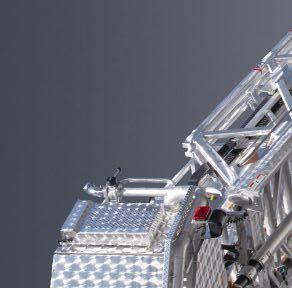
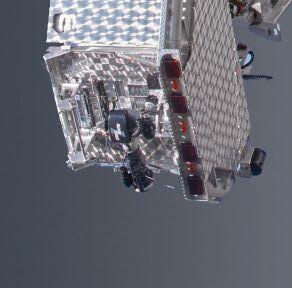
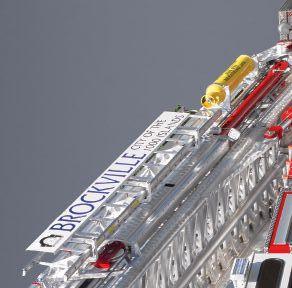
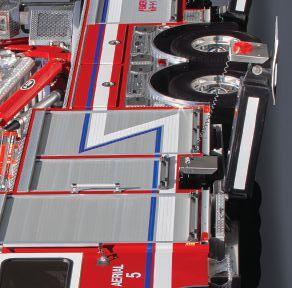
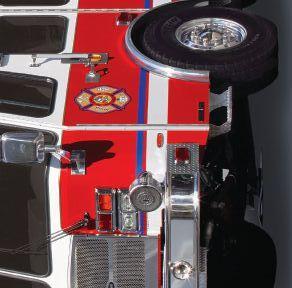
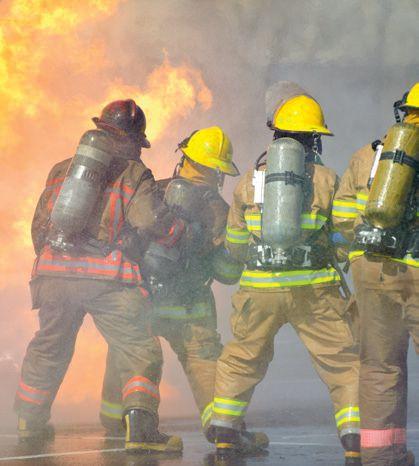
INSTEAD OF BUILDING STANDARD AERIALS, WE BUILD REVOLUTIONARY ONES.
For more info, please visit: e-one-aerials.com/hp-100-platform-truck
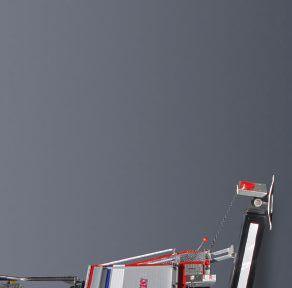
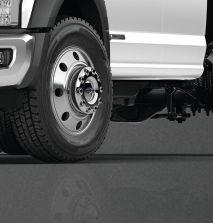
The E-ONE HP 100 Platform looks like a rock solid beast. And it acts like one too. This aerial, with a 2.5 to 1 structural safety factor is 25% stronger than NFPA requires. But this rig isn’t just a powerhouse, it’s also versatile. With crisscross under-slung outriggers that deploy to a tight 15’6” spread, the HP 100 Platform can go where other aerials can’t. Whatever the job calls for, the E-ONE HP 100 Platform is up to the task!
2.5 TO 1 STRUCTURAL SAFETY FACTOR
RESCUE STYLE COMPARTMENTS
CRISSCROSS UNDER-SLUNG OUTRIGGERS DEPLOY IN UNDER 45 SECONDS
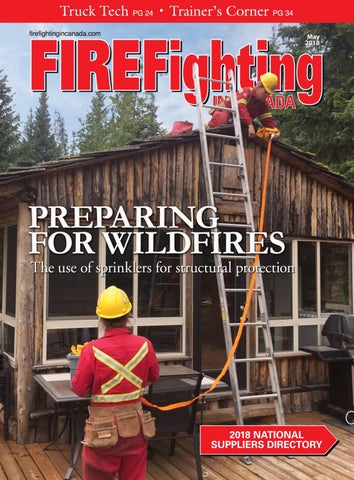
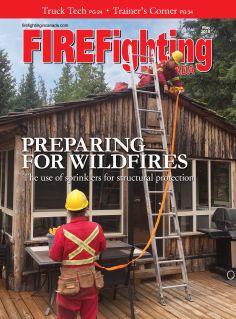
10 PREPARING FOR WILDFIRES
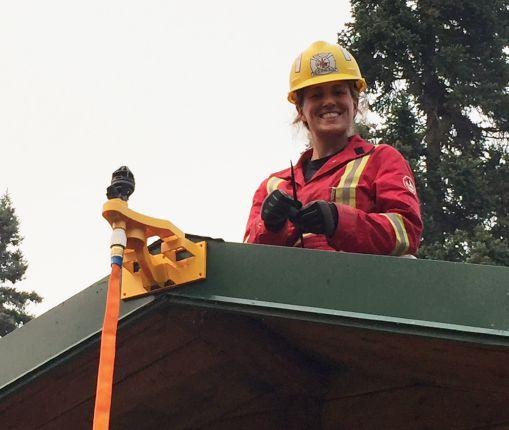
David Moseley, a forest officer with Alberta Agriculture and Forestry and lead training officer with Lac La Biche County Fire Rescue, shares how sprinklers can be of great benefit for structural protection in the face of wildfires.
20 THE FIREFIGHTERS’ PERSPECTIVE
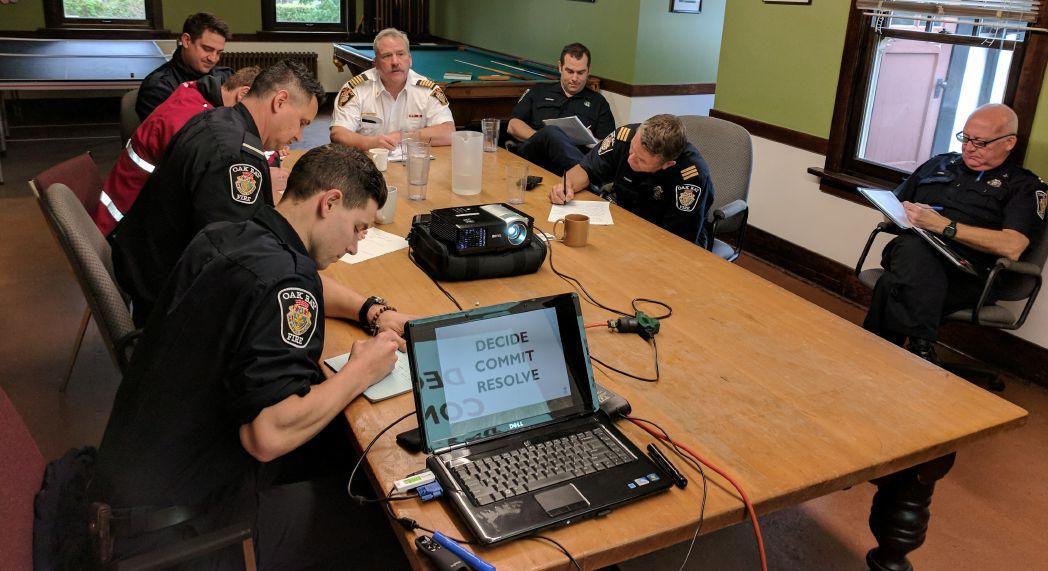
Sara Wegwitz has compiled the crew perspective on the Oak Bay Fire Department’s health and wellness program in the third installment of a five-part series.
50 SILO RESPONSE AND SAFETY
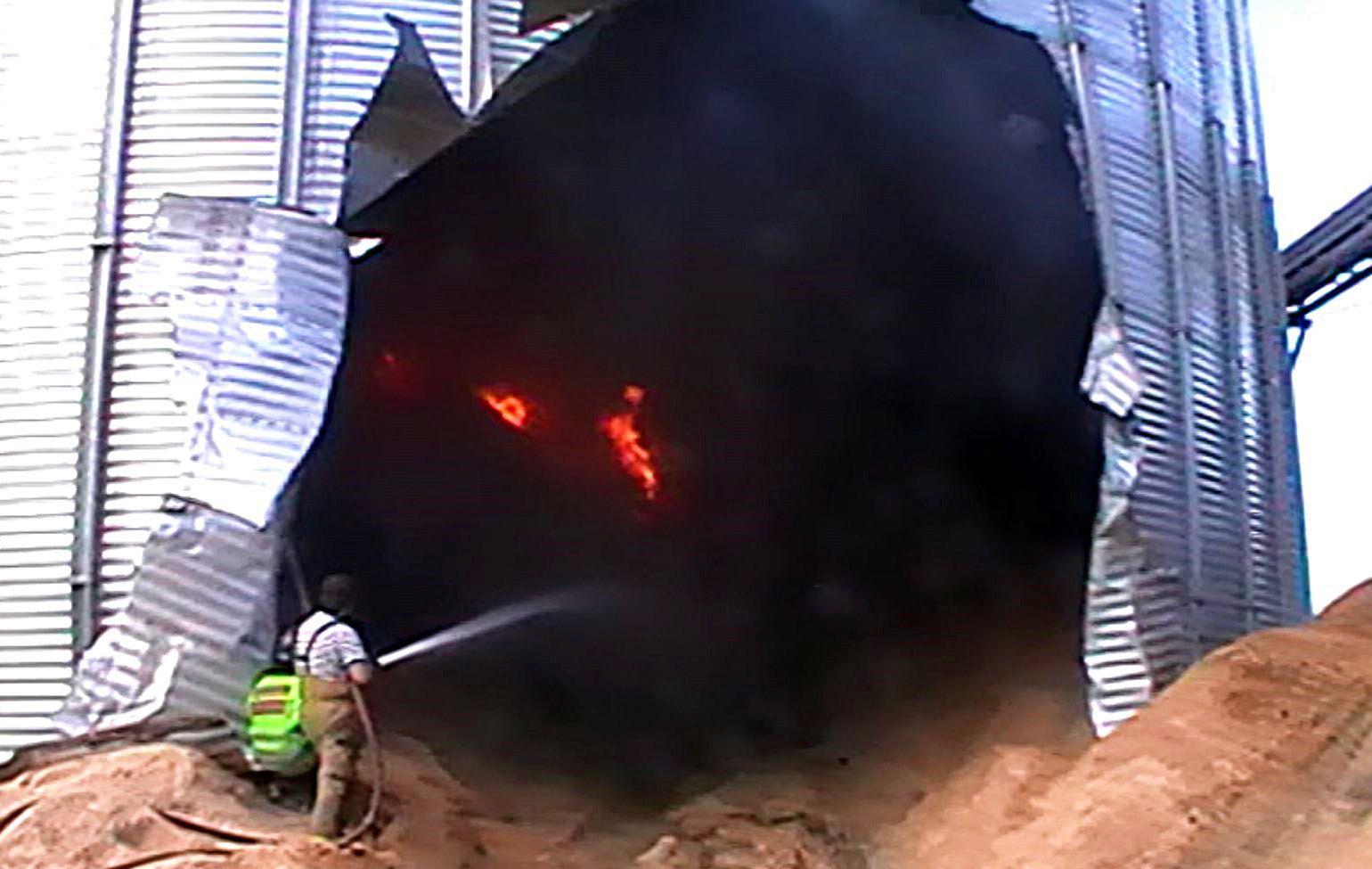
Frank Huess Hedlund and Jeffrey C. Nichols illustrate an international example as a cautionary tale of why carbon dioxide can be dangerous when used on smouldering silo fires.
56 NFPA 1620 IN THE MOBILE AGE
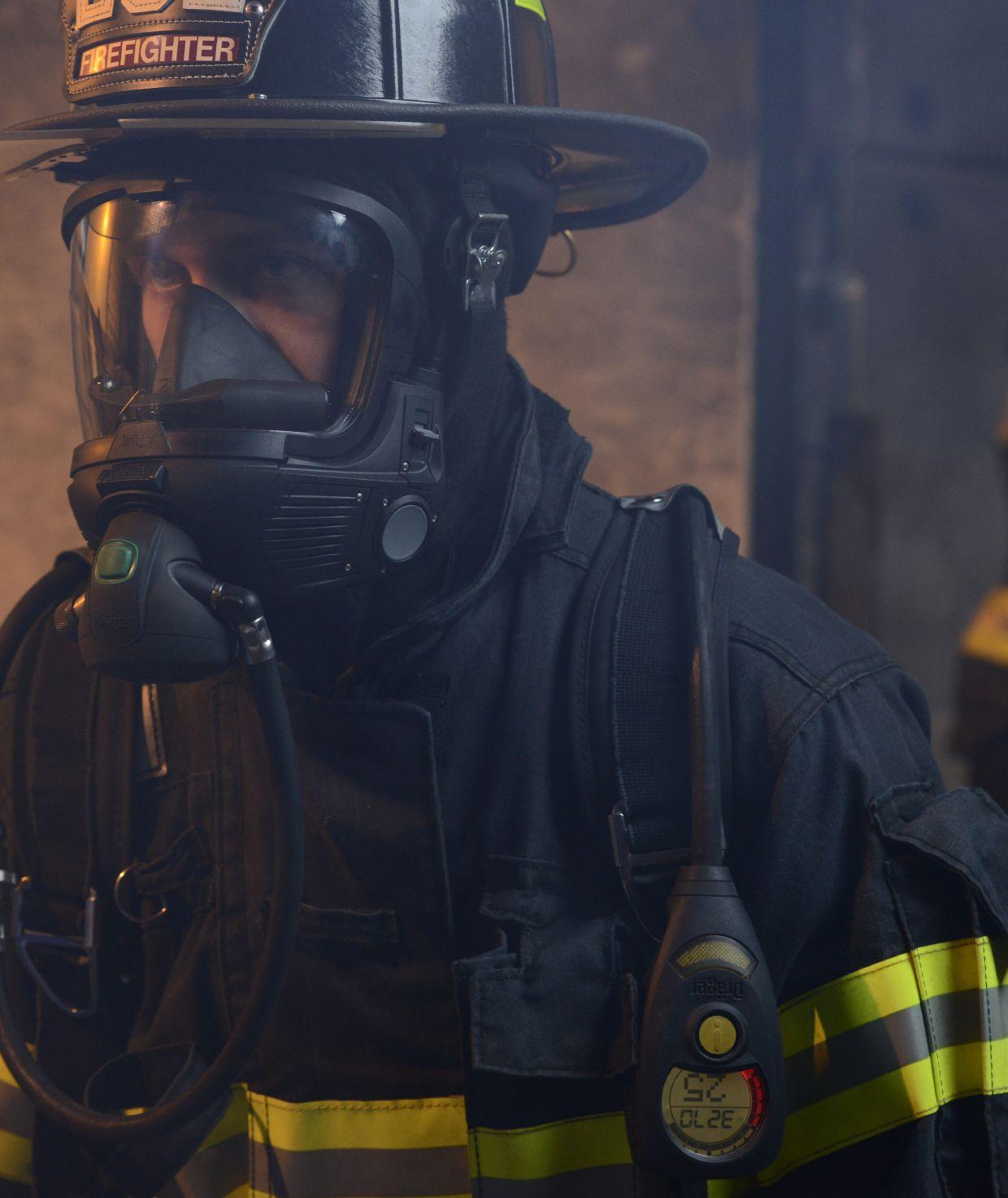
A University of Ottawa based research survey findings suggest the fire service perspective on how technology can assist in presenting building information. By Ala Abu Alkheir, Hussein T. Mouftah and Paul Martin.
BY LAURA AIKEN Editor laiken@annexbusinessmedia.com
A
COMMENT
Measuring risk
s first responders, the fire service has its lion’s share of stories. Emergencies are unique life events, and some of the stories I’ve heard thus far are quite humourous post-fact and in absence of significant injury — such as ones involving people found in compromising positions after a car crash. But others, like the three incidents Ed Brouwer shares in this edition’s Trainer’s Corner, resulted in significant loss of life and can’t invoke anything but sadness and anger.
I often marvel at the volume of stories embodied in each of us. Everybody has a unique story of life Everyone has a perspective and consciousness that only exists within them. Each is valued, and we all hope, that each is loved. When I read Brouwer’s article, my heart broke for the families of these valued lives lost. Each was irreplaceable in this world and left by force of nature rather than in nature’s due course. It is not just the life of the deceased whose future has been stolen, but those they were loved by whose lives and hearts will never be the same.
the events that led to the LODDs of 24 firefighters, lies the concept of measured risk and the question he poses: Firefighters endanger themselves beyond when emergency warrants it (to save a life). Is there something, such an inherent need for action, that prompts heedless risk?
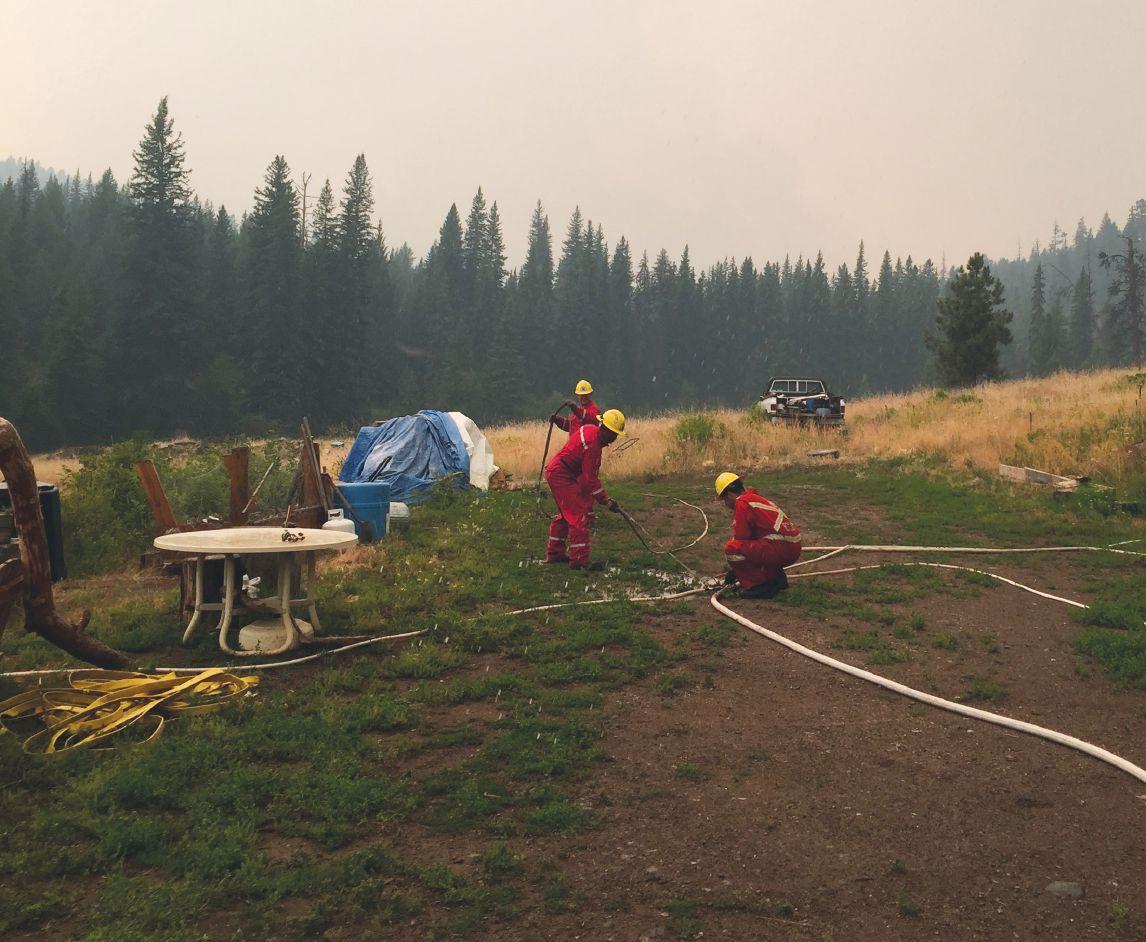
Lac La Biche County Fire Rescue crew set up sprinklers for structural protection in the face of the Elephant Hill fire at HiHium Lake near Clinton, B.C.
See story on page 10.
Brouwer has asked the tough question “why?” in the three cases he shares. Why is always a hard question — just sit with a three-year-old for a while and try to piloting through 50 different questions that all start with why. It’s pretty easy to start defaulting to “because.” As adults, “why” can become something we have to remind ourselves to ask, but it’s the question that might prevent a death down the line, making it worth every moment of reflection.
At the crux of Brouwer’s inquiry into
Risk measurement and assessment is often associated with mathematics, such as when weighing the odds of investing in one stock or another. In a life or death situation, or largescale emergency, the mental and instinctual functions for measuring risk are beyond the scope of what many in the public full appreciate. Mos measure risks in increments throughout the day as they battle traffic or cross a slippery surface. For most, real emergencies are few and far between rather than a common occurrence. But I imagine you know the adrenaline fuelled emergency risk response intimately, because you have felt it on on a call many a time before. In considering the firefighters who lost their lives in the large incidents highlighted by Brouwer, one will never know exactly what decision-making process in the advent of that fight or flight response happened to lead to such tragedy. It is only reflecting upon the “why” in the aftermath that can hopefully lead to preventing such loss in the future.
ESTABLISHED 1957 MAY 2018 VOL. 62 NO. 3
EDITOR LAURA AIKEN laiken@annexbusinessmedia.com 416-522-1595
Occasionally, Fire Fighting in Canada will mail information on behalf of industry-related groups whose products and services we believe may be of interest to you. If you prefer not to receive this information, please contact our circulation department in any of the four ways listed above.
All advertising is subject to the publisher’s approval. Such approval does not imply any endorsement of the products or services advertised. Publisher reserves the right to refuse advertising that does not meet the standards of the publication. www.firefightingincanada.com
STATIONtoSTATION
ACROSS CANADA: Regional news briefs
CRTC establishes emergency wireless alerts
Wireless service providers will conduct a nationwide public alerting test during Emergency Preparedness Week, which is from May 6 to 12.
Mandatory distribution of emergency alert messages on mobile devices in Canada started in April.
All wireless service providers must now distribute wireless public emergency alert messages on their LTE (longterm evolution) networks.
The Canadian Radio-television and Telecommunications Commission (CRTC) made
the announcement on April 6 and explained that wireless emergency alerts will inform Canadians about imminent dangers to life and property.
The alerts, which can be targeted to a specific area, will be sent to mobile devices connected to LTE networks, these networks are available to more than 98.5 per cent of Canadians. This will benefit the emergency alerts that Canadians
THE BRASS POLE
Promotions & appointments
KAPLANA
RAJGOPALAN is the new assistant chief of professional development and accreditation with Mississauga Fire and Emergency Services. Prior to Mississauga, Rajgopalan served as the manager of
academic standards and evaluation with the Office of the Fire Marshal and Emergency Management (OFMEM). She has worked for Emergency Management Ontario as a program manager for emergency management training and has led training and development programs at the private sector firms London Life Insurance and Transamerica Life.
already receive via their radios and televisions, while enhancing Canadians’ access to potentially life-saving information during an emergency.
“Nothing is more important than making sure Canadians are informed in a timely matter about an imminent danger such as a tornado, wildfire or Amber Alert when a child’s life is in grave danger,” said CRTC CEO and chairperson Ian Scott in a press statement.
“Mandatory distribution of public emergency alert messages on mobile devices will help do just that. Along with the wireless industry and our partners in federal, provincial and territorial governments, the CRTC has worked to provide Canadians with the emergency system they need to take appropriate safety measures if need be.”
Wireless service providers will conduct a nationwide public alerting test during Emergency Preparedness
Week, which is from May 6 to 12. This will be an opportunity for Canadians to become familiar with how public alert messages will be delivered to their mobile devices, including the tone and vibration cadence that will distinguish them from regular text messages.
Federal, provincial/territorial governments and emergency management officials issue emergency alert messages to warn the public of imminent threats such as fires, tornadoes, floods, water contamination and Amber Alerts.
Once alerts are distributed to mobile devices, Canadians will hear the same alert tone as they currently do while listening to the radio or watching television. Alerts on mobile devices will also trigger a unique vibration cadence, and will include the information Canadians needs for any action they should take.
To find out if a cellphone under a specific carrier
Coquitlam Fire Rescue has promoted JIM OGLOFF through the ranks to become the city’s new fire chief. Ogloff began his public service career in 1997 with Coquitlam’s planning department issuing building permits. He made the switch to become a firefighter two years later, moving up the ranks to become a captain, and the to assistant chief in 2005. Ogloff served as the
deputy chief of operations and support from 2011 until his most recent promotion.
SHELLEY MORRIS has been promoted to assistant fire chief of emergency planning and community management with the Surrey Fire Service in British Columbia. Morris first joined the
is capable of receiving emergency alerts, visit www.alertready.ca.
EMERGENCY PREPAREDNESS WEEK THIS MONTH
Emergency Preparedness Week (EP Week) takes place every year during the first full week of May and is geared towards helping Canadians prepare for just what it sounds like—an emergency.
This national event is co-ordinated by Public Safety Canada, in close collaboration
with the provinces and territories and various partners.
EP Week focuses on emergency strategies for unexpected emergencies such as tornadoes, hurricanes, earthquakes, severe storms and more. There are even guidelines aimed at Canadian farmers explaining the steps that should be taken to ensure farm animals, livestock, and poultry are protected during an emergency.
Being prepared for an emergency is so much more than simply knowing what to
do if or when an earthquake strikes. It is also about how individuals with disabilities or special needs should be cared for; preparing your home; car, vehicle, boat, pets and more.
The Emergency Preparedness Guide focuses on three key steps.
Step one: Know the risks
Step two: Make a plan
Step three: Get an emergency kit
The guide, which can be found at www.getprepared. gc.ca, suggests individuals and families prepare themselves for
being able stay safe, warm, fed and hydrated for a minimum of 72 hours.
EP Week is designed to make it quick and easy for people to become better prepared to face a range of emergencies anytime, anywhere. The guide helps the public create an emergency plan and use the checklists to build a 72-hour emergency kit. These basic steps will help ensure communities are prepared to care for themselves and their loved ones during an emergency.
Firefighters top list of most respected jobs in Canada
A vast majority of Canadians respect firefighters and the job they do in the community, indicates a new study.
Ninety-two per cent of Canadians have a positive opinion of firefighters, Vancouver-based market research company Insights West found in a March survey.
This makes firefighters the most well-respected professionals in the country, with nurses not far behind at 91 per cent. Politicians sit at the bottom of the list, as only 22 per cent of Canadians have a positive opinion of their occupation.
Sixty per cent of Canadians who responded to the survey have a “very positive” opinion of firefighters, while 32 per cent have a “somewhat positive” opinion.
Only 5 per cent of respondents hold “somewhat negative” views of the profession. Three per cent answered “not sure.”
Added up, this was the most overwhelmingly positive public response to any of the professions listed in the survey.
Insights West’s data is based on a small sample of 1,012 Canadians that responded to an online study in early March.
Firefighters have the most respected job in Canada, according
from Insights West.
department in 1997 as firefighter, working her way up through the ranks over two decades to achieve her current position. Morris is the third female career firefighter to ever be hired by the department, reported surreyhistory.ca.
The Surrey Fire Service promoted JASON CAIRNEY to the role of assistant chief of fire prevention. He joined the department
as a firefighter in 2002. Cairney also has experience as a teacher, instructing at the College of the Rockies and the Justice Institute of British Columbia at various points throughout his fire service career.
BEN DIRKSEN has risen up the ranks to become one of the three new assistant fire
chiefs in Surrey, B.C. Ben joined the Surrey Fire Service in 1996, serving with the department for over two decades. In his new role, Dirksen is responsible for Surrey’s training division.
Retirements
Campbell River, B.C., fire chief IAN BAIKIE is set to retire in June. Baikie initially began his fire service career in 1985 as a
volunteer firefighter in Campbell River, becoming a full-time firefighter in 1989. He was promoted to assistant fire chief in 1997, rising up the ranks once again to become deputy chief in 2006. Since 2012 Baikie served as the town’s fire chief. Deputy Chief Thomas Doherty will succeed Baikie following his retirement next month.
to new data
STATIONtoSTATION
BRIGADE NEWS: From departments across Canada
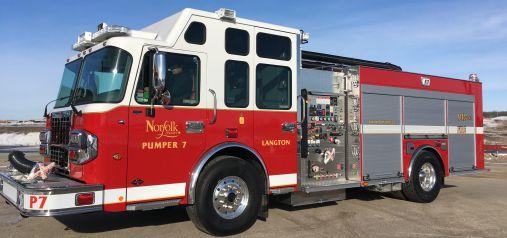
The fire department in Norfolk County, Ont., took delivery of a new pumper from Fort Garry Fire Trucks in February. The white and red truck is built on a Spartan Metro Star four-door chassis, with an emergency rescue body, 380-hp Cummins L9 engine, Allison 3000 EVS transmission, side control pump panels, a Hale APS 500PTO pump, 800 imperial gallon co-poly tank and Foam Fro 2002 Class A system.
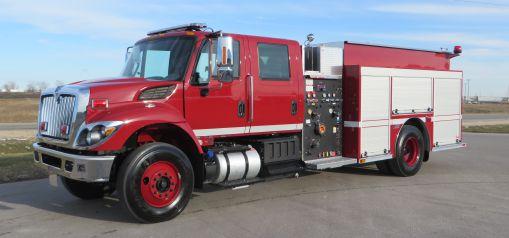
The fire department on the Tallcree First Nation near Fort Vermillion, Alta., took delivery of a Fort Garry-built pumper in February. The rig is built on an International 7400 chassis, with crusader body type, a 300-hp Cummins engine, Allison 3000 EVS transmission, side-control pump panels, a Hale DSD 1250 pump, an 800 imperial gallon co-poly tank, and a Foam Pro 1600 system.
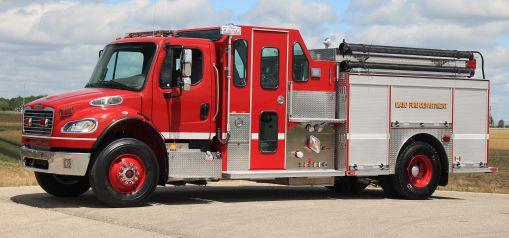
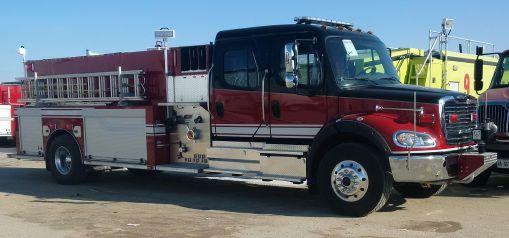
The fire department in Mayo, Yukon took delivery of a new Fort Garry-built pumper in 2016. The truck is built on a Freightliner M2 chassis with a MXV 3-Man Crown body and runs on a 350-hp Cummins ISC engine and an Allison 3000 EVS transmission. The rig has TME Control pump panels that power a Darley LDM 1250 pump. It has a co-poly 1000 imperial gallon tank and includes special features such as Bostrom Secure-all SCBA brackets.
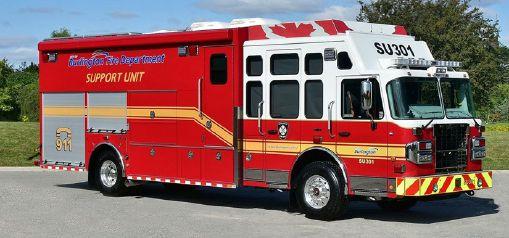
The Burlington Fire Department recently received a new SVI mobile command support unit from Safetek. The vehicle is built on a Spartan Metro Star chassis and is powered by a Cummins ISL 450-hp engine and Allison 3000 EVS transmission. The truck features in-cab command and rear command with slide out, AMX System, weather station, TelFlex Communications, 65-inch Smartboard, and a command light tower and generator.
Fort Garry Fire Trucks recently delivered a mobile water supply apparatus to the Whitehorse Fire Department. Unit feature a Freightliner M2 112 four-door chassis, Crusader Tanker body, 450-hp Cummins ISL9 engine, Allison 3000 EVS transmission, side control pump panels with a roll-up door, Waterous CXPA1500 PTO pump and a 1, 500 imperial gallon tank.
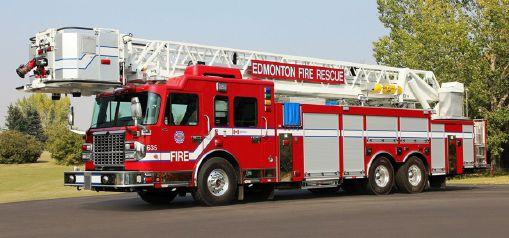
Edmonton Fire Rescue recently took delivery of a new Smeal 100 foot rear mount platform from Safetek. The rig is built on a Spartan Gladiator chassis, with a 600-hp Cummins ISX 15 engine and Allison 4000 EVS transmission with retarder. The unit features a Hale Qmax 2,250 GPM pump, carries 300 imperial gallons of water on board and features a FoamPro 2002 system, dual class A & B foam tanks, and dual flush and refill systems.
TALLCREE FIRST NATION
NORFOLK COUNTY FIRE DEPARTMENT
MAYO FIRE DEPARTMENT
BURLINGTON FIRE DEPARTMENT
WHITEHORSE FIRE DEPARTMENT
EDMONTON FIRE RESCUE
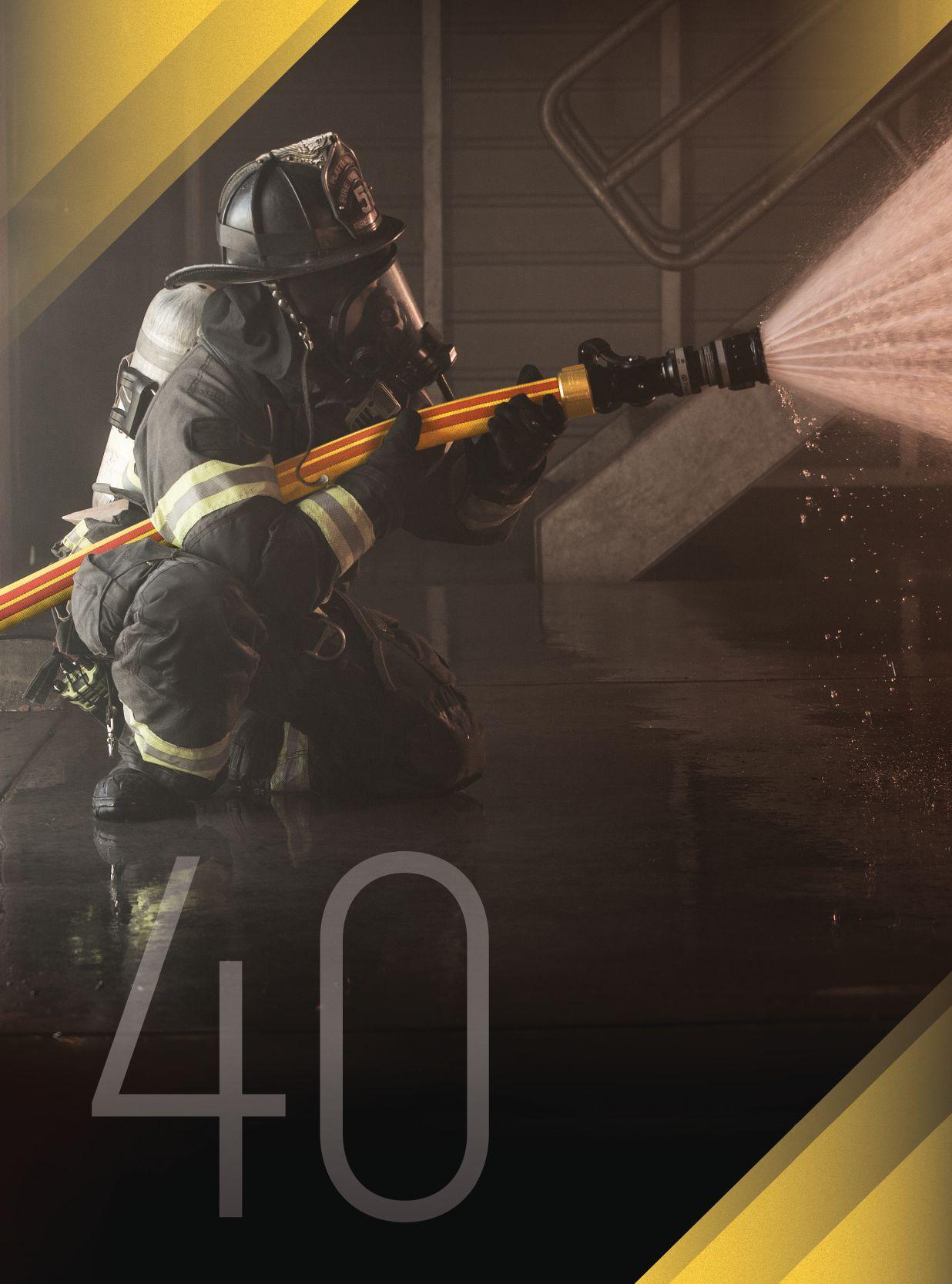
40 YEARS STRONG.
As we move forward with a 40 year legacy, we do so with one continued unrelenting goal – to keep people safe. There is no other profession that expects a higher standard for themselves or the equipment that supports them in saving lives. We are committed like never before to work with, support and innovate for these unique individuals. Yes we create fire hose but we also create trust. We are innovators. We are trailblazers. We are 40 years strong.
Preparing for wildfires
Sprinklers are very useful for structural protection during a wildfire. Here’s how a relatively small investment in training can produce big dividends.
By DAVID MOSELEY
The use of sprinklers for structural protection from wildfires was heavily employed in British Columbia during the summer of 2017. Crews from Lac La Biche County in northern Alberta spent six weeks there doing structural protection, which involved largely setting up sprinklers. In talking to members on their return, they understood that they made a difference; they saved people’s homes. This article will look at the basics of sprinkler use as taught to these crews before their deployment.
First off, crews should have a basic understanding of wildfire behaviour and safety, fire pumps, and structural protection strategies for the wildland urban interface. Courses such as NFPA 1051 and S215 Strategy and Tactics for the Wildland Urban Interface can provide this knowledge. While we will focus on sprinkler tactics, they must be deployed appropriately and strategically.
LEFT Lac La Biche County Fire Rescue crew, setting up 16mm lines with sprinklers off of 38mm feeder line north of Clinton, B.C. in the Bonaparte River Valley.
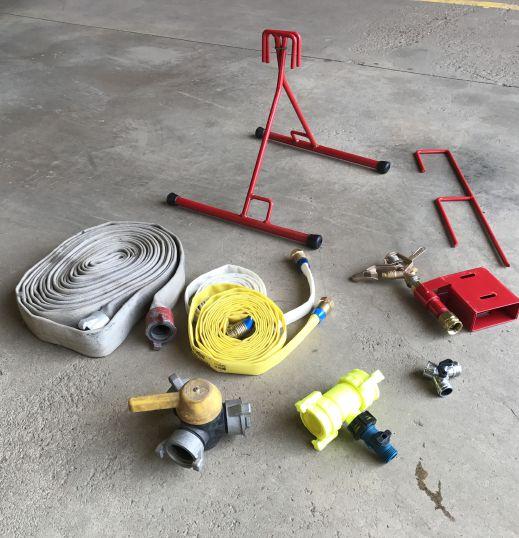
ABOVE Sprinkler kit components, clockwise from top: scissor-type roof mount, ground mount, Rainbird sprinkler on 2x4 mount, 16mm gated wye, 38mm to 16mm water thief, 38mm gated wye and 38mm and 16mm hose.
Inside a building, sprinklers are designed to control incipient fires. In the wildland urban interface, sprinklers are used to wet down fuels before the fire arrives, preventing ignition. The sprinklers may continue to operate as the fire passes, potentially extinguishing small fires, but wetting down is their primary function. They either apply water directly on and around structures or are set up to create a wet line firebreak between structures and approaching fire. Once set up, they can be left unmanned, freeing up resources while enhancing firefighter safety.
Rotating impact sprinklers are commonly used for wildland fires. Our department uses the Rain Bird model, which is often used in parks and agriculture.
They flow about 48 litres per minute in a 15-metre radius. As a general rule, a Mark III (standard forestry portable pump) should be able to effectively feed six to eight Rain Bird sprinklers. However, the more sprinklers you have, the less flow and pressure per sprinkler head. The number of sprinklers per structure vary between about two and 15, depending on the size and scale of the structure. For a typical single-family home, two Rain Birds, located at opposite ends or corners of the house, will often be sufficient. If your crew is using sprinklers with a lower flow, this will require more sprinklers. This may take more set up time, but this can also provide more coverage options.
In addition to sprinklers you will need a 38 mm forestry hose with quick connect couplings, a 16 mm hose (5/8 inch, garden hose fittings), 38 mm to 16 mm water thief couplings, and both 38 mm and 16 mm gated wyes. Double headed nails, wire, electrical or duct tape, and zip-ties are also useful when mounting sprinklers. Sprinkler kits can be assembled or purchased, with many designed to match the typical output of a Mark III pump and fit in a standard tote tub.
The 16 mm hose has tremendous friction loss so you want to minimize the length used and connect your hose lay in a closed loop (think of circulating as opposed to dead end hydrants). Sticking the sprinkler in the ground is easy and can be effective, but for flammable roofing material — and to get better reach — an elevated sprinkler is often preferred. Using nails on houses can be damaging, so crews will often attach the sprinkler to a two-by-four or a small wood pole with tape or wire. The kits we use each have a scissor-like sprinkler mount, which simply sits on top of a peaked roof. Others are designed to clamp on to the eavestrough.
Once the sprinklers are in place, crews should turn on the water to test the layout. Consider the potential damage the spray could do to the structure. Avoid any cracks or openings, electrical components, or easily damaged surfaces. After testing, your crew may continue flowing water, or shut down and start up again later when required.
Wet line construction can be
accomplished by attaching sprinklers directly to the 16 mm water thief outlet at each coupling. To get adequate coverage, the line might need to be doubled back on itself and require more than one pump. Remember that wind, obstacles, and varying pump pressure will affect the 15-metre sprinkler radius.
’’
a blast of pressure through the hose to dislodge the debris. If that doesn’t work you’ll need to shut that sprinkler off and clean it out.
Another common sprinkler problem is variable pressure, which can result in a poor stream. To fix this issue crews should
Consider the potential damage the spray could do to the structure. Avoid any cracks or openings, electrical components, or easily damaged surfaces.
Different water sources can be used but it’s hard to beat a portable pump hooked up to a natural water source such as a lake or stream. However, using a natural water source can lead to debris in the water, which may block the small sprinkler opening. Crews can remedy this by kinking the hose then releasing to send
adjust either the water pressure or number of sprinklers. If the sprinklers are used for an extended duration this may also cause parts to loosen and malfunction. Monitor then sprinklers and tighten things up if necessary. Alternatively, crews could use a more robust agricultural-type sprinkler, as opposed to lighter homeowner models, to reduce this problem.
Firefighters learn best by doing, so they should practice sprinkler skills. Training officers should have members sprinkler a building, or better yet, a group of buildings. Firefighters are creative and adaptable; given this foundation of basic knowledge, Lac La Biche County crews built on it and performed well during last year’s wildfire season in British Columbia. If your jurisdiction includes the potential threat of wildfires and you’re not already training with sprinklers, your department should consider basic sprinkler training. You may be pleasantly surprised, as we were, to find that a relatively small investment in training could reward crews (and the affected public) with such big dividends.
David Moseley is a forest officer with Alberta Agriculture and Forestry, and lead training officer with Lac La Biche County Fire Rescue in Alberta, focused on operations; other areas of interest include instructing, CISM, and wildfire investigation. Contact him at david.moseley@gov.ab.ca.
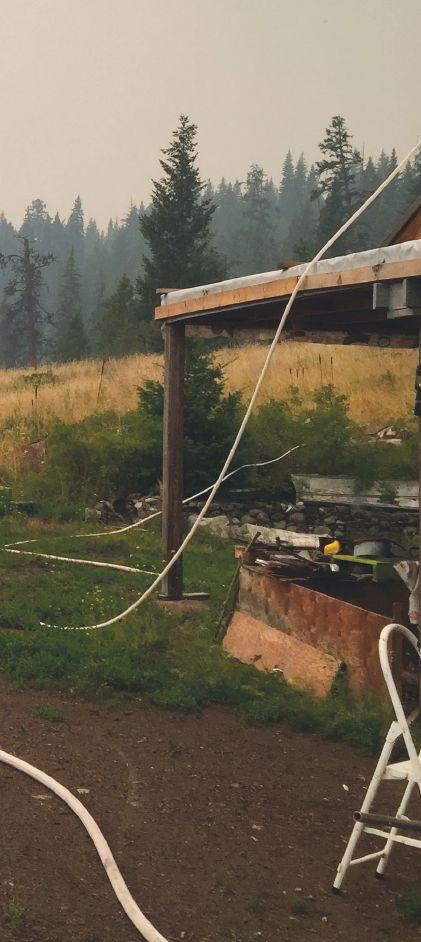
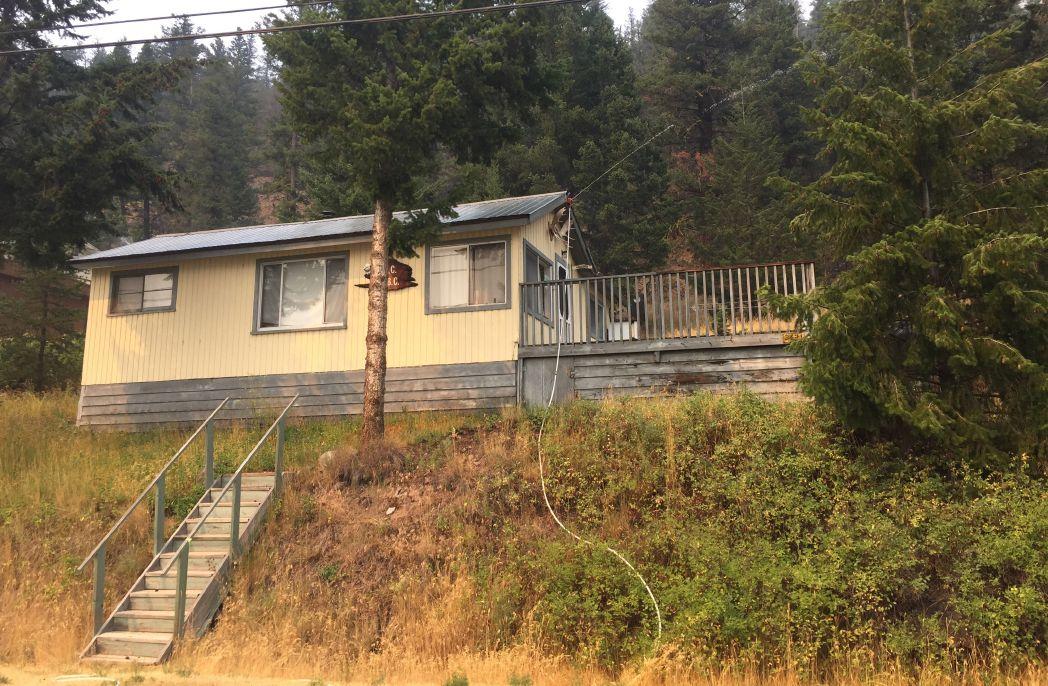
A structure with a sprinkler set up by Lac La Biche County Fire Rescue, B.C., in summer 2017.
BACKtoBASICS
The backup position
BY MARK VAN DER FEYST
Continuing our look back over the last 10 years of Back to Basics in Fire Fighting in Canada, I’d like to highlight this article, which focuses on the backup person position on the handline. This position used to be simply ignored outside of basic training. Instructors like Aaron Fields, Dave McGrail and many others from across America started to bring the focus back to this important role. This article was first published on September 2008.
THE BACK UP POSITION: SEPTEMBER 2008
In the March edition, we discussed the proper techniques for effective nozzle management. In that article, I mentioned that we would look at the job of the backup firefighter in more detail. This person is the workhorse of the team. Without this person, advancing a hoseline becomes much more difficult and time-consuming. Whether you are advancing a hoseline with two people or with three people, the backup firefighter will still perform the same amount of work.
In the full-time departments with fully staffed trucks, there might be three to four people advancing a hoseline. In the smaller departments, there will likely be a two-person team advancing a hoseline into the structure. Firefighters need to practice the basics of the backup position to master the skill of this important job. With the number of fires decreasing, opportunities for practicing this position are rare except in training situations. You can practice this position anywhere there is access to a hoseline, an engine to pump, and an open area to practice the backup firefighter job. Add in a few stairs, a standpipe, or a few corners and you have an excellent training session.
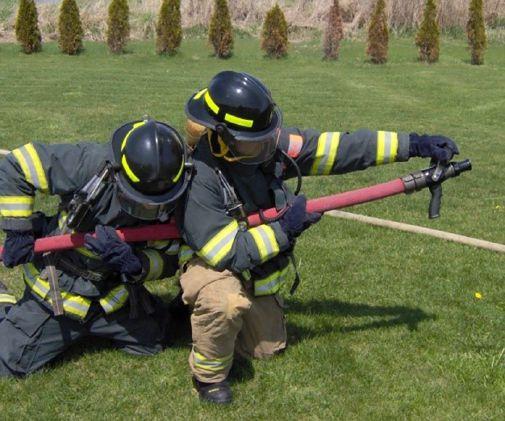
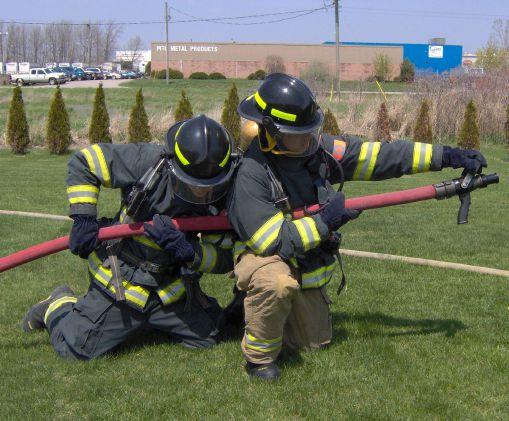
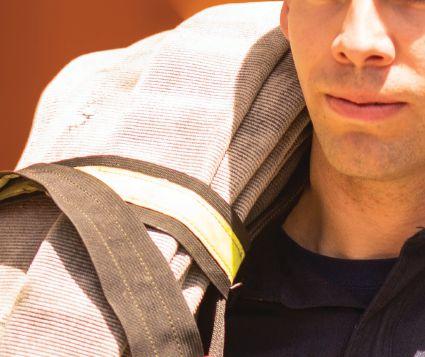
As mentioned before, this person has a very important job to do. They are the sole support of the nozzle firefighter. Their job is to take away the nozzle reaction away from the nozzle firefighter by supporting them with their full body weight. As depicted in Photo 1, the backup person is right behind the nozzle firefighter. Look at how he has his upper body buried right below his colleague’s shoulder. His whole body is supporting the nozzle firefighter, thus taking away the nozzle reaction and stopping his partner from moving back from the nozzle reaction. The only objective that the nozzle firefighter has to worry about now is controlling the nozzle and suppressing the fire.
The backup should have both hands on the hose, not just one. Many times, we find ourselves with only one hand on the hose and our other hand on the back of the person in front of us. Why do we do this? Because this is what we were taught in basic training. We were taught to have our one hand on the hose and the other hand
Photo 1: His whole body is supporting the nozzle firefighter, thus taking away the nozzle reaction and stopping his partner from moving back from the nozzle reaction.
PHOTOS BY MARK VAN
DER FEYST
Photo 2: Make sure you place both hands on the hose to support the nozzle.
When you and your equipment are at their best, there are no doubts when the call comes. Maximum condence is the all-new Super Duty® Chassis Cab. The military-grade aluminum alloy^ body let engineers upgrade the frame, driveline, suspension and brakes. Ford Commercial Vehicle specialists have the uptting and modifying expertise to make sure your Super Duty® is ready for duty. We’ll stop at nothing to make equipping your team easier. FORD.CA/BUILTFORBUSINESS
on the back shoulder of the firefighter in front of us to ensure proper spacing between the nozzle firefighter and the backup.
Firefighters were also taught to place one foot behind the nozzle firefighter’s foot to provide support. That works well if you are standing up and posing for a picture, but when a team is pumping 130 to 150 psi (900 to 1000 kpa), the backup needs to have both hands on the hose to give full support to the nozzle man. Without both hands on the hose, we are not taking away the nozzle reaction and not backing up the nozzle person effectively. Most times firefighters are kneeling on the ground when advancing a hoseline for interior attack, so putting one foot behind the nozzle person’s foot does not work; we need to use our whole body.
Members also wear bulky structural fire fighting gloves. The gloves can hinder our ability to hold the hose effectively and provide support, taking away some dexterity. Oftentimes gloves are too bulky, too big, not sized properly, too wet or too stiff (if they are dry). In some ways, our gloves work against us. They provide us with thermal protection, abrasion protection and weather protection, but at the same time they don’t always allow firefighters to use their hands to their full capacity. If you have small hands to begin with, this will be your No. 1 enemy, making your job even tougher. So, make sure you place both hands on the hose to support the nozzle like the firefighter in Photo 2.
The stance that the backup person takes is important as well. Look at Photo 3 – notice how the backup person is kneeling. He has both of his knees firmly on the ground, which will allow him to support the nozzle firefighter as well as himself. He is rooted like a tree, which gives him more stability and more endurance to support the nozzle person.
By keeping both knees on the ground, firefighters are giving themselves more stability and gaining a better advantage for hose advancement. In a previous article, I discussed the back-to-back position. This position also has great advantages for the backup person. The whole lower body is on the ground with the back-toback position, giving firefighters great stability. From the kneeling position, we are able to drive the hoseline as we advance it. We will discuss this later.
The backup firefighter can also act as the eyes behind the nozzle firefighter. He or she will be able to see what is going around them as well as behind them. The nozzle firefighter will be busy finding the seat of the fire and applying water to it. Sometimes members can get tunnel vision, ignoring the surroundings to focus on one task: the fire. The backup firefighter should be checking the environment around them at all times as a precaution.
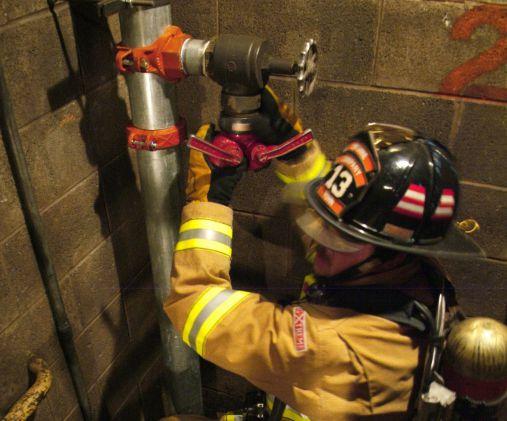
The backup firefighter is also the communicator of the two-person team. They will be the one communicating with members inside the structure if more or less hose is needed, or if the other members need more help. They will also be the one doing most of the work on the hose line. When more hose is needed, the backup firefighter will be the one responsible to feed it; the opposite is true as they retreat from the structure. When crews need to hook up to a standpipe system (Photo 4), the backup firefighter is responsible for establishing the hook up and ensuring that all the kinks are out of the hoseline as it being advanced into position. They will also turn on the water supply.
In the fifth edition of the IFSTA Essentials of Fire Fighting, offers some other techniques that replace the use of the backup firefighter. On page 652, hose straps are used, which are designed to aid the nozzle firefighter’s control of the hoseline and the nozzle on their own. This method of hoseline control may seem innovative, but does it really work? The hose strap will take away the nozzle reaction, but it does not allow the nozzle firefighter to have full control of the nozzle.
As discussed in the previous article, the nozzle firefighter’s main objective is to control the nozzle. This can only be done with the help of a backup person. For defensive operations, one person can operate a hoseline, but not with a hose strap. The member is better off looping the hoseline under itself and sitting on it, this way they will be able to control the nozzle without fighting against the nozzle reaction.
Mark van der Feyst has been a member of the fire service since 1999 and is a full-time firefighter in Ontario. Mark teaches in Canada, United States and India, and is a FDIC Instructor. He is the lead author of the Residential Fire Rescue book. Email Mark at Mark@FireStarTraining.com.
Photo 3: This backup firefighter has both of his knees firmly on the ground, which will allow him to support the nozzle firefighter as well as himself.
Photo 4: When crews need to hook up to a standpipe system, the backup firefighter is responsible for establishing the hook up and ensuring that all the kinks are out of the hoseline.
The firefighters’ PERSPECTIVE
How the Oak Bay
Fire Department’s health and wellness program is impacting its members.
Compiled by SARA WEGWITZ
Editor’s Note: This feature is the third installment in a fivepart series exploring Oak Bay Fire Department’s holistic health and wellness program.
The success of any health and wellness program is best demonstrated by the results achieved by the participants. In the case of the Oak Bay Fire Department in British Columbia, we thought it would be invaluable to share our members’ perspectives on how the health and wellness program has been impacting them directly. We recently invited crews to share their thoughts on the following questions.
■ WHAT HAVE BEEN THE PROGRAM BENEFITS?
(A Shift): “The program has provided a boost in comradery and has allowed team members to provide support and motivation to help fellow employees achieve their goals. There has been a noticeable shift in people’s physical and mental wellbeing.
(B Shift): “The health and wellness program has caused everyone to realize that their health is important and that they have the power to affect a change in their lifestyle. Members have changed the types of groceries they buy for the crew and the quantity they eat. One of the main successes has been the regular crew exercise periods and the crew bonding.”
(C Shift): “The biggest benefits that we have seen include improvements to eating and diet, crew cohesion, gaining mental health strategies, mental health being brought to the forefront, physical fitness time being scheduled and weight loss. Some of our successes and wins include more openness and mental and physical benefits for members. Additionally, members that were not physically and or mentally taking care of themselves have benefitted from the department wide approach as they are encouraged by others to improve.”
(D Shift): “The benefits that we have observed include increased team morale, mental health awareness as well as dietary knowledge. Our meals are smaller in size, contain more vegetables and less sugar and carbohydrates. The wins include a willingness to share more of our mental state with each other on a day to day basis which benefits us greatly when we are faced with a call that might result in a CISM debriefing. During these difficult times our crew is already comfortable sharing our thoughts and feelings which hopefully helps us ward off further mental health challenges.”
■
WHAT ARE SOME OF THE CHALLENGES?
(A Shift): “Time management has been a major setback within our program. On an individual basis, a lack of commitment or physical limitations has withdrawn some from making it a daily routine and with the addition of trying to balance the program in between calls, training and other daily routines, it can become less of a priority then it ought to be.”
(B Shift): “It has been a challenge to get the entire crew together to perform health and wellness activities together. The crew has worked hard to ensure the exercise periods have occurred regularly even if the one member is too busy to participate.”
(C Shift): “Some the challenges that we have encountered relate to scheduling, full buy in, and competing priorities at times. Some of the action steps that we have taken to address these challenges have included reminders, encouragement, and flexible scheduling.”
(D Shift): “A few of the challenges we have faced are ensuring the participation of everyone, allotting the time and making the program a priority.”
■ HOW HAS YOUR CREW/DEPARTMENT/ FAMILIES BEEN IMPACTED BY THE PROGRAM?
(B Shift): “Members of the crew have changed the way they think about food and the types of exercises that are best for them. Some of our family members attended a department wide educational session on mental health with a registered psychologist.”
(C Shift): “We have noticed weight loss. As a department, we are more cohesive, have dramatically better eating habits, and there is a healthy level of competition between crews. Our families have been included in education on the mental and physical challenges that firefighters experience. They have benefitted by having a healthier and happier spouse/partner. We have helped to bring a healthier lifestyle home by modelling this behaviour for our families.”
(D Shift): “Our crew has found that the skills and knowledge we have learned here at the fire hall has impacted our personal lives in a
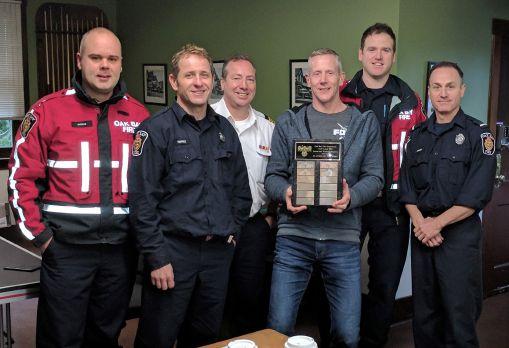
Meet D Shift, the Oak Bay department’s 2017 Health Platoon Award winners.
where it becomes a daily routine.”
positive way. Our families are eating healthier, we are more mindful of other people, and have gained skills to deal with daily stressors. The crew has found the chaplaincy a tremendous resource. Chaplain Gill is a trusted friend and is another avenue for all of us to utilize.”
■ WHAT HAVE BEEN YOUR HIGHLIGHTS?
(A Shift): “Highlights have included the variety of seminars such as personal trainers, nutritionists, and various medical professionals that have provided insight on topics from stress reduction to firefighter specific functional fitness. The continuing fitness testing and annual health risk assessment has provided us with a progress report to how we are developing and has given us a foundation to work from.”
(C Shift): “Winning crew challenges and participating in the cross-platoon challenges.”
(D Shift): “We have appreciated the mental health information sessions hosted by our registered nurse Sara or her guests. The nutritional information delivered by experts has been invaluable. All these educational sessions are an opportunity for each member to have a personal or one on one trainer with a professional in the health industry. Our crew takes pride in being the “Healthiest Platoon of the Year” champions in two of the last four years. We enjoy the social aspect of the cross-platoon challenges that get us outside on our days off and very much enjoy going for a beer afterwards. We feel this social bonding is an important part of why we are such a tight group and has created a very trusting environment.”
■ WHAT ADVICE WOULD YOU GIVE ANOTHER DEPARTMENT CONSIDERING A HEALTH AND WELLNESS
WFI PROGRAM?
(A Shift): “Have an outside consultant develop the program from models that currently exist to ensure that there is focus and direction from the initial conception. It should be accommodating to all members of the department and their abilities so that it can be easily followed and will continue to apply the program to the point
(B Shift): “Make sure that you have complete participation from all the crews and assistant chiefs. Ensure that the daily schedule will be able to permit for health and wellness training periods.”
(C Shift): “You definitely need an outside consultant to get the program going and to keep it on track. It is also important to develop buy-in through a collaborative process from all levels of the department.”
(D Shift): “The only way this program works is to have buy in from all involved, including management. Another department will have to realize that any WFI program requires a budget, and everyone must be flexible and adaptable with the daily routine and schedule. Once the managers make this program a set part of each shift, the firefighters will all see the benefits of participating.”
■ WHAT MAKES
INVESTING IN A HEALTH AND WELLNESS PROGRAM WORTH IT?
(B Shift): “The investments being made in long term health and reducing health problems of members will benefit a fire department in the long run.”
(C Shift): “Investing in a health and wellness program will help team members to gain self-awareness which allows for setting goals and aspirations, enables the group to assist members who require assistance, and will help to establish an openness and willingness to request or accept this assistance.”
(D Shift): “If done consistently all will see strength and endurance gains, an increase in mental health awareness, and will gain valuable knowledge pertaining to what foods we should be putting in our bodies. All of these aspects theoretically should keep us healthier, not only reducing sick plan usage but enabling all members to have the ability to live a longer more active life.”
Sara Wegwitz is a registered nurse who specializes in mental fitness and resilience training. She is the primary facilitator of the Oak Bay Fire Department’s wellness program. Contact her at sara@tailormakinghealth.ca.
B Shift participates in a team building training session.
PHOTO CREDIT: SARA WEGWITZ
TRUCKTECH Operation air brakes
By CHRIS DENNIS
There is a part of every vehicle we depend on the most, but it’s one that we take for granted. We start a vehicle — be it our everyday driver or a multimillion dollar fire truck — put it in gear and just expect that when we push the brake pedal with our foot that the vehicle is going to come to a full stop. Let’s put this in perspective in the fire station. The rigs sit at the ready backed into the station. The alarm sounds. The crews move to the trucks and proceed to the emergency. It’s at this point that everyone in that truck is focused on game day and what they have been trained to do. The accelerator pedal is pushed to the floor. Lights, siren and airhorns are all in check. Seat belts are on and firefighters are ready. At the first intersection, the light turns red upon approach and the intersection is busy. The accelerator pedal is released and the brake pedal is applied. It’s at this time we assume that all the functions of the brake pedal are working and that this 40,000 lbs plus piece of rolling thunder is going to stop. Thankfully, a good job on the truck checks was performed. The truck stops without concern. The crews carry on, perform the job at hand and return to the station. The apparatus is parked back in the station. All equipment used is taken off the truck, checked, cleaned or replenished and deemed sound for the next time. Post trip circle check of the rig is done. Appropriate inspection forms are filled out and submitted to the captain for truck records as all good for the next call.
All sound good? Here is my concern. Every woman or man who has a valid operator’s licence to operate and drive a fire truck with air brakes in Canada must be able to do a brake checks in accordance with the Ministry of Transportation (MTO). This means that brakes need to be re-checked during regular station routine truck checks and post trip truck checks as per the standard in your province for a Z air brake endorsement. This procedure should be part of your post truck equipment and truck circle check. How will you know if something has failed unless you take the time to actually look, mark and measure the brake stroke and observe the brakes functioning unless you get under the truck to check. However, the standard can be met with resistance.
The first push back is, “I am not a licensed mechanic so I don’t know what I am looking at or for.” The second push back is, “the truck is too low to get right under it to inspect the brakes.” Remember, as a qualified driver engineer, the firefighter must be able to perform these checks no matter what. If they hold a valid air brake endorsement they must be able to back it up. By simply by holding an air brake certification alongside the driver’s license accreditation, the driver must be able to mark and measure, perform behind the steering wheel air tests, listen for audible air leaks and know the names of all the air brake parts associated with the Z air brake endorsement they hold. I realize the driver already has a lot on his or her plate as a firefighter. They have been selected to perform this dubious task as either a duty or job function when
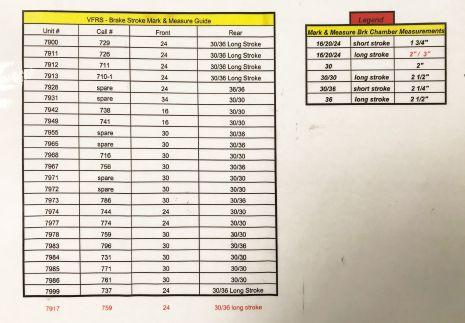
Have a form made up and laminated referencing the brake chamber size, as well as long stroke or short stroke designation with appropriate brake stroke measurements in every single truck.
PHOTO 1
PHOTO 2
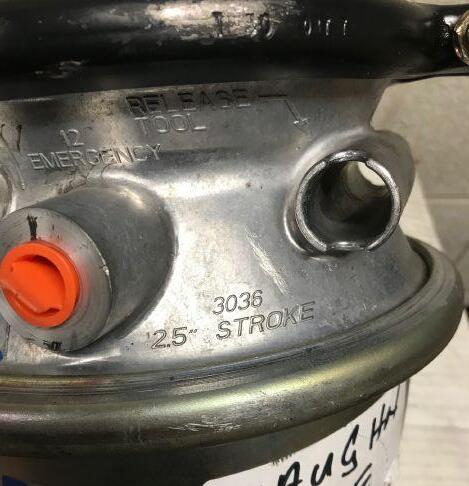
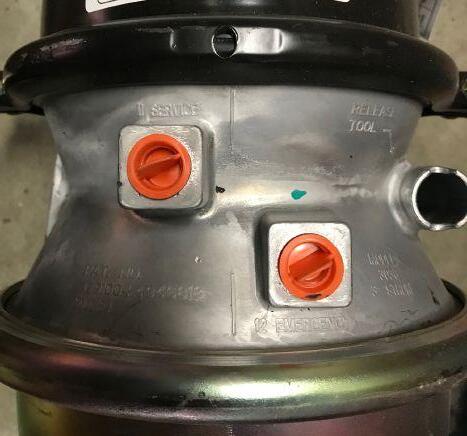
Having a laminated form in the truck indicating brake stroke measurements saves having to find the information on the brake chamber.
hired or promoted to this position. The responsibility of the driver is important to crew safety, citizen safety and the ability to respond to the call to assist those already in a bad state or situation. The idea is to “respond to the emergency, don’t become the emergency”.
Here are some inspection suggestions if you do not have them already in place, as welI as some technical information to explain air brake systems versus hydraulic brake systems.
First things first. Make the truck safe for inspection. Chock the wheels. Having a form made up and laminated (Photo 1) referencing the brake chamber size as well as long stroke or short stroke designation with appropriate brake stroke measurements in every single truck. Whether it’s in a binder or on the vehicles tablet or MDT, it should be in a place that everyone can access so that the driver knows what the correct brake stroke should be for that rig. This is beneficial for a few reasons. The driver who is dedicated engineer will know their truck and what brake chambers sizes are on their truck for measurement purposes. If the engineer or driver is moved to another station or called in on overtime to drive a rig they are not familiar with they automatically will familiarize themselves with the truck and its equipment and functions. The driver will perform a truck check and when it comes to doing brake checks will need to know the brake chamber size and if it is a long stroke or short stroke chamber. The purpose of this is to determine the brake stroke measurement. If this form is in the truck, it makes for a quick reference guide without looking for the info on the brake chamber (Photo 2). If at any time the rig is subject to a roadside MTO or DOT inspection, the official will ask the driver if they did truck checks. If so, they may ask the driver to describe their brake stroke measurements. Once the driver describes the process, the official may ask how they know the correct stroke. They can then refer to the form in the truck that correlates to the unit number of the truck they are in. For example, truck # 7973, call number 786 steer axle are 30 chambers rears and 30/36 short stroke chambers. This means the front measurement on steer is two inches and the rears 30/36 is 2 ¼ inch. This is more than acceptable and a quick reference guide. The second means to
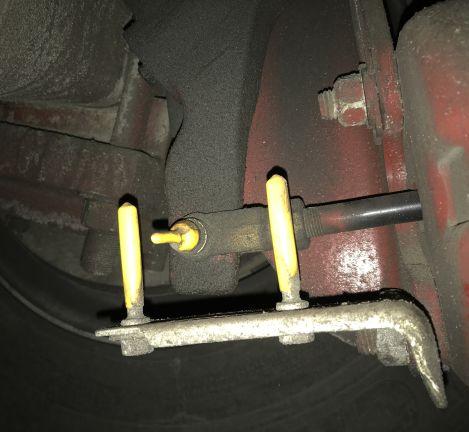
check brake stroke is to install brake stroke indicators, brake safes or cheaters as they are commonly known (Photo 3). This process of installation requires a certified licensed mechanic. They can be purchased from any truck part supply store and are not specific to the manufacturer (universal). When ordering, you will need to know the size and stroke of chamber you are installing it on. Once installed to the correct measurement, the process to perform brake stroke inspection is visual only. The need for a ruler or measuring tool is not needed. The math is done. The process to perform brake stroke inspection is initiated. The inspecting person under the truck only has to see that when the brake is applied, the moving pointer that is installed on the clevis pin connecting the brake chamber push rod to the slack adjuster is between the two fixed pointers attached to the brake chamber mounting bolts. If the moving pointer is between the two fixed pointers at rest, then again applied, the brakes are in adjustment (Picture 4). This does not exclude the driver from knowing how to mark and measure. It’s just made the inspection process quicker and easier. The inspector does not have to even go under the truck completely to see the brake being applied. They will see where the pointer stops and know whether brakes are in safe adjustment. Its important that when checking brake stroke that the air pressure be at 100 psi on the gauge on the dash or six to seven bar/kpa. The reason for this is min air pressure before low air warning comes on. The person you have selected to assist by applying the brake pedal should remember the park brake must be released before the brake stroke test be performed. The amount of brake pedal pressure should be equivalent to the amount of holding pressure applied to hold the truck on a moderate hill or at a traffic light. Do not stand on the brake pedal. Incorrect measurements will be noted. The internet is a wonderful tool for YouTube videos as well as provincial web sites referencing air brake testing, for example www.transportation. alberta.ca/1877.htm.
A commercial vehicle equipped with hydraulic brakes in the fire service also needs to be inspected. For those of us that have been around for a while, there was a time (perhaps 30 years ago) when
If the moving pointer is between the two fixed pointers at rest, then again applied, the brakes are in adjustment.
PHOTO 4 PHOTO 3
The second means to check brake stroke is to install brake stroke indicators, brake safes or cheaters as they are commonly known.
Loaded with safety, comfort and mobility features for unmatched performance, Flame Fighter® bunker gear offers a variety of custom outer shell fabric, liner system, hardware and pocket options to fit your specific needs.
• Patented IsoDri®* moisture management reduces the water absorbtion and helps gear dry faster between runs
• Exclusive Ventilated Trim™ allows vapor to be released, reducing the risk of scald burns
• Thermashield™ provides an additional layer of liner material in the upper back and shoulders to protect against compression burns
• Move-N-Hance™ crotch gusset increases mobility by reducing bunching, twisting and pulling
• Flex Knee™ for easy, natural movement
• Stay Rite™ sleeve wells integrate the sleeve’s liner into a full-length wristlet so that when you reach, the entire sleeve moves with you
For more information about Flame Fighter bunker gear, contact your Starfield LION sales representative at 1.800.473.5553 or visit us online.
believe it or not fire trucks (even custom-built fire trucks) only came with gasoline engines and hydraulic brakes. That was not that long ago. Now we have 1-ton and 5-ton emergency response vehicles fit with lights and sirens with gas engines and hydraulic brakes. The process for brake inspections with these vehicles is different. The post trip check still needs to be done. This can be done on the return trip back to station from the call you just responded to with hard acceleration and hard braking. If the unit responded without issue then on the way back to station, brakes can be checked. Follow these few pointers on the road then back in station.
• Can you smell burnt brake material?
• Does the vehicle pull to the left or to the right when brake pedal is applied softly then hard?
• Do you notice any noises when the brakes are applied that where not there before?
• Does the vehicle brake pedal feel like it is pulsing up and down under your foot when the brakes are applied when coming to a full stop?
• When pulling away from a full stop does the truck feel like it being held back as if brakes not releasing?
• Back in station check each wheel end for excessive heat radiating from the wheel or rim area. Use of a TIC can be used as well.
• Once parked, is there any smoke rising from a wheel?
• Check all brake lights. Make sure they come on and when the pedal is released the lights turn off. If they stay on, there is a possible hydraulic issue or a switch. The brakes may not have released completely.
• Open the hood and check brake fluid level, colour, heat and for moisture
• Are there any signs of brake fluid leaking onto the floor?
• Take note if the brake pedal has faded when being applied, there is a serious issue.
The above listed items are all out-of-service criteria if evident.
Whether you are full-time, composite, or all volunteer department, truck checks should be an internal requirement. If your department solely depends on an outside entity performing brakes checks then the odds of failure are apparent from one outing to the next. An inspection also has to be based on how often a rig rolls down the road for anything.
If your department at this time does not perform in depth brake checks, take some time to put a program together for your department. You can draw from the MTO air brake handbook for your province as a start. It will prompt the drivers to see more of the truck as well as help in preventive maintenance. The more they see and touch, the more they get to know what is correct and what is not. Early detection means less chance of failure. The likely hood of a catastrophic failure will be reduced, improving safety and repair costs. Think of it this way: Every time you use the brakes, they are one step closer to being worn out.
Rubber side down my friends.
Chris Dennis is the chief mechanical officer for Vaughan Fire & Rescue Service in Ontario. He can be reached at Chris.Dennis@vaughan.ca.
FIREFIGHTER SAFETY FOR LIFE
Study calls for firefighter wellness monitoring to address cancer and other risks.
By LEN GARIS
Anew Canadian study is calling for the creation of a national firefighter wellness surveillance system to help address soaring cancer rates and other key firefighter health risks.
Based on 10 years of firefighter health and injury data, Determinants of Injury and Death in Canadian Firefighters: A Case for a National Firefighter Wellness Surveillance System found that cancer caused more than 86 per cent of firefighter fatalities – overtaking cardiovascular disease as the top killer of Canadian firefighters – while traumatic injuries and mental health issues also take a significant toll.
Conducted by the British Columbia Injury Research and Prevention Unit (BCIRPU) and the University of the Fraser Valley (UFV) in B.C., the study was released in February after more than a year of work by a team of Canadian health professionals, researchers, academics and fire service leaders: Rachel Ramsden, Jennifer Smith and Kate Turcotte from the BCIRPU; myself; Dr. Kenneth Kunz, a medical oncologist; Dr. Paul Maxim, a researcher and Wilfrid Laurier University professor; Larry Thomas, deputy fire chief for the City of Surrey; and Dr. Ian Pike, director of the BCIRPU and a University of British Columbia professor.
Funded by the 2017 Motorola Solutions Foundation grant program, the study identified the top health concerns facing Canadian firefighters through an extensive review of research from 2000 to 2017, and claims data for 2006 to 2015 from the Association of Workers’ Compensation Boards of Canada (AWCBC) and WorkSafeBC.
“Taking a fresh look at the data helps to ensure that the measures taken to improve health and prevent injuries among firefighters are relevant and effective,” noted Ramsden, the lead author. “Through this
study we see that firefighter health risks evolve over time. This points to the need for a method of continually collecting and analyzing firefighter health data, so that the interventions can remain in sync. This important, potentially life-saving work would not have been possible without the support of the Motorola Solutions Foundation, and we extend our sincere thanks for their support of this study.”
Fire fighting is a risky profession. Career firefighters have the second highest injury rates among emergency responders. When responding to emergencies, firefighters may be exposed to extreme temperatures, strenuous physical labour, falling objects, diseases, toxic substances, and violence or other traumatic events.
Ten years of worker claims data shows the five top health concerns for Canadian firefighters are cancer, traumatic injury, cardiovascular disease, respiratory disease and mental health problems.
Cancer represented more than 86 per cent of all fatality claims, with an annual rate of 50 fatalities per 100,000 firefight-
ers. Traumatic injuries accounted for 90 per cent of all time-loss claims, affecting approximately one in 50 firefighters each year. Mental health was the third leading cause of time-loss claims, affecting an aver age of one in 5,000 firefighters per year.
Cardiovascular disease accounted for five per cent of fatality claims. Respiratory disease accounted for just under two per cent of all fatality claims.
In comparison to 2013 Statistics Canada data on all causes of fatality in the general population, firefighters die of cancer at two to three times the rate of the general population (depending on age), even though firefighters tend to lead healthier lifestyles as a requirement of their work. While firefighters are subject to the same genetic or environmental cancer risks as the general population, they are also exposed to concentrated carcinogens in the air, soot and tar at a fire ground. Even after using personal protective gear, many firefighters report smelling like smoke or burning plastic for days after a fire.
The cumulative effect of exposure to
Career firefighters have the second highest injury rates among emergency responders.
toxins over time is demonstrated by the ages of firefighters diagnosed with cancer. The highest number of time-loss claims for cancer were at ages 55 to 59, and most cancer deaths occurred over age 65.
In addition to the heightened cancer risk, stressful work conditions can lead to both increased risk of traumatic injury and mental health issues among firefighters. The claims data showed that traumatic injury contributed to 6.5 per cent of fatality claims, a rate of 4.4 deaths per 100,000 Canadian firefighters, and 90 per cent of time-loss claims. Common injuries include muscle strains and sprains, extremity injuries, and burns.
Importantly, the research showed that the risks to firefighters are evolving. For example, a study that followed 36,813 firefighters from 1972 to 1999 found that male firefighters were, overall, no more at risk of dying from cancer than the general population. Cardiovascular disease, once the leading cause of firefighter death, is now the third –although it is still the leading cause of on-duty death.
Mental health is quickly increasing as a leading cause of timeloss claims among firefighters, due to issues such as anxiety, post-traumatic stress disorder and depression. Time-loss claims were the highest among firefighters age 25 to 49.
“We know that firefighters are at an increased risk for certain types of injury, disease and death, and those are the issues where we need to be directing our resources,” said Dr. Pike of the BCIRPU. “For example, fire departments could have a marked impact on their firefighters’ health by focusing their health and wellness programs on preventing cancer and traumatic injury, and on promoting mental health.”
The study has implications for firefighters everywhere.
“We see this study as part of the ongoing effort to make firefighting a safer profession,” noted Mike Hurley, vice-president of the International Association of Fire Fighters’ 6th District, representing B.C., Alberta, Saskatchewan, the Northwest Territories and the Yukon. “We welcome any effort that helps us to better understand the risks to firefighters, and to identify what can be done to reduce them.”
Although existing workplace claims systems collect considerable data and information, they lack the details and specifics that would allow the development of targeted surveillance, prevention, wellness and ongoing research programs. Because of this, the study recommends the creation of a dedicated firefighter health surveillance model to monitor health trends and patterns and provide the information necessary to support future research and develop timely and responsive interventions that will lead to healthier and longer lives for Canadian firefighters in the years to come. Meanwhile, at the local level, fire departments are encouraged to be proactive about addressing the highest risks to firefighter health. The study can be downloaded for free at https://cjr.ufv.ca/. For more information about the Motorola Solutions Foundation grants program, visit http://motorolasolutions.com/foundation.
Len Garis is the Fire Chief for the City of Surrey, B.C.; an adjunct professor in the School of Criminology and Criminal Justice and associate to the Centre for Social Research at the University of the Fraser Valley; a member of the affiliated research faculty at John Jay College of Criminal Justice in New York; and a faculty member of the Institute of Canadian Urban Research Studies at Simon Fraser University. Contact him at LWGaris@surrey.ca.
Communication is difficult in dense smoke and noisy environments.
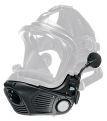
The Dräger FPS®-COM 7000 ensures clear, hands-free, voice-activated communication to your team without an external radio. Full duplex communication allows simultaneous speaking and listening - breath and ambient sounds are reduced by newly developed digital noise reduction technology. Integrated push-to-talk button to operate a radio that can be connected as an option allows you to communicate using a tactical radio. The tactical radio can be connected with a cable or Bluetooth.
TRAINER’SCORNER Danger in the DNA
By ED BROUWER
Wildland urban interface fires can be one of the most dangerous calls we go on, but perhaps not for the reasons you may suspect.
For over a decade, I have studied investigative reports on firefighter fatalities across North America and have discovered a common denominator on tragedy fires. I will be citing three reports: the 2001 Thirtymile Fire in Washington, the 2013 Yarnell Hill Fire in Arizona and the 2006 Empire Fire in Oklahoma.
It will be very difficult to fully describe the events that led to the deaths of these firefighters, and although I have tried to highlight the points pertaining to my discovery, I urge you to search these fire events out on the internet.
■ THE THIRTYMILE FIRE
Started by an abandoned campfire, the fire was located in a canyon about 30 miles north of Winthrop, Wash. The 20-person crew arrived at the fire at approximately 9:00 and after a safety briefing, they took action at 11:00. By 15:00, due to extreme fire behaviour, numerous spot fires and torching, pump operations were stopped and everyone including the look-out were called to the safety zone. At about 16:00 they were greeted by a Hot Shot crew who had just gotten off of a two hour rest. A district forest officer arrived shortly after. It is important to know that all personnel on the fire were in the safety zone. They took the time to eat, rest, and sharpen tools.
Thirty minutes later, two of the Hot Shot crew members left the safety zone to scout the road, and two engines drove up the road to look for hot spots. When they discovered a hot spot over a mile up the road they radioed for help. The crew boss trainee and his squad responded. They asked for additional help and a second squad was sent. As that squad arrived, the crew boss trainee drove past them with an empty van, heading back to the safe zone.
The arriving squad geared up and began to action the hot spot and noticed the engines were leaving. They, however, tied in with the IC and Squad One and worked on the small hot spot. Within two minutes they were told to retreat to the safety zone. Because the other van had returned empty, it meant 14 firefighters had to cram into one van. Within seconds they were met with a wall of flame. Their road to safety was cut off.
This story does not have a happy ending. Six firefighters, including the four that died, deployed their fire shelters above the road. The cause of death for all four firefighters was asphyxia due to inhalation of superheated products of combustion.
I urge you to watch the downloadable video and read the full investigative report. You should also be aware that on Jan. 30, 2007, the U.S. Attorney in Spokane, Wash., charged the IC of this fire with four counts of involuntary manslaughter and seven counts of making false statements.
My point: These firefighters were all in a safe zone. There was no “good” reason for them to leave the safe zone. So, was it boredom that caused two firefighters to
scout the road? Was it a “don’t just stand there, do something” attitude that motivated those two engines to leave the safe zone in search of hot spots?
The big question: “Was the sacrifice of four firefighters worth the two-minute attack on a hot spot that got run over by a crown fire anyway?”
Perhaps we need a new mindset: “Don’t just do something, stand there.” And that is, perhaps, one of the hardest things to teach rookies. The persona of the firefighter hero running in when everyone else is running out is clouding our good judgement. We are risking too much for an image.
■ THE YARNELL HILL FIRE
The Yarnell Hill Fire was a wildfire near Yarnell, Ariz., that was ignited by lightning. Around 15:50, the wind shifted and the fire started pushing aggressively to the southeast, toward Yarnell. Fire resources shifted to resident evacuation and structure protection in town. Only the Granite Mountain Interagency Hot Shot crew remained out on the ridge, on the southwest perimeter of the fire.
The Yarnell Hill Fire was a wildfire near Yarnell, Ariz., that was ignited by lightning and claimed the lives of an entire Hot Shot crew.
Personnel who communicated with the Hot Shots knew the crew was in the black at that time and assumed they would stay there. No one realized that the crew left the black and headed southeast, sometime after 16:04. At 16:30, thunderstorm outflows reached the southern perimeter of the fire. Winds increased substantially; the fire turned south and overran the Hot Shots. The fire overtook them while they were deploying fire shelters. Temperatures exceeded 1093 C.
My point: These firefighters were all in the black (safe zone). There was no “good” reason for them to leave the black and we will never know why, but they did. Was it boredom that caused these 19 professionals to leave the black?
■ THE EMPIRE FIRE
The 2006 fires destroyed 53 homes and more than 7,000 acres west of Duncan, Okla. A “Red Flag Warning” (extreme fire behaviour) had been forecasted.
Destry Horton, 32 and a father of two, was a seven-year veteran full-time firefighter with Chickasha Fire Department. On his days off, he doubled as a volunteer firefighter with the nearby rural Acme Volunteer FD. At 11:00, he and fellow volunteer Larry Crabb were dispatched out. At 14:00 they were released from staging without being assigned and returned to the Acme Fire Station. At 15:00 they are paged out with a Brush Truck to nearby Farwell. Thirty minutes later, after being unassigned and released at Farwell, they returned to the Empire Fire.
THE POWER YOU NEED
Consider: It is Horton’s day off and he volunteered to help. However, since arriving in staging five hours earlier, he had seen no action. He was released from staging twice without being assigned. Now in his department’s Brush Truck, still unassigned, he and his partner are heading back to Empire. (How does this sit with the “Put me in Coach” mentality? It is hard to sit on the bench during an important game.)
Around 16:00, just outside of Duncan they encountered a group of firefighters. They stopped and ask them about the location of the staging area. They are told to “just find some fire and fight it.”
Now normally, “just find some fire and fight it” would send up all kinds of yellow lights, but it has been five hours of sitting around, waiting, expecting, anticipating, desiring to be part of making a difference. This messes with someone’s thinking process. (The initial attack IC was not aware of Horton and Crabb’s arrival).
Anxious to get into action, Horton and Crabb turn off the paved road to access a fire area. They begin a direct attack (right on the fire’s edge) fighting fire from the black.
Crabb, wearing full PPE except gloves, is operating a nozzle out of the rear of the Brush Truck. Horton, driving, has removed his helmet, gloves and jacket. He is wearing his bunker pants, but not his firefighter boots. He has on nylon hiking boots and a t-shirt.
Things go well for almost 30 minutes, but then, surrounded by smoke and heat, Horton drives from the black into unburned fuels. Shifting winds and a sudden increase in heat cause these unburned fuels to ignite. Horton yells out the window: “We need to get out of here.” In his attempt to retreat he backs into a ditch—knocking Crabb off into barbed
Skid Units
Glider Kit
Portable Pumps
Foam Trailers
wire fencing. Flames, heat, and smoke overrun the now stuck truck.
Horton tries to help Crabb (entangled in the barbed wire). In seconds, as the fire front burns over them, the flames and heat engulf Horton’s face and upper torso. Crabb sees Horton’s t-shirt melt to the man’s chest and his nylon hiking boots dissolve into his feet.
After the fire front burns over them, Crabb removes himself from the barbed wire. He helps Horton away from the burning truck and then runs for help.
Crabb is transported to a regional hospital where he is treated for the second and third degree burns to his hands, face, and lower back. He is released later that day.
Horton is airlifted to Oklahoma City. The doctors tell Horton’s wife that he will probably not survive the night.
However, Horton seems to defy death. On the fourth day, the doctors remove the mummy-like bandages wrapped around him from head to toe, planning to scrape off the dead skin and tissue. They quickly realize, however, that Horton is burned so badly he has no skin left.
Horton’s face has suffered fifth-degree burns, leaving virtually nothing but bone. Six days into his ordeal, to prevent gangrene from spreading, the surgeons amputate both of Horton’s arms at his elbows. Horton’s family consulted with burn specialists from around the world and all agreed there was nothing else that can be done. On the evening of March 24 — 24 days after he is overrun by the flames on the Empire Fire — Horton passes away.
Before I close, let me please state how terribly sorry I am for the losses suffered by the families and fellow firefighters of these 24 fallen brothers and sisters. I urge you to train your firefighters to accept there are times of idleness on the fire ground and that it is quite alright to just do nothing. Be aware of the negative effects extended times of waiting on the sidelines can have on firefighters, especially those with that “Got Do Something” DNA.
And last but not least, be it in a safe zone or staging, stay there until you are assigned a task and clearly know the dangers of your assignment.
■ THE HARD COLD FACTS
We are risking too much! NFPA 1500 states: “Activities that present a significant risk to the safety of members shall be
limited to situations where there is a potential to save endangered lives” and “No risk to the safety of members shall be acceptable when there is no possibility to save lives or property.”
The LODD of the 24 firefighters you just read about made no significant difference upon the outcome of the fire. There was absolutely no reason for firefighters to be killed, for there was nothing to be saved. Houses can be rebuilt, trees can be replanted.
Please continue training like lives depend on it, because they do.
Ed Brouwer is the chief instructor for Canwest Fire in Osoyoos, B.C., and deputy chief training officer for Greenwood Fire and Rescue. He is also a fire warden with the B.C. Ministry of Forests, a wildland urban interface fire-suppression instructor/evaluator and an ordained disaster-response chaplain. Contact Ed at aka-opa@hotmail.com.
Northeastern ROUND-UP
A few session highlights from the NEFEC
By LAURA AIKEN
The Northeastern Fire Education Conference and Trade Show (NEFEC) provided no shortage of discussion at its well-attended event.
The NEFEC was held March 23-25, at Deerhurst Resort and Conference Centre in the rocky Muskoka outpost of Huntsville, Ont. The NEFEC was hosted by the Nipissing/East Parry Sound Fire Services Mutual Aid Association and managed by the Ontario Association of Fire Chiefs (OAFC).
Over 275 members of the Ontario fire service gathered for a full agenda of speakers and trade show on Friday and Saturday, with workshops capping the event on Sunday.
OAFC president Stephen Hernen provided an update on several of the association’s strategic initiatives, including improving two-way communication with members, generating new revenue streams through partnerships and grants, enhancing member services in the realm of PTSD prevention and becoming more effective at influencing legislation. Hernen noted that the OAFC was very active in getting firefighters exempt from certain provisions in Bill 148 (Fair Workplaces, Better Jobs Act), which was projected to carry a heavy financial toll for municipalities in paying their volunteers.
The subject generating most questions amongst the audience was undoubtedly the proposed Ontario legislation that will require all firefighters to achieve mandatory training and certification requirements as set out by the National Fire Protection Association (NFPA). By all accounts, it appears the new regulation is heading towards finalization following the public consultation that has now closed.
Here are the key messages Hernen emphasized in regards to the changes:
• The OAFC supports the Ontario governments efforts to modernize fire service delivery through the requirement of certification.
• Grandfathering as an option has re-opened immediately for all. The closing date is Sept. 30 and people can start applying right away. He strongly encouraged the audience to take advantage of this clause while it is available.
• Hernen assured that he “went to bat” for small town Ontario in the roundtable consultations with the government and that they were not forgotten.
• In responding to audience concerns about how volunteers would be able to find the time to meet these new requirements, he noted that departments doing
Benson of Gogama Fire Department shared the story of a large CN Rail train derailment that happened in his community on March 7, 2015. Forty-three train cars were impacted, with two hitting the river after a bridge collapsed. He invoked an emergency status and followed a detailed emergency plan, the latter being attributed with key success to in making the emergency manageable. In the case of an emergency, Benson said it is up to the fire chief to assume the role of incident commander.
“The community has the be the first priority,” he said of his efforts to ensure that CN Rail’s interests in getting their trains up and running weren’t getting the upper hand.
Billy D. Hayes, chief program officer
The nuts and bolts of Hayes’ talk came down to having a positive outlook on leadership, regardless of the challenges it presents. ‘‘ ’’
adequate training already shouldn’t have difficulty getting their members certified via third party testing, and there is an online component that allows for flexibility.
• The OAFC would like departments to share information regarding costs so the association can mobilize to acquire funding effectively from the government.
• The legislation and ensuing conversation highlighted the gravity to which volunteer recruitment and retention is a concern for departments.
Cannabis legislation, residential sprinklers and getting the sale of smoke alarms with removable batteries banned are also amongst the OAFC’s top priorities with the government.
In another highlight, Chief Mike
for The National Center for Fire and Life Safety, spoke on leadership Friday and Saturday. Fire Fighting in Canada sat in for the second leg on Saturday. Hayes drew upon history to illustrate why leadership is a privilege. The nuts and bolts of Hayes’ talk came down to having a positive outlook on leadership regardless of the challenges it presents. The key, Hayes said, is to be a solution driven leader,
Leadership has key functions Hayes summarized as this: develop observation skills by understanding events through scanning, monitoring and interpreting; use intuition, common sense and good judgement; be innovative; learn how to take calculated risks; share a vision; have presence; care about people and outcomes; and celebrate the success of everybody.
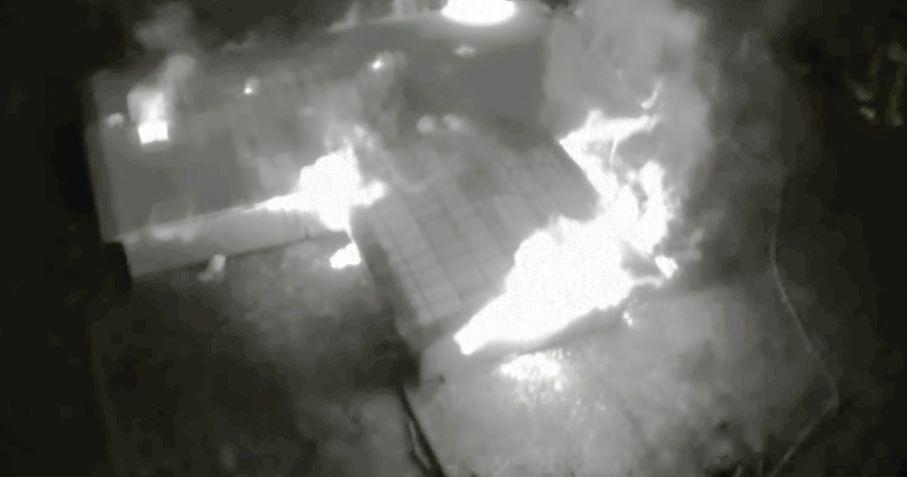
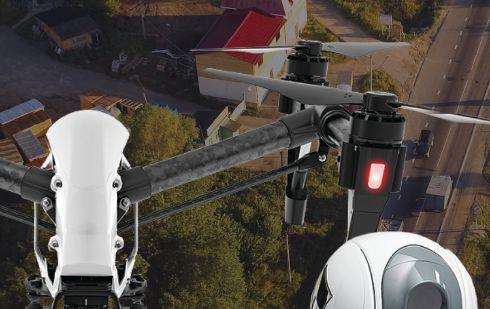
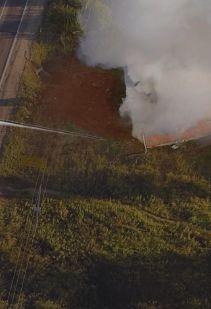
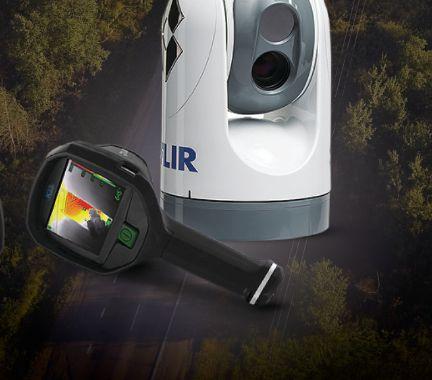
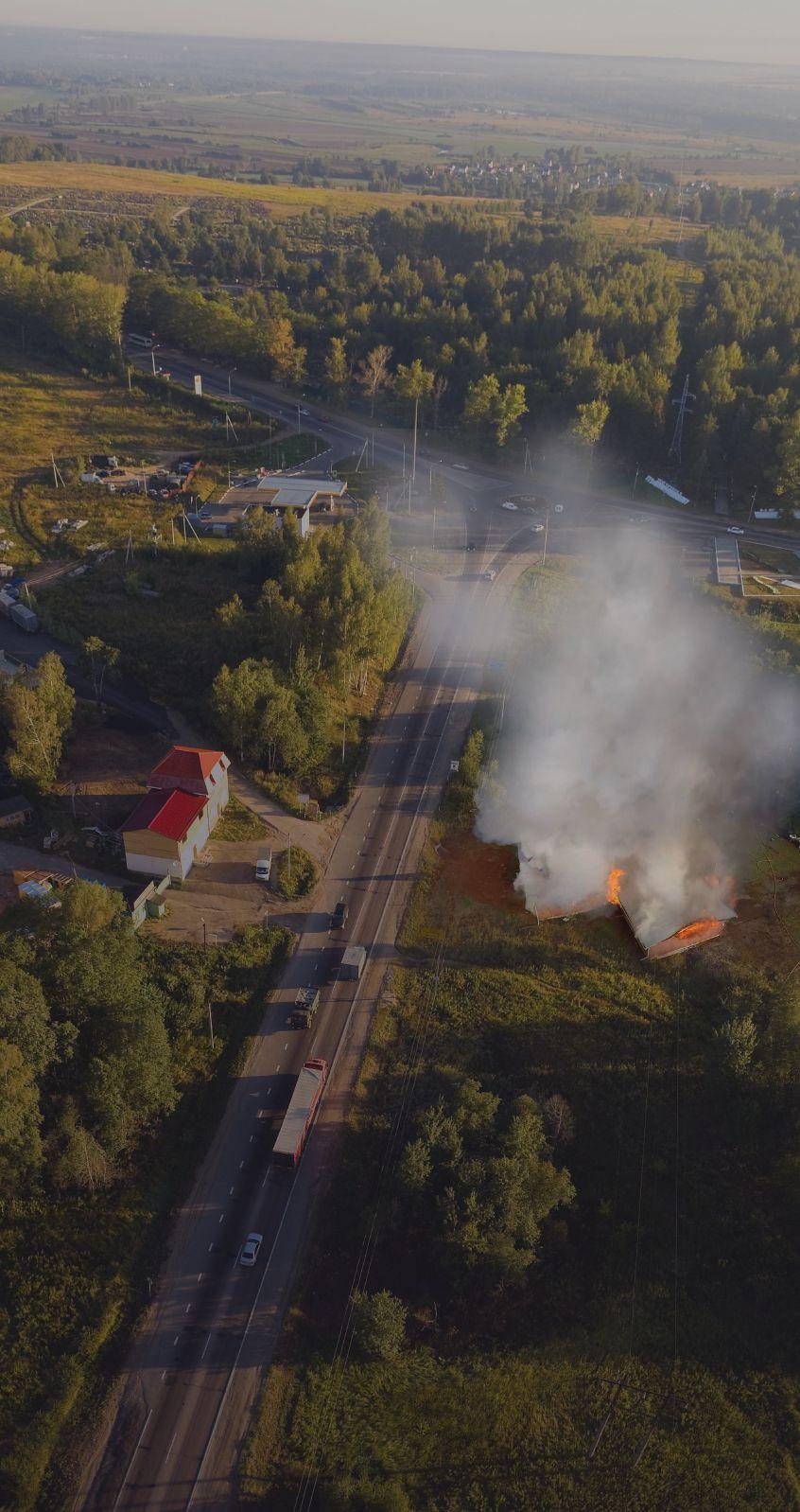
FROM BOOTS ON THE GROUND TO EYE IN THE SKY, WE’VE GOT YOUR BACK.
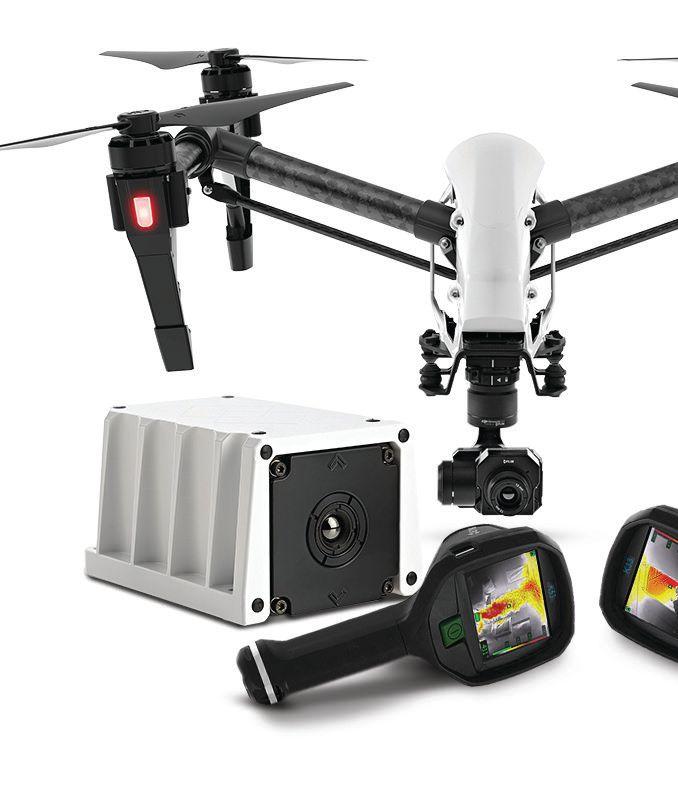
FLIR’s wide range of TICs can help you identify hot spots from a variety of distances – making safety the top priority. Learn more at FLIR.ca/fire
Trade in your current TIC — of any brand, in any condition — and receive a trade value of up to $2,950 off select new FLIR K-Series cameras
· FLIR M-SERIES PAN-TILT-ZOOM TIC s FOR ARFF, HAZMAT & ALL EMERGENCY VEHICLES
· FLIR AERIAL FIRST RESPONDER KITS
BY SHAYNE MINTZ NFPA Canadian regional director
MNFPAIMPACT
NFPA seeks participation in sprinkler initiative
ost fire deaths occur in homes.
It is the view of the NFPA that the time has come to bring broader attention to the North American fire-death problem, and how sprinklers can be a key solution. That’s why this year the NFPA is initiating Home Fire Sprinkler Day, on various dates over the spring and summer in Canada, and on May 19 in the United States.
This initiative tasks North American fire-sprinkler advocates with hosting as many events as possible to promote home fire sprinklers. The goal is to have fire-safety advocates host sprinkler-related events in as many Canadian provinces and territories as possible, and in all 50 states. As of mid-March, more than 20 Canadian fire departments in four provinces had committed to participating.
Sprinklers are but one aspect of the fire problem, but they are a key part of the solution that holds a fire in check until people can get out of harm’s way.
A study completed by Surrey, B.C., Fire Chief Len Garis and a team of researchers at the University of the Fraser Valley using the Canadian National Fire Information Database figures between 2005 and 2015 shows there were a total of 1,440 fire deaths in residential occupancies; this is roughly equivalent to the number of people on 20 full-sized school buses, or more than 10 Boeing 737 aircraft full of passengers. If that many lives were lost over the same period in Canada involving school buses or aircraft, I’m sure there would be a number of coroners’ inquests and public inquiries. But in Canada, and the majority of other developed countries, the public doesn’t seem to think the fire-death problem is that bad.
death problem. But, regardless of their presence – and that’s if they’re even working and properly maintained – smoke alarms only alert occupants that a problem exists and do nothing to assist in controlling the fire, not to mention the hazardous and toxic conditions created for firefighters by the time they arrive.
The NFPA Fire Sprinkler Initiative and the Home Fire Sprinkler Coalition – Canada is calling on the 50-plus Built For Life Fire Departments and others in Canada to help out and take action. Events are aimed at raising awareness of sprinklers as being key life-saving technology, and breaking down the myths and fallacies about their use.
Taking part is easy. The NFPA has outlined ideas on its website, nfpa.org/firesprinklerday, and has provided resources to make these events successful. If any assistance is needed or you have questions, please contact me, or Laura King, NFPA’s Canadian public education representative (canadacrr@nfpa.org).
The list of potential activities for Home Fire Sprinkler Day includes creating a local, regional or provincial Home Fire Sprinkler Coalition or initiative (there is a coalition in British Columbia through the Fire Chiefs Association of BC, and the Ontario Association of Fire Chiefs
Sprinklers are but one aspect of the fire problem, but they are a key part of the solution that holds a fire in check until people can get out of harm’s way.
’’
Many opponents to the sprinkler movement say modern codes and practices requiring smoke alarms are all that are needed to protect occupants. However, regional statistics in Canada, and NFPA research in the United States, show that notwithstanding the prevalence of smoke alarms, their presence has pretty much reached optimal effectiveness. Despite the inclusion of interconnected smoke alarms in every newly built home, and many communities offering free smoke alarms and installation as retrofits, the residential fire-death problem still exists.
This is not to say that working smoke alarms aren’t an important and integral life-saving device and a key part of the solution to the fire-
Shayne Mintz has more than 35 years of experience in the fire service, having completed his career as chief of the Burlington Fire Department in Ontario. He is now the Canadian regional director for the National Fire Protection Association (NFPA). Contact Shayne at smintz@nfpa.org, and follow him on Twitter at @ShayneMintz
has started some preliminary work on formalizing a coalition). If you are interested in forming a coalition, please get in touch and the NFPA can walk you through the process.
Other suggested activities include hosting a side-by-side live burn fire sprinkler demonstration (with support from NFPA, the Home Fire Sprinkler Coalition – Canada, the Co-operators Insurance Group, and the Canadian Automatic Sprinkler Association); hosting an open house featuring home fire sprinkler information; hosting or conducting dedicated training sessions for fire department staff and other public stakeholders on the myths and facts of home fire sprinklers; or advocating for a Home Fire Sprinkler Day proclamation in your town.
The NFPA has created resources and templates for your department to make your Home Fire Sprinkler Day initiative a success. For details visit nfpa.org/firesprinklerday.
Why stop if you don’t have to?
1 Christenson J, Andrusiek D, Everson-Stewart S, et al. Chest compression fraction determines survival in patients with out-of-hospital ventricular fibrillation. Circulation. 2009;120:1241-1247.
When you keep your hands on the patient, you increase compression fraction—a key factor in successful outcomes1. The innovative LIFEPAK® CR2 defibrillator is the only AED that analyses and makes a shock decision while chest compressions continue, reducing the pause between CPR and defibrillation.
Download more information about the new technology that makes this possible: stryker.com/dontstop
BY JAMES LINDSAY
WGUESTCOLUMN
Winter woes
inter can be fun: sliding, skiing, skating, hockey, or just going for a walk in the crisp fresh snow are all great cold weather activities that can put a smile on our faces. These are the happy thoughts of winter most of us would like to envision. Though this past winter, like last winter, has many of us cursing the season once again. It has been a cold winter for most Canadians. Even some of the most densely populated parts of the country got down to -20 or -25 degrees. Brrr!
When I began writing this in my recliner, lulled by the fairly continual sound of my furnace, I was checking the local hourly weather report from the Environment Canada station at our airport in Lynn Lake, Man. It was -34 with wind chill values of -50. These temperatures have been fairly consistent for almost three months, now, with a few “warm days” in the mid to low -20s. I’m writing this in the dead of winter, and while the majority of Canadians will be snow-less and maybe even planting their gardens when they read this in May, we’ll likely still have ice on the lakes here in Lynn Lake. I would like to take the opportunity to discuss some of the things we’ve learned this winter and share some of what we have discovered.
This is my first year as fire chief of the Lynn Lake Fire Department, which is a small paid volunteer department of 16 members and experiences low call volumes as we are separate from the EMS service in our community. We like to think our low call volume is due, in part, to the number of visits our department has made to the school in the last 12 years. Our department has traditionally had teachers serving as firefighters, which has made a difference, as well as our pro-active community involvement. Alas, fires happen. And too often, fires happen when cold weather creates harsh conditions for firefighters.
learned a few lessons.
As a rule, our department responds to structure fires with both of our pumpers. One acts as the primary unit, while the other stands idling as a secondary in case there are issues with the primary unit, or additional tools or equipment is needed. Once suppression operations have concluded and the fire is out, hoses are re-laid on the bed, tools are packed, and our crews return to station for a post.
On the occasion of the second fire on the 27th, however, we discovered a couple of previously un-detected problems in our Standard Operating Procedures and Guidelines (SOP and SOG) that only became apparent in the extremely cold winter conditions. It all started with a mechanical problem with our primary pumper a couple hours into the operation. The pumper stalled and could not be immediately restarted. With our secondary pumper standing by about 50 feet away, attack lines were quickly transferred from our primary to secondary pumper.
This meant our attack lines were shortened by 50 feet, but they remained operational on the secondary pumper. An additional two 50-foot x 1 ½ inch lengths were later added to the initial attack
Make sure your department has planned for every possible winter scenario before temperatures inevitably drop. ‘‘ ’’
Our first working fire this winter was a fully involved arson at a single-story residence on Jan. 19. The temperature was around -23 with 30 km per hour winds (-35 to -37 with wind chill). Once the fire was out, we packed up and returned to station for cleanup, reloading, re-checking, and post-incident de-briefing, as usual.
A week later, on Jan. 27, we attended a two-storey residential structure fire of unknown origin. Temperature was -30 with a 30 km per hour wind (-45 with wind chill). This is where we truly
James Lindsay is a high school teacher in Lynn Lake, Man. He has served with the Lynn Lake Fire Department for 12 years as a firefighter, captain, and was appointed fire chief in October 2017.
lines at the pumper end and connected to our secondary pumper. Immediately after starting to send water from the truck there was no water at the nozzle discharges. The nozzles were packed solid with slush, which also plugged at least the last foot of each attack line. The nozzles were also frozen to the ends of the attack lines.
We keep a small propane torch in our rescue van, and spare nozzles on our pumpers. Crews used the torch to thaw the collars on the nozzles, reduce discharge pressures to 30psi from the pumper. Firefighters then pounded on the plugged section of hoselines without the nozzles attached, while digging at the inside of the open male coupler with a screwdriver to clear the rapidly freezing slush before the hoses became useless lines of ice from pumper to business end. Spare nozzles were then connected and operations resumed.
Our first working fire this winter was a fully involved arson at a single-story residence on Jan. 19. The temperature was around -23 with 30 km per hour winds (-35 to -37 with wind chill).
Determining what went wrong during the incident was easy: There wasn’t enough hose laid out during initial setup. Knowing situations at an active fire are fluid and subject to change, we discussed what else could have gone wrong even if the incident commander (IC) had ensured more than enough hose was deployed.
What would the IC do if an attack line had burst and failed one or two hours into the operation? What if one or both lines had frozen? The immediate solution would be to pull an adequate length of fresh line and nozzle off another hose bed, connect it to the pumper and carry on . . . and we would have run into the exact same situation. Here’s why:
Approximately five years ago, we finally took the last of our cloth hose out of service, replacing it all with rubber attack lines. The firefighters rejoiced. Gone were the days of hanging 500 feet or more of cloth hose 25 feet up the centre of the hall on a draw-bar, rope and pulley system, leaving it to dry for a couple days before racking and rolling. ‘It’s all rubber now — it won’t rot if it’s walked and re-laid on the trucks,’ was the perspective of both firefighters and command officers. All we would have to do now is ensure that the rubber hose lengths are separated, walked, reconnected, and laid back on the bed after each use.
These practices are in line with recommended standard practices of several fire service hose manufacturers. However, even with adequate walking there will still be some residual water left inside the hose, particularly if that hose was walked out at very cold temperatures, leaving a film of ice inside the interior hose walls. It will melt back at the station, on the truck, and sit until the next incident.
When that same hose sits unused on a hose bed for a couple hours in -30 temperatures, the ice inside it heads for the restrictive tolerances of the nozzle, plugging it completely. Our department had never considered running into this problem before. Once we cleared the incident and returned to station we examined all of our
hoselines and nozzles that were not used in the incident that night. There was enough ice inside the unused hoses for this problem repeat itself on more than half of our hoselines.
Now our department is making modifications to both our SOGs and SOPs for hose deployments and preparing for future deployments, particularly during winter operations. We are also hanging all 1 ½ inch and 2 ½ inch rubber hose for a minimum of 12 hours in the run-up to winter operations next fall and hanging used rubber hose following winter operations moving forward.
Winter fire suppression has its own additional hazards, from over-exertion in waist deep snow, to slips and falls on ice-coated surfaces. Since firefighters must use water to suppress fires, it is pretty important to have a complete understanding of where the water (or ice) is inside the hose, where it shouldn’t be, and where it needs to go, when faced with the worst that a Canadian winter can throw at your crew. Make sure your department has planned for every possible winter scenario before temperatures inevitably drop. Until then, have a safe and warm summer. Keep the ice for your lemonade!
On Jan. 27, we faced a two-storey residential structure where temperatures were -30 with a 30 km per hour wind (-45 with wind chill).
PHOTO CREDIT: LLFD
BY LYLE QUAN
CORNERSTONE
What is your mindset?
Perhaps the title of this column should be “A Time for Change.” I say this because after more than 10 years of writing for Fire Fighting in Canada, I feel it’s time for me to put my pen away. Don’t misunderstand, it’s not that I feel I don’t have more leadership lessons to share, it’s just time to focus on other challenges and more travel in the RV.
Over the years I have enjoyed writing columns about leadership, risk management, change management and more. I have promoted countless books and programs over the years because I have learned from these books and programs and wanted to pass on these learning opportunities to my friends and colleagues. Most recently, I’m proud to say that I co-authored a second book with my friend Les Karpluk. Both Les and I hope that you enjoy Leadership Prescribed 2.0. This builds on the information and lessons promoted in our first book. Of course, I would remiss if I didn’t say thank you to the folks at Fire Fighting in Canada and Annex Business Media for their support and encouragement to complete our second book. All of this leads me to this article, which is all about your mindset.
The book I’m promoting is titled Mindset, The New Psychology of Success, written by Carol Dweck (2006). I wish I would have read this book when it first came out because it explains in a common-sense manner why some people have a “fixed mindset”, while others have a “growth mindset”.
A fixed mindset is the result of a belief that your abilities are set in stone; such as, you are who you are. A growth mindset is the result of a belief that your abilities are not permanent and you can grow beyond them. Growth mindset people adapt when needed and crave a challenge. Fixed mindset people see criticism as an assault on their character and start avoiding challenges in fear of failure, or perhaps having to move outside of their comfort zone. When you start to believe you can get better at something that is when you find the real desire and motivation to learn. Growth mindset people take criticism as a step towards achieving their goals. The thing about the growth mindset is their stick-to-itiveness no matter how far-fetched success might seem.
success naturally makes you smart. As such, fixed mindset people gravitate towards choosing the easier problem, so success can come quickly and can validate their smartness. By choosing a difficult problem a fixed mindset person may jeopardize their chances of success thus increasing the possibility of failure, which may eventually reveal a weakness. To highlight this previously noted concept, one of Dweck’s studies offered a choice to four-year olds of either doing an easy jigsaw puzzle or taking the difficult one. What surprised them was that even at such a young age, children with a fixed mindset opted for the easy option as they believed in smart people not making mistakes. Dweck also noted that when they increased the level of difficulty in the jigsaw puzzles, fixed mindset children made excuses as to why they didn’t need to do the new puzzles. Whereas, the growth mindset kids, jumped into the new puzzles with even greater energy.
Ultimately, Dweck discovers that people with a growth mindset are comparatively happier, satisfied, healthier and more likely to succeed. The good news for those with fixed mindsets is that switching to growth mindset is just a book away.
The message, as noted by Dweck, is that you can change your
The thing about the growth mindset is their stick-to-itiveness no matter how far-fetched success might seem. ‘‘ ’’
mindset. The book leads you through topics like, inside the mindsets, the mindset of leadership and of course changing mindsets. I strongly recommend if nothing else that you read the section on the mindset of leadership. It will offer you some valid information that I’m sure will advance some new perspectives. You won’t be sorry you did because I’m sure you will take a new outlook on mindset.
According to the fixed mindset, smart people succeed. Therefore,
Lyle Quan has more than 30 years of experience in the field of fire and emergency services. He presently consults for emergency services around the world. He facilitates fire officer programs at the Ontario Fire College and instructs the bachelor of business in emergency services for Lakeland College. Contact Lyle at lpqsolutions@bell.net and follow him on Twitter at @LyleQuan.
Mindset, The New Psychology of Success is published by Ballantine Books can be obtained through Indigo/Chapters and Amazon.
It has been a pleasure and honour to write for Fire Fighting in Canada and to receive the feedback from my peers. I’m sure you will still hear from me both in the world of consulting and instruction at the Ontario Fire College. My “growth mindset” will not allow be to stagnate and be comfortable with “just good enough”. All the best in your future endeavours.
STOP DROP & WORKRITE
Workrite FR Fire Service is the go-to uniform line for a crisp, professional look, easy care and high-quality ame-resistant (FR) protection. Our complete line of station wear maximizes the inherent protection of DuPont™ Nomex® IIIA with specialized construction techniques for added durability in tough conditions.
• Long lasting, looks great on and o the job
• UL certi ed to NFPA 1975 for added safety
• PerfectPress® permanent creases for a just-pressed look, right out of the dryer
BY SAMANTHA HOFFMANN
Finding life safety advocates
There are three fundamental questions that affect all people: Is my home safe? Is my community safe? Am I safe?
My sister is a journalist and has been taught to consider these questions with every story she reports. In January 2014 she learned that it didn’t matter that her home was equipped with state of the art smoke and carbon monoxide alarms, or that she had an escape plan. Her neighbour’s home wasn’t equipped. A fire started in the neighbour’s home one night and quickly spread. It’s not enough to ensure your home is safe, you need to ensure that neighbouring homes are also protected and that you are safe from fire no matter where you are. Statistics show us that most fires occur in residential homes. Ironically, home is where people feel safest and yet it is where they are at the greatest risk. We have had smoke alarm legislation in Ontario since 1975, yet in more than 60 per cent of fatal fires smoke alarms were not present or working. This means fire departments’ safety messages are falling flat in our communities.
There are many different reasons our communities are not heeding our message. It could be cultural, language barriers, general access or that age old ‘it won’t happen to me’ belief. Regardless of the reason(s), departments need to start getting buy-in from our communities and we need help. We can’t be solely responsible for fire safety messaging; it needs to come for a variety of sources. Remember the expression two heads are better than one? Fire and life safety officers should use this principle to share our message, create relationships and build a community full of fire safety advocates.
Human beings are hard-wired with the desire and need to connect. We are social beings who thrive on healthy relationships. Officers recognize the importance of positive healthy relationships when we teach fire safety to children with the expectation that they will go home and teach their parents. However, we can’t overlook the childless homes in our communities. Begin to unleash the power of positive relationships in your community by recognizing these individuals and bringing fire safety messages to them.
FIRSTLINE
If community members hear the message from someone they trust, they will be more likely to believe what they are being told. It is about incorporating safety messaging and behaviour changes into your relationships. When teaching through positive relationships, you recognize that each person is a living story with their own complex identity.
To start to build a community full of fire safety advocates departments first need to consider what you are asking citizens for. Why does the department want to reach people? What do you want them to do once messaging is received?
These are some of the first questions that most people will ask when contacted by public educators, and you should have the answers on the tip of your tongue. The answer to the first question should include some information about your fire service, your current initiative, why the effort is positive and necessary, what the department hopes to accomplish, and a description of the people you want to involve. The answer to the second question can vary from specific actions, to suggesting other good contacts and introducing you to other people and organizations.
Whatever the answers are, they should be clear, complete, and
We have had smoke alarm legislation in Ontario since 1975, yet in more than 60 per cent of fatal fires smoke alarms were not present or working ‘‘ ’’
Samantha Hoffmann has been in the fire safety field for more than 25 years; she is the public fire and life-safety officer for Barrie Fire & Emergency Service in Ontario. In 2014 Samantha was named Public Fire and Life Safety Educator of the Year by the National Fire Protection Association – the second Canadian and first Ontario educator to receive the award since its inception. Email Samantha at Samantha.hoffmann@barrie.ca and follow her on Twitter @shoffmannpflso.
accurate. Think carefully about what you want people to do and then ask them to do just that. Develop talking points and key messages. This will help keep your message clear, focused and consistent. The goal is for your department’s fire and life safety advocates to be comfortable asking friends, family members, co-workers, and community members to participate in conversation. Prevention officers should be able to give a brief overview about the program, talk about what issue they’ll be addressing and why it’s important.
Ideally, the community should have fire safety advocates in the many different sectors and industries – the parts of the community defined by common interests, purposes, and/or backgrounds. This will ensure that the community members you are trying to educate will first be approached by people they know and trust.
Examples of these sectors could be the business sector, healthcare,
education, government, or the religious sector, among others. Each sector has its members and those who are influenced by it.
As educators, we often struggle to reach diverse populations or groups in the community that are hard to contact. Populations that are hesitant to interact with anyone who seems to be “official” or in a position of authority are often difficult to reach out to, even if contact is beneficial. Using fire safety advocates that already have an established rapport with these communities may be the best way to gain their trust and begin to work with them.
How do you identify whom your fire safety advocates should be? Read your local newspaper. You should be able to identify one or two advocates in each issue. Who is making a difference in your community? Who is already reaching out and how are they doing it? How can you incorporate fire safety into what these individuals are already doing?
Let’s look at an example of putting all of this into play. We know that most fires happen in the home and we know that is where people feel safest. Who would be an ideal advocate for home fire safety? When driving through the community or looking through the newspaper we see lots of advertisements and signage for local realtors.
Hmmm, realtors are in homes all the time. They develop relationships with numerous members of the community across social groups, including those hard-to-reach groups. The Canadian Real Estate Association projects that 486,000 homes will be sold across Canada in 2018. With a partnership, that is a potential of 486,000 homes with working, in-date smoke and carbon monoxide alarms.
Fortunately, we have a celebrity realtor in my community, David
Visentin from the HGTV show Love it or List it. I reached out to him, explained the problem we were having and told him how he could help us save lives. He agreed to be our celebrity realtor and together we started the #RealEstateSmokeAlarmChallenge. Involving him allowed me to overcome barriers such as fearing change and addressing social norms that conflict with the desired behaviour, then model the desired behaviour. It also allowed me to challenge local realtors and turn them into fire safety advocates. My local realtors have started to include fire safety materials in their listings, make videos and great graphics for social media activities promoting the campaign, and most importantly, have engaged their clients in conversations about the importance of working smoke alarms and escape planning.
One local realtor, Jo Love of the Remax Hallmark York Group, makes a point of checking the dates and testing smoke alarms in every home she visits with clients. As a result, her clients are learning the importance of doing this in every home they visit. If the home has outdated or missing alarms, the realtor leaves a note or tells the homeowner that they need to take action immediately. The realtor has even taken it upon herself to purchase new smoke and carbon monoxide alarms for every home she lists and is giving alarms as gifts to clients that have purchased their home through her.
This is just one example of a fire safety advocate in the real estate field. Imagine if your department was to get a personal support worker, or a general contractor, a teacher, a local reporter, a mother, or a coach on board.
Fire safety is no longer just a lecture from the fire department, it’s a conversation happening throughout your community.
Silo response and safety
The dangers of using carbon dioxide to quench silo fires
By FRANK H. HEDLUND and JEFFREY C. NICHOLS
TOP : A wood pellet silo in Norway exploded when firefighters released inert carbon dioxide into the headspace to lower the oxygen content and suppress a smouldering fire.
On July 5, 2010 a wood pellet silo in Norway exploded when firefighters released inert carbon dioxide into the headspace to lower the oxygen content and suppress a smouldering fire. The lesson from this incident is that the use of carbon dioxide to suppress silo fires is unsafe.
Smouldering fires produce flammable pyrolysis gasses. The gasses can travel and accumulate, for example in the headspace of the silo. The release of carbon dioxide from high-pressure cylinders can generate static electricity with sufficient energy to ignite the pyrolysis gases.
■ SMOULDERING FIRES
Smouldering fires in wood pellets storages can occur for a number of reasons. There are plenty of examples in industry where pellets self-heat deep inside an undisturbed pile. Another known cause is mechanical friction heat in, for example, a roller bearing, which can ignite dust particles. Embers can be difficult to detect and they can travel in conveyor systems and start fires in storage areas.
Water is often an unsuccessful method of fighting smouldering fires in bulk storage silos. Water from sprinkler or deluge systems will only cause damage to the silo and is ineffective in suppressing deep seated fires as the
WE TAKE CARE OF THE GEAR THAT TAKES CARE OF YOU!
water will generally tunnel down through the outside of the material instead of wetting it through.
■ SUPPRESS FIRES WITH INERT GASES
Alternative fire fighting strategies have been devised which use the injection of inert gases to suppress combustion. Inert gases can deplete the oxygen available for combustion and quench the pyrolysis. The most commonly available inert gases in large quantities are nitrogen and carbon dioxide.
■ PYROLYSIS GASES
Oxygen-deficient smouldering fires produce pyrolysis gases. A typical pyrolysis gas is carbon monoxide, which is poisonous and flammable. The presence of unburned pyrolysis gases is a known hazard to firefighters. If a compartment fire has little or no ventilation, leading to an oxygen-deficient environment, large amounts of unburned gases will accumulate. The gases may remain at a temperature hotter than the auto-ignition temperature. The sudden access to air by breaking a window or opening a door may result in large flames rapidly expanding towards the source of oxygen; this is known as a backdraft.
Mixtures of fuel and air will burn only if the concentration of fuel is within certain limits, the so-called flammability limits. The limits for methane, for example, are 5-15 per cent volume. Carbon monoxide has a much wider flammability interval, the lower and upper flammability limits are 12.5 - 74 volume per cent. Mixtures of pyrolysis gases and air, at temperatures below the auto-ignition temperature are therefore likely to be in the ignitable range and able to cause an explosion if they meet an ignition source. Carbon dioxide may provide that source of ignition.
■ THE NORWEGIAN SILO FIRE
The silo in Norway was half full, with an inventory of about 3,500 cubic metres of wood pellets. The pellets had self-ignited and started a smouldering fire deep inside the pile. The first indications of trouble came about midnight when sensors in the pile registered elevated temperatures. Later came an alarm from the silo’s fixed carbon-monoxide detector.
Firefighters were quick to order a shipment of nitrogen to be able to inject into the silo to quench the fire. For a number of reasons – it was late at night and the nitrogen gas production facility was located several hundred kilometres away – the tanker truck was estimated to arrive about noon. A revised estimate pushed the arrival of the tanker to late afternoon, at the earliest.
Firefighters are people of action and it is easy to imagine just how unattractive it must be for them to stand idle next to a burning silo, merely waiting for a truck to arrive. Unable to wait, firefighters began collecting CO2 bottles from nearby power stations and industries. Only 22 bottles were available, about 220 cubic metres of CO2 gas, just five per cent of the headspace volume. Although the effect of CO2 injection was thought to be limited because of the limited quantities available, out of sheer frustration a CO2 attack was decided, in the hope that it at least might attenuate the fire until nitrogen supplies arrived.
A ladder on the silo led to a fixed platform, which provided access to an inspection hatch in the roof. The firefighters decided to manually discharge the CO2 bottles though this hatch opening. When
Every day you strive to be your best. Learn more. Train more. Because you know that in critical situations, what you do today can make a difference tomorrow. That’s why we never stop developing new technology to help you do your job more efficiently, comfortably and safely — so you can keep making a difference today and into the future.
discharging the fifth CO2 cylinder, the silo exploded.
The firefighters were briefly enveloped in flames, but fortunately their personal protective equipment offered excellent protection and they suffered minor burn injuries only. Static discharges from the CO2 bottles may have ignited the pyrolysis gasses. It is conceivable that that the firefighters themselves inadvertently introduced the source of ignition that led to the explosion, which easily could have killed them had the blast been strong enough.
■ HAZARD UNDER-APPRECIATED
A recent paper in Biomass and Bioenergy (Carbon dioxide not suitable for extinguishment of smouldering silo fires: Static electricity may cause silo explosion - Volume 108, January 2018, pages 113-119) examines international standards, guidelines, recent editions of frequently cited pellet handbooks and other literature. The paper argues that the electrostatic hazard of CO2 is widely under-appreciated, across countries. The situation appears particularly grave for NFPA 12 on carbon dioxide extinguishing systems, which gives ill-conceived advice on the application of CO2 to deep-seated fires involving solids subject to smouldering. NFPA 69 and NFPA 850 should also be revised to highlight the hazard.
■ PAST ACCIDENTS FORGOTTEN
In the past, major explosions have been attributed to electrostatic ignition of flammable vapours during the release of CO2 for fire-prevention purposes. The most dramatic explosion may have been that of a U.S. Air Force underground tank with JP-4
in 1954, which killed 37 people. The victims were officials, technicians and contractors who were standing on the roof of the tank while carrying out acceptance tests of the tank’s novel carbon dioxide fire extinguishing system. Unfortunately, there is evidence to suggest that those early lessons learned have at least partly passed out of sight.
We wish to alert the community that suppression of a smouldering silo fire with carbon dioxide is potentially unsafe. Firefighters have no means to determine if the atmosphere in the silo headspace is ignitable. The release of liquid carbon dioxide is associated with electrostatic discharges with sufficient energy to ignite flammable pyrolysis gases. The result may be an internal explosion with loss of life.
Frank Huess Hedlund is a Risk Expert at COWI and associate external professor at the Technical University of Denmark (DTU) teaching risk management. He has 25 years of experience, working for clients in industry and government carrying out risk and safety studies and industrial accident prevention work. fhhe@cowi.com, fhuhe@dtu.dk.
Jeffrey C. Nichols is Managing Partner at Industrial Fire Prevention, LLC and has been applying systems for the protection of equipment and personnel in processing industries since 1979. Mr. Nichols is a member of the NFPA 664 technical committee. Through his company, Jeff has been instrumental in bringing protection to many types of processes including drying, milling, grinding, and dust collection systems in industries handling combustible dust. JNichols@IndustrialFirePrevention.com.
Fighting Smoldering Fires in Silos –A Cautionary Note on Using Carbon Dioxide
BY FRANK HUESS HEDLUND
The full text of this article appears on www.mydustexplosionresearch.com/smoldering-fires-carbon-dioxide and permission to reprint this excerpt comes courtesy of Chris Cloney.
■ APPLICABLE STANDARDS AND DIFFICULTIES
The paper [Hedlund, F.H. (2017). “Carbon dioxide not suitable for extinguishment of smouldering silo fires: static electricity may cause silo explosion”. Biomass and Bioenergy. 108:113-119] examines major standards, guidelines, recent editions of frequently cited pellet handbooks, and other literature as-per their mid2016 versions. It presents examples where the hazard is
not stated; where the standard, guideline or recommended practice gives potentially illadvised recommendations; and where the absence of warning may have serious consequences
The situation appears particularly grave for NFPA 12: Standard on Carbon Dioxide Extinguishing Systems, which gives ill-conceived advice on the application of CO2 to deep-seated fires involving solids subject to smouldering. NFPA 69 and NFPA 850 should also be revised to highlight the hazard.
■ DON’T CONFUSE TERMS
Part of the problem appears to be a lack of precision in terminology. The usage of the terms purging and inerting is not entirely unambiguous in e.g. NFPA 69 on explosion prevention systems. This is a serious shortcoming.
Carbon dioxide may be a suitable inert purge gas because purging, by definition, ensures that an ignitable mixture never forms. The introduction of a possible source of ignition due to electrostatic discharges is of
no concern, in theory at least. But purging should not be confused with inerting where an ignitable mixture of flammable gas and air is made safe by adding an inert gas. Carbon dioxide appears to be unsuitable for this purpose due to the high chance of electrostatic ignition.
Another major issue is lack of clarity in the meaning of the terms fire and extinguishment, which are not defined in e.g. the NFPA 12 terminology section. The application of CO2 is excellent for extinguishing a fire with flames, but unsuitable for quenching deep-seated smouldering fires without a flame.
NFPA 1620 in the smart mobile age
Moving towards the integrated presentation of building information
By ALA ABU ALKHEIR, HUSSEIN T. MOUFTAH and PAUL MARTIN
For close to twenty years, NFPA 1620 has been the de facto standard for pre-incident planning in North America. NFPA 1620 specifies the minimum information that needs to be part of a pre-incident fire plan, which includes a building’s occupancy and use, architecture and design, safety features and equipment, surrounding buildings, entrances and exits, and contact information of managing staff. While the standard specifies the minimum information, it does not specify a presentation format, which has given fire departments the ability to design their own pre-incident plans. In fact, because compliance with NFPA 1620 is voluntary, most cities end up with short pre-incident plans that only cover part of the standard.
A typical pre-incident plan consists mainly of a textual description of a building divided into several groups. Oftentimes, part of this information is projected onto a floor plan or an aerial view of the building (i.e. a visual description) in the form of image annotations. However, because such annotations can make an image too difficult to read, only a small number of annotations are typically used. Most cities produce pre-incident fire plans in paper format. A fire truck typically has a folder of pre-incident fire plans for some (sometime most) buildings in its service area.
Current usability of pre-incident fire plans is limited by its paper-based nature and the difficulty of preparing, maintaining, reproducing, and accessing to these plans. Had an alternative medium been used to present pre-incident fire plans, these limitations could easily be avoided. Such an alternative medium could be the smart mobile technology (i.e. smartphones and tablets), which is gaining momentum amongst Canadian firefighters. Seen as a catalyst for technological interoperability between different first responder groups;
these devices facilitate seamless voice and data communication in an emergency. While these devices are currently using commercial cellular networks, in the future they will be using the national Public Safety Broadband Network (PSBN) that will provide public-safety-grade coverage, robustness, resilience, and security. Smart mobile devices have several attractive features that make it an optimal medium to present and access pre-incident fire plans. These include portability, inherent capability to display visual content, zooming capability using pinch-to-zoom, very large storage capacity, flexible scalability, and
identity management capabilities (such as access codes and fingerprints).
Accordingly, smart mobile devices can unveil the true potentials of preincident planning by giving firefighters the necessary information at the right time and at the right location. However, because there can be an infinite number of different ways to present a pre-incident fire plan on a smart mobile device, there is a need for identifying the key elements of the most preferred presentation format. Such a presentation will play a pivotal role in bridging any incompatibility issues and facilitate technological interoperability
Schematic diagram of an integrated presentation using annotated images. Users can tap to show a selectable list of building information items, tap on any annotation or information item to see details and/ or images of that item, and pinch to zoom and see more details.
FIRE EAGLE®
between different firefighting groups. To identify these elements, a team of researchers from the University of Ottawa conducted a survey of the Canadian firefighting professionals. The survey, sponsored by APX Data, was circulated to fire departments in 84 cities over 36 days (Jan. 10, 2017 to Feb. 15, 2017) and collected 74 responses.
■ THE SURVEY
This survey had two objectives. First, to help Canadian firefighters reflect their needs and preferences about presenting pre-incident fire plans on smart mobile devices, which can be a seminal step towards achieving technological interoperability. Second, helping the sponsoring software company, APX Data, understand the needs and preferences of their prospective customers. The survey consisted of four sections. The first section asked about roles, experience, age range, and whether respondents use smart mobile devices. The second section included questions about respondent satisfaction with the content of their current pre-incident fire plans, the grouping of information in these plans, and the first five things that they wish to know about a building while en route. Respondents were also asked to classify a list of building information items as “en route” and “on site” information. The third section had questions about the essence of including elements in a pre-incident fire plan, and the customization of information presentation based on a firefighter’s role, rank, or arrival time. It also asked respondents about the use of annotated images, slideshows versus thumbnails, categorized and selectable text, and the interplay between textual information and visual information. Finally, section four asked about their perspective about an integrated presentation where images and selectable text are interconnected in multiple ways.
Firefighters expect to see a summary of building information while en route to the scene. ‘‘ ’’
■ SURVEY RESULTS
Because the survey was distributed through fire chiefs, 64 per cent of respondents were fire chiefs. The remaining respondents where full time firefighters (31 per cent) and volunteer firefighters (five per cent). While only 50 per cent of fire chiefs where at least 50 years old, 66 per cent of respondents had more than 20 years of experience. Overall, the age range of respondents was more than 25 years (three per cent were under 25 and 41 per cent were over 50). Despite this wide age range, 97 per cent of respondents reported having at least one smart mobile device. Thus, when asked to assess the idea of using smart mobile devices for fire fighting on a scale of one to 10 (one being a very bad idea and 10 being an excellent idea), 99 per cent of respondents gave it at least 5/10 while 43 per cent gave it 10/10.
When asked about the content of current pre-incident fire plans used in their perspective departments, 39 per cent of respondents thought that the content is not enough and that more information is often needed, while 45 per cent thought the opposite. Of the remaining respondents, eight per cent thought that the information is overwhelming and eight per cent did not have an opinion.
This disparity in opinion was evident when respondents were asked to assess the grouping of information in current pre-incident plans on a scale of 1 to 10 (1 being totally dissatisfying and 10 being very satisfying). Only 20 per cent gave it a rating of 4/10 or less (1:4 per cent, 2:3 per cent, 3:9 per cent, 4: 4 per cent), while 80 per cent rated it at least 5/10 (5:14 per cent, 6:13 per cent, 7:24 per cent, 8:21 per cent, 9:3 per cent, and 10:4 per cent).
When asked about the first five things that they need to know about a building, respondents chose the key/lock box location (64 per cent), the location of the nearest hydrant (73 per cent), the location of fire department connection (50 per cent), and building occupancy (50 per cent). Respondents where then asked to categorize a list of information items based on the location where these information items are needed into “en route information” and “on site information”. While there was no unanimous classification for any information item, most items were classified with >60 per cent majority. In particular, building’s entrance (78 per cent), key/lock box location (69 per cent), location of nearest hydrant (96 per cent), location of fire department connection (85 per cent), hazmat (80 per cent), and building occupancy (84 per cent) were classified as en route information. On the other hand, the location of the fire safety plan box (70 per cent), stairwells (76 per cent), firefighters’ elevator (82 per cent), building representative/staff contact information (91 per cent), access to roof (85 per cent), backup generator (96 per cent), and fire phones (86 per cent) were classified as on site information.
One message that came clear out of this survey is that firefighters want every firefighter on a fire ground to have access to the same building’s information as everyone else regardless of arrival time, rank, or job description (97 per cent). However, when asked about the presentation format (not the information content), 39 per cent thought that some customization based on rank, arrival time, or job description could be helpful.
On a smart mobile device, building information will consist of a sequence of textual and visual information. When asked about annotated images versus plain images, 70 per cent of respondents preferred the former. Furthermore, images could be presented in either a slideshow or a grid of selectable image
thumbnails. Of those two options, 65 per cent of respondents chose selectable thumbnails while only 28 per cent chose a slideshow. On the other hand, when asked to rate a presentation where textual information is listed as a sequence of categorized and selectable information items, tapping on any item would bring further details, on a scale of 1 to 10 (1 being useless and 10 being very useful), 98 per cent of respondents gave it at least 5/10. Furthermore, 73 per cent preferred that this categorized and selectable presentation of textual information be integrated with the visual information such that when an information item is tapped, the corresponding visual information is shown along with other additional details. Finally, the survey concluded by asking respondents to rate the integrated presentation shown in Fig. 1 on a scale of 1 to 10 (1 being useless and 10 being very useful). Ninety-six per cent gave it at least 5/10 and 23 per cent gave it 10/10.
■ CONCLUSIONS
By looking at the results, it becomes clear that firefighters are aware of the advantages of using smart mobile devices to access pre-incident fire plans. Fire departments often ignored parts of NFPA 1620 to keep their pre-incident fire plans short. With smart mobile devices, firefighters can leverage the full potentials of NFPA 1620 if information is presented in an intuitive and user-friendly format that maintains their operational integrity. More specifically, firefighters prefer an integrated presentation where annotated images are used to link different information items to their perspective locations. Firefighters expect to see a summary of building information while en route to the scene. Once on a fire ground, firefighters want every firefighter to have access to the same amount of information regardless of rank, role, or arrival time.
Ala Abu Alkheir is SOSCIP-OCE Postdoctoral Research Fellow in the School of Electrical Engineering and Computer Science at the University of Ottawa. Hussein T. Mouftah is a Canada Research Chair and Distinguished University Professor in the School of Electrical Engineering and Computer Science at the University of Ottawa. Paul Martin is the founder and CEO of APX Building and Onsite Data Solutions. Stay up-to-date on how technology is impacting the fire service and more by visiting www.firefightingincanada.com or see what your peers are talking about on firehall.com.
Uniforms and Uniformity
No matter what uniform policy your department has, the uniform will always be a source of pride.
By KIRK HUGHES
As a fire department develops, the natural evolution is to include a uniform component of dress regulations to further enhance firefighter professionalism, improve public perception and possibly aid in recruitment. Different classes exist for uniforms, and not every department needs to go full bore in the dress uniform category. Uniformity takes on many styles. If you are a small department, maybe starting out, and the department can only afford a few job shirts and ball hats, then that is a solid beginning. A uniform is a source of pride and belonging. Whatever shape the uniform policy takes is sure to increase morale and inspire the next generation of
firefighters to want to join.
Consider this a starter package for moving towards different stages of uniforms. Perhaps your department already has the sweater and ball hat look and your chief is thinking of moving up to another level. Here is a rundown of the three typical fire service categories for uniforms.
■ STATION WEAR
Station wear is the most relaxed of the uniform standards in the fire service. Station wear comprises the items of casual clothing that is uniform in appearance and worn when performing manual work around the hall. If head dress is worn, it is often of the baseball hat variety. A t-shirt and the job shirt/sweater are worn with
TOP The author (right) in full formal wear.
RIGHT This photo shows a female firefighter wearing the duty gear while participating in public education geared to children.
At Motion Canada, we supply everything First Responders need – including solutions. Our experts have worked as First Responders and are knowledgeable about the latest industry trends. All of your First Responder
PREMIUM BRANDS & PRODUCTS
Your employees risk their lives daily. We supply them with the highest-quality products on the market, including Morning Pride, Industrial Scientific, Scott Safety, and Solberg Foam SOLUTIONS 24/7/365
You need the right gear and parts to solve problems and mitigate disasters. We have service centres across the country staffed with experts who have worked as First Responders.
ENVIRONMENTAL STEWARDSHIP
Firefighting doesn’t have to have a big impact on the environment. We sell biodegradable foams, which are gone from the environment in only 42 days.
regular station pants, which are often made of a Nomex material with steel-toed work boots. The purpose of the station wear uniform is to present an informal and comfortable yet presentable appearance to the public should they stop by the hall. Station wear also works to reinforce a sense of belonging amongst fellow firefighters and helps identify those firefighters outside of the station when they are in their respective communities. Job shirts, sweaters and t-shirts are great advertisements for attracting potential volunteers. Station wear is often the first step in the uniform policy ladder.
■ DUTY WEAR
Think of this as the semi-formal or business casual style for firefighters. The bottom half consisting of duty pants and work boots doesn’t change (albeit maybe a little bit of polish on those work boots). The top portion of the uniform is where the difference comes in. The job shirt is replaced with something like a dress shirt or collared golf shirt. The duty shirt is more formal, often with front button pockets, name and collar tags, and the potential to add a tie for the next level of professionalism. Duty shirts come in various sizes with darker colours often for firefighters and white for officers. Typically, this is the uniform firefighters wear during the day time hours, when visitors to the fire hall are prevalent as opposed to the station wear which is potentially worn at night or during weekend shifts. The duty wear look can feature a ball cap,
but often teeters towards a forage style hat with cap badge. The style is designed to present a more official look to the general public and is commonly worn by fire prevention, education and chief officers.
■ DRESS UNIFORM
The formal part of any uniform policy is the dress uniform. Frequently worn for parades, special events and functions, it highlights the professional appearance and authority of a firefighter. The uniform itself is quite complex, with many moving parts and articles of clothing. Don’t be intimidated by the seemingly long laundry list of required items. A bit of research and outreach to a formal uniform provider will make the acquisition painless. Below is the list of items that are regularly associated with a formal dress uniform policy.
Head dress: The iconic image of a firefighter is always the traditional helmet, with its curved back piece and peaked top. In the fire service, a variety of head dress options exist for the dress uniform, although arguably not as stylish.
The common type is known as the forage cap. This is the standard pattern adopted by most fire departments and consist of a peaked hat with visor, cloth topper, leather chin strap and coloured centre band. The visor is black and shiny and made of plastic. On some senior officer and chief hats, the visor may display a gold braid with different widths denoting different ranks. The second part, the chin strap, is affixed to the cap via two small buttons. These buttons are miniature versions of the buttons on the service dress tunic, and as such bear the initials FD or a Maltese Cross. The centre band is often dark in colour and matches the cloth topper.
A combination cap is similar to the forage hat but can be distinguished by its plastic topper, which is often white in colour, and its higher centre band. In some American departments, the use of the octagonal shape replaces the round shape of the cloth topper and is popular with some larger U.S. departments like New York, Baltimore and Boston.
The kepi head dress can still be found in some fire departments. The kepi was made famous by the French Foreign Legion but has been adopted by emergency services around the world for dress occasions, especially those with strong French influences. It comprises of a wide centre band, which can be adorned with braid
This photo shows fire chiefs in the duty shirts that are white based on their rank.
depending on preference and rank, a small visor and mounted chin strap. This type of headdress is popular because of the many ways it can be modified; from the top of the hat to the band, it can be decorated with many different objects to enhance its visual appeal.
Although not an all-inclusive list, considering head dress styles are as varied as the departments that wear them, the limit is endless. From cowboy hats to balmorals, to fur caps to Stetsons, the head dress generally depends on the style a department wishes to portray. The most important feature is the ability to match the headdress with the style of the upper portion of the dress tunic.
Tunics: Four types of tunics exist that are common in the fire service. The first, often called the high neck or mandarin, has a rounded collar and is often the domain of honour guards. The “red serge” of the Royal Canadian Mounted Police is a common example of this uniform, which was based on the British-style military pattern tunic of the early 18th century. Accompanying the mandarin collar style are the scalloped flap pockets and lined epaulettes.
The other three styles can be found throughout the Canadian fire service. The most common style, the suit jacket, actually makes up two of the four types. The difference is quite subtle; the suit jacket is broken down into those displaying eight/six buttons (double breasted) or four buttons (single breasted). Silver buttons are for firefighters whereas gold buttons are reserved for chief officers. Fit, price and design are the only determining factors when deciding which style of jacket best suits the need of a department.
Lastly, the Eisenhower Jacket was made famous during WWII. Characterized by its waist cropped length and rear pleats the jacket provides more freedom of movement while maintaining a professional and polished appearance. Mostly the adoption of this style of tunic is based solely on department preference but
has gained popularity in recent years due to its lower cost and ease of tailoring.
With the head dress and tunic now in place, the last part is the lower portion of the uniform. Dress pants are a straightforward acquisition with the only issue being material types. Some departments that are based in the north may prefer a heavier wool pant for heat retention as opposed to a lighter cotton blend.
Footwear is the last of the formal uniform pieces that requires attention. The decision is whether to use the ankle boot, a style made common by the military that is made of leather and holds a shine obtained from the addition of endless hours of polish; or the easier oxfords, which have been coated with a high gloss shine and require only a damp rag to wipe away any dust. The choice of the first is purely traditional, whereas the oxfords have grown in acceptance because of the time savings involved in not having to spit shine the whole shoe.
From casual to formal, uniforms are a key component of any fire department. Whether the policy is simple and limited to station wear or if the formal dress regulations are the standard, remember that every piece of clothing displays the pride of an organization serves to emphasize to the public the competence, skill and abilities of its membership.
Kirk Hughes is the Deputy Fire Chief of the M.D. of Taber Regional Fire Department in Alberta. A veteran of the Royal Canadian Mounted Police, Kirk has served with the Burlington (ON), Portage la Prairie (MB), Deline (NT), Fort Providence (NT) and Behchoko (NT) Fire Departments before taking a position with the Municipal District of Taber as the Community Safety Officer. KHughes@mdtaber.ab.ca.
This photo shows the combination of firefighters wearing station gear, t-shirts, and duty gear.
IN THEWATCHROOM
■ DRÄGER’S NEW ALARM FUNCTION PROTECTS AGAINST SMOKE-BORNE GASES
Dräger’s new alarm function enables the Dräger X-am 5000 multi-gas detector to measure CO and HCN against a combined threshold. The technology may increase firefighter safety during overhaul based on a U.S. study.
It is a 1- to 5-gas detector that measures combustible gases and vapours, as well as O2 and harmful concentrations of toxic gases, organic vapours, odorant and amine.
“We’re pleased that we can now offer the fire service a monitor that can protect firefighters against the deadly combination of gases known as the toxic twins,” said John Wilson, senior vice president of Dräger sales and marketing in a press statement, referring to carbon monoxide (CO) and hydrogen cyanide (HCN).
Because the combination of CO and HCN is exponentially more harmful than exposure to these agents individually, measuring each gas against its single alarm threshold is not ideal for overhaul operation.
■
NIGHTSTICK DICATATM XPP-5462 SERIES INTRINSICALLY SAFE HEADLAMP
The Nightstick DICATATM Intrinsically Safe Headlamp was designed for fire helmets and hard hats, but also to function without interfering with face shields. It combines a cULus, ATEX and IECEx intrinsically safe
certified safety rating along with meeting the requirements of NFPA 1907-8.6 (2013) to make it a DICATA Class I, Division 1 headlamp.
The spotlight and floodlight use a series of Total Internal Reflection (TIR) Lenses that are designed to optimize output. Two enlarged front-mounted buttons simplify switching between the high/low beam options and having the spot and floodlight on simultaneously even when wearing gloves.
The spotlight emits 275 lumens, while the floodlight emits 205 lumens with a beam distance of 120 metres (394 feet). 310 lumens will shine out while operating simultaneously in dual-light mode. Nightstick also added an independently controlled amber rear-facing light to make it easy to identify other team members in dark, hazardous places promoting safety.
“There has to be more than enough light, but the overall design of these lights cannot be overlooked,” said Russell Hoppe, marketing manager for Nightstick, in a news release. “Once the light is on the helmet, the only time a user should have to touch it again is to articulate the light or turn it on and off.”
The XPP-5462 DICATA (red or green) uses a heavy-duty rubber strap to fit on fire helmets and hard hats. It’s made of a chemical/impact resistant glass-filled nylon polymer and includes 3 AA batteries.
2018 NATIONAL SUPPLIERS DIRECTORY
A.J. STONE COMPANY LTD.
62 Bradwick Dr. Vaughan, ON L4K 1K8
Tel: 416-785-3752
Fax: 416-781-2827
Toll-Free: 1-800-205-3473
Website: http://www.ajstone.com
Email: order@ajstone.com
Mike Stone
A.J. Stone Co. Ltd. has proudly served the needs of the Fire/Rescue and First Responder Services of Canada since 1972, featuring quality products, knowledgeable sales reps, and training support.
A.J. Stone supplies equipment from MSA, TNT Rescue, Paratech Rescue, Akron, Kochek, FireAde 2000, Streamlight, Innotex Bunker Gear, ProTech Gloves, E.S. Safety Systems, CET, BullEx, and much more. We service what we sell!
Serving All of Canada
AIR TECHNOLOGY SOLUTIONS
CANADA INC.
251 Queen St. S., Ste. 512 Mississauga, ON L5M 1L7
Tel: 905-826-6682
Fax: 866-511-6904
Toll-Free: 1-866-735-1480
Website: www.airmation.ca
Email: info@airmation.ca
Randall Weber
Air Technology Solutions is dedicated to our Clients, offering updated, timely, full service Indoor Air Quality (IAQ) solutions. Air quality concerns are mitigated using a unique combination of professional indoor air quality assessment coupled with solutions. Off the shelf or customized site specific air cleaning equipment is available to resolve IAQ issues. Our technical experts review client requirements and budgetary availability. The finest appropriate air cleaning systems are provided. Air Technology Solutions is a leader in Diesel Exhaust Remediation and is the ONLY environmental tested and proven filtration system to exceed standards: NFPA, NIOSH, OSHA and ASHRAE. Building and facility managers, business owners, contractors, architects, and engineers have been working with Air Technology Solutions since 1986 to resolve IAQ needs. Employee and personnel safety and health are key issues. Breathing safe air in the workplace is of utmost importance. We provide global customized solutions to control contaminants, pollutants and odours in your facility. We look forward to servicing your requirements.
Serving All of Canada
BECOMING A FIREFIGHTER
PO Box 530, 105 Donly Drive S. Simcoe, ON N3Y 4N5
Tel: 519-429-3966
Fax: 866-810-8111
Toll-Free: 888-599-2228 ext. 235
Website:www.becomingafirefighter.com
E-mail: bcomer@annexbusinessmedia.com
Barb Comer
Serving All of Canada
BLAUER CANADA/MARTIN & LEVESQUE UNIFORMES
420 3rd Avenue
Levis, QC G6W 5M6
Tel: 514-220-6778
Fax: 418-839-5220
Toll-Free: 1-800-567-0068
Website: www.mluniforme.com
Email: proy@mluniforme.com
Pia Roy
Martin & Levesque Uniform is a manufacturer and distributor of Blauer uniforms for fire services, paramedic, police and more. Our mission is to provide high performance and ultimate quality products with impeccable service.
Serving All of Canada
C-MAX FIRE SOLUTIONS
3040 Sawmill Rd.
St. Jacobs, ON N0B 2N0
Tel: 519-664-3796
Fax: 519-664-3624
Toll-Free: 1-844-GET-CMAX
Website: www.c-max.ca
E-mail: fireinfo@c-max.ca
Kathy Brookes
Canadian family owned and operated business that offers a higher standard of service and sales for all your Fire Apparatus needs. C-Max Fire Solutions offers 24 Hour service from EVT Technicians with fully stocked service trucks. We offer Pump testing and repairs to all makes and models. We offer ground ladder testing as per NFPA 1932. We are also Ontario’s Factory Sales and Service Centre for KME Fire Apparatus.
Serving ON
CANADIAN SAFETY EQUIPMENT INC.
2465 Cawthra Rd., Unit 114 Mississauga, ON L5A 3P2
Tel: 905-949-2741
Fax: 905-272-1866
Toll-Free: 1-800-265-0182
Website: www.cdnsafety.com
E-mail: info@cdnsafety.com
Ross Humphry
We supply SCBA’s, Thermal Cameras, Auto Extrication, CAF Systems, Fall Protection, Bunker Gear, Fire Hose, Communications Equipment, Nozzles, Fittings, Hazmat Suits, Ventilation Fans, Gas Detectors, Confined Space Rescue Equipment, High Angle Rescue Equipment, Boots and Gloves. Everything for Fire Fighting and Confined Space Rescue. Serving All of Canada
CET FIRE PUMPS MFG.
75, rue Hector, C.P. 90 Pierreville, QC J0G 1J0
Tel: 450-568-2719
Fax: 450-568-2613
Toll-Free: 1-888-844-2285
Website: www.fire-pump.com
Email: sales@firepump.com
Stephan Thibault DEMAND QUALITY!
Portable Pumps, Skid Units, CAFS, Foam Trailer, Glider Kit, Water Tank, Brush Truck and Fire Apparatus.
We are a Canadian based company and we manufacture a full line of fire apparatus which includes aerial ladders, pumpers, tankers, rescue units and vacuum tankers. We provide parts and other related products. Serving All of Canada
CSE INCENDIE ET SÉCURITÉ INC.
5990 Vanden Abeele
St. Laurent, QC H4S 1R9
Tel: 514-737-2280
Fax: 514-737-2751
Toll-Free: 1-866-737-2280
Website: www.cseis.com
E-mail: info@cseis.com
Chris Castravelli
We supply SCBAs, Thermal Imaging Cameras, Auto Extrication Tools, CAF Systems foam, Bunker Gear, Fire Hose and accessories, nozzles, fall protection communications equipment, fittings, hazmat suits, ventilation fans, rescue saws, ice and water rescue gear, high angle rescue gear, boots, helmets and gloves.
Serving All of Canada
CANADA = BC (British Columbia), AB (Alberta), SK (Saskatchewan), MB (Manitoba), ON (Ontario), QC (Quebec), PE (Prince Edward Island), NL (Newfoundland & Labrador), NB (New Brunswick), NS (Nova Scotia), NT (Northwest Territories), NU (Nunavut), YT (Yukon)
2018 NATIONAL SUPPLIERS DIRECTORY
DARCH FIRE
9-402 Harmony Rd.
Ayr, ON N0B 1E0
Tel: 519-622-6110
Fax: 519-622-7705
Toll-Free: 1-800-254-2049
Website: www.darchfire.com
E-mail: sales@darchfire.com
John Darch
Darch Fire has been servicing the Ontario Emergency Service Industry since 1993! Acquired by 1200-Degrees, Darch Fire represents E-One Fire Trucks in Southern Ontario and the Near North. We are dedicated to providing the best firefighting equipment including Holmatro Rescue Tools. We also partner with Cosmas Boots, Drager, Elkhart Brass, Flir Cameras, Geargrid Corporation, Key Hose, Blowhard Fans, and Southcombe Brother Gloves. Our EVT certified service technicians work alongside with the parts department to ensure each service request is completed on time and above our customer’s expectation. Darch Fire employees work as a team and take pride in assisting our customers in any way possible. Serving All of Canada
DRAEGER SAFETY CANADA LTD.
2425 Skymark Ave., Unit 1 Mississauga, ON L4W 4Y6
Tel: 905-212-6600
Fax: 905-212-6602
Toll-Free: 1-877-372-4371
Website: www.draeger.ca
E-mail: sandi.davisjohn@draeger.com
Sandi Davis John, Lynn Scharfe
Call 1-877-Draeger1 to arrange for service of your SCBA and gas detection at your local Draeger Service Center. Contact us for fixed flame & gas detection, personal gas monitoring, drugs & alcohol testing, SCBA, thermal imaging cameras, live fire training systems and the rest of our portfolio. visit www.draeger.com for more info
Serving All of Canada
E-ONE, INC.
1601 S.W. 37th Ave.
Ocala, FL 34474 USA
Tel: 352-237-1122
Fax: 352-237-1151
E-mail: info@e-one.com
www.e-one.com
CANADIAN DEALERS
Associated Fire Safety Equipment
106-3070 Norland Ave., Burnaby, BC
V5B 3A6 Phone: 604-320-3303
Territory: British Columbia, Yukon
Keewatin Truck Service
610 Keewatin St., Winnipeg, MB R2X
2R9 Phone: 204-633-2700
Territory: Manitoba, Ontario
Techno Feu Apparatus Maintenance
105 Marie-Victorin, St. Francois-Du-Lac, QC J0G 1M0 Phone: 450-568-2777
Territory: Quebec, Atlantic Canada
Serving All of Canada
FIRE FIGHTING IN CANADA/ CANADIAN FIREFIGHTER
PO Box 530, 105 Donly Dr. S. Simcoe, ON N3Y 4N5
Tel: 1-800-265-2827
Fax: 888-404-1129
Toll-Free: 1-888-599-2228 ext. 252
Website: www.firefightingincanada.com
E-mail: fire@annexweb.com
Martin McAnulty
Canada’s National Fire Publication since 1957
Serving All of Canada
FIREHALL BOOKSTORE
PO Box 530, 105 Donly Drive South Simcoe, ON N3Y 4N5
Tel: 1-877-267-3473
Fax: 1-877-624-1940
Website: www.firehallbookstore.com
E-mail: info@firehallbookstore.com
Becky Atkinson
The Firehall Bookstore provides training & public education materials to the Canadian Fire Service industry and its professionals. A one-stop-shop for books, DVDs, codes and standards, and fire prevention and education materials for community outreach. Product lines include NFPA, IFSTA, PennWell, Action Training Systems, Jones & Bartlett, Brady, and Emergency Film Group.
Serving All of Canada
FIREHALL.COM
PO Box 530, 105 Donly Dr. S. Simcoe, ON N3Y 4N5
Tel: 888-599-2228 Ext. 253
Fax: 888-404-1129
Website: www.firehall.com
E-mail: aszpakowski@annexweb.com
Adam Szpakowski
Firehall.com provides an excellent forum for exchange among firefighters and others involved in the fire service. Advertising options include banner ads and e-blasts and offer extensive exposure to the rank and file.
Serving All of Canada
FIRESERVICE MANAGEMENT LTD.
34 Torlake Cres. Toronto, ON M8Z 1B3
Tel: 416-251-3552
Fax: 416-253-0437
Toll-Free: 1-888-731-7377
Website: www.fireservicemanagement.com
E-mail: tanja@fireservicemanagement.com
Peter Hill
Canada’s Premier facility dedicated exclusively to providing the best in bunker gear cleaning, assessing, decontamination and repair. NFPA 1851:2014 compliant, ISO 9001: 2008 registered, ETL verified for all fabric repairs and all moisture barrier repairs. Serving Calgary, Toronto, Detroit.
FSI® NORTH AMERICA, A DIVISION OF FIRE SAFETY INTERNATIONAL INC.®
311 Abbe Rd. Sheffield Lake, OH 44054 USA
Tel: 440-949-2400
Fax: 440-949-2900
Website: www.fsinorth.com
E-mail: sales@fsinorth.com
Veronica Kroyer
FSI North America® is a Full line supplier of mobile, portable and fixed hazmat decon showers, shelters, field hospital ‘surge capacity’ systems and accessories. Also offers Fire Fighter Rehab, rescue boats, PPV fans, and EMS supplies such as the FSI Transporter Disposable Backboards, triage tape, FSI Medical Field Cots, mortuary supplies, and a full range of isolation chambers, beds/chairs, and shelters.
Fort Garry Fire Trucks is Canada’s oldest and largest manufacturer of high quality fire apparatus offering a complete line of quality Pumpers, Tankers, Rescues, Aerial Devices, and Custom Designed & Engineered Specialized Units. Worldwide mobile service by EVT certified technicians and fully stocked part sales for all brands.
• Brian Nash – Vice President - Salesbnash@fgft.ca
• Eastern Ontario – Peter Somerton –psomerton@fgft.ca
Toll Free: 1-800-565-3473 (ext. 2005)
• Central Ontario - Graeme Crossgcross@fgft.ca
Toll Free: 1-800-565-3473 (ext. 2001)
* Western Ontario – Bob Lock – block@fgft.ca
Toll Free: 1-800-565-3473 (ext. 2004)
• Manitoba/Sask – Lance Spencerlspencer@fgft.ca
Toll Free: 1-800-565-3473 (ext. 3475)
• Alberta – Taylor Young - tyoung@fgft.ca
Toll Free: 1-800-565-3473 (ext. 3020)
• British Columbia
– Al Anderson & Bryan Anderson
– Fire Power Emergency Apparatusalan@firepowerplus.com or bryan@firepowerplus.com Phone: 1-250-668-2673 or 1-250-327-1904
• North West Territories – Rick Pennerrpenner@fgft.ca
Toll Free: 1-800-565-3473 (ext. 2024)
• Nunavut Territory – Ron Lavalleerlavallee@fgft.ca
Toll Free: 1-800-565-3473 (ext. 3478)
• Yukon Territory/Export Sales
– Steven Suche
- ssuche@fgft.ca
Toll Free: 1-800-565-3473 (ext. 3472)
Serving All of Canada
2018 NATIONAL SUPPLIERS DIRECTORY
GLOBE MANUFACTURING COMPANY, LLC
37 Loudon Rd.
Pittsfield, NH 03263 USA
Tel: 603-435-8323
Fax: 603-435-6388
Toll-Free: 1-800-232-8323
Website: www.globeturnoutgear.com
E-mail: info@globefiresuits.com
Stephanie McQuade
Fighting fires is demanding, physical work requiring maximum athletic performance. The fact is, if you want to perform like an athlete, your equipment has to enhance your performance. Your gear should move the way your body does, without restriction. And, of course, it must protect you. It’s more than turnout gear. It’s athletic gear for firefighters. You can learn more about Globe gear by visiting www. globeturnoutgear.com. But the website only tells part of the story. You have to try on the gear, and experience firsthand the difference wearing athletic gear for firefighters can make.
Serving All of Canada
GTAA
PO Box 6031, 3111 Convair Drive
Toronto AMF, ON L5P 1B2 Canada
Tel: 416-776-5997
Fax: 416-776-5851
Website: www.gtaa.com/festi
E-mail: antonia.brozic@gtaa.com
Antonia Brozic
Serving All of Canada
IAMRESPONDING.COM
PO Box 93
Dewitt, NY 13214 USA
Tel: 315-701-1372
Toll-Free: 1-877-509-0381
Website: www.IamResponding.com
E-mail: sales@emergencysmc.com
Daniel Seidberg
Serving All of Canada
JORDAIR COMPRESSORS INC.
205-6901 72 St.
Delta, BC V4G 0A2
Tel: 604-940-8101
Fax: 604-940-8131
Toll-Free: 1-800-940-8101
Website: www.jordair.ca
e-mail: info@jordair.ca
Andrea Barnard
Jordair offers a diverse range of standard and engineered compressed air and gas systems for specialized applications. All Jordair compressors are provided with a 24 month warranty. All units are standard with load cycle counters for the final oil and water separators. Bauer and Jordair provide safe, reliable products backed by over 40 years of breathing air compressor expertise. Jordair is CRN registered in all provinces across Canada and CSA certified.
Serving All of Canada
KOCHEK CANADA
62 Bradwick Drive
Vaughan, ON L4K 1K8
Tel: 416-948-6124
Website: www.kochek.com
e-mail: sales@kochekcanada.com
Laura Kenyon
Serving All of Canada
METZ FIRE AND RESCUE
3-304 Stone Rd. W.
Guelph, ON N1G 4W4
Tel: 519-763-9955
Fax: 519-763-6682
Website: www.metzfirerescue.com
E-mail: john@metzfirerescue.com
John Metz
Canadian dealer for KME Fire Apparatus. Specializing in custom and commercial pumpers, aerial, rescue, tankers and wildland units.
Serving All of Canada
NFPA
c/o Firehall Bookstore, PO Box 530, 105 Donly Dr. S.
Simcoe, ON N3Y 4N5
Tel: 1-877-267-3473
Fax: 1-877-624-1940
Website: www.firehallbookstore.com
E-mail: info@firehallbookstore.com
Becky Atkinson
Canadian distributor for NFPA products. Serving All of Canada
RESQTECH SYSTEMS INC.
189 Bysham Park Dr. Woodstock, ON N4T 1P1
Tel: 519-539-0645
Fax: 519-539-0646
Toll-Free: 1-800-363-7370
Website: www.resqtech.com
E-mail: resqtech@resqtech.com
Kyle Innis
PETZL
2929 Decker Lake Dr
Salt Lake City, UT 84119 United States
Tel: 8019261500
Fax: 8019261501
Website: www.petzl.com
E-mail: info@petzl.com
Caleb Krausmann
For over 40 years, Petzl has built on its expertise in the design and manufacture of products for verticality and lighting. Our mission is to create innovative tools and services that allow men and women to progress, position, and protect themselves in vertical and dark environments. We continually look for the best solutions for user needs in terms of performance, ergonomics, comfort, and reliability. The demands, commitment, and willingness of users are what guide our approach to supporting them in the pursuit of the inaccessible.
Petzl’s expertise in vertical terrain is expressed by its line of products specifically designed for work at height and rescue professionals. These products address all of the issues faced by professionals everyday. They maximize usability, reliability, and ease of use, while meeting the highest quality standard.
Serving All of Canada
ResQtech Systems, Inc. has served the fire industry since 1985 and is dedicated to providing firefighters with innovative products and solutions. ResQtech Systems is the exclusive fire apparatus dealer for Rosenbauer and Hackney emergency vehicles in Ontario and offer a full line of emergency equipment which includes the Rosenbauer Heros-Titan Helmet, Junkyard Dogg Struts, Interspiro Breathing Apparatus, Phoschek Firefighting Foam, Vindicator Nozzles and much more. In addition to the extensive product line, ResQtech has service technicians for your apparatus and emergency equipment needs, available at our in house facilities or on the road.
Serving All of Canada
ROCKY
MOUNTAIN PHOENIX
Head Office: 6415 Golden West Ave. Red Deer, AB T4P 3X2 Canada
Tel: 403-347-7045
Fax: 403-347-7049
Toll-Free: 1-800-494-4210
Website: www.rockymountainphoenix.com
E-mail: info@rockymountainphoenix.com
BRANCHES: 103-2285 Queen St., Abbotsford, BC V2T 6T3
Tel: 604-864-7303 Fax: 604-864-4938
Toll Free: 1-888-815-0500
320 Logan Rd., Bridgewater, NS B4V 3J8
Tel: 902-298-0415
Toll Free: 1-844-530-4003
Rocky Mountain Phoenix is a leader in the supply of vehicle solutions, products and services to the emergency response and fire combat industry. Your complete source for MSA SCBA, Thermal Imaging, Protective Clothing, Suppression Tools and Equipment. Visit our online catalogue at www. rockymountainphoenix.com
Serving AB|BC|MB|NB|NL|NT|NS|N U|PE|QC|SK|YT
2018 NATIONAL SUPPLIERS DIRECTORY
ROLLNRACK,LLC
PO Box 328
Mukwonago, WI 53149 United States
Tel: 2625657833
Fax: 2623632034
Website: www.rollnrack.com
E-mail: info@rollnrack.com
Javier Fernandez
The RollNRack System is customizable for your firefighters. Streamline hose management with a priority on safety and efficiency. Use the RollNRack or GO-Pack (collapsible unit) to load hose. The Power Roller can drain and roll a 100’ length of LDH in 30 seconds. LDH rolls are rocked into or out of unit. Hose rolls are loaded with two firefighters onto stationary rigs. No one rides on moving rigs when loading. Our Efficiency Package saves you money. The FASTBACK will roll up either hand lines or forestry hose. The RollNRack System improves your firefighter’s lives immediately. MADE IN THE USA.
Serving All of Canada
SAFEDESIGN APPAREL LTD.
34 Torlake Crescent Toronto, ON M8Z 1B3
Tel: 416-253-9122
Fax: 416-253-0437
Toll-Free: 1-877-253-9122
Website: www.safedesign.com
E-mail: sales@safedesign.com
Mark Christie
Specialists in Firefighters Protective Clothing. Complete line of Thermal Protective PPE. Globe Firefighters Suits, Shelby ‘Firewall’ Gloves, Globe EMS Lifeline, Black Diamond Footwear, PGI Cobra Hoods & Wildland Clothing, Workrite Stationwear, Firefighters Helmets, Cairns Protective Clothing. Globe Footgear, Topps Safety Apparel, Stationwear., Responder Wipes and AEGIS® Anti-Microbial Shield
Serving All of Canada
SAFETEK EMERGENCY VEHICLES LTD.
1775 Meyerside Drive, Unit 11-12
Mississauga, ON L5T 1E2
Tel: (905) 564-7900
Fax: (905) 564-7904
Toll-Free: 1-877-572-0040
Website: www.firetrucks.ca
E-mail: sales@firetrucks.ca
Isabelle Donohoe
Safetek Emergency Vehicles is Canada’s single-source provider for Spartan ® and Smeal ® & SVI firerescue vehicles, parts and service. We offer the industry’s largest portfolio of fire-rescue vehicles and we stock over $2 million in parts from 300 OEM approved vendors from our service locations in Ontario and British Columbia. Our Mobile techs are also available for service where and when it’s most convenient for you. To learn more about the Safetek Advantage, contact us at sales@ firetrucks.ca or (877) 572-0040 for Eastern Canada and (855) 853-0003 for Western Canada.
Serving All of Canada
SEATS CANADA INC.
1800 Bonhill Road
Mississauga, ON L5T 1C8 Canada
Tel: 905-364-5843
Fax: 905-364-7822
Website: www.seatscanada.com
E-mail: seatsinfo@seatscanada.com
Hasan Mohammed
We offer a complete line of quality Emergency Vehicle seating for driver, officer, crew, wall mount and jump seats. Engineered for comfort and safety, these seats have easy exit flipup split headrest and are manufactured in a wide variety of covering material.
Serving All of Canada
STARFIELD LION / PPE SOLUTIONS
23 Benton Road
Toronto, ON M6M 3G2
Tel: 416-789-4354
Fax: 416-789-5475
Toll-Free: 1-800-473-5553
Website: www.starfieldlion.com
e-mail: Rkalenuik@lionprotects.com
Rosanne Kalenuik
Starfield Lion has a legacy and ongoing vision of introducing PPE that is designed to ensure the health, safety and performance of the first responders who serve our communities. Your safety is our top priority. Your needs drive our innovations, we listen and develop the solution.
Serving All of Canada
SPECTRUM NASCO
150 Pony Drive
Newmarket, ON L3Y 7B6 Canada
Tel: 905-898-0031 Ext. 4910
Fax: 905-898-0035
Toll-Free: 1-800-668-0600 ext. 4910
Website: www.spectrum-nasco.ca/healthcare
E-mail: healthcare@spectrumed.com
Stacey Haywood
Spectrum Nasco is pleased to provide Firefighters with training aids for the important work that you do. We manufacture Simulaids and Life/form® products, known for value and quality. Products used for training include CPR and defib trainers, Rescue Randy, TI (thermal imaging) Rescue Randy, water rescue manikins and an array of moulage products to add realism to scenarios. For advanced prehospital training, we offer the wireless, iPad driven, SMART (Scenario-Based Medically Advanced Resuscitation Trainer) STAT manikin. For more information, please contact Stacey Haywood at shaywood@spectrumed. com
Serving All of Canada
VFIS
145 Wellington Street W., 8th Floor Toronto, ON M5J 1H8 Canada
Tel: 800-461-8347
Fax: 416-596-4067
Website: www.vfis.com
Kip Cosgrove
VFIS is Canada’s largest insurer of Accident & Sickness coverage. We have been protecting Canada’s Heroes since 1991. We have the most comprehensive coverage in Canada.
Serving All of Canada
WATEROUS COMPANY
125 Hardman Ave. S. South St. Paul, MN 55075 USA
Tel: 651-450-5000
Fax: 651-450-5090
Website: www.waterousco.com
E-mail: info@waterousco.com
Jim Fazekas
Since 1886 Waterous Company has been manufacturing fire pumps and accessories in the USA. WaterousThen, Now, Always, Made in America. Serving All of Canada
W.S. DARLEY & CO.
325 Spring Lake Drive
Itasca, IL 60143 USA
Tel: 630-735-3500
Fax: 630-345-8993
Toll-Free: 1-800-323-0244
Website: www.darley.com
E-mail: pauldarley@darley.com
Amanda Whitlaw
Founded in 1908, W.S. Darley & Company is a manufacturer and distributor of firefighting pumps, fire apparatus, and firefighting and defense equipment. They remain a family owned and operated company. Darley has a current customer base of more than 50,000, which includes federal, state and local governments as well as customers in over 100 countries. Darley is headquartered in Itasca, Illinois and has manufacturing, engineering and operations in Chippewa Falls, WI , Janesville, IA and Toledo, Oregon. Darley has been awarded major contracts by the Department of Defense to provide our forces with fire fighting, rescue and special operational equipment. Nowhere else will you find a company as dedicated to the Fire Industry. All this experience comes from a company that cares – W.S. Darley & Co. is customer driven.
Serving All of Canada
WATERAX INC.
6635 Henri-Bourassa W. Montreal, QC H4R 1E1
Tel: 514-637-1818
Toll-Free: 1-855-616-1818
Website: www.waterax.com
E-mail: info@waterax.com
Gabriella Gerbasi
Trusted by wildland firefighters around the world, WATERAX sets the industry standard by developing innovative, portable fire pumps and water-handling equipment designed to withstand demanding applications and rugged environments. With a time-tested legacy of reliability, WATERAX carries on its mission to place powerful, precision engineered pumps into the hands of the men and women who protect our forests and most cherished natural resources from the ravages of wildfires! Serving All of Canada
BY TOM DESORCY
VOLUNTEERVISION
Share your story
You may be familiar with the phrase “sharing is caring”. In this case, if you share this column in one way, shape or form, it may go a long way toward caring for those volunteers in your fire hall. This just may be the opportunity to tell the community their story. I’m asking you to share the challenges that our volunteers face every day. Being a volunteer firefighter used to be a spare time activity and now with all that we do every day, it seems that life is a spare activity in itself. Some will say we can’t thank the volunteers enough for their time, and that’s certainly true, but I think it’s high time that we spread that gratitude to the employers and the families of those men and women that have answered the call in service to our communities.
The life blood of a small town rests on the backs of small business; the grocery stores, coffee shops and gas stations. Those customers that visit these businesses do so with a certain expectation of service. It’s what keeps them coming back. Now take the staff of those businesses and have them leave at any time of the day to serve someone somewhere else. Business owners do a lot to give back to their communities, but sometimes this may just be too much. And if you’re the owner of the store that wears a pager, then that’s your livelihood.
Does your town shut down when the volunteers get a call? More than likely, unless it’s a major fire incident, most don’t even know that their fire department is responding somewhere for help. With medical calls and the like topping our response list, fire trucks rolling out of the hall has become commonplace for many communities. For the customer, when these volunteers show up at the door, they are not wearing the mechanics coveralls, or apron from the restaurant. They’re dressed as expected with no indication that a classroom of students at the local elementary school now has a last minute substitute teacher. That’s why I try whenever I can, through social media and my local newspaper to ensure that the community knows exactly who makes up their fire department. I’ve also reached out to employers and the business community to thank them again and again for allowing their employees to respond when they can.
weekends that cater to families of firefighters so they can come along and be a part of it with mom or dad. I’ve always said the family wears the pager, not just the member.
Public messaging can make people realize how lucky they are to have devoted people in their community who will drop everything to help them. But what if the opposite were the case? Our members are volunteers and may not always be available. What is the public’s reaction when no one comes to their aid?
Let me use this as an example. We provide fire protection to a certain area. Beyond our boundaries, there is simply none. We are located two hours east of Vancouver where the public expects and receives fire services virtually everywhere, however once you are east of my community, under most circumstances, it’s not available. Many a vehicle has burned on the highways east of Hope to the shock and disbelief of the driver that there are actual areas where fire protection does not exist.
People deserve the service yes, but at what cost? Not only do we count on the men and women of our department, but we count on the support system behind them; their families, employers, customers
Public messaging can make people realize how lucky they are to have devoted people in their community who willdrop everything to help them ‘‘ ’’
and friends that understand just what they do. We owe it to those support systems to send them home safe and use their time wisely. When a car is on fire with no imminent threat to life, then it will not be attended to.
The same goes for the families. Too often do our members leave their homes at the worst of times to attend to an emergency or take a weekend away for training. To that end, it’s nice to see specific training
Tom DeSorcy became the first paid firefighter in his hometown of Hope, B.C., when he was appointed fire chief in 2000. He is very active with the Fire Chiefs’ Association of B.C., as communications director and conference committee chair. Email Tom at TDeSorcy@hope.ca and follow him on Twitter at @HopeFireDept.
When I joined the fire service in the early 1980s, you made yourself available when you could, however we weren’t needed that often so it wasn’t very taxing. In fact, a fire call was quite the event when it did happen. In some communities today, it’s just the opposite and it’s almost like you live at the fire hall. All the more reason to be aware of the volunteer’s time.
You should always tell your story and tell their story too, as often as you can. Protect those that sacrifice their time and thank those that allow them to do so. Remind the community who we are, what we do and what it takes for us to do it.