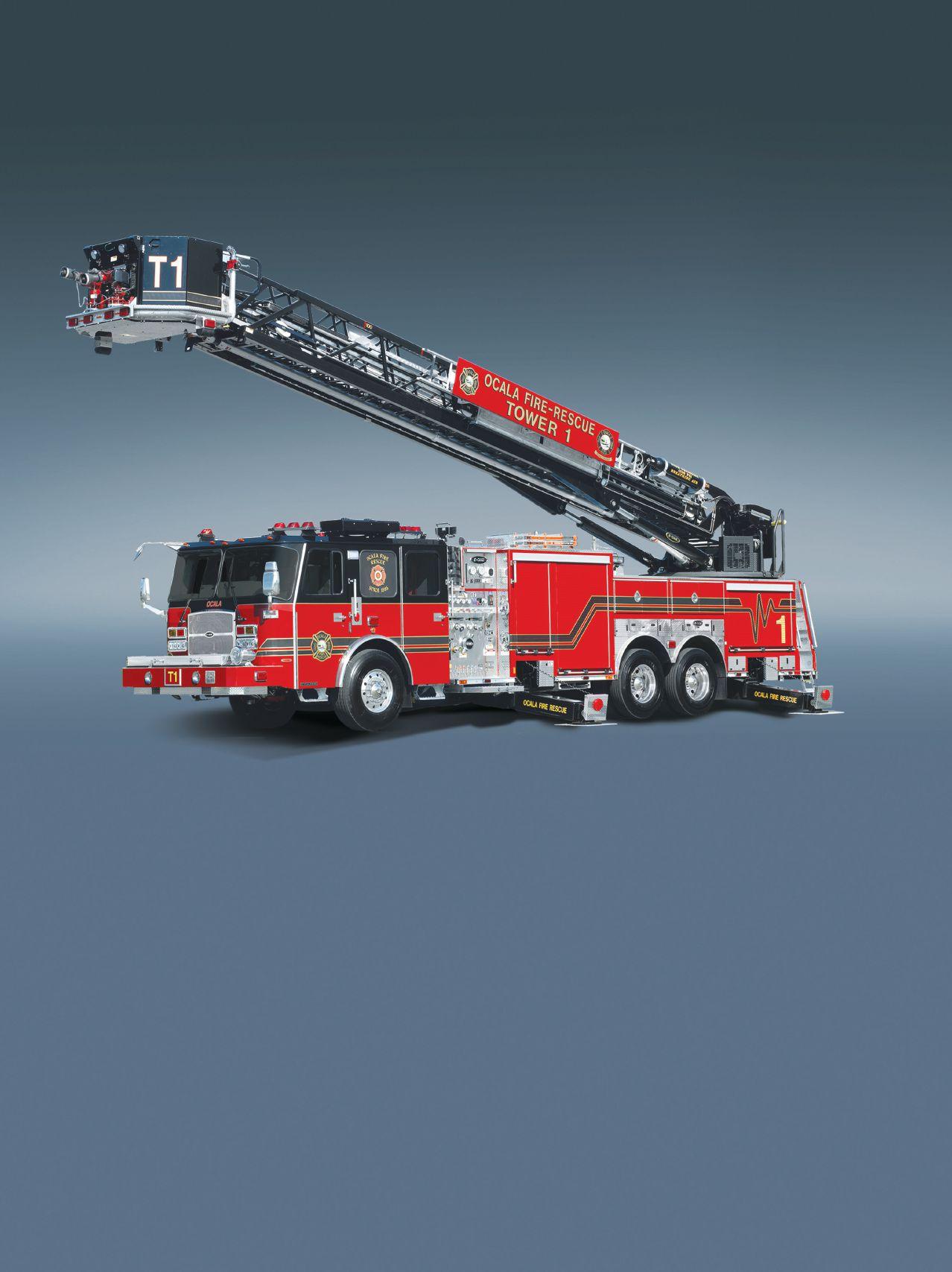
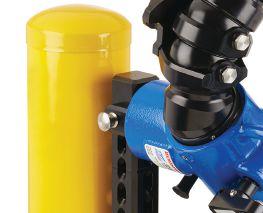
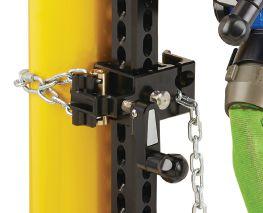
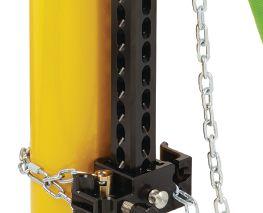
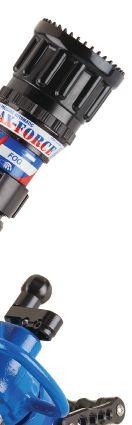
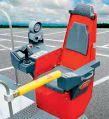
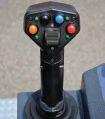
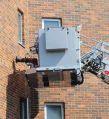
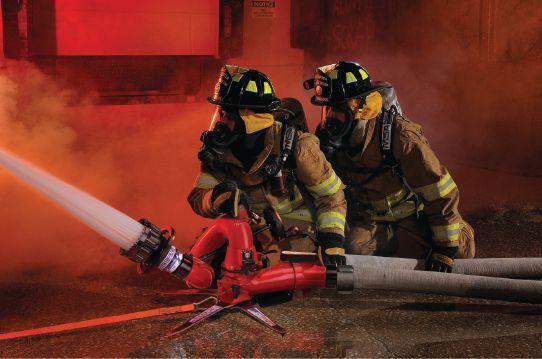
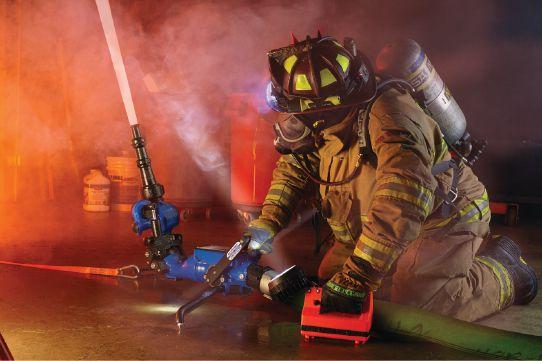
Provides up to 2000 GPM flow and available with wireless remote control.
1305 LB PLATFORM CAPACITY
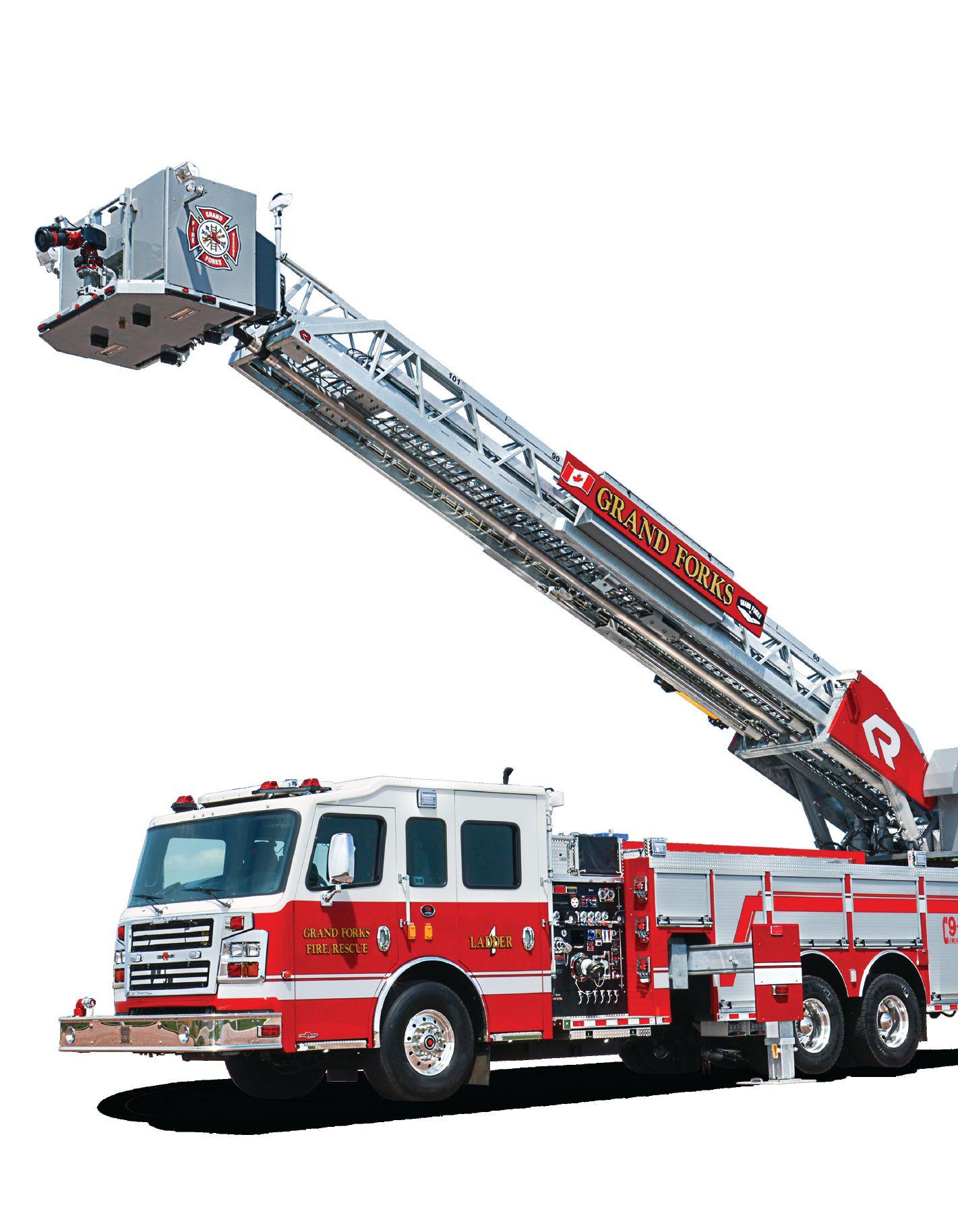
The HPS 100 Platform has a rated load of 1000 lbs of firefighters and 305 lbs of equipment. Angled front corners and perimeter step provide smooth egress.
DOMEX® STEEL AND GREASELESS ROLLER SYSTEM
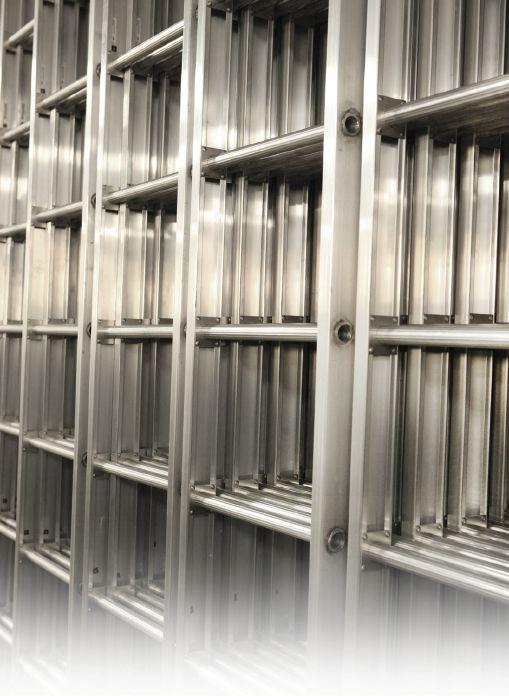
Aerial constructed with high strength DOMEX® steel and features an innovative greaseless roller system, tall hand-rails and maintenance free high traction rung covers to make your climb safer.
2.5 TO 1 STRUCTURAL SAFETY FACTOR
Exceeds NFPA requirements, contributing to E-ONE’s proven safety record for over 35 years.
STRONGEST CAB IN THE INDUSTRY
Keep your crew safe with the cab that withstands over 5x the static roof load and over twice the frontal impact required by NFPA.
UNMATCHED STABILITY
Rock solid stability, even when tested to one and a half times the rated load over the front with tires off the ground.
INTEGRAL TORQUE BOX CHASSIS
A unique design that provides a solid foundation and low center of gravity.
MORE STORAGE SPACE
Full depth compartments and up to 182’ of ground ladders in addition to a 300 gallon water tank. SideStacker™ hosebed with a full height body all the way to rear makes loading of hose easier.
INSTEAD OF BUILDING STANDARD AERIALS, WE BUILD REVOLUTIONARY ONES.
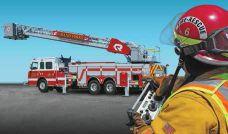
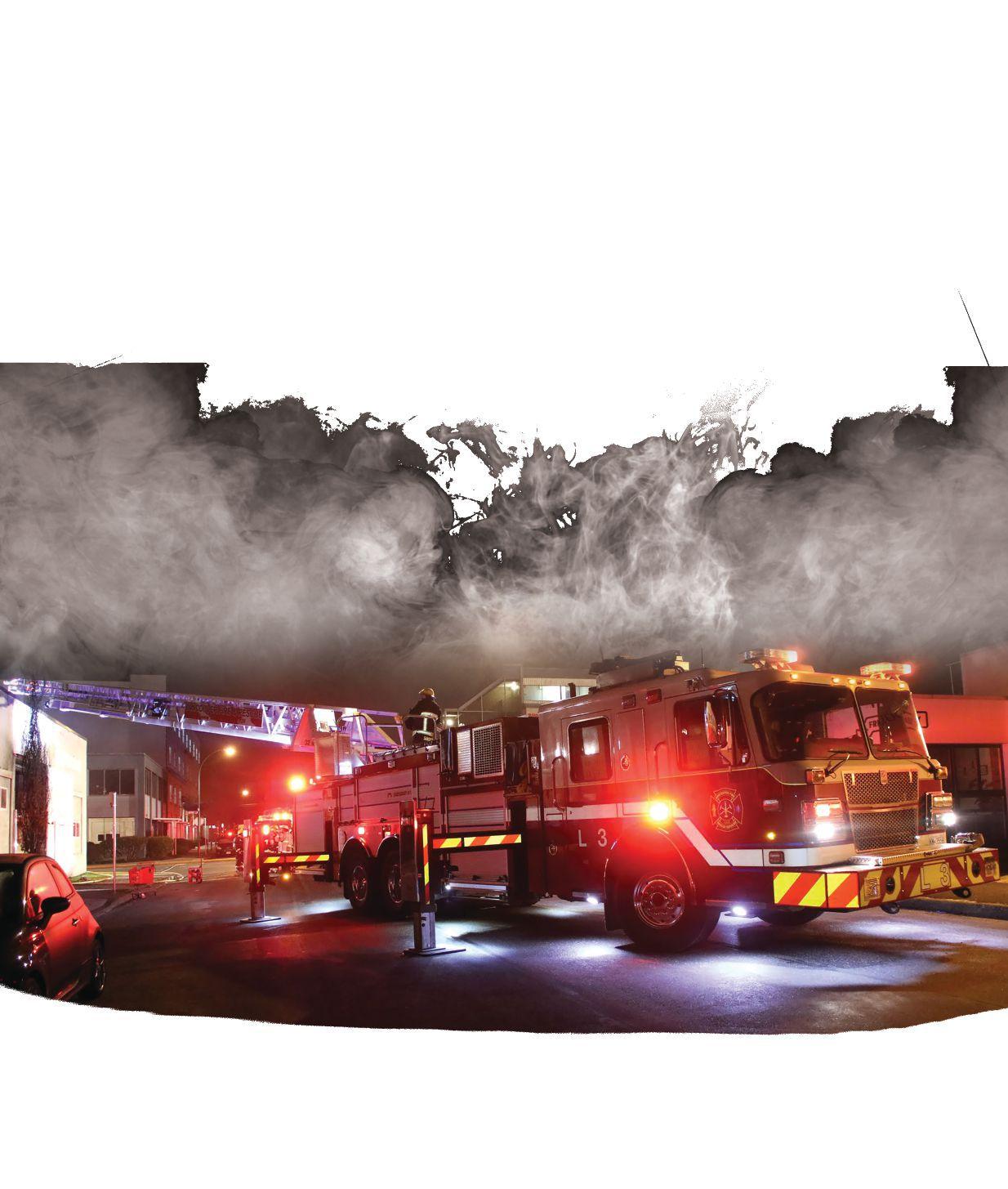
The HPS 100 Platform is a tough, reliable aerial. Constructed of high strength DOMEX® steel, this aerial is mounted to the revolutionary E-ONE chassis. With a 250” wheelbase, a travel height of 11’8” and a 45° cramp angle for enhanced maneuverability, the HPS 100 performs like no other. Its crisscross under-slung outriggers deploy in under 45 seconds, and its 1305 lb platform capacity offer you the strength that is crucial to the fight. The HPS 100 Platform equips your team with the full package from the ground up maximizing your fire fighting capabilities.
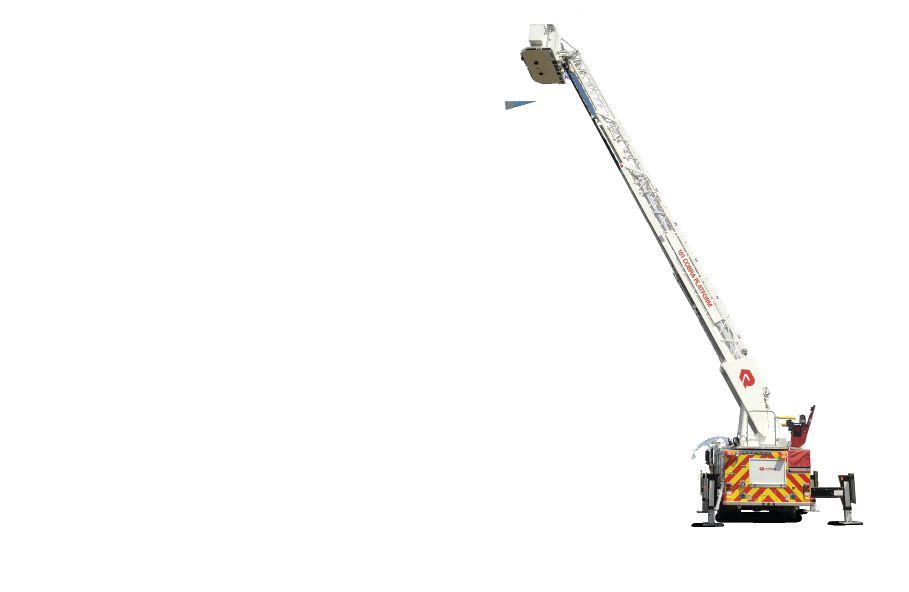
NARROW JACK DEPLOYMENT IN UNDER 45 SECONDS When time is vital and space is limited, the crisscross under-slung outriggers deploy to only 15’6” spread in under 45 seconds.
e-one-aerials.com
Forms
Calibrate for the gas most likely to be found in the field by Steve Clark and Connor Hadaway
Minister outlines Ontario’s response to PTSD crisis by Laura King
Maintain
David Moseley
BY LAURA KING Editor lking@annexweb.com
I
COMMENT
Employing the first line of defence
first heard about tracking exposure to traumatic incidents during a Road to Mental Readiness (R2MR) course in Lakeshore, Ont., a small community near Windsor.
During introductions – name, rank, time on the job – I stopped adding up the years of combined experience at 200, and we hadn’t yet gone beyond the front row: 24 firefighters from two departments – Lakeshore and Leamington – all officers, all volunteers who had started in their 20s and were . . . seasoned veterans.
As is often the case during R2MR sessions, there was talk of this call and that call, the nasty ones, the unforgettable ones.
Imagine, then, among the two dozen people in the training room at Station 1 in Emeryville on a clear, crisp November morning, the numbers of responses, the memories, the patients or victims they attended in crushed cars or at medical responses, the people they helped, or lost – and also knew.
exercise to Wayne Jasper, who is on the board of the Canadian Fallen Firefighters Foundation. Jasper retired last year after 30 years as a firefighter with CFB Esquimalt, and, it turned out, is working with fire departments in western Canada to develop a system to tack traumatic exposures. Simple forms that ask simple questions and require simple answers can make a significant difference, Jasper says.
ESTABLISHED 1957 MAY 2017 VOL. 61 NO. 3
EDITOR LAURA KING lking@annexweb.com 289-259-8077
ASSISTANT EDITOR LAUREN SCOTT lscott@annexweb.com 416-510-5116
National sales manager ADAM SZPAKOWSKI aszpakowski@annexweb.com 289-221-6605
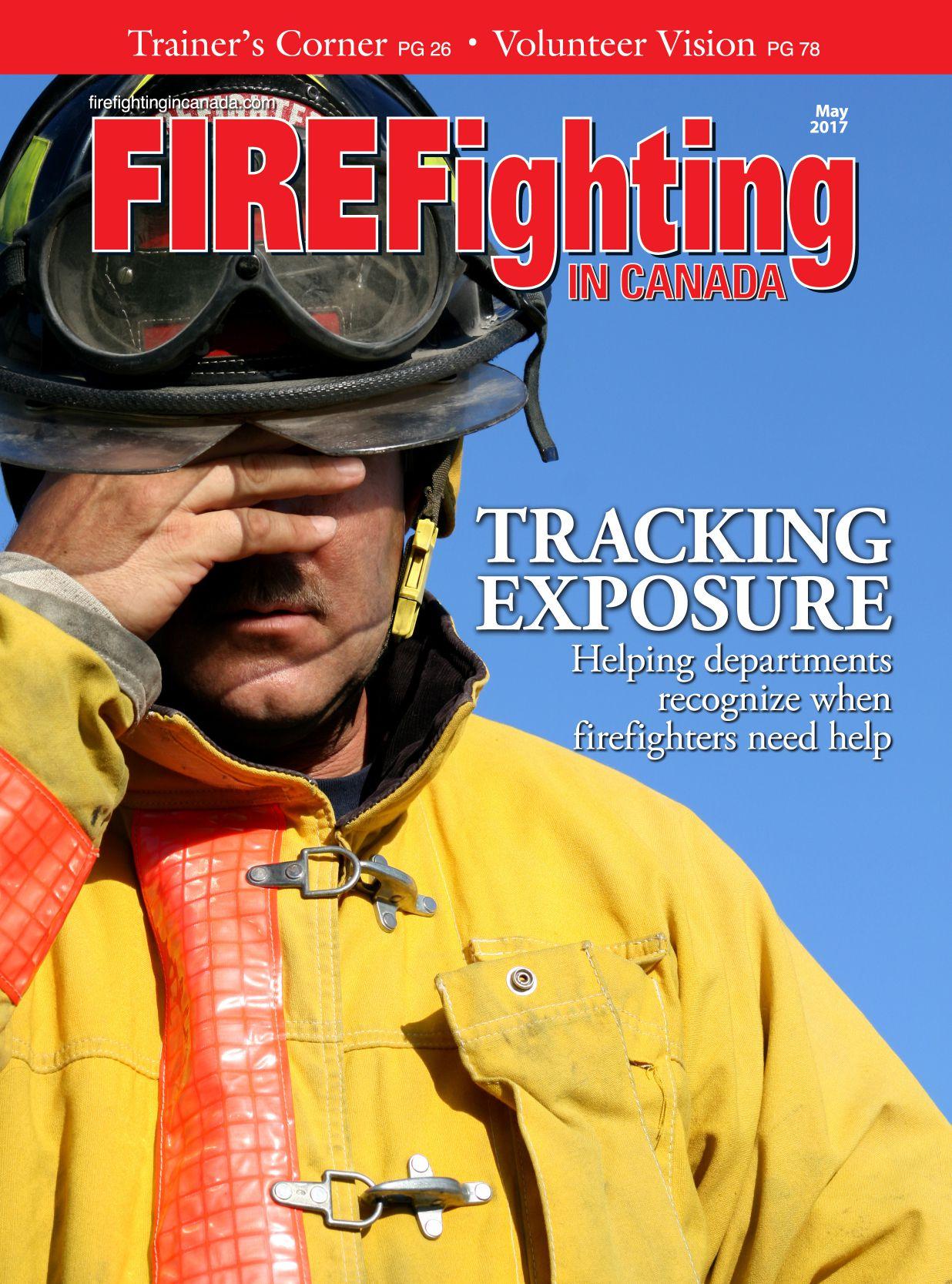
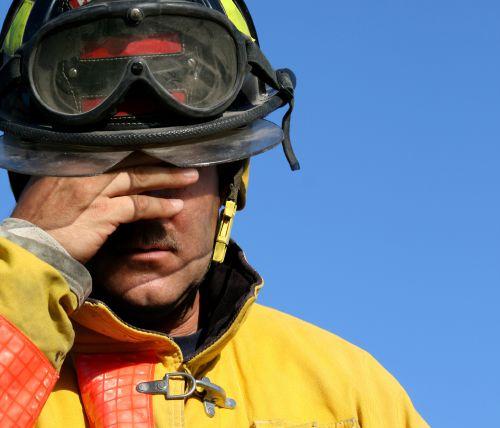
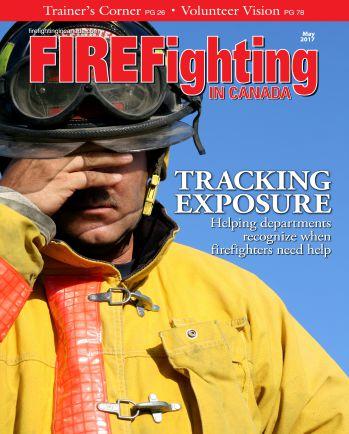
Tracking exposure may help officers recognize when firefighters could benefit from a mental-health check in. See story page 10.
It was Lakeshore Chief Don Williamson who acknowledged as we discussed the cumulative effect of traumatic incidents that keeping track of responses could help chief officers prevent firefighters – or each other – from slipping into the unhealthy zones on the mental-health continuum.
Simply knowing that a firefighter or officer had been to a handful of messy calls over a period of time, acknowledging the impact of the responses – particularly in small communities – and ensuring that everyone knows it’s OK to talk, listen and not be OK, can make a difference, Williamson said.
I mentioned Williamson’s tracking
The Mental Health Commission of Canada teaches in the R2MR program that mental illness among first responders is rarely actually post-traumatic stress disorder, rather it’s the cumulative effect of personal and work stressors, and, so often, one event – a fatality, a relationship breakdown, an ill parent –pushes people to act out or turn to drugs, alcohol or violence. Knowing what to look for, knowing where your people have been, and simply, talking about those calls, is critical to prevention.
Our stories in this issue – tracking exposures on page 10, critical incident stress refresher training on page 42, and an interview with Ontario Labour Minister Kevin Flynn about government measures to help first responders on page 30 – are testimony to how far we’ve come: politicians, mental-health professionals, firefighter associations, management, municipal officials and families all on the same page about the importance of good mental health. After all, it is OK to not be OK, but it, as it he case with fire, prevention is the best option.
PUBLICATION MAIL AGREEMENT #40065710 RETURN UNDELIVERABLE CANADIAN ADDRESSES TO CIRCULATION DEPT. P.O. Box 530, SIMCOE, ON N3Y 4N5 e-mail: subscribe@firefightingincanada.com Printed in Canada ISSN 0015–2595
Canada – 1 Year - $24.50 (with GST $25.73, with HST/QST $27.69) (GST - #867172652RT0001) USA – 1 Year $42.95 USD
We acknowledge the [financial] support of the Government of Canada.
Occasionally, Fire Fighting in Canada will mail information on behalf of industry-related groups whose products and services we believe may be of interest to you. If you prefer not to receive this information, please contact our circulation department in any of the four ways listed above.
All advertising is subject to the publisher’s approval. Such approval does not imply any endorsement of the products or services advertised. Publisher reserves the right to refuse advertising that does not meet the standards of the publication. www.firefightingincanada.com
When you and your equipment are at their best, there are no doubts when the call comes. Maximum condence is the all-new Super Duty® Chassis Cab. The military-grade aluminum alloy^ body let engineers upgrade the frame, driveline, suspension and brakes. Ford Commercial Vehicle specialists have the uptting and modifying expertise to make sure your Super Duty® is ready for duty. We’ll stop at nothing to make equipping your team easier. FORD.CA/BUILTFORBUSINESS
STATIONtoSTATION
ACROSS CANADA: Regional news briefs
Vancouver firefighter receives bravery medal
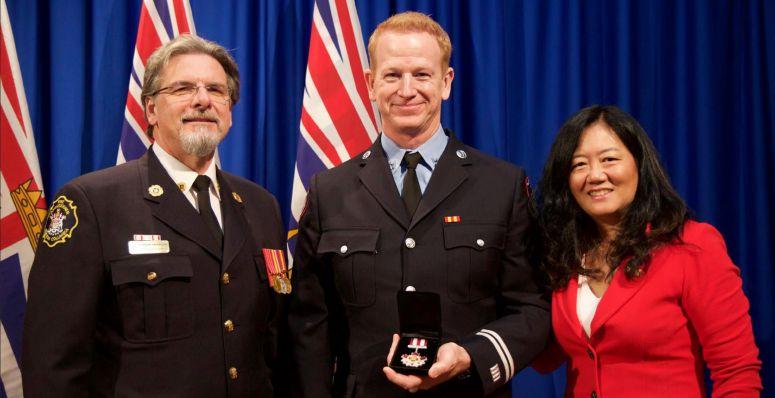
North Vancouver firefighter Capt. Kit Little was awarded a medal of honour on March 13 for risking his life to save a woman in her 80s during an apartment fire last July.
British Columbia Fire Commissioner Gordon Anderson and Naomi Yamamoto, minister of state for emergency preparedness, presented Little with the rare honour: it was the third time the B.C. Firefighter Medal of Bravery had been awarded in the last decade.
Little, a firefighter with the District of North Vancouver for 23 years, removed his breathing apparatus and helmet to climb through a narrow opening to get to the ladder.
“The helmet came off, it was just going to get in the way,” Little said in an interview. “I climbed up and it was all in a split second.”
To reach the woman, Little had to stand on the top rung
of the ladder. He then carried the woman in his arms and handed her to firefighters on the second floor, then went back to save her dog.
“It’s a calculated risk,” Little said. “It’s basically a risk-versus-reward decision.”
Little grew up in a small town in Saskatchewan, where his father was the volunteer
THE BRASS POLE
Promotions & appointments
CHRIS FORSTER was promoted to deputy fire chief of administration for the Penticton Fire Department in British Columbia in February. Forster has more than 22 years of fire-service experience; he started his career with
Vancouver Fire and Rescue Services in 1994. Forster has financial management and fire executive certificates from the British Columbia Institute of Technology.
DERRICK CLARK was promoted to fire chief at Oshawa Fire Services in Ontario on March 20. Clark has
fire chief. Little had always wanted to be a firefighter.
“It was an incredible honour,” Little said of the award. “My mom got to see it, and my kids, and my girlfriend. It was really neat.”
However, Little stresses that he couldn’t have done it without the support of other responders.
been a member of Oshawa Fire Service for more than 30 years; he started as a dispatcher and later became a firefighter, then acting captain, chief training officer, and deputy chief. Clark holds a master’s certificate in municipal leadership from the University of Ontario Institute of Technology.
CHUCK PARSONS is the new chief in Kingsville, Ont. Parsons
“It wasn’t just me, it took 12 people to pull this off,” he said. “There were four RCMP officers holding the ladder, there was five people waiting on the balcony to receive the lady when I got her down,” he said. “I was just the right tall guy at the right place at the right time.”
– Lauren Scott
had been chief in Leamington since 2011 and deputy chief since 2001.
The City of Montreal has appointed BRUNO LACHANCE as director of its fire department, six months after the former chief left. Lachance has been with the department for 33 years and has been assistant director since February 2016.
Kit Little (centre) is presented with B.C. Firefighter Medal of Honour by B.C. Fire Commissioner, Gordon Anderson (left), and Naomi Yamamoto (right), B.C. minister of state for emergency preparedness.
Markham wrapped truck honours Canada 150
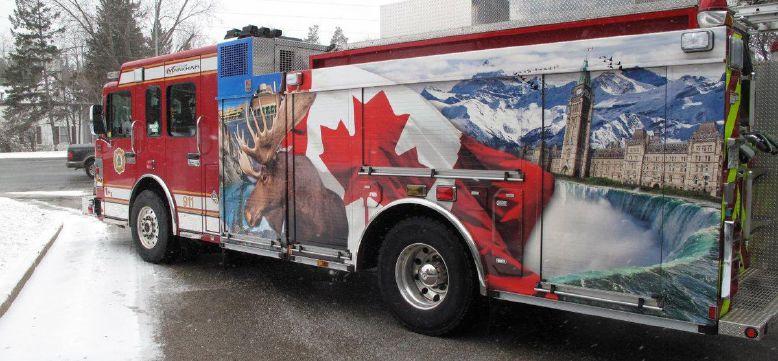
Markham Fire and Emergency Services has found a unique way to celebrate Canada’s 150th anniversary: a newly wrapped fire truck commemorating the history of the country.
Engine 911 now features Canadian symbols including the flag, Parliament Hill, Niagara Falls, the Rocky Mountains and, of course, a moose.
But that is just one side of the truck. On the other side there are historical images of Markham and its fire service.
Platoon Chief Chris Nearing spearheaded the project. Nearing said he was blown away with the quality of the wrapping, and he thinks the public will be too.
“When you see it in person you feel like you could just put your hand in Niagara
Falls,” Nearing said.
Nearing said the eye-catching design was changed three or four times before settling on one that has a lot of meaning for the City of Markham.
“There is a huge sense
of pride for our country in Markham,” he says. “It’s great that it honours Canada and it’s great that it honours Markham.”
Nearing says he hopes the visibility of the truck will
Sprinkler coalition launches safety website
The Home Fire Sprinkler Coalition has launched a website (https://homefiresprinklercanada.ca) that provides educational information about the benefits of installing sprinklers in newly constructed homes. Since the March launch, the not-for-profit group, along with the Co-operators
Retirements
DAVID SPALDING, deputy chief with the Penticton Fire Department in British Columbia, retired April 1 after 35 years in the fire service. Spalding was an auxiliary firefighter beginning in 1981 in Salmon Arm and in 1984 moved to Penticton and was a volunteer. Spalding was hired as a career firefighter in 1988. In 2005, Spalding was promoted to deputy fire chief.x`
Insurance and Financial Services, and the Canadian Automatic Sprinkler Association, have developed content aimed at providing information for stakeholder groups including homeowners, home builders, real-estate agents, insurance professionals and fire services.
Last alarm
DON BOND, former platoon chief with Central York Fire Services, died at Southlake Regional Health Centre March 29 at age 69. Bond started as a volunteer with Newmarket Fire Department in 1972. When the Newmarket and Aurora departments amalgamated, Bond became one of the first full-time platoon chiefs with CYFS. Bond retired in 2007,
The website also includes videos, fact sheets and resources to help fire departments that want to include sprinkler information in their safety programs.
“The website is a great new way to make this important information available to all Canadians,” said HFSC board
“lure” citizens to learn more about fire safety in their city. Markham Fire encourages anyone who spots Engine 911 in the city to snap a picture and tweet @MarkhamFire.
– Lauren Scott
president Lorraine Carli in a statement.
“In particular, it will also be helpful for fire services and other sprinkler advocates as they work to educate Canadians about sprinklers’ ability to save lives and protect property.”
– Lauren Scott
after serving his community for 35 years.
Platoon chief ROB KERR of Brampton Fire and Rescue Services in Ontario died Feb. 22 at the age of 56. Kerr had been a firefighter since 1988. Kerr experienced a stroke on March 14, 2014; the stroke resulted in rare syndrome that left him unable to move or speak.
JIM HAYTER the
Ont., died March 16. Hayter had been the deputy mayor for BrookeAlvinston for 10 years, and had spent decades serving his community. Hayter had been with the Alvinston Fire Department for 44 years, 15 as chief. Hayter was named senior-of-the-year in 2015.
former fire chief in Alvinston,
Markham Fire and Emergency Services’ wrapped truck features Parliament HIll, Niagara Falls and, of course, a moose. The other side features images of Markham and its fire service.
STATIONtoSTATION
BRIGADE NEWS: From departments across Canada
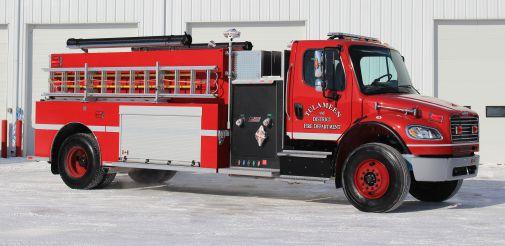
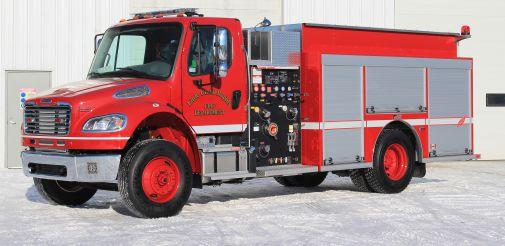
The Tulameen Fire Department in British Columbia received in February its new Fort Garry Fire Trucks-built Crusader Tanker. The unit is built on a Freightliner M2 106 chassis powered by a 330-hp Cummins engine. The truck has an Allison EVS 3000 transmission with side-control pump panels and a Hale DSD 1250 pump type and capacity.
The County of Vermilion River in Alberta received a new Freightliner M2 pumper from Fort Garry Fire Trucks. The truck features a 350hp Cummins engine and an Allison 3000 EVS transmission. It has a red Crusader Duster body constructed of 5052 marine-grade aluminum., a 1000 imperial-gallon CoPoly1000 Darley PSP 1250 pump tank and a Foam Pro 2002 system.
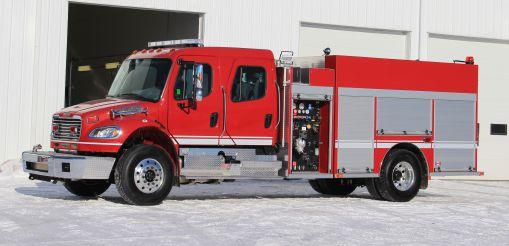
In early February, the Youbou Fire Department in British Columbia received a new Freightliner M2 106 pumper from Fort Garry Fire Trucks. The pumper has a red Crusader body with a 300-hp Cummins ISL9 engine and Allison 3000 EVS transmission. The truck has side-control pump panels made from 5052 marine- grade aluminum and is complete with a Hale DSD 1250 pump made and a Foam Pro 2001 system.
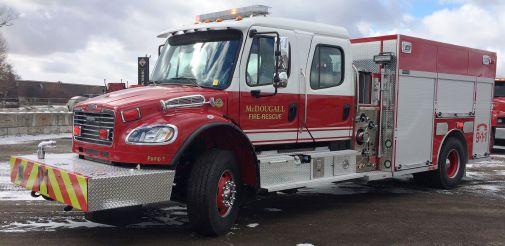
The McDougall Township Fire Department in Ontario took delivery of a 2018 Metalfab H.E.A.T.-series pumper from Carrier Centers Emergency Vehicles. The unit is built on a two-door Freightliner chassis and features a Waterous 1050 igpm pump with a 1000-imperial-gallon water tank. The truck has a Zico drop down ladder rack complete with Whelen warning and scene lights.
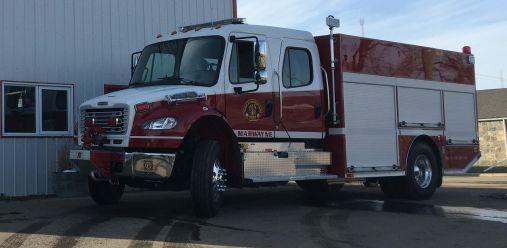
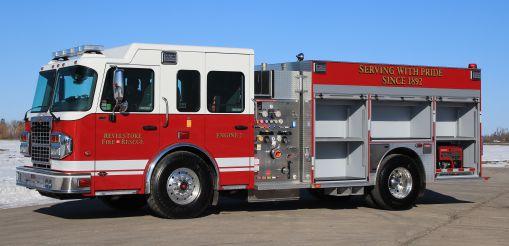
On March 12, the Revelstoke Fire Rescue in British Columbia received a new Spartan Metro Star-X pumper from Fort Garry Fire Trucks. The pumper, which has an emergency recue body type, came with a 380-hp Cummins ISL 9 engine, Allison 3000 EVS transmission with side-control pump panels, a Waterous CSU 1750 pump and a Foam Pro 1600 system.
Little Grand Rapids First Nation Fire Department in Manitoba received a new Fort Garry Fire Trucks-built Freightliner M2 pumper. The truck has a Crusader formed body complete with a 300-hp Cummins ISL engine and Allison 3000 EVS transmission. The unit has side-control aluminum 5052 pump panels and a Hale DSD 1250 pump; it features an 800-imperial gallon Pro-Poly tank and a Foam Pro 1600 system.
THE COUNTY OF VERMILION RIVER
THE TULAMEEN FIRE DEPARTMENT
THE YOUBOU FIRE DEPARTMENT
THE MCDOUGALL TOWNSHIP FIRE DEPARTMENT
THE REVELSTOKE FIRE RESCUE
LITTLE GRAND RAPIDS FIRST NATION FIRE DEPARTMENT
Small in size, big in action
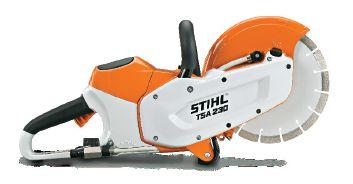
The STIHL TSA 230 is a battery-powered cut-off machine with a 230 mm/9” cutting wheel, and it is particularly light and small at only 3.9 kg/8.6 lb (without battery). Emission-free cordless technology ensures clean work, both indoors and outdoors. The standard-fitted water connection and optimal accessories for attaching to a vacuum cleaner ensure effective dust control when cutting. With a cutting depth of up to 70 mm/2.75”, the TSA 230 is equipped for a variety of applications.
• The cordless battery technology opens the door to countless uses, even in places with no electricity.
• As a completely emission-free cordless power tool, you can use the TSA 230 in confined spaces. The integrated moisture protection also allows for outdoor use in bad weather.
• Starts quickly and easily at the touch of a button. Designed to cut the same range of materials that our gas-powered STIHL Cutquik® will cut, including roofing tiles and indoor drywall.
• Ergonomic, curved front handle offers a secure grip in any working position, allowing precise control.
• The standard-fitted water connection and suction stubs ensure optimal dust suppression - clean work, both indoors and outdoors.
• Equipped with a spindle lock so you can easily change cutting wheels, a rundown brake for fast stopping and a central main switch to turn it off completely.
• The brushless EC motor with maintenance-free belt drive and enclosed control unit is particularly low-maintenance and durable. The highly-efficient EC motor converts battery power into excellent performance.
NOTE: STIHL batteries and chargers are sold separately.
QUALITY AT WORK FOR OVER 90 YEARS.
For over 90 years, STIHL has been a world market leader and innovator in outdoor power equipment. German engineered products featuring the latest pioneering technologies make STIHL the preferred choice for professionals, consistently providing uncompromising quality. STIHL products are only available at independent STIHL Dealers who provide personal advice and expert service. Thank you for the continuous support and for making STIHL the brand you trust.
* “#1 Selling Brand in Canada” is based on an independent market share analysis of gasoline-powered handheld outdoor power equipment from 2016. Source: TraQline Canada.
†Excluding cutting wheel and battery.
Tracking exposure
Traumatic-incident response forms help departments recognize when firefighters need help
By WAYNE JASPER
Mental-health programs teach us that the effects of trauma can be cumulative. As a chief officer, do you know how much exposure your crews have had to traumatic incidents such as fatalities or calls involving children?
With growing awareness of the importance of good mental health, some fire departments have begun to track their members’ exposure to traumatic incidents to ensure officers know when firefighters might need a supportive ear or a wellness check-in.
From a business perspective, tracking exposure can ensure that responders get any necessary treatment early on, which reduces absenteeism and compensation claims.
The Lakeland & District Volunteer Fire Department in Saskatchewan implemented a traumatic-incident exposure tracking system in January. A simple form for members to fill out following incidents helps officers understand how calls affected their crews and what help or resources may be required. The form also provides valuable information that may be used later to support workers compensation claims for post-traumatic stress disorder (PTSD).
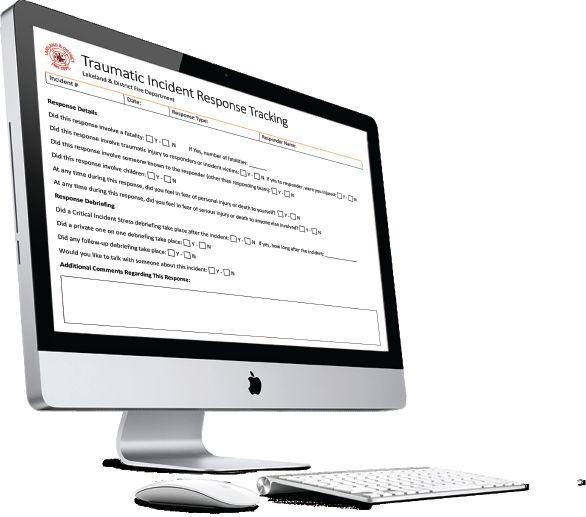
LEFT AND ABOVE Incidents can be traumatic for some members but not others – for various reasons – which is why it’s important to provide an opportunity for firefighters to describe their reactions to calls and indicate whether they want or need to talk. Use of traumatic-incident response forms allows departments to track exposure to trauma and better understand members’ needs.
“We started using the tracking forms after a PTSD awareness presentation earlier this year,” said Lakeland Chief Chris McShannock. “Not only is it tracking at-risk incidents, it also keeps the communication lines open with those who may need to talk. We implemented the form on a one-year trial basis but almost immediately we noticed a marked increase in open discussion following a traumatic incident.”
The Municipal District of Greenview No. 16 in Alberta is preparing to implement the form and is developing a standard operating procedure outlining how and when it should be completed. Greenview fire-services co-ordinator Derian Rosario said the traumatic incident response tracking system is a logical next step for departments that have implemented critical incident stress management (CISM).
“Our industry has recognized the need for CISM for a number of years,” Rosario said, “and the defusing and debriefing has told our people, ‘If you need more help, just let us know.’ In many departments, that is
where the care for emotional trauma stops.
“As we know, each of our department members’ threshold for emotional trauma is different, and there is a cumulative effect. Being able to track exposures and give our members the ability to reach out without any embarrassment is a huge win in our ability to help ensure their emotional health.”
Tracking exposure to traumatic incidents is equally as important in provinces with or without presumptive legislation for PTSD. (Alberta, Manitoba and Ontario have implemented presumptive legislation). Providing an accurate record of traumatic exposures over time may be essential when filing a workers compensation claim, no different from any other exposure or injury. Obtaining the necessary diagnosis and treatment from a medical professional is mandatory to ensure a claim is accepted; having a record of exposure to traumatic incidents may expedite that process and reduce the anxiety involved in filing the claim.
The availability of a simple form for members to complete once they return from a call they deem to be traumatic allows a department to keep an accurate record of exposure to traumatic incidents. It is important to recognize that not all members who respond to an incident may deem it traumatic. Firefighters’ responses to incidents can vary greatly depending on their duties at an incident, the location and time of the incident, and the age and familiarity of individuals involved in an incident.
The form being used by Lakeland, Greenview and Ladysmith Fire/Rescue in British Columbia is the result of discussions with emergency responders who had been diagnosed with PTSD and said they wished there had been an easier way to document and communicate the issues they experienced.
Ladysmith Chief Ray Delcourt echoed Lakeland Chief McShannock’s comments about the form as a catalyst for discussions about mental health.
“We have recently began tracking exposure to incidents that may lead to post-traumatic injuries” Delcourt said. “This has led to open and relaxed conversation by those responding to these incidents and their peers within the fire department.”
The form should ask members to provide basic information such as the incident number, date, responders’ names, and the type of response such as first responder, fire
or MVC. Some basic Yes or No questions about the incident help to qualify the type of traumatic exposure: Did this response involve a fatality? If yes, how many? Did this response involve traumatic injury to any responders or incident victims? If yes to a responder, were you the one injured?
Asking whether the call involved someone known to the responder is critical; responders who know a person involved in an incident may be more likely to consider the incident traumatic than those who don’t. The probability of responders knowing patients or victims is greater in smaller areas covered by volunteer departments than in larger metropolitan areas. The involvement of children in an incident generally increases the level of trauma for everyone involved. The involvement of children may often be reported to the responding crew while they are en route to the scene and may result in hyper-vigilance even before arrival at the incident.
Additional questions may qualify the nature of traumatic exposure: At any time during the response, did you fear serious injury or death to yourself or anyone else involved?
Questions should be included regarding debriefings by qualified individuals following the incident: Did a critical incident stress debriefing take place after the incident? If yes, how long after the incident? Did a private, one-on-one debriefing take place? Did any follow-up debriefing take place? If so, how long after the initial debriefing?
A key component of the tracking form is the final question: Would you like to talk with someone about this incident? Many responders may find it easier to reach out for further assistance by answering this question rather than having to ask in person. An affirmative answer can lead to a talk within the department and progress to the steps necessary to assist the responder.
A comment box can be included on the form to allow for personal observations, comments or questions relating to the event; firefighters can add more information relating to any of the questions on the form.
The form should be completed as soon as possible after firefighters return from an incident but may be completed later. Once completed, individuals should keep a copy of the form for their records and submit a copy to a designated department peer counsellor, safety officer, or officer in charge of the incident for follow-up.
The purpose of tracking responses to
Traumatic Incident Response Tracking
Lakeland & District Fire Department
Incident # Date:
Response Details
Did this response involve a fatality:
‐ N If Yes, number of fatalities:
Did this response involve traumatic injury to responders or incident victims:
Did this response involve someone known to the responder (other than responding team): Y N
Did this response involve children:
At any time during this response, did you feel in fear of personal injury or death to yourself? Y ‐ N
At any time during this response, did you feel in fear of serious injury or death to anyone else involved?
Response Debriefing
Did a Critical Incident Stress debriefing take place after the incident: Y N If yes, how long after the incident:
Did a private one on one debriefing take place: Y ‐ N
Did any follow‐up debriefing take place: Y ‐ N
Would you like to talk with someone about this incident: Y ‐ N
Additional Comments Regarding This Response:
An example of a traumatic-incident response form that can be easily customized by any department.
traumatic incidents is not to single out an individual but to provide an accurate record to assist in early recognition of those who may have been exposed to a number of traumatic incidents. For example, behaviour changes may suggest that individuals are struggling following an incident or from the cumulative effects of several incidents; the tracking information can help officers be aware of crews’ call responses and watch for any indicators of mental-health issues.
Should an individual choose to submit the personal tracking form, it ‘s a good idea to have the officer in charge of the incident submit an OIC traumatic incident response tracking form. (Note that this form may also be submitted by the officer in charge even if no one on the responding crew submits a personal form, should the OIC deem there may have been some form of traumatic event during the incident.) This form asks whether the OIC was made aware of submission of forms by responding crews, whether CISM briefings occurred, and whether the officer followed up with the firefighter(s) who submitted the forms. Submission of the OIC form can ensure that proper follow-up occurs with all those who responded to the incident. Submission by the OIC of an overall traumatic incident response form will also assist in ensuring all those that have responded to the incident receive adequate assistance if required.
New information may be added to the forms over time as additional points about the incident are recalled. This information may include feelings that may develop as
a result of responding to the incident. The Post Traumatic Stress Disorder Source Book recommends that close attention be paid to any form entries that involve two of the major symptoms associated with PTSD: signs of distressing arousal, which can resemble excessive emotional issues such as ongoing worries or increasing negative thoughts; and signs of dissociation – temporary escape from the memory of traumatic events by blocking them out. Extremely traumatic memories may then become dissociated. Traumatic memories that are associated with an incident or accumulation of different incidents may contain thoughts, feelings, images, smells and sounds that may cause an individual’s behavior to change.
Early recognition of these changes coupled with the accurate documentation of repeated responses to traumatic incidents can be critical in obtaining early treatment .
Ongoing discussions about the effects of traumatic-incident responses with your members will lead to a greater comfort level in discussing these events. As this comfort level increases, the stigma then decreases.
Departments interested in further information or in obtaining traumatic incident response forms can contact Wayne Jasper at wayne.jasper@icloud.com
Wayne Jasper is a 10-year member of the board of the Canadian Fallen Firefighters Foundation and chairs the line-of-duty-death committee. Jasper has 33 years of fire-service experience, as a volunteer and career firefighter.
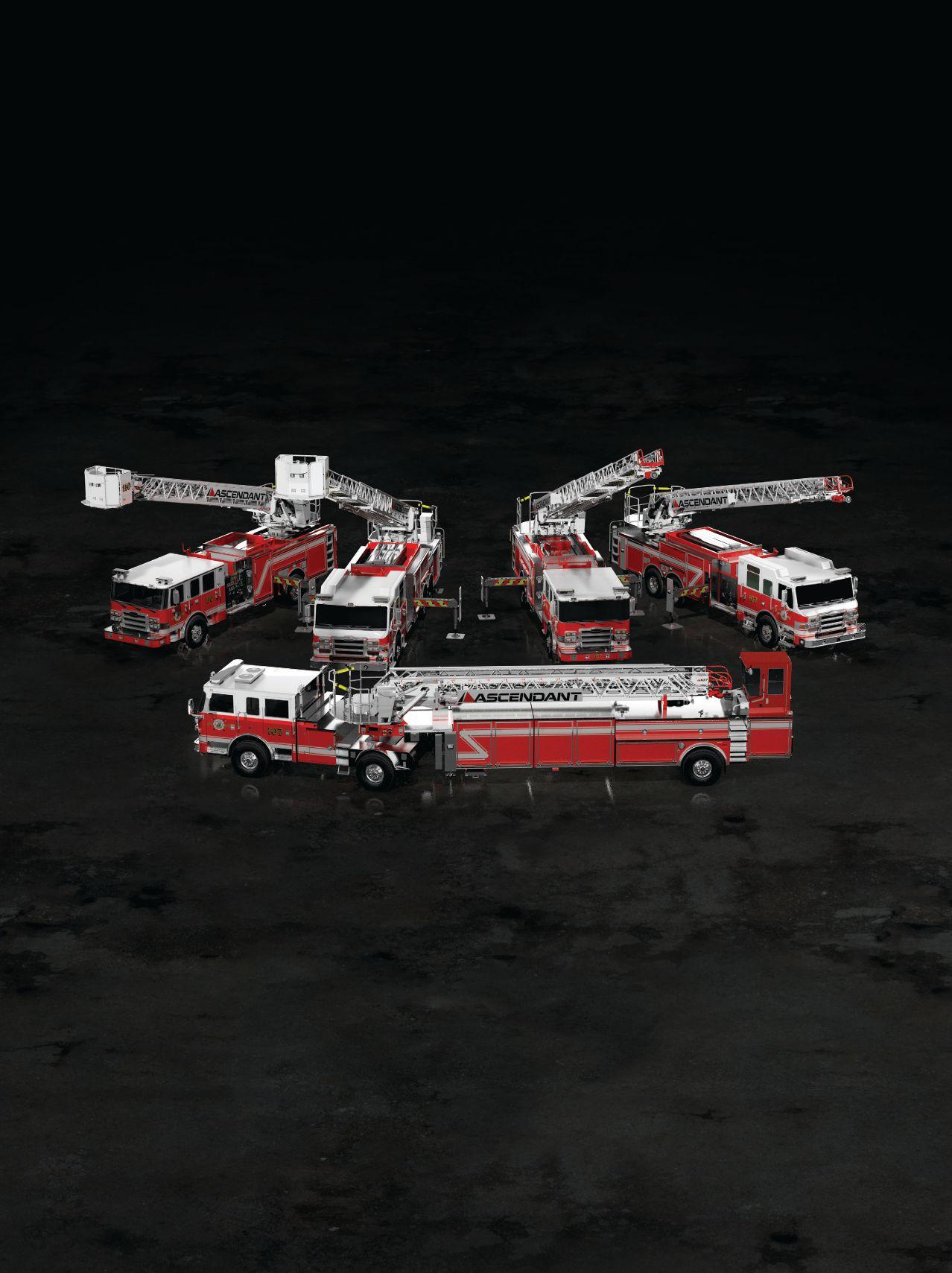
110’ Single Rear Axle Heavy-Duty Aerial Platform
Tandem Rear Axle Heavy-Duty Aerial Platform
107’ Tandem Rear Axle Heavy-Duty Aerial Ladder
107’ Single Rear Axle Heavy-Duty Aerial Ladder
107’ Tiller Heavy-Duty Aerial Ladder
BY
MATT
PEGG Fire chief, Toronto
Are you a reader?
LEADERSHIPFORUM
Finding leadership between the lines
I have always been a voracious reader. Reading is something I find grounding, relaxing and educational; it is something I crave, especially when life gets busy. Reading provides an opportunity to learn from some of the best leaders and smartest minds, any time and anywhere. There is something satisfying about holding and reading a good, old-fashioned paper book.
As good as paper books are, technology provides us with many amazing ways to read and learn, especially considering how mobile we are. My e-reader has become one of my favourite tools, and now that the app on my iPad automatically syncs with my e-reader, no matter which device I pick up, my bookmarks and library are up to date. This has made it far easier for me to read, and given that my e-reader can hold almost 6,000 books, moving and storing my library easy.
In March, my wife, Katherine, and I spent a much-needed week away. For us, the perfect vacation always includes lots of time to read. This particular holiday was no different as I happily dove into three great books during our week away. I want to share some thoughts that arose from one of those books.
One of my favourite authors is John Maxwell. Maxwell’s perspective and advice on leadership is exceptional. In his book Good leaders Ask Great Questions, Maxwell explains that “A team is a group of people who may not be equal in experience, talent or education, but are all equal in commitment.” I read the chapter that contains that quote, then reread it twice as I was struck by the accuracy and applicability of the statement to the fire service. Every fire department comprises a collection of different people with different skills, experiences and strengths; it is this diversity that makes us strong and effective.
destined for failure. Maxwell explains that failures resulting from a lack of commitment are less likely to happen when things are good, rather, they almost always happen when the heat and pressure are on.
As fire-service leaders, it is our responsibility to be the first to commit. The most effective leaders are those who bring the highest levels of commitment to the team. They lead by example. They are the first ones to go the extra mile. They pull their weight – and then some.
When a team member lacks commitment, projects, service levels, deliverables and other aspects of our business are negatively affected. But a lack of commitment at the leadership level will render even the most capable and talented teams ineffective and doomed for failure.
A few pages deeper into this book, Maxwell asks “If you are the leader, and you are not adding value to the team, should you even be the leader?” These are powerful words that should make each of us who has been entrusted with the privilege of being fire-services leaders to reflect. Being a leader is a privilege. The true role of every leader is to serve others and to create opportunities for our people to succeed. Fire-service officers can never afford to miss a chance to say thank you for a job well done. As leaders, we should be the first in
The absence of commitment, especially on the part of leaders, guarantees that even the most experienced, talented and educated teams are destined for failure. ‘‘ ’’
The segment of the quote that resonates so strongly for me is the reality that the key ingredient in any great team is commitment. The absence of commitment, especially on the part of leaders, guarantees that even the most experienced, talented and educated teams are
Matthew Pegg is acting chief with Toronto Fire Services, having previously served in Georgina, Ajax and Brampton, Ont. Pegg was president of the Ontario Association of Fire Chiefs from 2013 to 2016. Pegg’s education includes studies in public management, leadership, fire-service administration and industrial/labour relations. He has been awarded the chief-fire officer professional designation and is the recipient of the Ontario medal for firefighter bravery, the fire-service exemplary-service medal and the Firehouse heroism and community-service award. Contact Pegg at matthew.pegg@toronto.ca
line when things get tough or go wrong, and the last in line when it is time for praise or recognition.
I have never had the honour of meeting Maxwell. But, by reading many of his books, I can say that he plays a big role in my personal and professional development as a leader. I appreciate his candour and the way the he delivers powerful and sometimes difficult messages in a way that makes me stop and think.
As leaders, none of us will ever get enough time to complete the professional development, take all the courses or attend the seminars that we would like to. Books, magazines and executive book summaries afford us a means of connecting with other leaders; they give us the opportunity to learn lessons and examine our own skills and shortcomings. They give us the chance to pause and hear words of wisdom.
Are you a reader?
The problem with pentane
Calibrate for the gas most likely to be found in the field to ensure safety
By STEVE CLARK and CONNOR HADAWAY
Two units respond to alarm bells at a school after a caretaker reports a suspected gas leak. The local gas company is on the scene and refuses to enter the building due to elevated lower explosive limit (LEL) readings. The ladder crew begins to investigate with a multi-gas detector. There is no perceptible odour and the multi-gas detector indicates zero per cent LEL. However, the gas company is still getting elevated readings.
Is this the type of call to which your department might respond? Which detector do you trust? What do you do next?
The crews on scene bring in a second detector from the rescue unit. This solid-state combustible gas leak detector uses different technology. This detector immediately begins to detect gas and as readings elevate, the detector auto-scales from partsper-million to several percent LEL.
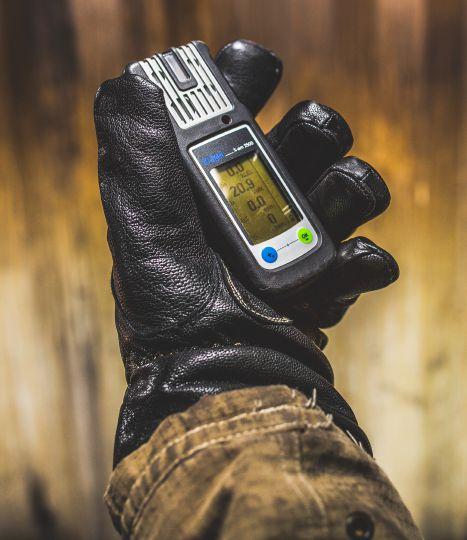
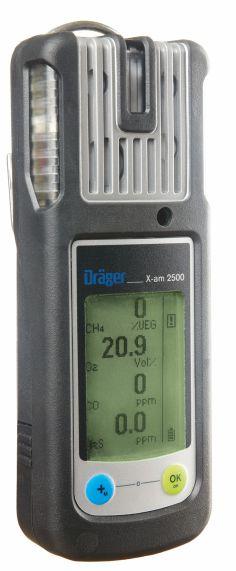
LEFT There are three main reasons an LEL sensor may lose sensitivity to higher-ignition temperature gases: an aging sensor; the sensor may be physically damaged; or the sensor may have been exposed to poisons.
ABOVE Almost all detector manufacturers recommend bumping and calibrating to the target gas, meaning the gas most likely to be encountered in the field; for firefighters that is methane or natural gas.
Yet, the multi-gas detector still indicates zero per cent LEL. Using the solid-state sensor, crews trace the source of the leak to an old boiler room; they discover an uncapped pipe that runs directly from the sewer, which is allowing methane gas to escape.
Methane is naturally an odourless gas. Gas utility companies add mercaptan, a harmless gas that has a rotten-egg odour, to natural gas to warn residents of leaks.
This incident prompted further investigation. Why did the multi-gas detector show zero per cent LEL while the solid-state detector and the gas company’s detector indicate elevated LEL readings?
The answer lies in how an LEL sensor operates and how calibration gas can affect its performance.
LEL sensors use the principle of catalytic oxidation, which generates heat. Essentially, the catalyst inside the LEL sensor “burns” the gas being sampled. As heat is generated, resistance across the sensor increases, which causes a change in voltage across the sensor.
The change in voltage is proportional to the gas concentration.
Why is this important? Different gases burn at different temperatures. Methane ignites at 537 C (999 F), while pentane needs a temperature of only 260 C (500 F) to burn.
The sensor needs almost double the amount of energy to detect methane as it does pentane.
Think of sensors like a battery; they gradually lose power over time. Therefore, it is possible that a LEL sensor with a degraded catalyst would respond to pentane during calibration and bump testing, yet might not respond to methane. The detector will essentially be blind to methane and possibly other high-ignition temperature gases such as hydrogen and propane, which burn at 500 C (932 F) and 455 C (851 F) respectively, while appearing to operate normally.
There are three main reasons an LEL sensor may lose sensitivity to higher-ignition temperature gases: an aging sensor; the sensor may be physically damaged; or the sensor may have been exposed to poisons. Some poisons that may affect sensors are silicon compounds such as Armor All, lead compounds, halogenated hydrocarbons (Freon), sulphur compounds, acids and pesticides.
The multi-gas detector used by fire crews on scene at the school was calibrated to pentane. However, the solid-state detector and the gas company’s detector were calibrated to methane.
Despite the fact that fire crews had successfully “bumped” their detector that day, they were operating with a sensor that had been poisoned. Essentially, the crews could have been standing in 100 per cent LEL of methane and their detector would not have indicated a hazard; this is the danger of a poisoned sensor.
Methane is the main component in natural gas. According to the NFPA, between 2007 and 2011, municipal fire departments in the United Sates responded to an estimated average of 51,600 gas fires each year. Almost all gas fires involved natural gas or liquefied petroleum (LP) gas.
So why do fire services calibrate to pentane? To put it simply: safety (or perceived safety). Pentane’s correction factors are lower than those of methane, so pentane
PHOTOS COURTESY
LEFT The best way to ensure that a monitor is working to capacity is to test the sensor with the target gas; doing so will prove the sensor’s ability to perceive even the most challenging flammable gases.
calibration is more accurate than other calibrations to a wide range of flammable gases. Methane’s factors are accurate to a large number of gases, but are very inaccurate for others.
Almost all detector manufacturers recommend bumping and calibrating to the target gas, meaning the gas most likely to be encountered in the field; for firefighters that is methane or natural gas.
According to Jason Morton, a product support manager at Drager in Mississauga, Ont., a catalytic sensor is the most suitable for the fire service. However, firefighters should be vigilant when it comes to the age and accuracy of the sensor.
“For safety monitoring applications, a catalytic sensor is suitable for use because it will respond to a very wide range of combustible gases,” Morton said. “However, as the sensor ages, its response
characteristics to different gases will change.
Sensitivity to gases with higher ignition temperatures, such as methane, will decrease to the point where accurate measurements are no longer possible. But sensitivity to gases with a lower ignition temperature, such as pentane, may still be sufficient.”
The best way to ensure that a monitor is working to its full capacity is to test the sensor with the target gas; doing so will prove the sensor’s ability to perceive even the most challenging flammable gases.
What is your target gas? Think about this: How many pentane calls has your department responded to in the last year? The past 20 years? How many natural gas calls has your team responded to? The choice for safety is obvious; the need for change isn’t always as obvious.
Steve Clark is an acting captain with the City of Hamilton Fire Department in Ontario and is a member of the department’s hazardous materials team. Clark has worked in hazardous materials response for more than 10 years in the public and private sectors, and has presented to and instructed fire departments and response teams across Canada and United States. Contact him at sclark23@gmail.com
Connor Hadaway is a former firefighter with the City of Hamilton Fire Department in Ontario who served on the department’s hazardous materials team. Hadaway has trained hazmat response teams in the private and public sectors; he is currently employed with the Ontario Provincial Police. Contact him at connorhadaway@hotmail.com
BY SHAYNE MINTZ Canadian regional director, NFPA
FAppetizing enterprises, or recipe for disaster?
ood trucks may seem like a strange topic for a column, but these kitchens on wheels are a becoming an issue for the fire service, particularly people in fire protection and prevention.
I can’t count the number of fire department staff I’ve spoken with who have recounted stories about food-truck troubles. In some cases, incidents have occurred, and in others, there have been close calls. Food trucks and temporary cooking facilities are a serious issue.
As the weather warms up, food trucks begin appearing on the streets. What may seem to be innocent, temporary cooking operations start popping up in neighbourhoods, fair grounds, carnivals, parks, and festivals.
With lower costs than brick-and-mortar restaurants and the opportunity for mobility, it is no wonder that food trucks are an appetizing enterprise. Municipalities have adopted necessary food-truck related bylaws to ensure that Canada’s growing street-food culture can safely expand.
These cooking operations range from street carts and converted delivery vans to custom-made, walk-through step-vans with multiple-axle trailers. Food trucks can even be found floating on lakes in the summer in the form of converted barges that move from marina to marina or harbour to harbour.
Is your department well versed in the locations of these set-ups and the fire-and-life-safety requirements? Are you tied into your health department, parks and recreation/public-events department, and law enforcement agencies so you can discuss mutual concerns about theses types of businesses?
As the authority having jurisdiction (AHJ) are you aware of the hazards associated with these operations, such as the greases or solid fuels being used that may need different extinguishing agents?
Do these units have proper means of access and egress for patrons, employees or response personnel?
few close calls in Canada. In 2012, a food truck at the Canadian National Exhibition was destroyed in a propane explosion. The incident happened at 4 a.m. and no injuries were reported, but had the explosion happened later in the day, there could have been numerous casualties.
The need for proper separation of food trucks at public events such as summer festivals needs to be considered; having several food trucks parked nose-to-tail could lead to disaster should a fire break out. Departments should also ensure that food-truck operators observe proper spacing from hydrants.
The national model building and fire codes refer to NFPA 96Standard for Ventilation Control and Fire Protection of Commercial Cooking Operations for the safety standards that apply to these types of situations. The purpose of NFPA 96 is “to reduce the potential fire hazard of cooking operations, irrespective of the type of cooking equipment used and whether it is used in public or private facilities.”
The scope of the standard provides for “the minimum safety requirements (preventative and operative) related to the design, installation, operation, inspection, and maintenance of all public and private cooking operations.”
I can’t count the number of fire department staff I’ve spoken with across Canada who have recounted stories about food-truck troubles. ‘‘ ’’
In a 2012 study of food trucks by the Fire Department of the City of New York several common hazards were found on board that led to explosions or fires that caused serious injuries or death. These hazards ranged from improperly stored or maintained propane and compressed-gas cylinders to high-voltage electrical hook-ups with an overabundance of extension cords, hot fryer oil and open flame grills, and improper storage of non-compatible fuels.
There have been food-truck related deaths in the United States and a
Shayne Mintz has more than 35 years of experience in the fire service, having completed his career as chief of the Burlington Fire Department in Ontario. He is now the Canadian regional director for the National Fire Protection Association (NFPA). Contact Shayne at smintz@nfpa.org, and follow him on Twitter at @ShayneMintz
These requirements include all manner of cooking equipment: exhaust hoods, grease-removal devices, exhaust ductwork, exhaust fans, dampers, fire-extinguishing equipment, and all other components involved in the capture, containment, and control of grease-laden cooking effluent. Most of this equipment is found in food trucks or transportable food vending operations.
As the AHJ, if you believe there is cooking being done for the purposes of sale and there is commercial equipment being used, then it could be assumed that the vehicle is a commercial cooking operation. Mobile restaurants must comply with the same building, health and fire code regulations as any other restaurant. All food trucks require permits to operate. Your municipal licensing office should have a list of approved vendors that will help fire-prevention teams ensure that everyone who operates these food trucks, and everyone who enjoys their wares, stays safe.
BE THERE
You asked for protection from fireground particulates, and we heard you. The new GORE® Particulate Hood provides protection so you can be there.
Be There for yourself… Be There for your brothers and sisters… Be There for those who depend on you.
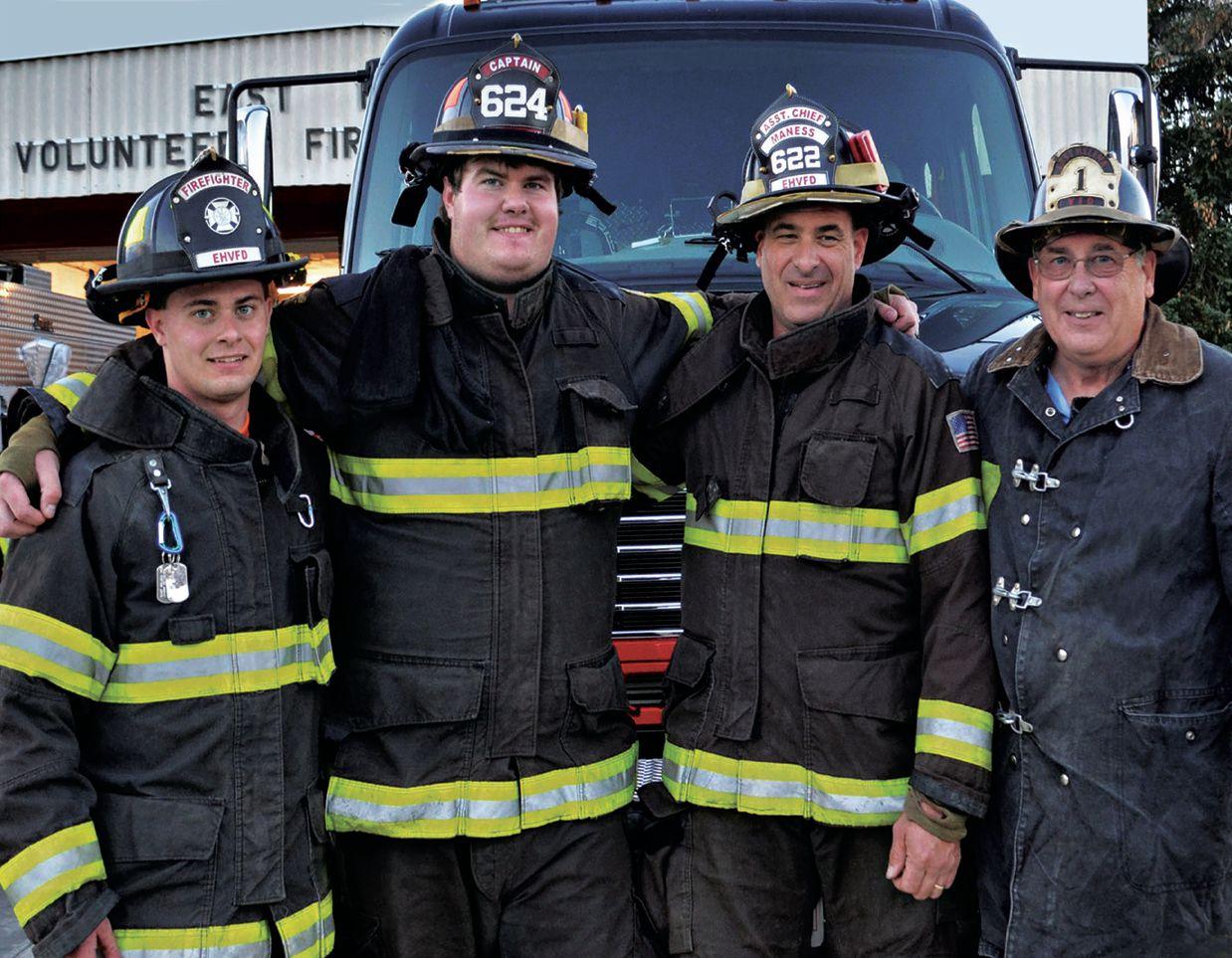
The Maness Family Three Generations of Firefighters East Helena Volunteer Fire Department, Montana
BY KEITH STECKO Fire chief Smithers, B.C.
MSAFEHARBOUR
Build resilience by practising yoga
aking a conscious effort to build your personal resilience is one of the most important things you can do for yourself as a firefighter. Being a firefighter is physically and emotionally demanding. Having a tailored personal resilience program can produce positive results and help to maintain work-life balance.
Personal resilience has many spheres, including proper nutrition, rest, and being physically and mentally fit. One activity that can help firefighters achieve and maintain this healthy lifestyle is yoga.
My experience with yoga has been transformational. At first I was skeptical, but as I continued with my practice, I began to implement some of the things I learned. For example, the act of breathing and using your breath to calm the mind and increase mental focus is one of the tools I use regularly.
Yoga is much more than showing up with a mat, bending into some really awkward poses and chanting “om” a few times. In fact, yoga can improve overall mental and physical well-being.
Being a firefighter is demanding work physically and mentally, and over time it can take a toll on the body and the mind. It is important to de-stress by taking care of the mind, body and soul. Practised properly and regularly, and with good instruction, yoga can help firefighters look after all three.
Consider all the protective gear that firefighters wear and the strenuous positions necessary to get the job done safely; yoga helps keep the body limber and flexible. Regular practise can benefit the back, joints, hips and all the parts in between.
Yoga builds strength. Holding the poses longer and using body weight strengthens the larger muscle groups. Yoga is essentially a two-for-one activity, building strength and flexibility.
Deep breathing also calms the mind and body. Taking deep breaths can even increase concentration – this lends itself well to increased situational awareness on the fire ground. Firefighters know and understand that on the fire ground, the environment can change quickly – nothing is the same as it was five minutes ago. I think the ability to calm the mind during emergencies is one of the most pow erful things that yoga can do for firefighters.
Responding to calls can get the heartbeat racing and adrenaline pumping. Sometimes these calls involve traumatic situations that can take a mental toll on first responders. When the body is faced with a crisis it releases cortisol as a coping mechanism, part of our natural fight-or-flight response. Cortisol levels may remain high hours after leaving the fire ground. Excess cortisol in the body can compromise the immune system and lead to other long-term health conditions. Doing yoga lowers cortisol levels and blood pressure, while allowing the heart rate to return to its regular pace.
Being exposed to high-stress events, firefighters may experience lowered energy levels and may even feel depressed. Stress, anxiety and depression drain serotonin in the body, but using breathing
I think the ability to calm the mind during emergencies is one of the most powerful things that yoga can do for firefighters. ‘‘ ’’
What about breathing? It seems simple, I know. But many people do not breathe effectively. Yoga teaches its practitioners to breathe full breaths through the belly, which most of us haven’t done since we were kids. It turns out, this is very important. As adults, we tend to take shallow breaths, which means we do not receive enough oxygen throughout the body. When firefighters are on the fire ground doing high-intensity work, breathing properly becomes very important.
Keith Stecko is the fire chief and emergency program co-ordinator in Smithers, B.C. He joined the fire service in 1986 as a firefighter/paramedic level 2 advanced life support, served in the Canadian Armed Forces, and is a graduate of the Lakeland College bachelor of business in emergency services program and the public administration program from Camosun College. Contact Keith at kstecko@smithers.ca and follow him on Twitter at @KeithStecko
techniques that are taught in yoga can raise serotonin levels and bring back positive feelings. This new sense of calmness and restored energy found through yoga helps to maintain mental balance.
Yoga an accessible and easy activity that you can pretty much do anywhere – at the fire station or at home. Another neat thing about yoga is that you don’t need to do it for hours on end. In fact, you can slip 20-minute yoga sessions into your day and still experience the benefits of the practice.
I think yoga offers the perfect balance in terms of a personal resilience program, when the physical and mental health benefits that yoga can offer a firefighter are considered.
The next time you think about working out or building personal resilience, try downward dog. You may find that yoga is more than a foreign four-letter word; it can be extremely effective to firefighters looking to build resilience and better themselves. Namaste.
TRAINER’SCORNER
Design training nights to achieve a purpose
By ED BROUWER
Today’s training officer needs to be a bit of a miracle worker to get the required fire services training objectives squeezed into a tight, 42-week schedule. As I was writing this column, our department was in its second full weekend of first responder training. In addition to the 38-hour first-responder course, we had a four-hour CPR course, which in itself was double our regularly scheduled practice time.
I heard a joke about an old cowboy (I can relate!) who applied for health insurance. The agent asked if the cowboy had experienced any accidents during the previous year.
The cowboy replied, “No, but I was bitten by a rattlesnake and a horse kicked me in the ribs. That laid me up for a while.”
The agent said, “Well, weren’t those accidents?”
“No,” replied the cowboy. “They did it on purpose.”
The punch line resonated with me and serves as a reminder of how we should train in the fire service. We must never leave training to chance; our training must be purpose-driven. That purpose must be training for achievement. Achievement, according to various dictionaries, means a thing done successfully, typically by effort, courage, or skill.
I’ve been wrong before, but I believe that learning by experience alone is a slow process and may never effectively equip your members for the job. The poet Matthew Arnold said, “We do not what we ought, what we ought not, we do, and lean upon the thought that chance will bring us through.” Although penned in the late 1800s these words still echo a warning, faintly reverberating within the walls of fire departments and training facilities.
For a training program to be effective, it must instill confidence in our firefighters so they are able to perform under stressful conditions. That is our mission as instructors. This must not be left to chance.
Training for achievement motivates our trainees, because it is based on personal successes rather than merely following the guidelines. What’s more, training for achievement will generate even more interest for all your members, because the trainers also have an individual interest in the achievements of their students. If your training purpose is to build confidence in your members, you will find that by training for achievement, your members’ performance standard increases.
Another area of concern is the lack of senior officer involvement in training programs. In a volunteer department, the chief and deputy should be involved with their staff throughout scenarios and evaluations. How else will they know what their department is truly capable of?
Training for achievement generates interest for all members, because the trainers also have an interest in the accomplishments of their students.
Effective training must instill confidence in our firefighters so they are able to perform under stressful conditions.
PHOTOS BY LAURA KING
We must never leave training to chance; our training must be purpose-driven. That purpose must be training for achievement.
’’
My son Aaron, a firefighter in Prince George, B.C., likened this to a basketball team, in which the assistant coach runs every practice, while the head coach comes out only for the games. The coach technically leads the team, but has no idea of each player’s strengths and weaknesses.
In most cases when a volunteer department responds to a call, the chief becomes the incident commander and that is why it is paramount that the chief knows the firefighters under his or her command. In order for the firefighters to feel confident under the IC’s leadership, there has to be a relationship on the training floor.
When we work with multiple crews on a wildfire, the B.C. Ministry of Forests sometimes sends us a desk jockey to act as incident commander (IC). I have no problem with this as long as the IC doesn’t mind answering a few questions before I follow orders, questions such as: When is the last time you were out in the field? What training do you have? Have you fought in these conditions before? What experience do you have with urban interface fires? I don’t think it is unrealistic for me to ask those questions – I’d rather find out the answers in the briefing rather than during the debriefing.
I respect my fire chief, Roy Terashita. He not only attends every practice session, he participates in them. Terashita takes all of the exams and strives for excellence in his leadership.
The training officer’s mission is to develop firefighters who will consistently achieve positive results on the fire ground. This is what I mean by purpose driven; it does not happen by chance.
When I was a rookie training officer, I was taught that a training program needs to focus on skill development, maintenance and improvement. That sounded like a good plan at the time. However, over the years I have discovered that skill development is only half the battle.
Training must go beyond merely imparting knowledge. Trainees need to develop confidence and trust in themselves so they can perform at their best under stressful conditions.
Training is the key to the success or failure of a fire department. The challenge is yours and I know you can do this. Remember that you are not alone. There is a vast network of trainers/instructors who can help you reach your goals. Strive for excellence and train with a purpose. Remember: lives depend on it.
Ed Brouwer is the chief instructor for Canwest Fire in Osoyoos, B.C., and training officer for Greenwood Fire and Rescue. He is also a fire warden with the B.C. Ministry of Forests, a wildland urban interface fire-suppression instructor/evaluator and an ordained disaster-response chaplain. Ed has written Trainer’s Corner for 15 of his 27 years in the fire service. Contact Ed at ebrouwer@canwestfire.org
BY DON JOLLEY
Fire chief, Pitt Meadows, B.C.
MLEADINGEDGE
The challenge of implementing change
y February column described the new Playbook standard and its application to both service-level determination and corresponding training-level application for an individual authority having jurisdiction. It has been more than 30 months since the Playbook was introduced and almost a year since the required implementation date for each community. The results have been overwhelmingly positive, but the process has not been without its challenges.
The fire service holds onto tradition very strongly, sometimes resisting necessary change. We have experienced some resistance to the Playbook; some chiefs and departments have objected to the Playbook generally, or have disputed or ignored some of its components. Other departments simply refuse to make the transition, which will come at their own peril should an incident occur. Combined with the new requirement for local government oversight and decision-making, the implementation of the new standard has definitely been challenging. However, most jurisdictions have embraced the Playbook
One of the biggest challenges has been ensuring that everyone understands what the document really entails, along with its implications and requirements. The groups involved with the development of the Playbook and its implementation – the Office of the Fire Commissioner, the Fire Chiefs’ Association of B.C. and the B.C. Training Officers Association – often receive questions from departments asking for local interpretations of the material, and what it means for their communities’ specific concerns. We have stressed that the Playbook is a generic, province-wide standard; it will be applied slightly differently from community to community depending on circumstance, but those situations are up to the local jurisdiction to identify and resolve. These concerns often arise when the Playbook is not read carefully.
level internally or utilize a third party if they desire.
Support for the Playbook from the vast majority of fire-service personnel has exceeded our expectations. We have seen interest in the Playbook from almost every province in Canada, numerous states, the NFPA, ProBoard, and training academies. Even large career departments are recognizing the opportunities the Playbook presents. The Playbook has even caused some British Columbia departments to move away from the NFPA 1001 certification and instead focus on the 1001 competencies that are directly applicable to their duties. The Playbook and its supporting materials have provided many jurisdictions with much-needed focus and an attainable standard.
British Columbia Fire Commissioner Gord Anderson and Chief Dean Colthorp, former president of the B.C. Fire Training Officers Association, have been real champions of the program since its inception. The training officers association, under new president Capt. Dan Golob, provide leadership and remain a go-to organization for training materials and advice. Numerous members of the fire chiefs association and training officers association assist in delivery of Playbook-related training around the province. Training institutions
As the Playbook becomes the new benchmark for British Columbia’s fire service, we are beginning to look forward. ‘‘ ’’
An extensive set of training aids has been created in support of the Playbook standard. Lesson plans, competency job-performance requirements, training-record templates, and written and practical evaluation tools are available free to departments on the Office of the Fire Commissioner website (www2.gov.bc.ca/gov/content/safety/ emergency-preparedness-response-recovery-fire-safety). A cadre of instructors is delivering the team-leader program provincially under a grant from the Office of the Fire Commissioner. Everything a department needs to make the transition to the new standard is available easily and free of cost. Departments can deliver the chosen standard
Don Jolley is the fire chief for the City of Pitt Meadows, and the first vice-president of the Fire Chiefs’ Association of British Columbia. Contact him at djolley@pittmeadows.bc.ca
have updated and modified their programs to recognize the Playbook standard and facilitate compliance among students.
As the Playbook becomes the new benchmark for British Columbia’s fire service, we are beginning to look forward. Discussions are underway to consider future standards for incident command, apparatus driver/operators, vehicle rescue, rapid-intervention teams and safety officers. Once again, we will look toward generating new standards that are applicable to the realities of the job, and are affordable, available and attainable to all fire services, rather than simply adopting another third-party reference.
The Playbook has been an outstanding success and promises to improve firefighter safety and community fire service delivery. However, this process is not complete. We hope it is only the beginning, and that British Columbia’s fire service will continue to lead the way nationally.
Needs and circumstances
Labour minister outlines Ontario’s response to PTSD crisis
By LAURA KING
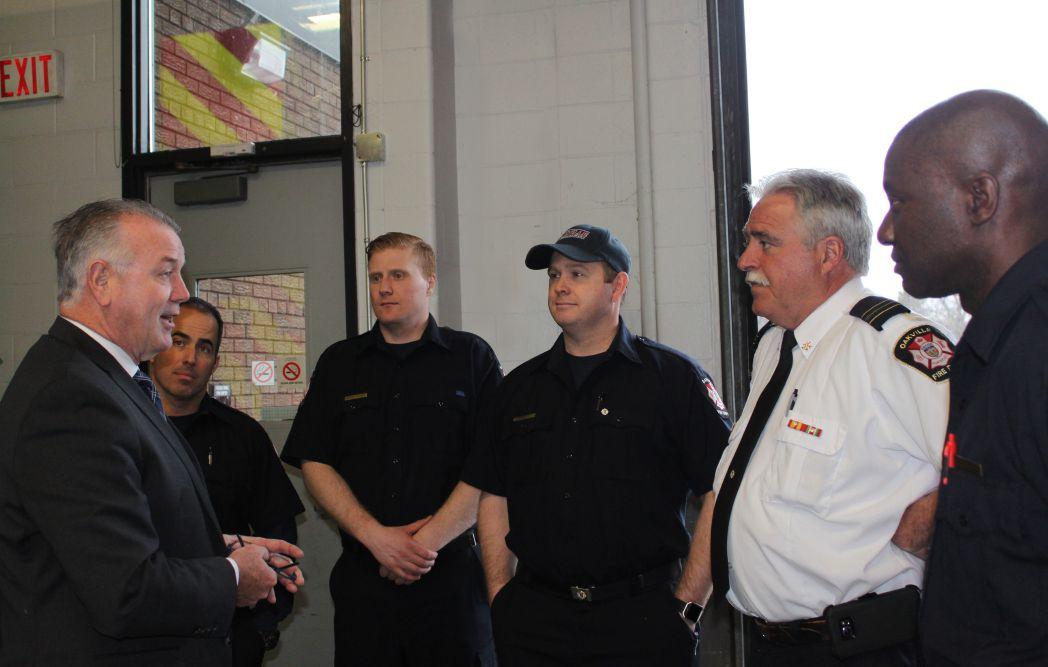
Ontario Labour Minister Kevin Flynn met with firefighters in Oakville in April, a year after the government passed presumptive legislation for post-traumatic stress disorder, and few weeks in advance of PTSD Awareness Month in June. Ontario holds an annual mental-health summit, and required all municipalities to submit PTSD prevention programs by April 23.
Editor Laura King interviewed Ontario Labour Minister Kevin Flynn in April, a year after the Supporting First Responders Act made PTSD a presumptive illness, and in the lead up to PTSD Awareness Month in June. With consistent messaging from the International Association of Fire Fighters and support from the Ontario Association of Fire Chiefs, the province has developed a PTSD strategy that encompasses awareness, prevention and treatment.
Q Mr. Minister, you met with firefighters in Oakville [April 7] and have met with police and paramedics; what are you hearing about responders and mental health?
A I was talking about the ramifications of Bill 163 [Supporting First Responders Act], just asking the guys what they’re seeing in the halls, themselves, asking the men and
women what they’re seeing on the trucks, what sorts of discussions ordinary, front-line first responders are having.
There was a very enthusiastic response – the chiefs were there, front line officers and firefighters . . . they all said it’s a much better environment now, they’re much more comfortable to be able to talk about the
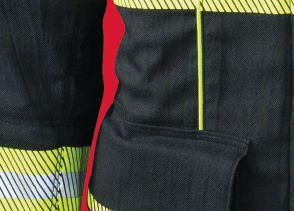
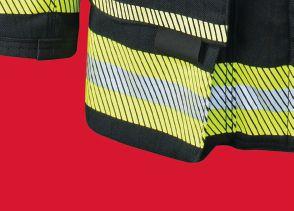
The Morning Pride TAILS System
The best just got better.
is the pioneer of safety by design, trusted for state-of-the art features, versatile customization, and rock-solid protection.
Morning Pride TAILS are the first responder’s first choice, and now have increased comfort, fit, and ergonomics for greater mobility and safety.
Make better PPE decisions, track and manage your PPE inventory and have real-time product information with FIRST Asset Management Software. Download a FREE 60-day trial version HERE: https://honeywellfirst.com
www.honeywellfirstresponder.com
issue, they’re seeing a lot more things are being discussed more openly when it comes to mental health in the workplace, and it’s being treated as it should have been all along, as just another illness, a serious illness sometimes, but I think in the past it was viewed through a lens of your moral character or your bravery, strength or courage were attached to it, and that was all wrong; but now there’s an understanding that it’s just somebody else got hurt on the job and they need the time and resources to get better. So it was really neat to have that confirmed by the people who are on the fronts lines for us every day.
The numbers that I got from the Workplace Safety and Insurance Board, they figure an additional 600 people . . . have got treatment early and appropriate treatment in a way they wouldn’t have had we not passed Bill 163.
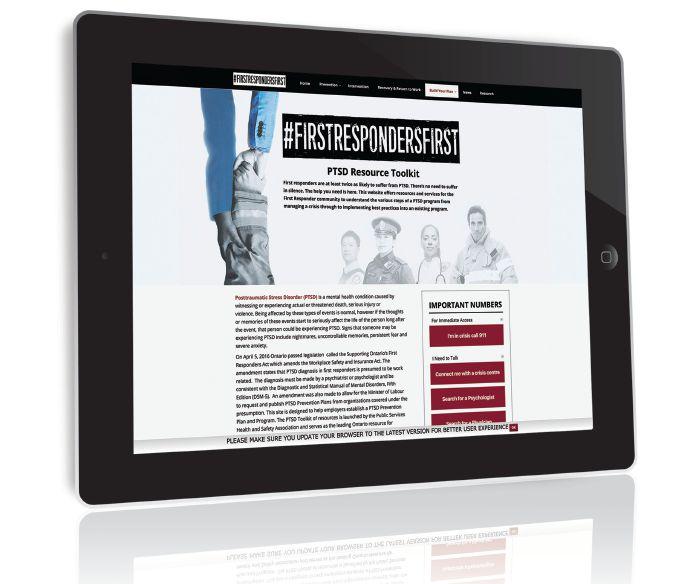
Q The deadline for municipalities to submit PTSD prevention programs is April 23. The First Responders First online template (www.firstrespondersfirst.ca) developed by the Public Services Health and Safety Association is available to all municipalities. Are you seeing other types of prevention programs?
A What we’re seeing is a mix; some people were really early off the mark; other program submissions are just arriving now, and I’ve got a good feeling that the vast majority of people will comply.
The idea wasn’t to put employers or
municipalities through a lot of work, it was really facing the reality that PTSD was real, it was impacting people in a way that was often leading to very tragic events unfolding, to the point where people were taking their own lives, so we knew we needed to do something about it, and there was agreement – certainly the associations and chiefs and officers were all in support of this, the government and academia were in support of it. The Association of Municipalities of Ontario was concerned about costs and that’s part of their job, but I think they understood that they were doing the right thing by supporting this.
So when you’ve got that type of system in place, and you realize that a complete cure for post-traumatic stress disorder is continuing to elude us – you really don’t want anybody to experience PTSD who doesn’t have to – so the prevention programs range from some pretty brief ones from smaller departments with fewer resources to some that look like they’re pretty comprehensive; it’s an information-sharing exercise that’s in the best interests of the employers.
When you recognize that there are costs associated with this, the best way to avoid those costs is to do the right thing and make sure the people who work for you don’t suffer from PTSD.
It makes sense for the firefighters themselves if they work in an environment where they know people care about them enough to have a prevention plan to help them not
suffer from PTSD, that’s a great thing for them; if we prevent that from happening to individuals it obviously results in less cost to employers, and the other thing is that they can learn from each other – the smallest volunteer departments can learn from some of the most sophisticated departments, and I really am taking advantage of the competitive nature of first responders – I know they always try to outdo each other – so I’m using it to my advantage as the minister of labour trying to keep people safe; nobody’s going to have the worst PTSD prevention program; everyone’s going to want to have the best.
Q The Mental Health Commission of Canada and other groups are moving away from the terms PTSD and operational injury because so often mental illness is a combination of personal, professional and operational stress. Has that been part of the conversation?
A Certainly there’s been a change in the nomenclature to operational stress – and you know what, people asked me to do something about PTSD so if there’s no political correctness in that, to be blunt, I don’t really care; I care about the people on the font lines every day doing their jobs that I wouldn’t do in a million years to keep us safe. So these folks asked me to do something about PTSD and that’s what I continue to call it. It’s not a big priority. We know what it is and we know we need to do something about. We don’t want to get into an argument about what we call it when there’s men and women out there suffering.
Q You’ve mentioned anecdotally that responders are talking more openly about mental illness, but how do we know the presumptive legislation, the annual PTSD summits and the prevention programs will make a difference?
A [First-responder suicide] is of the statistics you don’t like to look at but you can’t ignore because certainly it’s an indicator of how bad things can get if you don’t do the right thing; I’m led to believe that the police have been tracking [suicides] and are seeing improvement, I’m not sure about fire. I think it is an indicator that if we see a decline [in suicides], and that that people are getting help that are preventing them from doing that, from taking their own lives, that’s an indicator.
The number of people that are going into treatment now that wouldn’t have in the past ¬– there’s a normalization of the issue from a discussion perspective.
We care about them, we value the work they do, we understand the danger . . .
’’
I try to go out and support first responders every chance I get; the paramedics were doing a ride to Ottawa – leaving from Dundas Square; Toronto Mayor John Tory and I were there to see them off, and I stumbled across a group of students from Fanshaw College in London who were studying to be paramedics, and I thought I’d talk to them, so I asked them what they know about PTSD and the conversation was so comfortable; they said they understand that they need to look out for each other, that it’s one of the hazards of the job, that they had covered it in class, and if they suspect something is wrong they know what to do about it. It wasn’t so much the details of the conversation, rather it was the ease with which it rolled out of their mouths, as if it was the most normal thing in the world, and it’s something they need to know. That made me think we were making some inroads. If that had been five years ago with a group of people who had been on the job for 20 years I don’t think I would have gotten the same responses.
Just being with the firefighters when I met with the Oakville Fire Department –these would have been some of the more senior guys and some of the front-line firefighters – there was almost an enthusiasm about the discussion, and I think it really is a reflections of the esteem in which we hold first responders. The fact that the Government of Ontario decided that we need to make a special case and have a stand-alone act I think makes firefighters in the province of Ontario realize that the government’s got their backs, we care about them, we value the work they do, we understand the danger they put themselves in, and when you expect people to put themselves in harm’s way the least you owe them is the treatment and to make sure it doesn’t happen in the first place.
Q There’s treatment, and now prevention. What’s the next step?
A The PTSD summits will be held on an annual basis and we’re expecting to make progress. Now that the act is in place and the act is in place and firefighters are under active treatment, it strikes me that for the next summit we would really want to make sure we are using the right tools to measure our progress, along with advances in treatment.
The more attention you pay to something like this the more the fields of psychology and psychiatry will advance. I was proud the other day to receive an award from the Ontario Psychological Association for the work we have done on PTSD – to be shared with firefighters association, all the locals province-wide (president Rob Hyndman and past-president Carmen Santoro have been great advocates) – and the chiefs and management themselves; often there’s an adversarial aspect to that, to ideas that come forward from time to time – the chiefs have one opinion, the guys on the trucks have another – but in this case men and women on the trucks and the chiefs were all of the same opinion, it’s time to do something serious about this and we did.
It’s kind of a fine line; as much as you want to normalize the conversation you don’t want to be complacent about it, because it’s a very serious issue that we’ve been unable to talk about in the past.
Now we’re able to talk about it I don’t want it to just become background noise; we’ve got to keep getting better at it.
BACKtoBASICS
A refresher on foam
BY MARK VAN DER FEYST
Irecently taught a recruit class about foam. Given the few opportunities that today’s firefighters have to do actual fire fighting, it is always good idea to revisit the topic.
Foam has been an integral part of the fire service for years and it has many applications – the most notable being vehicle fires, class-A fires and class-B liquid fires. Our focus is foam concentrate systems, as opposed to compressed-air foam.
Many fire trucks are equipped with foam systems that involve the automatic mixing and discharge of a foam product. But what happens if the onboard foam system stops working? How is foam produced?
To answer this, we must look to the foam eductor – a nozzle attachment that introduces foam into the water stream. The eductor thickens foam by pulling air into the water stream and aerating the mixture. The thicker the required foam, the more aeration needed to produce it.
Fire departments may choose a nozzle depending on the nature of the incident. Every nozzle used in the fire service can produce a finished foam product – even a smooth-bore nozzle.
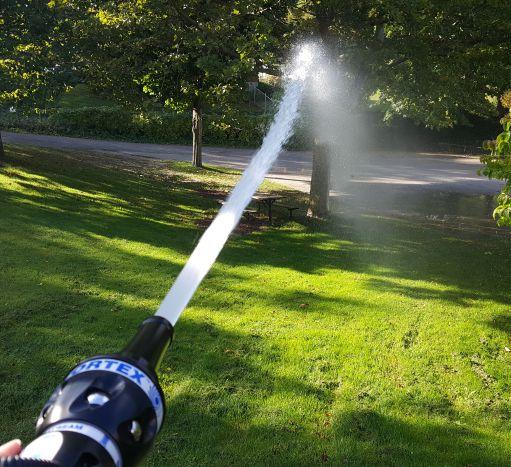
Photo 1 shows a smooth-bore nozzle flowing water and producing a solid stream; this creates foam by deflecting the stream onto the ground, banking it off an object, or pointing the stream upward as if it were raining down.
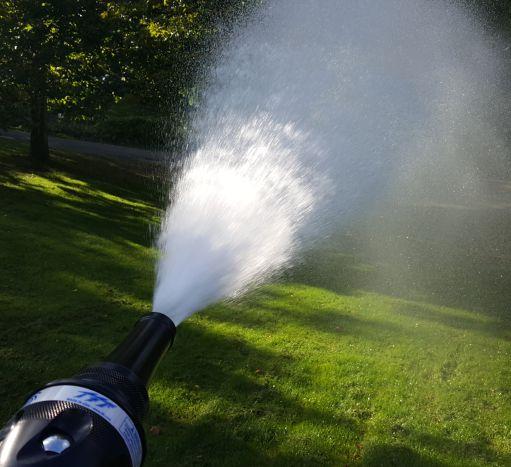
Photo 2 shows a narrow fog pattern. With this type of pattern or nozzle, finished foam is produced in the same fashion as mentioned above, with the benefit of more aeration.
The nozzle pictured is fairly new and can switch from smoothbore to a narrow fog pattern with a simple turn of the barrel. With a traditional, automatic combination nozzle, the same effect is produced with the pattern style.
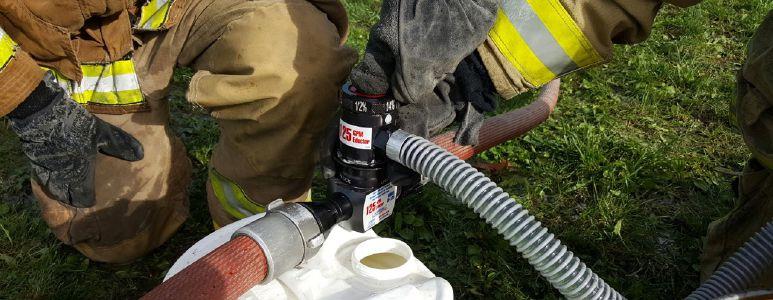
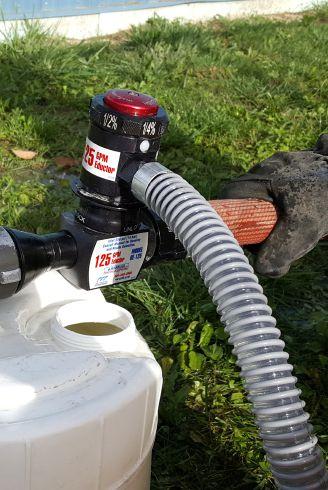
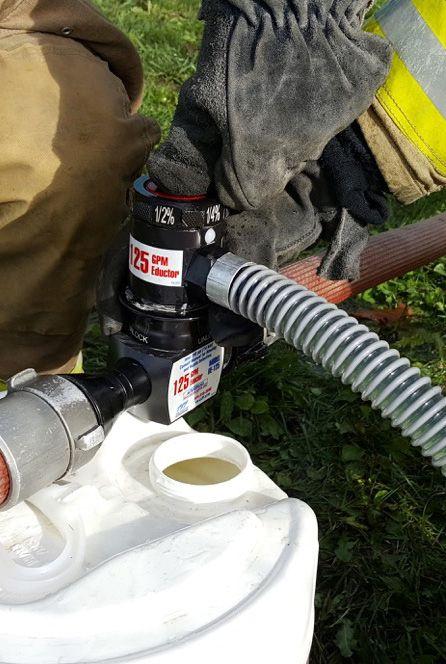
The eductor is the key piece of equipment needed to make foam. It mixes the foam concentrate and water so that the mixture can then be aerated at the nozzle. Photo 3 shows an example of such an eductor.
The eductor sits on top of the foam pail or can be attached directly to the pump discharge. The position of the eductor in the hoseline is important, as it must be within a certain distance of the nozzle, generally within 30 metres (100 feet).
The location of the eductor depends on how much hose has been pulled off the truck and how much is being used; the more hose, the higher pump pressure necessary to allow the eductor to work properly.
The pump discharge will automatically be 1400 kpa, but this does not account for friction loss created by the hose length. Higher pressure is needed to push water through the hose, while the eductor’s diameter will decrease and subsequently return back to normal. This
Photo 1: A smooth-bore nozzle flows water and produces a solid stream; this creates foam by deflecting the stream onto the ground, banking it off an object or pointing the stream upward.
PHOTOS BY MARK VAN DER FEYST
Photo 2: A narrow fog pattern produces finished foam with the benefit of more aeration.
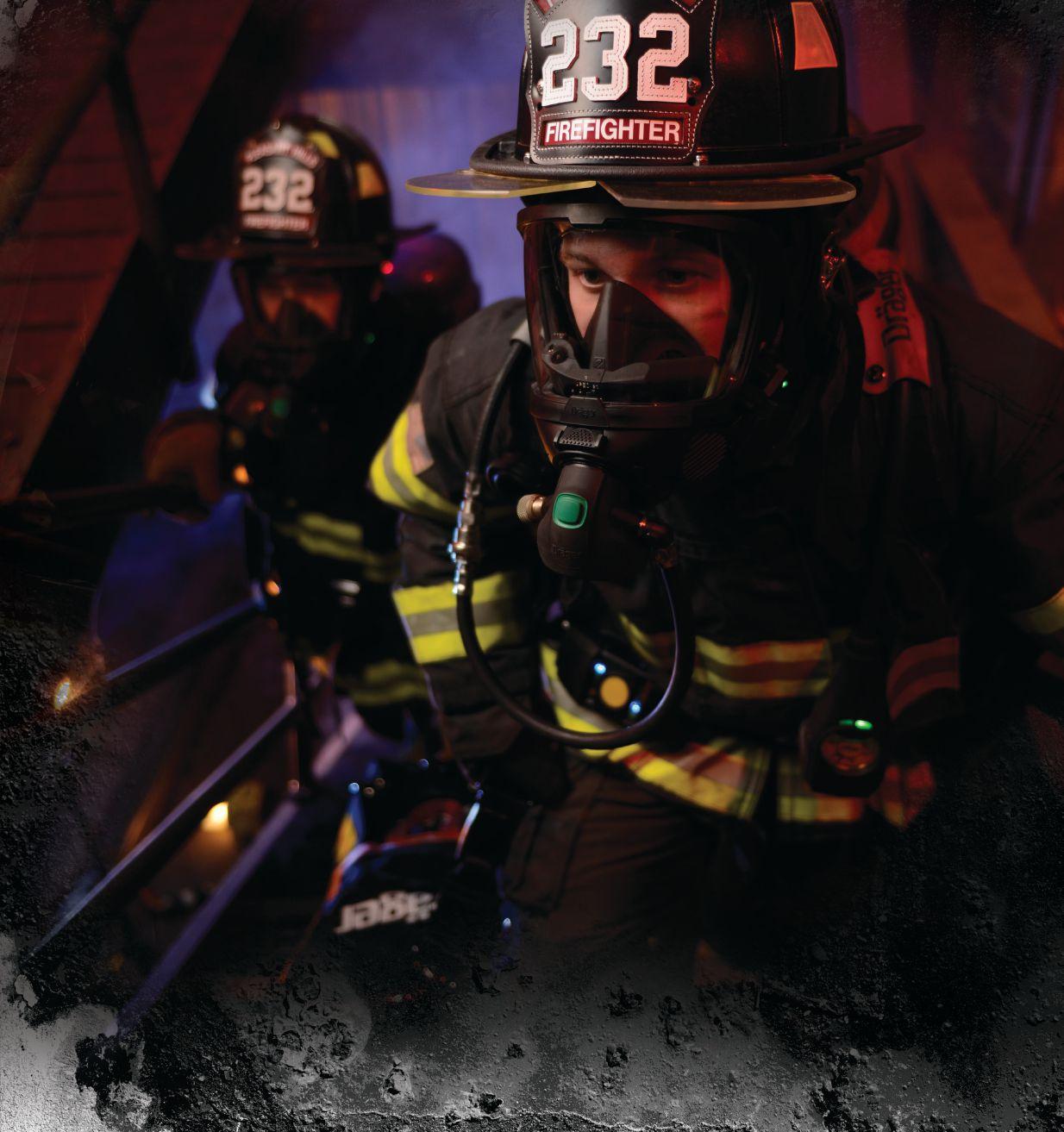
DRÄGER SCBA SOLUTIONS: OVER 45 POSSIBLE COMBINATIONS TO FIT YOUR NEEDS.
Just as every fire is demanding, so are you and your needs. That’s why our newest series of SCBA solutions can be configured over 45 different ways. And that’s why they are ergonomically engineered to be more stable and comfortable, intuitively designed, and held to the highest standards, so that you can perform more effectively, with less fatigue, and be ready to respond anytime.
FIND THE SCBA SOLUTION THAT FITS YOU BEST AT WWW.DRAEGER.COM/SCBA
decrease in the diameter creates a Venturi effect: this means a vacuum is produced, which draws the foam concentrate up the hoseline.
There should be a dial at the top of the eductor that allows the user to select the proper percentage of foam concentrate for the situation at hand.
Depending on the amount of foam solution added, you may need to set the eductor at 0.5 per cent, 1.0 per cent, three per cent or six per cent. Just turn the dial to the desired percentage and start flowing water. Once water is flowing, the foam solution will be used up. This can happen quickly, so keep be ready to switch out the eductor wand into a new foam pail when you run out of solution. Multiple foam pails should be available so that you can make a quick changeover.
Once you are finished using the foam and the fire is out, the system must be flushed. This can be accomplished in one of two ways: by using a pail of clean water; or using the flush button on the eductor.
Photo 4 shows the flush function of the eductor. Simply push the red button and allow water to continue flowing. If a pail of clean water is being used, put the wand into the pail and keep flowing water until foam is no longer being produced.
Even though there are automatic proportioning systems on fire trucks, firefight-
ers still need to know how to use the manual backup systems such as the foam eductor. Consider adding foam educator training to your next training night, and try this drill from the Fundamentals of Fire Fighter Skills. An attack line needs to be procured and the nozzle replaced with the air-aspirating nozzle. Place the in-line eductor no more than 150 feet from the nozzle. Place the foam concentrate next to the eductor. and set the meter. Place the pick-up tube from the eductor into the foam concentrate. Charge the hoseline with water, ensuring there is minimum of 200 psi at the eductor. Flow water through the hose until foam starts to come out of the nozzle. The hoseline is now ready to be advanced onto burning flammable liquid. Apply foam using one of three application methods – sweep, bankshot or rain-down, depending on the situation.
Mark van der Feyst has been in the fire service since 1999 and is a full-time firefighter in Ontario. Mark instructs in Canada, the United States and India. He is a local level suppression instructor for the Pennsylvania State Fire Academy. He is also the lead author of Pennwell’s Residential Fire Rescue book. Contact Mark at Mark@FireStarTraining.com
Photo 3: The eductor mixes the foam concentrate and water so that the mixture can then be aerated at the nozzle.
Photo 4: The flush function of the eductor –pushing the red button allows water to flow.
PHOTOS BY MARK VAN DER FEYST
BY SAMANTHA HOFFMANN
Public fire and life-safety officer, Barrie, Ont.
“
AFIRSTLINE
Use the media to spread safety messages
n opening line should invite the reader to begin the story,” author Stephen King said. “It should say: Listen. Come in here. You want to know about this.”
Think about these famous opening lines: “It was the best of times, it was the worst of times,” “It was a dark and stormy night,” “I had a farm in Africa.” Did they make you want to know more? When it comes to educating our communities about fire safety, we need to grab people’s attention. We can do that through good storytelling.
The Elements of Journalism describes journalism as “storytelling with a purpose.” When it comes to public education we know our purpose is to raise awareness about fire prevention and fire safety, and to change unsafe behaviours. The local media serves a similar public-education role. Fire departments should build relationships with reporters to achieve this purpose together.
Every time a truck responds to an emergency call, there is a story that can be told and a lesson that can be learned. Last year, our crews were called to a structure fire at which a babysitter and a five-year-old were trapped. Firefighters rescued two people from a second-floor window. The news story could have been written in a traditional way: “Firefighters save two from burning building.” Instead, we worked with the reporter and explained how the fire happened. We gave details: the babysitter made herself a midnight snack of French fries, which led to a grease fire. We explained how the sitter and the child became trapped and why they survived. After reading the story, readers know what they should and shouldn’t do in a fire emergency:
• Never remove the battery from a smoke alarm.
riences to which people in all walks of life can relate. We must seek out different perspectives if we want our entire community to learn about fire safety.
Stories about emergency calls could give fire departments an opportunity to learn from others’ triumphs and mistakes. An interview after an incident can be used to help readers or viewers think about their own behaviour.
Now that you know what makes a good story, build a relationship with your local media. Having a list of media contacts will make your storytelling much easier. In addition to contact info, ask about deadlines and story formats.
In every media course I have taken, we reviewed how to write press releases. However, reporters say hey don’t have time to read releases, that a phone call or email is a better way to get their attention. So pick up the phone and pitch your story!
Twice a year at daylight savings time, fire departments across North America promote smoke-alarm maintenance. Every year, there are successful Change the Clock, Change the Battery or Change the Hour, Check the Power campaigns. Many media outlets run free public-ser-
When it comes to educating our community about fire safety, we need to grab their attention. We can do that through good storytelling. ‘‘ ’’
• If you can’t escape from a fire, protect yourself from smoke by closing as many doors as possible between you and the fire.
• Call 911 and tell the dispatchers exactly where you are trapped in the home.
Telling stories can be tricky because community members are all different; they have diverse beliefs, characteristics, concerns and interests. So we must tell diverse stories that provide a variety of expe-
Samantha Hoffmann has been in the fire safety field for more than 25 years; she is the public fire and life-safety officer for Barrie Fire & Emergency Service in Ontario. In 2014 Samantha was named Public Fire and Life Safety Educator of the Year by the National Fire Protection Association – the second Canadian and first Ontario educator to receive the award since its inception. Email Samantha at Samantha.hoffmann@ barrie.ca and follow her on Twitter @shoffmannpflso
vice announcements promoting these campaigns, but are these canned releases the best way to get the message out? No. The best way to engage your community and get citizens to act is to tell them a story.
First, find your story subject – perhaps a family with a new baby or a young man with a puppy, or maybe even first time grandparents. Ask your subjects why smoke alarms are important: they may have had to change their home escape plan when the baby was born, the puppy arrived or when the grandchildren came to visit. Share your subject’s experience. Contact reporters, tell them the story, and provide statistics that prove working smoking alarms are important: do the groundwork, and work within reporters’ deadlines. Hand reporters a total package –topic, visuals and location. You can be part of the story, the authority that ties it all together. The combination of story and the statistics activates the reader’s emotions and changes behaviour.
After all, who can resist a cute baby or new puppy?
Re-train the trainer
Maintain CISM skills through in-house exercises and role-play with peers
By DAVID MOSELEY
TCISM-trained firefighters can work together to refresh their skills by reviewing the steps involved in a debriefing or defusing.
he neigbouring fire department calls you about a multi-casualty collision to which it responded. Among the dead are well-known community members, some related to responders. Three years ago, you took a critical incident stress management (CISM) course and you are asked to come and deliver a debriefing.
Are you ready?
One of the best ways to ensure firefighters certified to deliver CISM maintain their skills is through refresher training. In the interest of time and various other depart-
ment priorities, firefighters in volunteer or smaller career departments who completed CISM training rarely have the opportunity to participate in formal refresher courses. Similar to practising NFPA 1001 skills on training nights, CISM-certified firefighters can arrange to do their own informal refresher training in-house with their CISM teams.
CISM peer support workers are often trusted, caring members of the department. Being a CISM peer support worker has nothing to do with rank, rather those who choose to take the training do so based on qualifications and suitable demeanor.
Having CISM peer support workers in the department is extremely important because firefighters are generally more comfortable opening up to peers than to someone outside the profession.
The format for CISM refresher training is simple: review the defusing and debriefing components, then practise, using role-playing exercises. There are typically four to seven steps involved in CISM defusing or debriefing; however, a simplified, three-step process works well: introduction; exploration; and information. As is the case with much firefighter training, there is room for variation, as long as the refresher program stays within the guidelines based on the Mitchel method of CISM taught by the International Critical Incident Stress Foundation.
■ INTRODUCTION
The defusing or debriefing introduction reminds everyone of the steps involved. Participants review the objective, the process, and some boundaries or ground rules. The process goes something like this:
• Introduce yourself. Briefly describe your CISM qualifications – I like the mental-health first-aid analogy.
crafts·man·ship /kraf(t)smən’SHip/ noun
l skill in a particular craft
l the quality of design and work shown in something made by hand; artistry
Because a CISM defusing or debriefing is a safe space, firefighters usually don’t hold back ‘‘ ’’
• Let everyone know why they are there (because they responded to a traumatic incident). Describe critical incident stress: a normal reaction by a normal person to an abnormal situation.
• Explain that the objective is not to fix or treat, but to provide the opportunity to talk openly in a safe space and provide some basic information about coping strategies .
• Describe the three steps: introduction; exploration; and information.
• Stress voluntary attendance – never guilt firefighters to attend.
• Ensure confidentiality; the only exception is a threat of harm to self or others.
• Ensure that no one is pressured to
speak who does not feel comfortable doing so.
• Let everyone know the defusing or debriefing typically will take between 45 and 90 minutes.
• Minimize disruptions such as cell phones.
A good introduction will put everyone at ease and establish trust, which sets the stage for the exploration phase.
■ EXPLORATION
In a sense, the exploration stage is easy because, generally, firefighters want to talk after responding to a traumatic incident. Because a CISM defusing or debriefing is a safe space, firefighters usually don’t hold back.
To facilitate the exploration stage of the
Foam Trailers
Portable Pumps
CAFS
Skid Units
Brush Trucks
debriefing or defusing, use escalating questions. Start by asking participants to describe the stressful situation that happened, then ask more probing questions such as:
• What was your initial reaction?
• What did you think / feel?
• What was the worst part for you?
The key to active listening is sincerity and empathy. Simple responses such as, “that’s a perfectly normal response,” or even a nod and a “hmm” often suffice to validate the affected member’s experiences. Paraphrasing is a powerful tool to ensure the CISM peer supporter understands and show members that they are understood.
Members will normally express anger, fear, sadness or guilt after a traumatic incident; they feel disoriented, as their sense of normal has been destroyed. Peer support workers should acknowledge and accept these responses and reassure members that these emotions are common reactions to stress and trauma.
It’s important not to rush the exploration stage; allow some pause or silence. Ensure the participants talk more than the peer supporter. If an important issue has been raised and bypassed or overtaken by another topic, try to redirecting the group: “Earlier you said xyz, can you tell us more about that?”
Having more than one CISM responder facilitate the defusing or debriefing is beneficial as one person may pick up on something the other misses.
When the peer supporter(s) think it’s time to move on from the exploration stage, let participants know. Ask if anyone else wants to speak before continuing. Remind members that the group can come back to the exploration stage if they want to do so.
It’s not uncommon for one person to dominate the conversation while others absorb information before coming up with questions or comments.
■ INFORMATION
The purpose of the information stage is to describe common signs and symptoms of critical incident stress, and outline common coping methods. A handout can be useful at this stage; it’s worth putting some effort into finding or developing a good handout. (See sidebar.)
Responders have different reactions to stressful situations; members should not expect to experience every symptom, nor should they worry if they experience none. There’s no need to rattle off the whole list of symptoms during a defusing or debriefing; the point of the exercise is to recognize that these feelings and behaviours may be a result of the incident.
As a peer supporter, providing examples for your own experience during a defusing or debriefing may encourage others to open up, but be cautious not to overuse self-disclosure. Remember, the key to CISM is to listen.
In direct response to symptoms, provide useful coping strategies – again, sharing your experiences may be useful but be sure to ask your members how they dealt with previous critical incidents and have them provide suggestions. Exercising, spending time with family or outdoors are common ways to cope and recover. I always encourage participants to cut themselves some slack immediately after an incident – remind them it’s OK to not be OK – and to keep in mind that others may be experiencing similar emotions.
Family members can play important roles in a support system. Suggest that firefighters share CISM information with family members, friends or others in their networks. Be sure to focus on
The MSA G1 improves communication. Increases mobility. Helps you find a victim or a buddy—and the way out. To learn more and request a demo, visit msafire.com/breathe.
firefighters’ emotional responses and what might help them, rather than the details of the incident. If firefighters want to discuss details, encourage them to do so with a willing fire peer or a mental health professional.
To close the session, remember to thank firefighters for participating. Acknowledge that fire fighting is a difficult job and indicate your gratitude for their work. Invite anyone who wants to talk further to stay behind, but also limit your personal involvement – additional support should come from a mental-health professional whose contact information you provide.
Be sure to have a prepared list of resources including employee and family assistance program information, mental-health helpline details, and other local and regional support agencies.
■ FOLLOW UP
It is normal after a defusing or debriefing for senior officers or managers to ask if anyone requires additional support.
CISM peer supporters must consider confidentiality – it’s enough to say that either nobody stood out or some members took
the incident harder than others, and that officers should keep an eye on everyone.
Another follow up item to remember is self-care. Providing CISM is emotionally demanding, so those to deliver it also need to recover afterwards.
■ ROLE PLAY
CISM training involves role-play practice; after reviewing the components, the balance of the refresher training time can focus that aspect of the program. Everyone should have a chance to lead and provide feedback. Most adults learn best by doing, so take the time to go through several scenarios and have fun.
CISM refresher training is vital to maintain and develop peer supporter skills and competencies. With some support, your original training material and the information above, you should be able to provide that training for your qualified CISM peer supporters.
Firefighters like to help people in distress, so it’s only natural that we want to help our own. A robust CISM program that includes refresher training will allow your organization to do just that. * * * * *
Parts 1 and 2 of David Moseley’s series on critical incident stress management appear in the February and March issues of Fire Fighting in Canada. Visit www. firefightingincanada.com and click on Hot topics, and then Health and wellness.
David Moseley is a forest officer with Alberta Agriculture and Forestry, and lead training officer with Lac La Biche County Fire Rescue in Alberta, focused on operations; other areas of interest include instructing, CISM, and wildfire investigation. Contact him at david.moseley@ gov.ab.ca
Incidents can affect people differently; some crew members may struggle with incidents that other deem innocuous.
XT SERIES
The Bullard XT Series Gives You More Innovative Features:
•Longest battery run time (more than 6 hours)
•Best image quality
•Most desired form factor
•First wireless charging systems
•Proven durability
•Leading imager and battery warranty
BY LYLE QUAN
CORNERSTONE
Lead by eliminating self-deception
Ihave written columns about topics ranging from strategic planning to change management, and embracing uncertainty in our personal lives. I have written on such a variety of subjects because I believe leadership requires a wide range of knowledge. I also believe reading books solely focused on leadership can create a narrow view of what is required of today’s fire-service leaders.
In the fire officer courses I facilitate at the Ontario Fire College, one of my goals is to convey that leadership is more than just the number of bars or stripes on a uniform: leadership is more about how you stand by your morals and your people. Leadership is also about owning up to mistakes and not blaming others for those mistakes. As such, fire-service leaders need to appreciate the tremendous value related to leading by example, understanding the art of people management, and acknowledging the importance of knowing themselves (and what they stand for).
Recently, I enjoyed a conversation with the fire chief for a mid-sized Canadian city. We discussed the fact that taking ownership of what we do is as important (or maybe even more important) than how we lead. Let me explain: many people want to be seen as leaders, but when they are being held accountable for a mistake, some are quick to blame others for what went wrong.
Based on this observation, I have chosen to focus on one book because it covers myriad leadership- and personal-management concepts: that book is Leadership and Self-Deception by The Arbinger Institute (2010).
The authors found that the book has been used for more than it was originally intended, which was to help leaders understand and escape the negative environment in which they may be living.
finding ways to blame others for the situations or “raw deals” that life gives us, instead of taking ownership of these situations and finding gratifying ways to get out of this negative environment and move forward (with everyone).
The final section focuses on how to get of the box. This entails a true attitudinal adjustment; it means that we open ourselves up to others and work together without trying to find blame – rather answers to how you and the team can move forward.
In identifying the value of the lessons taught in the book, the authors note that there are five broad categories for which readers have used its lessons:
1. When hiring people – companies have prospective employees read the book and find out what they have learned and how would they apply the lessons.
2. For leadership – managers have all employees or up-and-coming leaders read the book to understand how to focus on people and build teams.
3. For conflict resolution – the book’s lessons allow readers to think outside the box.
We get into the box because we find ways to blame others for the situations or the “raw deals” that life gives . . . ‘‘ ’’
The book is divided into three main sections. Part one takes readers through the definition of self-deception and being in the “box.” Being in the box relates to not doing what is right. For example, if your baby is crying and you pretend to be asleep because you want your partner to get up and take care of the situation, this is, in fact, self-betrayal because you know what is right (to get up with the baby) but choose to do the wrong thing. In this situation, you are trapped in the box because you are blaming others for not getting what you want – in this case, more sleep.
The second part of the book covers how we get into that box – by
Lyle Quan has more than 30 years’ experience in fire and emergency services. He consults, facilitates fire officer programs at the Ontario Fire College and instructs the bachelor of business in emergency services for Lakeland College. Contact Lyle at lpqsolutions@bell.net and follow him on Twitter at @LyleQuan
4. To build accountability – the book encourages readers to take ownership of their actions and ensure that people don’t blame others for their mistakes, in other words, to own up and move on by finding a more acceptable resolution for the project and the team.
5. For personal growth and development – the authors have heard from many readers how the book has changed their outlook on life and, in turn, fostered personal growth and development.
The final section of the book includes a chapter on how to take full advantage of the teachings within.
I found this book an easy and interesting read and have already used it to evaluate how I have done some things in the past and consider how I will to change my approach in the future.
Leadership and Self-Deception can be obtained through Indigo/ Chapters and Amazon.
FROM BOOTS ON THE GROUND TO EYE IN THE SKY, WE’VE GOT YOUR BACK.
FLIR’s wide range of TICs can help you identify hot spots from a variety of distances – making safety the top priority. Learn more at FLIR.ca/fire
BUY ANY 4 FLIR K SERIES TICS, GET A FLIR K2 FOR FREE. A $ 1,350 VALUE!
®
FEATURED PRODUCTS:
· FLIR K2 THERMAL IMAGING CAMERA
· FLIR K33 & 53 THERMAL IMAGING CAMERA
· FLIR KF6 AERIAL APPARATUS
FIXED-MOUNTED THERMAL IMAGING CAMERAS
· FLIR M-SERIES PAN-TILT-ZOOM
TICs FOR ARFF, HAZMAT & ALL EMERGENCY VEHICLES
· FLIR AERIAL FIRST RESPONDER KITS
What’s NEXT?
Iwould like to retire, but there is no one to take my place.” Have you heard this comment? It is likely you have said something similar or have overheard it in your department. Whether you work in a volunteer or a career department, statements like this are common.
Sometimes these comments are prefaced with: “I’ve been doing this for 30 years,” or “My partner would like me to slow down and retire,” or “The chief’s job is such a big time commitment.”
My answers is to these statements are, in fact, questions.
• What have you done to prepare someone to take your job?
• Have you identified the leaders in your department and asked them if they are interested?
• Have any of your members expressed and interest in the job?
■ FIRE CHIEF’S ROLE
I have written two past stories addressing succession planning programs in career fire departments (Fire Fighting in Canada March 2015 and May 2016; www.firefightingincanada.com, click leadership), but the majority of Canadian firefighters are volunteers / part time. So how should fire chiefs of volunteer departments train successors?
This may sound a trite, but training successors in a volunteer department is no different than training career firefighter for the job.
In time, many firefighters will work their way up the ranks, but not all are leadership material. It sounds harsh, but it is true. You want to leave your department in capable hands, so how can you train your members to replace you when the time comes?
First let’s break down your role as a fire chief into four categories: command and control; training; administration; and human resources (yes, even in a volunteer setting).
Succession planning protocol for volunteer departments
By DENIS PILON
Cultivating fire department members to help them grow into leadership positions is a critical element of a fire chief’s job.
■ COMMAND AND CONTROL
Command and control is relatively easy. Your members gain experience with every response and develop command skills from this experience. You will have identified members who take control and can think on their feet. These people have become your captains and/or deputies and you have probably trained them to command incidents, as you cannot always be there. In fact, these members are probably pretty good at this already. In your absence, members are
expected to work as a team and bring the incident to a successful conclusion, no differently than if you were present.
■ TRAINING
Training is one of the most exciting parts of the job, and I am sure no one can do it as well as you. I worked in a fire department a number of years ago where the chief used to say that his fire fighters were the best in Saskatchewan… because he trained them. But after he retired, we started some seri-
MORE DETAILS AND TO REGISTER www.etouches.com/ehome/206001
Fire Chief of the Year Awards nominations are now being accepted! Each year the Canadian Association of Fire Chiefs and Fire Underwriters Survey recognize fire chiefs for their outstanding contribution to the Canadian fire services. Know a deserving chief? Visit www.etouches.com/eselect/69658 to nominate your chief today!
PLUS DE DÉTAILS ET S’INSCRIRE www.etouches.com/ehome/206001
Les candidatures pour les Prix d’année des chefs de pompiers sont maintenant acceptées! Chaque année, l’Association canadienne des chefs de pompiers et d’inspection des assureurs incendie reconnaissent chefs de pompiers pour leur contribution exceptionnelle au service canadien des incendies. Connaissez-vous un chef digne? Visitez www.etouches.com/85928 de nommer votre chef aujourd’hui!
ous training and actually had more than six members attend weekly training. We became a better team because of it. The point is, nobody is perfect and no one knows it all. Start by appointing a training officer, train some instructors, and let them set up a schedule. Then you can set them loose. Do not stop them, correct them or interfere unless what they are doing is illegal or would cause harm. Sit back and let them learn from their mistakes.
If your members want to learn, all they have to do is ask. The provincial fire commissioner’s office has countless resources, there may be a provincial fire school and neighbouring departments may share resources. Many local career departments are more than willing to help volunteers if asked. You can also check out your provincial and territorial associations, use on-line training resources and subscribe to trade magazines.
Belonging to your provincial or territorial fire chief’s association is a good way to stay connected, but you should not be the only member from your department. Get your deputies involved in these associations and have them attend conferences so they can learn from other chiefs from across the province. Take opportunities to attend training programs such as Beyond Hoses and Helmets and include other members in this training. It is not overly expensive and is great value for the investment.
■ ADMINISTRATION
It is extremely important to train firefighters in fire rescue basics, but we often drop the ball when it comes to administrative training. By telling members to “leave it on our desk,” we are not giving them the opportunity to learn essential skills that will allow them to eventually succeed us. Delegating administrative tasks will make your job much easier and prepare the next generation of leaders. Every incident requires paperwork, which is often filled in by the members and left for the chief to work his or her magic. Instead of overworking yourself and returning to big pile of paper at the end of every day, start delegating these responsibilities. All of your deputies, captains and lieutenants should be fully capable of completing a fire report and filing it with the provincial fire commissioner.
Someone will have to do the payroll when you are away, so why not assign the job to a deputy? You may even want to assign someone to pay all the bills and submit them
to the proper authority for payment. Be sure to put limits on the person responsible, so the department continues to make smart financial decisions even when you are not there. In my department, I don’t look at bills under $1,000 unless there is a problem or something is out of the ordinary.
How about the annual budget? Do your members have input into the budgeting process? Do the senior members participate in the annual budget developments and presentations? If not, consider getting your members involved in these essential tasks.
■ HUMAN RESOURCES
Human resources is one of the most important job functions of a fire chief, but also one of the most overlooked. Human-resource programs are critical to recruitment and retention programs, which are often lacking in volunteer fire departments. You should set up a recruiting program that informs new members of the department’s expectations for volunteers. Make it clear that volunteers should be committed. Interview prospective members with two of your existing members. This interview should start the succession planning process by identifying recruits who want to move up the chain of command. Ask candidates what their goals are; if they say they eventually want your job, hire them. You just found one of your successors. Conduct a physical abilities test to ensure candidates understand that being a firefighter can be physically rigorous.
Every department, career or volunteer, has members who seldom attend practice or fire drills. And yes, volunteers can be fired. Failing to address issues and problem volunteers will always cause bigger issues in the long run. So deal with issues as they present themselves.
Whether you are on the brink of retirement or have a few years left, all fire chiefs, volunteer or career, should think about the future of their departments. You have made a considerable impact as a chief. So you must plan in advance for succession, so you can ensure a bright future for your department. The decision to retire will be a lot less stressful knowing you leave it in good hands.
Denis Pilon is the chief of the Swift Current Fire Department in Saskatchewan and is the chair of the CAFC’s resolutions, bylaws and constitution committee. Contact him at d.pilon@swiftcurrent.ca and follow him on Twitter at @DMPilon
TRUCKTECH Rusted but not completely busted
By CHRIS DENNIS
Back in November, I wrote about frame issues due to corrosion caused by salt used on winter roads. I discussed how we are dealing with a damaged aerial here at Vaughan Fire Rescue Services (VFRS). For those who are wondering, the truck has been repaired and is back in service. For those of you who are wondering how… keep reading.
When – not if – you have to deal with a frame or cross-member concern, you must document everything. This is doubly important if you are going to do the repairs internally. If you are within the warranty, having notes will make the process easier. Be sure to note the make, model, serial number, apparatus build number, mileage and hours on the road. If your province requires regular safety inspections, frames and cross members should be inspected thoroughly as part of that process.
■ THE OVERVIEW
During an annual safety inspection, it was discovered that our aerial’s frame was significantly twisted. The pump-house module (mid-ship fire pump) frame rails were slightly twisted. Some flexion is allowed, but even upon first glance the rails did not look good. Closer inspection unveiled large gaps between the inner and out frame rail (C Channel) at the tops of the rails. This was not normal and we needed to fix it.
The inspection revealed cracked welds in same area and broken bolts on the brackets that support the fire pump (see photo 1).
The frame itself was not cracked. We hired a third-party to conduct an ultra-sonic inspection. The truck failed to pass Ministry of Transportation (MTO) inspection regulations for frames and chassis, deeming the vehicle unsafe for the road.
But the worst part was not the inspection failure; having to notify the chief was. He was disappointed that a key apparatus was so severely out of service that it required a complex and time-consuming repair.
Our chief had many questions: Why did this happen? What about the rest of the fleet? Could this have been prevented? How much will repairs cost? How long will the truck be out of service?
■ EXPLANATION
Liquid anti-icing agents used on roads react more quickly than other agents like salt and sand. These agents continue to react until they are neutralized or have washed away entirely. This means that more damage can be done to vehicles (See photo 2). There is a gap between the frame-rail C channels where one fits inside the other. This type of corrosion is not likely to occur on a single-style frame rail but it could occur at where the cross members bolt to the inner side of the frame rail, or where any brackets overlap.
Can this type of corrosion happen to the rest of the fleet?
During an annual safety inspection, it was discovered that the aerial’s frame was significantly twisted, with large gaps between the inner and out frame rail (C Channel) at the tops of the rails
more damage and corrosion can be done to
The body was cut away to expose a large section of the frame rails.
A fish plate was bolted across the distorted area –25 centimetres in front and 25 centimetres behind the area of concern to add to the rigidity of the frames.
Liquid anti-icing agents used on roads react more quickly than other agents like salt and sand. This means that
vehicles.
PHOTO 2
PHOTO 4
PHOTO 1
PHOTOS BY CHRIS DENNIS
PHOTO 3
UNSTOPPABLE
FEATURING THE SP 777E2 SPREADER
IN A WORLD WHERE SAVING TIME SAVES LIVES , HURST JAWS OF LIFE ® DELIVERS THE NEW SP 777E2 THE MOST POWERFUL 32” BATTERY-POWERED SPREADER ON THE MARKET. GET THE JOB DONE , AND GET IT DONE FASTER THAN EVER. LIGHTWEIGHT. HEAVY-DUTY. UNSTOPPABLE
Absolutely. Can it be prevented? Possibly. Initially, I considered contacting public works to request they stop using liquid de-icing agents. Unfortunately, sand and salt are harmful to the environment, so I knew my argument wasn’t going to fly.
■ COST
Repair costs vary depending on the extent of the damage. If the truck is beyond repair, then the cost is whatever market value is for a replacement truck. If the problem is repairable, prices range from about $125,000 for a glider to $250,000 for a full powered rolling chassis. In our case, repairing or replacing the frame would start at $15,000 and go up from there.
■ PROCESS
The best thing about having a dedicated fire department technician is that he or she understands the importance of the vehicle to community fire safety.
I mentioned in my November column that I had previously worked at a large Mack truck repair facility in Toronto. One of my tasks was to fix broken frame rails and/or fabricate frame rails for special applications. This experience came in handy when VFRS faced this repair issue.
VFRS hired a company to do an ultra-sonic test on the frame rails, which measures frame thickness and density through electronic pulse waves. The technician discovered that the frame flexion in the mid-ship pump house section of the aerial had exceed half of an inch or more, which is beyond the allowable MTO specification (3/8 of an inch). Check your provincial transport inspection laws for the specifications.
Throughout the repair process, I took pictures for our records. This process, once complete, will stay with the truck’s maintenance file until the day it no longer serves VFRS. I am sure some departments have had to write off apparatus due to frame irregularities. I can’t help but think that if the right people had been consulted, those trucks may have been saved.
The frame inspection technician told us that fire departments across Ontario are facing a corrosion epidemic. As the president of the Emergency Vehicle Technicians Association of Ontario, I have heard many of our members from across the province raise concerns about corrosion issues. Some departments have had to park custom trucks on the sidelines or, in extreme cases, de-rate trucks due to the volume of corrosion on or
around the aerial. Neither steel nor aluminum ladders are safe from de-icing liquids.
A fire chief must create a long-range plan when purchasing a fire truck. A replacement custom fire truck can cost between $280,000 and $450,000. The chief then has to go to council and explain that a 10-year-old fire truck, which should have lasted longer, has to be replaced because the frame is so damaged that it can’t be fixed.
Start including corrosion repair in your annual maintenance budgets as a stand-alone general ledger account. This will help city council members understand that, over time, repair expenses and regular maintenance will offset corrosion. Let the expenses speak for themselves.
Our next step was to hire an engineer who was a structural steel expert. The engineer’s first impression was that the damage wasn’t too bad, and I was pleasantly surprised. The engineer did say, though, that the damage had to be fixed. I suggested that a sub-section repair be completed on the damaged area. This engineer knows steel but I know fire trucks.
Replacing the frame rail on one side would require a lot of hours. On one side, we would have had to remove a 32-metre steel ladder and torque box, all four stabilizers,
(two front and two at the back), the airride suspension, the custom-made aluminum body, and the pile of wiring switches and hydraulics on the tandem truck. All of this effort, just to expose the full frame rails. So that option was not cost effective based on the age of the truck – 12 years.
Once I showed the engineer the magnitude of the potential repair, he agreed that we needed to take a different course. The engineer said a section repair was possible based on the location of the aerial torque box and stabilizer tubes in relation to the area in need of repair. The engineer suggested that I hire certified welders, but luckily the frame rail did not have to be replaced. This was great news!
Most fire-truck companies offer lifetime frame warranties however, most will not recommend welding a frame rail. This is a decision you will have to make. Based on the state of the chassis builder, I didn’t believe the repair would be covered under warranty, so I decided the frame repair was going to be done as per the engineer’s recommendation.
The fire pump had to be removed completely, which was done by the VFRS mechanical division. The truck was then towed to an outside repair facility, where we
Close up of the “fish plate” bolted across the distorted area. This plate was placed 10 inches (25 cm) in front and 10 inches behind the area of concern.
Faster operation without compromising tool performance!
• Zero emission
• More speed — up to 33% faster operation
• Latest lithium-ion battery technology
• Battery on top; easy to change in narrow spaces
• Control handle in central position, always within reach
• Robust, fiber reinforced housing
• LED battery capacity indicator
With all the twisted, rusted pieces of metal removed, the frame started to come back into shape.
’’
met again with the structural engineer so he could see the operation. We cut away the body to expose a large section of the frame rails (see photo 3).
Once the area was fully exposed and cleaned of excessive rust build-up, the engineer came back. His reaction was a pleasant surprise. With all the twisted, rusted pieces of metal removed, the frame started to come back into shape. Cold working the frame was a success.
The engineer suggested another test to determine frame thickness and check if any cracks had developed. There were no new issues. The next step was to bolt a “fish plate” across the distorted area. This plate was placed 10 inches (25 cm) in front and 10 inches behind the area of concern. It would add to the rigidity of the frames and make up for the rusted material that was removed (see photo 4).
Because some of the torque tube mounts were welded and bolted in frame repair area, these torque tube brackets had to be removed, as did the bolts. The aerial manufacturer supported our idea to upgrade the torque tube mount plates and re-bolt them to the frame. This will prevent future twisting that could possibly damage the frame rail beyond repair.
When the truck passed inspection, the engineer gave us the green light to complete the remaining body repairs in-house, which included painting and refitting the fire-pump. Once the truck was mobile, a third-party fire pump test and a nondestructive ladder test were completed. The last item on the list was to have the truck completely rust protected. The rust protection program of the entire VFRS fleet has been increased to prevent future failures like this one or any other corrosion concerns.
This truck came off the road in late June 2016 and was put back into service on Dec. 24, 2016.
The following are recommendations from the engineer for the balance of the truck’s life with our fire department:
• Conduct regular visual inspections at least every month for the first three months. If no issues arise, conduct the same visual inspection of the repaired site every six months from there on.
• Perform annual frame testing for the rest of the truck’s life.
• Conduct nondestructive ladder tests, as per NFPA guidelines, every five years.
• Rust-proof the vehicle annually, at the very least.
• Pay particular attention to the repaired area during annual MTO safety inspections.
The cost of the repairs was substantial, but less than the cost of a replacement truck.
Remember my friends: be safe and rubber side down.
Chris Dennis is the chief mechanical officer for Vaughan Fire & Rescue Service in Ontario. He can be reached at Chris.Dennis@ vaughan.ca
Fleet management for the future
Vancouver reassesses needs to meet city’s mandate on environmental standards
By PAUL DIXON
Vancouver Fire and Rescue Services has restructured its fleet to comply with the city’s environmental and financial goals and is phasing out the quints, like this Quint 19 shown at Spanish Banks, and replacing them with full-sized aerials.
How does a big-city fire department stay ahead of the curve in a community committed to reducing environmental impacts, while meeting public expectations and keeping costs down?
The answer, according to Capt. Jonathan Gormick, public information officer for Vancouver Fire and Rescue Services (VFRS), is a bit of a contradiction: going big, and going small – at the same time. Essentially, VRFS has rebalanced its service-delivery model and the apparatuses in service to more adequately serve the city today but also meet future demands.
Change has been constant at VFRS for more 130 years as the city has evolved from a small clearing on the shore of Burrard Inlet to a modern metropolis and Canada’s economic gateway to Asia and the Pacific, The first fire brigade was formed on May 28, 1886, six weeks after the city was formally incorporated. Sixteen days later, the small band of volunteers faced a raging fire wildfire that destroyed the entire town site, armed with nothing more than buckets, hand tools and good intentions. The rebuilding process began the next day. The fire brigade’s first engine arrived that first summer, and within two years had been joined by two more engines as the depart-
PHOTO BY PAUL DIXON
Loaded with safety, comfort and mobility features for unmatched performance, Flame Fighter® bunker gear offers a variety of custom outer shell fabric, liner system, hardware and pocket options to fit your specific needs. This hard-working gear also includes the following game-changing Starfield LION fire protection technology:
• Patented IsoDri®* moisture management reduces the water absorbtion and helps gear dry faster between runs
• Exclusive Ventilated Trim allows vapor to be released, reducing the risk of scald burns
• Thermashield™ provides an additional layer of liner material in the upper back and shoulders to protect against compression burns
• Move-N-Hance™ crotch gusset increases mobility by reducing bunching, twisting and pulling
• Flex Knee™ for easy, natural movement
• Stay Rite™ sleeve wells integrate the sleeve’s liner into a full-length wristlet so that when you reach, the entire sleeve moves with you
For more information about Flame Fighter bunker gear, contact your Starfield LION sales representative at 1.800.473.5553 or visit us online.
ment grew to three halls.
John Howe Carlisle, one of the original volunteers, became chief, serving almost 40 years in the position until his retirement in 1928. The young city rebuilt and expanded at a rapid pace. New fire halls were built and trucks were purchased. By 1899, the volunteers had been replaced by full-time firefighters, who were paid the princely sum of $15 a month.
Chief Carlisle owned one of the first private automobiles in Vancouver and was quick to see the potential of motorized fire trucks. By 1907, the chief’s horse and buggy had been replaced with a car, and the city purchased three of the first motorized fire trucks built by the Seagrave Company. In 1917 the department retired its horses, becoming the first fully motorized department in Canada.
Through the Depression, Vancouver grew to its current size as it absorbed the Point Grey and South Vancouver. By now, Vancouver had established a busy port served by two national railways and a local economy driven by forestry, fisheries and resource exploitation. Shipbuilding facilities, sawmills and other heavy industries lined the shore of the harbour, False Creek and much of the Fraser River. Wood construction was the rule and fires were a fact of life. As the 1970s dawned, the increasing value of Vancouver real estate was starting to push heavy industry from the downtown core out to the suburbs. Vancouver retired its first fire boat, the J.H. Carlisle, which had protected the sawmills and shipyards of False Creek in favour of four “super pumpers,” the largest-volume fire engines in Canada at the time, which were stationed in the high-value areas. At the same time, Vancouver acquired a 125-foot Calavar Firebird elevating platform, the first in Canada, which would be joined by a second Firebird ad a Bronto Skylift.
The next big push for development came from Vancouver’s bid for Expo 86, the world’s fair that took over lands on the north shore of False Creek that had previously been occupied by the CP Rail maintenance facilities, warehouses, sawmills and other heavy industry. After Expo, the site was sold to developers who created scores of highrise residential towers, while the blocks of old warehouses abutting the site were turned into upmarket lofts and chic restaurants.
Moving through the 1980s and into the ’90s, Vancouver faced the same challenges
1917 – Vancouver Fire Department is the first in Canada to retire its horses and shows off its fleet of motorized apparatuses.
1946 – The Vancouver Fire Department’s “inhalator squad” with the technology and level of training available in 1946.
1973 – Warehouse fire in what is now the trendy Yaletown neighborhood. Vancouver Fire Department’s “super pumper” with the 125-foot Calavar Firebird in the rear.
PHOTOS CITY OF VANCOUVER ARCHIVES
ABOVE The decision by VFRS to use a single supplier for its apparatus was made before the 2010 Olympics. Vancouver’s Engine 1, a 2007 Smeal Spartan Gladiator; and Ladder 1, a 2007 Smeal Spartan Gladiator 125-foot aerial.
RIGHT Medic 2 responds from quarters. The F250 medic units provide quicker responses and save wear and tear on the full-sized apparatuses. In 2015, Hall 2 responded to 7,592 calls, of which 6,096 were medical calls.
as other big city fire departments: stricter building codes, improved building techniques, and the decline in the use of coal, wood and sawdust for heating resulted in dramatic drop in actual fire calls, while at the same time there was huge increase in the role of firefighters as medical first responders – something the public began to expect. Vancouver had established its first “inhalator squad” in 1930 and by the 1980s ran two rescue and safety units in addition to its standard engines and ladder companies.
In the early 1990s, the city and the department starting looking at a better way of doing business, or as Capt. Gormick describes it, “exploring the idea of sending the right apparatus to the call.”
“Was sending a full-sized fire engine or aerial to every medical call the best way of doing business when you consider the use of fuel along with wear and tear on the apparatus?”
VFRS opted to go with smaller rescue trucks primarily for medical calls, but it brought quints into the fleet; by 1998-99 many halls that previously had an engine and an aerial now had a quint and a rescue. The rescues had originally been envisioned for firefighters performing light firefighting
duties and were outfitted with PTO pumps and small, on-board water supplies, but once the rescues were in service the decision was made to limit them strictly to rescue and medical responses. With the quints it was a matter of not quite enough: with 1500-gpm pumps, 150 gallons of onboard water, and 75-foot aerials, the quints simply could not be all things at once.
“They don’t have the on-board water supply or hose of an engine,” Gormick said. “And their aerial doesn’t have the reach of a bigger ladder. They were OK, but not great.”
Planning for the 2010 Winter Olympics was the next turning point for VFRS; it gave the department the opportunity to revisit the notion of sending the most appropriate apparatus to the call, but this time VFRS introduced small medical-response units to save the heavier trucks for what they were designed to do. The term “cross staffing” was introduced to the VFRS lexicon, as outlined by Fire Chief John McKearney in a report to council.
“Staff are assigned to two apparatus –the larger fire apparatus and the smaller medical-response apparatus,” McKearney said in the report. “The smaller medical units are F250XL crew cab pickups, as
opposed to the larger rescue units. When required to respond to a medical call, they ‘cross over’ to the smaller apparatus . . . conversely, when dispatched to a fire call they ‘cross back’ and use the fire apparatus.”
Vancouver’s Hall 2, located in the heart of the Downtown East Side, had 7,592 responses in 2016, of which 6,076 were medical calls. With a medic unit, an engine and a quint in Hall 2, the cross over is between the medic and the quint.
In preparation for the Olympics, Vancouver made a large purchase of trucks, including 13 Smeal Spartan Gladiator engines and two Smeal Spartan Gladiator 38-metre aerials, as well as the introduction of the first five cross-over medical units.
In 2014, Vancouver announced another large purchase of Smeal apparatuses, through Safetek Emergency Vehicles, including nine engines, five rescue engines and 10 32-metre aerials, with the result that all front-line VFRS apparatus will be Smeal. Smeal’s anti-idle technology promises to significantly reduce fuel consumption and emissions, which dovetails with the City’s green manifesto. Delivery started in 2016 and will be complete by the end of 2017. All front-line apparatus will be practically
PHOTOS BY PAUL DIXON
identical, with two-stage pumps and compressed air foam systems (CAFS). Trucks from the Olympic purchase have a slightly lower pumping capacity than the 2,250-gpm rating of the latest vehicles.
The decision to go with two-stage pumps on all trucks addresses multiple challenges. With no room to grow outward, the city’s buildings keep getting taller, creating the need to pump more water at higher pressures. Residential buildings in the downtown core are exceeding 60 storeys. The number of fires may have decreased, but the nature of building design, construction techniques and materials has changed the nature of fires.
Gormick points out that the rise in low-density, synthetic building materials has increased fire loads, and the growing use of laminated beams and composite flooring materials. In 2009, the British Columbia Building Code was changed to raise the limit on wood construction to six storeys from four. The University of BC has taken wood construction a step further, breaking ground in 2015 for an 18-storey student residence built almost completely of wood.
Increasing the pumping capacity of the trucks also compliments the city’s post-earthquake response, which is dependent on the Dedicated Fire Protection System that delivers salt water through a separate mains system that rings downtown and the south shore of False Creek.
The term rescue engine is new to VFRS. The five rescue engines entering service are standard, with a full complement of heavy rescue tools, including Sky Train lift equipment. As the quints are withdrawn from service and replaced by full-sized aerials, more of the crossover medical response pickup truck units will be put in service. The medical units can run with two or three personnel, versus four
on the full-sized engines and aerials. The medic unit is first out on all medical calls, and if a second call comes in, the engine goes; the system does not eliminate the use of large equipment on medical calls, but it greatly reduce it.
The increase in opioid overdoses has created a spike in medical responses, and the addition of Naloxone to the scope of care created another training challenge.
“It happened very quickly” Gormick says, “when the government realized this was a crisis. This was something that got rolled out very quickly from the initial approval in February and training over 800 personnel in a span of six months.”
The pressure on municipal governments is intense to meet public expectations in delivering services while struggling to maintain control of finances. Vancouver’s decision to go with a standardized line of trucks and the smaller medical-response units will improve response times on medical calls, save on fuel, and cause less wear and tear on full-sized apparatus, which will reduce maintenance costs and potentially increase the in-service life of the trucks.
■ SWISSPHONE INTRODUCES FIRE-PAGER SERIES
Swissphone’s new generation of fire pagers – the s.QUAD series – is available in both tone/voice and digital formats, and can be converted from one format to the other. S.QUAD pagers feature 16 minutes of stored voice memory, multi-colored alarm LED, and a large LCD display. For more information visit http://www.swissphone. ca/products/s-quad-voice-pager/
■ SCOTT SAFETY LAUNCHES
RIT-PAK
SOLUTION
Scott Safety has released the RIT-Pak Fast Attack, which offers a lightweight and com pact solution for rapid entry and air replen ishment for injured firefighters. The RITPak Fast Attack enables rapid intervention teams to focus on locating and assessing the downed firefighter. The product comes in two bag sizes – small and medium – and can be configured in both 4500 psi and 5500 psi. Visit www.scottsafety.com and click on products/respiratory protection.
■ COLTRACO
ULTRASONICS
RELEASES
PORTASONIC FLOW METER
Coltraco Ultrasonics recently introduced its Portasonic Portable Ultrasonic Flow Meter. The handheld, clampon flow meter provides accurate flow measurement from the out side of a pipe – especially for fire protection water sprinkler and fire hydrant systems. The meter can take measurements any where on full pipes from 12 millimetres to 4.5 metres in width with its non-invasive external clamp. Regardless of pipe material,
waypoints and routes, and track positions. For more information go to https://www.avenzamaps.com/maps/how-it-works.html
■ CUSTOMIZE DISPLAY USING NEW APP
Scott Safety has launched a mobile application that allows firefighters edit, save and share configurations for the in-mask display. Users can customize the brightness, icon layouts, temperature display and display colors. With the app, firefighters can personalize their in-mask displays. The app is available for Apple and Android. For more information visit https://www.scottsafety.com and click on products/thermal imaging.
■ ROSENBAUER RELEASES COMPACT LINE
Rosenbauer has added a multi-functional Compact Line vehicle to its emergency response line up. The unit was created to provide a multi-functional interior to keep up with individual fire service demands. The unit has an aluminum profile and sandwich design, which offers a customizable layout. Width, height and length can all be varied without any dividing walls,
NEWPRODUCTS
opening up any amount of space for the payload. For more information see http://www.rosenbauer.com/en/ca/rosenbauer-group/ press/specialist-press/press-detail/news/detail/News/neues-ausder-compact-line.html
■ GLOBE LAUNCHES ATHLETIX TURNOUT GEAR
After last year’s preview, Globe officially launched its ATHLETIX turnout gear at FDIC in Indianapolis in April. The gear uses stretch fabrics that allow a wider range of motion with less bulk. Visit http://globeturnoutgear.com for more information.
■ SIMON & SCHUSTER CANADA TO PUBLISH MEMOIR BY FORT MCMURRAY FIREFIGHTER
Simon & Schuster Canada has announced the publication of Inside the Inferno: A Firefighter’s Story of the Brotherhood that Saved Fort McMurray, a memoir by Fort McMurray firefighter, Damian Asher. The book is available on May 2, 2017, the first anniversary of the wildfire. For more information: http://www.simonandschuster.ca/books/Inside-the-Inferno/DamianAsher/9781501171123
2017 NATIONAL SUPPLIERS DIRECTORY
1200º DEGRES/TECHNO FEU INC.
105 Marie Victorin St., St-François du Lac, QC J0G 1M0
1200 Degres is a specialized group that provide a diverse range of firefighting products, from equipment to firefighting apparatus. In addition, 1200° offers pump testing, apparatus repairs, reconditioning, painting and mobile services to all brands of apparatus and competitive leasing solutions for your apparatus. 1200° represents major brands recognized worldwide such as E-One, Interspiro, Holmatro and Akron, to name a few. We ensure protection and optimum performance for all fire emergency responders by the excellent quality of our products and the specialized expertise of our employees. Serving ON, QC, NL, NB, NS
A.J. STONE COMPANY LTD.
62 Bradwick Dr., Vaughan, ON L4K 1K8
Tel: 416-785-3752
Fax: 416-781-2827
Toll Free: 1-800-205-3473
email: order@ajstone.com website: www.ajstone.com
Joyce, Lindsay
A.J. Stone Co. Ltd. has proudly served the needs of the Fire/Rescue and First Responder Services of Canada since 1972, featuring quality products, knowledgeable sales reps, and training support.
A.J. Stone supplies equipment from MSA, Genesis Rescue Systems, Paratech Rescue, Akron, Kochek, FireAde 2000, Streamlight, Innotex Bunker Gear, Pro-Tech Gloves, E.S. Safety Systems, CET, BullEx, and much more. We service what we sell!
Serving ON
AIR TECHNOLOGY SOLUTIONS
CANADA INC.
251 Queen St. S., Ste. 512, Mississauga, ON L5M 1L7
Tel: 905-826-6682
Fax: 866-511-6904
Toll Free: 1-866-735-1480
email: info@airmation.ca
website: www.airmation.ca
Randall Weber, VP Marketing & Sales, Canada
Air Technology Solutions is dedicated to our Clients, offering updated, timely, full service Indoor Air Quality (IAQ) solutions. Air quality concerns are mitigated using a unique combination of professional indoor air quality assessment coupled with solutions. Off the shelf or customized site specific air cleaning equipment is available to resolve IAQ issues. Our technical experts review client requirements and budgetary availability. The finest appropriate air cleaning systems are provided. Air Technology Solutions is a leader in Diesel Exhaust Remediation and is the ONLY environmental tested and proven filtration system to exceed standards: NFPA, NIOSH, OSHA and ASHRAE.
Building and facility managers, business owners, contractors, architects, and engineers have been working with Air Technology Solutions since 1986 to resolve IAQ needs. Employee and personnel safety and health are key issues. Breathing safe air in the workplace is of utmost importance. We provide global customized solutions to control contaminants, pollutants and odours in your facility. We look forward to servicing your requirements.
Serving All of Canada
BECOMING A FIREFIGHTER
PO Box 530, 105 Donly Drive S., Simcoe, ON N3Y 4N5
Kathy Brookes, Manager Canadian family owned and operated business that offers a higher standard of service and sales for all your Fire Apparatus needs. C-Max Fire Solutions offers 24 Hour service from EVT Technicians with fully stocked service trucks. We offer Pump testing and repairs to all makes and models. We offer ground ladder testing as per NFPA 1932. We are also Ontario’s Factory Sales and Service Centre for KME Fire Apparatus.
Serving ON
CANADIAN SAFETY EQUIPMENT INC.
2465 Cawthra Rd., Unit 114, Mississauga, ON L5A 3P2
Ross Humphry, Nick Desmier, Scott Gamble, Chris Hamilton, Steve Shelton, Mark Kentfield, Mike Robinson
We supply SCBA’s, Thermal Cameras, Auto Extrication, CAF Systems, Fall Protection, Bunker Gear, Fire Hose, Communications Equipment, Nozzles, Fittings, Hazmat Suits, Ventilation Fans, Gas Detectors, Confined Space Rescue Equipment, High Angle Rescue Equipment, Boots and Gloves. Everything for Fire Fighting and Confined Space Rescue.
We are a Canadian based company and we manufacture a full line of fire apparatus which includes aerial ladders, pumpers, tankers, rescue units and vacuum tankers. We provide parts and other related products.
Portable Pumps, Skid Units, CAFS, Foam Trailer, Glider Kit, Water Tank, Brush Truck and Fire Apparatus. A Century of Engineering for the Bravest!
Serving All of Canada
CANADA = BC (British Columbia), AB (Alberta), SK (Saskatchewan), MB (Manitoba), ON (Ontario), QC (Quebec), PE (Prince Edward Island), NL (Newfoundland & Labrador), NB (New Brunswick), NS (Nova Scotia), NT (Northwest Territories), NU (Nunavut), YT (Yukon)
2017 NATIONAL SUPPLIERS DIRECTORY
CSE INCENDIE ET SÉCURITÉ
5990 Vanden Abeele, St. Laurent, QC H4S 1R9
Tel: 514-737-2280
Fax: 514-737-2751
Toll Free: 1-866-737-2280
email: info@cseis.com
website: www.cseis.com
Richard Abraham, Mike Heering, Brad Bowen
We supply SCBAs, Thermal Imaging Cameras, Auto Extrication Tools, CAF Systems foam, Bunker Gear, Fire Hose and accessories, nozzles, fall protection communications equipment, fittings, hazmat suits, ventilation fans, rescue saws, ice and water rescue gear, high angle rescue gear, boots, helmets and gloves.
Serving All of Canada
DRAEGER SAFETY CANADA LTD.
2425 Skymark Ave., Unit 1, Mississauga, ON L4W 4Y6
Call 1-877-Draeger1 to arrange for service of your SCBA and gas detection at your local Maritimes Draeger Service Center.
Contact us for fixed flame & gas detection, personal gas monitoring, drugs & alcohol testing, SCBA, thermal imaging cameras, live fire training systems and the rest of our portfolio. visit www.draeger.com for more info
Serving All of Canada
E-ONE, INC.
1601 S.W. 37th Ave., Ocala, FL 34474
Tel: 352-237-1122
Fax: 352-237-1151
email: info@e-one.com
website: www.e-one.com
CANADIAN DEALERS
Carrier Emergency Equipment
6 Edmondson St., Brantford, ON N3T 5N3
Phone: 519-752-5431
Territory: Ontario
Associated Fire Safety Equipment 106-3070 Norland Ave., Burnaby, BC V5B 3A6
Phone: 604-320-3303
Territory: British Columbia, Yukon
Keewatin Truck Service 610 Keewatin St., Winnipeg, MB R2X 2R9
Fort Garry Fire Trucks is Canada’s oldest and largest manufacturer of high quality fire apparatus offering a complete line of quality Pumpers, Tankers, Rescues, Aerial Devices, and Custom Designed & Engineered Specialized Units. Worldwide mobile service by EVT certified technicians and fully stocked part sales for all brands.
Adam Szpakowski, Advertising Manager Firehall.com provides an excellent forum for exchange among firefighters and others involved in the fire service. Advertising options include banner ads and e-blasts and offer extensive exposure to the rank and file.
Peter Hill, Tanja Wleklinski Canada’s Premier facility dedicated exclusively to providing the best in bunker gear cleaning, assessing, decontamination and repair. NFPA 1851:2014 compliant, ISO 9001: 2008 registered, ETL verified for all fabric repairs and all moisture barrier repairs. Locations: Calgary, Toronto, Detroit. Serving All of Canada
• Ron Lavallee – Service Manager – rlavallee@fgft.ca
Toll Free: 1-800-565-3473 (ext. 3478)
Cell: 204-791-1167
• Atlantic Canada – Adam Baldwin
– abaldwin@fgft.ca
Toll Free: 1-800-565-3473 (ext. 2006)
Cell: 902-888-9806
• Eastern Ontario – Peter Somerton
– psomerton@fgft.ca
Toll Free: 1-800-565-3473 (ext. 2005)
• Central Ontario - Graeme Cross
– gcross@fgft.ca
Toll Free: 1-800-565-3473 (ext. 2001)
• Western Ontario – Bob Lock
– block@fgft.ca
Toll Free: 1-800-565-3473 (ext. 2004)
• Ontario Dealer – AJ Stone Company – order@ajstone.com
– Fire Power Emergency Apparatusalan@firepowerplus.com or bryan@firepowerplus.com
Phone: 1-250-668-2673 or 1-250-327-1904
• North West Territories – Rick Penner
– rpenner@fgft.ca
Toll Free: 1-800-565-3473 (ext. 2024)
• Nunavut Territory – Ron Lavallee
– rlavallee@fgft.ca
Toll Free: 1-800-565-3473 (ext. 3478)
• Yukon Territory/Export Sales
– Steven Suche - ssuche@fgft.ca
Toll Free: 1-800-565-3473 (ext. 3472)
Serving All of Canada
2017 NATIONAL SUPPLIERS DIRECTORY
2017 NATIONAL SUPPLIERS DIRECTORY
FSI® NORTH AMERICA,
A Division of Fire Safety International Inc.®
311 Abbe Road, Sheffield Lake, OH 44054
Tel: 440-949-2400
Fax: 440-949-2900
email: sales@fsinorth.com
website: www.fsinorth.com
Mark Conron, Phil Graham
FSI North America® is a Full line supplier of mobile, portable and fixed hazmat decon showers, shelters, field hospital ‘surge capacity’ systems and accessories. Also offers Fire Fighter Rehab, rescue boats, PPV fans, and EMS supplies such as the FSI Transporter Disposable Backboards, triage tape, FSI Medical Field Cots, mortuary supplies, and a full range of isolation chambers, beds/chairs, and shelters.
Serving All of Canada
GTAA
PO Box 6031, 3111 Convair Drive, Toronto AMF ON L5P 1B2
Tel: 416-776-5997
Fax: 416-776-5851
email: antonia.brozic@gtaa.com
website: www.gtaa.com/festi
Antonia Brozic, Office Administrator, Fire and Emergency Services
Laura Kenyon, Regional Director NEW!!!! Kochek Canada
Kochek Canada, supplier of high quality strainers, fittings, adapters, suction hose systems and other specialty equipment for the Canadian Fire Service.
Fighting fires is demanding, physical work requiring maximum athletic performance. The fact is, if you want to perform like an athlete, your equipment has to enhance your performance. Your gear should move the way your body does, without restriction. And, of course, it must protect you. It’s more than turnout gear. It’s athletic gear for firefighters. You can learn more about Globe gear by visiting www. globeturnoutgear.com. But the website only tells part of the story. You have to try on the gear, and experience firsthand the difference wearing athletic gear for firefighters can make.
Serving All of Canada
IamResponding.com
PO Box 93, Dewitt, NY 13214
Tel: 315-701-1372
Toll Free: 1-877-509-0381
email: sales@emergencysmc.com
website: www.IamResponding.com
Adam Feck
IamResponding is the industry leader for Web and App based dispatch notifications, knowing who is responding and where, mapping, and so much more. Activate your FREE 2-Month trial today to see why more than 6,000 departments use IamResponding!
Serving All of Canada
JORDAIR COMPRESSORS INC.
205-6901 72 St., Delta, BC V4G 0A2
Tel: 604-940-8101
Fax: 604-940-8131
Toll Free: 1-800-940-8101
email: info@jordair.ca
website: www.jordair.ca
Shane Gilmore - Inside Sales
Jordair offers a diverse range of standard and engineered compressed air and gas systems for specialized applications. All Jordair compressors are provided with a 24 month warranty. All units are standard with load cycle counters for the final oil and water separators. Bauer and Jordair provide safe, reliable products backed by over 40 years of breathing air compressor expertise. Jordair is CRN registered in all provinces across Canada and CSA certified.
Serving All of Canada
Kochek Canada is a Canadian owned and operated company with the support of Kochek Co. Inc. Kochek Canada understands the Canadian market and will do its very best to stock the correct products for timely deliveries. Laura Kenyon will still be your main point of contact and she looks forward to connecting with all her customers and continuing great service.
Martin & Levesque Uniform is a manufacturer and distributor of Blauer uniforms for fire services, paramedic, police and more. Our mission is to provide high performance and ultimate quality products with impeccable service.
Canadian distributor for NFPA products. Serving All of Canada
2017 NATIONAL SUPPLIERS DIRECTORY
ONLINE LEARNING CENTRE, THE 2286 Kingsford Place, Nanaimo, BC V9X 1Y3
Tel: 250-716-9103
Fax: 250-591-2850
email: info@theOLC.ca
website: www.theOLC.ca
Doug or Kathy
The OLC provides the online platform for the FPOABC’s NFPA 1031 Level I Fire Inspector and NFPA 1033 Fire Investigator courses.
Achieve ProBoard certification while eliminating costly travel, per-diem, and lost work-time expenses, while maintaining the highest standard of education for yourself and your employees!
Check out our variety of educational courses as well!
Head Office: 6415 Golden West Ave., Red Deer, AB T4P 3X2
Tel: 403-347-7045
Fax: 403-347-7049
Toll Free: 1-800-494-4210
email: info@rockymountainphoenix.com
website:
www.rockymountainphoenix.com
BRANCHES:
103-2285 Queen St., Abbotsford, BC V2T 6T3
Tel: 604-864-7303 Fax: 604-864-4938
Toll Free: 1-888-815-0500
320 Logan Rd., Bridgewater, NS B4V 3J8
Tel: 902-298-0415
Toll Free: 1-844-530-4003
BC Service Center: 103-81
Golden Dr., Coquitlam, BC
Tel: 604-226-8707
Toll Free: 1-844-552-8668
Rocky Mountain Phoenix is a leader in the supply of vehicle solutions, products and services to the emergency response and fire combat industry. Your complete source for MSA SCBA, Thermal Imaging, Protective Clothing, Suppression Tools and Equipment. Visit our online catalogue at www.rockymountainphoenix.com
Safetek Emergency Vehicles is Canada’s single-source provider for Spartan® , Smeal® and SVI fire apparatus, parts and service. We offer the industry’s largest portfolio of firerescue apparatus and stock over $1.5 million of OEM approved parts from our service locations in Ontario and B.C. Mobile techs are also available for service where and when it’s most convenient for you, in station. Our team of EVTs is Spartan, Smeal and SVI certified, and we have the experience, resources and expertise to help keep your fire-rescue vehicles on the job. Spartan, Smeal and SVI Certified. Serving All of Canada
ResQtech Systems, Inc. has served the fire industry since 1985 and is dedicated to providing firefighters with innovative products and solutions. ResQtech Systems is the exclusive fire apparatus dealer for Rosenbauer and Hackney emergency vehicles in Ontario and offer a full line of emergency equipment which includes the Rosenbauer Heros-Titan Helmet, Junkyard Dogg Struts, Interspiro SCBA, Phoschek Firefighting Foam, Vindicator Nozzles, Viking Bunker Gear, Argus Thermal Imaging and much more. In addition to the extensive product line, ResQtech has service technicians for your apparatus and emergency equipment needs, available at our location or on the road.
We offer a complete line of quality Emergency Vehicle seating for driver, officer, crew, wall mount and jump seats. Engineered for comfort and safety, these seats have easy exit flipup split headrest and are manufactured in a wide variety of covering material. Serving All of Canada
Securitrim 2002 is a specialized supplier of both 3M and Reflexite microprismatic reflective sheeting for commercial and emergency vehicle graphics. Brighter graphics enhance motorist safety and is now mandated by law for Fire apparatus. Now available are SEPANS, with 5X the reflective power of cones! Designed specifically for EMERGENCY RESPONSE INTERVENTIONS, SEPANS have proven to be the highest performing EMERGENCY INCIDENT TRAFFIC MANAGEMENT SYSTEM on the market. Securitrim 2002 is marketing
RCHEKpoints
for installation over diamond checker plate. Microprismatic custom made one piece pre-striping is now available in easy to install sheets, excellent for full rear coverage.
We are the industry leader in supplying Complete Laundering Solutions for personal protection equipment. Complete firefighter protection: When our Ram ExpressDry Gear Dryers are used as a team with our Continental ExpressWash Gear Washers, firefighters can feel secure knowing they are able to properly clean and dry their equipment.
Serving All of Canada
2017 NATIONAL SUPPLIERS DIRECTORY
SPECTRUM
NASCO
150 Pony Drive, Newmarket, ON L3Y 7B6
Tel: 905-898-0031 ext. 4910
Fax: 905-898-0035
Toll Free: 1-800-668-0600 ext. 4910
email: healthcare@spectrumed.com
website: www.spectrum-nasco.ca/healthcare
Stacey Haywood, Health Care
Catalogue Director
Spectrum Nasco is pleased to provide firefighters with training aids for the important work that you do. We manufacture Simulaids and Life/ form® products, known for value and quality. Products used by fire training centres include CPR and defib trainers, Rescue Randy, TI (thermal imaging) Rescue Randy, water rescue manikins and an array of moulage products to add realism to scenarios. For advanced prehospital training, we offer the wireless, iPad driven, SMART (Scenario-Based Medically Advanced Resuscitation Trainer) STAT manikin. For more information, please contact Stacey Haywood at shaywood@spectrumed.com
Serving All of Canada
STARFIELD
LION
23 Benton Road, Toronto, ON M6M 3G2
Tel: 416-789-4354
Fax: 416-789-5475
Toll Free: 1-800-473-5553
website: www.starfieldlion.com
Rob Hosselet, National Sales Manager; Rosanne Kalenuik, Director of Customer Sales and Support.
Starfield Lion has a legacy and ongoing vision of introducing PPE that is designed to ensure the health, safety and performance of the first responders who serve our communities. Your safety is our top priority. Your needs drive our innovations, we listen and develop the solution.
Serving All of Canada
TASK FORCE TIPS, INC.
3701 Innovation Way, Valparaiso, IN 46383-9327
Tel: 219-462-6161
Fax: 219-464-7155
Toll Free: 1-800-348-2686
email: sales@tft.com
website: www.tft.com
Jim Menkee, National Sales Mgr.; Brian Podsiadlik (Pods), Cdn. Mgr.
Please contact our local authorized Distributor for all your fire suppression needs:
Wholesale Fire & Rescue Ltd
– (800) 561-0400 Western (Canada)
ABC Fire & Safety
– (800) 665-1250 Manitoba & Saskatchewan
SPI Health & Safety – (800) 465-6822 Northwestern Ontario
Dependable Emergency Vehicles
– (800) 268-0871 Ontario
M&L Supply – (866) 445-3473 Ontario
L’Arsenal
– (800) 266-7610 Quebec
MICMAC Fire & Safety Source – (800) 667-3030 Atlantic Provinces
We go the extra mile to give you personalized service that is second to none. Technical assistance is available 24/7 from knowledgeable staff with many years of fire service experience. If you should require service or repair of a product, we maintain a 24 hour in house turn-a-round on all equipment. Providing the best service to our customers is not just a goal, it’s our way of doing business every day.
Manufacture and development of fire fighting foams - Alcohol Resistant, AFFF, Class A, Training Foams as well as Wetting Agents, Foam Control Agents and Fluorosurfactants.
Serving All of Canada
VFIS OF CANADA
145 Wellington Street W., Ste. 209, Toronto, ON M5J 1H8
Paul Darley, CEO; James Long, VP; Jim E. Darley, National Pump Sales Mgr.; Michael Whitlaw, Eqpt. Sales
Founded in 1908, W.S. Darley & Company is a manufacturer and distributor of firefighting pumps, fire apparatus, and firefighting and defense equipment. They remain a family owned and operated company. Darley has a current customer base of more than 50,000, which includes federal, state and local governments as well as customers in over 100 countries. Darley is headquartered in Itasca, Illinois and has manufacturing, engineering and operations in Chippewa Falls, WI, Janesville, IA and Toledo, Oregon. Darley has been awarded major contracts by the Department of Defense to provide our forces with fire fighting, rescue and special operational equipment. Nowhere else will you find a company as dedicated to the Fire Industry. All this experience comes from a company that cares – W.S. Darley & Co. is customer driven.
Serving All of Canada
WATEROUS COMPANY
125 Hardman Ave. S., South St. Paul, MN 55075
Tel: 651-450-5000
Fax: 651-450-5090
email: info@waterousco.com
website: www.waterousco.com
Mike Sterbentz
Since 1886 Waterous Company has been manufacturing fire pumps and accessories in the USA. WaterousThen, Now, Always, Made in America. Serving All of Canada
BY VINCE MACKENZIE Fire chief, Grand Falls - Windsor, N.L.
OVOLUNTEERVISION
Mental-health perception may hurt recruitment
ur job is tough. Responding to emergencies takes a toll on our bodies, minds and souls. But it is only recently that we have begun to consider how the stressful, life-saving work of first responders can impact our mental well-being.
Discussions and awareness about mental health have encouraged fire departments to develop much-needed strategies to handle the emotional challenges faced by individuals in our profession. But this increased awareness of firefighter mental-health challenges is also having an effect on the population’s impression of the jobs we do.
Mental health is a serious issue for first responders and today’s potential recruits are more likely than the generations before them to consider the mental-health risks of the job. Before you hold your next recruitment drive, consider this: increased awareness of the mental-health risks of the job could decrease the number of candidates interested in becoming volunteer firefighters. In fact, I have already experienced this perception that being a firefighter leads to post-traumatic stress disorder (PTSD).
I met someone in a grocery store who asked me about being a firefighter. We struck up a conversation and I then asked her, “Why don’t you apply the our fire department?” Her answer was swift and to the point. “I would like to,” she exclaimed, “but I don’t want to get PTSD!”
I was taken aback and as I tried to explain that while the stress of dealing with life-or-death situations does affect us at some time in our careers, not all firefighters develop PSTD. According to a 2009 study by the University of Ottawa and University of Washington, 85 per cent of Canadian firefighters had been exposed to at least one traumatic incident within the past year. But when firefighters and first responders do experience mental-health issues, there is more support available than ever, thanks to organizations such as the Tema Conter Memorial Trust and programs such as the Road to Mental Readiness.
ness for the mental well-being of existing first responders and have mental-health awareness and mental- illness prevention and response programs in place. Therefore, when we do recruit, we can provide members with the tools to maintain good mental health.
Including mental-health information in recruitment handouts and on information nights may help to address this misunderstanding that all firefighters experience PTSD. Explaining your department’s mental-illness prevention programs, the employee assistance program (EAP), the Road to Mental Readiness course or other similar offerings, and openly discussing peer support and critical incident stress management (CISM) may help to alleviate concerns.
Recruits need to know they can ask for help. Fire departments should be ready to answer questions, provide examples of stressful situations, and explain how the department deals with them through peer support, CISM, mental-illness awareness programs, and EAPs. It is my hope that raised awareness will arm recruits with knowledge that will truly help to prevent mental-health issues. It is OK to say you need help. In fact, we encourage it more than ever. First responders answer calls for a living, so our own calls for help will not go unheard.
It is my hope that raised awareness will arm recruits with knowledge that will truly help to prevent mental-health issues. ‘‘ ’’
That grocery-store conversation made me think that our mental-health awareness advocacy will surely have an effect on our ability to recruit volunteer firefighters. It is difficult to advocate for current first responders without having an effect on our ability to recruit others into this physically and mentally taxing profession.
Despite that risk, we must ensure that we continue to raise aware-
Vince MacKenzie is the fire chief in Grand Falls-Windsor, N.L. He is an executive member of the Canadian Association of Fire Chiefs and the past president of the Newfoundland and Labrador Association of Fire Services. Email him at firechief@townofgfw.com and follow him on Twitter at @FirechiefVince
I have often said there is no real difference between a career and volunteer firefighter. Equally, I believe mental stress does not distinguish between career and volunteer first responders. We all answer calls to help others in during tragic times, and witness and experience difficult things. Mental health affects all of us and we need to ensure that recruits have the tools and support to live better lives as we volunteer our services.
As we develop strategies to recruit voluntees we are also going to have to address the questions from potential recruits about PTSD and mental-health risks. Thinking about this before your next recruitment drive will help you prepare for the questions you may hear from potential recruits and will inform the community of the efforts you and your department have instituted to help your members deal with trauma, become resilient and maintain strong mental health.
We don’t provide the best warranty in the game because we have to – we do it because we can. An unmatched combination of quality and durability means you can rest assured that you’re making the best decision when you make it a Mitsubishi.