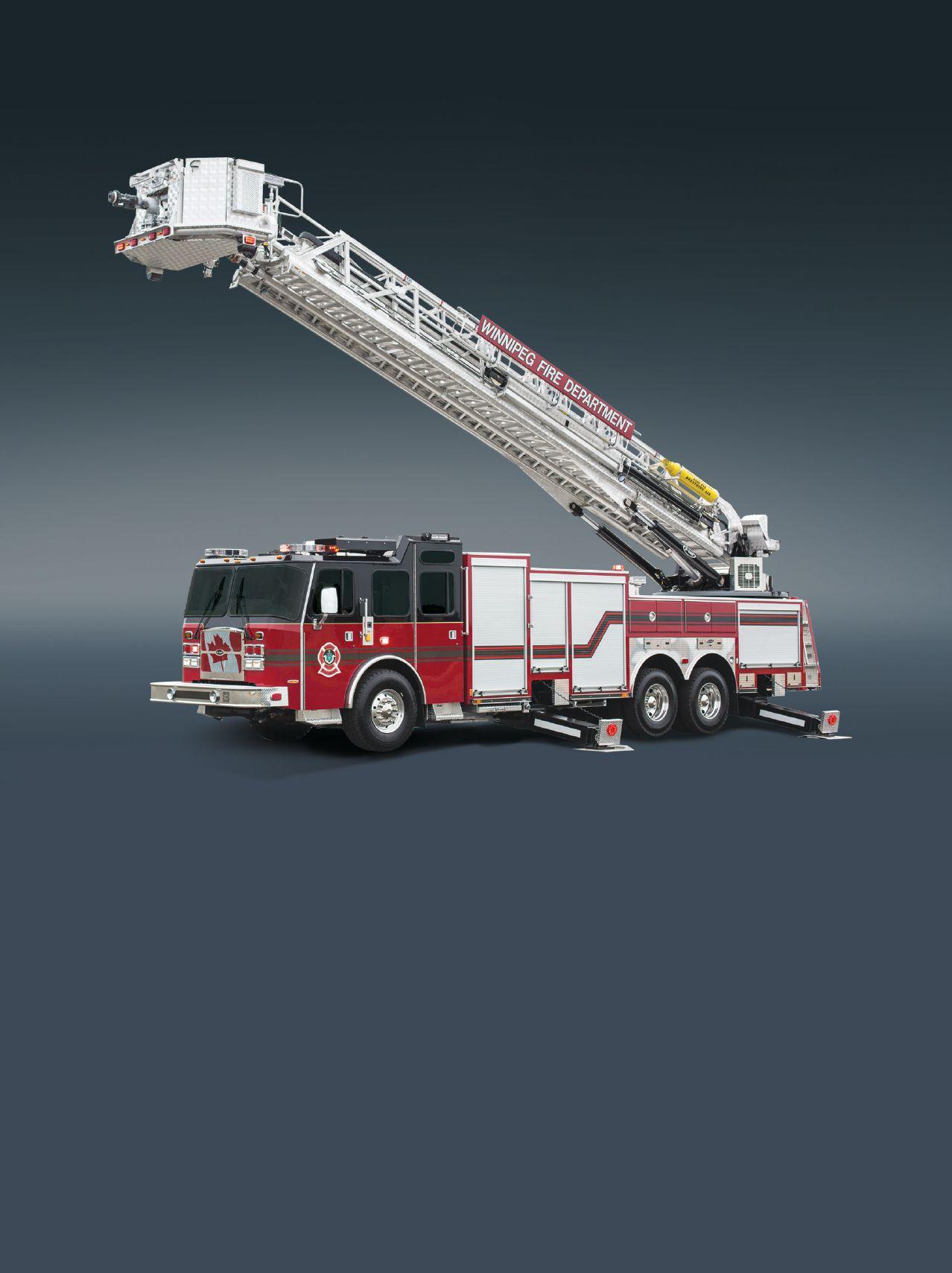
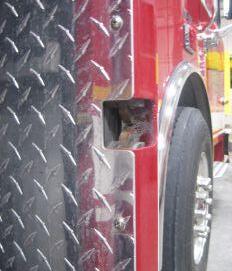
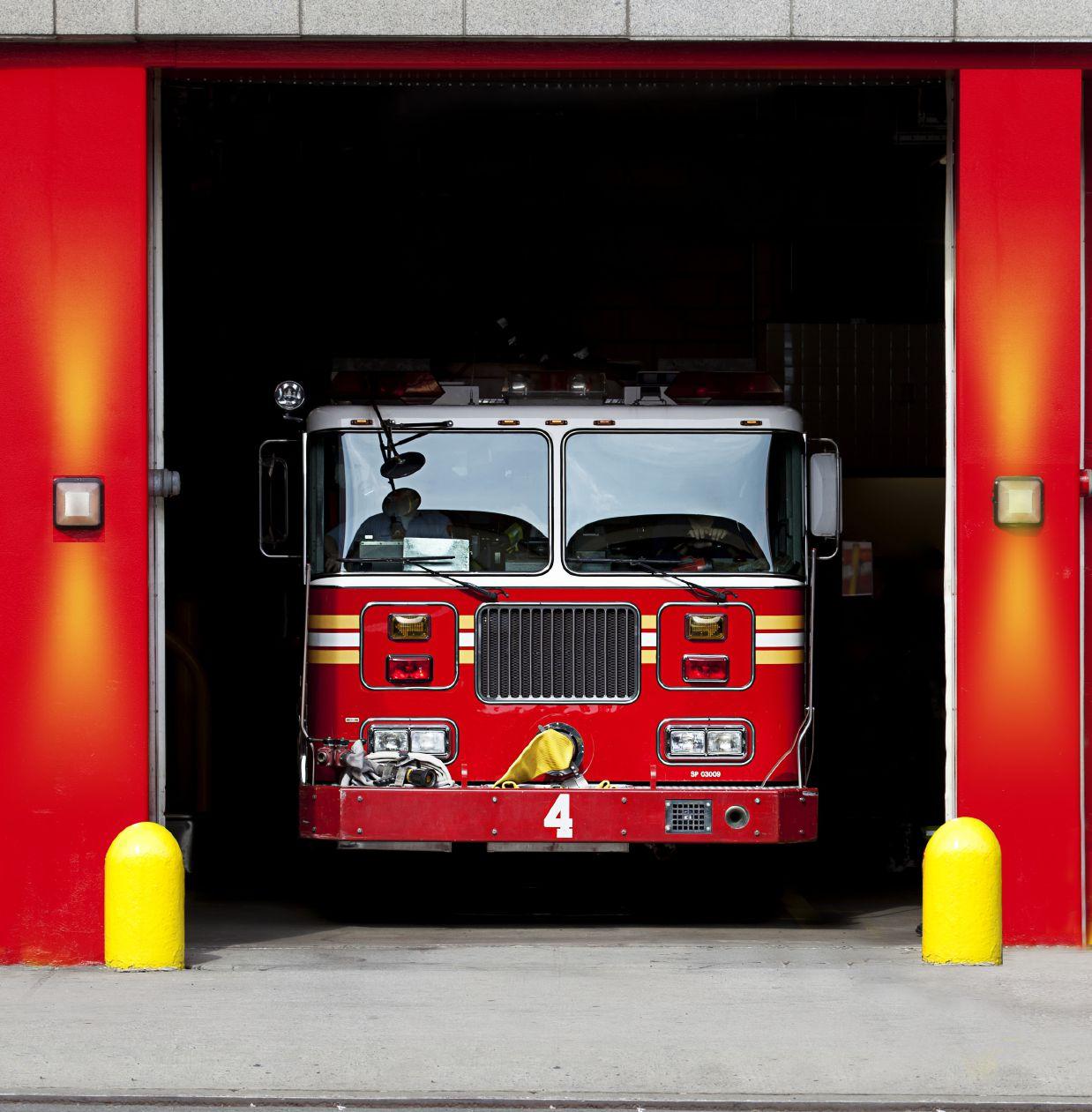
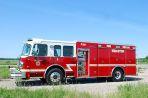
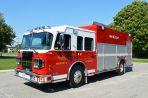
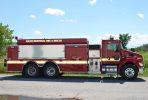
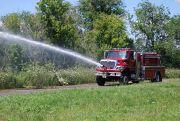
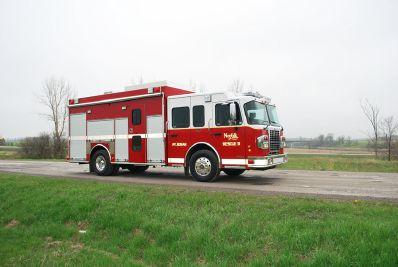
Angled front corners and perimeter step provides easier access to structures.
STRONGEST CAB IN THE INDUSTRY
Keep your crew safe with the cab that withstands over 5x the static roof load and over twice the frontal impact required by NFPA.
1305 LB DRY PLATFORM CAPACITY
The HP100 Platform has a rated load of 1000 lbs of firefighters and 305 lbs of equipment.
UNMATCHED STABILITY
Rock solid stability, even when tested to one and a half times the rated load over the front with tires off the ground.
PROTECH
Enhanced safety features such as rear camera, ESC, OnGuard collision mitigation, front and side air bag options.
2.5 TO 1 STRUCTURAL SAFETY FACTOR
Exceeds NFPA requirements, contributing to E-ONE’s proven safety record for over 30 years.
INTEGRAL TORQUE BOX CHASSIS
Manufactured from the ground up. A unique design that combines the chassis frame and aerial torque box to provide a solid foundation.
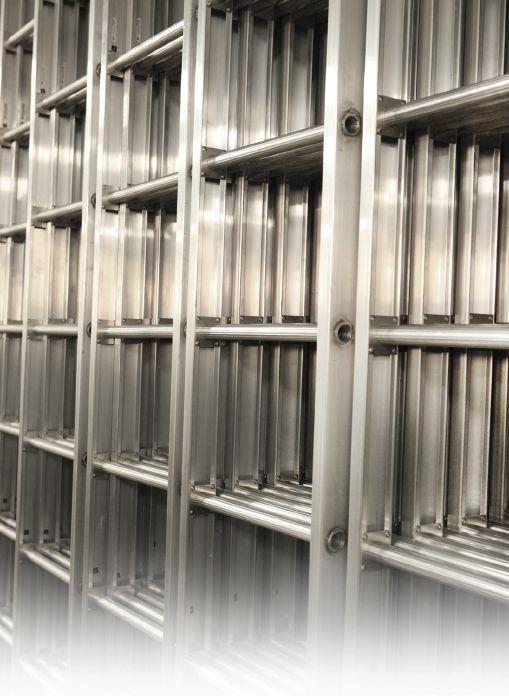
MORE STORAGE SPACE Rescue style compartments on each side and up to 182’ of ground ladder storage with tank and pump.
INSTEAD OF BUILDING STANDARD AERIALS, WE BUILD REVOLUTIONARY ONES.
The E-ONE HP 100 Platform looks like a rock solid beast. And it acts like one too. It has the muscle to hoist 1,000 lbs of firefighters plus 305 lbs of equipment 100 feet into the air. It also has the toughest cab in the business withstanding over twice the frontal impact required by NFPA and over five times the static roof load. But the HP 100 Platform isn’t just a powerhouse, it’s also versatile. With crisscross under-slung outriggers that deploy to a tight 15’6” spread, the HP 100 Platform can go where other aerials can’t. It’s also quick with jacks that set up in under 45 seconds and variable speed control system that gets the platform into position fast. Whatever the job calls for, the E-ONE HP 100 Platform is up to the task!
JACK DEPLOYMENT IN UNDER 45 SECONDS
When time is vital and space is limited, the criss-cross underslung outriggers deploy to a tight 15’6” spread in under 45 seconds.
A
being rolled out across Canada can help firefighters build resilience and recognize when colleagues need help.
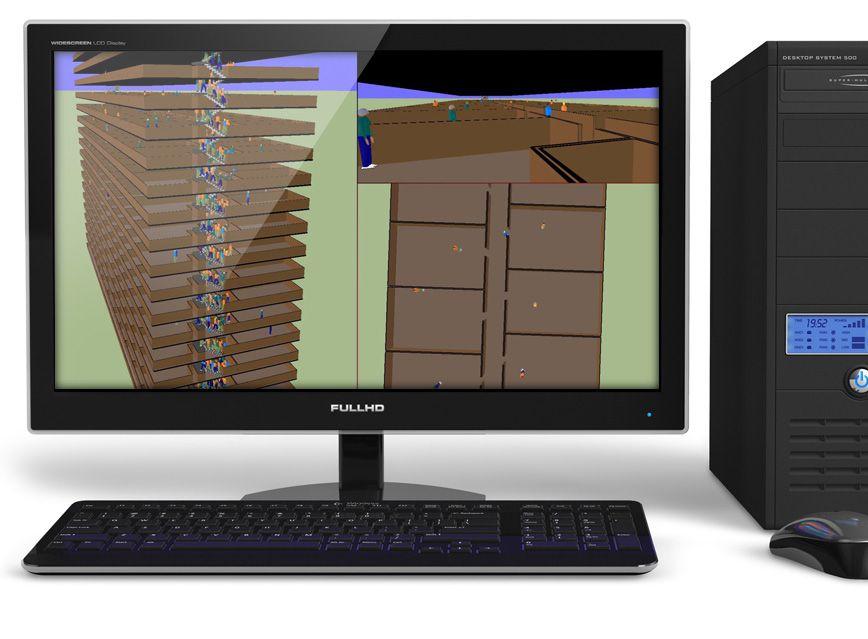
Computer simulations allow life-safety personnel to predict evacuation patterns.
How chief officers can implement a workable succession plan in a unionized department.
Best practices for dealing with methane buildup in pig barns.
Using data to target certain demographics and increase
Camp
and children of fallen first responders heal.
Tailoring
An
BY LAURA KING Editor lking@annexweb.com
I
COMMENT
An ounce of prevention
was skeptical, as is my nature. But having experienced a five-day train-the-trainer course and taught the eighthour Road to Mental Readiness leadership program, my cynicism has dissipated.
I heard classmates during the train-thetrainer session discuss their hurdles, the guts required to admit that their brains were wracked by flashbacks or nightmares, the disappointment when they took time off work and no one called or emailed to check on them.
And though I’ve yet to witness the success of the mental-illness prevention program as it has only just rolled out here in Ontario, I have watched light bulbs go on as participants – chief officers from career and volunteer departments – grasp the concept of the mental-health continuum (see story page 10), and the Big Four steps to building resilience.
to burnout, “which can be a significant but underappreciated problem with firefighters,” according to our R2MR trainer Sergio Falzi.
ESTABLISHED 1957
MAY 2016 VOL. 60 NO. 3
EDITOR LAURA KING lking@annexweb.com 289-259-8077
ASSISTANT EDITOR MARIA CHURCH mchurch@annexweb.com 519-429-5184
NATIONAL SALES MANAGER Adam Szpakowski Aszpakowski@annexweb.com 289-221-6605
SALES KORY PEARN kpearn@annexweb.com 519-902-8574
ON THE COVER
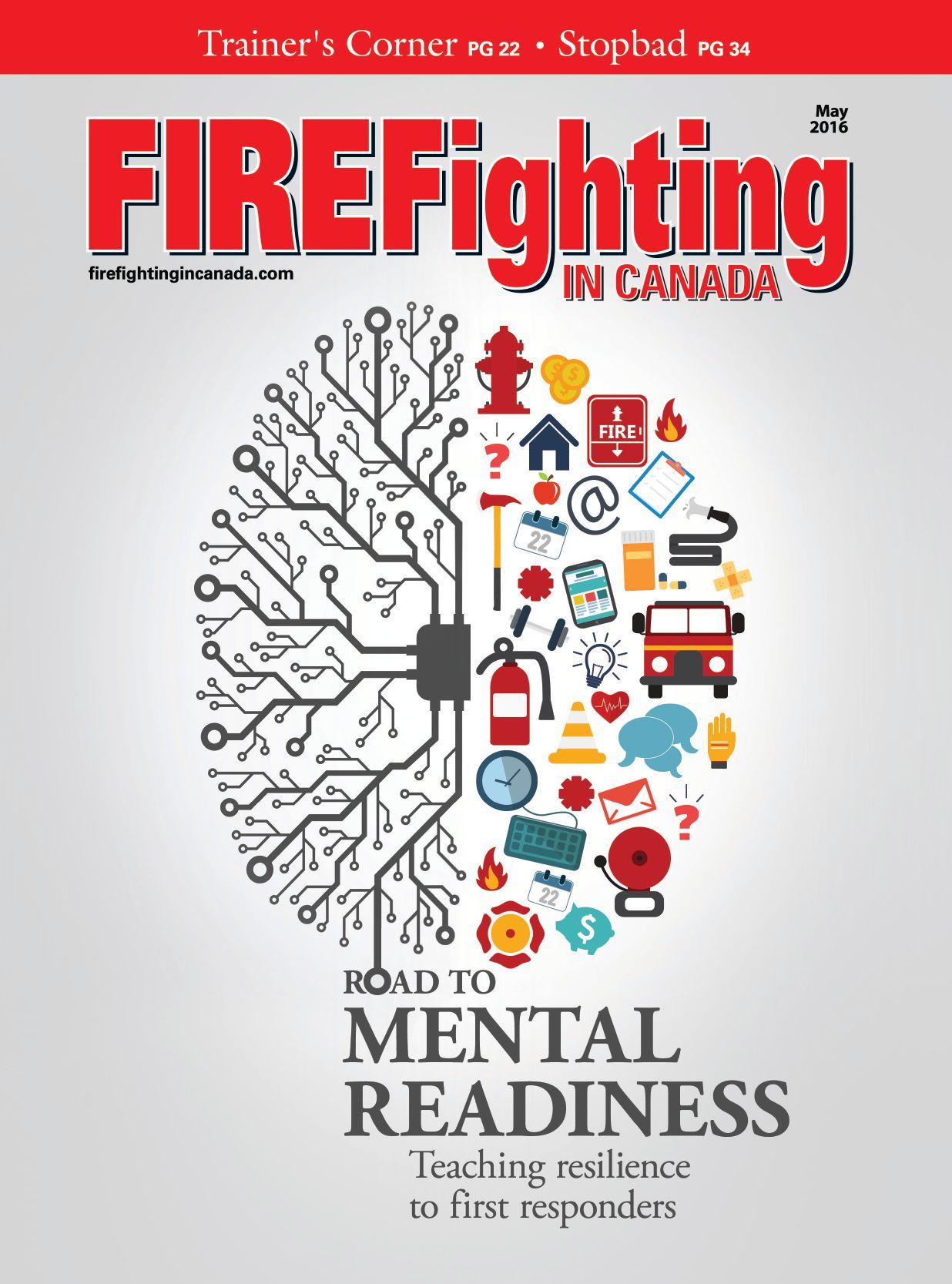
The Road to Mental Readiness program teaches responders resilience. See page 10.
I took the train-the-trainer course for two reasons: to be better educated about mental health – and therefore better able to write about it and its effects on fire-services personnel – and because people tell me things; I’m trained to listen and observe, to get interview subjects to open up, to ask probing questions so I can write detailed stories. Problem was, I had no idea what to say to people who tell me they are living with mental illness.
I learned a new language – living with mental illness, positive self-talk. I learned that there are three kinds of stress: organizational; personal; and operational. I learned that stress comes and goes, and that cumulative stress from calls, work-life balance and other challenges leads to exhaustion, which leads
Perhaps the most surprising revelation was fact that there are no Canadian studies – yet – that point to higher levels of mental illness or PTSD among first responders than among the rest of the population; mind you, mental illness (not just PTSD, but anxiety, depression, substance abuse) affects one in five Canadians and, therefore, one in five responders, but organizations are now tracking responder suicides, media are reporting them, and we’re all hyper-aware. I also learned that people get back to work sooner if they receive treatment early – so it’s important for managers to shield (help to prevent), sense (observe, ask questions) and support (provide resources to) their employees.
The Mental Health Commission of Canada is teaching R2MR to more than 250,000 emergency-services workers in the next 12 to 18 months. Those trainers will, in turn, teach their departments and others.
As Falzi explained, R2MR creators knew flood gates would open once police and fire personnel started to understand that mental illness is an injury that can be treated, managed and, in so many cases, healed.
“It’s not a flood gate,” Falzi said, “it’s a tsunami.”
RETURN UNDELIVERABLE CANADIAN ADDRESSES TO CIRCULATION DEPT.
P.O. Box 530, SIMCOE, ON N3Y 4N5 e-mail: subscribe@firefightingincanada.com
Printed in Canada ISSN 0015–2595
CIRCULATION e-mail: lmalicdem@annexbizmedia.com
Tel: 416-510-5187 Fax: 416-510-6875
Mail: 80 Valleybrook Drive, Toronto, ON, M3B 2S9
SUBSCRIPTION RATES
Canada – 1 Year - $24.50
(with GST $25.73, with HST/QST $27.69) (GST - #867172652RT0001)
USA – 1 Year $42.95 USD
We acknowledge the [financial] support of the Government of Canada.
Occasionally, Fire Fighting in Canada will mail information on behalf of industry-related groups whose products and services we believe may be of interest to you. If you prefer not to receive this information, please contact our circulation department in any of the four ways listed above.
All advertising is subject to the publisher’s approval. Such approval does not imply any endorsement of the products or services advertised. Publisher reserves the right to refuse advertising that does not meet the standards of the publication. www.firefightingincanada.com
MEET THE ALL-STAR LINEUP THAT HELPS GET THE JOB DONE.
With the powerful Super Duty Pick-Up, the versatile Transit and Transit Connect, and the work-ready platform of the F-650 and F-750, whatever you do for work, you can bet there’s a Ford commercial vehicle that can help you do it better. It’s no wonder F-Series is Canada’s best-selling truck 50 years straight,‡ and the truck Canadians trust to get the job done. Visit ford.ca/commercial-trucks and nd your perfect vehicle today.
STATIONtoSTATION
ACROSS CANADA: Regional news briefs
Honour guards network and learn in Niagara Falls
to 60
members from
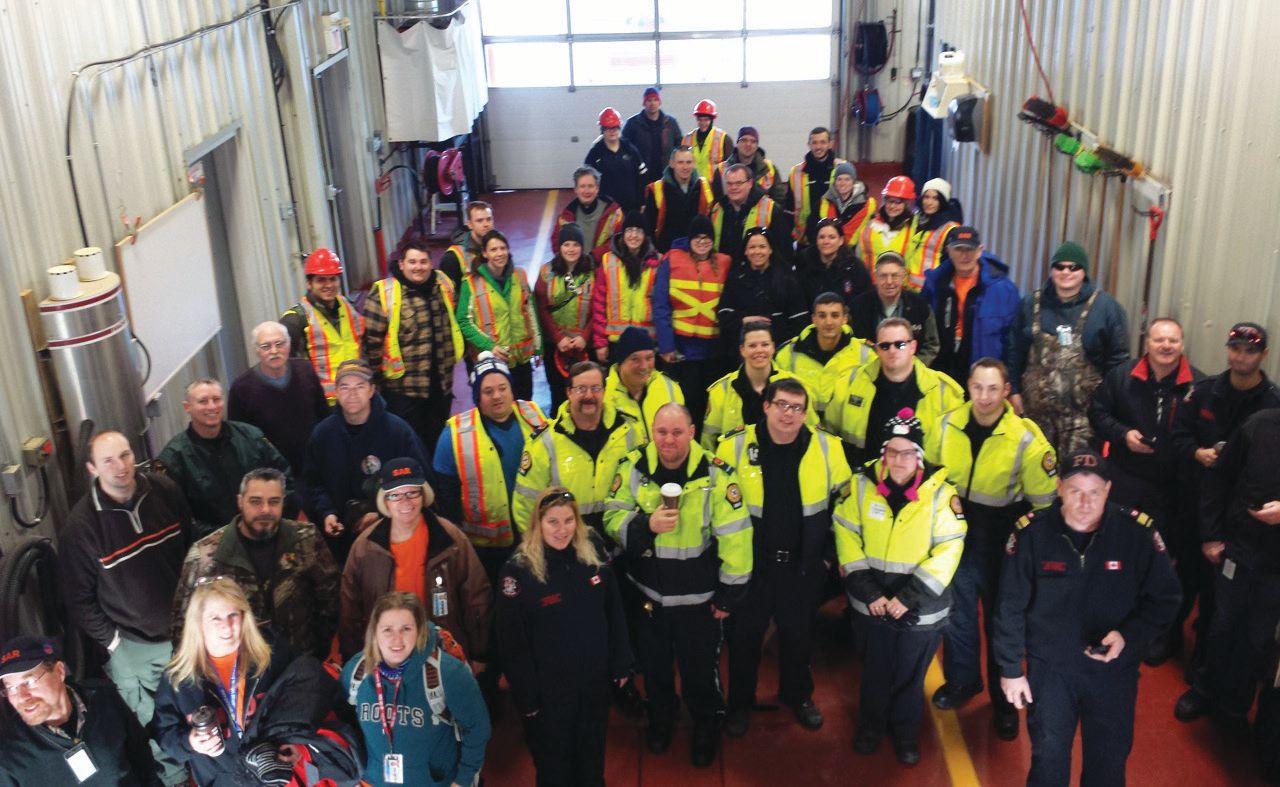
Camaraderie, brotherhood and the passing on of knowledge were themes discussed at the second annual Honour Guard Convention held in Niagara Falls, Ont., in February.
Close to 60 fire-service members from 14 departments took part in the convention.
Organizer Jan-Michael Reyner, a member of the Kitchener Fire Honour Guard in Ontario, said the event aims to celebrate the tradition
departments
of honour guards and to lend a hand to new departments.
“There are a lot of departments are just getting involved in honour guard and they’re just trying to get one established and there is nowhere to go to do that, whether it be learning about your uniform set up, your marching, the tools required,” Reyner said.
Guest speakers included Tim Bohr, a 10-year firefighter with the Westbury
THE BRASS POLE
Promotions & appointments
DAVE DECKER is the new fire chief of Markham Fire and Emergency Services in Ontario. Decker joined the department as a firefighter in 1988 after serving as an aircraft-rescue firefighter with the Canadian Armed Forces. He was promoted to deputy fire chief of operations in 2009, and was appointed chief on Feb. 16.
FRED STEPHENSON became fire chief for Loyalist Township Emergency Services in Ontario on Feb. 15. A 31-year firefighter with the department, Stephenson had been serving the township as acting chief since March 2015.
DALE UNRAU is the new fire chief for Mission Fire
Fire Department in New York, as well as Jordan Paris, a 14-year firefighter with Brampton Fire and Emergency Services, and John Clare, Brampton district chief and a director with the Canadian Fallen Firefighters Foundation.
The convention included a uniform display and attendees were encouraged to bring a complete honour guard uniform and other items from their departments.
“I had all these tables set up to display things, and when I left the room at about 3 p.m. – the venue started at 5 p.m. – there were only two tunics hanging there,” Reyner recalled. “When I came back down at 4:55, the whole room was full and they had actually used the tables that were supposed to have our food on for more display. It was a proud moment for me to see that there were so many more people who
were that enthusiastic about bringing their stuff and showing it off.”
Kitchener Fire Department Deputy Rob Martin said the only component missing at this year’s convention was sponsorship from vendors.
“There’s a lot of honour and tradition that goes into the fire service and the honour guard is really the tip of that spear representing us,” Martin said. “When a vendor shows up and supports something like that, it’s supporting the entire fire service.”
Reyner hopes to grow the convention to include honour guards from departments across North America and is working on forming an organizing committee. The next convention will be held in February 2017.
Learn more about the honour guard convention at www.hgconvention.com
- Maria Church
Rescue in British Columbia. Unrau served most recently as a deputy fire chief for Abbotsford Fire Rescue Service in British Columbia. He was appointed chief in Mission on Feb. 1.
CHARLES OLSEN was promoted to deputy fire chief for Estevan Fire Rescue Service in Saskatchewan on March 14. Olsen served the department for the past six years as a firefighter, lieutenant, captain and training officer. In 2014, he joined the Canadian Fallen Firefighters Foundation board to represent Saskatchewan and Manitoba.
MARK GRIFFIOEN was appointed assistant chief of administration with the Surrey Fire Service in British Columbia on Jan. 2.
Close
fire-service
14
in Canada and the United States participated in the second annual Honour Guard Convention held in Niagara Falls, Ont., in February.
PHOTO BY MYKHAIL BAEHR
Peer support model makes waves in Canada
An anonymous peer-support model for first responders in Canada is helping to end negative stigmas around mental-health issues.
Wings of Change Peer Support launched Feb. 1 and its users have since organized meetings in Ontario, British Columbia and Alberta communities. The meetings are opportunities for first responders to discuss difficulties and solutions in safe, judgment-free environments among peers.
Ontario paramedic Natalie Harris built the Wings of Change model based on a peer-support group developed
by retired staff sergeant Syd Gravel for members of the Ottawa Police Service.
“It’s peers helping peers, and with that comes an acceptance and understanding, and it removes any kind of anxiety surrounding being assessed by a medical professional,” Harris said, “However, we recommend very firmly that [professional help] takes place in conjunction with going to Wings of Change.”
The meetings are intended to compliment therapies already available to first responders, Harris said. Volunteers who organize
the meetings do not provide medical advice, rather they offer emotional support as colleagues who understand the pressures and difficulties of the job. The model can be adapted for all professions in which occupational trauma occurs, including military, communications and health care.
Harris, who experienced mental illness and received treatment, said she attended a similar support group as part of her rehabilitation.
“Being in a room of people who experienced very similar things, similar emotions, similar family struggles, literally
it was like looking in a mirror,” she said. “I was able to see that I needed help . . . it was what saved my life.”
Harris has received dozens of requests for the peersupport model from first responders in Canada, the United States and Britain.
For information visit the Facebook page: Wings of Change – Peer Support.
A new online tool can help firefighters be better prepared to respond to rail incidents involving flammable liquids.
Funded by the Canadian Association of Petroleum Producers and developed by Enform – the safety association for the oil and gas industry – in partnership with the Canadian Association of Fire Chiefs (CAFC) and other emergency-response stakeholders, the tool is a free, online presentation covering
Griffioen began his 20-year service with Surrey as a volunteer, and has been involved with the department’s pre-incident planning by assisting with production as well as program design and co-ordination.
Retirements
BILL SNOWBALL, fire chief for Markham Fire and Emergency
emergency-response resources, hazard identification and sitespecific hazard assessment and response.
CAFC president Paul Boissonneault said during the press conference launching the tool in March that firefighters, particularly volunteers in rural communities, are often the first on scene in the event of a train derailment.
“They are expected to initiate the critical steps of assessment, perimeter
Services in Ontario, retired in February after 40 years. Snowball became chief in 2008.
CAM STEPHENSON, deputy chief for Brantford Fire Department in Ontario, retired on Jan. 31 after more than 35 years.
containment, based on their knowledge and expertise,” Boissonneault said. “In this role, familiarity with rail equipment and the risks associated with the bulk transportation of dangerous goods is necessary.”
The online presentation includes up-to-date regulatory information from Transport Canada’s Emergency Response Task Force.
Brian Ladds, hazardous materials co-ordinator for the
Calgary Fire Department, was involved with the creation of the presentation and said the goal is to easily educate departments.
“It’s making sure that everybody understands the commodity, how it is carried, how it is placarded, and steps to take to keep everyone safe.”
Access the presentation in English at rail.capp.ca/en/ index.html and in French at rail.capp.ca/fr/index.html
- Maria Church
Stephenson served as firefighter, a captain and a platoon chief before he was named deputy in 2011.
ANDY MACINTOSH, fire chief for the Orangeville Fire Department in Ontario, retired in February. The 29-year firefighter served as chief for the past 16 years.
Last alarm
JASON MCLEAN, a 22-year firefighter with the Amherstburg Fire Department in Ontario, died on Nov. 10 of cancer. McLean, 40, became volunteer firefighter with the Anderdon Fire Department in 1993 before he was hired with Amherstburg in 1999.
STATIONtoSTATION
BRIGADE NEWS: From departments across Canada
Town of Athabasca Fire Department in Alberta, under Fire Chief Ryan Bodnarchuk, took delivery in November of a Fort Garry Fire Trucks-built emergency rescue pumper. This unit is built on a Spartan MetroStar LFD 24-inch raised roof chassis and powered by a 450-hp Cummins ISL engine and an Allison 3000 EVS transmission. It features a 1,250-gpm Hale RMC pump, a 500-igallon co-poly water tank and a Waterous Advantus 6.0 foam system.
Telkwa Fire Rescue in British Columbia, under Fire Chief Randy Cunningham, took delivery in November of a Fort Garry Fire Trucks-built crusader pumper. Built on a Freightliner M2 106 crew cab chassis and powered by a 350-hp Cummins ISL engine and an Allison 3000 EVS transmission, the unit features a 1,250gpm Darley PTO PSP pump, a 300-igallon propoly water tank, a Foam Pro 1600 foam system, transverse compartments, SCBA cylinder storage in fenders, and hose reel in custom cab steps.
Calgary Fire Department in Alberta, under Fire Chief Steve Dongworth, took delivery in September of two Smeal-built Pumpers. These units are built on Spartan Gladiator chassis, and powered by 500-hp Cummins IXL 31 engines and with Allison 4000 EVS transmissions. They feature 7,000-lpm Waterous CMUC20C-2000 pumps, 550-gallon water tanks, Eclipse CAFS with Advantus 3 Single foam systems, 30-gallon Class A foam tanks, and Akron 3440 Deck Master electric monitors.
Perth East Fire Department in Ontario, under Fire Chief Bill Hunter, took delivery in February of a ResQTech Systems/ Rosenbauer-built aerial. The unit is built on a Commander 3000 chassis with an 11-inch raised roof and powered by a 450-hp Cummins ISL Engine. The viper 78-foot viper smart aerial is equipped with a Rosenbauer N1500 Pump, a 400-gallon water tank, Weldon multiplexing, LED rung lighting, Joystick Soft Touch controls, Firetech Hi-Viz LED brow light and an EZ Load hosebed.
Courtenay Fire Department in British Columbia, under Fire Chief Don Bardonnex, took delivery in August of a Fort Garry Fire Trucks-built pumper. Built on a Spartan Gladiator chassis and powered by a 450-hp Cummins ISL engine and an Allison EVS transmission, it features a 2,250-lpm Hale QMAX pump, a 1,000-gallon poly water tank and 36-gallon class A/B poly foam tank, a Foam Pro 3012 system, and Amdor roll-up doors.
Ontario Power Generation Fire Rescue, under emergency response manager Ron Waller, took delivery in October of a Fort Garry Fire Trucks-built pumper. This unit is built on a Spartan Gladiator chassis and powered by a 550-hp Cummins ISX engine and an Allison EVS 4000 transmission. It features a 3000-gpm Hale pump, a 500-gallon poly water tank and 60-gallon poly foam tank, a Foam Pro 3012 system and TFT remote monitor.
Road to mental readiness
Teaching resilience to first responders
By LAURA KING
There’s one in every station – the ticking-time-bomb firefighter whose demeanour slips Jekyll-and-Hyde-like between everyone’s best friend and look-at-him-sideways and he’ll snap.
He’s a great firefighter – a stickler for SOGs and the department’s biggest safety advocate; he’s funny, sometimes loud, crusty and gruff, but he’s got your back. You’d trust him with your life.
Lately, though, he’s been flying off the handle over little things and the crew is steering clear, avoiding doing or saying anything that might aggravate him. What’s more, he’s showing up for shifts looking tired and disheveled.
He’s going through a rough patch, you figure – and it will pass.
Probably not. More than likely the firefighter is having trouble at home, doing things – drinking or gambling – that affect his sleep, and isn’t dealing well with whatever’s eating at him. More than likely, he needs help, but is too proud and stubborn to ask for it. Worse, he doesn’t want to be labelled as the guy who couldn’t cope.
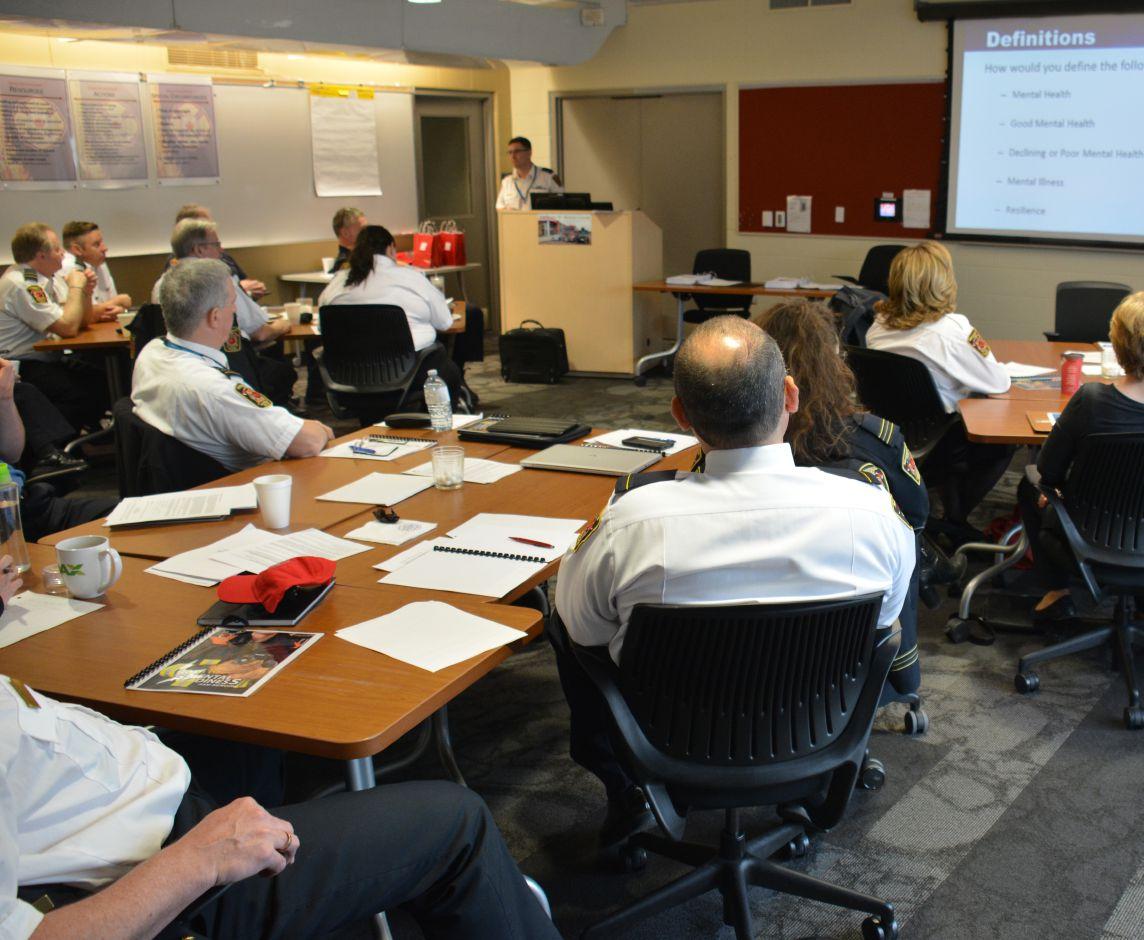
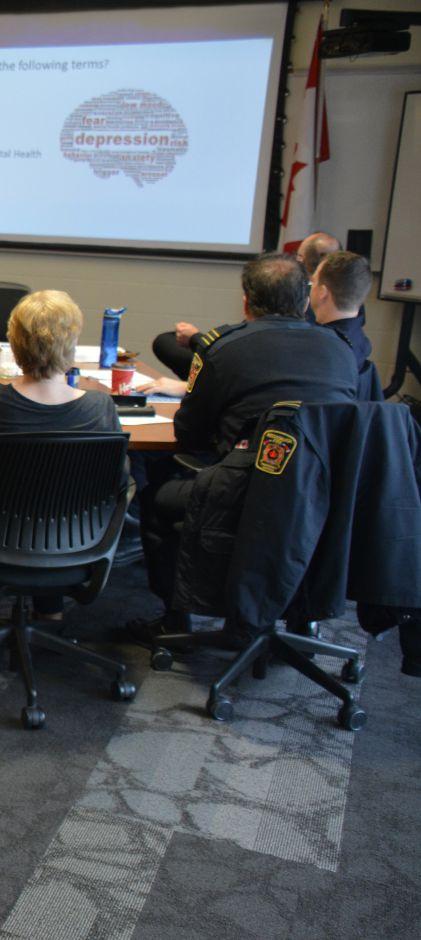
ABOVE The R2MR eight-hour leadership program for officers and four-hour primary course for firefighters provides skills to recognize when colleagues need help.
The crew starts complaining and patience wears thin. The stellar firefighter who always led by example is chewing out colleagues, slacking off, and everyone’s covering for him. What do you do?
The Road to Mental Readiness (R2MR) program developed for the Canadian Armed Forces and adapted for Canada’s fire services, gives firefighters two critical tools: a process for building resilience to deal with trauma or stress, and the skills to recognize when they, or colleagues, need help.
Most mental illness among first responders is not post-traumatic stress disorder, according to the Mental Health Commission of Canada (MHCC); rather, it’s a combination of personal challenges, daily hassles and operational stress.
And most fire-service leaders have no idea how to help a firefighter or colleague who is experiencing more stress than he or she can handle.
The R2MR program was rolled out in February by the Ontario Association of
Fire Chiefs (OAFC) – a train-the-trainer session taught by mental-health commission experts, followed by courses in North Bay (volunteer) and Mississauga (career); several more are scheduled. (Some fire departments, such as Kitchener Fire, have already brought in R2MR training and programs in partnership with other mental-health professionals and organizations.) Fire services in Alberta and British Columbia have also embraced R2MR; the Canadian Association of Fire Chiefs is working with the mental health commission to create a system for departments outside Ontario interested in R2MR training.
The goal of R2MR is similar to that of the fire-service wide incident-command system: to get everyone, from firefighters to chiefs, speaking the same language.
Mississauga Fire and Emergency Services put its supervisors through R2MR in April and plans to offer the program to its 600 officers and firefighters. Mississauga already has a robust peer-support team, critical-incident stress management trainers, and other mental-health tools, but Chief Tim Beckett says R2MR adds consistency.
“The key for us is structure,” Beckett said in an interview. “It’s not new to our organization, the aspect of mental-health training. This program allows us to build on our skill sets.”
R2MR comprises an eight-hour leadership program for officers, and a four-hour primary session for firefighters. Logically, the eight-hour leadership segment must be taught to a department’s officers before the four-hour primary segment is offered to firefighters. The curriculum is firefighter-friendly and uses adult-learning principles – there are lots of hands-on exercises, discussion, debate, and videos; course material was tweaked for fire personnel with input from departments in Calgary and Cornwall, Ont.
As with everything in fire, there are SOGs to ensure the integrity of the program: both the eight-hour and four-hour programs must be taught in single, one-day sessions; there are a maximum of 24 students per course; and costs per participant, which vary depending on grants, sponsorship and arrangements with the organizers. In Ontario, courses must be booked through the Ontario Association of Fire Chiefs; certificates of completion are awarded.
LEFT Mississauga Fire and Emergency Services offered the R2MR program to its supervising officers in April, the first career department to do so through the Ontario Association of Fire Chiefs.
PHOTOS BY LAURA KING
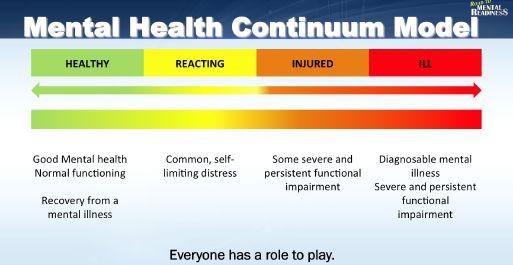
Supervisors should aim to ensure their people remain in the green - or healthy –zone of the mental-heath continuum model.
-
Cumulative stress is the worst, the mental health commission says in the R2MR manual; stress leads to exhaustion and burnout when it occurs too often, lasts too long and is too severe. Exhaustion, leads to bad performance. And bad performance results in departments losing good firefighters to lengthy and costly stress leaves.
The numbers, according to the MHCC, are staggering: 45 per cent of the population will experience mental illness – anxiety, depression or substance abuse. Given the stoic nature of first responders and the stigma surrounding mental illness, the likelihood of firefighters suffering in silence is significant.
What’s more, the World Health Organization predicts that by 2030, depression will be the No. 2 health condition in the world, surpassing heart disease. Figure, then, that a hefty percentage of Canadian firefighters – and your department’s members – will experience some form of mental illness.
The crux of the R2MR program is the mental-health continuum – a colour-coded sliding scale to help firefighters recognize when a colleague is experiencing significant stress.
Firefighters in the green zone are healthy – doing their jobs, being good citizens, spouses, parents and community members. It’s crucial, the MHCC says, to know your people – their personalities, how they react to calls and stress – in order to recognize changes in behaviour.
Firefighters who become irritable and anxious are reacting or injured – they’re in the yellow or orange zones. Those who lash out, shirk duties, turn to alcohol or drugs, are ill and in the red zone.
The objective of R2MR is to educate fire-service leaders about mental illness and, most importantly, how to prevent it, so they can keep their people in the green zone. The program provides skills and tools to recognize when people are drifting toward (or are already in) the red on the continuum; behaviour changes are key.
The program provides a step-by-step process for approaching a firefighter whose behaviour has changed, called the ad hoc incident review, or AIR: acknowledge, inform and respond.
R2MR spells out a system for officers to help members at every stage of the mental-health continuum, known as Triple S (similar to the three lines of defence): shield; sense; and support.
And the course gives everyone who participates a tool, aptly named The Big Four – the steps to build resilience: goal setting; visualization; self-talk; and tactical breathing.
“This program increases resiliency,” said the MHCC’s Michael Pitreus in an interview, “so that when people are faced with trauma, and prolonged trauma, they are much better prepared to deal with it.”
Using Navy Seals as examples, with a bit of brain science, the course
material and videos teach R2MR participants how to control fear and the fight, flight or freeze responses to trauma.
-
R2MR is suitable for career, composite and volunteer departments, for rookies or veteran firefighters, for new or longtime chief officers. Critical to the success of R2MR in career departments is buy-in from the firefighters association.
Mississauga IAFF Local 1212 vice-president Ryan Coburn said the union is anxious to end the stigma around mental illness and the R2MR program is known as a catalyst for change.
“We’ve recognized that behavioural health issues in the fire service are increasing and are not going to go away,” Coburn said in an interview. “And we know that by ending the stigma and bringing training programs out that it makes our people stronger and, in this case with the R2MR, more resilient.”
In Ontario, R2MR is part of a two-pronged strategy: prevention and treatment. On April 5, just days before the official launch of the R2MR program in Mississauga, the Liberal government passed presumptive legislation for post-traumatic stress disorder; New Brunswick has introduced similar legislation and Alberta and Manitoba did so in 2012 and 2015, respectively. While the Ontario Professional Firefighters Association (OPFFA) lobbied for the legislation to ensure access to treatment, the OAFC focused on a prevention strategy.
“The real investment needs to be in the up-front, proactive, preventative education,” OAFC president Matt Pegg said in an interview. “Our goal has been to give first responders the education and tools to prevent illness and the resilience, tools and education to stay healthy, and recognize when they need.”
Labour Minister Kevin Flynn said in an interview the government insisted on the two tenets: prevention; and treatment through presumptive legislation.
“The most damning thing about PTSD,” Flynn said, “is that you have post traumatic stress, you can deal with it properly, you can cope with it, you can manage it, but you’ve always got it.
“And it just strikes me that if that’s the prognosis, you don’t want to get it in the first place.”
The government launched a firstrespondersfirst.ca website in March to help emergency-services workers identify signs and symptoms of mental illness. Flynn said the R2MR program provides the necessary credible training.
“What we’re seeing on all health-and-safety issues is an increased demand for accreditation and standardization,” Flynn said, “so we know the training that we get is similar across the province . . . but also that there’s a standard of quality that’s being met. As long as we know that [R2MR] was signed off on by the fire chiefs themselves, that good enough for us; as long as we know that there’s a credible source behind that signature and the accreditation.”
The Association of Municipalities of Ontario (AMO) has said presumptive legislation for PTSD will cost cities and towns tens of millions of dollars. Naturally, AMO supports prevention programs and had the government’s ear, as did the union.
“The prevention part is where it’s going to pay off,” Flynn said. “And that’s why I was holding out for so long; the opposition parties were asking me to just pass Bill 2 – just get us presumptive legislation and everything will be fine.
“And that just meant it was OK for you to get PTSD because we were going to treat you only after you did, and that was the wrong message. We wanted to say, if you get PTSD, you’ll get treated as well as we can possibly treat you, but we don’t want you to have it in the first place.”
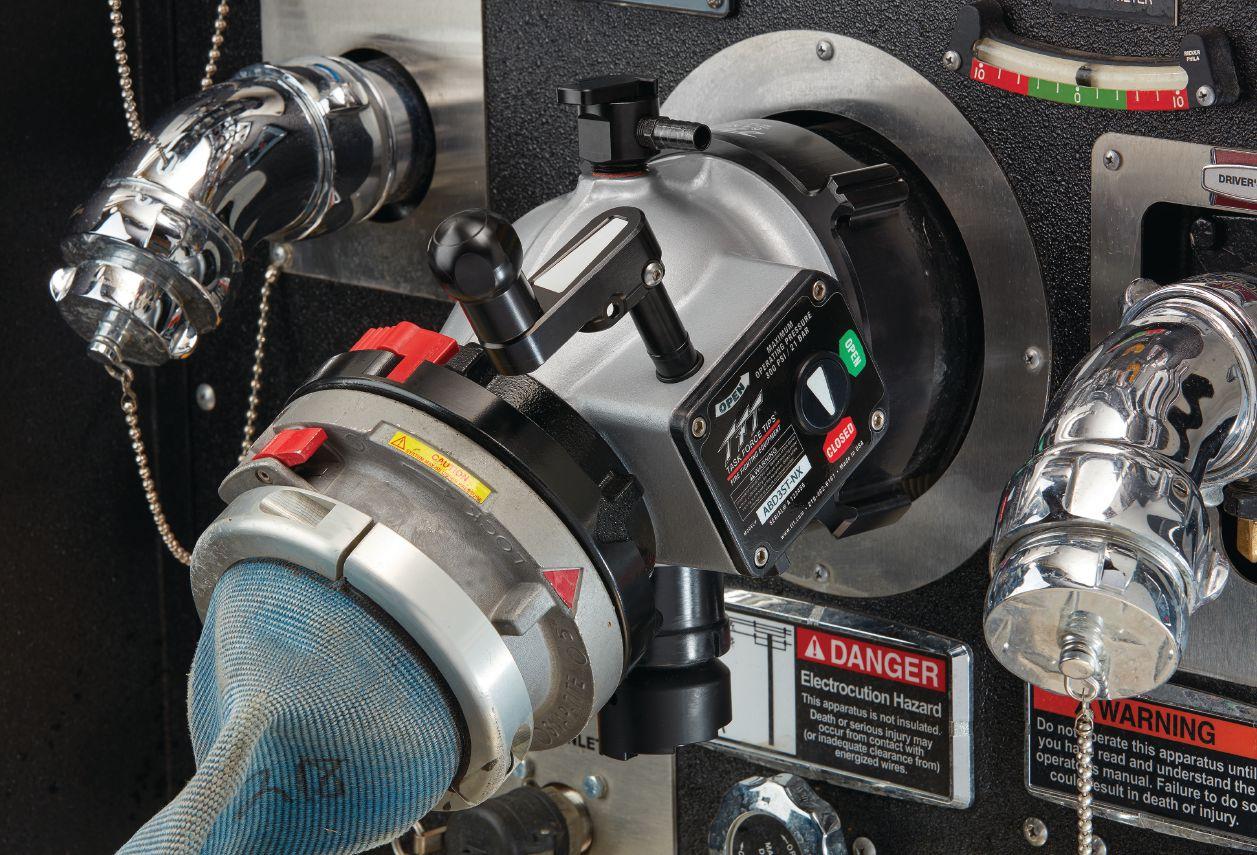
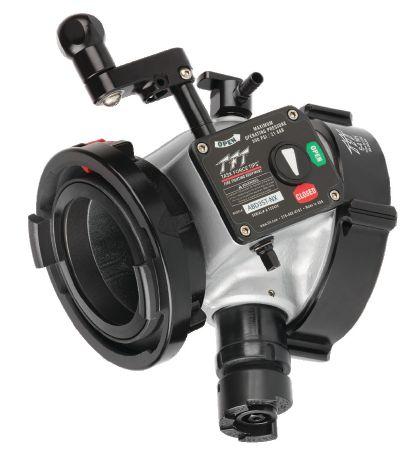
• Integrated Adjustable Pressure Relief Valve Provides Fast Reacting High Volume Protection from Water Hammers in the Hose lines
• Individually Serialized for Tracking and Continued Service and Technical Support
• Highly Visible Valve Position Indicator and Slow Close Operation Exceeds All Standards Requirements
• Flow Efficient Waterway Has Less Than 5 psi Loss at the Rated 1250gpm Flow
BY DAVE BALDING Fire chief, Golden, B.C.
AAre you fit to lead a fire department?
s a chief officer, I expect my firefighters to maintain a level of fitness and competence to enable them to safely and effectively perform their duties. In return, I must keep myself fit in order to be at my best for the people I guide, inspire and serve. Are you a fit leader?
There are several facets to fitness for leadership; the first one that comes to mind is physical condition. If there is a downside to advancing toward progressively senior positions, it’s the more sedentary nature of the job. I’m very fortunate that my position, while mainly administrative, also has some operational aspects; that makes the need for physical fitness quite clear. However, all fire-service leaders – whether they drive a desk all day long or attend every emergency call – need to set aside time to exercise; they’ll be better at what they do and they’ll set a great example for their teams.
Being fit for leadership also means being mentally healthy. The increased awareness around critical-incident stress and mental health overall is not only long overdue, but is also great news for the first-responder community. Open and candid conversations about this vital topic will continue to raise awareness and reduce the stigma around mental health. Much like physical wellness, firefighters must learn to first look after our own mental health. I recently attended a seminar that explained how an unhealthy work-life balance affects emergency responders’ abilities to cope with traumatic incidents. Leaders in the fire service tend to give it their all. Are you setting aside enough time for family and personal pursuits?
Another trait of those who are most fit to lead is passion for what they do. I am seldom more revved up about my amazing profession than after attending a conference or other networking opportunity. Conferences expose us to fresh ideas, products and acquaintances – both old and new, foster conversations and provide the perfect forums for problem solving and reinvigorating passion for leadership. The educational components of conferences are usually topical and cutting edge. Yes, these opportunities take us away from our communities, but they also allow us to share best practices, great experiences, and to showcase our departments. Membership in associations that host these conferences is another huge opportunity for leadership growth. Active participation and giving your time and talent to a provincial or other association grows us as leaders. We, as chief officers, insist on continuing professional development
for our firefighters and we must do the same for ourselves. Ongoing training improves us operationally and as leaders. While it can be easy to get caught up in the frenzy of the day-to-day operation of a fire department, it’s imperative to break out of that complacency and take opportunities to grow. Of course leaders must continue to advance their skills and knowledge of fire fighting and related duties, but they must also continually strive to improve at another vital art – guiding and inspiring the folks who make up our companies, battalions or departments.
Those most fit to lead are fully engaged with their organizations; they have a vision and are able to communicate it clearly to their members and others. A leader’s vision may entail change, whether it’s operational change in the department or change for council and the taxpayers they represent – for example a new fire hall. Let’s consider the obverse; some in positions of leadership view change as a threat. True leaders evaluate change and embrace suggestions from others.
Firefighters who are well suited to lead are much more than administrators or managers, they are there for the organization and, what’s more, they are there for the people. One of the benefits of belonging to a small department is the privilege of getting to know each one of
Much like physical wellness, firefighters must learn to first look after our own mental health. ‘‘ ’’
my members more than might be possible in a larger organization. No matter the size of the department, true leaders always look out for their members.
Another measure of fitness to lead is the ability, and commitment, to expand boundaries. Today’s emergency services and the agencies with which they deal are more interconnected than ever. We can no longer operate in silos; we must be comfortable reaching out and expanding our horizons beyond the norm, which means forging new relationships where we may not have previously.
Dave Balding joined the fire service in 1985 and is now fire chief in Golden, B.C. Contact Dave at dave.balding@golden.ca and follow him on Twitter at @FireChiefDaveB
It’s clear to me that to do the best job of looking after others, we must first look after ourselves. Look after your physical and mental well-being, engage with your colleagues in associations, continue to pursue training, and always grow. Chief officers must also promote this growth within our members, who are tomorrow’s leaders – we want them to be as fit as they can be.
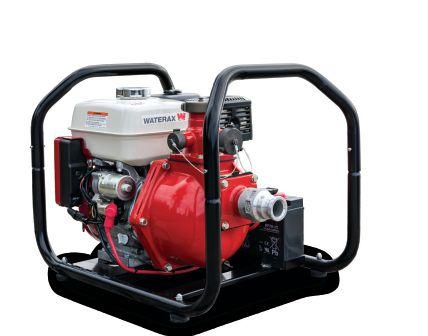
The VERSAX® is a multipurpose self-priming pump powered by a 6 HP or 9 HP Honda engine. This fire pump is rugged and versatile and can be used for other applications such as tank filling, water transfers and as ATV slip-on units. Also available in Vehicle Mount and with a Wrap-Around Frame for more protection and ease of carrying. Brought to you by WATERAX, makers of portable high-pressure fire pump such as the MARK-3® and the BB-4®, trusted by the wildland firefighting community since the 1920’s. Our pumps are as tested and proven as the men and women who use them every day.
Engine company ops: aggressive cooling – part 2 BACKtoBASICS
BY MARK VAN DER FEYST
Firefighters should be aware of situations that lead to rapid fire development (RFD) – occurrences such as flashovers, backdrafts and smoke explosions – and how to take aggressive action to protect themselves. In the March issue of Fire Fighting in Canada, we examined why better gear and new construction materials expose firefighters to RFD today more than ever before.
As a reminder, a flashover is the simultaneous ignition of all contents within a room. A flashover occurs when hot gases in the form of black smoke from unburned particles of combustion rise to the ceiling and spread out across the walls. As the smoke spreads, it heats up the room’s contents – paint on the walls, furnishings, clothing and flooring material. Once the contents reach their ignition temperatures – between 540 C and 820 C (1,000 F and 1,500 F) – rapid fire development occurs and everything becomes a big ball of fire.
There are visual and tactile signs or indicators that warn firefighters of impending flashover. Firefighters should heed these signs and take aggressive action to protect themselves.
• Heat buildup – there will be a period of time, based upon the temperature range of flashover, when excessive heat buildup occurs. This heat buildup will descend toward the lower part of the room, forcing the firefighter to the floor. Radiant heat produced by the unburned particles of combustion spreads out from ceiling to walls and then down to the floor area. When this quick increase in intense heat occurs, flashover is imminent.
• Rollover – A visible indicator known as a rollover reveals itself in the smoke in the lead up to a flashover. A rollover, or flameover, is when small gaps open up in the smoke layer, allowing air to mix with the unburned particles of combustion and ignite. Small flames appear in the midst of the smoke and then quickly disappear. These small bursts of fire are warning signs that flashover is coming.
• Thick, dark smoke – A change in the colour and thickness of smoke is also an indicator of flashover, and can be visible inside as well as outside the building. Firefighters on the inside will be surrounded in thick, dark smoke and will see nothing but total blackness. Crews on the outside will notice thick, dark, acrid smoke pushing out from a structure, under high pressure and with high velocity; this indicates flashover is impending.
Firefighters should take aggressive action against RFD, acting
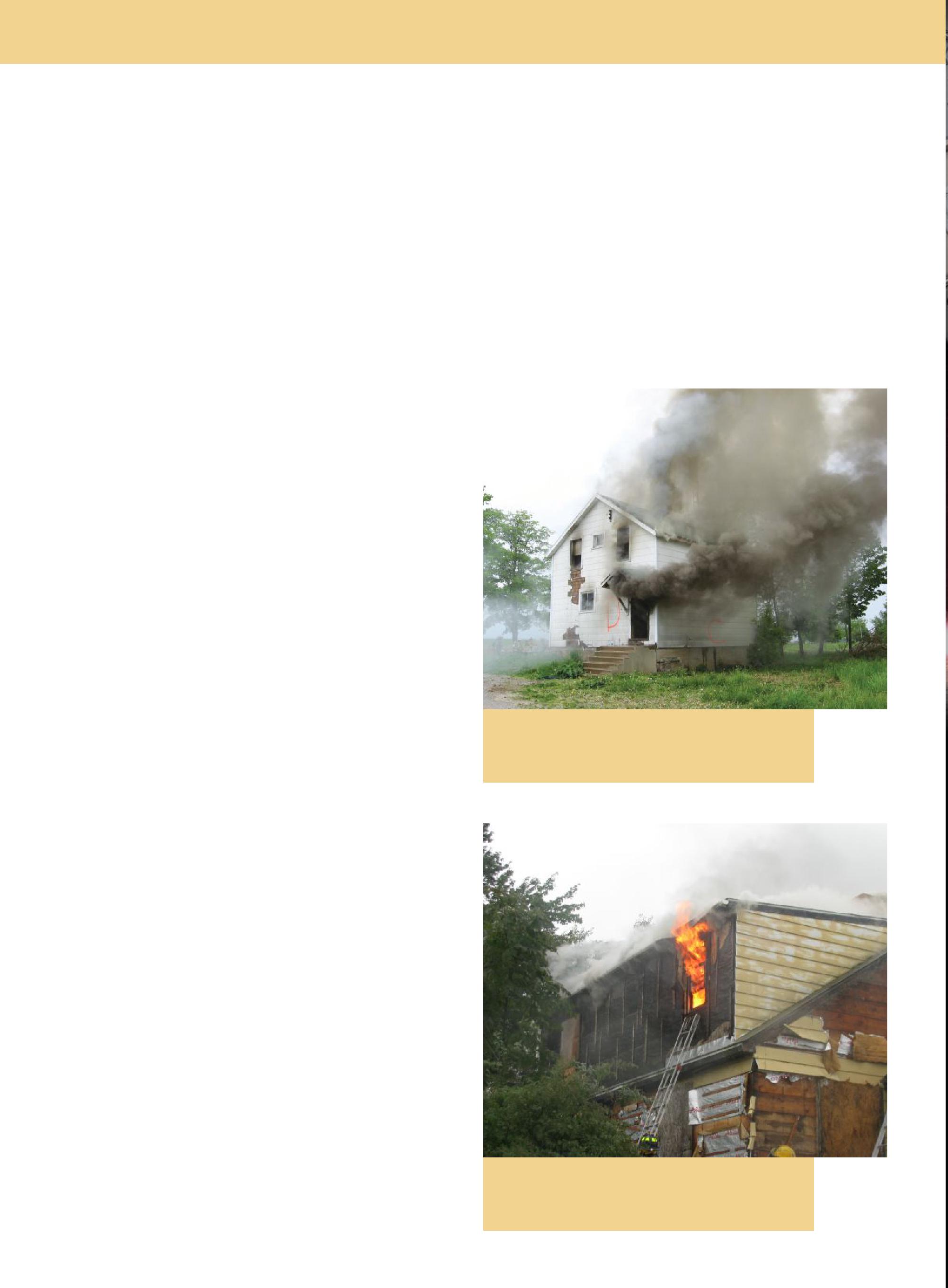
Thick, dark, acrid smoke pushing out from a structure under high pressure and with high velocity indicates to firefighters that a flashover is impending.
Firefighters should use a combination of tactical ventilation and aggressive cooling with water to effectively overcome and eliminate flashover.
PHOTOS BY MARK VAN DER FEYST
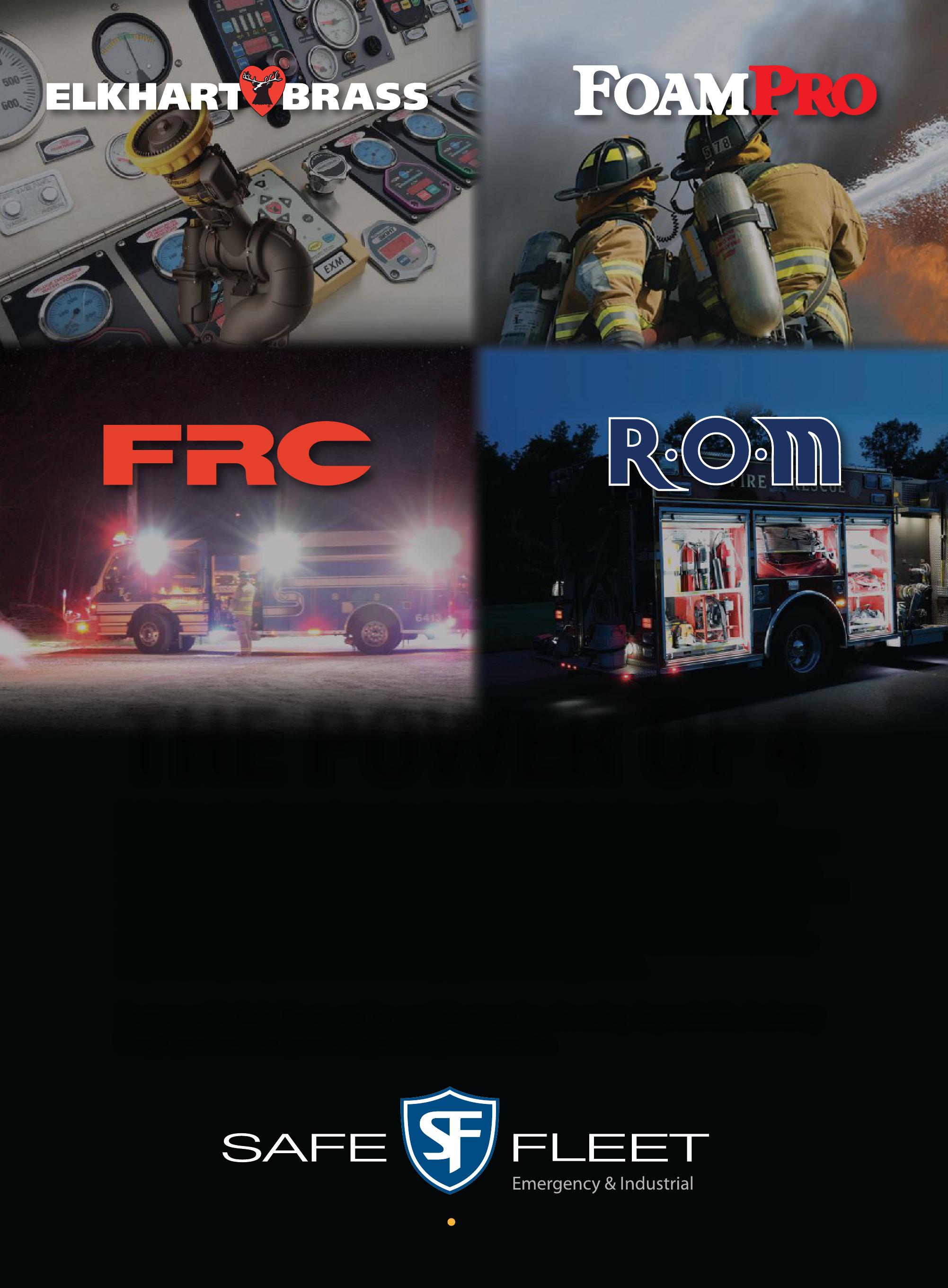
Safe Fleet unites the most innovative and proven technologies from a collection of industry leading companies. The combination of our expert field sales and technical teams offer unmatched service and support with dependable and rugged Elkhart Brass nozzles, monitors and valves. FRC’s lighting equipment, governors and gauges offer the safest, most dependable products in the industry. Innovation and expertise drive FoamPro to deliver concentrate on demand and with precision. And emergency responders trust the safetyinspired, easy-to-operate ROM doors equipped on their apparatus.
Partner with Safe Fleet, and be confident you’re choosing dependable, industry tough products for your integrated system needs.
www.safefleet.net+1.816.293.9040
BACKtoBASICS
smartly in order to gain the upper hand. There are two ways to effectively overcome and eliminate flashover: tactical ventilation and aggressive cooling with water. Tactical ventilation quickly removes the unburned particles of combustion – the hot gases, the smoke and the heat – from inside the structure. There are various methods for tactical ventilation, but the
most effective is vertical ventilation. Heat and smoke naturally rise, so a vertical opening creates a natural path out of the structure. The key to vertical ventilation is to place the opening directly above the fire to create a chimney or direct travel path to the outside for the smoke and hot gases.
Ventilation should be coupled with aggressive cooling from the application of
Fire Rescue and Safety Training
Approved training for IFSAC and Proboard seals
NorQuest College offers flexible online and face-to-face training for those looking to start or advance a career in fire rescue and safety.
From entry-level firefighter programs to fire officer, rope rescue, industrial, and wildland firefighter training, these courses allow you to learn from anywhere and complete your practical skills requirements in your own community.
water. A hand line, minimum 45 millimetre (1 3/4 inch), used in an effective way, cools the ceiling, walls, floors and contents all at once.
Aggressive cooling involves using a straight or solid stream of water from the nozzle. Do not use a fog pattern when facing pre-flashover conditions. A straight or solid stream of water will effectively knock down the fire and at the same time reduce the extremely high temperatures inside. During Underwriters’ Laboratories tests conducted for a report on fire attack tactics in the summer of 2013, temperatures inside a structure were recorded to have been reduced by about 700 C (1,300 F) with an aggressive attack using a smoothbore nozzle.
To aggressively cool a room, move the nozzle in a pattern so that the stream hits the ceiling, walls and floors in a sequential and consistent fashion. One method is to sweep across the ceiling then straight down to the floor; another is to sweep the ceiling and also sweep the floor. No matter what pattern, the attack should involve movement and not a static application of water.
Aggressive cooling reduces the temperatures of the ceilings, walls, floors and contents as firefighters advance into the structure. Apply water as well to the unburned particles of combustion. Remember, the particles contribute to the radiant heat along with the ceiling, walls, floors and contents. Applying water to the smoke sounds very aggressive and goes against everything firefighters have been taught for the last number of years, however, changing technology and better science impacts our tactics. We now know firefighters need to spray water at the smoke to effectively cool it and reduce or eliminate the risk of a flashover.
Mark van der Feyst has been in the fire service since 1999 and is a full-time firefighter in Ontario. Mark teaches in Canada, the United States and India and is a local-level suppression instructor for the Pennsylvania State Fire Academy and an instructor for the Justice Institute of BC. He is also the lead author of Residential Fire Rescue. Email Mark at Mark@FireStarTraining.com
TRAINER’SCORNER
Practise clear, concise arrival reports
By ED BROUWER
Victory loves preparation. This statement reflects what training officers should aim for on practice nights. Recently, at Greenwood Fire and Rescue, I was reviewing building construction with our firefighters when our tones rang and we were called to a possible structure fire at 1680 Deadwood St. There was a brief moment when all heads turned toward me as though the call was my doing. (Several months ago I surprised the crew with a mock call midway through a classroom session.) But I just shrugged and ran for my gear.
It didn’t take us long to respond since we were already at the hall. The arriving units set up and the incident commander took a look around. Flames were visible through the upper window and wisps of smoke were pushing through the parted curtains. Firefighters were a bit hesitant about how they should respond when it became clear this was a hands-on scenario I had arranged with help from our dispatchers.
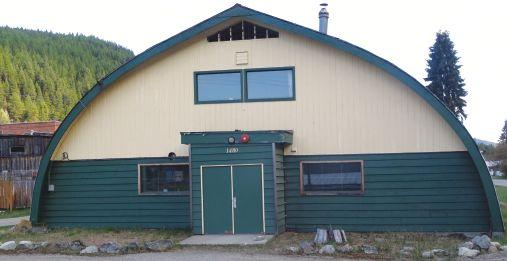
The structure fire was at our old curling rink, which is our practice building. I asked dispatch to use the street address rather than the local name to ensure members used the mapping system.
The realistic flames that danced across the ceiling and reflected through the glass of the window were from an indoor campfire unit I had purchased and tweaked it to fit our needs. The device simulates flames using coloured LEDs and a fan-driven flameshaped, silk fabric about 43 centimetres (17 inches) long. (Find these units at www.indoorcampfires.com.) A smoke machine added to the realism.
I would love to tell you that the scenario played out perfectly, but life isn’t always that kind. There were a few hiccups, but we dealt with them during our debriefing. One area of concern that came up during debrief was the poorly executed arrival report.
The arrival report is the first radio report to dispatch made by the first-arriving fire officer while he or she is still in the apparatus. This initial report is a 30-second time investment that pays huge dividends and is one of the most important yet overlooked fire-ground procedures. Departments should review the following points about arrival reports.
The first-arriving unit establishes command (command can be transferred later).
This arrival report should include six points:
• On-scene confirmation
• Incident location
• Building construction
• Fire conditions
• Establishment of command
• Critical safety information
On scene confirmation indicates to dispatch that command is established and confirms the location of the emergency. In our
Training officer Ed Brouwer surprised his class with a realistic mock structure fire at a nearby curling rink, which is now used as a practice building for the department.
drill served to point out the need for more training for firefighters on arrival reports.
The arrival report is the first radio report to dispatch made by the first-arriving fire officer while he or she is still in the apparatus. The report is an on-scene confirmation.
scenario, dispatch was informed that firefighters have arrived at 1680 Deadwood St. and that Deadwood command is established.
Use the word “from” during radio communications, for example, “Dispatch from Engine 1.”
And above all, wait until you are acknowledged by dispatch before giving the report. Do not just call out “dispatch” followed by your report; wait for the go-ahead.
Engine 1: “Dispatch from Engine 1.”
Dispatch: “Go ahead Engine 1.”
Engine 1: Then gives the report.
I realize radio protocol is elementary, but you would be surprised how many firefighters mess it up. Many use the word “to” – “Engine 1 to Dispatch” – but this is backwards. In order to get someone’s
BY ED BROUWER
The
PHOTO
TRAINER’SCORNER
attention you always call out the name (in this case dispatch) of the group or person or with whom you want to communicate.
Once you have been given the go-ahead by dispatch, clearly and precisely communicate your arrival report. Remember you are still in the cab at this point. Answer these simple questions: Who are you? Where are you? What do you see? What do you need? What are you going to do?
The incident commander (IC) also has the option of changing the response mode of responding resources. It may help to let dispatch and the other responders know your initial operational mode; offensive, defensive, investigative or rescue. The arrival report is also an opportunity to request help right away – for example a second/third page, mutual aid, hazmat, forestry, RCMP, EHS or utilities – and to warn of dangers such as downed power lines.
This short and sweet 30-second report paints a clear picture for incoming units. How much smoke and/or fire do you have? Where specifically is the fire? And so on.
The point of the arrival report is to tell those who are listening something that they may not already know. Determining what the listeners do not already know is not as easy as it sounds. If you say there is a house on fire, although you see what that house looks like, 12 people hearing your report each picture a different house.
During the practice night following our mock call, I had four firefighters leave the training room and take turns using a radio to describe pictures of burning houses. These pictures – which I printed off the Internet – showed houses in various stages of fire involvement. The members in the training room were given blank sheets of paper and pencils and tasked to draw what was being described to them via radio reports. The firefighters were allowed to ask for more details or clarification. When everyone was finished drawing, the actual pictures were revealed on the screen in the training room. There were more than a few “oh brother” comments, and lots of laughter and interaction.
In the second part of our practice session, each member was given an arrival-report card:
• To dispatch: (unit) arrived at (address)
• We have a: (what you see through the windshield)
• Structure type: residential/commercial, construction material, number of storeys
• Fire involvement: flame showing/not showing, vented/not vented
• Smoke: heavy/light, colour
• What do I need? Second or third page/ EHS/RCMP/mutual aid/utilities
• Who am I? (Incident location) command established
• What am I doing? e.g. going mobile for a more detailed size-up
I had prepared eight PowerPoint slides of photos showing structures in various stages of fire involvement, and one photo with no fire or smoke showing. Each slide had a local address typed at the bottom.
Blank sheets of paper and pens were handed out and each firefighter was instructed to play the role of the first-arriving officer and to write an arrival report from each slide as it came up. After each slide, a few individuals read out their reports and we discussed their findings.
When I showed the picture of the house with no fire or smoke, members were quick to report nothing showing, but weren’t too sure where to go from there. I asked them to consider what they should ask dispatch. There were a few blank stares, and no response. So I gave them a Sherlock Holmes quote: “You see, but you don’t observe.”
I noted that the address on the slide was 690 Copper Ave. N., and suggested asking dispatch to confirm the address – after all it could be 690 Copper Ave. S.
I love it when practice night is loud and interactive. There were a lot of good discussions about fire behaviour, fire suppression tactics and firefighter safety.
Remember, in order for our members to be victorious over the fire dragon we need to prepare them by training as though their lives depend on it. I hope this info will encourage you to review arrival reports with your members. Stay safe.
Ed Brouwer is the chief instructor for Canwest Fire in Osoyoos, B.C., and training officer for Greenwood Fire and Rescue. Ed has written Trainer’s Corner for 15 of his 27 years in the fire service. Contact Ed at
BY SHAYNE MINTZ NFPA Canadian regional director
OProtecting more than just the barn
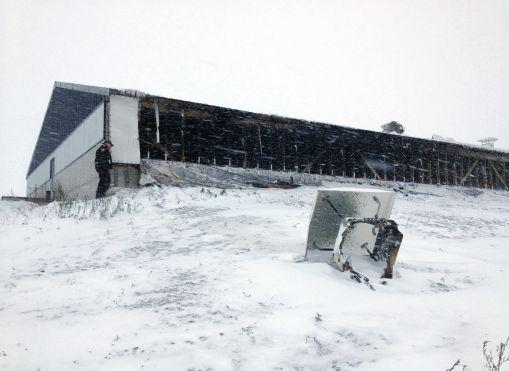
ver the winter, there were more large-profile barn fires in the news than I can recall in recent memory. At one point it was difficult to keep track of them all.
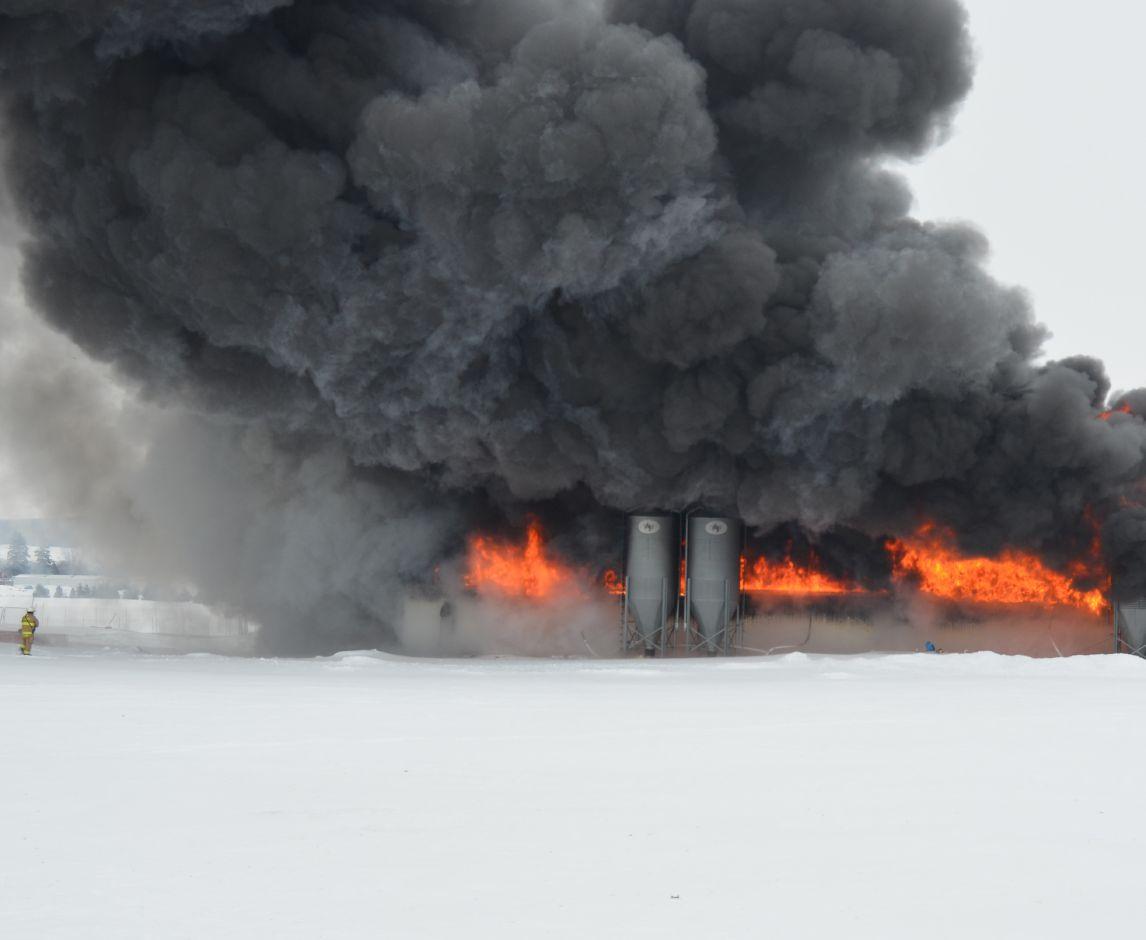
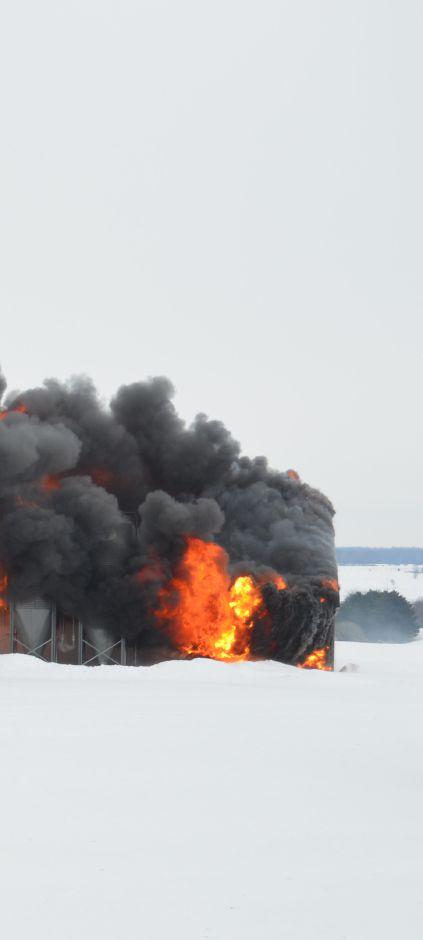
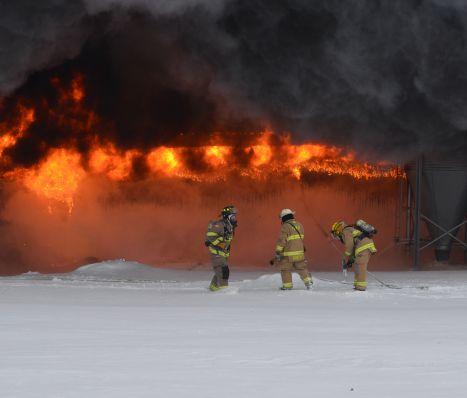
Between Jan. 4 and Feb. 25 at least 2,700 animals were killed in seven Ontario fires – and the problem was not limited to Ontario. On Jan. 28, 20 horses narrowly escaped death in a massive barn fire in Delta, B.C., and last summer more than 100 head of cattle were killed in a fire at a dairy farm near Truro, N.S.
Fires such as these are often in rural areas and have devastating effects not only on the owners of the barns, but also entire communities and local economies. People, animals and property are all in danger when a fire breaks out on a farm. Unfortunately, incidents such as these are not uncommon. Millions of dollars are lost each year to barn fires, both with and without the loss of livestock. The presence of machinery, equipment and farm implements and supplies stored in these barns further accentuates the losses.
In 2012, the NFPA published a report on structure fires in barns and identified that in the United States more than 800 barn fires occurred between 2006 and 2010, resulting in more than $28 million in property damage. NFPA 150: Standard on Fire and Life Safety in Animal Housing Facilities recognizes that installing automatic sprinklers is one of many ways to help protect animal-housing facilities. Sprinklers are not, however, a blanket solution because of unique hazards associated with different facilities and the specific needs of certain animals and, therefore, are not required in all animal housing or barn facilities.
for fire prevention, public education and awareness materials. Perth East Fire Department in Ontario created a notable public education campaign last summer called Building a Farm Fire Safe Community, which included a high-quality video (search More at Stake than the Barn on YouTube) that drove home the importance of fire-safe practices in barns. The NFPA also produces a free customizable barn fire safety checklist, which can help public educators develop local programs. This and many more fire-safety tip sheets can be found on the NFPA’s website.
As with most public-education and awareness programs, a barn fire-safety campaign raises awareness, in this case about fire hazards on farms and how farmers can take proactive measures to reduce risks. The messages are very simple: keep heat lamps and space heaters a safe distance from anything that can burn, and make sure they can’t fall over. Electrical wiring should be free from damage. Avoid the use of extension cords in barns. Keep light bulbs and other ignition sources clean or cover them to protect them from breakage and moisture. Farmers should maintain good housekeeping practices such as keeping dust and cobwebs from collecting in rafters and flat
People, animals and property are all in danger when a fire breaks out on a farm.
Members of the technical committee for NFPA 150 fully recognize that sprinklers may not be appropriate in every farm setting from both an economic and practical perspective. While fire prevention is the best way to deal with fires, installing sprinklers is still an attractive protection option.
Fire-alarm systems are another method of protection that should be evaluated by farm and barn owners. Heat detectors are a good choice for barns since the dirt and dust can cause false alarms in typical smoke alarms.
All that being said, the best way to protect a barn or farm from the devastation a fire can cause is through a combination of fire prevention and fire-protection practices. There are many sources
Shayne Mintz is the Canadian Regional Director for the National Fire Protection Association (NFPA). Contact Shayne at smintz@nfpa. org, and follow him on Twitter at @ShayneMintz
’’
spaces and making sure that oily rags are stored in proper containers and disposed of as soon as possible. Feed, hay, straw and flammable liquids should be kept away from the main barn.
All barns should be smoke-free zones and, if necessary, smokers’ areas should be established well away from any combustibles. Proper receptacles should be readily available to extinguish smokers’ materials. Make sure that everyone in the barn is aware that personal safety is the highest priority should a fire break out, and that all exits should be clearly marked and obstruction free. Finally, make sure all farm workers are aware of the location of fire extinguishers and are trained in how to use them. Help farmers create a hazard checklist to help with farm fire safety, and ensure that safety checks take place regularly. Spring is here and farmers are in full production mode, so there is no better time to introduce and reinforce the farm fire-safety message and develop it into a four-season initiative.
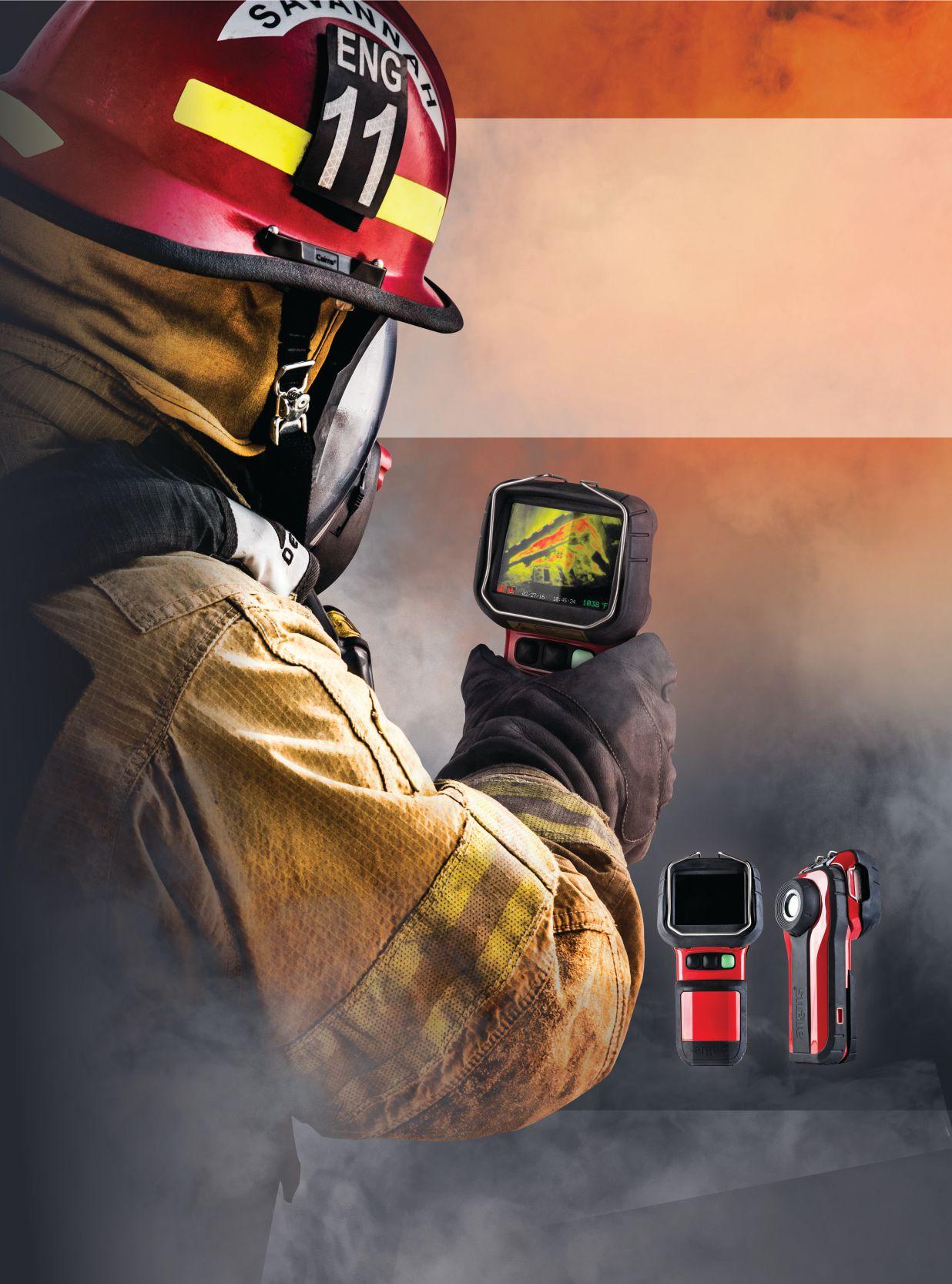
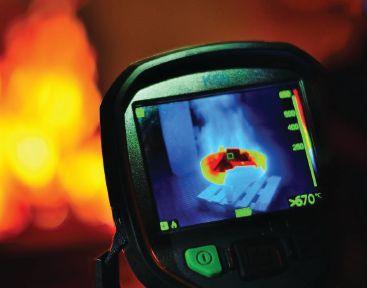
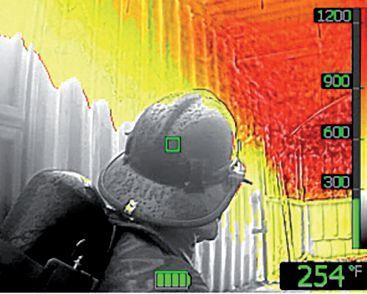
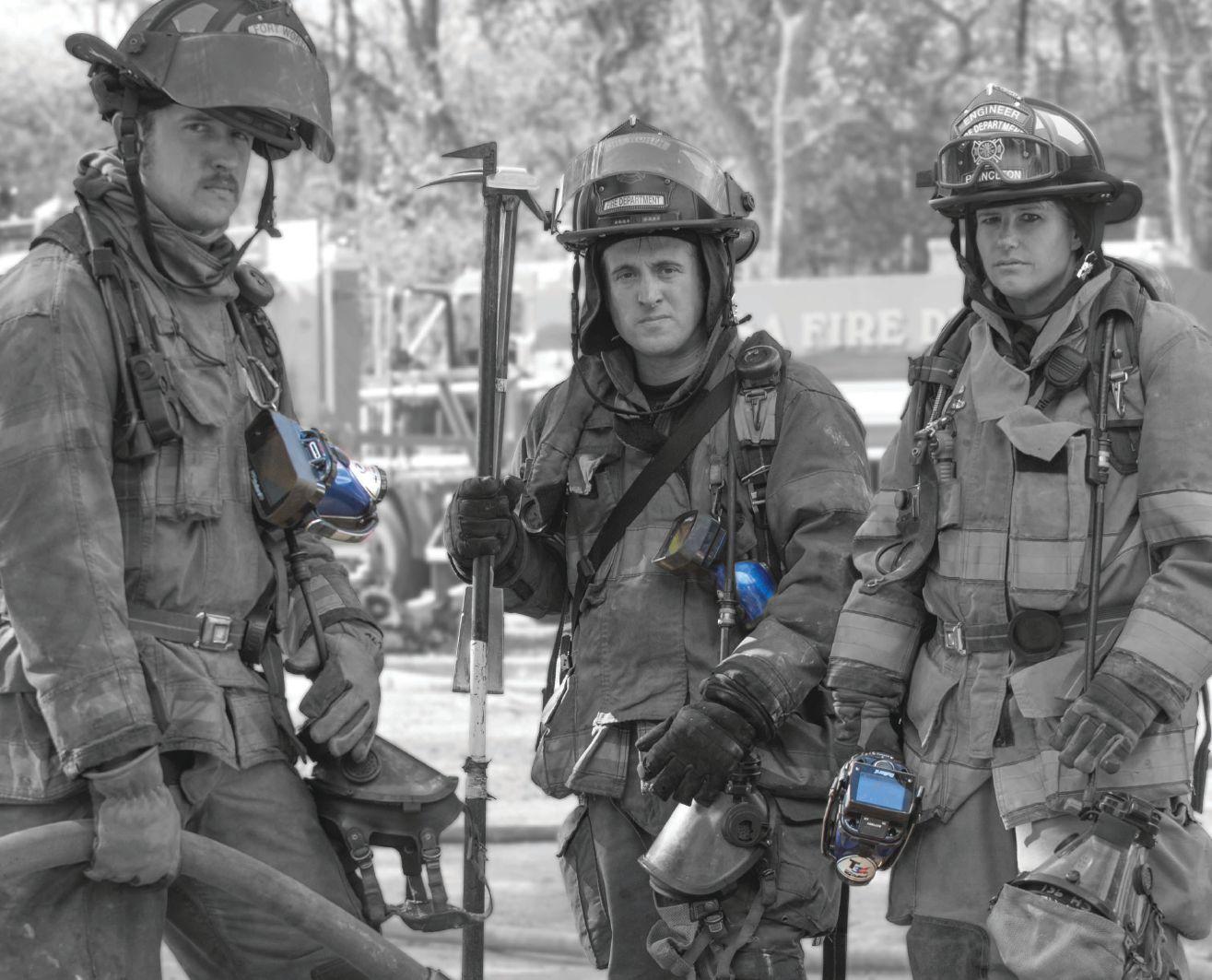
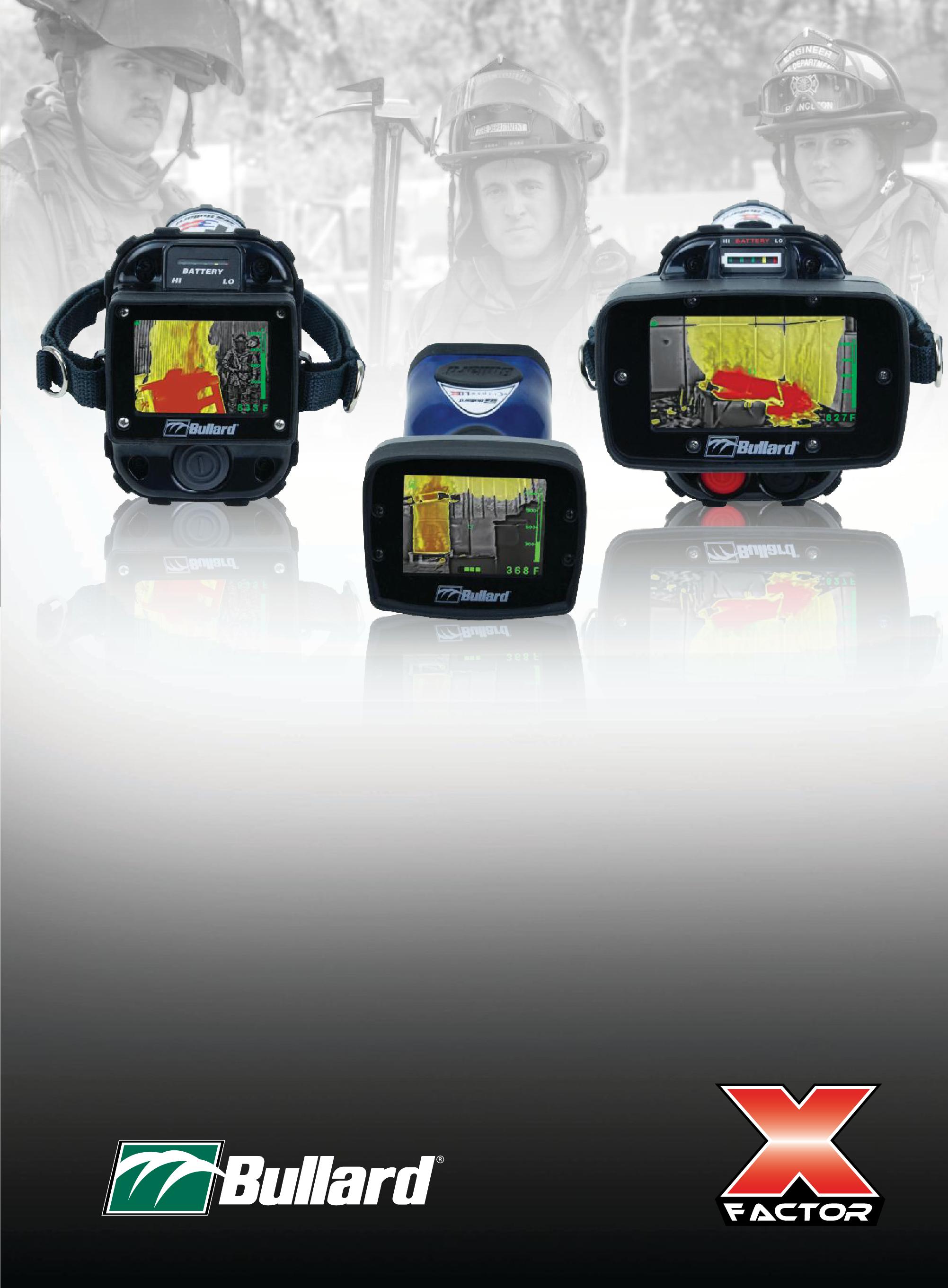
The lightest and most affordable NFPA 1801 compliant thermal imager with 6 operational modes
Highest dynamic temperature range : 2,000°F for excellent detail in extreme firefighting applications
Small and wearable at just 28 oz. with an oversized 3.5” display
Enhanced Standard Feature Set: Laser Pointer, Compass, Heat Seeker, Cold Seeker and much more
BY SAMANTHA HOFFMANN
Public fire and life-safety officer, Barrie, Ont.
TAnyone can do public education . . . right?
here are differences among public education, public information and public relations. But the differences are often blurred, so before we can understand public education, we need to look at the definitions of all three.
As soon as you put on a fire-department uniform, whether you are a volunteer or career firefighter, you represent the fire service as a whole. The general public has no idea about the different divisions (suppression, prevention, administration, training); they see a firefighter and they have expectations of that firefighter. Whether you are holding open a door for somebody or driving your personal vehicle to and from work while in uniform, you are representing the fire service; that is public relations.
Public information is disseminated when your department tells people about a specific topic; it could be through social media, a door-to-door campaign with brochures, a display rack of pamphlets in the front entrance of the hall, or a conversation at a community event. Basically, public information is the data or messages that are provided to your community about fire-safety topics.
Public education goes one step further; it takes the information, adds skill development and life experience to incorporate learning, and results in behavioural change. Traditionally, as fire services, we are really good at public relations and are held in high esteem by our communities. We do a good job with public information too; through provincial fire marshals’ offices and with the help of the NFPA we have access to quality material that is easy to read. However, fire services tend to struggle with public education because we have some old-fashioned beliefs and misconceptions – we don’t spend time learning key messages, and we don’t know how to educate.
of a group of people – adults and/or children – and telling him or her to talk; this is not fair to the firefighter being asked to give the presentation and it is definitely not fair to the audience.
In these situations, people see a firefighter in uniform and expect expert advice and information; they might have gone to see the big red truck, to meet their local firefighters and until this point, have witnessed only the television and/or movie version of fire fighting. We are doing a disservice if we do not take the opportunity to properly educate people and provide the life-saving information they need to prevent and survive a fire. Each and every time someone comes into a fire station, we are given a valuable opportunity to provide information and change behaviour.
Training divisions spend hours teaching recruits about auto extrication and how to tie knots, but very little time, if any, is spent on public education, general fire safety and how to teach an audience. Fire services need to make sure that all firefighters have the tools and skills to deliver a good public-education program.
There are some great resources available to help departments develop an effective fire-safety education program. To start, I
Fire services need to make sure that all firefighters have the tools and skills to deliver a good publiceducation program.
’’
As someone who has been fighting fires before they start for more than 25 years, it is offensive to me to hear that anyone can do public education and that no specialized training is required. In many departments, a firefighter on modified duty is tasked with public education. In other departments, when a tour or school visit is scheduled, it falls upon the junior firefighter who has no specialized public-education skills. We would never send an injured firefighter or a junior firefighter into a fully involved structure fire, yet we think nothing of standing newer department members in front
Samantha Hoffmann has been in the fire safety field for more than 25 years; she is the public fire and life-safety officer for Barrie Fire & Emergency Service in Ontario. Email Samantha at Samantha.hoffmann@barrie.ca and follow her on Twitter @shoffmannpflso
believe every firefighter should be certified to NFPA 1035, Level I Fire and Life Safety Educator. It takes fewer than 20 hours to obtain this certification, which provides basic fire-prevention activities, the foundations of public fire- and life-safety education, current educational materials, the major causes of unintentional injury, characteristics of learning, evaluation of lesson plans, presentation methods, learning characteristics of high-risk groups in the community, effective use of audio-visual aids, dealing with the media, record keeping and provincial fire statistics.
Educating all firefighters to NFPA 1035 is an initiative that we are piloting at Barrie Fire & Emergency Service. Fire Chief Bill Boyes has agreed that all front-line staff should be certified to NFPA 1035, at a minimum. If public education truly is the first line of defence, doesn’t it make sense that fire departments commit to providing staff with the tools and skills they need to be successful?
A model response
Understanding
evacuation systems during emergency incidents through computer simulation
BY STEVEN GWYNNE
Evacuee response to a fire can appear random and beyond understanding. Until relatively recently, fire engineers, safety managers and designers typically assumed that evacuee response would be dominated by panic – people being insensitive to the actual incident conditions they face, causing them to bolt for an exit or freeze to the spot.
Today, it is widely accepted by those working in life safety that evacuee response is more nuanced; it is complex, but not necessarily completely chaotic. Evacuees typically build a picture of an incident that is influenced by the perceived risk, the information and conditions to which they have been exposed, and the social setting. This understanding of evacuee response has been established by research into the evacuee decision-making process and through the examination of real incidents.
This picture, along with the route options available and the ability of the evacuees to use these options, informs evacuee response. Based on this picture, evacuee response may be iterative, imperfect and ultimately unsuccessful.
LEFT Evacuee behaviour is influenced by the perceived risk, information and conditions to which they have been exposed, and the social setting.
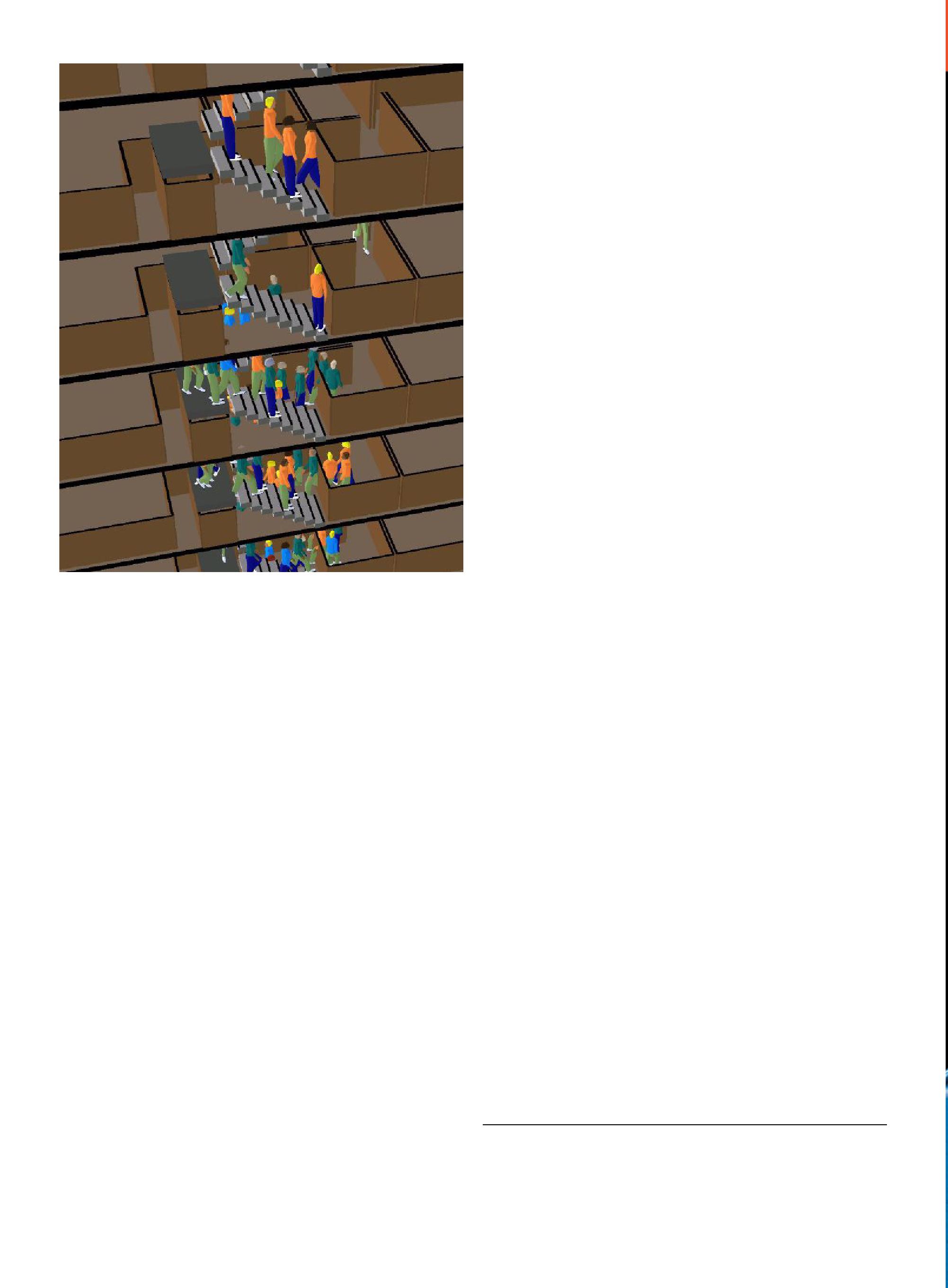
ABOVE Computer modelling allows life-safety personnel to predict evacuation patterns and prepare for responses to fires and emergencies. Widely held beliefs about evacuation, such as random response to a fire, have been quashed by research.
However, evacuee responses can be better understood and influenced through the provision of information, allowing emergency managers, designers and engineers to increase occupant safety.
The use of computer simulations can help those working in life safety to better grasp the impact of evacuee behaviour in different scenarios and then enhance design to improve life safety.
This new understanding of evacuee response has enormous implications for the fire-safety community: it provides a better explanation of what evacuees do and more avenues through which public-safety personnel can influence their response. This new knowledge also forms the basis upon which evacuee performance can be quantified – that is, forecast how
long it takes a population to reach safety. This matters for people who are designing for safety, managing an evacuation or fighting the fire.
Quantification allows comparisons to be made between the outcomes of different evacuation scenarios and the correlation between the effectiveness of various designs, emergency procedures, and evacuating populations in response to different fire incidents. In essence, quantification allows the observer to gain some insight into the outcome before an incident occurs. However, the insight gained is only as good as the model employed.
Those who study life safety have developed internal models of evacuee behaviour based on a collection of assumptions, information and theory used to predict and interpret evacuee response. But, bad assumptions equal bad insights. A well-informed model will likely produce useful forecasts; an ill-informed model will make incredible predictions. This is true whether the model resides in the minds of those involved in this type of research, or forms the basis of a computer simulation. A computer simulation based on sound (and transparent) assumptions has enormous potential for the firefighting community: it may allow planners, designers and emergency managers to assess incident scenarios and the effectiveness of the emergency response to them.
Here are five potential uses of computer simulations; each can enhance the understanding of those interested in life safety.
■ THE DRAWING BOARD
Let us assume that a 10-storey structure is to be constructed. A building inspector has requested a performance-based assessment as the design falls outside of the prescriptive regulations. The designer has to establish the life-safety impact of alternative floor designs (door positions, floor complexity), notification systems used (bell alarm or voice alarm), and the procedure employed (total, phased evacuation, or other) in order to assess safety levels and cost-effectiveness of the design given the expected occupant population.
A computational simulation tool is configured to represent a set of scenarios and then quantify the outcome, such as how many minutes it takes for people to evacuate
the structure given the building design, the alarm system in place and the procedure employed. The assessment also helps to identify the factors that produced this outcome, suggesting potential procedural and structural changes, if required.
■ LIFE CYCLE
The occupant population has changed over the lifetime of the building; it now includes a higher percentage of elderly people. The building’s fire-safety officer wishes to verify whether the previously determined level of safety is still relevant by testing the impact on this new population given the movement impairments that might be expected in such populations. If the performance results have deteriorated, then additional protective measures may be required to compensate for the new demographics such as different alarms, suppression, and refuges. An assessment finds that expected evacuation performance has been significantly reduced and that the emergency plan needs to be modified.
■ INFORMING RESPONSE
Building-safety officers and firefighters are regularly trained to ensure that they are prepared should their intervention be required. As part of their training they are presented with animated results from computer simulations, demonstrating the consequences of employing different procedures, fire conditions, and populations. Congestion is shown to be developing, and routes are overloaded or underutilized, leading to prolonged evacuation times and potential exposure to deteriorating environmental conditions. These results help responders better understand both the impact of their interventions and the relative value of the different procedures employed.
■ SAFETY IN NUMBERS
A serious fire develops in the building. During the incident, firefighters respond and employ a pre-determined procedure to secure
the structure and the occupant population. The procedure (search patterns, use of access routes) was previously tested to determine the most efficient way of searching the building given the development of different fire incidents, building designs, occupant populations and the tasks that need to be performed as part of the search. Firefighter intervention therefore was tested before being employed, with the results helping to hone firefighter performance and minimize the exposure of the occupant population.
■ LEARNING FROM INCIDENTS
Finally, information is collected after the incident to better understand how the fire started and developed, how evacuees responded, the effectiveness of the protective measures, and when/where people were affected by the fire. The use of computer simulation tools allowed the investigator to examine the impact of specific factors on the outcome: what if people had responded differently, the population size was different, or the fire had been different? The investigator gained insight into which factors had the greatest influence on the outcome and what procedural or design changes could have improved the outcome.
Computer simulation tools allow those interested in life safety to apply an understanding of evacuee performance to a range of scenarios, and are of value throughout the life cycle of a building. The examination of these scenarios may well be beyond other means of analysis (such as experimental work) given issues of cost, time and ethical concerns.
Given that the limitations of computer simulation tools are acknowledged by developers and users, these tools allow fire engineers and designers to pose questions and develop results that better inform their understanding of evacuee performance. The results then allow fire-service personnel to question design and operational effectiveness, and gain insights before, during and after designs are employed in the field. Of course, computational tools are no panacea given the many challenges faced when fighting fires; they simply enable responders to gain insight into the conditions that they might face and the impact of their actions, therefore helping them to be more informed on their arrival.
These computational tools are now widely used by engineers and researchers. Fire chiefs and emergency managers can access such tools directly or contact the engineering or research organizations where they are applied to quantify evacuation performance.
The National Research Council of Canada in Ottawa employs such tools to explore the movement of people in emergency and non-emergency scenarios – either in conjunction with experimental work or in isolation to address specific client needs, for example, the impact of a new floorplan on evacuation performance. These tools allow scenarios to be examined in more detail, a wider array of scenarios to be explored (that might otherwise not be the case given ethical concerns), and to quantify performance, therefore allowing comparison to be made between different designs and different scenarios. In all cases, these tools can provide additional evidence to allow experts to be better informed when addressing safety challenges.
Steven Gwynne, Ph.D., is a research officer in fire safety and construction with the National Research Council of Canada. Gwynne has worked in the field of evacuation and pedestrian dynamics, and human behaviour in fire for almost 20 years. Follow the NRC on Twitter @NRC_CNRC
BY GORD SCHREINER Fire chief, Comox, B.C.
TTrain on the basics, again and again STOPBAD
raining is a vast subject and is, of course, vitally important to the success and safety of a fire service. I often say that without on-going training a firefighter is just another civilian.
When it comes to hands-on training I always reference what I call the big four: four topics I believe that all firefighters must know inside out before they move on to other subjects. Don’t get carried away training on specialty areas when you can’t do the basics.
No. 1: Donning PPE and SCBAs. Know your personal protective equipment (PPE) and your self-contained breathing apparatus (SCBA). Practise putting on your PPE in a hurry; lives may depend on it. My department, Comox Fire Rescue in British Columbia, operates a fire-training centre and we often see students who do not have basic skills.
Fire-service leaders need to make sure their firefighters know SCBA basics and practise them often. In my department we hit the SCBAs hard; we wear them all the time. I would be very surprised if any of our firefighters had not donned an SCBA at least 50 times last year just for training. We time our firefighters donning their PPE and their SCBAs; they must be able to do this quickly, but also properly. We ensure our firefighters know how to manage their SCBAs during failed-open or failedclosed events and have them practise conserving air (mayday event). Using techniques to conserve air can give firefighters more time to solve their problems or for the rapid-intervention team to find them. We ensure our firefighters can manually turn on and off their PASS alarms and know when and how to use them.
position) or a roll call, our firefighters provide the correct responses.
No. 3: Throwing. How quickly can your firefighters throw (raise) a 7.3-metre (24-foot) ladder for rescue or deck/roof access? Comox firefighters practise throwing ladders over and over again. A call for a vent, enter, isolate, search (VEIS) to a second storey window must be executed like clockwork. We practise VEIS several times each week and most of my 50 firefighters have done the drill dozens of times. This single drill can make a huge difference and lead to a positive outcome. Of course the success of throwing skills are diminished if firefighters can’t get their PPE/SCBAs on in a timely manner.
No. 4: Stretching. Great firefighters do a lot of stretching, and by that I mean deploying hoselines. Can your firefighters pull a pre-connect and flow water quickly and effectively. Believe it or not, this is a weak point for many departments (career and volunteer) because of the time and effort it takes to replace the lines after they are deployed. During a practice session, typically, the first team will deploy from the rig, but subsequent teams will just pick up charged hoselines and spray water. Firefighters can go for months without ever having deployed from the rig. My department has designed
Don’t get carried away training on specialty areas when you can’t do the basics. ‘‘ ’’
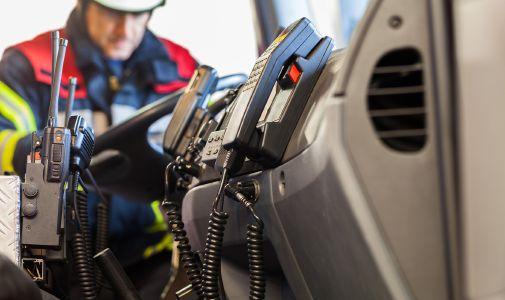
No. 2: Communicating. Perhaps one of the most important skills but the least practiced by firefighters is communicating on portable radios. Radios are not often used during training as everyone is working face to face or nearby; but they should be. Firefighters should be comfortable using radios all the time and know how to talk on them. We do not have the time to teach radio skills at 3 a.m. when we are trying a save a life. Departments must have a communication plan. Comox Fire Rescue uses the four Cs of communication – connect, convey, clarify and confirm. Using and practising the four Cs model has greatly increased our safety and effectiveness during practices and on fire grounds. Our firefighters are taught when they should talk on the radio and what to say. If there is a call for a TAP report (team, air,
Gord Schreiner is a full-time fire chief in Comox, B.C., where he also manages the Comox Fire Training Centre. Contact him at firehall@ comox.ca and follow him on Twitter at @comoxfire
hose trays in which to pack our pre-connects so that, after one team deploys a line, firefighters can pick up their hose and repack it in a tray while another fully loaded tray is placed on the rig. The next team can then deploy from the rig, and so on. During a typical twohour practice we might deploy 10 pre-connects; that way we get more hands on training and more practise doing things right. Once lines are deployed we ensure our firefighters can quickly replace a fail length or extend the line. We also practise purging the line and adjusting patterns for different applications.
This is a very simple explanation of my big four, but you get the point. Make sure your firefighters can nail these skills every time before they spend too much time on other drills. There are many, many other very important skills but these are a great foundation from which to build. Without effective, on-going practice, a firefighter is just another civilian. Training saves lives (maybe even your own).
Ergonomically
•
•
•
•
•
•
Seniority plus experience
Implementing a workable succession plan in a unionized fire department
By DENIS PILON
Anyone who works in a unionized fire department has, at some time, been confronted with the one word that sets up a roadblock to any succession program: seniority.
Seniority has good and bad points and can be viewed differently depending on the side of the table on which you sit: seniority ensures that those being promoted have the experience necessary for the next position; it also allows some people to be promoted beyond their capabilities or out of their comfort zones.
How do chief officers deal with seniority when developing a succession program?
We have all heard about that young firefighter who takes every course offered and at some point is pulled aside by a senior member and told to pull back and slow down. This is a cultural issue that has developed within the department, probably over many years, and is often predicated by the seniority issue. Young firefighters are told to bide their time and their turns will come.
How, then, do we develop a workable and credible succession program within our departments?
First of all, recognize that the seniority clause is in the collective agreement and it is not likely to be removed. Also recognize that the union wants the best-qualified leaders to be lieutenants and captains and recognizes that the quality of these leaders directly affects the safety of members. No firefighter, unionized or otherwise, wants to work under a leader who puts members’ personal safety at risk.
Fire chiefs have a number of tools available to ensure that the senior member is not only promoted, but is also competent, capable, and ready to assume the position. This succession-planning process must start the day a firefighter is hired. If seniority is going to be the deciding factor in promotions, then chiefs must assume that every member will someday be promoted, unless he or she resigns or retires sooner; thus, every member should be offered the education required for promotion.
The first tool is the standard required for promotion to every position. Most collective agreements allow the employer to set the qualifications for each position within the department; this must be done in consultation with the union whether or not it is required by the agreement. Failure to include the union will result in lack of buy-in to the new level of qualifications. Remember, the union wants qualified leaders also. These standards must be
reasonable for the level of leadership and they must be industry standards. The unions sit on the committees that develop the NFPA training standards and members expect them to be used. Setting a standard for fire officer I, fire instructor I, and fire inspector I for promotion to lieutenant is easily substantiated and can not be readily refuted by the union.
Once these standards are set, the employer is on the hook to deliver them. Can the standards be delivered locally, through the provincial fire commissioner’s or fire marshal’s office, or through a fire college? Does the fire department have the available budget to deliver the courses? These questions need to be answered before the qualifications are formally adopted.
The second succession-planning tool is setting solid expectations and articulating the expectations throughout the department. When a firefighter finally gets that promotion, the chief needs to sit down with him or her and have a detailed discussion about what the job entails, what the department expects from members
Fire chiefs have a number of tools available to ensure that the senior member is not only promoted, but is also competent, capable, and ready to assume the position.
in these positions, and what the member will be evaluated on during annual reviews. Newly promoted officers need to know who will be reviewing their performance, the purpose of annual reviews, and how the reviews will be conducted; they also need to understand that the annual reviews are not just about their personal performance, but about the performance of their unit or team as a whole. The officer must understand that the review will consider team morale, cohesiveness and work ethic, and will be very results-oriented.
Expectations must be the same for all members, regardless of their platoons or stations. The expectations must reflect the department mission, vision and values. By tying the expectations to the mission, vision and values, the chief is telling the member that he or she is not only required to live up to department expectations, but also to the community’s expectations. The chief sets a standard by which all members of the department will be measured.
The third tool in the fire chief’s tool box is establishing a continuing-education culture. This is accomplished by letting
everyone know that the required qualifications for promotion are minimum qualifications: there is an expectation that members will take not only required training and skills development throughout their career, but also advanced training. This training may be in the form of seminars, online classes, teleconferences, or webinars, for example, but must be supported and encouraged throughout a member’s career.
Waiting until a vacancy is about to open to take the training required for a promotion does not cut it. Training and education must be career-long activities that culminate in promotions through the ranks. It is also important to let the firefighter who has been promoted know that he or she must begin the education process for the next promotion.
The final tool in the fire chief’s tool box is the one no one ever wants to use –probation. No one wants to demote a firefighter just so another department member can be promoted; doing so is probably the most unpleasant function in any job and because of this, there is a great reluctance to demote. As a result, there are people
filling positions and failing to meet expectations; all we can do is wait for them to retire. Some of these people know they are in over their heads and may ask to go back to their old positions, but this rarely occurs. Typically, people who recognize the fact that they are not excelling will stay in the position for about three years to maximize their pensions, then retire; these situations are injustices to the member, the crews, and the whole department.
A typical promotion involves a six-month probationary period. This is not a period during which the chief decides if he or she likes the person; it is a period of mentorship during which the chief helps the newly promoted officer grow into the job. Officers who are not meeting expectations during the probationary period need to be counselled about their shortcomings and given an opportunity to make corrections. This cannot be done on the last day of probation.
During the probationary period, new officers should be required to perform specific tasks or projects that can be evaluated, and complete minor tests of their abilities. These tests should be department specific to assess the officer’s abilities to interpret and apply department operating guidelines, policies and protocols. Monthly meetings should be scheduled to discuss progress and point out areas that need improvement. At the completion of the probationary period, the chief will have documented reasons for confirming the promotion or for demotion.
It should be noted that a demotion isn’t forever, as the member will go back in line for future promotions; it is, however, an opportunity to develop and make further corrections so that next time, the member will pass the promotion. A demotion also sends a strong signal to all members of the department that seniority may get you the promotion but meeting expectations is what will keep the promotion.
Follow these few steps and you will have a good internal succession program that will put the best people in leadership positions and keep them there.
Denis Pilon is the chief of the Swift Current Fire Department in Saskatchewan and is the chair of the CAFC’s resolutions, bylaws and constitution committee. Contact him at d.pilon@swiftcurrent. ca and follow him on Twitter at @DMPilon
PHOTO BY MARIA CHURCH
Mind the manure
Best practices for dealing with methane buildup in pig barns
By DAVID SPARLING and JAMES MARSHALL
In the 1990s, rural farm-oriented communities began to see construction of large-scale pig barns. Today, these barns often house thousands of animals, and, when full, are all worth millions of dollars.
These operations are not only sizable, but are also built using new construction methods. Many of the barns include underfloor manure pits, by which animal manure is drained through the floor and stored for up to 12 months. There has also been an increase in the use of plastics and lightweight construction. Today, grated floors over the manure pit, the pens into which the pigs are separated, and even the lining on some walls are often constructed entirely of plastic components.
As fire-service personnel are aware, if you start erecting lots of new buildings in your fire protection area, it is only a matter of time before the department will be called to fire emergencies within them. Over the past decade, the Fire Department of North Huron in Ontario has responded to a major pig barn fire, on average, every 18 months. In fact, pigbarn fires became routine events for us.
Within minutes, a large pig farm operation in Ashfield-Colborne-Wawanosh, Ont., was destroyed by fire after a methane gas explosion on March 4, 2014. Crews from the Fire Department of North Huron responded to the blaze and have since established best practices to ensure firefighters are aware of the risks associated with large pig barns.
Storing hundreds of thousands of litres of manure underneath grated plastic/cement flooring may result in the release of assorted gases, including methane and hydrogen sulfide, into the barns. These gases create a caustic environment that greatly reduces the integrity of electrical wiring. The gas release is compounded when a ventilation-system malfunctions or when the vent systems are shut down by the farmer. One can easily predict the result of increased gas levels coupled with ignition sources.
Our presumptions about barn fires being typical responses changed on March 4, 2014, when North Huron firefighters responded to a methane gas/pig barn fire at 6:50 a.m. On arrival, methane gas had ignited and the fire self-extinguished; this is not an uncommon occurrence. Arriving fire personnel found no fire, but checked the building for extension, including the attic
area. As crews were exiting the building they noticed a couple of light smoke puffs from the attic. Firefighters opened up the gable end of the barn and accumulated gas in the attic area ferociously ignited (this was 46 minutes after first arriving on scene). In less than 60 seconds, the entire barn was gone.
Considering the frequency of pig barn fires – North Huron has responded to three other pig barn fires since March 4, 2014 –we knew that we couldn’t allow a close call such as this to occur again. Chief officers and the fire prevention officer began to look more in-depth into methane-gas barn fires and, as a result, the department has changed how crews operate at these incidents.
■ TREAT MODERN BARNS AS CONFINED SPACES
In a search to develop a better response to pig-barn fires, we came across Davis Hill from Pennsylvania State University’s Agricultural Safety and Health Department. Hill introduced us to the concept of treating all barns as confined spaces. Any time our personnel enter a barn for any emergency and there is no fire/smoke present or visible, they carry multi-gas meters, monitoring for oxygen (O), carbon monoxide (CO), hydrogen sulfide (H2S), and methane (CH4). If there is visible fire or smoke, each task group operating in non-fire areas must have a multi-gas meter.
Since implementing this best practice, our firefighters have encountered high levels of H2S as well as methane gas. Highconcentration exposure to H2S has hazardous effects on people and can result in a very sudden fatal event.
■ PLASTIC IS NOT OUR FRIEND
Many modern barns are full of plastic. For farmers, plastic cleans easily and doesn’t corrode. For fire personnel, plastic significantly increases the fuel load per cubic foot. Additionally, plastic barn floors that have been exposed to fire may show no signs of compromise on the surface, however, the underside may have significant melting/ degrading, and therefore is incapable of carrying the weight of an equipped fire crew.
When the burning plastic components of ceilings, walls, pens and floors are taken into account, the combustible load within the smoke is very high. While plastics are an added risk for firefighters, bear in mind that
pigs exposed to smoke from plastics will likely not be safe for people to consume. Ultimately, the fire loss in dead or untenable livestock may be as great as or greater than that of the building itself.
■ IF A BARN IS ON FIRE, START OUT WITH A DEFENSIVE ATTACK
North Huron crews learned from experience how quickly a barn can go from nothing showing to nothing left. Had our crews still been inside on March 4, 2014 they would not have made it out alive. Our department’s best practice now is to approach all barns defensively until a comprehensive size-up is done and sufficient resources are available and on scene. If command commits crews to interior fire suppression, in addition to other structure-fire best practices, several criteria must be met.
1. No personnel will work over top of grated areas where methane gas can come up through the floor from the manure pit underneath.
2. A charged, staffed, second line for back up is in place.
3. At least two sectors and sector commands are established.
4. Emergency exit routes are known and accessible. (For example, snow is cleared from the door.)
5. An adequate water supply, typically tanker-based, is in place.
6. If there is fire in the manure pit, the fire area should be treated as a class-B fire and coated with foam to minimize the release of methane gas.
Risk a lot to save a lot, risk a little to save what’s already lost. In many cases, there is little to gain by an offensive attack at pig barns.
■ PREVENTION IS DIFFICULT
The Fire Department of North Huron takes pride in being progressive with our fire prevention. We have met with provincial agriculture officials and engineers, and other fire-prevention officers to discuss the dangers associated with pig barns. Most importantly, we are meeting with farmers, beginning to preplan their properties and building relationships with them so that the first time they have us on the property isn’t during a structure fire. While these actions are not supported by our codes, they make good sense for us and we are being welcomed by many farmers.
The National Farm Building Code of Canada was last updated 21 years ago, and may not reflect all of the changes to modern farm
A methane explosion and fire at a pig barn near North Huron, Ont., in November 2014 blew off air vents that were attached to the roof.
buildings and how they operate. While much research is being done into methane gas build up and release, there are no simple answers. Two identical barns, on the same farm, using identical animal feed for animals from the same breeding stock can have two totally different methane build-up or release levels. Some barns may have methane foam buildup; others no foam at all.
■ START WITH WHAT WE KNOW IS HAPPENING
Methane gas is only a risk if it has an ignition source. Many times, ignition is caused by electrical circuits that have been compromised by exposure to other gases released in the barn. Check circuits with a thermal imaging camera to see where this breakdown is occurring. We have discussed the issue of electrical circuits with the Ontario Ministry of Agriculture and Rural Affairs and with farmers, and now, with a cost-effective iPhone app, farmers can affordably check their facilities for signs of compromised wiring. As well, some insurance carriers will provide an inspection service.
In many barns, the under-floor manure will develop a layer of foam over it. The foam is full of methane, and if it is compromised, that methane is suddenly released into the barn. Unfortunately, research has not found a way to safely break down this foam down, nor has its root cause been found. Our department is trying to increase farmers’ awareness of the risk of this foam, and encourage more caution when they are washing out a barn in which foaming is occurring.
■ PREVENTATIVE FIRE SAFETY SUGGESTIONS:
1. Preplan each farm with local fire departments
2. Inspect wiring with thermal-imaging
technology
3. Avoid using extension cords
4. Be cautious if reducing ventilation (especially while washing the barn)
5. Do not weld or use open flame devices directly over pits with foam on top of the manure
6. Ensure adequate exits, perhaps more than code requirements
We all enjoy the affordable food provided by modern farming techniques, and farms are key to the economy in the North Huron community. We have watched while smaller operations have grown into tremendously successful industrial-sized operations. Unfortunately, their success has outgrown provisions established in the 21-year-old farm building code.
Farmers are the heart of our rural community and suffer incredible emotional and financial loss in the event of a large-scale fire. Fire services need to ensure the safety of our personnel while encouraging best safety practices by the farmers whom we are called upon to protect, within the limitations of the codes and regulations under which we operate. We see tremendous risk in dealing with incidents at pig farms, from methane explosions, to floor collapse, to H2S exposure.
From what we have experienced and learned, we want to make sure that other first responders are prepared and aware of the risks they are dealing with if they get called to this type of farming operation.
David Sparling is the director of fire and emergency services for the Fire Department of North Huron.
James Marshall is a fire prevention officer for the Municipality of Morris-Turnberry and Township of North Huron.
A barn fire in July 2015 was caused by corrosive gases from a manure pit damaging an extension cord, which provided the ignition source for the methane gases.
GLOVES
Highly dexterous, durable protective barriers remain intact after repeated exposure to high heat.
TURNOUT
GEAR
Gore moisture barriers and liner systems manage heat stress better because they are the most breathable across multiple environments.
BOOTS
Leather boots that include a protective barrier provide better footing and decon more effectively than rubber.
It’s essential to understand what materials go into your gear and how they perform and hold up. To increase your safety and improve gear performance, Gore continues to push the technical capabilities of personal protective equipment. Knowledge is powerful, and the more you know, the safer you are.
Refining public education
Using data to target demographics and increase effectiveness
By PHILLIP SHUSTER
Does your fire department’s public-education program work? If you think it does, can you prove it?
With reduced fire-department budgets, fewer structure fires, and the shift to prevention from reaction, fire chiefs are likely to be questioned by council about the effectiveness of their departments’ fire and life-safety programs. Do the public-education resources make a difference? Are the lessons created based on data and trends?
As someone who has worked extensively with quantitative
data and qualitative data within post-secondary and private-sector environments, I was surprised when I began to analyze how fire departments across Canada implement their educational programming. Aside from a small number of departments – actually, just one that I could find, Surrey Fire Service in British Columbia – a majority of fire departments have implemented education programs based on very little to no demographic data to explain their existence.
Even more concerning, from my perspective, is the fact that
Place on a map a sticker or thumbtack for every fire incident your department had in the past five years. Clusters may start to form, which can illuminate exactly where you need to focus your efforts.
fire departments are focusing on a group that lack data to justify the large volume of resources being used. For some reason it has been engrained in our collective minds that a successful education program must be targeted at elementary-school aged children. This approach would be logical, of course, if statistics and data proved that fires are caused by children. However, this is not the case. We all know the No. 1 cause of home fires is unattended cooking. Unless family dynamics have changed since I was a child, adults are responsible for the cooking. Further, even if a high percentage of fires in your community was caused by children having access to heat sources, is that not directly related to a failure of proper adult supervision? While I believe educating children is beneficial, unless you can justify spending resources on solely educating school-aged children with tangible data, you may have to develop different approaches.
Therefore, I began to equate many of these education programs with hamster wheels that never stopped spinning because there simply was neither a rational start nor a logical end. So in
Know what types of fires are occurring in your community and where they are happening.
Gather as much data as you can about who is causing the fires in the clustered areas.
Start to establish programs with attainable goals focusing on one area at a time.
Evaluate the success of your education program, and if you failed, try again.
order to shed some light on the topic and perhaps help departments start the process of evaluating and creating their education programs, I have come up with four steps to public education self-awareness. I do not claim to be establishing universal truths but I hope to strengthen public-education programming for all fire departments to help us better serve the communities we protect.
1. Know what types of fires are occurring in your community and where they are happening. While this may sound simplistic, many of us fail to use the good data we have. It is helpful to know that in your municipality X number of fires caused by Y occurred Z amount of times in the last year. However, knowing where these fires occurred is perhaps an even greater benefit. Place on a map a sticker for every fire incident your department had in the past five years. You may start to realize as you are plotting the incidents and identifying what caused these fires that clusters start to form. These clusters of incidents will start to illuminate exactly where you need to focus your efforts.
2. Gather as much data as you can about who is causing the fires in the clustered areas. Now that you know where these fires are occurring and how they are happening, it is vital to understand who is starting these fires. If we lack knowledge on the behaviours of the people who cause the fires in our communities, how do we expect to effectively deliver fire-safety messaging to them? Behaviours include habits such as where these people shop, websites they visit, income levels, hobbies, education, food-delivery preferences and so forth. Now, before you start going door to door conducting surveys to gather this data, there are organizations that have it readily available for you. Statistics Canada is a great
place to start to get the broad range of data but companies such as Environics Analytics have collected consumer data and allow you to search using postal codes to gather community profiles. While this seems like a daunting task, the better the data you have the more effective your education programs will be. It is no coincidence that some of the most successful consumer-product companies in the world have some of the best analytical data.
3. Start to establish programs with attainable goals focusing on one area at a time. With all that data you collected, the next logical step would be to start creating actions to target the group that is responsible for the fires in your community. Here’s an example. A fire department realizes that in the past five years there has been a high rate of unattended cooking fires in the south-end area of the municipality. Upon further analysis, it is determined that the fires were caused by unattended cooking that was occurring in the daytime. Now, using demographic data, it becomes obvious that a majority of the households in that postal-code area have a large percentage of stay-at-home parents who frequent an online DIY-for-women blog and who also enjoy doing yoga. From this information the fire department creates the goal of reducing cooking fires in that area by 20 per cent over the next five years by buying ad space on the DIY blog and having fire-safety information nights at a local yoga studio. In this case, using raw data, the fire department was able to justify its actions through qualitative research and by setting realistic goals. Notice that it was not recommended that this particular public-education approach be used for the entire city. Rather, the reduction goal was set specifically for the area in which those analyzing the data knew certain demographic characteristics about those who were causing the fires. The blog-ad and yoga-studio approach would not work five blocks north where the households consisted of people who enjoyed football and fishing trips.
4. Evaluate, and if you fail, try again. Once you set your action items and education programs, you must also evaluate effectiveness. There is always risk that if you evaluate and make changes too soon you may not give the program enough time to succeed. However using resources over a long period with no new results is also inefficient. Ideally, two to five years is a target timeframe for testing new programs. If you find that your activities do not reduce fire loss in your community, do not give up, rather fine tune the programs and use other tools to get your message across.
Remember, you must resist the temptation to go back to your old ways of conducting your education programs. As UCLA basketball coach John Wooden said, failure isn’t fatal, but failure to change might be.
Prior to joining Brampton Fire and Emergency Services in 2009, Phillip Shuster had worked in the private sector as a project manager for a marketing firm with clients including Ford, Microsoft Canada and General Mills. Shuster has a master’s degree in public policy from McMaster University and an undergraduate degree in international relations from the University of Toronto. Shuster is a fire/life safety educator with BFES with an interest in statistical analysis and outreach to diverse communities. Email Shuster at Phillip.Shuster@Brampton.ca
TRUCKTECH Spring clean and inspect tires
By CHRIS DENNIS
The snow is gone. Spring is here. The wash bucket moves from inside the fire station to outside on the apron. That shiny fire truck, which for months has known only road salt, brine and sand, will now be washed, waxed and left to dry in the sunshine. The following are tips and tricks to keep in mind when spring cleaning the rigs.
Start by stripping out the truck compartments – wash them down and air them out. A salt brine-eliminator wash will neutralize the salt inside compartments to prevent the metal from continuing to wear away. Use care when spraying water around electrical switches, harnesses, outlets and so on. Once completely dry, it’s a good idea to add a moisture and odour neutralizer to help prevent mold after you repack the compartment.
Next, clean the channels of roll-up doors and then apply a dry silicone-based spray (see photo 2), which prevents dirt from sticking and allows the doors to operate more smoothly. If the apparatus has swing doors or barn-style doors, clean out all locks and handle assemblies of dirt, brine and sand. Use mild liquid detergent, such as Sunlight soap, with built-in degreasers to properly clean out lock and latch assemblies (see photo 3), which are a little more forgiving when it comes to using wet lubricants. Liberally lubricate these assemblies and hinges.
Make sure the door latch mechanisms are all working correctly by opening and closing the doors a few times. Pull on the door handle to make sure the door has latched. If the fire truck is equipped with a door-ajar warning system, make sure it too is working; this may require a helper to sit in the cab and observe a door-warning light or buzzer operation. Remember, the switch can fail closed. When a flashing light or buzzer comes on to tell you something is not closed or stowed away, go check the source; it may be a simple fix. Re-check by opening the compartment in question and if the light or buzzer does not come on, it means the door could be left open, or equipment such as an elevated scene light is deployed.
Nothing beats a full walk-around visual inspection before pulling away from the station. Even if you did a post-trip inspection of the truck when you came back from the last call, another firefighter doing a truck familiarization may have left a door open or a pullout tray extended; and if that particular area of the truck had a defective switch, the warning system would be ineffective. Driving the truck out of the fire station with a door still open or equipment still deployed could easily damage the fire station bay door, the truck, or, worse yet, harm a person.
A vehicle system monitor that tells you which door is open should also show you when doors are closed. These warning systems are usually wired to activate once the parking brake is released if a door or piece of equipment still deployed (ladder rack, hose bed doors, aerial stabilizer and so on). Always chock truck wheels for added safety.
Spring clean the rigs to remove salt from compartments and electrical components. Use a brine-eliminator wash to neutralize the salt and prevent the metal from continuing to wear away.
A dry silicone-based spray prevents dirt from sticking to roll-up doors after they’ve been washed and dried.
Use a mild liquid detergent to properly clean out lock and latch assemblies. Finish by liberally lubricating these components.
Drain out engine fuel tanks and use Sea Foam to lubricate as well as stabilize fuel and jack octane.
PHOTO 2
PHOTO 3
PHOTO 4
PHOTO 1
TRUCKTECH
Next, pay attention to the truck’s four-stroke and two-stroke operated gas engines. If the engine is four-stroke, change the spark plug, engine oil and gasoline and check the air filter. Excessive choke operations in colder weather can cause engine flooding and gasoline contamination in the engine oil. The first sign of flooding is higher-than-normal engine oil level, as well the oil that is very thin or fuel that is contaminated. Flooding prevents the essential lubrication of engine parts and reduces engine life considerably. Spark plugs can also become fuel fowled, which will make the engine harder to start. Drain out the fuel tanks from all engines, including small power tools or equipment. Be sure the factory recommended fuels are used as well as stabilizers. Insider tip: Sea Foam (see photo 4) is a quality product that will lubricate as well as help to stabilize fuel and jack octane. Air filters – foam, paper or cardboard – can absorb raw fuel like a sponge and will hinder air intake and make it difficult or for the engine to start. Spend a little time and a little cash now to clean up the engine and prevent expensive failures (see photo 5).
A two-stroke engine requires the same tender loving care, however, there is no crank-case oil to change. Just dump the premixed fuel from the machines, truck tank and gas cans and replace with fresh premix. Again, be sure to follow the manufacturer-recommended oil and fuel mixes. Another insider tip: try premixed fuel in a can, such as TruFuel or Motomix, sold by dealers or found at most local big box hardware stores (see photo 6). An unopened premix has years of shelf life. Vaughan Fire and Rescue has been using premixed products in all our two-stroke tools without incident for more than a year. (See the May 2015 Truck Tech column for a description of premixed products and the advantages they have over gasoline and fuel mixes.) Keep the premixes in approved containers or decentered into plastic gas cans.
Early spring is also a good opportunity to address aerial maintenance. Take time to degrease and lubricate the aerial and fly sections, booms, and so on, as per manufacturers’ recommendations (see photo 7). Brine and road dirt stick to aerial and tip equipment and monitors and can destroy wiring circuit boards, bearings and bushings. The brine will leach into all aerial sections and eat away at the equipment over time. Prevent further damage to the truck by washing all parts with liquid soap and water. Take extra care when cleaning the aerial if your department service area includes dirt roads. Dirt acts like sand paper, etching into sliders, cables, sheaves and hydraulics. Deep cleaning the aerial also gives crews an opportunity to see up close the parts of the apparatus and how they work. We have found over the years at Vaughan Fire that when operation firefighters help with aerial maintenance and cleaning, they have a better understanding of the equipment.
If your rigs are equipped with pump-house winter enclosures, spring is the time to open them up and clean out the brine and dirt. Remove any heat pans to increase air flow in the warm summer months, but be sure to mark them with truck unit numbers so they can be easily replaced in the fall. Next, shut off the pump-house heater. I suggest you verify the blowers are working properly before the cold weather comes back. You may want to look into whether or not your truck has a Canadian cold-weather package – a fabricated area under the pump house area that helps to hold in heat. The heat source for the package can come from a number of places; we use the exhaust system as it usually runs alongside of the fire pump. Newer rigs may be equipped with a diesel-particulate filter (DPF) and/or a
Spend time cleaning out fourstroke and two-stroke engines to prevent expensive failures in the future.
Premixed fuel purchased in a can, such as MotoMix, is easy to use and has a longer shelf life than gasoline and fuel manually mixed.
Clean, degrease and lubricate all aerial and fly sections, booms, and so on as per manufacturer recommendations.
selective catalytic reduction system (SCR), both of which generate extreme heat and can be used to keep the pump house area warm as well. Auxiliary heaters, or heaters mounted in the compartment and connected to the truck’s engine cooling system, are the main means by which the fire-pump valve areas are heated, and are usually found on top of the fire-pump module. We have attached additional vent ducting to these heaters to direct the heat to areas that are harder to heat (see photo 8). Today’s electronic pressure governor (EPG) transducers are small (see photo 9) and, depending on the fire-truck builder, may be exposed to extreme cold. Prevent EPG water control issues caused by frozen transducers by using ducting to direct heat from the pump-house heater.
Remove any ground ladders on the sides of the trucks or in the body and inspect them completely. I recommend monthly or weekly truck checks include the ground ladders so that crews regularly clean them and inspect the heat validation stickers and inspection dates. NFPA recommends yearly ground-ladder testing. Ladders with hemp halyards hold water and may have evident mold growth; pay close attention to the areas where the halyards go around pulleys. Check all moving parts as well as locks, rope or cable halyards, beams and rungs. Be sure that the washed ladders are dry before they are put away.
Spring is also usually a good time of year to off-load hose beds. The reason we clean out hose beds and re-flake all the hose is to give
PHOTO 6
PHOTO 5
PHOTO 7
TRUCKTECH
the equipment a chance to dry out from winter ops. Use this opportunity to test the hose as well, following testing requirements.
Check nozzles, bale handles, if equipped, and all adjustments. Nozzles in the preconnect load that sit in back of the truck and have not been touched all winter were probably, at some point, covered in snow and de-icing agent. Use soap and water to clean the equipment and allow it to dry before repacking.
■ INSPECT TIRES AND RIMS
Winter roads bring out the bad and the ugly in tires; potholes, builtup ice mounds, heaved curbs and frozen dirt roads all contribute to early tire wear or failure. A couple of good potholes are enough to change alignment angles and cause early tire wear. I recommend a front-end alignment be done every spring, which costs between $350 and $900 per tire.
Tires tend to leak air more often in the colder months due to less elasticity. When the tire compounds harden and are not as flexible, the sealing area between the tire bead and the rim bead can be damaged. Aluminum rims help to dissipate heat when braking and they are lightweight, but they also corrode and oxidize when they come into contact with water and salt or other road-deicing agents. The valve-stem area will also corrode on tires. Lightly spray a soap solution around the rim to tire bead or contact area and around the valve stem to rim area to check for leaks. Fill a portion of the stem with water and look for bubbles, indicating air leaks. Be sure tire pressures are reset for the warmer months according to the manufacturers’ recommendations based on loads.
Tires made by a reputable manufacturer – Michelin, Goodyear, Hankook, Bridgestone – are branded with a United States Department of Transportation (DOT) number close to the tire and rim-bead area. This number is a safety code that confirms the tire complies with all DOT and Transport Canada safety standards. The numbers and letters leading up to the last four characters are for plant location, tire size, model of tire and manufacturer; the last four characters are the week and year, respectively, the tire was manufactured.
Example of a DOT number: 9BYJ******1604 (16th week of 2004) = 12 years old. (See photo 10.)
Every province has a different set of safety standards for vehicle safety inspections, but the average recommendation for tire lifespan is seven years. Vaughan Fire and Rescue Services’ trucks have new tires put on every two to three years, depending on the style of apparatus. Some fire departments, particularly volunteer, may have trucks that do not see many road miles. Our neighbouring department’s volunteer station has trucks with tires that are in amazing condition but have been on the truck since it was purchased 12 years ago. That station’s call volume is low and the runs are short with significant PTO (power take off) or fire pump time – engine is running but no mileage is accrued.
Tires do dry out if they are not frequently used. The first sign of drying tires is cracking in the tread grooves or on the side walls. Sometimes a tire becomes very noisy; this is caused by thick treads that dry and deform in the shape of a small soup dish. These cups in the tread blocks catch air and when they hit the pavement the air is audibly squeezed out of the bowl area.
Follow manufacturers’ recommendations for the maintenance of
8
Check the placement of any ducting used to direct the heat produced by auxiliary heaters to other areas of the pump house.
Ducting is a good way to direct heat to electronic pressure governor transducers, which can freeze in the winter.
Tires made by reputable manufacturers are branded with a Department of Transportation (DOT) number. The last four numbers are the week and year the tire was made.
new tires. One of these recommendations is regular tire rotations. Don’t hesitate to rotate, cross or switch tires from one axle to the next if it is recommended. If rear tires have bud wheels or aluminum rims on the outside drives, ensure the inner drive material is the same before you call in a tire guy to rotate them; if the inner drive material is steel you will have to dismount the tire from the rim. If the tires have never been rotated, the aluminum may be in poor shape on the inside set of drives. A full set of tires can be very expensive. A tandem aerial’s tires can cost in excess of $8,000.
The last items on the spring cleaning to-do list are the tire rims and the fasteners that hold them on. Inspect the rims, front and back sides, all the way around. If the rims are steel, check for excessive rust and flaking and replace if necessary. If the fasteners or wheel nuts holding that wheel on are also in poor shape, replace them as well and be sure they are all torqued back on the truck and re-torqued after 100 kilometres. Keep in mind United States inspections are different than Canadian.
With spring in the air, be safe, be healthy and remember, my friends, rubber side down.
Chris Dennis is the chief mechanical officer for Vaughan Fire & Rescue Services in Ontario. He can be reached at Chris.Dennis@vaughan.ca
PHOTO 10
PHOTO 9
PHOTO
BY LYLE QUAN
Leadership inside and outside the box
During the interview process to find my replacement as fire chief for the City of Waterloo, Ont., I was struck by a comment made by one of the candidates. In response to a question about leading outside of the box, the candidate said, “Before you can think outside of the box, you need to know what’s inside of the box.” This comment impressed me and I have used it on several occasions since. I was in a bookstore recently and found a book titled Lead Inside the Box by Victor Prince and Mike Figliuolo, and I knew it would be worth sharing.
But before we talk about leading inside of the box, leaders must first understand what they stand for and how they want to move forward based on their beliefs. Man’s Search for Meaning by Viktor E. Frankl is a compelling read that sets the foundation for absorbing leadership lessons. Frankl is a survivor of the Nazi death camps. During the author’s time in these prisoner camps, he witnessed many atrocities, but also the strength of the human soul.
Frankl notes in his book that “. . . in the final analysis it becomes clear that the sort of person the prisoner became was the result of an inner decision, and not the result of camp influences alone.” So what does this tell me (and, I hope, you)? That the person you become as a leader is not just the result of the influences and challenges around you; it is also the result of your decisions about who you are and what you want to stand for. Fire-service leaders will not face the same adversity as Frankl, but they will face obstacles that will challenge the strength of their characters and beliefs.
departments for the same dollars and, as the authors note, “Leaders who can make improvements by shifting resources instead of adding them are more effective and valuable.”
The book starts off by asking readers to evaluate themselves based on a leadership matrix. From there, readers evaluate their teams and find out which members are exemplary contributors to the teams, which ones are high maintenance, and which ones are simply along for the ride. By completing the exercises within the book, readers should be able to identify gaps within their organizations, opportunities for improvement and/or need for succession planning.
As the authors note, the team assessment shows readers where they’re getting the most and the least return from their team members. By combining their results, readers discover where they may need to invest their leadership capital (human resources) to map out how to improve team performance – one team member at a time. The final chapter of the book explains how to apply the leadership matrix for maximum benefit for leaders and their teams.
Readers who execute the authors’ five-step process should be
The more you read, attend courses and network, the more you will grow. ‘‘ ’’
Frankl writes that “. . . we cannot avoid suffering but we can choose how to cope with it, find meaning in it, and move forward.” As fire-service leaders, of all ranks, you cannot avoid the personal conflicts and challenges to your authority and decisions, but you can have total control over how you cope. You can accept these challenges as negatives or as opportunities to improve the situation; it’s your choice, no one else’s. Frankl’s book will make you question what you presently stand for and what you hope to stand for in the future.
In Lead Inside the Box, authors Prince and Figliuolo lay the foundation for readers to understand the concept of the organizational tool box. As we all know, fire services compete with other municipal
Lyle Quan is the retired fire chief of Waterloo Fire Rescue in Ontario. He works with fire services throughout North America to assess and develop service improvements and master planning. Email Lyle at lpqsolutions@bell.net and follow Lyle on Twitter at @LyleQuan
able to improve their performances.
1. Document your assessments of where your team members fall on the leadership matrix.
2. Build a plan that defines the actions required for team members to improve their performance.
3. Discuss your approach with your team members and agree on the improvement plan.
4. Take the specified actions and execute the plan.
5. Measure and adjust as appropriate.
Both books are well worth the time to read and the effort required to apply their theories and applications towards improving your team and yourself. Remember, leadership is a journey, not a destination. The more you read, attend courses and network, the more you will grow.
Both books can be found at Firehallbookstore.com.
LEARN MORE ABOUT OUR LIVE FIRE TRAINING SYSTEMS AT WWW.DRAEGER.COM/FIRETRAINING STAY ONE STEP AHEAD OF EVERY FIRE WITH OUR LIVE FIRE TRAINING SYSTEMS.
Dräger can help you build the confidence and skills you need to fight fires safely and effectively. That’s because we offer a full range of Class A (wood-fueled) and Class B (propane-fueled) live fire training systems: from the Swede Survival system that teaches the warning signs of flashover, to portable systems that make live fire training convenient and affordable. Essential tools for essential training.
Supporting families
How a camp is helping spouses and children of fallen first responders
By MARIA CHURCH
Camp FACES was held for the first time last August in Orillia, Ont. For five days, families of fallen first responders mingled, played, laughed and, most importantly, healed.
Last summer, Luanne Donahoe was worried about her son, Josh. The 17-year-old’s father, a firefighter, died in the line of duty when Josh was nine, and he has had a rough time dealing with his absence.
Bullying in school led the teenager to develop social anxiety, so Josh enrolled in cyber school and mom and son moved to a new community in 2014.
“Other kids don’t understand what he’s gone through,” Donahoe said, “and they can’t begin to comprehend it unless they’ve experienced it themselves.”
On Aug. 21, Josh and his mom arrived at Camp FACES – families and children of
emergency services – organized for the first time by the Canadian Critical Incident Stress Foundation. Held at Fern Resort in Orillia, Ont., Camp FACES hosted about 50 children and spouses of fallen first responders from across Canada. The Donahoes were sponsored to attend by the Canadian Fallen Firefighters Foundation.
Andy MacDonald, interim general manager of emergency services for Guelph, Ont., is an advisory board member for Camp FACES and said board members were initially worried that families would be shy and take time to open up; but that was not the case.
“You’d swear it was a family reunion on Day 1,” MacDonald said. “People were
BY
PHOTO
Loaded with safety, comfort and mobility features for unmatched performance, Flame Fighter® bunker gear offers a variety of custom outer shell fabric, liner system, hardware and pocket options to fit your specific needs. This hard-working gear also includes the following game-changing Starfield LION fire protection technology:
• Patented IsoDri®* moisture management reduces the water absorbtion and helps gear dry faster between runs
• Exclusive Ventilated Trim allows vapor to be released, reducing the risk of scald burns
• Thermashield™ provides an additional layer of liner material in the upper back and shoulders to protect against compression burns
• Move-N-Hance™ crotch gusset increases mobility by reducing bunching, twisting and pulling
• Flex Knee™ for easy, natural movement
• Stay Rite™ sleeve wells integrate the sleeve’s liner into a full-length wristlet so that when you reach, the entire sleeve moves with you
For more information about Flame Fighter bunker gear, contact your Starfield LION sales representative at 1.800.473.5553 or visit us online.
laughing, sharing stories and getting to know one another . . . the noise level was palpable, in a good way.”
The only explanation, MacDonald said, is that the campers, regardless of age, gender, and history, had a shared experience that created an immediate bond. For most of the family members, the camp presented the first opportunity to interact with people who understood their pain.
Day 1 was a bit more difficult for Josh, who was one of only a few teenagers attending and anxious about not knowing people, or what was going to happen that week. Donahoe said her son experienced a panic attack in his room during the first gathering and had to be coaxed downstairs to meet everyone.
“I told him to just take some deep breaths, and said, ‘Why don’t you come down? You can always leave, but give them a chance’,” Donahoe recalls. Mom and son later returned to the gathering and introduced themselves to the first people who looked close to Josh’s age. Those people were MacDonald’s daughter, son and son’s girlfriend, who were all camp counselors.
“Josh hit it off with them right away,” Donahoe said. “There was really no turning back after that; he was full speed ahead. He participated in everything and he just loved it.”
Josh Donahoe, 17, was initially nervous to take part in Camp FACES, but soon felt comfortable and at home with the other families. Josh’s mom, Luanne, said the camp was transformational for her son.
Donahoe said it was incredible to watch her son’s transformation over just five days.
“He went from being a kid who felt like nobody understood what he was going through, to having friends and feeling like he’s understood again,” she said. “Josh told me that Camp FACES was the most important, life-changing week of his life since his dad died.”
MacDonald, too, witnessed the effect Camp FACES had on Josh.
“The camp and his association with the young counselors – because they were inseparable – turned his life around,” MacDonald said.
The five days of camping were planned to the hour with activities such as creative arts, music, sports, games and relaxation time. Those activities were not designed as counselling or support sessions, rather as fun, interactive ways for youths and spouses to get to know each other in a friendly, relaxed environment.
“The idea,” MacDonald said, “was to bring families together to give them a chance to get to know each other, to spend time with people who have been through similar circumstances, because that is what they don’t have at home.”
Four camp counselors took care of the children during the day, and every evening the campers would gather around a fire and share stories, which was perhaps the most therapeutic time for spouses, MacDonald said.
“It was very relaxing and very important
FEATURING THE SC 757E2 COMBI TOOL
IN THE RACE AGAINST TIME, TO SAVE LIVES EMERGENCY RESPONDERS REQUIRE UNRELENTING POWER AND SPEED. WITH THE LARGEST SPREAD AND SUPERIOR CUT RATING, THE SC 757E2 COMBI TOOL BY HURST JAWS OF LIFE IS THE SINGLE MOST POWERFUL COMBI TOOL ON THE RESCUE MARKET.
B ATTERY-POWERED AND LIGHTNING FAST, START EVERY RESCUE WITH THE UNSTOPPABLE
UNSTOPPABLE POWER
SPREAD
for the relationships at the camp,” he said.
Donahoe said getting to know the other spouses over the course of the camp was eye opening for her as a widow.
“It was such a relief,” she said, “because you feel like you’re the only person in the world who reacted certain ways or did certain things. I was so glad to have spoken to some of these moms and learn that they too had experienced similar moments.
“That week at Camp FACES was the first time since my husband died that I could completely relax knowing that my son was in a supportive, accepting environment and there wasn’t one moment that I needed to worry about him – it took the pressure off and I was so grateful.”
Renee Jarvis with the Canadian Critical Incident Stress Foundation (CCISF), who was a primary organizer of Camp FACES, said the idea behind the camp had been percolating in her mind for about 20 years. Jarvis formerly worked for Hamilton Police Service and sang in the police choir, which regularly performed at funerals.
“Singing in the choir I would be positioned at the front of the church and seeing the families and all of the young children, I
often thought: what do we do for them and what happens after the funeral?” she said. “And the reality was, nothing.”
Jarvis joined the CCISF in 2011 and said she knew then the national organization would be the vehicle she needed to create a program for families of fallen first responders. Once the idea took hold in early 2015, partners – individuals and organizations – were quick to jump on board as donors, sponsors and board members.
“In a very short time we had a bunch of extremely dedicated, committed individuals step forward,” Jarvis said. Board members include retired OPP commissioner Chris Lewis, Retired Hamilton Police Association president Mike Thomas, NHL senior vice-president Kris King, and mental-health consultant Bill Tibbo.
From an organizer’s perspective, Jarvis said, the inaugural camp was even more successful than they were hoping.
“Being the first of it’s kind in Canada ever, we didn’t know how the families would react,” she said. “I think we were all really taken aback by the impact it had on not just the families, but us as well.”
MacDonald agrees. “For me it was absolutely life changing,” he said. “It was one of the most rewarding things I have ever been involved in.”
In the future, Jarvis hopes to expand the FACES umbrella to include an education bursary as well as programs for families of first responders who are living with post-traumatic stress disorder.
“We feel that if we can help the families
and provide them with some of the tools and resources we would be able to help them strengthen that family unit,” Jarvis said.
The next Camp FACES is Aug. 19 to 23, and will once again be held at Fern Resort. The cost of sending a family of one spouse and one child to the camp is about $3,500, which covers everything from airfare to food and activities.
Several emergency services organizations support Camp FACES, including the Canadian Fallen Firefighters Foundation, Ottawa Professional Fire Fighters Association (IAFF Local 162), the Canadian Police Association, the National Peace Officers Memorial Run, the Ontario Provincial Police Association, Royal Newfoundland Constabulary Association, and more.
MacDonald urges individual fire services to consider fundraising to send a deserving family; the benefits of doing so are best explained by those who attended.
During the final goodbye gathering on the last day of Camp FACES organizers turned the mic over to campers to share their thoughts. Donahoe vividly recalls what happened next.
“Josh gets up, grabs the microphone and stands in front of the room talking to everybody . . . just telling them how he considers them his family now, telling them how Camp FACES changed his life and how grateful he was,” she said. “It still brings tears to my eyes.”
Learn more about Camp FACES and how to donate at www.campfaces.org, and connect with CCISF on Facebook and on Twitter @ CCISFlive.
Fire Chief of the Year Awards nominations are now being accepted! Each year the Canadian Association of Fire Chiefs and Fire Underwriters Survey recognize fire chiefs for their outstanding contribution to the Canadian fire services. Know a deserving chief? Visit www.etouches.com/eselect/69658 to nominate your chief today!
Les candidatures pour les Prix d’année des chefs de pompiers sont maintenant acceptées! Chaque année, l’Association canadienne des chefs de pompiers et d’inspection des assureurs incendie reconnaissent chefs de pompiers pour leur contribution exceptionnelle au service canadien des incendies. Connaissez-vous un chef digne? Visitez www.etouches.com/85928 de nommer votre chef aujourd’hui!
No size FITS ALL
Fire departments across the country rely on provincial or territorial statistics and provincial or territorial, national or international solutions. The more people a community has, the more incidents will occur. If the No. 1 problem in your province is cooking fires, it is likely more reflective of what goes on in major cities than in remote or rural communities.
However, effective public education must start and end with your own community; ergo, the process must begin with assessing the risks in your community. Look at your fire department’s emergency response incidents in the past three, five and 10 years. Identify the three most common incidents and, in the case of fires, look at the occupancy and cause. If your department identifies that the top three emergency response types are wood stove or chimney fires (farm dwellings, caused by creosote or maintenance), motor-vehicle collisions and barn fires, then the NFPA’s Fire Prevention Week message may not be the most effective tool to save lives in your community.
■ FILL THE GAP
Once you’ve identified your top three risks or areas of focus, determine where you can find the tools and resources needed to reach your audience. The organization that your fire department usually relies on for public-education material may have resources to address wood stove and chimney fires, but not motor-vehicle collisions or barn fires. Not having the material is not an excuse to skip over the risk; rather, it’s an opportunity for your staff to develop partnerships and get creative.
Motor-vehicle collisions are a prime opportunity for a partnership with police organizations. A campaign on obeying stop signs, slowing down, or driving according to conditions, could be even more effective if it’s promoted by both the police and fire department. In this case, both organizations
How departments can tailor their public education to a target audience
By TANYA BETTRIDGE
BY
TOP Public education campaigns are an opportunity to get creative and target specific audiences, such as children.
RIGHT Learn who to target by identifying the three most common emergency response incidents in a community in the past three, five and 10 years, and look at occupancy and cause.
PHOTO
share the same goal, so why not share in the solution?
Barn fire safety presents an opportunity to get creative. Until recently, most provincial, national and international fire authorities have had few resources to offer on that topic; find resourceful ways to fill in the gap. Work with the farming community groups, farm-safety groups and provincial farming industry groups to create a farm fire-prevention program. Post-secondary colleges and universities with agriculture programs may also be interested in being involved. The NFPA recently introduced some barn fire safety resources that may help launch a public education campaign.
Sometimes, it’s not the topic that is being missed, but the audience itself. Vancouver, Toronto and Brampton, Ont., have each focused on multi-language delivery of fire-safety education and prevention programming and invested in more diverse workforces. These decisions are direct reflections of their evolving community cultures; significant populations of at-risk residents are not English speaking and require communication in other languages. Note: the NFPA also offers resources in several languages.
■ MANY HANDS PREVENT MORE FIRES
Your community may not be unique in the risks it has identified. Attend regional or provincial fire-service events and meetings and engage with fellow departments. Identify potential partners who may also be looking for risk-similar communities. Doubling or tripling the resources while fractioning the cost to develop risk-specific programming will benefit everyone involved, including municipalities’ taxpayers and councils. Joining forces also broadens the talent pool. One department may have someone who is marketing-savvy, while another may have someone with sponsorship avenues, industry connections or expertise dealing with the identified risks.
A simple Google search or a conversation at a regional fire get-together will tell you if anyone else has already tackled the same risks you’ve identified for your community. One of the best things about the fire-service is its willingness to network and share. Chances are there is a program already designed and you just need to tweak and implement. Look at industries related to the risks (such as wood stove manufacturers or builder associations, safety
Work with the farming community groups, farm-safety groups and provincial farming -industry groups to create a farm fire-prevention program. ’’
associations, and so on) to see if they have programming in place that you can use or adopt. The solution might be with a fire department or safety organization two provinces over. Thanks to modern tech nology, the answer to “Does anyone have . . .” is much closer than it was 10 or 20 years ago.
■ JACK OF ALL TRADES, MASTER OF NONE
One of my biggest pet peeves in the area of public education is reliance on and misuse of generic messaging. Gearing a topic-specific message to everyone catch es the attention of almost no one. If you have a fire-incident problem because chimneys and woodstoves are not being properly maintained, a “Sparky says . . .” message will rarely motivate adults who are responsible for appliance maintenance. You wouldn’t present about fire safety for seniors to a high school class – that would be silly. Using children-geared tools when trying to change an adult population’s behaviour is just as silly.
Ask yourself whose behaviour you want to change and create or direct your messag ing accordingly. Don’t be afraid to push the envelope and have some fun with it. There are two methods fire departments use for public education campaigns:
The do-as-we-have method:
1. Identify the message you want to give.
2. Find generic messaging from provin cial/territorial/national authority.
3. Use any and all available channels to send it out.
The do-what-will-actually-work method:
1. Look at your community’s risks and identify whose attention you need.
2. Catch the attention of the identified audience with materials that appeal to them and use channels that will be most effective (for example: social media for teens, direct mail for seniors, classroom visits for children).
3. While you have their attention, insert safety messaging.
Planning for success
Partnerships, agency co-ordination tested during emergency-response exercise
By JAMIE COUTTS
The Lesser Slave Lake Region in Alberta held an emergency response exercise that involved 23 community organizations and tested inter-agency response.
Afew years ago I received a mass email from our regional Alberta Emergency Management Agency field officer asking if our community, the Lesser Slave Lake Region, was interested in participating in a province-wide emergency management exercise. After four years of constant rebuilding, repairing and reimagining our emergency services after the 2011 wildfire decimated our region, I thought: “Yes, we absolutely have to do this.” (I should have maybe asked around before sending a positive response . . .)
It was decided we would use our new regional emergency management plan (REMP), the information from our emergency services and emergency management reviews, and all of our knowledge gained from past years to participate in a high-level provincial exercise.
Everything sounded pretty good, and we sent in our inputs to the agency. Unfortunately, it quickly became apparent that our region would get a small, if any, role in the province-wide exercise. So instead our region held its own 48-hour emergency management exercise.
Lesser Slave has a regional protective-
services group that is part of our emergency-management committee and I went straight to these 23 organizations to ask for their participation. This committee had been revitalized after the 2011 fire, and we are very active; they all agreed and the planning started in early 2014.
The key to success for us was going to be running our emergency-operations centre (EOC) for up to 48 hours straight, teaching all the participants valuable handson lessons while also keeping our bootson-the-ground responders busy – no easy feat, but what could go wrong?
We began in early January 2014 with site selection (our local live-fire training area), EOC selection (local fire hall in Slave Lake), and a small budget from council ($4,000). Then came dozens and dozens of meetings with stakeholders, administrations and councils. Things still looked good so we pressed on and the exercise began to take shape, but the magnitude of the exercise had yet to be determined. Fire staff looked at our capabilities and workload, and decided that the exercise and the valuable training it would provide were too important to let go. The decision was made to involve everyone who wanted to
participate; at the levels they chose. (This turned out to be a huge event for the fire department, but we enjoyed every minute.)
The event was planned for February 2015 as such:
Emergency operations centre – operation Feb. 25-26, 8 a.m. to 4 p.m.; 60 centimetres of snowfall (24-hour period), closed highways, resident distress, first responder call volume increases, widespread power problems.
Regional EOC run out of Slave Lake regional fire hall, staffing 40 positions and trainers in eight-hour shifts.
Planning session – EOC – Feb. 25, 6-9 p.m.: establish work done, inputs for next period.
Live exercise – Feb. 25, 10 a.m.: simulated plane crash at Slave Lake Airport. (Local high school students, make-up artist, simulation of crashed plane at airport.)
Live exercise – Feb. 26, 10:30 a.m.: simulated building collapse, 26 people unaccounted for. (Local high school students, make-up artist, large-scale simulation at live-fire centre.)
As the weeks passed, fire crews went about their daily business, but spent every
spare second working on the emergency-management exercise. Crews set up all the hands-on simulations, and I handled all the meetings for agency inputs, disaster committees, EOC and training. Participation by the two local schools involved three weeks of first-aid training, including signs and symptoms. During the exercise, students chose their injuries, made acting notes, and worked with our local makeup artist to display the proper effects.
Most agencies were nervous to participate at first, but once they found out that we would try to simulate whatever they needed, things continued to get very interesting. Each agency listed its training wants, and assisted in supplying the inputs necessary to add that training to the exercise. As the day of the exercise drew near, we became swamped with the setup, training and hands-on work.
The first morning began as expected; we called in staff and had the director of emergency management (DEM) fill in his organization chart. As groups arrived at the EOC we handed the DEM his first input sheets. We were off and running. Every agency was represented with more than 50
The emergency-operations centre was active for 48 hours straight, run by personnel from every agency involved in the exercise.
people packed into the EOC. Our newly printed (2013) REMP was used and followed the incident command system (ICS) model. Some participants had never used the model before, but most overcame their nervousness during the setup.
Just after 10 a.m., we directed crews to respond to a simulated medivac aircraft crash with six people on board. The airport crew did a great job planning, setting up, and running the exercise and live crews rescued all patients.
By afternoon the participants really started to role play and made many decisions. Our trainers (brought over from Alberta Environment Sustainable Resource Department) were incredible, and everyone involved learned something new from them. At 4:30 p.m. we shut down the simulation for the day, and planned what would happen through the night in preparation for the incoming EOC team at 8 a.m. This planning session was great and involved more than 20 people pouring over the day’s inputs, plans, and EOC work.
The second morning began with a new DEM at the helm, who filled in his team. Inputs left from Day 1 were prioritized and new inputs were quickly put into the exercise. At about 10:30 a.m. the EOC sent out a full callout of all emergency response agencies; 26 students were trapped in a simulated collapsed building at our live-fire centre. The scene was very realistic due to all the prep work from all the agencies.
amazing to see all of these organizations testing all of their skills in so many ways.
A lot of unique aspects of emergency management were tested including our search-and-rescue dog, Navi, and handler Wade, a Code Orange (mass casualty) at our hospital, and the relationship between our local emergency medical students and our emergency medical responders.
All in all, it was an amazing event, which unfortunately also included two no-duff situations, which were handled in
. . . to succeed we must believe in a system that is so much bigger than any one person or organization. ’’ ‘‘
Dozens of units from fire, search and rescue, EMS, RCMP, commercial vehicle enforcement, Alberta Environment and Parks, Alberta Health Services, municipal district operations, town operations, ATCO Electric, ATCO Gas, and 20 EMT and EMR students from the local college all descended on the live-fire grounds. A command team was established and the scenario was tackled; make utilities safe, locate students, extricate, triage, treat, transport, account for all, triage at the hospital and move to treatment areas. It was
-14 C with a windchill of -24 C. Crews did a remarkable job, and the learning was constant and staggering. During all of this our EOC assisted with the live exercise and continued with all of its inputs. At one point I watched as the EOC members paired an RCMP driver with a fire truck to pick up patients for EMS at scene. If that doesn’t prove working together works I’m not quite sure what would.
The EOC, press conferences, public updates, and real crews worked throughout the day and by 4 p.m. we ended the exercise
and held a quick debrief. This experience, I can honestly say, was a highlight in my career. So many people came together and gave their time, knowledge, and hearts to a single exercise; it will always remind me that to succeed we must believe in a system that is so much bigger than any one person or organization. We must continue to find new ways to work together while continuing the tried-and-true efforts of all of those before us. The following are some of the lessons learned, but please know that the success of this exercise was the greatest gift of all.
■ LESSONS LEARNED
• Although great effort and time were put into our local communications, it’s important to have a plan and to implement it.
• Everyone works at different paces; we must work to find the right person and the right job and partner them up.
• The more agencies work together the easier it all gets.
• When you send 24 pieces of equipment to one site, you better have a staging plan.
• Using a confident incident-command team from multiple agencies makes for a very co-ordinated effort.
Jamie Coutts is the fire chief of Lesser Slave Regional Fire Service in Alberta. Contact him at jamie@slavelake.ca and follow him on Twitter @chiefcoutts
The exercise involved a simulated building collapse at a school. Students trained in first-aid for three weeks in order for the actors to play their parts during the mock disaster.
■ HIGHERGROUND OFFERS NEW 911-CALL RECORDING FEATURES
California-based HigherGround is offering speech analytics and mobile recording to its Capture911 solution for emergency dispatch facilities and 911-call centres. The new features were introduced during the National Emergency Number Association conference in Denver, Co., last year. Speech analytics converts recorded interactions into text and identifies and categorizes trends, while the mobile recording app allows users to view, replay and analyze mobile calls. Learn more at www.higherground.com
■ TOA RELEASES TWO NEW SPEAKERS
TOA Canada Corporation, based in Mississauga, Ont., has released two new speakers that meet ULC and UL safety certified standards. The paging horn is a compact, high-impedance and highly intelligible speaker ideal for public-announcement applications. The wall-mount speaker is constructed with a metal cabinet and delivers high-quality sound through a built-in 16-centimentre double cone speaker unit, which makes it ideal for use in a voice-alarm system. Both speakers have five-year warranties. Learn more at www.TOAcanada.com
NEWPRODUCTS
■ LEADER CREATES LIGHTWEIGHT BATTERY-POWERED FAN
Manufacturer LEADER has introduced a new model of PPV battery-powered fan that is lightweight and powerful. The BATfan is available in two-versions, one with a 20-minute runtime and weighing 23.5 kilograms and another a 45-minute runtime and weighing 27.5 kilograms. The mobile fan allows for fast implementation and flexibility during a response, and is compact to require minimal storage space. Learn more at www. leadernorthamerica.com
■ KUSSMAUL ANNOUNCES LINE OF VEHICLE SOLAR PANELS
Kussmaul has unveiled a line of flexible and rigid solar panels to assist with vehicle loads without the need to idle the engine for prolonged periods of time. The solar panels are ideal for charging mobile computers and radios, and eliminate the need to jumpstart vehicles. The panels come in various sizes to match roof space, are made of industrial-grade components and come with heavy-duty mounts designed for rugged use. Panel kits include all the parts needed for vehicle installation. Learn more at www.kussmaul.com
■ NEW MULTIPURPOSE TOOL UNVEILED BY HURST JAWS OF LIFE
Hurst Jaws of Life, Inc., has introduced a new portable multipurpose tool for fire, technical rescue, FEMA and urban search and rescue. The StrongArm has a built-in Picatinny accessory rail and a four-position handle to cut, lift and spread. The tool’s compact, portable design is easy to carry and fit into tight spaces, replacing the need for crowbars, Halligans, wire cutters and axes. The StrongArm weighs between 9.7 kilograms (21.4 pounds) and 11.7 kilograms (25.8 pounds,) depending on attachments, and comes with two sets of tips, two reachable batteries and a charger.
iGuardFire, based in Kelowna, B.C., has created a kitchen fire-prevention solution called the iGuardStove. Using motion-sensing technology, clinical-analysis software and monitoring technology, the iGuardStove is able to automatically shut off a stove if it senses unattended cooking. The safety device easily attaches to an existing electric or gas stove, and features wifi-connectivity, adjustable timers, late-night lock out, smart phone notification and alerts and low-temperature alerts. Learn more at www.iguardfire.com
2016 NATIONAL SUPPLIERS DIRECTORY
1200º DEGRES
105 Marie Victorin St., St-François du Lac, QC J0G 1M0
1200 Degres is a specialized group that provide a diverse range of firefighting products, from equipment to firefighting apparatus. In addition, 1200° offers pump testing, apparatus repairs, reconditioning, painting and mobile services to all brands of apparatus and competitive leasing solutions for your apparatus. 1200° represents major brands recognized worldwide such as E-One, Interspiro, Holmatro and Akron, to name a few. We ensure protection and optimum performance for all fire emergency responders by the excellent quality of our products and the specialized expertise of our employees. Serving ON, QC, NL, NB, NS
ACTION MEALS INC.
47 Faircrest Blvd., Kingston, ON K7L 4V1
Tel: 613-546-4567
Fax: 613-546-5031
email: info@actionmeals.com
website: www.actionmeals.com
Mark Hutchings
Self-Heating Action Meals® - nutritious MRE meals for isolated responders. The lightweight kit contains pre-cooked meal + heater, providing hot food in minutes without matches, fire, stove, electricity. A favorite for use at Emergencies or Fires.
A.J. Stone Co. Ltd. has proudly served the needs of the Fire/Rescue and First Responder Services of Canada since 1972, featuring quality products, knowledgeable sales reps, and training support.
A.J. Stone supplies equipment from MSA, TNT Rescue, Paratech Rescue, Akron, Kochek, Argo Vehicles, FireAde 2000, Streamlight, Innotex Bunker Gear, Pro-Tech Gloves, E.S. Safety Systems, CET, Fort Garry Fire Trucks, and much more. We service what we sell!
Serving ON
AIR TECHNOLOGY SOLUTIONS
CANADA
INC.
251 Queen St. S., Ste. 512, Mississauga, ON L5M 1L7
Tel: 905-826-6682
Fax: 866-511-6904
Toll Free: 1-866-735-1480
email: info@airmation.ca
website: www.airmation.ca
Randall Weber, VP Marketing & Sales, Canada
Air Technology Solutions is dedicated to our Clients, offering updated, timely, full service Indoor Air Quality (IAQ) solutions. Air quality concerns are mitigated using a unique combination of professional indoor air quality assessment coupled with solutions. Off the shelf or customized site specific air cleaning equipment is available to resolve IAQ issues. Our technical experts review client requirements and budgetary availability. The finest appropriate air cleaning systems are provided. Air Technology Solutions is a leader in Diesel Exhaust Remediation. Building and facility managers, business owners, contractors, architects, and engineers have been working with Air Technology Solutions since 1986 to resolve IAQ needs. Employee and personnel safety and health are key issues. Breathing safe air in the workplace is of utmost importance. We provide global customized solutions to control contaminants, pollutants and odours in your facility. We look forward to servicing your requirements. Serving All of Canada
BECOMING A FIREFIGHTER
PO Box 530, 105 Donly Drive S., Simcoe, ON N3Y 4N5
Kathy Brookes, Manager Canadian family owned and operated business that offers a higher standard of service and sales for all your Fire Apparatus needs. C-Max Fire Solutions offers 24 Hour service from EVT Technicians with fully stocked service trucks. We offer Pump testing and repairs to all makes and models. We offer ground ladder testing as per NFPA 1932. We are also Ontario’s Factory Sales and Service Centre for KME Fire Apparatus.
Serving ON
We supply SCBA’s, Thermal Cameras, Auto Extrication, CAF Systems, Fall Protection, Bunker Gear, Fire Hose, Communications Equipment, Nozzles, Fittings, Hazmat Suits, Ventilation Fans, Gas Detectors, Confined Space Rescue Equipment, High Angle Rescue Equipment, Boots and Gloves. Everything for Fire Fighting and Confined Space Rescue.
We are a Canadian based company and we manufacture a full line of fire apparatus which includes aerial ladders, pumpers, tankers, rescue units and vacuum tankers. We provide parts and other related products.
Serving All of Canada
PROVINCE DEFINITION ?
CANADA = BC (British Columbia), AB (Alberta), SK (Saskatchewan), MB (Manitoba), ON (Ontario), QC (Quebec), PE (Prince Edward Island), NL (Newfoundland & Labrador), NB (New Brunswick), NS (Nova Scotia), NT (Northwest Territories), NU (Nunavut), YT (Yukon)
Portable Pumps, Skid Units, CAFS, Foam Trailer, Glider Kit, Water Tank, Brush Truck and Fire Apparatus.
A Century of Engineering for the Bravest!
Serving All of Canada
CSE
INCENDIE ET SÉCURITÉ
5990 Vanden Abeele, St. Laurent, QC H4S 1R9
Tel: 514-737-2280
Fax: 514-737-2751
Toll Free: 1-866-737-2280
email: info@cseis.com website: www.cseis.com
Richard Abraham, Mike Heering, Brad Bowen
We supply SCBAs, Thermal Imaging Cameras, Auto Extrication Tools, CAF Systems foam, Bunker Gear, Fire Hose and accessories, nozzles, fall protection communications equipment, fittings, hazmat suits, ventilation fans, rescue saws, ice and water rescue gear, high angle rescue gear, boots, helmets and gloves.
Susan Miller and John Darch own and have operated Darch Fire Inc. since 1993. Darch Fire Inc. partners with leading industry manufacturers including Pierce Manufacturing, Holmatro, Draeger, Elkhart, Geargrid, Key Fire Hose, Blowhard Fans, Southcombe Gloves as well as many, many more to provide you the best products available. The parts department at Darch has all the everyday and hard to find parts needed to keep your emergency vehicles in top form. Darch Fire’s professional mobile fleet service team are fully licensed and EVT certified technicians and are ready to respond to all your fire truck maintenance and service needs including pump testing and scheduled fleet service.
Serving ON
E-ONE, INC.
1601 S.W. 37th Ave., Ocala, FL 34474
Tel: 352-237-1122
Fax: 352-237-1151
email: info@e-one.com
website: www.e-one.com
CANADIAN DEALERS
Carrier Emergency Equipment 6 Edmondson St., Brantford, ON N3T 5N3
Phone: 519-752-5431
Territory: Ontario
Associated Fire Safety Equipment 106-3070 Norland Ave., Burnaby, BC V5B 3A6
Phone: 604-320-3303
Territory: British Columbia, Yukon Keewatin Truck Service
Helping you realize SAFE, EFFICIENT, TRANSPORTING and most critically SAFE, EFFICIENT MANUAL HANDLING of your vital high pressure spare SCBA cylinders and O2 cylinders. Serving All of Canada
FIREHALL BOOKSTORE
PO Box 530, 105 Donly Drive S., Simcoe, ON N3Y 4N5
Peter Hill, Tanja Wleklinski Canada’s Premier facility dedicated exclusively to providing the best in bunker gear cleaning, assessing, decontamination and repair. NFPA 1851:2014 compliant, ISO 9001: 2008 registered, ETL verified for all fabric repairs and all moisture barrier repairs. Locations: Calgary, Toronto, Detroit. Serving All of Canada
FORT GARRY FIRE TRUCKS LTD.
53 Bergen Cutoff Rd., Winnipeg, MB R3C 2E6
Tel: 204-594-3473
Fax: 204-694-3230
Toll Free: 1-800-565-3473
email: bnash@fgft.ca
website: www.fgft.com
Brian Nash- National Sales Manager
Fort Garry Fire Trucks offers a complete line of Quality Fire Apparatus, including Pumpers, Tankers, Rescues and Aerial Ladders.
Contact FGFT Ontario Regional Manager (Ottawa) Peter Somerton; FGFT Ontario Regional Manager (Sudbury) Bob Lock, or Ontario Dealer AJ Stone Company. Serving All of Canada
FSI® NORTH AMERICA, A Division of Fire Safety International Inc.®
311 Abbe Road, Sheffield Lake, OH 44054
Tel: 440-949-2400
Fax: 440-949-2900
email: sales@fsinorth.com
website: www.fsinorth.com
Mark Conron, Phil Graham FSI North America® is a Full line supplier of mobile, portable and fixed hazmat decon showers, shelters, field hospital ‘surge capacity’ systems and accessories. Also offers Fire Fighter Rehab, rescue boats, PPV fans, and EMS supplies such as the FSI Transporter Disposable Backboards, triage tape, FSI Medical Field Cots, mortuary supplies, and a full range of isolation chambers, beds/chairs, and shelters.
Serving All of Canada
GTAA
PO Box 6031, 3111 Convair Drive, Toronto AMF, ON L5P 1B2
Tel: 416-776-5997
Fax: 416-776-5851
email: antonia.brozic@gtaa.com
website: www.gtaa.com/festi
Antonia Brozic, Office Administrator, Fire and Emergency Services Serving All of Canada
Firetech Manufacturing Ltd. is a Canadian manufacturer of non clothing sewn products. Products include medial bags - first responder, trauma and airway management bags. Firefighting tote and garment bags, SCBA mask pouches, flashover helmet covers, hirise hose packs, custom silkscreen tee shirts.
Serving BC, AB, SK, MB, ON, PE, NB, NS
FP2 (Ingenious Software)
1423 Park St., Nelson, BC V1L 2H7
Tel: 250-352-9495
Fax: 206-350-7750
Toll Free: 1-866-352-9495
email: fp2@fp2.ca
website: www.fp2.ca
Jeremy Murphy, Douglas Farquharson Fight Fires, Not Paperwork. Hundreds of Canadian Fire Departments use FP2 to manage all aspects of their operations.
FP2 is powerful, flexible software with modular design that ensures you only buy what you need.
New features include Dispatch, Shift Scheduling, Remote Inspections and much more.
Our unique Compensation Reports can even run payroll for you! Contact us for a customized consultation and estimate.
Serving All of Canada
HASTINGS BRASS FOUNDRY LTD.
236 Clark Dr., Vancouver, BC V5L 3H3
Tel: 604-253-2811
Fax: 604-253-3133
Toll Free: 1-800-653-2811
email: hasbra@telus.net
website: www.hasbra.com
Robert Worner, Sales Mgr. HASBRA FIREFIGHTING EQUIPMENT
- Serving the Firefighting Community Through Quality Distributors Since 1916. ISO 9001-2008
Fighting fires is demanding, physical work requiring maximum athletic performance. The fact is, if you want to perform like an athlete, your equipment has to enhance your performance. Your gear should move the way your body does, without restriction. And, of course, it must protect you. It’s more than turnout gear. It’s athletic gear for firefighters. You can learn more about Globe gear by visiting www. globeturnoutgear.com. But the website only tells part of the story. You have to try on the gear, and experience firsthand the difference wearing athletic gear for firefighters can make.
Ralph Briggs, ralph.briggs@ innotexprotection.com (226-791-8275)
INNOTEX® is a premier manufacturer of Fire Fighter Turnout Gear, Gloves and Hoods sold via quality Distribution Partners worldwide.
Serving All of Canada
2016 NATIONAL SUPPLIERS DIRECTORY
JORDAIR COMPRESSORS INC.
205-6901 72 St., Delta, BC V4G 0A2
Tel: 604-940-8101
Fax: 604-940-8131
Toll Free: 1-800-940-8101
email: info@jordair.ca website: www.jordair.ca
Shane Gilmore - Inside Sales Jordair offers a diverse range of standard and engineered compressed air and gas systems for specialized applications. All Jordair compressors are provided with a 24 month warranty. All units are standard with load cycle counters for the final oil and water separators. Bauer and Jordair provide safe, reliable products backed by over 40 years of breathing air compressor expertise. Jordair is CRN registered in all provinces across Canada and CSA certified.
Martin & Levesque Uniform is a manufacturer and distributor of Blauer uniforms for fire services, paramedic, police and more. Our mission is to provide high performance and ultimate quality products with impeccable service.
Serving All of Canada
KOCHEK CO., INC.
3131 Autumn Hill Crescent, Burlington, ON L7M 1Z3
Tel: 416-948-6124
Fax: 905-592-1999
Cell: 416-948-6124
email: lkenyon@kochek.com website: www.kochek.com
Laura Kenyon, Regional Sales Manager At Kochek, we take pride in manufacturing only the finest quality strainers, fittings, adapters, suction hose systems and other specialty equipment to meet a wide variety of water transfer needs. Our Canadian warehouse is now well stocked to expedite shipments across the country. Laura Kenyon looks forward to the opportunity to assist your industry or fire department in protecting the lives and homes in your community. For more information about Kochek products contact Laura and please remember to check our website regularly for new information being added to help you in your fight against fires.
Serving All of Canada
METZ FIRE AND RESCUE
3-304 Stone Rd. W., Guelph, ONN1G 4W4
Tel: 519-763-9955
Fax: 519-763-6682
email: john@metzfirerescue.com
website: www.metzfirerescue.com
John Metz
Canadian dealer for KME Fire Apparatus. Specializing in custom and commercial pumpers, aerial, rescue, tankers and wildland units.
ResQtech Systems, Inc. has served the fire industry since 1985 and is dedicated to providing firefighters with innovative products and solutions. ResQtech Systems is the exclusive fire apparatus dealer for Rosenbauer and Hackney emergency vehicles in Ontario and offer a full line of emergency equipment which includes the Rosenbauer Heros-XT Helmet, Junkyard Dogg Struts, Interspiro Breathing Apparatus, Phoschek Firefighting Foam, Vindicator Nozzles and much more. In addition to the extensive product line, ResQtech has service technicians for your apparatus and emergency equipment needs, available at our in house facilities or on the road.
Canada’s leading supplier of commercial fitness equipment.
Serving All of Canada
ONLINE LEARNING CENTRE, THE 2286 Kingsford Place, Nanaimo, BC V9X 1Y3
Tel: 250-716-9103
Fax: 250-591-2850
email: info@theOLC.ca website: www.theOLC.ca
Doug or Kathy
The OLC provides the online platform for the FPOABC’s NFPA 1031 Level I Fire Inspector and NFPA 1033 Fire Investigator courses. Achieve ProBoard certification while eliminating costly travel, per-diem, and lost work-time expenses, while maintaining the highest standard of education for yourself and your employees!
103-81 Golden Dr., Coquitlam, BC Tel: 604-226-8707
Toll Free: 1-844-552-8668
Rocky Mountain Phoenix is a leader in the supply of vehicle solutions, products and services to the emergency response and fire combat industry. Your complete source for MSA SCBA, Thermal Imaging, Protective Clothing, Suppression Tools and Equipment. Visit our online catalogue at www. rockymountainphoenix.com
We offer a complete line of quality Emergency Vehicle seating for driver, officer, crew, wall mount and jump seats. Engineered for comfort and safety, these seats have easy exit flipup split headrest and are manufactured in a wide variety of covering material. Serving All of Canada
Safetek is Canada’s leading provider of firefighting and rescue apparatus, equipment parts and service. We represent some of the most recognizable and well-known brands including Smeal Fire Apparatus, SVI Trucks, US Tanker, Ladder Tower Company, Danko Emergency Equipment and Profire Emergency Equipment Inc. We develop targeted solutions to meet our customer’s needs and to help make their fleets exceptional by providing a wide range of services to support our customers –from the time a new fire-rescue vehicle is delivered to the customer until it is retired from service. At Safetek we’ve got you covered with the industry’s best service and warranty program. Our service includes everything you need to keep vehicles safe and in great condition, from annual inspections to 24 hour assistance. We also stock and distribute both genuine OEM and aftermarket parts and in most cases we can have “The part you need when you need it” within 24-48 hours.
Serving All of Canada
Nathalie Drouin or David Russell
Securitrim 2002 is a specialized supplier of both 3M and Reflexite microprismatic reflective sheeting for commercial and emergency vehicle graphics. Brighter graphics enhance motorist safety and is now mandated by law for Fire apparatus. Securitrim 2002 is marketing
RCHEKpoints
for installation over diamond checker plate. Microprismatic custom made one piece pre-striping is now available in easy to install sheets, excellent for full rear coverage. Now available are SEPANS, with 5X the reflective power of cones! Designed specifically for EMERGENCY RESPONSE INTERVENTIONS, SEPANS have proven to be the highest performing EMERGENCY INCIDENT TRAFFIC MANAGEMENT SYSTEM on the market.
Spectrum Nasco is pleased to provide Firefighters with quality training aides for the important work that you do. We manufacture high quality manikins for use in simulation, from Rescue Randy, to water rescue manikins to the new high functioning SMART (Scenario-Based Medically Advanced Resuscitation Trainer) STAT manikin that can run completely wireless through a battery pack in the leg. The trainer runs the scenarios through an iPad and can run up to 6 manikins at one time. The SMART STAT is economically priced and is approximately one third of the price of comparable manikins on the market. Please contact Stacey Haywood for more information. Serving All of Canada
STABILITY DYNAMICS
10 Trent Dr., PO Box 670, Campbellford, ON K0L 1L0
Stability Dynamics produces rollover alert and data recording devices for operator training, operator awareness and vehicle monitoring applications. Helping Drivers Operate Safely Serving All of Canada
STARFIELD LION
23 Benton Road, Toronto, ON M6M 3G2
Tel: 416-789-4354
Fax: 416-789-5475
Toll Free: 1-800-473-5553
website: www.starfieldlion.com
Rob Hosselet, National Sales Manager; Rosanne Kalenuik, Director of Customer Sales and Support.
Starfield Lion has a legacy and ongoing vision of introducing PPE that is designed to ensure the health, safety and performance of the first responders who serve our communities. Your safety is our top priority. Your needs drive our innovations, we listen and develop the solution.
Serving All of Canada
TASK FORCE TIPS, INC.
3701 Innovation Way, Valparaiso, IN 46383-9327
Tel: 219-462-6161
Fax: 219-464-7155
Toll Free: 1-800-348-2686
email: sales@tft.com website: www.tft.com
Rod Carringer, VP of Sales and Marketing; Jim Menkee, National Sales Mgr.; Brian Podsiadlik, Cdn. Mgr. Please contact our local authorized Distributor for all your fire suppression needs:
Wholesale Fire & Rescue Ltd., 1-800-561-0400 (Western Canada) ABC Fire & Safety, 1-800-665-1250 (Manitoba & Saskatchewan) SPI Health & Safety, 1 - 800-329-6378 (Northwestern Ontario) M&L Supply, 1- 613-537-9559 (Ontario) L’Arsenal, 1-819-474-2111 (Quebec) MICMAC Fire & Safety Source 1- 800-667-3030 (Atlantic Provinces) We go the extra mile to give you personalized service that is second to none. Technical assistance is available 24/7 from knowledgeable staff with many years of fire service experience. If you should require service or repair of a product, we maintain a 24 hour in house turn-a-round on all equipment. Providing the best service to our customers is not just a goal, it’s our way of doing business every day. E-mail: sales@tft.com Website: www.tft.com Toll Free: +1-800-348-2686
Serving All of Canada
2016 NATIONAL SUPPLIERS DIRECTORY
TOA CANADA CORPORATION
6150 Kennedy Road, Unit 3, Mississauga, ON L5T 2J4
Tel: 905-564-3570
Fax: 905-564-3569
Toll Free: 1-800-263-7639
email: sales@toacanada.com
website: www.TOAcanada.com
Rico Lucia
TOA Corporation was founded in Kobe, Japan in 1934 and is the leading commercial audio, professional sound, and security product manufacturer in the world.
TOA products range from digital amplifiers and speakers, to mixers, wireless microphone systems and digital processors used in sound reinforcement, to integrated VOIP intercom and emergency paging and voice evacuation systems for security and communications.
TOA Canada Corporation was formed in 1990 as a complete sound solutions provider, specializing in commercial audio, including public address, voice communications, voice evacuation and emergency paging requirements.
TOA Canada Corporation offers complete solutions for all corporate and commercial audio communications and intercom requirements.
TOA Canada Corporation provides regional sales, technical support and warehousing from one convenient location.
Serving All of Canada
TRIFORM
2075 Kennedy Rd., Toronto, ON M1T 3V4
Tel: 416-226-6000
Fax: 1-800-563-1666
Toll Free: 1-877-874-3676
email: books@triform.com
website: www.triform.com
Genie Carreiro, Triform Specialist
Triform Ambulance, Emergency, Fire Evidence notebooks and Investigation Record notebooks are available in our standard issue or with custom information proprietary to your organization. All products are constructed of the highest quality materials with the following standard features: ruled and numbered writing pages; Sewn Construction Binding; available in four standard sizes with the most common size being 3-1/2” x 5”. Triform also offers a full range of standard and custom engraved cases for each notebook.
Go to www.triform.com to order your free notebook sample today and get 20% off your first order (new Triform customers only).
Paul Darley, CEO; James Long, VP; Jim E. Darley, National Sales Mgr.; Michael Whitlaw, Eqpt. Sales
Founded in 1908, W.S. Darley & Company is a manufacturer and distributor of firefighting pumps, fire apparatus, and firefighting and defense equipment. They remain a family owned and operated company. Darley has a current customer base of more than 50,000, which includes federal, state and local governments as well as customers in over 100 countries. Darley is headquartered in Itasca, Illinois and has manufacturing, engineering and operations in Chippewa Falls, WI , Janesville, IA and Toledo, Oregon. Darley has been awarded major contracts by the Department of Defense to provide our forces with fire fighting, rescue and special operational equipment. Nowhere else will you find a company as dedicated to the Fire Industry. All this experience comes from a company that cares – W.S. Darley & Co. is customer driven.
Serving All of Canada
WFR WHOLESALE
FIRE & RESCUE LTD.
240136 Frontier Cr., Rocky View County, AB T1X 0R4
Mathew Conte, Don Higgins, Scott Ingram, Jamie Parks, Dave Harnaha, Kyle Posehn
WFR Wholesale Fire & Rescue Ltd.
(WFR) is a Western Canadian business serving Western Canada since 1986. Our Equipment, Trucks and Service divisions are proud to connect you with the product experts and technical information to support all of your department’s needs. We endeavor to continue our history of supplying our customers the best products and unquestionable service and support. We bring hundreds of suppliers with thousands of tested and proven products together in one warehouse from trusted partners such as Task Force Tips, Fire-Dex, Bullard, Genesis Rescue Systems, Mercedes Textiles, Highwater Hose, Scott Safety and Pierce Manufacturing. For the past 30 years, WFR has been by our customers’ side every step of the way. We look forward to many more years to come and giving you the best of WFR. Serving BC, AB, SK, MB, NT, NU and YT
VFIS
145 Wellington Street W., 8th Floor, Toronto, ON M5J 1H8
Fax: 416-596-4067
Toll Free: 1-800-461-8347
website: www.vfis.com
Kip Cosgrove, Canadian Regional Manager
VFIS is Canada’s largest insurer of Accident & Sickness coverage. We have been protecting Canada’s Heroes since 1991. We have the most comprehensive coverage in Canada.
Manufacture and development of fire fighting foams - Alcohol Resistant, AFFF, Class A, Training Foams as well as Wetting Agents, Foam Control Agents and Fluorosurfactants.
Since 1886 Waterous Company has been manufacturing fire pumps and accessories in the USA. WaterousThen, Now, Always, Made in America. Serving All of Canada
WHELEN CANADA
32 Steeles Ave. E., Unit 8, Milton, ON L9T 5A1 Tel: 905-878-8457 Ext. 2 Fax: 905-878-0877
Malcolm Leslie Supply, installation of emergency vehicle lighting, LED, LED light bars, NFPA vehicle lighting. We assist you with vehicle lighting specs. We also supply and install “Early Warning High Power Voice/Siren Systems”. Serving All of Canada
BY VINCE MACKENZIE Fire chief, Grand Falls - Windsor, N.L.
IVISION
Promote change before it is too late
n my November column, I discussed firefighter recruitment and the effects of the image projected to potential candidates by you and members of your department.
Recruitment and retention of volunteer firefighters is crucial to a fire department’s strength and ability to provide effective services.
Most volunteer departments are challenged to recruit members willing to serve. In my opinion, one of the possible solutions to recruitment problems is blatantly obvious: diversity. It stands to reason that if fire departments become more diverse – through nationality, gender, age, sexual orientation and religious beliefs – we would have a stronger fire service, not only in increased numbers but also by the richness achieved through collective intelligence and different perspectives.
I have been involved in a project for the past 12 months through the Canadian Association of Fire Chiefs to enhance the recruitment and retention of firefighters. Through that process, I have learned a lot, expanded on a few things I already knew, and questioned some of my perceptions. I also discovered that no group or organization can provide a definitive number of volunteer firefighters serving Canadian communities, let alone a breakdown of diversity factors. Anecdotally, however, it’s clear that inclusion and diversity are indeed an issue in our volunteer fire services.
Certainly career services are dominated by white males, a circumstance that developed through tradition, and now fire services struggle to diversify to better reflect the communities they serve.
In November, I wrote about the image a fire department projects to its community. If the image and actions of a fire department are positive, the department tends to attract more potential recruits. These potential recruits are often likeminded but, therefore, also share other characteristics such as gender, race and age. Have we inadvertently bred a closed shop with positive images?
Rarely do the mainstream media pick up positive stories, and this, in my opinion, is where fire services are losing the battle.
Communities across Canada are expanding culturally and ethnically. But most communities are close to 50 per cent male and 50 per cent female. Fire departments are missing a large group of potential firefighters by not aggressively recruiting and appealing to women. It is especially important that fire departments target this audience given some of the negative news stories. A recent incident in Newfoundland highlights the point and potentially gives us all an undeserved black eye. This type of publicity disturbs me as a fire chief, as it injures any efforts by fire services to promote gender equity. Our fire services are for everyone and, to be successful, all departments must be diverse and inclusive.
Change is inevitable. Look at the ways we fight fires now; that has changed. Look at our demands on service and training time; that has changed. And look at the numbers in our ranks; that has changed. Why is the topic of diversity seemingly so hard to grasp?
Volunteer fire services need training in diversity and inclusion; they also need to talk about it more – honestly open up and learn
Our Canadian fire services are for everyone and, to be successful, all departments must be diverse and inclusive. ‘‘ ’’
what it means. We know that most of our fire services do not reflect the diversity of the communities they serve, partly, perhaps, because departments fail to target diverse audiences in their recruitment campaigns. That’s what needs to change.
Potential volunteer firefighter applicants seem to be getting rarer by the day, but it is reasonable to expect that there are more potential recruits out there if only we could find them. This is where expanded knowledge of marketing comes in. Fire services need to promote and advertise more positively to an expanded audience; that is difficult to accomplish when a lot of the news stories coming out of the fire service about inclusion and diversity are negative.
Vince MacKenzie is the fire chief in Grand Falls-Windsor, N.L. Email him at firechief@townofgfw.com and follow him on Twitter at @FirechiefVince
We all know what the problem is; the solution seems to elude everyone. Perhaps it’s a change that will come with a cultural shift, but we need to figure out how to fast track it before it is too late.
Progressive volunteer fire departments across the country will recognize the need to step outside traditional recruiting and aim for more diverse fire departments. Many departments across Canada have programs aimed at youth, and inclusion is a main component of their efforts; such is the case in my fire department. As we embrace the movements to include all, we will see a fire service in which the recruitment of a female firefighter is no longer a big deal; it will become so commonplace that it will not need to be highlighted in the local news.
Low Level Strainer Now Includes Floating Option at NO CHARGE ...
Flotation device allows TFT high volume low-level strainer to collect clean water from ponds, lakes and rivers. The strainer inlet, made of hard anodized and powder-coated aluminum, hangs 18” below water level to avoid sucking surface air and bottom debris. Capable of supporting up to 30 ft of hose, the strainer extends well beyond safety ledges of residential ponds.
The clog-resistant stainless steel filter has over twice as much flow area as a 6” hose keeping friction loss down to 0.5 psi (1” Hg) at 1500 gpm and reducing the potential for air vortexes. Oversized sealed ball pivot allows 45° range of hose angle without constricting the flow path.
Rugged polyethylene float is yellow for high visibility and nests compactly over the strainer for minimal storage space. Float removal is not necessary for low level use, although a tethered latching hinge pin allows the float to be removed or installed instantly if desired.
• Available With or Without Jet Siphon
• Supports Up to 30 Feet of Hose
• Clog-resistant Stainless Steel Filter Keeps Friction Loss to 0.5 psi (1” Hg) at 1500 gpm
• Sealed Ball Pivot Allows 45° Range of Hose Angle
• Rugged High Visibility Polyethylene Float Nests Compactly Over Strainer
• Tethered Latching Hinge Pin Allows Float to Be Removed or Installed Instantly