


Not many Canadian firefighters can say they visited the fire department in Tuktoyaktuk, N.W.T. – a community only accessible by plane or ice road. Jasper, Alta. Fire Chief Greg Van Tighem was excited for the opportunity.
“They probably do things
a little differently there,” Van Tighem joked on March 24, the day before he set out on his third bike tour to raise money for Multiple Sclerosis research and care.
Tuktoyaktuk was the last stop on Van Tighem’s tour of the Dempster Highway starting in Dawson City, Yukon.
GERRY PINGITORE is the new fire chief for the City of Ottawa. A 37-year veteran of the fire service, Pingitore served the past 22 years in the Ottawa area. He was promoted to deputy chief of Ottawa Fire Services in 2012, and was appointed chief on Feb. 23
following the retirement of John deHooge.
BRIAN CORNFORTH has been appointed deputy chief for the City of Edmonton Fire Rescue Services in charge of planning and the Office of Emergency Management. Cornforth, formerly the fire and EMS chief for the City of Lethbridge Fire and Emergency Services in Alberta, began his new role in Edmonton on Jan. 19.
A 1,000-kilometre, threeweek solo bike trip to an isolated community in the Arctic Circle might sound crazy to many, but Van Tighem has no shortage of motivation.
First and foremost, the chief’s bike trips are fundraisers and awareness campaigns for MS – a cause he embraced seven or eight years ago after meeting a deputy chief in Yellowknife who had the disease. Van Tighem’s first two bike tours – one on Highway 16 and another on Highway 93 – raised a whopping $146,000 for the MS Society of Canada Alberta and Northwest Territories Division. This year, he said, the goal is to add $90,000 to that total.
Secondly, the trips are a way for the chief to network with fire departments across the country. Van Tighem makes a point of stopping in every community he comes across to make friends and
share his story with local department crews.
Thirdly, biking, the chief said, is his own version of therapy – both physical and mental.
“I’ve been a firefighter for over 22 or 23 years now,” he said, “and been front-line on quiet a few traumatic MVCs and things like that.”
For Van Tighem, being mentally healthy and keeping physically fit are linked.
“That’s what this bike ride is about,” he said. “I’m not just doing it to help other people, I’m doing it to help myself too. It’s my therapy you might say.”
Van Tighem documented his journey, as well as his previous two bike tours, on the website endms93.com
Check out the chief’s most recent photos and stories from the Dempster Highway on the Facebook group Endms93.
- Maria Church
GREG SAUNDERS has been promoted to deputy chief of operation and training for North Bay Fire and Emergency Services in Ontario. Employed with North Bay for the past 18 years, Saunders held positions of fire prevention officer and acting captain before his appointment to deputy chief on Jan. 14.
MICHAEL SETH is the new chief of Thorold Fire and Emergency
Services in Ontario. Seth, who was appointed on Dec. 8, spent 10 years serving as the fire chief and community emergency management co-ordinator for the Six Nations Fire Department in Ohsweken, Ont.
BRIAN ARNOLD is the new deputy chief for the Cambridge Fire Department in
Kingston Fire & Rescue in Ontario has enlisted members of the community to help with its response to cardiac arrests – all thanks to a new app.
In March, Kingston became the first municipality in Canada to buy and use the application PulsePoint. The app sends out an alert to users when someone nearby is in need of CPR. It also gives users locations of any nearby public defibrillators.
The app, which is free for users, piggybacks on the fire department’s dispatch system. Users are who are within 500 metres of a cardiac-arrest incident are notified at the same time as the department.
While new technology is always cause for some
apprehension, Fire Chief Rhéaume Chaput said the app was a logical step to connect CPR-trained members of the community to the department’s dispatch information.
“It provides a gap measure that allows quicker response to people who are suffering cardiac arrest,” he said. “It’s an immediate Band-Aid solution until we can get emergency responders there.”
Kingston is an ideal city for the app, Chaput said. The military base, university and major hospital means there are many CPR-trained people in the community.
“The people who are downloading the app are the people who are perhaps interested in making a difference,”
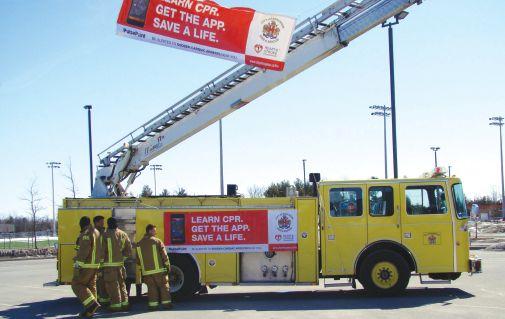
Kingston Fire & Rescue is the first municipality in Canada to launch the Pulse Point app, designed to alert the public to cardiac-arrest incidents.
he said. “I think overall it will help save lives.”
PulsePoint is a non-profit foundation based in the San Francisco Bay area. The app was developed by Richard
Canadian country singer Kevin Davison has been a paramedic and volunteer firefighter in Nova Scotia for more than 20 years. He knows about post-traumatic stress.
Last fall Davison composed a song that details his experience of post-traumatic stress disorder (PTSD) as a first responder.
“I’ve always wanted to write something about my job and about how the job affects your life when you get home,” he said. “It certainly has a lot to do with my career and things I have dealt with.”
The song called “When those sirens are gone” went public just four months ago, and has been viewed thousands of times on YouTube
and Facebook.
Messages from fans who were touched by the song flowed in soon after.
“I get anything from ‘Thanks,’ to ‘I’m going to get help,’ to ‘I’m talking about my PTSD which I’ve never told even my family about,’” Davison said. “People need to know that it’s OK to talk about those
Price, a former California fire chief, and is being used in more than 1,100 communities in the United States.
Learn more at pulsepoint.org - Maria Church
feelings.”
The country singer hopes to bring his song and his message to fire halls across Canada this year. One stop planned is a performance at FDIC Atlantic in Wolfville, N.S., on June 6.
Listen to Davison’s song on his website, kevindavison. ca, and find it on iTunes.
- Maria Church
BY
Ontario. Arnold, formerly the deputy chief in Woodstock, Ont., assumed his role in Cambridge on Feb. 2. Arnold sits on the Ontario Association of Fire Chiefs Public Education and Fire Prevention Committee, and is completing his master’s degree in public administration at Western University.
JASON BROLUND has been appointed chief for West Kelowna Fire Rescue in British
Columbia. Brolund, formerly the regional emergency program co-ordinator for the Central Okanagan, assumed his role on March 27.
WAYNE SCHNITZLER, fire chief of West Kelowna Fire Rescue in British Columbia since 2008, announced his retirement in December. Schnitzler started in
the fire service as a volunteer in 1979 with the Surrey Fire Service. He officially retired on March 27.
BRIAN SMYTH a seven-year volunteer firefighter with the Columbia Valley Volunteer Fire Department in British Columbia, died in the line of duty on March 7. Smyth suffered a
cardiac arrest while battling a house fire near Cultus Lake, and died days later in hospital.

JIM WILLIS, a training instructor for the Kincardine Fire Department in Ontario, died on Feb. 4 at 59 years old. Willis’ 19-year career in fire included 10 years as a firefighter for the Saugeen Shores Fire Department.
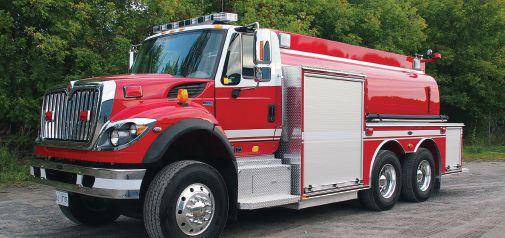
Greater Napanee Emergency Services in Ontario, under Fire Chief Terry Gervais, took delivery in January of an Eastway Emergency Vehicles-built tanker. Built on an International 7400SBA chassis and powered by a Navistar Maxxforce 10 350-hp engine and an Allison 3000 EVS transmission, the truck is equipped with a Hale AP50 PTO driven 420-gmp pump, a 2,500-gallon aluminum water tank, a Newton dump valve with swivel and extension, Amdor Roll-Up doors and a Whelen LED emergency light package.
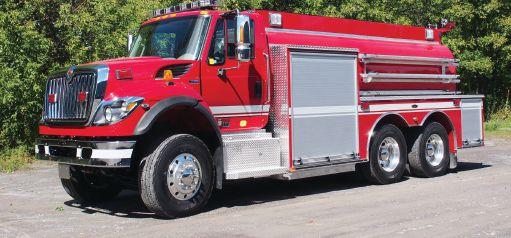
The Stone Mills Fire Department in Ontario, under Fire Chief Frank Haylow took delivery in December of an Eastway Emergency Vehicles-built tanker. Built on an International chassis and powered by a Navistar 350-hp engine and an Allison 3000 EVS transmission, the truck is equipped with a Hale AP50 PTO driven 420-gpm pump and a 2,500-gallon aluminum water tank.
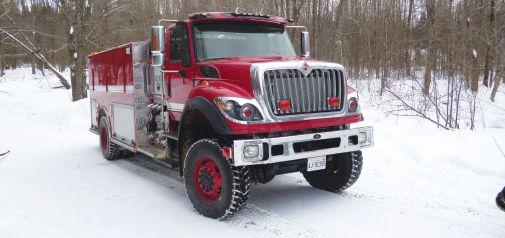
The Killaloe-Hagarty-Richards Fire Department, in Ontario, under Chief Bob Gareau, took delivery in February of an Arnprior Fire Trucks-built pumper. Built on an International 7500 SBA 4X4 chassis and powered by an Allison 3500 EVS transmission and a MaxxForce 9 330-hp engine, the truck is equipped with a Hale DSD 900-gpm pump and a 1,500-gallon aluminum water tank.
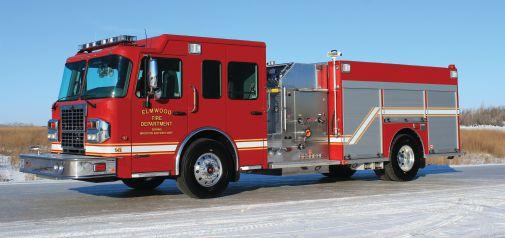
Elmwood Fire Department/Municipality of West Grey in Ontario, under Fire Chief Wayne McLeod, took delivery in January of a Fort Garry Fire Trucks-built pumper. Built on a Spartan Metro Star chassis and powered by a 380-hp Cummins ISL engine and an Allison EVS 3000 transmission, the truck is equipped with a 1,500-gpm Hale DSD pump, a 1000-gallon Propoly tank, a Foam Pro 2001 system, Whelen LED light package, and a Zone Defense rear view camera.
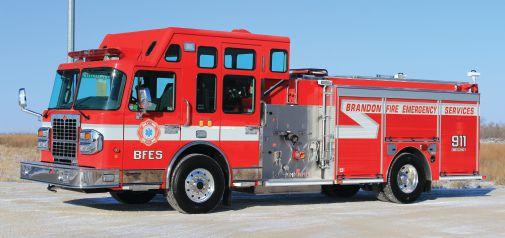
Brandon Fire and Emergency Services in Manitoba, under Fire Chief Brent Dane, took delivery in February of a Fort Garry Fire Trucks-built pumper. Built on a Spartan Metro Star chassis and powered by a 450-hp Cummins engine and an Allison 3000 EVS transmission, the truck is equipped with a 1,250-gpm Darley LDM pump, a 500-gallon Pro Ply tank and a Foam Pro 2002 A system.
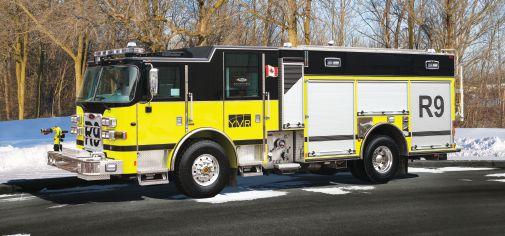
The Vancouver Airport Authority took delivery of a Pierce-built pumper. Built on an Arrow XT chassis and powered by a 450-hp Cummins engine and an Allison transmission, the truck is equipped with a 1,500-gpm Pierce PUC pump, Husky 12 foam system, a 540-gallon poly water tank, TAK-4 independent front suspension and a Will-Burt Night Scan Chief six-inch LED light tower.
30,000 AIR-PAKS SHIPPED. 600 DEPARTMENTS. ALL 10 CANADIAN

TRUST THE INDUSTRY’S FIRST NFPA 2013 COMPLIANT SCBA. In the seven months since receiving NFPA 2013 Edition approvals, Scott has worked tirelessly to deliver the NFPA 2013 approved Air-Pak SCBA to departments in all 10 provinces and all 50 states, meeting the needs of firefighters and first responders throughout Canada and the US. Because at the end of the day, you need the right equipment at the right time.
FOLLOW THE LEADER. VISIT LEADEROFTHEPAK.COM

By DAVID MOSELEY
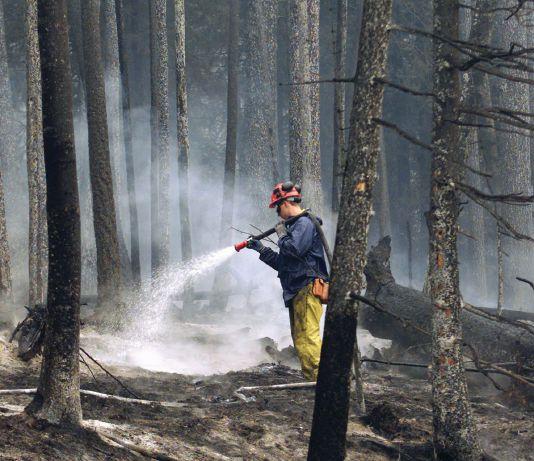
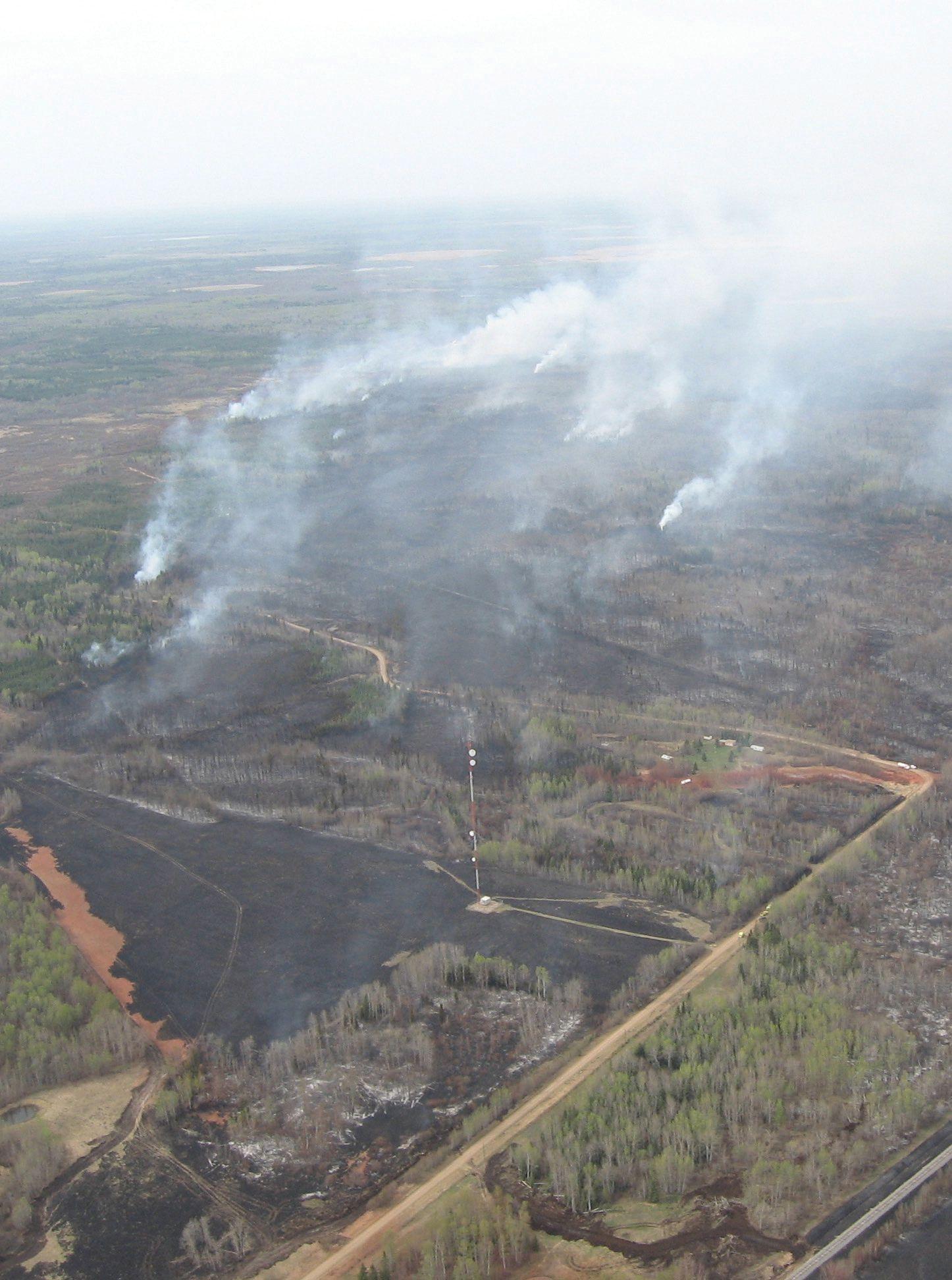
LEFT An overview of the Newbrook fire in Alberta in 2008 that forced 150 people out of their homes; the fire was one of 34 burning in Alberta at the time. ABOVE A firefighter hoses down hot spots around Hillcrest, Alta., in 2003. The prevalence of wildfires in Alberta has led to programs such as FireSmart to help municipalities protect property and reduce loss.
Wildfires can, and have, happened at any time of the year, but there is something special about the middle of May in northern Alberta. For those involved, the Redwater, Newbrook, Opal or Grassland fires were big deals, but the Slave Lake fire in 2011 made everyone sit up and take notice. While we hope we never have to face a fire that destructive, those other fires tell us that while the impact to Slave Lake was unique, in Alberta we had better be prepared for May wildfires.
For those not in northern Alberta, it is worth considering just how your conditions vary, and applying similar preparatory steps. As firefighters we should be the last ones to be fooled into complacency by thinking it can’t happen to us.
The wildland fire behaviour triangle tells us that wildland fires are largely influenced by the interaction of topography, weather and fuel. While topography must always be considered and can have immense local impact, it really does not contribute to the phenomena of these May wildfires, so we’ll put that aside.
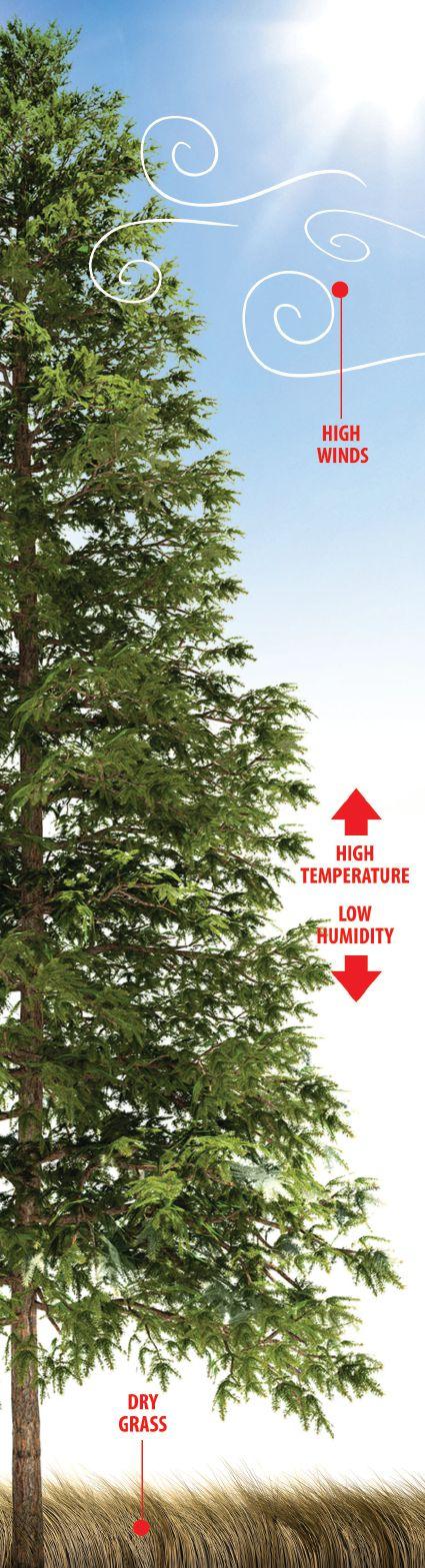
There are two weather conditions that are part of the equation. The first is crossover – when the temperature in degrees Celsius is more than the relative humidity expressed as a percentage. This is an easy indicator to follow. You don’t need an understanding of the complex (but very useful) Canadian Forest Fire Behaviour System to figure this out. Just check your local Environment Canada website forecast, where temperature and humidity is shown. If you have, or are approaching, crossover conditions, you will have easy ignition of fine fuels and the potential for rapid fire spread.
The second weather condition is high wind. Even with crossover conditions, without wind (or slope), any fire is unlikely to spread very fast and does not normally present a great suppression challenge. Add wind to the crossover conditions and things get more interesting. The windier it is, the more interesting things become. Firefighters don’t need to be meteorological experts, or even understand why wind spreads the fire so rapidly, we just need to know it does. We can refer to that same Environment Canada forecast for predicted winds, and of course keep an eye on the flags and observe current conditions.
Now let’s look at the fuel side of the equation. Mature conifer forest in northern Alberta, as with most of the boreal forest, are black spruce or jack pine. At their driest in May, these fuels have the greatest crown fuel load and can support active crown fire. These fires can be intense and with wind spread rapidly; they produce a lot of radiant heat and can put out a lot of firebrands, both of which can transfer wildland fire to urban fuels such as landscaping, outbuildings and houses.
Of the two species, black spruce has been identified as particularly threatening. Black spruce more often has continuous branching from ground to crown, providing its own ladder fuel to spread a
surface fire to a crown fire. Compared to jack pine, black spruce has smaller needles and more of them, as well as finer and denser twigs and branches. This greater surface area allows for easier ignition and spread. These finer branches, as well as much lighter black spruce cones, are likely to produce more firebrands that can cause spot fires.
Conifer fuel is not seasonal and it can be dry and windy any time of year, so what is it about May fires? That brings us to the two other main fuel types found in the north –grass and trembling aspen.
Dead dry grass is described as a fine and flashy fuel. Because it is so fine, it has a huge surface area and as a result quickly absorbs and loses moisture. Crossover conditions will quickly dry out dead grass; when grass is dry it ignites easily and with wind fire will spread rapidly. Certainly we can have grass fires in April or even March, but because of the shorter, cooler days and lingering snow, these fires are usually much less intense. Once June rolls around we usually get more rain, but the new green grass also emerges and does not shed moisture or carry fire like dead grass.
Grass fuels are usually associated with open wetlands or human-altered landscapes such as pastures, roadsides or industrial clearings. These grassy areas are often frequented by residents, workers or recreationists and contain transportation and utility infrastructure – the human causes of wildfire ignition.
In a sense, trembling aspen fuel behaves like a more subdued grass fuel. Often there is grass beneath the aspen, but with less light, not as much as there is out in the open. Combined with the dead leaves from the previous year, this makes up most of the surface fuel in these deciduous forests. With no green leaves on the aspen, sunlight and wind reach the forest floor, warming and drying it, creating conditions that will carry surface fire. Once the aspen leaf out (in late May, early June) the forest floor receives little sunlight and less wind, so does not dry out and warm up as much. Combined with greened-up understory fuels, the likelihood and intensity of fire in these forests is greatly reduced.
Now let’s put these fuels together on the landscape and consider the fire potential. While the forest may be a patchwork or mosaic of conifer, aspen and grass fuels, in May we find a unique continuity of fuel. Dry grass fuels will easily ignite and carry fire to the forest where aspen fuels will sustain the fire in a manner not seen at other times of the year, allowing it to reach conifer fuels that may crown and run.
To summarize, in May dry, windy weather can spread fire from easily ignited grass fuels through forested areas including aspen fuels that will not burn so readily at other times. When these fires involve mature conifer fuels, the resulting crown fires can be uncontrollable and produce an intensity of heat and firebrands that can spread fire from the wildland to urban areas.
As a municipality, small or otherwise, how do you prepare for the possibility of a destructive wildfire entering your community? In Canada there is a coalition called Partners in Protection that promotes a program called FireSmart. This program provides advice and direction to help fire departments and residents plan for wildfire in and around your community. Whether your department addresses this planning itself or in co-operation with provincial wildfire officials and/ or consultants, you should take advantage of this program. Without getting into great detail, let’s look at some of the components a community fire plan should include.
First you need to assess the threat. Often fuel is the most influential factor that is constant enough to predict and manage. Do you have large grassy areas adjacent to homes? Is the grass maintained through mowing or grazing, resulting in a fuel break? Or is it long and matted by the winter snowpack, creating a fuel hazard, acting as a bridge or wick between other fuels? Do you have mature conifer forests such as jack pine or black spruce adjacent to communities? How extensive or continuous are these areas?
If you have identified a fuel threat you should consider fuel modification. For grass fuels, this might involve prescribed burns in the spring, something many firefighters enjoy but others refuse to consider due to risk and liability. Mowing might be a better option and may involve enforcing community standard bylaws. Mature conifer fuels are more of a challenge, but there are options. Thinning these trees and removing the thinned material can maintain forest cover while greatly reducing the risk of a continuous crown fire – the crowns are too far apart for fire to spread from crown to crown. Pruning lower branches can reduce the risk of fire spreading from the surface to the crowns. Fire guards can create a break in the fuel as well as provide access for quick initial attack of fires. While more drastic, forests can be converted from conifer to deciduous species, or removed altogether. After an experience like

Slave Lake, it is tempting to say “Just remove that forest,” but we have to remember that many people choose to live in these locations because that forest is there.
Proactive steps can be taken to reduce the hazard from wildfire during the planning process. Improved access, as opposed to one road in and out of a subdivision, and additional water sources, can improve the fire department’s ability to respond during a large-scale incident. Greenbelts such as parks or golf courses can be used to separate homes from mature conifer fuels.
Certainly residents can play a large role to protect their properties. In addition to fuel modification, maintaining property and choices about building materials can influence the impact of wildfire. Municipalities can take an educational and advisory role in helping their residents help themselves; the Firesmart program has excellent material for this.
Fire departments should train to prepare themselves for these fires. Some kind of basic wildland fire training should take place, such as NFPA 1051. A popular course in Alberta is S215, Fire Operations in the Wildland /Urban Interface. This two-day course introduces some new strategies and tactics such as structural triage, structure and site preparation and unique engine operations for the wildland/urban interface. It is offered by Alberta Environment and Sustainable Resource Development to Alberta municipal fire departments at no cost. Dozer Boss courses and sprinkler training are other useful cross training to consider.
Training should not be limited to emergency response personnel – or perhaps rather who is defined as such should be expanded. Do senior municipal staff and elected officials have adequate incident command system training? Is your municipal disaster plan familiar and practiced?
Most municipal fire departments can’t just increase staffing for potential busy periods. If you have found May historically busy, or your assessment has identified a significant threat from spring wildfire, there are some steps you can take. Anticipating a need can be incorporated into your holiday planning, just as volunteer departments try to maintain adequate coverage over a long weekend. Make sure you have updated contact information for heavy equipment and helicopter charters, or, if applicable, standing contracts or agreements in place. You can schedule wildland fire training for March or April so it is fresh. And again, monitor the weather – if at no other time, then do so when it’s hot and dry in the spring. If you want a forecast that includes humidity and is catered specific to wildland fire, then check out Alberta Environment and Sustainable Resource Development’s website, or that of your provincial wildfire agency. If you get in the habit of doing this you may soon be able to see the correlation between weather and fire behaviour on smaller fires – experience that will serve you well on the bigger fires.
May wildfires in Alberta are a reality that municipalities have to face. In fire fighting there are no certain outcomes, but better understanding the spring wildfire phenomenon and taking reasonable steps to prepare for it will put us in a better place to protect our communities.

David Moseley is an environmental protection officer with Alberta Environment and Sustainable Resource Development, and lead training officer with Lac La Biche County Fire Rescue. Contact him at david.moseley@gov.ab.ca
New GORE® PARALLON™ Liner System reduces heat stress in a wide range of environments and improves thermal protection when wet
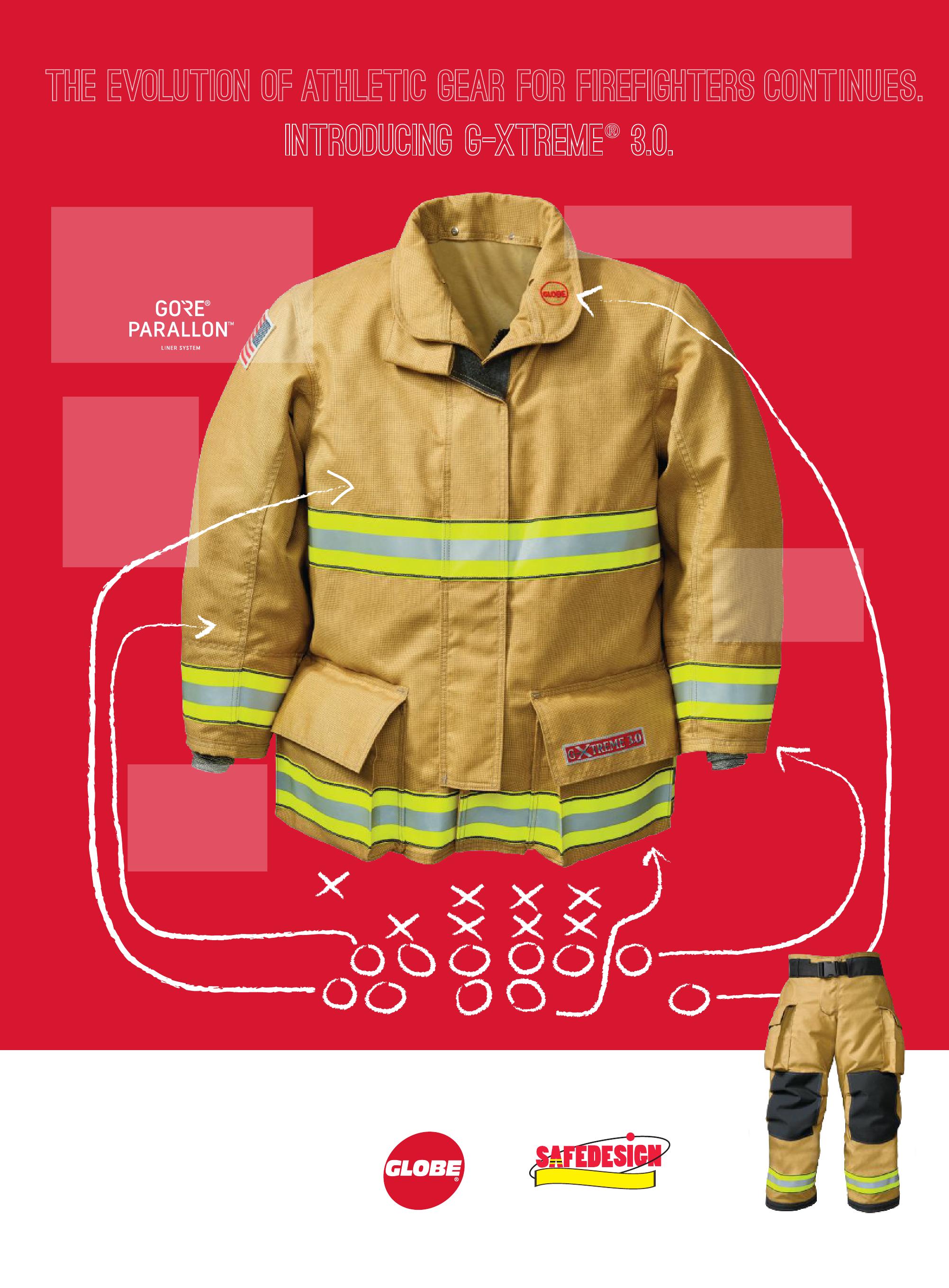
Retailored fit in the chest and sleeves for unrestricted mobility for even the most athletic firefighter At Globe,
The only turnout gear that comes in SHAPES to fit your body like never before
AXTION® Back and AXTION® Sleeve let you make all the right moves
BY TOM BREMNER Fire chief, Salt Spring Island, B.C.
ou’re the chief. How did you get to your position?
In days gone by, if you stayed in the service long enough, you became chief. Or perhaps you won a popularity contest.
To be a chief today requires you to be all things to all people – a public relations pro; a human resources manager; a budgeting and finance expert; a fund raiser; a social worker; a labour negotiations expert; a mentor; a leader; a succession planner. You report to a body, whether municipal/city or provincial, that may offer you little to no support. And don’t forget the taxpayer – who is sure he knows that all a firefighter does is drive a truck and aim a hose.
You may be misunderstood and are certainly criticized. How do we, and our departments, get a handle on this? As chief, you are the leader of your department and it is incumbent on you to ensure that you provide the atmosphere and venue in which your men and women can have the complete and complex training required to protect themselves and their communities.
Start with yourself. Sit down with a paper and pencil; draw a line down the centre of the paper and head one column “strong” and the other “less strong.” Be brutally honest. Think about how you might organize your time more effectively. In some of the areas where you are strong, can you mentor one of your team members to learn about and take on some tasks? Strong leaders are not afraid to share knowledge and responsibility.
For decades, chiefs were groomed to be fixers and in-house managers of everything. Are you one of these leaders? If so, are you exhausted and running out of internal options? Why not look for other solutions within your own community or nearby? Budget managing is always the No. 1 leadership challenge and has worn down many good leaders. In many cases, locating and chatting with outside (and inside) resources brings the light at the end of the tunnel. Trying to handle everything, every day, in house, with limited or no expertise is dangerous.
are less strong, involve trusted senior members in the initial steps of planning how to make things better. Do not be afraid to involve your whole department. Sometimes a really good idea will come from a new, fresh set of eyes. Let someone else talk about why you do certain things the way you do. What a great teaching and leadership opportunity. Consider having a professional lead a brainstorming session with only two rules: all ideas are welcome, and there is no evaluation or criticism allowed. It takes courage to do this, but it can pay real dividends. Members are more likely to buy into a new plan if they feel involved in the process.
Two cautions: first, don’t try to do everything at once. Have a three-year plan. Then ask yourself, “To accomplish this plan, what do I need to do in one year? In six months? In three months? This month?” Secondly, you are still the boss. Ask for and listen to input from members, accept help in drafting your plans, but in the end the buck stops at your desk.
I have left the most important point to the last. Look to your fellow chiefs for support. Attend all of the conventions and courses that you can. Get to know colleagues. There are some very talented,
Be wise enough to understand and value yourself and your service before you take on a tough challenge. ‘‘ ’’
Do you dread writing reports? Think about drafting what you want to convey in point form, and then let someone edit your thoughts into a coherent report. Maybe you can find these people outside your department. You still own the budget or the report, but accepting expert help is not weakness; it is the mark of a strong leader.
This same process can be applied to your department. In areas in which your department and its members are strong, acknowledgement and praise go a long way to maintaining those strengths. Where you
Tom Bremner is the fire chief for Salt Spring Island, B.C. Contact him at tbremner@saltspringfire.com
supportive chiefs in Canada who have done the legwork, and they are always willing to chat. Chiefs often hold back on asking for help because of a fear of appearing weak. Being open and vulnerable in the right setting and with trusted colleagues is a good skill to have.
Hence the column title “How much can our service handle?” This is not only about the level of service we provide members and communities, but also about us as humans beings and leaders. No community or service should let its leaders drown in an overwhelming workload. If you are caught up in a stream of endless challenges without support, it might be time to make some calls to trusted colleagues.
Be wise enough to understand and value yourself and your service before you take on a tough challenge. Education, communication and having trusted mentors will assist you tremendously if you choose to use them. And please feel free to connect with me.
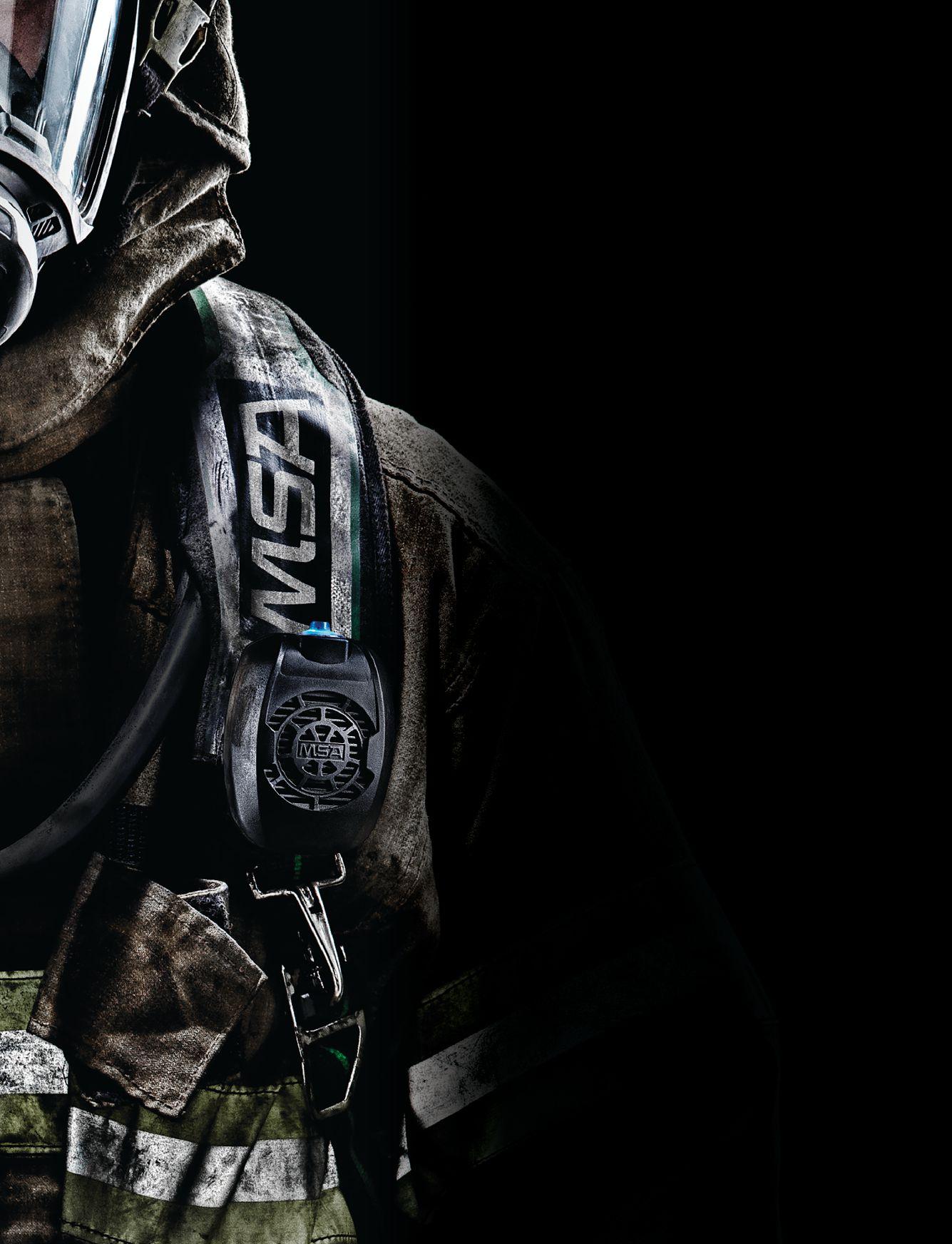
You said you wanted to communicate more e ectively. So we added standard electronic voice amps, proprietary voice filtering and Bluetooth capabilities. Even better? It’s approved.
To get your hands on the MSA G1 SCBA, visit msafire.com/breathe.
WHEN YOU GO IN, WE GO IN WITH YOU.
BY VINCE MACKENZIE Fire chief Grand Falls-Windsor, N.L.
y colleague, Tom DeSorcy, wrote in March about public perceptions of leadership positions in volunteer fire departments. I think Tom’s analogy of busy fires chiefs who appear calm on the outside but, like ducks, paddle furiously under the surface to keep things running smoothly, was spot on.
I would like to expand on Tom’s point and focus on firefighter training. Training is a skill that few recognize until a significant event occurs. Effective training takes leaders who spend countless hours preparing. Like ducks, those organizers are furiously working where no one can see to keep their departments trained and motivated.
Many colleagues have told me that they believe running a composite or volunteer fire department is a greater challenge than running a career department. If volunteers aren’t motivated, they simply quit and leave, and the department’s investment in training – both time and money – is gone. This challenges a department’s leadership team to appear calm while furiously paddling like the duck to keep the rest of the team motivated.
Running a successful volunteer fire department is more than the chief’s job; it takes the collaboration of every member. Everyone has to be a leader and have a positive attitude toward training.
I am the fire chief in a community of about 15,000 people. While my community is considered small by outsiders, it serves many smaller communities and therefore has city infrastructures and larger hazards and risks.
As I wrote this, I was fresh off one of those calls that chiefs forever remember as tests of their departments’ resources and strengths. On a stormy and cold February night, my department was dispatched to a tour-bus rollover with 55 occupants. The call came in with reports of multiple injuries and entrapment.
ahead. I was also preparing myself mentally for what I was about to see. I knew that I was about to be in command of a large incident. It was one of those calls at which you search every aspect of your training, experiences and relationships to perform as effectively as you can. More importantly, it was a call that was going to demand the exact same thing from every volunteer firefighter who responded.
Our crews along with paramedics and other partners successfully got all 55 patients to the hospital in under an hour; the outcome was extremely good and most injuries were minor.
The next day I beamed with pride for our first responders; every member brought his or her A game. But again, I felt anxious. I thought about what the scene would have been like if we had not been properly trained. Let me just say that motivation levels were high. I wrote about the three Ts for firefighter motivation (technology, training and tragedy) in a June 2013 column and I am happy to say this call proved that T for training is the best motivator; it could very well have been T for tragedy.
The point is that firefighters never realize the value of every little tidbit of training they receive; it is only in times of crisis that
As volunteer firefighters, we should make every day some kind of training day. ‘‘ ’’
Upon receiving the dispatch on my pager at home, I remember having one of those gut-ripping feelings. As I went out the door, I immediately thought of our resources and crew and wondered –while forcing myself to appear calm on the outside like the paddling duck, but my mind was reeling – if we were trained to deal with the magnitude of what we were about to face.
The six-minute drive to the scene was torturous. Not only was it a dangerous drive in slippery winter conditions, but my instincts were telling me to organize and use every second I could to think
Vince MacKenzie is the fire chief in Grand Falls-Windsor, N.L. Email him at firechief@grandfallswindsor.com and follow him on Twitter at @FirechiefVince
we know the extreme value of high motivation for training. Only then does your training become your trusted instinct, as was mine on that frightful night.
As volunteer firefighters, we should make every day some kind of training day. We owe it to ourselves to make conscious efforts to commit something to memory so we can recall it when the need arises. Take 10 to 15 minutes out of every day to read an article, watch a training video, or participate in some sort of training.
Don’t underestimate the power of those short training sessions; you never know when it will be needed, and when it does, it comes automatically and confidently. This is especially true for those smaller departments that have a low call frequency. As difficult as it is to stay motivated, volunteer departments especially need to make every day a training day. Keep paddling!

BY ED BROUWER
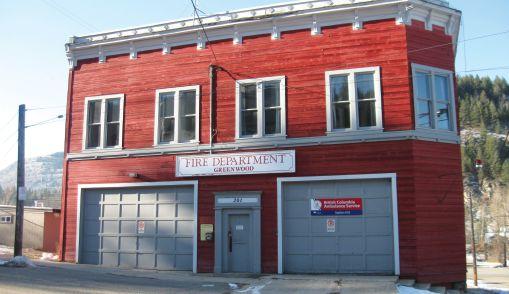
The Greenwood Fire Department in British Columbia where I am a training officer has come through a major facelift. Department members, along with a group that shares the building, invested hundreds of hours in transforming our hall. The word “our” is important because it shows we have taken ownership. Ownership, whether it’s ownership of a building or the department as a whole, is crucial for all members in order to effect positive change.
The historic two-storey building that houses Greenwood’s volunteer department had become a dumping ground for the city’s unwanted furniture, sports equipment and building materials. The small meeting room had become overstuffed with a pool table, poker table, old fridges and more old sofas and chairs than a yard sale. It was dark, dingy and dirty, and looking more like a club house than a training room. In 2010 the department closed the door to that room and moved into a small room at the back of the building.
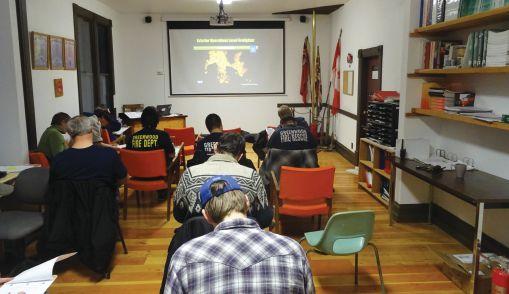
Last year I recommended we take back our room. The department needed the space (we had reached 80 per cent capacity) and I was hoping to use the positive momentum we were experiencing to raise the bar. The results are outstanding, and I am so proud of this fine group of volunteers.
We have some very skilled wood workers in our department, so the floors received a new covering of planks, sanded and varnished. The walls were primed and painted white. Bookshelves now hold our training materials. A projector was mounted into the ceiling and I scored us a 119-inch 3D ready auto projection screen. Since our restoration turned out so well, the city got on board and now the whole building is being redone.
Unfortunately, the department itself, like the old building, needed a complete overhaul. Over the past year we renovated more than just the building. Taking ownership along with encouraging each member to push for excellence has resulted in 99 per cent attendance on training nights so far this year and a 30-per-cent increase in membership.
There remains one area of concern: the election of officers. Up until recently officers were elected at the annual general meeting. A chief would say, “We need a safety officer, any volunteers?” A firefighter would reluctantly reply, “OK. If no one else is willing, I’ll try it.” Chief: “Great. All in favour?” Hands would go up and the chief would move on to the next officer position.
None of our officers had any training to help them fulfill their roles; most were uncertain about their roles. Personally, I don’t see elections working effectively, so we changed the whole process. Now when a position comes open we post the job description with the needed qualifications. After an interview, successful candidates are taken through a 13-week in-house officer’s training course. The course has little to do with fire suppression; it covers human resource management, incident management, administration and leadership.
for
Our executives now meet once a month for officer training. Although we are volunteers we strive to be professionals. By professional I mean having special training and skills; conducting oneself in a manner respected by members of the profession and society in general; engaging in something worthy of high standards, not necessarily for monetary gain.
Fire officers, whether full time, paid on call or pure volunteer, wear the trumpets. Look closely at your badge or your collar pins and you will see one or more speaking trumpets. These symbols come from the days when the symbol of command was a speaking trumpet. It is our symbol of professionalism.
There are five trumpets for the fire chief. In his book Making a difference, Randy Bruegman suggests that the trumpets represent the five
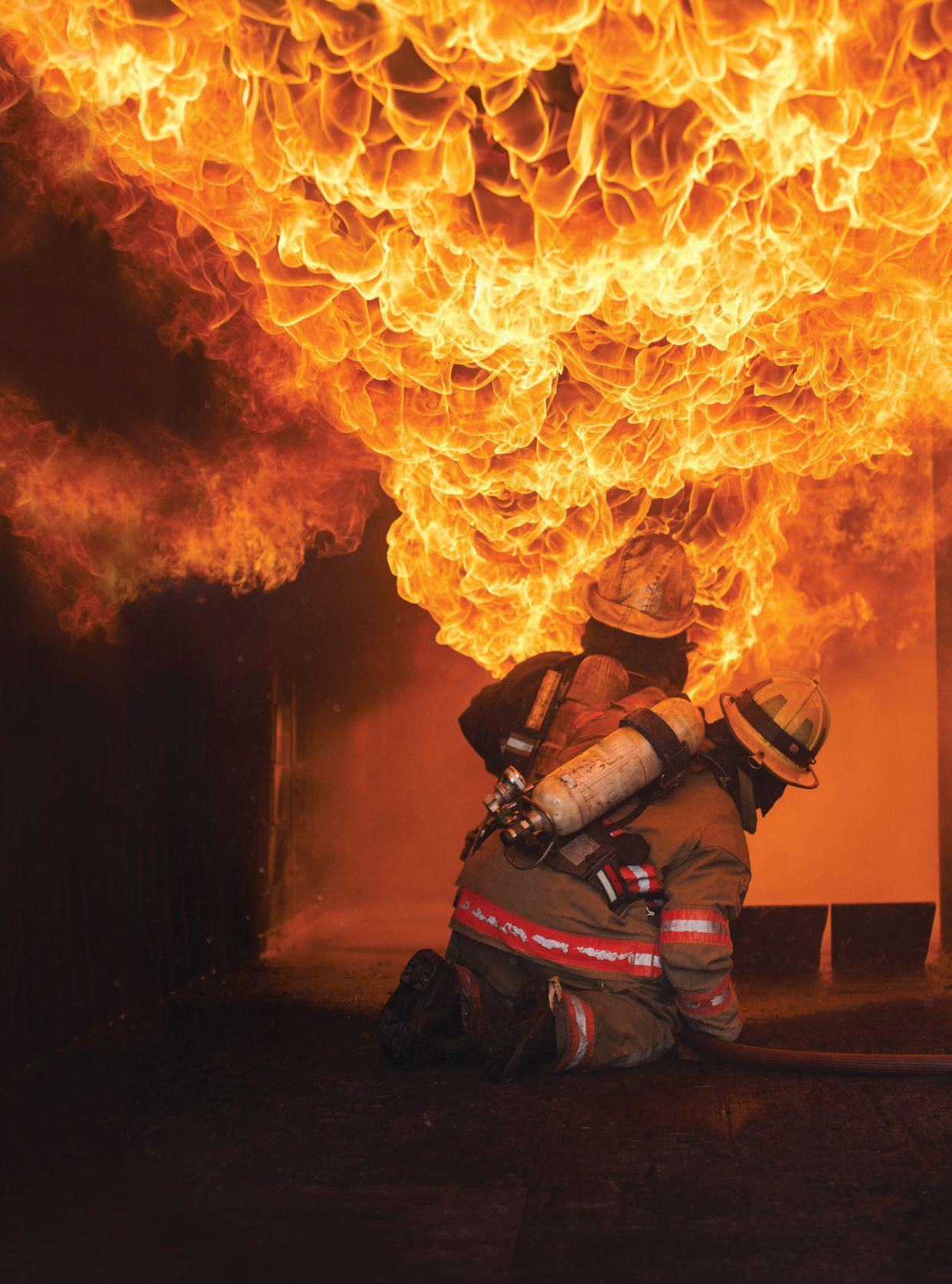
When fighting a fire, every thing counts – especially time. Because the home you live in today burns eight times faster than the one where you were raised. This makes CAFSystems a must. Water alone isn’t fast enough to suppress fast-moving fires that are fueled by synthetic materials and spread unabated through open floorplans. CAFs extinguishes modern flames five times faster than water , giving you a fighting chance. It’s a race between fire and your department, catch up with CAFs.
•see the UL study at http://newscience.ul.com/articles/modern-residential-fires

basic roles of the fire chief: leader, manager, role model, mentor and change agent. The trumpets symbolize the traditions and lineage of our profession, and it is an honour and a privilege to wear them on our uniform.
There is a history behind the badge and a responsibility that comes with the trumpets we wear. But I fear in some ways we have failed present-day fire-service officers by not equipping them to be outstanding leaders.
If we were to dress up firefighters in the traditional PPE and SCBA and send them into a burning building without instructing them in the use of that gear, we would be liable for injuries, or worse, and perhaps charged with criminal negligence, and rightly so. But is it any less neglectful to pin sets of speaking trumpets on firefighters’ collars without giving them the skills to successfully fulfill those roles?
Officer training should not be an option. If we do not develop competency in our fire officers, we cannot expect competency from those they lead.
Simple, everyday things – such as maintaining an attitude of courtesy and respect – need to be taught at an officer level. These days we don’t relate, we transact. We tweet, retweet, Skype, post, send and hashtag . . . but few actually relate. Perhaps we are connected, but for the most part it is superficial. I can be whoever I want to be online – but when we meet in person it is the real deal. I believe that to be effective as an officer you have to actually communicate face to face with your members.
Through social media we can control how we are seen. Face-to-face conversations take place in real time. You can look into the eyes of that firefighter or officer and feel the emotion, see more of the whole picture and more effectively deal with the situation. I would take a slap on the back with a word of appreciation over a 100 Facebook likes any day of the week.
Time spent on new technology and social media sites is increasing immensely, creating less time for real-life interactions. Officers must be taught how to encourage (push forward) those on the floor; for most people, this does not come naturally.
I am privileged to have three such encouraging men in my life: Brian Morris, my old fire chief, Lou Wilde and Gene Fischer. Both Morris and Wilde pushed me to excellence, and I am grateful. Fischer motivated many of Greenwood’s volunteers toward professionalism. He took an interest in us as firefighters,
never treating us as only volunteers, or worse yet wannabes.
Please consider that no matter how technical we get, people are still people. And a fire officer should know to show appreciation for a job well done. You must learn how to create an environment of excellence.
People need to have challenges available to gain a sense of accomplishment. At Greenwood, we raised the bar to make it more difficult to join the department, which resulted in an increase in membership. People want to belong to an organization of which they can be proud. Bottom line: people are important. No one should need to compete for importance.
I try to motivate our officers by personally congratulating them when they do a good job. I also try to be more attentive when they are talking. It is rewarding to see those officers doing the same with other department members. Appreciation can be shown in many ways. For example, my fire chief walks me out to the truck after each practice. It is his way of saying thanks. If we in the fire service take our officers for granted we will effectively silence the speaking trumpets.
Face it; the way things are in your department is the way you allow things to be. Sure there are some things over which we have no control, and yes, we get tired of fighting for change, but I encourage you to press forward. You can either watch things happen, make things happen or wonder what happened. Let’s make things happen – let’s be game changers, proudly reflecting the high calling of our speaking trumpets.
One of the reasons I write for Fire Fighting in Canada is because the columnists really care about the fire service and continually push for excellence. The heart behind Trainer’s Corner is all about you – the training officer – so please let me know how I can serve you better. If you are old school and want to phone me rather than use that techno stuff, go for it: 250-495-4877.
Train as if lives depend on it.
Ed Brouwer is the chief instructor for Canwest Fire in Osoyoos, B.C., and training officer for Greenwood Fire and Rescue. He is also a fire warden with the B.C. Ministry of Forests, a wildland urban interface fire-suppression instructor/evaluator and an ordained disaster-response chaplain. Contact Ed at ebrouwer@canwestfire.org
More Power... More Torque ... Better Fuel Efficiency
More Power... More Torque ... Better Fuel Efficiency
75% Less Emissions
75% Less Emissions
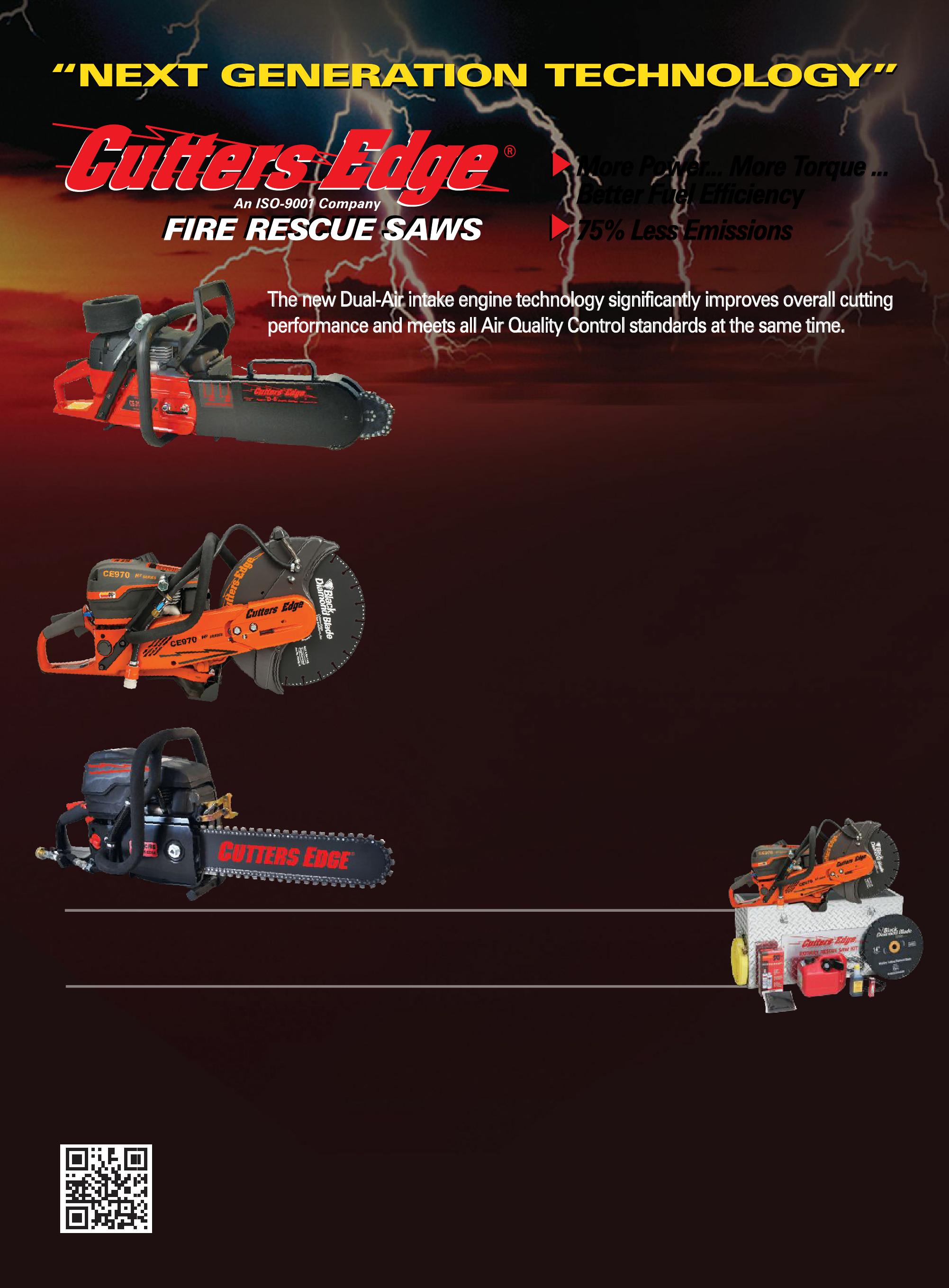
The new Dual-Air intake engine technology significantly improves overall cutting performance and meets all Air Quality Control standards at the same time.
New 2100 Series includes two engine sizes: 70.7cc and 87.9cc. Each engine is designed for use with Cutters Edge Carbide
Tipped BULLET Chain® to cut the widest range of materials found at fireground and rescue scenes.
New H Series is engineered and powered to work harder and operate longer in the most extreme fire and rescue conditions anywhere. The new technology engine is available in three sizes: 74cc, 94cc and 119cc. The Cutters Edge Black Star and Black Diamond Blades offer long cutting life and high speed cutting of virtually all materials.
The new BULLET BLADE TM will be available soon.
A new technology 94cc engine and a new style Diamond chain cuts reinforced concrete up to 16-inches thick. Features a lighter weight power head and full-wrap handle for high performance concrete cutting in any position.
All Cutters Edge NEXT GENERATION TECHNOLOGY Fire Rescue Saws are available in fully-equipped Field Kits designed for Rescue Cutting anywhere.
Contact Your Local Cutters Edge DealerSee New Engine Technology Video Now
WESTERN CANADA
WFR Wholesale Fire & Rescue Ltd. Calgary AB - Ph 403-279-0400 1-800-561-0400
Web: www.wfrfire.com
QUEBEC Areo-Fire 5205 J-Armand Bombardier
Longueuil QC, J3Z 1G4
1-800-469-1963
E-Mail: info@areo-feu.com
NEW BRUNSWICK
Micmac Fire & Safety Source 518 St. Mary's Street, Unit 1 Fredericton, NB E3A 8H5
1-800-561-1995 or (506) 453-1995
E-Mail: r.henderson@mmfss.ca
NEWFOUNDLAND
Medical West Supplies 13 Rowsell St., Corner Brook, NF
709-632-7852
E-Mail: jkenny@nf.sympatico.ca
ONTARIO
M&L Supply Ingleside, ON 1-866-445-3473
Email: markp@mnlsupply.com Web: www.mnlsupply.com
NOVA SCOTIA
Cumings Fire & Safety Equipment Ltd. Bridgewater, NS Ph 902-543-9839 1-800-440-3442
E-Mail: kylej@cumings.ca Web: www.cumings.ca
BY DAVE BALDING Fire chief Fraser Lake, B.C.
raser Lake Fire Rescue in British Columbia recently attended a chest-pains call. Dispatch identified the complainant over the radio and a number of us recognized the name as that of a local resident. Instead of listening and responding to the civic address given by dispatch, we headed right over to where we knew the local man lived – only to find no one home. After checking back with a very accommodating dispatcher we headed for the correct address, somewhat red faced. Thankfully the patient suffered no ill effects from our folly, and there was a valuable lesson for all of us who attended.
Communication, that vital tool that is so essential to every incident, often receives less attention than it deserves. More than half of our communication is non-verbal. That makes our most common way of communicating – two-way radio – even more of a challenge. Add in ambient noise, a flurry of information coming and going along with other distractions and we have the perfect storm for missed or misinterpreted messages. Concise messages, clear speech, plain language and paraphrasing messages heard to ensure confirmation all help with operational communications. Another critical piece in the communication puzzle is training. Radios are vital pieces of equipment to us; we must be familiar with every facet of their operation, much as we are with our SCBA and pumpers – whether operating on a digital trunked system, simplex analog or a repeater. Do you hold tabletop exercises? Try bringing a communications element into that controlled environment.
Effective communication outside the fire ground is critically important as well. Post-incident debriefs, for example, provide a valuable opportunity for sharing lessons learned, discussing close calls and ensuring all attending members are on the same page. I believe every incident, no matter how minor or routine, deserves a debrief. Longer, complex incidents, or those that may not have gone well, will require a strong leader to keep the conversation positive and on track. Questions should be asked in a non-accusatory fashion, and active listening – a skill that involves paying attention to non-verbal clues such as body language and confirming statements made by speakers – goes a long way to ensure the experience is positive for all participants.
work, check emails or pursue other distractions as we converse, even if it’s small talk. If I can’t set aside that time for all members of our organization then there’s something wrong.
We are almost always communicating, sometimes in unspoken ways. Consider the message of pride sent to the community when we drive around in a shiny apparatus.
Our individual performances send powerful messages as well. I recently mused with our members about how to encourage healthy lifestyle choices, and considered a fitness standard to promote physical health. It soon became evident that in our volunteer environment there is no realistic way to mandate any particular level of fitness. As in most every facet of leadership, the best way to send a powerful message is serve as a role model. Another message I send when the weather permits here in British Columbia’s Central Interior is for residents passing by the fire hall. Wide-open apparatus bay doors encourage passersby to drop by and see what’s inside. Sure, it takes a few minutes out of my day to chat with Mrs. Smith and her young son, but it’s also a tremendous opportunity to stir up interest in the emergency services and send a fire-prevention message home with them.
Communicating one on one is perhaps the most vital skill for a chief to hone.
’’
Communicating one-on-one is perhaps the most vital skill for a chief to hone. When a firefighter enters my office I don’t continue to
Dave Balding joined the fire service in 1985 and is now fire chief and emergency co-ordinator for the Village of Fraser Lake in British Columbia’s Central Interior. Contact Dave at dbalding@fraserlake.ca and follow him on Twitter at @FraserLakeFire
Communication continues to evolve in the fire service. Our now ubiquitous smart phones, by example, are a far cry from the bugles we once used on the fire ground. We must embrace new methods of communication as they become viable. I now communicate with our firefighters through texting – with great success. Social media is a far too often ignored communication platform that has its own set of rules. Ignore it at your peril as it has the potential, if unmanaged, to create havoc. Take advantage of this powerful instrument to spread messages about virtually every aspect of your department. It’s another opportunity to get messages out to the public.
Communication has many facets; it is also an oft-cited flaw in most every post-incident review. Like any of the skills demanded of us in our profession, we must continually work on our mastery of communication – both on and off the fire ground.
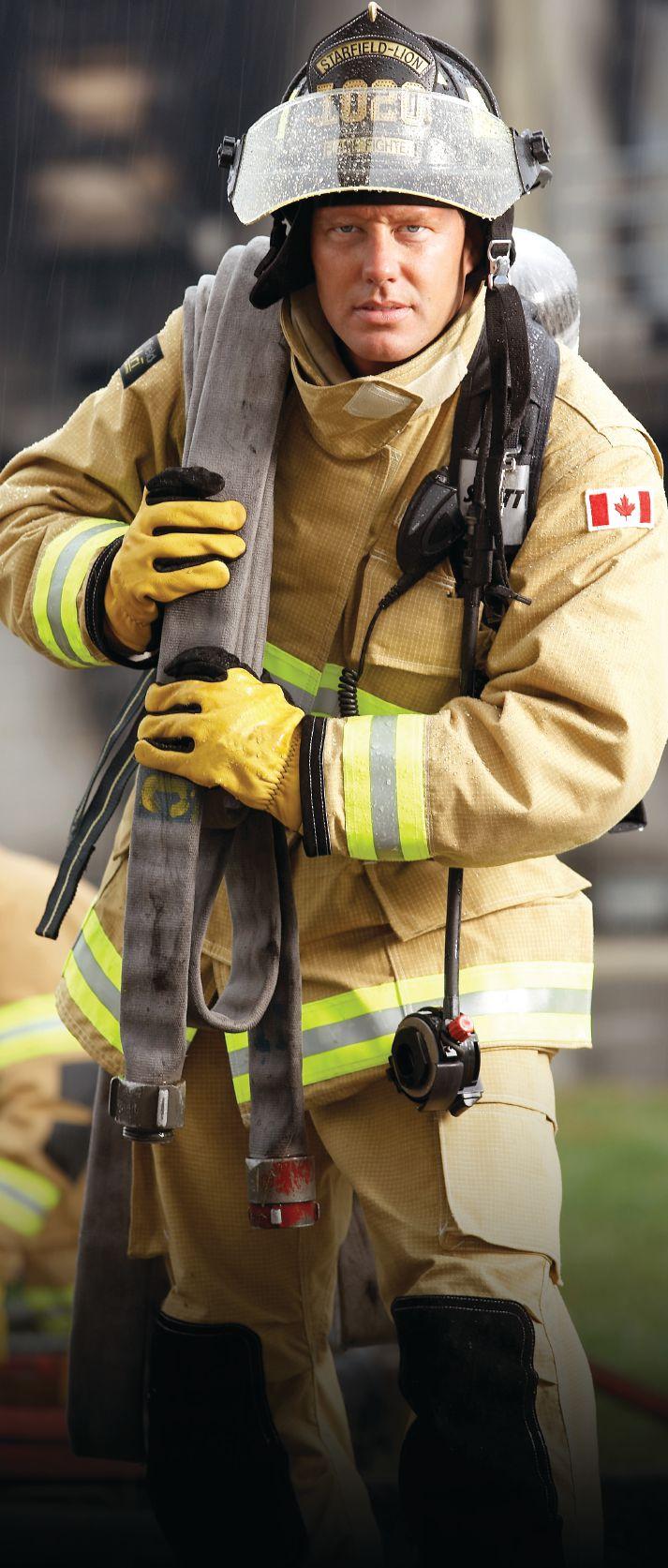
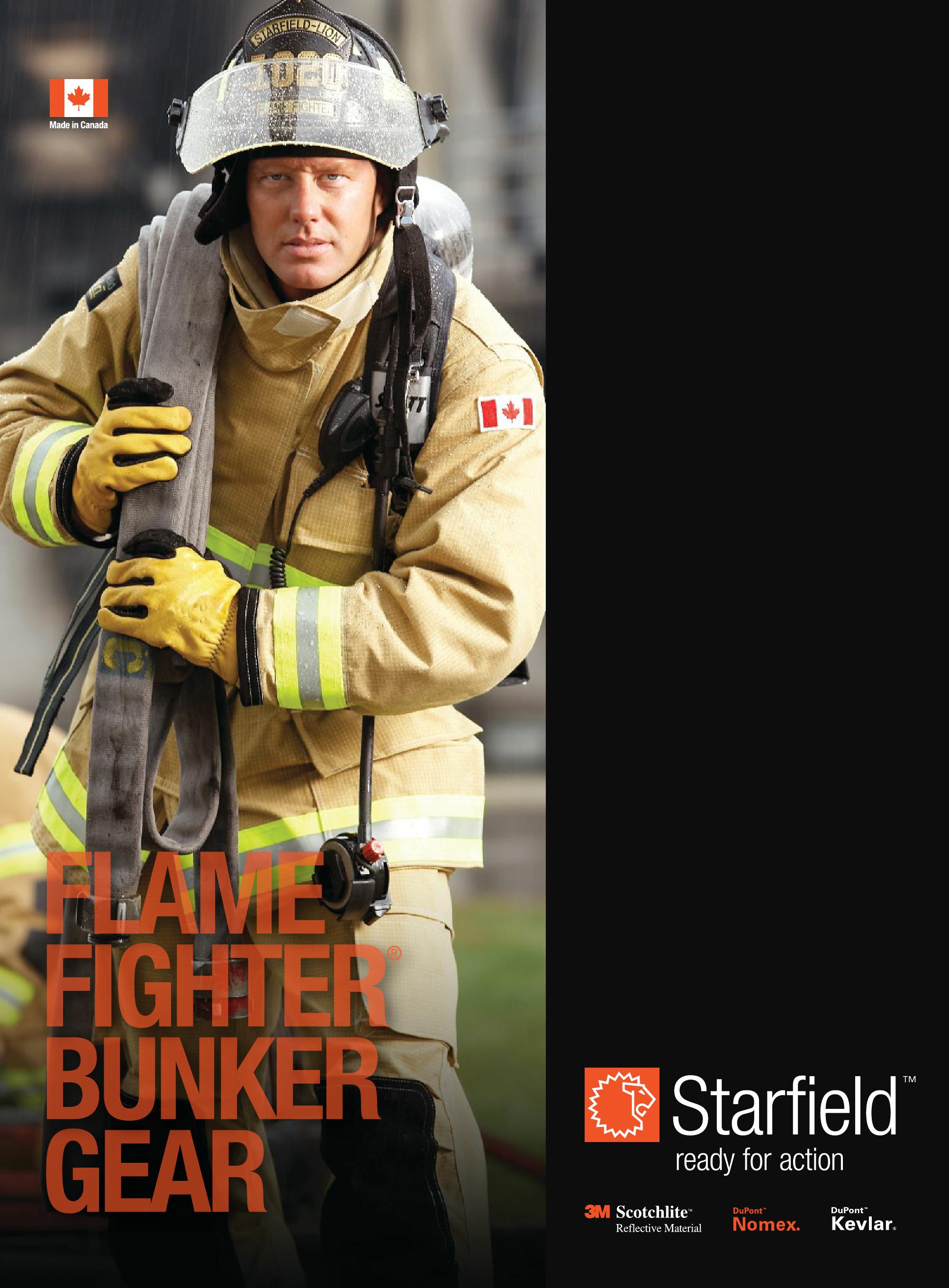
Loaded with safety, comfort and mobility features for unmatched performance, Flame Fighter® bunker gear offers a variety of custom outer shell fabric, liner system, hardware and pocket options to fit your specific needs. This hard-working gear also includes the following game-changing Starfield LION fire protection technology:
• Patented IsoDri®* moisture management reduces the water absorbtion and helps gear dry faster between runs
• Exclusive Ventilated Trim allows vapor to be released, reducing the risk of scald burns
• Thermashield™ provides an additional layer of liner material in the upper back and shoulders to protect against compression burns
• Move-N-Hance™ crotch gusset increases mobility by reducing bunching, twisting and pulling
• Flex Knee™ for easy, natural movement
• Stay Rite™ sleeve wells integrate the sleeve’s liner into a full-length wristlet so that when you reach, the entire sleeve moves with you
For more information about Flame Fighter bunker gear, contact your Starfield LION sales representative at 1.800.473.5553 or visit us online.
Understanding the impact of association requests and municipalities’ actions
By LAURA KING

For years, municipalities have complained about the high cost of firefighter salaries and benefits and the arbitration process that awards them.
There are countless examples.
In January, Fredericton Mayor Brad Woodside said council might have to make cuts to afford to pay the city’s most senior firefighters the $78,000 they were granted by an arbitrator – about $10,000 more than under the previous contract.
“If things start to get tight, the only control that we have over the fire department outside of binding arbitration is [to cut] a number of people, a number of facilities,” Woodside said, noting that the arbitration process itself cost the city $255,000.
Cutting firefighters and closing stations or taking trucks out of service can be politically explosive, as was the case in Corner Brook, N.L., in 2012 when firefighters were awarded a retroactive 16-per-cent pay raise over four years, immediately followed by layoffs. Layoffs, of course, are perfectly legal, but municipalities are often reluctant to cut firefighter positions given the generally unfavourable union response and negative media coverage.

LEFT Firefighters associations are generally well prepared at the bargaining table and at arbitration. Municipalities and fire chiefs, lawyers say, need to improve their bargaining – and political – savvy.
ABOVE Hicks Morley lawyer John Saunders recommends that municipalities be careful about freely negotiating breakthrough issues; doing so can start a pattern or trend that arbitrators will be inclined to follow.
Along with mayors, councillors and organizations such as the Association of Municipalities of Ontario (AMO), Fredericton’s Woodside is critical of the arbitration system that metes out salaries, shift changes, and benefits, often based on what everyone else is doing and, many politicians say, with little regard for the municipalities’ ability to pay.
In Ontario, AMO has asked repeatedly for change – including time limits for pre-hearings and arbitration decisions, and a clearer definition of ability to pay.
But John Saunders, a prominent fire-services lawyer in Canada, says municipalities
are contributing – albeit perhaps unknowingly – to the vicious cycle of request-ruling-request and need to get a better handle on the bargaining process and the impact that one city’s actions can have province-wide, even nationally.
Take the 24-hour shift. Arbitrators look at it this way: If the shift has become normative and pervasive (which it has in Ontario), there have been no complaints about firefighter health and safety, and if the firefighters want it, then, generally, the firefighters get it.
Municipalities – in Ontario at least – that oppose the shift, have argued that it creates problems for staff training and scheduling but have been unable to demonstrate to arbitrators that it is dangerous for firefighters. The issue has gone to arbitration in several Ontario municipalities and in each case the arbitrator has ruled in favour of the firefighter associations seeking to change to the 24-hour shift or wanting an extension beyond a trial period.
According to Saunders, many municipalities come to the table lacking the necessary tools, while firefighter associations share information and have become masters of the arbitration process.
“It’s like bringing a knife to a gunfight,” one former fire chief said of municipalities’ naiveté compared to the associations’ savvy.
Further, municipalities are giving in to association asks with little understanding of the greater impact of their actions. In Ontario, for example, firefighter association are requesting post-65 health benefits for retired firefighters and some municipalities have agreed, figuring if they anted up in one area the associations would back down in another.
Not so, said Saunders, a partner with the Toronto firm Hicks Morley.
The cities of Toronto, Ottawa, Vaughan, Windsor and Oshawa had longstanding retiree benefit plans for life. Recently, Hamilton, Oakville and Sarnia freely negotiated post-65 health spending accounts: the union asked, the corporation agreed, and there was no arbitration.
Associations in five other municipalities also asked for health spending accounts, but the issue went to arbitration. In all

cases, the perk was not awarded by arbitrators, based on the corporations’ argument against it – the cost – and because such accounts are not the norm. In Toronto and Windsor, arbitrators reduced the benefits for life by limiting the benefits to age 75 for new hires, among other things.
“There have been a series of interest arbitration boards that have denied post 65-benefits,” Saunders said in an interview. “Those benefits are very expensive and so the question is can the municipality, given the economic times, afford to be giving this generous benefit to its firefighters, and the choice in Ontario is no they can not.”
But, Saunders warns, if municipalities continue to freely negotiate these benefits at the bargaining table, arbitrators will have no choice but to award them.
“Municipalities that freely negotiate requests are setting trends,” Saunders said. “Be careful what you give away.
“If a request is not normative and pervasive, just say no.”
Further, Saunders said, it’s crucial that fire chiefs and human resources managers who are at the bargaining table find out what is normative in comparable municipalities.
“Some of that research means talking to your colleagues in human resources and the provincial fire chiefs associations,” he said.
Bruce Montone has considerable experience with interest arbitration, as deputy fire chief in Ottawa and now chief in Windsor, where the most recent arbitration ruling took eight-and-a-half years. The nine-year deal added just under $20 million to the fire department’s payroll. As part of the agreement, new firefighters’ benefits end at age 75 while those hired before the ruling will receive benefits for life.
Montone says associations are being well schooled by the International Association of Fire Fighters (IAFF) to push health and safety – items such as post-65 health benefits.
“There’s no question,” Montone said in an interview, “that the associations are very much driving the firefighter-safety agenda.
“And they’re being reasonably successful, because I think that some fire chiefs don’t necessarily appreciate the politics involved.
“Ultimately, I think where the cultural change is happening is in the area of accountability – how we expend the resources we’re provided is so different than 20 years ago. That cultural change has finally caught the attention of the associations and that’s what’s causing them to drive their agenda relative to firefighter safety and working con-
ditions and the associated benefits.”
Alex Forrest says he believes there is public support for extended health coverage. Forrest is president of the United Firefighters of Winnipeg and the Canadian trustee for the IAFF.
In Manitoba, interest arbitration for firefighter contracts is rare – about 95 per cent of contracts are bargained, including post-65 benefits.
“One of the things we find is firefighters retire much earlier than general population,” said Forrest, a lieutenant with the Winnipeg Fire Paramedic Service.
“Not because they want to but because they have to because they have other issues –cancer issues that aren’t covered under workers compensation, bad knees, shoulders.
“As you work through your career, it takes a toll on your body, so firefighters are retiring earlier. So firefighters are saying ‘We’re having to come forward and bargain for these things because when you retire earlier you’re potentially putting yourself in financial distress.’ ”
Essentially, Forrest said, firefighters need that financial safety net.
“When you retire earlier or have to go on long-term disability you are not allowed the same financial comfort that other employees have who are able to work longer.”
What’s more, said Forrest, fires are more dangerous and more toxic now, and mental-health issues such as post-traumatic stress disorder (PTSD) have become critical.
Carmen Santoro, president of the Ontario Professional Fire Fighters Association, says health benefits for life should be a given.
“I know it’s on everybody’s table,” Santoro said in an interview. “We feel that firefighters spend a major part of their lives protecting the community and putting their lives at risk and I imagine that the average person on the street doesn’t know that firefighters have no benefits after 65.
“People expect to have benefits to death; I think it should have been part of our benefit package decades ago. I came from private sector and I was shocked to see that I didn’t have a benefit until death when I retire from fire fighting.”
Santoro says extended maternity benefits – salary top-ups during maternity or parental leaves – and line-of-duty death benefits are on association agendas.
According to Saunders, associations are also broadening their asks to include more categories of health coverage – physiotherapy, chiropractic care, massage therapy, podiatry


and psychology.
Additionally, more municipalities are hearing requests for early retirement incentives, mandatory staffing, hours of work –for example, four, 10-hour shifts a week for fire prevention officers, bereavement leave for extended family members, and paid-up life insurance for life.
Also on some association lists are premium pay for training and working statutory holidays, the addition of Family Day as a 13th or 14th holiday, a seventh week of vacation, and no loss of pay for permanent accommodated work even though the duties performed would normally pay at a lower rate of pay.
Other requests include teeth whitening as a benefit, eight weeks of paid leave of absence before retirement, and four paid emergency leave days.
Municipalities, too, have expanded their asks to include longer probationary periods and termination without cause, the ability to act outside the bargaining unit for up to six months and retain seniority (this was awarded in Kitchener), and contracting out of communications, mechanics and equip-
ment repairs.
Corporations also want to expand the roles of their firefighters – to have suppression firefighters do prevention activities including pre-plans for buildings, and participate in smoke-alarm programs.
Layoff language is another municipal concern. Corporations want layoffs in reverse order of seniority by classification.
And then there are wages.
In December, firefighters in Kitchener, Ont., were awarded retroactive increases of 3.04 per cent in 2012, 2.78 per cent in 2013 and 2.72 per cent in 2014, bringing the salary of a first-class firefighter to $90,349 from $83,061, and in line with police paycheques.
After 18 months of arbitration, Mayor Berry Vrbanovic said the system is broken – a familiar refrain among municipal leaders but one that even Montone questions; he argues that better education and preparation is needed.
Regardless, over the last several years, arbitrators have awarded firefighters salaries that are higher than most of their municipal counterparts, albeit in line with
police. Saunders says that trend may be petering out.
In a presentation to the Ontario Association of Fire Chiefs labour relations seminar in January, Hicks Morley lawyers noted that economic factors including lower oil prices, the Harper government’s commitment to eliminating the deficit, and the departure of baby boomers from the workforce – resulting in a smaller and less productive workforce, which will reduce momentum in the global economy – will hurt municipalities’ ability to pay the salaries demanded by firefighter associations.
Further, the lawyers said, other publicand private-sector groups are being awarded significantly lower increases – between one per cent and two per cent.
Which, Saunders, said, will become the norm.
Earlier this year, firefighters with the City of Peterborough were awarded a 1.5 per cent increase in the final year of a threeyear contract.
“That’s a very unique award,” Saunders said.
Although the increase is similar to that
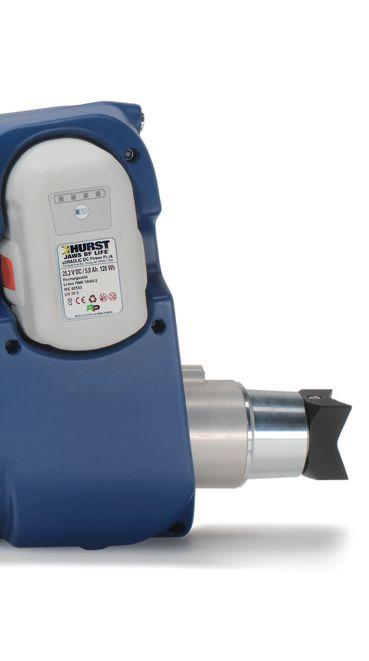
Make Room For The Industry’s Only Battery-Powered Telescopic Ram.


So, bluntly, that means that some municipalities are looking at whether or not a composite model would more effectively . . . provide appropriate fire-protection services . . .
– John Saunders, Hicks Morley
awarded to Peterborough’s police, Saunders said the decision is precedent setting.
“That’s a fundamental change from an interest arbitrator with regard to salaries,” he said.
Santoro says the decision is not a big deal – the association simply asked for parity with police, and got it.
“It was a typical award, but in the third year it was 1.5 per cent,” he said. “It wasn’t a lot but it’s what we asked for.”
A similar decision was expected at press time for the Toronto Police Service; the numbers, Saunders said, may be favourable to the municipality and will likely drive police-service salary awards across
the province.
“Which, in turn,” Saunders said, “could have a significant impact on the fire departments.”
Even if that happens, Saunders warns, the high cost of compensation for firefighters is forcing some municipalities to review their master fire plans to determine if there is a more cost-effective way to service local needs and circumstances.
“So, bluntly, that means that some municipalities are looking at whether or not a composite model would more effectively and from a performance perspective provide appropriate fire-protection services in their communities as opposed to
a full-time model. Right now there are a number of municipalities looking at that in Ontario.”
In late March, a consultant (and former fire chief) recommended that Cornwall, Ont., consider a composite model.
An equally frustrating issue for municipalities is salary compression, or the difference between the highest-paid members of the bargaining unit and the lowest-paid managers.
“By the time you have a captain or a platoon chief’s salary, with the addition of [retention pay] on top of that, and a little bit of overtime, they are often making a total compensation package similar to if not higher than the deputy chief who supervises them,” Saunders said.
Municipalities are then obligated to pay higher salaries for deputies and chiefs, whose paycheques become equal to those of senior municipal staff. And that, said Saunders, causes friction.
“You have a CAO who’s in charge of this whole municipality and asking why is the fire chief going to be paid as much as he is,” Saunders said.
“There is no solution.”
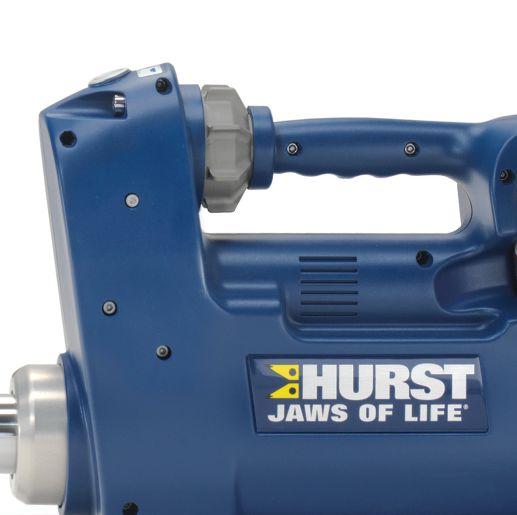
Without further introduction, let’s welcome the R 421E2 Ram to the industry’s most innovative line of rescue tools. This eDRAULIC™ 2.0 Ram extends 53” long with a max pushing force of 28,600 lbs. And its new sharp claws rotate 360 o on both ends, so it can get to work from just about anywhere. Even in a magazine.


BY MARK VAN DER FEYST
Securing and advancing a hoseline using a standpipe system in a building is an important aspect of engine-company operations. Standpipe systems are found in buildings that have multiple storeys or that are very large, such as warehouses or factories.
A standpipe system is designed to supply water to a fire department’s hoselines from within a building. When the fire is on the 20th floor of a building, or in a large factory, the standpipe helps crews in the attack.
In February, I helped conduct highrise training for the Hogansburg Akwesasne Volunteer Fire Department in New York at a casino in its response area. The casino has seven floors and is equipped with three standpipe systems. Crews were able to use one of the standpipes and access one of the hotel rooms to practise making the stretch. The mock fire was on the fourth floor in a room near the standpipe, which made the training realistic in terms of actually stretching a hoseline to a room. It is important for a department to work with its local building managers to obtain these types of opportunities.
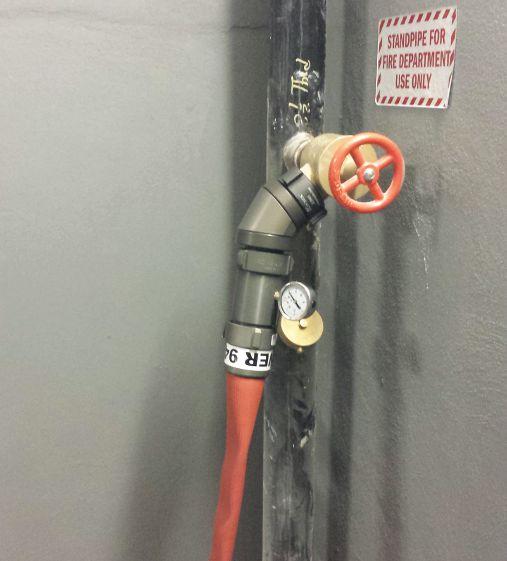
In a department’s highrise kit, there should be a pony length, 7.6-metre (25-foot) section of 65-millimetre (2 1/2-inch) hose, which goes to a gated wye, along with a 45-degree elbow that prevents kinking of the hose when coming off of the standpipe, a pressure gauge, multiple hose adaptors, a spanner wrench, a pipe wrench, a mallet and a spare wheel for the standpipe gate valve.
Photo 1 shows how the hose is connected to the standpipe using the 45-degree elbow and the pressure-gauge sleeve. The pressure gauge is important as it allows crews to see if there is enough pressure in the system to operate the hoseline. A problematic standpipe forces crews to go to Plan B, which may include providing their own standpipe system. This is accomplished by using a well stretch, or a well-hole stretch, inside the stairwell, or by putting an aerial ladder up to a window or balcony and connecting a hose to a discharge outlet on the ladder or platform.
If opting for a well stretch, start by checking the space between the stair rails to make sure there is enough room for the 65-millimetre hose. A firefighter can quickly check by making a fist and then inserting the fisted hand between the rails. If the fist fits, then there is enough room for the hose. The hose then runs vertically up the stairwell to the staging floor to connect to the hand lines. The hose is then secured with hose straps or webbing so that it does not fall back down the well.
In Photo 2, the gated wye is used to make a connection between the standpipe and the hand lines. It is important two handlines are connected to the standpipe system for a fire attack; one handline is the primary attack line and the second is a back-up line or additional
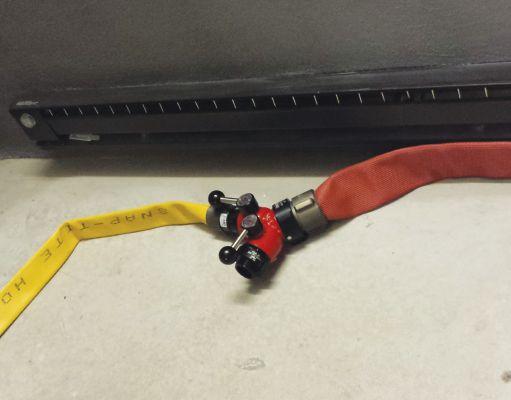
attack line. The gated wye is attached directly to the standpipe outlet after the pressure gauge sleeve, if a pony length of 65-millimetre hose is not used. The gated wye should be on the ground so that it is easily found in a smoke-filled environment. The downside to this system is the possibility of the gated wye being accidentally kicked closed. Notice how the gated wye and the supply hose are located on the outside walls of the stairwell.
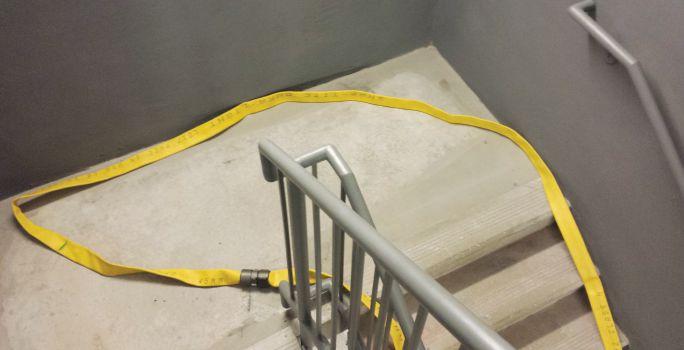
Photo 3 shows how the hose is placed on the stairs to allow a clear pathway while at the same time providing the water supply to the handlines. The hoseline is a tripping hazard so avoid placing it in the middle of the stairs.
The attack lines are also flaked out and run along on the outside wall. One firefighter
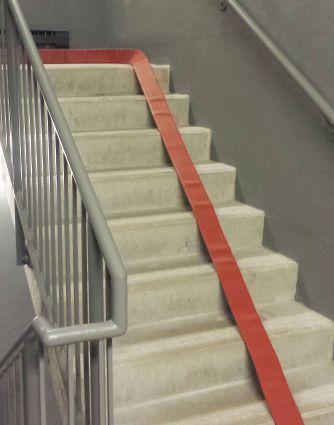
advances the nozzle and 15 metres (50 feet) of hose up to the fire floor and then up one more flight of stairs. The standpipe is always secured one floor below the fire floor to provide a safe haven for the attack team and also to allow the connection to be made without any hindrance from smoke, heat and flames. In Photo 4, the attack line is looped at the stair landing one flight above the fire floor to ease hose advancement during the attack. Gravity helps pull the hose down onto the fire floor as opposed to firefighters pulling it up the stairs.
Once the hose is flaked out, make sure that all kinks are removed and all sharp bends are rounded out before charging the handline. If the hose is caught under stair railings or pinched between stair treads or risers and is charged, the crew will have to shut down the line, drain the hose, re-advance and then recharge. It is better to take the extra second or two to make sure that the line is flaked out and ready for charging than to repeat it.
At this point firefighters are ready to make entry and attack the fire. In part 2 of standpipe operations in June we will look at the advancement of the attack line into the room.

Mark van der Feyst has been in the fire service since 1999 and is a full-time firefighter in Ontario. Mark teaches in Canada, the United States and India. He is a local-level suppression instructor for the Pennsylvania State Fire Academy and an instructor for the Justice Institute of BC. He is also the lead author of Pennwell’s Residential Fire Rescue book. Email him at Mark@FireStarTraining.com


BY SHAYNE MINTZ NFPA Canadian regional director
hen it comes to fire-service training, it is caveat emptor – or buyer beware.
It is my sense that even though the Durham College student who tragically died during ice-rescue training in early February in Ontario was not yet an official member of the fire-service brother and sisterhood, the entire fire community is grieving the loss of this aspiring firefighter. Since that terrible day, I have had inquiries about the role of the NFPA in both creating training standards and in the professional accreditation and certification process.
The NFPA has a critical role in the accreditation and certification of training agencies. NFPA 1000, Standard for Fire Service Professional Qualifications Accreditation and Certification Systems, provides clear guidelines that are the framework used by the International Fire Service Accreditation Congress (IFSAC) and the National Board on Fire Service Professional Qualifications (Pro Board) in establishing their process to accredit training agencies. The training agencies, in turn, certify that trainees have met the requirements of a specific NFPA Professional Qualification Standard.
To become accredited, a training agency is required to demonstrate that training and evaluation practices meet requisites recommended by NFPA 1001, Firefighter Professional Qualifications, or other professional qualifications standard such as NFPA 1021, Standard for Fire Officer Professional Qualifications, or NFPA 1041, Standard for Fire Service Instructor. Upon completion, the firefighter is recognized as being certified.
The achievement certificate is issued by the NFPA after an individual has successfully completed the required training program and has obtained a passing score on an examination. The examination is based solely on the educational content of the seminar and is open book. A certificate of educational achievement demonstrates that the learner has met the educational objectives of the NFPA training program he or she attended; it makes no claims as to an individual’s proficiency in conducting any specific task or job.
The NFPA certificate recognizes that an individual has successfully completed the requirements of a one-time educational course or training program. These programs are available only through the NFPA directly via distance learning or on-site seminar format. See catalog. nfpa.org/Training for more information on those programs.
While an NFPA certificate of educational achievement is a valuable recognition of educational achievement that can enhance a person’s professional development, it has no professional or other credential associations. Certificate holders cannot claim to be certified, licensed, accredited, or registered to engage in a specific occupation or profession. In contrast, professional qualification certifications provided by
It behooves the employer, the candidate or the purchaser of services to conduct due diligence . . . ‘‘ ’’
To become a certified firefighter the candidate must be trained and tested by a fire-service training facility that is accredited by either IFSAC or Pro Board. These are the only two agencies that can confirm a curriculum complies with the relevant NFPA professional qualification standard, and authorize the certification of firefighters to those standards. The list of accredited agencies for each province can be found on the respective IFSAC and Pro Board websites.
Where there was once a single professional standard for firefighters, there are now almost 20 different standards that focus on the various roles within the modern-day fire service.
As a point of note, an NFPA certificate of educational achievement is completely different than a professional certification or qualification.
Shayne Mintz has more than 35 years of experience in the fire service, and is the Canadian regional director for the National Fire Protection Association (NFPA). Contact Shayne at smintz@nfpa.org, and follow him on Twitter at @ShayneMintz
learning institutions or agencies that have been accredited by IFSAC and/or Pro Board are typically programs that certify professional or occupational competence. These programs require certain prerequisites and ongoing eligibility requirements.
On occasion, an organization or training entity may claim (or a learner may mistakenly interpret) that a program or course is NFPA certified or certified to the NFPA standard and that may not always be the case. It behooves the employer, the candidate or the purchaser of services to conduct due diligence and make sure that the claims being made by the training or certifying agency are accurate, validated and supported by the accreditation process of IFSAC or Pro Board.
Not all schools or programs are alike and it is up to individuals buying the services to shop around and understand what they are getting and what they will receive once they complete their programs.


BY LES KARPLUK AND LYLE QUAN
fter five years of writing our joint leadership column, it’s time for us to pass the torch to present and upcoming leaders. We have considered ourselves extremely fortunate to have had the opportunity to write together and to pass along our philosophies on leadership in the hopes of encouraging and motivating firefighters (at all levels) across Canada.
During our time writing these columns, we have received feedback from firefighters and it not only encouraged us to write more, but also made us want to do more in other areas such as consulting and speaking at conferences about leadership and team building. To be honest, there were times when we knew we would be touching a nerve with our thoughts. But, rather than play it safe, we expressed our opinions, hoping that they opened some minds in the areas of leading others and creating successful climates for promoting talent from within departments.
We know there will be good days, great days and bad days for everyone. It’s how chief officers deal with both the good and the challenging days that demonstrates just how resilient they are as leaders.
We have had numerous opportunities to coach and mentor those preparing for leadership positions and through this process we have not only encouraged them to step outside of their comfort zones, we have also communicated the reality of being a leader in the fire service; it’s hard work, but worth the journey. There is nothing more rewarding than leading a fire department, whether volunteer or career. The opportunity to be part of a team that is known for its courage, compassion and brother/sisterhood is something that many only wish they could experience.
Since this is our last joint column, here are some of our final thoughts.
Secondly, we have both been privileged to work with great leaders in our profession and because of them we have spread our wings and experienced our own personal growth as leaders. How others have helped us grow is reflected in our personal leadership philosophies. We are truly grateful for the seeds planted years ago by those leaders in our careers.
Thirdly, it is a privilege for us to serve as firefighters. Some people do not understand this privilege and their negative behaviours impact their teams and how they function. To be brutally honest, it is discouraging when we hear of firefighters being upset about the size of the letters on the backs of their departments’ T-shirts when we know that there are volunteer departments out there that have to fundraise so they can have department T-shirts. We have seen many situations in which firefighters viewed stumbling blocks as stepping stones to better things, and we have witnessed the exact opposite when a small issue is blown out of proportion because of negative attitudes. You need to look at the big picture; don’t sweat the small stuff, focus on why you are in this profession and get back to what really matters – serving the community and being the best you can be.
The fire service is a great and honourable profession but it is not
Will your departure, or the path you have created be what is cherished for years to come?
Firstly, it has been an honour for us to serve our fellow men and women, and it has been an honour to write for Fire Fighting in Canada. It seems like just yesterday we started writing, yet five years have come and gone. But feeling as if time has flown by is a testament to how much we have enjoyed our time writing for the magazine.
Les Karpluk is the retired fire chief of the Prince Albert Fire Department in Saskatchewan. Lyle Quan is the retired fire chief of Waterloo Fire Rescue in Ontario. Both are graduates of the Lakeland College Bachelor of Business in Emergency Services program and Dalhousie University’s Fire Service Leadership and Administration program. Contact Les at Genesis2020solutions@sasktel.net and Lyle at lpqsolutions@bell.net. Follow Les on Twitter at @GenesisLes and Lyle at @LyleQuan
perfect because it is made up of imperfect people who will make mistakes as they grow. That’s also how we learn – by trying.
We are not disappearing from the fire service. We are both helping and actively participating in the future of the fire service in other capacities, as consultants and instructors for fire-officer programs.
Never take for granted the privilege of your involvement in the fire service. Before you know it, the time will come when you will be leaving the fire service and will be passing the torch to others whom you (hopefully) have prepared to take over your role. Working and contributing to this great profession has been and continues to be our life-long journey.
Each of us has a legacy to leave. Will your departure, or the path you have created be what is cherished for years to come? May you succeed in your endeavours.
BY BILL BOYES Deputy chief, Barrie, Ont.
hen I was approached to write this column, I thought it would be a great opportunity to discuss my journey to a deputy-chief position, the challenges I faced in attaining the position and those I have experienced in my new role. I hope my columns provide some insight into how a chief officer experiences the transition from a front-line responder to an administrative role.
My longstanding and proud familial ties to the fire service started with my grandfather Bill, who joined the Alliston Fire Department in Ontario in 1949 and served as chief from 1958 through 1968. Undoubtedly inspired, my father Richard joined the same department in 1973 and worked his way to deputy chief at the age of 30. He has enjoyed a long and successful career as a chief in two other Ontario municipalities and is now executive director of the Ontario Association of Fire Chiefs. Given these ties and the influence of the fire service in our everyday lives, it is not surprising that my two brothers and I joined the emergency services.
After graduating recruit training with Brampton Fire and Emergency Services, I immediately sought my next steps. While I cannot pin down one specific event or situation that prompted my desire to become a chief officer, it definitely had something to do with dinner-table discussions about the challenges of leading a fire department in an era of unrelenting change.
Despite my unique access to the inner workings of fire-service management, it was quickly apparent there were significant challenges to attaining a chief-officer position. With no specific career-development path in Ontario for aspiring chief officers, I began to prepare for a chief-officer position without actually knowing what was required. The ramifications of poor or ignorant career decisions are extremely significant from financial, professional and personal perspectives. Going back to your former position within an association or finding a similar position in another sector is, for the most part, impossible. Our somewhat unique skill set as responders is difficult to transfer into another sector for similar wages and benefits.
Historically, compiling years of service was the de facto method to become a chief officer. It is difficult to pinpoint when the fire service changed to stress formal education, but certainly in the last decade fire-service administration practices have evolved to mirror those commonly found in the broader public sector.
The demands placed on chief officers have grown substantially due to a changing economic environment, an enhanced need for public-sector accountability, the transformation from a fire service to an emergency service, and many non-emergency responsibilities. The training and experience acquired through many years of fighting fires and responding to emergencies has produced efficient emergency responders; however, it has done little to adequately prepare the chief officers to strategically lead large public-sector departments with multi-million dollar budgets, legal responsibilities and human-resource challenges, all of which are conducted in politically sensitive environments. Chief officers in every fire department need to possess similar skill sets that are based on normative public-sector administrative and management principles. Furthermore, all chief officers must operate within the municipal management team.
Chief officers must contribute to the strategic and operational
The ramifications of poor or ignorant career decisions are extremely significant . . .
success of the municipality. This can be an arduous task given many of our peers at the management level of a corporation bring combinations of university education and incrementally increasing administrative responsibility.
Everyone I asked for advice had similar opinions. Most advised building up many years of service while incrementally moving through the ranks along with joining the union executive to understand labour relations and gaining some administrative experience. A select few (mainly my father) strongly advocated for completing a university degree in public administration. Thankfully, I listened to those who had the foresight to promote the importance of formal education.
Bill Boyes is the deputy chief of operations and training for Barrie Fire and Emergency Service in Ontario. Contact him at Bill.Boyes@barrie.ca
Ensuring the chief officers are sufficiently trained and prepared through a combination of formal education and competency is the only sustainable practice that will guarantee future success. Any aspiring chief officer must understand that the career path to fire-service management requires competency in the administration of a public entity, and formal education should underpin that competency.
In future columns I will discuss challenges and unexpected situations I have faced, the steps necessary to reach a chief’s position, offer some advice for those who want to climb the ladder, and reveal some things you may not discover until you attain the position.
■ Four (4) Adjustable Compartment Shelves
■ 26”/13.5” Deep Compartments
■ Undercoated Body
■ LED Lighting
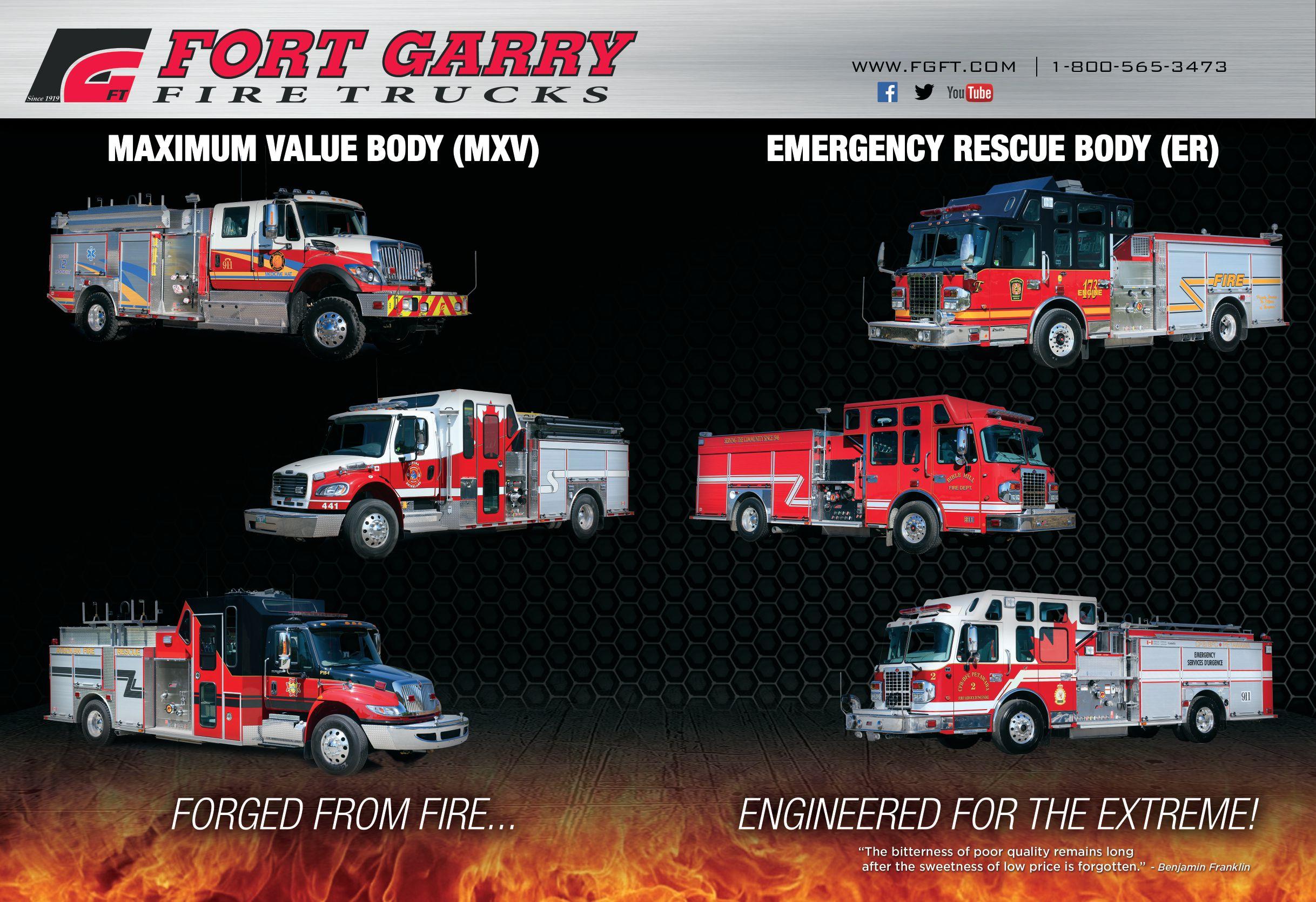
■ Aluminum Extruded Body – 5083 Saltwater Marine Grade
■ 20 Year Body Warranty
■ Darley, Waterous or Hale Pumps
■ Side Control, Top Mount or Top Mount Enclosed
■ 1000 IG Booster Tank
■ Fold Down Ladder Rack
■ ULC or NFPA Tested & Certified
■ Custom Options Available
■ Aluminum Extruded Body – 5083
Saltwater Marine Grade
■ 20 Year Body
Warranty
■ Darley, Waterous or Hale Pumps
■ Side Control, Top Mount or Top Mount Enclosed
■ 600/800 IG Booster Tank
■ Enclosed Ladder, Pike Pole & Suction Hose
Storage
■ ULC or NFPA Tested & Certified
■ Custom Options
Available

■ Four (4) Adjustable Compartment Shelves
■ Full Height Compartments
■ Undercoated Body
■ LED Lighting
By CHRIS DENNIS
It’s spring maintenance time at the fire department. The maintenance list is long. Truck-check sheets and maintenance records should be updated as you go.
Small-engine maintenance includes chainsaws, portable pumps, generators, vent saws and positive-pressure fans. Hopefully you remembered to change the gasoline and fuel mix on these engines on the first day of spring. There is a large difference between winter gasoline and summer gasoline. The different grades of gas are measured on a system of Reid vapor pressure (RVP), which is measured in pounds per square inch (PSI). The higher the RVP number of a particular gas blend, the more easily it vaporizes. All gasoline blends must be below 14.7 PSI, which is normal average atmospheric pressure; any higher than that and gasoline would become a vapour.
In the summer heat, the RVP of gas has to be especially low to keep it from boiling off. The United States Environmental Protection Agency (EPA) mandates an RVP maximum of anywhere between 9.0 PSI and 7.8 PSI for summer-grade fuel, depending on region, for using gas blended with 10-per-cent ethanol.
The time for switching from summer- to winter-blend gasoline varies by province. Generally, the lower the RVP of a gas blend, the more it costs. For example, in winter you can blend butane – which is relatively plentiful and cheap – with gasoline. But butane, which has an RVP of 52 on its own, can’t be used in summer; it would immediately boil off as a gas. If winter fuel is mixed in two-stroke engines, the oil mix will separate as it sits and the byproducts will fowl carburetors, which would necessitate an overhaul and new spark plugs. On a four-stroke engine, change crankcase oil and replace fuel completely as well change the spark plug. The twostroke engine requires the same process but with less crankcase oil. Replace the spark plugs and start all these engines, then let them run for some time. If possible, turn off the fuel while the engines run and let them run out of fuel.
To reduce the chance of equipment fowling while traveling to a call, use the gasoline octane rated by the manufacturer. How many departments have only a few premixed gas and oil options for twostroke engines? Examples of premixed ratios are 50:1, 26:1 and 40:1. These measurements are the amount of fuel to oil required for your specific piece of equipment. Over the past five or six years, premixed and straight fuel in a can have become available for purchase over the counter. For example STIHL, a manufacturer of gas-power tools, recently introduced an over-the-counter premix ethanol-free fuel in a can, called MotoMix (see photo 1). With the premix, there is no need for gas pumps, fuel cards or learning the science involved in mixing. Now if you need 50:1, it is available in a one-litre tin.
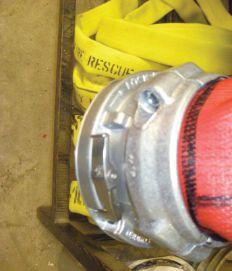
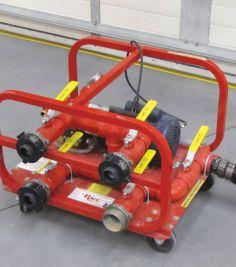
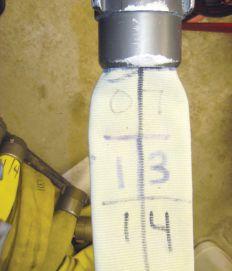
Some manufacturers have introduced premixed fuel, such as STIHL’s MotoMix, which have longer shelf lives than mixes with gas from the pump.
During hose testing, the locks on non-threaded hose connections, such as Storz couplings, should be checked to ensure there is no unintentional disconnection.
3
A certified hose tester can test multiple hoses at one time and consists of different hose size coupling.
After testing a hose, use a permanent marker to identify the month, year and the pressure at which it tested.

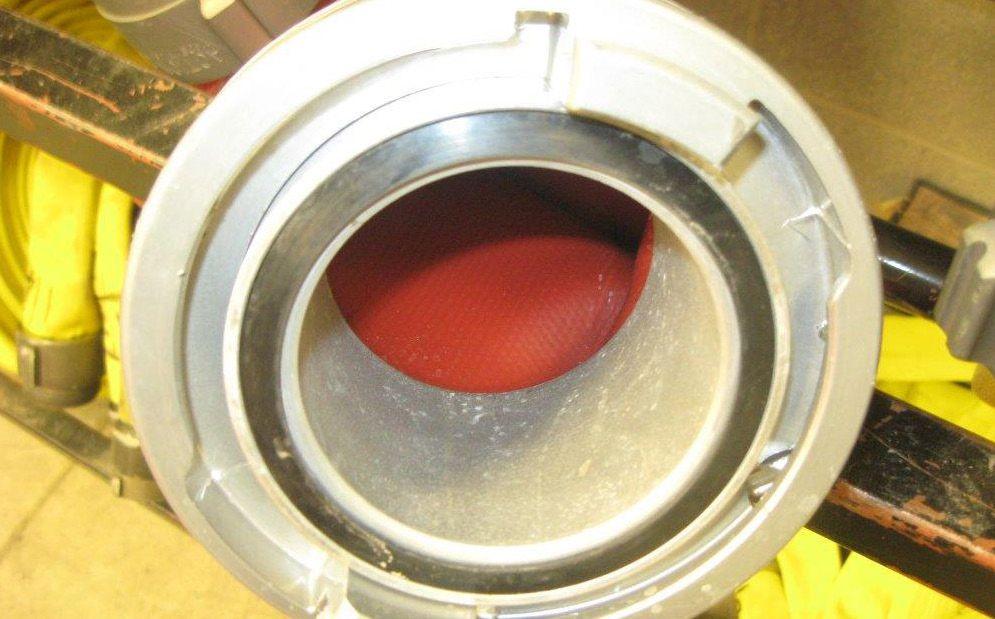
To replace the fuel in, for example, a saw, first drain all existing gas. Then run the engine until it runs out of fuel. Refill the saw’s fuel tank with MotoMix and start the engine. Make sure it functions correctly after starting; in some cases fuel mixtures on carburetors may need to be adjusted for a new fuel. Because MotoMix is ethanol free, its shelf life with the seal broken is two years, and up to five years if it is sealed in the tin. By comparison, gas from the pumps begins to separate after two weeks in a gas-powered tool’s fuel tank, carburetor or gas-storage container. This is not an infomercial for the STIHL product; we use STIHL gas-powered tools in my department and this product works for us. TruFuel is another manufacturer of premixed fuel, and comes in 40:1, 50:1 and four-stroke mixes.
The next item on the maintenance list is ground ladders. Use the current edition of NFPA 1932: Standard on use, maintenance and service testing of in-service fire department ground ladders, and the International Fire Service Training Association’s manual for fire service ground ladders, as references for maintaining ground ladders. I also suggest keeping a maintenance log for ground-ladder inspection and testing, which will vary depending on a department’s and call volume or a training division’s use of the ladders. Vaughan Fire & Rescue Service firefighters check all ground ladders every Sunday. All ground ladders come off the trucks and are thoroughly washed with mild soap and water and light wax or
silicon-based spray is applied to all friction surfaces. Do not use an oil-based lubricant. Smaller departments may require an inspection just once a month or every six months. Whatever inspection timeline you use, be consistent. Inspections should cover heat stickers, ropes, cables, beams, rungs, pulleys, feet and ladder locks.
Figure 1 is a Duo-Safety ladder report approved for use:
• Regular ladder maintenance and keeping written logs allows departments to track problems before they become accidents.
• Non-destructive testing, which is done by a third-party who specializes in this testing, is also necessary as per NFPA 1932, at least once a year.
Yes, tires cost a department a lot of money when they need to be replaced. Tire air pressure needs to be checked more often in cold weather, but if that was not done during the winter, now is the time. Nitrogen has been used in tires for many years now because it does not expand when heated or condense when cooled. The lack of condensation means less rust on the inside of a steel wheel and less chance of bead or rim leaks due to aluminum corrosion. A tire’s side wall has a lot of information, such as air pressure for cold, air pressure for dual tires, tread wear indicators, tire size, make and model, load ranges and the Department of Transportation (DOT) number for tire identification. The DOT number is found close to where the tire mounts onto the rim.
The last four numbers determine the week and year it was made. For example: DOT JRL MDL 3609 means the tire was made in week 36 of 2009.
There is no fixed rule in the fire service that determines tire life expectancy of tires. Manufacturers often suggest replacement every 10 years, but because of the service we provide, you may want to replace every seven years. Over time a tire can dry and harden, which reduces wet-weather handling and braking ability.
Tire rotations can help tires wear evenly and increase life expectancy. Rotations cost between $300 and $500, whereas a complete set of tandem drives costs upwards of $10,000.
Hoses – whether they are rubber or a weave of some kind – should be tested annually. NFPA 1962: Standard for the care, use, inspection, service testing, and replacement of fire hose, couplings, nozzles, and fire hose appliances, is a guideline and best practice that factors in new materials and new technology. The standard provides specific criteria for attack hose, forestry hose, booster line, occupant-use hose and suction hose.
• Remove from service hose made prior to July 1987.
• Establish a replacement schedule for fire hose, taking into consideration the use, age and testing results of the hose.
• Conduct system tests at least annually on each pre-connected line or any attack line used for interior firefighting operations on a fire apparatus, together with the nozzle or hose-connected appliance it supplies.
• Service test nozzles at least as frequently as the hose to which it is attached.
• Service test attack hose to a minimum of 2,070 kilopascals (KPA) or 300 pounds per square inch (PSI).
• Service test supply hose to a minimum of 1,380 KPA or 200 PSI.
• Provide all non-threaded hose connections (such as Storz couplings, see Photo 2) with locks to ensure against unintentional disconnection. There is a lot to discuss about hoses made prior to 1987 coming out of service. What about the hoseline that is pre connected on the truck for special application or that sits as a dead load? Test this hose annually and, if the budget allows, buy a new one. Let’s face it, 1987 was 28 years ago. If you buy a new truck, spec it with new hose – it is cheaper to
include new hose in the spec than to purchase it afterwards. Figure 2 is a test flow chart for hose prior to 1987 in PSI.
Be sure when hose testing that single or multiple wall liners or jackets are identified. Over pressuring will cause failure and possible injury.
Vaughan Fire tests its hose twice a year – spring and fall – due to call volume. Departments should test hose at least annually. Many departments have a system in place that includes a full inventory spreadsheet with some kind of identification, such as a serial number and the name of the repair technician. The system for identifying hose and appliances can be as simple as using the station ID number, the month and the year tested, and end with a number. Continue numerically – for example 71032015 1. Stamp or engrave this serial number on the coupling, recording if a hose is repaired during its lifetime or a coupling is replaced. Again, use your custom serial number and mark it with an identifier that says it was replaced, such as R 71032015 1 R. Do not reuse the old hose test date. The hose, once repaired, will need to be retested so it should be a new number. I recommend you budget for and purchase a certified hose tester that can test multiple hoses at one time and consists of different hose size coupling (see Photo 3).
Hose testing requires a lot of room and a nice day or two. Once the hose is tested, use a permanent marker to run a line all the way around the hose next to the coupling until the lines meet. Next, pick a spot on that line and draw an eight-centimetre (three-inch) vertical line, straight off the coupling. Now date that hose by month, year and the pressure at which it tested, and then rebrand the coupling as mentioned earlier. (See photo 4).
Nozzle maintenance and testing should be done at the same time as hose testing. Ideally, you have been trained by the nozzle manufacturer to disassemble, perform general maintenance and reassemble the nozzle with the correct tools. If not, be sure to wash with mild soap and water, then hook up the hose to a charged line and test full operations: bale open/close operation, bale to smooth bore to fog operation, nozzle adjustments, flow rates, etc. If all systems are a go, store the nozzle back on the rig. If an appliance or hose failed, clearly tag what failed and store it in a spot for repair. Create a written log or spreadsheet to record maintenance, as well as failed parts and note when repaired parts returned to service.
The most important part of spring maintenance washing and waxing those beautiful rigs. Clean the interiors wash the windows and floor areas.
When the truck is in service, start by emptying all compartments one at a time. Wash compartments with soap and water and with a salt-eliminator mix to get rid of any winter road salt buildup. Avoid using pressure washers to prevent the water from penetrating electrical parts such as lighting or open door-warning systems. Wash all compartment equipment and lubricate zippers on bags door hinges, guides or rollers with food-grade biodegradable lubricants, which are harmless to skin and the environment. Remember, rubber side down, my friends. Have a great and safe summer.
Chris Dennis is the chief mechanical officer for Vaughan Fire & Rescue Service in Ontario. He can be reached at Chris.Dennis@vaughan.ca

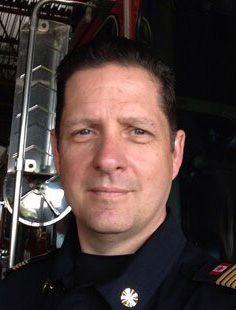
BY KEITH STECKO Fire chief, Smithers, B.C.
n the March issue I outlined some of the emotions that firefighters may feel after a critical incident, and some of the signs and symptoms that may be associated with those feelings. The next step is to talk about strategies to increase your emotional resiliency, and how the organization can do the same.
Increasingly, firefighters are responding to different types of emergencies and disasters, which requires effective crisis-response capabilities. Critical-incident stress management (CISM) is a powerful tool for crisis response. CISM is a comprehensive, multi-component crisis psychological first-aid intervention system that covers the continuum of a crisis experience, from before it occurs through to the crisis phase.
As with pre-fire planning, organizations can pre-plan how and when CISM is applied through operating guidelines, policies, training and emergency planning. Further, educating and training of firefighters about CISM as part of the overall culture of the organization can help to build emotional resiliency on a continual basis.
Breaking down the trigger points gives an idea of how and when CISM can be applied:
Pre-crisis preparation: This includes stress-management education, stress resistance and crisis-mitigation training for front-line people and those in supervisory/management roles. The goals are to improve stress management through recognition of the emotional signs and symptoms of stress, and to provide resources and support. This is probably one of the most critical aspects of the CISM system because it gives firefighters the tools to build their resiliency by recognizing and developing strategies.
up as responders start to digest a traumatic event and try to understand the range of reactions and responses that follow the experience. The critical-incident debriefing is like psychological first aid that informs and empowers a group after a threatening or overwhelming situation. The debriefing can boost firefighters’ resistance to stress reactions, build up their abilities to bounce back from traumatic experiences, as well as facilitate recovery and return to normal healthy functions.
Follow-up: Referral mechanisms for assessment and treatment, if necessary.
It is important that a responder considers talking about the event – what you saw, heard, smelled and did – and about your reactions, particularly how you felt. Tell your story to someone in whom you can confide. Confiding is key; it begins the healing process inside. It helps the responder release all the things that are being kept bottled up.
Understand and expect the incident to bother you. Remind yourself that your reactions are normal. Do not think you are going crazy, or you are the only one who has been affected. It is also important to understand that recovery takes time. Give yourself permission to heal.
. . . when we are hurt inside, it is important that a system of emotional first aid be applied. ‘‘ ’’
Defusing: This is a group meeting of those involved in an incident, ideally held directly after or within 12 hours of the event. An officer or firefighter may call a defusing if he or she notices something is bothering someone. The goal of the talk is to ease the symptoms and bring relief. It is an opportunity for members of the team to talk about what happened and their reactions. The group leader can provide information about normal stress reactions, available support services and details of the follow-up critical-incident stress debriefing. It important that defusing meetings are not confused with operational debriefs.
Critical-incident debriefing: This usually occurs one to seven days after the incident. The goal is to assist participants in finding physiological closure. In my experience, a lot of emotions can bubble
Keith Stecko is the fire chief and emergency program co-ordinator in Smithers, B.C. Contact Keith at kstecko@smithers.ca and follow him on Twitter at @KeithStecko
Try to be patient with the changes in your emotional state. Participate in critical-incident stress defusing as soon as possible after the event, and later in critical-incident stress debriefing. Be careful, and watch your fixation on the incident; allow yourself time to recover.
Establish or re-establish routines, engage in healthy behaviours to enhance your ability to cope with excessive stress. Eat well-balanced meals, get plenty of rest and follow an exercise program. If you experience ongoing difficulties with sleep, you may be able to find some relief through relaxation techniques.
It is not a matter of if a critical incident will occur; it is a matter of when. We can increase our resistance by being healthy and increasing our emotional resiliency. Talk openly about critical-incident stress, support one another and train for it. By doing so, a resilient fabric of support is created both on and off the fire ground.

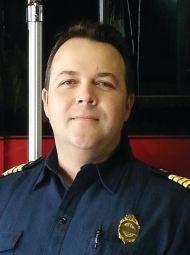
JEREMY PARKIN Deputy chief, Rama, Ont.
top buying fire trucks! There, I said it. There seems to be this idea that buying a fire truck for a community will prevent any and all fire fatalities. There is a tragic flaw in that thinking when it comes to First Nations communities across Canada.
Along with the recent tragedies in Makwa Sahgaiehcan, Sask., and Siksika, Alta., there is a steady stream of stories detailing fire fatalities on First Nations communities. What makes the headlines is usually the inadequate level of fire safety in these communities, followed by an overview of the antiquated federal funding program in place. Some may say it is hypocrisy for me to make generalized statements while I work for a highly funded First Nation with an incredible fire department. But it wasn’t always that way. Our success is in our people, our programs, and our slow and deliberate growth. Being located in Ontario, we benefit from the three lines of defence philosophy – public education, code enforcement, and response. So I hope to shed light on what I and many others believe are the best options for success for creating a fire-safe First Nations community.
The diversity of First Nations across the country is vast. There are many issues facing these communities, and no single idea will solve them; many are intertwined at socio-economic and cultural levels. Overall funding is a historic issue. It has not kept pace over the decades; it creates hardships on many fronts from education to infrastructure. Simply put, it is imperative that the funding model be corrected. There are many stories of fire trucks sitting rusted and unused. Community budgeting and proper funding allocation is critical. It is costly to operate a full-complement fire department with a working fleet. It is not practical to assume that only having a fire department will solve the issue. Zero fire deaths is a common goal for all Canadians. Fire doesn’t target race or ethnicity.
While First Nations govern and operate at a federal level, nothing stops them from establishing their own regulating bylaws. There are both national and provincial building and fire codes available. There is room in the Indian Act regarding the interpretation of provincial laws. Education on all codes, standards and legislation is paramount. Set the level of service and address the issues brought to light in the risk analysis. Use the existing standards and legislation as tools, and do not be confined by them.
Fire safety is universal, and many very brave and intelligent women and men have solved some of the big concerns. Integrate these. There are numerous success stories from places like Behchoko, N.W.T., to Indian Brook, N.B., to Moose Factory, Ont. Engage with communities like these. We should celebrate these success stories. How have they adapted and overcome and who else can repeat the process? Among the various First Nations political groups there should be discussion and sharing of ideas, opinions and solutions. Changing the big machine of government takes tremendous time, effort and resources. But there are several ways to make changes with immediate impact. Become part of the solution and join local, provincial and
Overall funding is a historic issue. It has not kept pace over the decades . . . ‘‘ ’’
Until the funding model is addressed, there are opportunities to improve. A great place to begin is with a community-risk analysis. Determine what the local risks are, and determine what capacity there is to mitigate them. Compartmentalize and prioritize the risks. I have always praised the benefits of partnerships – local, provincial and federal. A risk-based approach to creating a fire-safe community will prove more successful than relying on suppression and response only.
Jeremy Parkin is the deputy chief for Rama Fire Rescue Service in Ontario with the Chippewas of Rama First Nation. He has 17 years of fire-service experience and spent the past eight years working to improve fire safety in First Nations communities. Contact him at jeremy.parkin@ramafirstnation.ca
federal associations. Lobby for necessary change. Find a champion in your community, one who will ensure there are working smoke alarms in every home. Find somebody who will educate the children, seniors, or at-risk groups on fire safety and home escape planning. Start building homes that meet proper codes. Do something.
The solution is not as simple as pouring more money into the problem. Success has a cost to it, but it cannot be bought. Until there is more money available, create a better value for your community investment. Do not aim for impractical solutions; find realistic and achievable goals. But most importantly, whatever path you choose, invest in your people: they are the greatest resource you will need in building a fire-safe community. The bonds that hold them together will be the programs and services you implement. Give them a reason to unite. Then buy a fire truck.
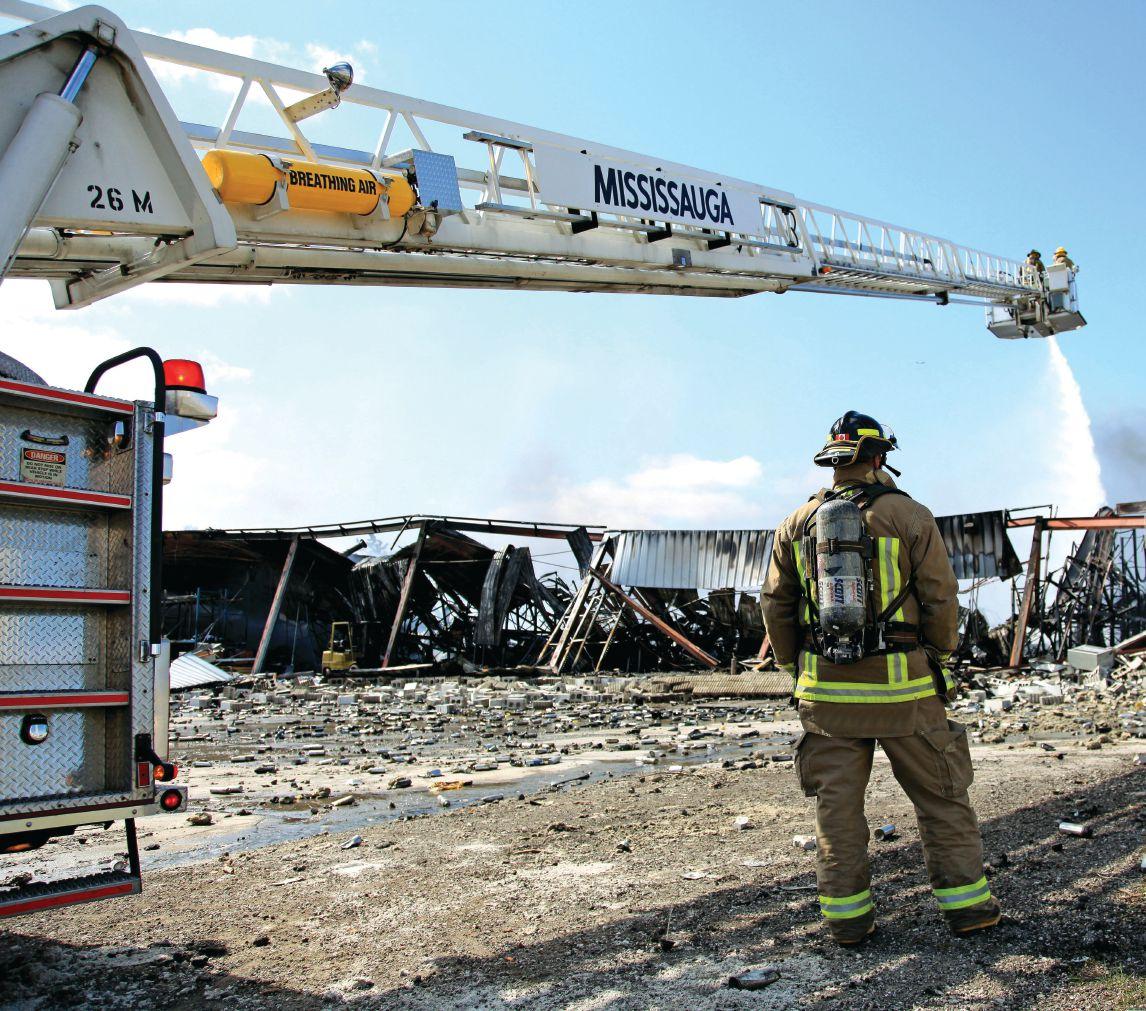
Mississauga Fire embraces a peer-team support system
BY MARIA CHURCH
LEFT A Mississauga firefighter surveys the wreckage of a massive industrial fire – dubbed the Thamesgate fire – in April 2014. The three-alarm blaze caused multiple explosions that seriously injured four firefighters.
ABOVE Mental health professionals agree that the brains of first responders are affected by critical incident stress, and, if left untreated, the stress can take its toll on their work and home lives.
Mississauga firefighter Jodine Hough has a soft, calm voice – a trait that likely makes her an asset in her role as a peer team member. She described that role with humility.
“It’s voluntary for firefighters to speak about an incident,” she said. “But we let them know that we are here to talk, and here are the resources.”
Hough and her seven co-members that make up Mississauga Fire and Emergency Services’ peer team are volunteers offering their time to what is increasingly being recognized as essential and lacking in Canada’s fire service: mental health support.
“Critical incident stress is not really dealt with [in the fire service],” Hough said. “But I think people are becoming more aware about mental health as it comes more out of the wood work,” she said.
Hough has been a member of the Mississauga peer team for 10 years, only two years after she was hired as a full-time firefighter. She took on the role of team co-ordinator six years ago.
“I saw colleagues who were struggling,” she said. “And, especially in a male-dominated profession, a lot of guys don’t like to talk because they know they are looked up to. To appear to have weakness, it comes across as shameful.
“A firefighter’s job is to help the public, but (the peer team) is here to help internally,”
Hough said.
Dave Connor, district chief with Mississauga, spearheaded the department’s peer team in 1989.
Connor - now a mental-health trainer and leadership facilitation consultant – credits his interest in critical-incident stress management in the fire service to his own experience with critical-incident stress. His response, he said, was trig-
gered years ago though excessive alcohol consumption and a particular scent.
Looking for answers, Connor researched and learned about peer-support methods being pioneered at the time by the Ontario Provincial Police (OPP).
“I did the exploratory work into getting some peer support training for myself,” he said. After a few courses, one of which was with the OPP, Connor became Mississauga Fire’s first and only peer-support team member. His job starting out was to go and visit crews that were having issues after serious calls.
Years later, as more members joined and trust in the team grew, so did the services members provided. The team’s mandate began to include social services in areas such as suicide intervention and addiction.
“Those things become part of the catalogue of services,” Connor said. “It was really out of necessity that we did that.”
Despite its necessity, Connor said, keeping the peer-team project alive was a rocky journey.
“We definitely struggled for funding and support in the past,” Connor said, and there were times that the peer team wasn’t used or activated frequently.
A turning point for Mississauga’s peer team, Connor said, was aligning with the Joint Wellness Fitness Initiative – a resource provided by the International Association of Firefighters (IAFF) and the International Association of Fire Chiefs.
The Joint Wellness Fitness Initiative provides information about successful wellness programs being run across the United States and Canada. Aligning with the joint initiative, Connor said, gave the peer team the legitimacy necessary to secure approval and funding from local government and fire service associations.
Today, the peer team is kept alive through support from its chief and members, strong relationships with the firefighters’ association and the city’s health services department, and a specific budget set aside for wellness.
In 2014, Mississauga Fire – a department of 708 staff – spent about $30,000 to put each member through basic mental-health training. That’s about $50-75 a person for training, which is administered
with assistance from the peer team.
Depending on the size of the department, Connor said, the cost to set up a peer team is between $4,000 and $8,000. Departments should also budget between $3,000 and $10,000 annually for certifications and courses.
Mississauga’s peer team includes a mix of ranks in the service, from third-class firefighters to district chiefs, as well as in suppression, communication and training. The idea is that firefighters have the opportunity to discuss their work-related stress with a co-worker in a comfortable and causal setting.
The peer team is activated ideally within a few days following a traumatic incident. A meeting is scheduled and members are encouraged to discuss what happened. If required, psychologists are brought in to monitor the discussion.
“The peers, they’ve been through the trenches,” Hough said. “They know what to expect, and how to deal with what you’ve seen; it adds credibility. If they talk to you, you’re gong to understand where
The support peer teams give to departments in terms of keeping people at work and reducing the level of disability, it’s one of the best values you can get for very little money.
– District Chief Dave Connor, Mississauga Fire and Emergency Services
they are coming from.”
Sometimes, she said, that means using black humour that the general public likely would not understand.
The peers aim to meet at least four times a year to train on the latest services in mental health. As the co-ordinator, Hough is responsible to ensure the team’s training is up to date.
The team is certified through the Canadian Critical Incident Stress Foundation; however, there are other certifications available internationally.
“We maintain [the certification] as a base,” Hough said. “Then we do additional training. There are courses provided in suicide intervention, addictions, resiliency – so all different ones we try and have to add
diversity to the team.”
An example of one of the peer team’s initiatives is the spousal day for new recruits. The team organizes a day when new firefighters and their spouses are invited in to hear about critical-incident stress and services offered by the department’s employee assistance provider.
A peer team starting out, Connor said, first needs support from outside of the fire hall. That’s where psychologists come in. Trained mental health professionals are needed to guide the initial interactions of the peer team with department members in order to gain trust and support, as well as add legitimacy.



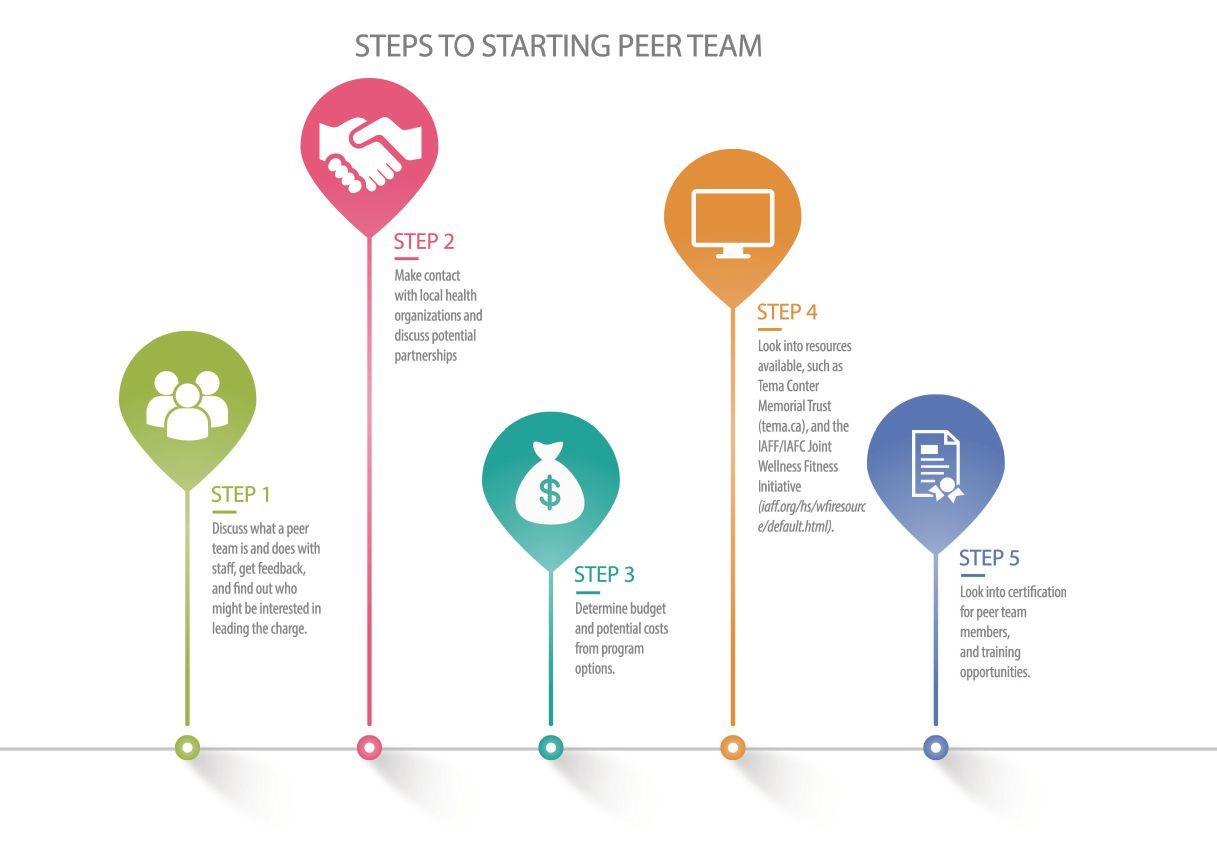




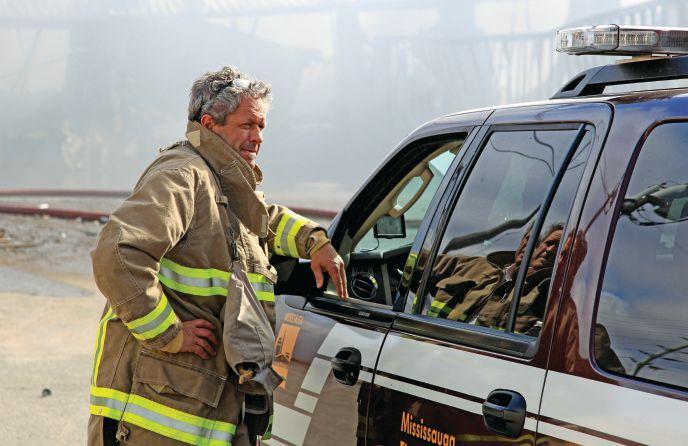
To find professionals, departments must connect with mental health providers in their municipalities. For Mississauga, that meant partnering and working closely with the city’s employee health unit.
Drew Sousa is the manager of employee health services for the city of Mississauga. She was behind a municipal government-wide mental-health awareness campaign in 2012.
Not long after that campaign, Sousa determined that the fire department required further attention.
With the peer team already in play at the time, Connor and Sousa teamed up to brainstorm ideas to further support mental health services for members of the Mississauga fire department. The resolution was to bring in an outside employee assistance provider and
A district chief reflects after the warehouse explosion, which tested Mississauga Fire and Emergency Services’ response to a large incident.
to work with the peer team and the IAFF/ IAFC Joint Wellness Fitness Initiative.
“My role was to bring more of a health care professional perspective into it,” Sousa said, “to help our fire department learn how to pull all of the resources that were available, and to position themselves in a manner that the rest of the (government) organization wanted them to be in.”
Partnerships, Sousa said, are crucial for any fire department – regardless of size or budget – to create a legitimate and effective mental health peer team.
“There are a lot of organizations out there now,” she said. “Especially right now with mental health being at the forefront.
“A small department shouldn’t be intimidated. Start conversations about people like us,” Sousa said, “and learn from us.”
Mississauga Fire was praised for its peerteam approach to providing mental health










services to its firefighters earlier this year during the Ontario Association of Fire Chief’s labour relations seminar held in Toronto.
Mississauga Fire Chief Tim Beckett gave a presentation on the peer team during the seminar, along with Connor and Hough.
Beckett, who came on as chief for Mississauga in July 2014, said he was encouraged at the time to see that the department had mental-health services already in place.
The resources allocated for the wellness/fitness initiative, including the peer team, represent “a long-term investment in the department’s staff,” Beckett said. It also shows that the employer cares.
“Mental health issues do not distinguish between sizes of departments,” Beckett said. There are costs, he said, but there are also supports available.
“There’s an onus on organizations to invest in this, and invest in their employees,” Beckett said. That means, as a chief, making the tough decisions, he said.
“We’ve got to start thinking differently and as a leader, my job really is to push that
change of thought through the organization,” he said. For Beckett, an opportunity for change came in November, shortly after the department lost one of its firefighters to suicide. A close friend of the firefighter was scheduled to work during the funeral, but, after a discussion with the chief, was given the day off to attend the service.
“In the past that’s not how we would have done things, but that’s the change that we need to look at,” Beckett said.
There is also an onus on chiefs to lead by example, he said. “You don’t have to be that tough, grumbling firefighter that everybody has in their perception, you can be the softer, kinder person that says, ‘Yeah, you know what, I’m impacted by this.’ ”
At this point, Connor said, with all of the studies and evidence available online, all chiefs should already know the importance of having services for mental health. What it broils down to is almost always funding. But the payoff in this case, he said, is well worth it.
“The support peer teams give to departments in terms of keeping people at work
and reducing the level of disability, it’s one of the best values you can get for very little money.”
While it will be impossible for volunteer departments to mirror what Mississauga has done, Hough says it is possible for small departments to provide peer-team services.
She recommends looking first into free resources that provide mental health support and services. One of those resources is the Tema Conter Memorial Trust (tema. ca), a foundation established in 2001 that provides peer and psychological support for Canada’s public safety organizations.
Initializing partnerships with local health organizations, as Sousa suggested, is also a good place to start looking for support for a peer team.
Even one person (who has what Connor calls the helper gene) can make up a peer team for a small department, Hough said.
“It’s about finding someone who has passion for it,” she said, “someone who wants to help their colleagues, and is trusted in their department. As belief in them starts to grow, more people will step up to help them.”

By CHRIS DAVISON-VANDERBURG
A fire instructor wants his or her lesson to strike a chord, impact behaviour and leave firefighters thirsty for more. The proper use of visual amplifiers can boost a PowerPoint’s visual and emotional appeal to help students retain knowledge.
You love amplifiers. Even if you don’t rock out, you love amplifiers. Now before the jazz, classical music and easy-listening aficionados move on to the next article, allow me a moment to explain. As you know, a sound amplifier essentially takes noise and increases its strength to make it louder. As a firefighter, you love amplification because increasing strength with equipment is something that we do daily: fire pumps increase the discharge pressure of our water, hydraulics move extrication tools or monstrous ladders, and compressors
jam a bunch of breathable air into a tiny cylinder. See . . . you love amplifiers!
As instructors, we should consider how PowerPoint presentations are our visual amplifiers. We use them to strengthen the message and subject matter both visually and emotionally, which helps students with retention. Used improperly however, these visual amplifiers distract the learner from the key points and reverse the intended effect.
I remember going to see a new rock band many years ago in a small bar. The amplifiers were cranked to the point of utter distortion. The experience was

unpleasant and the sound system made the group sound amateur. My friend informed me of the band’s impending record deal and I was dumbfounded. (I’m pretty sure I said the group was going nowhere.) Months later, I heard the band’s hit song on the radio and it didn’t even sound like the same group. What was emitting from the speakers was crisp, clear and clean; it was in complete contrast to what I had witnessed live and I was able to hear the music and the message. I enjoyed it a lot more.
This story illustrates what we need to do with our PowerPoint presentations; make them crisp clear and clean by removing the distortion. I believe that we need to be careful we use our instructional amplifier so that the lessons come through clearly, are memorable and don’t allow the distraction of visual noise to turn off our students. We want our lesson to strike a chord, impact behaviour and leave firefighters thirsty for more.
In the February issue of Fire Fighting in Canada, I mentioned that we need to alter the way we use PowerPoint and consider how we can overload individuals with too much verbal and visual information at the same time. By splitting students’ attention with slides that are loaded with information while we lecture or talk simultaneously, we risk overloading their working memory. Very few of us are able to pay attention to two different things at once. Think about how challenging it can be to maintain focus on a
conversation that you are in, when suddenly you overhear your name being mentioned by others in a separate discussion.
The fact that our working memory capacity has inherent limits was first suggested in the 1950s. The science moved into the classroom when cognitive load theory was developed to emphasize the limitations of working memory load on learning during instruction. Instructors were cautioned to be careful where they directed a learner’s attention. Splitting a student’s attention was proven to interfere with learning. Eventually, a cognitive theory of multimedia learning was introduced and this is where PowerPoint comes back in. The theory is based on the idea that there are two separate channels for processing information – an auditory and a visual channel of which there is a limited overall channel capacity. Think for a moment about hydraulically venting from a window: if your pattern is too wide, the water hits the wall, there is no Venturi effect and the smoke and heated gases never get outside. If you are providing a lot of visual and verbal information in your lesson at the same time, your pattern is too wide: some information will hit the wall instead of making it into your students’ brains. You want to focus the amount of information to a narrow stream so that it penetrates through the working memory and into the long-term memory.
To be clear, I encourage the use of PowerPoint at certain points during instruction. Educational psychologist Richard Mayer came up with what is known as the multimedia principle, which states
that people learn more deeply from words and pictures than from words alone. Information derived from graphic images on the screen combined with the auditory information coming out of the instructor’s speech is organized dynamically to produce mental constructs. PowerPoint, when done well, can even elicit specific emotions. When we combine emotions with key learning points, it makes for a memorable lesson.
I believe, however, it is important to keep cognitive load and working memory in mind while we prepare our lessons. We must plan how we will purposefully focus, maintain and direct the students’ attentions throughout the lesson, free from distraction or visual noise.
So what does this mean when you need to teach? It means don’t crank the amp up too high on your PowerPoint. As an instructor, you are the star of the show, not your amplifier. While you are at your computer creating the presentation, take a moment to consider how the visual communication is going to coincide with the verbal information that will be spilling out of you. Tone down your graphics to single images or words that can match up with what you plan to say. Reduce the load on the working memory’s processing channel and provide the message crisply, clearly and cleanly. Simplicity matters.
There is a predictable journey that occurs between an individual and PowerPoint. Like the guitarist plugged into an amp, skills have to be built sequentially over time and experience makes a difference. No matter your experience level, however, the visual
At less than 3 pounds (1.27 kg) and a light output of 1203 lumens, the new 9410L LED Lantern packs the power without the weight. And it’s loaded with innovative technology and features you have come to expect from Pelican.
amplifier will be projecting your stuff. Here are some tips related to your level of PowerPoint experience:
Your slides are always a title with bullet points underneath – the software default. If this describes you, you are likely still working with the software basics; how to change text, inserting images and moving between the editing and slide show modes. Don’t sweat it, everyone starts out here and keep in mind that every great fire chief had a first day on the job as a recruit!
It helps that you don’t have any bad habits to break. Start by deleting the bullet-point box. Try to create slides with minimal text, one to five words, or a single full-page image either alone or with a few words. The content of the slide should be a trigger for what your students really need to remember. Your screen should display only the highest levels of information or images that convey an emotional response. Resist bullet-point lists or step-by-step procedures on a single slide. Spread lists and step-by-step points across multiple slides, have them in your instructor notes, or provide a handout. Better yet, create activities through which the students will figure out those lists on their own.
You are comfortable with the software, use a stock of regular presentations, and are exploring other features such as transitions, animations, media and design templates.
Tread carefully. It is tempting to let the features of the software drive your presentation design. Just because you can do something
WHERE: October 3 and 4, 2015 WHEN:
COST: Grand River Raceway, Elora, ON in partnership with Centre Wellington Fire & Rescue
FOR: Dr. Rebecca Gimenez of TLAER Inc., PhD. LEAD: Early Bird $179 (July 15, 2015) $200 CDN + hst (2 day awareness level training)
First responders, law enforcement & animal control of�icers
Let us heLp protect you
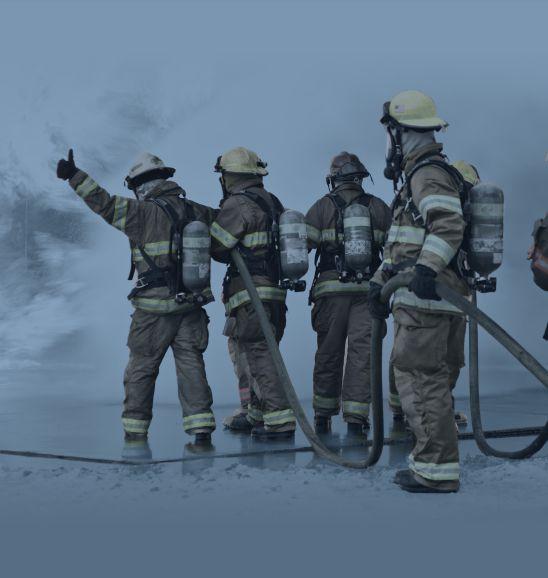
For your cleaning, decontamination, inspection, testing, repair and record keeping of your firefighter’s protective clothing... we have you covered!
• 24/7 access to Firetrack®, the online data base that provides you with complete details of your C&M Program with FSM. We do the work for you!
• ETL Verified
• ISO 9001 Registered
• Fast turnaround
• Complete Bunker Gear Rental Program – Toronto Location
Ontario (toronto) 1-888-731-7377

doesn’t mean that you should! The software features are there to help you deliver your message. Don’t get caught using your message to show off the features of the software. Using animations and screen transitions without purpose is distracting.
You don’t need to be a graphic designer to learn the key concepts and basic rules.
You always need to ask yourself if the bells and whistles create too much noise. The goal is to be crisp, clear and clean. As I mentioned in February, it helps if you stay analog and plan your presentation before you touch the software. Having a plan will help you resist the urge to animate an object with a swivel or a bounce. If you still feel compelled to animate something, please go into the effect options and speed it up; slow motions are particularly painful.
You have a solid grasp of the software and know most of the hidden menu items. It’s time to take things to the next level.
Study graphic design. I know that seems ridiculous to say in the fire service, but it makes a huge difference for the learner and will raise your effectiveness exponentially. You don’t need to be a graphic designer to learn the key concepts and basic rules. Observe the language of visual communication and how to control the viewer’s eye in an aesthetically pleasing manner.
There are a lot of great graphic design resources, but two books I have found particularly valuable are Presentation Zen (and Presentation Zen Design) by Garr Reynolds and White Space is Not Your Enemy by Rebecca Hagen and Kim Golombisky. You can drastically transform slides by using the right typography, colour combinations, layout, patterns and imagery to evoke emotion and lead your students.
You may also want to explore the use of hyperlinks, especially to other slides in the same presentation. Hyperlinked menu buttons or scenarios drastically increase the possibilities of the software and can turn your passive presentation into an engaging activity. I guarantee that once you go down the hyperlink path you will never look at PowerPoint in the same way again.
By practising and mastering these techniques, you will be creating crisp, clear and clean communication through your visual amplifier. You will be the star of the show and you won’t distract attention away from your lesson. Your students will retain more and not be turned off by another death-by-PowerPoint presentation. It will strike a chord, impact their behaviour and leave them thirsty for more.
The bottom line is that your message will be better understood and enjoyed, just like when I heard the professionally mastered sound of that band. By the way, the group has sold a lot of records, and was named rock artist of the year by Billboard magazine in 2007. I eat crow for saying that the group was going nowhere!
Western canada (calgary) 1-403-279-5095
Mid-West USa (Detroit, Mi) 1-866-877-6688
I just needed to hear – the band, and not a lot of noise.
Chris Davison-Vanderburg is a training officer with Brampton Fire and Emergency Services. He has been a member of the fire service since 2004. Email Chris at chris.vanderburg@brampton.ca or follow him on Twitter @CapHyphen
13-05-13 9:59 AM

By KIRK HUGHES
Navigating the world of protocol is complex and, at times, frustrating and confusing. Since my article
“Protocol and proper dress” appeared in the June 2013 issue of Fire Fighting in Canada, I have received countless emails, letters and phone calls from fire personnel across Canada. Most of the questions are similar in nature; some ask for clarification on uniform standards, some seek advice on proper protocol for parades and functions, and some ask for specific insight on the wearing of orders, decorations and medals. In responding to these correspondences, a few common questions and situations arose. I hope here to further the understanding of dress and deportment in the Canadian fire service.
The side on which shields or badges are worn on the tunic chest is the subject of some debate. In order to provide some insight we must first consider why the shield was originally issued. Historically, the chest badge was modeled after chivalrous societies to symbolize a knight’s shield. The reasoning is that those in public service perform noble work, often in a paramilitary environment. As a carry over of those duties, the Maltese cross shield was adopted by fire departments throughout the world.
A typical medieval knight or soldier carried his shield on his left arm over his heart for protection and kept his right hand free to draw his sword. That is why you salute with your right hand –to show the person on the receiving end that you are unarmed. Therefore, wearing your shield on the left side is a throwback to the early evolution of the fire service. The wearing of a shield or badge in such manner is steeped in tradition, however, there are no official regulations in Canada that stipulate on which side they are to be worn; in fact, the issuing agency may stipulate where the shield goes. The classical approach is to wear shields on the left.
Although you won’t find service markers mentioned in the official Canadian Honour System, these awards are issued to service members who perform a set period of service and are often worn on the uniform. Again, there is no official standard regarding placement, however most emergency services personnel wear the markers at the bottom of the left sleeve (with the exception of the RCMP –members wear them on the left arm between the shoulder and the elbow). A service marker customarily represents five years of service. Styles differ among the traditional Maltese cross, maple leafs, and stars or bars. A member who has served in more than one fire department is permitted to wear the accumulative years of service.
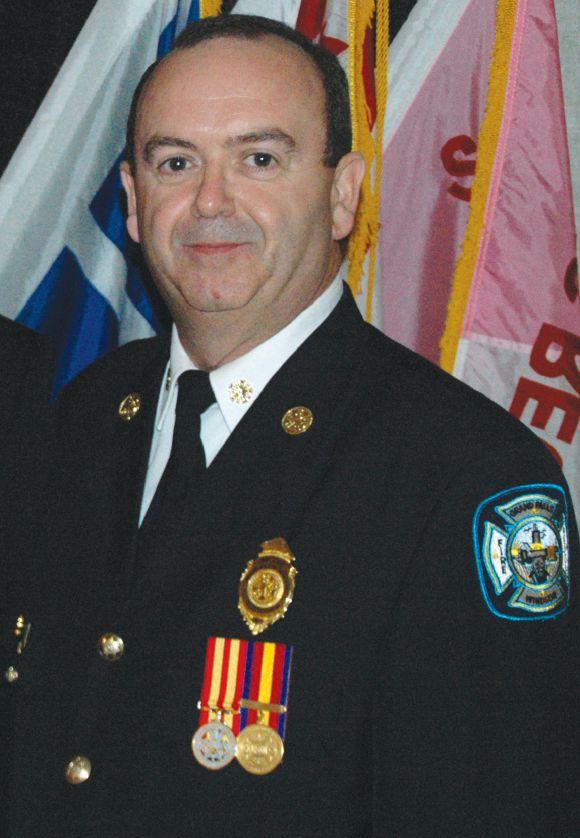
Falls-Windsor, N.L., Fire Chief Vince
wears a shield on his left. Though not officially regulated, wearing a shield or badge on the left is a throw back to the early evolution of the fire service.
This topic was covered briefly in the original article, but I have received many questions about the proper procedure for mounting hazardous-skill badges on formal dress uniforms. When discussing hazardous-skill badges – or wings, as they are often informally referred to – it is important to identify exactly what is being discussed. For the purpose of uniforms, we are referencing Canadian

Armed Forces patches that contain a specific specialized trade encased on either side by a wing. Single-wing badges are not referenced and are generally not worn on formal uniforms. Examples of the most commonly seen hazardous-skill badges include basic military parachutist, search-and-rescue technician, pilot, and explosive-ordinance disposal technician. These wings are worn on the left side above the lapel pocket and above any medals or ribbons being worn. Trade badges, such as military firefighter, are worn on military dress on the right side and are seldom worn on civilian firefighting uniforms, although such action would not be entirely inappropriate. A firefighter’s decision to wear trade badges is based on permission from his or her fire chief.
Firefighter trade patches are an emerging trend in the Canadian fire service as a way to recognize specialized skill sets. These specific patches are generally worn on the bottom left sleeve. Officers have rank braids and generally do not wear these patches. Originally trade patches included an R wrapped in laurel leaves to signify that the wearer was no longer an active member of the fire service but retained the privilege of wearing the department uniform. Now patches are used to signify medical qualifications, hazardous-materials training, and even crossed axes, which, depending on departments, can signify a fully trained firefighter. These patches are likely to increase in popularity as demands for specialized knowledge increase. Local fire chiefs must exercise caution to prevent these patches from becoming excessive, numerous and inappropriate. (For example, a rifle marksmanship patch isn’t something you should see on a firefighter’s tunic.)
As described by the Guide for the Wearing of Orders, Decorations and Medals: “Ribbons worn by uniformed personnel when the wearing of full-size or miniature insignia is not appropriate. Every honour has its own ribbon, and when more than one ribbon is worn, they must be placed in the established Order of Precedence and be arranged in rows, with the most senior ribbon at the left of the top row.”
When a firefighter is wearing short sleeves or a tunic, undress ribbons are worn centred immediately above the left breast pocket. Undress ribbons are not to be pinned to the flap of the pocket, but rather should rest on the crease that separates the top pocket flap from the tunic.
These awards are authorized by the province/territory, often handed out by the provincial lieutenant-governor, and are worn at the end of all federally issued medals. The simple rule to remember is that the lieutenant-governor represents the Queen, and an official award from the Queen’s representative carries the weight of the Crown. As such, provincial/territorial medals are worn in conjunction with all medals of the Canadian Honour System. Examples of these types of medals include the Ontario Medal for Firefighter Bravery, the Saskatchewan Volunteer Medal and the Emergency Services Medal.
Generally, foreign awards from a commonwealth country that are headed by the Queen – such as Great Britain, Australia and New Zealand – may apply for permission from the Governor General to wear decorations in accordance with the Canadian Hzonours System.
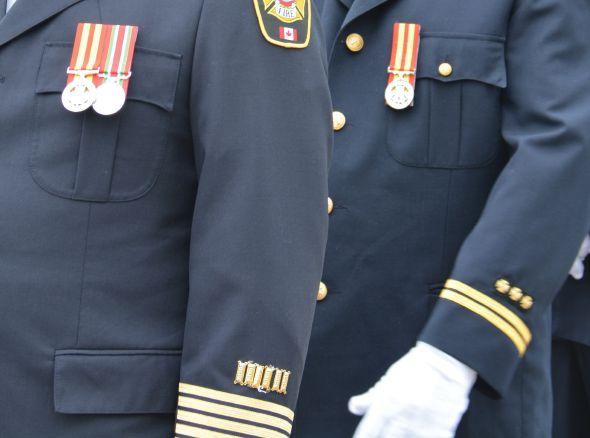
While there is no standard regarding placement of service markers, most emergency services personnel wear the markers at the bottom of the left sleeve. Each marker customarily represents five years of service.
BY
This is a strict protocol as the Canadian Honour System has two sets of “order of precedence”; one dating back before 1972, and the current system. Decorations not approved by the Government of Canada directives for wear should not be worn unless authorization has come from the Crown.
Foreign medals are awards made by other countries that do not have the Queen as the head of their honour system, such as the United States. As a rule, these awards are not to be worn in conjunction with any order, decoration or medal unless authorized by the Governor General. Examples include bravery or meritorious service medals such as the Bronze Star or the Army Commendation Medal.
I received a lot of questions about cadet medals, particularly from aspiring firefighters. Since September 2011, cadet medals have been worn on the right side above the tunic pocket. Cadet medals are classified as unofficial, so their display is at the discretion of the fire chief or the chief training officer of the academy. Cadet medals are customarily not worn. The exception is cadet pilot and basic parachutist wings, which are awarded to cadets because they follow rigid Department of National Defense selection and graduation requirements.
Association medals are a hotly contested issue. According to the Governor General, unauthorized medals cannot be worn in conjunction with official Canadian Honours. Wearing association medals is an erroneous habit in the fire service. Many firefighters receive awards from partner agencies, such as the Royal Canadian Legion, the Order of St. Lazarus, firefighter associations, and the Royal Lifesaving Society. These medals are acknowledgements from community partners to show that they value the service firefighters provide, however, they must not be confused with official honours. Wear only on the right side, if at all.
Department medals, such as for service or valour, are becoming more common in the fire service. Such awards are sometimes posthumous or made in memory of a deceased firefighter. Department medals not only express gratitude for the recipient but also convey a legacy of the person whose name is attached to that award. These medals are often governed for wear by the local fire chief and should be worn on the right side of the tunic only.
Medals that are acquired through unofficial means should never be worn on any uniform, even if they seem legitimate. Firefighters purchasing medals, often labeled as commemorative, is a disturbing and growing trend in the fire service. These medals are often of high quality and craftsmanship to replicate those awarded by the Governor General, however, they are not legitimate and wearing them can cause friction with veterans and possibly lead to charges under the criminal code.
The topic of improper wearing of honours became front-page news across the country last Remembrance Day. Veteran groups quickly discredited Franck Gervais, who falsely portrayed himself as a combat veteran. Does this happen in the fire service? It does – and it is illegal. Lt.-Col. Debbie Miller, for example, not only wore military medals to which she was not entitled, but the ones she was awarded were stripped due to her conduct. An alleged veteran in Hamilton, Ont., is also under federal review and is charged for wearing medals he did

not earn. Simply put, wearing orders, medals or badges that are not earned is not worth it. Veterans, scholars, researchers, and military buffs will quickly uncover imposters and highlight any falsehoods. The resulting negative press will devastate that person’s reputation and previous legitimate accomplishments, and demean the prestige of the fire service.
If a colleague is in violation of honours etiquette, politely advise that person that his or her behaviour has serious consequences and ask that he or she stop. If that fails, the next step is to formally bring the colleague’s actions to the attention of the senior officer and appropriate management. Failing all else, the local police service should be notified to assist, and, if deemed necessary, investigate. Those who parade around with such items on their chests should not be allowed to jeopardize the high community standing of a fire service and bring the character of fellow firefighters into disrepute. In the end, it is about trust. Communities trust their emergency services members to be honest, have integrity and be honourable.
The dress uniform continues to be a recognizable symbol of the fire service and a source of pride. Ensuring its standard enhances public trust, presents an appearance of professionalism and, finally, promotes the value of emergency services throughout the country. The benefits of continual uniformity cannot be understated.
Kirk Hughes is the fire chief for the Edzo Fire Department in the Northwest Territories. Reach him on matters of uniform standards at khughes@firehousemail.com
By LEN GARIS
Anew online course offered by the British Columbia Institute of Technology (BCIT) teaches building managers and owners how to take a leadership role in fire-safety planning in their buildings.
The course, called Fire Safety Planning for Building Owners and Managers, was developed in partnership with the Surrey Fire Service to teach those in charge of commercial and multi-residential buildings – typically laypeople with little to no fire-prevention experience – how to meet their fire-code responsibilities and legal requirements for fire-safety planning. The course is offered online and open to anyone in Canada.
Alexander Ku, BCIT’s associate dean of the laboratory and allied health program, said there is a demonstrated need for managers to learn the fire-safety skills taught in the course.
“In growing areas in Canada,” Ku said, “we’re seeing denser development, taller buildings and more people living in multi-unit buildings. We’re pleased to play a role in increasing public safety in our province by adding this new course to our existing complement of fire-prevention and protection courses.”
Fatalities in several nursing-home fires that have happened in Canada over the past few decades demonstrate the importance of fire-safety planning, and the tragic consequences of overlooking maintenance and best practices.
The self-paced, eight-week course for owners and managers explores topics such as fire hazards in buildings, fire inspections, fire-protection systems and maintenance, and how to develop and maintain a fire-safety plan that meets code requirements.
The first course was held in March, and a new course is offered each month. Fire departments are encouraged to bring the course to the attention of their municipal governments and local building managers.
Research suggests that behavioural changes could lead to improved fire safety in multi-unit buildings.
The 2013 report called U.S. Experience with Sprinklers, written by John Hall for the National Fire Protection Association (NFPA), points to human action as the leading cause for the failure of automatic sprinkler systems during structure fires.
The most common reason for sprinkler system failure (64 per cent) in structure fires reported between 2007 and 2011 was that the system had been shut off before the fire began – something that may occur during inspection or maintenance. The other primary reasons were manual intervention that defeated the system (17 per cent) and lack of maintenance (six per cent). Only seven per cent of

A self-paced, eight-week course now offered by the British Columbia Institute of Technology teaches building owners and managers how to take the lead on fire safety in their buildings.
the failures were attributed to component damage, and five per cent to the building having an inappropriate system for the type of fire. Surrey Fire Service investigated the concept of human error further in 2014 when it commissioned a report on the risks associated with suppression-system failures in highrises. Although there is typically greater regulatory compliance in highrises, the report predicts that risk could be reduced even further by a combination of
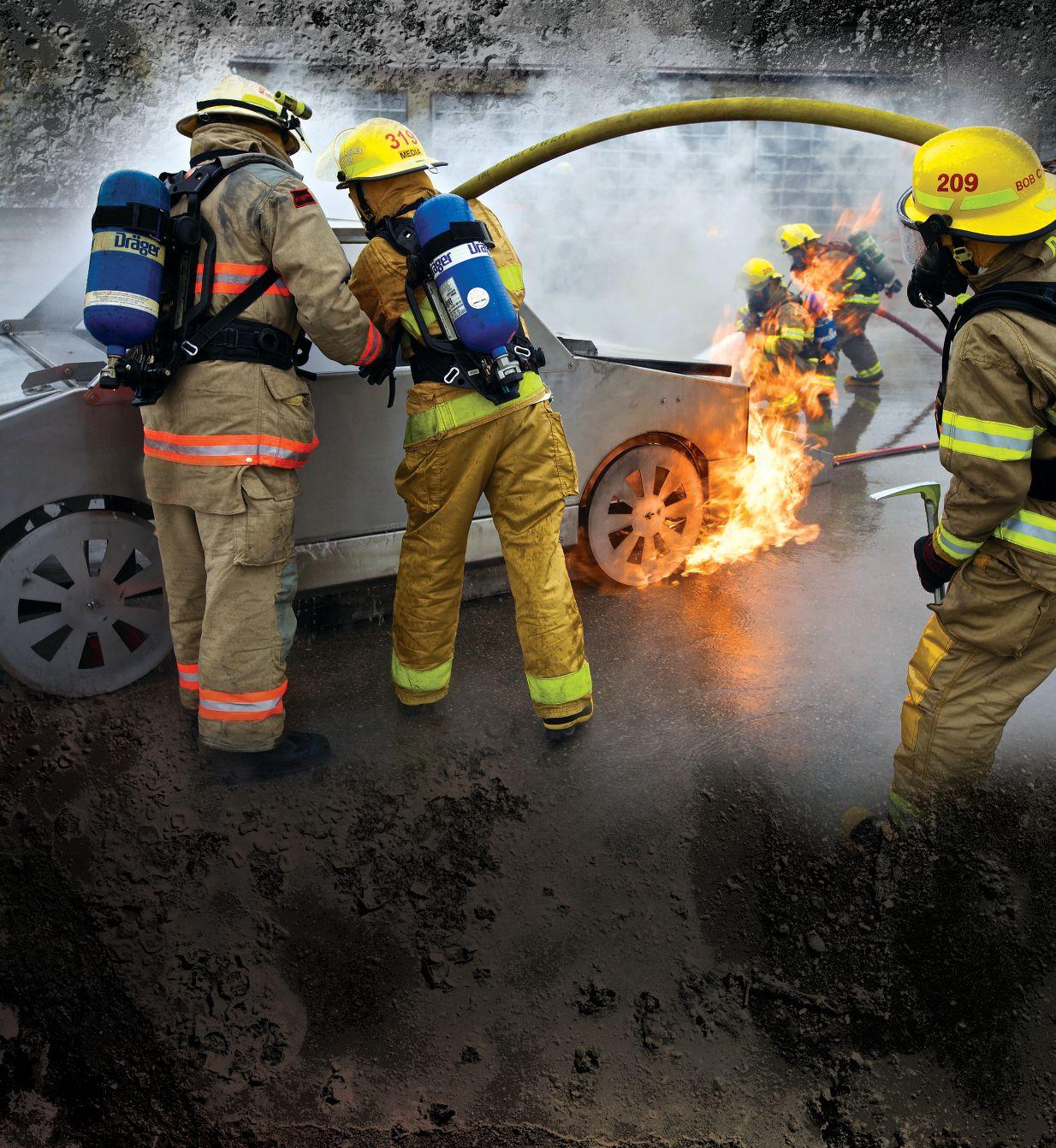
LEARN MORE ABOUT OUR LIVE FIRE TRAINING SYSTEMS AT WWW.DRAEGER.COM/FIRETRAINING STAY ONE STEP AHEAD OF EVERY FIRE WITH OUR LIVE FIRE TRAINING SYSTEMS.
Dräger can help you build the confidence and skills you need to fight fires safely and effectively. That’s because we offer a full range of Class A (wood-fueled) and Class B (propane-fueled) live fire training systems: from the Swede Survival system that teaches the warning signs of flashover, to portable systems that make live fire training convenient and affordable. Essential tools for essential training.
An introduction to fire-safety plans is one of several components to the online course that is designed to meet national and provincial fire codes.
education and code changes that recognize the specific requirements of highrises.
Lack of awareness of fire-safety requirements is also cited as a reason for non-compliance in the 2014 University of the Fraser Valley study A Dynamic Risk-Based Framework for Redesigning the Scheduling of Fire Safety Inspections that I wrote with Joseph Clare.
The UFV study indicates that education and collaboration could remedy this situation – in particular, conveying to owners/operators a sense of responsibility for complying, and encouraging them to do so through education. “It is possible that building owners are philosophically in favour of voluntarily meeting all requirements laid out in the fire code, but are unaware of all their responsibilities and as such, are technically acting non-compliantly,” the study report says.
The president of the Fire Prevention Officers’ Association of British Columbia,
Mark Smitton, welcomed news of a BCIT course that targets building managers.
“Many building managers would like to comply, but find the regulations daunting or hard to understand,” Smitton said. “I have no doubt we will see greater compliance among those who complete the course. And because of the online format, this could help improve the safety of building occupants across the country.”
Course details
BCIT’s Fire Safety Planning for Building Owners and Managers is the only comprehensive course in the country designed specifically to teach building owners and managers what they need to know to meet the fire-safety planning requirements of the national and provincial fire codes.
The course’s seven modules cover a wide range of topics, including:
• Introduction to fire-safety planning – the reasons for fire-safety planning and training, the history of fire-prevention standards and the leading causes of fire and need for occupant training.
• Building owner/manager responsibilities – legal requirements (provincial and local), roles and responsibilities, fire inspections, correction of non-compliance issues, consequences for non-compliance and administration and record keeping.
• Fire hazards of a building – dynamics of fire, fire risks, identifying hazards and flammable material handling and storage.
• Inspection techniques and assessing life safety – the need for inspections, the fire department’s role, building manager responsibilities for inspections and occupant management.
• The fire-safety plan – the need for and process for fire safety plans, evacuation plans, occupant responsibilities, fire-code requirements and fire safety plan components.
• Fire-protection systems – Fire-code
requirements, components and functions, fire alarm systems, fire extinguishers, sprinkler systems, detection systems, emergency generators and fire doors and separators.
• Ongoing maintenance of fire-protection systems and fire-safety plan – building manager responsibility for system maintenance, identifying a qualified contractor, occupant fire drills and refresher training and fire protection system maintenance, inspection and testing requirements.
The course takes an average of 14 to 18 hours to complete. Participants can work at their own pace, but are required log in each week to review course materials and complete activities.
The intent is that by the end of the course, participants will fully understand their responsibilities and all elements of the fire-safety planning process so that they can confidently develop their own fire-safety plan, safely manage and maintain their building’s fire-protection systems, properly educate the building occupants and keep their plan in compliance with legal requirements.
Students may register for Fire Safety Planning for Building Owners and Managers (OCHS 0560) through bcit.ca
For more information, visit bcit.ca/ study/courses/ochs0560

Len Garis is fire chief for the City of Surrey, B.C. He is the past president of the B.C. Fire Chiefs Association, an adjunct professor in the School of Criminology and Criminal Justice at the University of the Fraser Valley and an affiliated research faculty member at the Christian Regenhard Center for Emergency Response Studies, John Jay College of Criminal Justice, and a member of the Institute of Canadian Urban Research Studies, Simon Fraser University. Contact him at len.garis@ufv.ca

62 Bradwick Dr., Vaughan, ON L4K 1K8
Tel: 416-785-3752
Fax: 416-781-2827
Toll Free: 1-800-205-3473
email: firesafety@ajstone.com website: www.ajstone.com
Joyce, Dan, Robin, Jared
A.J. Stone Co. Ltd. has proudly served the needs of the Fire/Rescue and First Responder Services of Canada since 1972, featuring quality products, knowledgeable sales reps, and training support.
A.J. Stone supplies equipment from MSA, TNT Rescue, Paratech Rescue, Akron, Kochek, Angus Fire, Marsars Ice/Water Rescue, Innotex Bunker Gear, Pro-Tech Gloves, E.S. Safety Systems, CET, Fort Garry Fire Trucks, and much more. We service what we sell!
Serving All of Canada

47 Faircrest Blvd., Kingston, ON K7L 4V1
Tel: 613-546-4567
Fax: 613-546-5031
e-mail: info@actionmeals.com website: www.actionmeals.com
Mark Hutchings
Self-Heating Action Meals® - nutritious MRE meals for isolated responders. The lightweight kit contains precooked meal + heater, providing hot food in minutes without matches, fire, stove, electricity. A favorite for use at Emergencies or Fires.
Serving All of Canada
CANADA INC.
251 Queen St. S., Ste. 512, Mississauga, ON L5M 1L7
Tel: 905-826-6682
Fax: 866-511-6904
Toll Free: 1-866-735-1480
email: info@airmation.ca
website: www.airmation.ca
Randall Weber, VP Marketing & Sales, Canada
Air Technology Solutions is dedicated to our Clients, offering updated, timely, full service Indoor Air Quality (IAQ) solutions. Air quality concerns are mitigated using a unique combination of professional indoor air quality assessment coupled with solutions. Off the shelf or customized site specific air cleaning equipment is available to resolve IAQ issues. Our technical experts review client requirements and budgetary availability. The finest appropriate air cleaning systems are provided. Air Technology Solutions is a leader in Diesel Exhaust Remediation. Building and facility managers, business owners, contractors, architects, and engineers have been working with Air Technology Solutions since 1986 to resolve IAQ needs. Employee and personnel safety and health are key issues. Breathing safe air in the workplace is of utmost importance.
We provide global customized solutions to control contaminants, pollutants and odours in your facility. We look forward to servicing your requirements. Serving All of Canada
CANADA = BC (British Columbia), AB (Alberta), SK (Saskatchewan), MB (Manitoba), ON (Ontario), QC (Quebec), PE (Prince Edward Island), NL (Newfoundland & Labrador), NB (New Brunswick), NS (Nova Scotia), NT (Northwest Territories), NU (Nunavut), YT (Yukon)
Head Office: 5205 J.A. Bombardier
Longueuil, QC J3Z 1G4
Tel: 450-651-2240
Fax: 450-651-1970
e-mail: info@areo-fire.com
website: www.areo-fire.com
Dominic Miller (Technical support for fire trucks and sales of Rosenbauer trucks & Daniel Renaud (Sales Director)
At Areo-Fire we are committed to meeting our customers needs and we are proud to offer a wide range of top-of-the-line equipment, clothing and accessories for firefighting and emergency interventions, public safety and fire trucks. We have been in business for more than 50 years and today, the 3rd generation of the company has continued to add new, high-quality products so that you can find everything you require under one roof.
Through the years, we have acquired a solid reputation based on the high level of satisfaction of our clientele. Considered as one of the best distribution models in the fire service industry, we partnered with some of the major product and truck manufacturers such as: Rosenbauer, MSA, Hurst, CET Fire Pump, Cosmas, Innotex, Protek, PETZL, NAFH, Groupe Leader, Maxxera, Res-Q-Jack, Streamlight, Ergodyne, Techtrade, Solberg, Mustang, Ansul, Foampro, Koehler Bright Sar, Hale, Waterous, Elkhart Brass, and many more. Areo-Fire is also a Canadian agency which supplies and stocks products such as: Cosmas fire boots, Leader Group products (FANS, SEARCH & RESCUE, TRAINING), Acton Fire boots, Protek Nozzles, Rabbit P-555 portable pumps and Maxxera’s hose reels and unrollers. Snagger tools. We are currently looking for distributors, please contact us.
Where equipment matches courage. Serving ON, QC, NB
AIR VACUUM CORPORATION
PO Box 517, Dover, NH 03821
Tel: 603-743-4332
Fax: 603-743-3111
Toll Free: 1-800-540-7264
email:
sales@airvacuumcorporation.com website: www.airvac911.com
Thomas Vitko, Regional Sales Manager, John Koris
The AIRVAC 911® exhaust removal system is a hose-free, fully automatic filtration system that addresses both the gasses and particulate emitted from diesel engines. The AIRVAC 911® system is100% effective for a clean and safe environment.
For a free quote visit www.airvac911.com or call 1-800-540-7264. Serving All of Canada

BECOMING A FIREFIGHTER
PO Box 530, 105 Donly Drive S., Simcoe, ON N3Y 4N5
Tel: 519-429-3966
Fax: 1-866-810-8111
Toll Free: 1-888-599-2228 ext. 235 email: bcomer@annexweb.com website: www.becomingafirefighter.com
Barb Comer, Acount Co-Ordinator
Serving All of Canada

C-MAX FIRE SOLUTIONS
3044 Sawmill Rd.,
St. Jacobs, ON N0B 2N0
Tel: 519-664-3796
Fax: 519-664-3624
Toll Free: 1-844-GET-CMAX email: fireinfo@c-max.ca
website: www.c-max.ca
Kathy Brookes, Manager
Canadian family owned and operated business that offers a higher standard of service and sales for all your Fire Apparatus needs. C-Max Fire Solutions offers 24 Hour service from EVT Technicians with fully stocked service trucks. We offer Pump testing and repairs to all makes and models. We offer ground ladder testing as per NFPA 1932. We are also Ontario’s Factory Sales and Service Centre for KME Fire Apparatus.
Serving ON

CANADIAN SAFETY EQUIPMENT INC.
2465 Cawthra Rd., Unit 114, Mississauga, ON L5A 3P2
Tel: 905-949-2741
Fax: 905-272-1866
Toll Free: 1-800-265-0182
email: info@cdnsafety.com website: www.cdnsafety.com
Ross Humphry, Nick Desmier, Scott
Gamble, Chris Hamilton, Steve Shelton, Mark Kentfield, Mike Robinson
We supply SCBA’s, Thermal Cameras, Auto Extrication, CAF Systems, Fall Protection, Bunker Gear, Fire Hose, Communications Equipment, Nozzles, Fittings, Hazmat Suits, Ventilation Fans, Gas Detectors, Confined Space Rescue Equipment, High Angle Rescue Equipment, Boots and Gloves. Everything for Fire Fighting and Confined Space Rescue.
Serving All of Canada

CET FIRE PUMPS MFG.
75, rue Hector, C.P. 90, Pierreville, QC J0G 1J0
Tel: 450-568-2719
Fax: 450-568-2613
Toll Free: 1-888-844-2285
email: sales@fire-pump.com website: www.fire-pump.com
Stephan Thibault
Accept Only The Best Portable Pumps, Skid Units, CAFS, Foam Trailer, Glider Kit, Water Tank, Brush Truck and Fire Apparatus. A Century of Engineering for the Bravest!
Serving All of Canada

5990 Vanden Abeele, St. Laurent, QC H4S 1R9
Tel: 514-737-2280
Fax: 514-737-2751
Toll Free: 1-866-737-2280
email: info@cseis.com
website: www.cseis.com
Richard Abraham, Mike Heering, Brad Bowen
We supply SCBAs, Thermal Imaging Cameras, Auto Extrication Tools, CAF Systems foam, Bunker Gear, Fire Hose and accessories, nozzles, fall protection communications equipment, fittings, hazmat suits, ventilation fans, rescue saws, ice and water rescue gear, high angle rescue gear, boots, helmets and gloves.
Serving All of Canada

CUTTERS EDGE
PO Box 846, 3855 23rd Street, Baker City, OR 97814
Tel: 541-524-9999
Fax: 541-524-9996
Toll Free: 1-800-433-3716 email: info@cuttersedge.com website: www.cuttersedge.com
Thomas Ruzich
Manufacturers of NEXT GENERATION TECHNOLOGY including: MULTICUT® Fire Rescue Saws with BULLET® CHAIN, H Series Rotary Rescue Saws with Black Diamond Blade and optional BULLETBLADE® plus CE94 Concrete Cutting Chainsaw with Diamond Chain. Fully equipped Field Kits are available for all 3 models. Serving BC, AB, SK, MB, ON, QC, NB and NS

275 Clarence St., Brampton, ON L6W 3R3
Tel: 905-453-6724
Fax: 905-453-7716
Toll Free: 1-800-268-0871 email: sales@dependable.ca website: www.dependable.ca
Pino Natale
Design & manufacture custom fire pumpers, rescues, tankers, aerials, haz-mat, air-lighting units, minis, EMS & police support vehicles & equipment. Collision and restoration estimates, complete on-site vehicle collision and restoration, large custom paint shop. Apparatus repairs and MTO certification. Spartan Dealer, Freightliner, Sterling, International, Kenworth, Peterbilt, Mack, Ford, General Motors chassis. Sales. Service and parts for Hale, Darley and Waterous pumps. Extensive parts inventory. Sales and repairs of all makes of Emergency lighting, hose, nozzles and fire related equipment. Friendly, courteous and knowledgeable one stop shopping for fire apparatus and related equipment since 1975.
CANADIAN DEALER FOR:

Spartan ERV, A Spartan Company907 7th Avenue North, Brandon, SD 57005
Tel: 605-582-4000
Fax: 605-582-4001 website: www.spartanerv.com
Serving All of Canada

DARCH FIRE INC.
9-402 Harmony Rd., Ayr, ON N0B 1E0
Tel: 519-622-6110
Fax: 519-622-7705
Toll Free: 1-800-254-2049
email: sales@darchfire.com website: www.darchfire.com
John Darch
Susan Miller and John Darch own and have operated Darch Fire Inc. since 1993. Darch Fire Inc. partners with leading industry manufacturers including Pierce Manufacturing, Holmatro, Draeger, Elkhart, Geargrid, Key Fire Hose, Blowhard Fans, Southcombe Gloves as well as many, many more to provide you the best products available. The parts department at Darch has all the everyday and hard to find parts needed to keep your emergency vehicles in top form. Darch Fire’s professional mobile fleet service team are fully licensed and EVT certified technicians are ready to respond to all your fire truck maintenance and service needs including pump testing and scheduled fleet service.
Serving ON

DRAGER SAFETY CANADA LTD.
2425 Skymark Ave., #1, Mississauga, ON L4W 4Y6
Tel: 905-212-6600
Fax: 905-212-6602
Toll Free: 1-877-372-4371 email: sandi.davisjohn@draeger.com website: www.draeger.ca
Sandi Davis John
Draeger Tubes detect over 500 different gases. Our gas Analyzer CMS combines high accuracy with simplicity and flexibility. Portable and fixed gas detection are available for many toxic and combustible gases. Draeger’s respiratory line ranges from half mask cartridge respirators to S.C.B.A.’s.
We also specialize in Confined Space Training Trailer, the Live Fire Training Systems, the Swede Survival Flashover Systems and Submarine Escape Devices.
Serving All of Canada
E-ONE, INC.
1601 S.W. 37th Ave., Ocala, FL 34474
Tel: 352-237-1122
Fax: 352-237-1151
e-mail: info@e-one.com
website: www.e-one.com
CANADIAN DEALERS
Carrier Emergency Equipment
6 Edmondson St., Brantford, ON N3T 5N3
Phone: 519-752-5431
Territory: Ontario, Atlantic Provinces First Truck Specialty Vehicles 18688 96th Avenue
Surrey, BC V4N 3P9
Phone: 604-888-1424
Territory: British Columbia, Alberta, Yukon, Northwest Territories
Techno Feu Apparatus Maintenance 105 Marie-Victorin, St. Francois-Du-Lac, PQ J0G 1M0
Phone: 450-568-2777
Territory: Quebec
Serving All of Canada
PO Box 530, 105 Donly Dr. S., Simcoe, ON N3Y 4N5
Tel: 519-429-5178
Fax: 888-404-1129
Toll Free: 1-888-599-2228 ext. 252
email: fire@annexweb.com
website: www.firefightingincanada.com
Publisher, Martin McAnulty
Advertising Manager, Catherine Connolly
Editor, Laura King
Serving All of Canada
FIRESERVICE MANAGEMENT LTD.
34 Torlake Cres., Toronto, ON M8Z 1B3
Tel: 416-251-3552
Fax: 416-253-0437
Toll Free: 1-888-731-7377
email: tanja@fireservicemanagement.com website:
www.fireservicemanagement.com
Peter Hill, Tanja Wleklinski Canada’s Premier facility dedicated exclusively to providing the best in bunker gear cleaning, assessing, decontamination and repair. NFPA 1851:2014 compliant, ISO 9001: 2008 registered, ETL verified for all fabric repairs and all moisture barrier repairs.
Locations: Calgary, Toronto, Detroit. Serving All of Canada
PO Box 530, 105 Donly Drive S., Simcoe, ON N3Y 4N5
Tel: 519-429-3006
Fax: 1-877-624-1940
Toll Free: 1-877-267-3473
email:
firehallbookstore@annexweb.com
EASTWAY911 EMERGENCY VEHICLES LTD.
7 Industrial Ave., Carleton Place, ON K7C 3V7
Tel: 613-257-8197
Fax: 613-257-8517
Toll Free: 1-888-571-6842
email: sales@eastway911.com website: www.eastway911.com
Jennifer LaBelle, Sales
Eastway911 Emergency Vehicles Ltd. is a custom manufacturer of all types of apparatus for the fire service. Apart from custom designed and engineered apparatus Eastway911 also maintains an inventory of demonstrator units available for quick delivery. Eastway911 also provides mobile pump testing and repairs as well as full in-house refurbishment and mechanical repairs. Serving All of Canada
website: www.firehallbookstore.com
Becky Atkinson
Canadian distributors for education and training products.
Product lines include NFPA, IFSTA, PennWell, Brady, Action Training, Emergency Film Group & Jones & Bartlett.
Serving All of Canada
FORT GARRY FIRE TRUCKS LTD.
53 Bergen Cutoff Rd., Winnipeg, MB R3C 2E6
Tel: 204-594-3473
Fax: 204-694-3230
Toll Free: 1-800-565-3473
email: bnash@fgft.ca website: www.fgft.com
Brian Nash- National Sales Manager Fort Garry Fire Trucks offers a complete line of Quality Fire Apparatus, including Pumpers, Tankers, Rescues and Aerial Ladders. Serving All of Canada
PO Box 530, 105 Donly Dr. S., Simcoe, ON N3Y 4N5
Fax: 1-888-404-1129
Toll Free: 1-888-599-2228 ext. 253
email: cconnolly@annexweb.com
website: www.firehall.com
Catherine Connolly, Advertising Manager
Firehall.com provides an excellent forum for exchange among firefighters and others involved in the fire service. Advertising options include banner ads and e-blasts and offer extensive exposure to the rank and file. Serving All of Canada
FP2 (Ingenious Software)
1423 Park St., Nelson, BC V1L 2H7
Tel: 250-352-9495
Fax: 206-350-7750
Toll Free: 1-866-352-9495
email: fp2@fp2.ca website: www.fp2.ca
Jeremy Murphy, Douglas Farquharson
FP2 is powerful, flexible and reasonably-priced software. The modular design covers every aspect of Fire Department administration, including Dispatch, Scheduling, Attendance and much more. Our unique Compensation Reports can even do payroll for you!
Serving All of Canada
FSI® NORTH AMERICA, A Division of Fire Safety International Inc.®
311 Abbe Road, Sheffield Lake, OH 44054
Tel: 440-949-2400
Fax: 440-949-2900
e-mail: sales@fsinorth.com
website: www.fsinorth.com
Mark Conron, Phil Graham
Full line supplier of mobile, portable and fixed hazmat decon showers, shelters, field hospital ‘surge capacity’ systems and accessories. Also offer rescue boats, PPV fans, and EMS supplies such as the FSI Transporter Disposable Backboards, triage tape, FSI Medical Field Cots, mortuary supplies, and a full range of isolation chambers, beds/ chairs, and shelters.
Serving All of Canada
GLOBE MANUFACTURING COMPANY, LLC
37 Loudon Rd., Pittsfield, NH 03263
Tel: 603-435-8323
Fax: 603-435-6388
Toll Free: 1-800-232-8323
email: info@globefiresuits.com website: www.globeturnoutgear.com
Stephanie McQuade
Fighting fires is demanding, physical work requiring maximum athletic performance. The fact is, if you want to perform like an athlete, your equipment has to enhance your performance. Your gear should move the way your body does, without restriction. And, of course, it must protect you. It’s more than turnout gear. It’s athletic gear for firefighters. You can learn more about Globe gear by visiting www. globeturnoutgear.com. But the website only tells part of the story. You have to try on the gear, and experience firsthand the difference wearing athletic gear for firefighters can make.
Serving All of Canada

GROVES INCORPORATED
818 Trakk Lane, Woodstock, IL 60098
Fax: 815-338-8640
Toll Free: 1-800-991-2120
email: sales@groves.com website: www.readyrack.com
John Groves
Groves Incorporated Pioneered Turnout Gear storage in 1984. The original heavy duty Ready Rack® and Red Rack™ were specifically designed for the Fire Service. Their line has grown to include PPE drying cabinets, hose washing, drying and storage systems, mobile work tables wall organizers and a wide variety of Fire Fighter tools, bags and accessories. The latest addition is the Multiple Purpose Storage System, or MPSS. Available in 5 different configurations, the MPSS can store up to 24 SCBA units, up to 32 air cylinders, up to 1,400’ of 2 ” hose, or as a combination storage depending on your Department’s needs.
Serving All of Canada
GTAA
PO Box 6031, 3111 Convair Drive, Toronto AMF ON L5P 1B2
Tel: 416-776-5997
Fax: 416-776-5851
e-mail: antonia.brozic@gtaa.com website: www.gtaa.com/festi
Antonia Brozic, Office Administrator, Fire and Emergency Services
Serving All of Canada
HASTINGS BRASS FOUNDRY LTD.
236 Clark Dr., Vancouver, BC V5L 3H3
Tel: 604-253-2811
Fax: 604-253-3133
Toll Free: 1-800-653-2811
email: hasbra@telus.net website: www.hasbra.com
Robert Worner, Sales Mgr.
HASBRA FIREFIGHTING EQUIPMENT
- Serving the Firefighting Community Through Quality Distributors Since 1916. ISO 9001-2008
Serving All of Canada
275 Gouin St., PO Box 2980, Richmond, QC J0B 2H0
Tel: 819-826-5971
Fax: 819-826-5195
Toll Free: 1-888-821-3121
email: info@innotexprotection.com website: www.innotexprotection.com
Ralph Briggs, Regional Sales Manager - Canada
Ralph.briggs@innotexprotection.com (226-791-8275)
INNOTEX® is a North American leader in the development, manufacturing and distribution of firefighter turnout gear, gloves and hoods certified to NFPA 1971.
Serving All of Canada
JORDAIR COMPRESSORS INC.
205-6901 72 St., Delta, BC V4G 0A2
Tel: 604-940-8101
Fax: 604-940-8131
Toll Free: 1-800-940-8101
email: info@jordair.ca website: www.jordair.ca
Shane Gilmore - Inside Sales Jordair offers a diverse range of standard and engineered compressed air and gas systems for specialized applications. All Jordair compressors are provided with a 24 month warranty. All units are standard with load cycle counters for the final oil and water separators. Bauer and Jordair provide safe, reliable products backed by over 40 years of breathing air compressor expertise. Jordair is CRN registered in all provinces across Canada and CSA certified.
Serving All of Canada
JUNKYARD DOG INDUSTRIES
119 Keystone Dr., Montgomeryville, PA 18936
Tel: 267-803-1440
Fax: 267-803-1447
Toll Free: 1-800-574-8228 email: info@jydind.com website: www.junkyarddogindustries.com
Laura Miller, Tom Hurd “Keeping It Simple” - Junkyard Dog Industries ZSRUT and XTEND Rescue Strut Systems and the SideWinder Rescue Stabilization Jack are safe and easy to use products for rescuers worldwide. See our line of fire, rescue and EMS products online including safety devices and equipment bags. Please e-mail Tom Hurd at Thurd@jydind.com for more information.
Serving All of Canada
KIDDE CANADA INC.
– Angus Fire Division 340 Four Valley Drive, Vaughan, ON L4K 5Z1
Tel: 905-695-6060
Fax: 905-660-4670
Toll Free: 1-800-667-0423 website: www.kiddecanada.com
Contact Us: Western Canada Sales –Gary Darling ext 6261 (Gary.Darling@kiddecanada.com), Ontario, Manitoba & Atlantic Sales –Jeremy Laviolette ext 6075 (Jeremy.Laviolette@kiddecanada.com), Quebec Sales –Marcel Demers ext 6264 (Marcel.Demers@kiddecanada.com), Business Support and Information –Mike Calderone ext 6070 (Mike.Calderone@kiddecanada.com), Inside Sales & Customer Service –Barry Coldwell ext 6245 (Barry.Coldwell@kiddecanada,com). The legacy of Angus Fire goes back over 200 years. Tradition, combined with innovation has allowed Angus to become the world leader in the manufacture of fire fighting equipment. Canada’s first choice in high quality hoses and foam products, the Angus Fire brand offers performance secondto-none, while Kidde Canada’s sales and technical support team ensure the legendary Angus Fire service level is maintained to the highest industry standards.
Serving All of Canada
KNOX COMPANY
1601 W. Deer Valley Rd., Phoenix, AZ 85027
Tel: 623-687-2300
Fax: 623-687-2283
Toll Free: 1-800-552-5669
email: info@knoxbox.com website: www.knoxbox.com
The KNOX-BOX Rapid Entry System is a complete emergency access system operated with a high security master key. Fire departments in North America have been depending on Knox key boxes, vaults, cabinets, key switches and padlocks since 1975. Other products include locking FDC plugs and caps for protecting water based fire protection systems.
Serving All of Canada
KOCHEK CO., INC.
3131 Autumn Hill Crescent, Burlington, ON L7M 1Z3
Tel: 416-948-6124
Fax: 905-592-1999
Cell: 416-948-6124
email: lkenyon@kochek.com website: www.kochek.com
Laura Kenyon, Regional Sales Manager At Kochek, we take pride in manufacturing only the finest quality strainers, fittings, adapters, suction hose systems and other specialty equipment to meet a wide variety of water transfer needs. Our Canadian warehouse is now well stocked to expedite shipments across the country. Laura Kenyon looks forward to the opportunity to assist your industry or fire department in protecting the lives and homes in your community. For more information about Kochek products contact Laura and please remember to check our website regularly for new information being added to help you in your fight against fires.
Serving All of Canada

14935 County Road 2, PO Box 269, Ingleside, ON K0C 1M0
Tel: 1-866-445-3473
Fax: 613-537-9449
Toll Free: 1-866-445-3473
email: markp@mnlsupply.com website: www.mnlsupply.com
Mark Prendergast, President
HOW CAN WE HELP MAKE YOUR JOB EASIER CHIEF?
How’s this - 10 Sales People (combined sales backgrounds of 197 years, as well as combined firefighting backgrounds of 329 years).
When equipment is damaged in hostile environments we have 4 Factory Certified Technicians (combined service background of 53 years, combined Firefighter background of 108 years) to get you up and running.
CHIEF ARE YOU STILL THINKING?
Serving ON, PE, NL, NB and NS
3-304 Stone Rd. W., Guelph ON N1G 4W4
Tel: 519-763-9955 Fax: 519-763-6682
email: john@metzfirerescue.com
website: www.metzfirerescue.com
John Metz
Canadian dealer for KME Fire
Apparatus. Specializing in custom and commercial pumpers, aerial, rescue, tankers and wildland units.
Serving All of Canada
c/o Firehall BookStore, PO Box 530, 105 Donly Dr. S., Simcoe, ON N3Y 4N5
Fax: 1-877-624-1940
Toll Free: 1-877-267-FIRE (3473)
email:
firehallbookstore@annexweb.com
website: www.firehallbookstore.com
Canadian distributor for NFPA products. Serving All of Canada
PO Box 524, 901 Commerce Road, Luverne, MN 56156
Tel: 507-283-9141
Fax: 507-283-9142
Toll Free: 1-800-344-2059
email: info@midwestfire.com
website: www.MidwestFire.com
Sarah Atchison
420 3rd Avenue,
St-Romuald, QC G6W 5M6
Tel: 514-220-6778
Fax: 418-839-5220
Toll Free: 1-800-567-0068
email: proy@mluniforme.com website: www.mluniforme.com
Pia Roy, 514-220-6778.
Martin & Levesque Uniform is a manufacturer and distributor of Blauer uniforms for fire services, paramedic and police and more. Our mission is to provide high performance and ultimate quality products with impeccable service.
Serving All of Canada
Since 1987 Midwest Fire Equipment & Repair Company has worked alongside firefighters designing and manufacturing high-quality, multi-purpose, customized, cost effective products that save lives and protect property. Midwest Fire has delivered more than 650 trucks to departments throughout North America and we are proud of the high percentage of repeat and multitruck customers we have developed. Midwest Fire is a small team of skilled professionals that are committed to building trucks to serve you and your community for decades. Fight Fire with Fire – Midwest Fire.
Serving All of Canada
641 Rte. 161, Ham-Nord, QC G0P 1A0
Tel: 819-344-2525
e-mail: jduguay@nemoinc.com
Joe Duguay
Fibreglass storage tanks from 2000 to 40,000 US Gallons. We serve all of Canada!
Serving All of Canada
1200 Aerowood Dr., Unit 25, Mississauga, ON L4W 2S7
Tel: 905-625-1758
Fax: 905-625-0187
Toll Free: 1-866-601-1758
email:
jsmith@northerndocksystems.com website: www.northerndocksystems.com
Jonathan Smith
NDS is the premier Canadian distributor of Four-Fold Doors as manufactured by Door Engineering. The high speed, low maintenance Four-Fold Door systems are specifically designed for use in the Fire and EMS Service Industry. Strength, security, performance and safety are all guaranteed with the use of the Door Engineering and Northern Dock Systems’ Four-Fold Doors. With custom designs and finishes available, make your existing or new station stand out from the rest. Well suited for retrofit or new construction projects, NDS and Door Engineering are ready to help with your new station design. Choosing Four-Fold Doors in place of conventional Sectional Doors will help lower maintenance costs, reduce downtime, increase productivity and minimize costly heat and cooling loss which equates to valuable energy savings.
Contact Northern Dock Systems today for more information.
Serving All of Canada
ONLINE LEARNING CENTRE, THE 2286 Kingsford Place, Nanaimo, BC V9X 1Y3
Tel: 250-716-9103
Fax: 250-591-2850
e-mail: info@theOLC.ca
website: www.theOLC.ca
Doug or Kathy
The OLC provides the online platform for the FPOABC’s NFPA 1031 Level I Fire Inspector and NFPA 1033 Fire Investigator courses.
Achieve ProBoard certification while eliminating costly travel, per-diem, and lost work-time expenses, while maintaining the highest standard of education for yourself and your employees!
Serving BC, AB, SK, MB, ON, PE, NL, NB, NS, NT, NU, YT
RESQTECH SYSTEMS INC.
189 Bysham Park Dr., Woodstock, ON N4T 1P1
Tel: 519-539-0645
Fax: 519-539-0646
Toll Free: 1-800-363-7370
email: resqtech@resqtech.com
website: www.resqtech.com
Brian Innis
ResQtech Systems, Inc. has served the fire industry since 1985 and is dedicated to providing firefighters with innovative products and solutions. ResQtech Systems is the exclusive fire apparatus dealer for Rosenbauer and Hackney emergency vehicles in Ontario and offer a full line of emergency equipment which includes the Rosenbauer Heros-XT Helmet, Junkyard Dogg Struts, Interspiro Breathing Apparatus, Phoschek Firefighting Foam, Vindicator Nozzles and much more. In addition to the extensive product line, ResQtech has service technicians for your apparatus and emergency equipment needs, available at our in house facilities or on the road.
Serving All of Canada

5100 Timberlea Blvd., Mississauga, ON L4W 2S5
Tel: 416-712-2700
e-mail: bill.brodie@rwdoors.com website: www.rwdoors.com
Bill Brodie
In business since 1912, RichardsWilcox was the first company in Canada to introduce sectional overhead doors and establish nationwide distribution channels. Today, RW has a complete range of sectional overhead doors including “Thermatite, Alumatite, Polytite and Slidetite” Series of Doors for any commercial/industrial application. For more information visit www.rwdoors.com
Serving All of Canada
Head Office: 6415 Golden West Ave., Red Deer, AB T4P 3X2
Tel: 403-347-7045
Fax: 403-347-7049
Toll Free: 1-800-494-4210
email: info@rockymountainphoenix.com website: www.rockymountainphoenix.com
BRANCHES:
103-2285 Queen St., Abbotsford, BC V2T 6T3
Tel: 604-864-7303
Fax: 604-864-4938
Toll Free: 1-888-815-0500
320 Logan Rd., Bridgewater, NS B4V 3J8
Tel: 902-298-0415
Toll Free: 1-844-530-4003
BC Service Center: 103-81 Golden Dr., Coquitlam, BC Tel: 604-226-8707
Toll Free: 1-844-552-8668
Rocky Mountain Phoenix is a leader in the supply of vehicle solutions, products and services to the emergency response and fire combat industry. Your complete source for MSA SCBA, Thermal Imaging, Protective Clothing, Suppression Tools and Equipment. Visit our online catalogue at www. rockymountainphoenix.com
Serving All of Canada
SAFEDESIGN APPAREL LTD.
34 Torlake Crescent, Toronto, ON M8Z 1B3
Tel: 416-253-9122
Fax: 416-253-0437
Toll Free: 1-877-253-9122
email: sales@safedesign.com
website: www.safedesign.com
Don King, Vice-President/Sales
Specialists in Firefighters Protective Clothing. Complete line of Thermal Protective PPE. Globe Firefighters
Suits, Shelby ‘Firewall’ Gloves, Globe EMS Lifeline, Black Diamond Footwear, PGI Cobra Hoods & Wildland Clothing, Workrite Stationwear, Firefighters
Helmets, Cairns Protective Clothing. Globe Footgear, Globe USAR Clothing/ Tech Rescue, Topps Safety Apparel, Stationwear.
• Exclusive Dealer Network Coast to Coast.
Serving All of Canada
A Division of Scott Plastics Ltd. 2065 Henry Ave. W., Sidney, BC V8L 5Z6
Tel: 250-656-8102
Fax: 250-656-8126
Toll Free: 1-800-214-0141 email: fire@scotty.com OR lloyd@scotty.com website: www.scottyfire.com
Lloyd Rees, Mgr., Fire Div. Hand Pumps, Backpacks, Foam Eductors, Air-Aspirating Foam Nozzles, “Through-the-Pump” Foam Proportioners, “Foam-Fast” Cartridge Systems, Fog Nozzles, Spanner Wrenches, Shut-Offs, 3-Way Valves and Connectors. www.scottyfire.com
Serving All of Canada
SECURITRIM 2002 INC.
9200 - 5E ave., Ville Saint-Georges, QC G5Y 2A9
Tel: 418-226-4961
Fax: 418-221-6147
Toll Free: 1-888-666-4961
email: info@securitrim.ca website: www.securitrim.com
Nathalie Drouin or David Russell Securitrim 2002 is a specialized supplier of both 3M and Reflexite microprismatic reflective sheeting for commercial and emergency vehicle graphics. Brighter graphics enhance motorist safety and is now mandated by law for Fire apparatus. Securitrim 2002 is marketing
for installation over diamond checker plate. Microprismatic custom made one piece pre-striping is now available in easy to install sheets, excellent for full rear coverage. Serving All of Canada
SAFETEK EMERGENCY VEHICLES LTD.
30686A Matsqui Place, Abbotsford, BC V2T 6L4
Tel: 1-866-723-3835
Fax: 604-504-2415
Toll Free: 1-866-723-3835
email: wstevens@firetrucks.ca website: www.firetrucks.ca
Wayne Stevens, Vice President Safetek Emergency Vehicles Ltd.,(Safetek) is Canada’s leading provider of fire and emergency vehicles, parts and service. We represent some of the industry’s leading brands including Smeal Fire Apparatus, SVI Trucks, and Spartan Chassis. We also provide a wide array of services to support our customers - from the time their vehicle is delivered until it is retired from service. These services help our customers improve fleet utilization, reduce costs, manage information, upgrade or reconfigure their apparatus, and protect their investment. Our responsibility does not end when the apparatus is delivered. We are committed to providing excellent after sale support to our customers for the life of their apparatus. This support includes extensive training, warranty support, parts supply, and on-site services.
Visit us at www.firetrucks.ca to learn more.
Serving All of Canada
1800 Bonhill Road, Mississauga, ON L5T 1C8
Tel: 905-364-5843
Fax: 905-364-7822
e-mail: seatsinfo@seatscanada.com website: www.seatscanada.com
Hasan Mohammed
We offer a complete line of quality Emergency Vehicle seating for driver, officer, crew, wall mount and jump seats. Engineered for comfort and safety, these seats have easy exit flipup split headrest and are manufactured in a wide variety of covering material. Serving All of Canada
STARFIELD LION
23 Benton Road, Toronto, ON M6M 3G2
Tel: 416-789-4354
Fax: 416-789-5475
Toll Free: 1-800-473-5553
website: www.starfieldlion.com
Rob Hosselet, National Sales Manager; Rosanne Kalenuik, Director of Customer Sales and Support. Starfield Lion has a legacy and ongoing vision of introducing PPE that is designed to ensure the health, safety and performance of the first responders who serve our communities. Your safety is our top priority. Your needs drive our innovations, we listen and develop the solution.
Serving All of Canada

INC.
230, St-Charles Sud, Granby, QC J2G 3Y3
Tel: 450-378-8441
Fax: 450-378-1558
e-mail: louellet@stedfast.com
website: www.stedfast.com
Lynne Ouellet
Stedfast is a world leader in manufacturing value-added laminated and coated textiles serving the material to specification needs of Protective clothing, industrial, Medical, and Military applications, including chemical and biological weapon resistant textiles.
Stedair®, Waterproof Breathable moisture barriers and Stedfast’s coated fabrics offer new levels of protection and comfort that go above and beyond. Serving All of Canada
FORCE TIPS, INC.
3701 Innovation Way, Valparaiso, IN 46383-9327
Tel: 219-462-6161
Fax: 219-464-7155
Toll Free: 1-800-348-2686
email: sales@tft.com website: www.tft.com
Rod Carringer, VP of Sales and Marketing; Jim Menkee, National Sales Mgr.; Brian Podsiadlik, Cdn. Mgr.
Please contact our local authorized Distributor for all your fire suppression needs:
Wholesale Fire & Rescue Ltd., 1-800-561-0400 (Western Canada)
ABC Fire & Safety, 1-800-665-1250 (Manitoba & Saskatchewan)
SPI Health & Safety, 1- 800-329-6378 (Northwestern Ontario)
M&L Supply, - 613-537-9559 (Ontario) L’Arsenal, 1-819-474-2111 (Quebec) K & D Pratt, Ltd. 1- 800-563-9595 (Maritime and Atlantic)
We go the extra mile to give you personalized service that is second to none. Technical assistance is available 24/7 from knowledgeable staff with many years of fire service experience. If you should require service or repair of a product, we maintain a 24 hour in house turn-a-round on all equipment. Providing the best service to our customers is not just a goal, it’s our way of doing business every day.
E-mail: sales@tft.com Website: www.tft.com
Toll Free: +1-800-348-2686 Serving All of Canada
UNIFOAM COMPANY LIMITED
5746 Finch Ave., Unit 2, Scarborough, ON M1B 5R2
Tel: 416-335-0514
Fax: 416-335-0515
e-mail: unifoam@total.net
website: www.total.net/~unifoam
George Vestergom Jr.
Manufacture and development of fire fighting foams - Alcohol Resistant, AFFF, Class A, Training Foams as well as Wetting Agents, Foam Control Agents and Fluorosurfactants.
Serving All of Canada
145 Wellington Street W., 8th Floor, Toronto, ON M5J 1H8
Fax: 416-596-4067
Toll Free: 1-800-461-8347
website: www.vfis.com
Kip Cosgrove, Canadian Regional Manager
VFIS is Canada’s largest insurer of Accident & Sickness coverage. We have been protecting Canada’s Heroes since 1991. We have the most comprehensive coverage in Canada.
Serving All of Canada
W.S. DARLEY & CO.
325 Spring Lake Drive, Itasca, IL 60143
Tel: 630-735-3500
Fax: 630-345-8993
Toll Free: 1-800-323-0244
email: pauldarley@darley.com website: www.darley.com
Paul Darley, CEO; James Long, VP; Jim E. Darley, National Sales Mgr.; Michael Whitlaw, Eqpt. Sales
Since 1908, Darley has been dedicated to serving the World’s Fire and Emergency Services. We offer a wide range of quality products and services through progressive design, manufacturing and distribution. Darley was recently awarded major contracts by the Department of Defense to provide our forces with fire fighting, rescue and special operational equipment.
Darley builds Fire Trucks, Fire Pumps and distributes Fire and Emergency Equipment through our catalog and www.edarley.com.
Serving All of Canada
FIRE & RESCUE LTD.
240136 Frontier Cr., Rocky View County, AB T1X 0R4
Tel: 403-279-0400
Fax: 403-279-0549
Toll Free: 1-800-561-0400
Toll Free Fax: 1-888-279-1966
email: inquiries@wfrfire.com
website: www.wfrfire.com
Mathew Conte, Don Higgins, Scott Argent, Scott Ingram, Austen Tanney WFR Wholesale Fire & Rescue Ltd. (WFR) is a Western Canadian business serving Western Canada since 1986. WFR has been delivering service and quality products to our customers for 29 years. WFR is proud to connect you with the product, experts, and technical information to support your department’s needs. We bring hundreds of suppliers with thousands of tested and proven products together in one warehouse with key partnerships from trusted partners such as Task Force Tips, Fire-Dex, Bullard, Genesis Rescue Systems, Mercedes Textiles, Highwater Hose, Scott Safety and Pierce Manufacturing. You have the passion, dedication and hard work; we have the tools.
Serving BC, AB, SK, MB, NT, NU and YT
WATEROUS COMPANY
125 Hardman Ave. S., South St. Paul, MN 55075
Tel: 651-450-5000
Fax: 651-450-5090
e-mail: jafazekas@waterousco.com website: www.waterousco.com
Jim Fazekas
Serving All of Canada
WHELEN CANADA
32 Steeles Ave. E., Unit 8, Milton, ON L9T 5A1
Tel: 905-878-8457 Ext. 2
Fax: 905-878-0877
e-mail: mleslie@whelencanada.com website: www.whelencanada.com
Malcolm Leslie
Supply, installation of emergency vehicle lighting, LED, LED light bars, NFPA vehicle lighting. We assist you with vehicle lighting specs. We also supply and install “Early Warning High Power Voice/Siren Systems”. Serving All of Canada

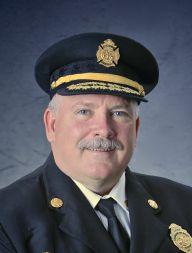
BY DOUGLAS TENNANT Fire chief, Deep River, Ont.
ocial media is rampant with adages and short, insightful sayings about leadership and management. Put the magazine down or minimize the Fire Fighting in Canada website and go to LinkedIn, Facebook or Twitter to browse through them for a few minutes. I like most of the adages; they have the tendency to stick in my mind as I reflect upon what the day brings to me – especially as I interact with colleagues and the public. A recent one that stuck with me is: Managers light a fire under people – leaders light a fire within them. I am not sure who coined this phrase, but for me it summarises what managers and leaders should be doing.
Many of these popular and meaningful social media sayings deal with refreshing or building effective relationships with others in your workplace. These insights are powerful, rich in imagery and enable you to visualise ways to refocus your interactions with others. It is one thing to light a fire in someone else, but what about you, the leader? How are you lighting and stoking the fire within yourself? What is your internal driver? What is in your personal strategic plan?
Do you have a personal vision and mission statement? Is it something short and simple but powerful that you can retrieve to keep you focused?
Many organizations have vision and mission statements and post them on their websites or business cards. Some are too long and convoluted to remember and recount, let alone apply to your work life. Others are simply brilliant. My favourite is from Peterborough Fire Services in Ontario: To be there – whatever the need, prompt and professional. As a firefighter, officer or fire chief, the statement speaks to what the department is all about.
My personal vision and mission statements are “To do the best I can at whatever I’m working on,” and “Be kind, tender-hearted and forgiving.” They are pretty simple and seemingly straightforward, but for me they are not easy. Try being kind, tender-hearted and forgiving for just a day, an afternoon or even an hour at work – both inwardly and outwardly. The effort of fulfilling these personal statements reminds me of the duck Tom DeSorcy describes in his March Volunteer Vision column – outwardly calm and docile, but madly paddling internally.
So, are personal vision and mission statements really a good thing or even necessary? Most of us in the fire service have career paths laid out. Whether you are striving to be a captain in your volunteer department or the fire chief in Canada’s smallest full-time fire service, it is wise to chart a course for yourself. The plan should include personal strategic priorities to accomplish. The result is a strong set of values to exemplify in the community and around the fire hall.
As Les Karpluk and Lyle Quan point out in their March Leadership Forum column, it is crucial to “understand that leadership is more than leading within the station walls.” You may have to lead yourself
The alternative to creating personal vision and mission statements is the status quo . . . ‘‘ ’’
So what is your internal vision or mission statement? I know, you may think it is all warm and fuzzy silliness, and a crock, but think about it: what enables you to know when and how to adjust your sails when the wind changes direction? Society encourages us to be busy and do something – anything –continually. With all that we are exposed to and given our personal, work and other family pressures, it is no wonder that mediocrity and the whatever syndrome has become so seemingly prevalent in the fire hall. If, as Kevin Foster points out in his March Straight Talk column, having “a vision can lead to a positive future for the fire service,” think of what having a personal vision can do for your career – whether you are the greenest recruit or the most seasoned veteran officer in your department.
Doug Tennant is the fire chief in Deep River, Ont. Contact Doug at dougietennant@gmail.com
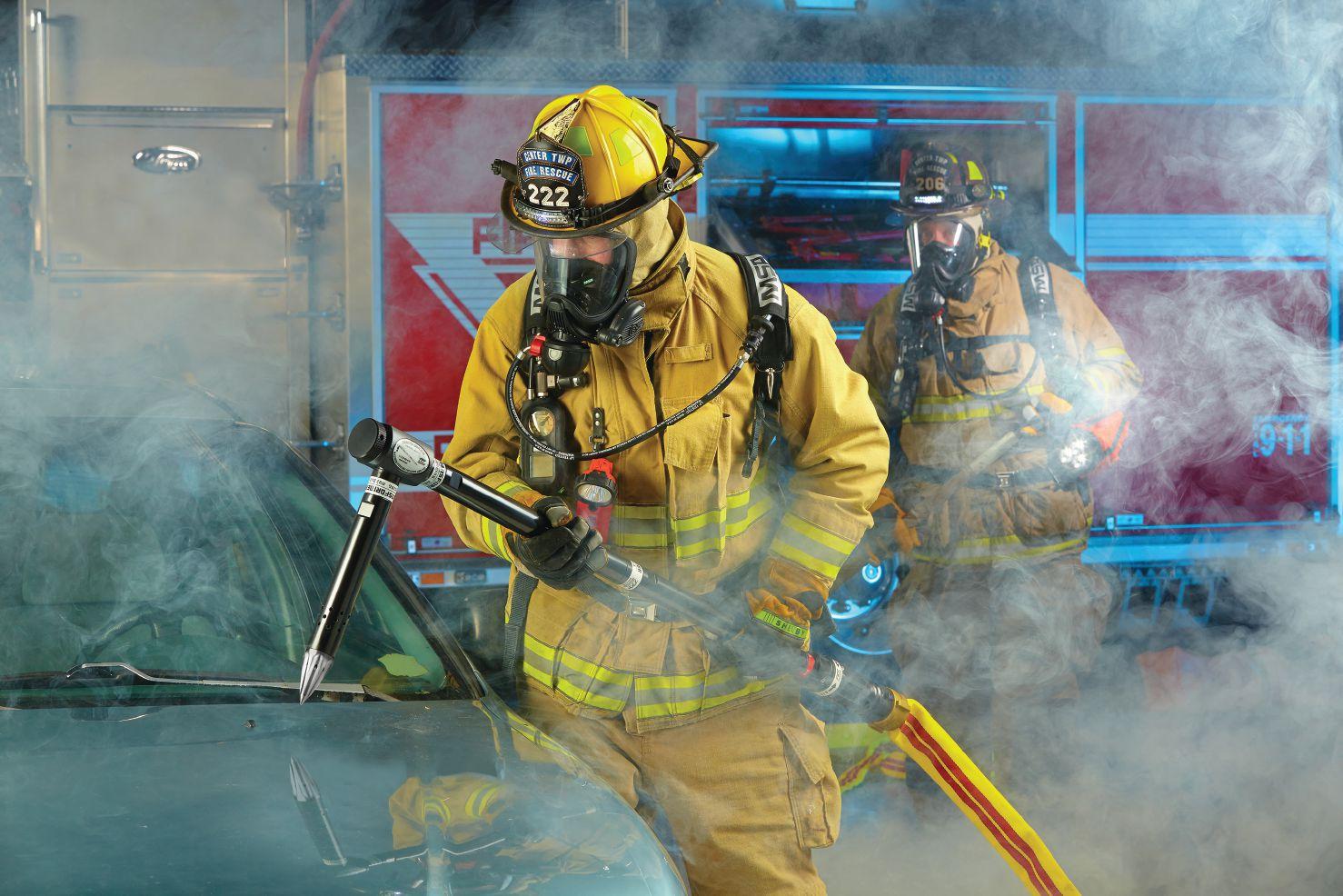
as well from time to time to ensure you are able to pursue leadership excellence. I suggest you take stock of your personal strategic plan, be it centred on family, career or personal growth. Ponder how to connect the dots in order to successfully follow your career path.
Engage your personal mentor to help you reflect on how change, external and internal, can be an opportunity for you. Evaluate your actions and behaviours in and around the fire hall and the community. As Gord Schreiner points out in his March Stopbad column, make yourself vulnerable and ask your confidants about the ethics of your leadership behaviour.
The alternative to creating personal vision and mission statements is the status quo and going with the flow – however, I have heard that only dead fish go with the flow.
Remember – you lead as you are.