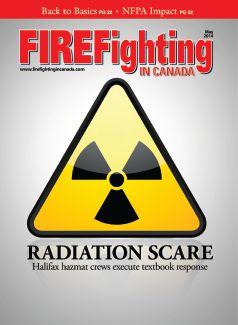
On March 13, Halifax Regional Fire and Emergency Services responded to a report that four large containers holding uranium hexafluoride fell 50 feet into the hold of a ship. While the incident turned out to be less dramatic, John Giggey writes that fire crews completed a textbook response.
26
PENCILLING & PPA
The fire service has evolved a great deal since Neil Campbell joined its ranks almost 20 years ago. Now, Campbell makes the case for employing pencilling and positive pressure attack at every fire – something he was taught never to do.
38 UNDERSTANDING FLOW PATHS
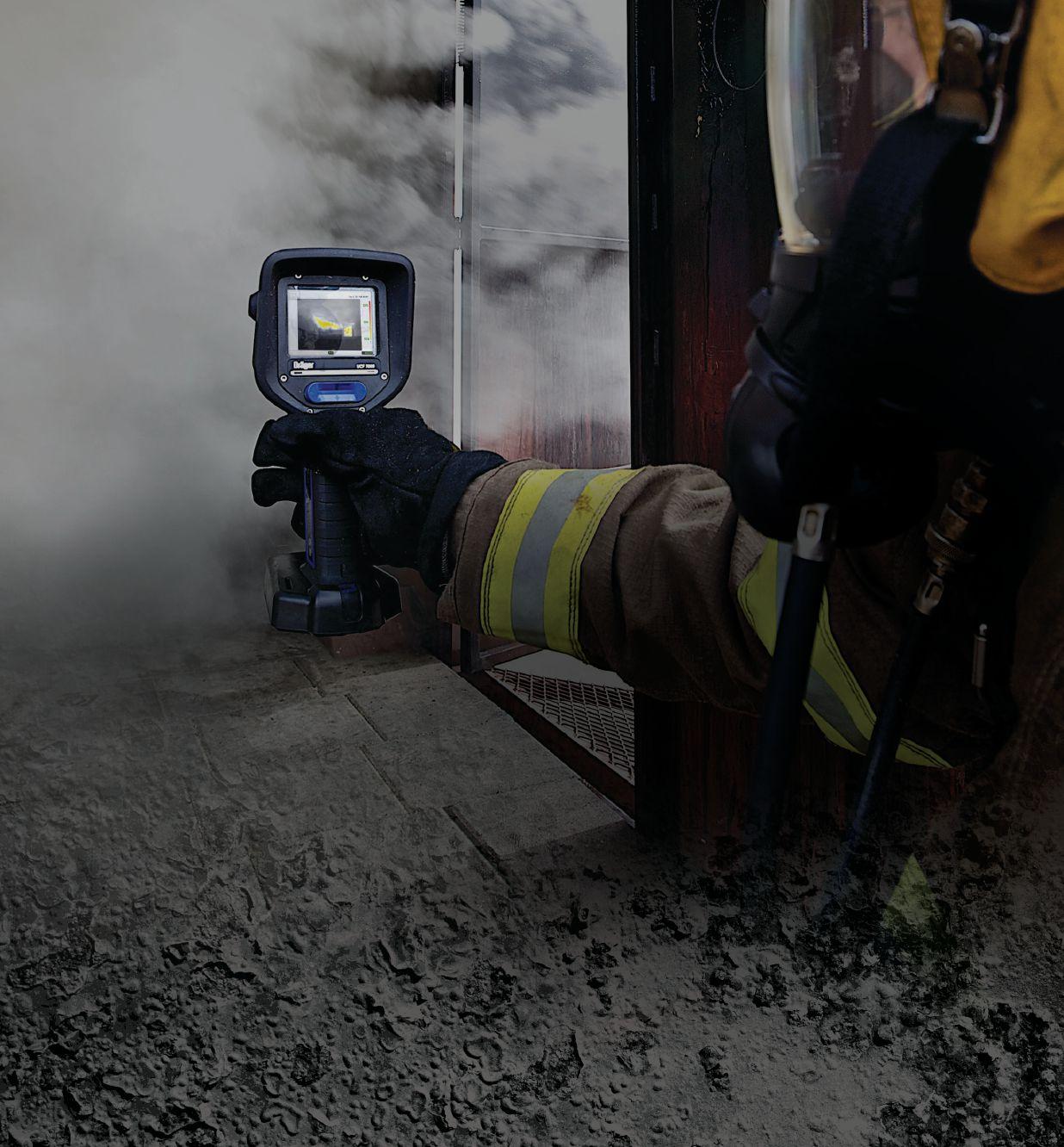
Flow paths have directly caused the deaths of several firefighters. Ian Bolton explains the science behind the movement of flames and hot smoke inside a structure, and how fire crews can control these flow paths.
64
MAKING THE CASE FOR WOOD
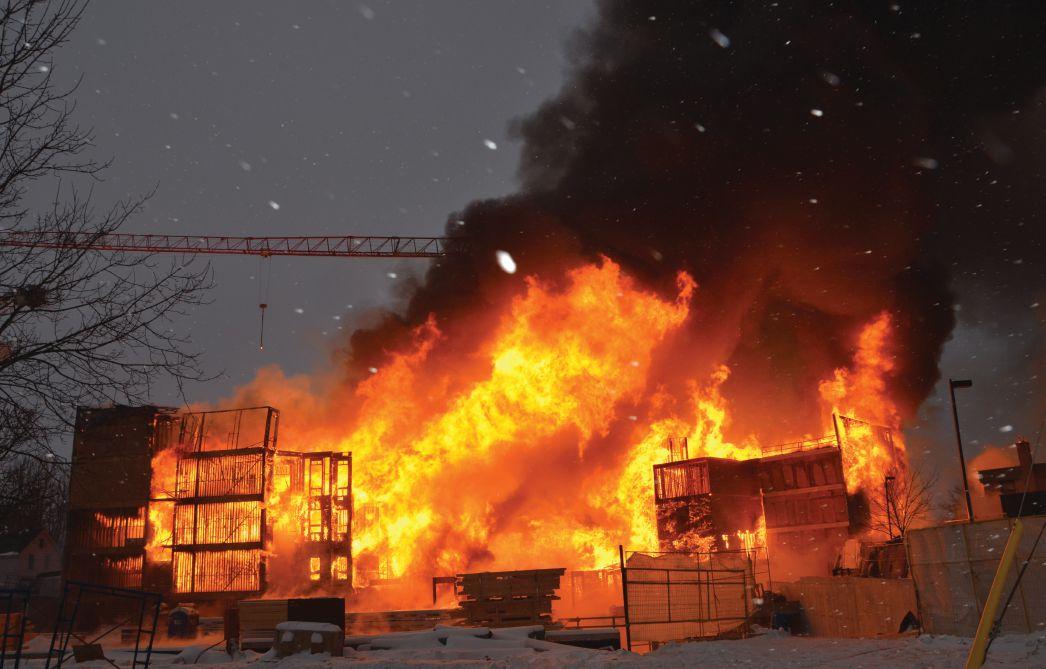
New research comparing the outcomes of fires in buildings with wood, steel and concrete framing appears to bolster the case for taller wood-frame buildings. Len Garis and Joseph Clare describe the influences that various levels of fire protection have on different types of construction.
BY LAURA KING Editor lking@annexweb.com
W COMMENT
Good stories, great insight
e try, here at Fire Fighting in Canada, to offer readers stories that reflect the diversity and expertise of fire departments from coast to coast.
So when crews from Halifax Regional Fire and Emergency Services responded to a call for a potential radiation leak on March 13, I immediately (after learning that the incident was, in fact, a scare and not a leak) wondered about the best way to get the details.
Having connected years ago with John Giggey, a former Canadian Press reporter and retired volunteer captain with Halifax Regional who works part-time for the department’s public affairs division, I figured there was a good chance he could help. Before I got back from the CAFC’s government relations week in Ottawa, John contacted me, keen to provide the detail that only an insider could.
John’s story. And our cover – which makes it clear that the story is about the response to a threat rather than an actual leak – certainly grabs readers’ attention.
We’re excited to welcome a handful of new writers who, I am certain, will shake things up. Dave Balding, the fire chief in Fraser Lake, B.C., joins us with his Firelines column on page 62. It took me a while to coax Dave into writing but the promise of fame and fortune won him over.
ON THE COVER
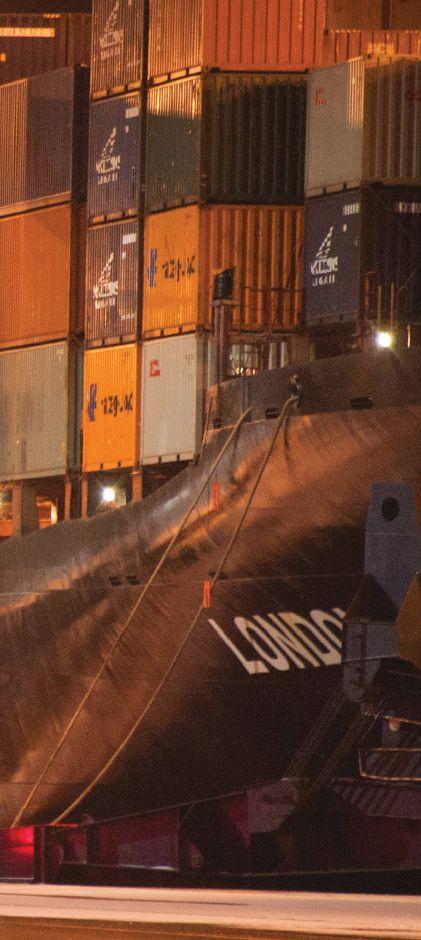
Hazmat crews in Halifax responded to reports of a radiation leak at a container pier on March 13.
Then there was the issue of photos. Canadian Press photographer Andrew Vaughan was at the scene but it was dark, he was shooting from behind barriers, and, like most news photographers, he shoots at a lower resolution than we need for the cover of Fire Fighting in Canada. (I like to think that news and freelance photographers at emergency scenes think, “I bet Laura would love this for the cover of the magazine so I should shoot vertically and at 300 dpi.” No such luck!)
See story page 10.
Days of chasing potential photos proved fruitless, and because the call happened at night, in a restricted area, the usual citizen-journalist snapshots were not available. Regardless, we managed to get some great photos from Halifax Regional to go with
Doug Tennant, the chief in Deep River, Ont., launches his LeaderBoard column on page 46. Doug had written for the magazine years ago and slyly sent me a note at the Ontario Association of Fire Chiefs mid-term meeting in Niagara Falls in November offering up his insight on mentoring which was, given Doug’s background and his generous and pleasant manner, impossible to pass up. Shayne Mintz, the new Canadian regional director for the NFPA, offers up his first NFPA Impact column on page 52. Lastly, we re-launch our Well Being column on health and wellness – which will be guest written by many authors – on page 78, with an entertaining tale by Cobourg, Ont., Chief Mike Vilneff who has learned never to say anything out loud at a chiefs conference that he doesn’t want in the pages of Fire Fighting in Canada! Our regular columnists return next month.
PRESIDENT MIKE FREDERICKS mfredericks@annexweb.com
PUBLICATION MAIL AGREEMENT #40065710
RETURN UNDELIVERABLE CANADIAN ADDRESSES TO CIRCULATION DEPT.
P.O. Box 530, SIMCOE, ON N3Y 4N5
e-mail: subscribe@firefightingincanada.com
Printed in Canada ISSN 0015–2595
CIRCULATION
e-mail: subscribe@firefightingincanada.com
Tel: 866-790-6070 ext. 206
Fax: 877-624-1940
Mail: P.O. Box 530 Simcoe, ON N3Y 4N5
SUBSCRIPTION RATES
Canada – 1 Year - $24.00
(with GST $25.20, with HST/QST $27.12) (GST - #867172652RT0001)
USA – 1 Year $40.00 USD
We acknowledge the financial support of the Government of Canada through the Canada Periodical Fund of the Department of Canadian Heritage.
Occasionally, Fire Fighting in Canada will mail information on behalf of industry-related groups whose products and services we believe may be of interest to you. If you prefer not to receive this information, please contact our circulation department in any of the four ways listed above.
All advertising is subject to the publisher’s approval. Such approval does not imply any endorsement of the products or services advertised. Publisher reserves the right to refuse advertising that does not meet the standards of the publication. www.firefightingincanada.com
STATIONtoSTATION
ACROSS CANADA: Regional news briefs
Chiefs Coin awarded for life-saving actions
a multi-vehicle collision in Peace River, Alta., in February.
When EMT Rick Bergen arrived on the scene of a two-vehicle collision, his training as a volunteer firefighter with the Peace River Fire Department in Alberta paid off. When a fire started in one of the vehicles, Berger’s quick actions saved the life of one of the drivers. In recognition of that heroic rescue, Bergen was awarded the Chief’s
Coin of Excellence.
Bergen responded to the collision at the intersection of Highway 2 and Highway 688, just south of Peace River, on the morning of Feb. 17 as an EMT with Alberta Health Services EMS. A sand truck and a highway tractor-trailer collided; the sand truck rolled over and its load of sand poured into the cab
THE BRASS POLE
Promotions & Appointments
DENIS LETENDRE was promoted to deputy fire chief for the Carrot River Fire Department in Saskatchewan on Jan. 1. Letendre, who was promoted from captain, has 11 years of fire-service experience.
SCOTT
DEBIENNE was promoted to fire chief for the Carrot River Fire Department in Saskatchewan on Jan. 1. Debienne has almost 25 years of service, and is trained as a paramedic and first-responder instructor.
KEVIN DONALDSON was appointed deputy chief for
of the tractor-trailer, trapping the driver in the wreckage. Bergen’s training and experience as a firefighter took over when a fire started as a result of the crash.
BY TYNE LUNN
“It was probably the firefighter side of me that kicked in for me to know what we needed in order to make the scene safe to get him out,” says Bergen, a 24-year fire-service veteran. “As soon as I could get close I started digging sand out and found the top of his head and dug around it.”
Firefighters and paramedics worked closely together to quickly extinguish the fire and protect the occupant, and then worked to dig the patient out of the sand. Due to the co-ordinated rescue efforts, the patient suffered only minor injuries.
The Chief’s Coin, which was instituted in the Peace River department in 2013, recognizes members of the department for acts of excellence and honour.
Bergen, who is the fourth member to receive the coin, was hon-
the Greater Napanee Fire Service in Ontario on Jan. 6. Donaldson began his career in 1984 as a member of the Stone Mills Fire Department, where he worked as a firefighter, before being promoted to captain, to deputy district chief and to deputy chief. Donaldson fills the position left by Ian Shetler, who retired at the end of 2013.
oured for his quick actions and situational awareness in saving the life of the trapped driver at the scene, which was extremely dangerous as both trucks were on fire and the patient was shrouded in smoke.
Other recipients are Lt. Martin Cooper, who was awarded the coin for his actions during a medical first response call, Capt. Kendal Russell, who received the coin for his work promoting the Dixonville Fire Hall, and firefighter/EMT Tyne Lunn, who was awarded the coin for her work promoting the department, particularly through her relationship with Alberta Health Services.
“I haven’t taken credit for saving a life and I will not take credit for saving a life,” Bergen says. “I didn’t view what I did as saving a life; I identified a life.
“I was very surprised [to receive the coin], not expecting it at all. I guess shocked is a better term.”
– Lance Bushie
DANNY STACK retired from the Greater Sudbury Fire Services in Ontario in December. Stack, a 36-year fire-service veteran, joined the department as a firefighter in 1978. He rose through the ranks and was promoted to deputy chief of operations in 2009 . In 2011, he was appointed fire chief, the position he held until his retirement.
Fire Chief Lance Bushie (left) presents Lt. Rick Bergen with the Chief’s Coin for Excellence in recognition of his life-saving actions at the scene of
PHOTO
Dual-purpose marine unit marks half century
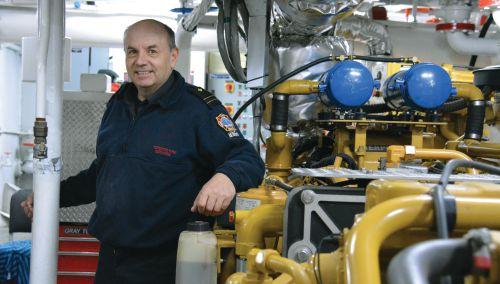
Toronto Senior Marine Capt. Adrian Lewicki knows every nook and cranny of the William Lyon Mackenzie, from the newer diesel engines to the nozzles. And he’s darn proud that the boat bought in 1964 from Russell Brothers Limited in Owen Sound runs like clockwork in its 50th year.
Although the fire boat and its crew at Station 334 on Queen’s Quay respond to medical calls and other emergences on the Toronto Islands and along the city’s waterfront, one of its main duties is to maintain an ice-free path during the
winter for the ferry to nearby Ward’s Island, a populated haven accessible only by boat.
During the harsh winter of 2013-2014, the William Lyon Mackenzie and its crews broke ice on 102 consecutive days, a minimum of tice a day - beating the previous record of 78 consecutive days in.
The WLM was built with a modified tugboat hull to provide marine fire fighting and ice breaking. In 2004, the vessel was refurbished at cost of $1 million and is expected to be in service until 2037.
The WLM is named after
Toronto’s first mayor and is one of just two fire boats working in the Great Lakes. Fiftieth
Vaughan develops fire-safety video game
Vaughan Fire and Rescue Service in Ontario has partnered with educational game developer Squabble Studios to develop a fire-safety video game that reaches children between 10 and 14 years of age.
The game, titled Flashover, educates users about the dangers of cooking and the importance of home escape planning. It features three scenarios that can be played to several different outcomes. Users are scored based on the actions they take.
The idea for the game
ROY DEWHIRST retired as fire chief of the St. Clair Fire Department in Ontario on Oct. 3. Dewhirst, a 42-year veteran of the fire service, began as a volunteer firefighter in 1972, with the Brigden station in Moore, Ont. He served as chief in Moore in 1998 before becoming chief of the St. Clair department in 2001.
CRAIG MACDONALD retired from the Carrot River Fire
came from a conversation that a member of the Squabble Studios team had with a friend in the fire service.
“We developed a prototype . . . to see if it was doable and if we could put it together,” explains Squabble Studios CEO and co-founder Veronica Cole.
“In January 2012, we teamed with Vaughan Fire and showed them the prototype.”
Vaughan Fire offered its input, explaining what needed to be changed or improved.
“We were just exploring a
Department in Saskatchewan on Dec. 31.
MacDonald is a 27-year veteran of the fire service and most recently served as chief for the Carrot River department.
ROBERT GORDON, a 45-year veteran of the fire service, retired from the Puslinch Fire Services in Ontario on Dec.
new idea for that demographic and age group,” says Vaughan Fire Chief Larry Bentley. “There’s Sparky the Dog and colouring books for kids but for young teenagers, how do we engage them?”
Preliminary research was conducted during the summer. The game was brought to a junior firefighter camp and a summer camp run through the City of Vaughan.
“After playing just 10 minutes of that prototype, 70 per cent of kids learned something new about fire safety,” says
anniversary celebrations were scheduled for May 23. – Laura King
17. Gordon, one of the original members of the department, became a firefighter in 1969 and became fire chief in 2008.
DONALD STEWART, one of the original members of the Puslinch Fire Services in Ontario, retired on Dec. 17.
A 45-year veteran of the fire service, Stewart joined the department as a firefighter in 1969.
Cole. “Almost everyone was able to identify what they learned.
“It was positive to see that [the kids] were both interested and they were learning.”
“The fire service can’t just continue to drum out the same message,” Bentley says. “We need to change with the world, and with social media . . . we need to get on the bandwagon and get our message out that way.”
The game is available at www.getflasover.ca.
– Olivia D’Orazio
PETER LEONARD, a training officer for the Vaughan Fire & Rescue Service in Ontario, died suddenly on Feb. 14 at his home in Cookstown, Ont. Leonard joined the fire service with the department in Vaughan as a firefighter in 1989 and became training officer for the Vaughan department in 2002.
Toronto Senior Marine Capt. Adrian Lewicki inside the gleaming engine room of the refurbished ice-breaker/fire boat William Lyon Mackenzie.
PHOTO BY LAURA KING
STATIONtoSTATION
BRIGADE NEWS: From stations across Canada
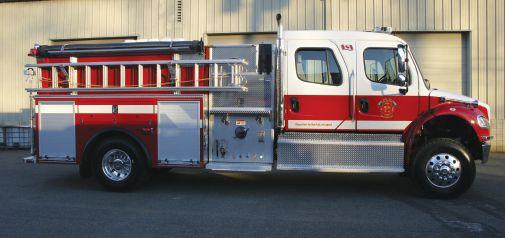
The Riceton Volunteer Fire Department in Saskatchewan, under Fire Chief Gordon Glaze, took delivery in December of a Hub Fire Engines & Equipment-built pumper. Built on a Freightliner M2 chassis and powered by an Allison 3000 EVS transmission and a Cummins ISL 350-hp engine, the truck is equipped with a Hale Q-Pak 840-gpm pump, a FoamPro 1600 foam system, a 930-gallon co-poly water tank and custom SCBA storage.
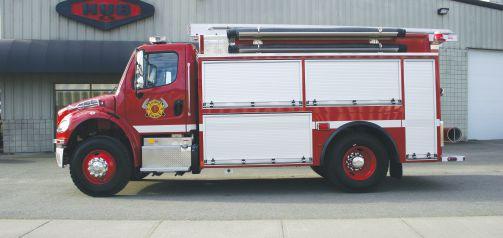
The Malakwa Fire Department in British Columbia, under Fire Chief Joanne Held, took delivery in January of a Hub Fire Engines & Equipment-built tanker. Built on a Freightliner M2 chassis and powered by an Allison 3000 EVS transmission and a Cummins ISL 330-hp engine, the truck is equipped with a CET pump, FoamPro 1600 foam system, a 1,600-gallon co-poly water tank, Amdor roll-up doors, a Whelen LED light package and an EJ Metal 180-degree swivel dump chute.
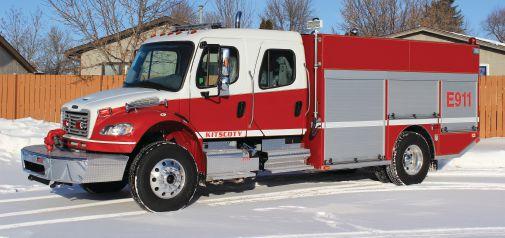
The Kitscoty Fire & Rescue Department in Alberta, under Fire Chief Orest Popsil, took delivery in January of a Fort Garry Fire Trucksbuilt pumper. Built on a Freightliner M2 chassis and powered by an Allison 3000 EVS transmission and a Cummins ISL 350-hp engine, the truck is equipped with a Darley 1,000-gpm pump, a 1,000-gallon co-poly water tank and a FoamPro 2002 Class A foam system.
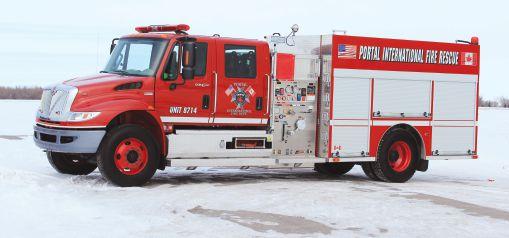
The Portal International Fire Department in Saskatchewan, under Fire Chief Mike Gillies, took delivery in February of a Fort Garry Fire Trucks-built pumper. Built on an International 440 chassis and powered by an Allison 3500 EVS transmission and a Maxxforce 300-hp engine, the truck is equipped with a Hale 840-gpm pump, a 1,000-gallon co-poly water tank and a Hale Logix Class A foam system.
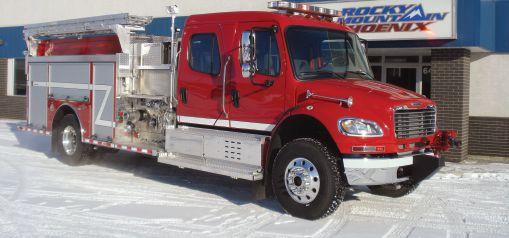
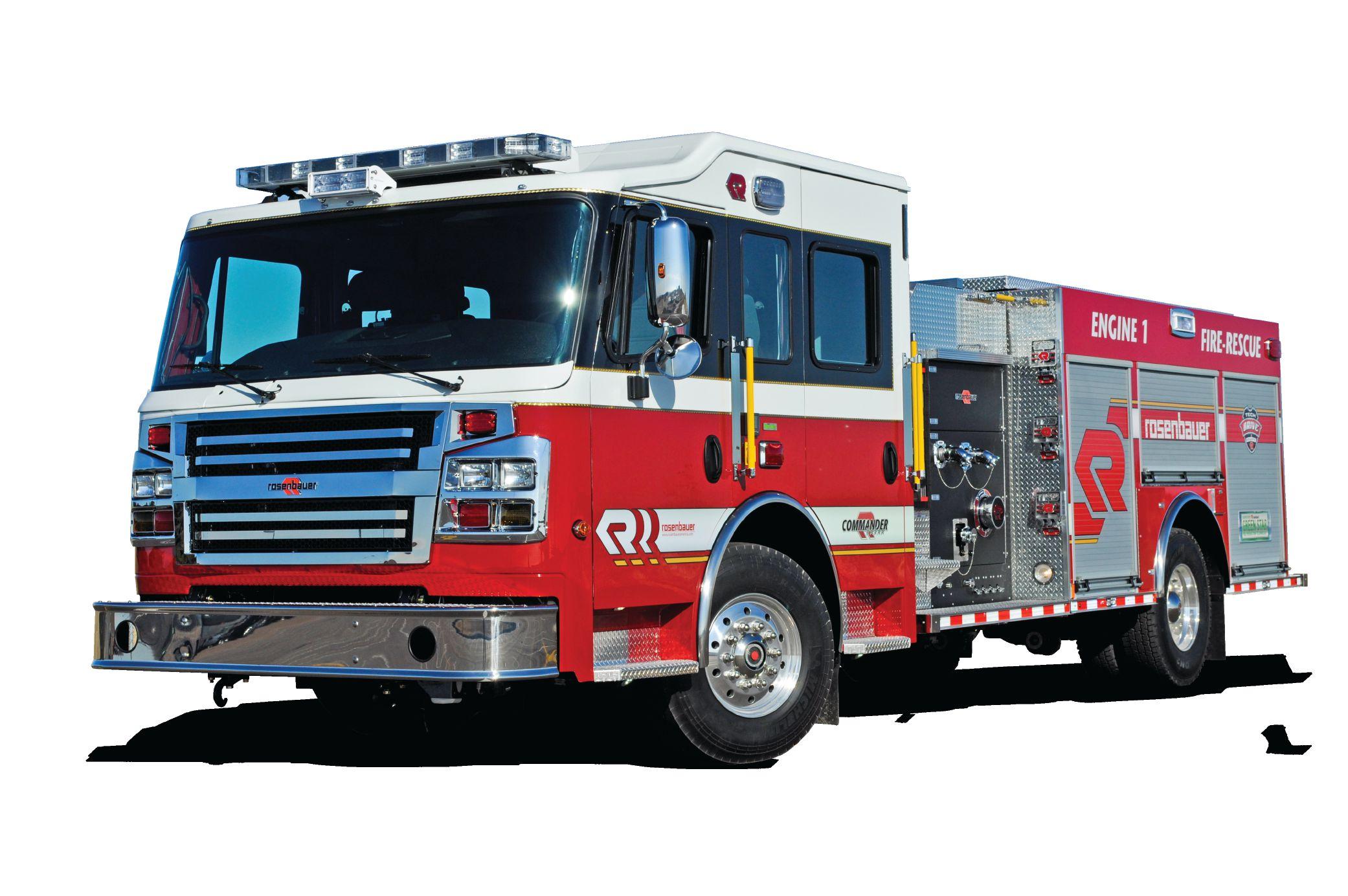
The Clive Volunteer Fire Department in Alberta, under Fire Chief Monte Zaystoff, took delivery from Rocky Mountain Phoenix in February of a Rosenbauer-built pumper. Built on a Freightliner M2 chassis and powered by an Allison 3000 EVS transmission and a Cummins ISL 330-hp engine, the truck is equipped with a Rosenbauer 1,000-gpm pump, a 1,000-gallon co-poly water tank, a Rosenabauer FixMix HP and FoamPro 2001 foam systems and an Akron FireFox bumper turret.
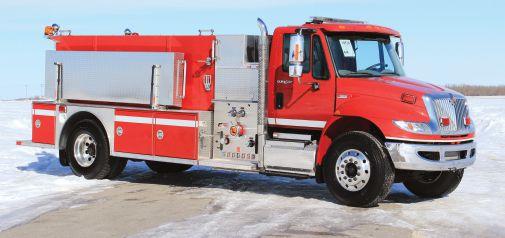
The Trent Lakes Fire Rescue in Ontario, under Fire Chief Don Mitchell, took delivery in March of a Fort Garry Fire Trucks-built tanker. Built on a Freightliner M2 chassis and powered by Allison 3000 EVS transmission and a Cummins ISC 330-hp engine, the truck is equipped with a Darley 840-gpm pump and a 900-gallon co-poly water tank.
THE MALAKWA FIRE DEPARTMENT
THE RICETON VOLUNTEER FIRE DEPARTMENT
THE KITSCOTY FIRE & RESCUE DEPARTMENT
THE PORTAL INTERNATIONAL FIRE DEPARTMENT
TRENT LAKES FIRE RESCUE
THE CLIVE VOLUNTEER FIRE DEPARTMENT
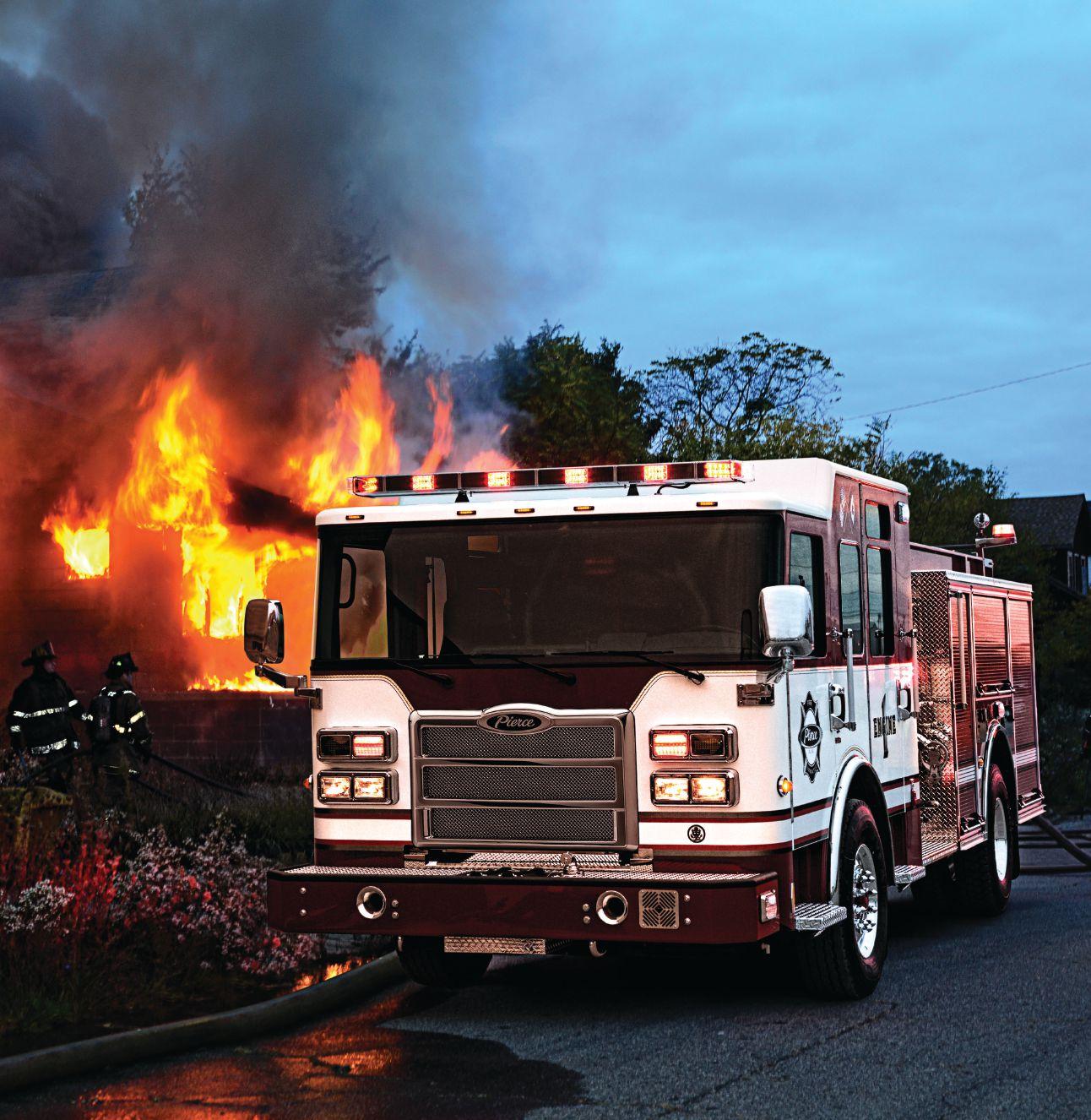
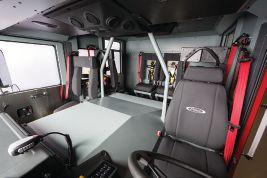
Proven reliability returns. The Pierce ® Enforcer ™ chassis is back, offering TAK-4 ® independent front suspension and two powerful engine options. With advancements in safety, visibility, space, ergonomics and serviceability, the new Enforcer performs like never before.
seats.* Smaller, lower engine tunnel maximizes driver and officer space while improving visibility across the cab. ReadyReach Seatbelts for easy usage in full gear.
RADIATION SCARE
Halifax crews complete textbook response to hazmat call at container pier after crane drops canisters into hull
By JOHN GIGGEY
In Halifax, it takes between 60 and 90 seconds for a 911 call taker to answer the phone, pass the phone to a fire dispatcher and tone out the necessary apparatuses. Sometimes, when the call is particularly serious, one dispatcher may telephone the primary station to give crews a heads up while another dispatcher handles the page.
So when the house phone rang at Station 12 shortly after 9:30 p.m. on March 13, Capt. Ed Oakley knew something was up.
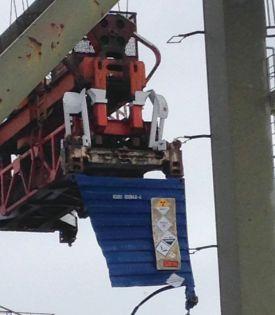
The dispatcher told Oakley that a crane had dropped several canisters containing radioactive material. The canisters fell about 15.24 metres (50 feet) at the Cerescorp container pier, one of two container piers on the Halifax waterfront. While the dispatcher was still talking, the tones started.
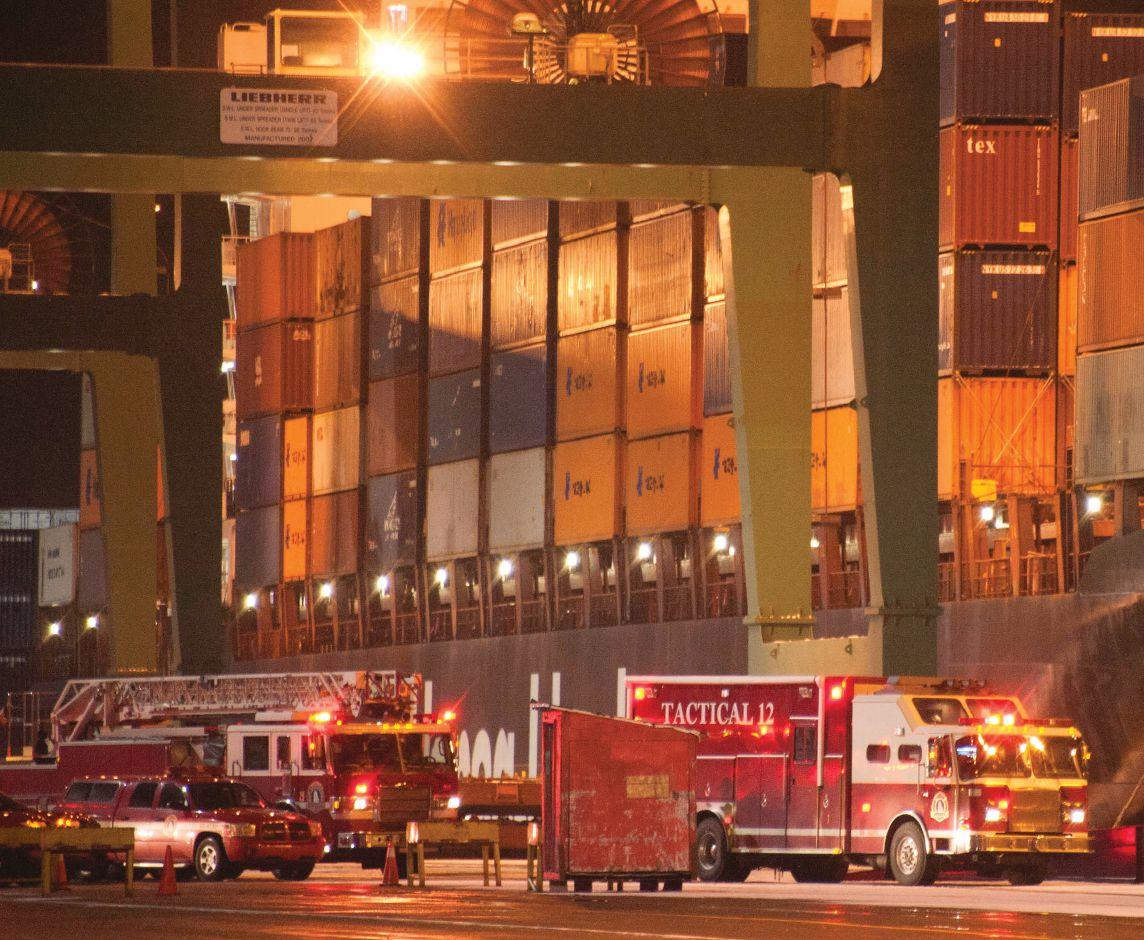
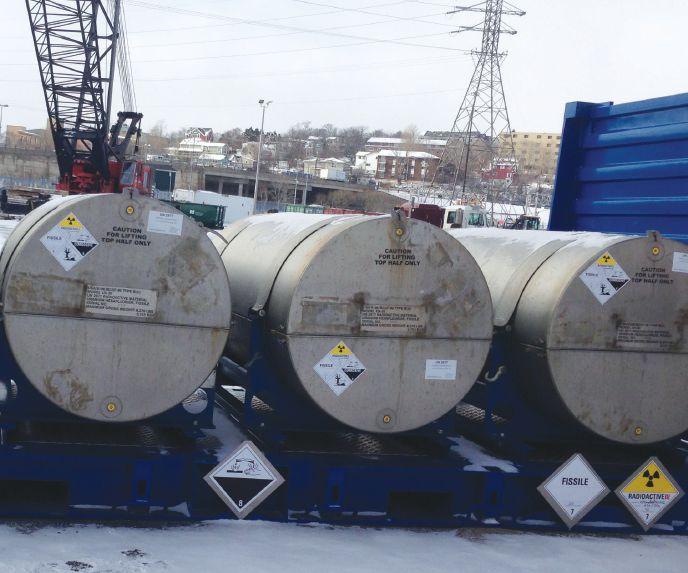
LEFT Halifax Regional Fire and Emergency Services responds to a call for a possible radiation leak at a container pier on March 13. Containers holding uranium hexafluoride, a highly radioactive compound used in the uranium enrichment process that produces fuel for nuclear reactors and nuclear weapons, had been dropped by a crane into the ship’s hold and had possibly been compromised.
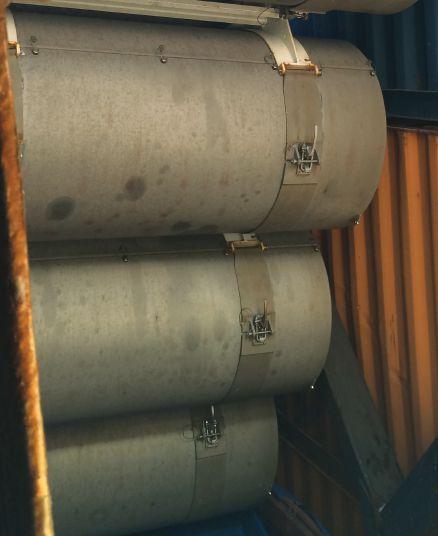
ABOVE The part of the flat rack with the canisters still attached landed on its end, with the top canisters leaning forward. The danger of a collapse kept members from approaching the canisters to get a required reading three feet from the containers.
The response included the city’s hazmat units –12 Company, comprising Quint 12 and Tactical 12, and Quint 5, the decontamination unit, which is based in another part of the city. A hazmat response also includes the closest engine company, which in this case, was also from 12 Company, as well as the closest engine company, Engine 4, which was just up the street from the scene.
In Halifax, the operating guidelines for a radiological response require that personal dosimeters (which measure radiation exposure) be activated and donned by all hazmat crew members before leaving the station. A Geiger-Mueller probe, which is sensitive to alpha, beta and gamma radiation, must be activated and its readings must be monitored during the response. Any other meters expected to be used must be up and running before the apparatuses leave the station. For this reason, the hazmat units at both stations were delayed four or five minutes.
First-in Engine 4 arrived on scene to find security waiting. Capt. Dennis Pitts met the night superintendent who told
him the canisters fell about 12.2 metres (40 feet) into the hold of a container ship. The department later learned that the containers actually fell about 6.1 metres (20 feet) while being off-loaded. Four canisters had been bolted to a flat rack, which is constructed of a steel frame and a softwood bottom. An identical rack of canisters on the nearby wharf had just been off loaded, and carried the same product. Pitts determined the canisters were marked UN2977 – uranium hexafluoride, a highly radioactive compound used in the uranium enrichment process that produces fuel for nuclear reactors and nuclear weapons.
Pitts radioed that information to Oakley on the quint, who later said the hairs on the back of his neck stood up when he spoke with Pitts. A few weeks earlier, he had drilled his crew on a worstcase scenario involving a radioactive spill, and that very scenario was playing out. Oakley advised Pitts to not proceed any further and to hold his position until the hazmat team arrived. Once on scene, Oakley spoke face to face with Pitts and assumed command.
Operating guidelines require the staging area first be metered to confirm it is in the cold zone. After this was completed, two members geared up and, using meters, moved forward from the apparatus toward the incident, monitoring for changes in levels. There were none.
“We got right up to the ship without any significant readings,” Oakley said. “Now we could narrow the hot zone down to the ship itself.
“We didn’t board the ship at this point, but we could communicate with the crew from the jetty. We determined there were four canisters attached to the flat rack, and part of the rack along with the canisters had fallen into the hold.”
In the meantime, Pitts gathered information in the main Cerescorp building at the terminal. Then came a surprise: the shipping agent approached Pitts and reported that everything was fine. The agent said that he and the first mate had already gone into the hold, inspected the containers and determined that nothing was wrong with them.
There’s a little more to checking for radiation than looking. Pitts put into isolation the shipping agent and everyone
PHOTO BY ANDREW VAUGHAN, THE CANADIAN PRESS
PHOTO BY MARK LEGERE
Part of the flat rack remains on the crane after another section with the canisters attached fell into the hold.
LESSONS LEARNED
• HRFE is considering putting cellular devices with Internet access on frontline apparatuses, in addition to the computer system in its tactical unit. In the meantime, some members have acquired personal devices, which proved valuable during this operation. With the incident at a distance from the tactical unit, members could quickly access online information without returning to the vehicle. Members could also communicate by cell phone rather than radio transmissions, which are monitored by the media and the public.
• iPhones provide much better live video feeds than the department’s expensive remote camera.
• Carefully choose your words. While prolonged exposure to radiation readings of four times normal levels can cause health problems, this reading posed no immediate danger yet caused great concern among uninformed reporters and the listening public. Use more face-to-face or mobile-phone communication.
• Provide a separate, quiet location for the hazmat research team. The team was in the same vehicle as accountability, which was loud, crowded and distracting.
• Command could have stayed with the first-in captain until a more senior officer arrived so the captain of the hazmat team could focus on his assignment.
with whom he had come into contact. Pitts also isolated himself from his crew until he could be metered. With the first mate still on the ship, the crew also had to be checked. The gates to the pier were closed and no one was allowed to leave or enter without permission from fire officials. Everyone was later metered and cleared of any radiation contamination.
By this time, Divisional Commander (platoon chief) Corey Beals had arrived and assumed command. Oakley was put in charge of operations. Pitts gathered all stakeholders on scene in a boardroom and Beals, having been brought up to speed, briefed them on what was happening. Oakley updated the group on the operational side via cell phone.
With a potentially major incident unfolding, Beals called for the emergency management team, bringing together Fire Chief Doug Trussler, Brian Gray, the deputy chief of operations, and Roy Hollett, the deputy chief of operational support, along with Executive Officer Phil McNulty as public information officer. By this time, many reporters had gathered outside the gate.
The need for an official public information officer on scene had become critical. Because divisional commanders often deal with the media on day-to-day calls, it’s not uncommon for reporters to have their contact information. This call was now well beyond routine, and phone inquiries were flooding in from all over North America and around the world. With a PIO in place, the incident commander could manage the incident without distraction.
At any given time, the level of radiation from various sources fluctuates around 0.25 uSv/hr, or one quarter of one millionth of a sievert. This product was contained in cement with a steel outer casing, making it virtually indestructible. This type of vessel is considered category-3 containment. Each of the four canisters involved weighed about 4.5 tonnes.
Halifax Regional Fire and Emergency Services guidelines allow for members to advance until they get readings of 0.5 uSv/hr, still far below any danger level. Using this measurement as a guide, pylons are set down at the 0.5 uSv/hr point around the source, cordoning off an area that becomes the initial contact point.
In this case, scene control was manage-
able given that the incident was aboard a ship. Following the directions provided by a member of the ship’s crew, firefighters Craig March and Sherry Thibault boarded the ship, taking meter readings as they went. Oakley and firefighter Dwayne Dodge followed March and Thibault, using meters for a secondary survey. The meter readings remained at normal levels.
March and Thibault climbed to a catwalk overlooking the hold and had a visual on the dropped containers, 6.1 metres (20 feet) below. Radiation readings always fluctuate, but the meters read about four times normal levels.
“Dwayne and I went up and confirmed the levels with our meters,” Oakley said. “But at that point we had no idea what would be normal for that container.”
Meanwhile, Beals notified outside agencies, including the Canadian Transport Emergency Centre (CANUTEC) and the Canadian Nuclear Safety Council, advising them of a potential incident involving uranium hexafluoride and indicating that first responders were still investigating.
However, satisfied with the readings, crews narrowed the hot zone to the area around the canisters. Further investigation showed that if uranium hexafluoride mixes with water, it forms deadly hydrofluoric acid in a gaseous state. CANUTEC advised that most crew members be evacuated, leaving only the captain and four seamen aboard.
Oakley maintained contact with CANUTEC and obtained the emergency response action plan for the product from RBS Logistics, the emergency response agency for these canisters. RSB Logistics also provided Oakley with the consignment papers for that product, which included other specific information on what crews were dealing with.
Oakley also received the transport index. This was critical; the index says precisely what the maximum reading should be for the canister from a distance of one metre (three feet). If readings exceed that level, the canister has lost its ability to safely hold the product. At this point, crews needed to take readings one metre away from the canisters.
However, the rack of canisters had fallen vertically into the hold; the canisters were leaning forward and it was obvious they could fall over. Firefighters could not
PHOTO BY SCOTT LOGAN
ON SOLID FOOTING FOR 25 YEARS
Improve your performance. Globe boots are flexible like your feet, grip like no other and feel broken in right out of the box.
Contact Safedesign to get Globe footgear. Internationally recognized PPE specialists.
safely get within one metre of the canisters to take a reading.
The decision was made to leave only a skeleton crew of the captain and two other critical officers on board. A department portable radio was left with the officers on board so they could contact command directly if necessary.
With the situation now stable, Engine 4 and Quint 5 were released. Since there was still a chance the rack could fall over, Quint 12 and Tactical 12 stayed on scene. At daybreak, a shift change resulted in Divisional Commander Peter Andrews taking over incident command and Capt. Scott Logan of 12 Company taking over operations after being briefed by Oakley.
In the meantime, a remote camera had been set up to provide a live video feed to the tactical unit so the canisters could be monitored constantly without firefighters being close to the scene. Every 90 minutes, a member would go and change the battery.
During the day, officials arrived from the Canadian Nuclear Commission, RSB Logistics, and Overwatch Incorporated, a company that specializes in the nuclear industry including responding to and mitigating nuclear emergencies. It was critical to get that one-metre reading. But the problem remained: The four canisters were on their ends and leaning forward; they
could topple over at any time. Putting someone next to them to take a reading was out of the question.
It was time to innovate. As a hazmat scene, there had been a pole set up with a sock on top to monitor wind direction. Members removed the sock, attached a meter to the pole, and took the reading from a safe distance. The readings were within the transport index; the canisters were safe; the emergency, basically, was over.
Fire crews stayed on scene until indus trial response teams arrived from outside the province. A camera was set up, which allowed members to constantly monitor the canisters from Tactical 12.
“By 11 p.m. we had determined there was no leakage, the integrity of the con tainers had not been compromised, and the containers could be moved the following day,” said Andrews.
At 21 minutes after midnight on March 15, Company 12 cleared the scene and the incident officially came to an end.
John Giggey is a retired volunteer captain with Halifax Regional Fire. He works part-time in the department’s public affairs division. He is also a retired journalist, having acted as a supervising editor with the Canadian Press and Broadcast News in Toronto. E-mail him at giggeyj@halifax.ca
An identical flat rack of canisters with the same product sits on the wharf after being off-loaded before the second rack fell back into the ship.
PHOTO BY CORY DOMINIX
BY VINCE MACKENZIE Fire chief
Grand Falls-Windsor, N.L.
VVOLUNTEERVISION
An astronaut’s view of . . . the fire service
olunteer firefighters who last a long time in the fire service can certainly gain a vast perspective on many aspects of life. As firefighters in our respective communities, we are exposed to almost every imaginable scenario of adversity or crisis that can befall our populations. The incidents we respond to vary from the very tragic to the heartwarming, and, in some cases, the downright hilarious with very happy endings. Never knowing what the next call will bring adds to the thrill, the excitement, and the challenge of being a firefighter; this also motivates us to continue to train and stay up to date, even though doing so can be overwhelming at times.
Every once in a while, I come across an experience, a lecture, a presentation, or some writing that sheds a little light on what makes us continue to soldier on. Those tidbits sometimes create a better understanding of what drives and motivates us in those moments of fear or despair at those not-so-fun calls. We steadily learn and train to be ready for the ever-increasing difficult tasks we are called to deal with, all while juggling family life and our regular jobs.
I had another perspective-enhancing experience a few months ago when I read and thoroughly enjoyed Canadian astronaut Chris Hadfield’s book, An Astronaut’s Guide to Life on Earth. I initially read the book because I have always taken an interest in space exploration. The only time I ever played hooky from high school was to stay home and watch the very first space shuttle launch and then the safe return to Earth in 1981. I have followed Commander Hadfield’s career; he is an outstanding Canadian and has certainly become one of my mentors.
incredible, but also, astronauts must prepare for every conceivable emergency; this parallels what we do in the fire service.
I was particularly struck by Hadfield’s explanation of the three ways crew members are perceived in the eyes of their colleagues.
So, translating Hadfield’s system to the fire service, there are three types of individuals ranked by their perceived contributions to their departments. First, are the Minus 1s – people who are seen as constantly creating problems and being harmful to an organization; this behaviour can be deliberate or it can exist simply because these people do not engage or have the internal resources to perform to the level required.
Next are those classified as Zeros – those who are perceived as doing their part and giving effort to the normal course of duty; neutral players who do not impact the organization either positively or negatively. Hadfield says we all should strive to be at least a Zero.
Finally, there are those who are considered Plus 1s by peers, individuals who actively and consistently add value to the profession. We all want to be perceived as Plus 1s, but if you proclaim yourself
I was struck by the experiences Hadfield narrated about training, motivation, and wanting to excel and to fit into the team. ‘‘ ’’
As I read the musings of our famous astronaut, the storyline started to transform in my mind from a book about astronauts to a book about firefighters and the missions we execute. While reading Hadfield’s thoughts and advice about different challenges, I couldn’t help but constantly think that even the volunteer firefighter’s life is similar to that of a NASA astronaut.
I was struck by the experiences Hadfield narrated about training, motivation, and wanting to excel and to fit into the team. Not only is the amount of training involved to prepare for a mission
Vince MacKenzie is the fire chief in Grand Falls-Windsor, N.L. He is the president of the Newfoundland and Labrador Association of Fire Service and a director of the Canadian Association of Fire Chiefs. E-mail him at firechief@grandfallswindsor.com and follow him on Twitter at @FirechiefVince
to be a Plus 1, you will almost certainly be perceived as a Minus 1. Classifying, and understanding, how you view others and how you are viewed by those around you, can simplify and improve how we all interact and get along.
So, are you viewed as a Minus 1, a Zero, or a Plus 1? I think all firefighters should reflect at times and ask themselves if they are doing all they can to be perceived as the Plus 1s in the eyes of their peers. Imagine the strength we all could have if everyone put a little more energy into solving the challenges that we face in today’s volunteer fire service. Our service needs more Plus 1s.
I think Hadfield’s book is a good read for all firefighters, career or volunteer. Comparing firefighters with astronauts is not my normal musing, but every now and then it is important to view our profession from a different perspective.
The hazards of trailer fires TRAINER’SCORNER
BY ED BROUWER
Amobile home is a house that has been fabricated off site. The house is placed on a steel chassis and is transported to the building site. The wheels can be removed but the chassis stays in place. Typically, mobile homes are built on lightweight wood frames with a thin aluminum shell covering, and are set up on concrete blocks, metal stands, wooden pillars or a concrete foundation.
Manufactured homes are essentially mobile homes, but with higher safety standards that were adopted by housing and urban development groups in 1976. The thin aluminum siding was replaced with wood siding or chicken wire and stucco, and the roof has a slight pitch or is flat. Three models of manufactured homes are available: single, double and triple wide.
Although mobile homes are smaller in square footage than homes that are built on site, people still seem to pack in the same volume of contents as they do in a typical house. This combination (small room sizes and large fire loads) promotes rapid fire growth and quickens flashover. Lower ceilings make fire spread extremely fast, creating multiple safety challenges for interior crews.
The following is taken from a National Institute of Occupational Safety and Health line-of-duty death (LODD) investigative report regarding a mobile home fire. It is hard not to get angry when you read this brutal account. How many more firefighters do we have to sacrifice to the fire dragon before incident commanders get their acts together?
“On January 11, 2001, a 27-year-old male volunteer fire fighter (the victim) died after becoming separated, disoriented, and lost as he and another fire fighter were trying to escape from the interior of a fully involved mobile home fire. Fire apparatus were dispatched to the site at 1110 hours, and at 1113 hours, the Chief arrived on scene in his privately owned vehicle (POV) and assumed incident command (IC). At 1122 hours, the first apparatus arrived: Engine 19 with the First Assistant Chief, a driver/operator, and two fire fighters (including the injured fire fighter). The Chief told them to set up in the driveway of the mobile home (Side 2), and pull two attack lines. At 1123 hours the next apparatus arrived: Engine 14
SUGGESTED TRAINING TOPICS:
■ Size-up
■ Firefighter assist and survival: following a hoseline to safety, feeling the hose couplings for exit direction, turning a window into a door, moving a downed fire -
fighter in limited space and moving firefighters down ladders or from below the floor
■ Mayday protocol: when to call and how to call
■ RIT: small windows, small rooms, tight spaces, narrow
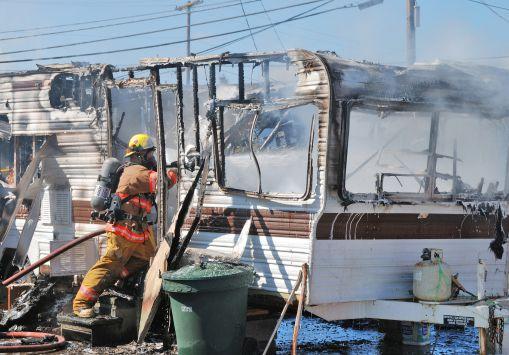
ABOVE Despite having less square footage, mobile homes are often packed with the same volume of belongings as a typical house.
BELOW Mobile homes and trailer homes are often constructed of lightweight materials and have low ceilings, allowing fire to spread extremely quickly through the structure.
hallways and lightweight construction
■ Fire-ground communications: review radio operating procedures
■ Ventilation and fire attack
■ Class A foam
■ Overhaul and salvage
■ Pre-planning
■ Mobile home construction and floor plans
■ Evacuation alerts: audible warning and emergency radio traffic
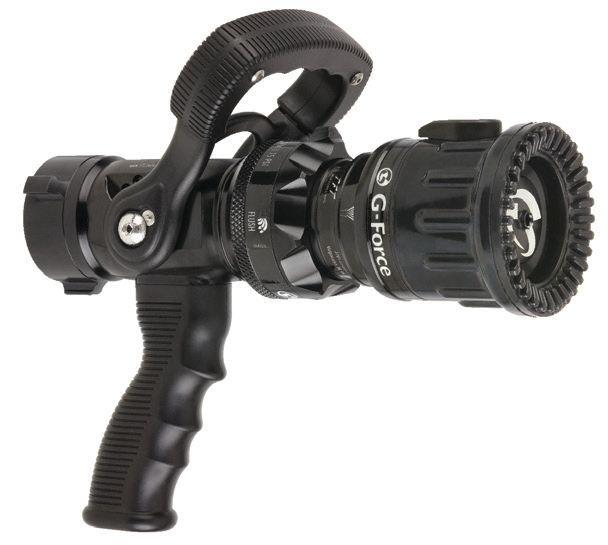
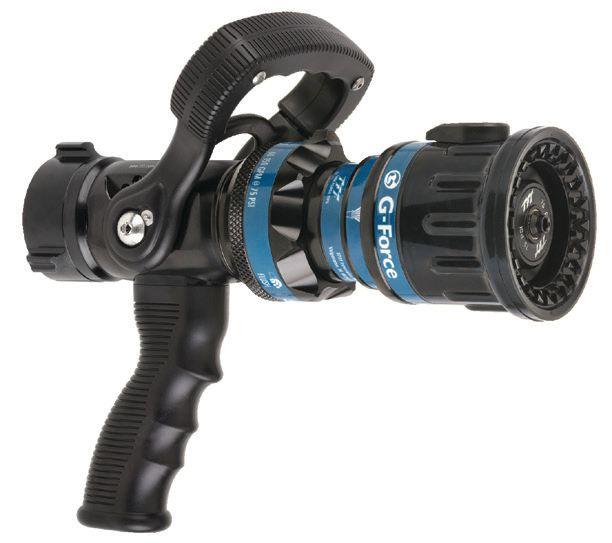
Three Amazing Nozzles...
• Available in Tip Only, Shutoff, or Shutoff with Pistol Grip.
• Choice of fixed metal, rubber, or spinning tooth fog pattern designs
• All models are made in the U.S.A., are serialized, have reflective labeling, permanent laser markings and 5-year warranty
TRAINER’SCORNER
(mutual aid) with a driver/operator. Engine 14 set up his apparatus behind Engine 19, and prepared to supply water. At 1125 the final two apparatus arrived: Engine 15 (Captain and two fire fighters) and Engine 16 (Captain, Lieutenant [the victim], driver/operator, and one fire fighter). Both engines set up their apparatus and awaited instructions.
he was pronounced dead at the scene by the local coroner.” (NIOSH report F2001-04 –http://www.cdc.gov/niosh/fire/reports/ face200104.html)
No complete size-up, no continual evaluation of fire conditions, no accountability, no PAR, no PASS alarm, no RIT, no safety officer, no mayday, no radio – no chance!
The victim had 10 years of firefighting experience. His helmet was found by another firefighter and given to the assistant chief, who then began a search. No one knew he was in trouble. Although he had become lost and disoriented, no distress or mayday call was ever heard. He was wearing a PASS device but it had not been turned on and his radio was found in his turnout pants pocket, where it is hard to reach.
“The IC sent two crews to attack the fire–one crew entered the basement (Side 2), and the second entered the main floor from the porch (Side 1). The victim and the fire fighter from Engine 15 were in the first crew; they moved their attack from the basement to the porch, and then moved into the structure. A fire fighter from Engine 19, who was originally in the basement, joined them, and the three fire fighters moved down the hallway toward a back bedroom. The low-air alarm went off on the fire fighter from Engine 15, and he exited the mobile home to change his air bottle. The victim and remaining fire fighter hit the fire in the back bedroom until conditions deteriorated, and intense heat and smoke forced them to quit the interior attack and try to leave the structure. The deteriorating conditions also forced the second crew to quit the interior attack, and they were able to exit the home.
I know this was 12 years ago, and many of these safety issues have been addressed – we now train to a higher standard that includes PAR training, evacuation alerts and RIT, and our equipment now has builtin PASS alarms. However, the question I spoke out loud as I read this was, “Why the heck are we sending firefighters into these situations in the first place?” It is a valid question, especially when you read that the female who reported the fire told the chief, upon his arrival, that everyone was out of the house.
“As the victim and fire fighter from the first crew were trying to exit, thick smoke banked down to the floor and the heat intensified further, forcing them to follow the handline on their hands and knees. However, the line had looped over itself several times, and the two fire fighters became disoriented, got off the line, and crawled into an addition (12 ft x 12 ft) to the mobile home. The fire fighter from Engine 19 found a window, broke through it, and fell outside the mobile home. Other fire fighters assisted him, and he was transported to the local hospital, at 12:02 hours.
NFPA 1500 explains that we may risk a lot to protect savable lives, we may risk a little to protect savable property, but we will not risk our lives at all for property that is already lost.
“Between 30 and 40 minutes elapsed before it was determined that the victim was missing. At this time, several fire fighters began searching the grounds and the interior, and even called the local hospital to see if the victim had been transported there with the injured fire fighter. The victim was eventually located by a chief from one of the mutual aid departments, who crawled into the addition and saw the victim’s boot. His body was removed to the outside and
An additional danger with mobile homes, especially the older ones, is that the structure may have had any number of remodels and additions. Take the preceding incident as an example. The original mobile home was a single-family residence measuring 3.6 metres wide and 19.8 metres long. Then it was placed on a concrete-block foundation measuring 7.3 metres wide, 19.8 metres long and was 2.1 metres in height to create a basement. The basement was partitioned off and consisted of finished living quarters on the east side and a workshop area containing a garage on the west side. It was a wood-framed building with aluminum siding and a flat roof with metal roofing, and was fully carpeted. An enclosed porch measuring 3.6 metres wide and 13.1 metres long, and a 3.6-metre by 3.6-metre addition had also
TRAINER’SCORNER
Due to the limited space for storage in mobile homes, occupants will often store items – such as spare car tires or lawn mowers – under the home.
home. One dangerous modification was the addition of a pitched roof over the flat metal roof of the single-wide trailer, which created a void and, without access, made fire suppression difficult.
This may be an extreme case, but it is not that uncommon. Take note of mobile homes in your area; you may be hard pressed to find any that do not have some kind of addition or, worse yet, multiple additions. Many of these homes are nowhere close to being up to fire and building codes. When dealing with a mobile-home fire:
• Conduct a complete size-up of the incident before initiating firefighting efforts
• Give careful consideration to type of construction, age of structure, additions and exposures
• Continually evaluate the risk versus gain during firefighting operations; remember the primary purpose of the interior attack is to provide protection to possibly trapped occupants and to the crews searching for those occupants
• Entry teams should also conduct their own ongoing size-up
• Communicate your observations
• Read and re-read smoke conditions
• Maintain accountability for all personnel at the fire scene – this is paramount
• Establish RIT and keep it in position.
• Appoint an incident safety officer to assess hazards or potential hazards
• Ensure firefighting tactics and operations do not increase hazards on the interior (for example: opposing hose streams may inadvertently push the fire in the direction of other hose crews)
• Leave hoselines in the structure until all crews have exited
• Firefighters entering the structure should be equipped with an easily accessible radio that is turned on
• Co-ordinate ventilation operations with the fire attack; remember the weak roof system
• Do not underestimate the danger because “it’s just a trailer.”
Positive pressure ventilation: Horizontal ventilation may be your safest bet, but even that may prove difficult. Most mobile homes sit up off the ground, making it difficult to get an effective cone at the door from a PPV fan. I caution against vertical ventilation because the mobile home roof is commonly made of only 38-millimetre by 38-millimetre rafters.
Hidden hazards: Due to the limited space for storage in mobile homes, occupants often store items under the home. A piece of plywood fastened to the vinyl skirting is a good indicator of sub-level storage, where it is not uncommon to find spare car tires and lawnmowers.
On May 13, 2002, at 02:04, we responded to a mobile home fire. Although it had all the outward appearances of a family dwelling – complete with kids’ toys and outdoor furniture – the house turned out to be a full-blown grow-op. The 3.6-metre by 19.8metre mobile home was completely gutted and then filled with marijuana plants and
grow equipment. Compartments measuring 3.6 metres by one metre had been built on the trailer ends, complete with curtains, furniture and wall decor. These false fronts hid the grow op from public view (for more information on this operation, see page 11 in the February 2003 issue of Fire Fighting in Canada).
Liquefied petroleum gas (LPG) hazard: In many cases, cooking and heating for the home is provided by propane. Look for large propane tanks near the unit (usually behind). Pre-planning helps locate these dangers.
Our city has several mobile home communities or trailer parks. The access roads and driveways are narrow and resident parking is limited, so fire apparatuses have a small space in which to turn around and manoeuvre. The closeness of neighbouring mobile homes is also a concern; exposure protection is a top priority when dealing with a fire in the trailer park. Using Class A foam on exposures can be a game changer, due to the foam’s cooling ability, vapour suppression abilities, and its insulating and clinging characteristics, among other properties. There are no real specialty tools, but we did design and fabricate a piercing nozzle (for more information on piercing nozzles, see the TECHSmart section of the September issue of Fire Fighting in Canada). It takes two firefighters to adequately use this tool, but it enables us to apply water directly into burning rooms through the mobile home’s lightweight exterior, while the operating firefighters are safely outside.
The thoughts of dealing with a mobile home fire may be a little overwhelming, but don’t despair. Victory loves preparedness, so with the right equipment, proper training and pre-planning you will have a much greater chance of success and firefighter safety.
Until next time, keep up the good work training like lives depend on it.
Ed Brouwer is the chief instructor for Canwest Fire in Osoyoos, B.C., and Greenwood Fire and Rescue. The 25-year veteran of the fire service is also a fire warden with the B.C. Ministry of Forests, a wildland urban interface fire -suppression instructor/evaluator and an ordained disaster-response chaplain. Contact Ed at ebrouwer@canwestfire.org
Pencilling & PPA
When I started working in the fire service in 1995, much of a new recruit’s training was based on knowledge passed down from senior members to rookies. We didn’t have a burn building in which to train, so live fire training wasn’t an option.
One of the first things I was taught by my crew was to never, ever spray my hoseline into the window of a structure that was on fire; if I did direct my hoseline into a window, I could injure or kill anyone who may be inside by pushing the fire throughout the structure.
I was taught that we were to go inside the building, and using our hoselines, force the smoke, heat and fire out of the structure through a window or doorway. It made sense. The next fire to which I responded was a large fire in a commercial structure. I was sent to the Charlie side of the building and told to report to the captain in the alleyway. I was immediately tasked with using a pike pole to break two large windows on the back of the building. Crews operating inside the building got water on the fire, and steam and smoke started to come out the windows I had broken. It seemed pretty simple: go in the front and push the fire and smoke out the back.
We used this tactic for many years: break some windows or a door, and with smoke banking down from the ceiling –sometimes right to the floor – we crawled into the structure. The only time we would spray hoselines into the structure from the outside was when we had gone
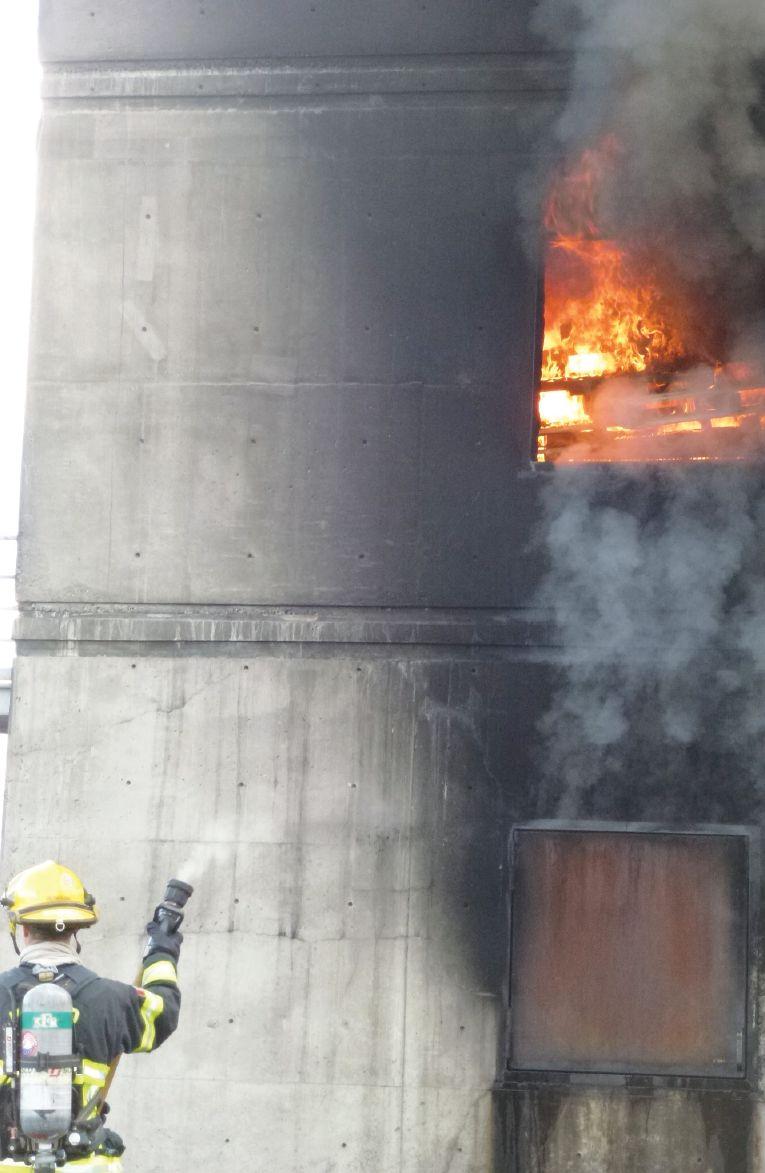
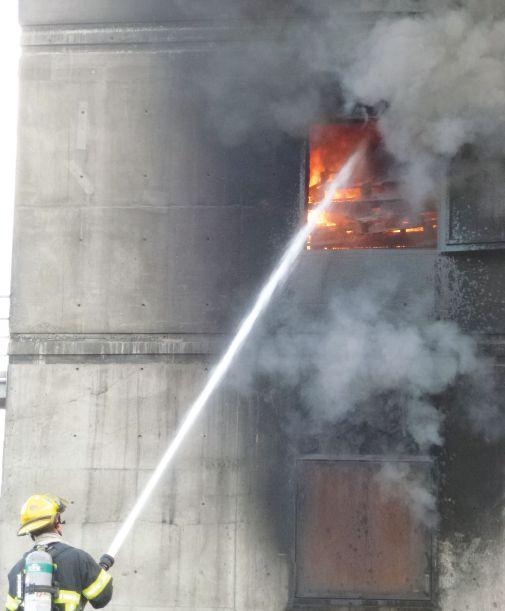
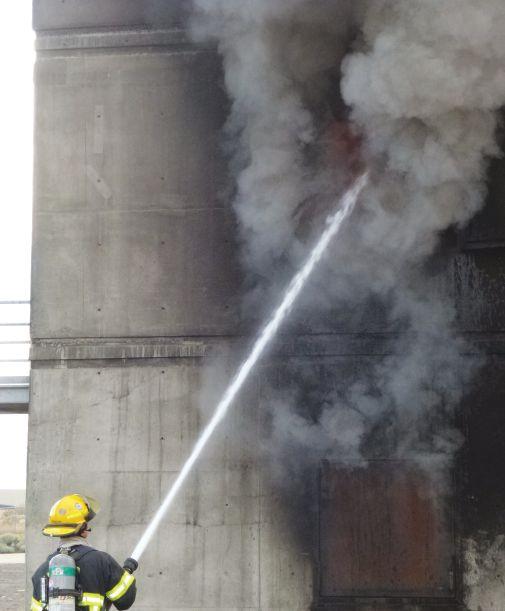
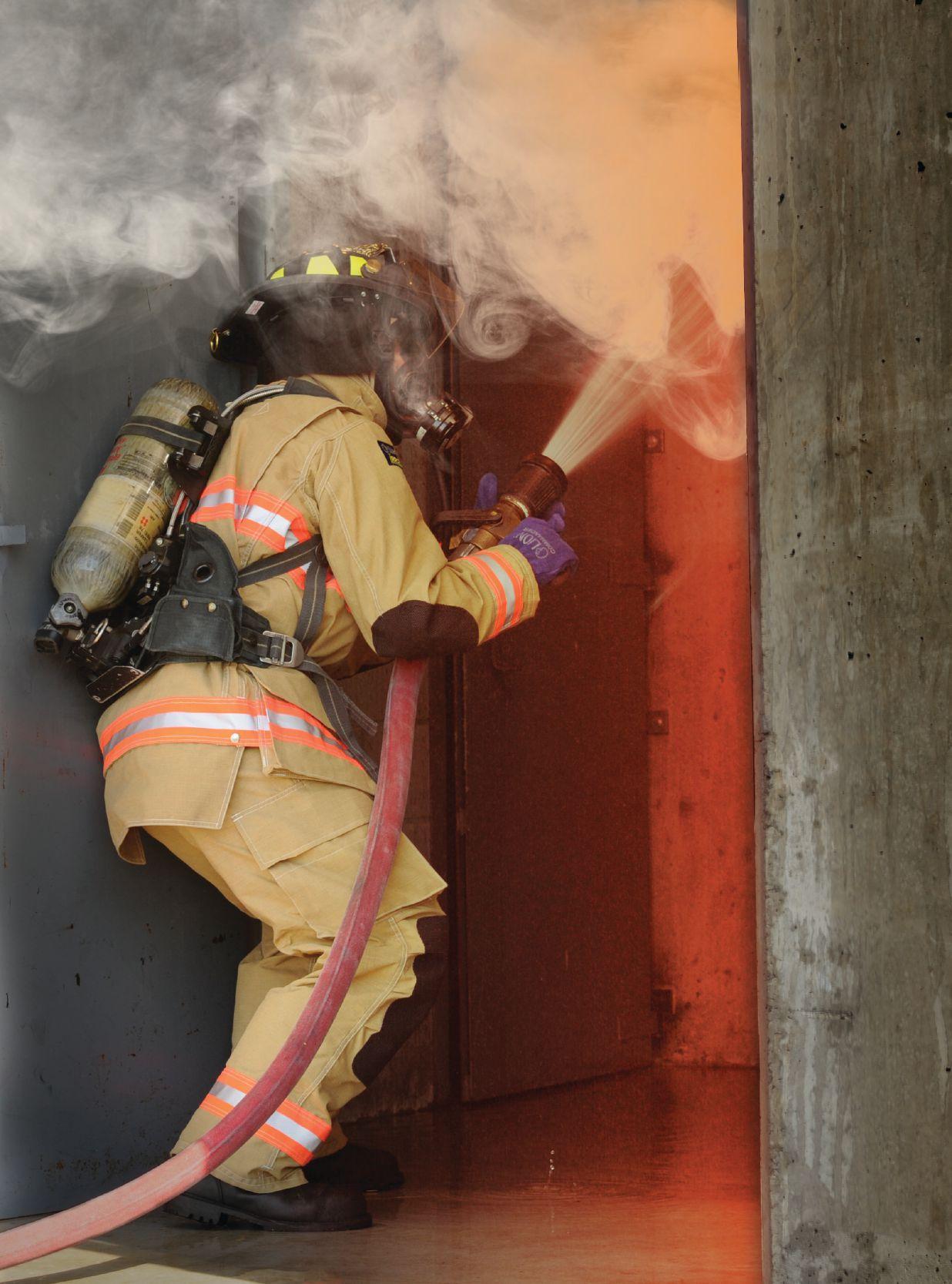
RIGHT Before beginning an exterior attack using the pencilling and PPA method, the incident commander must determine exactly where the fire is located inside the structure. In residential structure fires, this may be easy as smoke and flames may already be visible.
Adapting tactics for small departments or minimum-man fire responses
By NEIL CAMPBELL
The pencilling technique involves pushing a straight stream of water into the ceiling of the room in which the fire is located. This method of water dispersal results in a rain-down effect inside the room, producing massive heat absorption capabilities.
defensive – when we knew an interior attack wasn’t likely to be successful, or was just too dangerous.
Now, more than 15 years later, Kamloops Fire Rescue in British Columbia attempts positive pressure attack (PPA) at every intact residential structure fire. Instead of crawling into the structure, firefighters go in standing up. Instead of smoke-blind primary searches, now firefighters can see everything. Firefighters are able to move rapidly, find the seat of the fire faster and extinguishment happens very quickly. The threat of flashover has been all but eliminated. PPA makes the operation safer for our entry teams and for civilians who may be inside the structure. (Thanks to Kris Garcia, Reinhard Kaufmann and Ray Schelble, the creators of the PPA fire-ground tactic.)
Two years ago, I began working on an exterior fire-attack program for volunteer and minimum-manning response fire departments. This tactic incorporates pencilling the fire room from the outside of the structure with a straight stream nozzle pattern into the ceiling and PPA with a high-pressure fan – a fire-ground tactic that can be accomplished with as few as three or four firefighters.
My goal when developing the program was to disprove the old-school thinking about pushing fire with an exterior water application. After many test fires, the theory was sound: an external water application incorporating PPA did not push fire, smoke or super-heated gases throughout the structure. In fact, quite the opposite was true: fire knock down and extinguishment was accomplished with no transference of heat, smoke or fire into other rooms in the structure.
In December 2010, Steve Kerber, a fire research engineer with Underwriters Laboratories, wrote a paper called Impact of Ventilation on Fire Behavior in Legacy and Contemporary Residential Construction. The 400-page report examines fire-service ventilation practices and the impact of changes in modern house geometries. Extensive research was conducted on the air
The airflow pattern from the doorway of the structure, where the PPA fan is located, through the structure and out the breached window will force smoke and heat from the structure, replacing it with cool, fresh air, while the pencilling works to darken, and hopefully extinguish, the blaze.
flow paths inside a structure fire and the effect of ventilation on these flow paths.
“There were no temperature spikes in any of the rooms, especially the rooms adjacent to the fire room when water was applied from the outside,” the report says.
“It appears that in most cases the fire was slowed down by the water application and that external water application had no negative impacts to occupant survivability. While the fog stream “pushed” steam along the flow path there was no fire pushed.”
Further, Kerber says, “If you add air to the fire and don’t apply water in the appropriate time frame, the fire gets larger and safety decreases. Co-ordination of fire attack crews is essential for a positive outcome in today’s fire environment.”
What does this mean? Simply put, for the safety of firefighters and people trapped in a burning structure, it is essential that the structure be ventilated to release the super-heated gases and smoke. Ventilation must immediately be followed by a well co-ordinated attack with hoselines from either the inside or outside of the structure. The quicker ventilation occurs and water is put on the fire, the quicker problems start to disappear. Delays getting water on the fire after the building has been ventilated will result in the growth of the fire, sometimes extremely rapid growth.
The steps for an exterior fire attack can be accomplished quickly, even with a four-person crew. The incident commander (IC) must determine where the fire is inside the structure. The IC can do this by doing a 360-degree size-up. This can be done quickly for residential structures. Sometimes finding the fire is easy as the fire may have breached a window and the smoke and flames are already showing. If the fire hasn’t broken any windows, a crew member must be tasked with this job. It is important to make the vent opening (or openings, if it is a small window) as close to the seat of the fire as possible. This will help to reduce temperatures, smoke and fire gases inside the structure and help to prevent fire
spread to unburned areas. The firefighter tasked with breaching the window will also be the exterior hoseline operator, or nozzle man.
While hoselines are being stretched, another crew member must be tasked with positioning and starting the positive pressure fan. The fan should be positioned in front of an opening in the structure, preferably a doorway. The moment the window is breached, the door to the structure is opened and the fan is positioned 1.2 to 1.8 metres (four to six feet) from the opening at a 15-degree upward angle. The fan is then turned on full throttle.
Other (Please Specify Below)
The effect of the forced ventilation should be immediate. An airflow pattern from the doorway through the structure and out the breached window will now be established. Smoke and heat will be forced out of the structure and replaced with cool, fresh air. Once the window is breached, the goal is to get water pencilling into the ceiling as quickly as possible. Pencilling is a straight or solid stream introduced through an opening into a room or area of origin for a limited amount of time with the objective of confining the fire.
The duration for the initial application of water is a judgment call but the pencilling must be meaningful. Just two or three short bursts of water will not achieve positive results; pencilling should darken down the fire, and if luck is on your side, extinguish it.
I was discussing pencilling with Reo Jerome, a captain and acting battalion chief with the City of Surrey Fire Service; we both see value in the pencilling tactic for firefighter safety and fire control. Reo reminded me of some basics on fire flow.
“When selecting the initial hoseline and amount of water required, a good rule of thumb to use is the National Fire Academy Fire Flow Formula, which is the square feet of involvement divided by three. This formula will help you choose the gallons per minute (gpm) required to knock down a given sized roomand-contents fire. There is nothing worse than taking an inch-and-a-half to a two-and-a-half fire; it’s kind of like bringing a knife to a gun fight,” he said.
“I am not suggesting that you pull out a calculator at 3 a.m. and start punching numbers in. Keep it simple and do it beforehand.”
Firefighters can determine room size during the 360-degree size-up based on the location of the room and size of the windows, Jerome said.
Here are two examples: 1. Venting fire out of a second floor kid’s bedroom window:
• 12 feet x 12 feet = 144 square feet (round up to 150)
• 150 divided by 3 = 50 gpm required
• A one-and-one-half-inch hoseline with 95 gpm is plenty for this fire
2. Venting fire out of a first-floor living room or third-floor studio apartment unit:
• 20 feet x 30 feet = 600 square feet
• 600 divided by 3 = 200 gpm required
• A two-and-one-half-inch hoseline at 250 gpm is plenty for this fire, or an inch-and-three-quarter hoseline at 200 gpm, or even two one-and-one-half-inch hoselines at 95 gpm each
The flow of water onto the ceiling results in a rain-down effect inside the room. When water is dispersed this way, it has massive heat absorption capabilities. Continue with this exterior attack even if an airflow pattern from the doorway to the breached window cannot be established. The lack of airflow will likely be due to a closed door in between the outside doorway and the breached window. Continue with the positive pressure as the fan will pressurize the structure right up to the closed door. This pressurization will prevent the smoke, heat and fire gases from getting into the rest of the structure.
We all know that electricity always tries to find its way to ground and will always find the path of least resistance to do so. Smoke and super-heated fire gases are the same, except that they are not trying to get to ground, they are trying to get to an area of low atmospheric pressure, or outside (unless that side of the structure is wind driven, of course). When a fire starts inside a structure, it creates pressure. The hotter and larger the fire gets, the more pressure is created. Break a window and the pressure will be released. With that pressure release will come super-heated fire gases, smoke and – quite likely – fire.
The nozzle man should be prepared to do lapping protection –spraying water around and above the breached window to prevent the fire from impinging the outside of the structure. If a transitional attack is being deployed, it is crucial that the IC notify the nozzle man on the outside when a team is about to transition to the inside to ensure that opposing hose streams do not impact the safety of the inside team. Vinyl or wood siding on homes is extremely susceptible to this type of fire spread. Wetting down the outside of the home near a breached window can prevent fire spread.
The window has been breached by a crew member or by the fire, the side of the building around and above the breached window has been sprayed with water, and the fan is running at full throttle. Pencilling has been initiated with a straight-stream nozzle pattern to the ceiling inside the room on fire, and the fire appears to be almost out. Now what? Even resource-challenged or defensive-only fire departments must go interior eventually to search for civilians and complete overhaul – but only if the building is structurally sound. Once overhaul is complete and no further fire spread is discovered, fire-ground operations are complete.
Pencilling and PPA can be used together extremely successfully but require strong leadership on the fire ground. These tactics must be employed with precision, crew co-ordination and communication.
Neil Campbell is a 19-year fire-service veteran and has been a training officer for six years. He is an adjunct instructor with the Justice Institute of B.C. Campbell is a fifth-generation firefighter with the City of Kamloops, a combination career/auxiliary department with seven halls, more than 120 career staff and 40 auxiliary staff. Contact him at ncampbell@kamloops.ca.
Join the growing number of fire departments from across Canada who are using our Industry-leading Auxiliary Power Unit to support their community’s Commitment to Sustainability and lower their annual operating costs.
Contact a Product Specialist at FIRETRUCKS.CA or visit our booth at OAFC, FCABC or AFCA to learn more.
BACKtoBASICS
Truck company ops –elevated master streams
BY MARK VAN DER FEYST
One function of a truck company is to supply elevated master streams. An aerial apparatus or ladder truck has an aerial device of some sort with either a single nozzle or multiple nozzles attached to the tip of the aerial for water delivery. There are times when fire crews need to deploy large volumes of water from a higher elevation to suppress and extinguish a fire, either as a defensive tactic or to protect exposures.
Most aerial apparatuses built in the last 20 years have pre-plumbed waterways that run underneath the length of the aerial ladder. However, not all aerials have on-board water pumps; those that don’t require an engine or pumper to supply the water pressure required for the nozzle(s) to flow adequately. If this is the case, make sure the supply hose is connected to the correct intake. The intake for the aerial master stream is usually located on the back of rearmount ladder trucks or on the side of mid-mount ladder trucks. The intake is labeled accordingly.
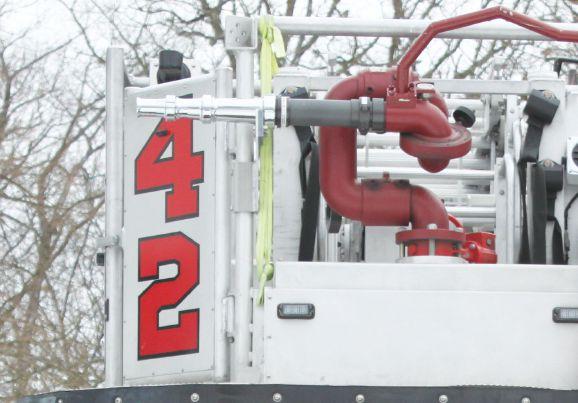
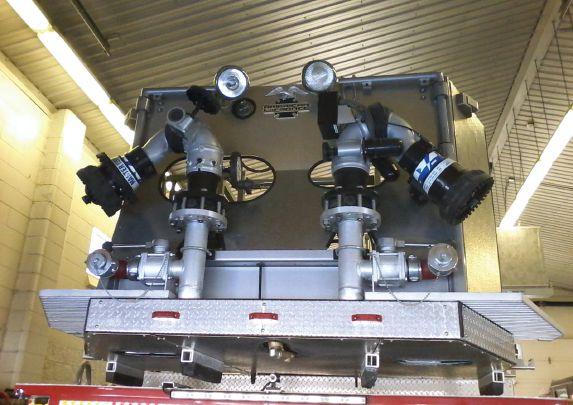
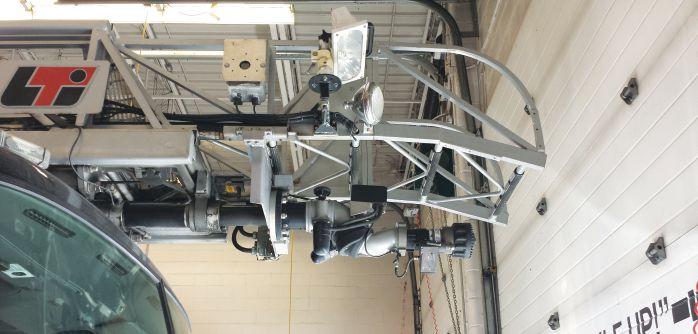
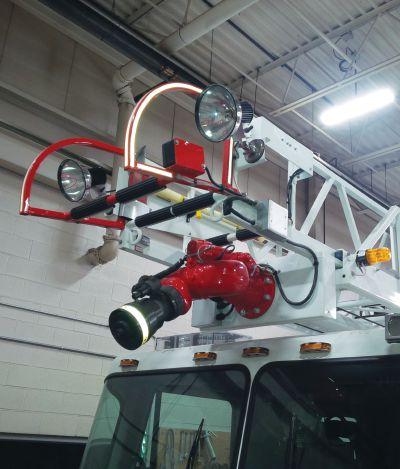
Some aerials have a single nozzle; others have double nozzles. The choice to have a smooth-bore nozzle or a combination nozzle depends on the fire department’s perception of the best way to deliver water. Photo 1 shows a single smooth-bore nozzle located in the middle of the platform while in photo 2, two combination nozzles are located on either side of the platform. If the aerial device is a straight ladder (see photo 3), there will be only a single nozzle located in the middle of the ladder.
Nozzles are either manual or automatic (photo 2 depicts both types). Manual nozzles must be operated by a firefighter on the platform. Automatic nozzles can be run at the pump panel or by remote at the turntable base.
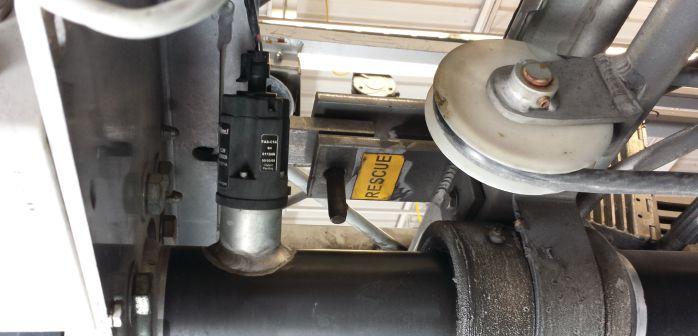
Some straight aerial ladders have pinnable waterways; this option allows the ladder to be in rescue mode or a water-flowing mode. The pin can be removed and inserted into one of two holes that are marked rescue or water-flowing. Some ladders have a switch device or latch, instead of a pin, that can be rotated into the rescue or water-flow position. Labels on the top and bottom of the ladder identify the mode in which the aerial ladder is set (see photo 4).
A pinnable waterway is more streamlined than a preplumbed waterway and therefore enables the ladder tip to be placed closer to a window or rooftop for rescue.
Photo 2: Alternately, some aerial or ladder trucks have two combination nozzles, located on either side of the platform.
Photo 1: A single smooth-bore nozzle, located on the back of the platform, can be a valuable tool for the truck company, especially when trying to protect exposures or apply large volumes of water at a fire scene.
PHOTOS BY MARK VAN DER FEYST
While there are advantages to pinnable waterways, there are also safety concerns –primarily with the pin placement. On April 8, 2008, a deputy fire chief was killed in the line of duty in Erie, Penn., after he was struck by the aerial ladder’s water monitor and attached 30-foot aluminum pipe while fighting an industrial fire. The water monitor was launched from the elevated aerial ladder, which was equipped with a pinnable waterway, when it was charged with water. The National Institute for Occupational Safety and Health (NIOSH) investigation revealed that the pin did not always properly fit the holes; in this case, the pin was found on the ground in front of the ladder truck.
The NIOSH investigation also discovered 10 similar incidents involving waterways being launched off of aerial devices. There were no fatal injuries associated with
the 10 incidents, and alternate designs, such as the switch or latch, have been introduced since 2008. If there is a pinnable waterway on your aerial device, it is vitally important that the pin or latch be checked before water begins to flow; this can be done during the truck check but also needs to be done on scene when using the aerial for master stream or rescue operations.
Mark van der Feyst is a 15-year veteran of the fire service. He works for the Woodstock Fire Department in Woodstock, Ontario. Mark instructs in Canada, the United States and India and is a local-level suppression instructor for the Pennsylvania State Fire Academy and an instructor for the Justice Institute of B.C. E-mail Mark at Mark@ FireStarTraining.com
Photo 3: If the aerial device is a straight ladder, there will be a single nozzle, located in the middle of the ladder. Both a combination nozzle and a smooth-bore nozzle would be useful on the fire ground; fire departments can decide which best services their needs.
Photo 4: Pinnable waterways use a pin to switch the device from rescue to water-flow modes. However, these pins have been known to fall out so extra caution must be paid when using a pinnable waterway on scene.
A CERTI-FIRE KNOWS FIRE ALARM TECH.
In the same way that MD certifies a doctor, or CGA designates an accountant, Certi-Fire qualifies your electrician as one of the few experts in all aspects of fire alarm technology.
A Certi-Fire electrician has successfully completed an intensive, four level certification program acceptable to the Ontario Fire Marshal. It guarantees the expertise required to assess your needs, install the correct technology, and maintain and monitor your fire alarm system. It’s one-stop fire alarm security and peace of mind.
BY DAVE MATSCHKE Suppression lieutenant Ottawa
FGUESTCOLUMN
Keeping firefighters safe through science
ire services are dealing with new threats to public safety that require innovative ways to keep communities safe.
In a challenging public safety world, science and technology is vital to the success of emergency response teams. The contributions of science and technology to planning and co-ordination of emergency response have been repeatedly demonstrated through the development of new response policies such as interagency and interprovincial sharing agreements, interoperability solutions, new technologies for CBRNE responses, and technologies to improve response times.
But keeping up with innovations is challenging; fire service leaders are overloaded with day-to-day operational issues. Services are pressed to keep pace with the changing landscape, including environmental and man-made incidents that are occurring more frequently and on larger scales.
To fill that gap, new groups called communities of practice have been developed to help first-response agencies use the myriad scientific and technological developments that benefit their operations.
“A key success indicator for this program is its commitment to ensuring that research results don’t sit on the shelf,” says Mark Williamson, director general of Defence Research and Development Canada’s Centre for Security Science (DRCS CSS), “that they are actually transitioned into becoming a reality through products, knowledge or technology that can be easily adapted for use by public safety and security organizations across the country.”
In Canada, the Canadian Safety and Security Program (CSSP), which is led by DRDC CSS in partnership with Public Safety Canada, is contributing to this effort. CSSP’s mission is to develop science and technology solutions to prevent incidents that threaten Canada’s safety and security, to prepare and respond to these incidents when they happen and, ultimately, to recover from their aftermath.
ment. The fire community of practice is made up of public- and private-sector leaders and experts in fire prevention, intervention, recovery, instruction, research and engineering who are committed to sharing their knowledge, experience and expertise to help CSSP support the development of new knowledge through research that leads to innovative, effective and measurable solutions.
The overall goal of these communities of practice is to identify challenges in public safety and collaborate on projects and studies to develop new capabilities or enhance those that already exist.
There have been many discussions among fire services, fire chiefs’ groups, standards-setting bodies, and researchers about the need for science and technology research to pave the way for fire services to evolve. Fire dynamics, which is the study of how chemistry, fire science, material science and the mechanical engineering disciplines of fluid mechanics and heat transfer interact to influence fire behavior or, how fires start, spread and develop, is a hot topic.
New firefighting issues have surfaced in the last 20 years due to the advancement of building materials and technologies. The ability to battle fires in structures built from lightweight materials has been challenging
A key success indicator for this program is its commitment to ensuring that research results don’t sit on the shelf . . . ‘‘ ’’
CSSP brings together science and technology experts to work on the most pressing safety and security issues facing Canadians. Within the fire domain, research projects supported by CSSP aim to develop knowledge to help Canadian fire services make more informed decisions based on scientific and technological evidence.
Communities of practice bring together representatives from emergency response fields, including fire, EMS, and police and law enforce-
David Matschke is a suppression lieutenant with Ottawa Fire Services. He is on secondment to Defence Research and Development Canada’s Center for Security Science, managing its fire portfolio. Contact him at Dave.Matschke@drdc-rddc.gc.ca
because information about the way fire spreads in these circumstances has not been thoroughly disseminated. That is why the CSSP has identified the development of new and the updating of existing firefighting educational material related to fire dynamics as a priority issue for the fire service.
In fact, a proposal was recently approved by the CSSP to begin research for the development of a new fire-dynamics training curriculum to educate Canadian fire services. This project will develop a lexicon, an evidence-based training curriculum, live fire training tools, and train-thetrainer opportunities to help Canadian fire services and standards- and codes-setting bodies to develop new standards, policies and procedures.
With many CSSP research projects and other research initiatives underway, the challenge for fire services will be to embrace the results of this research and integrate the evidence to enhance skills and knowledge.
When water is scarce and every drop of water is precious, the only practical option for fighting a fire is CAFS. According to US Fire Administration, it can take 15 gallons of water to match the effectiveness of a single gallon of ONE STEP™ CAFSystem foam. This saves water without sacrificing results. When fighting a fire, everything counts – even water consumption – and only ONE STEP™ CAFSystem accounts for it all.
Understanding flow paths
How air pressure and openings affect fire behaviour in structures
By IAN BOLTON
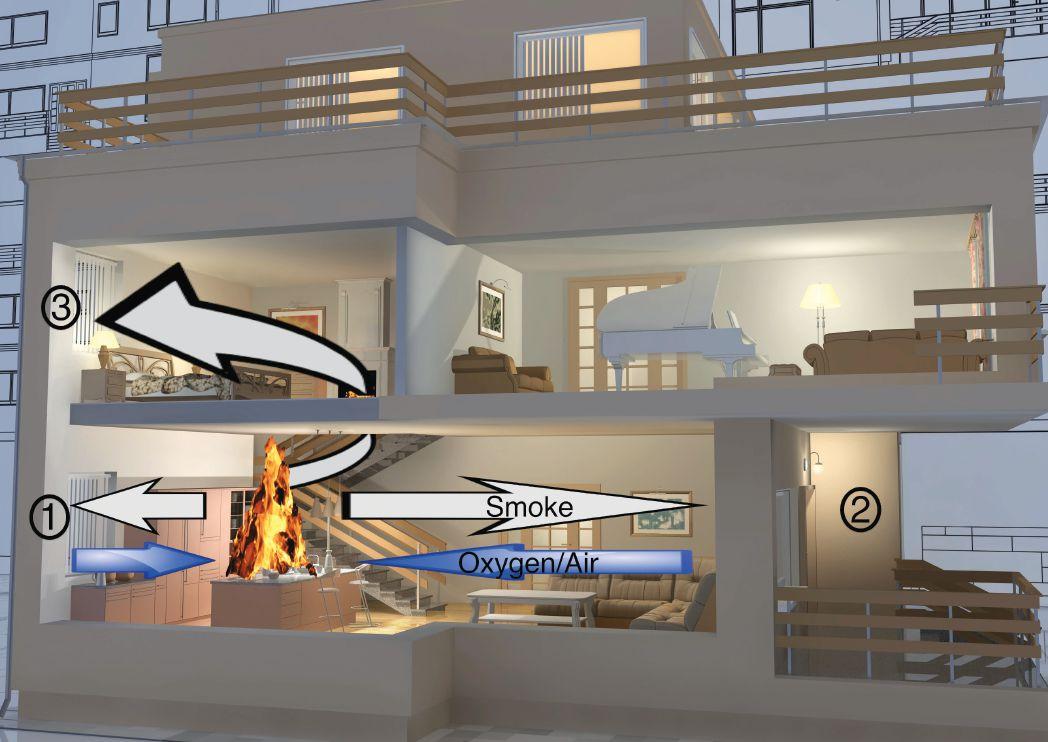
TOP This graphic explains the movement of fire gases through a two-storey home as the gases are drawn from high-pressure areas to low-pressure areas.
From the Vandalia Avenue fire in New York City in December 1998, in which three FDNY firefighters died, to the Forward Avenue fire in Ottawa in February 2007, which forced four firefighters to jump from a third-floor window, the number of firefighters who have been severely injured or killed after being caught in the flow path of a fire is staggering. For firefighters, understanding how fire and smoke move throughout a building and the concept of flow paths is critical, as one of the most dangerous places for a firefighter to be is between the fire and where the fire is going.
“Flow paths can be defined as the movement of heat and smoke from the higher air pressure within the fire area to all other lower air pressure areas both inside and outside of a fire building,” writes Stephen Kerber, director of the Underwriters Laboratories Firefighter Safety Research Institute (ULFSRI), in a report titled Study of the Effectiveness of Fire Service Vertical Ventilation and Suppression Tactics in Single Family Homes.
“Based on varying building design and the available ventilation openings (doors, windows, etc.), there may be several flow paths within a structure. Operations conducted in the flow path can place firefight-
ers at significant risk due to the increased flow of fire, heat and smoke toward their position.”
■ THE WHY FACTOR
It is essential for all firefighters to understand why flames and hot smoke move and behave the way they do. In addition to heat, a developing fire creates various hot fire gases and byproducts of combustion, which we generally refer to as smoke. Although this smoke consists of a wide range of gases, aerosols and particulates, these fire gases behave similarly to other gases. For this reason, the various gas laws established as far back as the 17th century by scientists such as Irish physicist Robert Boyle can help us understand the fundamental behaviour of fire gases. Quite simply, these gas laws show us how the volume, pressure and temperature of gases are connected to one another.
Since the density of fire gases decreases when heated, the gases move vertically through the fire plume and accumulate in the upper areas of the compartment of origin. This accumulation and confinement of the fire gases, coupled with their continued increase in temperature and natural tendency to expand when heated, creates an area of high-pressure in the hot fire gas layer. When an area connected to the fire compartment is available, such as a hallway, room or stairwell, the lower pressure that is present in these connected spaces causes the hot fire gases to move and spread as the gases follow the path of least resistance – that is, from high-pressure areas to low-pressure areas.
When fire crews preform interior fire operations, hot fire gases increase the temperature of firefighters’ turnout gear as the gear absorbs the fire gases’ thermal energy. However, the drastic increase in the rate of convective heat transfer (which refers to the transfer of heat by the movement of gas or liquid) when velocity, or speed, is added to these fire gases is not commonly considered. Firefighters experience the effect of convective heat transfer if they are positioned in a flow path, between where the fire is and where it is going as the fire gases move over the interior fire crews to low-pressure areas. Much like the effect of convection ovens or hair dryers, when velocity is added to hot gases, the rapidly moving molecules are able to quickly run over a surface and deposit thermal energy. The higher the temperature and velocity of the fire gases, the greater the convective heat transfer. This incredible energy transfer is one of the main reasons so many firefighters have been injured or killed in a flow path.
■ EVERY OPENING IS A POTENTIAL FLOW PATH
Consider, for example, arriving on the scene of a working fire located on the ground floor of a two-storey residential home. If smoke or flames exit a failed window on the ground level (see position 1 on graphic), at least one flow path is already established as hot gases and fire move to the low-pressure point available outside of the window. When crews force the front door and smoke exits through the doorway, another flow path is established (see position 2 on graphic). By opening the front door, fire crews provide another low-pressure point for the hot fire gases to move toward.
“Firefighters in a flow path can be convectively heated and cooled,” Kerber explains. “It is important to understand the direction of gas flow in the flow path. It can be bidirectional or unidirectional depending on the relation to the fire’s location. When below or on the same level as a fire, firefighters can find themselves being cooled as fresh air is entrained into the fire, or heated if they are in the outflow, which depends of the height of the neutral plane (smoke layer).”
Furthermore, if a crew advances to the second floor to perform
You protect the public
Let us heLp protect you
For your cleaning, decontamination, inspection, testing, repair and record keeping of your firefighter’s protective clothing... we have you covered!
• 24/7 access to Firetrack®, the online data base that provides you with complete details of your C&M Program with FSM. We do the work for you!
• ETL Verified
• ISO 9001 Registered
• Fast turnaround
• Complete Bunker Gear Rental Program
– Toronto Location
Ontario (toronto) 1-888-731-7377
Western canada (calgary) 1-403-279-5095
Mid-West USa (Detroit, Mi) 1-866-877-6688
■ Four (4) Adjustable Compartment Shelves
■ 26”/13.5” Deep Compartments
■ Undercoated Body
■ LED Lighting
■ Aluminum Extruded Body – 5083 Saltwater Marine Grade
■ 20 Year Body Warranty
■ Darley, Waterous or Hale Pumps
■ Side Control, Top Mount or Top Mount Enclosed
■ 1000 IG Booster Tank
■ Fold Down Ladder Rack
■ ULC or NFPA Tested & Certified
■ Custom Options Available
■ Aluminum Extruded Body – 5083
Saltwater Marine Grade
■ 20 Year Body
Warranty
■ Darley, Waterous or Hale Pumps
■ Side Control, Top Mount or Top Mount Enclosed
■ 600/800 IG Booster Tank
■ Enclosed Ladder, Pike Pole & Suction Hose
Storage
■ ULC or NFPA Tested & Certified
■ Custom Options
Available
■ Four (4) Adjustable Compartment Shelves
■ Full Height Compartments
■ Undercoated Body
■ LED Lighting
search operations and a window is opened or tactically ventilated prior to fire control, yet another flow path is created (see position 3 on graphic). It is this situation in which firefighters are essentially working in the chimney of the fire due to the buoyant nature of the fire gases.
“The firefighter in this situation may not see flame but will be subjected to high heat conditions,” says Kerber. “When a firefighter is in a flow path above the fire the flow will be unidirectional. This situation has claimed the lives of many firefighters. Gas flow in the flow path has been measured to be 16-32 km/h. The higher the gas velocity and higher the temperature of the fire gases, the less time a firefighter has to escape as the heat will transfer quickly through their turnout gear.”
Fire crews on the second floor above the fire in a flow path are in an extremely dangerous position.
■ CONTROLLING THE FLOW PATHS
A sound understanding of this concept before arriving on the fire ground is the first step firefighters can take to reduce the threat of being injured or killed in a flow path. The second step is a proper size-up, identifying all current flow paths and any future flow paths that may result from fire growth or tactical actions. Finally, consider closing windows and doors to control the movement of air and fire gases in a way that is consistent with the operational objectives.
Doors are not just entry points into rooms and structures. They also serve as an exceptionally efficient ventilation point. Crews are able to interrupt a flow path either on the downstream or upstream side of the fire, simply by closing a door. This action can be life saving. For crews performing vent-enter-search operations, for example, isolating themselves from the flow path is vitally important. When a window is breached for firefighter access, a new flow path is created, drawing heat, smoke and fire toward that location. However, by quickly closing the door to the room the firefighters just entered, before beginning their search, firefighters can cut themselves off from the flow path, improving conditions for both themselves and for any potential victims in that area.
Door control methods must also be considered when crews make primary entry to a structure to perform fire attack operations. Although this technique is somewhat new to North American fire departments, firefighters in other parts of the world have been doing this for decades. For this technique to be successful, an additional firefighter must remain at the entry door to close the door as much as possible while assisting with hose advancement. With proper door control actions, the flow path created between the fire and the front door can be reduced, once again improving firefighter safety.
For more information on flow paths, have a look at the video (https://vimeo.com/89428277), titled Why Thermal Flow Paths are the Key to Successful Firefighter, by Dan Madrzykowski, a fire protection engineer with the Fire Research Division of the National Institute of Standards and Technology.
Ian Bolton has been a student of the fire service for more than a decade. While working in Sydney, Australia, he was trained as a fire behaviour and tactical ventilation instructor and has received additional training in these areas through the Swedish Civil Contingency Agency in Revinge, Sweden. Currently, Ian is a firefighter and the lead fire behaviour instructor for the District of North Vancouver Fire Rescue Service. Ian also serves on a technical panel at Underwriters Laboratories Firefighter Safety Research Institute and is pursuing a fire science degree from Western Oregon University in Monmouth, Ore. Contact Ian at ian.bolton@firedynamics.ca
BY MIKE BURZEK
INDUSTRIALOUTLOOK
Preparing for pipeline emergencies
In general terms, pipelines are (mostly) underground conduits used for transporting materials including water, waste products, oil and gas. The Canadian petroleum and natural gas industry uses pipelines extensively for transporting hydrocarbons. For emergency personnel, it is important to understand the basic characteristics of pipelines and what they carry. It is also useful to know some pipeline jargon to better understand why certain control procedures are necessary.
The petroleum industry in Canada has a remarkable safety record when it comes to pipeline-related incidents. High safety standards and strict regulations for pipeline design, construction and operation go a long way to ensure failures are prevented and risks mitigated. Many of the hydrocarbon-based products processed and used by the industry are classified as hazardous by Transport Canada; these substances can be readily identified by cross-referencing the supply labels or placards with the corresponding information provided in the Emergency Response Guidebook
When responding to pipeline-related emergencies, it is useful to understand a few essential terms and their meanings so personnel can be better prepared. For example, a section of pipeline is referred to as a segment; this term identifies a specific length of pipe between control points or shut-off valves. Obviously, the larger the diameter and the length of pipe, the greater the volume of product it will contain; emergency evacuation zones are primarily determined by this information. These segments of pipe have to be bled down – that is, the pressure in the pipe must be reduced – whenever a major leak or failure is detected. Reducing pressure in some large-diameter natural gas pipelines can take several hours.
pipelines transport raw products and contain higher concentrations of liquids. And remember, raw natural gas generally has no detectable odour.
There are many pipeline safety control measures required by regulations. Some of these features include protective material referred to as a jacket on the outside of the pipe; cathodic protection, a technique that reduces the risk of static discharge; remote sensors; computer-controlled high- and low-pressure alarms; an emergency shutdown (ESD); and pipeline cleaning/inspection gauges (referred to as PIGs). It is useful to know that all transmission pipelines are required to have manual shut-off valves at designated places. These valves are located at a pipeline riser, the small section of pipeline that is above ground and barricaded or fenced in. Pipelines are also marked by warning signs indicating the product in the pipe and a 24-hour emergency contact number for the company or owner.
Although major pipeline-related emergencies, such as the explosion and fire in Otterburne, Man., on Jan. 25, are rare in Canada, it is imperative for industry and emergency response services to recognize the need to be prepared. One of the most common causes of pipeline
Responder safety must always be the highest priority.
’’
It is important to know that pipelines are classified as either transmission or distribution, the key difference being the standard operating pressure. Distribution lines typically operate at less than 100 psi, whereas transmission pipelines can operate at several hundred psi. Distribution networks of piping are more commonly included within the broader utilities category and are generally located in or near urban centres, supplying natural gas to a large customer base. Distribution lines are generally much smaller than transmission lines, are constructed with different materials, and carry clean, dry methane gas. A chemical called mercaptan is added to the gas carried in distribution lines, giving it a pungent odour that is easily detected at low concentrations. On the other hand, transmission
Mike Burzek is the director of public protection and safety for the BC Oil and Gas Commission. He lives in Fort St John, B.C., and can be reached at mcburzek@gmail.com
failures is third-party damage, usually from heavy equipment. Other causes of failure include stress fracturing from flooding, from landslides, or from the pipe itself over-pressuring; corrosion; weaknesses in the steel or weld due to age or wear; and manufacturing defects. Most of the serious pipeline incidents in Canada occur in remote places, posing limited risk to public safety. When pipelines are close to populated areas, emergency planning zones are predetermined and identified for response personnel in the company’s emergency response plan.
Responder safety must always be the highest priority. It is important that responders learn how pipelines are operated, the products they transport and common types of incidents – pipeline companies can provide this information – so that emergency personnel have practical knowledge prior to responding to an actual event. Knowledge is not only power, put protection as well.
BY DOUGLAS TENNANT Fire chief, Deep River, Ont.
YLEADERBOARD
You lead as you are – advice from a master
ou lead as you are. I learned this adage from a dear friend and mentor of mine – retired Cambridge, Ont., fire chief Terry Allen. It took me a while to really appreciate what Terry was getting at with this short but very profound observation, especially as it pertained to the fire service. As I have come to understand it, Terry was advising those who made the effort to listen and appreciate his statement, that we are all leaders in some way or another around the fire hall. It is thus up to each of us to take stock and determine how we will take on the responsibility to lead as and, ultimately, how we are.
No matter the composition of your fire service (full time, part time, volunteer) there are leaders in every rank and stage of their respective careers in the fire station. From the newest recruit to the oldest-serving member, you will find formal and informal leaders, good ones and not-so-good ones, and those who don’t even realize they are leading. They, or rather we, are all leading as they, or we, are.
Indeed, as Lyle Quan and Les Karpluk wrote in their Leadership Forum column in the March issue of Fire Fighting in Canada, leadership is “about sharing what you have learned, yet at the same time, allowing others to make mistakes as they grow into their roles as leaders.” It is through this sharing that mentoring is so effective.
Mentoring is all about change; it is about transitioning from one static form of leadership to a dynamic and diverse way of leading our ever-evolving fire service. We should never stop seeking out mentors. Sometimes we need to go outside of the fire service and spend time with people from other emergency services, or those with other experiences, maybe a teacher, a neighbour or even a young person with a unique perspective on life. My point is that just as we have wyes, reducers and all sorts of adapters in the compartment of a pumper, so we should have more than one (type of) mentor. Whether you love ‘em or hate ‘em, you can even find the odd elected official who can offer some pretty amazing mentoring.
ment or the one down the road at the same time. I have had several exceptional mentors during my career in the fire service; some were informal mentors while others involved the formal assignment of an older fire service member as a mentor. I have also been honoured to have been a mentor to others in the fire service. And even in this type of an arrangement, I was still able to be mentored by the individuals I was mentoring.
It’s not easy being a mentor. It is also not easy being mentored, especially when the mentor takes the time to let you, as the mentoree know that yes indeed, you do have broccoli in your teeth.
Mentoring entails making yourself vulnerable, having shortcomings pointed out, being called upon to explain why you took this or that action in regard to someone in your fire service. Spending time with your mentor should cause you to take some serious personal (nonscreen) time to ponder, mull and ruminate on how to interact with someone, incorporate a certain issue into your department’s strategic plan or develop a new SOG about an emerging issue affecting your fire station(s).
These days a fire chief has instant access through technology to
Mentoring is a two-way street. We can be mentors even while we are being mentored. ‘‘ ’’
Mentoring is a two-way street. We can be mentors even while we are being mentored. To say that we should always be only in a state of being mentored is somewhat limiting; there is also the unique responsibility of being a mentor to someone else in your depart-
Douglas Tennant is the fire chief in Deep River, Ont. He joined the fire service as a volunteer in 1978 and has served in several communities as a fire-prevention officer, chief officer and also as a manager with the Office of the Fire Marshal in Thunder Bay. He was treasurer and a vice president for eight years with the Ontario Association of Fire Chiefs. Contact Doug at dtennant@deepriver.ca
just about any topic related to the fire service from leadership, management and dealing with difficult people, to how to fight fires and use a defibrillator. We can read books, blogs and trade-magazine articles on a vast spectrum of topics. There is an incredible array of fire and emergency service seminars and conferences to attend. But there is nothing quite as unique or effective, despite all of our technology and formalized seminar and training settings, as faceto-face mentorship opportunities. It is too easy and, dare I say, less of a rewarding learning experience, to try to be mentored via the Internet or through social media. Call me a dinosaur, but just as we still make house calls with the big red trucks to those who call 911, having a face-to-face, good old-fashioned fire-hall mentor is worth the investment of time and effort. Put the tablet down, invest in yourself and others and go get a mentor. You lead as you are.
BY GEORGE BIRTIG Deputy chief Oakville, Ont.
YGUESTCOLUMN
Handling exposure to infectious diseases
our fire crew is the first to arrive at the scene of an MVA and during your size-up you find someone who is bleeding profusely from a deep cut to the neck. You apply pressure to the wound as quickly as possible but the patient’s blood has splashed into your face.
You and your partner have removed an unconscious male from just inside the front door of a fully involved house fire. The second-in crew is just arriving on scene. You immediately doff your facepiece and firefighting gloves to assess the badly burned patient.
You are at a medical call at a community housing residence. You are caring for a patient who is coughing profusely. EMS doesn’t arrive to assume patient care for almost 20 minutes.
Have you been exposed to a communicable disease? If so, what happens next?
In 2008, the Ontario government amended the Health Protection and Promotion Act to include mandatory guidelines and protocols for the notification of emergency workers to ensure that they are made aware of specific communicable disease exposure so that appropriate action may be taken. The act requires that each police, fire and EMS department appoint a designated officer so that potentially exposed workers can be assessed as soon as possible. In the case of a significant exposure, the designated officer will contact the area medical officer of health in order to obtain as much information as possible about the contact. The Ministry of Health liaises with the designated officer in order to advise to the exposed worker regarding the steps to take to protect the worker and his or her family and peers.
In some cases, the exposed worker and attending physician may have to make an application under the Mandatory Blood Testing Act to determine if there has been an exposure to Hepatitis B, Hepatitis C or HIV. Similar acts to protect emergency service workers exist in Alberta, Saskatchewan and Nova Scotia.
been created to support workplace-designated officers and help them obtain information, suggestions and advice when navigating this process. The Ontario Association of Designated Officers (OADO) is a not-for-profit organization of designated officers who represent police, fire and paramedic services, public health units and correctional institutions in Ontario. We provide a forum through which Ontario’s designated officers can build capacity in infection prevention and control (IPAC), which will provide consistency among services when responding to exposure risks. Our mission is to mitigate and prevent occupational exposures to communicable disease for all emergency workers through education, co-operation, communication and collaboration. Our vision is to protect the lives of these workers by preventing exposure to communicable diseases.
Recently, the Ontario Ministry of Labour recognized the OADO as a partner for helping to validate best practices and assist in solving IPACrelated issues for emergency workers in Ontario. This partnership will go a long way toward helping to standardize the protection of frontline responders across the province.
Our group currently consists of more than 150 members from more
Workers have been exposed to agonizing wait times for information, misinformation, or no information at all. ‘‘ ’’
Perfect. Every firefighter in these provinces should receive the best care and advice available, right? As straightforward as the legislation may seem, the realities of confidentiality regulations, other provincial legislation, and commitment from stakeholders have muddied the waters and led to confusion and frustration for potentially exposed workers. Workers have been exposed to agonizing wait times for information, misinformation, or no information at all.
So where do we go from here? In Ontario, an organization has
George Birtig is the vice chair of the Ontario Association of Designated Officers and a deputy chief in Oakville, Ont. Contact him at gbirtig@oakville.ca and follow him on Twitter at @blazebro95
than 70 services and we are growing. We commit to help our members by providing a source for networking and problem solving, monitoring issues and trends, lobbying for health and safety issues, providing IPAC education and resources, co-ordinating an alerting system for IPAC threats, liaising with other IPAC organizations and health and safety groups, participating in national and international committees and conferences, collecting and analyzing exposure statistics, and we supply expert consultation and speakers.
Is it time for your province to follow suit? Take the time to find out how you can obtain this valuable information for your firefighters if they have been potentially exposed to a communicable disease. Do you have the legislation or resources available to you that will help protect your members and their families?
Visit the OADO website at www.oado.ca.
BY SHAYNE MINTZ NFPA Canadian regional director
FNFPAIMPACT
What the NFPA can do for you
or those of you who may not be aware, I am the new Canadian regional director of the National Fire Protection Association (NFPA) and Sean Tracey’s successor. Sean, who is now the assistant deputy fire chief for community standards for Ottawa Fire Services, was the consummate advocate for fire and life safety in Canada and was certainly the go-to person in all NFPA matters including code development and adoption.
My role is to carry on with that work and, equipped with the resources of the NFPA, continue to improve fire and life safety in Canada by working alongside organizations such as fire-chiefs, fire-prevention and public-education associations and the Canadian Association of Fire Chiefs.
By participating in fire-safety events and code-change activities across Canada, I will promote the services and tools that the NFPA has to offer, continue to advocate for the adoption of NFPA codes and standards, and support research and education.
The NFPA has finalized its strategic planning process and vision for the next three years, and I think it’s important for you to be aware of the NFPA priorities between now and 2016.
I will do my best to build and grow relationships and assist agencies, boards and organizations that have a like-minded interest in public safety. I will also strive to build new relationships with key influencers in forwarding the fire and life safety agenda.
While I am based in southern Ontario, I am keen and eager to broaden my network. My plan in the first year is to get to as many events as possible to introduce myself and, perhaps, bring the message that the NFPA is here to help with information, advocacy, research, and standards or codes. The NFPA strives to place those resources where they can do the most good – in the hands of local, provincial and national leaders in the fire and life safety industry.
Canadian Home Fire Sprinkler Coalition. There is one chapter in the southern Ontario region and the NFPA would like to expand that outreach to any communities that wish to support such a program.
Another initiative that is gaining interest is the implementation of codes and standards to reduce the likelihood of communities losing homes to wildland urban interface fires. I will continue to work with Partners in Protection to build FireSmart and Fire Adapted Communities, and with the Province of Saskatchewan to develop what we believe to be the first rural/urban interface building code.
Finally, the NFPA hybrid and electric vehicle (EV) training program should roll out this year. The curriculum is intended to inform and train the fire service and other first responders on the potential hazards of dealing with EVs in emergency situations. This program will be facilitated through the Canadian Council of Fire Marshals and Fire Commissioners – this arrangement is the first of its kind in Canada and will hopefully be a model for other national projects.
The NFPA is committed to improving standards development and the work that the many technical committees undertake. Through the use of technology, the NFPA is hoping to streamline the meeting, vot-
One of the vital initiatives for which the NFPA will advocate is the adoption of fire sprinklers in new residential construction . . . ‘‘ ’’
One of the vital initiatives for which the NFPA will advocate is the adoption of fire sprinklers in new residential construction and retro-fit applications for nursing homes and care facilities. Our most vulnerable people are relying heavily on us for their protection.
Over the next three years, the NFPA will continue to better educate and advocate for more communities to become involved in the
Shayne Mintz has more than 35 years of experience in the fire service, having completed his career as chief of the Burlington Fire Department in Ontario. He is now the Canadian Regional Director for the National Fire Protection Association (NFPA). Contact Shayne at smintz@nfpa.org, and follow him on Twitter at @ShayneMintz
ing, comment and approval processes.
Furthermore, the NFPA strives to better educate the users of our standards by promoting and making available the technical research, data analysis and advisory service reports that the committees use.
The NFPA is constantly looking for volunteers to participate on committees or task groups. I urge anyone who is interested in participating on a committee to contact me or the NFPA.
The NFPA strives to improve its portfolio of products and services to better serve our stakeholders. This may be realized through improvements to our outreach, training and services. Stay tuned for more on that.
As you may have gathered, the time ahead will be very busy; I’m looking forward to talking more about these initiatives as I meet with people and organizations that share the NFPA’s mission and vision.
TRUCKTECH
Battling the corrosion monster
By CHRIS DENNIS
With all the snow Canadians endured between November and April, it’s important to do the necessary maintenance on our apparatuses to prevent problems caused by the salt, sand and brine used on our roadways.
Before we discuss ways to keep the trucks in shape, here is another spring maintenance tip. In the February 2013 issue of Fire Fighting in Canada, I suggested you change the gasoline in your gas-powered tools at the same time as you change the batteries in your smoke alarms and carbon monoxide detectors. If you have not done that yet, here is your reminder: winter fuel does not work well in the warmer weather. The octane levels and fuel additives are different from winter to summer. The same should be said about diesel fuel. If your department does not go through a lot of fuel, then an additive with a higher cetane level with a built-in lubricant and emulsifier should be added to help prolong the winter diesel until you can freshen it up. Remove all the gasoline from your firefighting equipment as well as your winter gas-powered equipment and top up those two-stroke and four-stroke engines with the fuel mixture and octane levels recommended by the original equipment manufacturer.
Now, let’s talk about rust. Where there are below-zero temperatures, things freeze. When this happens, de-icing materials are spread over roadways. Over the years, the environment has dictated what products are used to melt snow and ice so that the ecosystem is not damaged and so we have the safest conditions possible with the ever-changing temperatures. Many kinds of de-icing materials have been used but the one that seems to work best here in southwestern Ontario is salt. Salt causes early rust and corrosion. Fire trucks are made of many materials – aluminum, stainless steel, plastic and iron products – and will corrode. Even the copper inside the wiring harnesses is prone to early corrosion.
Some of the photos I have provided are of parts of trucks that are just three years old and had been rust-protected every fall. We cannot seem to beat this corrosion demon. The mix used here in southwestern Ontario is salt and urea or calcium, which form a liquid slurry known as brine.
Brine is easy to detect. Brine is a liquid sprayed onto the roadway by what looks like a liquid fertilizer spreader on steroids. This machine leaves multiple lines on the road, as if somebody dragged a rake across the pavement; when the ice begins to melt, it quickly turns to water and washes into the next line of brine, naturally spreading this slurry all over the roads and inside the fender wells, on our boots and into the cab, the lighting and the wiring harnesses. This brine is so efficient that, when it dries, it lays dormant until it’s wet again, like a Gremlin. Then the brine starts eating away at our equipment again, even when temperatures are above zero.
Five years ago, Vaughan Fire & Rescue Services put four new trucks on the road. The trucks were rust protected and have been rust protected each year. That winter our region started to use brine. I received
A steel pin fits through an eyelet in a brake pedal, acting as a pivot point for when the brake pedal is depressed and released. This is also where a spray lubricant should be applied to prevent corrosion during the winter.
The circles indicate the grease points on an aerial ladder where grease should be applied so that it can spread throughout the aerial.
While this roll-up door switch looks like a simple hunk of rubber that secures the door, it is actually an electronic switch that also alerts the truck driver if the door is not properly closed.
PHOTO 2
PHOTO 3
PHOTO 1
ALL PHOTOS BY CHRIS DENNIS
Game Changing Technology
TRUCKTECH
a phone call from a captain who said his crew had just put out a fire on the wheel of a truck. It took a minute but then it hit me: it was his pumper wheel that had caught fire. The truck was at a stoplight and was about to proceed through the intersection when crew members smelled something burning.
I proceeded to the truck’s location in our service vehicle. My roadside investigation determined the brake pedal was stuck in the applied position and the friction material had heated the brake assembly so much that the grease, oil, plastic and rubber in the area ignited. The brake pedal has a metal backing with two machined eyelets through which a steel pin fits. Those eyelets are made up of two more aluminum eyelets on the air-brake control valve and are bolted to the floor. The pin passes through the eyelets to act as a pivot point (see photo 1).
In this case, the dissimilar metals were corroded together. These valves and pedal assemblies have been used for decades, not only on custom fire trucks but also on highway rigs. I worked on Mack trucks and Freightliners for many years and these manufacturers used these same pedal assemblies long before custom fire trucks came along. The only time you won’t see this type of assembly is if the pedal assembly pivots overhead and swings down over the floor instead of through the floor.
The truck was towed back to our maintenance facility where it was disassembled. We found the pin almost welded into the aluminum. It was so badly corroded that, when we tried to take it apart, the aluminum eyelets broke off. Why did this happen then and not sooner? The
Trucks that have barnstyle doors that swing outward or upward are often fastened with a pin-style devices. These pins also alert the truck operator if the door is not properly closed.
Proximity switches are in direct line with the salt-water spray coming off of the truck’s tires in the winter. These switches should be inspected frequently for over-heating and corrosion.
PHOTO 5
PHOTO 4
TRUCKTECH
only thing that had changed was this liquid that is being sprayed on the roads.
Rock salt sticks to our boots and, when mixed with wet snow, leaks down over the vehicle’s pedals, rubber floor mats and carpets; once the salt has dried, it can be washed away or vacuumed. But this is not the case with brine; it is like antifreeze. Heavier than water, brine leaks into the smallest areas and when it is dry it starts its corrosive journey.
This brake-pedal failure did not just happen at that traffic light; it had been happening over time. After every brake-pedal application, the pedal should bounce back to a non-applied position. In this case, every time the brake pedal was applied, it stayed partially applied, a bit more each a time. This happened so slowly that, despite many different drivers and a powerful engine, nobody noticed until it overheated to the point that the grease caught fire.
When that truck returned to service, the rest of the fleet was inspected; four more trucks were on their way to a failure for the same thing. The fix was simple: disassemble, clean and polish the area, and apply a lubricant that would also repel the brine. Photo 1 shows where we spray the lubricant. This has become a standard operating guideline for winter and is now done during every truck check, four times a month, from November through May. * * *
The next items requiring winter maintenance are aerials. In Vaughan, we have five 17-metre quints, two 32-metre aerials and one 30-metre midmount platform. Each of the trucks, except the platform, has the monitor and nozzle mounted over the cab in the driver’s view. The platform, being a mid-mount, has the monitor and bucket at the back over the tailboard.
On a truck with an aerial, the winter salt-snow-water mix coats the mon-
On an aerial truck, the winter salt-snow-water mix coats the monitor and nozzle and begins to flow down the fly section and the main bed. All these areas should be cleaned with mild soap and water more frequently during the winter months.
TRUCKTECH
itor and the nozzle, and begins to flow down the fly sections and the main bed until it comes off the back; on a mid-mount, the turbulence at the back end wets the bucket and bucket monitor with the same liquid.
I mentioned how corrosive this slush is and how it seems to flow into everything and stick. It ends up in the nozzle, the monitor swivel points and motors, the tip light and controls, and coats any tools, ground ladders or stokes baskets that may be stored up there. I recommend cleaning all these areas with mild soap and water a lot more frequently during the winter.
In addition, a non-flammable spray-on lubricant can be used directly on the aerial. The aerial’s grease points (see photo 2) should also be lubricated more often during the winter months than what the manufacturer recommends. We use approved white water-based grease on the aerials. Pins, pivots and rollers all need to be lubed. The white grease is used for appearance as our sticks are white, plus the grease washes off with mild soap and water.
Since the aerial is greased four times a
month, the liquid brine is pushed out and the area is lubricated. The cables are also infected with this stuff so they, too, need to be lubricated. It is important that you only use lubricant recommended by the apparatus builder on these cables and follow the builder’s cleaning instructions so as not to void warranties or prematurely ruin the cables. We use soap and water and then rinse lightly with a garden hose – not a pressure washer – before lubricating the cables with transmission fluid.
Once winter has passed, we do a major degreasing and maintenance. The truck body and compartments should be washed to get that brine out. Do not use high-pressure water near electronics or body graphics. I recommend not washing the underside or engine and transmission areas until the warm weather arrives. If you do decide to wash these areas, be sure the truck is out for maintenance so the technician can look after all the areas – such as the alternator – that should not be soaked down directly, and that need to be completely dried out before restart.
Duo-Safety Ladder
* * *
The last items to clean are the roll-up door switches (see photo 3) that alert you if the door is not closed. In most cases, the switches are built into the catch at the bottom of the roll-up door and sealed but barn-style doors may feature a pin-type switch (see photo 4). These switches, which are in direct line with the salt and spray coming off the wheels and tires, can overheat and short out. Inspect them closely for overheating and for corrosion of the wires or relays. The cab-door ajar switches and the cab door handles should be lubricated as a preventative measure.
May is the time to do some major spring cleaning so be sure that when the bad weather comes around again, you are prepared to battle this liquid metal-eating corrosive monster.
Rubber side down, my friends.
Chris Dennis is the chief mechanical officer for Vaughan Fire & Rescue Services in Ontario. He can be reached at Chris.Dennis@vaughan.ca
BY DAVE BALDING Fire chief Fraser Lake, B.C.
IBritish Columbia’s combustible-dust lesson
was in Halifax in January 2012 when our deputy chief called from Fraser Lake at three in the morning to advise that Babine Forest Products near neighbouring Burns Lake had exploded and was on fire. That event would leave two workers dead and 20 injured. Several weeks later in April, Lakeland Forest Products in Prince George experienced a similar tragedy. That was the beginning of a long investigative process that would lead to a lot of education and increased awareness in the sawmilling and firefighting communities.
WorkSafeBC has now released its report on the Babine incident, which looks strongly at combustible dust as the cause of the explosion and subsequent fire. Combustible dust, it turns out, is a common hazard in manufacturing and industrial settings, including operations that handle wood, pharmaceuticals, tires and aluminum, to name a few. Nobody knows what caused these events; what we do know is we need to educate those in the sawmilling industry and the fire service so that such an incident never happens again.
To that end, in October 2012 the British Colombia government created the Fire Inspection and Prevention Initiative (FIPI). Its mandate is to improve fire-code compliance in primary wood product manufacturing operations that have combustible wood dust-producing processes. FIPI aims to accomplish this by creating greater awareness in the industry around combustible dust hazard recognition and mitigation along with providing training to local assistants to the fire commissioner about combustible dust, fire-safety plans and basic inspection techniques. FIPI’s final goal is to build stronger ties and enhance co-operation among the three regulatory bodies having jurisdiction in this area – WorkSafeBC, the BC Safety Authority and the Office of the Fire Commissioner – in a fire safety plan referral process.
pentagon combine to create a deflagration or explosion. This event, perhaps relatively minor, then disturbs accumulated dust throughout the building, introducing it to a source of ignition causing what is known as a secondary, potentially much more devastating explosion. Successful removal of one or more sides of the combustible-dust pentagon would eliminate the risk of further events. Some options are not feasible. Managing the fuel available is the most effective method of preventing a combustible dust occurrence. One of the sawmilling industry’s greatest challenges is that by the very nature of its work, it generates an enormous amount of potentially combustible fuel: sawdust. Keeping fuel accumulations below hazardous levels (less than one-eighth of an of inch of dust over five per cent of an area, according to NFPA 664, Standard for the Prevention of Fires and Explosions in Wood Processing and Woodworking Facilities, 2012 Edition) is essential to minimize the chance of another dust explosion. Is learning about combustible dust truly part of fire fighting? I would answer with a resounding yes. It is only due to good fortune, along with a lack of awareness, that there haven’t been more combustible-dust tragedies in our manufacturing and processing sectors. The
Is learning about combustible dust truly part of fire fighting? I would answer with a resounding yes.
We’re all familiar with the three elements required for combustion that form the fire triangle: heat, fuel and oxygen. There are only two further components needed for a dust explosion to form what is known as the combustible-dust pentagon. The first is dispersal; in other words, the dust particles must be airborne. This occurs commonly in industrial settings, whether in the work area itself, or within dust-collection systems. The second – confinement – is easily met within the walls of a workplace. Combustible dust explosions are typically two-stage events. First, all the necessary components of the
Dave Balding, a 29-year veteran of the fire service, is the fire chief and emergency co-ordinator for the Village of Fraser Lake in British Columbia’s Central Interior. Contact Dave at dbalding@fraserlake.ca and follow him on Twitter at @FraserLakeFire
people we protect deserve more than a reactive fire service. It is not only essential that we respond effectively to emergencies, we absolutely must contribute to fire prevention in every way we can. Public education is a large part of that mission, as is code enforcement. FIPI’s three priorities – educating industry, local assistants to the fire commissioner, and co-ordinating the three regulatory bodies to enhance code enforcement – are a good start, but they’re just a start. Where do we go from here? It is my belief that British Columbia’s Office of the Fire Commissioner must continue when FIPI ends its two-year mandate in the fall with a legacy of increasing awareness and code compliance by supporting the fire departments in the province. This may be a significant endeavour for that organization, one that, in my opinion – along with a renewed commitment of support for the fire service across British Columbia – must be once again embraced.
Mental accuracy and speed of decisions can be impaired by surprisingly small increases in body core temperature. Effective evaporation of sweat is a critical natural process which helps minimize these increases. And your choice of moisture barrier – often more so than the outer shell or thermal liner – affects this process the most.
Although all moisture barriers on the market today meet the NFPA 1971 Standard, they don’t all perform equally. GORE ® and CROSSTECH ® moisture barriers offer less resistance to the evaporation of sweat, particularly in warmer conditions, such as working in the sun, on hot asphalt highways, or near fireground sources – conditions where heat stress can be particularly significant. When your moisture barrier performs better, so do you.
Another reason why more firefighters wear turnout gear using moisture barriers from Gore.
Making the case for wood
Study confirms construction material makes little difference when safety measures are in place
By LEN GARIS and JOSEPH CLARE
TOP A fire in an under-construction wood-frame building in Kingston, Ont., in December raised concerns about fire safety during construction, but a study of fire injuries and deaths in British Columbia shows that building materials are not a factor in completed structures that have sprinklers and other fire-safety measures.
New research comparing the outcomes of fires in residential buildings with wood, steel and concrete framing appears to bolster the case for taller wood-frame buildings.
Proposed and adopted building-code changes in some provinces to permit taller wood-frame buildings, along with pending changes to the National Building Code of Canada, have sparked discussion in the fire community and among producers of building materials about the safety of wood-frame buildings.
The report – Fire Outcomes in Residential Fires by General Construction Type – which
was released in February by the University of the Fraser Valley in British Columbia, challenges the perception that completed buildings constructed predominantly with steel or concrete are safer in fires than those built predominantly with wood.
While a Dec. 17 fire in a half-finished wood-frame building in Kingston, Ont., drew attention to the greater fire risk and lack of fire safety regulations related to buildings under construction, the report data indicates that completed buildings do not share this risk.
“ . . . there appears to be little difference with respect to fire spread, death and injury rates as a function of building general construction type, provided these buildings have
functioning smoke alarms and complete sprinkler protection,” the report says.
“With these findings in mind, and in parallel with other research findings from the authors, it should be considered that more emphasis is placed on ensuring all buildings have operating, current and optimal fire safety systems.”
The report reviewed 11,875 fires in residential buildings that could be grouped within five broad general construction types. These fires were a subset of a total of 34,708 fires reported to the BC Office of the Fire Commissioner between October 2008 and October 2013. The 11,875 fires, which caused 772 injuries and 107 deaths, were divided into five construction-type categories for comparison purposes. Described simply, they are:
• Unprotected wood construction – exposed wood joists and trusses (in buildings under construction)
• Protected wood construction – wood joists and trusses protected by plaster or gyproc (after construction is completed)
• Heavy timber construction
• Unprotected steel construction – exposed steel joists and trusses (in buildings under construction)
• Protected steel or concrete construction (after construction is completed)
Overall, the report shows that the fire safety of buildings has more to do with effective fire-safety systems, such as working smoke alarms and sprinkler protection, than with the construction materials.
When effective fire safety systems were not factored into the analysis, this dataset showed that fires were more often contained to the point of origin in steel and concrete buildings than in wood-frame buildings.
However, in buildings with complete sprinkler systems, there was little difference in the spread of fire among the different building types.
The same was true when injuries and deaths were considered: in these particular fires, steel and concrete buildings had lower death and injury rates per fire when effective fire-safety systems were not factored in, but buildings of all construction types had similar death and injury rates when these systems were present. In fact, when working smoke alarms and complete sprinkler systems were in place, there were no reported fatalities from the fires – regardless of the type of building construction.
When looking at this particular set of 11,875 fires – including both sprinklered and non-sprinklered buildings – the data shows:
• 66 per cent of the fires, 75 per cent of injuries (7.4 injuries per 100 fires) and 62 per cent of deaths (.85 deaths per 100 fires) occurred in buildings with protected wood construction.
• 19 per cent of fires, 14 per cent of injuries (5.0 injuries per 100 fires) and 30 per cent of deaths (1.4 deaths per 100 fires) occurred in buildings with unprotected wood construction.
• Nine per cent of fires, six per cent of injuries (4.5 injuries per 100 fires) and six per cent of deaths (.57 deaths per 100 fires) occurred in protected steel or concrete construction.
• Four per cent of fires, three per cent of injuries (4.3 injuries per 100 fires) and one per cent of deaths (.20 deaths per 100 fires) occurred in unprotected steel construction.
• Two per cent of fires, one per cent of injuries (4.4 injuries per 100 fires) and two per cent of deaths (.88 deaths per 100 fires) occurred in heavy timber construction.
When the effect of sprinkler protection was ignored, fires were con-
fined to at least the room of origin 92 per cent of the time in protected steel or concrete construction, 76 per cent of the time in unprotected steel construction, 71 per cent of the time in protected wood construction, 51 per cent of the time in unprotected wood construction and 47 per cent of the time in heavy timber construction.
However, when sprinkler and smoke-alarm protection was factored in, the spread of fire (i.e., fire confined to the room of origin) was similar across building types: 94 per cent in protected steel or concrete construction, 84 per cent in unprotected steel construction, 88 per cent in protected wood construction, 91 per cent in unprotected wood construction and 80 per cent in heavy timber construction.
When the effect of sprinkler protection was ignored, the data for this group of fires showed that most of the fires, and therefore most of the deaths and injuries, occurred in buildings with wood construction. Buildings with protected wood construction accounted for 75 per cent of injuries and 62 per cent of deaths, unprotected wood construction accounted for 14 per cent of injuries and 30 per cent of deaths, protected steel and concrete construction for six per cent of injuries and six per cent of deaths, unprotected steel construction for three per cent of injuries and one per cent of deaths, and heavy timber for one per cent of injuries and two per cent of deaths.
The picture changes when the effect of working smoke alarms and complete sprinkler systems is considered. The presence of a working smoke alarm reduces the death rate for all construction types, while the presence of a sprinkler system brings the death rate to zero for all types.
The data also shows a reduction in the rate of injuries across the board for all construction types with sprinkler systems, but an increase –except for heavy timber construction – when smoke alarms are the only
fire-protection system. This is consistent with previous research, likely because occupants alerted to a fire by their alarms are more likely to be injured while trying to extinguish the fires themselves.
The use of both smoke alarms and sprinklers further levels – or even narrows – the playing field.
The renewed interest in the use of wood as a building material –and the debate about fire safety – is not unique to Canada. South of the border, the NFPA released a report in December through its Fire Protection Research Foundation titled Fire Safety Challenges of Tall Wood Buildings (go to nfpa.org and search the title). Representing the first phase of a planned multi-phase study, the report looks at existing research and identifies gaps that would further the understanding of fire performance of tall wood buildings (those six storeys or higher). The authors cite a number of international case studies of tall wood buildings that have been constructed and research showing the effectiveness of automatic sprinklers in controlling fires and limiting fire damage in wood buildings.
As the debate continues over the fire safety of wood buildings, both the UFV and NFPA reports offer insight and scientific data to decision makers seeking to update and improve building practices in Canada.
To read the full report, go to the reports and publications section at www.ufv.ca/cjsr.
Len Garis is the fire chief for the City of Surrey, B.C. Contact him at LWGaris@surrey.ca.
Dr. Joseph Clare is an adjunct professor at the University of Western Australia and faculty member of the Institute of Canadian Urban Research Studies. Contact him at joe.clare@uwa.edu.au.
2014 NATIONAL SuppLIerS dIrecTOry
A.J. STONE COMPANY LTD.
141 Bentworth Ave., Toronto, ON M6A 1P6
AS OF JULY 15, 2014
62 Bradwick Dr., Concord, ON L4K 1K8
Tel: 416-785-3752
Fax: 416-781-2827
Toll Free: 1-800-205-3473
e-mail: firesafety@ajstone.com
website: www.ajstone.com
Joyce, Tyler, Dan, Robin
A.J. Stone Co. Ltd. has proudly served the needs of the Fire/Rescue and First Responder Services of Canada since 1972, featuring quality products, knowledgeable sales reps, and training support.
A.J. Stone supplies equipment from MSA, TNT Rescue, Paratech Rescue, Akron, Kochek, Angus Fire, Marsars Ice/Water Rescue, Innotex Bunker Gear, Pro-Tech Gloves, E.S. Safety Systems, CET, Fort Garry Fire Trucks, and much more. We service what we sell! Serving All of Canada
Self-Heating Action Meals® - nutritious MRE meals for isolated responders. The lightweight kit contains pre-cooked meal + heater, providing hot food in minutes without matches, fire, stove, electricity. A favorite for use at Emergencies or Fires. Serving All of Canada
AIR TECHNOLOGY SOLUTIONS CANADA INC.
251 Queen St. S., Ste. 512, Mississauga, ON L5M 1L7
Air Technology Solutions is dedicated to our Clients, offering updated, timely, full service Indoor Air Quality (IAQ) solutions. Air quality concerns are mitigated using a unique combination of professional indoor air quality assessment coupled with solutions. Off the shelf or customized site specific air cleaning equipment is available to resolve IAQ issues. Our technical experts review client requirements and budgetary availability. The finest appropriate air cleaning systems are provided. Air Technology Solutions is a leader in Diesel Exhaust Remediation. Building and facility managers, business owners, contractors, architects, and engineers have been working with Air Technology Solutions since 1986 to resolve IAQ needs. Employee and personnel safety and health are key issues. Breathing safe air in the workplace is of utmost importance. We provide global customized solutions to control contaminants, pollutants and odours in your facility. We look forward to servicing your requirements.
Serving All of Canada
ASPHODEL FIRE TRUCKS LTD.
1525 County Rd. 42, Norwood, ON K0L 2V0
Tel: 705-639-2052
Fax: 705-639-2992
Toll Free: 1-877-639-2052
e-mail: sales@aftl.ca website: www.aftl.ca
Jeff McNiece, Paul Bitten, Morley
Kosmack, Sales
We build pumpers, tankers, rescues, rapid response and mini-pumper vehicles designed for need, built for your budget. Custom manufacturing of quality emergency and specialty vehicles for police, fire, EMS and industry. “If you can dream it up - we can build it”
Serving All of Canada
ARÉO-FEU/AREO-FIRE LTD.
Head Office: 5205 J.A. Bombardier Longueuil, QC J3Z 1G4
Tel: 450-651-2240
Fax: 450-651-1970
e-mail: info@areo-fire.com
website: www.areo-fire.com
Dominic Miller (Technical support for fire trucks and sales of Rosenbauer trucks & Daniel Renaud (Sales Director)
Committed to meeting our customers’ needs, we are proud to offer a wide range of top-of-the-line tools, clothing and accessories for fire fighting and emergency interventions and fire truck. For almost 50 years, we have continued to add new, high-quality products so that you can find everything you require under one roof.
New online purchasing website at www.aero-fire.com Repair services on: SCBA, extrication tools, gas detection, portable pump, pumper trucks, aerial ladder, etc.
Authorized parts and service center for: Hale, Waterous, Darley, KOEHLER
Major product lines: MSA, HURST, CET FIRE PUMP, KOCHEK, RED HEAD, AWG, PROTEK, NAFH, GROUPE LEADER, MAXXERA, RES-Q-JACK, STREAMLIGHT, ERGODYNE, MUSTANG, FRC, FOAMPRO, NAUTIC & ART, INNOTEX, ROSBOROUGH BOAT, KOEHLER BRIGHT STAR, HALE, WATEROUS.
Areo-Fire now has a Canadian distribution network which supplies products such as Cosmas fire boots, Leader Group products (FANS, SEARCH & RESCUE, TRAINING), Acton fire boots, Protek Nozzles, Rabbit P-555 portable pump and Maxxera’s hose reel and unroller.
The AIRVAC 911® exhaust removal system is a hose-free, fully automatic filtration system that addresses both the gasses and particulate emitted from diesel engines. The AIRVAC 911® system is100% effective for a clean and safe environment. For a free quote visit www.airvac911.com or call 1-800-540-7264.
Serving All of Canada
BECOMING A FIREFIGHTER
PO Box 530, 105 Donly Drive S., Simcoe, ON N3Y 4N5
CANADA = BC (British Columbia), AB (Alberta), SK (Saskatchewan), MB (Manitoba), ON (Ontario), QC (Quebec), PE (Prince Edward Island), NL (Newfoundland & Labrador), NB (New Brunswick), NS (Nova Scotia), NT (Northwest Territories), NU (Nunavut), YT (Yukon)
Canadian family owned and operated business that offers a higher standard of service and sales for all your Fire Apparatus needs. C-Max Fire Solutions offers 24 Hour service from EVT Technicians with fully stocked service trucks. We offer Pump testing and repairs to all makes and models. We offer ground ladder testing as per NFPA 1932. We are also Ontario’s Factory Sales and Service Centre for KME Fire Apparatus. Serving ON
2014 NATIONAL SuppLIerS dIrecTOry
CANADIAN SAFETY
EQUIPMENT INC.
2465 Cawthra Rd., Unit 114, Mississauga, ON L5A 3P2
Tel: 905-949-2741
Fax: 905-272-1866
Toll Free: 1-800-265-0182
e-mail: info@cdnsafety.com
website: www.cdnsafety.com
Ross Humphry, Nick Desmier, Scott Gamble, Chris Hamilton, Chris Moore, Steve Shelton
We supply SCBA’s, Thermal Cameras, Auto Extrication, CAF Systems, Fall Protection, Bunker Gear, Fire Hose, Communications Equipment, Nozzles, Fittings, Hazmat Suits, Ventilation Fans, Gas Detectors, Confined Space Rescue Equipment, High Angle Rescue Equipment, Boots and Gloves. Everything for Fire Fighting and Confined Space Rescue.
We are a Canadian based company and we manufacture a full line of fire apparatus which includes aerial ladders, pumpers, tankers, rescue units and vacuum tankers. We provide parts and other related products.
Division is proud to be the E-ONE fire apparatus dealer for Ontario. When you need full-service for all makes and models of mission critical vehicles including parts, mobile on-site pump testing, ground ladder testing, aerial inspections, refurbishing, collision repair and more, make Carrier Centers your first choice to help your department keep your community safe. For sales, parts, and service inquiries please call 1-866-896-3588. For information regarding additional offerings including heavy trucks, walk-in vans, lease and rental, reefers and air conditioning, and body shop services, visit us online at www.carriercenters.ca
Accept Only The Best Portable Pumps, Skid Units, CAFS, Foam Trailer, Glider Kit, Water Tank, Brush Truck and Fire Apparatus. A Century of Engineering for the Bravest!
Serving All of Canada
CSE INCENDIE ET SÉCURITÉ
5990 Vanden Abeele, St. Laurent, QC H4S 1R9
Tel: 514-737-2280
Fax: 514-737-2751
Toll Free: 1-866-737-2280
e-mail: info@cseis.com
website: www.cseis.com
Henry Paintin
We supply SCBAs, Thermal Imaging Cameras, Auto Extrication Tools, CAF Systems foam, Bunker Gear, Fire Hose and accessories, nozzles, fall protection communications equipment, fittings, hazmat suits, ventilation fans, rescue saws, ice and water rescue gear, high angle rescue gear, boots, helmets and gloves.
Serving All of Canada
CUTTERS EDGE
PO Box 846, 3855 23rd Street, Baker City, OR 97814
Manufacturers of NEXT GENERATION TECHNOLOGY including: MULTI-CUT® Fire Rescue Saws with BULLET® CHAIN, H Series Rotary Rescue Saws with Black Diamond Blade and optional BULLETBLADE™ plus CE94 Concrete Cutting Chainsaw with Diamond Chain. Fully equipped Field Kits are available for all 3 models.
The goal at Darch is to provide the best fire and first responder vehicles, equipment and technical service so that emergency services personnel can work safely and protect the citizens of their community. Darch partners with leading industry manufacturers including Pierce Manufacturing, Holmatro, Draeger, Elkhart, Geargrid, Key Fire Hose, Blowhard Fans and Code 3 as well as many, many more. The parts department at Darch has all of the everyday and hard to find parts needed to keep your emergency vehicles in top form. Darch’s professional fleet service team with fully licensed and EVT master certified technicians is ready to respond to all of your fire truck maintenance and service needs including pump testing and scheduled fleet service.
Design & manufacture custom fire pumpers, rescues, tankers, aerials, haz-mat, air-lighting units, minis, EMS & police support vehicles & equipment. Collision and restoration estimates, complete on-site vehicle collision and restoration, large custom paint shop. Apparatus repairs and MTO certification. Spartan Dealer, Freightliner, Sterling, International, Kenworth, Peterbilt, Mack, Ford, General Motors chassis. Sales. Service and parts for Hale, Darley and Waterous pumps. Extensive parts inventory. Sales and repairs of all makes of Emergency lighting, hose, nozzles and fire related equipment. Friendly, courteous and knowledgeable one stop shopping for fire apparatus and related equipment since 1975.
CANADIAN DEALER FOR:
Spartan ERV, A Spartan Company 907 7th Avenue North, Brandon, SD 57005
Tel: 605-582-4000
Fax: 605-582-4001
website: www.spartanerv.com
Serving All of Canada
DIXON GROUP CANADA LIMITED
2315 Bowman St., Innisfil, ON L9S 3V6
Tel: 705-736-1125
Fax: 705-436-6251
Toll Free: 1-877-963-4966
e-mail: isales@dixongroupcanada.com
website: www.dixongroupcanada.com
Julian Huby
Dixon is the manufacturer of both the Northline and Powhatan lines of fire fittings.
Aluminum and Brass fire thread adapters, valves, Storz fittings, nozzles, fire hose, hose racks and reels, fire department connections, LDH suction hose and more . . .
Product is now stocked in Edmonton, AB, Barrie, ON and Montreal, QC. Please call our Customer Service at 877-963-4966.
Draeger Tubes detect over 500 different gases. Our gas Analyzer CMS combines high accuracy with simplicity and flexibility. Portable and fixed gas detection are available for many toxic and combustible gases. Draeger’s respiratory line ranges from half mask cartridge respirators to S.C.B.A.’s. We also specialize in Confined Space Training Trailer, the Live Fire Training Systems, the Swede Survival Flashover Systems and Submarine Escape Devices.
Territory: Ontario, Atlantic Provinces First Truck Specialty Vehicles 18688 96th Avenue Surrey, BC V4N 3P9 Phone: 604-888-1424
Territory: British Columbia, Alberta, Yukon, Northwest Territories Techno Feu Apparatus Maintenance 105 Marie-Victorin, St. Francois-Du-Lac, PQ J0G 1M0 Phone: 450-568-2777
Territory: Quebec
Serving All of Canada
EASTWAY EMERGENCY VEHICLES
7 Industrial Ave., Carleton Place, ON K7C 3V7
Tel: 613-257-8197
Fax: 613-257-8517
Toll Free: 1-888-571-6842
e-mail: gmills@eastway911.com
website: www.eastway911.com
Gord Mills, Sales Manager Eastway Emergency Vehicles (EEV) is a custom manufacturer of all types of apparatus for the fire service. EEV is a Canadian based company owned and operated by the same family for over 45 years. Apart from custom designed and engineered apparatus EEV also maintains an inventory of demo units and pre-owned units available for immediate delivery. EEV provides mobile pump test and repairs as well as full in house refurbishment and mechanical repairs.
Serving All of Canada
FIRE FIGHTING IN CANADA/ CANADIAN FIREFIGHTER/ EMS QUARTERLY
PO Box 530, 105 Donly Dr. S., Simcoe, ON N3Y 4N5
Tel: 519-429-5178
Fax: 888-404-1129
Toll Free: 1-888-599-2228 ext. 252
e-mail: fire@annexweb.com
website: www.firefightingincanada.com
Publisher, Martin McAnulty
Advertising Manager, Catherine Connolly
Editor, Laura King
Serving All of Canada
2014 NATIONAL SuppLIerS dIrecTOry
FIREHALL BOOKSTORE
PO Box 530, 105 Donly Drive S., Simcoe, ON N3Y 4N5
Firehall.com provides an excellent forum for exchange among firefighters and others involved in the fire service. Advertising options include banner ads and e-blasts and offer extensive exposure to the rank and file.
Canada’s Premier facility dedicated exclusively to providing the best in bunker gear cleaning, assessing, decontamination and repair. NFPA 1851:2008 compliant, ISO 9001: 2008 registered, ETL verified for all fabric repairs and all moisture barrier repairs. Locations: Calgary, Toronto, Detroit. Serving All of Canada
FORT GARRY FIRE TRUCKS LTD.
53 Bergen Cutoff Rd., Winnipeg, MB R3C 2E6
Tel: 204-594-3473
Fax: 204-694-3230
Toll Free: 1-800-565-3473
e-mail: bnash@fgft.ca
website: www.fgft.com
Brian Nash- National Sales Manager
Fort Garry Fire Trucks offers a complete line of Quality Fire Apparatus, including Pumpers, Tankers, Rescues and Aerial Ladders.
Serving All of Canada
FP2 (Ingenious Software)
1423 Park St., Nelson, BC V1L 2H7
Tel: 250-352-9495
Fax: 206-350-7750
Toll Free: 1-866-352-9495
e-mail: fp2@fp2.ca
website: www.fp2.ca
Jeremy Murphy, Douglas Farquharson FP2 is powerful, flexible and reasonably-priced. Modular design covers every aspect of Fire Department administration, including Dispatch, Scheduling, Attendance and much more. Our unique Compensation Reports can even do payroll for you!
Serving All of Canada
FSI® NORTH AMERICA, A Division of Fire Safety
International Inc.®
311 Abbe Road, Sheffield Lake, OH 44054
Tel: 440-949-2400
Fax: 440-949-2900
e-mail: sales@fsinorth.com
website: www.fsinorth.com
Mark Conron, Phil Graham
Full line supplier of mobile, portable & fixed hazmat decon showers, shelters, field hospitals, surge capacity systems and accessories. Also offer rescue boats, PPV fans, and EMS supplies such as the FSI Transporter Disposable Backboards, triage tape, FSI medical ‘Field Cots’ and mortuary supplies. Serving All of Canada
Problem: Your current turnout gear restricts your performance. It’s physiology. When you move your arms to work in front of you or raise them up to work above you, you need more length across your back and more length under your arms or else your movements will be restricted. Our AXTION™ back with full-length expansion pleats and AXTION™ sleeve with pleats and darts on the front and back of each sleeve allows unrestricted movement with or without an SCBA and produces minimum coat rise when you reach up. Globe Firefighter SuitsTurning out the world’s best.
Serving All of Canada
HASTINGS BRASS FOUNDRY LTD.
236 Clark Dr., Vancouver, BC V5L 3H3
Tel: 604-253-2811
Fax: 604-253-3133
e-mail: hasbra@telus.net website: www.hasbra.com
Robert Worner, Sales Mgr. HASBRA FIREFIGHTING EQUIPMENT
- Serving the Firefighting Community Through Quality Distributors Since 1916. ISO 9001-2008
Manufacturer of hydraulic, pneumatic and manually operated rescue equipment.
Serving All of Canada
HUB FIRE ENGINES & EQUIPMENT LTD.
PO Box 10, 3175 McCallum Rd., Abbotsford, BC V2T 6Z4
Tel: 604-859-3124
Fax: 604-859-5821
Toll Free: 1-888-611-2896
e-mail: info@hubfire.com
website: www.hubfire.com
Sales: Harvey Goodwin Parts: Linda Welsh and Joe Sward
Canada’s oldest fire apparatus manufacturer with a full parts facility and on site mobile service.
Serving All of Canada
INNOTEX®
275 Gouin St., PO Box 2980, Richmond, QC J0B 2H0
Tel: 819-826-5971
Fax: 819-826-5195
Toll Free: 1-888-821-3121
e-mail: info@innotexprotection.com
website: www.innotexprotection.com
Kerin Sparks, Director of Sales - North America
INNOTEX® is a North American leader in the development, manufacturing and distribution of high quality firefighter suits, gloves and hoods certified to NFPA 1971.
Jordair is an ISO 9001-2008 accredited company founded in 1973 for the production of compression systems. Jordair offers a diverse range of standard and engineered compressed air and gas systems for specialized applications.
Proudly Canadian, Jordair has supplied over 5,000 breathing air and gas compressors to a variety of Canadian and global clients. Jordair is the exclusive Canadian agent for Bauer Kompressoren GmbH of Munich, Germany.
Jordair products set the industry standard in safety and reliability.
Jordair/Bauer compressor systems are the number one choice for the Fire Departments, Diving and the Military in Canada.
Contact Us: Western Canada Sales –Gary Darling ext 6261 (Gary.Darling@kiddecanada.com), Ontario, Manitoba & Atlantic Sales –Jeremy Laviolette ext 6075 (Jeremy.Laviolette@kiddecanada.com), Quebec Sales – Marcel Demers ext 6264 (Marcel.Demers@kiddecanada.com), Business Support and Information –Mike Calderone ext 6070 (Mike.Calderone@kiddecanada.com), Inside Sales & Customer Service –Barry Coldwell ext 6245 (Barry.Coldwell@kiddecanada,com). The legacy of Angus Fire goes back over 200 years. Tradition, combined with innovation has allowed Angus to become the world leader in the manufacture of fire fighting equipment. Canada’s first choice in high quality hoses and foam products, the Angus Fire brand offers performance secondto-none, while Kidde Canada’s sales and technical support team ensure the legendary Angus Fire service level is maintained to the highest industry standards.
“Keeping It Simple” - Junkyard Dog Industries ZStrut and XTend Rescue Strut Systems and the SideWinder Rescue Stabilization Jack are the easiest and most affordable products used by rescuers worldwide. See our line of fire, rescue and EMS products online including equipment bags. Dealer inquiries accepted. Please e-mail Tom Hurd at Thurd@jydind.com for more information.
Serving All of Canada
KNOX COMPANY
1601 W. Deer Valley Rd., Phoenix, AZ 85027
Tel: 623-687-2300
Fax: 623-687-2283
Toll Free: 1-800-552-5669
e-mail: info@knoxbox.com website: www.knoxbox.com
The KNOX-BOX Rapid Entry System is a complete emergency access system operated with a high security master key. Fire departments in North America have been depending on Knox key boxes, vaults, cabinets, key switches and padlocks since 1975. Other products include locking FDC plugs and caps for protecting water based fire protection systems.
Laura Kenyon, Regional Sales Manager At Kochek, we take pride in manufacturing only the finest quality strainers, fittings, adapters, suction hose systems and other specialty equipment to meet a wide variety of water transfer needs. Our Canadian warehouse is now well stocked to expedite shipments across the country. Laura Kenyon looks forward to the opportunity to assist your industry or fire department in protecting the lives and homes in your community. For more information about Kochek products contact Laura and please remember to check our website regularly for new information being added to help you in your fight against fires.
Serving All of Canada
M&L SUPPLY
14935 County Road 2, PO Box 269, Ingleside, ON K0C 1M0
Tel: 1-866-445-3473
Fax: 613-537-9449
Toll Free: 1-866-445-3473
e-mail: markp@mnlsupply.com
website: www.mnlsupply.com
Mark Prendergast, President HOW CAN WE HELP MAKE YOUR JOB EASIER CHIEF?
How’s this - 10 Sales People (combined sales backgrounds of 185 years, as well as combined firefighting backgrounds of 315 years).
When equipment is damaged in hostile environments we have 4 Factory Certified Technicians (combined service background of 49 years, combined Firefighter background of 102 years) to get you up and running.
Canadian dealer for KME Fire Apparatus. Specializing in custom and commercial pumpers, aerial, rescue, tankers and wildland units.
Serving All of Canada
MIDWEST FIRE
PO Box 524, 901 Commerce Road, Luverne, MN 56156
Tel: 507-283-9141
Fax: 507-293-9142
Toll Free: 1-800-344-2059
e-mail: bjmwf@iw.net
website: www.MidwestFire.com
Brett Jensen
Midwest Fire specializes in manufacturing Tankers (Tenders) and Tanker-Pumpers for fire departments world-wide. We are based in Luverne, MN - the heart of the midwest and North America. Since 1987, we’ve been in the business of serving one specific purpose: MOVING water for Fire Fighters like you. We don’t claim to be all things to all people, but we are proud of the reputation we’ve built by our commitment to being the best in everything that we do.
Midwest Fire – We specialize in MOVING water.
Serving All of Canada
NFPA
c/o Firehall BookStore, PO Box 530, 105 Donly Dr. S., Simcoe, ON N3Y 4N5
Canadian distributor for NFPA products. Serving All of Canada
RESQTECH SYSTEMS INC.
189 Bysham Park Drive, Woodstock, ON N4T 1P1
Tel: 519-539-0645
Fax: 519-539-0646
Toll Free: 1-800-363-7370
2014 NATIONAL SuppLIerS
SAFEDESIGN APPAREL LTD.
SAFETEK EMERGENCY VEHICLES LTD.
30686A Matsqui Place, Abbotsford, BC V2T 6L4
Tel: 1-866-723-3835
e-mail: resqtech@resqtech.com
website: www.resqtech.com
Brian Innis
ResQtech Systems, Inc. has served the fire industry since 1985 and is dedicated to providing firefighters with innovative products and solutions. ResQtech Systems is the exclusive fire apparatus dealer for Rosenbauer and Hackney emergency vehicles in Ontario and offer a full line of emergency equipment which includes the Rosenbauer Heros-XT Helmet, Junkyard Dogg Struts, Interspiro Breathing Apparatus, Phoschek Firefighting Foam, Vindicator Nozzles and much more. In addition to the extensive product line, ResQtech has service technicians for your apparatus and emergency equipment needs, available at our in house facilities or on the road.
Serving All of Canada
ROCKY MOUNTAIN PHOENIX
Head Office: 6415 Golden West Ave., Red Deer, AB T4P 3X2
Rocky Mountain Phoenix is a leader in the supply of vehicle solutions, products and services to the emergency response and fire combat industry. Your complete source for MSA SCBA, Thermal Imaging, Protective Clothing, Suppression Tools and Equipment. Visit our online catalogue at www. rockymountainphoenix.com
Serving All of Canada
Fax: 604-850-2397
Toll Free: 1-866-723-3835
e-mail: sales@firetrucks.ca
website: www.firetrucks.ca
Wayne Stevens, Vice President
Founded in 1993 The Safetek Emergency Vehicles is Canada’s leading provider of firefighting and rescue apparatus, equipment parts and service. We represent some of the industry’s most recognizable and well-known brands including Smeal Fire Apparatus Co. (SFA), SVI Trucks (SVI), and Danko Emergency Equipment. We offer a diversified range of products and services, including new vehicles, used vehicles, parts and service, including repair and maintenance services. We are also the Canadian authorized service and warranty provider for Smeal Fire Apparatus, SVI Trucks and Spartan Chassis. We currently employ 12 Emergency Vehicle Technicians (EVT) and have service facilities located in Mississauga ON and Abbotsford, BC. We also operates fully equipped mobile service vehicles, providing our customers with the flexibility of having service completed on location.
Safetek Service includes:
• Annual inspection
• In-service ULC and NFPA pump testing
• Aerial ladder inspection, testing, repair and refurbishment
• Modifications and retrofit
• OEM and aftermarket parts
We stock and distribute both OEM and aftermarket parts from our facilities in Mississauga and Abbotsford and the value of the current inventory is in excess of $500,000. For more information visit us at: www.firetrucks.ca
We offer a complete line of quality Emergency Vehicle seating for driver, officer, crew, wall mount and jump seats. Engineered for comfort and safety, these seats have easy exit flip-up split headrest and are manufactured in a wide variety of covering material.
Serving All of Canada
SECURITRIM 2002 INC.
9200 - 5 ave., Ville Saint-Georges, QC G5Y 2A9
Tel: 418-226-4961
SCOTTY FIREFIGHTER,
A Division of Scott Plastics Ltd. 2065 Henry Ave. W., Sidney, BC V8L 5Z6
Tel: 250-656-8102
Fax: 250-656-8126
Toll Free: 1-800-214-0141
e-mail: fire@scotty.com
OR lloyd@scotty.com website: www.scottyfire.com
Lloyd Rees, Mgr., Fire Div. Manufacturer of Forestry Hand Pumps & Backpacks, Foam Eductors, “Through-the-Pump” Foam Proportioners, “Foam-Fast” Cartridge Systems, Air-Aspirating Foam Nozzles, Fog Nozzles, “FoamCheck PRO” Foam Meter, . Spanner Wrenches, Shut-Offs, 3-Way Valves and Connectors. www.scottyfire.com
Securitrim 2002 is a specialized supplier of both 3M and Reflexite microprismatic reflective sheeting for commercial and emergency vehicle graphics. Brighter graphics enhance motorist safety and is now mandated by law for Fire apparatus. Securitrim 2002 is marketing
RCHEKpoints
for installation over diamond checker plate. Microprismatic custom made one piece pre-striping is now available in easy to install sheets, excellent for full rear coverage.
Serving All of Canada
2014 NATIONAL SuppLIerS dIrecTOry
SMITHS
DETECTION
7030 Century Ave., Mississauga, ON L5N 2V8
Tel: 905-817-5990
Fax: 905-817-5992
e-mail: canada@smithsdetection.com
website: www.smithsdetection.com
Martin Hanna, 613-882-6565
Smiths Detection leads the global military and emergency response marketplace with specialized chemical, biological, radiological, nuclear and explosive (CBRNE) detection and protection solutions. Our advanced and accurate trusted solutions enable armed forces and responders to mitigate incidents with confidence as they seek to reduce risks and minimize potential losses associated with growing CBRNE threats.
Serving All of Canada
TASK FORCE TIPS, INC.
3701 Innovation Way, Valparaiso, IN 46383-9327
Tel: 219-462-6161
Fax: 219-464-7155
Toll Free: 1-800-348-2686
e-mail: sales@tft.com
website: www.tft.com
Rod Carringer, VP of Sales and Marketing; Jim Menkee, National Sales Mgr.; Brian Podsiadlik, Cdn. Mgr.
Please contact our local authorized Distributor for all your fire suppression needs:
Wholesale Fire & Rescue Ltd.,
1-800-561-0400 (Western Canada)
ABC Fire & Safety, -800-665-1250 (Manitoba & Saskatchewan)
SPI Health & Safety, - 800-329-6378 (Northwestern Ontario)
M&L Supply, - 613-537-9559 (Ontario)
L’Arsenal, -819-474-2111 (Quebec)
K & D Pratt, Ltd. - 800-563-9595 (Maritime and Atlantic)
STARFIELD
- LION COMPANY
23 Benton Road, Toronto, ON M6M 3G2
Tel: 416-789-4354
Fax: 416-789-5475
Toll Free: 1-800-473-5553
e-mail:
infostarfield-lion@lionprotects.com
website: www.starfieldlion.com
Robert Hosselet, National Sales Manager; Francesca Solano, Marketing & Merchandising Co-ordinator; Rosanne Kalenuik, Administrative Manager; Scott Coleman, Regional Sales Mgr., Western Canada.
Fire Fighter and Emergency Responder
Protective Clothing:
• Proudly Canadian made
• Compliant with NFPA, CGSB standards for firefighter clothing
We build:
* Bunker Gear
* Fire Retardant Station Clothing
* Coveralls
* Wildland Fire Fighting Garments and much more
For information on availability or to obtain our full-line catalogue, please contact us today at 1-800-473-5553
Serving All of Canada
We go the extra mile to give you personalized service that is second to none. Technical assistance is available 24/7 from knowledgeable staff with many years of fire service experience. If you should require service or repair of a product, we maintain a 24 hour in house turn-a-round on all equipment.
Providing the best service to our customers is not just a goal, it’s our way of doing business every day.
E-mail: sales@tft.com
Website: www.tft.com
Toll Free: +1-800-348-2686
Serving All of Canada
VFIS
145 Wellington Street W., 8th Floor, Toronto, ON M5J 1H8
Fax: 416-596-4067
Toll Free: 1-800-461-8347
website: www.vfis.com
Kip Cosgrove, Canadian Regional Manager
VFIS is Canada’s largest insurer of Accident & Sickness coverage. We have been protecting Canada’s Heroes since 1991. We have the most comprehensive coverage in Canada.
Serving All of Canada
W.S. DARLEY & CO.
325 Spring Lake Drive, Itasca, IL 60143
Tel: 630-735-3500
Fax: 708-345-8993
Toll Free: 1-800-323-0244
e-mail: pauldarley@darley.com
website: www.darley.com
Paul Darley, CEO; James Long, VP; Jim E. Darley, National Sales Mgr.; Michael Whitlaw, Eqpt. Sales
Since 1908, Darley has been dedicated to serving the World?s Fire and Emergency Services. We offer a wide range of quality products and services through progressive design, manufacturing and distribution. Darley was recently awarded major contracts by the Department of Defense to provide our forces with fire fighting, rescue and special operational equipment.
Darley builds Fire Trucks, Fire Pumps and distributes Fire and Emergency Equipment through our catalog and www.edarley.com.
Serving All of Canada
WATEROUS COMPANY
125 Hardman Ave. S., South St. Paul, MN 55075
Tel: 651-450-5000
Fax: 651-450-5090
e-mail: pumpsales@waterousco.com
website: www.waterousco.com
Jim Fazekas, National Sales Mgr., USA and Canada
Waterous leads the way in the fire pump suppression industry. With bold new products that will change the way we fight fires. With a full range of fire pumps, foam and CAFSystems, Portable Pumps and Pump Modules, Waterous has the fire fighting solution for any type of fire.
Serving All of Canada
WFR WHOLESALE
FIRE & RESCUE LTD.
8030, 11500-35th Street S.E., Calgary, AB T2Z 3W4
Tel: 403-279-0400
Fax: 403-279-0549
Toll Free: 1-800-561-0400
Toll Free Fax: 1-888-279-1966
e-mail: inquiries@wfrfire.com
website: www.wfrfire.com
James Gibson, Mark Richardson, Mathew Conte
WFR Wholesale Fire & Rescue Ltd. is Western Canada’s one stop shop for firefighting equipment.
WFR has been delivering service and quality products to our customer for 28 years. We understand your needs and challenges and endeavor to continue our history of supplying our customers the best products and unquestionable service and support. WFR’s extensive product line comes from trusted partners such as Task Force Tips, FireDex, Bullard, Genesis Rescue Systems, MARSARS Water and Rescue Systems, Mercedes Textiles, Highwater Hose, Scott Safety and Pierce Manufacturing. Serving BC, AB, SK, MB, NT, NU and YT
Supply, installation of emergency vehicle lighting, LED, LED light bars, NFPA vehicle lighting. We assist you with vehicle lighting specs. We also supply and install “Early Warning High Power Voice/Siren Systems”.
Serving All of Canada
BY MIKE VILNEFF Fire chief Cobourg, Ont.
HWELLBEING
Taming the taboo topic of detoxification
ave you ever opened your mouth and said something that you later regretted? This recently happened to me when I was part of a panel discussion at a health and safety seminar. The topic of discussion was cancer in the fire hall. We discussed ways that we felt we could reduce exposures to known carcinogens in our business.
Well, I kind of went outside the lines and talked about something that I had done years ago after a particularly nasty call. I shared with everyone in the room that I had gone out and purchased a heavy-metal cleanse the next day and started taking the little pills. When I shared this, there were definitely some chuckles heard, and that was OK. I went on to explain that ever since, I have continued to do a full body cleanse twice a year.
After the session ended, I was asked to help re-launch this wellness column by telling my story. That is where the regret (initially) set in. After a day of reflection, I agreed to write this in the hope that it will generate some level of interest in better protecting ourselves.
Before we go any further, I must stress that I am in no way a subject-matter expert with respect to detoxification. Nor am I a doctor, nutritionist or naturopath. I am simply someone who stepped outside of my comfort zone to try something to improve my health.
My wife, Theresa, has been a firm believer in natural healing for many years and had been encouraging me to give some of her remedies and treatments a chance. Naturally, being of the male gender, I snubbed my nose and stayed with my mantra that these options were not for me. I never discouraged Theresa or objected when she introduced our children to some of these techniques; I just did not want to drop the macho façade I had developed in my mind.
months to admit what I had done.
After doing the initial cleanse and following up with the full-body cleanse, I started to talk about it at the lunch table at the fire hall. There were skeptics and a few chuckles – and who knows what was said when I was not in the room – but the interesting thing was that two firefighters actually tried it. One did the pill cleanse that I do and one tried the Master Cleanser program that my wife does. The fellow who tried my approach quit after just a few days and that is OK; it was not for him, but at least he was open enough to try it. The other fellow lasted nine days of the 10-day program. Knowing what is involved in that program, that was a huge accomplishment.
So what does all of this have to do with cancer? Well, as I said, I am not a doctor and I do not profess to know what triggers that horrible disease. What I do believe though, is that if I can get rid of any toxic substance that is in my body, I should have a better chance of dodging cancer or any number of other maladies that could strike.
Where is this leading? You have no doubt been told on many occasions to think outside the box. I am asking once again for you to give this cliché a ride. Stop in to your local health store and see what it has; there
I am simply someone who stepped outside of my comfort zone to try something to improve my health. ‘‘ ’’
Turn the clock back to April 26, 2005, the day after the Horizon Plastics fire in Cobourg. This fire covered an area of 76,000 square feet of plastic fence, lattice and associated parts. The plastics were made of HDPE (high-density polyethelyne) and PVC (polyvinyl chloride). I really did not know what was in the smoke, but figured it probably was not a healthy cocktail, so I went out and bought a cleanse. I did this on my own and did not share this with Theresa; I kept this decision hidden from her as I did not want to admit to her that I may have been wrong about her naturopathic remedies. It took me many
Mike Vilneff is the fire chief for the Ontario; the Cobourg Fire Department in Ontario. The 34-year veteran of the fire service is also a member of the Ontario Ministry of Labour Section 21 committee and is the chair of the advisory committee for the Fleming College pre-Ssrvice program. E-mail Mike at mvilneff@cobourg.ca and follow him on Twitter at @84supra
is a huge range of products from which you can choose. Find something that works for you. If you don’t have a local store, jump on the world wide web and search “detoxification”. You will be amazed at what is available and what can be delivered to your door.
I was somewhat surprised after the panel discussion at the health and safety seminar when a fellow chief officer tapped me on the shoulder and told me not to be embarrassed, as he has also been doing a cleanse for many years. I was then very pleased when another chief asked me to send him information about the product that I use as he wanted to give it a try.
Writing this has been kind of a mind cleanse for me. Most importantly, I have to thank Theresa for introducing me to a healthier life and for her constant support.