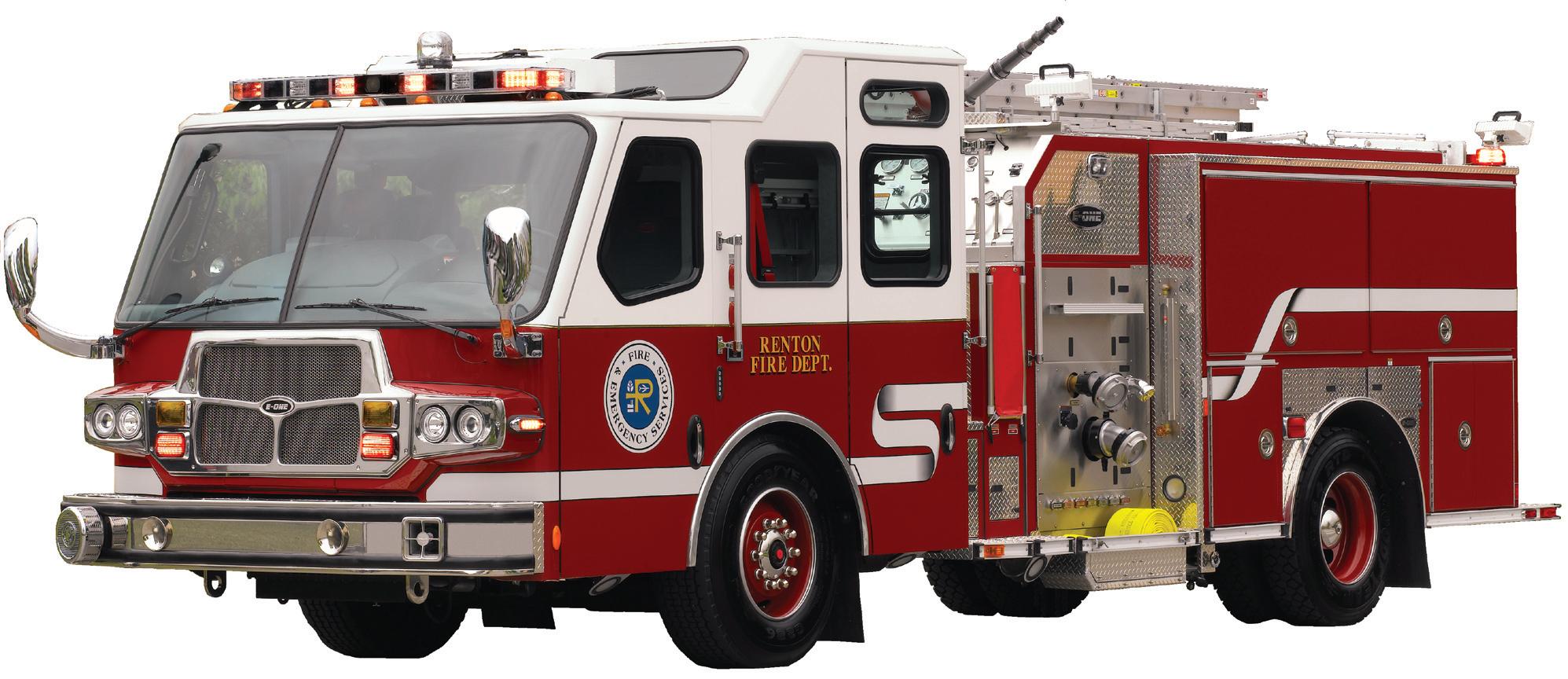
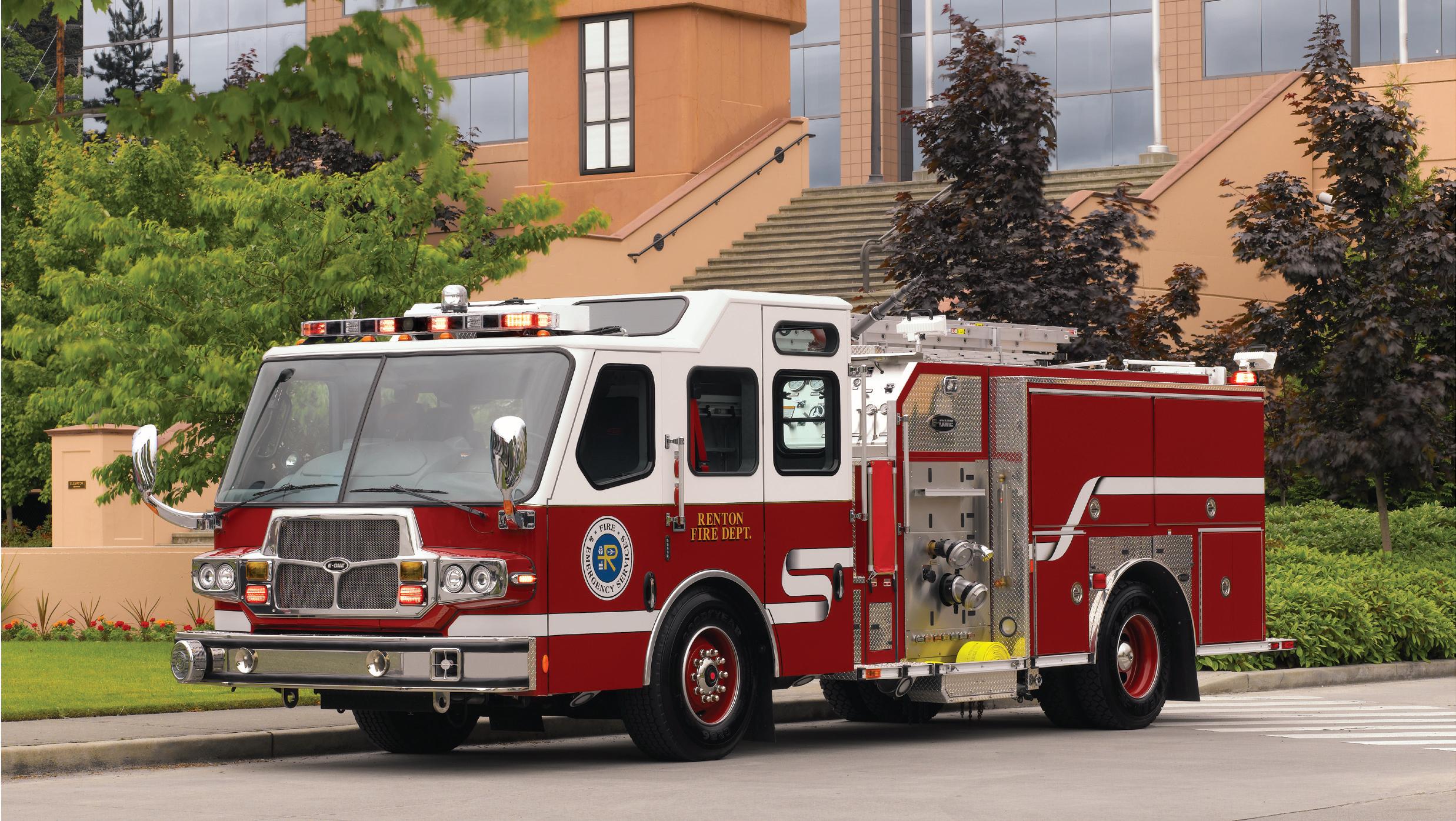
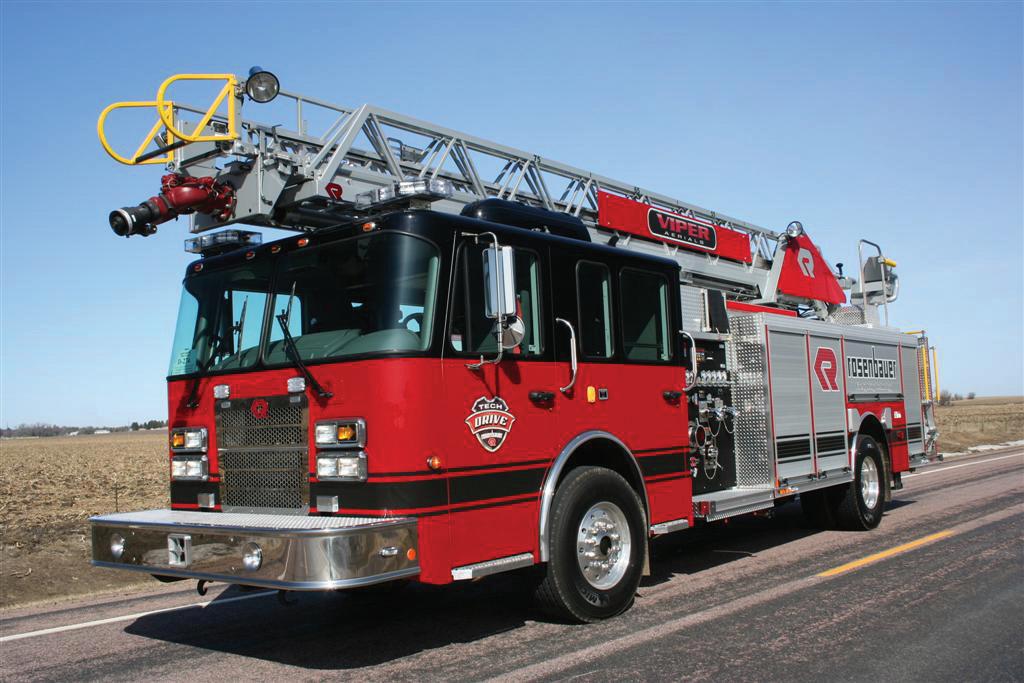
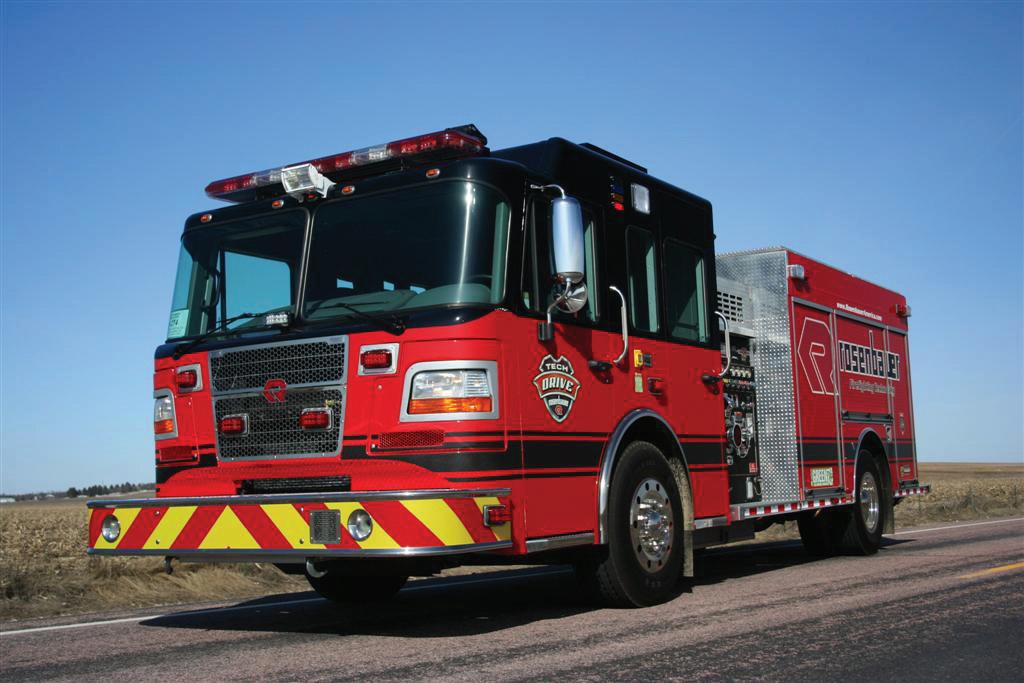
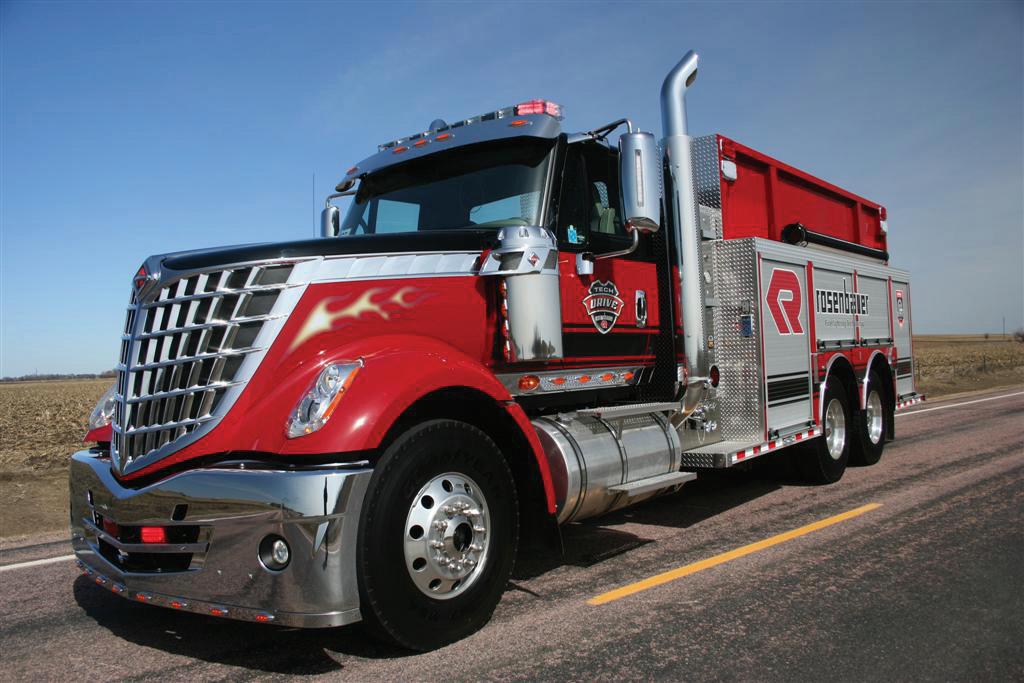
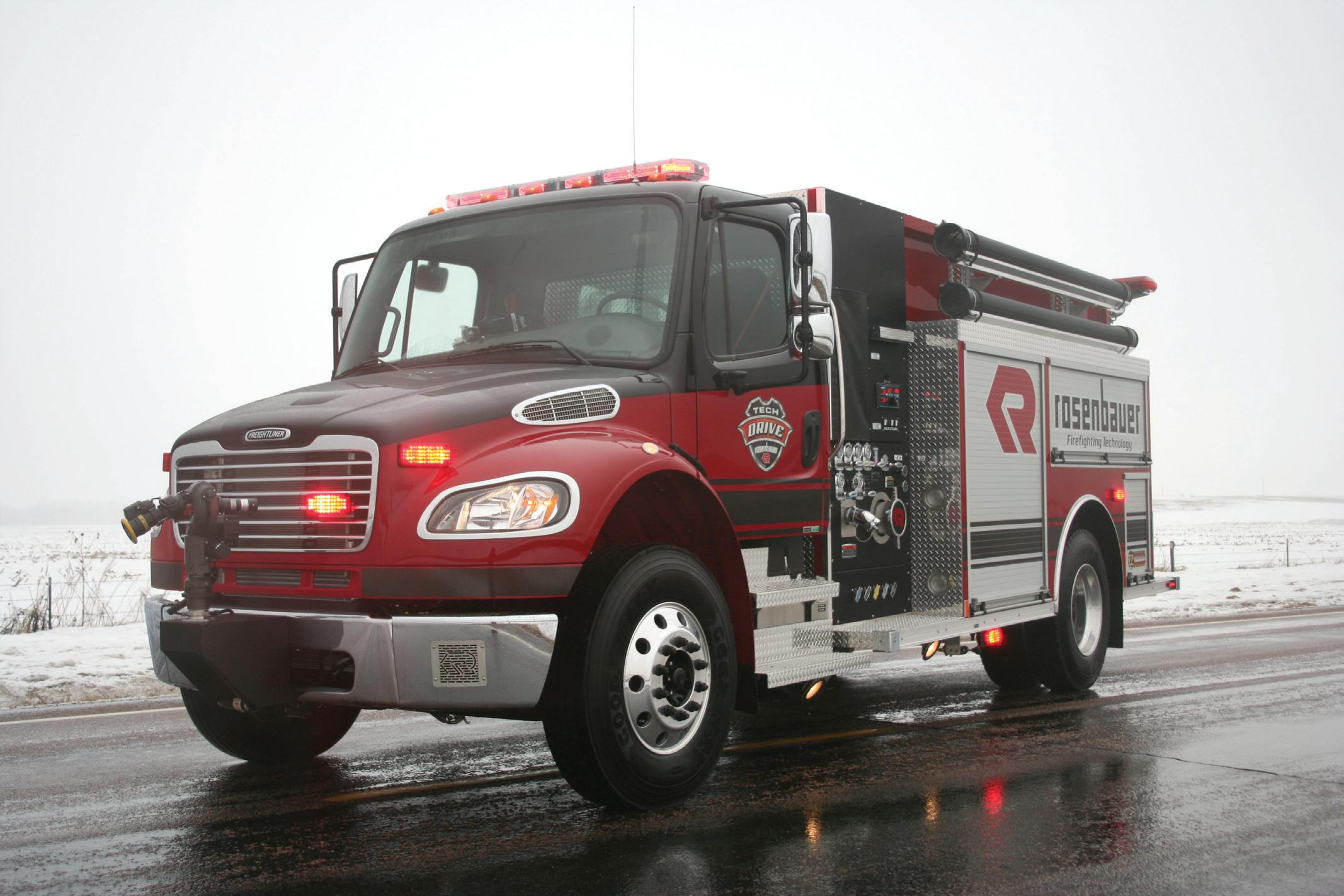
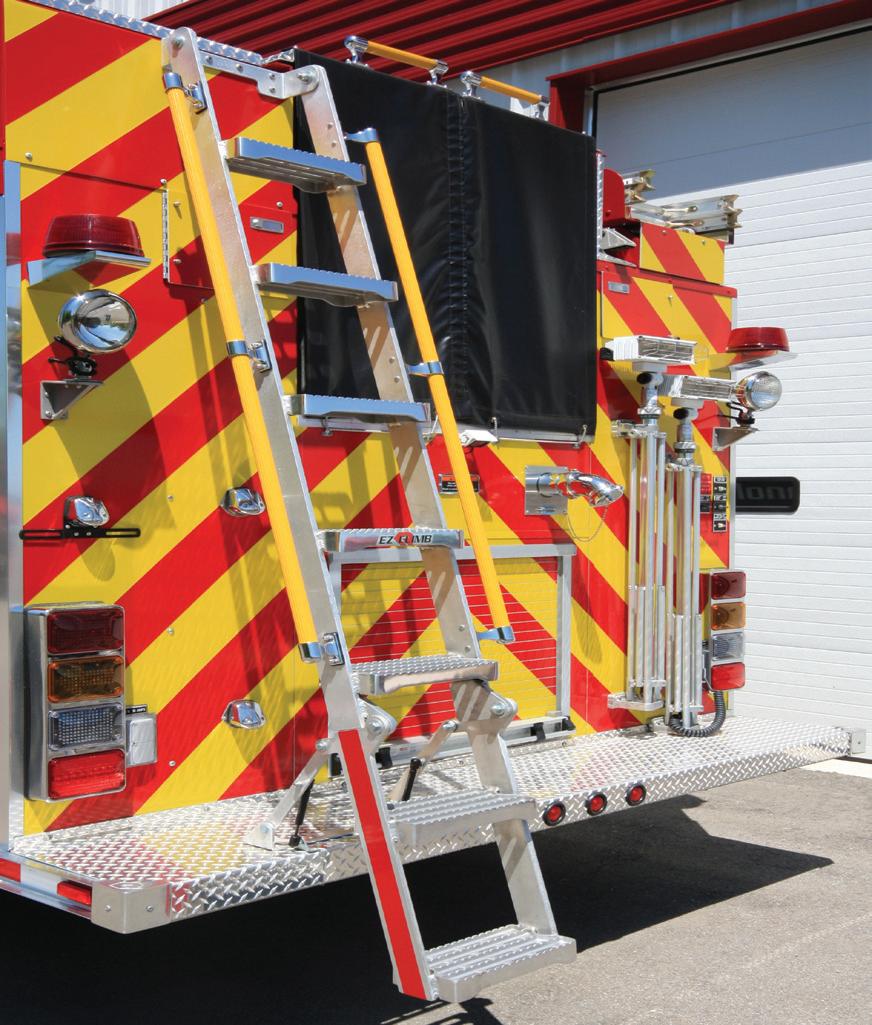
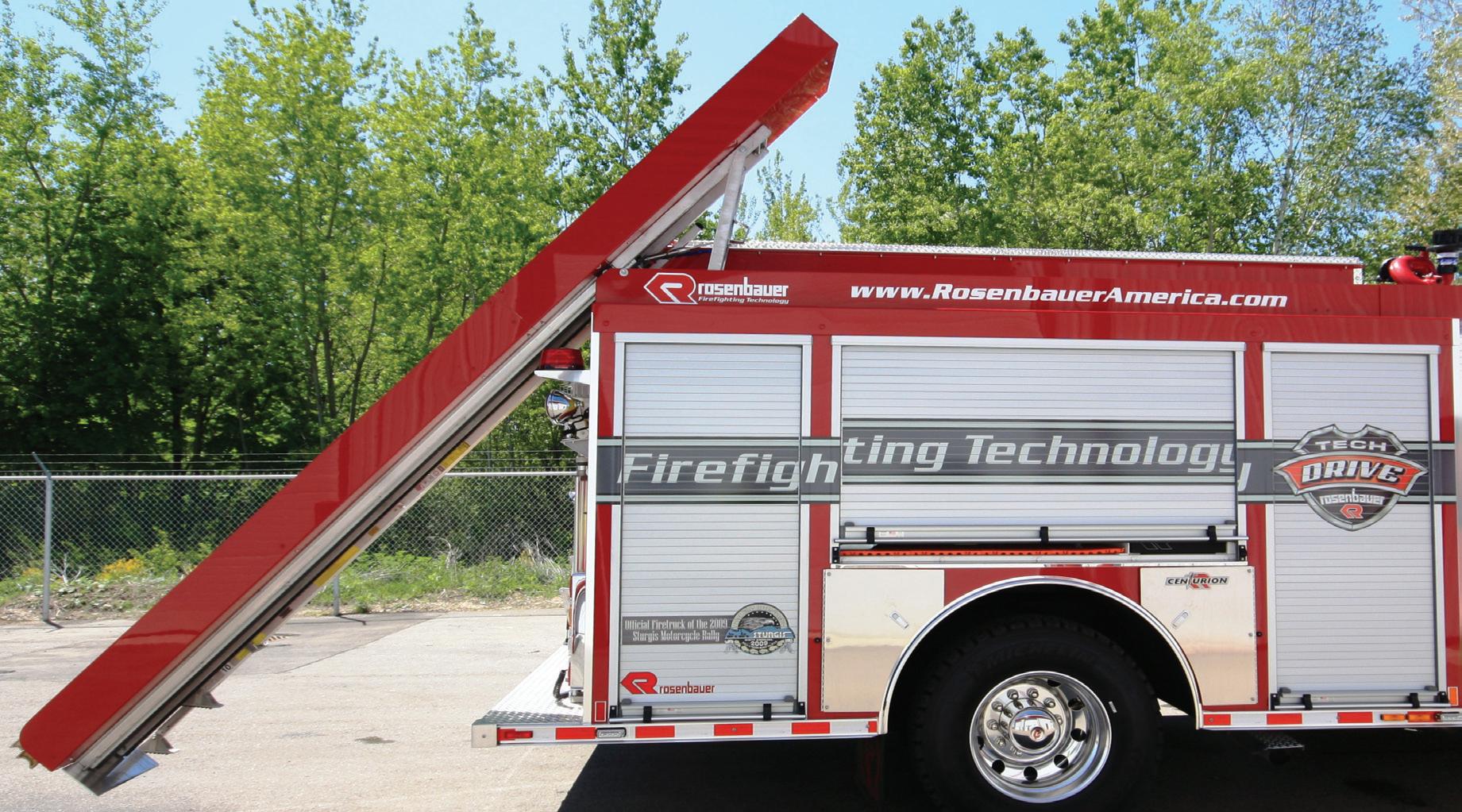
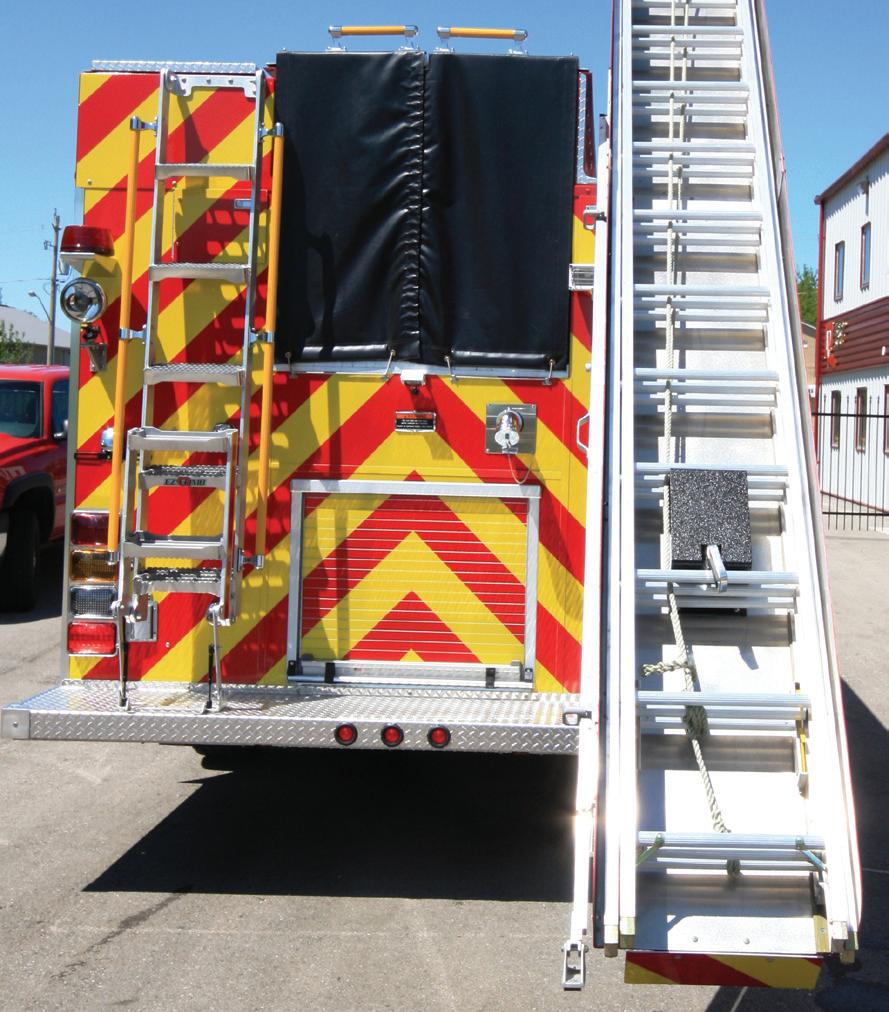
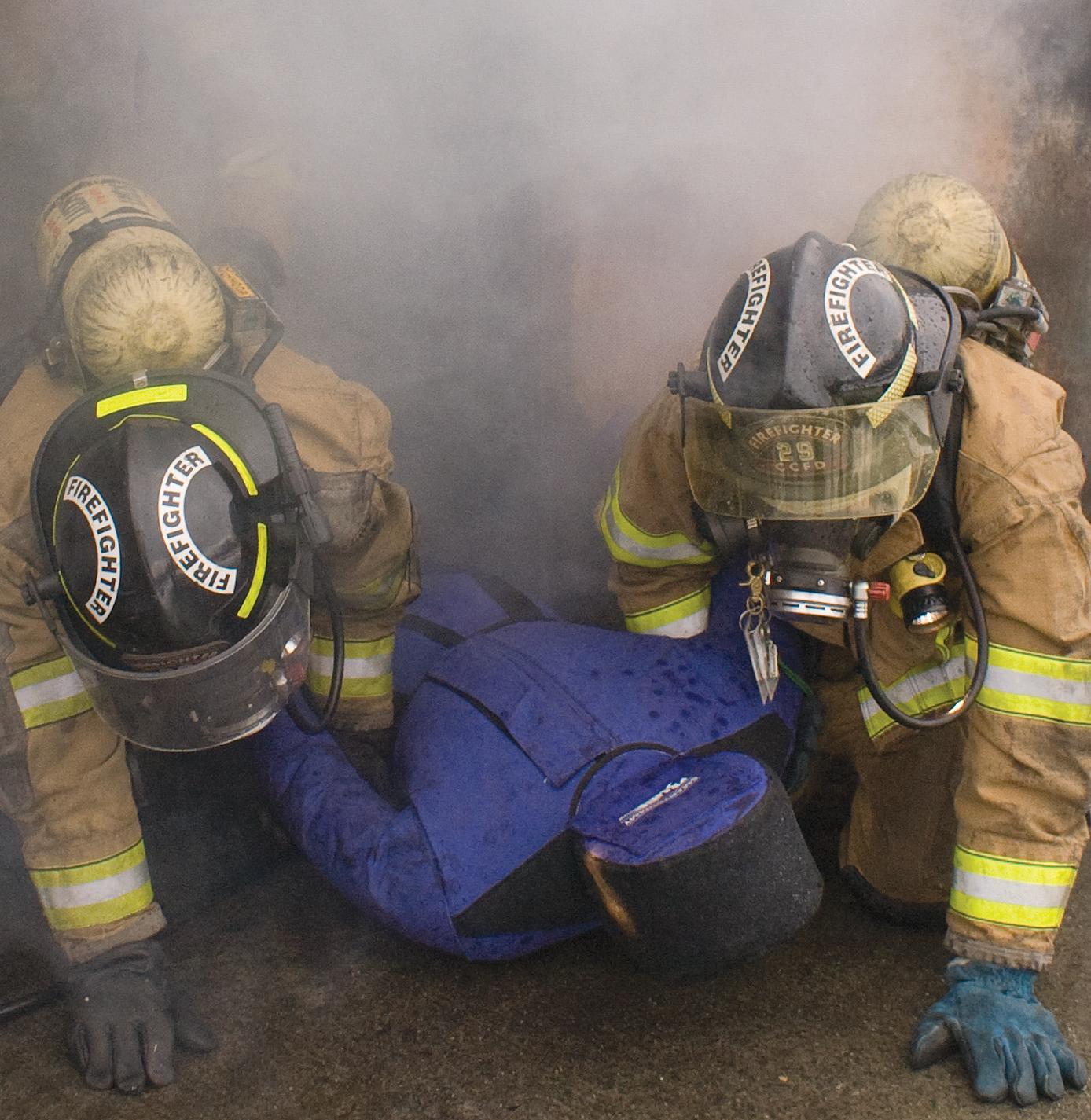
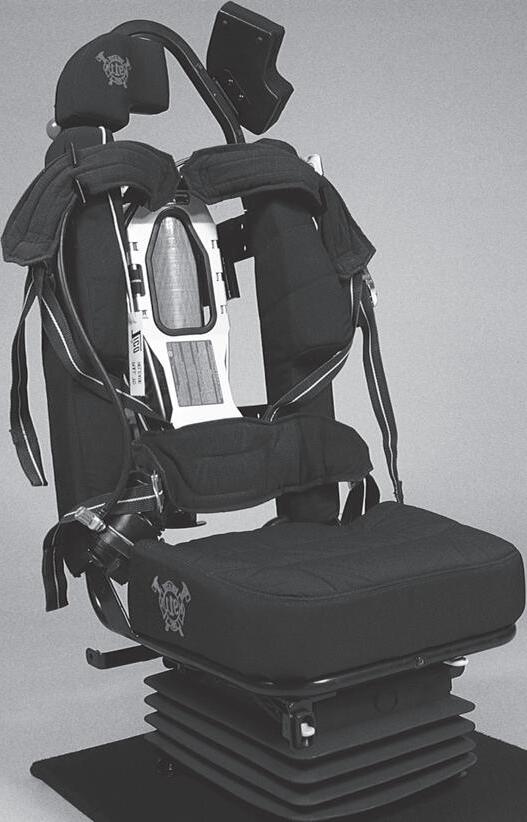
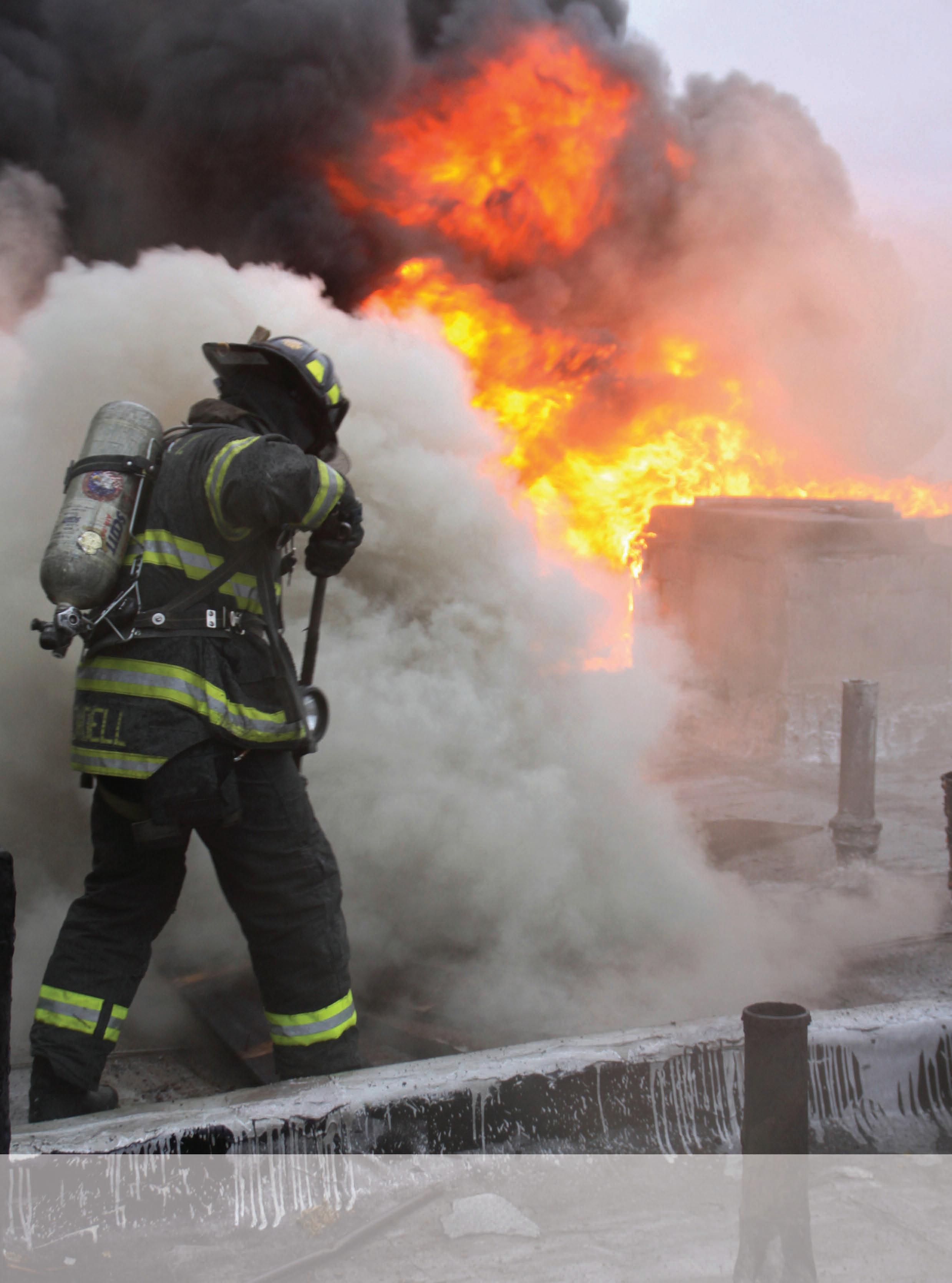
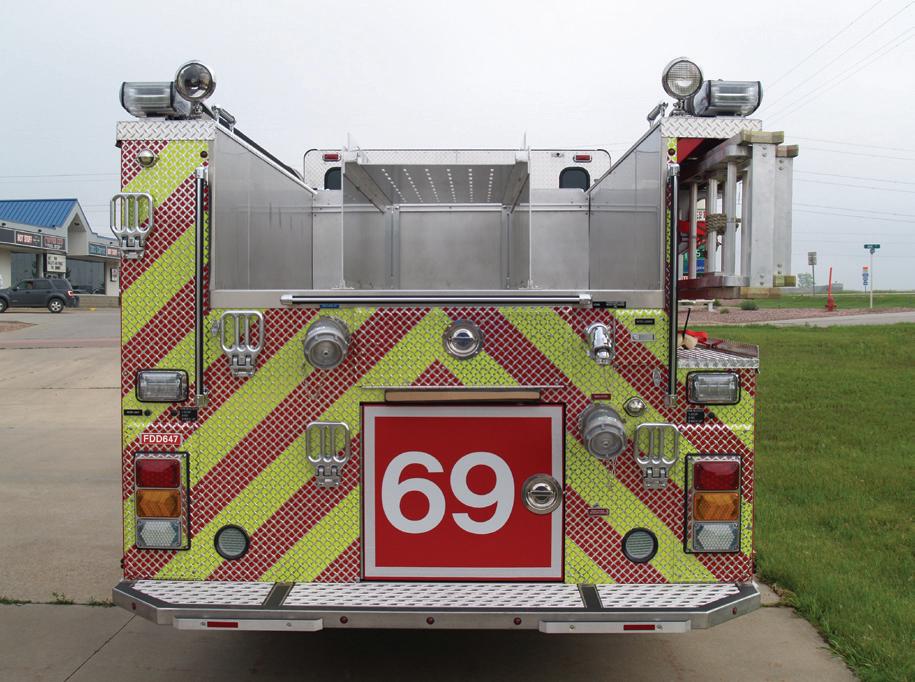
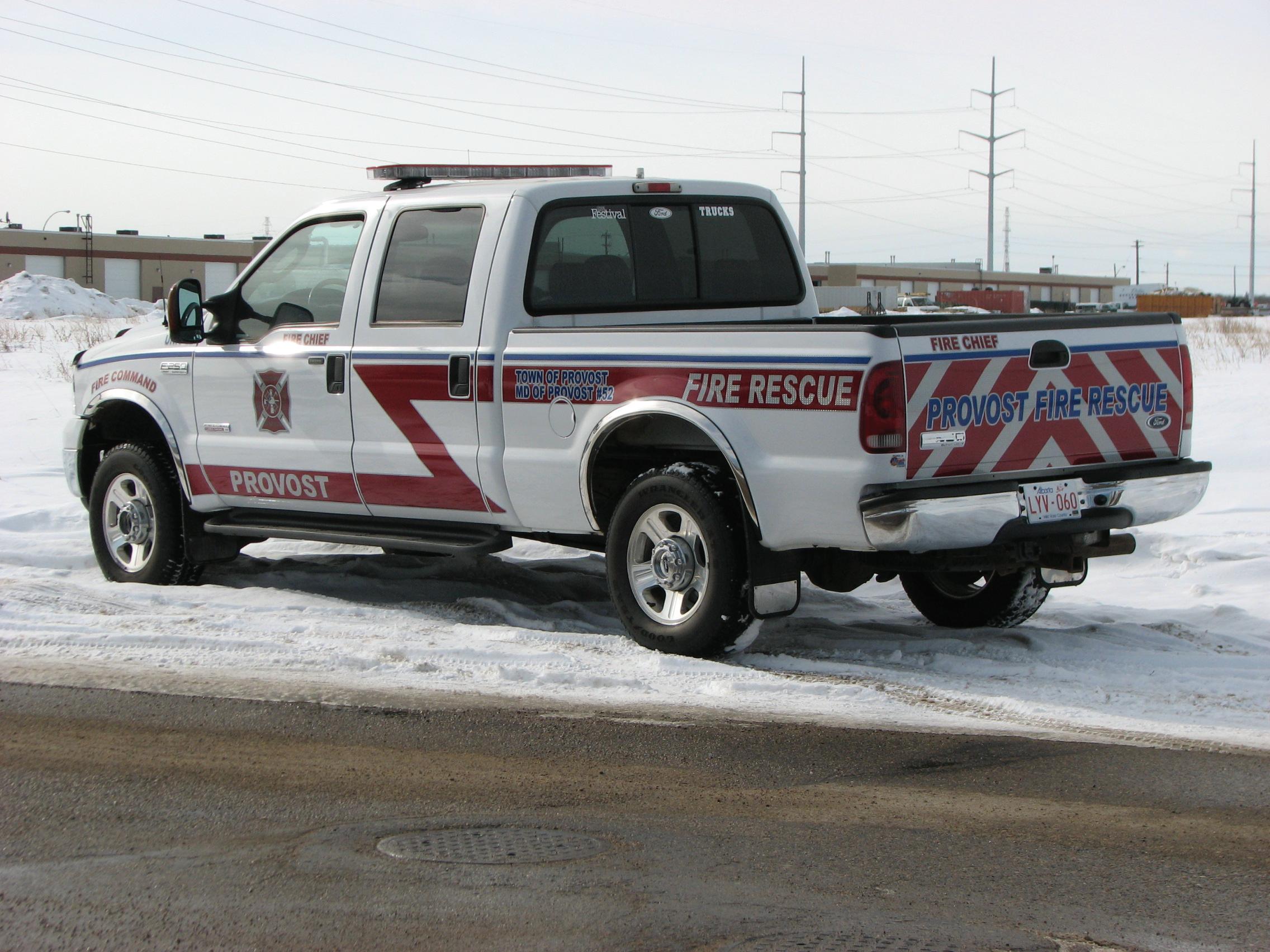
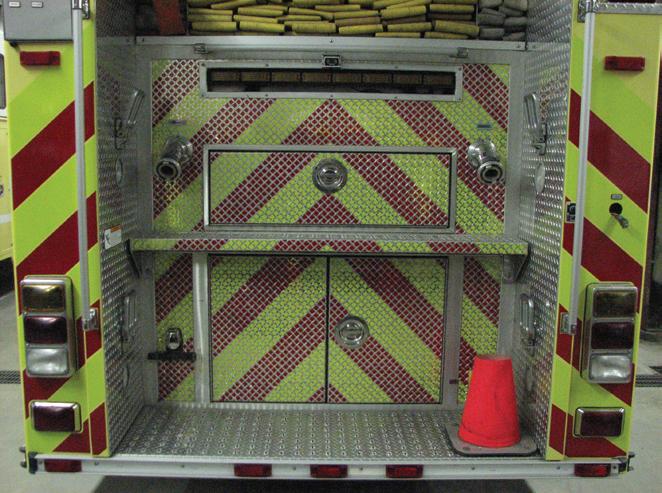
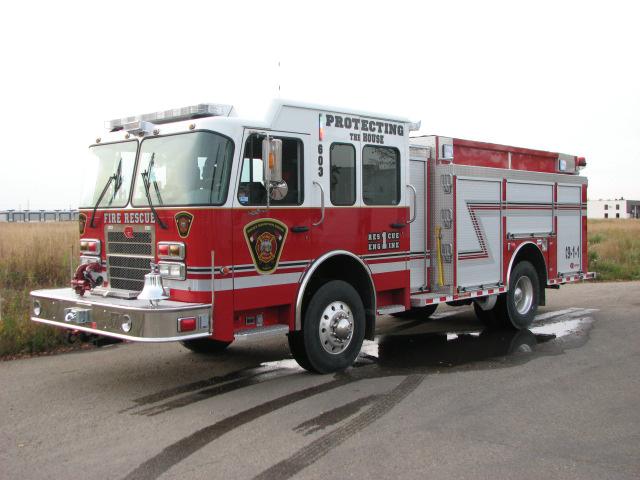
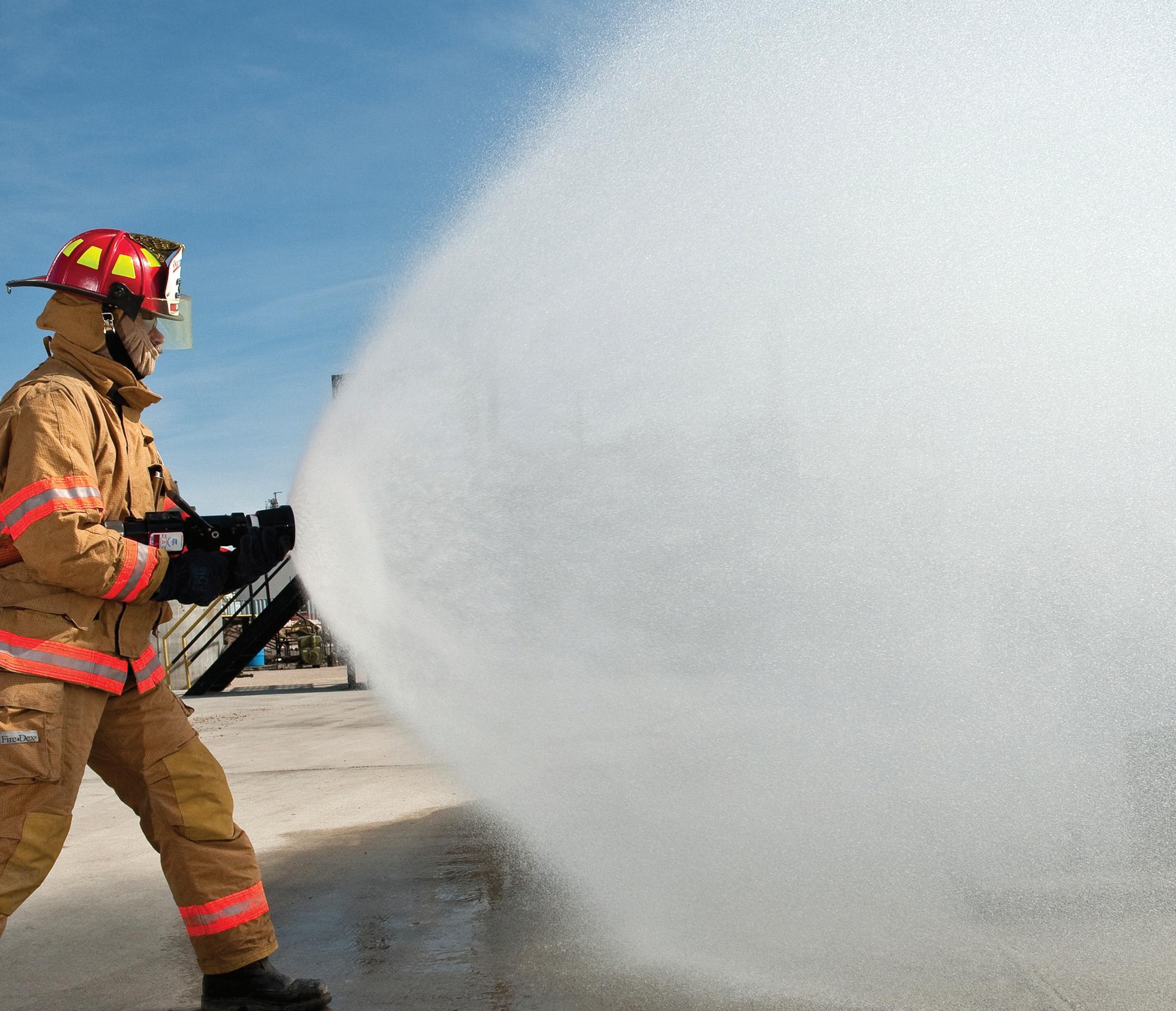
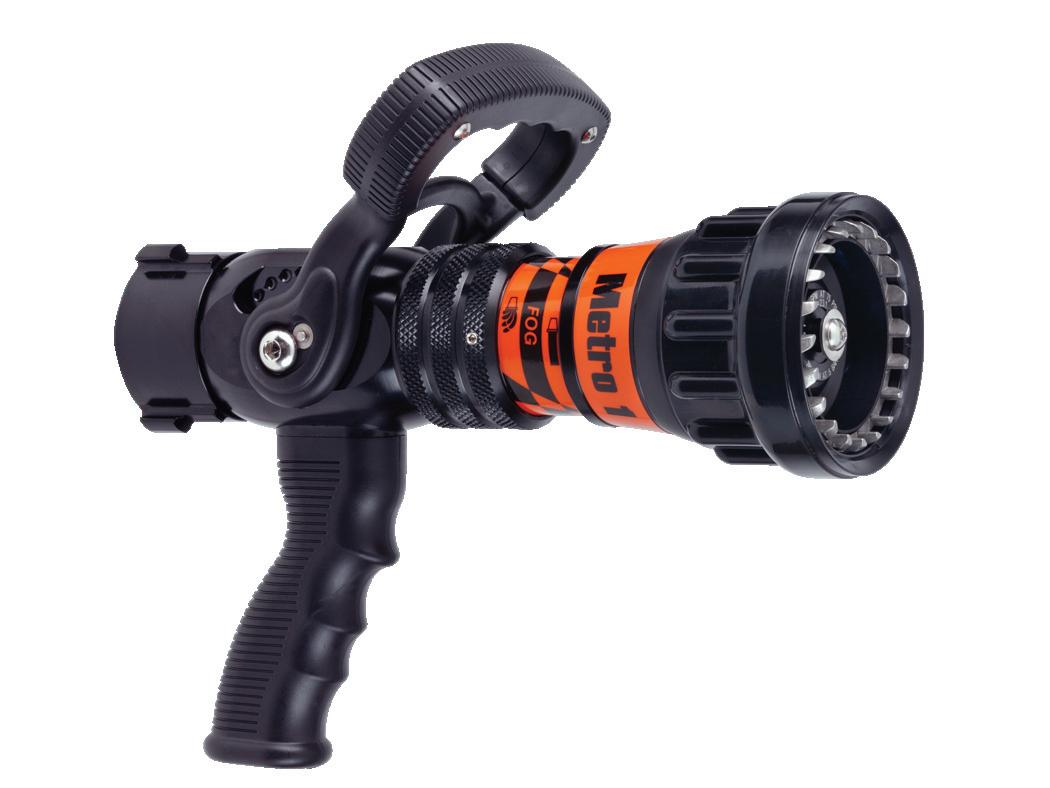
How can you protect against what you can’t see? The short answer - you can’t. That’s why we engineered The E-ONE Quest chassis with the best visibility in the industry. An expansive windshield and massive wipers provide best-in-class front visibility while the front cab-corner mirrors offer maximum side visibility. Plus, the ergonomically placed controls are easy to find, helping you keep your eyes on the road. Because when it comes to protecting your crew and all those that cross your path, shouldn’t you see what’s coming?
Learn how to Protect Better at E-ONE.com.
For more information, contact your nearest dealer:
Carrier Emergency Equipment
6 Edmondson Street
Brantford, ON N3T 5N3
Phone: 519-752-5431
Territory: Ontario; Atlantic Provinces
Carriere Fire and Safety 369 Archibald Street Winnipeg, MB R2J 0W6
First Truck Specialty Vehicles 18688 96th Avenue Surrey, BC Canada V4N 3P9
Phone: 604-888-1424
Territory: British Columbia, Alberta, Yukon, Northwest Territory
When lives are in the balance and seconds count.
Techno Feu Apparatus Maintenance
1 05 Marie -Victorin St. Francois-Du-Lac, PQ J0G 1M0
Phone: 450-568-2777
Territory: Quebec
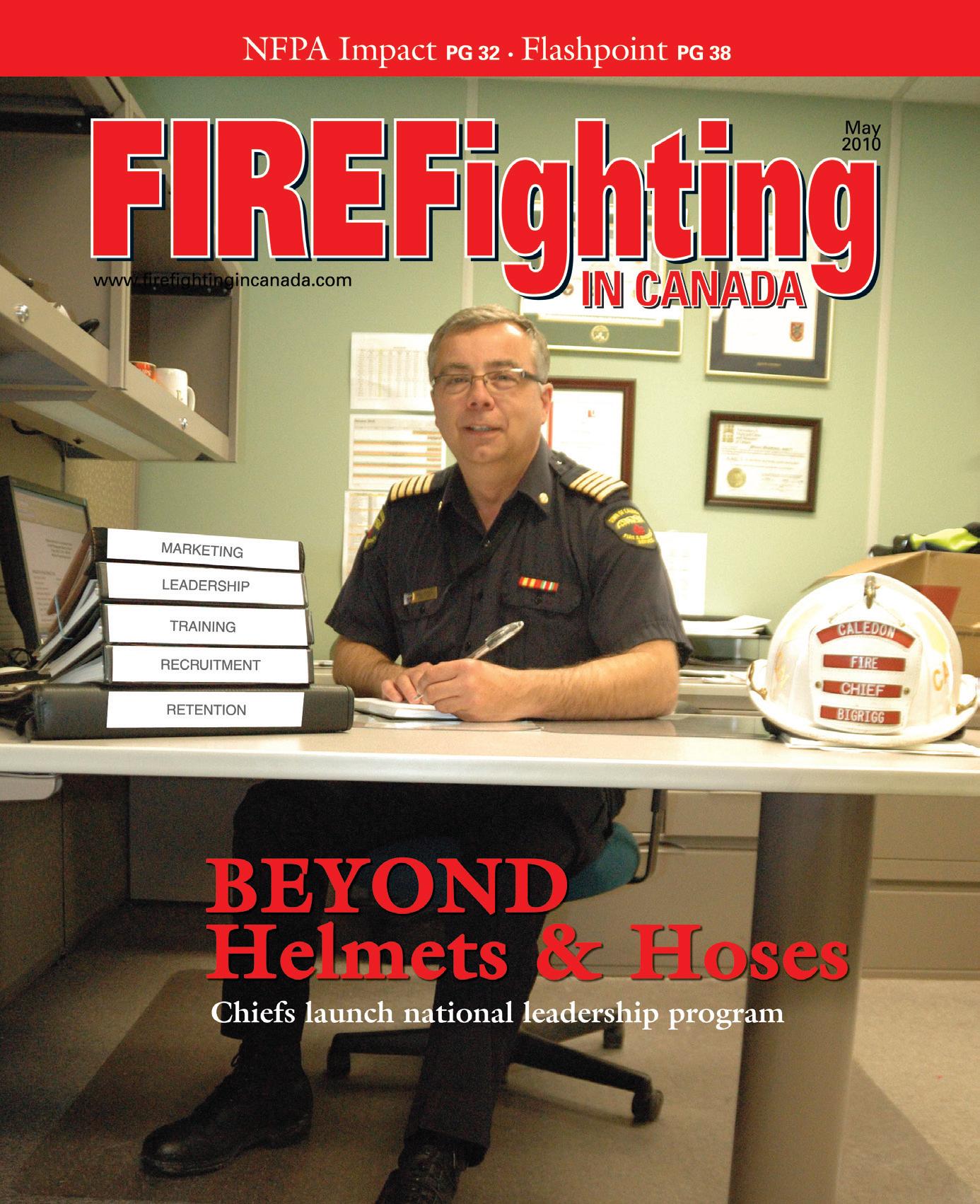
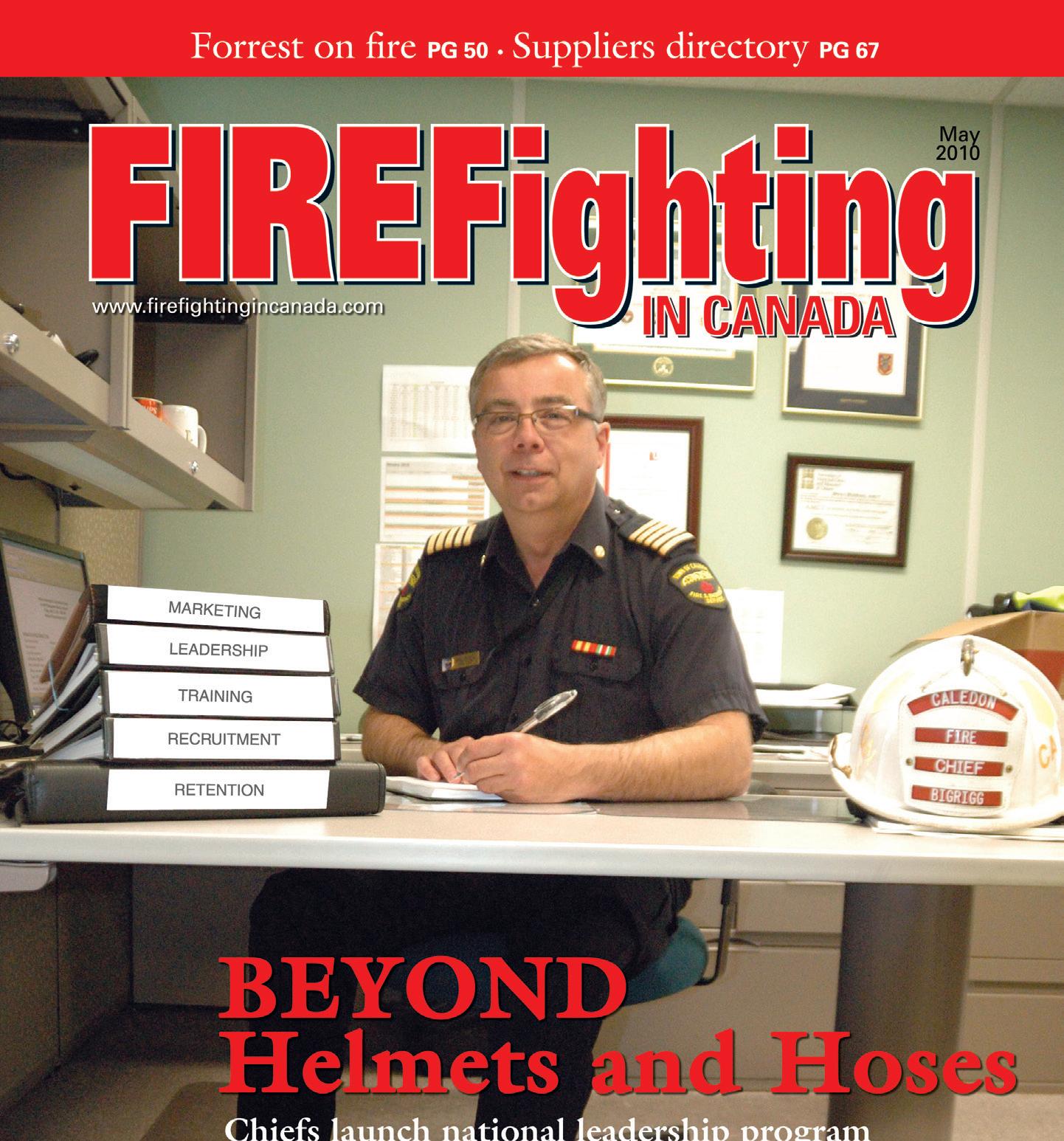
BEYOND HELMETS AND HOSES
The CAFC, in partnership with provincial chiefs associations, launches a national training program for chief officers this month. It’s an introduction to fire service management by experienced people and it’s affordable. By Laura King.
22 MOVING FORWARD
A groundbreaking report by a group of B.C. chiefs and fire service stakeholders outlines recommendations and reforms aimed at modernizing the fire service. By Karin Mark.
26 NEGLIGENCE 101, PART 3
Lawyer Timothy Wilkin continues his study of negligence cases in Canada and the lessons learned. In this instalment: Departments must understand and employ proper size-up and duty of care.
50 FORREST ON FIRE
Seven-term Winnipeg union boss Alex Forrest cites presumptive legislation and co-operative fire-EMS as his biggest challenges. By James Careless.
54
SAFETY FIRST
Ontario’s new Bill 168 is one of the toughest pieces of legislation in the country dealing with workplace violence and harassment but all Canadian fire departments must understand and heed the increasingly stringent regulations aimed at protecting employees. By Rosie Lombardi.
67 2010 NATIONAL SuPPLIERS DIRECTORY
By l au R a kI ng Editor lking@annexweb.com
IFinally, a leadership program comment
t’s been a long time coming but good things are usually worth the wait.
Beyond Helmets and Hoses, the subject of this month’s cover story on page 14, is a new program to educate and mentor volunteer chief officers in the fire service.
The program – the first of its kind in Canada – is born of two realities: First, the recognition that administrative skills are as important as to the fire service leadership as fire suppression skills are to first responders at a dwelling blaze. And second, that firefighters moving into leadership and command positions in departments of all sizes need help developing those administrative skills to navigate political bureaucracies, deal with the public, recruit new blood and become effective administrators and advocates for their departments.
Beyond Helmets and Hoses – if properly executed and embraced by departments and associations beyond Ontario – represents a shot at advancing fire service education while acting as a unifying catalyst among national, provincial and territorial leaders. Investing in people is always a good idea. When those people are your leaders, opinion shapers and the faces of the departments in your communities, it really becomes a service imperative.
Chief Brad Bigrigg of Caledon, Ont., one of eight course instructors, says the program is meant to whet the appetites of men and women committed to the fire service for the long term and instil in them a desire for lifelong learning.
ON THE COVER
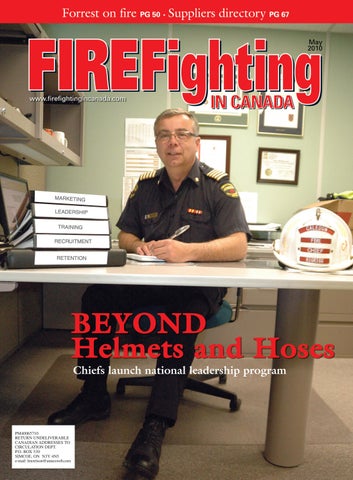
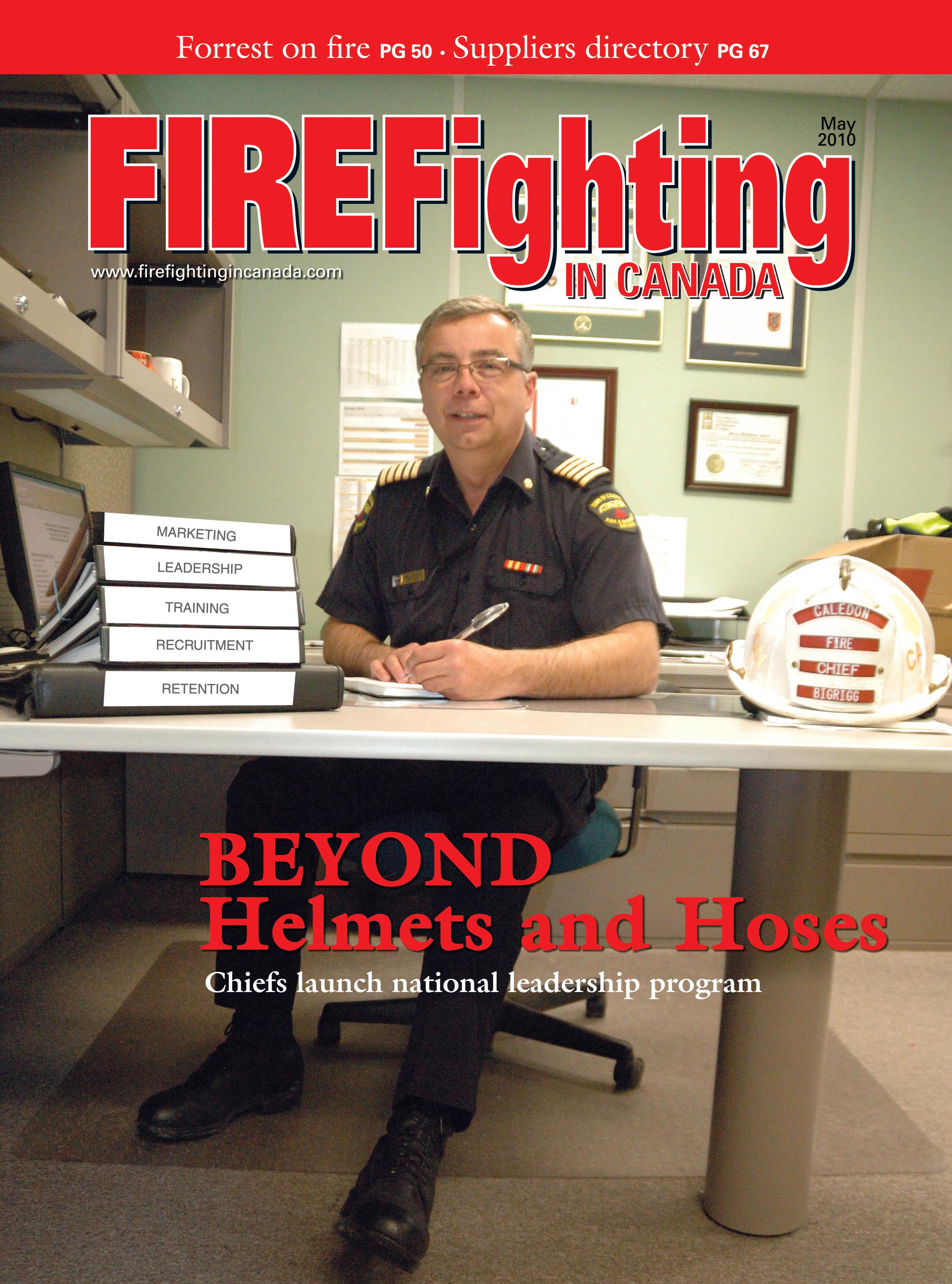
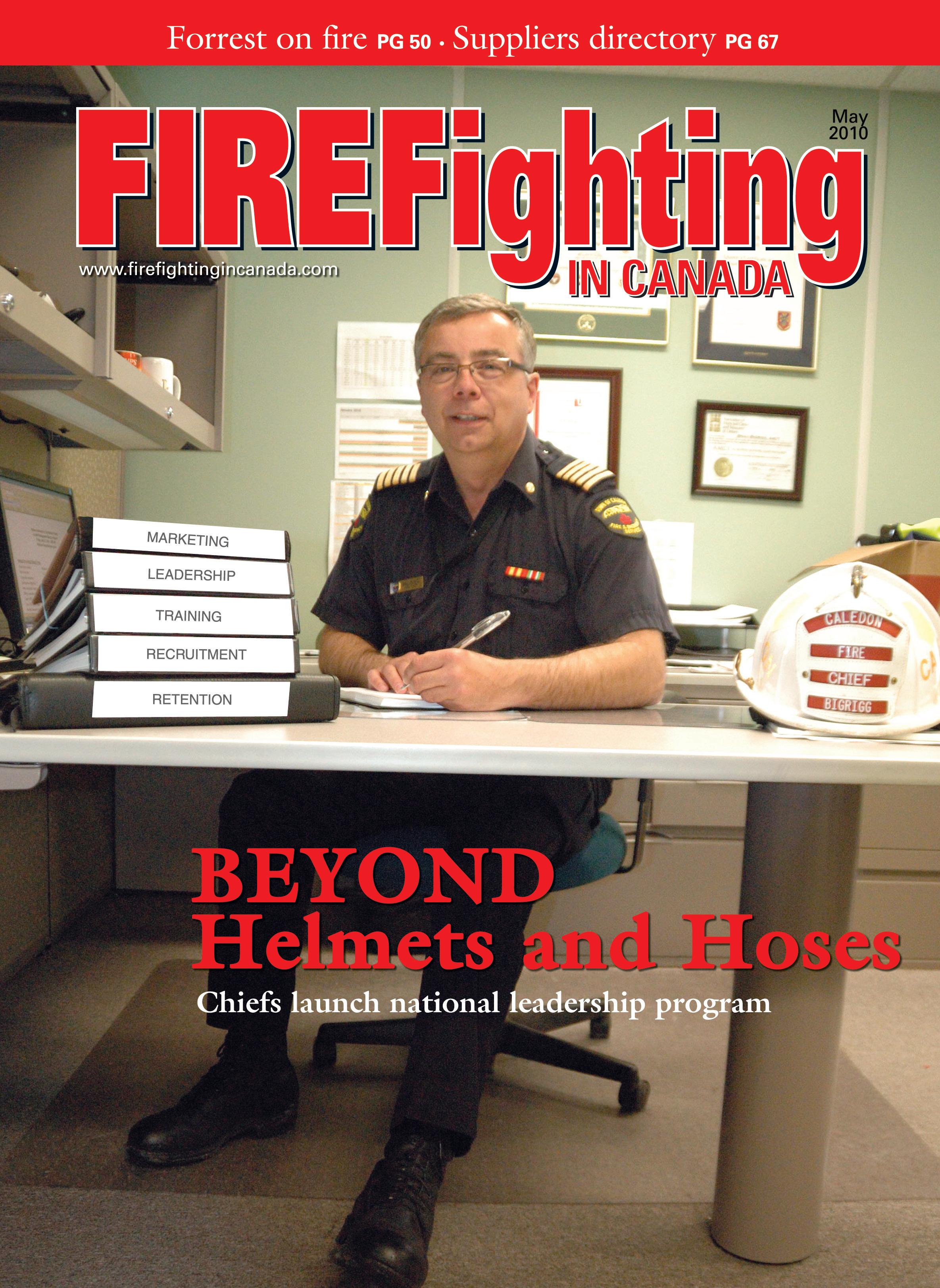
Caledon, Ont., Fire Chief Brad Bigrigg is among eight instructors for Beyond Helmets & Hoses, a national leadership program for chief officers. See story page 14.
The program is a partnership between the Canadian Association of Fire Chiefs and provincial chiefs associations. But for it to be a success and change the way the next generation of fire service leaders tackle their jobs, other provincial organizations will need to embrace it.
Customized for Canada from a similar program offered by the International Association of Fire Chiefs, the inaugural two-day program debuts this month at the OAFC conference in Toronto and the plan is to offer it five more times in across the country.
The hope is that the program will be successful and other provincial associations will pick it up.
And that, of course, harkens to a familiar theme in these editorials – the need for national, provincial and territorial fire service leaders to be on the same page on issues from education to residential sprinklers.
Once word of the program starts to spread he hopes it will spread like, well, wildfire and lead to ongoing educational opportunities for fire service leaders.
As part of our goal to bring new names, faces and points of view to the pages of Fire Fighting in Canada, we’ve introduced two new columns this month. Welcome to Ian Crosby, the wellness and fitness co-ordinator for the Calgary Fire Department, whose inaugural column on page 42 explains how to get firefighters to buy in to a health and wellness program. And on page 12, Chief Vince MacKenzie of Grand Falls-Windsor, N.L., who wears many other fire service hats, tackles issues from Atlantic Canada in View from the East. If you’re interested in writing a View from the west, Ontario or Quebec let me know at lking@annexweb.com.
pREsIdEnt MIKE FREDERICKS mfredericks@annexweb.com
PuBLICATIOn MAIL AgREEMEnT #40065710
RETuRn unDELIVERABLE CAnADIAn ADDRESSES TO CIRCuLATIOn DEPT.
P.O. Box 530, SIMCOE, On n3Y 4n5 e-mail: lmorrison@annexweb.com
Printed in Canada ISSn 0015–2595
CIRCulatIon e-mail: lmorrison@annexweb.com
Tel: 866-790-6070 ext. 206 Fax: 877-624-1940
Mail: P.O. Box 530 Simcoe, On n3Y 4n5
suBsCRIptIon RatEs
Canada – 1 Year - $25.44 (includes gST - #867172652RT0001) uSA – 1 Year $50.00
We acknowledge the financial support of the Government of Canada, through the Publications Assistance Program and the Canada Magazine Fund, toward our mailing and editorial cost. Nous reconnaissons l’aide financiere accordee par le gouvernement du Canada pour nos coults d’envoie postal et nos coutl redactionnels par l’entremise du Programme d’aide aux publications et du Fonds du Canda pour les magazines.
From time to time, we at Fire Fighting In Canada make our subscription list available to reputable companies and organizations whose products and services we believe may be of interest to you. If you do not want your name to be made available, contact our circulation department in any of the four ways listed above.
All advertising is subject to the publisher’s approval. Such approval does not imply any endorsement of the products or services advertised. Publisher reserves the right to refuse advertising that does not meet the standards of the publication.
www.firefightingincanada.com
Photo by LAURA KING
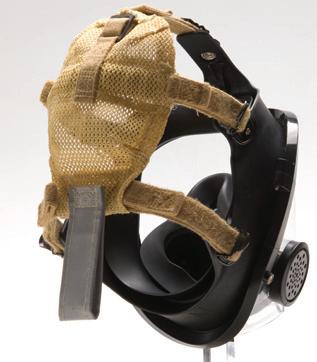
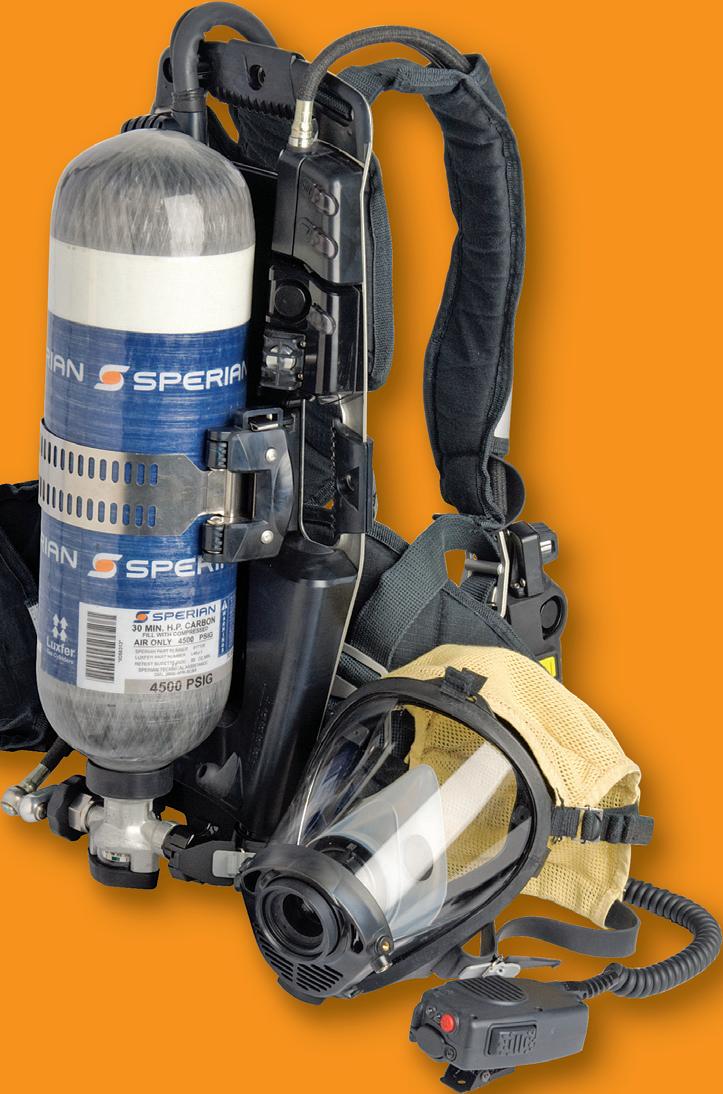
INTRODUCING THE SURESEAL SYSTEM FOR THE AV-3000® FACEPIECE. With patent-pending reverse reflex seal technology, it provides a more reliable, comfortable fit every time. Our Top-Down Convertibility™ feature allows you to use a single facepiece, with a single fit-test, across all CBRN
\
SCBA, air-purifying and powered air-purifying applications. This compatibility gives your team the best protection possible. Plus, an improved PPE interface further enhances overall fit. Some hazards push you to the limit. Make sure you have equipment that responds.
statIontostatIon
across canada: Regional bews briefs
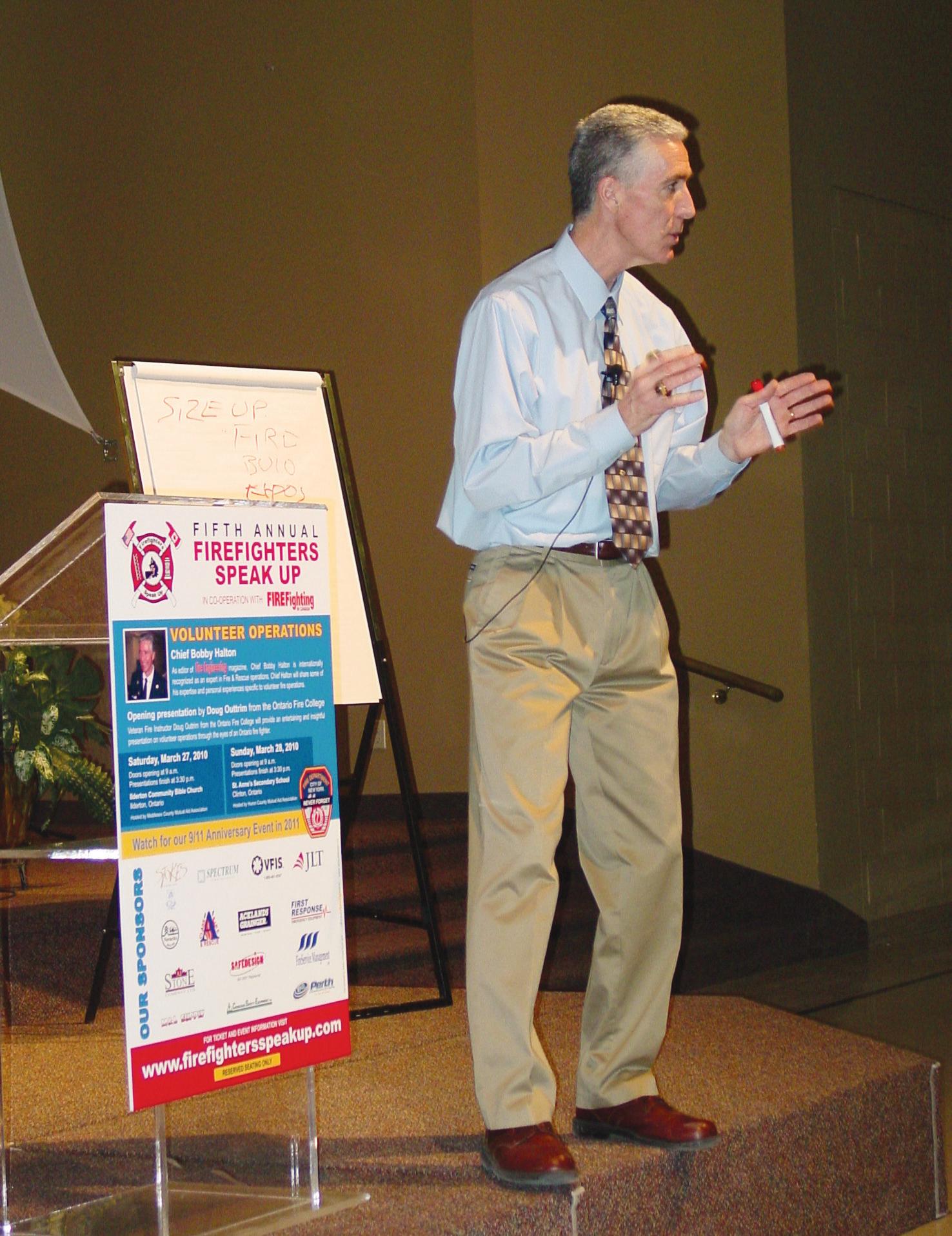
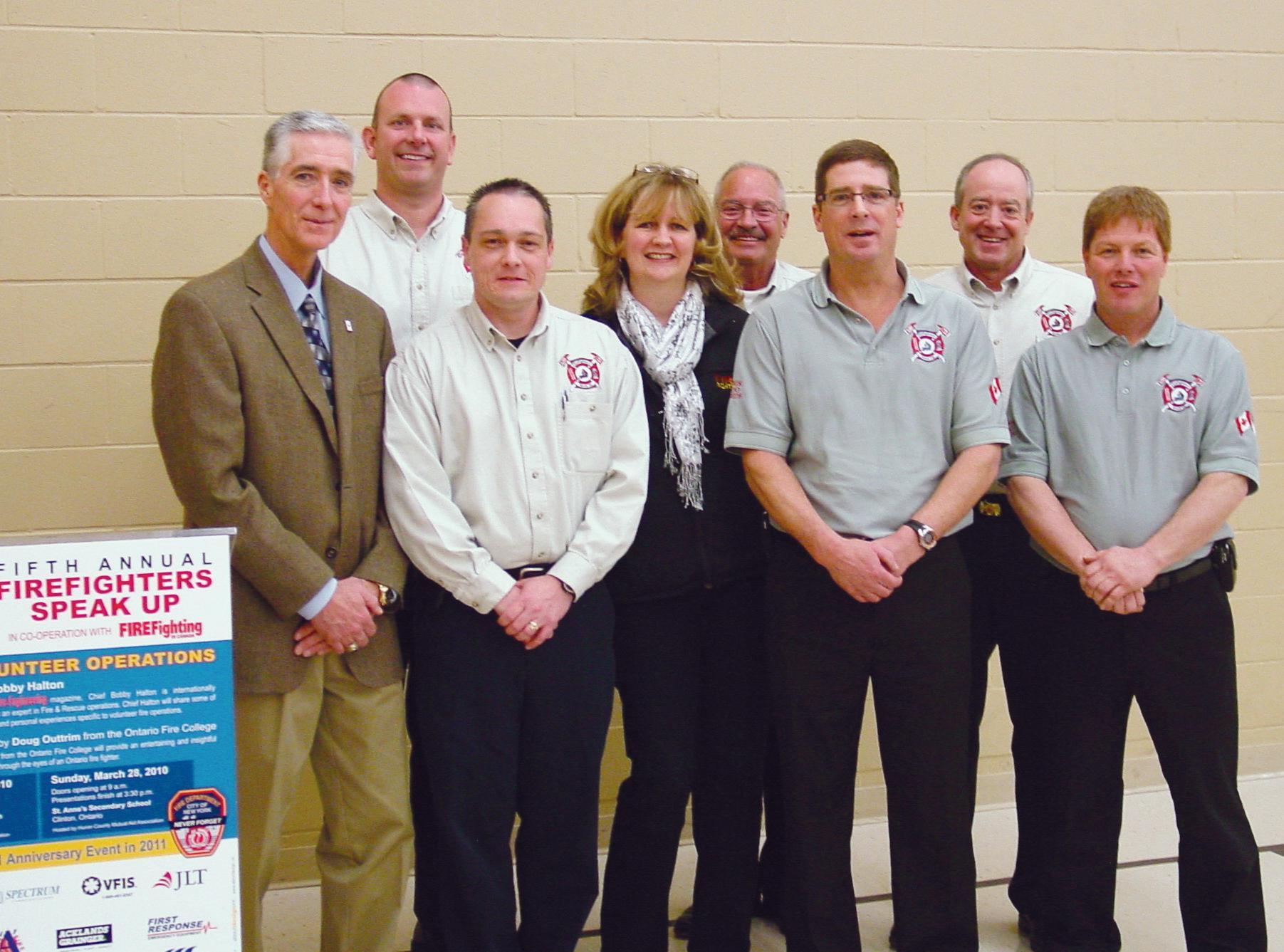
Fire Engineering editor-in-chief Bobby Halton addresses volunteer firefighters from Middlesex and Huron counties at the Firefighters Speak Up event in Ilderton, Ont., on March 27, sponsored by Fire Fighting in Canada. The 2011 version of Firefighters Speak Up – during the 10th anniversary year of 9/11 – features NYFD’s John Salka and the members of NYPD’s Ladder 6. For more information visit firefightersspeakup.com
the brass pole
promotions & appointments
daRREn ClaRkE has been promoted to fire chief of the Saprae Creek Volunteer Fire Department in Alberta. Saprae Creek is a rural community within The Regional Municipality of Wood Buffalo. Clarke has been a member of the department for 14 years and has served as deputy chief since 2002. Clarke takes over from greg MacMillan, who
stepped down after serving 20 years as chief.
JEFF BECkwIth is the new deputy chief in the City of Prince Rupert. Beckwith has more than 10 years of experience with Prince Rupert Fire Rescue. He was promoted nov. 10, 2009.
stEVE kRaFt is the new fire chief in Richmond Hill, Ont. Kraft was acting chief for twoand-a-half years while the town
Chiefs applaud code change that requires smoke alarms
■ BRITISH COLuMBIA
The Fire Chiefs’ Association of B.C. had some kind words for the provincial government after it announced changes to the BC Fire Code in late March. The amendments requires private home and hotel or motel rooms built before 1979 to have smoke alarms installed by May 1.
“This is an issue that the
Fire Chiefs’ Association of BC began lobbying for last year,” said FCABC President Stephen Gamble. “We are very happy to see that the government acted upon it so quickly in the interest of public safety.”
Previously, buildings built after 1979 were required to have smoke alarms.
CFFF chooses finalists for memorial design
■ OTTAWA
The Canadian Fallen Firefighters Foundation (CFFF) has announced the six finalist teams of a two-stage competition for a national monument to commemorate the more than 1,000 Canadian firefighters who have lost their lives in the line of duty. The memorial is expected to be completed by March 2012.
The teams are Ken Lum (Vancouver) / Architects
went through an organizational review. He began his career with the Richmond Hill Fire Department in 1988 and was promoted to captain in 1995 and acting platoon chief in 2002. His appointment as chief took effect May 1.
Alliance (Toronto); Allan Harding Mackay (Toronto) / Phillips Farvaag & Smallenberg (Vancouver); Barbara Steinman (Montreal) / Fleisher Ridout Partnership (Toronto); Myfanwy Macleod (Vancouver) / Ferris & Associates (Toronto); Rose Marie E. Goulet (Montreal) / VLAN Paysages and Peter Soland Architect (Montreal).
ConRad landRy has been appointed to the position of deputy chief of operations in the municipal fire department for the City of Dieppe, n.B. Landry became a volunteer firefighter in 2001 and has worked as a casual firefighter for the department since 2003. He received a master’s degree in administration from the université de Moncton in January 2009. Before accepting this position, he was a provincial program director for St. John Ambulance
Newfoundland budget allocates $1.3 million for fire service
The government of Newfoundland and Labrador announced $1.3 million in new funding for the fire service in its March 29 budget. The Newfoundland and Labrador Association of Fire Services said the four items presented to government in the association’s annual brief were addressed positively.
1. The cost sharing program for fire trucks has been increased to $2.5 from $1.7 million. While the association asked for $5 million, it said it is encouraged. The funding will help to replace the aging fleet of fire trucks in the province but the NLAFS noted that this funding must continue to increase to replace existing apparatus that are past their service life in more than 100 communities.
2. The special assistance grants that permit fire departments to buy capital items has been doubled to $1 million. While the association asked for a separate program to assist in the replacement of firefighter protective equipment and breathing apparatus, the increase in the existing special assistance program
and the Canadian Red Cross.
dEnIs pIlon is the new fire chief of the Swift Current Fire Department in Saskatchewan. He was previously the deputy chief of prevention. This is Pilon’s third department, having
essentially equates to the same thing.
3. The fire protection officer for Labrador announced in last year’s budget has been funded this year and will be in place in the near future.
4. The funding program for firefighters to
attend training that was piloted last fiscal year will be will be continued in 2010-11. In addition, overtime allocations have been positively distributed to assist in firefighter training initiatives such as the hazardous materials program.
served as chief in Melville from 1985 until 1990 and as chief in Weyburn from 1993 to 2008.
noRmand BEauChamp has accepted a position as deputy fire chief – operations with the Swift Current Fire Department in Saskatchewan. He comes to Swift Current from the SaintHippolyte Fire Department in Quebec, where he served as fire chief. Beauchamp has 20 years experience in the fire service with 12 years as chief.
FIRE ChEF BoB RIndahl has left the Swift Current Fire Department in Saskatchewan after 311/2 years of service. He was proud to have served in every rank within the department and to have spent his
entire career with the SCFD. Most notable is his dedication to fire prevention, giving Swift Current an enviable fire loss record throughout his period as chief.
daVId ChaRlEs gRay, who spent his 24-year career in north York, Ont., died March 9 at the age of 48 after a battle with brain cancer. gray was acting captain with Toronto Fire Services.
Fire Engineering editor Bobby Halton (left) and Fire Fighting in Canada editor Laura King (centre) with organizers of Firefighters Speak Up in Ilderton, Ont., on March 27, (left to right) Capt. Carlin Riley (Kitchener Fire Department), District Chief Blair Harvey (Ilderton, Ont.), District Chief Steve Cook (Central Huron), Capt. Jeff Musser (Exeter, Ont.), District Chief Lonnie Fletcher (Coldstream, Ont.), and firefighter Mike Reid (Exeter, Ont.).
statIontostatIon
br I gade news: From stations across Canada
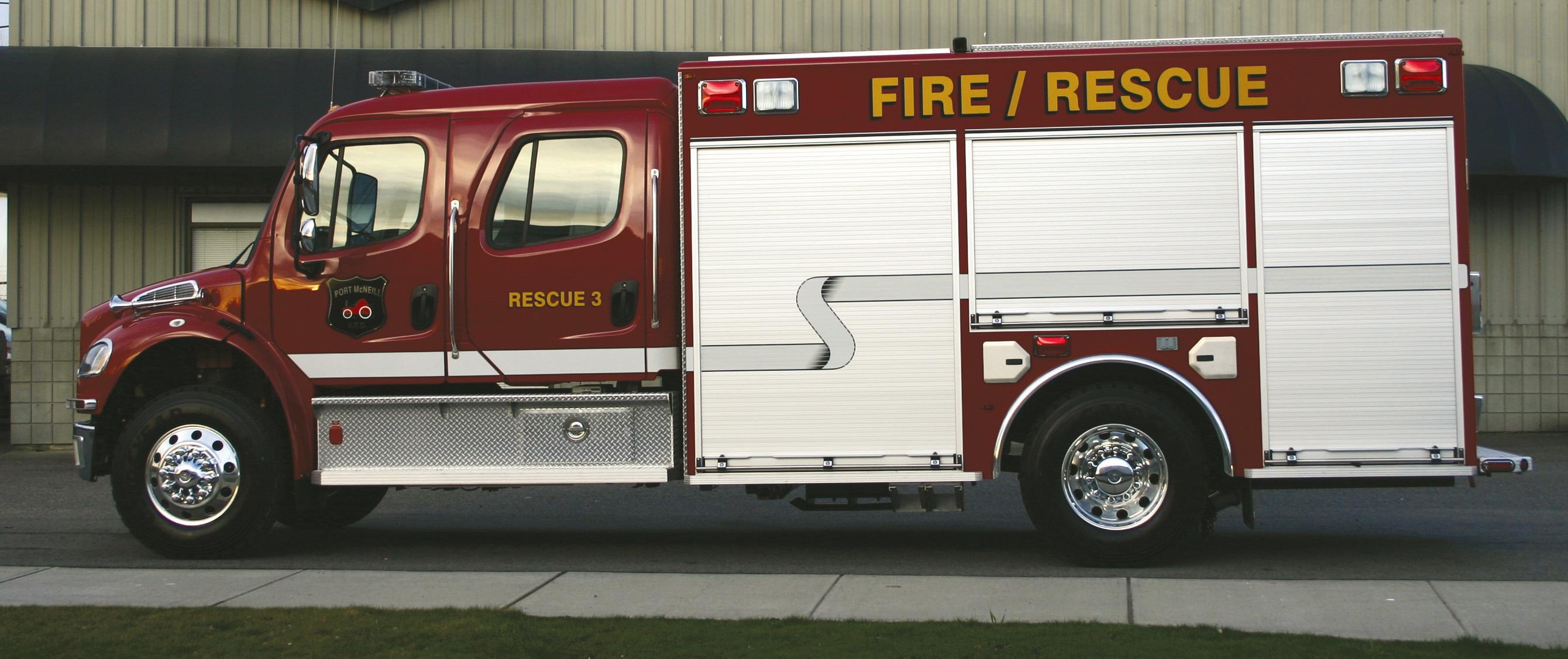
The poRt mCnEIll VoluntEER FIRE dEpaRtmEnt in B.C. under chief Larry Bartlett took delivery in January of a Hub Fire Engines & Equipment-built rescue unit. Built on a Freightliner M2-106 chassis and powered by an Allison 3000 EVS transmission and a Cummins ISC 300-hp engine, the truck is equipped with a Trimax 30 compressed air foam system, Whelen light package, Warn m8000 portable winch, Zico Quic ladder, Onan Protec 20 kW generator, Will-Burt light tower, Slide Master slide out trays and dividers and a refrigerator.
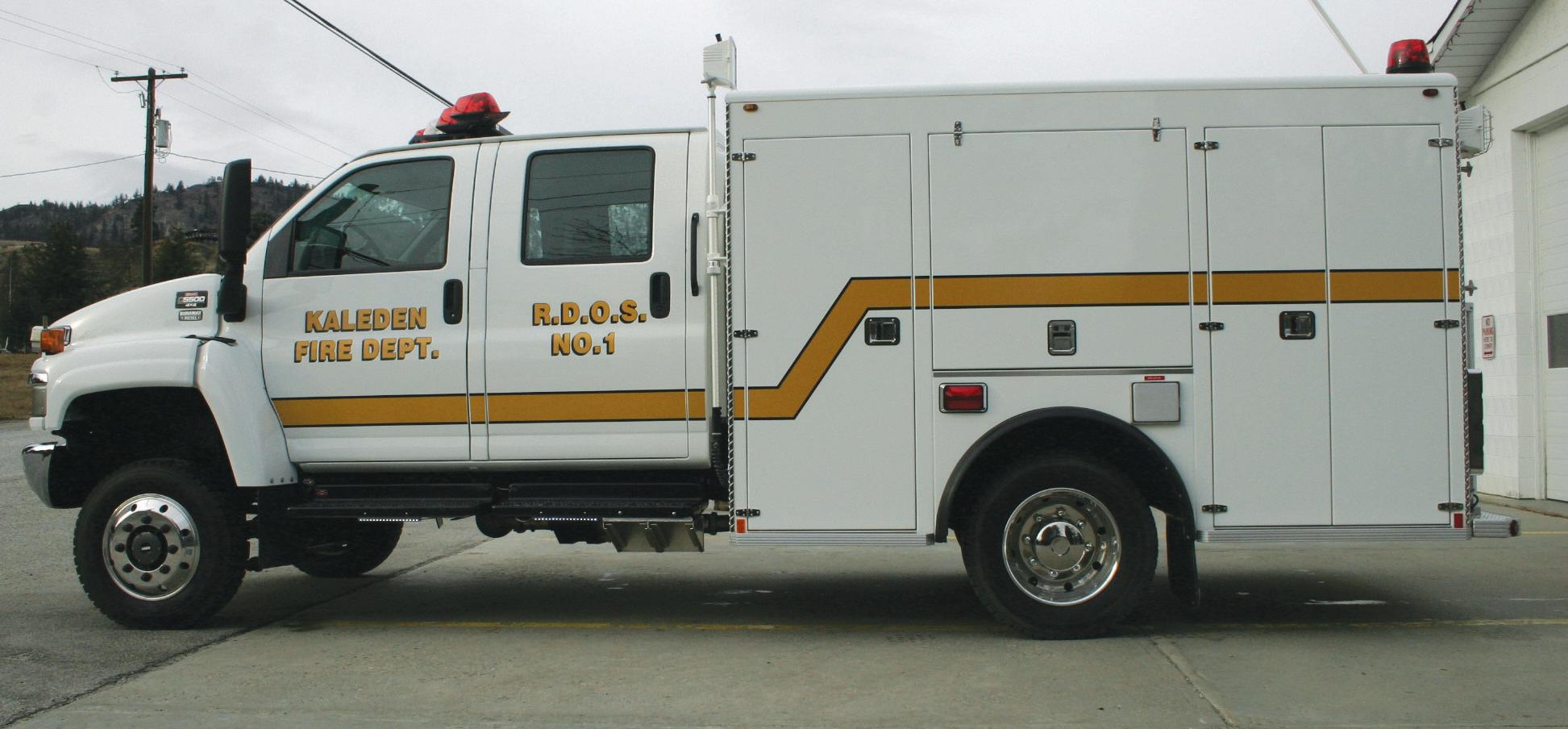
The kalEdEn FIRE dEpaRtmEnt in B.C. under chief Darlene Bailey took delivery in December of a Hub Fire Engines-built rescue unit. Built on a GMC TC5500 4x4 chassis and powered by an Allison 1000 EVS transmission and a Dura Max 6.6L 330-hp engine the unit is equipped with 500 watt front body push-up lights, 500 watt rear body tripod lights, a Danby refrigerator, front receiver mounted winch, and an Onan HG 6000 6kW hydraulic generator.
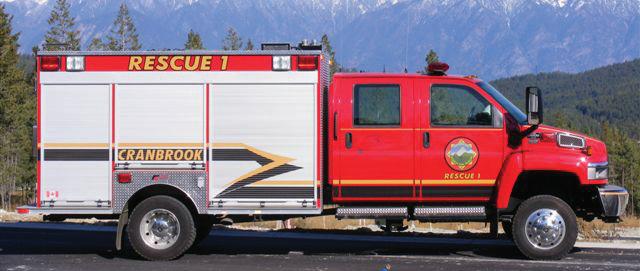
The CRanBRook sEaRCh and REsCuE soCIEty in B.C. took delivery in June of a Fort Garry Fire Trucks-built rescue unit. Built on a GMC 5500 chassis and powered by an Allison 2350 EVS transmission and a Duramax Diesel 6.6L 330-hp engine the truck is equipped with Command light Knight 2, 6 Kw Harrison hydraulic generator, Federal Signal LED warning lights, Slidemaster slide out trays, Pac Tool boards, front bumper CORE hydraulic connections, and rear black/yellow chevron striping.
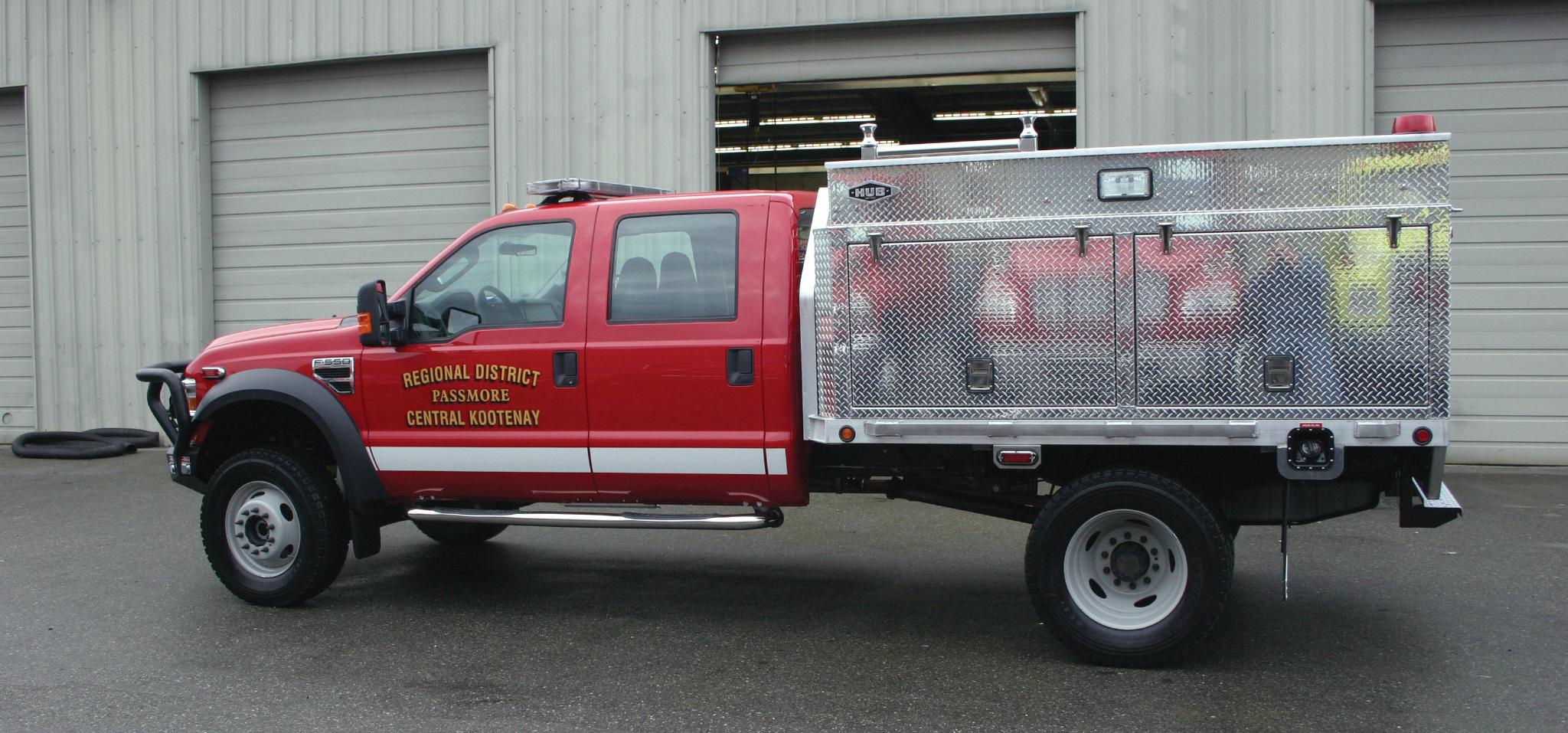
The passmoRE FIRE dEpaRtmEnt in B.C. under chief Gord Ihlen took delivery in February of a Hub Fire Engines & Equipmentbuilt light attack truck. Built on a Ford 550 4x4 chassis and powered by a five-speed automatic transmission and 6.8 litre V-10 engine, the truck is equipped with a CET 35 CFM Wild foam system, 250 IG co-poly water tank and a Whelen light package.
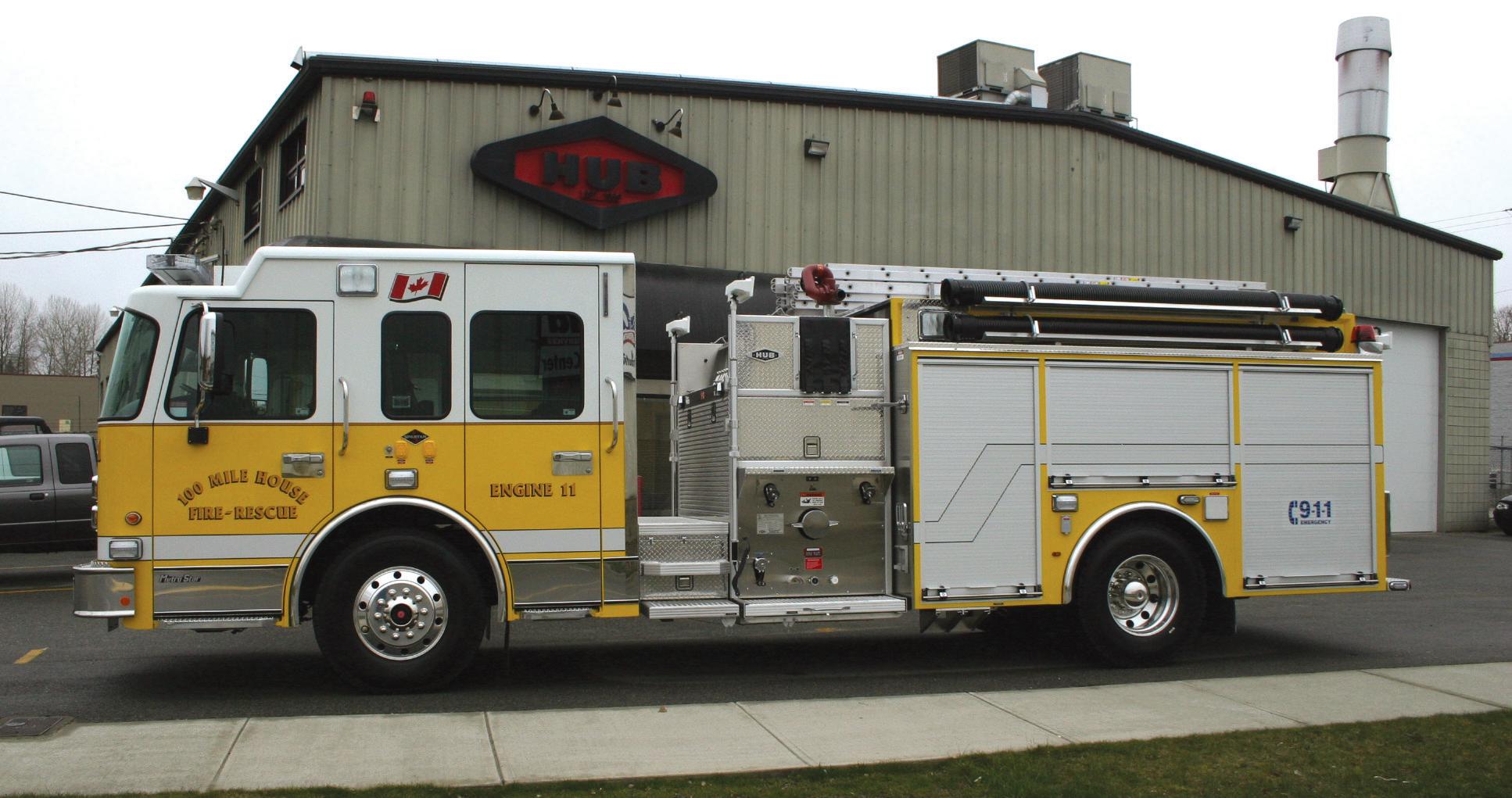
100 mIlE housE FIRE REsCuE in B.C. under chief Darrell Blades took delivery in February of a Hub Fire Engines & Equipmentbuilt pumper. Built on a Spartan Metro Star chassis and powered by an Allions 3000 EVS transmission and a Cummins ISL 425-hp engine, the pumper is equipped with a Waterous CSUC 10C 1,250 IGPM pump, 850 IG co-poly water tank, Whelen LED warning light package, Smart Power 8 kW generator and Magnafire lights.
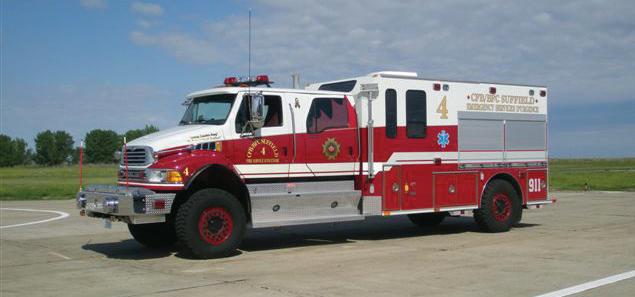
The CFB suFFIEld FIRE dEpaRtmEnt in Alberta under deputy chief Lance Purcell took delivery in May of a Fort Garry Fire Trucksbuilt command rescue unit. Built on a Sterling Acterra 4x4 chassis and powered by an Allison 3000 EVS transmission and a Cummins ISC 330-hp engine the truck is equipped with a Marmon Harrington four wheel drive system, 15 kw Onan hydraulic generator, Hurst 220 Trimo pump and walk-in command area.
poRt mCnEIll
kalEdEn
CRanBRook
passmoRE
100 mIlE housE
CFB suFFIEld
VERY FEW
THINGS CAN SURVIVE AN INFERNO.
OUR MISSION IS TO MAKE SURE YOU’RE ONE OF THEM.
The flames build. The smoke gets thicker and more intense by the second. People are fleeing. And what do you do? You push forward ready to do battle. It goes against every natural human instinct. But then again, firefighters are a different breed. For your infinite courage and selfless dedication, we salute you. But more importantly, we’re going to do everything we can to protect you. We’re MSA. And we equip firefighters with the most advanced thermal imaging cameras, helmets, air masks and gas detection devices available. Coincidentally, we’re somewhat of a different breed ourselves. You see, we’re a safety innovations company that’s been on a relentless crusade to protect lives for more than 90 years. Today we protect firefighters, soldiers, construction, iron and steel workers, oil riggers, utility workers, miners, consumers and hundreds more. Wherever there are workers who need to be protected, we will be there.
By V I n CE m a CkE nz IE Fire chief
rand Falls- w indsor, n l
tVIEw from the east
A call for federal and provincial support
he fire service in the east is, for the most part, as diverse as our cultures. Fire departments spanning large metropolitan centres are not the norm here, but nonetheless, the fire service is an assortment of different levels of servicing. I speak primarily of the fire service in Atlantic Canada, and Newfoundland and Labrador in particular, as it is the forum with which I am most familiar. Having stated that, I do have an appreciation for some of the challenges around the rest of the Maritimes through my involvements and exposures to some of the fine people serving the Atlantic fire service
Where to start? Well, if you watch the tourism commercials featuring icebergs, lobsters, whales, the Bluenose and Green Gables, I can tell you that servicing these areas is not as exotic as one might suspect. When it comes to the delivery of service to our public, we share many of the same challenges as other Canadian departments but we seem to do it with less funding and smaller population bases from which to draw. There are instances in which very unique ways of delivering service are the norm due to climate, municipal infrastructure, lonely distances, limited water supply and demographics. I have travelled throughout the fire service spectrum in Canada and I do run into some typical stereotyping of the east but I guarantee you there is a common thread of issues nationwide.
Many of our communities place considerable value on their fire departments, no matter what level of service exists. Many communities have one major industry or economic engine that requires protection. It is ironic that governments spend so much money trying to bring new business and industries to rural areas but fail miserably in their attempts to fund the protection of what they already have. Fire protection is a service that many compare solely by how far away the local fire station is. True fire protection starts long before the alarm with inspection, prevention, training and engineering. Where do rural fire services get funding for those types of resources – by selling turkey suppers?
I know many chiefs who wish they had more inspection and prevention resources but they must channel funds to keep their operations running. So, here we go, pleading our poor mouths again. Governments say we have to hold the line on spending as times are fragile. Well folks, from where we sit, that is about the most convincing argument I have heard to increase funding to ensure we protect what we already have.
Fire protection is a system; some say it is driven from the top and some argue it is driven from the bottom. Regardless, in order to provide adequate fire protection, we must be well funded. Governments at all levels must bear and share responsibility for the fire services. It is easy to label our service a municipal one but the provinces and the nation have vested interests in how we are doing. In my view, they are oblivious to it.
My vision is of a fire service that is supported adequately by all levels of government. Call me a dreamer but I advocate for federal support with an effective funding program that is channelled to the provinces to assist with large infrastructure and training initiatives. An incentive in income tax relief for volunteer firefighters would be nice too. Sound familiar?
My vision is of a fire service that is supported adequately by all levels of government. ‘‘ ’’
Think about your community. Do you have a large processing plant or manufacturer or a mine? What happens if that facility is suddenly lost? What happens to the community if owners don’t rebuild? Are you confident as a firefighter that we have done all we can to protect that structure and the jobs it contains before the fire? Most of us cannot answer affirmatively as the fire service in Atlantic Canada is generally under funded and relies on fundraising to keep up.
Vince MacKenzie is the fire chief in Grand Falls-Windsor, N.L. He is the president of the Newfoundland and Labrador Association of Fire Service, the first vice president of the Maritime Fire Chiefs Association and a director of the Canadian Association of Fire Chiefs. E-mail him at firechief@grandfallswindsor.com
Heavy investment by the provinces to maintain training to some form of provincial standards should be a no brainer. The availability of firefighting resources within a region based on a solid planning with networks of fire departments that are interoperable and co-operate with each other is crucial. Placing equipment in strategic locations and enacting legislation that has teeth with enforceable aspects would be good starts.
The municipalities, which bear the highest cost of fire protection, must be able to avail of all funding provided to truly enhance their fire departments.
Acquiring extra funding from all three levels of government is essential to meeting future fire protection needs in our eastern communities. Equally, spending that money in more effective ways requires a little more thinking outside the box on our part. Perhaps that word that comes up all the time lately – regionalization – may be a part of the great solution in some areas. More on that next time.
g
beyond helmets and hoses
Chiefs launch national leadership program to guide new officers through challenges of politics, administration and bureaucracy
By LAURA KING
everyone has heard stories about people who are great at their jobs then get promoted into management and fail miserably – teachers who become principals, hockey players who become coaches, firefighters who become chief officers.
The meteoric rise of top-notch employees without proper training is a workplace phenomenon that Canadian fire chiefs want to change through a national leadership program for volunteer chief officers.
The two-day program, called Beyond Helmets and Hoses, is the first national leadership training program for chief officers. Essentially, it’s an introduction to fire service management by experienced people trained to deliver consistent messages. It’s affordable – it comes to your jurisdiction so your people don’t have to travel – and it’s run by Canadians. The program is geared to volunteer and combination fire departments and is designed to be completed on a weekend – in a training room or hotel – for a reasonable cost.
The program was to be launched in May at the Ontario Association of Fire Chiefs conference in Toronto, in partnership with the Canadian Association of Fire Chiefs. The initiative is a partnership between the CAFC and the provincial chiefs associations. The CAFC and the OAFC are counting on the other provincial chiefs associations to support and embrace the program and offer it in their jurisdictions. Ontario, B.C. and New Brunswick are already on board.
The program, says Fire Chief Brad Bigrigg of Caledon, Ont., who is one of eight instructors, will help new fire service officers meet the ever increasing expectations that communities and municipal councils have of their fire departments.
“The fire service continues to evolve and if we don’t get in front of the ball we’re going to get run over by the ball,” Bigrigg said.
“Expectations are changing and even if we are volunteers I think that there’s an expectation by the public that we’re professional volunteers.
“I think that one of the problems that we face, whether you’re in Victoria or Gander, is that people don’t stay in the volunteer fire
service as long as they did when my dad was on. So, we have to identify those people who bring extraordinary talent to the department and we have to develop these officers quickly. We have to give them the leadership skills to move the volunteer fire service forward into the next quarter century.”
Indeed, volunteer fire chiefs in southwestern Ontario alone are dealing with challenging issues from presumptive legislation to residential sprinklers to recruitment and retention. Chief officers need to know how to work with government and their communities while meeting department demands.
“We are expected to provide a greater variety of services with a higher competency level than has ever been demanded of us before,” Bigrigg says. “Our regulatory bodies have to have confidence in us and at the same time our constituents have to have confidence in us. And while what we were doing 10 years ago was good we have to do better.
“We have a very small cadre of people to develop. There aren’t that many people who are going to hang on in the volunteer fire service for 10 or 15 or 20 years and we’ve got to develop them further.”
After almost three years of behind-thescenes work, Beyond Helmets and Hoses was adapted for Canadian use by a committee of CAFC chiefs led by OAFC President Richard Boyes, Fire Chiefs’ Association of B.C. President Stephen Gamble and New Brunswick Association of Fire Chiefs President Jody Price. The CAFC got permission from the Volunteer & Combination Officers Section of the International Association of Fire Chiefs to adopt and adjust the course.
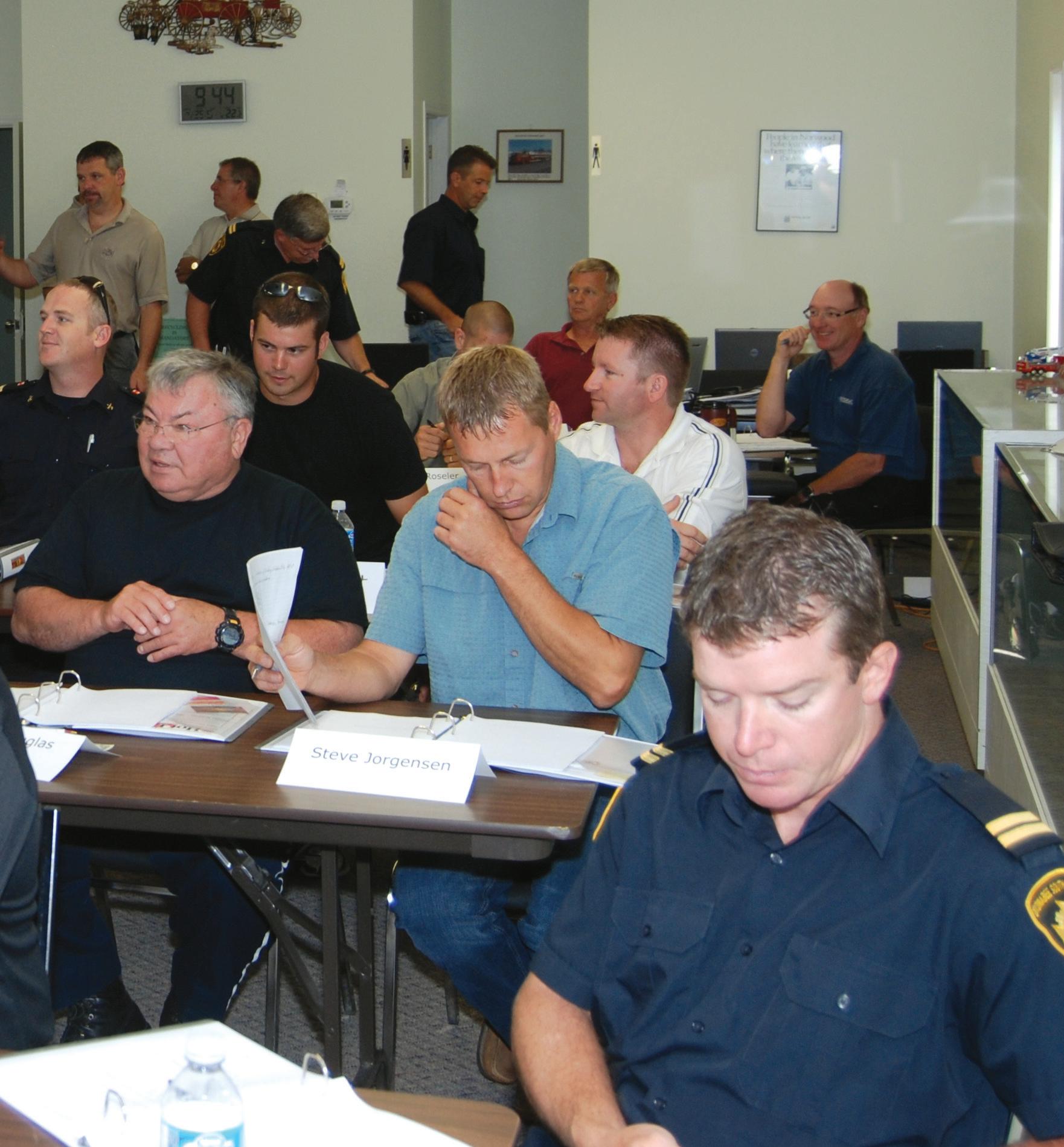
Last summer, the committee ran its first Canadian pilot course at the Eastern Ontario Fire Academy in Norwood, Ont., with 40 students from volunteer fire departments in eastern Ontario. Earlier, eight fire officers from across Canada completed a train-thetrainer session led by former IAFC president John Buckman, chief of the German Township Volunteer Fire Department in Evansville, Ind., and Greg Render, chief of the Signal Hill Fire Department in Illinois. Those eight fire officers are now instructors – Price and Jim Haley of Oromocto, N.B., B.C. chiefs Don Beer of Abbotsford and Dave Balding of Mahalat, and Ontario chiefs Bigrigg, Kevin Foster of Midland, Ted Bryan of Otonabee-South Monaghan and Bryan Burbidge of King Township.
“This is going to take that large leap out of the company officer program and give people who are aspiring to be chief officers some easily acquired basic leadership
abo V e : Chief officers from Ontario participate in the pilot of the Beyond Helmets and Hoses leadership training course last summer.
foundations,” says the OAFC’s Boyes.
At first, Beyond Helmets and Hoses will focus on five components – leadership, training, recruitment, retention and marketing and branding. Another six modules will be developed later – communications, managing daily tasks, problem solving, team building, customer service and managing change.
The price? Between $150 and $250 a person depending on potential sponsorship of the Canadian program.
The goal for 2010 is to run six courses across Canada, beginning with a two-day program at the OAFC conference. Ideally, says OAFC executive director Barry Malmsten,
who is providing administrative support for the program, each of the six courses will be taught by two trained instructors – one from the region in which the course takes place and one from another jurisdiction in Canada to bring a fresh perspective to the classroom.
“Most fire service personnel spend their whole careers in one department,” Malmsten says. “And research has shown that the longer people do the same thing the same way, the more they think that’s the only way to do it.
“If we have an instructor from a different jurisdiction he may talk about ways of doing things that are different from yours. In this way, we can develop and share best
SmartDummy — InteractIve Search &
practices across Canada. We also recognize that we need an instructor from the host province as he will understand the local legislation and practices.”
Malmsten says the course is instructor dependent so organizers will use a small group of teachers who have gone through the program. Over the next year or two the organizers will develop a participants’ manual to ensure consistency in the training segments.
Malmsten says organizers will tweak the course after some initial feedback, if necessary.
“Based on participant feedback from these first six courses we will review the content and the course,” he says. “These first six courses will be a pilot. Having said that we did run a trial version of the course during the train-the-trainer session and the feedback was highly positive.”
Clearly one weekend isn’t enough time to teach the intricacies of the five initial components. Instead, the course will introduce new chief officers to concepts and challenges that may not have concerned them as firefighters. Essentially, said Boyes, Beyond Helmets and Hoses is an awareness course rather than an operational or technical program.
“It’s really geared to trying to raise competency not on the technical fire side but on the administrative side. We’ve done a great job training firefighters and officers about dealing with the operational issues of emergency response. The trouble is that when people become officers they need to know about all that administration and political stuff if they’re going to be successful. This course will introduce them to that part of the business.
“Although the course has lots of good content, tips and techniques it is just an introduction,” Boyes says. “We hope that it will encourage officers to continue to seek additional training through the CAFC’s leadership program, their provincial chiefs association or colleges and universities.”
Information and applications for fire departments interested in hosting Beyond Helmets and Hoses will be released over the summer.
The program, Bigrigg says, is the beginning of much needed change in the Canadian fire service.
“I really think this is just a small first step. This just gets the door open for people. We have to push some of the company officer training, some of the financial stuff, so they’ll be able to present a budget to council and defend their needs. These are the kinds of issues we need to tackle.
“I think ultimately the goal is to whet the appetite of those who have an interest in staying in the fire service long term, to develop the skills to lead a volunteer fire service in two or eight or 10 years and then it’s their job to start whetting the appetites of those who come after them.”
By t I m BEC k E tt Fire chief k itchener, o nt.
IStrategic lobbying for the fire service
n February, I discussed the disciplined art of lobbying. This type of lobbying is a continuing learning process for me and my colleagues on the board of the Ontario Association of Fire Chiefs. I have stressed and will continue to stress the concept of showing up and making friends, and then showing up and making more friends. Why is this important? It lends credibility to you and your organization and people involved in the issue get to know who you are and what you are about. More importantly, it allows you to establish critical relationships and key contacts.
When you show up at events – political fundraisers, media conferences, association banquets – you are working. It’s great to sit back and enjoy the ambiance but remember to stay focused on the task. You are working to get your issue known, to establish contacts and relationships and to ensure that your organization is noticed. It is vitally important to work the room and make contacts with the staffers and politicians.
Messaging at events needs to be kept short. You are likely going to have 30 to 45 seconds to introduce yourself and establish a connection before someone else moves in. Be prepared; know what your message is. You will need to keep it brief and to the point. This initial meeting is just a starter. You want to be able to set the stage for a next meeting to further discuss your issue in detail. Make sure you give a business card and get a business card. This is your contact information for the next step.
If the function you are attending is large, go in numbers. This will allow you to work the room and ensure that you have a chance to establish contacts and not miss anyone. Plan ahead and know who you want to speak with. Ensure that everyone in your party is up to speed about who to meet and the key message to deliver.
Ministry of Community Safety and Correctional Services, under which the fire departments fall, and the Ministry of Municipal Affairs and Housing for the building code issues. A new interest has emerged in the Ministry of Labour as we continue to educate politicians on the impacts of sprinklers on improving firefighter safety, especially as we continue to build homes using lightweight construction. Lastly, we have ensured that the premier’s office staff are engaged because residential sprinklers is a public safety issue that affects people province wide.
We worked to find a champion in government, an MPP with a passion and an interest in the issue of residential sprinklers. This champion allowed us to get our issue heard from the inside. This involved educating the MPP and continuous briefings. We soon began to see private members’ bills being presented. Fire chiefs and other fire service members filled the visitor’s galleries in support of the bills; MPPs voted in favour of moving the bills through first and second readings only to have them fall off the agenda when the Ontario legislature was prorogued on March 4. Even though we continue to push, we still find ourselves without the necessary legislation. This is not the time to give up. We continue
Be prepared; know what your message is. You will need to keep it brief and to the point. ‘‘ ’’
We often struggle to determine who we want to connect with – specific ministers or key elected officials in the government, opposition members of the legislature or Parliament, policy advisors and staffers to certain areas of government, or other stakeholders with like concerns or wants. Is your matter a staff issue or is it something to take to the political leader or minister? Does it affect one minister or several or the government as a whole?
As fire chiefs continue to push for mandatory residential sprinklers, we must break down the issues. For example, in Ontario, the issue of sprinklers in homes has importance across ministries – the
Tim Beckett is fire chief with City of Kitchener and is first vicepresident of the Ontario Association of Fire Chiefs. He has 24 years in the fire service and a degree in public administration from Ryerson University in Toronto. Contact him at tim.beckett@kitchener.ca
to be strong with consistent messaging: Sprinklers save lives. The government knows our issues, it knows our organization and it knows that we have not wavered in our objective to see residential sprinklers put into new homes.
We will continue to lobby for sprinklers. We have witnessed small wins with the changes to the Building Code requiring sprinklers in buildings higher than three storeys. We also have some traction on the retrofitting of sprinklers in elderly care and residential buildings for seniors. We have seen the devastation of not having these types of buildings sprinklered and this is unacceptable. Our continuing lobby efforts have helped to move these issues forward.
A simple reminder: show up often and make friends; be prepared and know your stuff; use your resources in government, staff and media to get your issue(s) heard. It works.
moVIng forward
B.C. chiefs and stakeholders work together to find ways to modernize the fire service
By KARIN MARK
when faced with a large and complex challenge it’s easy to find an excuse to ignore it.
Three years ago, representatives of British Columbia’s fire/rescue service could easily have employed the adage “If it ain’t broke, don’t fix it” when faced with the daunting task of determining how the 350 independent departments that provide fire, rescue and emergency services in B.C. must evolve to meet the challenges of the future.
After all, fires are still being extinguished, property is still being protected and lives are still being saved.
This may be true but in recent years it had become increasingly impossible to ignore the fact that B.C.’s fire/rescue service had not kept pace with changing public needs and expectations, operational demands and fiscal challenges.
“The last real official look at the fire/rescue service was 35 years ago,” said Fire Chiefs’ Association of B.C. President Stephen Gamble, who chaired the Fire Services Liaison Group (FSLG) that was tasked with determining how to modernize the service.
“The services we provide have really changed, as well as the expectations and the environment we work in. We need to change too.”
Funded by provincial and federal grants, the FSLG brought together key stakeholder groups with direct interests in the fire service, including local governments (via the Union of B.C. Municipalities and Local Government Management Association), as well as management and employee groups (the Fire Chiefs’ Association of B.C., the Fire Prevention Officers’ Association of B.C., the B.C. Fire Training Officers’ Association, the B.C. Professional Fire Fighters Association and the Volunteer Firefighters’ Association of B.C.). The Office of the Fire Commissioner was an ex-officio participant.
After more than two years of extensive research and discussion, the FSLG has released Public Safety in British Columbia: Transforming the Fire/Rescue Service, which includes 14 shortterm and long-term recommendations (see sidebar page 24) that are intended to achieve the transformation required.
The report is in the hands of the provincial government for review but has already generated interest from fire service organizations in British Columbia and across the country.
“There are several recommendations that are not just B.C.
British Columbia’s 350 fire departments have operated independently but are now working together to meet future challenges. Stakeholders agree that there has been no central leadership or direction to ensure co-ordination, co-operation and consistency in operations, training and services.
funding, training and recruitment and retention.
The Fire Service Liaison Group report includes 14 recommendations to modernize the fire service. Its top three challenges are
FootGear
For more information, call your local Globe dealer or Safedesign
British Colum B ia and a l B erta Guillevin
Coquitlam, British Columbia 800-667-3362
Calgary, Alberta 800-661-9227
Campbell River, British Columbia 250-287-2186
Edmonton, Alberta 800-222-6473
Fort St. John, British Columbia 250-785-3375
Kamloops, British Columbia 250-374-0044
Nanaimo, British Columbia 250-758-3362
Prince George, British Columbia 250-960-4300
Trail, British Columbia 250-364-2526
Que B e C H.Q. Distribution LaSalle, Quebec 800-905-0821
atlanti C provin C es K & D Pratt Ltd. St. John's, Newfoundland 800-563-9595
Dartmouth, Nova Scotia 800-567-1955
Saint John, New Brunswick 800-567-1955
m anito B a and s askatC hewan Trak Ventures 204-724-2281
issues,” Gamble noted. “We feel other provinces will find some value in the report.”
According to the report, one of the key challenges facing B.C.’s fire/rescue service is the fragmented manner in which it evolved. The approximately 350 departments collectively employ about 4,000 career firefighters and 10,000 volunteer firefighters. More than half are located in and managed by municipalities and regional districts while the rest operate in small, unincorporated communities under the direction of improvement districts or societies.
Over the years, these hundreds of departments each developed independently, with no central leadership or direction to ensure co-ordination, co-operation and consistency in operations, training and services. Attitudes and practices are entrenched, resources are limited and co-operation is poor.
However, in surveys conducted by the FSLG, fire departments and local governments across the province agreed on the top three challenges facing B.C.’s fire/rescue service:
• Training;
• Funding;
• Firefighter recruitment and retention. Drilling down further into the issues, the FSLG targeted the following key problems that are hindering the fire/rescue service:
• Responsibility for fire and rescue services is unclear;
• Governance of B.C.’s fire/rescue service is lacking;
• Gaps in services exist;
• There are no province-wide competency standards;
• Data is not available for effective decision making;
• Operational differences exist among various fire departments;
• No pro-active strategy exists to address budget pressures;
• And the volunteer sector is under heavy stress.
Gamble noted that development of the 14 recommendations to address these challenges required a level of co-operation that previously didn’t exist in B.C.’s fire/rescue service. Although critics had predicted infighting would derail the process, those involved were able to set aside any biases and work as a team for the common good.
It started with the development of a common vision for the fire/rescue service: “To have a competent level of fire and emergency services that is supported by sustainable resources for all residents of and visitors to the province of British Columbia.”
“We proved that we can work together,” Gamble said. “That kind of united thinking and co-operation was remarkable in itself.”
The new, collaborative attitude within B.C.’s fire/rescue service will certainly be needed in the months to come as the work begins to ensure the report is taken seriously and that its recommendations become reality.
“Ideally we’d like to have every one of the immediate priorities implemented right away, but realistically we know it will take some time,” Gamble said. “We do have a strategy and we look forward to working with the provincial government to do what is needed to improve public safety in our province.”
Public Safety in British Columbia: Transforming the Fire/Rescue Service is available for download in the public section of www.fcabc.bc.ca.
t■
he report’s 14 recommendations were divided into immediate and long-term priorities.
IMMEDIATE PRIORITIES TO BE ADDRESSED BY THE PROVINCIAL GOVERNMENT
1. Establish a Fire Services Advisory Board – this single representative body would provide policy leadership and co-ordination for B.C.’s fire/rescue service. It would speak on behalf of the service, address issues and challenges, act on common issues and put forward initiatives to the provincial government. B.C.’s Fire Services Act provides for the creation of such a board.
2. Broaden the mandate of the Office of the Fire Commissioner – update the mandate of the OFC to reflect the full range of services provided.
3. Standardize competencies and training standards – clarify and specify training standards for the fire/rescue service (specifically interior fire fighting), to help ensure fire departments meet minimum competency and safety standards.
4. Support training, recruitment and retention for volunteer departments –provide support for training, recruitment and retention for volunteer fire
negligence 101
Departments must understand and employ proper size-up, duty of care
By TIMoThY WILKIN
Editor’s note: Lawyer Timothy Wilkin of Cunningham Swan Carty Little & Bonham in Kingston, Ont., prepared a review for the Ontario Association of Fire Chiefs of reported Canadian court cases in the last 15 years that dealt with negligence by municipalities and their fire departments. We looked at several cases in the February and March issues of Fire Fighting in Canada. The final instalment is below.
SCHOuTEN V. RIDEAu (2005)
The plaintiffs operated one of the largest farms in eastern Ontario with about 2,000 acres under cultivation and more than animals. The plaintiffs resided on the property with their respective families.
■ LEGAL ISSuES
In the early morning of Nov. 20, 1999, a serious fire destroyed a complex of barns and silos on the plaintiffs’ property, causing $857,000 in damage. The calf barn, a two-storey barn and feed room were involved in the fire and there was extensive damage to the silos and the recently harvested crop (4,000 tons of dry grain corn).
The fire was fought over a period of several days by volunteer firefighters from the Rideau Township under the command of its fire chief. A great deal of equipment and manpower was brought in from surrounding municipalities to supplement the resources of the township’s fire department under mutual-aid agreements among fire departments in the area.
The plaintiff alleged negligence based on certain acts and omissions of the department and particularly, the fire chief. It was alleged that the chief failed to conduct a proper size-up of the fire scene when he arrived and never properly assessed or appreciated the fact that the silos could be protected by bringing equipment around to the south of the barn complex and streaming water into the feed room in an effort to cut off the fire’s advance.
The plaintiffs alleged that if the fire chief had streamed water into the feed room as requested, it would have decreased the chance of the fire spreading into the feed room and connecting silos. Evidence indicated that the farm owner had recommended this at the time.
The fire moved rapidly through plaintiffs’ complex of barns and therefore, there was a very short interval of time within which firefighters might have attempted this type of response.
The experts at trial agreed that a fire ground is a dynamic and fast-moving environment requiring rapid decision making. Within that small time frame, the fire chief had to identify the options available to him, having regard for the firefighting resources available at the time and the persons, property and hazards that he reasonably regarded as requiring protection.
• Do volunteer firefighters owe a duty of care to property owners experiencing a fire, and if so, what is that duty?
• Did the fire chief’s decisions and directions in fighting the fire at the initial stages reflect an appropriate standard of care?
• Was the fire chief negligent in not conducting an adequate size-up of the fire scene upon his arrival and at the early stages of the fire such that he failed to appreciate the need to stream water into the feed room as a method of cutting off the advance of the fire to the silos?
• Would the fire have reached the silos even if the water had been applied to the interior of the feed room structure?
■ COuRT’S FINDINGS
The court found that the proper standard of care is determined by combining the concept of reasonableness with the particular circumstances confronting the firefighters in question.
Based on the expert evidence at trial, it would have been too late to successfully extinguish the fire in the feed room unless done within the 12 to 15 minutes after the fire chief assumed command, because by that point the fire was firmly established and spreading rapidly along the feed room to the adjoining silos.
The court therefore determined that it was this 15-minute interval (post-arrival) during which the fire departments’ actions must be assessed. The court found that attempts to flow water into the feed room after that point would have, at best, slowed the fire’s progression, but would not have prevented its ultimate spread into the silos.
The court found that the fire chief breached a professional standard by failing to carry out a proper size-up of the fire upon arrival and therefore, prematurely committed the primary fire fighting vehicle to an area that prevented it from being used in an attack on the fire from the south via the feed room.
However, the court found that the defensive fire attack plan adopted by the chief was a reasonable choice under the
Firefighting is not a trade for the weak. The tests are unforgiving and punishments unmentionable. At Waterous, we know. Like you, we’re firefighters too. Which is why we design and manufacture fire suppression equipment as though our lives depend on it. Because often times, they do. fire pumps, foam systems, ARFF pumps and more that you can rely on in the heat of battle, call on Waterous.
circumstances and that his deployment of resources, which were limited in the half hour after his arrival at the fire, was also reasonable.
The evidence did not support a finding that the fire chief had failed to establish a reliable and continuous water supply in this nonhydrant area. The court found there was no delay in commencing the spraying of water on the buildings. The tanker vehicles rapidly discharged initial water loads into portable tanks that permitted prompt application of water to the burning buildings and the exposures.
The court stated that even if there had been a delay, it would not have affected the outcome in any material way, particularly since the calf barn and the two-storey barn were not going to be saved, and the heat and fire from those structures would inevitably radiate into the feed room, despite the application of water to the exterior of these structures.
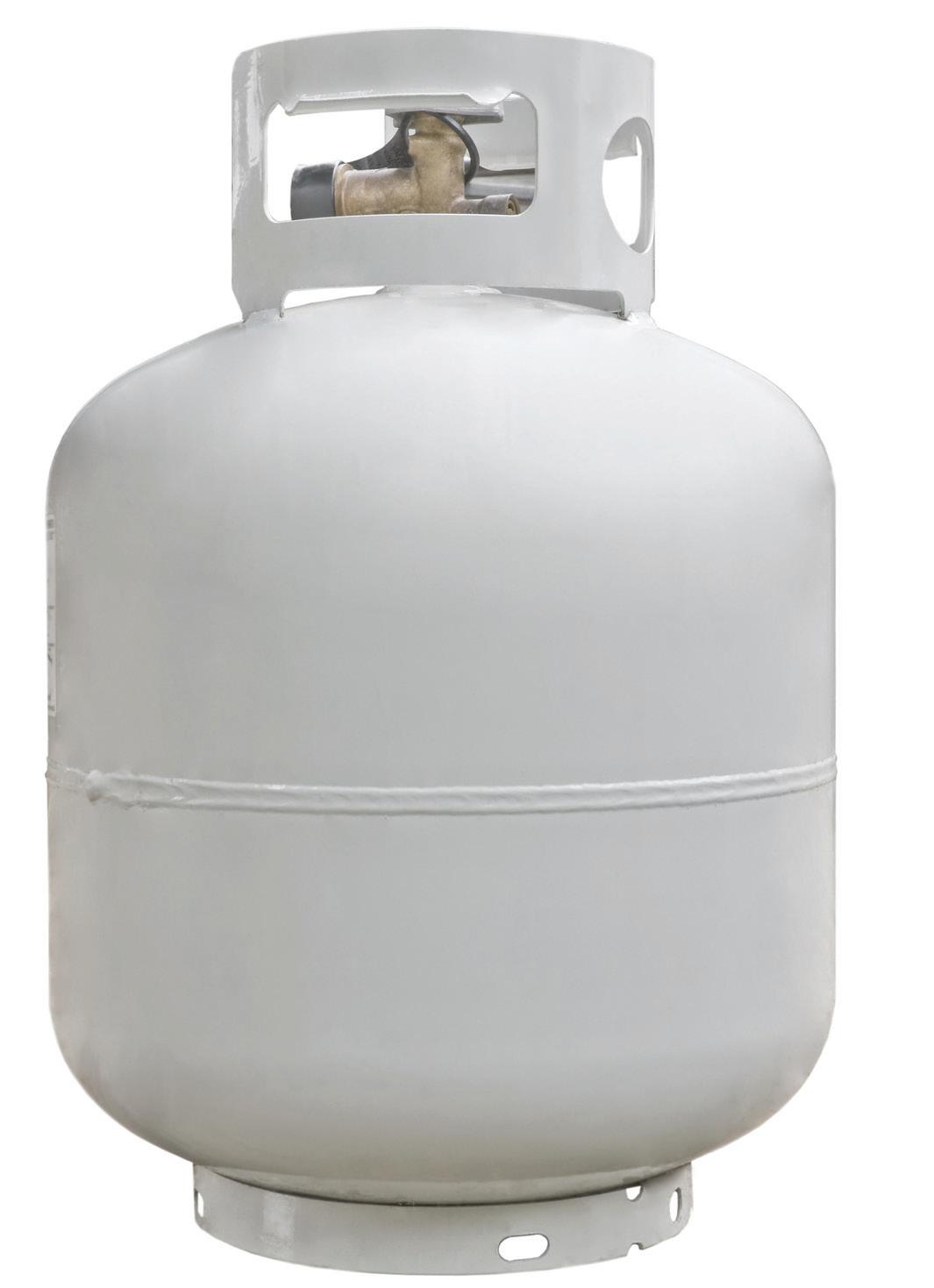
The fire chief had faced the largest fire in his career. He reasonably chose to deploy the only available attack pumper to a position where the deluge gun and secondary lines could spray the twostorey barn, the 1,000-gallon propane tank on the property, and, if necessary, the plaintiff’s home. The fire chief’s primary goal was to prevent the fire from progressing beyond the perimeters of the barn and silo complex.
The fire chief had the right to fear the risk of the fire advancing to the plaintiff’s home and the propane tank, and to prioritize the deployment of his resources accordingly. In doing so he acted reasonably.
■ THE COuRT SAID:
“It would be an injustice to the fire chief and fire department and contrary to the established principles of tort law to assess [the Fire]
chief’s decisions from a retrospective armchair point of view when he was making these decisions in the face of a dangerous and fast moving fire.
“The fire department and, in particular, the fire chief, exercised reasonable judgment in the formulation and implementation of the initial phases of the fire attack plan. Despite an inadequate size-up and premature deployment of his only attack pumper upon arrival, the fire chief used reasonable judgment and competently executed a fire attack plan which the court found to be reasonable for a volunteer fire department in like circumstances and with like resources. ”
The plaintiffs had failed to prove that the silos would have been saved had the plan they recommended been implemented.
■ LESSONS LEARNED
Conducting a proper “size-up” and developing a suitable attack plan are part of the expected standard of care for a fire department. In that respect, a volunteer fire department has the same professional obligation and will be held to the same standard of professional care as a career fire department.
The court indicated that a proper size-up should occur immediately upon arrival at the fire ground and should properly assess all sides of the incident. This includes:
• safety issues,
• building layout,
• how advanced the fire is,
• the direction and velocity of the wind,
• the location of the body of the fire growth,
• the likely path of travel of the fire and
• an identification of exposures on the property to be protected.
The court stated that a size-up should include input from the
property owners.
Having completed a proper size-up, it is also a standard operating procedure that a fire attack plan be formulated. A fire attack plan can be either an offensive mode or a defensive mode.
In determining whether the actions of a fire department are reasonable, the court will take into account the circumstances presented to the firefighters at the time of the fire and the resources available to them. It will not hold a fire department to a standard of perfection and will not second guess decisions that had to be made in the face of a
dangerous and fast moving fire as long as the actual decisions made were reasonable ones.
ENNIS-PAIkIN STEEL LTD V HAMILTON (2006)
On April 10, 1989, the plaintiff’s manufacturing plant and adjoining office premises were largely destroyed in a major fire. The cause of the fire was never determined.
The Hamilton Fire Department had responded the previous evening to a smell of smoke call at the property from the plaintiff company’s president. The plaintiff alleged that the Hamilton Fire Department
Fully Involved FIre TraInIng SySTemS [
had failed to do a proper inspection because the firefighters spent about only 15 minutes searching for the source of the smell of smoke call.
The Hamilton Fire Department located and neutralized a seized up ceiling exhaust fan, which had overheated and was accepted by all, including the plaintiff’s president, as the source of the smoke and odour that prompted the call.
The fire captain told the company president that it would be a good idea if he remained at the scene for another 45 minutes to an hour as a precaution. The president eventually left at 11 p.m. At 5 a.m. the next morning, he received a telephone call about a fire at the company premises.
The plaintiff alleged that the fire department had been negligent because it relied on the company president to stay at the premises to maintain a fire watch, a duty that should have been assigned to fire department personnel.
■ LEGAL ISSuES
Was the Hamilton Fire Department negligent in the manner of its response to the smell of smoke call?
■ COuRT’S FINDINGS
The court found that, based on the information and knowledge available to it, the Hamilton Fire Department had responded appropriately to the smell of smoke call.
The court stated that the length of time on the scene is not as important as the fact that the crew was able to very quickly identify the problem as being the ceiling fan, and to take corrective action. The plant area was checked and there was no evidence of fire or smoke in the plant. There was no evidence at the time to warrant further investigation for other sources of fire.
Overhaul was successfully completed when firefighters checked for hot spots and any signs of smoke or odour in the area around the fan, in the wall with the wiring that supplied power to the fan motor, and in the attic space above the fan. There was no fire and therefore, no need to establish a fire watch.
The court stated that the ordering of a fire watch is not a standard fire procedure. It is done for cause, not caution. The recommendation that the company president remain at the property was not evidence of a possible rekindle but was intended to reassure him that the source of the smell had been eliminated and that he should call the fire department if he had any further concerns.
B y lE s k a R pluk Fire chief, p rince a lbert, s ask. and lyl E Quan d eputy chief, g uelph, o nt.
IPromoting a positive fire-department culture
n our March column we talked about reframing your organization’s future through hiring the right people and then supporting them. We also talked about coaching and counselling your people to help them be the best they can be. Does this mean that once you have the right people in the right places the rest is easy? Actually, the real work has just begun because organizational culture and its ideologies impact your staff from the day they walk through the door until the day they leave. Let’s talk more about creating a positive culture.
Culture is defined as shared and inter-related sets of emotionally charged beliefs, values and norms that bind people together and help them make sense of their world. There is an old saying: Give a man a fish and you feed him for a day; teach him how to fish and you feed him for life. In other words, it’s not enough to give our people the basic tools and related expectations. We have to help them understand how these learning and coaching tools were developed and how they can take full advantage of them to further their careers.
Creating and promoting a positive culture needs to be supported through actions and constructive reinforcement. It’s not good enough to use phrases like “lead by example” or “walk the talk”. This kind of talk can sometimes create a culture in which your people watch out for what everyone else is doing, and if they aren’t doing the right things at the right time, then this leads to other staff telling on those who aren’t leading by example or walking the talk; this is definitely not what we want. In order to develop our people and our departments we need to get staff excited about the benefits of creating a culture that promotes excellence and lifelong learning. We, as chief officers, must live this stuff every day; if we want to promote (and eventually realize) a culture of excellence and personal growth we need to demonstrate this through our own actions.
and individual perceptions of an organization’s members. For example, we often see the eagerness of new firefighters decline with time; sometimes those firefighters fall into the status quo trap and it becomes too easy to go with the flow. We need to put aside the tendency to find a rationale that explains and/or supports this complacency and, instead, accept the fact that our departments are social entities and their intricacies are unique, and then move on. By working with your people, you gain the ability to identify the issues and, as a team, look at what needs to be implemented in order to go from complacency to fulfilment.
Culture cannot be changed overnight. It sets the tone for the department. If you are part of or have inherited a department that has a negative culture you need to drill down and find out why this culture exists, how long it has been part of the department and what belief system fosters this counterproductive philosophy. If the past fire chief created the negative culture then your path is clear: you need to be the broom that sweeps clean the negative climate and the leader who injects the positive beliefs. It doesn’t matter who or what created this negative environment; understand that it will not change overnight. What has possibly taken years to create will certainly take years or even a generation to change into something with a degree of orderliness and strong
Challenge them, listen to them and give them the authority to improve their department. ‘‘ ’’
Too often we hear from fire chiefs who are frustrated and confused about their personnel issues. They have tried to hire the right people, provided the tools required to do their jobs and implemented a support system of coaching and mentoring, yet problems continue to exist. So, what’s the issue? It could be that organizational culture is a multifaceted entity that is bigger than any one person in the group. In reality, culture has little to do with facts and everything to do with the collective
Les Karpluk is the fire chief of the Prince Albert Fire Department in Saskatchewan. Lyle Quan is a deputy chief with the Guelph Fire Department in Ontario. Both are graduates of the Lakeland College Bachelor of Business in Emergency Services and Dalhousie University’s fire administration program.
organizational values. The point is that you, as a chief officer, cannot let down your guard or let your commitment to your people and the department falter.
If your department is on a solid foundation and appears to be going in the right direction, you still can’t let your guard down. Your people expect you to take them to a higher plane by examining and reinventing what you do and how you do it. Challenge them, listen to them and give them the authority to improve their department. The more they become involved in the future of the department the greater their feeling of ownership and pride.
As is the trend in our columns, we are issuing a challenge to you to be the champion of change – the catalyst who makes the difference. We have no doubt that you will be pleasantly surprised with the level of support you receive from your people and how quickly the tide turns, as long as you are committed to understanding the dynamics of organizational culture and the change process.
BaCktoBasICs Fine points of hose construction
By MARk VAN DER FEYST
In February I attended a factory tour of Snap-Tite Hose Inc. in Erie, Pa. The tour involved two plants that produce rubberjacketed and cotton-jacketed fire hose. The fire hose is the main tool used in engine company operations, for both attack and supply lines, as one of the major jobs of the engine company is to deliver water both on the fire and to the apparatus.
As we all know, fire service hose comes in various sizes and lengths and is designed for specific purposes. Attack lines range from 1.5 inches to 2.5 inches; supply lines range from three inches to six inches.
Over the years, fire service hose has changed and improved. We now see greater flows of water with less friction loss due to technological advances in materials such as the inside liner of the hose. The more laminar the liner, the less friction loss there is.
Rubber-jacketed and cotton-jacketed hose have a cotton weave inside. This cotton weave starts as a thin piece of string on a spool and is fed into a round weaving machine. The multiple strands of string all come together and form into a round shape that becomes a continuous length of hose. Rubber-jacketed hose has a cotton weave that is imbedded into a rubber liner and rubber jacket. Sections of rubber hose are constructed in lengths of 700 feet, allowing the hose to have no seams in the cotton weave, the rubber jacket or the liner. Once the rubber coating has been applied, it is steamed to allow the rubber to vulcanize, or cure, properly. This process allows the two materials to become one, giving the hose a very high strength ratio. The same process is conduced for cotton-jacketed hose except for the fact that a second cotton jacket is applied to the outside and is then vulcanized.
Once the hose is constructed it is cut into 100-foot sections and couplings are added. The hose is then service tested to ensure it is acceptable for use. The inside of the hose is where we want to be sure we have the best material; material that is smooth and laminar will allow water to flow much more efficiently, with less frication fighting against it. Some of the inside material is designed to prevent kinking at pressures as low as 50 psi. (For competitive reasons, Snap-Tite did not want to share its material secrets.)
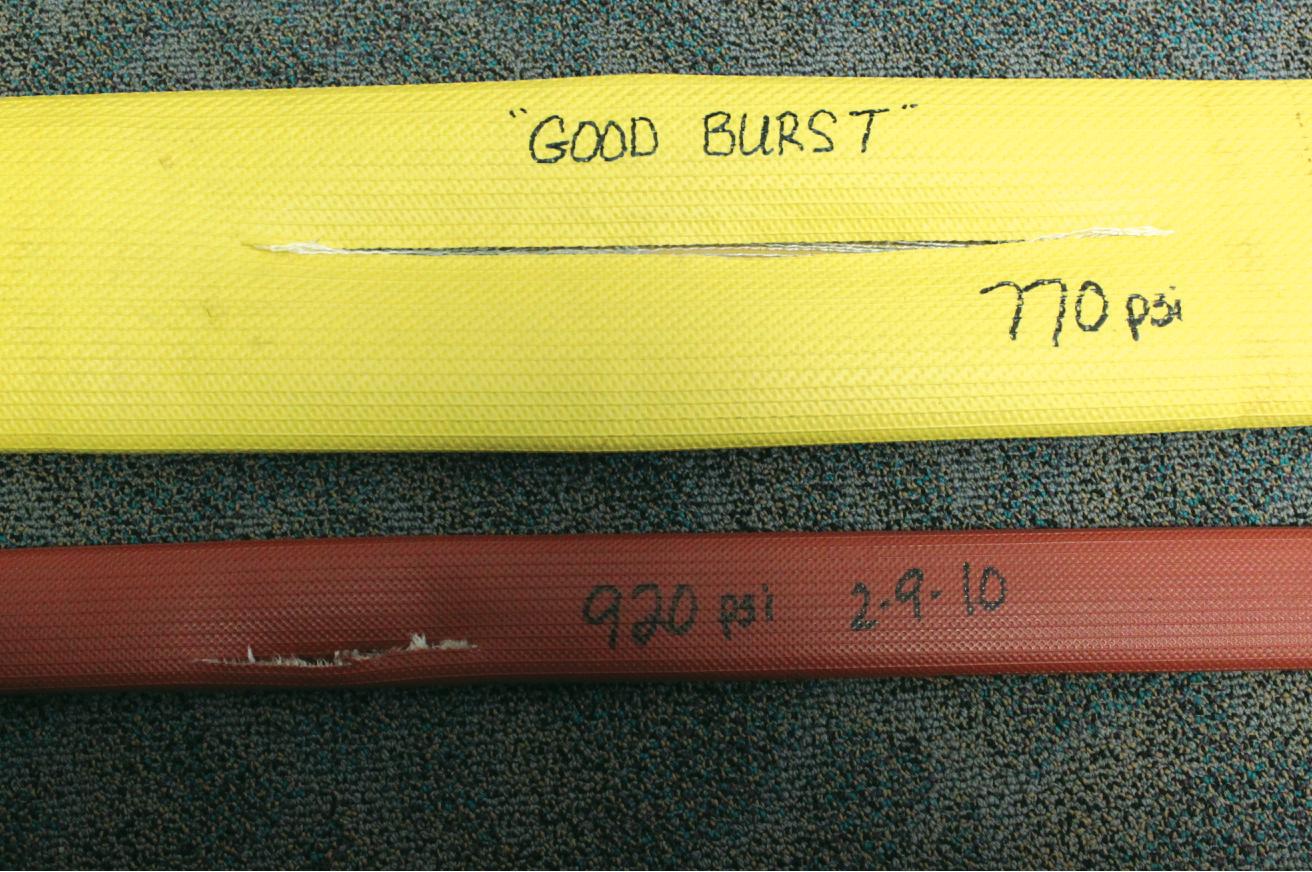
When fire service hose fails – which can happen, due to many potential factors – the hose is designed to burst a certain way to limit injury. Fire service hose can withstand and is tested to extreme pressures, ensuring that it will not fail during average use. However, when fire service hose does fail, it is designed to do so in a way that limits any injury or further damage. In photo 1, you can see two examples of proper or good hose bursts. Both sections of test hose have parallel breaks. These two test sections were used in a quality control test to measure the strength of the hose. These hose sections were randomly chosen. The red hose was tested in front of us on the day of our visit. That section of hose failed at a pressure of 920 psi, well above the required working pressure and service test pressure that NFPA dictates. This quality control test is designed to make the hose section fail to see how it behaves. In regular pressure tests conducted on all hose manufactured by Snap-Tite the hoses are charged only to between 400 psi and 600 psi.
Another feature that was shown on our tour is the hose identi-
2:
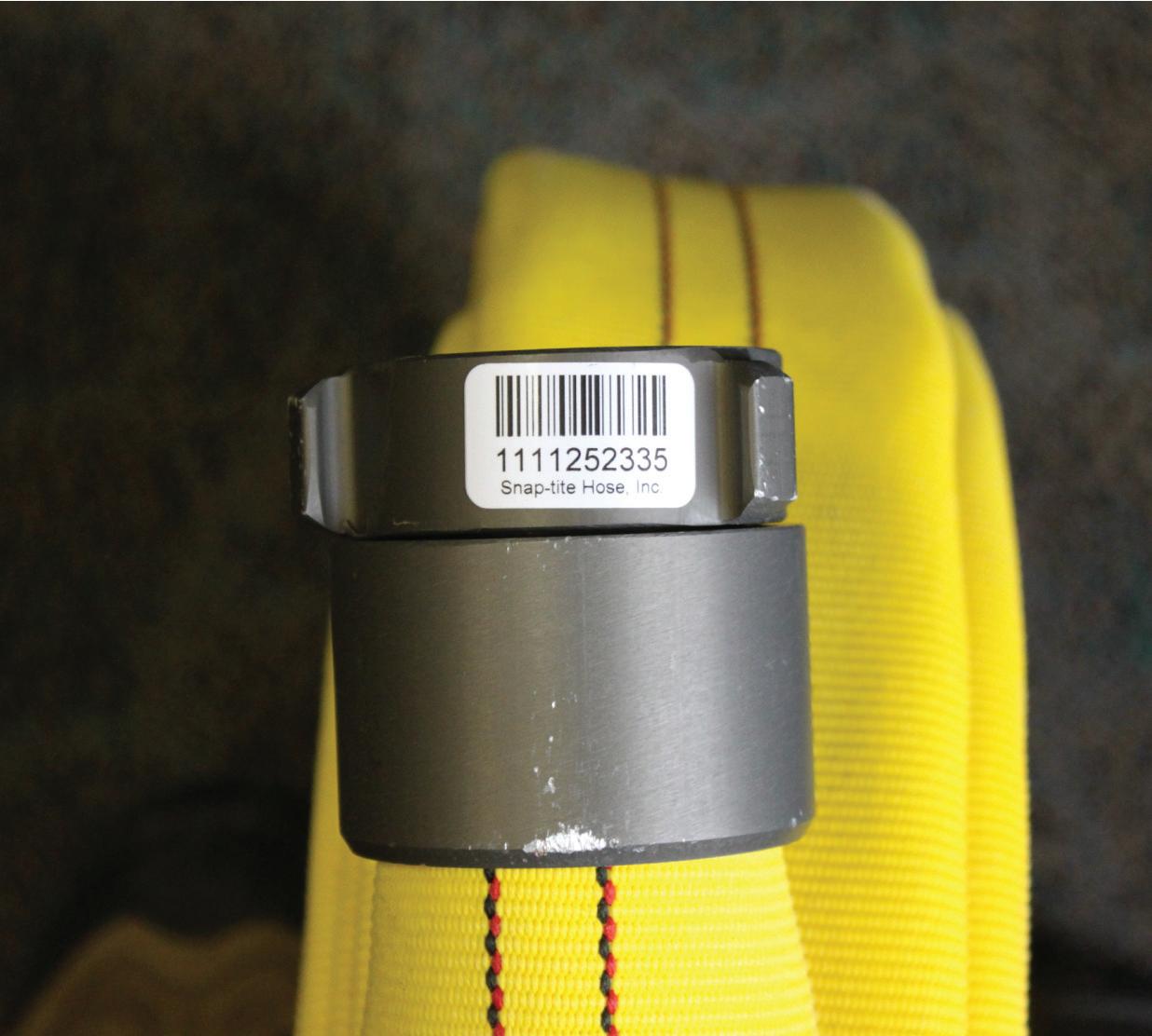
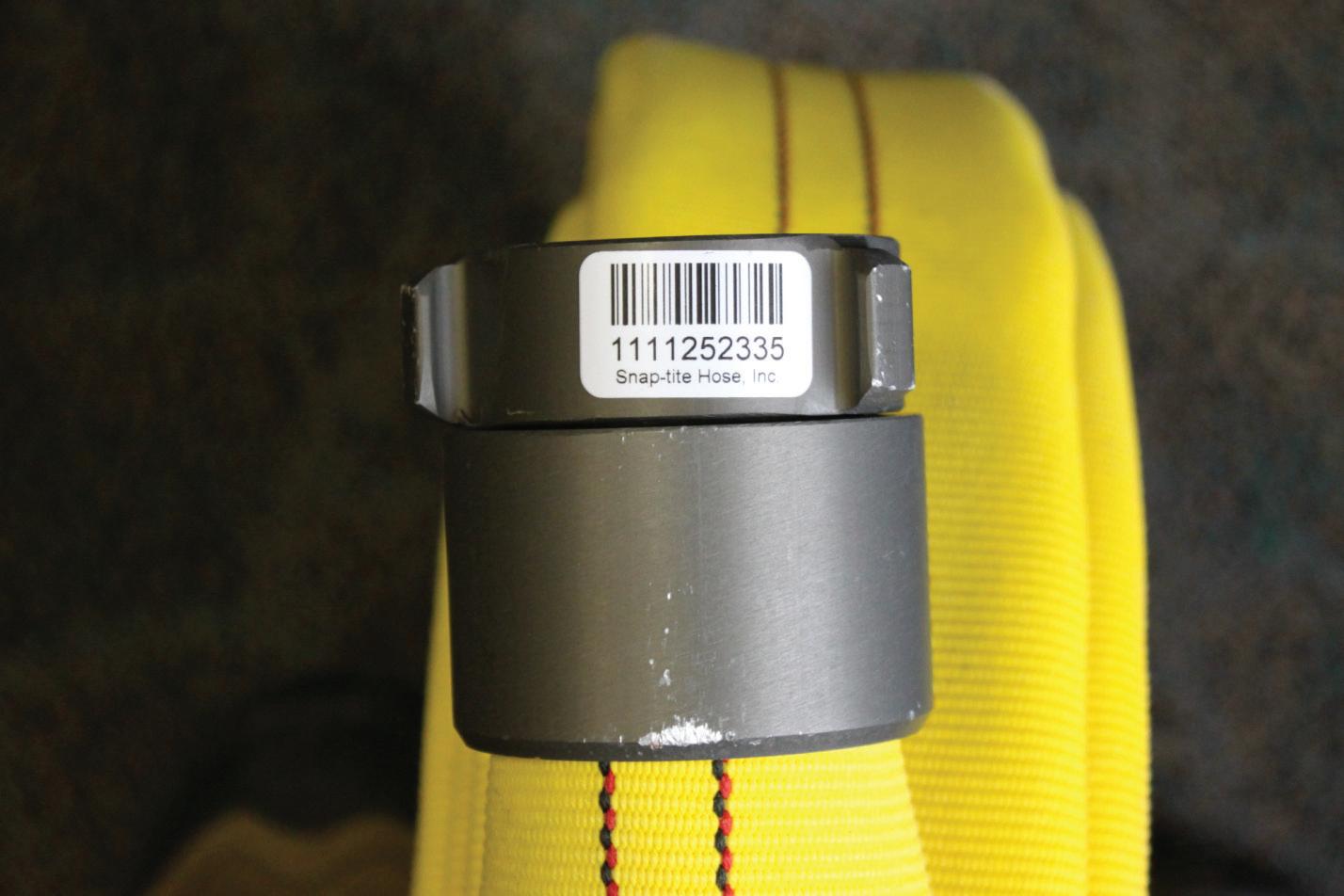
hoses feature a label that includes a bar code and 10-digit identification number.
fication tag system (see photo 2). Each section of hose is supplied with an identification label that is placed on the female coupling. The label sits next to the lug, allowing it to be protected somewhat from normal wear and tear. The label includes a bar code and a 10-digit identification number. The label is unique to that section of hose. It is implemented at the birth of the hose section, allowing Snap-Tite to monitor the testing of each section along with the remaining production process. This identification label system is transferable to the fire department that purchases the hose. If the fire department chooses to subscribe to Snap-Tite’s hose record management service, it can use the system to track its hose service
Photo 1: Sections of hose that have been tested to fail at extreme pressures.
Photo
All Snap-Tite
Every second counts... Newton Kwik-Dump Valves
Fire hoses can fail due to many factors.
life. All pertinent information is tracked and recorded for the department to use and view. Dates when the hose section was last service tested, when it was put into service, when it was taken out of service, any damage that was incurred during service life and any repairs that were made are all recorded and kept in this data management system. This saves fire departments from having to label each section of hose with their own identification numbers and starting a record of that hose.
Unfortunately, I was unable to take photos inside the facility as it was not permitted. However, having seen how fire service hose is constructed, manufactured and tested has made me realize that this basic tool that we use every day is certainly designed to withstand the harshest of work environments.
Mark van der Feyst is a 10-year veteran of the fire service. He works for the City of Woodstock Fire Department and is an instructor teaching in Canada and the U.S. Mark is a local level suppression instructor for the Pennsylvania State Fire Academy, an instructor for the Justice Institute of BC and an associate professor of fire science for Lambton College. He can be contacted at Mark@FireStarTraining.com
Cutters Edge Rescue Saws are designed and built to deliver 100% reliable, high performance cutting in the most demanding and extreme conditions encountered by Fire and Rescue Professionals.
MULTI-CUT Fire Rescue Saw
The Cutters Edge Original for Ventilation, Forcible Entry and Rescue Operations and built specifically to operate in hot, smoky fireground conditions. The patented BULLET® Chain cuts faster, safer and lasts up to 20 times longer than standard chains.
Gas Powered Concrete Rescue Saw
Cuts reinforced concrete up to 16-inches thick in minutes with the patented GCP SealPro® Diamond Chain and powerful 101cc engine. It’s fully portable, operates in any position and just one water hose needed for dust-free cutting in rescue situations.
Rotary Rescue Saw
Look for the New Generation, More Powerful Rotary Rescue Saw in Early 2010.
Fully Equipped Sawing Kits are Available for All Three Models
Contact Your Local Cutters Edge Dealer -
WESTERN CANADA
WFR Wholesale Fire & Rescue Ltd.
Calgary AB - Ph 403-279-0400
1-800-561-0400
Web: www.wfrfire.com
QUEBEC
Areo-Fire 615 Guimoind Blvd.
Longueuil, Qc J4G 1L9
1-800-469-1963
E-Mail: hpicard@areo-feu.com
ONTARIO M&L Supply Ingleside, ON 1-866-445-3473 Web: www.mnlsupply.com
t has often been said that the size and extent of any emergency is equal to the number of satellite news trucks in the parking lot the next day. That’s not always the case, but a scene like that can be pretty overwhelming. We all know the feeling and for most, it’s truly one of fear – fear that you will be put on trial in the court of public opinion, fear that nothing positive can come out of a media interview, and all “they” are interested in is finding someone to blame for something, or fear that you simply are not good at public speaking.
Is this what goes through your mind when the microphones and cameras arrive? Is dealing with the media the biggest concern you have beyond that of even the incident itself? Then maybe it’s time to take a different view and start to treat the media as part of your team and one of the most valuable tools that you have at your disposal.
You see, I used to be one of “them”. In fact, when I first started in the fire service as a volunteer I was a young broadcasting grad working on the air at CKGO Radio in Hope, B.C.
As an on-air announcer I was also responsible for covering local news. As you can imagine, that put me in a somewhat unique situation. First off, in the smaller communities at least, fires don’t happen every day and when a fire truck is rolling through town with lights and sirens on, everyone knows, or at least wants to know, what’s going on. I was considered a contact “on the inside” so to speak, but I, like most every volunteer firefighter in Canada, knew how to separate my real life from my responder life and always waited until after the call before filing a story and, to be honest, often from the fire hall itself. Besides, the sound of a truck’s back-up alarm in a radio report made for a great sound effect.
prevention and public safety. Can you imagine any other business that could simply call up the local newspaper, provide a photo backdrop and get countless free advertising to sell a product? This is unheard of in the business world but accessible in ours, yet the majority of us don’t take advantage of it. Most prefer to sit back and wait for an event and when the time comes, are ill prepared for what they face. Maybe it’s time to stop reacting and start calling on the media before they call on you.
If you haven’t already, take the time to build and maintain contacts outside of any incident or emergency with your local media. Then, when they do arrive, treat the experience not as a trial but as an opportunity as part of the overall incident response. Talk when you’re ready to talk and, if cameras are involved, where you want to talk. That means pick your background and, during interviews, consider whether there is something to be learned by what has just occurred or something extraordinary your department has done, and work that into your interview. Put your spin on the event beyond the usual who, what, where and when. Again, all of this is so much easier when you have an existing relationship; however, – particularly
Maybe it’s time to stop reacting and start calling on the media before they call on you. ‘‘ ’’
Perhaps it’s because I told the stories I reported from a fire perspective, but I knew the power that we, in the media, had and helped the fire department gain access to it. Think of it like this: in today’s fire service we refer to the people we serve as customers. If that’s the case then consider us in the business of fire
Tom DeSorcy became the first paid firefighter in his hometown of Hope, B.C., when he became fire chief in 2000. Originally a radio broadcaster, Tom’s voice could be heard in the early 1990s across Canada as one of the hosts of Country Coast to Coast. DeSorcy is married with two children, aged 28 and 20, and enjoys curling and golf. He is also active with the Fire Chiefs’ Association of B.C., and chairs the communications and conference committees. Contact him at TDeSorcy@hope.ca
in smaller communities – that relationship is often forgotten if and when the big event occurs (or when the satellite trucks roll into town). Imagine how you would feel if you developed a rapport with someone only to be ignored just because it’s a big event. You’ve taken all this time to build up trust. Always try to remember the little guy.
At the end of the day, your 15 minutes of fame will be just that and another day will bring another story, probably bigger than yours. Realize that no amount of media training or seminars can teach you to be comfortable talking publicly if it’s simply something you’re not used to. In any case, I will leave you with one piece of advice that all broadcasters learn in their careers: treat every microphone as live and every camera as if it were turned on. Believe me, that rule has saved many of us on more than one occasion.
By I an CR os B y wellness/ fitness co-ordinator Calgary Fire d epartment
wEmployee buy in key to health program
ith one in three firefighters injured annually in North America we know our personnel face high odds of being injured. It’s understood by unions, management and frontline fire personnel that a comprehensive wellness-fitness program can secure the highest level of health for firefighters.
Programs such as the IAFF/IAFC joint labour management Wellness Fitness Initiative (WFI) have been shown to reduce the number of work-related injuries and lost workdays. Indeed, Statistics Canada says a majority of Canadian corporations offer wellness programs for their employees yet many fire departments struggle with the implementation of these types of programs. Most absent and arguably the most critical component is the annual medical evaluation.
There is often debate over the differences between NFPA 1582 and the WFI and it usually revolves around the topic of fit for duty versus wellness. The medical components of the two are essentially the same but the difference lies in application. The NFPA is generally made up of standards used to determine job status; wellness is regarded as overall health promotion regardless of current health status. The difference may appear subtle but it can have a huge impact on your program’s success. It’s critical that when you establish a program you get employee buy in. The focus needs to be on individual health promotion versus adherence to an industry standard or your wellness physician will be perceived with the same negative connotations as a Workers Compensation physician.
The mandate of the WFI is to “develop an overall wellness fitness system with a holistic, positive, rehabilitating and educational focus”. Many programs fail to reach their potential because they impose a standard before establishing trust. A program’s success hinges on changing the workplace culture. Creating an environment of trust and respect with a focus on individual health promotion and education that empowers the employee results in a positive shift in the workplace culture. Once this shift occurs then management needs – such as adherence to a standard and personnel accountability – can be met.
is centered on the patient’s personal well-being. Employees will make the appropriate decisions if they are properly educated about their condition and trust the physician. The worst that can happen is that employees who don’t trust a department physician will avoid divulging any information beyond what is required. By providing proper guidance and support, management’s goal is to empower employees to take responsibility for their health. In the WFI “there are no blanket prohibitions to determine job status”. If a medical condition exists that limits someone’s ability to perform a task then it is the responsibility of the WFI physician to work with the individual to determine the best course of action. The personal health of the individual is the priority; the physician serves as the advocate to ensure the appropriate treatment strategy ensues. Whenever possible, the firefighter has an active role in the decision process.
Another important concept to consider in the implementation of a health and wellness program is mandatory and non-punitive. The WFI requires mandatory participation and is non-punitive. Simply stated, the program won’t work if the employee won’t participate. The program may only be punitive if employees don’t participate. In order to affect a lifestyle change for firefighters on and off duty, this initia-
Many programs fail to reach their potential because they impose a standard before establishing trust. ‘‘ ’’
The obvious concern is the fear of allowing personnel to remain on full duty if a medical condition is discovered that would normally preclude them from working. Many organizations may already have personnel in this situation but have chosen to do nothing because they are unsure how to confront the problem. It’s the wellness physician’s job to provide the patient with unbiased health information and guidance that
Ian Crosby is in his 17th year with the Calgary Fire Department and serves as its wellness and fitness co-ordinator. Crosby developed the department’s Wellness Centre, which opened February 2005. He is a member of the IAFF/IAFC/ACE Peer Fitness Trainer (PFT) Oversight Committee and an instructor for the PFT certification program. E-mail him at Ian.Crosby@calgary.ca
tive must focus on delivering a positive, individualized plan. All results are confidential and are measured against the individual’s previous examinations and assessments and not against any standard. The nonpunitive component means that no personnel will lose pay. In extreme cases, where a serious medical condition exists that impacts job status, all efforts are made to correct the situation (through treatment) along with an appropriate accommodated work position with no loss of pay. It’s in the best interest of everyone involved to get an employee back to full duty if the condition is correctable.
Health information is personal and must be safeguarded. In order for personnel to divulge their health history, complete a lifestyle questionnaire, undergo laboratory, radiology and physical exams and make voluntary changes to their personal lives, they must truly trust the system. Once trust is established and firefighters believe that their individual interests are a priority, then the program can reach its potential – the program works and everyone wins; it just needs to be applied properly.
checks
Know your water tank
By DON HENRY
water tanks are a very important component of the fire truck and are often overlooked and under maintained.
Water tanks are usually made of steel or plastic. The plastic tanks are more correctly called UPF Poly-Tanks and have been very popular for the last 10 to 12 years. Because the manufacturers are very confidant of the UPF tanks they offer a lifetime warranty.
To a large degree, plastic tanks have reduced many of the corrosion problems associated with steel tanks. They are generally considered to be 50 per cent lighter than steel tanks of the same capacity. The use of this material has allowed for some very interesting options for fire departments, such as the ability to store the ladders lower down on the fire truck with a through-the-watertank design.
According to NFPA 1901, a pumper must have a water tank of at least 300 gallons (1,100 litres). It is important that the tank overflow direct the overflow water to dump behind the rear axle so this water will not interfere with wheel traction. (See photos 1 and 2.)
Inspect the inside of your steel tank for corrosion. Pay particular attention to the baffles inside the tanks. The baffles perform an important safety function. As the vehicle de-accelerates or turns a corner, the water will tend to stay in motion and force the truck to remain in the same direction. This could cause the truck to flip over. The baffles in the tank, to a degree, stop the water from sloshing in the tank. If the steel baffles have corroded in the tank or have become disconnected from the water tank’s inner walls, the vehicle will become unstable during turns or on corners. A half-full water tank can be dangerous even with working baffles. Many departments have a SOP stating that the fire truck will be driven only with a full water tank or a completely empty water tank. After a fire call, the truck’s water tank is drained if it cannot be filled from a water source, such as a hydrant, before returning to the hall. If you have to use an open water source such as a pond or a roadside ditch, completely flush out the water tank, fire pump and piping after returning to the hall.
When waiting for a call, fire pumps should be kept full of water or empty. Never leave the pump partially full of water. The mix of oxygen and water will cause rust. Most departments keep the fire pump full of water. Departments in northern areas may decide to keep the pump dry to avoid freezing. There will be some corrosion even in water that is of a neutral PH; as the water becomes more basic or acidic, depending on your water source, the rate of corrosion will increase. To combat this problem corrosion, anodes are installed. These anodes are made of a sacrificial metal. (See photos 3 and 4.) As such, over time, the anode will dissolve in the water rather than the more expensive and more difficult to replace pump parts. These anodes can be made like the ones in the picture above or as part of the screens that cover the intake ports to the pump. Most people think that the screen used in the intake ports of a fire pump is there to keep debris from entering the fire pump. It’s really intended to be used by departments that keep
Looking down on fill hole for a plastic tank; note the removable screen and overflow pipe.
Tank to pump line; note the bolts on the right side and the rubber cushion between the frame support and the water tank.
PHOTO 1
Inside view of a steel tank baffle. There’s some corrosion but note the excellent condition of the welds. PHOTO 2
Replaceable anodes mounted in pump piping.
PHOTO 3
Note the sacrificial metal in the pump intake.
PHOTO 4
Note the leather belting used as a cushion between the tank and the frame.
PHOTO 5
PHOTO 6
A typical water tank level sensor on top of the water tank.
PHOTO 7
tRuCkchecks
their fire pumps flooded with water when in the fire hall. The screen is really a piece of sacrificial metal that is meant to dissolve and, in the process, fight corrosion. How often these will need to changed depends on the condition of your water. Those of you who have attended our fire school in Vermilion, Alta., will understand the problem! In the past, when steel tanks were very common, the water tank, piping and fire pump would experience the effects of this corrosion. Now that we have plastic tanks this corrosion can only occur in the fire pump and piping. In other words, a plastic tank can accelerate corrosion in a fire pump. The anodes and the protection they bring are now even more important as there is less material over which to spread this corrosion.
■ WATER TANk TO FRAME
The water tank needs to be secured to the truck frame (see photo 5). This is often done with clamps or bolts. There will be a cushioning material between the water tank and frame. On older trucks this was often a strip of hardwood. On more modern trucks a strip of leather belting was often used. Presently, a strip of rubber is most often the material of choice. In any case, these materials will deteriorate over time. I would recommend that these devices be inspected yearly. (See photo 6.)
■ WATER TANk LEVEL SENSORS
These devices have come a long way from a glass tube on the side of the water tank to indicate levels. (See photo 7.) An excellent website for information on the topic of water level sensors and their maintenance is the MC products web page – http://www. mcproducts.com/servicemanuals.html. These water level sensors give very little trouble. If the tank level sensors get coated in oil then they may need to be cleaned. The bulbs on the panel are easy to replace and available from almost any auto-parts store. Like most electrical defect problems, these tank level sensors can be broken down into three categories: Opens circuits, such as a break in the wire, are almost always at an electrical connection, unless you have managed to get the wire close to a hot exhaust pipe; A short circuit, also know as copper to copper, will often cause another circuit to be energized; and a ground circuit, often called copper to steel, will almost always melt a fuse or trip a circuit breaker if the problem is on the power side of the load. A high resistance will be caused if the bad ground is after the load. This could cause
the light bulbs to be dim instead of bright. Clean the ground connection and protect it from moisture and corrosion. Both short circuits and ground circuit problems can cause a fuse to blow or a circuit breaker to trip. Never replace a blown fuse or circuit breaker with one of a higher amperage rating; it would look bad if the fire truck caught on fire.
■ BOYD COLE EDuCATORS’ MEMORIAL AWARD
Boyd Cole was a pivotal person in the creation of the Apparatus Maintenance Section of the IAFC, The Emergency Vehicle Technician Certification Commission, NFPA 1915 and NFPA 1071 committee, which he chaired, and their standards. He was also very active on other NFPA standards and a long-time member of NFPA 1901 and NFPA 1914. He personally taught fire apparatus aerial courses across the United States and Canada and was instrumental in the formation of a number of state associations as well as being a mentor to many. Boyd was a long-time employee of Underwriters Laboratory. His belief in the need for technician training and certification was absolute. Without the support of educators like Boyd Cole, the level of technician training would not have advanced to where it is today.
In memory of Boyd Cole, the EVMS will be presenting an award each year at Fire Rescue International (FRI) to recognize an educator, trainer, or facilitator of emergency vehicle technicians’ training. The award will be presented at the EVMS two-day preconference workshop and will consist of a wall plaque and ticket to the pre-conference workshop. To ensure that the person can attend and accept the award, the EVMS will pay for airfare and two nights’ accommodation in an area hotel. The EVMS will solicit only the State and Provincial EVT Associations for nominations for this award.
The nominee may be a corporate, private or public sector educator, trainer or facilitator of EVT training. The nominee cannot be a currently sitting director of a nominating organization. The deadline for nominations is May 30. Please respond with all relevant documentation supporting your nominee to don.henry@lakelandcollege.ca. A committee has been formed to select the candidate.
Don Henry teaches the Automotive Services Technician and Heavy Equipment Technician programs at Lakeland College in Vermilion, Alta. He can be reached at don.henry@lakelandcollege.ca
By s E an t R a CE y Canadian Regional m anager n F pa International, o ttawa, o nt.
tImpact
Response standards updated for 2010
he NFPA has recently released the 2010 editions of standards 1710 and 1720. These are the third editions of each of these documents and, although they were originally viewed as controversial publications, the sky has not fallen on municipal officials and the standards have proven to be valuable tools in the determining and protection of the level of fire services in communities across Canada. The latest editions of these standards reflect continuing refinement from our experiences in applying them across North America.
When the standards – NFPA® 1710 Standard for the Organization and Deployment of Fire Suppression Operations, Emergency Medical Operations, and Special Operations to the Public by Career Fire Departments and NFPA® 1720 Standard for the Organization and Deployment of Fire Suppression Operations, Emergency Medical Operations, and Special Operations to the Public by Volunteer Fire Departments – were first introduced, it was expected that the key benefit would be to help local fire departments provide substantiation for minimum levels of service. The standards would identify benchmarks for what the international fire service community was recommending for minimum levels of response to a single family dwelling fire. The two standards were to reflect predominantly career and predominantly volunteer fire department response objectives separately, including minimum staffing and response time objectives. The aim was to be able to take these and present them to elected municipal officials so they could make informed decisions on response levels for their communities. The standards have stood the test of time but the recent minor changes provide even more clarification for better use of the standards.
80 seconds from 60 seconds for fire and special-hazard response. This change is a result of feedback that the earlier 60-second response time was leading to unsafe conditions as personnel were looking to shortcut safe practises to meet the time objective. In Chapter 5, it is made clearer that the deployment model was meant to apply to a typical two-storey, single family dwelling fire without a basement and without exposures. It is therefore implied that if you have either, then additional resources should be considered. Also in this edition a community wide risk management model has been incorporated into Annex B of the standard. This was taken from the 1720 standard and has been found to be a valuable tool for departments as it states that deployment, staffing and service levels contained in NFPA 1710 is but one component of a total community fire protection planning process. Other components to consider are higher building standards, fire prevention activities and public education.
In the 2010 edition of NFPA 1720 the staffing and response table has been revised and is more understandable. The table provides response objectives based on population density. It also makes it clearer that a community may have varying response zones. The
The four-minute response time has been clarified to be four minutes of travel time. ‘‘ ’’
The 2010 edition of NFPA 1710 for career departments has incorporated changes that make the document more readable. A new section has been added that clarifies the application of the standard. This section makes it clear that the standard is based on a response to a single family dwelling fire but that it should be used as a platform for more hazardous or complex incidents. Also added is new guidance on alarm handling and clarification regarding the time elements in determining response.
The four-minute response time has been clarified to be four minutes of travel time. The 2010 version also includes new annex materials that make it more clear how the various response time elements are considered. Added is an increase in turnout time to
Sean Tracey, P.Eng., MIFireE, is the Canadian regional manager of the National Fire Protection Association International and formerly the Canadian Armed Forces fire marshal. Contact him at stracey@nfpa.org
requirement that fire departments have the capability to initiate an attack within two minutes of having necessary resources at the scene in remote areas was moved from the footnotes to a new paragraph and has been made applicable to all operations. Text was added in the annex to help users calculate the percentage of times they meet the objective. A new section on sustained firefighting operations has been added and several sections have been revised and reorganized to present the requirements in a more logical order.
Both NFPA 1710 and 1720 have been fine tuned in these latest editions. They have weathered the storm of initial criticism to become valuable tools for fire chiefs to use before councils when fighting for resources. The most recent changes represent ongoing evolution of the documents so that they can be more effective and better understood by elected officials. Both editions, like all NFPA standards, can be viewed on line for free at www.nfpa.org.
forrest on fire
Seven-term
Winnipeg union boss cites presumptive legislation and co-operative fire-EMS
as biggest challenges
By JAMES CARELESS
In March, Alex Forrest was acclaimed to his seventh term as president of the United Firefighters of Winnipeg. The union represents the city’s 1,500 firefighters, firefighter paramedics, fire prevention officers, training academy instructors and senior operations officers.
Forrest – a lawyer – talks about his dedication to union work and his successes and challenges.
Q. SEVEN TERMS. WHAT kEEPS YOu COMING BACk FOR MORE?
A. It’s something I really enjoy. When you’re involved in the union, it becomes your passion and a part of your life. I enjoy my job and I enjoy helping firefighters. I even enjoy contract negotiations because that’s where the union can really make a difference for a great bunch of guys.
Q. WHAT ARE THE MOST PRESSING ISSuES FOR YOuR MEMBERS?
A. Looking over the last 15 years, the biggest issue facing Canadian firefighters has been getting cancer recognized as a occupational disease. It was only in 2002 that Manitoba became the first province to recognize cancer as a line-of-duty problem. Now we have seven provinces that have this presumptive legislation; we still have three provinces and territories to go.
An issue that runs a close second is the move of firefighters into emergency medical services. The traditional model of single role ambulances doing EMS duty has really failed. The provinces are only realizing now that putting a tremendous amount of money into this model has only made the situation worse.
In contrast, fire-based EMS – which we have in Winnipeg –doesn’t cost more. We can put the resources of firefighters into emergency medicine and provide better service to the community. It’s a common sense resolution to a growing problem. Firefighters trained as paramedics have a four-to-five minute response time here in Winnipeg, whereas traditional EMS crews take from nine to 12 minutes in other Canadian cities.
Q. WHAT HAS CHANGED DuRING YOuR TERMS?
A. The biggest change is that firefighters are getting more involved in EMS. Fifteen years ago this was not the norm. Today, every firefighter signing on with our department has to be dual trained in fire and EMS. Incident command procedures and accountability have also improved over my time as union president. Safety measures have improved tenfold since then; the problem is that the toxicity of environments that we have to work in has increased 20 times.
Q. AS DETAILED IN THE SEPTEMBER 2009 ISSuE OF FIRE FIGHTING IN CANADA, YOuR uNION AND THE CITY OF WINNIPEG WORkED OuT A STRONG, CO-OPERATIVE RELATIONSHIP AFTER DECADES OF CONFLICT. HOW DID YOu ACHIEVE THIS?
A. It took time and tragedy [the deaths of captains Harold Lessard and
Tom Nichols] but eventually we both learned that we can accomplish a great deal more when the union and the department work together. The same is true in Edmonton, where both sides co-operate with each other. In these cities, the departments are excelling and being leaders in fire and EMS.
It is really easy to fight, and it does add a whole level of effort to work together. But it helps us provide better protection to the community and it certainly makes it easier to deal with the politicians, because it’s no secret that fire fighting is one of the most political jobs out there. Having a united front makes it easier to negotiate for what we need from government. The more we work together, the better things go.
Q. WHAT IS YOuR TAkE ON THE 24-HOuR SHIFT? RIGHT NOW YOu ARE WORkING ON THE 10/14 ROTATION
A. The 24-hour shift has certainly caught on in Ontario, where commute time is a big issue. But in western Canada commuting is not really a problem.
United Firefighters of Winnipeg president Alex Forrest, shown during a presentation at the CAFC conference in Winnipeg in September 2009, was acclaimed to a seventh term in March.
P hoto by LAURA KING
We are interested in the 24-hour shift and are studying it. One point that interests us is the health and safety aspect of this rotation. If the evidence proves that it is better for firefighters we would push for it. Granted, it can be brutal to work 24 hour days but at least you get a full day off to catch up on sleep and recover. Here, you can work 14 hours at night, not get enough sleep and have to be right back at it 10 hours later.
One issue is just how much strain this schedule would put on our members. Because they are also serving as paramedics, there is no such thing as a quiet station anymore. We are seeing an average of 2,000 to 3,000 runs a year, which means that each station is doing about 10 runs a day. So we have to figure out how moving to a 24-hour shift in this environment would affect our people. Would it make things better or worse?
Q. PLATOONING – NOT SENDING OuT FuLL CREWS TO EVERY CALL – IS BEING CONSIDERED BY SOME FIRE DEPARTMENTS WHAT DO YOu THINk OF IT?
A. I have serious concerns about this practice. The problem is this: What happens if you send a partial team to an incident, just to learn that you need more people to handle the situation? You have lost critical time and you may be putting the first response team in danger, since they are unlikely to sit in their trucks waiting for backup to arrive.
I can’t think of any fire chief or union president that would want to increase the level of risk for firefighters and that’s what platooning could potentially do.
Q. WHAT ABOuT HEALTH AND WELLNESS?
GLOBAL CONNECTIONS
A. I spend a lot of time talking to premiers and ministers of labour trying to persuade them to pass presumptive legislation to protect firefighters. But we can’t expect them to do this if we, as unions, don’t then give something back by having proper health and wellness programs for our members. You just can’t ask government to compensate for problems without trying to minimize the amount of money that needs to be spent in doing so.
That’s where health and wellness programs come in – every dollar spent on them saves two to three dollars that has to be spent treating and replacing injured workers.
Calgary and Edmonton already have very successful health and wellness programs. We are trying to learn from them, to develop programs for Winnipeg.
Q. WHAT DO YOu SEE AS THE BIG ISSuE DuRING YOuR NExT TERM?
A. I am expecting to see a real showdown between fire and EMS in every province. We are already seeing it happen in B.C. and Ontario. There are hard facts that prove that fire-based EMS provides better, more affordable service for communities. But change is always hard to come by, especially when there are entrenched interests in place.
Q. AND WILL YOu BE RuNNING FOR AN EIGHTH TERM, IN TWO YEARS’ TIME?
A. Definitely. I love being a union president, doing what I can to help our members. Even when I went to law school and got my degree – and got called to the bar – I couldn’t think of anything I’d rather be doing than what I am doing now. So yes, I will be staying with this job if the members want me to. Being a union president was the best decision of my life.
safetY fIrst
as North American legislators make changes that require employers to prevent all kinds of workplace harassment – not just human rights violations – Canadian fire departments need to understand how the new laws affect them, their workers and their unions.
Ontario’s new legislation is particularly strict and the fire service is scrambling to meet the requirements of Bill 168, which comes into effect in June.
The amendment to Ontario’s Occupational Health and Safety Act makes violence and harassment in the workplace a safety issue. Other provinces such as Alberta, Nova Scotia and Quebec have already introduced similar legislation but Ontario’s goes farther and is part of a growing trend to introduce more reviews, training and enforcement to prevent incidents.
Several high-profile and horrific workplace incidents have driven this move. In 1999, Pierre Lebrun, a long-service OC Transpo bus driver in Ottawa, went on a shooting rampage at his workplace, killing four employees and two others before committing suicide. In 2005, Lori Dupont, a nurse at Hotel Dieu Hospital in Windsor, Ont., was stabbed to death by her exboyfriend, a doctor who worked in the same hospital and subsequently killed himself by drug overdose.
Bill 168 has many controversial elements that will need to be sorted out by legal experts and case law. It grants workers the right to refuse to work where they feel endangered by workplace violence. It also requires that employers take reasonable precautions to protect workers from domestic violence that may occur in the workplace and result in physical injury. And it requires employers to advise employees about people with a history of violent behaviour if they
Legislation concerning workplace harassment remains vague and is especially complicated for fire departments, which are like second homes where firefighters work in close proximity for lengthy periods.
Canadian departments and firefighter unions challenged by new rules on workplace harassment
By RoSIE LoMBARDI
Surreyfiresafety jul09CFF.pdf 1 25/01/10 1:34 PM
encounter them in the course of their work, which may run counter to privacy rules.
Ontario fire departments should think carefully about the kinds of investigative steps they’ll commit to taking to comply with the legislation, says Cheryl Edwards, partner at Heenan Blaikie LLP, a Toronto-based law firm.
“The reason is that violence and harassment can be very broad as defined under Bill 168, so they should think about putting in mechanisms that allow them some discretion to say: ‘We don’t think your complaint about someone looking at you the wrong way meets the threshold.’ Otherwise, they’ll be committing to investigating every minor event of what someone might think is harassment instead of focussing on the real issues.”
■ POLICY ISSuES
The key to preventing harassment and violence in the workplace in any organization, not just the fire service, is education, says Fred Leblanc, president of the Ontario Professional Fire Fighters Association. “Bill 168 has rung a bell about the need to ensure an harassment-free workplace. But it’s quite an adjustment of the whole concept of health and safety compared with previous approaches,” he says.
The OPFFA is developing a tailored training campaign but there are many policy issues to sort out first with legal counsel and the Ministry of Labour , says Leblanc. “For example, some smaller fire services only have three members. So if two of them get into a fight, how do we deal with it? Can members invoke the right to refuse to work because the environment is unsafe? We’re entering uncharted waters.”
Another issue is that personal harassment under Bill 168 is not clearly defined, unlike harassment under the human rights code, which is based on gender, race and creed. There are no precedents, as past incidents of harassment in the fire service have been largely gender based and relatively minor, he says.
“But it’s not clear now. If Joe says something to Bob and he’s offended, it doesn’t necessarily mean it’s harassment. We’ll have to wait for the legislation to be tested a few times to see where investigators go with this.”
Leblanc points out that there are unique aspects in the fire service’s workplace that require greater tolerance all round about human foibles. “Unlike the police or EMS workers, our workplace is really a second home, and firefighters are together in a close environment for the entire shift. It’s incumbent on everyone to rise above personality issues that will inevitably come from that because they must work effectively to respond to emergencies.”
The domestic violence and history of violence provisions of the bill also raise issues, he says. “Situations sometimes arise where police and EMS workers know certain repeat callers have a history of domestic violence but our people don’t get that information due to the way dispatches work. Police and EMS won’t go in unless they have enough people to deal with the situation. But there’s resistance to sharing that information with firefighters because it has privacy implications, so our members have asked if they can refuse to enter that ‘workplace’. We’re exploring this with the [Ministry of Labour].”
But these types of situations are fairly rare, he adds. “We already have rules around harassment and we’ve dealt with violence before but we’ll need to broaden our training. There won’t be much change for most fire departments beyond working through complaints and formalizing processes for dealing with them under the legislation,” says Leblanc.
■ TRAINING TO CREATE A RESPECTFuL WORkPLACE
According to Bill 168, training should be provided to all employees to prevent violence and harassment. “We urge employers to look at workplace violence as a continuum,” says Bill Badzmierowski, director of instructor services at the Crisis Prevention Institute (CPI), an
Official Supplier to the 2010 FireFit Championships
The clear leader for Structural Fire
international training firm based in Brookfield, Wis.
Many situations that start as simple discourtesy and incivility in the workplace can escalate into more serious words and acts, he says. Most incidents of employees ”going postal” have precursors in conflicts and verbal exchanges and there are often indicators in the way people behave that should raise alarms.
“If someone gets in your face your first impulse is to talk or hit back,” says Badzmierowski. “But there are other things you can do and most people don’t know what they are. How close you stand to the person, your body language and facial expressions make a big difference. There are practical ways to train employees to defuse a situation and prevent its escalation.”
.
Badzmierowski says incidents of violence between firefighters are fairly rare, based on his experience working with the New York Fire Department post-September 11 and other fire services in Canada and the U.S..
“Incidents are more frequent with the public because firefighters are trained to take charge of situations and give directives. They’re often perceived as being negative, demanding and condescending – particularly if people don’t want to hear what the fire inspector is saying – but they’re just doing their job and taking charge.”
There are several aspects of firefighter culture that are unique, he says. “They tend to rib, tease and challenge each other a lot. There are times when some firefighters don’t appreciate this, and even though it’s unintentional, this behaviour could qualify as harassment under Bill 168.”
Another aspect is the irreverent and sometimes dark humour. “For example, a firefighter faces tragic situations and may encounter a death in the course of work. But someone back at headquarters may say something like, ‘Oh well, all in a day’s work.’ It can really push someone’s buttons on that particular day, even though it’s an innocuous comment. It may not be intended to mean, ‘Buck up, it’s your job’ – but it may be heard that way.”
Changing some of these cultural aspects in firefighting organizations is a long process, as they’re often deeply entrenched. “Our training focuses on learning alternative ways to deal with people when things get tense and practicing those skills. We don’t say you should never joke, but before you do, stop and think what someone may have faced, and maybe check in with them first to ensure they’re OK.”Is this still Badzmierowski talking?
He says he gets many questions from firefighters about whether the workshop training will really work in the field. “We don’t fight the resistance they sometimes show during training because we challenge them to try it and they’re open to this. We often get positive feedback afterwards like, ‘Someone was about to punch me but I took a step back so they couldn’t reach me – like you said in the training – and it worked.’”
The Calgary fire department introduced a code of conduct defining acceptable behaviour five years ago, and many of these aspects are now part of Alberta’s Occupational Health and Safety Act, defining safe workplaces, says acting deputy chief of administration Glenn Bjolvdrud.
“Many things that used to be considered rites of passage are no longer deemed appropriate. A lot of the emphasis in our training is on ways to create that inclusiveness without crossing the line into offensiveness.”
A generational shift is underway in terms of acceptable behaviour, Bjolvdrud says. “We tend to see younger rather older firefighters voicing complaints. They’ll respond to inappropriate comments by saying, ‘I don’t like that. It offended me.’ Then it’s incumbent on the officer to step in and stop it.”
Notwithstanding the fact that the program has been in place for several years and improvements have been made, there is still work to be done to change the culture, says Bjolvdrud. “It will take more time before all these behaviours are corrected. The hardest ones to change are firefighters who’ve been with us over 30 years – they have a tougher time adapting to organizational change.”
...and your agency’s business requirements Software that Suits
Customizable, Integrated, Reliable & Flexible software solutions that improve your agency’s responsiveness, enhance operability and accelerate communications that saves lives. FDM’s fully integrated Computer Aided Dispatch, Records Management and GIS Analyst solutions provide your agency with the tools to effectively manage day-to-day operations.
Offering: A 2 course certificate in incident command for experienced incident commanders. Please contact our office for more information.
Are you looking to take on more responsibility in your Department? Trying to round out your technical ability with leadership skills? Preparing to advance your career?
At Dalhousie University we offer a three course program, the “Certificate in Fire Service Leadership” to career and volunteer fire officers.The 3 courses Station Officer: Dealing with People,Station Officer:Dealing with New Operations and The Environment of the Fire Station are all offered in each of our 3 terms, September, January and April. The program can be completed in one year.
For more information and a program brochure please contact:
You will also find the information in our brochures or at the following internet address:Web site:http://collegeofcontinuinged.dal.ca
tRaInER’scorner
Smaller, scarier meth labs
By ED BROuWER
this column will be somewhat of a review. Samuel Johnson, a writer in the 1700s, said “People need to be reminded more often than they need to be instructed.” I trust these reminders of the dangers of dealing with meth labs will benefit your department.
The following is a report on a scenario CanWest Fire just ran during our SOO HOT weekend for the Boston Bar / North Bend Fire Department. This was our fourth weekend with this department in as many years. It’s a volunteer department under the leadership of Chief Ernie Ferguson, Deputy Chief Eric Phibbs and Asst. Chief Crystal Baughman.
This year our weekend began with a bit of a twist. The department members met at Hall One while we set up at Hall Two. The officers and firefighters expected to come for orientation and some theory, however we used their dispatch to call in a “reported smoke” and “alarm sounding”.
When the first truck arrived on scene they discovered actual smoke coming from the eves of a large one bay wooden structure. There was a smoke detector sounding from inside. We had posted “No trespassing” signs and blacked out the windows along with boarding up the back entrance. There were garbage bags and cans out at the front entrance. As the crew put on their PPE, the IC did a size-up and one member established a manpower staging area. As other apparatus arrived, firefighters reported to staging. The size-up revealed little if any heat on the front door and a light grey / white smoke coming from the attic vent and some of the eves. A search team was established to make entry. The front door was checked and safely opened. Team members entered and informed the IC they were doing a righthand search. To their credit, the team did look left behind the door before proceeding (you would hate to miss a victim within easy reach of the entry team).
As search members continued, they crawled over lots of garbage and broken furniture. As they entered the second room (we had built this within their fire hall) they discovered a 45-gallon drum with a corrosive chemical placard attached to it. One firefighter informed the IC of this while the lead firefighter – who had just discovered a propane tank with a plastic hose leading to a large pot under a table –reached to shut of the propane tank. As he did that, his partner called out, “Something doesn’t look right . . . ” Our instructors – watching through the theatre smoke – felt the firefighters had disturbed the scene enough to initiate our explosion. We ignited a “cannon” cracker and dropped it through the safety lid on the 45-gallon drum. Although the explosion was much louder during our rehearsals, we knew we got our desired results by the loud exclamation of “Oh crap!” Both firefighters were considered down and now RIT was called on.
It was perhaps a bit mean spirited for us to do this first thing
Saturday morning but at least they won’t forget this for a while.
The following points were addressed during our debriefing.
ExPLOSIONS
The most dangerous stage is called the “cook”, the final heating or chemical-reaction step, which may take up to 48 hours. It is not unusual for lab operators to set up a cook and then leave the lab until it’s done. This is the time when a lab is most likely to blow up.
Many meth lab explosions have been the result of anhydrous ammonia or phosphine gas tank explosions; liquid ammonia stolen from agricultural supply houses is loaded into small propane tanks by lab operators.
Red phosphorus has been banned from commercial sale for years, but lab operators have discovered that it can be extracted from wooden match heads. A coffee can full of match heads has the same explosive potential as a small pipe bomb.
Fire Officer: Principles and Practice, Second Ed.
Item#: RES24509 I Price: $63.75
Fire Officer: Principles and Practice combines current content with dynamic features and interactive technology to better support instructors and help prepare future fire officers for any situation that may arise. Because reducing firefighter injuries and deaths requires the dedicated efforts of every firefighter, fire officer, fire department, and the entire fire community working together, the 16 Firefighter Life Safety Initiatives developed by the National Fallen Firefighters Foundation are integrated into the text. Also, in each of the chapters, actual National Firefighter Near-Miss Reporting System cases are discussed to drive home safety and the lessons learned from those incidents.
Some of the guiding principles added to the new edition include:
• Description of the ‘’Everybody Goes Home’’ and the National Firefighter Near-Miss Reporting System, including over a dozen company officer near-miss examples throughout the text
• The latest fire fighter death and injury issues as reported by the NFPA National Fallen Firefighters Foundation, IAFC, and IAFF, including results of a thirty-year retrospective study.
• Changes in fire-ground accountability and rapid intervention practices
• Results of National Institute of Standards and Technology research on wind-driven fires, thermal imaging cameras, and fire dynamics as related to firefighter survival
• The latest developments in crew resource management
The second edition Fire Officer also reflects the latest developments in:
• Building a personal development plan through education, training, self-development, and experience, including a description of the Fire and Emergency Services Higher Education (FESHE) program
• The impact of blogs, video sharing, and social networks
• How to budget for a grant
• Changes in the National Response Framework and National Incident Management System
Industrial Fire Brigades: Incipient Level DVD set
Item#: RIF113DVD I Price: $5159
Industrial fire brigades can provide rapid, on-site response to fires and other workplace emergencies, minimizing injuries, loss of life and property damage. Our first series of 12 programs for the industrial sector is designed for training fire brigade members to the incipient level, which provides the capability to extinguish incipient-stage fires while wearing normal work clothing. This basic training is a prerequisite for advanced exterior and/or interior structural level fire brigades.
Students see how brigades are organized and are shown their functions and limitations under occupational safety regulations. We demonstrate the operation and maintenance requirements for common industrial firefighting equipment, such as portable extinguishers and fixed extinguishing systems, fire alarm and detection systems, fire hose, nozzles, appliances and tools. The series also provides demonstrations of fire behaviour, hazard communication systems used at industrial sites, evacuation procedures, fire safety surveys and the incident management system.
12-DVD set includes:
• Organization & Safety
• Combustion & Fire Behaviour
• Portable Extinguishers 1
• Portable Extinguishers 2
• Fire Alarm Systems
• Fixed Extinguishing Systems
• Fire Hose
• Fire Streams & Nozzles
• Hoselines & Master Streams
• Hazard Recognition
• Incident Management
• Loss Control: Salvage
Each DVD can also be purchased separately for $467.50 each.
tRaInER’scorner
FLAMMABLE CHEMICALS
These can be stored in every type of container imaginable and hidden in closets, under stairs, under tables or even out in the open. These include common solvents such as acetone, methanol, benzene, toluene, Freon and ether. Other solvents that might be present include kerosene, petroleum ether and chloroform.
BOOBY TRAPS
One lab had a trip wire that dumped a jar of acid into potassium cyanide crystals, releasing hydrogen cyanide gas on unsuspecting responders.
TOxIC CHEMICALS
In the early stages of an incident, firefighters may be exposed to sufficient concentrations of toxic chemicals to cause severe health problems, damage to the lungs, chemical burns and / or freezing (exposure to anhydrous ammonia), severe injury to eyes and blindness.
Iodine crystals are used to form hydriodic acid, a key component, along with red phosphorus, in the conversion of pseudoephedrine to methamphetamine. When heated even slightly, iodine crystals convert to a gas. This purplish iodine-containing gas is highly toxic and can cause intense eye and mucous membrane irritation.
You may discover lithium batteries stripped apart to extract the lithium metal, which is used in one of the chemical reactions.
A final class of chemicals in the meth lab will be acids like sulphuric acid (muriatic acid or battery acid), hydrochloric acid along with drain cleaner (sodium hydroxide), potassium hydroxide and ammonium hydroxide.
Touch nothing. Meth labs contain all sorts of hidden hazards. The risk of explosion is great. Do not turn off any heating devices or hot plates (too rapid cooling can lead to adverse chemical reactions). Don’t even turn off lights – they could be booby trapped.
Get out as quickly and safely as possible. Relay any and all pertinent information to the IC. Move apparatus, equipment and staging to a safe zone.
Keep in mind that a meth lab is a crime scene. It is a responsibility of the fire department to preserve evidence.
METH LAB uPDATE
Meth cooks have come up with a new, one-pot method. Also known as “shake and bake” this method takes less time, leaves less mess and the result is just as strong and addictive as the meth produced in bigger meth labs.
With ingredients small enough to fit inside a backpack, this new method eliminates the ammonia odor, the usual tell-tale signal that a meth lab is present.
Meth cooks are using this method because it is quicker (about 30 minutes) and less traceable. It is extremely dangerous and very popular now, because of the crackdown of traditional meth labs by law enforcement. Often done in a vehicle or motel room, this method involves mixing pseudoephedrine and ammonium nitrate in a plastic two-litre soda bottle.
Law enforcement officials claim the new shake-and-bake process is even more dangerous than the old makeshift meth labs. If the bottle is shaken the wrong way, or if the cap is loosened too quickly, the bottle can exploded into a giant fireball.
When the old clandestine meth labs caught fire the cookers would just run away. But with the shake-and-bake method, they are actually holding the bottle when it explodes.
The new method can be carried out in any size or type of vehicle. These mobile labs can explode while driving in traffic or parked near a
school. Trash from these mobile labs is usually thrown into the ditch along the highway. These discarded containers the meth is made in contain a poisonous brown and white residue and can explode. Recyclers could now be at great risk.
The old labs were somewhat mobile –indeed, firefighters responding to MVIs have discovered small meth labs in the trunks of cars. In August 2006, investigators in Brigham City, Utah, found meth in a the tractor of a semi trailer along with pots and pans used to cook it. A hazmat team was called in to decontaminate the officers and suspects. More recently, in February, deputies in Mississippi arrested two suspects in connection with a mobile meth lab. Deputies pulled over the suspects after they noticed a strong chemical odour coming from the SUV.
These new shake-and-bake labs they can be found anywhere. I urge you to remind your members of the hazards revolving around meth production.
On a side note I was surprised that I was able to purchase everything I needed to fill my crystal meth recipe (old style), including cooking equipment, at our local hardware store – no questions asked. After speaking with management we agreed to drop off a list of products used in meth production.
Please, train like their lives depend on it, because they do.
Ed Brouwer is the chief instructor for Canwest Fire in Osoyoos, B.C., and the training officer for West Boundary Highway Rescue. The 20-year veteran of the fire service is also a fire warden with the B.C. Ministry of Forests, a wildland interface fire suppression instructor/evaluator and a fire-service chaplain. Contact Ed at ed@ thefire.ca
Lock-Fit Ankle Support System™, Pierce-Protect Arch Protection System™ and Vibram ® Fire & Ice outsoles, the STC fire boot
Continued from page 24
departments in small and rural communities to help these underresourced departments meet recognized standards for firefighter training and maintain acceptable minimum staffing levels.
5. Improve the fire investigation and inspection system – fund a joint study to improve these two critical fire prevention services.
6. Identify and fill gaps in service coverage - initiate a study to clarify services and identify gaps in fire/rescue services; develop a joint strategy to address gaps in medical first responder coverage; make legislative changes to enable local governments to enact bylaws intended to improve public safety; implement a province-wide public fire education strategy.
■ IMMEDIATE PRIORITIES TO BE ADDRESSED BY LOCAL GOVERNMENT
7. Investigate local and regional efficiencies – initiate reviews of department operations and services with the goal of achieving efficiencies, and seek regional efficiencies while reviewing services and service levels.
8. Provide administrative and management support to volunteer departments – with support from Office of the Fire Commissioner, ensure volunteer departments have the necessary administrative and management support.
■ LONG-TERM PRIORITIES TO BE ADDRESSED BY THE PROVINCIAL GOVERNMENT
9. Establish local government responsibility for fire/rescue
services – undertake initiatives to improve accountability and oversight of the fire/rescue service, including a transition plan to give local governments responsibility for all fire departments in their jurisdictions (except for private, federal or First Nation departments), and a requirement for local governments to file annual service plans for their fire departments.
10. Update compensation agreements for services to provincial agencies – fund a joint study to review and update tariffs paid to fire departments for services provided to provincial agencies, and the requirement for departments to receive preauthorization from the Provincial Emergency Program to be compensated for calls outside their service areas.
11. Improve training opportunities – initiate projects intended to improve access to firefighter training and to provide leadership training for the fire/rescue service.
12. Enforce competency, training and operating standards – initiate development of a strategy for improving firefighter competencies over an extended transition period, including a deadline for all volunteer firefighters to attain the basic fire fighting certificate, and mandatory fire department registration and certification.
13. Research and develop best practices – research trends and issues, and develop, publish and promote best practices guidelines for fire and rescue services, including information specific to volunteer departments.
14. Improve interoperability in the fire/rescue service – fund initiatives to promote greater interoperability, co-ordination and information sharing within the fire/rescue service.
Continued from page 30
The fire department demonstrated a reasonable standard of care in its response to the smell of smoke call. A thorough overhaul was conducted to ensure that no other area was ignited as a result of the overheated fan motor. The Hamilton Fire Department examined the whole plant for signs of heat, smoke or fire but none was found.
The plaintiff failed to establish a link between the initial smell of smoke call and the later fire that caused substantial damage. The fire captain’s decision not to order a fire watch was reasonable because there was no basis for concern about the danger of a rekindle.
■ LESSONS LEARNED
A municipal corporation, having established and maintained a fire department, can be held liable in law for any damage caused through the fault or negligence of the fire department or its employees. A municipal fire department owes a duty of care to the community it was created to protect.
That duty of care is to respond to calls for assistance in a reasonable manner, consistent with established policies and procedures, and without negligence.
Failure to order a fire watch was not negligent because there had been no reason to believe that an actual fire had occurred. Though there was evidence to suggest that this standard operating procedure might have changed in the 17 years between the date of the fire and trial, the court was only prepared to apply the standards in effect at the time for purposes of evaluating the reasonableness of the fire department’s conduct.
Once again, the court emphasized the importance of firefighters and fire chiefs preparing accurate records as quickly as possible following the incident. The court stated that, “The firefighter witnesses candidly admitted that the details of the smell of smoke call of April 9, 1989, had merged with the details of numerous such calls both before and after that date.” In the face of conflicting evidence between the company president and the fire department’s witnesses, the court relied heavily on the written account of events made at the time, rather than to the oral testimony of the witnesses.
HALABuRA V. FRASERWOOD FIRE DEPARTMENT (1994)
On April 28, 1988, the volunteer fire department had been fighting wild fires in a number of places, including one close to the plaintiff’s property. The department had engaged in
back burning to prevent the fire from spreading further.
The following day, the fire re-ignited, spread to the plaintiff’s property and destroyed buildings, farm equipment, crops and automobiles and other personal property. The plaintiff was not at home and no attempts were made to phone the plaintiff and warn him of the approaching fire.
The plaintiff alleged that fire spread onto his property because the fire department failed to take reasonable care to extinguish a fire in some willows, which it had been fighting the previous evening and which re-ignited and spread to the plaintiff’s property.
The evidence as to what steps had been taken to put out the fire differed substantially among witnesses for the plaintiff and the fire department.
■ LEGAL ISSuES
• Was the department negligent in its efforts to extinguish the fire in the willows, which later re-ignited and destroyed the plaintiff’s property?
• Was the department negligent in not alerting the absent plaintiff or his relatives of the fire’s approach so that he might try to save some of his moveable property?
■ COuRT’S FINDINGS
The case turned on whether the department failed to use reasonable care to extinguish the fire in the willows. According to expert testimony, the steps that the firefighters said they took to extinguish the fire were reasonable and prudent.
Though the fire may well have been smouldering in the roots of the willows, the follow-up checks on that location were equally prudent. No evidence suggested that the department was in any way careless in its firefighting procedures or in its follow-up steps.
The court did not consider there to be a duty on the department to try to locate the plaintiff in the circumstances. The RCMP were involved and were trying to keep ahead of the fire to see that there was no loss of life or personal injury. The firefighters were totally pre-occupied attempting to contain the fire and to limit its destruction.
This decision was upheld on appeal to the Manitoba Court of Appeal.
■ LESSONS LEARNED
A fire department will not be found to be negligent in the performance of its duties as long as the steps taken to extinguish a fire are reasonable and prudent.
There is no duty to locate and warn a plaintiff about a fire on his property when he is not home, especially when emergency services are preoccupied with trying to contain the fire and ensure no loss of life or personal injury.
Bill Stone, Debbie Stone, Mike Stone, Monika, Tyler
A.J. Stone Co. Ltd. has proudly served the needs of the Fire/Rescue and First Responder Services of Canada since 1972, featuring quality products, knowledgeable sales reps, and training support.
A.J. Stone supplies equipment from MSA Safety Company, TNT Rescue, Paratech Rescue Tools and much more.
Self-Heating Action Meals®nutritious meals for isolated responders. The lightweight kit contains pre-cooked meal + heater, providing hot food in minutes without matches, fire, stove, electricity. A favorite for Emergencies or Fires.
Serving All of Canada
dIrectorY
AIR TECHNOLOGY SOLUTIONS
CANADA INC.
251 Queen St. S., Ste. 512, Mississauga, ON L5M 1L7
Tel: 905-826-6682 Fax: 866-511-6904
Toll Free: 1-866-735-1480
e-mail: info@airmation.ca
website: www.airmation.ca
Randall Weber, VP Marketing & Sales, Canada Air Technology Solutions is dedicated to our Clients, offering updated, timely, full service Indoor Air Quality (IAQ) solutions. Air quality concerns are mitigated using a unique combination of professional indoor air quality assessment coupled with solutions. Off the shelf or customized site specific air cleaning equipment is available to resolve IAQ issues. Our technical experts review client requirements and budgetary availability. The finest appropriate air cleaning systems are provided. Air Technology Solutions is a leader in Diesel Exhaust Remediation.
Building and facility managers, business owners, contractors, architects, and engineers have been working with Air Technology Solutions since 1986 to resolve IAQ needs. Employee and personnel safety and health are key issues. Breathing safe air in the workplace is of utmost importance.
We provide global customized solutions to control contaminants, pollutants and odours in your facility. We look forward to servicing your requirements.
Pierre Bernier, Sales Mgr. AirBoss-Defense “Ultimate Protection Mission”
AirBoss-Defense is specialized in the design and manufacture of Fire Fighter boots and CBRN protective handwear, footwear and gas masks. Besides being the only Canadian manufacturer of rubber Fire Fighter boots, AirBoss-Defense is also proud to supply Defense Forces and First Responders Worldwide.
We manufacture solutions . . . Quality manufacturing of Fire Pumpers, Tankers and Rescue Units. Commercial and Custom Chassis. Serving all of Maritime Provinces, Quebec, Northern U.S. state and Ontario. Manufacturer of Poly Tanks, Water, Foam and Misc.
Serving All of Canada
AMERICAN RESCUE TECHNOLOGY, INC.
2780 Culver Ave., Kettering, OH 45429
Tel: 937-293-6240 Fax: 937-293-7049
website: www.genesisrescue.com
Richard S. Michalo American Rescue Technology offers a complete line of Genesis® hydraulic rescue tools, Matjack air bags and First Responder® self contained rescue tools. See our complete line of Boron Capable Cutters at www.genesisrescue.com
Serving All of Canada
ANNEX BookStore, a division of Annex Publishing & Printing Inc.
PO Box 530, 105 Donly Drive S., Simcoe, ON N3Y 4N5
Tim Rafter, 613-662-3253, (Eastern + Central Ontario), Daniel Kyrodrin, (Inside Sales Help), Joel John (Sales Director)
Committed to meeting our customers’ needs, we are proud to offer a wide range of top-of-the-line tools, clothing and accessories for fire fighting and emergency intervention. For over 40 years, we have continued to add new, high-quality products so that you can find everything you require under one roof.
New toll free line for the province of Ontario: 1-866-426-9991
Repair services on: SCBA, gas detection, portable pump, pumper trucks, aerial ladder, etc.
Authorized parts and service center for: Hale, Waterous, Darley, KOEHLER
Jeff McNiece, Paul Bitten, Sales We build pumpers, tankers, rescues, rapid response and mini-pumper vehicles designed for need, built for your budget. Custom manufacturing of quality emergency and specialty vehicles for police, fire, EMS and industry. “If you can dream it up - we can build it”
Serving All of Canada
C-MAX FIRE SOLUTIONS
3044 Sawmill Rd., St. Jacobs, ON N0B 2N0
Tel: 519-664-3796 Fax: 519-664-3624
e-mail: fireinfo@c-max.ca
website: www.c-max.ca
Clare Weber, President; Kathy Falkenberg Canadian family owned and operated business that offers a higher standard of service and sales for all your Fire Apparatus needs. C-Max Fire Solutions offers 24 Hour service from EVT Technicians with fully stocked service trucks. We offer Pump testing and repairs to all makes and models. We are also Ontario’s Factory Sales and Service Centre for KME Fire Apparatus.
Serving ON
CANADIAN SAFETY EQUIPMENT INC.
2465 Cawthra Rd., Unit 114, Mississauga, ON L5A 3P2
Ross Humphry, Rory Hunt, Steve Rittenhouse, Scott Gamble, Chris Hamilton
We supply SCBA’s, Thermal Cameras, Auto Extrication, CAF Systems, Fall Protection, Bunker Gear, Fire Hose, Communications Equipment, Nozzles, Fittings, Hazmat Suits, Ventilation Fans, Gas Detectors, Confined Space Rescue Equipment, High Angle Rescue Equipment, Boots and Gloves. Everything for Fire Fighting and Confined Space Rescue. Serving All of Canada
Carrier Centers is proud to be the E-ONE fire apparatus dealer for Ontario and Atlantic Canada. When you need full-service for all makes and models of mission critical vehicles including parts, pump and aerial testing, refurbishing, collision repair and more, make Carrier Centers your first choice to help your department keep your community safe. For sales, parts, and service inquiries please call 1-866-896-3588. For information regarding additional offerings including heavy trucks, walk-in vans, lease and rental, reefers and air conditioning, and body shop services, visit us online at www.carriercenters.ca
We are a Canadian based company and we manufacture a full line of fire apparatus which includes aerial ladders, pumpers, tankers and rescue units. We provide parts and other related products. Serving All of Canada
Command Light manufactures elevating, lighting towers that have been tested to -40º and to 90 mph wind. Command Light . . . see what you’ve been missing.
Serving BC, AB, SK, MB, ON, QC, PE, NL, NB, NS and YT
CUTTERS EDGE
PO Box 846, 3855 23rd Street, Baker City, OR 97814
Manufacturers of The MULTI-CUT Fire Rescue Saw with patented BULLET Chain, Concrete Cutting Chainsaw with Diamond Chain and a Rotary Rescue Saw with choice of Black Star Diamond Blade, the Longest Lasting Diamond Blade or The Black Lightning Blade, the Fastest Cutting Diamond Blade Available.
John Darch, Susan Miller, Todd Finnie IGNITE THE PASSION, CREATE THE CONFIDENCE
Darch Fire is the premier dealer for fire and emergency vehicles and equipment in Ontario. Darch Fire is the Ontario dealer for Pierce Manufacturing. The Pierce product line includes pumpers, rescues, aerials, tankers and specialized response vehicles. Darch Fire is also the dealer in Ontario for Holmatro rescue tools. Darch Fire provides sales, service, parts and support for the Holmatro line of products. Other product lines available include fire hose, foam, self contained CAFS systems, nozzles, monitors, hand tools, porta-tanks, flashlights, equipment mounting brackets, etc. You can trust the Darch Fire Fleet Services Team to keep your fire apparatus up and running and well maintained. In-house and mobile service available. The Parts Team at Darch Fire can access most parts for most makes and models of fire apparatus in service today. Serving ON
Alberta: First Truck Centre Vancouver Inc., 18688 96th Avenue, Surrey, BC V4N 3P9, Tel: 604-888-1424; Ontario and Atlantic Canada: Carrier Centers, Paul Martin, 6 Edmondson St., Brantford, ON N3T 5N3, Tel: 519-720-1113; Quebec:
Techno Feu Inc., Robert Traversy, Jacques Boisvert, 105 route Marie-Victorin, St. Francois du Lac, QC J0G 1M0, Tel: 450-568-2777, Fax: 450-568-0211.
Eastway Emergency Vehicles designs and manufactures Fire Apparatus for both major urban centers and small volunteer Fire Departments. Each unit is built with the same attention to detail, ensuring quality, strength and durability.
Complete product lines of Pumpers, Tankers, Rescue, Wildland and HazMat vehicles is available. Design work is done using 3D Solid modeling. All manufacturing is done at our Ottawa facility. Used fire trucks are available, each with factory certification and warranty. Collision repairs and refurbs are performed with quick turn around, thus minimizing vehicle down time. Financing is available with competitive rates and flexible payment terms.
Eastway Emergency Vehicles is proud to be celebrating 41 years as a 100% Canadian family owned and operated business.
Serving All of Canada
FDM SOFTWARE
113 - 949 West 3rd St.,
North Vancouver, BC V7P 3P7
Tel: 604-986-9941 Fax: 604-986-7130
Toll Free: 1-800-986-9941
e-mail: info@fdmsoft.com
website: www.fdmsoft.com
Lynne Boucher
With over 20 years experience and 120 installations serving hundreds of jurisdictions throughout North America, FDM Software is a market leader in Fire/ EMS enterprise solutions. The company provides powerful and flexible Records Management (RMS), Computer-Aided Dispatch (CAD), mapping and analysis solutions that help save lives and protect property across the continent.
The FDM advantage is that our solutions are entirely customizable to meet your agency’s business requirements. You get the best of both worlds with a complete “off-the-shelf” application and the option to modify everything from the structure and the appearance to the behavior of the software.
Based in North Vancouver, BC, FDM also has offices in Ontario, Canada and Missouri, Utah and Washington State, USA. Serving All of Canada
Janie Green, Marketing Co-ordinator. Fire Engineering Books & Videos, a division of PennWell Corp., is your leading source for fire service training materials. We publish a variety of books and videos in areas including Strategy & Tactics, Management, Career Advancement, T echnical Rescue, Training, Risk Management, and more. We also produce videos and DVDs to enhance your training. Quantity discounts available. Serving All of Canada
Stan Carter Manufacturer of: A. Medical Bags – First Responder, Airway Management, Oxygen, Backpacks. Features: Bags totally washable for bloodborne pathogen in minutes. Toughest bags with life cycles up to 15 years.
B. Firefighter Bags – Turnout Gear, RIT, SCBA, HiRise Hose, Hydrant Tool Bags. More products on our websitevisit www.firetechmfg.com
Serving All of Canada
FIRE FIGHTING IN CANADA/CANADIAN FIREFIGHTER/EMS QUARTERLY
PO Box 530, 105 Donly Dr. S., Simcoe, ON N3Y 4N5
Tel: 519-429-5178 Fax: 888-404-1129
Toll Free: 1-888-599-2228 ext. 252
e-mail: fire@annexweb.com
website: www.firefightingincanada.com
Publisher, Martin McAnulty
Advertising Manager, Catherine Connolly Editor, Laura King Serving All of Canada
Canada’s Premier facility dedicated exclusively to providing the best in bunker gear cleaning, assessing, decontamination and repair. NFPA 1851:2008 compliant, ISO 9001: 2000 registered, ETL verified for all fabric repairs and all moisture barrier repairs.
Custom fit dress uniforms and everything that goes with them. I.D. badges and wallets. Celebrating our 35th Anniversary. Shop On-Line at www.fishersregalia.com Serving All of Canada
FORT GARRY FIRE TRUCKS LTD.
2521 Inkster Blvd., Winnipeg, MB R3C 2E6
Tel: 204-594-3473 Fax: 204-694-3230
Toll Free: 1-800-565-3473
e-mail: bnash@fgft.ca website: www.fgft.com
Brian Nash
Fort Garry Fire Trucks offers a complete line of Quality Fire Apparatus, including Pumpers, Tankers, Rescues and Aerial Ladders.
Serving All of Canada
FP2 (Ingenious Software)
1423 Park St., Nelson, BC V1L 2H7
Tel: 250-352-9495 Fax: 206-350-7750
Toll Free: 1-866-352-9495
e-mail: fp2@fp2.ca website: www.fp2.ca
Jeremy Murphy
Ingenious Software has been developing Fire Department record management software since 1991. FP2, our flagship product, is currently used by over 150 Fire Departments in 7 provinces across Canada. The program has evolved over the last 19 years with a focus on ease of use and flexibility. FP2 has been designed with Canadian Fire Departments, for Canadian Fire Departments.
FP2 is flexible enough to meet the reporting needs of Departments of varying size and composition, and is compliant with ALL provincial reporting requirements. The modular structure of FirePro 2 ensures that it can meet those needs in an efficient, integrated and cost-effective way. We also provide extensive customization options and good scalability, allowing the program to grow seamlessly to meet the needs of your department.
Full line supplier of mobile, portable & fixed hazmat decon showers, shelters, field hospitals, surge capacity systems and accessories. Also offer rescue boats, PPV fans, and EMS supplies such as the FSI Transporter Disposable Backboards, triage tape, FSI medical ‘Field Cots’ and mortuary supplies.
Serving All of Canada
GLOBE MANUFACTURING COMPANY, LLC
37 Loudon Rd., Pittsfield, NH 03263
Tel: 603-435-8323 Fax: 603-435-6388
Toll Free: 1-800-232-8323
e-mail: info@globefiresuits.com
website: www.globefiresuits.com
Stephanie McQuade
Problem: Your current turnout gear restricts your performance. It’s physiology. When you move your arms to work in front of you or raise them up to work above you, you need more length across your back and more length under your arms or else your movements will be restricted.
Our AXTION™ back with full-length expansion pleats and AXTION™ sleeve with pleats and darts on the front and back of each sleeve allows unrestricted movement with or without an SCBA and produces minimum coat rise when you reach up. Globe Firefighter SuitsTurning out the world’s best.
Serving All of Canada
HANNAY REELS INC.
553 State Route 143, Westerlo, NY 12193
Tel: 518-797-3791 Fax: 518-797-3259
Toll Free: 1-877-467-3357
e-mail: reels@hannay.com
website: www.hannay.com
Edward Rash, Director of Advertising and P.R.
Reliable Firefighting and Rescue reels designed and built to exacting standards and efficient use of apparatus space. There are Hannay Reels for all large or small diameter hose, for breathing air, hydraulic, water and foam. Hannay power cable and grounding reels provide safety and quality professional equipment. With worldwide acceptance in the Fire/Rescue profession Hannay has a reel to meet your needs.
Serving All of Canada
HASTINGS BRASS FOUNDRY LTD.
236 Clark Dr., Vancouver, BC V5L 3H3
Tel: 604-253-2811 Fax: 604-253-3133
Toll Free: 1-800-653-2811
e-mail: hasbra@telus.net website: www.hasbra.com
Robert Worner
HASBRA FIREFIGHTING EQUIPMENT
- Serving the Firefighting Community Through Quality Distributors Since 1916. ISO 9001-2000
Serving All of Canada
HAZMASTERS
1915 Clements Rd., Pickering, ON L1W 3V1
Tel: 905-427-0220 Fax: 905-427-9901
Toll Free: 1-877-747-7117
e-mail: jbeattie@hazmasters.com
website: www.hazmasters.com
Jan Beattie
Since 1989 Hazmasters has been committed to supporting the fire service in creating a safer work environment, and enhancing their safety culture. Hazmasters provides customized safety solutions through training and education, product deployment, equipment rentals, repairs and leasing.
Hazmasters has branches across Canada, each with a training centre, knowledgeable staff, extensive inventories and functioning service centres.
Serving All of Canada
HUB FIRE ENGINES & EQUIPMENT LTD.
PO Box 10, 3175 McCallum Rd., Abbotsford, BC V2T 6Z4
Tel: 604-859-3124 Fax: 604-859-5821
Toll Free: 1-888-611-2896
e-mail: info@hubfire.com
website: www.hubfire.com
Sales: Harvey Goodwin
Parts: Les Leedam, Linda Welsh
Canada’s oldest fire apparatus manufacturer with a full parts facility and on site mobile service.
Serving All of Canada
INNOTEX®
275 Gouin St., PO Box 2980, Richmond, QC J0B 2H0
Tel: 819-826-5971 Fax: 819-826-5195
Toll Free: 1-888-821-3121
e-mail: mike.mondoux@innotex.ca
website: www.innotex.ca
Mike Mondoux
INNOTEX® INC. is a North American leader in the development, manufacturing and distribution of high quality Firefighter Suits. INNOTEX®; Protection Through Innovation™.
Serving All of Canada
JORDAIR COMPRESSORS INC.
101-7950 Huston Road, Delta, BC V4G 1C2
Tel: 604-940-8101 Fax: 604-940-8131
Toll Free: 1-800-940-8101
e-mail: info@jordair.ca website: www.jordair.ca
Sean Rowand
Exclusive Bauer agent for Canada. New Fire-Kat Systems for 2006. Factory certified Jordair/Bauer training course offered. NFPA 1901 Fill Systems. ISO 9001-2000.
Serving All of Canada
2010 natIonal supplIERs dIRECtoRy
JUSTICE INSTITUTE OF BRITISH COLUMBIA – Fire & Safety Division
The JIBC is a world leader in education and training. Renowned for our hands-on, simulation-based educational approach, we offer a range of courses and programs, ranging from pre-employment training to a Bachelors Degree in Fire and Safety Studies.
Serving All of Canada
KIDDE CANADA INC. –
Angus Fire Division
340 Four Valley Drive, Vaughan, ON L4K 5Z1
Tel: 905-695-6060 Fax: 905-660-4670
Toll Free: 1-800-667-0423
website: www.kiddecanada.com
Contact Us: Western Canada Sales –Gary Darling ext 6261 (Gary.Darling@kiddecanada.com), Ontario, Manitoba & Atlantic Sales –Jeremy Laviolette ext 6075 (Jeremy.Laviolette@kiddecanada.com), Quebec Sales –Marcel Demers ext 6264 (Marcel.Demers@kiddecanada.com), Business Support and Information –Mike Calderone ext 6070 (Mike.Calderone@kiddecanada.com), Inside Sales & Customer Service –Barry Coldwell ext 6245 (Barry.Coldwell@kiddecanada,com). The legacy of Angus Fire goes back over 200 years. Tradition, combined with innovation has allowed Angus to become the world leader in the manufacture of fire fighting equipment.
Canada’s first choice in high quality hoses and foam products, the Angus Fire brand offers performance second-to-none, while Kidde Canada’s sales and technical support team ensure the legendary Angus Fire service level is maintained to the highest industry standards. Serving All of Canada
KOCHEK CO., INC.
3131 Autumn Hill Crescent, Burlington, ON L7M 1Z3
Tel: 416-948-6124 Fax: 905-592-1999
Cell: 416-948-6124
e-mail: lkenyon@kochek.com
website: www.kochek.com
Laura Kenyon, Regional Sales Manager
At Kochek, we take pride in manufacturing only the finest quality strainers, fittings, adapters, suction hose systems and other specialty equipment to meet a wide variety of water transfer needs. Our Canadian warehouse is now well stocked to expedite shipments across the country. Laura Kenyon looks forward to the opportunity to assist your industry or fire department in protecting the lives and homes in your community. For more information about Kochek products contact Laura.
Serving All of Canada
LAMBTON COLLEGE FIRE AND EMERGENCY RESPONSE TRAINING CENTRE
1457 London Rd., Sarnia, ON N7S 6K4
Tel: 519-336-4552 Fax: 519-336-4537
Toll Free: 1-800-791-7887
e-mail: carol@lambton.on.ca
website: www.lambton.on.ca/fertc
Dale Wales, Sandra Morrison, Paul Phillips
Visit our website: www.lambton.on.ca/fertc
We offer short-term courses in:
• industrial and municipal fire fighting
• Hazmat - awareness, operations, technician, technician refresher, tank car specialist levels
• Gasoline Tanker Rollover
• Confined Space Entry/Rescue
• Incident Management
• Custom Training to meet Specific Client Needs
We also offer certificate and diploma programs.
Serving All of Canada
LPG EMERGENCY RESPONSE CORPORATION
800, 717-7th Ave. SW, Calgary, AB T2P 0Z3
Tel: 403-543-6092 Fax: 403-543-6099
e-mail: scott@lpgerc.ca website: www.lpgerc.ca
Scott Blaney, General Manager Incidents can happen any time any place and when they do, LPG Emergency Response Corporation is there - 24/7. You can count on our highly-trained personnel to help your company with state-of-the-art LPG emergency response capabilities.
Serving All of Canada
M&L SUPPLY
14935 County Road 2, PO Box 269, Ingleside, ON K0C 1M0
At M&L Supply, Fire & Safety, we pride ourselves in being able to offer our customers top quality products and exceptional customer service. We are a team of 10 Sales Representatives knowledgeable about the equipment we sell and experienced in their use in real life situations.
As part of our commitment to customer service, M&L Supply is proud to offer 5 certified technicians for the service and repair of Amkus Extrication Equipment and Task Force Tips Nozzles as well as a mobile service for Scott AirPaks®. We are also pleased to provide quantitative fit testing to assist departments in meeting the requirements of their individual respiratory protection programs.
Check us out on the web at www.mnlsupply.com and find out what we can do for you.
Serving ON, PE, NL, NB and NS
MEDTEQ SOLUTIONS CA LTD.
87 Law Drive, Guelph, ON N1E 7J7 Fax: 519-822-5080
Judy Smith, Account Executive Online Fire and EMS training comes with web based records management system. Upload your own content and assign to students. Create your own tests and have the system grade and record results. Brunacini hazard zone management certification system now available. Serving All of Canada
MEDTRONIC OF CANADA LTD.
6733 Kitimat Road, Mississauga, ON L5N 1W3 Fax: 905-826-6620
Toll Free: 1-800-217-1617
web site: www.medtronic.com OR www.medtronicphysiocontrol.com
Matt McKimm, Lisa Levesque Serving All of Canada
METALFAB LTD.
847 Central St., Centreville, NB E7K 2E8 Tel: 506-276-4551 Fax: 506-276-3648
Manufacturer of Fire Department pumpers, tankers and rescue vehicles. Serving All of Canada and the Northern New England states.
Serving All of Canada
MICMAC FIRE & SAFETY LIMITED
121 Ilsley Ave., Unit K,
Dartmouth, NS B3B 1S4
Tel: 902-468-6060 Fax: 902-468-9090
Toll Free: 1-800-667-3030
e-mail: sales@micmacfs.com
website: www.micmacfs.com
Nick Weatherston, Owner; Scott Weatherston, General Mgr.; Kevin Arsenault, Sales Mgr.; Karen Brown, Purchasing & Mktg. Co-Ordinator; Mary Baker, Accounting; Paul Campbell, Government of Canada Inside/Outside Sales; Roland LeBlanc, Walter Wilson, Outside Sales, NS; Emile O’Brien, Andre Grandmaison, Carla & Jim Brown, Outside Sales, NB; Steve Collette, Outside Sales, PE, NS; Dwayne Young, Doug Wilson, Inside Sales; Henk Engels, Steve Rogers, Pierce Fire Apparatus Specialists; Bernie Ryan, Shipping/Receiving; Denis Ward, Branch Mgr., NL; Jim Peddle, Inside/Outside Sales, NL; Rick DeHann, Inside Sales & Service Specialist for Holmatro & Scott Health & Safety, NL; Trent MacLean, Andre Grandmaison, Sales & Service Specialists for Holmatro & Scott Health & Safety for NS, NB, PE.
Micmac Fire & Safety Ltd. has been located in Burnside Industrial Park in Dartmouth, Nova Scotia since 1984. We provide products to Fire Departments, Hazmat Teams, Government, EMS and Police Departments, etc. We presently have a staff of over 20 people and service all of Atlantic Canada. Most of our knowledgeable representatives have over 25 years experience in the Fire & Safety business. Serving All of Canada
MIDWEST FIRE
PO Box 524, 901 Commerce Road, Luverne, MN 56156
Tel: 507-283-9141
Toll Free: 1-800-344-2059
e-mail: ksmwf@iw.net
website: www.MidwestFire.com
Kraig Scholten
Midwest Fire specializes in manufacturing Tankers (Tenders) and Tanker-Pumpers for fire departments world-wide. We are based in Luverne, MN - the heart of the midwest and North America. Since 1987, we’ve been in the business of serving one specific purpose: MOVING water for Fire Fighters like you. We don’t claim to be all things to all people, but we are proud of the reputation we’ve built by our commitment to being the best in everything that we do. Midwest Fire – We specialize in MOVING water.
Serving All of Canada
MINE SAFETY APPLIANCES COMPANY
5535 Eglinton Ave. W., Ste. 222, Toronto, ON M9C 5K5
Tel: 416-620-4225 Fax: 416-620-9697
Toll Free: 1-800-MSA-2222
e-mail: info@msanet.com
website: www.msafire.com
Sean Donovan
Established in 1914, MSA is a global leader in the development, manufacture and supply of sophisticated safety products that protect people’s health and safety. Sophisticated safety products typically integrate any combination of electronics, mechanical systems and advanced materials to protect users against hazardous or life-threatening situations. The company’s comprehensive line of products is used by workers around the world in the fire service, homeland security, construction and other industries, as well as the military. Principal products include self-contained breathing apparatus, gas masks, gas detection instruments, head protection, respirators and thermal imaging cameras. The company also provides a broad range of consumer and contractor safety products through retail channels. These products are marketed and sold under the MSA Safety Works brand. MSA has annual sales of approximately $914 million, manufacturing operations throughout the United States and Europe, and more than 40 international locations. Additional information is available on the company’s Website at www.msanet.com.
Serving All of Canada
NFPA
c/o Annex BookStore, PO Box 530, 105 Donly Dr. S., Simcoe, ON N3Y 4N5
Superior products that firefighters trust and depend on every day for saving lives.
Niedner has been the leading manufacturer of municipal, forestry and industrial fire hose since 1895; over a century of quality and dependability.
Niedner manufactures various models of layflat hoses for all of your fire fighting needs. We also manufacture numerous models of fire hose testing machines.
Northline’s strong core of experienced people will respond to customer needs and understand the market that we provide our product to. Northline is a Canadian based manufacturing facility offering: LDH hardware, suction hose, strainers, Storz adapters, threaded fittings and dry fire hydrant products. Please contact us with questions that you may have. We value your commitment to Northline products and look forward to working with you.
Serving All of Canada
ONTARIO FIRE TRUCK INC.
1397 Old Hwy. 99, Dundas, ON L9H 5E3 Tel: 905-628-3324, Cell: 905-577-3471
Wayne Robillard, Earl Lewis, Jason Lewis, Joe Iannuzzi, Jacqueline Robillard Ontario Fire Truck Inc. is Ontario’s first choice for Fire Apparatus Service & Sales. We are your first and only call for Fire Apparatus Service, Sales & Testing! We offer you the finest repairs in the industry; we offer a 24 hour, 7 days a week service. All of our service staff is fully licensed Class “A” & “T” both provincially and EVT certified. We are fully insured and have over 30 years experience combined to provide the best service at your location. Our fully stocked mobile service trucks travel all over Ontario! Why take your truck anywhere, we come to you for both Service and Testing! “You’re Test Site or Our Mobile Pump Test Trailer” Our Sales staff has over 60 years combined experience in the fire industry, we offer only the finest fire apparatus, and Our Company believes only the best will do! We are the authorized sales and Service Company for many fire apparatus and equipment companies. “The bitterness of poor quality remains, long after the sweetness of low price is forgotten”
Serving All of Canada
2010 natIonal supplIERs dIRECtoRy
PPE
SOLUTIONS
Bunker Gear & More!
PATRIAE MARKETING INC.
1080 34e Ave., Lasalle, QC H8P 3A2
Tel: 514-595-1142 Fax: 514-595-0511
Toll Free: 1-866-595-1142
e-mail: mbiernat@ican.net
Mark Biernat, President
AWG Fittings: www.awg-fire.com
Darley Pumps: www.darley.com
FoamPro: www.foampro.com
Fire Research Corp: www.fireresearch.com
Phoschek: www.phoschek.com
Thuemling: www.thuemling.com
Trident Emergency: www.tridentdirect.com
Will-Burt: www.willburt.com
Serving All of Canada
POK OF NORTH AMERICA INC.
500 Henry Street, Cambridge, MD 21613
Tel: 410-901-9900 Fax: 410-901-9160
e-mail: info@pokfire.com website: www.pokfire.com
Pete Karlson
POK is a worldwide company in business for over 30 years supplying over 2500 products in the area of firefighting, fire suppression equipment, monitors, nozzles, valves, foam equipment, brackets . . .
Serving All of Canada
PPE SOLUTIONS INC.
207-92 Caplan Avenue, Barrie, ON L4N 0Z7
Fax: 1-877-999-0316
Toll Free: 1-888-999-0316
e-mail: info@PPESolutionsInc.com
website: www.PPESolutionsInc.com
Daryl Kretzschmar; Todd Daley - NE Ontario, Jon Balabuck -NW Ontario, Jim Taylor -Niagara, Steve Proctor - Central Ontario, George Valade - Eastern Ontario, Helen Kelly - SW Ontario. Ontario Dealer For:
STARFIELD-LION - Bunker Gear (Flamefighter, Orbit, Express), Paul Conway Helmets, Protec Coveralls & Station Wear.
ANGUS FIRE - Hose (1200, Ultima, Little Big Chief, Red Chief, Hi-Combat, Hi-Vol), Foam (Spitfire, Hi-Combat, Niagara, Alcoseal, Tridol) & Hardware.
Profire Emergency Equipment specializes in a complete range of Emergency Vehicle Service, Maintenance Alterations/ Modifications, Refurbishment, Custom Fabrication and Mobile Service (Pump and Preventive Maintenance Programs). We service ALL makes and models of apparatus and vehicles and carry a complete range of parts, accessories and components in our inventory.
Our EVT Certified Technicians are fully trained and undergo ongoing OEM Factory Product Training on a wide variety of components to handle any repair, maintenance and refurbishment requirement required focusing on prompt quality service to minimize downtime to keep your apparatus in service.
The Propane Training Institute (P•T•I) is a division of the Propane Gas Association of Canada. P•T•I offers state-of-the-art training programs which meet the standards of provincial bodies for all individuals dealing with propane and propane-consuming products. P•T•I offers an LPG Awareness for Firefighters course, designed specifically for Canadian firefighters.
ResQtech’s mission from the outset has been to provide QUALITY products to the fire industry backed by QUALITY people providing QUALITY service. Utilizing 22 years of knowledge and experience in the fire industry, ResQtech is able to provide its customers with a complete line of firefighting solutions that meet their every need.
Serving All of Canada
ROCKY MOUNTAIN PHOENIX
6415 Golden West Ave., Red Deer, AB T4P 3X2
Tel: 403-347-7045 Fax: 403-347-7049
Toll Free: 1-800-494-4210
e-mail: info@rockymountainphoenix.com
website: www.rockymountainphoenix.com
Howard Bradley, Carey Feduniw
Operates out of an eight bay 20,000 sq. ft. facility with full parts, equipment and service.
Brian “Archie” Miller, Brent Pedersen Your complete source for MSA SCBA, Thermal Imaging, Protective Clothing, Suppression Tools and Equipment. Visit our online catalogue at www.rockymountainphoenix.com
Scott SCBA Sales and Service, Snap-Tite Hose, POK Firefighting Equipment, Starfield-Lion Clothing, ISG Thermal Imaging Cameras, Last Chance Rescue Filters, Zoll Defibrilators, Super Vac Ventilation Equipment, Tuff Bult CAFS. Check out our new website or call and request a copy of our 260 page Full Colour Catalogue. Opened our second branch in November 2009 in Halifax.
Serving QC, PE, NL, NB, NS and NU
website: www.stcfootwear.com
SEATS CANADA INC.
SEATS CANADA INC.
1800 Bonhill Road, Mississauga, ON L5T 1C8
1800 Bonhill Road, Mississauga, ON L5T 1C8
Tel: 905-364-5843 Fax: 905-364-7822
Tel: 905-364-5843 Fax: 905-364-7822
e-mail: seatsinfo@seatscanada.com
e-mail: seatsinfo@seatscanada.com
website: www.seatscanada.com
website: www.seatscanada.com
Hasan Mohammed
Hasan Mohammed
We offer a complete line of quality Emergency Vehicle seating for driver, officer, crew, wall mount and jump seats. Engineered for comfort and safety, these seats have easy exit flipup split headrest and are manufactured in a wide variety of covering material.
We offer a complete line of quality Emergency Vehicle seating for driver, officer, crew, wall mount and jump seats. Engineered for comfort and safety, these seats have easy exit flip-up split headrest and are manufactured in a wide variety of covering material.
Serving All of Canada
SECURITRIM 2002 INC.
129 25, 46th Ave., Ville de Saint-Georges, QC G5Y 5B9
Tel: 418-226-4961 Fax: 418-228-9550
SECURITRIM 2002 INC.
Toll Free: 1-888-666-4961
Hugh Fox
STC Footwear is a Canadian Manufacturer of NFPA 1971 2007
Spectrum Nasco is pleased to provide Firefighters with quality training aides for the important work that you do. We manufacture high quality manikins for use in simulation, from Rescue Randy, to water rescue manikins to the new high functioning SMART (Scenario-Based Medically Advanced Resuscitation Trainer) STAT manikin that can run completely wireless through a battery pack in the leg. The trainer runs the scenarios through a pocket PC and can run up to 6 manikins at one time. The SMART STAT is economically priced and is approximately one third of the price of comparable manikins on the market. Please contact Stacey Haywood for more information.
23 Benton Road, Toronto, ON M6M 3G2
Tel: 416-789-4354 Fax: 416-789-5475
Toll Free: 1-800-473-5553
e-mail: infos-l@lionapparel.com
Edition Structural leather fire fighting boots. Our boots are made in Montreal. They exceed CSA Grade One toe, plate and ESR standards as well as meet the latest NFPA standard. They use Crosstech fabric and the latest Vibram Fire & Ice soles as well as non-metallic puncture proof midsoles.
website: www.starfieldlion.com
SWISSPHONE by Thames 150 Sass Chatham, Tel: 519-352-2280
129 25, 46th Ave., Ville de Saint-Georges, QC G5Y 5B9
David Russell
Tel: 418-226-4961 Fax: 418-228-9550
Toll Free: 1-888-666-4961
e-mail: info@securitrim.ca
website: www.securitrim.com
David Russell
Securitrim 2002 is a specialized supplier of both 3M and Reflexite microprismatic reflective sheeting for commercial and emergency vehicle graphics. Brighter graphics enhance motorist safety and is now mandated by law for Fire apparatus. Securitrim 2002 is marketing
Securitrim 2002 is a specialized supplier of both 3M and Reflexite microprismatic reflective sheeting for commercial and emergency vehicle graphics. Brighter graphics enhance motorist safety and is now mandated by law for Fire apparatus. Securitrim 2002 is marketing
Ashley Spectrum Communications has been providing communications equipment to the public safety industry for over 30 years. As a Motorola authorized twoway radio dealer and paging equipment provider, Spectrum Communications ensures proper communication is the first step in providing safety response.
Spectrum Nasco is pleased to provide Firefighters with quality training aides for the important work that you do. We manufacture high quality manikins for use in simulation, from Rescue Randy, to water rescue manikins to the new high functioning SMART (Scenario-Based Medically Advanced Resuscitation Trainer) STAT manikin that can run completely wireless through a battery pack in the leg. The trainer runs the scenarios through a pocket PC and can run up to 6 manikins at one time. The SMART STAT is economically priced and is approximately one third of the price of comparable manikins on the market. Please contact Stacey Haywood for more information.
Serving All of Canada
STARFIELD - LION COMPANY
1020 Lawrence Ave. West, Toronto, ON M6A 1C8
Robert Hosselet, National Sales Manager; Francesca Solano, Marketing & Merchandising Co-ordinator; Rosanne Kalenuik, Administrative Manager. Fire Fighter and Emergency Responder
Protective Clothing:
• Proudly Canadian made
SURREY FIRE SAFETY HOUSE COMMAND CENTERS
222 East Front St., PO Box 388, Napoleon, OH 43545
• Compliant with NFPA, CGSB standards for firefighter clothing
Paul Mayrand Swissphone and Service Fire pagers tured at the Zurich, Switzerland. the leader since 1969, been benefiting ture rich pager It’s next to edented in
For information on availability or to obtain our full-line catalogue, please contact us today at 1-800-473-5553
You knew us as Survivair, Securitex and Biosystems. These brands have joined together to create Sperian Fire- A division of Sperian Protection, dedicated to serving the brotherhood of firefighters and EMS professionals.
Protective Clothing:• Proudly Canadian made • Compliant with NFPA, CGSB standards for firefighter clothingWe build:* Bunker Gear * Fire Retardant Station Clothing * Coveralls * Wildland Fire Fighting Garments and much moreFor information on availability or to obtain our full-line catalogue, please contact us today at 1-800-473-5553
Sperian Fire re-focuses core business units around a single unified vision – to produce high performing respiratory, gas detection and protective gear that firefighters and EMS professionals can depend on. Serving All of Canada
STC Footwear is a Canadian Manufacturer of NFPA 1971 2007 Edition Structural leather fire fighting boots. Our boots are made in Montreal. They exceed CSA Grade One toe, plate and ESR standards as well as meet the latest NFPA standard. They use Crosstech fabric and the latest Vibram Fire & Ice soles as well as non-metallic puncture proof midsoles.
Serving All of Canada
SVI Trucks is the Fire and Police Industry’s Premier Builder of Custom Rescue, Haz-Mat, Air/Light, Command/ Communications, Bomb/Swat Vehicles, and now Fire Rescue Boats. Built on Custom or Commercial Cab/Chassis. SVI Trucks “Limited Only By Your Imagination”.
Rod Carringer, Marketing; Mgr.; Brian We go the personalized none. Technical when you staff with many experience. stands ready simply to accept ing, or to answer service or our service get to the the best solution with 24 hour ment sent the best service not just a business every Tips.Please Distributor needs:K & Atlantic) 800-563-9595; Safety (Winnipeg, ; Boivin & Lorette, QC) Fire & Safety 3473 ; Superior ON) 800-465-6822; Rescue (BC, 800-561-0400
Full line of emergency ventilation products including P.P.V., Smoke Ejection, Confined Space and HazMat Units from 8” to 80” in diameter. Also Rescue Saws, Smoke Machines, Tent Heaters and other Accessories.
Serving BC, AB, SK, MB, ON, QC, PE, NL, NB, NS, and YT
SVI Trucks is the Fire and Police Industry’s Premier Builder of Custom Rescue, Haz-Mat, Air/Light, Command/ Communications, Bomb/Swat Vehicles, and now Fire Rescue Boats. Built on Custom or Commercial Cab/Chassis. SVI Trucks “Limited Only By Your Imagination”. Serving All of Canada
TASK FORCE TIPS, INC.
3701 Innovation Way, Valparaiso, IN 46383-9327
Tel: 219-462-6161 Fax: 219-464-7155
Toll Free: 1-800-348-2686
e-mail: sales@tft.com website: www.tft.com
Rod Carringer, VP of Sales and Marketing; Jim Menkee, National Sales Mgr.; Brian Podsiadlik, Cdn. Mgr.
We go the extra mile to give you personalized service that is second to none. Technical assistance is available when you need it, from knowledgeable staff with many years of fire service experience. Our helpful sales staff stands ready to assist you, whether it’s simply to accept your order, quote pricing, or to answer your questions. If it’s service or repair parts that
you need, our service department will help you get to the root of your problem and offer the best solution to meet your needs with 24 hour turn around on all equipment sent back for service.
Providing the best service to our customers is not just a goal, it’s our way of doing business every day here at Task Force Tips. Please contact our local authorized Distributor for all your fire suppression needs:
K & D Pratt, Ltd. (Maritime and Atlantic) 800-563-9595; ABC Fire and Safety (Winnipeg, MB) 800-665-1250 ; Boivin & Gauvin Inc. (L’Ancienne-Lorette, QC) 800-463-1590; M & L Fire & Safety (Ingleside, ON) 886-445-3473 ; Superior Safety (Thunder Bay, ON) 800-465-6822; Wholesale Fire & Rescue (BC, AB, SK, YT, NWT, NT) 800-561-0400
Serving All of Canada
UNIFOAM COMPANY LIMITED
5746 Finch Ave., Unit 2, Scarborough, ON M1B 5R2
Tel: 416-335-0514 Fax: 416-335-0515
e-mail: unifoam@total.net
website: www.total.net/~unifoam
George Vestergom Jr.
Manufacture and development of fire fighting foams - Alcohol Resistant, AFFF, Class A, Training Foams as well as Wetting Agents, Foam Control Agents and Fluorosurfactants.
WFR is a stocking warehouse distributor and a manufacturer, supplying Western Canadian fire departments with a full line of equipment for all their needs, including the Pierce line of fire trucks.
Serving BC, AB, SK, MB, NT, NU and YT
WILDFIRE GROUP
1100 Norman, Suite 200, Lachine, QC H8S 1A6
Tel: 514-637-5572 Fax: 514-637-3985
Toll Free: 1-800-426-5207
e-mail: wildfire@tycoint.com
website: www.wildfire-equipment.com
Marcello Iacovella
The recognized global leader in wildland fire fighting equipment, Wildfire Group is a full-line manufacturer and distributor with more than a century of industry experience. Perhaps best known for its Mark-3® - the benchmark in portable centrifugal pumps - Wildfire also manufactures high quality slip-ons, backpacks, forestry tools, in line accessories and personnel protective equipment and accessories. Wildfire distributes fire hose, foam, aqueous firefighting gel and many other related products. The company maintains extensive R&D facilities in the U.S. and Canada and has developed a strong international presence. Wildifire’s expertise and commitment to customer service are second to none.
Serving All of Canada
CLASSIFIED ADS
SPECIALTIES
SPECIALTIES SERVICES
USED EQUIPMENT
FOR SALE: Used Jordair/Bauer breathing air compressor. IK120 7.5HP 3 stage, capacity 9.3 SCFM. Date of manufacture July 2005, low hours, full low sound enclosure, brand new upgraded purification. Like new condition. Full 1 year warranty. Current Jordair model equivalent FireKat5 120 ultra silent. E-mail bd@adgastech.com for pictures. Phone enquiries Toll Free 1-866-725-7751.
EMPLOYMENT OPPORTUNITY
OPPORTUNITY: Interested in auto extrication and hydraulic rescue tools? Want to run your own business? A leading rescue tool manufacturer (TNT Rescue Systems) is looking for individuals within dedicated territories throughout Canada to provide demonstrations, service and repair hydraulic rescue tools used in auto/truck/bus extrication and industry applications. For more information call 1-800-205-3473 and ask for Mike Stone.
EDUCATION AND TRAINING
LIVE FIRE FIGHTING EXPERIENCE: Short and long term courses available, Municipal and Industrial fire fighting. Incident Command System, Emergency Response/HazMat, three year Fire Science Technology Diploma program. Lambton College, Sarnia, Ontario, call 1-800-791-7887 or www.lambton.on. ca/p_c/technology/fire_emerg_resp.htm. Enrol today!
By p E t ER s E lls
Training through success versus trial by fire
riker: One of the reasons you’ve been given command is so you can make a few right decisions, which will establish a pattern of success and help build self-confidence. If you don’t trust your own judgement, you don’t belong in the command chair.
Wesley: But what if I’m wrong?
Riker: Then you’re wrong. It’s arrogant to think that you’ll never make a mistake.
The exchange above took place on Star Trek: The Next Generation in 1989. Acting Ensign Wesley Crusher had been given his first command assignment, to lead a scientific survey team, under the watchful eye of Commander William Riker – a low-risk, low-stress command assignment that was well within his capabilities. The outcomes were as much about the professional development of the junior officer as they were about the data to be gathered. When I saw that episode, the phrase “establish a pattern of success” stuck in my mind.
Fast forward to 1994. At the age of 18, Tiger Woods had become the youngest winner in the history of the U.S. Amateur Golf Championship. Tiger’s career was under the guidance of his father, a decorated Green Beret colonel, who understood training, success and command. It was clear that Tiger was headed for a successful career. The strategic decision to be made centred around the timing of his professional debut. He could have turned pro as a teen, took his chances against the world’s best players and probably won a couple of big cheques. Instead, he stayed in the amateur ranks, became the only golfer to win the Amateur in three consecutive years, attended Stanford University and continued to reinforce his pattern of success. He was learning how to win.
Forward again to 2003. Thirteen-year-old amateur golfer Michelle Wie became the youngest player in history to make the cut in an LPGA event, the youngest winner of any U.S. Golf Association adult tournament with her victory at the U.S. Women’s Public Links championship and the youngest-ever to make the cut at the U.S. Women’s Open. The following January, she became a media sensation by accepting a sponsor’s exemption to play against some of the best male professionals in the Sony Open. What transpired from that point could be described as establishing a pattern of failure. Wie sought opportunities to play at levels way above her ability. She played against male professionals 14 times on six tours. She turned professional on her 16th birthday, too young for LPGA membership. That decision disqualified
her for NCAA eligibility when she later enrolled at Stanford. In 2009, she recorded her first victory since that landmark win at the age of 13.
Now, let’s talk about firefighting. Specifically, let’s look at command training. Whatever the level of technology being used – tabletop models, paper exercises or networked virtual-reality simulators with all the bells and whistles – I have too often seen command training that is purposefully designed to throw as much at the trainee (or test candidate) as possible. This trial-by-fire mentality assumes that overwhelming the trainee with information or a scenario that will escalate too quickly beyond the available resource level will result in an officer with a greater appreciation for the worst-case outcome and who will be better prepared. Reality could not be further removed from this assumption. This training style often results in shattered self-confidence, paranoia and distaste for the training process. We should be creating Tigers.
John Brunacini related to me an anecdote from a few years ago in Phoenix. John was driving past the Command Training Center one evening and noticed that the lights were on. He found that a group of firefighters had let themselves into the CTC after hours and were running through training scenarios. The style of training that had been implemented at the CTC was to play the role of incident commander at
This training style often results in shattered self-confidence, paranoia and distaste for the training process. ‘‘ ’’
Retired District Chief Peter Sells writes, speaks and consults on fire service management and professional development across North America and internationally. He holds a B.Sc. from the University of Toronto and an MBA from the University of Windsor. He sits on the advisory councils of the Ontario Fire College and the Institution of Fire Engineers, Canada branch. Contact him at peter.nivonuvo@gmail.com
one of several types of structure fires, simulated on a computer screen, and assign resources into the hazard zone using established communications and tactical protocols. No surprises, no unreasonable expectations – just rote practise to establish a pattern of confidence and success. The philosophy is to become progressively better at implementing the system and then react to the situation as it unfolds, either in the CTC or on the street.
What started in Phoenix is taking off. Command Training Centers (or Centres, in Canada) using the same methodology are active in the U.S. Midwest, are being implemented in Ontario and are drawing attention from Australia and Dubai. Develop a command system that works and instil a pattern of success in your people.