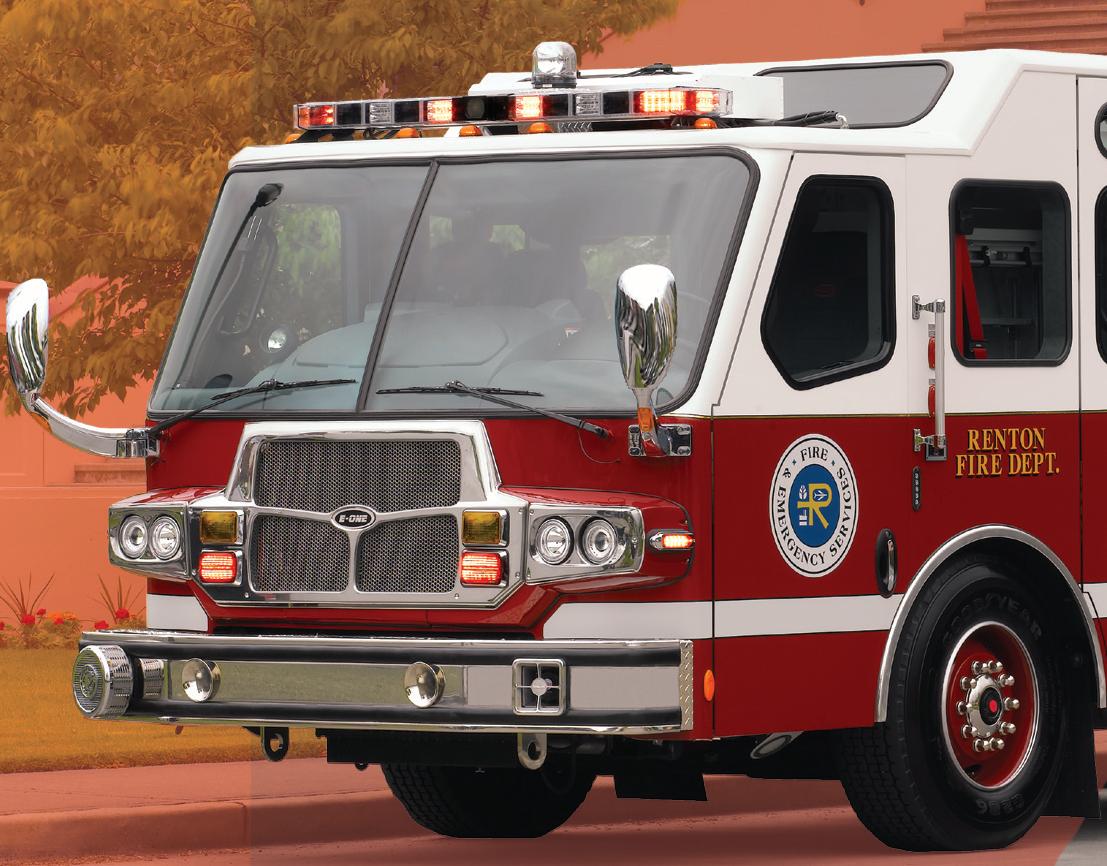
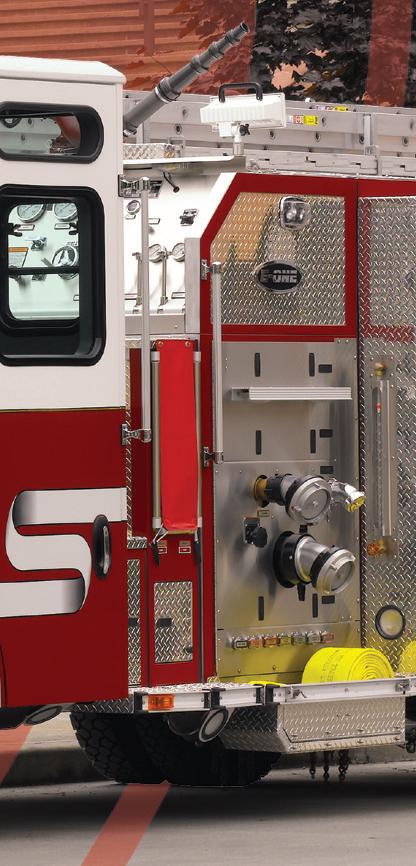
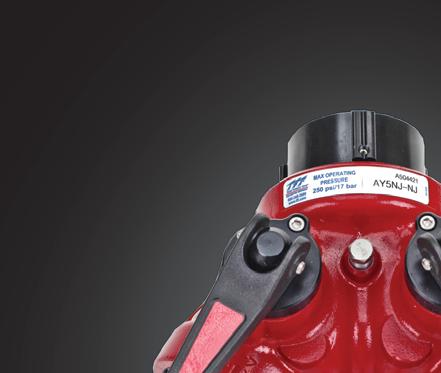
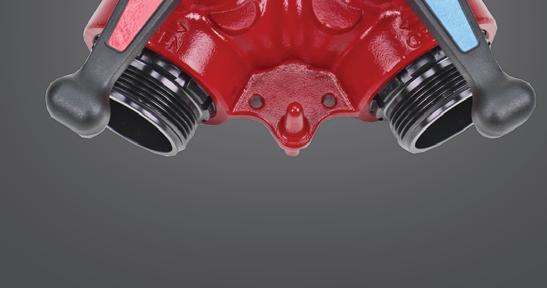
How can you protect against what you can’t see? The short answer - you can’t. That’s why we engineered The E-ONE Quest chassis with the best visibility in the industry. An expansive windshield and massive wipers provide best-in-class front visibility while the front cab-corner mirrors offer maximum side visibility. Plus, the ergonomically placed controls are easy to find, helping you keep your eyes on the road. Because when it comes to protecting your crew and all those that cross your path, shouldn’t you see what’s coming?
Learn how to Protect Better at E-ONE.com.
For more information, contact your nearest dealer:
Carrier Emergency Equipment
6 Edmondson Street
Brantford, ON N3T 5N3
Phone: 519-752-5431
Territory: Ontario; Atlantic Provinces
Carriere Fire and Safety 369 Archibald Street Winnipeg, MB R2J 0W6
First Truck Specialty Vehicles 18688 96th Avenue Surrey, BC Canada V4N 3P9
Phone: 604-888-1424
When lives are in the balance and seconds count.
Techno Feu Apparatus Maintenance 105 Marie -Victorin St. Francois-Du-Lac, PQ J0G 1M0
Phone: 450-568-2777
Territory: British Columbia, Alberta, Yukon, Northwest Territory
Territory: Quebec
DON’T BUY IT BECAUSE THE PRICE IS IRRESISTIBLE.
BUY IT BECAUSE THE OPTIONS AND PERFORMANCE ARE OUTSTANDING.
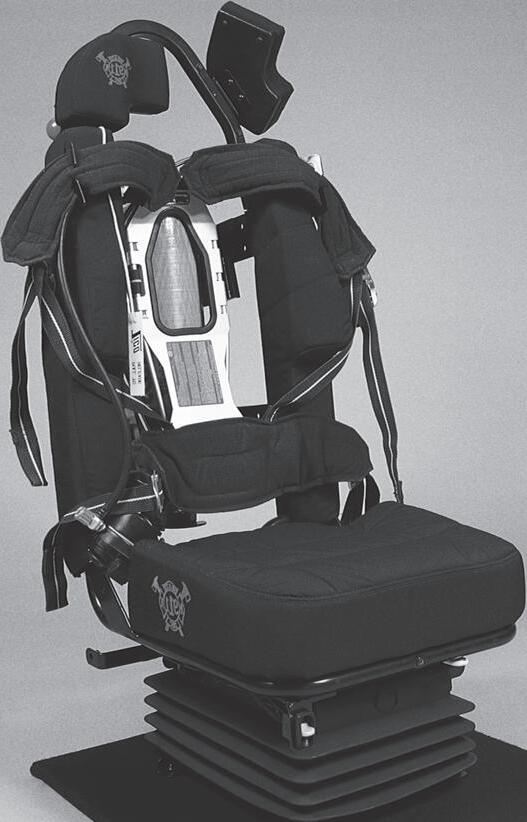
You know the value of hard work. So should your apparatus. The Responder™ is your best-of-both-worlds workhorse –packing a ton of custom features into a commercial configuration. You’ll value the 1250 gpm pump that makes service a breeze. And pump-in-motion and low pre-connect give you the ultimate in ease of use. An optional center SCBA seat, EMS/storage areas and full height compartments on both cab sides give plenty of flexibility for hard working departments on a budget. And because it’s built by Pierce, you know no compromises were made. Go with the truck that understands your values – the Responder. Value. Driven.
12
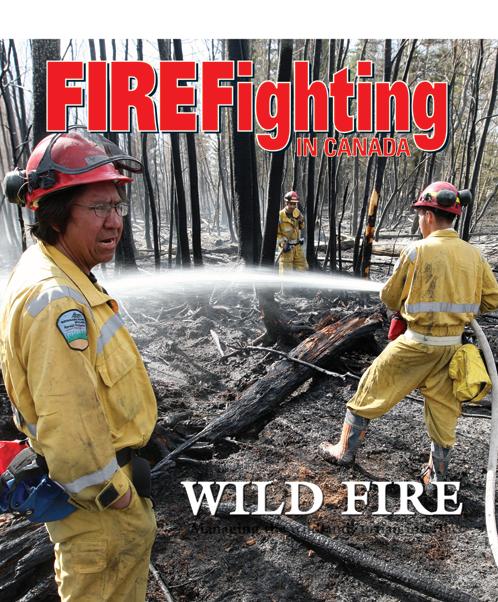
WILD FIRE
As Canadian communities expand, fires that used to burn deep in the country’s forests are encroaching on subdivisions that are being built deeper into the woods, away from bright lights and big cities. As James Careless reports, many Canadian fire departments have learned the hard way how to manage the wildland/urban interface.
26
FIRESTORM 2003
In 2003 in British Columbia, more than 250,000 hectares were consumed in the worst fire season on record. Paul Dixon reports on changes to the emergency operations structure and the willingness to co-operate that has become the legacy of that miserable summer.
30
HIGH-FLYING ACCOMPLICES
Already this spring Canadians have seen images of water bombers and helicopters putting out brush fires in Nova Scotia and British Columbia. As Blair Watson reports, planning for the spring/ summer fire season and maintaining the necessary equipment is crucial to managing forest fires and wildland/urban interface fires.
BY LAURA KING Editor lking@annexweb.com
W
COMMENT
Wildfire education, prevention
hen we set out months ago to plan this issue on managing the wildland/urban interface we knew we had some gripping stories to tell and some overwhelming experiences from which to draw. We didn’t expect that as the stories went to our the proofreader on April 30, the Halifax Regional Fire & Emergency Services would be back at it, fighting another massive blaze and trying to save homes in subdivisions.
The same week that 800 hectares burned in the Spryfield area of Halifax (eight homes were gutted and 1,200 people forced from their homes) there were forest or brush fires in B.C. and Saskatchewan. Since then, there have been fires in Quebec and Newfoundland.
As Jim Murphy, a fire advisor for the Ontario Ministry of Natural Resources, tells James Careless in our cover story on page 12, most wildland/urban interface fires at this time of year are caused by people and carelessness, and happen fairly close to the wildland/urban boundary. No surprise there.
the forest fires up north. I was in beautiful Kelowna in 2007 for the B.C. fire chiefs conference, four years after the firestorm swept through the Okanagan, by which time much of the devastation had been rebuilt or had grown over. Just before writing this, I received a photo from a B.C. chief of one of the massive wildland/urban interface fires in Santa Barbara, Calif. Thankfully, such fires in Canada have been smaller and less deadly than those in the U.S. Still, if the number of wildland/urban interface fires is indeed growing, what can we do to change that pattern?
ON THE COVER
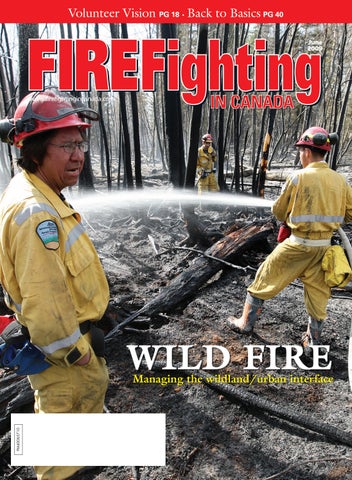
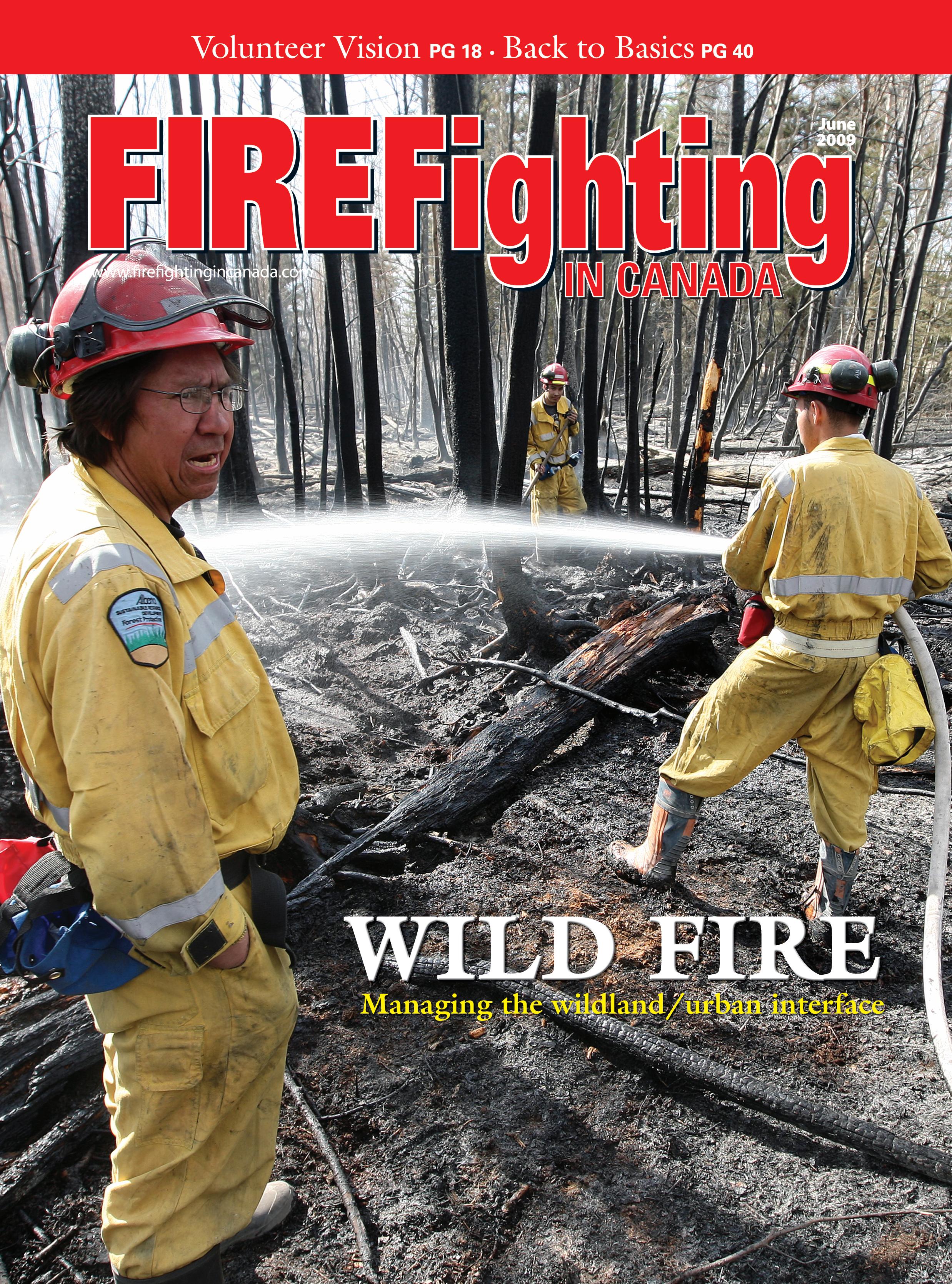
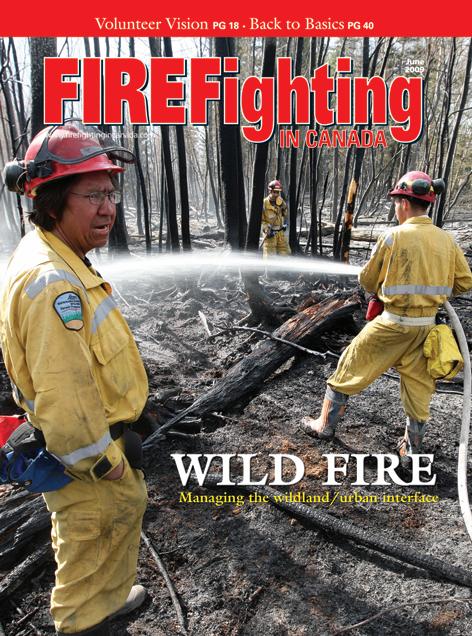
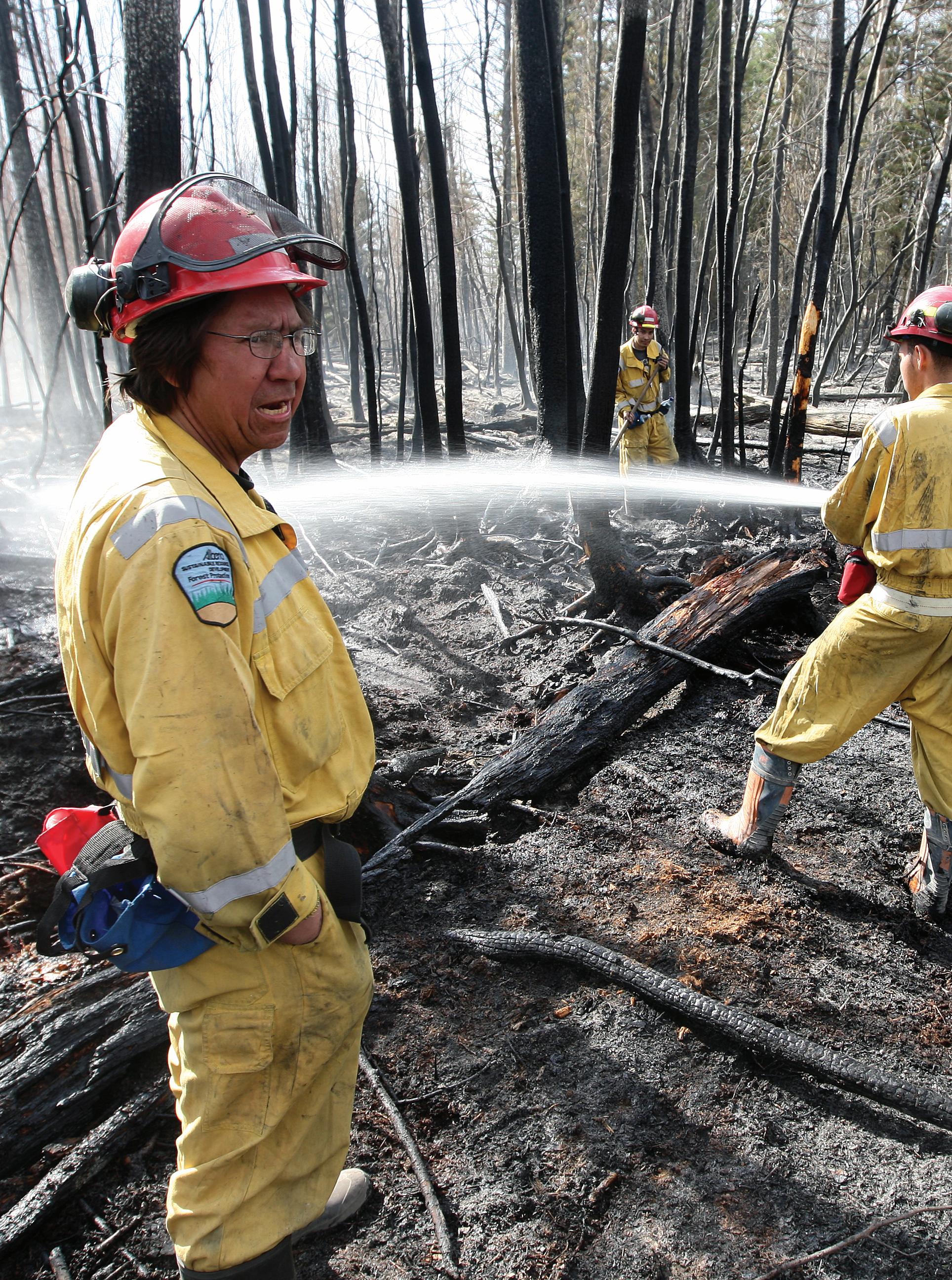
Contract firefighters from Sucker Creek First Nation near High Prairie (front to rear) Vincent Willier, Johnny Calliou and Tyler Willier battle a wildfire north of Josephsburg, Alta., on May 6.
Statistics from Natural Resources Canada don’t differentiate between forest or brush fires and wildland/urban interface fires so it’s tough to determine how many of the approximately 8,500 fires that consume about 2.5 million hectares of Canadian wilderness every year are considered urban interface fires. To observers it certainly seems like the numbers are going up as urban sprawl infringes on previously untouched forest land.
When my family lived in Edmonton we could often see and smell the smoke from
You know what’s coming. One word: education. Kelowna Fire Chief Rene Blanleil and his crews have embraced a wildfire education plan and as Ed Brouwer – a wildland fire trainer for Canwest Fire in B.C. – outlines in his Trainer’s Corner column on page 32, there are dozens of steps homeowners can take to reduce risks to their properties during wildfire season.
The term defensible housing seems to just be catching on. It’s a buzzword we all need to embrace, to teach and to start pushing, the same way we did for smoke detectors, carbon monoxide detectors and residential sprinklers. It’s an uphill battle to convince municipalities and the seemingly all-powerful developers to consider things like wildland/ urban interface fires when they allow urban sprawl. But it’s a battle we can win.
PRODUCTION ARTIST KRISTA MISENER kmisener@annexweb.com
GROUP PUBLISHER MARTIN MCANULTY fire@annexweb.com
PRESIDENT MIKE FREDERICKS mfredericks@annexweb.com
PUBLICATION MAIL AGREEMENT #40065710
PAP Registration #8885
RETURN UNDELIVERABLE CANADIAN ADDRESSES TO CIRCULATION DEPT.
P.O. Box 530, SIMCOE, ON N3Y 4N5 e-mail: lmorrison@annexweb.com
Printed in Canada ISSN 0015–2595
CIRCULATION e-mail: lmorrison@annexweb.com
Tel: 866-790-6070 ext. 206
Fax: 877-624-1940
Mail: P.O. Box 530 Simcoe, ON N3Y 4N5
SUBSCRIPTION RATES
Canada – 1 Year - $25.44 (includes GST - #867172652RT0001)
USA – 1 Year $50.00
We acknowledge the financial support of the Government of Canada, through the Publications Assistance Program and the Canada Magazine Fund, toward our mailing and editorial cost. Nous reconnaissons l’aide financiere accordee par le gouvernement du Canada pour nos coults d’envoie postal et nos coutl redactionnels par l’entremise du Programme d’aide aux publications et du Fonds du Canda pour les magazines.
From time to time, we at Fire Fighting In Canada make our subscription list available to reputable companies and organizations whose products and services we believe may be of interest to you. If you do not want your name to be made available, contact our circulation department in any of the four ways listed above.
All advertising is subject to the publisher’s approval. Such approval does not imply any endorsement of the products or services advertised. Publisher reserves the right to refuse advertising that does not meet the standards of the publication.
www.firefightingincanada.com
PHOTO BY JOHN LUCAS, EDMONTON JOURNAL
Ingleside, ON
STATIONtoSTATION
ACROSS CANADA: Regional news briefs Drivers education project launched
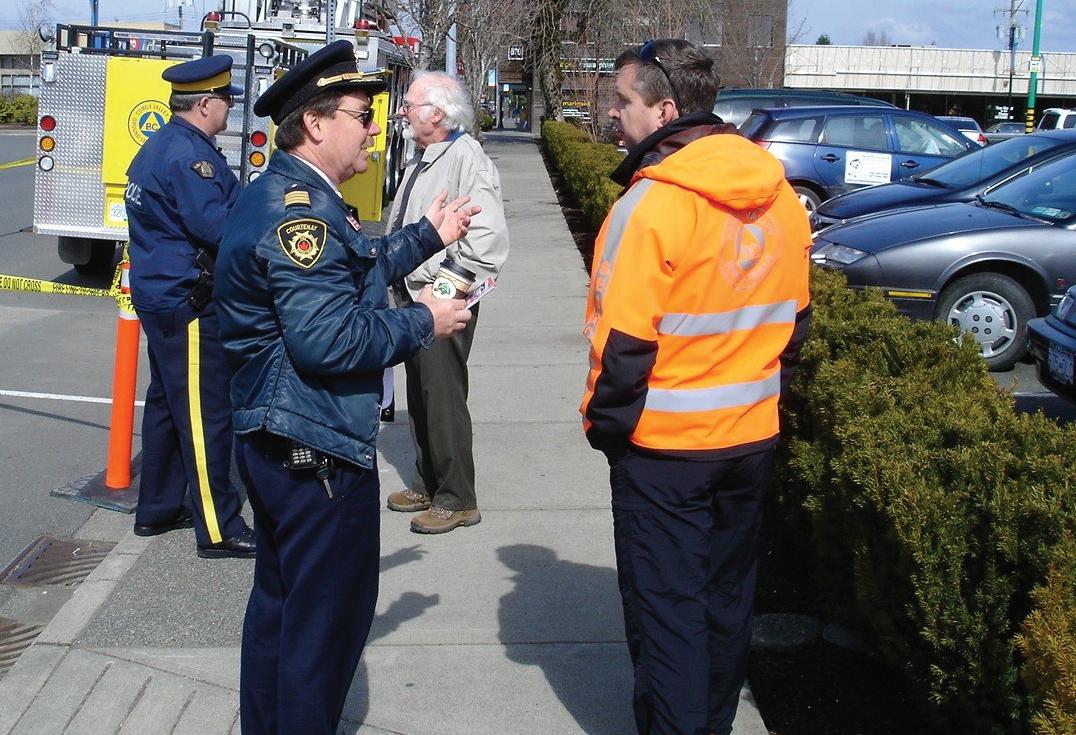
Fire departments in the Comox Valley in B.C. want drivers to know what to do when they see emergency vehicles on the road. The association, with the support of the Comox Valley Fire Chiefs Association, launched an educational program in April to outline correct procedures for drivers.
As part of the Emergency Vehicle Awareness Project, firefighters handed out pamphlets in malls and grocery stores in
the Courtenay and Comox areas. The pamphlets outline the goal of the project – to make more people aware of their responsibilities when approached by an emergency vehicle with lights and siren on. The pamphlets also include a section of the B.C. Motor Vehicle Act that explains the legal obligation of drivers to pull over and stop when approached by an emergency vehicle.
THE BRASS POLE
BEN NIVEN has been appointed chief of the Crossfield Fire Department in Alberta. Niven had been the deputy chief for the last three years and has been with the department for 11 years. Peter Pecksen has been appointed deputy chief. He has been with the department for 16 years.
NEIL BOOTH is the new fire chief for the Kelowna International Airport in B.C. Booth has 19 years’ service as a firefighter, fire officer and
The pamphlets list ways drivers can be more observant for emergency vehicles and the benefits that result from their co-operation.
In co-operation with other emergency responders, fire departments provided manpower and fire apparatus to draw attention to the need for public information about yielding the right of way to emergency responses.
The project was presented to the Comox Valley Fire Chiefs Association in 2008. It was unanimously accepted and was supported financially. The enthusiasm was based on the fact that many drivers of emergency vehicles encounter problems because so many other drivers do not know what to do when approached by an emergency vehicle.
If any agency is interested in developing a program or partnering with the program started in the Comox Valley, contact Frontline Fire Department Training at frontlinetraining@telus.net
assistant chief with the Airport Fire Services.
WAYNE BROWN has been appointed district chief of Station 3-8 in Vaughan, Ont. Brown had been an assistant district chief for the Vaughan Fire and Rescue Service.
WILLIAM SNOWBALL is the new fire chief in Markham, Ont. He had been a deputy chief since 2002 and acting chief for
Print benefits muscular dystrophy
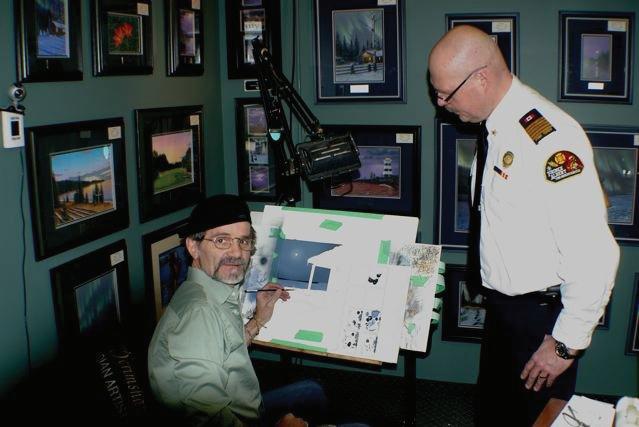
It’s strange how people are sometimes brought into our lives when we least expect it. That was the case when I received a call from Glen Scrimshaw. Glen is well known for his paintings and his philanthropic efforts. He will create a painting or series of paintings and donate sales from each print to a charitable organization. On average, he donates in excess of $150,000 annually to charitable organizations.
several months on two occasions in the last two years. Snowball joined Markham Fire and Emergency Service in June 1974 as a volunteer firefighter.
BOB DAVIDSON has accepted the position of deputy fire chief with the Norfolk County Fire & Rescue Services in Ontario. Davidson previously worked for the City of Brampton Fire and Emergency Services and brings with him more than 32 years
Police officers get out and about in the community to make residents aware of the Emergency Vehicle Awareness Project.
When I learned that Glen was interested in creating Artist Glen Scrimshaw and Prince Albert Fire Chief Les Karpluk.
his first fire print and that he wanted to reveal it at the Saskatchewan Association of Fire Chiefs Conference in April, I was more than excited. After many conversations with Glen, two common
themes emerged: the first was his passion to create Rescue and to be able to donate proceeds from the painting to Muscular Dystrophy and the Saskatchewan Burn Fund through the Saskatchewan
Training grant offered
■ CANADA
The Canadian Volunteer Fire Services Association and online training provider Medteq Solutions have partnered to make available $1 million in grants for firefighters who want to pursue online training.
The CVFSA believes online distance education is one way to ensure that all firefighters, volunteer or career, are prepared for every type of situation they encounter while on the job.
“The CVFSA believes in offering the volunteer firefighters the ability to train under
NFPA standards towards improving their skills with this unique approach of combining innovation with tradition,” said CVFSA president Martin Bell.
To help the CVFSA in its effort to assist some of the more than 3,000 Canadian volunteer and combination fire departments, online training provider Medteq Solutions has agreed to be the delivery partner for this training grant.
Grant applications are available at www.cvfsa.ca or www. medteqsolutions.ca.
Association of Fire Chiefs and the Saskatchewan Volunteer Firefighter Association; the second was Glen’s desire to honour the men and women in the fire service.
Please check out this fine
piece or artwork at http:// www.glenscrimshaw.com/artwork.php?piece=113 and support Glen in his efforts to support Muscular Dystrophy and the Saskatchewan Burn Fund. -Les Karpluk
CAFC pushes Parliament to pass safety legislation
Ottawa – The Canadian Association of Fire Chiefs has urged Parliament to give speedy approval to Bill C-6, the Canada Consumer Product Safety Act, which went to second reading in the House of Commons in April.
“A significant percentage of fire department calls in Canada are in response to unsafe products in the home and CAFC has long urged the government
to modernize and strengthen product safety laws,” said Saint John Fire Chief Robert Simonds, first vice-president of the CAFC.
“While we continue to be concerned about the manufacture and importation of unsafe, often counterfeit consumer products like candles and cigarettes, and the sale of matches and lighters to minors, we are particularly worried about the
increasing use of flammable chemicals in residential furnishings, toys and clothing,” said Simonds.
Simonds said the CAFC congratulates Health Minister Leona Aglukkaq on her efforts and those of her department, through consultations and this legislation, to limit risk to the health and safety of Canadians.
Bill C-6 will provide better oversight of consumer
products in Canada by improving the government’s ability to take timely compliance and enforcement actions when unsafe products are identified. It will also encourage compliance through higher fines and increased penalties for violators.
CAFC representatives were in Ottawa in April to speak to elected representatives and government officials about issues of concern to the fire services.
of public emergency service experience. He began his new position on May 11.
After 42 years of service, District Chief DAVID BALL retired March 31 from the King Fire and Emergency Services in Ontario. Ball began his firefighting career with the City of Toronto in October 1966 and joined the King City depart-
ment as a volunteer firefighter in November 1971. He rose through the ranks to become Nobleton’s Fire Chief in 1996 and, after the merger of the former Schomberg, King City and Nobleton fire departments in 2000, became the district chief responsible for Station 3-8.
Capt. JOHN LOCH, formerly with the Prince Albert Fire
and Emergency Service in Saskatchewan, died Dec. 31. He joined Prince Albert Fire in 1957 and retired in 1989 after more than 32 years of service.
BRUCE PAINE, 68, died Dec 31. He served with the ChathamKent Fire Department, Station 10 Orford, Ont., for 38 years and was deputy station chief.
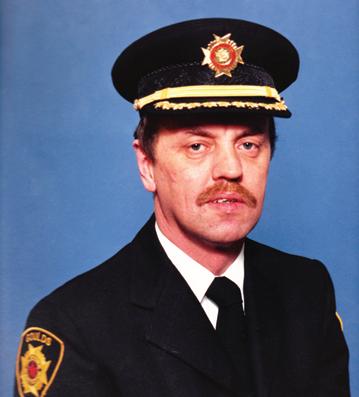
BRIAN BENNETT, an original and founding member of the
Volunteer Fire Department in Newfoundland, died April 2. Bennett served for more than 24 years, most recently as fire chief.
Goulds
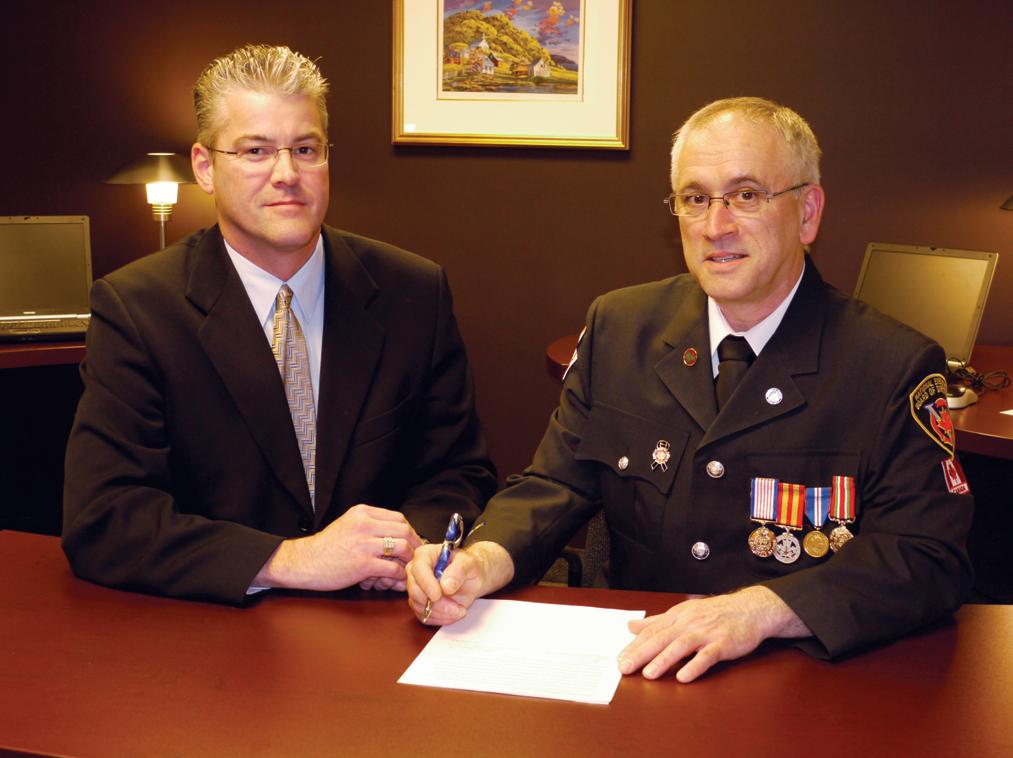
Medteq president Nelson Lawrence (left) and CVFSA president Martin Bell sign an agreement to offer $1 million in online training to Canadian volunteer firefighters.
PHOTO COURTESY MEDTEQ SOLUTIONS
STATIONtoSTATION BRIGADE NEWS
Volunteers honoured
■ NEW BRUNSWICK
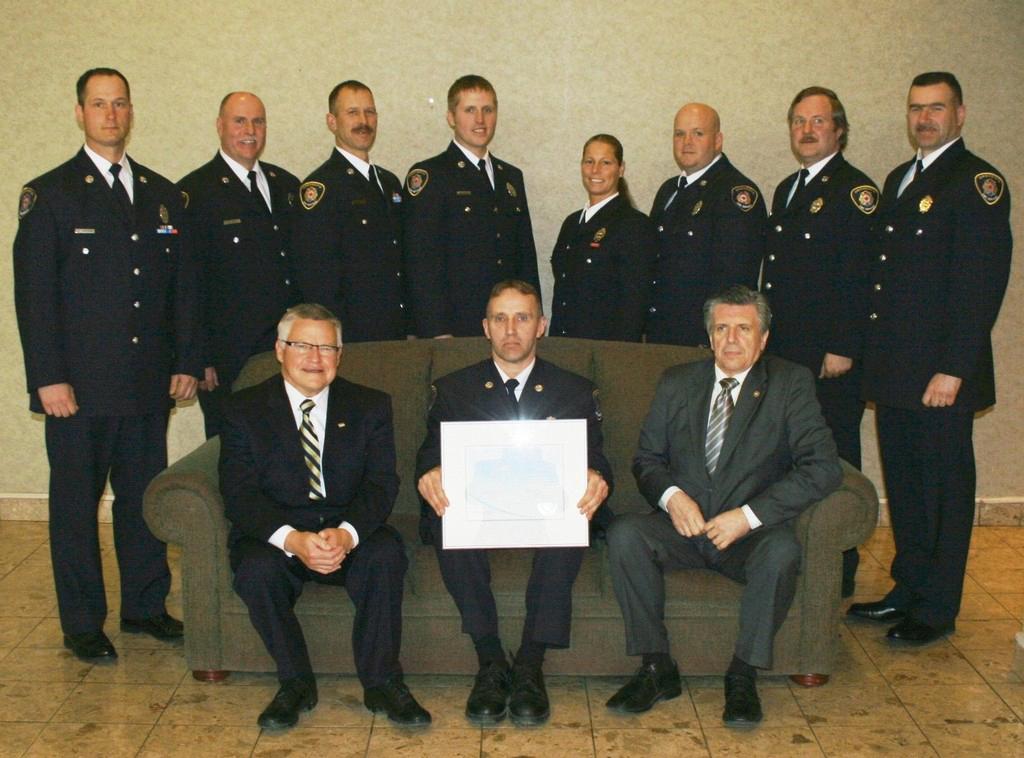
Volunteer firefighters in Oromocto, N.B., have been recognized with a provincial award for their service to the community.
Although served by a dedicated career firefighters, the Oromocto Fire Department augments its service with 30 volunteers. A majority of the volunteer firefighters also serve with the Canadian Forces at CFB Gagetown.
The award notes that over a 12-month period, volunteer firefighters contributed more than 6,360 hours. During the 2008 spring flood, they delivered food and water, pumped basements, accounted for residents, assisted with boat operations and rescued livestock.
Oromocto firefighters honoured include (back, from left) Michael Hawthorn, Bryce Firlotte, David Boudreau, Brad Merrett, Margaret McLean, Shawn Beals, James Haley and Greg Hawkins; seated (from left) Minister of Supply and Services Ed Doherty, Donald Tupper and Lieutenant Governor Herménégilde Chiasson.
Annex Bookstore winners
Congratulations to the Hudson Fire Department in New Liskeard, Ont., and Fire Chief Donald Leggett and Deputy Chief Shawn Morrow, winners of the new Sourcebook for Fire Company Training Evolutions , 3rd Edition, and The Last Men Out: Life on the Edge . New Liskeard won the draw at the Northeastern Fire Education Conference in Thunder Bay.
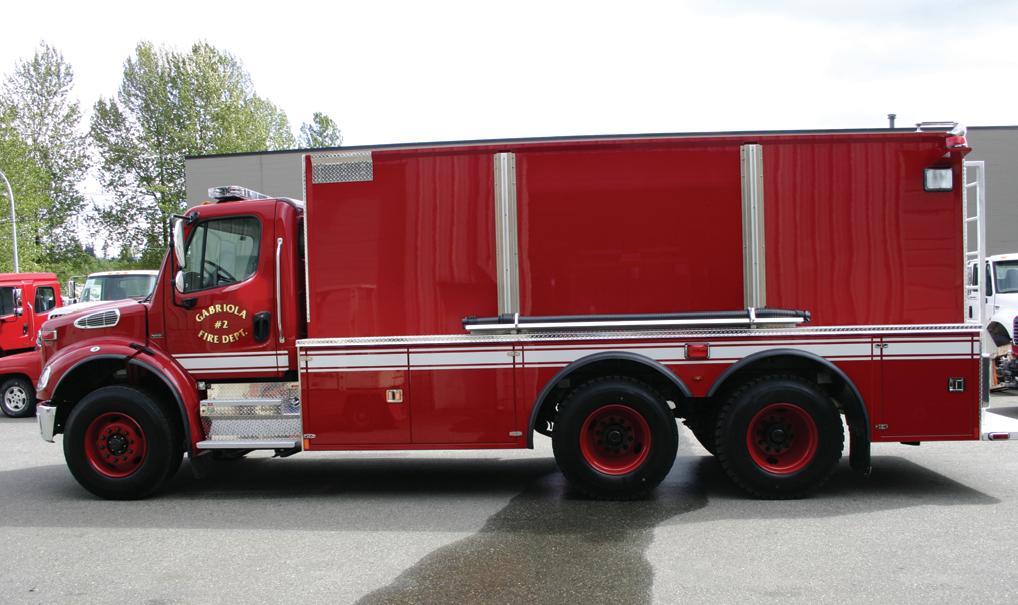
The GABRIOLA FIRE DEPARTMENT in British Columbia under Chief Rick Jackson took delivery May 8 of a Hub Fire Engines-built tanker. The tanker was built on a Freightliner m2112 chassis and is powered by a 410-hp MBE 4000 engine. The truck features a 13,000-litre co-poly tank and is equipped with a Darley portable pump.
The OSOYOOS FIRE DEPARTMENT in British Columbia under Chief Rick Jones took delivery in April of a Hub Fire Engines-built tanker. Built on a Freightliner m2 106 4X4 chassis and powered by a Cummins 300-hp engine, the tanker features an Allison 3000 EVS transmission, Hale HPW pump and a 7,000-litre co-poly tank.
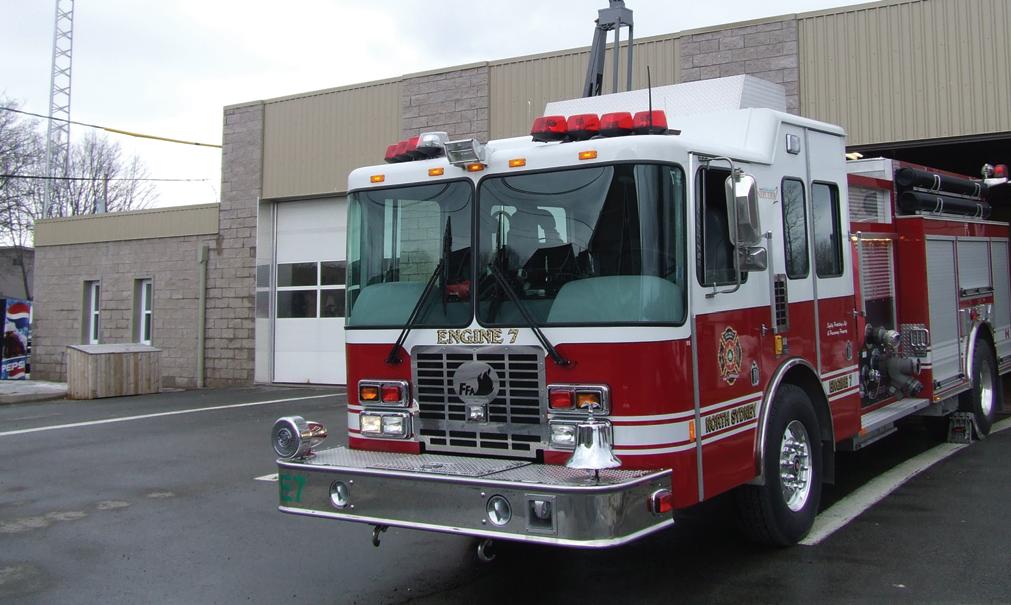
The NORTH SYDNEY FIRE DEPARTMENT in Nova Scotia, under Chief Lloyd MacIntosh took delivery in February of a Ferrara Fire Apparatus-built rescue pumper. Built on a Intruder 2 chassis and powered by a Cummins 330-hp engine, the pumper features a Hale 1050 igpm pump, Foam Pro 1600 foam system, 1,500-litre co-poly water tank, Command Light light-tower and Onan hydraulic generator.
GABRIOLA
OSOYOOS
NORTH SYDNEY
VERY
FEW THINGS CAN SURVIVE AN INFERNO.
OUR MISSION IS TO MAKE SURE YOU’RE ONE OF THEM.
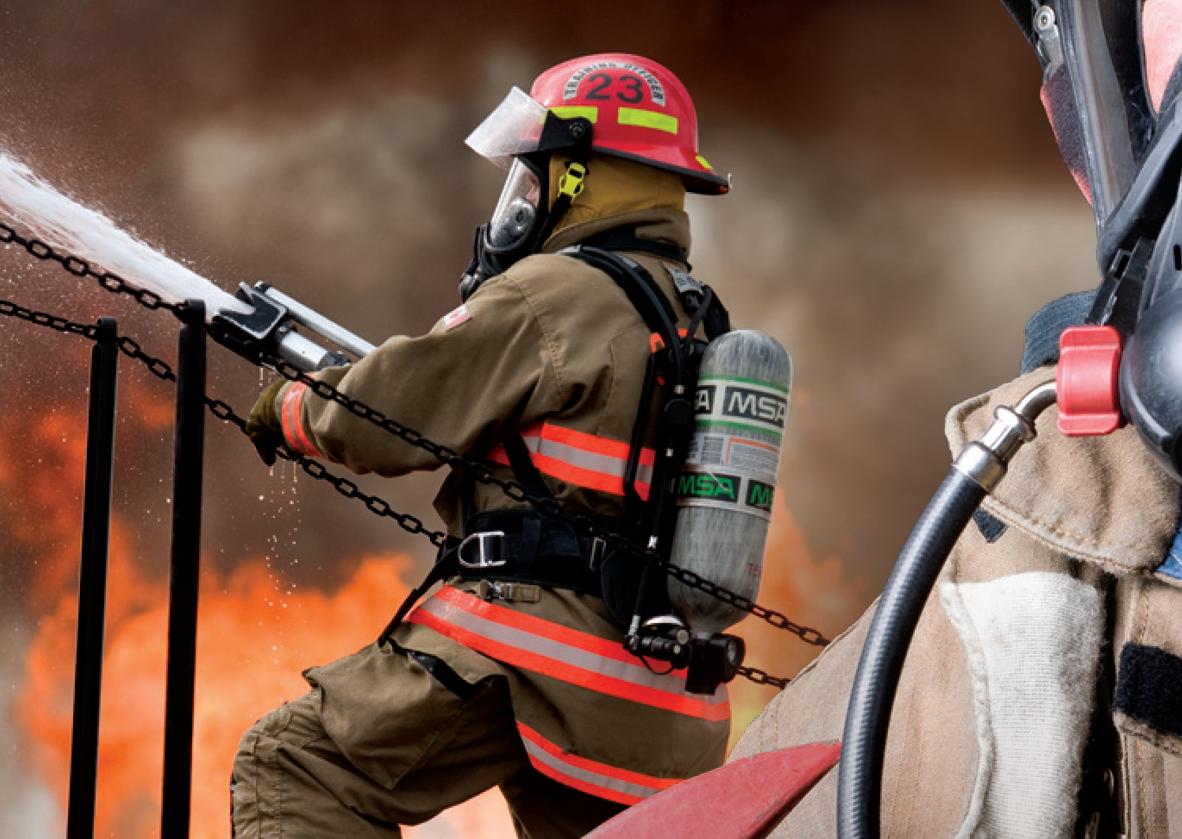
The flames build. The smoke gets thicker and more intense by the second. People are fleeing. And what do you do? You push forward ready to do battle. It goes against every natural human instinct. But then again, firefighters are a different breed. For your infinite courage and selfless dedication, we salute you. But more importantly, we’re going to do everything we can to protect you. We’re MSA. And we equip firefighters with the most advanced thermal imaging cameras, helmets, air masks and gas detection devices available. Coincidentally, we’re somewhat of a different breed ourselves. You see, we’re a safety innovations company that’s been on a relentless crusade to protect lives for more than 90 years. Today we protect firefighters, soldiers, construction, iron and steel workers, oil riggers, utility workers, miners, consumers and hundreds more. Wherever there are workers who need to be protected, we will be there.
WILD FIRE
Managing the wildland/urban interface gets more difficult as urban sprawl takes hold in Canadian communities
By JAMES CARELESS
LEFT: Contract firefighters from Sucker Creek First Nation near High Prairie (front to rear) Vincent Willier, Johnny Calliou and Tyler Willier battle a wildfire north of Josephsburg, Alta., on May 6.
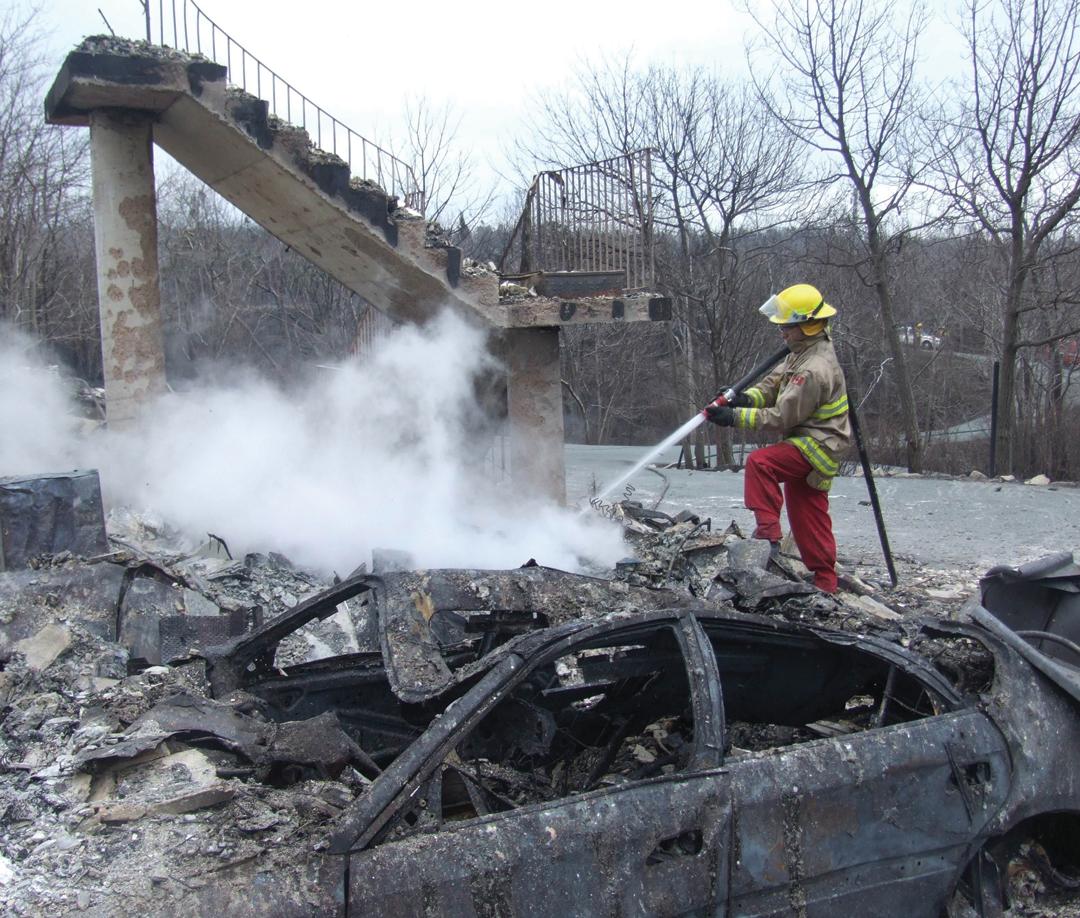
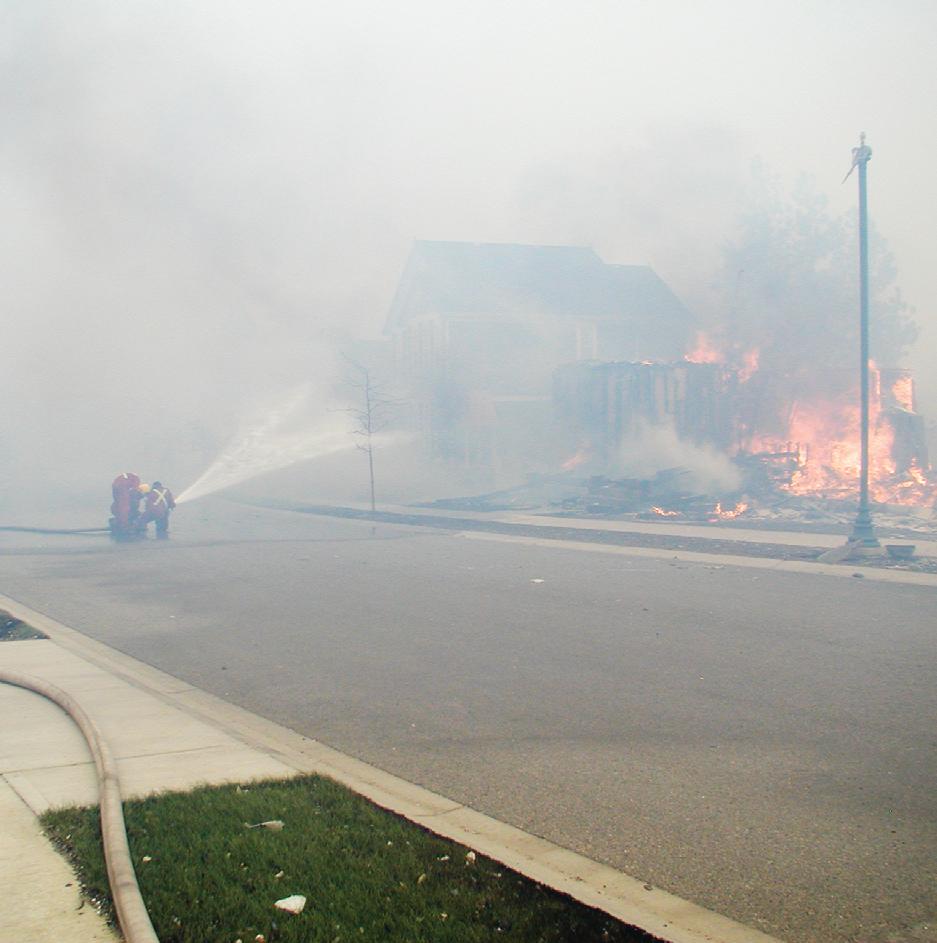
ABOVE: Firefighter Steve Gallant of Station 58 (Lakeside) wets down the still smouldering ruins of this home on the third day of the fire.
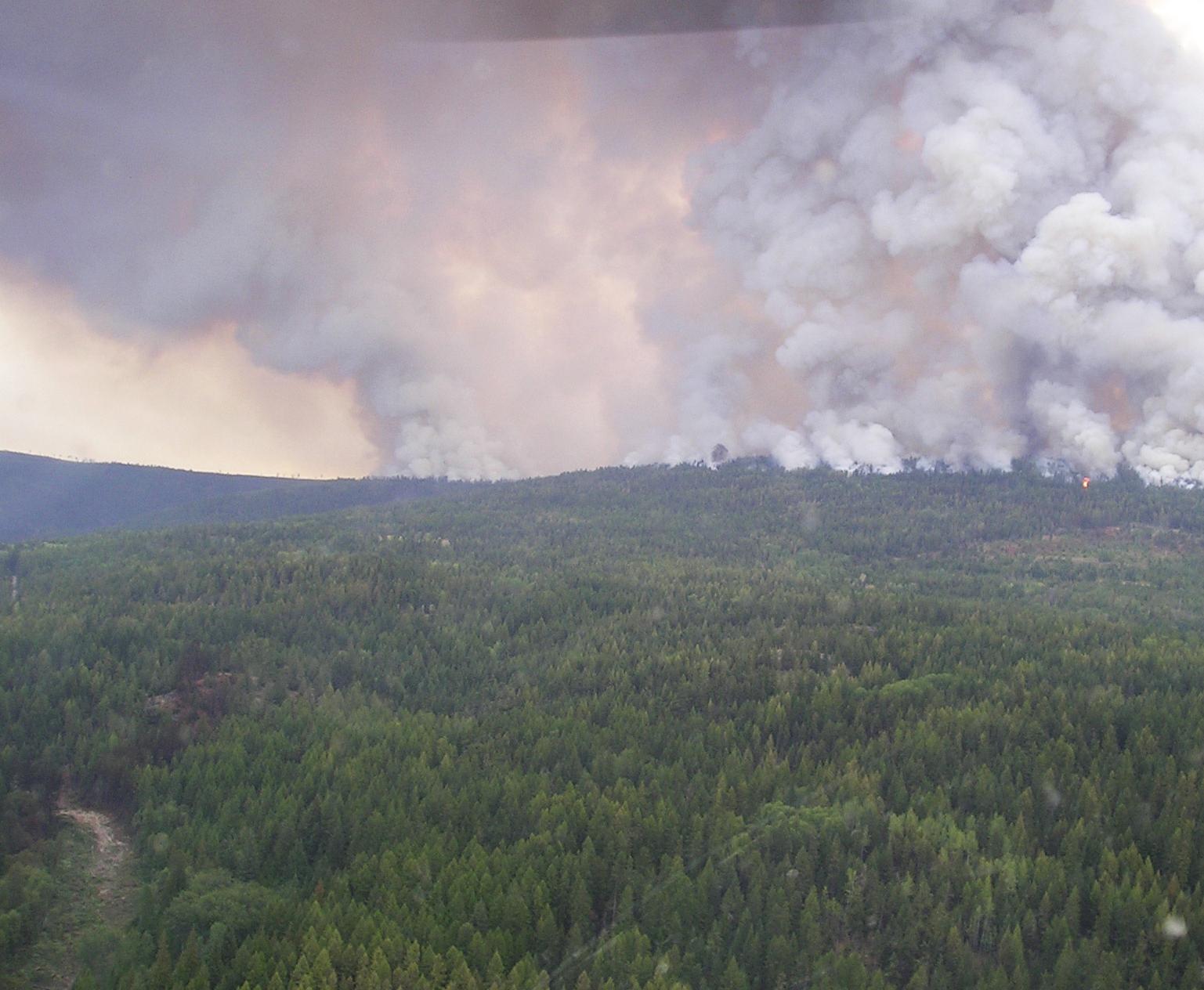
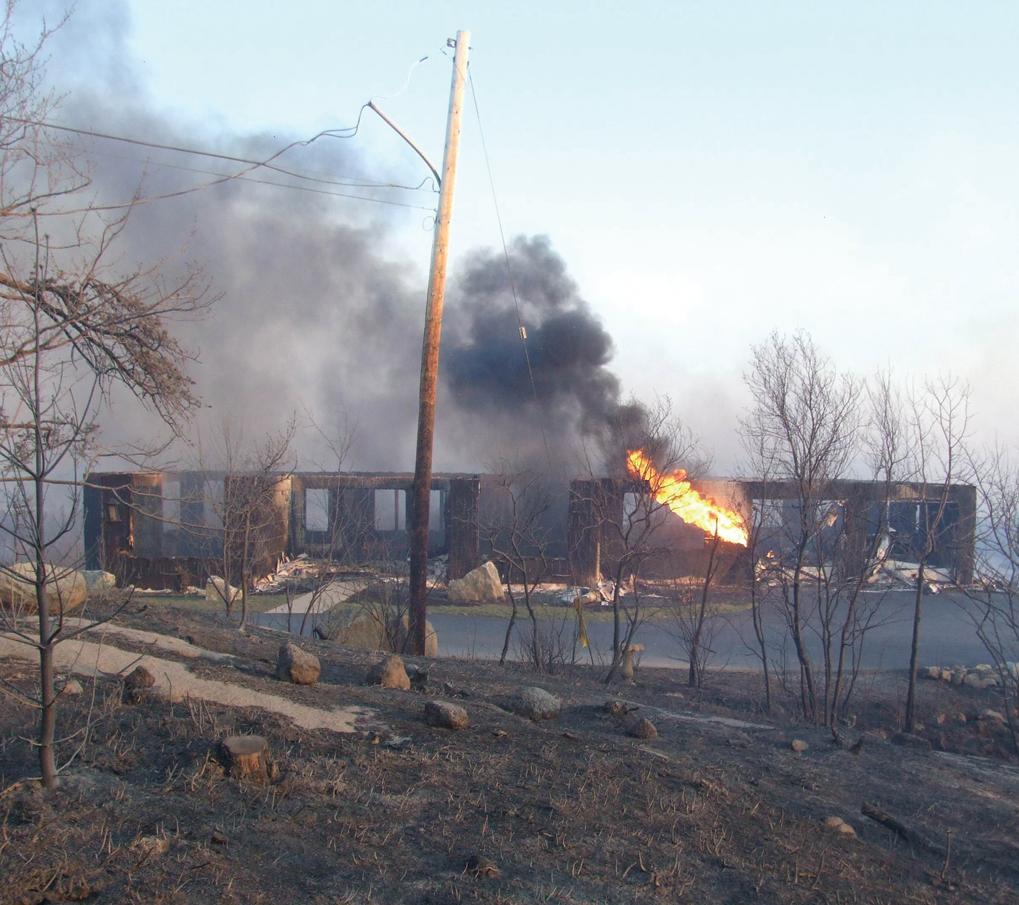
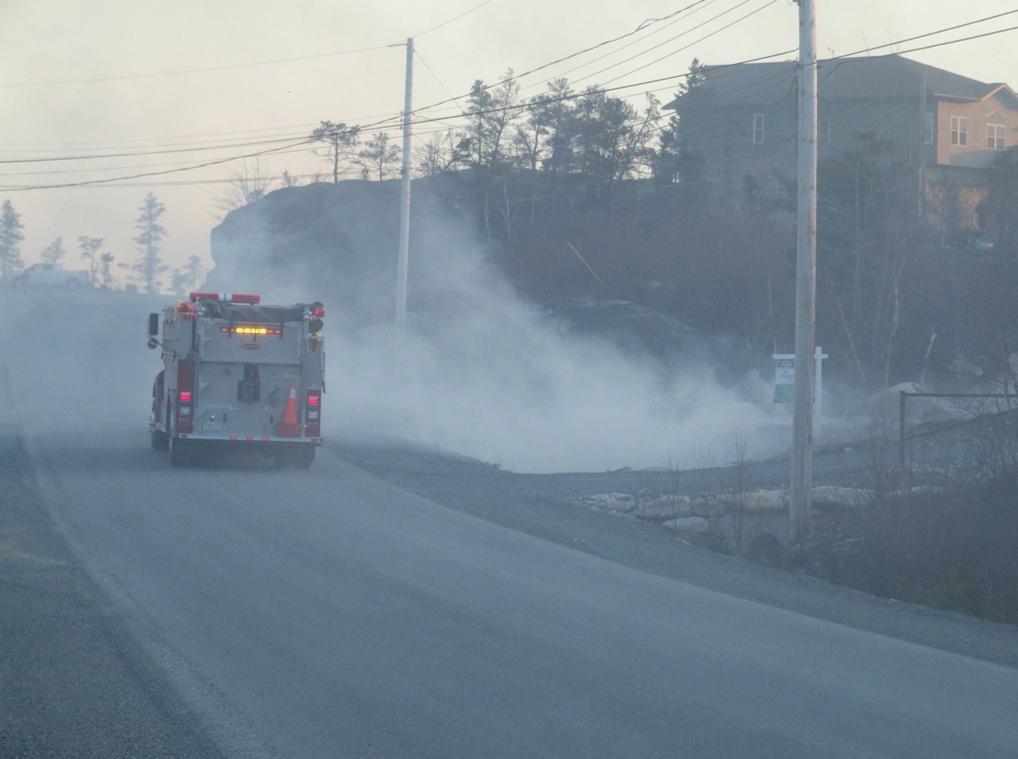
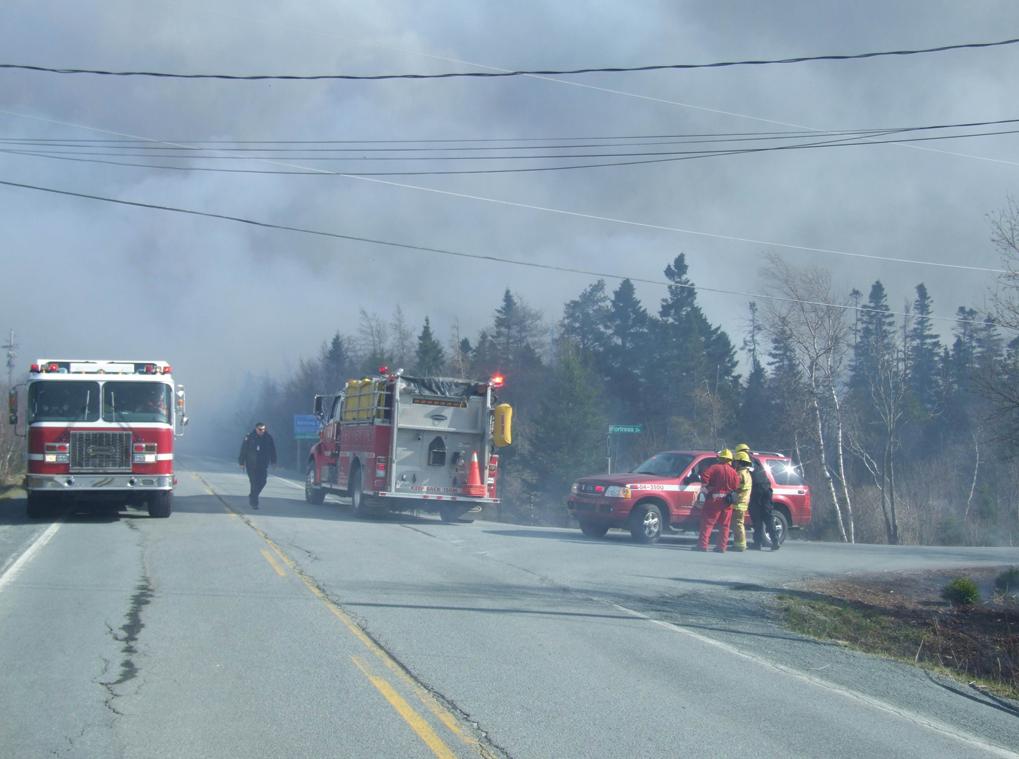
On April 30, just 11 months after the Halifax Regional Fire & Emergency Service battled one of the worst wildland/urban interface in the province’s history, another fast-moving consumed 800 hectares of land north of Halifax and forced 1,200 people from their homes.
The Halifax-area fire, fuelled by debris on the ground from Hurricane Juan in 2003, was the first of several such fires that last week of April and one of thousands that will burn more than 2.5 million hectares this year.
As Canadian communities expand, fires that used to burn deep in the country’s forests are encroaching on subdivisions that are being built deeper into the woods, away from bright lights and big cities. As many Canadian firefighters know, this suburban sprawl causes major headaches.
Two of the worst recent urban/interface fires – the June 2008 Lake Echo/Porters Lake blaze around Halifax that consumed 2,500 hectares and sent 30,000 people out of their homes, and the devastating 2003 Okanagan Mountain Provincial Park blaze on the outskirts of Kelowna, B.C. – provided valuable lessons for firefighters.
■ ENCROACHMENT
Kelowna Fire Chief Rene Blanliel says drought conditions, high winds and the fuel load created by beetle-killed ponderosa pine turned a 10-hectare fire caused by a lighting strike to grow into a Rank 6 firestorm that demolished 27,000 hectares.
“It got to the point that all we could do was get everyone out of the firestorm’s path, then see what could be salvaged afterwards,” he says.
The Okanagan fire destroyed 239 homes. The 60 fire departments, 1,000 firefighters,1,400 armed forces troops and five water bombers were largely helpless in the face of one of Canada’s worst wildland/urban interface fires.
Like this spring’s Halifax fire, most springtime fires are wildland/ urban interface fires caused by human activity, says Jim Murphy, a fire advisor for the Ontario Ministry of Natural Resources.
“The reason urban/rural interface fires are often devastating is because this is where people meet the wildland areas; more and more intermixed areas are cropping up,” he says.
“All areas are dead, cured fuel in spring so there is lots of fuel for fire to burn. Also, there is often little time to react; usually more defensive strategies are needed instead of offensive.”
Roy Hollet, deputy chief director at Halifax Regional Fire and Emergency Services, knows wildland/urban interface fires only too well. He says interface fires are common in the region because of the urban sprawl.
“These homes are located in the wildland/wood and in most cases the trees/brush is allowed to grow too close to the home. In this case, once a wildland fire starts, it is able to spread to residential areas (pending terrain and weather conditions) with relative ease.” (See Trainer’s Corner, page 32.)
Wildland/urban interface fires are tough to fight because they happen in areas without hydrants, and are often tough to get to.
But like the Halifax fire in late April/early May, the biggest challenge is that most of these fires happen in grassy areas, or fine fuel areas, says Nolan Shortt, a fire advisor with Ontario ministry.
“Fine fuel fires tend to spread fast and react quickly to changes in wind speed and direction,” he says. “It is a possibility that by the time the fire department arrives the fire could have already spread to values [homes and other buildings].”
■ LESSONS LEARNED
Since fighting urban/rural interface fires is so difficult, seasoned agencies such as the Kelowna Fire Department spend a lot of time trying to reduce the threat.
“We work hard to educate homeowners as to the importance of removing deadwood and brush from their properties,” says Chief Blanleil. “We also urge new home builders to keep their sites as clear of debris as possible, and to design their developments to allow easy access of fire equipment and evacuation of residents.”
One effective educational tool is the FireSmart booklet developed by Partners in Protection, which is available for free at http://www.partnersinprotection.ab.ca/ downloads/. (See also www.getprepared.ca)
“The biggest factor that contributes to the interface fires is the lack of knowledge,” says Shortt.
WILDFIRE FACTS
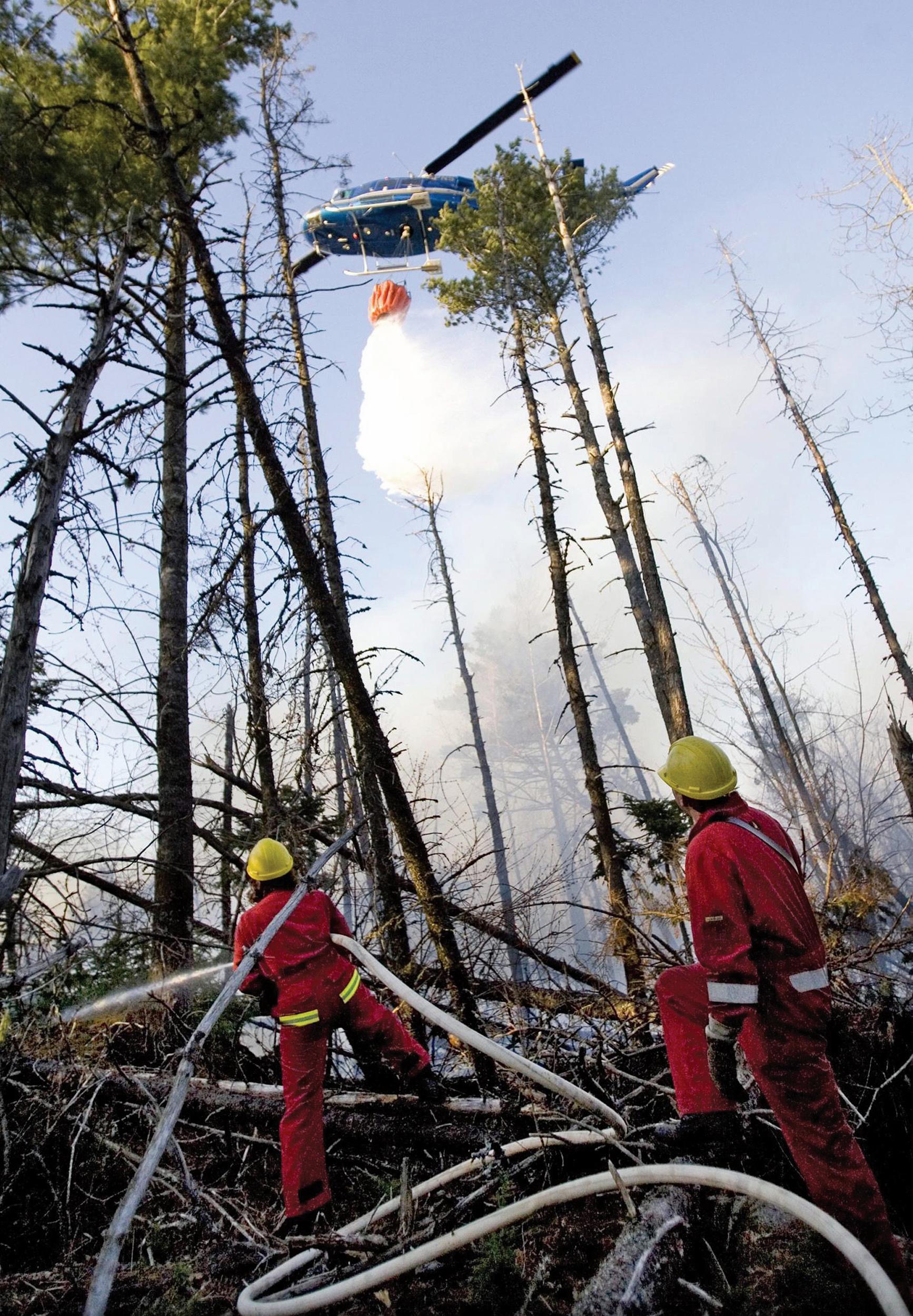
Halifax regional firefighters are aided by a helicopter dropping water while fighting a brush fire on April 30.
Educated homeowners who reduce the risk of interface fires by keeping the fuel load down certainly helps but interface fires will still occur and firefighters will still have to put them out. And that means urban fire departments need to train for wildland/ urban interface fires.
Just like live fire training for structural fires, it’s imperative that firefighters get out into the wildland/urban interface to find out what they may be up against, including bad roads and no municipal water.
“If you do not drive the back roads, how can you know where to go?” says Don Henry, who chairs the International Association of Fire Chiefs’ apparatus maintenance section committee.
“Just as you need to drive the city to understand the roads and obstacles that this territory entails, so you need to drive the urban/rural interface to know this area well when you do have to respond.”
Henry also notes that trucks with high bumpers, four or six-wheel drive and transmissions with deeper reductions are needed to operate off road and in hilly terrain.
He also recommends using compressed air foam for wildland/urban interface fires.
“If you thought that water put out fire better then dirt, then you should see what compressed air foam does,” Henry says. “People often think that CAF is only for big city departments, but its true value is with small rural departments that have a water shortage. Yes, compressed air foam is a bit more complicated both from an operational and maintenance point of view, but when it comes to fighting urban/rural interface fires, it’s worth it.”
Halifax’s Deputy Chief Hollet recommends that city firefighters take courses on
Continued on page 24
Approximately 8,000 wildfires occur in Canada each year, consuming 2.5 million hectares.
The cost for suppressing forest fires ranges between $300 million and $500 million annually.
Fires caused by lightning represent 45% of all fires, but because they occur in remote locations and often in clusters, they represent 81% of total area burned.
Human-caused fires represent 55% of all fires. They occur in more populated areas and are usually reported and extinguished quickly.
The regions with the highest wildfire occurrence are British Columbia, and the Boreal forest zones of Ontario, Quebec, the Prairie provinces, and the Yukon and Northwest Territories.
www.getprepared.ca
PHOTO BY TIM KROCHAK, HALIFAX CHRONICLE HERALD
BY E. DAVID HODGINS Managing Director Alberta Emergency Management Agency
ALEADERSHIPFORUM
Recession challenges leaders to be effective
story in the March 13 Montreal Gazette says: “The police and fire departments are on the hook for $21.45 million of Mayor Gerald Tremblay’s $155 million budget-cutting exercise.” The fire department has been told to cut $7.6 million.
A headline in the March 16 Chronicle-Herald in Nova Scotia, says “Volunteer fire chiefs fight for funding”. The story quotes Emergency Health Services spokesman Paul Maynard: “They keep referring to hard economic times,” he says. “They’re not willing to give us the funding.”
What effect does the current state of the economy have on your department? How should leaders in fire/rescue and emergency management react? These are tough yet pragmatic questions. I recently read another newspaper account about London, Ont., which is requesting that its police and firefighter associations accept an across-the-board voluntary wage freeze. The president of the firefighters’ association responded that the city needed to show him its books and that city officials had better come prepared with lots of information and not just a general statement about times being tough. The police association administrator said he wanted to ensure the city was not squandering money on so-called soft services while putting his members and the public at risk. It doesn’t take much imagination to gauge the reaction of the city’s senior administrative and elected officials.
I have seen many different responses from senior emergency services officials when asked to develop operating budgets to address financial challenges. The typical knee-jerk response is: “No way, not us – we’re special.” Then comes the threat that any cuts will put the response staff and public at risk. This is the old babies-will-die-in-their-sleep approach that was used to frighten senior administrators and elected officials in the hope they wouldn’t reduce the emergency services budget. Hopefully, this tactic has been abandoned.
first-rate corporate citizens. When I refer to leaders, I mean individuals from both management and the associations. Dealing with cuts is tough and the degree to which you will feel the heat depends on your rank or role in the department. If you are at or near the top of the organization, a lot of heat will be applied to you from beneath to just say no. There will also be significant pressure from those above you to find economies similar to those found by other corporate departments.
This is where true leaders shine. Innovative thinking and great ideas often come about as a result of adversity. In the words of Albert Einstein: “In the middle of every difficulty lies opportunity.”
The first thing good leaders do is talk to all members of their departments. If there are savings to be found, the people on the front line will have the best ideas. At the same time, it’s the staff who will be expected to operationalize budget-reduction strategies. You need to look for opportunities to fine-tune programs and service delivery and to generate revenue. Don’t immediately offer up resources that will reduce emergency response services. In the interest of your long-term success, don’t play that game.
Innovative thinking and great ideas often come about as a result of adversity. ‘‘ ’’
Given the dramatic and negative impact of the economic crisis, it’s time for real leadership in the fire service. Any response that suggests we are special and should be immune from having to work with the limited financial resources available is not an option.
Now is the time for fire service officers with business and political acumen to demonstrate their leadership skills and be
David Hodgins in the managing director, Alberta Emergency Management Agency. He is a former assistant deputy minister and fire commissioner for British Columbia. A 30-year veteran of the fire service, he is a graduate of the University of Alberta’s public administration program and a certified emergency and disaster manager. Contact him at David.Hodgins@gov.ab.ca
Pennsylvania’s joined-up fire and emergency management program implemented a strategy to generate revenue to address financial challenges. It collected 10 per cent of all traffic fines and used the money to fund fire-training programs. The rationale was that firefighters need training to respond to motor vehicle collisions and the drivers who cause the most collisions should pay for the training through fines. Another great idea comes from Maryland, which added $1 to the cost of every motor vehicle licence plate issued and entirely funded its world-class air ambulance program. What could you do in your jurisdiction?
To sit back and ignore the challenge in the hope that it will go away or to aggressively push back and say no are not options. I am not suggesting that you let others run roughshod over what should be your decision. Rather, make sure you are part of the solution, not the problem.
BY BRAD PATTON Chief Centre-Wellington, Ont.
PVOLUNTEERVISION
Platooning –a wild and crazy idea
erhaps it’s about money or community; or it could be that people just don’t like change.
It’s getting more difficult to understand volunteer firefighters. I appreciate that we have different personalities. Some would call this the clash of generations X, Y and Z. As I like to put it, one generation likes doing things the old way, another likes the show and the third just likes the money.
This grouping does not fit everyone; there are a lot of wellrounded rational thinkers too. However, if you look at large groups of people they often fit into one of these categories and the difficulty comes when you get them all in one station at the same time and then tell them you’d like to do things differently. That’s when I’d rather be riding the tailboard of a pumper going down a washboard gravel road on a hot day than be a fire chief.
Recently, I brought up the idea of platooning our stations, meaning that only half of the station’s firefighters would be paged out for carbon monoxide and medical alarms. Everyone would still be paged to all other alarms – fires, motor vehicle accidents and rescues. The platoons would alternate weekly. When I presented the idea to get some input from everybody, you would have thought I had sold their homes and families and drank their last beers. It was ugly. The guys were emotional and they didn’t like the idea one bit.
Two years ago, many of today’s members were applying to be volunteer firefighters, going though the hiring process, then recruit training. They were full of “Yes sirs”, “No sirs” and “Anything to help, sir”. Then they were assigned to the station did a couple of hundred runs, and now they own the work – they jumped to the cause of their brother firefighters and with all the passion of a raging bull, let me know that platooning is a bad idea and that they know what’s best for the community and the fire department. If I had started platooning a day before they started as volunteers, it would have just been the way we do business, no big deal.
25? Carbon monoxide and medical alarms are one-truck calls that require a maximum of four firefighters. Many places do it with three. I thought, who wants to get paged out at two in the morning for a C/O alarm when there is no chance of making the responding apparatus? You get up, get dressed, rush down to the hall, place a tick beside your name so you get paid and your attendance is recorded, then go home back to bed. Or, perhaps you leave your employer to figure out how to get along without you while you go down to the station just to sign in.
I really thought platooning was a good idea but I ended up feeling like WKRP’s Les Nessman when he thought turkeys could fly. I hoped platooning would give firefighters, their families and their employers all a bit of a break and save the municipality a few dollars.
It’s hard to figure out people at the best of times and it’s even harder when they are in large groups with different values. Onethird argues that this proposed change would impact life safety; another third sees this potential change as nothing more than taking their money away and cutting costs or reallocating funds within the department from their wages; and another group sees it as taking
I thought, who wants to get paged out at two in the morning for a C/O alarm . . . ‘‘ ’’
I tried to explain my thoughts on platooning, which went over like a solid lead balloon. I said that just under half of our calls are what I described as platoon calls or alarms that require low manpower. The ambulance is sending just two people, so why am I paging out
Brad Patton is the fire chief for the Centre Wellington Volunteer Fire & Rescue Department in Ontario, one of the largest volunteer departments in the province. Brad has been though three major municipal amalgamations in his career and after 30 years of service still enjoys his job! Centre Wellington has a population of 28,500. The department responds to more than 550 alarms a year. Brad can be reached at BPatton@centrewellington.ca
away their right to pick and choose which alarms they respond to, or attempting to add structure to their activities or employment.
All I wanted to do was make changes that I felt would better the performance and efficiency of the department and ensure longterm viability.
The discussions will continue. I’ll let you know how it works out. I’m open to any of your suggestions or comments.
What I do know is that as payroll costs escalate, the day will come when it might make sense to have full-time crew and page out the volunteers for structure fires only.
If you have anything to add to this topic or would like to hear my views on any topic concerning the volunteer fire department operations please e-mail me at BPatton@centrewellington.ca with your thoughts or comments – they are always appreciated.
Take care and be safe.
BY LYLE QUAN Deputy Chief Guelph Fire Department, Ont.
R
CORNERSTONE
Confronting the demons of public speaking
ecent studies have confirmed that most of us would rather get root canal work at the dentist than speak in public. I’ve had the pleasure of speaking to small and large groups on different topics and it never ceases to amaze me how excited I am to talk about my topic but how nervous I can be about giving the presentation. Everyone who goes to hear a presentation does so to learn and even to support the speaker. So why, if everyone is there to support the presentation, do most of us get so nervous?
As firefighters, we speak to the public regularly when we conduct station tours or give fire-safety presentations to members of our communities. But these encounters don’t seem to affect us the same way as getting up and speaking in front of a group of people in a more formal setting. Why? Is it our level of confidence, our comfort level with the surroundings or is it that we just don’t do this type of public speaking regularly?
To answer these questions, I began to evaluate why some people seem so relaxed when speaking and others seem unsure of themselves as soon as the presentation begins. Rest assured that you most likely appear and present better than you think, so enjoy the experience and remember that we can be our own worst critics.
Like most, I have received the typical advice given to those about to deliver a presentation:
Imagine everyone in the room in their underwear – this is to remove any hierarchy from the audience;
Repeat to yourself that you like yourself, you are great, everyone loves you . . .
These techniques work for some but they didn’t do anything for me. Rather, I found that the key is to being prepared: rehearse your presentation until you can repeat it from memory – the more comfortable you are with your topic, the more confident you will be with your audience.
relating to public speaking and explains how to overcome them. For example, the author points out that the more confident and comfortable we are with the topic and the presentation, the more relaxed we will be. He discusses some other key points such as:
Learning how to grab attention right from the start;
Speaking to small groups;
Doing business presentations;
Transitioning from one point to the next;
Becoming comfortable with your speaking environment.
Tracy has presented to millions of people over the years so his information is based on actual experience, not just theory.
Say It Like Obama builds on Tracy’s information. President Obama is well known for his excellent public speaking. The author identifies some of the same points noted in Tracy’s book, then takes it up a notch by showcasing some of Obama’s speeches and noting how he grabs the attention of the audience, makes a strong first impression, emphasizes his key message and uses a technique (that both authors touch on) called three times three. This method of emphasizing a point in three different ways is simple, yet effective. Once you hear and read about it, I’m sure you will incorporate it into your speeches.
Many presenters neglect to bring the focus back to the original point of the presentation. ‘‘ ’’
Two books about public speaking that I recommend complement each other nicely. The first, a book on disc titled Speak to Win by Brian Tracy (2008) takes us back to the basics of public speaking and provides some valuable points to build on. The second book, Say It Like Obama by Shel Leanne (2008), reinforces the first set of points by demonstrating how one of the most eloquent speakers of our time applies these simple lessons.
The five-disc Speak to Win set covers many of the issues we deal with
Lyle Quan is a deputy fire chief with the Guelph Fire Department in Ontario. A 28-year veteran of emergency services, he has a business degree in emergency services from Lakeland College and a degree in education from Brock University. Lyle is a graduate of Dalhousie University’s Fire Service Leadership and Administration Programs and is an Associate Instructor for the Ontario Fire College, Lakeland College and Dalhousie University. E-mail: thequans@sympatico.ca
One other point that both authors discuss is something that is missing from many presentations – a strong ending. In the wrap-up, many presenters neglect to bring the focus back to the original point of the presentation. We can probably all recall presentations that have ended without a good set of closing points to highlight why we were there and what the presenter wanted us to take home.
Speakers who have experienced that knot-in-the-stomach feeling before giving a presentation or the nagging feeling that they could have done better will find these two books valuable additions to their libraries. By reviewing these two books readers will learn how to leave their audiences with a positive and lasting impression.
Both books are available through Amazon and Chapters. Speak to Win by Brian Tracy (2008), published by Gilden Media Corporation
Say It Like Obama by Shel Leanne (2008), published by McGraw-Hill Publishers.
BY SEAN TRACEY Canadian Regional Manager NFPA International, Ottawa, Ont.
IThe need to embrace defensible housing
n the late 1800s and early 1900s entire Canadian communities were lost or severely damaged due to wildland/urban interface fires. In many cases, these fires were the impetus for the formation of fire brigades and for the creation of building standards. Vancouver was destroyed by wildland fire in 1886 and in 1908, Fernie, B.C., suffered the same fate. Unfortunately, we appear to have forgotten this history. In 2002 a B.C. auditor general’s report found that there was a need for wildland/urban interface standards such as those in the NFPA. In 2003, more than 33,000 people had to leave their homes in the Okanagan Valley because of the massive wildland/urban interface blaze. But have we learned anything or taken any action to reduce the threats? I think not, and the problem is not unique to B.C.
The Canadian building and fire codes are silent on the need to enhance design requirements areas that are at high risk for wildland/ urban interface fires. Therefore, we still permit developments and single structures to be built in these zones without any consideration for the need to protect them. The fact that these structures are indefensible creates a crisis for Canadian fire departments that must attempt to protect these homes. Studies of fires have shown that minor building code changes can lead to the creation of defensible housing. These changes include addressing the need to assess the potential risk of wildfire, and, based on this evaluation, specifying additional building protection measures.
NFPA 1144 Standard for Reducing Structure Ignition Hazards from Wildland Fire, 2008 Edition, represents the latest evolution of these design principles. It was first introduced in 1935 and contains basic criteria for fire agencies, land-use planners, architects, developers and local government for planning development in areas that might be threatened by wildfire. This standard, when used as part of a co-operative approach within the community, will provide guidance in the design and development of Firewise communities (www.firewise.org). Firewise aims to help protect the lives of residents and firefighters, and reduce property damage, when wildfires strike.
individual properties in the community and the need to maintain these properties. It is complemented by NFPA 1141, which identifies development standards.
NFPA 1141 Standard for Fire Protection Infrastructure for Land Development in Suburban and Rural Areas, 2008 Edition, addresses the design requirements for planned building groups. The 1998 edition was one of the first NFPA standards translated into French in Quebec. It has specific requirements for community infrastructure (e.g., roads, water supplies, etc.), and occupancy limits for areas based on the ability to evacuate them, the need for properly designed access routes, and requirements for community safety and emergency preparedness.
Both NFPA 1141 and NFPA 1144 are written in clear language and are meant to be adopted by municipalities for enforcement at the local level. Used in conjunction with education programs and community activities these standards are intended to create defensible communities.
We need to create defensible communities in Canada. If development officials and homeowners continue to insist on building structures and communities that are not defensible, then they will
Studies . . . have shown that minor building code changes can lead to the creation of defensible housing. ‘‘ ’’
Since 2003 I have been speaking out about NFPA standards that create defensible spaces, yet, to my knowledge, no community in Canada has enacted these standards. The Canadian program FireSmart promotes such community measures but it is solely a source of information and is not enforceable. NFPA 1144 is enforceable as a bylaw in Canada, but it requires that someone in the community take the lead. NFPA 1144 essentially covers design requirements for
Sean Tracey, P.Eng., MIFireE, is the Canadian regional manager of the National Fire Protection Association International and formerly the Canadian Armed Forces fire marshal. Contact him at stracey@nfpa.org
continue to burn and the cycle of wildland/urban interface conflagration will continue. Fire services should not waste resources or risk the lives of firefighters to protect these losing causes. Let them burn. Instead, let us put our resources into what can be saved. We need a community-based approach to protection, as this has proven to work. We need to run public-awareness programs, we need to educate homeowners on property-maintenance standards, we need to adopt design standards on housing and we need to adopt development standards. All these are within your reach. NFPA is standing by to assist you.
NFPA has a tremendous number of free resources for communities through its Firewise website, www.firewise.org, including free materials for community planning that can be downloaded for free, free DVDs on firefighter safety that can ordered and free training on water supplies.
fire behaviour, fire safety and planning to prepare for wildland/urban interface fires.
“Excellent prevention and education strategies should be implemented to prepare people prior to an event. It is also important to have an emergency plan in place,” he says.
Hollet notes that the wildland firefighting environment is different than structural fire and includes hazards such as: the ease with which a wildland fire can turn back on itself and surround a fire crew; •
the speed at which a wildland fire can move and very easily overcome a ground crew; the heat intensity that a wildland fire can have, and the radiant ground heat; the hazards of being in the woods (getting lost and wild life). the risks involved when water bombers are overhead.
■ INNOVATIONS
In Ontario, the Ministry of Natural Resources has established a system under which local departments can call in water bombers from the province. As well,
the ministry has created Mobile Values Suppression Units, essentially cargo trailers loaded with sprinklers and other fire fighting equipment designed to protect cottages, subdivisions, tourist lodge/outpost camps and cut wood, according to Nolan Shortt.
In Halifax, firefighters took matters into their own hands and developed a skid that slides into the back of a threequarter ton truck, says Mike LeRue, a division chief with Halifax Regional Fire & Emergency Services.
The skid is fitted with a 400-gallon water tank and a 20-hp pump and turns the truck into an instant quick-response vehicle.
“We also prepare an urban/rural firefighting kit reloaded on a pallet, that contains everything we need for the job,” LeRue says. “When such a fire strikes, we just load it and go.”
A key component of effective wildland/ urban interface fire management is dealing with the public. Jim Murphy, the Ontario fire advisor, recommends that regions have haver media ads ready for emergency situations and identify people who are good at dealing with public when emergencies occur.
Deputy Chief Hollet says the key to handling media enquiries and keeping homeowners informed is open, honest communication.
“Your media representatives need to be professional, empathic, caring, helpful and – again – honest.”
Hollet says spokespeople for the department must provide the most up-to-date information possible and be prepared to answer an array of questions. He recommends bringing maps outlining the fire area and, if possible, aerial photos and anything to maintain the media’s co-operation.
“It is also very important to keep the area residents updated before going to the media,” he advises. “It is best that area residents (especially evacuees) hear the truth from the fire spokesperson in person than to hear news from the media. You need the residents’ trust in order to do your job properly.”
To effectively fight wildland/urban interface fires, departments need to educate the public, minimize the risks and train their people properly. Still, in worst-case scenarios such as the 2003 Okanagan Mountain Provincial Park firestorm, there are times when a strategic retreat is the most appropriate response.
Firestorm 2003
The blaze that devoured Kelowna has left a legacy of change and co-operation among B.C. responders
By PAUL DIXON
Canada is a forested nation, with more than 400 million hectares of forest or about 10 per cent of the Earth’s total forest area. Every year, thousands of wildland fires burn across million of hectares. While these fires have not yet reached the level of recent fires in Australia or the U.S. southwest, they do affect thousands of people, have a significant impact on local and regional economies and clearly demonstrate the potential for a major disaster.
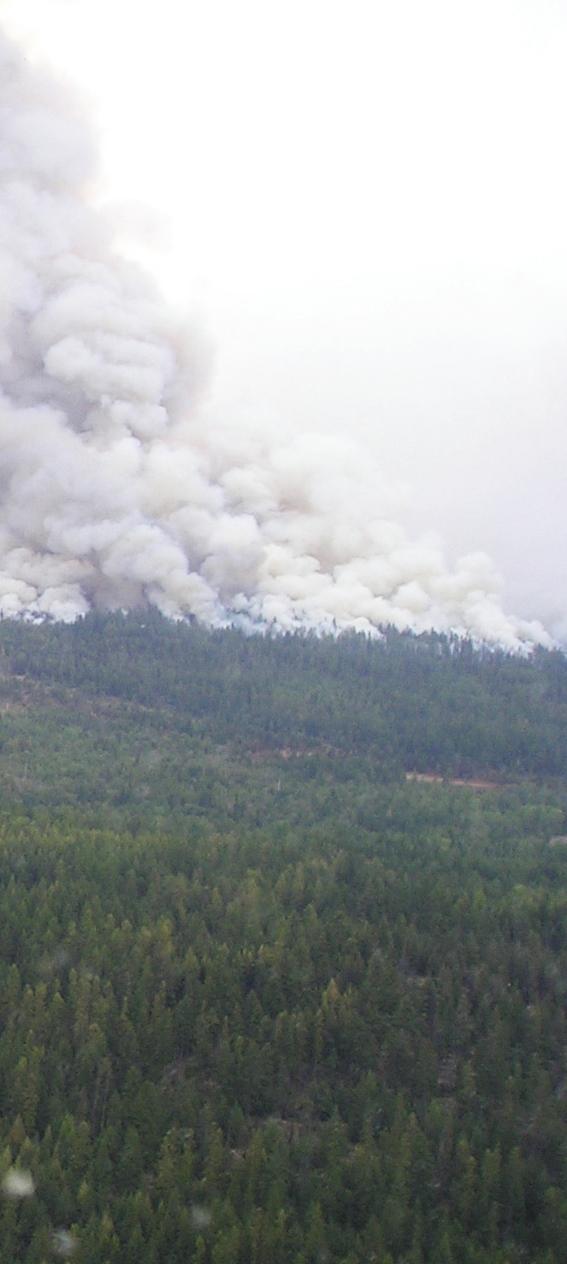
The wildland/urban interface is any place where structures are in close proximity to combustible wildland fuels. This includes large parks and green belts within urban settings, subdivisions built adjacent to forests or rangelands, and/or small communities or industrial properties in isolated locations surrounded by forests. No two wildfires are the same, because the factors that influence these fires are never exactly the same. The type, amount and moisture content of fuel, precipitation, relative humidity, temperature and wind conditions at the time of the fire, as well as the topography over which the fire burns, all have an influence on shaping the development of the fire.
The 2003 fire season was the worst on record in B.C., with more than 250,000 hectares
ABOVE: With resources spread thin, Kelowna firefighters try to save a home next door to a structure consumed by the wildland/urban interface fire.
In the summer of 2003 in British Columbia, more than 250,000 hectares were consumed in the worst fire season on record. Entire towns were evacuated and hundreds of homes were destroyed. In October 2003 Gary Filmon, former premier of Manitoba, was appointed by the B.C. government to head an independent inquiry into the province’s.
Filmon’s mandate was to review the issues relevant to prevention, planning and response to wildfires. Public hearings were held in eight of the communities most affected by the fires. Hundreds of submissions were heard. Filmon’s report, released in the spring of 2004, highlighted many previously identified areas of concern, emphasizing that if nothing were done, the future danger would be even greater. Filmon made recommendations on mitigation, response and recovery, forest management practices, emergency management planning and implementation,
command and control issues, communications issues and resources from both the human and materiel perspectives.
■ LEARNING THE HARD WAY
South of Kelowna, the city of Penticton was one of the key operations centres during the 2003 fire season. Initially, Penticton served as a staging point for firefighters and apparatus arriving from the rest of the province. Firefighters and equipment would then be sent north, up the east side of Okanagan Lake, through Naramata to the Okanagan Mountain fire zone, or south to Okanagan Falls and the Vaseux Lake fire. Penticton Fire Chief Wayne Williams has vivid memories of that summer.
“When the OK Mountain fire forced the evacuation of Naramata, their EOC was consolidated into the Penticton EOC in the No. 1 fire hall. It was at this point when we created one fire department comprising the 13 communities in the Regional District of Okanagan Similkameen and the municipal firefighters that responded from other areas of the province. Eventually, the EOC grew in size and complexity to where it took over the entire fire headquarters building, forcing the fire apparatus and crews to move to the No. 2 hall on the other side of town. Power to the entire region was lost when hydro lines from the north were consumed in the OK Mountain fire and the lines from the south were affected by the Vaseux Lake fire. We didn’t have adequate backup power and it was a challenge sourcing and placing generators. Then, at the height of the fire threat, a small plane crashed in the middle of the Penticton watershed, threatening the quality of the city’s drinking water.”
Williams relates some of the steps that have been taken since the summer of 2003.
“The primary EOC is now in our city hall, with the regional district office designated as the secondary EOC. One very positive thing that came out of that summer was the performance of the city and regional district staff in the EOC. Many staff members stepped in and performed tasks far outside of their training and backgrounds. They did a great job. Now, we’ve been able to augment that experience with formal training.”
In 2007, a series of windstorms toppled trees and knocked out power over much of the Okanagan Valley, but with emergency generators in place, fire department operations and communications were unaffected.
All Penticton firefighters have been trained and equipped for fighting interface
LEFT:
destroyed.
fires. “We have outfitted all firefighters, career and paid on-call, with coveralls, hard hats, boots and eye protection. Everyone has their bag with them at all times” says Williams.
A positive relationship with the provincial ministry of forests has enabled Penticton to engage the services of local helicopter operators for fire fighting on the strength of a phone call.
“Previously, it might have taken several hours to get a helicopter on to a fire.” Now, says Williams, “we can have a helicopter bucketing within minutes of the fire being reported.”
■ ELEVATION
Unlike Penticton’s semi-arid climate, West Vancouver lies in B.C.’s temperate coastal rainforest. Stretching along the north shore of English Bay from the Lions Gate Bridge to Horseshoe Bay and up Howe Sound, West Vancouver has Canada’s most expensive residential real estate nestled in amongst the forests that extend from sea level up through Cypress Bowl to an elevation in excess of 1,600 metres. While development is restricted to the first 350 metres above sea level, the municipality stretches over much of the forested mountainsides above, to where they become provincial parkland and the Metro Vancouver watershed.
Bill McCuaig is the urban forester for District of West Vancouver. While the untrained eye sees trees stretching from sea level to mountain top, McCuaig has a very different view. A wildfire that kills most of the vegetation within an area is
called a “catastrophic” or “stand-replacement” fire. More common are the fires that burn through a stand killing some, but not all, of the existing trees and under canopy vegetation. In B.C.’s coastal rainforests, the necessary weather conditions to create fires are infrequent when compared to the hot, dry interior of the province. However, low-elevation forests become warmer and drier than high-elevation forests and are subsequently more susceptible to fire. Evidence indicates that the high-elevation forest on Hollyburn Ridge, high above West Vancouver, has experienced just two stand-replacement fires since the last ice age – 10,00 to 12,000 years ago – while the 75-hectare Lighthouse Park, at sea level, has experienced such fires as frequently as every 250 years. McCuaig says that there have been many fires in Lighthouse Park over the past 15 years, as many as 18 in one year and every one caused by humans – some caused by the carelessness of a discarded cigarette or abandoned campfires and other deliberate acts of vandalism.
■ PUBLIC EDUCATION
West Vancouver Fire & Rescue Division Chief Martin Ernst is responsible for public education, inspections and enforcement.
“We take a very proactive approach to public education, especially in promoting the idea that people must be responsible for taking the necessary steps to protect their homes,” he says.
“It’s much easier to prevent a fire than it is to fight a fire. We do have authority within our municipal bylaws to compel
property owners to take appropriate steps to minimize fuel loading on their property and our residents are not reluctant to phone in complaints. To date, we’ve never had to take formal action, as we find people are very quick to comply when the dangers are pointed out. When we investigate these complaints we make a point of meeting with the complainant, as it gives us a chance to do some further education. We try to teach people the concept of making their property defensible.”
While West Vancouver firefighters are trained in wildland firefighting techniques and have the tools and equipment to fight fires in the interface zone, they are still primarily structural firefighters. In the interface, the fire department takes primary responsibility for the areas within 350 metres of a road. That leaves a huge portion of the municipality beyond the fire department’s capabilities.
What sets West Vancouver apart from other communities is its parks department wildfire suppression crew. Under Bill McCuaig’s direction and a second supervisor, there are two three-person initial attack (IA) crews.
“We all have backgrounds as firefighters with the province”, says McCuaig, “though we all have full-time jobs in the parks department with fire fighting as a secondary responsibility.” All the parks firefighters are trained to provincial specifications, including helicopter entry/exit.
“In fire season”, McCuaig says, “we aim to be able to deploy our crews to a fire within 30 to 45 minutes. That means returning to the works yard from wherever they may be in the municipality and responding from there. When the fire hazard reaches moderate, two of our staff will be on pager 24/7. When the hazard level reaches high or extreme, all eight of us are on call 24/7.”
Beyond their own borders, at peak times in the summer fire season when provincial resources are redeployed from the southwest region into other areas of the province, the West Vancouver crews will be contracted by the province to respond to fires in the provincial parks and crown land adjoining West Vancouver, as well as work with the Metro Vancouver watershed protection wildland crews.
There is a strong working relationship between West Vancouver Fire & Rescue and the parks fire crews. While McCuaig is circumspect in saying that his staff are not trained as structural firefighters, Division Chief Ernst is more forthright in stating that there have been many instances in recent years whenwhere the timely assistance of parks crews in the interface zone has been invaluable.
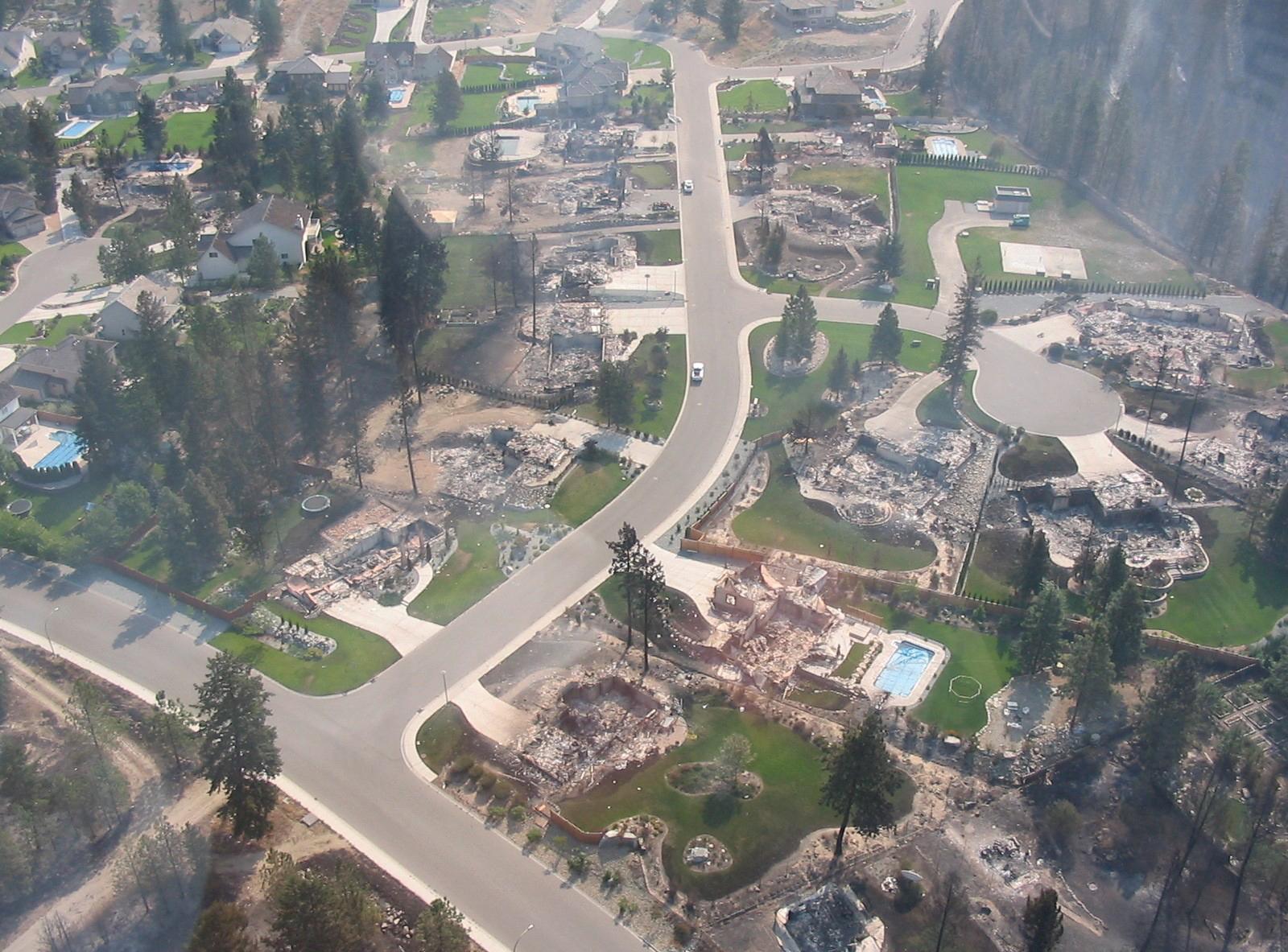
The wildland/urban interface fire of 2003 ravaged the city of Kelowna and surrounding area.
PHOTO BY KELOWNA ASSISTANT FIRE CHIEF LOU WILDE
Find out by enrolling today and train where firefighters learn from the best. The Greater Toronto Airports Authority’s state-of-the-art Fire and Emergency Services Training Institute (FESTI) offers hands-on training courses ranging from basic fire extinguisher to NFPA firefighter level I and II as well as a variety of rescue programs. Clients from across the globe in search of top quality instruction make FESTI their first choice for their emergency response training needs.
High-flying accomplices
Planning for use of aircraft to help fight Canada’s wildfires a co-ordinated effort
By BLAIR WATSON
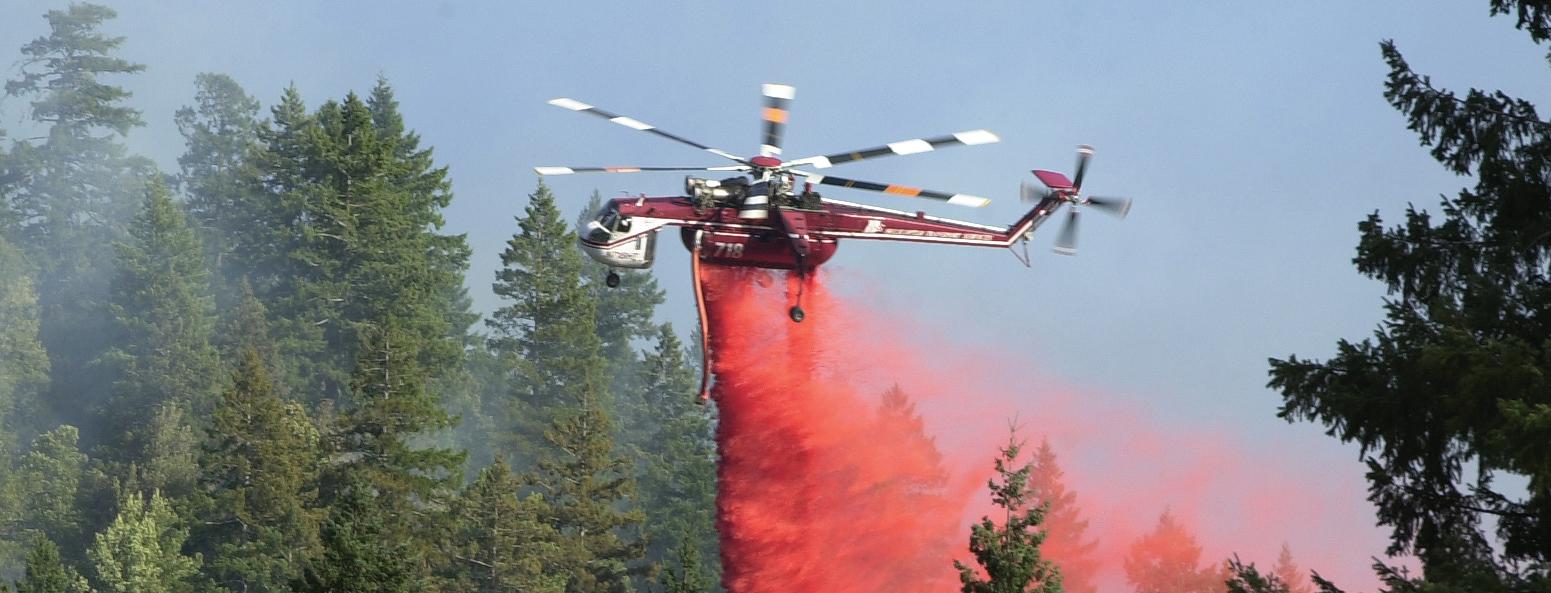
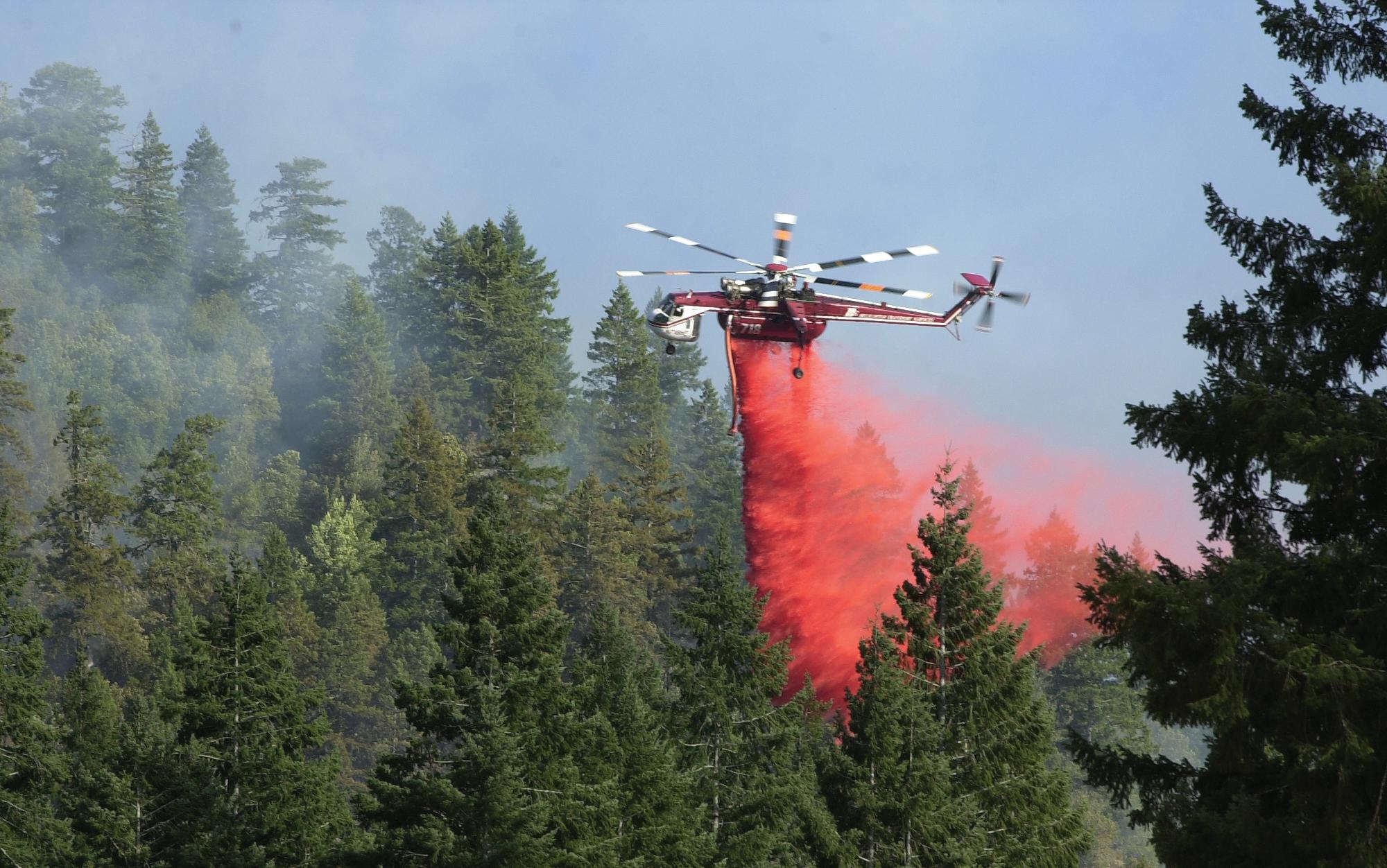
The Erickson S-64 Aircrane is used in several countries, including Canada, for aerial fire suppression. It has a large hose that hangs from the underside that is used to transfer up to 9,462 litres of water, water/ foam, or retardant to belly tanks during firefighting operations. In this case, the Erickson S-64 carried foam to help fight a 2002 fire in B.C.
Already this spring Canadians have seen images of water bombers and helicopters putting out brush fires in Nova Scotia and British Columbia. Planning for the spring/summer fire season and maintaining the necessary equipment is crucial to managing forest fires and wildland/urban interface fires.
In most parts of the country, fire season starts in April and ends in October. On average, about 8,500 forest fires are reported each year in Canada, burning approximately 2.5 million hectares. When provincial or territorial firefighting resources become inadequate, aircraft and crews from other jurisdictions are brought in to battle wildfires. The Canadian Interagency Forest Fire Centre (CIFFC) in Winnipeg handles co-ordination.
All provincial and most territorial governments have a forest protection agency. Saskatchewan, Manitoba, Ontario, Quebec, Newfoundland, New Brunswick, and Nova Scotia each have a fleet of firefighting aircraft, entirely fixed-wing in most cases (Nova Scotia’s is entirely rotary-wing). Alberta and the Northwest Territories have Canadair water bombers operated by companies in partnership with the government. British Columbia and the Yukon contract air tanker services. Prince Edward Island rarely needs aerial firefighting resources. In many regions, helicopter operators are hired to provide fire suppression and operations support.
In Canada’s second-largest province, the Ontario Ministry of Natural ResourcesAviation and Forest Fire Management (OMNR-AFFM) has assigned in years past,
and did so again this year, four helicopters – AS350 B2s and EC130 B4s – to firefighting. Three other aircraft and their crews are deployed throughout the province for fire support as needed.
Part of the government work done before a fire season starts involves issuing a Request for proposal (RFP) for helicopter services. Operators interested in bidding must meet provincial or territorial as well as Transport Canada requirements. Forest protection agency or aviation safety officers visit operators to determine whether they meet government standards. Bids from qualified operators proceed to the evaluation stage, and then contracts are awarded.
Helicopter Association of Canada (HAC) members have expressed concern that the flight-hours requirement in provincial tenders falls short in judging a pilot’s ability to conduct firefighting flights. Furthermore, RFP requirements have kept pilots from acquiring fire suppression experience, which could be detrimental over the next decade and beyond as highly experienced pilots retire.
A HAC pilot qualifications group has been working to establish criteria for assessing firefighting flying skills. The group’s goal is to have operators adopt the evaluation concepts as industry best practices while avoiding another certification requirement.
Government helicopter firefighting and support contracts range in duration from one to 80 days. In Ontario, for example, the average number of short-term hires – one to four days – is 190 per year. Part of the preparation work between fire seasons is to update government databases with operator information so that later in the year, when fires are raging, valuable time is not wasted trying to find companies with suitable equipment and crews.
Because aircraft must be available throughout the contract period, maintenance has to be completed before the season begins. Engine and transmission changes and avionics upgrades are done before aircraft are deployed. Firefighting equipment such as heli-buckets and hydraulic packs undergo maintenance. AMEs are sent with helicopters to forward bases so that field maintenance can be done on site. Before the start of a fire season, engineers and pilots are briefed by government staff on fire suppression operations, practices and policies.
Training also takes place between fire seasons. Ground fire crews learn to exit helicopters with their equipment and pilots practice water drops, hover exits, equipment slinging, co-ordination with other aircraft, and more. The control zone around a wildfire becomes a busy location in which there is little room
for error. To operate safely in it with other helicopters, a bird-dog airplane, water or chemical retardant bombers and ground fire crews, pilots are required to perform their flying tasks proficiently and understand how their aircraft is choreographed with others in a firefighting “dance.” Operator and provincial or territorial agency training provides a solid foundation for safe operations.
To help co-ordinators track fire fighting and support aircraft and orchestrate their operations, technologies such as Automated Flight Following (AFF) have been created. AFF was developed in B.C., home to some of the world’s most challenging aerial firefighting because of the terrain. The main advantages of AFF are GPS-tracking in near-real-time and enhanced situational awareness, a crucial part of effective aviation asset management.
The history of AFF goes back 20 years when the B.C. Forest Service recognized the need for an integrated decision support system. Automatic Flight Following, which was initially FM-based, transitioned to satellite technology by the late 1990s. It is used by forest protection departments in Canada and some U.S. agencies. Where required, commercial operators must equip their aircraft with AFF technology, meeting the AFF data
Continued on page 33
TRAINER’SCORNER
Wildland fire preparedness
By ED BROUWER
Wildland fires are associated with out-of-control burning, high intensity, high flames and high rates of spread. Fed by high temperatures, low humidity and low rainfall, the fire-prone vegetation that shares space with manmade structures can destroy whole communities. Each year, there are thousands of forest fires in Canada. Although most are far from populated areas, there have certainly been tragic exceptions.
•
•
According to Natural Resources Canada (www.nrcan.gc.ca), in July 1911, after two months of unreasonably high temperatures, several small fires converged into a giant conflagration. The massive blaze swept through 10 isolated mining communities near Timmins, Ont., and a mining area known as Camp Porcupine. Residents of South Porcupine became trapped and were unable to escape the fire as the town burned to the ground.
According to a section on the NRC website devoted to Northern Ontario disasters, “The high winds created by the fire reached gale-force speeds, reportedly so powerful that [they] sucked tree trunks out of the ground and flung them through the air, where they would either explode or be dropped into another piece of tinder dry fuel.”
• Recommendations that fire departments should make to residents so homeowners can reduce fire-loss risk. These actions will provide firefighters with a reasonably safe defensible space.
The website says the intense heat caused buildings, timber and clothing to combust. At the nearby West Dome Lake Mine, the mine manager hurried his family and employees down into the mineshaft in hopes of protection from the fire. Sadly however, the passing fire pulled the oxygen from the mineshaft. The
Continued on page 38
Fuel oil continues to burn off at a house destroyed during the massive brush fire in Halifax in April/May.
STEPS TO CREATE DEFENSIBLE HOUSING
touch. A separation between tree-tops of 3 metres (10 feet) is a good average distance.
■ Limb all trees to a height of 2.5 metres (8 feet) for 30 metres (100 feet) around dwellings.
■ Dispose of all flammable ground fuels and debris to a distance of at least 15 metres (50 feet) around buildings. The distance should be increased where steep slopes rise up to or away from the building.
■ Maintain a well-watered lawn or rock type garden around your premises.
■ Space trees for a distance of at least 30 metres (100 feet) around buildings so that the tops do not
■ Dispose of accumulations under trees, which could act as fire ladders.
■ Fall and dispose of dead standing trees within 30 metres (100 feet) of buildings.
■ Remove wood or lumber piles to a distance of 30 metres (100 feet) from buildings during summer or dispose of unwanted accumulations. These piles should not be located downhill from dwellings.
■ Clean your roofs monthly of
needle, leaf or moss accumulations.
■ Be prepared in advance to water your roof with sprinklers if fire threatened.
■ Fall and dispose of all trees or limbs overhanging buildings.
■ Screen or seal off all openings into attic or crawlspaces to prevent sparks from entering. Skirt in areas under the trailer or mobile home with noncombustible materials.
■ Remove flammable debris stored or accumulated under porches or crawlspaces or screen off these areas so that sparks cannot enter.
■ Clear a mineral soil fire break at property edge and dispose of flammable ground fuels.
■ Prepare ahead by having garden hose and water connections available so that water can be used at any point 30 metres (100 feet) around house.
■ Prepare pump or hose system so that other available water sources can be used for fire protection, i.e. swimming pools, ponds, irrigation systems. This prepared water source could also assist other fire control agencies in the event of a fire.
■ Have available during summer months at least a shovel, rake, axe and bucket as well as a ladder.
■ Plan family escape routes (at least two) ahead of time.
■ Identify and make your home address highly visible.
Continued from page 31
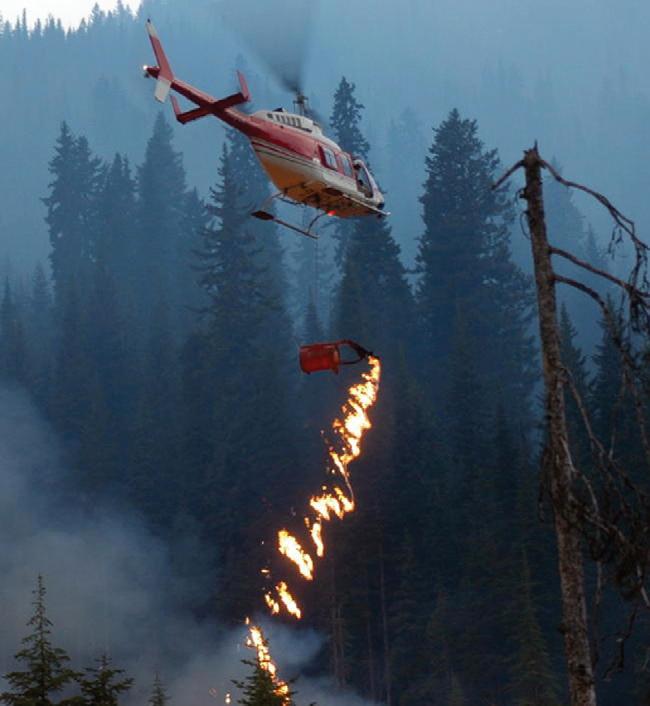
Some helicopters are equipped with a drip torch or Delayed Aerial Ignition
transfer specifications issued by the CIFFC. AFF data standards developed in B.C. have been adopted nationally and internationally.
The integrated decision support system developed in B.C. uses AFF (by displaying aircraft locations based on received data) but also incorporates fire reporting, chronological event logging, resource and personnel tracking, electronic requests for assets, GIS spatial information and imagery, fire behaviour and weather. The computer-based system, aptly named Dispatch, has proven to be a highly effective firefighting management tool.
Because communication with pilots flying firefighting or support missions is critical, forest protection agencies require contracted aircraft to be equipped with a communication system that meets their standard. Outside of B.C., low-band FM radios satisfy the requirement in several regions, but in Canada’s most westerly province as well as the northern part of the country where there are few repeater stations, aircraft satellite communication equipment is mandatory. Because of its utility, SATCOM in Canadian firefighting aircraft is common.
Technology has improved aerial firefighting greatly during the past half century. Between fire seasons, forest protection agencies and operators review new technologies to determine their suitability for fire detection and suppression. In the summer of 2007, OMNR-AFFM personnel began night vision technology (NV) testing and training. Using NVGs, crews found that it was considerably easier to detect fires, even small ones such as campfires. OMNR-AFFM evaluation of NVGs continues. Other night vision technology applications are precise mapping of active fires and extractions of firefighters in emergency situations. Two helicopters in the Ontario government’s fleet, an AStar and an EC130, have been modified with NVT.
Nothing Dumps Faster!
Over 40,000 in use. We’ve been in business for over sixty years, so you can depend on us. That’s why Newton Kwik-Dump Valves can be trusted to get your tanker emptied and on its way FAST. Standard length, Mild Steel and Stainless Steel are in-stock. Need special length valves? Call us and it’s as good as done! Don’t accept look-alikes. Ask for us by name. For prompt, timely delivery, call us today.
*Test results available on request.
www.ahstockmfg.com
Device to light backburns and controlled burns.
TRUCKCHECKS
Total connected load
By DON HENRY
ut up your hand if you’ve had battery or starting problems on your fire truck. The problem could be the total connected load ( TCL), one of the most misunderstood factors affecting apparatus operation. The relationship between TCL and alternator output is very important and is often overlooked during construction of new apparatus and in the diagnoses of problems during repair of older apparatus. By definition, TCL is the amount of electrical power needed to operate the vehicle while on scene or enroute.
When determining how much electrical power is available we first need to examine the batteries. The batteries must, by NFPA definition, be high-cycle batteries, not to be confused with deep-cycle batteries.
Deep-cycle batteries work well with electrical loads that discharge, such as golf carts or electrical fishing motors, and they work well when a small amount of energy is needed for a long time. Deep-cycle batteries can be recharged many hundreds of times but they cannot be used to deliver the large amounts of energy needed to start a diesel-engine. Neither are batteries that work well for delivering high cold-cranking amps (CCA) suitable for fire service work, as fire trucks are usually started in warm fire halls.
A high-cycle battery can be discharged for a long period of time and also provides the energy needed to restart a large diesel-engine. Fire-truck batteries also need to be able to deliver current over long periods of time after an alternator failure at the fire scene, and this is why the high-cycle batteries are ideal.
For many years D batteries were the batteries of choice, either 4D, 6D or 8D, with 8D being the most popular. But these batteries are not high-cycle. The high-cycle battery most often specified now is the group 31 battery. It is a high-cycle battery that can supply both the high-amp discharge needed for starting and the long, continuous current needed in the event of low alternator output or alternator failure.
The first step after determining that the battery is high-cycle and is fully charged is to test the brand of alternator. The remainder of the test will provide the necessary data to project the on-scene survival time for any vehicle when the charging system fails.
(Note: the following tests will be invalid if any of the batteries are defective.)
1. Test to determine total connected load
a. Brand of alternator
At the time of delivery the manufacturer should have given the user a nameplate displaying the rating of the alternator and the output of the alternator at both engine idle and at a 200-F (93ºC) engine-compartment temperature. This information is useful to determine if the alternator is the original or a smaller, cheaper replacement.
b. Rated charge voltage (Vc) ____________
This number should be given by the manufacturer as a cold setting or a hot setting. (A cold alternator, say at -30 C, will have a voltage maximum setting of close to 14.4 to 14.6 volts but as the alternator warms up because of high
REFLECTIVE STRIPE
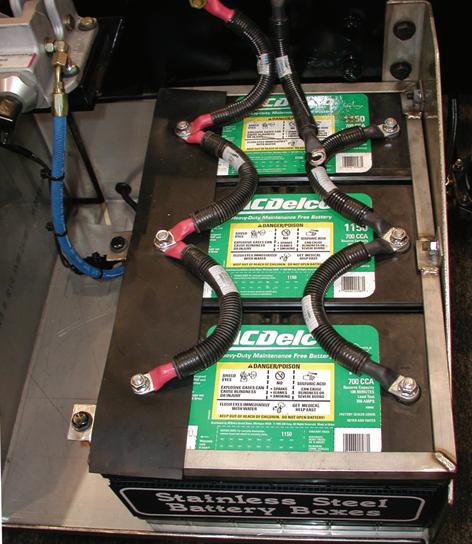
A set of three group 31 batteries
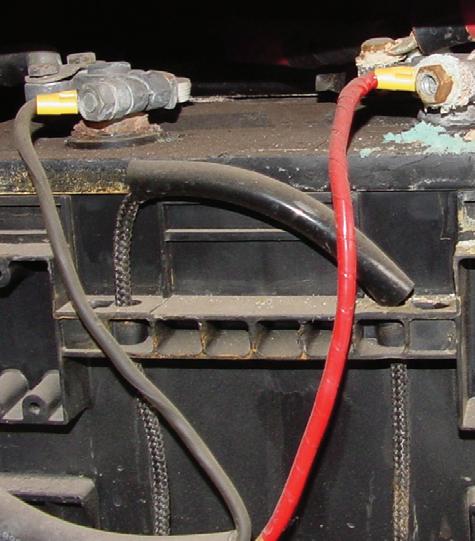
It is not possible to test these batteries until the posts are cleaned. This is an 8D battery; this type of battery clamp can cause unwanted voltage drops.
INTAKE VALVE
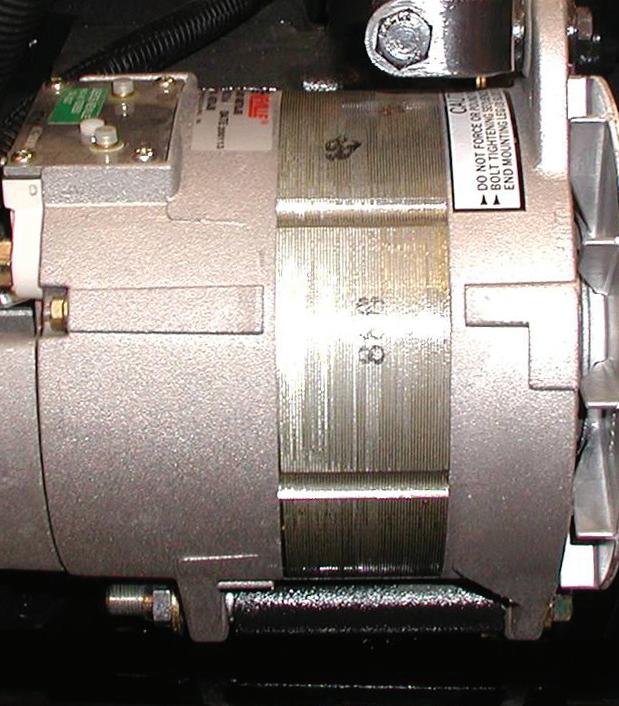
A large output alternator but with the wrong belt for the pulley. The belt needs to match the alternator requirements. Note adjustable voltage regulator upper left corner.
FRONT BUMPER
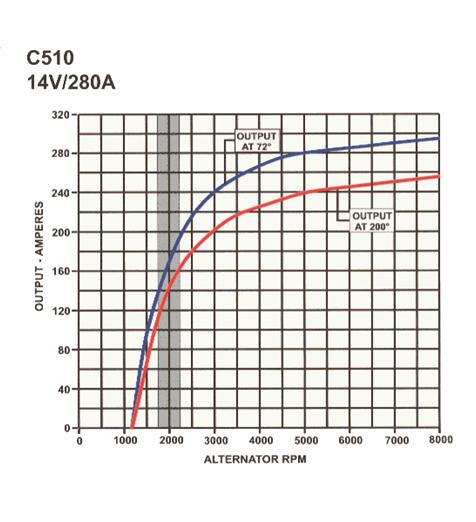
Figure 1: A typical output curve. Note the difference between cold and hot output.
AIR HORNS
under-hood temperatures that are found on fire apparatus, the voltage will be lower, often in the range of 13.8 to 14 volts at 70 C. This is automatically accomplished by the solid state voltage regulator.) Be careful, however, as a typical cold setting may be 14.4 volts DC and 14 volts DC at operating temperature. Most alternators have some method to reduce charge voltage when at operating temperature. Use a digital voltmeter to take this measurement. c. Maximum output rating Cold, 77 F (25 C) Ac ____________ Hot, 200 F (93 C) Ah ____________
Note that amperage cold and amperage hot may differ by as much as 20 per cent on the low side for some brands of alternators.
Get a chart of the alternator performance from either the truck-builder or the alternator-manufacturer. To measure the amperage you will need an amperage gauge and a method of applying a load to the alternator. You can use a carbon pile or turn on the electrical loads such as lights, sirens and primers, as long as you can apply enough loads. Most alternators must spin the rotor shaft at least 5000 rpm to reach full output. This means the engine needs to turn at least 1200 rpm to allow full alternator output. For example: A typical setup– alternator pulley is 2.5 inches (6.35mm) in diameter; engine drive pulley is 9 inches (22.8mm) in diameter; engine full-speed maximum governed rpm is 2100 rpm. The relationship of the drive to driven pulley is 3.6 times – for every one revolution of the engine, the alternator turns 3.6 rpm. For the alternator to spin at 5000 rpm the engine must run at 1388 rpm. You will have to do this math for every truck you look at and calculate the pulley relationships. Sometimes people put the wrong pulley on the alternator. It might seem that the solution to the problem of low alternator output at idle is simply to put a smaller pulley on the alternator, which would make it turn faster at a lower engine rpm. However, it would also turn faster at a higher engine rpm and at the engine maximum governed speed of 2100 rpm the alternator rotor would be turning at 7560 rpm. Most manufacturers recommend that the rotor bearing not turn at more than 8000 rpm for long bearing life. If a smaller pulley were used, the rotor shaft and its bearing could turn at far too many rpm, which would result in a shortened life cycle.
d. Amperage output at engine idle
Take this measurement with the engine at its normal idle speed and with an engine compartment temperature of at least 200 F (93 C).
e. Amperage output at 1000 engine rpm
Take this with the engine as close to 1000 rpm as possible, with an engine compartment temperature of at least 200 F (93 C).
2. Vehicle engine type
Engine manufacturer ____________
Model ____________
Cubic inch displacement ____________
14-volt system ____________ or ____________
28-volt system ____________
3. Total connected load
To determine the total connected load you can either:
a. Assign a value to all the electrical accessories that might be on at any given time – this information should be available from the manufacturer of each particular component.
b. Perform a test of all the possible loads that could be in use. This could be measured with an amperage meter connected at the batteries when the engine is off so that all power must come only from the battery packs. As some of this load will be applied only while en route and some only when at scene, you will have to take two measurements with the appropriate loads switched on or off. Consult your department’s SOPs to find out what loads and lights are used in which situations.
Total component load, component’s amperage draw
a. Dedicated loads (loads you can switch off)
1. Engine fuel management ____________
2. Transmission computer ____________
3. Other loads ____________
4. Amount necessary to float charge the battery pack
If the engine computer senses that the voltage is too low it will shut down the engine. This shut down cannot be disabled like the high-temperature or low oil-pressure shutdowns in fire-service vehicles. A typical low voltage shut down is 10.2 volts.A typical load for the engine could range from 10 to 35 amps, depending on the engine type, and about 10 amps for the transmission. To maintain the batteries at peak performance a single 8D battery will need 15 amps, while a group 31 will need approximately five amps per battery.
Total amps dedicated ________________________
b. Switchable loads (worse case condition)
1. Calculated amp value ____________ at rated test voltage (VT) ____________ or
2. Actual amp value ________ at battery test voltage
This test voltage will most likely be about 12.0 to 12.1 volts depending on the condition of the batteries and the size of the loads, and is measured at the battery. Be careful and take safety precautions around the batteries. To avoid any sparks, use a clamp-on type amperage meter. Here are some typical load draws – you will need to fill in your own numbers.
Lights running ____________
Lights at scene ____________
Sirens ____________
Driveline retarder (electrical type) ____________
Air conditioning (fans and compressor clutch) _______
Radios and cellular phones ______
Primer pump ____________
Total amperage load, switchable ____________
Total connected load (3A plus 3B) ____________
4. Fill in the blanks to find the Voltage Factor (Vf) (Vc)___ - (Vt)____+ (Vd)___ = _______ +1 + (Vf)______ (Vt)______
■ VOLTAGE FACTOR (VF)
It is not enough to just put back in to the electrical system what you took out to run the loads. This is because the electrical power you used was at 12.2 volts and the power you must put back in is most likely going to be in the range of 14 to 14.4 volts. This voltage factor is used as a multiplier to find the total connected load. This adjusts the TCL for any given charge voltage value when the test voltages in B-1 and B-2 are known. This larger number is the true value of the TCL when the system is operating at charge voltage and represents an increase in amps anywhere from 15 per cent to 25 per cent.
TRUCKCHECKS
The voltage factor is determined by first obtaining the voltage difference (Vd) between the system’s charge voltage (Vc) and its voltage (Vt) during the load test or, if calculated, the operating voltage at which the manufacturer rated the component lamps or devices. This voltage difference (Vd) is then divided by the test voltage (Vt). The resulting answer is the voltage factor (Vf). By multiplying the voltage factor by the TCL you will know the true amount of electrical power needed for the system.
5. True value of total connected load at charge voltage
a. Total connected load from section 3B
b. Voltage factor (Vf). _________
Adjusted TCL (A x B ) ________
6. Output of alternator hot (Ah, from section 1) ___________
Adjusted TCL from section 5 _____
Is the alternator’s output when hot greater than the adjusted TCL?
If yes the alternator is properly sized. If no, then a larger alternator is needed or you will have electrical problems.
7. CID (cubic inch displacement) of
engine _____ x 2 = minimum CCAs (cold cranking amps) required. The metric calculation is 125 CCAs per liter of engine displacement. Battery manufacturers will give you the CCA rating of the battery and this measurement is always taken at 0 F ( -18 C).
Check with the manufacturer – many recommend three times the cubic inch displacement but this is usually calculated for diesel engines that have to start outside in cold weather and therefore may not apply to your fire truck.
8. Number of batteries needed to meet the reserve capacity (Rc) requirements if the alternator is off-line (failure of alternator or engine stall).
a. TCL (adjusted from line 5)
b. 25 (Rc load test) A divided by B = number of batteries ____
■
EXPLANATION OF RESERVE
CAPACITY TEST
Rc is the amount of time in minutes that a battery can deliver 25 amps and maintain a
voltage above 1.75 volts per cell. As a 12volt battery will have six cells, at the battery terminals the voltage should be not less than 10.5 volts. This is very important for the newer electronically controlled engines and transmissions, as a low voltage will cause these engines and transmissions to shut down. Simply put, how long, in minutes, can the truck operate with no alternator output?
9. Total CCAs available.
a. CCA rating of battery _______
b. Number of batteries in the pack (item 8) ____________
c. (A x B) = ________________
(This value must be larger than the total from line seven)
■
SUMMARY
This chart was not made up by someone at the taxation office! This information was originally presented by a true genius and supporter of the fire service named Dennis Litchenstine – we truly stand on the shoulders of giants like Dennis. An EVT who is aware of the special electrical demands placed on a vehicle in the fire service and the NFPA standards in place to ensure those demands are met is well placed to offer expert advice to the decision makers who purchase fire apparatus. This expert knowledge of electrical systems and electrical demands also ensures the EVT is capable of carrying out appropriate preventive maintenance, testing and record keeping. Correct maintenance of the most appropriate electrical components will ensure that firefighters are not left in the dark and incommunicado at the emergency scene. If the TCL is not correct then you will need to install a load-management device, load-shedding device or a larger alternator. It is also waste of time and money to install a larger output alternator if you do not also install larger gauge wires to and from the alternator.
An excellent source for larger alternators is www.ceniehoff.com It also has excellent wire charts to determine the size and length of wire for a given amperage. If your alternator is undersized it may be necessary to use load-management devices and load-shedding devices – they will be the subject for a future article.
Don Henry teaches in the Automotive Services Technician and Heavy Equipment Technician programs at Lakeland College in Vermilion, Alta. He can be reached at don.henry@lakelandcollege.ca
Fight Fires, not Paperwork
e-mail:
TRAINER’SCORNER
Continued from page 32
family was untouched by the fire but was asphyxiated. The next day, the same fire swept through the town of Cochrane, Ont. Three communities were destroyed and 77 people were officially listed as dead, though the number of unrecorded deaths will never be known.
Then there was the fire of 1916 known as the Matheson fire, named for a town that was completely annihilated. According to the website, “July 30 was a frightening day, almost a repeat of the events that had happened only five years previously. This time, the fire consumed nearly 800 square miles of forest, and the toll reached an unheard of 282 official deaths.
“Nushka, just down the T&NO line from Matheson, was particularly hard hit. As the fire approached the town, the local priest, Father Gagne, led 56 people to a field outside of town. There was no other place to go. All 56 people were asphyxiated when the flames surrounded the field. As a memorial to Father Gagne’s efforts, the community was renamed Val Gagne.”
The summer of 2003 will be remembered as the year B.C. burned. Three firefighters lost their lives – Ian Mackay, a 41year-old father of four, Eric Ebert, 32, and Ben Von Hadenberg, 33, who was to be married two days after his death. In addition, 335 homes were lost or damaged, 38,009 people were forced to leave their homes and 148,695 hectares were lost to fire. My crew and I spent more than 50 days working wildland/interface fires in the Okanagan that year.
Most firefighting methods deal with fire that starts inside and burns outward. However, a wildland fire starts on the outside and tries to get in. There are not too many wildfires today that don’t threaten something.
Although there have been volumes written on suppression tactics and firefighter safety, I believe we’ve missed the boat. Fire departments should play a more effective role in the area of prevention and preparedness. (See sidebar.)
The bottom line for us in 2003 was that we had not done enough in the area of prevention and preparedness – not nearly enough. Many of the fires burned where homes were located in or near the woods (wildland-urban interface). Some of those fires very quickly exceeded the suppression capabilities of the local fire services.
Because of the intensity of a wildfire, no fire department can guarantee the safety of a home or its residents. However, homeowners can protect their families and their properties from wildland fires.
We need to heighten public awareness about the dangers of wildfire in the urban interface. One of your department’s goals should be to empower homeowners in your communities to protect their families and their homes from this threat by creating a safety zone called defensible space.
Wildfire awareness campaign materials are readily available online. The producers of this material encourage us to use the documents and make changes that are appropriate for our target audiences.
Handouts and tip cards are available at the Washington State Department of Natural Resources website – www.wildfireawareness@ dnr.wa.gov (click on fire information and prevention, then wildfire awareness). Several pamphlets and/or tip cards are available on topics including wildfires, debris burning, protecting your home from wildfires and preparing a house for wildland fire season. There’s also a wildfire-approaching checklist. The British Columbia Provincial Emergency Program website also has downloadable information on wildfire safety at http://www.pep.bc.ca/hazard_preparedness/ FireSmart-BC4.pdf.
ABOVE: Tanker 41 (Waverley) moves back into Fortress Drive in Halifax after a brush fire ripped though the suburban area. Four homes were lost on this street BELOW: Halifax fire crews gather around Div. Capt. (Safety) Dave Meldrum’s car after retreating from Fortress Drive, where several homes were on fire.
Fire departments can and should be more proactive in the areas of awareness, prevention and preparedness. With free material available through the FireSmart program (see FireSmart web link above) there is no reason not to empower your community to take an active role in helping you prepare for and fight wildfires. If we learn from our past shortcomings, Canadians will not have to go through another wildfire season like those of the early 1900s and 2003.
Stay safe – until next time train like their lives depend on it, because they do.
Ed Brouwer is the chief instructor for Canwest Fire in Osoyoos, B.C., and the training officer for West Boundary Highway Rescue. The 19-year veteran of the fire service is also a fire warden with the B.C. Ministry of Forests, a wildland interface fire suppression instructor/evaluator and a fire-service chaplain. Contact Ed at ed@thefire.ca
Knox-Box® Rapid Entry System
WESTERN
Tel: 604-302-2613
Fax: 604-826-7850
BACKtoBASICS
The art of low profiling
BY MARK VAN DER FEYST
SCBA is one of our most important pieces of equipment. It protects us from IDLH (immediate danger to life and health) atmospheres and has been considered the key in the advancement of today’s fire service.
SCBAs have evolved but still have limitations: they limit our vision – especially peripheral vision; they limit our ability to communicate and to hear; they add weight; and they provide a limited air supply.
In addition, SCBAs add extra profile to our bodies, which hinders our ability to move around or through obstacles. In basic training, we were presented with an obstacle and were required to reduce our profiles so we could pass through it. This technique, called low profiling, is now being taught in firefighter survival classes as a method of self-rescue. Low profiling was around well before firefighter survival training started to emerge and we should all know and practise it. We take risks whenever we reduce our profiles. Normally, we want to keep SCBAs on our backs at all times, from the moment we don our breathing apparatus until we come out of the structure. When we take off our SCBAs or partially remove them within an IDLH atmosphere, we increase the risk of exposure and we increase the chance that something can go wrong with the SCBA. If we fail to properly reduce our profile, our SCBAs can be lost or become tangled or we might drop them through a hole in the floor, thus losing our air supply. All of these risks need to be eliminated or managed, and the only way to manage them is to become familiar with low profiling.
■ THERE ARE THREE WAYS TO REDUCE PROFILE
1. Simply loosen the straps of the SCBA but keep it on. Loosening all the waist and shoulder straps allows the SCBA to move freely on our back so we can navigate through a small opening. Once we pass through the opening, we can tighten the straps and carry on. In a survival instance, re-tightening the straps is not that important because we want to exit the structure as fast as we can. In a search operation, it is prudent to re-tighten the straps. If the straps are not re-tightened, they can become an entanglement hazard and the SCBA could fall off – slowing us down, and making us ineffective.
We need to make sure we extend the straps all the way. Some firefighters loosen the straps just a little, which allows them to take off the SCBA or move it to one side but creates problems when it’s time to put the SCBA back on. Remember that we lose some dexterity and feel while wearing structural firefighting gloves. This hinders us when trying to put the SCBA back on. Opening the straps all the way ensures that we can get the SCBA back on quickly and efficiently.
2. The second method involves loosening the straps and taking off just one side of the SCBA. Look at photo 1.The firefighter has moved his SCBA to one side of his body and the profile allows him to fit through a tighter obstacle. Depending on the size of the firefighter to begin with, this may be the preferred method for reducing your profile. This technique requires all straps be loosened and one shoulder strap removed from your body. The shoulder strap that contains your regulator needs to stay on your body. This prevents the regulator from being pulled apart from the face piece.
Photo 3: Protect the regulator
PHOTOS BY MARK VAN DER FEYST
Photo 2: Sounding the floor
Photo 1: Removing the SCBA
SHOR T
The bridge to your future
&
LONG TERM COURSES
•MUNICIPAL FIRE FIGHTING
• HAZARDOUS MATERIALS RESPONSE
• INDUSTRIAL FIRE FIGHTING
• CONFINED SPACE ENTRY/ RESCUE
• INCIDENT COMMAND SYSTEM
• CUSTOM TRAINING TO MEET SPECIFIC NEEDS
• PRE-SERVICE FIREFIGHTER EDUCATION and TRAINING
CERTIFICATE PROGRAM
• FIRE SCIENCE TECHNOLOGY
DIPLOMA PROGRAM
FIRE & EMERGENCY RESPONSE TRAINING CENTRE Sarnia,ON,Canada
1-800-791-7887 or 519-336-4552, ex t 21 • Fa x : 519-336-4537 e
www.lambton.on.ca/fertc
BACKtoBASICS
In photo 1, the firefighter has the left shoulder strap on his body, thereby protecting his regulator. Once the SCBA is on the side of your body, you will be able to manoeuvre through the small space and bring the SCBA with you. Once through the obstacle, put the SCBA back on.
It is important to sound the floor when you are going through any type of an obstacle to make sure a floor exists – in other words, to make sure there isn’t a hole in the floor – to sustain your weight.
3. The third method is more risky. It involves removing the SCBA completely, passing it through the obstacle then putting it back on. As mentioned, the straps need to be fully extended.
In photo 2, the firefighter has an opening of just 14 inches by 14 inches through which to fit. He has used his tool to sound the floor on the other side of the wall and is aware that the floor is stable. This is important because if there is a hole in the floor the SCBA and regulator will fall through.
In photo 3, the firefighter has his SCBA off his back. He is wearing an MSA SCBA and protects the regulator by holding onto the right shoulder strap.
In photo 4, the firefighter passes his SCBA through the opening. In photo 5, we can see from the other side of the wall how the SCBA is being passed through. The firefighter has a firm grip on his right shoulder strap to protect his regulator and make sure he does not lose the SCBA. Notice the tool lying next to the wall. It is placed here so the firefighter can easily locate it when he is ready to move on. Often firefighters throw the tool through the opening and let it land where it falls, making it difficult to find the tool.
Photo 6 shows another example of an SCBA being passed through an opening. This firefighter does not have a firm grip on the SCBA. He is holding it with both hands on the side, pushing it in front of him. Is he sounding the floor? Are there any holes in front of him? Be sure you have a firm grip on the shoulder strap that contains the regulator.
In photo 7 the firefighter has made his way through the opening and puts his SCBA back on.
The 14 by 14-inch opening is typical given that stud walls are spaced 16 inches apart.
For a useful drill, create a 14 by 14-inch hole and make everyone go through it at least once. You will be surprised that even the biggest person in your department will fit through using low profiling. This type of drill is also a good confidence builder for each person.
Mark van der Feyst is a 10-year veteran of the fire service currently working for the City of Woodstock Fire Department in Ontario. Mark is an international instructor teaching in Canada and the U.S. He is a local level suppression instructor for the Pennsylvania State Fire Academy and an Instructor for the Justice Institute of B.C. He can be reached at mvanderfeyst@gmail.com
Photo 7: Putting SCBA back on
Photo 5: Tool strategically placed by the wall
Photo 4: Pass SCBA through opening
Photo 6: Less-than-perfect
Offering: A 2 course certificate in incident command for experienced incident commanders. Please contact our office for more information.
Are you looking to take on more responsibility in your Department? Trying to round out your technical ability with leadership skills? Preparing to advance your career?
At Dalhousie University we offer a three course program, the “Certificate in Fire Service Leadership” to career and volunteer fire officers.The 3 courses Station Officer: Dealing with People,Station Officer:Dealing with New Operations and The Environment of the Fire Station are all offered in each of our 3 terms, September, January and April. The program can be completed in one year.
For more information and a program brochure please contact:
You will also find the information in our brochures or at the following internet address:Web site:http://collegeofcontinuinged.dal.ca
Just Arrived
NFPA 1: Fire Code Handbook, 2009 Edition
The 2009 NFPA 1: Fire Code Handbook has the extra information you need to fully understand Code requirements and implement or enforce them effectively.
Whether you’re a code of cial, inspector, re marshal, AHJ, facility manager, or anyone concerned with public safety, this book is your key to solid Code knowledge for increased public safety and job success.
Give your community the high level of protection it deserves. Make sure you’re ready to apply new re and life safety requirements right the rst time with answers and solutions on demand in the 2009 NFPA 1 Handbook.
Item#: 1HB09
The Art of Reading Smoke: Practice Sessions
Often, smoke issuing from a building is the only clue available to predict re behaviour and the likelihood of a ashover or rapid re spread.
In this companion to The Art of Reading Smoke, Dave Dodson presents seven real-world scenarios involving residential, commercial, and mixed-use scenarios to help hone your smoke-reading skills. Using the process taught in the original DVD, you are given the opportunity to read the incident, then instructor Dodson walks you through the scenario. The “reading smoke” process is an invaluable skill for any re ghter, from the probie on up. (30 minutes)
Item#: 1593701451
Price: $106.65
The Engine Company
In his new book, Battalion Chief Salka, a nationally recognized speaker and author with years of service in several career and volunteer departments, looks at both the similarities and differences in the engine company operations practised by re departments and discusses in detail the equipment, staf ng, and operations of engine company re ghters at structural res and emergencies in urban, suburban and rural settings.
Item#: 1593700805
Price: $93.15
CLASSIFIED ADS
EDUCATION AND TRAINING
MESC will provide custom design training programs. Other courses available include: Building standards, Rescue program, Emergency Medical, Management Program, Fire Prevention, Public Safety and Hazardous Material. Manitoba Emergency Services College, Brandon, Manitoba, phone: (204) 726-6855.
FIRE FIGHTING EXPERIENCE: Short and long term courses available, Municipal and Industrial fire fighting. Incident Command System, Emergency Response/HazMat, three year Fire Science Technology Diploma program. Lambton College, Sarnia, Ontario, call 1-800-791-7887 or www.lambton.on. ca/p_c/technology/fire_emerg_resp.htm. Enroll today!
BY PETER SELLS District Chief
Shakespearean-type tragedy in Montreal
Is it too dramatic to pose the long-standing differences between the City of Montreal and the Montreal Firefighters Association in Shakespearean terms? I don’t think so, because this feud has gone on for so long and has featured such drastic actions and entrenched positions as to make the Capulets and Montagues seem reasonable by comparison.
Back in the ’90s the issues were staffing levels, proper equipment and outstanding collective agreements. Over the last few years, those same issues have remained bones of contention. Look at this list of actions and reactions and see if you can spot any that indicate a commitment to the constructive resolution of problems.
From the 1970s through the 1990s, staffing dropped to about 1,600 firefighters from 2,500.
A 1989 study, which recommended building two new stations and relocating others, was not acted upon.
Faced with the reality of provincial downloading and enormous budget pressures, the MFA formulated a 1996 plan to cut labour costs by $10 million through retirement incentives, a wage freeze and other concessions.
That plan was rejected by the city as inadequate. When an arbitrator rejected a 1997 MFA grievance challenging the city’s right to cut staffing despite commitments made in contract negotiations, the city stated in a communiqué that it had “the right to diminish the numbers of firefighters according to need.”
In 1998, a rash of sabotage incidents took place in Montreal fire stations. Hoses were punctured, computer and phone systems rendered inoperative and fire apparatus defaced with paint. Firefighters on duty were suspended for refusing to clean up the mess and for other issues of insubordination.
Fast forward to 2007.
ensure that chief officers had access to their offices. No contract was negotiated or arbitrated, allowing the city to gap any increase since 2006.
And now, in 2009 . . .
The CSST, Quebec’s workplace safety board, recommended staffing Montreal apparatus with a minimum of four firefighters, a practice that is recognized as standard across North America. The city publicly stated that it regards the CSST ruling as “not imposing any obligation on the employer.”
Binding arbitration is pending for the 2007-2009 contract and arguments are due for the 2010-2012 contract. No hope for a negotiated contract would be realistic.
Here’s my take, albeit from a distance: the city has consistently and brazenly ignored best practice and the recommendations of its own commissioned studies, whereas reactionary elements within the membership have recklessly endangered public safety and the lives of their own comrades through their juvenile and criminal tantrums. The MFA has the only claim to any high ground, and that claim is tenuous due to its apparent inability to control or discipline the lunatic fringe.
The city has . . . ignored best practice and the recommendations of its own commissioned studies. ‘‘ ’’
Once again, a study recommending a staffing increase is not acted upon. In this case, an expert panel created by the city and the union to draw a risk-coverage plan for Montreal Island called for hiring 500 more firefighters.
The rejection of this plan resulted in the MFA withdrawing from contract negotiations in April 2007.
In October, the city sent cleanup crews and locksmiths under police escort into 12 fire stations to clean up windows that had been painted over and to repair locks and doors that had been filled with glue or welded shut. Security guards were posted to
District Chief Peter Sells writes, speaks and consults on fire service management and professional development across North America and internationally. He holds a B.Sc. from the University of Toronto and an MBA from the University of Windsor.
Certainly the economic climate in Montreal has been excessively challenging over the last 30 years. And although I am no expert in labour law, it appears that arbitrators have a distinctly pro-management slant in Quebec (just as they seem to be more pro-labour in Ontario). This pro-management inclination gives the city a reliable fall-back position and represents a disincentive to bargain in good faith.
Regardless, the best way to repair the relationship and move forward responsibly is through co-operative interest-based actions, not adversarial posturing and self-destruction. It is fortunate that no major fire losses have occurred, because the odds are stacked against the continued safe and effective operation of a fire department that is founded on a dysfunctional labour/management relationship.
See, what a scourge is laid upon your hate. It is a wonder that the people of Montreal have put up with this for so long, and for winking at your discords too have not lost a brace of kinsmen. All are punish’d. A plague on both your houses.