FFIC - March 2020

Page 1


SMALL BUSINESS. BIG OPPORTUNITY.

Whatever your business needs from a vehicle, Ford F-Series trucks have what it takes. The 2020 Super Duty has available class-exclusive Pro Trailer Backup Assist TM^ and a Military-Grade † Aluminum Alloy body. It can help take your business to the next level.

2020 SUPER DUTY

• BEST-IN-CLASS Max. Available Payload of 7,850 lbs*

• BEST-IN-CLASS Max. Available Diesel Towing of 37,000 lbs**

• BEST-IN-CLASS Available Diesel Torque of 1,050 lbs.-ft.^^

FEATURES

10

MUTUAL AID IN ACTION

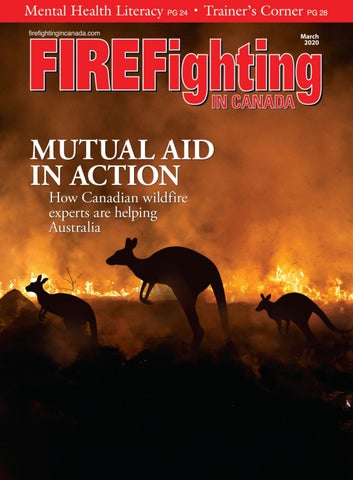
Australia has been ravaged by one of the worst wildfire seasons seen in decades. In early December, an official request for assistance reached the Canadian Interagency Forest Fire Centre and a cohort of 21 highly trained staff from a variety of provinces were sent for a 38-day deployment in Australia. Since then, over 200 Canadian personnel have been deployed to aid in the suppression efforts.

16 CANCER IN FIREFIGHTERS: PART 3

The third and last installment in our Cancer in Firefighters series looks at presumptive cancer legislation across Canada and chronicles how one doctor began working with and advocating for firefighters with cancer.

24

MENTAL HEALTH LITERACY

Working in the fire service will impact your mental health, one way or another. This feature focuses on why mental health literacy — the ability to educate to the point of recognition, prevention and management — is so important.

T

COMMENT

Presumptive legislation

his edition marks the third and last installment in our cancer in firefighters series by Dr. Kenneth Kunz, an oncologist. This final article brings us alongside a doctor on his journey helping firefighters and summarizes the presumptive legislation for cancer in firefighters Canada-wide. As you can see from the chart on page 17, cancers covered and minimum cumulative periods vary depending on where you live. The lack of national uniformity is just one indicator that presumptive legislation is extraordinarily complex.

To a firefighter who has been diagnosed with cancer and had their workers’ compensation claim rejected, the system feels broken.

To a firefighter with an approved claim, the system feels like recognition and relief. The possibility for rejection or acceptance, the existence of these circumstances, can mire a conversation about presumptive legislation in mixed feelings. Legislation expansion appears to be the leading trend, and while that might not mean a win for every claim, it is a win in the right direction for firefighters. Expansion indicates widespread recogntion and acceptance that firefighters are at a higher risk for cancer than the general population.

every perceivable angle. Obviously, it would be better if the cancer hadn’t happened at all. Humans can’t get rid of cancer, but they can reduce the risk of it developing, even in higher risk situations where one’s job may inherently tip the scales unfavourably. There is hope in this, hope for a future where less firefighters get cancer.

ON THE COVER

Hundreds of Canadians have assisted with Australia’s devasting wildfires — here’s how the mutual arrangement between the two countries works. See story on page 10.

The fire service, perhaps more than anyone, knows the power of prevention. Fire safety messaging in communities has contributed to a substantial decrease in residential fires. A Statistics Canada report drawn up in September 2017 showed that the total number of fires in the National Fire Incident Database (NFID) went down 25 per cent between 2005 and 2014. Fire related deaths declined by 32 per cent between 2008 and 2014. The fire service deserves significant credit for these lives saved. Prevention works. Knowledge works when it’s accurate and actionable. Educating firefighters about cancer screening, lifestyle measure, and how to protect themselves from cancer through proper procedures will save lives too. A shift is afoot to make this happen, and there are firefighters who will live longer, healthier lives because of it.

ESTABLISHED 1957 MARCH 2020 VOL. 64 NO. 2

EDITOR LAURA AIKEN laiken@annexbusinessmedia.com 416-522-1595

ASSOCIATE EDITOR BRIEANNA CHARLEBOIS bcharlebois@annexbusinessmedia.com 416-510-5233

ASSOCIATE PUBLISHER ADAM SZPAKOWSKI aszpakowski@annexbusinessmedia.com 289-221-6605

MEDIA DESIGNER ALISON KEBA akeba@annexbusinessmedia.com

GROUP PUBLISHER/VP SALES MARTIN MCANULTY fire@annexbusinessmedia.com

COO SCOTT JAMIESON sjamieson@annexbusinessmedia.com

PUBLICATION MAIL AGREEMENT #40065710

RETURN UNDELIVERABLE CANADIAN ADDRESSES TO CIRCULATION DEPT.

P.O. Box 530, SIMCOE, ON N3Y 4N5 e-mail: subscribe@firefightingincanada.com

Printed in Canada ISSN 0015–2595

CIRCULATION

e-mail: bolechnowicz@annexbusinessmedia.com Tel: 416-510-5182

Fax: 416-510-6875 or 416-442-2191

Mail: 111 Gordon Baker Rd., Suite 400, Toronto, ON M2H 3R1

SUBSCRIPTION RATES

Canada – 1 Year - $25.50 (GST - #867172652RT0001)

USA – 1 Year $58.50 (CDN)

Annex Privacy Officer Privacy@annexbusinessmedia.com

Tel: 800-668-2374

Occasionally, Fire Fighting in Canada will mail information on behalf of industry-related groups whose products and services we believe may be of interest to you. If you prefer not to receive this information, please contact our circulation department in any of the four ways listed above.

Presumptive legislation concerns financial compensation, and the economic toll of cancer reaches beyond fighters and their loved ones to the municipalities who employ them. The emotional burdens remain unquantifiable.

A firefighter with cancer is a devastating and costly occurrence for all involved at

No part of the editorial content of this publication may be reprinted without the publisher’s written permission ©2020 Annex Publishing and Printing Inc. All rights reserved. Opinions expressed in this magazine are not necessarily those of the editor or the publisher. No liability is assumed for errors or omissions.

All advertising is subject to the publisher’s approval. Such approval does not imply any endorsement of the products or services advertised. Publisher reserves the right to refuse advertising that does not meet the standards of the publication.

www.firefightingincanada.com

STATIONtoSTATION

ACROSS CANADA: Regional news briefs

OAFC Labour Relations Seminar

In late January, fire service leaders and human resource professionals from across Canada gathered at the annual Ontario Association of Fire Chiefs (OAFC) Hicks Morley Labour Relations Seminar in Toronto. Attendees heard from legal experts, chief fire officers, and a variety of inspirational speakers. Presenters provided insight, up-to-date knowledge, and guidance on a wide range of labour relations topics that currently impact the fire service.

The seminar kicked off with a keynote address from comedian Jody Urquhart, who discussed leadership, the importance of positive thinking, and the benefits of laughter to decrease stress. Then, after brief remarks from Ontario’s Minister of Labour Monte McNaughton, attendees split into breakout sessions: urban and

THE BRASS POLE

Promotions & appointments

NORA HANNON was promoted to regional fire chief of The Regional District of Central Kootenay on Dec. 10. Hannon has worked in the Kootenays for 12 years and has played key roles in the Emergency Program and

Wildfire Mitigation with the RDCK. Prior to the promotion, she was acting deputy regional fire chief.

City Council appointed BRENT THOMAS fire chief the Orillia Fire Department effective Dec. 10. Thomas has spent 30 years in the fire service. He also

suburban/rural.

In the rural breakout session, Hicks Morley lawyers focused on some of the issues facing Ontario’s volunteer firefighters. They spoke about the different ways to define volunteer firefighters: Are they actually volunteers? Or are they employees? The Hicks Morley team pointed out that the answer isn’t as simple as some may think. The lawyers also addressed one of the biggest concerns in the fire service – mental health and WSIB coverage and how presumptive PTSD legislation affects the fire service.

Meanwhile, the urban breakout session was also addressing mental health and discrimination in the workplace. During this session, the team of Hicks Morley lawyers stressed the fact that every discrimination case, or mental health illness, is unique and needs to be addressed individually, rather than a blanket policy. The presenters provided numerous suggestions on how to accommodate those suffering from these illnesses, such as treatment, unpaid leave, Last Chance Agreements, and other strategies.

Continuing with the mental health theme, Ontario’s Associate Minister of Mental Health and Addictions, Michael Tibollo, spoke to investments the Ontario Government is making. He said his ultimate goal is for uniformity in mental health reform across Ontario.

“Mental health accessibility has been an issue in Ontario for a long time” said Tibollo, noting that one in five Ontarians suffer from mental health and/or addiction issues. “We are going to be adding $3.8 billion into mental health over the next 10 years.”

While strides are being made for firefighters who suffer from PTSD, there are still hurdles to overcome. It was estimated that about 10 per cent of first responders worldwide are affected by mental health issues.

Another major topic at this year’s seminar was staffing depart-

spent 10 years as a paramedic. He joined the Orillia Fire Department in 2014, where he served as assistant fire chief responsible for training and overseeing the city’s emergency management program. After the retirement of former fire chief Ralph Dominelli, Thomas was appointed acting fire chief on April 1, 2019.

LINDSAY HOLM was appointed full time fire chief of North Battleford, Sask., in December. He began his career as an Emergency Medical Technician before joining the North Battleford Fire Department in 2000. Holm moved from the position of deputy fire chief into the role

A keynote speaker, Nick Bontis, strategy and management specialist, talked about shortening attention spans due to technology.

ments. While municipalities have the power to determine the level of fire protection they offer their residents, it was noted that there are statutory requirements under the Occupational Health and Safety Act (OHSA) that need to be considered.

Later in the seminar, Hicks Morley labour and employment lawyers gave an update on recent collective bargaining decisions and interest arbitration awards in the fire sector.

In his keynote speech, Nick Bontis, a strategy and management specialist, focused on the shortening of people’s attention spans due to technology. While 91 per cent of Canadians use the internet daily, Bontis noted that socialization is critical to forge meaningful relationships.

Keeping in tune with Bontis’ message, communications specialist Karen Gordon then took to the stage to speak about social media. Gordon encouraged chiefs to use social media to facilitate communication with the public and gave examples of how to properly use social media, and how not to. She noted that Instagram can be an effective recruitment tool for the younger generation, while Twitter can be used to engage the general public.

This year marked another successful Labour Relations Seminar for the OAFC, their event partner Hicks Morley, association sponsor Gordon Strategy and the many attendees.

JIBC to recognize B.C. fire chief with honorary degree

Tim Armstrong, fire chief for the City of New Westminster, B.C., is being recognized for his contributions to public safety in Canada and internationally.

The Justice Institute of British Columbia (JIBC) will present Armstrong with a Doctor of Laws degree, honoris causa.

Armstrong began his firefighting career at the age of 21 with Vancouver Fire & Rescue Services where he served for 28 years reaching the rank of Deputy Chief Special Operations. He became the fire chief at New Westminster Fire & Rescue Services in 2009. He also currently serves as Director of Emergency Management for the City of New Westminster.

As a strong advocate of emergency management and cross-border relationships, he is the chair of the Cross Border Emergency Management Working Group which engages emergency responders and law enforcement agencies in British Columbia and the State of Washington in multi-agency emergency preparedness initiatives. He has spent much of his career focused on training and advancing specialty skill sets within the fire service. In 2017, Armstrong was named Fire Chief of the Year by the Canadian Association of Fire Chiefs in recognition of his outstanding service.

Mississauga group raises funds for cancer programs

The Mississauga Fire Fighters Benevolent Fund raised $58,000 for the Cancer Care program at three community hospitals.

For the fifth year in a row, the group made t-shirts, received local sponsorships and painted a fire truck pink. They spent every weekend from Sept. 28 to Nov. 1 touring the community, selling t-shirts and raising money for the oncology departments at Trillium Health

Partner hospitals.

Bryan Doucette is the fire prevention inspector for the Mississauga Fire Department and is a trustee with the Mississauga Fire Fighters Benevolent Fund. He said that each year they have conincreased the amount raised. cit The first year the group raised $17,000. This year, $58,000 was raised.

“This year we sold more shirts than we ever have,” he

said. “So, we’re still progressively on the incline and are already getting ramped up for next year.”

The Mississauga Fire Fighters Benevolent Fund was launched in 1982 and has collectively raised over $2.6 million dollars for charities within their community.

Doucette said they are looking forward to raising even more money next time for their Trillium Health Partners.

of acting chief after the former fire chief’s departure in early 2019. He moved into the permanent position on Dec. 9. Last year, he also received the Saskatchewan Protective Services Medal from Lt.-Gov. Russ Mirasty in recognition of his years of service.

MATT HALMASY was appointed deputy fire chief of the Cramache Township

Fire Department in Ontario. He was previously a captain with the Alnwick-Haldimand Township Fire Department. Halmasy moved into his new role on Dec. 20.

In January, KENT READMAN was appointed deputy fire chief of the Dryden Fire Service in Ontario. Alongside his new position, he was also given

the additional role as the city’s new alternate community emergency management program coordinator. Though new to Dryden, Readman previously served as the Fire Chief in Marathon, Ont., and in Barriere, B.C.

Retirements

JOHN OSBORNE retired Feb. 29 after serving the city of

Guelph, Ont., for 30 years. Osborne joined the department as a dispatch firefighter. He was instrumental in implementing the strategic development of the hazardous materials and special operations team. Osborne became deputy fire chief in 2009 before moving into the role of chief in 2016.

The Mississauga Fire Fighters Benevolent Fund sold t-shirts from a pink truck to raise money for local cancer care programs

STATIONtoSTATION

BRIGADE NEWS: From departments across Canada

The Banff Fire Department Brigade in Alberta received an emergency rescue pumper from Fort Garry Fire Trucks. This unit runs on a Cummins L9 350 HP engine and an Allison 3000 EVS transmission. The truck was built with salt water marine grade aluminum and has a Waterous CSU 1500 pump capacity and FoamPro 2002.

Saskatchewan’s Moose Jaw Fire Department welcomed this top mount enclosed pumper built by Fort Garry Fire Trucks. This truck is powered by a 450 HP Cummins engine and an Allison 3000 EVS transmission. Built with CO Poly 500 IG, this unit is equipped with a Hale QMAX XS 2250 pump and FoamPro 2002.

The Kersley Volunteer Fire Department in British Columbia received a Freightliner M2-106 pumper from Fort Garry Fire Trucks. This truck is powered by a Cummins L9 – 350 EV HP engine and an Allison EVS 3000 transmission. This unit is built with CO Poly 1000 IG aluminum and has cross control. It also houses a Hale PTO RSD1250 pump.

The Regina Fire Department in Saskatchewan took delivery of a Rosenbauer custom engine from Rocky Mountain Pheonix. This apparatus runs on a Cummins L9 350 HP engine and an Allison 3000 EVS transmission. Other features include: FoamPro 2002 foam system, a 2271 L water tank, 2000lb front suspension and a Roda Deaco emergency engine shut down with dual controls.

The Calgary Fire Department took delivery of a leased vehicle from Commercial Emergency Equipment. Manufactured by Pierce Manufacturing, this unit runs on a Cummins L9, 450 HP engine and features a 107’ Ascendant ladder. The truck has a a single stage Waterous CSU 2000 gpm, carries 500 gallons and has a plumbing for future Husky 3/12 foam system.

The Chilliwack Fire Department in British Columbia welcomed this delivery from Commercial Emergency Equipment. This truck is powered by a Detroit Diesel, DD13, 470 HP engine and a 107’ Ascendant ladder. Built on a single axle Enforcer, this unit is equipped with a Pierce 1500 gpm single stage pump, holds 500 gallons and has a Husky 12, single agent, PUC, multi select feature pump.

MOOSE JAW FIRE DEPARTMENT
BANFF FIRE DEPARTMENT
KERSLEY VOLUNTEER FIRE DEPARTMENT
REGINA FIRE DEPARTMENT
CALGARY FIRE DEPARTMENT
CHILLIWACK FIRE DEPARTMENT

Mutual aid in action

How Canadian wildfire experts are helping Australia

Australia has been ravaged by one of the worst wildfire seasons seen in decades. To date, millions of hectares have burned and about 2,500 homes have been destroyed. A reported 34 people and an estimated billion native animals have died. The current economic cost of the fire has been estimated at AUS $4.4 billion and counting.

In early December, an official request for assistance reached the Canadian Interagency Forest Fire Centre (CIFFC), and a cohort of 21 highly trained staff from a variety of provinces were sent for a 38-day deployment to New South Wales. Since then, 239 Canadians aided in three different Australian states.

Melanie Morin, an information officer for CIFFC, returned to Canada on Jan. 20 after a 14-day deployment in Melbourne. Until recently, she explained, all of Australia’s requests had been for a specialized workforce. This included fulfilling roles in command, aviation, planning, logistics and operations.

“As an agency, we facilitate and organize wildland fire fighting resources in Canada,” said Morin. “The experts who have been deployed to Australia are all personnel who fill these roles in Canada within their own agencies during our fire season.”

At the time of publication, CIFFC had facilitated 52 personnel from British Columbia, 34 from Alberta, two from the Yukon, four from the Northwest Territories, 11 from Saskatchewan, 11 from Manitoba, 35 from Ontario, 46 from Quebec, four from Newfoundland and Labrador, 16 from New Brunswick, two from Prince Edward Island, nine from Nova Scotia and 13 personnel from Parks Canada.

When asked why certain provinces were able to provide more personnel than others, Morin explained it is all dependent

on what requests have been sent, who is available at the time of the request and the individual’s qualifications. It is, as she explains, “a bit of a balancing act.”

Among the specialists chosen was Glen Burgess, a former incident commander and the current deputy fire centre manager at the Kamloops Fire Centre in British Columbia. He travelled to Australia on Dec. 22 for a five-week deployment. Stationed in New South Wales, he worked as a senior agency representative and served as a liaison between Canadian experts and Australian agencies.

“Australia has seen fires in the hundreds of thousands of hectares and if you had asked me 10 years ago, I would have said that that’s unheard of. But after 2017 and 2018 in B.C., and what we’ve seen in Alberta in the last few years, the sheer size of recent forest fires are becoming much more common worldwide,” he said.

International collaborations allow for the exchange of personnel, knowledge, skills, equipment, technology and mutual support in the event of an emergency. This isn’t the first time Canada has been called to aid in Australia’s wildfire fighting efforts. The two countries have been officially sharing firefighter resources since 2015.

The arrangement between Canadian and Australian signatories on the Exchange of Wildland Fire Management Resources was signed June 2, 2016. In 2017, almost 200 Australian fire fighting specialists arrived in Canada to assist in fighting hundreds of wildfires. Again, in 2018, Australian firefighters (alongside American, Mexican and New Zealand firefighters), came to Canada to help British Columbia fight a horrendous fire season.

British Columbia has also fostered its own mutually beneficial wildfire management relationship with the Australian state of Victoria for over 12 years. Wildland fire personnel from British Columbia were deployed to Australia in 2007 and 2009 to help respond to busy fire seasons and personnel from Australia were deployed to British Columbia to assist with fire fighting efforts in 2009, 2014 and 2015.

Morin said the partnership between Canada and Australia has been successful, in part, because the countries have opposing summers and because the need for more experts has grown immensely as

LEFT The severity of Australia’s wildfire season has brought an international conversation on the impact of climate change on wildfires to the forefront.
ABOVE CIFFC facilitated 239 Canadian personnel to aid in the suppression efforts in Australia.

GREAT ON

SNOW AND ICE

wildfire seasons have become more volatile in recent years.

On the fire ground, Burgess explained that, while wildfire fighting tactics are similar, how Australians apply these tactics is different.

“They do a lot of work off trucks,” he said. “In B.C., the crews work on the ground so, I think one of the reasons they didn’t ask for crews and why we couldn’t send crews initially was because it’s just not familiar to us.”

But, in February, the CIFFC deployed four groups of frontline firefighters as per request of the National Resource Sharing Centre in Melbourne.

Glen Burgess worked as a senior agency representative during his five-week deployment to Australia.

“Our American counterparts sent firefighters in December and January so perhaps that need was being fulfilled at the time,” said Morin. “Their first requests from us were for overhead personnel but, as their needs increased and changed a bit, we started to send frontline firefighters.”

The four groups that deployed included a total of 79 firefighters (three cohorts of 20 and one of 19 ) — 20 from British Columbia, 39 from Quebec and 20 Atlantic-based firefighters (combined from New Brunswick, Nova Scotia and Prince Edward Island). Before deployment, CIFFC chose firefighters who fulfilled the necessary requirements. Once in Melbourne, the firefighters were then put through the appropriate safety and integration training, received their assignments and soon began working on specific incidents.

The Canadian government also organized and sent a military transport plane and about 15 additional personnel to help fight bushfires in Australia on Feb. 2. as part of Operation Renaissance, a standing mission that sends military help to other countries coping with natural disasters. The plane transported fire retardant from America and is working to aid in Australia’s airlift capacity and take images of fires from the air to measure them and predict how they might spread. (Morin noted this was facilitated independently by governments.)

Burgess, who was part of the second cohort of fire experts to deploy and has since returned to Canada, said that upon arrival into Australia, the reception — not just of Canadian experts and firefighters, but also those deployed from the United States, New Zealand and Tasmania — was “incredibly welcoming”. He said previously working with many of the same Australians in British Columbia during recent wildfire seasons also allowed for a smooth transition in aiding operations.

“The nice thing is that we actually know a lot of [the Australian experts] because, while the world is really big, the fire fighting community is really quite small. Having a pre-existing relationship with some of the people certainly makes it easier to get your feet under you,” Burgess said. “All you can do is try to figure out how you fit in to how they do things and do the best job you can.”

Editor’s note: All figures cited in this article were current when this edition went to press.

PHOTO

COMING TO FDIC IN APRIL 2020

Fort Garry Fire Trucks will be showcasing our brand new Bronto All-Rounder featuring:

• 92-foot articulated ladder platform

• 450 HP Freightliner chassis

• 1250 IG pump with a 275 IG poly tank and foam system

• Measuring under 13ft tall, 42ft long and 8ft wide.

Fort Garry Fire Trucks is the largest fire apparatus manufacturer in Canada and are proud builders of fire trucks, custom-built pumpers, aerial ladders, and related fire-fighting equipment. Our customers emanate from cities, towns, and municipalities throughout Canada, the U.S., and abroad

with the harshest weather, climates, and terrain— which is why we design “One Tough Truck.”

OLEADERSHIPFORUM

What legacy are you leaving behind?

ver the Christmas holidays, I took time to stop and reflect about the firefighters I have worked with over the past 26 years. I wondered what would they say about my leadership style and what they would remember most about the department. As a leader, you hope to leave a positive legacy behind. For the record, to any firefighters from my department: I have no plans on leaving!

What is legacy? The Merriam-Webster dictionary defines legacy as “something transmitted by or received from an ancestor or predecessor or from the past.” The key to that definition is “received from a predecessor.” We all know that everyone can be replaced, something that we are reminded of numerous times throughout our careers. Before you go, what do you want to leave for your successor? How do you want your entire team to remember your tenure?

Apparatus will change, stations will be renovated and procedures will update, but it’s interactions and conversations with you that personnel and peers will remember. They will remember how you handled difficult situations more than they will remember “stuff” bought.

There are very few people in any industry who have pioneered a new groundbreaking technique or piece of equipment that has drastically changed the way business is completed. Chances are very slim you will be one of those people. However, people remember positive encounters and relationships they have had with leaders more than they will remember the inventor of a piece of equipment. I have no idea who invented the thermal imaging camera or who pioneered the technique for utilizing them for a search. I do remember many different leaders who have had a memorable influence on me and my career. They stick with me each time I am having a difficult conversation with another employee or am in an adverse situation.

We have a plaque hanging in one of our fire stations recognizing the individuals who had a hand in construction of the building. From time to time, people will walk by it and acknowledge the great job they did on seeing the project to completion. But you get a bunch of the same firefighters sitting around discussing past leaders in the department, and this rarely comes up. They speak about a former fire chief who was gruff and tough and demanded respect, but at the same time was fair, approachable and took care of his people. They pass stories on to the younger generations of this individual and how much they respected him. This is what they remember — the people who directly influenced them in a positive way.

Firefighters also remember those “big calls” and how the leaders around them brought them through adversity. They remember how they were treated and brought through the incident to become better firefighters and a better overall department. Even more memorable are the times they screwed up at an incident and how the leadership addressed it and worked with them to improve on their abilities. These incidents go a long way towards how firefighters and even those around us at scenes will remember how an individual was as a leader

We all know that everyone can be replaced, something that we are reminded of numerous times throughout our careers. Before you go, what do you want to leave for your successor? ‘‘ ’’

As I sit in another arena this hockey season writing this article, I relate the fire service legacies to hockey coaches. I can’t tell you the exact year I won any hockey titles or tournaments, but I can sure tell you the coaches that left an impression on my life. The coaches didn’t create any groundbreaking systems or schemes, but their positive influence on me and my future career is quite a legacy to me. It showed me how you can navigate through a tough situation and lead a team through it in a positive manner, similar to guiding your fire fighting team.

Chris Harrow is the fire chief in Minto, Ont. He is a graduate from fire programs at Lakeland College and Dalhousie University and holds a graduate certificate in Advanced Care Paramedics from Conestoga College. He can be reached at c.harrow@mintofiredept.on.ca

during their tenure.

If you as a leader can be a positive role model for one firefighter or even one generation of firefighters, you will be remembered for doing so. If you have large scale incidents occur in your career, you will be remembered for how you handled yourself and the people involved. They will remember your leadership and how the department improved after the incident. Any time you are able to demonstrate your leadership abilities in a positive manner will add to the opinions and memories people hold about you.

I am not advocating for a leader to spend an excessive amount of time worrying about their legacy and how it will last. Good leaders will have no worries about what their legacy consists of. Work hard every day to leave a positive impression on everyone you encounter and your legacy will take care of itself.

NO HYDRANTS, NO PROBLEM

1 2 4

CET manufactures portable pumps, skid units, brush trucks and more to allow fire departments to Adapt, Improvise & Extinguish fire in almost any scenario where hydrants are scarce and static water resources maybe all you have to work with. CET- Providing fire ground solutions since 1908.

1

Portable Pumps (PFP-20hp-HND-MR Shown)

50+ models to choose from for both fire attack & resupply operations from static water sources like lakes, rivers, ponds and pools

2 3 4

Skid Units (Attack Pack Shown)

State-of-the-art custom designs & components –yet affordable!

Glider Kits

Arrives Completely pre-assembled, pre-plumbed, pre-wired and pre-tested ! Simply mount to your chassis, connect electrical and go fight fire!

Brush Trucks (Custom Built)

Solid/Affordable/Practical

CANCER IN firefighters: Part 3

Doctors, firefighters and why the power is in prevention

During my training as a physician, which began in 1982 at the Winnipeg Health Sciences Centre, and concluded in 1996 at the Arizona Cancer Center, I must have assessed and treated thousands of patients. Looking back though, I never really paid much attention to the firefighters, or any other special group, for that matter. As a physician, I was never fully aware of the work-related risks of what it meant to be a firefighter.

Why was this? Why do the impending long-range health dangers that face a firefighter escape a doctor’s attention? The answer is simple: just like firefighters working on the fireground, a doctor must frequently operate under the urgent pressure of workload levered against time. The concept of ‘situational awareness’ applies just as much to the work of a doctor as it does to the work of a firefighter.

Firefighters must note that, for doctors, the medical training itself is so mentally and physically demanding, the patients so

numerous, the illnesses so serious, the responsibilities so dire, the hours so merciless, and the patient turnover rates so high, that the goal of just surviving the interminable grind of medical education — without messing up too badly, or else going down altogether — is often the haggard medical resident’s prime objective. Under the burden of circumstance, it is difficult for a doctor to maintain focus on the personalized details of any special group of patients. On the flip side however, a doctor will be delighted to cooperate with a motivated firefighter for better health and wellness outcomes — once that physician is made aware of the risks that confront the fire service. Firefighters should know this, and be empowered to address it by acting as their own best health advocates. Therefore, a firefighter must take personal responsibility over matters they can control directly. This includes maintaining an optimal body weight through eating a healthy diet with a reasonable calorie count, attaining peak fitness through physical activity, eliminating tobacco consumption, curtailing alcohol along with refined sugar, ensuring a regular, good night’s sleep, and drinking plenty of water. Then, there is something extremely important – our mental health – which determines the way we think and is the basis of all motivation and action. A relatively new science called epigenetics has shown that the cells of our bodies take their signals from our beliefs. The mind is therefore a powerful force, and optimal mental health is critically essential for a firefighter’s overall health. This makes down-time, stress reduction, relaxation, strong social connections, and talking – whether that be with a trusted mentor or a mental health counselor – all critical ingredients for healthy and fit firefighters. It goes without saying that workplace safety and health are also an important part of firefighter health, including proper use of clean, personal protective equipment, and careful decontamination after a fire call.

There is one further important point to make: firefighters must also take the responsibility of informing their primary care providers of the long-term, line-of-duty risks they face. This premise gave rise to the “Firefighter’s Cancer Screening and Surveillance Letter”, which was commissioned under the vision of retired Surrey, B.C., fire chief Len Garis. Freely available to all firefighters working in any geographic location, this letter can be found on the Fire Chiefs’ Association of British Columbia website. Firefighters are encouraged to print this letter out, and regard it as a personalized medical document that has clinical currency in any fire jurisdiction worldwide. I wrote the letter expressly for the purpose of informing primary care providers of the long-term health risks that firefighters face, primarily as it concerns cancer.

TYPES OF CANCERS CURRENTLY COVERED BY PRESUMPTIVE LEGISLATION

MINIMUM CUMULATIVE PERIOD IN YEARS

Quebec does not have presumptive legislation for firefighters with cancer. In 2016, an administrative policy was created that recognized seven cancers and minimum service periods: Kidney, bladder, and lymphoma (20), lung and larynx (15), myeloma (15) and mesothelioma (0).

In summary, for a firefighter, personal accountability in thought and action constitutes an important act of public service, because healthy and fit firefighters are functional firefighters — they are out in the world working in a spirit of generosity.

■ TRAINING AND SURVIVAL: DOCTORS AND THEIR FIREFIGHTERS

When I think back on the matter of a doctor’s training, and the innumerable nights spent ‘on call’ in the hospital, I remember some isolated but dreadful clinical vignettes involving sick or injured firefighters. Cases like the stoically resigned but forlorn 44-year-old firefighter with leukemia who, sitting alone in his isolation room, was breathing through a yellow paper face mask while clad only in a blue hospital gown. He was grasping an I.V. chemotherapy pole to support his weight, after having spent many weeks on the bone marrow transplant unit. Shivering uncontrollably with fevers and chills, his very life was in peril from the leukemia as well as the difficult and prolonged treatment.

And then there was that otherwise fit and robust 55-year-old non-smoking firefighter, accompanied by his visibly shaken and apprehensive wife. He rolled around in agony on a hospital gurney in the clinic, having been diagnosed with a sudden-onset and aggressive form of lung cancer. The disease was already metastatic to his ribs and vertebrae, and his illness was so rapid that I never really got the chance to know him. He didn’t suffer long though, but in dying, left another widow to attend yet another solemn bagpipe ceremony.

All of these, and many other heartbreaking firefighter cases to

you protect your firefighters?

We do. For more than 40 years we have made it our business to ensure clean air in fire stations. We provide high-quality exhaust removal systems to protect firefighters and others from exposure to hazardous diesel exhausts.

800-644-0911

www.plymovent.com

the side, my life and medical training went necessarily onward. In February 2011, I was living in Nelson, B.C., where I was giving a series of public lectures on cancer awareness and prevention. At one of these, a volunteer firefighter by the name of Harry Hadikin, from Beasley Search and Rescue, asked me if I would consider giving a similar talk on how firefighters, specifically, could avoid getting cancer. This simple request triggered a flood of recollections concerning all the firefighters I had seen over my years of practice who had succumbed to cancer. Later, on researching the issue, I was surprized to discover that several large, statistically significant studies had been published in peer-reviewed medical journals confirming that firefighters, when compared to the general public, had higher incidence and mortality rates from cancer. I have since prepared the lecture Hadikin requested, called: “Job-Related Cancers in Firefighters”, and have given it to appreciative audiences at firehalls and hospital conference rooms all across the province. This talk can be found online on the Comox Search and Rescue website.

These speaking engagements have brought me face to face with many in the fire service who have been diagnosed with a cancer they feel resulted from the toxicity of fighting fires. Some of these firefighters have told me they were unsuccessful in obtaining recognition and support from Workers’ Compensation because the type of cancer they were diagnosed with was not on the presumption list. Just as heartbreaking, I have seen cases where firefighters diagnosed with a Workers’ Compensation-recognized cancer were denied benefits because the clinical timeline of their illness did not meet the required minimum cumulative period. To the best of my knowledge, wisdom, and experience as a cancer consultant, I have never known any type of cancer to obey a minimum cumulative period. Similarly, there are over 200 different types of cells in the human body, any one of which can give rise to cancer in response to a carcinogenic mutation, depending on individual genetic vulnerabilities. Therefore, it is possible for a firefighter to be diagnosed with any type of cancer, and this includes rare cancers that are not typically covered by workers’ compensation. Rare cancers may be infrequent; however, they are not infrequent to the person they are affecting, and this includes firefighters.

A quick review of the firefighter cancer presumption laws, along with the minimum employment periods, shows considerable variation in coverage from province to province. This reflects the complex personal, medicolegal, scientific, and economic controversies that surround this type of legislation. Furthermore, the non-uniformity in cancer presumption highlights the point that cancer is a complex, multifactorial, and poorly understood phenomenon that involves many variables including advancing age, personal lifestyle choices, natural cancer causing exposures like sunlight and certain infections, and environmental and job-related carcinogens, all of which are balanced against an individual’s genetic susceptibility.

In light of this knowledge, I hope progress in cancer presumption legislation will continue to move forward with expanding coverage for firefighters, as firefighters themselves continue assuming personal responsibility for their health.

Dr. Kenneth Kunz trained as an oncologist, cancer researcher and a mental health & addictions counsellor and consultant. He is a competitive track and field athlete and father of two residing in British Columbia. Contact him at Kenn@netidea.com

SEE THE HEAT FROM EVERY VANTAGE POINT

Give your crew FLIR thermal vision — a clear, 360° view of the scene — from the air, ground and by hand in the thick of the smoke. Plan your attack faster, see re as it spreads and make rescues safer for victims and re ghters. FLIR has a TIC solution for any budget.

To learn more or request a demonstration, visit flir.ca/fire

TCall signs for life

he fire service is constantly changing. Thirty years ago, we had little to no portable radios. When we sent a team into a burning structure, we could not contact them other than by yelling at them. Today we would not think of sending a team into a burning structure without a portable radio. Modern fire services have portable radios for every member of the team. Teams today may have two to four portable radios, depending on their size. This change alone suggests that we should use a call sign system that allows us (if needed) to talk to the individual members of that team. Why, you say? Well, what happens when one member of your team gets separated from the rest of the team, how do we call that one member? We could call them by name, which should work, but we could have more than one firefighter with the same name or we could or in the case of a mutual aid firefighter, not know how to pronounce the name. Also, once we use the real name, the confidentiality is gone. If that firefighter is lost or trapped and we use the real name on the radio, it is likely that many others, outside of your department will know right away via scanners.

Some departments use their engine company assignments as their call sign when operating on the fireground. Engine #1 remains Engine #1 when they are doing an interior attack or search. In this example, if we needed two teams (assuming a four person engine company) from Engine #1 we would further split them into Engine #1 Alpha and Engine #1 Bravo (or something like this). This does not give us individual call signs and does not take advantage of having more than one radio on that team. If one member from Engine #1 Alpha gets separated from the other, it becomes very difficult to communicate without using real names.

STOPBAD

The task call signs can become very confusing, even at simple incidents. The first in confinement team might be called “Attack 1”, the first in search team, going to floor two (bedrooms) for a primary search might be called “Search 1”, the second in confinement team might be called “Attack 2” and the second in search team, conducting a primary on the first floor would be called “Search 2”. So, Search 1 is on floor two and Search 2 is on floor 1. Confused yet? What happens if Attack 1 finds the victim and Search 1 is then asked to confine the fire? We would have Attack 1, rescuing and Search 1 confining. Confusing? You bet.

But there’s a solution: Call Signs for Life! How about a call sign system where you are assigned a call sign when you join the department and use the same call sign for your entire career, the same call sign at every incident doing any task? This is much safer and more effective. Firefighters and incident commanders have enough to think about with having to remember or create a different call sign for every task you do or when you ride on a different engine.

Call Signs for Life works extremely well. If firefighters are working on individual tasks like traffic their individual call sign would be used.

Firefighters and incident commanders have enough to think about with having to remember or create a different call sign for every task you do or when you ride on a different engine. ‘‘ ’’

Some departments use task orientated call signs. An interior attack team would likely be called “Attack 1” and interior search team called “Search 1”, and so on. Again, this does not take advantage of more than one radio on that team. Also, using this type of system can lead to many other problems. When using tasks as call signs, a firefighter might have his call sign changed several times during the same incident and will likely have a different call sign at his next incident. The firefighter needs to remember what his latest call sign is and try not to respond to a call sign that the firefighter may have used at a previous incident or earlier at the same incident.

Gord Schreiner joined the fire service in 1975 and is the full-time fire chief in Comox, B.C., where he also manages the Comox Fire Training Centre. Contact him at firehall@comox.ca and follow him on Twitter at @comoxfire.

When they are working in teams the team leader’s call sign is used to contact the team. If a member of the team gets separated, that firefighter can contact command using their individual call sign. And no, you don’t need to remember everyone’s call sign, just your own. In our case we have displayed the individual call signs on everyone’s PPE, kind of like putting numbers on your rigs for easier identification. Individual call signs are on helmet patches, decals on rear of helmets and Velcro on the jackets and pants. We can see your call sign, you can see your call sign.

Call signs for life can make your fireground safer and more effective, allowing command to think more about strategy and tactics rather than what calls signs to assign in-coming teams. What will be your call sign at the next incident you attend? If you are using Call Signs for Life, you would know right now!

BACKtoBASICS

Ladder Dating: Climbing Angles

We introduced our topic of ladder dating — coined such because you need to know your ladder intimately and would do well to date it first — in the February edition of Fire Fighting in Canada, and we’re going to dive right in here by detailing climbing angles. There are a few opinions on what the proper angle is for setting up a ladder so it’s safe to climb. Some of the arguments are valid and others are not.

In basic training, we instruct from the textbook that the optimal climbing angle for any ladder, be it a ground ladder or an aerial device, is 75 degrees or ¼ of the building height. This optimal angle allows for a firefighter to ascend and descend the ladder with ease. They should be able to stand upright while climbing just as they would be if they were walking on level ground. It is designed to remove some of the physical stress and exertion from the firefighter, thus making the task assigned a little bit easier.

How do we measure the climbing angle of 75 degrees or ¼ of the building height? Every ground ladder will have a pictorial diagram on the beam side of it showing how a firefighter can measure with their arms out extended, their feet planted at the base tip of the ladder and their hands just touching the rung of the ladder in front of them. If a firefighter can do this, then the ladder is at the optimal climbing angle. Other ladders will have an “L” on an angle so that when the ladder is set to the proper angle, the “L” will read just like you see it here —level.

With the ground ladder angle set, is it really at 75 degrees or ¼

of the building height? How do we know if it is or not? How many of you carry a protractor in your coat pocket so, when you’re setting up a ladder, you can pull it out and measure the angle to ensure it is at 75 degrees? Or carry a laser device to measure the height of the building so that you can deduce what length out from the wall the ladder should be at to be ¼ of the building height? The answer is obvious – no one carries these items.

But what if the ladder is not at the optimal climbing angle? Will the ladder not work properly if it is set at an angle of 65 degrees, 55 degrees, or 60 degrees? If you look at Photo 1, you will see two ground ladders set at different angles. One is at the optimal climbing angle of 70 to 75 degrees and the other is slanted at an angle that is probably around 50 degrees. In this photo, both ground ladders are going to provide what is needed at both climbing angles. The one ladder is not superior over the other in terms of holding the firefighter’s weight, providing ingress and egress from the building, allowing the firefighter to work off the ladder, and so on.

How is this possible? The ground ladder is tested annually to ensure that it meets weight and performance limitations. When it is tested, the ladder is placed horizontally, resting on two separate work horses or end supports. Then there is a 500-pound weight that is placed in the middle of the ladder, which is then suspended off the ground for five minutes. The pawls or locks or dogs are then tested to 1,000 pounds to make sure they will not fail under load. If a ground ladder can withstand these types of weights on a horizontal plane, will

Photo 1: These ground ladders are set at different angles, but both perform and neither is superior to the other in performance.
PHOTOS BY MARK VAN DER FEYST
Photo 2: The ground ladder is set at an angle less than the textbook taught 75 degrees, and the firefighter is having no problem working off it.

the same ladder not also withstand our normal operations at an angle less than 75 degrees? Yes, it will.

In Photo 1, the ladder that is set at a lower angle has a firefighter doing a headfirst ladder dive, so it would make sense to have a ladder set at an angle that is not so steep. But in Photos 2 and 3, you will see examples of firefighters standing or working off the ladder to perform a rescue or other functions. Both photos show the ground ladder set at an angle less than 75 degrees, and the firefighter(s) having no problem working off of them.

So, why should we not care too much about setting the ground ladder at the optimal climbing angle every time? The short answer is time. Time is always against us when we need to perform a rescue at a structure fire and taking the time to measure the ladder once set is taking away the time needed to perform the rescue.

Other reasons why we do not want to always set the ladder at 75 degrees is for the firefighter’s benefit. One reason is for firefighter survival or egress methods. If a firefighter needs to get out of the building quickly by doing a head first ladder dive or get onto the ground ladder quickly to climb down, the angle it is set at will accommodate a less intrusive descent.

A second reason is for firefighter rescue as shown in Photo 3. It is easier to remove a downed firefighter from a building down a ladder at an angle that is less intrusive. Also, when we are removing an occupant from the building down the ladder, it is easier for us to control the occupant if they are unconscious, lying horizontally across our arms down a ladder that is less intrusive than at an angle that is at 75 degrees.

Do not get to hung up on setting the ground ladder at the optimal climbing angle whenever using at a structure fire or other instances where the ladder is needed – you will find that the ground ladder set at 60, 65, or 55 degrees will work just as well as safely as a ladder set at 75 degrees.

Mark van der Feyst has been a member of the fire service since 1999 and is a full-time firefighter in Ontario. Mark teaches in Canada, United States and India, and is an FDIC Instructor. He is the lead author of the Residential Fire Rescue book. Email Mark at Mark@FireStarTraining.com.

Photo 3: A less intrusive angle makes it easier to remove a downed firefighter that needs rescuing.

MENTAL HEALTH LITERACY

To help address mental health concerns, the fire service needs to move past awareness and reach educated fluency

Imagine this: You’re just wrapping up a weekend long certification program. You stayed awake for the in-class portion and your hands are dirtied by the practical. The test, when written, was a pass with distinction. You earned your bragging rights. You’ll head back to the hall, and quickly update everyone on your newest knowledge nugget. You’ll proudly, in a power stance and with head held high, announce this achievement loudly to everyone, ushering in station-wide envy.

You are now… Hazmat Aware.

You’re right, this scene as imagined is not likely to happen. As firefighters, we roll our eyes at the Awareness Level certification, like we are likely to do at our Legislative 101 courses. We want to be Technician level, after all. That’s the true testament to our practical and academic merit. Yet, when it comes to mental health, we carry on in maintenance mode with low-level basic mental health knowledge. We are nowhere near mental health literate, or Technicians if you prefer, when it comes to firefighter mental health.

Even more importantly, we don’t know how to challenge those in our profession who may not see a need to move past the awareness stage, who continue to think, believe, act, and sometimes lead with the misunderstanding that mental health is not a true concern in the fire service and when it is, it is either too late to help or there is really nowhere to turn for help.

How do we use checks and balances to ensure we move beyond awareness and actually become educated about our own mental health and how the work of the fire service impacts it? Because it will impact it, one way or another. This is exactly why mental health literacy is important.

The media has really helped advocate for firefighter mental health by relaying true stories of PTSD and suicide in our brotherhood/sisterhood, serious issues that are devasting firehalls across the country. But when the media is our teacher and their coverage is the extent of our education on our mental health, many of us may be left to wonder if they have PTSD. Actually, your lack of sleep and irritability after the recent fatal MVA is most likely normal and is one component of how you process a bad call.

Recent research on volunteer firefighters’ mental health found that firefighters are more aware now than ever that their work can impact their mental health, but for many, the mental health knowledge seemingly stops there (Brazil, 2019). What firefighters need, once they become aware, is what is called mental health literacy. Mental health literacy is defined as the “knowledge and belief about mental disorders which aid their recognition, management, or prevention” (Jorm, Korten, Jacomb, Christensen, Rodgers, & Pollitt, 1997, p. 182). Basically, it is knowing how to recognize, manage

or prevent mental health problems; problems we are vulnerable to because of the very work we do. We are trained how to recognize, manage, and prevent a lot of things in the fire service so we can work effectively and efficiently. Wouldn’t it make sense to do the same with our mental health? Until we start to become literate on this issue, we will have a heck of a time trying to address it.

Think of what we currently do or have in our fire departments relating to mental health as falling along a continuum. At one end we have available services should we find ourselves off the fire ground because of mental health challenges; we have WCB coverage and insurance. In the middle of the continuum we have our CISM defusings and debriefs where we address the bad calls right after they happen to help lessen the impact. At the beginning of the continuum we should have mental health education to improve our mental health literacy. This way, we have a chance to recognize what is going on with ourselves from very early on and through practice and reflection, help prevent any new stories for the media.

Why is awareness level information on its own so problematic? Perhaps the most harmful aspect of not moving beyond the awareness stage is misinformation. How we receive and access information is critical for understanding the harmful consequences. Many of us only gain knowledge through popular media sources such as social media, personal blogs, and online forums. But as the sole source of information on mental health, harms of self-diagnosis, confusion, and further stigmatization can emerge.

Most of us believe that sharing a meme or information on social media is a strategy to lessen stigma on mental health issues, but in reality, it can intensify stigma and increase the likelihood that individuals will not seek help early if the information is wrong. There is a problem with the accuracy of many mental health messages. The overload of PTSD awareness campaigns has contributed to a crisis of misunderstanding of mental health problems and creates confusion for the individual who may be struggling. A rising issue is seen in how firefighters and other first responders are self-diagnosing, with PTSD being the main verdict. The danger of self-diagnosis is two-sided — it can either trivialize the mental health problem or it can magnify it. This can lead to panic and/or self-medicating, which can be equally as harmful.

Knowing this, how do we move past this awareness stage? Firefighters need to demand access to the educational tools and practical opportunities that will help them recognize, manage or prevent mental health problems.

Fire departments have an obligation towards striving for the best knowledge, based on evidence, that they can provide their staff, just as they would for fire suppression or prevention. Again, if we fail to recognize the importance of becoming literate when it comes to our

own mental health, then we will continue to be confused, frustrated and continuously lose battles. It would be as if we were trying to fight modern fires without the understanding of modern building construction and fire behaviour.

Awareness is about basic understanding, like understanding that where there is smoke, there is usually fire. Literacy is extensive knowledge and action — when there is fire, this is how you supress it. As with any program or intervention worth its salt, there should be some metric for which you are able to measure its effectiveness. We would never think, for instance, that just taking a pump-ops course is enough to ensure proficiency in running the pump on scene. That academic knowledge allows one to conceptualize how to run pumps; it doesn’t teach how to run your pump, on that particular scene, with the particular water demands, etc. To be frank, if your organization is simply running once a year information sessions with mental health focus, because that is what is called for by the PTSD Prevention plans, then you are offering bread and water to folks. That is awareness.

Practice and conscious reflection are what brings this all together.

Further, as researchers, we need your help. The majority of large scale studies have been completed using self-reporting strategies. This means that you receive a survey with questions and answer them based on the wording. The assessments, however, require more specific understanding regarding exactly what and why the question is asked. This requires the user to understand on a more literate level why answering “feeling tired, or having little energy” on the Patient Health Questionnaire (a commonly used assessment) means more than simply tired from the day or week. The completer needs to understand that it is feeling tired without any reasonable cause or

occurrence (i.e. work isn’t impacting, exercise isn’t impacting, a rough night’s sleep isn’t impacting, etc.).

Literacy isn’t all on chief officers and administrators either. As has been written elsewhere (see “Forging new beliefs”, December edition of Fire Fighting in Canada), there is a high level of responsibility on the part of the frontline staff to ensure their own well-being. Indeed, it is a fair argument to make that literacy on non-frontline administrative staff is going to be much different than the literacy needed by active frontline firefighters. These two programs will never be mutually exclusive with wide overlaps, however the knowledge needed is going to be different.

Continuing to ignore or deny that these are now the realities of working in the fire service amounts to denying that cancer is not a risk factor, so we continue to practice removing SCBAs during overhaul.

It’s just bad practice.

Nick Halmasy is a registered psychotherapist who spent a decade in the fire service. He is the founder of After the Call, an organization that provides first-responders with mental-health information. Contact him at nhalmasy@afterthecall.org.

Amanda Brazil is a research scientist at the Centre for Health and Community Research (University of Prince Edward Island), an associate researcher with FIREWELL, and a former volunteer firefighter and medical first responder with the Cross Roads Fire Department (P.E.I.).

Robin Campbell is a PhD candidate at Dalhousie University, and a lecturer in the Department of Community Development at Acadia University. Robin is an associate researcher with FIREWELL and was a volunteer firefighter in rural Nova Scotia for 10 years.

TRAINER’SCORNER Working together for a common goal

OBJECTIVES: Review donning and doffing of PPE and SCBA, team building, problem solving, communication.

PROPS: One basketball, one garbage can, six raw eggs, two traffic cones.

As strange as this practice outline may sound as you read it, the results were very positive.

Due to the weather, we held our practice in an empty bay. After firefighters split into groups of three, I outlined the “rules of engagement”. As firefighters stood side by side (shoulder to shoulder), the two outside firefighters were instructed to place their hand on the middle firefighter’s shoulders. This contact must be maintained throughout the entire drill.

To help you picture this, consider you are looking at the three firefighters, “A’s” left hand is on “B’s” right shoulder. “C’s” right hand is on “B’s” left shoulder. Clear as mud, right?

The firefighters were told the firefighter in the middle could change positions with either teammate on the outside as long as contact was kept. Let the firefighters figure it out. “A” places free right hand on “C’s” left shoulder. Then “A” removes left hand from “B’s” shoulder. This puts “C” in the middle.

Teams were told that the middle firefighter could only use both his/her hands when donning or doffing gear. All other objectives were to be met by the outside firefighters using their free hands. Each team set their PPE and one SBA unit in front of them. They were then instructed to don their PPE.

It was really interesting watching the teams work together, communicating clearly as they problem solved. Once everyone in the team had geared up successfully (complete PPE), I threw another problem at them. One firefighter in the group was to don SCBA. Again, teams surprised me as to their successfully working together for a common goal. When teams were successful in donning SCBA, I challenged them to score a basket. The middle firefighter was handed a basketball and when they were ready, he/ she held the ball out in front while the outside firefighters used their free hand to hold the ball. They were given three attempts to toss the ball into a garbage can set 20 feet away (sounds easy, but isn’t). Remember each firefighter is in full PPE including gloves.

The next team challenge was to transfer raw eggs from one traffic cone to another placed 40 feet apart. Teams were instruct-

A

B C

Imaginative drills are a great way to engage your firefighters and help them become better communicators and problem solvers.

ed to pick up an egg from the top of a traffic cone by using gloved palms (no fingers). The two outside firefighters worked together to pick up an egg and carry it to the second traffic cone. The second cone had an egg on it already, so the outside firefighters had to give the egg they were holding in their palms to the middle firefighter. They then picked up the second egg and transferred it into the hands of middle firefighter, then retrieving the first egg they placed it on the cone. They then took back the remaining egg from the middleman and transferred it back to the first traffic cone, placing the egg on the cone. (Remember outside firefighters are only allowed to use gloved palms, no fingers). When these two challenges were completed the teams were instructed to doff their BA, and PPE.

No baskets were scored – but no eggs were broken (well not until this morning’s breakfast that is). When everything was placed properly in front of them the teams were released from their contacts. A quick debrief brought some very positive comments. All in all, I was impressed that this simple drill was so successful.

I was pleased to see the cohesion of our crew grow as they engaged in this drill and will definitely use it again. I encourage you to use your imagination and develop some drills for your department. All we as training officers can do is our best in hopes to engage our members to become better at communicating, and problem solving. Remember my friends to train like lives depend on it, because they do.

Ed Brouwer is the chief instructor for Canwest Fire in Osoyoos, B.C., and deputy chief training officer for Greenwood Fire and Rescue. Contact Ed at aka-opa@ hotmail.com.

CVOLUNTEERVISION

On cooking, hockey and success

ooking and hockey —not necessarily something you’d expect in a Volunteer Vision, but then again with me, many won’t be surprised. These are just two of the things, outside of fire fighting, that occupy my time. On the hockey front, more so as a spectator than a player, and I will admit to watching a lot of cooking on television — just as much as sports. So, how does this relate to leadership and life in the firehall? Well, in this column, I’ve often referred to sports and the correlation between coaching and leadership in the firehall and the recipe for success.

I also feel that this is where volunteer departments, with fewer members or just one hall, are unique to that of career or larger departments. It’s like comparing a city to a small town. There is a unique sense of community where a firehall becomes a lot of different things. Firehalls can be a meeting place, a storage facility and a focal point of the community, just to name a few. Some are community halls and emergency centres. They host functions and gatherings of all kinds. To some, it’s actually our home away from home.

For any fire department, chemistry is everywhere and a required ingredient in all that we do. we all learn in the beginning about the fire triangle. We have heat, fuel and oxygen everywhere, yet we still need that chemical reaction in order to have a fire.

The same goes in the kitchen where if we combine the right ingredients good things can happen but not by themselves. For example, simply combining flour and water together does not make bread. You need other ingredients, including chemistry, to bring the dough together. Simply said, when you put the right mix together along with time and technique, we can create something special.

you can look up in a manual. Albeit, as a chief fire officer and leader gathering skills and knowledge, there is a place for literature. In fact, it’s a great place to start. I refer to books on leadership written by those in the game, those that have been in the room. These books are not manuals, they’re guides for success; guides one can use to recognize those key ingredients that can come from within “your” room. The skill lies in the leader that can find that ingredient and give it what it needs to grow stronger.

In our fire department we have seen a definite change in our ranks, not just in age but in attitude. Some may call it dealing with a different generation. I’d like to think it’s the older generation that is not only instilling the traditions of the fire service, but helping our firehall community grow strong in support of, and for, each other. They truly have each other’s backs, beyond an emergency event. This is stuff you can’t teach.

The big buzz words in the volunteer fire service have always been recruitment and retention. To me, a great team blows the retention issue out of the water. Keeping people engaged as part of the team, as part of the family, wins out over all.

It’s up to us to demonstrate that recruits are not just on the team, but are a key ingredient in the mix. ‘‘ ’’

Watching sports, particularly hockey, I often hear about that one person on the team referred to as being “good in the room”. They bring a certain chemistry. The room, or the firehall in this case, is where leaders emerge, be it through age, attitude or experience and much like a kitchen, adding one wrong ingredient can ruin the meal. Finding the recipe for success in the firehall is not often something

Tom DeSorcy became the first paid firefighter in his hometown of Hope, B.C., when he became fire chief in 2000. Originally a radio broadcaster, Tom’s voice could be heard in the early 1990s across Canada as one of the hosts of Country Coast to Coast. Tom is very active with the Fire Chiefs’ Association of British Columbia as communications director and conference committee chair. Contact Tom at TDeSorcy@hope.ca and follow him on Twitter at @HopeFireDept

On the other side of the coin, some may get the feeling that it’s hard to break into a strong team, that they might not be accepted by “the group”. On the contrary, I think the stronger the team, the more pressure there is on a recruit to not necessarily “fit in”, but work even harder to make the team beyond the fire skills and training.

It’s up to us to demonstrate that recruits are not just on the team, but are a key ingredient in the mix. We use a mentoring program that does just that. It allows recruits to have a peer to lean on. Soon they will learn that this organization is more than what meets the eye as we create a unique desire to be a part of it.

We all give our team the skills to play in the fire game. Those skills not only build confidence but they build pride. Pride that is like a wave, and once you catch it, it’s hard to let go. All you have to do is find the recipe to bring them together as a winning team.

e-one.com

A POWERHOUSE OF A PLATFORM THE E-ONE HP 100 GOES WHERE OTHER AERIALS CAN’T.

The E-ONE HP 100 Platform looks like a rock solid beast. And it acts like one too. This aerial, with a 2.5 to 1 structural safety factor is 25% stronger than NFPA requires. But this rig isn’t just a powerhouse, it’s also versatile. With crisscross under-slung outriggers at a 15’6” spread or optional short jack of 11’2”, the HP 100 Platform goes where other aerials can’t. Whatever the job calls for, the E-ONE HP 100 Platform is up to the task!

For more info, please visit: e-one-aerials.com

2.5 TO 1 STRUCTURAL SAFETY FACTOR

15’6” JACK SPREAD AND ONLY 11’2” WITH SHORT JACK OPTION

INTEGRAL TORQUE BOX CHASSIS DEEP RESCUE STYLE COMPARTMENTS

In an emergency*, an OnStar ® Emergency-Certified Advisor is available to help first responders 24 hours a day. Certified by the International Academies of Emergency Dispatch, these Advisors can provide certain types of critical assistance to OnStar Members until they arrive.

LEARN MORE AT: onstar.ca

Turn static files into dynamic content formats.
Create a flipbook
Issuu converts static files into: digital portfolios, online yearbooks, online catalogs, digital photo albums and more. Sign up and create your flipbook.