FFIC - March 2018

Page 1


The Hush Series (HS) is a fi re truck engineered to help crews respond more effi ciently, and prepare with more fl exibility. Our innovative custom chassis design puts the engine in the rear, meaning more cab space, more comfort, a quieter ride, and better overall climate control. For more information, visit: http://www.e-one.com/product/hs-chassis

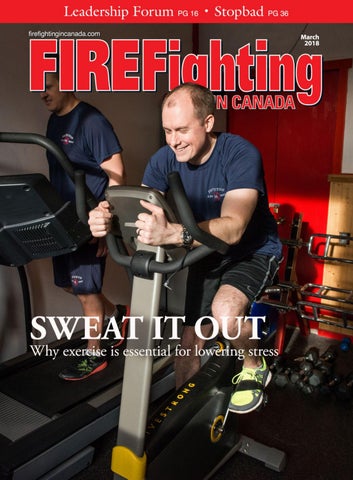
SWEAT IT OUT

Do you know the best way to reduce stress build-up? Mental health expert Nick Halmasy discusses the research-backed strategy of exercise and why it works.

22

DOZER BOSS

Bulldozers may not fit on the truck as part of a firefighter’s regular toolkit, but David Moseley explains how firefighters are using them to combat wildfires.

30 A CONTINUUM OF FIREFIGHTER CARE

Read the second installment in a five-part series looking at how the Oak Bay, B.C., fire department implemented a holistic health and wellness program that works. By Fire Chief Dave Cockle and Sara Wegwitz, R.N.

O COMMENT

Infinity’s verse

f all things infinite from birth to death, stress must be one of the most discussed. As you well know, it is of particular consequence to the fire service. If Statistics Canada found in 2014 that almost 40 per cent of those surveyed experience workplace stress due mainly to inflexibility of schedule, long hours, constant connectivity, tight deadlines, and lack of vacation time, then consider the magnitude leap that first responders make with bridging the gap between life and death, encountering human remains, and receiving the palpable anguish of those in the worst times of their lives.

Stress is an infinite subject in the firefighter’s handbook because it can’t be solved with a flexible schedule or taking a vacation. It’s a part of the job, and developing physical and mental strength is a lifelong quest, as new challenges and tragedies constantly raise the bar of what’s required of us.

ON THE COVER

Penticton B.C., firefighters Chad Taylor (left) and Ben Grantham getting physical with stress. Workout captured by department photographer Mike Biden. See story on page 10.

Stress is complex and subjective, like the perception of pain. Also, like pain, it shares the two interconnected facets of mind and body. In author and psychotherapist Nick Halmasy’s cover story on page 10, he explains why exercise is so imperative to managing the body’s biological response to stress. All those anxiety producing chemicals were intended to be expelled, so if you are not physically running for your life, pretending to might just be the ticket to preventing an accumulation of stress by-products.

On the mental side, resiliency is armour. Studying it and improving it can be endlessly motivating. There are no shortages

of inspiration. Amy Morin is one such figure. In her TEDxOcala talk “The Secret of Becoming Mentally Strong,” she shares how she endured a number of tragedies including losing her mother suddenly at 23 and becoming widowed at 26. Her strategy pivots around three key mental habits: unhealthy beliefs about oneself, unhealthy beliefs about others and unhealthy beliefs about the world. She emphasizes moving past envy, self-pity, and resentment towards the positive attributes of self-agency and acceptance that life is not fair. It’s a simplified summary that would be nearly impossible to dispute as a strategy, but being reminded by the outside world of the path to greater mental strength can help assess where we are really at with these concepts.

Chiefs don’t become chiefs without developing a mental resiliency and ability to manage stress. As leaders it becomes part of your role to help empower others to build their own strategies for managing the physical and mental stress of being a firefighter. In this edition, you will also find Part 2 in a series on Oak Bay Fire Department’s holistic program for its firefighters that focuses on how the department integrates mind, body and spirit into wellness. Physical and mental health is a growing editorial focus for Fire Fighting in Canada as it continues to be at the forefront of industry concern.

ESTABLISHED 1957 MARCH 2018 VOL. 62 NO. 2

EDITOR LAURA AIKEN laiken@annexweb.com 416-522-1595

ASSISTANT EDITOR LAUREN SCOTT lscott@annexweb.com 416-510-5116

ASSOCIATE PUBLISHER ADAM SZPAKOWSKI aszpakowski@annexweb.com 289-221-6605

SALES KORY PEARN kpearn@annexweb.com 519-902-8574

ACCOUNT COORDINATOR WENDY SERRAO wserrao@annexbusinessmedia.com 416-510-5232

MEDIA DESIGNER BROKE SHAW bshaw@annexweb.com

GROUP PUBLISHER MARTIN MCANULTY fire@annexbusinessmedia.com

COO TED MARKLE tmarkle@annexbusinessmedia.com

PRESIDENT & CEO MIKE FREDERICKS

PUBLICATION MAIL AGREEMENT #40065710

RETURN UNDELIVERABLE CANADIAN ADDRESSES TO CIRCULATION DEPT.

P.O. Box 530, SIMCOE, ON N3Y 4N5 e-mail: subscribe@firefightingincanada.com

Printed in Canada ISSN 0015–2595

CIRCULATION

e-mail: bolechnowicz@annexbusinessmedia.com

Tel: 416-442-5600 ext. 3543 Fax: 416-510-6875 or 416-442-2191

Mail: 111 Gordon Baker Rd., Suite 400, Toronto, ON M2H 3R1

SUBSCRIPTION RATES

Canada – 1 Year - $25.00 (GST - #867172652RT0001)

USA – 1 Year $44.00 USD

Annex Privacy Officer Privacy@annexbusinessmedia.com Tel: 800-668-2374

We acknowledge the [financial] support of the Government of Canada.

Occasionally, Fire Fighting in Canada will mail information on behalf of industry-related groups whose products and services we believe may be of interest to you. If you prefer not to receive this information, please contact our circulation department in any of the four ways listed above.

No part of the editorial content of this publication may be reprinted without the publisher’s written permission ©2018 Annex Publishing and Printing Inc. All rights reserved. Opinions expressed in this magazine are not necessarily those of the editor or the publisher. No liability is assumed for errors or omissions.

All advertising is subject to the publisher’s approval. Such approval does not imply any endorsement of the products or services advertised. Publisher reserves the right to refuse advertising that does not meet the standards of the publication.

www.firefightingincanada.com

When you and your equipment are at their best, there are no doubts when the call comes. Maximum condence is the all-new Super Duty® Chassis Cab. The military-grade aluminum alloy^ body let engineers upgrade the frame, driveline, suspension and brakes. Ford Commercial Vehicle specialists have the uptting and modifying expertise to make sure your Super Duty® is ready for duty. We’ll stop at nothing to make equipping your team easier. FORD.CA/BUILTFORBUSINESS

STATIONtoSTATION

ACROSS CANADA: Regional news briefs

Ontario fire departments support Wounded Warriors Canada

(L-R): Whitby fire chief David Speed, WWC executive director Scott Maxwell, Carleton Uniforms account manager Monika Seller, WWC partnership director Steve Topham, OAFC president Stephen Hernen and Unisync Group president James Bottoms.

Wounded Warriors Canada wrapped up its “Slip on your RED” epaulette campaign with a presentation at the Ontario Association of Fire Chiefs (OAFC) office in Ajax, Ont. RED stands for “remember everyone deployed.”

The campaign, whose funds will benefit operational stress supports for first responders, raised money through the sale

of epaulettes produced and supplied by Unisync Group Carleton Uniforms.

In January, the OAFC presented the cheque for $10, 428 to the organization on behalf of all participating departments across the province.

Bruce Krauter, a paramedic chief in Windsor-Essex, Ont., first came up with the idea for a fundraising campaign

THE BRASS POLE

Promotions & appointments

BRIAN

HUTCHINSON is the new fire chief at the District of North

Vancouver Fire and Rescue Services. Hutchinson began his fire service career with Vancouver Fire and Rescue Services as a firefighter/ lieutenant in 2000. While he served as a captain with VFRS, he

worked as a public information officer and emergency management officer. He moved to the District of North Vancouver in 2015 as an assistant chief of operations, a position he held until his appointment to fire chief in February.

The fire department in Alberta’s Lac Ste. Anne County promoted JULIEN BOURGEOIS through the ranks to become the town’s

that assisted veterans and first responders living with operational stress injuries. The “Slip on your RED” campaign was introduced last June, when Wounded Warriors Canada teamed up with the Paramedic Chiefs of Canada (PCC).

Wounded Warriors Canada executive director Scott Maxwell said the donations are “absolutely incredible.”

“We’re covering our uniformed service members and their families directly just simply by wearing a red epaulette. It’s a pretty powerful thing.”

Randy Mellow, PCC president, said they have sold more than 1, 500 epaulettes, with all of the proceeds going towards programming.

Paramedics participating in the campaign wear the red epaulettes every Friday throughout the year. Last November, Ontario fire departments donned red epaulettes every Friday.

Carleton Uniforms account

new deputy fire chief in October 2017. Bourgeois has been with the department for more than a decade, starting as a volunteer firefighter, working his way up to district fire chief of the former Onoway station. Following amalgamation in 2016, Bourgeois became a captain at the Ste. Anne East station. As deputy fire chief, Bourgeois will be responsible for training and fleet maintenance.

manager Monika Seller was instrumental in bringing the campaign to the Ontario fire service. The uniform company designed the epaulettes, which cost $20 a pair, donating 60 per cent of the proceeds back to the campaign.

Mellow said the campaign has exceeded his expectations by helping to bring together emergency service workers.

“We’re talking with our colleagues and with our peers about mental health issues and operational stress injuries and it’s helped to reduce stigma, but it’s also been comforting to know that we’re in this together,” Mellow said.

Wounded Warriors Canada plans to continue the “Slip on your RED” campaign after this year’s success, Maxwell said.

To learn more about how your department can get involved in next year’s campaign or programming, please contact Scott Maxwell directly at scott@ woundedwarriors.ca.

TREVOR WAWRYK was promoted to deputy chief of operations in WhitchurchStouffville, Ont., in November 2017. Wawryk has been with the department for 17 years, starting as a volunteer firefighter. He was promoted to career firefighter, later moving up to become a captain and acting deputy chief. He is a certified firefighter, company officer and fire instructor.

PHOTO COURTESY OF OAFC

Alberta firefighters receive greater cancer coverage

The Government of Alberta is expanding coverage for firefighters who are diagnosed with reproductive cancers.

If a firefighter is diagnosed with ovarian or cervical cancer, it is now presumed to be an occupational illness under the amendments to the Worker’s Compensation Act.

Workers are eligible to receive benefits and support from the Worker’s Compensation Board (WCB) after a minimum exposure period of 10 years.

The minimum exposure period for testicular cancer has been reduced to 10 years, down from 20.

Firefighters are six times more likely to be diagnosed with cancer, said Craig Macdonald, president of the Alberta Fire Fighters Association, in a statement.

Women make up eight per cent of the province’s fire service, but Macdonald said the WCB coverage expansion could change that.

“. . . Adding female reproductive cancers not only strengthens the diversity of our profession, it makes Alberta a leader in the fire service,” Macdonald said in a statement.

Premier Rachel Notley and Minister of Labour Christina Gray met with Calgary

Canadian firefighters train colleagues in Belize

Firefighters from across the country are worked together to help train firefighters in Central America.

Six firefighters travelled to Belize in January as part of an initiative with Fire Rescue International Training Association (FRITA), a Canadian non-profit organization that has deploys firefighters to countries that require training-based aid.

Retirements

VICTOR PENMAN retired from his position as the fire chief with District of North Vancouver Fire and Rescue Services in December 2017. He began his fire service career as a firefighter with the District of North Vancouver in 1988. He moved his way up to become an assistant chief in 2003, and later deputy fire chief

Alberta Premier Rachel Notley was in Calgary to announce expanded cancer coverage for firefighters diagnosed with reproductive cancers.

firefighters to announce the changes on Jan. 19.

“To the brave men and women who serve Alberta every day as firefighters: thank you,”

B.C., Surrey, B.C., St. John’s, N.L., and Lion’s Bay, B.C.

Notley said in a statement. “We stand with you and we will make sure you have the financial and medical supports you need if you are battling cancer.”

District of North Vancouver fire chief and FRITA director Brian Hutchinson travelled with firefighters to Belize City.

“We look to build longterm relationships,” said Hutchinson. “It’s meant to be a partnership.”

Taking part in the Belize City deployment were members from departments in North Vancouver, Grande Cache, Alta., Abbotsford,

in 2006. He served as the fire chief for the department from 2011 until his retirement.

The first ever fire chief in South Frontenac, Ont., RICK CHESEBROUGH announced his retirement on Jan.16, after nearly a decade and a half in the role. Chesebrough began his career in the fire service in 1987 as a volunteer firefighter in Pittsburgh Township, where he later

Belize has a full-time national fire service, but with a population about the size of Halifax, it has only 15 fire stations across the entire country. Two individuals from each station were selected to participate in training. The trip marked FRITA’s fourth annual deployment to the country.

“The level of enthusiasm and the level of engagement is extremely high,” he said.

Firefighters providing training

became a captain. After municipal amalgamation in 1998, he became a volunteer training officer with Kingston Fire & Rescue. He took on the role of fire chief in South Frontenac in 2003. Last year, Chesebrough received the Ontario Association of Fire Chiefs Bill Williams Humanitarian award.

Last Alarm

Cranbrook, B.C., firefighter

for hazardous materials, emergency scene management and fire ground survival. FRITA also offered high-rise operations training, as Belize City is seeing an increase in multi-storey developments.

“It’s hugely rewarding because we know we’re not only serving the members themselves but we’re helping the overall organization.”

This year FRITA is sending firefighters to Chile, El Salvador, Anguilla, and two trips to Columbia.

Capt. CLAYTON MURRELL was killed in a head-on highway collision on Feb. 3. Murrell served with Cranbrook Fire & Emergency Services since 1990. He was the vice-president for the BC Professional Fire Fighters Association for the Kootenay region. In 2017, Murrell was awarded British Columbia Long Service Medal for 25 years in the fire service.

PHOTO BY CHRIS SCHWARZ/GOVERNMENT OF ALBERTA

STATIONtoSTATION

BRIGADE NEWS: From departments across Canada

The Sturgeon Lake Cree Nation in Valleyview, Alta., received a new pumper truck from Fort Garry Fire Trucks in November. The pumper is built on a Freightliner chassis with a Terminator body type. It is designed with a Darley PTO PSR1250 pump and a 1000 imperial gallon Pro-Poly tank. Special features include a Kussmaul Pump Plus 1000, Tornado quick-disconnect monitor, Hannay hose reel, Federal Signal lighting package and FRC scene lights.

Vaughan Fire and Rescue Service received a Smeal 32-metre rear mount aerial truck in 2017. The truck is built on a Spartan Gladiator chassis, and is powered by a Cummins ISX 500-hp engine and Allison EVS 4000-R transmission. The truck has a Waterous CSUC 7,000 litre per minute pump, an Akron StreamMaster II 3480 monitor, SaberMaster 1577 nozzle and a Smeal SG-09 Green Power auxiliary power unit.

The Yukon Government and Fire Marshal’s Office received a Fort Garry-built wildland range truck in 2016. The truck is built on an International 7400 2-door cab 4x4 with a formed aluminum body and runs on a 330-hp Navistar N9 engine with an Allison 3000 EVS transmission. The rig has top-mount pump panels that power a Darley LSPAH 1000 pump. It is finished with a hotdipped galvanized 1000 imperial gallon tank.

The fire department in Amherst, N.S., took delivery of a Metalfab pumper. It is built on a Spartan Metro Star X chassis with an extruded aluminum body. It runs on a 400-hp Cummins L9 and Allison 3000 EVS auto transmission. The pumper has a 1250 imperial gallon Hale QMAX pump, a tank capacity of 600 imperial gallons and comes with a Foam Pro 2001 dual tank system, Whelen LED warning light system, and 6000-Watt hydraulic generator.

The Nunavut Office of the Fire Marshal took delivery of a pumper truck from Fort Garry Fire Trucks in Summer 2017. Built on a 2018 Freightliner M2-106 chassis and a MXV 3-Man Crown body, the pumper features a 300-hp Cummins L9 engine, Allison EVS 3000 transmission, enclosed pump panels, a Hale DSD 1050 IGPM pump and a 1000 imperial gallon CoPoly tank. Includes an extreme insulation package, among other special features.

The department in Parkland County, Alta., took delivery of a new pumper rescue in December 2017. The truck is built on a Spartan Gladiator chassis and has an emergency rescue body. It runs on a 450-hp Cummins L9 engine and an Allison 3000 EVS transmission. The rig features a Waterous CSU 1500 pump with side-control pump panels, a 1000 imperial gallon Poly tank and a Waterous Eclipse compressed air system with Advantus 6 foam.

VAUGHAN FIRE AND RESCUE SERVICE
STURGEON LAKE CREE NATION
YUKON FIRE MARSHAL’S OFFICE
AMHERST FIRE DEPARTMENT
NUNAVUT OFFICE OF THE FIRE MARSHAL
PARKLAND COUNTY FIRE SERVICES

SWEAT

SWEAT IT OUT

Do you know the best way to reduce the buildup of stress in your body?

LEFT / ABOVE: Chad Taylor (above) and Ben Grantham (far left) are firefighters with the Penticton Fire Department in B.C. Their workout session was captured by the department’s first dedicated fire department photographer, Mike Biden.

Stress. Take a minute to write down what you think it is. Words such as anxiety, pressure, tension and overwhelming may spill onto your page. You’re not wrong. Indeed, these things are the very reason stress leads folks to talking to clinicians like me. Current research indicates that vigorous exercise is a top way to mitigate the cumulative effects of stress. Let’s review the stress response, and why getting your heart pumping is fundamental to stress management.

In the fire service, stress is almost a rite of passage, starting in school and continuing through the calls on the job itself. Stress can wreak havoc on the system. In a 2017 article published in Psychological Medicine, Dr. Ayman Saleh and colleagues connect early childhood trauma to significant changes in the brain, such as decreased orbitofrontal cortex — the brain’s “command centre” — which aids the brain’s decision-making processes as well as hippocampal volume, a structure known to be crucial in memory formation. In Why zebra’s don’t get ulcers, Robert Sapolsky also identifies several instances that hippocampus damage is done, including PTSD (indicating that the findings related more to multiple incidents, not a single incident), which have found smaller hippocampal volumes in their participants. Though, importantly, Sapolsky writes that the exact mechanism is not yet known. But, Sapolsky adds, stress is linked to neuronal damage and may “accelerate the aging of our brains.”

The above researchers suggest that excessive amounts of stress can actually change our brains. Stress research is identifying some significantly alarming results. Researchers have even linked stress to the development of cancers and a chronic pain disorder known as fibromyalgia. Stress serves a purpose, but stress that runs rampant has scary consequences.

Stress, simply, is a barrage of various chemicals into the brain. The point of this is to motivate you in a few ways. The research has expanded, but for the purposes of understanding we can keep it to the colloquialism “fight or flight”. Consider when we are presented with a very real threat. Imagine that you are on the Serengeti armed with primitive weapons, or none at all, and an embarrassing lack of clothing. The tall grass moves suddenly. You have some choices to make. Run, as you may very well become dinner. Or fight, for the threat could be your dinner coming towards you.

This ancient mechanism lies deep under the new brain matter we’ve developed since our primitive days. This is precisely why it is a difficult mechanism to control. But, the point is, and as I tell all my folks, “I would never want you to be without it.”

Stress can be good! It may feel uncomfortable in the moment, but if harnessed properly it can become an effective, motivating factor. Stress allows us to be hyper-vigilant on the fire ground. The fight or flight mechanism is one that has been developed in order to keep us alive. It’s what you feel when you get a “gut feeling”

PHOTOS BY MIKE BIDEN

around a situation, or, what we see in moments of heroism and courage. That is stress harnessed in a positive way.

But the stress of the job has lasting impacts when not curbed. You flood the system with a chemical meant to motivate, but if you don’t “exercise” that chemical out of the system it lingers and lasts. There are a number of ways stress accumulates.

We don’t always leave the job at work or have stress-free home lives. The job will have exposure to stressful and potentially traumatic scenarios. Yet, should we return home to an unstable and stressful home environment, this down time from work does little to negate the impact experienced. Come next shift, should that home stress not be resolved, it remains packaged

and active when you return back to shift. This is a cycle of destruction and as long as it continues, only increases the risk of ongoing mental wellness challenges.

We only have so much cognitive currency to battle away the demands. In a really simple example, this can be a great explaination of why some of us may develop struggles while others may not at the exact same scene: imagine two arbitrarily drawn lines. The lower is your baseline and the upper is your cognitive limit. This will vary for everyone, but rest assured we all have it. One stressful event, such as a wedding, jumps us from baseline toward the limit. Given enough protective factors and removing other stressful events, we can come back down to baseline.

ABOVE Researchers have correlated stress with the onset of some cancers and the chronic pain condition fibromyalgia.

LEFT Firefighters Chad Taylor (left) and Ben Grantham getting their heart rates up for health.

If, however, you have never engaged in meaningful and effective protective activities – home life remains stressful and you are showered with the unhappy experience of multiple, stressful calls – you quickly escalate towards that cognitive limit. Cross the line, and that is where you will find folks struggling, or worse and they are found to be clinically diagnosable for a mental health disorder. Please note though, this does not necessarily mean PTSD. It can manifest as any number of issues.

To combat stress in a meaningful way, consider the whole mechanism: stress chemicals are flooded into the brain with the presence of a perceived threat and, currently, there is no active way to remove those chemicals. Therefore, they remain flooded and stress heightened, leaving the person vulnerable to more stress impacts. By activating a high intensity, or vigorous, exercise regimen, we are allowing for the release of those chemicals in a natural way – much like we would have done back on the Serengeti. The difficulty in defining this is “vigorous” can mean a lot of things

PHOTO BY MIKE BIDEN

to different people – from duration of time, to intensity of movement. Trying to land somewhere in the middle, vigorous may mean a moderate duration with bouts of explosive movements.

Instituting a regime of high intensity exercise following stressful events may activate the fight or flight mechanism and eliminate these aggregate chemicals from the system. We have extensive research showing the mental wellness increasing power of exercise. For instance, a 2016 article in the academic journal Military Medicine conducted a Systematic Review of PTSD and Exercise in veterans. They concluded that exercise seems to suggest a preventative function in the future development of PTSD in members.

We also know from research that exercise is a major stress combatant. And, while we are all sick of hearing the same old adages, the mental health angle may help to bring exercise back to the forefront. Not because it is inherently good for you (though it is), but, because it could save your (psychological) life!

Exercise also becomes a preventative approach. While we certainly benefit from reactive services, we should be

looking for more preventative means of protecting our firefighters. This is a proposal that only has benefits. Exercise will decrease the stress collection between our baseline and our cognitive limits. Involving oneself in such a regime can ward of immediate stress, mitigate the cumulative effect, and prolong both career and mental wellness. In short hand, increase one’s resilience.

In modern fire departments, we need a holistic approach to the mental wellness of our folks and by instituting the ability to engage in high intensity outlets following a perceived stressful call we may, in fact, protect our firefighters against the negative effects of job-related calls. Stress was meant to protect you. With a little forethought and some slight program changes, we can continue to experience stress in this protective manner.

As is the case in science, we cannot conclude definitively, due to the lack of research done specifically in these realms and with our population specifically. Science is in the business of, as physicist Lawrence Krauss says, “proving things wrong, not proving things right.”

There is, however, one important caveat. Cumulative stress might be battled with exercise, but it looks like you have to start early. While commonplace ideas suggest the simple A-B relationship — increased exercise equals decreased health problems — the mitigating effect tends to disappear at high rates of stressful life events, suggests a 2014 study. While there isn’t enough to make a hard case on either side, exercise, it seems, is paramount to both prevention and in some cases, intervention with issues of cumulative stress.

Nick Halmasy is a registered psychotherapist who spent a decade in the fire service. He is the founder of After the Call, an organization that provides first-responders with mental-health information. Contact him at nhalmasy@afterthecall.org.

Mike Biden is a photographer based in British Columbia. He has served for more than 30 years as a ground search and rescue technician, rescue diver, and search and rescue pilot. His photographs have appeared in Canadian Geographic, West Jet magazine, Triathlete magazine, Comox Search and Rescue, among others.

BY CHRIS HARROW Fire Chief, Minto, Ont.

ILEADERSHIPFORUM

The great shirt debate

wanted to start off by saying how honoured I am to have the opportunity to share some of my thoughts on leadership in the fire service. For my first stab at a leadership column, I thought I might jump right into the blue shirt versus white shirt for fire chiefs debate. Fire chiefs love to talk about this and it always makes for some great discussion in departments across the country.

I am sure everyone can agree that a shirt itself does not make a leader. The same can be said about the amount of “bling” you have on your shirt. Yet the debate continues over why some chiefs wear white shirts and why some wear blue shirts. We all understand the history of the shirts and colours as well as the importance of showing rank when necessary. Departmental policy will always dictate the colour of your shirt, but in no way will it dictate the type of leader you can be while wearing the shirt.

For many fire chiefs, wearing dark shirts is an absolute necessity. As a fire chief with regular operational duties, trying to keep a white shirt clean is an impossible task. In a day’s work, I will find myself filling bottles, cleaning and bedding hose or washing vehicles. One of the realities of the job is that small town chiefs are required to perform hall duties. I also argue that this is an important aspect of leadership.

A basic part of leadership is leading by example. All fire service leaders have read many articles on the topic and probably have recited it many times to our firefighters. But how many of us actually practice this on a daily basis? How many chiefs have helped firefighters clean and bed hose after a structure fire? Does it really matter if you are a full time, composite or volunteer department? I know from many experiences that white shirts do not stay white while bedding hose with very keen young firefighters.

the firefighters. We discussed two ways to ask a firefighter to wash a vehicle. The first way was “Hey, can you get that pumper washed? it’s filthy.” The second approach was “Do you mind giving me a hand to wash this pumper?” I told our captain I prefer the second way when I lead (hence the blue shirt) and I asked the question, which way would you prefer to be given the task? He immediately saw the difference and I have watched him grow as a leader since that conversation. For career departments, I understand the roles are different and contractual obligations kick in. I argue however, there are many ways to get in the trenches without breaking any rules. Maybe chiefs could cook dinners at stations or assisting with clean up at a smaller fire? There are many tasks that can come to mind if you really want them to. Perhaps start a discussion with other chief officers about maintain ing trench work ethic? Sharing ideas can give you many options.

I choose my daily wardrobe according to the duties I know I will have to perform that day. If I am making a presentation to council or am engaged in senior management meetings, I understand the necessity to wear a white shirt and show rank. If I know I need to do air management or hose testing, I might decide that it’s a blue shirt kind

The role of the fire chief sometimes requires a few costume changes, similar to a multiple act stage performance. ‘‘ ’’

“As a manager, or leader at any level, you can choose not to lead by example . . . and not play by the same rules you expect others to. But why would you want to? That is, if you want to have the best chances of succeeding,” Forbes management writer Victor Lipman wrote in a 2016 column. A great way to lead by example is to be the first to grab the wash brush or the length of hose. One of my favourite sights to see is the look on new firefighter’s faces when they see me jump in to help.

I recently had a conversation with a captain in our department. We were talking about leadership styles and how to gain respect from

Chris Harrow is the fire chief in Minto, Ont. He is a graduate from fire programs at Lakeland College and Dalhousie University and he holds a graduate certificate in Advanced Care Paramedics from Conestoga College. He can be reached at c.harrow@mintofiredept.on.ca.

of day. However, I always ensure I have a back up white and blue shirt hanging somewhere in my office (and an extra tie in the glove box).

Fire chiefs may be required to perform a number of tasks in a day. You could go from a budget meeting or senior management meeting right out to the floor to perform hose testing with a group of firefighters. The role of the fire chief sometimes requires a few costume changes, similar to a multiple act stage performance.

Firefighters do not care what you are wearing. They don’t decide whether or not they will follow a particular leader based on the colour of their shirt. They follow leaders they respect and trust.

Whether you wear a white shirt or a blue shirt, it’s the leader inside that counts. Being able to step back to reality once in a while is a very valuable thing. I have no issue showing my rank when the time calls for it. But knowing the right time is the hardest part . . . that, and getting the stains out of my white shirts.

BACKtoBASICS

The right way to overhaul

We are continuing with a look back over the last 10 years with articles that have been a highlight based on the topic or feedback. This article was published in August 2009 and was a highlight because of the topic: not much is discussed about overhaul.

■ THE RIGHT WAY TO OVERHAUL: AUGUST 2009

In the fire service, we have many different terms associated with our operations. One of them is truck company operations. What exactly does this term mean? In the Canadian fire service, we rarely use this term, but we involve ourselves within the operations that are associated with it. Truck companies are fire apparatus that have ladders, both ground and aerial, and they do not have the capability to pump water. They are a giant toolbox on wheels. Firefighters who run on truck companies are usually the seasoned veterans. This is because of the nature of work that is performed by them. There are 10 functions that a truck company will be responsible for: rescue, ventilation, forcible entry, reconnaissance, laddering, overhaul, elevated master streams, salvage, utility control and RIT.

Even though we do not operate in Canada with official truck companies — we usually call them aerials or quints — we still perform these functions using the apparatus that we do have. Every apparatus has ground ladders, equipment for rescue, equipment for salvage and overhaul, equipment for forcible entry; quints and aerials have elevated master streams and provide elevated access.

I want us to consider the basic task of overhaul. Overhaul is often overlooked and never trained upon. It is always an afterthought at most fire ground operations. When we think of overhaul, we usually associate it with creating giant holes in walls and ceilings to find hidden fire. The home owner is usually shocked when they find their house’s interior all opened up.

I can remember one time when riding along with a fire department down in Maryland, we had a kitchen fire in a residence. The fire was quickly knocked down and the truck company began their overhaul operations. Instead of feeling and looking for hidden fire, they decided to gut the entire kitchen and main floor. The home owner was angry at the amount of damage that we created for no real reason except to overhaul.

A firefighter friend of mine who works in Denver was telling us about a captain that made his firefighters cut nice neat, square holes with drywall saws to find the hidden fire and then made them carry all the debris outside into a neat

Photo 3: A square opening is created, which allows firefighters to see behind the drywall.
PHOTOS BY MARK VAN DER FEYST
Photo 2: The firefighter prepares to pull the drywall away from the studs.
Photo 1: A firefighter uses a Halligan tool to create a square hole.

BACKtoBASICS

pile. The end result was the home owner was happy and appreciative of the care that was taken to ensure the least amount of damage. The idea behind the square holes was that when it came time to fix the walls, it is easier to fix them with square holes created versus giant holes made with Halligans or axes. The home owner in this story was the firefighter friend of mine and it was his house.

So, what is the point of the above-mentioned stories? Let us go back to the basics of overhaul. We can make square, neat holes in our walls and ceilings without having to use drywall saws. We can still use our Halligans and hooks to accomplish the same task. In Photo 1, we can see an outline of a square hole created by a Halligan tool that will be soon opened. Notice the perforation marks all the way around. These have been made with the fork end of the Halligan. This provides a template for the drywall to be pulled off in a square pattern.

In Photo 2, we are ready to pull the drywall away from the studs. The firefighter uses the adz end of the Halligan to pry the drywall away from the studs. The end result is seen in Photo 3, a nice square opening allowing us to see behind the drywall.

We still need to use our other tools such as thermal imaging cameras, heat guns and touch to determine where our holes need to be created. Just arbitrarily opening up walls and ceilings near a fire area will not suffice. We need to ensure that there is heat behind the wall first before we open it up. Thermal cameras and heat guns are a great tool for determining heat build-up behind walls and ceilings. Using your hand to touch and feel the wall also works.

So why is it important to use these simple techniques when conducting overhaul? First, it helps with our customer service. If home owners witness us taking the time and effort to care for their house by creating nice square openings where needed, they will appreciate the fire service all the more. It is not as intrusive to them as it would be if we are demolishing their entire kitchen and main floor for a small kitchen fire. Secondly, it helps with the investigation of the fire. Many investigators will tell you that the worse thing to do is take away all of the drywall. If it has to be done, then so be it, but if it can be avoided, this will help with their investigation. Burn patterns on walls and ceiling tell a story and point the investigator to the cause and origin of the fire. No walls or ceilings means no story for the investigator.

Whenever a chance arises to use an acquired structure for training, practice this technique and become familiar with it. If no access to acquired structures is available, then build a wall prop four feet high and eight feet long and nail sheets of drywall to it. The more we practice these basic techniques, the more we will increase our mastery of skills.

Mark van der Feyst has been a member of the fire service since 1999 and is a full-time firefighter in Ontario. Mark teaches in Canada, United States and India, and is a FDIC Instructor. He is the lead author of the Residential Fire Rescue book. Email Mark at Mark@FireStarTraining.com

DOZER BOS S

Increasingly, municipal firefighters are being called to fight wildland fires and fires in the wildland urban interface. Departments should cultivate a good understanding of wildland fire behaviour, suppression techniques, and above all, safety. One less familiar tactic municipal firefighters sometimes face is the use of bulldozers (dozers) in fireline construction. This article will provide an overview of why and how dozers are used to control wildfires.

The key to wildland fire suppression is perimeter control — stopping the advance movement of the fire — which is done by building a fireline around the fire. Wetline is commonly made with pump and hose, extinguishing the fire with water and wetting adjacent fuels. Dryline is often built with hand tools scraping away surface fuels to mineral soil, so a surface fire will stop when it reaches the line. In Alberta we use both, but in the North our water is often farther away than on the Canadian Shield and our deep soils are seldom conducive to handline, so we heavily utilize dozers to construct the fireline.

In addition to creating a fuel break, dozers create access that can be used to move water and manpower. Even relying on boot power, it’s much easier to lay hose and work from a dozer guard than through uncleared forest and brush, greatly increasing efficiency and safety. The dozer guard is often used as an escape route and in some fuels a safety zone. Safety is further increased by clearing a 30 square metre helipad every few kilometres, a common dozer practice.

Under ICS dozers can be a Single Resource or form a Strike Team, often under a Heavy Equipment Group Supervisor. We like to use three dozers and a water carrier supervised by a Strike Team Leader we still call a Dozer Boss. The Dozer Boss may be from industry, your provincial wildfire agency, or your fire department. It’s their

How firefighters are using bulldozers to combat wildfires

TOP When it’s safe to be on the line, dozers usually start from the rear of the fire, working up the flanks.

RIGHT The job of the Dozer Boss is to guide and supervise the dozers by locating the line, directing the dozers, and ensuring the quality of the guard and the safety of all.

The key to wildland fire suppression is perimeter control — stopping the advance movement of the fire — which is done by building a fireline around the fire.

job to guide and supervise the dozers by locating the line, directing the dozers and ensuring the quality of the guard and the safety of all. The Dozer Boss should be prepared to do a lot of walking, and most use an ATV as well. The ideal Dozer Boss has a good knowledge of both wildfire and heavy equipment. If, like me, you’re less knowledgeable about heavy equipment, be sure to utilize the experience of your dozer operators.

Using three dozers, the first walks down the trees, the second windrows them away from the fire and the third cleans the line to mineral soil. This results in a fuel break of one to two dozer blade widths, perhaps six metres. Areas with lighter fuels can often get away with two dozers, but a single dozer working alone is not recommended. Remember the guard is intended to stop surface fire, while you can widen it, don’t follow the thought that if six metres is good, 60 metres must be better. This is seldom an effective use of resources when under extreme conditions fire can spot over 1,000 metres.

Speaking of extreme conditions, the active head of the fire is seldom the place for dozers. When it’s safe to be on the line, dozers usually start from the rear and work up the flanks. They do excellent work at night when fire behavior is less intense and other crews are off the line. It’s always good to get the Dozer Boss up for a flight to see the fire from above and plan their route, but especially so before night operations. Tight-lining is simplest, just following the edge of the fire. However, straightening the line may boost productivity greatly, which is best determined from an aerial assessment.

As to the dozers, greater size means greater power and weight. Power is required for large timber such as mature aspen and white spruce, but weight can be a liability, especially if working in muskeg (floating bog). With so much muskeg in northern Alberta we often use smaller dozers like D5s, and low ground pressure (LGP) models less likely to break through. They should have good grills on their radiators and good overhead protection for the operator. Lights must be adequate for night work. The more dozers with winches the better, certainly at least one.

Of course, dozers can be a crude tool. Crossings require great care, whether streams, pipelines, roads, or railways. They require some degree of knowledge of local laws and practices. Stream crossings should be located where they will do the least harm, solid banks with a narrow welldefined channel being better than marshy areas. Trees and woody material are better stream-crossing material than soil. Pipelines should only be crossed after consulting with the pipeline company and following their direction. Consider this early on when using

dozers. The same applies to railways.

Dozers are not very compatible with the infrastructure found in urban areas. In the wildland urban interface, they most commonly build guard around a subdivision or buildings, constructed in the adjacent forest or agricultural land.

Having a water carrier allows you to quickly get water to hot spots that may threaten to cross the line. This is a good idea as dozers can build guard much faster than crews can lay hose. They usually carry about 1000 litres of water with a pump and short

length of hose. Their speed and ability to drive on pavement make wheeled skidders good for upland and interface locations. Nodwells and other tracked machines work better on soft ground.

There are several safety considerations when working around dozers. A distance of two tree lengths should be kept from working dozers. Firefighters should stop work and clear the immediate area and let dozers pass. Never allow anyone to ride on any machinery unless they are in a seat designed for passenger use. Windrowed debris contains wood under pressure that may release unexpectedly, be aware and use caution, especially if cutting that wood.

The Dozer Boss must wear high visibility PPE, including a headlamp at night. They must maintain communications with each operator and before approaching, ensure dozers have stopped, lowered their blade, and made eye or radio contact. One the greatest operator hazards is fatigue, so think ahead when ordering dozers and plan to swap out operators for extended operations (when the size of your fire is expressed in hundreds of hectares, expect extended operations). Also know how you will carry out a medical evacuation if required, possibly from a remote location at night.

After the fire is out, you should give some thought to reclamation. Watercourse crossings are usually built in haste, but co-ordinate removal with local environmental officials. Erosion control is required on slopes and near water. Whether you choose to leave the guard open for future access or roll it back, the debris windrow should be addressed. Continuous windrows can obstruct the movement of wildlife and livestock, and create a fire hazard.

Dozers are an excellent tool to contain wildland fires. However, as you can see there is a lot to think about when using them. If you find your department using them often, in Alberta a four-day Dozer Boss course is offered to industry, including municipal fire departments. Short of that, if you’re just building on experience, consider the information above and work safe.

David Moseley is a forest officer with Alberta Agriculture and Forestry, and lead training officer with Lac La Biche County Fire Rescue in Alberta, focused on operations; other areas of interest include instructing, CISM, and wildfire investigation. Contact him at david.moseley@gov.ab.ca.

LEADINGEDGE

E

The subliminal case for residential fire sprinklers

veryone in the fire service is well acquainted with the ever-present argument around response times. The overwhelming opinion for decades has been that rapid response is best. We have ingrained it in our firefighters, demanded it of our politicians and assimilated the public to a large extent. We have made it a fundamental component of legislation locally and beyond in many areas in North America. We have entrenched it into industry standards from NFPA and others. Much of it is validated, some experiential, some very much anecdotal. But always, it resides to form part of nearly every controversial conversation around fire services worldwide.

Why then, has the fire service not completely endorsed, advocated for and demanded at the highest level the inclusion of fire sprinklers in every home, everywhere? I have heard, even recently, chief officers and prevention staff telling me that they do not fully support residential fire sprinklers. “They fail too often.” “We need to go anyways so why waste people’s money?” “They take away from what firefighters do.” It is very true that fires are not the only calls that firefighters respond to in modern society, far from it. However, they are certainly the most high profile and potentially catastrophic incidents we attend. Given actual structural fires are likely less than five per cent of our total call volumes, the argument is abundantly clear that fire sprinklers will not reduce staffing levels. There are far too many other important roles.

However, when I look at this perplexing phenomenon another way, even the naysayers are in fact validating the need for fire sprinklers in homes. The same fire service individuals with negative views are also very likely to be the ones who adamantly demand increased staff and fire halls to reduce response times. Overtly they are stating to elected officials and the public that speed is everything. Subliminally though, they are validating the argument for residential fire sprinklers in a very strong manner. There will never be a quicker response than a fire sprinkler head activating in response to a fire in the incipient, or other early stages. No response from suppression personnel or equipment could ever get there as fast. To even the most stridently opposed, this fact must be blatantly obvious.

British Columbia, and under the co-ordination of Chief Stephen Gamble, the target audience is diverse; from builders, to building inspectors, technicians to fire chiefs, and media to elected officials. At it, national experts in residential sprinklers, fire survivors, sprinkler advocates, and progressive professionals will have dispelled many persistent myths, presented many relevant and important facts, and demonstrated the unique and undeniable effectiveness of these life and property saving devices.

As a fire service, across this nation, we all need to set aside bias and tradition and recognize the future. In-building suppression and control devices – fire sprinklers only being the current format – are becoming more sought after by safety-conscious home owners and more affordable to them. If you can install an in-ground lawn sprinkler system or granite countertops you have the funds necessary to install residential fire sprinklers in a new home. British Columbia is moving slowly, but steadily, toward legislation that will enable communities to require fire sprinklers in all new homes. Some in B.C. already have this requirement and are leading the way. The path to get everyone on board will be long, but as professionals sworn to

Fire sprinklers, and their future iterations, are the leading edge in fire safety. ‘‘ ’’

protect the public from fire and other threats, there is no alternative. Fire sprinklers, and their future iterations, are the leading edge in fire safety. There simply is no other consideration that could be even close to equivalent and it is time that every firefighter, inspector and officer at all levels recognize this and live up to our sworn oath to protect.

Fortunately, the times are changing. By the time you read this article, the Home and Family Sprinkler Summit will have been held in Langley Township. Presented by the Fire Chiefs’ Association of

Don Jolley is the fire chief for the City of Pitt Meadows, and the first vice-president of the Fire Chiefs’ Association of British Columbia. Contact him at djolley@pittmeadows.bc.ca

Learn about fire sprinklers from experts, not pessimists. Research materials abound; read them and ask questions. More sprinkler summits will occur across Canada; attend one, or more. The Fire Sprinkler Coalition program is in place and will hopefully be embraced nationally, join up and/or visit the website at www. homefiresprinkler.org. Finally, recognize that fire sprinklers will save firefighter lives. You all believe in the importance of response times, so I now challenge you to advocate for the fastest response of all to fire – fire sprinklers.

A continuum of firefighter care

Oak Bay Fire Department applies emergency management principles to its firefighters’ health and well-being

We were recently tasked within our fire department to put our health and wellness program to the test. Our department was involved in what firefighters refer to as a ‘once in a career’ traumatic event that profoundly impacted our first responders, families, and our community. The event involved the tragic loss of life for two young children through a homicide. Our fire department worked alongside other first responders such as police and paramedics to provide medical first response at the incident. The elements of a health and wellness program fit perfectly into the emergency management principles in support of our greatest asset – our firefighters. The following article takes a closer look at how these principles apply to the continuum of care that fosters the health and wellbeing of firefighters and will outline the steps we took in response to this tragic incident.

As fire service leaders, we plan emergency management through the principles of prevention, mitigation, preparedness, response, and recovery. We use these principles to create plans and education to enhance public safety for our community and first responders. The recent events within the community provided an opportunity to reflect on these principles and correlate them to our health and wellness program and other resources we utilize to support our firefighters. The primary focus of our health and wellness program is to take a proactive and preventative approach. This enables the department to respond to incidents in a flexible and adaptable manner and in turn allows our responders to not only survive but to be resilient as they recover from the incident. When these critical incidents occur, it is important that

fire departments have a full spectrum of resources to draw from to support their firefighters. Like in sports, it is imperative to have an offensive and defensive game plan and strategies; and in this case both proactive and reactive strategies and responses.

■ PREVENTION AND MITIGATION

The foundation of our health and wellness program begins with a holistic upstream approach to the first pillar of emergency management: prevention and mitigation. Research has shown that the more you invest in prevention training and education, the more you can prevent and mitigate mental and physical health

injuries. The program is designed so that all members take actions to identify and reduce the impacts of health risks and behaviours before incidents and mental and physical injuries occur. We work collaboratively with our team and a registered nurse to identify common health risks for firefighters, and provide the education and tools required to reduce those risks. We empower our people through firefighter specific training and education sessions that promote ongoing participation in improving physical fitness, proper nutrition, sleep hygiene, and mental fitness strategies. We are consistently proactive in researching health and wellness trends for first responders while keeping a ‘pulse check’ on members’ current state of health.

Oak Bay’s health and wellness program is designed to encourage all members take actions to identify and reduce the impacts of health risks and behaviours before incidents (like the structure fire pictured) occur.
PHOTO COURTESY OF SARA WEGWITZ

Our program is flexible and adaptable to meet the needs of our members. We adjust and implement changes to our health and wellness programming throughout the year to reflect both areas.

■ PREPAREDNESS

At this step we ensure our members have the capabilities and skills to respond and recover from the stresses of an incident. The preparedness step is where the work begins to enrich the firefighters with the tools they need to not only survive, but

to thrive throughout their career in the fire service.

We introduced policy and procedures to our daily schedule to provide for health and wellness training opportunities for our team. The policies and procedures included changing the daily routine that had been in place for many years. The daily routine was very military regimented as to what we accomplish for every hour of the shift. Through our research, and guidance from our registered nurse, we discovered that by changing the physical

THE POWER YOU NEED

Skid Units
Glider Kit
Portable Pumps
Foam Trailers

To learn how the MSA G1 SCBA can help you fight a vicious, unpredictable adversary more safely and e ectively (and request a demo) visit msafire.com/breathe.

program, because of its holistic upstream approach, supports the response and recovery of our members by ensuring that they maintain a level of job preparedness.

RESPONSE

When we consider the response principles of emergency management, we are drawn to the actions taken during an event to reduce loss and impact. If we apply this principle to the firefighters through the health and wellness program, we can draw on the steps we have taken in the prevention/mitigation and preparedness stages to reduce the impact on our responders. We provide our firefighters with the tools to identify the signs and symptoms of mental injury and assist with managing these through the support channels that we have created. The following are some of the steps that we took in response to this incident.

We acted quickly to remove our affected members from the stress of the incident by backfilling for a few hours while we deployed our Critical Incident Stress Management trained resource team to

support these first responders. We contacted every member in the department to let them know that members of the team had been to a significant incident (no need for them to hear it in the news). Our mental health team was contacted, and two sessions were scheduled for the responding members to allow for debriefing with a professional. A system of monitoring was put in place for all members to assist in the identifying of needs for healing and intervention. With a caring and watchful eye, we continue to monitor and deliver support for those affected.

It was requested that the department assist with the organization of a community candlelight vigil to provide some comfort to the family and residents of the community. We proudly stepped up to assist in providing this service to allow the time and space for our community to mourn and begin the healing process. Members attending the vigil were requested by the department not to be in uniform as this event was organized for community members and responders to come together

to grieve and show support in a safe environment. This important consideration allowed the responders to participate as a member of the community without being besieged as a responder, providing the opportunity to be as one.

We had over two thousand people attend. Community comments included:

“Your team was strong, responsive, and compassionate – your actions and your words creating a safe space to come together to grieve”

“The night was raw and beautiful, we are immensely grateful for your caring and thoughtful leadership of a very tender and important evening.”

The proactive steps of prevention/ mitigation and preparedness provided the necessary skills and support for our members to respond and continue recovery from this event. This incident reaffirmed the importance of training our firefighters in every aspect of our job and how the wellbeing of a first responder needs to be viewed as a continuum of care. Fire departments and first responders must be able to react and adapt and have firefighter resources in place at all ends of the continuum of care.

RECOVERY

As we reflect on the incident we had in our community, the response of our firefighters, and the subsequent recovery process that we continue to work through, we are encouraged by the steps we have taken through the health and wellness program to support members. While all pillars are necessary as part of a continuum of care, the more a department invests resources in the prevention and mitigation and preparedness stages, the more firefighters can better bounce back and adapt to critical incidents.

The quip “time heals all” is well past its prime in the fire service. Today’s firefighters require a full complement of resources along a continuum that foster their overall health and well-being so that they not only survive but thrive throughout their career.

Chief Dave Cockle has been a career firefighter with the Oak Bay Fire Department for 30 years. Contact him at dcockle@oakbay.ca

Sara Wegwitz is a registered nurse who specializes in mental fitness and resilience training. She is the primary facilitator of the Oak Bay Fire Department’s wellness program. Contact her at sara@tailormakinghealth.ca

Firefighters need PPE to protect them from danger on the fire ground and the resources to help cope with the aftermath.

GORD

Fire Chief, Comox, B.C.

OSTOPBAD

Call Signs for Life!

f all the articles I have written, the one on Call Signs for Life I wrote five years ago continues to garner a lot of inquiries. Dozens of departments have switched to this simple system and most have said that changing their radio call signs has been one of the best decisions they have made.

The fire service is constantly changing, as is our need for safer and more effective fire ground communication. Thirty years ago, we had few portable radios; when we sent firefighters into a burning structure we could not contact them other than by yelling at them. Now, we would not think about of sending a team of firefighters into a burning structure without a portable radio for each member. This change suggests that we should use a call-sign system that allows us to talk to individual members of that team, if necessary. Why? Because it is a safer and more effective method. Using the older systems, what happens if one team member is separated from the others? How do you call that one member individually? Calling by name could work, but there might be two or more firefighters with the same name. Also, confidentiality disappears when a real name is used over the radio.

Some departments still use their engine-company assignments as their call signs on the fire ground. So, Engine 1 remains Engine 1 when it is doing an interior attack or search. If two teams are needed (assuming a four-person engine company) from Engine 1, the crew is further split into Engine 1 Alpha and Engine 1 Bravo (|or something similar). This, again, does not provide individual call signs and does not take advantage of having more than one radio on the team. If one member from Engine 1 Alpha gets separated from the others, it becomes difficult to communicate with that person without using real names.

building might be called Search 1. The second-in confinement team might be called Attack 2 and the second-in search team, searching the first floor would be called Search 2. So Search 1 is on floor two and Search 2 is on floor one. What happens if Attack 1 finds the victim and Search 1 is then asked to confine the fire? If we add divisions and groups, a call sign system can unravel very fast, and still we would have no way to contact individual firefighters without using real names.

The solution is Call Signs for Life. Firefighters are assigned a call sign when they join the department and they use the same call sign for their entire career, at every incident, no matter what task they are doing. This system is safe and effective. We don’t change the names on our rigs if they are assigned to different tasks, we should not change our firefighters’ call signs.

Call Signs for Life works extremely well, as proven by the hundreds of departments using the system daily. Firefighters working on individual tasks, such as traffic, use their individual call signs. When working in teams, the team leader’s call sign is used to contact the team. After calling a team leader and getting no response, the incident commander can try to call another member on the team using their call sign.

The fire service is constantly changing, as is our need for safer and more effective fire ground communication. ‘‘ ’’

Some departments still use task-orientated call signs. An interior attack team would be called Attack 1, and an interior search team is Search 1, and so on. A firefighter who is using a task-oriented call sign might have his or her call sign changed several times during the same incident, and will certainly have a different call sign at the next incident. Firefighters need to remember their latest call signs and must try not to respond to call signs that they may have used previously.

Task-oriented call signs can be confusing, even at simple incidents. The first-in confinement team might be called Attack 1 while the firstin search team conducting a primary search on the second-floor of a

Gord Schreiner joined the fire service in 1975 and is a full-time fire chief in Comox, B.C., where he also manages the Comox Fire Training Centre. Contact him at firehall@comox.ca and follow him on Twitter at @comoxfire

Team members who become separated can contact command using their individual call signs. Don’t over think this: the system is simple and works great. Our department and many other departments across North America have used this system at thousands of incidents. Firefighters don’t need to remember everyone’s call signs, just their own. Some departments may add the assigned function to the call sign. For example, “355, Attack, from Command.” In this case 355 would be the leader of an attack team.

In our department, we display all firefighters’ call signs on their PPE, kind of like putting numbers on rigs for easier identification. Individual call signs are on helmet patches, decals on the rear of helmets, and are attached on the jackets and pants. We can see your call sign and you can see your call sign; you will never forget your call sign. What will your call sign be at the next incident you attend? If you are using the Call Signs for Life method you already know!

Fire Chief, Hope, B.C.

RVOLUNTEERVISION

Reflecting back and looking forward

eflection. Wow, there is another one of those power words like Resilience, Change or Inspiration. Words that good leaders have emblazoned on their foreheads, or that we’d like to believe is the case.

For me, words in general are important and can mean a lot (both good and bad), and can be different when written or spoken. In broadcasting, I worked in the theatre of the mind and the way you spoke often was more important than what you had to say. The same is true when I “reflect” on what I’ve done in all my careers. At times, the most important person we have to lead is ourselves.

Life triggers so many emotions to a point where those windows of opportunity often turn into mirrors and we find ourselves looking back. This is is a chance to pause and reflect on what you’ve become through the choices you’ve made and the cards you were dealt.

In March of 1983 I joined the fire service here in Hope, B.C. I recently found a copy of some meeting minutes from that time, where I was invited, voted on and accepted as a member. That’s right, “accepted.” There were no recruit drives or Answer the Call campaigns back then.

That was 35 years ago, and while I did take some time away for five years to pursue major market radio, I’ve spent more than half my life in the fire service, which the has been my full-time career for the past 18 years.

It seems like yesterday that we were always handing out the long service awards for 20-plus years. That’s because once you joined the volunteer service, it became your life, especially in a small town. Your role wasn’t a cumbersome one, really. The department probably spent more time organizing community events than actually responding to incidents. It was easy to be a part of this family.

because my dad was also a member. The department realized it needed to get younger and I guess I was the beginning of a youth movement of sorts.

More about expectation: Today we are quick to point to the taxpaying public that they expect a lot from their public services, whether they are paid or volunteer. In the 1980s the volunteer fire department became just as expectant. I don’t know if that was the nature of the business at the time, but I could sense that feeling of demand. The town itself was changing and we started to feel the pressure. The department itself began to demand more, in terms of money and recognition. The town office was largely responsible for department administration, which was minimal and in stark contrast to our two neighbouring departments. Now I lead all three departments as one.

Perhaps it was the fact that my original department was part of a municipality and the other two were governed by a regional district that formed each department from the ground up, with residents leading the charge and building the halls. In comparison, we had an existing building and were largely made up of public works employees. The trucks themselves were often used as public works vehicles.

At times, the most important person we have to lead is ourselves. ‘‘ ’’

Today it remains easy to be a part of this family, however it takes its toll in particular on the volunteers. Somehow, as the times changed, life became more complicated and there are many things to blame for this. Largely a matter of opinion, mind you, but lots of places to point fingers. Public expectation comes to the top for me.

I think I was unique in 1983 in that I joined the fire department when I was rather young. In fact, I had just graduated from high school three years earlier. I was the ‘kid’ of the crew there, largely

Tom DeSorcy became the first paid firefighter in his hometown of Hope, B.C., when he was appointed fire chief in 2000. He is the communications director and conference committee chair for the Fire Chiefs’ Association of B.C. Email Tom at TDeSorcy@hope.ca and follow him on Twitter at @HopeFireDept.

When we went from a community fire siren to a pager system, I think that’s when the community stopped realizing what we really did. The old fire sirens were not only a signal to the members that there was a fire but a notice to the community, especially in the summer to turn off your lawn sprinklers as the fire department might need the water. You also knew why that car behind you had their four-way flashers on.

Eventually, the community stopped knowing when we were out responding. Actually, that’s not entirely true. They knew we had a call if the bay doors were open. That’s right, we didn’t have automatic doors nor did we stop to shut them – truly a different time.

The spring is recruit time for many of us, and while we spend more time on applicants today, I still can’t help but reflect on past practice. That mirror soon turns back into a window of opportunity as we welcome another generation to create memories of their own.

FROM BOOTS ON THE GROUND TO EYE IN THE SKY, WE’VE GOT YOUR BACK.

FLIR’s wide range of TICs can help you identify hot spots from a variety of distances – making safety the top priority. Learn more at FLIR.ca/fire

Trade in your current TIC — of any brand, in any condition — and receive a trade value of up to $2,950 off select new FLIR K-Series cameras

®

FEATURED PRODUCTS:

· FLIR K2 THERMAL IMAGING CAMERA

· FLIR K33 & 53 THERMAL IMAGING CAMERA

· FLIR KF6 AERIAL APPARATUS FIXEDMOUNTED THERMAL IMAGING CAMERAS

· FLIR M-SERIES PAN-TILT-ZOOM TIC s FOR ARFF, HAZMAT & ALL EMERGENCY VEHICLES

· FLIR AERIAL FIRST RESPONDER KITS

WE TAKE CARE OF THE GEAR THAT TAKES CARE OF YOU!

Turn static files into dynamic content formats.
Create a flipbook
Issuu converts static files into: digital portfolios, online yearbooks, online catalogs, digital photo albums and more. Sign up and create your flipbook.