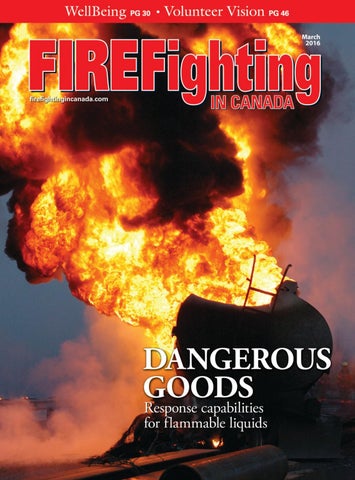
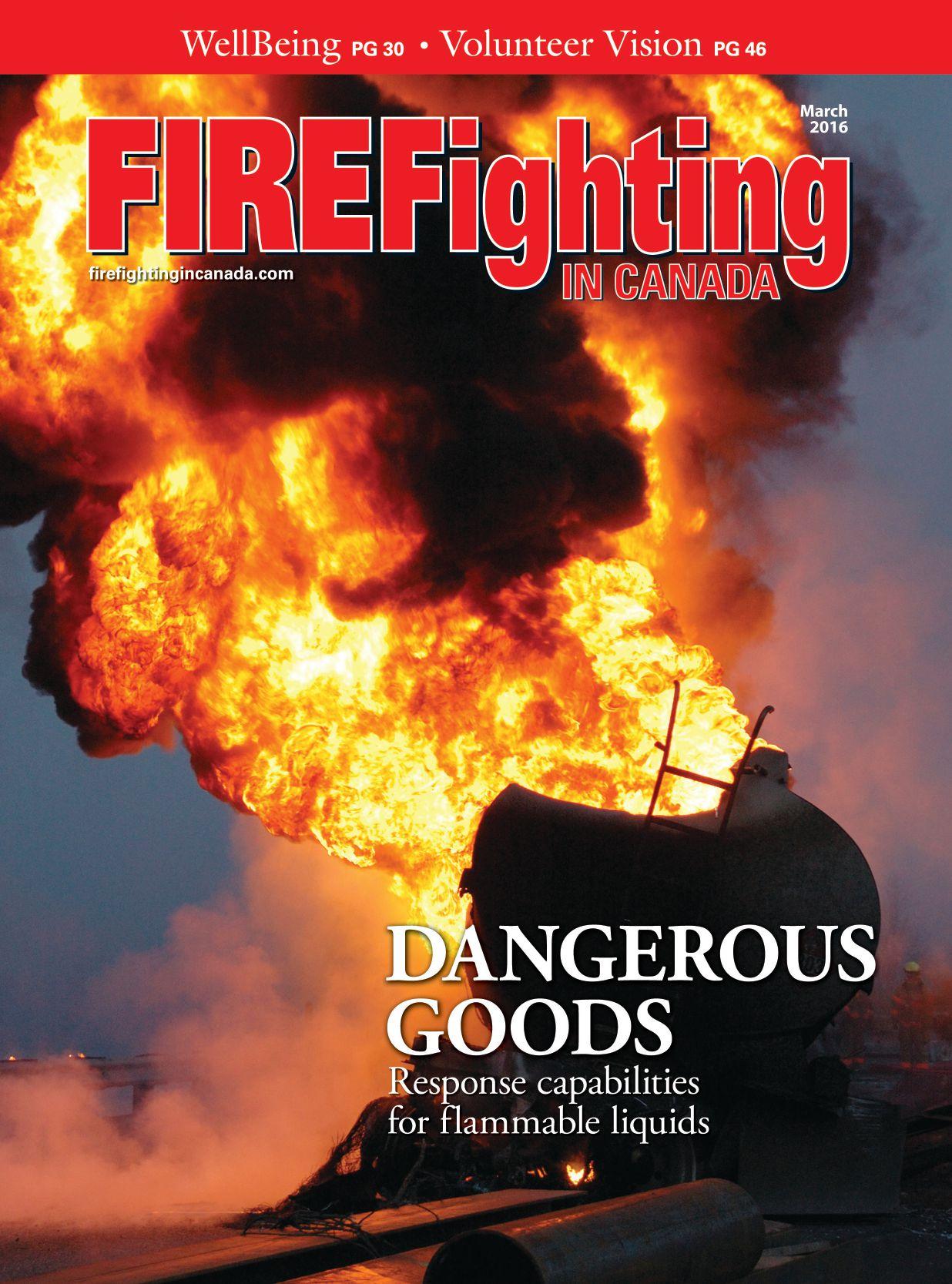
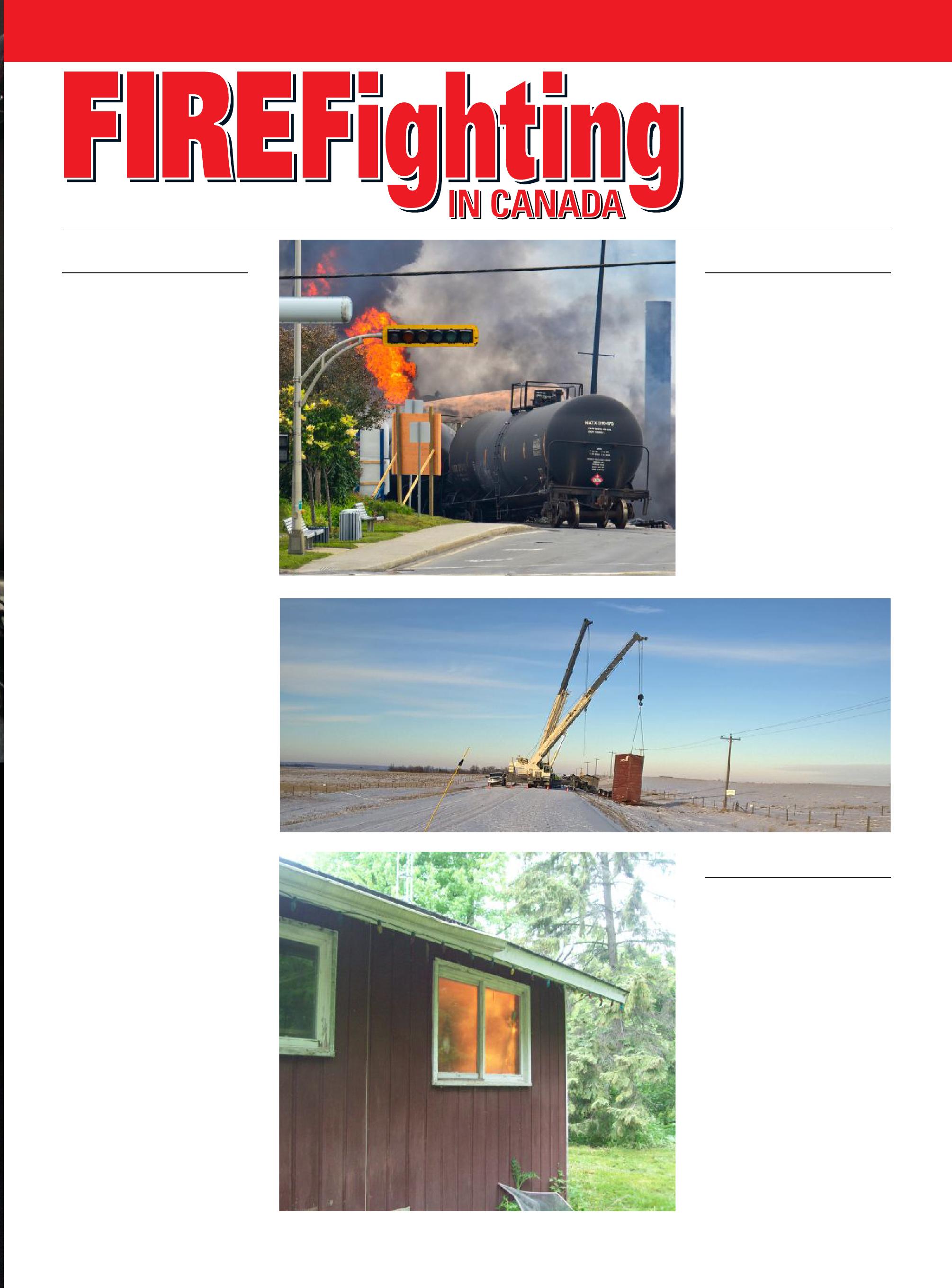
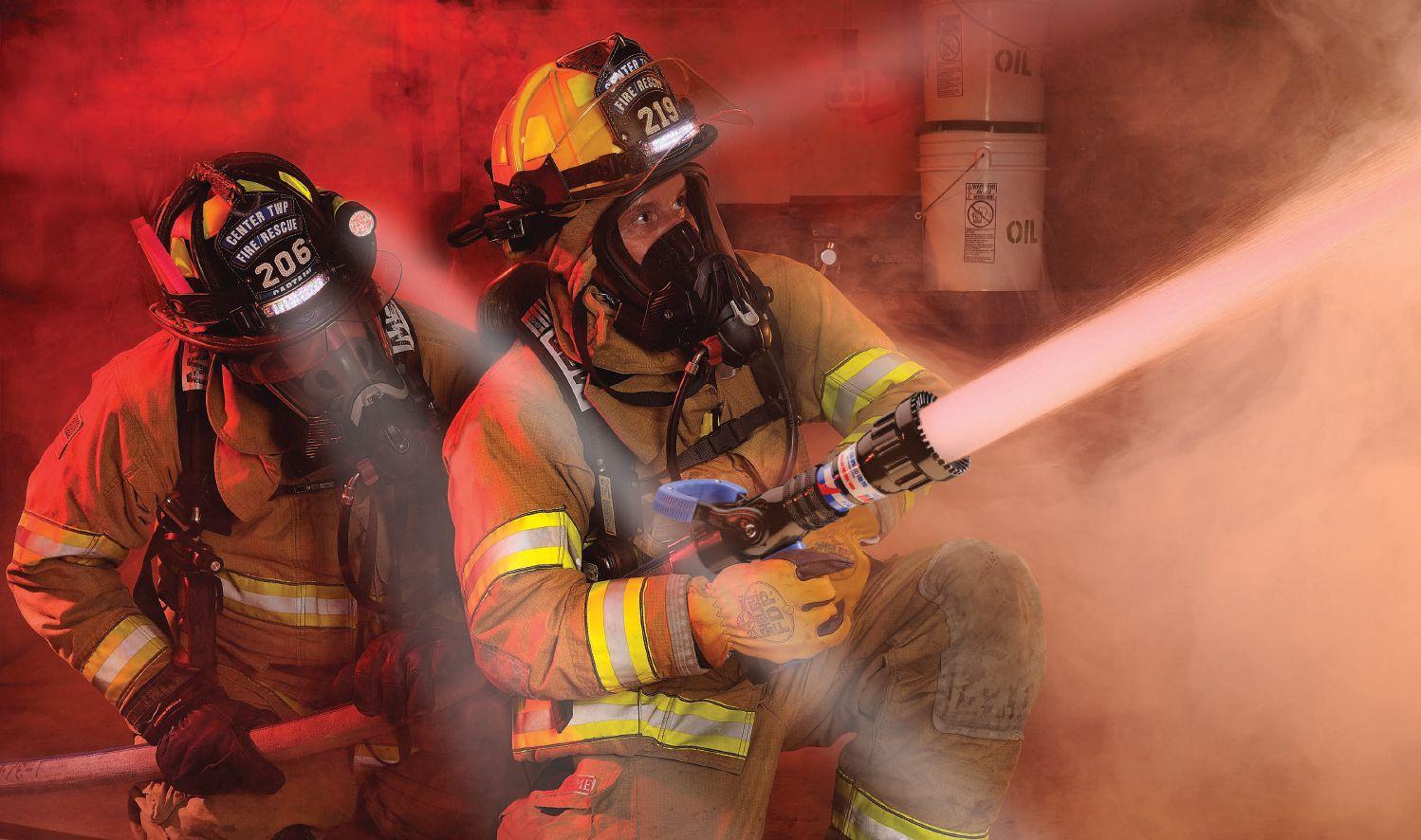
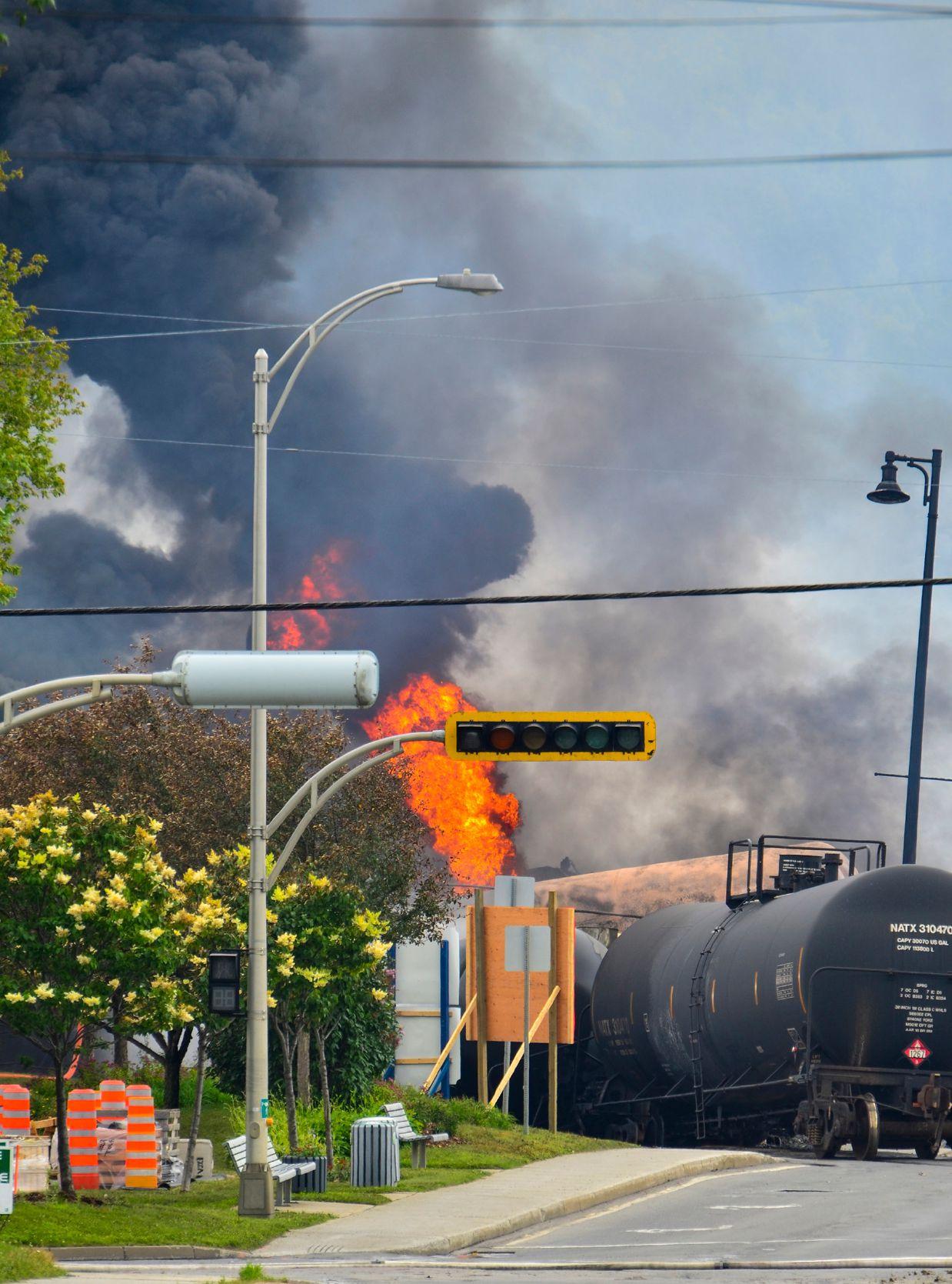
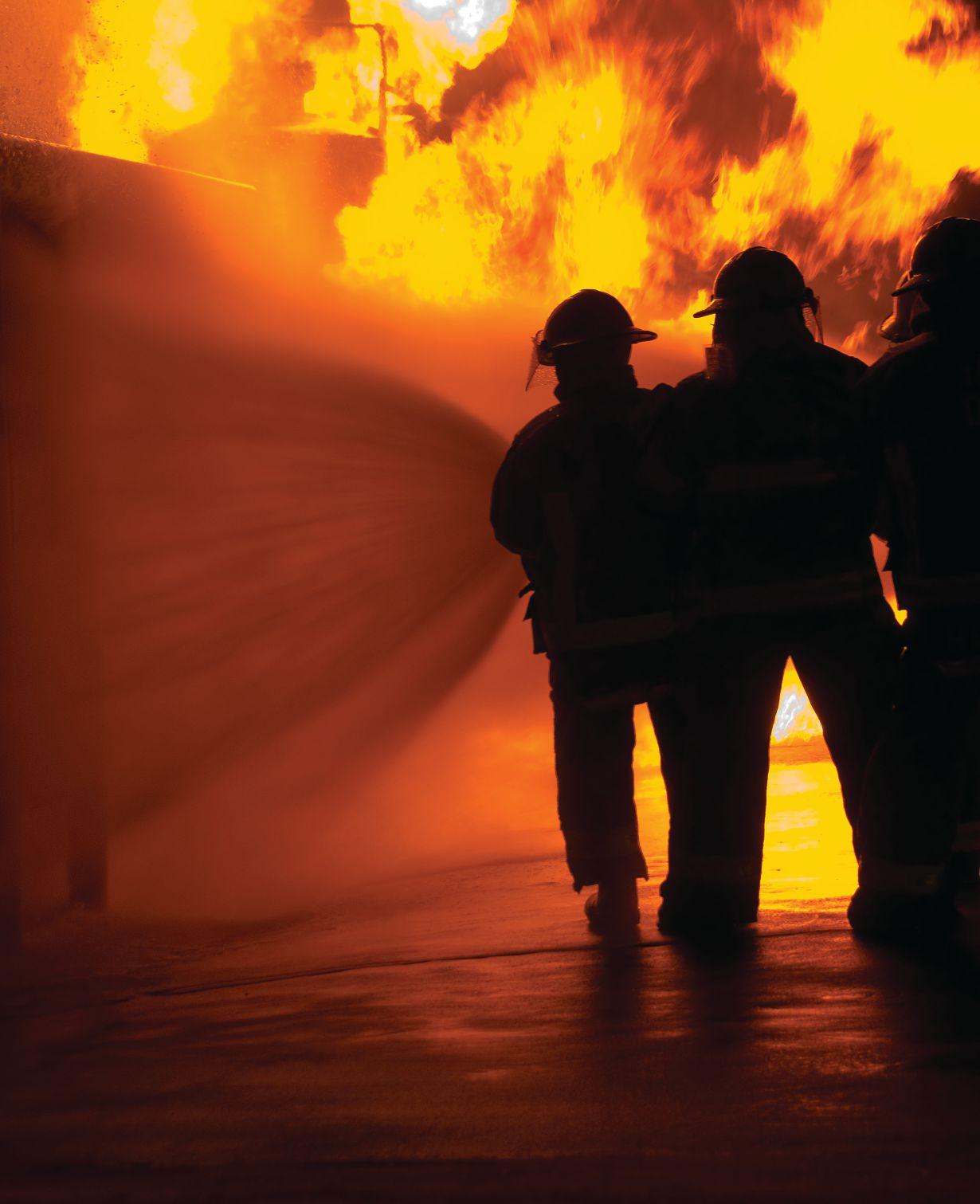
The 2013 train derailment and explosion that killed 47 people in Lac-Megantic, Que., brought about changes to the transportation of dangerous goods in Canada. Ken McMullen explains what firefighters should know about responses to flammable-liquids emergencies.
18
BUILDING RESILIENCE
A college in British Columbia has developed a program to help first responders learn to be more resilient. The program teaches students how to safely access, contain, acknowledge and release stored emotional and physical imprints from trauma experiences. By Maria Church, Ruth Lamb and David Gillis
32
COMBINING FORCES
Organizations that support publiceducation and fire-prevention officers in Ontario teamed up, for the first time, to organize a fall seminar that brought together the first two lines of defence. By Maria Church
38
INCIDENT REPORT
Firefighters in Swift Current, Sask., quickly secured an evacuation zone around a multi-vehicle collision site after confirming the presence of yellowcake uranium in an overturned container. By Denis Pilon
BY LAURA KING Editor lking@annexweb.com
B
COMMENT
Chance to be a bulldog
ack in 2008, I was flabbergasted to learn that the Sunrise Propane depot that blew up in Toronto was in a residential area, across the street from ordinary homes.
I was in Nova Scotia on vacation – it was Aug. 10 – when I saw the report, gobsmaked that there were no regulations prohibiting a propane filling station from locating in the middle of a seemingly nice neighbourhood. Whether the propane company or the homes had been there first was irrelevant; something should have changed before two people died –one in the explosion, one responding to it.
Later, while I was still learning which agencies regulate, or don’t regulate what, I was equally flabbergasted to find out that not all seniors homes have sprinklers, and that trains full of heaven-knows-what hazardous products speed through towns and cities across Canada but municipalities and responders often have no idea what’s in them.
three cases, individuals and organizations had to take on government(s) to force change. Why? Because change costs money – for government or big businesses that pay big taxes. So, what’s changed?
Propane facilities can no longer be built in residential areas in Ontario and there are strict operating regulations, thanks to the Ontario Association of Fire Chiefs (OAFC) and bulldog Ted Bryan, the fire chief in Otanabee-South Monaghan.
ESTABLISHED 1957 MARCH 2016 VOL. 60 NO. 2
EDITOR LAURA KING lking@annexweb.com 289-259-8077
ASSISTANT EDITOR MARIA CHURCH mchurch@annexweb.com 519-429-5184
NATIONAL SALES MANAGER ADAM SZPAKOWSKI aszpakowski@annexweb.com 289-221-6605
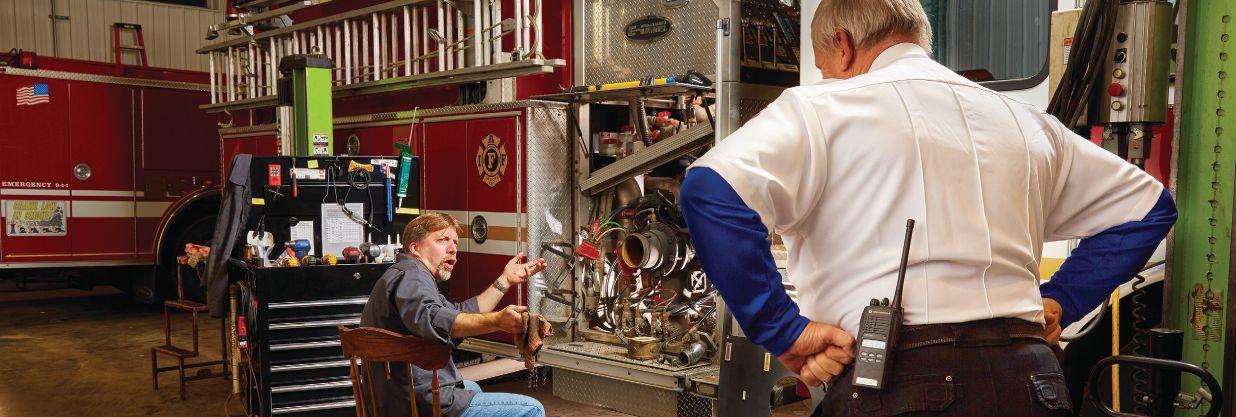
Emergency Response Assistance Canada helps firefighters deal with flammableliquids incidents. See page 10.
I remember questioning the Sunrise location and wondering how policy makers could be so complacent. A Sunrise worker had, of course, violated policy on the morning of the incident, but why had the depot been allowed to be on that site in the first place?
Policy, of course, isn’t the issue; it’s politics, and the bulldog-like efforts of the vocal minority who aren’t afraid of backlash and get things done. Sadly, in each of these examples – propane, retirement homes and the transportation of dangerous goods –people had to die before the rules changed. (No surprise, really, given smoking, seatbelts, carbon-monoxide alarms and the like.) In all
Although it took a disaster of mammoth proportions to change the transportation of dangerous goods by rail in Canada, the after-effects of Lac-Megantic are accumulating; there’s a list of bulldogs connected to this issue – primarily Chris Powers, a former chief in Ontario and New Brunswick, and the CAFC. And retirement homes in Ontario must be retrofitted with sprinklers – at tremendous cost to the province, which owns many of them; Jim Jessop, now a deputy chief in Toronto, was the bulldog in that battle, bolstered by the OAFC.
So, it’s February as I write; three people died in an apartment-building fire in Toronto that wasn’t fully sprinklered and a quick look at the home page of our website shows residential fire fatalities in Vaughan, Ont., and Langley, B.C. in the last week. Residential sprinklers. Any bulldogs out there want to take on that one?
PUBLICATION MAIL AGREEMENT #40065710 Printed in Canada ISSN 0015-2595
(with GST $25.20, with HST/QST $27.12) (GST - #867172652RT0001) USA – 1 Year $40.00 USD
We acknowledge the [financial] support of the Government of Canada.
Occasionally, Fire Fighting in Canada will mail information on behalf of industry-related groups whose products and services we believe may be of interest to you. If you prefer not to receive this information, please contact our circulation department in any of the four ways listed above.
All advertising is subject to the publisher’s approval. Such approval does not imply any endorsement of the products or services advertised. Publisher reserves the right to refuse advertising that does not meet the standards of the publication. www.firefightingincanada.com
STATIONtoSTATION
ACROSS CANADA: Regional news briefs
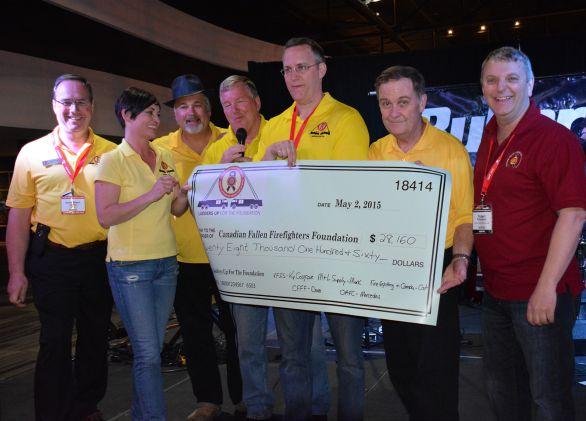
Ladders Up for the
The team behind a fundraiser born five years ago to raise money for the families of fallen firefighters is hoping for a stellar turnout for its fifth anniversary.
M&L Supply’s Mark Prendergast is the founding organizer of Ladders Up for the Foundation, and said he hopes to beat last year’s total of more than $27,000.
Prendergast organized the first Ladders Up in 2012, and modelled it after the Stop, Drop, Rock & Roll fundraiser held annually at FDIC in Indianapolis for the National Fallen Firefighters Foundation in the United States.
The Canadian event is held every spring during the Ontario Association of Fire Chiefs conference in Toronto, and features live music and food. An online auction of donated items opens March 1 to raise extra funds for the foundation. Every dollar raised – more
Foundation
than $100,000 over the past four years – goes towards the Canadian Fallen Firefighters Foundation (CFFF) education fund for the families of fallen firefighters.
Ladders Up is the largest lump-sum donation made to the CFFF each year.
Prendergast said he keeps motivated to organize the event by hearing from recipients of the CFFF scholarships. All firefighters and chief officers should feel equally motivated to donate to the cause, he said.
“I forget how many people I know on that wall,” Prendergast said, referring to the fallen firefighter memorial wall in Ottawa. “We’re doing it for them, for their children, for their grandchildren and their spouses.”
The Ladders Up committee members, Prendergast said, deserve the credit for making the fundraiser happen, including Michelle
THE BRASS POLE
Promotions & appointments
LORI HAMER was appointed deputy fire chief in charge of training, communication and special projects for the London Fire Department in Ontario on Jan. 4. Hamer began her career as a communications operator for the Kitchener Fire Department
in 1998, and in 2009 became a communications officer. She holds various provincial chair positions, a bachelor’s degree in family and social relations, and is working toward a public administration governance degree from Ryerson University.
ROBERT CHATTON became fire chief for Lantzville Fire Rescue in British Columbia on Jan. 11. Chatton began his career as a
to celebrate five years
Ladders Up has raised more than $100,000 for the Canadian Fallen Firefighters Foundation since its inception in 2012.
O’Hara from the OAFC, Kip Cosgrove from VFIS of Canada, Manfred Kihn from Bullard, Karen Jones from M&L Supply, David Sheen from Ajax Fire and Emergency Services and Catherine Connolly from Annex Business Media.
This year’s Ladders Up for
volunteer in Shawnigan Lake, and most recently served as assistant chief of training for Pitt Meadows Fire and Rescue Services. He also provides municipal and industrial firefighter training as an instructor with ERT Training Inc.
Retirements
JIM PHELAN, fire chief of
the Foundation is on April 30 at the Crowne Plaza Toronto Airport from 7-11 p.m. Learn more at www. firefightingincanada.com/ laddersup, on Facebook. com/LaddersUpCanada, and follow the charity on Twitter @LaddersUpCanada – Maria Church
in Alberta, retired in November after more than 27 years in fire. Phelan began his career in Yellowknife and rose to the rank of deputy before moving to Parkland as deputy in 1988. He was promoted to chief in 2004.
TOM WHIPPS, volunteer fire chief for Lantzville Fire Rescue in British Columbia, retired in January after 35 years with the department, 14 as chief.
Parkland County Fire Services
PHOTO BY MARIA CHURCH
CO-awareness champion receives Order of Ontario
John Gignac, the man behind Ontario’s Hawkins-Gignac Act that requires carbon-monoxide alarms in all homes, has been named to the Order of Ontario.
Gignac, who is a retired captain with Brantford Fire Department, received the honour at a ceremony in Toronto in January. The recognition, he said, is shared by all volunteers of the HawkinsGignac Foundation.
“We have a lot of volunteers and family members that help out a ton,” Gignac said in an interview. “Without
those people I wouldn’t be nearly as successful.”
Gignac retired as a firefighter after 34 years in 2009, several months after his niece, Ontario Provincial Police constable Laurie Hawkins, her husband and their children died from carbon-monoxide poisoning. Gignac started the foundation that year with the mission to increase awareness of carbon monoxide and educate people about the importance of prevention and alarm systems.
“[The foundation] was born on the promise I made to my
brother when my niece was in the [hospital] in Toronto,” Gignac said. “I had my uniform on and he said, ‘Why is this happening? Why aren’t you doing something about it?’
“He was, of course, in a state of shock, but I said, ‘From here on in, I’ll do the best I can.’”
Creating awareness about carbon monoxide began as an uphill battle, Gignac said – he was surprised how few people understood the severity of the so-called silent killer. He turned to his years of training as a firefighter and experi-
ence dealing with trauma as a launch point to begin public-education efforts.
Ontario passed the Hawkins-Gignac Act in late 2013, making it the second province in Canada to require carbon-monoxide alarms in homes; Yukon passed similar legislation earlier that year.
Gignac, on behalf of the Hawkins-Gignac Foundation, was heavily involved in campaigning in both the province and territory.
Learn more about the foundation at endthesilence.ca
– Maria Church
Firefighter insurer celebrates 25 years in business
In 1991, Kip Cosgrove moved to Canada to fill a market niche: to provide a national insurance option for firefighters.
Cosgrove brought the United States-based insurance company VFIS north of the border, and at the 1991 International Association of Fire Chiefs conference held in Toronto, VFIS of Canada was launched.
“Because the program was so successful in the United States,” Cosgrove said, “they felt that, hey, the Canadian
fire service is very similar. Fighting fires is no different in Canada than in the U.S.”
Now in its 25th year, VFIS of Canada insures more than 21,000 fire departments across the country.
VFIS of Canada pioneered several benefits that are now market standards, Cosgrove said, including cosmetic disfigurement from burns, and heart and circulatory malfunction.
Cosgrove is well known in the industry thanks to his presence at many conferences
and trade shows. VFIS sponsors several associations and charities, finances educational guest speakers, and offers free educational programs to its clients.
“Today the volunteer firefighters needs to grab everything they can, and we really are giving them access to a
lot of these great tools free of charge,” Cosgrove said in an interview.
“If they weren’t buying my program, I wouldn’t be able to offer back anything, but because our program is taking off, we want to give back to the fire service.”
– Maria Church
Whipps, 67, earned a medal of merit from the Lifesaving Society in B.C. in 2001 for an off-duty rescue of a child.
MORRIS WILLIAMS, a volunteer firefighter and former chief of the Uniacke & District Volunteer Fire Department in Nova Scotia, retired on Dec. 31 after serving
for 60 years. Williams joined the department when he was 17 and held positions of firefighter, driver/operator, lieutenant, captain, deputy and fire chief.
STEPHEN TAYLOR a senior dispatcher with the Yarmouth Fire Department in Nova Scotia, retired on Oct. 9. Taylor joined Yarmouth as a volunteer in 1975 and was hired as a dispatcher in 1989.
Last alarm
JOHN KOVACS, an acting captain with Tillsonburg Fire Services in Ontario, died in the line of duty Sept. 28 from brain cancer at 54 years old. Kovacs served in fire for 28 years, 25 of which were with Tillsonburg and three with Houghton Township Fire Department. He was actively involved with the firefighters association.
FLYNN LAMONT, acting battalion chief for Vancouver Fire & Rescue Services, died on Oct. 29 from pancreatic cancer. Lamont served for 28 years, was a faculty member with the Justice Institute of BC, and was instrumental in the development of Vancouver’s heavy urban search and rescue team.
STATIONtoSTATION
BRIGADE NEWS: From departments across Canada
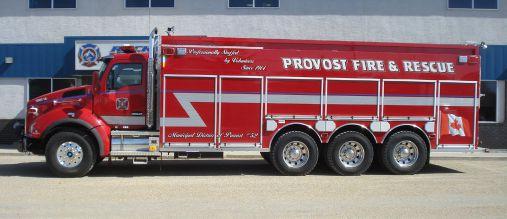
MD of Provost Fire and Rescue in Alberta, under Fire Chief Barry Johnstone, took delivery in April of a Rocky Mountain Phoenix/Rosenbauer-built tanker. Built on a Kenworth T880 chassis and powered by a 600-hp Cummins ISX 15-litre engine and an Allison 4500 EVS transmission, the unit features a 4,000lpm Rosenbauer pump, a Rosenbauer Fix Mix and FoamPro 1600 systems, 4,800-gallon water tank and 30-gallon foam tank, a TFT Tornado bumper turret and Evolution brow light.
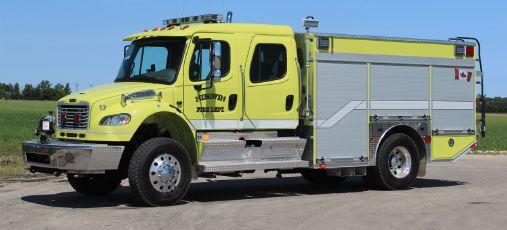
Nipawin Fire Department in Saskatchewan, under Fire Chief Brian Starkell, took delivery in July of a Fort Garry Fire Trucksbuilt wildland urban interface unit. Built on a Freightliner M2-106 chassis and powered by a 350-hp Cummins ISL engine and an Allison 3000 EVS transmission, the unit is equipped with a 1,250-gpm Darley high-pressure pump, a 1,000-igallon poly water tank, a Foam Pro 2002 Class A foam system, TFT Tornado turret, Akron hose reel and Zone Defense camera.
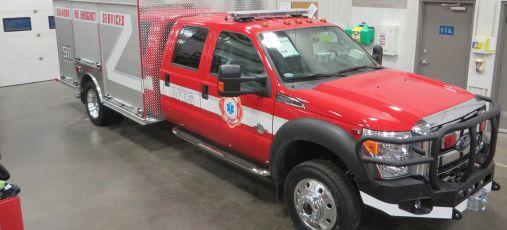
Brandon Fire & Emergency Services in Manitoba, under Fire Chief Brent Dane, took delivery in November of a Fort Garry Fire Trucks-built rescue. Built on a Ford F-550 4x4 crew cab chassis and powered by a 300-hp Power Stroke 6.7 litre engine and a six-speed automatic transmission, the unit is equipped with Command lights, Warn front bumper with 12,000-pound winch and Slide Master trays.
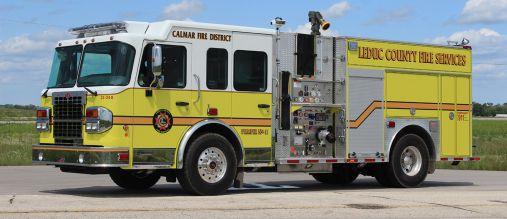
Leduc County Fire Services in Alberta, under Fire Chief Darrell Fleming, took delivery in July of a Fort Garry Fire Trucks-built pumper. Built on a Spartan Metro Star chassis and powered by a 380-hp Cummins ISL engine and an Allison EVS 3000 trans mission, the unit features a Darley PSP pump, a Foam Pro 2001 system, a 1,200-gallon poly water tank, MSV body with Amdor roll-up doors and Fort Garry pan doors, Elkhart Cobra EXM monitor, FRC IC 300 governor and Zico electric ladder rack.
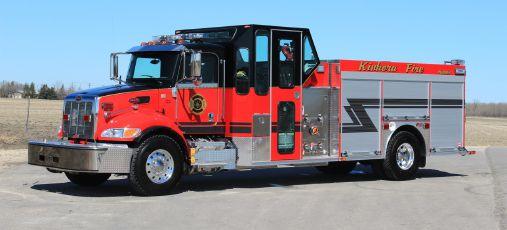
Kinkora Volunteer Fire Department in P.E.I., under Fire Chief Adam Baldwin, took delivery in June of a Fort Garry Fire Trucksbuilt emergency rescue. Built on a Peterbilt 348 chassis and powered by a 380-hp Paccar PX-9 engine and a five-speed automatic transmission, the unit is equipped with a 1250 CSPA Waterous pump, a 1,000-igallon poly water tank a Foam Pro 2001 Class A foam system, Weldon multiplex system, KL415D-FS command light, FRC Spectra scene lights and Zico angled parking lights.
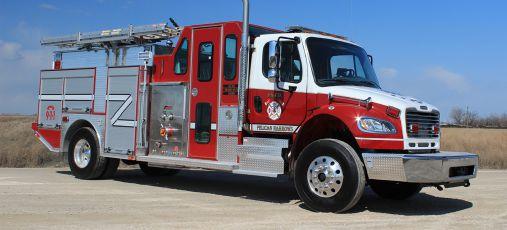
Pelican Narrows/Peter Ballantyne Cree Nation in Saskatchewan, under Chief Peter Beatty, took delivery in April of a Fort Garry Fire Trucks-built pumper. Built on a Freightliner M2 chassis and powered by a 350-hp Cummins ISL engine and an Allison 3000 EVS transmission, the unit features a top-mount enclosed threeman crown, a 1250 LDM Darley pump, a 1,000-igallon pro-poly water tank and a Foam Pro 1600 Class A foam system.
NIPAWIN FIRE DEPARTMENT
MD OF PROVOST FIRE AND RESCUE
BRANDON FIRE & EMERGENCY SERVICES
LEDUC COUNTY FIRE SERVICES
KINKORA VOLUNTEER FIRE DEPARTMENT
PELICAN NARROWS/PETER BALLANTYNE CREE NATION
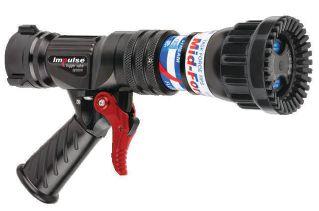
Smooth Bore Performance from a Combination Nozzle…
TFT’s Mid-Force dual pressure automatic nozzle offers you a choice of maximum flow, or maximum reach and penetration from a single nozzle.
The low pressure mode provides target fire flows with greatly reduced nozzle reaction, and the integrated slide valve produces a turbulence free straight stream, even when gated.
Your choice of molded rubber or stainless steel spinning fog teeth.
To learn more about how you can dramatically improve your initial attack flow operations automatically, contact your local TFT dealer today.
DANGEROUS
DANGEROUS GOODS
Response capabilities for flammableliquids incidents
By KEN MCMULLEN
LEFT Emergency Response
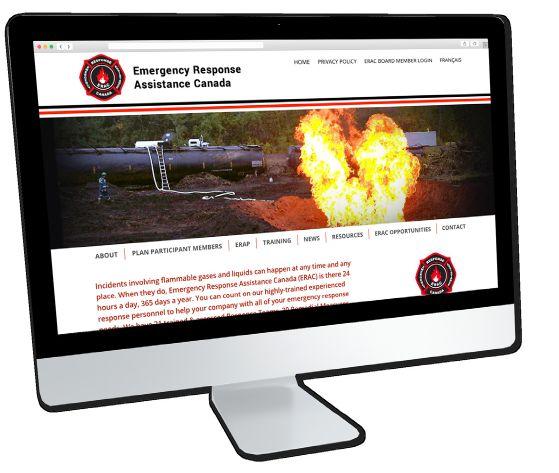
Assistance Canada created a separate division to meet the needs of industry after Transport Canada issued protective directive 33, requiring emergency response assistance plans.
ABOVE ERAC manages emergencyresponse plans for more than 300 industry participants.
Say the words Lac-Megantic and a flood of images, feelings and thoughts come quickly to mind. The July 2013 train derailment and explosion that killed 47 people in Lac-Megantic, Que., was a watershed event in Canada, particularly as it relates to the transportation of flammable liquids and the regulations, policies and actions that producers, shippers and consignors must now consider.
The incident, with its devastating loss of life and property damage, more than any other in Canadian history, has brought the reality of dangerous goods transport to the minds of government, the public and first responders. As a result, change has come to the transportation of dangerous goods in Canada.
One of the key components of this change is the protective directive 33, which requires producers, consignors and shippers to register an emergeny-response assistance plan (ERAP) with Transport Canada if so required by regulation. Part 7 of the Transportation of Dangerous Goods Act requires that there be an approved ERAP before offering for transport or importing certain dangerous goods above a quantity specified in column 7 of schedule I of the transport of dangerous goods (TDG) regulations. If no number (or reference to a special provision) appears in column 7 – schedule 1, an ERAP is not required. If a number appears in column 7 of schedule I, then the shipper must adhere to the requirements of section 7.1 of the TDG regulations.
What is ERAC and what does it do for first responders? Emergency Response Assistance Canada (ERAC) responded to post Lac-Megantic changes in order to seek and develop continuous improvements in its safety and quality response system. Now, in addition to liquid-petroleum gas (LPG), ERAC has developed a separate division to meet the needs of industry with respect to the Transport Canada protective directive 33.
As a non-profit corporation, created by industry stakeholders, ERAC’s focus has been on the achievement of one objective only –to provide Canada’s best response capability for LPG and flammable-liquids-related incidents. Consequently, ERAC is instrumental in helping hundreds of companies, large and small, meet the strict regulatory requirements for an emergency-response assistance plan.
ERAC has experts in designing emergency plans, managing the documentation and, most of all, activating those plans whenever and wherever needed. Using the most highly trained and skilled responders and industry best practices and equipment, ERAC has prepared for any LPG or flammable liquids emergency. Operating 24/7 from coast to coast and offshore in Canadian territorial waters (LPG only), ERAC is ready to help its members keep their companies, communites and clients safe. ERAC manages emergency-response assistance plans for more than 300 plan participants from the LPG and flammable-liquids industries, which include wholesalers, producers, transporters and retailers.
ERAPs are specifically designed to address management of
goods within class 3 flammable liquids (packing groups 1 and 2) in the event of a transportation accident. The plans define roles and responsibilities, required equipment, notification, documentation, responder expertise and response details. The plans further address emergency preparedness, personnel and team training, response exercises, assessment and how equipment must be serviced and maintained. ERAPs supplement the emergency response plans of the carriers and of the local and provincial authorities, and they must be integrated with other organizations’ protocols to help mitigate the consequences of an accident. This integration is usually accomplished by working within an incident-management system.
■ ROLE AND RESPONSIBILITY
ERAC’s role is to provide stakeholders, plan participants, response teams and their personnel – along with municipal first-responders – with assistance. The assistance includes providing technical advisors, remedial measures advisors, response team leaders and home-based co-ordinators who possess the means (equipment, training) and the knowledge and systems (notification, dispatch, co-ordination and response) to successfully manage, control and contain incidents involving road, rail and stationary tanks and containers.
As Canada’s LPG emergency-response provider, ERAC provides emergency response to plan participants who transport certain products by road or rail, or those who store these products in tanks with capacities of 450 litres or greater. These products are gases at standard temperatures and pressure:
• Propane (UN1978)
• Butane (UN1011)
• Propylene (UN1077)
• Butylene (UN1012)
• Isobutene (UN1969)
• Isobutylene (UN1055)
It is recognized that these products may contain a concentration of condensate and/or minute quantities of other elements including hydrogen sulphide. Under the plan, response is also provided to emergencies involving Butadiene – 1, 3 (stabilized) (UN1010).
In addition to LPG, ERAC responds to the following flammable-liquids incidents (transported by rail only):
Training and the development of expertise are at the core of what ERAC is and does. ERAC, in concert with its educational partners, offers training to municipal fire services (at cost – ERAC is a non-profit organization) in order to improve knowledge and understanding of the risks and challenges that flammable liquids and liquid petroleum gases pose to municipalities, fire services and personnel.
This year, ERAC will offer first responder LPG awareness training (online) as well as Level 1 LPG firefighting training at five locations across Canada in order to provide first responders with the necessary understanding and hands-on training to help ensure their health and safety when responding to these specific dangerous-goods products.
Classes began in the fall of 2015 within Ontario and will branch out across the country this spring. The Level 1 training prepares first responders with the information, knowledge, exposure and handson skills that they will require in order to become proficient and further expand their training to Level 2 programming, now available through ERAC’s partner the Emergency Services Training Centre in Blyth, Ont. ERAC’s online firefighter LPG-awareness program will also be available online in the spring and will become the precedent for Level 1 training.
■ RESPONSES AND LOCATIONS
ERAC contracts 21 specialized response teams across Canada, which respond to a wide range of flammable-liquid or liquid-petroleum emergencies. Regardless of the location of the emergency, the mode of transport or the size and complexity of the incident (beyond 450 litres), ERAC’s experts in control and containment provide advice to shippers, consignors, producers and incident commanders. Damage assessment, air monitoring, extinguishment, spill control, bonding and grounding, transfer,
flaring, purging of containers and the continuous provision of advice related to the control and management of incidents is ERAC’s forte. However, ERAC not only responds to LPG and flammable liquids fires and leaks, it provides firefighting expertise, product knowledge and technical assistance to first responders as part of its outreach and educational plan.
As part of this outreach and educational plan, ERAC uses four purpose-built firefighting trailers (which will expand to six this year) to assist in fire containment, cooling and extinguishment. These trailers are designed specifically to fight and suppress flammable-liquid fires utilizing AR-AFFF and AFFF foam and to cool LPG railcars during incidents involving fires.
This year, ERAC will add new rail and road prop training trailers to the firefighting trailers that enable ERAC to offer Level 1 training to first responders across Canada, in addition to providing municipal and industrial fire teams with firefighting equipment, training and expertise.
■
CONTINUOUS IMPROVEMENT
Fire fighting is more than simply responding when the phone rings; it requires a thorough understanding of tactics, products and their characteristics and properties and the best application methods and practices required to successfully contain, extinguish fires and mitigate risks. Understanding comes about through transferring learning as knowledge to first-responder personnel and determining if this knowledge transfer has improved competence.
ERAC strives to continuously improve the knowledge of its people and the methods, processes and procedures it uses to meet its goals and objectives. ERAC maintains a strict compliance regimen for its response personnel, technical advisors, remedial-measures specialists, team leaders and home-based co-ordinators. Ensuring this level of knowledge and invigilation is meant to assure stakeholders that ERAC personnel possess all the necessary skill and expertise to safely engage any emergency involving LPG and flammable liquids.
If your municipality would like to obtain LPG training, contact me.
Ken McMullen is the manager of safety and quality improvement for Emergency Response Assistance Canada. Contact him at ken.mcmullen@erac.org
BY JAMIE COUTTS Fire chief Lesser Slave Regional Fire Service
TPartnering to deliver quality training
raining props are something fire services want and need, but unfortunately not always something they can afford. Getting money from the federal or provincial government seems logical, but that means competing with other departments in your own municipality. What if there are other ways to amass training supplies? The Lesser Slave Regional Fire Service has come up with a few solutions that are worth sharing.
A common problem for us here in the frozen north of Alberta is accessing hands-on, useable training in the cold, winter months. In 2016 we vowed to try harder to find applicable training for our firefighters and to introduce new props and concepts.
Just after the Christmas break we called our friends at a local safety supply and service company and asked if we could use their confined-space prop again this year. Just like these good people had done for the past 14 years, they agreed and said they would not charge us. We used a loader and dragged the prop into our fire hall to let it thaw out. Based on that relationship, we began to think of new partnership possibilities. We asked the principles of Slave Safety Supply if they wanted to partner with us – they would maintain ownership of the $40,000 prop, we would supply the upgrades, paint the tank, and store it at our training site, and both of us could use it year round. The local welding company donated some of the time and materials to upgrade the prop, another local tank-building company donated a tank truck hatch, and the Slave Lake Firefighters Society covered the additional $5,000. The regional fire service provided the paint and the firefighter labour to complete the project.
fluid from rolled over, or damaged tank trucks. The idea was to pass this prop on to someone who would use it, and could deliver training if requests came up. The Slave Lake Firefighters Society paid for the trucking costs (which were partly reduced by a local trucking company) and we had another prop on which to train. After painting, a few repairs and some welding, we had ourselves another great training aid. This prop is used for hatch-cone recovery training; it has two drill plates for drilling-and-recovery operations training, and is a three-part confined-space prop as well. The prop is a damaged tank from a tank truck – it has the valving, baffles, hatches and parts so the training is amazing and could not be more realistic.
The third prop came just days later when we received a letter from the provincial government granting our funding application from six months earlier. We received $40,000 for a technical rescue, high-angle addition to our training facility ($20,000 from the Government of Alberta, $15,000 from the Slave Lake Firefighters Society, $5,000 donation in-kind from the fire service). The prop will include a ladder to the top of the 16-metre (54-foot) tower with the same safety system used by the local forestry towers, service rigs, and wood mills.
. . . the best things get done when people set aside their problems, personalities and egos and work for a common useful outcome. ‘‘ ’’
This prop now can be used by local municipalities, the fire service, and industrial customers for manhole-sewer and storm-sewer training, rescue-tripod training, dangerous-goods pumping and fluid recovery, leak containment, confined-space use and rescue, and as a smoke maze. This partnership has allowed for a single-use training aid to become a versatile, multi-use, indoor-outdoor prop at a fraction of the price of a new one.
During the partnership process people heard about what was going on and tried to help us at every turn. The next idea came from one of the owners at Slave Safety Supply. WCSS (Western Canadian Spill Services) built a tanker rollover prop a few years ago and rarely had requests for its use. WCSS staff are mostly pipeline-spill responders and had built this prop to show people how to recover
Jamie Coutts is the fire chief of Lesser Slave Regional Fire Service in Alberta. Contact him at jamie@slavelake.ca and follow him on Twitter @chiefcoutts
Our high-angle members will be able to train on realistic props and systems for rescue, rappelling and Stokes-basket work on both the inside and outside of the tower. This prop will enable all our protective-services partners and industry customers to train at a safe, offsite location so they don’t have to use existing infrastructure in their own facilities, which are often live, loud and dangerous areas that don’t lend themselves well to training scenarios.
For the firefighters and personnel from our technical teams, these three new training aids, and the new partnerships, will allow for hands-on, practical training never before seen in this area. We created these amazing opportunities by fundraising, developing partnerships and applying for government funds. It amazes me every day how the best things get done when people set aside their problems, personalities and egos and work for a common useful outcome. I could not be more proud of the communities in which we work and live.
Building resilience
How firefighters can deal with trauma by taking control of their minds and bodies
By MARIA CHURCH, RUTH LAMB and DAVID GILLIS
Acollege in British Columbia has developed a program to help first responders learn to be more resilient.
Langara College’s Strategic Resilience for First Responder program is well timed with fire-service organizations – the Ontario Association of Fire Chiefs in particular –instituting resilience-building programs.
The college, led by healthcare faculty member Ruth Lamb, built its program based on 15 years of clinical experience using resilience-based practices that self-empower using modern science and Eastern body-mind practices. The resilience program is taught in three-day sets over about six months, and was first held last fall. The University of New Brunswick plans to bring the program to its campus starting in September.
LEFT Repeated exposure to trauma impacts firefighters over time. A college in British Columbia is offering a program that teaches first responders how to build strong, resilient bodies and minds.
ABOVE Firefighters can easily place their nervous systems on high-push or keep them at high levels of arousal, and forget to step back and recalibrate.
David Gillis, a 10-year firefighter in British Columbia and a three-year member of Royal Canadian Marine Search and Rescue, is one of 15 students who participated in the first semester of the resilience course.
■ DAVID
In July 2013 I attended a cardiac-arrest call to assist paramedics who were already performing CPR on a slim, elderly male. Although this was a fairly routine call, it turned into something far more impactful for me.
As I walked up the stairs and approached the victim, I was struck by an odour that triggered a response in me for which I was not prepared. That odour took me back six years to an extremely traumatic event in June 2007, during which a person had also voided. The odour triggered a memory that screamed for my attention and I fought to maintain my composure. Later, when I was able to take a break from compressions, some of the old memories and emotions from six years ago started to surface. I couldn’t let that happen – not then. So I did
what I usually do and told myself to suck it up, deal with it and move on. Then I went back to doing compressions.
■ RUTH
David was experiencing an involuntary, reflexive flashback fragment of trauma triggered by odour. Although he rightly at the time denied the experience, his body still underwent hormonal, emotional and physical responses that he could not control. David’s traumatic experience stacked onto his other trauma experiences and, while out of his conscious awareness, the experiences took their toll on his body and mind.
Research provides ample proof that some firefighters are negatively impacted when facing high-stress trauma incidents over time, and others cope relatively well. However, it seems that few firefighters understand how important it is to reset and calm their nervous systems as they face one impactful call after another. How many firefighters know how to release stress and built-up tension between calls?
Residue from trauma experiences are unconsciously stored in a body’s tissues, including the nervous system, immune system and endocrine system. As doctor Bessel van der Kolk explains in a 1994 paper on the psychobiology of post-traumatic stress, repetitive invasion of other people’s traumas can, consciously or unconsciously, subtly drain a person’s vital energy, impact personal feelings, beliefs, values, judgements and relationships. It is amazingly easy for firefighters to place their nervous systems on high-push or to keep them at high levels of arousal, and forget to step back and recalibrate. It is equally as easy to shut down or self-anesthetize and to ignore body sensations by keeping constantly on the go or using substances to cope with continuous, even subconscious anxiety. The toxic power of trauma and stress keeps individuals in hyper-motion and hyper-vigilance mode – symptoms include irritability, insomnia, critical mindedness, restlessness, anxiety, panic and nightmares – or hypo-active mode – symptoms include low moods, cravings for sweet foods or dulling drugs, fatigue, amnesia, avoidance, feeling numb or as if in a fog. These are just a few of the emotional-psychological defensive reactions that can arise from
traumatic stress. Constant stress leads to inflammatory (often painful) conditions. What is more, when tested, individuals with post-traumatic stress disorder had high amounts of inflammatory markers, which show that subtle inflammation processes are underway. Symptoms of inflammation vary, but painful gut is common.
The body’s sensory and hormonal systems hold trauma imprints and can get stuck in trauma-alert mode, which means that psychological and physiological defences stay engaged. The nervous system can hijack a person’s preferred response locking him or her in a trauma-response or shock mode.
For David, he had talked about his previous traumatic experience and theoretically understood what was happening to him, but talking about it did not heal the primal body reactions that were unconsciously triggered when he smelled certain odours during a call. David needed to diffuse his nervous-system activation and stop his actual behavioral response.
■ DAVID
What happened next was something I didn’t pay much attention to at the time, but now am very thankful I witnessed. I was doing the last set of compressions on the man when the protocol ended and we were instructed to stop CPR. Equipment was removed and somebody handed me a blanket to use to cover the victim. The paramedic, who had been giving the breaths, gently closed the victim’s eyelids and said a few words very quietly and softly to him. I don’t remember his exact words but they were quite simple and had no obvious religious overtones – something like, “Rest well, old timer.”
What occurs to me now is that regardless of the reason the paramedic said those parting words, it was a show of compassion, connection, kindness, love and respect. Those words not only honoured the victim, but may very well have provided just enough emotional relief and support to the paramedic to allow him to feel less traumatized and more resilient in the face of this event and the effect it may have had on him then and in the future.
■ RUTH
Unhealed, denied emotions make us sick. When these emotions are pushed deeply into the unconscious they stack up and take their silent toll on our lives. The paramedic’s
heartfelt, compassionate statement surely helped him to recalibrate his nervous system and, in a manner unique to him, name and release his sorrow caused by a human’s passing.
■ DAVID
I believe that we need to be training first responders on how to increase their resilience and endurance for trauma through knowledge, awareness and reflection. We need to better equip responders to recognize when they or those with whom they work have been overexposed and require help. We need to find a new way of looking at and managing our traumas from the past and present, and to prepare for the future. We need to look at new ways of experiencing and processing trauma through insight, balance, grounding, emotional flexibility, compassionate connection to ourselves and others, and body-mind awareness.
As first responders, we need to consider that exposure to trauma is as much an on-the-job hazard as smoke, fire, knives, bullets, needles or infectious disease. We need to devote as much time, effort and resources to protecting our mental health and wellness as we do to protecting our physical health and wellness.
Did anybody really explain to you what you were signing up for? Were the words “exposure to trauma” in your job description? What about “risk factors” and “propensity for PTSD”?
Langara College’s resilience program has introduced me to a new way, a better way, to experience and manage trauma. Knowledge, awareness, and reflection of course content has allowed me to put into practice a new model of self-help and well being. I believe non-invasive, non-chemical and self-empowering strategies such as powerful breathing techniques, qigong exercises, yoga, meditation and a greater awareness of my body and how I actually feel, plus reading and research, have helped me build, strengthen and expand my resilience. I have benefited from experiential learning and dynamic face-to-face group participation with a cohort of learners and instructors, who are either wearing or have been in our shoes in some capacity or another, in a safe and secure environment.
A few years ago if the duty officer, company officer or a fellow firefighter had noticed that something wasn’t quite right with me on scene and asked if I was OK, I would have just responded with,
It is time to acknowledge that chronic exposure to trauma and stressful conditions can interfere with how firefighters cope on a daily basis and over time.
- Ruth Lamb, Langara College
“Yeah, I’m good”. Now I think about things such as what that paramedic said to the victim – rest well, old timer – and I think about resilience. I think about a different way for me and other first responders to deal with trauma. We need to embrace a new way of resisting PTSD, a better way, because the old way wasn’t working – at least not for me and not for the people close to me.
■ RUTH
It is time to acknowledge that chronic exposure to trauma and stressful conditions can interfere with how firefighters cope on a daily basis and over time. Dare we ask: what do firefighters need to know to keep their high-powered careers on track? Are firefighters willing to be the trailblazers who take steps to protect their mental health and wellbeing, and, by doing so, support their professional excellence?
If the response is yes, then healing the nervous system through a slow-paced, non-invasive and self-empowering process that teaches firefighters how to safely access, contain, acknowledge and release stored overcharge-imprints from trauma experiences is the answer. These processes help individuals take back their lives. Their bodyminds will then have strong and resilient nervous systems – ones that can cope with high-stress careers and provide absolutely essential services for their communities.
The nervous system heals slowly, habits soften slowly and behaviours change slowly. Releasing trauma imprints safely is part of a slow consciousness-based and awareness-focused process. The process counters the stacking of trauma in the tissues and nervous system. Firefighters more commonly cope with stacked trauma by using defense mechanisms or substances of any kind in order to just keep on going. Understandably, statistics show that many first responders do not want a diagnosis and to face the stigma, therefore they cope through denial until they are overwhelmed.
A leader in the first responder community recently said at a WorkSafe B.C. event, “Once someone is diagnosed with PTSD they are placed on medication and we never see them again.” How does this serve first responders, their teams, and their communities? Instead of focusing on disease or diagnosis and medicating natural human responses to crisis situations, education for primary prevention and resilience strategies could be the priority.
Learn more about the Strategic Resilience for First Responder program at langara.bc.ca/resilience
Ruth Lamb, PhD, is a program co-ordinator at Langara College. Email her at rlamb@langara.bc.ca
David Gillis is a firefighter in British Columbia. Contact him at dgillis512@gmail.com
At Rocky Mountain Phoenix, we take pride in going that extra mile for you. We provide a comprehensive line of emergency apparatus and equipment in brands you know and trust. It doesn’t stop there!
We provide service for all your emergency apparatus and equipment. Annual testing, servicing, and repairs available at all four of our locations and through our seven mobile service teams, all with emergency service offered 24/7, every day of the year.
We really do have you covered!
Reflect on your change
By ED BROUWER
As I got out of my truck in the Walmart parking lot, I heard a voice behind me say, “Hey buddy, any change?” I don’t remember the fellow saying, “Do you have any change?” and so as I went about my shopping, I thought about the way the question was phrased and applied it to my role as a training officer.
Change is something we as instructors in Canadian fire services deal with constantly. During my 15 years writing this column, I have witnessed many changes, especially in the way we present our lessons. Just recently I (finally) threw out two garbage bags full of videocassettes. Each video represented hours of training modules; they all had hand-printed labels and were stored in protective hard plastic cases. These instructional tapes were once invaluable, now they sit at the back door waiting to be recycled. As for books, my office contains more than 100 hardcover fire-related volumes and training manuals. I value the printed page and enjoy the feel of a hardcover book, but for the most part they now collect dust. Some of the printed material is, well, old and outdated (I feel this way at times).
To answer the question, “Hey buddy, any change?” I’d have to say yes, there has been. There was a time when I’d have two or three books opened as I prepared for practice night. Now I can download a training video on any topic in seconds and insert it into a PowerPoint presentation ready to be used minutes later.
However, this instant practice material has come at a price. The hours we spent researching our topics and the time spent preparing overheads (remember them?) and flipcharts helped us know our topics. We wrote up the handouts and photocopied them; now we surf the net, cut and paste and hit print.
The first Trainer’s Corner column was about communication; it came complete with a practical hands-on layout any fire department could use. I’m pleased to say, we at Greenwood Fire Department in British Columbia still use that layout.
The intent for the Trainer’s Corner column is not so much to teach you how to perform various fire-ground tasks as it is to help you discover your particular gifts (talents) as an instructor. Trainers’ roles are more about learning to be effective communicators than experts in fire behaviour. We have both the challenge and honour of dealing with adult learners.
If you are new to instructing let me suggest that one of the first things you work at is determining your members’ learning styles. This will help you identify the conditions to help you teach most effectively.
For example, visual learners prefer seeing what they are learning. So, as instructors we should try to create mental images for them. For these types of learners, handouts (written instructions) are a must.
Auditory learners benefit from hearing the message or instruction being given. These adults prefer to have someone talk them through a process, rather than reading about it first. Over the years I have read exam questions to students who struggled to read.
PHOTOS BY MARIA CHURCH
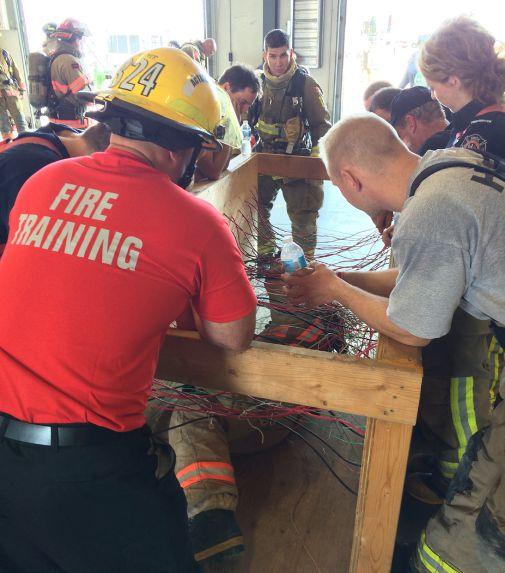
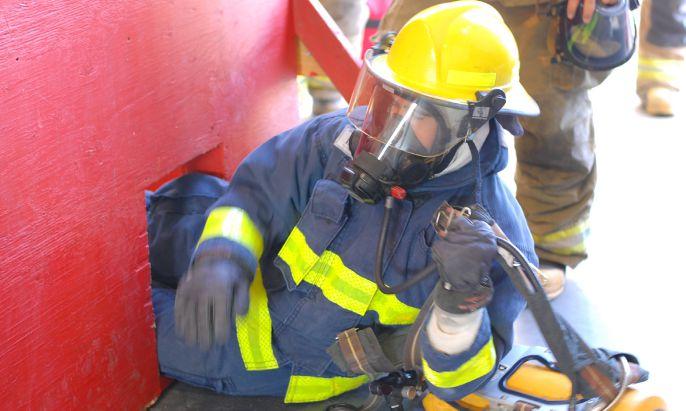
Firefighters learn best by doing. Active participation through hands-on activities such as entanglement drills should be the cornerstone of your training program.
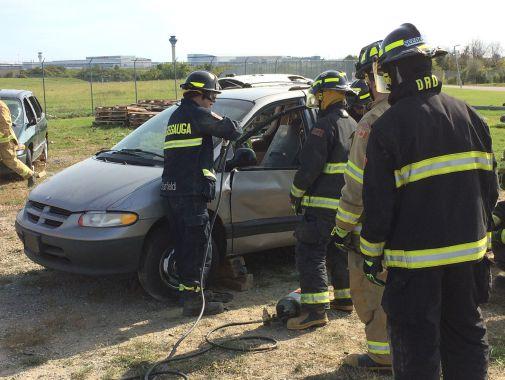
A firefighter student who is experienced and passionate about extrication should be called on to be a part of the lesson.
Ergonomically
•
•
•
•
•
•
They had no trouble remembering verbal instructions, but struggled to comprehend what they read. Other learners prefer to do, so hands-on is where it is at for them.
Keep in mind that volunteer firefighters come to practice night expecting to learn something worth their time; they are trying to balance the demands of learning to be effective firefighters and the truckload of adult responsibilities. Look, it is pretty hard to get excited about going to practice if every one is about pumping or hose lays. Firefighters should strive for excellence in all areas.
Unfortunately, most of the fire service exams (multiple choice) available to us are, to put it bluntly, lame; they do not make firefighters think. And that, my friend, is the end goal.
Be honest with your crew. After 20 plus years of instructing in the fire service, I am quick to admit I do not have all the answers, and that is OK. Understand your role. A large part of my role as an instructor is to develop strengths and confidence in the members of Greenwood Fire Department, and you, the faithful readers of this column. I have discovered that firefighters learn best by doing. Active participation should
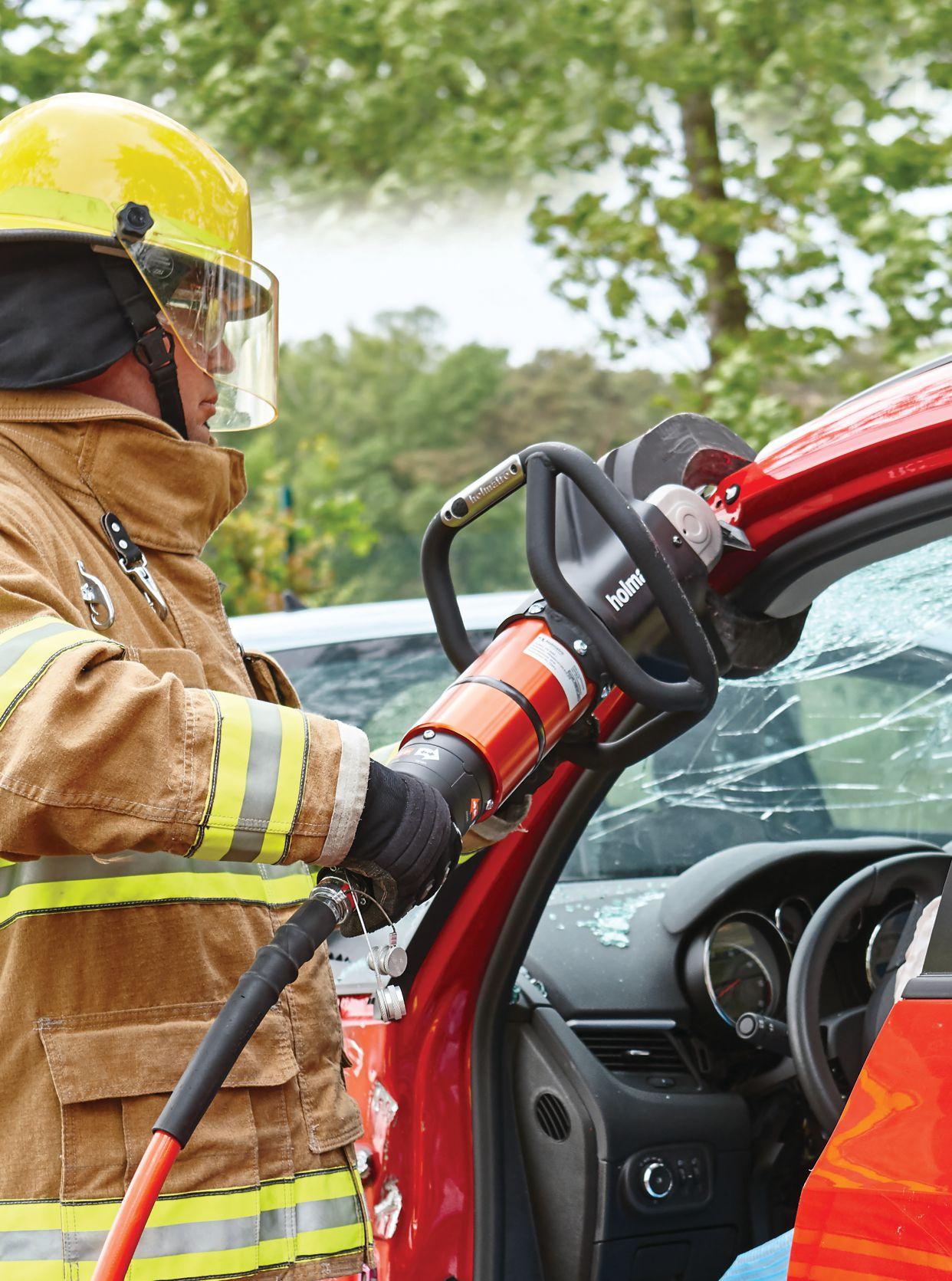
Volunteer firefighters come to practice nights expecting to learn something worth their time. Instructors should strive to keep lessons interesting by mixing up the drills and working with new props whenever possible.
be the cornerstone of your training program. I use what I call the Bob-the-Builder system. The theme behind the kids show is to solve problems and get things done with a positive attitude. Bob the Builder and pals dig, haul and build together! With friends like Muck the dump truck and Dizzy the cement mixer, Bob and his business partner Wendy live in an imaginative world full of new experiences.
Basically the idea is to give your fire-
fighter students a part in their training programs by tapping into what they are experienced in and passionate about.
On a personal note, please don’t think you have to be an expert at every aspect of fire fighting. Trainers just need to learn how to draw on the various experiences and talents found in their memberships. When I teach on building construction I call on Pat, a local contractor, to help me. When dealing with first response medical training I call on Larry or Rob, who are both paramedics.
So in closing let me ask you, “Hey buddy, any change?”
In the last year have you been able to create an environment that promotes interaction? Have you provided handson opportunities? Have you caused your members to think for themselves or do they just mimic others? Do they know why they do the things they do or are they simply following orders? Have you raised the bar in your training objectives?
I’ll challenge you with a question my son Casey, a firefighter in Osoyoos, asked regarding change: “If not now, when?”
In the year ahead, continue to train as though your crews’ lives depend on it, because they do. When firefighters find themselves in a fire-ground crisis they will seldom rise to the occasion, but they will default to their training. That’s why we train so hard.
Ed Brouwer is the chief instructor for Canwest Fire in Osoyoos, B.C., and training officer for Greenwood Fire and Rescue. Ed has written Trainer’s Corner for 15 of his 27 years in the fire service. Contact Ed at ebrouwer@canwestfire.org
PHOTO BY OLIVIA D’ORAZIO
BY ELIAS MARKOU
Still smoking? Learn how to quit
n the past few months I have conducted many firefighter physical exams for a number of fire departments. As I was going through the medical assessments, I observed an interesting trend: a significant number of firefighters still smoke.
A September 2011 article in the American Journal of Industrial Medicine found that 13.6 per cent of career firefighters and 17.4 per cent of volunteer firefighters in the United States smoke. A larger percentage of career and volunteer firefighters used smokeless tobacco –18.4 per cent and 16.8 per cent respectively. Despite the fire service’s strong position against smoking, and the fact that firefighters need to maintain a high level of health and fitness, there is still a high number of smokers. In the United States, the percentage of firefighters who smoke is equal to that of the public average. But shouldn’t firefighters be more fit and healthy than the average person?
In Canada, tobacco causes about 37,000 deaths each year and is the leading cause of preventable death. A 2008 Health Canada Smoking Report found smoking kills more people in Canada than the combined deaths caused by traffic accidents, suicides, murders and drug abuse. If you weren’t moved by those stats, how about this one: cigarettes contain more than 4,000 harmful chemicals including tar, lead, hydrogen cyanide, acetone and carbon monoxide. At least 70 chemicals found in cigarettes are known to cause, initiate or promote cancer.
Thousands of studies have been conducted worldwide and the results are definitive: smoking tobacco is addictive and a huge risk to a person’s health.
A 2014 report by the United States Department of Health and Human Services found that nearly every organ in the human body is impacted by cigarette smoke exposure, proving that no amount of exposure to tobacco by-products is risk free.
of Public Health in the United States found that the greatest risk to smokers is those 4,000 harmful ingredients found in all tobacco products. These chemicals cause irreversible damage to our DNA, so much so that new evidence shows liver and colorectal cancers have strong causal relationships to tobacco.
How can firefighters stop the addictive behaviour of smoking? What help is there available for firefighters to kick this crazy habit?
Acupuncture, acupressure and ear laser therapy are techniques that can assist with smoking cessation. A few acupuncture studies have demonstrated positive associations and abstinence rates in smoking.
There are a number of scientific studies on the effectiveness of using hypnosis to quit smoking. At the end of one study, 61 per cent of patients reported that they had quit smoking. Success rates of smoking cessation after hypnosis seems to fall between 60 to 70 per cent.
Some consider author Allen Carr’s book Easyway to Stop Smoking to be the quit-smoking bible. Carr explains to readers that, yes, nicotine addiction and withdrawal exist, but people need to change the way they think in order to quit. In a 2006 study published in the medical journal Addictive Behaviours, researchers found that after
Quitting smoking is the single most important thing firefighters can do to improve their health. ‘‘ ’’
The International Association of Fire Fighters (IAFF) acknowledges the deadly synergy between tobacco use and on-the-job exposures. According to the IAFF website, “This deadly interaction between tobacco use and on-the-job physical stresses and exposures to carcinogens and other toxic agents increases negative effects to even greater levels than the sum of these independent health risks.” The IAFF goes on to say that the expected consequences of smoking are higher rates of heart disease, respiratory disease and cancer.
What is it about cigarettes and tobacco that impacts our health in such a dramatic way? David Abrams from the John Hopkins School
Elias Markou is in private practice in Mississauga, Ont., and is the chief medical officer for the Halton Hills Fire Department. Contact him at dmarkou@mypurebalance.ca
reading the book, 53.3 per cent of all smokers (and 63.6 per cent of pack-a-day or less smokers) were still smoke free after 12 months.
Anti-depressant drugs such as Zyban and Wellbutrin and nicotine-blocker Champix all reduce cravings and help with smoking withdrawal symptoms, but have a number of dangerous side effects on their labels. In one study, Zyban’s six-month quit rate was 18 per cent, and placebo was 11 per cent, while the 12-month quit rate for Champix was 22 per cent under artificial trial conditions.
There are no studies yet available that connect e-cigarettes to smoking cessation. I don’t see how vaping another harmful chemical replaces smoking tobacco.
The fact that research shows smoking causes an increased risk of heart disease, chronic respiratory disease and cancer should be enough to motive firefighters to stop smoking. Quitting smoking is the single most important thing firefighters can do to improve their health.
Combining forces
Ontario brings together the first two lines of defence to share best practices
By MARIA CHURCH
The organizations that support public educators and fireprevention officers held a joint seminar at the Ontario Fire College last fall to capitalize on the crossover of personnel.
Public educator Tanya Bettridge has been to several seminars for her job over the years, but the latest one was different.
In late October, Bettridge entered the conference room of the Ontario Fire College in Gravenhurst, and sat down next to not just other public education officers, but also fire prevention officers.
For the first time, the Ontario Fire and Life Safety Educators (OFLSE) and the Ontario Municipal Fire Prevention Officers Association (OMFPOA) joined forces to organize a fall seminar that
brought together the first two lines of defence.
Kevin Vaughan, fire prevention officer for Ajax Fire and Emergency Services, OFLSE director and co-organizer of the seminar, said public education is sometimes overlooked by the need for compliance.
“As an inspector, I’d say 85 per cent of my job is educating the public anyway, there is all that crossover,” Vaughan said.
Ontario’s 1997 Fire Protection and Prevention Act first established a framework for fire protection services that balance the three lines of defence: public education and prevention, fire safety standards
BY
PHOTO
LAURA KING
and enforcement, and emergency response (suppression). Public education is No. 1, Vaughan said, and it has to be the first priority.
To capitalize on the crossover of public-education and fire-prevention personnel and subject matter, the public educators and prevention officers worked with the Ontario Association of Fire Chiefs and the Ontario Fire College to deliver theoretical and practical training during the first-ever combined five-day conference. Some sessions were plenary and others required the two disciplines to split up.
“Both groups worked hard together to bring in training opportunities that were good for, useable or transferable to both disciplines,” Vaughan said.
The attendees heard the best of the best public education and fire prevention successes to come out of the province.
For Bettridge, who is also an executive member of the public-educators group, the most noticeable difference between this seminar and all others was in the way the information was presented.
“It’s basically a week of sharing knowl-
edge,” she said. “It’s not what the government feels is generic and politically correct, which is what we’re trying to get away from because it’s not working.”
■ USING RESEARCH
Dave Lisle, director of research and education for the Toronto-based Technical Standards and Safety Authority (TSSA), gave one of the first plenary presentations of the seminar on risk communication in the fire service. Understanding how and why people make risk-based decisions is essential to create strategies that can change their behaviours, Lisle said in an interview.
“We know that in the end safety is a shared responsibility with us all having a role . . . but ultimately the public has a portion of that responsibility as well,” Lisle said.
Fire services can design public education programs that target certain audiences, he said, by understanding how people view their safety role and act on it, including where they get their information and what appeals to them.
One of TSSA’s major case studies is their provincial carbon monoxide campaign that was designed based on years of behavioural research.
“People need to be aware of the risk, they need to understand their role in managing it, and then you’ll have a chance that they’ll do something different,” Lisle said.
Lisle’s presentation was followed by a presentation from Ontario’s Durham region firefighters who used data from the TSSA to execute a safety campaign. Firefighters from Ajax, Clarington, Oshawa, Pickering, Scugog, Uxbridge and Whitby worked with Lisle to form their Get Real Durham campaign, which ran in each of the communities last year.
“They picked my brain and looked at the research results and used that to inform the way they designed their strategies, and then they executed it and measured the success they achieved,” Lisle said.
Over a two-week span, firefighters from each community targeted 1,000 households through direct phone calls, mail outs and door-to-door visits. Firefighters shared local fire statistics such as the total
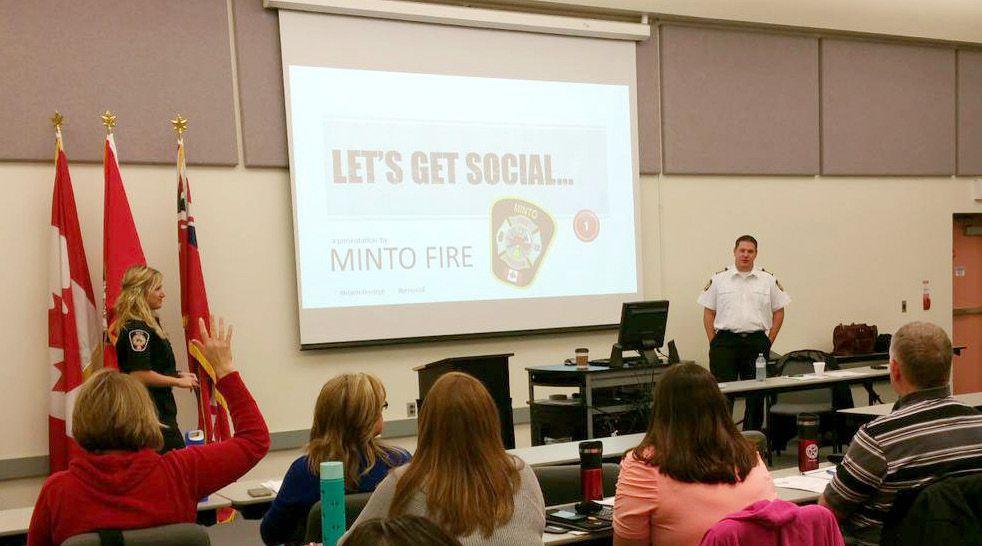
TOP Callise Foerter and Chief Chris Harrow with the Minto Fire Department share social-media techniques for public educators.
RIGHT The seminar’s presenters included members from both organizations who shared successes and lessons learned.
PHOTO BY NANCY CHRIST
WFR Wholesale Fire & Rescue Ltd. Calgary AB - Ph 403-279-0400
1-800-561-0400
Web: www.wfrfire.com
QUEBEC
Areo-Fire
5205 J-Armand Bombardier
Longueuil QC, J3Z 1G4
1-800-561-1995 or (506) 453-1995
E-Mail: r henderson@mmfss
709-632-7852
E-Mail: jkenny@nf sympatico ca WESTERN CANADA
1-800-469-1963
E-Mail: info@areo-feu com
cost of structure fires, injuries and deaths in the past year.
Lisle has several other partnerships on the go within Ontario and said he welcomes new opportunities to work with fire services.
“I see a lot of progress in terms of people challenging the status quo and looking for ways to take knowledge and apply it and become that much more effective,” he said.
■ KEEPING ORGANIZED
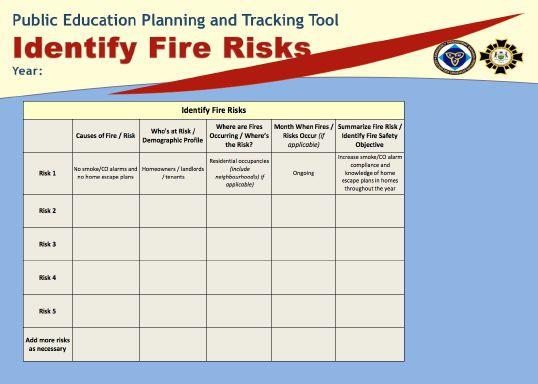
Knowing where to begin and how to stay on top of public-education projects can be a challenge for firefighters. To help smooth the planning process, Denise Wallace and Chris Slosser, both program specialists for the Office of the Fire Marshal and Emergency Management (OFMEM), introduced free activity-tracking tools to both public education and fire prevention officers during the seminar.
The tools were designed with input from fire departments across the province to help public educators focus their efforts where they are needed in the community.
The first tool is an activities planning and tracking spreadsheet in Excel that requires users to identify risks in their communities and then plan activities throughout the year to target each audience at risk. Built-in formulas tabulate a running total of the number of activities completed, such as news releases sent out, presentations given or homes visited.
“Those annual totals allow you to go back to your chief . . . and say, ‘Here’s how we’re spending our time or here’s what we’re focusing our resources on and you can show just how effective you are being in your community,’” Slosser said.
The second tool is an annual-report template that allows officers to fill in details about what education efforts they accomplished within any given year.
“It’s really flexible so you can delete, revise, add in – whatever fits in for your community,” Wallace said.
Presenting the tools to both pub-ed and fire-prevention officers at the joint seminar was ideal, Wallace said, to reach as many educators as possible, including those who fill both roles. Both tools are publicly available and free to download from the OFMEM website.
■ PUSHING THE ENVELOPE
A pub-ed shift is happening, Bettridge said, and the seminar was a start.
“There was lot of talk all week,” she
The Ontario Office of the Fire Marshal and Emergency Management staff created an activities planning and tracking tool, designed in Excel, that can help public educators keep organized throughout the year. The spreadsheet is a free download on the OFMEM website.
People need to be aware of the risk, they need to understand their role in managing it, and then you’ll have a chance that they’ll do something different.
- Dave Lisle, TSSA
said, “that we need to stop looking at what the fire service needs from the public and instead turn that around – what does the public need from us?”
The old style of repeatedly asking people to be fire smart is not effective, she said. But there are ways for the fire service to make people want to change their behaviours, and it means tapping into what they want.
“It’s marketing – that’s what it comes down to,” Bettridge said.
As a public educator and administrative assistant for Perth East and West Perth Fire Departments, Bettridge was one of several Ontario fire-service presenters who shared stories of successful programs in their communities. The presentations came from both public education and fire prevention sides.
“It comes down to sharing,” Bettridge said. “If you’re an FPO, but you have a great public-education program, why wouldn’t we invite you to present and share?”
Ryan Betts, acting manager of public safety education for the OFMEM, agreed
there has always been a crossover of attendees at past conferences run for one or the other discipline.
“I think it’s important for educators to have an understanding of the legislation and what the fire code says . . . and it’s good for the inspectors and the prevention folks to have that exposure (to public education), because, in my mind, even an inspection is an educational opportunity,” he said.
The OFMEM has, for years, Betts said, tried to address local issues by approaching them with all three lines of defence. While there is not a specific focus to design combined approaches, working inclusively is more “front of mind,” he said.
The seminar was well received from all sides, Vaughan said, and the next one is already in the works and will be held once again in the fall at the Ontario Fire College.
“From the OMFPOA or the OFLSE all the way up to the Ontario Association of Fire Chiefs, they were ecstatic with how it went over,” he said. “It was a good value.”
Uranium response
By DENIS PILON
Jan. 11 started much the same as any other Monday morning. The crew members on duty at the Swift Current Fire Department in Saskatchewan completed their morning checks and had prepared for some fire inspections. At noon, they started cooking lunch, not knowing they would not get to eat it. As the crew was sitting down to eat, SCFD was dispatched to a minor MVC on a city street. This call came in at 12:26 and the crew arrived on scene at 12:30 to find two half-ton trucks had collided at an intersection and sheared off a fire hydrant. Crew members were doing the scene assessment and talking to the drivers, who were not injured, when another call came in at 12:34. The crew was dispatched to an MVC on Hwy 4, about 10 kilometres north of the city.
As there were no injuries and no risk of fire, the crew left the scene in the hands of the RCMP and responded to the highway incident. As the crew was leaving the city, a second alarm was requested to have the off-duty crew called back to cover the city while the first crew was out.
As the firefighters approached the scene, they could see a truck in the ditch on the east side of the highway and the ambulance parked near the truck. The crew reported on-scene at 12:44 and Capt. Rick Anderson assumed command. Firefighter Kent Silbernagel was dropped about 200 metres short of the scene to set up warning signs and firefighter Chris Haichert was directed to drive the engine up to the accident scene.
As the engine approached the
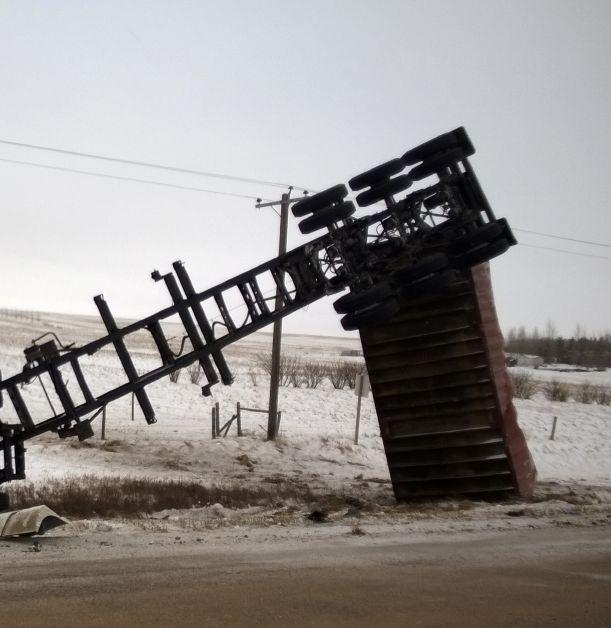
truck, firefighters observed an intermodal container standing on its end with the top facing them and with one corner still attached to the trailer, which was up in the air. A person was walking on the highway talking to the paramedic from Swift Current Ambulance. The engine was staged short of the accident scene and Capt. Anderson exited the engine to approach the accident on foot. At this time, Anderson noticed a radioactive III, class 7 placard and UN2912 on the upper corner of the container. Placards were not previously visible as the only top of the container was viewable on approach.
This person on the highway was identified by Anderson as the driver of the truck; he was not injured. Anderson talked to the driver, who confirmed that he was carrying yellowcake uranium and he indicated that there was little risk from the product as long as it was in the container. At this time, Anderson ordered a 300-metre exclusion zone be set up. He directed firefighters Haichert and Keith McLeod to back up the truck to the intersection with a gravel cross road and stop all traffic. Anderson requested the RCMP drive around to the north end of the scene and stop traffic from the north.
Anderson then requested the on-call deputy chief be dispatched to the scene with radiation monitors, checked the Emergency Response Guidebook, and contacted the Canadian Transport Emergency Centre, Canutec, for further advice. Just before 13:00, I arrived at the hall from lunch as Deputy Chief Pete L’Heureux was getting the radiation moni-
tors, and I was briefed about the accident. I followed L’Heureux out to the scene. On arrival, we were briefed that Canutec had confirmed that the initial evacuation zone was 25 metres –expanding to 100 metres for a large spill – and that responders should stay upwind. Canutec also confirmed that we could safely approach to within 10 metres to
DEPARTMENT PROFILE
Swift Current Fire Department operates out of one hall protecting a city of about 18,000 and provides rescue services to seven surrounding rural municipalities under contract.
• 1 career fire chief
• 2 career deputy fire chiefs
• 1 administrative assistant
• 4 career captains
• 12 career firefighters
• 16 paid-on-call firefighters
test the area but to take precautions against inhaling or ingesting the product if we approached closer to take readings.
Based on this information, L’Heureux, Anderson and I drove to within 100 metres of the scene and then approached using the radiation monitors to do a scene survey. During this survey, we noted a small amount of what appeared to be yellow powder in a crushed area of the container. We approached with the radiation monitor and a reading appeared on the monitor at about two metres away. We then met with the driver and had him contact his dispatch centre to initiate the Emergency Response Assistance Plan (ERAP) and secured the scene to 300 metres while we awaited the arrival of the ERAP team.
As the shipping papers were
• 2 engines
• 1 102-foot ladder platform
• 1 tanker
• 1 utility/wildland truck
• 1 rescue boat
• 3 command vehicles
still in the truck, we relied on the driver for information. We contacted Saskatoon-based Cameco, the world’s third-largest uranium producer, and were informed that the shipment belonged to Heathgate Resources of Australia and was being sent to Cameco’s Blind River, Ont., refinery on a truck owned by RSB Logistic, based in Germany and Dubai. As the importer of record, Cameco would respond to the scene and had activated Envirotec from Saskatoon, the company’s hazmat-response contractor. The container was holding 63 drums of uranium concentrate, known as yellowcake, stacked two high. The RCMP contacted the Department of Highways and Infrastructure to close the road and set up barricades and warning signs. From this point on, it was hurry up and wait. Envirotech
Lessons learned CIDENT REPORT
• Ensure you confirm the UN number. At one point, two numbers were transposed and the UN number was written as 2192 (Germane), not 2912 (radioactive material).
• Trust the Emergency Response Guide but ensure you contact Canutec for additional information.
• Don’t be afraid to order the Emergency Response Assistance Plan activated early in the incident. The trucking company was initially reluctant to activate as it was not aware how dangerous the scene was.
• Err on the side of safety. Evacuate a large enough area to ensure public safety.
and Cameco personnel started to arrive at about 17:15 and a representative from the Saskatchewan Office of the Fire Commissioner arrived at about 17:30. As it was getting dark, it was decided that the evening and night would be spent planning for the safe recovery of the product and getting the resources and equipment in place. At about 20:30, a private security firm was hired to man the barricades and as there was no risk of fire, our firefighters were relieved and the scene was turned over to Cameco.
The next morning, representatives from the Canadian Nuclear Safety Commission and Saskatchewan Environment arrived on scene to supervise the recovery and cleanup. Envirotech confirmed that the yellow powder seen on the exterior was in fact uranium. Two cranes were brought in to separate the truck from the container. A vacuum was used to recover the small amount of uranium on the exterior of the container and the tear was plugged with spray foam.
Cameco had access to a container overpack that had been made for another incident. Once the truck was removed, the Cameco crew laid down the container on the base of the overpack, lowered the bell top over it and sealed it with bolts. The pack was loaded on a truck and transported to Cameco’s facilities to be opened and recovered in a safe environment and repackaged for continued shipment to the refinery. The area was scanned for any further product and, when it was determined that the area was clear, the scene was turned over to the Department of Highways and Infrastructure. After some snow removal and sanding, the highway was reopened at about 21:00 Tuesday.
Denis Pilon is the chief of the Swift Current Fire Department in Saskatchewan. Contact him at d.pilon@swiftcurrent.ca and follow him on Twitter at @DMPilon
• Be prepared for nation-wide media. It may seem like a minor incident from your perspective on scene, but there will be many requests for information throughout the incident. Use social media when necessary to inform the public of the reasons for evacuating and waiting.
• The crew involved in this incident followed proper procedures to secure the scene and ensure public safety. The public may be upset about a highway closure and detour but we are responsible for their safety. Remember, these incidents take time and time is on our side.
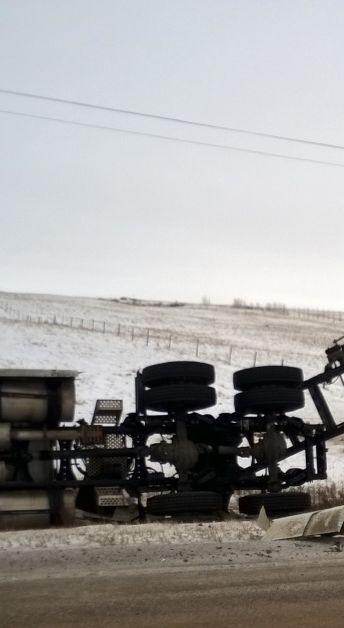
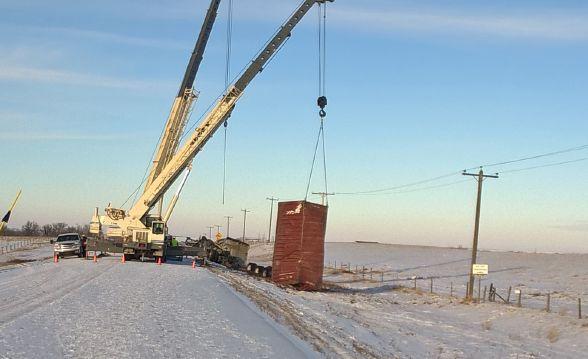
A container and truck as they came to rest in the ditch near Swift Current, Sask., in January. The container contained 63 drums of uranium concentrate.
Two cranes separate the truck from the container; firefighters were on scene for hours awaiting officials from Cameco, the uranium producer, and Canutec, the Canadian Transportation Emergency Centre.
PHOTOS BY DENIS PILON
BY SHAYNE MINTZ NFPA Canadian regional director
GNFPA is changing to better serve firefighters
ood fire-service leaders know the benefits of a solid and comprehensive strategic plan; it provides the opportunity to analyze the current state, identifies what risks or threats may exist or lie beyond the horizon, can help highlight future opportunities and pitfalls, and can provide the organization with vision, goals, and objectives to pursue in a world of continuous improvement.
In November 2014, under the leadership of a new president and the senior-management team, the NFPA’s board of directors approved the pursuit of a new strategic plan to lead the organization into the future. Over the past few months, the finished product was unveiled.
Throughout the planning process there was one resounding message heard loudly and clearly: in a growing and changing world, business as usual is not an option. The NFPA has enjoyed a very successful history, but how things were done in the past does not align with future stakeholders’ needs or expectations. The world is more digitally focused and there is desire for immediate interaction, engagement and feedback. The NFPA recognized the need to update its vision and mission statement to reflect the organization’s aspirations.
The NFPA’s new vision is to be the leading global advocate for the elimination of death, injury, property and economic loss due to fire, electrical and related hazards. Our mission is to help save lives and reduce loss with information, knowledge and passion.
Along with the new vision and mission statements, the plan focuses on five high-level core initiatives that will set a new direction to better ensure NFPA’s organizational viability and relevance in the foreseeable future.
collection and analysis agency. To further strengthen that commitment, the organization intends to create a comprehensive data collection, analysis and application system. The NFPA wants to be recognized as the primary resource for the fire and life-safety community and will achieve that through use and analysis of data and other information sources that are needed by our constituents to make sound, fact-based decisions. As an example, here in Canada the NFPA is engaged with the Canadian Association of Fire Chiefs in the development of the new national fire incident-database project.
The NFPA sees a need to develop a roadmap for its role in supporting and enhancing the jobs of the enforcement community. In that spirit, the NFPA wants members of the enforcement community to turn to the NFPA first for information, guidance, solutions and partnerships. We will facilitate access to our subject-matter experts to help enforcers get it right, the first time.
Finally, and possibly the most important of the five core initiatives, is to expand first-responder engagement. The organization plans to develop and implement a strategy for its role in partnering with the first responder community.
The new plan is exciting, ambitious and strongly focused on our desire to help firefighters and all our stakeholder groups. ‘‘ ’’
The first core initiative is to build and maintain a stakeholder-focused culture that works to improve our service to firefighters. We will better serve each firefighter by providing specific and customized data-driven tools, and ensuring multiple points of engagement such as staff interaction and the NFPA’s new online Xchange network.
The NFPA also aspires to provide a deeper engagement with our key stakeholders to better understand their needs and use that information to drive decision making and future direction. We will engage through webinars, workshops, forums, stakeholder consultations and research, and will also share with you the knowledge and information gained from these activities.
One of the NFPA’s strengths has always been its role as a data-
Shayne Mintz is the Canadian Regional Director for the National Fire Protection Association (NFPA). Contact Shayne at smintz@nfpa. org, and follow him on Twitter at @ShayneMintz
The new plan is exciting, ambitious and strongly focused on our desire to help firefighters and all our stakeholder groups.
The NFPA continues to be heavily involved with many projects here in Canada. Our team has been working with Transport Canada to create an interim guideline for first responders to deal with high-hazard flammable trains. The NFPA is also engaged with the Canadian Council of Fire Marshals and Fire Commissioners to bring the Electrical and Alternate Fuel Vehicle First Responder Safety program to Canada. And most recently, the NFPA has engaged with Indigenous and Northern Affairs Canada to create policy for fire protection on First Nations communities.
The NFPA recognizes its role is not to respond to emergencies or enter burning buildings, nor to inspect and create fire-safe buildings; rather it is to provide information and knowledge to help you in the field and, in that way, achieve its mission.
BACKtoBASICS
Engine company ops: aggressive cooling – part 1
BY MARK VAN DER FEYST
Rapid fire development (RFD) is a concern that all firefighters face whether they are undertaking engine-company or truck-company functions. RFD refers to occurrences such as flashover, backdrafts and smoke explosions, and can take place at any structure, at any time of day, anywhere in the country.
Flashover is a common RFD that can catch firefighters off guard as they operate inside structures. I recently watched a video in which a firefighter in another country was trapped in a third-storey bedroom of an apartment during RFD. The firefighter had no hoseline to help him and he was trapped between a window and a room that flashed over. The firefighter jumped from the window with his gear on fire.
Flashovers are a very real possibility for all front-line firefighters; all firefighters should be trained about flashover and how it can be prevented or avoided.
Flashover is the simultaneous ignition of everything within a room. A flashover occurs when hot gases – the black smoke from unburned particles of combustion – rise to the ceiling and spread out across the walls. As the gases spread, they heat up the items within the room such as the paint on the walls, the furnishings, clothing, mattress and flooring material. Once the contents are heated to their ignition temperatures, rapid fire development occurs and everything becomes a big ball of fire.
The temperature range for ignition of all contents and unburned products of combustion in a room is between 540 C and 820 C (1,000 F and 1,500 F). These temperatures are not viable for firefighter survival, let alone an occupant of the residence. Firefighters need to recognize the signs of impending RFD prior to it occurring to avoid getting caught in the subsequent flashover. Firefighter-survival skills can only do so much to help firefighters once they are caught in RFD; the best defence against this is to avoid RDF situations all together or aggressively cool the area in question.
The heat spread from RFD is radiant, which is why black smoke is dangerous to firefighters and needs to be aggressively cooled. The unburned particles of combustion in the hot, black smoke, once mixed with a fresh air supply will eventually turn into a ball of fire.
Firefighters are more often dangerously exposed to RFD today than ever before.
• Better gear protects firefighters more nowadays, so that crews are able to enter deeper into structures.
The liner of firefighter PPE should list the different thermal-protection properties as well as heat resistance and protection. The more heat resistance, the less likely firefighters will feel rapid fire development.
PHOTOS
Firefighters are more often dangerously exposed to rapid fire development today; better gear allows crews to go deeper into structures and protects firefighters from heat longer.
A fire in an airtight house is under ventilation-limited conditions – the hot gases are contained and the house is exposed to rapid heat buildup and flashover precursor.
Modern gear has properties that protect from heat longer, which prevents firefighters from feeling the rapid buildup of heat. Gear can be assembled with many different options such as outer-shell material, inside-liner material and vapour-barrier material (see photo 1). Each type of material has different thermal-protection properties as well as heat resistance and protection. Depending upon what type of gear firefighters wear, they may not feel the heat until it is too late to act.
• Fire crews are being notified about fires quicker than before. Faster dispatch means firefighters often arrive at a structure fire before RFD has occurred. If a structure is in the stages of fire development, a fire department may arrive while the fire is under ventilation-limited conditions –the black smoke cannot get out and is contained. Those firefighters on scene are exposed to the rapid heat buildup and flashover precursor.
• Tying in with the previous point, houses built in the last 10 years are airtight. The push for energy efficiency and conservation has resulted in houses that do not breathe naturally and do not allow black smoke to escape; this produces a vent-limited building and situation for the arriving
crew. A modern house will have an air exchanger built in as part of the local building code that allows air to circulate in and out mechanically.
• With the advancement of technology and chemistry, houses are filled with highly combustible furnishings. When modern furniture is exposed to high heat radiating from a nearby fire and unburned particles of combustion, it starts to break down and contribute to the overall heat-release rate of the room. Once these furnishings ignite, they produce an extreme heat-release rate, which creates RFD. An upholstered chair will release two megawatts of heat – the same heat-release rate at which a flashover will occur.
In the May issue, we will further examine RFD and learn how firefighters can aggressively cool the fire box to remove the potential for a flashover.
Mark van der Feyst has been in the fire service since 1999 and is a full-time firefighter in Ontario. Mark teaches in Canada, the United States and India and is a local-level suppression instructor for the Pennsylvania State Fire Academy and an instructor for the Justice Institute of BC. He is also the lead author of Residential Fire Rescue. Email Mark at Mark@FireStarTraining.com
PHOTO BY MARK VAN DER FEYST
BY TOM
DESORCY
Fire chief, Hope, B.C.
BVOLUNTEERVISION
Know the benefits and risks of social media
y now all firefighters are aware of the benefits of social media and many of us are proficient on Facebook, Twitter, Instagram and the like. I think it’s time to discuss the risks and hazards associated with social media and what I consider a somewhat disturbing trend in its use.
What seems like a zillion years ago, I was a journalist. That is to say, I was a member of the broadcast media and, as such, was subject to and held accountable for a set of rules and regulations that exist to this day. The Canadian Radio-television and Telecommunications Commission and the Canadian Broadcast Standards Council regulate content on the air using a code of ethics and quite simply, common decency.
But the rules for social media are still developing, and to me it’s unfortunate that the likes of Facebook and Twitter are even called media given the lack of accountability for postings. Legitimate journalists and broadcasters still follow the rules, however, you can imagine how hard it is for them to watch what’s being said on social media and decide whether or not they should believe it. Have you seen a picture of your fire scene on TV news and wondered where it came from? That kind of footage that was submitted by viewers used to be called amateur video, but that is no longer the case. TV journalists often turn to social media for the images they want and give credit to Twitter handles or Facebook users (mind you, this is perfectly legal – images on social media are considered public domain). Many people don’t even realize their images are being used in this way. If you ever post to social media from a scene, assume that picture is being used by media.
Having experience in the fire service, particularly from a leadership perspective, I am increasingly amazed and equally frustrated at the frequency and speed of social media posts during the early stages of an incident. If firefighters had a social-media feed on board a fire engine and the time to look at it, the posts would give them an incredible size-up and perspective on what they’re getting into. Sooner or later, however, this is going to put people in danger.
Some of you may have seen a sign that reads: In case of fire please exit the building before posting it on social media. That sign is proof that we can only go so far to protect people from themselves.
A few years ago I wrote a column about the value of social media for firefighter situational awareness, and I still preach that idea. However, the opinions of the outside world can also harm your fire department. We teach our firefighters not to take social media posts personally and not to engage those who may be critical of their actions.
I still believe in the power of social media to send messages, be they public education, warnings or team building, but unfortunately that power is often in the wrong hands. People who have no business commenting on issues or events are doing so at an alarming
I don’t believe in the disclaimer that comments are my own and don’t reflect that of the fire department. ‘‘ ’’
Here is the disturbing part and an example of the evolution of the medium: I’ve seen profiling, racism, public shaming and fear mongering on Facebook bulletin boards and so-called rant pages. In fact, I’m sure the sky has fallen once or twice. But where’s the accountability? What ever happened to being ethical and treating people the way you wish to be treated?
Can you imagine if I had gone on the air and said, “Well I heard . . . ”? I would have been fired and the broadcasting license of the station would have been called into question.
The point is that so-called experts are everywhere – with several keystrokes I could easily weave a fractured tale that everyone would believe. Years ago, we used to laugh at tabloid newspapers yet today we are entrenched in tabloid-style reporting from anyone and everyone.
Tom DeSorcy became the first paid firefighter in his hometown of Hope, B.C., when he became fire chief in 2000. Email Tom at TDeSorcy@ hope.ca and follow him on Twitter at @HopeFireDept
rate. On the other hand, it seems as though an increasing number of users believe everything they read.
Today, media-relations training has taken on a whole new meaning. Do you talk to your firefighters about what to expect on social media, what is acceptable and whether or not you are ever not a member of the fire department when posting to the various platforms? My Twitter account, for example, is a blend between me the fire chief and me the person. I don’t believe in the disclaimer that comments are my own and don’t reflect that of the fire department (it has no legal grounds anyway). Everything I say comes from the chief and that’s the way it will always be.
The same applies to our volunteers: on duty or off, posting on social media or doing anything inappropriate in public will be noticed. Common sense may have left the building, but you need to ensure it remains in your department.