BY LAURA KING Editor lking@annexweb.com
BY LAURA KING Editor lking@annexweb.com
e never know how readers will respond to the stories and columns we run. We do, however, think long and hard about what goes on our pages and evaluate every story proposal and column idea thoroughly.
Sometimes readers get mad – thankfully, that happens rarely, presumably because we make solid decisions based on our mandate to provide leadership, training, news, opinion and analyses that benefit the Canadian fire service.
Often, readers email our contributors and ask for more information about the topic at hand – training plans, PTSD programs, Stopbad ideas, volunteer recruitment.
Deputy Chief Arjuna George writes for our brother publication, Canadian Firefighter. In January, George produced a column about field incident technicians, or FITs, and Salt Spring Island Fire Rescue’s use of these valuable civilians on the fire ground.

lieutenant with a rural department.
Sound familiar? Of course it does. With a dearth of young people in many Canadian communities, and an aging demographic right across the country with remarkable knowledge, patience and, in many cases, more than a half century of local know-how and life skills under their belts, harnessing the power and prowess of these experienced men and women makes perfect sense.
ESTABLISHED 1957 JUNE 2015 VOL. 59 NO. 4
EDITOR LAURA KING lking@annexweb.com 289-259-8077
ASSISTANT EDITOR MARIA CHURCH mchurch@annexweb.com 519-429-5184
EDITOR EMERITUS DON GLENDINNING
ASSOCIATE PUBLISHER KATHY LIOTTA kliotta@annexweb.com 905-726-5444
ACCOUNT COORDINATOR BARB COMER bcomer@annexweb.com 519-429-5176
888-599-2228 ext. 235
MEDIA DESIGNER BROOKE SHAW bshaw@annexweb.com
GROUP PUBLISHER MARTIN MCANULTY fire@annexweb.com
DIRECTOR OF SOUL/COO SUE FREDERICKS
PUBLICATION MAIL AGREEMENT #40065710 RETURN UNDELIVERABLE CANADIAN ADDRESSES TO CIRCULATION DEPT.
P.O. Box 530, SIMCOE, ON N3Y 4N5 e-mail: subscribe@firefightingincanada.com
Printed in Canada ISSN 0015–2595
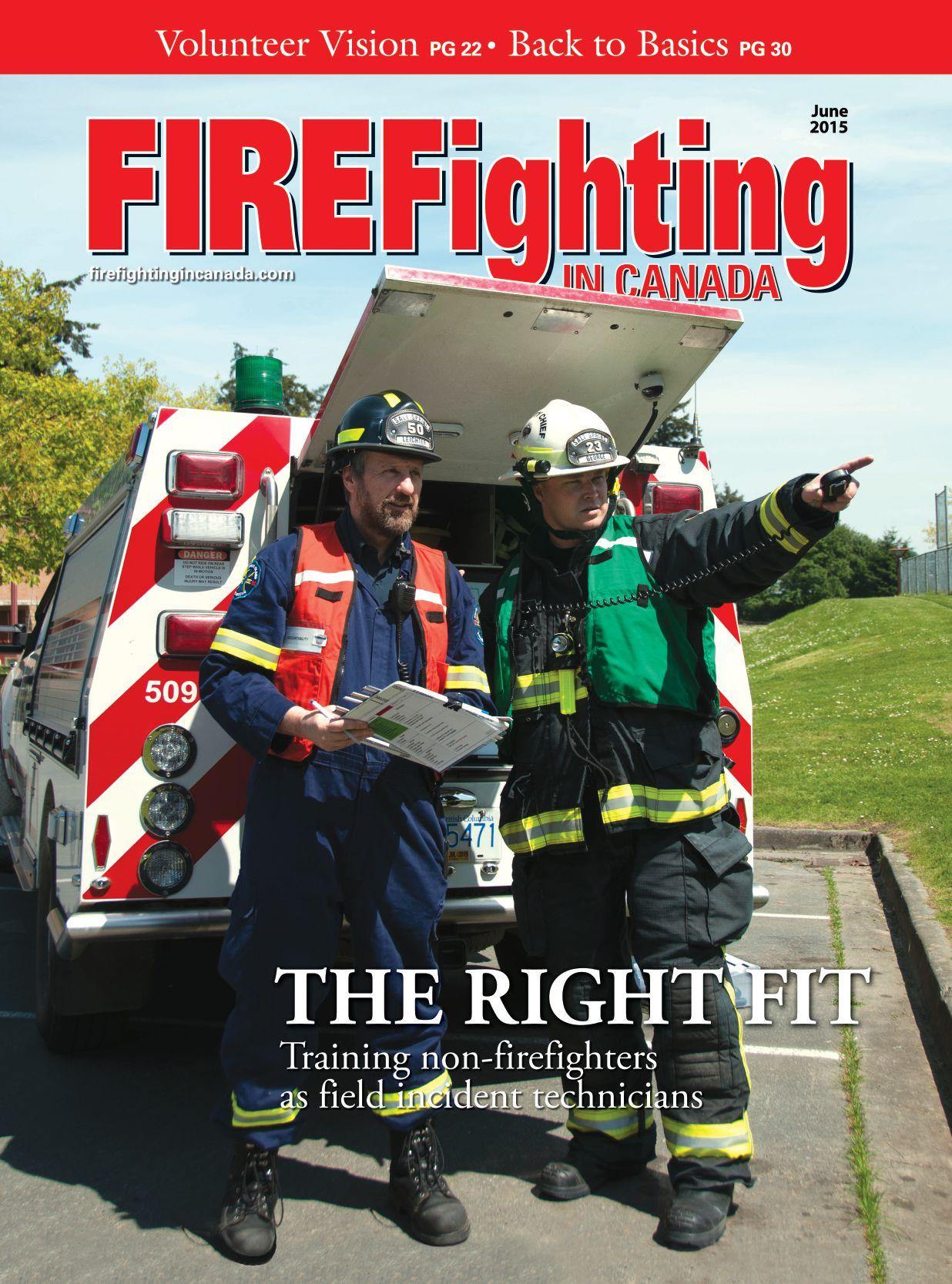
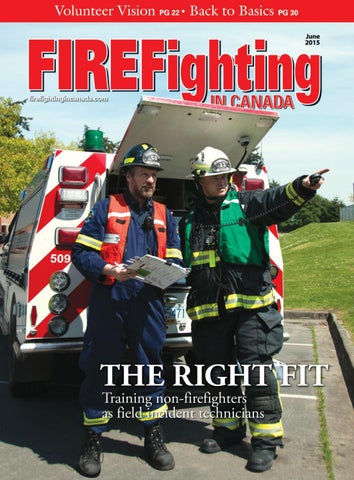
ON THE COVER FITs are an extra set of eyes and ears on the fire ground. See story page 10
The response was overwhelming. In each instance, lieutenants, captains, chiefs and training officers wanted to know more about the FIT program. And, in each instance, there was a line in the email to George about the lack of available personnel: “Manpower is certainly the drawback,” one email said. “We are in the middle of a staff shuffle and the chief and I are looking hard at how to allow more volunteerism,” said another. “We need to expand our membership and this looks like a really good idea,” one writer noted. “We have very few young members of our department as most of them work away from the area,” said a
BY AJ GEORGE
The key to the success of a FIT program is buy-in from firefighters – ensuring that your crews understand that these skilled communicators are not in line for suppression positions –so there’s no misunderstanding or resentment.
As George notes, “FITs do not make tactical decisions; they are simply a resource to provide information and assist the incident commander.”
Our story on page 10 goes into more detail about the FIT program than the column we ran in January. It’s rare for us to run a second item on the same topic, but reader interest, and George’s expertise (and willingness to write to a very tight deadline!) drove our decision.
“FIT members are a second set of eyes and ears,” George says. “Firefighter safety is the bottom line and FITs provide that added layer of safety on the fire ground.” Who wouldn’t want that?
CIRCULATION
e-mail: subscribe@firefightingincanada.com
Tel: 866-790-6070 ext. 206 Fax: 877-624-1940
Mail: P.O. Box 530 Simcoe, ON N3Y 4N5
SUBSCRIPTION RATES
Canada – 1 Year - $24.00
(with GST $25.20, with HST/QST $27.12) (GST - #867172652RT0001)
USA – 1 Year $40.00 USD
We acknowledge the [financial] support of the Government of Canada.
Occasionally, Fire Fighting in Canada will mail information on behalf of industry-related groups whose products and services we believe may be of interest to you. If you prefer not to receive this information, please contact our circulation department in any of the four ways listed above.
No part of the editorial content of this publication may be reprinted without the publisher’s written permission ©2015 Annex Publishing and Printing Inc. All rights reserved. Opinions expressed in this magazine are not necessarily those of the editor or the publisher. No liability is assumed for errors or omissions. All advertising is subject to the publisher’s approval. Such approval does not imply any endorsement of the products or services advertised. Publisher reserves the right to refuse advertising that does not meet the standards of the publication.
107' VERTICAL • 100' HORIZONTAL 750 lb TIP LOAD • 500 GALLONS ALL ON A SINGLE REAR AXLE
Refuse to compromise. The new Ascendant ™ 107' Heavy-Duty steel aerial ladder is engineered to give you more capabilities with no sacrifice in water capacity, performance or safety.

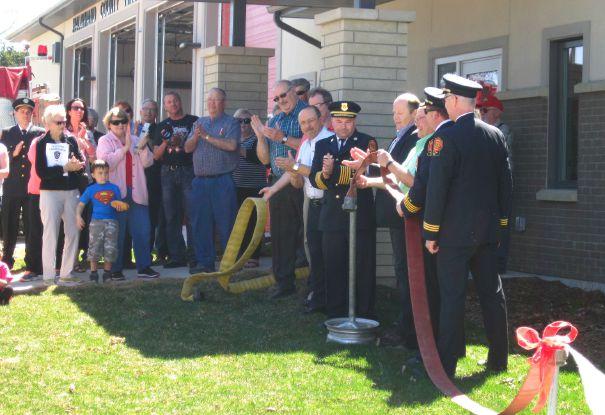
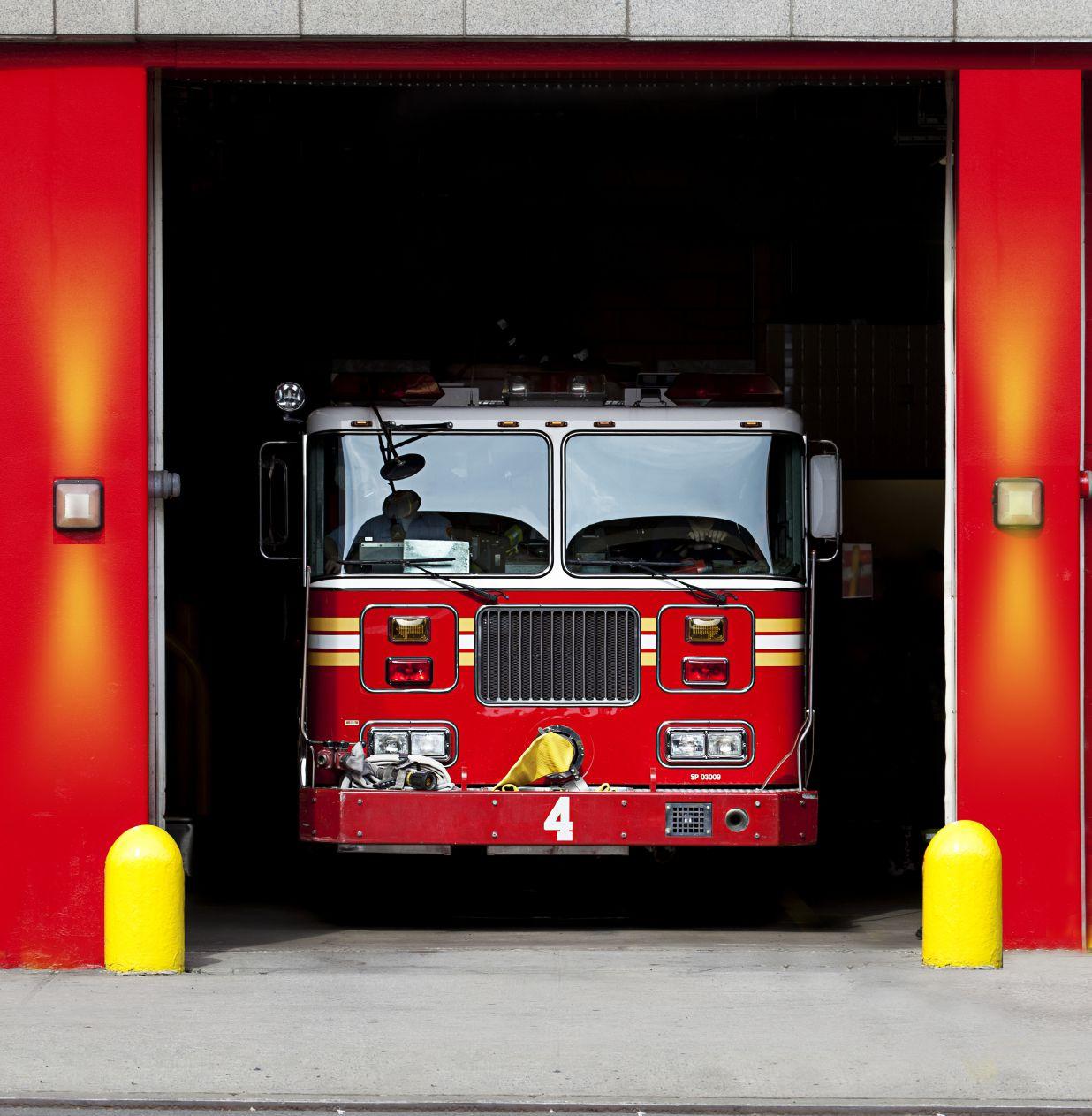
Haldimand County Fire Chief Rob Grimwood leads a hose-uncoupling ceremony to officially open the new station in Cayuga, Ont.
The civic pride was evident the day Haldimand County fire and EMS personnel officially opened Fire Station 4 in Cayuga, Ont. – the first jointly operated station in the county.
Fire Chief Rob Grimwood beamed all day on April 18
when the department threw open the bay doors and welcomed about 100 curious community members to tour the new facility.
“The station honestly exceeds expectations,” Grimwood said in an interview during the grand opening,

DAVE BALDING is the new fire chief in Golden, B.C. Balding has 30 years of experience in fire, and has served as chief for the Malahat Volunteer Fire Department, and, most recently, for Fraser Lake Fire Rescue, both in British
Columbia. Balding is also the Firelines columnist for Fire Fighting in Canada.
CHRIS JANCOWSKI was appointed fire chief of Esquimalt Fire Rescue in British Columbia on March 23. Jancowski, a 22-year veteran of fire, was formerly deputy chief in Port Alberni and previously served as chief for the Qualicum Beach Fire Department.
shortly after he conducted the official ribbon cutting ceremony – or in this case the official hose-uncoupling ceremony – with members of the local council.
The new hall – which came in just under $3 million – houses about 25 firefighters, as well as EMS personnel and administration. It has four truck bays (one of which is used for storage), two ambulance bays, a truck baystyle storage room, energy efficient sensors and lighting, a separate room for the SCBA compressor and one for gear storage, and a diesel-capture system.
“For a smaller volunteer department, with a limited budget, to be able to produce this station on time and on budget, it absolutely feels incredible,” Grimwood said.
Firefighter Melissa Baisley shared the chief’s excitement about the new station,
emphasizing the amount of space the crew now enjoys. Before, she said, firefighters would squeeze around trucks and equipment just to hang up their gear.
The main reason for the extra space is the storage bay, Grimwood said. The bay houses equipment for the entire department, as well as EMS. Its large bay door, accessed from the back of the station, allows the trucks to back in and easily retrieve equipment.
The new station, which replaces a 54-year-old hall in Cayuga, is one of 12 in Haldimand and was built, in part, to centralize the county’s emergency services administration, including the chief officers.
The county also opened a new hall in Hagersville, which crews moved into late last year.
- Maria Church
PIERRE VOISINE became the new chief for the Cornwall Fire Department in Ontario on April 27. Voisine has more than 20 years of experience in the fire service, and most recently served as deputy Canadian Forces fire marshal. He previously held positions with both the Canadian Association of Fire Chiefs and the International Association of Fire Chiefs.
RICHARD MCCULLOUGH, fire chief in Cornwall, Ont., retired on April 30 after a 35-year career in fire. McCullough was hired by the Cornwall Fire Department in 1980 and was appointed chief in 2013.
WAYNE CALVER, fire chief of Loyalist Township Emergency Services in Ontario, retired
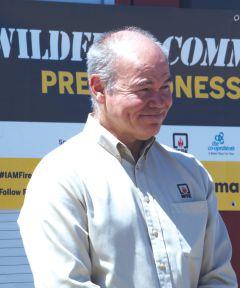
NFPA Canadian director Shayne Mintz participates in the inaugural Wildfire Community Preparedness Day on May 2 in Woolwich, Ont. The event will be held annually and funding is available from the NFPA.
Twenty-four organizations across Canada each received $500 from the NFPA to host wildfire preparedness days on May 2.
What’s remarkable about that, says Kelly Johnston, the executive director of Partners in Protection and FireSmart, is that each application met all the criteria for the funding.
“We had planned to fund 20 events,” said Johnston, “but after reviewing the applications we felt that 24 projects were really deserving
of our support so we came up with the extra funds.”
The Township of Woolwich in Ontario was chosen as the launch community for the inaugural Wildfire Community Preparedness Day. The fire department in Bresuau, Ont., hosted NFPA Canadian director Shayne Mintz and other guests, and an open house.
“Our volunteer firefighters do an outstanding job of ensuring the safety and well-being of residents
throughout the township,” said Woolwich Mayor Sandy Shantz.
“Through the assistance of the partnering organizations, this event will help to raise awareness of the dangers related to wildfires.”
NFPA funding for community events such as a chipping day, cleanup project or wildfire education programs will be available for 2016. Details will be available online at nfpa.org and firesmart.ca
- Laura King
Members of the Perth East Fire Department in Ontario hope a new fire-prevention program targeting farmers will help reduce property loss in their community, and that other departments in Canada will follow their lead.
In April, Perth East unveiled a program called Building A Farm Fire Safe Community, or FFSC. The program is centred on a self-assessment form for farm owners and operators that is filled out electronically and sent to the department for review. If there are any red
flags – such as open-air burning locations near buildings or electrical outlets without proper grounding – says Perth East Fire Chief Bill Hunter, the department will contact the individual and arrange a consultation.
Hunter said the program became a priority after a recent department report showed close to 70 per cent of value lost in the municipality over the past five years was on farms.
“We’re talking close to $10 million,” Hunter said.
Tanya Bettridge, an admin
assistant with the department in charge of public education, was a lead on the FFSC project and said the process began with a search for sponsorship.
“Everything starts with your goals . . . and who shares those goals,” she said. The aim was to reduce property loss, so Bettridge approached insurance companies, all of which eagerly agreed to sponsorship.
The FFSC program is sent out to the community through mail outs and promoted through social media.
The promotion campaign will
soon be bolstered by a video series to be shot this summer by a local filmmaker.
Bettridge said another goal for Perth East was designing the farm fire-safety program in a way that allows departments across Canada to modify and use the material in their own jurisdictions. The only request, she said, is that departments continue to honour the sponsors.
Find out more about the farm fire safety program at www.pertheast.ca/en/municipalservices/ffsc.asp
- Maria Church on March 31. Calver began his 40-year career in fire in Ernestown, Ont., in 1975. He was promoted to fire chief of Ernestown Township Fire Department in 1995, a position he held until assuming the chief’s position of the newly amalgamated Loyalist Township Emergency Services in 1998.
BRUCE ROBBINS retired from the Yarmouth Fire Department in Nova Scotia on March 26 after a 20-year career as a dispatcher.
TODD GUSTAVSON, fire chief for the Lloydminster Fire Department in
Alberta, died of cardiac arrest on April 4 at 53 years old. Gustavson, a third-generation firefighter, joined the department when he was 16 years old. He served as chief since 1998.
KEN WILFRED, a retired deputy chief for the Asphodel-Norwood Fire Rescue and Emergency Services in Ontario, died in a vehicle collision in April at age 62. Wilfred joined the Norwood
Fire Department in 1971 and served until he retired in 2007.
LLOYD MELLOR, former president of Toronto’s Stokes Cap & Regalia – now Stokes International – died on April 16 at 92 years old. Mellor began as a supplier of fire and police uniform caps and regalia in 1949 and was well known in the industry. He retired in 2000 when his son, David Mellor, took over.
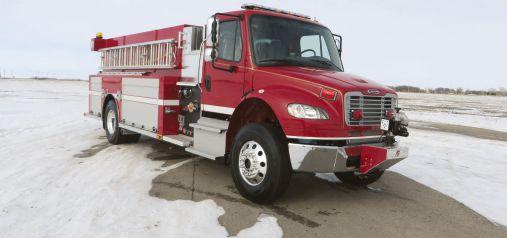
Athabasca County Fire Services/Rochester Fire in Alberta, under Fire Chief Lloyd Parker, took delivery in March of a Fort Garry Fire Trucks-built tanker. Built on a Freightliner M2-106 chassis and powered by a 300-hp Cummins ISL engine and an Allison EVS 3000 transmission, the unit features a 1,700-gallon poly tank, a Darley PSP 1000 pump, a 30-inch pump house, a TFT Tornado bumper turret and a Whelen light and emergency package.
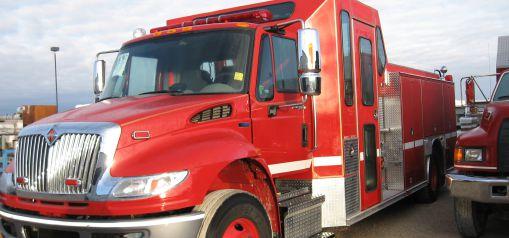
BHP Billiton in Leroy, Sask., under superintendent Keith Doyscher, took delivery in March of a Fort Garry Fire Trucksbuilt pumper. Built on an International 4400 chassis and powered by a 300-hp Maxxforce engine and an Allison 3000 EVS transmission, the unit is equipped with a Darley LDM 1000 pump in a top-mount enclosed four-man crown and a 600-gallon Pro-Poly tank.
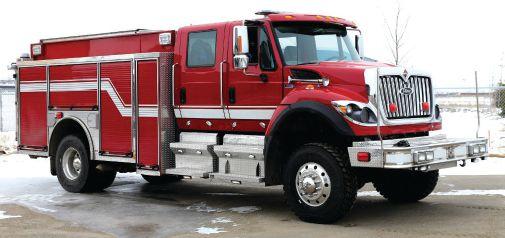
STURGEON COUNTY EMERGENCY SERVICES
Sturgeon County Emergency Services in Alberta, under Fire Chief Pat Mahoney, took delivery of a Pierce-built pumper. Built on a IHC 7400 chassis and powered by a 330-hp MaxxForce 9 engine and an Allison 3500 EVS transmission, the truck is equipped with a 1,250gpm Waterous CXPA pump, a 1,000-gallon Poly tank, Husky 3 foam system, a cold weather package with pump enclosure and water heater, and a TFT Tornado remote control monitor.
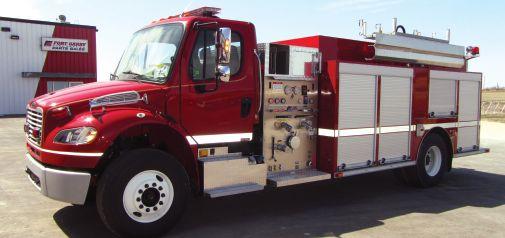
Tay Township Fire and Emergency Services in Ontario, under Fire Chief Brian Thomas, took delivery in April of a Fort Garry Fire Trucks-built pumper. Built on a Freightliner M2 106 chassis and powered by a 350-hp Cummins ISC engine and an Allison 3000 EVS transmission, the unit is equipped with a 1250 Hale QFlo pump, a 1,500-gallon Pro-Poly tank and Zico powered ladder and porta-tank storage.
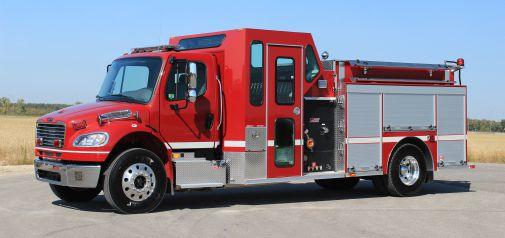
Mosaic Esterhazy K2 potash mine in Saskatchewan, under Fire Chief Jason Polvi, took delivery in December of a Fort Garry Fire Trucks-built pumper. Built on a Freightliner M2 106 chassis and powered by a 300-hp Cummins engine and an Allison 3000 EVS transmission, the unit is equipped with a 1,250-gpm Hale D2D pump, a 1,000-gallon CoPoly tank with 25 IG integral foam cell, and a Foam Pro 1600 system.
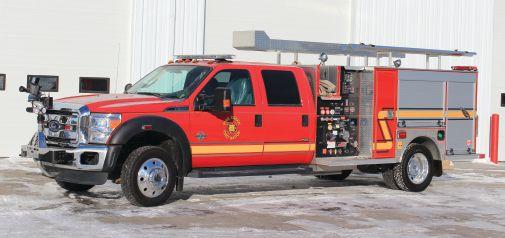
Pine Creek First Nation Volunteer Fire Department in Manitoba took delivery in January of a Fort Garry Fire Trucks-built mini pumper. Built on a Ford chassis and powered by a 300-hp Ford engine and a Torqueshift transmission, the unit is equipped with a Darley HM350 pump, a 300-gallon CoPoly tank with 15 IG integral foam cell, a Foam Pro 1600 system, front bumper turret and pump and roll.

By ARJUNA GEORGE
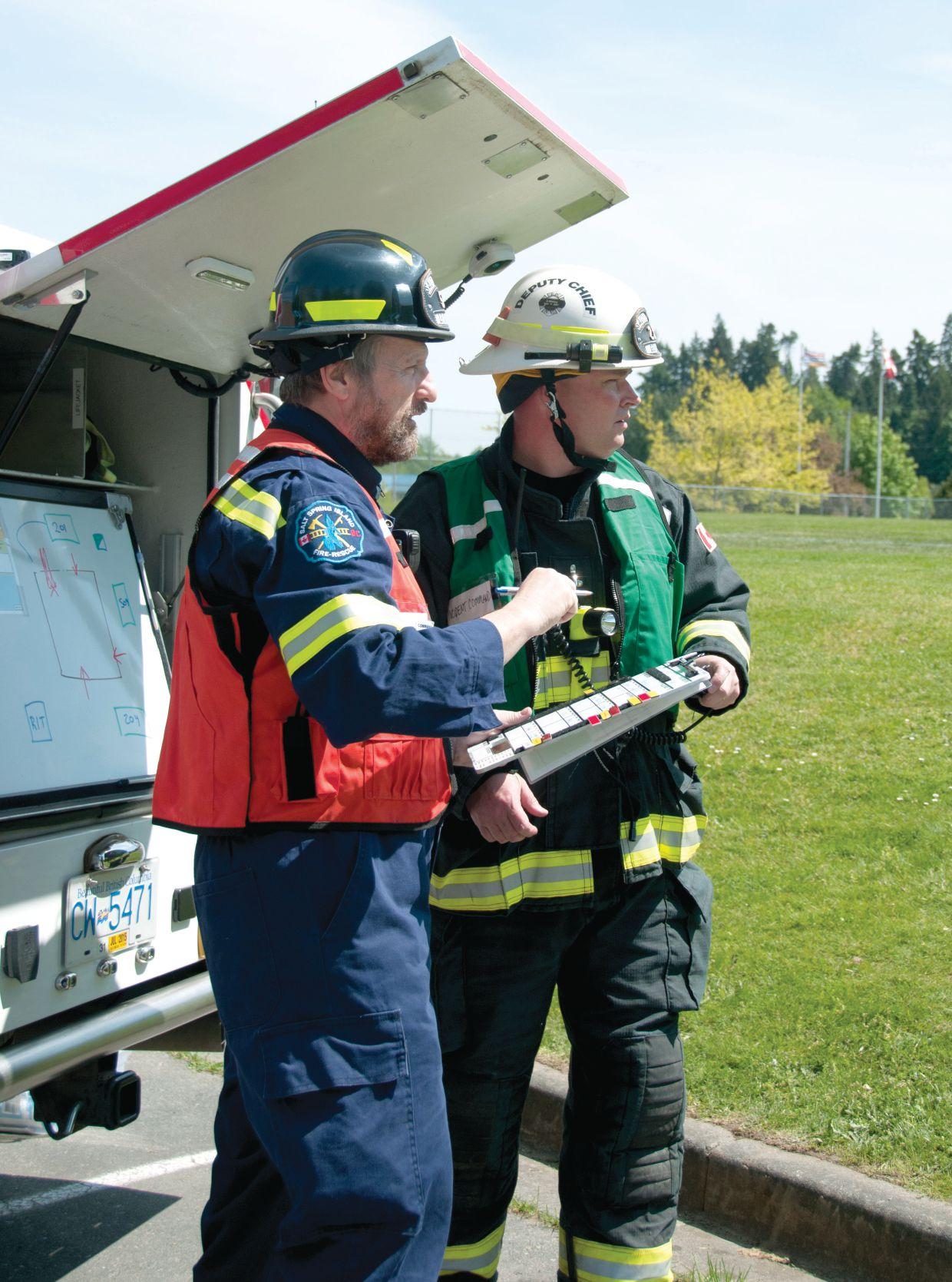
LEFT Salt Spring Island Fire Rescue’s FIT program diversifies its recruitment pool by welcoming non-firefighting members to the team.
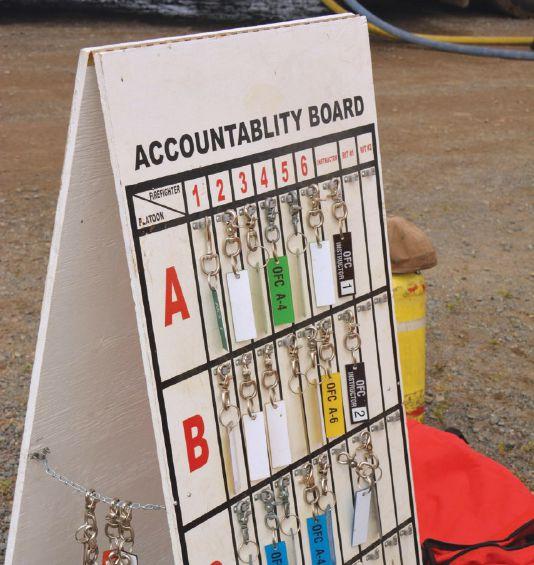
ABOVE FITs take on cold-zone activities including accountability. The first FIT on scene connects with the incident manager to take over or establish member accountability.
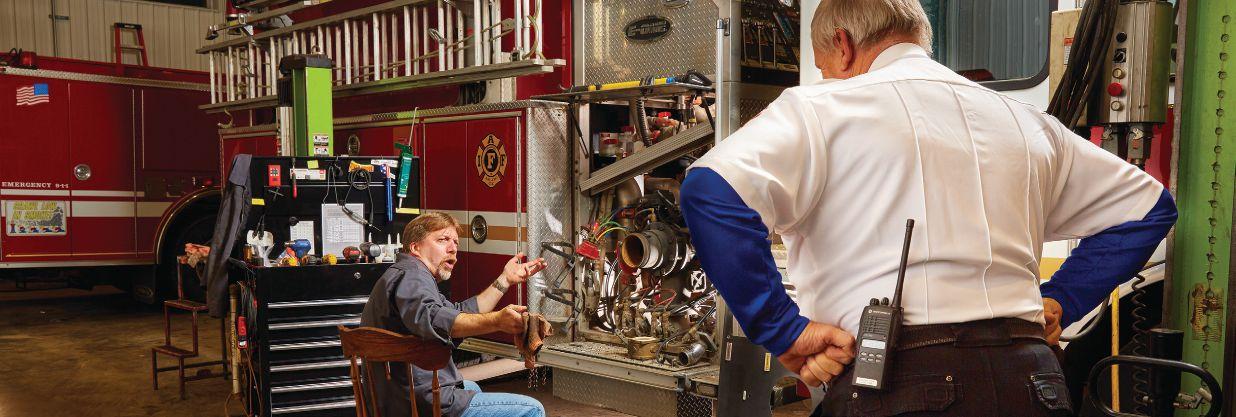
Salt Spring Island Fire Rescue (SSIFR) in British Columbia has been operating a field incident technician program since 2002. Today the department’s six field incident technicians – who are referred to as FITs – are a vital part of the organization.
SSIFR developed its paid-on-call FIT position based on a United States model in which senior officers or chiefs act as a command aides during incidents. SSIFR adapted the FIT position to suit people who are not interested in or capable of interior fire operations but are able to conduct cold-zone activities. Our FIT model can be used by any volunteer, paid-on-call or combination fire stations. The FIT role allows non fire-service members to be a part of the organization while freeing up firefighters to do that for which they are trained.
“The FIT program,” said Salt Spring Island Fire Chief Tom Bremner, “and the resource support that comes from it, allows firefighters to do their primary function – fire fighting.”
SSIFR’s FIT program was formed through a partnership with the local amateur-radio club. The members of the club are all experts in radio communication and documentation, and most have backgrounds that involved working under stress.
The FIT program’s origins can be traced to Steve Leichter, an amateur radio club member who is now one of SSIFR’s senior field incident technicians.
“I happened to go into the main fire hall during a call,” Leichter said, “and noticed that a firefighter was sitting at the desk operating the radio.
“This experience prompted a discussion with other members of the club and the question became clear. Why would a trained and experienced firefighter be behind a radio in the hall when he or she could be doing what they were trained to do?”
Discussions followed between Leichter and the fire chief and a new group of SSIFR radio operators was formed.
At that point, radio traffic was not monitored or recorded as it is now. The crucial role of documenting benchmarks is vital to our operations. The radio club members who joined the department made a huge impact on documentation and allowed members to focus their skills on fire response.
In the early days of the radio operators, the new members were considered to be part of an experiment, and there was no vision for how their position would evolve. Within two weeks of the radio operators joining the team, the department responded to the largest and most dangerous fire in the island’s recent history. It was a hot, dry and windy summer evening and a fire broke out in a large, multi million-dollar resort complex that was under construction. All the factors were there to generate the perfect storm. It was
Improve your performance. Globe boots are flexible like your feet, grip like no other and feel broken in right out of the box.
Contact Safedesign to get Globe footgear. Internationally recognized PPE specialists.
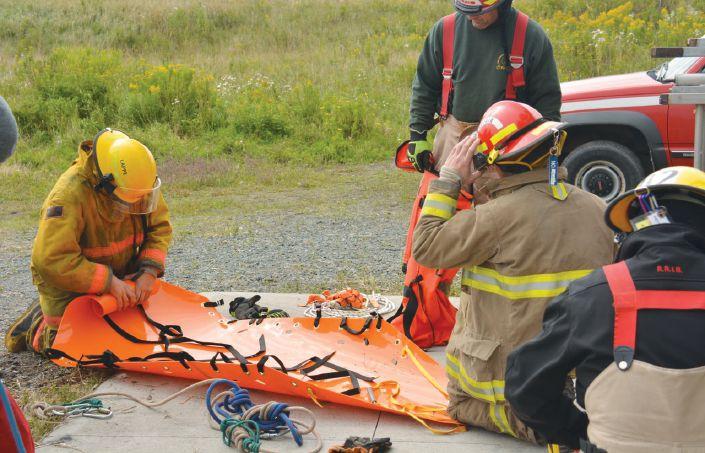
Trained FITS can take over staging management to relieve overly burned incident commanders.
also the radio operators’ first page, and they jumped into action.
“In that incident,” Leichter recalled, “the radio operators went far beyond communications. They operated the radios in the fire hall, kept a full written log of the incident, handled incoming telephone calls, dealt with convergent volunteers, and arranged the logistics of bringing in firefighters from other islands.”
“For the first call,” Leichter said, “it was an extreme test.”
FIT members are now responsible for fireground communication and an assortment of command-aide tasks. FITs have also become the primary accountability managers. The department’s operational guidelines state that the first FIT on scene will connect with the incident commander and establish, or take over member accountability. Having a dedicated member responsible for accountability alone has massively improved firefighter safety and command and control.
boards, waterproof paper, whiteboards and iPads. We have also developed specialized FIT checklists.
FITs do not make tactical decisions; they are simply a resource to provide information and assist the incident commander. FIT members are a second set of eyes and ears. Firefighter safety is the bottom line and FITs provide that added layer of safety on the fire ground.
SSIFR asks that its FITs maintain a minimum of 70 hours of training per year for active duty – less then what is asked of the interior firefighters. The training standard was carefully selected for a few reasons. For one, the manageable time commitment keeps the program attractive to members of our community who can not attend hundreds of hours of training.
BY
SAFEDESIGN APPAREL LTD
34 Torlake Crescent Toronto, Ontario, M8Z 1B3
www.safedesign.com
TOLL FREE: 1 877 253 9122
Telephone: 416 253 9122

Incident commanders have one of the most stressful and challenging roles in today’s emergency services. Having FITs available allows incident commanders to delegate some of the tasks and focus on managing a safe fire ground.
In the first few years of development, the primary roles of the FITs were accountability, scribing and assistance with radio communication. The position has since evolved to include staging management, rehab management, and a few cold-zone activities. Our FITs assist the incident commander by managing phone calls, radio communication, pre-plans, hazmat identification, and documentation, all by using handheld dry-erase
Secondly, FITs require fewer hours of training because there are fewer skills required of them. The FIT training is very specific and focuses on only a few disciplines. FITs train occasionally by themselves to concentrate on command-aide skills and accountability, but the majority of the training occurs alongside the firefighters and officers. Each FIT is assigned to a platoon for training. Having the FITs train with the firefighters encourages bonding and inclusion, and allows each member to see first-hand the value the other position brings to the team.
As with all new things, change is a challenge. Incorporating a FIT program into a department must be done in such a way that the new FIT members feel welcomed, and the firefighters understand the new role.
FITs do not make tactical decisions; they are simply a resource to provide information and assist the incident commander.
’’
-DeputyChiefArjunaGeorge
Becoming a FIT is not a steppingstone to becoming a firefighter; the roles are different and specific. If the lines are blurred the roles become confusing to the whole team. In the early FIT days the department was concerned about the perception that the new role was a back-door path to becoming a firefighter. However, with proper communication and roll out of the program, each member quickly became aware of the new role and how it is needed to stabilize incidents.
Since the days of the radio operators up to today’s well-defined FITs, SSIFR has not needed to actively recruit new members for the FIT positions. Most applications come to us via word of mouth, and most are from the local amateur-radio club’s membership. The department’s current FITs have a variety of professional backgrounds, including
police and air-traffic control, that make them a perfect fit to work in high-stress emergency situations.
FITs are required to obtain an amateur-radio licence, if they don’t already possess it, within the first year, which allows for FIT-to-FIT back channel radio communication as well as a direct communications link to the EOC. An application process is in place and candidates are asked to provide a driver’s abstract and police records check prior to training.
Depending on the development of the FITs, most receive a pager at six months and begin responding to calls soon thereafter. FITs respond just as our firefighters do; if the pager goes off and they are available, they respond to the station or the scene. FITs respond to all fires, multi-car crashes, major hazmat calls, and any complex technical-res-
cue incident. The duty officers and chiefs are also able to specifically page out the FITs for other incidents if they deem it necessary.
The department cannot guarantee a FIT will respond, so it also has a roster to ensure the best coverage possible. Since a FIT is not guaranteed to attend an incident, it is also important to have the firefighters up to speed on basic accountability and command-aide tasks.
FITs are issued PPE that is suitable for cold-zone activities – coveralls, a rescue helmet, gloves, headlamp, boots and a cold-weather jacket. The clothing provides protection as well as visible identification at a much cheaper price than structural protective wear. There are also vests in the command totes to identify positions such as accountability and staging.
Expansion of the FIT program will include social-media monitoring and management in the field.
As a senior FIT, Leichter has several pointers for departments interested in starting their own FIT program:
1. Take a good look at your operations. What jobs really need a trained firefighter to accomplish and what tasks can non-firefighters do just as well or better?
Make Room For The Industry’s Only Battery-Powered Telescopic Ram.
2. Talk to your local emergency operations centre manager. Chances are there are already amateur-radio operators providing emergency communications services in your community. The EOC may be able to put you in contact with your local radio club or with experienced operators.
3. Take it slow. Once you find a group of interested people, do a realistic evaluation. Would that person be able to take on certain duties and perform well in the stress of a fire ground? If yes, start off the program with just one or two.
4. Provide training. Amateur-radio operators are likely already skilled in communications but will need training in fire-service procedures, safety and incident command. Reinforce the idea that they are not firefighters so they will not be involved with hot-zone activities, but are still essential members of the team.
5. Integrate your new FITs into regular department activities, drills and team building.
6. Keep an open mind. You will be surprised how many intelligent, skilled and experienced people are in your
community. Not all people can or want to be front-line firefighters but they still have a lot to contribute if given the opportunity. Once the program is established, do not limit your FIT search to amateur-radio operators. Our current membership includes a former RCMP member, former air-traffic controller and former commercial radio-station owner.
Incorporating a version of a FIT program into a fire department deepens the recruitment pool and diversifies membership. Recruitment is challenging nowadays, so whatever creative fixes a department uses are worth the extra work. What FITs can contribute to a department is limited only by its members’ imaginations.
For more information and a copy of our job description, checklists and operational guidelines, please get in touch.

Arjuna George is the deputy fire chief of operations on Salt Spring Island, B.C., and has served on the department since 1997.
ageorge@saltspringfire.com @AJGeorgefire
WHAT FITS CAN DO FOR YOUR DEPARTMENT
■ Scribing
■ Accountability
■ Staging
■ Communication
■ Manage mayday calls
■ Social media monitoring
THE BENEFITS OF FITS
■ Strengthen personnel numbers
■ Improve recruitment and retention
■ Make fire grounds safer and more efficient
■ An extra set of eyes and ears focused on firefighter safety
STEPS TO STARTING A FIT PROGRAM
■ Review operational need for FITs
■ Approach local EOC for contacts
■ Start slow with only one or two FITs
■ Provide training on fire-service SOPs
■ Integrate FIT members into regular department activities
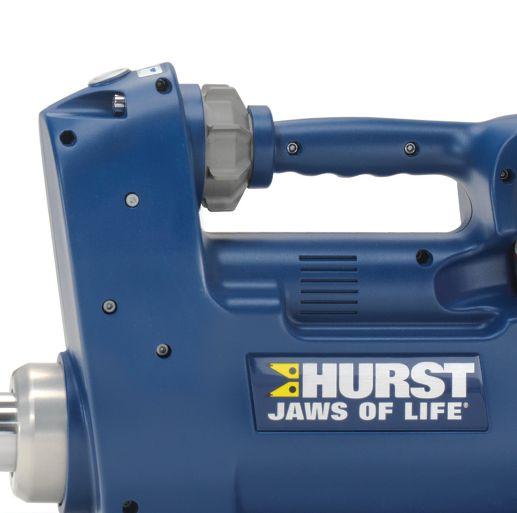
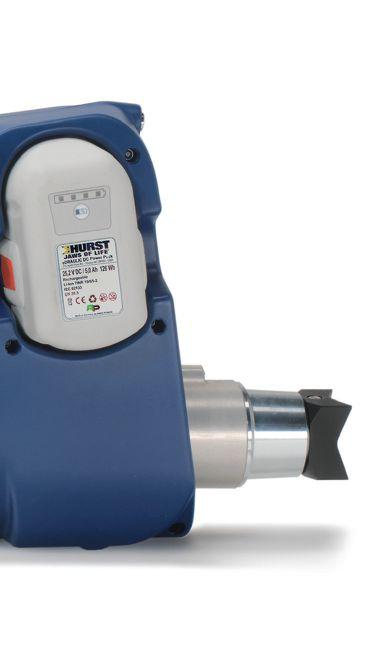
Without further introduction, let’s welcome the R 421E2 Ram to the industry’s most innovative line of rescue tools. This eDRAULIC™ 2.0 Ram extends 53” long with a max pushing force of 28,600 lbs. And its new sharp claws rotate 360 o on both ends, so it can get to work from just about anywhere. Even in a magazine.


BY ED BROUWER
In April, Greenwood Fire Rescue held a practice night that was based, in part, on Elliot Lake Fire Chief Paul Officer’s Q&A in the March issue of Fire Fighting in Canada. A quote from Chief Officer on page 16 caught my attention; “I think probably the lesson for my officers is the note-taking and detail that is required.”
Although note-taking wasn’t on our training schedule, I felt the need to bring it up to members sooner rather than later. I also hoped to drive home Chief Officer’s point in a more dramatic way rather than a lecture on note-taking. I’ve taken several courses on note-taking and, although it is very important, the course material is as exciting as watching paint dry.
Yes, I realize not all training should be valued in terms of excitement, however, getting all the learning senses involved helps to embed the topic into our already over-stuffed brains.
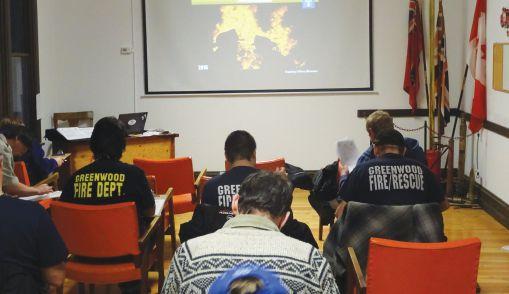
At the time, Greenwood Fire’s members were in the midst of completing a fire-behaviour module. Members had just completed exams in PPE, safety, SCBA and communications, so it was no surprise when they were asked to take out their notebooks and training manuals. After a quick review, we began fire behaviour part 2. We were six slides into my PowerPoint when our pager tone went off. (I had programmed an audio clip into the presentation.) A dispatcher’s voice called us out to a possible structure fire at 1480 Deadwood Rd. Neighbours reported smoke at the front entrance.
At first everyone just stared at me wondering what to do. I shouted, “Well? What are you waiting for? Go!” Books were closed, chairs were pushed back, orders were issued and the department responded with both engines to the reported address.
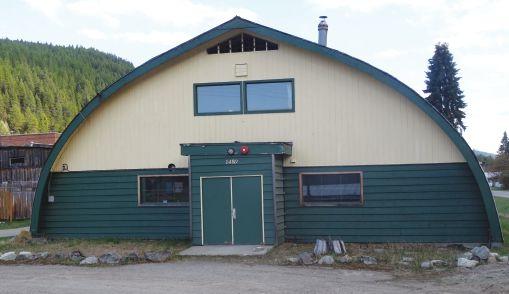
The location was the old Greenwood curling rink – a Quonset that has been sitting without purpose for a decade. The building had become a storage facility for public works. Three years ago I requested the building be given to the department for use as a training facility. With more than 465-square metres (3,000 square feet) of space, the building is a trainer’s dream. I saw great potential in the two-storey, 46.5-square metre (500-square foot) front entrance and lounge area with a layout close to a typical two-storey residence.
As firefighters arrived on scene I informed the incident commander (IC) that this was to be handled as the real deal. I wanted charged lines. I believe we should practise as if we are doing it on the fire ground; full PPE (yes, gloves too), SCBA (breathing air) and definitely charged lines. A hydrant lay was deployed and an arrival report given to dispatch (I was acting dispatch on our tactical radio channel). I recorded the timeline on a clipboard, noting time of call, time when apparatus left the hall and arrival time.
A more detailed size-up was performed (I filled in what their imaginations couldn’t see) while an interior-attack team donned SCBA. The IC chose to use the hose reel for a quick attack. An
accountability person was given our new accountability board and all members handed in their tags. Entry was made on the Alpha side. They entered the main floor and after a quick and dirty lower-floor search they went up the stairs. Moving a charged line through an obstacle course of furniture and up a flight of stairs with a landing at a 90-degree turn can be difficult.
I let things evolve. I jotted down struggles and areas of uncertainty along with comments on how to better our performance. I kept quiet throughout the whole scenario. There were a few hiccups, but that is not necessarily bad. It is far better to have issues during a practice scenario than at the real call.
So here is where the practice scenario relates to the Elliot Lake lesson. I had pre-arranged for one of our firefighters, unbeknownst


More Power... More Torque ... Better Fuel Efficiency
More Power... More Torque ... Better Fuel Efficiency
75% Less Emissions
75% Less Emissions
The new Dual-Air intake engine technology significantly improves overall cutting performance and meets all Air Quality Control standards at the same time.
New 2100 Series includes two engine sizes: 70.7cc and 87.9cc. Each engine is designed for use with Cutters Edge Carbide
Tipped BULLET Chain® to cut the widest range of materials found at fireground and rescue scenes.
New H Series is engineered and powered to work harder and operate longer in the most extreme fire and rescue conditions anywhere. The new technology engine is available in three sizes: 74cc, 94cc and 119cc. The Cutters Edge Black Star and Black Diamond Blades offer long cutting life and high speed cutting of virtually all materials.
The new BULLET BLADE TM will be available soon.
A new technology 94cc engine and a new style Diamond chain cuts reinforced concrete up to 16-inches thick. Features a lighter weight power head and full-wrap handle for high performance concrete cutting in any position.
All Cutters Edge NEXT GENERATION TECHNOLOGY Fire Rescue Saws are available in fully-equipped Field Kits designed for Rescue Cutting anywhere.
Contact Your Local Cutters Edge DealerSee New Engine Technology Video Now
WESTERN CANADA
WFR Wholesale Fire & Rescue Ltd. Calgary AB - Ph 403-279-0400
1-800-561-0400
Web: www.wfrfire.com
QUEBEC Areo-Fire 5205 J-Armand Bombardier
Longueuil QC, J3Z 1G4
1-800-469-1963
E-Mail: info@areo-feu.com
NEW BRUNSWICK
Micmac Fire & Safety Source 518 St. Mary's Street, Unit 1 Fredericton, NB E3A 8H5
1-800-561-1995 or (506) 453-1995
E-Mail: r.henderson@mmfss.ca
NEWFOUNDLAND
Medical West Supplies 13 Rowsell St., Corner Brook, NF
709-632-7852
E-Mail: jkenny@nf.sympatico.ca
ONTARIO
M&L Supply Ingleside, ON 1-866-445-3473
Email: markp@mnlsupply.com Web: www.mnlsupply.com
NOVA SCOTIA
Cumings Fire & Safety Equipment Ltd. Bridgewater, NS Ph 902-543-9839 1-800-440-3442
E-Mail: kylej@cumings.ca Web: www.cumings.ca

NFPA-COMPLIANT UCF® THERMAL IMAGERS
Today’s fires are more dangerous and unpredictable than ever. Missing an important detail in a difficult environment can place lives at risk. Fire, smoke, and darkness make visibility extremely limited and navigation difficult. Scan your surroundings quickly and safely with Dräger’s new line of NFPA-compliant UCF® Thermal Imaging Cameras. STAY ONE STEP AHEAD WITH DRÄGER. WWW.DRAEGER.COM/UCF
to the others, to quietly walk away from the main scene and lay down at the Bravo-Charlie corner of the building.
The scenario played out until the interior-attack team reached the top of the stairs and located the fire. I called it a wrap and suggested we get cleaned up. I informed the firefighters that we would debrief back at the hall. Members were still trying to figure out the purpose of this scenario. They certainly were not expecting a man down or a lesson on accountability.
Clean up went as expected and units headed back to the hall. There were a few questions as to where Pat was, but no one really pushed the point. Once back at the hall, two members actually ran back to the curling rink (which was just two blocks away). After calling out Pat’s name several times, the firefighters returned to the hall; they thought perhaps he was already up in the training room.
The person with the accountability board (who was new to Greenwood Fire) was upset because Pat’s tag was still on the board and she hadn’t said anything. Finally, we went back to the curling rink and found Pat lying at the back of the building some 200 feet up an alley.
Back at the hall we debriefed the call and highlighted a few areas of concern. I asked members to pretend we were now in court regarding the call out to 1480 Deadwood Rd. I led the questioning of certain individuals. I asked what time the call came in, what time they left the hall, what time they arrived. Did they do a size up? Was an arrival report submitted? Who was in attendance? What time was entry made? Who entered? How long before fire was located? I hammered away with these questions, then asked if there was an accountability system and asked them to describe it. I asked about Pat – where had he been, why he was missed and left behind.
Because I had recorded all the info earlier, I could challenge any made-up answers. I explained to the members that this incident had happened in the last hour and yet they struggled getting their timeline right. Now I told them to imagine it was two months or three years later and Pat’s family was suing the department for negligence. It was then the lights came on and someone said, “We should start taking notes.” Another said, “We wrote some things on the whiteboard, but we erased them when we cleaned up.”
Then I brought up the Elliot Lake lessons. We too now have a scribe (even at a practice scenario). A heart attack can happen anywhere, even at a practice night. The practice scenario taught us that accountability is our responsibility at every incident, practice or event –emergency or not. I knew our practice was successful when I overheard a junior member say, “I’ll never forget that lesson.”
Two weeks after the practice, Greenwood Fire responded to a fifth-wheel travel trailer fire in a driveway adjacent to a single-family residence. When I asked the chief for a run down three days later, he pulled out his notes and gave a minute-by-minute detailed report.
Our members may not all be note-takers, but you can bet they are taking note of what is happening around them; and that is half the battle. Stay safe out there and remember to train as if lives depend on it.
A special thanks to the Elliot Lake Fire Department.
Ed Brouwer is the chief instructor for Canwest Fire in Osoyoos, B.C., and training officer for Greenwood Fire and Rescue. Contact Ed at ebrouwer@canwestfire.org
Fire-Rescue Canada ©
The Canadian Association of Fire Chiefs Annual Education Conference
September 20 – 23, 2015
Victoria, British Columbia REGISTER TODAY! www.etouches.com/ehome/104387
Fire Chief of the Year Nominations are now being accepted! Each year the Canadian Association of Fire Chiefs and Fire Underwriters Survey recognize Fire Chiefs for their outstanding contribution to the Canadian Fire Service. Know a deserving Chief? Visit www.cafc.ca/en/awards/ to nominate your Chief today!
Secours-incendie Canada © Le conférence annuelle d’éducation d’Association canadienne des chefs de pompier
Le 20 – 23 septembre, 2015 Victoria, Colombie Britannique
INSCRIVEZ-VOUS AUJOURD’HUI! www.etouches.com/ehome/104387
Les candidatures pour les Prix d’année des chefs de pompiers sont maintenant acceptées! Chaque année, l’Association canadienne des chefs de pompiers et d’inspection des assureurs incendie reconnaissent chefs de pompiers pour leur contribution exceptionnelle au Service canadien des incendies. Connaissez-vous un chef digne? Visitez http://cafc.ca/fr/awards/ de nommer votre chef aujourd’hui!

BY TOM DESORCY Fire chief, Hope, B.C.
oo often I’ve heard that things are just not the same as they were back in the day. In fact, I’ve caught myself saying that on more than one occasion. I suppose that comes with age and, in the fire service, it’s always easy to compare the way things are with the way things used to be. Our world is constantly changing and, at times, it’s hard to keep up.
Do you share the opinion that today’s firefighters face many different challenges, and that today’s fire departments are very much different than those of the past? Take, for example, the demand for training and the response to many more and different events; not to mention the competing demands on a volunteer’s time.
When we talk about the challenges we face as volunteer departments, we have to consider that what we did back then is known only because we have senior people in our departments who have either experienced it, or heard about it from now-retired firefighters. But today, things change so much faster, and today’s firefighters don’t have time to learn, absorb or understand how and why things used to be.
As time goes on, there will be more and more firefighters who will remember only the way it is now. Just imagine – 20 years from now firefighters will be reminiscing about when they had iPads and drones in the department. But with recruitment and retention challenges, how many of today’s firefighters will even be around the departments in 2025?
When today’s firefighters joined the hall, alarms and medical calls were normal; when I joined, they weren’t. While we see the service as old and steeped in tradition, it really was always new and changing all the time. Today it just changes a little faster.
The youth today have access to so much more. They are adaptable to and accepting of change, primarily because things evolve more rapidly now so they don’t have time to become accustomed one thing, which is all the more reason to find the balance in the way things were and the way things are. It’s also important to remember that everything will be different tomorrow and today’s fire service will become yesterday’s to many.
I recently conducted a survey by email to the member departments of the Fire Chiefs’ Association of BC. In it I asked two simple questions: “How many members are in your department,” and “what is the average age?” This little poll was targeted at volunteer departments and generated some interesting results.
In the 68 departments that responded there are just over 1,700 volunteer firefighters, and an average of 25 members per department. The average age of those firefighters is just over 40. This begs the question, where will the fire service be in 10 years? Are we bringing in enough younger members and is that really what we want? Most of us know that, as with life, fire fighting is about balance. We balance the young with the old, the rookies with the experienced, and all is
History may be the glue that keeps us together but be prepared to tack on a few new pieces. ‘‘ ’’
Most children around the age of eight likely know how to use a computer or digital camera and can run circles around most of us in a video game. Our first reaction is to marvel at how kids know so much more than we did at that age, how advanced they seem to be. But when you think about it, we were advanced at that age too, because none of that stuff was around, and our world then didn’t change as fast as it does today. But that world was still evolving, we just didn’t find out about it because we had very limited access to information about the world around us.
Tom DeSorcy became the first paid firefighter in his hometown of Hope, B.C., when he became fire chief in 2000. Email Tom at TDeSorcy@ hope.ca and follow him on Twitter at @HopeFireDept
good. While the younger volunteers may be fit and nimble, they may not stay around long enough to gain the experience and knowledge that we need to teach them.
The fact that today’s volunteers never knew the old department is a testament to advancement. However, there are those of us who still need to remind them that we once had a fire siren instead of a pager, and that tall boots and a long coat were called turnout gear.
This shouldn’t, however, hold back tomorrow’s firefighters, no matter their ages. They are coming into a new normal and it’s up to all of us to foster and embrace that normal. History may be the glue that keeps us together but be prepared to tack on a few new pieces. As with any work in progress, this project is far from over.

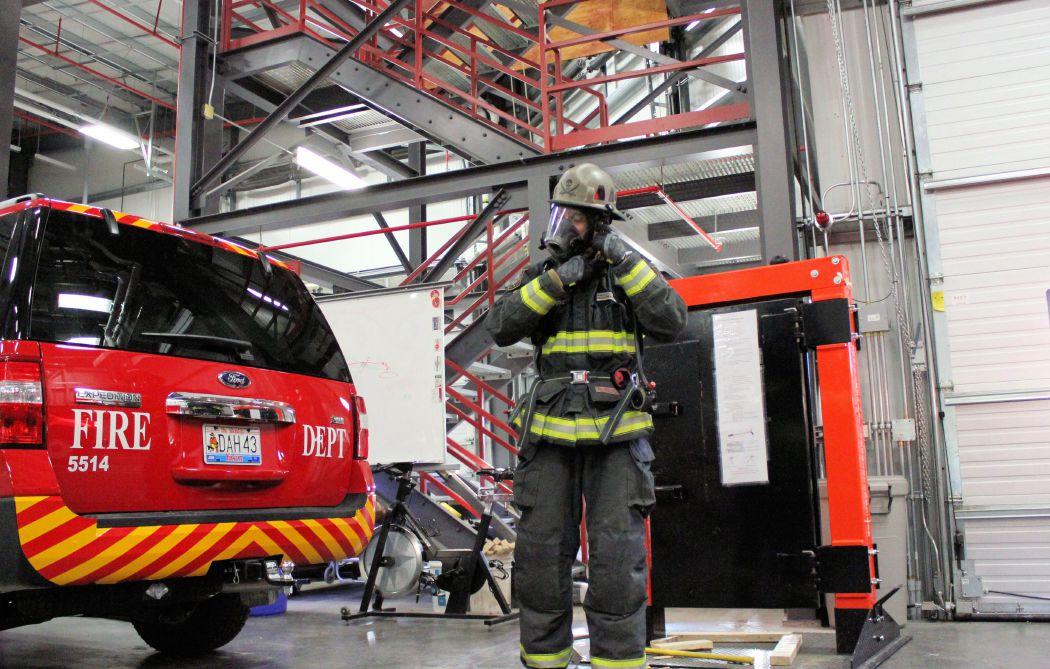
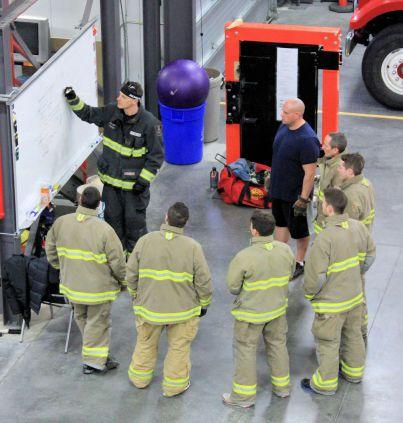
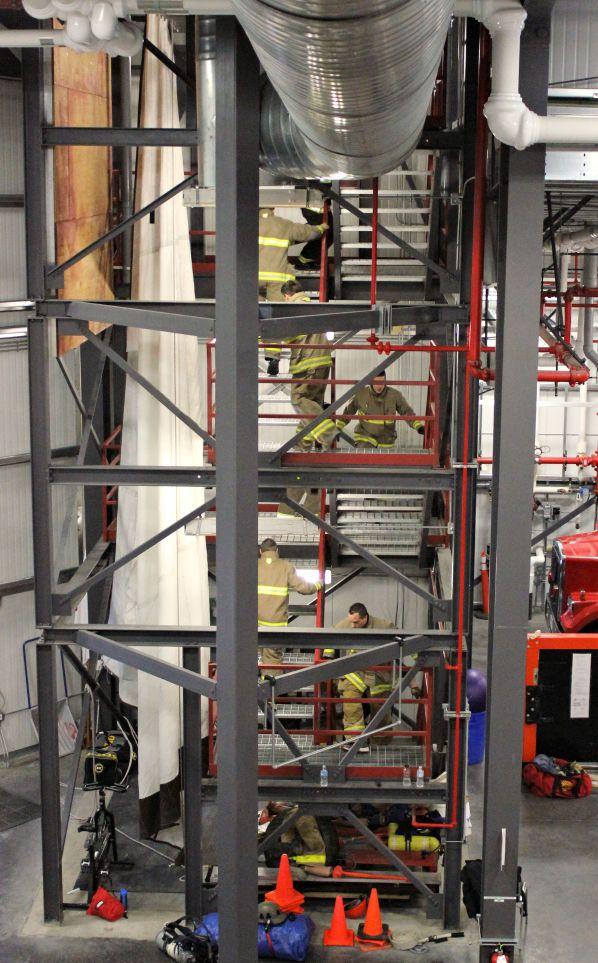
TOP Yukon Deputy Fire Marshal James Paterson straps on his helmet, the final piece of PPE he and his team of nine firefighters will wear for their hour-long workout to train for FireFit –the Canadian firefighter fitness challenge.
RIGHT Paterson writes out the day’s fitness plan. Warm up: five towers (no pack), 10 burpees per tower. Exercise: 20 towers on air. Post-workout: 200 lunges.
By MARIA CHURCH
It’s 11:30 a.m. in Whitehorse. With practised ease, 10 firefighters don their PPE, turn on their SCBAs, and line up at the base of a five-storey training tower.
They gaze up and the tower, eyes reflecting an internal battle – fear of the physical challenge they are about to take on, but also determination.
An hour and 150 storeys later: sweat, exhilaration, soreness, triumph. Tomorrow they will do it again.
This is the scene Yukon Deputy Fire Marshal James Paterson describes in an interview about a voluntary fitness program he has been running out of the City of Whitehorse Fire Station 2 for
about two years.
Five days a week, nine firefighters (and sometimes a city manager) join Paterson for an intense workout that targets their cardiovascular systems – gets their hearts pounding.
But why do they do it? What’s the motivation?
Mandatory fitness, particularly if it is punitive, is a hot-button political issue in the fire service, Paterson said, the effects of which he dealt with in the past as chief of the Yukon airport fire department.
When he took on the role of deputy fire marshal in 2013, Paterson explored other methods for motivating Yukon firefighters.
It’s a challenge, he admits, but he

I don’t believe we should be losing our members from cardiovascular emergencies that are – for the most part –preventable.
’’
- Deputy Fire Marshal James Paterson
believes departments owe it to the community, and to themselves, to keep physically fit.
Maintaining motivation is the ever-present challenge for any voluntary fitness initiative. For the Yukon firefighters, Paterson said, the greatest motivator is having a goal that gives their workouts purpose.
The fitness initiative originally started as training for the annual Scott FireFit Championships – the Canadian version of the United States-based Firefighter Combat Challenge.
“In the past when I had run in the combat challenge,” Paterson said, “when I returned home to Whitehorse I just felt fantastic when I had to go fight a house fire. I felt bigger than the whole thing, and that I could handle anything that came at me. I wanted to bring that feeling to our volunteers.”
Paterson shared his passion with crews and as word grew about launching a new team for the combat challenge. With permission and support from the fire chief in Whitehorse to use station 2 as a base, Paterson started training anyone who showed up.
“More and more people came out and started to work with me and now it’s a daily event,” he said.
The group now has two teams signed up for FireFit, a team from Whitehorse with six members, and Yukon Fire Service team with Paterson and three volunteer firefighters from surrounding departments.
Competing in the FireFit championships may be the original motivator for the firefighters, Paterson said, but annual events in the community are essential to keep up day-to-day morale.
“It’s critical you have destinations,” he said, “you have things like the Terry Fox run, you have the Run for Mom, you have all those things where your firefighters are out in the general public . . . so that training is continuous and ongoing.”
At 51, Boyd Pyper is proud to be the oldest member on the team of mostly 20-something-year-olds.
Pyper is the fire chief in Tagish, Yukon, a small community an hour southeast of Whitehorse. He makes the trip in to Whitehorse four days a week to train with the team, then spends another few hours in the gym on his own.
Pyper said he was not a gym enthusiast before, but as a seasonal park ranger and what he calls a “classic Yukon cliché” who regularly camps, hunts and fishes, he leads a relatively active lifestyle.
“But I’ve never really pushed myself or challenged myself the way

I have in this last six months training,” he said, “and I love it. I’m a little bit hooked.”
Another part of what drives Pyper to exercise is remembering his predecessor, Kurt Gantner. Chief Gantner died in 2011 at age 49 from cardiac arrest, the day after responding to a house fire.
Months before Gantner’s death, Yukon adopted presumptive legislation that includes cardiac events. If a firefighter suffers cardiac arrest within 24 hours of an emergency scene it is considered in the line of duty. The International Association of Firefighters (IAFF) lists similar legislation in Alberta, Manitoba, New Brunswick, Northwest Territories, Ontario and Saskatchewan.
Paterson also spoke of Gantner’s death, calling it a wake up call for the Yukon fire service.
“This job is a physical job, make no mistake,” he said. “Chief officers shouldn’t be excluded because it’s a tremendous amount of stress put on their hearts and their minds when they are woken up at 2 a.m. and have to make a huge amount of command decisions in a very short period of time; that elevates your heart rate instantly.”
Sudden cardiac events are recognized by the IAFF as one of the top killers of firefighters in Canada and the United States. Paterson points out that cardiovascular issues are “precipitated by lack of fitness and lifestyle choices.
“I don’t believe we should be losing our members from cardiovascular emergencies that are – for the most part – preventable,” he said.
Whitehorse Fire Chief Kevin Lyslo is 100 per cent behind the fitness program running out of station 2 one hour a day, six days a week.
The fire service is changing, Lyslo said, and part of that change is a focus on the physical health of its firefighters. Chiefs need to encourage that change, he said, especially in volunteers.
“Being physically fit from the time you start to the time you leave is going to impact your retirement years, ” Lyslo said. “To have this opportunity for our new guys to participate, it keeps them involved with us and I think it creates a better volunteer who is more engaged and physically fit.”
As a chief, Lyslo said, the best thing you can do to motivate your crew is lead by example.
“If a chief is not willing to get out of his chair and do the five-k (run),” he said, “or even run the stairs with them while they’re training for their challenge, if he’s not willing to mirror that, he should not expect anyone else to.”
Lyslo isn’t on the team, but he rides his bike or runs to work everyday, year round, with a cutoff of around -30 C.
Pyper also hopes that his participation in the FireFit challenge and overall enthusiasm for fitness will not only encourage his current volunteers to participate, but also attract new ones to the department. “We want to say, ‘Hey, I’m getting fit, I like doing these things and it can be a lot of fun,’” he said.
Paterson knows the intensity of the FireFit challenge isn’t for everyone, but recommends firefighters sign up for community events such as runs and cycles to motivate themselves.
And while most departments don’t have the resources to purchase fitness equipment, especially if they are volunteer, that shouldn’t stop members from exercising, he said. There are many inexpensive ways to keep fit.
“I’m a big proponent of body weight exercises. You really just need the time,” Paterson said.
His favourite are burpees – a mix of squats, planks and jumps that target the heart and lungs. Other options are sit-ups, pushups, lunges, and walking or running outside.
At the end of the day, he said, choosing to exercise is a personal decision.
Paterson admits that he often struggles with his own motivation as he straps on his SCBA and lines up with his teammates at the base of the training tower.
“There’s a thousand excuses why I shouldn’t do it, or I don’t have to do it,” he said.
“‘Paterson, you’re 44 years old, you’re a chief officer, you don’t have to do this; you did this three times last week, you don’t have to do it, buddy.’ But I tell myself there’s really only one reason to do, it’s because I said I was going to do it and I’m going to do it.”


For your cleaning, decontamination, inspection, testing, repair and record keeping of your firefighter’s protective clothing... we have you covered!
24/7 access to FIRETRACK®, the online data base that provides you with complete details of your C&M Program with FSM. We do the work for you!
ETL Verified
ISO 9001 Registered Fast turnaround
Complete Bunker Gear Rental Program – Toronto Location




BY MARK VAN DER FEYST
Standpipe systems are designed to supply firefighters with water at any height and at a constant flow and pressure. This two-part lesson is based on highrise training I helped conduct in February for the Hogansburg Akwesasne Volunteer Fire Department in New York at a casino in its response area. We had complete access to the fourth floor and a hotel room in the casino to practise making the stretch.
As a side note, it is always beneficial to access opportunities for training. It is up to the fire department to approach highrise building owners or managers and try to establish working/training relationships. Be proactive and see what may be available.
A great time to approach owners or managers is when a highrise is under construction and does not have any interior finishes that would be damaged by water flow. In order for the Hogansburg Akwesasne department volunteers to train at the casino, the hoseline could not be charged and structural firefighting gear could not be worn inside.
The May edition of Back to Basics, part 1 of this lesson, explained the engine-company task of securing the standpipe water source inside a highrise for suppression. It is important that members of the engine company can smoothly and easily hook up to the standpipe.
Once firefighters have secured the standpipe and hose, they can advance past the stairwell door and into the room of origin.
Before advancing the hoseline from the protected stairwell into the hallway, make sure that the door has been felt for heat. By the time members of the engine company climb to the fire floor, the fire may have spread out of the unit and into the hallway. If the fire is in the hallway it requires a more aggressive fire attack from the stairwell moving to the fire source.
The size of hoseline used for the operation dictates how aggressive the attack should be – if it is the standard 38-millimetre (1 1/2-inch) or 45-millimetre (1 3/4-inch) hoseline, the attack is limited. If the hoseline is a 65 millimetre (2 1/2-inch), then the attack will be much easier to handle based on the amount of water flowing. (Jeff Cowan details the argument for using the 65-millimetre (2 1/2-inch) hoseline for commercial buildings in the April edition of Canadian Firefighter.)
Once the stairwell door is felt for heat and it is safe to access the hallway, firefighters can open the door and advance the hoseline into the hallway. Photo 1 shows how the hose is advanced out the stairwell door and around the corner. The door can be either kept open with a door chock (as shown in the photo), or it can be free to close onto the charged hoseline. Some firefighters think the door should be kept open, other say it should be allowed to close. If the door is closed, it will help prevent smoke from
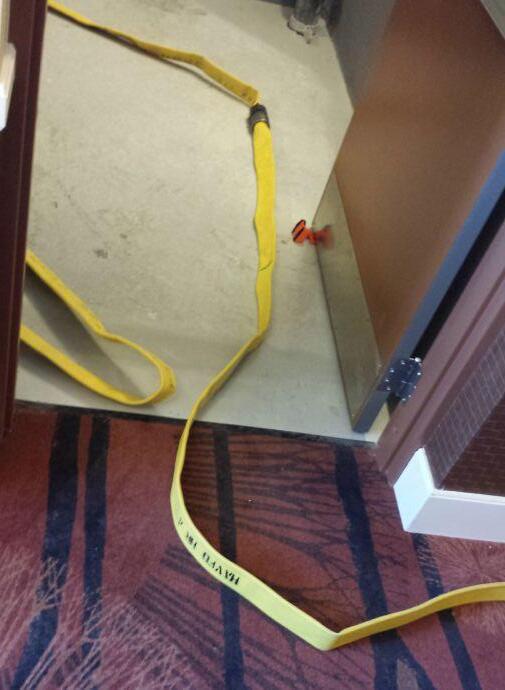
entering the stair shaft. Positive-pressure ventilation set up in the stair shaft would also help keep the smoke out.
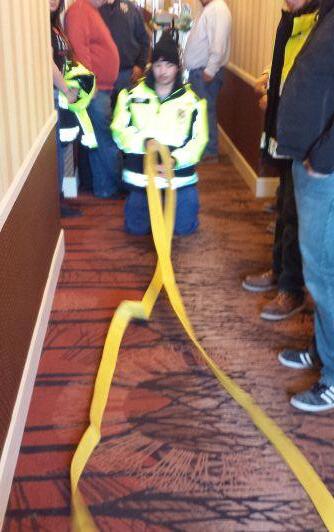
Once in the hallway, firefighters should ensure there is enough hose available for advancement. Dedicate one firefighter to pulling hose out from the stair shaft and readying it for the stretch into the hallway and the unit. Because there is not enough space in the hallway to make large loops of hose, create a figure eight to avoid kinks by looping the hose onto itself (see photo 2).
The firefighter dedicated to pulling out hose then joins the firefighter operating the nozzle to help advance the hoseline down the hallway and into the unit.
Advancing into the unit is difficult work – it takes a lot of energy to pull and push the charged hose. Once at the unit’s door, the firefighter operating the nozzle again feels the door for heat
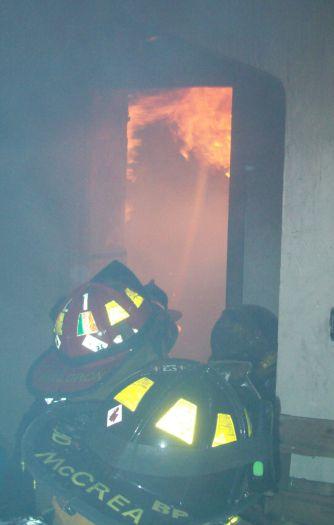
and then slowly opens it to gauge the conditions inside the unit. If the conditions are dangerous, the door should be closed again to confine the fire while firefighters wait for extra resources and help to arrive.
When opening the door to the unit, remember to never expose yourself directly to the fire. Firefighters can use the wall or the door to shield themselves from the direct radiant heat. Photo 3 shows how firefighters apply a stream of water from a distance, providing there is adequate pressure and flow for the water to reach the target.
Maintaining a distance allows the team members to shield themselves from the heat while at the same time suppressing the fire and then advancing further into the unit.
Most highrise hotel rooms or apartments are not large, which means hose streams will adequately reach the opposite end, allowing firefighters to defend themselves.

1. Secure the standpipe and hose.
2. Feel stairwell door for heat to determine if the fire has spread into hallway.
3. Advance hoseline from stairwell to hallway.
4. Use a chock to keep the door open, or allow door to close on charged line.
5. Ensure there is enough hose for advancement.
6. Create a figure eight to prevent kinks.
7. Advance hoseline to the unit of origin.
8. Feel the door for heat and gauge conditions.
9. Use the wall or door as a shield from radiant heat.
10. Apply a stream of water from a safe distance.
Mark van der Feyst has been in the fire service since 1999 and is a full-time firefighter in Ontario. Mark teaches in Canada, the United States and India. He is a local-level suppression instructor for the Pennsylvania State Fire Academy and an instructor for the Justice Institute of BC. He is also the lead author of Pennwell’s Residential Fire Rescue book. Email mark at Mark@FireStarTraining.com

By CHRIS DAVISON-VANDERBURG
We all value our time and get frustrated when it is wasted. How often have you left a class or conference room and thought, “That is three hours of my life that I will never get back”?
As instructors, we must ensure the good use of our students’ time. To do this, instructors must fully comprehend the relevance of our lesson plans from the students’ perspectives, not our own. Then, instructors must transfer this understanding in a way that encourages students to believe it themselves. Done properly, this step sets the stage for a lesson and creates an environment primed for engagement and active learning.
Teaching adults – your firefighters, or your colleagues and peers – is different than teaching children. Adults need to know why they are sitting in a room listening to you talk about a subject in which they may or may not be interested.
Andragogy is the art and science of how to teach adults specifically. Malcolm Knowles popularized andragogy in North America. “Adults need to know the reason for learning something,” he said of the major difference between adult learners and children.,
An adult’s search for purpose is one of Knowles’ foundational assumptions related to motivating mature learners.
Having your students understand why they are learning doesn’t need to be overly complicated. There are a few common pitfalls that teachers can learn to sidestep once they become aware of them.
A class will likely view a lesson as training just for training’s sake – or a waste of time – if an instructor makes one or more of these three mistakes:
1. Failing to start the lesson with why
2. Providing why from the wrong perspective
3. Poorly executing the transfer of why
The first mistake is straightforward; if you don’t plan to begin with why, it won’t happen. Conversely, if you work hard to infuse the why step as part of your regular class-preparation routine, the benefits of having engaged and non-confrontational individuals in your class will be well worth the effort.
The second mistake – using the wrong perspective – needs a bit of clarification. Consider a training session on ropes; the chief wants firefighters to cover the NFPA 1001 job-performance requirements on rope because the organization needs to demonstrate that the fire department meets this standard of training. If
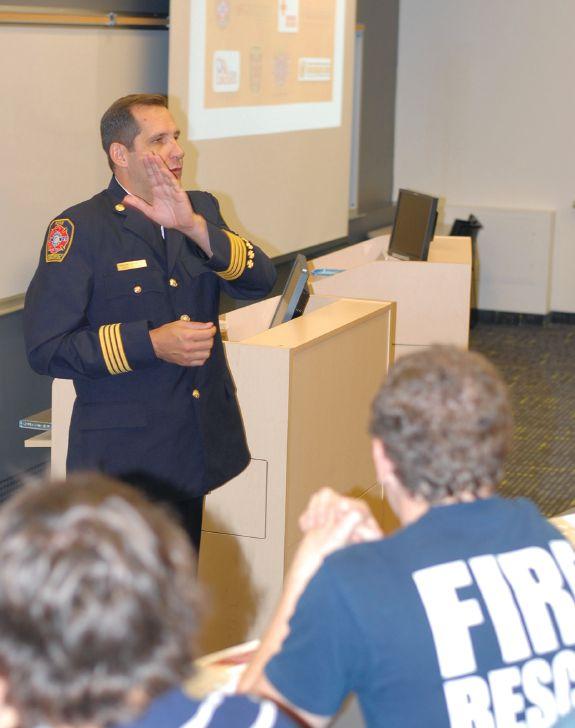
Teaching adults – your firefighters, or your colleagues and peers – is different than teaching children. Adults need to know why they are learning about a subject.
the instructor walks into the classroom and says, “We are doing this training because the chief needs us to put a checkmark in the checkbox,” it is unlikely the students will be enthused to learn. Explaining the chief’s perspective does not resonate with the students.
If, however, the instructor starts the lesson by reviewing any past incidents at which ropes were actually used, then having groups brainstorm why a strong foundation in ropes is a precondition for individuals to progress to the rope-rescue team, the students will likely be motivated.
Keep in mind that individual students have different beliefs regarding training priorities. When caught among these priorities,
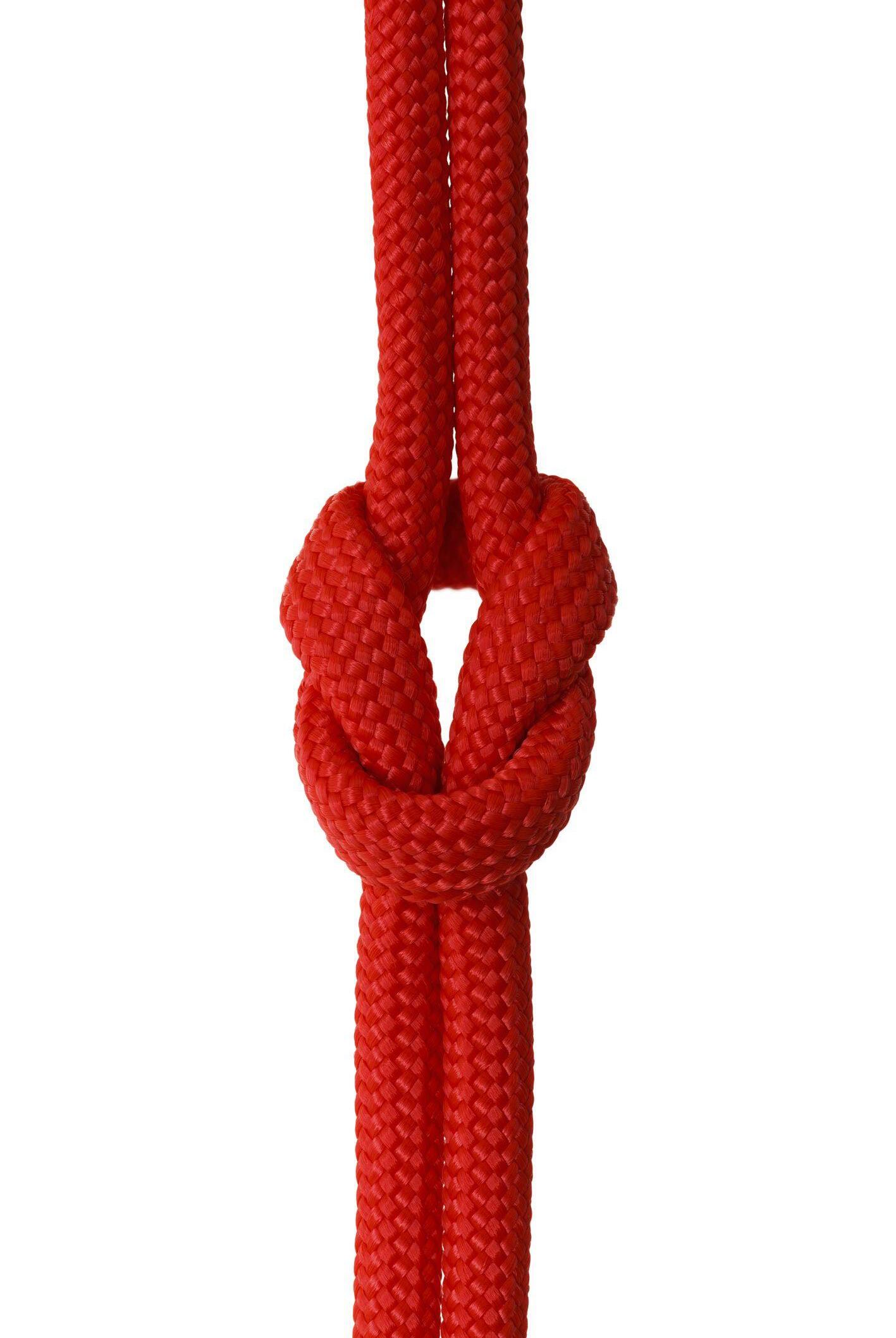
Begin a lesson on ropes by having the class recall past incidents at which ropes were actually used.
instructors often become referees, translators and diplomats. With different perspectives and priorities for what constitutes an efficient use of training time, the instructor’s job is to find the common ground and package the why message according to the different audience beliefs.
Be cognizant of the differing perspectives and ensure that everyone is on board before the lesson begins. Be patient. The goal is to ensure that you establish the right atmosphere for learning prior to diving into the topic at hand.
The third mistake – a poor execution of why – is the hardest to notice and avoid. A teacher may have a strong understanding of the importance of the lesson from the student’s perspective, but fail to deliver it in a meaningful or relevant way.
Using the ropes example, imagine that a teacher walks into the class and begins with a textbook-style explanation about why it is important that students know their knots for use on the fire ground. The teacher explains why without using any concrete examples, only with theory. “You never know when you’ll need to

hoist a fan up three storeys.” The newer recruits might buy in to it, but some of the senior firefighters will likely mention that they never, or rarely, use a rope at an incident. Your credibility will be instantly shot, and the artistic doodles and whispered conversations will begin.
Convincing firefighters of the value of their training is a vital step that must become a part of an instructor’s regular classroom preparation, and one that can’t be skipped or glossed over. Starting a lesson with a PowerPoint slide headed Objective, followed by a reference to a standard or section of legislation, will not fire up anyone. Ideally, come up with an activity through which the students will discover the value of the lesson for themselves.
Time spent setting the stage is time well spent. I distinctly remember participating in Denver Assistant Chief David McGrail’s course on highrise operations at a conference put on by the British Columbia Fire Training Officers Association. McGrail spent more than an hour setting the stage, explaining why we were there to learn, and ramping us up emotionally before he even mentioned the words nozzle, hose, standpipe or stair. It was one of the besttaught courses that I have ever attended because McGrail took the time to re-engage the passion within us, his students. He had us believe it was important to pay attention and become active in our own learning. Chiefs from different departments were working hoselines up the stairs, sweating and fighting for the nozzle as if they had just shown up for recruit class.
This doesn’t mean that every training session requires a onehour intro. My department, Brampton Fire and Emergency Services in Ontario, recently purchased new SCBA packs and


Ideally, come up with an activity through which the students will discover the value of the lesson for themselves. ‘‘ ’’
rolled out the training to our 400 members. During the course-development phase, the discussion about why we were doing the training was seemingly straightforward – until we considered perspective. NFPA standards and occupational health and safety regulations are clear on the need for individuals to be trained on the use of any new SCBA equipment; it was tempting to state this as our objective and then go into a comprehensive and detailed explanation of the packs.
What mattered, however, to the men and women serving proudly on the front line was feeling comfortable and confident with their new equipment; they were already professional experts on SCBA.
As a training division, we decided the real objective of our training was to ensure that people felt comfortable and confident with the new equipment. During each instructional session we spent a few minutes discussing or mentioning that goal.
As soon as we stated that we were there to make sure crews were comfortable and confident with the new SCBA, you could see and feel the sense of relief from the members who recognized that this training was not going to be a long, drawn-out explanation on the use of SCBA. The members acknowledged afterwards that the lesson was a good use of their time.
Hopefully you can appreciate why the best teachers emphasize the reasons students need to know the material before launching into the lesson.
Sharing the why sets the tone for the day, grabs students’ attention and engages the group for a positive reception and exploration of the topic.
Chris Davison-Vanderburg is a training officer with Brampton Fire and Emergency Services. He has been a member of the fire service since 2004. Email Chris at chris.vanderburg@brampton.ca or follow him on Twitter @CapHyphen


BY SHAYNE MINTZ NFPA Canadian regional director
f a disaster like the train derailment and subsequent inferno that caused 47 fatalities in Lac-Megantic were to occur in your community, would you, your department and your municipality be prepared to respond? Would you be capable of mitigating the incident and prevent or minimize the loss of life and property? Could you work effectively and efficiently alongside non-government agencies to find a resolution?
To address these questions, in November of 2013 Canada’s minister of transportation created a working group to examine the expansion of the Emergency Response Assistance Plan (ERAP) program to include crude oil and other Class 3 flammable liquids.
Following a number of recommendations dealing with bulk flammable liquids in transportation and the requirement for them to now require an ERAP, the minister announced on April 23, 2014, the formation of an emergency response task force to conduct additional research and make further recommendations to improve the ERAP program.
The task force brought together stakeholders including regulators, first responders, railways, and representatives from the chemical- and petroleum-producing communities. The task force has met monthly since its inception to hear from experts in the field. As issues arise they are either resolved or passed to sub groups of subject-matter experts to find solutions. The task force is scheduled to wrap up its work by June of this year.
During these meetings, concerns were raised about the lack of competence, capability and capacity of first responders to handle large-scale flammable liquid fires that may arise from train derailments. Fire-service representatives have further expressed concerns over their lack of awareness of Transport Canada programs such as ERAP, as well as other resources and equipment that can be made available to them on the site of an incident.
It’s evident from available rail data that the volume of Class 3 flammable liquids such as ethanol and Bakken crude moving on rail has increased over recent years and is expected to continue to grow. The Financial Post recently reported that both the Canadian National and Canadian Pacific railways forecast crude oil shipments to grow between 25 and 35 per cent.
In February and March there were at least four notable derailments in North America. A massive derailment and fire of a crude oil unit train in Mount Carbon, W.Va., in February; two derailments occurred near Gogama, Ont., two weeks apart; and, yet another occurred in Galena, Ill., on March 5.
Flammable-liquid derailments are not just a Canadian issue, but rather an emerging North American problem. The NFPA welcomed the opportunity to work with the task force toward solutions.
On March 18, the NFPA and the Fire Protection Research Foundation hosted a symposium in Ottawa with about 30 members of the task force to begin developing an action plan for the creation of standards and other actions to address emergency responder competencies for flammable-liquids fires in rail transportation.
. . . the volume of Class 3 flammable liquids such as ethanol and Bakken crude moving on rail has increased over recent years . . . ‘‘ ’’
The task force also identified a lack of training programs to deal with train-derailment fires involving bulk shipments of flammable liquids – especially for volunteer first responders. The group also seeks a reference standard outlining the competency profile for industrial responders who, under the ERAP program, would serve as flammable liquids technical advisors. These advisors would ideally have the training and job skills required to provide assistance and fulfill the requirements of the ERAP program.
Shayne Mintz is the Canadian regional director for the National Fire Protection Association (NFPA). Contact Shayne at smintz@nfpa.org, and follow him on Twitter at @ShayneMintz
During the symposium there was widespread support for an NFPA-standards approach to rail safety. To develop a common benchmark for both emergency and industrial responder competencies, the group used the NFPA new project initiation process as a foundation and reference point.
In April the task force was awaiting a decision from the NFPA standards council on how it chose to proceed. The council may adopt the new project initiation form as submitted and create a new standard; it may assign one or more of the existing NFPA technical committees, such as NFPA 472, to alter the standards to address the issue; or it may find that this issue is already covered by existing standards and therefore requires no further action. Whatever the outcome, stay tuned to provide comment when the opportunity arises. For more information on the NFPA project, go to bit.ly/1CK8ts6