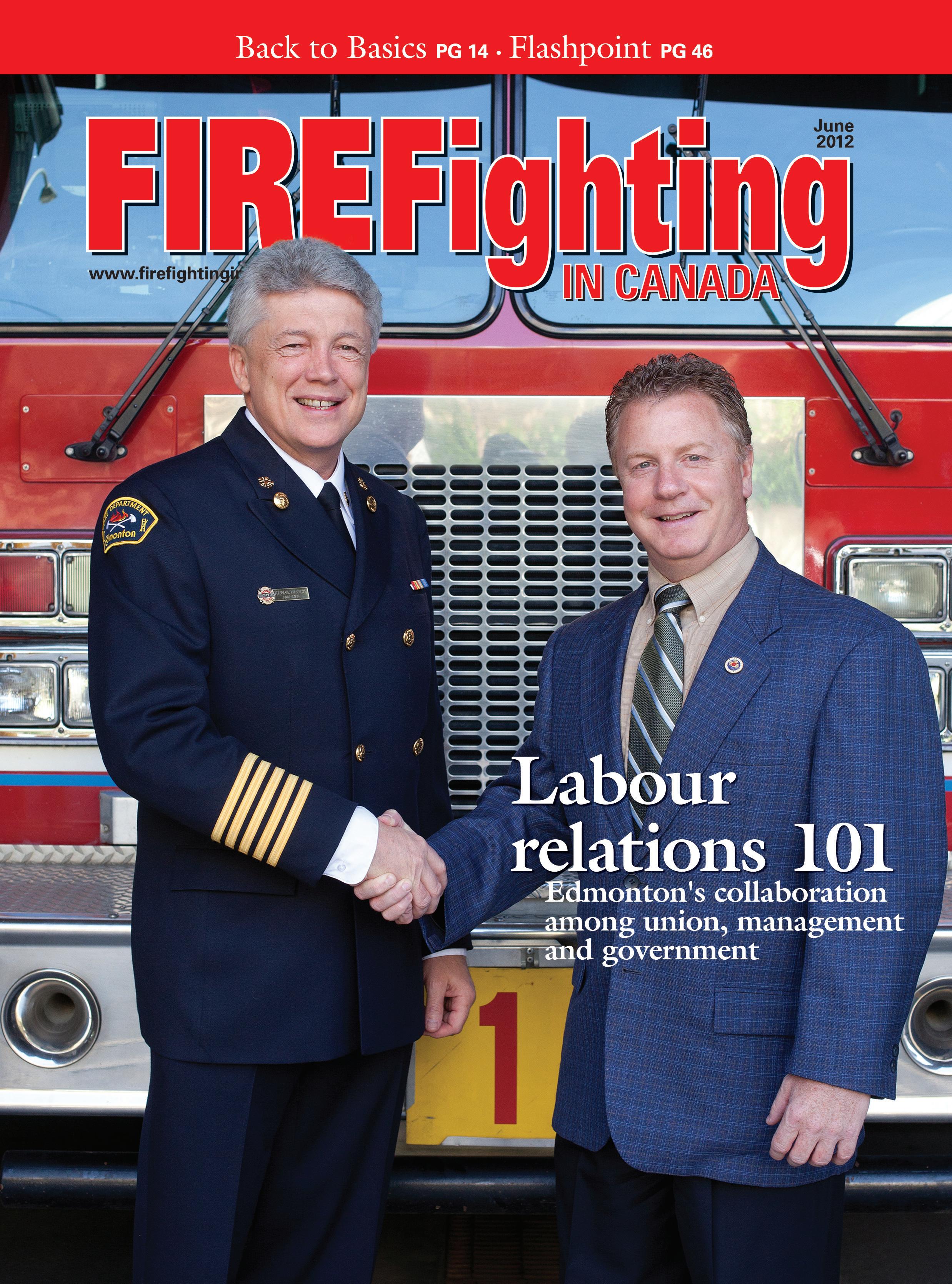
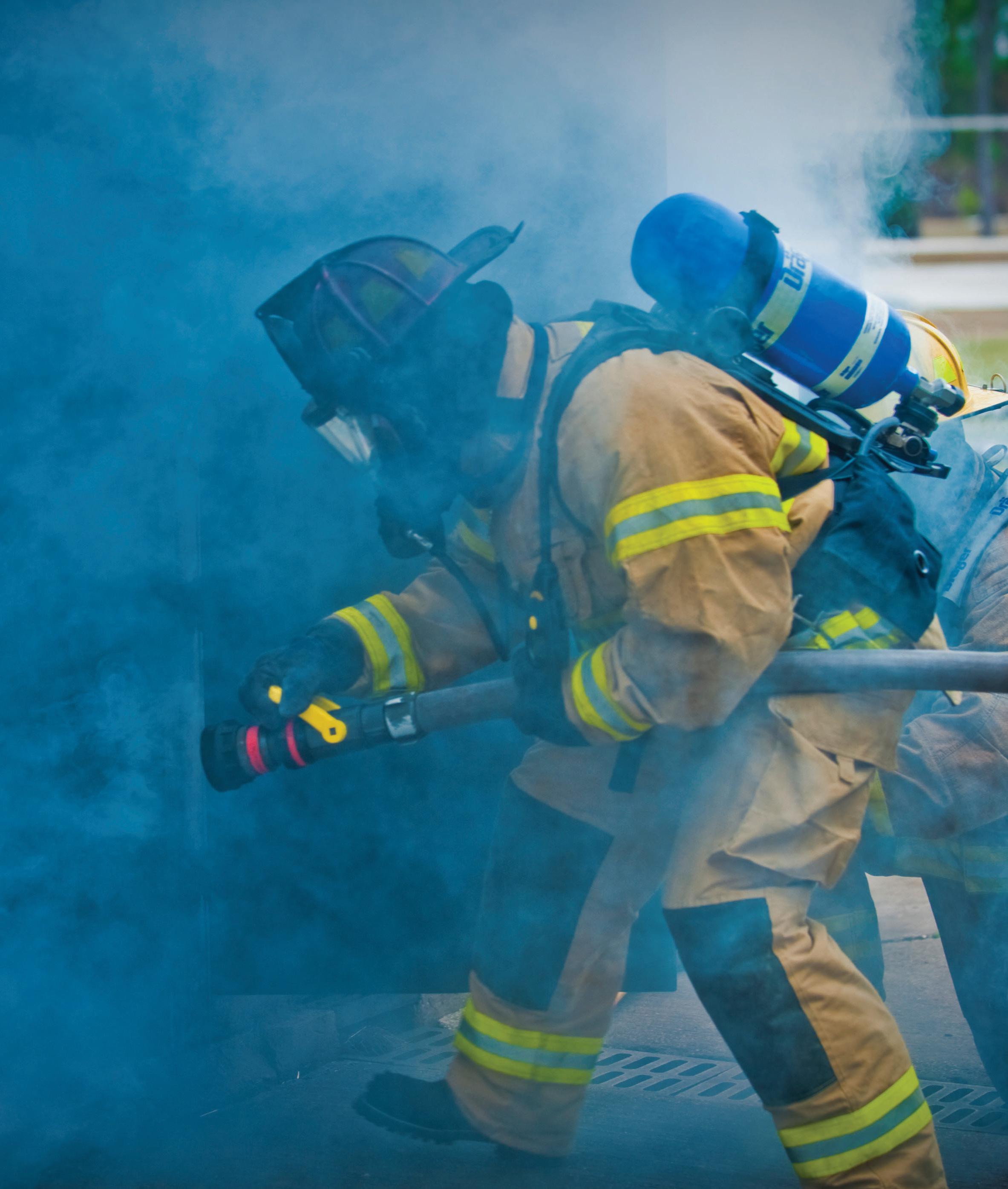
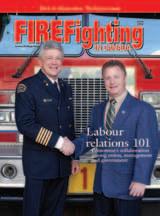
Labour relations in Canadian fire departments are iffy at best. But as Jay Shaw and Laura King report, in Edmonton, management and the union are working together with government to achieve goals.
27 WIND-DRIVEN WILDFIRE
As weather expert Dr. Ed Brotak explains, an unusual mix of wind, warmth and topography drove the wildfire that devastated Slave Lake in May 2011.
30 COMMUNICATION BREAKDOWN
Radio-system failures during the Slave Lake fire storm have forced agencies to rethink the way they talk to each other.
By Stefan Dubowski
SAFE AT hOME
As Surrey Fire Chief Len Garis and a team of researchers reports, spreading the fire-safety message door to door in at-risk neighbourhoods has reduced the number of incidents: In other words, the legwork has paid off.
By L AURA K ING Editor lking@annexweb.com
t Listen, hear and learn comment
wo topics for this issue.
First, labour relations. I was disappointed when a trusted advisor told me recently that an executive member of a firefighters association had referred to Fire Fighting in Canada as “your” magazine, “your” being fire chiefs and fireservice management.
While I like to think of our magazines as publications for the entire fire service, FFIC certainly has a leadership bent, while our brother publication, Canadian Firefighter, is geared more toward the rank and file.
Still, that conversation stuck in my craw and with this month’s cover story about labour relations in Edmonton, I hope we’re starting a journey to what some may see as better coverage of the fire service as a whole rather than the us or them of unionmanagement relations.
more efficiently and effectively than when they’re butting heads.
Where have you heard that before?
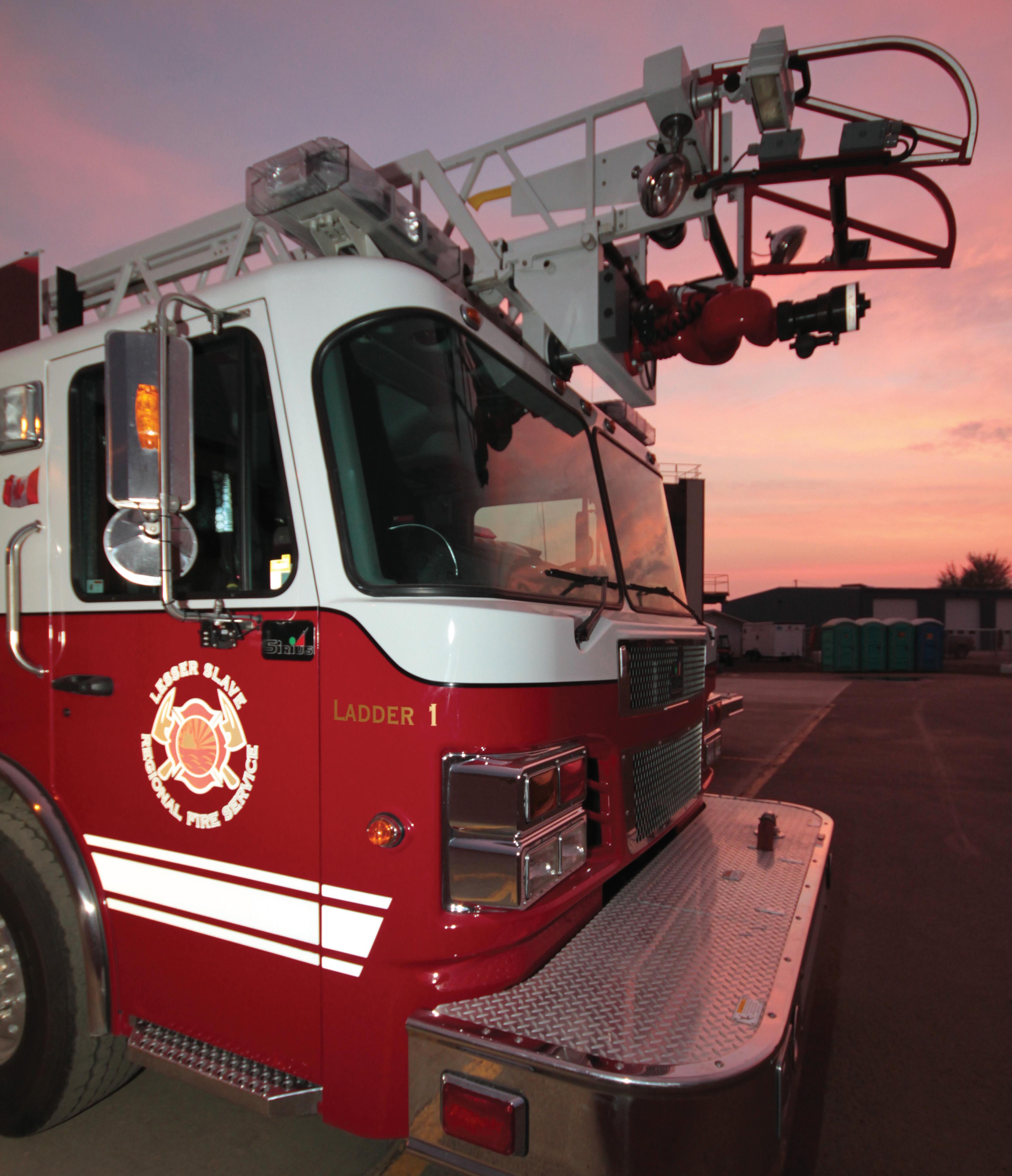
Secondly, Slave Lake. By the time you read this Jamie Coutts will have given his presentation at FDIC Atlantic in Wolfville, N.S. (June 1-3) on the wildfire that devastated his town.
ON ThE COVER
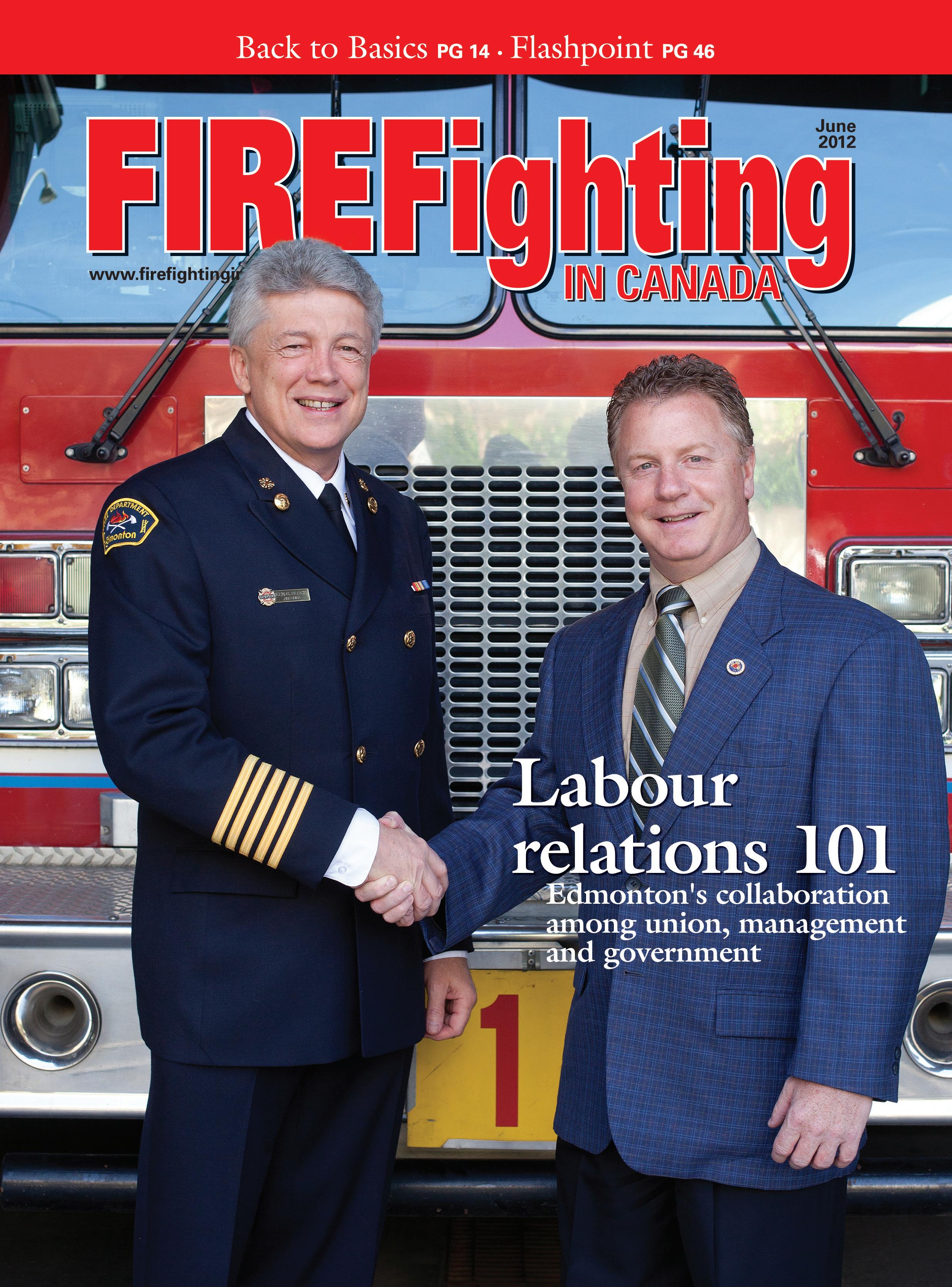
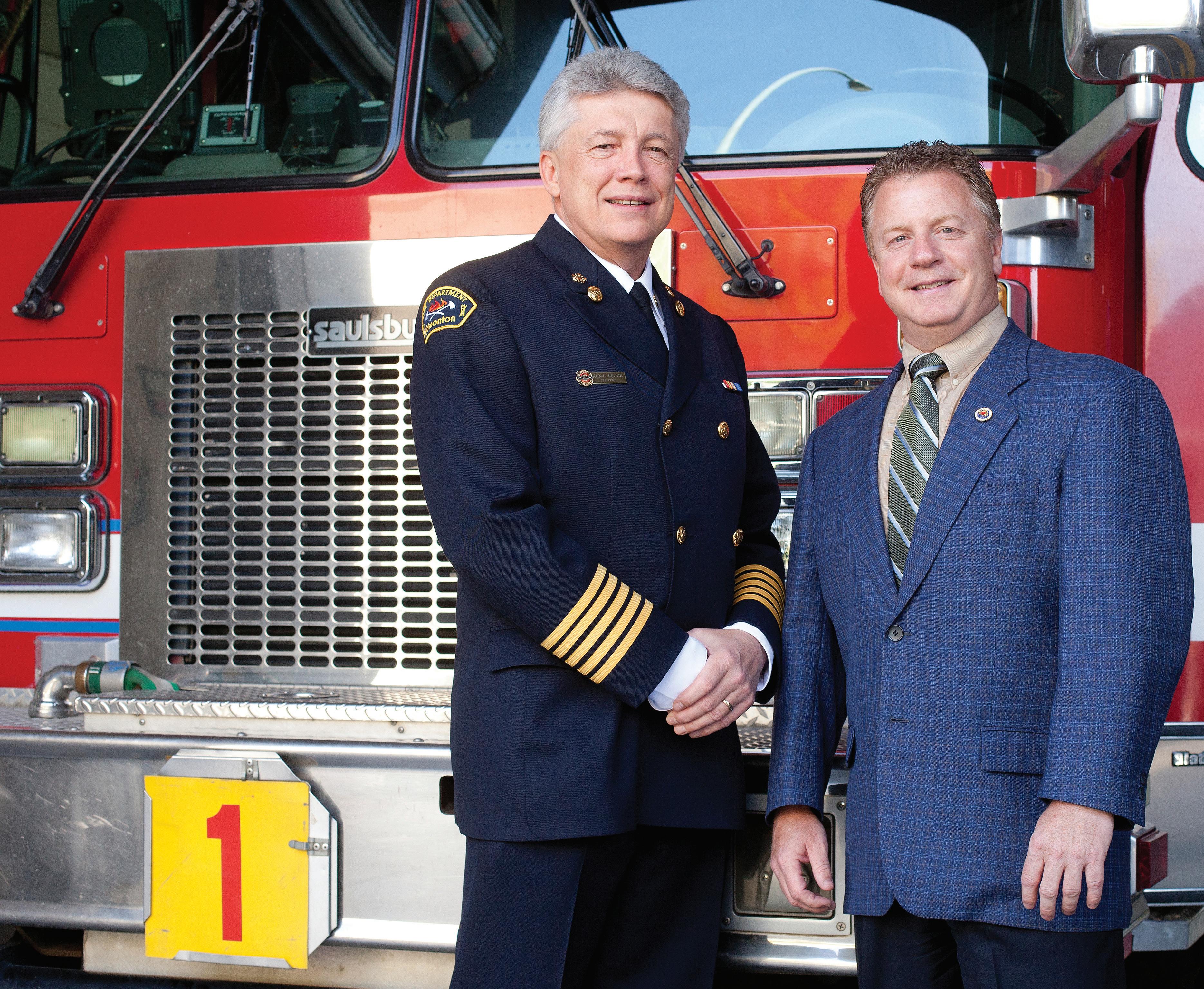
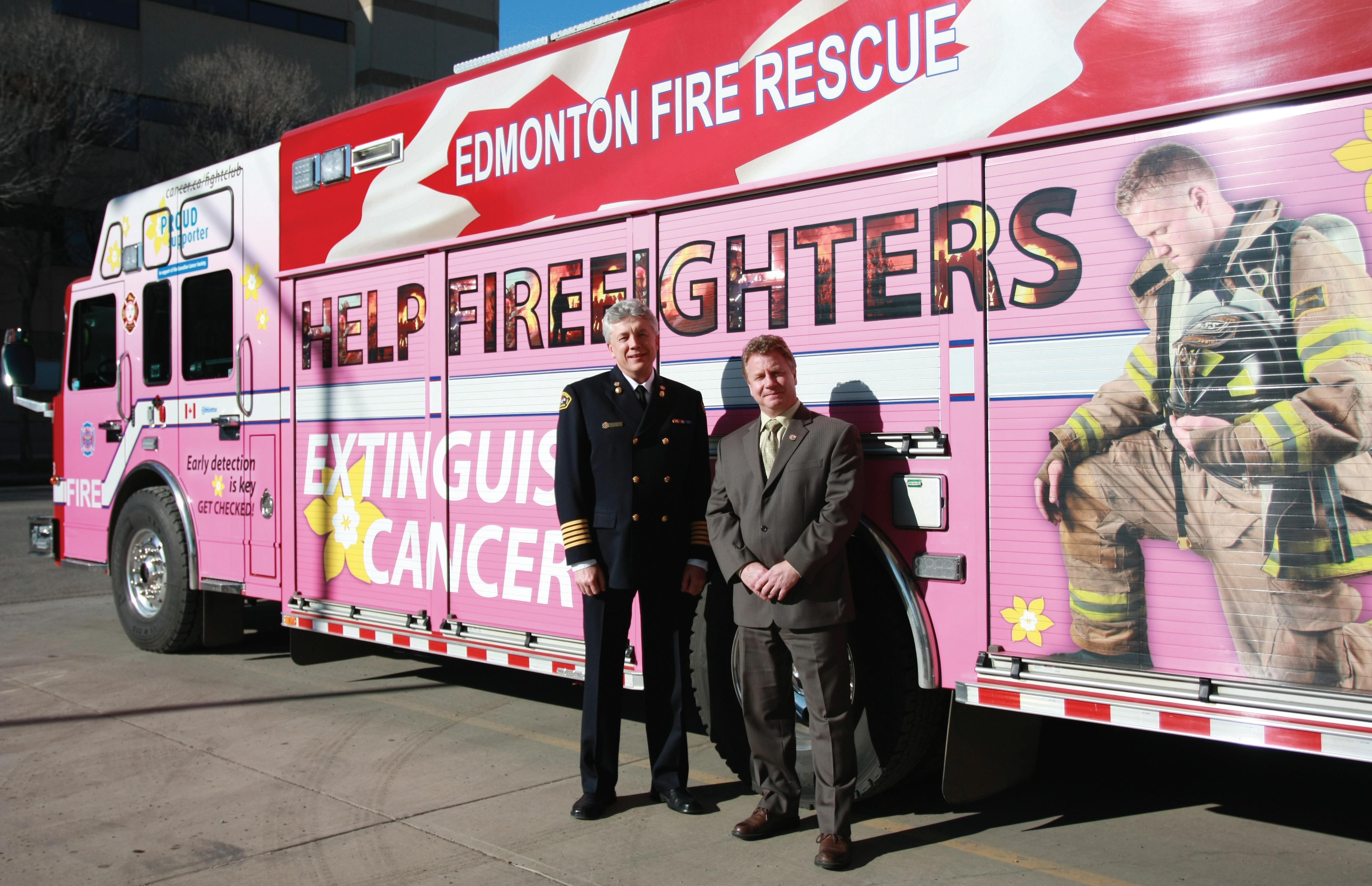
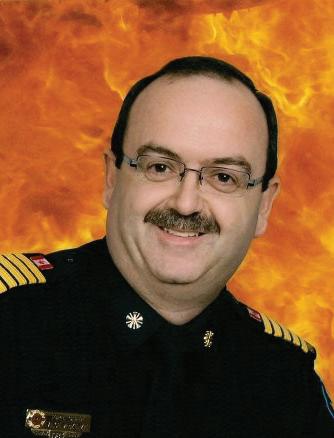
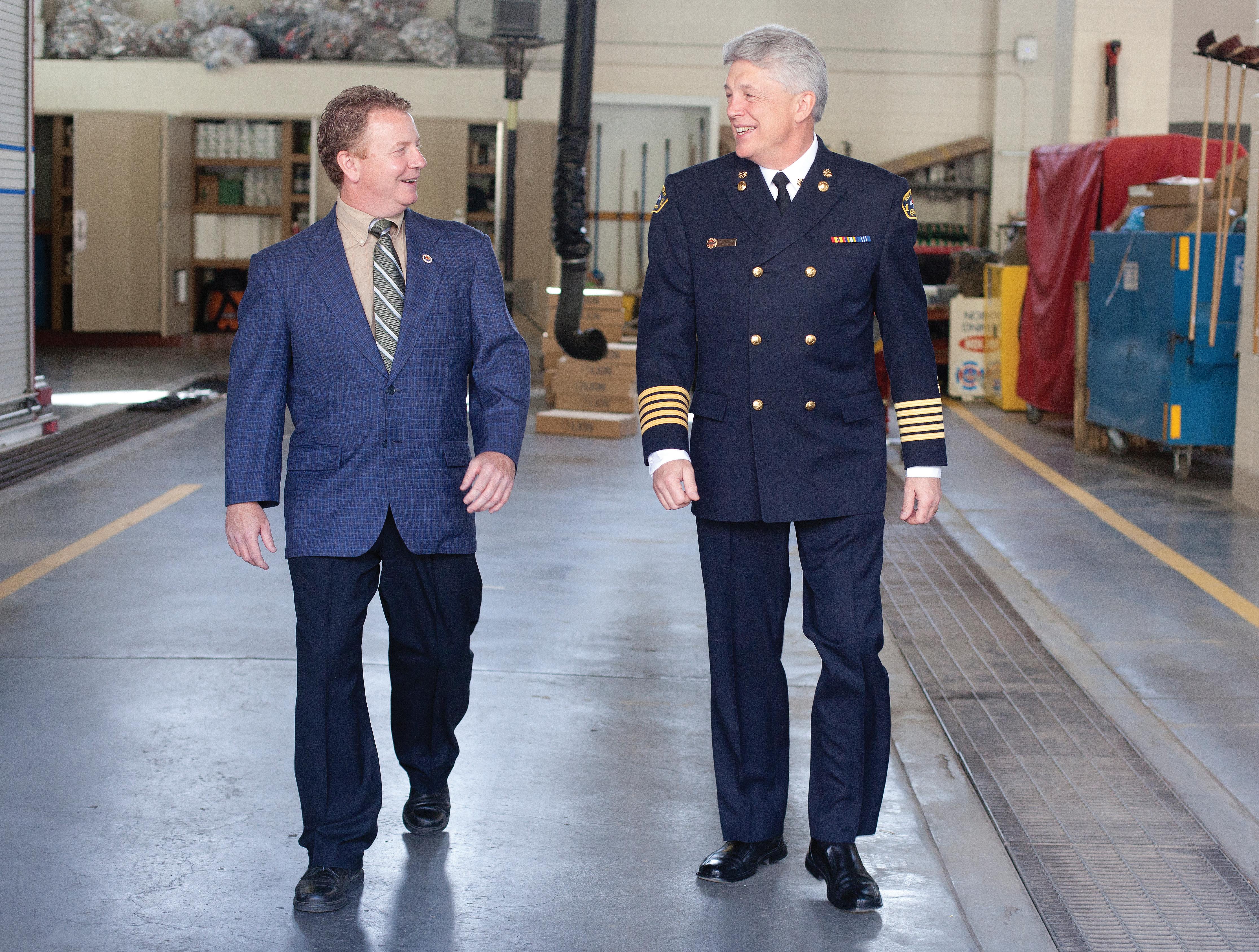
Edmonton Fire Chief Ken Block and union president Greg Holubowich have forged a positive, productive partnership. See story page 10.
Sure, many of our columns about leadership focus on things chief officers should consider to ensure healthy environments in their departments, but that advice is relevant to every firefighter in every department in Canada: communicate, listen, build partnerships, lead by example and play nicely with others.
Our feature stories on fire-service issues – mandatory retirement, the 24-hour shift, cancer, recruitment and retention, hoarding, liability and accountability, regionalization – are must-reads for all firefighters. If you’re not interested in these issues, you’re not interested in getting ahead.
So, as writer Jay Shaw says in Labour Relations 101 on page 10, it’s time to get along, because together unions and management can affect positive change much
I heard the presentation at the Ontario Association of Fire Chiefs conference in May and was riveted, even though I’d interviewed Coutts and we had run a cover story on the fire in July 2011.
The chief’s quiet humour and down-toearth approach was apparent when I spoke with him last June, just weeks after the fire; firefighters in Wolfville are (were) in for the lesson of a lifetime.
Chief Coutts’ tale of his 15-year-old son driving a 4x4 all over town to deliver supplies (everyone else was gone) and his 12-year-old daughter making loads of sandwiches and then sobbing when a batch of 150 disappeared in minutes are the people stories that will be remembered long after houses are rebuilt and equipment replaced.
Still, there are countless lessons to be learned from Chief Coutts’ presentation and the ongoing study of the May 2011 wildfire. Our story on page 27 looks at the weather behind the wildfire – the wind, the warmth and the unique mix of meteorological phenomena that conspired to wreak such havoc. A second feature story, on page 30, looks at radio communication during the fire and what various agencies are doing to make sure everyone is better prepared next time. Because there will be a next time.
PRESIDENT MIKE FREDERICKS mfredericks@annexweb.com
PuBLICATIOn MAIL AGREEMEnT #40065710 RETuRn unDELIvERABLE CAnADIAn ADDRESSES TO CIRCuLATIOn DEPT.
P.O. Box 530, SIMCOE, On n3Y 4n5
e-mail: subscribe@firefightingincanada.com
Printed in Canada ISSn 0015–2595
CIRCULATION
e-mail: subscribe@firefightingincanada.com
Tel: 866-790-6070 ext. 206
Fax: 877-624-1940
Mail: P.O. Box 530 Simcoe, On n3Y 4n5
SUBSCRIPTION RATES
Canada – 1 Year - $24.00
(with GST $25.20, with HST/QST $27.12) (GST - #867172652RT0001)
uSA – 1 Year $40.00 uSD
We acknowledge the financial support of the Government of Canada through the Canada Periodical Fund (CPF) for our publishing activities.
Occasionally, Fire Fighting in Canada will mail information on behalf of industry-related groups whose products and services we believe may be of interest to you. If you prefer not to receive this information, please contact our circulation department in any of the four ways listed above.
All advertising is subject to the publisher’s approval. Such approval does not imply any endorsement of the products or services advertised. Publisher reserves the right to refuse advertising that does not meet the standards of the publication. www.firefightingincanada.com
Photo by Jason Franson
statIontostatIon
across canada: Regional news briefs
Ladders Up fundraiser exceeds expectations
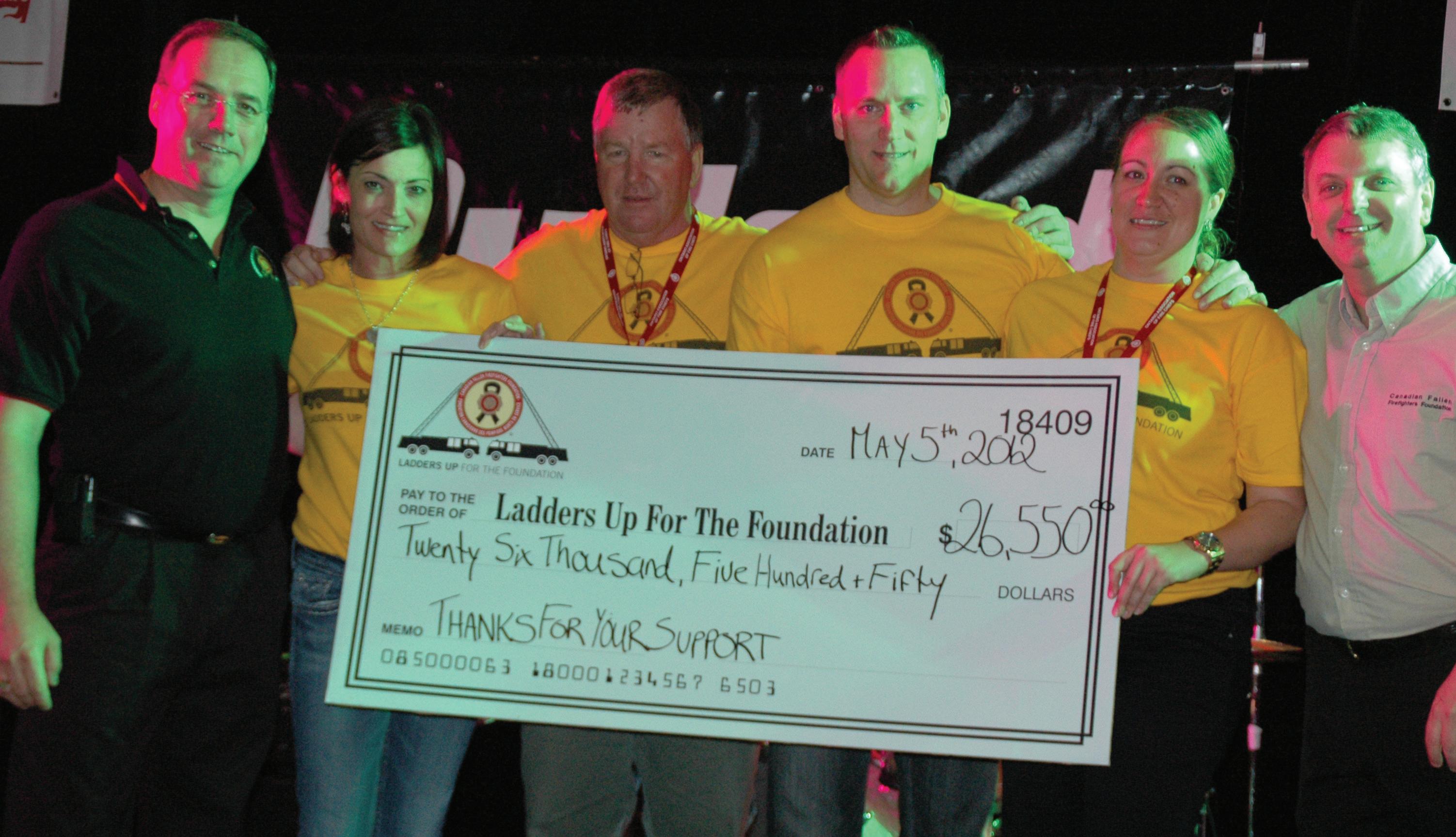
The inaugural Ladders Up for the Foundation fundraiser exceeded the expectations of organizers, participants and the Canadian Fallen Firefighters Foundation, raising $26,550 and ensuring a repeat performance and a bigger and better event next year.
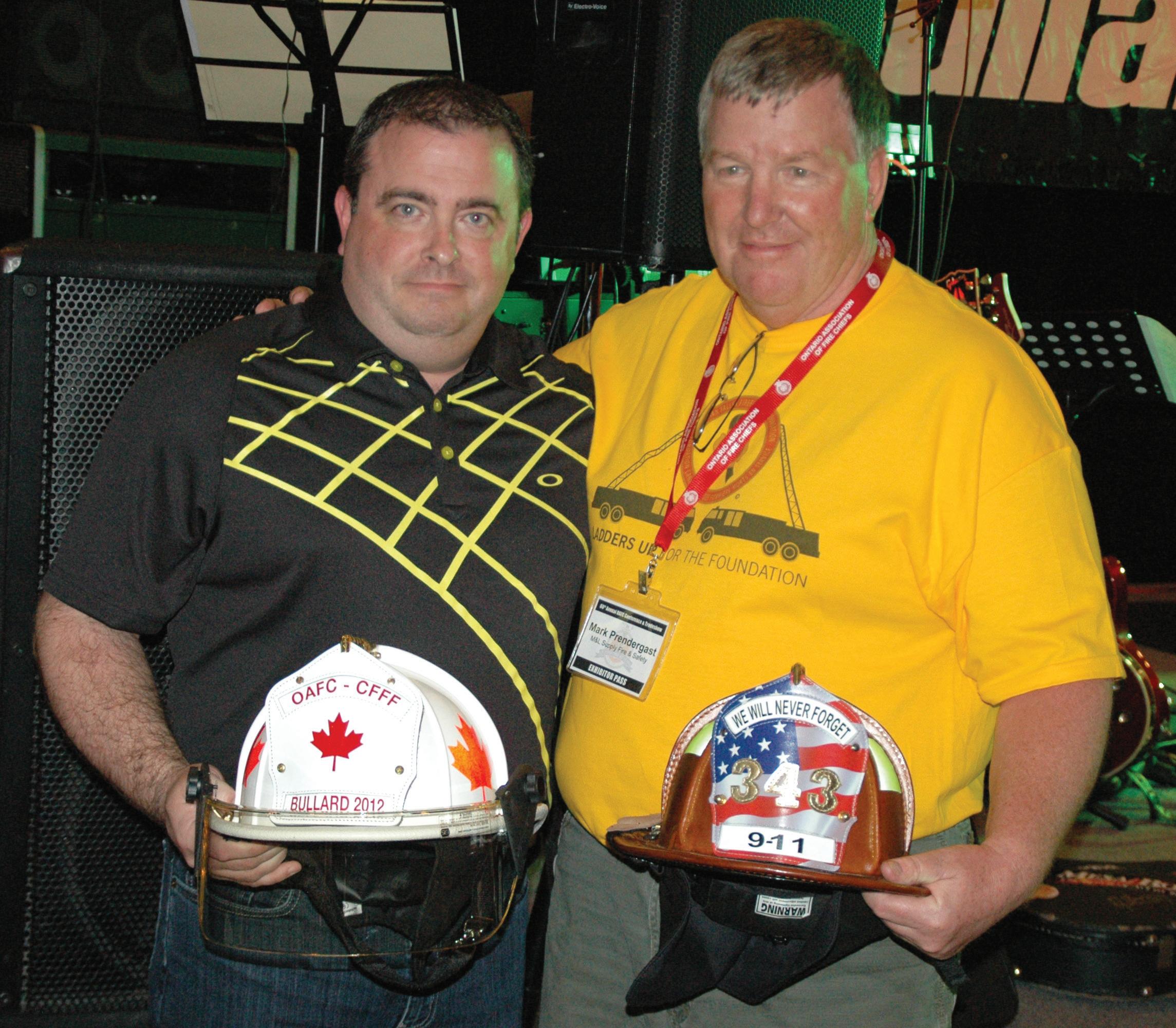
The idea for Ladders Up started in Indianapolis in 2011. Mark Prendergast, president of M&L Supply, successfully bid on a commemorative 9-11 helmet, which instantly became the talk of Canadians at the conference. That night, at an event called Stop, Drop, Rock & Roll, a fundraiser for the National Fallen Firefighters Foundation in the United States, Mark thought about doing a similar event in Canada.
A committee was formed that included Barry Malmsten and Mercedes Foulon with the Ontario Association of Fire Chiefs (OAFC), Fire Fighting in Canada sales manager Catherine Connolly,
David Sheen with Toronto Fire Services and Ontario chairman for the CFFF, Kip Cosgrove with VFIS, and, of course, Mark. The group worked tirelessly for months to bring the event to fruition.
The first part of the fundraiser featured an online auction in which fire departments bid on donated items such as thermal imagers, bunker gear, hose kits and training packages. The silent auction raised $23,000 and bidders snagged some new equipment and training at great prices.
The gala event on Saturday, May 5 in Toronto (in conjunction with the OAFC conference) was also a huge success. Raffle tickets sold out, boosting the total amount raised to $26,550. The 250 participants enjoyed live music courtesy of Better Under Fire, hors d’oeuvres, a cash bar, and great company.
A portion of the proceeds raised will go toward the final the payments for the CFFF memorial in Ottawa, which is expected to be completed
the brass pole
promotions & appointments
TREVOR BAIN has been appointed assistant deputy fire marshal/executive officer. He has more than 26 years of experience in the Ontario public service, having served with the Ontario Provincial Police and more than 17 years with the Ontario Office of the Fire Marshal. Previously, Bain was acting assistant deputy fire marshal for the fire protection services.
SHAyNE MINTZ has been appointed assistant deputy fire marshal for the fire protection services with the Ontario Office
in the next few months. Remaining proceeds will go into a trust intended to pay for post-secondary education of the children of Canada’s fallen firefighters.
Visit http://www.cfff.ca/ EN/donations.html to donate to this worthy cause.
– Olivia D’Orazio
of the Fire Marshal. He has more than 20 years of experience in senior management roles in north York, Toronto, and Markham. Mintz was most recently the fire chief for the City of Burlington Fire Department.
DOUGLAS TENNANT is the new fire chief in Peterborough, Ont. He has more than 30 years of experience in the fire service and emergency management.
ABOVE: The inaugural Ladders Up for the Foundation raised $26,550 for the CFFF. Pictured are committee members David Sheen with Toronto Fire Service, FFIC sales manager Catherine Connolly, M&L Supply president Mark Prendergast, VFIS Canadian regional manager Kip Cosgrove, the OAFC’s Mercedes Foulon and CFFF president Robert Kirkpatrick.
LEFT: Troy Mulch, vice-president of the Canadian Volunteer Fire Services Association and the winning bidder on the commemorative OAFC-CFFF helmet at Ladders Up, and Ladders Up founder Mark Prendergast, president of M&L Supply, with the 9-11 helmet that he bought at Stop, Drop, Rock & Roll in 2011 in Indianapolis.
Previously, Tennant was deputy chief for the City of Cambridge, Ont., a position he held since 2005.
HUGH MURRAy is the acting fire chief for Oro-Medonte Township in Ontario. Murray is the deputy chief for the district.
last alarm
CLARENCE STEELE, retired fire chief of the Mara Township volunteer Fire Department,
Photos by Laura King LADDERS UP FOR THE FOUNDATION
Quinte West spreads fire-prevention message with Spyder
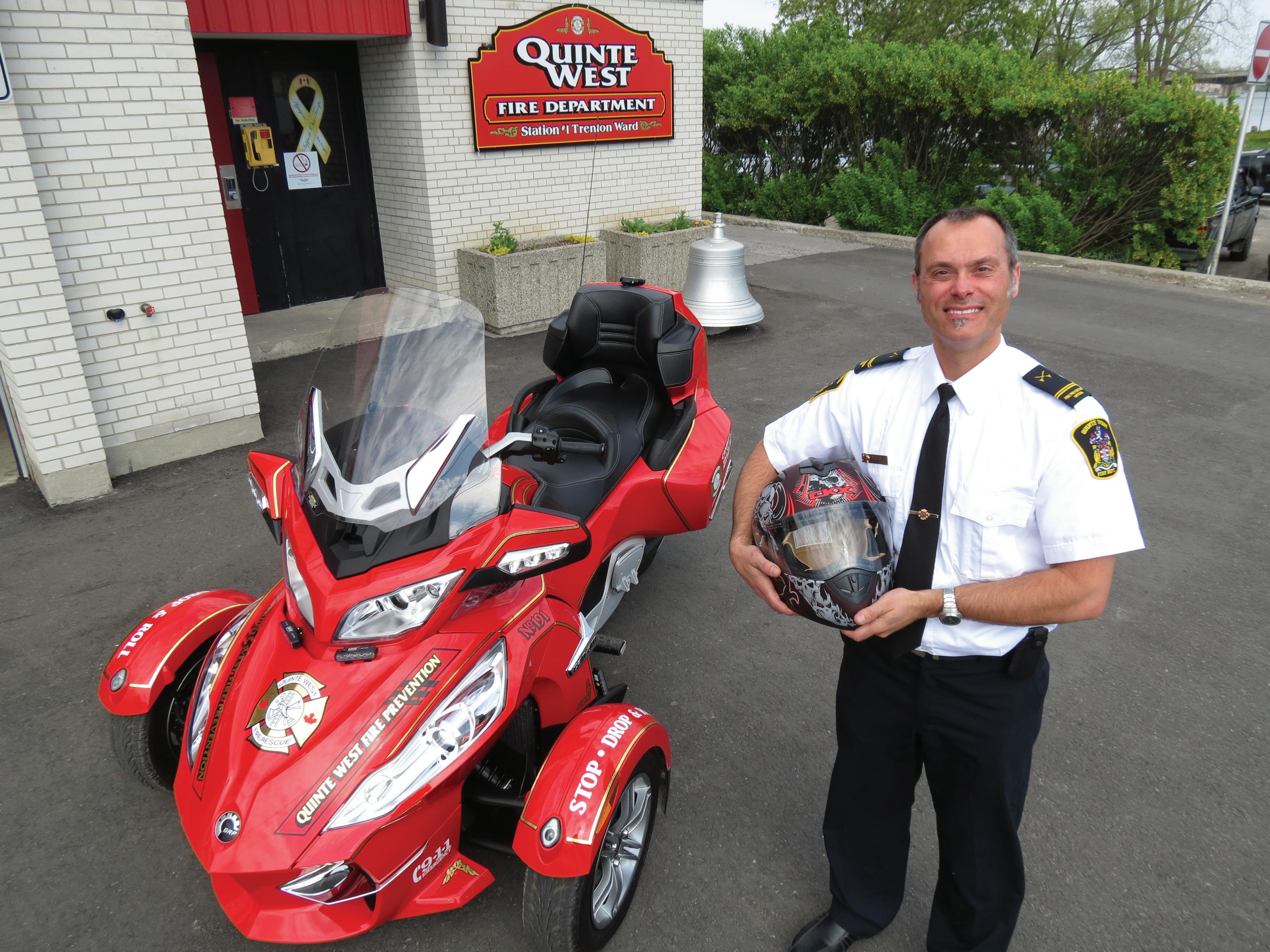
The Quinte West Fire Department in Ontario is spreading its fire-prevention message with a new Bombardier Spyder motorcycle.
A volunteer firefighter with the department works at Bombardier and asked the company if the department could borrow the bike, which retails for about $32,000. On Friday, April 13, the department took delivery of the motorcycle, which it will keep, free of charge, for one year.
Fire prevention officer Robert Comeau said the department will integrate the bike into its safety message.
“We’ll use it for public education for fire prevention,” he said. “It will be a vehicle to use and go into the town and go to events.”
Comeau says that, as far as he knows, his department is the only one to have access to
the impressive bike; the threewheeler, which also features the department’s crest and other fire-prevention decals, has a 998cc BRP-Rotax V-twin engine, with an automatic fivespeed transmission.
“I’m a motorcycle fan,” Comeau says, “and it’s like, wow. It’s a one-of-a-kind ride.”
Comeau says the department will use the bike as an entry point into the fire-prevention conversation – people will stop to admire the bike, and stay for the lesson in fire prevention. Already, the motorcycle is serving its purpose.
“I’ve been to events already and people love [the bike],” Comeau says. “They come by and look at the bike, and then you just bring the fire-prevention message into the conversation – are you checking your fire alarms, are you doing fire drills with your
kids. . . ?”
The motorcycle is getting a great response from adults, too.
“We’ve got Sparky for the kids, and the bike for the big boys,” Comeau laughs.
Quinte West’s Bombardier
Spyder was at the Ontario Association of Fire Chiefs Conference in Toronto in early May, where motorcycle enthusiasts flocked to catch a glimpse.
– Olivia D’Orazio
Bible Hill Fire Brigade recognizes outstanding contributions
The Bible Hill Fire Brigade in Nova Scotia held its annual awards banquet on Saturday, April 21, recognizing several members for outstanding service and accomplishments in 2011.
Voted on by the officers of the brigade, firefighter David Pearston was awarded firefighter of the year for his involvement as a truck lieuten-
ant and for his leadership on the fire-prevention committee. Firefighter Alex Johnson was the recipient of the Merle Newson training award for his commitment to training activities.
Firefighter Bob Gay received the long-service medal, awarded by the fire marshal, celebrating his 25 years in the fire service, while Deputy Fire
Chief Leo Van Kroonenburg was voted fire officer of the year by members of the brigade, and retired firefighter Paul Hanaham received the Arnold Crowe active honorary member award for his ongoing support of brigade activities.
The Bible Hill Fire Brigade, formed in 1946, provides emergency service to the 5,000 residents of the Village of Bible
Hill. The brigade’s coverage district includes the Nova Scotia Agricultural College campus as well as a number of commercial facilities. The brigade is an active member of the Colchester County Firefighter Association and works closely with surrounding communities in a mutual-aid role.
died nov. 18 at the age of 92.
TOM O’GRADy, active volunteer firefighter for more than 20 years in Cannington, Ont., died Dec. 1. He was a member of the board of directors of the Fire Fighters Association of Ontario.
DANIEL BOTKIN, 29, a volunteer firefighter in Enderby, B.C., died in the line of duty on Dec. 29. He joined the fire department six years ago and had recently been promoted to
captain and training officer.
Retired fire chief ROBERT LANDRy died Jan. 25 at the age of 64. He was fire chief in Moosonee, Ont., then Millbrook, Ont., and finally Callander, Ont., where he retired in 2004.
LANNy CARTHER died Jan. 27 at the age of 65. He joined the Thamesville/Camden Fire Department in Ontario in 1968; he was chief of the Chatham-Kent
Fire Station no. 8, Thamesville when he passed away.
JOHN BLACK died Apr. 27 at the age of 50, following a brave battle with cancer. After a 24-year career with the Gravenhurst Fire Department in Ontario, Black left the station in 2009 to become fire chief of the north Huron Fire Department.
RICH MORRIS died May 4 at the age of 82. Morris was a champion of life safety and a
trailblazer who brought smoke alarms to Canada.
Retired fire chief TOPH MARTIN died May 3 after 38 years of dedicated service. He began his career in 1956 as a member of the Fergus Fire Department in Ontario, where he was promoted to fire chef in 1985.
PETE CZULINSKI died May 3 after a courageous battle with cancer. The Toronto firefighter was just 45 years old.
– Olivia D’Orazio
Fire prevention officer Robert Comeau with the new Bombardier Spyder, which was donated to the Quinte West Fire Department.
Photo by r yan Mc n aught
statIontostatIon
br I gade news: From stations across Canada
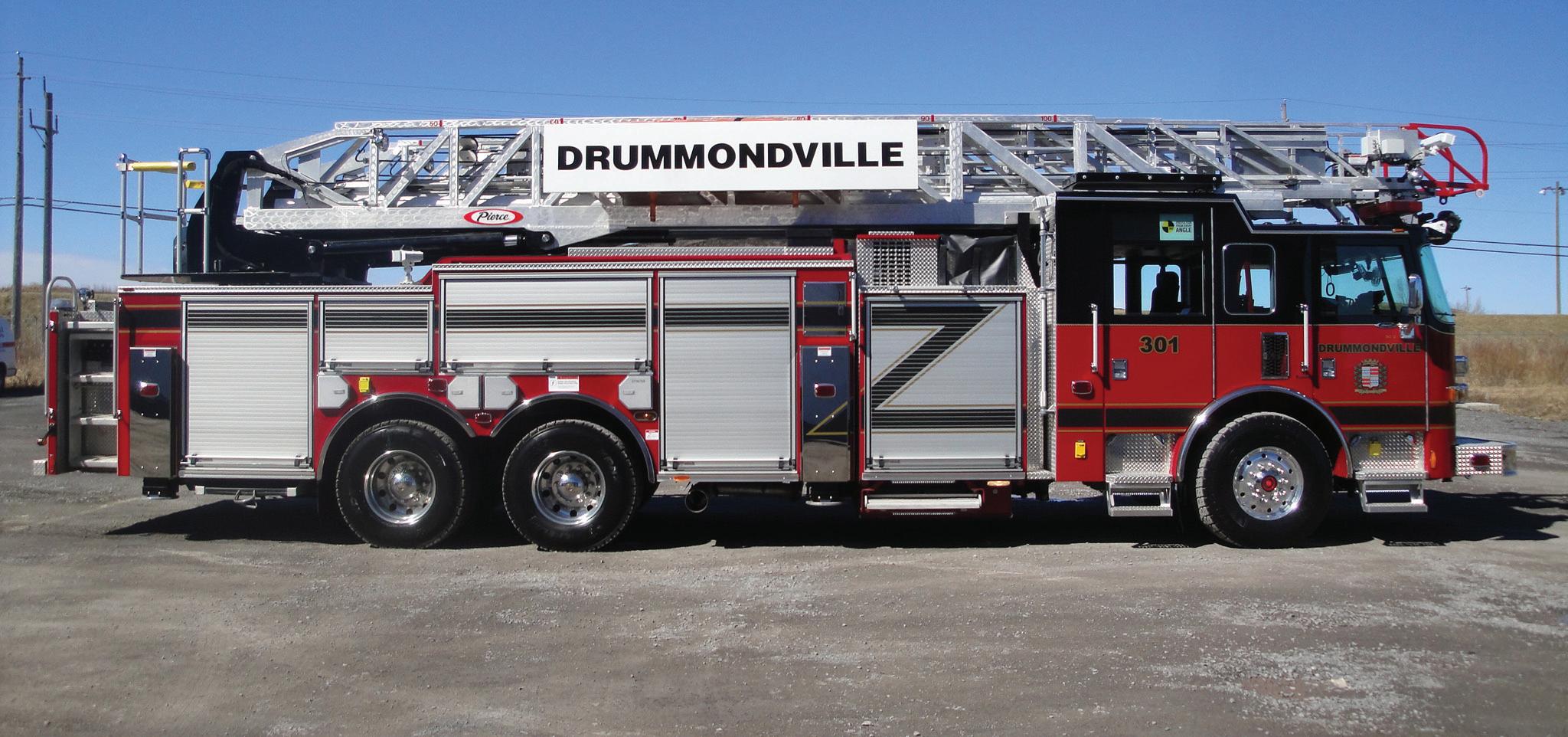
SERVICE DE SéCURITé INCENDIE DE DRUMMONDVILLE in Quebec, under Chief Georges Gagnon, took delivery in April from L’arsenal and Thibault & Associates of a Pierce Manufacturing-built aerial. Built on an Arrow-XT chassis and powered by an Allison 4000 EVS transmission and a 500-hp DD13 engine, the truck is equipped with a 1,750 IGPM pump, 430 IG UPF water tank, 100-foot HAL aluminum ladder, Pierce Command Zone and back-up camera.
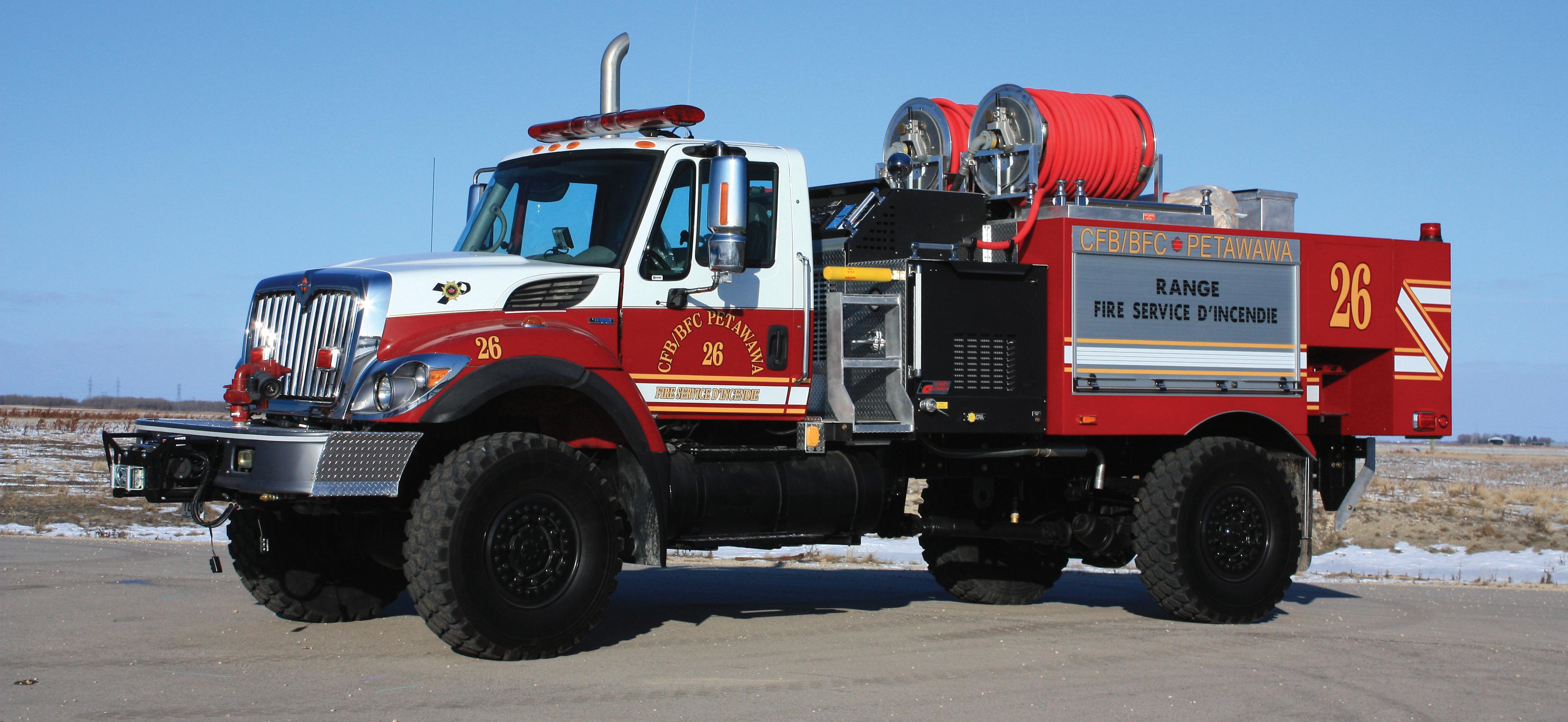
CFB PETAWAWA in Ontario, under deputy Chief Garry Clement, took delivery in March of a Fort Garry Fire Trucks-built range fire fighting vehicle. Built on an International 7400 4X4 chassis and powered by an Allison 3000 EVS transmission and a MaxxForce 9 330-hp engine, the truck is equipped with a Waterous CPD-2 pump, 1,000-IG CoreTen steel water tank, Waterous Aquis 1.5 foam system, F.S. LED light package, Federal Signal 3 backup cameras, Waterous Crossmount CAFS with Perkins 60-hp engine and a Warn M12,000 winch.
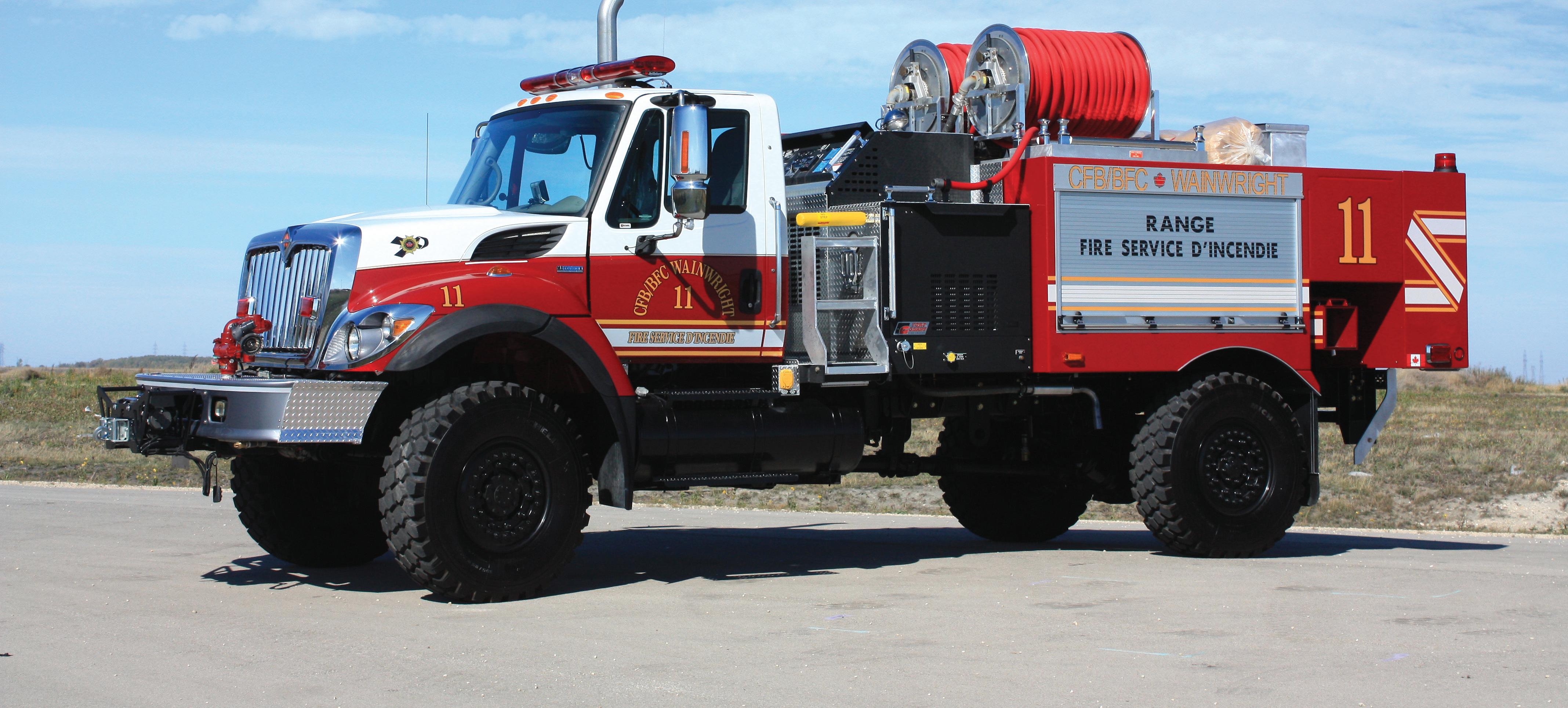
CFB WAINWRIGHT in Alberta, under Chief Frank Thibaudeau, took delivery in October of a Fort Garry Fire Trucks-built range fire fighting vehicle. Built on an International 7400 4x4 chassis and powered by an Allison 3000 EVS transmission and a MaxxForce 9 330-hp engine, the truck is equipped with a Waterous CPD-2 pump, 1,000-IG CoreTen steel water tank, Waterous Aquis 1.5 foam system, F.S. LED light package, Federal Signal 3 backup cameras, Waterous Crossmount CAFS with Perkins 60-hp engine and a Warn M12,000 winch.
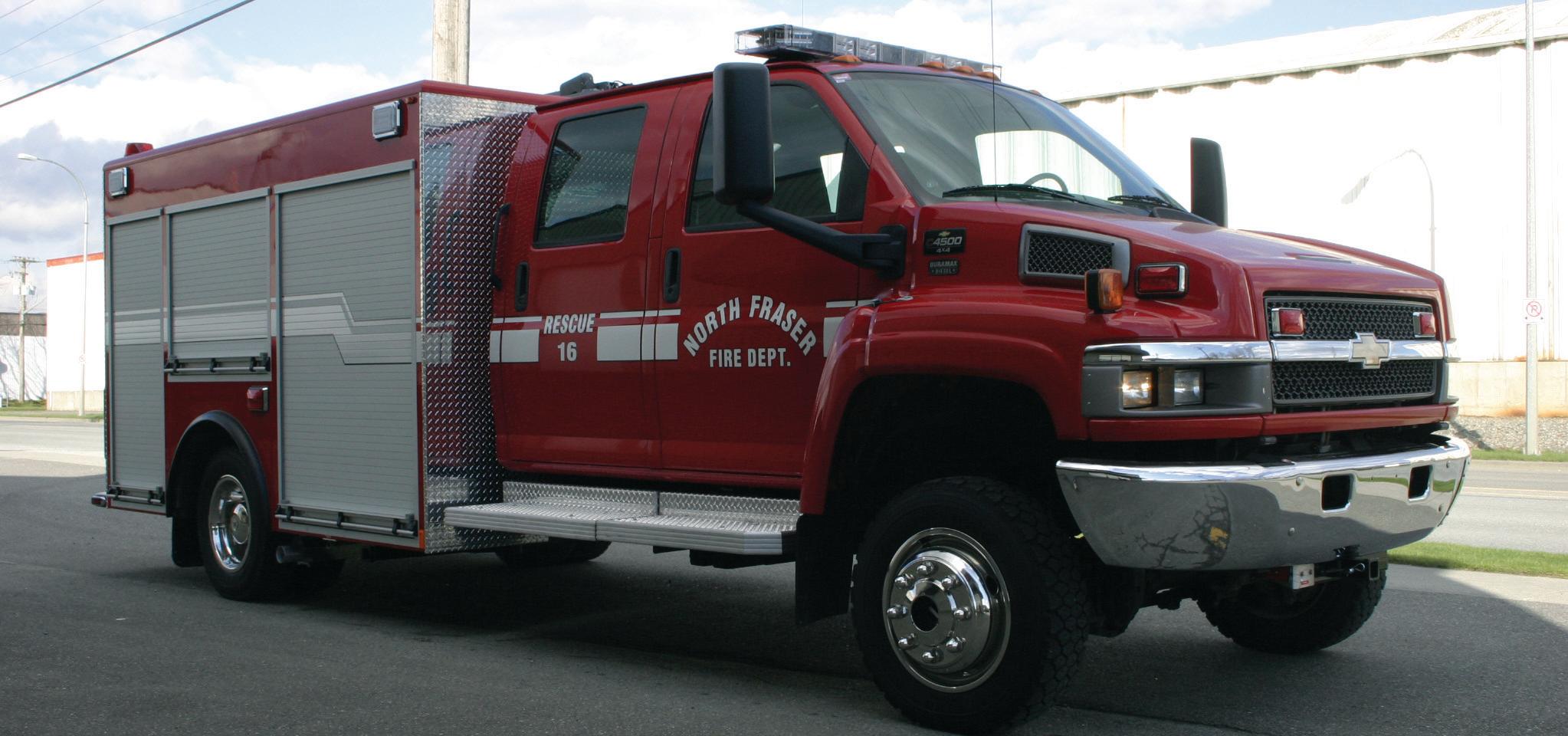
The NORTH FRASER FIRE DEPARTMENT in British Columbia, under Chief Curtis Stevens, took delivery in April of a Hub Fire Engines & Equipment-built rescue unit. Built on a Chevrolet C4500 4x4 chassis and powered by a Duramax Diesel engine, the truck is equipped with ROM roll-up doors, a Whelen light package, Warn M8000 portable winch, Honda EU3000 generator and a Command light tower.
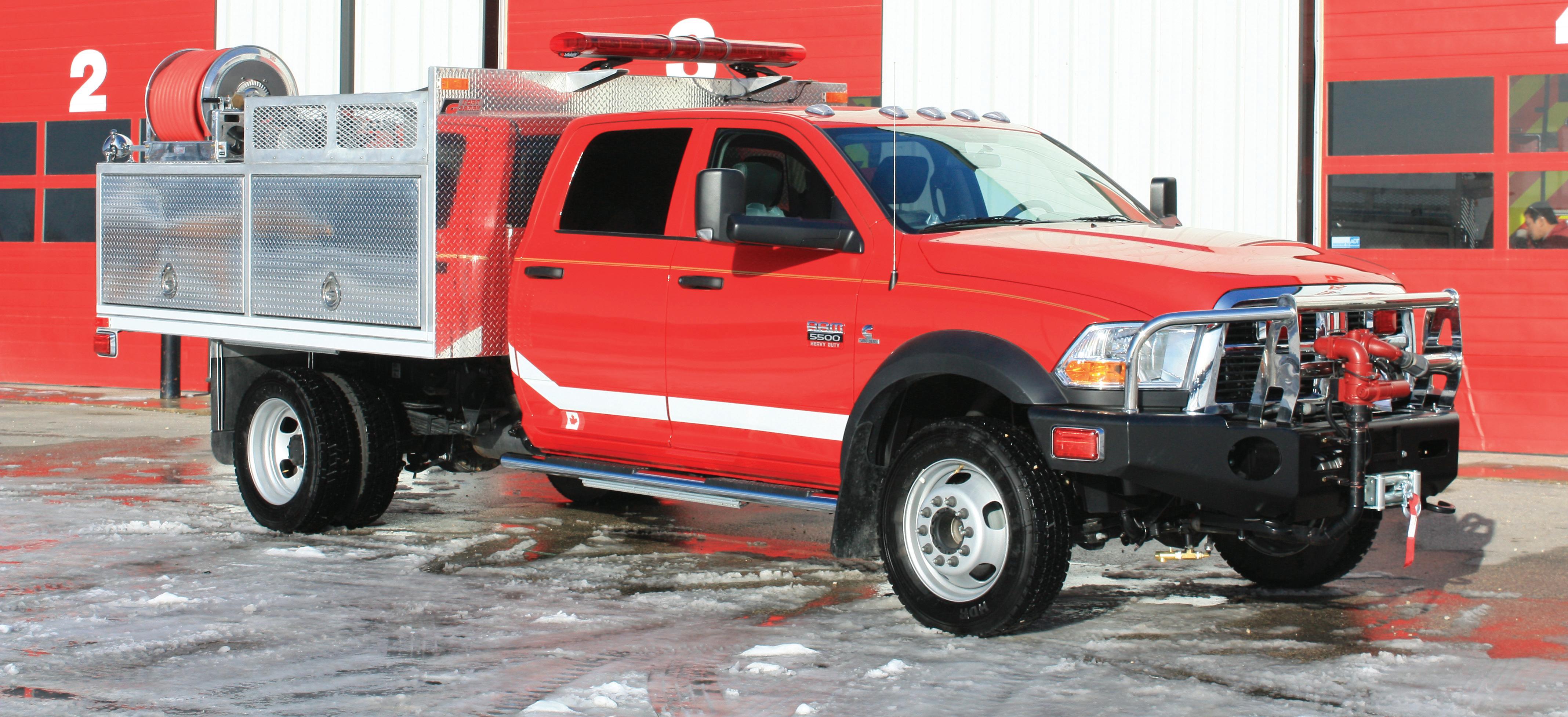
The Government of Saskatchewan FIRE MANAGEMENT & FOREST PROTECTION BRANCH in Prince Albert took delivery in January of a Fort Garry Fire Trucks-built wildland unit. Built on a Dodge 5500 chassis and powered by an Asin AS68R automatic chassis and powered by a Cummins ISB 305-hp engine, the truck is equipped with a Darley Portable HP 18-hp pump, Darley Fast Foam 50 system and Chemguard 3000 high expansion foam generator, Federal Signal Smart Siren LED lights, Warn M12 winch and a Fire Fox bumper turret.
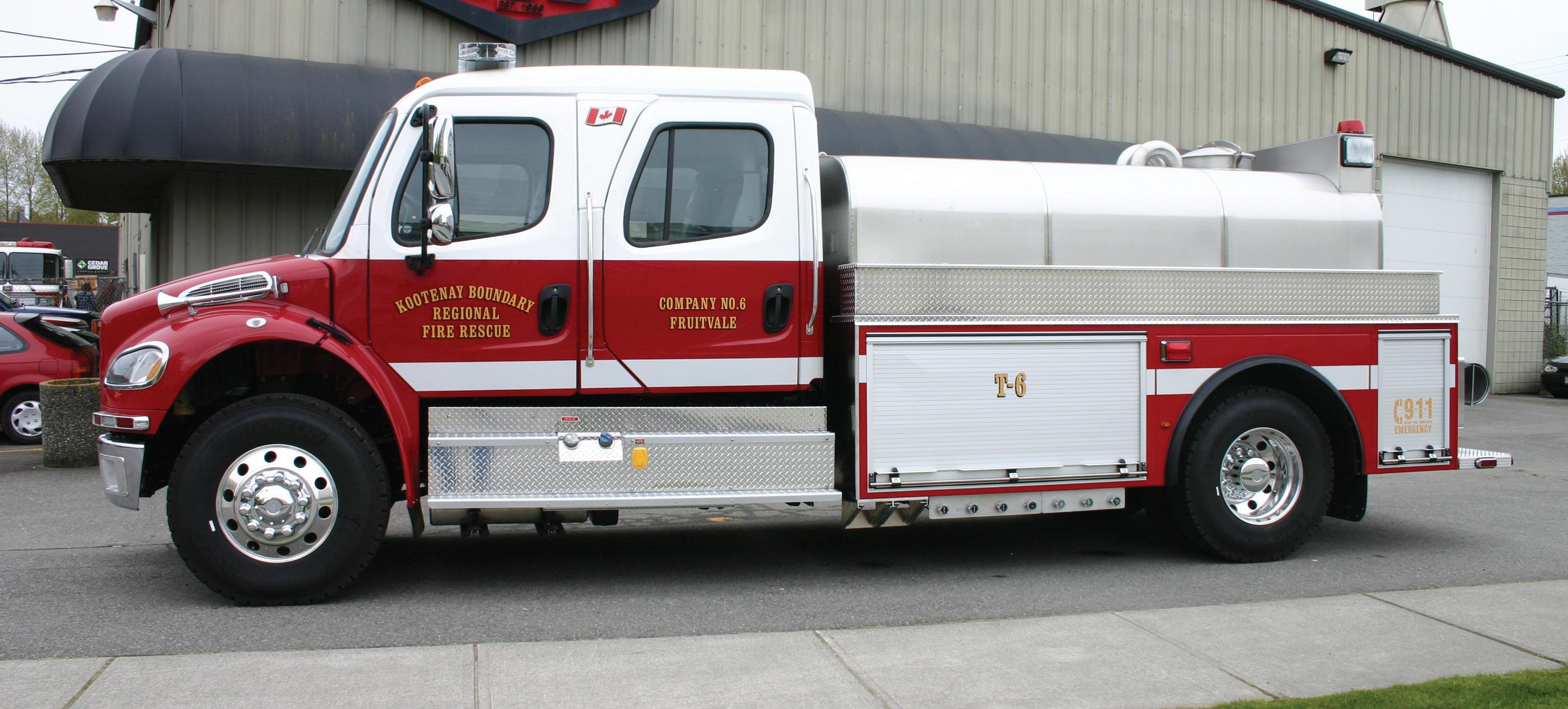
KOOTENAy BOUNDARy REGIONAL FIRE RESCUE, located in Fruitvale, B.C., under Chief Terry Martin, took delivery in May of a Hub Fire Engines & Equipment-built tanker. Built on a Freightliner M2 chassis and powered by an Allison 3000 EVS transmission and a Cummins ISC 350-hp engine, the tanker is equipped with a Hale AP50 420-IGPM pump, 1,50- IG stainless steel water tank, Whelen light package, GO power inverter, custom porta-tank storage and an E J Metals swiveling dump valve.
SERVICE DE SéCURITé INCENDIE DE DRUMMONDVILLE
CFB PETAWAWA
NORTH FRASER FIRE DEPARTMENT
CFB WAINWRIGHT
GOVERNMENT OF SASKATCHEWAN FIRE MANAGEMENT
KOOTENAy BOUNDARy REGIONAL FIRE RESCUE
labour relations
101
How Edmonton transformed a toxic relationship into a productive collaboration among management, the union and government
By Jay SHaw and Laura King
Respect/Trust/Honesty Collaboration
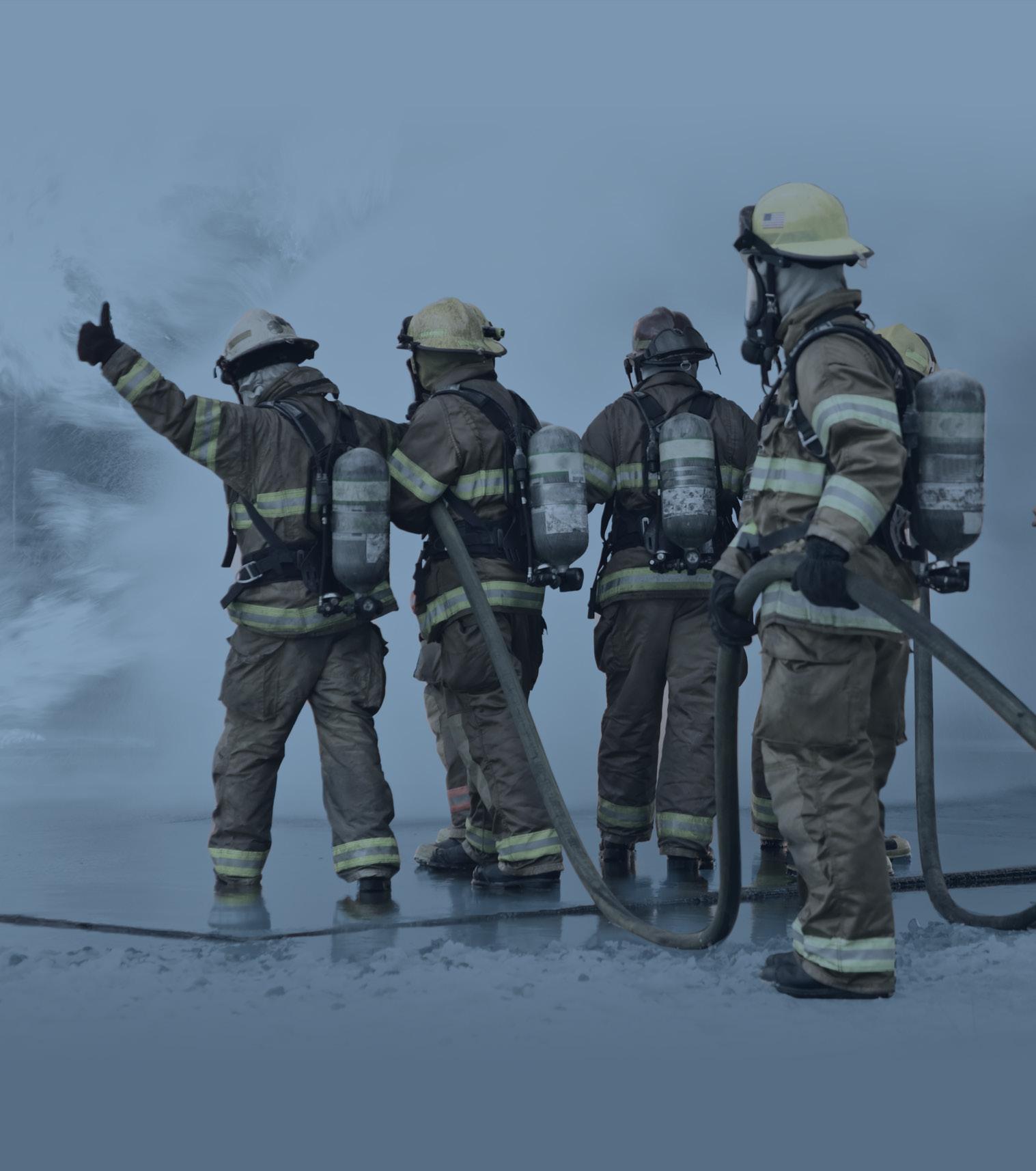
labour relations in Canada’s fire departments are iffy at best.
In Corner Brook, N.L., the union secured a whopping 16 per cent raise in a three-year contract in February. The next day, the city laid off four firefighters.
In Brandon, Man., union president Wade Ritchie was suspended, demoted, fired and re-hired between January and May. Fire Chief Brent Dane – a former union president – announced a settlement of all issues before the Manitoba Labour Board in mid-May, on the same day he was to testify at an arbitration hearing into unfair labour practices.
In Ajax, Ont., the 24-hour shift has divided labour and management, and departments are watching for the outcome of an arbitration hearing on the issue.
Chiefs in many departments feel embattled as municipal councils trim fire budgets and firefighter associations press for wages, gear, training and benefits.
All this strife flies in the face of the healthy and robust labour-management relationship in Edmonton, where Fire Chief Ken Block – also a former union president – and Edmonton Fire Fighters Union (EFFU) president Greg Holubowich have built a strong, harmonious partnership based on trust and common goals.
“In Edmonton we lived the worst-case scenario from 1987 to 2001, when union and administration were at war,” Block says. “There was no trust, no respect, and each had their own agendas. Our job was torn apart and the fire service suffered greatly. There was a lack of effective leadership on either side with much focus centred on undermining the other’s credibility.
From an outsider’s perspective, Edmonton’s union and fire-service administration have pioneered a friendly, new union-management ideology that leverages each other’s strengths to meet everyone’s needs and wants – a collaborative-management triangle, so to speak.
To complete the triangle, the third party – government, all levels – is a necessary and powerful partner that fire departments need to win over and, in some cases, support, in order to achieve their goals. Firefighter associations have become extremely adept at working with government. Harnessing this energy and political astuteness is a strategy that fire departments should embrace to further their agendas and move their initiatives forward. * * *
Chief Block was president of the Edmonton Fire Fighters Union from 2001 until 2007.
Holubowich, the current president, is a 21-year firefighter and has been involved with the union for 12 years, six as president. If there’s one lesson that’s clear from EFRS’s experience, it’s that unions and management understanding each other’s motivations is the most powerful tool departments can use to meet their needs, build new programs and resources, and work with government to affect policy change.
In the last decade, fire unions have evolved from local organizations into political machines capable of organizing, fundraising, marketing and mastering everything from boot drives to election campaigns. Some unions are so powerful they have become political entities themselves, delving into issues that are indirectly related to the fire service but crucially important to the political parties they support.
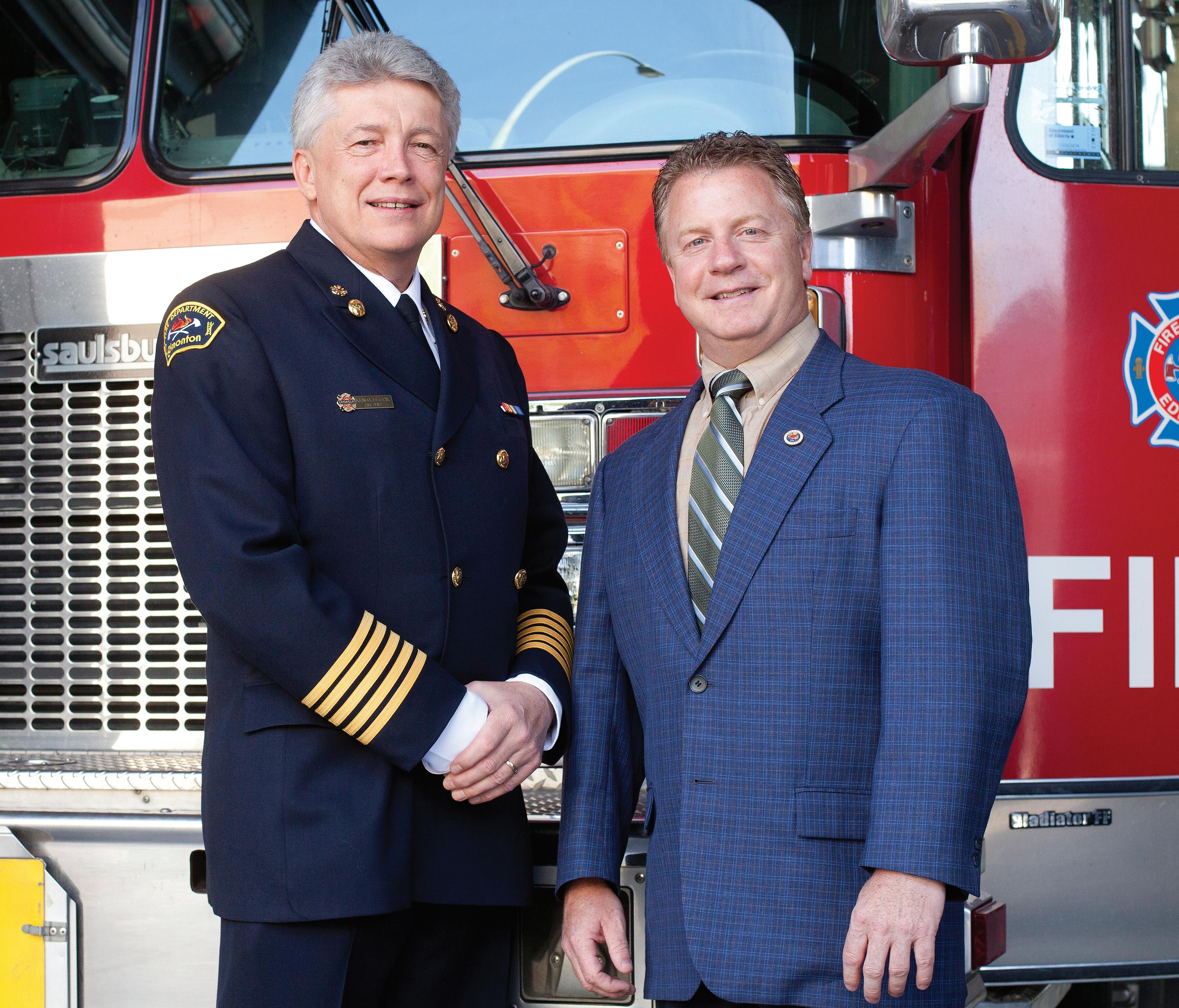
Edmonton Fire Chief Ken Block and association president Greg Holubowich have a longstanding co-operative relationship that has benefited all fire-service stakeholders. abo V e : Each side of the triangle represents a collaborative path among fire service administration, the union, and government. Each side must be seen as an equal partner. The relationships are tri-lateral, meaning each side can go to, or through, the other to achieve a desired outcome. Transparency is a must.
“We learned that in order to move forward we had to have credible people in place, identify areas where we could work together, and then build the trust and respect necessary with one another’s constituents to allow us to work together on common issues.”
The story of Edmonton Fire Rescue Service’s (EFRS) journey to labour-relations harmony is complex but the foundations are simple: co-operation, planning, communication, buy-in, and, essentially, consistently playing nicely with others.
The International Association of Firefighter (IAFF) declares on its website that “The goal of any politician, after having been elected, is to get reelected.” For politicians to do what they promise their constituents, they must remain in office. Lobbying for politicians and helping them win is a powerful tool; those who master this can effectively control, to a degree, the outcome of what used to be uncontrollable circumstances – things like fire-department funding, or legislation on everything from sprinklers to line of duty deaths. Fire unions have always dabbled in the political arena, but only recently have they learned to master the rules and control their destinies by choosing and supporting those who support their own ideologies. The mandate of
left:
Fire Administration Government
Stakeholder Benefit
Photo by J ason F ranson
the IAFF is to support those who support it.
There’s not enough space here to argue the ethics of these political relationships. Fire unions did not create this political process, but they have gained exceptional expertise in leveraging its power. Harnessing the energy and passion of politically active unions allows fire departments to work with government to create mutually beneficial initiatives for firefighters, management and taxpayers. Understanding your region’s political leanings is crucial. In Manitoba the collaborative-management triangle includes a strong working relationship with a conservative mayor and a left-of-centre premier. In Alberta, the triangle focuses on civic politicians, and in Ontario, the Liberal premier is the target of the union’s attention.
Chief Block cites a simple example of how the triangle works.
When Block stepped down as union president in 2007, the fire chief of the day was determined to win a budget increase for more fire-prevention officers. Holubowich – the new union president, and his executive – believed that additional firefighters to staff a new rescue truck were more important, and the union made its preference known to council.
“The result was not surprising,” Block says, “and in a very difficult budget year, council seized on the difference in priorities and didn’t fund either.”
That story, Block says, shows the importance of being transparent with labour, including the union executive in difficult discussions such as budget priorities, and making an effort to appreciate the union’s priorities and challenges.
“These discussions and information sharing are critical to progress being possible,” Block says.
As chief, Block says he reflects on his positive experiences as union president to acknowledge and use the power of the union.
“I absolutely view the position of union president to be an equivalent – albeit reporting to different stakeholders and constituents – to the position of the fire chief. Each has powers and abilities to influence key constituents that the other does not.
“Those differences, when used constructively, can be of great assistance to ensuring the success of both the union and the fire service and, conversely, those differences can be used to advance and entrench agendas that are destructive to both the union and the fire service.”
Block notes that after he became chief, one of the first things he and Holubowich agreed on was the need for more firefighters to staff a rescue truck.
“It will come as no surprise that council
Edmonton Fire Chief Ken Block started laying groundwork for a strong relationship with the firefighters association back when he was union president from 2001 through 2007. Today, Block and union president Greg Holubowich have a transparent and mutually beneficial working relationship.
heard clearly that both administration and union were aligned with this budget priority and the new funding for the additional 20 positions was approved,” Block says.
“The value of our administration and union working together cannot be overstated.”
* * *
When Block was first promoted to chief, he had seen enough negativity to last a lifetime and wanted to install a new system that defined how he would lead. The system included several initiatives – some new, some that had already been implemented.
“My first priority as the new fire chief in 2009 was to establish the principles or cornerstones of my administration,” Block says.
Those principles are public service, safety, public trust and support, and teamwork.
“Our principles were developed in conjunction with our union executive and my administration team,” Block says.
“It was imperative to our success that the principle officers of our bargaining unit, as well as my deputies, understood what each principle was about, and the thought process and rationale that was behind them. After some great conversations and input from all, the principles were accepted unanimously and we were able to roll them out to our Fire Rescue staff in all areas.”
Long before the four cornerstones were developed, Block, as union president, had worked with former Fire Chief Randy Wolsey on the creation of an EFRS master plan, which outlines the department’s goals.
“[Wolsey] believed that the days of a budget presentation that was based on anecdotal information to council having any
chance of success had passed,” Block said.
“What the fire service needed to assist building a proper business case for budget requests was a master plan outlining goals and objectives that were supported by performance measures consistent with recognized fire-service standards; these had to align with council’s strategic, long-range planning.”
The plan includes performance measures that serve as benchmarks for EFRS.
After Block became chief, EFRS went a step further and developed a program to achieve accreditation through the Center for Public Safety Excellence, Commission of Fire Accreditation International (CFAI). Essentially, the accreditation process is an independent audit of every aspect of operations.
“This process,” Block says, “validates that our master plan principles and objectives are based on legitimate, industryaccepted standards that are supported by our citizens, our elected officials, and by those incredible men and women who comprise our fire rescue service.”
On March 9, 2010, EFRS was recognized by CFAI and achieved full agency accreditation.
Another document that has helped union and management understand each other’s positions is the city’s working-relationship agreement with all civic unions.
“The WRA has been one of the foundations used in developing our labour-management relationship with EFRS administration,” Holubowich says. “This WRA sets
Continued on page 42
BACKtoBASICS
Highrise kit options for engine companies
By MARK VAN DER FEyST
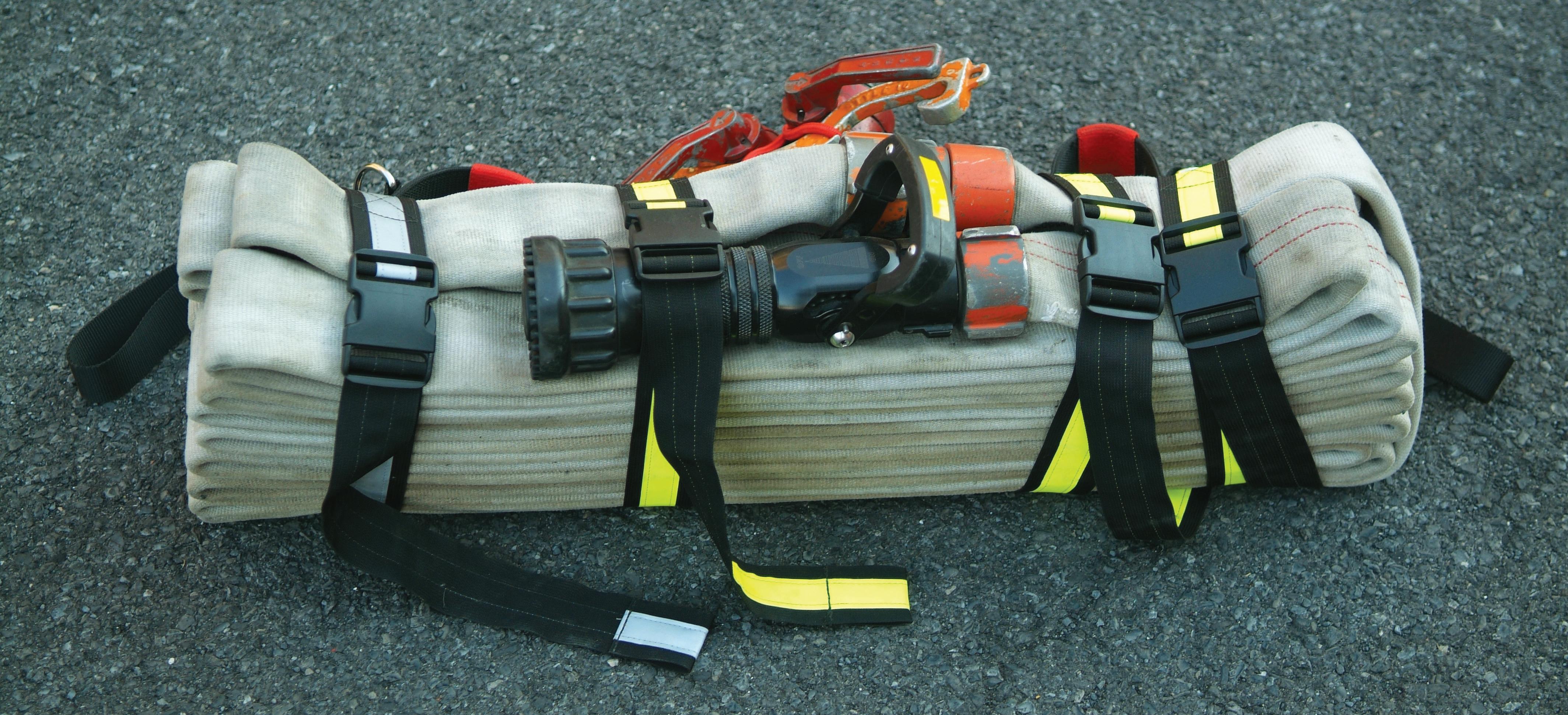
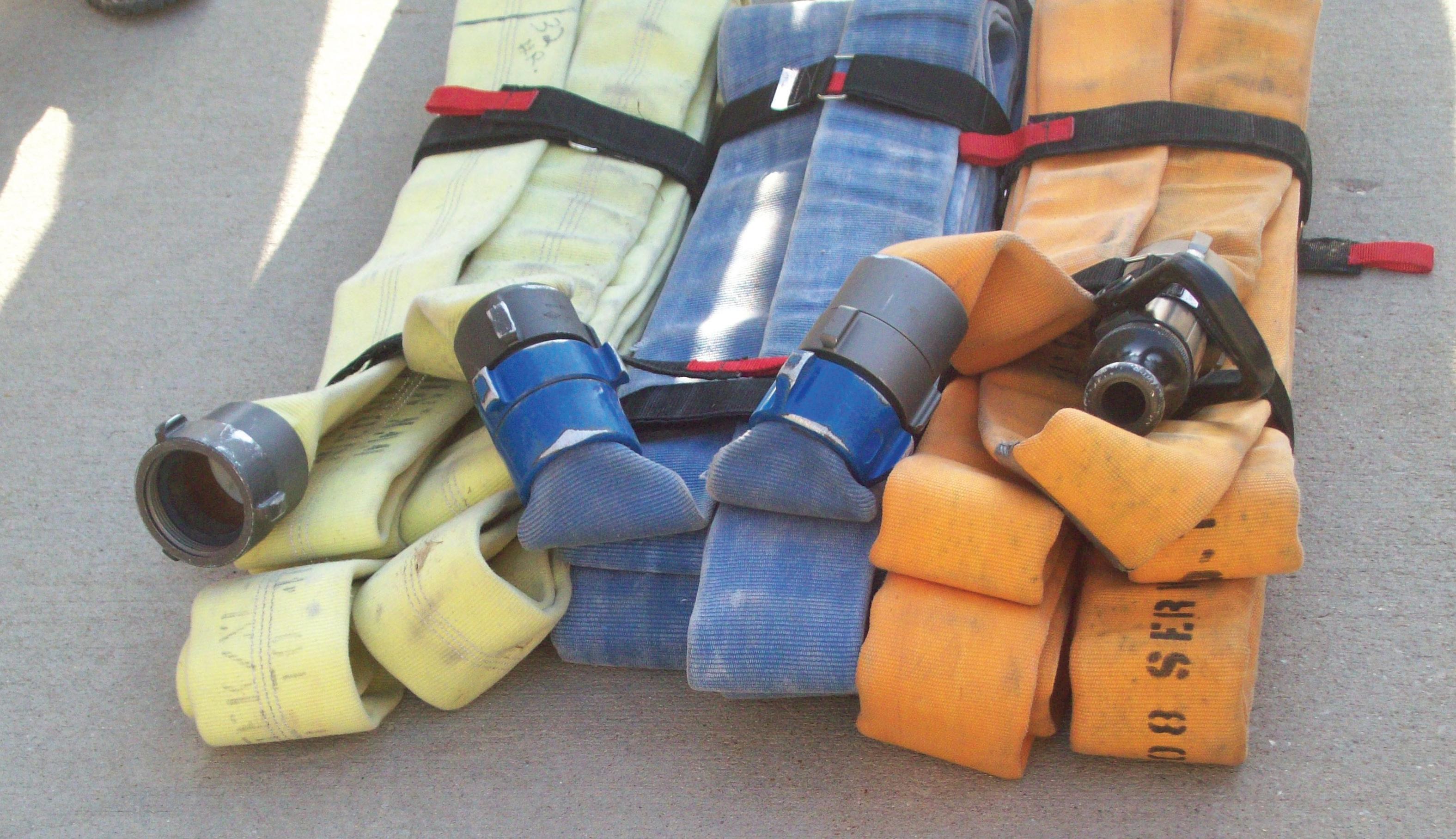
In April, my department in Woodstock, Ont., had its first highrise fire of the year. It was on the seventh floor and was contained to a single bedroom where a piece of furniture – an upholstered chair – was on fire and created some good heat in the room. We used our highrise kit as part of the attack. The kit consists of 100 feet of one-and-three-quarter-inch hose and a 10-foot length of two-and-ahalf-inch hose attached to a gated wye. The gated wye gets attached to the standpipe. After a quick knockdown, the fire was extinguished and overhaul operations began. Our highrise kit, shown in photo 1, is fairly basic. There are many configurations for highrise kits, based on factors such as manpower, water supply, the department’s operational procedures, types and sizes of fire usually encountered, and ease of operation.
Our highrise kit is typical. As mentioned, the gated wye gets attached to the standpipe, which allows a secondary attack line to be attached without interrupting operations. Some gated wyes have pressure gauges, which allow firefighters to verify the amount of pressure being supplied to the line at that point. If the highrise kit uses an automatic combination nozzle as seen on photo 1, it requires 700 kilopascals (kpa), or 100 pounds per square inch (psi), at the nozzle. If the kit uses a smooth-bore nozzle, then it requires 350 kpa or 50 psi at the nozzle. Having both types of nozzles allows for a choice based on water supply, the type of building, and manpower. The lower-pressure nozzle requires less water pressure and can be handled relatively easily by one firefighter. At least two firefighters are required to operate the higher-pressure nozzle at the correct pressure. There are some automatic combination nozzles that operate at 75 psi, or 525 kpa; the lower pressure helps the firefighter use the nozzle in a highrise application.
The highrise kit needs to be deployed in a manner that requires half of the hose length to be taken up the stairs from the hook-up floor to the fire floor, and then up one more flight of stairs, looped around the outside of the stairway and taken back down to the firefloor door. In this situation, one firefighter takes 50 feet of hose up and the other firefighter deploys the other 50 feet. All kinks must be removed to ensure that the line is completely charged at the correct pump pressure. Use of this basic type of kit can be time consuming and may not be the best option.
Another type of highrise kit is the Cleveland Load. In photo 2, the hose load is deployed, charged and ready for advancement. This type of load makes deployment easier, quicker and kink-free. The hose load is good for highrise applications as it allows a crew of two firefighters to tie into the standpipe, charge the line and then advance it to the fire floor. The key with this type of load is to make sure the load is pulled apart once on the floor, and to charge it first before advancing. If the hose is advanced before it is charged, it will not play out as intended. The hose load still has to be advanced up one flight to the fire floor; this will be the hardest part of using this type of load, because it needs to be pulled up the stairs and around corners
Photo 1: A typical highrise kit, which includes an automatic combination nozzle. Kit configuration can vary, depending on manpower, water supply and operational procedures.
Photo 2: The Cleveland Load makes deployment easier, quicker and kink-free. Note that the hose is charged and ready for advancement.
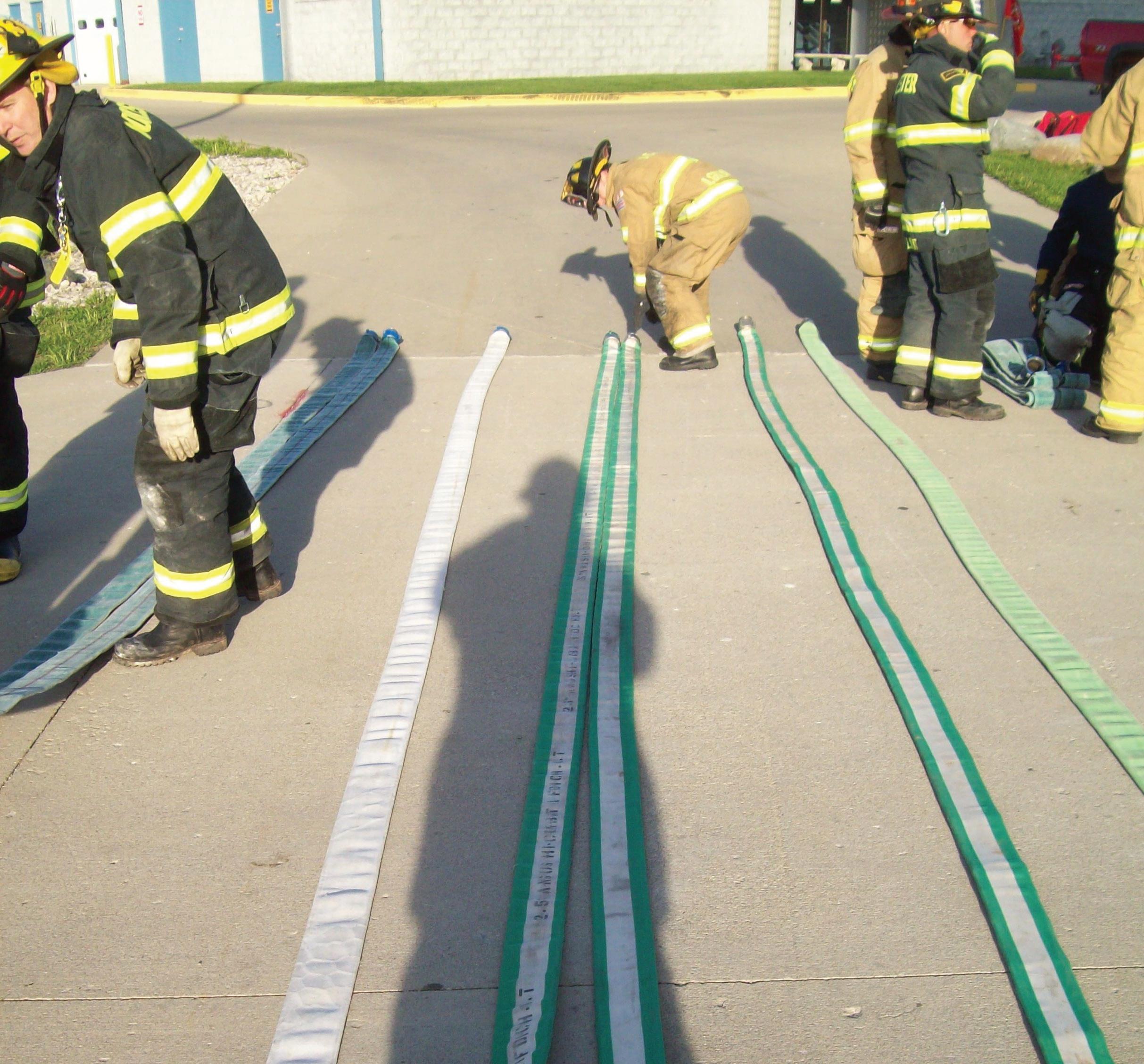
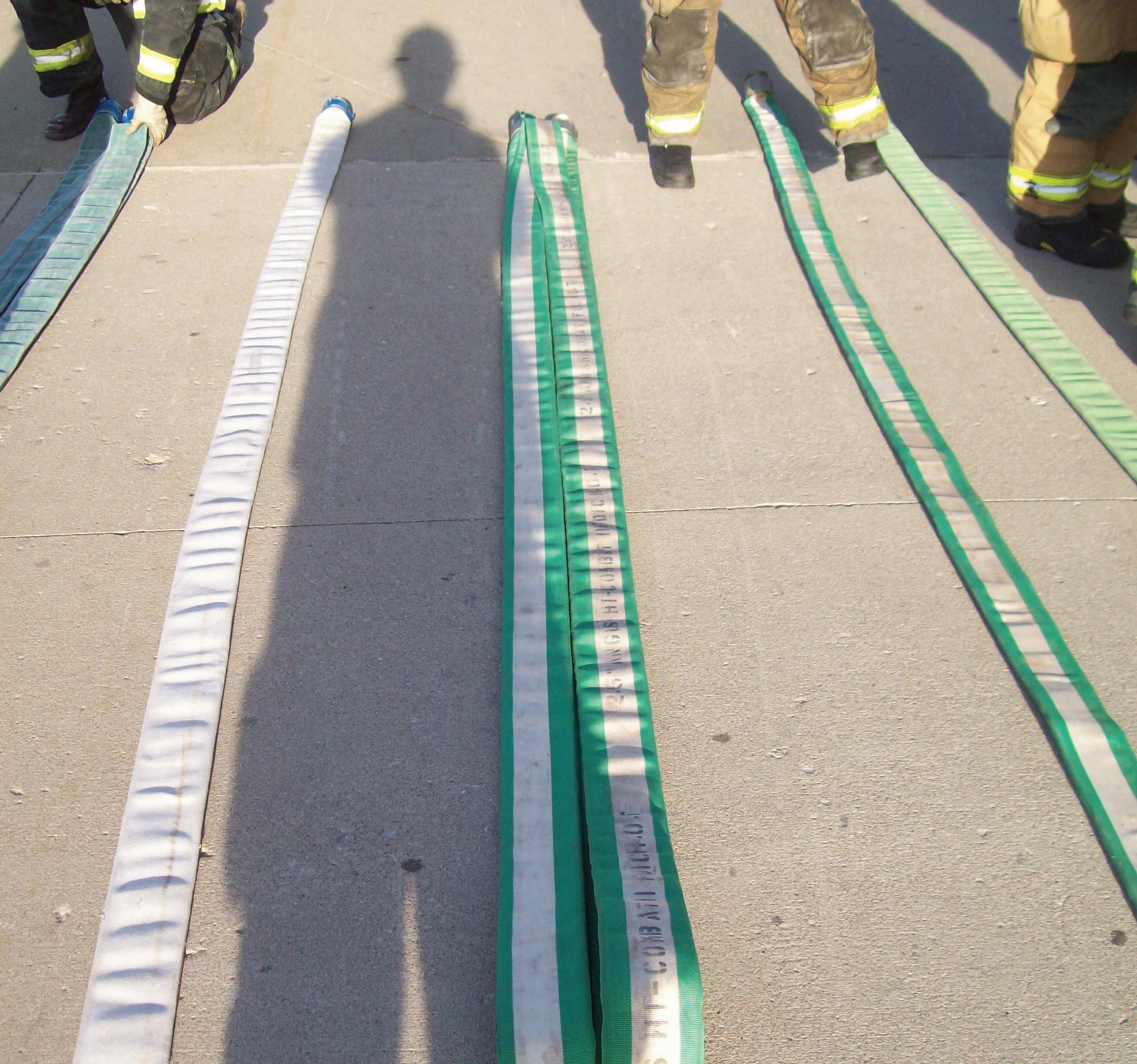
Photo 3: This third type of highrise kit comes from New York City, and comprises three separate 50-foot bundles. Firefighters can select the appropriate hose length, making it easier to carry the hose up stairs to the hook-up floor.
Photos by Mar K van der Feyst
while charged. Another factor to consider and, perhaps, a drawback of this load, is where it is being attached to the standpipe. If the standpipe is in the hallway, the load will work with few restrictions. If the standpipe is in the stairwell, then space is an issue. Even though this type of load is supposed to be kink-free, it is still important to make sure there are no kinks. Hose kinks can occur in any line, at any time and at any pressure and, as mentioned in previous columns, kinks kill.
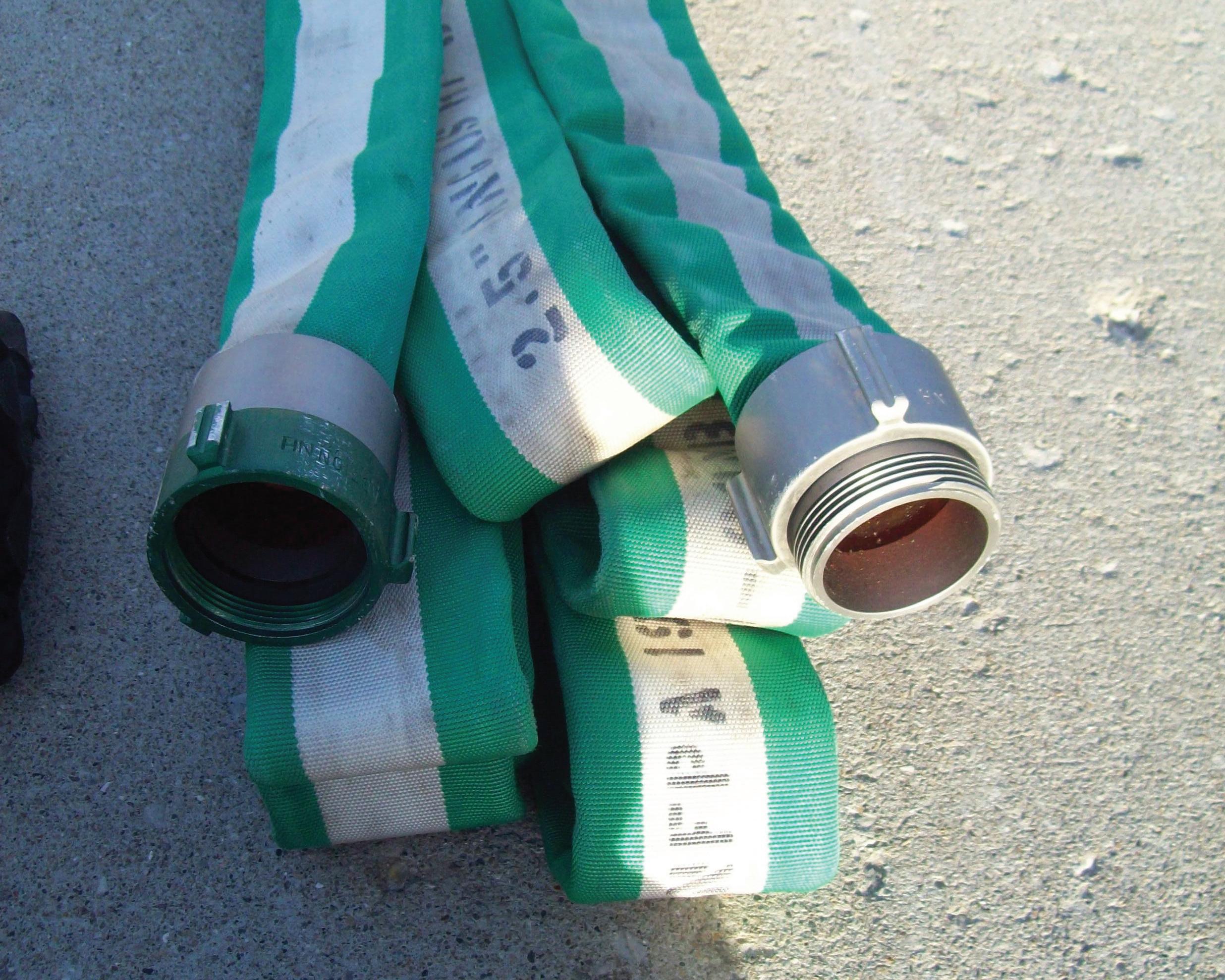
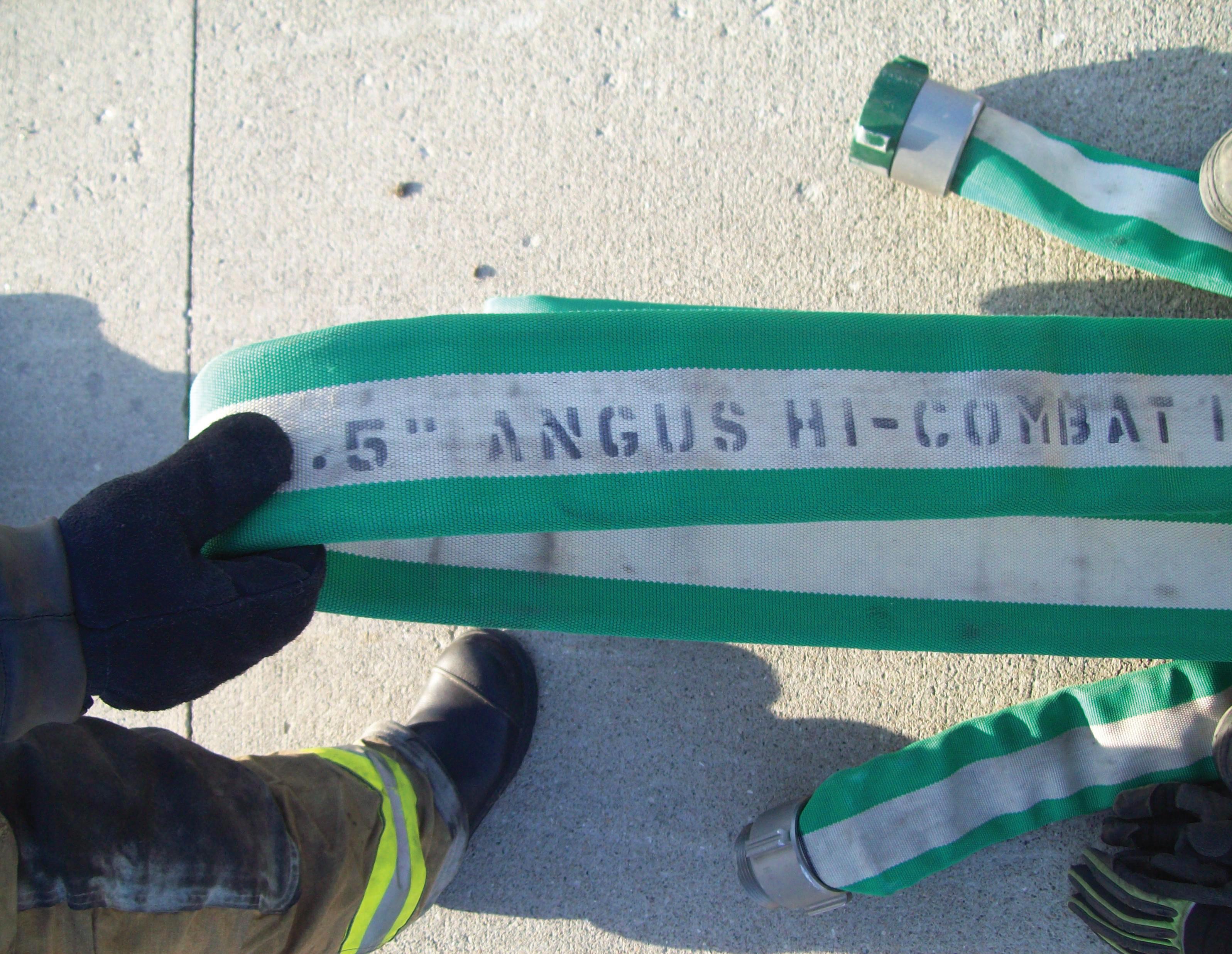
A third type of highrise kit comes from New York City. As shown in photo 3, this kit comprises a two-and-a-half-inch hose packaged in three separate 50-foot bundles. The kit can also be used with one-and-a-half-inch or one-and-three-quarter-inch hoses. The smaller hose loads make it easier for firefighters to carry the hose up to the hook-up floor. If 100 feet of hose is needed, then two bundles are taken; if 150 feet is needed, then three bundles are taken. The three bundles are packaged in such a way that the couplings can easily be attached when the bundles are laid side by side. Each individual load is packaged with the middle of the hose marked and laid between the two couplings of the line. Photo 4 shows the middle part of the hose lying between the couplings. This allows a firefighter to grab the
middle of the hoseline, advance it up the stairs, and lay it down around the outside of the wall in one action. This saves time (see photo 5). In essence, one firefighter can grab the nozzle and the middle of the hoseline and quickly advance it into position. The second firefighter can check for kinks as he makes his way up the stairs to join his partner.
Packaging this type of highrise kit is simple. Lay out the hose with the two couplings at opposite ends. Then bring one coupling to the other and lay them side by side. Grab the middle of the hose where it has bent in half, and bring that to the two couplings, laying it on top of the hose. After that, the hose is double stacked on itself until you have a small and compact hose load (see photos 6, 7 and 8).
Practising and trying different types of loads will determine which highrise kit works for your department.
Mark van der Feyst is a 13-year fire-service veteran who works with the City of Woodstock Fire Department in Ontario. He instructs in Canada, the United States and India. Contact him at Mark@ FireStarTraining.com.
Photo 4: When using the New York City kit, carry the line by the middle part of the hose, which sticks out between the two couplings.
Photo 5: Holding the middle of the line also saves time when it comes to deployment.
Photo 6: To package the New York City kit, lay out the hose so the couplings are side by side.
Photo 7: Bring the bended part of the hose to lay over the couplings.
Photos by Mar K van der Feyst
TRAINER’Scorner Surviving PTSD – part 2
By ED BROUWER
This is part 2 in a four-part series intended to provide information. It is not to be used to diagnose or as a cure. If you or someone you know is thought to be suffering from post-traumatic stress disorder (PTSD), seek professional help immediately.
research has shown that firefighters will often exhibit the symptoms associated with PTSD at home and attempt to mask these symptoms at work. Therefore, I highly recommend that the Canadian fire service provide some level of training for spouses and family members to recognize PTSD symptoms.
Symptoms may include difficulty sleeping or concentrating, haunting memories, and anxiety, which itself has symptoms including chest pain, rapid or irregular heartbeat, shortness of breath, hyperventilation, and, sometimes, overwhelming fear.
Although PTSD symptoms vary, there are common ones, such as reliving the event through memories, nightmares or flashbacks, avoidance and emotional numbing, increased alertness and aggression or insomnia, headaches, and profound sadness. PTSD can also lead to drug or alcohol addiction, depression or other illnesses.
Generally, a period of time elapses between the trauma and the onset of PTSD behaviours. The time frame with acute PTSD is much shorter than with chronic PTSD, in which years can pass between the trauma and the fallout.
The main difference is how individuals are able to cope. Some may turn to or away from their faith, peers, friends and families. Others feel shame and guilt, whether they are responsible for the event or not; perceptions and assumptions are made based on personalities and upbringing.
High levels of social support at home and at work have proven to significantly lower odds of developing PTSD. The social support that develops in the firehouse can help to insulate firefighters from the impact of traumatic experiences. This is particularly true if the firefighter fits in with and is accepted by peers. However, withdrawal from social relationships is common in firefighters who develop PTSD.
According to a 1999 study by a group of researchers, high levels of work stress (problems with supervisors, and other work-related problems) were associated with a three- to four-fold increase in the odds of firefighters developing PTSD.
Ian Crosby, co-ordinator of the wellness and fitness centre for the Calgary Fire Department, says just one to two per cent of CFD’s members are diagnosed with PTSD each year.
“There’s that stigma attached to it, I think, in the general population anyway,” Crosby says, “but in emergency services I think it’s compounded even further.”
“You’re dealing with people that tend to have a rescue mindset, where you’re helping others and not necessarily looking to whatever issues you might be having internally. You tend to kind of put that aside.”
So, have you ever . . .
• felt so tense, discouraged or angry that you were afraid you just couldn’t cope?
Responses to collisions, particularly those involving children who have something in common with the responder’s children, are likely to cause post-traumatic stress.
• had an extremely stressful experience that you try not to think about, but cant?
• felt constantly on guard or been on edge (jumpy) more than you really need to be?
• wondered why you get upset seeing a certain scenario in a movie?
• had reoccurring nightmares?
• felt suicidal?
• self-medicated with drugs (prescription or other), alcohol, food, sex?
If so, please understand that you are not alone.
Another study by that same group of researchers compared 203 firefighters in urban departments in the United States with 625 Canadian firefighters; 22 per cent of the American firefight ers and 17 per cent of the Canadians were found to have PTSD. Other researchers have found that between 33 per cent and 41 per cent of firefighters experienced emotional distress, and 21 per cent of ambulance service workers had PTSD. These researchers concluded that the high level of PTSD suggests a mental health problem of epidemic proportions in urban professional firefighters in the United States.
The following incidents are most likely to traumatize firefighters:
1. Witnessing the death of an emergency responder or viewing the body at the scene, especially that of a friend or partner. Trauma is often increased if the firefighter believes he or she should have protected the person who died, if he or she trained the dead peer, or if the dead firefighter or EMT/ paramedic was temporarily serving in the survivor’s place. Trauma is increased when firefighters or EMTs/paramedics imagine themselves as the ones who died, then visualize the impact their death would have on those they love. Survivor guilt increases the impact of the traumatic experience.
2. A reasonable belief that death or critical injury is imminent and certain, such as being in the middle of a burning building as the structure collapses, or being caught in a wildfire.
3. Viewing the body of a child, particularly if the firefighter or EMT/paramedic is a parent, and even more so if their children are the same age and sex as the dead victim, or if the child victim is similar in some other way to their children.
4. Dealing with the death of a child due to irresponsible adults, such as drunk drivers or careless parents. The impact can be greater if the body of the child has been burned or dismembered.
5. Hearing a citizen scream for help from inside a burning building, and, because the fire is too involved, being unable to save that individual.
6. Being blamed for the death of a citizen, particularly a child victim, by department members, family members of the victim, or the media.
7. Feeling guilty or responsible for violence or death, whether irrational or based on fact. Two events that seem to lead
firefighters or EMTs/paramedics to blame themselves for a death or injury and suffer accompanying guilt are: the deaths of a peer during a shift that they would have been working had they not taken leave, been sick, been on vacation; and responding to a call minutes after a firefighter or EMT/paramedic has lost his or her life.
8. Having a dead victim become personalized, rather than just an unknown body, through interaction with grieving family members or friends. Continued association with the pain of survivors through investigations also can personalize dead victims.
During my investigative research for my HOT session, Calling A Mayday, this last point became very real for me. Most of my time was spent studying one particular fire – the Charleston’s Sofa Super Store fire. I read hundreds of pages from the investigation reports. I researched the lives of each of the fallen brothers, and then listened to hours of recorded radio transmissions from the fire ground. Without reservation, I admit the tragic deaths of the Charleston 9 impacted my life.
9. Having a victim die in the arms of a firefighter or EMT/ paramedic, or en route to the hospital, particularly when the victim is a child or adolescent.
10. Being exposed to particularly bloody or gruesome scenes, especially for a great length of time (viewing victims with severe burns, seeing the suffering of victims and/or the grief of their loved ones).
11. Observing an event involving violence or murder, but not being able to intervene. (“She was screaming for my help but there was nothing I could do.”)
12. Feeling personally responsible for someone’s life, for example,
after administering CPR to a patient at the scene or en route. Whether a victim dies en route to the hospital or survives, symptoms may occur as a result of the stress hormones released during long rescue operations.
13. When citizens at the scene threaten to kill or critically injure a firefighter or EMT/paramedic unless some condition is met. (For example, “If my father dies, you die. You had better save him.”)
14. Being referred to as a hero after being involved in an incident where other fire- and rescue-service professionals died or were critically wounded. The living rescuer’s sense of guilt over living or not having saved a peer and/or friend can dramatically increase PTSD symptoms.
These incidents were compiled by combining research with the numerous stories of firefighters and emergency service personnel treated by Dr. Nancy Davis, a clinical psychologist who specializes in PTSD among first responders.
To this point I have focused on firefighters, paramedics and ambulance personnel, but what about the support groups who work alongside us (flaggers, city and highway crews)?
When Crosby and I spoke about PTSD, we both commented on the plight of tow truck operators, wondering whether they ever receive help regarding the traumatic accidents to which they respond.
Until recently, I really didn’t think about the ability of tow truck drivers to deal with this traumatic situation. After a crisis, they may feel out of control, depressed, confused and angry. They may feel numb and not feel anything at all. They may experience physical reactions such as headaches, sleeplessness and/ or nightmares, stomach upset, even vomiting. Someone needs to tell them that it is normal to react this way after a critical incident.
Consider what the responding agencies would have experienced in responding to the following three MVIs:
A horrific head-on crash killed five people outside Williams Lake, B.C. The victims were reportedly on a family trip to Vancouver. The SUV in which they were travelling crossed the centre line of Highway 97 into the path of an oncoming tractor-trailer, according to Cpl. Madonna Saunders of the Prince George RCMP. Both vehicles ended up in a ditch engulfed in flames, killing all five passengers in the SUV;
In Shakespeare, Ont., a van carrying 13 migrant workers from South America ran a stop sign before it was broadsided by a truck. The violent impact killed 11 people at a rural
intersection; and Police in Alberta investigated a fiery head-on collision involving two pickup trucks that killed seven people on a busy stretch of highway between Edmonton and Fort McMurray. The crash occurred in snowy conditions on Highway 63 near Wandering River. RCMP confirmed that six of the nine people involved in the collision died at the scene of the crash. The seventh person, a teenage girl, later died in hospital.
In all three cases, post-incident debriefings were delivered by mental health workers and peer de-briefers. (These experts should have experience in the emergency services with which they work, giving them all-important credibility.)
Debriefing is popular with emergency workers and aid workers, because many of them see it as their only chance to talk about their experiences. It allows them to do so as a matter of routine, without the stigma of therapy, which they sometimes fear could be detrimental to their careers.
The first step in battling critical incident stress (CIS), a precursor to PTSD, is to be prepared. Take care of yourself before a critical incident – exercise, a good diet, and downtime are helpful. Keep hydrated by drinking water, know your stress levels and recognize when you need a break. Build relationships with loved ones – they will be your strongest defence.
Know the enemy: When we get an adrenalin rush, there are some 10,000 chemicals dumped into our bodies. These chemicals take an average of 18 hours to get rid of when unchecked. Drinking water helps flush these chemicals from our bodies and exercise sweats out the chemicals. Avoid caffeine, sugar and alcohol, as they just add more chemicals to the mix.
Know your support system: Your spouse and/or family can help you heal. Don’t shut them out. You don’t have to share the gory details, but do share how you felt. Hold a hand. Talk to them. Find someone you trust, talk about the incident.
Know where to get help: Chaplains, peer support and employee assistance programs are all good places to start. If you know someone who has recently battled CIS, don’t ignore them. Reach out to them and offer help.
Ed Brouwer is the chief instructor for Canwest Fire in Osoyoos, B.C., and Greenwood Fire and Rescue. The 21-year veteran of the fire service is also a fire warden with the B.C. Ministry of Forests, a Wildland Urban Interface fire suppression instructor/evaluator and a fire-service chaplain. Contact Ed at aka-opa@hotmail.com
By V INCE M AC K ENZIE Fire chief Grand Falls-Windsor, N.L.
IVOLUNTEERVIsIon
Situational awareness versus technology
have had an opportunity to attend, present, and be a delegate at various firefighting seminars and conferences across the country over the last 24 months, and it is quite apparent that change is taking place in the volunteer fire service.
That is no surprise, as we have been changing since the modern fire service was born. What is remarkable, in my view, is that in the last five years, change has accelerated, and because of that rapid pace, the magnitude of that change is very intimidating to many firefighters, myself included. As we train for our work, and then serve and do our jobs, and continually try to update our professional development, it’s hard not to wonder if we are doing all we can do. Hence, the feeling of intimidation.
Not only is the fire service changing in terms of firefighting tactics, but also there is considerable change in communication and technology. Couple that with the generational divide among our personnel, the change in the way we do business from legal, moral, and accountability perspectives, then consider the volunteer firefighter who is experiencing change at home or at work. All these changes are among the reasons that many firefighters find it a challenge to keep up, and may even decide to leave the fire service.
Individually, all these changes would not be overwhelming, but when the world throws them at us all at once, it takes extra effort to sort through the challenges so we don’t become so overwhelmed that we question what we are doing in the first place.
To keep up with all this change, the world has devised communication technology and smart phones that supposedly make things easier for us. Instant communication and instant recall/ research has become the norm. Firefighters can now acquire and view training information in the palms of their hand in seconds. Some say we are training ourselves to expect instant results and gratification in return. At a recent Beyond Hoses and Helmets course I was honoured to help instruct in British Columbia, there was a diverse mixture of younger and older firefighters, all gathered together to develop and improve their leadership skills. Change became a theme in our discussions, and I heard many different perspectives.
are able to grasp and recall information quickly, but even some of us older folks can zip our way around the new tools in the palms of our hands. I am no expert, but I am no slouch at it either. It is no secret that the generations of firefighters coming into our departments are very tech savvy and can multi-task. I am in awe of our ability to communicate, find information quickly, and get things done. But I wonder if these younger firefighters are smarter than we were, or if they’re just smarter users of technology. Personally, I am excited to see where all this technology will lead, and as a leader, I want to learn more about it. But I worry:
Does this generation of firefighters rely so much on technology that their firefighting instincts won’t develop the same way ours have?
My old-guy fear is whether the critical knowledge will end when the battery dies or data service is lost during emergencies. Will the newer firefighters’ brains die as well, because they have learned to rely on this technology so much that any interruption in data service may cripple their abilities? The counterpoint to that is that I also feel I need this technology to make me a better firefighter. Intimidation again!
i am in awe of our ability to communicate, find information quickly, and get things done. ‘‘ ’’
In a discussion about changing technology, it was obvious that the younger firefighters had the upper hand. Sure, the younger folk
Vince MacKenzie is the fire chief in Grand Falls-Windsor, N.L. He is the president of the Newfoundland and Labrador Association of Fire Services, the second vice president of the Maritime Fire Chiefs Association and a director of the Canadian Association of Fire Chiefs. Email him at firechief@grandfallswindsor.com
It is a wonderful thing, this technology, and as long as there is an electronic device available, the knowledge, communication, and little reference banks it brings will be at our emergency scenes. But today’s firefighters must understand that although use of these devices can be beneficial, a certain amount of knowledge needs to be stored in their heads. The point I would like to make to the newer generation is that there may be false security in their reliance on smartphone technology; that knowledge needs to be in the old organic brain for use on the fire ground, and not displayed in the palms of their hands.
The fire service will continue to change, and it’s important to be aware that sometimes we get caught up in all the hype. Fire fighting will always be a physical job, requiring thorough training, teamwork and good leadership. For that, we need to have keen instincts and situational awareness of all that is around us.
By SE AN TRACE y Canadian regional manager, NFPA
tA Canadian evaluation of compressed-air foam
he fire service has long been accused of not embracing new technologies but being trapped in old practices and methodologies. One area that generates regular inquiries is compressed-air foam systems and whether greater credit should be given to these systems in NFPA standards and in insurance grades.
Firstly, we need to understand the purposes of NFPA standards. These are used to standardize, or write into the fire code, industry best practices based on years of experience and scientific evaluations. The standards represent what the fire service wants to see promulgated as standards of practice. Should standards become the means to push the fire service to accept new technologies? I think this is not what is wanted, and when standards attempt to do this, the fire service often resists unless there are compelling arguments in favour of the change.
Secondly, the standards speak to common equipment expectations and resources. They do not speak to fire-ground effectiveness, tactics, or even SOPs; I believe this would be too difficult to do in our complex system of career, composite and volunteer departments whose resources can differ drastically. For this reason, standards such as NFPA 1710 and 1720 talk broadly about resources and response-time objectives, and we have standards on water supply calculations to help determine whether there are adequate fire resources. But this is where these standards tend to end, as we give room to communities for a broad range of alternative delivery practices.
The NFPA has standards on compressed air foams, notably NFPA 1145, Guide for the Use of Class-A Foams in Manual Structural Fire Fighting
FUS ratings on how fire brigades are scored for insurance ratings in communities. FUS grades tend to evaluate departments based on a number of NFPA standards. The problem is how to benchmark the performance of CAF systems, because effectiveness may vary greatly based on the operator and equipment. Also, can the CAF systems still fulfill all the requirements of areas such as water supplies and control of exposures? The bottom line is that there are still cases when water flow is required and the foam may not replace needed fire flows in all cases. FUS can now grade water-supply effectiveness using the superior tanker accreditation, but no equivalent accepted methodology has been put forward for CAF systems. So, FUS may appear to be slow to change but in its defence, there are many outstanding questions and more research is needed.
Many research entities and fire departments are advancing our understanding of the effectiveness of CAF systems. NFPA’s Fire Protection Research Foundation (FPRF) hosted a workshop in December to look at the capabilities and limits of CAF. This was
The problem is how to benchmark the performance of CaF systems, because effectiveness may vary greatly based on the operator and equipment.
This document is a guide. As the preamble to the standard states, “because the use of class-A foam and its associated hardware and proportioning systems was still evolving, the committee decided that a guide to the use of such foam would be of greater benefit to the many fire departments and agencies that were exploring the use of class-A foam for structural fire protection as well as fire suppression and extinguishment.” The standard remains a guide after three editions.
The use of foam has also had a direct impact on water supplies for fire fighting but both the NFPA 1 fire code and NFPA 1142 Standard on Water Supplies for Suburban and Rural Fire Fighting have yet to consider the potential impact that foam may have on water-flow calculations. (The same committee responsible for NFPA 1141 on water supplies is responsible for the class-A foam standards.)
The NFPA standards do not generally speak to measuring operational effectiveness – if this falls to anyone, it is the purview of Fire Underwriting Survey (FUS). In Canada we generally accept
Sean Tracey, P.Eng., MIFireE, is the Canadian regional manager of the National Fire Protection Association International and formerly the Canadian Armed Forces fire marshal. Contact him at stracey@nfpa.org
part of a two-year project to provide a comprehensive study on the use of CAFs for structural fire fighting. The workshop was open to the fire services, and the National Research Council’s Andrew Kim – a leading researcher in this field – presented information on recent evaluations. Results of the meeting can be downloaded from the NFPA website (www.nfpa.org).
So what are the next steps? As mentioned, more research is needed and NFPA’s FPRF does have a study underway, but the Canadian fire service should be looking at compiling its research and experiences. To help facilitate this, I have started a discussion thread in the NFPA forum of PTSC Online (www.ptsc-online.ca), including a link to the FPRF workshop information and Kim’s presentation. My intention is to start a dialogue and catalogue the experiences of the Canadian fire service. I encourage you to get involved in this discussion.
There are many questions around CAF systems that prevent them from getting the credit they may need, but at least there is research and discussion about the benefits of these systems.
wind-driven wIldfIre
the fire that devastated 40 per cent of the Town of Slave Lake, Alta., in May 2011, was propelled by a plethora of weather phenomena from drought and unusually high wind to a bizarre pressure system bolstered by geography – mountains to the west, prairies to the east – and warm, dry air sitting on top of the Earth’s surface.
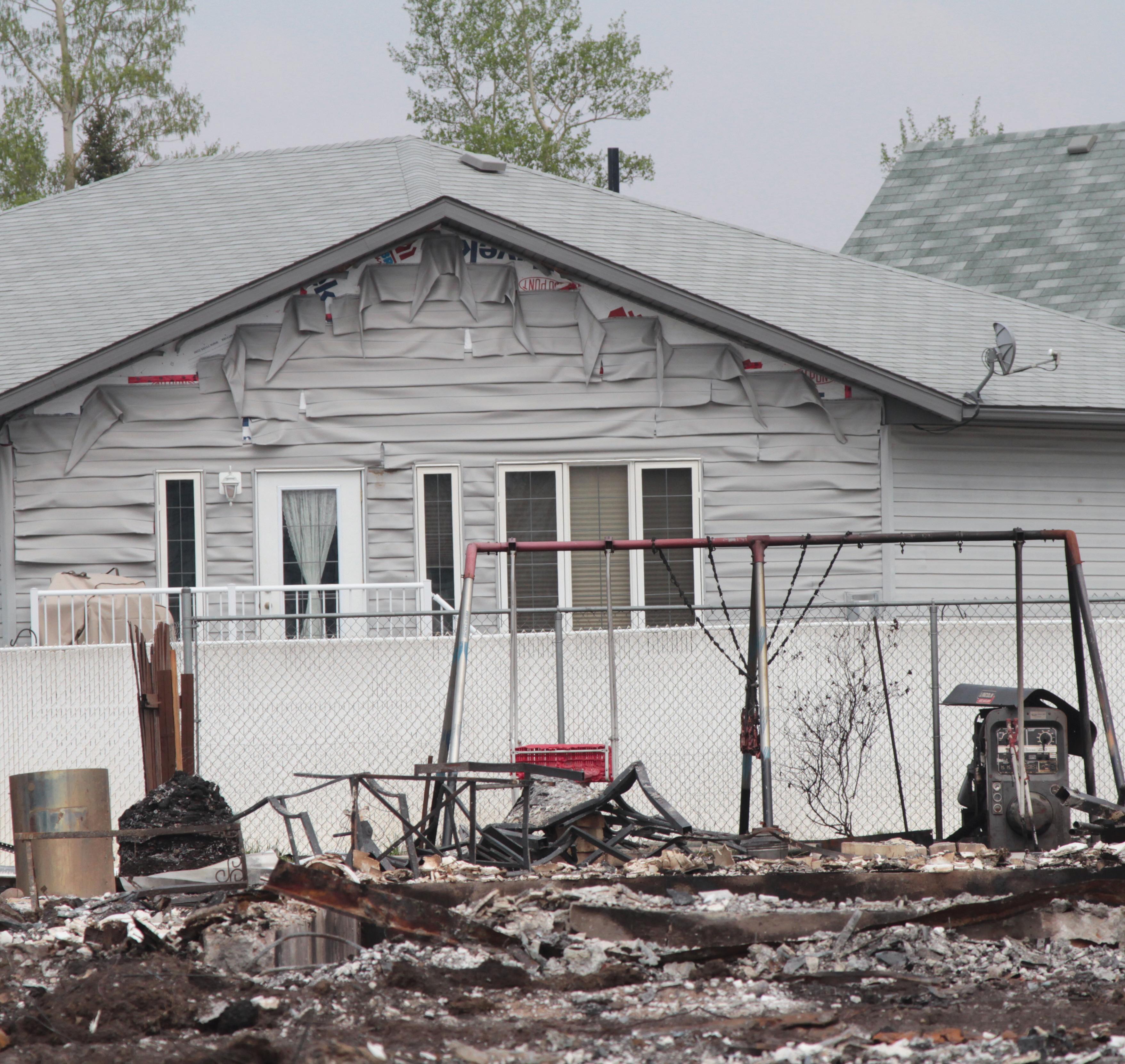
The fire, on Sunday, May 15, desecrated almost 40 per cent of the town. Total losses, which exceeded $1 billion (insured losses of $700 million), made the Slave Lake fire the second greatest natural disaster to affect Canada.
Fire Chief Jamie Coutts gave a harrowing account of the fire – from his perspective on the front line – in the July 2011 issue of Canadian Firefighter and EMS Quarterly. Wildfires are mainly a product of the weather conditions. As a meteorologist, I have incorporated Coutts’s observations into my analysis of the weather conditions that caused the extreme fire behaviour.
The countryside of north-central Alberta consists of rolling hills. In terms of fire control, this type of topography would present more problems than flat plains, but is not as extreme as more mountainous terrain. The vegetation is mixed boreal forest. With a dry understorey, the spruce trees are prone to crown fires. Drought usually sets the stage for major fires and this was the case in Alberta last year. The North American Drought Monitor indicated moderate drought conditions throughout the region in May. The Slave Lake weather station at the airport had recorded just 75 millimetres (mm) of precipitation in the first four months of 2011. May was even drier, with just 4.5 mm of rain in the first two weeks of the month. The average May precipitation is 43.5 mm and May usually marks the start of the summer wet season. Showing the perversity of nature, an amazing 199.5 mm of rain was recorded in June.
The week before to the fire had been particularly warm; the high temperature had exceeded 20 C on most days (the average high temperature is 16 C). Vegetation
How the blaze that devastated Slave Lake gained force and fury
By Dr ED BroTaK
An unusual mix of wind, warmth and topography drove the wildfire that surged through Slave Lake, Alta., in May 2011. On Sunday, May 15, the weather forecast underestimated the wind speed by 40 kph.
was dry and could be easily ignited. Fire ignitions are common in dry but calm conditions, but fire control is usually fairly easy. Unless there is an extreme amount of fuel (downed trees, for example) or challenging topographic situations, fire behaviour is generally normal and spread rates are slow. When high winds are superimposed on a dry area, fire control becomes a problem.
On Saturday, May 14, a number of fires were reported around Slave Lake. Weather conditions weren’t good; afternoon temperatures were above 20 C and relative humidities fell below 20 per cent. Winds from the southeast gusted to 65 kilometres
per hour. One fire threatened Poplar Estates, Mitsue and the Sawridge First Nation, which are about 10 kilometres east of Slave Lake. As the fire entered residential sections, these areas were evacuated. Crews fought this fire through the night and numerous structures were lost. The fire that was to devastate Slave Lake was first reported at 1:30 p.m. on Saturday, about 17 km south of town. The fire was small and, with winds diminishing, crews contained it through the night.
Weather conditions began to deteriorate again after daybreak on Sunday. With a warm, dry air mass still in place (a high temperature of 21 C and relative humidity less than 20
per cent), winds began to increase again. By noon, wind was gusting at more than 60 kph and strengthened throughout the afternoon. By 3 p.m., wind at the airport was sustained at 50 kph with gusts to almost 70 kph. But the fire still seemed to be under control. Then, at 3:30 p.m., reports of a major run started coming in and suddenly Slave Lake was in the path of the fire. Crews were sent to the southeast side of town. With Highway 2 to the south and Highway 88 to the east, Coutts hoped to use these roads as fire breaks.
The wider the fire break, the more effective it will be. But wind works against this. Burning debris and embers can be thrown up into the air and carried forward. These embers can carry over a fire break and start spot fires on the other side. Spot fires can merge and become a new, progressive fire head. The stronger the wind, the further ahead of the main fire this can occur.
This is exactly what happened at Slave Lake. By 4 p.m., sustained winds were blowing at 55 kph with gusts of more than 80 kph. The peak gust recorded at the airport was 89 kph. With the wind blowing this strong, burning debris and embers in the air easily crossed the highway and started multiple spot fires on the town side. There were too many fires and too little equipment to fight them. As Chief Coutts recounted, “From the time [the fire] was on one side of the highway until it was burning the town was half an hour. There were too many hot spots and [the fire] was moving too fast.” At one point, Coutts said there were 50 calls and just six trucks.
Another serious impact of the wind on the firefighting effort was to ground all aerial support. By 7 p.m., the wind was too strong and turbulent to allow water bombers or helicopters to fly safely. Poor visibility further hampered the firefighting efforts. Visibility at the airport on the other side of town dropped to a few kilometres in dense smoke.
Another unusual and critical factor was the wind direction. Winds from the east or southeast are not unusual in May, but these winds are seldom strong. All of the record peak gusts recorded in Slave Lake were from the west or northwest. The strong southwest winds became the key factor that drove the fire northward into the town.
The battle against the fire turned in favour of the firefighters that night. First, the exceptionally strong winds died down, as is typical at night. Then, reinforcements arrived to join the fire fight. Finally, fire lines that had been carved into the town held. Unfortunately, this had involved the bulldozing of burned homes, trees and other potential fire fuel. Although some homes were burned in the next two days, most of the 480 homes lost were consumed in that first afternoon and evening.
Why did the winds blow so hard on Sunday? As Coutts recalls, the weather forecast underestimated the winds by 40 kph. Why was Sunday different? To explain this, we must look at the weather maps. Wind is produced by high- and low-pressure areas. Air always tries to go from higher to lower pressure, but something called the Coriolis Effect curves the wind; thus, winds blow clockwise around a high and counterclockwise around a low (in the Northern Hemisphere). The greater the pressure difference, the stronger the winds. Meteorologists can predict this pressure gradient – that is, the change in pressure over distance. It is indicated on a surface weather map by the closeness of the isobars, lines of equal pressure. The strongest winds are found where these lines are tightly packed.
In the week before the fire, a large, strong high-pressure area developed over the Northwest Territories. As is typical in this situation, a nose of high pressure wedged down over the Prairies, banking up against the east side of the Rockies, where it formed a stationary front. Being on the southwest side of this high, Alberta was in a warm, southeasterly flow from mid-week on. Low pressure was located off the West Coast and, initially, the pressure gradient between the high and low was fairly weak. This began to change on Saturday when the low started to move inland. As the pressure gradient tightened, the winds increased. On Sunday, pressures fell notably in British Columbia and Alberta, especially along the stationary front. With pressures remaining high to the east, the pressure gradient across Alberta tightened even more and, as a result, winds were even stronger. Another factor that may have played a role is the channelling effect of the mountains. With the Rockies to the west providing a physical barrier to the airflow, the winds were channeled, or funneled, through a smaller area. When this happens, wind speed increases.
In the Slave Lake region, weather watchers often see a diurnal pattern in the winds. Wind speeds will decrease overnight and then increase again during the following day. At night, when the Earth’s surface cools, the layer of air nearest the surface decouples from the atmosphere above it. These decoupling and frictional effects slow the surface wind. When the sun comes up the next morning, the Earth’s surface is heated, as is the air next to it. This promotes vertical mixing and causes wind speeds to increase.
To get an idea of what weather conditions will be like in the afternoon, it is a good idea to look at a morning sounding, which is a vertical profile of temperature, moisture, and winds. The 12 p.m. GMT (5 a.m. MDT) sounding at Edmonton showed fairly benign conditions at the surface: a temperature of 6.4 C, a relative humidity of 50 per cent, and winds from the southeast at 15 kph. But conditions changed rapidly above the surface. Winds increased to 80 kph at 500 metres (m) above the ground and to 100 kph at 1,900 m. Relative humidities also dropped to 13 per cent at 1,650 m. Conditions aloft on a morning sounding are very important. With the heat of the day and strong mixing, air from above will be brought down to the surface. In this case, dry air and strong winds were poised just aloft, easily available to be brought down. The 12 a.m. GMT (5 p.m. MDT) sounding showed an extremely steep lapse rate (large temperature change with height) from the surface up to three km. This indicated strong vertical mixing and this is what brought the very dry air and strong winds to the surface.
“We never thought this could happen,” Chief Coutts said, “The biggest lesson we learned is we have to plan ahead farther.”
Coutts elaborated the needs from a firefighting perspective.
“I would emphasize the need to lessen the fire risk itself within the confines of the urban area,” he said. “We need to avoid flammable materials. Roofs especially need to be fire retardant. Outdoor areas need to be as devoid of fuel as possible. No dry leaves or flammable mulches. Without reducing the spot fire risk, firefighting efforts will certainly be hampered.”
Dr. Ed Brotak is a retired college professor turned freelance writer. He has studied wildland fires and weather for more than 30 years.
You protect the public
Let us heLp protect you
For your cleaning, decontamination, inspection, testing, repair and record keeping of your firefighter’s protective clothing... we have you covered!
• 24/7 access to Firetrack®, the online data base that provides you with complete details of your C&M Program with FSM. We do the work for you!
• ETL Verified
• ISO 9001 Registered
• Fast turnaround Ontario (toronto) 1-888-731-7377
Western canada (calgary) 1-403-279-5095
Quebec (Montreal) 1-514-312-3708
Mid-West USa (Detroit, Mi) 1-866-877-6688
communication breakdown
radio-system failures in Slave Lake fire force agencies to rethink the way they talk to each other
By STEFan DuBowSKi
top : Some emergency response officials were best able to communicate through BlackBerry Messenger when other systems failed during the May 2011 wildfire in Slave Lake, Alta.
It has been about a year since a freakishly fast wildfire devastated the municipality of Slave Lake, Alta. For the last 12 months, organizations that were involved in battling the blaze have been mulling over those frenetic May days, trying to piece together what happened, why and how.
In a presentation at the Fifth Canadian Public Safety Interoperability Workshop in Ottawa late last year – and in followup interviews earlier this year – representatives from the Province of Alberta, Calgary Emergency Management, and Alberta Health Services discussed communications during the fire: what
worked, what didn’t, and what needs to change in case something like Slave Lake happens again.
The fire began on May 14, 2011, and quickly spread due to high winds and little precipitation. By May 15, news outlets were reporting that 30 per cent of the municipality had burned. Numerous firefighting teams from across the province and the rest of Canada arrived to help. By May 28, the fire was finally out. In the end, the town hall, 372 houses and six apartment buildings were destroyed.
Today, Patrick Henneberry is director and registrar of accreditation and certification within the Office of the Fire
It’s compact profile fits under seats or hugs the wall in storage compartments, leaving more room for gear and equipment. Its optional slide-in mounting plate facilitates easy installation & removal in tight areas.
The 40 amp smart circuitry provides high boost voltage, quickly replenishing batteries, then reverts to float voltage.
The new waterproof indicator provides both digital and bar graph display of battery condition.
Specify the LPC 40 for large charge capability when you are small on available space.
KOCHEK® LDH and Rural Systems
Your Single Source of Water Supply
Commissioner in the public safety division of Alberta’s Municipal Affairs department. But during the Slave Lake fire, he was the director of central operations for the Alberta Emergency Management Agency (AEMA). He described some of the communications challenges firefighters faced in Slave Lake.
One issue was radio communication. All agencies arriving to help beat back the fire used different radio systems, so interorganization connectivity was difficult.
“We had to source radios,” Henneberry said, explaining that otherwise there would be no way for the agencies to communicate effectively.
Alberta Sustainable Resource Development (ASRD) – the province’s natural-resources stewardship department – stepped forward with about 100 extra radios to distribute among firefighters. But the organizations also had to buy “several thousand” batteries for the equipment, Henneberry said.
What’s more, the crews had to reconfigure the radios, noted Tom Sampson, deputy chief of Calgary Emergency Management Agency. The radios weren’t programmed for the Slave Lake area, so while the SRD’s own teams could talk to each other, communication among SRD and other organizations was still difficult. “We struggled to reprogram the radios on the fly,” Sampson said.
Communicating information to Slave Lake’s residents was hampered as well: the local radio station was destroyed; the town’s Telus communication hub was out of commission, too. Firefighters managed to staunch the blaze at the cell phone technology centre, but the water that was used to put out the fire severely damaged the equipment.
“The concept of a single point of failure really struck us here,” Sampson said.
Lacking the local radio station, residents logged on to Facebook for updates.
the province’s first responders the chance to operate on the same radio network, so in the future, interconnectivity won’t be as big a problem as it was during the Slave Lake fire, said Curtis Brochu, transformation consultant with Alberta First Responder Radio Communications System (AFRRCS).
But the solution isn’t just about the technology, he said. It includes new governance models designed to ensure that organizations using the network can voice their concerns and participate in ongoing network improvements. It also incorporates new operating procedures and training.
With respect to the Slave Lake fire, another issue became apparent in the Provincial Operations Centre (POC) in Edmonton, where response co-ordination efforts were underway. As the POC moved from Level 1 to Level 4 during the first few days of the situation, the people in charge realized that the automatic call-out system wasn’t doing its job. Henneberry pointed out that the technology, designed to send a message to government employees compelling them to come to the POC, wasn’t contacting everyone it was supposed to call.
“That showed us that we are in need of a refresh,” he said, adding that a new system is in place now.
A new system had to be devised for the reporting hierarchy during the incident as well, Sampson said. While the proposed communication chart for emergencies employed a matrix structure with cross connections among various stakeholders, that proved to be cumbersome in Slave Lake, resulting in situations whereby individuals would report to provincial agencies, and the agencies would try to impose their solutions on the operations centre. The answer: establish the operations centre as the top of command, Sampson said. That helped the communication flow, and ensured that everyone was on the same strategic page.
Meanwhile, incident managers had to meet face to face three times a day in the operations centre to update each other on the situations in various parts of the town, Sampson said.
Trevor Maslyk, executive director for Alberta Health Services, said that even though the Telus network was out of commission, his BlackBerry proved to be invaluable for connecting with one of the emergency workers in the field.
“The only way I was able to communicate with him was through BlackBerry Messenger – and it worked,” he said.
Alberta is deploying a new Harris voice communication system that will give all of
Sampson pointed out that the response to the Slave Lake fire was a team effort. Many believe the frontline firefighters played a particularly important role. Members of the RCMP saluted the firefighters as they left the area in late May, according to news reports.
Henneberry echoed the feeling. “It’s my personal belief that the firefighters were the heroes of Slave Lake. I tip my hat to them.”
Stefan Dubowski is a freelance writer based
Forged
Valves
By Ly LE Q UAN Fire Chief Waterloo, Ont.
IBuilding high-performance fire-department teams
was invited to speak at the Ontario Association of Fire Chiefs conference in Toronto in May about how to develop a cohesive and high-performing team. This excited me because I have always believed in the strength of teamwork. Part of a leader’s development is appreciating the value of this type of growth and depending upon his or her team to help get things done. This, in turn, lends itself to promoting a strong and vibrant organization. Although a team is made up of individuals with varying personalities, when that group is brought together with a singular focus and purpose, its members become a dynamic entity.
Let’s explore two great books on the topic of team building and how to deal with some of the dysfunctions that teams can experience. The first book is The Five Dysfunctions of a Team: A Leadership Fable by Patrick Lencioni (2002). The second book is The One Minute Manager Builds High Performing Teams by Ken Blanchard, Eunice Parisi-Carew and Donald Carew (2009).
Lencioni leads the reader through a parable in which a new manager must try to get her team to work as a cohesive unit. This manager has been successful in past team-building endeavours but this particular group of individuals is proving to be a real challenge. However, with dogged determination (that draws on past experiences) and a sincere desire to build a high-performing team, the manager breaks down the dysfunctions that she has witnessed into five areas that are very similar to Maslow’s theory of hierarchy, meaning that you need to create a solid foundation before the individual or the team can grow and move to the next level. The point here is that the entire team must understand what these stages are and how to work through them.
The five dysfunctions are presented in a manner that demonstrates how each level must build upon the last. The dysfunctions are absence of trust, fear of conflict, lack of commitment, avoidance of accountability, and inattention to results.
ing conflict is beneficial to the growth of the team.
• All members of the team need to be committed to the goals and expected results.
• Everyone needs to be accountable for assignments and for supporting the team’s efforts.
• Team members must be results-oriented and have a clear vision of the expected outcomes.
Lencioni also points out that the key to building a cohesive team is to keep it simple: Don’t fall into the trap of thinking that a detailed project charter will make things more effective. I’m not suggesting that you don’t need to build a project charter; just ensure that it is easily understood by all members of the team.
The authors of the second book note that, “When groups are operating effectively they can solve more complex problems, make better decisions, release more creativity and do more to build individual skills and commitment than individuals working alone.”
Blanchard, et al., say the required characteristics of a high-performing team are purpose and values, empowerment, relationships and communication, flexibility, optimal performance, recognition and appreciation and morale.
The authors break down these seven areas down into greater detail. To sum them up:
Building and maintaining a high-performing team is a labour of love . . .
’’
• The team needs a joint purpose.
A look at Abraham Maslow’s hierarchy of needs demonstrates that an individual’s needs – physiological needs, safety needs, social needs, esteem needs and self actualization – are not much different than a team’s needs:
For Lencioni’s levels:
• Without trust as the foundation, no team can move ahead.
• If the team is not willing to acknowledge some conflict, which might simply mean a difference of opinion, then its members will avoid conflict; open, honest and non-threaten-
Lyle Quan is the fire chief of Waterloo Fire Rescue in Ontario. He has a business degree in emergency services and a degree in adult education. Lyle is an instructor for two Canadian universities and has worked with many departments in the areas of leadership, safety and risk management. E-mail: thequans@sympatico.ca
• We need to empower team members by giving them the authority to do what is required to complete their tasks.
• Relationships are built on trust and support, along with constant, open and honest communication
• The team and its leader must be flexible to adjust to the changing needs of the project.
• You must celebrate your wins by recognizing them and demonstrating a sincere appreciation for the work being done by all.
• To keep morale high, encourage each other, support each other and trust each other.
Building and maintaining a high-performing team is a labour of love for leaders who wants to see their teams grow and enjoy being part of an organization that will move forward no matter what is thrown at it.
safe at home
the Surrey Fire Service in British Columbia has used a data-driven, research-based approach to reduce residential fires.
This program, known as HomeSafe, has involved on-duty firefighters going door-to-door in the city’s highest fire risk neighbourhoods, distributing fire prevention information, checking for working smoke alarms and installing free smoke alarms as required.
In its first two years, this program has reduced the annual rate of residential fires in the highest-risk homes in the city by almost two-thirds, and has prevented an estimated $1.26 million in fire losses. In addition, when fires did occur after the home visits, smoke alarms activated more frequently and fires were smaller and did less damage.
HomeSafe was the result of a study of international best practices in fire safety home visits, and the implementation of selected elements of those best practices in Surrey.
From the early 1990s, the effectiveness of public fire education has been illustrated. For example, Proving Fire Education Works, written by Philip Schaenman, Charles Jennings and colleagues from the TriData Corporation in 1990, analyzed 77 public-education strategies including school-based programs, comprehensive community-wide programs, programs targeting a specific cause of fire or audience, juvenile fire-setter programs, smoke-detector programs, and national strategies. All 77 initiatives demonstrated some form of positive impact.
More recently, a 2009 TriData review of best practices in residential fire prevention highlighted the impact of home visitation programs in the United Kingdom that targeted fire-safety inspections and risk reduction, and emphasized the importance of working smoke alarms.
Similar initiatives have become crucial components of Canadian residential fire-prevention efforts, often implemented by either community-based volunteers or by acquiring additional prevention funds. These types of visits have focused the presence and functionality of smoke alarms, the
B.C. program has reduced fires in high-risk areas by two-thirds
By LEn gariS
Surrey, B.C.’s HomeSafe program has reduced the number of residential fires in the highestrisk homes in the city by almost two-thirds and has prevented an estimated $1.26 million in fire losses.
development of fire-escape plans, and public education on common causes of preventable house fires, with the typical result being reduced rates of fires and increased presence of working smoke alarms.
However, these types of initiatives have lacked conclusive, formal evaluation and have often become victims of their own success, with funding and focus redirected after the problems were perceived to have been solved.
Motivated by these indications that datadriven approaches can reduce the frequency of residential fires, Surrey Fire Service commissioned a review of Surrey fire data from 1988 to 2007. Analysis of almost 5,000 structure fires indicated the following trends:
More than 75 per cent of the structure fires involved residential properties.
The incidence of fire increased when occupants smoked, were elderly, had a disability or had mental-health or substance use issues.
Residential structure fires tended to be clustered geographically, and based on dwelling use, on sources of ignition (for example, cooking or open flames), and on the presence of functioning smoke alarms.
With this data in hand, Surrey created HomeSafe, a custom fire-education program that targets the neighbourhoods historically associated with an increased risk of residential fires.
HomeSafe leverages local fire data and fire education best practices to target residential fires in neighbourhoods that pose the greatest risk. Risk is determined based on the distribution of recent fires across the city, combined with the concentrations of high-risk residents (as a consequence of factors such as age, family structure, and lifestyle). The aim was to reduce the frequency and severity of residential fires.
These high-risk zones are located throughout the city. Each of Surrey’s 17 fire halls receives an equal number of information packages to distribute and a list of addresses to target. Scheduled training is suspended for a two-week period, during which crews deliver an average of 2,620 information packages. At the time of formal evaluation, this distribution process had been completed seven times.
When undertaking the deliveries, uniformed firefighters go door-to-door in the high-risk zones to educate residents about fire safety, provide an information package and offer to install a free smoke alarm on the spot (a signed waiver is required). The information package covers a range of prevention topics, including:
• Smoke alarms – purpose, types, locations, strategies and maintenance
• Home fire escape plans – need and
purpose, the realities of fire, what to do in case of fire, individuals and locations with the greatest fire risks
• Children and fire – curiosity about fire, parenting strategies to prevent fire-setting, safe use of fire, setting a good example
• Seniors fire safety – fire survival and prevention strategies, home fire escape plans, what to do in case of fire
• Kitchen fire safety – prevention strategies, what to do in case of a kitchen fire, ignition sources, how to respond to burns and burning clothing, and children in the kitchen.
A letter from the Surrey fire chief, included with the package, outlines the purpose of the initiative and reinforces the offer of a free home-safety inspection and smoke-alarm installation.
Implementation costs for the first two years of the program were less than $63,000. On-duty career firefighters deliver the information as part of their routine duties, and donations from community partners have helped to minimize the hard costs, which are less than $3 per visited household.
When Surrey Fire Service formally evaluated this program, HomeSafe had been in effect for two years and had reached 18,473 addresses, representing about 14 per cent of all homes in Surrey (excluding apartments). High-risk control groups were used to evaluate the impact of the public-education distribution campaign. Based on data from two years prior to the first wave of delivery, the annual rates per 1,000 dwellings in each group were calculated and compared. This process revealed a 64 per cent reduction in the annual rate of fires for HomeSafe houses, which was approximately 4.4 times greater than the reduction (15 per cent) observed in the high-risk controls over the same period. This translated to a reduction in the frequency of house fires in the HomeSafe areas from once every 97 days before the intervention to once every 193 days afterward. The control groups, in comparison, observed a frequency decrease of just 3.7 days per fire.
The HomeSafe results are also encouraging when the 13 fires that did occur in houses visited by Surrey Fire are examined:
• Smoke alarms were activated in 46.2 per cent of cases, compared to 17.2 per cent pre-intervention – a 169 per cent increase.
• 38.6 per cent of fires were confined to the object of origin, compared to 11 per cent pre-intervention – a 251 per cent increase.
• Average loss of $33,486, compared to $66,707 pre-intervention – a 50 per cent decrease, despite the fact that the average property values in
the target areas had grown to $405,000 from $380,000.
By extrapolating the findings with respect to reduced fires and the reduced financial impact of the fires that did occur, Surrey estimates that HomeSafe saved $1.26 million in its first 25 months ($28,252 × 13 for fires, and 13.4 × $66,707 for fires that did not occur, assuming a constant annual rate of fires). None of these patterns was matched within the fires that occurred for the high-risk control groups over the same period of time. The detailed findings of the formal evaluation of the first two years of HomeSafe have recently been published in the Journal of Safety Research.
The reduction in fire incidences in the high-risk control areas reflects a series of positive interventions initiated by the Surrey Fire Service, including aggressively boarding up vacant buildings, electrical fire safety inspections at residential marijuana grow operations, a targeted cookingfire awareness campaign, and community forum work with elderly residents. As a consequence of these programs, and despite a 14 per cent increase in the number of residential structures and a 10 per cent increase in population since 2006, the city has observed a 49 per cent decline in the rate of residential fires per 1,000 dwellings, and a 40 per cent reduction in the rate of fire-related casualties per 10,000 residents.
HomeSafe has proven to be an effective approach that maximizes the efficiency of the firefighter effort involved with the delivery of fireprevention public education. It directly contrasts with more traditional fire-prevention education campaigns, which commonly involve broadbrush efforts across a wide geographic area and do not target specific problems or groups. This lack of focus not only dilutes any positive effects away from the areas/individuals in greatest need, but also makes it difficult to evaluate the impact. None of these limits applies to the HomeSafe methodology.
With its evidence-based approach to fire prevention, Surrey is bucking the regional and provincial trend of an increasing volume of residential fires. More than 40,000 homes will have received HomeSafe visits by the spring 2012, and the city is pursuing future initiatives to expand on the positive results to date, including:
• Identification of the highest-risk members of the community through closer examination of the links between fire and the age of individuals, cognitive/physical disability, drug-induced impairment and socio-economic factors
• Identification of risks based on dwelling types
• Continued monitoring to ensure the program continues to target the community’s highest risk areas
• Additional research of applicable best practices to enhance the program’s process, content and delivery, including the use of telemarketing to distribute safety information.
In the same way that seatbelts must be worn on every journey and every new generation of cxhildren is vaccinated, continued funding and focus on smoke alarms is critical. Consequently, the key to successfully countering these issues lies with the development of sustainable prevention strategies that work in partnership with other service providers. To this end, Surrey Fire Service is exploring the feasibility of developing partnerships with a local services, including health-care providers, the insurance industry, hydro providers, library services, and even the RCMP.
The strategy implemented by Surrey Fire Service was undertaken through analysis of local data and the targeted application of existing prevention methods, with minimal additional cost to the fire service. The logic of this approach can be replicated and applied everywhere. Focusing on the highest-risk members of the community will produce the biggest return on investment. With this in mind, there is no excuse for not doing something.
With files from Joe Clare, Charles Jennings, Darryl Plecas and Karin Mark.
Len Garis is the fire chief for the City of Surrey, B.C. Contact him at LWGaris@surrey.ca
TRUCKtech
Aerial maintenance – part 2
By ChRIS DENNIS
my last column discussed aerial preventive maintenance at the station level. Making sure firefighters are trained on this piece of apparatus is your department’s first line of defence. The truck checks that firefighters perform are based on department SOPs and manufacturers’ suggested standards of operation. These checks – and the discovery of any problems with the apparatus – will give the station officer a clear understanding of what’s wrong.
So, part 2 goes like this: we are addressing a 17-metre, or 55-foot, steel aerial quint. It is the end of a hard winter – well, not here in Ontario, but we will pretend it was. The inspection has been performed at the fire-station level and you have been advised: the ladder is filthy, multiple lights are not working and the hydraulics are sluggish.
When an apparatus defect is discovered, it is the fire department’s responsibility to provide guidance for the firefighter about what needs to be done, depending on the severity of the deficiency. NFPA 1911 identifies out-of-service criteria for the following areas:
• Driving and crew
• Apparatus body and compartments
• Chassis, axles, steering and suspension systems, driveline, wheels and tires
• Engine systems
• Engine cooling system
• Transmission and clutch
• Low-voltage and line voltage electrical systems
• Braking systems
• Air brake systems
• Hydraulic brake systems
• Fire pump system
• Aerial device system
The standard provides excellent guidance about when to take the apparatus or an identified component out of service and when you should call a qualified technician to evaluate the component.
If this information comes to you in written form through your chain of command, note that some detail may be lost in the description of an issue – a phone call or face-to-face discussion may be best. With 24-hour shifts and multiple shift rotations, it is not always easy to speak directly with the operator of the equipment – whether you have a mechanical division or not. If possible, speak directly with the trained operator to discern exactly what issues have arisen. Get as much detail as possible to pinpoint the concerns.
Vaughan Fire and Rescue Service is fully equipped with a multi-bay repair facility and four trained EVTs. When an issue arises, the information is passed through a chain of command to the apparatus division or the on-call technician. The technician’s job is to get the information and translate it into terms that the on-duty senior officer can understand. In the case of our quint,
Use a soft brush to degrease all painted surfaces and chrome, taking special care around switches and other electrical components.
Throughout the year, road grime can build up on the aerial, especially in rural communities, where dirt roads are common.
Photos by c hris d ennis
When the waterway sits in water, it is sandblasted with sediment, resulting in pits and rust.
Avoid the use of high-pressure water on the cables. These parts trap water, slowly causing the cables to deteriorate from the inside out.
it had been determined that this particular apparatus would come out of service.
Once the unit arrives at VFRS, the defects are recorded and the repairs are made. Then comes maintenance. One of the concerns was the filthy aerial. Road grime in the winter can make the aerial dirty. Dirt, over time, can result in costly repairs, and this apparatus was not built to come out only on nice days.
Washing the aerial is the first point of business, and spring is the best time to do this. Find a secure area and set up the truck. Fully extend the aerial to its lowest point, in this case, off the back. Set up pylons around the extended unit so that it does not get hit by another vehicle. With the aerial fully extended, use a biodegradable degrease on every part of the ladder, including the cables, sheaves, rungs, hydraulics, pins, and control levers. Let the degreaser soak in. Wearing safety glasses, gloves and some clothing you don’t mind getting dirty, use a soft brush to scrub the degreaser onto all painted surfaces and chrome. Use caution around switches and electrical components, and do not scrub cables too hard – just enough to remove the grime.
Once this is complete, a power washer or a garden hose with an attachment can be used to wash off the degreaser. Do not push highpressure water into the cables – the cables will trap the water and will slowly deteriorate. Follow the manufacturer’s guidelines for cleaning and re-lubing the aerial. Let the unit dry completely.
You can use mild soap and water to clean aluminum ladders. With a steel ladder, we use an EP2 food-grade white grease. We brush all the slide areas as set out by the builder. A slight film of transmission fluid on a rag is wiped over the cables. Caution: The cables have fine barbs, so be careful not to get a metal sliver or cut. The same transmission fluid can be used to wipe off chrome cylinders and waterways. Most grease schematics can be found with the as-built manual, providing the correct locations, type of grease, and recommended amount to use.
So, the dirty part is done. Run the aerial through all its paces to be sure it moves smoothly and correctly. A chatter or shudder after all this work usually means something is not lubricated. Recheck your work, re-lubricate any dry areas, and if all that fails, find a qualified EVT to readjust the cables. If compressed air is available, blow off all the electrical connections and switches and make sure all proximity switches are free of dirt and greasy film. Re-check all functions of the stick, including the electrical operations.
LABOUR RELATIONS
Continued from page 12
101
a tone of behaviour and conduct expected by all department and union leaders to basically respect each other.”
So, what has changed? Morale, for one.
“At the depths of the dark days, there was no labour-management relationship, no trust,” Block says. “Both sides were positional and the time and energy of both sides was spent exclusively on efforts aimed at discrediting and undermining one another and the influence they had on their constituents.”
Block offers another anecdote.
“The fire administration implemented a system of rotating days off in lieu of stat pay, whereby members would be sent home without notice for an entire shift. The union responded by implementing a straight up and down relief, whereby firefighters wouldn’t relieve their man until exactly 08:00 and 18:00 hours, which resulted in administration having difficulty managing staffing in stations without incurring significant overtime.
“Firefighters began booking off sick often and for several shifts at a time. The fallout from these tactics on both sides was an unacceptable level of short-term sick leave and long-term sick leave and extensive overtime. There were 84 grievances on the books by 1995 and the management style was to ignore the collective agreement and tell the union to grieve if they didn’t like it, and then ignore the grievance procedure.
“At the end of the day, it tore the department apart. The service to the public suffered, there was little to no training being done, and firefighters felt under appreciated by administration.”
Today, a comparison of sick leave numbers tells the story. Between 1990 and 2001, before Block was union president, an average of 25 to 30 firefighters a day (out of a total of 764) were on short- or long-term sick leave, in addition to 25 to 30 firefighters off on long-term disability at any given time. Now, with 1,115 firefighters on staff, the daily average for short-tem leave is between 10 and 15 firefighters; the daily average for long-term leave is eight to 10.
The numbers show a 50 per cent reduction in sick time and a saving of about $600,000 yearly since 2008. While there are still grievances, they are the exception, and Block can recall just once during his tenure when there have been two at once
As Holubowich explains, the positive working relationship has led to forward-
thinking initiatives and co-operation on big-picture projects.
“We worked together in the development and introduction of a health and wellness program that is non-punitive and voluntary,” he says.
“We have an amazing 80 per cent participation rate that has pre-screened in early stages some very serious medical issues that our members did not know they had. The program saves lives and is only here because we work together with the government and our fire administration. The $600,000 per year to fund this program would never have happened with poor relations.”
Of note is the fact that the $600,000 for the fitness-wellness initiative came from council and was initially approved after a presentation by the union.
Holubowich has made sure his members understand how the relationship among union, management and government has paid off.
“We believe our union members are the greatest assets of this public safety organization [EFRS],” Holubowich says.
“What better group to access than the union, which represents the workers and has a thorough knowledge of not only the work they do but also the collective agreements that governs the workforce. If there needs to be an adjustment or amendment to a collective agreement, the union can be part of the discussions from the start and this allows a greater opportunity for buy-in. By working together in developing strategic
plans the people of influence (government), they see that there is a greater chance of success and are more apt to approve the plans put before them.”
Without spending money on lawyers or focusing on negativity, union and administration have collectively saved hundreds of thousands of dollars that have been redirected to support various positive initiatives. In addition, the union no longer leases office space but owns a building and rents space to tenants, which creates income for the association.
Holubowich says the union’s focus is absolute and defined.
“We have been able to channel our efforts on providing better service to our members and have built better relations throughout the fire industry,” he says. “Our union dues have been the same for 10 years and we continue to try to improve our service to our members all the time.”
Is there a message for the fire service about how to orchestrate such a huge attitude shift?
“A labour/management relationship that is progressive and collaborative requires significant dedication and work by all involved,” Block says.
“You have to go back to that cornerstone document and really try to use it as a tool. Success does not come without tremendous challenges and risk, and once achieved it can never be taken for granted, as there are always those who might want to go in a different direction.”
Including the union in key decisions such as budget discussions and outlining the department’s principles and visions have helped to strengthen the management-union relationship in Edmonton.
Photo by J ason F ranson
Continued from page 41
This truck is a quint, so it has a waterway. With the ladder fully extended, inspect the chrome water tube for rust and pitting. If pitting and rusting is evident, note its location and advise the maintenance crew. Pitting is usually found on the lowest part of the tube, or the part facing the ground, indicating that the waterway has not been completely drained after use. If the water you are pumping is from a pressurized source or a static source, it is imperative that the stick be raised (observing all overhead obstructions) and completely drained after use. Both treated and untreated water contain hard sediment, which will sit and thicken in the lowest part of the tube if it is not allowed to drain. The clearance between the waterway tube and the outer painted tube is extremely tight inside. As you drive down the road, the chrome waterway bounces slightly inside the outer, painted housing tube. This shakes up the sediment, which acts like a sand blaster and easily damages the chrome. So, sitting in water that is being sandblasted internally makes pits, and then causes rust. If you extend the waterway, the rusty pits will go by, causing small cuts every time the waterway moves past the rusted spots, resulting in water leaks. Draining the waterway completely helps to prevent this.
The waterway on our aerial is pitted and not leaking, but we needed a new one, and the item was back-ordered five days. A little trick to help slow the damage being caused to the packing and wiper: use 000 steel wool and good penetrant. Apply the penetrant to the chrome tube and let sit for a few minutes, as you would a rusting nut and bolt. Then, lightly rub the 000 steel wool up and down the contaminated area. This will knock off the high spots and drive the penetrant into the pits to slow the rusting. Once this is complete, wipe away the water with transmission fluid. Leaving a slight film on the chrome tube, retract and extend the tube a couple of times. Be sure no water is left to sit in the tube. If there is sediment, flow some water through the waterway to help break it up and then drain the water way completely. If it is bad, you will see the color of the water change as it gets cleaner.
Now that a complete cleaning has been done and all lubrication points have been addressed, we can check the other defects reported.
The hydraulic seems sluggish: well, the bath we just gave the aerial fixed that. The dirt was binding up the system. Be sure, though, that the hydraulic oil level is correct and the hydraulic filter is clean. Run the device through all its paces, verifying that all interlocks, safeties, and lights are working.
We will now touch on stabilization. The controls must be arranged so that the operator can view the stabilization movement. An indicator will denote when the apparatus is operable within the manufacturer’s range of level conditions. Stabilizers that protrude beyond the body will have one or more red warning lights and be striped or painted with reflective material.
Be sure all hydraulic control levers operate smoothly and return to a neutral position, and that there is no hydraulic function when controls are in their neutral position. These areas get dirty and can be degreased and lubricated. Check all these conditions and pieces for correct function. All this is in NFPA 1901 1911.
Some time requirements must also be met, as per 1901 1911. With stabilizers set, the aerial ladder should be capable of being raised from the bedded position to maximum elevation and extension and rotated 90 degrees.
• 110 feet (34 metres) or less in 120 seconds
• Vertical height over 110 feet (34 metres) in 180 seconds
• Elevated platform of 110 feet (34 metres) or less in 150 seconds
• Stabilizers in stored position to operating position within 90 seconds.
Inspections are required every year but nondestructive tests of the welds and other parts are required only every five years. Some testers believe it’s best to simply do the nondestructive tests, which are thorough and don’t take much more time than an annual inspection, but there is a cost involved in contracting a third party to do the tests. If you ever raise your aerial, these tests are a must for safety. Few departments have the facilities, equipment, and certified personnel to do these tests and even those of us who have the know-how contract a third party who specializes in this testing.
Now that all this is done, the aerial has met all its standards and there are no other defects, do yourself a favour and check all levels, lights, brake adjustment and be sure the air conditioning is working. If all this is OK, put this rig back in service.
(A special thank-you to Capt. Peter Ross of Toronto Fire Services, mechanical division, for all the work he has done on the F5 Aerial Fire Apparatus component of the EVT exams.)
Remember, my friends: rubber side down.
Chris Dennis is the chief mechanical officer for Vaughan Fire & Rescue Services in Ontario. He can be reached at Chris.Dennis@ vaughan.ca
Are you a good candidate to take on a secondary career as one of our Ontario representatives? Visit www.PPES.ca today for additional details.
By PETER SELLS
Is public safety in JEPP-ardy?
I’ll take Public Safety Canada for $3 million, Alex.”
“And the answer is: These programs will no longer receive federal funding as of 2013.”
BUZZ!
“Peter?”
“What are the Joint Emergency Preparedness Program, the Canadian Emergency Management College and Heavy Urban Search and Rescue task forces?”
I’ve always wanted to be a Jeopardy contestant and now, with the announcement in April that federal JEPP funds will dry up, it appears that we may all be.
First, for the Jeopardy round, let’s talk about the Canadian Emergency Management College. I attended several courses when the CEMC was still located in Arnprior, Ont., just after the barracks had been closed. We were put up in hotels and bused each day to the college. It was a very functional and well-equipped campus, staffed by amazingly dedicated people. I only wish I had attended earlier and had received the whole barracks experience as well, but the bricks and mortar were progressively neglected by successive governments over decades and had deteriorated beyond hope. Eventually the entire campus was abandoned for a rented location in Ottawa, and now all responsibility has devolved to the provinces. This is what passes for leadership on public safety at the federal level in Canada.
Which brings us to the Double Jeopardy round – JEPP funding. Aside from all of the other worthy projects that will now not be possible with the cancellation of JEPP, funding for Canada’s five heavy urban search and rescue (HUSAR) task forces is now in its final year. I have previously written about the failure of the Canadian government to send our teams to Haiti or Japan. To recap: Toronto’s CAN-TF3 was on exercise when the Haiti earthquake occurred. Since the task force was already assembled, it could have been rapidly deployed if the call had come. Instead, excuses were made that the airport in Haiti was bogged down (true, but CAN-TF3 could have arrived before that) and that the Canadian Forces would have been more appropriate since its members could be self-sufficient on scene (true, but so could CAN-TF3 have been). Canada did not respond to a neighbour in need due to the inability to make a decision and complete ignorance of the capabilities of task forces that received $3 million in federal funds annually. As for Japan, both CAN-TF1 in Vancouver or CAN-TF2 in Calgary were geographically closer to Japan than any of the FEMA teams
that responded from the United States (hint – look at a globe, not a map). The United Kingdom teams even found their way to Japan; why not the Canadians – a Pacific neighbour?
There have been deployments, notably CAN-TF3 to Goderich, Ont., after a tornado touched down in August 2011 and CAN-TF1 to Lafayette, La., after Hurricane Katrina. Vancouver’s Katrina response, however, resulted from a local-to-local appeal between members of emergency teams who knew each other from previous training experience. FEMA effectiveness had been crippled by the inept bureaucracy of the newly created Department of Homeland Security, and official Canadian response was days away. CAN-TF1 had responded, spent several days on scene – saving a reported 110 people – and returned to Vancouver before the official Operation UNISON task force of Canadian Forces and Canadian Coast Guard resources left Halifax harbour.
A 2004 report on municipal emergency preparedness and management costs for the Federation of Canadian Municipalities stated that “the federal aims and objectives of this program (HUSAR) are not well understood by the municipalities. Municipalities also do not understand how to access this capability or for what other municipal purposes the teams may be available.” I submit that the reverse is closer to the truth,
‘‘ This is what passes for leadership on public safety at the federal level in Canada
’’
based on events of the last decade. It was municipal initiative that started the development of HUSAR teams, not federal planning after 9-11. Vancouver started development of its team in 1995, for example. The reality is that federal vision has been sadly lacking, and the willingness to implement operations has been out of harmony with the willingness to fund the five task forces.
Retired District Chief Peter Sells writes, speaks and consults on fire service management and professional development across North America and internationally. He holds a B.Sc. from the University of Toronto and an MBA from the University of Windsor. He sits on the advisory councils of the Ontario Fire College and the Institution of Fire Engineers, Canada branch. Contact him at peter.nivonuvo@gmail.com
The April release announcing the cuts stated that “these changes are expected to result in a leaner, more efficient and effective federal government engaged in the delivery of its core business areas, which these two programs (CEMC and JEPP) are outside of. Public Safety Canada remains committed to ensuring a safe and resilient Canada and to the security of Canadians and their communities.”
Seriously? The only solace I can take is that, as a taxpayer, my money will no longer be spent on programs for which there is no apparent federal will or purpose. Operations are now in step with vision. It’s just a shame that it is the wrong vision.