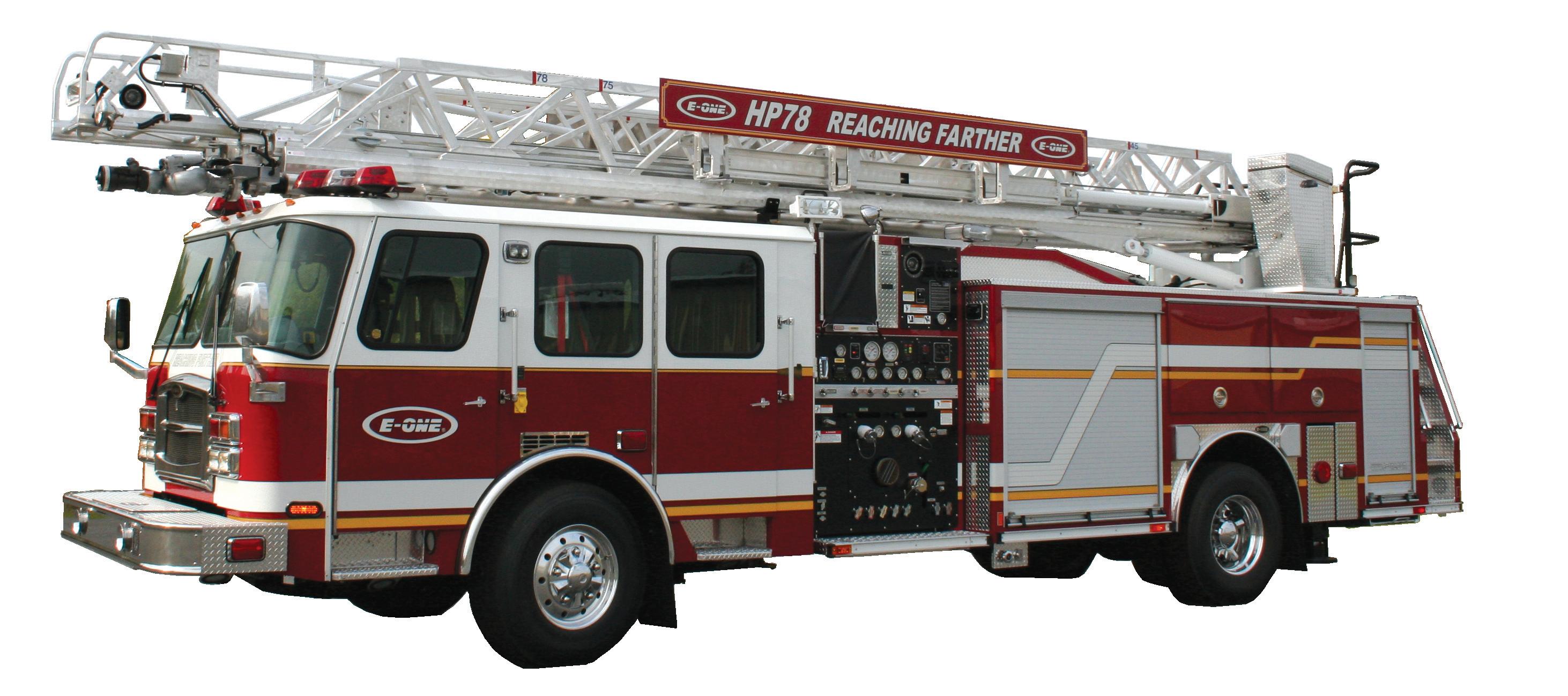
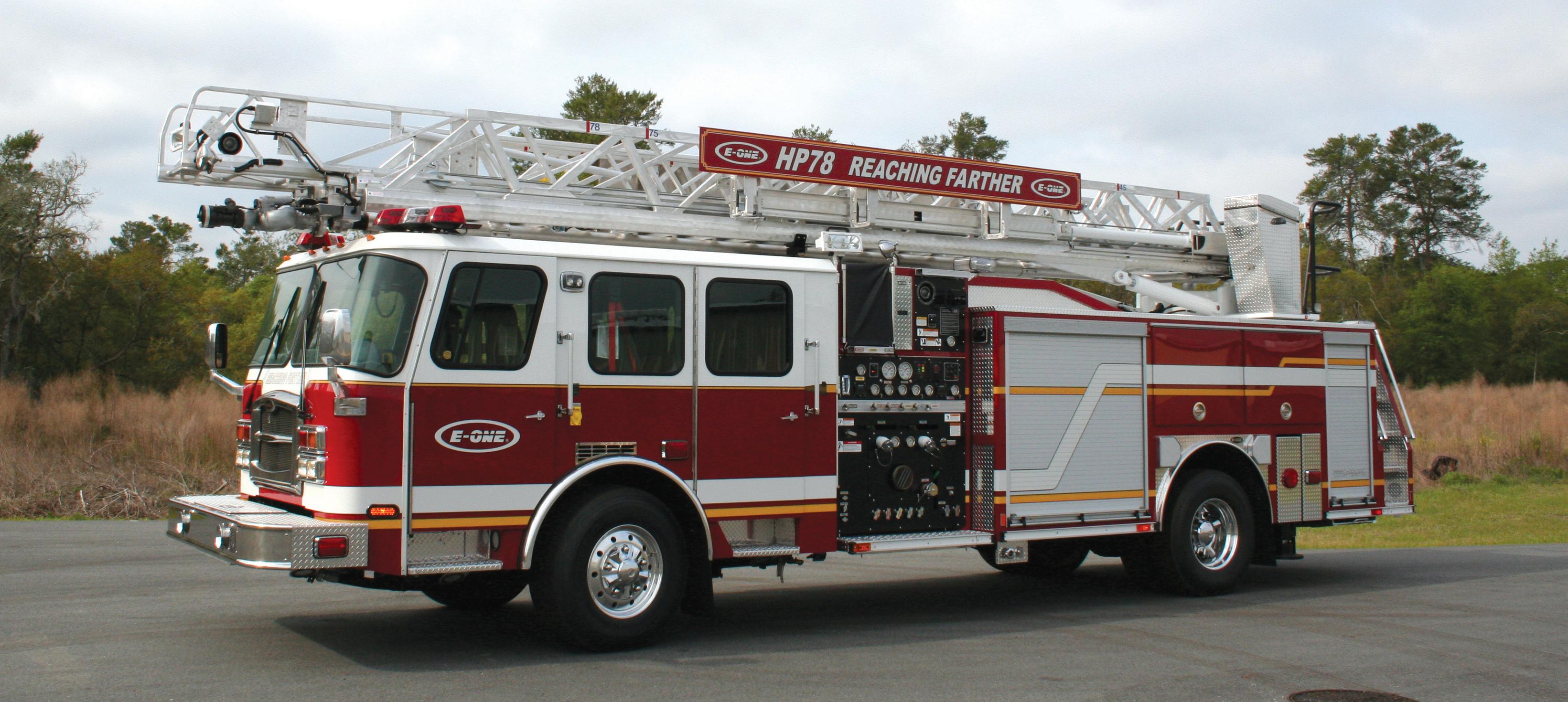
With more than 28 years of aerial experience and an industry-leading performance record, E-ONE continues protecting your team at the scene by delivering on our founding principles of innovation and safety. Featuring a 750-lb tip load, the new ToughTruss™ aluminum aerial design, a 2.5 to 1 structural safety factor, and a 78’ reach, the new HP 78 offers increased rescue capability and additional reach over similar products in its class. Combine this with generous compartment space, ground ladder storage, hosebed and tank size, and you’ll see why the new HP 78 allows you to carry the equipment and personnel necessary to protect your team at the scene. Carry more, reach farther with the new HP 78. www.E-ONE.com For more information, contact your nearest dealer:
When lives are in the balance and seconds count.
Phone: 204-233-3737
Phone: 519-752-5431
Phone: 450-568-2777
Territory: Quebec
WILDFIRE
After the worst fire season on record in British Columbia in 2009, the province has downsized the Ministry of Forests and Range but fire officials say they’re well prepared for whatever’s thrown at them with training, experience and co-operation on their side. Paul Dixon reports.
18
BE PREPARED
There’s a wildfire in your jurisdiction and you need backup. But how do you handle the influx of firefighters and their needs, from Gatorade to radios to shift assignments? Lou Wilde, the assistant chief in Kelowna, B.C., has been here and done that and offers a first-hand report on staging and setting up a base camp for large-scale incidents.
BY LAURA KING Editor lking@annexweb.com
ICOMMENT
FDIC north worth considering?
’m writing this in the nation’s capital during the Ottawa FIRE Symposium, an impressive, week-long affair that features world-renowned speakers and incredible science-of-fire workshops put on by the National Research Council, a national treasure if ever there were one.
The symposium, pulled together mostly by union muscle and the passion that grew out of a near tragedy, is a direct result of the Workers’ Report on the Forward Avenue fire in Ottawa on Feb. 12, 2007. To quote the dedication at the beginning of the lengthy report: “In the early afternoon of Feb. 12, 2007, the members of No. 11 Station, D Platoon, were called to 187 Forward Ave. for a report of a fire. Within nine minutes of their arrival on scene, five members of 11 D would be fighting for their lives in the performance of their duties. This report is dedicated to ensuring that the injuries and suffering incurred by these five members and that the lessons learned were not in vain.”
Edmonton for the Alberta chiefs conference in late June, the Maritime chiefs in July and the Canadian chiefs in September. There’s a new conference this year – the International Conference for Fire & Rescue Executives in Calgary May 30 to June 1 – plus the disaster management conference in Toronto, the 26th annual North American Vehicle Rescue Challenge in Calgary in September and the Canadian Industrial Emergency conference and expo, also in September in Calgary. OK, you get the picture. What’s the point?
PRODUCTION ARTIST KRISTA MISENER kmisener@annexweb.com
GROUP PUBLISHER MARTIN MCANULTY fire@annexweb.com
PRESIDENT MIKE FREDERICKS mfredericks@annexweb.com
PUBLICATION MAIL AGREEMENT #40065710
RETURN UNDELIVERABLE CANADIAN ADDRESSES TO CIRCULATION DEPT.
P.O. Box 530, SIMCOE, ON N3Y 4N5 e-mail: lmorrison@annexweb.com
Printed in Canada ISSN 0015–2595
CIRCULATION e-mail: lmorrison@annexweb.com
Tel: 866-790-6070 ext. 206 Fax: 877-624-1940
Mail: P.O. Box 530 Simcoe, ON N3Y 4N5
SUBSCRIPTION RATES
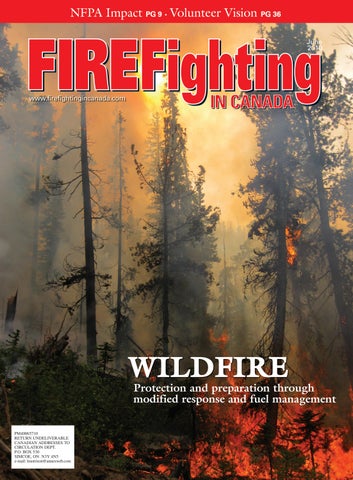
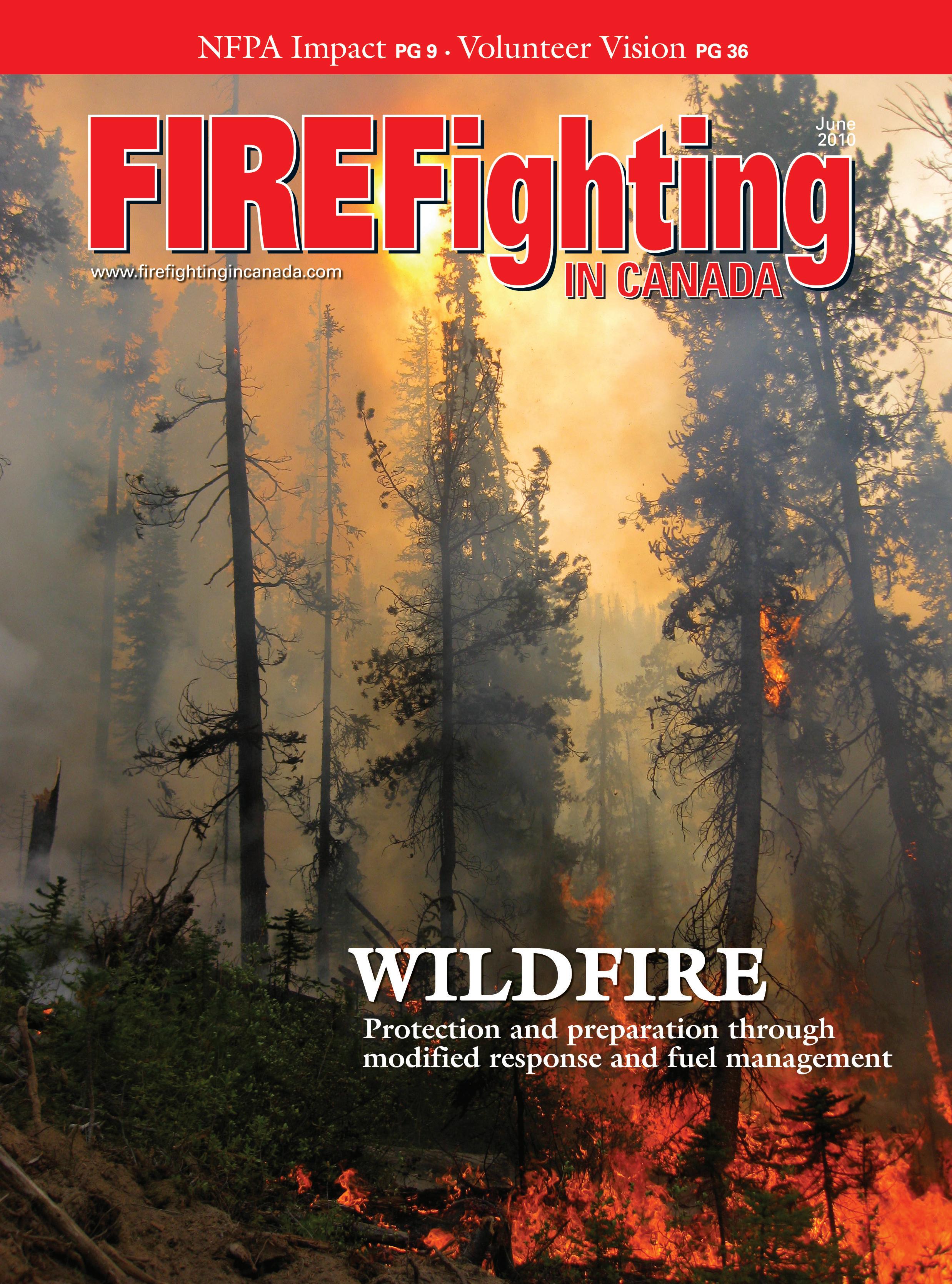
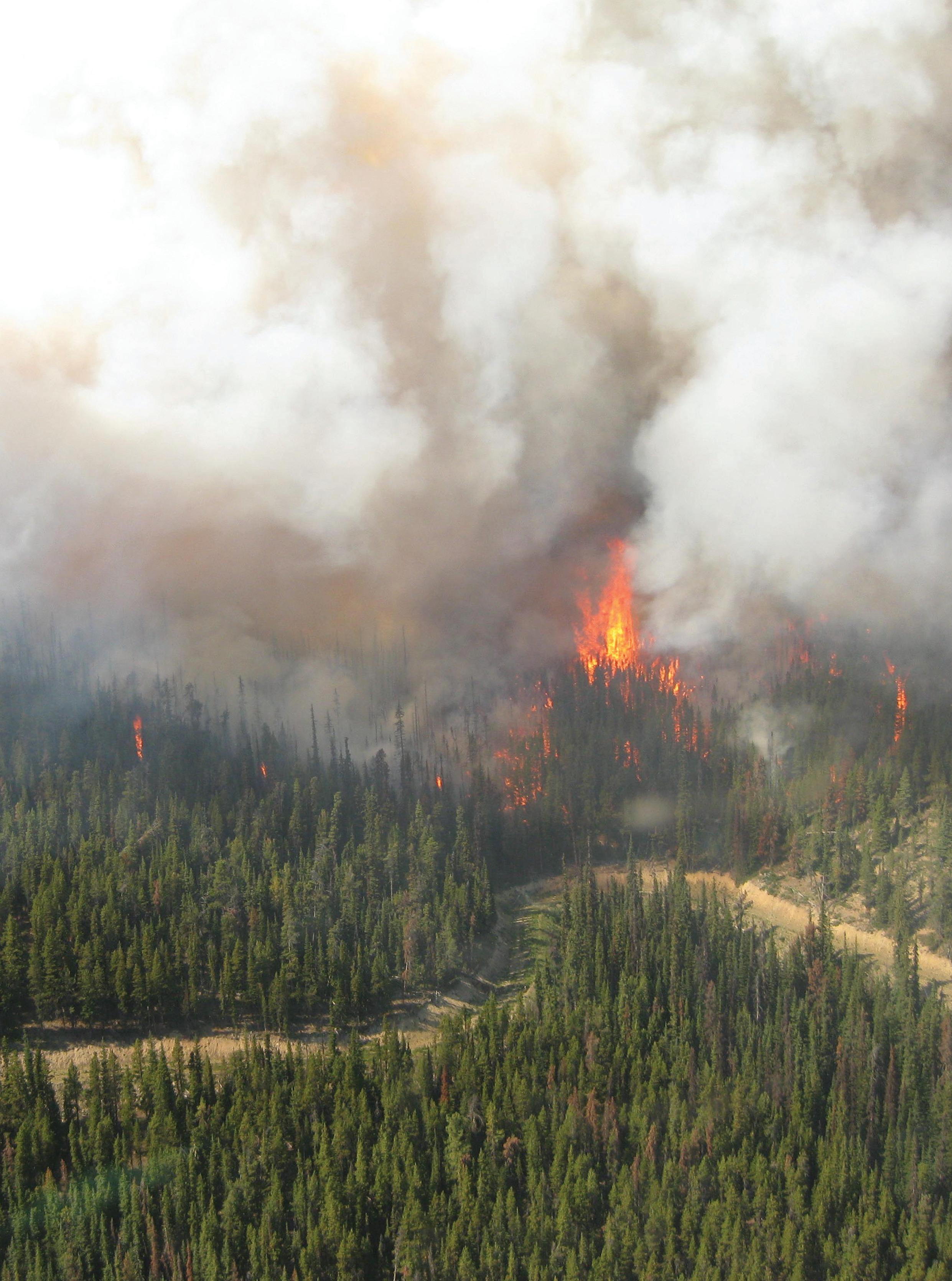
After the worst wildfire season on record in 2009, B.C. is well prepared. See story page 14.
The inaugural symposium wasn’t particularly well known outside Ottawa but it’s one of several educational forums this spring and summer that I’m attending in a continuing effort to better understand the issues challenging the Canadian fire service and meet the leaders who are passionate about tackling those challenges. In April it was FDIC in Indianapolis with dozens of Canadians from Windsor, N.S., to Morinville, Alta.; then the Ontario Association of Fire Chiefs convention in Toronto; and FDIC Atlantic early this month, with a remarkable 500 delegates for a weekend of hands-on training in beautiful Wolfville, N.S. We’re off to
Well, with limited travel budgets it seems departments are having a tough time choosing where to send their members. Chiefs of some key metro departments were notably absent from the OAFC conference, which led to musings about whether they were saving their travel dollars for the CAFC in the fall or to attend the new international conference in Calgary. Could all these conferences be too much of a good thing? The Ottawa symposium, FDIC and the extrication challenge are different –they’re not aimed exclusively at chiefs, rather there’s a significant training component meant for front-line firefighters. But once again it seems that in this business the left hand doesn’t always know what the right hand is doing and some national communication might help to get everyone on the same page about education and training needs. Some have suggested an FDIC-Canada – a massive undertaking but maybe it’s worth discussing.
Canada – 1 Year - $25.44 (includes GST - #867172652RT0001) USA – 1 Year $50.00
We acknowledge the financial support of the Government of Canada, through the Publications Assistance Program and the Canada Magazine Fund, toward our mailing and editorial cost. Nous reconnaissons l’aide financiere accordee par le gouvernement du Canada pour nos coults d’envoie postal et nos coutl redactionnels par l’entremise du Programme d’aide aux publications et du Fonds du Canda pour les magazines.
www.firefightingincanada.com ON THE COVER
Occasionally, Fire Fighting in Canada will mail information on behalf of industry-related groups whose products and services we believe may be of interest to you. If you prefer not to receive this information, please contact our circulation department in any of the four ways listed above.
All advertising is subject to the publisher’s approval. Such approval does not imply any endorsement of the products or services advertised. Publisher reserves the right to refuse advertising that does not meet the standards of the publication.
PHOTO BY CHRIS BERGMAN
l Best warranty in the industry
l Greatest number of safety options available on an SCBA
l Accountability System for complete fireground management
l New FireHawk M7 Responder Air Mask adds optional CBRN APR and PAPR convertibility
STATIONtoSTATION
ACROSS CANADA: Regional news briefs OAFC honours Kingston Chief Harold Tulk
As a longtime fire chief, Harold Tulk knows a lot about the Canadian fire service. But he didn’t know he had gained so much respect from his peers for his contribution to fire safety that they nominated him for the Alf Stone Award.
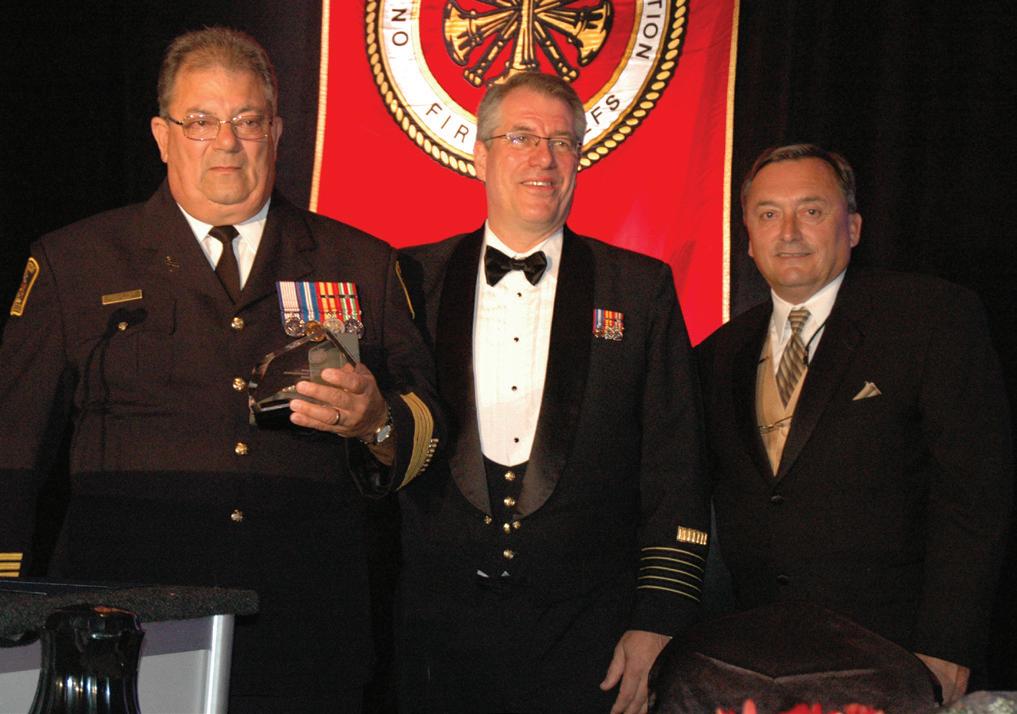
The award, presented by AJ Stone president Bill Stone and Ontario Association of Fire Chiefs president Richard Boyes at the closing banquet of the OAFC’s 58th annual conference on May 5 in Toronto, represents a longstanding commitment to the betterment of the fire service.
It recognizes the contribution of a fire service leader who exhibits professionalism and a positive attitude toward improving public fire safety, demonstrates initiative and innovation in improving fire safety, leads by example, serves the greater good and influences others.
During Chief Tulk’s lengthy career, which began in 1970 as
a firefighter in Toronto, he was a training officer, worked for the Office of the Ontario Fire Marshal, served on the OAFC board as a director and as president from 1993 to 1997 and sat on numerous boards and committees.
Chief Tulk chaired the Ontario Fire Chiefs in the Legislative Reform process from 1988 to 1997 and was assigned to Emergency Planning Canada during the 1980s and early 1990s to instruct and assess at the emergency site management program at the Canadian Emergency Preparedness College.
Tulk serves on the Performance Measures Committee of the Ministry of Municipal Affairs and Housing, which develops performance standards for municipal services.
He was the fire chief in Brockville, Ont., from 1984 to 2001; he provided leadership to the senior elected officials
THE BRASS POLE:
Promotions & Appointments
STUART KOFLICK has been appointed fire chief for the Town of Westlock, Alta., in addition to his current position of emergency services co-ordinator, managing the fire, EMS and emergency management departments. Koflick brings 20 years of experience to his new role including a background in technical rescue, dangerous goods and occupation health and safety. He was previously a captain with the Wabamun Fire Department in Alberta.
MARK DIOTTE becomes fire chief in the Town of Ajax,
Kingston, Ont., Fire Chief Harold Tulk received the Alf Stone Award for his outstanding contribution to the fire service at the Ontario Association of Fire Chiefs conference in Toronto in May. Tulk (left) received the award from OAFC president Richard Boyes and AJ Stone president Bill Stone.
in Leeds Grenville during the 1998 ice storm; and he was appointed chief for the City of Kingston on November 26, 2001.
A clearly surprised and emotional Tulk said he was honoured and humbled to receive the Alf Stone Award.
Ont., on July 1. Diotte began his career as a volunteer in Pickering in 1980 as a 21 year old. He became a deputy in Pickering in 2001 and move to Ajax in 2006. Diotte takes over from Chief Randy Wilson, who is retiring after 14 years as chief.
Retirements
Deputy Chief DREW ARMSTRONG has retired from Whitby Fire and Emergency Services in Ontario. Armstrong
The OAFC also honoured Chief Garnett Bennett of Pellatt United Firefighters, the recipient of the Bill Williams Humanitarian Award. Chief Bennett will be presented with the award at FireCon in Thunder Bay in November.
-Laura King
began his career as a volunteer on June 24, 1974, and was hired as full time in 1975. He became a captain in 1988 and attained the rank of platoon chief in fire prevention in 1993. He was
PHOTO BY LAURA KING
Liberals promise tax relief OAFC elects new board
Liberal Leader Michael Ignatieff has promised a $3,000 refundable tax credit for volunteer firefighters if his party wins the next federal election.
Ignatieff made the announcement May 3, shortly after the Canadian Association of Fire Chiefs brought the tax-credit issue and other concerns to MPs in Ottawa during government relations week in March.
Ignatieff noted that in its 2010 Agenda for Action the CAFC said 92 per cent of volunteer fire departments are having trouble recruiting members and 85 per cent have difficulties retaining existing members. The CAFC had also noted that 97 per cent of
volunteer departments said an element of personal income tax relief would alleviate some of the recruitment difficulties and 96 per cent said it would help to retain firefighters.
The tax credit would apply to volunteer firefighters who log 200 hours of service a year, including training.
The CAFC also asked MPs to amend the national building code to include sprinklers in new homes, to designate exclusive radio broadband access to first responders, for adequate funding for Ottawa’s Joint Emergency Preparedness Program and to create a mechanism for the national co-ordination of emergency response, including the collection of fire data. ■ ONTARIO
Kitchener Fire Chief Tim Beckett was elected president of the Ontario Association of Fire Chiefs during the OAFC’s 58th annual convention in May, succeeding Oakville Chief Richard Boyes, who stepped down after three years as OAFC president.
Executive members are first vice president Kevin Foster (fire chief, Midland, Ont.), second vice president Bryan Burbidge (fire chief, King Township, Ont.), third vice president Ted Bryan (fire chief, Ononabee-South Mogaghan, Ont.) and treasurer Matt Pegg (deputy chief, Brampton, Ont.).
Directors are Chief Warren
Mississauga breaks ground on training centre
■ ONTARIO
The City of Mississauga broke ground May 13 on a stateof-the-art fire and emergency training centre that it says will provide the most current and comprehensive emergency response training in Ontario.
“Our first responders are the best in their field and the development of this facility will allow us to expand our expertise and better serve our residents,” said Mississauga Mayor
Hazel McCallion. “The late fire chief, Garry Morden, dedicated his life to building fire safety in our community. This new training centre is a testament to him and will allow us to keep his vision alive.”
The Garry W. Morden Centre – Dedicated to Fire and Life Safety is scheduled for completion in late 2011 and will become the training ground for Mississauga Fire and Emergency Services personnel.
The City of Mississauga’s
Fire and Emergency Services will use the facility for training in all aspects of fire suppression, structural collapse, trench rescue, hazardous material handling and auto extrication.
The facility, which will span 37 acres in the north-west corner of the city, is expected to reach Leadership in Energy and Environmental Design (LEED) standards and has many environmentally friendly features. The centre will incorporate radiant heating in
Brinkman of Kenora Fire & Emergency Services; Deputy Chief Mark Diotte from Ajax Fire and Emergency Services; Deputy Chief Frank Lamie of Toronto Fire Services; Deputy Chief Gord Mills of Ottawa Fire Services; Chief Shayne Mintz from the Burlington Fire Department; Deputy Chief Neville Murphy of Kingston Fire & Rescue; and Chief Ghislain Pigeon from the Hawkesbury Fire Department. Deputy Chief Lee Grant of the Oakville Fire Department, and Chief Tim Bond of the Kemptville Fire Department, stepped down from the board, as did Zone 2 rep Chief Denys Prevost of Welland Fire and Emergency Services.
promoted to deputy chief in charge of fire prevention and communications on Jan. 1, 1998. Armstrong’s career in Whitby spanned more than 35 years.
Capt. MIKE HUTCHINGS (Hutch) of Whitby Fire and Emergency Services in Ontario passed away Feb. 5 after a courageous, 10-month battle with cancer, at the age of 59. An active member of Whitby Professional
Firefighters Association, Hutchings worked tirelessly as an advocate in the research and specifications of Whitby’s emergency vehicles and equipment. It was this passion and experience
with large trucks that resulted in many of the safety features found on the department’s front-line emergency vehicles today. For 26 years, Hutchings dedicated his life to the residents of the Town of Whitby and to the the safety of the firefighters with whom he worked. He was the first member of WFES to pass away while on active duty with the department.
Chief GEORGE HANMORE of Napanee, Ont., died May 1 after a brief battle with cancer at age
the garage bays, will have an energy efficient HVAC system, low consumption showers and air-quality monitoring stations. Mississauga Fire and Emergency Services will share the facility with the Department of National Defence and will house reservists from the Toronto Scottish Regiment who are training for domestic and international commitments. It will also be the site of a driver training circuit for Peel Regional Police.
56. Hanmore began his career more than three decades ago and had been Napanee’s fire chief for six years. He began his firefighting career in 1974 as a civilian with the Department of National Defence at CFB Kingston. He was a captain with the Kingston Township Fire Department and assistant fire chief of the Greater Sudbury Fire Service in 2000. He retired in 2002, but came out of retirement in 2004 when he applied for the position of chief in Napanee.
Last Alarm
STATIONtoSTATION
BRIGADE NEWS: From stations across Canada
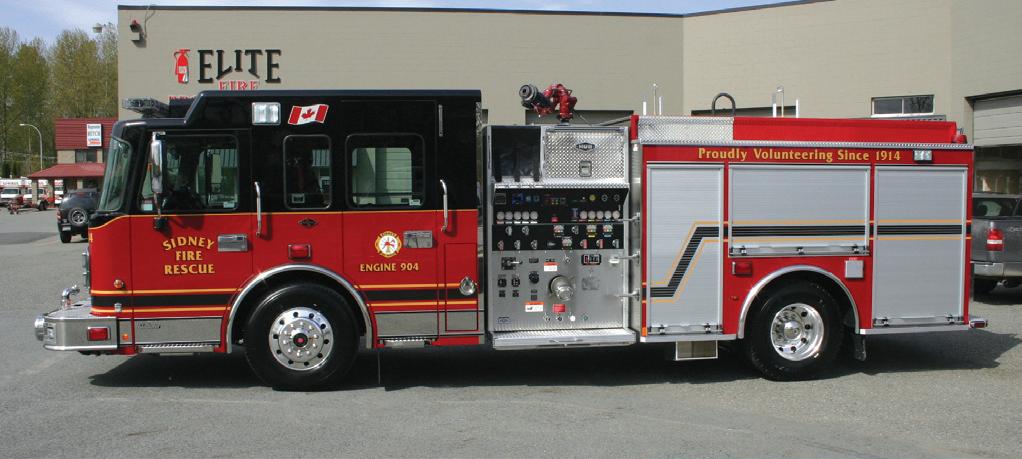
SIDNEY FIRE RESCUE in B.C., under Chief Dan Holder, took delivery in April of a Hub Fire Engine & Equipment-built pumper. Built on a Spartan Gladiator chassis and powered by an Allison 3000 EVS transmission and a Cummins ISL 400-hp engine, the pumper is equipped with a Hale Qmax 200 1,500 IGPM pump, a 500 IG co-poly water tank, Foam Pro 2002 foam system, a Whelen light package, Harrison 8 kW generator, Command light tower and Weldon multiplexed electrical system.
The CEREAL FIRE DEPARTMENT in Youngstown, Alta., took delivery in April of a Fort Garry Fire Trucks-built Terminator interface unit. Powered by an Allison 3000 EVS transmission and a Cummins 330-hp engine, the truck is equipped with a Darley PSRH 1,050 IGPM pump, 1,000 IG poly water tank and Foam Pro 2002 foam system.
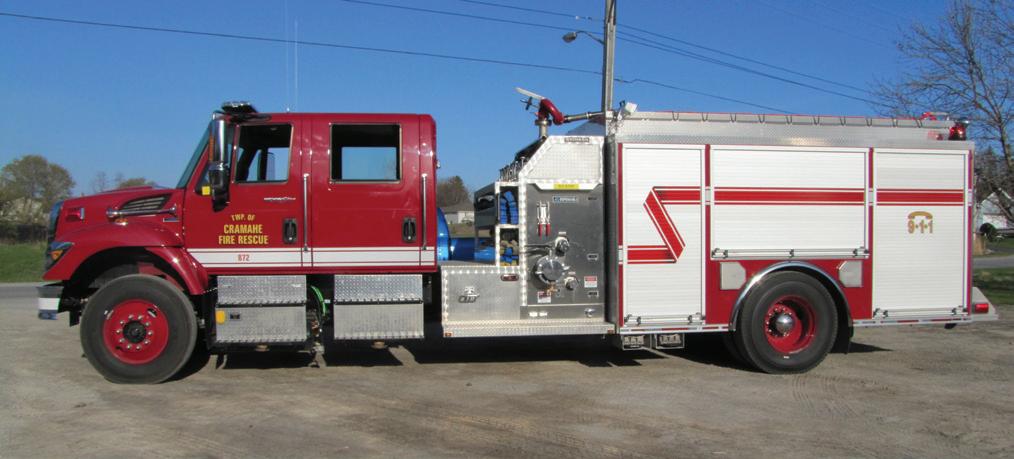
The TOWNSHIP OF CRAMAHE FIRE DEPARTMENT in Ontario, under Chief Jim Harris, took delivery in April from Dependable Emergency Vehicles of a Crimson Fire/Dependable Emergency Vehicles-built pumper. Built on an International 7400 BSA chassis and powered by an Allison 3000 EVS transmission and an International Maxxforce 9 350-hp engine, the pumper is equipped with a Hale DSD 125-23x 1,000 IGPM pump, Foam Pro 1600 foam system, 850 IG UPF water tank and a Whelen light package.
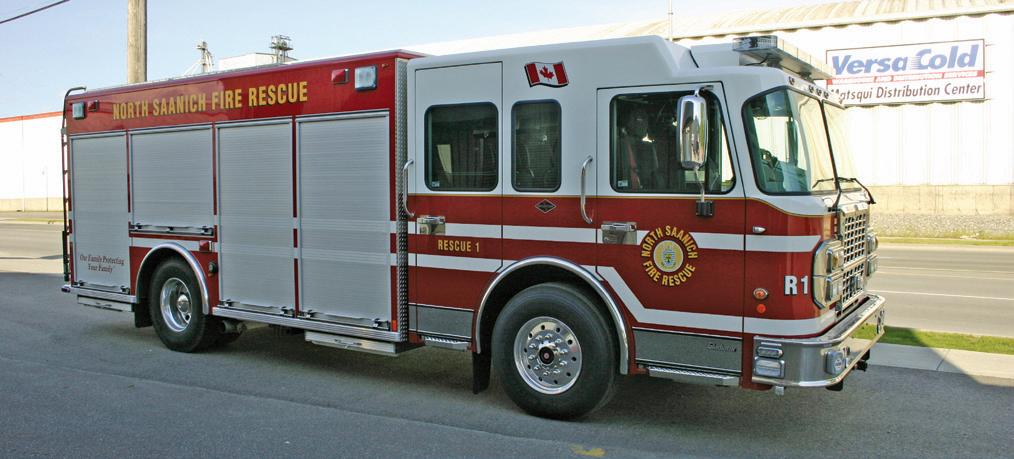
NORTH SAANICH FIRE RESCUE in B.C., under Chief Gary Wilton, took delivery in May of a Hub Fire Engines & Equipment-built rescue unit. Built on a Spartan Gladiator chassis and powered by an Allison 4000 EVS transmission and Cummins ISM 400hp engine, the rescue unit is equipped with a Waterous 100-50 DS pump, 300 IG co-poly water tank, Zico roof access ladder, Whelen light package, Warn M8000 winch, Onan Protec 25 kW generator, Will-Burt night scan power light, Amdor H2O LED ground lighting, back up cameras and an Xdriven event recorder.
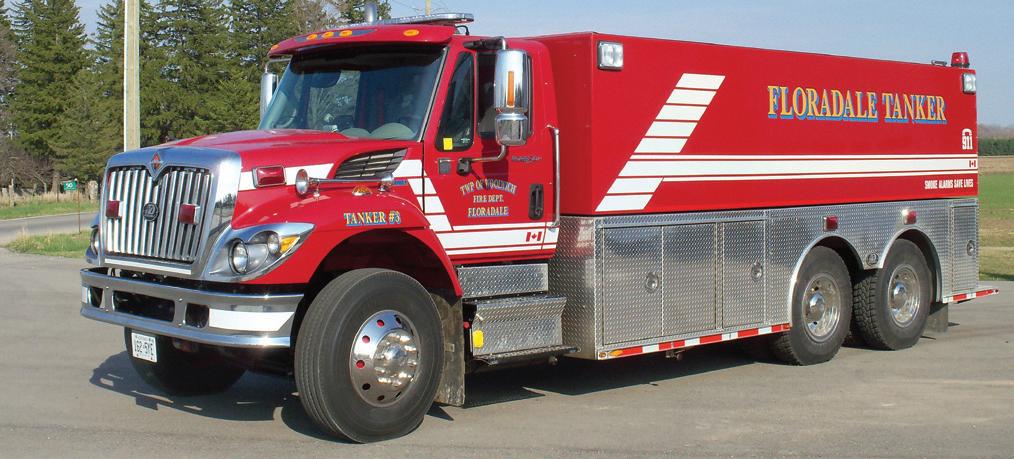
The TOWNSHIP OF WOOLWICH FIRE DEPARTMENT in Ontario took delivery in March of a Dependable Emergency Vehicles-built tanker. Built on an International 7400 6x4 chassis and powered by an Allison 3000 EVS transmission and a Maxxforce 9 330-hp engine, the tanker is equipped with a CET PFP 18-hp 200 IGPM pump, a 2,500 IG poly tank, a 3,000 IG folding Husky portable tank, Newton Kwik dump/swivel chute and telescopic chute and a Whelen light package.
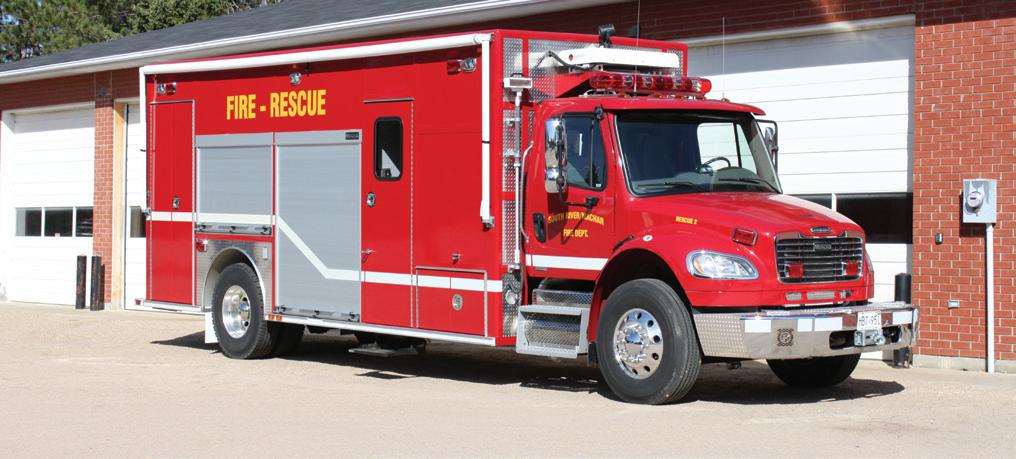
The SOUTH RIVER MACHAR FIRE DEPARTMENT in Ontario took delivery in March of a Metalfab-built heavy rescue truck. Built on a Freightliner M2 106 chassis and powered by an Allison 3000 EVS transmission and a Cummins 330-hp engine the truck is equipped with two 100-foot Hurst hydraulic reels, a 22-foot awning, a 12,000 pound Ramsey winch, a command centre, five SCBA seats, a foldaway stretcher and M-sized oxygen with six patient output.
SIDNEY FIRE RESCUE
THE CEREAL FIRE DEPARTMENT
THE TOWNSHIP OF CRAMAHE FIRE DEPARTMENT
NORTH SAANICH FIRE RESCUE
THE TOWNSHIP OF WOOLWICH FIRE DEPARTMENT
THE SOUTH RIVER MACHAR FIRE DEPARTMENT
BY SEAN TRACEY Canadian Regional Manager NFPA International, Ottawa, Ont.
CWildland fire issue needs our attention
anada has an inglorious past with regard to wildland urban interface (WUI) fires. Entire Canadian communities have been destroyed, including Vancouver in 1886, where 1,000 structures were devastated in 45 minutes with 28 killed and 3,000 left homeless. In 1908, the town of Fernie, B.C., was burned. And in 1911, fire gutted the community of Porcupine, Ont., and claimed 73 lives.
Many of the first building bylaws in Canada were introduced to counter the threat of wildfire. Unfortunately, we seem to have forgotten these origins as there are no provisions in the national codes to address the wildland/urban interface. Communities are on their own to set conditions – if they are even permitted to do so.
Enforcement of building and development standards in the WUI zone falls into a regulatory void. In the absence of any direction, I suggest that Canadian fire service leaders need to take the lead on this issue, as they will, unfortunately, be the ones with lives at risk at the hot front.
We need to educate the public so they understand that unless they build to higher standards in these areas the fire service will not come to their defence. Like development standards for flood plain construction, any community can adopt specific bylaws requiring enhanced development requirements in at-risk areas. Structural survivability has been proven in a number of studies and in recent fires and there is a standard that encompasses these. NFPA’s Building and Fire Code requires that any new development in a recognized wildland/urban interface area must meet NFPA 1144.
NFPA 1144 has been written so that it can be adopted by any municipality. It empowers the authority having jurisdiction (AHJ) in these areas to be able to take action to minimize the threat, including requiring design review and restrictions on access and outdoor fires. It presents basic criteria for fire agencies, land-use planners, architects, developers and local government for planning development in areas that may be threatened by wildfire. This standard, when used co-operatively among key agencies, will provide guidance in the design and development of Firewise communities in or near wildland fire-prone areas.
ing materials. It is hoped that the requirements in this document will, firstly, help protect the lives of residents and firefighters when wildfires strike and, secondly, reduce property damage. NFPA 1144 even has enforceable standards on homeowners for property maintenance. It is the standard for fire safe building practices referenced in the Canadian Homeowners FireSmart Manual (http://www. srd.alberta.ca/ManagingPrograms/PreventingFightingWildfire/ FireSmart/Default.aspx). The FireSmart manual is a good starting point in educating homeowners about making smart decisions. It is also a good tool to inform them so that they can properly maintain their properties. It does not, however, provide the needed enforceable standards for development of new properties. The B.C. version of the manual has a very good assessment guideline that can be used to determine whether properties are at risk and therefore potential design changes.
After one of the worst wildland urban interface fire seasons on record in 2009, NFPA has launched a new push on the WUI issues. It is recognized that with climate change, beetle infestations and increased human development into wildland areas the problem is going to get worse.
After one of the worst wildland urban interface fire seasons on record in 2009, NFPA has launched a new push on the WUI issues.
Communities need to begin to act now to mitigate these dangers. To aid in this task, NFPA has brought its considerable resources to bear on the problem. These resources are intended to support the Canadian fire service.
According to NFPA 1144, property in these at-risk areas shall undergo a wildland fire risk and hazard severity analysis. This shall include a plan developed to address these risks, construction plans approved by the AHJ, specific road design for fire department access, and fire-resistant building design requirements such as roof-
Sean Tracey, P.Eng., MIFireE, is the Canadian regional manager of the National Fire Protection Association International and formerly the Canadian Armed Forces fire marshal. Contact him at stracey@nfpa.org
The NFPA has appointed a new person to help lead its Firewise advocacy campaign. David Nuss, previously the NFPA Denver region manager, has taken on this task. A considerable amount of free resources from NFPA have been made available to anyone with access to the Internet. The primary launch point is www.firewise. org. Resources include several online courses for the fire service such as how to conduct a fire risk assessment, water supplies, firefighter safety in the WUI zone, Firewise landscaping and more.
My time and resources are also available to any community wishing to adopt such a bylaw. The Canadian fire service needs to adopt this as its mandate as its leaders can best control the issue. NFPA has the resources to support you.
BY E. DAVID HODGINS Managing Director Alberta Emergency Management Agency
F A new philosophy about fire and EM
ire, rescue and emergency management (EM) services should be separate and stand-alone organizations. At least, that’s what I once thought – and I defended that view with great vigour. Each is a unique service with its own unique mandate with distinct traditions and cultures. And EM folks also don’t typically wear uniforms. However, as I reflect on the need to apply what I preach about effective leadership and the ongoing quest to find better ways to achieve an organization’s goal and objectives, I have rethought this issue. I have come to realize there is a tremendous opportunity in linking these services.
Today I am a champion and enthusiastic promoter of systems that bring together fire, rescue and EM into a single structure. As I talk with colleagues about its benefits, I am challenged with questions such as why just fire, rescue and EM and what about the police and paramedics? My response, based on a career in the emergency services, is that fire and rescue are front and centre when a major emergency occurs. Television clips of a disaster, such as a flood or a tornado, always zero in on action shots of firefighters and search-and-rescue technicians. Why? Because they are the most actively engaged services in responding to natural disasters so it makes good sense for them to operate within one structure before, during and after a disaster. This is true for chemical, biological, radiological, nuclear and explosive (CBRNE) emergency events as well. I realize that EM professionals, police officers, paramedics and public works people play an integral role in bringing order out of chaos but my focus is on partnering the two centre stage emergency players.
Fire and rescue services often complain that they take a back seat to police in securing needed resources. Whether that is a reality or just a perception is not relevant at this point. Senior decision makers agree that an amalgamated structure would definitely add value to these organizations. Fire and rescue services would gain ground by supporting an amalgamated structure.
The death and devastation that resulted from the terrorist attacks of Sept. 11, 2001, highlighted the need for comprehensive and robust EM services. Every level of government embraced a renewed interest in EM and the need to ensure its organizations were able to respond to major events in a connected, co-ordinated, co-operative and collaborative approach. This has let fire departments get involved in supporting their government’s community safety priority. I am not talking about a hostile takeover. This is about creating synergies to provide citizens with effective and efficient education, planning, preparedness, response and recovery services.
Think about the opportunities that exist in public education. Most fire systems have effective, albeit often marginalized, fire safety and injury prevention programs. They do not necessarily require additional resources to grow these programs to include preparedness for major emergency events. But the EM 72-hour preparedness message is not as effective as it should be. It’s estimated that only 13 per cent of the population is prepared to be self-sufficient immediately following a major event. That needs to improve.
The expanded use of the incident command system (ICS) creates another opportunity for fire and rescue to support and partner with
Today I am a champion and enthusiastic promoter of systems that bring together fire, rescue and EM into a single structure. ‘‘ ’’
For instance, aggressive fire extinguishment occupies approximately five per cent of a fire department’s time. Many departments are responding to medical and motor vehicle collision emergencies, which adds considerably to their response numbers. However, there is an opportunity to take the lead and be the go-to for EM as well. When it comes to EM and the proverbial FM radio station WIIFM – What’s in it for me? – I would suggest a joined-up fire and rescue would give EM direct access to much-needed resources. Having a seat at the table becomes a win-win for everyone.
David Hodgins in the managing director, Alberta Emergency Management Agency. He is a former assistant deputy minister and fire commissioner for British Columbia. A 30-year veteran of the fire service, he is a graduate of the University of Alberta’s public administration program and a certified emergency and disaster manager. Contact him at David.Hodgins@gov.ab.ca
EM and the other emergency response agencies. ICS is routinely used for fire incidents so fire department officers are very good at applying the ICS principles. This could be shared with others in creating more effective and efficient mitigation activities. And it makes good sense to do this through a joined-up system.
I was very proud to be part of a closely aligned fire and rescue response team. And I wore the uniform with great pride. As I stepped away from my role of fire chief and then fire commissioner, I wondered how I would adjust to life in a suit and tie. Actually, it has worked out very well. Being part of an integrated fire, rescue and EM structure has its benefits, including significantly enhanced support from very senior levels of government. This translates into the ability to influence the overall system in order to benefit the services, and more importantly the people, we seek to serve.
It’s all about leaders making the right decisions for the right reasons. As Pierre Elliot Trudeau put it: “Reason over passion.”
WILDFIRE
Protection and preparation through modified response, fuel management
By PAUL DIXON
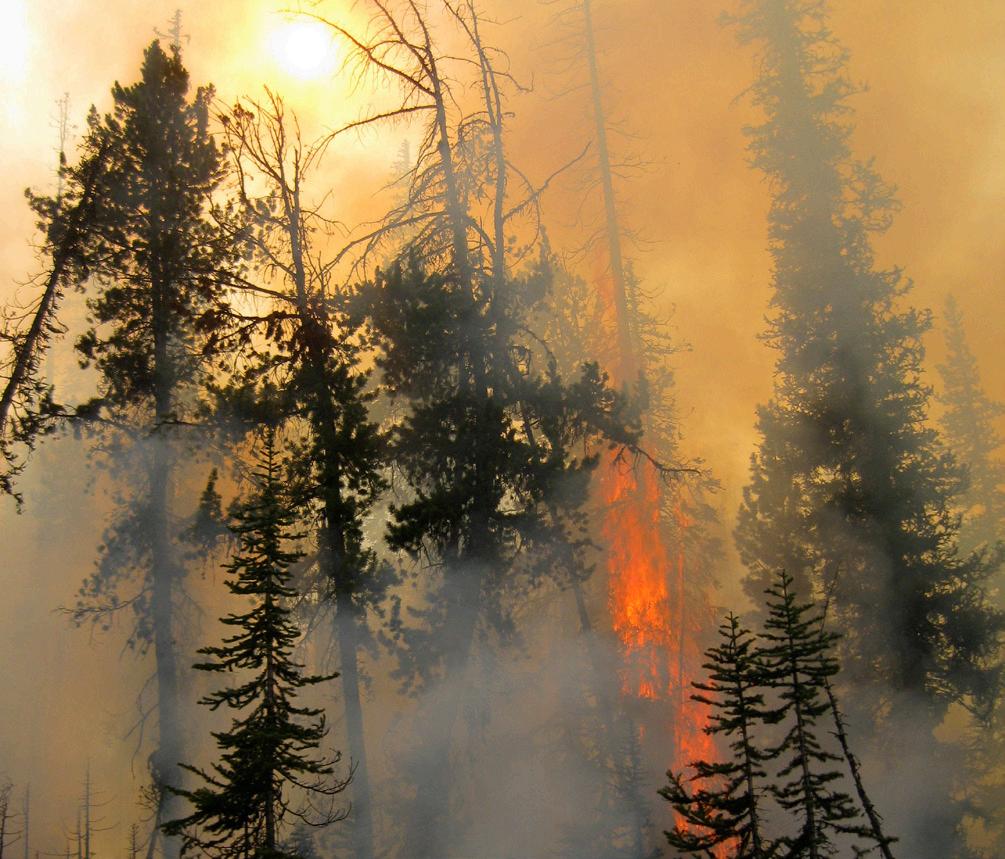
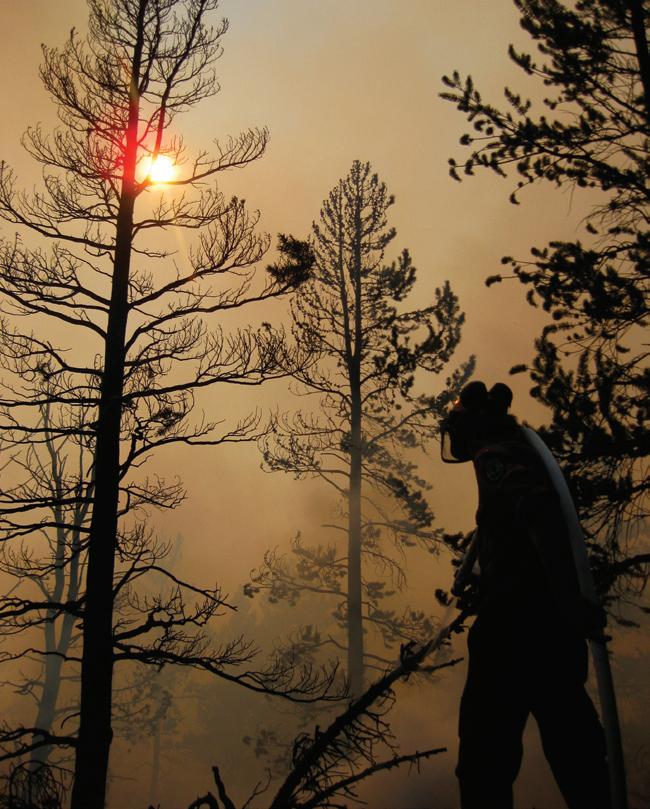
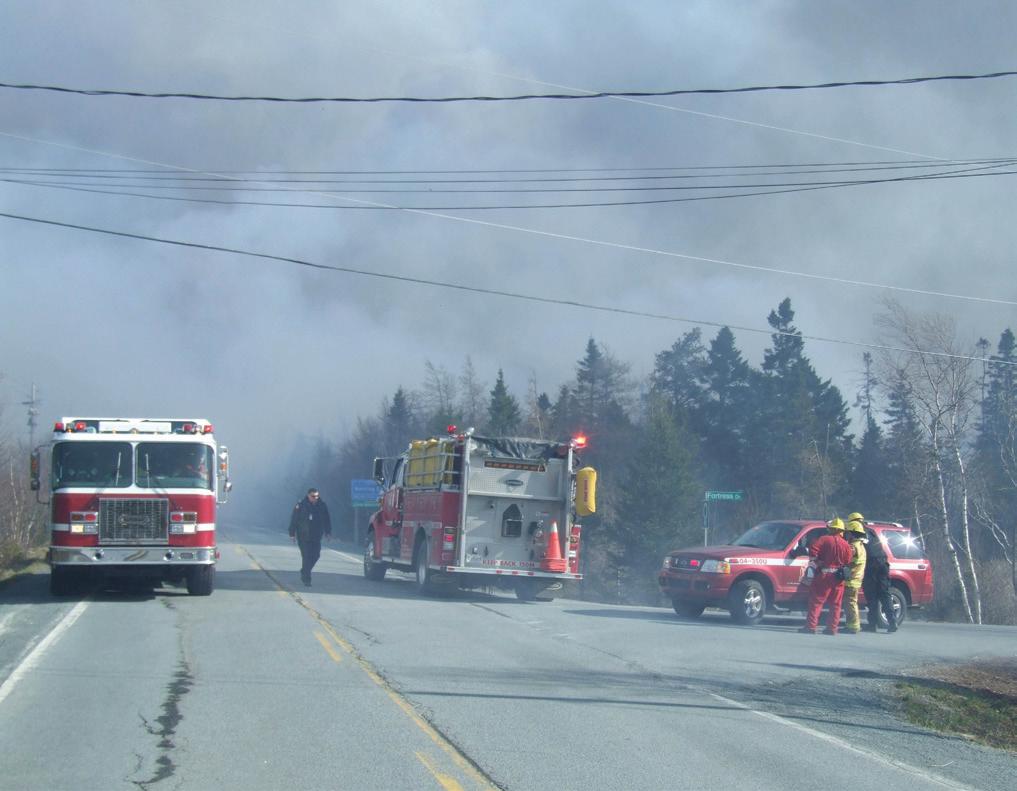
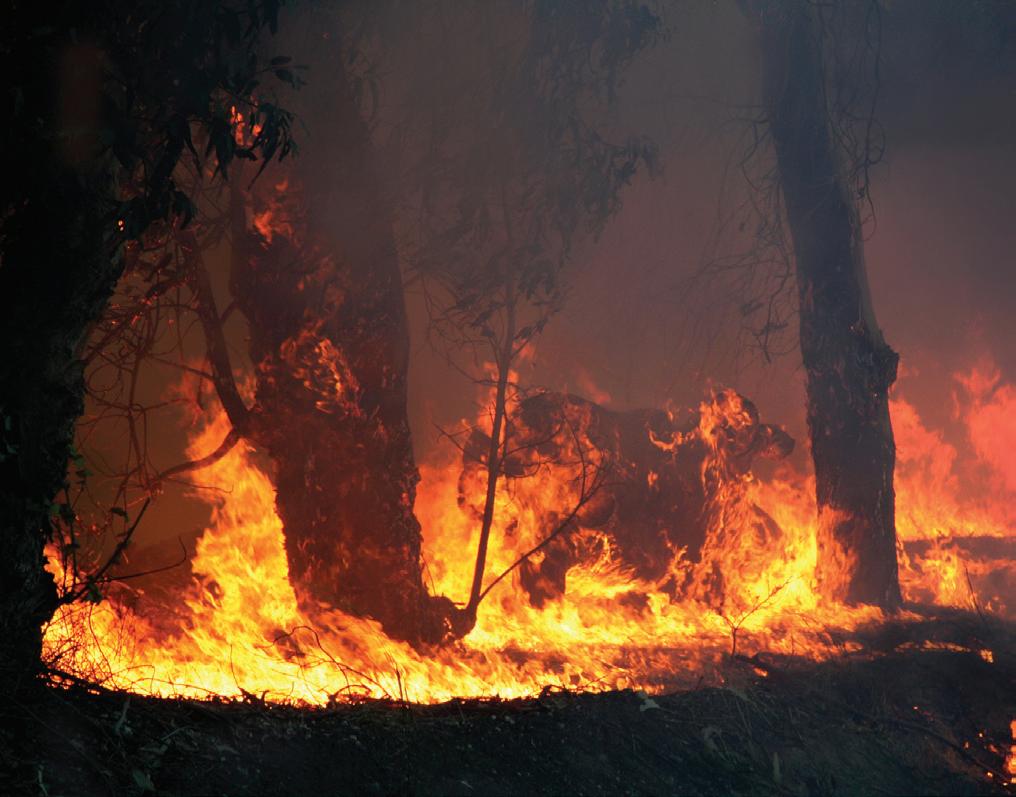
LEFT: A wildfire burns north of Lillooet, B.C., in mid-August 2009 during the worst wildfire season on record.
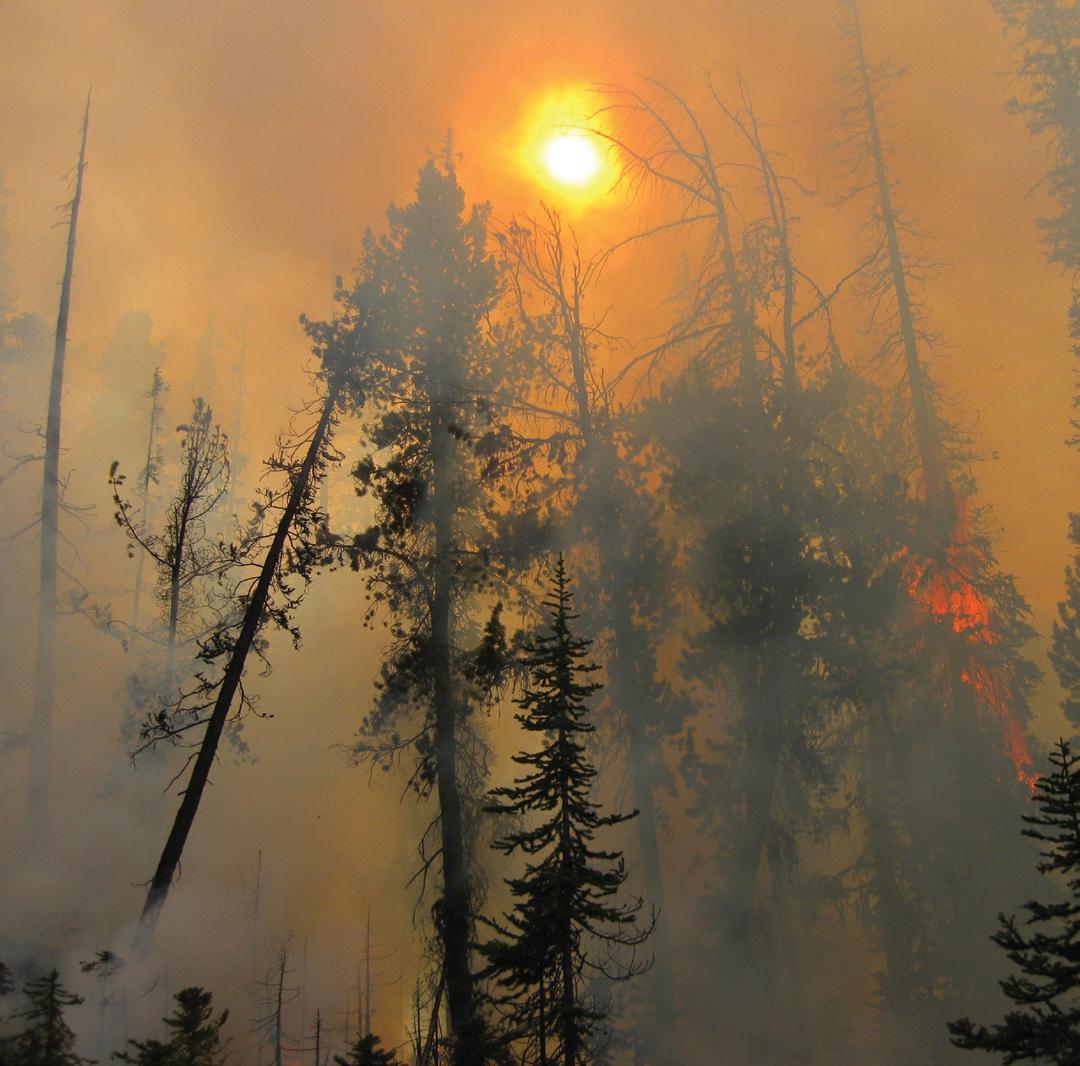
ABOVE: High noon on the fireline as the midday sun is barely visible through the smoke and haze north of Lillooet, B.C., in August 2009.
On April 15th, B.C.’s minister of forests issued a press release predicting that the province might be in for another scorching summer on the heels of 2009, the worst fire season on record. The statement came four days after the provincial government announced it would eliminate 204 permanent positions from the Ministry of Forests and Range as part of the ongoing downsizing of the provincial civil service.
The 2009 fire season in B.C. surpassed 2003 as the worst fire season in recorded history, with more than 3,000 fires devouring 257,000 hectares, about 40 per cent of the total for all of Canada. Other jurisdictions experienced relatively few significant wildfires, leaving personnel, equipment and aircraft available to be deployed to B.C. by the Canadian Interagency Forest Fire Centre.
B.C. employs 1,100 seasonal wildland firefighters. Last summer, 2,500 Class 1 firefighters were brought in from across Canada and as far away as Australia and New Zealand under the auspices of the CIFFC, plus another 1,200 contracted personnel. At the peak of the fire season there were 251 helicopters actively engaged in firefighting, along with 42 aerial tankers and water bombers, which dropped 19.6 million litres of retardant. More than $400 million was spent on wildland fires in B.C. in 2009; the province had budgeted $60 million. The single day record for new fire starts was 154 on Aug. 1, with 792 separate fires burning simultaneously.
Interviewed separately, Brian Simpson, director of the provincial Wildfire Management Branch, and Kelowna Fire Chief Rene Blanliel could have been reading from the same script when recounting the lessons learned from 2003, the changes that have been made and what the road ahead may look like.
When asked about the difference between 2003 and 2009 they had the same answer: unified command and communications.
Co-operation among local governments and agencies was markedly better in 2009 because, as Simpson put it, “everyone knows their role and pulls on the rope in the same direction”.
From Blanleil’s perspective, a good example of effective unified command was the mid-July 2009 Glenrosa fire on the west side of Okanagan Lake, during which Fire Chief Wayne Schnitzler of West Kelowna quickly took charge of the response to a fast-moving blaze that threatened thousands of homes. About 10,000 people were evacuated in the first 24 hours while municipal firefighters were joined almost immediately by the first provincial firefighters and aircraft.
Communication has improved in many ways. From the fire line through tactical command to the regional and provincial level, information flow greatly improves decision making capabilities. Providing accurate information to the media in a timely fashion during the 2009 fires resulted in more complete and positive reporting of events than in 2003 and this contributed to public understanding and stronger support.
In 2003, the 25,000-hectare Okanagan Mountain fire that threatened Kelowna led to public outrage, after which the province appointed former Manitoba premier Gary Filmon to conduct a commission of enquiry. After hearing hundreds of submissions, the
commission released its findings in early 2004 in a document known as the Filmon Report. Key findings included poor communication at all levels, partly because the existing lines of communications were simply overwhelmed and also because there was no comprehensive communication strategy, internally or externally. A lack of even the concept of unified command left locals feeling slighted when the provincial forces announced that they were in charge. While there was an influx of structural firefighters and apparatus from across the province, much of it self-initiated, putting people who were neither trained nor properly equipped directly in harm’s way. The province has embraced the Filmon Report and this has led to a significant change in philosophy, says Simpson.
“Prior to 2005, wildland fire fighting in B.C. was simply a response. Now we have shifted our focus from protecting forest values to protecting communities through fuel management programs and community wildfire plans. Fire management around communities is critical.”
Modified response means that fires in remote areas that do not threaten human life or structures are allowed to burn in order to maximize resources where needed. In 2009 in B.C. there were 338 modified response fires.
B.C. now has a co-ordinated fuel management program. Fuel management is the process of changing forest fuels to reduce aggressive fire behaviour. This can include thinning, spacing and pruning trees, and removal of needles and woody debris on the forest floor. This reduces fuel load and the potential for devastating wildfires. Money is made available to municipalities and regional districts in the form of matching grants administered by the Union of B.C. Municipalities (UBCM). The City of Kelowna had initiated its own fuel management program in city parks in 1998 and has aggressively upgraded its program since 2003. Chief Blanliel says that while his department and the City of Kelowna put a lot of energy into the program, along with public education, there is still a problem with property owners who are unable or unwilling to undertake the work on private property.
Sometimes the process of disposing of the accumulated dead trees, downed branches and needles can be just as risky as leaving this material on the ground. Piling up the fuel and burning it is the only way to reduce the hazard but after a warm, dry winter the burning season can be very short. West Kelowna cancelled 95 burning permits in early March after two slash fires got away from the property owners and spread to surrounding brush. A quick response by West Kelowna Fire Rescue brought the fires under control before there was any significant damage. Across the lake in Kelowna, Chief Blanleil decided not to cancel the 100 permits that his department had issued.
■ CHANGING WEATHER
Weather is a key factor in wildfire season. As Simpson notes, “fire seasons are starting earlier and lasting longer year after year”.
Snowpack across B.C. was at below average levels this spring, though a late dump of snow across much of the province in the weeks after the February Olympics did improve the situation. But snowpack is just part of the equation. Chief Blanleil says that “the situation is really dependent on the amount of precipitation the region receives through May and June and then how hot it gets through the summer”.
Another factor is timing. “We were fortunate in 2009”, says Blanleil, “as the big fires were early in the season, which meant that provincial resources were available. In 2003, the large fires in and around Kelowna were later in the summer and there had already been a number of significant fires in the province. Resources were stretched thin and people were worn out.”
Community Structure Protection Units (SPU) are credited with saving hundreds of buildings during the 2009 wildfire season. The UBCM owns three units that are strategically placed around the province and jointly managed under a memorandum of understanding
BY
with the Office of the Fire Commissioner and the Ministry of Forests. These structure protection units are designed to minimize damage from interface fires. Each trailer contains 350 sprinklers, which is enough to protect 30 to 50 homes. The units are deployed during an interface fire to dampen roofs and areas around structures to help prevent sparks and embers from igniting fires. Many communities and fire departments have created their own SPUs.
■ PINE BEETLES AND HUMAN ISSUES
The mountain pine beetle infestation has a huge impact on wildfire behaviour. Currently the B.C. government estimates 16.3 million hectares are affected by the beetle, with trees dead or dying. Dead trees burn easily and support rapid spread of fire. The dead and dying trees do not retain water in the ground with the result that ground cover dries out quickly and acts as ladder fuels that support combustion.
A large part of the problem is the number of fires caused by humans, whether deliberate acts of arson, careless smokers, campers ignoring open fire bans to what David Letterman calls “true acts of human stupidity”. In July 2009, a homeowner in West Vancouver, concerned that the noise of a chainsaw would disturb his neighbours, decided instead to burn out a stump behind his multi-million dollar home. Oblivious to the tinder dry conditions and the total fire ban in effect in the community, he doused the stump in gasoline and tossed a match. Flames exploded through the tinder dry underbrush and the resulting smoke screen created mayhem on the nearby TransCanada highway. While no buildings were damaged, West Vancouver firefighters were hard pressed to control the blaze that consumed several hectares of brush.
Part of the April 15 press release from B.C.’s Minister of Forests was a warning that tickets would be issued to those ignoring fire closures in parks and on Crown
land. What the minister didn’t mention was that in addition to his ministry eliminating 204 staff positions this year, more than 50 provincial park rangers who would ordinarily be out patrolling the back country during the peak summer season were eliminated last year; the number of conservation officers in the province has also been reduced by half over the past decade. Global warming, climate change – call it what you will. Shirtsleeve weather in Vancouver during the Olympics might look good to the tourist board, but it’s really not what the province needed. This past winter was the warmest and driest on record
from coast to coast to coast. Before spring had sprung there were fires burning in the Maritimes, Ontario and Alberta. Forest fire resources in this country are designed around the concept that at times of peak need, resources will be available from other regions, as happened to B.C.’s benefit in 2009. What happens when those resources are not available for deployment? We are rapidly approaching the tipping point.
Online: A unique training program in Kelowna is preparing the next generation of wildfire fighters. Go to www.firefightingincanada.com and click on web exclusives.
GLOBAL CONNECTIONS
PHOTO
CHRIS BERGMAN
The aftermath of one of the 2009 wildfires in British Columbia.
Be prepared
Staging and base camp key to managing large-scale incidents
By LOU WILDE
One aspect of incident command system training that is often overlooked is staging and base camps to support large-scale events. Largescale events may not occur often in a career but it’s prudent for chiefs and officers to discuss the what ifs.
Here’s an example: In August 2003 when a lightning strike in Okanagan Provincial Park became a threat to the city of Kelowna, B.C., mutual aid was requested and received from as far away as the Edmonton (Alberta) Fire Department. Within 24 hours of the request for mutual aid during the provincial state of emergency, we had 62 additional companies and more than 250 staff.
The road in front of our main station had to be closed; lineups had to be drafted for day and night shifts; personnel had to
be tracked for accountability and for pay. Supplies from hoses to Gatorade needed to be available and monitored. It should have taken an army of people to support the army in the field. In Kelowna, we are working on a system to set up a large-scale base camp so that when an incident of this magnitude happens again we will have a template and be better prepared for 250 additional staff.
Here are some of the basics that need to be managed in a base camp.
• Stores: firefighting supplies, water, Gatorade, power bars and other items need to be kept secure and issued by staff rather than having a “free for all.”
• Finance section chief: you need to set up an F and A section before people arrive, if possible, so that pay for members can be accounted
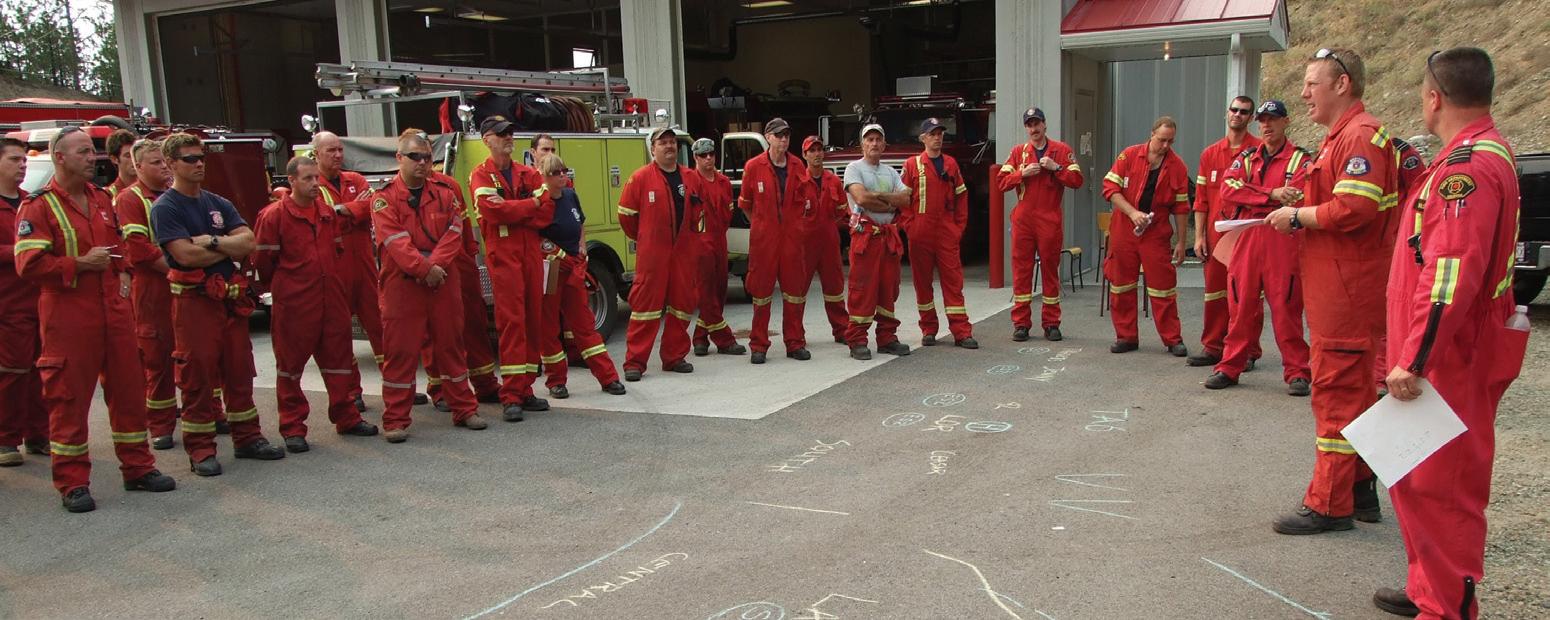
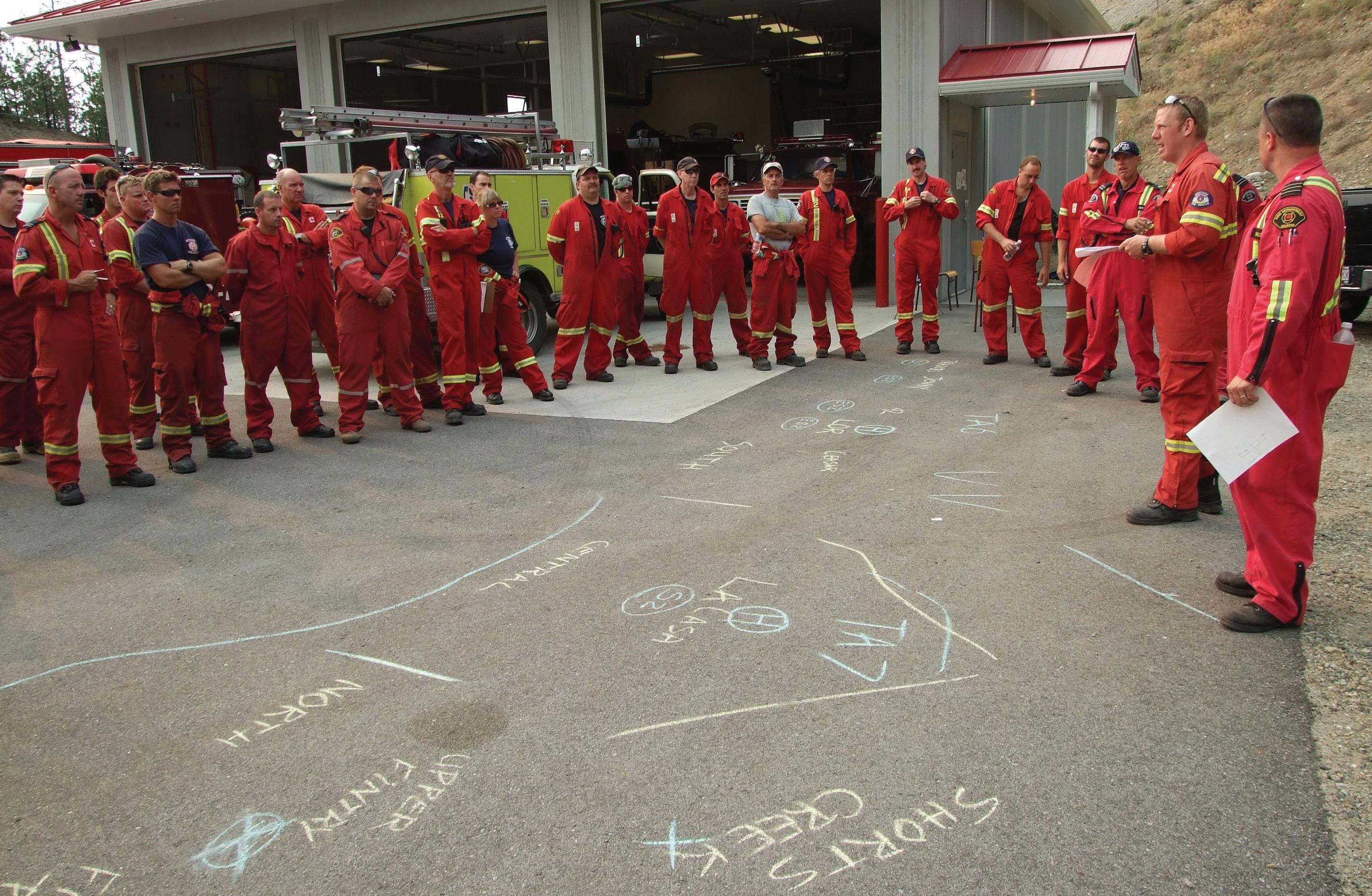
TOP: Darren Lee from West Kelowna and Kelowna Assistant Chief Lou Wilde (right) brief crews during the Terrace Mountain fire in August 2009.
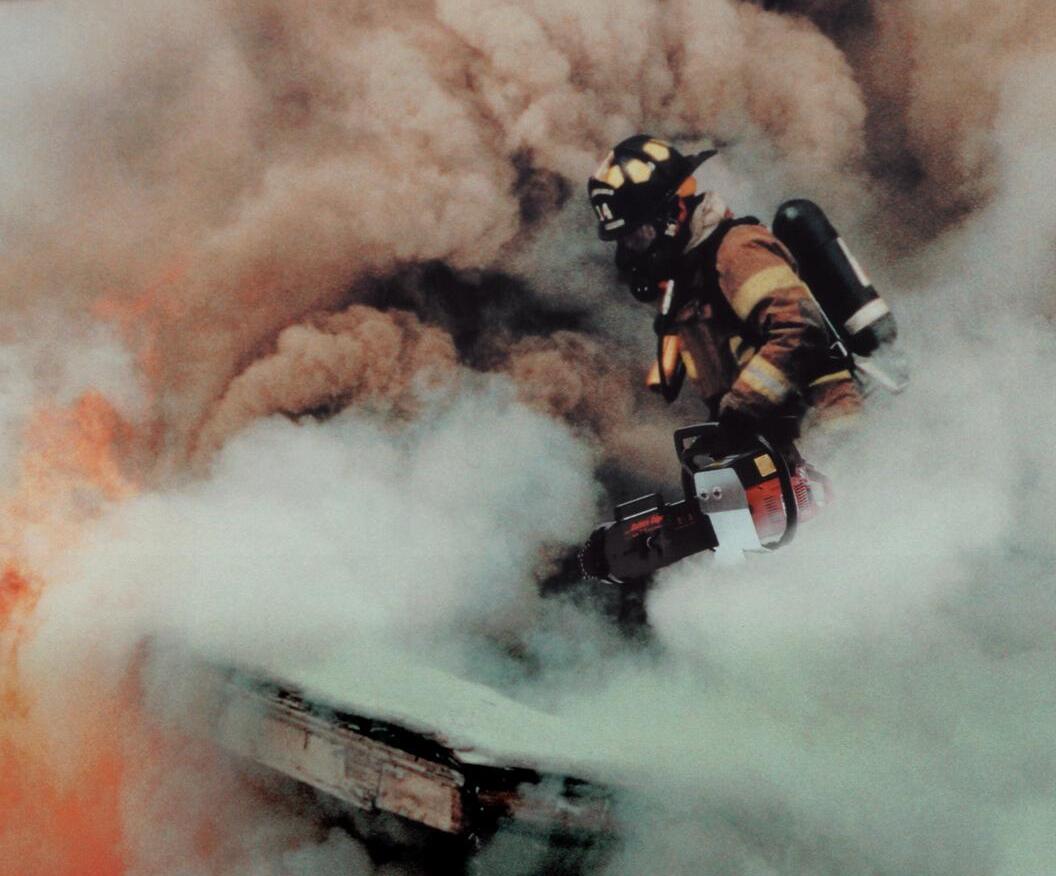
Cutters Edge Rescue Saws are designed and built to deliver 100% reliable, high performance cutting in the most demanding and extreme conditions encountered by Fire and Rescue Professionals.
MULTI-CUT Fire Rescue Saw
The Cutters Edge Original for Ventilation, Forcible Entry and Rescue Operations and built specifically to operate in hot, smoky fireground conditions. The patented BULLET® Chain cuts faster, safer and lasts up to 20 times longer than standard chains.
Gas Powered Concrete Rescue Saw
Cuts reinforced concrete up to 16-inches thick in minutes with the patented GCP SealPro® Diamond Chain and powerful 101cc engine. It’s fully portable, operates in any position and just one water hose needed for dust-free cutting in rescue situations.
Rotary Rescue Saw
Look for the New Generation, More Powerful Rotary Rescue Saw in Early 2010.
Fully Equipped Sawing Kits are Available for All Three Models
Staging areas and preparation are key to managing large-scale incidents.
for along with invoicing for all that Gatorade.
• Radio frequencies: If companies are showing up with radios that do not have proper frequencies, then a radio company should be contracted to provide reprogramming on their arrival. If members have to be issued radios, you need an accountability system to track of who has radios and who has returned them. Batteries need to be charged and a method must be developed to ensure members aren’t going out to the field with a battery that will soon die.
• Personnel accountability: If your local departments use the same system with a tag on a ring or Velcro, that may be OK,
Fires, not Paperwork
but what if you have private contractors or police or ambulance or anyone else who doesn’t use your fire department’s system to track names and assignments?
• What happens if people show up and don’t have proper personal protective equipment?
• Lost and found: This is necessary so people have a place to deposit or look for items instead of asking. This seems simple but is necessary, as is a message board through which people can contact each other. This kind of thing can be made available at a kiosk in a central spot where people can go for information rather relying on someone to tell them.
• A kiosk is also a good place to post official messages or notices such as lineups, directions and maps.
In 2003, during the Okanagan Park fire, we had a number of unsolicited donations, from extinguishing agent to socks and everything in between. We had to control the receiving and disbursement of all this stuff. Businesses and members of the public want to help. They give what they can and, although it’s appreciated, we have to be careful about how we use it – from a kind-hearted elderly woman bringing in pies that shouldn’t be eaten (ask your local food safe people about this) to the company that “donates” equipment then invoices your department or uses the acceptance of the donation as your endorsement in later advertising. Don’t get me wrong – tons of good corporate and private citizens made a huge difference through their support in the work we were able to do – it’s just something you have to be aware of.
Rehab for personnel is crucial. Members should arrive at camp early enough to go through the so-called “meat grinder” – where
Continued on page 26
BACKtoBASICS Know your ladder angles
By MARK VAN DER FEYST
Ground ladders are a big part of truck company operations. As mentioned in Back to Basics in September 2009, firefighters need to train and practise the raising and placing of ground ladders with just one person. Due to manpower issues, we cannot always dedicate two people to raising a 24-foot ground ladder. Ideally, a single firefighter can effectively ladder a residential structure.
Part of the raise operation includes angling the ladder to the correct climbing angle.
The ideal climbing angle for any ladder is 75 degrees, or one-quarter of the ladder’s working height. While we teach new firefighters the right way to set the climbing angle, it’s not always possible in emergency situations to follow all the steps we teach.
At structural fires, we should ladder all sides of the building, or at least two sides. This provides interior crews with at least two exit points and a quick ingress point for the rapid intervention team. We also ladder structures for victim rescue. When fire victims are hanging out a window, ready to jump or yelling at us for help, we need to quickly raise and position the ladder to rescue them. Checking the correct climbing angle is not a part of this operation.
Each ground ladder has labels containing safety messages, warnings and heat cautions. Some labels show the correct method for setting the climbing angle once the ladder has been raised. These labels are often found on the side beams of the ground ladder and show a stick figure measuring the ladder to ensure the 75-degree angle. The label even includes a four-step process:
1. Place toes at bottom of ladder’s side rails;
2. Stand erect;
3. Extend arms straight out;
4. Make sure palms of hands touch top of rungs at shoulder level.
We instruct our crews to use this four-step process when trying to determine the correct climbing angle. Taking the time to follow the four-step process while a victim is hanging out the window ready to jump is not a wise decision. When trying to ladder a building in a nonemergency situation, taking the time to ensure a good climbing angle is wise.
Another type of label sometimes found on the side of ground ladders features an L diagram that shows when you have the proper climbing angle. When you put the ladder against the support wall vertically, the L is crooked and points toward the ground. When you pull the ladder out from the support wall, the L straightens out and appears just as you would write it on a piece of paper. When the bottom part of the L is parallel with the ground, the climbing angle is correct. This type of label is a quick reference guide and can be useful when trying to place a ground ladder but it’s difficult to see at night as it’s printed in black.
Ground ladders are very strong and, as noted in September’s column, are tested to ensure maximum working conditions. If a ground ladder is placed against a building at an angle of less than 75 degrees, will this hinder our climbing operations? No, it will not. But if the ladder is set at an angle of more than 75 degrees, we are in trouble. A ladder set at 80 degrees is very intrusive when trying to climb for entry, or when rescuing a person from the building. And a ladder set at an angle of 50 degrees or less will be dangerous; the butt spurs will kick out when someone steps onto it, especially on a concrete surface.
a firefighter to climb up, gain entry and bring the victim down the ladder safely.
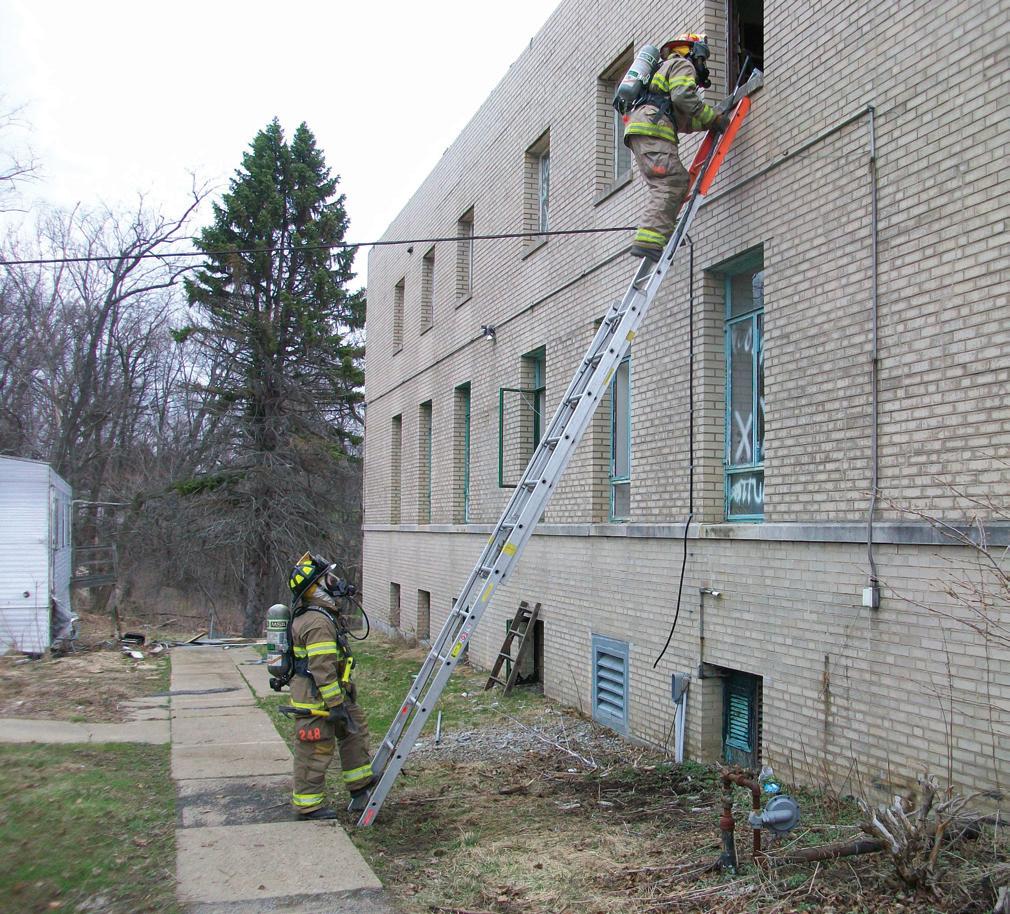
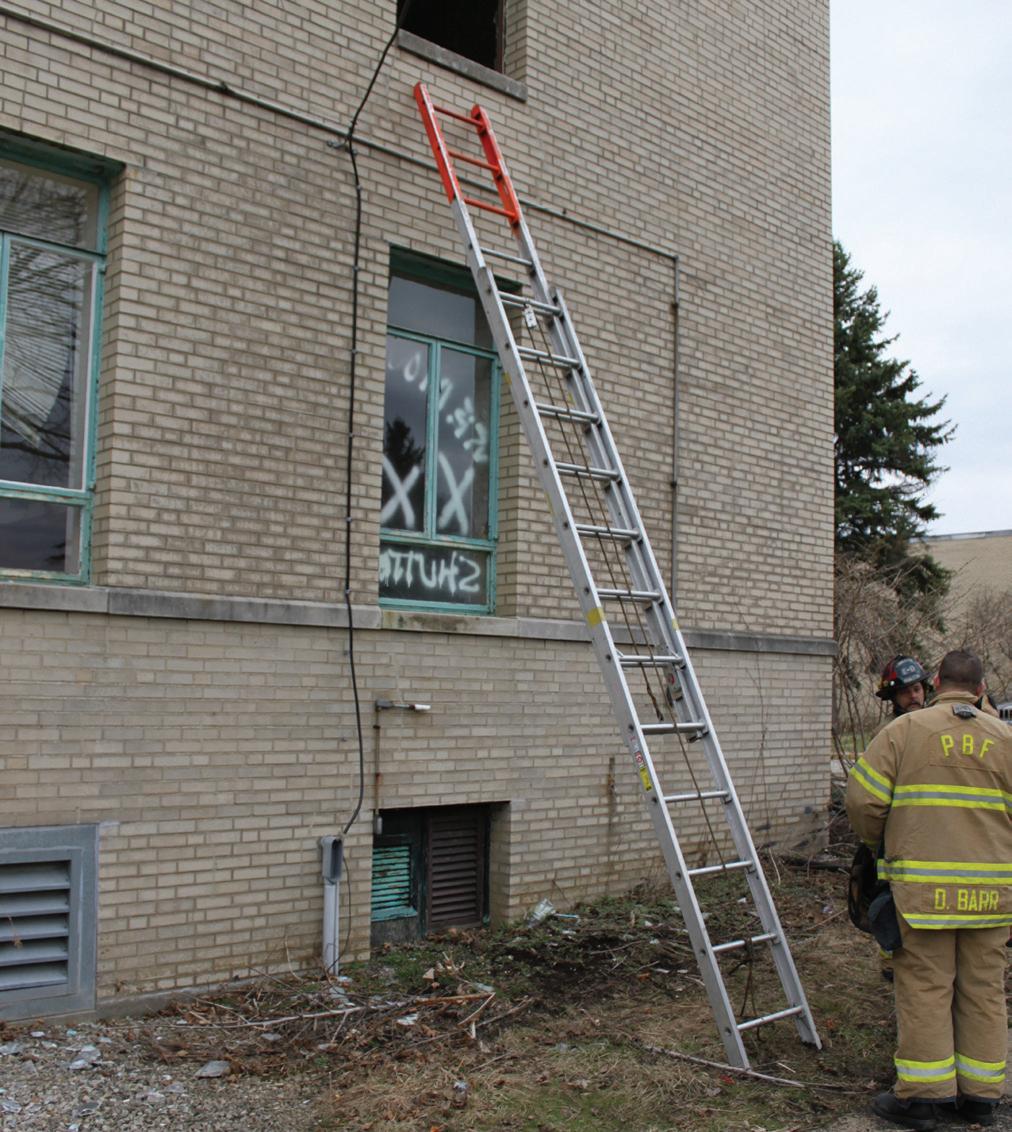
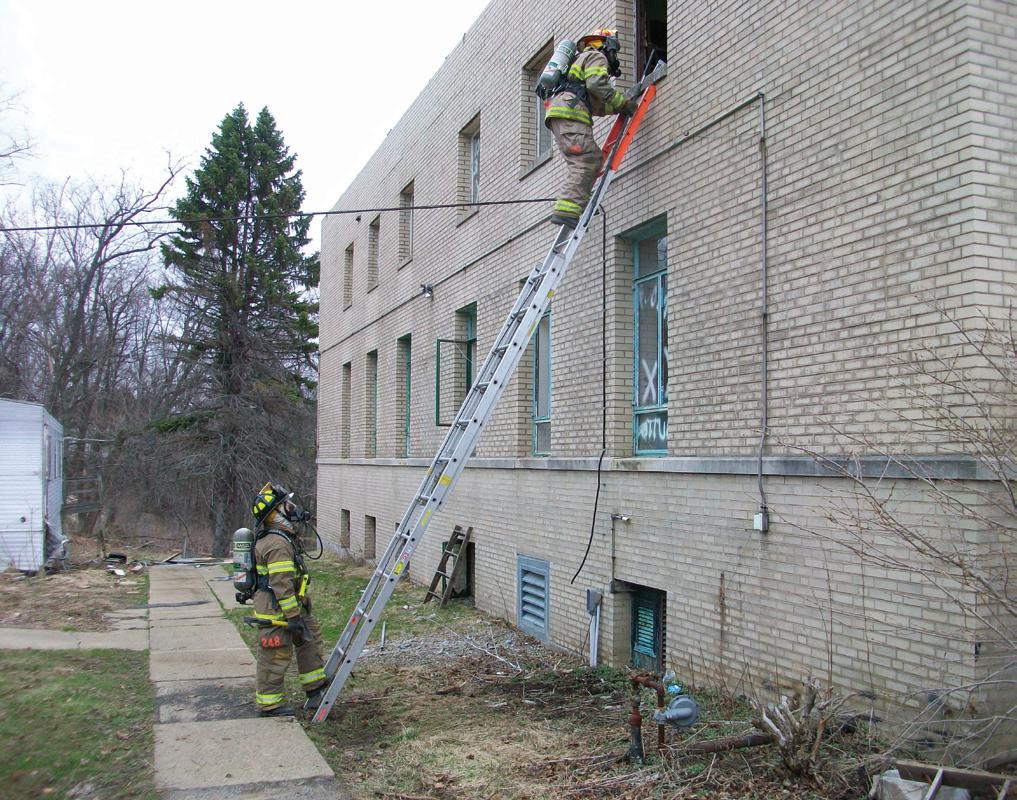
Photo 2: The ladder is set at less than 75 degrees, but this still works for the operation.
Photo 1: This ladder is at an angle of less than 75 degrees but it allows
PHOTOS BY MARK VAN DER FEYST
Photo 1 shows a ground ladder at a training exercise during which teams were practising vent, enter and search techniques. The ground ladder was raised and set without checking for a proper climbing angle. The idea was to move quickly because the crew needs to search and remove a victim from the room on the third floor. Note that the ladder tip is not exactly at the bottom of the window sill – it is about six inches too short – and the base of the ladder is not at the edge of the concrete walkway. Is this ladder at a 75-degree angle? Probably not. But it is at an angle that allows a firefighter to climb up, gain entry and bring the victim down the ladder without hindering any efforts. It is at an angle of less then 75 degrees.
In photo 2 the ladder tip is immediately below the window sill and the base is at the edge of the concrete walkway. There are five rungs extended beyond the bed section of the ladder, compared with just four rungs extended in photo 1. Again, this angle will work for the operation, although the ladder is set at less than 75 degrees.
Another good reason to have a ground ladder set at less than 75 degrees is firefighter survival. If interior crews need to bail out of the building, then having a ground ladder set at less than 75 degrees offers a less intrusive angle for a head first ladder bail.
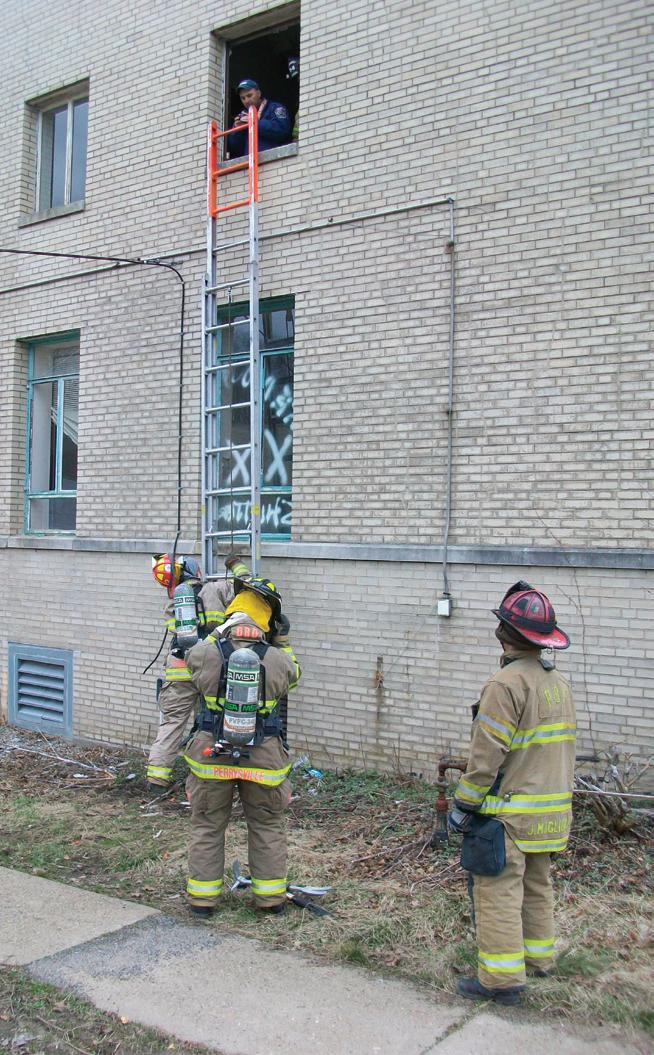
To determine a good climbing angle when the ground ladder is vertically against the wall of the building, raise the fly section so that the tip of the ladder extends beyond the window sill by one rung, as shown in photo 3. At this point, the base of the ladder can be pulled out from the building; stop when the tip of the ladder drops below the window sill. In this situation, the ladder tip drops one foot for every four feet we pull the base out from the wall – one-quarter of the ladder’s working height.
This will work well only when we train and practise on different windows in our response districts. Do not dwell on setting the climbing angle to exactly 75 degrees; make sure that it is set at a good angle that allows you to climb and conduct your assigned operation.
Mark van der Feyst is an 11-year veteran of the fire service. He works for the City of Woodstock Fire Department in Ontario and is an instructor teaching in Canada and the U.S. He is a local level suppression instructor for the Pennsylvania State Fire Academy, an instructor for the Justice Institute of BC and a professor of fire science for Lambton College in Ontario. He can be reached at Mark@ FireStarTraining.com.
3: The tip is extended beyond the window sill by one rung and then the base is pulled away from the building, giving you a good climbing angle.
Photo
PHOTO BY ERIC WISSNER
BE PREPARED
Continued from page 20
they enter in to F and A, go to accountability for assignment, receive assignments, maps and documents and sign out equipment, go through rehab for vitals and are briefed on the upcoming operational period before going into service. This should all be done prior to the swap out for the off coming shift. This takes a lot of co-ordination and may involve busing members to the field or having apparatus pack up and return to base camp.
Smaller, rural departments may have the added challenge of getting supplies due to their remote locations. Fuel tankers may have to be ordered and parked on site. A canteen or cook shack and mess hall may have to be assembled to feed people. Tents may come from the local militia or party rental store. Washroom facilities should be planned for if the fire hall is on a septic system. All departments should ask how they would manage two or three times or 10 times the staff they currently have. Talk to your neighbouring departments to see how you can work together.
smoke Generation for
The next thing to prepare is a mobile staging kit to set up in the field for members from multiple jurisdictions and agencies. Are you able to do all this from your vehicle in a parking lot? Recently, I helped to operate a base camp/staging area for 20 apparatus, two paramedic teams and almost 80 firefighters out of a two-bay fire station. Lessons on preparation for managing that many members from various departments and briefing them on the upcoming operation period were reinforced. You need to have the simple things, like clipboards and paper, duct tape and a step-by-step direction chart for processing people through the meat grinder. Briefings may be held for select members such as division supervisors and task force leaders or for all members. All pertinent information must be made available to the members so they are best prepared for the operational period. A T-card system, similar to the one that the forest service in B.C. uses, is ideal. The British Columbia Forest Service has its act together when it comes to operating at these lengthy events. Indeed, it was the US Forest Service that was called in to New York during 9-11 to help FDNY and NYPD operate an incident of that size for the duration of the search and clean up.
BullEx Smoke Generators were designed with one goal in mind: to create the most realistic fire training smoke possible. BullEx Smoke Generators continuously produce thick, heavy smoke without recharging or reheating. Whether
you’re doing search & rescue, ventilation or initial fire attack drills, these Smoke Generators don’t stop until your training is done. To see the Smoke Generators in action, check out our videos at www.bullexsafety.com.
A lot of times during large events it makes sense to use your local members to fill roles of base camp manager, command staff and section chiefs. It is imperative to have people with local knowledge in key roles even to the point of using your local members as escorts so that out-of-town companies have local knowledge on each apparatus if necessary. Use the imported help to do the grunt work and your local people where they can do the most good. Smaller departments that have little experience running larger operations should not be afraid to call for help. Get help from those who have experience to help run the incident command or operations section – it will be some of the best on the job training you’ve ever had. The B.C. forest service has Type 1 command teams that travel when and where needed. Maybe the provincial fire commissioner’s office can spearhead a similar program that would be of great benefit, especially to the small rural departments that encounter their once-in-alifetime career incident.
It’s one thing to know incident command and how to run a regular, everyday emergency but what if you had 10 times the number of staff on their way to you right now? Ask yourself some of the what ifs posed here. As we all know, there’s nothing like being prepared.
Lou Wilde is the assistant chief in Kelowna, B.C.
Offering: A 2 course certificate in incident command for experienced incident commanders. Please contact our office for more information.
Are you looking to take on more responsibility in your Department? Trying to round out your technical ability with leadership skills? Preparing to advance your career?
At Dalhousie University we offer a three course program, the “Certificate in Fire Service Leadership” to career and volunteer fire officers.The 3 courses Station Officer: Dealing with People,Station Officer:Dealing with New Operations and The Environment of the Fire Station are all offered in each of our 3 terms, September, January and April. The program can be completed in one year.
For more information and a program brochure please contact: Gwen Doary,Program Manager Dalhousie University Fire Management Certificate Programs 201-1535 Dresden Row,Halifax,Nova Scotia B3J 3T1
You will also find the information in our brochures or at the following internet address:Web site:http://collegeofcontinuinged.dal.ca
Preventing rekindled fires
By ED BROUWER
For more than two decades, I have taught the wildland fire suppression and firefighter safety classes to wildland and structural firefighters. Next to firefighter safety and fire behaviour, the major emphasis is placed on mop-up. The first priority is to contain the fire. Once we have the fire contained by use of a fire line adequate for weather conditions, fuel type and terrain, we concentrate on extinguishment.
It is difficult to get structural firefighters excited about fighting fire with a shovel, pulaski or a grub hoe. Unfortunately, fire departments still respond to wildland fires with the simple plan to “put the wet stuff on the red stuff”. Although this works in most structural fires, it is not the most effective approach to wildland fire suppression. In wildland fire fighting, the best thing is to let the fire burn up the fuel – contain the fire and let it burn itself out. What is burned up will not burn again. This brings us to the discovery of one of the few “dirty” words in the Canadian fire service: rekindle. A rekindle is a term used by firefighters to describe a blaze that re-ignites after they leave a scene.
Much more than an embarrassment for the responding agency, a rekindled fire is an indicator of a poor firefighting operation and can certainly be subject to legal action.
Last April in Conway, S.C., firefighters responded twice to a weekend yard fire that officials believe rekindled four days later, igniting a massive wildfire that destroyed 70 homes and charred 31 square miles near Myrtle Beach. No injuries were reported but damage estimates rose to $16 million.
There seems to have been some discrepancy about the fire department’s initial response but it appears it responded to the property not once, but twice, to extinguish a grass fire. It also appears that the second response was to extinguish a rekindle that resulted from improper mop-up procedures from the fire alarm. The fire department says the property owner is responsible for the massive fire, claiming he started the fire in the first place. The property owner says that while he may have allowed his fire to get out of control, the fire department told him that the fire was out (twice) and that there was nothing to worry about. He says he can’t understand how he can be blamed for a fire that wasn’t properly extinguished by supposedly trained professionals.
Wildland firefighters use the term re-burn to describe a fire that is out but later rekindles. But isn’t that an oxymoron? Whether structural or wildland, firefighters must ensure the fire is not smoldering in some hidden area. Mop-up and overhaul, although seen as the least glamorous tasks on the fire ground, are of vital importance.
Experienced fire officers know that certain types of materials are more difficult to fully extinguish and are susceptible to rekindling. For example, burned and smoldering mattresses, bedding material and stuffed chairs are some of the most difficult materials to fully extinguish. Firefighters often remove a mattress or stuffed chair from the building even after it is quenched with water during overhaul.
Ordinary clothing, when hanging in a closet, can conceal a smoldering fire. Pockets of air between the layers of clothing and the
More than an embarrassment for the responding agency, a rekindled fire is an indicator of a poor firefighting operation, and can certainly be subject to legal action.
added problem of plastic covering over clothing from a dry cleaner increases the chance of a smoldering fire going unnoticed. Burned clothing must be removed from the closet, pulled apart and wet by a hose stream.
Tree stumps and deep duff are the areas of concern for wildland firefighters. Fire can burn for hours, even days, in the fine root systems under ground. Burning slash piles can push heat and fire many metres into the ground. Even when the above fire has been extinguished, hot ash and burning embers can be uncovered by hydraulicing with a water stream. In one case, we were called to a rekindle of sorts (smoke puffing from the ground) three months after the initial slash pile was burned.
■ TIPS FOR WILDLAND MOP-UP AND STRUCTURAL OVERHAUL
Both
• It may be necessary to limit overhaul until the fire cause has been determined by fire investigators. Firefighters need to preserve evidence and protect the point of origin.
• The thermal imaging camera is a great tool but it takes experience to know the difference between residual heat images and smoldering heat images. Visually check if there is any doubt.
• Overhaul can be just as demanding as the fire attack.
After overhaul has been completed, the fire ground commander should keep everyone out of the building and post a fire watch if necessary.
Numerous injuries happen at this stage of the incident, and most are preventable. Falls still rank as a leading cause of firefighter injuries and deaths, and a considerable number of fatalities have occurred during the overhaul phase.
• To increase overhaul efficiency place exhausted firefighters who have extinguished the blaze in rehab and bring in fresh firefighters to do the mop-up and overhaul. Make sure members are wearing SCBA and PPE during overhaul (off-gassing of toxic fumes is of real concern). Many firefighters and fire investigators use full-face respirators during overhaul. They are excellent for filtering particulates and dust in toxic environments, but there’s really no substitute for SCBA.
• If you do not set up a fire watch, follow your department’s SOGs as to revisiting the scene to ensure due diligence regarding rekindles.
Wildland
• The fire fighter’s primary job is to construct the fireline. The fire fighter digs below the surface of the ground to the mineral layer of soil. This procedure clears fuels (dry leaves and duff, including roots) and prevents the fire from spreading. On average, the fireline built with hand tools is not more than 30 to 60 centimetres wide. The depth of the line is always to the mineral layer of the soil.
• Once the fire is contained, overhauling involves moving in towards the centre one hose length at a time. This provides a consistently increasing fire guard all the way around the fire.
• Make mud puddles in those hard to extinguish spots and soak the burning duff.
• Extinguish all smoldering material along the fire edge after the spread has been stopped. Place all rolling fuel so it cannot roll across the line or trench below it. Make sure that all burning fuel either burns itself out or is spread or buried to stop spark travel. Clear the line on both sides of all special threats such as snags, rotten logs, stumps, singed brush and low-hanging tree limbs. Search for underground burning roots near the line. Mop up all material adjacent to the line on large fires to make sure the fire cannot blow, spot or roll over the control line. Cold trailing is a method of determining whether a fire is still burning. It involves careful and methodical inspection of burned material and the surrounding area by carefully feeling with the bare hand. Once a fire is controlled and mopped up, the fire boss will declare the fire to be on a “patrol” basis. The job of the fire patrol is to walk the control line to prevent escapes, discover and
control spot fires and mop-up whenever necessary. If there is no forestry personnel to do this a couple of firefighters may have to take turns. A fire patroller will also keep a sharp lookout for “sleepers.” Sleepers should be spotted before they have a chance to ignite the adjacent fuel and cause the fire to escape. A sleeper is a hidden fire, deep inside the duff layer or in a root tip. As well, there is no glowing stage. The “sleeper” is aptly named – it may take weeks before an adjacent patch of fuel is brought up to ignition temperature. Until then, it normally defies detection.
Structural
• Consider filling a bathroom sink or tub in the burned-out structure with water and soak small amounts of smoldering materials in water.
• Remove smoldering mattresses and stuffed chairs to the street, then soak them with water outside. (Be careful when removing smoldering mattresses and stuffed chairs. They have ignited in hallways and stairs during the carry out. One superintendent of a high-rise apartment house tried to remove a smoldering couch down to the street in an elevator. As the elevator descended, the couch flared up due to the fresh air moving through the elevator during the descent. The superintendent and the couch were found incinerated in the elevator car on the first floor by firefighters when they arrived.)
• If the fire is at night the investigation may be delayed and you may want to post a fire watch until morning. The benefit here is that a fresh crew performing overhaul in the daylight will be a safer operation. Otherwise, the incident
SHOR T & LONG TERM COURSES
• MUNICIPAL FIRE FIGHTING
• HAZARDOUS MATERIALS RESPONSE
• INDUSTRIAL FIRE FIGHTING
• CONFINED SPACE ENTRY/ RESCUE
• INCIDENT COMMAND SYSTEM
commander, the safety officer and the appropriate company officers should perform a building/scene safety survey to identify health hazards. If you suspect hazardous materials limit overhaul to what is necessary to prevent re-ignition. Be aware of weakened structural members, holes in floors, burned-out stairways, leaning chimneys and walls. Flag or cordon off any structural hazards and inform all personnel of their locations.
• After the fire has been extinguished and overhaul has been completed, the fire ground commander should keep everyone out of the building and post a fire watch if necessary.
Several years ago we attended a wildland fire on Black Mountain in Kelowna, B.C. When we had the fire contained, I walked over to where there had been a lightning strike fire three months earlier. As I walked around the old hand guard, I noticed that the fire had actually escaped. The hair on the back of my neck stood on end. Fortunately, it had put itself out, but the escape was made possible by a five-inch root that had not been cut out where it crossed the guard.
Whether you are a volunteer or career department, to have a fire that has been controlled and apparently mopped up start again – hours, days or weeks later – can only be classed as an inexcusable failure.
Ed Brouwer is the chief instructor for Canwest Fire in Osoyoos, B.C., and the training officer for West Boundary Highway Rescue. The 19-year veteran of the fire service is also a fire warden with the B.C. Ministry of Forests, a wildland interface fire suppression instructor/evaluator and a fire-service chaplain. Contact Ed at ed@thefire.ca
• CUSTOM TRAINING TO MEET SPECIFIC NEEDS
• PRE-SERVICE FIREFIGHTER EDUCATION and TRAINING CERTIFICATE PROGRAM
• FIRE SCIENCE TECHNOLOGY DIPLOMA PROGRAM
FIRE & EMERGENCY RESPONSE TRAINING CENTRE
Sarnia, ON, Canada
1-800-791-7887 or 519-336-4552, ex t 21 • Fa x : 519-336-4537
The bridge to your future e-mail: sandra@lambton.on.ca • www.lambton.on.ca/fertc
CASH REBATES FROM
$50 $200 up to
Upgrade to the latest life safety equipment by Akron® . And cash in with
Rebate offers:
Trade in your used combination nozzle and purchase a new Turbojet® , SaberJet™ or Assault™ nozzle to receive a $50 - $75 cash rebate. monitor and purchase a new Mercury™ Quick At tack or MercuryMaster 1000™ monitor to receive a $150 - $200 cash rebate.
No limit on the number of items you can trade in. Each qualifying trade-in and purchase will receive a cash rebate.
For details, contact your local Akron Brass Distributor, visit: www.akronbrass.com/FFAppreciationRebate or call 800-228-1161. Rebate offer is good through September 30, 2010.
FootGear
For more information, call your local Globe dealer or Safedesign
British Colum B ia and a l B erta Guillevin
Coquitlam, British Columbia 800-667-3362
Calgary, Alberta 800-661-9227
Campbell River, British Columbia 250-287-2186
Edmonton, Alberta 800-222-6473
Fort St. John, British Columbia 250-785-3375
Kamloops, British Columbia 250-374-0044
Nanaimo, British Columbia 250-758-3362
Prince George, British Columbia 250-960-4300
Trail, British Columbia 250-364-2526
Que B e C H.Q. Distribution LaSalle, Quebec 800-905-0821
atlanti C provin C es K & D Pratt Ltd. St. John's, Newfoundland 800-563-9595
Dartmouth, Nova Scotia 800-567-1955
Saint John, New Brunswick 800-567-1955
m anito B a and s askatC hewan Trak Ventures 204-724-2281
IN THE WATCHROOM
■ HERO PIPE
FIGHTS
HIGHRISE FIRES
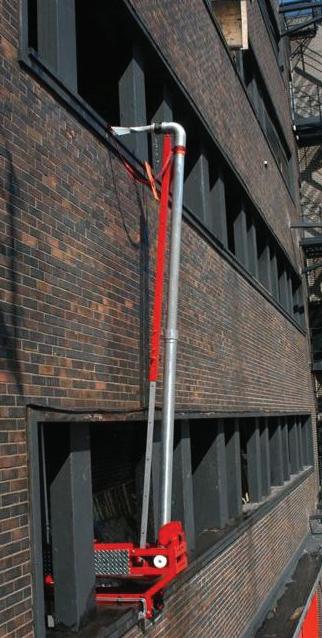
The Hero Pipe is a telescoping tool designed to allow firefighters to safely fight fires on the upper floors of tall buildings. Constructed from anodized aluminum, the Hero Pipe can be assembled by a team of two and clamped securely to a window sill to allow firefighters to direct a master stream at the fire safely from a floor below. The Hero Pipe features hydraulic stabilizing bars for securing the device between floors and ceilings and a control valve and pressure gauge to eliminate the need to communicate between the standpipe and appliance. Visit www. theheropipe.com
■ RUGGED TIC DESIGNED FOR FIREFIGHTERS
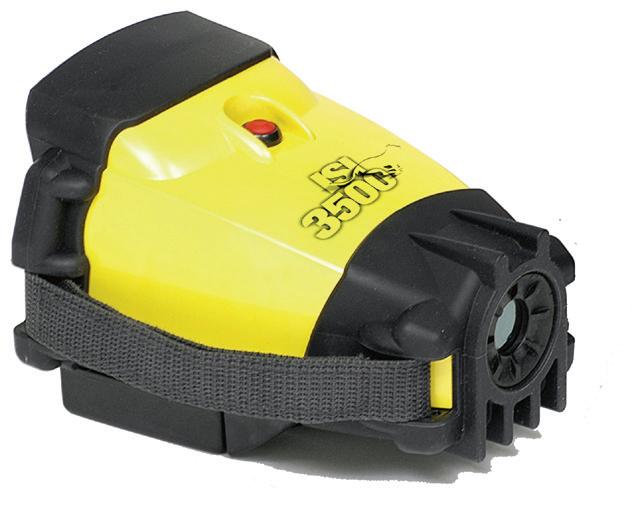
The ISI 3500 lightweight thermal imaging camera is designed to meet firefighters’ needs. The 3500 is fully operational within three seconds of start up and features a diagnostic charging system, four-hour battery life, two-colour temperature colourization and a remote LCD search option. The ISI 3500 is designed to withstand a three metre drop and remain operational without any cosmetic damage. Visit www.cdnsafety.com
■ RAPPELLING SYSTEM
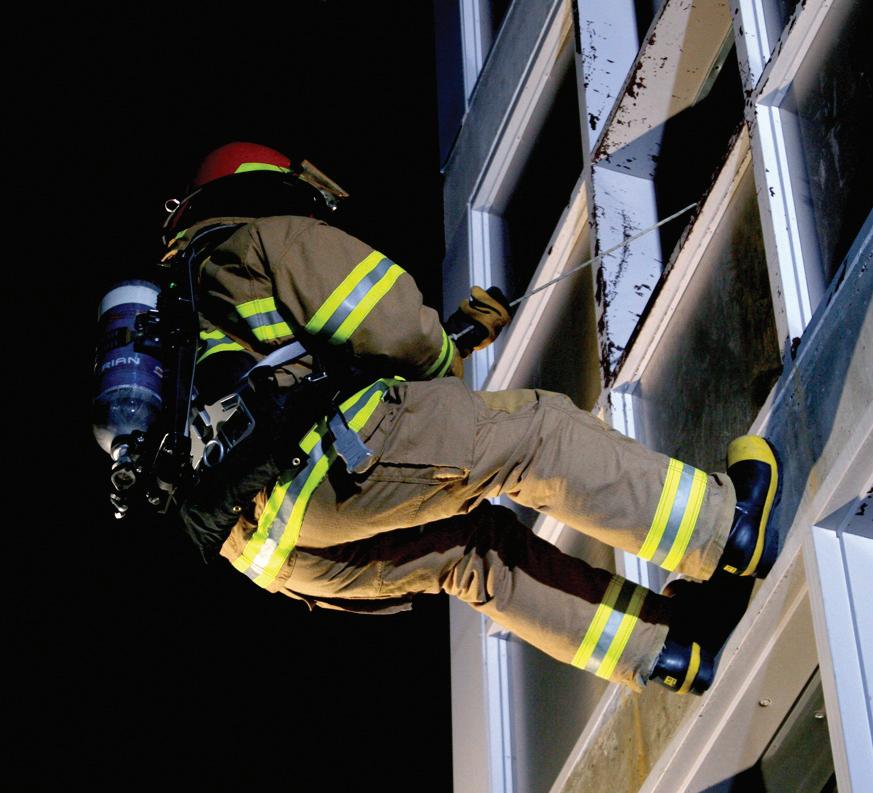
INTEGRATES ON TO SCBA
Sperian Respiratory Protection, working with Fire Innovations, has obtained NFPA and NIOSH certifications on an escape belt and rappelling system integrated on to the Warrior SCBA. The integration of the escape belt and optional rappelling products with the Warrior SCBA allows fire departments to add a critical piece of rescue equipment to their Warrior SCBAs while maintaining critical compliance with NFPA
1981 2007 edition and 1983 2006 edition. The belt is constructed of a Kevlar and Nomex braided weave, offers 4,000 pounds of tensile strength and features a patented quick-release jettison system that allows the Warrior SCBA to be disengaged from the belt with a tug of two quick release pull straps. By pulling these straps, the firefighter jettisons the SCBA, allowing an escape from a confined space without the bulk of the SCBA. The straps also allow the firefighter to easily change the orientation of the SCBA while keeping the MMR secure on the facepiece. For more information visit www. sperianfire.com
■ MOBILE SYSTEM
IDENTIFIES PATIENT
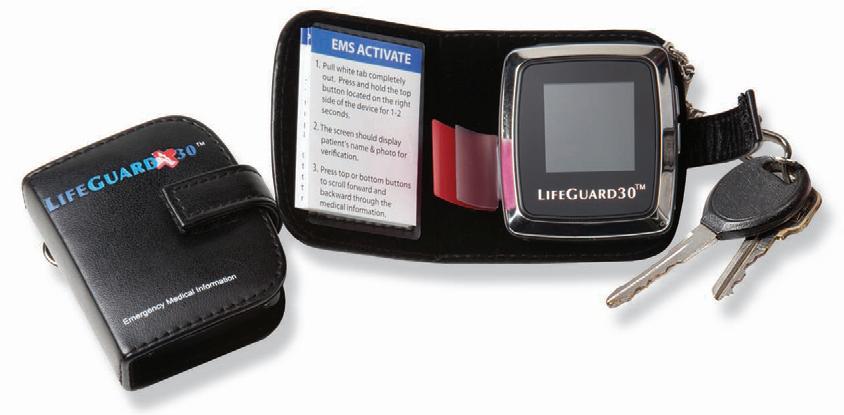
The LifeGuard30 is a hand-held mobile medical records system that provides wireless access to critical medical information. Small enough to be clipped onto a keychain or belt loop, the full-colour screen displays up to 30 pages of medical data including a photograph of the individual, current medications, surgical history, preexisting conditions, known allergies and emergency contacts. The system uses only a last name and photo to identify the patient; it does not include the user’s first name, address or phone. Data stored in the system is encrypted to meet HIPAA standards for medical privacy. Each LifeGuard30 system includes two devices — one for backup — along with a medical ID bracelet, wallet ID card, home and auto decals and a refrigerator pocket decal all designed to alert first responders that the patient has a LifeGuard30 device and medical information available. Visit www.Lifeguard30.com
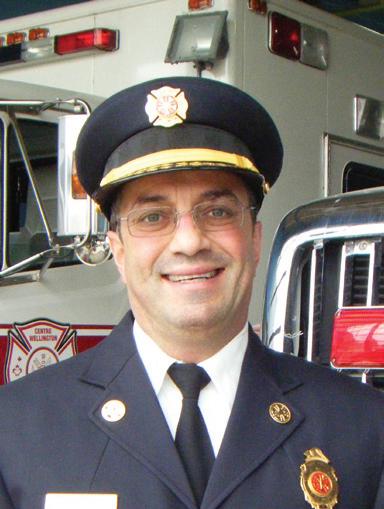
BY BRAD PATTON Chief Centre-Wellington, Ont.
TA different way of doing business
imes they are a-changin’ and the fire service is going to have to find other ways to deliver services. The federal government is set to reduce funding to the provincial governments, which, in turn, will reduce funding to municipal governments and you know what that means – reduced fire department budgets.
It doesn’t look like anyone is going to come to our rescue. Fire chiefs and fire departments are going to have to solve the problems on their own. It won’t matter if it’s a large city fire department or a small volunteer department – everyone is going to feel the cuts and the only difference will be in the decimal points. In larger cities, fire department budgets are often the biggest municipal expenditures whereas in the smaller communities department budgets are often the municipality’s third-largest expenditure. Either way, a 10 per cent or 20 per cent budget cut is very hard to manage.
Most fire departments have been fine-tuning their budgets for years and there is very little remaining to give up without major service cuts or staffing reductions. Governments have been implementing alternative service delivery (ASD) models for some time now. ASD models could also be used in the fire service.
My suggestion is to take a very close look at regionalizing, or the sharing of services. We are talking about economies of scale. In some cases this might be difficult. There will be union and volunteer issues but we need to work together to survive the financial crises. There are services we could share with other departments as a first step toward a more co-operative fire service, which, I believe, would increase our service levels and be cost efficient.
Take, for example, fire prevention, public education and fire investigation. There is no legal reason (of which I am aware) why these services have to be provided by each municipal fire department. Often these services are required but they may be provided in almost any way. Depending on your location and relationships with other fire departments, two, three, four or more departments could share the cost and hire a full-time or even part-time fire prevention officer to provide fire code inspections/ enforcement, public education and/or fire investigation.
This type of arrangement would help to reduce the city’s labour budget while providing a service to the rural committees.
The training and education requirements for an FPO are at a level now that makes it very difficult, if not impossible, for a volunteer firefighter to commit the time needed to qualify as a fire prevention officer. There just isn’t enough time in the day. The liability for a municipality that has a poorly trained FPO is too great. If an FPO does an inspection and misses an important life safety device that is required in a building, or orders in a sprinkler system only to find out it wasn’t needed, the municipality will be in a lot of trouble. Also, inspections need to be followed up in a timely manner and, if needed, charges must be laid. All of these issues are very important and require a great deal of time.
Contracting out or sharing of these services also has another benefit. Often in smaller communities conflict of interest issues can arise. Local businesses can be owned by relatives of the volunteer complement or by members of the department themselves.
It just makes sense to me to collectively fund a well-trained person who has the skills and commitment to provide this service.
This plan requires a couple of important decisions to be made
My suggestion is to take a very close look at regionalizing, or the sharing of services. We are talking about economies of scale. ‘‘ ’’
at the local level. Firstly, how important are fire prevention, public education and proper fire investigations? Secondly, can these services be provided locally by a part-time person with all of the required training and education? Finally, can area fire chiefs work together to make this a reality?
Perhaps if your department is located near a larger department that already has these services you arrange to have the full-time FPO spend one or two days a week or month – depending on the needs in your municipality – providing these important services.
Brad Patton is fire chief for the Centre Wellington Volunteer Fire Rescue Department in Ontario. Centre Wellington, with a population of 28,000, covers 410 square kilometres and has stations in Fergus and Elora.
The second part of this plan would be to consider the above arguments but include or replace the FPO with a training officer; we need to review the ideas of shared training, mechanical officers and administrative support as well.
I could write another page on the virtues of a regional, or a group of fire departments sharing resources . . . Think about it. It’s time to start working together and pooling our resources and ideas to ensure our fire departments are sustainable and provide the professional service that the public has grown to expect.
BY LYLE QUAN Deputy Chief Guelph Fire Department, Ont.
GLeading while mentoring is tougher than it looks CORNER
ood fire service leaders inspire and share their knowledge with others. And they never lose sight of their two main responsibilities – to their people and their organizations. The first responsibility, of course, is to successfully lead their teams so that all members eagerly and willingly become contributing members. The second responsibility of leaders, and possibly the more important one, is to pass on knowledge and the practical experiences they have gained while building their careers in the fire service.
So, is a leader a mentor or is a mentor a leader? The short answer is not all the
time. Not all leaders of an organization are sought out by their peers and subordinates to help guide them in their career development; so, the larger question is, why not? Let’s look at answers to that question and two books that will help to guide you even further in your career development.
Leaders may be technically great at executing their duties and responsibilities to the organization and its staff. But if they don’t pass on their skills and information, who will carry the torch? So, the question becomes, are we truly leading or are we just managing the organization?
Leadership and management are two
different things. Quite often, where good leadership is needed, poor management is there as an impostor. Leadership is about doing the right things; management is about doing those things the right way. Or, as a past fire chief of mine used to say, “Leaders inspire; managers perspire.”
Based on this concept of inspiring your people and becoming a mentor, the first book I am recommending is Launching a Leadership Revolution by Chris Brady and Orrin Woodward (2005). Brady and Woodward discuss what a leader is and what leaders can bring to an organization. Most of the lessons learned in this book are based on the authors’ five levels of leadership, which are:
• Learning – to learn, you must first become the student;
• Performing – you learn how to apply some of the lessons taught at the first level;
• Leading – you demonstrate to others how to perform like you;
• Developing leaders – you become the mentor;
• Developing leaders who develop leaders – at this final level, you have a following of other leaders who want to take themselves to the next level by developing others.
All these levels must be reached in the order noted, much like building a pyramid. It’s only when fire officers understand how to learn and perform as leaders that they can begin to lead. The most exciting part of the journey that the authors describe is at levels four and five, when leaders get to share their experiences and knowledge with others. Levels four and five are also when leaders can truly see and appreciate
1143: Wildland Fire Management 2009
Item#: 114309 I Price: $40.70
Every year, wildland fire incidents in North America pose increasing threats to adjacent communities, often overwhelming the resources of local first responders. The 2009 NFPA 1143: Standard for Wildland Fire Management recognizes the development of the National Fire Plan in the United States and numerous mitigation efforts to solve the problem of ailing forests and endangered communities in or near forested areas.
The vital 2009 edition of NFPA 1143:
* Specifies the latest management practices and policies necessary for a fire protection organization to develop a wildland fire management program.
* Incorporates material to help small community and volunteer fire departments prepare for fire suppression in forested and wildland areas, and address the broader task of wildland fire management including mitigation, prevention, and community coordination.
Local government and volunteer fire departments should use this edition to develop an approach consistent with today’s NFPA standards on emergency services incident management and disaster management programs, and to keep current with firefighter safety practices.
Now Available
Canadian Firefighter’s Handbook
Instructor’s Curriculum CD
Item#: 1439058893 I Price: $246.95
This curriculum CD is designed to support the unique content of the Canadian Firefighter’s Handbook: Firefighting and Emergency Response, First Edition. Included on this CD are many valuable tools to help instructors deliver training for Firefighter I & II, and Hazardous Materials, Terrorism and Disaster Response.
Features:
• Administration sections provides the instructor with an overview of the various courses, student and instructor materials, and equipment checklist, and practical advice on how to set up courses and run skill sessions.
• Answers to Review Questions are included to help instructors check student knowledge of key concepts presented in each chapter.
• Modularized Lesson Plans summarize the topics in the chapter and include references to the corresponding chapter pages, PowerPoint presentations, and Skill Sheets (editable).
• Computerized Test Banks (in ExamView 6.0) containing hundreds of questions helps instructors prepare candidates to take the written portion of the certification exam for Firefighter I & II (editable).
• Skill Sheets outline important skills that each candidate must practice on the training ground, and master, to meet requirements for certification (editable).
• Quick Reference Guides include the NFPA Standard 1001 and 472 Correlation Grids that cross-reference the content of the Canadian Firefighter’s Handbook to each requirement of these two standards.
• An Image Gallery containing hundreds of graphics and photos from the book offers an additional resource for instructors to enhance classroom presentations.
the fruits of their labour because this is where they get to create new leaders within the fire service.
For me, there is nothing more exciting and flattering than to be asked to mentor (and guide) someone. This is where the second book I’m recommending, Leader Mentoring by Michael Shenkman (2008), builds on the lessons of the first book.
Shenkman explains that mentoring is different from teaching, instructing and coaching because it emphasizes the talents and skills that we use daily and helps to bring out the qualities and values of life we need to sustain any creative endeavours.
words, these are skills that you either have or you don’t and can’t be taught.
I have had the pleasure of speaking at several conferences on leading and developing our people and I can tell you that there is no special recipe to accomplishing these things – it’s all about being honest enough (with yourself) to admit that you cannot know everything and open enough to learn from others. A leader is a lifelong learner who is always thirsty for knowledge and con-
Leadership is about doing the right things; management is about doing those things the right way. ‘‘
Shenkman addresses such topics as how to mentor, how to identify a candidate for mentoring and even what it’s like to be mentored. One essential talent that the author identifies as a fundamental ingredient for a leader is people skills. Unfortunately for some, people skills are innate. In other
Lyle Quan is a deputy fire chief with the Guelph Fire Department in Ontario. He has a business degree in emergency services and a degree in adult education. Lyle is an associate instructor for the Ontario Fire College, Lakeland College and Dalhousie University. E-mail: thequans@sympatico.ca
’’
stantly trying to find ways to do things better for the organization and its people.
Both books are a great read on their own, but together they complement each other. They are available through Amazon and Chapters.
• Launching a Leadership Revolution by Chris Brady and Orrin Woodward. (2005), published by Business Plus
• Leader Mentoring by Michael Shenkman. (2008), published by Career Press.
Nothing Dumps Faster!
Ask for it by name.
on A.H. Stock Manufacturing, the original manufacturer of the Kwik-Dump Water Valve.
Over 40,000 in use. We’ve been in business for over sixty years, so you can depend on us. That’s why Newton Kwik-Dump Valves can be trusted to get your tanker emptied and on its way FAST. Standard length, Mild Steel and Stainless Steel are in-stock. Need special length valves? Call us and it’s as good as done! Don’t accept look-alikes. Ask for us by name. For prompt, timely delivery, call us today.
CLASSIFIED ADS
SPECIALTIES
OPPORTUNITY: Interested in auto extrication and hydraulic rescue tools? Want to run your own business? A leading rescue tool manufacturer (TNT Rescue Systems) is looking for individuals within dedicated territories throughout Canada to provide demonstrations, service and repair hydraulic rescue tools used in auto/truck/bus extrication and industry applications. For more information call 1-800-205-3473 and ask for Mike Stone.
EDUCATION AND TRAINING
LIVE FIRE FIGHTING EXPERIENCE: Short and long term courses available, Municipal and Industrial fire fighting. Incident Command System, Emergency Response/HazMat, three year Fire Science Technology Diploma program. Lambton College, Sarnia, Ontario, call 1-800-791-7887 or www.lambton.on. ca/p_c/technology/fire_emerg_resp.htm. Enrol today!
BY PETER SELLS District Chief
FLASHPOINT
A broader form of mutual aid
And the multitude of them that believed were of one heart and of one soul: neither said any of them that ought of the things which he possessed was his own; but they had all things common. . . and distribution was made unto every man according as he had need. -Acts 4: 32-35
Those of you who know me may find it odd that I chose to quote the New Testament but the sentiment expressed fits this month’s topic like a glove. Picture a fire on the twenty-ninth floor of a robust, 45-storey, 1930s-era bank tower in downtown Toronto. There were no sprinklers on that floor, so the fire took hold quickly. With ceiling temperatures well in excess of 1100 C, the fire spread to the thirtieth floor. Fire suppression operations lasted more than five hours and involved more than half of Toronto’s on-duty personnel and apparatus. However, coverage across the city was maintained seamlessly as units from 22 surrounding municipalities responded into fire halls throughout Toronto. Common radio channels and prior training on joint operating procedures allowed this automatic aid system to function like a well-oiled machine.
This fire took place just a few years ago, in 2004, but if you are having difficulty remembering it, forgive my sleight-of-hand. It was at the LaSalle Bank Building in Chicago, and the town was the only detail I changed. Chicago is part of the Mutual Aid Box Alarm System (MABAS) which began in the late 1960s in Illinois. MABAS is the quintessential example of an ad-hoc group solution to common problems that has grown into the North American best practice for mutual or automatic aid. When a fire department joins MABAS, it agrees to meet specific conditions for any MABAS responses, such as minimum standards for equipment and apparatus, adherence to MABAS policies for everything from RIT to fire ground safety. Most importantly, a common radio channel is used whenever MABAS is activated, and all agencies use a common Incident Management System. Member departments are assessed dues, which are used for administration costs and to maintain the common elements of the system.
on run cards in boxes, and although the boxes have been replaced by computer-aided dispatch systems, the box alarm name remains.
MABAS has grown to the point where it involves more than 1,000 of the approximately 1,200 fire departments in Illinois. Substantial growth outside that state has occurred, with active MABAS districts in Wisconsin, Indiana, Michigan, Iowa, Missouri and Ohio. Included in there are several very large cities such as Chicago, Milwaukee and St Louis. I am trying to get my head around the scale of that territory, and I am picturing all the fire departments in Ontario, Quebec and Manitoba operating as one co-operative system. The inevitable spinoffs, such as common purchasing for SCBA or bunker suits, would result in economies of scale well beyond what anyone in Canada is able to achieve. Examples from MABAS divisions include the development and purchase of a technical rescue trailer outfitted with hydraulic shoring and other equipment, or the outfitting and training of a division dive team and its associated response vehicle. Dues also offset the cost of training classes, such as incident management, officer development, hazmat and trench rescue.
The more I learn about MABAS, the more I wonder if and when the system will cross the border. There are substantial differences in
. . . I am picturing all the fire departments in Ontario, Quebec and Manitoba operating as one co-operative system. ‘‘ ’’
The result is much like what you would expect from one enormous fire department. As emergency responses leave gaps in coverage, neighbouring departments respond as needed or move into place to fill vacant stations. If those communities are left wanting, their neighbours shuffle into place. All these potential moves were originally kept
Retired District Chief Peter Sells writes, speaks and consults on fire service management and professional development across North America and internationally. He holds a B.Sc. from the University of Toronto and an MBA from the University of Windsor. He sits on the advisory councils of the Ontario Fire College and the Institution of Fire Engineers, Canada branch.
fire department funding models in Canada and the U.S.; notably, our cousins to the south have access to upper tier funding, especially from the federal level. In many U.S. communities, the fire department is a separate entity from the municipal government. Such fire districts or fire territories, with separate taxation or funding, are much less common in Canada. Our fire and rescue problems, however, are essentially the same. In addition to the Chicago fire mentioned above, notable MABAS responses have included derailments, tornadoes, technical rescues and floods, all of which can and will occur in any given year in Canada.
Whether MABAS comes to us directly, through a border-crossing arrangement such as the one between Detroit and Windsor, or whether a Canadian region takes the initiative to independently develop a similar system, MABAS is an idea whose time has come. “From each according to his ability, to each according to his needs,” was the quote I was going to open with, but Americans aren’t too crazy about Karl Marx.