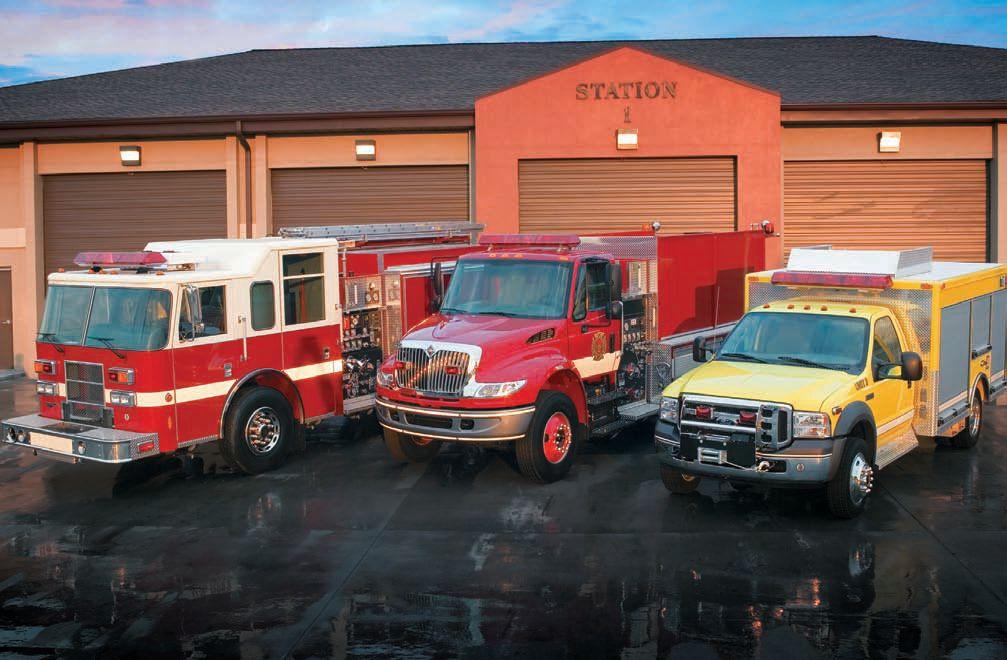
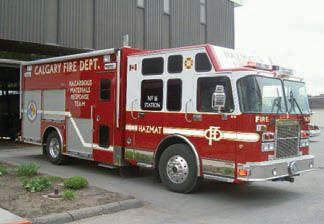
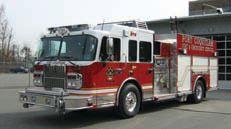
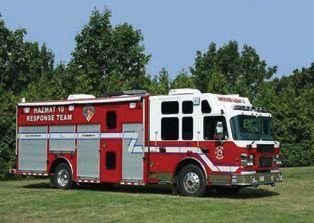
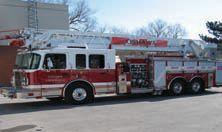
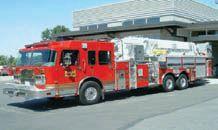
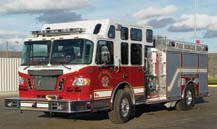
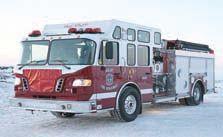
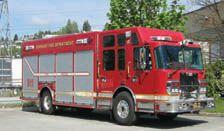
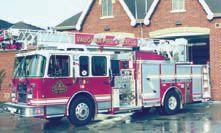
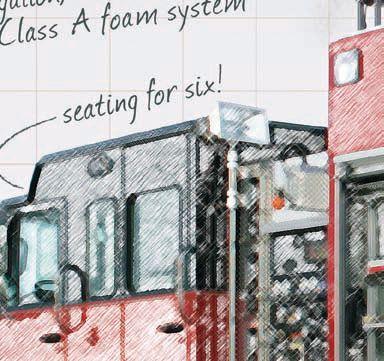
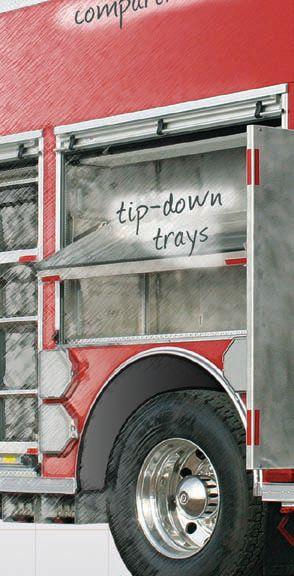
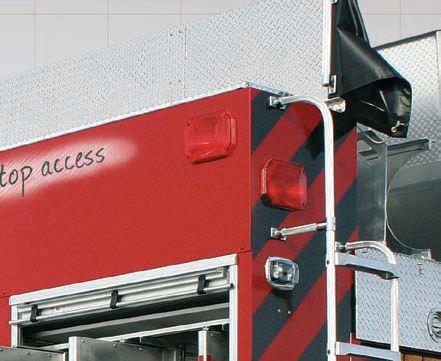
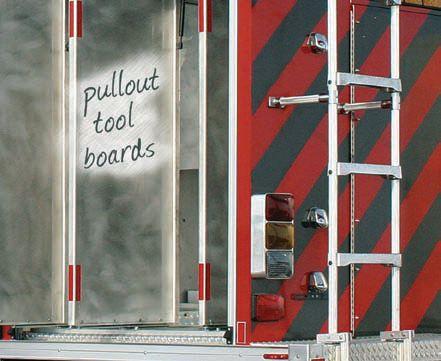
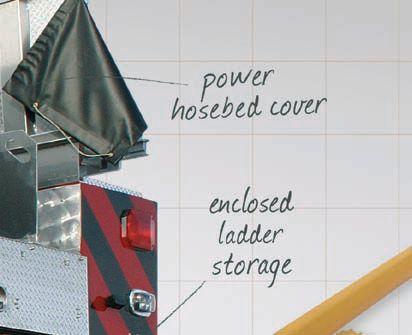
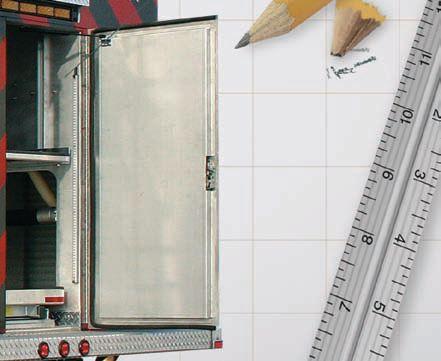
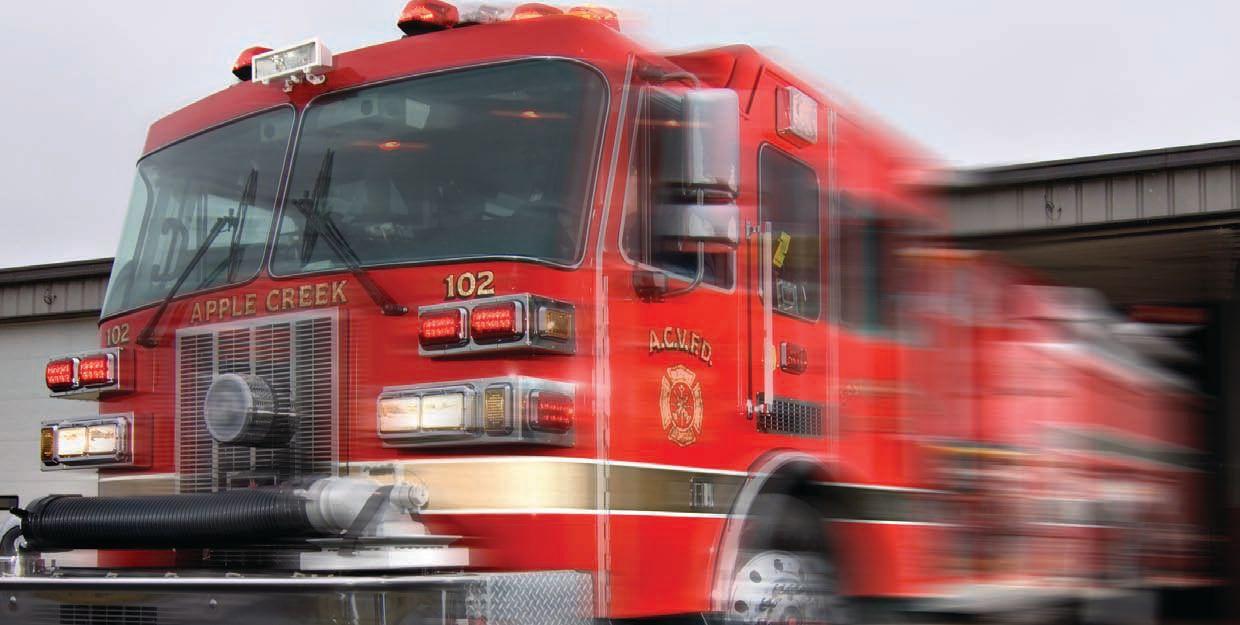
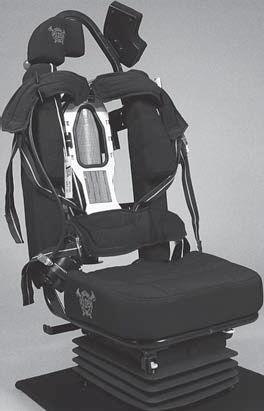
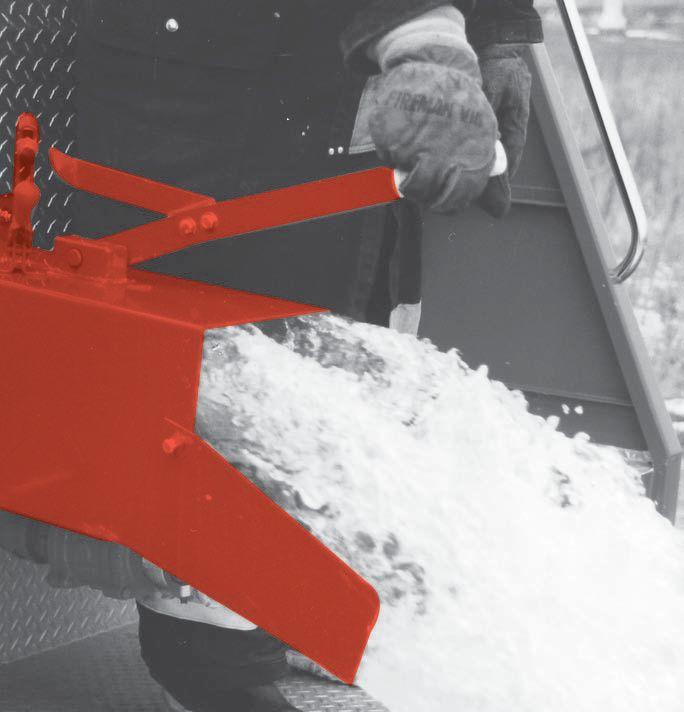
What do you get when you completely rethink the pump house? You get the new E-ONE Synergy. Featuring an ultra-compact and extremely versatile pump module, Synergy provides better access to the controls and more options for pump control placement. This compact design gives you up to 528 cu. ft. of storage space and improved maneuverability with a shorter wheelbase. Add five chassis options, and the new E-ONE Synergy gives you unmatched flexibility and control.
Dan Haden reports on the Canadian contribution to FDIC and the effort to draw more Canucks.
The Greater Toronto Airports Authority invites fire departments from across Canada and around the globe to experience its state-of-theart facility. By Laura King
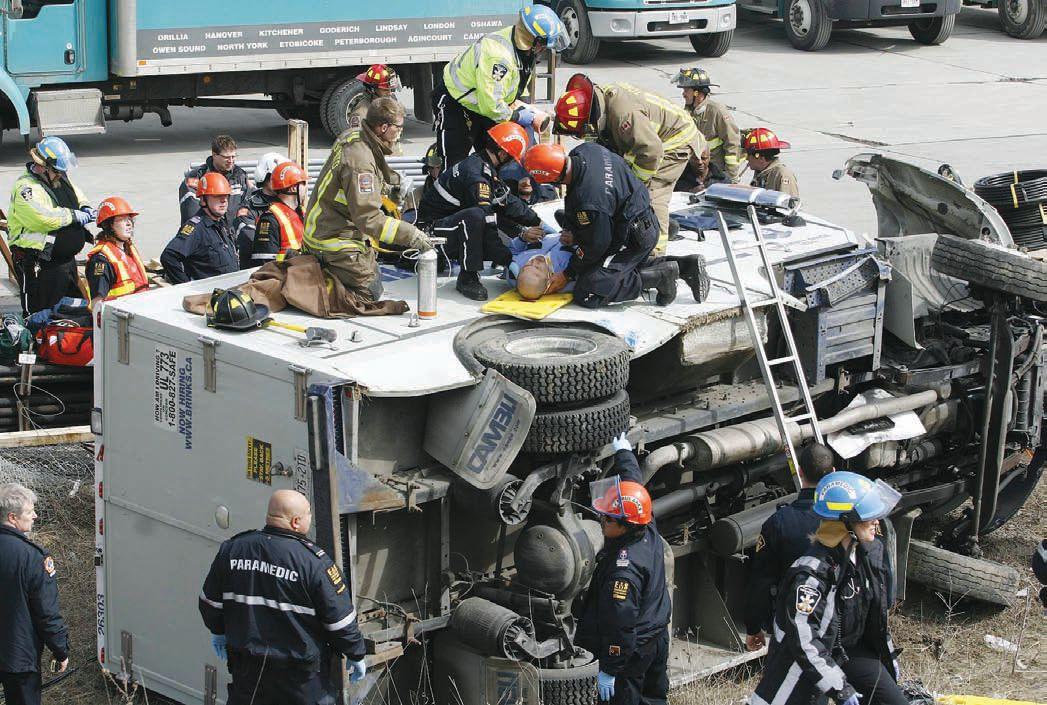
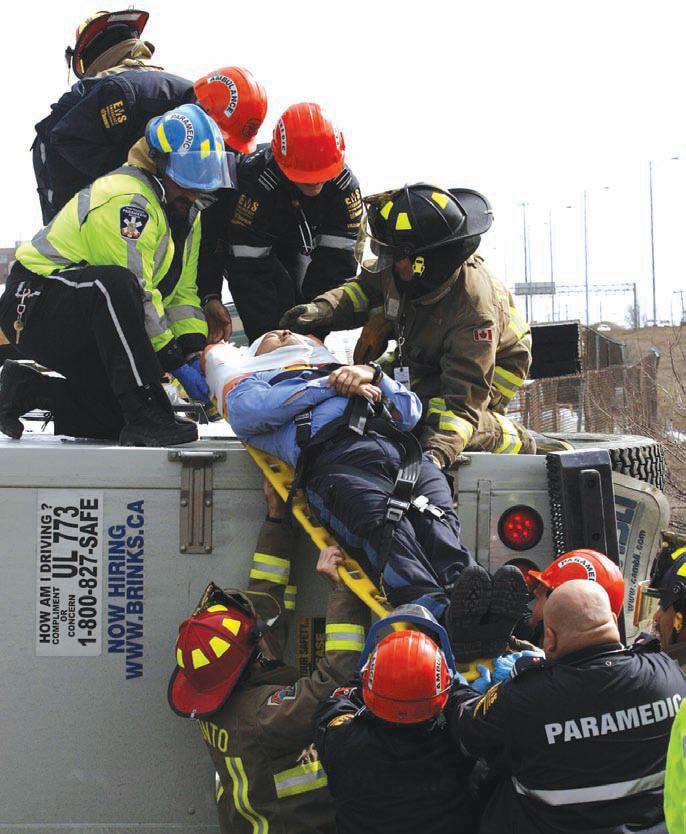
Toronto photojournalist John Hanley reports on the challenge of getting three injured Brinks workers out of a nearly impenetrable armoured vehicle.
BANDING TOGETHER
As New Brunswick’s Andrew Sanojca explains, merging 39 ambulance service providers into one system was not without challenges.
NOT A DRILL
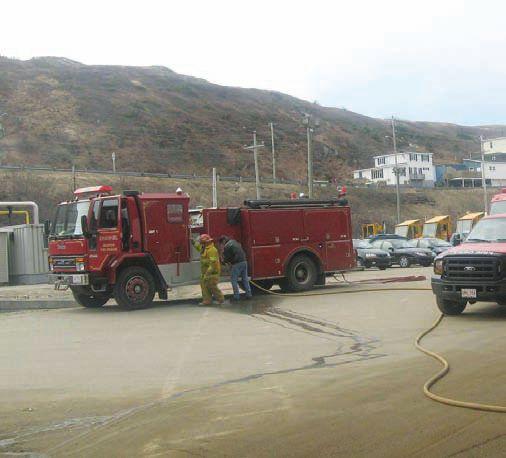
A mock disaster for Marine Atlantic turns into a real rescue. Robert Lynch reports. 48 BREAD AND BUTTER
Capt. Carlin Riley asks whether bread-and-butter operations still exist and if changes to firefighting protocol are necessary.
Any time.Any place.
We’re ready to respond. LPG Emergency Response Corp. is made up of a highly skilled group of professionals dealing with compressed gas incidents across Canada. Our teams are trained in the areas of product transferring, grounding and bonding, vapour and liquid flaring and container purging. We’re equipped to handle a wide range of products including: Propane, Butane, Propylene, Butylene, Isobutane, Isobutylene and Butadiene, inhibited. Our teams always ensure an incident is controlled timely, efficiently and safely.
LPGEmergency Response Corp.
BY LAURA KING Editor lking@annexweb.com
WA genuine fire service wake-up call
hat if you called 911 for an ambulance and it showed up 3,500 kilometres and three time zones away?
The tragic circumstances that left an 18month-old toddler dead, his family devastated, thousands of voice-over-Internet-protocol telephone subscribers unnerved and VoIP providers scrambling is an all-points wake-up call for Canadians.
The family of Elijah Luck moved to Alberta from Mississauga, Ont., and kept their phone service with Internet phone provider Comwave. The family had changed its billing information, but not its physical address. Tragically, emergency responders were dispatched to the family’s former address, based on information on file. The family waited 30 minutes before a Calgary neighbour’s landline phone was used to call 911 again, sadly too late.
Canadian Radio-television Communications Commission back in 2005 and are clearly in need of an overhaul. Current rules require VoIP providers to inform customers of limitations of the 911 service annually.
For its part, the CRTC has said it plans to act to enhance service to VoIP subscribers but there are not a lot of specifics. Canadian regulations in this area are generally seen as lagging behind Federal Communications Commission-mandated rules in the United States.
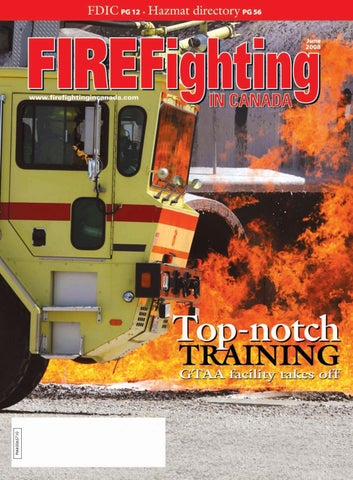
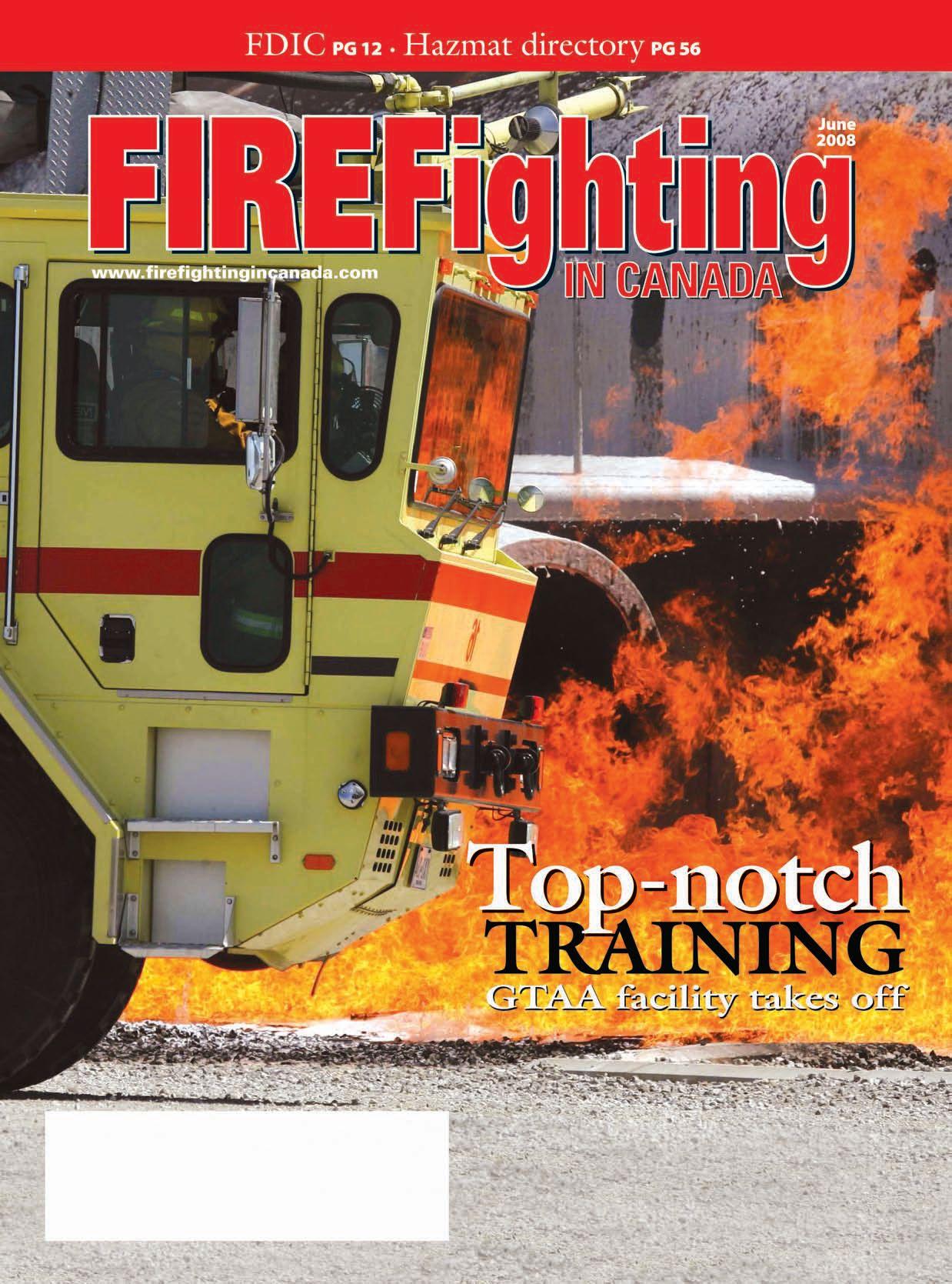
ON THE COVER
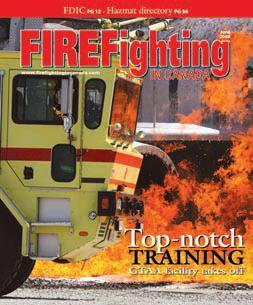
The GTAA’s Fire and Emergency Services Institute. See page 16.
The core of the problem is simple: there are different rules governing 911 services in Canada depending on whether you have a traditional land-line based provider or a VoIP, a system whereby you get phone service through the Internet.
But even within that seemingly clear division of technology, there are further schisms. Large VoIP providers – like Rogers – were ordered in 2005 to provide 911 services that are similar to what is available from landline companies – like Bell. Enhanced, or e911, connects a caller with the emergency communication centre in the city where the call originates.
But smaller VoIP providers are not held to this standard. These providers of so-called “nomadic” VoIP services – like Comwave and Vonage – operate 911 services via call centres, which then dispatch responders based on addresses.
The rules around all of this were set by the
The fact is that while VoIP providers do warn customers of the 911 limitations, as required by the CRTC, the 911 system is the foundation upon which emergency response stands. To be reliable it has to be bulletproof for all Canadians.
Bruce Farr, president of the EMS Chiefs of Canada, says change has to come to make VoIP 911 more reliable, and, failing that, to warn consumers that in an emergency, some types of phone calls might not reach the right people.
We will never know if a prompt response would have saved Elijah Luck. What we do know is that the system failed to help him. The CRTC and our industry must work together to change the system.
Most of Canada’s firefighters are volunteers and we want to be sure they have a voice in our magazine. This month, we’re delighted to introduce Brad Patton, the fire chief in Centre Wellington, Ont., one of the largest volunteer departments in Ontario. Chief Patton has lots to say and we’re happy to give him the space in which to do so. His inaugural Volunteer Vision column is on page 44.
PRESIDENT MIKE FREDERICKS mfredericks@annexweb.com
PUBLICATION MAIL AGREEMENT #40065710
PAP Registration #8885
RETURN UNDELIVERABLE CANADIAN ADDRESSES TO CIRCULATION DEPT.
P.O. Box 530, SIMCOE, ON N3Y 4N5 email: sbrady@annexweb.com
Periodical Postage Paid at Buffalo NY. USPS 007-276, ISSN 0015-2595. Published eight times per year (Feb., March, May, June, Aug., Sep., Nov., Dec.) by Annex Publishing & Printing Inc. U.S. Office of Publication c/of DDM Direct.com, 1223 William St. Buffalo NY 14240. U.S. Postmaster send address change to P.O. Box Niagara Falls Ny 14304.
Printed in Canada ISSN 0015–2595
CIRCULATION
e-mail: sbrady@annexweb.com
Tel: 866-790-6070 ext. 206
Fax: 877-624-1940
Mail: P.O. Box 530 Simcoe, ON N3Y 4N5
SUBSCRIPTION RATES
Canada – 1 Year - $25.44 (includes GST - #867172652RT0001)
USA – 1 Year $50.00
We acknowledge the financial support of the Government of Canada, through the Publications Assistance Program and the Canada Magazine Fund, toward our mailing and editorial cost. Nous reconnaissons l’aide financiere accordee par le gouvernement du Canada pour nos coults d’envoie postal et nos coutl redactionnels par l’entremise du Programme d’aide aux publications et du Fonds du Canda pour les magazines.
From time to time, we at Fire Fighting In Canada make our subscription list available to reputable companies and organizations whose products and services we believe may be of interest to you. If you do not want your name to be made available, contact our circulation department in any of the four ways listed above.
No part of the editorial content of this publication may be reprinted without the publisher’s written permission @2008 Annex Publishing & Printing Inc. All rights reserved. Opinions expressed in this magazine are not necessarily those of the editor or the publisher. No liability is assumed for errors or omissions.
All advertising is subject to the publisher’s approval. Such approval does not imply any endorsement of the products or services advertised. Publisher reserves the right to refuse advertising that does not meet the standards of the publication. www.firefightingincanada.com
PHOTO BY JOHN RIDDELL
OUR MISSION YOUR SAFETY
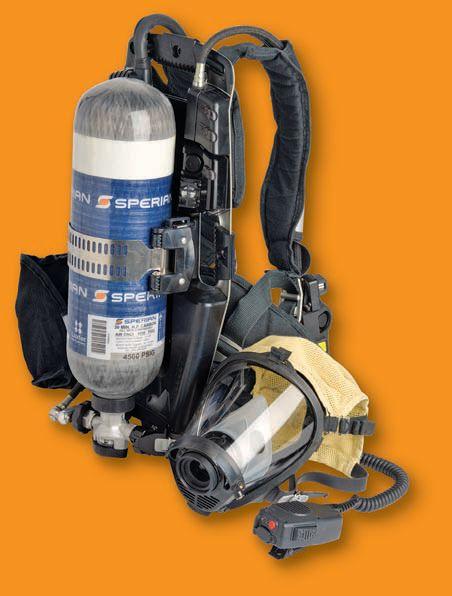
Meets the new 2007 NFPA Standards, 1981 & 1982
A PASS Alarm that can Take the Heat “Bullet-Proof” electronics
Straight-talk communications
Fireground management capabilities
Extended protection
Lightweight and easy to use
Platform for the future
PROTECTION ENGINEERED FOR YOUR
STATIONtoSTATION
ACROSS CANADA: Regional news briefs
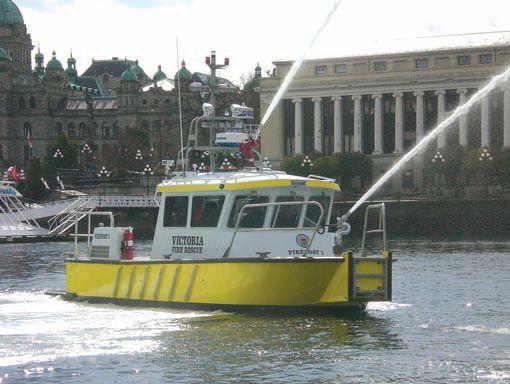
Victoria FD receives fireboat
■ BRITISH COLUMBIA
The Victoria Fire Department in B.C. has a new addition to its life-saving team – a canary yellow FireStorm 30 stationed near the main port.
Twin Cummins QSB 5.9 L diesel engines paired with Hamilton 274 jets power the 30-foot vessel.
The firefighting capabilities of the boat include one roofmounted, remote master stream monitor, two 2.5-inch
discharges for hand lines and one five-inch storz discharge to supply land-based operations.
The Darley 1750 fire pump is capable of flowing more than 2,300 gallons per minute.
The boat can perform in shallow draft conditions and is able to manoeuvre in tight harbours. It is capable of operating in inclement conditions, including driving rain and dense fog.
Canwest Fire hosts inaugural RIT challenge
■ BRITISH COLUMBIA
At the recent B.C. Volunteer Firefighters spring training, hosted by Oliver Fire & Rescue, Canwest Fire unveiled its RIT Challenge. This challenge was inspired by the Pittsburgh RIT Drill and reworked by Canwest Fire in honour of the line-of-duty death of of Clearwater, B.C., firefighter Chad Shapansky, who lost his life in a structure fire on March 29, 2004.
Teams of four firefighters had to pass safely through a stud wall, a 12-foot culvert and a simulated attic hatch.
Then, after crossing a short span of floor space, they had to safely rescue a downed firefighter (a rescue dummy in full PPE). The downed firefighter was located in what depicted a partial through-the-floor entrapment. The RIT was then required to rescue the firefighter
THE BRASS POLE
Promotions & appointments
JEFF FALLOW has been appointed full-time fire chief for the City of Cold Lake, Alta. A longtime resident and a 19-year veteran of Cold Lake Fire-Rescue, including the amalgamated Town of Grand Centre Fire Department, Fallow recently served as deputy fire chief-training and operations. The City of Cold Lake is in northeastern Alberta with
a population of about 13,000 and operates two active fire stations with about 50 part-time members. Cold Lake Fire-Rescue responds to more than 200 calls a year, including vehicle and ice rescue.
DAN CALLAGHAN has been appointed as the first full-time fire chief for the Township of Tyendinaga. Dan began his volunteer service in 1990 and was deputy chief of the department when it was formed in 1992.
and bring him/her through the obstacle course. The clock stopped when the entire RIT and victim were through the stud wall.
Initial times were just under 12 minutes. Then, as the groups discussed and implemented various time-saving strategies, the times were cut in half.
First place went to the Whistler FD RIT at 2.11
minutes. Second place went to the Kaleden FD RIT at 3.04 minutes.
Special thanks to MSA Canada and Firefighting In Canada for donating the awards.
The Oliver Fire Department, under the leadership of Chief Dave Janzen, did a great job hosting this spring training event.
-Ed Brouwer
In addition to his duties as fire chief, Dan will be responsible for fire prevention and inspection duties and community bylaw enforcement. The Township of Tyendinaga is east of Belleville, Ont., along the Highway 401 corridor with a population of 4,000. The department is a composite department with 30 volunteers running 120 calls a year out of one station.
Fire Chief DENIS PILON left the Weyburn Fire Department in
Saskatchewan after 15 years as chief to assume the position of deputy chief with the Swift Current Fire Department on May 26, 2008. Pilon will be in charge of fire inspections and fire prevention programs.
MIKE BRANSCOMBE is the new fire prevention officer in Prince Edward County, Ont. Branscombe, 39, replaces Chris Todd, who has retired. Branscombe started his career as a volunteer in the fire service
FSANS urges attendance at annual fall meeting
■ NOVA SCOTIA
The annual conference and semi-annual meeting of the Fire Service Association of Nova Scotia was held April 2527 at the Cole Harbour Fire Hall.
Jim Gates of Halifax Regional Municipality discussed clandestine drug labs, which are becoming a problem in Nova Scotia. He addressed the dangers firefighters face when responding to these kinds of calls.
Kevin Thomas of Halifax Regional Fire Service made presentation about the Risk Watch program, which was developed to teach children and their families the skills and knowledge they need to be safe from accidents and injuries. Risk Watch is promoted by the Canadian Association of Fire Chiefs.
At the business meeting, Mike Myette from EMO Nova Scotia spoke about the next generation of mapping of emergency service boundaries to improve the 911 system. One method is to incorporate digital mapping using the Geographic Information System (GIS). This system is used for capturing, storing, analyzing and managing geographic data. More than 40 per cent of 911 calls come from
cellphones and no location is automatically provided to the call taker, often making it difficult to dispatch the correct fire department. Cumberland County has been using the GIS system and it has been working well.
The Nova Scotia Firefighters School continues to face many challenges. The province gave $500,000 to the school toward the purchase of one mobile burn unit but the funding did not include money for training or maintenance.
The meeting ended with discussion on the relationship between the fire service and government. President Tom Bremner stressed the importance for representation from all Nova Scotia Fire departments at FSANS meetings. “We need to be united to achieve our common goals for the fire service in this province,” he said, “as this association is the voice of the fire service in Nova Scotia to government.”
The annual meeting of FSANS is Oct. 19 at the Nova Scotia firefighters School in Waverley. All departments in Nova Scotia are urged to have someone attend.
-Julie Bent
■ ONTARIO
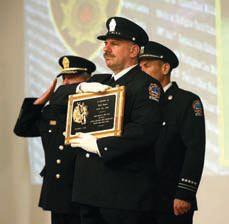
Toronto firefighter John Tuffner carries a memorial plaque during a ceremony to honour line-of-duty-deaths from workrelated illnesses recently recognized in provincial legislation. The ceremony, held in April by the Toronto Professional Fire Fighters Association, was to present commemorative station plaques to be hung at each firefighter’s last hall as well as medals for the families.
CAFC urges departments to use JEPP funding
Ottawa – An injection of $8 million into the federal government’s Joint Emergency Preparedness Program (JEPP) is important progress in ensuring that provinces, territories and municipalities have comparable capacity to respond to local emergencies, the Canadian Association of Fire Chiefs (CAFC) says.
The funding was announced May 5 by Public Security Minister Stockwell Day at Toronto’s Heavy Urban Search and Rescue (HUSAR) facility to mark the beginning of Emergency Preparedness Week in Canada.
JEPP funds support an enhanced national capability to acquire training and tools to manage all types of emergencies and ensure a reasonably uniform recovery capacity among provinces and territories.
Calgary Fire Chief Bruce Burrell, first vice president of the CAFC, said of the $8
million, $5 million is earmarked for emergency preparedness projects while the rest is dedicated to HUSAR and critical infrastructure protection.
Since 2002, CAFC has pushed for an increase in JEPP funding to $20 million over four years.
Chief Burrell noted a continuing CAFC concern about the under use of JEPP funding by volunteer fire departments across Canada.
“Given that there are almost 3,500 fire departments in Canada, the total amount of funds available is relatively low, and even with the new money announced today, we fear applications from the smaller departments that make up over 90 per cent of Canada’s fire service are unlikely to succeed. Moreover, the applications process itself is sufficiently complex to discourage most volunteer fire chiefs,” Chief Burrell stated.
-CAFC
in 1987 and became full time in 1992. In addition to public education, he will be responsible for inspection of commercial and residential properties. Branscombe is a certified water and ice rescue technician and is also certified as a trainer facilitator for the department.
Last alarm
JOHN MCLAUGHLIN, who joined the Toronto Fire Department on May 1, 1953 and retired June 4,
1987, died April 7 at Scarborough General Hospital at age 76.
Toronto Fire Services on May 25
honoured 22 firefighters who died in the line of duty and added their names to the fallen firefighter memorial.
Names of those who lost their lives in the line of duty since 1848 have been inscribed in the monument, which was erected in 2001. The following names have been added to the monument: Capt. Jim Arnold, Capt. Donald Booth,
Capt. John Chappelle, Capt. Charles Carolan, District Chief Thomas Clark, District Chief Stan Dutka, Capt. Vic Ebbs, acting Capt. Greg Fecteau, Capt. Roy Ireland, Capt. Raymond Jackson, District Chief Kenneth “Gary” Lang, acting Capt. Richard Mann, Harry Manderson, Capt. Ron Mathe, Capt. John Morrison, Bob Simpson, Bill Smith, Capt. Albert G.H Solman, John Barry Stephenson, William Walker, Capt. Brian Whitehead, Capt. Alan Gordon Wilson.
CALLING ALL DEPARTMENTS
All departments are invited to send news of promotions, appointments and retirements, and last alarm notices, along with photos to: lking@annexweb.com
PHOTO BY JOHN RIDDELL
STATIONtoSTATION
BRIGADE NEWS
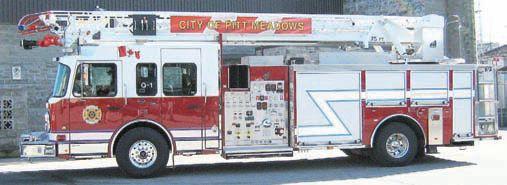
THE PITT MEADOWS FIRE DEPARTMENT in British Columbia, under the command of Chief Bill Park, took delivery in February of a Safetek-built quint featuring a Spartan Gladiator chassis, a Cummins ISL 400-hp engine, an Allison 3000VS transmission, a Waterous CSU pump, a Foam Pro 2002 dual tank foam system, ROM roll-up doors, a Smeal rear-mount 45-foot ladder, a Whelen LED lighting package, a 300-IG poly tank 11E, an Akron 1577 monitor deck gun, a Smeal “EHL”-powered hose bed, rope rescue anchor and pulley options, an Onan 8000-watt PTO generator and an electric actuated positional waterway.
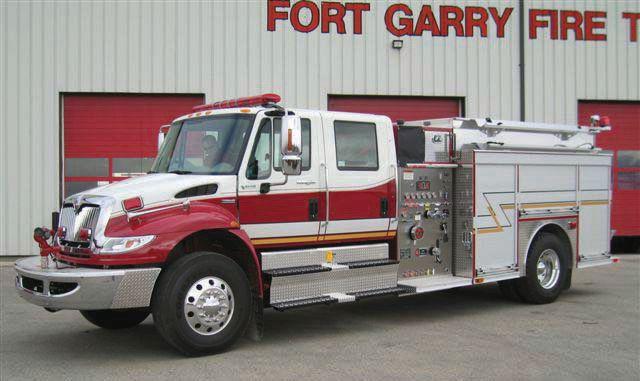
THE VALE INCO LTD. INDUSTRIAL FIRE DEPARTMENT in Thompson, Man., took delivery in December of a new Fort Garry Fire Trucks built pumper on an International Durastar chassis with a Maxxforce 9, 330-hp engine, an Allison 3500 EVS transmission, a Darley PSP1250 pump and a Foam Pro 2001 A and B foam system.
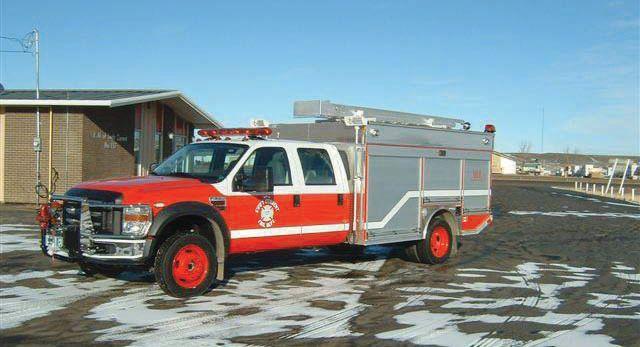
THE RURAL MUNICIPALITY OF SWIFT CURRENT took delivery in December of a Fort Garry Fire Trucks built initial attack unit on a Ford F550 chassis with a six-litre Powerstroke engine, a five-speed TorqShift engine, a CET 18-hp pump and Scotty Class A foam.
ONtheWEB
Fire-service poll
Have your say in our regular Fire Fighting in Canada online polls. A resounding 100 per cent of respondents to our May poll on voice over Internet protocol (VoIP) say stricter regulations are needed.
Cross-Canada news
Check in daily for breaking fire-service news from coast to coast to coast.
Web exclusives
Peter Sells challenges the status quo in his Flashpoint column in Fire Fighting in Canada and provokes plenty of feedback. Read Peter’s Flashpoint blog online and join the banter by posting comments or blog entries of your own. Check it out under web exclusives.
DIGITAL MAGAZINE
Visit www.firefightingincanada.com to sign up for your free digital issue.
BLOG
Check out our editor’s blog for opinions and commentary on fire-service issues. Click on Blog
EVENTS
Send us your event and have it posted on our comprehensive list of conferences, workshops and association meetings.
BUYERS GUIDE
Fire Fighting in Canada’s annual buyers guide is posted on our website for quick and easy reference to suppliers and manufacturers. Click on Buyers Guide.
PITT MEADOWS
VALE
Canadian content
FDIC aims to increase presence of northern neighbours at annual trade show and conference
By DAN HADEN
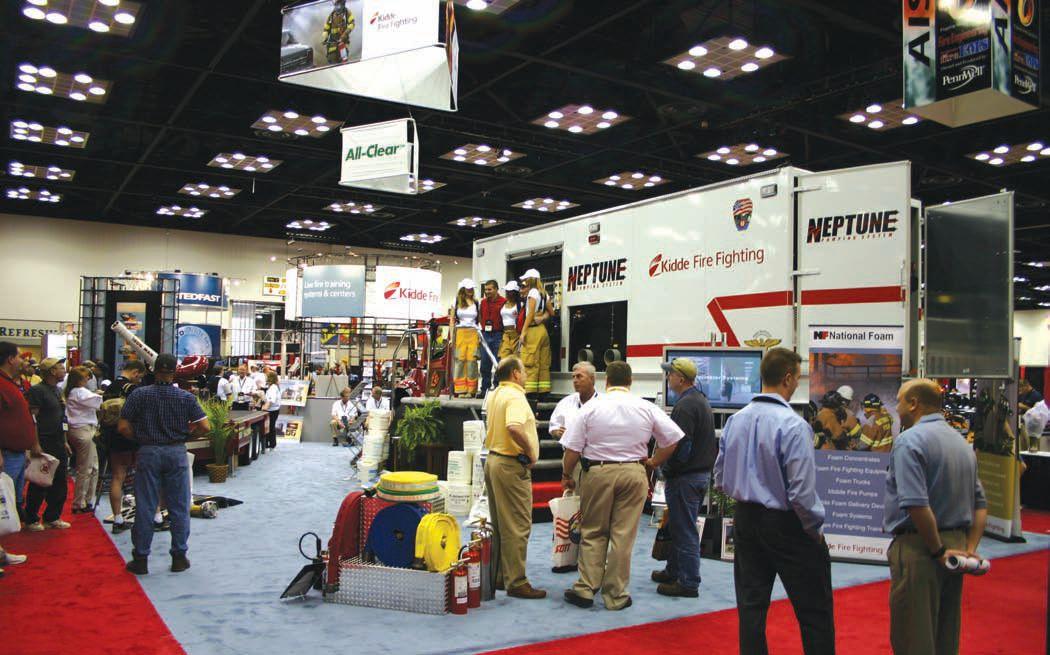
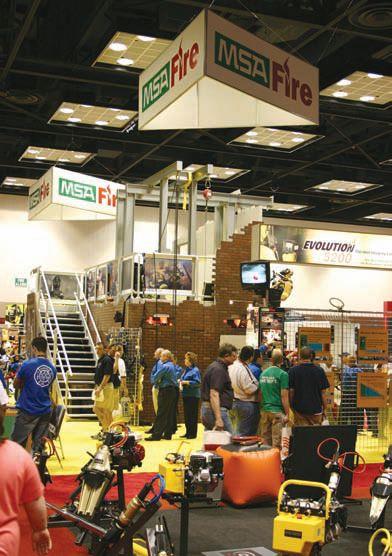
The massive trade show at the Fire Department Instructors Conference in Indianapolis is beginning to attract more Canadians.
FDIC, the Fire Department Instructors Conference held annually in Indianapolis, attracts tens of thousands of fire service professionals, primarily from the U.S., although attendance from Canada, Europe and around the world is growing.
Still, there’s a seeming reluctance by Canadians to want to take leadership roles at FDIC and the lack of funding for firefighters to attend makes it challenging for many to get there.
Undaunted, FDIC’s education director Bob Halton and others are hoping for a bigger Canadian turnout in the coming years.
Halton was excited by the international presence at this year’s FDIC. He called the presenters the best in North America and
Europe. ”We had quite a few European presenters that came in this year,” he noted, “and we’re seeing that growing.”
With respect to Canada, Bob and the FDIC team have attempted to better reach the Canadian fire services through emphasis on efforts like attending and speaking at a number of Canadian venues, including the Ontario Fire College, largely via the Courage and Valour speaking tour. “We’re particularly interested in encouraging and engaging our Canadian brethren,” Bob says. “Our fire response problems are so closely intertwined.”
■ THE CANADIAN EXPERIENCE
The central location of FDIC within the U.S. makes it a reasonable travelling distance for a significant portion of the Canadian fire
PHOTOS
Edmonton, AB
Vancouver, BC
Calgary, AB
Squamish, BC
Oshawa, ON
Iqaluit, NU
Edmonton, AB
Saanich, BC
Fort McMurray, AB
Vaughan, ON
Burnaby, BC
Port Coquitlam, BC
service. Combined with the conference successes , this helps to explain the increasing – but still small (estimates range from about 200 to 500) – Canadian FDIC presence.
Peter Sells is one such Canadian. Sells is district chief of professional development and training for Toronto Fire Services and began attending FDIC in 1992. He immediately saw the benefits and it wasn’t long before he submitted his own teaching proposals, initially for the classroom sessions but quickly graduating to the more intensive and well-respected Hands-On-Training (H.O.T.) sessions, which run over several days. Sells has taught courses on management of training, media relations, instructor development and presentation skills – and he’s in good company.
David Ross is chief health and safety officer for Toronto Fire Services, author and member of the National Fire Protection Association (NFPA) 1500 standard committee. He began attending FDIC in the early 1990s before it made the transition to Indianapolis from its previous location in Cincinnati, Ohio. Ross has also taught both the classroom and H.O.T sessions in such topics as leadership, management, training and firefighter safety with Peter McBride from Ottawa Fire and Emergency Services, another well-respected presenter on building construction and firefighter safety. McBride is probably best known for his research in firefighter heat stress rehabilitation – he helped developed the ‘Kore Kooler’ – and high-rise building positive pressure ventilation (PPV)).
Why do they do it? For Sells, it’s about networking with peers and keeping up to date with the latest training technologies. Ross agrees, adding that FDIC attendees tend to be “dedicated to the fire service and want to contribute to making it better and safer.
■ THE BENEFITS
The Canadian perspective on the advantages and disadvantages of
attending FDIC are important for several reasons, including consideration of travel and accommodation costs (especially when the Canadian dollar is doing poorly), the overall relative value of FDIC to the Canadian fire service experience, time from work (the conference itself takes place over a full week), and the fact that departments cutting costs tend to consider conferences luxuries rather than necessities.
Ross, who is also a member of the FDIC educational advisory board, thinks more Canadians are seeing the benefits. “When I first started to attend, there were not nearly as many Canadians as there are now. I believe this is largely due to the fact that FDIC is the premiere fire services conference in North America and that Canada really has nothing comparable to offer.”
Sells mostly agrees, but thinks the increasing Canadian attendance is likely due to the trade show. “I have heard from many Canadian representatives that they can do more business with Canadian departments at FDIC than at any show in Canada,” but he cautions that this may be changing “with the fabulous improvement in the OAFC [Ontario Association of Fire Chiefs] conference over the last three years.” From the educational perspective, Sells thinks FDIC likely ranks third for attracting Ontario training officers after the annual training officer’s seminar and the OAFC conference.
Attendance at the FDIC trade show does seem to be growing more quickly than at the educational offerings. Once confined to the RCA Dome and smaller convention center, a new wing was added several years ago and quickly filled with new vendors. A new adjoining hotel was also built. Now, the conference is amidst a transition in location to a completely new convention centre for Indianapolis, the Lucas Oil Stadium. The first trade show exhibitors will move beginning in 2009 with a complete transition, yielding 50 per cent more floor space, expected by 2011.
As a member of the educational advisory board, one of Ross’ roles is
to constantly improve educational offerings to attract training attendees by reviewing classroom training topic proposals and providing feedback to Fire Engineering “to get a wide range of input into how to provide the best training to attendees.” If the objective is met, then the training numbers should increase.
Either way, “the numbers are pretty daunting,” says Sells. “I can’t imagine a Canadian market for anything on that scale.” And none of this is to say that Canadians lack either the facilities or expertise. Sells believes “we have plenty of both, just not enough attendees.” Ross feels the same way, “Canada does not have a large enough population to support this type of show.
“Additionally,” he adds, “I’m not sure Canadians are willing to make the same investment in career development.”
It’s true that firefighters in the U.S. appear to be more invested in career development. This may be due to the stricter requirements for firefighter certification, which is organized and maintained by numerous states, as well as at the national level. Further, U.S. educational institutions appear more willing to recognize specific conference sessions as continuing education units toward various accreditations. These may account, in part at least, for increased educational attendance at this conference when compared to Canadian counterparts.
■ A MORE CANADIAN FDIC
There used to be a greater emphasis on foreign attendance at FDIC, including an event for international attendees. Sells would like to see this revived, perhaps through a Canadian sponsor, so that networking opportunities could be expanded beyond North America. Halton likes the idea of reviving such an event, but stresses the need to find longterm sponsors.
For now, this void is being filled, albeit informally, by the corporate hospitality suites hosted by the larger fire service suppliers, including
MSA, in the nearby hotel ballrooms. MSA’s hospitality suite this year was so popular it could only barely be contained to the otherwise large venue.
But more formal Canadian recognition would certainly be nice. Sells would like to see a Canadian honour guard at the opening ceremonies, while Ross suggests at least placing Canadian flags on the main stage, and perhaps playing the Canadian national anthem at the opening ceremonies. But, as Sells puts it, Americans can be insular about these formalities.
If we assume that Canada is one-tenth of the U.S. population (which is close, but not completely accurate), then a U.S. fire service trade show of 29,000 firefighters translates into a Canadian show of 2,900 – something we haven’t yet seen in Canada.
If we’re interested in knowing why, the next step is to determine the numbers for the most attended fire service conference and trade show in Canada and compare them with the very real potential for 2,900 attendees as suggested above. Then we question the reason(s) for the difference between the two numbers. Resolving the reason(s) is how we improve attendance in Canada – if indeed that’s what we want to do.
The other choice is to recognize what shows like FDIC can do that we cannot and use those features to our maximum (learning or business) advantage.
In a global world, increasingly placing greater value on international knowledge, experiences, networking and business opportunities, the decision isn’t at all an easy one to make.
Dan Haden BA, MA, CHRM, is a 25-year career firefighter with Toronto Fire Services and Canadian curriculum consultant with MedTeq Solutions, a NFPA approved online training company. Dan has been attending FDIC for 12 years, including numerous classroom presentations, and has written numerous fire-service related articles.
Top-notch Top-notch
TRAINING
WState-of-the-art training institute opens doors to all departments
By LAURA KING
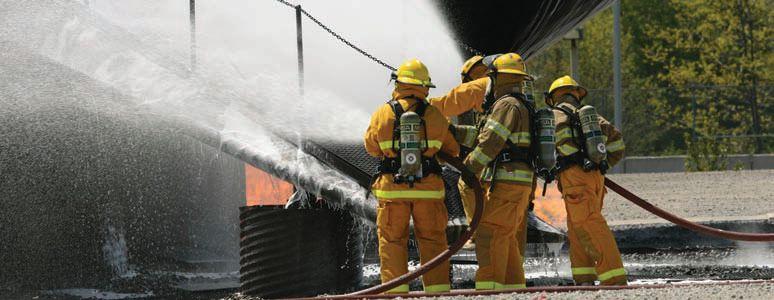
LEFT : Firefighters from Athens International Airport train on the mock aircraft at FESTI. A remote-controlled propane fire simulates an airline fuel fire.
ABOVE: FESTI’s burn tower is constructed of exterior beams that allow for easy re-installation of deteriorating interior walls.
hen Air France flight 358 skidded off the runway at Pearson International Airport on Aug. 2, 2005, firefighters were on the scene in 52 seconds and got all 309 people aboard the Airbus A340 airliner safely out of the burning fuselage.
Firefighters with the Greater Toronto Airports Authority Fire Department saw flight 358 approaching in wet, rainy conditions, knew it was in trouble and sprung into action.
It’s a statistic the GTAA’s Fire and Emergency Services Training Institute, or FESTI, boasts about – and it should. As it happened, the Air France airliner landed on the runway closest to one of the GTAA Fire Department’s two stations (one north, one south). Regulations require a three-minute response time to the halfway point of the furthest runway from each station. The GTAA’s response is one to two minutes, among the best response times in Canada.
“I believe they were prepared [for the Air France disaster] because of this institute,” Deputy Chief Dwayne MacIntosh told reporters on a media day in May to celebrate the one-year anniversary of the revamped institute.
“I think we definitely played a part. We’re pretty proud of the fact that they did a phenomenal job that day.”
In 2005, the GTAA’s training facility comprised a control tower and a couple of training fuselages – and it still managed to provide a remarkable response to the Air France crash.
It also comprised some motivated officers who pushed hard for funding for a $15 million state-of-the-art institute, drew up a plan to turn the training centre into a thriving business. FESTI is adjacent to Pearson, sits on 45 acres of land (including the nearby hazmat training ground) and after a little more than a year in the new facility is becoming an internationally renowned training centre for airport, municipal and industrial fire departments. It also trains civilians in fire extinguisher use and shows off its premises to fire-service associations and school groups.
“We’re open to everybody, not just airport fire departments – that’s one of the biggest misconceptions,” says MacIntosh, a Nova Scotian and former military firefighter. (Several of FESTI’s officers are Nova Scotian – from Halifax, Donkin and Antigonish – and most are former military firefighters.)
FESTI has trained international firefighting teams from Belgium and Bermuda, and has just rolled out a marketing campaign aimed at Canadian departments along with those in the northern United States and Europe.
Teams from the Kelowna and Victoria, B.C., and Hamilton and Windsor, Ont., Toronto City Centre, Ottawa International and Prince Rupert airports have trained at FESTI. Industrial departments from Albion Sands and Fort McMurray have also used the facility.
In mid-May, a team of 14 firefighters from Athens International Airport spent four days training at FESTI. As MacIntosh pointed out, training crews get the royal treatment from FESTI, including hotel bookings, catered lunches and, in the case of the Athens
PHOTOS BY JOHN RIDDELL
Capts. Dave Lane and Rob Lenders demonstrate hazmat training (without the paper towels necessary to wipe their masks).
group, an arranged trip to Niagara Falls.
Interestingly, the Greek firefighters were primarily municipal firefighters who were being relocated to an airport fire department and had little training in airport response.
Over and over, FESTI’s training offers put the Athens firefighters through response drills (the Athens chief was in command), igniting a ring of propane around a model fuselage and forcing the firefighters to improve their response. Placement of the mammoth airport fire trucks – which each hold 12,000 litres of water, 1,400 litres of foam and 500 pounds of dry chemicals – proper application, postioning, communication and other details were reviewed in post mortems and then tried again.
During training, the mock ups on the training ground burn about 24 times a day, four days a week for six to eight months
Continued on page 22
FACTS ABOUT FESTI
OFFERS:
• Fire recruit training
• Aircraft rescue fire fighting training and recertification
• Structural fire fighting
• Hazardous materials (all levels)
• First aid
• Auto extrication
• Technical rescue
• Incident management training
• Command and control
RESCUE TOWER
• Emergency patient care (first responder)
• Defibrillator training
• Fire extinguisher and symptom relief training
• CPR and first aid programs for businesses geared to meet industry, business and government requirements
Five-storey structure allows instructors to simulate multiple emergency response scenarios such as interior search and high-rise fire fighting. The tower is also used in aerial platform training, technical rope rescue and ladder training. The building has a smoke room that directs simulated smoke to either a section of the tower or throughout the building to enhance training scenarios. The dense smoke is generated from a water-based product, making it safe for training and education purposes.
BURN BUILDING
Trainees experience real fire conditions up to 900 F in the intensely supervised and remotely monitored setting. The design of the burn building has incorporated “sacrificial” masonry panels and other innovations that allow the structure to withstand the trauma of training without structural failure.
AUTO EXTRICATION AREA
Allows the instructors to educate using challenging motor vehicle training scenarios in a safe environment. The area is spacious and can support heavy extrication scenarios such as tractor trailers or school bus extrication.
HAZARDOUS MATERIALS TRAINING SITE
Located close to the main campus and spread out over a 15-acre site. Includes transport trucks, buses, rolling terrain, an out building to simulate hazmat storage facilities From www.gtaa.com/festi/en
Continued from page 18
before they’re closed down for the winter. The mock ups cannot operate in the freezing temperatures.
Since it opened last year, the new FESTI centre has trained more than 2,000 Firefighters, industrial and business personnel in structural fire fighting, aircraft fire fighting, confined space rescue, rope rescue, hazmat response and vehicle extrication.
Its courses – all available at www.gtaa.com/festi – range from $125 for a six-hour NFPF 472 hazardous materials awareness program to $15,000 for an 18-week NFPA 1001 level I and II firefighter / NFPA 1003 airport firefighter training program that covers everything from forcible entry to incident command.
FESTI also leases classroom space in its environmentally friendly classrooms (ergonomic chairs, state-of-the-art air-circulation system) to colleges and fire departments and will sends its instructors out to departments for training. FESTI’s hazmat crew worked on site with the Hamilton Fire Department in Ontario for the month of May.
FESTI will also customize training programs for departments and create new programs to meet departmental needs. It will offer an NFPA 1006 rope rescue technician course for the first time at the end of the summer.
Everything about FESTI was impeccably thought out and planned by architects and senior officers of the GTAA Fire and Emergency Services. Take the burn tower, for example. Generally, burn towers deteriorate over the years and have to be replaced or reconstructed. At FESTI, poured concrete pillars on the outside of the burn tower comprise the structural integrity of the tower. When interior walls begin to deteriorate, they can quickly and easily be replaced without compromising the structural integrity of the tower. This system also allows officers to change the interior layout of the tower without starting from scratch. MacIntosh found the concept for the tower on a Virginia-based website then worked the design into the layout he wanted for FESTI.
“We want to be able to train people to think outside the box,” he says, vastly understating the scope of FESTI’s amenities, programs and the calibre of its training officers.
The five-storey rescue tower features a photo luminescent safety way guidance system on stair railings and along the floor to primarily guide occupants out of a structure. MacIntosh will be doing trials with the manufacturer, Luminol, and the National Research council to determine if this type of system will benefit firefighters entering the structure for firefighting purposes and is convinced use of the material will become law in Canada before long. Similar photo luminescent material was being tested on the bottom three floors of one of the New York’s twin towers when the 9-11 terrorist attack happened.
The two aircraft models for airport training serve different purposes. The larger of the two has 10 exterior burn zones, controlled from the original tower on the FESTI site. Training officers can light one zone or 10 to produce up to 5,000 square feet of fire around the aircraft, to mimic burning fuel.
The smaller model is used to train for engine fires, wheel fires, and interior fire fighting and rescue.
The training area is designed with environmental sustainability in mind. Pits in the training field collect runoff from the training fires and if there are any contaminants in the water they are isolated and collected for disposal.
Toronto District Chief and Fire Fighting in Canada columnist Peter Sells calls FESTI “as close as an example of the perfect firetraining centre as I have seen in my 17 years in fire service training.” TOP-NOTCH TRAINING
The science of reading smoke
By ED BROUWER
Smoke, heat and toxic gases are all products of combustion. They are produced during a fire’s normal progression and growth. If the fire is inside a structure, the compartment acts as a container, trapping these products of combustion. These trapped products of combustion can cause reduced visability, rapid fire spread and, in some cases, can create a potential for explosion.
Convection is the primary principle that controls the spread of smoke, heat and toxic gases within a compartment. Heated gases expand, becoming less dense than cooler gases. As a result, the hot gases produced by a fire in a closed room rise to the ceiling (thermal layer) and spread outward, displacing cooler air and pushing it toward the floor. Smoke, heat and toxic gases will spread horizontally along the ceiling until they find an opening that allows them to reach a higher level. They will then flow upward through the vertical opening until they reach another horizontal obstruction. At that point, they will again spread out horizontally and bank down as they accumulate. This process is called mushrooming.
The majority of gases produced by a fire, most notably carbon monoxide, are toxic. These gases pose a life-threatening condition. Whether interior or exterior attack, mop-up or exposure protection, a structure or vehicle fire, fighfighters should use full PPE.
Because smoke is the direct result of fire, it is generally hot when created. The inhalation of superheated gases in smoke can cause severe burns to the respiratory tract. Hydrogen cyanide is formed when plastic products, such as the PVC pipe used in residential construction, burn. It is a poisonous gas that is quickly absorbed by the blood and interferes with cellular respiration. Phosgene gas is formed from incomplete combustion of many common household products, including vinyl materials.
Convection, the flow of heated gases produced by the fire, is one of the primary mechanisms of fire spread. The gases may be hot enough to ignite combustible materials along their path. In addition to igniting combustible materials, the hot gases, smoke and other products of combustion can explode.
In many cases, these products of combustion may include a rich supply of partially burned fuels that are hot enough to ignite but lack sufficient oxygen to support combustion. If these products are mixed with fresh air, the atmosphere itself can ignite
SMOKE EXPLOSION
Following is a brief description of a smoke explosion according to Paul Grimwood at firetactics.com:
■ A smoke explosion can involve cold smoke;
■ A smoke explosion involves a contained layer of flammable smoke already existing within its limits of flammability;
■ All that is needed is an ignition source;
■ A rich-mix of superheated fire gases in smoke may
Colour, location and amount of smoke can provide valuable clues to the fire’s size, intensity and fuel.
'auto-ignite';
■ All that is needed in this case is AIR – this is not truly reflective of a smoke explosion;
■ A smoke explosion usually causes structural damage caused by pressure waves whereas the lesser event, termed flash fire, does not;
■ When a flashover occurs, there is generally plenty of smoke accompanying it;
■ Smoke explosions usually occur with smoke/gas/air pre-mix below 650 C for if the temperature is higher than this the gases will most likely auto-ignite.
TRAINER’SCORNER
For more information, call your local Globe dealer or Safedesign.
GlobedealerorSafedesign.
BRITISH COLUMBIA AND ALBERTA
Coquitlam, British Columbia 800-667-3362
Calgary, Alberta 800-661-9227
Edmonton, Alberta 800-222-6473
Kamloops, British Columbia 250-374-0044
Nanaimo, British Columbia 250-758-3362
Prince George, British Columbia 250-960-4300
QUEBEC
LaSalle, Quebec 800-905-0821
ATLANTIC PROVINCES
St. John's, Newfoundland 800-563-9595
Dartmouth, Nova Scotia 800-567-1955
Saint John, New Brunswick 800-567-1955
MANITOBA AND SASKATCHEWAN
or, in an extreme situation, explode. Try this simple experiment. Light a candle (an emergency candle works best). Let it burn for at least two minutes. Now, light a match and then, as you blow out the candle, bring the lighted match close to the white smoke trailing from the wick. You should see the white smoke ignite and jump the flame back onto the wick. This proves there is enough unburned fuel (gas) in the smoke to ignite. You may not think this is a big a deal but consider this same experiment with 100 times the smoke volume. (See sidebar, page 24.)
Typically, firefighters view smoke as light or heavy. This may be adequate for an initial size up report but it is not descriptive enough when trying to discover what is going on with a fire. The colour, location and amount of smoke can provide valuable clues to the fire’s size, intensity and fuel.
Thin, light-coloured smoke moving lazily out of the building usually indicates a small fire involving ordinary combustibles. Thick, dark grey smoke “pushing” out of a structure, suggests a larger, more intense fire. A fire involving petroleum products will produce large quantities of black, rolling smoke that rises in a vertical column.
Smoke movement is a good indicator of the fire’s temperature. A very hot fire will produce smoke that moves quickly, rolling and forcing its way out through an opening. The hotter the fire, the faster the smoke will move. Cooler smoke moves more slowly and gently. On a cool, damp day with very little wind, this type of smoke might hang low to the ground (smoke inversion).
The four attributes of smoke – volume, velocity, density and colour – must be analyzed.
Smoke volume is an indicator of the amount of fuels that are off gassing within a given space. In itself, smoke volume tells very little about the fire.
The speed at which smoke leaves a building is referred to as velocity. Smoke velocity is an indicator of pressure that has built up within the compartment.
More than half of the indicators warning of potential backdraft have to do with smoke: smoke puffing at intervals from the building (appearance of breathing); pressurized smoke coming from small cracks; black smoke becoming dense, grey yellow smoke-stained windows.
Incomplete burning causes smoke density (smoke thickness). The greater the smoke density the more likely a hostile fire event, such as flashover or rapid fire spread, can occur. In essence, the thicker the smoke, the more spectacular the flashover or fire spread.
For single-fuel fires, smoke colour may indicate the type of material burning. In typical residential and commercial fires, it is rare that a single fuel source is emitting smoke. Smoke colour can, however, tell the firefighter what stage of burning is taking place or where the fire is within a building.
Virtually all solid materials will emit a white smoke when first heated. This white smoke is actually moisture. As the material dries out and breaks down, the colour of the smoke will change. Natural materials will change to tan or brown while plastics and painted surfaces will turn to grey. Grey is a result of moisture and hydrocarbons (black) mixing. All materials will eventually off gas a black smoke; flame contact will cause materials to give off black smoke right away.
Smoke velocity and colour differences from opening to opening help firefighters find the location of the fire. Faster/darker smoke is closer to the seat of the fire; slower/lighter smoke is farther away. If smoke from multiple openings is a constant colour and velocity, firefighters should start thinking that the fire is deep seated within the structure.
Black fire is a phrase used to describe smoke that is of high volume, turbulent velocity, ultra-dense and black. Black fire is a sure sign of impending auto-ignition and flashover. Be advised: wind, thermal balance, fire streams, ventilation openings and sprinkler systems can change the appearance of smoke, causing a false reading.
Thompson, Manitoba 204-778-7123
877-253-9122 www.safedesign.com
Smoke movement caused by heat (convection) will typically rise and slow gradually after it leaves the building. If the velocity of smoke leaving an opening is agitated or turbulent, then rapid fire progress is likely to occur. In these cases, the structure must be ventilated and cooled.
The NFPA definition for backdraft is the explosive or rapid burning of heated gases that occurs when oxygen is introduced into a building that has not been properly ventilated and has a depleted supply of oxygen due to fire.
(Burklin, NFPA 1980)
I have heard more then a dozen testimonials from incident commanderss who, after correctly reading the smoke, called for an evacuation of the burning structure, no doubt saving the lives of their firefighters.
Ed Brouwer is the Chief instructor for Canwest Fire and a memeber of the Osoyoos (B.C.) Fire Department. The 17year veteran of the fire service is also a Fire Warden with Ministry of Forests, a First Responder III instructor/evaluator; Local Assistant to the Fire Commissioner. E-mail: ed@thefire.ca
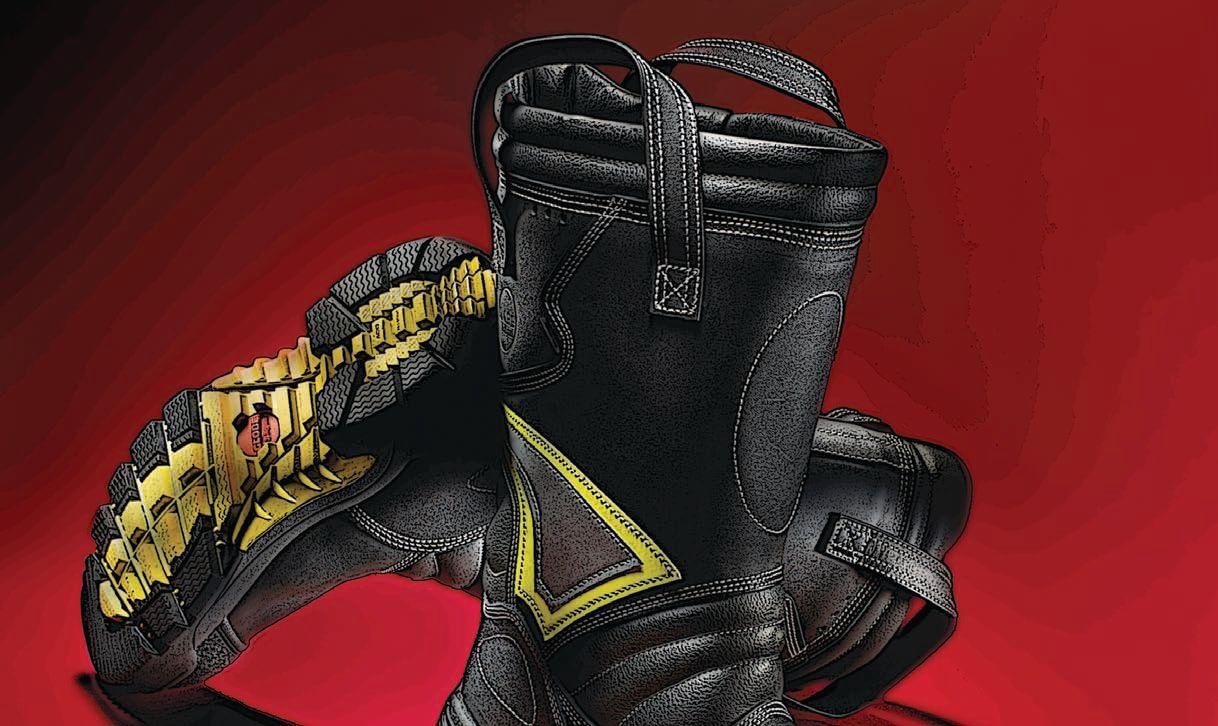
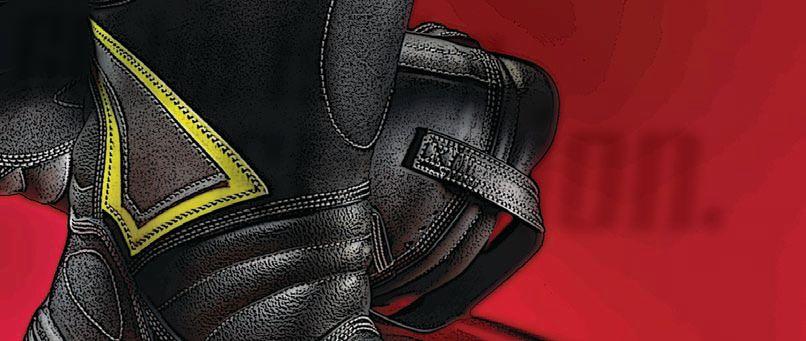
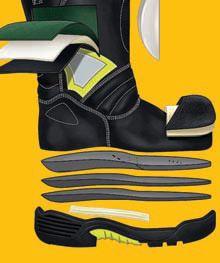
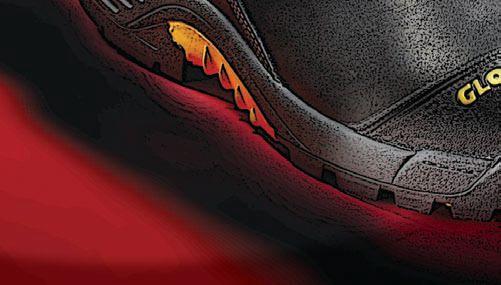
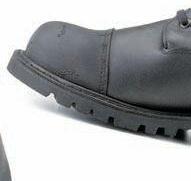
NFPA 1971 (Structural Fire Fighting) and NFPA 1992 (Liquid Splash) compliant. Also available in a 12” Zipper/Speed Lace.
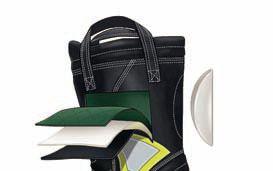
Unique cement construction combines contoured outsole, 3D lasting board with built-in flex zone, and multilayer composite puncture protection. Without stiff welts, ribbed midsoles, or steel plates, this attachment process is far more flexible than traditional welt construction. Globe FootGear has been tested
withstand
flexes with no compromise in performance.
SAY GOODBYE TO HEAVY, STIFF, MILITARY-CONSTRUCTIONBOOTS FOREVER – GLOBEFOOTGEAR IS HERE. REMARKABLY FLEXIBLE WITH A UNIQUE CUSHIONED AND CONTOUREDSOLE AND CUSTOM FIT SYSTEM,GLOBEFOOTGEAR FITSBETTER, GRIPSBETTER, AND FEELSBROKEN IN RIGHTOUTOF THE BOX.GLOBEFOOTGEAR COMES IN A RANGEOF STRUCTURAL,TECHNICAL AND EMERGENCYNFPA COMPLIANTSTYLES. FIND THE GLOBESOLUTION TO ALL YOURPPEPROBLEMS AT:
BY E. DAVID HODGINS Managing Director, Alberta Emergency Management Agency
HLEADERSHIPFORUM
Walking the talk to effective communication
uman resource professionals with expertise in administering and analyzing workplace-satisfaction surveys have identified trust and confidence in top leadership as key and reliable predictors of employee contentment with their organizations. Experts in organizational development assert that effective communication in three critical areas is the key to creating trust and confidence in the workplace. They are: Ensuring employees identify with the organization’s overall business strategy; Ensuring employees recognize how they contribute to achieving key business unit objectives; Sharing information with employees on both how the organization is doing and how an employee's unit is doing relative to strategic business objectives.
Research identifies that many of the problems that occur in an organization are the direct result of poor and/or negative communication. Bad communication leads to confusion or opposition and this leads to failure at many levels. There are two components involved in communication: content and context. The content is the subject matter and the context is the statement or environment that surrounds a particular word or event that determines its meaning. Content and context can be the cause for misunderstanding the message. In reality, we tend to believe what we see, such as the leader’s actions, not what we hear.
Prussian philosopher Friedrich Nietzsche suggested that the way we think and the way we behave are directly related to the way we talk. If his opinion is correct, individuals interested in becoming capable leaders need to understand the importance and impact of their words. Messages based on positive language are a good leadership tool when used at the right time and place. In all languages there are more words to describe negative feelings than to describe positive opinions. The ratio is about five to three. This means that for three positive words you hear, you'll probably hear five negative words. The challenge for leaders is to be in command of their thoughts and behaviours so that constructive content becomes instinctive.
thoughts become your words; You must keep your words positive because your words become your actions; You must keep your actions positive because your actions become your values; And you must keep your values positive because your values become your destiny.
This is much more difficult than it sounds. Here is a well-known list of the most important words (author unknown):
The six most important words: “I admit I made a mistake.”
The five most important words: “You did a good job.”
The four most important words: “What is your opinion?”
The three most important words: “If you please.”
The two most important words: “Thank you,”
The one most important word: “We”
And the least most important word: “I”.
Communication tools and even language have changed drastically in the past few years. As leaders, our challenge is to ensure that we adapt and find ways to incorporate what’s new and not have it negatively impact messaging. New words and terms are being fabricated daily to describe contemporary systems. These words influence our interaction with others, positively or negatively.
New words and terms are being fabricated daily to describe contemporary systems. ‘‘ ’’
To become a trusted and successful leader you must create a positive environment. That starts with your choice of thoughts and words. To do this: You must keep your thoughts positive because your
David Hodgins is the managing director, Alberta Emergency Management Agency. He is a former assistant deputy minister and fire commissioner for British Columbia. A 30-year veteran of the fire service, he is a graduate of the University of Alberta’s public administration program and a certified emergency and disaster manager. E-mail: David.Hodgins@gov.ab.ca
This is especially true in the field of advanced technology. A recent case in point: Sony’s Blu-ray DVD product has won the battle, beating out the Toshiba’s HD DVD product. The marketing gurus tell us that Sony’s brilliant use of the term Blu-ray made the difference. Consider the prolific use of cellphones and the fact that millions of people are “texting.” The term “textonym” is now being used to describe word use and a new language that has been created. A few examples of textonyms that are part of cellphone speak are: gr8 (great); lol (laugh out loud); and Idk (I don’t know).
Here’s a new term: “Seagull leadership.” It’s a negative one. You don’t want to be a seagull leader. They fly in, make a lot of noise, crap on everything, and then leave.
To end on a positive note, effective leaders are effective communicators who gain the respect and trust of employees. This leads to approval and support, which translates into a successful organization.
BULLETPROOF
Armoured Brinks vehicle makes for challenging extrication
By JOHN HANLEY
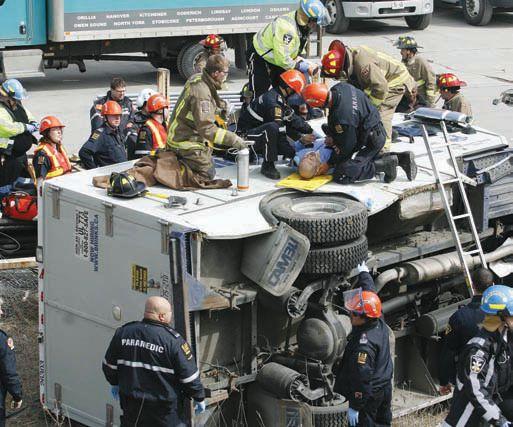
TOP: Firefighters from Toronto Fire Services and EMS personnel from Peel Regional EMS work on a Brinks employee who had minor injuries after being rescued from a truck rollover near Toronto. The Brinks workers advised rescuers on the best method to get them out of the armoured vehicle.
It’s one thing to rescue someone trapped in a vehicle; it’s quite another when that vehicle is an armoured truck.
Under bright sunny skies on March 30, three workers were trapped in their Brinks truck after the armoured vehicle lost control southbound on Highway 427 in the northwest end of Toronto. The vehicle left the highway at about 2 p.m., crashed through a fence and landed on its side at the bottom of a large ditch.
“It’s like a bank vault on wheels,” said James Franks, captain of Toronto’s Rescue 412 (rescue pumper). “We knew this one was certainly going to be a challenge.”
A vehicle designed to withstand an explosion or gunfire provided crews with a very
difficult extrication. The impact of the crash disabled the locking mechanisms in the armoured truck’s doors, trapping the three Brinks employees. Rescuers knew that traditional extrication methods wouldn’t be successful because the vehicle had heavy steel doors and thick, bulletproof glass.
Gord Clark, captain of Toronto Fire Services Squad 445 (heavy rescue) immediately radioed Toronto Fire communications to update dispatchers on the situation and request that Brinks be notified and send a representative.
Because of the nature of the vehicle, it required two separate extrications: the driver and guard in the front cab of the vehicle; and a third Brinks employee trapped in the cargo area of the vehicle.
PHOTO BY JOHN HANLEY
TOP: Toronto firefighters and paramedics including firefighter Josh Kramer from Rescue 444 (right) and firefighter Bruce Bottom of Pumper 445 (bottom left) lower one of three Brinks worker rescued from an overturned vehicle.
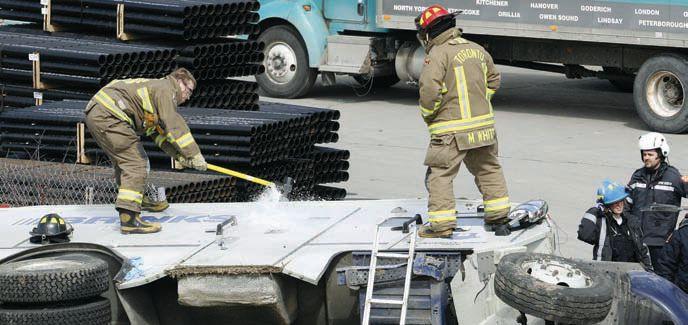
BOTTOM: Josh Kramer (left), of Toronto Fire Services Rescue 444 attempts to break a window on a Brinks truck that rolled over on March 30, trapping three employees inside, while acting Capt. Mike White, also of Rescue 444, looks on.
All three Brinks workers suffered minor injuries but were able to talk to rescue crews and instruct them on possible methods of extrication. Brinks workers suggested that the easiest way in would be through the glass windows.
With the possibility of disabling the locking systems on the armoured truck, it was decided to leave the vehicle’s battery connected. The vehicle needed little in the way of stabilizing as it was more or less a big steel box on its side.
The crew from Rescue 444 laid a charged hose line down to the accident scene and two members of the crew began assessing extrication of the third guard from the back of the vehicle.
Once it was determined that the doors were not going to unlock, crews began working on the glass of the vehicle as extrication points.
“The (windshield) glass had three layers to it,” said Gord Clark. “It was a three-step process to get through it.”
Crews working on the windshield chipped away the outer plastic-like layer of the glass. Using a sawzall, a small hole was then made. A Holmatro tool was then used to cut a larger hole in the glass.
While members from Squad 445 and Rescue 412 began to work on the front windshield, firefighter Josh Kramer of Rescue 444 used a sledgehammer to get through glass in the cargo area of the vehicle. Although the window Kramer was trying to breach was only about two feet by two feet, Rescue 444 acting captain Mike White estimated that the small window had about 25 kilograms of glass to it.
“It must have taken me a good 20 swings to get through that glass,” Kramer said.
The Brinks worker, trapped in the cargo area was the first to be feed. He was pulled out through the small window onto the side of the vehicle.
All firefighters were quick to point out that had the three Brinks workers been unable to communicate with fire crews the extrication would have been much more difficult. Also, had the worker in the cargo area been
unconscious or incapacitated in any way, the extrication would have become a confinedspace rescue.
District Chief Jim McCracken added that because the injuries were not serious, crews had time on their side and were able to rescue the three workers safely.
“With (the workers only having) minor injuries, it was better to get them out safely than to rush things,” said McCracken. “There was no time wasted.”
After about an hour, all three Brinks employees had been extricated from the wreck. All three were taken to local hospitals with non-life threatening injuries.
As a Plan B, crews brainstormed that cutting the hinges off the doors may have been an alternative had the glass been impenetrable. Rescuers were concerned, however, that tools used for the door removal might spark a fire.
Overall, crews took away new knowledge from this incident:
Avoid use of cutting tools such as welding torches as they can caused a fire…
Use gun holes in doors for communication with trapped staff.
Have every tool you may need on scene… sawzall, spreaders, cutters, etc.,
The quick decision to contact Brinks management was crucial to the timely extrication.
PHOTOS BY JOHN HANLEY
BY LYLE QUAN Deputy Chief Guelph Fire Department, Ontario
A CORNERSTONE
Analyzing the art or science of leadership
s I am writing this, I am also putting the final touches on a presentation that and my friend Les Karpluk and I are invited to do at the Ontario Association of Fire Chiefs conference. The presentation, like the title of this column, is about whether leadership is an art or a science.
Les, who is the fire chief in Prince Albert, Sask., and I have been friends and classmates for several years and have discussed this question from many angles. Whether it was during our discussions while completing the emergency services degree program with Lakeland College or while we chatted via e-mail, we have always shared and compared our successes and challenges. Through all of this, we have noted that our problems weren’t unique to Ontario or Saskatchewan, rather they are universal. Because of this, sharing of our experiences and research (at the conference) would continue to support our commitment to the fire service. We are believers in sharing what we have learned and that’s how this opportunity to speak at the OAFC came about.
This year also marks another milestone in what I see as a great example of leadership and sharing in action. The OAFC has been working at removing the silos from our industry by bringing other professional groups into its annual conference. A few years ago, the Ontario Training Officers Association was invited to join the conference and this year, the Ontario Communicators Association is joining and reaping the benefits of sharing training and educational programs.
As noted in my November column, networking is one of the greatest strengths of the fire service. We share unselfishly our experiences and eagerly want to pass on our successes. So, kudos to those on the OAFC executive who have worked so hard to make this joint educational conference a reality.
Buffalo leadership
• One person in charge.
• The herd moves only when the leader moves.
• If the leader is killed the herd looses its direction and stands still until a new leader emerges.
Geese leadership
• Everyone knows where the team is going.
• They switch off and take the lead when necessary to lighten the load.
• There is constant and open communication.
So, is leadership an art or science? It is a combination of both. When dealing with people, tab A does not always fit into slot B. Therefore, as leaders, we need to educate ourselves to understand the personalities and generational gaps that exist within the fire service. Are you trying to understand your staff, their needs and values? If not, why not?
Leaders and managers need to look at the bigger picture and determine on which battlefield they want to plant their flag or when they should take a more supportive role. During the Korean War, while in the process of what appeared to be a retreating manoeuvre of his troops, General MacArthur was quoted as saying to the media,
So, what is the answer to whether leadership is an art or science? It is a combination of both. ‘‘ ’’
As for the joint presentation that Les and I prepared on leadership, it is a culmination of the books and articles we have read, the seminars we have participated in and, of course, our personal experiences and beliefs. The presentation makes reference to a concept that is discussed in the book Flight of the Buffalo The authors, James Belasco and Ralph Stayer, point out that one major reason some organizations fail is that their leadership style is more related to the buffalo mentality than the geese way of thinking.
Lyle Quan is the deputy fire chief – administration with the Guelph Fire Department in Ontario. A 27-year veteran of emergency services, he is a graduate of Lakeland College’s Bachelor of Applied Business: Emergency Services and Dalhousie University’s Fire Service Leadership and Administration Programs. Lyle is an Associate Instructor for the Ontario Fire College, Lakeland College and Dalhousie University. E-mail: thequans@sympatico.ca
”Retreat, hell, we’re just attacking from another direction.” This statement so aptly epitomizes the ability of this leader to see that it’s all in how you look at a challenge that makes your efforts a success or a failure. Be flexible, readjust and tackle the problem from a different angle. It’s not about winning or losing, it’s about which solution best supports the vision and values of the organization and the community it serves.
So, is leadership an art or science? Let’s just say that a true leader is someone who can see when dealing with people that there is an art for appreciating that we are all different, yet when dealing with the hard-core issues, the science of assimilating, evaluating and reaching a conclusion is also a requirement.
The two books mentioned here can be obtained through Amazon. com and Chapters. (Flight of the Buffalo by James Belasco and Ralph Stayer (1993), published by Warner books. A Tale of Two Employees by Dr. Chris Bart (2002), published by Corporate Missions Inc.)
Ingleside, ON
TRUCKCHECKS Transmission Tips – Part 3
By DON HENRY
While the family of older hydraulic-mechanical Allison transmissions (AT-MT-HT) was very good for the fire service, the world transmission called the WT and the newer Emergency Vehicle Service transmission (EVS) are excellent for our use. There are a number of reasons for this.
■ ADAPTIVE LEARNING
The WT and the newer EVS have a quality called adaptive learning. This feature allows the transmission to change over time to meet the needs of the user. All transmission components, such as clutches, experience normal wear over time. These clutches could slip when engaging during full power up-shifts. The Allison’s computer can measure the speeds of the input shafts, the clutches, the output shaft and the position of the foot pedal. It can then take all this information and command the clutches to apply. By making sure the clutches do not have excessive slip during engagement, the clutch facings will not overheat because of friction. These full-power shifts will be very firm to ensure long clutch life. This transmission can also give very smooth shifts under light acceleration. In fact, the shift quality can rival that of many automotive high-end cars. You would not have to drive a piece of older fire apparatus with a HT 740 transmission very far to appreciate the improved shift quality that this new electronic transmission can provide. This transmission, because of its adaptive learning, can even adapt to different drivers. If your people are the pedal-to-the metal type, with long-up hill grades the transmission will learn to make harder, firmer shifts. If your department does not have the need for such aggressive driving, the transmission will learn to make softer, smoother shifts.
The transmission’s computer comes programmed from the factory with hard, firm shifts. Its computer called an ECU (electronic control unit) quickly learns to adapt to the needs to the user. If, for any reason, the transmission loses electrical power, for example, if the batteries go dead, the transmission will revert to the harsher factory setting. This is not bad; it will just take a few hours of normal use to relearn.
To ensure that the computer never loses its memory in the event of a power loss many departments installed an extra battery. This was called an isolation battery. Its job was to keep the transmission, and, in some cases, the electronic engine, operating in the event of a complete power loss. This could happen if a main starting battery cells became defective or an alternator was failed while at a fire scene. This idea was thought to be the solution to keeping the computer alive until the isolation batteries began to fail over time. Even if the main batteries were good, if the computer saw fewer than 10 volts, the engine and/or transmission would ether not run or would run poorly.
This isolation battery was often not located in the normal battery box but hidden close to the transmission. The old saying, out of sight, out of mind, applied here. Only a trained EVT who knew what this battery was for would even think to look for it. As such, many of these isolation batteries were neglected and, over time, failed. These failures caused a lot of problems. As such, it is not recommend that an isolation battery be used.
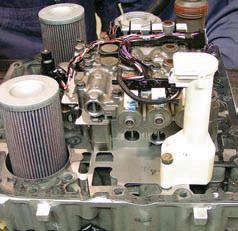
Valve body removed, optional oil level sensor in lower right hand corner (white), note oil filters right side of
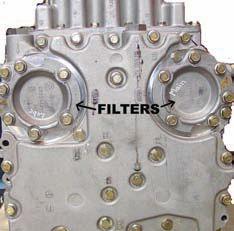
Oil filter locations, looking up from below.
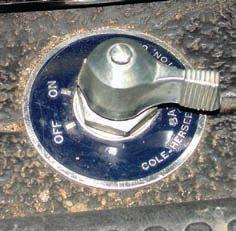
Master disconnect switch.
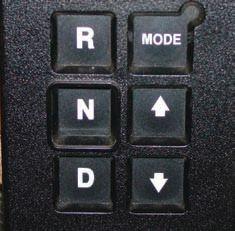
Shift pad: On this model, push the up and down buttons at the same time.
PHOTO 2
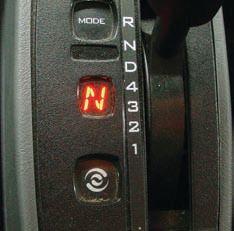
On this lever model, push the Allison symbol button in the lower left hand side.
PHOTO 3
PHOTO 1
picture.
PHOTO 5
PHOTO 4
TRUCKCHECKS
Even if you turn off the main batteries with a master disconnect switch, you do not cut the power to the transmission computer – its memories have to keep alive with battery power. It the master disconnect switch did cut power to the computer each time you turned it off, then the transmission would always revert back to the harsher factory shifts. There have been reports of this happing to fire apparatus. (See photo 1.)
It is now more common to find load-shedding devices that will shut off electrical loads to ensure that the computers on the fire apparatus receive the required voltages. We will address this in a future column.
■ TRANSMISSION CODES
As with any mechanical device, things will go wrong, but the Allison has some neat diagnostic tricks to help keep you going.
The computer has the ability to talk to you and tell you what is wrong. If a problem were to happen when operating the transmission, the computer could set a diagnostic code. If the code is not serious and does not happen again, then the code will disappear after 25 engine starts. If the problem is serious and is persistent then the transmission warning light will illuminate on the dash. This is also called the Do Not Shift (DNS) light. I have often told my students that it really could be called the Will Not Shift light. For example. if the rear output shaft speed sensor were to disconnect from its wire, then the transmission would set a code. The transmission would coast until you obtained first range and then the transmission would stay in first range.
Just for reference, Allison does not call it first gear, second gear and so on, rather it call uses first range, second range, etc. You can do what you want – shift to neutral, reverse, even shut off the truck and restart – you are still in first range.
The term for this code is called a hard code. You will have to fix the problem and then drive the truck. When the computer now sees the speed sensor is connected, then this code will become a soft code You may also hear it called an historic code. You can then erase the code or simply do nothing and the code will disappear after 25 starts.
Does it cost a lot for diagnostic computers and training to extract these codes? No. In fact, Allison has made it very simple for you to obtain the codes from the computer. Depending on the generation or model, different methods are used. First, turn off the engine and move the start key to the run position. If you have a transmission console with the up and down arrow keys, push these keys at the same time. (See photo 2.)
If you have the shift lever (very popular with fire departments because it can be used with gloves on, then push the display button once. (See photo 3.) This button looks like the Allison symbol.
The computer can hold up to five diagnostic codes and it will read out the D1 (diagnostic one) code first. The lights will flash a D1 and then the two-digit main code and a two-digit sub code. You can then write down the codes and refer to the manuals.
For example, a code D1-21-12 indicates that this is main code 21 and indicates a problem with the throttle position sensor signal (that’s the foot pedal for the rest of us) and sub code of 12 indicates that the throttle position sensor signal was low. This could be just a badly corroded connection. That’s a pretty smart computer but it can not tell you that maybe you are just washing the under hood of the truck to much and have repeatedly sprayed some high-pressure hot, soapy water into the connections.
If there are other codes you will need to write them down and fix the problems as you go. If you think there are other codes, push the
mode button to retrieve the remaining codes.
It is rare to have a problem on this transmission but if you have to do troubleshooting it is made much easier with the use of diagnostic codes.
Even though I teach this, have I memorized all the codes? Of course not. They made books for that! Go to your local Allison deal and ask for the book that has the codes for your transmission or go to www.allisontransmission.com. There are also some great videos at this site that you can watch on the subject of transmission codes. While you are there, look up your local dealer and see if it offers any courses.
We are very lucky in Alberta to have two Allison training schools, one in Edmonton and one in a smaller city to the south of Edmonton that also has a hockey team. I am talking about Waterous power systems: look up www.waterouspower.com – it offers excellent courses for both the operator (firefighter) and the technician.
It has been my experience that very little goes wrong with the transmission. When problems do occur they are usually caused by incorrectly installed two-way radio transmitters that people that think they can weld on the fire truck without first disconnecting the computers or not using genuine Allison parts.
■ OIL LEVEL AND FILTERS
All the information on oil-level checks in the May issue of Fire Fighting in Canaa that apply to the At-Mt-Ht also apply to the WT and I will not repeat them here.
The WT has a few features that need to be explained. The first is an optional oil-level checking system. This allows you to electronically check the oil level from the seat of the truck. If the oil level dipstick was not correctly wiped off and installed back into the transmission correctly, there is a good chance that dirt could be put into the transmission. This oil-level option removes the chance of this happening.
There are a few things to learn before you use this feature. First, the transmission must be warned up, the truck level and the engine at idle. You use the same buttons as you used to check for engine codes. If the transmission has the oil-level sensor option then the first push of the button will tell you oil level. The button will have to be pushed again for transmission codes. It may take a few seconds after you push the button for the level sensor to give you a reading. If the display reads OL-OK-OK then the oil level is OK to go. The sensor can read as much as four quarts low or high.
For example, if you were six quarts low, then you would read only four quarts low. This can be a handy feature for fire apparatus as often it can be difficult to access the transmission oil level dipstick on custom cabs. I would still ask for a monthly visual check of the dipstick to ascertain oil condition. (See photo 4.)
There are two transmission oil filters. One for lubrication and the other a main oil filter. They are easier to access than the older MT transmission as you do not have to remove the oil pan to change them. I recommend only the genuine Allison filters. Change them on schedule and use an oil analysis program. This is not a place to save a few dollars on an off-brand filter. (See photo 5.)
We will continue our look at transmissions in the August issue.
Don Henry teaches in the Automotive Service Technician and Heavy Equipment Technician programs at Lakeland College in Vermilion, Alta., where he has been a faculty member for more than 17 years. He has co-developed and delivers Canada’s only post-secondary level fire apparatus maintenance program and has completed a textbook on fire apparatus.
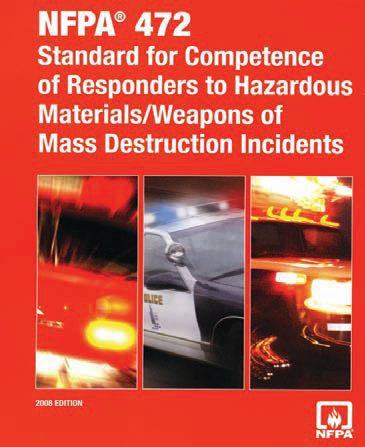
472:COMPETENCE OF RESPONDERS TO HAZMAT INCIDENTS,2008 ED.
Item#:47208
Price:$38.00 • NFPAMemberPrice:$34.20
Ensure that responders to hazmat/WMD incidents are up to the task and reduce accidents,injuries, illnesses,and fatalities with the 2008 NFPA 472.
NFPA 472 identifies the minimum levels of competence required by responders to emergencies involving hazardous materials/weapons of mass destruction (WMD).The 2008 edition has been retitled and completely rewritten (with major chapter reorganization) to apply to ALL first responders,regardless of response discipline,who may respond to the emergency phase of such incidents.It is based on the operational philosophies that emergency responders should be trained to perform their expected tasks,and that a responder cannot safely and effectively respond to a terrorism or criminal scenario involving hazmats/WMD if they don’t first understand basic hazardous materials response.
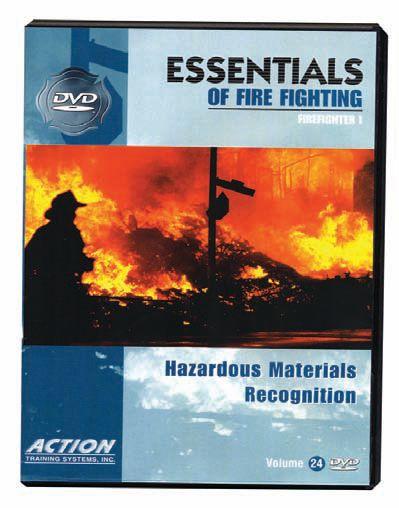
HAZMAT AWARENESS SERIES – 2 DVD SET
Item#:RHA003DVD
Price:$360.00
Firefighters as first responders need to be prepared in the basics of HAZMAT recognition and identification.These programs present the four basic rules to identification and recognition,the nine hazard classes defined by the DOT,how to use the Emergency Response Guidebook and the NFPA 704 marking system.
The courses included in this set are as follows:
• Hazardous Materials Recognition
• Hazardous Materials Identification
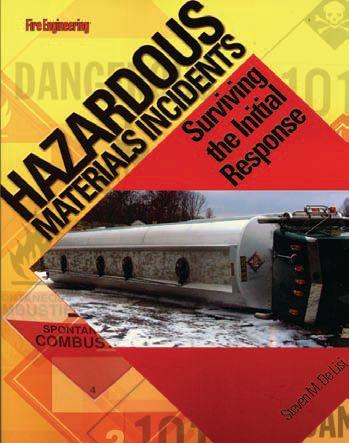
HAZARDOUS MATERIALS INCIDENTS:SURVIVING THE INITIAL RESPONSE
Item#:1593700717
Price:$49.00
First responders who arrive on the scene of a hazardous materials incident may be assigned to an engine, ladder truck,rescue,or ambulance with very little sophisticated HAZMAT equipment.Despite these limitations,their actions during the initial response will often set the stage for the success or failure of the entire event.
Many incidents start out as minor “routine”events that suddenly escalate when something goes terribly wrong! First responders,despite their best intentions,can quickly become part of any hazardous materials problem.The results can be first responders who are killed or seriously injured,or those who suffer devastating illnesses years after exposure to a hazardous material.
COME AND VISIT US AT OUR BOOTH AT THE MARITIME FIRE CHIEFS CONFERENCE, JULY 6TH TO 9TH IN LUNENBURG,NS. VIEW THESE TITLES AND MORE,TO SEE WHAT’S NEW IN TRAINING AND EDUCATION FOR THE FIRE INDUSTRY.
IN THE WATCHROOM
For more information on In the Watchroom products, go to www.firefightingincanada.com and click on In the Watchroom. Links to manufacturers’ websites are included on the web version of In the Watchroom, at the end of each entry.
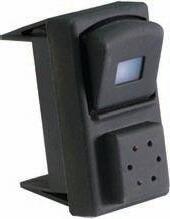
■ SIGMA SWITCH AVAILABLE
Boston – Cole Hersee introduces its new Sigma Rocker Switch with Alarm (part number 40205). Ideal for emergency vehicles, this audible and visual warning alarm indicates the status of various inputs, such as door ajar, high/low pressure, high/low temperature, on/off status, and many other applications.
This low current input membrane switch is compatible with microprocessor-based electrical/electronic systems and has the look and feel of a conventional rocker switch.
The Sigma Rocker comes complete with reliable LED backlighting and provides an alarm and override feature for the Cole Hersee SureStart 48500 series of low-voltage disconnect switches.
Its silicone rubber actuator can be affordably customized by Cole Hersee using laser etching technology. Options include custom colours, imprint and graphics, and the shape and location of the LED lens.
■ MONITOR RECEIVES CSA APPROVAL
Pittsburgh, Pa. – The Canadian Standards Association has certified Industrial Scientific Corp.’s MX6 iBrid multi-gas monitor as intrinsically safe for use in hazardous locations.
Industrial Scientific said the MX6 meets CSA Standards C22.2 No. 152 and C22.2 No. 157 as intrinsically safe for use in Class I, Group A, B, C and D hazardous locations. This certification applies to the use of the instrument both in diffusion mode and with an integrated sampling pump.
The MX6 iBrid is the first gas monitor to feature a full-color LCD display screen. The MX6 colour display improves safety with clear readings in low-light or bright-light conditions. It also supports on-board graphing and a menu-driven PEG (Portable Embedded GUI) operating system. This allows users to step through instrument functions using an intuitive menu and the instrument’s five-way navigation button. The MX6 also adds flexibility for multilingual and international work forces with one of eight available pre-programmed languages.
The MX6 is designed to detect from one to six gases including oxygen, combustible gases and up to four toxic gases.
■ OGSI RELEASES MOGS-50/100
The OGSI MOGS-50/100 Medical Oxygen Generating System has been designed to produce oxygen on site and fill high-pressure cylinders (up to 2,200 psig) or to supply oxygen directly at up to 80 psig.
The system produces medical-grade oxygen in accordance with the USP specifications, and can reduce oxygen supply costs by 80 per cent or more in most cases.
The MOGS-50/100 can be easily transported to a disaster site, and fits easily through a 36-inch doorway.
Banding together
The province of New Brunswick, with a population of about 750,000, has adopted a new model for the delivery of ambulance services. Ambulance NB (ANB), a newly formed public-sector company, has taken over all land-based ambulances and the air ambulance service. ANB is managed by New Brunswick EMS, a subsidiary of Medavie EMS. Medavie EMS has operated the provincial ambulance system in Nova Scotia for 10 years, and began operating a provincial system in Prince Edward Island last year.
Contracts for pre-hospital emergency care and patient transfers were previously held by 39 service providers, operating under more than 50 contracts. These providers included regional health authorities, municipalities, for-profit companies, non-profit organizations and First Nations communities.
The New Brunswick Department of Health announced the new service on June 12, 2007, settled the contracts with previous operators and all assets were turned over to ANB.
All qualified medics were offered employment with ANB and those who accepted the offer began working for ANB on Dec 16. The service includes 750 primary care paramedics operating up to 126 ambulances from 75 bases. There is a shortfall of about 100 medics, which has resulted in some shifts being covered by overtime. Some of this shortfall may be relieved when the current PCP students complete their courses. It is expected that there will be about 900 paramedics in the system by 2010 and the number of ambulances may increase to135.
When the change was announced, there was a mix of certification and skill levels among New Brunswick’s paramedics and ambulance staff. The majority were trained as emergency medical technicians while some were primary care paramedics. Most had training in advanced life skills.
A news release from the province said
New Brunswick consolidates ambulance service
By ANDREW A. SANOJCA
TOP: Paramedics Pauline Heelan and Jeff Levesque with their first-in gear.
RIGHT: Ambulance New Brunswick, a new publicsector company managed by New Brunswick EMS, has taken over all land-based ambulances and air ambulances.
PHOTOS BY ANDREW SANOJCA
that in keeping with national standards, primary care paramedic (PCP) would become the basic entry level for all new paramedics working in New Brunswick. The government also intends to introduce advanced care paramedics.
The look of the ambulances has changed to white with burgundy and green stripes from white with an orange stripe. There is also a new ANB logo that includes a provincial galley boat over a star of life.
Managing all these resources and getting them to the right place at the right time is the responsibility of the Medical Communications Management Centre (MCMC) in Moncton. Dispatchers at the centre co-ordinate scheduled transfers and dispatch incoming 911 calls.
The goal of ANB is to provide standardized care to all residents in the heavily rural province. To do this, the system must make the best use of its available resources. While some services would previously sit idle for extended periods, under the new system, all resources are being used to provide emergency coverage and patient transfers. Provincial ambulances respond to 120,000 calls a year, of which 50 per cent are patient transfers between hospitals and nursing homes or back to a patient’s residence. Of the approximately 60,000 patient transfers completed, almost 40 per cent are long-distance transfers, where the patient is taken to another facility in a different community.
As with any major change, the new ambulance system has had some difficulties. Rock Marois, president and CEO of Ambulance NB, said the new deployment system has been a concern for some communities.
“They used to have a locally run system and they used to see
their ambulance parked somewhere. Now it’s not as visible, so this is a huge change.”
However, what is not visible to the community is the fact that while the ambulance stationed in the community may be out on a call, or covering a call in a nearby area, ambulances from what used to be bordering coverage areas are moving toward the community to provide balanced coverage. This includes moving ambulances from rural areas towards busier urban areas, where they can respond in a reasonable time in either direction.
Members of Saint John’s city council have been in the news often since the change was announced and some have not endorsed the changes. Not only did the city lose local control of its ambulances, it also lost the ability to dispatch those ambulances, and some councillors fears there may be a delay in help reaching those in need. The city operates a Public Safety Answering Point, where incoming 911 calls are answered, and dispatches its own fire and police departments, as well as several neighbouring fire departments. It used to dispatch ambulances within the city and Kennebecasis Valley, but all ambulance calls are now forwarded to the Medical Communications Management Centre in Moncton. Rock explained said the purpose of MCMC is to make the best use of all resources but acknowledges that the move to dispatch from one central location was controversial.
“It’s impossible to have a provincial system without having a provincial communications centre to control all your resources,” he said. ”I firmly believe this is working really well now.”
Better control of those resources may also include keeping an out of town ambulance in a major centre to assist with a backlog of patient transfers. The preference is to keep a local crew available to
respond to 911 calls, however MCMC can help guide out-of-town ambulances to a scene using a GPS-based automatic vehicle locator, which have been placed in all ambulances. Medics often help each other out, with locals providing directions to those from out of town.
Two or more ambulance crews may now complete long-distance patient transfers. Because the ambulances are now owned by one company, and have all been standardized, with the same equipment located in same location, crews may perform a “seat to seat” transfer. This means a crew leaving Bathurst might trade ambulances with a crew in Moncton that has just dropped off a patient and is returning to Saint John. This is now possible instead of having to drive the whole distance and then return to the base,” Marois said.
“That is something that could not be done before, because of the fragmented nature of the old system.
“It allows for the originating team to go back to their area sooner, it reduces fatigue, and it allows us to better manage overtime because on long-distance transfers it can be a challenge to get people back before the end of their shift.”
In addition to making better use of resources and having a standardized fleet of ambulances, the ambulances will be maintained at regular intervals at three fleet centres. An existing contract with Malley Industries in Dieppe N.B., provides ambulances to ANB on a four-year lease. The vehicles are maintained and serviced by NB EMS and are returned at the end of the four years. With the better use and rotation of these vehicles it is expected each will have travelled about 280,000 kilometres by the end of their leases. Previously, some returned vehicles had travelled more while others had travelled fewer kilometres.
By 2010, Ambulance NB will be required to have an ambulance at an emergency scene within nine minutes, 90 per cent of the time, in urban areas, and within 22 minutes, 90 per cent of the time in rural areas. These time frames are already being met in most cases, but will form an integral part of the performance based contract.
An Ambulance New Brunswick air ambulance featuring the company’s new logo.
PHOTO BY ANDREW SANOJCA
BY BRAD PATTON Fire Chief
Centre Wellington, Ont.
I
VOLUNTEERVISION
Obstacles in maintaining a volunteer department
have been in the fire service for more than 25 years, seven as a senior officer and five as fire chief in Centre Wellington, Ont. I have always cared for and managed volunteer firefighters. Every year, it seems to get more challenging and I’m beginning to wonder how much longer volunteer departments can last.
The obstacles volunteer chiefs face are daunting. There are about 127,000 volunteer firefighters in Canada. In Ontario alone, it would cost taxpayers more than $1 billion annually to replace the volunteer firefighters with full-time staff. If we were working for private companies and saving that kind of money, the year-end bonus would put our children through university. We don’t work for private companies; we are civil servants. We work for municipal councils and for the province or territory that maintains the standards we adhere to. Most importantly, we work for the community and anyone in our jurisdiction who needs our help.
Some might disagree, but I firmly believe that being a chief for a volunteer department is twice as hard as being a chief for a full-time department and I’m prepared to discuss or debate that with anyone. Our business is very cost effective for the municipality but very difficult for those of us in charge to manage. We do not have the luxury of having a captured work force for 10, 14 or 24 hours a day to do training, equipment maintenance, apparatus checks, fire prevention and education, station duties and respond to alarms.
When I’m at a large emergency calling for all our trucks and mutual aid from surrounding volunteer departments, I often compare the situation to my favourite snack, Bits & Bites. Every handful is completely different than the last one and you just never know what to expect. Some trucks arrive with two or three captains. The next one arrives with two firefighters. The next has a deputy chief and six firefighters on board. As incident commanders, we’re responsible for building teams or sectors from arriving crews, assigning them tasks, tracking them, keeping them safe and working them hard and long. I have worked for a full-time department and one of the biggest differences between full-time and volunteer is how quickly most full-time departments get relief. After just one or two hours, it’s back to the hall because relief has arrived. Volunteer firefighters stay until the incident is over, so it’s not unusual for me to work with the same firefighters for 10 hours or longer on a major alarm.
In a volunteer department, training is one of the most difficult things to manage. I believe all firefighters should be thought of and respected as professionals – people who are knowledgeable, have high moral standards and good ethics, have obtained the necessary skills though training and education and are passionate about providing a service.
It takes four or five years of dedicated training to make a firefighter. Unlike in other professions, fire chiefs don’t hire a fully trained person to do a job. Construction companies hire trained backhoe operators to run backhoes. Dental offices hire qualified dentists. We hire people who we believe, through a series of tests and interviews, have the potential to become good firefighters. Then, we put them though 120 hours of training. And you know who does all that training – other volunteer firefighters. It takes more than 200 hours for training officers to put together lesson plans and instruct recruits. Last year, our 50 volunteer firefighters put in 17,405 hours of training and responded to 564 alarms – that’s about 470 work weeks.
The only way the Canadian system of volunteer fire departments can work effectively is to have firefighters who are well trained, who are given the best equipment and apparatus, who receive fair remuneration and who have the utmost respect of colleagues and the public.
. . . many people believe they receive less of a service from a volunteer department... ‘‘ ’’
Brad Patton, a 25-year veteran of the fire service, is the fire chief in Centre Wellington, Ont. He holds diplomas in advanced fire prevention and advanced fire protection from the Ontario Fire College, and a certificates in fire service management and municipal administration from Mohawk College. Contact him at bpatton@centrewellington.ca
Volunteer firefighters are greatly misunderstood. In my experience, many people believe they receive less of a service from a volunteer department than a full-time or composite department. In truth, the only difference may be response time and often that isn’t even an issue. Still, it appears that the public has no problem with a full-time firefighter being a electrician, plumber or truck driver on the side and doing a very fine job at both chosen careers. So, why can’t we reverse the roles so that a full-time electrician, plumber or truck driver can be a professional volunteer firefighter too, in the eyes of the public and of fellow firefighters?
We can overcome these challenges in running a volunteer fire department. We just need to work together, understand the challenges and create a plan to make it work.
In the August issue of FFIC we will begin to explore how to best manage a volunteer fire department.
Not a drill
Mock disaster turned real leads to stronger ties between Marine Atlantic and area fire departments
By ROBERT LYNCH
Volunteer firefighters in Port aux Basques have been running drills with Marine Atlantic after a mock disaster exercise in September turned into a real marine rescue.
Amock disaster exercise that turned into the real thing has resulted in a new level of co-operation between Marine Atlantic – the company that runs passenger ferries between Nova Scotia and Newfoundland – and volunteer firefighters at ports in both provinces.
The mock disaster exercise, known as Ocean Guardian III, took place in the Bay of Islands on the west coast of Newfoundland and Labrador on Sept. 27. The exercise was a test of the Halifax Search and Rescue region’s major maritime disaster plan. By noon, the simulation had turned into a real emergency that sent 21 people to hospital.
Things were going according to plan when a call came over the radios: “No-duff, no-duff, no-duff; all call signs other than noduff please remain of the air.” This was code
for “No kidding, no more make believe” and the exercise quickly changed from a mock disaster to a major problem with real injuries and a real rescue required.
The mock scenario – an explosion/ fire aboard the Ocean Guardian III, which was standing in for Marine Atlantic’s MV Lief Ericson, one of its ferries that travels between Port aux Basque and North Sydney, N.S.– involved about 400 people and was in the works for more than a year. The exercise was halted around noon when 21 people aboard a lifeboat were overcome by what the coast guard first reported as smoke but was later confirmed to be acrid fumes from engine exhaust.
All 21 victims were all taken aboard the Canadian search and rescue ship Sir Wilfred Grenfell and triaged. Two were airlifted by a Cormorant helicopter, one was not injured and the remainder were as taken
by an RCMP vessel to port or by the coast guard lifeboat, Cape Norman, to a marina at nearby Allen’s Cove. Awaiting ambulances transported all those requiring further medical treatment to Western Memorial Regional Hospital in Corner Brook.
At 12:40 p.m., Western Regional instituted its code orange to respond to the real emergency. In implementing code orange – a response to a mass-casualty incident – all elective surgeries at the hospital were cancelled for the rest of the day. As of 5:30 p.m., 11 of the patients from the mock disaster had been discharged from Western Memorial but three patients were transferred by air to Eastern Health at The Health Science Complex in St. John’s for further medical treatment.
“Two are listed in stable condition and the third is listed in serious, but stable condition,” Dr. Brent Thistle, head of emergency, said during a briefing. “Those people were transferred into St. John’s to be looked at for treatment in the hyperbaric chamber. Smoke inhalation is our main concern, and carbon monoxide poisoning.”
In March, Transport Canada released its report on the incident.
“Transport Canada relied on data provided by health-care professionals who responded after the incident. It became evident to us that some of the participants in the exercise were exposed to high levels of carbon monoxide,” said Transport Canada regional communications director Maurice Landry.
“The most likely cause of the incident is what is called drafting, [which] caused the exhaust to be sucked into the open back hatch of the lifeboat. It's an enclosed lifeboat and the back hatch was open, much like a vacuum.”
Transport Canada made six recommendations:
When operating totally enclosed lifeboats all hatches should remain closed;
Lifeboats should be provided with atmospheric monitors to indicate high levels of airborne hazards;
Operating crews should be trained in the hazards associated with airborne hazards and the steps to be taken to eliminate them;
Operating crews should be trained in their duties and responsibilities when carrying personnel other than required boat crew;
Operating crews should be trained in the hazards associated with operation of fully enclosed lifeboats;
A risk assessment be completed to assess known and foreseeable hazards associated with totally enclosed lifeboats.
Marine Atlantic will not face any charges and the Crown corporation has voluntarily
acted on all the recommendations.
“Within days of the actual incident that occurred, we had already begun to act on what we thought was happening based on our own internal investigation,” Marine Atlantic spokesperson Tara Laing said in March. “By the time we received this report we had actually implemented all the measures necessary to meet these recommendations.”
Laing said in an e-mail interview that as a result of the mock disaster, Marine Atlantic has developed a greater understanding of all the players who would respond to an
incident involving one of the company’s vessels and the roles each would play.
“Being involved in exercise enabled us to begin to develop a relationship with some of these individuals and strengthen our relationships,” she said.
Marine Atlantic has its emergency response plan in place and conducts regular training exercises to respond to emergencies but this was the first time it participated in an exercise of this magnitude.
Laing said the exercise confirmed that its
Continued on page 51
ARE YOU
FESTI TOUGH?
Find out by enrolling today and train where firefighters learn from the best.
The Greater Toronto Airports Authority’s state-of-the-art Fire and Emergency Services Training Institute (FESTI) offers hands-on training courses ranging from basic fire extinguisher to NFPA firefighter level I and II as well as a variety of rescue programs. Clients from across the globe in search of top quality instruction make FESTI their first choice for their emergency response training needs.
NO MORE bread and butter
Kitchener-Waterloo study proves new materials burn differently
By CARLIN RILEY and AL STRONG
So-called bread-and-butter operations are becoming a thing of the past with new, fasterburning construction materials forcing firefighters to re-examine the way they approach structure fires.
House fires, or, as they have been traditionally referred to, bread-andbutter operations, are part of the ever-changing world of fire fighting. Just when we thought we had a handle on things, the construction industry introduced newer, lightweight building materials. These man-made building materials such as parallam and Microllam LVL have affected the construction industry and the consumer in positive ways. These materials have changed the way houses are built, offering owners a greatly expanded open basement with no beams, silent floors and quicker construction times.
However, within the context of the fire
service, the implications are not so positive. When these building materials are exposed to heat, new issues arise. Everyone knows, based on experience, that it takes about three minutes for a gang plate to lose its integrity under fire conditions and that truss or support is no longer effective. So, what changes with these new construction materials? Take the same heat and apply it to an area filled with the new materials, which, by the way, contain large amounts of glues and supports made of materials other than metal – as opposed to the metal supports of the past – and we have a recipe for disaster.
The fire and thermal properties of these materials include faster fire spread rates and
The bridge to your future
SHOR T & LONG TERM COURSES
•MUNICIPAL FIRE FIGHTING
• HAZARDOUS MATERIALS RESPONSE
• INDUSTRIAL FIRE FIGHTING
• CONFINED SPACE ENTRY/ RESCUE
• INCIDENT COMMAND SYSTEM
• CUSTOM TRAINING TO MEET SPECIFIC NEEDS
• PRE-SERVICE FIREFIGHTER EDUCATION and TRAINING CERTIFICATE PROGRAM
• FIRE SCIENCE TECHNOLOGY DIPLOMA PROGRAM
FIRE & EMERGENCY RESPONSE TRAINING CENTRE Sarnia,ON,Canada
1-800-791-7887 or 519-336-4552, ex t 21 • Fa x : 519-336-4537 e m a i l : c a r o l @ l a m b t o n o n c a • www.lambton.on.ca/fertc
higher heat release rates, which translates to more rapid deterioration of the structural integrity of a building.
Although current trends don’t yet indicate a major problem, once the data is compiled in a few years a different picture will emerge.
According to a U.S. report in 2003 called Trends in Firefighter Fatalities Due to Structural Collapse, 1979-2002, structural collapse often occurs without warning and can easily cause multiple fatalities.
“Between the years 1979 and 2002 there were over 180 firefighter fatalities due to structural collapse, not including those firefighters lost in 2001 in the collapse of the World Trade Center Towers,” the report says. “Structural collapse is an insidious problem within the fire fighting community. It often occurs without warning and can easily cause multiple fatalities.”
These numbers are sure to rise given the new era of construction materials and methods. So, let’s consider the bread-and-butter incident. The call is made, the trucks are dispatched and typically firefighters would arrive and immediately consider an interior attack. Of course, the scene size-up might dictate differently depending on what you see on arrival. The structures that we have considered for these offensive attacks are type-five construction or a regular house (bread-and-butter).
There is a saying in the firefighter survival program :“There is no such thing as a routine fire”. That said, should we be considering new tactics to deal with the new building construction?
There are stories already circulating in many fire-service groups that these new homes burn so quickly that firefighters didn’t get a chance to get in or, when they did, they had to immediately back out. Should we reconsider our approach given this new construction? The answer is yes. There is no such thing as an acceptable loss of a firefighter. Each incident commander will operate in a different manner given the same incident but what if we instituted new protocols that took the old risk-management model and gave it a turbo charge, saying that if we encounter a newly constructed house under heavy fire conditions on any floor, we do not enter? Again, each incident will have specific needs and present very differently than another, but consider the risk versus gain when dealing with a newly constructed house.
Paul Grimwood, formerly of the London Fire Brigade and now with www.firetactics.com has been working on new suppression techniques for years. He has proposed the “snatch rescue”. This is the rescue of known or visible occupants; no more blind room-toroom searches that we have practised for years. If we are sure that there are no survivors in the structure, why enter?
Let’s take a step back for a moment and discuss the by-products of combustion when dealing with the new building materials. There has been talk lately of suspending flashover training for firefighters due to the carcinogens emitted by particle board. Now, take OSB (oriented strand board), parallam and the numerous other building materials all bonded together with glue and calculate the survivability of an occupant without any safety equipment.
If we see heavy fire we also know that anyone in that structure has very likely succumbed to the event. This is not a pleasant thought for anyone on the scene but how long do we keep sending our firefighters in blindly with the ever-increasing possibility of collapse and the many rapid-fire progress events that are more likely to occur as a result of these new building materials?
Below are some figures that show the differences between conventional lumber and the newer phenol-formaldehyde bonded wood products.
Over the past few years the Kitchener Fire Department and The University of Waterloo have conducted test burns using conven-
tional lumber and the newer, glue-bonded materials to gain a better understanding of how building materials behave during a flashover within a compartment. These results, which have not otherwise been made public, yield some surprises when compared to results using conventional solid lumber. These results prompted a review of the use of these materials with respect to fire activities related to fire search, rescue and suppression.
The thermal properties of these new materials are not completely known but enough information is available in the literature to make a brief comparison.
FSI= Fire spread rate, an index that compares the relative rate that a flame spreads over the material; Tij = The ignition temperature of the material in Celsius; Char rate= the rate at which a material chars when off gassing or flaming (min/mm);
(NOTE: The results are subject to a wide range of test conditions and should be considered as nominal only.)
Ignition temperatures (Tij): At a glance, there would appear to be only minor differences between OSB , plywood and dimensional lumber (spruce) in terms of their ignition temperatures.
Fire spread index (FSI): Here, there is significant difference as OSB, once flaming, will spread the fire at more than twice the rate of dimensional spruce. This is a significant factor when considering the rate of fire progress in structures with glulam trusses and OSB sheating.
Char rate: The rate at which char is formed on OSB is about twice that of dimensional lumber. More importantly, at 1.5 min/ mm, an 11-millimetre sheet of OSB in a truss, charring on both sides would be totally consumed in about eight minutes and would have less than half its design load capacity in five minutes. This fact has been verified in fire calls across North America.
On the other hand, a 2 x 8-inch dressed spruce joist (3.8 x 19 centimetres) would take about 30 minutes to burn through.
Tthe total amount of heat produced by OSB is not significantly different from that of spruce for the same mass but its maximum rate of heat release is about 30 per cent higher, which accounts for the hotter temperatures in these fires, which was observed in the Kitchener FD/University of Waterloo flashover tests.
So with OSB, flame spread is faster, more heat is released and OSB glulam trusses burn through much faster than their spruce counterparts.
“Over the past two years we have been conducting experiments on flashover in compartments with different construction materials,” says Al Strong of theUniversity of Waterloo fire research group.
“OSB in particular produced the highest heat release and charring rates of those materials tested. This has serious implications for fire fighters in terms of structural collapse when considering entering homes using glulam trusses and OSB sheating.”
A good example can be found on Chief Billy Goldfeder’s
www.firefighterclosecalls.com by typing in this link http://firefighterclosecalls.com/downloads/FIREBOX14-7.ppt. This was taken from a small fire in Baltimore County, Md, . When you look through the PowerPoint presentation, look at the amount of smoke and heat damage on the adjacent walls. There is not much evidence of long burn time or the presence of significant heat.
The bottom line is that in the Kitchener FD/University of Waterloo tests, these materials very serious collapse hazards and do not hold up under heated conditions. Smoke emitted from thse materials also presents a serious hazard.
Dave Dobson coined the phrase “smoke is fuel”. This has never been so true. The next time you roll up to a house fire, don’t consider it a bread-and-butter operation, consider it for what it is – a very dangerous situation that is becoming more dangerous with increased
NOT A DRILL
Continued from page 47
training and regular drills have prepared it to respond to an emergency. The exercise also identified some areas for improvement, including working with fire departments in North Sydney and Port aux Basques.
“The volunteer fire departments in our ports of call will be a key part a response to a fire on a vessel should the vessel be in port,” Laing said.
Both the North Sydney Fire Rescue and the Port aux Basques Fire Department had toured Marine Atlantic’s passenger ferries in the past to become familiar with the layout of the vessels. Since the Ocean Guardian III incident, however, the departments have been doing their own mock disasters and scenarios on board the ferries and have agreed to conduct training exercises onboard each of Marine Atlantic’s three vessels annually. Both departments have already conducted exercises that included a full response by their members and equipment.
Jerry Musseau, assistant chief with Port aux Basques Fire Department, said recent mock fire drills on all three Marine Atlantic ferries were successful.
“It demonstrated training and co-operation from both sides and the knowledge that we are both ready for the challenges should a real emergency occur,” he said.
Lloyd Macintosh, chief of the North Sydney Fire/Rescue, agrees.
“Marine Atlantic and North Sydney Fire/Rescue have always maintained a close working relationship. The training exercise organized by Marine Atlantic was a logical extension of this relationship.
“Our personnel need to be familiar with Marine Atlantic and their operations both on shore and on vessels. These training sessions will further enhance our awareness of their operation and what support North Sydney Fire/ Rescue can offer to Marine Atlantic and of course, vice versa.”
risk to our firefighters. Become educated and know what we are getting ourselves into so that we can all make better decisions on the fire groundand start chipping away at the 100-plus firefighters who are killed each year in North America.
Carlin Riley is a captain with the Kitchener Fire Department and co-owner of Ontario Fire Training.
Al Strong, (Ph.D., PENG(ret.), a professor emeritus at the University of Waterloo, has an adjunct appointment in the Department of Mechanical and Mechatronics Engineering, Fire research group. Over the past 15 years he has conducted experimental fire research, worked with the regional fire services and consulted on a number of projects such as the design of fire training facilities and post-incident fire investigations.
TESTED IN A LAB PROVEN IN HELL
Now you can get strength and comfort under fire. With Lock-Fit Ankle Support System™, PierceProtect Arch Protection System™ and Vibram ® Fire & Ice outsoles, the STC fire boot brings you the science of fire protective footwear.
BY STEVE KRAFT Deputy Chief, Richmond Hill, Ont.
I YOURCALL
Goldfeder gets last word on seatbelt issue
n the March issue of Fire Fighting in Canada, we posed a scenario about a firefighter not wearing his seatbelt and asked how you would handle the situation.
I provided my response in the May edition, but due to the overwhelming interest in this scenario, this column has also been dedicated to thisscenario. Here are a few of the responses we received.
District Chief Perry Hayward, Brule District, Yellowhead County Fire Rescue, Alta.
In response to your scenario regarding seatbelt use, I would like to tell you what we have found to work in our station. We have adopted the buddy system, the same as for all other personal protective equipment. Before entering a hazardous environment, all members of a team check each other’s PPE to make sure that everything is properly done up. Seatbelts are another critical piece of PPE and when we board a truck, everyone checks everyone else to make sure their seatbelts are fastened. The truck doesn’t move until the whole crew is buckled in.
District Deputy Chief Tim Sparks Sr., St. Clair Twp. Fire Department, Corunna Station, Ont.
Your scenario of firefighters not wearing their sealtbelts while responding to or returning from a call is an ongoing issue for many departments. I will admit that my fire department had past issues of this nature but for safety’s sake, we have a good handle on it now! This safety concern has to start with training and education on the matter of the importance of seatbelt use and the consequences of noncompliance. We have gone as far as removing the seat-mounted SCBA from our engines and placed them in brackets in the side compartments. The fire personnel were more concerned with donning their packs on the way to the emergency; the seatbelt was a secondary issue.
If the offender of the seatbelt issue is a repeat offender than disciplinary action is warranted for the good of him/herself, their brother/ sister firefighters and for the department as a whole: a shift off without pay for the first incident and put on file and there is no second chance – dismissal. Lives are at stake!!!
Dave Enfield, Fire chief/emergency program co-ordinator, Salt Spring Island Fire and Rescue, B.C.
With regards to the firefighter not wearing his seatbelt, our department has a policy that no one is allowed to be on a moving apparatus without proper restrains in place – no exception. It is not the driver’s responsibility or the officer’s responsibility to ensure that the restraint is in place, it is everyone’s responsibility. Stories abound about firefighter injuries or death resulting from this practice. There are more rules and regulations, operational guidelines and mention in our occupational health and safety program, along with posters from fire service insurers that not wearing a seat belt is in total disregard for not only the offending firefighter’s safety but the effect on the fellow firefighters.
Imagine the effect on them if there were an incident causing injury or death to him while everyone else walked away. A second incident
Don’t wear your seatbelt for me... Wear it for the people that are in your wallet. ‘‘ ’’
Our apparatus driver/operator and senior officer on the unit are ultimately responsible for the safety of the passengers and this includes everyone buckling up before the apparatus moves! The IFSTA Pumping Apparatus Driver/Operator Hanbook, 2nd Edition, 2006 (NFPA 1002) states this in its chapters.
Steve Kraft is the deputy chief and a 19-year member of the Richmond Hill Fire Department. He has completed the certificate in fire service leadership though Dalhousie University and is a graduate of the fire protection technologist course at the Ontario Fire College. He is a certified Community Emergency Management co-ordinator and is enrolled in Western University, where he is completing his diploma in public administration.
would have seen an automatic suspension if not a dismissal. Seatbelts, like smoke detectors, save lives!
Matt Pegg, Deputy Fire Chief, Ajax, Ont.
There are a few issues at play here that require the officer to draw upon his/her knowledge, training and experience as a leader to address effectively.
The first time this occurred, the officer should have ensured that he/she fully explained the importance of wearing the seatbelt, explained the department policy relating to seatbelt use along with the legal requirement to wear and use all required protective equipment. Then, he/she should have clearly established and communicated the requirement to buckle up every time in future without having to be told.
Mistakes are okay – repeated mistakes are not. If this occurs again:
Offering: A 2 course certificate in incident command for experienced incident commanders. Please contact our office for more information.
Are you looking to take on more responsibility in your Department? Trying to round out your technical ability with leadership skills? Preparing to advance your career?
At Dalhousie University we offer a three course program, the “Certificate in Fire Service Leadership” to career and volunteer fire officers.The 3 courses Station Officer: Dealing with People,Station Officer:Dealing with New Operations and The Environment of the Fire Station are all offered in each of our 3 terms, September, January and April. The program can be completed in one year.
For more information and a program brochure please contact: Gwen Doary,Program Manager Dalhousie University Fire Management Certificate Programs 201-1535 Dresden Row,Halifax,Nova Scotia B3J 3T1 Tel:(902) 494-8838 • Fax:(902) 494-2598 • E-mail:Gwen.Doar y@Dal.Ca
You will also find the information in our brochures or at the following internet address:Web site:http://collegeofcontinuinged.dal.ca
Address the immediate health and safety concern – order him/her to don the seat belt immediately.
Immediately upon return to the station, the officer must formally meet with the firefighter in private and clearly outline the issue, explain how he/she has violated departmental policy and Ontario law as well as failing to meet the expectations that you previous established and explained.
Clearly explain that the firefighter is not only placing him/herself in violation of the Highway Traffic Act, Occupational Health and Safety Act and departmental policy, but he/she is also placing the officer in a position of adverse liability under the OHSA as well. Reconfirm the expectations; advise formally that if this happens again the issue will be moved up the chain of command resulting in the possibility of formal discipline; ensure there are no questions; and then fully document the details of the meeting.
Dave West, company officer, Richmond Hill Fire Department, Ont. Wearing a seatbelt may seem like a little problem that just needs to be addressed by verbally requesting that all firefighter(s) wear their seatbelts at all times when in the apparatus. But as stated this wasn’t a single occurrence. The first occurrence could have
been a oversight by the firefighter. But since it has happened more than once it must be addressed. Due to the nature of the issue I would have a meeting with the firefighter and ask if there was any reason (medical or otherwise) for not wearing the seatbelt. If there seemed to be no reason then I would explain that not only does our department have a SOP on wearing seatbelts it is also a Provincial law under the Highway Traffic Act. Also under Health & Safety as a Supervisor I as well as the Employer must take every precaution to protect the worker. Due to these regulations and polices I must request that they wear the belt. I understand that it seems like a small thing but it puts the employer, supervisor, crew and the individual and themselves at risk.
I would review all required regulations and policies and advise the firefighter that I will be documenting the occurrence and the steps for correcting the problem but it will remain at the crew level. I would also state that if it occurs again I am obligated to proceed to the next level and have a meeting with my supervisor.
I would then end on a positive note and state that I’m sure this incident was an oversight and that the regulations and policies are in place to protect all employee’s so they can remain safe and return home to
their families. On a personal note I would encourage them by reiterating how much they bring to the crew and how well they perform on a regular basis.
■ THE LAST WORD
Most of the replies were similar, the consensus being that all firefighters are responsible to wear their seatbelts and the officer has additional responsibilities to ensure compliance. I did receive a few replies stating that it is not the officer’s responsibility – it is the individual’s responsibility. Although I can agree that everyone is responsible to ensure they wear their seatbelt, the officer (supervisor) is responsible to ensure compliance, when a firefighter won’t comply on his/her own.
I cannot emphasize the importance of supervisors doing everything possible to ensure everyone goes home. Wearing your seatbelt should be a no-brainer. Why wouldn’t you wear it? In our careers as firefighters, we have all been to car accidents and stood there staring at a dead body in disbelief, wondering why the deceased didn’t wear a seatbelt. If we think like that (and I know we all do), doesn’t it just make sense for us to wear our seatbelts?
Nothing Dumps Faster!
Over 40,000 in use. We’ve been in business for over sixty years, so you can depend on us. That’s why Newton Kwik-Dump Valves can be trusted to get your tanker emptied and on its way FAST. Standard length, Mild Steel and Stainless Steel are in-stock. Need special length valves? Call us and it’s as good as done! Don’t accept look-alikes. Ask for us by name. For prompt, timely delivery, call us today.
Let me give Chief Billy Goldfeder the final word, because when I heard him say this, it really hit home. He said, “Don’t wear your seatbelt for me. Don’t wear it for the chief of your department. Wear it for the people that are in your wallet.” His comments were simple but profound. Most of us have pictures of our spouse, kids, parents and loved ones in our wallets. Wear your seatbelt for them because they expect you to come home after every run. They certainly don’t expect mom or dad to be tragically injured or killed just because they were too stubborn to wear a seatbelt. So, the next time you see someone who doesn’t have a seatbelt on, just ask “Who’s in your wallet?”
Here’s the next scenario:
For several weeks you have noticed a firefighter constantly badmouthing directives, other staff, and the latest policy and procedure changes that just came down from the chief. Everyone knows this firefighter has nothing nice to say about anyone. He is known as Mr. Negative. As an officer, how are you going to deal with this firefighter, considering he is a member of your crew/division?
IN THE WATCHROOM
Continued from page 40
St. Catharines, Ont. – Replace your existing caution tape with new high-visibility reflective caution tape to improve safety.
This new high-visibility reflective caution tape has reflective strips every 36 inches to ensure that restricted areas such as accident, crime, fire, spill sites, and construction areas maintain highly visible day or night and in fog, heavy rain or snow.
Increased visibility will ensure that not only is the restricted area is enforced, but that the individuals working in the area are protected.
This product is available from Linetech Design & Mfg.
■ AMPHIBIOUS VEHICLE COMES TO MARKET
Covington, Tenn. – After four years of research and development, Hydratrek has unveiled its industrial duty emergency response vehicle to the mass market.
Able to manoeuvre into areas that have rarely before been accessible by land, Hydratrek’s amphibious vehicle can effortlessly trek up and down steep inclines, through heavy sticky mud, swamps, woodlands, earthquake zones and flood waters.
The Hydratrek is the ultimate disaster vehicle for situations including disaster response and urban search and rescue.
The Hydratrek comes equipped with a patent pending hydraulic circuit and valve arrangement that allows for tri-mode propulsion including land only wheel drive, a proprietary designed 11-inch bronze dual prop system for water drive, or a combination of prop and wheel drives. A fully integrated hydrostatic closed-loop drive system includes an individual motor for each wheel and prop and allows for the wheels and props to work independently from one another. The base model retails at US $52,000.
Names, addresses, contact names & numbers of manufacturers, distributors, dealers and agents
Head Office: 5205 J.A. Bombardier Longueuil, QC J3Z 1G4
Tel: 450-651-2240 Fax: 450-651-1970
Toll Free: 1-866-426-9991 (Ontario)
e-mail: info@areo-fire.com
website: www.areo-fire.com
Stephen Bouvier, (Sales Manager - Canada), Chris Pettinger (Central Ontario), George Valade (Eastern Ontario), Mike Moldown (Western Ontario), Patrick Beaulieu (Northern Ontario)
CANADIAN SAFETY EQUIPMENT INC.
2465 Cawthra Rd., Unit 114, Mississauga, ON L5A 3P2
Gregg Geske, Heinz Gee, Steve Toren. Canadian Representative: Mark Biernat, Toll Free: 1-866-595-1142w
PRODUCTLISTINGS
BUNKER GEAR
CLEANER AND REPAIR
A.J. Stone
Aréo-Fire
Micmac Fire
Safety Source
CBRN RESPONSE EQUIPMENT
A.J. Stone
AirBoss-Defense
Aréo-Fire
Canadian Safety Eqpt.
Draeger Safety
DuPont Personal Protection
Hazmasters
Mine Safety Appliances
Safetek Emergency
Safety Source
Team Hazco
CLEANERS/ DEGREASERS/ SOLVENT
A.J. Stone
Safety Source
COATINGS/ PROTECTIVE FLOORING
Firetak Mfg.
Safety Source
COMMUNICATIONS
A.J. Stone
Aréo-Fire
Canadian Safety Eqpt.
Draeger Safety
Hazmasters
Kenwood
Safetek Emergency
Safety Source
COMPUTERS
Panasonic
Safety Source
CONFINED SPACE SAFETY PRODUCTS/ TRAINING/SERVICES
A.J. Stone
Aréo-Fire
Canadian Safety Eqpt.
Draeger Safety
Espirt Ropes
Hazmasters
Industrial Scientific
J and N Enterprises
Lambton College
Micmac Fire
Mine Safety Appliances
PowerFlare
Safety Source
Team Hazco
CONTAINMENT AND LEAK PLUGGING SUPPLIES
A.J. Stone
Canadian Safety Eqpt. Firetak Mfg.
Hazmasters
Paratech Inc.
PowerFlare
Safety Source Team Hazco
DE-CON SHOWERS
A.J. Stone
Aréo-Fire
Canadian Safety Eqpt.
Firetak Mfg.
FSI N.A.
Hazmasters
Kidde Canada
- Angus Fire
Micmac Fire
Safety Source
Team Hazco
PRODUCTLISTINGS
DISPOSAL SERVICES
Micmac Fire Team Hazco
DIVE EQUIPMENT
Draeger Safety
EMERGENCY RESPONSE EQUIPMENT SERVICES
Aréo-Fire
Canadian Safety Eqpt. Dependable
DuPont Personal Protection Hazmasters
Kidde Canada - Angus Fire
Micmac Fire PowerFlare Team Hazco
EMERGENCY RESPONSE TEAMS
LPG Emergency PowerFlare Team Hazco
ENVIRONMENTAL AND WASTE AUDITING Team Hazco
ENVIRONMENTAL CONSULTING/ ENGINEERING Team Hazco
ENVIRONMENTAL DRILLING SERVICES Team Hazco
ENVIRONMENTAL MANAGEMENT/ SERVICES PowerFlare Team Hazco
EYE WASH STATIONS
A.J. Stone
FSI N.A.
Hazmasters
Micmac Fire Safety Source
FILTRATION EQUIPMENT/ SYSTEMS
Dependable
Micmac Fire
GAS DETECTORS
A.J. Stone
Aréo-Fire
Canadian Safety Eqpt. Dependable
Draeger Safety Hazmasters
Industrial Scientific
J and N Enterprises
Micmac Fire
Mine Safety Appliances
Safety Source Team Hazco
GENERAL CONTRACTING/ DEMOLITION Team Hazco
GROUNDWATER MONITORING
Kidde Canada - Angus Fire
Micmac Fire Safety Source
HAZ-MAT ABSORBANTS
A.J. Stone
Aréo-Fire
Canadian Safety Eqpt.
Hazmasters
Micmac Fire
Safety Source Team Hazco
HAZ-MAT CHEMICAL NEUTRALIZERS
FSI N.A.
Hazmasters
Safety Source Team Hazco
HAZ-MAT DECONTAMINATION UNITS
A.J. Stone
Aréo-Fire
Canadian Safety Eqpt. Dependable Firetak Mfg. FSI N.A.
Hazmasters
Micmac Fire
Safetek Emergency Safety Source Team Hazco
HAZ-MAT SPECIALTY VEHICLES
A.J. Stone
Aréo-Fire
Canadian Safety Eqpt.
Carrier Emergency Dependable
FSI N.A.
Kidde Canada - Angus Fire
Micmac Fire PowerFlare
Safetek Emergency Team Hazco
HAZ-MAT STORAGE/ CHEMICAL LOCKERS
A.J. Stone
Aréo-Fire
Canadian Safety Eqpt. Hazmasters
Micmac Fire Safety Source Team Hazco
HAZ-MAT TRAILERS
A.J. Stone
Aréo-Fire Dependable FSI N.A.
Safetek Emergency
Safety Source Team Hazco
HAZARDOUS RECYCLING SERVICES Team Hazco
HAZARDOUS WASTE TREATMENT
Canadian Safety Eqpt. Team Hazco
INCIDENT COMMAND EQUIPMENT
Aréo-Fire
Canadian Safety Eqpt. Dependable
Micmac Fire PowerFlare
Safetek Emergency
Safety Source
INDUSTRIAL CLEANING AND DECONTAMINATION
Aréo-Fire
Firetak Mfg.
FSI N.A. Team Hazco
INFLATABLE TENTS
A.J. Stone
Canadian Safety Eqpt. FSI N.A.
Hazmasters Safety Source
LABELS/SIGNS/ PLACARDS
A.J. Stone Dependable
Hazmasters
Micmac Fire
Safety Source
LABORATORY TESTING Team Hazco
LAUNDRY
EQUIPMENT FOR TURNOUT GEAR
Nicholson Mechanical
LEAK DETECTION/ TESTING
Hazmasters
Industrial Scientific
Micmac Fire
Mine Safety Appliances
Safety Source Team Hazco
LEAKS, SEALS AND PIPE BANDAGES
A.J. Stone
Paratech Inc.
Safety Source Team Hazco
OIL CONTAINMENT EQUIPMENT
A.J. Stone
Aréo-Fire
Hazmasters
Micmac Fire
PowerFlare
Safety Source Team Hazco
ON-SCENE LIGHTING
A.J. Stone
Aréo-Fire
Canadian Safety Eqpt. Dependable PowerFlare
Safety Source Streamlight
Surrey Fire Safety House
PCB SERVICES Team Hazco
PORTABLE DE-CON STATIONS
A.J. Stone
Aréo-Fire
Canadian Safety Eqpt.
Firetak Mfg.
FSI N.A.
Hazmasters
Micmac Fire
Safety Source
PROTECTIVE CLOTHING
A.J. Stone
AirBoss-Defense
Aréo-Fire
Canadian Safety Eqpt.
Dependable
DuPont Personal Protection
FSI N.A.
Globe Mfg.
Hazmasters
Micmac Fire
Mine Safety Appliances
Safedesign Apparel
Safety Source
Starfield - Lion Team Hazco
PUBLICATIONS
Fire Fighting In Canada
PUMPS/VALVES/ METERS
A.J. Stone
Aréo-Fire
Dependable
Safety Source
Waterous
RENTAL EQUIPMENT
Hazmasters
Industrial Scientific
Safety Source
RIGID TENTS
A.J. Stone
Canadian Safety Eqpt.
Firetak Mfg.
FSI N.A.
Micmac Fire Team Hazco
ROPES, LIFE SAFETY
Espirt Ropes
SCBA SEATING
Aréo-Fire
Canadian Safety Eqpt.
Dependable
Safety Source
Seats Canada
SELF-CONTAINED BREATHING APPARATUS
A.J. Stone
Aréo-Fire
Canadian Safety Eqpt.
Draeger Safety
E.S. Safety Systems
Hazmasters
Mine Safety Appliances
Safety Source Team Hazco
SHELTER HEATERS
A.J. Stone
Aréo-Fire
Canadian Safety Eqpt.
FSI N.A.
Hazmasters
Safety Source
SPILL CONTROL
KITS
A.J. Stone
Aréo-Fire
Canadian Safety Eqpt.
Dependable
Hazmasters
Micmac Fire
PowerFlare
Safety Source Team Hazco
SPILL RESPONSE/ CLEAN-UP
Aréo-Fire
Firetak Mfg.
Hazmasters
Kidde Canada - Angus Fire
Micmac Fire Team Hazco
STORAGE SYSTEMS
Aréo-Fire
E.S. Safety Systems
Hazmasters
Micmac Fire
TEMPORARY/ PORTABLE BEDS
A.J. Stone
TRAINING AND EDUCATION
Annex BookStore
Draeger Safety Fire Fighting In Canada
Hazmasters
Lambton College
NFPA
Surrey Fire Safety House Team Hazco
EDUCATION AND TRAINING
CUSTOM TRAINING PROGRAMS:
MESC will provide custom design training programs. Other courses available include: Building standards, Rescue program, Emergency Medical, Management Program, Fire Prevention, Public Safety and Hazardous Material. Manitoba Emergency Services College, Brandon, Manitoba, phone: (204) 726-6855.
FIREFIGHTER CAREER TRAINING: Fire services career preparation Certificate recruit training program. Business leadership for the fire services. Courses available: Fire Prevention, Fire Suppression, HazMat, Emergency First Responder, Search and Rescue. For more details call Durham College, Whitby, Ontario or call Don Murdock at (905) 721-3111 ext. 4069.
LIVE FIRE FIGHTING EXPERIENCE: Short and long term courses available, Municipal and Industrial fire fighting. Incident Command System, Emergency Response/HazMat, three year Fire Science Technology Diploma program. Lambton College, Sarnia, Ontario, call 1-800-791-7887 or www.lambton.on. ca/p_c/technology/fire_emerg_resp.htm. Enroll today!
BY PETER SELLS District Chief
No more mister nice guy (apologies
to Alice Cooper)
Iremember someone once describing to me the difference between firefighters and police officers.
When a cop comes to your house because someone broke into your garage, the cop is your buddy and is doing a great job.
The very next day when you get a ticket from the same cop, you can’t believe how a hero can turn into a jerk overnight.
Firefighters, however, are always the nice guy. We are always there to help and always seen in a positive light. This is one of the reasons why we are always ranked so highly in terms of public satisfaction and societal regard. But it also may not always be compatible with our mission. Sometimes we have to be the bad cop.
There is a lot of media attention right now on the direction being taken by fire chiefs and fire marshals towards charging the owners of properties where fatal fires have occurred if, for example, there was no working smoke alarm.
This is not a new concept.
What is new is that we are losing our reluctance toward exercising the powers the fire service has always had. The standard line of reasoning is that the bereaved family has already suffered enough.
I can’t speak to the quality of someone’s suffering, but to be frank it is not a matter of personal compassion. It is a matter of determination of criminal negligence and accountability for one’s actions. We have faced these situations before and often we take the nice way out instead of doing our job by the book.
About 20 years ago we started to see “do not resuscitate” orders beginning to appear outside of hospital settings. This did little more at first than muddy the situation often faced by our officers and firefighters when they were dispatched to a scene where someone had passed away at home – fully expected – as the result of a long-term illness or a deteriorating medical condition.
not present at the scene, calls the fire chief the next day demanding to know why his father was not given CPR (not a hypothetical situation).
More recently we have been dealing with the popularity of backyard fireplaces, or chimineas.
People have a certain confidence that the products they buy are safe and appropriate for their intended use. The problem in this case is that a fire contained in a chiminea is classified as open-air burning for the purposes of most fire codes. As such, it is often prohibited by local bylaws in urban or suburban areas.
If we are called to the backyard of someone who bought a chiminea in good faith at a local store, once again the officer does not have discretion.
The only appropriate action is to ask the homeowner to extinguish the fire and refrain from future use of the device.
They may very well be upset with the officer, but think back to my previous column on emotional intelligence. Sometimes we have to take the figurative crap from people. The homeowner’s dissatisfaction should be directed at the retailer, who knew fully well that the item was not approved within town limits (hence the disclaimer on
It is a matter of determination of criminal negligence and accountability for one’s actions. ‘‘ ’’
In the absence of a pronouncement of death or a valid DNR order, the only action that should be taken by firefighters on an adult patient with no vital signs is to begin resuscitation. It is neither helpful, nor nice, nor pleasant to do this in front of a grieving family but it is the only option. The officer does not have the discretion to order otherwise.
If we were dispatched, either by the family inappropriately calling 911 or by a third party, a mistake was made. If this seems cold or harsh, well actually it is. It is a cold, harsh reality of our job.
Imagine a situation where a son of the deceased, one who was
District Chief Peter Sells writes, speaks and consults on fire service management and professional development across North America and internationally. He holds a B.Sc. from the University of Toronto and an MBA from the University of Windsor.
the weekly flyer, in about a four-point font).
Comparing an unapproved backyard fireplace to a family bereaved by the loss of a child may not seem even or balanced, and certainly the two situations don’t balance in terms of the severity of the consequences. But in each case we can either choose to fulfill our responsibilities as stewards of public safety or we can choose to be the good cop.
Also in each case, the tough choice to make is actually the easy choice to defend.
Ask the homeowner to keep the fire small and the neighbour will call you again the next time the smoke drifts into his window. Don’t charge the victim’s family and they are not held accountable for the death of a helpless child.
In a no-win scenario, if you go by the book you stay off the hook. Now I’m starting to sound like Johnny Cochrane.