RISING TO THE CHALLENGE WITH NEW SOLUTIONS TO PROTECT YOUR CREW.
Filter out 99.97% of toxic particles and contaminants at a MERV 17 filtration rating which is equal to or better than most hospital operating rooms. ADVANCED FILTRATION SYSTEM
EASY-TO-CLEAN INTERIOR
Durable aluminum surfaces coated with easy to clean paint are impervious to gases and liquids and easy to disinfect.
Advanced PHI and UV technology kills 99% of pathogens*, including COVID-19, in the air and on surfaces delivering better air quality and a safer cab environment for your crew.
FLOORS
Treadplate floors coated with Line-X eliminate stair nosing and allows for easy cleaning.
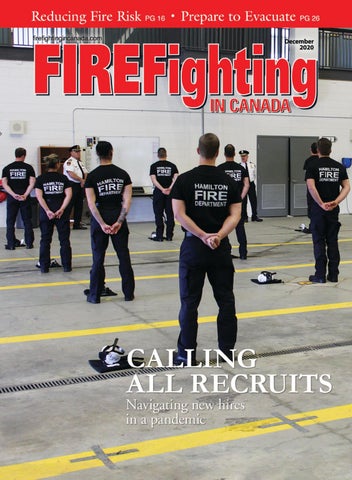
CALLING ALL RECRUITS
Recruitment and hiring practices are looking a little different during the pandemic, but a focus on diversity and inclusion remains top of mind.
By Brieanna Charlebois
REDUCING FIRE RISK
A new report details the results of the HomeSafe program in Surrey, B.C.
By
Larry Thomas, Len Garis, Shelley Morris and Chris Biantoro
26
PREPARE TO EVACUATE
Insights into behavior during the Chimney Tops 2 fire could improve evacuation planning.
By Jonathan Griffin
LESSONS IN AMMONIUM NITRATE
Understanding ammonium nitrate, its role as a fire hazard and what constitutes safe storage.
By Juri Kasemets
BY LAURA AIKEN Editor laiken@annexbusinessmedia.com
TCOMMENT
What a year
he December issue of Fire Fighting in Canada has arrived. When we meet again on these pages we’ll have popped the champagne cork on 2021. It’s been quite the year.
Fire Fighting in Canada would like to sign off 2020 with a roll call of gratitude, a sentiment shining extra bright through the holiday season. There is nothing we take for granted about the wonderful readership and supportive clients we serve. Thank you for your time spent with us this year. We hope that you’ve been well informed by the ink on these pages and the accompanying digital content we provide.
Our contributors are the backbone of the editorial operation, and I am continually delighted with the candor and insights shared by our writers. Thank you to everyone who wrote for Fire Fighting in Canada in 2020. Your words have formed a story of the fire service during a histor-
ic time. Thank you for your ongoing commitment to sharing your observations and knowledge with the fire service through Fire Fighting in Canada
This year Fire Fighting in Canada hosted its first Virtual Summit, a success championed by our presenters, sponsors and audience. We will be hosting another Virtual Summit in 2021. Our sister publication, Canadian Firefighter , plans to return to the live event scene with its annual Training Day. This edition comes with our annual wall calendar and planner, and I know we are all hoping to keep our live event dates and gather safely again in the near future.
ON THE COVER
Recruitment and hiring is evolving with the pandemic and the conversation around diversity and inclusion in the firehall is staying strong. See story on page 10.
Thank you, dear reader, for spending your time with us through this most unusual year together. The team at Fire Fighting in Canada wishes you and yours a very merry and bright holiday filled with much love and peace. Cheers!
ESTABLISHED 1957 DECEMBER 2020 VOL. 64 NO. 8
EDITOR LAURA AIKEN laiken@annexbusinessmedia.com 416-522-1595
Tel: 416-510-5182 Fax: 416-510-6875 or 416-442-2191
Mail: 111 Gordon Baker Rd., Suite 400, Toronto, ON M2H 3R1
SUBSCRIPTION RATES
Canada – 1 Year - $25.50 (GST - #867172652RT0001)
USA – 1 Year $58.50 (CDN)
Annex Privacy Officer
Privacy@annexbusinessmedia.com
Tel: 800-668-2374
Occasionally, Fire Fighting in Canada will mail information on behalf of industry-related groups whose products and services we believe may be of interest to you. If you prefer not to receive this information, please contact our circulation department in any of the four ways listed above.
All advertising is subject to the publisher’s approval. Such approval does not imply any endorsement of the products or services advertised. Publisher reserves the right to refuse advertising that does not meet the standards of the publication. www.firefightingincanada.com
PHOTO : HAMILTON FIRE
STATIONtoSTATION
ACROSS CANADA: Regional news briefs
A new mental health app for Canada’s frontline workers
Espri by TELUS Health is a new app that delivers mental health and wellness resources to support the mental health pressures faced by firefighters, police, physicians, nurses, care workers, emergency medical services, correctional officers and their family members.
“The current health emergency has highlighted the unique challenges faced by our frontline care workers,” said Darren Entwistle, TELUS president and CEO, in a news release. “By providing timely access to effective mental health resources, we are able to offer critical support to our essential frontline workers, first responders and clinicians, in turn, enabling them to keep all
THE BRASS POLE
Promotions & appointments
DAVID LAZENBY became the new fire chief for Brockville FD in Ontario on Sept. 21. Lazenby started his fire fighting career at the Humberside Fire Brigade in northern England. After moving to Canada, Lazenby took a firefighter position in Brantford, Ont. In 2010, he moved into the role as deputy fire chief at the
London FD in Ontario before being hired as fire chief at the Burlington FD in 2017.
MELISSA MEIER became the fire chief of Hootalinqua Volunteer Fire Department in the Yukon on Oct. 1. Meier took on the role of acting fire chief in 2019 , then moved into the position of deputy chief in January. She is the first woman fire chief in the Yukon in more than 20 years.
Canadians safe and well, today and in the future.”
In 2017, a study in the Canadian Journal of Psychiatry found that 44.5 per cent of first responders, including paramedics, police officers and firefighters, screened positive for symptoms consistent with mental disorder, a figure four times higher than the general population. Unfortunately, frontline workers may also face considerable barriers and stigma to accessing mental health resources.
“Despite the impact and prevalence of mental health issues, many people do not proactively seek support,” said Dr. Diane McIntosh, chief neuroscience officer at TELUS. “We know that frontline workers often feel isolated and alone in dealing with mental health challenges. With Espri by TELUS Health, we can help support them in breaking down those barriers and provide a platform where they can confidently and confidentially access the support they need.”
Features and tools of the app include: a resource hub that provides quick access to clinically-informed and occupationspecific content; a goal-setting tool that helps workers build positive habits by setting and completing mental health and wellness goals; video call feature that enables organizations to host virtual one-on-one, peer and group therapeutic sessions and educational programming that allows for anonymous participation; a resource list that offers quick navigation to a preferred support resources, such as crisis lines, employee and family assistance programs, critical incident stress programs and access to healthcare professionals including psychiatrists, psychologists and mental health experts.
Eligible frontline workers are able to access the app through their employer or member organization.
Retirements
After nearly 37 years in the fire service, SUE DAWSON, deputy chief of communications and business services at the Barrie Fire and Emergency Service in Ontario, retired Nov. 13. She served with the Barrie department in the communications field for
over 30 years. Starting in an administration position, Dawson worked her way up to deputy chief of communications and business services where she oversaw dispatch services for 17 different fire departments in Simcoe County. She was a founding member of the Ontario Fire Communications Committee in 2011 and was a contributor for Fire Fighting in Canada maga-
Espri by TELUS Health was launched in support of Canada’s frontline workers
A new mixed reality solution for firefighter training
A female led tech company based in southern California, a leading innovator of virtual, augmented and mixed reality software, is offering a new training solution to fire departments. The mixed reality software allows for scenario based training in a real world setting.
The company, AVATAR Partners, works with the American military and heavyduty commercial industries to provide interactive 3D media for improved training with zero room for errors. AVATAR’s solutions are often applied to the maintenance of high asset equipment, where a mistake could be tremendously costly.
Marlo Brooke, CEO and founder of AVATAR Partners, launched the company after 9/11.
“Our mission statement is to serve those who serve us,” she says. She remembers the bravery of those who responded to the September 11 terrorist attacks by running towards the danger instead of away. Brooke is keen to serve the fire fighting community with the solutions that have worked well for their partners in the military.
The Augmented Reality
Decision Aid (ARDA) software from AVATAR is a mixed/extended reality experience that has many applications for firefighter training. The mixed reality software differs from virtual reality. In mixed reality, the physical environment can still be seen and the training features are overlaid onto it. The use of haptics takes everything up a notch when you consider the ability to introduce sensory feedback in form of the smell of smoke and feel of heat through the wearable training gear. You can create a large virtual fire integrated with the senses. Mixed reality differs from virtual reality in that it remains rooted in the physical environment. It’s a virtual fire in a real-world setting, which Brooke describes as the best of both worlds.
zine, writing the Comms Centre column since 2017.
After nearly four decades, Welland, Ont., Fire Chief BRIAN KENNEDY is retiring. He began his career as a volunteer firefighter with the department in 1984 before being hired as a career firefighter in 1987. Kennedy was
ARDA has applications for scenario and live fire planning, mitigating some of the expense and risk of live fire training, she says.
“This doesn’t completely replace live fire training,” says Brooke, “but it gets the firefighter 80 per cent of the way there.”
The solution is 100 per
promoted to captain in 2004, moved into the role of deputy chief in 2011, before taking on the role of fire chief in 2016. His official retirement date is Feb. 28, 2021.
C. RYAN EDGAR, director of fire and emergency services and fire chief of the Port Hope Fire and Emergency Services in Ontario, retired in November. He began his career with Port
cent portable, reusable and intended to aid in training for decision making. There is less risk of injury for new firefighters and it helps to create the muscle memory by still requiring them to go through the physical motions Brooke notes, adding that the actual risk of a live fire raises stress, which can interfere with mental clarity and by removing the actual stress it may help reinforce the learning. Alternatively, AR with sensors can be configured to increase the emotional and mental stress factors, but without risk of smoke damage to the lungs. The sensors are equipped to let firefighters know when they are getting too hot, providing an additional layer of support through data and machine learning. The AI provides instant feedback, providing firefighters with the consequence for their actions. This will influence their training if they find out they
continually doing something to injure or risk their life. The scenario planning could involve evacuations or safety checks. You can have your firefighters get people to safety and have civilian emotional responses built into the simulation, such as those who are afraid or those who won’t leave the building. The scenarios are unlimited, says Brooke.
The secret sauce of ARDA is SimplifyXR, she says, which is a software AVATAR sells that allows for quick modification and one that can be done by the fire department’s themselves quickly if they want to change the building layout or fire size, for example. Departments can also consider training for scenarios beyond fire like biohazard. The software can be configured to do whatever the fire department wants it to and it can be collaborative, allowing the user to share what they are seeing with someone offsite.
AVATAR’s solutions are available now to fire departments and the company is seeking a Canadian company to partner with; a fire department to work with to build it out.
For more information, visit avatarpartners.com.
Hope in 2015 as deputy fire chief after serving 16 years as a police officer with the Durham Regional Police Service. He was appointed fire chief in 2016 and served as treasurer and an executive director of the Ontario Association of Fire Chiefs since May 2019. Edgar officially retired on Nov.18.
Mississauga Fire Chief TIM BECKETT officially retired in
November after nearly 35 years in the fire service. He was fire chief for the Kitchener FD and served as the Ontario Fire Marshal regional co-ordinator for the Region of Waterloo prior to moving into the role of fire chief in Mississauga in 2014, where he also served as the city’s director of emergency management. He also spent two years as president of the Ontario Association of Fire Chiefs.
The secret sauce of ARDA is SimplifyXR software.
PHOTO: AVATAR PARTNERS
STATIONtoSTATION
BRIGADE NEWS: From departments across Canada
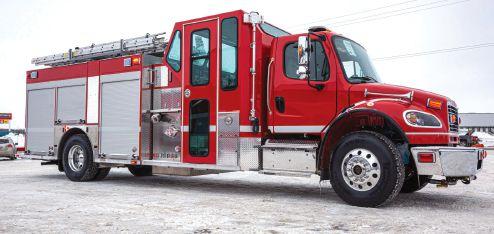
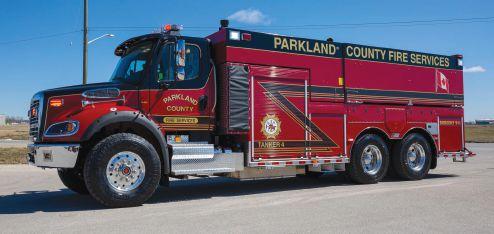
The Red Deer Fire Department in Alberta took delivery of this tanker from Fort Garry Fire Trucks. Sitting on a Freightliner M2-106 chassis, the apparatus runs on a Cummins L9 350 HP engine with an Allison 3000 EVS transmission. It is equipped with a stainless-steel ER pumper 4-man crown enclosed pump with a Hale DSD 1250 pump and a 40-gallon fuel tank.
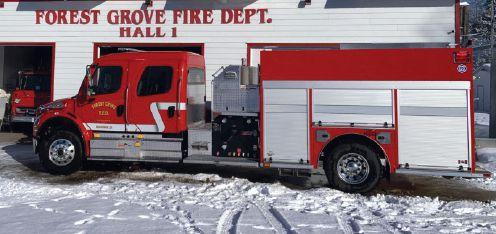
The Forest Grove Volunteer Fire Department received this pumper from Fort Garry Fire Trucks. The apparatus sits on a Freightliner M2-106 chassis and runs on a Cummins L9-350 HP engine. It has an Allison 3000 EVS transmission, is equipped with cross control pump panel, a Hale PTO pump with 1250 US GPM and 1000 IG CoPoly tank.
The Government of Nunavut took delivery of this three man crown pumper. Equipped with a Cummins L9 300 HP engine and Allison EVS 3000 transmission, it sits on a 2021 Freighliner M2-106 chassis. It has an enclosed three man crown pump panel and a Hale DSD 1250 GPM/ 1050 IGPM pump.
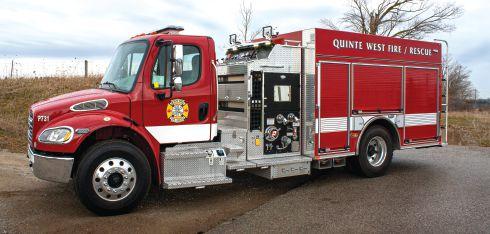
The Quinte West Fire Department in Ontario was delivered this Pierce Manufacturing FXP pumper by Commercial Emergency Equipment. This apparatus sits on a Freightliner M2 106 chassis and runs on a Cummins B6.7 360 HP engine. It has a Husky 3 foam system and is equipped with a Hale 1250 GPM and holds 1,000 gallons of water.
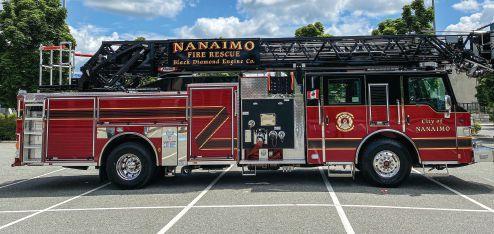
Commercial Emergency Equipment delivered this apparatus to the Nanaimo Fire Rescue in British Columbia. Manufactured by Pierce Manufacturing, this unit has a 110’ Ascendant Platform body and sits on a Velocity single axle chassis. It runs on a DDC DD13 525 HP engine. It has a Husky 12 foam system and is equipped with a Waterous 2,000 GPM pump and holds 500 gallons of water.
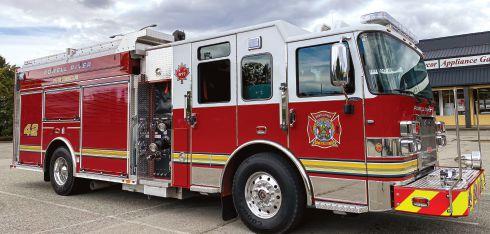
Powell River in British Columbia received this MaxiSaber pumper from Commercial Emergency Equipment. This unit sits on a Pierce Saber FR chassis and runs on a Cummins L9 engine with 450 HP. It is equipped with a Husky 3 foam system, a Waterous S1000 2,000 GPM pump and holds 500 IG of water.
FOREST GROVE FIRE DEPARTMENT
RED DEER FIRE DEPARTMENT
THE GOVERNMENT OF NUNAVUT
QUINTE WEST FIRE DEPARTMENT
NANAIMO FIRE RESCUE
POWELL RIVER FIRE RESCUE
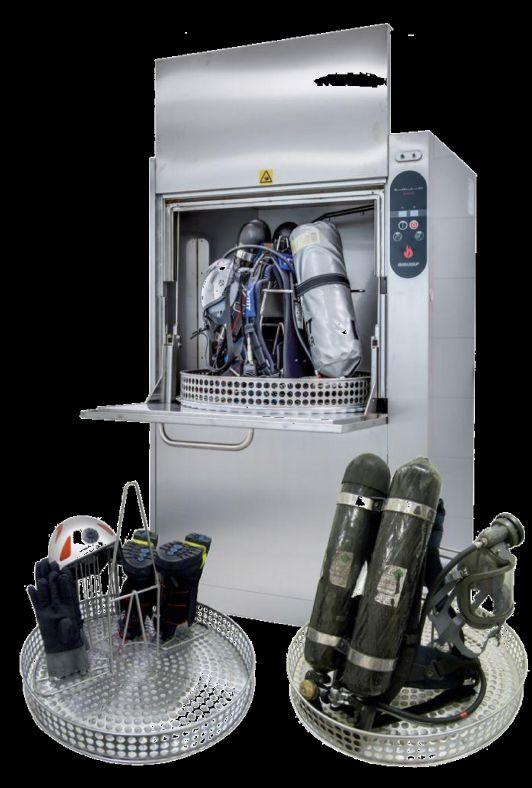
AUTOMATIC SCBA DECON WASHER
PROTECT YOUR FIRE FIGHTERS FROM CANCER CAUSING AGENTS
Developed to help firefighters fight cancer:
Studies show that firefighters run a significantly higher risk of being diagnosed with, and dying from, various forms of cancer than the general population This is due to the hazardous chemicals and carcinogenic particles they are exposed to in the line of duty To reduce this exposure and the resulting cancer risk, it is essential to thoroughly, safely and efficiently clean and decontaminate all protective equipment after every use. That is exactly what the Solo Rescue® Decon Washer does. Cleaning gear in the Solo Rescue means less exposure to cancer causing PAH particles and a safer work environment for you and your fellow firefighters
Using a Solo Rescue® heavy duty SCBA washing machine helps avoid exposing the crew to combustion gases, soot particles, toxins and carcinogens released in the maintenance process and also substantially lowers the time spent decontaminating firefighter equipment.
HERE’S WHAT A CANADIAN FIRE DEPARTMENT HAS TO SAY ABOUT THE SOLO RESCUE DECON WASHER…………..
“We were thoroughly impressed by the Machine’s ease of operation, efficiency and performance. The contaminants that were removed from our SCBA’s that had previously been cleaned by hand was astonishing. The Solo Rescue washer will be an integral part of our exposure reduction program, not only for its superior quality and efficiency of cleaning, but in the reduced exposure to contaminants throughout the cleaning process”
IN ONE HOUR YOU CAN CLEAN/DECON:
• 30 HELMETS
• 60 PAIRS OF GOVES
• 20 PAIRS OF BOOTS
And with the optional second PPE rack you can double the number of helmets, gloves and boots.
IN ONE HOUR YOU CAN CLEAN/DECON: -14 SCBAs W/MASKS
WASH/DECON TWO SCBAs IN 8 minutes
Calling All Recruits
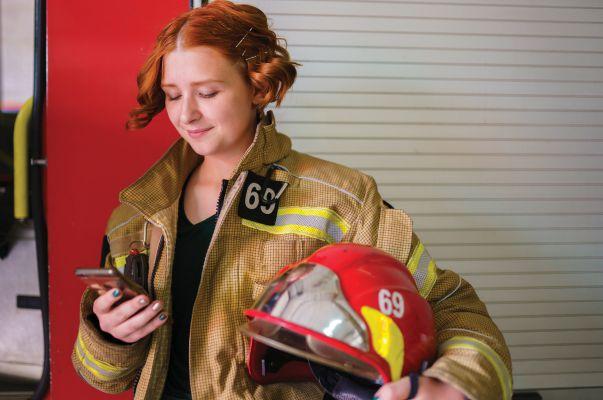
Departments are focusing on diversity and inclusion while navigating recruitment in a pandemic
By BRIEANNA CHARLEBOIS
At 6 p.m. on Oct. 22, Barrie Fire and Emergency Services held their second virtual recruit information session, exemplifying one of the many ways Canadian departments adapted their recruiting and hiring practices during the pandemic. Over 250 people attended the session to learn more about joining Barrie’s career department.
VETTING BY VIDEO
Barrie, Ont., is a city of about 150,000 in central Ontario employing 187 career fire fighting staff across five divisions. Management was actively recruiting in autumn for the purpose of hiring 12 new firefighters by 2021. After applications closed in October, two interviews were conducted—the first virtual, the second in-person—with the intention of providing job offers by December. Successful candidates are expected to report by mid-March for training, and start on shift by July 1. Barrie Fire Chief Cory Mainprize said 2020 was not a “growth year”; the available positions are to fill vacancies.
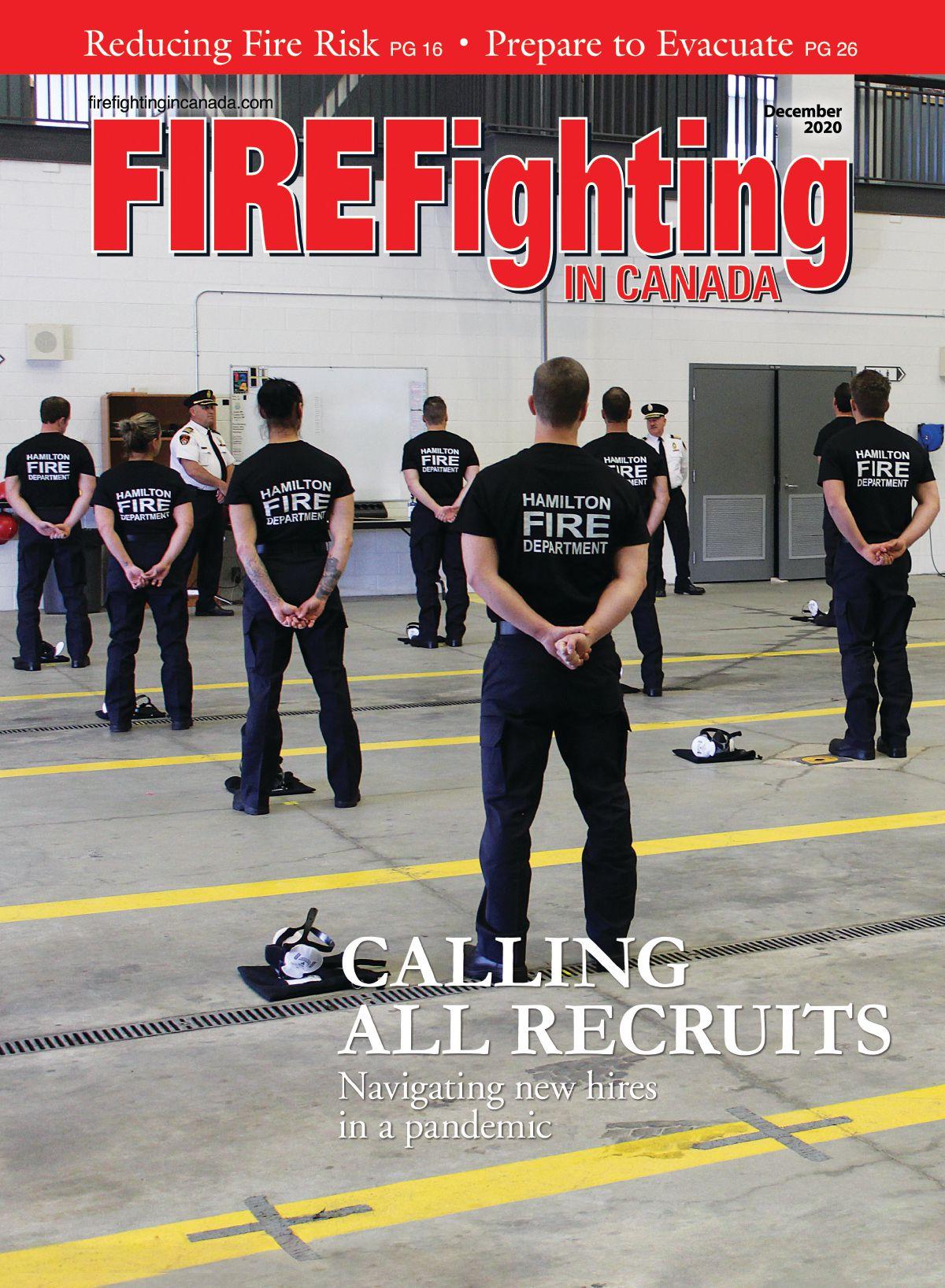
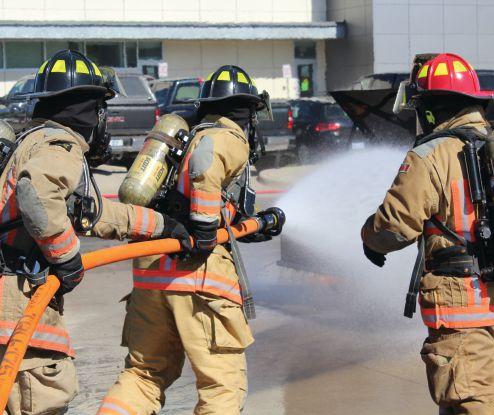
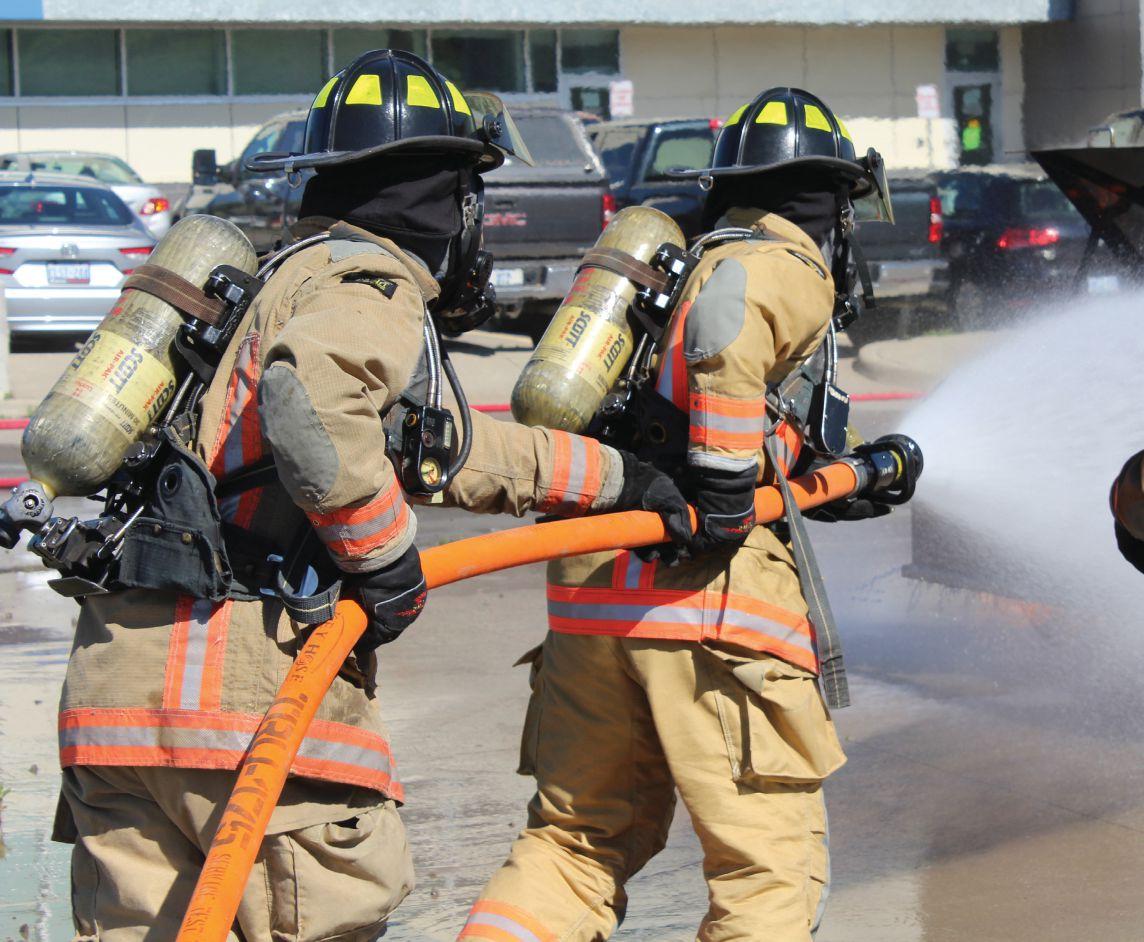
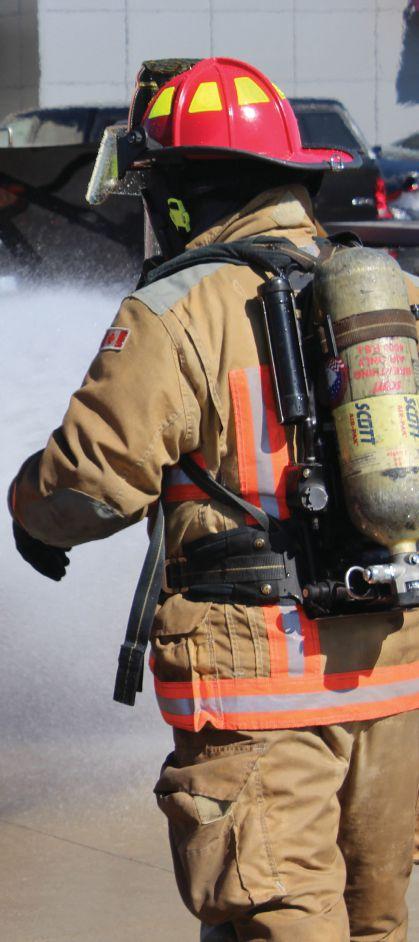
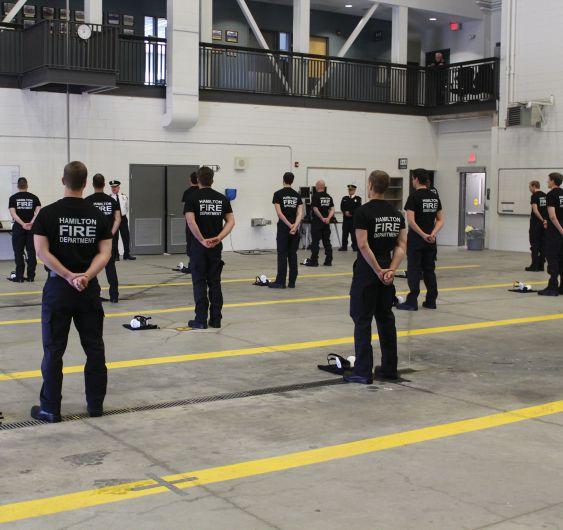
LEFT Despite unforeseen challenges this year, recruitment and training remain a priority for many departments.
ABOVE The fire service is taking care to comply and adapt to evolving COVID-19 protocols.
The Oct. 22 session aired Barrie’s 2020 recruitment video and provided information about the department. Considerable time was also dedicated for questions from attendees, which included inquiries about growth and analytics of the department, hiring and training process and the projected start date for successful candidates.
Brampton, another Ontario career department, serves a population of about 735,000, has 13 stations and about 550 staff. The Brampton fire department conducted similar recruitment strategies through virtual information sessions to attract a diverse audience. They also introduced a new online situation judgment test, a written exam that test applicants on their response to job relevant situations.
“This is critical step to ensure we have the most competent candidates proceeding to the next stage of selection: the Standardized Behavioural Interview, which is another strong predictor of performance with minimal adverse impact across gender and racialized groups,” said Brampton Fire Chief Bill Boyes.
Boyes and Mainprize also noted once recruits are hired, the rigorous sanitation practices and physical distancing will likely continue for spring training.
“Obviously, if we’re still in the physical distancing stage when recruits start training, we’ll make adjustments and do our best to accommodate that,” said Boyes. “We’ve also introduced a daily screening process and have ongoing medical evaluations for staff and so far, we’ve had success with it.”
While the pandemic has generated many challenges, departments continually work to adapt to new health protocols. Several chiefs have, like Mainprize, turned to virtual forums as a means to distribute information to potential recruits.
Though Brampton only plans to hire about 20 new firefighters, over 600 people attended their last online career information session in October. Boyes deemed it a success.
“One of Brampton’s greatest strengths is our diversity,” he said. “We really wanted to be as transparent as possible, so this year our recruitment campaign was designed to appeal to people from diverse backgrounds who may not traditionally have seen themselves pursuing a career in fire. We wanted to convey the message that anyone looking to start a career in fire fighting is invited to explore opportunities with our team regardless of their background.”
VYING FOR VOLUNTEERS
Deputy Chief Jay Plato of the volunteer Niagara-on-the-Lake Fire Department in Ontario said their recruitment process is rigorous and includes a 300-hour, eightmonth training program. Their last class was hired in late 2019. Recruits had almost finished their training when COVID-19 hit Canada so the process was put on hold and the recruits are only now completing the process.
“We’ve worked hard to connect with local public health officials for information
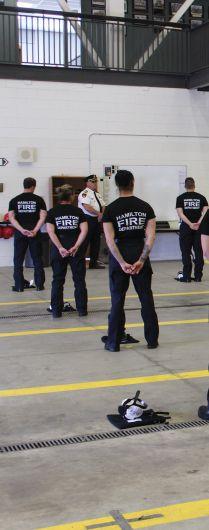
PHOTO CREDIT: HAMILTON FIRE DEPARTMENT
so we could come up with a plan for training while keeping recruits engaged and healthy,” said Plato.
Ontario’s North Algona Wilberforce volunteer fire department is actively attempting to recruit two new members; a process Fire Chief Kevin Champ said is often arduous due to the rural town’s small population and because many people often can’t respond to day calls due to full-time jobs. Though the town is only home to about 3,000, Champ said their geographic coverage area is extensive. The department has 43 fire service members, two stations and a remote substation.
“We’re typically recruiting all the time,” he said. “If someone shows an interest, we have them come out to a couple of our training sessions and if we want to work together, we generally give them an offer right away.”
■
A COMPOSITE APPROACH
Hamilton, Ont., has an amalgamated service and is a composite department with 26 stations. It serves a city of over 766,000. “Our recruitment is quite robust because we have a lot of ongoing needs right now,” said Helen Klumpp, an executive officer with the City of Hamilton.
Hamilton usually hires two recruitment classes per year. In March, their volunteer recruitment session was disrupted and then cancelled. The department was able to continue recruiting for career positions for their January 2021 class.
“Recruiting volunteers proved difficult to coordinate because recruits are spread across all the stations [based on where they live],” Klumpp explained. “In career, we just often receive a large pool of applicants who aren’t restricted by where they live so it’s more about choosing applicants with certain specializations, then placing them at stations where they’re needed.”
To compensate for recruiting challenges the pandemic posed, Hamilton added online components for human relations assessments, which, Klumpp said, were “very successful.” They also held interviews and psychological assessments that were completed with a combination of in-person and virtual components.
“Once the recruits came in, we also changed the way we formatted the 16-week training process,” she said. “We had to juggle things around and decided
to move our usual online training components up in the schedule; we did those first and that worked out nicely.”
■ ATTRACTING DIVERSITY, BEING INCLUSIVE
Barrie’s Oct. 22 session was the department’s second online recruitment meeting. They previously co-hosted a session with the Fire Service Women of Ontario (FSWO) on Oct. 7 that provided information on recruitment and FSWO membership; 60 people attended.
The desire for more diversity and inclusion within departments coincides with a new report from the Canadian Association of Fire Chiefs (CAFC) titled “A Fire Service for All: Exploring Ways to Further Diversity and Inclusion for Women in the Canadian Fire Industry.” The report summarizes feedback from a September 2019 meeting with the purpose of providing awareness of areas that need improvement and includes recommendations at the local, regional and national levels.
Canmore, Alta., fire chief and CAFC board of directors member Keri Martens is one of the founding members of the CAFC’s Diversity and Inclusion Committee and helped write the report (available at CAFC.ca).
“So far, the feedback from the report has been has been really positive,” Martens said. “From the recruitment perspective, we need to change the physical image of what society thinks of as a firefighter. We can’t just talk about diversity, we have to work to show it.”
She also noted that volunteer departments tend to have more women than career departments.
“I think people need to take a really hard look at what their recruitment policies are and how decisions are made and how departments can make themselves attractive to a diverse group of candidates.”
Martens said one of the main goals of the CAFC Diversity and Inclusion Committee is to encourage departments to reshape their message to help everyone to feel part of the conversation.
For example, Barrie and Brampton both launched social media campaigns and produced recruitment videos that illustrate a diverse fire service and have held virtual recruiting sessions aimed at various demographics.
“The thinking behind [the virtual sessions] was to make sure we reach as many people as possible,” said Mainprize, who noted most recruits in the past tended to be Caucasian males aged 23 to 31. “We certainly encourage non-traditional candidates apply. Sometimes the biggest barrier can just be lack of information and we know the sessions help combat that.”
Boyes said his department is also actively trying to appeal to more diverse applicants. He explained that Brampton is somewhat unique in that they provide 18-month conditional offers to recruits, meaning when an individual is offered a job, they have 18 months to complete the required fire fighting certifications. He said this has been an immense aid in attracting candidates with varying backgrounds and skillsets who may not have considered firefighting.
“A main focus of our most recent master plan, recently endorsed by Council, is the diversity and inclusion component because our ultimate goal is to be more reflective of our community and give anyone interested in fire fighting the opportunity to apply.”
While there is a strong focus across Canada to attract diverse candidates, departments must also consider the culture within their own departments.
“Many focus on diversity and inclusion during recuitment but the work can’t stop there,” Klumpp said. “We need to change the culture we’re bringing people into.”
Mainprize agreed, noting subtle, unintended discouragements may be easily overlooked, like how fire stations were originally designed.
“Traditional station designs, resembling community centres or male locker room facilities, offer very little privacy or modesty for any of our staff and so we’re trying to update the layout to make them more ‘people-friendly’,” he said, noting he wanted to ensure potential candidates were aware of the adjustments being made as an effort to break down barriers and encourage people who may have been previously deterred from joining the service, to apply.
“We’re just looking to hire good, compassionate and empathic people who care about our community and that have a desire to work hard and problem solve,” he said. “Our focus is completely on hiring people who embrace our values and we’ll teach them the rest.”
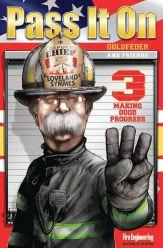
Pass it On 3: Making Good Progress
Item #: 1593704360
In Pass It On 3: Making Good Progress, Chief Billy Goldfeder has once again gathered leading firefighters, fire officers and chiefs from all over the country to share their wisdom and insight through short personal stories, life experiences and anecdotes. Including more than 80 contributors, Making Good Progress delivers tactics, operations, tragedy, humor, knowledge, and personal perspectives from a very wide range of extremely diverse personalities. Anyone from rookie to chief (and anyone who knows or plans to be a firefighter) will find loads of great stuff in this book.
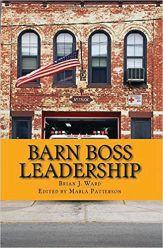
Barn Boss Leadership Item #: 1546701927
Barn Boss Leadership is a unique blend of fire, science, psychology and fire service history provided by a author who has worked for the largest of metropolitan to the smallest of volunteer departments. True leaders develop their power long before they receive a promotion.This text is designed to provide a guide and self-awareness gut check for individuals of all ranks. However, the emphasis of this text is for the informal leader in the organization, who is the catalyst for action.
Leadership Prescribed 2.0 –A Handbook for Fire Service Leaders
Item #: 1775130406
Fire service leadership is a journey and you need to start here. Written by Chief Les Karpluk and former Chief Lyle Quan, this book provides existing leaders and those aspiring to be leaders the tools to become more effective.
BY CHRIS HARROW Director of Fire Services
Minto and North Wellington Ontario
TLEADERSHIPFORUM
Motivating teams during COVID-19
hroughout this pandemic, many things have been put on hold or have been much harder to accomplish. Weddings, funerals and family get-togethers have adapted to maintain safety. The fire service has also had to adapt. Departments are all finding ways to do things differently to stay within the new guidelines. One of the most difficult tasks to achieve around the stations is preserving your firefighters’ motivation even when you can’t get the entire team together. It’s like playing an NHL hockey game, but not being able to practice together on the ice before the game.
As many great leaders in the fire service know, one thing that makes them successful is a strong team. The team that remains strong and motivated makes any task around the station or at an incident work extremely well. Leaders spend much of their time making sure the team is motivated and in tune with what’s occurring around the station or within the municipality. But, with the current situation, how do we motivate and communicate with a team that cannot get together?
In speaking with my peers in the fire service, many have tried different techniques with varying degrees of success. There are a lot more emails being sent in attempt to keep everyone in the loop. But how successful are the emails to the younger generation who opt for many options besides email? I know my own kids don’t even have their phones set up to alert them to a new email message. Are there any other digital techniques that others are using to communicate with their firefighters that doesn’t involve a plethora of emails?
message multiple times or having someone else to deliver messages to your team for you. Similar to the telephone game played back in school where the first person would whisper a message to the person beside them and so on, it never fails but the same message never seems to be able to get through to everyone.
No matter how strong your management group is, there is nothing that can replace good, old-fashioned face-to-face meetings. As a leader, so much can be accomplished with this type of meeting and not being able to do it feels like you are steering the bus with only three wheels. There is a lot of reliance put on the other managers to assist in getting the proper messages out. It requires a very cohesive and high functioning management team to accomplish. If management was not all on the same page before, they had better be now because it will show immediately if not. Personally, I don’t think I have ever talked more to my co-workers than I do now to make sure we are all in tune with what’s happening and the messaging we send out.
We all need to collaborate more and share ideas on how we can motivate our teams with the same effectiveness as pre-CO
As leaders, we are being constantly challenged to find methods that work in new environments. ‘‘ ’’
There are a lot of fire departments who use social events to reward and motivate their firefighters. Awards nights are often held to recognize the long service of firefighters and to thank their partners for the support. Sadly, those have all been cancelled for this year. Christmas parties are another event where everyone can get together and socialize and also don’t look like they will be happening this year. Socialization is a huge part of keeping a team together and motivated.
All these set backs are requiring leaders to be creative and find new ways of accomplishing the same ideas. Many of us thrive on being able to assemble our entire teams and communicate with everyone at once; it saves a ton of time not having to repeat the
Chris Harrow is the director of fire services for the Town of Minto and Township of Wellington North in Ontario. He is a graduate from fire programs at Lakeland College and Dalhousie University and holds a graduate certificate in Advanced Care Paramedics from Conestoga College. He can be reached at c.harrow@mintofiredept.on.ca.
VID-19 times. Using social media allows chiefs to see what other departments are doing to deal with the changes caused by this coronavirus. It’s vital we keep our teams together, working towards the same goals. I have already noticed my team is drifting apart a bit due to the lack of opportunities to get together. Volunteer departments thrive on this ability. It is similar at times to a service club that acts as a hub for people to socialize. It is what draws people to serve on the department. If they enjoy being with the people around the department, they will keep coming back. If that is taken away from them, a huge motivation tactic we use is also gone.
It’s important to find new ways of motivating and increasing morale around your team. As leaders, we are being constantly challenged to find methods that work in new environments. Don’t dismiss the lack of socializing, thinking it will come back when this is over. You may not be able to wait that long, so start now finding new ways and share your successes with your peers. We are struggling and need to work together to get through this. Stay strong and keep pushing though. You and your team will appreciate it that much more when this is over.
Reducing FIRE RISK
New findings to consider for your public education efforts
By LARRY THOMAS, LEN GARIS, SHELLEY MORRIS, CHRIS BIANTORO
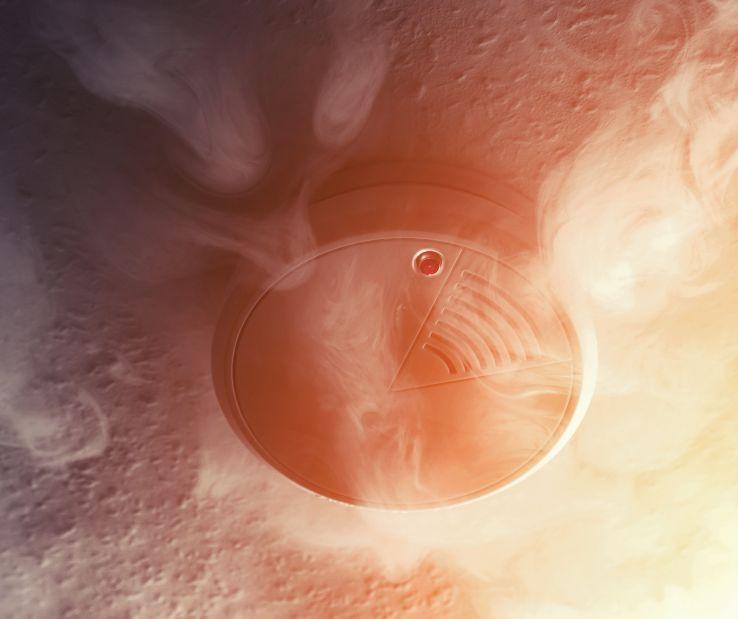
Anew British Columbia study reveals the importance of bringing an evidence-based, coordinated and sustained approach to public education about smoke alarms and fire safety—along with personal contact.
While its population has continued to grow, the City of Surrey in Metro Vancouver has experienced a marked community-wide decline in fires and fire casualties since 2008, when it introduced the HomeSafe fire education and smoke alarm testing/installation program that targeted the city’s fire hotspots with various types of outreach over time. The new paper, “Journey of HomeSafe: Community Risk Reduction in Surrey” from the University of Fraser Valley (UFV) studied which forms of outreach were the most and least effective.
The winner of a 2013 Community Health and Safety Program Excellence Award from the International City/Country Management Association, HomeSafe was based on international best practices, including a United Kingdom program that caught Surrey’s interest by reducing fire-related fatalities by 40 per cent over 15 years through interventions such as home visits with firefighters focusing on fire safety information and working smoke alarms.
As it added new outreach initiatives over the years, Surrey’s HomeSafe program ultimately bettered those outcomes, reducing the per-capita fire rate by almost 80 per
cent, doubling the presence of working smoke alarms found in homes and cutting the severity of fires by more than half.
As the study authors, we concluded that the most effective HomeSafe outreach initiatives were those that were applied and monitored consistently over time and involved some kind of direct personal contact with the recipients.
“The success of HomeSafe reinforces research showing that a sustained approach is necessary to truly achieve community risk reduction,” said British Columbia fire commissioner Brian Godlonton. “The measures in Surrey are a great example of staying the course.”
■ TARGETING THE RIGHT PEOPLE AND PLACES
At the heart of HomeSafe is data. Escalating residential fire rates in Surrey in the late
2000s—in particular, kitchen fires—had the Surrey Fire Service team searching the world for solutions. Their research revealed the value of fire education programs involving home visits and smoke alarm testing and installation, prompted them to take a closer look at specifically where fires were happening in Surrey and why.
Through a research partnership with the University of Fraser Valley (UFV), Surrey studied 20 years of fire incident data that not only identified the city’s fire hotspots but also a consistent set of population and social data characteristics linked to a higher risk of fires and casualties: homes with occupants ages six and under or over 64, single-parent families, residents who move frequently, low income or unemployed residents and those living in older buildings.
Based on this information, Surrey Fire Service implemented HomeSafe in 2008
with door-to-door visits by on-duty firefighters in areas of the city most prone to residential fires. The firefighters provided residents in these at-risk neighbourhoods with packages of fire prevention information (left at the door if no one was home) and offered to test existing smoke alarms or install a new one for free.
Surrey continued to rely on data as it introduced additional targeted outreach measures over the years, while closely tracking and evaluating the progress of HomeSafe to seek continual improvement. The program has benefited from a webbased business intelligence monitoring tool the city developed to help monitor fire rates, fire spread and the percentage of working smoke alarms in the target areas.
■ ANALYZING THE IMPACT OF HOMESAFE INITIATIVES
The UFV study considers the effectiveness of each HomeSafe initiative by analyzing the city’s fire, casualty and smoke alarm statistics both before and after their introduction. For this purpose, the program’s implementation was broken down into four periods, with Period 1 covering the pre-HomeSafe years.
During Period 2 (2008-2010), HomeSafe was introduced with home visits in at-risk areas by on-duty firefighters, who spoke to residents about fire safety and offered to check their alarms or install free ones, and left information at the door if no one was home. Later in Period 2, the program expanded to allow residents to request free smoke alarm installations and/or confidential home fire safety inspections. Additionally, fire crews responding to any incident at a home, such as a medical call, began to verify and install alarms where needed.
In Period 3 (2011-2017), Surrey Crime Prevention volunteers began to distribute fire safety and smoke alarm educational materials to homes that warranted extra attention, while firefighters continued to conduct their home visits. Door hangers were also issued in at-risk areas, with fire safety and smoke alarm information and details for booking alarm tests or free installation. As well, outreach was expanded to include clients of Surrey Food Bank and people waiting in city property tax lineups. Toward the end of Period 3, community volunteers were trained to conduct both telemarketing and the door-to-door visits, including testing and installing alarms.
During Period 4 (2018-2019), the existing programs continued, with the community outreach primarily conducted by trained volunteers.
Analysis of city fire data before and after HomeSafe shows the program has had a positive impact not only in at-risk areas, but throughout the city. In total, the program reached nearly 121,000 people over 12 years, with the number of contacts increasing as each new initiative was introduced.
Overall program results included:
• Reducing the fire rate by population by nearby 80 per cent, from 80 to 88 fires per 100,000 people before HomeSafe to 20 to 21 fires per 100,000 people in 2019.
• Doubling the presence of working smoke alarms found at residential fires, from less than 30 per cent before HomeSafe to 60 per cent afterward.
• Cutting the severity of fires by more than half, with the percentage of fires contained to the room of origin increasing from 15 per cent before HomeSafe to more than 40 per cent in 2019.
• Reducing casualties by at least 40 per cent, from 8.6 casualties per 100,000 people before HomeSafe to about 4.8 casualties per 100,000 by 2019.
When considering the success of individual HomeSafe initiatives, the analysis of fire data shows that while cumulative benefits were achieved from the layering of different initiatives, the three most effective methods were the home visits, the HomeSafe inspections and smoke alarm installations based on public request, and the alarm testing/installation when crews responded to other incidents.
In general, these three interventions cut the fire rates at their visited properties by 73 per cent (home visits), 79 per cent (HomeSafe inspections/alarm installations by request), and 74 per cent (testing/ installation during crew response). At the same time, they increased the presence of working smoke alarms found at residential fires by 24 per cent, 47 per cent, and six per cent respectively. Moreover, the home visits reduced fire severity by increasing the percentage of fires contained to the object of origin from 75 to 94 per cent of the time, a 24 per cent increase.
In contrast, the less successful individual initiatives proved to be those with the least personal contact, such as when information was left at the door, either in a package or on a door hanger. The study also could not
accurately measure the impact of outreach in the city tax lineups and Surrey Food Bank, given the difficulty of collecting property information in those settings.
■ WHAT’S NEXT FOR HOMESAFE
As HomeSafe has evolved, the same population characteristics that Surrey used to identify at-risk neighbourhoods in 2008 continue to be linked to higher risks of fires and casualties in the community. To continue to be successful over the long-term, the HomeSafe program must constantly locate geographic areas where residents fit those demographics. This will ensure the program targets areas where education is needed most.
The program would also benefit from an integrated data repository of up-to-date population demographics, as well as city planning and development information, to allow for nearly real-time monitoring. Other improvements could include the collection of resident data during HomeSafe’s social interactions, such as providing information to people at the food bank or in tax lineups.
Additionally, HomeSafe will need to adapt to new protocols related to the coronavirus pandemic of 2020 and address the challenge of continuing to operate the program effectively while protecting the health and safety of crews, volunteers and residents.
The study “Journey of HomeSafe: Community Risk Reduction in Surrey” can be downloaded for free at https:// cjr.ufv.ca/.
Larry Thomas is the fire chief for the City of Surrey B.C., ECFO, C. Mgr, with 31 years of experience. Contact him at LSThomas@ surrey.ca. Len Garis, is a senior advisor for the Centre for Social Data Insights and Innovation at Statistics Canada, and fire chief (ret) for the City of Surrey B.C.Contact him at lwgaris@outlook.com. Shelley Morris is an assistant fire chief for the City of Surrey, B.C., focus in emergency management and community engagement with a focus on risk reduction. Contact her at scmorris@surrey.ca. Chris Biantoro, Ph.D, is the strategic planning analyst for the City of Surrey Fire Service, B.C. He has a background of operations research and extensive working experiences in advanced analytics, data science, and statistical modeling. Contact him at chris.biantoro@surrey.ca.
BY ELIAS MARKOU Naturophathic Doctor Mississauga, Ontario
AWELLBEING
Mental health crisis and COVID-19
recent CBC article, “Psychologists worry about mental health in first full COVID-19 winter” and a sudden influx of patients coming into my practice with mental health concerns influenced me to write this very important article for firefighters and the fire service.
I want to sound the alarm bells. Mental health has been a prevailing health issue among firefighters and COVID-19 has poured gasoline on a fire that may soon be an out of control raging inferno. We must act. Mental health will be one of the defining health issues of COVID-19. Please don’t take my warning lightly. One of every three patients coming to my clinic is now dealing with sadness, anxiety, depression, insomnia, and many other mental health issues. There are many factors influencing this quick decline from anxiety to depression and other menacing mental health diagnosis. Over the summer, things were okay. We all had the opportunity to be outside and be exposed to fresh air and healthy sunshine. We made the most of a difficult situation and we saw covid numbers at an alltime low as social distancing measures were in place. We watched Australia struggle with their COVID numbers during their winter. We now know covid is very seasonal and it will be back even more aggressively in the coming months.
As the weather becomes colder, the days dark and long, many of us are now inside almost the entire day and we have seen covid numbers jump dramatically. For anxious and depressed individuals these statistics will have a negative impact on their mental health. I like to hope firefighters are immune to this mental health crisis, sadly they are not. Many fire halls have put their firefighters on lockdown at work, they have limited outside exposure during shifts, are put in mandatory quarantine when at home and have been recommended a super tight bubble and strict monitoring. You can imagine how quickly an already vulnerable firefighter can move from anxiety to depression. Here are some action steps firefighter can take to minimize the risk of a mental health crisis. Fire departments should have a conversation and have a plan in place.
SUPPLEMENTS FOR MENTAL HEALTH
Here is a list of a few vitamins that should be in your vitamin program to ward off the most common mental health issue. Please ask
Dr. Elias Markou is one very busy naturopathic doctor. He is in private practice in Mississauga, Ont., and is the chief medical officer for the Halton Hills Fire Department. Dr. Markou was a firefighter for six years; he has a special interest in firefighter health, is a writer and blogger who is regularly featured on television and radio and in print. Contact him at drmarkou@mypurebalance.ca
your medical health professional if these supplements are safe with your medication and current health concerns. <bu>
• 5-HTP or 5-hydroxytryptophan is a by-product of tryptophan, when in the body it is converted by the body to serotonin a chemical in the brain that plays a critical role in sadness, depression and sleep. Serotonin is the “happy” neurotransmitter.
• A B-complex vitamin is one of the key vitamins needed to convert 5-HTP to serotonin.
• Magnesium is a very important mineral that also helps 5-HTP convert to serotonin. It also has the ability to support the nervous system.
• St John’s Wort is a herb that helps with mild depression.
• GABA is a neurotransmitter often used to help anxiety. This is found in the form of a supplement.
• Melatonin, can help you get better sleep and this will in turn help with mental health issues.
WHAT CAN WE DO TO PREVENT COVID RELATED MENTAL HEALTH ISSUES?
I apologize for the bleak images I painted about COVID-19 and depression — don’t let this be a fact. We can be proactive and steer clear of this mental health outcome. Here are some helpful strategies to get you through the long dark days of winter.<bu>
• Talk, talk, talk. Express yourself, ask for help when you feel your mental health is at risk.
• Be physically active inside and outside. Remember when you were younger you loved being outside during those long cold winter days. Re-discover winter again. Get that fresh cold air into your lung for 30 minutes each day. Skate, ski, snowboard or just walk.
• Focus on your breathing techniques. This is a great way to calm your nervous system and help you manage the anxiety and address depression.
• Deep restful sleep and a minimum of seven hours a night should be your ideal night. A good night’s sleep will help support a health mind.
• Be social, laugh, tell stories and be present for your fellow firefighters.
• Sit in an infrared sauna or conventional sauna (COVID-19 rules only). Spend some time alone in a sauna and do this every day for 20 minutes.
Avoiding mental health issues during the first COVID-19 winter should be your top priority for maintaining your well-being. During your journey also look out for your fellow firefighter’s mental health.
BY GORD SCHREINER Fire Chief Comox British Columbia
TDon’t burnout, turn it around!
oday’s firefighters face so many challenges. Stress is coming at us from every angle both internally and externally and we need to remember that we cannot help others unless we help ourselves too.
Many of today’s firefighters are feeling overwhelmed; out of control. We are facing ever increasing workloads, unreasonable expectations and long hours all while dealing with a worldwide pandemic. For some, the addition of COVID-19 is tipping the balance they have tried to maintain for years.
Getting burnout typically happens over time and can lead to serious physical and mental problems. It can turn your life upside down and damage your relationships, both at work and at home. It can be as bad; sometimes worse than getting sick from an illness or physical injury. It can affect you forever.
HOW DO WE FIGHT BURNOUT?
To fight burnout, we can start by working towards being better version of ourselves. You are in charge of you; it all starts and ends with you. Look after yourself, both physically and mentally. Get more sleep, stay physically fit, eat well and do not abuse your body. Make time for your family and yourself to balance the good with the bad. You owe it to yourself and others to stay in good shape (both physically and mentally). The fitter you are, the more energy you’ll have to work toward improvement and bettering yourself.
STOPBAD
ney. It never ends and takes constant effort. The people who understand this work hard every day to become better. Unfortunately, there are others who sit back and do little but complain. If you find yourself complaining a lot, it’s a sign you need to change. Quit complaining and start doing! Step up to make your weaknesses your strengths: do more and expect less.
Be nice to everyone you meet, especially to those of lesser fortune and do so even on days you do not feel like being nice. Lift others up rather than put others down. Do not criticize others and try to commit at least one random act of kindness (RAK) every day. This might be a simple as holding a door open for someone or paying it forward in a drive through.
I have had the pleasure of meeting and working with many great firefighters in my life. Watching and learning from others over the years has made me a better person and firefighter. It is very clear to me that I am in charge of who I am. I can learn from others to become a better me. I can choose to be a nice person or not. I have noticed that great firefighters are constantly helping others. They are not selfish but seek opportunities to help others without the expec-
Getting burnout typically happens over time and can lead to serious physical and mental problems.
As we age, eating properly becomes more important; our bodies have a harder time dealing with the things we put in it, including excessive calories. The old adage of ‘you are what you eat’ is very true. Eat good to be good. Eat great to be great.
Move your body. Get outdoors and walk, run, bike; move, move, move. Exercise is key to a healthy body but be sure to keep your mind healthy too. Stay positive and reach out and talk to others when you have problems or concerns. Rest is important too. Don’t forget to take some me time to recharge your batteries.
Take opportunities to make a positive difference in the fire service and the lives of others. Do not blame others for your shortcomings or failures. Do not make excuses. Just get out and do it. I chuckle when someone tells me they are going to change. You do not have to tell me or anyone else, just show us. Bettering yourself is a life long jour-
Gord Schreiner joined the fire service in 1975 and is the full-time fire chief in Comox, B.C., where he also manages the Comox Fire Training Centre. Contact him at firehall@comox.ca and follow him on Twitter at @comoxfire.
’’
tation of receiving anything. They know that helping others helps them too. Great firefighters treat others better than they expect to be treated. Great firefighters are humble.
To be a great person/firefighter, you also need to maintain healthy relationships. This includes with your family, friends, co-workers, employer and associates. Having a good relationship with anyone requires a solid effort. Do not take these relationships for granted. You need to pay attention to them and put a positive effort into them to get positive results. We can spend a lot of time and energy trying to cope with a bad relationship. So, avoid these and make effort to turn bad relationships into good ones.
Have an open mind to changes, including to changing yourself. Reinvent yourself and try new things to open your mind to change. Read. It keeps you sharp, helps expand your mind and makes it easier for you to accept change. But don’t only read fire service items. Choose a broad spectrum of items to read and do so often.
Avoid and stop burnout by working on making yourself even better and stay safe out there.
BACKtoBASICS
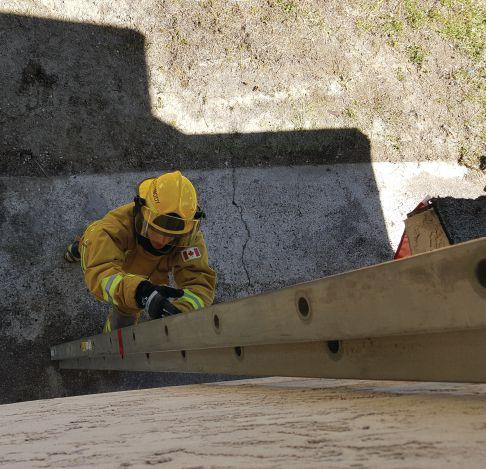
Ladder Dating: Single firefighter high shoulder ladder throw
BY MARK VAN DER FEYST
When we have fewer hands to help, we must find ways to be effective and efficient with limited manpower – this may mean that we have to work by ourselves for certain tasks to be accomplished. The idea of single firefighter assignments or tasks may go against the grain of what we have been taught for numerous years; to always work in pairs (at a minimum), but it can sometimes be a reality.
But, is this safe? I believe it is. This question can be debated in great detail with both sides making strong arguments but for this month’s article, we are going to look at a single firefighter assignment or task that is relatively safe and easy to accomplish: the high shoulder ladder throw.
This operation can be accomplished by any one firefighter – be it the driver, the pump operator, the first firefighter of a two-man team, the officer, etc. It is a task that any one person can accomplish with ease. Laddering a building needs to be a single firefighter assignment. This is where we need to divide our available manpower on scene with the tasks that need to be accomplished. Laddering a building is a safety point for both the firefighters inside as well as for the occupants that may need to be rescued, more so for our benefit. This does not require two firefighters to do. That is going to be a waste of manpower for the incident commander.
The high shoulder ladder throw is perfect for newer fire trucks, which are manufactured with a ladder compartment or a ladder rack that folds down. Traditional static ladder rack positioned on the side of the truck, also presents the ladder at shoulder height. Whenever the ground ladder is positioned at a height well above the shoulder, it will not be beneficial for any type of operation as it will take a long time to just get the ladder off the truck.
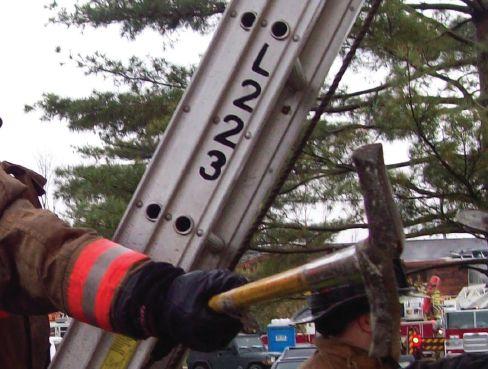
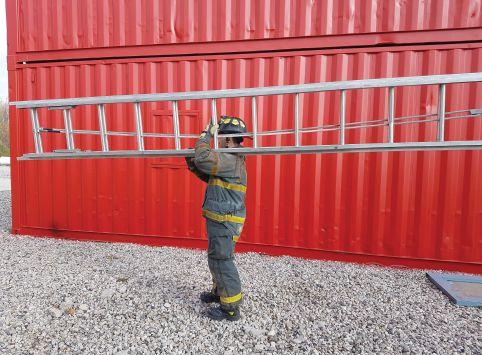
The first step in making this ladder throw successful is to mark or identify the middle of the ladder. This can be accomplished in several ways such as depicted in Photo 1. The ladder is tagged as L223 which identifies which fire truck it belongs to as well as the middle of the ladder. Another way is to use spray paint to mark the middle of the ladder as well. The spray paint colour can also be an identifier for which truck it belongs to. By marking the middle of the ladder, we can visually tell and know where the mid-point of the ladder is for carrying purposes. This will allow the firefighter to grab the ladder in the right place the first time without delay.
The second item to consider is the halyard—it needs to be tied in a manner that will allow one firefighter to raise the ladder, and
The first step of a successful single firefighter ladder throw is to mark or identify the middle of the ladder.
PHOTOS BY MARK VAN DER FEYST
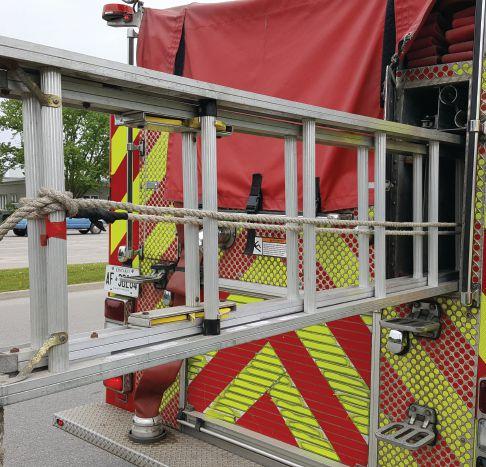
The halyard needs to be tied in a manner that will allow one firefighter to raise and extend the ladder without having to untie it.
then extend the ladder without having to untie the halyard. This can be accomplished as shown in Photos 2 and 3. The halyard is tied around the bottom rung of the bed section using a clove hitch and stays that way always. When it comes time to extend the fly section of the ladder, all you must do is pull on the halyard and up goes the ladder.
The third item to consider is the orientation of the ground ladder on the truck either in a compartment as shown in Photo 3 or on a ladder rack. The ground ladder must be orientated bed section to the firefighter. This allows them to pull the ladder out from the compartment to the mid-point of the ladder, then place their shoulder underneath the bottom beam of the bed section at the mid-point and walk the rest of the ladder away from the truck. It also allows the one firefighter to raise the ground ladder and able to extend the fly section easily with one operation using one or two hands with the halyard facing them as shown in photo 4.
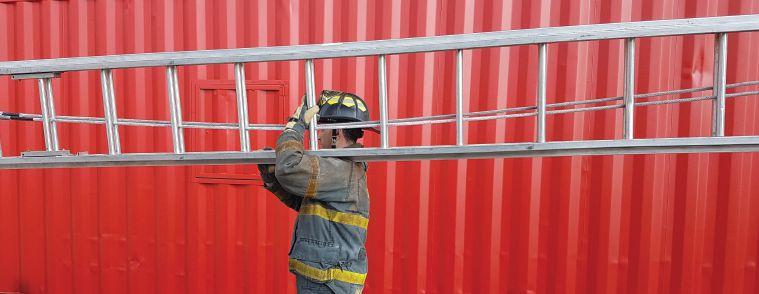
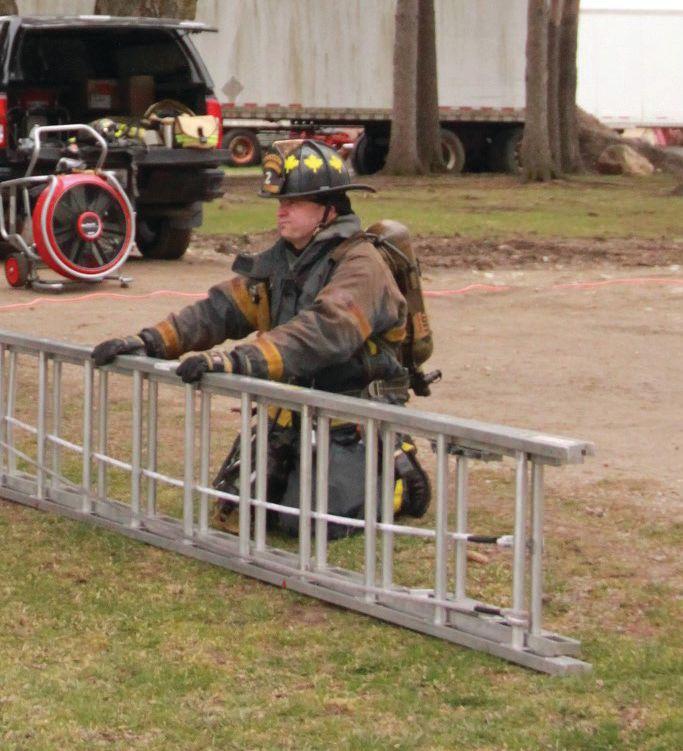
To pull off the high shoulder load throw, the ladder needs to be completely on top of the firefighter’s shoulder as in photo 5. This will mean getting use to balancing the ladder on your shoulder with the ladder in this orientation. The firefighter will have to use their one hand to hold the rung of the ladder while freeing up the other hand to carry some hand tools if necessary. If both hands are available, they can both be used to hold the ladder rungs while carrying it.
Once the firefighter has reached their destination, they will direct the butt spurs of the ladder into the ground and then, with a single push on the beam, raise the ladder vertically. At this point the ground ladder will be facing backwards to the building, fly section toward the building and bed section toward the firefighter. The firefighter can now extend the fly section of the ladder. Once the ladder has been extended to where it needs to be, the ladder is then placed against the building, the butt end is moved out away from the building to allow for the ladder tip to fall down to where
To pull off the high shoulder load throw, the ladder needs to be completely on top of the firefighter’s shoulder.
it needs to be. The ladder can then be flipped over in the right orientation to the building; fly section out. Bringing the ladder back down is the opposite of it going up.
The learning curve for each firefighter allows them to identify when to put the mid-point of the ground ladder on their shoulder to, once again, shift it completely on their shoulder with ease.
Mark van der Feyst has been in the fire service since 1999 and is currently a firefighter with the FGFD. He is an international instructor teaching in Canada, the United States, FDIC and India. He is a local level suppression instructor for the Pennsylvania State Fire Academy and the lead author of Fire Engineering’s Residential Fire Rescue book and other DVDs. He can be contacted at Mark@ FireStarTraining.com
The firefighter must always consider the orientation of the ground ladder on the truck.
The firefighter can easily raise the ground ladder and extend the fly section easily using one or two hands.
TRAINER’SCORNER
Losing a mentor
By ED BROUWER
As I was writing this article, I received the sad news that my old fire chief, Brian Morris, had passed away after a lengthy battle with congestive heart failure. This was a man who changed my life. I was 31-years-old when I joined the Joe Rich Volunteer Fire Department (JRVFD) in British Columbia. Morris was deputy chief then and seemed to have a soft spot for me. Once during a pumping exercise, I was staring at the gauges totally overwhelmed by orders from the chief when Morris tapped me on the shoulder. He put his finger on his lips suggesting I say nothing, then he smiled and quick as can be he pushed and pulled levers, motioning for me just to repeat the chief’s instructions in the radio.As things slowed down a bit, Morris winked and disappeared as the chief came around the engine to see if it was really me at the controls. He just walked away shaking his head.
Morris then offered to show me the ropes, so to speak, on operating that old pump system. He was patient and kind.
Morris would run the weekly training sessions, which sometimes meant he read to us out of the IFSTA training manuals. Sometimes we did hands-on sessions, for example once a year we would have ladder practice.
I still laugh even though it is almost 30 years later when I think of one particular ladder practice. I was a young rookie and scared of heights. Morris told us all we were going to ladder the roof at the firehall; we were to put on our full gear with BA, climb the ladder and sound the roof. He looked at me and said, “Brouwer, you’re first.” I gulped and said, “I can’t chief — it’s against my religion.” He cocked his head and said, “What?” I went on (making it up as I went) and said, “The Bible says ‘Lo [sounds like LOW] I’ll be with you always’.” He just shook his head and chose someone else. Phew! However, the following year we had ladder practice again, and before I could say anything, Morris shouted out: “And Brouwer don’t give me your excuses, I looked in that “Good Book” and it says, ‘I will lift you up on heights’!”
department, doubled the size of our response area, built a second new fire hall and extended the old hall with a new bay and large office/training area. Up to that point JRVFD had one old engine and a homemade tender. Morris raised funds and purchased three engines (one with 4WD) and two tenders. He also got us a rescue truck when I brought us up to first responder level III requirements.
He encouraged me every step of the way as I established a full NFPA 1001 training program. In addition to structural protection, we added wildfire suppression, wildland urban interface, highway rescue and extrication, and first responder III training.
He helped develop my training experience by seeing to it that
Busted! Too funny. I really liked him and above all respected him. I think the office of fire chief is to be respected. It’s unfortunate not all who bear the title behave in a respectable manner.
Morris became fire chief in 1991 and held that office until 2003. Shortly after his promotion he appointed me training officer. I thought this was a crazy idea, but he saw potential in me that I did not even realize myself.
Under Morris’ leadership we completely rebuilt the fire
I was able to attend all the outside training seminars that we had available in the province. That is key for any department. If you are going to ask someone to take on an officer’s role, you must be prepared to equip them. Otherwise, you are setting them up for failure. I have witnessed the self destruction of volunteer departments that have officers in positions that they have never been trained or equipped for.
The JRVFD department had the honour of holding training seminars and workshops for surrounding fire departments, both paid-on-call and full-time. It was so encouraging to see a half dozen of our members go on to be full-time firefighters. This was due in large part to our chief’s encouragement and “can do” attitude.
A few years in as training officer, Morris appointed me to dep-
uty chief along with Gilles Sibilleau. Our population base tripled in size and our call outs went from six per year to over 80. Morris listened to our ideas; some he dismissed, others he took hold of, one of which was to do away with the typical jeans and t-shirts and issue each member station wear. Man, did we look good at practices! But it was more than just appearance. We felt professional, and that too is a secret, because being professional has nothing to do with whether you are full-time, paid-on-call or straight out volunteer. It’s a mindset. At first some thought our membership requirements would hinder us, but it did the opposite — we grew to over 30.
He helped develop my training experience by seeing to it that I was able to attend all the outside training seminars that we had available in the province. That is key for any department.
I realize this became a bit of a eulogy; it was not meant to be. Yet, perhaps deep down I wanted you to know that Morris made a difference. I want you to know that you are making a difference. Being an officer in the Canadian fire service means you have an opportunity to mold and shape the young guns coming up the path behind us. Like I said earlier, Morris changed my life. He saw untapped potential in me and pushed me to be who I am today in the fire service. Only time will tell as to the full extent of his mentoring.
I am in my late sixties now, (if I knew I was going to live this long I would have taken better care of myself, or at least worn my BA during overhaul) . I have come to realize the greatest lesson an old firefighter can teach a young firefighter is how to become an old firefighter, and here’s the bottom-line on that:
• you can’t teach through intimidation
• the office of fire chief is to be respected
• if you ask someone to take on an officer’s role you must be prepared to equip them
• being professional has nothing to do with whether you are full-time, paid-on-call or volunteer
• you are making a difference
• wear your BA during overhaul
Stay safe, and remember to train like lives depend on it, because they do.
Ed Brouwer is the chief instructor for Canwest Fire in Osoyoos, B.C., a fire warden, wildland urban interface fire-suppression instructor and ordained disaster-response chaplain. He is the retired deputy chief training officer for Greenwood Fire and Rescue. Contact Ed at aka-opa@hotmail.com.
PREPARE TO EVACUATE
Insights into behavior during Chimney Tops 2 fire could improve evacuation planning
By JONATHAN GRIFFIN
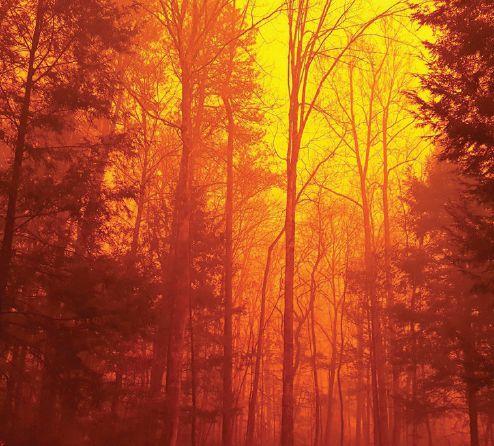
An unsuspecting Tennessee community found itself in a terrible place during the 2016 Chimney Tops 2 Fire, which led to 14 deaths and nearly 200 injuries — many related to last-minute evacuations.
To understand what motivates people to evacuate, researchers at the National Institute of Standards and Technology (NIST) surveyed affected residents. Their analysis of the responses identified key factors at play and uncovered an unexpected phenomenon, wherein smoke appeared to lower peoples’ sense of danger. These results, outlined in the International Journal of Wildland Fire, could help communities, especially those without robust wildfire response plans in place, devise and improve strategies for getting people to head for safer ground.
The NIST survey asked residents of Sevier County, Tenn., the county most impacted by the fire, about a multitude of factors that could have affected their decision to flee or stay behind.
Receiving almost 400 responses, the survey revealed that nearly 80 per cent of evacuations occurred on the day the fire had breached the city limits, despite the fire burning for days prior in the nearby Great Smoky Mountains National Park. In addition, less than a quarter of surveyed residents received any type of warning or had prepared an evacuation plan for their household.
“While wildland fires can occur fairly regularly during fire season, only a small percentage actually spread into communities. So, the local public wasn’t necessarily prepared,” said Emily Walpole, a NIST social scientist and co-author of the study.
The team used statistical approaches to determine how much influence the factors from the survey had on each resident’s sense of danger to themselves or others and on their evacuation decision.
The analysis revealed that witnessing flames or embers increased perceptions of risk — a somewhat expected outcome, Walpole said. Seeing or smelling smoke appeared to have the opposite effect, however, lowering residents’ sense of danger. According to the authors, the seemingly bewildering finding could be explained by the wildfire’s longevity.
“Since this wildfire was actually burning for a week in the surrounding area, we proposed that some kind of desensitization might have happened,” Walpole said. “It’s possible that you get used to smelling smoke and it basically lulls you into a false sense of security … the fire could be miles away and be producing smoke.”
Whether one’s sense of security was false or not, it emerged as the most critical factor for evacuation decisions. By asking residents to rank their perceived risk on a scale of one to five, the researchers found that the likelihood of evacuation increased by 3.5 times with each increasing point on the scale.
Gender also had a powerful effect, as women were almost three
times more likely to evacuate than men. Studies of other extreme events, such as hurricanes, have suggested that this outcome could be in part because women are more likely to take on caregiving roles, Walpole said.
The effects of household preparedness were split. Those that took measures to make their residence more fire-safe — clearing vegetation around the house, installing more fire-resistant roofing, etc. — were more than twice as likely to stick around, as they may have felt more secure at home. However, having an evacuation plan, which could make evacuating a more approachable option, made households about twice as likely to clear out.
The survey also probed residents about the warnings they received from sources they deemed credible which, for most, were official sources, including fire and police departments. The researchers uncovered that hearing from a trusted source increased the odds of evacuating by a factor of almost 5.5. However, the fraction of surveyed residents that received trusted warnings or any warnings at all was low, at 7.4 per cent and 22.7 per cent, respectively, which could partially explain the prevalence of last-minute evacuations.
“It seemed that people expected that if a large wildfire requiring evacuation was going to happen, they would be told. Instead many had to find out on their own,” Walpole said.
In particular, the authors call out the essential nature of early warnings with clear messages, accurately representing the threat of oncoming wildfires.
Jonathan Griffin is a science writer and public affairs specialist with the NIST Public Affairs Office.
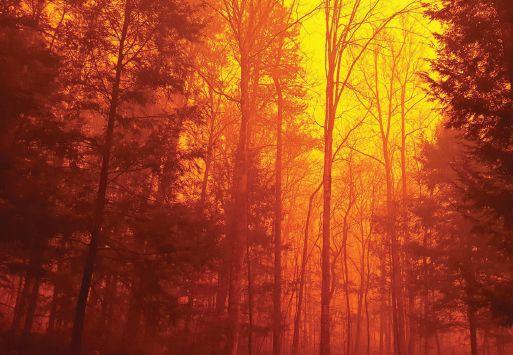
On Monday, Nov. 28, 2016, the Chimney Tops 2 Fire entered the city limits of Gatlinburg, Tennessee.
Lessons in ammonium nitrate
Understanding ammonium nitrate, fire hazards and safe storage
By JURI KASEMETS
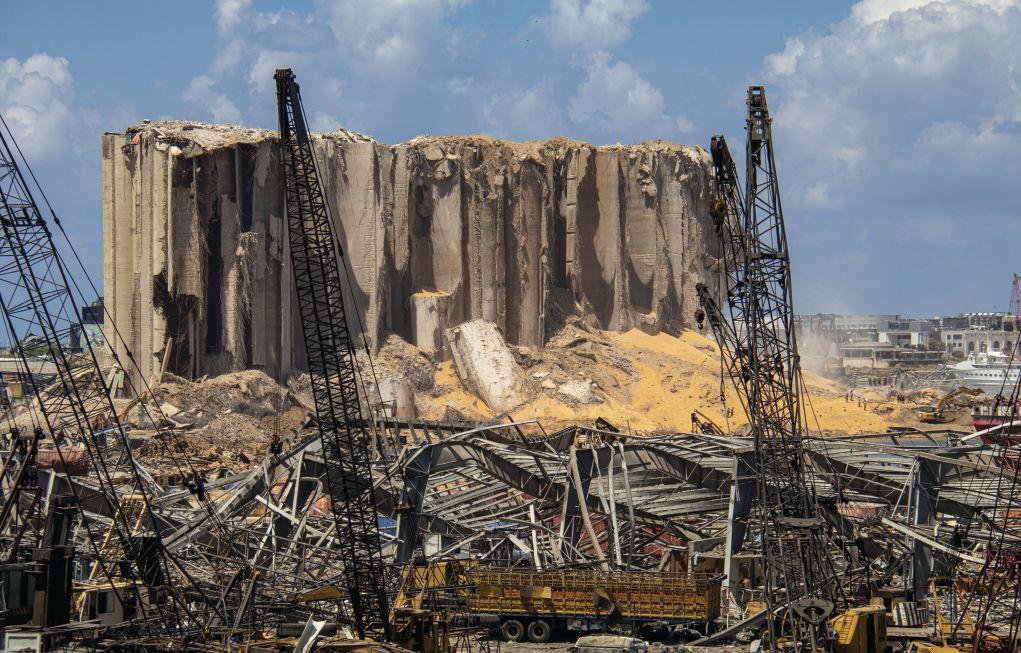
TOP Ammonium nitrate was the catalyst of Beirut’s devasting explosion on Aug. 4.
Editor’s Note: This feature has been edited and condensed from the summer newsletter and its updates published by the Explosives Management Group.
The information in the article was compiled from various sources and is not designed or intended to be the official version or the sole guide and source of information. The focus of this article is safety in storage and handling of ammonium nitrate (AN) in Canada. It is not meant to cover in transit and even storage in transit of AN.
It’s been just over a hundred years since the Halifax explosion and now there has been another catastrophe in Beirut. The former involving explosives and the latter ammonium nitrate (AN). That is not
meant to imply that there weren’t serious incidents between those two.
I know there is a lot that we don’t know but here are some of the fundamentals of AN.
First, AN is not an explosive. It is an oxidizer used legally as fertilizer and a precursor used by those with malice in mind as an ingredient to make an explosive for an improvised explosive device (IED).
One would hope that the security on the AN in Beirut was very high but all indications are that it was deficient.
Apparently the AN had been in storage in a ‘warehouse’ for six years. It came off
a ship. Was it contaminated in any way? Was it in bulk or perhaps bags (25 kg bags or 500 kg/1000 kg FIBC – flexible intermediate bulk container)? From pictures it looks like it was in totes. Was there spillage? Was it all in one heap or broken into smaller quantity piles? Were bags on wooden pallets (wood can be a problem). Was it in the form of flakes or prills? The AN was being shipped to an explosives manufacturer so it could have been either flakes or prills (from pictures it looked like prills).
AN is made into prills (small beads) in a prill tower. The fertilizer grade is solid to allow for slower dissolving in farmers’ fields (it is called FGAN — fertilizer grade ammonium nitrate). Ammonium nitrate in prill form is of a whitish or off-white colour. It gives off a light ammonia smell. Its density varies between 0.72 and 1.0 g/cc. AN readily absorbs water and is very soluble. AN tends to absorb water from the atmosphere. The prills are usually surrounded by anti-caking material to help prevent clumping together, but in spite of this, when in contact with sufficient moisture over a sufficiently long period of time it will cake-up and form larger solid masses. AN melts at 170°C and decomposes above 210°C, producing large clouds of toxic fumes — mainly oxides of nitrogen. Don’t walk into one of these clouds because the NOx will combine with the water in your lungs to form nitric acid.
Due to its hygroscopic nature bulk AN should be stored in such a way that it is kept dry. It is generally stored in a dry silo or warehouse. It should be a secure storage structure (e.g., being locked and protected by CCTV coverage, or other security measures).
AN contaminated with oil or combustible materials can initiate a fire when there is a heat source sufficiently close. Similarly, combustible materials (such as clothing) impregnated with AN have been known to start burning spontaneously when left on hot surface.
Whenever the temperature of AN passes 32°C and -18°C the crystalline structure changes (there are 5 crystalline structures but those would be the temperatures of interest – maybe not minus 18 in Lebanon but it would be here in Canada). There are volume changes when the crystalline structure changes. Repeated cycling through these temperatures results in the prill breaking down, caking and losing its ability to adsorb fuel oil. ANFO that has gone through sufficient cycles has been known to become more sensitive, i.e. cap sensitive (a 1.1D explosive). How many cycles occurred over six years?
AN is an oxidizing agent so it contains oxygen and does not need oxygen from the air for a fire. Fires involving AN cannot be extinguished by oxygen deprivation. Water is the most effective means of fire fighting (it acts like a heat sink). Attempts to smother fires with dry chemical, carbon dioxide or foam extinguishers will not succeed as they work on the principle of depriving a fire of oxygen.
AN is stable in normal conditions. However, when involved in a fire, it will give off toxic compounds of nitrogen oxides and may emit ammonia vapours into the air. When confined or exposed at high temperatures, it can explode. It becomes more sensitive to explosion when contaminated by organic matters or other combustible materials.
AN has three main hazards: Fire due to its oxidizing nature, decomposition with formation of toxic gases and explosion.
Fire: AN itself if not combustible and does not burn but it can facilitate the initiation of fire if contaminated with oil or combustible materials. AN can thermally decompose which can accelerate to an explosion.
Decomposition: When decomposing, AN will give off toxic gases; in an open and unconfined situation it will decompose completely to give gaseous products of ammonia (NH3) and nitric acid (HNO3). These are typically white fumes and vapours.
Explosion: If heated sufficiently (such as a brake/tire fire on a truck) combined with contamination and/or confinement (such as in the bin on a truck) other gases including brown or orange vapours of oxides of nitrogen (NOx) are given off. Through self-accelerating reactions the temperature will keep rising and a detonation could occur.
Fires are avoided by rigorously eliminating the amount of potential fuel, combustible materials and dangerous contaminants in and around AN storage, and ensuring that there are no potential sources of heat nearby.
Hot work is a leading cause of fires and this has since emerged as the most likely reason for the Beirut explosion. In Canada, on the regulatory side welding is generally covered by provincial OHS regulations. In Nova Scotia it is Part 10 Welding, Cutting, Burning and Soldering. Those regulations refer to National Standard of Canada CSA W117.2:19 Safety in Welding, Cutting and Allied processes. On the corporate policy side FN Global Data Sheet 10-3 Hot Work Management is a good place to start for more information. I don’t want to stray too far from safe handling and storage of ammonium nitrate but hot work is a leading cause of fires around the world.
AN is an oxidizing agent so it contains oxygen and does not need oxygen from the air for a fire.
■ SAFE STORAGE
The storage of AN in Canada is safer than Beirut – and probably one of the safest in the world. However, in making that argument the facts presented should be accurate.
The Cargo Fumigation and Tackle Regulations under the Canada Shipping Act limits (un)loading to 10 000 t. On Sept. 23, 2019 the Marine Safety and Security Management System Tier I policy Loading or Unloading Ammonium Nitrate Based Fertilizer in a Canadian Port became effective. It describes the process for getting permission for (un)loading in excess of the 10 000 t of bulk AN. Then, there is the follow-up question: Is there a limit on the quantity on a ship if there is no (un)loading? Thus far, I have been unable to confirm the scientific basis and rationale of 10 000 t as a particular limit.
AN storage facilities regulations fall under the Railway Safety Act. Those regulations apply only to storage on a railway rightof-way – a small fraction of the Canadian land mass. Storage must be at least 45 m from a single-storey family home. If you do the conversion from quantity of AN to explosive quantity does anyone consider 45 m to be safe? Perhaps the distances in the regulation need review.
Few other details on the actual cause of the explosion have emerged other than warehouse 12 may have been used for storing other hazardous flammables such as paint thinner and maybe some
kind(s) of fuel.
So, what regulations does Canada have on safety in handling and storage of AN? Other than Ammonium Nitrate Storage Facilities Regulations, I can’t find anything. The Part 20 of Explosives Regulations, 2013, covers security of precursors (chemicals of use to those with intended malice), it does not cover storage safety. The Explosives Act and Explosives Regulations, 2013, only deal with the safe storage of ammonium nitrate when it is part of an explosives licence.
I did a gap analysis of Canadian legislation/regulations and standards related to safety of storing and handling AN. My judgement is that instead of a gap in Canada there is a big hole. There are some requirements in the National Building and Fire Codes, as well as provincial Fire Codes. But more information needs to be readily available.
What are safe distances? For explosives and AN there are consequence and risk based approaches.
“The term “TNT equivalence” is a normalization technique for equating properties of an explosive [including AN when it explodes], to TNT, the standard.” (from IME). There are several techniques for calculating TNT equivalence of AN. One such is to use the IME TNT Equivalence Calculator on their website. Estimates range from 0.25 to 0.75 of the mass of AN. The most common these days appears to be 0.32. However, it should be kept in mind that AN in an explosion does not quite behave like TNT and there is risk assessment software that takes this into account.
Once you have the TNT equivalence one then refers to QuantityDistance Tables (in Canada the tables are published by BNQ and are free; the five-year review of the tables was scheduled for 2020) to determine minimum distances. When I became an explosives inspector in 1985 I learned that the QD table in use allowed 50 kg of explosives in a steel box 23 m from a house. I wrote a staff paper and then I developed what became the 1995 Quantity-Distance (QD) table.
Consider that risk equals Likelihood x Consequences. If you consider probability together with consequences you get risk.
■ THE EMERGENCY RESPONSE GUIDEBOOK
The Emergency Response Guidebook (I refer to the 2016 version but the 2020 edition has just been released, please contact me for more details) is intended for use by first responders during the initial phase of a transportation incident involving dangerous goods/hazardous materials. Guide 140 applies. If a tank, rail car or tank car is involved in a fire an initial evacuation of 800 m is to be ‘considered’.
First responders rush to the scene of fires – it is their job. But if an AN storage facility explodes (an explosion is either a deflagration or detonation) they are the first to feel the effects. It is vital that departments know where AN is stored in their areas of responsibility. But what about mobile AN such as on a truck? Firefighters should not be fooled by the yellow 5.1 oxidizer placard. A brake/tire fire can lead to AN detonation in a short period of time (23 minutes in Camden, Arkansas). The time from a fire starting to an explosion occurring it typically in the order of 20 to 40 minutes and very roughly speaking about one in 10 ammonium nitrate fires lead to an explosion.
Juri Kasemets, P.Eng. (ret’d), is president of the Explosives Management Group (www.explosivesmanagement.com). He can be reached at emgroup@ns.sympatico.ca.
BY TOM DESORCY Fire Chief Hope British Columbia
WVOLUNTEERVISION
The year that was, the year that will be
ow, there was so much to look forward to. The year 2020 was to be the year of a clear vision; the year of clarity with our sights set on the horizon ahead. At least that was among the themes discussed at our last conference committee meeting. So much for that. This was the year that the virtual conference came into play and gave us a bit of an opportunity to connect and learn but honestly, it just wasn’t the same.
Coming out of the year that was, I fear for those in the fire service that may have lost that connection. The one thing that an image on a screen can never replace is complete human contact. That relationship among your peers gives everyone the opportunity to learn, ask questions and collectively come up with ideas that work for your department.
Back in the day, remember when the future was video calling? Offering a unique chance to connect with one another from your desk, living room, wrist or palm of your hand? This is now the norm and while it was put to the test in the past year, it only proved to me the value of face to face interaction.
As each month went by and the Facebook memories kept popping up reminding us all of the events we should be at, you couldn’t help but sigh knowing they would have to wait for another year and hope we would soon get to some sense of normal, some sign of regular.
To me, regular is those things that never change in the fire service world and frankly I’m happy about that. In particular, I was made to realize the other day that I’m happy when someone is sad. Wait, does that sound wrong to you? Does it make sense that I’m happy when people aren’t? Let me explain. If you’re a chief officer such as myself, then you will agree that the happiness of the members is paramount and should be one of our highest priorities. Understand however, that the volunteer fire service sees members come and go. We spend countless hours training, nurturing and supporting our members only to have them leave us as the bigger priorities in their lives change. It’s what we expect, it’s part of
who we are.
So when a member comes to me and says they are leaving and that they are extremely saddened by it, then that makes me happy and it should be the same for all of us. If we’ve done our job in creating a safe and welcoming environment, then being sad to leave it is a compliment.
Volunteer fire departments used to have longevity. Probably because it was older, established people in the community joined. There was a “social club” atmosphere. They were settled in the community and were always a part of the fire department. Today the fire service is clearly more demanding and as training improved so did the opportunities for those that needed a stepping stone to a career. The result may be a younger demographic that comes our way that is also one that changes often.
I can hear my colleagues now saying that “sure the fire service is getting younger, only because you’re getting older”. But am I wrong in saying the days of the 40-plus years of service awards may be dwindling?
In the past year many have longed to see their friends and loved
This past year made it tough on everyone both outside and inside the fire department but as our society grows stronger, so too will our departments. ‘‘ ’’
ones and the fire hall is no different. I’ve spoken with colleagues and friends across this country and each has the same message. Look no farther than in spring when we cut out training nights. There was definite disconnect and longing to interact with each other as calls in the beginning were few and far between. When they did happen there was a sense of reunion — the gang got to play together.
Tom DeSorcy became the first paid firefighter in his hometown of Hope, B.C., when he became fire chief in 2000. Originally a radio broadcaster, Tom’s voice could be heard in the early 1990s across Canada as one of the hosts of Country Coast to Coast. Tom is very active with the Fire Chiefs’ Association of British Columbia as communications director and conference committee chair. Contact Tom at TDeSorcy@hope.ca and follow him on Twitter at @HopeFireDept.
Back to the person that had to leave and my feelings: Really, it’s pride.We’ve all seen the hashtag #ProudChief used by many of us and it’s true. To see our group of professional volunteers interact not only as a team but as friends away from the firehall is comforting. This past year made it tough on everyone both outside and inside the fire department but as our society grows stronger, so too will our departments.
Fort Garry Fire Trucks is the largest fire apparatus manufacturer in Canada and are proud builders of fire trucks, custom-built pumpers, aerial ladders, and related fire-fighting equipment. Our customers emanate from cities, towns, and municipalities throughout Canada, the U.S., and abroad with the harshest weather, climates, and terrain—which is why we design “One Tough Truck.”
We are a proud distributor of sales, service, and parts for the versatile Bronto Skylift aerial platforms, and this year we unveiled our brand new Bronto All-Rounder, the first articulated aerial ladder platform built on a single axle commercial chassis in North America, and proudly manufactured in Canada. This 92- foot articulated ladder platform features a 1250 GPM pump with a 275 USG poly tank and foam system, a spacious rescue platform with 750 lb capacity, and 165 cubic feet of compartment space.