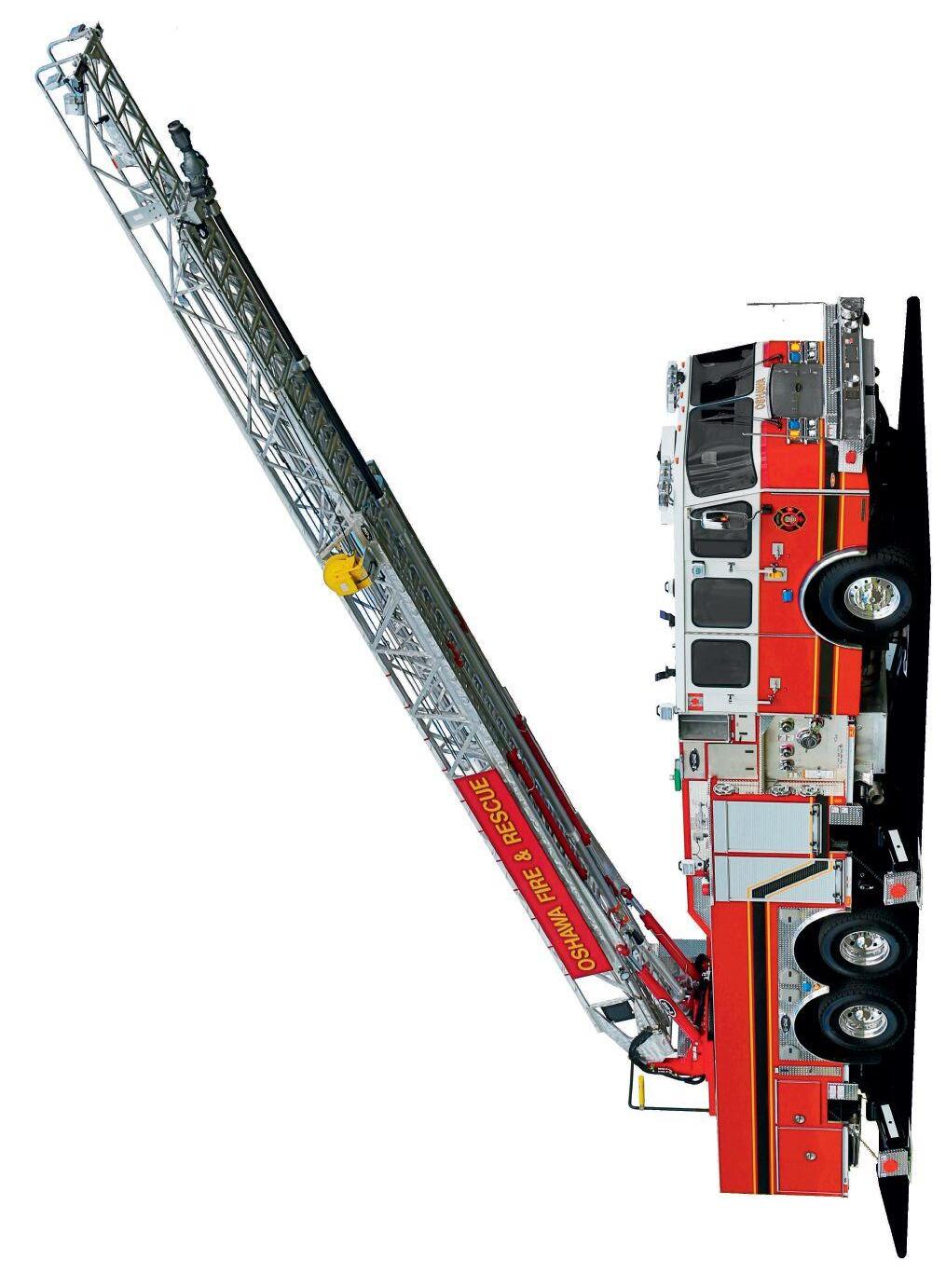
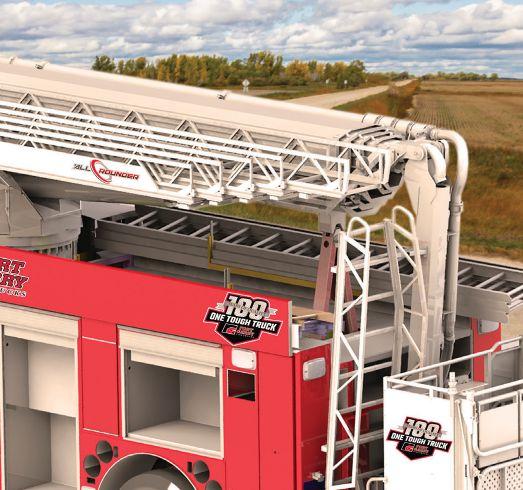
575 LB TIP LOAD RATING TOUGHTRUSS TM EXTRUDED ALUMINUM LADDER
STRONGEST CAB IN THE INDUSTRY
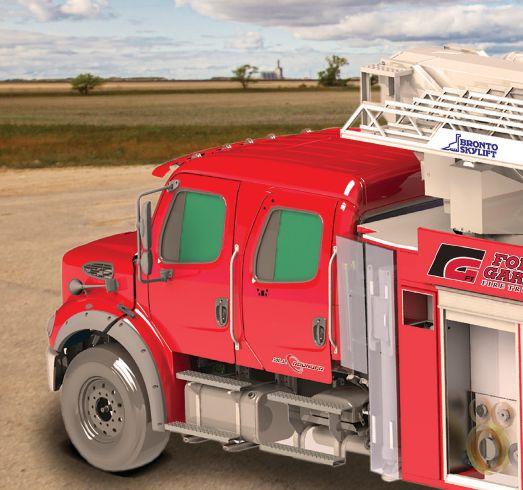
25% INCREASE OVER INDUSTRY STANDARDS. THAT’S E-ONE STANDARDS. The E-ONE HR 100 is an aerial with a proven design and an increased tip load. With a 2.5 to 1 structural safety factor, this rig is 25% stronger than NFPA requires. The crisscross under-slung outriggers deploy quickly to a tight 12’ spread. The tandem HR 100 has a large equipment allowance and is very maneuverable with its 45° cramp angle and wheelbase as short as 230”. For more info, please visit: e-one-aerials.com
2.5 TO 1 STRUCTURAL SAFETY FACTOR
ROCK SOLID STABILITY EVEN WITH ALL TIRES OFF THE GROUND ADVANCED AERIAL CONTROLS
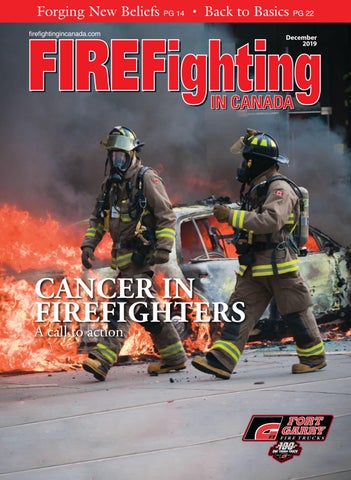
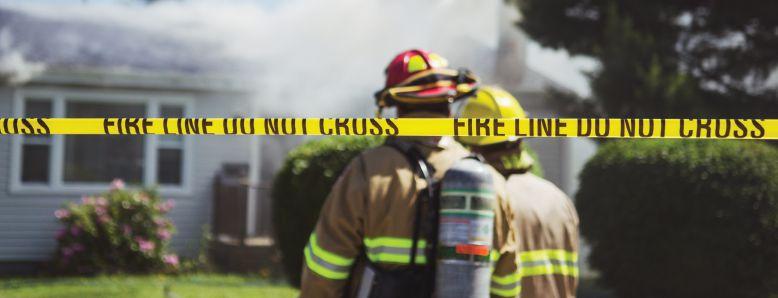
CANCER IN FIREFIGHTERS
This article is the first installment of a three-part series that is a call to action and historical journey into firefighters and cancer.
By Dr. Kenneth Kunz
FORGING NEW BELIEFS
What determines how first responders cope with the tragedies they encounter on the job? Research indicates a solid link between personal strategies and resiliance.
By Nick Halmasy
IMPROVING EFFICIENCY WITH DATA
Data can make a tremendous difference in improving department performance. Here’s how Burlington Fire Department in Ontario uses data analytics and GIS spatial analysis.
By Jin Y Xie
BY LAURA AIKEN Editor laiken@annexusinessmedia.com
CCOMMENT
Cells’ silent stalker
ancer is a terrifying prospect beyond its lethality — its unpredictable path and penchant for wreaking havoc on our cells quietly before it spreads itself at an often too late to abate rate, make it a particularly frightening diagnosis. Cancer is so six degrees of separation that we can all tell a story of someone whose cancer was given a great prognosis and they died. We can also all tell a story of someone whose cancer outlook was given the direst of straits and they lived. Some of you are cancer survivors.
Cancer is a high-profile disease inflicting and killing firefighters at a higher rate than the general public. In fact, cancer is now the No. 1 killer of Canadian firefighters, reported a recent study by the University of the Fraser Valley.
This fact doesn’t mean we can’t reduce the number of cases.
In Part 1, Dr. Kunz shares the current statistical picture before taking readers on a fascinating journey into the lives of ancient fire brigades. In Part 2, Dr. Kunz narrates on firefighter cancer in these ancient times and what parallels can be drawn. The series will wrap up with what steps can be taken to mitigate cancer diagnosis and mortality in firefighters, alongside his physician’s perspective and story of his commitment to researching and educating on the cancer risks firefighters face.
ON THE COVER
Information that leads to preventative care and optimal cancer screening for firefighters will save lives. Our December edition introduces a threepart series on firefighter cancer written by Dr. Kenneth Kunz, a Canadian oncologist and researcher who has taken a passionate interest in cancer care for firefighters. Dr. Kunz, who wrote the series with the support of the Fire Chiefs’ Association of British Columbia, speaks widely on the subject. You can find a talk he delivered to Comox Fire Rescue called “Job-Related Cancers in Firefighters” online. He has been researching cancer since 1979, and in his Comox session he points out that trillions have been spent trying to end cancer, but cancer isn’t ever going to go away. It’s a natural part of being human.
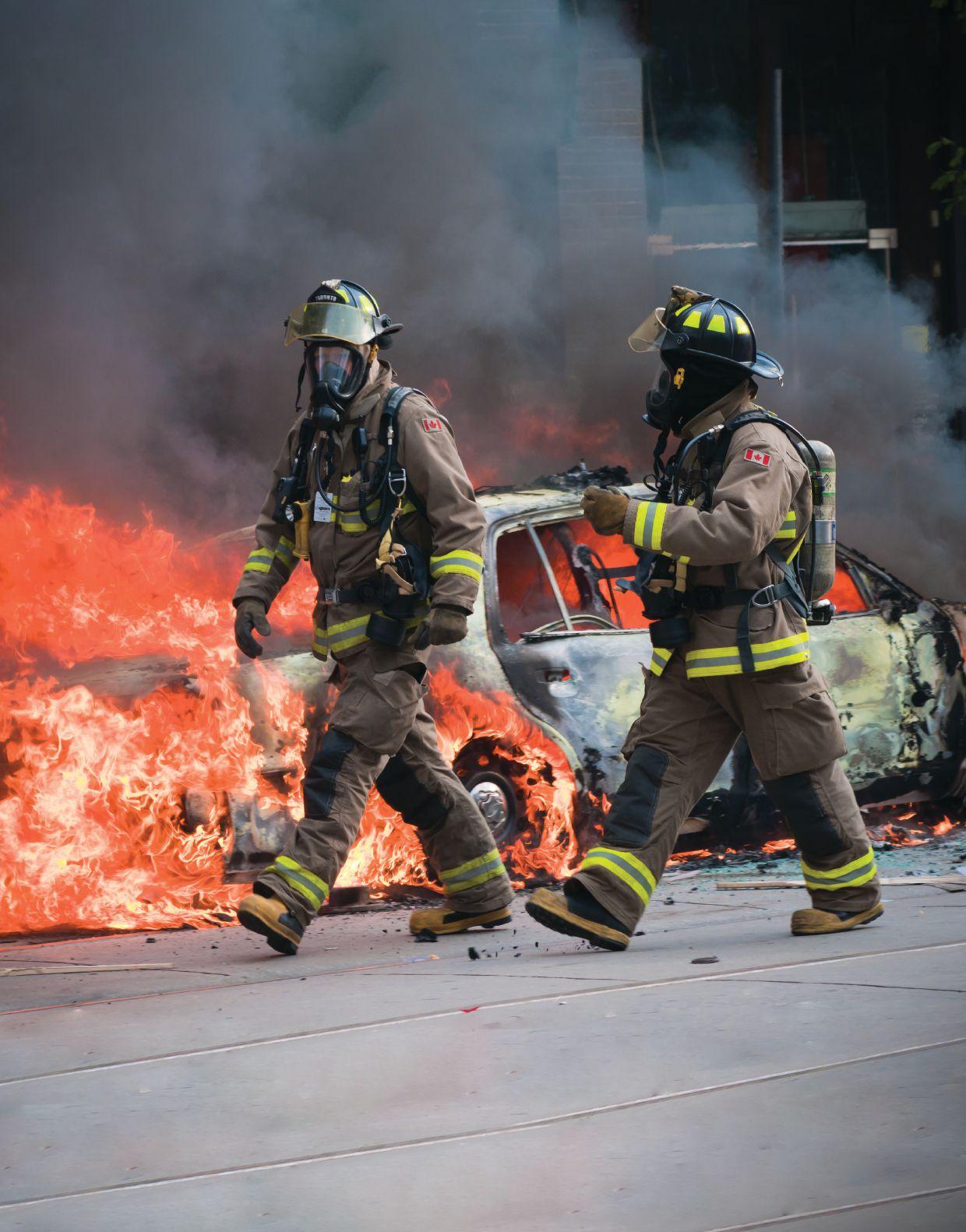
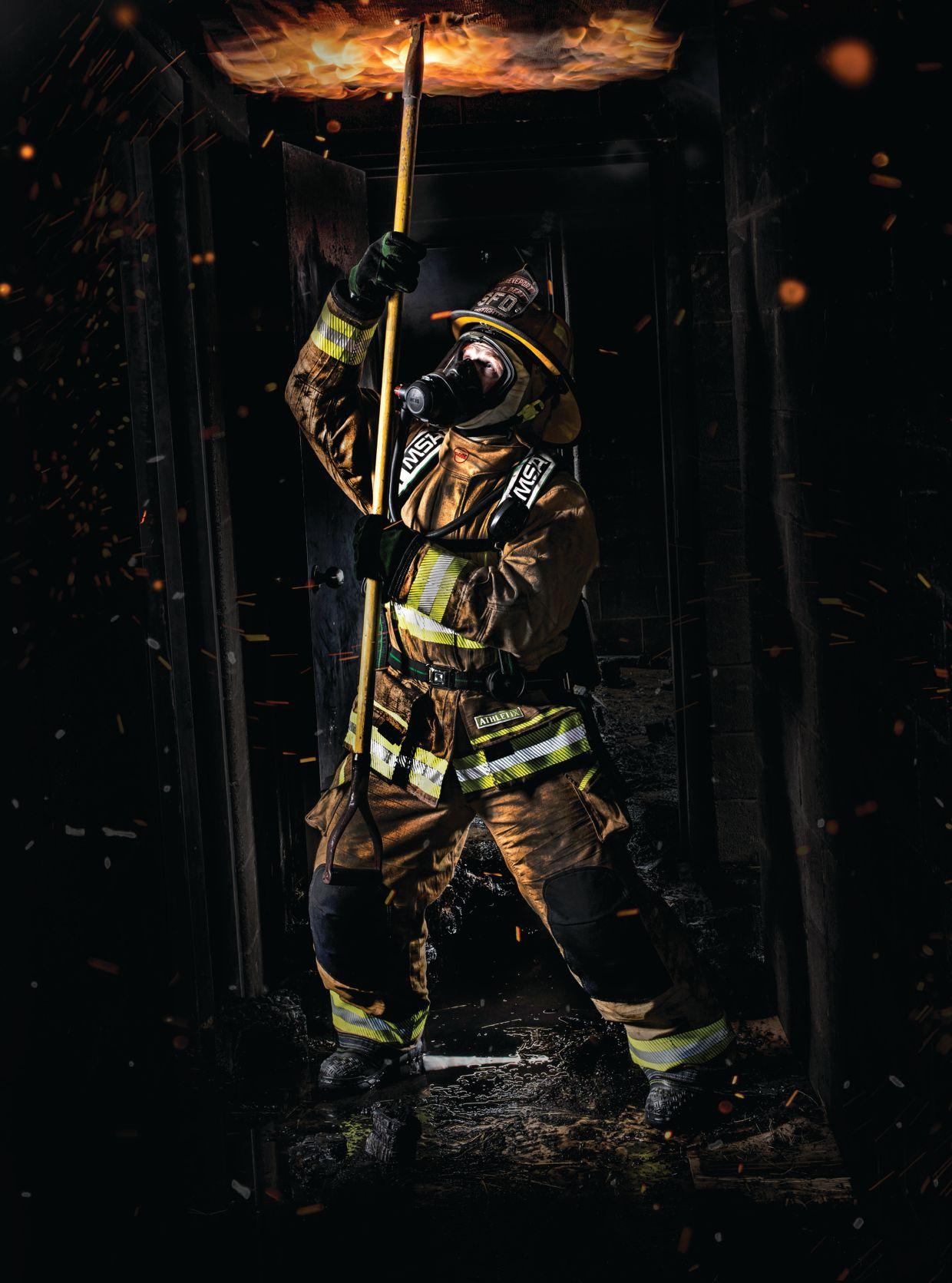
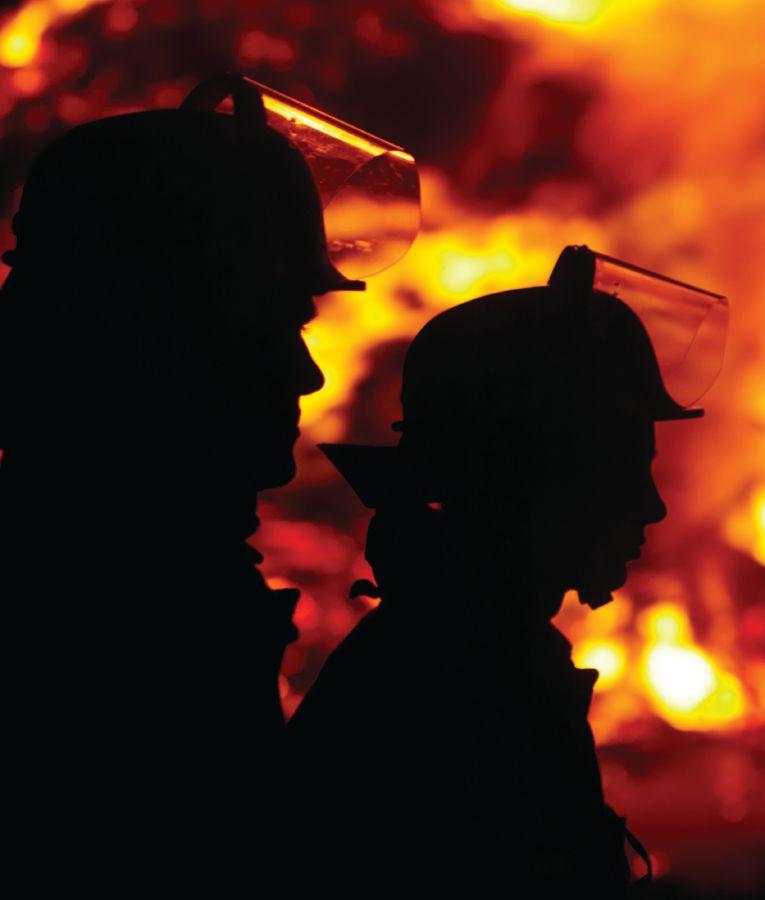
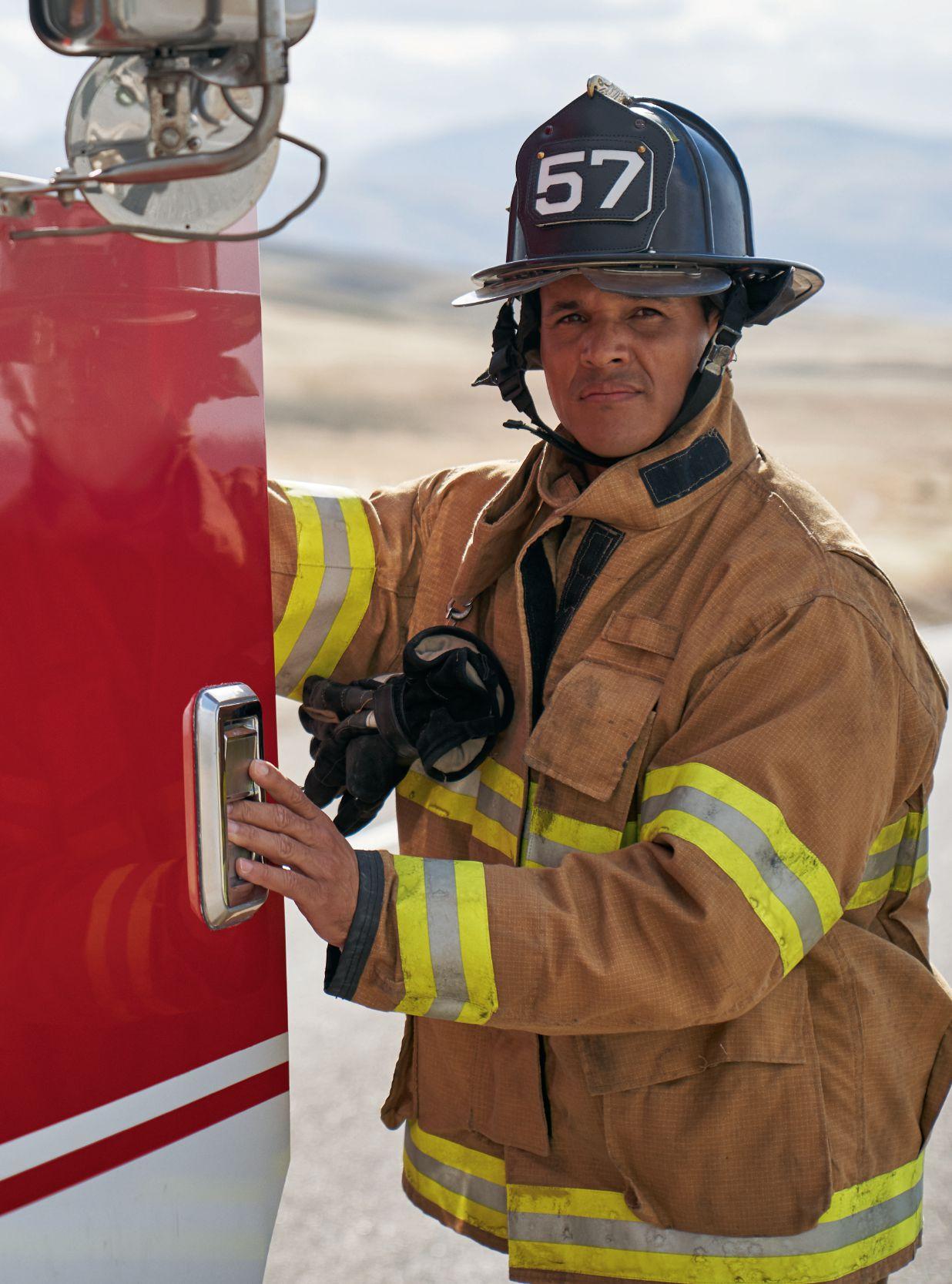
Fire fighting is a job with inherent risks, but the No. 1 killer of firefighteres today isn’t fire or accident — it’s cancer. See story on page 10.
On a bright note, you are lucky to be in the fire service now instead of ancient Rome. We have modern medicine and many brilliant minds dedicated to cancer research. The growth in knowledge will continue to give more of us longer and healthier lives (so long as we heed the advice to take care of ourselves as well).
I hope you find this series written by Dr. Kunz as fascinating as I did. I have a much better understanding of cancer than I did before thanks to his eloquent delivery. The team at Fire Fighting in Canada wishes you a safe, joyful and peaceful holidays. We look forward to serving our readership in the New Year.
ESTABLISHED 1957 DECEMBER 2019 VOL. 63 NO. 8
EDITOR LAURA AIKEN laiken@annexbusinessmedia.com 416-522-1595
Occasionally, Fire Fighting in Canada will mail information on behalf of industry-related groups whose products and services we believe may be of interest to you. If you prefer not to receive this information, please contact our circulation department in any of the four ways listed above.
All advertising is subject to the publisher’s approval. Such approval does not imply any endorsement of the products or services advertised. Publisher reserves the right to refuse advertising that does not meet the standards of the publication.
www.firefightingincanada.com
PHOTO BY ISTOCK
STATIONtoSTATION
ACROSS CANADA: Regional news briefs
121
firefighters
made Firefighter Training Day a success
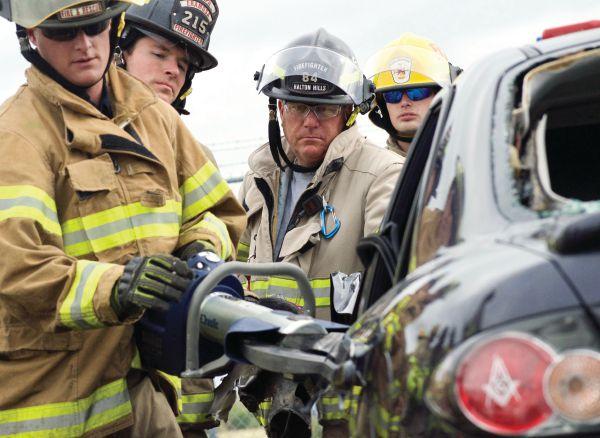
Training Day participants learning the most effective and efficient ways to hold and position auto extrication tools.
One hundred and twenty-one firefighters came to Canadian Firefighter magazine’s annual Firefighter Training Day sponsored by Fort Garry Fire Trucks and TargetSolutions. The training event ran Sept. 28 at the Fire and Emergency Services Training Institute (FESTI) in Mississauga, Ont.
Firefighter Training Day offered free training to firefighters in various areas of the field.
The day began with registration and a bit of caffeine before
THE BRASS POLE
Promotions & appointments
Halifax Regional Fire and Emergency promoted DENNIS PITTS to district chief. Pitts started in the fire service in 1988 as a volunteer in Beaver Bank, N.S. While there, he rose through several
officer levels and attained his volunteer fire service leadership certificate. In 1996 he was hired full-time as a firefighter by the city of Dartmouth, N.S., which later became Halifax Regional Fire and Emergency after amalgamation. Among his new duties as district chief, he is overseeing the technical rescue program for Halifax as well as assisting with the
participants broke off into seven different hot courses that included aircraft rescue, auto extrication, firefighter survival, forcible entry, live fire rescue, LPG Incident and The Working Mind.
Amanda Leigh from Adjala-Tosorontio Fire Department in Ontario, participated in the novice stream of the two auto extrication courses offered. Leigh said she appreciated the pressure-free learning environment.
“There’s no judgment and no tests. [Training Day] gives you the chance to learn without always being concerned that you have a test to pass or skills to master.”
LPG Incident was a new course offered this year that focused on ammonia safety training.
Participants of the course learned about physical behaviour and toxicity for both fixed facility and transportation incidents. Students witnessed a live ammonia release and learned strategies to remediate vapour production and the severity of toxic incidents.
Captain David Clarke is the hazardous materials and dangerous goods specialist with FESTI. He said the new training was brought in from the Ammonia Safety and Training Institute in California by Emergency Response Assistance Canada (ERAC).
“On Training Day, firefighters are able to come here for free and get a taste of these new skills,” said Clarke. “They are going to go back home and work what they learned into the training evolutions at their halls.”
After bunker gear was shed and helmets were hung up, each firefighter was presented with a certificate for the completion of his or her course.
municipality’s return to the National HUSAR program as Canada Task Force 5.
NICK RULLER accepted the position of fire chief with the town of Niagara-on-the-Lake, Ont., in September. Ruller first joined Niagara-on-the-Lake Fire and Emergency Services Department in 1999 and served as a firefighter at Station 1 until
2003. He also spent 16 years in the operations division with Toronto Fire Services.
KRIS OLSEN is the new fire chief in Prince Albert, Sask. Olsen joined the Prince Albert Fire Department in 1995 and has been with the department for the entirety of his 24 years of service. Olsen’s new position became effective early October.
PHOTO CREDIT MORIAH
CAMPBELL
Waterloo Fire Rescue putting stress to the test
Does job stress lead to chronic disease in firefighters? A new research partnership seeks scientific understanding in this pressing area of firefighter health. In June, NFPA statistics attributed 44 per cent of the 64 on-duty American firefighter fatalities to overexertion, stress or medical reasons.
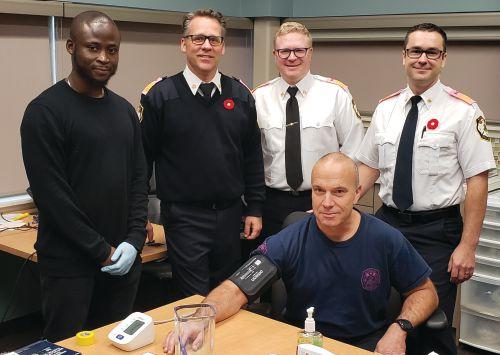
Waterloo Fire Rescue (WFR) and a team of researchers at the University of Waterloo (UW) have teamed up to determine if occupational stress in firefighters increases their allostatic load (defined as wear and tear on the body caused by stress). Allostatic load is measured through various cardiovascular, neuroendocrine and metabolic changes. Chronic diseases in question include heart disease, high blood pressure and diabetes.
Phase 1 of the study began in 2016 with four members of WFR that represented a generational cross-section designed to reflect the current fire service. Phase 1 grew into a full-scale study thanks to grant funding from the Government of Alberta. Around 60 firefighters are now taking part in the research, which obtains a number of biological markers, including blood pressure, height, weight, blood glucose, blood lipid analysis and cortisol levels measured in their hair. Firefighters also complete a number of questionnaires related to stress and resiliency.
Ryan Schubert, a deputy fire chief for WFR, said he is excited by the opportunity this research holds in an area that needs further
Project Zero striving to end residential CO deaths
Enbridge Gas partnered with Ontario fire departments to reduce fire and carbon monoxide related deaths through its Project Zero initiative during the province’s Carbon Monoxide Awareness Week. For example, Ottawa Fire Services received 726 combination smoke and carbon monoxide alarms through Project Zero, a public education campaign that provides more than 9,100 alarms to residents in 40 municipalities across Ontario.
This year, Enbridge Gas invested $275,000 in Project Zero. Over the past 11 years, the program has provided more than 44,356 alarms to Ontario fire departments.
From L to R: Somkene Igboanugo (UW research team), Fire Chief Richard Hepditch, Deputy Fire Chief Mike Adair, Deputy Fire Chief Ryan Schubert and Captain Training Officer Fred TenEyck, a research participant.
study. In an email to Fire Fighting in Canada, Shubert wrote: “We have full support of the Waterloo Professional Firefighters Association and look forward to supporting the advancement of this research potentially across North America.” The study has funding secured for a year and a half, said Schubert, and ideally will be supported to follow its firefighters over the long-term of their career.
The University of Waterloo research group comprises John Mielke, Philip Bigelow and Somkene Igboanugo.
“Carbon monoxide is known as the ‘silent killer’ for a reason, and we have proof that prevention saves lives, said Ian Ross, director of Eastern region operations for Engridge, in a news release
Jon Pegg, Ontario’s fire marshal, said in a press statement: “The objective of Project Zero is to deliver combination smoke and carbon monoxide alarms to Ontario communities who need them the most. It’s a program that municipal fire departments can adopt to help educate their communities about the requirement for all Ontario homes to have a CO alarm if they have a fuel burning appliance or an attached garage.”
Carbon Monoxide Awareness Week starts each year on Nov. 1. The awareness week was enacted under the Hawkins Gignac Act (Carbon Monoxide Safety) of 2013.
Newly promoted District Chief STEPHEN TURNER began his career as a full-time professional firefighter 24 years ago with the Dartmouth Fire Department in Nova Scotia, at what was then known as Station 1. Throughout his career, Turner has worked as a firefighter,
engineer and captain and has been involved with various specialties including technical rescue, harbour/water rescue and medical. Turner developed the first AED program to be used by Halifax Regional Fire and Emergency. In his new role Turner will be responsible for A Platoon, District 3.
Last alarm
JOHN WAINWRIGHT passed away at his home in Yarmouth, N.S., on Oct. 3. He was a member of the Yarmouth Fire Department for 43 years. Wainwright served as both deputy fire chief and acting fire chief during his time with the department.
Fire Chief GORDIE ROSS of the Woods Harbour Shag Harbour Volunteer Fire Department passed away suddenly on Oct. 18 at the age of 59. Ross joined the fire service as a volunteer firefighter for the Woods Harbour/Shag Harbour Volunteer Fire Department at 19 and served as the department’s fire chief for the past 20 years.
STATIONtoSTATION
BRIGADE NEWS: From departments across Canada
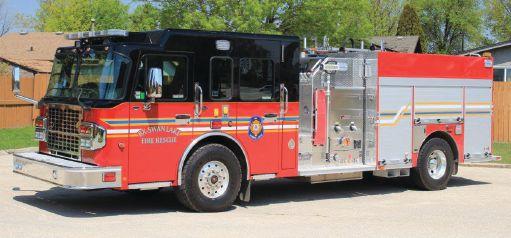
BX Swan Lake Fire Rescue in British Columbia received a new MXV pumper from Fort Garry Fire Trucks. The truck sits on a Spartan Gladiator chassis and has a Cummins 505 HP engine with an Allison EVS 4000 transmission. It’s a cross control pumper made of 5083 salt water grade aluminum. The pump is Hale Q-MAX and holds 1500 IGPM.
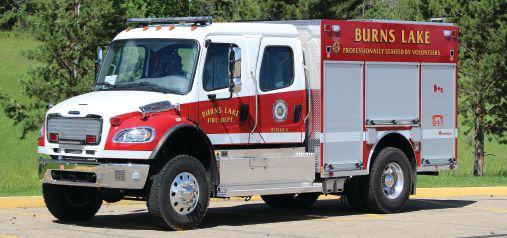
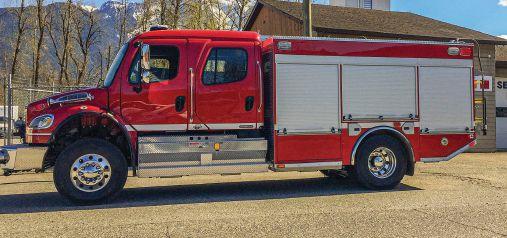
The Burns Lake Fire and Rescue Department in British Columbia received a Rosenbauer wet rescue from Rocky Mountain Phoenix. This truck sits on a 2019 Freightliner M2 106 4-door 4x4 chassis and is powered by a Cummins L9 350 HP engine and an Allison 3000 EVS automatic transmission. The Rosenbauer 12 ft extruded aluminium rescue body is equipped with a 187 IG water tank, 200 ft high pressure hose reel and nozzle, and a 12 V Command Light LED light tower.
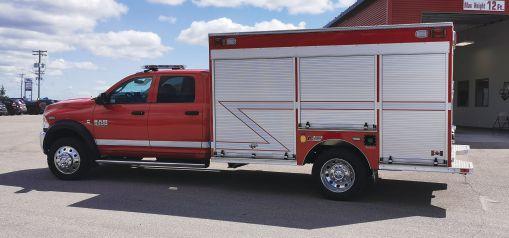
Princeton and District Highway Extrication Society in British Columbia, took delivery of a new 12 ft walkaround rescue from Fort Garry Fire Trucks. Built on a Dodge Ram 5500 crew cab chassis and powered by a Cummins 6.7L turbo diesel engine and a 6-speed Aisin automatic transmission. The truck’s 5083 saltwater grade aluminum body also has 30 g of Eco CAFS foam.
Seabird Island Fire Department in British Columbia took delivery of a WIU pumper from Fort Garry Fire Trucks. The truck sits on a Freightliner M2-106 4x4 chassis and is powered by a Cummins L9 350 HP engine and an Allison EVS 3000 transmission. This Terminator WIU body is made of 5083 salt water grade aluminum and features an 800 IG Darley PSRH pump.
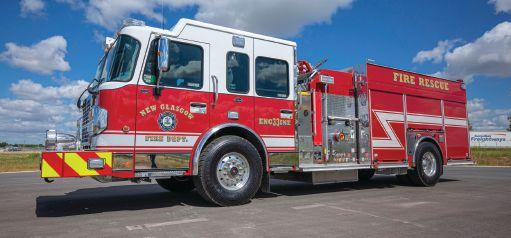
New Glasgow Fire and Rescue in Nova Scotia recently took delivery of this pumper built by Fort Garry Fire Trucks. This Spartan 4-door MFD 10” RR is powered by a Cummins L9 400 HP engine and an Allison EVS 3000 transmission. The truck’s 5083 salt water grade aluminum body is equipped with a Waterous CX 1250 USG pump, a Pro Poly 1200 USG tank and FoamPro 2001 class A foam system.
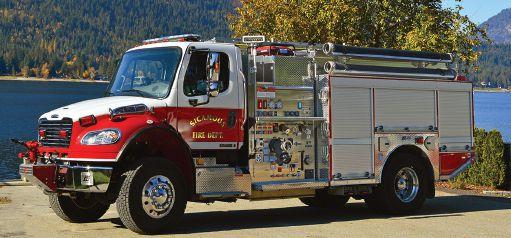
British Columbia’s Sicamous Fire Department received their new Firewalker wildland pumper from Fort Garry Fire Trucks. Built on a Freightliner M2-106 4x4 chassis and an Allison EVS 3000 transmission, this S5083 aluminium body has a Waterous CXPA 1050 IGPM/ 1250 GPM pump, a Pro Poly 1000 IG/1200 USG tank and Waterous CAFS 140 P Aquis 3 A-B foam system.
BURNS LAKE FIRE AND RESCUE DEPARTMENT
BX SWAN LAKE FIRE RESCUE
PRINCETON AND DISTRICT HIGHWAY EXTRICATION SOCIETY
SEABIRD ISLAND FIRE DEPARTMENT
NEW GLASGOW FIRE AND RESCUE
SICAMOUS FIRE DEPARTMENT
Cancer in FIREFIGHTERS
This three-part series is a call to action and retrospective on firefighters and cancer through the eyes of an oncologist.
By DR. KENNETH KUNZ
Editor’s Note: Part 1 in our series looks at the modern statistical picture before delving into the history of firefighters and the dangers they faced. In Part 2, we’ll be looking at medicine and disease in ancient firefighters. Part 3 will take us back to the present and look ahead to what needs to be done to change the increased risk of cancer that firefighters face. Dr. Kenneth Kunz is a medical oncologist who has taken action in the fight against cancer in firefighters through visiting fire departments and spreading the message of risk in various ways. Dr. Kunz has written this three-part series with the support of the Fire Chiefs’ Association of British Columbia.
Having trained professionally as a cancer researcher and a medical oncologist, I am developing an increasing interest in the health and welfare of firefighters. You see, cancer and fire are a lot alike. Both seem to strike mysteriously and when least expected. They strike incisively, often with devastating force. Both have the will and the capacity to — either quickly or leisurely — overwhelm and devour their subjects with an insensate and unquenchable thirst. Physicians and firefighters, cast in the role of onlookers or intercessors, can
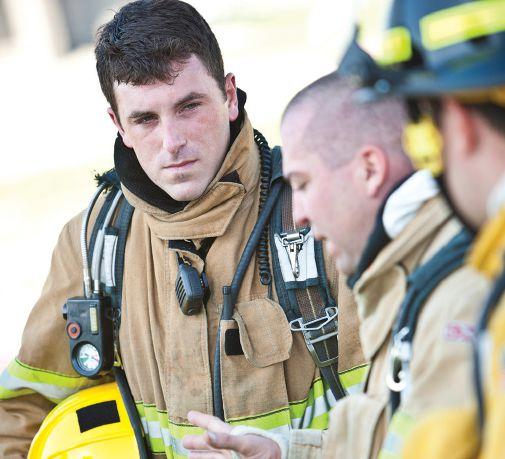
TOP When compared with the public, firefighters are at a significantly higher risk of being diagnosed with, and subsequently dying of cancer because of the service work that they do.
RIGHT Dr. Kenneth Kunz.
often do nothing, or at best are relegated to harm reduction or palliative strategies. Meanwhile the cancers — or the flames — mete out the corresponding pain, fury, and confusion that are commensurate with their power. And despite the ongoing scientific advances in each respective discipline — fire fighting and medical oncology — the physical, structural, psychological, and spiritual losses from fire and cancer remain as heartbreaking and perplexing as ever.
But there is a deeper, more personal, and tragically ironic issue that concerns cancer and fire; they share in common an even more poignant property: both are inextricably linked by their propensity to consume firefighters. And cancer, as we now know, usually claims the lion’s share of the spoils.
When I ask my friends, medical colleagues, and other members of the public, to speculate about how they think a firefighter most commonly dies as a result of work in the fire service, they often guess that it involves either being crushed, asphyxiated, or incinerated. They are often surprised when I point out what the ever-expanding scientific literature reveals: when compared with the public, firefighters are at significantly higher risk of being diagnosed with, and subsequently dying of cancer that is fundamentally related to, and caused by, the service work they do.
This poignant finding was recently highlighted by an eye-opening report published in 2018 by Rachel Ramsden and her coworkers at the Injury Research and Prevention Unit at the University of British Columbia, in collaboration with Len Garis, a retired fire chief, at the University of the Fraser Valley. Ramsden, who is currently a doctoral student at the UBC School of Population and Public Health, examined a series of workers’ compensation claims awarded to fallen Canadian firefighters or their families over a 10-year span between 2006 and 2015. Out of a total of 568 work-related firefighter deaths, 483, or 85 per cent, were attributed to occupational cancers, while only eight per cent were due to chronic illnesses like lung and heart disease, and six per cent from traumatic injury. In other words, the results of this surprising study indicate that the overwhelming majority of work-related deaths among Canadian firefighters involved cancer. This is a sobering revelation when contrasted with the more modest plight of the standard Canadian citizen, who, by
Out of a total of 568 work-related firefighter deaths, 483, or 85 per cent, were attributed to occupational cancers.
comparison, has “only” a 30 per cent lifetime chance of dying of cancer. Firefighters die of this illness at significantly higher rates than the public.
The solemn relationship that exists between fire fighting, cancer, and death is continually renewed, substantiated, and updated as time moves forward and new evidence emerges. For example, in a hallowed Sept. 11, 2018 bell ringing ceremony in Calgary honouring 47 fallen firefighters, 38 of them, or 80 per cent, died of cancers that were presumed to be as a result of their jobs; and at a similar 2018 9/11 ceremony held in Colorado Springs, 249 fallen firefighters were honoured, 164 of which, or 66 per cent, succumbed to occupational cancers.
But examining the firefighter cancer mortality rates in these special, very public, and therefore sensationalized instances can have the untoward effect of magnifying or overamplifying the real numbers. A more accurate approximation of what really happens to firefighters comes from the work of epidemiologist Dr. Robert Daniels and his associates at the National Institute for Occupational Safety and Health (NIOSH), the National Cancer Institute (NCI), and the University of California at Davis. In 2015, this research team published the most thorough, ambitious, and authorita-
tive study to date on the subject of cancer in firefighters. After examining data from nearly 30,000 urban U.S. firefighters over a span of almost 60 years, the group reported that firefighters have a nine per cent higher chance of developing cancer at some point during their lives, and a 14 per cent higher probability of subsequently dying from cancer than the general public. These may seem like modest increases; nine per cent and 14 per cent, respectively, however, they must be considered in context to the baseline cancer risk faced by the standard North American citizen. For example, if, in 2019, the average Canadian has a 44 per cent lifetime risk of developing cancer, that number jumps to 53 per cent if that Canadian happens to be, or has been, a firefighter. If the average Canadian has a 30 per cent lifetime risk of dying of cancer, that mortality rate now increases to 44 per cent if that person had a career in the fire service.
It is high time that steps be taken by society to stem this rising tide; to slow, stop and eventually reverse the number of firefighters consumed in this roiling cancer tsunami. Helping to reduce the burden of cancer, particularly as it concerns those in the fire service, falls within my special area of professional interest. To understand the entire story of cancer and firefighters, it is important and utterly fascinating to learn
some of the history behind fire fighting.
ON THE ANTIQUITY OF FIRE, FIREFIGHTERS AND CANCER
Curiosity has often led me to wonder: how long has the industrial association between fire, fire fighting, and cancer been going on? Probably a long time — epochs, in fact. It is now generally accepted among archeologists and anthropologists that our early ancestors began the controlled use of fire for warmth, protection, tool making, and food preparation approximately 1.5 million-years-ago. That’s about 50,000 hominid generations, perhaps longer. This allowed primitive populations to expand, disperse geographically, and evolve culturally, with the eventual introduction
out these cities of antiquity, fires were ubiquitous and inevitable. Not only smaller domestic-sized blazes — but outright industrial-scale, citywide conflagrations — posed an ever-present threat to property and life. So far, we have only indirect knowledge of professional fire fighting services in ancient Egypt, but such did exist. If the Egyptians were able to design and construct ships capable of transporting 180-ton granite obelisks at a distance, they probably had a fairly sophisticated fire service as well. Knowledge regarding this comes to us from the well-kept records of imperial Rome.
A BRIEF HISTORY OF FIRE FIGHTING IN ANCIENT ROME
In considering a history of fire fighting in
It is high time that steps be taken by society to stem this rising tide; to slow, stop and eventually reverse the number of firefighters consumed in this roiling cancer tsunami.
of agriculture some 12,000 years ago. Reliable food sources made possible the gradual expansion of smaller communities into larger cities of several hundred thousand people; cities such as Damascus, Syria, which has seen human inhabitation for 11,000 years.
In the absence of our modern synthetic construction materials, stone, mudbricks, and natural fibre were common building materials for sure, but also, indispensably and predominantly wood — and plenty of it.
Because of the scarcity of timber in the Sahara, it is recorded that in 2,600 BC, Sneferu, a powerful Egyptian pharaoh of the 4th Dynasty, ordered the construction of a fleet of 60 seaworthy cargo ships. Successive convoys of these high-capacity transport vessels sailed an ancient Mediterranean superhighway to harvest the richest source of cedar logs, found at Byblos, Lebanon. One papyrus invoice of the time catalogued the delivery of 40 such shiploads of massive cedar logs. Wood was delivered continuously and in abundance, to source the expansion of the magnificent Egyptian empire. Everywhere in the ancient world, as cities were growing, wood craftwork and construction was booming. With so much timber used through-
ancient Rome, and how it leads up to the modern-day plague of cancer in firefighters, the first certain knowledge of organized attempts at urban fire control comes to us from the journalists who were there to see it. Ancient historians such as Cassius Dio (AD 155 -235), Pliny the Elder (AD 23 – 79), and Plutarch (AD 46 – 120), among others, left careful accounts of day to day life in these distant times. We learn that roughly 2,000 years ago, the city of Rome was a high-density metropolis of approximately one to two million people, a significant 30 per cent of which were slaves. We are told that the city was frequently and repeatedly ravaged by lethal and devastating fires, to the continual dismay and vexation of the empire. One estimate suggests there were as many as 100 smaller fires per day, any two of which could erupt into terrifying infernos that would threaten the city at large.
These historians tell us of a notorious, privately-owned, and commercialized fire service that emerged in Rome in the first century BC; fire fighting that amounted to little more than a swindle in the form of organized extortion. A certain Marcus Licinius Crassus (115 BC – AD 53), whose life was marked by craft, cunning, and an overpowering lust for wealth, assembled
a retinue of about 500 men, indentured slaves who, before falling on hard times, were formally trained as builders and architects. The crew would rush to a blaze and then remain on standby while the brazen Crassus entered into an impassioned haggling with the distraught owner to purchase the property — as it was burning — at an insultingly low rate. If the frantic owner, in a moment of vulnerability, accepted the deal, the fire crew would jump into action and attempt to extinguish the flames. If no deal was reached, the erstwhile firefighters would stand down and watch the structure burn to the ground. In the aftermath, Crassus would often successfully acquire the damaged or burned-out ruins, which sometimes amounted to large tracts of the neighbourhood, and his skilled team of ‘contractors’ would repair or rebuild so that he could sell the properties back to their original owners, or others, at much higher rates. In this way, along with operating other nefarious schemes as well as legitimate enterprises, Crassus amassed a fortune that by today’s standards is estimated to be in the range of about $15 billion US. Dishonest intentions, however, combined with profiting from the misfortune of others, inevitably comes with a cost. We learn that Crassus, one of the first, self-stylized fire chiefs, had his head hacked off and molten gold poured down his throat (although I am not sure in what order) in a scornful public mockery of his lust for wealth.
A more commendable and praiseworthy attempt at establishing a fire service took place 30 or 40 years later, somewhere around 22 BC, when a certain ambitious magistrate, Marcus Egnatius Rufus, won great distinction in Rome by establishing the next organized, privately-run, but freeof-charge fire service. Considered to be a dangerous and somewhat less than prestigious occupation, this early fire department was also necessarily staffed by slaves, to the number of about 600 men. Given the immensity of the city and the frequent number of overwhelming infernos, this poorly-resourced agency was stretched far beyond its capacity to render effective response. Historical reports suggest that the fire services were disappointingly haphazard and unreliable. The proud and confident Chief Rufus, after basking on an initial crest of popularity, was subsequently executed by reason of unrelated conspiracies combined with the sinister intricacies
Forging New Beliefs
Let’s examine the link between personal coping mechanisms and resilience.
By NICK HALMASY
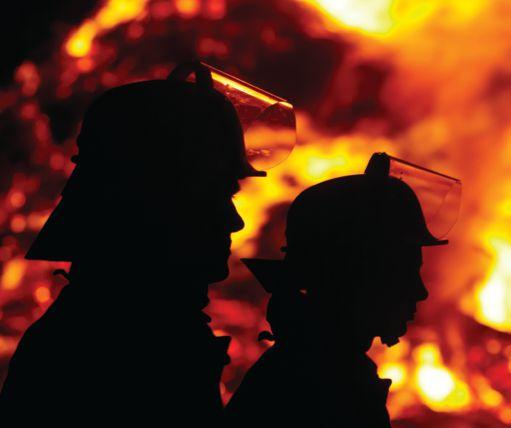
TOP One call will impact two firefighters very differently. Why?
RIGHT There can be a protective effect in viewing the present through the tint of rose-coloured glasses.
There is a saying that we see the past through rose-coloured glasses. What if we saw the present in a similar way? What if what you saw was less important than how you viewed it? If this was so, wouldn’t we be that much more successful at protecting ourselves against psychological distress and harm?
Fortunately, there is a lot of evidence to suggest that this is true. If trauma was simply what we saw , then we’d expect that 100 per cent of firefighters would have trauma related disorders. Even the highest estimated numbers of first responders screening positive for PTSD symptoms don’t begin
to scratch towards 100 per cent. How do we explain how a single call affects two firefighters so differently?
When Sheerin et al. wrote their research paper focusing on combat veterans and PTSD (2018), they identified that a traumatic experience was not enough in and of itself to warrant a PTSD diagnosis. It is a necessary component, but it is not the only component. Interpretation and the subsequent coping are the other components.
We see an emphasis on PTSD in the fire service focusing on the nature of the job. Less conversational emphasis has been on personal responsibility for psychological well-being. And that is exactly what is needed to help ensure and
maintain psychological health. It isn’t a new idea, but rather one that people have been identifying long before we knew of trauma and stress in the way we do today.
Epictetus wrote in the Enchiridion thousands of years ago that “it is not events that disturb people, it is their judgement concerning them.” Epictetus seemed to understand that what was seen was immutable. More important was how people interpreted the event and this is something we have much more influence over.
Research has shown a pretty clear correlation between styles of coping and risk toward psychological harm (Sheerin et al., 2018; Loo et al., 2015; Hetzel-Riggin & Meads, 2016). Simply put, if you have an ineffective coping strategy, you’re at a higher risk for psychological trouble than your colleagues with more effective strategies. This helps to explain the major individualistic factor in why some people are more impacted by the work they do than others.
AVOIDANT STRATEGIES
Some people have an avoidant style of coping, which isn’t a conscious decision, but rather a process over time. An avoidant style entails small and minor psychological adjustments made to soothe stress and emotions employed over years that snowball into an automatically deployed strategy.
This is illustrated by one of the common questions I’m often asked and that is, why now? In reality, though, the better question is, why not now? It would be more surprising if people continued to stay well in spite of these unexamined strategies.
An avoidant strategy is putting space between us and the stressor physically, psychologically, emotionally or in combination of these (Hetzel-Riggins & Meads, 2016). Leaving, avoiding, ignoring, or dissociating (psychologically leaving, we could say) all act to mitigate the impacts of what we are feeling.
This is an automatic response. In fact, this happened to me during a call where a scene began to feel a bit like a movie set. Framing the scene as such was an attempt to help make sense of what I was seeing. I had zero experiences that would help me process what I saw prior to that. This distance created a safety net. Luckily, these calls didn’t build on each other to
an extent where this created problems psychologically. I was lucky.
Some of us are not so lucky. Culturally, we exercise a very ingrained strategy: drinking. A study in 2012 found that 56 per cent of career and 46 per cent of volunteer firefighters engaged in binge drinking (Haddock et al., 2012). It “allows us to relax”, as we may like to rationalize. As well, it is too often we hear of tail-gate debriefs where alcohol is consumed and stories are swapped. I’m not making a judgement call on the appropriateness of this, but rather to call out how a culturally accepted practice may inadvertently reinforce the idea that
chologically and socially. With a little luck, you may even be able to restructure this belief on your own through successes that help identify that this is not actually true. But, you may also not have a very ingrained belief yet.
Often these core beliefs go unchallenged, indeed usually supported, because of the way we filter our world. Core beliefs are hard to identify, but there are clues. They tend to come as automatic thoughts. An “I’m not good enough” core belief, for instance, may sound like “I’m not going to respond to that, it’s a nothing call,” or “what’s the point in arguing, they’ll always win.” Slowly,
Often these core beliefs go unchallenged, indeed usually supported, because of the way we filter our world. Core beliefs are hard to identify, but there are clues.
drinking to cope is an effective way to navigate problems.
Other avoidant strategies may be increased sick day use, less call response, or slower call response times. More subtle avoidant strategies are much harder to explicitly identify, and more often than not require the individual to reflect carefully on how they respond. Typically, marriage strife, workplace issues, loss of friendships and the like can all be signs that an avoidant strategy is being used as it rarely accomplishes anything positive and tends to impact those around us.
NEGATIVE CORE BELIEFS
Compounding avoidant styles with negative cognition amplifies the risk, as illustrated by Sheerin and Chowdry et al. (2018). Therefore, identifying how you see yourself fitting within these events is a significant component. How we view ourselves and the world can significantly bias how we interpret events. This factor permeates every single clinical session I have ever had with firefighter or family (and the general public for that matter).
Often, we start with a negative core belief about ourselves or the world.
At first, having such a belief causes little issues. A belief like “I’m not good enough” causes only minute waves psy-
over time, this becomes more and more ingrained. This becomes more and more automatic.
In 1964 Aaron Beck recognized this. Beck, the founder of cognitive therapy, laid the groundwork for most cognitive approaches, including trauma related therapies like Cognitive Processing Therapy. Beck noticed that the more time that these beliefs go unchecked the more ingrained they become. Indeed, the longer someone was suffering before reaching a therapy chair, the more adjusted the view of reality becomes. And, therefore, the harder they have to work in order to regain psychological balance.
REGAINING BALANCE
Some things that you can start to do immediately is identify automatic thoughts. Track them (yes, that means writing). After a week or so, look through them to see if you notice any themes. Those themes are the hints at negative core beliefs. Those core beliefs are being supported by thinking traps that do not allow you to see the evidence and experiences that disprove the underlying belief. Next, you have to actively try and renegotiate a more balanced core belief. This is fundamental to many therapies (Wenzel, 2012; Greenberger & Padesky,
2016). You want to be able to balance a belief so that positive experiences strengthen it and negative experiences are allowed by it. Removing a negative core belief often means making an underlying belief more flexible.
And, stop avoiding. Really, stop avoiding.
Did you have hard day at work? Don’t have a drink. Fight with your partner? Don’t walk away without a promise to come back to the issue to solve the problem. Feeling worried or anxious? Don’t distract. These are painful moments, of course they are. You may need a professional to help support you through these practices, especially if the belief is very ingrained and you are having difficulty identifying it, or if trying to sit with these experiences puts you in immediate danger to yourself or others.
By implementing these few strategies consciously, you will begin to develop a pattern of adaptive and healthy coping strategies. These strategies lead to better emotional navigation, as problems are managed head on. Not later or tomorrow or after a bottle of beer, but now. There are free resources online that could help you navigate through automatic thoughts and core belief work. I recommend BounceBack, a telephone coaching provincial program based on CBT and run by the Canadian Mental Health Association (bouncebackontario.ca). Here are a couple other online resources: getselfhelp.co.uk/thoughts.htm and mcgill.ca/ counselling/files/counselling/20_questions_to_challenge_negative_thoughts_0.pdf from McGill University. Or, you can pick up a few books like Mind over Mood authored by Dennis Greenberger and Christine A. Padesky that walk you through various strategies and worksheets to help you collect how you feel about yourself, others, and world and how to adjust those views if they tend to lead to negative outcomes.
This work requires a commitment on your part and takes time. That means you need to prioritize your mental wellness now. Not waiting until we find ourselves desperately seeking help when things have become too much for us to bear on our own. Proactive approaches are the most effective.
While none of these approaches are any guarantees, these skills help lessen the impact of stress and life issues in the long-term. And this is an important point. Addressing these things tends to increase your distress in the immediate. That’s because we’ve asked you to stop doing the things that help you avoid those uncomfortable emotions in the first place. And that is not fun. That is hard.
And that is exactly why it is important.
Emotions are the most unpopular topic among our gritty, stoic image. And they are of the utmost urgent importance to your psychological well-being. Stop blaming the entirety of all psychological harm simply on the type of work we do. That’s like blaming fires on the fact that wood burns.
That is a component, and one we have little control over.
We have much more influence over how we see situations. Through this process, we can strengthen ourselves and make ourselves more resilient to continued and cumulative stresses. And, we can continue to do the job we love.
Nick Halmasy is a registered psychotherapist who spent a decade in the fire service. He is the founder of After the Call, an organization that provides first-responders with mental-health information. Contact him at nhalmasy@afterthecall.org.
BY CHRIS HARROW Fire Chief
Minto Fire Department Ontario
OLEADERSHIPFORUM
Make taking care of yourself a top priority
ver the past few years, the mental well-being of first responders has been the subject of much conversation. Many great leaders have now implemented programs to take care of their personnel. How many of these great leaders have implemented programs to take care of themselves? How many have managers who oversee their department that pay attention to the mental health of the fire chief? In my personal and professional experience, I have seen too many leaders fail to take the steps to take care of themselves.
There have been many articles written about taking care of yourself and ensuring you have a healthy mind before you lead your firefighters each day. Lots of great seminars have been run to teach leaders techniques on self-help. Realistically, not many leaders have taken the advice or training seriously and implemented what they learned. Even worse, many leaders totally avoid the topic of mental health out of fear of facing the reality.
I will say right up front that I am a hypocrite as I write this article. I do not follow many of the suggestions made by experts on how to take care of yourself or put yourself first. My wife will read this article and probably glare at me. She has preached this for years and I have not heeded her advice. It’s not that I disagree with her; I am just horrible at taking the advice. So, the disclaimer of the article is do as is written not as the author does.
The demands placed on leaders can be overwhelming. A normal day involves being pulled in 10 different directions. I am beginning to realize that starting the day without a sharp mind or a clear focus makes dealing with day-to-day issues that much harder. I can always feel the difference when I have a good sleep and prepare myself better in the morning for the day. Even something small, like not having a proper breakfast, can set you up with a poorer frame of mind. A lot of fire service leaders head into the office early and get started before others are up and functioning. This works for them, but how are they later in the day when the demands pick up? Would taking the time to eat well or go for a walk first thing have worked better? Only each individual knows, but it requires being honest with yourself about how you are handling your days.
who are so skeptical of showing any weakness to others, especially in the fire service. But leaders are not superhumans or robots who have no feelings. For the overall health of the individual, having one or two confidants is very important.
It is extremely important that each leader has a peer of similar rank they can sit down and decompress with. Unfortunately, in the fire service, only leaders of similar rank can understand the pressures you are under and issues you face. Listening and solving a firefighter’s issues or decisions made at a large-scale incident cannot be discussed with individuals who have not faced it before. Only someone who has been in that situation can truly understand what you are going through.
Leaders are expected to guide their departments through crises. They are expected to look after their people on a daily basis. They need to monitor and ensure their personnel are getting the help they need when the situation arises. Most leaders excel at this and have written up excellent critical incident stress protocols for their departments to follow. However, how many departments have protocols for their senior leadership team to follow? At the time of writing this article, we don’t (hence the do as I write, not as I
Each leader needs to have one or two go-to peers where they can sit down and discuss the situation. ‘‘ ’’
Another huge issue in the fire service is having a peer of similar rank or responsibility to confide in. There are a great deal of leaders
Chris Harrow is the fire chief in Minto, Ont. He is a graduate from fire programs at Lakeland College and Dalhousie University and holds a graduate certificate in Advanced Care Paramedics from Conestoga College. He can be reached at c.harrow@mintofiredept.on.ca.
actually do). How many make it a priority that after the personnel get looked after, they then follow a similar debriefing for themselves or their team around them?
The questions I put forward here are to promote thought amongst senior leaders. Many probably have their own procedures they use to debrief and relieve stress in their lives. Throughout any senior fire service leader’s career, there are going to be high stress decisions made that will cause you to second guess yourself. Each leader needs to have one or two go-to peers where they can sit down and discuss the situation. These are peers who don’t pass judgement, they just listen and have good feedback. They are peers who know you and know when you are struggling with a certain issue and can get you help if need be. Everyone should identify this person or persons and ensure they use them.
of Roman politics.
In exasperation after another particularly dreadful blaze around AD 6, and inspired by the lofty endeavors which won popularity for the hapless Chief Rufus, Augustus Caesar (63 BC – AD 14) resolved once and for all to implement a no-nonsense, imperially-ordained, professional fire service.
After considerable research, the following is my reasoned approximation of how Caesar was able to inaugurate his highly-effective and military-disciplined fire authority. For better administrative management, Caesar divided the expansive city into 14 distinct geographical regions. As a means of generating a fire budget, he levied a new tax of four per cent on the sale of all slaves. Caesar specified that the new fire service be modeled after the agency then operating in Alexandria, Egypt, which was renowned for its efficiency. The emperor appointed a fire commissioner, who oversaw the creation of seven municipal fire authorities, with each authority responsible for providing fire protection to two geographical regions of the city. Each of these seven main authorities were further subdivided into seven distinct fire brigades, with each brigade consisting of 70 to 80 full-time firefighters. Each brigade had its own sophisticated, expansive, and especially designed firehall complete with barracks and water cisterns, and equipped with an impressive array of fire fighting implements. Horse-drawn fire engines — rolling wagons partially filled with a reservoir of water — were fitted with a primitive form of deck-mounted deluge gun: powerful, Greek-designed, twin-suction Ctesibius piston pumps. These forerunners of our modern appartus were capable, according to some reports, of projecting a fountain of water some 20 or 30 metres high. The deck guns were manned by experienced pump operators who worked in collaboration with firefighters whose primary task was to locate and access a continuous supply of water, which they sourced from the numerous wells, basins, aqueducts, and public fountains distributed throughout the city.
With the fire monitors pumping a continuous stream of water onto the blaze, firefighters on the ground worked knockdown using buckets, ladders, grappling hooks, ropes, pickaxes, and mattocks. They were assisted in their work by heavy military engines designed to create firebreaks by demolishing burning buildings and any
nearby structures also at risk of catching fire. With bravery, skill, and resource, these ancient firefighters also muffled flames by throwing large, water-soaked patchwork quilts over fires, in addition to chemically smothering flames by spraying a vinegar-based fire retardant.
Apartment blocks, some higher than five or six stories, were common in the city of Rome, thus the firefighters had a ready supply of bulky rescue mats that were
to fire codes, or careless in managing a fire, the fire chief could order them to be summarily beaten, horsewhipped, or, at the very least, for minor infractions, given a good tongue-lashing. Many lives, then, just as now, would depend upon such responsible fire conduct.
Because of the difficulty and danger of ancient fire knockdown and overhaul, there was initially some reluctance for prospective young firefighters to enlist in the
‘‘ ’’
Motivated by fear and desperation at the thought of a fiery death, the Romans were nothing if not resourceful and daring.
designed to cushion the falls of tenants who chose to escape incineration by jumping for their lives. Motivated by fear and desperation at the thought of a fiery death, the Romans were nothing if not resourceful and daring.
Another major task was to get out and actively patrol the streets on foot, especially at night, when the fire hazards peaked due to the use of candles, oil-lamps, hearth fires, and fixed-lighting torches. Since lethal fires could spread so quickly, homeowners were expected to assist in fire suppression and prevention. Roman fire codes specified that landlords and tenants were to keep fire fighting equipment ready-to-hand, along with an abundant supply of water to assist in battling any flames that might erupt.
Archeological evidence reveals that the firefighters of ancient Rome wielded a more fearful power —even a brutal influence — over the general public than our more temperate and well-mannered firefighters of today. Tasked with serious responsibilities, and held accountable by an unforgiving imperial authority, Roman firefighters, in thought and action, were actually a hardened amalgamation of military soldier, police officer, and firefighter. This can be seen from the gravestones of Roman firefighters, which indicate that some were equipped with a lethal short sword as well as a heavy, knobby-wooded baton called a fustis, which served, essentially, as a bludgeon.
Many firefighters today would be interested to learn that, under the authority of the emperor, if a member of the public was discovered to be negligent in adhering
new service. Therefore, in AD 24, Tiberius Caesar (42 BC – AD 37) vowed to grant full Roman citizenship — a title with considerable privileges and benefits — in addition to a significant cash bonus, to any firefighter who survived or endured a sixyear span of service.
A six-year span of service? When contrasted with the standard 25-year term expected of soldiers fighting with the imperial Roman army, this may convey significant depths of meaning regarding the anticipated survival rates of each of these disciplines. Nevertheless, the enticements offered by the government must have had some success, as a census in AD 55 recorded that the fire service in the city of Rome had grown to 3,920 full-time career firefighters. In AD 205, because of the ongoing and indispensable successes of the fire department, this number was doubled to about 7,000 firefighters. The imperial Roman government recognized that organized, professional fire brigades were an absolute necessity as the empire expanded and progressed. Therefore, similar models quickly sprung up in many, if not all, Roman cities, for example Carthage and Antioch, among others.
Look for Part 2 in our series on firefighters and cancer in the February edition of Fire Fighting in Canada.
Dr. Kenneth Kunz is a classically-trained medical internist, oncologist, chemist and cancer researcher and most recently a mental health and addictions consultant. He is a competitive track and field athlete and father of two residing in British Columbia.
COMING IN SPRING 2020
Fort Garry Fire Trucks will be showcasing our brand new Bronto All-Rounder featuring:
• 92-foot articulated ladder platform
• Freightliner chassis
• Detroit 450 HP diesel engine
• poly tank and foam system manufacturer in Canada and are proud builders of equipment. Our customers and municipalities throughout which is why we design “ ”
■ THE RADIO RIG
Team Wendy introduced the Radio Rig, the company’s first chest harness. The harness comes with an assortment of three pouch sizes to fit any size radio or GPS. It features a separate weather-resistant accessory pouch to protect electronics from the elements.
PALS webbing on the front has a modular attachment system for the included pouches, as well as any other MOLLE/ PALS compatible holsters and bags. Fidlock magnetic buckles are designed to
IN THEWATCHROOM
allow the front section to fold forward providing access to the backside of the front panel. This backside features a clear touchscreen compatible pocket for electronic devices, maps or notes. teamwendy.com
■ NEXT-GEN HYDRAULIC PLATFORM
Rosenbauer rolled out the B34 2.0, the next generation of its standard hydraulic platform. The B34 2.0 has been overhauled and equipped with new, weight-op-
timized components. The weight of the aerial rescue equipment and cage have been reduced. A newly developed telescopic boom ensure allows the arm set to be extended further than with the B32. The telescopic boom reaches a rescue height of 34 m with the cage attached. Highstrength steel give the telescopic boom strength while the Rosenbauer horizontal vertical jacks with step-less width detection provide stability. The B34 also features a rescue ladder attached to the aerial rescue set that allows personnel to descend safely, as does the turntable ladder as a secondary rescue route. rosenbaueramerica.com
■ WIRELESS PORTABLE MULTIGAS ANALYZER
Gasmet’s GT5000 Terra portable multigas analyzer can be operated wirelessly for measuring up to 50 gases simultaneously. The analyzer can measure and identify more than 300 gases using FTIR technology The analyzer has a highly integrated optical structure: the number of moving parts has been minimized to maximize the stability. The GT5000 Terra is IP54 rated and suitable for versatile outdoor use in any climate.
The GT5000 Terra can identify toxic gases in containers, laboratories, production facilities and accident sites. The analyzer is also designed to measure natural greenhouse emissions in outdoor environments. The device is equipped with an integrated pump and an internal battery. gasmet. com
■ NEW BATTERY-OPERATED HORNET LIGHT
Lind Equipment released its new battery-operated Hornet Light. The redesigned LED task light is 6” in size and comes with pre-installed magnets and an 180° rotatable bracket designed for easy placement.
The battery-operated work light produces 1700 lumens with 15W of power. The light will run for three hours on full-power, six hours on low power, and will continue to operate while charging. The Hornet comes with three different rechargeable options: An AC adapter, a DC car adapter and a USB cable. Additionally, there is an option to charge a cellphone with the light’s battery while it continues to run.
The Hornet has an IP65 weatherproof rating, and is designed to withstand temperatures from below 40 C to over 40 C without failing. The light also surpassed military drop-test requirements. lindequipment.net
BY GORD SCHREINER Fire Chief
Comox Fire Rescue
British Columbia
OSTOPBAD
Improving our environmental footprint
ur fire department is small, serving around 20,000 citizens, but we are always looking for ways to improve our environmental footprint. Our team trains a lot. For years we were concerned about the amount of drinking water our department used during our many training sessions. I am not talking about bottled water. I am talking about the water coming out of our hydrants.
In my community, as in most urban places, the water from our municipal hydrant system is our treated domestic drinking water. I used to watch master streams operate and think to myself, “Wow, that is a lot of drinking water going down the drain.” It costs a lot of money to treat and deliver this water to our homes and businesses and it seems wrong to let it go to waste. Not only does my department train aggressively by using a lot of water, but we also operate a fire training centre that uses a significant amount of water. I figured we should do our part to conserve water, and in doing so we could also save money.
My team and I put our heads together to come up with the practical solution of recycling the domestic water we use for training. In addition, we decided to capture rainwater for use in our training centre. We estimate that we will save more than 1 million litres of drinking water per year.
We can also use this system to refill our fire engines when they return empty from incidents. We have not eliminated the use of hydrants altogether in our training centre, as of course, they are a vital training component, but we have significantly minimized the water we use from them. We often hit the hydrant and then convert to our recycled water system.
we have issued refillable stainless steel water bottles to our firefighters and to our students at our training centre to reduce the use of plastic bottles.
We have also added two BullEx digital fire training panels and artificial smoke generators to our training centre. This reduces the amount of real smoke we produce while improving the health and safety of our firefighters. The digital fires and smoke look very realistic and we now incorporate them into all of our regular training. This has made a significant difference in the smoke we generate and our instructors appreciate these safety precautions for themselves and their students.
We also recently added a vehicle fire suppression blanket to our rigs. In some cases, we can cover a vehicle on fire with this blanket, starving it of oxygen and reducing the smoke almost immediately. Also reducing contaminates running down the catch basins. Yes, we still wear SCBA and pull hose lines. This is just another example of how our industry is changing for the better.
Other things we have done include:
• Converting to LED lighting in many areas of the station
I used to watch master streams operate and think to myself, ‘Wow, that is a lot of drinking water going down the drain. ‘‘ ’’
One of the many benefits of this system is that during water restriction periods (typically summer months), we do not have to dial down our training as we are simply reusing the same water. We also use the stored water for washing down the training area after use. We no longer use a full-size engine to supply our fire hoses during day-long live fire programs. This reduces wear and tear on the engines and frees up an engine for a full day. If for some reason our municipal water system is not working, we have a large water supply to refill our trucks. In addition,
Gord Schreiner joined the fire service in 1975 and is a full-time fire chief in Comox, B.C., where he also manages the Comox Fire Training Centre. He has delivered cost effective training on a variety of subjects all over Canada to hundreds of departments and is available to deliver training in your area. Contact him at firehall@comox.ca and follow him on Twitter at @comoxfire.
• Occupancy sensors on lights in most rooms in the station
• Adding solar power lights in our training centre
• Reducing fire engine run time
• Using smaller response vehicles when possible
• Planting our own fire station garden which is irrigated by our captured rainwater
• Installing mini-splits heat exchangers and disconnecting baseboard heat
• Adding battery operated power tools and fans
• Increasing the recycling of batteries, smoke alarms, etc.
The fire service should be a community leader in green initiatives. Fire departments train to save lives, let’s also train firefighters to help save our environment. You can see more about our recycling efforts on our department website at comoxfirerescue.org.
BACKtoBASICS
Stop for the red light
BY MARK VAN DER FEYST
We are coming to the close of another year and heading into wintertime. Some parts of the country will have already experienced winter in full force with snow accumulating. In other parts of Canada, we are just getting into it!
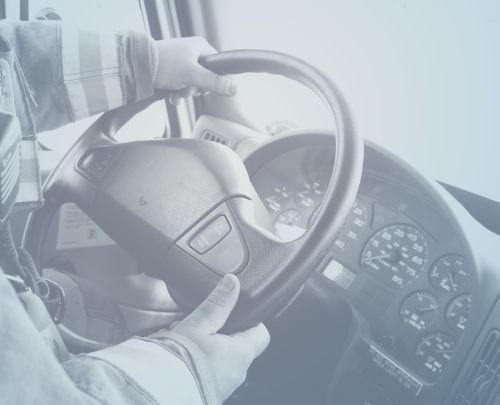
We are ending our series on things firefighters are becoming desensitized to daily by wrapping up with a look at a driving related issue, namely, the red light. In 2018, the NFPA compiled data showing that 10 firefighters were killed responding to or returning from an incident scene, with eight of them resulting from a crash. This is a low number (16 per cent) of the total number of firefighter fatalities, but it’s still an alarming number to see.
In 2017, the NFPA reported there were 15,430 collisions involving fire department vehicles responding to or returning from incidents resulting in 1,005 injuries. There were also 750 collisions involving firefighters’ personal vehicles who were responding to or returning from incidents.
So, what is the big deal? These are U.S. statistics and not pertinent to Canada, right? They may be U.S. statistics, but the numbers still paints a picture for us in how we should be approaching driving duties and how easy it is for us to get into a collision with the fire truck or our own personal vehicle.
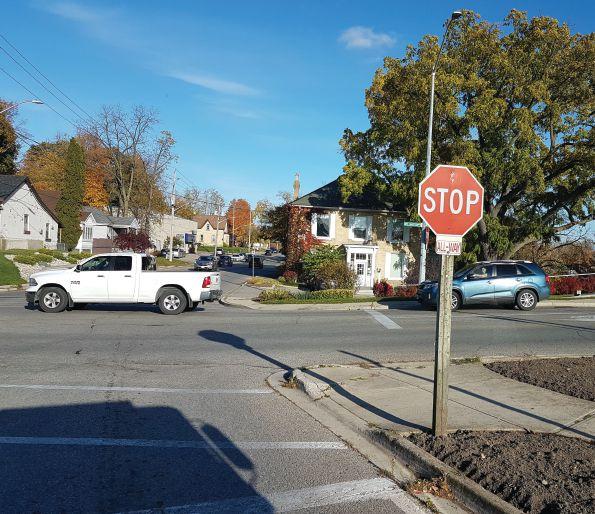
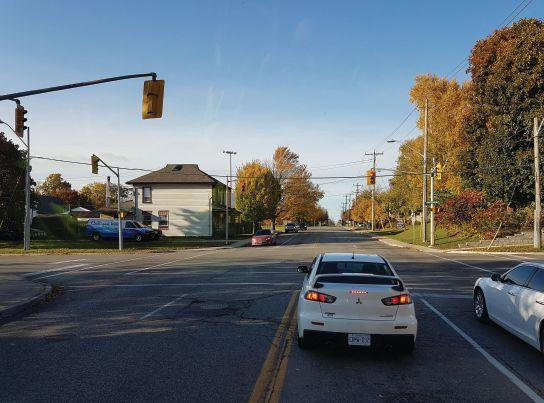
The key traffic danger in responding to an incident is at an intersection with either stop signs or a set of traffic lights. This is where we find a good number of collisions taking place with other emergency responding vehicles or with civilian vehicles.
The results of a collision can be fatal for the firefighter and/or the civilian. Most times, when we have a collision with a fire truck and a civilian vehicle, the occupant of the civilian vehicle will end up sustaining the most injuries or worse, be killed. Just based on physics, a fire truck weighs more than a passenger car, and multiply that with the speed of both vehicles at the moment of impact and the results can be fatal.
What governs us in our driving is the Highway Traffic Act (HTA) or a variation of it for each province. Within the HTA is a provision that allows emergency response personnel to pass through an intersection against a red light, if certain parameters have been met. The main requirement is that the emergency vehicle must come to a complete stop before proceeding through the red light. The other requirement is that there must be flashing lights and a siren turned on when doing so.
The key traffic danger in responding to an incident is at an intersection with either stop signs or a set of traffic lights. This is where we find a good number of collisions taking place with other emergency responding vehicles or with civilian vehicles.
Within the HTA is a provision that allows emergency response personnel to pass through an intersection against a red light, if certain parameters have been met. The main requirement is that the emergency vehicle must come to a complete stop before proceeding through the red light. The other requirement is that there must be flashing lights and a siren turned on when doing so.
PHOTOS BY MARK VAN DER FEYST
To assist the fire department with decreasing the time it takes to respond to a call and increasing passenger safety, many municipalities have installed traffic control devices. These devices are designed to control the lights when they are initiated by means of strobe lights, GPS locators, siren sound or flashing lights. If the light is red, they will automatically turn to green giving the emergency vehicle the ability to travel through. As much as these devices are a great help for the fire department, they cannot be relied on all the time. Even with a traffic control device, if the light does not turn from red to green in time, the fire truck must come to a complete stop before proceeding through.
Coming to a complete stop applies to all times of the day. Even at 3 a.m. when there is no traffic at all, we must come to a complete stop. It will be that one vehicle and occupant out at an uncommon hour that will be the victim of us not stopping first before proceeding through.
So far we have focused on the fire truck, but what about the personal vehicle (POV)? These vehicles may be equipped with a green light to indicate to other drivers that they are responding to an emergency, but does it give them a free pass to speed or go through red lights? The answer is no.
We only have to look back in history to September 2007 when a firefighter responding to a call in New Dundee, Ont., struck and killed a person when arriving on scene. Sadly, the fallout was a person killed, the firefighter charged with the incident and a fire department having to recover from the ordeal.
So, what can be done to help reinforce the need for safe driving and to ensure that we stop at all red lights? Training. First off, ensure that there is a process in place to qualify people to be a driver of a fire truck. Just because you have the proper license, does not make you a qualified driver. There must be an in-house process to qualify someone to drive.
Secondly, there needs to be SOPs or SOGs outlining the responsible ways that department personnel will operate fire trucks, including responding to calls, returning from calls, how to proceed through a red light or intersection, etc.
Thirdly, practice and testing. Each driver will need time to practice their skills driving and will eventually go through the NFPA road course test. This will prove their ability to operate a fire truck effectively and safely and provide proper documentation for the department.
On the POV side, there is much more difficulty reinforcing the rules of the road from a fire department perspective on a person who is driving their own vehicle. One way is to require all people respond to the station first, then take a fire truck to the scene as opposed to responding directly to the scene. Another way is by enforcement, such as periodic driver abstract checks to gauge driving history coupled with department policy for not complying with the HTA. This could mean immediate dismissal if contravention of the act has been committed.
Mark van der Feyst has been a member of the fire service since 1999 and is a full-time firefighter in Ontario. Mark teaches in Canada, the United States and India, and is a FDIC instructor. He is the lead author of the Residential Fire Rescue book. Contact Mark at Mark@FireStarTraining.com.
BY SAMANTHA HOFFMANN Public Fire and Life-Safety Officer Barrie Fire & Emergency Service Ontario
WIf you permit it, you promote it
inter holidays are exciting times to gather with family and friends, enjoy traditional decorations and eat special foods. Unfortunately, these holiday festivities can also present unique fire hazards. More residential fires happen during the colder months of the year, and are primarily caused by cooking, heating and electrical malfunctions.
Fires are more likely to happen when people get preoccupied or distracted from a task, or let their guard down. The holidays are busy and these distractions are to be expected. Add to the commotion the likelihood that we might have a drink or two – or more – and it becomes very easy to forget about the pot on the stove or let a burning cigarette fall onto the carpet.
This is when a tragedy can happen and tragedy can happen in the blink of an eye!
A common catchphrase is, “Smoke alarms save lives.” Actually, this is not true. Working smoke alarms will give you and your family the early warning needed to escape a fire emergency. In the fire service, we know that time can be your biggest enemy when escaping a burning building. In less than 30 seconds, a small flame can turn into a major fire and it only takes minutes for a house to fill with smoke and become engulfed in flames. Proper planning can make the difference between life and death.
We need to spend more time stressing the importance of escape planning and acting on it, no matter where we are. Travel over the holidays is commonplace and it may involve sleepovers at a family member’s home, staying in a hotel or visiting another province or country. It may also mean family and friends staying at your place.
FIRSTLINE
key messages to share and we repeat them over and over every year. Yet, we must remind ourselves regularly that actions speak louder than words.
It is not enough to just say that working smoke and carbon monoxide alarms are important to you and expect other people to check their devices. Professional and authentic people practice the behaviours they promote. If being prepared is important, you should be checking alarms and ensure they are working everywhere you go. When you see something speak up, point it out and get it corrected. It shouldn’t matter if you are at a family member’s home, a friend’s house or out for dinner in a public building.
As a firefighter, the public, your co-workers, your family and friends are watching your every move. It’s not because they don’t trust you, and it’s not because they want to keep track of you. The reason people watch you closely is that they want to know if what you say and what you do are the same — that is, that you talk the talk and walk the walk. You can modify the fire safety behaviour of others just by practicing what you preach. Set the example, and then ensure your actions are consistent. If we want our influence
You can modify the fire safety behaviour of others just by practicing what you preach. ‘‘ ’’
This is when it is paramount that as members of the fire service, and specifically as public educators, we practice what we preach. To practice what you preach means when you say something, you live it. Talking is great but taking action is what moves you forward.
Through public education we know the statistics, we know the
Samantha Hoffmann has been in the fire safety field for more than 25 years. She is the public fire and life-safety officer for Barrie Fire & Emergency Service in Ontario. In 2014, Samantha was named Public Fire and Life Safety Educator of the Year by the National Fire Protection Association – the second Canadian and first Ontario educator to receive the award since its inception. Email Samantha at Samantha.hoffmann@barrie.ca and follow her on Twitter @shoffmannpflso.
to be positive and productive we must be clear with what we want from others, and then make sure our actions support our words!
Recently, while teaching NFPA 1035 Public Fire Educator, Level 1 to a group of firefighters, one of them said something that really resonated with me: “If you permit it, you promote it.”
So this holiday season, let’s all take an active approach to public education. Ensure that it truly is the first line of defence. When we are checking into a hotel or staying overnight at a new house, let’s check those alarms. Take 45 seconds to make a plan and speak up when you see a fire safety issue. The NFPA estimates there are over 152,000 firefighters in Canada. Now imagine how much safer our world would be if we all led by example and spoke up for fire safety all the time.
Improving efficiency with data
A case study on how Burlington Fire Department in Ontario uses data analytics and GIS spatial analysis to drive performance
By JIN Y XIE
Burlington Fire Department in Ontario serves a city population nearing 200,000 and earned itself the top seat on MacLean’s Best Communities in Canada list this year. In addition to the base population, Burlington Fire provides mutual or automatic aid with neighbouring municipalities. The department’s goal is to save lives, preserve the environment and protect properties. Like anywhere else, the incidence of real fires (including structure, non-structure and vehicle) are a much smaller percentage of calls than they used to be. The services have extended from fire suppression to medical emergency, motor vehicle accidents, rescue, hazardous materials, fire prevention, inspections, etc. To serve its community best, Burlington Fire uses data analytics and GIS spatial analysis to drive the department’s operations and make the performance more efficient.
Data plays a vital role in emergency response. When a 911 call is received, it is automatically captured in the Computer Aided Dispatch (CAD) system and is processed by dispatchers in a timely manner so that the closest available resources will be sent to the incident. The associate information about the incident is eventually transferred to the Records Management System (RMS) for command officers to review, comment and sign off. The data entailed could also be analyzed later to answer important questions. However, due to lack of capacity of visualization, it takes resources to sift through the data and discover meaningful information to support making data-driven decisions and improve performance. I recently conducted a case study of the last three years of data (2016 to 2018).
VISUALIZATION IS THE KEY TO SUCCESS
In emergency services, nothing can beat visual representation. The geographical distribution and spatial or temporal patterns are always used to show trends, correlations and patterns by exploring the data. Since the number of incidents are so large, simply plotting the data on the map won’t show meaningful trends to decision-makers. Instead, I created a heat map (kernel density estimation) in QGIS. The heatmap is most commonly used to visualize incidents density geographically so that the patterns of higher than average occurrence can emerge.
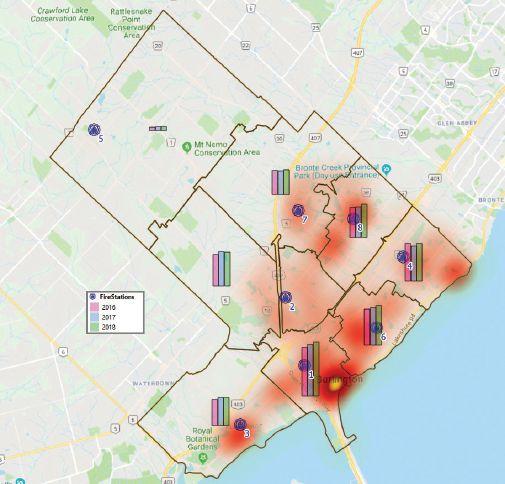
Once the heat map is created, it can always be used as a base map for reference when doing analysis. Figure 1 shows the heat map as a background reference for the statistics chart of the total incidents in the eight fire stations on the map across the entire city. Among the stations, most of them are in an urban area.
Only Station 5 is in rural area and it is mainly used by volunteer firefighters.
TIME IS CRUCIAL
The Code 2 incidents are time critical, involving all lights and sirens. When talking about performance in fire, I am referring to the Code 2 cases. The total response time is used for performance measure. It is the time from the call received until the first truck arrives on the scene. Response time is composed of three elements: call handling time, turnout time and travel time. Properly analyzing the three elements can provide decision makers with a complete picture of the response process to improve the performance. First, the call handling time is the elapsed time it takes to answer and process a call and dispatch trucks. Specified by the NFPA, the best practice for call handling time should be less than 60 seconds of 80 per cent. The average call handling time was around 50 seconds in the past three years. How can it be kept or even improved? We all know technology advancements can help to improve call handling time. Regardless of spending money on the technologies, let’s look at those incidents that didn’t meet the NFPA’s standard for call handling time. As all the calls are handled at centralized communications, day and time are the major factors
Figure 1: Total incidents by stations (2016 to 2018).
that affects the performance. I created a cohort chart of temporal heat map that shows the pattern by the hour of day and the day of the week. The darker the red is, the higher the occurrence is of the incident (which has more than 60 seconds call handling time). This information could provide the management with a clue why higher rates happened in certain times and days, and find a way to improve on this through education or better processes.
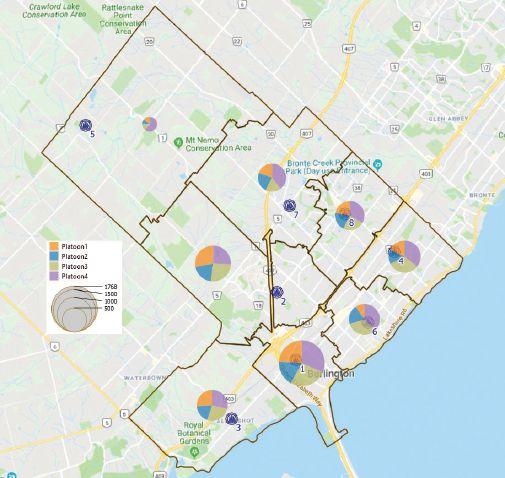
Second, the turnout time is the elapsed time from the tune to the trucks leaving the station. When a fire truck is dispatched to an incident, the station’s alert tune sounds at the same time and firefighters rush out to their truck and leave. Standardized by the NFPA, the turnout time should be less than 80 seconds of 90 per cent. In the past, the average turnout time is less than 80 seconds every year. Can it be kept or bettered? Looking into the incidents that didn’t meet the NFPA’s standard of turnout time would give the decision makers an idea where to find the room to improve directly. Since the firefighters are working as members of a platoon at different fire stations, Figure 2 shows the pattern of spatial distribution by platoons and by stations for those incidents that need to improve on turnout time.
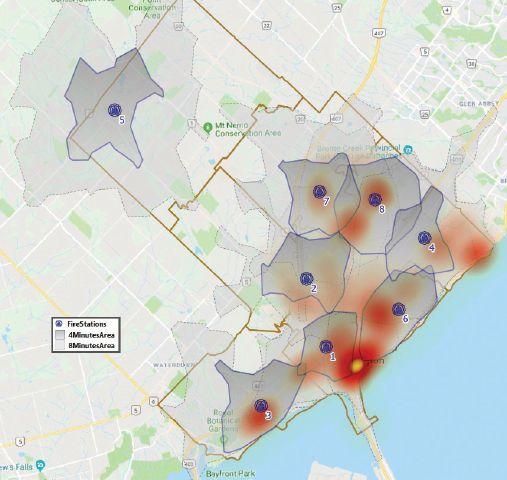
Last, the travel time is the elapsed time from when a truck starts to respond until its arrival on the scene. Based on the requirement of NFPA, the standard travel times are four minutes for first-due trucks and eight minutes for full assignments. Due to the complexity, I am not going to delve too deep on the travel times. Travel times vary and depend on population densities, road traffic volumes, and road conditions like potholes and speed bumps, etc. Rather, I’ll focus on the role that I can play by using the technology without additional resources. Using the big data collected by the Open Route Service and Open Street Map Service, the estimated cover area driving from stations in four minutes and eight minutes are created in GIS as a layer. By overlaying this layer with the heat map generated from the raw incident data, it gives the decision maker a picture of where is covered in four minutes driving time and where is covered in the eight minutes driving time (Figure 3).
This case study was created using free open source software.
Jin Y. Xie is a PhD and GIS specialist. He has over 16 years of experience, including working for police, fire, Ontario municipalities and Saskatchewan Wildfire Management. Xie is currently an application analyst serving Burlington Fire and Rescue.
Figure 2: Incidents (Code 2 from 2016 to 2018) turned out in more than 80 seconds by platoons and stations.
Figure 3: Heat map with station covering area in four minutes and eight minutes.
TRAINER’SCORNER
Honing your conflict resolution skills
By ED BROUWER
During my 30 years of being a training officer in a volunteer department, I have witnessed a lot of changes. Our bunker gear is lighter and safer, our SCBA is much more efficient and with the introduction of computers (yes, I remember when we didn’t have one in the hall) our communications, pre-plans, record keeping, training and resources are state-of-the-art.
Yet, in my opinion there is still one area of grave concern in today’s volunteer, paid-on-call fire departments. Here it is: volunteer firefighters taking on an officer’s role without really understanding that role, be it lieutenant or chief. Although many are more than willing to do a good job, they are not provided with any kind of training.
There are three books I recommend for every fire officer: Igniting the Leader Within: Inspiring Motivating, and Influencing Others by Michael F. Staley; Fire Officer Principles and Practice by Michael J. Ward and Making a Difference: The Fire Officer’s Role published by Onguard Inc.
It may surprise you but the biggest obstacle for officers is not administrative in nature, nor is it training, or being the incident commander on the fireground. It is dealing with the departments most valuable commodity — the firefighters themselves.
What has most drained my energy and zeal for fire fighting these past years is having to deal with difficult people. As an officer you will be called on to deal with interpersonal conflict among your members and I’m not referring to a simple disagreement between two firefighters. An interpersonal conflict is a disagreement between two or more people or subgroups of an organization involving significant resentment and unhappiness.
Some of the most difficult situations for a fire officer are times when you must act as the referee between firefighters. Not being able to size up these situations can worsen the conflict, or worse, drag you into it.
Officers need to be taught how to recognize and resolve problems when they are small. A good leader knows that conflict resolution begins before the struggle occurs. It may help to keep a watch over those members who can be difficult, and get to know their triggers.
We all know people who are hard to deal with. Some people are too demanding or abrasive, others may be arrogant or emotionally abusive. It may help to consider that everybody is somebody’s difficult person. However, there is a big difference between being difficult and being toxic. Dealing with toxic people is like walking in a minefield; it can be quite stressful. Taking the wrong approach with these firefighters can make matters worse rather than better.
Avoidance does not work. If a problem escalates to where two people argue constantly and spread rumors about each other, you
Officers need to be taught how to recognize and resolve problems when they are small.
will have a much harder time resolving the underlying conflict. It is possible for an officer to both overreact and underreact. I refer to these as “over and under” problems.
As an officer, your most useful role in conflict resolution is being a neutral third party. You cannot do this if you appear to take sides in the dispute. Yes, sometimes one person is more at fault than another, but when you’re dealing with an ongoing conflict that continues to escalate, it is likely that both members are involved in the battle. If you have a conflict of interest and it is impossible to remain neutral, you should ask for help from someone who can be neutral, such as another officer. Officers must also learn how to recognize problems that are beyond their scope of authority or influence and know how to get help in these situations.
Along with the three officer books I recommended, as a chaplin, my go to book is the Bible. There is a wealth of information contained within its pages regarding conflict resolution. One verse in particular reads, “A hot-tempered person stirs up conflict, but the one who is patient calms a quarrel.” Proverbs 15:18.
Basically, hot tempers cause arguments, but patience brings peace. As an officer dealing with members in conflict, it is imperative you
stay on point and remain patient and calm. I have friends who love to stir things up, they will argue for the sake of arguing. There is no place for that in an already toxic environment.
Being in a volunteer department means we are open to all sorts of people coming through the hall doors, however not every applicant is a good fit. It is easy to overlook certain indicators of toxicity, especially with the shortage of volunteers. We have had toxic people slip through the cracks and it did not end well. It might be easier if people came with warning signs: Danger: Toxic Person.
Destructive conflict flows from individuals who consistently blame others instead of owning their part of the problem. These people tend to apologize rather than change their behaviour. They become defensive instead of open to feedback. They consistently excuse their behaviour and will come across as being argumentative.
When team cohesion dwindles, team safety suffers. Most certainly the much needed confidence that we have each other’s backs erodes quickly in a toxic environment. Like ingesting poison, a steady diet of destructive conflict can and will kill your department.
Ongoing conflict can manifest as physical stress. This can result in physical changes to an individual, such as low energy, headaches, nausea, aches, pains, tense muscles, chest pain, rapid heartbeats, insomnia, etc. Your whole department can be adversely affected by ongoing conflicts and it is near impossible to recruit new members in a toxic environment of unresolved conflict.
Simply put it isn’t the mountains ahead (the big conflicts) that wear us out, it is the unrepaired pothole that throws our alignment (our harmony and team cohesion) out of whack.
Putting an unequipped officer into these situations is not only unfair, it is a recipe for disaster. To prepare officers, I suggest departments develop officer training classes as well as a conflict resolution team. An officer shouldn’t go it alone.
I’ll wrap up these observations:
• Separate the person from the conflict. Make the conflict impersonal.
• Listening attentively. Hear all sides and ask questions to clarify.
• Analyze the conflict. What factors are the real issues that underlie the conflict?
• Don’t take it personally. You are not responsible for an individual’s corrosive behaviour.
• Stay calm. This is easier said than done. There are times I want to shout, “Are you kidding me! Both of you take a time out.” I then remember a tag line on my wife’s e-mail, “Be kinder than necessary, for everyone you meet is fighting some kind of battle.”
The truth is, we are going to have conflict whether we like it or not. It is a part of life we can’t control. But remember, if conflict is ignored there is a strong chance that it will continue. Stay safe and as always train like lives depend on it, because they do.
Ed Brouwer is the chief instructor for Canwest Fire in Osoyoos, B.C., deputy chief training officer for Greenwood Fire and Rescue, a fire warden, wildland urban interface fire-suppression instructor and ordained disaster-response chaplain. Contact Ed at aka-opa@hotmail.com.
Arrivesafeandontime.
provides extra st s arting and stoppiing traction in slippery con o ditions.
BY TOM DESORCY Fire Chief
Hope Fire Department
British Columbia
TVOLUNTEERVISION
Positivity is contagious
he other day a person said to me, “You look like you have a spring in your step.” This was nice, but in fact there was rock in my shoe. All kidding aside, it’s a reminder that people notice you and all you do. New parents are always reminded that little minds are like sponges that absorb everything they see, especially when they are watching mom and dad. The same goes for someone in a uniform, another position of authority. Add the fact that you’re a firefighter and all bets are off.
Wearing a uniform, a fire department t-shirt or driving a marked fire vehicle can sometimes make you feel like a target. Rest assured you’re being watched and you’re getting noticed. In a small town, you don’t even have to be in uniform because everyone knows who you are and what you do. Do you feel the pressure yet?
I was taught the Golden Rule at an early age, that is to always treat others the way you wish to be treated. My father had a motto that really resonated: “I’ll do anything for anybody if they ask me to do it, but don’t tell me to do it or I won’t.” You should help out anyone and everyone, but those looking for help should be polite and ask. Another motto I learned early in my career is “It’s nice to be important, but it’s more important to be nice.” Pin that one to the bulletin board.
When you go through life with a positive outlook it’s contagious. The same goes for negative nellies in the workplace that always seem to bring down the mood in a room. If you look closely, you can see the dark cloud hanging over them. There is no place for this negativity in the fire department. Yes, there are times for sadness and grief, but to me, maintaining a positive attitude is paramount in building up and supporting your team.
in radio, it also brings back the lessons I was taught growing up in broadcasting. One thing I was taught has become a habit that I will never forget — remember every microphone you see is live or at least treat it that way. Watch what you say whenever you see one and assume it can hear every word you speak. Once this lesson becomes habit, it can save you from many embarrassing situations. Remember and practice it.
The idea that teachers can teach without trying is similar to the fundamentals of parenting. Your kids, no matter their age, will always learn from your example. I hope one of those examples is that they too can make a difference. I’m often reminding people that it only takes one person to cause change, positive or negative. You may not be able to change the world through your positive attitude, but working at it a little at a time will certainly improve the world around you.
I’m not sure where or when I first heard this and while I can’t take credit for it, I always correct a person that tells me “You only live once” by saying, “No, you only die once. You live every day.”
People have problems, and in a volunteer fire department
‘‘ ’’
You might believe that you are only as strong as your weakest link, but this is when you take the steps to strengthen and support that link.”
I try to be a teacher. Not in the traditional classroom sense, but in life in general. The saying that you should always learn something new every day resonates with me and I do my best to instill and help others accomplish that, whether they know it or not.
Recently I started doing podcasts for Fire Fighting in Canada magazine and while this brings back many memories from my days
Tom DeSorcy became the first paid firefighter in his hometown of Hope, B.C., when he became fire chief in 2000. Originally a radio broadcaster, Tom’s voice could be heard in the early 1990s across Canada as one of the hosts of Country Coast to Coast. Tom is very active with the Fire Chiefs’ Association of British Columbia as communications director and conference committee chair. Contact Tom at TDeSorcy@hope.ca and follow him on Twitter at @HopeFireDept.
nothing messes with the fabric and continuity of the organization more than the negativity of its members. If a member has a problem, we all have a problem. That’s the beauty of the team. When something negative threatens the family dynamic, it’s the team that pulls together. You might believe that you are only as strong as your weakest link, but this is when you take the steps to strengthen and support that link.
When looking after your people, I believe that a positive attitude can go a long way to building resiliency and mental health when it comes to negative attitudes. So much is said about traumatic stress and critical incident, but don’t forget there is such a thing as compassion fatigue. Sometimes you’ve just about had enough of dealing with people in general. Remain positive and see beyond others’ problems so they don’t become your own.