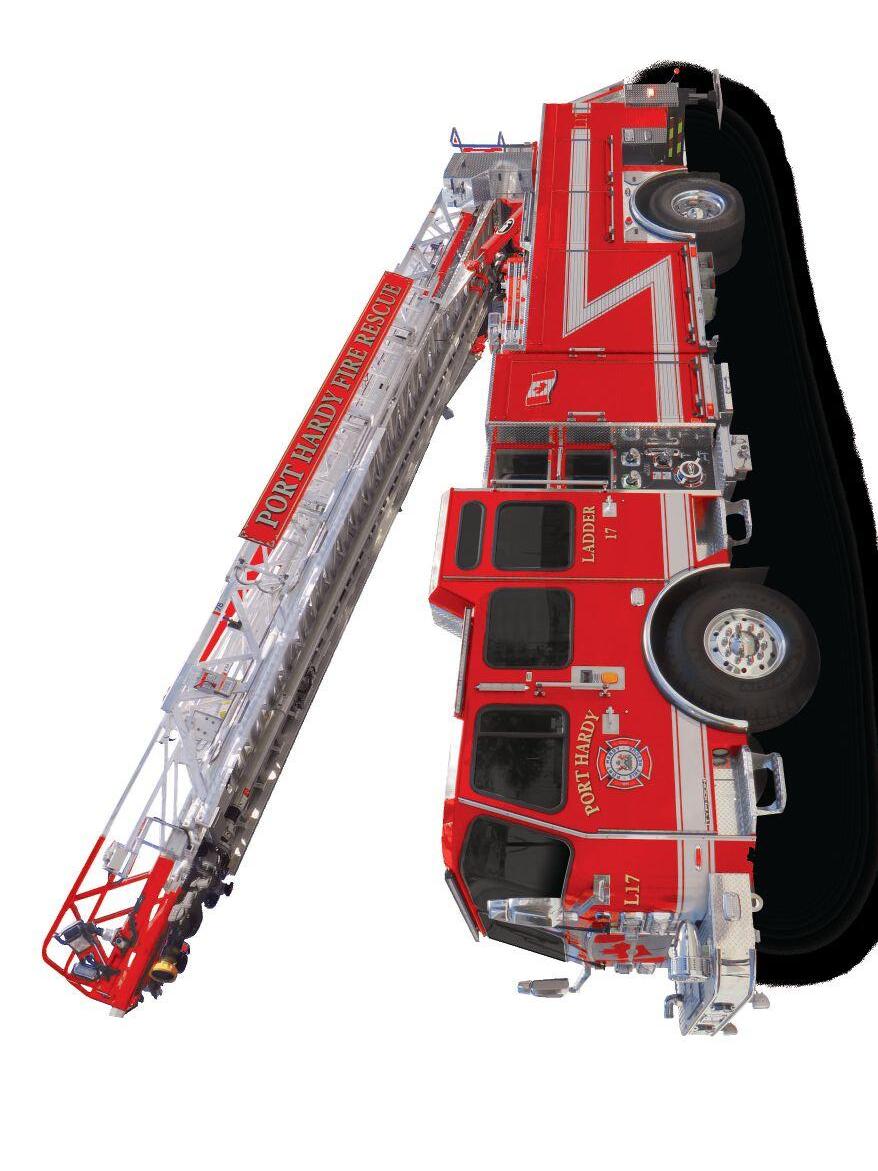
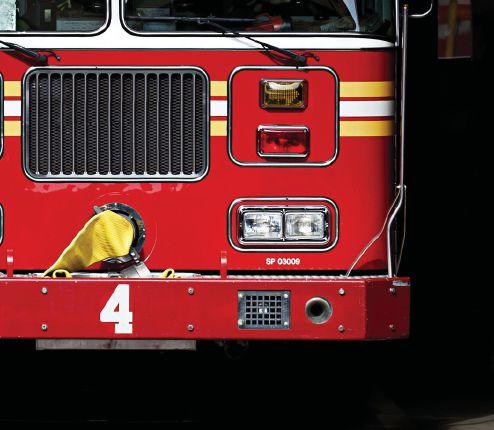
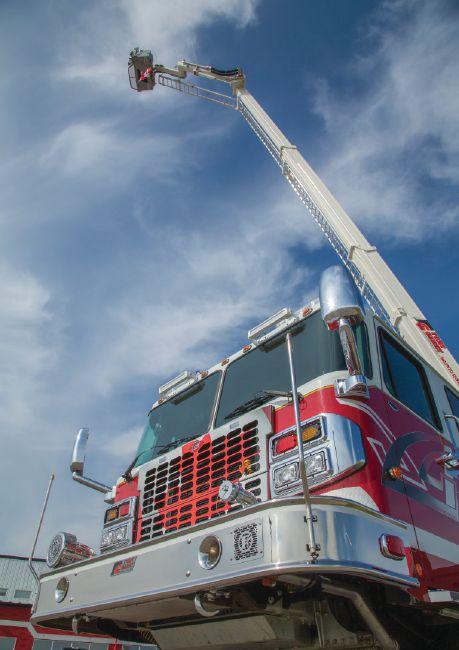
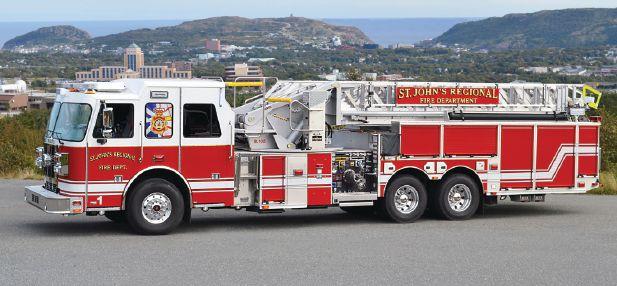
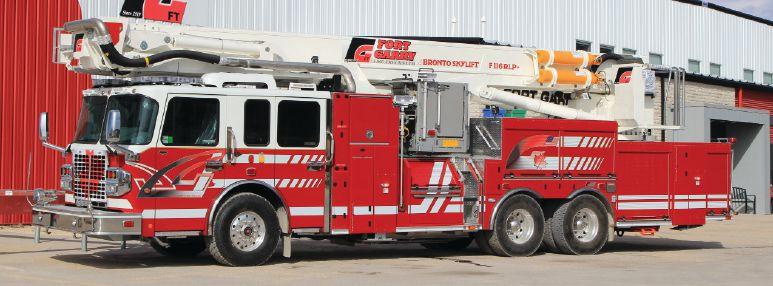
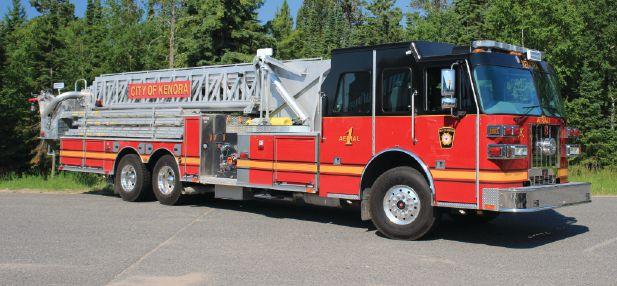
Featuring a 825-pound tip load for increased rescue capability, the HP 78 gets a crew and its gear reliably where it needs to go. The ToughTruss TM ladder design features extruded aluminum construction with a 2.5 to 1 structural safety factor, solidifying E-ONE’s legendary commitment to safety. With the combination of generous compartments, ground ladder storage, hose bed and tank size, the HP 78, like every aerial we make, is revolutionary! For more information, visit: http://www.e-one.com/aerials
10
A MAN WHO’S ON A MISSION
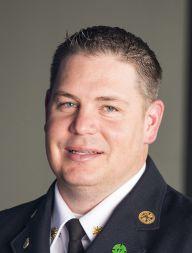
Jeremy Inglis, deputy fire chief at the Fort Erie Fire Department in Ontario, is working with other emergency services to raise awareness of human trafficking in Canada
12
REGIONALIZATION PROS AND CONS
Bringing fire departments under a single banner has its good and bad points. Kirk Hughes, deputy fire chief of the M.D. of Taber Regional Fire Department in Alberta, writes about what municipal councils and fire departments need to think about when considering regionalization.
18
EFFECTIVE LEADERSHIP
What does it take to be an effective leader in the fire service and government? Len Garis, fire chief for the City of Surrey, B.C., writes about research that delved into the issue of leadership traits. The research found that organizations are seeking leaders who are ethical and have the courage to do the right thing.
BY GRANT CAMERON Editor gcameron@annexbusinessmedia.com
S
COMMENT
Funds for the Fire Service
o, it’s official. Recreational use of cannabis is now legal in Canada. Let the games begin.
Whatever your position on pot, the move is sure to affect fire departments across the country – on both the safety front and in the pocketbook.
Let me explain.
Cannabis comes with its own set of fire hazards, particularly in residential settings. At least that’s what the experience in Colorado has shown us. There have been instances of grow sites, mostly illegal, that have resulted in fires because of issues with overloaded circuits and heat lamps.
So-called butane honey oil extraction – one method of processing cannabis at home – is extremely dangerous and can pose a safety hazard. It involves using a strong flammable solvent, usually butane, but sometimes propane, to extract THC and produce a highly-potent marijuana derivative.
though, legalization of weed will put a financial squeeze on fire departments and municipalities, as they’ll have to fork out more money for education, training and inspections.
In Colorado, for example, fire code violations increased significantly as a result of the legalization of marijuana.
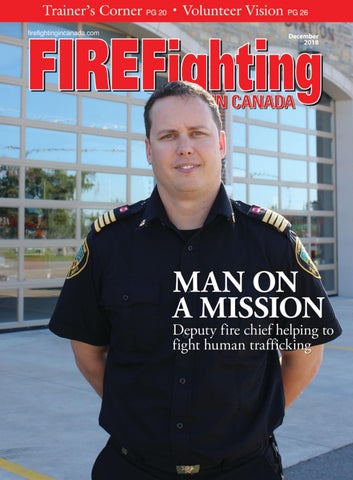
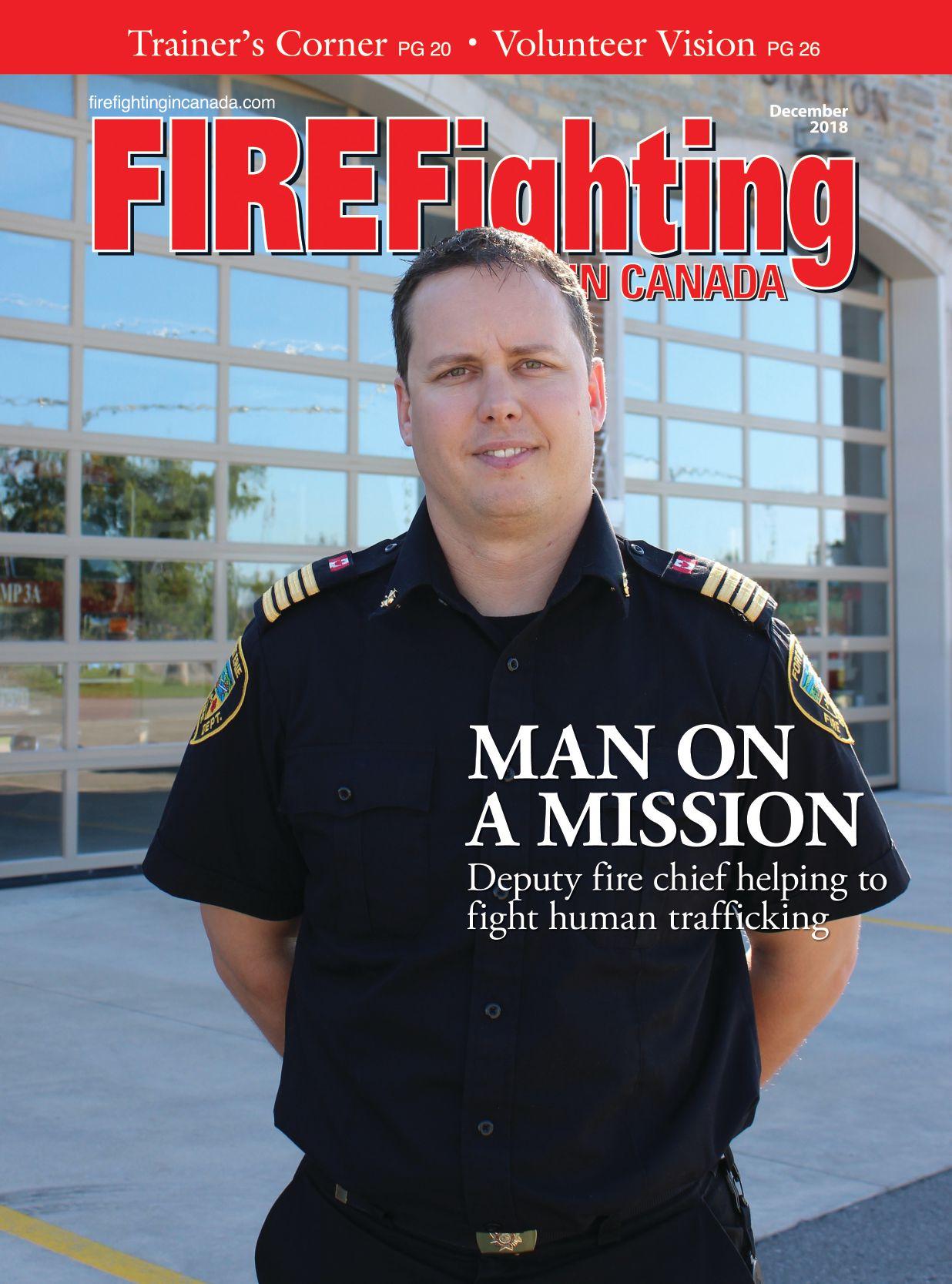
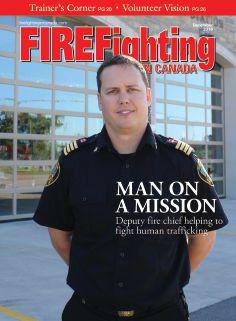
ON THE COVER Fort Erie Fire Department
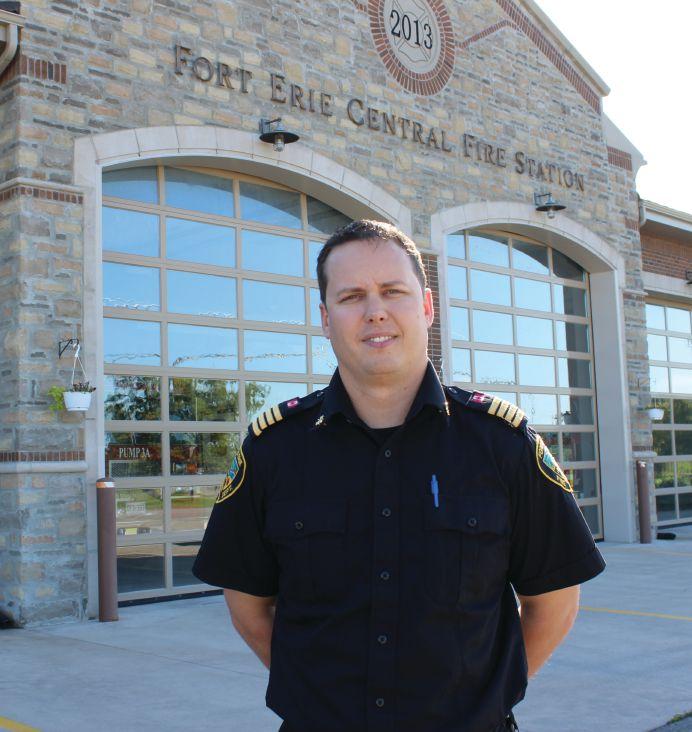
Deputy Chief Jeremy Inglis has been working to raise awareness of how firefighters can combat human trafficking.
See story on page 8.
The fire service in London, Ont., knows this all too well. Firefighters there have already responded to a number of such calls. Last December, for example, an explosion in the basement of a home caused by cannabis processing blasted the bricks off the outside of the house and seriously injured a man.
The Ontario Fire Marshal’s office reports that it has probed 40 butane extraction-related fires or explosions in the last five years. The fire department in Halifax, N.S., meanwhile, has also had to deal with fires caused by illegal grow ops.
Apart from the safety side of things,
Last year, the government announced $274 million for border efforts and police training related to legalization of marijuana. But the fire service also needs funding.
Governments, both federal and provincial, are in for a tax windfall when weed is legalized. A study conducted by business services firm Deloitte figures the total impact of the legal cannabis market on the Canadian economy will amount to between $12.7 billion and $22.6 billion annually.
Fire departments across Canada deserve to be funded appropriately. The Canadian Association of Fire Chiefs has called on the feds to provide more money to fire departments because legalization of pot will result in increased costs for training, inspections and education. The association made its point crystal clear when it provided feedback to the feds on the issue.
Costs of the added duties will put further strain on already under-resourced fire departments. They shouldn’t be on the hook for the costs.
ESTABLISHED 1957 DECEMBER 2018 VOL. 62 NO. 8
EDITOR GRANT CAMERON gcameron@annexbusinessmedia.com 416-522-1595
Occasionally, Fire Fighting in Canada will mail information on behalf of industry-related groups whose products and services we believe may be of interest to you. If you prefer not to receive this information, please contact our circulation department in any of the four ways listed above.
All advertising is subject to the publisher’s approval. Such approval does not imply any endorsement of the products or services advertised. Publisher reserves the right to refuse advertising that does not meet the standards of the publication.
www.firefightingincanada.com
PHOTO BY SARAH FERGUSON
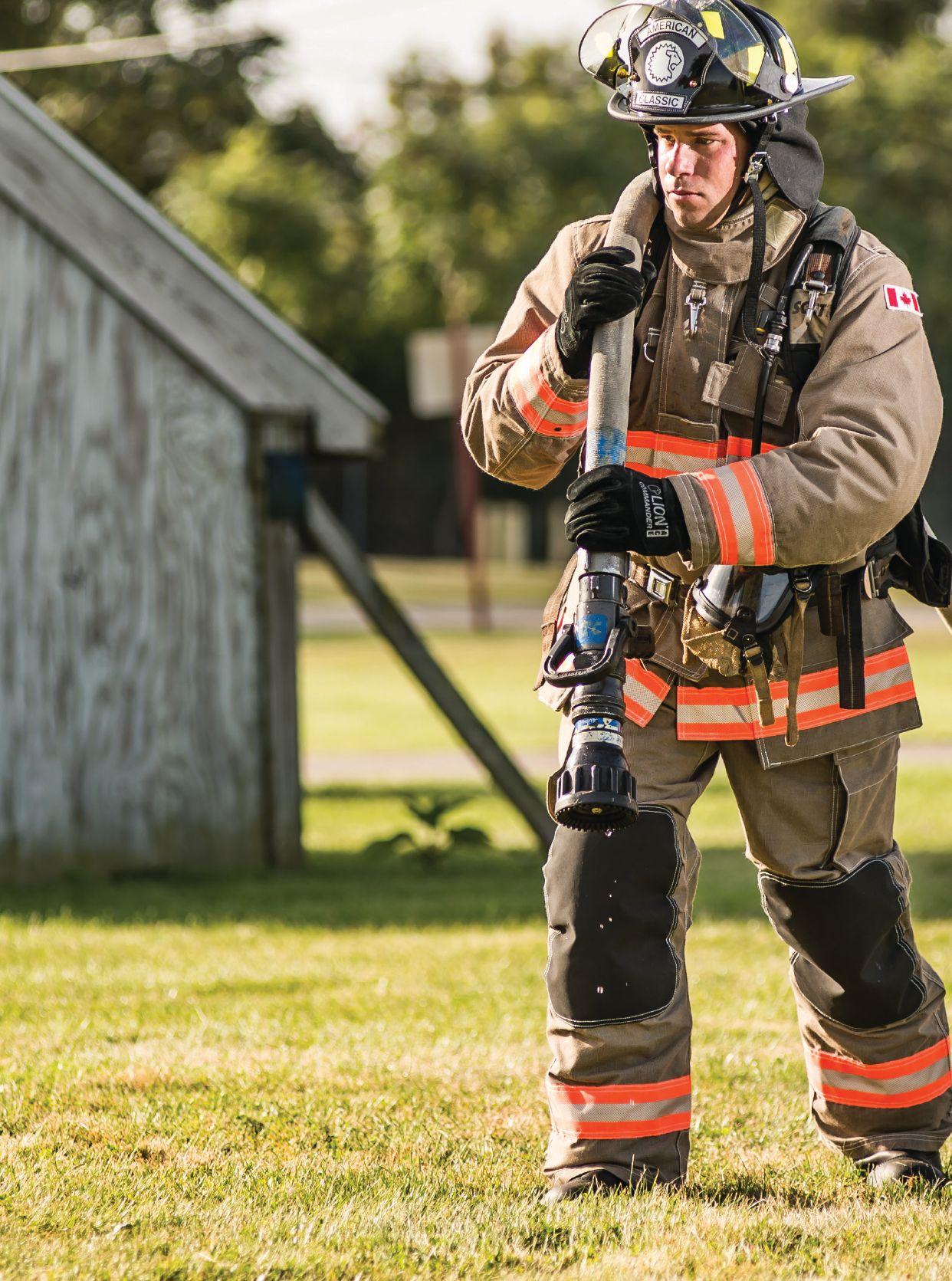
Loaded with safety, comfort and mobility features for unmatched performance, Flame Fighter® bunker gear offers a variety of custom outer shell fabric, liner system, hardware and pocket options to fit your specific needs.
• Patented IsoDri®* moisture management reduces the water absorbtion and helps gear dry faster between runs
• Exclusive Ventilated Trim™ allows vapor to be released, reducing the risk of scald burns
• Thermashield™ provides an additional layer of liner material in the upper back and shoulders to protect against compression burns
• Move-N-Hance™ crotch gusset increases mobility by reducing bunching, twisting and pulling
• Flex Knee™ for easy, natural movement
• Stay Rite™ sleeve wells integrate the sleeve’s liner into a full-length wristlet so that when you reach, the entire sleeve moves with you
For more information about Flame Fighter bunker gear, contact your Starfield LION sales representative at 1.800.473.5553 or visit us online.
STATIONtoSTATION
ACROSS CANADA: Regional news briefs
Firefighters gather for Burn Fund milestone
The B.C. Professional Fire Fighters’ Burn Fund celebrated its 40th anniversary Oct. 18 by hosting more than 40 local firefighters at Capilano Suspension Bridge Park in Vancouver.
The Burn Fund is a registered charity established in April 1978 by the B.C. Professional Fire Fighters and provides life-saving, life-supporting, and life-enriching services to the people in B.C.
Throughout its history, the Burn Fund has played a major role in enhancing the quality of care a burn and trauma patient receives from bedside through to recovery.
The Burn Fund and Capilano Suspension Bridge Park are linked by events that took place in 2007.
That year, severe winter storms caused major damage to the Bright Nights Christmas lights display in Stanley Park, severely impacting donations to the annual Burn Fund.
At the same time, a 46-ton tree fell onto Capilano Suspension Bridge, closing the park for five months.
To celebrate the bridge re-opening, Nancy Stibbard, owner and CEO of Capilano Group, decided to hold a fundraiser for the Burn Fund to help replenish lost donations from its annual holiday event.
That was the beginning of a beautiful friendship, as partial proceeds from Canyon Lights at Capilano Suspension Bridge Park have been donated to the Burn Fund ever since.
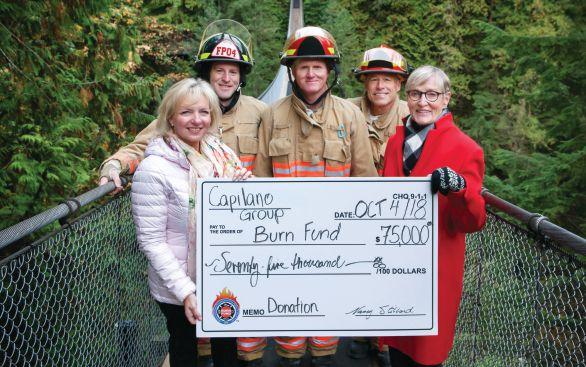
This year, a donation of $75,000 was made to the Burn Fund. Through the generosity of donors such as the Capilano Group, the Burn Fund has achieved many significant accomplishments. This includes the notable achievement of completing a $13.1-million capital campaign to raise funds to build the new Burn Fund Centre in 2015 – a home away from home for burn and trauma survivors.
Stibbard’s donations have exceeded $425,000 and her continued financial support through Canyon Lights has played a signif-
THE BRASS POLE
Promotions & appointments
Sherwood Park’s JEFF HUTTON has been appointed as the new director of emergency services and fire chief for Strathcona County. Hutton has been working with Strathcona County for 37 years, including serving as the utilities director for 12 years. He also has advanced training in leadership and emergency man-
agement. In the past, Hutton has worked with emergency services as part of an incident management team that was deployed to High River in 2013, as well as with the incident management team that oversaw the Fort McMurray and area evacuee response in Strathcona County during the fires in 2016.
The City of Revelstoke, Alta., has hired Assistant Fire Chief
Burn Fund executive director Lisa Beck (left), B.C. Burn Fund director Grant Smith of North Vancouver Fire Fighters Local 1183 (centre), Capilano Group owner and CEO Nancy Stibbard (right), and firefighters with a cheque for $75,000 to the Burn Fund.
icant role in bringing awareness to the Burn Fund. She will be recognized at a Responder Dinner Gala on April 27, 2019.
The B.C. Professional Fire Fighters’ Burn Fund has been providing prevention and survivor support programs and funding medical care and training for the people of B.C. and the Yukon for almost four decades.
The Burn Fund has been built by more than 3,800 professional firefighters from 53 communities in B.C. and the Yukon who dedicate their funds and time to the cause.
– Grant Cameron
DWAYNE VOYKIN as the new Fire Chief. Voykin was the training officer and emergency program co-ordinator as well as the assistant fire chief. He has lived in Revelstoke for 25 years and has more than 21 years of experience with Revelstoke Fire Rescue Services: 10 as a volunteer firefighter and the past 11 as a career firefighter.
The Resort Municipality of
Whistler has a new fire chief. The municipality announced the hiring of former City of Vancouver Fire Chief JOHN MCKEARNEY in October in a press release. “We are very pleased to welcome John to our organization as he begins the Whistler Fire Rescue Service chapter of his career,” said Whistler chief administrative officer Mike Furey in the release. “John brings exten-
PHOTO:
B.C. PROFESSIONAL FIRE FIGHTERS’ BURN FUND
New law would help to improve firefighter safety
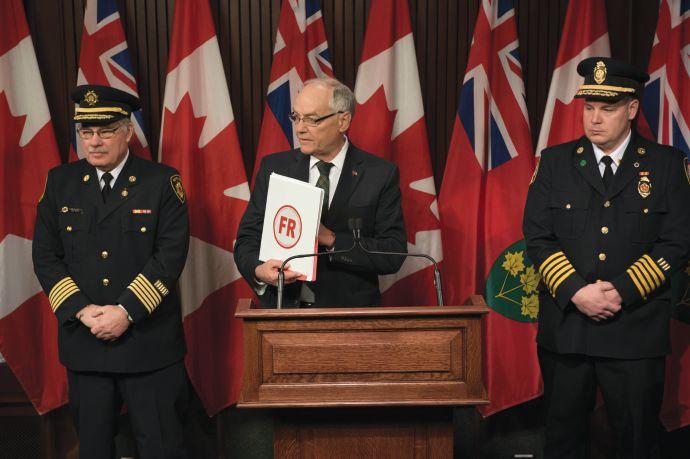
Legislation has been proposed in Ontario that would make it safer for firefighters when they’re trying to extinguish blazes at buildings constructed using truss and lightweight construction, or TLC.
Randy Pettapiece, MPP for PerthWellington in Ontario, has re-introduced the Rea and Walter Act (Truss and Lightweight Construction Identification) at Queen’s Park in an effort to improve firefighter safety.
The Act, known as Bill 33, will require commercial and industrial buildings in the province, as well as certain multi-family dwellings using TLC. to be marked by an identification emblem.
Buildings containing TLC will be required to post one of three emblems:
• “F” decals if only the floor of the building uses TLC.
• “R” decals if only the roof of the building uses TLC.
• “FR” decals if both the floor and the roof of the building use TLC.
The Act is in honour of North Perth fire service members Ken Rea and Ray Walter who died in 2011 when the roof of a store constructed with TLC collapsed while they were fighting a fire.
As of press time, the legislation had passed second reading in the Ontario Legislature with all-party support and had been moved to the Standing Committee on Regulations and Private Bills.
“Firefighters need to know which buildings contain truss and lightweight construction,” Pettapiece said. “When a fire breaks out they need to know how to attack it safely.”
The Rea and Walter Act was wiped off the legislative agenda when the previous Liberal government prorogued the Legislature in March 2018.
Pettapiece noted that a fire at Tim Horton’s in Arthur, Ont., on July 21 demonstrated once again the need for truss and lightweight construction identification.
In response to the incident, Wellington North Fire Service Chief Dave Guilbault said, “We were not aware that the roof trusses were lightweight. There was no way of knowing. There could have been serious injuries or loss of life.”
Pettapiece said the Rea and Walter Act will restore trust and accountability between fire departments, municipalities
and small business owners.
“I am looking forward to working with all of my colleagues and stakeholder groups across the province,” he said. “It is the minimum standard our firefighters should expect.”
Groups such as the Ontario Association of Fire Chiefs, the Insurance Bureau of Canada, Ontario Building Association, and Ontario Society of Professional Engineers support the Rea and Walter Act.
“I’m grateful for the support I have received on both sides of the aisle for this Act,” said Pettapiece. “Firefighter safety is a non-partisan issue, and together we are helping to enhance their safety.”
– Grant Cameron
sive experience in firefighting work as well as organizational leadership and will be a great asset to the team.” McKearney comes to Whistler from the City of Vancouver, where he started as a floor firefighter and worked his way up the ranks, serving as lieutenant on the rescue squad and training officer before being promoted to deputy chief and then fire chief.
Retirements
Penticton Fire Department
Captain KEN YOUNGHUSBAND is retiring after more than three decades of service in British Columbia. Younghusband will be kicking off his retirement with a trip across Canada with his wife, as well as spending plenty of time with his grandchildren.
Younghusband said he will for sure miss riding around in the fire truck.
Last Alarm
Perth Fire Department’s first full-time fire chief has died at the age of 77 after a brief battle with cancer. DAVID “DAVE” BELL died on Thursday,
Oct. 19. He grew up in Perth, Ont., and volunteered with the Perth Fire Department. He rose through the ranks of the fire service, becoming Perth’s first fulltime fire chief in 1993. He also distinguished himself with several awards for his acts of bravery. He won the Golden Helmet in 1979, the Ontario Medal for Firefighters Bravery in 1984, and the Star of Courage the same year.
(L to R) North Perth Fire Department Chief Ed Smith, Perth-Wellington MPP Randy Pettapiece, and Minto Fire Department Chief Chris Harrow announcing the Rea and Walter Act.
STATIONtoSTATION
BRIGADE NEWS: From departments across Canada
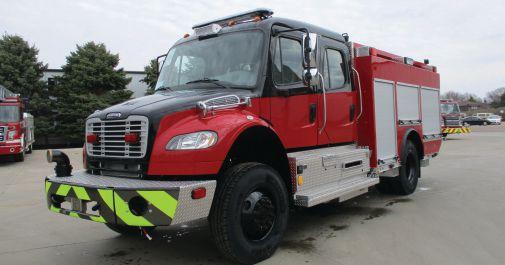
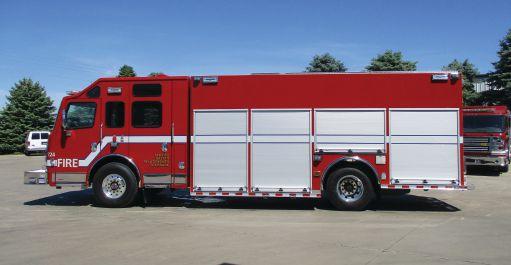
The fire department in St. Catherine De La Jacques Cartier, Que., received a truck recently. The pump was manufactured by Rosenbauer and has a 350 hp Cummins engine that sits on a Freightliner M2-106 chassis. It has a rear-mounted pump, a single axle and an NH55 pump.
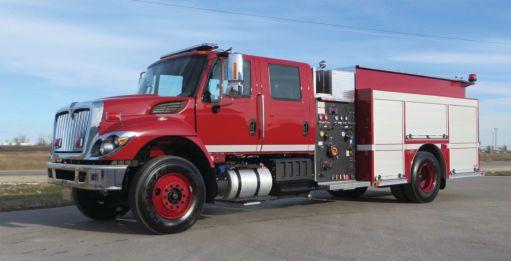
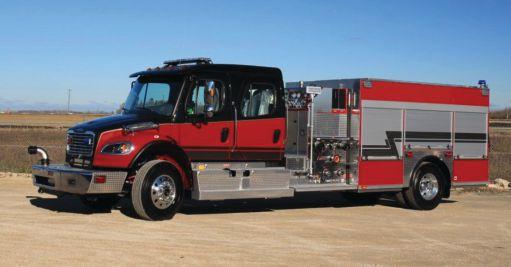
The fire department in Georgian Bay, Ont., received a new pumper in the fall. The new truck sits on an International 7400 chassis and has a Hale DSD 1250 pump. Its Crusader body style is made of marinegrade Aluminum 5052 and its tank is made of CoPoly (800 imperial gallons).
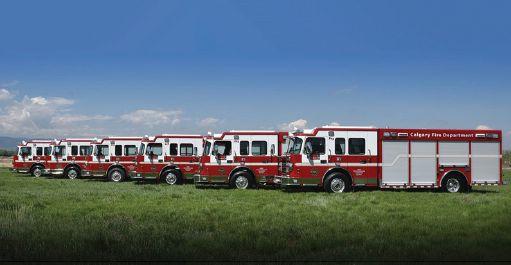
The Calgary Fire Department is accepting delivery of six new SVI custom heavy rescues. They are built on a Spartan Metro Star chassis and powered by Cummins ISL 450 hp engines, with Allison 3000 EVSP transmissions. The trucks feature ROM roll-up doors, Onan 30kw generators, CL 615 command light towers, two 200-foot electrical cord reels, and four Holmatro 100-foot core reels mounted on an on-scene slide out tray in the rear compartment.
Amherstburg Fire Department in Ontario received new apparatus in October. The new truck is a 2019 model year and has a Freightliner M2 106 chassis. The truck has a Waterous 1500 pump and is an Emergency Rescue vehicle with an Alum 5083 construction (salt water marine grade). It has a CoPoly (800 imperial gallons) tank.
Edmonton Fire Rescue Services recently received delivery of a new truck from Rocky Mountain Phoenix. The new truck sits on an RBM commander chassis and has a Cummins 450 hp engine. The truck has an FX body style and is single axle.
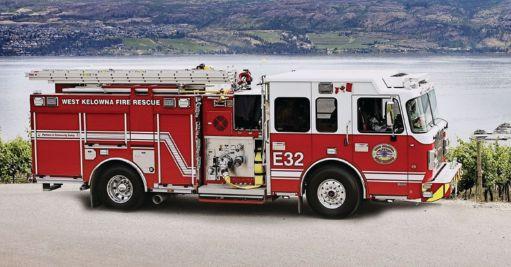
West Kelowna Fire Rescue recently took delivery of a new Smeal Custom Pumper. The pumper is built on a Spartan Gladiator chassis and powered by a Cummins ISX15 550 hp engine, with an Allison 4000 EVS transmission. The pumper features a Waterous CSU 2250 GPM pump and carries 500 imperial gallons of water. It has a Waterous Advantus 6 Foam System and an Electric Akron Deck Master 3440 Monitor.
GEORGIAN BAY FIRE DEPARTMENT
FIRE DEPARTMENT IN ST. CATHERINE DE LA JACQUES CARTIER
CALGARY FIRE DEPARTMENT
AMHERSTBURG FIRE DEPARTMENT, ONT.
EDMONTON FIRE RESCUE SERVICES
WEST KELOWNA FIRE RESCUE
BY GORD SCHREINER Fire chief, Comox, B.C.
WSTOPBAD
Firefighters need to be constantly training
hat makes us firefighters? Well, it is not our cool hats and t-shirts. Nor is it our uniforms, personal protective clothing, fancy rigs or bumper stickers, expensive equipment, or our fire stations and badges. It’s our training.
Training is what makes us a firefighter. Great training can make us great firefighters. Without training, a firefighter is just another civilian dressed up to look like a firefighter.
It’s important to note that it’s too late to train tomorrow for the incident you are responding to today.
Great firefighters are constantly training. This includes physical training, constantly reading fire service publications and constantly taking on new training.
Great firefighters learn from others, including reviewing recent line-of-duty deaths and injuries.
The fire service is like no other industry. Big changes are happening in the fire service and we cannot always do what we always did. We need to be constantly training for our next incidents, without knowing when, where or what that incident will be.
In all of my travels, I have yet to meet a firefighter who does not agree that training is probably the single most important thing we do. I have met quite a few, though, that talk the talk but don’t walk the walk.
Those firefighters are quick with lots of excuses as to why they or their departments don’t train much. But, there is no excuse for not training. I’ve heard all the excuses – the budget is small, it’s too cold or too wet, there’s not enough time, or I already know everything. These excuses just do not cut it. Get out and train like lives depend on you getting it right the first time because they do.
I challenge my firefighters to keep thinking up new ideas, which are practical yet don’t cost a lot for our training centre. Even if they do not come up with any new ideas, they have probably learned something about fire service training just by looking.
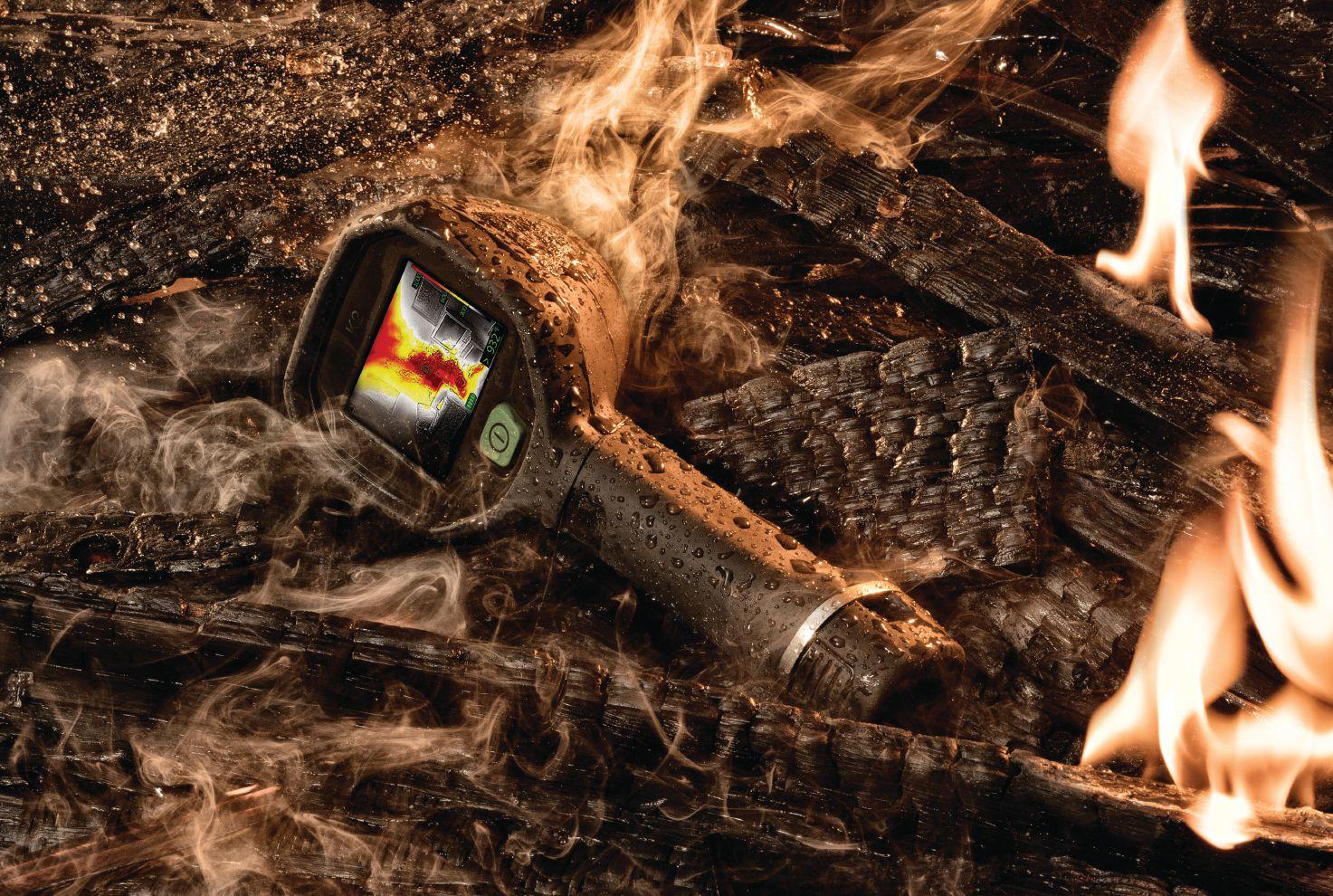
Here is a hot idea. We recently added a sauna for dummies. Using an infrared heater, we heat up our rescue dummies then place them in a cooler room where we can search for them in artificial smoke, using thermal imaging cameras. The hot dummies look real as they provide a great thermal signature.
What’s wrong with hitting a hydrant, stretching a line, donning SCBA and throwing a ladder on a false alarm run? If your firefighters are on the rig, why not ask them to practice one of their common procedures to ensure they are not getting rusty? It only takes a few minutes to stretch that pre-connect, show water and put it back in place for the next call.
Your next run might involve a child trapped where precious seconds will make a difference. Wouldn’t it be great for you to get it right?
Once you have the basics nailed down you can then expand to other techniques such as vent, enter, isolate and search.
Without training, a firefighter is just another civilian dressed up to look like a firefighter.
’’
Training resources are abundant, you just need to look. The Internet is full of fire service lesson plans, training props and scenarios. Other fire departments will bend over backwards to share with you. There is a lot of great software out there for training, and much of it is inexpensive.
In my department you will find training going on almost every day. We have added some training components to our on-board iPads. Each rig and officer has our latest lesson plans, complete with photos and videos. We have built our own training centre which includes dozens of props.
Gord Schreiner joined the fire service in 1975 and is a full-time fire chief in Comox, B.C., where he also manages the Comox Fire Training Centre. Contact him at firehall@comox.ca and follow him on Twitter at @comoxfire.
Our firefighters love to train and I am proud that they are very well trained. However, we are not stopping and continue to make our team even stronger by providing more great training. I know we can be called upon at any time to deliver an excellent response to an emergency.
Good training pays off in terms of successful incidents. Victims are rescued, fires are extinguished quicker and, most importantly, our firefighters are safer.
After recent fires, some of our firefighters have commented that the incidents were very much like a training scenario. We practice like we play and we train like our lives depend on it because they do
We keep our training challenging and exciting. I find that reminding our firefighters that lives depend on us helps to keep them motivated. So, get out and push your department to train more.
Remember, if it is predictable it should be preventable.
A Man who’s on a Mission
How the fire service can help in the fight against human trafficking
By GRANT CAMERON
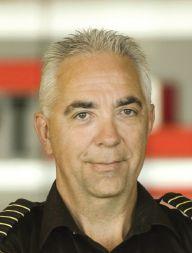
Jeremy Inglis, deputy fire chief at the Fort Erie Fire Department in Ontario, is a man on a very specific mission.
For the past three years, he’s been working with police, emergency services and agencies in the Niagara Region in Ontario to raise awareness of human trafficking and the role firefighters can play in stopping the heinous crime.
“As firefighters, we can play a vital role in the fight against human trafficking of these young women and girls,” he says. “Each year, firefighters in Canada have tens of thousands of interactions with the public. These are potentially hundreds of interactions with trafficking victims, hundreds of opportunities to hear someone’s cry for help, hundreds of opportunities to develop a rapport with victims, and hundreds of opportunities to help someone get their life back.”
Inglis, who has more than a decade of experience as an active firefighter and training officer, says firefighters can play a big role in exposing the crime and helping victims escape from their handlers because those in the fire service are often in a perfect position to spot signs of trafficking.
Firefighters often deal with the public on emergency calls and while on inspections and serving in the community, he says, and, if properly trained to look for potential problems, could make a difference.
Inglis figures that firefighters can have an impact on human trafficking if they learn more about the issue.
He wants firefighters across the country to sign up for specific training and be on the lookout for cases of human trafficking, something their counterparts in the U.S. have been doing for years.
“For much of the fire service in Canada, we are late to the game. But we can catch
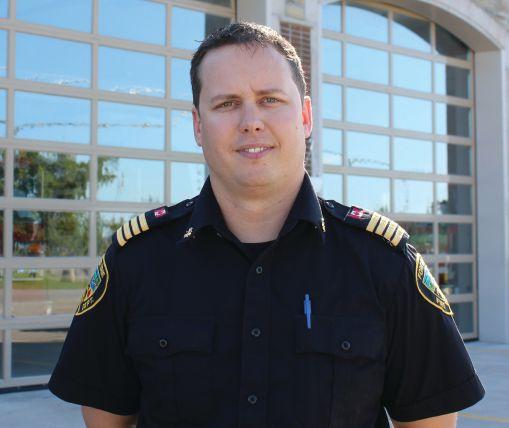
Jeremy Inglis, deputy fire chief at the Fort Erie Fire Department in Ontario, says firefighters can play a big role in exposing the crime of human trafficking and helping victims escape their handlers.
up. Training your department on how to identify and report human trafficking may help someone get their life back.”
The Fort Erie Fire Department and agencies in the Niagara Region have banded together to create a regional emergency response protocol and resource map for the area. A training program has also been developed to help members of the fire service identify and report suspected cases of trafficking.
As many as 10 training sessions have been held, Inglis says, and the agencies
have already received a tip from one of the fire departments about a suspected human trafficking case, so there has been some success early on. A couple of fire departments in other parts of Canada have also expressed interest in learning more and the agencies are hoping to deliver training in the new year.
The extent of human trafficking is difficult to assess, but as of press time 127 girls were being advertised for sexual services in Niagara Region alone.
According to research done by Inglis,
66 per cent of sex trafficking victims in Canada are in Ontario. Most are women between ages 18 and 34, but girls as young as 11 have been identified.
“By no means is this a problem in the Niagara Region alone,” says Inglis, noting that girls are being advertised for sex in a number of communities across Ontario and that since 2005 the Royal Canadian Mounted Police has reported 455 cases in which human trafficking charges have been laid.
“This is just the tip of the iceberg,” Inglis says. “It is estimated that, on any given day, there are up to 15,000 postings for girls who are being advertised for sexual services across Canada.”
Inglis says most of the victims being trafficked in Canada are Canadian.
“If you have a daughter in high school, college or university, ask her if she knows of anyone who has been approached, recruited, or groomed by potential traffickers.” he says. “Chances are she will know of someone from her school that has been affected by human trafficking.”
Traffickers use Facebook and Tinder, Sugar Daddies, and various other online dating and social media sites to organize “dates” with the victims, which is the start of the recruitment phase.
A common method of manipulating victims into human trafficking is called the “Boyfriend Experience” whereby the
trafficker preys on vulnerable victims, either through social media, youth shelters, and/or drug rehab groups. They’ve even been caught trying to recruit girls at high schools, colleges, and universities.
The so-called boyfriend will stage a meeting between himself or a co-conspirator and the victim, Inglis says, and everything will start out much like a new couple starting to date, with the pimp showering the victim with expensive gifts like clothing, jewelry, cell phones and vacations.
The grooming may go on for months before the boyfriend starts mind games used to manipulate the victim into becoming completely dependent on the pimp.
In many cases, Inglis says, the pimp will get the victim hooked on drugs and cycle her through withdrawal to add a further level of control. Because of this level of manipulation, it takes a victim an average of seven attempts to escape before she is successful.
“This is why, when a victim comes forward and is asking for help, we must be there and we must be ready to help.”
Inglis says one victim can bring in more than $250,000 a year for her pimp and, according to Victim Services Niagara, a pimp running a stable of girls can easily bring in $1 million or more a year.
Inglis says firefighters can help stop the cycle of human trafficking by looking for common warning signs.
“There are many signs that a person is potentially being trafficked,” he notes, one of the key indicators being that victims might not speak for themselves or their words or actions are directed by someone else.
Other signs include:
• The person is involved in prostitution against his or her will.
• The person may not know the person he or she is with.
• The person may refer to the person he or she is with as “boyfriend.”
• There may be drugs or large sums of cash nearby.
• The person may be inappropriately dressed for the time of year or conditions.
• The person may show signs of abuse, neglect, malnutrition, addiction.
• A group of people may all have similar tattoos or branding in similar locations on their bodies.
• The person isn’t in possession of ID or someone else has his or her ID.
• The person may appear very anxious around people in uniforms.
• The person may have multiple cell phones going off very frequently.
• The person may be in possession of multiple hotel/motel keys.
To enquire about fire department training to spot human trafficking, contact Inglis at jinglis@forterie.ca.
Regionalization Pros & Cons
Bringing fire departments under a single banner has its good and bad points
By KIRK HUGHES
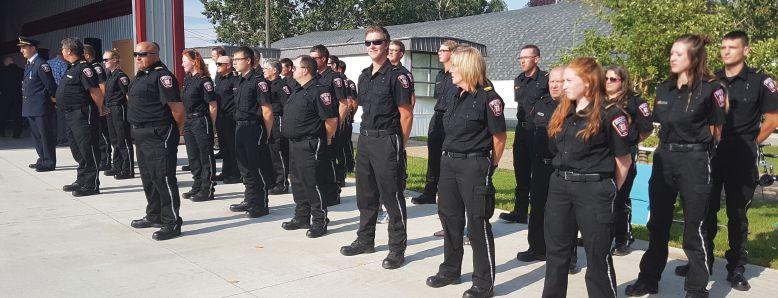
The concept of regionalization in the fire service has been around for a number of years now, but recent factors have accelerated the concept further.
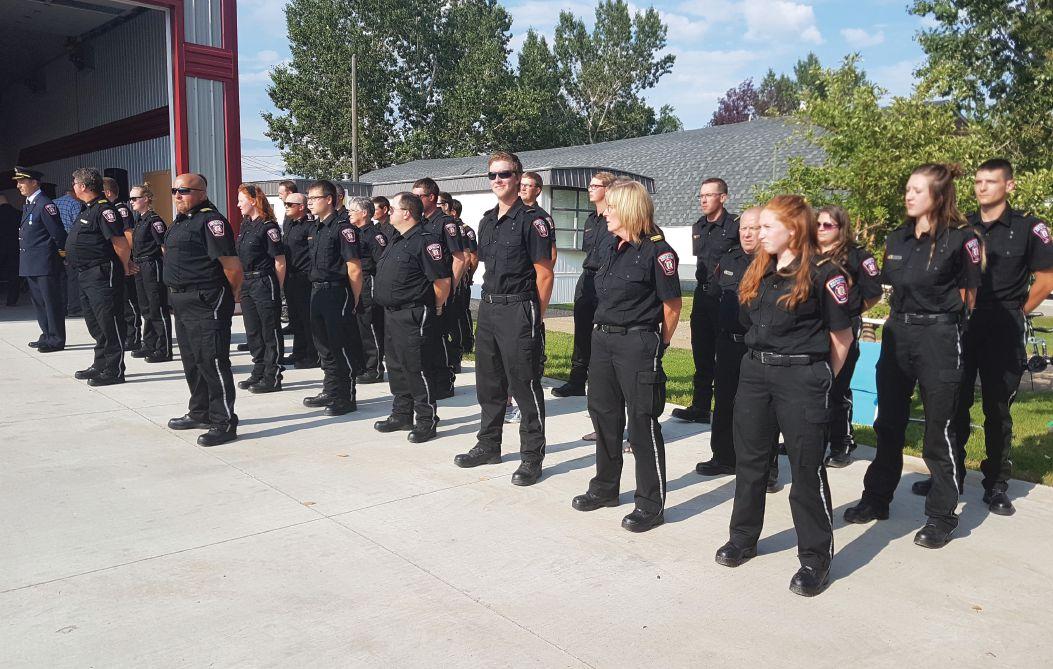
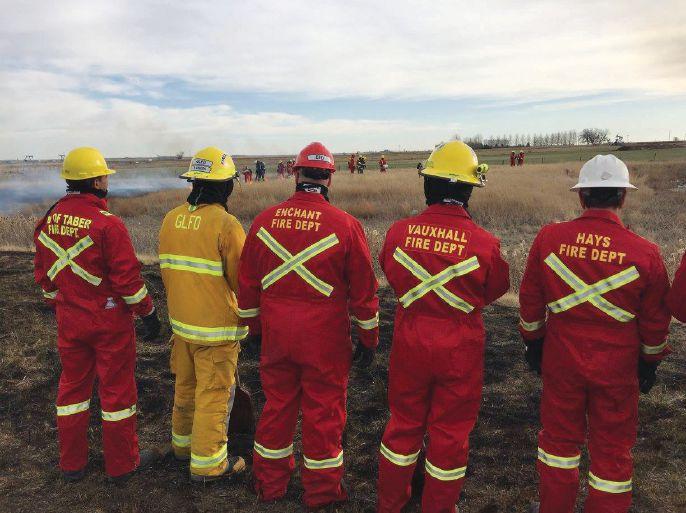
TOP Firefighters from all six stations of the M.D. of Taber Regional Fire Department in Alberta in formation.
Triggers such as tightening budgets, reduced volunteer ranks and the need for fiscal restraint in uncertain economic times have made the concept more attractive to municipal governments across Canada.
Regionalization can yield some strong end results for those that navigate the process successfully, but the fact remains that it has challenges that should be fully understood and addressed before it is finalized.
Before beginning the process, it is best to have a directive from the appropriate political body. A council motion, for exam-
ple, that identifies who will carry out the assessment and what the target result is will be a great segue into a dedicated mandate.
A list of reasons why regionalization is being considered, both for firefighter information and community involvement, also aids in setting out the groundwork as transparently as possible. This is important, especially if opposition and resistance is to be expected.
Regionalization is not always easy, but proper planning and communication will assist in, at the very least, moving the message forward. People want to know why something is being done and firefighters are no different. Be honest and transparent.
The first step towards the realization of a regional system is to identify the players.
An inventory needs to be created that lists the number of stations or stand-alone departments that are looking to be amalgamated, the number of firefighters and fire chiefs that will be affected and what resources like apparatus and specialized equipment will need to be absorbed.
Getting a snapshot of call volumes and training standards is also a benefit. This stage is often called the “gathering” stage. Incorporating these into the project should provide a baseline on the expectations, especially as it relates to service delivery. Regionalization is usually considered to enhance public safety. Showing the current situation and how regionalization will improve community safety is important.
Individual stand-alone departments have their own identities and, often their own fire chiefs, some of whom have been in their positions for years. Asking them to step down, or revert to a lower rank under a regional system, is difficult, but can be achieved with delicate statesmanship and clear rationale.
Most volunteer fire chiefs want to do what is best for their communities and some mutual respect goes far in this process. A recent regionalization that occurred in Alberta identified a regional chief and a regional deputy chief, but retained district chiefs at all the volunteer stations. This was done without an immediate reduction in rank bars, allowing for a gradual replacement upon retirement of those long-serving chiefs. This eased the transition into the regional system without throwing out the balance of those communities. Having this type of approval moves the project forward.
The second step is determining the terms of reference and nomenclature. What terms are used between one department may not translate in terminology to another. By clearly labelling the terms, words, phrases and colloquialism of the project seriously helps in understanding it. A standalone department that, under regionalization, would be termed a station provides clarity and understanding to the project.
In the Northwest Territories, a merger between Rae and Edzo fire departments into the Behchoko fire service was done simply by acknowledging the differences between those two departments and agreeing to embrace change. Having common ground going forward is paramount.
Of course, none of this can be accomplished without leadership. Having a champion to spearhead the project who possesses
the knowledge, skills and abilities to handle the task while maintaining a calm demeanour in educating people is key to overall success.
Strong leadership is not to be underestimated. Having people understand the benefits while accepting the risk, is where a strong project manager can be extremely beneficial.
With strong leadership identified, the next part is the hardest.
The question of whether regionalization is right must be answered. Ensure that the objectives identified as reasons for regionalization are addressed.
It is important to tie the reason for the project to the end results. Since a project usually involves returning to the governing body, the one that provided the mandate in the first place, and presenting the findings for debate, having the facts and analytics to back the results aids in the decision-making process.
If the project receives approval, it goes to the next level. A negative result likely ends the process.
If the result is positive and the concept of regionalization is to be pursued, the “selling” phase comes next.
This is where branding comes into play. A new regional fire service requires a new identity. This means new uniforms, new shoulder flashes, maybe even new truck decaling. It’s a big up-front investment, but it helps with the buy-in from affected firefighters.
Ironing out a standard set of operating guidelines is also a by-product of a regional system and best done with input from
all relevant stakeholders such as the new district chiefs. Amalgamating several small, probably rural departments, into one large fire service will require patience and mutual co-operation. Having initial acceptance will help as the process gets more complicated.
Highlighting the pros of a regional system, while continuing to acknowledge and address any issues as they arise, helps with the message.
A new image does wonders for morale, and the sense of belonging to something successful and bigger cannot be underestimated.
With objectives met and approval in place, it’s time to move to outreach, where the new fire service is highlighted and presented to the public. This is the main educational portion, as the results of the project will now be on display to the public, firefighters and other emergency services. This is where the hard work pays off and the fun begins.
Regionalization may not be right for every department or service, but it is a concept worth exploring if conditions exist that would benefit a group of departments into forming a regional service.
Kirk Hughes is the deputy fire chief of the M.D. of Taber Regional Fire Department in Alberta. A veteran of the Royal Canadian Mounted Police, Kirk has served with the Burlington, Ont., Portage la Prairie, Man., Deline, N.W.T., Fort Providence, N.W.T., and Behchoko, N.W.T., fire departments before taking a position with the M.D. of Taber as director of community safety. He can be reached at khughes@mdtaber.ab.ca.
Bringing together separate fire departments into a regional system can be difficult, but establishing common goals and benefits while celebrating differences makes for a solid foundation moving forward.
Stress Strategies
Some simple ways to calm your mind and give your brain a break
By SARA WEGWITZ
The greatest threat to the health and well-being of those in the fire service is stress. Stress is at the root of most, if not all, chronic illnesses like cancer, heart disease, high blood pressure, depression and others.
Firefighters must deal with a lot of stressors on the job such as shift work, irregular sleep and a high-pressure environment. Stress is at the root of most, if not all, chronic illnesses like cancer, heart disease, high blood pressure, depression and a host of other medical issues.
It doesn’t matter how much you work out or how well you eat. If you are not looking after your mental well-being those efforts are diminished.
Some examples of common stressors are family issues, financial hurdles, emotional challenges and physical injuries, just to name a few.
As firefighters, you can add in specific stressors such as shift work, irregular sleep patterns, a high-pressure environment and negativity in the workplace, which can mean a fast track to a chronic state of overdrive for an untrained mind.
Building on this, there are so many
distractions in our everyday life. Endless emails, texts and the ever-evolving to-do lists means our attention span is taking a beating, along with our ability to be productive and perform.
In fact, it has been estimated that we spend in total about five hours per day engaged on the Internet, either surfing, communicating and/or playing games. That is about a third of the time that we are awake.
Our average attention span is estimated to be a whopping five seconds. Goldfish are said to have a longer attention span at nine seconds. Let that sink in.
What if you could take back the steering wheel of your mind and be calmer, more mentally fit to withstand stress, and ultimately more resilient?
Taking just a five-minute “brain break” a few times a day can help to improve mental clarity, productivity, attention span and immunity, and has been shown to reduce
anxiety and depressive symptoms.
The following are some strategies to help you do just that:
• Engage more of your senses by way of the 3-2-1 strategy –The 3-2-1 strategy invites to you to engage more of your senses. Wherever you are right now, notice three things that you can see, two things that you can hear, and one thing that you can feel. You can change up the sequence as well to keep it fresh. Repeat as necessary, each time scanning your world to find new things to engage your senses in.
• Change the channel – Simply close your eyes and take a few relaxing deep breaths. Reflect over the last 30 days and recall a pleasant memory. Step into the memory and allow yourself to relive it as if it were once again happening right before your eyes.
• Tactical breathing or square breathing – Breathe in for a count of four, hold for a count of four, exhale for a count of four, no breath for a count of four. Repeat.
• Leverage nature – Instead of listening to a podcast when you are out for a walk, take out your ear buds and pay attention to what is around you. Better yet, take short walks outside and around the department on your breaks. A dose of fresh air can do a world of good.
• Brain reset with the learner’s state – This strategy is based on an ancient Hawaiian meditation called the hakalau. Look up as if you are looking between the middle of your eye brows. As you do this, find a spot high up on the wall or ceiling and gently gaze at it. Hold this for about 15 seconds. Next, while focusing on the same spot, have your eye muscles relax and allow your peripheral or side vision to come into focus. Notice objects, shapes, colours etc. while continuing to stare at the same spot. Hold for another 10 to 15 seconds. This exercise acts as a reset for your mind and is calming at the same time because it engages your parasympathetic nervous system.
Sometimes it can be challenging at first to learn how to take back the steering wheel of your mind. There are many apps available to assist you in doing this. Here are a few that I recommend:
• Head Space – This app offers relaxing guided meditations and mindfulness techniques. The tracks on the app are generally about 10 minutes in length. This app has a free trial.
• Insight Timer – There are more than 10,000 tracks to choose from. Choose the length of time you wish to meditate for and whether it be to relax or sleep. There are many different practitioners to choose from. This app is free.
• Calm – The are more than 100 guided meditations to help you manage anxiety, lower stress and sleep better. Calm is a great mindfulness app for beginners and includes programs for intermediate and advanced users. This app offers a free trial.
• Glenn Harrold – This offers hypnotherapy/guided imagery for things such as sleep, relaxation, and anxiety. Some tracks are free, and others cost a nominal amount.
During stressful times, these strategies can help bring you back to the present moment while restoring calm and sanity. Get into the consistent practice of giving your brain a break for a few minutes every day.
Sara Wegwitz is a registered nurse who specializes in mental fitness, resilience training, and health and wellness programming. She works with a number of fire departments throughout B.C., helping firefighters improve how they eat, move, sleep and think. Contact her at sara@ tailormakinghealth.ca.
Effective Leadership
Good leaders seek to inspire and motivate others and have a strong commitment to excellence
By LEN GARIS
What does it take to be an exceptional leader, or even simply a good one? Fire chiefs and other government leaders are missing out on a crucial ingredient if they only look to the private sector for the answer.
That ingredient – a strong inner core of character, integrity, ethics and values –is key to being a truly effective leader in government: one who gets the job done in a way that shows genuine respect and concern for everyone involved.
It is the element of public trust that makes leadership far more complicated in the public sector than in the private sector, notes Darryl Plecas, co-author of The Essentials of Leadership in Government –Understanding the BASICS, published in March 2018 through the University of the Fraser Valley (UFV) in British Columbia.
Public-sector leadership “requires a more comprehensive discussion, and a more nuanced and values-based approach, than leadership that is focused on profit margins,” said Plecas, a UFV professor emeritus, two-term MLA and speaker of the Legislative Assembly of British Columbia.
The assertion is based on extensive research of business, academia, government and public-sector leadership, combined with decades of on-the-job experience by authors Plecas, Colette Squires, sessional faculty member at the Justice Institute
of B.C. and instructor at Trinity Western University, and Len Garis, fire chief for the City of Surrey, B.C., and an adjunct professor at UFV.
The investigation led to the creation of a framework called the BASICS, an acronym representing the behaviours, aspirations, skills, information commitments, communication commitments and sustainability commitments of a good government leader. A strong inner core is at the heart of the BASICS model.
“More than ever, organizations are crying out for leaders who are responsible, principled, ethical, and have the courage to do the right thing,” the authors wrote. “We need government leaders who not only have the skills and behaviours of good leadership, but who guide their work with a moral compass and an ethical, principled core.”
Not surprisingly, the behaviours of a good leader – the B in BASICS – are rooted in their strong inner core. Good leaders foster genuine collaboration. They invest in people and have a genuine concern about their well-being and success. At the same time, they encourage innovation, have vision, and the courage to make the tough decisions.
A good leader’s aspirations are guided by a strong moral compass as well. They are committed to “getting to yes” with others through win-win approaches. They seek to inspire and motivate others, and have a
Good leaders foster genuine collaboration. They invest in people and have a genuine concern about their well-being and success.
strong commitment to excellence in every aspect of their organization. They have a positive approach, but are also thoughtfully skeptical. Good leaders are also loyal to their organization and those who work with them.
Good leaders must have a wide variety of skills – and again, how they apply those skills is shaped by their inner values. They need good verbal, presentation and written skills, as well as active listening skills to resolve conflicts. They need to have the skills to coach and build their team and, at the same time, be able to evaluate performance and provide meaningful feedback. They must have strong analytical, problem-solving and decision-making skills. Having good organizational skills and being able to manage resources, assets and finances is also important.
To be a good leader also requires making a number of commitments to one’s self. In terms of information commitments, leaders must be willing to seek feedback about their own weaknesses as part of striving to become better leaders. They must be
committed to knowing the concerns and aspirations of those they work with, as well as knowing their organization’s business. They must be committed to data measurement, making decisions based on evidence, and knowing what is going on in the world around them.
The communication commitments of a good leader are about expressing sincere gratitude and appreciation to others for work well done, as well as cultivating open, transparent and easy communication. Good leaders also encourage input and are committed to improving information-sharing.
A good leader’s sustainability commitments encompass both human and operational concerns. They foster healthy workplaces with highly engaged and committed employees, and where upcoming leaders are groomed and trained to ensure organizational growth.
Good leaders create an internal culture of continuous improvement and ongoing assessment, while also working to improve
the organization’s brand externally.
People at all levels of government, and in all roles, can benefit from learning more about what it takes to be a better leader. Do not confuse management and leadership. Whereas management is about tasks and processes, leadership is about inspiring and activating people – a skill that is useful for anyone who manages or works alongside others. While not everyone is a born leader, everyone has some of the necessary characteristics, and with guidance can work to develop others.
For some, developing the inner core of a good leader will be the hardest part. “Find a way to nurture your inner core, your moral compass that will guide your path,” the authors wrote. “For many, this is not just an intellectual exercise; it is akin to a spiritual journey. There is often a transcendent aspect to the inner core of good leaders who are truly transformational in their workplaces. Find out about that, do some digging and exploration to discover
what that is truly about.”
Another challenge on the journey towards being a better leader is getting honest feedback from colleagues and employees on your performance. A 360-degree tool, a type of anonymous questionnaire, can be an effective way to evaluate performance in yourself or others, and to obtain constructive feedback. A sample 360 tool is provided in The Essentials of Leadership.
Since its release, the book has received accolades from successful North American leaders and leadership experts, and has been added to the reading list for leadership students at the University of Alberta.
“The chapters are easy to read, interesting, down to earth and loaded with practical advice,” Dr. Louis Hugo Francescutti, professor of public health at the University of Alberta and past president of the Canadian Medical Association and Royal College of Physicians and Surgeons of Canada, said in his review of the book. “If you are an inspiring leader, put this book on your self-improvement list.”
Renowned U.S. leadership coach and best-selling author, Dr. Marshall Goldsmith, called the book a “foundational resource for government leaders,” and applauded it for addressing how to sustain the impact of effective leadership.
“How often have you seen a good leader leave his or her post and have the good work that was accomplished be destroyed by the next leader who assumes the role? This book provides a solution to this and many other previously unresolved issues that are faced by leaders in government.”
There is no such thing as a perfect leader. But for those willing to commit to this challenging but rewarding journey, good leaders may become great, and great leaders may become the kind of exceptional leaders that have a positive lasting effect on the people and communities they serve.
The book can be downloaded for free at http://cjr.ufv.ca.
Len Garis is the fire chief for the City of Surrey, B.C.; an adjunct professor in the School of Criminology and Criminal Justice and associate to the Centre for Social Research at the University of the Fraser Valley; a member of the affiliated research faculty at John Jay College of Criminal Justice in New York; and a faculty member of the Institute of Canadian Urban Research Studies at Simon Fraser University. Contact him at LWGaris@surrey.ca.
Good leaders have mastered many forms of communication, including the written word.
Tools of the Trade: What to carry
By ED BROUWER
During our last practice, I set the stage for the evolution to include two firefighters down. This, of course, was unexpected by the incident commander and it was interesting to see them deal with the situation. The two downed firefighters were both told to be unresponsive.
It certainly stretched our members, but they were able to successfully rescue both firefighters.
During our debriefing, we touched on self-rescue techniques, specifically reminding our members about their pocket tools.
When we do Saving Our Own Hands-on Training, our instructors will usually get the firefighters to don their PPE and then request they empty their pockets.
The results vary from everything you can imagine to nothing whatsoever.
I’ve asked those firefighters carrying nothing if they actually know the purpose of those big pockets on their bunker gear. One group of firefighters indicated that their department didn’t allow them to carry tools in their pockets, fearing it would make holes in the gear.
I could have just told them to let it go, but I told them that it’s their gear, it is fitted to them, and it is their protection. A tool in their pocket could very well save their life, or the lives of their fellow firefighters.
Imagine being hooked by a piece of wire that could easily be cut by a pair of wire cutters – but alas they are in the tool box on the truck. Now it becomes a rapid intervention team, or RIT situation, and more firefighters are put at risk.
There is no honour in a line-of-duty death that could have been prevented by carrying a $14 pair of cutters, whether or not they wear a hole in the gear.
There are different schools of thought regarding what equipment should be carried in your bunker gear.
The most popular items include webbing, carabineers, extra gloves, first responder knife, door chocks, extra flashlight, pliers, lineman, cable cutter, wire cutter, side cutter, battery cable cutter, channel lock, and vice-grips.
It seems a large number of firefighters carry Leatherman tools or multi-tools, even Swiss army knives. But, I wonder how many have actually used them in a fire? These small tools are awkward to open and work with at the best of times, let alone with gloves on in poor light.
After deciding what you need to carry, the next question is where?
Realtors say, “Location, location, location.” In this case, location is everything.
Think about trying to get at your wire cutters while wearing SCBA and laying on your side.
and water
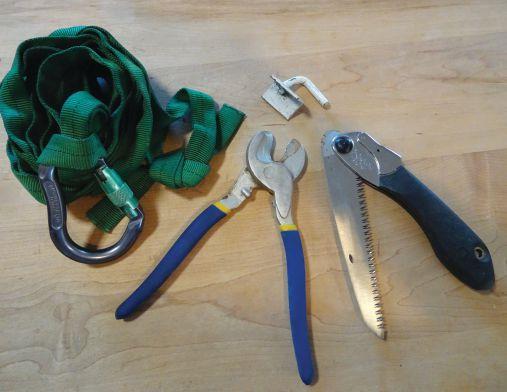
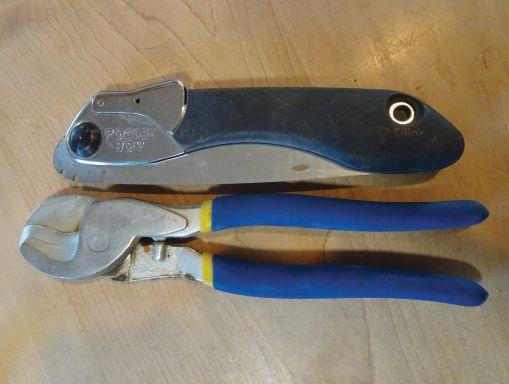
Pliers and saw in a closed position show how compact they are for carrying in bunker gear.
Some firefighters keep structure tools such as wedges and webbing on the right side, and auto-extrication tools such as seatbelt cutters, Res-Q-Rench and window punch on the left.
Bunker pant pockets usually carry hand protection, rope, utility gloves and more webbing.
One firefighter carried an extra Nomex Hood for filter breathing during SCBA failure. This is not a good idea. Firefighters with SCBA malfunction or failure have a better chance of being revived if they keep their masks on.
Webbing (showing carabineer
knot), pliers, folding saw and metal door chock.
’’
“I have always thought the more tools we have at hand the better our chances of survival.
Inhaling even a trace amount of super-heated fire gases may cause your larynx to close off, thereby robbing you of breath. Air management and calling a Mayday early give you the best chance of survival.
One firefighter suggested carrying an electrical tester. Although this may help during the investigation stage, in the heat of battle treating wires as being live is your best bet for survival.
During fire ground operations, an entanglement emergency can occur when a firefighter becomes caught up in debris that prevents freedom of movement, thus creating a potentially life-threatening incident.
Debris that can create an entanglement emergency include television and computer cables, electrical and telephone wiring, suspended ceiling grid and wiring, HVAC flexible tube and aluminum ductwork, draperies, blinds and more.
The number one thing you should have in your pockets is an extra flashlight. Be sure to check your backup flashlight each practice night. I wear my primary flashlight on my bunker coat. I found my helmet-mounted light was poor at best. It is a snag point during confined space operations.
There are a variety of door wedges being carried. Being able to ensure that the door you just opened stays open could mean the difference between life and death.
Door wedges can also be used to stop sprinkler heads. I found that the plastic wedges slip out of position easily. The wooden ones are a bit better, but the best is our homemade steel ones. A piece of one-inch angle iron cut into one-and-a-half-inch pieces with a quarter-inch steel rod hook welded to it works the best. Simply hang the hook over the hinge of the opened door and the angle iron keeps the door from closing.
I don’t carry vice-grips, but several firefighters swear by them. They use them to loosen or tighten bolts, as a door wedge, or they clamp them on an overhead door track to keep the door from coming down.
I carry two different lengths of webbing – 12 feet (looped to six feet) of one-inch webbing tied with a water knot attached to a four-and-a-half-inch aluminum carabineer and a 20-foot (looped) piece also tied with a water knot and attached to a four-and-a-halfinch aluminum carabineer. They can be used separately or hooked together for longer reach. Their main purpose is for self-rescue and RIT operations. Other uses include carrying tools and lowering and raising tools.
There are some special items for motor vehicle accidents – a spring-loaded centre punch for popping windows and heavy-duty cutters for battery cables. A multi-tool, including seat belt cutter, is also very useful. I carry a pocket mask in its case in my inner coat pocket. I also carry a small notebook and pen and readers.
For structure fires, I carry two steel door chocks, one plastic door chock, two door-latch stoppers made from a piece of inner tube with two one-and-a-half-inch holes cut in. You stretch one hole over the door knob, pull the inner tube over the latch and hook
TRAINER’SCORNER
the second hole over the door knob on the other side of the door. Should that door close, it can’t latch because of the inner tube. I also carry a piece of chalk for marking interior doors after a search is complete.
My favourite tools include a folding saw and HD wire cutters.
The wire cutters are nine and a half inches long with insulated handles. They have an incredibly powerful two-and-a-quarter-inch bite. These were around $14 at Canadian Tire.
My wife bought me the Pocketboy Folding Saw for Christmas more than 20 years ago. It is lightweight with a seven-inch micro blade that cuts through a two-by-four stud in seconds. I’ve never needed to use it, but I sure appreciate her thoughtfulness.
Just recently, I picked up a new second flashlight. The SLIM flashlight is manufactured by Nebo and brother does it pack a punch. It’s the best flashlight I have ever purchased. It produces an unbelievably strong light.
That sums up the possibilities for your carry-on equipment with one exception, the helmet. This is another place that firefighters carry stuff.
Personally, I don’t carry anything on my helmet, but I do carry two things in my helmet – my accountability nametags and a photo of my family. It just keeps it all in perspective for me.
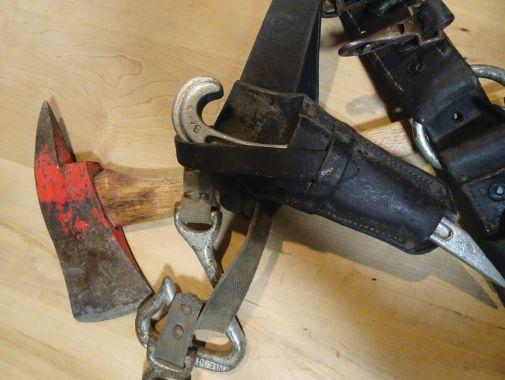
Although it has been 15 years since I officiated the celebration of life for a retired NVFD training officer, I still have his old fire department utility belt that was given to me by his now-deceased widow.
The old leather belt, complete with fire axe and hose irons, hangs in my office. But, every time I see it I wonder why we got away from wearing them.
I have always thought the more tools we have at hand the better our chances of survival.
Certainly, no tool left on the truck has ever saved a firefighter’s life. Until next time, stay safe and please remember to train like your life depends on it because it does.
Ed Brouwer is the chief instructor for Canwest Fire in Osoyoos, B.C., deputy chief training officer for Greenwood Fire and Rescue, a fire warden, wildland urban interface fire-suppression instructor and ordained disaster-response chaplain. Contact Ed at aka-opa@hotmail.com.
The SLIM flashlight is manufactured by Nebo and produces an unbelievably strong light.
An old leather utility belt of a late training officer, complete with fire axe and hose irons.
BACKtoBASICS
Specialized training is needed for firefighters on RITs
BY MARK VAN DER FEYST
Ifirst wrote about the issue of rapid intervention team, or RIT, 10 years ago in an issue of Canadian Firefighter magazine. But, it’s an important subject that’s worth revisiting.
The concept of rapid intervention teams is not new. It has been around for 10 to 15 years in the U.S., but has only begun to infiltrate the Canadian fire service in the last five years. What was once a trend is now a standard practice, with many fire departments implementing some kind of RIT program.
We have now adopted rapid intervention teams into NFPA standards such as:
• 1500: Standard on Fire Department Occupational Safety and Health Program;
• 1710: Standard for the Organization and Deployment of Fire Suppression Operations, Emergency Medical Operations, and Special Operations to the Public by Career Fire Department; and
• 1720: Standard for the Organization and Deployment of Fire Suppression Operations, Emergency Medical Operations and Special Operations to the Public by Volunteer Fire Departments.
The Ontario Ministry of Labour’s Fire Service Section 21 Advisory Guidance Note 6-11 (35) also addresses the idea of establishing and using a rapid intervention team. But, the question is, who are they, really?
NFPA 1410: Standard on Training for Initial Emergency Scene Operations (2005) defines RIT as, “two or more firefighters assigned outside the hazard area at an interior structure fire to assist or rescue at an emergency operation.”
Ontario Fire Service Section 21 Advisory Guidance Note 6-11 (35) defines RIT as follows:
The Rapid Intervention Teams (R.I.T.) can either be:
• On-scene firefighters designated and dedicated to rapid intervention crews; or
• On-scene firefighters performing other functions, but ready to deploy as rapid intervention teams if necessary.
The standards tell us what a rapid intervention team is and when to use it, but they do not specify the minimum standard to which RIT members should be trained.
NFPA 1001 Standard for Firefighter Professional Qualifications lists the subjects in which a firefighter must be trained to and certified by. Why not also specify how a firefighter must be trained to be part of a rapid intervention team?
At any typical structure fire, most fire departments will assign at
(L to R) Craig Cunningham from Mississauga Fire & Emergency Services and Matt Wherle from Grey Highlands Fire Department during RIT training.
PHOTOS: MIKE GUTSCHON
Mark van der Feyst instructs a group of firefighters from Beachville, Ont., in rapid intervention training.
Many fire departments have begun to train their personnel in the concepts of rescuing downed, trapped or injured firefighters.
least two people to be the initial RIT team. The initial RIT team will gather what it can for equipment and will stage at a location near the structure or by the incident commander (IC). The two people (minimum number) who have been assigned to be the RIT team will be chosen by the IC in order to fulfill legislative requirements, as in Ontario’s Section 21 Guidance Note 6-11, that, “The employer should provide written operational guidelines for establishing rapid intervention crews/teams of at least two firefighters to rescue firefighters in circumstances where there is the potential to become lost or trapped. The potential to become lost or trapped can occur at emergencies such as interior structural fires, confined space rescues, high-angle rescues etc.
The question is whether firefighters assigned by the IC to the RIT team are the firefighters we really want to be our rapid intervention team. Are they trained to locate and rescue a downed, lost or trapped firefighter? This is the question that must be answered.
A few years back, I was visiting a department in Ontario and asked firefighters who were on duty that day about their RIT capabilities. Did they train on RIT techniques?
The answer I received was astonishing in that they treat a firefighter rescue the same as a civilian rescue. This is a big misconception and also a common occurrence among fire departments. Given the fact that all firefighters are trained to rescue civilians, why not assign just any one firefighter to be on the RIT team? Presumably, they have the tools and knowledge for rescue if they are already trained in civilian rescue.
Another city fire department I worked for had a standard operating policy on RITs. It stated the minimum standards as based on the Section 21 Guidance Note. We were dispatched to a reported structure fire and were the fourth engine company due in the firstalarm assignment. Once we arrived on scene, we were assigned to be the RIT. We grabbed what equipment we needed as per the SOP and sat by the IC.
While waiting, I asked my captain if we should do a complete 360 of the building. He said that wasn’t necessary because the guys inside were almost done. I then asked if we should ladder the second-storey windows to provide a secondary means of egress for the crews and to provide a quick means of entry for the RIT. Again, the answer was, “No,” because it was not needed. If the SOP did not state what to do at the scene, then it did not get done.
To be a rapid intervention team firefighter requires special training and emphasis on many subjects.
When I worked in Pennsylvania with the Cranberry Township Volunteer Fire Company, we had dedicated firefighters trained as RIT firefighters. We had to meet certain qualifications in order to be an RIT firefighter. Part of these qualifications included training on specific topics.
We were denoted as RIT members by wearing orange balaclavas and we had orange RIT stickers on our helmets. By wearing these items, any officer could quickly identify who was RIT-trained and who was not, which was beneficial on the fire ground.
The fire department belonged to an organization called ABBETRIT, an association comprised of three counties that shared in RIT responses for mutual aid. Part of the mandate was to train firefighters in rapid intervention techniques.
Following is a breakdown of the training that would be beneficial for RIT firefighters. (Note that the amount of time devoted to actual RIT techniques is only 36 hours.)
• Basic vehicle rescue – 16 hours
• Incident command system – 16 hours
• Firefighters safety and survival – 16 hours
• Respiratory protection (SCBA) – 16 hours
• Introduction to rapid intervention teams – four hours
• Fire department (incident) safety officer – 16 hours
• Structural collapse I – four hours
• Structural collapse II – 16 hours
• Building construction – 16 hours
• Accountability – four hours
• High-angle rescue (ropes and knots) – 16 hours
• Confined space rescue – 16 hours
I had the privilege when working in Pennsylvania to be under the tutelage of James Crawford, who at the time was assistant fire chief of the Pittsburgh Bureau of Fire. He is regarded as the godfather of RIT and was instrumental in the training and development of hundreds of RIT-trained firefighters. He had the experience of locating and recovering fallen brothers in the City of Pittsburgh at the Bricelyn Street fire in 1995. He will tell you that it takes well-trained firefighters in rapid intervention techniques to rescue firefighters.
While at Cranberry Township, we responded to an auto-body shop fire one night as the dedicated RIT team. As soon as we were on site, we were deployed to locate a missing firefighter. The front wall of the shop had blown out and when a PAR check was conducted, one firefighter could not be accounted for. Within minutes, we had located him and he was taken to hospital for evaluation.
Our quick rescue was a result of our training. We were trained to locate and rescue firefighters in distress and that night it paid off. I can recount numerous other times when we responded as the dedicated RIT for other mutual-aid structure fires and, even though we were not deployed, we were ready because of our training.
Personnel in the other fire departments asked themselves if these were the guys they wanted as their RIT team. They knew the answer.
Do you know yours? Is this the same question you will ask when it comes time to establish your RIT team?
Mark van der Feyst has been a member of the fire service since 1999 and is a full-time firefighter in Ontario. Mark teaches in Canada, United States and India, and is a FDIC instructor. He is the lead author of the Residential Fire Rescue book. Contact Mark at Mark@FireStarTraining.com.
BY TOM DESORCY
Fire chief, Hope, B.C.
RVOLUNTEERVISION
Uniform is essential to department well-being
eading a piece from a recently retired colleague got me thinking. In particular, a comment about finding something to wear other than a uniform every day once you retire made me think of the power a garment has and the impact it can have on a volunteer fire department.
As a full-time fire chief, my day-to-day dress choices are relatively easy and have been for many years. But, it was the expansion of this apparel that many take for granted.
When I started in this position, I was literally creating a fire department, not from scratch, but from fragmented beginnings out of three different organizations. I myself had no fire management experience and only knew the service as a volunteer firefighter of some 12 years.
I was reminded of some of the steps I took back then when a retired district chief of ours said the other day that one of the best things he thought I did in the beginning was to get uniforms for the department.
In hindsight, it was a key component in us coming together as a team, in building a solid family base and immediately instilling pride in the organization. This included me.
The position I was hired to fill didn’t come with any history. There was no prior established leader in a full-time role and therefore no uniform. In fact, as a newly amalgamated department we didn’t even have a logo or patch. That’s where I learned the benefits of trade shows and networking.
What is the standard, or is there even one? What do other departments do? The closest thing we had to any kind of uniform was what I would call a hockey team jacket with our name on the sleeve. Not much of a uniform, but something you wore around as part of the fire department. We still have something like that, but have gone several steps further.
Perhaps the mayor didn’t want me to stand out which was, in fact, a testament to the controversy around the position.
After a few obvious encounters it didn’t take me long to realize the benefits of being easily identified. You soon learn that in public service it’s nice to be able to answer the question before it gets asked and when they know who you are, they know what to expect.
Today, the uniform package for our members is standard issue. Yes, there is an expense to it, but it’s now a budget line item for us – a part of doing business, as it were. The volunteers may not wear the uniform every day, but when they do as a group they stand out and look professional.
It’s vitally important for members to realize, too, what that uniform brings. It’s hopefully something that instills pride and respect from both their peers and the community as a whole. In fact, when you’re properly turned out in either personal protective equipment or a uniform shirt, your job is all that much easier, as there is a certain trust factor that goes along with it.
We’ve all heard the phrase, “You wear it well,” and hopefully that’s the case for everyone. I feel that in order to play the part you have to look the part. That’s why I advocate for all departments, big or small, to appropriately outfit their members and go the extra mile and put their chief in a dress tunic.
‘‘ ’’
I feel that in order to play the part you have to look the part.
Is there a downside to a uniform look? Well, there is that added layer of responsibility. The more you look the part, the more you’re expected to perform at a higher level.
One of the key components in creating our look was gaining acceptance in the community. If our members weren’t used to a uniform you can bet that the town’s people certainly weren’t. Before I started our mayor at the time didn’t want me in any uniform.
Tom DeSorcy became the first paid firefighter in his hometown of Hope, B.C., when he became fire chief in 2000. Originally a radio broadcaster, Tom’s voice could be heard in the early 1990s across Canada as one of the hosts of Country Coast to Coast. Tom is very active with the Fire Chiefs’ Association of B.C as communications director and conference committee chair. Contact Tom at TDeSorcy@hope.ca and follow him on Twitter at @HopeFireDept
Simply put, if this is new for your department then be prepared to be noticed in a good way and the sense of belonging among your members to be raised substantially.
For those of us that have been around for a while, the uniform is more than a calling card or something you have to wear to work every day. As a chief fire officer, I will admit that there are times when I feel that the responsibility can also weigh you down. I had no idea the fire department crests would be so heavy, not to mention the five stripes that adorn the shoulder.
While not a life-safety item, a uniform is essential to the well-being of a volunteer department. A volunteer organization survives as a team and nothing builds that team like pride and inclusion.
BY CHRIS HARROW Fire chief Minto, Ont.
TLEADERSHIPFORUM
Status quo is no longer an acceptable practice
here is the famous phrase every firefighter in the world has heard or used, “But we have always done it that way.”
Each time the phrase is uttered, it makes me cringe and, at times, I’m embarrassed for our industry.
Fire service leaders need to be very cognizant of the term and never get sucked into using the phrase as a guideline for their dayto-day operations.
Over the years, there has been an abundance of articles written about breaking traditions and how to modernize the fire service and firefighters.
A common trap that leaders in the fire service fall into is to not exercise practices learned in the material to break the cycle of tradition.
Many times, it is easier to carry on with the methods the department has used in the past.
Senior leadership in a department can also get stale and find it easier to maintain status quo and not continue to strive to be better.
A common function in a volunteer department is that the chief or deputy chief takes command at every incident.
Day or night, weekday or weekend, a chief is in command because this is the way it always has been done.
Now, take this process back and look at it from another perspective and establish a better process of establishing command. Did the municipality hire you as a senior officer to take command of every incident or were you hired to ensure the administrative side of the department runs smoothly?
they are excited to complete more paperwork and administrative functions.
When officers get to use their skills it motivates them even more to want to take on higher roles because they see the opportunities first hand.
The theory also works for training sessions and department meetings.
Sharing the responsibilities of leading training sessions and conducting department meetings can go a long way in challenging officers to use the leadership skills they have acquired.
Volunteers especially, join the department to experience challenges and push themselves to see what they can accomplish. Allowing them to “spread their wings” can have positive impacts on the entire department.
For a fire chief or other senior officer, it allows them to step back and observe things from a totally different light. It shows them who has the potential for success in future promotions, sort of like an ongoing job interview.
It can also be extremely satisfying to see a younger firefighter
Allowing newer officers an opportunity to use the skills they have learned will undoubtedly improve morale around the stations. ‘‘ ’’
I would also venture a guess that each officer in your department is trained in incident command and other officer functions. When do they get to practice their skills and learn from their mistakes if someone else is always taking control?
Using the example above, and applying various techniques of breaking the mold from a traditional way to a more modern method, can demonstrate how it improves your department and assists you in many different areas.
Allowing newer officers an opportunity to use the skills they have learned will undoubtedly improve morale around the stations. I don’t know many officers who sign up for an officer role because
Chris Harrow is the fire chief in Minto, Ont. He is a graduate from fire programs at Lakeland College and Dalhousie University and holds a graduate certificate in Advanced Care Paramedics from Conestoga College. He can be reached at c.harrow@mintofiredept.on.ca.
succeeding in a new role.
As a senior officer, you can be there to field questions during an incident or after when the debrief takes place.
It becomes a great resource for captains and other senior firefighters to know they can take command, but have someone available to bounce ideas off of or assist them if the incident progresses.
A great leadership technique is to constantly challenge your department to come up with new ways of accomplishing its goals. We send firefighters to courses all the time.
Do we allow them time when they come back to demonstrate at the next training session what they learned and how the new skills can improve upon existing techniques?
Or, do we not allow younger firefighters the opportunity because they don’t have enough seniority? By taking on the philosophy you
always want to strive to find better ways, you can see how many instances arise in a week and can be used to promote change.
I know many departments implement change on an ongoing basis, but there are many still out there working the same way they have for the past 30 years.
As leaders in a department, you need to be able to listen to firefighters coming up through the ranks. They have some solid ideas that could be implemented, or at the least, be discussed.
Nothing improves morale around a station better than when firefighters are given the ability to try a new concept and teach an old firefighter a new idea.
I love seeing how it keeps the more senior personnel on their toes to keep up with the younger personnel.
I believe each person in the service should keep the motto that the status quo is not acceptable posted somewhere in their stall or office.
Each day you put on your uniform or your bunker gear, you should be searching for a new and improved way of doing your daily tasks. All of my mentors in my career have followed the same philosophy and driven it into me.
You may think you have the best way, but there is always a better way.
The last thing it does in a volunteer department is drastically improve the recruitment and retention of firefighters. The word quickly gets out about an organization that is continually striving to be better and breaking new ground.
In my experience, people in the community are drawn to this concept and want to join organizations with strong reputations. There is a big difference between an organization that is respected for what it does but does the same thing over and over again, as opposed to an organization that has the same respect but is known to be innovative and always challenging its people. I know which one I would want to join.
I challenge all firefighters to work together in their organizations to strive to improve constantly.
You may not be the best at coming up with new concepts, but ensure you are able to accept change and are not scared to try something different.
The fire service would definitely be an even better profession if we were well known for our ability to design and handle change regularly.
BY TINA SARYEDDINE Executive director, Canadian Association of Fire Chiefs
WGUESTCOLUMN
Top 10 achievements of CAFC in Ottawa
ith the end of 2018 near, top 10 lists become irresistible. This top 10 list is a view from my office here in Ottawa at the Canadian Association of Fire Chiefs.
It’s a look back, but it’s also a thank you – to the chiefs, board and national advisory council, staff, members and partners.
While it could easily be a top 100 list, suffice it to say CAFC is grateful to be part of the team, to help and support or lead as the circumstance calls.
With that, let’s get started. Here’s is the top 10 list:
1. Fire Rescue Canada 2018: The annual gathering and conference of the Canadian Association of Fire Chiefs took place in the nation’s capital in September 2018. Amazing speakers came forward through the call launched in January and February. Stay tuned for Fire Rescue 2019 in Calgary. Everyone is welcome to suggest presentations.
2. Federal “friends of fire”: This year, we met with close to 100 Parliamentarians across all parties, as well as with government officials who have more than a dozen initiatives impacting our sector, at Fire Rescue, Health Canada, Public Safety Canada, Transport Canada, Defence Research Development Canada, National Research Council, the Building Codes Commission and Indigenous Services Canada. This is a “fire friendly” era in Ottawa. Let’s make the best of it together.
3. “Trusted Source” and “Power-Forward”: When tornadoes hit Ottawa, CAFC got a call from our trusted partner Duracell, reminding us that the Power-Forward truck is available to CAFC member communities when needed. Duracell is a long-standing and trusted partner of the CAFC.
Canada: This year, the CAFC launched the Female Fire Chiefs and Company Officers Network of Canada. The initiative stands on the shoulders of giants that have started such initiatives locally and provincially.
6. Building the Policy Engine: More than 60 fire chiefs now sit on policy committees from diversity and inclusion to interoperability, building codes and best practices.
7. Topics on Fire Webinar Wednesdays: This year, CAFC launched Topics on Fire Webinar Wednesdays, which is a series of webinars on topics ranging from water rescue to mental health and opioids to intergenerational leadership.
8. New Research Databases: Fire Research Roster is a searchable database of fire-friendly researchers who are willing and interested in working with members. You can find it on the CAFC website. In the coming year, we will also make the National Fire Information Database broadly available for research purposes. You can learn more about the National Fire Information Database at www.nfidcanada.ca.
9. Building Codes Commission: In January, CAFC President and Edmonton Fire Chief Ken Block and Building Codes Co-chair
This year, we met with close to 100 Parliamentarians across all parties, as well as with government officials. ‘‘ ’’
4. Sharing and Caring - Road to Mental Health Readiness: While there were accolades for the federal budget dedicating $30 million for mental health through the Canadian Institutes for Health Research and the Canadian Institute of Public Safety Research and Treatment, a more modest offering also fits on CAFC’s top 10 list because it got straight to the business of near-term impact. Public Safety Canada funded the Canadian Institute for Public Safety Research and Treatment (CIPSRT) approximately $140,000 to send 25 individuals to R2MR (resilience) master training. Nine individuals represented CAFC and are training others. We hope to see scale and spread in 2019.
5. Female Fire Chiefs and Company Officers Network of
Tina Saryeddine, PhD, MHA, CHE is the executive director of the Canadian Association of Fire Chiefs. You can find Tina’s contact information and learn more about the CAFC initiatives at www.cafc.ca.
Chief Gaetan Morinville, as regulator, were appointed to the Canadian Building Codes Commission. This is an important step in ensuring that the voice of the fire sector is clearly heard in the complex process required to balance the needs of the safety sector with those of industry.
10. Executive Chief Fire Officers: In 2017, CAFC with support from Motorola Foundation launched the Executive Chief Fire Officer Program which replaces the Chief Fire Officer Program. By the end of 2018, 74 executive chief fire officers were certified across the country, which includes six new recipients. You can meet them on the CAFC website.
This concludes my top 10 list for this year. From all of us at the Canadian Association of Fire Chiefs, we wish all the readers of Fire Fighting in Canada a very safe and joyous holiday season, and all the very best in health and happiness for 2019.