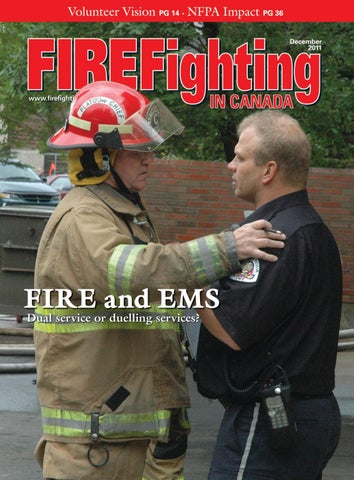
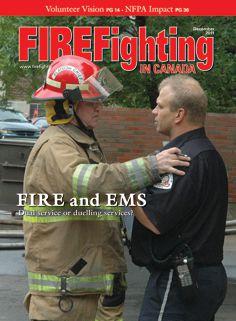
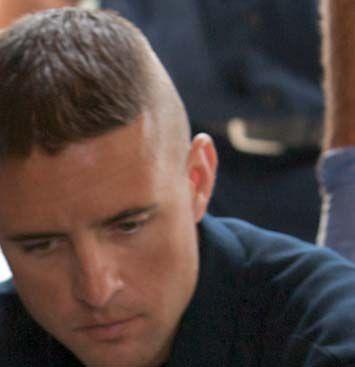
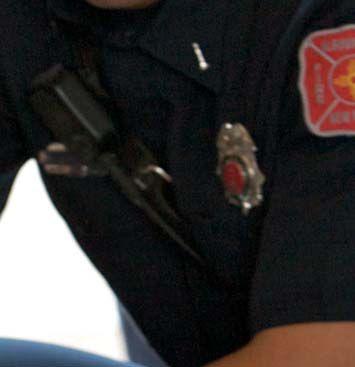
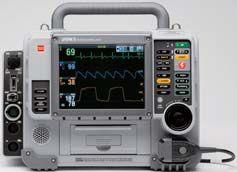
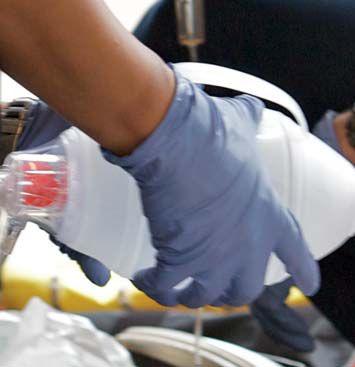
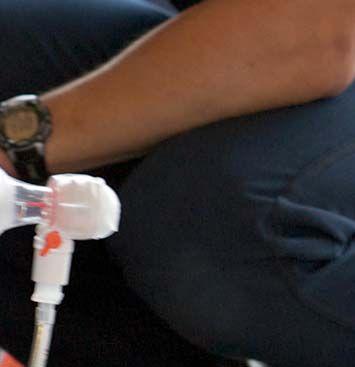
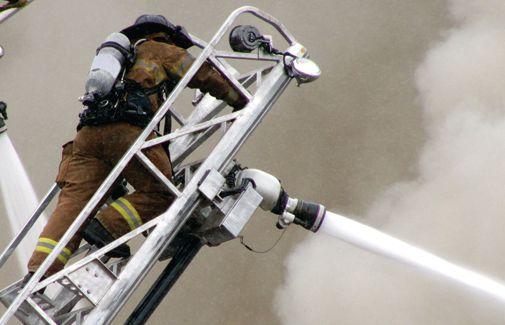
As municipalities look to trim budgets, fire and EMS services in Ontario are butting heads over responses to medical calls. As Laura King reports, both sides say patient care is the priority.
18
LEADING BY EXAMPLE
Kirk Hughes, the assistant fire chief and training officer in Déline, N.W.T., explains how pride and communication were key to enticing and retaining volunteer firefighters in a northern community.
28
TEACHING TOOLS
Online learning was once cutting edge in the fire service. Now, enhanced programs that automate administration and track progress are helping training officers become more efficient and effective. As Peter Sells reports, learning management systems are the latest e-learning tool.
42 MOVING UP
Len Garis, Joseph Clare and Raj Nagaraj explain how this riskassessment system uses data from past calls to calculate probability, staff stations accordingly and improve costs and efficiency.
B Y La UR a K I ng
Editor lking@annexweb.com
The point about volunteers
e were finishing this issue of Fire Fighting in Canada on the weekend of Nov. 12 and 13 (yes, editors work weekends too!) when I checked Twitter on my BlackBerry and saw a tweet from fellow Cape Bretoner John Cunningham of the Nova Scotia Firefighters School about a fire at the White Point Beach Resort on the province’s south shore.
Having stayed at White Point, and knowing so many firefighters in the region from all those trips to the FDIC Atlantic and the MFCA conferences, the news hit home.
Very quickly, there were multiple tweets, Facebook postings, photos, videos and lots of excellent and accurate information about the fire and the response.
I’ve spent a lot of time lately talking to students, politicians, emergency managers and fire personnel about the value of social media for emergency services. Some have embraced it; others are skeptical.
chief and popular FDIC Atlantic speaker
W comment
Robert Krause – who is writing a series on fire attack for Canadian Firefighter and EMS Quarterly in 2012 – ran a seminar for attendees. Krause went home from Truro so impressed by the quality and dedication of the region’s volunteer firefighters that he e-mailed me to ask if he could write about the experience. He did, and we posted the piece on our website. What struck me, though, was the fact that Krause – who has more than three decades of firefighting experience – was so gobsmacked by the fact that most of the firefighters in Nova Scotia’s Colchester County are volunteers.
ON THE COVER
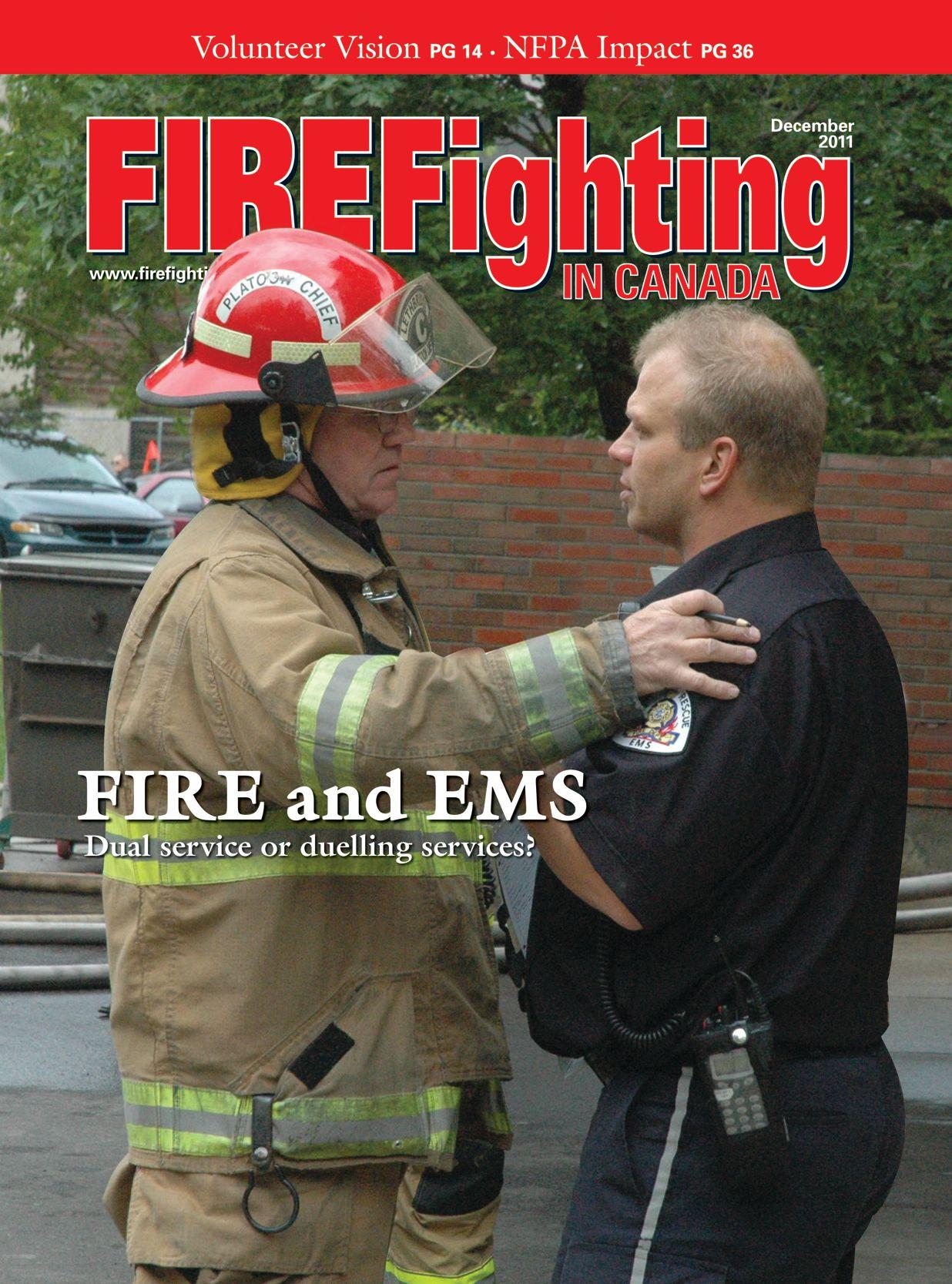
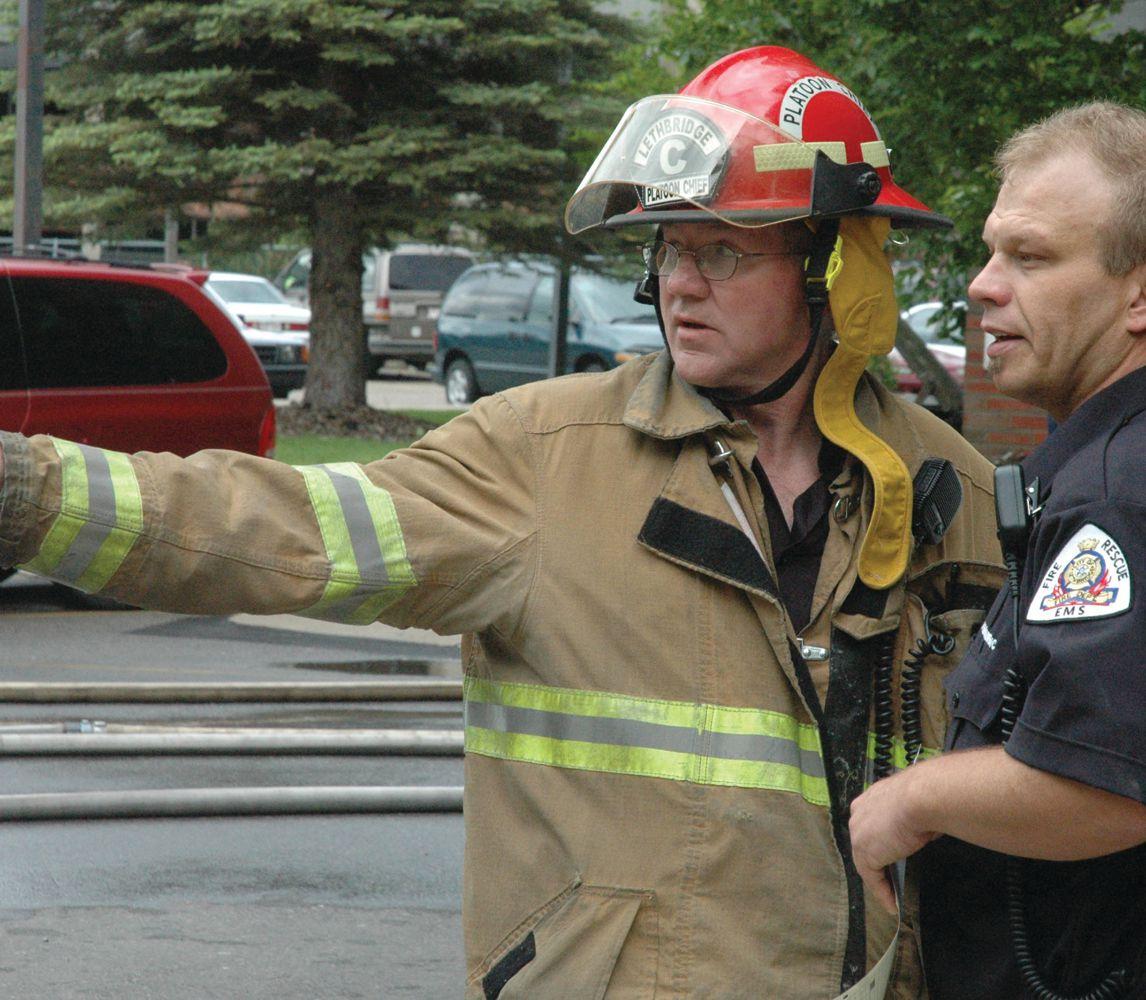
Fire and EMS work together well in places like Lethbridge, Alta., where the two services are combined, but there is tension between them in other regions. See story page 10.
I don’t know if we can measure the value of social media in getting word out to thousands of interested and concerned people about what was probably the biggest fire most members of the 16 responding volunteer fire departments will encounter in their careers, other than a feeling of connectedness and an understanding of the magnitude of the incident, which became apparent as the afternoon wore on and the main building collapsed. What I understood from knowing the area was the fact that all 16 of the responding departments are staffed by volunteer firefighters – not a career or composite department among them.
Interestingly, the White Point fire happened the weekend after the Colchester County Firefighters Association conference in Truro, N.S., at which Toledo, Ohio, battalion
Admittedly – and he’d chuckle at this – Krause is a career firefighter from a landlocked state, so he’s not overly familiar with the Nova Scotia landscape, but his essay was a bit of an eyeopener about the overall lack of understanding of the fact that there are 89,000 volunteer firefighters in Canada who are well-trained, committed, passionate and as competent as their career counterparts.
Sure, there will be an analysis of the response to the White Point fire, and most likely those doing the analyzing will find (through all those social media photos and videos) things that the 16 responding departments could have done better. But with a fully involved, wind-driven fire in an 83-year-old, wooden building, hats are off across the country to the volunteer fire crews from Shelburne to Liverpool. Watch for our in-depth story about the White Point fire in early 2012.
PRESIDEnt MiKE FREDERiCKS mfredericks@annexweb.com
PuBLiCATiON MAiL AGREEMENT #40065710
RETuRN uNDELiVERABLE CANADiAN ADDRESSES TO CiRCuLATiON DEPT.
P.O. Box 530, SiMCOE, ON N3Y 4N5
e-mail: subscribe@firefightingincanada.com Printed in Canada iSSN 0015–2595
CIRCULatIon
e-mail: subscribe@firefightingincanada.com
Tel: 866-790-6070 ext. 206
Fax: 877-624-1940
Mail: P.O. Box 530 Simcoe, ON N3Y 4N5
SUBSCRIPtIon RatES
Canada – 1 Year - $24.00
(with GST $25.20, with HST/QST $27.12) (GST - #867172652RT0001) uSA – 1 Year $40.00 uSD
We acknowledge the financial support of the Government of Canada through the Canada Periodical Fund (CPF) for our publishing activities.
Occasionally, Fire Fighting in Canada will mail information on behalf of industry-related groups whose products and services we believe may be of interest to you. if you prefer not to receive this information, please contact our circulation department in any of the four ways listed above.
All advertising is subject to the publisher’s approval. Such approval does not imply any endorsement of the products or services advertised. Publisher reserves the right to refuse advertising that does not meet the standards of the publication.
www.firefightingincanada.com
Photo by Laura King
statIontostatIon
across canada: Regional news briefs N.S. firefighters get big-screen experience
Lawrencetown, N.S. – On a cool, overcast morning on the edge of a calm seaside road on Nova Scotia’s eastern shore, the peaceful air was rocked by a massive explosion. A car was bombed, engulfed in a horrific fireball, both doors were blown off and the hood was thrown six metres into a tangled heap. Two occupants of the vehicle were burned beyond recognition.
This would have been a terrifying scene if it weren’t for the fact that this was a film set for the latest installment of television movie series called Jesse Stone, starring Tom Selleck.
The series, based on the novels by Robert B. Parker, is the story of Jesse Stone, a former Los Angeles police detective who is hired by small town Paradise, Mass., as chief of police. Chief Stone finds himself investigating murders and other crimes that are set in the present but linked to the town’s dark past.
On this rather unique day in Seaforth, N.S., the Causeway Road stood in for the seaside of rural Massachusetts, and the
members of Lawrencetown Beach Volunteer Fire and Emergency acted as the first responders from Paradise F.D.
On day 1 of the film shoot, the firefighters were doing emergency standby for the onsite car-bombing scene. Set call was 0630 hrs, the truck and personnel were set up in two minutes, and the waiting began. The film crew used the fire department’s expertise in areas of fire and scene safety, with a little help from the big red truck too.
the brass pole promotions & appointments
RoBERt WatSon and JULIE InESon have joined the Pickering Fire Services in Ontario as fire inspectors. Watson previously worked for the university of Toronto as its senior fire prevention officer and as a mechanical plans examiner with the Town of Milton. ineson previously worked for the Town of Richmond Hill as a fire
inspector and has experience in educating, promoting and enforcing applicable fire-safety codes and legislation.
tRoY LaWLoR was appointed in April deputy fire chief of the Arthur Fire Department in Ontario. He has served as a member of the volunteer force since September 2006.
JoHn KIngYEnS, an 18-year veteran of Sarnia Fire Rescue Services in Ontario, became
At around 1100 hrs everything was ready and the countdown started.
“3 . . . 2 . . . 1. . . fire!” And, nothing! Something was amiss, for there was no blast. The pyrotechnics crew members rechecked their work and found a small fault. It was fixed and within minutes we were going again. This time, everything went without a hitch. Doors and the hood flew, the fireball plumed, there was a great thunderous bang, and the fully
deputy fire chief on July 25. He began working for the service as a firefighter in 1992 and achieved the rank of acting captain.
involved car fire that ensued was spectacular. There were no surprises, and the firefighters got some good training in the final fire suppression.
On day 2, three firefighters were used as extras on camera in the scene in which the fire is extinguished and the investigation occurs.
To see Jesse Stone: Benefit of the Doubt, check CBS listings for the release date in 2012.
-H. Christopher Conrad Chief, Lawrencetown Beach VFES
deputy chief of Ocean Wave Fire Company in Carleton Place, Ont., effective Aug. 1. He has been with Ocean Wave for 21 years, the first 11 as a volunteer and the last 10 as fire-prevention officer.
DoUg LangRoVE retired July 22 after a 32-year career. He moved from a long career with the Nanaimo Fire Department in British Columbia to become deputy chief and then chief in Victoria.
RoD BLaCK was promoted to
Lawrencetown, N.S., firefighters Matt Rowlands, Adam White and Matt Molloy act as extras in the Tom Selleck movie Jesse Stone, Benefit of the Doubt.
Photo
Toronto Fire Services receives diversity award
Toronto – Toronto Fire Services (TFS) has been awarded the 2011 International Tony Pini Award for Diversity and Inclusion in the Fire Service.
This award is jointly presented by the International Association of Fire Chiefs (IAFC) and Fire 20/20, an international nonprofit organization connecting fire and emergency-medical services with their multicultural communities to increase the reach and effectiveness of diversity recruitment and retention, emergency response and community risk-reduction programs.
The award specifically honours the TFS partnership with Centennial College to identify and address diversity barriers in the Ontario standardized pre-
service firefighter education and training program. The pre-service fire program is jointly administered by the Ontario Office of the Fire Marshal (OFM) and the Ontario Association of Fire Chiefs (OAFC), and is offered through a number of Ontario community colleges.
TFS partnered with Centennial College to co-author an enhanced version of the preservice fire program curriculum and usher that new version through the necessary approval processes of the joint OFM/ OAFC Endorsement Review Board, as well as the Ontario Ministry of Training, Colleges and Universities and Ontario Credential Validation Service.
The objective is to ensure
that a greater number of visible minorities, women, and aboriginal people are able to participate in and graduate from the program. These graduates will then increase the diversity of potential applicants to TFS, allowing TFS to participate in the national fire-service trend of requiring graduation/certification as a hiring prerequisite, while at the same time meeting its obligation and desire to be reflective and representative of the communities we serve.
The first class under the partnership began in September 2010 with 34 students, consisting of 18 visible-minority males, three visible-minority females, six white females and one aboriginal person, for a
total diversity participation rate of 77 per cent – well above the then-current rate across GTA community colleges. Of those students, 21 were City of Toronto residents. These students graduated in August.
“We are very pleased to again be recognized and awarded for our efforts in fire-service diversity and inclusion,” said TFS Chief William Stewart. “It is especially exciting that this award will appropriately recognize our leadership at an international level. This is a fitting tribute to the commitment and leadership of our people working together in teams to bring the finest in courage, compassion and service to the people of the City of Toronto.”
Canadian firefighters museum seeks donations, support
Canadian firefighters are proud of work that they do and the heroic history of those who preceded them, and their stories of courage, bravery, self-sacrifice and compassion need to be told.
The Canadian Fire Fighters Museum was established in Port Hope, Ont., in 1984 with a mission to tell the story of fire fighting in Canada from 1759 to today. The museum is collecting, preserving, researching and displaying fire apparatuses, fire equipment, photographs and related archival materials to illustrate the development of
retirements
WaYnE DRUMMonD retired from the Ocean Wave Fire Company in Carleton Place, Ont., on July 31. He served for
the fire service in Canada.
The museum occupies the old Port Hope town sheds, which are in poor condition. The town is demolishing the sheds as part of its effort revitalize the area, meaning the museum will soon have to find a new home. A large part of the museum’s collection is in storage at other sites. It is the museum’s goal to move into a new building allowing the collection to expand and the museum to become a truly national firefighter museum.
The museum is looking for
the right spot in Port Hope and is hoping to move into space in the unused buildings of Port Hope’s historic centre pier. That location would allow the museum to display the former Toronto fire boat that will make up an important part of the collection. The main collection includes hand-drawn, horse-drawn and motorized fire apparatuses, including steamers, from many parts of the country. The museum has been offered many items, which it is unable to accept at this time due to space constraints, and
the museum’s ambitious plans have been delayed because of the lack of funds.
Anyone can become a member of the Canadian Fire Fighters Museum by downloading the forms from the museum’s website at www.firemuseumcanada.com and returning them electronically or by regular mail. Members receive newsletters twice yearly. The Canadian Fire Fighters Museum is a nonprofit charitable organization that issues tax receipts for all donations of $20 or more.
-William Lambert
40 years, spending the last 18 as deputy chief.
PEtER MCCoRMaCK, a captain with Whitby Fire and Emergency Services in Ontario, retired on Sept. 30. McCormack joined the department as a volunteer in 1979 and was hired full time in 1985. He served the citizens of the Town of Whitby for more than 32 years. McCormack was a captain with the department for more than six years.
HaRRY agaR, a captain with Whitby Fire and Emergency Services in Ontario, retired on Sept. 30. Agar joined the department as a volunteer in 1984 and was hired full time in 1989. He served the citizens of the Town of Whitby for more than 26 years, holding the rank of captain for more than two years.
DonaLD WaRDEn retired as executive director of the Canadian Association of Fire Chiefs in October. He was
president of the CAFC for almost three years and executive director for four years.
last alarm
LaRRY PILKEY, a firefighter in Markham, Ont., died Oct. 27 after a battle with brain cancer. He joined Markham Fire and Emergency Services in 1987 as a recruit firefighter and worked out of various Markham fire stations during his 25-year career.
br I gade ne W s: From stations across Canada statIontostatIon
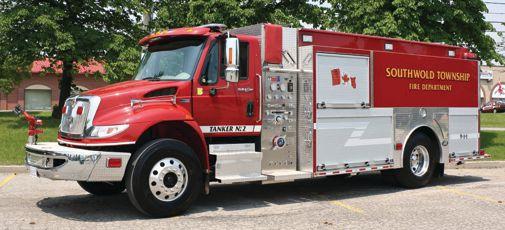
tHE SoUtHWoLD toWnSHIP FIRE DEPaRtMEnt in Ontario, under Chief Robert Brown, took delivery in June of a Dependable Emergency Vehicles-built tanker. Built on an International DuraStar 4400 chassis and powered by an Allison 3000 EVS transmission and a MaxxForce 9 330-hp engine, the tanker is equipped with a Darley PSP100 PTO 840-IGPM pump, a 1,500-IG co-poly water tank, enclosed porta tank storage, bumper mounter 500IGPM Elkhart Sidewinder monitor, Whelen LED lighting package and storage for four SCBA bottles.
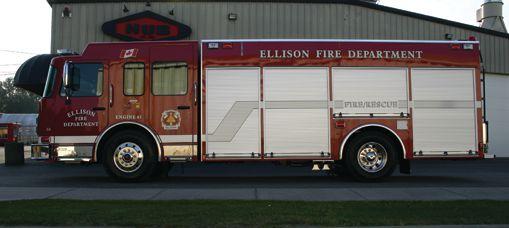
tHE ELLISon FIRE DEPaRtMEnt in British Columbia, under Chief Kurt Szalla, took delivery in August of a Hub Fire Engines & Equipment-built pumper. Built on a Spartan Gladiator chassis and powered by an Allison 3000 EVP transmission and a Cummins ISL 425-hp engine, the truck is equipped with a Waterous S100D 1,500-IGPM pump, a Foam Pro 1600 foam system, a 700-IG co-poly water tank, a TFT Hurricane monitor, Zico Access ladder, Smart Power 10-KW generator and Command Light tower.
SoUtH FRontEnaC FIRE anD RESCUE in Sydenham, Ont., under Chief Rick Cheesborough, took delivery in August of a Fort Garry Fire Trucks-built rescue unit. Built on a Kenworth T370 chassis and powered by an Allison 3000 EVS transmission and Paccar PX-8 300-hp engine, the truck is equipped with an 18-foot walk-in rescue body and is manufactured from Saltwater marine grade aluminum.
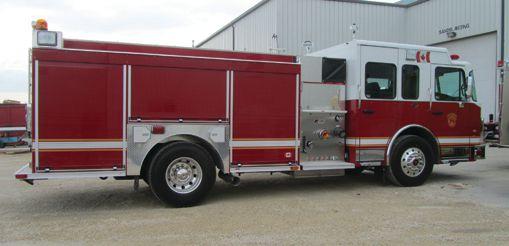
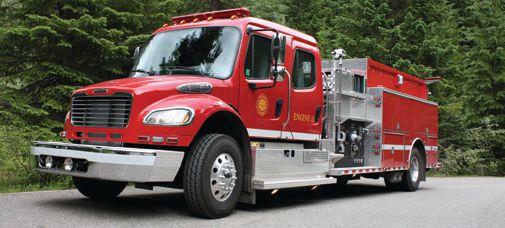
tHE RED RoCK VoLUntEER FIRE DEPaRtMEnt in British Columbia, under Chief Nelson Malcolm, took delivery in July of a Rosenbauer-built pumper from Rocky Mountain Phoenix. Built on a Freightliner M2-106 chassis and powered by a Cummins ISC 300-hp engine, the truck is equipped with a Darley PSM 1,050IGPM pump, a Foam Pro 2001 foam system, a 1,000-IG co-poly water tank, a 40-IG foam tank, a 5,000-watt Honda generator, Federal Signal warning light and siren package and 500-watt Fire Research telescoping lights.
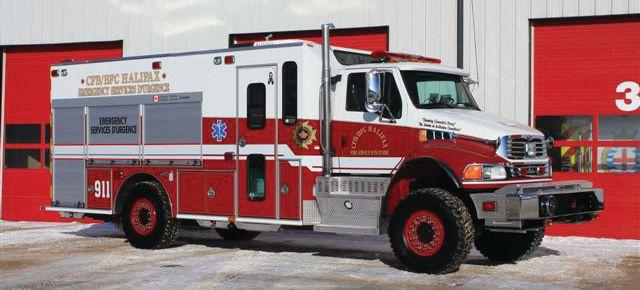
CFB HaLIFax in Nova Scotia, under Deputy Fire Chief Murray Watson, took delivery in March of two Fort Garry Fire Trucks-built hazmat command rescue units. Built on Sterling Acterra 4X4 chassis and powered by Allison 3000 EVS transmissions and Cummins ISC 330-hp engines, the trucks are equipped with F.S. LED light packages, FRC 1000-watt Optimum tripod lights, Federal Signal backup cameras, Amdor H20 ground lighting, 10-kilowatt Powertech diesel generators and Hurst Gas Trimo pumps.
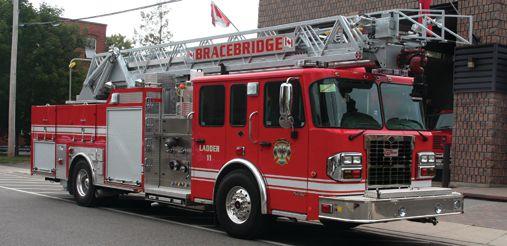
BRaCEBRIDgE FIRE DEPaRtMEnt in Ontario, under Chief Murray Medley, took delivery in August of a Carl Thibault Emergency Vehicles-built ladder truck. Built on a Spartan Metro Star chassis and powered by an Allison 3000 EVS transmission and a Cummins 450-hp diesel engine, the truck is equipped with a Hale 1,500IGPM pump, a Foam Pro foam system, a 500-IG co-poly water tank, a 75-foot ladder and 1,250-IGPM aerial monitor nozzle.
tHE RED RoCK VoLUntEER FIRE DEPaRtMEnt
CFB HaLIFax
tHE SoUtHWoLD toWnSHIP FIRE DEPaRtMEnt
FIRE DEPaRtMEnt
tHE ELLISon FIRE DEPaRtMEnt
SoUtH FRontEnaC FIRE anD RESCUE
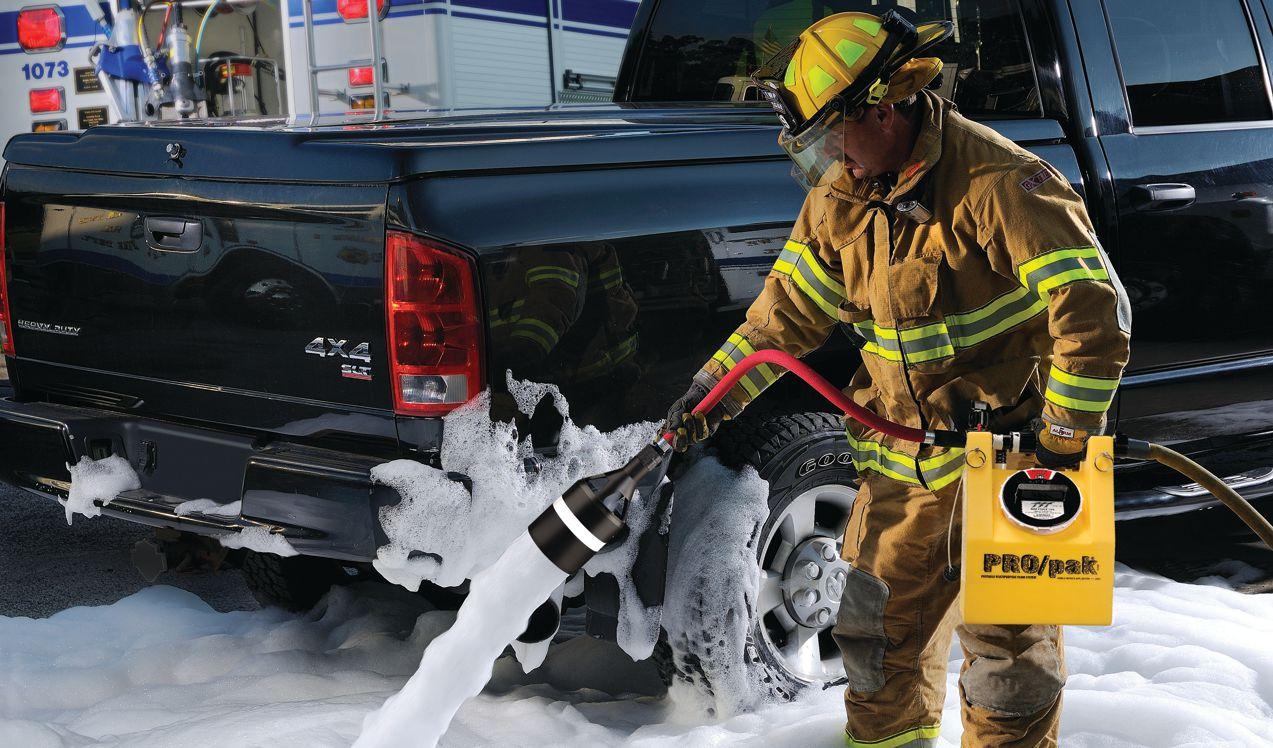
A Foam Eductor that Flushes Itself…
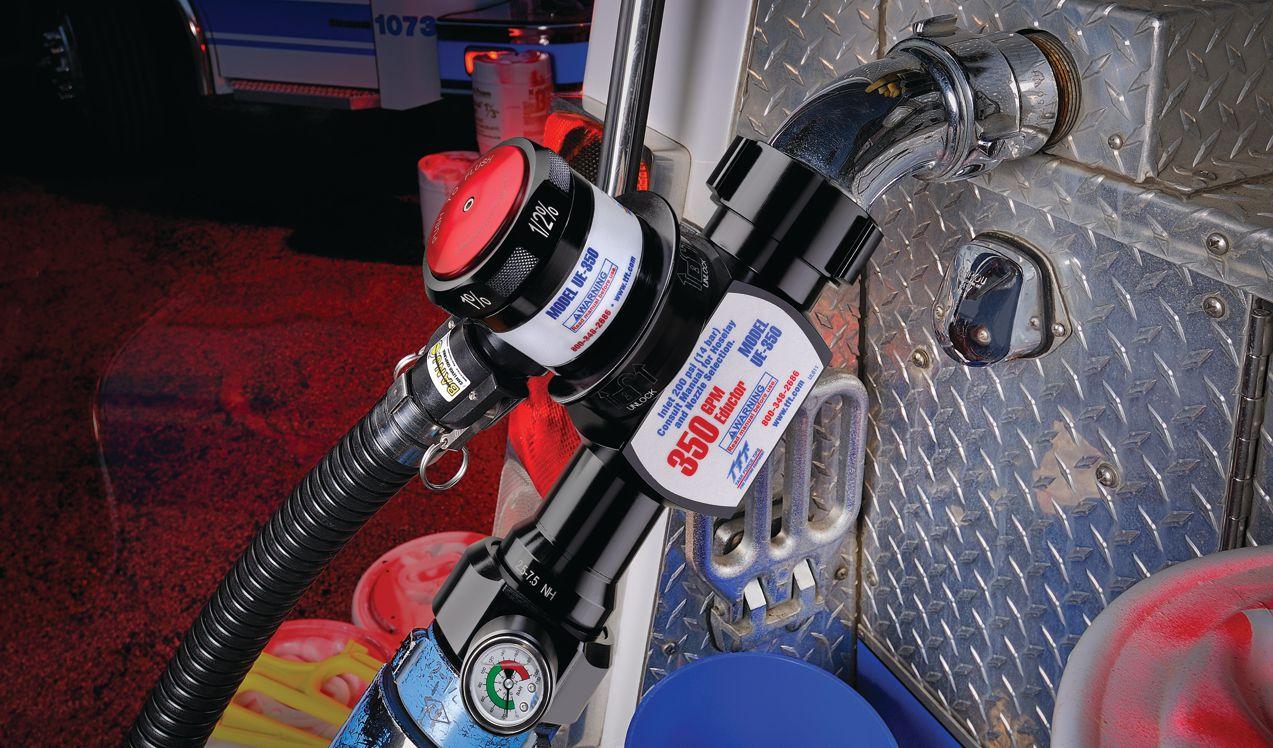
With the touch of a button, TFT’s Foam Eductor Series can completely flush all residual foam concentrate ensuring successful injection during the next foam operation.
Offering injection ratios of ¼% up to 6% and flow choices from 60gpm up to 350gpm, these eductors are the ideal choice for all Class A, AFFF, or Alcohol Resistant foam concentrates.
To learn more about how you can dramatically improve and simplify your foam operations, contact your local TFT dealer today.
350 GPM Eductor with Integral Go/No Go Gauge
fire and ems
Dual service or duelling services?
By Laura King
last spring, a council committee in Peterborough, Ont., on the advice of the city’s fire and EMS chiefs, agreed to stop sending firefighters to non-lifethreatening medical emergencies. Like most Canadian municipalities, Peterborough was looking for ways to cut costs and best use resources. The two chiefs did what they were told to do by their employer, the municipality: they worked together, considered options, and came up with a plan.
On May 30, Fire Chief Trent Gervais and Emergency Medical Services Chief Bob English told the committee that in more than 50 per cent of non-life-threatening calls, the fire department arrives on scene after EMS, and firefighters’ services are not required.
The policy change would have reduced the number of medicals to which the fire department responds by between 500 and 700 calls a year. Peterborough Fire & Rescue responds to about 1,800 medical calls annually.
Under the proposal, the fire department would still respond to medical calls for life-threatening situations. And dispatchers would send fire to medical calls in nonlife-threatening situations if an ambulance couldn’t respond within 10 minutes.
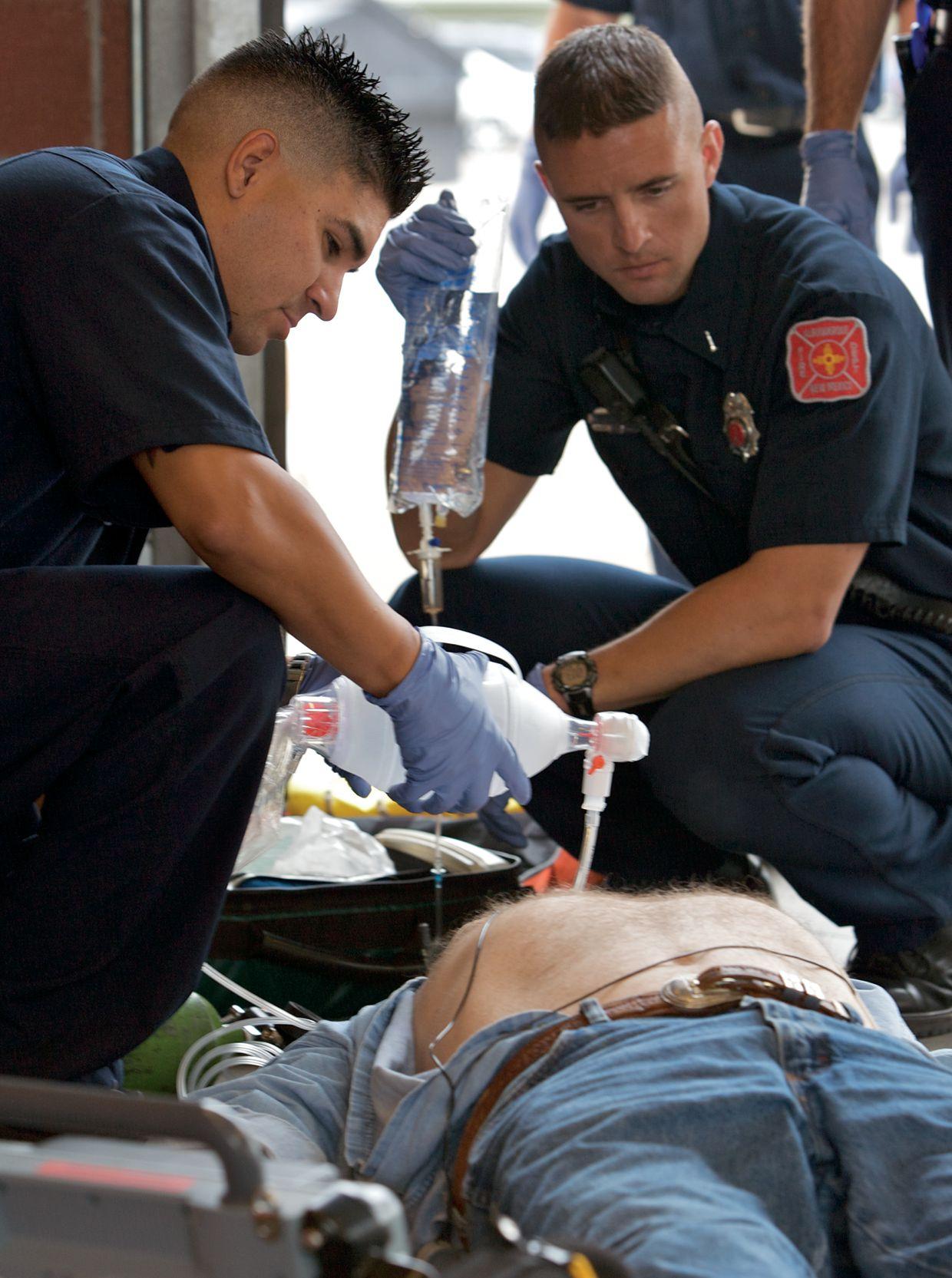
Some regions of the country, such as Lethbridge, have combined fire and EMS services, but there is tension between firefighters and paramedics in Ontario over responses to certain medical calls. Both sides have created websites to promote their positions – www.sendfirefighters.ca and www.sendthepros.ca
A week later, after hearing from the firefighters association, council voted against the change.
“The reduction of response services to the public . . . is morally and ethically wrong,” Robert Lloyd, president of the Peterborough Professional Fire Fighters Association, told council. “This proposal will cost lives.”
Or would it? That depends on perspective and the politics at play.
The two chiefs said the policy change wouldn’t put lives at risk because fire would respond if paramedics couldn’t.
Peterborough Mayor Daryl Bennett said the proposal offered a workable solution to having both ambulances and fire trucks respond to non-life-threatening medical calls. “It’s not going to endanger lives,” he said.
And Chief Gervais argued that the changes would reduce the risk to the public and to firefighters by not having half-million-dollar apparatuses rush through town to calls that paramedics usually get to first.
But the firefighters association noted that there had not been a single accident
causing serious injury in the last 25 years involving a fire-department response.
“They do their job well. Let them do it,” Lloyd said of the firefighters. “It’s not about who gets there first, it’s about somebody getting there as quick as possible.”
While councillors debated the cost and benefits of what they called a duplication of services, Lloyd indicated that the union might have a grievance against the city if council were to approve the proposed change.
At about 1 a.m. on June 7, councillors decided against the policy change.
The tension between the grassroots of the fire and paramedic services in Ontario over emergency response to medical calls is palpable.
Both sides have built websites to promote their points of view – www.sendthepros.ca (the paramedics) and www.sendfirefighters.ca (the firefighters association). Both claim that patient care is the priority and both say their response to a medical emergency is in the public interest.
As Fred LeBlanc, president of the Ontario Professional Fire Fighters Association (OPFFA) noted in an August column in Fire Fighting in Canada, “ . . . for municipal councils to play the budget card as justification for reducing this type of service is laughable: taking trained emergency responders out of the mix for minimal savings on fuel and wear and tear on vehicles just doesn’t make sense and, ultimately, the taxpayer will pay more dearly through longer response times.”
The issue – emergency response to medical calls – will be resolved by municipal or regional councils rather than unions or fire and EMS chiefs. Local governments set response levels for their communities but to do so, politicians need to understand the ins and outs of tiered response and simultaneous dispatch and absorb the research on response times and effectiveness.
“Councils need to decide what level of service they want in a community and what level of service they want for their residents,” Chief Gervais said in an interview. But to some degree, the issue goes beyond municipal boundaries to the provincial Central Ambulance Communication Centres (CACCs) that dispatch EMS services.
“The other concern is that we’re going to race a 40-tonne truck across the city and get there and find out the patient is gone,” Gervais said. “Simultaneous dispatch is the answer. And that’s the provincial CAC Centres – that’s what it comes back to. There is a project on the go to fix that, but
m ain
Photo by Laura King
I think the answer has to be to download the CAC Centres to municipalities, but we can’t even get an EMS radio in our dispatch centre. If we could get that, we would hear where they’re going and communicate with them. That’s how silly it is.”
Gervais, who has been the fire chief in Peterborough since 2008, says the issue of how best to deploy fire and EMS resources is multi-faceted and frustrating.
“If it were me having problems I’d just want the quickest person there,” he said.
Emergency response has been a hotbutton issue in Ontario for years. Studies on pre-hospital care in 2005 and 2008 showed that getting to a scene quickly and starting CPR, then administering rapid defibrillation, improves survival rates for those who suffer cardiac arrest.
The quagmire resurfaced in early 2011 as talk of municipal budget cuts surfaced and the Ontario Professional Fire Fighters Association (OPFFA) wanted to get the response issue in front of provincal politicians in the runup to the Oct. 6 election.
The OPFFA supported incumbent Dalton McGuinty and his Liberal government in the election campaign. The Liberals had introduced presumptive legislation for volunteer firefighters and mandatory retirement for suppression firefighters, and backed a pilot project in simultaneous response that will be rolled out in 2012.
The OPFFA explains its stance on its website:
We (the OPFFA) want to ensure that our direction, our legislative agenda as it relates to EMS and the fire service is clear, not only to our membership, but the public, decision makers and those in the EMS field that we work with. Our AGENDA is based on the following fundamental principles;
• Whenever someone in medical distress dials 911, they expect the closest trained emergency responder to be sent as soon as possible, regardless of whether that responder arrives in an ambulance or fire truck.
• The fire service is already strategically placed to respond rapidly to fires or other emergency situations and studies have proven that firefighters can positively affect the outcome of medical emergencies.
We believe and continue to strive to achieve recognition and implementation of the following;
• Firefighters, in urban centres, should be dispatched simultaneously with EMS to emergency medical responses that meet local tiered response agreement criteria.
• Firefighters, in urban centres, should be dispatched to all calls for emergency
medical help that involve life and limb threatening medical emergencies, i.e. those that meet EMS Code 4 dispatch criteria. We will continue to work with local associations, fire chiefs, and municipal councils to ensure tiered response agreements reflect this goal.
Ontario’s paramedics are highly skilled emergency responders who save Ontarians’ lives every day. However, we believe the fire service is positioned to play an increased role in pre-hospital care . . .
Paramedics group president Norm Gale waded into the fray in October, perhaps a tad unawares. Gale was quoted in the Toronto Sun by a columnist who has been critical of Toronto firefighters. The Association of Municipal Emergency Medical Services of Ontario (AMEMSO) had commissioned a study that showed firefighters are needed on just two per cent of medical calls. (As Gervais noted, two per cent of medical calls in Peterborough means firefighters are helping 50 or 60 people, so the number is not insignificant.)
A couple of days later, Gale was quoted by the CBC saying that firefighters can be a valuable resource at medical calls and that the Sun story had an anti-firefighter tone.
“He noted the idea behind the study was to gather information about the best patient care possible, for the best price,” the CBC said.
“Gale said some fire departments in southern Ontario want to expand their role in medical calls. Now, a tug of war is developing between firefighters and paramedics in some Ontario cities, as each group tries to prove its value and head off possible budget cuts.”
As the CBC noted in a September story, “ . . . this duel arises as a result of costcutting measures at the municipal level.”
The report, out of Ottawa, said firefighters were worried that their services may be deemed more expensive than EMS, and may be cut. The story noted that fire services cost almost two times more annually than emergency medical services, according to City of Ottawa numbers.
A few months earlier, at the OPFFA’s annual convention in Ottawa in June, LeBlanc noted in a speech to delegates that enhancing medical response would increase the value of fire departments to the community.
“Make no mistake; the EMS community is not in agreement with us,” LeBlanc said. “They are fighting back and they want the fire service out of what they consider ‘their business.’ However, removing the fire service from EMS responses will only cost the municipalities and the provincial
government more. Therefore, we must take advantage of this opportunity to position ourselves as a logical use of tight budget dollars.”
LeBlanc urged delegates to work on the issue with local councils to ensure long-term success of simultaneous response.
“Now, at the completion of this pilot and upon full rollout of the simultaneous notification technology the issue becomes local, and it is up to you. We will set the stage for a strong tiered-response agreement, but you need to commit to the concept and strongly advocate with your council to ensure your place – our place – in EMS response is entrenched.”
LeBlanc also noted the role of the Ontario Association of Fire Chiefs (OAFC) in the debate.
“Unfortunately we cannot rely upon the OAFC to stand with us on this issue. They have retreated from this issue and are partnering with the EMS chiefs under the guise of duplication and cost savings.”
The OAFC says it is staying out of the discussion but supports simultaneous notification and is compiling data to pass on to municipal councils to help them understand the issues.
“The fire service has an important strategic role in the delivery of emergency patient care,” OAFC President Tim Beckett said in an e-mail.
“Through the evaluation of fact-based data the OAFC, in consultation with the Association of Municipal Emergency Medical Services of Ontario, is committed to investigating and further clarifying the role of the fire service in emergency prehospital patient care. Through these discussions, we are ensuring that together we provide each municipality with information to assist them in optimizing their services to provide the best possible delivery to the citizens in their communities.
“We also remain committed to the dispatch simultaneous notification project, which will assist in enhancing the current tiered-response plans that are in place in municipalities throughout Ontario.”
Others are less enamoured with simultaneous notification. An Aug. 9 letter to Peel regional chair Emil Kolb from Caledon, Ont., Mayor Marolyn Morrison – after Morrison read LeBlanc’s speech – was blunt.
“Simultaneous notification will only heighten the cost of emergency response to the taxpayers,” Morrison said. “We should seriously review the use of this response in Ontario. Simultaneous notification has failed in Grand Valley, Owen Sound and Hamilton, to name a few.”
A quagmire indeed.
B Y V I n CE Ma C K E nz IE Fire Chief
g rand Falls-Windsor, n .L.
tAnalyzing the volunteer tax-credit conundrum
his past summer, the Canadian government recognized the value of volunteer firefighters by introducing the volunteer firefighter tax credit.
The tax credit, and the effort by the Canadian Association of Fire Chiefs, the Canadian Fallen Firefighter Foundation, and all Canadian firefighters and their supporters to lobby government through the givefirefighterscredit.com website, is a true win. To have the federal government recognize the volunteer fire service this way is an honour and is very much appreciated.
We are just about to complete the first taxation year in which some volunteer firefighters can claim the federal $3,000 tax credit. The 2011 personal income tax return will have a new line in Schedule 1 – the federal tax section – to allow firefighters who qualify to claim the credit.
I can’t speak for fire-service associations in each province, but the Newfoundland and Labrador association has received many inquiries about the implications and limitations of the tax credit. Issues have been raised on conference floors, particularly the 200-hoursof-duty requirement and what tasks can be included in those 200 hours. According to the Canadian Revenue Agency website (www.cra-arc.gc.ca/firefighter/), eligible services include responding to and being on-call for firefighting calls and related emergency calls as a firefighter.
OK, so now the 200-hour conundrum: What does on-call mean? And who interprets the term on-call?
If you ask firefighters across the country, most will tell you that they are on-call 24-7, carrying pagers and ready to respond. Others may say that their fire departments assign and schedule times for specific firefighters to be on-call in order to share the burden and guarantee a minimum response to all calls at all times. There are obligations in this system other than just carrying around a pager, such as remaining in the response district at all times while on-call. Do these hours count? Or, does on-call mean on a call to which a response has been initiated and the crews activated?
teers who are on-call 24-7/365. While I recognize the need to establish criteria, why can’t we just allow all volunteers to take advantage of this benefit? I do agree that there must be minimum criteria, but can’t we make the tax credit little more realistic and attainable for Canada’s volunteer fire departments? Most volunteers average two hours per training night once a week and an odd weekend training session, almost guaranteeing 100 hours in training alone. I suggest that 100 hours of training per year be part of the criteria, to ensure compliance and guarantee that the tax credit will serve as an incentive to train. But another 100 hours may be difficult to attain for firefighters in small, rural departments that don’t get the call volume to add up to 100 hours – these volunteer firefighters keep a 24-7 watch over their communities, just like career firefighters, but will not be able to take advantage of the tax credit.
We do not decide which calls we respond to; we simply answer the alarms as they come in. And volunteer firefighters certainly don’t think about which calls will give them more hours to add to their taxation qualification. As we all know, one call can be half an hour or half a week – we just stay until the call is done.
The tax credit will not benefit the majority of the fire service because the 200 hours is unattainable for many smaller departments. ‘‘ ’’
As you know, the 89,000 volunteer firefighters in Canada work under myriad schemes and systems, leaving the fire chiefs or other administrative people to determine what each firefighter can count toward the 200 hours of service required to claim the new tax credit.
Fire services in many parts of this country are provided by volun-
Vince MacKenzie is the fire chief in Grand Falls-Windsor, N.L. He is the president of the Newfoundland and Labrador Association of Fire Service, the second vice-president of the Maritime Fire Chiefs Association and a director of the Canadian Association of Fire Chiefs. E-mail him at firechief@grandfallswindsor.com
The volunteer firefighter tax credit is in its infancy. We asked the government for it, we appreciate it, and it recognizes volunteer firefighters as a value to Canadians. I just hope that the tax credit will mean something to all the men and women of Canada’s fire services, not just those in the larger and busier departments, or the ones unfortunate enough to have a lengthy emergency in their towns in a particular tax year.
The tax credit will not benefit the majority of the fire service because the 200 hours is unattainable for many smaller departments. With recruitment issues as they are, the tax credit will not likely help these rural departments become stronger. Even with perfect attendance to a weekly two-hour training session and a handful of emergency calls, many Canadian volunteers will be hard-pressed to meet the 200 hours. Yet volunteers maintain the 24-7 emergency coverage in our communities. Shouldn’t that count for something?
The fire helmet that started it all... and the tradition lives on with
and
that firefighters have trusted for generations. Join the celebration at www.msanet.com/cairns175.
by
leading by example
Pride and communication key to enticing volunteer firefighters in northern community
By KirK HugHes
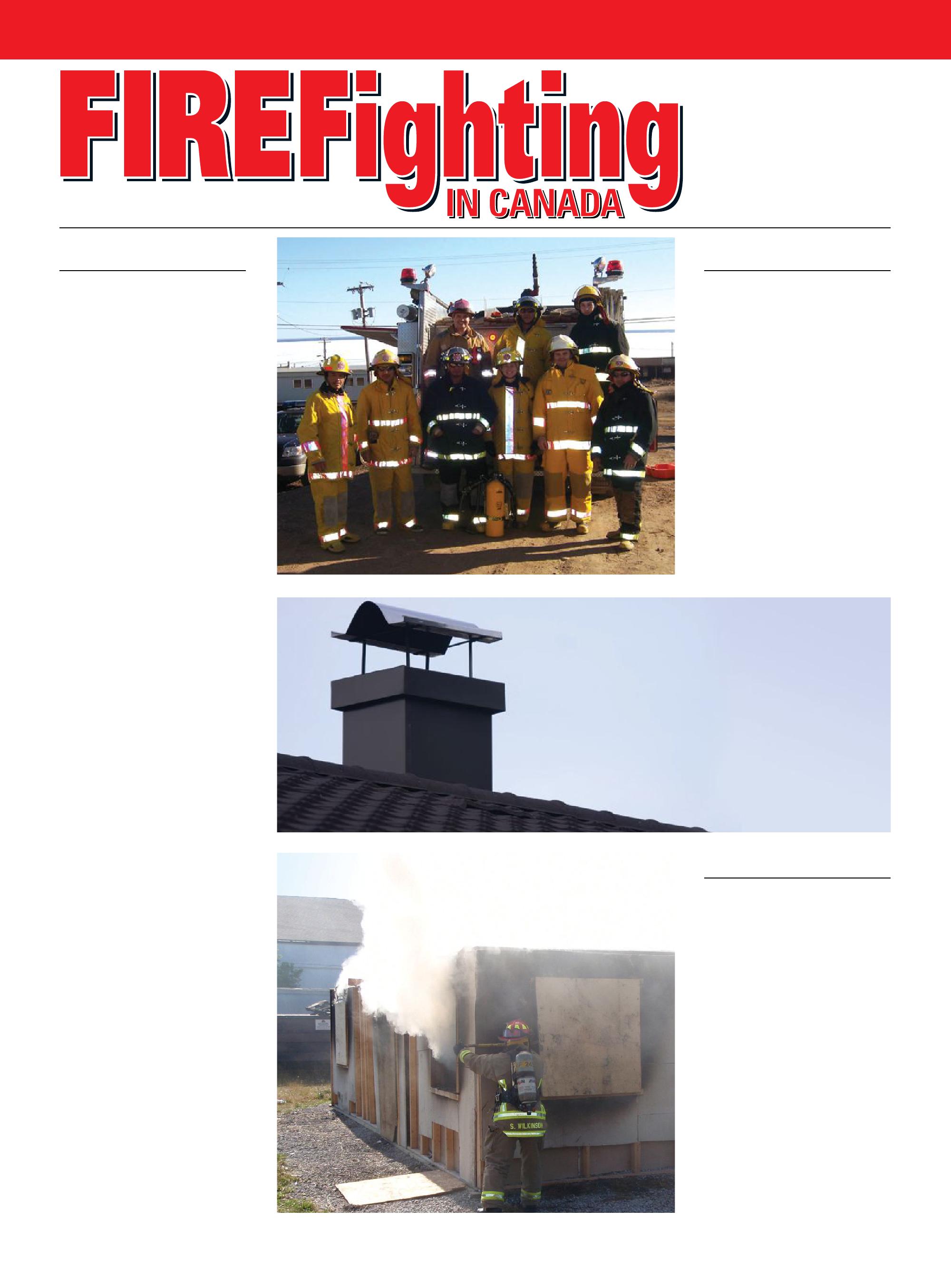
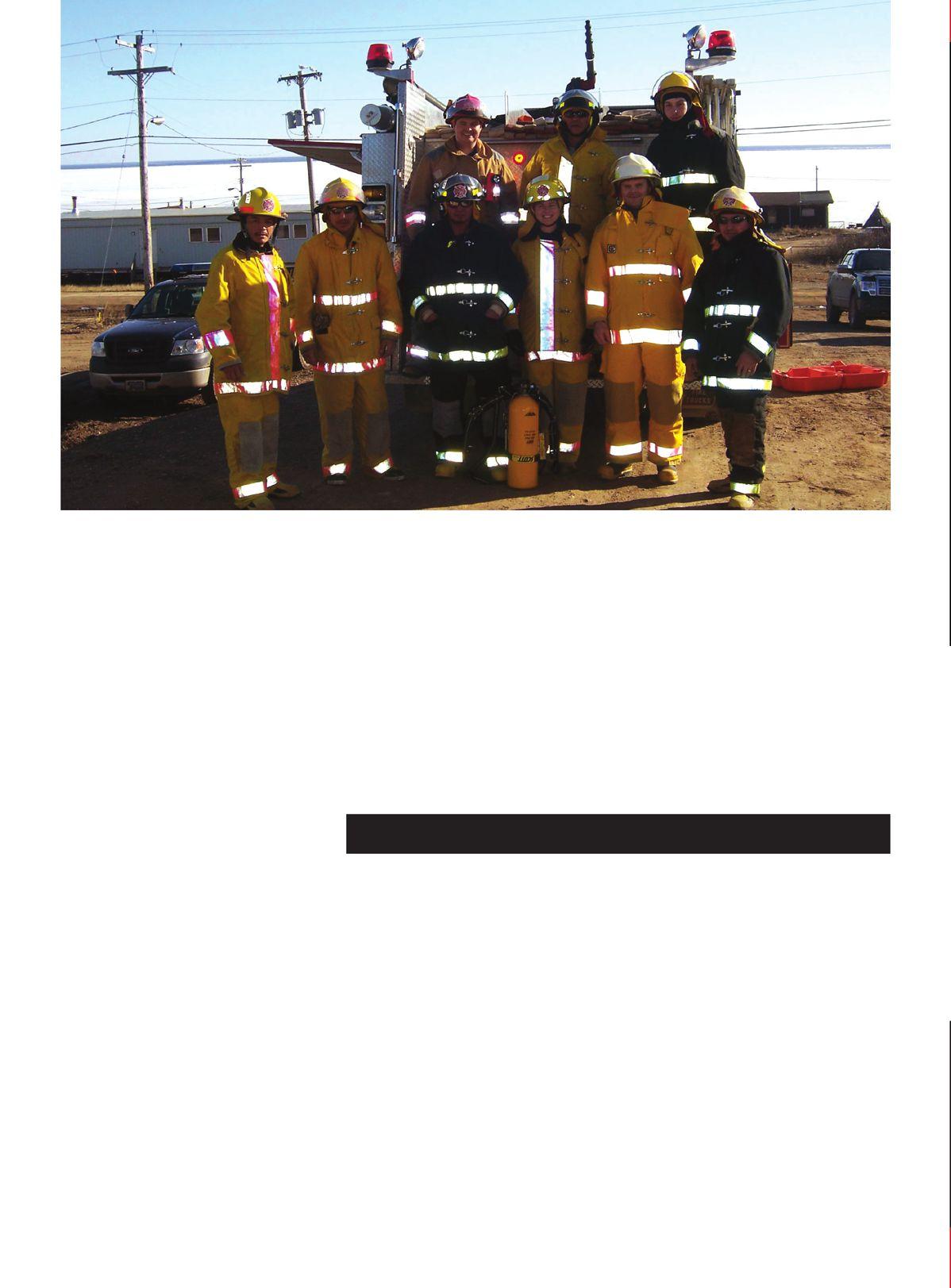
abo V e : Proud members of the growing Déline Fire Department in the Northwest Territories. The department now boasts 25 volunteers.
fire is a living, breathing thing –something that grows, devours and eventually dies. A fire department isn’t much different. Whether career, composite or volunteer, a department navigates different growing phases, hiring cycles and changes.
A little more than a year ago, the Déline Fire Department faced a major recruitment and retention challenge. Today, it is thriving. Here’s what happened.
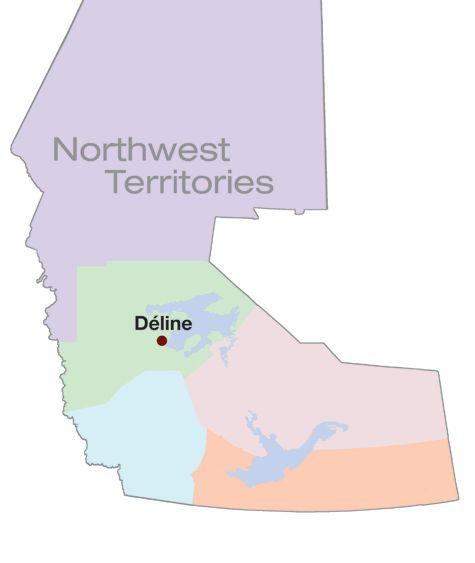
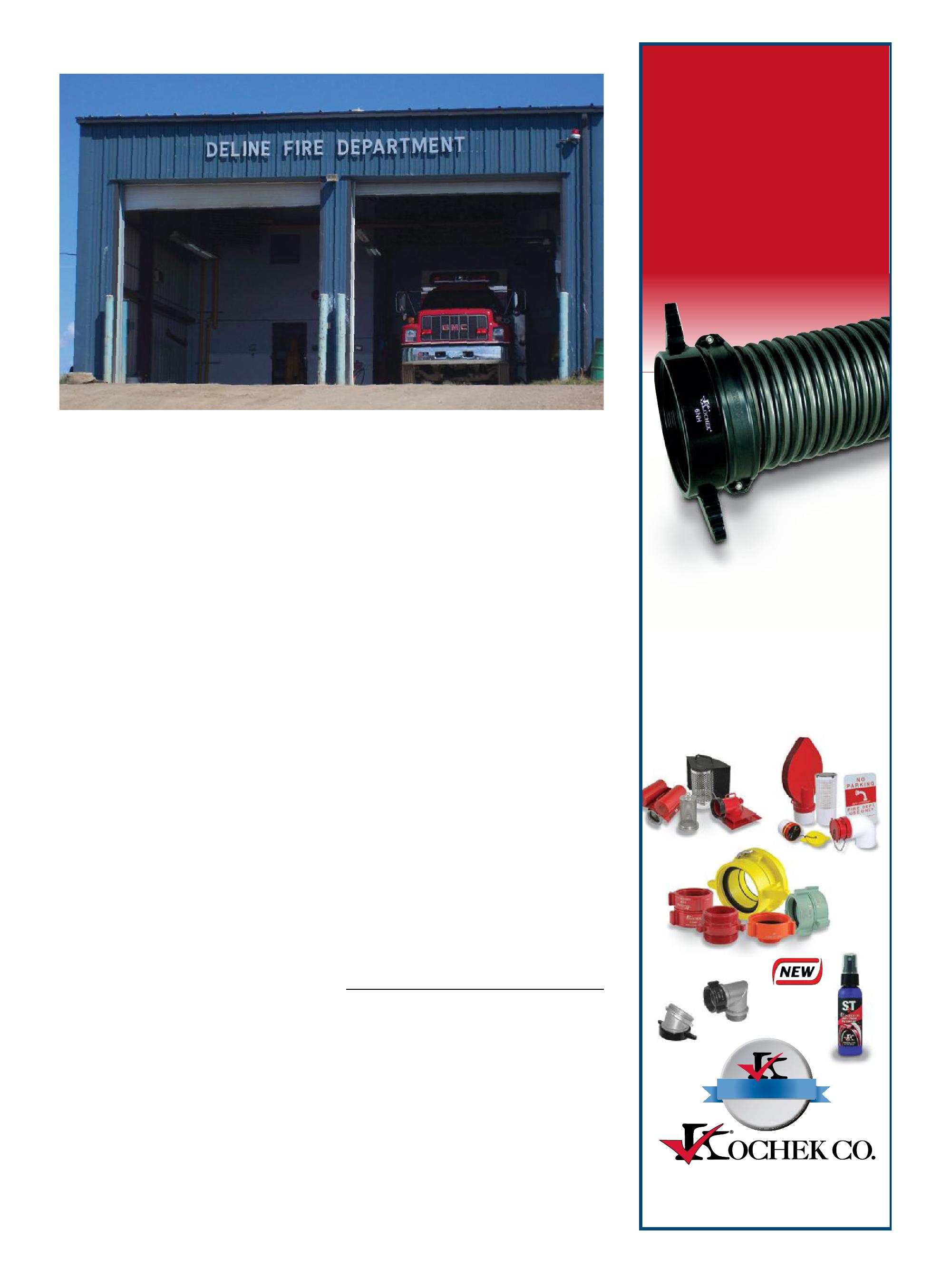
Déline, located on the southwest arm of the Great Bear Lake in the Northwest Territories, has a charter community of about 600 people and is completely isolated, accessible only by airplane (except for about 60 days when the ice road can handle the weight of transport trucks). Fire fighting here is an extreme balance between doing
the job and doing it safely. Communities like Déline (whose name means where waters flow) don’t have mutual aid – no other department is coming to help out in a major fire. It’s your crews versus the fire –winner takes all.
In the summer of 2010, the Déline Fire Department went through a remarkable transformation not typical of trends in fire departments across the country, particularly in the north: it started to grow. The process began with a conversation between the department and Christina Gaudet, the community’s senior administrative officer, who wanted to see an increase in firefighting effectiveness by the local department, which numbered six people at the time.
This was not an unreasonable request, but what followed was an important piece of the rebuilding puzzle – the authorization to
Photo
Kir K h ughes
spend money and recruit firefighters. The charter community of Déline added four firefighters immediately by allowing its employees to attend fires during business hours. This raised the number of firefighters to 10 within the first week of recruiting.
From there, veteran firefighters discussed who should be a firefighter and, once a name was selected, simply approached that person and asked if he or she were interested. If a recruit came on board, he or she filled out an application for approval by the fire chief. If the chief thought that person would help the department, the recruit was bunker-geared up and attended a training orientation. As word spread of the effectiveness of the recruiting process, more people started to ask if they could join. By the end of the first year, Déline Fire numbered 25 volunteers.
Recruiting people is one thing but keeping them is another. With firefighters secured, the goal moved toward retaining them, and what better way to do that than with some exclusive free items? Déline Fire made its first purchase, which consisted of t-shirts, sweaters, hats, shoulder flashes and helmet decals. Monetarily, this was a pretty meagre investment, but for morale it was priceless. Soon, Déline Fire sweaters and hats could be seen throughout the community being worn by members and officers alike. This presented the department with free advertisement and, ultimately, free recruiters.
With numbers and morale high, the task of training kicked into full gear. Unlike in the south, there are not a lot of fire colleges in the north, so the bulk of fire training is split between travelling fire marshals from the Northwest Territories and local trainers who have formal training and
A training officer was selected and a course curriculum was created. From there, volunteers met twice a month for training, with one night dedicated to fire-ground operations and the other to administration and discussion, often over a free meal. This led to a very fluent department: everyone felt comfortable sharing their input, ideas and suggestions with the fire chief and his officers. This method ensured that the most critical piece of the puzzle –department communications – was healthy. Firefighters were kept in the loop through posters, e-mails and meetings while the charter community and the local fire marshal’s office was kept up to date on activities through a detailed monthly report. Paperwork is never fun, but good reports had good effects, and Déline felt that right away when the fire marshal agreed to come to town and host a course.
Eventually, this communication method piqued the interest of St. John Ambulance in Yellowknife, which worked out a uniquely northern solution to the problem of medical response. Down south, paramedic crews respond to medical emergencies, but in small
Keeping volunteer firefighters engaged and motivated through training, special activities and firedepartment wear has encouraged others to join.
communities like Déline, medical response is often left to the local nursing station and the RCMP. St. John Ambulance saw this as a golden opportunity and authorized the training and equipping of the Déline Fire Department for medical response. Now, Déline Fire has medical equipment, advanced medical training and certified responders who can be called out to assist in any traumatic emergency.
All that said, no one joins the fire department to get free clothing, train all the time and have free meals. We join to fight fires, and the first test of the revitalized Déline Fire Department came just a few months into that transformation, on a frigid January afternoon when an alarm sounded at the local hockey arena.
Déline’s arena is more than a place to put on skates. It is a critical gathering place for youth, drum dances, weddings, fundraisers and other events. The facility links the entire community, so when word came that the arena was on fire, many fearfully gathered. In many communities, a fire in such a large building would mean disaster. Déline Fire Department responded with all resources, including Engine 1 and Tanker 2. Other privately owned water tankers arrived to help out. Firefighters were on scene in a matter of minutes and an aggressive interior attack was ordered by the first on-scene fire officer. Two firefighters entered the structure, with two in reserve and a safety officer monitoring the conditions. White smoke immediately bellowed out of the doorway of the kitchen. As more firefighters arrived, a second team was established to open the large Zamboni bay doors to allow the smoke to exit and clear the visibility for the search-and-rescue team to sweep the meeting hall.
Shuttling water trucks maintained critical water supply, providing interior firefighters with a constant stream to attack the fire. Within 10 minutes, reports emerged from interior units that the fire had been extinguished, the community hall had been searched for victims and the damage was contained to a small portion of the kitchen lobby. Grateful community members applauded the volunteer firefighters and thankful people still recall the heroic actions of the first two firefighters who went inside. Since that day, Déline Fire has responded to several calls for service, from house fires to forest-fire evacuations, all of which have allowed the department to show its worth to the community.
Déline is a vibrant and strong place that deserved a ready and willing fire department. All communities deserve good fire protection, and despite all the hurdles, obstacles and growing pains, there is a feeling beyond words when you can report to a homeowner and fellow citizen that the fire is out and everyone is safe, and hear children say they want to be firefighters when they grow up. I guess our recruiters will be busy for years to come.
Kirk Hughes is the assistant fire chief and training officer for the Déline Fire Department in the Northwest Territories. Hughes is a graduate of the Dalhousie University Fire Service Leadership program. He has worked at Emergency Management Ontario and as a volunteer firefighter in Portage la Prairie, Man., Kilbride, Ont., and at Ball Industries. Prior to arriving in the Northwest Territories, he served as the RCMP emergency-services co-ordinator for the G8 Summit accommodations team. Contact him at khughes@firehousemail.com
KOCHEK® Rural Systems Your Single Source of Water Supply
Lightweight, fle xible, and durable are the trademarks of Kochek’s P VC suction hose
It is the only brand designed specifically for the fire ser vice Our patented, field repairable, poly-lock collar and hose are backed by an industr y leading warranty
C all: 800-420-4673 or on the web@Kochek com
Strainers
Durable P VC Hose with lightweight design
KE P Suction Elbows
Dry Hydrants
Photo by Kir K h ughes
BaCKtoBaSICS
Rooftop obstructions
BY MARK VAN DER FEYST
We have been looking at ventilation in relation to truckcompany operations. Going to the roof to conduct vertical ventilation is not always an option as sometimes rooftop obstructions prevent firefighters from accessing the roof. Obstructions used to be found mainly on commercial and industrial buildings. Now we see similar and new types of obstructions on homes, as people become more environmentally aware.
The weight of these new types of obstructions prevents firefighters from conducting vertical ventilation. As the fire develops and grows, it weakens the roof support members, which can lead to a roof collapse. Incident commanders and front-line officers reading the conditions will recognize the signs of collapse and will prohibit any roof work.
HVAC systems and water tanks are common obstructions found on the roofs of commercial, industrial and business structures. These obstructions are factored into the construction of the building for structural stability. However, when there is fire present, the structural members will be weakened and the collapse of the roof will be accelerated because of the added weight of HVAC units and water tanks.
Solar panels and rooftop gardens are becoming more popular to produce energy and reduce carbon footprints as people become more environmentally conscious. These types of obstructions are common on the rooftops of industrial, commercial and business buildings, but they are becoming more prevalent on residential roofs too. Government programs that pay customers for energy production into the hydro grid are an incentive for homeowners to install solar-panel systems on their rooftops.
A variation of the solar panel is the solar thermal panel. This type of panel is used to heat water using the sun’s heat. Homeowners install these types of systems to heat pool water, and commercial buildings, such as aquatic centres, also use them.
Solar grids vary in size depending on the size of the roof and the amount of energy a homeowner wants to produce. The roof of the house in photo 1 has two sides covered with 21 solar panels, and there are plans to cover the other two sides with 21 more. The number of sides covered is dictated by the available space and the path of travel of the sun on the house. In photo 2, the roof of a nursing home is covered in solar panels. In both cases, the solar panels limit the space available for vertical ventilation.
There are two dangers to firefighters attempting to ventilate from a rooftop: the added weight of the solar panels and a live energy source. In residential structures that use lightweight truss construction, adding solar panels to the roof increases the dead load on the roof. This extra weight is probably not accounted for in the specs for lightweight roof construction. Typically, solar panels weigh about 50 pounds each, not including the weight of the hardware and installation systems used. If a thermal panel system is being used, there is even more weight due to the water that travels through the grid. The timeframe for a lightweight truss to fail is between five and 15 minutes. With a solar-panel system on the roof of a residential structure,
Photo 1: Adding solar panels to the roof of residential structures adds to the dead load on the roof. This, combined with a live energy source, presents a risk to firefighters performing vertical ventilation.
Photo 2: The nursing home shown here is not a likely candidate for vertical ventilation as the entire roof is covered in solar panels.
Photos by m ar
3: Rooftop gardens, which are becoming more prevalent, add considerable weight to rooftops; adding fire will cause the roof to collapse more quickly.
there will be less time to failure, and other methods of ventilation may have to be used.
The live energy source is the second hazard that firefighters may face. A solar-grid tie system used for power generation works with all of the panels strung together to produce the maximum amount of power. Each panel produces 24 to 48 volts. When tied together, the voltage can range from 120 to 400 volts. If a firefighter were to cut a vent hole through the solar panel with an axe or chainsaw, that firefighter will feel the full voltage being produced within that grid system. If vertical ventilation is required, it is best to relocate to a spot where the roof can be cut.
Rooftop gardens (see photo 3) are popular in many inner-city dwellings and apartment buildings. These gardens come in a variety of layouts and are mostly found on flat roofs, but can be installed on sloped rooftops. In Switzerland, builders are required to replace the green space taken by the building with a green space of equal size on the roof. This law includes existing buildings and all types of rooftops. A school in France is covered by a tent-type structure with a layer of grass on top. It performs double duty, providing a green footprint and holding the tent in place. Sod, water and plants to grow food add considerable weight to the roof. Most installation manuals for rooftop gardens advise homeowners to seek a structural engineer to determine if their roof can handle the added weight. Adding fire to the scenario will certainly lead to a quicker collapse of the roof.
When sizing up and looking at the outside of a residential or commercial building, look up to see what rooftop obstructions are present and, if necessary, reconsider what rooftop operations will be conducted (if any at all) and consider how this may affect interior operations.
Mark van der Feyst is a 12-year veteran of the fire service. He currently works for the City of Woodstock Fire Department in Ontario. Mark is an international instructor teaching in Canada, the United States and India. He is a local-level suppression instructor for the Pennsylvania State Fire Academy, an instructor for the Justice Institute of British Columbia and a professor of fire science at Lambton College. E-mail him at Mark@FireStarTraining.com
Photo
Managing chimney fires
BY ED BROUwER
chimney fires should never be considered routine. A chimney fire can burn with such explosive intensity that it can be –and often is – detected by neighbours or passersby. Flames may shoot several feet from the top of the chimney. People in the house report being startled by a low, rumbling sound that reminds them of a freight train. Do not respond thinking, “It is only a chimney fire.” Think structure fire and respond accordingly.
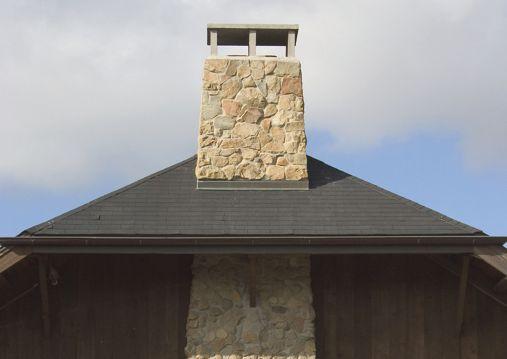
Traditionally, chimneys were solid structures that were constructed of heavy stone, block or brick. The chimney either was an integral part of the overall building structure, or was connected to the structure by a series of ties between the chimney and the outside wall of the structure. The flue was constructed of firebrick, clay, slate or tile. Few chimneys are built this way today because they are extremely expensive and there is a shortage of experienced, capable masons.
Most modern chimneys are prefabricated from steel tubing or pipe. This double- or triple-walled pipe is extended from the heating device through an insulated thimble in the wall and up the exterior of the structure. The chimney is fastened to the exterior wall by a series of metal brackets. The inner wall of the pipe serves as the actual flue. All chimneys should be equipped with a spark-arrester screen and a cap on the top.
A common cause of chimney fires is the ignition of residue within the flue. This residue is formed when fires are routinely burned at less than free-burning levels. This may be due to an insufficient oxygen flow to the firebox, or when large logs are added to a small fire. Incomplete combustion produces low heat levels and large amounts of fire gases. As these gases travel up the flue, they begin to cool and behave much the same way petroleum does as it is separated at a refinery. When the gases reach their condensation temperature, the liquid clings to the inside surface of the flue. This substance is called creosote. Creosote is black or brown and has a crusty or flaky consistency. It can be tarry, drippy, sticky or shiny. When it is hardened it is highly combustible. If the buildup of the volume of creosote is sufficient, a chimney fire is possible.
Hot, free-burning fires that have plenty of oxygen create very little smoke or residue. These fires develop high levels of heat, ensuring that any residue created makes it out of the top of the chimney. As long as fires are allowed to free-burn, few problems are encountered.
Another cause of chimney fires is the ignition of combustible materials near the chimney or heating device. Proper clearance and insulation between the heating device and other construction materials are crucial in the prevention of a fire that may start between the walls. These fires can burn undetected for a long time and are extremely difficult to fight. Firefighters may be required to completely tear out the walls or ceilings and perform extensive salvage and overhaul to put out the smallest fire.
Creosote buildup is most commonly found at three locations in the chimney: sharp bends in the flue, long horizontal runs in the flue, or the top one-quarter of the flue.
Indicators of a working chimney fire include the following:
• A roaring sound that grows louder as the fire intensifies, reaching temperatures higher than 1,000 C.
fire should be one
• Sparks or flames exiting the top of the chimney.
• A whistling or buzzing sound coming from the chimney.
• A back flow of smoke through the heating device into the structure.
• Discoloration on the walls adjacent to the chimney.
• Smoke emanating from the cracks in the wall or from electrical outlets near the chimney.
The minimum response to a chimney fire should be at least one engine company, one ladder company and an EMS unit. The engine company is required for fire extinguishment. The ladder company is required to supply tarps, ventilation fans, overhaul tools and ladders. Smaller volunteer departments may have all of this equipment on the engine. However, due to the fact that there will be firefighters working
The minimum response to a chimney
engine company, one ladder company and an EMS unit. Smaller departments may have all the necessary equipment on the engine.
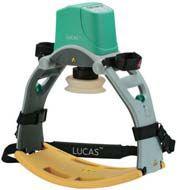
LIFEPAK 15 + LUCAS Perfect Partners
Perfect partners work together to create the best possible outcome for their patient. They support each other without duplicating effort. Designed based on years of partnership with EMS, the LIFEPAK® 15 monitor/defibrillator and the LUCAS™ 2 chest compression system work together to support your team in managing cardiac arrests. LUCAS 2 is designed to provide continuous, uninterrupted compressions while helping to reduce scene complexity. The 15 provides the power of 360J, plus the most advanced monitoring parameters available. Both are designed to be easy to understand and use by trained care providers. For more information, visit www.physio-control.com.
tRaInER’Scorner
on the roof, often in freezing or otherwise inclement weather, the potential for injuries at a chimney fire may be greater than first thought.
NFPA 1500 standard on fire department occupational safety and health program requires an EMS unit on fire responses.
Suppression tactics: The following should be considered when establishing an SOG for chimney fires:
• Ensure safety by evacuating the structure. Remember that all fires are unpredictable, so full PPE and SCBA should be worn.
• Perform a size-up of the building to ensure the exact location and size of the seat of the fire is confirmed. Fire will not always be visible from the flue on arrival. Only cancel other responding apparatuses when you have made a good evaluation of the chimney and surrounding areas.
• Check the carbon monoxide readings in the house with a CO detector.
• Check that the fire has not extended into the attic.
Once the fire has been located, and if it is contained within the flue system, move on to chimney fire specific extinguishment methods:
1. Spread a runner or salvage cover en route to the stove or fireplace. Not only does the cover catch any ashes or embers that may fall when and if the wood is removed from the firebox, but it also keeps bunker boots from tracking dirt onto the carpet. Plastic tarps fail quickly when they are exposed to heated embers, so you may want to consider fire-resistant cloth tarps.
2. Stop the flow of oxygen to the flue. Hopefully the occupant will have closed the damper before your arrival. However, if this is not the case, the first fire personnel on the scene should immediately shut off the oxygen supply. Reducing the oxygen flow decreases the intensity of the fire in the flue and, in some cases, will extinguish it completely. This step may not be possible on open fireplaces.
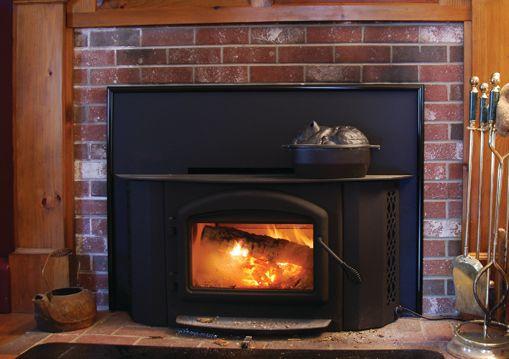
3. Extinguish the fire in the firebox. Before you just put the fire out, consider using the fire in the box to extinguish the fire in the flue. Water may be applied in small quantities (usually one cup of water) from a small bucket, a garden sprinkling can or an air-pressurized water extinguisher. In most cases the steam created from this small amount of water travels up the flue and extinguishes the fire. Multipurpose dry chemical agents will put the fire in the firebox out, but will not usually extinguish anything further up. Only remove fuel from the firebox if it has been extinguished and if absolutely necessary.
4. Establish horizontal ventilation. Some of the extinguishment activities, particularly the removal of wood from the firebox, may create a slight smoke condition in the dwelling. Establishing ventilation before other firefighting activities take place will minimize this. Positive-pressure ventilation is the method of choice in these situations. The ventilation entry point should be at a location remote from the stove or fireplace. The ventilation exit point should be as close to the heating device as possible, thereby minimizing the spread of smoke within the structure.
5. Ladder the roof. With a sufficient number of personnel on the scene, this step should be underway while steps 1 to 4 are being completed. If an aerial device is used, it should be extended to the chimney opening. If ground ladders are being used, a wall or an extension ladder should be placed at a good roof entry point and a roof ladder should be extended to the roofline adjacent to the chimney. If the roof is covered with combustible material, a charged hoseline should be advanced onto the roof as soon as the ladders are
Continued on page 34
teaching tools
Learning management system enhances online programs, automates admin and tracks progress
By PeTer seLLs
abo V e : Online learning management systems help trainers by centralizing and automating administration and consolidate training initiatives on a scalable, web-based platform.
online learning used to be a technique that fire departments dismissed as inapplicable, citing hands-ontraining as the best teaching method for fire personnel. With departments such as Edmonton Fire Rescue Services embracing online learning (see Fire Fighting in Canada, February 2011) and program developers enhancing the software, e-learning has become an accepted, effective and efficient teaching tool for the fire service.
Like all technology, online learning has evolved into something called learning management systems, or LMS, which better helps trainers track progress and competencies. LMS is a rapidly changing field that the American Society for Training
& Development (ASTD) describes as a software application that automates the administration, tracking and reporting of training events. My preference, for consistency (and also to describe an outcome rather than an activity), is to change training events in the previous sentence to learning events.
The difference between the terms LMS and online learning can be illustrated by using Tim Hortons as a parallel. Tims is a coffee and doughnut store. But it is also a retail outlet for breakfast items and light meals such as soup and sandwiches, an important employer across Canada, a sponsor of minor sports, a publicly traded Canadian corporation – this list could go on, depending on how objectively and broadly we wish to define Tim Hortons.
Bringing that analogy into fire-service learning, an LMS is more than a vehicle for online-training programs. The ASTD says on its website (www.astd.org) that a robust LMS should centralize and automate administration, use self-guided services, assemble and deliver learning content, consolidate training initiatives on a scalable, web-based platform, and support standards.
In my career as a fire-service training manager and an administrator of the LMS for Toronto Fire Services, I needed an LMS to do all those things, although I didn’t know it when we started down the LMS path. The two biggest surprises were the necessity of being able to create and deliver our own content, and the importance of records management and reporting tools that were flexible and easy to use.
Ellen Whybrow, the e-learning project manager with Edmonton Fire Rescue Services (EFRS) wrote about the that department’s experience earlier this year. I asked her what the anticipated advantages had been, and what advantages became apparent as the project unfolded. She said Edmonton Fire anticipated cost savings, the ability to track and maintain training records, the ability to generate written exams from an exam bank, and 24-7/365 access. She said it did not expect that many EFRS staff would log in to the LMS from home, that administrators would be able to track and survey staff subgroups by rank or specialty, or that certain fea-
tures – such as reminders to users to complete a course or congratulations to those who pass courses – could be automated into the system.
Edmonton is now able to accomplish some learning-management tasks that were not possible before, such as tracking use of reference materials or ensuring that trainees read materials and pass basic exams before coming to practical training sessions.
As for the anticipated savings, Whybrow says that Edmonton has recouped the initial investment in e-learning as the LMS has become an integral part of its training program. The content pushed out through the LMS is largely designed in house, but occasionally, off-the-shelf content is purchased that covers generic content such as WHMIS.
This content mix matches my experience at Toronto Fire Services. About 80 per cent of the content came from the service provider, but we quickly started developing our own course materials. By the second year, local content constituted the majority of the program as the LMS became a more familiar and integrated learning mode for firefighters and training officers. TFS continues to use its LMS this way to ensure that all members are up to date on policies, procedures and learning requirements for new equipment.
In addition to Toronto and Edmonton, fire departments in large cities such as Halifax, Regina, Vancouver and Mississauga are making productive use of online learn-
ing management systems from several providers. The adoption of online learning as a strategy for professional development is not limited to fire services with larger budgets. In fact, the types of cost savings that Whybrow described for Edmonton can make an online LMS even more valuable for a small department. For example, every time a fire officer from even a mid-sized department is sent to the Ontario Fire College for a weeklong course, an acting officer must be designated, and this is often possible only through an overtime callback. So the costs are not limited to the course fees and a travel stipend. With overtime and pay for acting rank factored in, the actual cost can turn into thousands of dollars per attendee. If the same course, in whole or in part, were to be offered online, the saving to the department would be much greater than the annual cost of the LMS user fee for that individual.
My experience as an administrator, content developer and user of several learning management systems over the last few years pales in comparison to that of Jay Patterson, a firefighter with New Tecumseth Fire Rescue in Ontario. Patterson has worked for 22 years in the software field, particularly in human and health services, and has designed and deployed provincial-level networks and applications for medical-health records, substance-abuse counselling and treatment centres. Patterson recognized a need in Ontario for a common training platform for firefighters.
“Fire departments across Ontario struggle with a common set of challenges,” Patterson says. “Some challenges we’ve had for a long time are now becoming acute, requiring greater attention, such as delegatory supervision in training. New challenges, such as budgeting and time management, are forcing us to rethink how we engage and manage our current and next-generation workforce.”
To meet those needs, Patterson and several partners started Stillwater Consulting Ltd. Stillwater’s Fire Learning Management System (FLMS) aims to of use innovative technology to more efficiently house, access, deliver and track firefighter training.
As important as online learning will be for large and small career departments, it will be even more valuable for the other three-quarters of the fire service. If online learning were an option, volunteer firefighters and officers would not have to attend courses on personal time away from jobs and families. James Wall, deputy fire chief of King Fire & Emergency Services in Ontario, says the Stillwater FLMS provides one-stop shopping for everyone.
Online learning management systems combine all aspects of training from records management to quizzes.
“Staff members can access our training programs from virtually anywhere . . . at the station, from home, or even from their iPhones,” Wall says.
“All of the training programs come fully supported with cognitive material, PowerPoints, videos, and short-answer quizzes that are automatically graded.”
Wall is also impressed with the consistency of the training programs, since he can be confident that the content delivered is the same for all firefighters.
One new capability of Stillwater’s FLMS is that instructors can remotely monitor students’ progress once they are enrolled in a course. As for cost savings, Wall notes that the amount of photocopying of learning materials has been cut in half since all firefighters have access to training materials online.
Meantime, Stillwater is starting a pilot project with the Ontario Fire College to address cost savings and accessibility. Some officer training programs will always require attendance by the learner; activities such as command simulation or development of instructional skills cannot yet be easily conducted online, at least not completely. But Stillwater is aiming to provide a cost-effective alternative for those courses that can be largely or entirely delivered through an e-learning model. The goal is to have as much of the Ontario Company Officer Diploma curriculum as possible available through FLMS, beginning with the foundation course on legislation, standards and program orientation. (Note: Ontario is not alone in adopting e-learning at the provincial level. École nationale des pompiers du Québec offers 120-hour online programs for Firefighter 1 in English and French.)
Between 2007 and 2009, the Ontario Ministry of Labour conducted 205 inspections resulting in 349 orders issued to fire departments. The five most common orders were related to the fire departments’ duty to provide instruction, provide supervision, produce documents, maintain equipment and provide WHMIS training. The ministry has been aggressively enforcing the Occupational Health and Safety Act across Ontario and the corresponding provincial, territorial and federal agencies across Canada are doing likewise. FLMS has squarely focused on improving training delivery and firefighter health and safety while reducing organizational liability. The importance of records management in reducing liability cannot be overstated. The implementation of a good LMS automates what is often a tedious and timeconsuming process.
I don’t wish it on any of you, but during
my years as a training manager, I occasionally had to sift through reams of paper to answer freedom-of-information requests, to comply with lawyers defending civil suits, to provide information to coroner’s inquests, and, once, when the assistant deputy chief called me and said, “You are about to get a phone call from a homicide detective. Give him what he wants.” Each of these episodes would have been reduced to a few keystrokes had today’s LMS tools been available. I don’t want to leave you with the impression that reduction of liability is the focus of an LMS, rather it is a valuable spinoff.
If good records management through use of an LMS can demonstrate that a firefighter has been properly trained and developed, the most important outcome is a safer firefighter.
Some tips for the LMS shopper:
• Make a list of your needs and then talk with some other fire services about how they make use of their learning management systems.
• You may not realize it at first, but you are likely to be creating most of your learning content in house, regardless of how extensive a catalogue your provider has available.
• Check into the financial health of your prospective provider; in fact, put some financial due diligence and disclosure into the tender documents. It can be a hectic day if your LMS provider goes belly up without notice (trust me on this one).
• What generation of Internet browser technology does the LMS use? Is it easily supported by your corporate network and accessible by your firefighters’ home computers or mobile devices?
• How does the licensing work? By computer? By firefighter? By course?
• Get your IT department on side and make sure it is going to support the implementation of the LMS. Deal in advance with issues such as allowing streaming content and pop-ups, and make sure all the necessary software pieces are in place (Flash, Java, etc.).
Retired District Chief Peter Sells writes, speaks and consults on fire-service management and professional development across North America and internationally. He holds a B.Sc. from the University of Toronto and an MBA from the University of Windsor. E-mail Peter at peter.nivonuvo@ gmail.com
Fire
BY L ES Ka RPLUK
Chief, Prince a lbert, Sask. an D
LYLE Q U an Fire Chief,
Waterloo, o nt.
tShowing by example that there’s no I in teamwork
he Canadian Association of Fire Chiefs conference in Calgary in September was more than just a learning experience; it was also an opportunity to network with our peers to see how things are going in their departments. As we have noted in several of our columns, there isn’t a whole lot of difference between what is happening in Calgary and what is happening in any other part of our country (Toronto, Halifax, Vancouver or St. John’s) – we are all trying to do more with less.
One of the themes for the conference was teamwork and this is what we want to address. In emergency services (as in any organization) we rely on teamwork to get the job done. It’s no secret that everincreasing pressure is being placed on chief officers to find new ways to provide our services, decrease costs, increase revenue, and maintain harmony and teamwork within the station walls.
We all expend a great deal of energy trying to build up others and demonstrate to them that we are supporting them because they are part of the team. This can drain our energy, and in many cases, it becomes the underlying reason some leaders in the fire service decide to leave the profession. Numerous fire chiefs have spoken to us about the growing sense of entitlement in their departments and how it can affect the team environment. In order for our departments to be able to overcome the what’s-in-it-for-me attitude, we need to build the what’s-in-it-for-us principle – hence, the challenge for chief officers.
‘‘
People change their attitudes when they see the value in changing them, or when they fear the possible alternatives. As much as the fire service is steeped in tradition with a focus on teamwork, there are reasons teams present a dilemma for some people. First, people can lose a certain level of independence in teams by having to rely on the success of the team itself. There is no room for individuals to claim they did all the work, when, in fact, it was a team effort. Secondly, because individuals are motivated differently, some of our colleagues value looking good over doing good. In other words, some people in the station are not interested in making sacrifices for the success of the team – they are more concerned with being part of the fire service and reaping the social benefits of such status. And lastly, there are those who just have a different work ethic and are not concerned about winning; rather they are more concerned about
putting in their time and collecting their paycheque. Variety is the spice of life, and yes, we need people with different views, values and abilities, but in the fire service, we expect all members to pull their own weight.
Understanding the dynamics and challenges of maintaining team harmony is fundamental for the success of today’s fire-service leaders. Teams have highs and lows and it’s unrealistic for any fire-service leader to expect the team to function harmoniously all the time. A closeknit team has often been viewed as the ingredient for team success when, in fact, a close-knit team can be the impetus of a dysfunctional team. Team members who are too close may hesitate to hold another accountable for fear of jeopardizing the relationship and causing dissension among members. If individuals are not held accountable to the department’s standards, it becomes too easy for members to put their own needs and egos ahead of the team’s. The reality is that mature teams led by experienced members can demonstrate respect by holding one another accountable to department standards, thus keeping the team in check and in touch with reality.
Progressive fire-service leaders recognize that teams consist of people with different backgrounds, expectations and needs. An effec-
People change their attitudes when they see the value in changing them, or when they fear the possible alternatives.
tive team requires trust, open communication, a sense of belonging and accountability. Teams are not built overnight, nor do they recover from setbacks overnight. Patience is key and the what’s-init-for-us principle must exist in every fire department across Canada. Ignorance of this principle becomes a root cause for the misguided sense of entitlement, which will eventually destroy team harmony and spirit.
Les Karpluk is the fire chief of the Prince Albert Fire Department in Saskatchewan. Lyle Quan is the fire chief of the Waterloo Fire Department in Ontario. Both are graduates of the Lakeland College Bachelor of Business in Emergency Services program and Dalhousie University’s Fire Administration program. E-mail Les at l.karpluk@ sasktel.net or Lyle at thequans@sympatico.ca
Jin Kwon, a South Korean martial arts master, said, “One piece of log creates a small fire, adequate to warm you up, add just a few more pieces to blast an immense bonfire, large enough to warm up your entire circle of friends; needless to say that individuality counts but team work dynamites.” In other words, we truly are the sum of all our efforts and if those efforts are disjointed because the team isn’t firing on all cylinders, those around us will notice it. But if we work like a well-oiled machine, everyone will feel united and we will become dynamic in what we do.
OUR SCHOOL ALSO HAS FIRE DRILLS. 850ºF FIRE DRILLS.
Our Pre-Service Firefighter Training Program is taught by the best firefighters of today, for the best firefighters of tomorrow. That’s why half of our firefighting course is hands-on training. The other half is the essentials you need to be the greatest. Talk to us about our intense firefighting program. www.festi.ca
Continued from page 26
in place. All firefighters on the roof should be wearing full PPE, including SCBA – no exceptions. Chimney fires rarely occur when the weather is good so watch your footing in snow or freezing rain conditions. Do not place the ladder near or secure the ladder to the chimney.
6. With all other tasks accomplished, the chimney fire may then be extinguished, assuming it has not already been extinguished during the process.
There is some opposition to using water, based on the fear that the water will rapidly cool the flue and cause it to fracture. These fractures may then go undetected, and subsequent use of the chimney may result in heat and products of combustion being released into the walls or attic, which may create a more serious fire situation at a later time. The key is in the amount of water used and how it is applied. There are special nozzles (six litres per minute) designed to apply water inside the chimney.
Some departments place dry chemical extinguisher powder in small Ziploc baggies and drop them down the flue (the weight of the powder causes the bag to
drop down to the dampener). The heat melts the plastic bag, releasing the dry chemical agent. The powder is light and will usually be lifted up the flue by the hot air rising from the fire.
Caution must be taken here because not every chimney is safely accessible.
7. Perhaps the most overlooked step is checking the clean-out box. Clean-out boxes are found both inside and outside the house. They are usually covered by an eightinch by eight-inch metal plate with two handle tabs on it, mounted on the wall in line with the chimney. You should be aware that there may be more than one – I once found three clean-out boxes at one fire. After locating the box, use a small shovel and a metal pail to clean out the burning embers. Once this is done, you can place a small, handled mirror into the box to look up into the flue. You should be able to see if there is still a fire in the flue. Communicate your findings to the roof sector. Looking up one flue, I noticed that the creosote was so thick that the opening in the top quarter of the flue had been reduced by 90 per cent –it was no bigger than a toonie.
8. Check for extension (again). Once the fire has been extinguished, look for obvious
signs of fire extension beyond the chimney. All roof, attic and wall areas near the chimney and heating device should be checked for the following signs of fire extension: discoloration or blistering of surface materials; hot-to-touch areas; smoke emitting from cracks and/or from electrical outlets, light fixtures, eaves or roof coverings; and visible glowing embers.
This is a great time to use thermal imaging cameras or heat sensors if your department has them. Should any of these signs be noticed, standard overhaul procedures should be used to expose the area.
Before leaving the scene, inform the resident that a qualified inspector must inspect the chimney and/or heating device before it is used again. Getting the resident to sign a statement to that effect, as well as informing dispatch that the resident has been informed, will help reduce your department’s liability in the matter.
A further note: The fire department is obligated to put out the fire; therefore, any damage caused in the process is a reasonable risk. However, the fire department is not obligated to clean the chimney, so damaging the chimney in this process is not a reasonable risk.
Nothing Dumps Faster!
Over 40,000 in use. We’ve been in business for over sixty years, so you can depend on us. That’s why Newton Kwik-Dump Valves can be trusted to get your tanker emptied and on its way FAST. Standard length, Mild Steel and Stainless Steel are in-stock. Need special length valves? Call us and it’s as good as done! Don’t accept look-alikes. Ask for us by name. For prompt, timely delivery, call us today.
One department I was with encouraged us to use a chimney chain, dropping it down the flue to knock creosote from the walls of the flue onto the bottom of the firebox. It required us to work from the roof and certainly increased the risk factor. Our present SOGs call for us to confirm extinguishment of the fire and lack of fire extension, and then advise the homeowner to have the chimney cleaned and inspected before lighting another fire in the fireplace.
9. Take time during salvage and overhaul operations to use floor runners and fireretardant salvage covers near the fireplace. Careful cleanup can earn your department valuable praise from the homeowners.
Chimney fires are generally simple to manage if you take the right actions.
Until next time, stay safe out there, and remember to train like their lives depend on it.
Ed Brouwer is the chief instructor for Canwest Fire in Osoyoos, B.C., and Greenwood Fire and Rescue. The 21-year veteran of the fire service is also a fire warden with the B.C. Ministry of Forests, a Wildland Urban Interface fire suppression instructor/evaluator and a fire-service chaplain. Contact Ed at ed@thefire.ca
SALES & SERVICE
WHERE QUALITY COMES FIRST
Offering: A 2 course certificate in incident command for experienced incident commanders. Please contact our office for more information.
Are you looking to take on more responsibility in your Department? Trying to round out your technical ability with leadership skills? Preparing to advance your career?
At Dalhousie University we offer a three course program, the “Certificate in Fire Service Leadership” to career and volunteer fire officers. The 3 courses Station Officer: Dealing with People, Station Officer: Dealing with New Operations and The Environment of the Fire Station are all offered in each of our 3 terms, September, January and April. The program can be completed in one year.
For more information and a program brochure please contact:
Gwen Doary, Program Manager
Dalhousie University Fire Management Certificate Programs
You will also find the information in our brochures or at the following internet address: Web site: www.continuinged.dal.ca
B Y SEan t R a CEY Canadian Regional Manager, n FPa
sThe NFPA’s 2012 Canadian objectives
trategic planning is a great way for organizations to focus. This is even more important for an organization such as the NFPA, which has many facets.
In 2011, the NFPA undertook a strategic planning effort, during which a number of its corporate goals were enunciated and clear objectives were set out for each region, including Canada.
From my experience, this was a welcome initiative, considering the limited resources available to Canadian fire services. The strategic planning exercise provided me with an opportunity to share these goals with our major stakeholders and get their buy-in. With 2012 just around the corner, it is important that I share these objectives with you to shine a light on the NFPA, its mission, and fire-safety issues in Canada
As a standards-development body, it is very important that the NFPA’s standards be accepted. To do this, the NFPA is looking at means to facilitate wider participation by Canadians in the standard-development process. Thus, we sponsor the online resource PTSC-Online (www.ptsc-online.ca), and write for media (such as this fine magazine). Through these mediums, we can update Canadians on proposed changes and new standards and their potential impact in a Canadian context. Through PTSCOnline we can even support discussion forums on specific topics.
Residential fire sprinklers remains one of the key advocacy efforts for the NFPA in 2012, with a focus on increasing awareness of the benefits through support of the expanding Home Fire Sprinkler Coalition and its planned Canadian spinoff.
reduction as a high priority. The NFPA is advocating this internationally, with Canada being the first stop in this effort. The formal memorandum of understanding (MOU), signed by Partners in Protection (PiP) and the NFPA was the first partnership formed. The NFPA hopes to roll out elements of the MOU in 2012, with key points including adapting the materials for use in Canada, running provincial FireSmart workshops and assisting PiP in launching a FireSmart community recognition program. We will also work with PiP to seek wider adoption of NFPA standards 1142, 1143 and 1144 by communities in their development plans. These standards are complemented by PiP’s FireSmart manual. Communities following these standards could then easily qualify to meet the recognition criteria, thus raising the profile of the protection activities.
The NFPA will also continue to support the activities of the Canadian fire service. It wants to be the go-to source for guidance on fire/life safety issues. For this reason, the NFPA will remain active in monitoring and supporting local fire services on issues in and around
r esidential fire sprinklers remains one of the key advocacy efforts for the n FPa in 2012, with a focus on increasing awareness of the benefits . . .
The NFPA will also look to support a number of side-by-side burn demonstrations across Canada. We will also offer a stipend to support communities that wish to build and run residential sprinkler side-by-side burn demonstrations in their communities. This initiative was funded by a FIRE Act grant in the United States, and the NFPA will fund this in Canada.
We will also continue efforts to have sprinklering adopted into the National Building Code and the provincial codes. The NFPA has submitted a number of code-change proposals and has looked at parallel firefighter-safety issues that can benefit from sprinkler adoptions. Because the installation of residential sprinklers is not well supported outside the fire service, the NFPA will support individual communities that wish to introduce sprinkler bylaws. The NFPA is prepared to offer a full range of support, including assisting in council presentations if need be.
The NFPA board has also identified wildland-urban interface risk
Sean Tracey, P.Eng., MIFireE, is the Canadian regional manager of the National Fire Protection Association International and formerly the Canadian Armed Forces fire marshal. Contact him at stracey@nfpa.org
’’
care-home fire safety, First Nations fire protection and mid-rise construction, to name a few.
The NFPA may not have a specific policy addressing its concerns on each of these issues, but it will use the baseline information found in the NFPA consensus codes and standards. The aim is to help present best practices and reduce the risks to Canadians and to the Canadian fire service. With this aim, the NFPA will provide support and technical advice from its entire network of resources to local departments and provincial departments as necessary.
The year 2012 promises to be challenging, thanks to the many issues that the Canadian fire service faces.
With luck and hard work we hope to see the presence and influence of the NFPA grow yet again.
Thanks for your ongoing support of the NFPA. We look forward to serving you in the new year.
stepBYstep
Positive pressure attack
By PHIL ROSS
one hundred years of tradition unimpeded by change: I’m confident that if you have been part of the fire service for any time, you have heard this phrase, or something similar, during your career.
Unfortunately, in some North American departments, this is indeed the case. I have never personally subscribed to this way of thinking, and, as fire department leaders, it is incumbent upon us to search out new techniques, to evaluate new products and adopt new tactics to assist our crews in suppression activities, and to make the job of fire fighting safer.
With this in mind, the Niagara Falls Fire Department (NFFD) in Ontario recently completed a comprehensive training program on positive pressure attack (PPA).
PPA is not new. In fact, departments across the United States have been using this tactic since the early 1990s. When I introduced positive pressure ventilation (PPV) to my department in 2002, I anticipated that, in time, we would expand our operations to use PPA.
The training division was directed to research the topic, gain some knowledge and formulate a plan to get our personnel trained in PPA. As a starting point, we bought several copies of the book Positive Pressure Attack for Ventilation & Firefighting, by battalion chiefs Kriss Garcia and Reinhard Kauffmann, and firefighter Ray Schelble, of the Salt Lake City Fire Department in Utah.
It wasn’t long before I was approached and floated the idea of contracting the services of Garcia to conduct a train-the-trainer course, not only for our department, but also for others, if they were interested. Long story short, we advertised first through the Niagara Regional Fire Chiefs Association to gauge the interest, then opened up registration through the Ontario Association of Fire Training Officers. A budget line was set, course details were confirmed and we proceeded to build a one-storey, five-room burn house to accommodate the practical training.
As firefighters, we know that plastics have replaced most natural materials used in the manufacturing of household furniture. As a result, fires are increasing in intensity more rapidly than ever and more deadly gases are being created, even in the smallest fires. These products of combustion will cause harm and possibly death to those in their midst without respiratory protection.
As recruits, we learned that the rapid removal of smoke, heat and gases from a structure on fire is helpful to firefighting personnel during search and rescue and fire attack, while providing a more tenable, survivable atmosphere for any victims still inside the structure.
Then why would we wait to ventilate a structure?
It’s time to move forward and stop limiting our crews to the same conventional methods of ventilation used for years. The rapid fire spread our crews are facing in structure fires today, combined with the increased use of lightweight construction materials, begs for a better form of mechanical ventilation with an increased margin of safety.
Opening of windows in the fire room.
Photos by Phi L r oss
Opening established prior to fan introduction.
Fan started and directed into structure.
PPV + INITIAL FIRE ATTACK = PPA = CO-ORDINATED ATTACK
Setup for PPA is basically the same as for PPV, with one important difference: the fans are set up before firefighters enter the structure and are used in conjunction with the initial fire attack.
The basic procedures to a successful use of PPA include:
• positioning of the fan at the point of entry firefighting crews are using
• creating an exhaust opening in proximity to the fire
• beginning pressurization in tandem with fire attack.
First-arriving crews must identify the point of entry to be used for firefighting operations and a firefighter then positions the fan at that location. Another crew member and/or officer quickly identifies the location of the fire (this can be accomplished with the use of thermal imagery) and chooses the exhaust opening to be used. The firefighter at the entry point will position the fan one to two metres away from the opening. The fan is started as soon as possible, with the airstream directed away from the opening. With the exhaust opening secured and attack crews in position with a charged hoseline, the airstream is now directed into the entry point. The attack crew waits momentarily until pressurization has taken place within the structure and observable conditions have improved before making entry. The fan is always placed at the backs of the initial attack crew. Personally, the best way I could evaluate the process and weigh the benefits of PPA was to take part in the practical evaluations. In order to do this, I participated in several burns to experience the operation myself. I can tell you that Garcia likes his fires hot! With visibility getting progressively worse and heat in the upper portion of the building increasing and advancing to the lower portion of the room we were in, the crew and I were becoming more intimate with
the floor with every passing moment. The order was given to take the window for the exhaust opening, which provided little relief for the crew inside. Moments later, the entry point was opened and the fan directed into the building.
I can attest that almost instantaneously we were able to stand up, visibility was vastly improved to the point at which we could see the fire room, and all products of combustion were being effectively vented through the exhaust opening. The attack crew with a charged hoseline entered shortly thereafter and, in a matter of seconds, had the fire under control with very little water use and no flame spread to any other area of the structure.
Through my research of PPA as a fireattack strategy I was confident that this was going to be an effective tool, but like many others, I was skeptical about the effect it would have on the fire and the rest of the structure.
Seeing this operation first hand confirmed that this was the future of suppression operations in the NFFD.
• Heat and smoke are rapidly cleared from the fire structure early in the operation.
• Victims’ chances of survival are increased.
• Improved visibility within the structure.
• Attack lines rapidly advanced to seat of fire.
• Water use is decreased due to direct fire-attack capabilities.
• Fire damage is reduced.
• Better use of crews as roof ventilation may not be necessary.
For departments contemplating PPA implementation, there are several considerations to keep in mind:
Positive pressure attack started.
Fire attack underway.
• There must be a commitment. Fans will need to be purchased to outfit apparatuses that may be arriving first on scene. A burn structure will need to be constructed if a facility is not readily available. Training time may be extensive (one to two months).
• ALL personnel must be thoroughly trained in PPA, including theory, applications and precautions before implementation. Senior officers (platoon chiefs) were directed to
participate in all aspects of this training in order to have a better understanding of the dynamics at work when PPA is used. Fireprevention officers also participated in this training to gain a better perspective on the operation and to acquaint themselves with flamespread patterns that may be out of the norm when PPA is employed.
• All personnel should have an expectation that PPA will be a fire attack option.
• Protocols, procedures or operational guidelines must be developed so firefighting crews will systematically put fans into operation as part of a coordinated attack.
• PPA is best used for aggressive interior attacks on incidents at which first-arriving crews can make a rapid entry into the area involved in fire. Large, complex operations may require a more methodical, less aggressive implementation of PPA.
• Command and control of the incident is paramount when using PPA. Co-ordination of fire attack in terms of exhaust opening, airstream introduction and crew advancement requires disciplined and welltrained personnel.
In the short time that the NFFD has been using PPA, feedback has been very positive. I have had firefighters, captains and senior officers express to me their appreciation of the vast improvement to their personal safety. They also say that the physical toll on firefighting crews has greatly diminished, and that we should have been doing this 20 years ago. I couldn’t agree more.
Be safe!
If you are interested in obtaining more information on this procedure you can contact Jim Boutilier, Director of Training, Niagara Falls Fire Department or visit www. PositivePressureAttack.com
TRAIN MORE PEOPLE MORE EFFECTIVELY IN LESS TIME WITH A BULLEX SYSTEM.
The I.T.S. Xtreme™ live-fire extinguisher training system provides safe, effective hands-on fire safety lessons at your convenience. Interchangeable props include a trash can, stove top, electric motor, and paint locker,
providing an interactive, realistic hands-on training experience. Check out our website for more information about the I.T.S. Xtreme system and to see the entire arsenal of BullEx training tools.
Deputy Chief Phil Ross is responsible for the suppression and training divisions of the Niagara Falls Fire Department in Ontario. He is a graduate of Ryerson University’s public administration and governance program and the Niagara College law and security administration program, and is a member of the Institute of Fire Engineers (GIFireE). He is qualified as a community emergency management co-ordinator, is a certified municipal manager with fire suppression professional endorsement through the Ontario Municipal Management Institute and is a certified fire and explosion investigator through the National Association of Fire Investigators. He is a member of the Ontario fire marshal advisory board on firefighter survival, the Ontario fire marshal first responder task force on clandestine labs and marijuana grow operations, and is a qualified instructor for the provincial incident management system course through Emergency Management Ontario.
moving up
system uses data from past calls to calculate probability, staff stations accordingly and improve costs, efficiency
By Len garis, JosePH CLare and raJ nagaraJ
Editor’s note: This article builds on an April 2008 story in Canadian Firefighter and EMS Quarterly that explained Surrey Fire Service’s use of the LiveMUM decision-making tool for optimum coverage. After four years of use, Surrey summarizes the positive findings of an evaluation of LiveMUM.
It’s Thursday morning in Surrey, B.C., and three Surrey Fire Services (SFS) units are responding to a residential structure fire in the city’s northwest. At the same time, in the south of the city, another four units are responding to a motor vehicle accident and an alarm call. From an operational perspective, how does the duty chief determine whether the remainder of the city’s resources are located where they will provide optimal coverage? What are the risks of another call occurring? Should empty halls be backfilled? Can on-duty resources be temporarily redistributed to improve coverage?
In years past, such questions were answered based on gut feelings and experience, with huge variations from one instance to the next. At an extreme, such a situation would have been addressed by initiating full standby coverage for all empty halls.
However, since 2007, this has not been the case for Surrey Fire, where operational decision making has been guided by a probabilitydriven, real-time resourcing decision-making tool called the Live Move-Up Module (or LiveMUM, created by Deccan International – www.deccanintl.com).
This model uses past calls for service, across time and space, to calculate the probability that resource gaps have emerged as a consequence of current resourcing demands. If such gaps are identified, LiveMUM then makes recommendations about reallocating the remaining resources to improve coverage.
This process is achieved through recommending move-ups, which involve temporarily relocating resources from one station to another to provide emergency coverage when and where it is required.
From the outset, Surrey Fire management has been very satisfied with the performance of LiveMUM and the results of a recently completed evaluation have justified this position. Analysis of 2010 data revealed LiveMUM had an overall net positive impact on response times and reduced incidence of indiscriminate backfilling. In short, probability-driven, pre-emptive allocation of resources around the city has maximized operational cost efficiencies and improved firefighter coverage.
THE SCOPE OF THE COVERAGE PROBLEM
Surrey is the second-largest city in British Columbia and the 12th largest city in Canada. Its 17 fire stations provide coverage for 317.4 square kilometres and a population of about 475,000 (see Figure 1 for the coverage areas for the 17 fire halls in Surrey). Although calls for service are unevenly distributed across time and space, analysis of historical data demonstrates that there is predictability to these distributions.
THE UNDERLYING LOGIC OF LIVEMUM
Using this knowledge, LiveMUM aims to achieve three goals:
• Maximize coverage across the city;
• Minimize the number of vehicle move-ups;
• Minimize the travel times involved when vehicle move-ups are recommended.
LiveMUM interacts with the city’s computer-aided dispatch system in real time to determine when and where move-ups are necessary. For example, when the closest units to a particular neighbourhood will not be available for a significant period of time, a move-up is recommended. At the same time, LiveMUM’s risk-assessment tool helps to ensure that any relocated resources will actually be put to use. This critical component relies on historical data to calculate the probability of a second call occurring in an area when units are already in use. This calculation looks at the time of day and geography of previous calls. Move-ups into particular areas are recommended at times/days when the area’s call volume is typically high, but not when volume is typically low.
The system employs Bayesian statistics, which are an approach to probabilistic inference that determines the likelihood of a future event occurring based on past incidences of the event. LiveMUM applies
Figure 1. LiveMUM pop-up window, advising of the coverage gap and effective solution.
Figure 2. Detailed station-by-station unit information and colour-coded coverage gaps indicated by LiveMUM.
this approach, recommending a move-up if the probability of a call occurring is above the specified threshold (to date this threshold has been set by Surrey Fire at 25 per cent likelihood of a resource being required in the area).
If the likelihood of requiring additional resources in an area that is currently not covered exceeds this risk threshold, then a second decision is required: where should resources be moved from in order to address the probabilistically determined need? This recommendation is made based on the combination of available alternatives and is motivated by a need to avoid simply shifting the resourcing coverage problem to a different part of the city. An underlying safeguard in this process is that LiveMUM is never going to worsen coverage, and, as such, will never move a “must-cover” unit.
WHAT THE DISPATCHERS EXPERIENCE
From an operational perspective, LiveMUM functions by displaying a colour-coded map (see Figure 2) that allows dispatchers to see the various levels of move-up necessity for different types of apparatuses in real time across the city. For example, per customized Surrey Fire Service configuration rules, if two adjacent fire halls respond to a call, a red colour on the map indicates where an engine move-up is required, based on the probability of a call occurring while the responding units are in use elsewhere. Orange indicates if a move-up is not necessary due to historical call infrequency at that time. Colour coding also shows where the level of coverage is acceptable (yellow) and optimal (green) throughout the service area.
Also, fire stations on the map are colour coded to indicate whether there are available units, no available units, or no units assigned.
Detailed station-by-station unit information is also available, as is on-screen monitoring of a move-up in progress (see Figure 1).
From a dispatcher’s perspective, LiveMUM will pop up a window advising of the coverage gap (see Figure 1). The system accommodates multiple concurrent scenarios – an important feature for a department the size of Surrey –and the dispatcher can cycle through alternatives as required before making the call to the appropriate units to move up as required.
IMPROVED RESPONSES AND COST EFFICIENCIES
SFS wanted to examine the impact of LiveMUM on responses to calls for service in 2010 – a total of 28,902 incidents, of which 10,164 (35 per cent) involved an engine-capable unit. Depending on the timing and typical coverage requirements of incidents, gaps in coverage occurred. As
a consequence, LiveMUM initiated 422 engine move-ups (an average of 1.15 per day), 81 of which resulted in a response by the moved-up engine unit. This meant that 19 per cent of the time an engine unit was moved up in 2010, it was located in the correct area of the city to ensure better overall response times were attained.
In addition to providing better coverage, LiveMUM reduced unnecessary backfilling of stations. Data from 2002 revealed that prior to implementation of LiveMUM, callback resources were used 52 per cent of the time. In comparison, the call-back rate for 2010 increased to 92 per cent, a 77 per cent improvement. The net result of this was to maximize the effectiveness of the cost associated with backfilling empty fire halls.
CONCLUSIONS AND FUTURE APPLICATIONS
Therefore, LiveMUM has enabled Surrey Fire Service to dynamically manage its resources and maintain a high level of coverage while minimizing downtime. Surrey Fire is now working with Deccan International to fine-tune the decision-making criteria for the initiation of move-ups to further enhance these positive effects.
From a broader planning and economic perspective, tools such as LiveMUM are becoming increasingly valuable in light of the economic downturn, which is forcing the fire service to find more efficient ways to deliver services. LiveMUM enables Surrey Fire to dynamically apply its resources in an efficient, targeted manner, with no net reduction of service.
Moving beyond the specifics of fire, there is obvious potential for using a similar probabilistic approach to resource allocation for other emergency first responders. LiveMUM is fully compatible with automatic vehicle locators and/or computerdriven dispatch, and has the potential to be used across governmental boundaries (for example, for mutual aid) and across service providers (EMS and fire). Furthermore, the principles that underlie the successful application of Bayesian modelling in LiveMUM, such as the non-random distribution of calls for service over time and space, are equally applicable to these other services, which are also attempting to meet service needs across a pre-defined area with finite resources.
Len Garis is the fire chief for the City of Surrey, B.C. Contact him at LWGaris@surrey.ca
Dr. Joseph Clare is a strategic planning analyst for Surrey Fire Service.
Dr. Raj Nagaraj is director of engineering with Deccan International.
Are you a good candidate to take on a secondar y career as one of our Ontario representatives? Visit www.PPES.ca today for additional details.
B Y PE t ER SELLS
The best of times; the worst of times
Ihate reading or quoting Dickens, but I console myself with the knowledge that the same line was spoken by Capt. James T. Kirk in The Wrath of Khan. I want to look at a tale of two fire chiefs –in Prince George, B.C., and Caledon, Ont.
In early November, Prince George Fire Rescue responded to a fire on the fifth floor of an apartment building, rescuing five people from balconies and evacuating 40 to 50 residents, many of them seniors with mobility challenges.
Fire Chief John Lane gave a lot of good material to the media, sticking to his messages. Facts: “Three full crews, the rescue truck, and the assistant chief made up the initial call-out crew when the first alarm came in, sometime between 6:30 a.m. and 7 a.m. . . .” Process: “It was immediately clear that they had a working fire – there were people trapped on the balconies and multiple calls from inside the building . . . so we got the ladder truck down here as quickly as possible . . .” Avoiding speculation (as to smoking being the cause of the fire): “It’s quite preliminary for me to release anything like that, but we’re certainly aware that there were people in the suite and we’re certainly pursuing that avenue in the investigation.”
A job well done by Lane and his team, but was it the best of times? My consistent message is that the best fire fight is the one that doesn’t occur. Sun Tzu said in The Art of War that the best general wins by being in such a strong position as to avoid the potential for conflict. That is what Fire Chief Brad Bigrigg of Caledon Fire & Emergency Services in Ontario attempted to achieve by calling for stricter fire-safety measures at a group home for 50 people living with mental illness. The home operates with just two staff at night; Bigrigg has notified the home to bring the nighttime staffing up to four to comply with code, or face consequences, potentially including eviction and closure.
damage. Chief Bigrigg was fulfilling a different responsibility, that of enforcing compliance. These situations involve parties whose immediate interests are in conflict, but whose long-term interests are best served by compliance. Any official exercising statutory authority over a private party can be portrayed as the heavy if the resolution of the issue comes down to eviction or closure. So the first element of contrast is the particular facets of a fire chief’s job that Lane and Bigrigg were fulfilling.
The second contrast is in the stakeholder reaction. In Prince George, support was provided by allied agencies such as EMS, police, transit and health authorities, the city’s communications director, and the Salvation Army. All these resources were directed at ensuring the health and safety of the residents and firefighters. In Caledon, Bigrigg had support of the mayor and was acting within his statutory authority, but the property owner claims that the provincial health ministry sees the regulations as unfair. Media coverage has the owner claiming to have spoken to the office of the fire marshal, but the degree of support for the owner’s position, as reported, is vague. Paradoxically, the advocacy group, which one would expect would support the safest possible living conditions for the residents
s un Tzu said in The Art of War that the best general wins by being in such a strong position as to avoid the potential for conflict. ‘‘ ’’
The local paper quotes the owner of the group home as believing that the chief is trying to make a name for himself. Even more outrageously, “It’s pretty obvious that the fire chief is bigoted or ignorant about people with mental illness,” said Max Wallace of The Dream Team, a mental health advocacy group, in the Caledon Enterprise. “He seems to believe the residents are physically impaired or invalids.”
What led to this contrast? I see three elements. Chief Lane was dealing with a structural fire response, in which the interests of all parties are aligned: everyone wants a quick resolution with minimal
Retired District Chief Peter Sells writes, speaks and consults on fireservice management and professional development across North America and internationally. He holds a B.Sc. from the University of Toronto and an MBA from the University of Windsor. E-mail Peter at peter.nivonuvo@gmail.com
(i.e. the fire chief’s position) has loudly and irresponsibly portrayed the chief as a bully.
Finally, the role played by local media could hardly be in greater contrast. Media consultants will say that the media can be your partner and get critical messages out to the community. This is the type of support Chief Lane received from the Prince George Citizen and others. The Caledon Enterprise took a different approach, printing inflammatory rhetoric, seemingly to change the focus from bringing the group home into compliance to questioning the fire chief’s character and motives. Another valuable media-relations skill is sticking to your message when dealing with a reporter who may have more to gain through sensationalism than through professional integrity.
In the interest of my own journalistic integrity, I will disclose that John Lane and Brad Bigrigg are my friends. I have the deepest professional respect for them both.
A Protective Foam Blanket
in Less than 60 Seconds…
TFT’s compact PRO/pak foam injection and application system is the ideal choice for rapid vapor suppression with any Class A, AFFF or Alcohol Resistant foam concentrate.
Offering nozzle choices for low or medium expansion finished foam, the PRO/pak operates at low inlet pressures, is easily flushed, and provides injection ratios from 0.1% to 6%.
To learn more about how you can improve and simplify your foam operations, contact your local TFT dealer today.