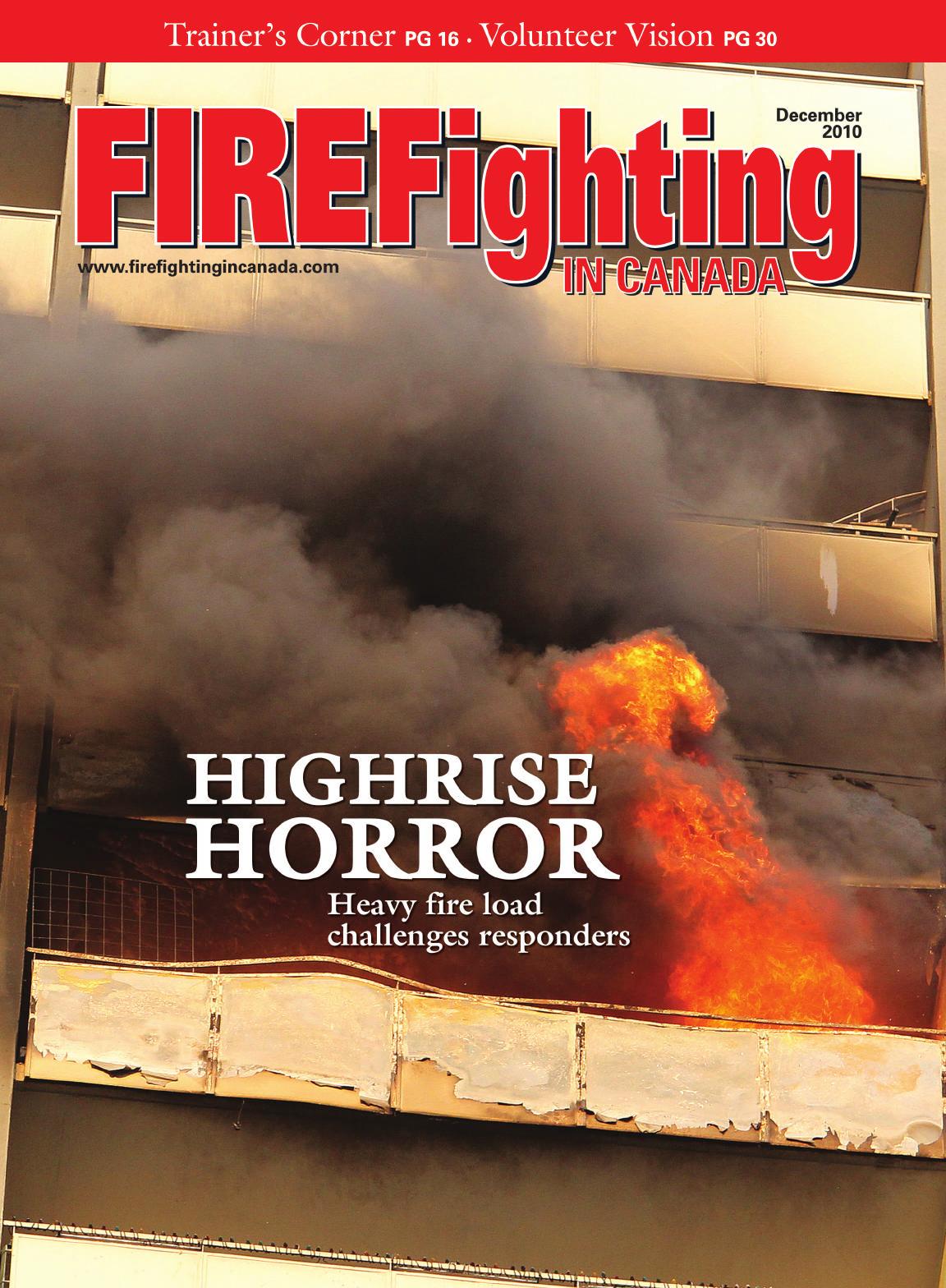
When Toronto firefighters were called to a severe, working fire at 17:02 on a bright, sunny September afternoon, they expected a fairly routine apartment fire. They didn’t expect the fire in a 712-unit apartment complex to escalate to six alarms nor the heavy fuel load they found in the unit of origin. Chief William Stewart reports.
BEST PRACTICES
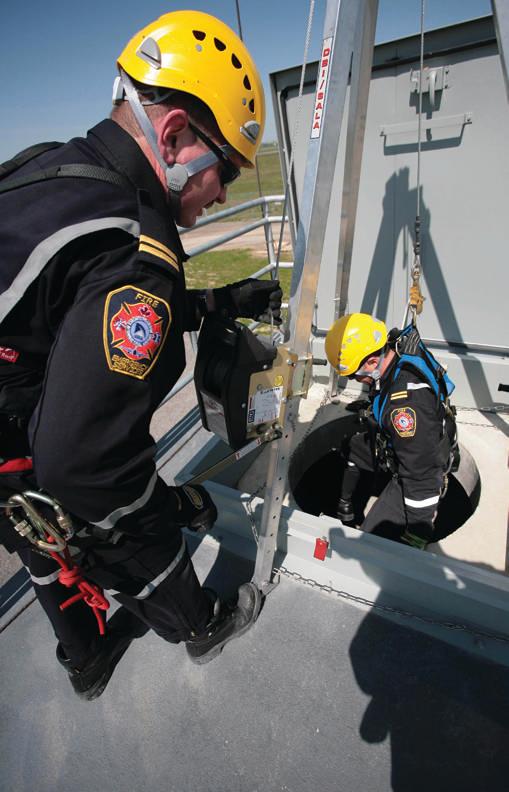
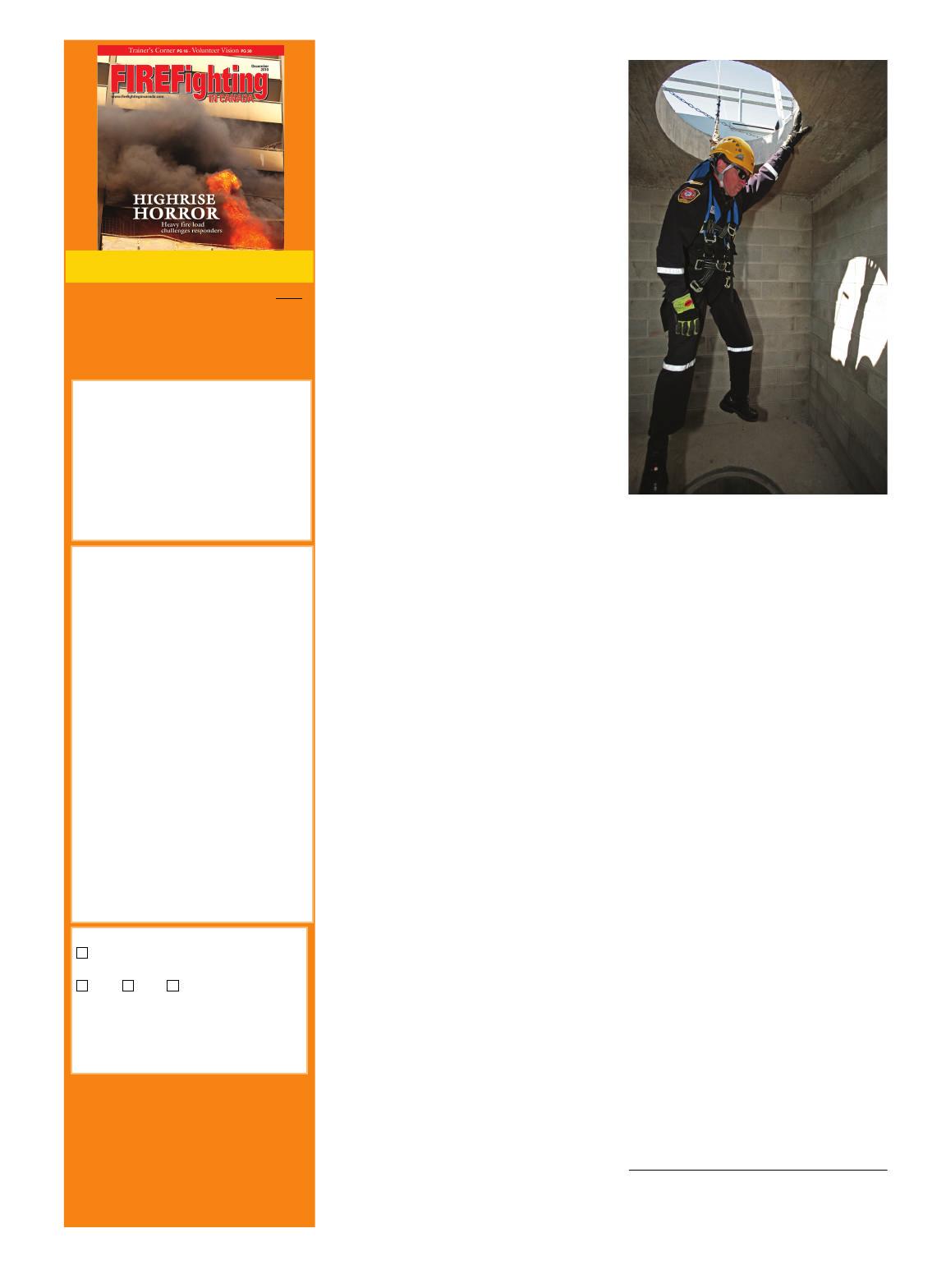
A new standard that defines confined spaces and provides guidelines to help rescuers avoid potential risks is expected to reduce the number of confinedspace deaths in Canada. The Canadian Standards Association recently implemented a national standard that has implications for firefighters and first responders. Rosie Lombardi explains.
BY LAURA KING Editor lking@annexweb.com
I
COMMENT
Common sense revolution
n September I wrote about Chief Brad Patton, our former Volunteer Vision columnist, who had taken on a project that left him little time to pontificate for Fire Fighting in Canada
Brad’s shoot-from-the-hip style and his vision for a more cohesive fire service will be missed but two great things have come from his departure from these pages: our new, equally passionate Volunteer Vision columnist Chief Vince MacKenzie from Grand Falls-Windsor, N.L. (more on Vince below); and Brad’s project to change the structure of the volunteer fire service.
In a presentation to Ontario chiefs in November, Brad outlined a scheme to make the fire service in his home county of CentreWellington more efficient, more effective and, more importantly, safer for its firefighters. Although the project is meant for CentreWellington, it can be applied to departments across Canada and can affect firefighter health and safety, departmental liability, volunteer retention and, of course, the bottom line – a bonus for bean counters and municipal councilors.
“Volunteer fire departments are not free,” Patton said. “I strongly believe that in this day and age … a volunteer departments needs fire and administrative staff and support, and council needs to hear that volunteer departments need good leadership.
“What will this position do? It will reduce the legal liability to municipalities – there will be lesson plans, safety plans and everything will be documented. It will increase the safety of firefighters.” It’s not a radical change at all, it’s just common sense. So, let’s throw that 100 years of tradition unimpeded by progress under the pumper and get with Brad’s program. Brad would be happy to share more details with you. Contact him at bpatton@ centrewellington.ca.
ON THE COVER
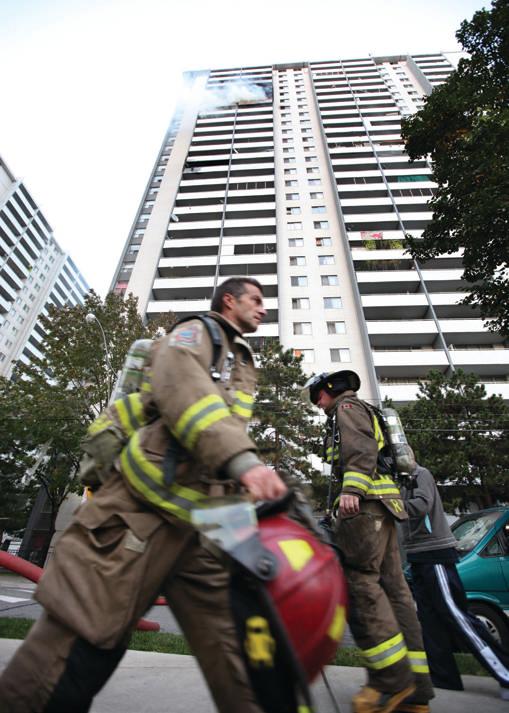
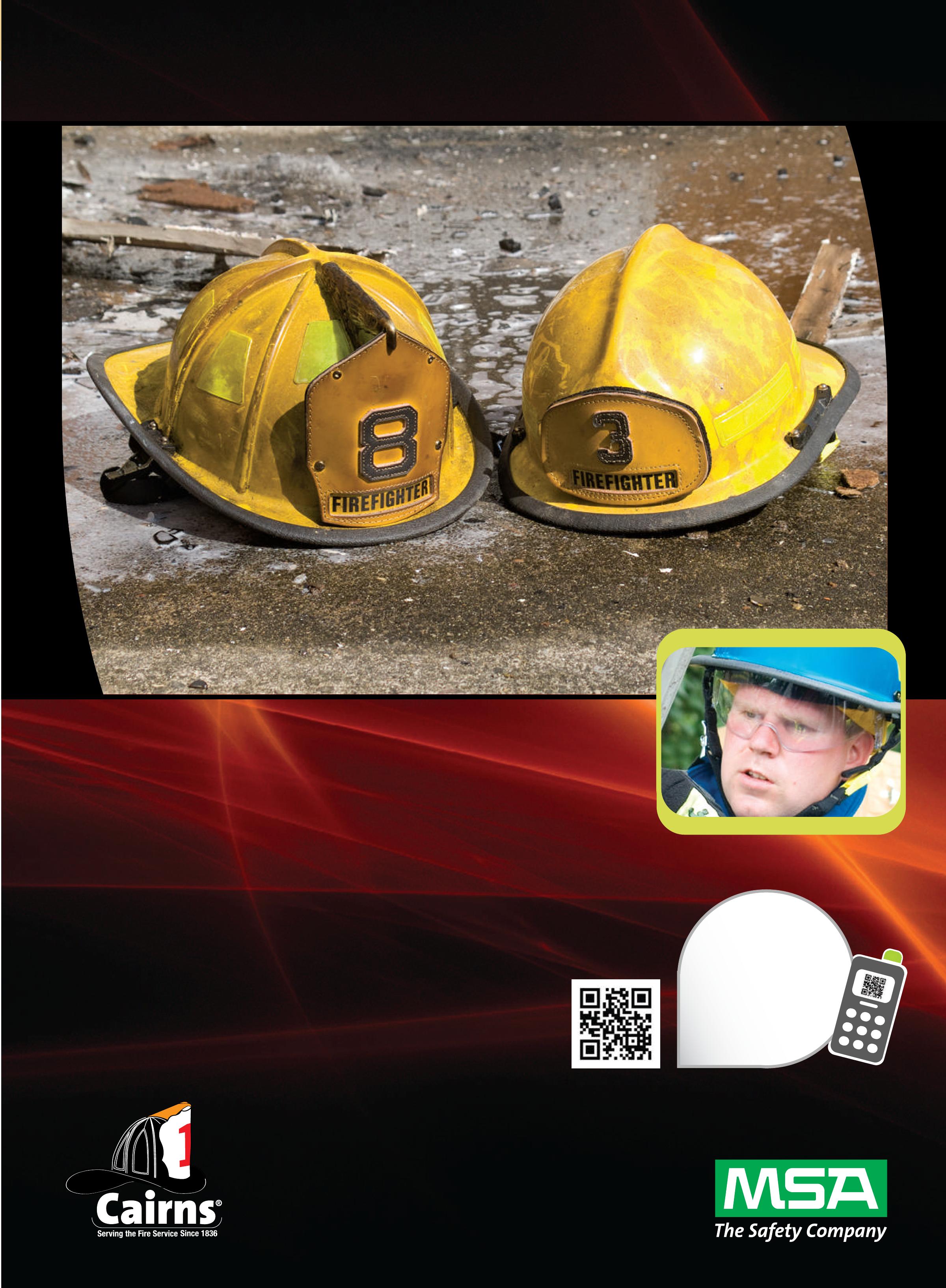
Toronto Fire Services encountered unexpected challenges during a highrise fire in September. See story page 10.
Vince MacKenzie got bitten by the writing bug after he did a View from the East column for Fire Fighting in Canada in May, so it wasn’t difficult to convince him to take on a bigger role in the magazine.
PRODUCTION ARTIST KRISTA MISENER kmisener@annexweb.com
GROUP PUBLISHER MARTIN MCANULTY fire@annexweb.com
PRESIDENT MIKE FREDERICKS mfredericks@annexweb.com
PUBLICATION MAIL AGREEMENT #40065710
RETURN UNDELIVERABLE CANADIAN ADDRESSES TO CIRCULATION DEPT.
P.O. Box 530, SIMCOE, ON N3Y 4N5 e-mail: lmorrison@annexweb.com
Printed in Canada ISSN 0015–2595
CIRCULATION
e-mail: lmorrison@annexweb.com
Tel: 866-790-6070 ext. 206
Fax: 877-624-1940
Mail: P.O. Box 530 Simcoe, ON N3Y 4N5
SUBSCRIPTION RATES
Canada – 1 Year - $24.00
(with GST $25.20, with HST/QST $27.12) (GST - #867172652RT0001)
USA – 1 Year $40.00 USD
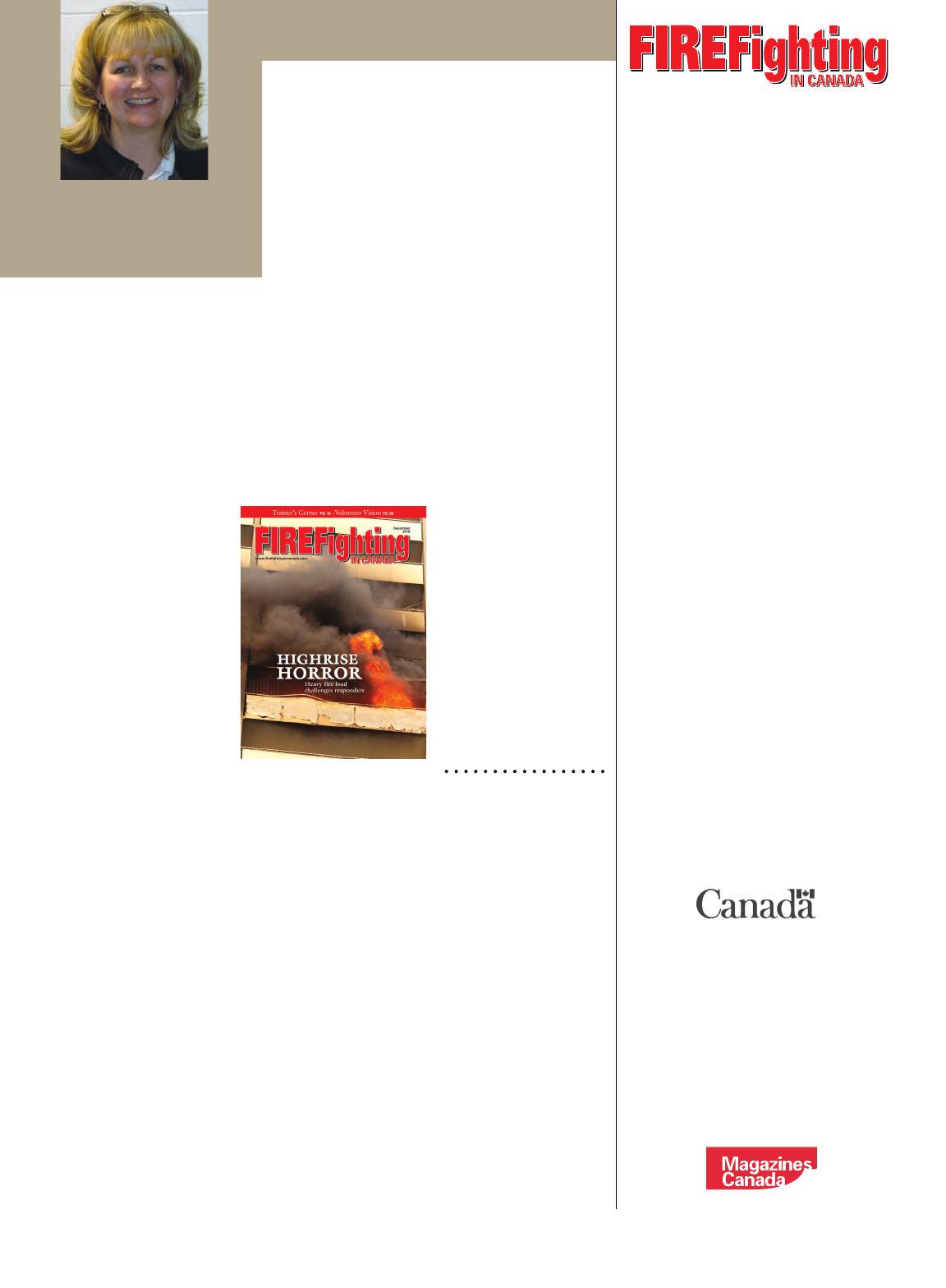
We acknowledge the financial support of the Government of Canada, through the Publications Assistance Program and the Canada Magazine Fund, toward our mailing and editorial cost. Nous reconnaissons l’aide financiere accordee par le gouvernement du Canada pour nos coults d’envoie postal et nos coutl redactionnels par l’entremise du Programme d’aide aux publications et du Fonds du Canda pour les magazines.
Essentially, this radical change involves the hiring of one full-time training officer to prepare detailed training plans for all stations in the county and deliver those plans to the volunteer training officers to use on training nights: accountability, liability and consistency in one fell swoop. Sure, it means the municipality has to agree to spend money on a full-time training officer, but given liability concerns – particularly in Ontario where two chiefs and a training officer have been charged under the Occupational Health and Safety Act following firefighter injuries and a fatality – it’s a bargain.
Vince shares Volunteer Vision with Tom DeSorcy, the chief in Hope, B.C., who joined us in February. Each will write four columns a year.
In a true bit of fire-service bonding, Vince and Tom met at the CAFC conference in Saint John, N.B., in September and discovered that although they’re from opposite coasts, they have plenty in common.
Like DeSorcy, Vince wears many hats: he’s president of the Newfoundland and Labrador Association of Fire Services, second vice-president of the Maritime Fire Chiefs Association and a director of the CAFC. He will offer a well-rounded perspective on fireservice issues.
Occasionally, Fire Fighting in Canada will mail information on behalf of industry-related groups whose products and services we believe may be of interest to you. If you prefer not to receive this information, please contact our circulation department in any of the four ways listed above.
All advertising is subject to the publisher’s approval. Such approval does not imply any endorsement of the products or services advertised. Publisher reserves the right to refuse advertising that does not meet the standards of the publication.
www.firefightingincanada.com
PHOTO BY JOHN HANLEY
STATIONtoSTATION
ACROSS CANADA: Regional news briefs
Ontario firefighters recognized for rescues
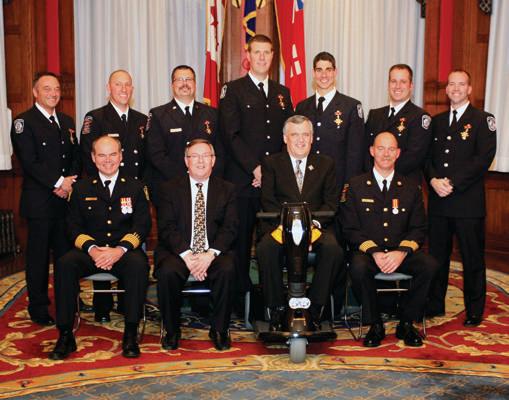
Seven Ontario firefighters, from the Burlington and Wasaga Beach fire departments, received the Ontario Medal for Firefighter Bravery on Nov. 18 from Ontario Lieutenant-Governor David Onley in a private ceremony at Queen’s Park. The firefighters were nominated by their chiefs for two rescues.
On March 10, Wasaga Beach firefighters Jason Bavelaar and Reno Levesque rescued an unconscious man from his smoke-filled home. Full-time firefighters Bavelaar and Levesque, both off duty at the time, were paged to respond to a structure fire and arrived before the department trucks and equipment. When informed that a person was inside, the two entered the smoke-filled home without protective gear. The unconscious man was located in the basement and was carried outside. The gentleman was transported to hospital, treated and later released. Bavelaar and Levesque suffered minor
smoke inhalation and were treated on scene.
On Aug. 18, the Burlington Fire Department responded to what was reported as a man being washed away in a river. Crews found a man clinging to a rope in a drainage culvert with water up to his chest. Firefighters George Cassady and Blair Fedyszyn entered the water but were advised by the victim that that his leg was trapped in a grate. Upon orders from the platoon chief, Acting Capt. Chris Martin entered the water and discovered that the victim was wearing hip-wader style boots that were full of water. The force of the water siphoning into the drain and the heavy hip waders made it next to impossible to free the man.
The water had risen above the victim’s chin and he was beginning to panic.
Firefighters Bruce Cole and Joel Kirschner entered the torrent to assist. Martin requested that Cole place his foot on the back of the victim’s leg
THE BRASS POLE
Promotions & Appointments
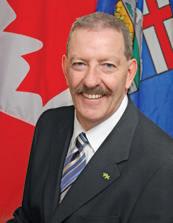
ROB MCKENZIE has been appointed fire chief of Whitchurch-
Stouffville Fire and Emergency Services in Ontario. McKenzie was hired as a full-time firefighter in 1983 at the Richmond Hill department and worked his way up the ranks to platoon chief before joining the Whitchurch-Stouffville department as deputy chief in 2006.
Platoon Chief DAVE BEATTY has been selected as deputy chief of the Burlington Fire Department in Ontario. Beatty
Bravery award recipients (back row, left) firefighters George Cassady (Burlington), Jason Bavelaar (Wasaga Beach), Reno Levesque (Wasaga Beach), Acting Capt. Chris Martin (Burlington), Joel Kirschner (Burlington), Blair Fedyszyn (Burlington) and Bruce Cole (Burlington). Front row (left) Burlington Chief Shayne Mintz, Community Safety and Correctional Services Minister Jim Bradley, Lt.-Gov. David Onley, Wasaga Beach Chief Mike McWilliam.
and push. In a co-ordinated effort, and on the command of Martin, Cole executed his order and the team pulled in unison to remove the victim from the grate.
has been with the department since June 1976, and achieved the rank of lieutenant in 1985, captain in 1993 and platoon chief in 2005. He attended the Emergency Preparedness College in Ottawa and completed programs in both emergency site management and emergency operations centre procedures. Beatty has taken over the suppression division and maintenance division portfolios.
DAVE HODGINS has retired,
Firefighter Jeff Willemse was anchored on the shore, securing life-line tether ropes that were attached to the rescuers and the victim. Willemse received a certificate of merit.
Retirements
having experienced a very successful and rewarding career with fire, rescue and emergency management services. He began his distinguished career as a volunteer firefighter in 1977, becoming a career firefighter in 1978. Hodgins served as deputy chief, Edmonton; fire chief, Strathcona County, Alta., and London, Ont., and British Columbia’s fire commis-
PHOTO BY JOHN RIDDELL
Canadian fire station wins prestigious design award
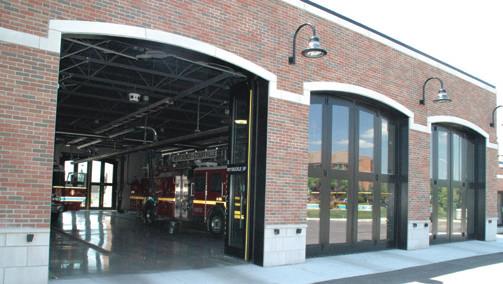
For the first time, a Canadian fire station has been awarded a gold standard in Fire Chief magazine’s station design competition. The WhitchurchStouffville Fire Department’s Station 51 (featured in September’s Station to Station) is highlighted in the November issue of Fire Chief.
“Every year they dedicate most of the November issue to an award and recognition process for new fire stations that
they call station design awards,” Whitchurch-Stouffville Chief Rob McKenzie said in an e-mail to staff.
McKenzie said he and former Chief Chris Powers referred to several past editions of the magazine’s design issue while designing and building Station 51 and captured some ideas from the magazine. In September, McKenzie took the liberty of entering Station 51 in the competition.
The Whitchurch-Stouffville Fire Department’s Station 51 is recognized in Fire Chief magazine’s design issue.
The $6.5-million station boasts a gourmet kitchen with stainless steel appliances, an enormous community room that doubles as the EOC, a good-sized workout room, dorms for men and women and the original fire bell from the old Main Street station. The station’s bifold doors are the talk of the town.
– Laura King
A little piece of Caledon in Kandahar
Lynn Beaton works in customer service for the Town of Caledon, Ont., a quaint and picturesque community that’s proud of its composite fire department.
Earlier this year, Caledon Fire Chief Brad Bigrigg spoke to Beaton’s husband, Paul, an Ontario Provincial Police Officer and a member of the Canadian Forces Reserve, at a collision with entrapment.
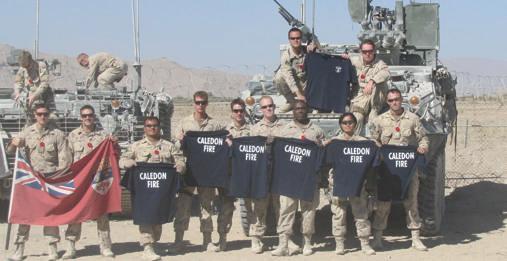
Paul Beaton was deployed to Kandahar in April with Force Protection Platoon, Task Force 1-10 Afghanistan and, through some goodwill, ended up with a little piece of Caledon in Kandahar – or, rather, several pieces – in the form of Caledon Fire t-shirts donated by the
sioner and assistant deputy minister; and completed his public service as managing director, Alberta Emergency Management Agency. He has
Members of Force Protection Platoon, Task Force 1-10 Afghanistan, show off t-shirts donated by the Town of Caledon and the Caledon Fire Department in Ontario. They are (front row, from left) Rob Taylor, Josh Bouchard, Rhean Ongcango, Matthew Shipman, Robin Schavo, Paul Beaton, Eric Scott, Pauline Chung, Ivan Oliynykov, (back row, seated at right) Al Watson and Kiefer Patriquin.
Caledon Fire Department.
“In late summer, Lynn approached me about send-
ing some of our Caledon Fire t-shirts to Paul’s platoon to show our support for our
troops,” Bigrigg said. “It was a pleasure to do so. The gesture is intended to show Paul and his platoon that they are not forgotten, that their mission matters and that the Caledon community has a great deal of respect for them and the professional manner in which they have conducted themselves on behalf of Canadians during their deployment.”
In a e-mail to Bigrigg, Paul Beaton said he and members of Task Force 1-10 Afghanistan “wore the shirts at the gym so often that people thought the town had deployed firefighters to Kandahar.”
Task force members return home in December.
BY
been a contributor to Fire Fighting in Canada for 20 years and plans to continue to write and share his ideas about challenging the status quo.
Former Orangeville, Ont., Fire Chief WILLIAM (BILL) NOBLE died at his home in Collingwood on Oct. 26, in his 80th year. Well known in the Orangeville community, he first joined the department in
1952 as a volunteer firefighter and served as its chief from 1964 to 1995. Noble had the distinction of being the Town of Orangeville’s first full-time fire chief in 1974.
FRANK BISHOP JR. passed away May 26, when the small plane on which he was the only passenger crashed in the Labrador interior. The Cupids, N.L., resident was a dedicated volunteer firefighter with the Cupids and Bay de Grave departments.
NANCY JANE SINCLAIR slipped away peacefully surrounded by her family on Oct. 13. Nancy devoted her life to Camp Bucko and those within the burn community. Camp Bucko, near Minden, Ont., is a haven for children ages seven to 17 with burn injuries. Sinclair had been operations manager since 2000 and touched the lives of campers, parents, volunteers, and donors, as well as many members of the firefighting community.
PHOTO
LAURA KING
STATIONtoSTATION
BRIGADE NEWS: From stations across Canada
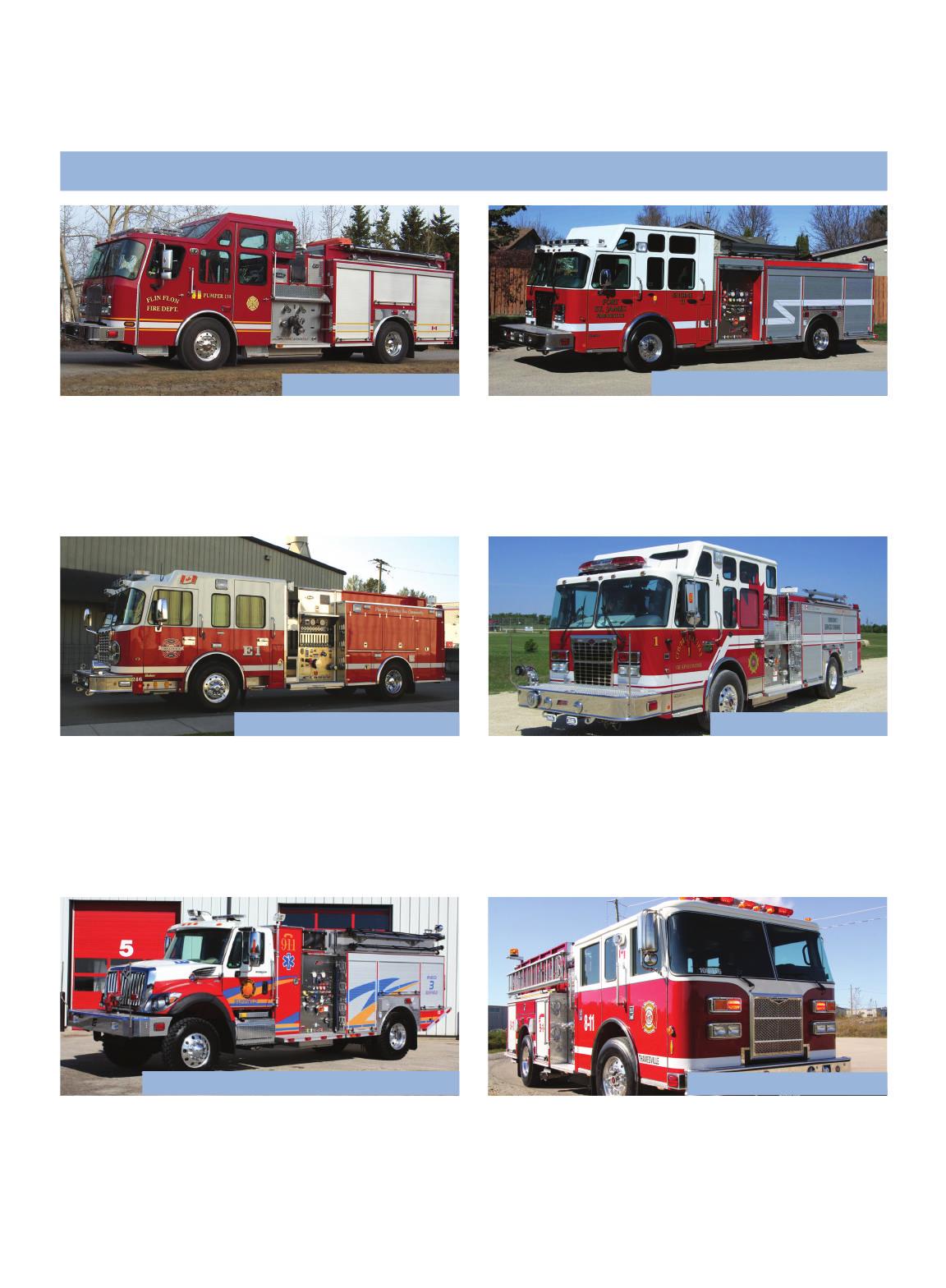
FLIN FLON FIRE RESCUE in Manitoba, under Chief Jim Petrie, took delivery in April of an E-One Emergency Vehicles-built rescue pumper. Built on a Cyclone II chassis and powered by an Allison 3000 EVS transmission and a 330-hp ISC Cummins engine, the pumper is equipped with a 580 IG poly tank, a Hale 1,250 IGPM pump, a three-outlet foam boss system and a 6,500-watt Honda generator.
The FORT ST. JAMES FIRE DEPARTMENT in British Columbia, under Chief Rob Bennett, took delivery in October of a Fort Garry Fire Trucks-built pumper. Built on a Spartan Metrostar chassis and powered by an Allison 3000 EVS transmission and a Cummins ISL 400-hp engine, the truck is equipped with a Darley LDM 1,500-IGPM pump, a Foam Pro 2001 foam system and an 800IG co-poly water tank.
The CHILLIWACK FIRE DEPARTMENT in British Columbia, under Chief Rick Ryall, took delivery in October of a Hub Fire Engines & Equipment-built pumper/rescue truck. Built on a Spartan Gladiator chassis and powered by a Cummins ISL 370-hp engine, the truck is equipped with a Hale QMAX 150 1,250-IGPM pump, a Foam Pro 2001 foam system, a 500-IG co-poly water tank, a Honda generator, a Go Power Inverter and a Whelen light package.
CFB HALIFAX in Nova Scotia, under deputy fire chief Murray Watson, took delivery in July of a Fort Garry Fire Trucks-built rescue pumper. Built on a Spartan Metro Star chassis and powered by an Allison 3000 EVS transmission and a Cummins ISC 360-hp engine, the truck is equipped with a Waterous CSU 2,000 IGPM pump, an 800 IG co-poly water tank, Foam Pro 2001 foam system, Harrison MCR eight-kilowatt hydraulic generator, Setcom intercom systems, Amdor H2O ground lighting and backup cameras.
The CYPRESS COUNTY/SUFFIELD FIRE DEPARTMENT in Dunmore, Alta., under Chief Dennis Mann, took delivery in September of a Fort Garry Fire Trucks-built pumper. Built on an International 7400 chassis and powered by a Maxxforce DT 300-hp engine, the truck is equipped with a Waterous CSPA 1,000-IGPM pump, a Foam Pro 2002 foam system and a 1,000-IG co-poly water tank.
The CHATHAM-KENT FIRE SERVICE in Chatham, Ont., under Chief Bob Crawford, took delivery in October from Darch Fire of a Pierce Manufacturing-built pumper. Built on a Pierce Contender chassis and powered by an Allison 3000 EVS transmission and a Cummins ISC 360-hp engine, the pumper is equipped with a Hale 1,250IGPM pump, a Foam Pro 1600 foam system and a 1,000-IG co-poly water tank.
FLIN FLON FIRE RESCUE
THE CYPRESS COUNTY/SUFFIELD FIRE DEPARTMENT
THE CHILLIWACK FIRE DEPARTMENT
FORT ST. JAMES FIRE DEPARTMENT
CFB HALIFAX
CHATHAM-KENT FIRE SERVICE
SIZE MATTERS ! New 2186 MULTI-CUTTM Rescue Saw
With more power than any other Fire Rescue chainsaw available and up to a 24" bar and the D-10 Guard/Depth Gauge for safety, speed and ease of use. Equipped with the BULLET® Chain that cuts safer, faster and longer than any other carbide chain made.
Gas Powered Concrete Rescue Saw
Cuts reinforced concrete up to 16-inches thick in minutes with the GCP SealPro® Diamond Chain and powerful 101cc engine. It’s fully portable, operates in any position and just one water hose needed for dust-free cutting in rescue situations.
The New Generation Rotary Saw is Here !
Rotary Rescue Saw
The CE807R Rotary Rescue Saw has a new, more powerful 80.7cc engine and a non-slip rubber Full-Wrap Handle for all position cutting. A new 4-Stage Air Filtration System, incorporating a High Performance K&N Filter as its third stage assures outstanding performance in all cutting conditions. Fully-equipped Sawing Kit is available plus Black Lightning and Black Star Diamond Cutting Blades.
HIGHRISE
HORROR
Heavy fire load inside apartment challenges responders
By WILLIAM STEWART
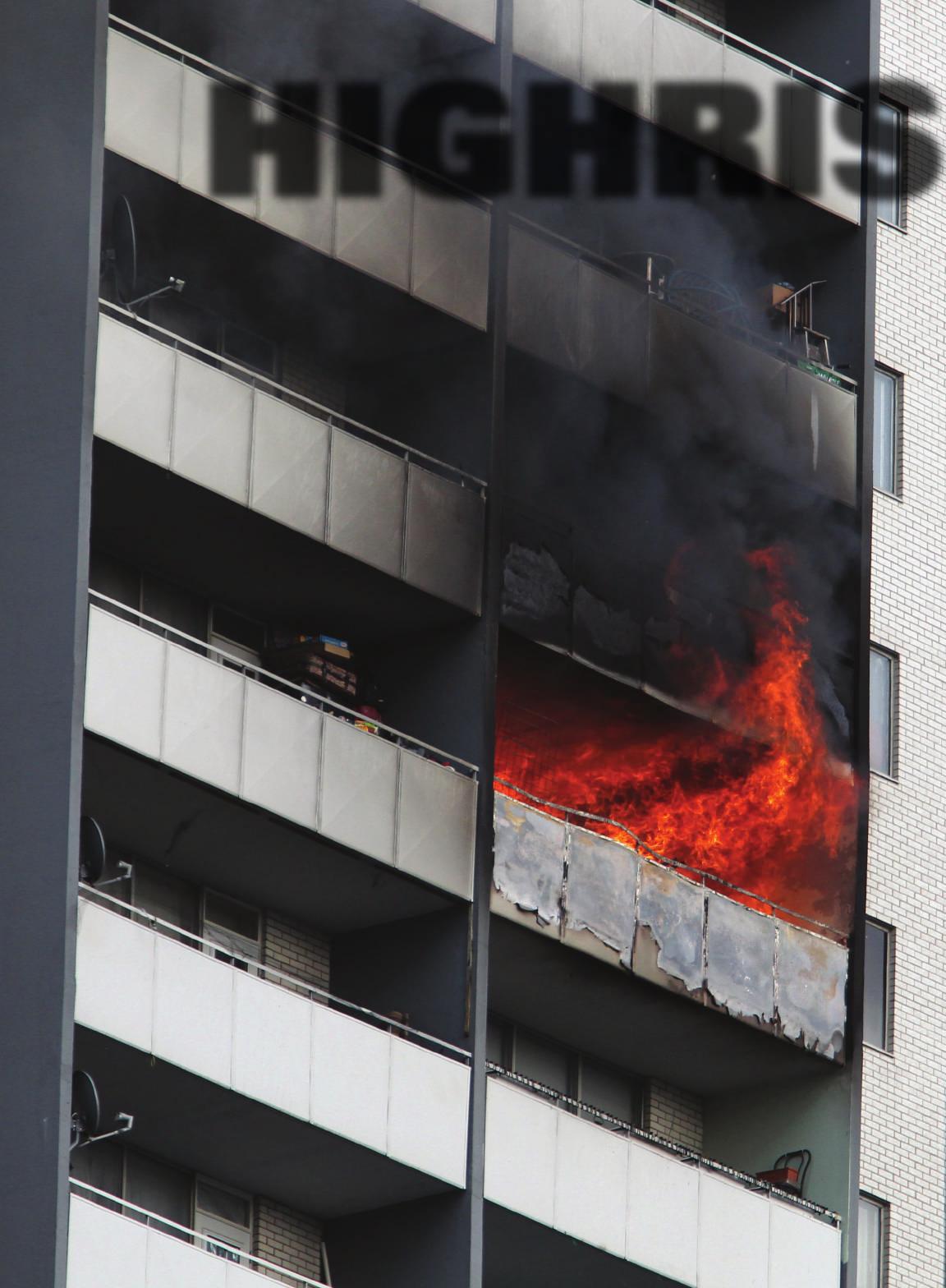
LEFT: High winds were a factor on Sept. 24 when Toronto firefighters were called to a fire in a 30-storey highrise in the city’s downtown core.
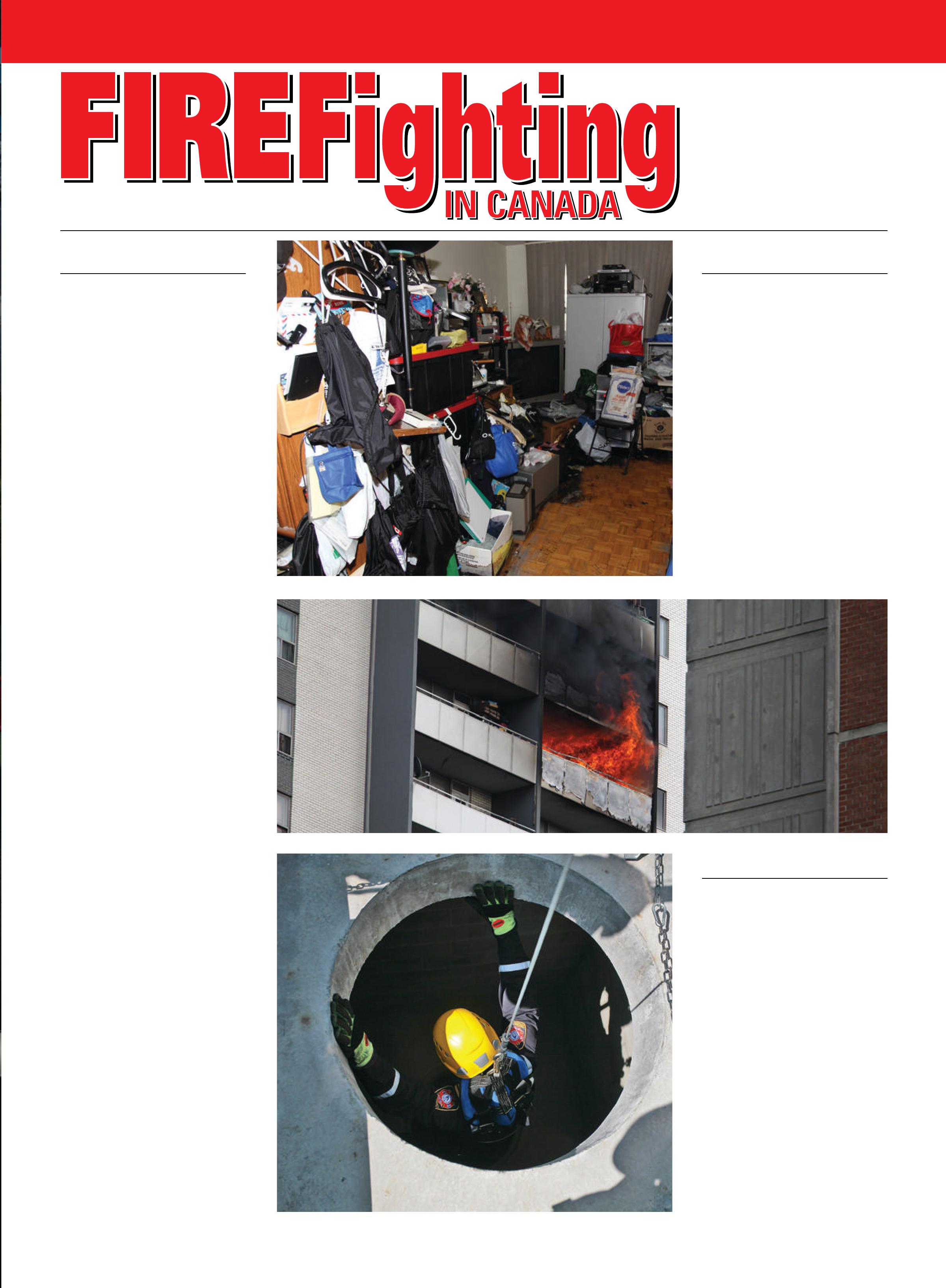
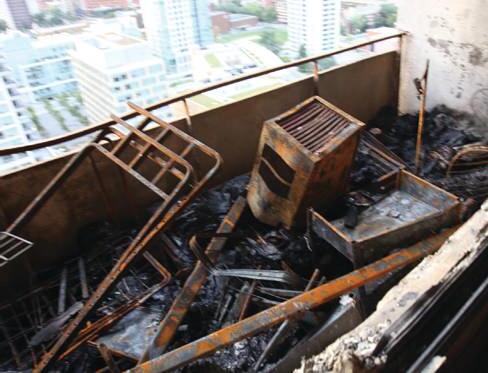
ABOVE: Firefighters from Toronto Fire Services were unable to open the door of unit 2424 due to the heavy fire load inside.
When Toronto Fire Services (TFS) was called to a severe, working fire at 17:02 on a bright, sunny September afternoon, we expected a fairly routine apartment fire. We didn’t expect the fire at 200 Wellesley St. E. to escalate to six alarms and we didn’t expect many of the challenges that met us in the community housing highrise.
Given the time of day, this challenging fire was not what would have been expected in any Canadian community. But the complexity of the fire and the time of day were in fact a benefit to TFS. Had this fire occurred in the early morning hours, there may have been a loss of life due to smoke migration among sleeping residents.
The Office of the Ontario Fire Marshal (OFM) was notified early in the Sept. 24 incident and attended to prepare for its role in the investigation. The OFM remained on scene for several days, determining the cause and origin of the fire that caused significant damage to the unit of origin and the fire floor. The investigation was completed on Oct. 1 but the cause and origin of the fire had not been released as of press time.
The magnitude of this incident was indeed very different from any normal highrise fire. The fire occurred on the 24th floor of the 30-storey complex, located in the inner core of the city. The initial crews responding to the first alarm proceeded to the 19th floor, as the enunciator panel indicated that the fire was on that floor. Smoke was visible on the west face of the building. The district chief requested a second alarm on arrival, and this fire would soon escalate to six alarms.
The first-in crew from Station 313 did not locate a fire on the 19th floor and continued to search the floors above the 19th floor. The fire was located in unit 2424. Fire attack commenced with a 38-millimetre hose line after adapting the standpipe. A heavy fire load and combustibles in the unit prevented the unit door from opening. The initial hose line was not effective on the fire due to the extreme heat and fire load encountered in the suite. TFS crews assigned to the fire floor for both fire attack and search and rescue faced an extremely hot, wind-driven fire. The crews then used a 65-millimetre line along with the 38-millimetre line as they tried to enter the apartment to extinguish the fire. Crew members were pushed back due to the high heat and fire load in the apartment. From the outset of the first arriving crews, the incident command system was established for the various crew assignments. Search and rescue, ventilation, lobby control, elevator control and accountability responsibilities were assigned by the incident commander. These responsibilities were upgraded to sector responsibilities as warranted by the incident. The fire chief, deputy fire chief and division commander arrived early in the incident. Responsibilities were assigned, the incident commander (in charge of operational fire fighting) would be the division commander, with the fire chief and deputy fire chief responsible for establishing a unified command and focusing on all non-firefighting activities, while acting in a consulting role with the incident commander.
Weather played a significant role in this incident, as the daytime temperature reading was 30 C, with winds from 40 to 60 kilometres
PHOTO BY JOHN HANLEY
per hour and gusts of up to 70 kilometres per hour. The immediate impact was a wind-driven fire due to the heavy fire load on the west-facing balcony of the 24th floor and the rapid extension to the apartment. Crews were faced with an extreme fire load contained in the one-bedroom apartment. I had never witnessed an apartment fire that required firefighting operations over a prolonged period of eight hours. The fire was brought under control by the use of 65-millimetre hand lines and the establishment of a ground monitor into the unit. Besides bringing the fire under control, the incident commander also faced the challenge of coordinating task assignments to crews to deal with reported emergent incidents in more than 40 additional apartments. He also had to liaise with the resource sector to ensure all resources were maintained for the duration of the incident. Roles within the command vehicle were assigned to co-ordinate these tasks in parallel with the firefighting and rescue operations.
The fire forced the evacuation of 1,200 residents from the address. The housing complex, which consists of two 30-storey towers containing 712 apartment units, is one of the largest public housing properties in Canada under the ownership of the Toronto Community Housing Corporation. Shelter Housing and Support for the City of Toronto, along with various agencies, provided accommodations for the residents in the local community centre across the street from the fire incident. Residents were briefed and moved to various sites across the city.
Many residents of the complex chose to evacuate the building in the first few minutes of the fire. However, many could not evacuate the upper floors of the apartment building due to smoke migration in the stairwells. Fire crews were assigned to search and rescue, and conducted primary and secondary searches of the complex. More than 200 doors had to be forcibly opened because the tenants had changed the locks. Ventilation crews used vertical ventilation to the stairwell shafts. During the course of firefighting operations, the building’s EVAC system was used to direct tenants to shelter in place and to seek refuge on the balconies. Tenants were also instructed to call 911 should they encounter any difficulties because of the fire. Fire crews were assigned to calls for assistance to ensure tenant safety or to evacuate as required. Elevator and lobby control was established early in the incident to aid in moving crews in and out of the building.
Toronto Emergency Medical Services and Toronto Police Service were on scene performing their assigned duties, from
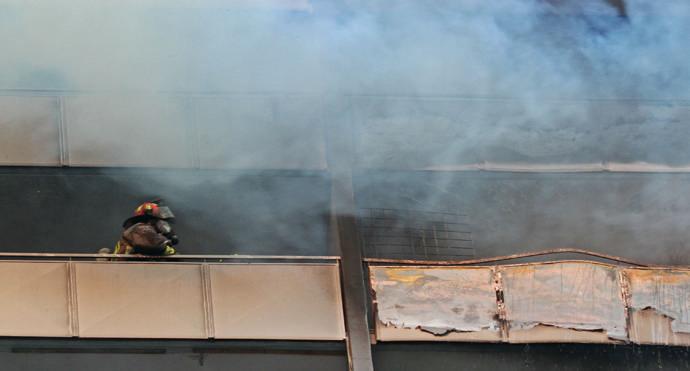
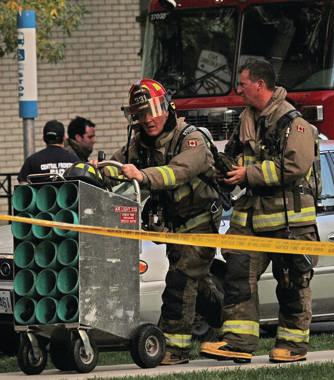
medical protocols to perimeter and security details. A total of 17 patients – 14 residents and three firefighters – were transported to Toronto-area hospitals and later released. The regular daytime temperature combined with high heat from the fire impacted the fire crews operating on the fire floor and upper floors. Crews were rotated along with re-hydration on the exterior of the building. Paramedics monitored TFS members as crews went through rehab prior to reassignment. TFS was fortunate to have a number of crews rotate through this incident without serious injuries.
The fire was contained to the 24th floor, but there were a number of balcony spot fires caused by flying embers that were extinguished by TFS crews. There was significant smoke and water damage to the north complex and extensive fire damage to the unit of origin and fire extension to the corridor of the 24th floor. The upper floors suffered heavy smoke damage.
On the morning of Saturday, Sept. 25, TFS fire prevention staff and staff from the Toronto Community Housing Corporation (TCHC) arrived on scene and commenced checking the units. Each unit was checked to ensure a working smoke alarm was installed and operational. TFS fire prevention staff remained on scene until Oct. 1, helping TCHC staff deal with any apartments that had high combustible fire loads. A number of units were identified and TCHC staff took appropriate actions to ensure the fire load issues were resolved in each unit. Fire prevention staff inspected
ABOVE: Many of the complex’s 1,200 residents were able to evacuate the building within the first few minutes of the fire, but smoke in the stairwells prevented those on the upper floors from evacuating immediately. Search and rescue crews on every floor aided residents in finding shelter in place and on the balconies.
LEFT: Heat – the temperature was 30 C on Sept. 24 – and the duration of the incident stressed Toronto Fire Services crews.
every door to ensure that doors would be replaced in more than 200 units. An extensive fire watch was developed for the 30 floors of the complex that will remain in place until the fire panel is replaced. The TFS fire prevention division chief attended three community meetings with the occupants to discuss details of the inspection of the building and ensure that residents would recognize the measures were taking place to ensure their safety.
The residents were assured that fire prevention staff and TCHC would meet and join together regularly to bring the important message of fire safety to residents and staff at this facility.
Lessons learned from this fire are significant, given the high combustible fuel load in the unit of origin:
• The standard 38-millimetre hose line was not sufficient to deal with the fire load in the suite.
• The use of 65-millimetre hose lines for fire attack was required for both hand lines and the establishment of the ground monitor to control the fire.
• The early establishment of a unified command with Toronto Fire Services as lead proved to be invaluable. It facilitated a process early in the incident that demanded business cycle meetings to occur every 60 minutes for the first 12 hours of the incident. This process continued for three days with the meeting intervals increasing as time permitted. Many agencies, including Toronto Fire Services, Toronto Police Services, Toronto
Continued on page 18
PHOTOS BY JOHN RIDDELL
TRAINER’SCORNER
The hazards of hoarding
By ED BROUWER
This issue of Trainer’s Corner looks at the danger that hoarding poses to first responders.
The Mayo Clinic defines hoarding on its website as “the excessive collection of items, along with the inability to discard them. “Hoarding,” it says, “often creates such cramped living conditions that homes may be filled to capacity, with only narrow pathways winding through stacks of clutter.”
We may never understand fully the psychology behind hoarding, but the bottom line that is hoarding is dangerous. A buildup of hoarded items can create unsanitary living conditions. A lack of regular home maintenance can result in the loss of running water, heat or refrigeration, and toilets and sinks may be unusable or inaccessible. Not only is there health risks from airborne pathogens, waterborne pathogens and food-borne pathogens in dwellings where hoarding is present, the accumulation of combustible materials, such as newspapers, clothing and rubbish, can pose a severe fire hazard.
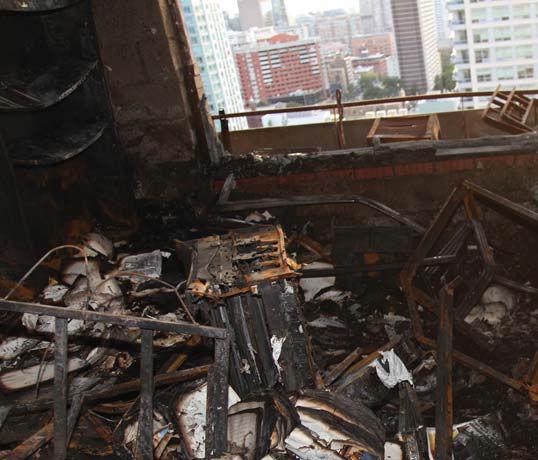
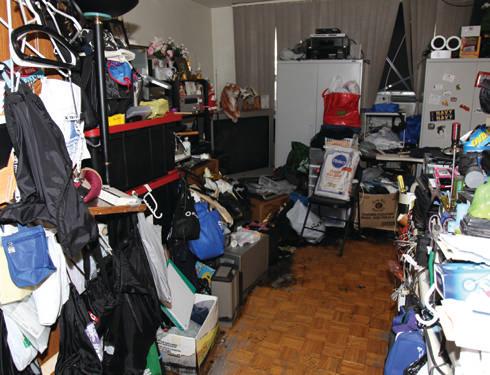
The volume of combustible materials in a hoarding situation can create an extremely hot, fast-spreading fire that is difficult to suppress. Toronto fire officials say they are worried about hoarding after an apartment fire on Sept. 24 that forced 1,200 people to evacuate a 30-storey Toronto Community Housing complex. The unit of origin, and several others, were found to have extremely high fuel loads.
“The apartment was filled with books and paper at the time of the fire,” said Toronto Fire Chief William Stewart. He said the fire was one of the hottest fires his crews have ever fought, adding that the problem was the “extreme fuel loading.”
In the early 1980s, while living in Orangeville, Ont., I came face to face with a hoarder. As a community pastor I dropped in to visit an older gentleman who was reported to be in crisis. His driveway was lined with an assortment of empty containers. Piles of newspapers, old clothing, trash and a dead (and partially decomposed) cat on a blanket framed the front door. As I knocked on the door, I could see in through the window. The house was filled with newspapers, magazines, empty containers, old clothing, paper, trash and rotting food. The sheer volume was overwhelming. There were two very narrow pathways among the metre or more debris.
Looking back, it is hard to imagine any firefighter doing a room search in these conditions. Not only can the blocked hallways, doorways and windows make escaping a fire impossible, it can critically impede rescue attempts by emergency personnel.
Emergency personnel should also consider that the weight and volume of hoarded items – often stacked from floor to ceiling – can cause structural damage. Flooring can rot with time under piles of garbage and belongings.
And, stacked debris can fall on firefighters. Broken items among the debris can cause injury. There is a high risk of wound infection and disease from the filth, especially if animals and insects are in the home.
Here are some common code violations due to hoarding:
• blocked egress (hallways, stairs)
• fire load (weight of items on the structure of the home)
Excessive fuel loads, like those (above) in the unit of origin in a Toronto highrise fire in September, and (below) in another unit in the same building, present considerable challenges for firefighters and emergency workers.
• fire hazards (items in oven, near heat source)
• trip hazard (fall prevention concerns)
• infestation (insects, rodents)
• plumbing not functioning (health and cleanliness)
When attending fire scenes, the first-arriving officer should be very cautious if there is an extreme collection of items in the yard or along the driveway. There may also be an accumulation of combustible materials (newspapers, magazines and rubbish) near the doorway, on the porch or in the garage. Blocked windows and doorways will hinder the entry and egress of firefighters.
In a hoarding situation, emergency personnel may have to move clutter to reach an injured person and this takes valuable time. If a patient has to be carried out on a stretcher, having to navigate around clutter can cause further delay. In addition, unsanitary conditions can be a serious health hazard for emergency personnel. Dust mites, insects and rodents thrive in clutter. When pet droppings dry and turn to dust, the particles can be inhaled.
While less prevalent, animal hoarding also poses a serious health threat, due mostly to the accumulation of feces, disease and decomposing remains of dead animals. A Google search for hoarding reveals some horror stories: one animal hoarder had 260 cats; one man with 30 cats was found to have toxic levels of ammonia in the air in his house because of all the cat urine.
There are several reports about hoarding on firefighternation.com and backstepfirefighter.com, In one instance, Detroit firefighters had to wade through a hoarder’s collection inside a small private dwelling before making a rescue. Firefighters arrived at the structure and encountered waist-high debris in most places, floor to ceiling in others. Only after the incident did they realize the victim was in a bathroom; all of the contents made the room unrecognizable. The fire, believed to have started in the kitchen, eventually burned through the roof.
In another report, firefighters in Buffalo, N.Y., had no idea they were walking into a raging house fire with propane tanks that had been stored inside; all they had been told was that an elderly man lived there. His car was out front, so crews rushed in and tried to search for him but were told the house was filled with junk and debris, making it tough to move around. Facing one challenge after another, crews were soon ordered out of the house for their own safety and it was on their way out that they noticed and picked up some propane tanks.
“The fire conditions were just horrendous in this one. The wind was blowing; we had a lot of combustibles in there,” said Buffalo Division Chief John Mogavero. “We had some containers of propane; we don’t know what else we had inside. The fire took off and we ended up pulling companies out for the safety of the firefighters at that point since there was nobody inside to search for anymore. We pulled the firefighters out and went defensive on this.”
What if your department encountered a hoarder fire situation? Do you have a plan? What additional resources are available after a working fire is confirmed? Do you have enough manpower to devote to a lengthy search as well as fight the fire? Imagine trying to do a room search when you can’t even get to a wall. What about salvage and overhaul difficulties? What about emergency egress for firefighters? Please let us in on your department’s experiences with hoarders.
In the meantime, keep training like their lives depend on it, because they do.
Ed Brouwer is the chief instructor for Canwest Fire in Osoyoos, B.C., and the training officer for West Boundary Highway Rescue. The 19-year veteran of the fire service is also a fire warden with the B.C. Ministry of Forests, a wildland interface fire suppression instructor/ evaluator and a fire-service chaplain. Contact Ed at ed@thefire.ca
The standard 38-millimetre hose line was not sufficient to deal with the fire load in the Toronto apartment building. The use of 65-millimetre hose lines for fire attack was required for both hand lines and the establishment of the ground monitor to control the fire.
HIGHRISE HORROR
Continued from page 12
Emergency Medical Services, Toronto Hydro, the City of Toronto’s Shelter, Support and Housing Administration, Toronto Community Housing Corporation, the Ministry of the Environment, and the Toronto Public Health were aware of the unified command approach and knew where to go to share information and raise questions. Toronto fire prevention staff remained on site for four additional days, led the business cycle meeting and released the building to TCHC on Oct. 1 after fire safety measures and inspections were completed.
• A key element was the integration of fire prevention into the incident command structure to ensure that the building owner carried through with all the measures required in a timely fashion so residents could re-enter their units.
Note: See related items on pages 16 (Trainer’s Corner) and 38 (FlashPoint).
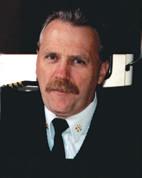
Chief William Stewart is a 38-year fire service veteran, having served in the former City of North York Fire Department for 26 years prior to the amalgamation of the new City of Toronto on Jan. 1, 1998. He has served as an operations firefighter, captain, administration chief, assistant deputy, deputy chief and has been fire chief since May 1, 2003. Chief Stewart has served on numerous committees and boards. He is a graduate of the Ontario Fire College, the executive development program and the Canadian Emergency Preparedness College and has a certificate in public administration and governance from Ryerson University and an honorary bachelor of applied studies from Humber College. He is committed to lifelong learning, and is currently serving as a board member for public administration and governance at Ryerson.
PHOTO BY JOHN HANLEY
BACKtoBASICS Truck company reconnaissance
BY MARK VAN DER FEYST
One of the functions of a truck company is to conduct reconnaissance on the fire ground. Whether conducted by an official truck company, a rescue company or an engine company, reconnaissance is important. Incident commanders are often frustrated because they don’t know what is going on inside and around the structure during the first minutes of the situation. Knowing what is going on inside and outside helps the incident commander make good decisions.
Reconnaissance, a term used by the military, is the process of getting information about enemy forces or positions by sending out small groups of soldiers or aircraft. By doing this, the military is able to concentrate its efforts. The fire service has adopted this principle in relation to fire attack. If we can gather information about our enemy’s position, we can concentrate our efforts.
Reconnaissance takes place on arrival at the scene. Reconnaissance is certainly a part of the size-up process but it does not happen continually. The truck company that arrives on scene will break up into smaller teams; one team will go inside and the other team will take care of the outside. One of these two groups will conduct reconnaissance of the structure and situation. This information will be relayed to command to be processed. Then, the incident commander can direct the other resources at hand to effectively mitigate the incident.
It’s important to remember the difference between reconnaissance and progress reports from the interior or exterior crews. A progress report informs incident command about the status of the assigned task; a reconnaissance report informs incident command about the circumstances or opposing forces that firefighters or rescuers will face. Reconnaissance refers to a complete walk-around of the structure. For most structural fires, a single person – usually the firstarriving officer – can complete a walk-around. These buildings are small enough to facilitate this. When a building is too big, too complex or connected to another building, it is difficult for one person to complete a walk-around. In these cases, a small team assigned to outside functions can complete the walk-around for exterior concerns. The small team can be assigned tasks such as laddering the structure, shutting off utilities, ventilating windows, removing obstructions, forcing entry into the structure and setting up master streams. All of these tasks allow the small team to gather information for the incident commander. The inside team will have similar assigned tasks.
Here are five areas present at all structural fires.
FIRE LOCATION
The location of the fire is crucial information that the incident commander and engine company need to have. Sometimes, firefighters can see exactly where the fire is located when they arrive on scene but other times they cannot. Visible flames or smoke exiting from the structure at a certain point do not indicate fire location. These signs can be deceiving and may lead firefighters to the wrong location. The truck company can help to locate the fire when it is conducting the primary search. The inside team will have a much better vantage point, as its members will either start their search at the fire location
The truck company can help to gather information that will help incident command direct resources to where they are needed.
or work toward it. When the fire location has been determined, the truck company can relay the location to the incident commander and the incoming engine company. This reduces the time it takes for the engine company to locate the fire.
FIRE EXTENSION
Once the location of the fire has been determined, the inside truck team can search for fire extension. Fire extension will sometimes be the biggest and longest part of fire suppression, as it requires chasing down the fire and stopping it. Extinguishing the main body of the fire will take only a few seconds but locating and extinguishing fire extension can take time. Finding the fire extension is important as it will direct other engine companies and their suppression activities.
PHOTO BY MIKE GUTSCHON
PHOTO BY MARK VAN DER FEYST
Establishing a secondary means of egress is among the tasks assigned to the truck company.
BACKtoBASICS
SALVAGE OPERATIONS
Salvage operations are often forgotten during structural fire ground operations. The inside truck company will identify which areas need to be salvaged right away and which areas can wait. These areas can usually be located while conducting the primary search. Quick salvage operations will avoid great financial losses for the property owner.
SECONDARY MEANS OF EGRESS
The outside truck company team contributes to the inside truck company’s reconnaissance efforts by locating the secondary means of egress and possibly finding access points for aerial operations. When
members of the outside team are walking around the structure, they will look for the best locations for secondary exits. The outside team members may ladder windows for this purpose or open up doors in other areas on the ground floor; either way, they will communicate this information to incident command.
OBSTRUCTIONS TO ACCESS/EGRESS
The outside team will identify obstructions that hinder access and/ or egress from the structure. These obstructions must be removed so they will not cause problems later on. Other crews may be assigned to remove these obstructions – bars on windows, for example – based on the reconnaissance report given by the outside truck team. The initial outside team may not have the tools to remove the bars but incident command can assign another team to complete this task.
Teamwork is needed for reconnaisance to be successful, and when inside and outside truck companies co-operate, reconnaissance can make a difference in minimizing the negative impact a fire may have.
Mark van der Feyst is an 11-year veteran of the fire service. He currently works for the City of Woodstock Fire Department in Ontario. Mark is an international instructor teaching in Canada, the United States and India. He is a local level suppression instructor for the Pennsylvania State Fire Academy, an instructor for the Justice Institute of British Columbia and a professor of fire science at Lambton College. E-mail him at Mark@FireStarTraining.com
Nothing Dumps Faster!
Over 40,000 in use. We’ve been in business for over sixty years, so you can depend on us. That’s why Newton Kwik-Dump Valves can be trusted to get your tanker emptied and on its way FAST. Standard length, Mild Steel and Stainless Steel are in-stock. Need special length valves? Call us and it’s as good as done! Don’t accept look-alikes. Ask for us by name. For prompt, timely delivery, call us today.
Looking for and knowing where the fire is located are part of truck company operations.
• Now meets NFPA 1500 Standard on Fire Department Occupational Safety and Health Program primary eye protection requirements
• Now also meets ANSI.Z87.1 Standard on Eye and Face Protection as a primary eye protection spectacle
• Continues to meet NFPA 1971 Standard on Protective Ensembles for Structural Fire Fighting and Proximity Fire Fighting ( clear and amber lenses
BY SEAN TRACEY Canadian Regional Manager, NFPA
TNFPAIMPACT
Standard needs backing of fire service
hanks to a push by the Canadian Association of Fire Chiefs (CAFC) and the International Association of Fire Chiefs (IAFC), the NFPA standards council has recently agreed to the creation of a deployment standard for fire prevention activities. The standard is aptly nicknamed the NFPA 1730 standard, as it is anticipated to have a great impact on fire inspection, fire investigation and public education numbers in the fire service, just as the NFPA 1710 and 1720 standards have. The fact that this issue warrants the consideration of its own standard reflects the importance of the need to implement a balanced approach to fire protection, including suppression, inspection, investigation and public education services.
One expressed need for a service standard is to help to counter potential future budget cuts in fire department operations. An international consensus standard that sets a baseline for fire inspections, fire investigations and public education programs, as well as standardized approaches to benchmarking these services, would be greatly welcomed by groups that may often be the first to have their services cut in an effort to save suppression operations. These service standards would also be welcome for setting insurance gradings in communities.
This is not the first time that this issue has been brought forward to the NFPA. A previous request from the IAFC to prepare such a standard was acknowledged by the standards council and was sent to the committee responsible for NFPA 1201Standard for Providing Emergency Services to the Public for consideration. Once an item is tasked to technical committees, the NFPA must remain removed from the process of developing the standard. The NFPA merely publishes standards; you and your peers write them. The first request did not produce any clear direction and resulted in only minor language in NFPA 1201. A push was re-established for a stand-alone standard, similar to what was prepared for the career and volunteer departments in 1710 and 1720.
The CAFC was one proponent of a fire prevention deployment standard. It had
already tasked a committee to study this. In its June 23, letter to the NFPA it stated that the executive committee of the CAFC “unanimously supports and strongly recommends the creation of an NFPA standard for fire prevention work.” The result was that the NFPA standards council listened and a new NFPA committee was created – the Committee on Organization and Deployment of Fire Prevention Activities. The committee is responsible for creating a new document on the organization, operation, deployment and evaluation of code enforcement, public fire and life safety education and fire investigation operations. The CAFC has even prepared a draft for the standard and forwarded it to the NFPA as a potential starting point.
Ron Farr, the state fire marshal for Michigan, has been selected as the technical committee chair. The committee is calling for volunteers to help draft this standard. The NFPA expects that many enforcement authorities will wish to apply, and so the push is on to get a balance of other representatives. It will be at least two years before the standard is finalized, but in the interim, the public and the fire service will have ample opportunity for comment.
One tool for input on the standard is the Partnership Towards Safer Communities Online (PTSC-Online), a new web community that encourages dialogue and broadcasts the activities of the NFPA. It can be found at www.ptsc-online.ca. PTSC is a new CAFC initiative supported by Public Safety Canada for a limited time. Using this collaboration tool will help to support PTSC in its ongoing mission to foster better collaboration among emergency services. Readers are encouraged to visit and register on the site as it has the potential to be an excellent resource; however, ongoing PTSC support will be contingent on the success of the trial period.
Remember, codes and standards are written by those who show up to participate. If you wish to have a say in the standard, voice your opinion in the coming months. This will be your standard; if you feel passionately about fire prevention, now is the chance to leave your mark.
Best practices
Standard that defines confined space expected to identify risks and reduce death rate
By ROSIE LOMBARDI
Anew standard that defines confined spaces and provides guidelines to help rescuers avoid potential risks is expected to reduce the number of confined-space deaths in Canada.
The Canadian Standards Association (CSA) recently released CSA Z1006 Management of Work in Confined Spaces, a national standard that has implications for firefighters and first responders.
“This new CSA standard, the first of its kind in Canada, defines what a confined space is and provides guidelines to managers, workers and rescuers for identifying and avoiding potential risks while not becoming victims themselves,” says CSA president Suzanne Kiraly.
Confined spaces can be found in almost all industries and include grain and corn silos, hydro vaults, underground tunnels, shipping compartments, pump stations, boilers and chemical tanks. Workers in these environments are at risk of serious injury or death resulting from asphyxiation, engulfment, electric shock and other causes.
More than 60 per cent of confined-space fatalities are would-be rescuers, according to the CSA. These would-be rescuers are often fellow workers, but the statistic also includes firefighters and first responders who succumb to the same environmental hazards.
“In Canada, there has been an increase in the number of confined-space incidents involving firefighters over the past decade,” says Christopher Jones, Manitoba’s fire commissioner.
In British Columbia alone, 18 deaths related to confined spaces were recorded between 1989 and 2004; five of those deaths were people trying to rescue the original victims. Unfortunately, these incidents aren’t tracked nationally, so there are no Canada-wide statistics available.
Doug Silver, division chief for Toronto Fire Services, says there have been no fatalities due to confined-space rescues in the Greater Toronto Area during his 20-year tenure, but there have been many close calls.
“People call the fire department because we’re the jacks of all trades,” he says. “Firefighters will do their best, but the question is, are we sending untrained or unequipped firefighters to do things that are beyond their capabilities?”
HOW THE STANDARD HELPS
Firefighters are in a dependent and precarious position. They rely on industry to put measures in place to reduce the hazards in their workplaces and to educate their workers about how to handle incidents, says Jones.
“We’re in an industry where it’s incumbent on rescuers to stay current. With the CSA standard, firefighters need to know the parameters of people working in confined spaces and how to respond if people make a mistake.”
Because CSA Z1006 is a national standard with a set of associ-
Firefighters at the Greater Toronto Airports Authority’s Fire and Emergency Services Training Institute practise confined-space rescue. The recently released CSA Z1006 Management of Work in Confined Spaces defines a confined space and provides guidelines for managers, workers and rescuers.
ated best practices, Silver says it will bring consistency across Canada. “It’s my understanding that not every province had a standard that defined confined-space working conditions under their Occupational Health and Safety Acts (OHSA). A national standard brings all industry to a similar level when it comes to dealing with confined spaces. It sends the message to industry: You need to prepare yourself before firefighters get there because they may not get there in time if there’s an accident.”
As with any new standard, it takes time for industry to implement changes, Silver adds. “But since it’s under the OHSA, it has teeth. If companies don’t do the right thing, management will be fined or jailed, so there’s a lot of onus put on industry to follow it.”
Companies have already been hit with hefty fines for violations in Ontario, which had strict rules in place under its OHSA. In 2007, Bell Canada was fined $280,000 in the deaths of two men – the largest fine given to a federally regulated company for Canada Labour
Continued on page 36
BY
PHOTO
JOHN RIDDELL
BY LES KARPLUK Fire Chief, Prince Albert, Sask. AND LYLE QUAN
Fire Chief, Waterloo, Ont.
TSense of entitlement requires reality check
his final instalment of our three-part series on department relationships is a no-holds-barred column, which we hope will challenge fire officers to do the right thing. We know that attitudes make a difference in a fire department, and can either build the department’s strength or destroy its morale and reputations. With more than 60 years of fire service experience between us, and having communicated with fire chiefs across Canada, we have been exposed to countless situations. It is very clear to us that the fire service faces myriad problems.
Being baby boomers, we understand the challenges of working with younger generations and the different expectations of today’s firefighters. Unfortunately, many in the fire service use the generation gap to justify behaviours within the station. Claiming that generation Y firefighters are too young to meet the expectations of their fire-service peers and officers, or that some young firefighters
are the products of their generation and therefore can’t be held to reasonable standards, is easy and convenient, but doing so is merely a Band-Aid on a wound that requires surgical intervention. Not dealing with this sense of entitlement that seems to prevail among younger generations will lead to tragic results for employees and for departments. Everyone has something to lose.
EXPECTATIONS
We all have expectations that change as our careers evolve. This is human nature and is to be expected from every firefighter. The problem arises when the expectations are unrealistic and cause strife in the department. Expectations of employees have changed significantly since we started in the fire service. We’re not going to rant about why
Continued on page 33
BY VINCE MACKENZIE Fire Chief, Grand FallsWindsor, N.L.
IVOLUNTEERVISION
Volunteers need to climb on advocacy bandwagon
am thrilled to contribute to a column that has been a staple of Fire Fighting in Canada. Please indulge me as I take a few lines to express my sincere pride in the volunteer fire service here in Newfoundland and Labrador. Hundreds of firefighters did an admirable job during Hurricane Igor, which ravaged the northeast and southern parts of Newfoundland on Sept. 21. Volunteer firefighters are the last ones to blow their own horns but the stories are trickling back to me about the significant role played by the fire service in hundreds of communities that day. With the exception of paid chiefs in two towns, every one of those involved was a volunteer firefighter. I once heard a quote: “Volunteers can achieve more than any government can ever provide.” Truer words were never spoken.
The topic for my debut column is vision, specifically that of Canadian fire-service associations. Typically, associations are formed to better a cause, to embrace a vision and to form a plan to implement that vision with strength in numbers. Strength in numbers is a valuable asset when trying to effect change with governments. As volunteer firefighters we have a vested interest in the direction of our governments, and consequently, the vision that governments set for the fire service. It is our duty to ensure that this vision is shaped to the realities of society for the common good.
It has been my experience that vision is not something all governments initially have, especially when it comes to the fire service (unless you call maintaining the status quo a vision). We in the fire service think we are stuck in tradition but politics have even deeper roots and politicians have traditional decision making down to a science. We are so often told how undervalued and unappreciated we are. Unfortunately, these comments are not usually followed by active debate in legislatures or Parliament.
bear until all politicians see it as a true national issue.
As one who has been kicking around fire-service associations for most of my career, I know that associations work. Associations sometimes get sidetracked and it takes the entire membership to keep the ship sailing in the right direction. We must elect people to our organizations who will work for and champion the cause. We must hold politicians to those accolades they often toss our way - mentioning at dinners and community events how we are a true service to the public – and turn those comments into action by the government of Canada. Our associations are the channels through which to do that.
My vision is a call to action to every one of you. Do you support (to the best of your ability) the association that serves you? Are you a member, and do you actively participate in the initiatives being sought, or merely wait to see what happens? Have you signed the tax-credit petition at www.givefirefighterscredit.ca and forwarded it to all your members?
You can support your associations and add your voice by getting involved. That doesn’t necessarily mean running for office, but when your provincial and national associations ask for support in surveys and petitions, oblige them with your time. Just being a
The tax credit will not come to bear until all politicians see it as a true national issue. ‘‘ ’’
One volunteer firefighter tradition that has served us well is the formation of associations to further our causes – some political, some operational and training, and some to improve our function.
In the past year or so, the Canadian Association of Fire Chiefs (CAFC) has taken a giant leap in its advocacy for a $3,000 federal tax credit for volunteer firefighters. This initiative is not new but, finally, some big-city chiefs are speaking publicly to the need for this tax credit. And there is the difference in the CAFC today: even the career chiefs now understand and support this issue, so now is the time for us little guys to stand alongside them. The tax credit will not come to
Vince MacKenzie is the fire chief in Grand Falls-Windsor, N.L. He is the president of the Newfoundland and Labrador Association of Fire Service, the second vice president of the Maritime Fire Chiefs Association and a director of the Canadian Association of Fire Chiefs. E-mail him at firechief@grandfallswindsor.com
card-carrying member isn’t enough. Volunteers make up 89 per cent of Canada’s fire service and we have much to offer. The political power we hold is incredible if channelled correctly. As volunteer fire departments, we need to seize the opportunity to build. We have a national voice for the fire service and that voice must grow to accurately represent us all.
As the president of a provincial fire services association and a CAFC director, I have seen the provincial associations support their national counterpart, but is that enough? We are volunteers, and to be members of associations often means paying membership dues with fundraised money. Maybe the CAFC board needs to consider that, and perhap use a membership fee scale based on size and population.
A true collective national voice has to come from all, and that means each one of you. Be aware of the issues that are being discussed and debated. Join up and share your input; doing so you will strengthen the push to move fire-service issues forward.
LEADERSHIP
Continued from page 28
firefighters should be happy to have jobs as firefighters and be grateful to be part of a profession that is well respected. We know times have changed since we were hired. Rather, our point is that these kinds of negative behaviours can no longer be accepted in the fire service. It’s time to say enough is enough.
Don’t get us wrong – change is good, and the progression of the fire service over the last 10 years has been welcome. The advances in technology – PPE, PASS devices and thermal imaging cameras – have obviously made our profession safer. This means firefighters today are able to provide better service than their colleagues did 10 years ago, which is great. Unfortunately, a dark cloud came along with this growth in the fire service. We’ll call this dark cloud the entitlement principle, and unfortunately, it exists in our own departments.
THE ENTITLEMENT PRINCIPLE
Our definition of the entitlement principle is an individual or group that possesses a sense of entitlement with impracticable expectations. This means that some, and we emphasize only some, members of our profession expect that they can do or act any way they choose and the department will meet their needs. In a sense, these individuals have twisted concepts of responsibility and live by what we call the Nemo clause.
Remember the Disney movie Finding Nemo, in which the hungry seagulls constantly chanted mine, mine, mine? They’re kind of like firefighters who witness the strengths and good things in other departments and want to reap those same benefits without working for them. Understanding human nature, it is likely that this misguided sense of entitlement will get others in the department worked up, and in a short time span, many members will be chanting mine, mine, mine. We find that members who believe in the Nemo clause feel as if the department owes them something (or everything).
A true professional understands that everyone must earn their reputation and the entitlements that go along with the job. Many of the concepts that we have discussed in our past articles emphasize things like building trust, supporting the team and placing the safety of the community before individual needs. Young and old, we need to lead by example and know when to say enough is enough.
Ask yourself why you chose this profession. Hopefully your reasons include the challenging aspects of the job, the drive to do good for your community and the desire to make a difference in the lives of those you serve.
Fire fighting is one of the most respected and highly sought after professions in the
world. We consider ourselves fortunate to be part of a small but talented group that makes up the firefighting brother/sisterhood. As a profession, we have excelled at being part of our communities, but it is the community of the fire station that seems to be feeling the pressure of this entitlement belief, which has somehow muddied the waters.
If you want to destroy the profession from the inside out, then just sit back, put your feet up and accept the behaviours of those adhering to the Nemo clause. By the time you realize that your department is in a pressure cooker, it may be too late. This misguided
sense of entitlement can kill even the best departments in the country. What are the fireservice leaders of today going to do about it?
Les Karpluk is the fire chief of the Prince Albert Fire Department in Saskatchewan. Lyle Quan is the fire chief of the Waterloo Fire Department in Ontario. Both are graduates of the Lakeland College Bachelor of Business in Emergency Services program and Dalhousie University’s Fire Administration program.
BY IAN CROSBY
Departments at risk for bedbug invasions
B
edbugs were once all but eradicated in Canada but these pests have made an unwelcome comeback. Bedbugs are reddish-brown, oval-shaped insects that look like apple seeds with six legs. It can be difficult to tell if you have bedbugs because they hide well, are pretty small and, generally, they come out only when it’s dark.
Bedbugs like to hide in cracks and crevices in mattresses, bed frames, furniture, carpets and walls during the day and typically bite people while they sleep. Literature on bedbugs indicates they can live up to a year on one feeding.
Since bedbugs hide so well and can go a while without feeding, they are notoriously difficult to eradicate. It’s for these reasons that it’s important to be diligent to avoid bringing these pests into a fire station. If we do get an invasion, we need to eliminate the bedbugs as soon as possible before they can breed and lay eggs.
As the bedbug populations rise, it’s likely that fire personnel will encounter situations in which they are present. Bedbugs travel well, stowing away in luggage and even clothing. Don’t assume that you have to worry about bedbugs only at homeless shelters; they are being found in expensive hotels, and even in movie theatres, department stores and taxi cabs in New York City.
Walking into a room that has bedbugs doesn’t mean you will get bedbugs. Bedbugs don’t jump and they spend most of their time trying to avoid light. Despite this, these insects are invading a growing number of fire stations across the United States. A bedbugs incident was reported in the Denver Post: “Firefighters battling the blaze had a hard time because of an attic filled with storage items and debris, including things infested with bedbugs. The pesky bedbugs, animated by the fire, sought refuge on firefighters, latching onto equipment and gear.”
for any contaminated gear – place your gear in a plastic bag. If you are washing contaminated gear, be sure the washing machine temperature is set on hot and the tub is full before adding the clothing. Following a thorough washing, place the clothes in the dryer on the highest heat setting.
It’s not just the calls you have to worry about. Many firefighters like to travel; these tiny pests can hitch a ride in station bags and backpacks used by vacationing firefighters.
Despite their elusiveness, there are some signs that will help you determine if a fire station has been invaded by bedbugs:
• You will see little red bites without knowing why. People rarely catch bedbugs in the act – they come out when you are asleep and bite only for a short period. They are most active just before dawn.
• Bedbugs create a lot of waste that shows up as dark brown or reddish spots on your mattress (which can be feces and/or blood). Or, you may find shed skin, eggs or dead bedbugs inside your mattress, between the box spring and mattress, or in the sheets.
On the upside, bedbugs have never been shown to transmit
Bedbugs tend to hide in the seams of clothing, so take special care to inspect these areas of your uniform. ‘‘ ’’
Firefighters should inspect their gear after returning from a run where they suspect a bedbug problem, especially if a crew member has brushed against soft furniture. Bedbugs tend to hide in the seams of clothing, so take special care to inspect these areas of your uniform.
Killing bedbugs on fabric requires temperatures above 48 C. If the bedbugs are only on clothing, the best way to prevent them from spreading is to contain them. Use a procedure similar to that
Ian Crosby is in his 17th year with the Calgary Fire Department and serves as its wellness and fitness co-ordinator. Crosby developed the department’s Wellness Centre, which opened February 2005. He is a member of the IAFF/IAFC/ACE Peer Fitness Trainer (PFT) Oversight Committee and an instructor for the PFT certification program. E-mail him at Ian.Crosby@calgary.ca
disease. But once a bedbug population is established in a fire station, it is difficult and expensive to eradicate. Aside from the exterminator fees, infested furniture may have to be replaced. Since July, the San Diego Fire Department has spent $46,000 to treat six fire stations infested with bedbugs. The seventh and latest infestation involves the city’s largest station and an estimated treatment cost of $25,000.
The problem is more widespread in the United States than in Canada, but bedbugs don’t stop at the border. Many Canadian cities are reporting an increase in calls that involve bedbugs.
To help reduce potential costs, departments should consider investing in mattress bags. Once bedbugs get into a mattress, the mattress will likely need to be discarded. A mattress bag won’t necessarily stop an infestation, but it will keep bedbugs from penetrating a mattress. Practising good diligence by carefully inspecting items that enter a fire station is the best way to keep this pest at bay.
Offering: A 2 course certificate in incident command for experienced incident commanders. Please contact our office for more information.
Are you looking to take on more responsibility in your Department? Trying to round out your technical ability with leadership skills? Preparing to advance your career?
At Dalhousie University we offer a three course program, the “Certificate in Fire Service Leadership” to career and volunteer fire officers.The 3 courses Station Officer: Dealing with People,Station Officer:Dealing with New Operations and The Environment of the Fire Station are all offered in each of our 3 terms, September, January and April. The program can be completed in one year.
For more information and a program brochure please contact: Gwen Doary,Program Manager Dalhousie University Fire Management Certificate Programs 201-1535 Dresden Row,Halifax,Nova Scotia B3J 3T1
You will also find the information in our brochures or at the following internet address:Web site:http://collegeofcontinuinged.dal.ca
Continued from page 26
Code violations. The two men died in an Oakville underground vault while installing fibre-optic cables for Bell. They were about five metres below ground when they were overcome by toxic fumes. By the time firefighters pulled them out, they were dead.
OF
FireFiGHTer
❑ Other (Please Specify Below)
Worker awareness and education is critical to ensure the best and fastest rescue response, as many such emergencies are due to toxic atmospheric factors, says Silver. “The best way to trigger the right response is if workers know to say confined space when they call in an incident to dispatch. If they just call and say a co-worker slipped and broke a leg, it will be read as a medical call and pumpers will be sent. But if the medical emergency happened in a confined space, we’ll send a specialized operations squad with the right equipment and experts.”
Time is of the essence in these situations, says Silver. Pumpers that get to the scene first will call the squad and do the best they can in the meantime, but they may not have the right equipment to handle the rescue safely themselves.
Toronto has five strategically located specialized operations stations with the best equipment and staff to handle any hazard, but it can take from five to 15 minutes for them to get to the scene, he adds. “If the squad isn’t called right away, you’ve lost precious time. If it’s an atmospheric incident, 15 minutes may be outside the window of survivability.”
Dispatchers and 911 operators also need to be aware of confined-space issues, says Jones. In Manitoba, industry is well educated about confined spaces but not all of these incidents occur in industrial settings.
“Dispatchers need to be asking the right questions when the call comes in, as incidents are not always what they appear to be. If a kid falls down a well and mom calls, she won’t know to say it’s a confined-space incident – but it will require a specialized, confined-space rope rescue.”
Most emergency rescue personnel are keen to keep on top of their training, and dispatchers generally do a good job of deducing confined-space incidents from panic-stricken callers. “We recently ran a conference that had 450 people in attendance, and we’ve also run confined-space awareness programs throughout the years,” says Jones, adding that the Manitoba Emergency Services College is run under his office, and offers national training and 29 programs at its 60-acre practical training site.
Confined-space rescue equipment and training is expensive, and there may be issues for smaller fire departments that serve cashstrapped municipalities, says Silver. “Their
Workers in almost every industry are at risk of confined-space related injury or death. The standard will bring consistency across Canada and will help industry prepare for confinedspace emergencies so rescuers can respond as efficiently as possible. It will also reduce the number of fatalities and close calls.
mandates are determined by city councils or authorities for the region. These may decide the only thing the fire department will handle is fires and spend money only on that, so confined space rescues may not be funded. But the fire department must nevertheless respond to such incidents.”
However, there are pockets of expertise for technical rescues even in small municipalities if a specific hazard exists in the area, he adds. “If there’s recreational cliff climbing in the region, for example, fire departments will have to respond if there are incidents. They can go to the council and ask for funding if confined spaces are identified as a hazard in the community.”
Over time, the CSA standard will help save lives, and fire departments should be involved in outreach, says Jones. “It’s important that industry and emergency responders begin a dialogue about confined spaces and look at joint training and other steps that would help solidify measures. Most fire departments do pre-planning with the businesses in their municipalities. They need to keep that going and get out there and do sessions for industry so they know what their rescue procedures are and how they work.”
Rosie Lombardi is a Toronto-based freelance writer and regular contributor to Fire Fighting in Canada.
lsewhere in this issue, Chief Bill Stewart describes the tactical problems encountered and overcome by Toronto Fire Services at a wind-driven fire on an upper floor of a downtown highrise. Our industry has come up with various methods over time for calculating the required flow of water for fire protection. I’d like to present a few of them to you and discuss the following question: What is the correct method for calculating a tactical fire flow?
Some of you may think, “Hey, I thought FlashPoint was an opinion column, not a technical forum,” and you are right. Don’t worry; I won’t deviate too far from my usual path.
Fortunately, the fire service has, over time, developed simple flow calculation methods. Unfortunately, there are several of them, and they don’t always generate the same result. Also unfortunately, many fire services don’t make use of any flow formula, preferring to rely on standard procedures or judgment calls, which are much more likely to result in too little flow (too small a hose line) than too much. We have all either been at fires or heard stories of fires at which a later arriving incident commander must give orders to replace 38-millimetre lines with the 65-millimetre lines that perhaps should have been laid in the first place. The use of a quick and easy flow calculation, along with knowledge of the characteristics of the nozzles and appliances we drag into place, should result in more appropriate initial tactical postures.
Chronologically, here are three flow formulas to consider, using the Toronto highrise fire as an example (note that we will consider only the fire apartment, and assume 100 per cent involvement and ignore exposures, to keep the math simple):
• The Iowa State formula was developed in the 1950s. Intuitively, you might expect that it may give too low a flow, given that it reflects the much lighter fire loads that were present in Ward Cleaver’s or Ozzie Nelson’s homes or offices (note to generation X and Y: look up those names in Wikipedia). The formula (converted into metric units) is: Flow = Length x Width x Height x 4/3. So, for our 50-square-metre apartment with 2.5-metre ceilings, we get: Flow = Area x Height x 4/3 = 50 x 2.5 x 4/3 = 167 litres per minute (lpm).
• The NFA formula is simpler by one factor in that there is no need to estimate the ceiling height. Intuitively, this would also mean that there is no way to adapt this formula to higher ceilings, perhaps a shortcoming of this method. On the other hand, it did give us a higher flow than the Iowa State formula.
• Lastly, and most recently, let’s use the Grimwood formula, developed by retired United Kingdom fire officer Paul Grimwood after analyzing actual effective fire flows at structure fires in London in the early 1990s. Grimwood keeps it exceedingly simple: Flow = Area x 4 for normal fire loads, or Flow = Area x 6 for high fire loads. So for the Toronto apartment fire, we have: Flow = 50 x 4 = 200 lpm or Flow = 50 x 6 = 300 lpm.
As Chief Stewart noted, the fire load was very high, so of all of these results, we would expect the highest – Grimwood’s Area x 6 figure of 300 lpm – to be the most appropriate. Looking a bit deeper though, 38-millimetre lines (at least 360 lpm) and 65-millimetre lines (950 lpm) were inadequate. A ground monitor capable of flows in excess of 2,000 lpm was needed to get the job done, requiring
There is a lot of new material available on wind-driven fires; find it and learn it . . .
’’
• Next, let’s use the U.S. National Fire Academy (NFA) formula, developed in the 1980s, again converted to metres and litres: Flow = Length x Width x 3.6 = Area x 3.6 = 50 x 3.6 = 180 lpm
Retired District Chief Peter Sells writes, speaks and consults on fire service management and professional development across North America and internationally. He holds a B.Sc. from the University of Toronto and an MBA from the University of Windsor.
perhaps 10 times the flow that would be calculated using the standard Iowa State, NFA or Grimwood formulas, and approximately seven times that which would come from Grimwood’s formula for high fire loads.
Here’s the rub: none of these tools were intended for highrise use, and Paul Grimwood makes specific note that his formula is not adequate for wind-driven fires. The initial attack met any of the flows that could have been calculated, but the extraordinary fire conditions rendered those calculations useless. So here is your homework: there is a lot of new material available on wind-driven fires; find it and learn it, because it could quite literally save your life.
Interesting note: As I did the math for this column, I discovered that the Iowa State formula for a three-metre ceiling is identical to Grimwood’s basic formula. I will explore that in more detail in an upcoming blog at www.firefightingincanada.com.