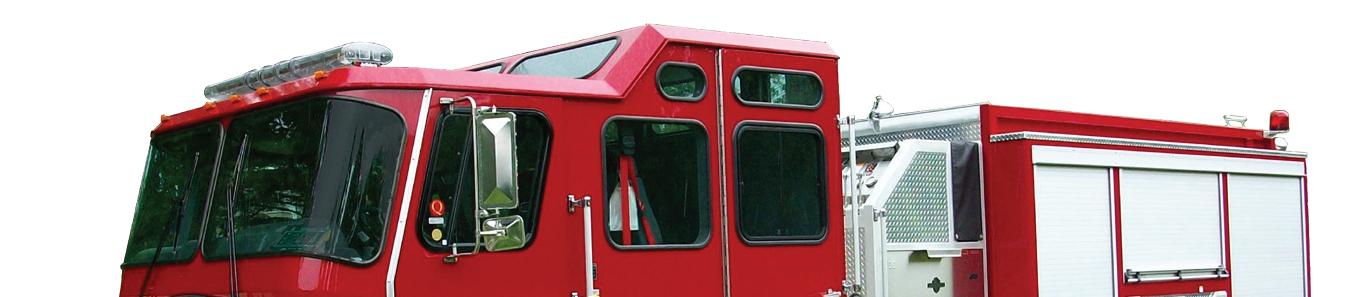
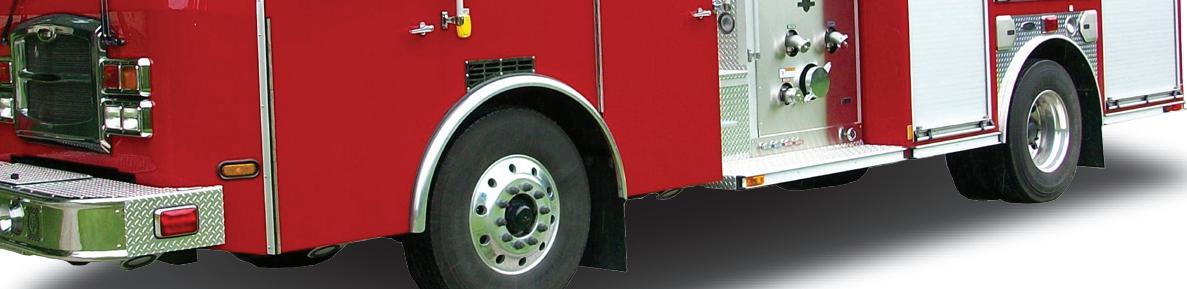
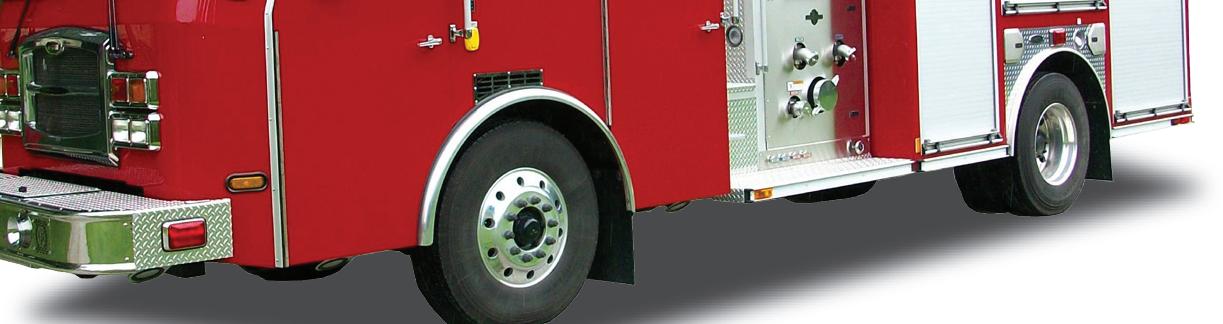
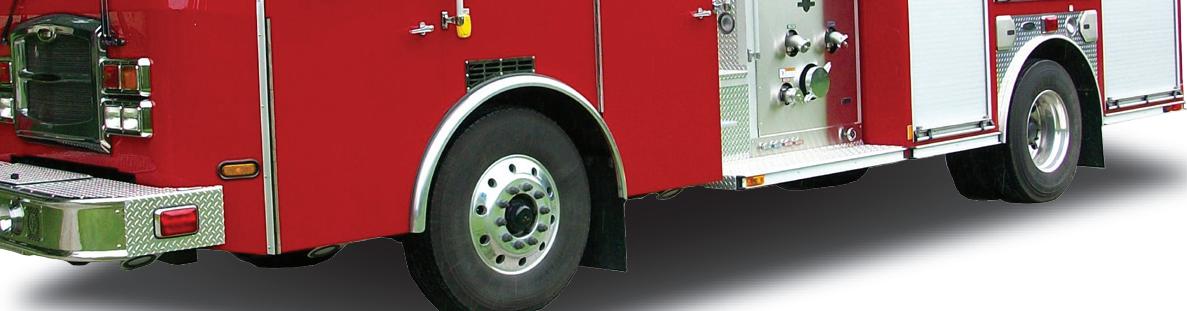
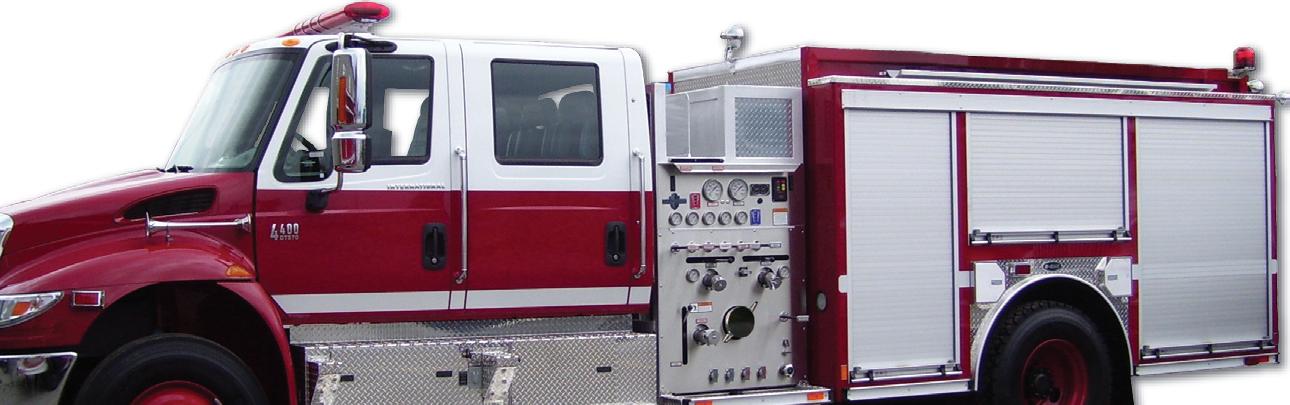
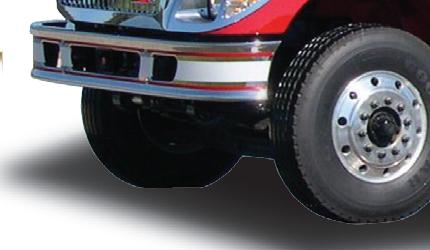
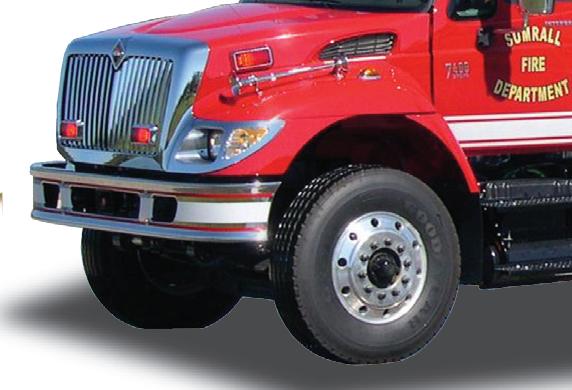
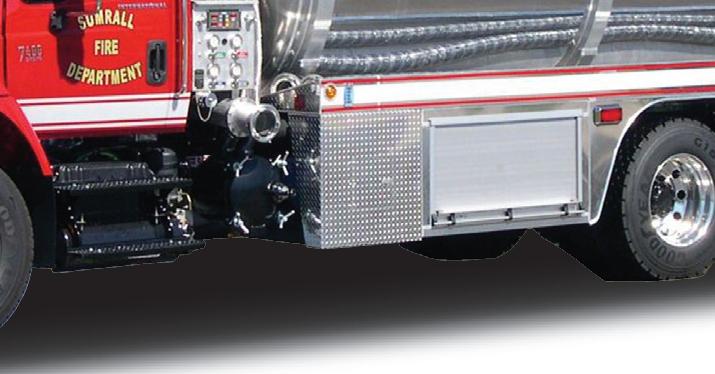
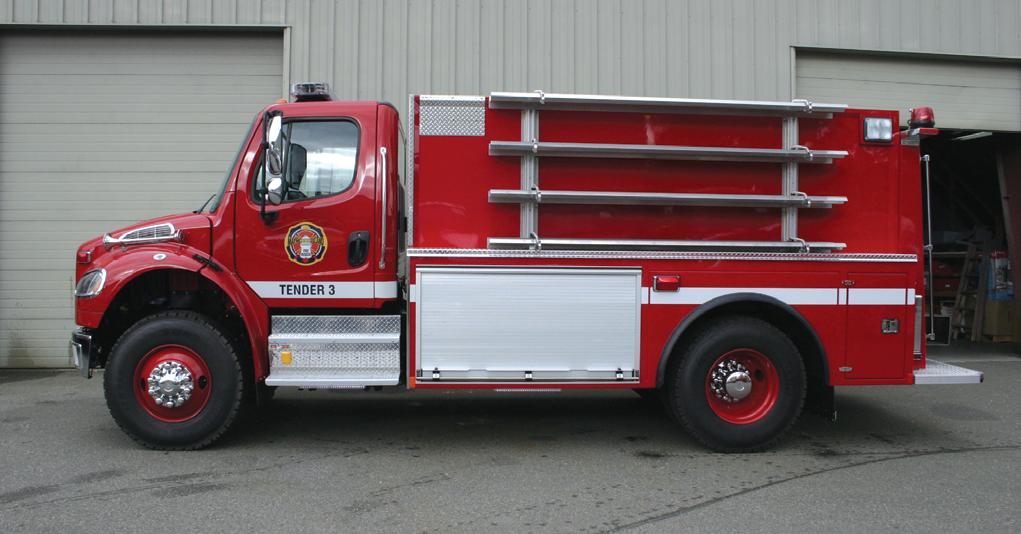
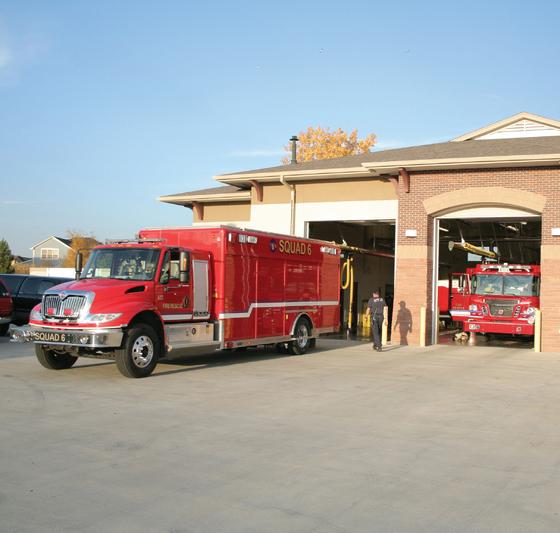
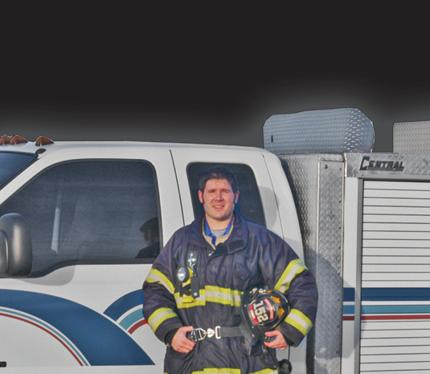
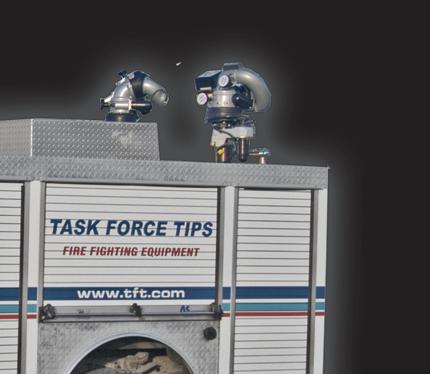
• 1/2, 3/4 or full-height officer side with various ladder storage configurations
• 89 cu. ft. of hosebed storage
• Stock units available
• Freightliner® or International® 2-door or 4-door chassis
• 1250 to 1500 gpm Hale® pump
• 1000-gallon tank
• Side-mount or top-mount pump configurations available
• International® chassis with electronic stability control
• Polished aluminum water tank with vacuum pump system
• In-cab pump and valve control console
• Closed circuit monitor with two cameras
• Hard suction hose trays, length of unit
• Lighting and siren package
• Portable tank rack
• 1/2, 3/4 or full-height officer side with various ladder storage configurations
• 89 cu. ft. of hosebed storage
• Stock units available
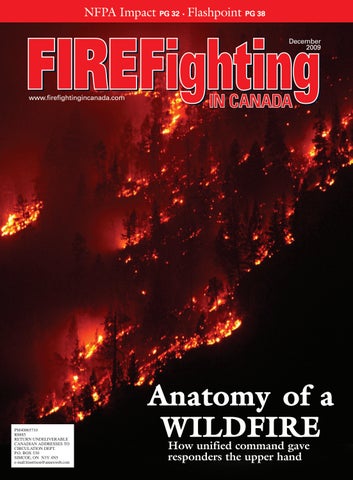
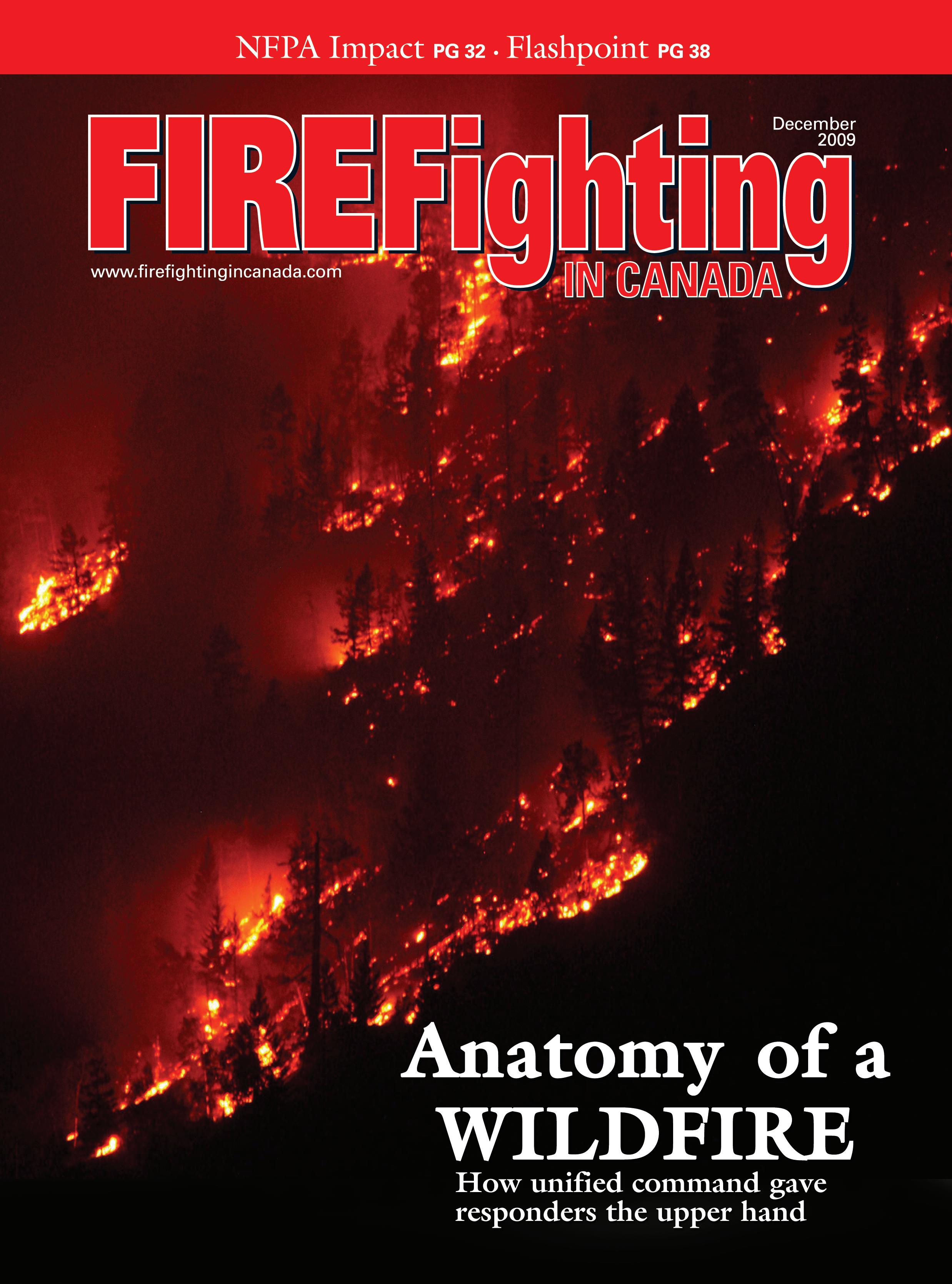
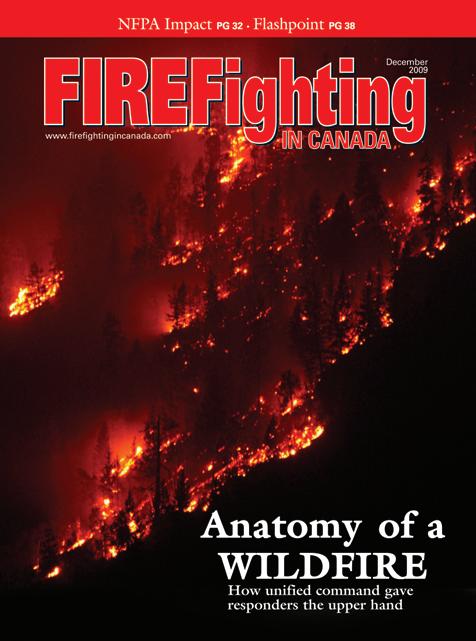
ANATOMY OF A WILDFIRE
Lou Wilde explains how unified command and lessons from 2003 prepared B.C. responders for the summer’s infernos.
22
BLUE CARD COMMAND
The Blue Card Command system, promoted by retired Phoenix Fire Chief Alan Brunacini, focuses on standardized local response and has a famous name behind it to boot. By Peter Sells
34 HANDS-ON TRAINING
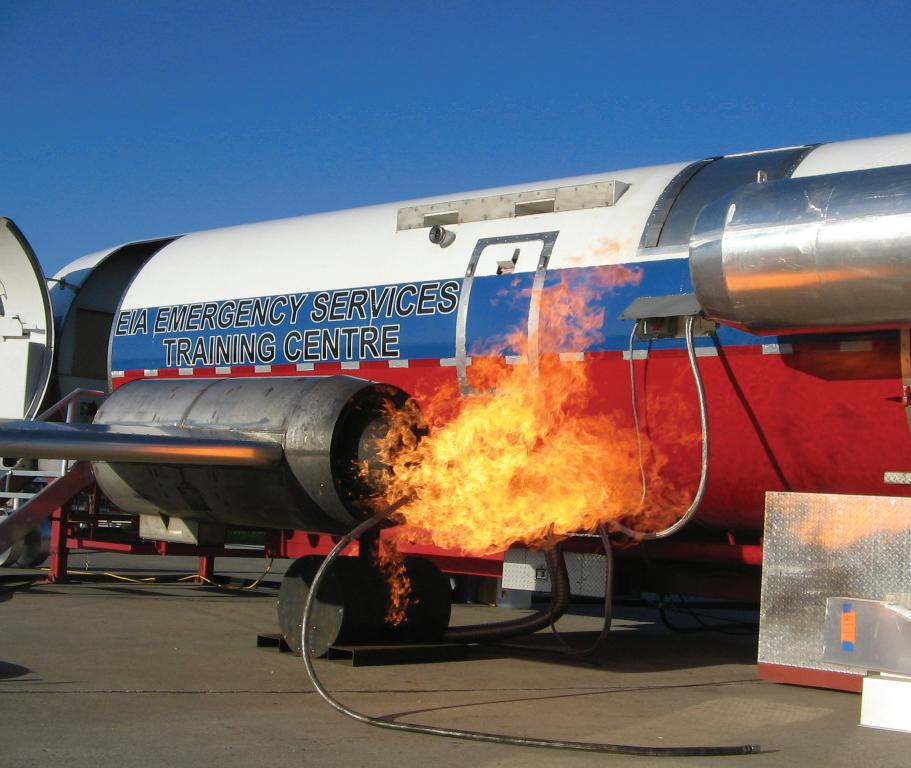
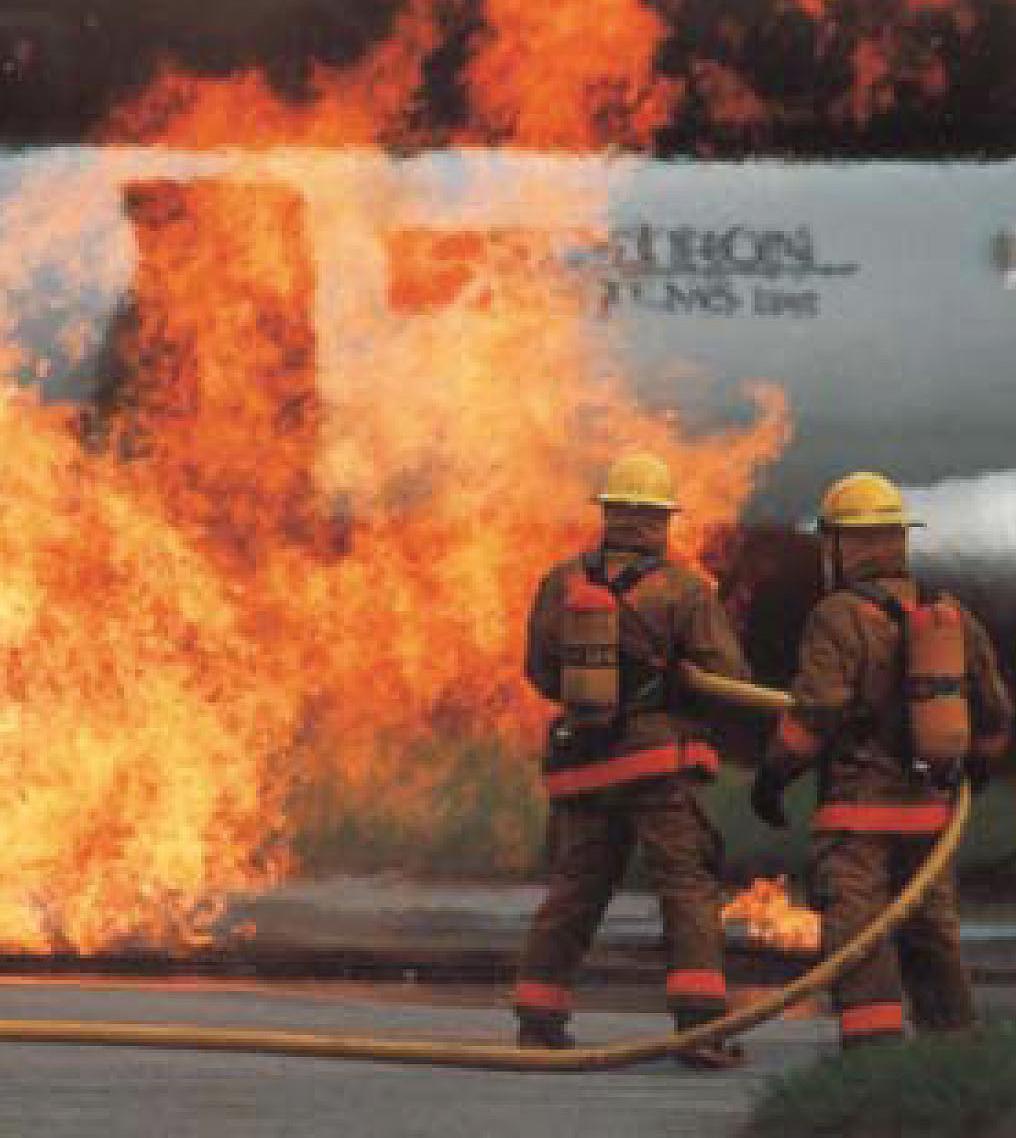
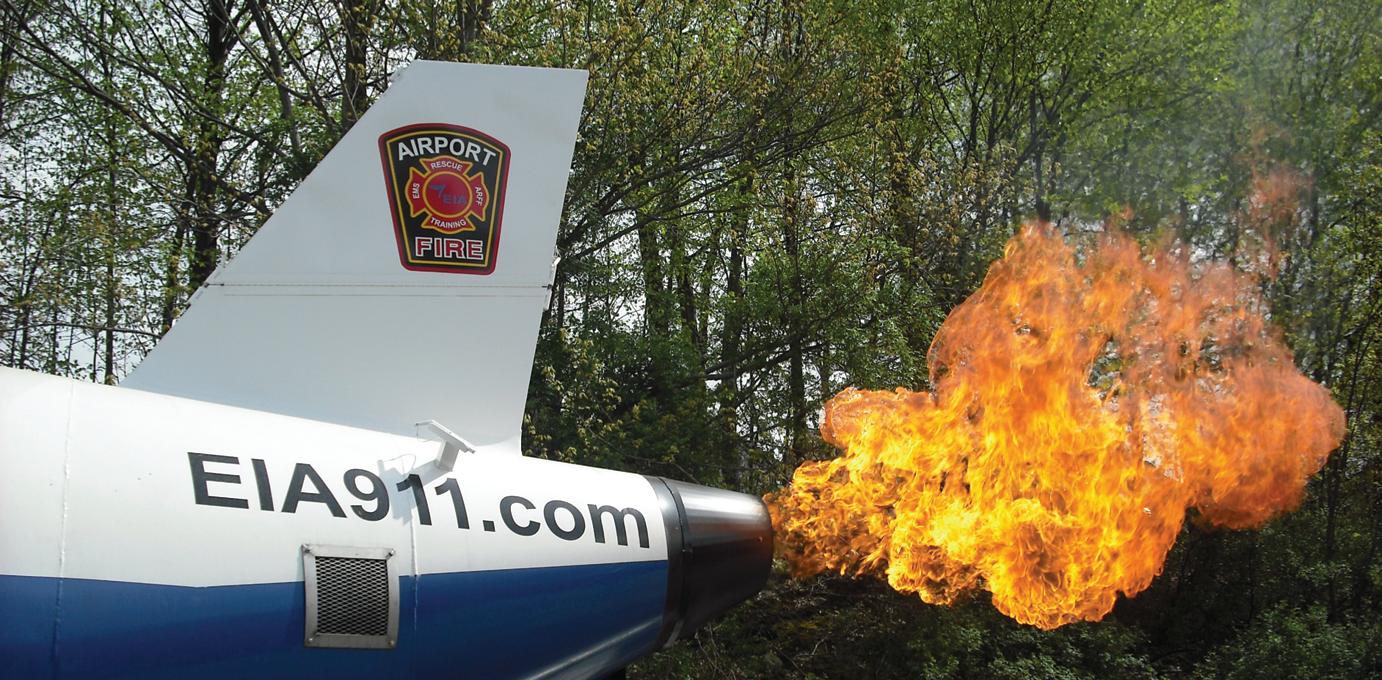
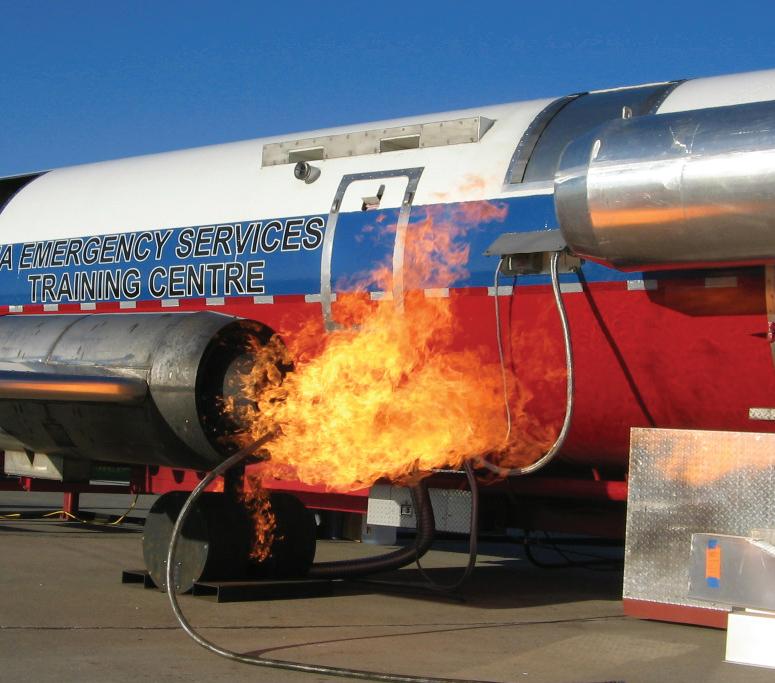
As Blair Watson reports, a new mobile aircraft fire trainer at the Edmonton International Airport is the first of its kind in Canada and allows fire departments to run multiple daily drills.
BY LAURA KING Editor lking@annexweb.com
COMMENT
A firefighter is a firefighter
t was a good day.
On Nov. 4, Ontario Labour Minister Peter Fonseca announced the extension of workers compensation benefits to volunteer and part-time firefighters and fire inspectors.
The announcement was two years in the making and the delay caused frustration and anger among the province’s more than 19,000 volunteers.
In May 2007 the province announced presumptive legislation for fulltime firefighters but said it needed to work out details for part-time and volunteer firefighters.
In a nutshell, there was concern in some corners that volunteer firefighters could get cancer from other sources (their day jobs) and the province would end up footing the bill through presumptive legislation. The province wanted to figure out how to address that issue before extending the benefits to volunteers and needed evidence to support the volunteers’ cause.
could tell which of the several hundred chiefs in attendance were volunteers and which were full-time. You all know the answer.
And Fonseca and his handlers were taken to the Oakville Fire Department’s training centre and put through their paces in the training tower, wearing full gear and with live fire. Fonscea, a fit and strong Olympian who ran in the marathon event for Canada in Atlanta in 1996, was convinced.
ON THE COVER
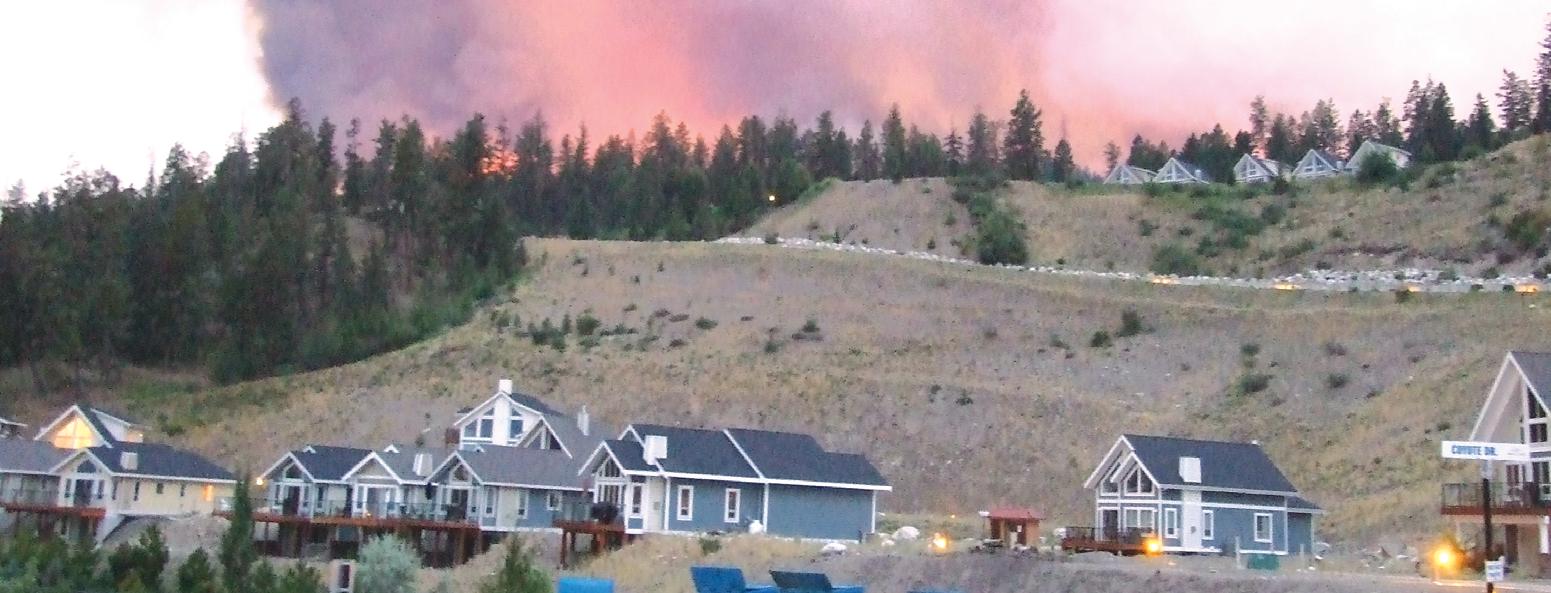
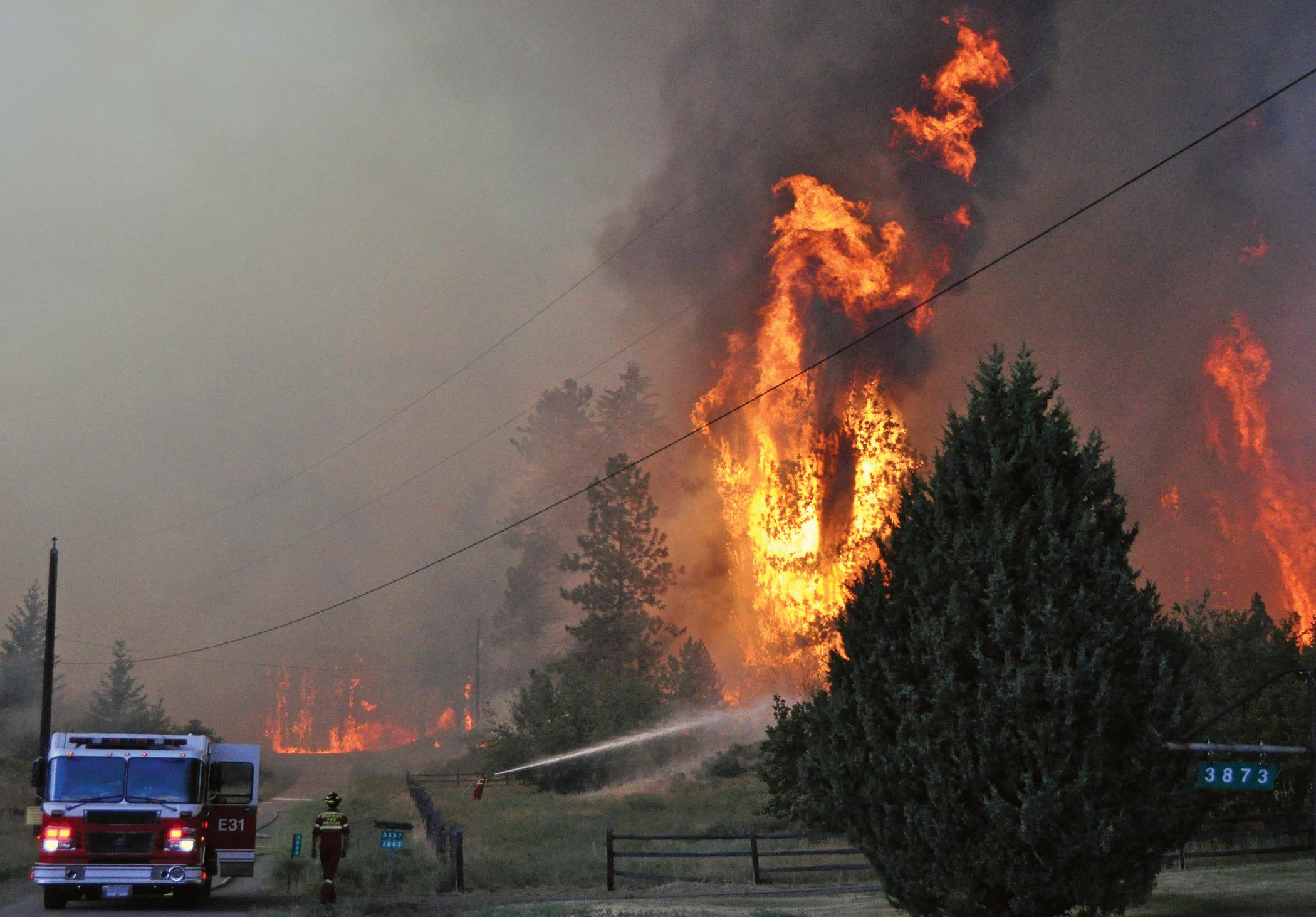
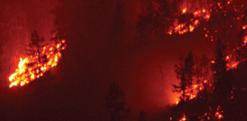
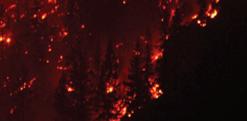
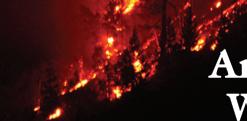
A wildfire burns on Terrace Mountain north of Kelowna, B.C., in the early morning hours of Tuesday, Aug 4. See story page 12.
Never one to turn down a challenge, Barry Malmsten, the executive director of the Ontario Association of Fire Chiefs, knew that numbers speak volumes to bureaucrats and he did what he always does: a survey.
The OAFC surveyed its members about cancer rates and determined that the cancer rate was no different among volunteer firefighters who worked in potentially cancercausing industries than among those who did not. Case closed.
In addition, the OAFC and the Firefighters Association of Ontario took a hands-on approach to convincing Fonseca and others that volunteer firefighters need the same protection as full-time firefighters.
At the OAFC conference in April, Fonseca and his staffers were asked if they
As MPP Dave Levac said of the announcement, “It’s a good day today, because today the province recognizes the value that volunteer firefighters bring to the communities of Ontario.”
And, as Paris, Ont., Fire Chief Paul Boissonneault so eloquently put it: “The volunteer fire service doesn’t look for the big things. We look for the meaningful things and if there’s anything more meaningful than looking after our own I don’t know what it is. Today, we recognize that a firefighter is a firefighter.”
The moral: the OAFC and the FFAO worked tirelessly to get what they knew was right. They didn’t back down when a new minister was appointed in 2008 and they had to start from scratch. They got creative. They developed relationships with bureaucrats and other influential people. And it worked. Congratulations!
PRESIDENT MIKE FREDERICKS mfredericks@annexweb.com
PUBLICATION MAIL AGREEMENT #40065710
PAP Registration #8885
RETURN UNDELIVERABLE CANADIAN ADDRESSES TO CIRCULATION DEPT.
P.O. Box 530, SIMCOE, ON N3Y 4N5 e-mail: lmorrison@annexweb.com
Printed in Canada ISSN 0015–2595
CIRCULATION e-mail: lmorrison@annexweb.com
Tel: 866-790-6070 ext. 206
Fax: 877-624-1940
Mail: P.O. Box 530 Simcoe, ON N3Y 4N5
SUBSCRIPTION RATES
Canada – 1 Year - $25.44
(includes GST - #867172652RT0001)
USA – 1 Year $50.00
We acknowledge the financial support of the Government of Canada, through the Publications Assistance Program and the Canada Magazine Fund, toward our mailing and editorial cost. Nous reconnaissons l’aide financiere accordee par le gouvernement du Canada pour nos coults d’envoie postal et nos coutl redactionnels par l’entremise du Programme d’aide aux publications et du Fonds du Canda pour les magazines.
From time to time, we at Fire Fighting In Canada make our subscription list available to reputable companies and organizations whose products and services we believe may be of interest to you. If you do not want your name to be made available, contact our circulation department in any of the four ways listed above.
All advertising is subject to the publisher’s approval. Such approval does not imply any endorsement of the products or services advertised. Publisher reserves the right to refuse advertising that does not meet the standards of the publication. www.firefightingincanada.com
PHOTO BY DARRYL DYCK, THE CANADIAN PRESS
Ingleside, ON
STATIONtoSTATION
ACROSS CANADA: Regional news briefs
King Township department honoured for driving program
King Fire and Emergency Services in Ontario has been selected by the International Association of Fire Chiefs Volunteer and Combination Officers Section (VCOS) as the recipient of the 2009 VCOS VFIS Emergency Vehicle Safe Operation Achievement Award.
Over the last two years King Fire and Emergency Services has developed a driver training program that includes eight functional operation guidelines, a driver monitoring/testing program, driver rodeo events and a post-incident driver evaluation by the company officer. King’s emergency vehicle operators must complete 16 hours of driver training, including the safe manoeuvring of the apparatus forward and backward, plus knowledge of all components and the vehicle’s inventory.
King firefighters have secondary accidental injury coverage through Volunteer Fire Insurance Service (VFIS). VFIS clients can access its
training library and programs at no cost. King Fire has used and adopted many VFIS programs and, following some minimal customizing, incorporated them into its policies and operational guidelines.
The 2009 VCOS VFIS Emergency Vehicle Safe Operation Achievement Award is an international award that supports the U.S. National Fallen Firefighters Foundation and the initiatives to reduce
THE BRASS POLE
Promotions & appointments
JIM PENDERGAST is the new part-time fire chief for the Town of Penhold in Alberta. Pendergast is a long-time firefighter in Alberta and is a full-time fire captain with Rocky View Fire Services currently at station 72 in Balzac. He can be contacted at firedept@townofpenhold.ca.
ERNIE POLSOM is the new fire chief in Leduc, Alta. Polsom’s most recent position was director of field operations with the Alberta Emergency Management Agency in Edmonton. He came to the fire commissioner’s office with the Government of Alberta and joined with Emergency Management Alberta to form the agency about two years ago. Polsom started as a volunteer firefighter in north-
firefighter injuries and deaths as a result of vehicle accidents.
This year’s award recognizes emergency service organizations that were accident free between Aug. 1, 2008, and July 31, 2009, and have demonstrated a functioning vehicle safety program.
King Fire and Emergency Services Chief Bryan Burbidge said he is honoured that the department was chosen as the award recipient.
ern Manitoba in 1983 and he worked his way up to deputy fire chief in the Town of The Pas in Manitoba.
TOM THOMSON is the new fire chief in Drayton Valley, Alta. Thomson has been with the fire department for more than 15 years and was the department’s training officer for the last two years.
The City of New Westminster
“This program and award was not accomplished alone and had it not been for the tremendous effort demonstrated by Capt. Gerard (Gerry) Binsfeld and the driver training committee of King Fire we would not be as successful,” Burbidge said.
Burbidge and Binsfeld were to receive the award at a ceremony in Florida on Nov. 6.
-Laura King
in British Columbia has named TIM ARMSTRONG as chief. Armstrong spent 28 years with Vancouver Fire and Rescue Services, culminating in his role as assistant chief special operations/USAR team task force leader. Armstrong brings experience leading programs in disaster response, hazardous materials, evacuation, emergency planning and public safety.
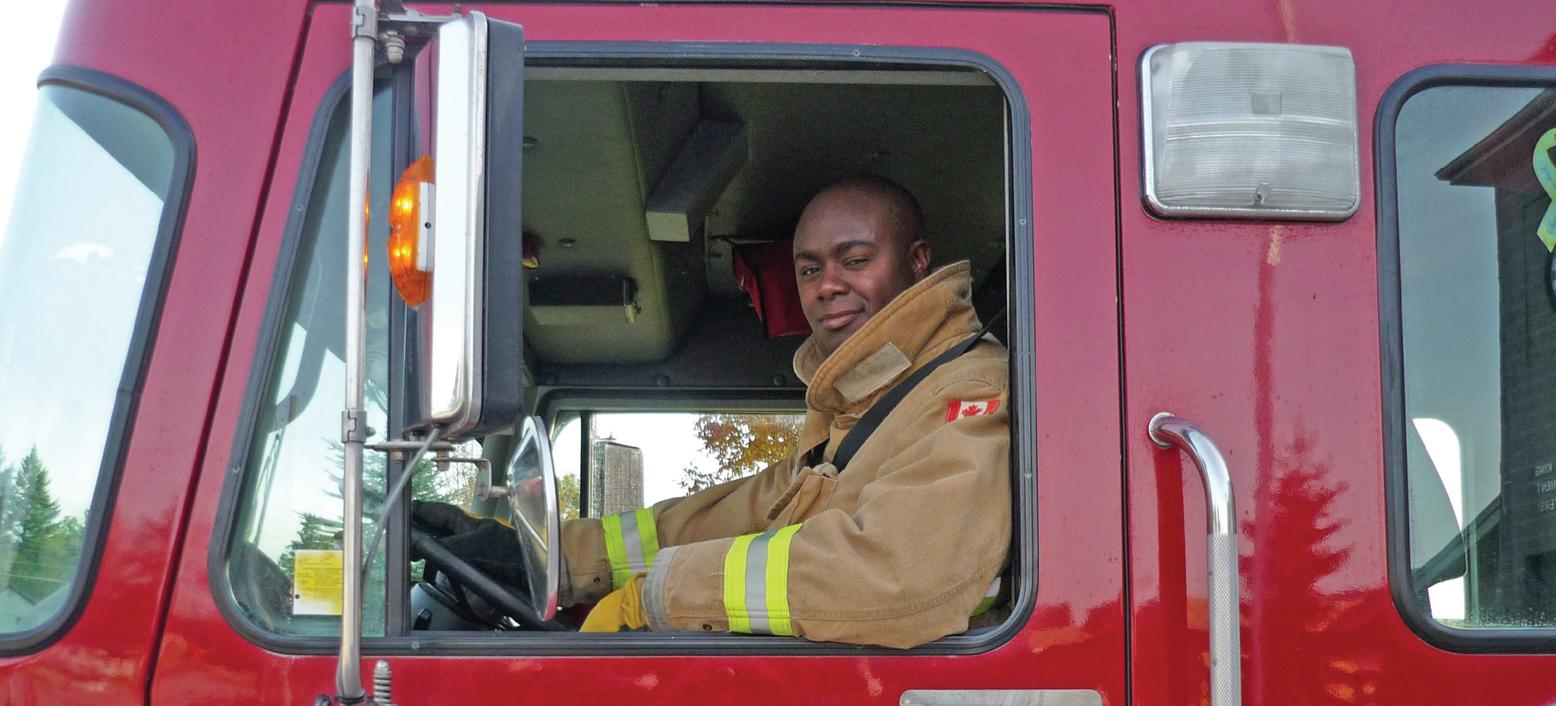
King Fire and Emergency Services recruit Dwayne Jackson is among those who have experienced the department’s award-winning driver training program.
Oakville Fire commemorates 100th anniversary with coffee-table book
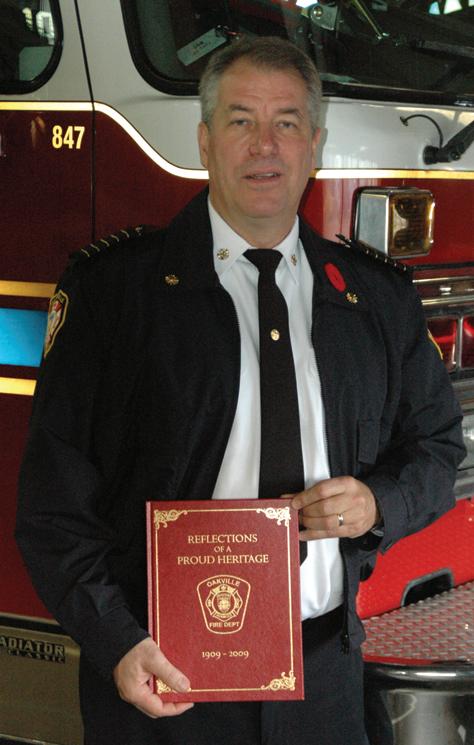
The Oakville Fire Department’s 100th anniversary celebration this year included the launch of a commemorative, hard-cover book, called Reflections of a Proud Heritage, that features hundreds of glossy photos and a wonderfully detailed account of a century of fire fighting.
According to a press release from the Town of Oakville, “the book contains stories of events that were memorable in some way and that form part of the overall history of the Oakville Fire Department,” said contributing author and fire prevention officer Glenn Barwell.
Prevention Officer John Percy and Oakville Fire administrative assistant Lynn Norton. Oakville Fire Chief Richard Boyes said the committee spent five years “nurturing an idea, gathering information and selling the concept of a history book to fire management.”
Author and Mississauga Fire Capt. Robert Kirkpatrick wrote and edited much of the text, which includes vivid descriptions of major fires, significant events including station openings and the induction of new chiefs, and the evolution of Oakville Fire from a brigade to the present 212-member department.
The history book was Barwell’s brainchild but he enlisted help from Fire
Among the book’s highlights are a look at Oakville’s most recognized vehicle, Pumper
No. 8, or P8. According to the book, the 1948 American Lafrance carries 125 gallons of water and 1,600 feet of hose, and can “pump” water from wells and lakes. The pumper was used to fight its first major fire on Aug. 14, 1948, at the Kendall Leather Company. On Feb. 26, 1959, it pumped water for 16 straight hours to help put out another major fire. On Feb. 12, 1980, P8 was used at its last fire at the Ren’s Feed and Supply store where, while drafting, it threw a piston through the engine block. The next day, P8 was taken out of service. In 1983, the Oakville Professional Firefighters Association began to restore P8, completing the work in 1984. It is now the department’s only
parade antique truck. The 194-page book is available through www.oakvillefire. ca/100years.htm. ■ ONTARIO
Oakville Fire Chief Richard Boyes shows off a copy of the department’s 100th anniversary book. The project was spearheaded by prevention officer Glenn Barwell.
Inaugural humanitarian award presented by OAFC
■ ONTARIO
The Ontario Association of Fire Chiefs and Safedesign Apparel Ltd. honoured the memory of Bill Williams in April with the inaugural Bill Williams Humanitarian Award. When Williams retired from Safety Supply, he went to work at Safedesign, where he stayed until his passing. He was the consummate salesman and mentor.
OAFC President Richard Boyes said recipient Aurele
Constantineau, chief of the Limoges Fire Station in The Nation, Ont., “is an outstanding citizen who has never received the formal recognition he deserves.”
Chief Constantineau has been involved in the Limoges Fire Department and the Nation Municipality Fire Department for 33 years (32 years as chief).
“I have always admired his strong values and ethics, his value for people, his dedication to his community, his belief in
ongoing fire prevention, his determination to always go the extra mile to deliver the best service possible, his relentless support to firefighters, his determination to fight battles for the benefit of better fire prevention, his genuine love for his community and its safety and his willingness to share his fire prevention passon and knowledge with people of all walks of life,” his nominator said in a submission to the OAFC.
Constantineau was fire chief on site during a 38-vehicle pile up on Highway 417 in February 2006 during a white out. The incident resulted in five deaths. “All who have heard the presentation about the incident have been impressed with the efforts that Aurele made to treat the victims with dignity, to care for the survivors, to console the families and to reach out to them afterwards,” the nomination said.
BY
WILLIAM SNOWBALL was appointed fire chief for the Town of Markham, Ont., in April. Snowball has been a deputy chief in Markham since 2002 and was acting chief for several months on two occasions during the past two years. He has 34 years of service with the Town of Markham. He joined Markham Fire and Emergency Service in June 1974 as a volunteer. As deputy fire chief of operations he was responsible for 200 fire
suppression staff, the mechanical division of the department, purchasing apparatus and the construction of new fire stations.
The City of Prince Rupert in British Columbia has appointed DAVE MCKENZIE as the fire chief. McKenzie has been a deputy fire chief for the last three years with responsibility for all aspects of fire and rescue service in Prince Rupert’s composite department. McKenzie
took over from Chief Ron Miller who retired in September after 33 years with the department.
Last alarm
ANN LONGLEY, executive director of the Fire Services Association of Nova Scotia, died suddenly on Oct. 24 in Kentville, N.S. Longley was 63. She was the long-time municipal clerk for the Municipality of Kings in Nova Scotia.
SEND US YOUR DEPARTMENT NEWS: Fire Fighting in Canada and our readers want to hear about your department’s promotions, appointments and retirements. Send details and a colour photo by e-mail to lking@annexweb.com and we’ll publish an announcement in our next issue.
PHOTO
LAURA KING
STATIONtoSTATION
BRIGADE NEWS: From stations across Canada
MAYNE ISLAND FIRE RESCUE in B.C., under chief Jeff Francis, took delivery in October of a Hub Fire Engines & Equipment-built tanker. Built on a Freightliner M2 chassis, this tanker is powered by an Allison 3500 EVS transmission and a Cummins ISC 330-hp engine and is equipped with a CET 18-hp portable pump, 1,500 ig co-poly water tank and Zico electric porta tank storage.
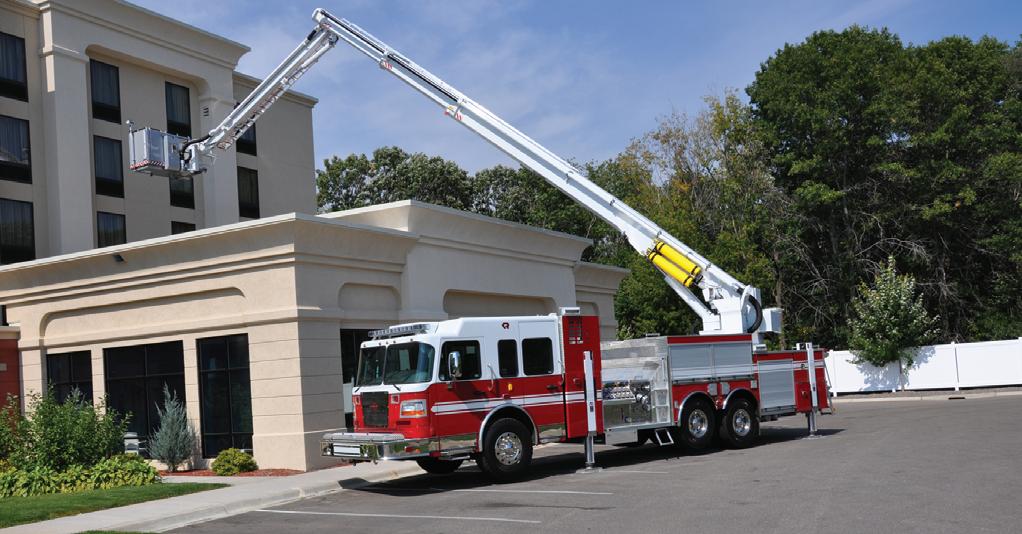
The ST. ALBERT FIRE DEPARTMENT in Alberta took delivery in September of a Rosenbauer-built aerial platform. The truck was built on a Commander AT chassis, features an Allison 4000 EVS transmission and is powered by a Caterpillar C13 525-hp engine. The aerial unit is equipped with a T-Rex articulating platform, Hale 2000 igpm pump, 1,400-litre water tank, an Onan 10kW hydraulic generator and a 140-litre foam cell.
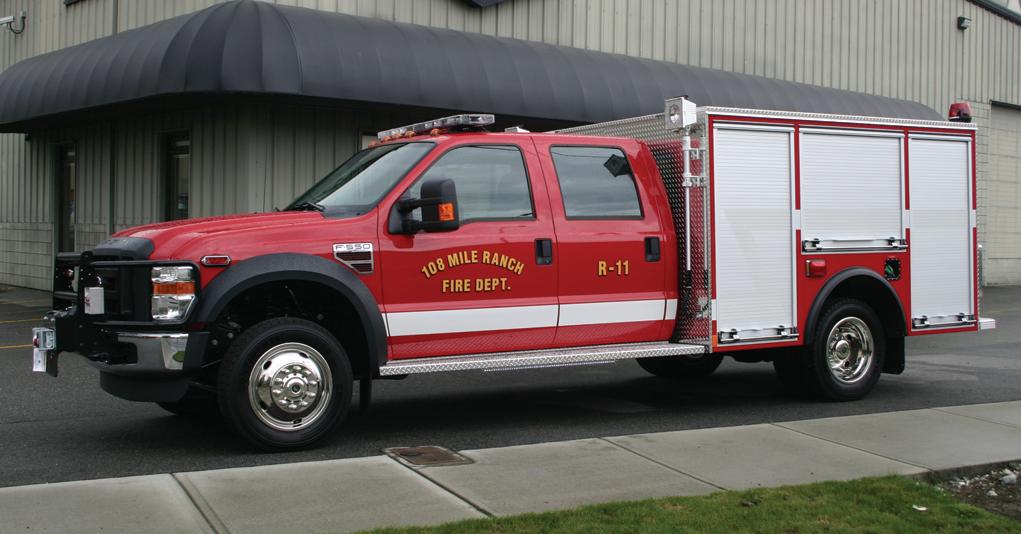
The 108 MILE RANCH FIRE DEPARTMENT in British Columbia, under chief Marcelle Reid, took delivery in September of a Hub Fire Engines & Equipment Ltd.-built lite rescue truck. The truck was built on a Ford 550 4x4 chassis and is powered by a 6.4-litre diesel engine. The rescue unit is also equipped with a five-speed automatic transmission, Whelen light package and a Warn M12000 winch.
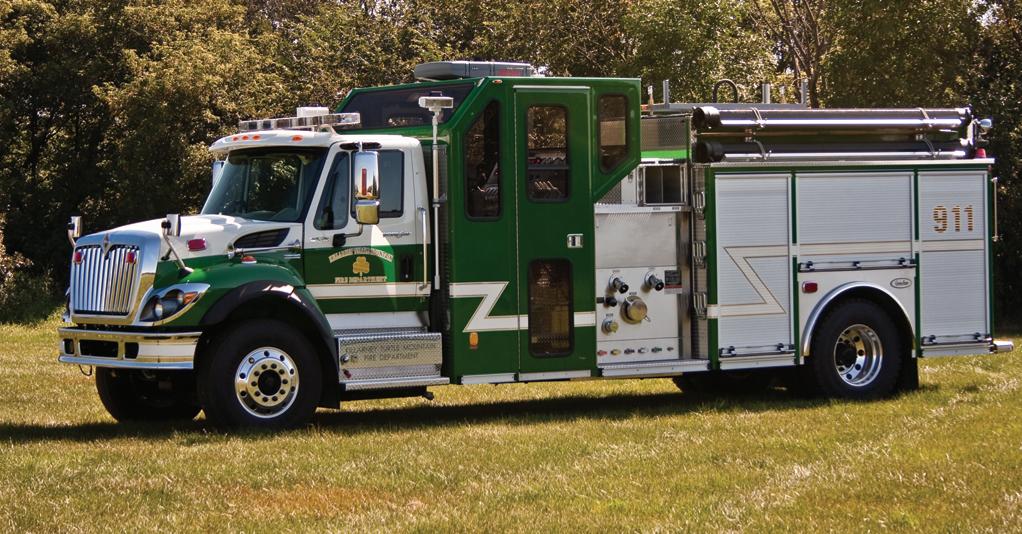
The KILLARNEY-TURTLE MOUNTAIN FIRE DEPARTMENT in Manitoba, under Chief Patrick Monkman, took delivery in September of a Green Acres Industries-built pumper. The pumper was built on an International 7500 chassis and is powered by a Maxxforce 10 350-hp engine. The pumper is equipped with a Hale QMax 1250 igpm pump, Foamlogix 2.1 foam system, Allison 3000 EVS transmission and 4,500-litre polyurethane water tank.
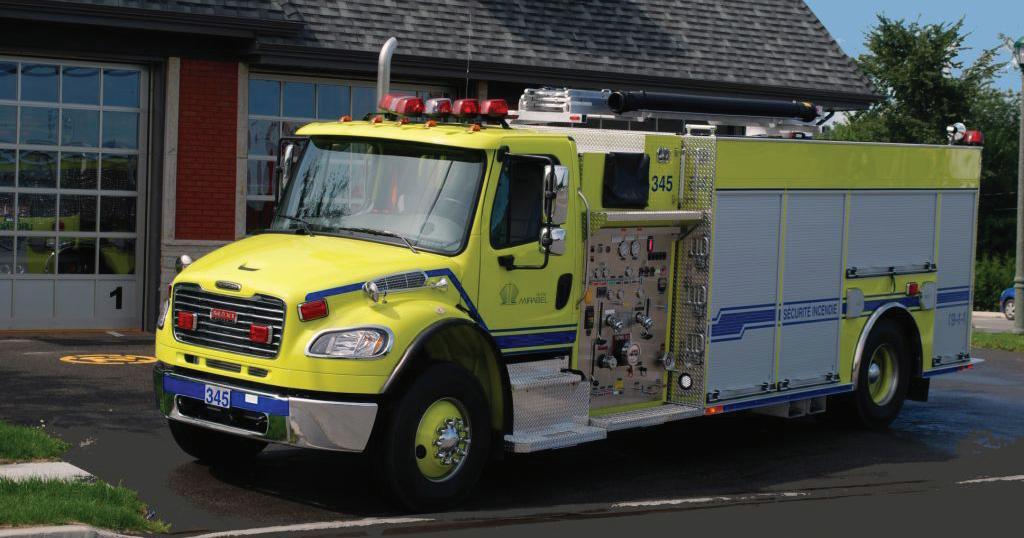
The MIRABEL FIRE DEPARTMENT in Quebec took delivery in August of a Maxi Metal-built pumper-tanker. The truck was built on a Freightliner M2 chassis and is powered by a 300-hp Cummins engine. The pumper features Amdor roll-up doors and is equipped with a Hale 1050 igpm pump and 6,800 litre co-poly water tank.
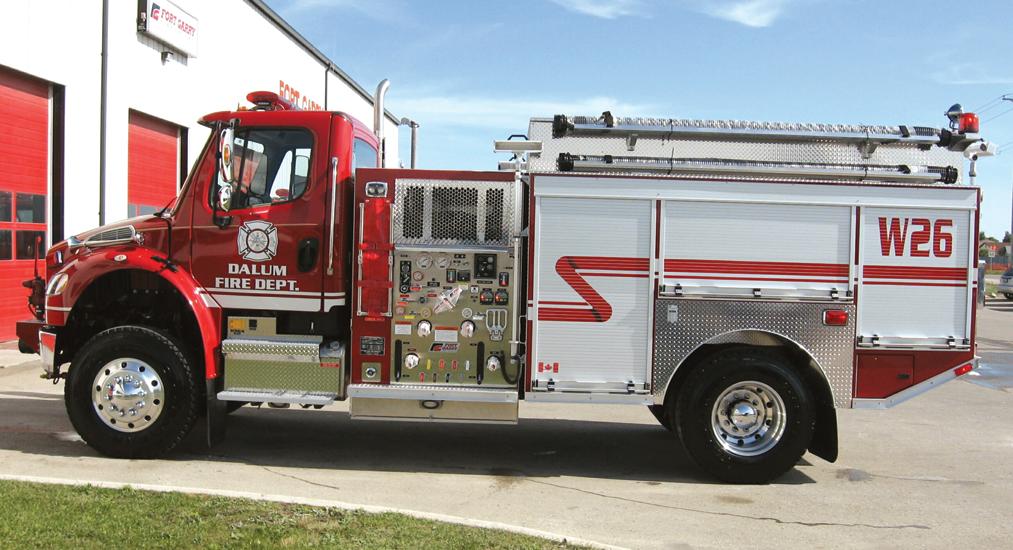
The DALUM FIRE DEPARTMENT in Alberta under Chief Albert Jensen took delivery in September of a Fort Garry Fire Trucksbuilt urban interface truck. Built on a Freightliner M2106 4x4 chassis, the truck is powered by an Cummins ISC 330-hp engine and an Allison 3000 EVS transmission and is equipped with a Darley HM 500 igpm pump and 1,000 IG co-poly tank and FoamPro 1600 foam system.
MAYNE ISLAND FIRE RESCUE
ST. ALBERT FIRE DEPARTMENT
KILLARNEY-TURTLE MOUNTAIN FIRE DEPARTMENT
MIRABEL FIRE DEPARTMENT
108 MILE RANCH FIRE DEPARTMENT
DALUM FIRE DEPARTMENT
Anatomy of a wildfire
How unified command and lessons from 2003 prepared B.C. responders
By LOU WILDE
PHOTO BY JOHN MACDONALD,
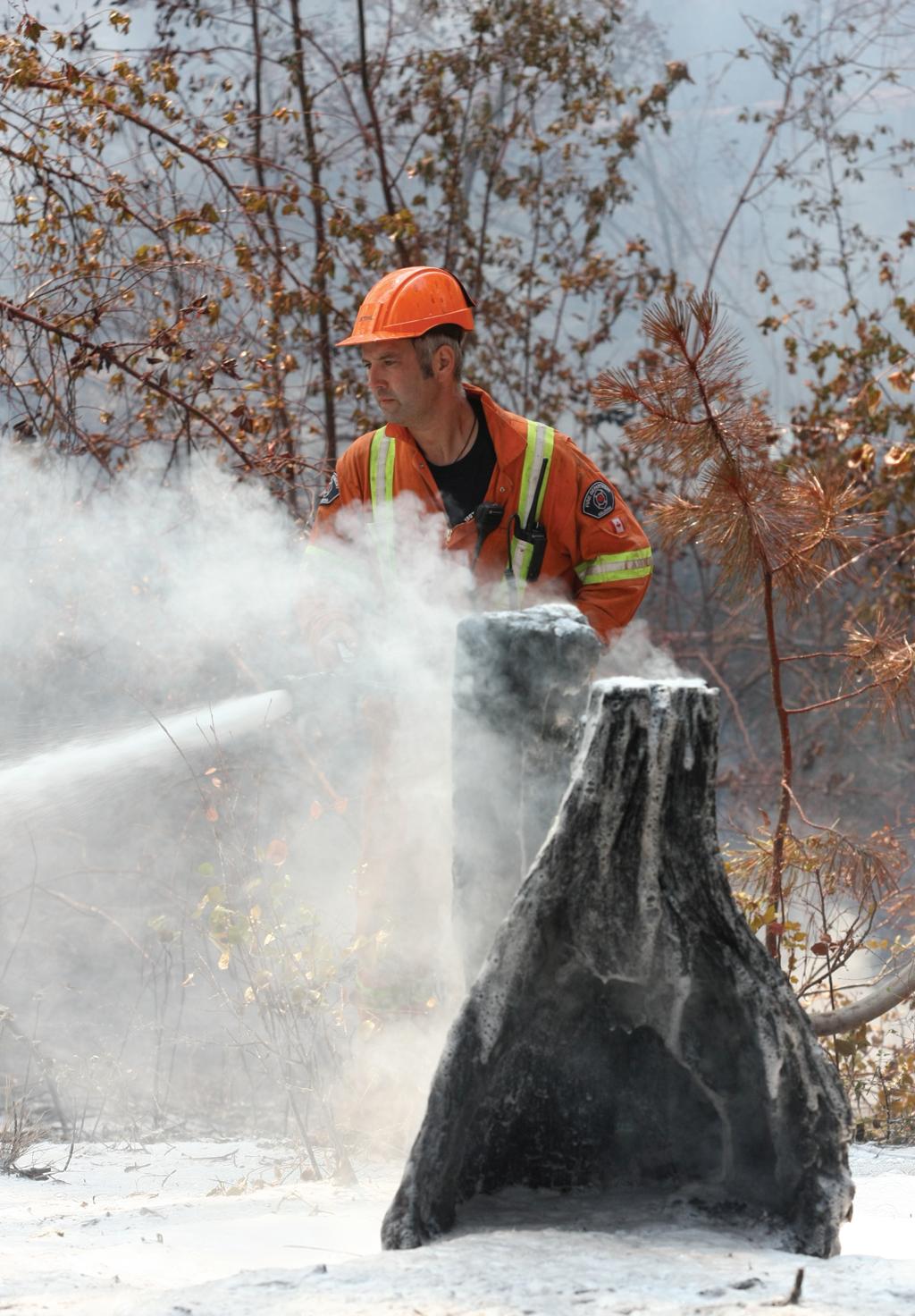
The peak of the 2009 wildfire season hit the Central Okanagan Valley in mid July, about a month earlier than usual. Three major interface fires made up what the British Columbia Forest Service termed the West Kelowna Complex, which ran for almost 45 days. Besides the protection branch of the B.C. Forest Service, the incident was commanded by forestry officials from Ontario, California and Australia by the time it was deemed under control and contained.
I met with Fire Chief Wayne Schnitzler of the West Kelowna Fire Rescue to recount the first operational period (12 hours) of the Glenrosa fire, the Rose Valley fire and the Terrace Mountain fire. What follows is a snapshot of our operations, some of the successes and lessons learned.
The Glenrosa fire was reported on July 18 at 14:40 hours and began on the fringe of the Glenrosa subdivision in the south end of West Kelowna, which is home to about 6,000 residents. The neighbourhood is made up of small acreages, which were in the immediate area of the fire, and urban-type homes on smaller lots half a kilometre to the north. Due to the Okanagan’s extremely dry climate (and minimal rainfall this summer), wildfires accelerate quickly and have to be acted on immediately using all necessary resources. The temperature that day was 37 C with wind gusting to 70 kilometres an hour; the humidity was at just 13 per cent. As time is paramount, we’ve learned that there is only a small window of opportunity during which we can make an impact on a wildfire when it is first reported.
In the Central Okanagan, fire departments usually act on fires outside their regular response areas rather than waiting for the fires to enter their jurisdictions; there is no time to waste when calling for resources, whether it’s mutual aid or the BC Forest Service. Our fire departments have a great working relationship with the protection branch of the BC Forest Service. We often cross jurisdictional lines to help each other with response and resources.
As Chief Schnitzler arrived on scene,
one of his first acts was to request the opening of the Central Okanagan Regional District Emergency Operations Centre as it was obvious that many people were going to be affected by this fire. The EOC was opened to a level 2, which includes the basic support of an operations section chief, liaison officer, police, fire, ambulance, emergency health services, planning-section chief, public information officer and a director (CAO) representing the municipality. Schnitzler had established incident command at the intersection of Apollo Street and Brown Road, from where officials could watch the rank 4 or 5 fire, which by that point was within metres of the south flank of the Glenrosa subdivision and just a kilometre from Gorman Bros. Lumber Ltd.
The RCMP members on duty that day were performing a tactical evacuation and traffic control. A call had already been put out for assistance from the BC Forest Service protection branch based out of Vernon and Penticton, which was responding with five helicopters, two unit crews (20 members), an initial attack crew of between three and five, two water tenders, two bulldozers, a tanker group (one bird dog plane and two to three air tankers) as well as a type 1 incident commander from the Vernon base. Through the EOC, Schnitzler also requested mutual aid from the other local fire departments and, within the first half hour, three engines, four bush trucks and three tenders were on their way from Lake Country, Ellison, Joe Riche, Kelowna and Peachland under the Central Okanagan Regional District mutual-aid agreement.
Assistant Chief Darren Lee from West Kelowna Fire Rescue was made the Upper Glenrosa division supervisor and a general page was put out for the 22 career and 60 paid on-call staff. As the incident developed, three divisions were established to maintain a working span of control: the Gorman division, led by Capt. Mike McGuire; the north division, led by Assistant Chief Darren Lee (both of WKFR); and the south division, led by Platoon Capt. Shawn O’Reilly (Kelowna Fire Department).
“As the incident commander you need a good visual vantage point on an incident of this size in order to develop your strategy,” Chief Schnitzler recalls. “It’s difficult for the division supervisor to have perspective of what is happening around him when he’s in the middle of things. They sometimes have a difficult time deciding their next move because of their limited view of the situation.”
From a tactical perspective, fire crews
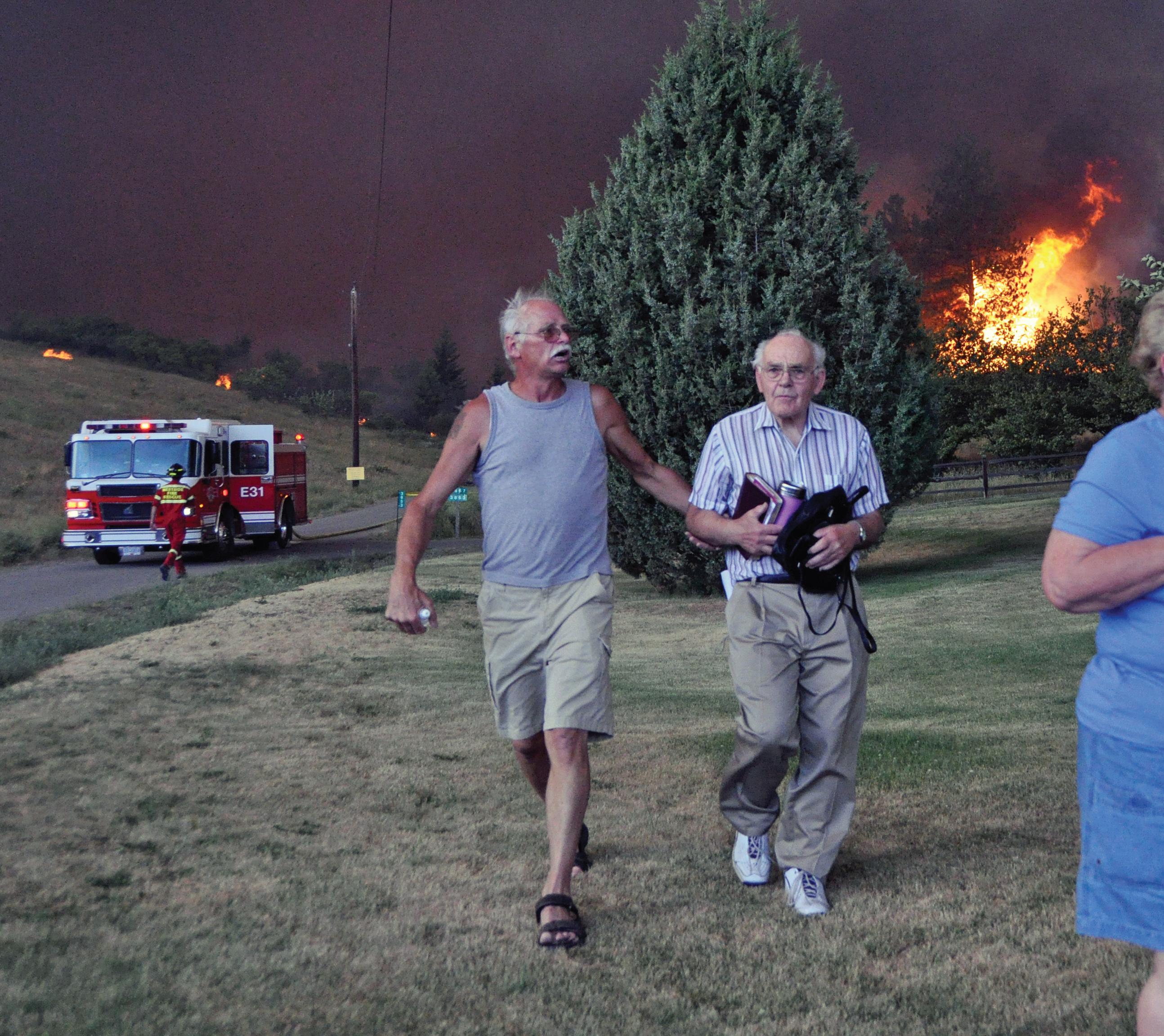
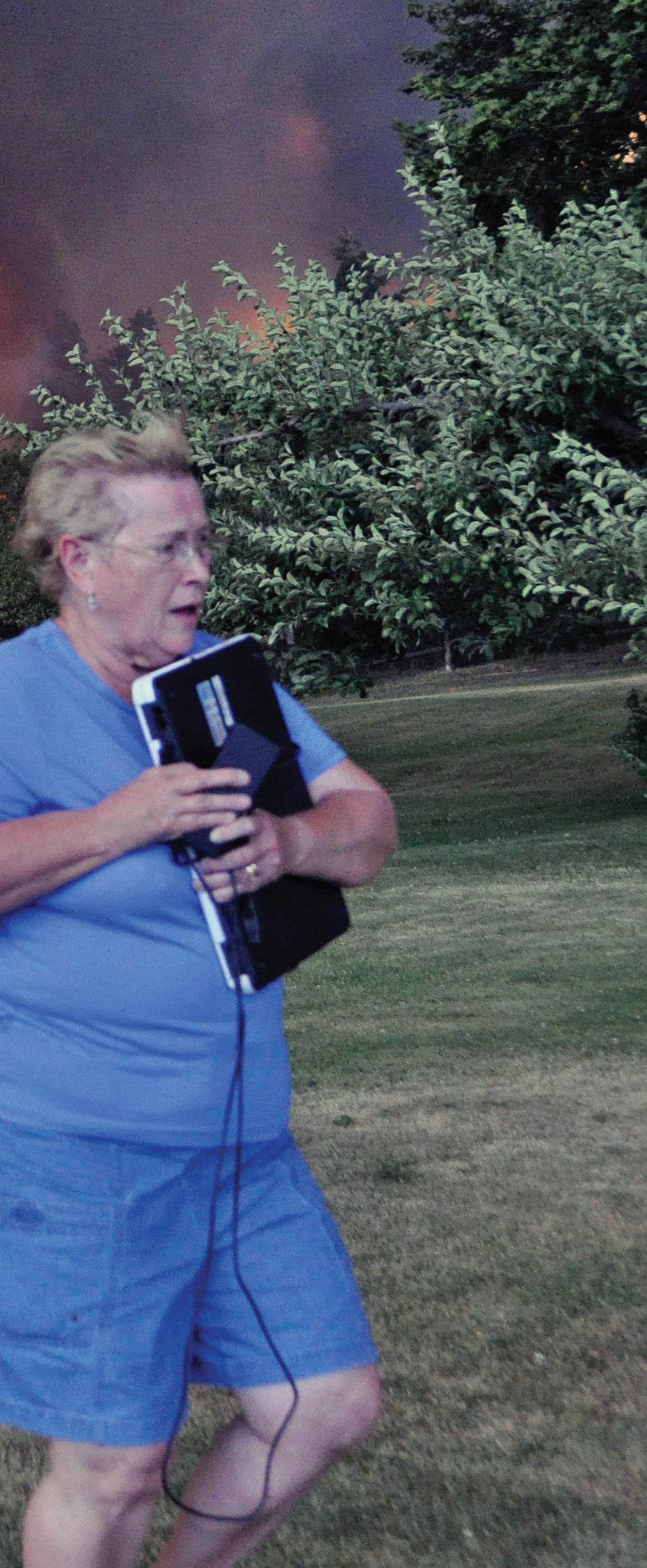
LEFT: Kelowna residents Rev. Les and Shirley Hamm were canning fruit when the fires began. They fled their home with whatever they could carry after watching the blaze take a nearby home.
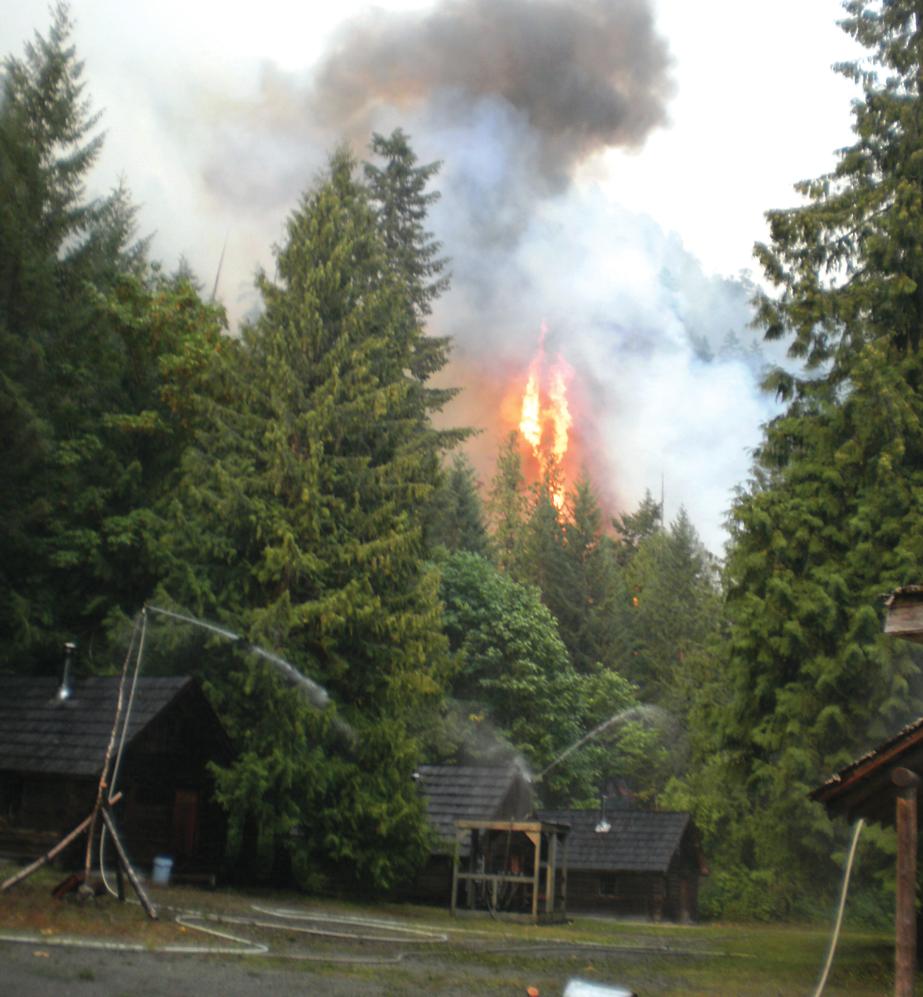
ABOVE: Sprinklers wet down farm buildings during the B.C. blazes in August.
needed to stay mobile. Firefighters couldn’t afford to lay huge amounts of supply line and stretch multiple 2.5-inch handlines to protect individual homes. They had to triage homes and properties on the run, suppressing multiple spot fires caused by the flying brands and the 70 kilometre per hour wind that were igniting ground fires 500 metres ahead of the rank 4 fire. As the chief put it, “the worst mistake that a task force leader or company officer can make is committing to a pinpoint. The officer must maintain a wide field of view evaluating the ever-changing dynamics around him. Dynamics of an interface fire of this magnitude change in such rapid succession that it’s often difficult to prioritize efforts.”
From an incident command perspective, managing an interface fire the size of the Glenrosa blaze can be like directing several commercial fires at once. “You rely on your experience from past fires and your decision-making abilities” says Chief Schnitzler. “It’s one thing to delegate the protection of neighborhoods to a division supervisor but it’s another to make decisions on all the other stuff.”
Consider the many decisions: How many more apparatus are needed? How many tenders, engines, bush trucks? Did we get a request in for forestry assistance (air support) since it’s within our jurisdiction? How many more firefighters? Where can we set up staging for appa-
FIRESMART RECOMMENDATIONS
The B.C. edition of the FireSmart manual can be found online at www.pep.bc.ca/hazard_preparedness/FireSmart-BC4.pdf It includes the following recommendations:
Prune tree branches to a height of two metres or more; Store fire wood 10 metres or more from the house (avoid downslope location);
Remove all trees, long grass, shrubs, logs, branches, twigs and needles within 10 metres of house;
ratus that is close but not too close? Who can I get right now for a staging manager? What streets need to be evacuated now? We need to set up a unified command with a number of agencies (WKFR, RCMP, BC Forest Service, and ambulance) somewhere other than the hood of my truck. What have we got for a hydrant system in the involved area? Did my only other assistant chief go out of town on his holidays? How long until he can get back? And what about fuel for apparatus, food, drinking water, back-up power for the water system in case the power goes out or power lines are destroyed by fire?
Within two hours a formal unified command had been established two kilometres north of the fire at Emmanuel Assembly Church, which offered tables and chairs, whiteboards, landlines, washrooms and a great vantage point of the ensuing fire. Representatives from WKFR, RCMP, ambulance and BC Forestry were now at the command post. It was imperative that public information come from the unified command post via the EOC and the message represented all agencies involved. Staging was set up at Station 31 in downtown West Kelowna so that there was control of who was going into action.
“We were able to get staging set up pretty quick so dispatch could direct resources there instead of trying to relay which street they were to respond to,” Schnitzler adds. At this point the interface fire was almost 70 hectares; there were about 30 pieces of apparatus, more than 150 people on the ground and eight aircraft working this fire.
“It almost becomes like a hazmat call where you need to rush to the scene and then slow right down,” says Schnitzler. “You need to assess the situation, evacuate public and determine where to allocate your limited resources, assign people to tasks, and put them to work then begin to evaluate progress and plan for what’s next.”
Thin trees (with three to six metres between crowns) for at least 30 metres from the house;
Contact your utility company if trees or branches are not clear of power lines;
Grass within 10 metres of buildings should be mowed and watered;
Address, fire or lot number clearly signed for quick identification by fire service;
Driveway is wide enough to accommodate emergency vehicles;
Try to provide an alternate emergency access route to your property;
Pond or tank with emergency water supply; A FireSmart burning barrel; Driveway clear of trees to a distance of at least three or four metres;
Chimney installed to code complete with spark arrestor screens;
All eaves enclosed and screen all vents including soffits; Undersides of balconies, decks and crawlspaces sheathed in with flame resistant materials;
Propane tanks located at least 10 metres from building and clear all vegetation within three metres; Use only fire-retardant roofing rated Class A, B or C and fire resistant exterior siding; Solid shutters or metal firescreens will provide increased fire protection for windows and doors. •
Within the same period of time, the EOC had been staffed to level 3 with about 60 people from a number of agencies. The public information officer put out press releases informing residents of the fire and detailing which streets were being evacuated as fast as the command post was calling them in. The EOC liaison officer was in contact with the Provincial Emergency Program headquarters in Victoria getting the official evacuation declarations completed. The emergency social services members were on their way to a local high school to register evacuees. BC Hydro was asked to assess and address the power outage. The fire was spreading west (out of town) and was a threat to the main transmission line supplying the entire community as well as the town of Peachland, five kilometres to the south. Things were changing quickly; there were more people to put on evacuation alert and more to order out. More resources were needed. Every new evacuation required the mapping staff in the planning section of the EOC to draft another map that would identify for the media the new status of evacuations. The Interior Health Authority needed to be called in because senior care facilities could be affected and hotels needed to be called (in the middle of July) to house evacuated residents. At about 18:00 hours (almost four hours into the fire) the command post had to move again because the church lost power and command called for the evacuation of the area around the church. Shannon Lake Elementary school was five kilometres away and had power. Thankfully, there was a school district representative in the EOC who had the authority and contacts to open two schools during summer holidays at a moment’s notice. It was decided that our first operational period for this event would go 12 hours with shift change (EOC and site) at 02:00 on Sunday, July 19.
Tactically, out in the field, firefighters made an amazing stand at Gorman’s lumber mill. Some raw logs and lumber products were lost but the facility and more than 400 jobs were saved. The bad news was that the fire spread east and had jumped the four lanes of Highway 97, the only highway connecting all the Okanagan Valley communities, and was headed downhill with a 60-kilometre-an-hour
wind pushing it toward Power’s Creek Canyon. The command post called for the evacuation of the easterly exposed Gellatly neighbourhood and eight square blocks of downtown West Kelowna (commercial and residential). By 18:00 hours the fire had spread to 250 hectares and another 3,000 people had been evacuated.
“Firefighters had to triage properties quickly,” Chief Schnitzler recalls. “Was the home defendable? Were the property owners practising Fire Smart recommendations with green space around their home, non-combustible building products and removing ladder fuels? What kind of escape route did firefighters have from the property if things turn bad?”
After the fire crossed Highway 97 it headed toward Okanagan Lake and the only sewage treatment plant for West Kelowna and Peachland. Again, task forces were directed to make a stand similar to that at the lumber mill. Losing the sewage plant for two communities could mean weeks of repair and could put both communities on evacuation order. How many porta-johns would we need for 35,000 people?
At the command post the BC Forest Service was working on plans for the next operational period with more than 150 forestry firefighters. The firefighters would need a place to camp so the Westbank First Nation rep in the EOC was asked for permission to set up a forestry camp in a baseball stadium on First Nation land. This camp became home to more than 350 forestry firefighters and operated until late August.
If things weren’t surreal enough, at 21:30 hours, a 911 call reported another wildland fire on the west shore of the Rose Valley reservoir in West Kelowna, 8.5 kilometres from the Glenrosa fire. Resources had to be pulled from Glenrosa to deal with this fire. Fortunately, the BC Forest Service got a chopper on site quickly to assess and act on the fire from the air as the fire burned away from nearby homes. The terrain was too difficult to put firefighters on site so a few were left to watch for spot fires near homes. The Rose Valley fire grew to 150 hectares before being contained and forced the evacuation of about 8,000 people. In all, 17,000 residents of West Kelowna were ordered out of their homes on July 18, many for an
entire week before unified command allowed them to return. Work to contain the 400-hectare Glenrosa fire and the 150-hectare Rose Valley fire took almost two weeks before it was termed “out”.
With the two active wildland fires in West Kelowna and a 500hectare fire burning some 30 kilometres to the northwest, the BC Forest Service designated the area as the West Kelowna Complex, meaning all three fires would be operated under the same unified command team in order to share resources and intelligence. By July 20, the Terrace Mountain fire was 1,300 hectares and by July 21 it was 1,800 hectares.
On July 22, while fire crews were in mop up in West Kelowna, the Central Okanagan’s rural fire department co-ordinator, Rod Miller, and I drove to the bedroom community of North West Side, home to about 2,500 residents, to meet with Fire Chief Wayne Carson. The Terrace Mountain Fire was now 2,700 hectares and fewer than 10 kilometres from Carson’s jurisdiction. From past experience in the Okanagan, we know that wildfire can make a four- or five-kilometre run in a day, so we were triaging and planning for the B.C. fire commissioner’s representative John Kenyon, who filled the role of structural branch director under the unified command. Kenyon had responded two days earlier with three of the province’s sprinkler protection units, complete with crews. Each of the sprinkler units could offer protection to about 20 homes deemed “defendable”. Plans were drafted to identify the few water sources (hydrants), identify safe zones so that fire crews could “retreat and return”, identify geographical divisions, identify key members for placement in an organizational chart, identify look-out points, print maps and make plans for back-up power for pump stations and so on. With plans drafted, all we needed was a fire. Because North West Side is remote and difficult to access, we ended up staging resources in the area ahead of the expected fire.
The narrow, winding 25-kilometre drive to North West Side was the only way in, so we planned to evacuate the public north to the
West Kelowna’s Engine 31 protects a residence as a tree “candles” in the yard.
PHOTO BY
BY CHRIS
The West Kelowna Complex, with its three fires, was a success in most accounts. All three fires appeared to have been caused by humans.
City of Vernon so that emergency vehicles could respond from the south. The two-bay fire hall in Wilson’s Landing, led by Fire Chief Derek Fletcher, is about 10 kilometres from North West Side so it was used as our staging area on Aug. 1, when the threat of fire became imminent. Twelve more units were brought in to supplement the two local fire departments with a staff of about 70 members. For seven days (14 operational periods), assistant chiefs Darren Lee and Kerry Klonteig from West Kelowna Fire Rescue and I shared the role of North West Side branch director. We established three division supervisors with task forces to perform “Fire Smarting” on the local properties while the BC Forest Service, with about 400 members, 15 helicopters and more than 90 pieces of heavy equipment, cut fire guards and performed back burns in an effort to save this small community on the shores of Lake Okanagan. Each operational period would begin with a briefing for structural crews at the staging area with the most current intelligence gathered at the previous night’s planning meeting held by the unified command. From this, duties and priorities would be delegated to division supervisors for the day. The forest service’s efforts on the community’s outskirts were successful and, on Aug. 7, the last of the mutual-aid companies was demobilized without seeing action.
The West Kelowna Complex, with its three fires, was a success in most accounts. All three fires appear to have been caused by humans but were still under investigation at press time. Three homes were lost, along with some vehicles and outbuildings, but there were no deaths or serious injuries. As Chief Schnitzler put it, “Over the years we (the regional municipalities and fire service) have put together an EOC with great people with experience. Our fire departments have developed a great working relationship through our mutual-aid agreement, the Regional Emergency Program and Regional Rescue Program. We’ve known and used ICS for years but we’re implementing it better now primarily through the experience we’ve gathered from interface incidents like the West Kelowna Complex”.
PHOTO
BY BRAD PATTON Chief Centre-Wellington, Ont.
IVOLUNTEERVISION
Budget basics for volunteer departments
need to start with an apology to all “big” volunteer/composite fire departments. In my bio at the end of this column, I wanted to emphasize that the Municipality of Centre Wellington, with a population of almost 29,000, is protected by an all-volunteer firefighting force. I believe this to be in the top 10 to 20 per cent of volunteer departments responsible for a population of that size. The original bio was edited and that changed the intended meaning. Fire Fighting in Canada and I apologize for any confusion. Strictly looking at the number of volunteers, we are small, with a staff of 60 volunteer firefighters running about 500 emergency runs a year. I hope this clears up any misunderstanding.
It’s budget time for many departments and I thought I’d pass on some thoughts in that regard. Volunteer departments operate with motivated people wanting to help their communities. These people join to become firefighters and give up a great deal to serve their communities, as I have mentioned in other columns. I believe volunteer firefighters sacrifice more for the well-being of a community than any other group. Our job is to encourage this type of behaviour. Volunteer/part-time firefighting rescue departments or companies are extremely cost efficient but the service isn’t free nor should it be. Our firefighters invest an enormous amount of time and energy to help others and for that investment to continue there should be rewards.
Those rewards come in several different packages and that, my friends, is where the budget comes in. Volunteer firefighters need, deserve and greatly appreciate good equipment. It’s one thing to ask someone to jump out of bed or drop what they are doing to rush to someone’s aid and another to give them a 25-year-old tool to use. Outdated and unsafe equipment equals poor morale, high turnover, unsafe conditions and high liability risks.
firefighters receive an annual cheque – you need to budget something that rewards your firefighters in a meaningful way. I strongly encourage fire chiefs, councils and fire boards to provide firefighters with the best remuneration package that can be afforded. It is one of the best investments your town can make.
We have a staff appreciation account that allows for the purchase of t-shirts, hats and jackets. This account can start off small but should grow. Volunteer firefighters are proud of what they do and should be, so a nice t-shirt with your department’s logo on it is another considerate way of saying thank you. There are many other ways to use this account; for example, an annual barbecue, Christmas gifts and so on.
Often, building maintenance budgets are forgotten, Fire stations are like any other piece of equipment. They need repairs and updating on an annual basis. Upgrading furnaces, toilets, installing dishwashers and updating kitchens and showers have a big impact on morale and can save money in their efficiencies. We just changed our glass overhead doors to insulated doors with one row of thermal-pane windows. These doors will pay for themselves in four to five years.
Large-ticket items such as new fire stations or additions, apparatus, breathing air compressors and so on may need to have reserve
I believe volunteer firefighters sacrifice more for the well-being of a community than any other group. ‘‘ ’’
All your equipment should be inventoried and recorded on a spreadsheet that includes a description of each item, the station to which it is assigned, the quantity, the life expectancy, the value in present dollars and a 10-year forecast indicating when the equipment is to be replaced, complete with grand totals at the bottom of each year’s column.
Initially this will be a lot of work but it will allow for greater planning and better financing. This is the same practice that should be done for vehicle replacement forecasting. This should become a 10year capital forecast for equipment replacement, depending on your finance department’s practice.
The other item that has to be budgeted for is compensation. It doesn’t matter if you’re on a point system, have hourly wages or your
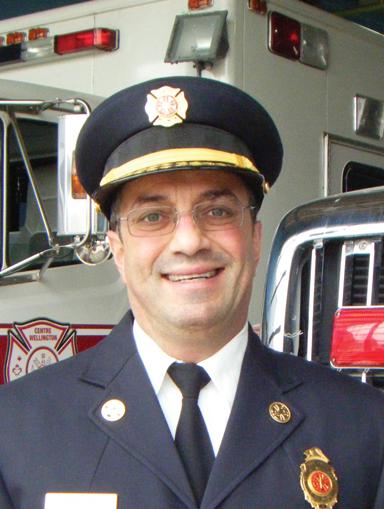
Brad Patton is fire chief for the Centre Wellington Volunteer Fire Rescue Department in Ontario. Centre Wellington, with a population of 28,000, covers 410 square kilometres and has stations in Fergus and Elora.
accounts set up to reduce the impact on budgets. As an example, a breathing air compressor cost of $20,000 plus $10,000 for construction and preparation of a room for the installation brings the total cost of the project to $30,000. Setting up a reserve account that annually receives $6,000 may be more affordable, and funding this kind of project over several years makes it easier for councils or fire boards to accept and approve. The added benefit is that the firefighters will know that new equipment is coming and that there is a plan.
Councils, fire boards and committees need to understand the sacrifices that volunteer firefighters make for their communities. Volunteer firefighters need to be outfitted, equipped and rewarded for their efforts because the alternative is higher labour costs, higher liabilities and unsafe conditions for the public and the firefighters. As chief officers we need to be able to communicate efficiently and effectively during budget deliberations. Our communities and our dedicated volunteer firefighters are counting on it.
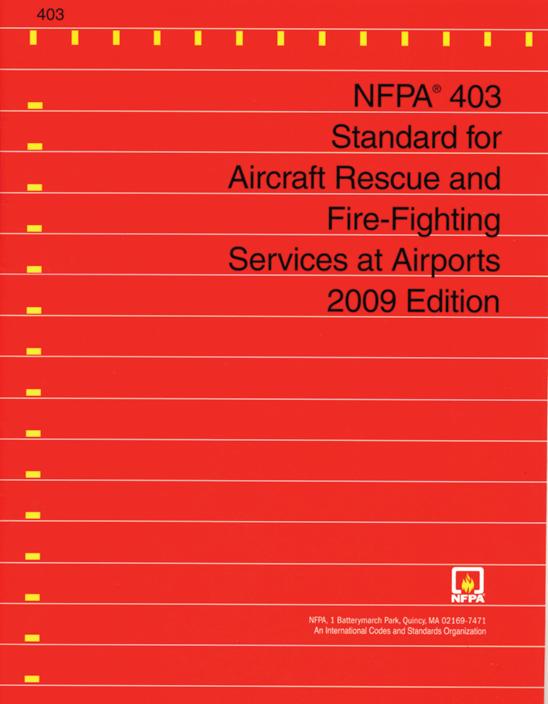
NFPA 403: Standard for Aircraft Rescue and Fire-Fighting Services at Airports addresses the minimum number of fire service vehicles and the amount of extinguishing agent vehicles must carry to the scene of an aircraft accident. The 2009 edition reflects FAA changes in airport category classification, based on scheduled service of aircraft with more than nine passenger seats.
Other major changes for 2009:
• First-time discussion on the use of specialized vehicles in fire suppression covers larger aircraft, such as Airbus A380s, that cannot be accessed by the use of ground ladders and normal ARFF vehicles.
• New Annex material addressing accident scenarios, and how location and other factors could influence a “worst case scenario” at a given airport.
• New Annex material assists airport operators in dealing with airport staffing, including discussion on how to conduct a task and resource analysis, and discussion of goals and objectives for ARFF staff.
Item#: 40309
Price: $48.60
Professionals responsible for fire safety at airports–and AHJs whose jurisdiction includes an airport of any size–need the 2009 NFPA 403 to ensure disaster and emergency preparedness.
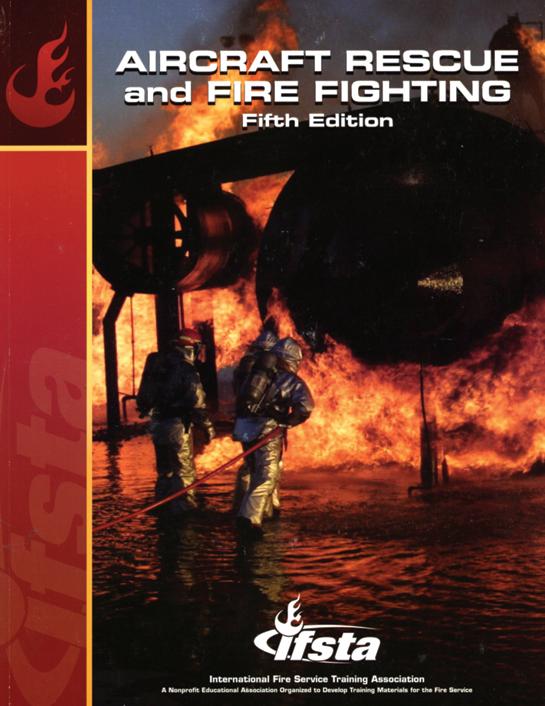
Aircraft Rescue and Fire Fighting, Fifth Edition
The 5th edition of Aircraft Rescue and Fire Fighting provides basic information needed by firefighters to effectively perform the various tasks involved in aircraft rescue and fire fighting. Material covered includes qualifications for aircraft rescue and fire fighting (ARFF) personnel, aircraft and airport familiarization, safety and aircraft hazards, ARFF communications, extinguishing agents, ARFF apparatus, rescue tools and equipment, ARFF driver/operator, airport emergency planning, and ARFF strategic and tactical operations.
This book addresses the requirements of NFPA 1003, Standard for Airport Fire Fighter Professional Qualifications (2005 edition). Additional material addresses the airport fire fighting apparatus covered in Chapter 9 of the 2009 edition of NFPA 1002, Standard on Fire Apparatus Driver/Operator Professional Qualifications. Key parts of NFPA 402, Guide for Aircraft Rescue and Fire-Fighting Operations (2008 edition), and NFPA 403, Standard for Aircraft Rescue and Fire-Fighting Services at Airports (2009 edition), are also covered in this manual.
Item#: 36523
Price: $74.25
BY LYLE QUAN Deputy Chief Guelph Fire Department, Ont.
ICORNERSTONE
Passing the torch requires good leadership
recently returned from the Canadian Association of Fire Chiefs’ conference in Winnipeg. The theme of the conference was Passing the Torch and my friend Les Karpluk, fire chief of Prince Albert, Sask., and I spoke about supporting your people. In our presentation we talked about having a vision for the future of your department and how coaching your staff is key to give your firefighters and officers the management tools they will require.
To continue on this theme of supporting your people, I’m introducing two books that I believe give you those much-needed tips for presenting new concepts in your department and how to be the coach you want (and need) to be.
The first book, Flipping the Switch – Unleash the Power of Personal Accountability Using the QBQ! by John Miller, addresses a concept the author coins as the “question behind the question”. And what is the question behind the question?; it’s when you continually ask yourself how you can do better. Miller’s book discusses the five fundamental concepts and values that guide our behaviours, which are: Learning; Ownership; Creativity; Service; Trust.
Although these principles may not sound new, it’s how the author explores them and relates them to personal accountability that makes them come alive for readers. His question behind the question delves deeper into each topic, which brings readers back to their personal accountability for themselves and the organizations for which they work.
lip service to your people, they will bore of it quickly. So, you need to demonstrate that you mean what you say or you stand the chance of losing any momentum you have gained.
Miller’s chapter on service and humility reinforces the concept and value of “servitude leadership”. I have always believed that some of our greatest leaders have been servant leaders; this means that they recognize humility as the cornerstone of leadership. It’s all about having an attitude of “I’m here to help you reach your goals”, as opposed to “I’m in charge and you’re here for me”, or, as one fire chief I worked for noted, “You work for me, I don’t work for you”. Not all who are in leadership roles see serving as part of their jobs but the good leaders do and Miller covers this point quite well.
The second book, Coaching and Mentoring, by Harvard Business Essentials (2004) will help you build on the questions asked in Flipping the Switch by giving you coaching tools. Even if you believe you already have the basic coaching skills you need, this book will help you to fine tune them.
To begin with, let’s look at the difference between coaching and mentoring. The authors note that coaching is an interactive process that aims to solve performance problems or develop employee
People will change only if they want to and it’s up to you to give them a reason to change. ‘‘ ’’
One key point that I particularly liked is Miller’s reaffirmation that you cannot change the “we” but you can change the “me”. In other words, people will change only if they want to and it’s up to you to give them a reason to change. Miller discusses roadblocks to learning, such as setting unrealistic expectations. There is also the experience trap into which many of us fall. This trap can prevent personal growth because some of us think that after years of experience we cannot learn anymore and become arrogant and overconfident in our thinking.
In his chapter on learning equals change, Miller notes that real learning happens when we turn knowing what to do into doing what we know; actions speak louder than words. If all you are doing is giving
Lyle Quan is a deputy fire chief with the Guelph Fire Department in Ontario. He has a business degree in emergency services from Lakeland College and a degree in education from Brock University. Lyle is a graduate of Dalhousie University’s fire service leadership and administration programs and is an associate instructor for the Ontario Fire College, Lakeland College and Dalhousie University. E-mail: thequans@sympatico.ca
capabilities whereas the aim of mentoring is to support individual growth through both career and personal development. To put it simply, coaching is the act of teaching those who have the desire but not the skills, which makes it more job- or skill-specific; mentoring, on the other hand, is preparing someone for a career.
The mentor’s job is to help people help themselves. But as the authors note, never forget that those you are coaching or mentoring are responsible for their own success. As a mentor you are there to lend support and advice and, if need be, open doors from time to time.
This book helps you prepare to coach, teaches you how to be a mentor and helps you understand how and when you can use each process and why.
After giving you the basics on coaching and mentoring, the book then takes you to the next level to become an even more effective coach and mentor. This is a great book to have close by to reference as you take on the challenge of coaching or mentoring.
Blue Card Command
Brunacini-led system focuses on standardized local response
By PETER SELLS
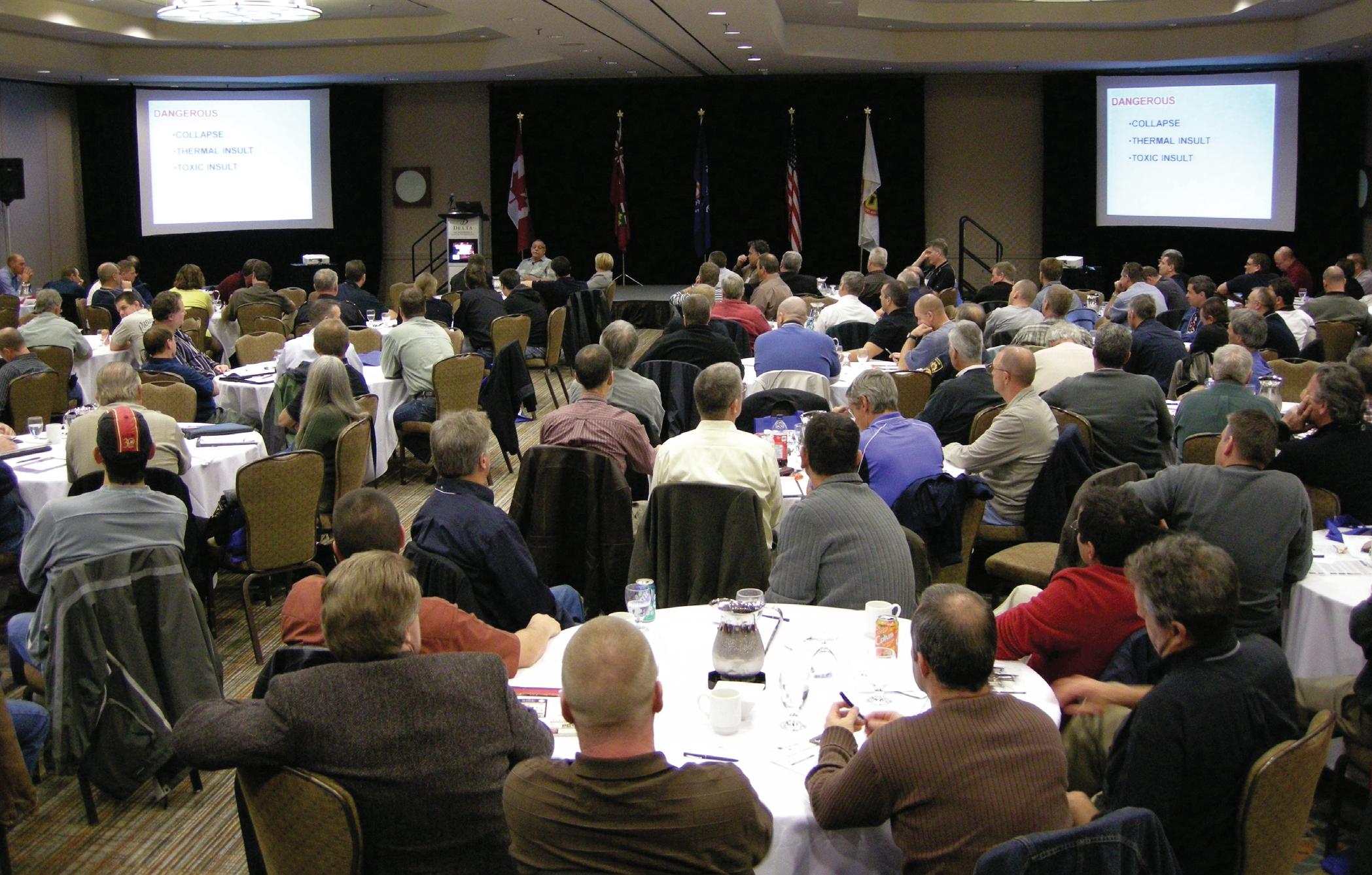
Retired Phoenix Fire Chief Alan Brunacini (seated near podium) discussing potentially fatal dangers to firefighters at the 21st Century Incident Command Symposium hosted in October by Mississauga Fire & Emergency Services.
Firefighters will often part company at the end of a shift by saying, “See you at the big one.” One of the oddities of our subculture is that such a phrase usually is received with a smile. Even as 9-11 begins to fade from our immediate consciousnesses we are willing, and even eager, to face that one careerdefining incident that would bring out all hands.
What about the “little one”?
On Oct. 25 and 26, Mississauga Fire and Emergency Services in Ontario hosted a symposium titled “21st century incident command training – supporting safe and effective ICs in your organization.” The focus of the symposium was the system of
hazard-zone management developed and tirelessly promoted by retired Phoenix Fire Chief Alan Brunacini. Brunacini, of course, is the author of the definitive text Fire Command, The Essentials of Local IMS, which has influenced how emergency incidents are managed across North America and around the world for the last few decades. Along with his sons Nick and John (both also retired officers from the Phoenix Fire Department), Brunacini was the symposium’s keynote speaker.
With about 200 attendees representing fire services from Saskatchewan to Prince Edward Island (with Labrador City in there for good measure), Brunacini opened by reminding us that we will face a gazillion “little ones” before we
see another “big one”. And when you consider that it is at the little ones that firefighters are injured and killed, the need to properly manage our most common responses seems obvious. Our people are in more urgent danger at a first alarm, offensive interior fire attack than they are at a fourth or fifth alarm surround-anddrown lumber-yard fire or a week-long smoldering pile of tires. According to Brunacini, the regular practice of sound, safe, disciplined procedures at the little ones – where the dangers are greatest – prepares us for the big ones.
John Brunacini emphasized the point by asking if anyone at the symposium had ever responded to a NIMS type 1 or 2 incident. Such incidents in a Canadian context would involve federal and provincial agencies and would typically last several days at a minimum. No hands were raised. “The system we use to manage our work must match the work that we perform,” John advised. The system the Brunacinis advocate and teach grew out the Phoenix Fire Department’s recovery process from the death of firefighter Brett Tarver in the Southwest Supermarket fire in 2001. PFD discovered that it had been applying a residential house fire mentality to all incidents. In this case, the result was that firefighters, including Tarver, were placed in offensive positions in a large commercial structure in which the fire conditions had become defensive. By the time Tarver became lost the die had essentially been cast.
The symposium presented the philosophy and application of the Brunacinis’ Blue Card Command Certification Program (www.bluecardcommand.com or www. medteqsolutions.ca). Ten officers from Mississauga Fire, along with colleagues from Windsor and Belleville, Ont., spent the previous six days with Nick, John and me, completing certification as Blue Card instructors. One of the keys to Blue Card, according to John, is that “no layer of the system – strategic, tactical or task – can outperform the non-performance of any other layer.” At the task level, John compared firefighters to scuba divers or skydivers. “We know as we enter the hazard zone that our life expectancy is defined by the air in our SCBA, just as a skydiver’s is defined by the time it takes to fall to the earth. If we run out of air, or if their parachute fails, the result is the same. A firefighter’s survivability is based on an effective size-up and proper management of their air supply.”
Alan described our responses as “compressed, sequential, simultaneous, decentralized events with a beginning, a middle
and an end.”
“We needed a fast, agile, simple, tight command system to evaluate standard conditions and apply standard actions to achieve a standard outcome,” he said.
Alan related a conversation with a young medic who questioned whether it was possible to have such a system for structural fire fighting. He drew the following analogy;
“Have you ever been to a call where someone had been shot in the head?”
“Yeah, Chief, a few times.”
“What were your standard actions?”
“One round of drugs, you know, for the family.”
“And the outcome?”
“Dead.”
“Well sometimes we go to buildings that have been shot in the head. What’s the difference? Even if we conduct an aggressive interior attack, the building is going to be hauled off to the dump next Wednesday.”
In the analyses that PFD conducted as part of its recovery process, a gap in tactical management was identified. Alan continued: “At a smaller incident, the task level IC could manage the tactics. Once
we had a strategic level IC in place, that IC could manage the tactics and allow the company officers to focus on the task level. As incidents got larger it was the tactical level that was breaking down. The changes that were needed were at the tactical management level. Maydays will tend to go the same way as your tactical level was going just beforehand. If you were out of control beforehand you will not be able to control the mayday.”
As part of the Blue Card program, tactical templates were developed for common building types (residential, multi-unit, strip mall, commercial and big box). Nick, with his background as a battalion chief and shift commander, presented some of the meat and potatoes of applying the tactical templates including a review of a strip-mall fire in which a false mansard across the front allowed the fire to skip around a firewall that separated the fire occupancy from the adjacent exposure. The incident action plan was to contain the fire to the burned side of the firewall by getting into the mansard and preventing extension into the attic of the unburned side. This was exactly the type of incident that was exercised in the instructor certification workshop.
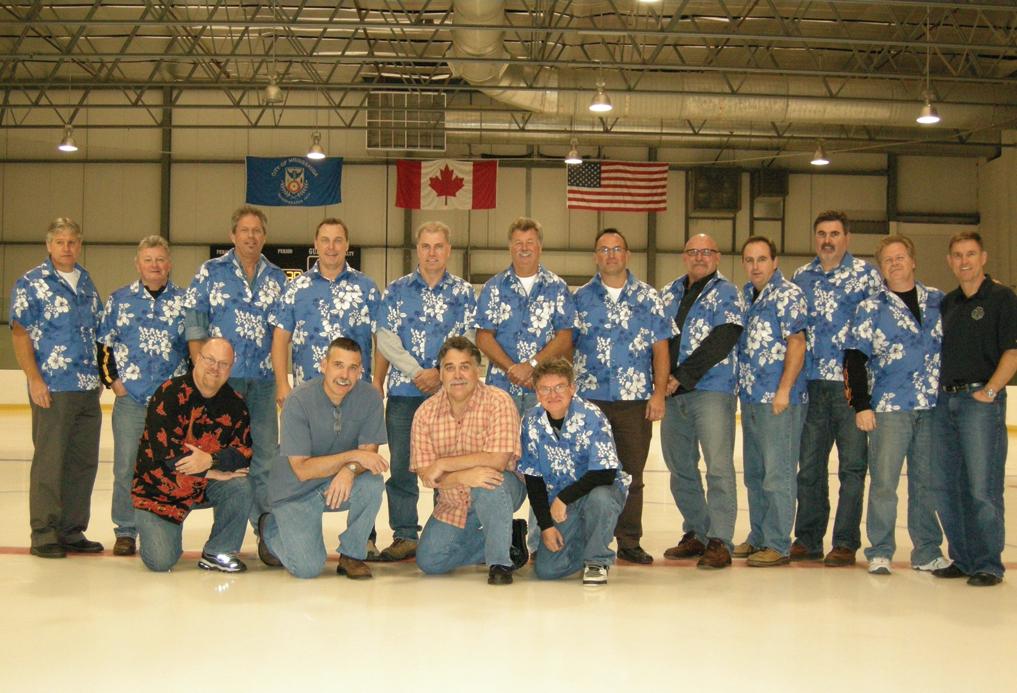
Canada’s first class of Blue Card Command Certified Instructors, from Mississauga Fire & Emergency Services, Windsor Fire & Rescue Services and Belleville Fire & Emergency Services, with instructors (front row from left) Peter Sells, John Brunacini and Nick Brunacini, and Mississauga’s Chief Training Officer Shawn Matheson (back row at right).
On the second day of the symposium, a panel of Ontario fire chiefs joined Alan on stage for a forum with the audience. The first question concerned whether response chiefs should drive their own vehicles. Although each chief supported the idea, not everyone felt it could be afforded within their system. Alan started by relating that PFD also has dedicated field incident technicians (FITs) at the rank of captain who drive response chiefs’ vehicles and perform support duties at the tactical or strategic level (as
assigned). As for apparatus drivers, Phoenix had been using engineers as a tested position (i.e. a position for which firefighters must apply and compete) for many years, reflecting Alan’s opinion that the driver/operator must be expertly trained.
“Apparatus accidents are not only hugely dangerous and expensive, they are almost 100 per cent preventable,” he said.
Toronto also has FITs (fireground incident technicians in the local terminology). Mississauga Fire Chief John McDougall’s practice is to assign a more junior or acting chief as FIT when staffing permits. This strategy combines the tactical support of a FIT with the safety of not having the chief drive while preparing for the incident, and simultaneously provides a mentoring process for the younger chief. (As a Mississauga taxpayer, I was very pleased with this approach.)
The panel of chiefs tackled other issues, such as defining what has changed the most in the fire service during their careers, and describing the challenges in today’s tight budget environment.
Toronto Deputy Chief Jim Shelton reminded us that we are in a media-rich world and that the public is kept aware of what we do. Therefore, we are accountable for our actions, internally and externally.
Hamilton, Ont., Fire Chief Jim Kay noted that while our equipment is constantly evolving and improving, our fire-loss statistics, along with firefighter injuries and deaths, do not change significantly. This led him to wonder if we are complacent about our work and if we need to hold supervisors more accountable.
Fire Chief Andy MacDonald of Brampton, Ont., emphasized the need for comprehensive wellness and fitness in the fire service. He walks the talk himself, competing in the Scott FireFit championships each year. Brampton Fire has mandatory fitness testing built into its promotional processes, a unique and defensible approach to what can be a very thorny issue.
Oakville Fire Chief Richard Boyes advocated education on a number of fronts. He feels that councils need to fully understand and support what is in their master fire plan and constant liaison and engagement with the fire service is the best way to achieve that. Also, he said, firefighters need to understand that they cannot take unwavering public support for granted rather they need to be educated to provide the best possible service each day and “walk with a little bit of purpose in their step.”
ONTARIO: Head Office
Toll Free Tel: 1-800-361-2277
Toll Free Fax: 1-888-333-7064
e-mail: david@stokes-int.com
WESTERN REP:
Attn: Mal Wood
Tel: 604-302-2613
Fax: 604-826-7850
e-mail: mal@stokes-int.com
QUEBEC REP: HQ Distribution Inc., Attn: Barbara Krzywoszanski Tel: 514-667-7034 Fax: 514-667-7104
e-mail: barbara@hqdistribution.com
MARITIMEREP: Attn: Bert Fusk
Tel: 506-458-9463
Fax: 506-458-9463
e-mail: bert@stokes-int.com
The last word has to go to Mississauga Mayor Hazel McCallion. The 88-year-old mayor was extremely generous in her praise of Chief Brunacini and his accomplishments. Likewise, she reflected on her relationships with fire chiefs and the fire service over her 31 years in office. She never forgets that Mississauga was put on the map through the excellent response to the 1979 train derailment, Mississauga’s “big one”. That derailment involved tank cars carrying styrene, toluene, propane, caustic soda and chlorine. As burning propane cars sent fireballs 1500 metres into the air, 218,000 of Mississauga’s 284,000 residents were evacuated for fear of a major release of toxic gas. This was the largest evacuation in North American history until New Orleans was cleared out during and after Hurricane Katrina in 2005 and McCallion remains committed to ensuring that her firefighters are second to none.
So in that regard, Mayor McCallion, the Brunacinis and all in attendance at the symposium were in agreement: a safe and effective fire service in the 21st century requires safe and effective incident commanders.
Retired District Chief Peter Sells writes, speaks and consults on fire service management and professional development across North America and internationally. He holds a B.Sc. from the University of Toronto and an MBA from the University of Windsor.
BECAUSE EVERY SECOND COUNTS
Put your trust in Glentel. With over 45 years experience in providing reliable wireless solutions, Glentel understands your need for fail-safe mission critical communications. We offer a complete range of secure wireless voice and data solutions through a wide range of interoperable P25 compliant products, and the services to ensure they are working all the time, every time. Contact Glentel today. www.glentelbusiness.com
Offering: A 2 course certificate in incident command for experienced incident commanders. Please contact our office for more information.
Are you looking to take on more responsibility in your Department? Trying to round out your technical ability with leadership skills? Preparing to advance your career?
At Dalhousie University we offer a three course program, the “Certificate in Fire Service Leadership” to career and volunteer fire officers.The 3 courses Station Officer: Dealing with People,Station Officer:Dealing with New Operations and The Environment of the Fire Station are all offered in each of our 3 terms, September, January and April. The program can be completed in one year.
For more information and a program brochure please contact: Gwen Doary,Program Manager Dalhousie University Fire Management Certificate Programs 201-1535 Dresden Row,Halifax,Nova Scotia B3J 3T1 Tel:(902) 494-8838 • Fax:(902) 494-2598 • E-mail:Gwen.Doar y@Dal.Ca
You will also find the information in our brochures or at the following internet address:Web site:http://collegeofcontinuinged.dal.ca
TRUCKCHECKS Proactive maintenance
By DON HENRY
isyphus was an ancient Greek king who angered the god Zeus. He was condemned to push a very heavy boulder up a steep mountain. Just before quitting time each night he was to stand aside and let the boulder roll all the way back to the bottom of the mountain. The next day at dawn he would start all over again. It never got any better; he never got a day off and he knew if he did not do the job he would endure the wrath of the gods. Even if he had a better way to complete the task it didn’t matter – the gods did not listen. Sound a lot like where you work? Feel like you are on a modern-day treadmill and will never accomplish anything?
In the September 2008 issue of Fire Fighting in Canada I wrote a column called “Sustainability for apparatus.” It pointed out the different levels of apparatus maintenance and the causes and effects of each. If your department has embraced crisis maintenance then you’re so deep in trouble you don’t need to read on; it may not be possible to help you. Be like Sisyphus – stand out of the way and just watch the rock roll to the bottom of the hill. Try to not let the rock run over you. For those who have worked hard to get to the level of preventive maintenance or, even better, proactive maintenance, read on.
If budget cuts have not yet happened at your place of work, they will. One of the first areas to be cut is always maintenance. Can you do more with less, you will be asked. If you have been outsourcing repair work, you will be asked to bring repairs back in house. This will be hard to do because you let your maintenance personnel go years ago. If you have not been outsourcing repair work, you will be asked to give that a try; can you cut back on staff and training?
If you have been conducting a proper preventive maintenance program, it may be possible for a short period of time to live off the benefits of a good program. It would be the same for Sisyphus to walk away from the boulder and, for a minute or an hour, the boulder may stay in place, but don’t bet on it. You are very quickly going to roll back into the hellhole you worked so hard to get out of – that being crisis maintenance.
Of course, your god (insert fire chief’s name here) will be very angry if he cannot ride his chariot to the next fire. It is very important that you help your boss make the connection between maintenance and firefighter safety. As the chair of the Apparatus Maintenance Section of the IAFC, I heard time after time during our two-day workshop in Dallas in August about maintenance budgets that have been slashed to the bone. Reductions to maintenance budgets affect fire apparatus reliability and vehicle safety. Please read the near-miss reports that are sent in daily to www.firefighternearmiss.com/. A large number of these reports are maintenance related; further cuts to budgets will make this worse. While on this site, do a search of the reports for words like battery, wheel or brake. It is a real eye-opener. To make sure you are informed and can guide your chief, obtain and read a copy of NFPA 1911, Standard for the Inspection Maintenance, Testing and Retirement of InService Automotive Fire Apparatus. This standard contains excellent
Preventive maintenance eliminates the vicious cycle of repairs and replacements.
BUDGET
Cuts to maintenance budgets affect apparatus reliability and safety.
STANDARDS
Safety, and therefore maintenance, is key to comply with standards.
Departments that have embraced maintenance programs have lower costs.
information on such items as out-of-service criteria. As an example, a driver’s seatbelt not working places the complete unit out of service; if a non-driver seatbelt does not work then only that seat may not be used and the unit may respond, unless your department’s policy is that the truck may not leave the hall without a full crew. Of course, you would never allow a firefighter to leave the hall without a fully functioning seatbelt. If your department does not have an out-of-service policy, ask for one to be developed or volunteer to help create one. Remember that NFPA standards are great but they are minimum standards; your department should develop standards that are more encompassing and related to your department needs.
It is our job as emergency vehicle technicians to make sure our fire-service leaders know and understand the effects of indiscriminately slashing maintenance budgets. For those departments that have embraced proactive maintenance programs, your costs are already lower than those of your neighbouring departments that have not done so. You have been living off a proactive maintenance dividend for years. I strongly recommend that departments that wish to reduce their maintenance costs start an oil-and-fluid analysis program. The $30 for a sample is a lot cheaper than the $30,000 engine.
Maintenance is a controllable cost; keep your focus on reducing costs but maintaining a safe level of service and reliability. This can be done by training firefighters to conduct proper daily inspections and by reporting problems to the EVT before the problems get out of control and expensive. Last summer, I walked into a fire hall that claimed to conduct daily and weekly inspec-
tions. I looked around and asked for a creeper and a trouble light. Have you ever seen the look of a deer in the headlights of your car just before you hit him?
It is very important that you keep open the lines of communication between the fire service and the maintenance section. It is during times of financial trouble that
departments can become very polarized and quickly develop an us-versus-them mentality.
This downturn in the economy will pass; let’s come out of it with stronger departments with solid apparatus fleets. Now is the time to put in place a preventive/proactive maintenance program.
The report on maintenance practices for the Boston Fire Department is available at http://www.boston.com/news/local/ breaking_news/Final_Report_on_BFD_ Fleet_Maintenance_Practices_Assessment. pdf
We all need to read and learn from the tragic death of Lt. Kevin Kelley, who was killed in a January accident after the brakes on a ladder truck reportedly failed.
Remember that when your only tool is a hammer all your problems look like nails.
Don Henry teaches in the Automotive Services Technician and Heavy Equipment Technician programs at Lakeland College in Vermilion, Alta. He can be reached at don.henry@lakelandcollege.ca
TRAINER’SCORNER Olympics primer, part 1
By ED BROUWER
In a matter of days it will be 2010. For us in British Columbia, this means the celebration of the Winter Olympics. Whistler’s population is expected to increase to 55,000 from 10,000. The increase in population, the transportation needs and the threat of terrorism will certainly challenge emergency first responders.
This column is in two parts: here we’ll deal with first responders and terrorism; the second part (in February) will deal with multipatient incidents.
Hopefully you won’t have to deal with terrorism during your career but it is a very real concern in Canada. Certainly no one on the west coast is taking it lightly. Insp. Barry Nickerson of the Vancouver 2010 Integrated Security Unit (ISU), the policing branch of the Vancouver Olympic Committee (VANOC), told CBC News that exact closures of air corridors are still being worked out with input from an aviation advisory committee. “It would be absolutely fair to say there will be some restrictions,” Nickerson said. “Any Olympic venue is a high area of concern.”
Blogger Megan Stewart with the Vancouver Observer (www. vancouverobserver.com) states, “As a crush of spectators, international dignitaries, top athletes and the world’s media descend upon Vancouver for the Olympics this winter, a chlorine facility at the base of the Second Narrows Crossing will temporarily stop production. The timing for the closure could not be better. But it will be brief.”
Cpl. Bert Paquet, a spokesperson for the ISU, said chemical warfare is one of the elements for which the ISU prepares and plans. “It would be irresponsible for us not to consider all the possibilities and risks involved and obviously chemical is a big part of our security preparation,” he said.
I was unable to determine whether the Canexus Chemicals plant in North Vancouver, which produces sodium chlorate and chloralkali products for the pulp and paper and water treatment industries, will shut down during the Games. I did, however, discover that the release of such chemicals from a 90-tonne railcar could potentially injure or kill 100,000 people.
There are basically five categories of terrorist incidents: biological; nuclear; incendiary; chemical; and explosive. The acronym B-NICE is a simple way to remember them.
It is important to remember the four routes of entry: inhalation,
emergency
for
absorption, ingestion and injection.
from
Biological incidents: These agents are dispersed by the use of aerosols, orally (through contamination of food or water supplies), through direct skin exposure or through injection. Biological agents are generally spread through inhalation and ingestion. Skin absorption and injection also are potential routes of entry but are less likely.
Nuclear terrorism: This is usually used in a “threat” situation. According to FEMA, it is unlikely that any terrorist organization could acquire or build a nuclear device or acquire and use a fully functional nuclear weapon.
Incendiary incidents: An incendiary device is any mechanical, electrical or chemical device used intentionally to initiate combustion. The purpose is to set fire to other materials. Incendiary materials burn with a hot flame for a designated period of time.
There are three basic components to an incendiary device: an
KEY POINTS FOR DEALING WITH POTENTIAL TERRORISM
We certainly have come a long way in the Canadian fire services. Looking at our responsibilities today it is easy to become overwhelmed. However, if you consider the following key points (you already use these) it becomes a bit easier to deal with the magnitude of our jobs:
■ Initial size-up and scene safety – take simple first steps, such as staging apparatus uphill and upwind, and establishing hot zones (perimeters). Even if this is all you do before additional resources arrive, do not underestimate the importance of these steps.
■ First responders must understand their role as it relates to their local emergency response plans. The IC should be able to properly assess the situation and without hesitation call for additional resources as needed. The IC should be prepared for what might happen next.
■ The use of PPE, including SCBA, is vital to your health. The initial actions taken by the first responders will be the deciding factor as to the final outcome of the incident. Pre-planning is a must, this is no time to fly by the seat of your pants.
As Vancouver prepares to host the 2010 Winter Games, thousands of
preparedness personnel are preparing
the possibility of everything
terrorist attacks to snowstorms that wreak havoc with traffic.
igniter or fuse; a container or body; and an incendiary material or filler. The container can be glass, metal, plastic or paper, depending on its desired use.
Chemical incidents: There are five classes of chemical incidents; nerve agents, blister agents, blood agents, choking agents and irritating agents. A note on nerve agents: they resemble water or light oil in pure form and possess no odour. The most efficient distribution is as an aerosol. Nerve agents kill insect life, birds and other animals as well as humans. Many dead animals at the scene of an incident may be a warning sign.
Explosive incidents: It is estimated that 70 per cent of all terrorist attacks worldwide involve explosives. It is apparent that bombs are the current weapon of choice among terrorist groups.
Please do not be of the “it won’t happen here” mindset. In 1999, Ahmed Ressam was arrested by U.S. Customs officials while carrying timing devices and 130 pounds of explosives from Victoria, B.C., to Port Angeles, Washington. Ressam confessed to membership in a Montreal group plotting to bomb Los Angeles International Airport.
In 1991, U.S. border officials arrested three American members of the militant Muslim group Jamaat ul-Fuqra. They were carrying an attack plan, a list of bomb components and surveillance notes about a theatre and a Hindu temple in the Toronto area. In 1985, a suitcase bomb was loaded on a plane in Vancouver, then transferred to Air India Flight 182 in Toronto. The plane crashed while en route to India, killing 329 passengers, including 279 Canadians. A second bomb, loaded on a Canadian Pacific flight from Vancouver to Bombay, killed two and injured four at Tokyo’s Narita Airport. Inderjit Singh Reyat was sentenced to 15 years in prison for his role in the bombings; two other suspects were acquitted. In 1985 the Turkish Embassy in Ottawa was taken over by three members of the Armenian Revolutionary Army. And in 1982, members of Direct Action detonated a van packed with dynamite outside Litton Industries’ Toronto plant. Ten people were injured.
Dealing successfully with a terrorism incident begins with a proper size-up. If you have been proactive by pre-planning, you will already have important information prior to the incident. Size up, especially at a possible terrorism incident, must be an ongoing evaluation. There may be pressure applied to you as the IC to do something. Be careful; it may be better to “just don’t do something, stand there”. It is critical to know what is going on, what steps to take and the order in which those steps must occur because of the presence of hazards other than those normally encountered. There is nothing routine in a terrorism incident.
First responders face threats today for which they may not be prepared. These threats go far beyond the usual ones found at structural fires, vehicle incidents or even hazmat incidents. The results of some of these threats may cause mass injury or fatalities. Images of the incident linger well after the incident is over. The psychological effect on first responders is an issue that cannot be overlooked. Some responders may not be able to deal with the trauma they experienced after witnessing an incident. I have spoken with more than a dozen old-time firefighters who still have nightmares. You may have to bring in a critical incident stress management team.
Before I sign off, let me wish you all a Merry Christmas and thank you for your commitment to safety and excellence in the Canadian fire service.
Ed Brouwer is the chief instructor for Canwest Fire in Osoyoos, B.C., and the training officer for West Boundary Highway Rescue. The 19-year veteran of the fire service is also a fire warden with the B.C. Ministry of Forests, a wildland interface fire suppression instructor/evaluator and a fire-service chaplain. Contact Ed at ed@thefire.ca
BACKtoBASICS Truck company, part 4
By MARK VAN DER FEYST
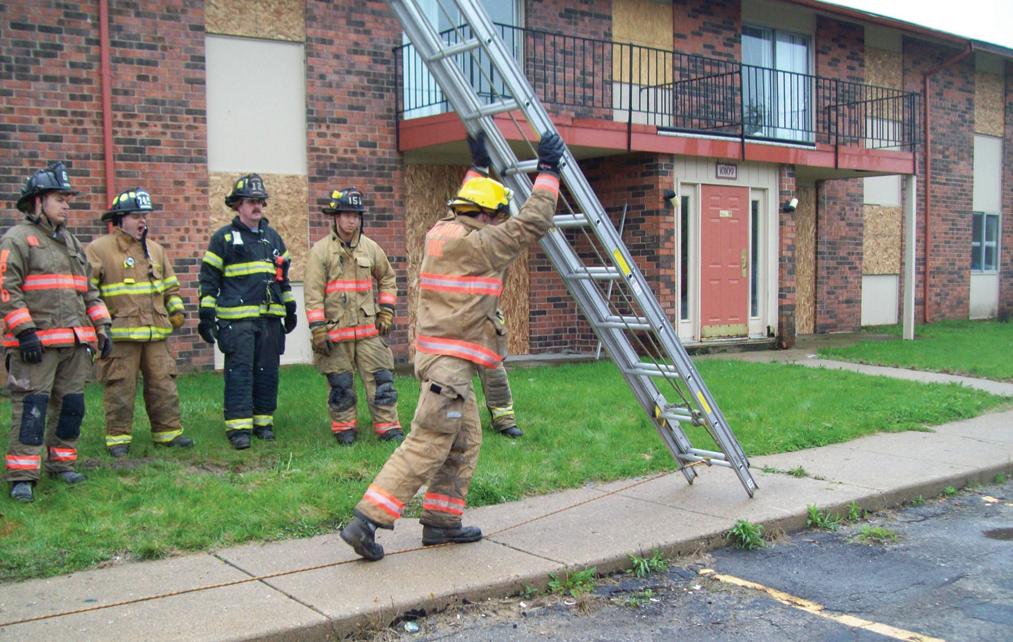
In November we discussed the importance of looking up before raising ground or aerial ladders. Raising ladders requires planning and skill; we have to consider the height of the building, the destination of the ladder, the condition of the ground, access to the area and the purpose of laddering the building. It’s time to incorporate all the details that we have discussed in the last few columns and put them into practice.
From basic training onwards we were taught that raising a ground ladder is a two-person job. Even though there are techniques for one-person raises, we generally push the two-person raise. In textbooks and on the fire ground we always see two people raising a ground ladder. Using two people to raise a ladder is a safer option. The second person heels the ladder as it is being raised and acts as a spotter helping to gauge the height of the raise.
Though there are many different ways to raise a ladder, there are two main techniques: a beam raise and a flat raise. November’s column on overhead obstructions featured a picture of an alleyway that presented a challenge for raising a ground ladder. In that situation the beam raise would probably be the best choice as the space was quite narrow and the overhead obstructions were plentiful.
So, why do we insist so heavily on using two people to raise a ladder? I believe that we should train firefighters to raise ground ladders of between 24 feet and 28 feet by themselves. (Most of our ground-ladder raises involve ladders of between 12 feet and 28 feet. It takes two people to raise longer ladders.) There are often manpower issues on the fire ground and there are not enough personnel to dedicate two people to raise a ladder. In truck company operations, the driver of the truck usually conducts outside operations and ladders all sides of the building. One firefighter with a ground ladder can be very effective on the fire ground. At house fires, firefighters usually deal with two storeys. Even if there is a third storey, one firefighter should be able to raise and extend a ground ladder to the third storey. Ladder math is used to determine the height of the ladder extension and the size of the ladder needed. Overhead obstructions dictate what type of raise will be used. The purpose of the operation (rescue/access or firefighter survival) determines how the ladder is placed against the building. One firefighter can accomplish this task very easily; it is just a question of training.
So, how can a firefighter raise a ladder without someone to heel it? Building features can help; bases of walls, curbs and steps can prevent the ladder butt spur from moving. But what if we these features are not available? Photo 1 shows a 24-foot ground ladder with a piece of orange rope beside it. By hooking the rope to the bottom rung of the ladder, firefighters can walk the rope with their feet to hold the ladder from slipping as they raise the ladder into position.
First, hook the rope around the bottom rung. Attach the rope to the rung using a small carabineer (see photo 2). Wrap the rope around the bottom of the butt spur and walk it out to the tip of the ladder.
PHOTOS BY MARK VAN DER FEYST
Photo 1: Hooking a rope to the bottom rung of the ladder allows a firefighter to walk the rope and hold the ladder from slipping.
Photo 2: Hook the rope around the bottom rung then attach the rope to the rung using a small carabineer.
Photo 3: Start to raise the ladder by grabbing the tip and walking along the rope to secure the ladder.
Now, start to raise the ladder by grabbing the tip and walking along the rope to secure the ladder (see photo 3). The end result as shown in photo 4 is a ground ladder being raised, either by beam or flat method, by one firefighter. Now the firefighter can position and extend the ladder to be placed against the building.
Always remember to have your body facing the building when raising a ladder. Remember this by saying “Body to the building”. This was taught to me by Lt. Mike Ciampo from the New York City Fire Department, and can be accomplished by making sure the ladder is positioned our outside shoulder. This gives you a full view of the building when you are raising the ladder. Having the ladder on the inside shoulder results in a blind spot that prevents you from seeing the whole building. This method works best when conducting a beam raise. The beam of the ladder can rest on the outside shoulder, allowing you to pivot the ladder if you need to reposition yourself. Ensure that you watch the building as you raise the ladder. Conditions and situations can change. Initially, there might not be anyone in the window at which you are positioning a ladder for access; the next second there might be someone needing to be rescued. Keeping the body to the building will help us catch these changes in conditions and situations and adapt accordingly.
Training is still the key to perfecting our skills. Practising oneperson ladder raises will ensure that anyone on the fire ground can complete this task. We do not want to be conducting training on the fire ground when the seconds count.
Mark van der Feyst began his career in the fire service in 1998 with the Cranberry Township Volunteer Fire Company, Station 21, in Pennsylvania. He served as a firefighter and training officer for four years, then joined the Mississauga Fire & Emergency Services, where he served for three years as a firefighter and shift medical instructor. He is now with the City of Woodstock Fire Department in Ontario and can be reached at mvanderfeyst@gmail.com
Photo 4: The result is a ground ladder being raised, either by beam or flat method, by one firefighter.
BY SEAN TRACEY Canadian Regional Manager NFPA International, Ottawa, Ont.
SNFPAIMPACT
Chiefs must unite to fight forestry lobby
omething wicked this way comes.” Shakespeare’s Macbeth contains this famous line of foreboding evil. There is a proposal being discussed to increase combustible construction limits in the National Building Code of Canada to six storeys. The fire service needs to engage now to fight this ill-advised reduction in building fire safety standards. Forthwith, a primer on the issue and a request for your support to fight this initiative.
The premier of British Columbia, in an effort to help save the decimated forestry industry in that province, pushed through the change for mid-rise construction with combustible components. Essentially, this increases the height of combustible construction to six storeys from a maximum of four. The fire service in B.C. had well-documented concerns that were laid out. These, however, were never adequately reviewed or answered. Many significant issues were, in fact, dismissed outright. But then again, it was a political decision at the highest level and it had to be expedited.
What was a politically expedient decision in B.C. has now become a potential national issue as it has been learned that a proposal may be put forward to make these changes part of the National Building Code of Canada. This means that a six-storey, timber-frame building could be built in any community in Canada, including those without fire departments, without aerial devices and without the needed water supplies. Thus, something wicked this way comes . . .
When the B.C. issue first arose, NFPA’s Canada office was asked to assist and did. A number of points were raised and added to comments submitted by the B.C. Fire Service Liaison Group. These remain valid concerns that were never addressed when the construction was approved as having no increased risk to life. Now that B.C. has fallen, the forestry industry is on to the rest of Canada.
would be sprinklered to NFPA 13 but then again so would any other non-combustible, six-storey apartment building. The great concern is that fire could get into vertical void spaces undetected. No job-task analysis considered the needed resources and timelines to put out such a fire and evacuate occupants. The fire services in many communities would be overtaxed attempting to extinguish such fires and evacuate occupants.
In addition, the codes do not define what an adequate fire department response is, so each community fire chief has to get engaged and fight against such a project if he has too few personnel, not enough apparatus or too little water.
This change should not be imposed nationally because one of the criteria used to assess code changes is enforceability at the local level. Permitting this as a uniform measure of construction without defining “adequate fire department” in the codes will result in nonuniform fire risk across Canada.
In a detailed, six-page letter, the B.C. Fire Service Liaison Group raised several concerns that were never addressed. Some of these included concerns about pre-fire planning and capabilities of smaller departments where these structures may be built, the
Essentially, this increases the height of combustible construction to six storeys from a maximum of four. ‘‘ ’’
Canada has invested in an objective-based codes framework. This means that the old prescriptive codes became the basis of acceptable solutions. Changes to the codes must be equal to or better than these approved solutions. If the Canadian Commission on Building and Fire Codes is serious about being an objective codes body then it needs to require changes to meet the equivalency test. There are tools available to be able to measure building performance under fire conditions. Tools such as NRC’s FIRECAM could quantify the added risk involved in such construction but those tools were never used. This is not an equivalent solution but a policy decision to reduce the standards in the codes.
Increasing height limits is not an improvement. Yes, the buildings
Sean Tracey, P.Eng., MIFireE, is the Canadian regional manager of the National Fire Protection Association International and formerly the Canadian Armed Forces fire marshal. Contact him at stracey@nfpa.org
lack of mandatory inspections in some jurisdictions, exposure to fire during construction, standpipe issues, emergency power and more. This included a call for a detailed engineering review of the planned changes before the structures were occupied. These are all very valid concerns.
The building codes permit many new innovative practices but these never consider the impact in the inevitable fire. The code writers have never experienced the rapid spread of fire and its uncanny ability to seek out void spaces. They have never experienced a floor collapse. They have never seen the impact on families left homeless by fire. The fire service needs to be vigilant on this and nip this one in the bud. The service needs to get engaged in the code review process and speak out.
So, to close with another quote from Shakespeare – this one from Much Ado About Nothing: “O, what men dare do! What men may do! What men daily do, not knowing what they do!”
On Aug. 2, 2005, Air France Flight 358 was inbound to Lester B. Pearson International Airport in Toronto from Paris with 12 crew and 297 passengers. Thunderstorms near the airport drenched the runways and created strong winds that changed direction erratically. As the first officer attempted to land, a sudden tailwind pushed the four-engine jetliner along the 9,000-foot runway before its main landing gear tires made contact – with just 5,000 feet remaining.
The combination of poor visibility in heavy rain, the initial landing manoeuvre – the flare started 50 feet too high – the sudden tailwind, significantly reduced tire friction because of standing water on the runway and a delay in activating reverse thrust resulted in the Airbus A340 failing to stop before the hard landing surface became soaked dirt and grass. The 185-tonne airplane crashed through the airport fence to the west of runway 24L (left) and into a ravine. Fires erupted outside the cabin as the aircraft came to a stop. In less than one minute, airport firefighters reached the crash site and began combating the blaze. By the time the flames were extinguished, most of the aircraft had been obliterated. Incredibly, all 309 occupants fled the burning airliner and survived.
The accident at Toronto’s main airport underscored the need for regular and realistic training for firefighters who respond to aircraft crashes, aviation fuel spills and other situations involving fire or the possibility of ignition. In addition to Toronto International Airport, there are 25 major and regional airports in Canada as well as hundreds of smaller airports serving communities across the country. Although the larger airports have on-site aircraft rescue and fire fighting (ARFF) resources, the smaller aerodromes rely on municipal firefighters and equipment in the event of a fire at the airport or nearby.
Canada’s fifth-largest airport in terms of passengers is the Edmonton International Airport. In July, the airport authority took possession of a mobile aircraft fire trainer (MAFT), the first of its kind in Canada and one of a few in the world. Other jurisdictions that use the Kidde MA-3000 aircraft fire simulator are the American states of Virginia and West Virginia, and Germany. The Virginia Department of Fire Programs was particularly helpful in providing input to the Edmonton MAFT project team – led by training officer Corey Schram – based on its MAFT experience.
Schram has been involved with fire fighting and training for decades. In 1985 he joined the Spruce Grove Fire Department in Alberta and progressed through the ranks to become training officer and captain. Eleven years later he started working as a fire service instructor at the Emergency Training Centre (ETC) in Vermilion, Alta., – 220 kilometres east of the international airport – where he planned and delivered training to career and volunteer firefighters, fire inspectors, investigators, officers, safety educators, instructors
and fire code officers. In 2003, he accepted the Edmonton training officer position, and for the past six years has been responsible for the development, delivery and monitoring of ARFF training programs.
Part of Schram’s work over the summer was to certify the MA3000 simulator for operation after its arrival in Edmonton. MAFT certification was the culmination of two years of effort. In the past, firefighters at the Edmonton International Airport used a square sea container that resembled an airplane fuselage; firefighters explained how they would deal with a fire situation without actually demonstrating what they would do. More realistic, hands-on training was clearly needed.
Schram and his team considered building a fixed fire training facility but the cost was high and firefighters from other airports in the Edmonton area or beyond would have to come to the facility for live fire training. The cost of sending Edmonton firefighters to the ETC in Vermilion was also substantial. The committee tasked with examining live fire simulators realized that a mobile system would address a number of issues at the four metro Edmonton airports and other airports in Alberta.
The ability to transport the MAFT to any location where live fire training is needed – and authorized to take place – is a big advantage. With the MA-3000 system, firefighters can use their own equipment during training and conduct more than one live fire drill a day. Fire departments in Edmonton and other Alberta communities benefit financially because they can have the mobile simulator brought to them instead of having to send their firefighters away for training. Furthermore, the airport authority is able to recoup its investment by providing live fire training services. Also, the MAFT is better for the environment than other training systems because it burns propane, not jet fuel or aviation gasoline, and its fires are put out with water, not foam.
After researching aircraft fire trainers, visiting departments that employed fixed or mobile training systems, taking into account the environmental effects of live fire training, and creating a business
Edmonton’s Kidde MA-3000 mobile aircraft fire trainer allows crews to do multiple drills in a day and can be transported to other airports.
The fuselage of the MAFT is is the size of a large commuter aircraft; the detachable wing can be attached to the fuselage at the low, mid or high position to simulate different types of airplanes.
case to justify the purchase of the MA-3000 simulator, the MAFT committee recommended to management that the airport authority buy the American system.
Edmonton airport’s MA-3000 simulator was designed and built by Kidde Fire Trainers of Montvale, N.J. The system – approved for ARFF training by the Federal Aviation Administration in the U.S. and Transport Canada – is self-contained and transportable by trucks. It incorporates many of the features of a fixed trainer without the need for costly and immobile infrastructure. The MAFT consists of four main elements:
An aircraft fuselage with a detachable wing (and a simulated jet engine), movable main landing gear assembly and auxiliary power unit (APU) in the aft part of the fuselage (the APU runs on jet fuel and generates electrical power on the ground when the main engines are not running). The fuselage is also equipped with piping for simulated cabin fires and cut-in panels so that firefighters have to “force” their entry, just as they might after an aircraft crash.
Burn pans used to simulate ignited aviation fuel spills.
A propane supply and storage system.
A control station with a computer that permits the training officer to initiate or terminate a fire in any part of the MAFT.
The fuselage is the size of a large commuter aircraft such as the popular Bombardier CRJ (Canadair regional jet) operated by Air Canada and other airlines. The detachable wing can be attached to the fuselage at the low, mid or high position to simulate different types of airplanes.
Inside the simulator fuselage is a cockpit, a passenger area with seats, a galley and a bathroom. As in real aircraft, fuel and battery shut-off controls are in the cockpit. The main cabin has a flashover feature and can be filled with smoke. Speakers add realism to the training; audio effects include crackling flames and people crying out for help. Electrical fires from food and beverage equipment in the galley can also be simulated. Powered hotplates on magnets can be positioned anywhere in the MAFT and are used to create hotspots. Part of ARFF training involves a hand-held thermal imaging camera that transmits what it sees to the control station.
During training exercises, an instructor
Now you can get strength and comfort under fire. With Lock-Fit Ankle Support System™, PierceProtect Arch Protection System™ and Vibram ® Fire & Ice outsoles, the STC fire boot brings you the science of fire protective footwear.
AVAILABLE
Edmonton’s MA-3000 simulator is selfcontained and transportable by trucks.
AUGUST2009 inside the MAFT monitors how firefighters respond to a fire scenario and new problems that suddenly appear (each is activated from the control station). An instructor watches outside the MAFT and another is in the control station. They each wear a control pendant that will shut down the fire(s) when pressed. Also, instructors are in radio communication with each other and the firefighters doing the training exercise.
Nothing Dumps Faster!
Over 40,000 in use. We’ve been in business for over sixty years, so you can depend on us. That’s why Newton Kwik-Dump Valves can be trusted to get your tanker emptied and on its way FAST. Standard length, Mild Steel and Stainless Steel are in-stock. Need special length valves? Call us and it’s as good as done! Don’t accept look-alikes. Ask for us by name. For prompt, timely delivery, call us today.
To become an airport firefighter, candidates must first satisfy NFPA 1001: Firefighter II Professional Qualifications in order to be certified to NFPA 1003: Standard for Airport Fire Fighter Professional Qualifications, 2005 Edition, Part III, Subpart 3: Aircraft Rescue and Fire Fighting at Airports and Aerodromes of the Canadian Aviation Regulations (CARs), details the relevant ARFF regulations. Anyone interested in learning more about ARFF can visit Transport Canada’s civil aviation website, which has information about airport firefighter qualifications, knowledge and skills training, recurrent training, command and control training and more.
While the CARs stipulate that airport firefighters must satisfactorily complete a live fire drill every 12 months, more frequent training helps to keep their skills sharp. Aviation is a highly regulated industry with an excellent safety record, so airport firefighters might not experience an actual aircraft fire during their entire careers. The current aircraft accident rate is 5.7 accidents per 100,000 flying hours; flying activity in Canada in 2008 was estimated at 4.4 million hours.
The Kidde mobile aircraft fire trainer allows airport and municipal firefighters to practise several fire scenarios, including an aircraft being engulfed in flames, as happened to Air France Flight 358.
CUSTOM TRAINING
MESC will provide custom design training programs. Other courses available include: Building standards, Rescue program, Emergency Medical, Management Program, Fire Prevention, Public Safety and Hazardous Material. Manitoba Emergency Services College, Brandon, Manitoba, phone: (204) 726-6855.
LIVE FIRE FIGHTING EXPERIENCE: Short and long term courses available, Municipal and Industrial fire fighting. Incident Command System, Emergency Response/HazMat, three year Fire Science Technology Diploma program. Lambton College, Sarnia, Ontario, call 1-800-791-7887 or www.lambton.on. ca/p_c/technology/fire_emerg_resp.htm. Enrol today!
BY PETER SELLS District Chief
O Making the best of a bad situation
ct. 16, 1987. That was the day that Jessica McClure, Baby Jessica, was rescued from an abandoned well in her backyard where she had been trapped for 58 hours. Fledgling cable outlet CNN was among the media throng that swarmed the town of Midland, Texas, and captured Jessica’s rescue. A flood of books, articles and a movie of the week followed. Through it all, Jessica’s parents showed uncommon maturity. They kept her out of the spotlight and she led a quiet and almost anonymous childhood with no memory of her ordeal.
For a while, the spotlight shifted to the rescuers and shone particularly intensely on paramedic Robert O’Donnell. O’Donnell saw the incident, already almost a day old, unfold on TV while he was off shift but hurried to volunteer his services directly to the fire chief. He spent most of the next day and a half underground.
Jessica was wedged seven metres below ground in a pipe about 20 centimetres in diameter. The rescuers bored a hole adjacent to the pipe and jack-hammered a tunnel laterally to intersect just below Jessica’s position. O’Donnell did the lion’s share of the work, due in part to his lanky frame and despite his claustrophobia. He was the first to reach Jessica and he figured out how to safely extricate her and package her for transport up the rescue shaft.
Of course, such a rescue is always a team effort. Among the other notable contributions was that of Midland police officer Andy Glasscock, who spent the bulk of three days flat on his stomach talking to Jessica and listening to her cry, sing nursery rhymes and call for her mother. Neither Glasscock nor any other rescuer, however, received the attention that was suddenly and unexpectedly showered on O’Donnell. O’Donnell’s was the media face of the rescue and he enjoyed the attention until North America collectively changed the channel.
been drugged and raped. Police found that Glasscock had videotaped the assault, along with scenes of a 12-year-old girl stepping in and out of his shower. They found other unsavory images on his computer and discovered 180 kilograms of high explosives in his house. He pleaded guilty to multiple charges and won’t be out anytime soon.
There is no way to conclusively connect Glasscock’s behaviour to his role in Jessica’s rescue. It is remarkable, however, on a visceral level, to reflect on how two professional responders who played key roles in a successful rescue each ended up broken and damaged.
Now, let’s flash back to Jan. 27, 1988. Melvin Stanton, serving time after being convicted of three rapes and a murder, walked away from a Toronto halfway house and brutally murdered 25-year-old Tema Conter in her apartment. The pumper crew from Toronto Fire Department station 24 responded but were stopped at the door by the cops, who had secured the murder scene. I was on the aerial and I still remember the other guys saying that even from the door they could see how gruesome the scene was.
Paramedic Vincent Savoia was at that scene and witnessed its
Recognizing that the experience had affected him, he sought counselling early. ‘‘ ’’
April, 23, 1995. After watching the coverage of the recovery efforts at the Oklahoma City bombing site, and commenting to his mother at one point that “those guys are going to need a lot of help for a long time”, O’Donnell drove into the bush and put a shotgun shell through his head. Media attention? Posttraumatic stress disorder? Depression from losing his job due in part to prescription drug addiction (he had developed migraines shortly after the rescue)? Nobody will ever know.
Dec. 24, 2003. Midland police officer William Andrew Glasscock Jr. was arrested after a female acquaintance complained that she had
Retired District Chief Peter Sells writes, speaks and consults on fire service management and professional development across North America and internationally. He holds a B.Sc. from the University of Toronto and an MBA from the University of Windsor. He sits on the advisory councils of the Ontario Fire College and the Institution of Fire Engineers, Canada branch.
full horror. Recognizing that the experience had affected him, he sought counselling early. He went on to found, and is the executive director of, the Tema Conter Memorial Trust. From the trust’s mission statement, posted on its website at www.tema. ca: “The mandate of the Tema Conter Memorial Trust is to assist emergency services personnel to better understand and cope with the physical, psychological and emotional stressors of acute trauma and its powerful aftermath. The trust was founded to improve the understanding of acute and post traumatic stress disorder. This goal is accomplished through research and public education, as well as the granting of scholarships, media and public service awards.”
The contrast of Vincent’s example with the outcomes for O’Donnell and Glasscock is striking and ironic, given the outcomes for Tema and Jessica, respectively. I don’t have space here to do justice to Vincent’s courage but I urge readers to visit the trust’s site and learn more.
VERY
FEW THINGS CAN SURVIVE AN INFERNO.
OUR MISSION IS TO MAKE SURE YOU’RE ONE OF THEM.
The flames build. The smoke gets thicker and more intense by the second. People are fleeing. And what do you do? You push forward ready to do battle. It goes against every natural human instinct. But then again, firefighters are a different breed. For your infinite courage and selfless dedication, we salute you. But more importantly, we’re going to do everything we can to protect you. We’re MSA. And we equip firefighters with the most advanced thermal imaging cameras, helmets, air masks and gas detection devices available. Coincidentally, we’re somewhat of a different breed ourselves. You see, we’re a safety innovations company that’s been on a relentless crusade to protect lives for more than 90 years. Today we protect firefighters, soldiers, construction, iron and steel workers, oil riggers, utility workers, miners, consumers and hundreds more. Wherever there are workers who need to be protected, we will be there.