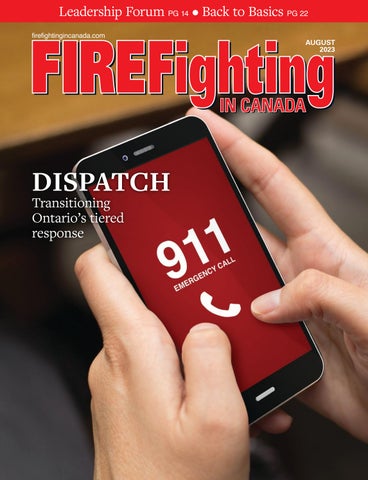

DISPATCH
Transitioning Ontario’s tiered response
MOBILE PUMP TESTING CONDUCTED AT YOUR LOCATION BY CERTIFIED
EMERGENCY VEHICLE TECHNICIANS TO NFPA 1911 AVAILABLE ACROSS CANADA. COMMERCIAL EMERGENCY EQUIPMENT ALSO
•
•
•
•
Managing the move to an MPDS 911 dispatch system in Ontario. By Julie Fitz-Gerald.
Ideas for building relationships with outside agencies to benefit large scale emergencies. By John
Liadis

BY LAURA AIKEN Editor laiken@annexbusinessmedia.com
WA wild year for wildfires
ell, the world on fire that we have talked about for decades appears to have made a loud entrance in 2023. Can’t recall the air ever tasting like an ashtray in Southern Ontario due to wildfire smoke. Toronto achieved “worst air quality in the world” ratings on June 28. It’s been a budget busting, all hands-on-deck, blockbuster of a wildfire season. Except it’s not a movie, and even though technology like drones and sophisticated programs courtesy of the U.S. Pentagon have come into play, it’s not a video game either. It’s real destruction of homes, of upended evacuated lives. Of a largely volunteer fire service keeping up response and of efforts to train more people in wildland fire fighting. See Chief Vince MacKenzie’s Volunteer Vision column on page 30 for more of the impacts on the departments responding outside the larger urban centres.

ON THE COVER
Ontario is changing the way 911 calls are dispatched, a move that select municipalities have already done, but there are challenges Fire needs to know about. See page 10.
Canada may remain dependent on foreign firefighters for some time, as Prime Minister Justin Trudeau put forth, but Canada also helps abroad. We were on planes to help with Australia’s bushfire crisis in 2020. Is this really going to cut the mustard long term if this is the “new normal” that we may be dealing with or do Canadian fire departments need more funding to be prepared for response? Canada and the U.S. inked a new mutual aid deal, but what if both are extended in their resources at the same time? (Perhaps a large what-if, but nonetheless).
I found a paper online from the Canadian Council of Forest Ministers called “Canadian
Wildland Fire Strategy, A 10 year review and renewed call to action”, dated 2016. In 2021, another paper was produced by the group called Action Plan 2021-2026. There were five key action items, and one centred around enhancing capacity for preparedness and response. It summarized: “As wildland fire conditions continue to change rapidly, traditional response and suppression tactics are becoming less effective while agencies are being taxed beyond their collective capabilities. This is despite the fact that wildland fire response (i.e., suppression) activities have received the bulk of investment over recent decades. Enhancing wildland fire preparedness will improve capacity for response and includes increasing pan-Canadian, regional and local capabilities to effectively predict, identify and respond to new wildland fire starts, increasing interoperability and investing in training and exercises.”
A core message was the creation of an integrated wildland fire approach that crosses jurisdictional boundaries involving all levels of government. We are halfway through the action plan’s timeline. Are we operating at a high level of coordinated national response? Now that we are truly in the thick of it, these sentiments require reflection to see if the path envisioned is indeed the path attained.

ESTABLISHED 1957 AUGUST 2023
VOL. 67 NO. 5
Reader Service
Print and digital subscription inquiries or changes, please contact Angelita Potal, Customer Service Tel: (416) 510-5113 Fax: (416) 510-6875
Email: apotal@annexbusinessmedia.com Mail: 111 Gordon Baker Rd., Suite 400, Toronto, ON M2H 3R1
EDITOR LAURA AIKEN laiken@annexbusinessmedia.com 416-522-1595
ASSOCIATE EDITOR ELENA DE LUIGI edeluigi@annexbusinessmedia.com 416-510-5143
PUBLISHER ADAM SZPAKOWSKI aszpakowski@annexbusinessmedia.com 289-221-6605
ACCOUNT COORDINATOR CATHERINE GILES cgiles@annexbusinessmedia.com 416-510-5232
BRAND MANAGER PAULA INGLIS PInglis@annexbusinessmedia.com 437.774.7961
AUDIENCE DEVELOPMENT MANAGER BEATA OLECHNOWICZ bolechnowicz@annexbusinessmedia.com 416-510-5182
MEDIA DESIGNER EMILY SUN esun@annexbusinessmedia.com
GROUP PUBLISHER PAUL GROSSINGER pgrossinger@annexbusinessmedia.com
PRESIDENT/COO SCOTT JAMIESON sjamieson@annexbusinessmedia.com
PUBLICATION MAIL AGREEMENT #40065710
RETURN UNDELIVERABLE CANADIAN ADDRESSES TO CIRCULATION DEPT. P.O. Box 530, SIMCOE, ON N3Y 4N5 e-mail: subscribe@firefightingincanada.com Printed in Canada ISSN 0015–2595
SUBSCRIPTION RATES
Canada – 1 Year - $25.50 (GST - #867172652RT0001) USA – 1 Year $58.50 (CDN)
Annex Privacy Officer Privacy@annexbusinessmedia.com Tel: 800-668-2374
Occasionally, Fire Fighting in Canada will mail information on behalf of industry-related groups whose products and services we believe may be of interest to you. If you prefer not to receive this information, please contact our circulation department in any of the four ways listed above.
No part of the editorial content of this publication may be reprinted without the publisher’s written permission ©2023 Annex Business Media. All rights reserved. Opinions expressed in this magazine are not necessarily those of the editor or the publisher. No liability is assumed for errors or omissions.
All advertising is subject to the publisher’s approval. Such approval does not imply any endorsement of the products or services advertised. Publisher reserves the right to refuse advertising that does not meet the standards of the publication.
www.firefightingincanada.com



STATIONtoSTATION
ACROSS CANADA: Regional news briefs
Firefighter cancer Bill C-224 has passed
Bill C-224, an Act to establish a national framework for the prevention and treatment of cancers linked to fire fighting, received royal assent on June 22 and will become law.
Bill C-224 was introduced by Quebec MP Sherry Romanado in January 2022.
“Cancer is responsible for over 85 per cent of all duty-related deaths among firefighters in Canada. Awareness, education and information sharing are critical to the prevention and early detection of the cancers linked to fire fighting,” Romanado said in a government press release. “This bill represents concrete action to better protect the health and safety of the men and women who put themselves in harm’s way to keep us safe. That it passed unanimously in both the House and the Senate is a testament to the high regard in which our country’s holds its firefighters and the essential work they do.”
Through Bill C-224, starting next year, the month of January will be declared “Firefighter Cancer Awareness Month” throughout Canada. This declaration is intended to raise awareness about cancers linked to fire fighting and best practices to prevent these cancers.
The royal assent of Bill C-224 builds on commitments to implement a action plan to protect people in Canada, including firefighters, from exposure to toxic flame retardants found in household products, reported the federal government. It also expands the federal government’s plan to protect firefighters from harmful chemicals released during household fires, which was announced in August 2021.
Over the next year, Health Canada plans to develop a national framework that raises awareness of cancers linked to fire fighting, supports improved access for firefighters to cancer prevention and treatment, and provides a common direction for stakeholders to address cancer among firefighters.
THE FIRE HALL BULLETIN
Promotions & appointments

Guelph, Ont., welcomed BRIAN ARNOLD as its new fire chief and general manager. He has spent more than 30 years in the fire service, beginning in 1993 as a firefighter in Toronto. Arnold honed his leadership skills in London, Woodstock, Sarnia, and
Cambridge. He is an active board member for the Ontario Association of Fire Chiefs.
LARRY WATKINSON is Kelowna, B.C.’s new deputy fire chief. He previously spent eight years as fire chief in Penticton, B.C.
DAN SMITH is the new fire chief and director of fire and emergency services for Belleville, Ont. He has over 20 years of experience.Smith was the fire
BY
Specifically, Bill C-224 paves the way for Health Canada to support valuable research on the link between certain types of cancer and firefighting, make recommendations regarding regular screenings for cancers linked to fire fighting, and promote research and improve data collection on the prevention and treatment of cancers linked to firefighting.
Health Canada is engaging with stakeholders to inform the development of the national framework and will work with all relevant parties to better protect firefighters in the line of duty, stated the press release.
“The development of a national framework will raise awareness, promote research and improve prevention and treatments of cancers linked to firefighting,” said Federal Minister of Health Jean-Yves Duclos in the statement.
chief and director of protective services in Port Hope, Ont., before he became Belleville’s deputy chief in 2022.
Retirements

Fire Chief SILVIO ADAMO retired after serving his community of Banff, Alta., for 35 years. He joined the fire department in 1988 and rose through the ranks
from a paid on-call volunteer to deputy fire chief in 2004, and then fire chief three years later.
Adamo plans to stay with Canada Task Force 2 incident management team after his retirement as well as consult on regional emergency management for large-scale events for Canmore, Alta.
The Kaleden Volunteer Fire Department in B.C. said goodbye to Fire Chief DENIS GAUDRY ,
Bill C-224 isanother step in the federal government’s plan to protect firefighters from harmful chemicals.
PHOTO
Colchester hosts inaugural 2023 Training Symposium
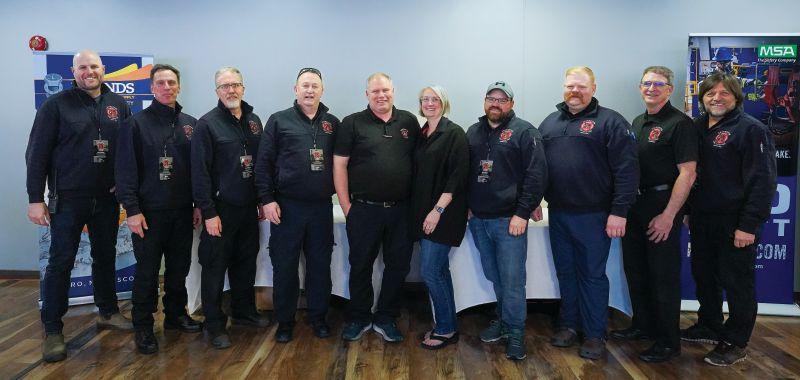
The Colchester Fire Fighters Association held its first training symposium in Debert, N.S., this spring to address a number of training needs for their 18 mainly volunteer departments in the area. The symposium’s curriculum was a direct result of a training survey done in 2022 and was funded in part by the Colchester County, the firefighters’ association and donations. The planning committee for the event included Brent Fisher, Jeff Barry, Barrett Jenkins, Jeremy Smith, Kevin Bushey, Nigel Leggett, Ryan Geldart, Peter Dellewell and Steve Currie.
The symposium, which took place April 21-22, brought in Jamie Coutts, fire chief for the City of Chestermere and voice behind Growing Up Fire, as a keynote speaker. Chief Coutts is a well-known figure in Canadian Fire and has spoken extensively about his experience with wildland fires and interagency training.
Currie, who is treasurer for the Colchester Firefighters Association, said the impetus for starting the symposium came from a merging of new people in the union, new ideas and new training coordination.
BY
who has retired after spending more than 30 years in the fire service. Gaudry started his career back in 1992 and has served as the department’s chief since 2017. He also assisted in the creation of the South Okanagan Similkameen Fire Chiefs Association.
Oshawa, Ont.’s Fire Chief DERRICK CLARK, the longest-standing member of Oshawa Fire Services, is retiring.
Emphasis was placed on delivering firefighters what they needed, bearing in mind that people are busy with full-time jobs and they need to make sure to communicate the goals. Barry noted that many hours were spent just on coming up with the survey questions. A 25-page report was generated from the 140 responses. The biggest topics of interest were the urban wildland interface; strategy and tactics for rural fire fighting; communications; and safety and accountability on scene.
It was important to the planning committee that firefighters knew that their training matters and there
was support for hands-on skill development. In terms of communications, this focused on radios, debriefing after incidents and I am Responding app. Improving communication came with the understanding that today’s generation talks on multiple platforms. The survey also shed light on that fact that firefighters were keen to know members in other departments who showed up during mutual aid calls. The data also pointed to a disengagement after year two and year five of joining, and those have been identified as touch points to rekindle passion and foster long term engagement with the fire service. Legget said
that much of the social aspect, such as dart and ball leagues, has disappeared and the atmosphere tends to be more “all business.”
The planning team believes this event helped with retention by listening to their needs, and another committee will be created for next year to address changes with Level 2.
Each of the 16 sessions at the event featured a door prize and over 90 draw prizes were given out. A 50/50 draw raised $1100, half of which was donated to the Camp Courage in Halifax.
All in all, the Training Symposium was considered a great success to be hosted again in 2024.
Last Alarm
HEADING Univers LT Std 85 Extra Black 0.5 paragraph rule black
BODY Univers LT Std 57 Condensed 9 pt, Names: 67 Bold Condensed Uppercase WORDCOUNT Aprox 465 words, depending on amount of images
Clark spent nearly four decades with the department, starting his career in 1986 as an alarm room operator/dispatch, then becoming a firefighter. He moved through the ranks to become fire chief in 2016. Throughout his career, Clark has received several awards, including the Fire Services Exemplary Service medal, a Champion of Mental Health award and the Firefighter of the Year award from Oshawa Fire Services.
(Ret.) Fire Chief BRUCE BARTON passed away on May 31. Born and raised in Vankleek Hill, Ont., Barton served as a volunteer firefighter for 45 years. The fire hall in Vankleek Hill was renamed the Bruce Barton Fire Hall in 2012 when he retired. That same year, he was awarded the Queen’s Diamond Jubilee Medal for his heroic efforts during the 1998 ice storm.
Barton was also awarded the Fire Services Exemplary Service medal in 1986.
(Ret.) Fire Chief JOEL GORMAN passed away in June at the age of 68. He spent more than 35 years serving the Town of Smith Falls, Ont. Gorman was described as a big family man and spent his time hunting, fishing, farming, and producing maple syrup after his retirement.
Fire Chief Jamie Coutts joined the Nova Scotia training event as its keynote.
PHOTO
STEVE CURRIE
STATIONtoSTATION
BRIGADE NEWS: From departments across Canada
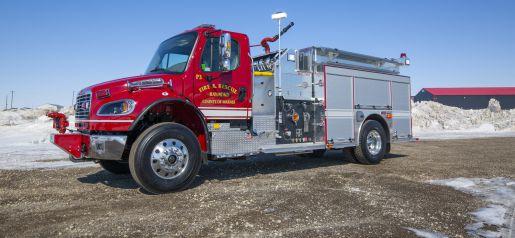
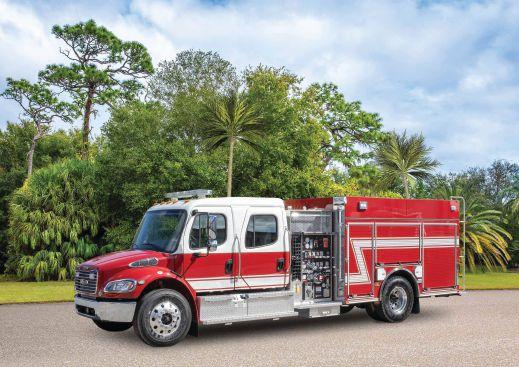
Raymond Fire Department in Alberta took delivery of an MXV pumper from Fort Garry Fire Trucks. Manufactured on a Freightliner chassis with a 360 HP Cummins L9 engine and an Allison 3000 EVS transmission, this vehicle features a 5083 saltwater grade aluminum body, Darley PTO PSP 1000 pump, cross control pump operator panel, rear stainless steel ladder, Hannay hose reel, Akron ball valves, Zico hydraulic ladder rack, Akron Fire Fox bumper monitor, Federal Signal emergency lights, FRC scene light package, Foam Pro 2001, and a Fireman’s Friend external tank fill.
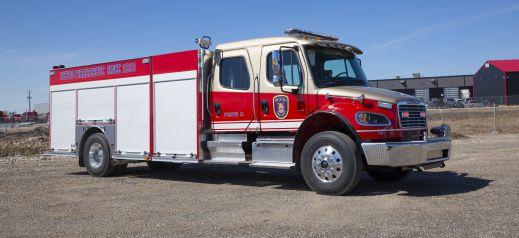
Pictou Fire Department in Nova Scotia took delivery of a pumper from Fort Garry Fire Trucks. Manufactured on a Freightliner chassis with a Cummins L9 360 HP engine and an Allison 3000 EVS transmission, this pumper has a side control Waterous CSU 1750 pump, 5083 aluminum body, Whelen lights package, TFT crossfire monitor, Foam Pro 2001 and a CoPoly 1000 IG tank.
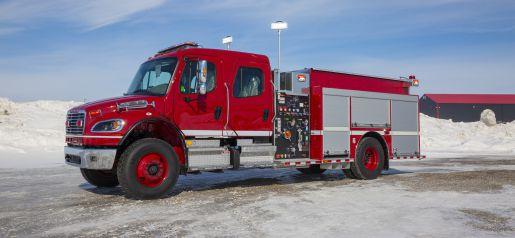
Weenusk First Nation Volunteer Fire Department in Ontario took delivery of a crusader pumper from Fort Garry Fire Trucks. Manufactured on a Freightliner chassis with a Cummins L9 360 HP engine and an Allison 3000 EVS transmission, this vehicle features a Hale QFLO1250 side control pump, Whelen emergency lights and scene lights package, Amdor roll up doors, a 5000W Honda generator, and FRC 12V LED telescopic lighting.
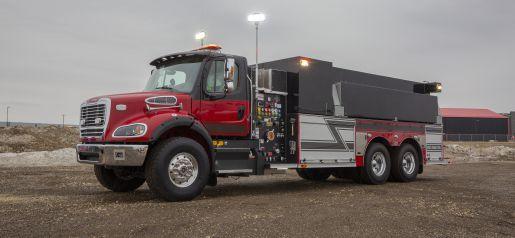
Riverport & District Fire Department in Nova Scotia took delivery of a pumper tanker from Fort Garry Fire Trucks. Manufactured on a Freightliner chassis with a Waterous CX 1500 pump, some of this vehicle features include a DD13 505 HP engine, Allison 4000 EVS transmission, saltwater marine grade aluminum body, Whelen emergency and M9V series combo warning scene lights, FRC push up scene lights, a stainless steel dump chute with removable chutes, Fireman’s Friend external tank fill, Zico hydraulic portatank rack, and Elkhart electric valves.
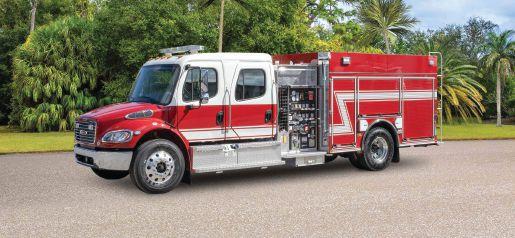
Grande-Anse Fire Department in New Brunswick has taken delivery of a pumper from Safety Source Fire Incorporated. Manufactured on a Pierce Freightliner chassis with a Cummins B6.7 360 HP engine, this vehicle features a Waterous 1250 GPM midship pump, Husky 3 foam system and a 1000 G tank.
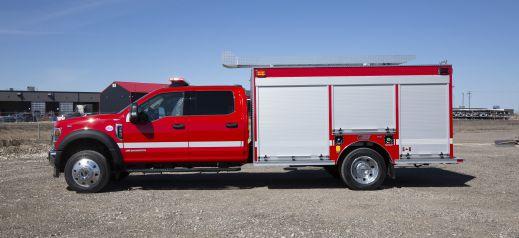
Lac La Biche County Fire Rescue in Alberta has taken delivery of a Wildcat from Fort Garry Fire Trucks. Manufactured on a Ford F-550 chassis with a Powerstroke 330 HP 6.7L engine and a TorqShift 10 speed transmission, this vehicle features a Darley 375 GPM skid unit pump, Darley Foam Fury, Federal single lights package, TFT EF1 monitor, Warn Zeon winch, and a 300 USG tank.

A tiered transition
A
911 dispatch change is happening
in
Ontario and Fire needs a seat at the table
By JULIE FITZ-GERALD
OABOVE The MPDS dispatch system will change what calls Fire goes to.
ntario will be transitioning to a new 911 dispatch system over the next three years in an effort to provide better response times to urgent calls, however fire chiefs that have recently made the change in Peel and Halton regions are raising some alarm bells about the implementation process.
The move to Medical Priority Dispatch System (MPDS) from the previous Dispatch Priority Card Index (DPCI) is meant to ensure the most serious calls receive attention first, preventing less urgent calls from tying up ambulances while patients facing
life-threatening situations are left waiting.
Under the previous DPCI system, calls were sorted into four groups, with Code 1 being a deferrable call, Code 2 a scheduled call, Code 3 a prompt call and Code 4 an urgent call with lights and sirens. The DPCI system sends ambulances in call sequence, even if a later call is more urgent. Sixty per cent of calls fell under Code 4 – many that were non-life-threatening – causing ambulance delays and Level Zeroes, meaning no ambulances were available to attend a call.
This February, The Ottawa Citizen reported in a that paramedic Level Zeroes more than doubled last year, being “declared 1,819 times
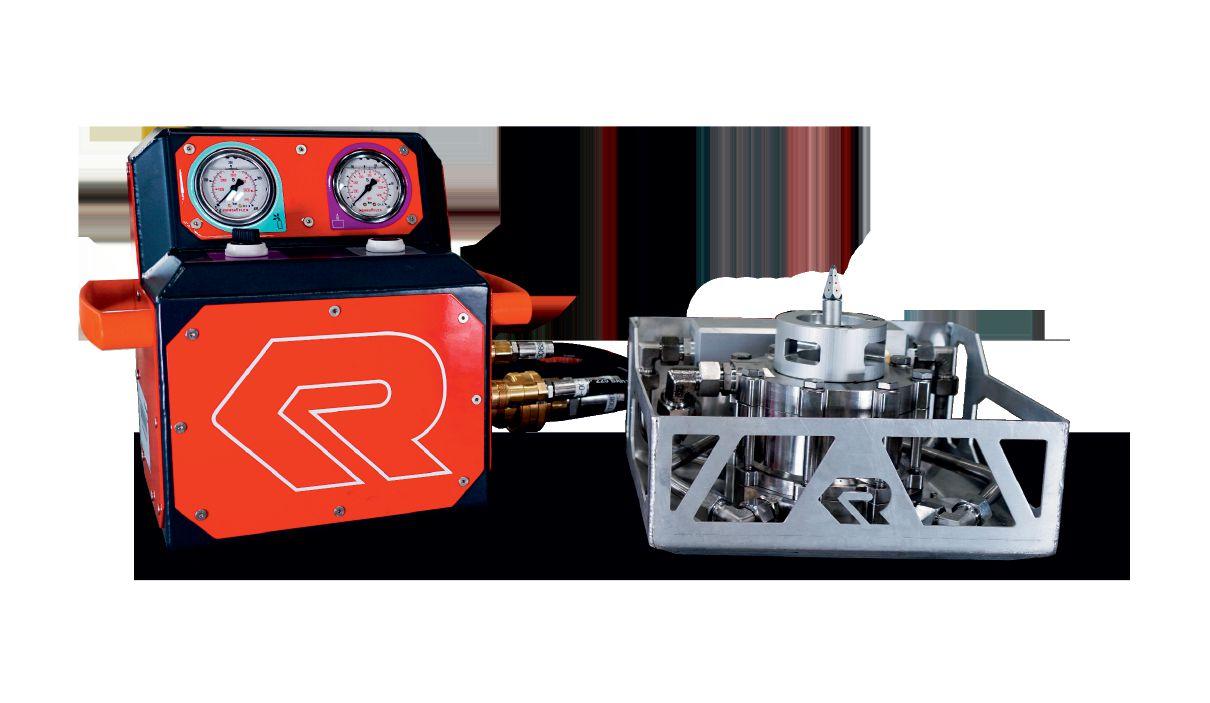
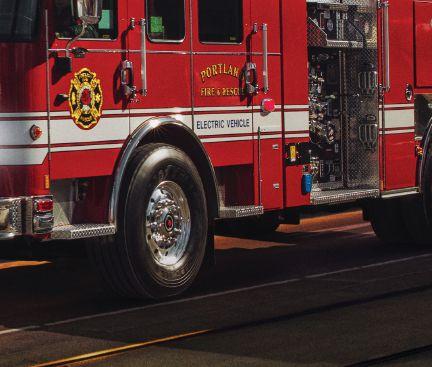
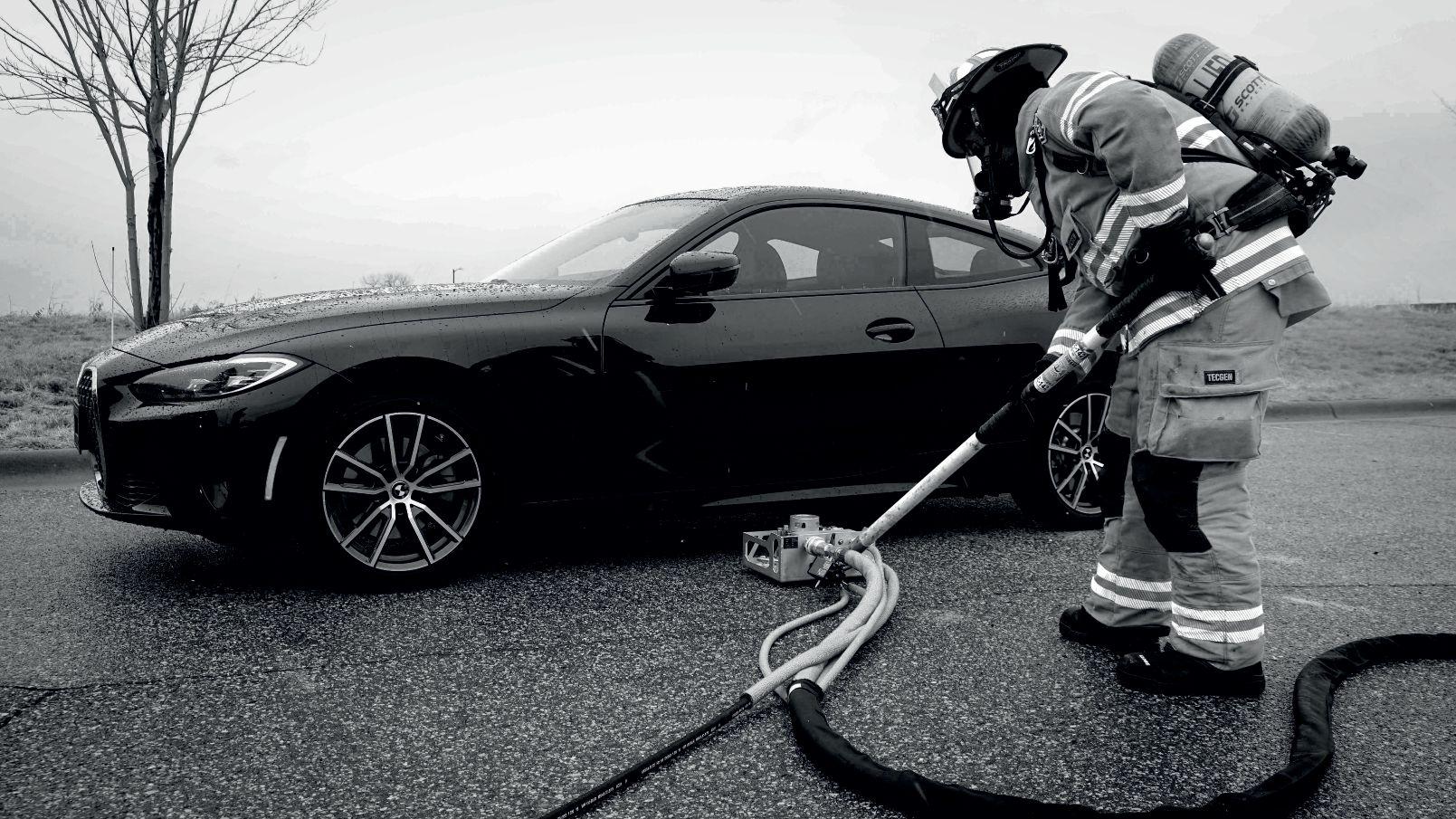
The call is coming when you will face an electric vehicle (EV) battery fire. Extinguishing an EV fire with traditional methods may take hours and thousands of gallons of water. Rosenbauer's battery extinguishing system technology (BEST) does the job with a fraction of the water and within an hour or less. When positioned beneath the vehicle, the piercing unit punctures the battery pack and halts thermal runaway by injecting cooling water around the battery cells. What was a resource-intensive call for service is now safe, efficient, and fast.


by the Ottawa Paramedic Service in 2022. A year earlier there had been 750 Level Zero events in the city.”
The province is hoping MPDS will change all this. MPDS is a software system that allows ambulance communications officers to determine how serious a person’s medical condition is and determine which 911 callers need help first. Through a series of questions, the communications officer determines a caller’s threat to life according to severity of symptoms. Based on responses, the caller will fall into one of six priority categories: Echo (emergent and immediately life-threatening), Delta (emergent and potentially life-threatening), Charlie (urgent and potentially life-threatening), Bravo (non-urgent, potentially serious with no immediate threat to life), Alpha and Omega, both which are non-urgent. Under the previous DPCI system, Bravo, Alpha and Omega would have all been categorized as a Code 3. MPDS is a sophisticated triage tool with 36 categories/protocols that subdivide into 1,800 sub-categories or determinants. It’s currently used in 52 countries around the world and has been in use by Toronto and Niagara for some time. The system ensures that the highest priority calls, like cardiac or respiratory arrest, heart attack, severe allergic reactions or an unconscious person receive an ambulance first. The approach makes sense. However, the implementation has proven to be a bumpy ride for some fire departments.
Oakville Fire Chief Paul Boissonneault said two of the biggest issues his department is facing with MPDS is the need for simultaneous dispatch and being able to have an ambulance on standby during active fire calls. Under the old dispatch system, fire dispatch could call the Central Ambulance Communication Centre (CACC) and have EMS on standby in case of public or firefighter injury during calls where it was prudent.
“It’s the difference in having someone ready to act versus waiting until there’s an actual emergency called. There is no standby under MPDS. That, in my mind, is a huge gap. I don’t want an incident command to have a Mayday and then we’re waiting however many minutes for the ambulance to get there,” said Boissonneault.
Simultaneous dispatch, which was part of Toronto’s and Niagara’s MPDS tiered response agreements, failed in Peel region when the system was implemented in December and unfortunately was not part of Halton’s tiered response agreement at all. During a recent
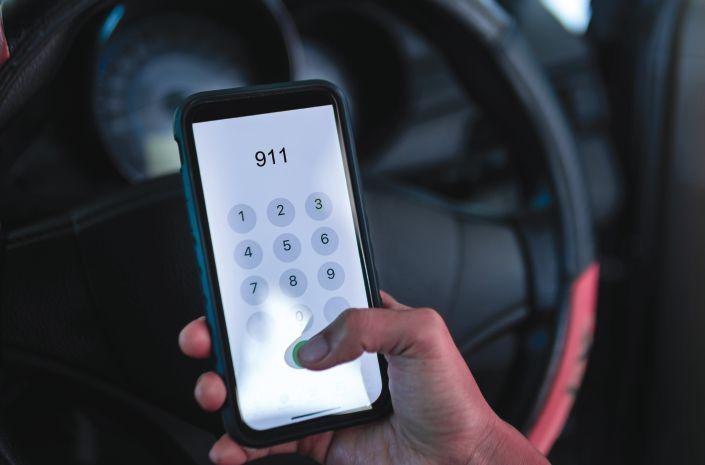
The
MPDS system triages by 36 protocols and 1,800 determinants.
online learning session held by the Ontario Association of Fire Chiefs (OAFC) and led by Rob Grimwood, president of OAFC and deputy chief with Mississauga Fire and Emergency Services. Grimwood said simultaneous dispatch must be included in MPDS rollouts and he offered hope to attendees that it was in the works.
“Everyone needs this and it’s in process,” he said.
Grimwood noted in his presentation that simultaneous dispatch/notification is a bi-directional sharing of information that benefits fire and paramedics, reducing response times and eliminating the need for manual phone call updates about cautions, hazards, etc., on a particular call.
“It doesn’t add call volume and it works within your criteria through tiered response,” he explained.
As MPDS rolls out across the province, Grimwood and Boissonneault say fire departments need to ensure they have a seat at the table so they can advocate for a system that works for everyone involved. Grimwood noted that MPDS has the oversight of a medical director who is independent of Fire and Paramedic.
“In a good system, the MPDS medical director consults with both the Fire medical director and the Paramedic medical director. Be careful if a medical director is not consulting Fire and only consulting with the Paramedic medical director, because that removes Fire’s seat at the table.”
With potentially three medical directors at
play (fire, paramedic and MPDS), Grimwood noted there needs to be provisions in tiered response agreements that set out how it will work.
“Niagara worked well because there was a committee that functioned well and the paramedic chief was sincerely committed.”
For Boissonneault, despite having numerous conversations and meetings to ensure up-to-date tiered response agreements with the paramedic chief and his team, he felt the quick implementation of MPDS in Oakville last December overlooked Fire’s concerns and essentially “threw them out the window.”
“I think it’s a great opportunity for the tool to be used, but there are roadblocks. Our council wants Fire there, but the paramedic chief doesn’t. We shouldn’t have to justify why our medical director and council want us at a call. We like MPDS as a tool, but there have been challenges. We are not there yet.”
Grimwood noted that Fire has historically had a big stake in the paramedic service and it’s a point that should be highlighted when hashing out tiered response agreements. He encourages Fire to come to these meetings prepared to articulate the value that Fire provides using documentation to back it up. From call reports to quality assurance documentation, bring proof of the quality service Fire provides in your region and be prepared for said call reports and patient care reports to be analyzed. “If the fire department wants to be part of medical care, we have to step up our game. The documentation process needs to be there.”
Understanding your department’s capacity is also important. Grimwood pointed out that if your department is a full-time career department with defibrillators on every truck and firefighters certified to the Emergency Medical Responder (EMR) advanced level of training, your capacity to make a difference at medical calls is much greater than a volunteer department that holds the standard first aid training certification.
“Knowledge, skills, experience and equipment determine what calls we should go to. Every department is different.”
His advice to other Ontario fire departments preparing to transition to MPDS is simple: Be at the table early, be prepared to advocate for your department, back it up with data and documentation, and show the value of what you provide.
“You need to sit down with the paramedic service, CACC and all the medical directors and go line by line as to what calls are appropriate for Fire to attend.”
When Peel region moved to MPDS, he said there was little discussion or dialogue and call volume dropped from 1,800 calls to 530 overnight. Gaps began to appear. For example, if the victim of a motor vehicle collision was deemed to have non-serious injuries/symptoms, they could be left waiting on the roadway for an ambulance for hours. Are Fire and Police expected to wait with the victim? Issues like these are now being ironed out.
‘‘ ’’
We like MPDS as a tool, but there have been challenges. We are not there yet.
“We need to get our crews back into service, not sitting on the roadside waiting for an ambulance,” explained Grimwood. As fire chiefs raise the alarm about the gaps they are seeing, the system is being tweaked and Grimwood said Peel’s fire departments have started to recover.
“Every meeting we’re getting a little more. Keep pushing for your seat at the table.”
Boissonneault is hoping for a similar ironing out in Halton.
“We’ve been advocating very hard to ensure simultaneous dispatch is another piece to the MPDS. There’s no reason for Halton not to run this. It’s not a technology issue, its simply cutting through the red tape. Fire wants to make a difference in our communities as per the level of service that our council has set. Fire does not transport patients; we are not primary care paramedics. We have significant medical training, we want to service our community, but we’re not trying to take jobs away from paramedics. We want to make a difference on scene.”
He believes that as MPDS is rolled out across the province, education among the fire service and communication to temper public expectations will be key to finding success.
“Educate yourself on what’s happening in other areas. Speak to fire chiefs who have been through it in Peel, Halton, Niagara and Toronto so you can hopefully avoid the pitfalls. It’s not just a triage tool or drop in call volume – it’s much more and it’s a huge change to what we’ve previously known. It’s not all bad. There are certainly some pieces to this that are advantageous, but there are gaps.”

BY MATTHEW PEGG Fire Chief Toronto
MLEADERSHIPFORUM
Altitude exposure
any of us aspire to move into increasingly senior leadership positions, and ultimately, to be the top leader in our organization. Being in these high-altitude leadership roles is an awesome yet daunting responsibility. I know many leaders who, shortly after being appointed or promoted, find themselves wondering if they have made a mistake. How is it possible for a leader to perform well and produce solid results at the operational leadership level, and then falter once they move into a senior leadership role? The problem may well be altitude exposure.
The individual weaknesses, flaws, and limitations that we all possess become increasingly visible and exposed as we climb higher on the organizational chart. Oftentimes, the first thing subjected to increasing scrutiny as we climb the ladder is our behaviour.
As a leader climbs, they increasingly operate under a high-powered microscope and spotlight, and their behaviour will be scrutinized and criticized more heavily than ever before. Things that may have been accepted, ignored, and even condoned by your former peers, will quickly fuel the fires of criticism and public debate when you become the leader. This altitude exposure continues to increase exponentially as you move into executive posts. Aspiring leaders need to be honest with themselves about whether or not they will be able to thrive in their role, especially when a giant spotlight is illuminating their behavioural choices.
The decisive test for behavioural exposure is simply to ask ourselves if we would be comfortable reading about whatever it is we are about to do, on the front page of the newspaper, seeing it on the evening news or as the top post on our social media feeds. If that possibility concerns us, then we should be choosing alternate behaviour.
Using the fire chief position as a point of reference, I want to share this important truth: Many people want to “be” the fire chief. However, few of them truly want to assume the responsibilities and accountabilities that come with being in the role. There is absolute truth to the notion that it is lonely at the top. In my role, I go through every day having to know things that I would rather not know, so that others can be shielded from unnecessary distraction, pressure, and nastiness. This is true of any executive role, including fire chief, CEO, city manager and beyond.
My good friend and former colleague, Tony Bavota, often explained that criticism is the privilege of leadership. Those are profound and wise words of advice from an experienced and savvy leader. Anyone who isn’t willing and prepared to accept that criticism is an undeniable reality for leaders, is destined for disappointment, and potentially, failure.
There are few opportunities more rewarding than being a leader within a strong, high-performance team that delivers exceptional results. Conversely, enduring the exposure that comes with being in a role that does not align well with your interests, competencies or abilities will be both excruciating and devastating. As you consider what is next for you, make certain that you actually want to do the job that comes with the position you seek, and that you are not simply pursuing the title, salary or perceived status that may come with the role. Make sure that you will still be excited about your job when you are being publicly criticized for the decisions and choices you make.
I have spoken to many newly promoted leaders who quickly find themselves alone in their office, realizing that they don’t even like the role they have achieved. Many miss the direct, hands-on results of their work and, unfortunately, some deeply regret their decision to take on the more senior
Before you put yourself in a position of increased altitude exposure, ensure that you are truly willing to take on the duties, responsibilities, and challenges of the role that you seek. ‘‘ ’’
position and must now live with those consequences.
Before you put yourself in a position of increased altitude exposure, ensure that you are truly willing to take on the duties, responsibilities, and challenges of the role that you seek.
Matthew Pegg is the chief with Toronto Fire Services, having previously served in Georgina, Ajax and Brampton, Ont. Contact Matthew at matthew.pegg@ toronto.ca and follow him on Twitter at @ChiefPeggTFS.
There hasn’t been a single day since I was first promoted as a chief officer that I haven’t missed being hands-on, on the frontlines of emergency response. I miss being part of the crew, having my hands on the tools, and directly helping those who need our help the most. Fortunately, I love my role as fire chief and executive leader, the opportunity to coach and mentor, and the opportunity to make a difference in people’s lives through leadership, more than I miss what came before.
One final thought – the only protection against career altitude sickness is self-awareness. As Benjamin Franklin so wisely cautioned the fire-threatened Philadelphia residents in 1736, “an ounce of prevention is worth a pound of cure.”
Indeed, it is.

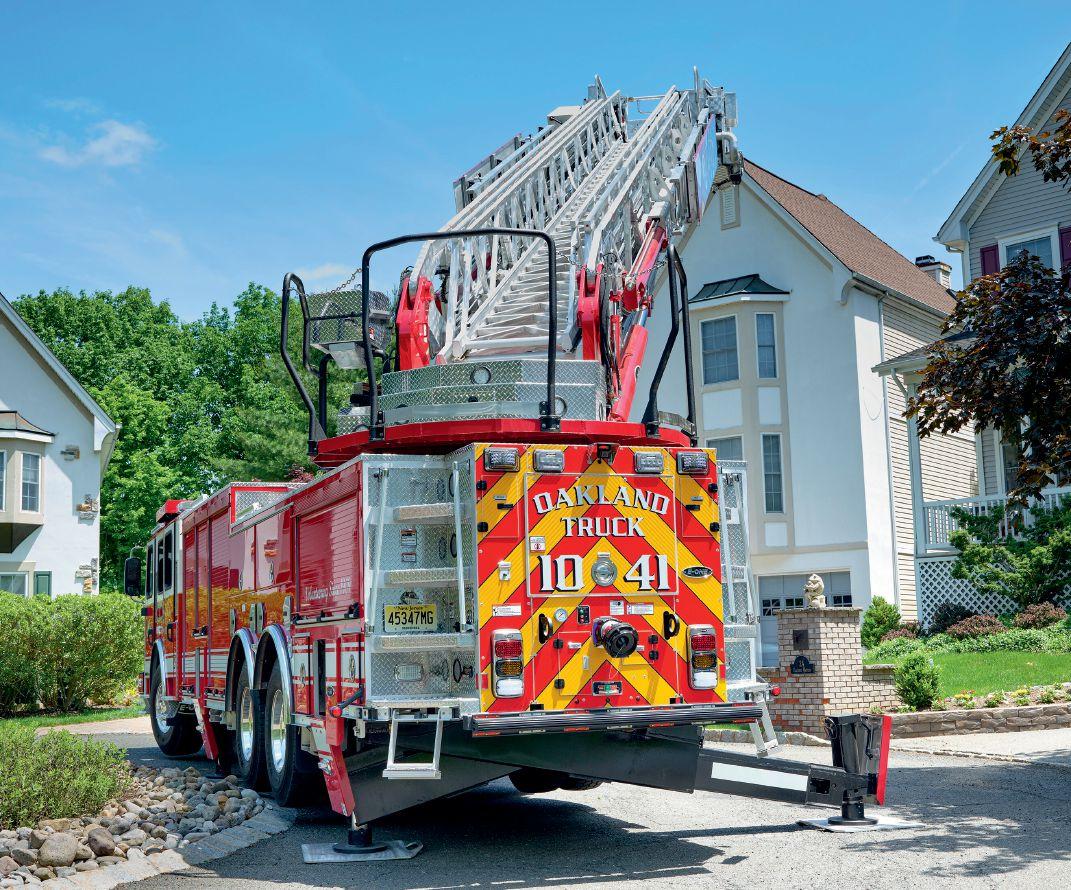
When time is vital and space is limited, the HP100 platform Criss-Cross Underslung Jacks deploy in less than 45 seconds to a spread of only 15’6”, delivering maximum performance and outstanding stability. Add to that a short jack option that allows more flexibility on scene so you can focus on the job.

Discover how the E-ONE HP100 Platform is delivers maximum performance. Contact your E-ONE dealer, or visit e-one.com/hp-100-platform



Networking for better preparedness
Ideas for building relationships with outside agencies to benefit large scale emergencies
By JOHN LIADIS
FABOVE A “battle of the badges” sporting event like a hockey game can be a great way to bring agencies, the public and council together.
ire departments are usually operating on one of three spectrums. There is the modern FD with industry best practices and operating on a level that sets the standard. Then there is the in-between that’s moving away from practices of olden days and working to migrate its operations into the standards of today’s modern fire service. On the third spectrum we find the departments who struggle to get support from councils and or lack the proper leadership to take the department into the future. Although most of us face certain limitations on how we can modernize our service level
and ensure we are doing our due diligence within a leadership position, I have been fortunate to work on all three levels of the spectrum. These experiences have helped me form insights and new perspectives on leveraging relationships with outside agencies to benefit the community, as well as fellow firefighters.
Working with outside agencies is a relationship building opportunity that can create a political strength when it’s viewed from the perception of public and members. Having the ability to incorporate business and fun is key. The facts and data show that being proactive is always better than being reactive,
and building those relationships early is key. One of the things that can be done that has no cost associated is to create a fundraising opportunity with an outside agency while including council and the public. Some of the best examples are picking a local charity and doing a battle of the badges type of sporting event such as a hockey game, baseball game, tug of war, family day event or any of the many more options out there. Invite council and build the relationships beyond police and fire create that a positive fun environment. Police, Fire, EMS, conservation officers, wildfire, fish and wildlife, CPOs, public works, and agriculture and forestry are some of the industries, just to name a few, that are good to include while planning an event. The more groups involved, typically the bigger the crowd. Who said a little friendly competition doesn’t bring out the best in people? When council and members of the public attend, it creates an opportunity for relationship building that can help and benefit all.
Once the door has been opened and communications between agencies are on a first name basis, it can make it easier to work on planning tabletop and mock scenario exercises. These are key in emergency preparedness. Hosting a tabletop exercise allows for growth and support for all involved. This can also be done with industrial partners if your department has a large industry presence in such areas as oil and gas, mining, pulp and paper, steel etc. Having an open line of communication between outside agencies not only builds resiliency but also growth, and preparedness levels are elevated. These events can create great learning opportunities and highlight areas where additional support or help is required, therefore opening the door to creating a proposal for council or possible donations from industry partners that can enhance the emergency preparedness program.
During an emergency, if relationships are already built and the preparedness aspect is ready, it creates a near flawless execution during those critical times. Having the ability to deploy an emergency operations centre that can be established effectively allows for ease of organization and communications to support the crews on the incident grounds. When the key players within the organizations can operate within a unified command structure efficiently it will typically minimize the challenges. When you have practiced before an incident, it allows for the ability to understand everyone’s expectations and fix any corrective actions highlighted during a tabletop or mock scenario. The adrenaline, anxiety and stress levels can be very high when you put together a team of high functioning people, especially when they have never worked together before and are in the middle of an emergency. Taking the steps to remove that element of stress will enhance the functionality of the operation. Strong pre-built relationships are fundamental basics that can enhance the effectiveness of any team. Put in the extra work and it will pay dividends on your successful execution of multi-agency emergencies.
No matter what spectrum your department and team are operating in, there’s no excuse for leaders to not try and make an impactful difference within their own organization. The ability to network with outside agencies builds relationships and the benefits for all can be the most rewarding. Spend the time building your agency’s culture in a positive way and remember why we are all here. Be the one that can make a difference within your community and pay it forward to the service — that’s why most of us were put in a leadership role.
With almost 20 years in emergency services, Chief John Liadis and his team currently lead a progressive composite department in Central Alberta.


BY LAURA KING NFPA Regional Director Canada
BData is the key to prevention
y the time Ontario Fire Marshal Jon Pegg closed the two-day Operation SAFER (Smoke Alarms for Every Residence) summit in June, panelist after panelist had pounded home the same point: specific messages that target specific audiences identified through data is the only solution to the growing number of fire fatalities and lack of working smoke alarms.
“Using data to our advantage is exactly what we have to do,” Pegg told more-than 400 delegates in Vaughan, Ont. – primarily fire chiefs, fire prevention officers, and fire- and life-safety educators.
Fire- and life-safety educators have known for eons – they were all taught in their NFPA 1035 courses – that using data, drilling down to find root causes, creating messaging and, more importantly, programs, specifically for people identified as unlikely to have working smoke alarms, is the only way to reach them.
Now, the chiefs – at least those who were at the summit – and the Office of the Fire Marshal, understand that a single message, for example, working smoke alarms save lives (a good message but there’s no call to action and it’s too broad) isn’t effective.
To Pegg’s credit, he acknowledged he’s not a data guy – he’s more policy and big-picture – but after listening to experts who have reduced rates of impaired driving and raised millions of dollars for campaigns by using data to pinpoint target audiences, he gets it.
Who’s dying in fires in Ontario and elsewhere, and who is unlikely to have working smoke alarms? According to the National Fire Information Database there are specific groups: people who live in older homes; who are under the influence of alcohol or drugs; who are male; who are part of single-parent families; who move house often; who are new to Canada; who speak languages other than English.
Garis, former fire chief in Surrey, B.C., who’s now leading the National Fire Information Database project, announced that Ontario – along with British Columbia – is partnering with StatsCan to make data available to its fire departments to bolster their community risk assessments.
Which brings us to NFPA 1300, Standard on Community Risk Assessment and Community Risk Reduction Plan Development.
All fire departments in Ontario are mandated to complete a community risk assessment by July 2024. Which is great. But even Pegg realized during Operation SAFER that next steps are critical, and departments need to also implement community risk reduction (CRR) plans, identify problems and root causes, create programs for specific target audiences, build partnerships to reach those target audiences, and regularly evaluate the programs to ensure they’re working, or revise them. NFPA 1300 outlines these steps and provides an easy-to-understand framework for implementing CRR. Go to www.nfpa.or/1300 or subscribe to NFPA LiNK (www.nfpa.org/LiNK).

’’
The great news is that now there is data available that can help put local stats in perspective.
Why, then, have we expected universal messages to be effective? And why do (some) fire departments not give their fire- and life-safety educators access to their data? Because it’s far easier to grab a message from the OFM or NFPA, post it on social media, and tick a box.
Some fire departments do a fabulous job using data, reaching audiences, increasing knowledge, and changing behaviour. But many departments don’t have full-time fire- and life-safety educators, capacity, or the knowledge to implement messaging and programs.
The great news is that now there is data available that can help put local stats in perspective. During Operation SAFER, the OFM and Len
Laura King is NFPA regional director for Canada. Contact her at lking@nfpa. org.
In addition to the summit, Operation SAFER comprises a day of action on Sept. 28, on which Ontarians will be encouraged through a province-wide campaign to test their smoke alarms. (www.savedbythebeep.ca).
NFPA, the Ontario Office of the Fire Marshal, the Ontario Association of Fire Educators, the Ontario Municipal Fire Prevention Officers Association, and the Ontario Association of Fire Chiefs collaborated on Operation SAFER. Now, other provinces and territories are getting involved, and the vision is to make Test Your Smoke Alarm Day and the Saved by the Beep theme national.
It took 133 fatalities – the most in one year, in 2022 – for Ontario to wake up and shift the paradigm to align with NFPA 1300 and NFPA 1035. With chiefs, fire marshals and fire commissioners on board, the availability of data, an easy-to-use standard, and a seemingly new will to work together rather than in silos, let’s hope 2023 is a better year.
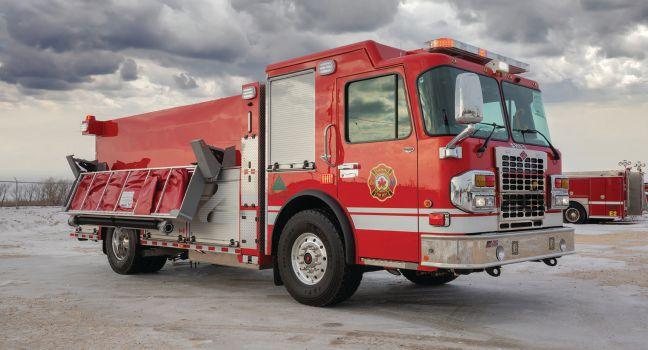

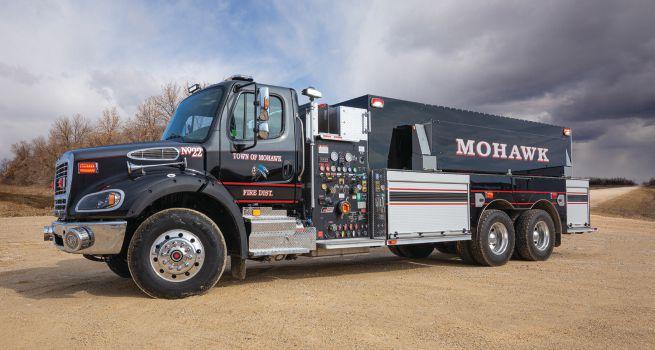
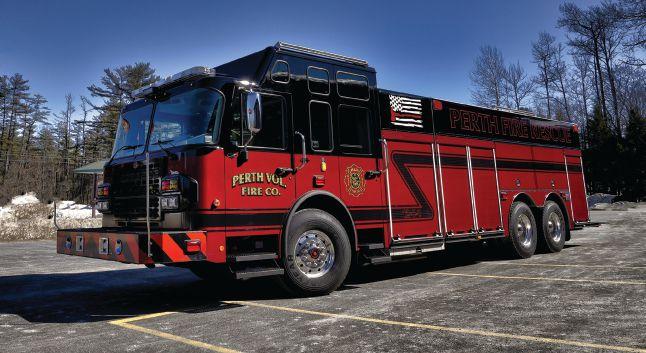
Our fire tankers/tenders and pumper tankers/tenders are engineered for the harshest road conditions and environments in the world featuring a full-framed 6061- T6 aluminum extruded sub-frame utilizing 5083 saltwater marine-grade aluminum compartments. We offer over 12,000 custom options to choose from giving our customers a unique fire apparatus that is One Tough Truck and fits their fire department’s needs serving their communities for many years to come.
DESIGNED BY YOU, BUILT WITH CONFIDENCE
• Full-Framed 6061- T6 Aluminum Extruded Sub-Frame Utilizing 5083 Saltwater Marine-Grade Aluminum Compartments
• All Chassis Options Available
• Darley, Waterous, or Hale Pumps
• 180 Degree Swivel Rear Dump Chute
• Adjustable Compartment Shelves
• Roll-up or Pan Compartment Doors
• 1200 to 3500 I.G. Co-Poly Tanks
• Undercoated Body
• LED Lighting
• ULC or NFPA Tested and Certified
OPTIONS AVAILABLE
• Side Control or Cross Control
• 3-Man or 4-Man Enclosed Control
• Top Mount Enclosed (TME)Custom Chassis
• Rooftop Monitor Options
• SCBA Brackets and/or Trays
• Portable Pump Options
• Roll-out and/or Tip Down Trays
• Electric Side and Rear Dump Chutes
• Tank Pocket Storage Options for Ladders or Portable Tank
• Electric Fold Down Ladder Rack
• Hydraulic Portable Tank Brackets
• Back-up Camera
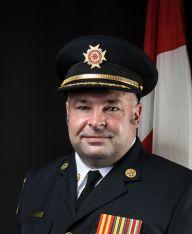
BY ROB GRIMWOOD President, Ontario Association of Fire Chiefs
AGUESTCOLUMN
The OAFC continues to advocate
t the Ontario Association of Fire Chiefs (OAFC) AGM in November, a 12 person board of directors was elected to enact the vision of the members and achieve the goals of the organization’s strategic plan.
The board of directors is comprised of myself (Rob Grimwood), as president, vice president Jeremy Parkin, treasurer Jeremy Inglis, secretary Chad Brown and directors Mark Berney, Mark MacDonald, Andrea DeJong, Brian Arnold, Jason Whiteley, Brent Thomas, Kent Readman and Paul Boissonneault.
So far, 2023 has been a busy and incredible year for the OAFC, starting with a highly successful labour relations seminar from Jan. 24-26 in Toronto.
Then, from March 23-25, hundreds of firefighters and chief fire officers from Northeastern Ontario attended the Northeastern Fire Educational Conference and Trade Show at Deerhurst Resort in Huntsville, Ont.
The OAFC Conference and Trade Show took place in Mississauga, Ont., from May 3-6, and featured pre-conference workshops, keynote speakers Corey Hirsch and Adam Timm, many other speakers and panel discussions, and the largest fire service trade show in Canada. We were honoured to have Premier Doug Ford join us, address our members and tour our trade show. He was presented with a white helmet to reflect his government’s ongoing support.
The OAFC board of directors established four key government relations priorities for 2023, which include supporting fire service training and achieving certification, supporting mental health and PTSD (post-traumatic stress disorder) prevention, ensuring the effective implementation of Next Generation 911 and support for dispatch technology and operations, and reducing fire deaths through engineering, education and enforcement.
The OAFC is working to establish public safety grants to support fire department training, infrastructure, health and safety and fire prevention programs; improve cancer prevention efforts; modernizing the “slow down move over” legislation to establish more specific speed parameters to make the law more enforceable while also committing to more robust public education to change driver behaviour; developing a framework for investigating firefighter line of duty deaths to develop recommendations for prevention and promoting the role residential sprinklers play in fire safety.
The OAFC seeks modernizing the billing for fire department responses on provincial highways to include no service calls, enabling municipalities to use administrative monetary penalties as an option for enforcing violations of the Ontario Fire Code; and developing a strategy to address the risks associated with abandoned gas wells.
Tragically, in 2022 there were 133 fire-related deaths in Ontario, the most in decades. As a result, the Ontario Fire Marshal’s Office convened a two-day fire safety summit in June called Operation SAFER (Smoke Alarms For Every Residence, The OAFC is a proud partner, and donated $15,000 to the event as well as $5,000 in bursaries for OAFC members who wished to attend but did not have the financial means to offset travel and accommodation expenses.
Other OAFC projects and initiatives include the creation of a new chief officer orientation program, a new website, online learning series, and work-
Tragically, in 2022 there were 133 fire-related deaths in Ontario, the most in decades. ‘‘ ’’
These government relations priorities were front and centre when the OAFC hosted its Queens Park Fire & Life Safety Advocacy Day on May 30. The day saw OAFC directors and members meet with over 40 ministers and Ford to discuss fire and life safety initiatives and OAFC priorities.
Other initiatives that the OAFC continues to advocate for include support for fire departments to achieve mandatory certification; ensuring the Fire Marshal’s Office has proper resources to modernize training; ensuring that simultaneous notification of tiered response calls is enacted in all dispatch centres that do not currently have it; establishing a provincial public safety broadband network; modernization of the Ontario Fire Code, and ensuring that fire safety is considered in all decisions made to address the provincial housing strategy.
ing with partner departments to modernize the OFAI Candidate Testing Services.
Additionally, our various committees continue to work hard on projects including creating a Diversity, Equity and Inclusivity toolkit for fire departments, participating on a volunteer firefighter recruitment and retention work group that is co-ordinated by the Office of the Fire Marshal, reimagining our retiree program and creating a chief officer peer support program.
The OAFC looks forward to FireCon in Thunder Bay, Ont., from Sept. 6-10 (registration is now open), our health and safety workshop in Niagara Falls, Ont., on Nov. 21 and our AGM in that same city from Nov. 22-24.
I want to thank all OAFC directors, provincial advisory committee leaders, committee members and all of Ontario’s chief fire officers for all of their dedication, hard work and support to ensuring fire and life safety.

Rob Grimwood is the deputy fire chief for Mississauga Fire and Emergency Services. He is also the 2023 president for the OAFC board of directors.

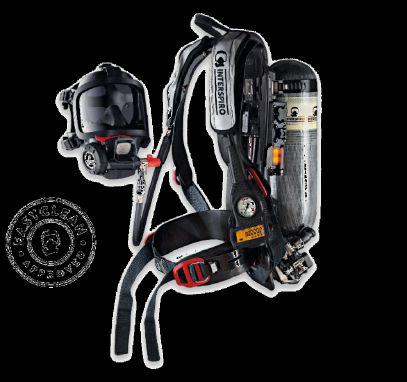
CANADIAN SAFETY EQUIPMENT IS PROUD TO BE A DISTRIBUTOR FOR THE INTERSPIRO RESPIRATORY PROTECTION LINE. THEIR STATE OF THE ART S9 INCURVE IS ONE OF THE MOST COMFORTABLE SCBAs YOU WILL EVER WEAR.
GIVE US A CALL AT 0182 OR EMAIL US AT


EVFIREISOLATORrrrrrr
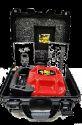
FIRE ISOLATOR is a concept for isolating and fighting EV car fires based on best practices and live testing In general, there is not one single solution to extinguish or control EV car fires, as all firefighters who have dealt with these types of car fires will be able to confirm . Effectively isolating and fighting EV car fires takes several different methods because of the lithium-ion batteries on board EV cars The EV car may need to end up submerged in water in a container, but with the FIRE ISOLATOR concept, there is a lot that can be done beforehand to minimize the damages Fighting EV car fires with the Fire Isolator concept has been thoroughly tested and proven to be effective
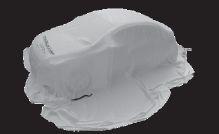
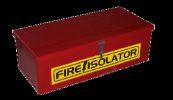
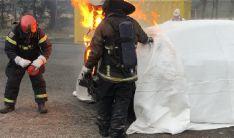
The Fire Isolator blanket, when used with the FlameGuardFire grenade is an Excellent method of getting an EV fire under control. The blanket can be washed and reused a number of times.


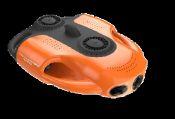
NEW UNDERWATER DRONE FOR SEARCH AND RECOVERY
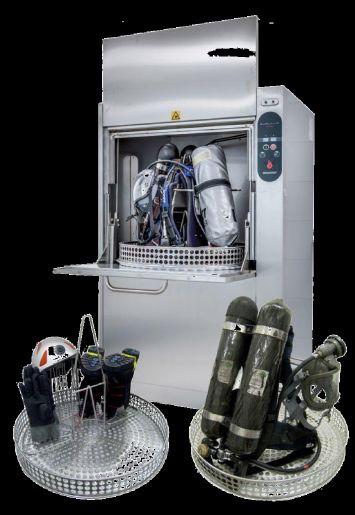
The Solo SCBA Decon/Washing machine was designed and built for one purpose only…to protect Fire Fighters from Cancer causing agents found in the Smoke and residue left on their SCBAs. As an added bonus it can clean Gloves, Boots and Helmets. In addition, it substantially lowers the time spent decontaminating firefighter equipment. The SOLO is the only SCBA decon machine that meets both NFPA and CSA standards.




WASH/DECON TWO SCBAs IN 8 minutes


IN ONE HOUR YOU CAN CLEAN/DECON:

ü REDUCED HEALTH RISK
ü SAVES TIME 2/PKS IN 8 MIN
ü EASY TO USE
Qualified by MSA for cleaning the G1 SCBA.
Low Power use. Minimal moving parts. Low maintenance costs

BACKtoBASICS
Garage fires, Part 5
By MARK VAN DER FEYST
Imentioned in the June edition that we had come to the end of our series of garage fires. Well, I lied because we are going to add a Part 5 to this series. In our previous four parts, we examined the dangers of garage fires, but did not detail what tactics we can use to combat different garage fires. In our last part, and it is our last, I want to detail the different tactical options that are available to use.
The various types of fire departments, with the various types of engines, trucks and tankers, will be equipped with some common items that can be used in our tactical approach.
FIRE ATTACK TACTICS
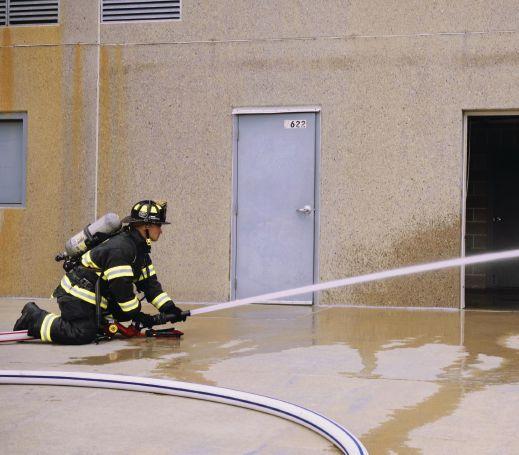
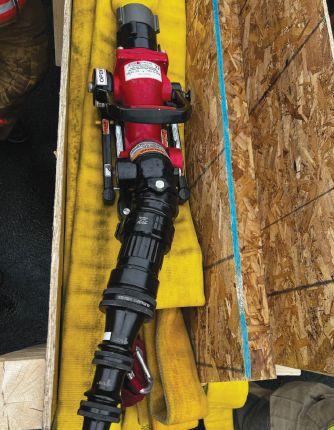
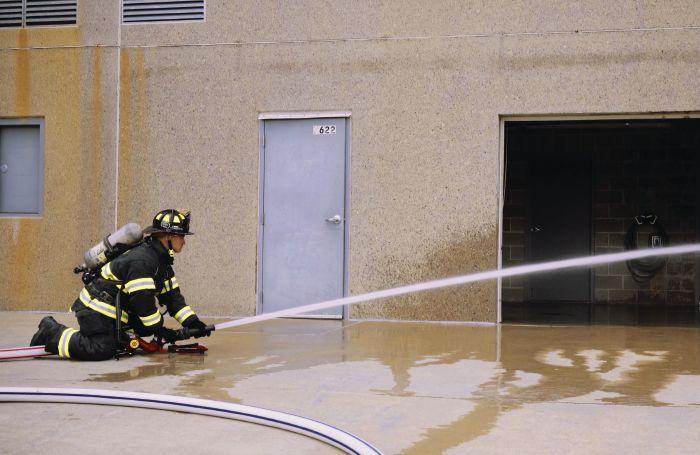
RAM attack: A garage fire will produce large volumes of fire based upon the fuel load found inside, as well as the exposure to the house that it may be attached to or not. This will require a large volume of water to be applied effectively and efficiently to achieve a quick knockdown. This can be accomplished with using the RAM tactic. As you will see in Photo
1, a RAM or Rapid Attack Monitor can be preconnected to a 65 mm or 2 ½" hose line for rapid deployment by one firefighter. When deployed, the firefighter can set it up on the ground in front of the garage and apply 500 gallons per minute (gpm) or 1800 litres per minute (lpm).
The large volume of water and the reach of the stream will be very effective in penetrating the thermal layer of the fire and “painting” the garage with water on the walls, ceiling, and floor with large drops of water falling. As in Photo 2, the firefighter can easily advance the RAM closer to the garage as needed, and even making an interior attack into the garage. The RAM can also be converted into a ball valve or gate valve with a smaller hand line extended off the discharge thread of the appliance to advance further in. A very effective and efficient tactic for limited staffing situations.
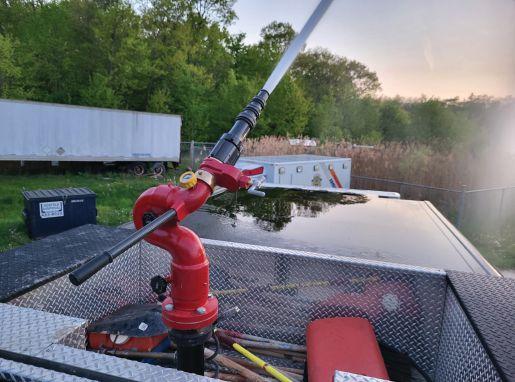
Deck gun: Just as the RAM tactic can be used for large volume application, so can the
truck-mounted deck gun. As you will see in Photo 3, the deck gun can deliver water from 500 gpm to 1250 gpm, or 1800 lpm to 4800 lpm. For the limited staffing situation, the gate valve has been added to replace a firefighter needing to be up there prior to the deck gun being charged. The driver or pump operator can extend the deck gun from the pump panel electronically, charge the deck gun, and then climb on top, open the gate valve, and flow water. If the deck gun is a manual operation, then two firefighters will be needed to get it into operation.
The deck gun will flow a lot of water – so you need to know how much water you have on your booster tank and how much water you can afford to flow for a quick hit before shutting it down and being empty. For a 1000-gallon booster tank, if you flowed only half of the booster tank, that will be a quick 500 gallons or 1800 litres of water hitting the fire.
Hose line selection: Every fire truck will be equipped with hoses and nozzles. The size
PHOTOS BY MARK VAN DER FEYST
Photo 2: Firefighters can easily advance the RAM closer to the garage as needed, and even launch an interior attack into the garage.
Photo 1: A RAM can be preconnected to a 65 millimetre or two-and-a-half-inch hose line for rapid deployment by one firefighter.
and type of each will vary, but the majority will have 45 mm (1 ¾") and 65 mm (2 ½") hose lines with either a combination automatic or fixed flow nozzle attached to it. For the minority number of fire departments, they may have smooth bore nozzles on their hose lines.
The size of the fire coming from the garage or still within the garage will dictate the size of the hose line that should be pulled off. The fuel load inside the garage and its spread will dictate what size of hose line needs to be stretched. The bigger the hose line, the more water will be applied, knocking down fire very quickly compared to a smaller hose line that is typically pulled for most fires. If the larger hose line is pulled and not needed after a few minutes, then the smaller hose line can also be pulled and used. If the opposite has occurred, it will be catch up time by trying to control a large volume of fire with little water.
Door removal: Sometimes the best tactic is to remove the garage door or cut an access opening into the garage door for water application purposes. Normally in our basic training, cutting an access opening in the garage door is done by cutting a triangular shape. The triangular opening
is to provide structural support of the garage door while applying water inside. The drawback to cutting a triangle is that if we need to apply water at the top of the garage, the ceiling area, we are extremely limited because the top of the triangle is narrow. Instead, turn the triangle upside down –cut an upside-down triangle providing a wider opening at the top to apply water in a left to right fashion.
Seeing as we are going to cut the garage door to make an upside-down triangle, why not cut the whole door to remove it all together? By removing the entire garage door, the opening is available to apply water and also make entry to conduct an interior attack/search. Cutting the whole door off can be accomplished by using a rotary saw and cutting along the top from end to end, then cutting down the one side, vertically down to the ground, then cutting along the other side in the same manner. Using a roof hook, pull the garage door away from the opening and away from the operation off to the side.
Door openers: Many garage doors are attached and operated by remote-door opening devices. While these are great for the homeowner, for the fire department they can be a deadly device. If a garage door is ever opened and is still attached to the opener, the door needs to be locked out using a six-foot roof hook or pike pole. Other devices such as spring clamps can also be used – the intended purpose is to prevent the garage door from closing, trapping firefighters inside. Another option is to disconnect the garage door from the opener if it is accessible and visible. Even if it is not powered by a door opener and is a manual door operation, it still needs to be locked out using the same methods described above – we cannot rely upon the spring tensioner to keep the garage door open.
This fifth part in our series is definitely the last part for our look at garage fires. For the tactics described above, take the time to practice them in training to see which ones work best for your department.
Mark van der Feyst has been in the fire service since 1999 and is currently a firefighter with the FGFD. Mark is an international instructor teaching in Canada, U.S. FDIC and India. He is the lead author of Fire Engineering’s Residential Fire Rescue & Tactical Firefighter books. Contact him at Mark@ FireStarTraining.com.

Photo 3: A deck gun can deliver water from 500 gpm to 1,250 gpm, or 1,800 lpm to 4,800 lpm.
TRAINER’SCORNER Should I risk my life?
By ED BROUWER
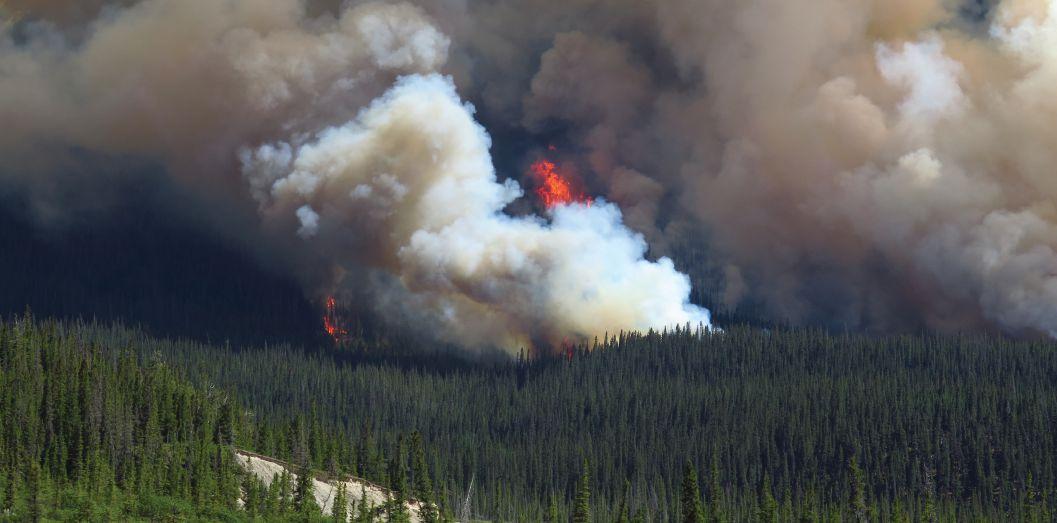
Iwas listening with great interest to Global News the morning I began to write this. There were multiple reports on the outof-control wildfires ravaging our province. As the reporter concluded his detailed report on safety concerns and preparedness he said, “This may be the worst fire season in B.C.’s history.” Then they went to commercial, and it was, of all things, a trailer for a new TV series called “LA Fire & Rescue.” The shot was of a female firefighter in full bunker gear stating matter-of-factly: “Should I risk my life? The answer is yes!”
I looked at the TV and thought, are you kidding me? I really struggle with this “risk taker” image Hollywood presents. Perhaps it’s the voices of the more than 80 firefighter’s ghosts I still hear in my head. It also bothered me to see a female firefighter portrayed that way. If it was a male, it would have been less shocking, because let’s be honest, males have been known to do some incredibly risky things.
I can’t remember ever hearing a woman say, “Hey, hold my beer as I...” There are certainly daredevil women out there, but it seems to me they are much more risk conscious about how certain actions may affect others.
I have found female firefighters to be cool, calm, and quick thinking under pressure. Of the hundreds of firefighters we pushed through our “Firefighter’s Ghost” entrapment maze, none of the female firefighters worsened their entanglement by forcing their way through. I recollect the men to be more like “bulls in a China shop.”
My wife was on our wildfire suppression Crew for 10 years. She was one of the main reasons we were able to go 31 years without a major incident. Did we take risks? Of course. But the whole crew knew that when they heard her say, “Ed?”, we would be re-evaluating our knee-jerk reaction plan.
The statement — “Should I risk my life? The answer is yes!” — implies firefighters
don’t have a choice. This type of type of thinking messes up young firefighters, who can be easily overwhelmed with a hero complex, and it messes up how the public views us, thereby putting unrealistic expectations on us.
Risk is a part of life. The heart of risk management is in identifying and evaluating risks and deciding on how to best deal with them.
NFPA 1500 specifies the minimum requirements for an occupational safety and health program for fire departments or organizations that provide rescue, fire suppression, emergency medical services, hazardous materials mitigation, special operations, and other emergency services.
• Let me ask you, does everyone in your department know about NFPA 1500?
• Have you as their training officer walked them through these minimum requirements?
• May I be as bold as to ask, “Do you even know what it says?”
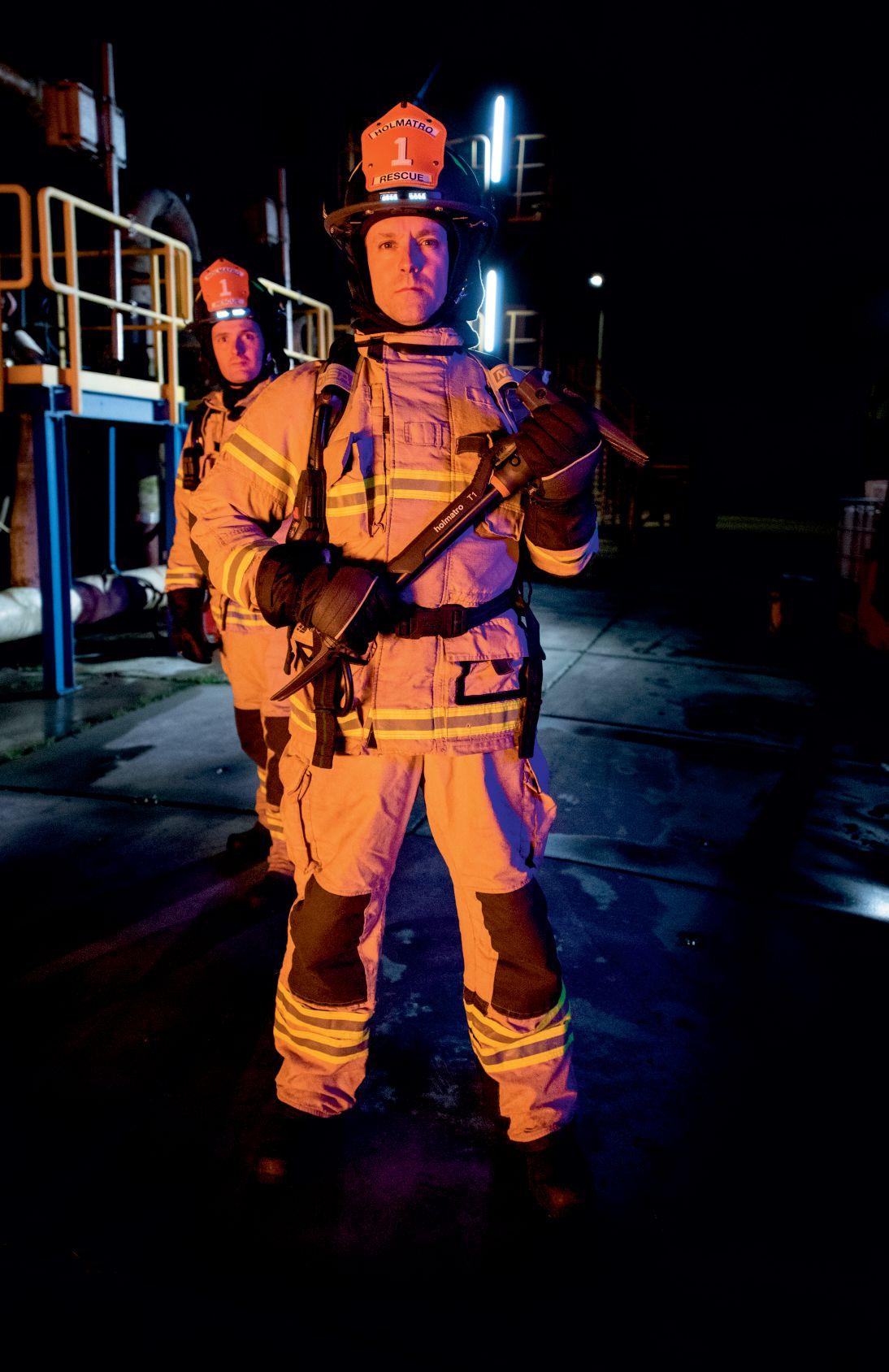
Wildfire suppression crews take risks, but those risks must be re-evaluated if they are part of a knee-jerk plan.
TRAINER’SCORNER
Thankfully, fire fighting is not listed among the three most dangerous job sectors in Canada (those honours go to manufacturing, construction and transportation). And I give the credit to the unrelenting work of safety officers, prevention officers, and fire inspectors.
To deal with an issue in my last department’s Organizational Chart, I approached the chief and suggested we dissolve one of the two assistant chief positions and create a new
position of safety officer. He agreed and we approached the two assistant chiefs with the idea. To my surprise one of them jumped at the chance, and it was a great fit. It was a lot of work, but with NFPA 1500 as a guideline, our department soon had its first fire safety officer. However, I noticed a strange thing. After the initial honeymoon period, some firefighters saw the safety officer’s enforcement of NFPA 1500 standards as annoying critiques. We humans are a strange bunch.
People are wrong to think firefighters risking their life on the fireground are more heroic than the actions taken by safety officers, prevention officers, and fire inspectors before the call comes in. It may be hard to prove, but I believe these unsung heroes may save more people than firefighters do.
No matter how you look at it, I’m pretty sure we will never see Hollywood produce a blockbuster movie about fire prevention.
Firefighters saying — “Should I risk my life? The answer is yes!” — are often the ones who ignore safety standards. They fly by the seat of their pants making quick decisions based on gut feelings, rather than the all-important skill of situational awareness.
Did you hear about Dillon Reeves? He is the seventh grader who stopped a 15,000-pound school bus with 65 children on it. He jumped into action when he noticed the driver having a medical emergency. I read he was the only kid on the bus without a cell phone. He was the only one out of 65 who had situational awareness. Situational awareness is an excellent topic to research.
Now that I’m retired, my wife and I own and operate a horse ranch. I get to do a lot of tractor work. I’ve jumped into my F350 pickup, flipped my right signal light on and wondered why I wasn’t moving. Then suddenly I’d realize I was in the truck not on my tractor, which has a shuttle shift (lever same place as signal light lever), where is up is forward, down is reverse. I thought it was an age-related mix up, however I recently read that your mind is built for pattern recognition. So, when my brain saw I wanted to go forward in my truck it quickly reached into my memory and produced a response based on what worked to solve a similar problem earlier that day…on the tractor.
Your mind says, “I’ve seen this before, and I know precisely what to do.”
Another example: My truck is a diesel; my wife’s truck is gas and the odd time I drive her truck I automatically turn the key and wait to let the glow plugs warm up.
In Fire, we need to understand not only how situational awareness works, but how confirmation bias operates.
For example, I really appreciate the FFIC editorial staff; they make me sound and look good. My brain usually goes faster than my one educated finger when typing my column, so sometimes I type “teh” thinking it was “the”.
TRAINER’SCORNER
I usually don’t see the mistake I made when I proofread my own work.
This is referred to as confirmation bias, which is the tendency to search for or interpret information in a way that confirms our preconceptions and or expectations and to ignore what contradicts our preconceptions.
Another characteristic of confirmation bias is that we do not see the change, or if we subconsciously see it, we undervalue its importance. That is the trouble with risk taking according to your “gut” feeling.
A prime example: We have been told repeatedly during SCBA practice to “shake” to stop the PASS alarm from activating, told to the point that it no longer sends a warning to our brain that a firefighter is in trouble on the fire ground.
Research in visual attention has revealed several ways that people don’t see what is in their visual field. These aspects are inattentional blindness, change blindness and confirmation bias. Inattentional blindness is the “looked-but-failed-to-see” effect. It happens when you fail to notice something that is fully obvious in front of you and your attention is on something or someone else.
How often does this happen at a fire scene? It is easy for the IC’s focus to be on one aspect of a scene while he or she overlooks what someone else sees as fully obvious. Inattentional blindness has been implicated as a common cause of traffic accidents.
This confirms the need for more than one pair of eyes doing a continual size up. Safety officers and ICs working in tandem is of the utmost importance.
Change blindness is a failure to notice that something is different

from what it was. Every married man on the planet has suffered from this. My wife has more than once in these past 48 years looked at me and said, “Well?” This was usually after her getting a new hair style or worse for me, a new colour. I now know when she stands directly in front of me and says, “Well?”, it means I better do a quick “size-up”.
Our province is burning, as I said earlier, perhaps the worst fire season in B.C.’s history. Now if a fire was approaching our ranch, I would want firefighters to be ready and willing to take action. And I’d welcome them when they showed up. Yet, my preference would be that the ranch doesn’t catch fire in the first place. So, the focus for me as the homeowner should be on fire prevention and preparedness!
For over 31 years of responding to both structural and wildland fires, I have witnessed the disregard for our safety by the home or property owners. Unmarked driveways, lightweight bearing bridges, narrow driveways with no room to turn around, firewood stored against the house, unkept yards, abandoned vehicles, locked gates, packs of dogs, low hanging branches (ladder fuels), propane and other fuel tanks…etc. And yet somehow, we feel obligated to risk our very lives?
• With that in mind does your department have a Structural Triage Plan?
• If you do have one, do those living in your fire protection district understand it?
The risks on the fireground are constantly changing, situations are evolving moment by moment, we need to be in a constant state of awareness and preparedness.
How? We need to get up close and personal with NFPA 1500.

Chapter 4 section 4.2.1 of NFPA 1500 (2007) states that the fire department shall develop and adopt a comprehensive written risk management plan (p.1). Section 4.2.2 further states that the risk management plan shall at least cover the risks associated with administration, facilities, training, vehicle operations, both emergency and non-emergency incidents, and other related activities. (p.1)
When we practice safety, we manage our risks. Note I said, our risks. You are not a Superhero, you are part of department, a crew, or a unit. You may say, “I will risk my life,” but are you offering up your fellow firefighters’ lives as well? They are the ones who will have to go in and rescue you, or worse drag you out in a body bag. But hey, you might get a department funeral. And your family may get some of those fancy sandwiches with the crust cut off, and perhaps a nice Canadian flag! Too much? Too dramatic? That’s the point!
We may risk our lives a lot to protect savable lives… We may risk our lives a little to protect savable property ... We will NOT risk our lives at all for lives or property that are already lost.
Thank you for all you are doing in the Canadian fire services. If I can be of any help to you, please feel free to contact me. And as always, please continue to train as if lives depend on it, because they do.


A tip of the hat to all safety officers, prevention officers, and fire inspectors — our unsung heroes. 4-9-4 Ed
Ed Brouwer is the chief instructor for Canwest Fire in Osoyoos, B.C., retired deputy chief training officer for Greenwood Fire and Rescue, a fire warden, wildland urban interface fire-suppression instructor and ordained disaster-response chaplain. Contact aka-opa@hotmail.com.

BY VINCE MACKENZIE Fire Chief Grand Falls-Windsor, N.L.
WVOLUNTEERVISION
Support for volunteers is a national responsibility
ildfire has become the news story of the summer with more to come as we brace for yet another record setting year in wildfire incidents. It seems everywhere in Canada, something is burning. With all the coverage and wildfire smoke advisories affecting a good percentage of the country, the attention that has been turned toward our firefighters in the national news is unprecedented. Wildfires across Canada have made national headlines almost daily. The fires are so large and complex that we have been importing wildland firefighters internationally. Just recently a provincial government was calling on volunteers to come and assist, but who pays their bills?
With the recent catastrophic fire events overwhelming fire services in both big cities and rural areas, the call has gone out for more volunteers to staff the fire lines. Firefighters, career and volunteer, across this country have been relentless in their efforts to control the fires and protect communities from wildfire threats. When volunteers sign up to their local fire department, they don’t envision being deployed for days on end to an incident. Indeed, we have all been on such deployments, but paying a salary to those who answer the call has not been the common practice. Many times, volunteer firefighters serve alongside other agencies who are being paid a wage while they are on the clock.
Politicians across Canada have been singing the praises of our firefighters. These are the same politicians that we have been lobbying their governments to provide more support for Canada’s fire services like better tax credits, and emergency training and preparedness funding for better resources and equipment.
When these serious events happen, everyone talks about the woes of climate change and the greater frequency and severity. When they are over and the community waits for the next one, the serious talk stops and little action is generated by the government other than committees and initiatives to study the problem. Ever since the joint emergency preparedness funding program was cancelled some 10 years ago, climate emergencies have become more complex. Smaller municipalities and their volunteer fire departments have stepped up to respond with greater frequency. Canada’s emergency response system would be dead in the water without volunteers staffing fire departments, search and rescue organizations, and non-government agencies. No government in the modern world could ever afford to fund the staffing required on a full-time
basis for all those organizations, so volunteers have to staff these groups. What is lacking is the tangible funding to assist our fire departments. I’m talking about support for the firefighters when they are deployed from their day-time jobs. Many leave their employer on the hook when they respond. Those employers should be recognized for their contribution to Canada’s security during disasters because local expertise is always needed during emergencies since they are more efficient. Firefighters should be compensated once a disaster goes longer than a normal response. Perhaps a national fund should be established to pay for the labour required to maintain and sustain extended operations in emergency zones.
There are no volunteer cops or other emergency agencies. Why then, do volunteer firefighters, ground search and rescue members or their employers bear the cost of extended operations? The emergency equipment funding needed to support fire departments in wildfire and climate emergencies must be reinstated by Ottawa. Emergency generators, fire fighting, rescue and communications equipment all come with a hefty price tag that fire departments struggle to acquire. In the last year, climate change events have devastated our communities with wildfires, hurricanes, tornados, floods and snowstorms.
Canada’s emergency response system would be dead in the water without volunteers staffing fire departments. ‘‘ ’’
Vince MacKenzie is the fire chief in Grand Falls-Windsor, N.L. He is an executive member of the Canadian Association of Fire Chiefs and the current president of the Maritime Fire Chiefs Association. Email Vince at firechief@ townofgfw.com and follow him on Twitter at @FirechiefVince.
As climate change increases our frequency of emergencies, the equation we now see includes more complex incidents being responded to with dwindling or cancelled funding for joint emergency preparedness and less equipment and staffing. I suspect this emergency response crisis will grow larger every year until our politicians realize that fires don’t put themselves out. It takes dedicated volunteer firefighters and agencies responding from outside big-city Canada. We need more support to keep volunteer labour while mitigating the devastation in our country. As governments sing the praises of our emergency response, it would be nice to see some front-line funding to better equip our municipalities with tools and infrastructure to take care of the next emergency, which is guaranteed to be more severe. Supporting those who volunteer to staff local emergency response agencies is a national responsibility, in my view.