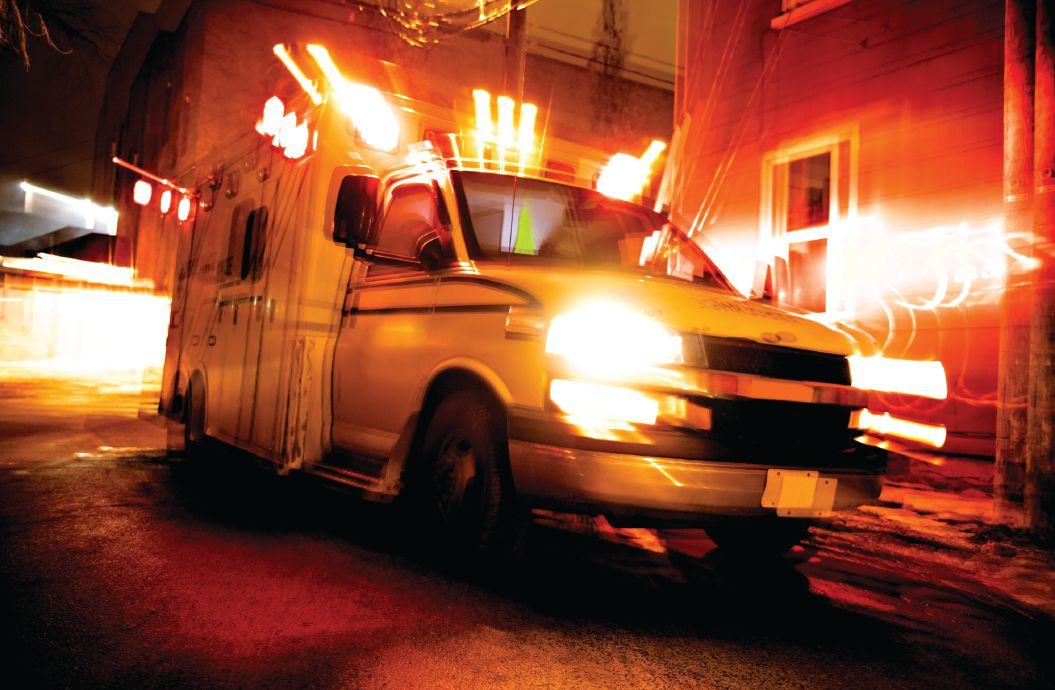
As we move along the continuum of the pandemic, medical calls, ambulance offload delays and how everyone can work better together are driving forward pre-hospital care.
by Laura Aiken
PFAS IN THE MODERN FIRE SERVICE
These forever chemicals are coming under increased scrutiny, and fire industry suppliers are rising to the challenge of reformulation.
by Kaitlin Secord
28 THE KENOW WILDFIRE: A CASE STUDY IN DEFENSIVE FIRE FIGHTING OPERATIONS
Reviewing past Canadian wildfires, and learning from them, has become a staple in the fire service. by Kirk Hughes
BY LAURA AIKEN Editor laiken@annexbusinessmedia.com
CCOMMENT
A worst kind of wait
anada’s healthcare system is struggling, and some regions are reporting significant issues with ambulances waiting at the hospital unable to “offload” their patients to the short staffed and highly taxed hospitals. This was a problem before the pandemic, and a bigger problem during and after. Between Jan. 1 and May 25, there were 526 instances where Ottawa had no available ambulances to respond, sources told CBC News. There were 45 of these “level zero” cases during the same period last year. In early January, Ontario’s Durham region went an hour in “code zero” (no available ambulances), a situation that would typically be more like two minutes, reported Durham’s paramedic chief to news outlets.
truck. Fire Chief Steve Dongworth noted that was “not the purpose” of fire trucks.
An April article in Macleans, “Canadian paramedics are in crisis” by Christina Frangou, noted that the number of 911 calls have been rising for at least a decade. She wrote: “In the past 12 months, cities all over Canada have reported code reds, meaning there are no ambulances or paramedics available to help. Toronto called one in January, and Waterloo, Ontario, called 11 in December alone. Between August 1 and December 6, 2021, Calgary and Edmonton were issuing red alerts every 90 minutes. Nova Scotia’s Standing Committee on Health heard the same story.”
Joe Triff, vice-president of the Halifax Professional Fire Fighters Association, told CTV News its typical for firefighter crews to be waiting for ambulances during medical calls and MVIs, which ties the crew for responding to another call. In May, the Nova Scotia government introduced the Direct to Triage policy that allowed paramedics to leave low-risk patients in the waiting room for further assessment.
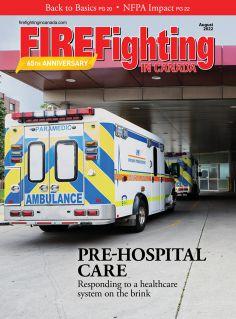
ON THE COVER
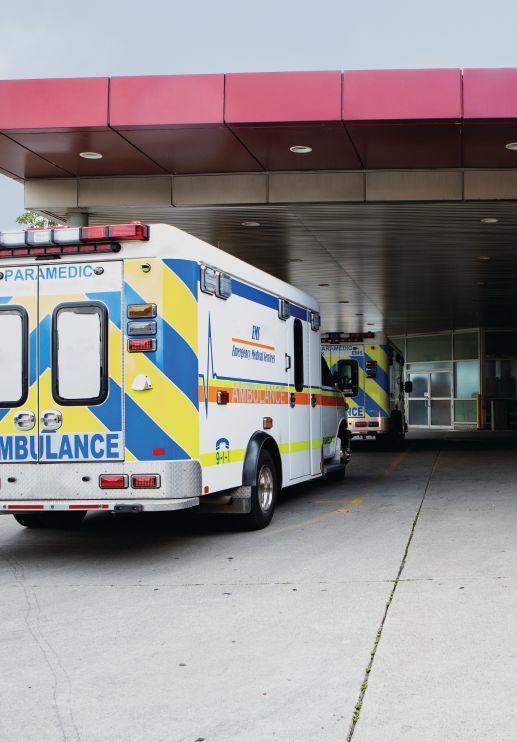
Canada’s healthcare system is struggling mightily, bringing conversations around pre-hospital care and fire response to the forefront. See story on page 10.
In Manitoba in June, Winnipeg FireParamedic Chief Christian Schmidt told city council that response times have increased over the years to approaching 15 minutes, which is nine minutes longer than the six-minute target for life threatening emergencies. This was attributed to staff shortages and a lack of physical ambulances.
Late June in Calgary, firefighters needed to transport a toddler to the hospital via fire
On July 2, CTV News published a round-up of some emergency rooms shutting down entirely, with the chief reason cited as staff shortages.
All of this frankly troubling news means some fire departments are feeling the strain of being on scene longer with limited tools at their disposal. The conversation on pre-hospital care and the fire first responder is a critical one. There is no quick fix or easy solution for the problem of offload delays or staff shortage. Nothing can be solved without communication, and let’s hope the right people in high places are talking — a lot. •
ESTABLISHED 1957
AUGUST 2022
VOL. 66 NO. 5
Reader Service
Print and digital subscription inquiries or changes, please contact Beata Olechnowicz, Audience Development Manager Tel: (416) 510-5182
Fax: (416) 510-6875
Email: bolechnowicz@annexbusinessmedia.com
Mail: 111 Gordon Baker Rd., Suite 400, Toronto, ON M2H 3R1
EDITOR LAURA AIKEN laiken@annexbusinessmedia.com 416-522-1595
Occasionally, Fire Fighting in Canada will mail information on behalf of industry-related groups whose products and services we believe may be of interest to you. If you prefer not to receive this information, please contact our circulation department in any of the four ways listed above.
All advertising is subject to the publisher’s approval. Such approval does not imply any endorsement of the products or services advertised. Publisher reserves the right to refuse advertising that does not meet the standards of the publication.
www.firefightingincanada.com
PHOTO BY ADOBE
STATIONtoSTATION
ACROSS CANADA: Regional news briefs
RECAP: OAFC Conference and Trade Show’s return to live and in person
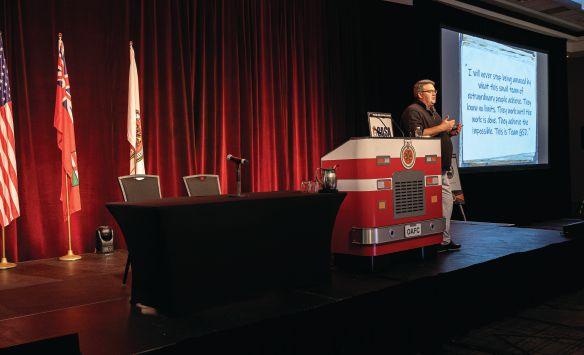
The Ontario Association of Fire Chiefs Conference and Trade show was full of festive spirit as chiefs across the province and beyond enjoyed the opportunity to gather in person again. Almost 3,000 attendees and over 200 exhibitors convened at the International Centre in Mississauga for the event, which ran from May 5 to 7.
“It was great to return to in-person events and the OAFC was pleased to host so many people attending our educational sessions, memorial service, banquet, networking events and trade show. Our relationship with our members, vendors and partners are so key, and the opportunity to see people come back together was incredible. We are already looking forward to our 2023 event!” said Deputy Chief Rob Grimwood, president of the OAFC.
THE
FIRE
HALL BULLETIN
Promotions and appointments
The city of Pickering, Ont., has welcomed STEVE BOYD as their new fire chief. Boyd has 35 years of experience in the fire service, joining Pickering as deputy chief in 2017. He previously held titles of fire captain, training office and deputy chief for the city of Oshawa, Ont.
FRANK LOEFFEN is the new fire chief for the West Nipissing Fire and Emergency Services in Ontario. Loeffen has over 30 years of experience in the fire services, serving the last 18 as chief for the East Ferris Fire Department.
The OAFC show kicked off with a packed room for an opening session on mental health, followed by keynote speaker Michael Landsberg. Landsberg founded, with others, the charitable foundation Sick Not Weak after realizing he could inspire people by sharing his own story of battling severe depression.
Landsberg spoke to a rapt room about his personal story, sharing many emotional messages along the way. His message was clear: If you have depression and anxiety, know that you are not alone. Several fire chiefs in the room showed the vulnerability he acknowledged is necessary in leadership by raising their hand to admit their own struggles with mental health. Although strides have been made, Landsberg said there is still a stigma around mental illness and acknowledging the stigma is the “best way to beat the stigma.”
In another emotionally moving presentation, Bob Ferguson, a firefighter in Uxbridge, Ont., shared his story of operational stress injury after responding to a motor vehicle accident call in which his best friend ended up losing his life. Many firefighters know the fear and reality of responding to calls involving people they are close to, and what it is like to have to attend both the call and the funeral. In the aftermath of his best friend’s death, Ferguson was diagnosed with cumulative PTSD. Ferguson courageous story walked the audience through the realities of his injuries and the steps he took to move forward and heal.
The conference program took a tactical turn with “Reading Smoke” by Philip Jose of Ignition Point Training. The key message of that presentation? Smoke IS fuel! Jose shared several images in an interactive exercise in reading smoke in terms of density, velocity, volume, and colour, and in turn, assessing where the seat of the fire is. In determining this, he said density equals destiny — that’s where
Belleville Fire and Emergency Services in Ontario appointed DON CARTER as deputy fire chief. Carter has been a member of the Belleville Fire and Emergency Services for 30 years. He started his career as a volunteer firefighter in 1992 and transitioned into being a career firefighter in 2000.
In B.C., GREG MCROBBIE has been promoted to assistant chief of operations with the Surrey Fire Service. McRobbie joined the service in 2003 as a volunteer firefighter and became a career firefighter in 2004. His focus is to maintain an engaged workforce that is supported both operationally and individually.
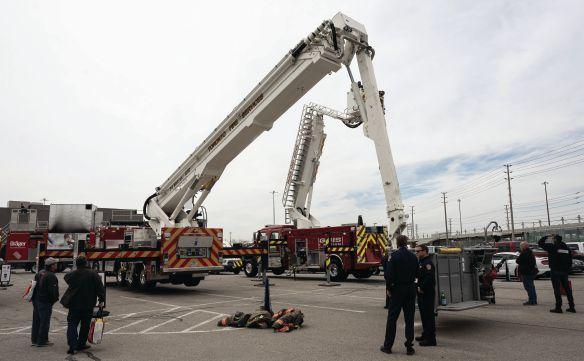
TFS brought their new Bronto Skylift to the show.
PHOTO BY OAFC
the fire is going.
The first day also featured an interactive afternoon “So you want to be a fire chief? Everything you need to know, should have known or could have known” panel. There were also sessions on data analytics for program evaluation and developing a community risk assessment that afternoon.
■ DAY 2
The second day garnered another room at full attention with a keynote by Celina Caesar-Chavannes, a former MP with the Canadian government who now serves as the senior advisor of diversity, equity and inclusion initiatives and adjunct lecturer at Queen’s University. She shared insights from her personal journey and brought her passion for transformative leadership through design thinking, building trust, mindfulness, and empathy. Her DEI talk was less about statistics on why diversity is good for an organization, and more on why being empathetic humans to each other is at the heart of why DEI is so important.
Toronto’s Fire Chief Matthew Pegg followed Caesar-Chavannes’ talk with an insider’s look at his life quarantined in a hotel during the apex of his time as incident commander for Toronto’s COVID-19 response. He shared his personal notes, remarking on the anchors of routine during such isolation, the amazing behind-the-scenes teams he was grateful for, and ultimately the way in which he will be forever changed by the experience.
The trade show opened after Pegg’s talk, and concurrent conference programming included an update from the Office of the Fire Marshal (OFM), a toolkit for including women in the fire service from Fire Service Women Ontario, and sessions on enhancing your community presence digitally, and creating a peer support program.
The last day of the conference featured a keynote by Richard Gaseway on situational awareness, a panel on developing an E&R bylaw, and more time to enjoy the trade show.
Evening events included a Chiefs Welcome Reception sponsored by OnStar on May 4, the OAFC annual fire chief awards sponsored by A.J. Stone Company on May 5, a networking reception sponsored by Hicks Morley on May 6, and the annual OAFC memorial service, sponsored by Open Access and Bruce Power, on May 7.
There was plenty to see and buy on the trade show floor, with impressive displays from the likes of AJ Stone Company, First Alert, Dependable Emergency Vehicles, Canadian Automatic Sprinkler
Retirements
In Ontario, DOUG BARFOOT, is set to retire from his role of fire chief with Owen Sound Fire and Emergency Services after 41 years of service. Barfoot briefly retired in 2015, before returning to fill his role of fire chief. Barfoot received an Ontario medal for firefighter bravery and held several roles, beginning at the Inter Township department in 1980.
After more than 30 years with Yellowknife’s fire division, GERDA GROOTHUIZEN is set to retire from her role as deputy chief. Groothuizen started her career as a volunteer firefighter in 1989, working through the ranks to achieve her current role in 2008.
Association, Commercial Emergency Equipment, Starfield Lion, Hexagon, Rosenbauer, City View Vehicles, and North City Insurance Brokers, to name a few. There were also extrication demos by Jason Defosse of Code 4 Fire & Rescue.
Outside, Toronto Fire Services showcased their new aerial apparatus platform, which is the tallest in North America. The Bronto Skylift 70 metre articulated aerial unit is nicknamed “Tower 1” and can reach about 22 storeys high at full extension. Toronto’s next tallest aerial apparatus can reach 11 storeys.
In the outdoor display area, The Office of the Fire Marshal was hosting tours of one of Ontario’s new mobile live fire training units (MLFTUs). The unit is one of two roaming the province, and at the time of the OAFC trade show, the units had already put 2000 firefighters through training this year.
The new mobile training units are part of the province’s plan to expand and modernize access to fire fighting training with the intent of bringing additional high-quality, hands-on training directly to fire services in all regions.
The OFM will be using the trailer later this year at the OAFC’s FireCon, Sept. 8-10, in Thunder Bay, for a train the trainer program.
With plenty of education, networking, purchasing and sights to see, the 2022 show’s return to in-person was a great success. The OAFC Conference and Trade Show will return May 4-6, 2023, at the International Centre in Mississauga. More on the 2023 show will be available from the OAFC soon.
JIM DONOVAN has retired after 43 years of service with the Elizabethtown-Kitley Fire Department in Ontario. He joined the fire service in 1979 and became fire chief in 1990. Donovan has been provincially and federally recognized with medal and service bars and was the recipient of a Canada 150 medal.
Last alarm
Retired Fire Chief ROSS POOLE passed away in April. He was a member of the fire service in Roseneath, Ont., from 1966 to 2011, when he retired. Throughout his career, he served as a firefighter, deputy chief, fire prevention officer and fire chief.
Chief Matthew Pegg spoke on the “COVID cave”
PHOTO BY OAFC
STATIONtoSTATION
BRIGADE NEWS: From departments across Canada
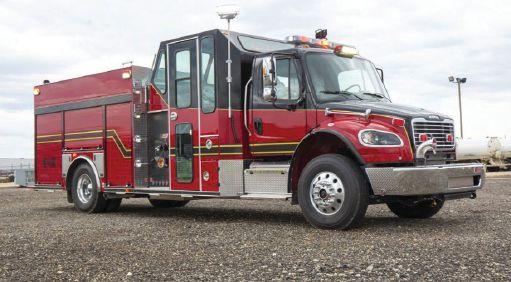
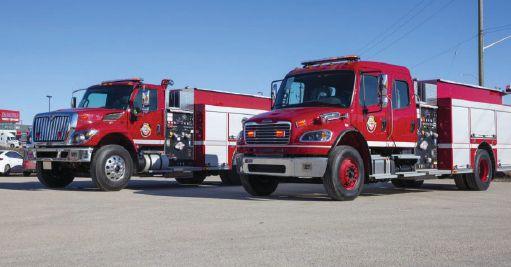
Dokis First Nation in Ontario has taken delivery of a pumper tanker from Fort Garry Fire Trucks. Manufactured on a Freightliner M2 chassis with an ER 4Man Crown body, this vehicle features a Hale QMax 1500 pump and a Co-Poly 800 IG tank.
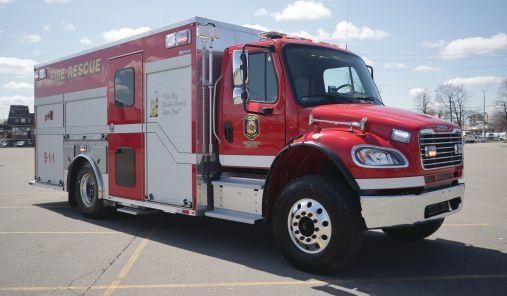
Temiskaming Shores Fire Department in Ontario has taken delivery of a custom designed and built walk-in rescue vehicle from Dependable Truck and Tank Limited. It features 12 bunker gear storage compartments, four FRC Spectra lights, an Irwin Air CS-2 cascade system and a 15kW Cummins Onan generator.
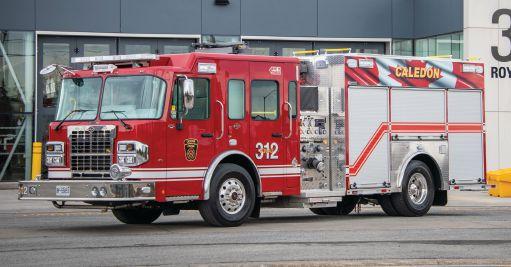
Caledon Fire and Emergency Services in Ontario received a custom-built Dependable Truck and Tank Limited pumper. Built on a Spartan Metro Star LFD chassis, the vehicle features a tank ladder and pike pole storage, custom built stokes baskets tunnels and adjustable shelves and tool boards. It also includes an 800 USG water tank, 30 USG foam tank and a Hale QMAX 7000 LPM pump.
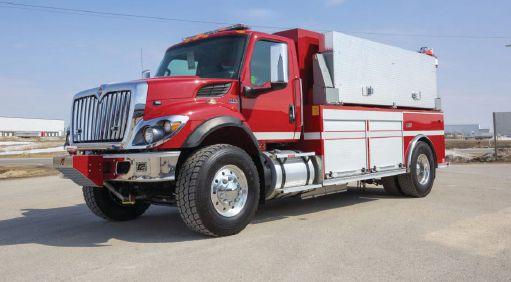
The Municipal District of Ghost River in Alberta has taken delivery of a Crusader tanker from Fort Garry Fire Trucks. Built on an International HV607 chassis, this vehicle also features a Hale Sidekick APS pump and a Co-Poly 2000 IG tank.
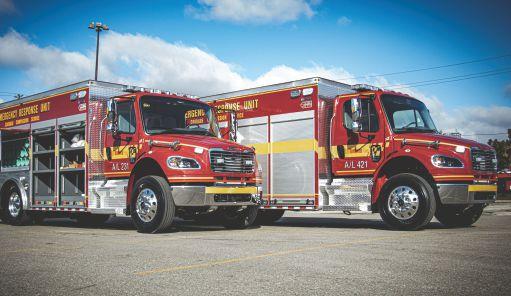
Toronto Fire Services has taken delivery of two air light vehicles from Dependable Truck and Tank Limited. Built on a Freightliner M2 106 cab, these trucks can carry up to 125 SCBA bottles and 12 O2 bottles. They also feature a FRC inView 360 video system, Harrison 20,000kW generator and a Waltco tailgate lift gate.
Lac Suel First Nation, located in Hudson, Ont., has taken delivery of a Crusader pumper from Fort Garry Fire Trucks. Built on a M2 Freightliner chassis, the vehicle also features a Darley LDM1250 pump and a Co-Ploy 800 IG tank.
TEMISKAMING SHORES FIRE DEPARTMENT
DOKIS FIRST NATION
CALEDON FIRE AND EMERGENCY SERVICE
MUNICIPAL DISTRICT OF GHOST RIVER
TORONTO FIRE SERVICES
LAC SUEL FIRST NATION
Pre-hospital care
How a struggling healthcare system is fostering conversation, challenges and collaboration in the fire service
By LAURA AIKEN
Ambulance response times are increasing in several regions for a number of reasons, including offload delays and a shortage of staff and physical ambulances.
Medical calls making up an increasing share of fire department response is far from a new conversation, but circumstances brought on by the pandemic have brought both new challenges and new collaboration to the forefront.
Chris Harrow, director of fire services for the Town of Minto and Township of Wellington North in Ontario, and co-columnist of this magazine’s Leadership Forum, said that ambulance delays mean remaining on scene longer and being first on scene a lot of the time. This is adding up to more patient care than some departments are used to. Harrow, who was a paramedic for 13 years,
said it’s well-accepted that the paramedics are the medical experts, and when the crew is on-scene for 10 to 15 minutes waiting for the ambulance and doing a lot more than they usually do, they may not be ready to handle all that entails. In the full-time career world, it’s taxing resources with increased response and time on scene. For volunteers, it’s adding to the call line and this volume is taking the volunteer away from work more often and for longer.
In his region, Harrow saw the problem of offload delays building over time, with the pandemic acting as an accelerant. In the City of Guelph, it’s possible to have six or seven ambulances waiting to offload, he said. Ambulances from smaller areas are
PHOTO BY ADOBE
being pulled in to run city calls, which then means longer response times back to the rural areas. When this happens, the volunteer fire department gets tiered to respond and perhaps it’s a call they wouldn’t even normally attend, but they need someone on scene until an ambulance is freed up. But, firefighters are limited in what medical care they can do. They are trained to help; paramedics are trained to be the medical professionals. The strain of doing the best they can with what tools they have, and under the legislative limitations they work under, has an impact on mental health, said Harrow. On the question of whether fire departments can better prepare firefighters for the mental health demands of medicals calls, there is no easy answer. There are ways to pre-screen candidates, but the science is all new and evolving fast. You can give mental health training, but he said it’s hard to know how someone will really react until they are faced with the real thing.
“The real thing is different than a simulation. People around you are screaming, and the scenes are chaotic. Hard to simulate that in a lab.”
How you can prepare, he said, is by ensuring the frequency of your medical training is adequate and that supplies are well stocked, although he said that is not a magic solution as anytime you have an increase in something that is the common reaction. But, he noted, it sure helps to have a great relationship with your local paramedics.
Harrow has established relationships that have improved working partnerships in his region. Police, fire and paramedic management meet jointly once a month to let each other know what’s happening in the area. They take opportunities to train together, with paramedics walking firefighters through the ambulance so they know where items are should firefighters need to assist, and vice versa, firefighters can walk paramedics through hazmat scenarios. Harrow sees emergency management as the fourth partner, and the four groups have an interoperability day at least once a year where they bring in speakers from each of the three services to present on different topics. Beyond the practical, the three agencies share one huge commonality.
“The one thing that can draw all the agencies together is the mental health piece. The more you can use your allied resources to help everybody, it just makes sense to me. It’s the same tax dollar at the end of the day going toward this, so you might as well share the resources and work together on it.”
■ COLLABORATING AS A PROVINCE
In B.C., Dan Derby, the fire chief for Kootenay Boundary Regional Fire Rescue and president of the Fire Chiefs’ Association of British Columbia, is part of a pre-hospital care committee that is working towards a collaborative approach with local community agency. The fire first responder relationship with BC Emergency Health Services (EHS) has reached a positive turning point.
“We are having conversations with the Ministry and BC EHS that weren’t happening before right at the leadership level...How can we affect positive change for pre- and out of hospital care? That’s the goal. And we’re all trying to leave some of our history at the door and deal with our issues. We’re the most optimistic we’ve ever been about affecting change and in our involvement in the delivery of our hospital care from a fire first responder perspective.”
At the start of the pandemic, a pre-hospital care committee was formed to manage the response and pandemic changes instituted by Dr. Bonnie Henry. This committee brought together key players such as BC EHS, the Ministry of Health, Fire Commissioner, First Nations’ Emergency Services Society of British Columbia and the
Patient Voices Network. The first six months were dedicated to pandemic response. Prior to the pandemic, an auditor general’s report on pre-hospital care was released that identified several areas BC EHS needed to focus on and tasked the Ministry of Health with working with local governments and BC EHS to ensure a coordinated approach to pre-hospital care that resulted in medical oversight. An important piece was sharing signed agreements and confirmation that first responders were being dispatched to the right events.
After building a foundation of working together, the pre-hospital care committee transitioned from the pandemic to focusing on the auditor general’s report. Around the beginning of this year, a draft discussion paper was completed by the groups dealing with four different areas. The first responder agreement was an outcome of the other three areas, from the group’s perspective, so now they are in the middle of consultation with the fire services, CEOs and local governments across the province, said Derby. A facilitator was hired to ensure consistent delivery and consultations were done in zones to create opportunities to meet. Six consultation sessions were planned with a schedule to wrap at the end of June, after which the committee will spend the next couple months going through feedback. The work with the pre-hospital care committee is aligned with the position paper on local community choice.
“The position paper comes down to community choice – advocating that at the local community level, it’s up to you the level of care you want to provide. Being careful not to propose that everybody wants a new bar, up or down. We have communities that want to provide a higher level of care, but there are also communities talking about a lower level of first responder care in their communities –
Ambulances from rural areas are running city calls, leading to longer response times in the rural zone.
with the challenges of long wait times and those sorts of things, their members aren’t interested in doing those types of calls.”
“It feels good. It feels like we’re making progress. It’s been a ton of work. Between the pandemic and the pre-hospital care conversation, I probably spend half my time in my role as president of the association in that conversation. It’s crazy to think, but it’s also a big piece of the level of service most communities provide, so it warrants it…At the end of the day, if we’re able to assess and release as an industry, in the pre-hospital care continuum, what we’re going to do is free up resources on both ambulance and fire department side to attend the calls we need to attend – the higher acuity calls – and what we have now is overuse of the 911 system for calls that don’t work going to the emergency room. As a group we’ve built the foundation that will allow us to have those conversations and work together to make sure we’re sending the right resources to the right calls together.”
Derby noted that they are in no way coming up with the solutions and fixing the problems in the province today. It’s all a work in progress, and the open dialogue is breaking down silos so the groups can work together to develop solutions moving forward. Derby expects that coming out of this, there will be clear expectations on training and licensing requirements that a community can commit too.
“Relationships have been built and are starting to be normalized from the perspective that we can just pick up a phone and have a conversation that we never used to be able to have. That’s pretty excellent in itself and speaks to the commitment to change to support the level of risk communities want to meet.” •
PHOTO BY ADOBE STOCK / RAY AKEY
BY MATTHEW PEGG Fire Chief Toronto
TLEADERSHIPFORUM
The snake pit
oday, perhaps more than ever, fire service leaders must be highly skilled and capable at presenting reports and information in a public forum and in responding to questions in an efficient and effective manner. This is certainly true for fire service leaders who must present information, deliver presentations, and respond to questions from their local mayor and council.
Responding to questions during a council meeting can be very challenging. The stakes are often high and the need to be able to deliver accurate and factual responses in a clear and concise manner is critical to the success of whatever recommendation is being discussed.
There are certainly times when reading from prepared remarks is both acceptable and appropriate, including during formal press conferences and when delivering formal remarks as part of a ceremony. However, trying to respond to questions in a council meeting by reading from a script is certainly not one of those times.
Achieving the trust and confidence of those whose questions you are responding to demands that you provide thoughtful, accurate and specific answers to questions in a reasonably articulate and efficient manner. Unfortunately, that can seldom be achieved by reading a canned response.
I find it surprising how many fire service leaders, despite fully understanding the importance of a particular report, or knowing in advance that the subject matter at hand is likely to generate a significant number of questions, fail to intentionally prepare to respond to questions in advance.
If you were to peruse my work calendar, you would find a number of scheduled meetings entitled “snake pit”. This rather ominous sounding appointment appears quite frequently in our calendars and is one of the processes that my team and I use to ensure that we are fully prepared for whatever report or presentation is upcoming.
things get interesting in the snake pit. The rest of the team then take turns peppering the presenter with every obscure, difficult, sensitive, problematic, and uncomfortable question that they can think of. In each case, the spokesperson must respond directly to each question that is asked.
The goal of the snake pit is to have the spokesperson face and consider as many challenging or awkward questions, concerns, or rebuttals as possible, to ensure they are well prepared to respond effectively to the questions that may come during the real meeting.
Nothing is off limits during a snake pit; in fact, the more challenging and obscure the questions, the better. Admittedly, it can be very awkward to be put on the spot like this by your colleagues, and perhaps even harder to be the one putting your teammate in this kind of position, but it is vitally important that it happens.
During the snake pit, it is common for questions to be asked that expose the need for additional information or for some additional preparation in order to ensure that we are able to answer those questions effectively when the pressure is on.
In my experience, to fully prepare to answer questions, you must
Nothing is off limits during a snake pit; in fact, the more challenging and obscure the questions, the better. ‘‘ ’’
A snake pit begins with the spokesperson for a particular report or presentation actually delivering their presentation to a team of people assembled for this purpose, in live time, and in the exact manner in which they intend to do so. My snake pit meetings generally include a handful of senior officers, along with those who have particular subject matter expertise in the topic at hand.
Once the spokesperson has completed their presentation is where
Matthew Pegg is the chief with Toronto Fire Services, having previously served in Georgina, Ajax and Brampton, Ont. Contact Matthew at matthew. pegg@toronto.ca and follow him on Twitter at @ChiefPeggTFS.
actually listen to yourself voice your answers out loud. It is only then that you will identify opportunities for improvement in areas such as wording, tone, inflection, and even accuracy of information. This is often the only way that you will become fully aware of any questions or subject matter that might be especially challenging for you to speak to.
By the end of well-run snake pit session, the spokesperson will have faced the most challenging questions and will have responded to them effectively. This is a huge confidence builder that sets us up for success when this subject matter will be formally debated.
I encourage you to implement the snake pit process in your team’s preparation process to set yourself up for the best possible performance when it counts.
•
PFAS in the modern fire service
PFAS, while effective, are coming under increased scrutiny.
By KAITLIN SECORD
er- and polyfluoroalkyl substances, or PFAS for short, are a group of over 4700 human-made substances that are frequently used as lubricant and repellents. Known as forever chemicals, they can be found in fire fighting foams, textiles, cosmetics and in food packaging.
PFAS have been produced since the 1940s. In the 1950s, 3M began manufacturing products that used two types of PFAS — PFOA and PFOS — to create products like Scotchgard. 3M also helped to develop Aqueous Film Forming Foam (AFFF), which is used to fight complex liquid fuel fires.
AFFF, while effective, is increasingly coming under scrutiny due to concerns around negative impacts on the health and safety of people and the environment.
According to Order 2021-87-04-02 Amending the Non-domestic Substances List regarding the Canadian Enviornmental Protection Act, 1999, well-studied PFAS are environmentally persistent, meaning they do not degrade easily “under normal conditions and within organisms,” and they are associated with a range of adverse effects on the environment and human health. Exposure to certain PFAS have been linked to reproductive, developmental, liver, kidney and immunological effects.
In Canada, risk management actions for PFOS, a type of PFAS, were put in place in 2008. Since 2016, manufacturing, using, selling or importing certain types of PFAS (PFOS, PFOA and LC-PFCAs) was prohibited, with a few exceptions, under the Prohibition of Certain Toxic Substances Regulations, 2012. The Canadian government evaluated the risks of particular PFAS in 2006 and 2012. PFOS, PFOA and LC-PFCAs were found to be toxic to the environment and were added to the List of Toxic Substances, under Schedule 1 of the Canadian Environmental Protection Act 1999.
Order 2021-87-04-02 notes that, in a global context, PFAS have been found in increasing intensity in environments that are close to or downstream from “point sources”, which includes manufacturing plants and sites where fire fighting foams have been used.
Order 2021-87-04-02 also notes that in Canada, a significant portion of PFAS contamination comes from the use of fire fighting foams, whether to extinguish fires or from use during training and testing.
But is there a solution for contamination when it comes to fire fighting foams?
David Ash, product director for foam for Johnson Controls, commented on the future of non-fluorinated foams.
“Non-fluorinated foams are gaining momentum in the fire service market. Departments and municipalities are seeking them out because they don’t want to handle all that comes along with fluorinated
In Canada, a portion of PFAS contamination comes from the use of fire fighting foams.
chemistry. Technology [of non-fluorinated foam] is improving so performance is comparable to traditional foams.”
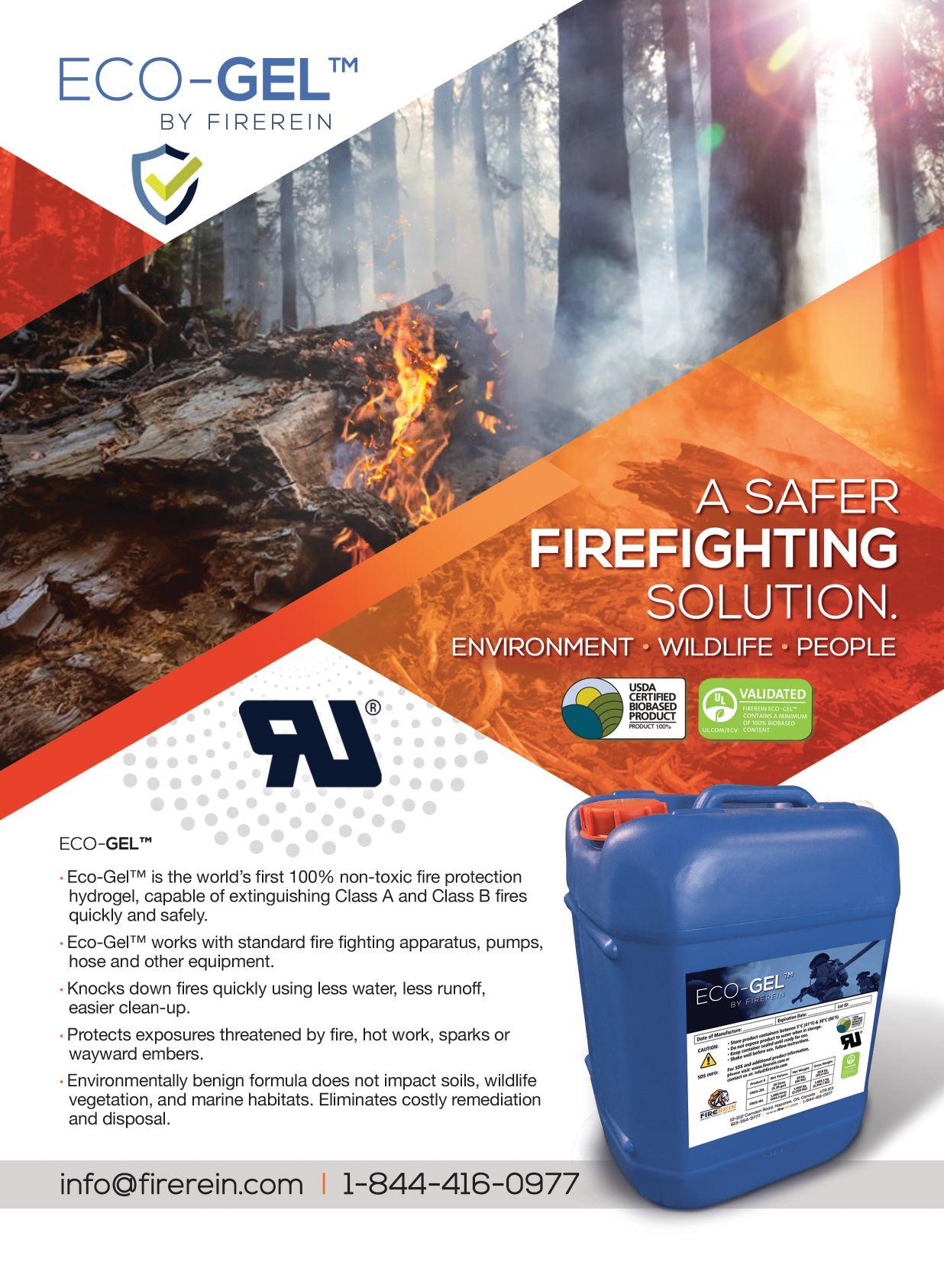
David Hyndman, chief science officer at FireRein, Quincy Emmons, president and co-founder of FireRein, and Zackery Hodgen, vice-president and co-founder at FireRein, spoke with Fire Fighting in Canada’s editor Laura Aiken about their Eco-Gel product and what it brings to the table as an eco-friendlier and health-conscious choice.
“I liken PFAS to asbestos and cigarettes. There was a lot of denial about how bad they were until the science started to come out,” said Hyndman. “That’s why we are working on a viable alternative that avoids the use of these chemicals.”
Ash said that even products like eco-gels and other non-fluorinated foams “are still chemicals and should be treated as such.”
“The safety data sheet tells you, regardless of the foam, to use the proper PPE,” said Ash. “I would never describe a chemical as safe but with proper handling, non-fluorinated foams can be just as effective and more readily disposed of.”
OCTOBER 9TH-15TH, 2022
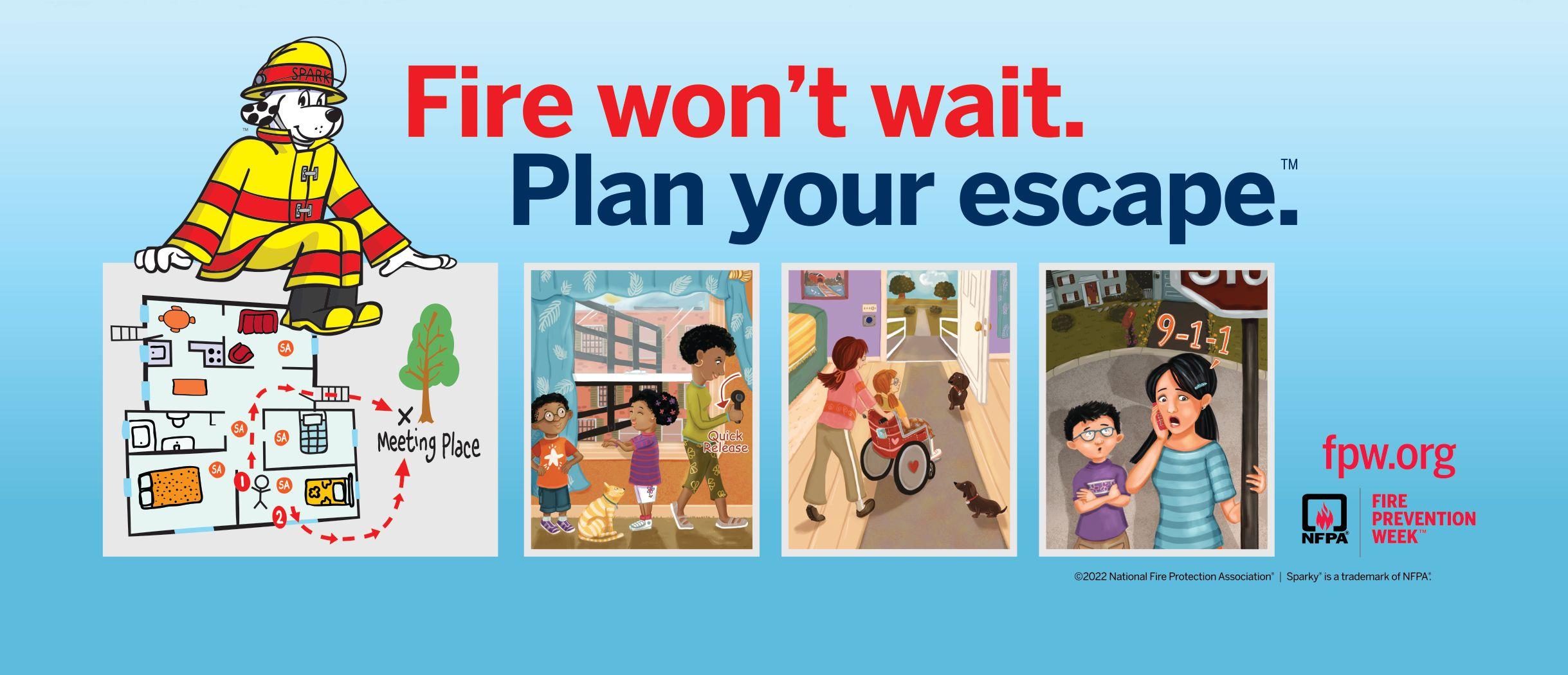
This year’s FPW campaign, “Fire won’t wait. Plan your escape™”, works to educate everyone about simple but important actions they can take to keep themselves and those around them safe from home fires by developing and practicing a home escape plan.
Today’s homes burn faster than ever. You may have as little as two minutes (or even less time) to safely escape a home fire from the time the smoke alarm sounds. Your ability to get out of a home during a fire depends on early warning from smoke alarms and advance planning.
SPARKY THE FIRE DOG® PRODUCTS
• NEW Tattoos (4 designs per pkg.)
• NEW Water Bottle Waterproof Stickers
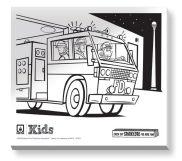
• NEW Fire Truck Colouring Pad
• Colouring/Activity Books
• Crayons, Pencils, Stickers
• Fire Hats
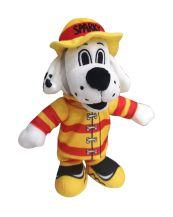
• ….and the popular Sparky Stuffy
LOTS MORE AVAILABLE
• School Items & Handouts
• Tattoos, Water Bottles,
• Kitchen & Bath Items
• Kids Turnout Gear
• Stuffies and More!
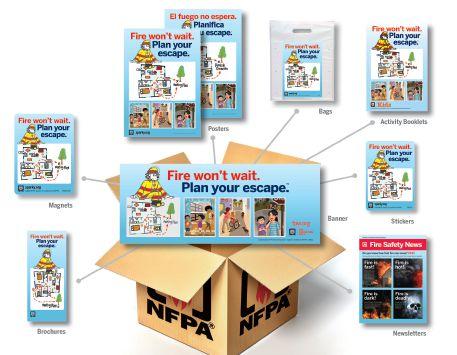
FIRE PREVENTION WEEK IN A BOX
This top-selling value pack for groups of 100, 300 or 500 has everything you need to engage your community this October and throughout the year. Having the right handouts and giveaways are sure ways to increase engagement and help get your messages out far and wide. The products in the FPW in a Box™ are bright and colorful, easy to read and understand, and feature everyone’s favorite, NFPA mascot, Sparky the Fire Dog.®
KIDS FIRE HATS
• Stock and Custom available.
• Ask us about putting your logo on a custom hat!
The tenets of VES BACKtoBASICS
BY MARK VAN DER FEYST
On the fire ground, when responding to a residential structure fire, the fire service resorts to tactics to accomplish important tasks and priorities. Just like a football coach who has a play book with different set ups, plays and calls for the game, the fire service has a tactics book.
One such tactic is VES or VEIS – even though they are different by a letter, the two are the exact same thing. The original term is VES and through time, with some contribution from other people, VEIS was adopted.
VES stands for Vent, Enter, Search and VEIS stands for Vent, Enter, Isolate, Search. For this article, I am going to use the term VES - let us look at the tenets of what VES is and how it can be used by any fire department. Firstly, VES is “a” tactic but not the only tactic. Fire departments and firefighters cannot rely on only one tactic as the be all, end all. When new tactics are introduced, people seem to rely on them as the only one to use – but the opposite is true. The one tactic is added to the others so that when arriving on scene, the appropriate tactic can be selected and deployed. Firefighters cannot rely on VES for every situation – although it is very versatile and adaptable to be used.
VES is a tactic that is designed for staff limited situations. VES works best with two firefighters. Having three firefighters on a team performing this can be done, but it becomes crowded in the room and with the sequence of operations. Many smaller fire departments will respond with two firefighters on an engine and will find themselves struggling to keep up with limited hands available. If the engine has four firefighters arriving on it, the team can be split into two teams of two to perform this.
This tactic is also designed and meant to be used by the first arriving unit on scene. The goal of VES is to perform a rapid rescue of an occupant. This rapid rescue will and must occur in the first five minutes of arriving on scene. The greatest chance of survival for the
occupant is going to happen within this window of opportunity. Any delay in the rescue after the first five minutes could be detrimental to the occupant.
One of the key aspects of VES is the known location of the occupant within a room of the structure. This will be based upon witness statements from other family members, neighbours or even the occupant themselves calling 911. Having a witness state that there is a person in a particular room is going to verify
the presence of that person and validate the need to use VES to perform the rapid rescue. Neighbours will most likely know the habits or schedules of the occupant, so they can identify if they will be home or not. If they are home, the neighbour may be able to point out which room the occupant is in.
VES works best with a known location of the occupant – this part also includes knowing building construction and being able to read a building. If we are told that a person is still in
VES is designed and meant to be used for a single room only. It is a search of a single room and not the entire floor of the structure.
their bedroom, but they don’t know which bedroom it is, the firefighter needs to be able to identify where the bedrooms are in the house by reading the building. Window locations and types are going to assist with this along with the number of stories the house has. Many occupants are found in their bedrooms on the floor by the bedroom door, the window or in their bed.
Occupants that are still in the structure need to be viable for rescue. What this refers to is the amount of time exposed to the conditions and the extent of the conditions in relation to their location. Sizing up the fire and the building will play an important role in the decision to use VES. The fire conditions of the structure and the location of the fire will dictate if the occupant will be able to survive the exposure. If the room in question is fully involved with fire and self-venting out the window, any occupant in that room will not be viable for rescue as opposed to a fire in a room next to or below the occupant’s room.
Lastly, VES is designed and meant to be used for a single room only – it is a search of a single room and not the entire floor of the structure. If a primary search takes place by entering a window and then searching the entire floor, this is not VES. Entering by the window and searching only the room in question is VES – this tactic is an assistant to the primary search.
Many fire departments are still considering whether to include VES as part of their tactics play book. Hopefully this information will assist in their decision to adopt this tactic. In our next issue, we will explore the practical portion of this VES. •
Mark van der Feyst has been in the fire service since 1999 and is currently a firefighter with the FGFD. Mark is an international instructor teaching in Canada, U.S. FDIC and India. He is the lead author of Fire Engineering’s Residential Fire Rescue & Tactical Firefighter books. Contact him at Mark@ FireStarTraining.com
One of the key aspects of VES is knowing the location of the occupant within a room of the structure.
PHOTO BY ADOBE STOCK / FRAMESTOCK
BY LAURA KING NFPA Regional Director Canada
ANFPAIMPACT
Celebrating 100 years of Fire Prevention Week
s is always the case, the theme for Fire Prevention Week 2022 is based on science and data: Fire won’t wait. Plan your escape.
In May 1919, at NFPA’s 23rd annual meeting in Ottawa, at the invitation of the Dominion Fire Prevention Association, resolutions were passed urging governments in the United States and Canada to support a campaign for a common Fire Prevention Day.
Fire Prevention Day expanded to Fire Prevention Week in 1922, and the non-profit NFPA, which has officially sponsored Fire Prevention Week since its inception, selects the annual theme.
One hundred years ago, solid furnishings and construction burned slower than the plastics, synthetics, and lightweight products in homes today. Occupants had time to escape if they were alerted to smoke or fire.
Now, with as little as two minutes to get out of a burning building before the circumstances become untenable, it’s critical that everyone in the home – including guests – knows and has practiced a home fire escape plan at least twice a year.
The National Fire Protection Association’s messaging and resources for this centennial Fire Prevention Week consider all types of homes, and all types of occupants: single family, townhomes, apartments, hotels and motels, campers and RVs; adults, older adults, children, people with mobility challenges and those who are deaf or hard of hearing. The images feature diverse populations and urban and rural settings.
You’ll recognize some of the FPW images from NFPA’s long-running Learn Not to Burn program, which was established in 1979; its messages about smoke alarms and escape plans remain accurate and are based on NFPA’s Educational Messages Desk Reference – from which all public-education programming and materials are derived.
Learn Not to Burn lessons:
• Different homes have different plans. Know what to do and where to go if there is a fire.
• Have a home fire escape plan for everyone in your home. Some people may need help waking up or getting outside. Plan for your abilities!
• Protect your loved ones. Plan your home fire escape.
• Have an outside meeting place a safe distance from your home where everyone should meet. Call 911 or the fire department from outside your home.
• Have a clear path to your exits.
• Knowing two ways out of every room is an important piece of your home fire escape plan.
You can download the social cards for Twitter, Facebook and Instagram, and other materials from NFPA’s dedicated Fire Prevention Week website, www.fpw.org (or www.firepreventionweek.org) a onestop resource centre for fire departments and other organizations such
Fire Prevention Day expanded to Fire Prevention Week in 1922, and the non-profit NFPA, which has officially sponsored Fire Prevention Week since its inception, selects the annual theme.
’’
You’ll notice that some messaging for Fire Prevention Week 2022 is a bit more direct than usual – we’ve customized the messages for today’s social-media savvy audiences who are used to, and have come to expect, no-holds barred posts.
For FPW 2022, NFPA has developed three sets of messages and social media cards.
The first series of three social media cards features clear, direct language, and bold images of fire and smoke: Fire is FAST! Fire is DARK! Fire is HOT!
We’ve also maintained our popular “Be like Bill” messaging. The third set of six social media cards features messages that build on
Laura King is NFPA’s regional director for Canada. Contact her at lking@ nfpa.org. @LauraKingNFPA.
as schools, daycares, and community groups planning FPW activities or events, virtually or in person.
There are two key tabs at the top of the FPW website: About, and Toolkit.
The About section features NFPA’s step-by-step escape planning video – suitable for all ages and audiences and our history of FPW video, a must-see!
There are lesson plans at www.fpw.org to help fire departments, schools and community groups plan FPW presentations for children, adults, and older adults.
Watch for NFPA’s FPW social media posts, and be sure to use the hashtag #FirePreventionWeek. Follow @sparky_fire_dog and @LauraKingNFPA. •
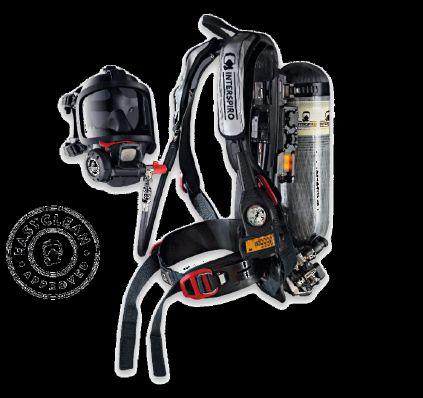
CANADIAN SAFETY EQUIPMENT IS PROUD TO BE A DISTRIBUTOR FOR THE INTERSPIRO RESPIRATORY PROTECTION LINE. THEIR STATE OF THE ART S9 INCURVE IS ONE OF THE MOST COMFORTABLE SCBAs YOU WILL EVER WEAR.
GIVE US A CALL AT 0182 OR EMAIL US AT INFO@CDNSAFETY.
No company has a richer history in respiratory protection than . Their innovations have become industry standards, time and
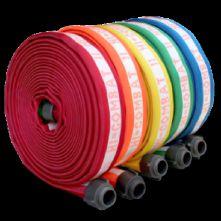
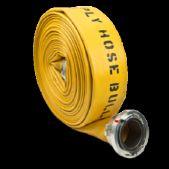
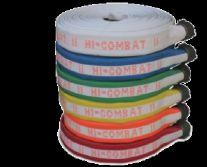
BullDog Hose Company (formerly ANGUS hose) proudly designs and manufactures industry-leading firehoses that are unmatched in quality and performance. Hundreds of North American fire departments depend on BullDog to get the job done safely and efficiently.
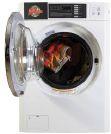
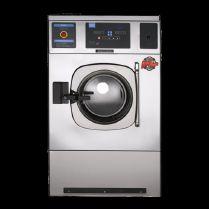
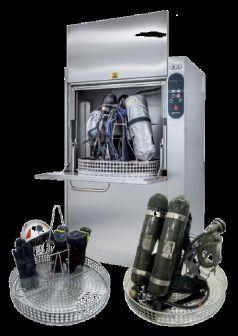
The Solo SCBA Decon/Washing machine was designed and built for one purpose only…to protect Fire Fighters from Cancer causing agents found in the Smoke and residue left on their SCBAs. As an added bonus it can clean Gloves, boots and Helmets. In addition it substantially lowers the time spent decontaminating firefighter equipment.
WASH/DECON TWO SCBAs IN 8 minutes
NEW PRO-S
SCBA DECON WASHER
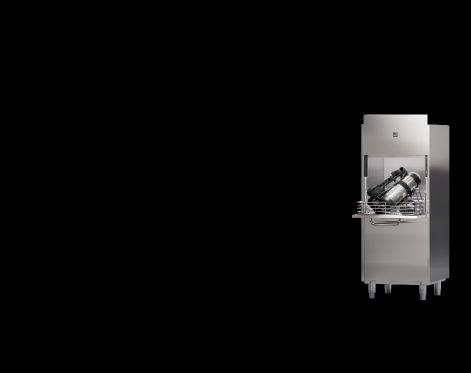
Rescue Intellitech introduces their newest SCBA Decon Washer, the compact PRO -S
Designed to Wash/Decon a single SCBA at a time, it can also wash/decon boots, gloves and helmets.
This new model only uses 220 VAC single phase and requires less than 20 amps to operate.
Like its bigger brother, the PRO -S doesn’t require filters or specialized water treatment, making it the lowest cost SCBA Decon Washer to purchase and operate on the market.
For user references near you please feel free to give us a call at: 1-800-265-0182.
Low Power use. Minimal moving parts. Lowest maintenance and operation costs
TRAINER’SCORNER
We learn from what we honour
By ED BROUWER
Where does the time go? Nearly 22 years have passed since I wrote my first Trainer’s Corner column. I am so very grateful to have been allowed this incredible opportunity. Being the training officer for Joe Rich Volunteer FD in B.C., I found it difficult to juggle family, a job and life while having to research, study and prepare 40-some-odd training sessions a year. I approached Jim Hailey, then editor of Fire Fighting in Canada, with the idea of providing help to the nation’s volunteer training officers through the magazine. He agreed to give it a shot, and Trainer’s Corner was birthed. My first column was “Communications”. I had no idea that one column would turn into over 100 contributions and multiple invitations to instruct in person.
In 1998 at age 45, I successfully met the B.C. Fire Fighter Standard (Justice Institute of B.C.). Five years later I achieved NFPA 1001 certification. I am proud of my accreditations, as I am sure you are of yours, but they don’t automatically make you an instructor. The instructor role was a steep learning curve.
We didn’t have the Internet back then, at least not in the same way we have it today. Research for training sessions was done through reading books, making notes, watching VHS tapes, and making more notes. I must take a moment and thank my then Fire Chief Brian Morris (RIP). Chief Morris believed in me and pushed me to excellence. He sent me to every FD instructional course held in B.C.; including the Firefighter Assist and Survival Tactics (F.A.S.T) course put on by North Vancouver FD.
Being part of B.C.’s First Responder Program as an instructor / evaluator was a tremendous help in learning how to instruct. Much of that information was at one time or another shared through this column.
unprecedented urban interface wildfire year. I had the honour of speaking with each of their families and later took part in what I believe was the first LODD ceremony held by B.C. Forestry.
One of my favorite life statements is, “What man is a man who does not make the world he lives in better.” This statement provided guide posts and gave me a sense of purpose. I admit I’m a fixer — I have a “rescue mindset” — that is why I’m a training officer. I would spend multiple hours poring over firefighter fatality reports, trying to see what caused the LODD, and then I would try and “fix it”.
However, I believe the turning point in my training style took place in 2004. It was on March 29 when Clearwater volunteer firefighter, 23-yearold Chad Schapansky, lost his life in an abandoned structure fire.
I have no trouble remembering this date, for it is my birthday, and I will have no trouble remembering this young man because of what I felt at his funeral. Hundreds of firefighters stood outside in formation facing the small chapel where Chad’s body lay, and his grieving family and
There is great value and honour in using LODD events to instruct, whether we learn what to do or what not to do, it doesn’t matter as long as we learn something. May no firefighter’s death be in vain. ‘‘ ’’
Trainer’s Corner has always been written in the first person. My closing tag line for most of these years has been, “Train like lives depend on it, because they do.” This is referring to you and your members, not the general public. You see, I am passionate (some say driven) about firefighter safety. There is an old saying: “The best thing that an old firefighter can teach a young firefighter is how to become an old firefighter.”
They tell me I can be tough, but to be honest, even as I type this column I’m getting choked up, wondering if I’ve made a difference. I am sadly aware that my circle of concern is bigger than my circle of influence.
Throughout my career as a firefighter, my faith in God has been my strength. I am humbled to think I was given the honour to speak at several 9/11 memorial services. Two years later, in 2003, we (the BC Wildfire Service) lost three firefighters (Ian, Eric and Ben) during an
friends gathered. Right behind us was the burned out long abandoned restaurant he lost his life in.
“We may risk our lives a lot to protect savable lives…We may risk our lives a little to protect savable property ...We will not risk our lives at all for lives or property that are already lost,” kept playing through my mind. (Risk Management NFPA 1500).
His tragic death made no sense to me. Why did Chad have the only radio? His partner had to use his cell phone to call 911 to tell the FD that they were in trouble. Why were they in the building in the first place? I vowed to do all I could to ensure firefighters got to go home after each call.
Once the investigation of Chad’s death was published, I studied the reports, giving careful consideration to the floor collapse that trapped Chad, who sadly ran out of air before being rescued. My sons, both firefighters, and I developed a two-story hands-on training prop (com-
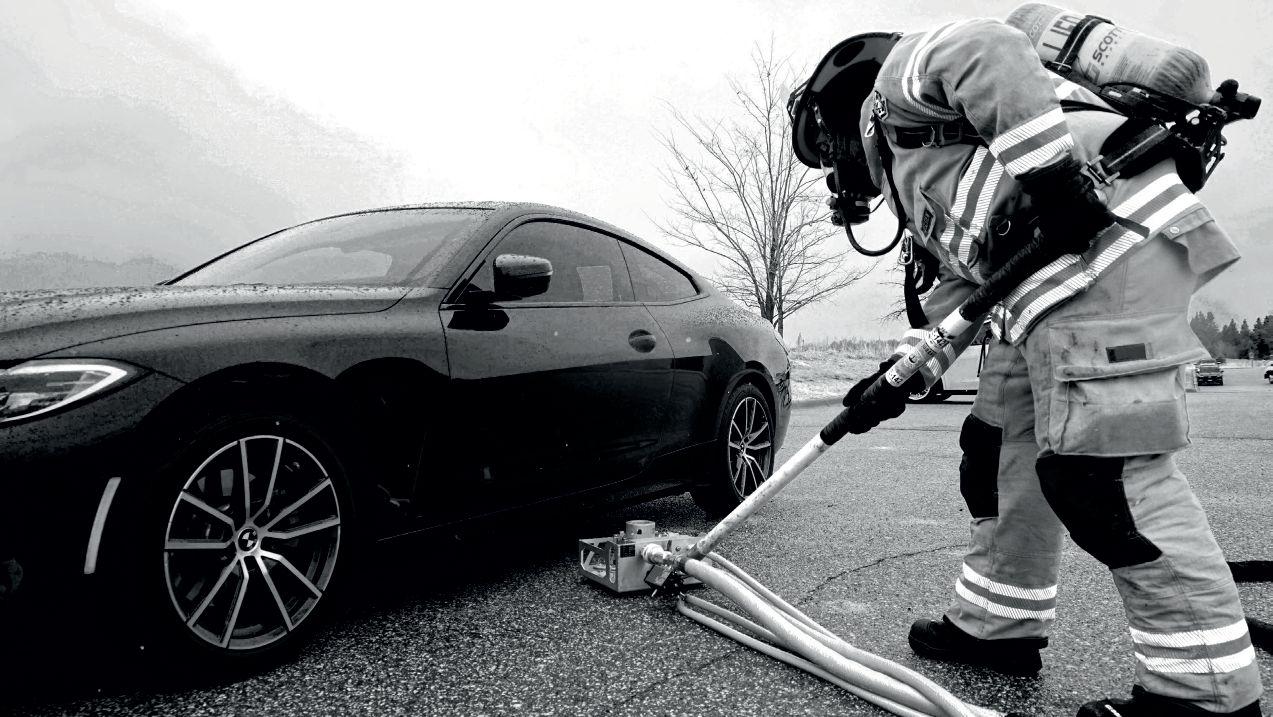
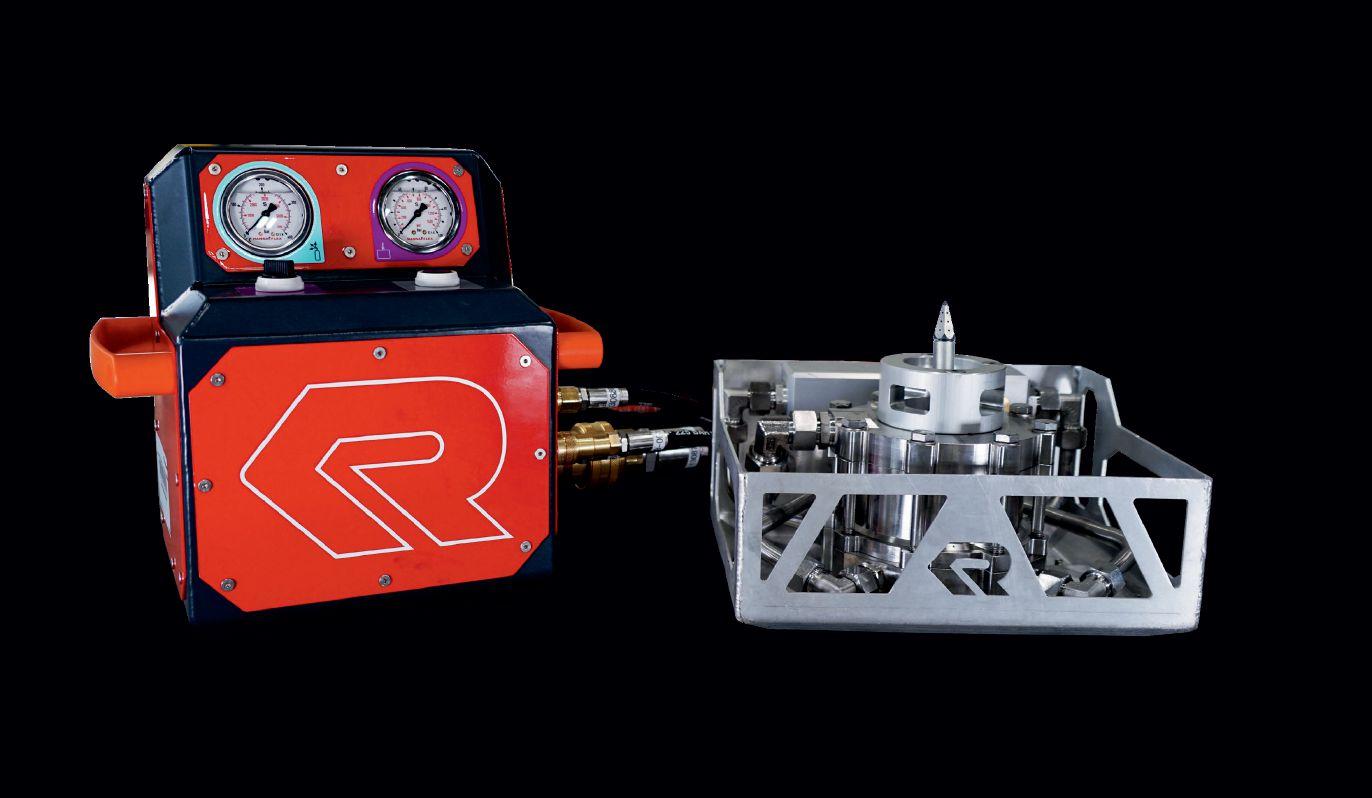
The call is coming when you will face an electric vehicle (EV) battery fire. Maybe you already have and experienced dousing an EV in more than 8,000 gallons of water and being on scene for four hours or more. There is a better way. Developed over six years in partnership with leading automotive companies the Rosenbauer battery extinguishing system technology (BEST) does the job with a fraction of the water and within an hour or less. When positioned beneath the vehicle, the piercing unit punctures the battery pack and halts thermal runaway by injecting cooling water around the battery cells at just eight gallons per minute. What was a resource-intensive call for service is now simple, safe, and efficient.
TRAINER’SCORNER
plete with collapsing floor) to simulate the conditions of that fatal fire incident. We spent hours running firefighters through the simulator and brainstorming ways a rescue could be made. We came up with some basic rescue tactics and a list of self-rescue tools firefighters needed to carry in their bunker gear pockets.
We brought it to the Oliver FD Spring Training in 2005. When the Clearwater FD members witnessed the rescue of the fallen firefighter in our re-enactment, and they realized Chad had not died in vain there was a spontaneous outburst of applause. It moved more than a few to tears.
There is great value and honour in using LODD events to instruct, whether we learn what to do or what not to do, it doesn’t matter as long as we learn something. May no firefighter’s death be in vain.
It’s been said that there is no greater influence of change in the fire service than a Line Of Duty Death of a firefighter. Yet, there is no greater tragedy than that of a fallen firefighter whose death prompted the passing of a safety policy which may have prevented his or her death!
I have been honoured to speak at several fire chief conferences as well as FDIC Atlantic. One of my main themes was “Calling A Mayday”. I did something one year at the FDIC Atlantic that I wish would become a required component for all Canadian fire conferences. I posted a
CONTINUED FROM PAGE 16
Ash said that if you’re using fluorinated foam, you should capture, contain and dispose of it properly.
Hyndman said that if you spray a fluorinated foam, it’s not just about cleaning up the foam itself but the contaminated area too.
“There is soil contamination, water contamination. People living around manufacturing sites have many times the amount considered toxic in their blood stream and water supplies.”
A recent Health Canada biomonitoring study found that 98.5 per cent of Canadians have some level of PFAS in their blood. Canada has set a limit of 1,000 parts per trillion of PFAS in drinking water, while the U.S Environment Protection Agency has theirs set to 70 parts per trillion.
In 2021, the Canadian government pledged to invest in research and monitoring of PFAS and examine this information to inform a class-based approach. A report on PFAS report is expected to be published in 2023.
When considering environmentally friendly alternatives, there is always the consideration of whether the product is as friendly as it claims to be.
“Green washing in the fire service hap-
power point slide in honour of the Maritime’s Line Of Duty Deaths. As the 99 names slowly scrolled up the screen, we honoured them with a moment of silence.
I carry the names of many lost firefighters, afraid to forget them, afraid to dishonour them by not sharing their tragic deaths. I researched what led to their LODD, listened to hundreds of hours of dispatch transmissions, read page after page of transcripts and reports. With information from their fatality reports, I built training mazes and props to teach survival skills.
Although my research started years ago, I still hear firefighter Champaign (46) calling out, “We need help. I can’t find the way out.” I hear him give his last breath. I think I tried to honour him by developing and instructing Mayday protocols. It will be my honour to introduce you to him along with a few more of my influencers next issue. Until then please, stay safe and remember to, “Train like lives depend on it, because they do”. 4-9-4 – Ed. •
Ed Brouwer is the chief instructor for Canwest Fire in Osoyoos, B.C., retired deputy chief training officer for Greenwood Fire and Rescue, a fire warden, wildland urban interface fire-suppression instructor and ordained disaster-response chaplain. Contact aka-opa@hotmail.com
pens,” said Emmons. “We are supposed to be the ones protecting our communities and if you think about the products we are using, even without our knowledge of doing so, we’re contaminating our communities.”
Ash said that while foams can be formulated without any PFAS or surfactants added, it is challenging to say that there are absolutely none at all.
“Foam agents are a complicated material to analyze and who’s to say that the water we’re using doesn’t have parts per trillion of PFAS. The language distributors and companies use is important, as we don’t want to be misleading, that’s why the emphasis on ‘no addition’ is key.”
Hyndman said FireRein’s EcoGel as a “100 per cent bio-based gel. It is made from food-grade material. The gel is a water additive and is created with no added surfactants.”
FireRein’s Eco-Gel achieved the key milestone of Underwriters Laboratories performance certification this year. In addition to effectiveness, the cost of use and disposal were also considered.
“When you look at price versus cost, traditional chemicals are more expensive than Eco-Gel to maintain, store and they need to be incinerated, as they are often classified as hazardous waste,” said Hyndman.
CHEMGUARD and ANSUL are expand-
ing their market of non-fluorinated foams to meet the same UL Standards as their fluorinated counterpart. National Foam expanded their fluorine-free foam facility to meet demand and product expansion. Safety Components released the first non-fluorinated water-repellant finish designed for PPE fabrics in April 2021.
“Seeing this shift gain momentum in the Western world, I think non-fluorinated foams and products will be the predominate product in the market in the next few years,” said Ash.
■ PFAS AND TURNOUT GEAR
PFAS can also be found in turnout gear. In September 2021, the NFPA council voted to keep PFAS in turnout gear.
Ed Kelly of the International Association of Fire Fighters filed an appeal to the NFPA Standards Council to remove the requirement for the middle layer in turnout gear, known as the moisture barrier, to withstand 40 hours of UV light as this required the gear to be manifested with PFAS to perform to that standard.
NFPA responded in a letter and stated that further review to understand how removing the testing requirement would impact the middle layer is necessary. They pledged to make later recommendations based off findings from a task force. •
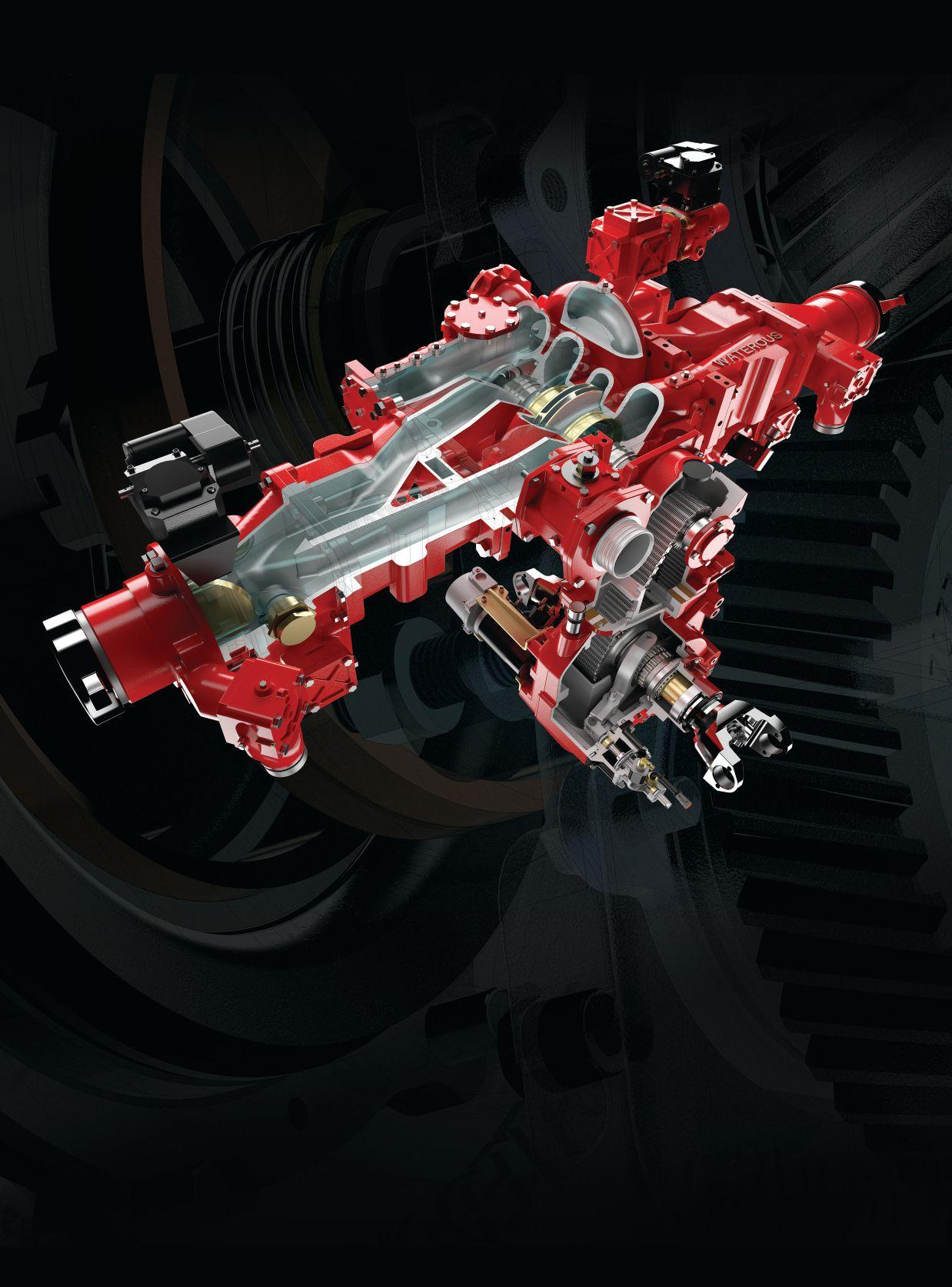
TIME-TESTED PROCESSES. ENGINEERED INNOVATIONS.
FULL-BODIED MIDSHIP PUMPS
OUR REVERSE FLOW WEAR RINGS
Restrict recirculation and improve overall efficiency and longevity of the wear ring.
SEPARABLE IMPELLER SHAFT
Allows the pump transmission to be separated from the pump and removed from the apparatus. The pump remains mounted in the apparatus and can be easily repaired minimizing downtime.
CHAIN DRIVE
TRANSMISSION – Transfers power more efficiently than gear-driven transmissions by having more points of contact between the chain and rotating sprockets.
“Silent” chain drive makes our transmission the quietest in the industry.
In the largest cities across the world, Waterous pumps never fall short. Cast and made in America, our pumps feature industry exclusive innovations. These innovations, along with the Waterous University library of support, help keep your pump running strong and your fire team serving the community.
FLAME-PLATED IMPELLER
PERFORMANCE – Bronze impellers are flame-plated with tungsten carbide, creating an ultra-hard surface resistant to wear.
CS/CSU SERIES SHOWN
The Kenow wildfire: a case study
Reviewing and learning from past Canadian wildfires has become a staple in the fire service
By KIRK HUGHES
Every fire is a battle, and with a changing climate it seems that each large wildfire has become a war within itself.
Recent examples across Canada have highlighted the devastating effects of wildland interface fires, where a fire threatens or destroys an urbanized area.
Last summer, the Village of Lytton experienced catastrophic destruction after three days of scorching, record-breaking temperatures. Notable forest fires in recent history stretch across the country. The 2014 Northwest Territories forest fires that strangled the only highway from the Deh Cho Bridge to Yellowknife – paralyzing traffic and trade for days and scorching vast sections of Highway 3. In 2017, B.C. wildfires struck hard in the central and southern interior consuming over 3 million acres of forest. No article on urban interface could be complete without mentioning the tragic events of the Town of Slave Lake in 2011, in which over 400 homes were destroyed, and the 2016 Fort McMurray wildfire which altered the conscious of the nation and resulted in the costliest disaster in Canadian history with an estimated economic impact that could approach $10 billion dollars, as reported by The Weather Network. Reviewing and learning from these examples has become a staple in the fire service.
Preparing for, responding to, and recovering from larger, more destructive fires that threaten urban centres should become a standard practice for fire departments that live close to forested areas. With larger fires becoming common, implementing sound practices taken from fire fighting experts across Canada, and applying them to how fire leaders should be tackling fires, may prove to be the cutting edge needed in learning how to respond to these intense conditions.
After all, experience is the best teacher. For those that have been involved in operationally high tempos in the past, it only reasons that any lessons learned on the front lines may be applicable to wildland fire operations.
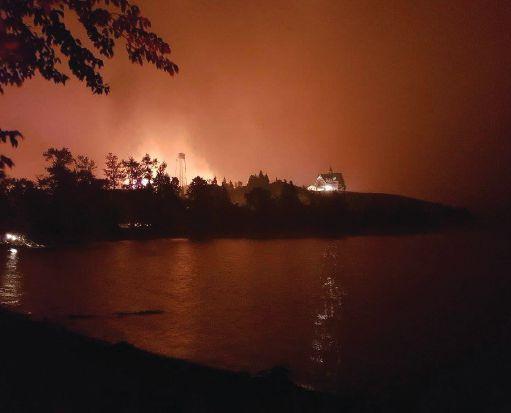
At the end of August 2019, near the southwest border of Alberta and British Columbia, a fire sparked by an intense lightening storm, and fueled by exceptionally hot weather, strong winds and extremely dry conditions, was detected about 10 kilometres from the edge of a one of Canada’s national gems – Waterton Lakes National Park. Comprised of a gorgeous townsite, the historically important Prince of Wales hotel, and a hiking trail network that included bridges, picnic areas and scenic lookouts, Waterton Lake National Park was now
under threat from a fire that would later be identified as the Kenow fire. What made this fire different was the amount of time allotted for defensive preparation before the fire crested the mountain range and barrelled down to the townsite.
Detected on Aug. 30, 2019, Parks Canada staff began almost immediately to prepare. Crews worked to create fuel line breaks, fire retardant was sprayed on structures and buildings, and forest firefighters fought the spreading fire as helicopters dropped buckets in an attempt to stop the head of the fire.
By Sept. 5 an evacuation alert was issued. By Sept. 8 the alert had risen to an order. Tourists, campers, seasonal staff, visitors, and permanent residents were all removed from the park boundary. A unified command was established, and structural protection firefighters from across Southern Alberta were called into service. High-volume pumps and sprinkler systems were strategically placed around the perimeter of the townsite, and the Prince of Wales hotel was surrounded by aerial platforms pulling water from the nearby cove to coat the building in a steady stream of water.
By Sept. 11 the fire had firmly established itself, moving northeast across the valley before finally bridging the crest of the townsite by evening.
The fire as it approached the Prince of Wales hotel.
PHOTO BY KIRK HUGHES
Defending the townsite was a division, broken down into two taskforces (North and South), and supported by a single resource water tender strategically placed within the centre of the townsite for rapid deployment.
The taskforces consisted of a mixture of structural engines/pumpers, wildland units and command elements. Task force commanders faced a daunting job during the day of Sept. 11, leading their response to a potential wildland interface fire.
This first set of assignments occurred in the early part of the morning. Crews were organized into their sub-groups, paired with an officer and provided a detailed briefing by the task force commander. Items included in the discussion were the current state of the fire, weather conditions (meteorological), and a “breaking ground” session in which the commander provided a map to each crew member and went through it naming local landmarks, roads, and areas of significance. Afterwards, crew leaders were issued orders and provided a timeline for completion.
The original set of orders consisted of minor, but important task, all geared towards defensive operations. These tasks included strategically placing water bladders around town and removing propane tanks and wood piles.
The work continued as command elements collected local knowledge on the terrain, acquired more detailed satellite imagery maps and completed a reconnaissance of the surrounding area. By lunch, defensive preparations had been created to make the townsite as flame resistant as possible given that the biggest threat to fire spread would likely come from falling embers.
Commanders marked new maps with LACES terminology; naming and setting up lookout positions, anchor points, escape routes and safety zones. Communications were checked and digital radio frequencies assigned for each task force with identified channels for division, aerial operations, and evacuation. Spots were scouted out for safety zones and evacuation plans drafted and passed up to the Unified Command Centre (UCC).
As crews began returning to their apparatus, each task force commander held another briefing explaining the map, the locations and going over details of the evacuation plan. From that, another set of orders were issued, this time more geared to the pending fire fight that was expected. Crew leaders were given assignments to foam
down certain structures, staff observation posts and the painstaking process of pre-laying fire lines and hoses was started.
By mid-afternoon, firefighters were conducting response drills and taking the time to get the lay of the land, touring the district and committing to memory the evacuation routes, safety zones and immediate actions they would need to do when under pressure. Command elements were also hard at work, reviewing preparations, checking on the welfare of staff and conveying information to and from the UCC.
By evening, more accurate information was passed down to firefighters about the size and behaviour of the fire, as well as weather conditions and assigned resources. Firefighters felt confident that the preparations made would be sufficient to protect, not only themselves, but the town.
A final briefing was held in the evening, with task force commanders rehashing the main memory points they wanted to instill on their crews. The area was being regularly patrolled, and crews were provided detailed instructions on what their roles would be in the coming hours. Firefighters took turns resting up and prepping gear, unaware that the Kenow fire was about to crest the hill and descend on the townsite valley.
Command elements from Parks Canada and Alberta Forestry studied the updated reports of the fire’s behaviour over the last few hours. Original predictions had the fire possibly skipping across the valley floor and bypassing the town altogether. That was the best-case scenario. That evening, the fire changed direction seemingly intent on coming for Waterton itself.
As supper was finishing, the alarm sounded. The fire had crested the ridge line to the north – the battle had begun.
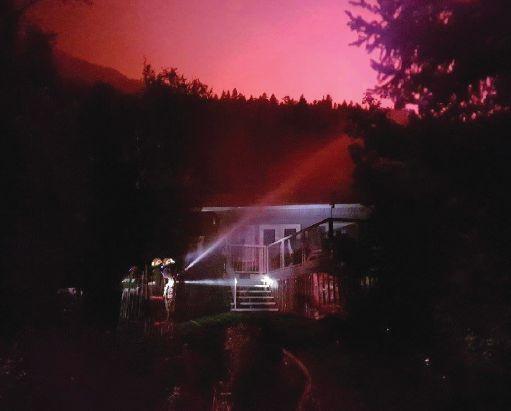
Upon detection, all crews were alerted and manned their apparatus. Aerial apparatus intensified their operations, coating the historical Prince of Wales hotel with water and retardant as task force commanders assigned trucks to do the same to buildings on the north side, such as the iconic Northland Lodge and Aspen Village.
The first significant event happened shortly before 9 p.m., when raining ash, some as large as baseballs, fell on to the roof of the old visitor centre, setting it ablaze. Spot fires popped up everywhere, as crews raced to scene after scene dousing every ember. Cameron Creek, running through the middle of the town and by fed by glacier waters, ran black with soot. The battle would last 24 hours and after all was said and done, the townsite and the Prince of Wales hotel suffered no significant damage and lost no buildings. This was a testament to the leadership of the command teams, the training of the crews, and the soundness of the defensive preparations.
The Kenow fire remains another example of the power of nature, how a small brush fire could mutate into such a large and devastating force. It also serves as a case study in defensive preparations by firefighters and the effective use of unified command, resourcing, and training.
As the threat of devastating fires continues to grow across Canada, it’s time to reflect on the past and analyze our responses for the future. •
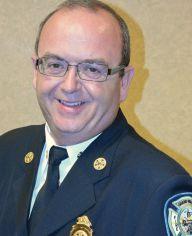
Kirk Hughes is the director of protective services for the County of Vermilion River, Alta., and a recent panelist for the Fire Fighting in Canada 2022 Virtual Summit on climate change. During the summer of 2017, Chief Hughes was assigned as a Task Force Commander to protect the Waterton Townsite during the Kenow Fire. He can be reached at khughes@county24.com.
Coating the Northland Lodge as the Kenow fire descends the hill.
PHOTO BY KIRK HUGHES
BY VINCE MACKENZIE Fire Chief Grand Falls-Windsor, N.L
IVOLUNTEERVISION
Time to call the adversity department
t is conference season, and I can’t tell you how important it is to see our training and networking opportunities redevelop over the last few months. As the pandemic restrictions ease, our world returns to normal (or whatever normal will be in a post-pandemic time). We will need our peer networks like never before.
In my view, our collective lives may never be the same and it will certainly be a struggle as all organizations and businesses regroup to provide their services and wares.
If the stumbling automobile, air transportation, and supply chain businesses are any indication, consumers will be in for a tough ride. Providing services to Canadians in any aspect of a business seems to have changed. Timely healthcare services are even more dire as we see our partners in our nation’s hospitals struggle to recover with adequate staffing and service levels. We are actually seeing emergency rooms close. There is a real concern that the professional women and men in healthcare will be in crisis for a long time. This is serious business and the lives and safety of our colleagues, families, and friends are under threat. Just like the fire service, the demand for service can not be turned off as much as our governments would like.
Managing and improving these core services usually mean increases to funding and hiring more people. But they are still in crisis and there is simply no trained workforce pool to be had. Fire services are provided in many communities by volunteers, so money certainly won’t be the answer there either.
The financial business world is heading into turmoil as interest rates sharply increase and the price of everything skyrockets. It will have impact on everything fire department related, from the cost of a new fire truck to a new pair of gloves. Operating budgets will undoubtedly be diminished as the mounting costs pile up and the value of our funding goes down.
been highlighted by the challenges of fighting fires and training; overcoming adversity is a staple of what we do. We are the adversity department for our towns and villages and this upcoming era will be no exception.
If we think that someday we will magically wake up and all is good, I will call you a dreamer. Let’s face it, fire departments exist for the sole purpose to fix the adversity of community strife when it happens. Thankfully, our fire halls are filled with the most resilient types of individuals known to society. Those of you that have been here a long time did not get here by riding the coat tails of others. I would suggest that when the problems come knocking on the doorstep of our community, it is the fire department that is often first out to respond. When society has thrown curve balls to community, the members of our fire departments always adapted and overcame.
Prior to the pandemic, our challenges were many. Problems like recruitment and retention, adequate funding, updating equipment and technology, boosting morale, managing politics, and training were the ingredients to make a successful fire department more resilient. Now that the world is seeing adversity on all fronts, from airlines to hospitals, on even greater levels than anyone has been used to, fire department challenges should be expected to be no different. But I do think we have an advantage: volunteer fire departments have been training
Let’s face it, fire departments exist for the sole purpose to fix the adversity of community strife when it happens. ‘‘ ’’
I’m sure my comments may seem like a diatribe of doom and gloom but there is a point to all this.
The world is facing adversity at an unprecedented scale and we, the country’s first responders, will face challenges to provide fire and life safety protection to our citizens. With all the negative energy coming from the news, it will be easy for fire departments to make excuses and point fingers at other factors to explain why we are struggling.
But haven’t we always struggled? My entire fire service career has
Vince MacKenzie is the fire chief in Grand Falls-Windsor, N.L. He is an executive member of the Canadian Association of Fire Chiefs and the current president of the Maritime Fire Chiefs Association. Email Vince at firechief@ townofgfw.com and follow him on Twitter at @FirechiefVince.
in the college of adversity since our inception. We are ready for this. I believe this is where the adversity leaders in your fire halls will have their finest hours to come.
So, my point in all this is to help show you that we have the tools to push our departments further along during the troubles to come. Your challenge will be to concentrate on the leadership traits you already have and build them even more. Our challenge will be to keep responding and helping in a time where it will take a greater toll on our resilience, our bodies and minds. Care for your mental health, support each other like we never have before, enhance your leadership ability on all levels from firefighter to chief. These post-pandemic times will offer old and new challenges. Let us lean on each other, and our fire organizations will have their proudest moments. •