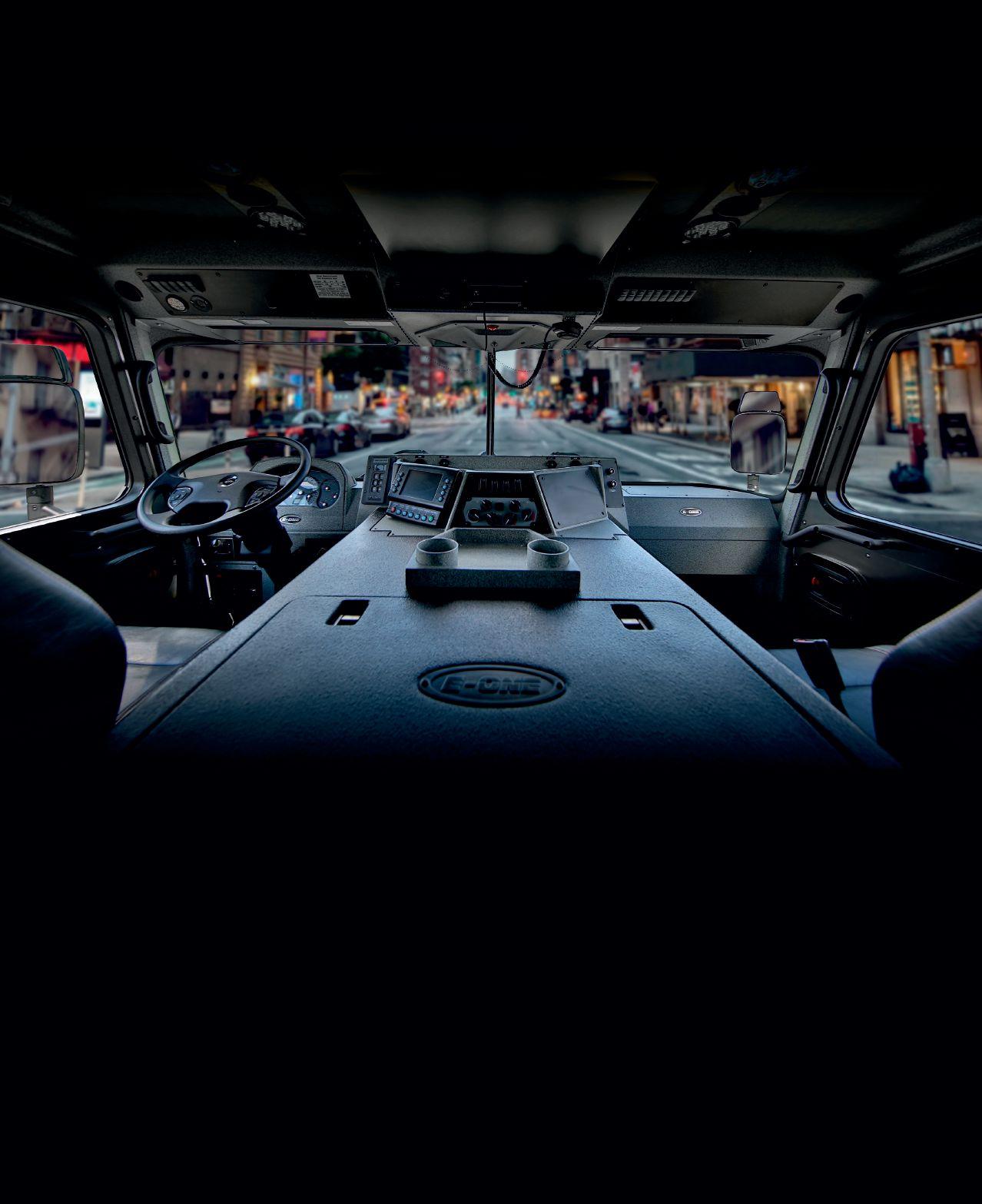
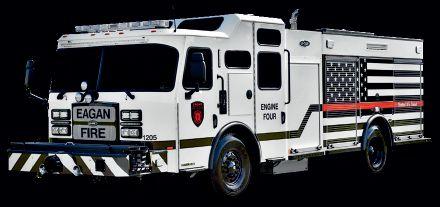
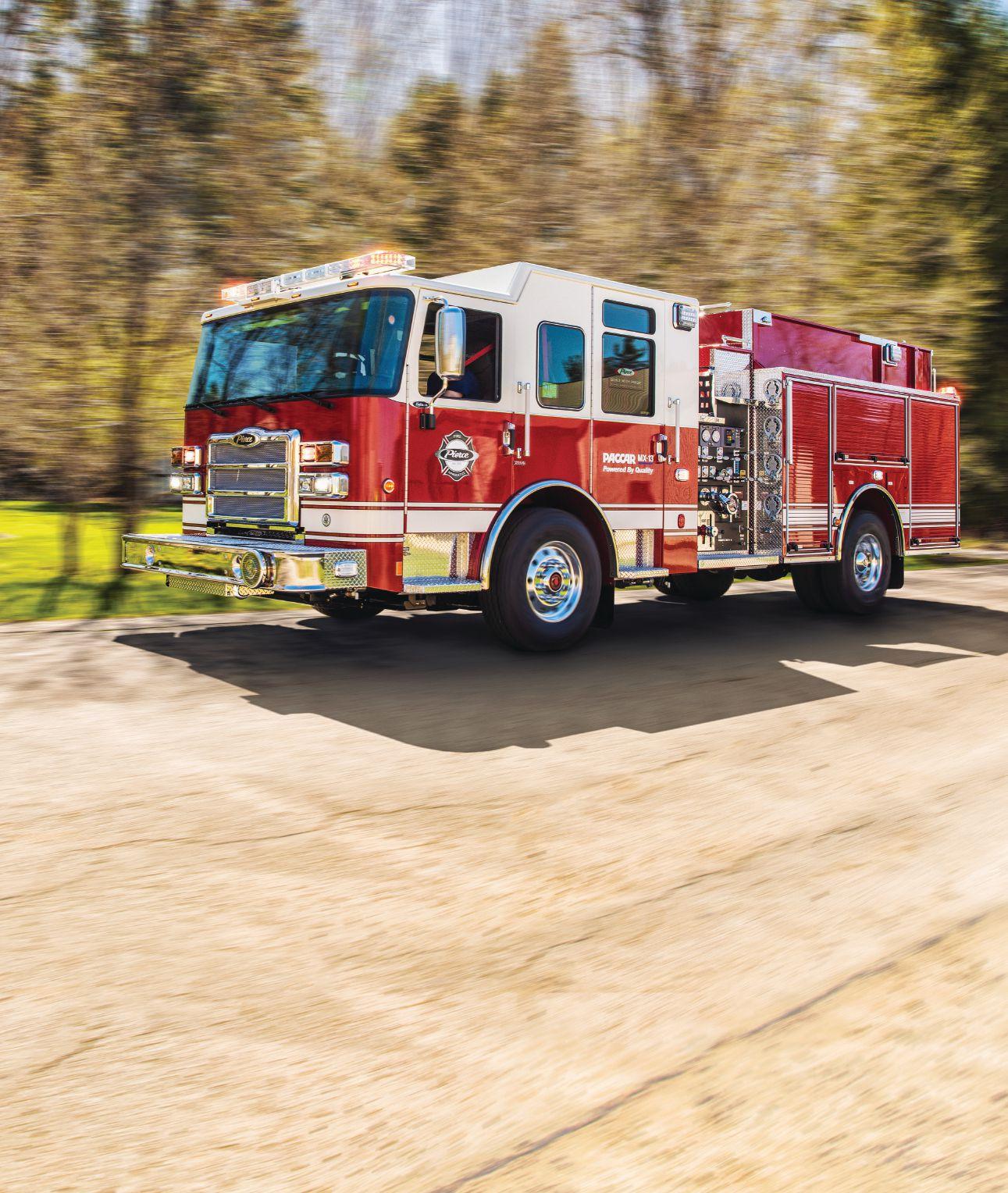
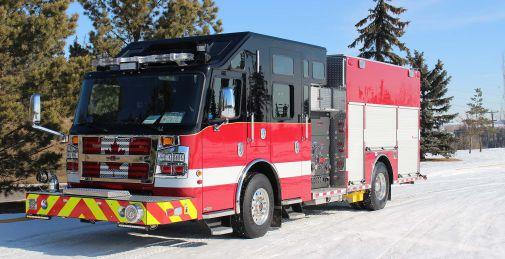
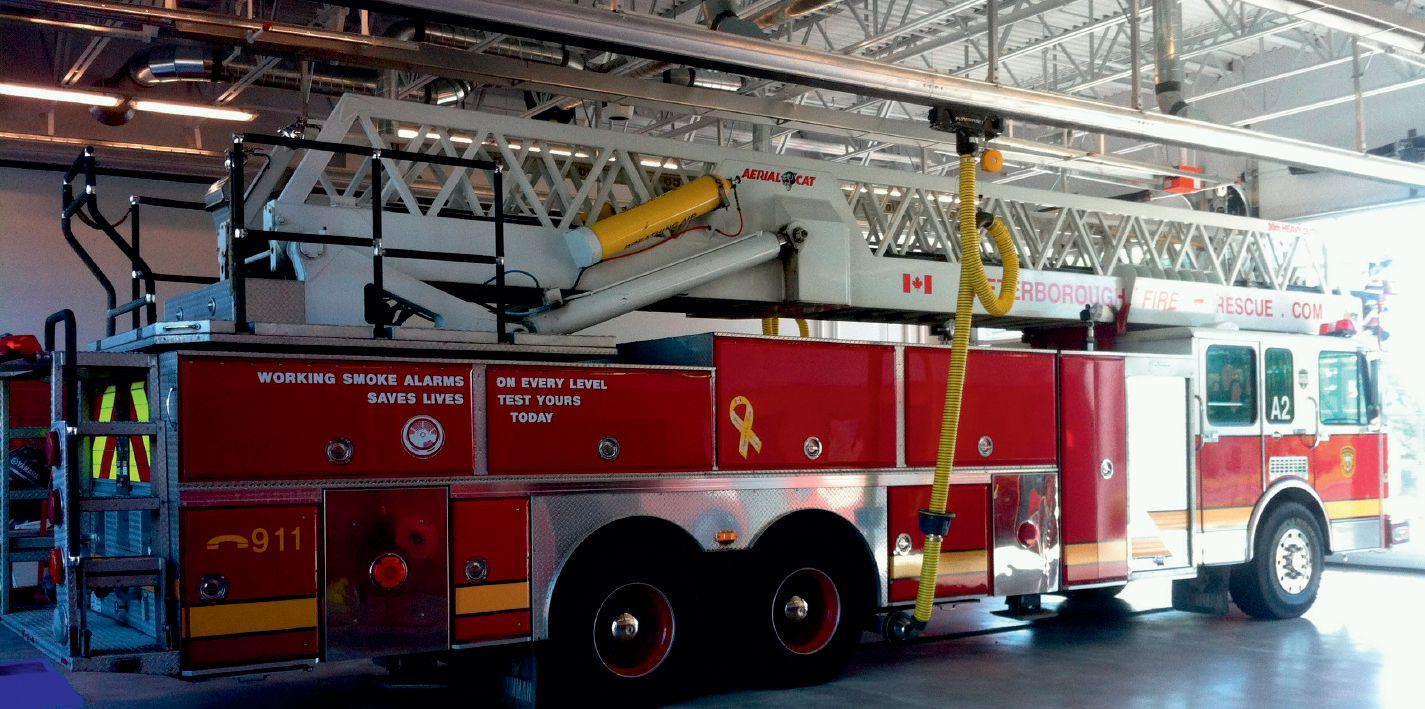
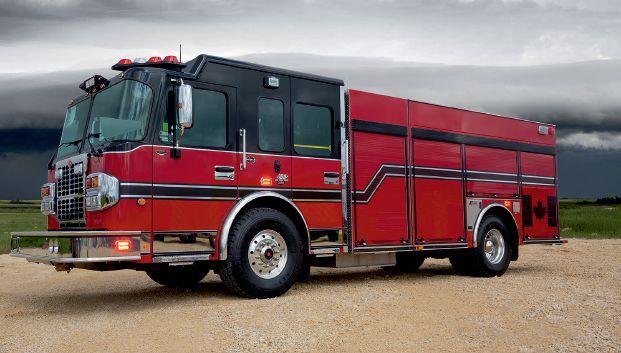
The new 2020 E-ONE® Cyclone cab is bigger and better than ever before, featuring updates and refinements suggested by firefighters just like you. The new 100” wide cab provides more space for your crew with a generous 27” between door and engine cover for both driver and officer. The Cyclone is available in five cab lengths with a flat roof (low or 4” raised) or one of four raised “vista” roof designs that include the 4” raised front roof. The Cyclone cab provides excellent visibility for driver and crew with its low profile dash, one piece door glass and a reduced profile interior A/C system. Like all E-ONE aluminum cabs, this one is built with heavy wall extrusions and 3/16” plate for floor, roof, walls and doors for maximum strength and durability.
INCREASED VISIBILITY
THIN PROFILE AC SYSTEM
STRONGEST CAB IN THE INDUSTRY
EASY EGRESS
NEW FRONT STYLING
100” WIDE DESIGN PROVIDES MORE INTERIOR SPACE
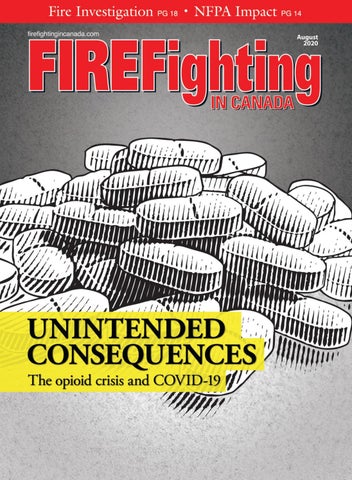
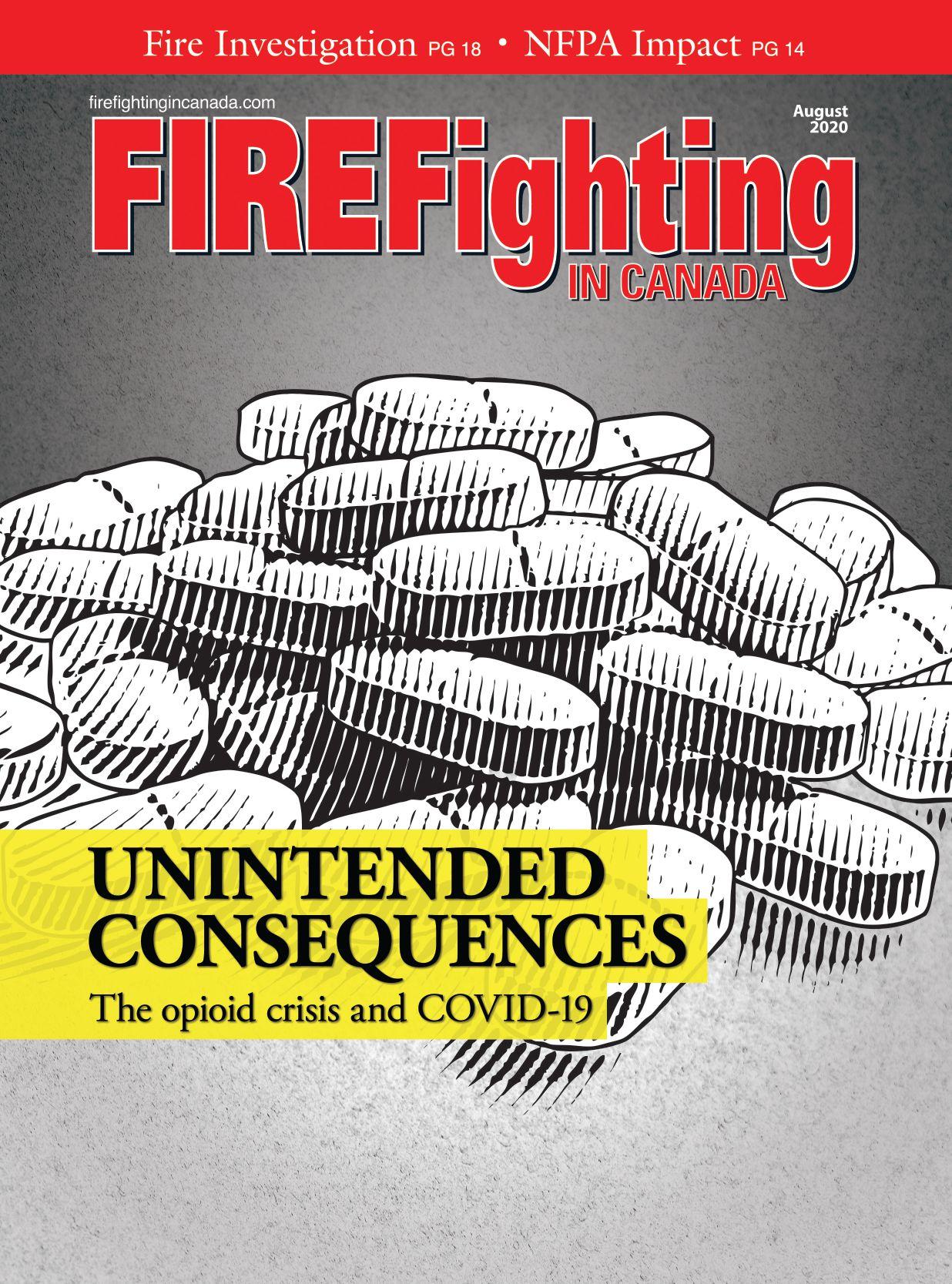
A resurgence in opioid use and fatalities is emerging as one of the unintended consequences of COVID-19 control measures. The new numbers remind us to be prepared for this persistent and ever-present public health tragedy.
By Brieanna Charlebois
INVESTIGATION
There are many things a fire department can do to aid in a fire investigation. Here are strategies for helping determine the “why” and the “what” in determining cause.
By David Moseley
BY LAURA AIKEN Editor
COMMENT
All-hazards responders
Fire departments truly are all-hazards responders — COVID-19 illuminated this brilliantly. No matter the response protocol to COVID that was decided, that is, whether they continued to respond to all medical calls or a limited set during the onset of the crisis, a conversation needed to be had because Fire is truly an all-around emergency service.
The novel coronavirus is the public health emergency that gripped the shoulders of early 2020 and has just now let the Canadian population drift weary, dangling toes against the floor to touch the surface in respite before an anticipated second wave may yank us our grounding from us once more. And it is during this interlude of sorts that the first tally of lockdown’s unintended casualties begin to peer tentatively from that which all-encompassed us. We have a short time span to look back on, but we now know opioid fatalities rose sharply during the pandemic, in British Columbia particularly. Ontario too is reporting a significant increase in deaths. Reports across Canada show increased illicit activity. The opioid epidemic did not go away because coronavirus arrived. In April 2016, British Columbia declared a public health emergency because of escalating opioid related-deaths. That was only four years ago and the epidemic rages on.
opioid response by region. Some departments carry the overdose-reversing agent Naloxone. Some choose not to. Each have their reasons in their unique communities. As all-hazards responders, this scourge of public health needs to be on the radar of all fire departments. Addiction does not discriminate – wealthy or poor, young or old, there are many untold stories of addictions stemming from initial prescription use for injuries that later ended in accidental death. Who would ever picture that is the course their life would take? Addictions are public health problems whose perception suffers under stigma and beliefs.
ON THE COVER
The opioid crisis was featured on our December 2017 cover and it’s back for 2020. Read why on page 10.
Rising opioid fatalities are likely one of a variety of unintended consequences that we must now watch for. The full scope of mental health implications are most certainly pending. Though the virus is picking up speed in much of the poorer parts of the world, here in Canada we are beginning to pick up the pieces of its initial wrath, a job the all-hazards fire service will surely find themselves a part of.
ESTABLISHED 1957 AUGUST 2020 VOL. 64 NO. 5
EDITOR LAURA AIKEN laiken@annexbusinessmedia.com 416-522-1595
MEDIA DESIGNER BROOKE SHAW bshaw@annexbusinessmedia.com
GROUP PUBLISHER/VP SALES MARTIN MCANULTY fire@annexbusinessmedia.com
COO SCOTT JAMIESON sjamieson@annexbusinessmedia.com
PUBLICATION MAIL AGREEMENT #40065710
RETURN UNDELIVERABLE CANADIAN ADDRESSES TO CIRCULATION DEPT.
P.O. Box 530, SIMCOE, ON N3Y 4N5 e-mail: subscribe@firefightingincanada.com
Printed in Canada ISSN 0015–2595
CIRCULATION e-mail: bolechnowicz@annexbusinessmedia.com Tel: 416-510-5182 Fax: 416-510-6875 or 416-442-2191
Mail: 111 Gordon Baker Rd., Suite 400, Toronto, ON M2H 3R1
SUBSCRIPTION RATES
Canada – 1 Year - $25.50 (GST - #867172652RT0001)
USA – 1 Year $58.50 (CDN)
Annex Privacy Officer
Privacy@annexbusinessmedia.com
Tel: 800-668-2374
Much like the fire service needed to determine its response to coronavirus geographically, it has had varied plans for
Occasionally, Fire Fighting in Canada will mail information on behalf of industry-related groups whose products and services we believe may be of interest to you. If you prefer not to receive this information, please contact our circulation department in any of the four ways listed above.
All advertising is subject to the publisher’s approval. Such approval does not imply any endorsement of the products or services advertised. Publisher reserves the right to refuse advertising that does not meet the standards of the publication. www.firefightingincanada.com
@fireincanada
STATIONtoSTATION
ACROSS CANADA: Regional news briefs
Measuring chemical exposure
A total of 45 unique PAHs were found on the silicone dog tags, including 18 not previously reported with fire fighting exposures.
A recent study published in Environment International, a U.S.-based scientific journal, used military-style silicone dog tags to sample and measure the chemical exposures firefighters face.
During fire suppression measures, firefighters may be exposed to carcinogens, including various polycyclic aromatic
THE BRASS POLE
Promotions & appointments
JOE ZATYLNY stepped into the role of fire chief of Edmonton Fire Rescue Services on June 1. He has over 25 years of emergency service experience and over 10 years in leadership roles. He most recently held the role of
deputy chief with the Calgary Fire Department where he oversaw the Fire Training Academy, critical medical response support, technical teams support, 911 service management, and hazardous materials response support.
JIM PETRIK was named the first fire chief of Guelph/Eramosa Fire Department in March. Petrik was a volunteer firefighter for 20
hydrocarbons (PAHs). In the U.S., firefighters have an estimated 10 to 20 per cent increased risk of developing cancer compared to the general population, but there have been limited studies done linking fire fighting to specific carcinogens.
The study noted that previous research focused on adverse health outcomes associated with firefighter exposure to potentially harmful chemicals are primarily based on measures like job title, department call volume and length of career in the fire service. But, it notes, fire departments may vary based on other factors including average number of calls, types of fires and PPE available.
To overcome some of these measures, this study used silicone military-style dog tags to sample exposures at two departments in Missouri. One department was considered a high call volume department, the other a low call volume department.
The 56 firefighter participants wore different tags when on–duty and off-duty for 30 24-hour shifts. Researchers then measured the chemical exposures from the tags to collect exposure data on chemical mixtures. They detected 45 unique PAHs, including 18 not previously reported with fire fighting exposures. The study found also that the number of fire calls attended was more strongly correlated with PAH concentrations than firefighter rank or years in the fire service.
This study was conducted by researchers Carolyn M. Poutasse, Lane G. Tidwell, Peter D. Hoffman and Kim A. Anderson from Oregon State University’s Department of Toxicology, and Walker S.C. Poston, Sara A. Jahnke and Christopher L. Haddock from the Center for Fire, Rescue, and EMS Health Research.
years. He spent 14 years in the fire service in Rockwood, Ont. He moved into the position as deputy chief at the Guelph Fire Department. He spent four years in that role before accepting the position as chief for the Guelph/ Eramosa’s fire department.
Retirements
In May, after nearly 40 years with the White Rock Fire
Department in British Columbia, Fire Chief PHIL LEMIRE retired. Joining the department in 1980, he was appointed the position of deputy chief in 1996 before assuming the role of fire chief in 2006. In June of 2017, he was elected president of the Fire Chiefs’ Association of British Columbia, representing more than 350 fire departments. Lemire officially retired on May 29.
PHOTO: CATONPHOTE/ADOBESTOCK
Studying firefighter mental health during COVID-19
The Canadian Institute of Health Research awarded Kathryn Sinden, an assistant professor of kinesiology at Lakehead University, a $49,968 grant to spend six months developing resources to support the mental health of firefighters working during the COVID-19 pandemic.
Sinden has been doing research in the fire sector for almost 10 years. She said her most recent work has been in collaboration with Thunder Bay Fire Rescue conducting a series of projects that aim to develop evidence-based solutions to improve overall firefighter health. Most recently, she said, her research has focused on identifying relationships between critical incident exposure and mental health disorders including post-traumatic stress.
The project that earned the funding is titled “Protecting those who protect us: An evaluation and synthesis of resources deployed to support firefighter mental health during COVID-19”. It aims to assess the unique context the pandemic has created for the fire service and evaluate where their risk for experiencing mental health
conditions has increased.
“The pandemic has increased firefighters’ concerns regarding potential disease transference from patients among coworkers and, subsequently, to their family,” Sinden said. “Firefighters experience higher levels of mental health conditions including post-traumatic stress injury, compared to the general public; the unique exposures associated with working during COVID-
After more than 30 years in the fire service, Fire Chief KEVIN GALLANT retired from the Town of Bradford West Gwillimbury in Ontario on May 31. Prior to joining the department as deputy fire chief in September 2009, Gallant also worked with the City of Mississauga and the Town of Erin. He was then promoted
to the position of fire chief in 2010.
Last Alarm
GARY MAHONEY, former deputy fire chief of the Wallace District Fire Department in Virden, Man., passed away on May 19. Gary served with WDFD for 36 years.
19 increase their risk of experiencing mental health conditions.”
She said the project will use an integrated knowledge translation approach, meaning firefighters will be embedded in the research process.
“We plan to evaluate other bodies of literature that speak to evidence-based strategies for managing complex mental health conditions and hope to integrate that with our findings that will be specific to
Mahoney also served with the Birtle Manitoba Fire Department for five years and was recently recognized by the Manitoba Association of Fire Chiefs for 40 years of service.
Former Collingwood, Ont., Fire Chief FRANCIS MAGUIRE passed away on April 29 after a battle with cancer. He was 84. Having served a total of 32 years with the Collingwood Fire
the firefighter sector.”
Information about managing mental health from peer-reviewed academic journals, online information specific to firefighter health and existing guidelines (provided by firefighter associations) will be used. She explained the results of this research will then be used to develop various resources and develop strategies to help manage firefighter mental health and prevent illness.
Department, he was appointed chief in 1977 where he remained at the helm for 17 years until his retirement in 1994.
Retired Brampton, Ont., Fire Chief VERRALL CLARK passed away on June 1 at the age of 82. Clark served with Brampton Fire and Emergency Services for 34 years, holding the position of chief from 1993 until his retirement in 2003.
The grant of nearly $50,000 will be used to develop mental health resources for firefighters working during the pandemic.
STATIONtoSTATION
BRIGADE NEWS: From departments across Canada
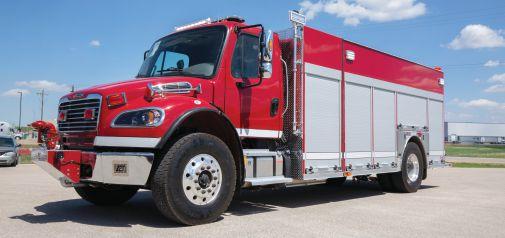
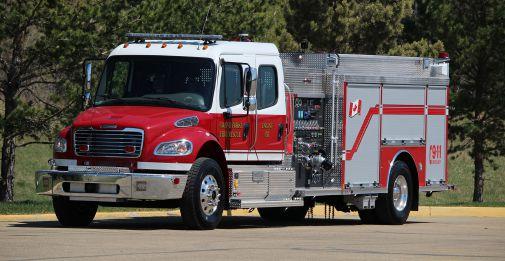
The Charlie Lake Fire Department in British Columbia took delivery of a pumper tanker from Fort Garry Fire Trucks. This apparatus runs on a Cummins DD8 engine and an Allison 3000 EVS transmission. It sits on a Freightliner M2-106 chassis and is also equipped with an enclosed side control Darley PSP1250 pump and has a Foam Pro 1600 system.
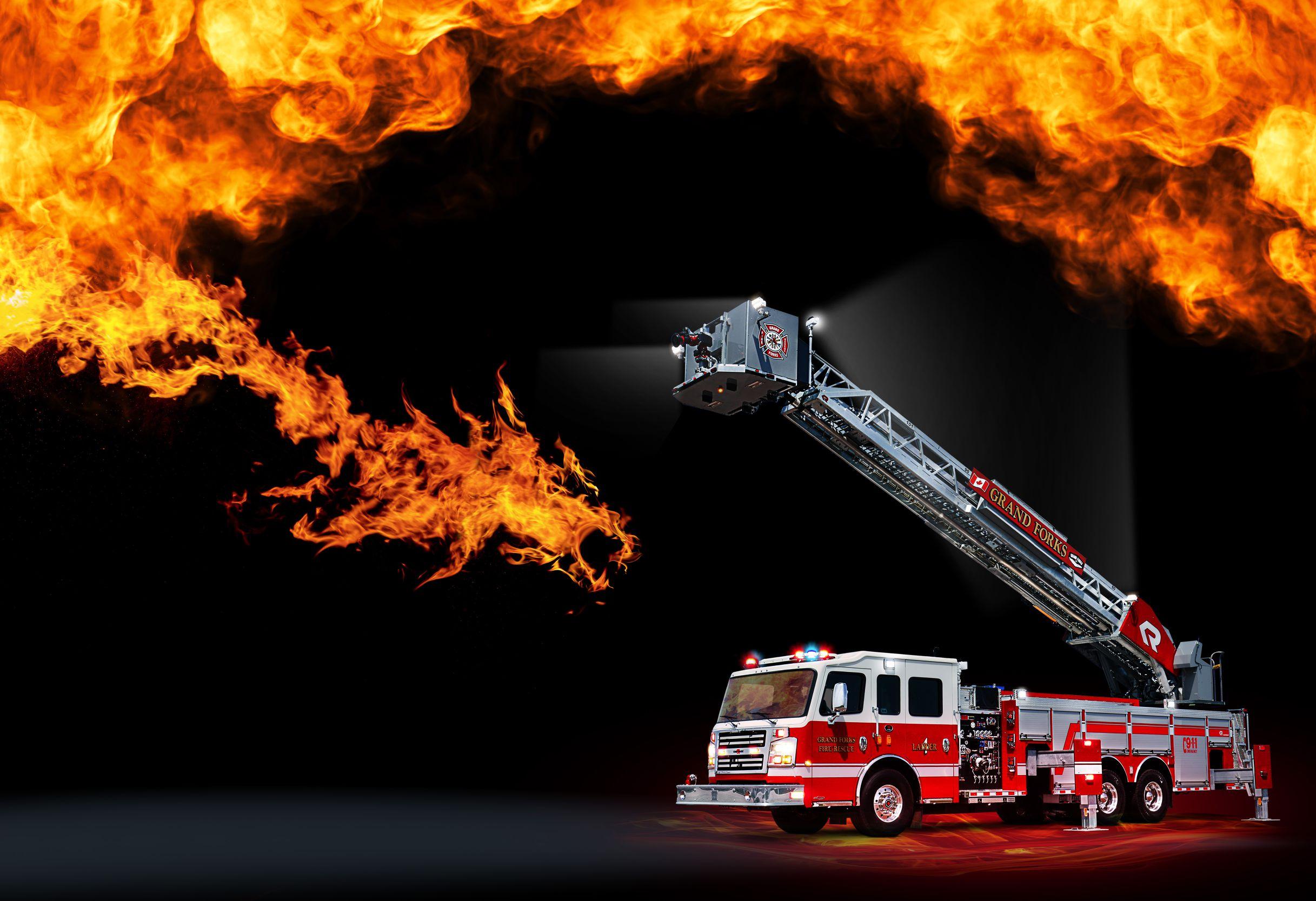
Grand Forks in British Columbia took delivery of a Freightliner M2 106 from Rocky Mountain Phoenix. This unit runs on a Cummins L9 350 HP engine. It is equipped with an Allison 3000 EVS Automatic Transmission, a 30 Imperial gallon foam tank and a 1000 Imperial gallon water tank.
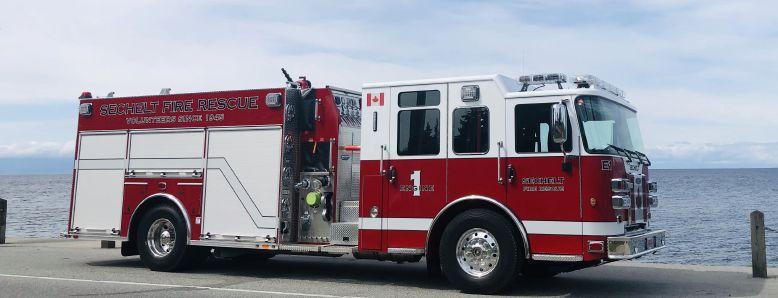
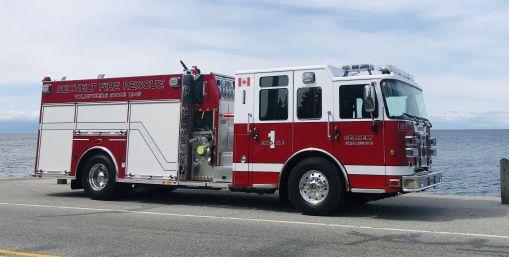
This pumper was delivered by Commercial Emergency Equipment to the Sechelt Fire Department in British Columbia. It is powered by a Cummins L9 450 HP engine and sits on a MaxiSaber chassis. It is equipped with FoamPro 2001 foam system and a Waterous CS 1,500 GPM pump that holds up to 900 US gallons of water.
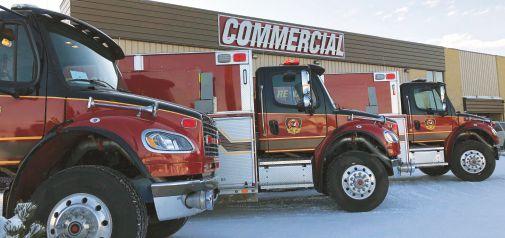
The County in Grande Prairie Alberta took delivery of three Maximetal pumpers from Commercial Emergency Equipment. This unit sit on a Pierce Saber FR chassis and Cummins L9, 380 HP engine. It is equipped with a Husky 12 pump that holds 1,000 gallons of water.
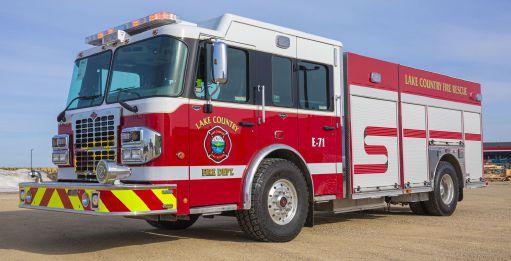
Lake Country Fire Department in British Columbia received a Spartan Metro Star EMFD 10” RR four-door pumper truck from Fort Garry Fire Trucks in April. This truck is powered by a Cummins L9 – 450 HP engine and an Allison EVS3000 transmission. It has a Hale DSD1500 USGPM foam tank and a Foam Pro 2002 Class A system.
MD Foothills Fire Rescue in Alberta was delivered this pumper from Rocky Mountain Phoenix. The apparatus sits on a Rosenbauer Commander 4000 chassis and runs on Cummins L-9 with 450 HP. With an Allison 3000 EVS automatic transmission, the apparatus is also equipped with 850 IG water tank with 20 IG foam tank.
GRAND FORKS FIRE DEPARTMENT
CHARLIE LAKE – PEACE RIVER REGIONAL DISTRICT
GRAND PRAIRIE FIRE DEPARTMENT
UNINTENDED CONSEQUENCES
Opioid deaths on the rise in Canada amid the COVID-19 pandemic
By BRIEANNA CHARLEBOIS
While Canada’s number of new daily COVID-19 cases has been dropping, the death toll from another ongoing public health crisis is rising. In recent months, provinces and territories across Canada began reporting a growing number of opioid-related deaths.
In a statement released on May 31, Dr. Theresa Tam, Canada’s chief public health officer, addressed the increasing overdose trends across the country.
“While everyone in Canada is working hard in the fight against COVID-19, there is an increasing concern about a range of unintended negative consequences of the pandemic response,” Tam wrote. “Among these is the impact on the ongoing public health crisis of opioid-related overdose deaths and problematic substance use in Canada more broadly.”
Increased opioid overdose numbers have been cited in jurisdictions in Ontario, British Columbia, Alberta, Manitoba, Prince Edward Island, Nova
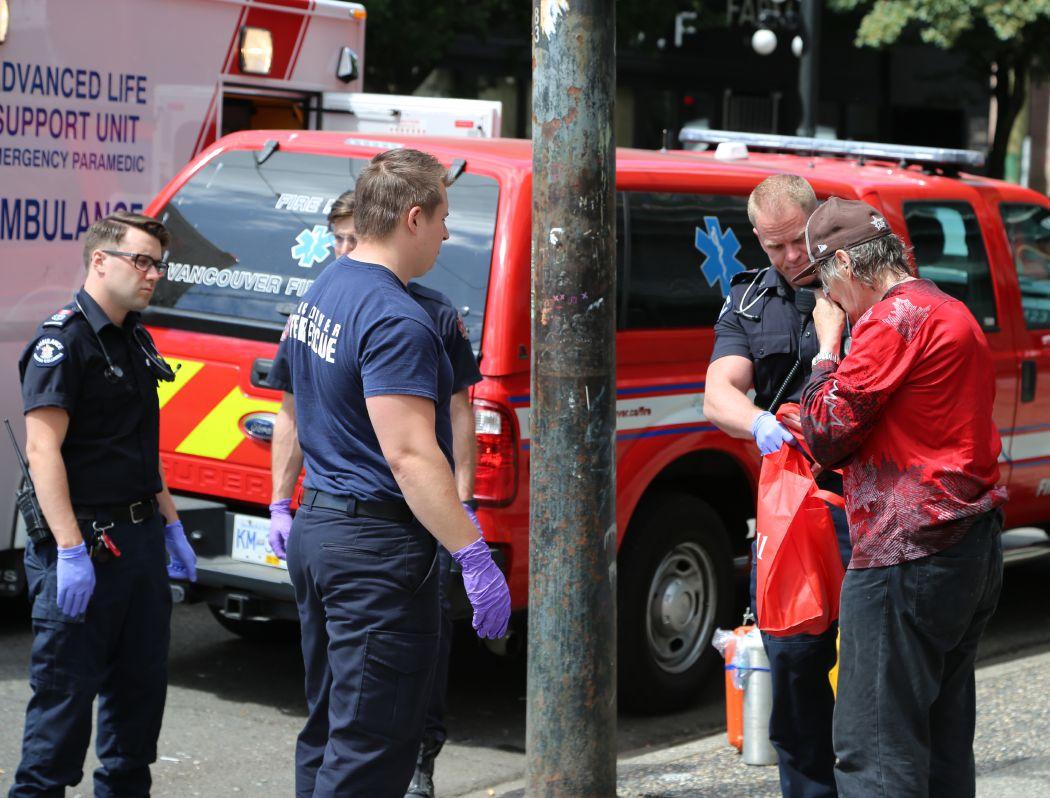
The Vancouver fire department partnered with Vancouver Coastal Health to create an interagency response team.
Scotia, Newfoundland, Saskatchewan and the Yukon.
The Ontario’s Coroner’s Office cited a 25 per cent increase in the number of overdose-related deaths from March to May over the same period last year.
In Alberta, the number of opioid-related calls to EMS increased from 257 in March to 550 in May and the Calgary
Drop-In Centre’s staff said they reversed over 40 overdoses in both March and April this year compared to 11 in February.
The city of Winnipeg also reported that emergency calls related to crystal meth and opioid poisonings or overdoses had increased 66 per cent in April and May, compared to the same period last year.
In British Columbia, the Coroners Service found that unintentional illicit drug toxicity deaths have increased in recent months, with over 100 reported deaths occurring in the province in both March and April. The province, which declared the opioid epidemic a public health crisis in 2016, also reported 170 fatal overdoses in May alone—more deaths in a single month than COVID-19 had claimed in the province at that date.
Across the nation, the overdose crisis has been largely driven by increasing contamination of the illicit drug supply with powerful synthetic opioids like fentanyl.
“Even before COVID-19, the overdose crisis had been raging for years, but one thing we’re seeing now is that the ability to connect and try to support people who are using drugs has really become a lot more difficult,” said Nick Boyce, director of the Ontario Harm Reduction Network.
He explained that though overdose prevention sites remained open, physical distancing guidelines meant fewer people had access to services. This, combined with increased isolation (meaning more people using alone) and a general fear of catching the virus are also likely deterrents during the pandemic.
While no official reason for more potent and toxic drug supply has been confirmed, some experts have suggested that, because the global supply chains were broken down after COVID-19 and measures were put in place and borders closed, more potentially deadly drugs began circulating to make up for lack of supply.
But, Andy Watson, spokesperson for the BC Coroners Service, urged caution in citing reasons for the preliminary data until evidence-based research is found.
“Since 2016, we’ve been dealing with a highly toxic drug supply with fentanyl detected in about nine out of 10 deaths and we have seen, certainly in the last few months, that the level of toxicity and fentanyl concentration in the post mortem testing is even higher,” said Watson. “We continue to see it detected in about nine
out of every 10 deaths but now it’s a higher toxicity to what we would consider an extreme level.”
Of course, an increase in overdoses takes a toll on responders who are often the first on scene.
In April, the Vancouver department made headlines after calling on Provincial Health Officer Bonnie Henry to reconsider an order restricting firefighters to attending only the most life-threatening calls, saying the unintended consequences of the decision put citizens at serious risk.
Jonathan Gormick, the Vancouver Fire Rescue media relations officer, said COVID-19 measures had taken a toll on the department (even before medical calls were limited) about navigating how best to respond to patients exhibiting COVIDlike symptoms and having the proper PPE, but limiting medical calls was an added concern.
“Our response matters, especially when someone’s in respiratory arrest. Seconds count and the faster that we get professionals on scene who are able to provide ventilations or interventions like naloxone, the better chance we have of a positive outcome.”
The decision was reversed shortly after so the department could continue responding to overdoses.
“I think it’s really important for us
to recognize the crucial role that all first responders, including firefighters, have in reversing overdose events that would otherwise be fatal,” said Watson. “So, in order to help departments, access to safer supply is really crucial because the fewer calls they have to attend, the more that can be done in other ways.”
Many fire departments across the country, including the Vancouver department, began taking naloxone to calls in response to the increased numbers of overdoses in recent years. Other measures have been put in place in various provinces in an attempt to now address the dual crises.
For example, on March 17, the Ministry of Mental Health and Addictions in British Columbia also implemented ‘Risk Mitigation in the Context of Dual Public Health Emergencies’ guidance in an effort to protect people from the risk of withdrawal, overdose and COVID-19.
“Physical distancing is not easy when you are living in poverty, visiting a clinic every day to get your medicine and relying on an unpredictable, illegal drug supply,” said Judy Darcy, Minister of Mental Health and Addictions. “This guidance will make it easier for at-risk people to meet the requirements of distancing while avoiding other serious risks to their health and to
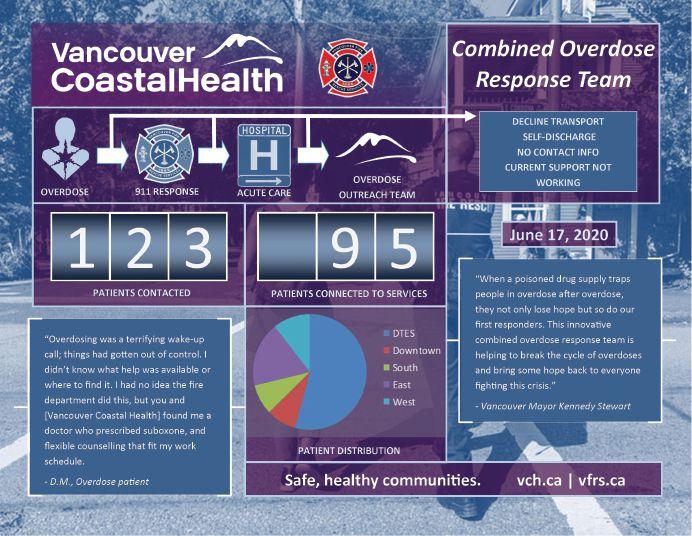
Vancouver Combined Overdose Response Team operational system and progress as of June 17.
BY CHRIS HARROW Director of Fire Services
Minto
and Wellington North Ontario
WLEADERSHIPFORUM
The meaning of a mentor
ith the pandemic restrictions starting to ease, I’ve had the chance to have more conversations with a couple of new peers. One topic came up a few times was the idea of mentoring; how it works and what makes it work so well. By having these conversations with new ideas and new perspectives, I have gained a new respect and priority for mentoring and how valuable it is.
The word mentor gets thrown around quite a bit in the fire service. Some services even have or have attempted to put in place a formal program for mentoring future officers and new firefighters. I believe it is very difficult to have a program with parameters around it. It is also difficult to force people into a mentorship program with someone they may not be comfortable with. To truly be mentored by someone or guided by someone you trust, the individual needs to find their own peer that they feel comfortable with. They need to seek the person out on their own terms and know what is comfortable for them.
Each firefighter that wants to learn will find someone or hopefully a few people they can trust to help guide them and learn from. They will also find individuals who allow them to have great conversations and debates with which enable them learn from each other. Some of my greatest mentors are people I have had debates with and the odd time I would win; they would admit when they were wrong. They were also people who would work with me to find the solution and go down the path together to create new ideas. The best conversations I have had have been in hotel rooms at conferences with one or two individuals where I have learned so much from debating and arguing many points.
mentor should be able to give you the rationale and facts behind the information to show you it is true. A peer of mine told me in a conversation that a person he once looked up to and would have kept being mentored by was giving him false information on a regular basis. But he didn’t know any better, because he didn’t expand his inner circle to include other mentors, which leads to point number two: possess a variety of mentors from different areas of your life. Surround yourself with various types of people you trust and give you good advice. Having multiple people you can bounce ideas or problems off of and get different perspectives from will help you make the proper decision in the end. Different ideas aid in thinking of ideas you would not usually come up with. It is not healthy to only have mentors from the fire service. Different perspective can assist in making a good well-rounded decision.
I also feel a mentor needs to be progressive. A mentor needs to push me to think outside the box when required. The person should be non-judgmental and positive. Nobody enjoys spending time with people who are negative and constantly putting other people down. It not only drags down your mood and attitude, but it hampers your
To truly be mentored by someone or guided by someone you trust, the individual needs to find their own peer that they feel comfortable with. ‘‘ ’’
What should a person look for in a mentor? Does it have to be someone in the fire service or someone from within their own fire department? The answer to both questions is no. It needs to be someone who possesses the qualities that are most important to you. Each person values different qualities in a friend or someone they want to surround themself with. It is extremely important you stay with this thought process and find a mentor who demonstrates these qualities.
There are a few qualities I believe are vital for a strong mentor to have. The obvious one is trust, both personally and professionally. You need to know the person is telling you the correct information. The
Chris Harrow is the director of fire services for the Town of Minto and Township of Wellington North in Ontario. He is a graduate from fire programs at Lakeland College and Dalhousie University and holds a graduate certificate in Advanced Care Paramedics from Conestoga College. He can be reached at c.harrow@mintofiredept.on.ca.
ability to move forward and look at a situation as a positive.
Individuals who wants to surround themselves with mentors will need to come up with their own list of qualities they look for. It is like an informal interview process in your mind. You need to silently screen the potential candidate in your thoughts and figure out if they would fit in with the beliefs you have as a leader and a professional.
Mentors will change over time. As your career progresses, the mentor you had when you were a young, raw fire service leader will most likely evolve into someone else who can challenge you. As you progress through your career, you will most likely become someone else’s mentor. You will be challenged to guide and provide advice to someone else in the fire service and elsewhere. At the same time, you will still need those people you can turn to for advice and assistance when the situation calls for it. Mentors are valuable right into retirement!
BY LAURA KING NFPA
public-education rep
PServe up fire safety –from a distance
retend for a minute everything you’ve ever done for public education and Fire Prevention Week is no longer an option. You have a clean slate. You can spitball ideas and blue-sky with your team, as if you’re a bunch of executives around a board room table with endless resources.
That’s how NFPA is embracing Fire Prevention Week 2020. Instead of restrictions because of distancing, or changes of plans because school visits and fire department open houses may be off limits, think of Oct. 4-10 as the greatest pub-ed opportunity of your career.
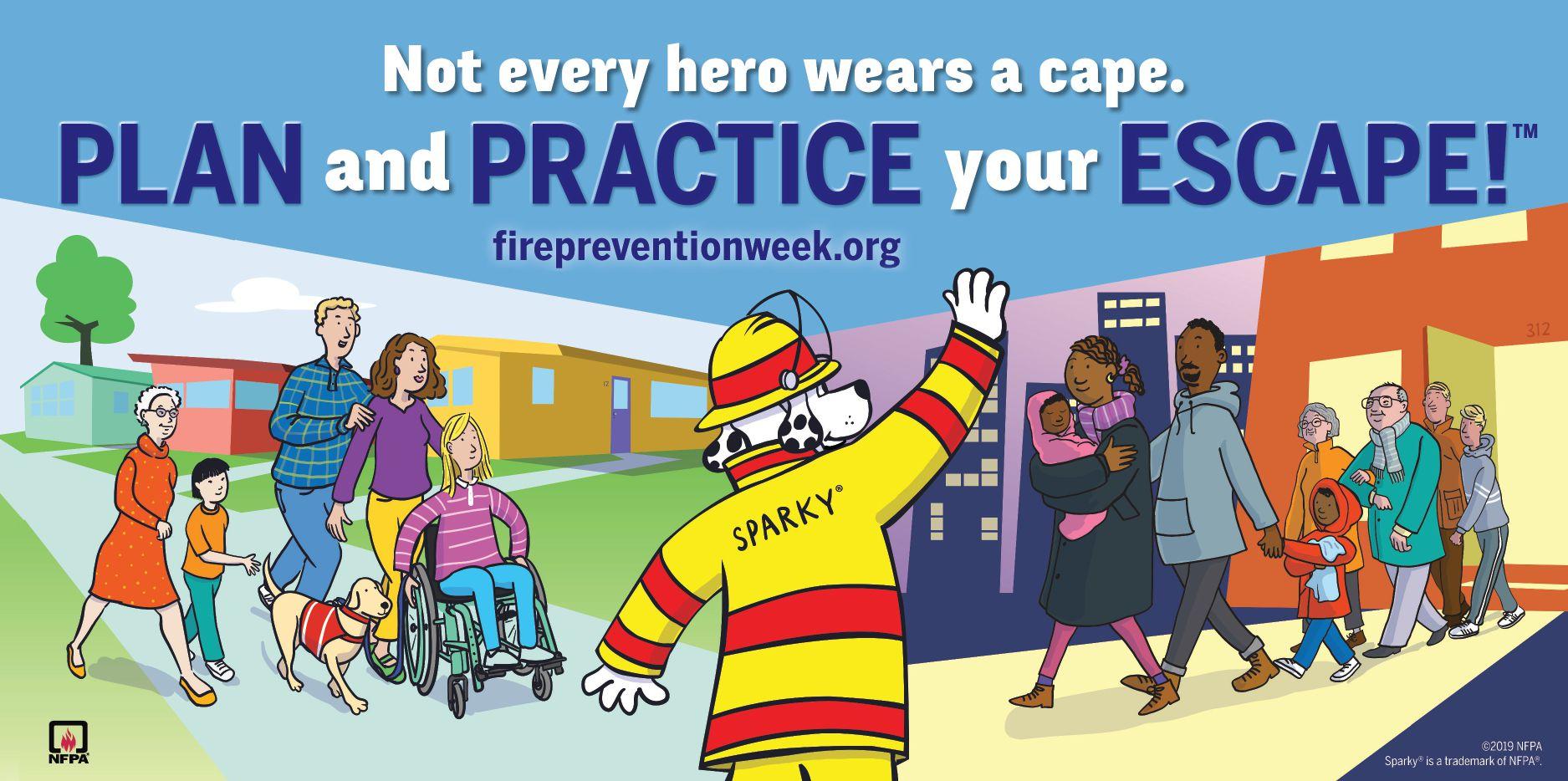
The 2020 Fire Prevention Week theme, Serve Up Fire Safety in the Kitchen!, works to educate everyone about the simple but important actions they can take to keep themselves, and those around them, safe in the kitchen. Cooking is the No. 1 cause of home fires and home fire injuries. Unattended cooking is the leading cause of fires in the kitchen.
So, what can your department do to reach your target audiences – teens who may be distracted by TikTok videos, young adults who might be hungry but also drowsy at 2 a.m., busy families, and older adults – while also respecting restrictions?
First, everything you need for a successful Fire Prevention Week is at fpw.org – endless resources! You’ll find social media cards, in English and French, for Facebook, Twitter and Instagram. You’ll find images for websites. You’ll find videos, dozens of games and activities, colouring sheets for kids and adults in English and French, Canadian versions of press releases and talking points, an event flyer in English and French to promote virtual activities, safety tip sheets (of course!), and checklists in French and English.
Most importantly, there’s a list of ideas, compiled by fire- and life-safety educators across North America, to help you and your department conduct an awesome Fire Prevention Week campaign – virtually and from a distance. Go to fpw. org, click on Toolkit, then Out-of-the-box ideas.
porate communications team now and walk through the free-to-download FPW resources (no need to reinvent wheels!). Use NFPA’s free resources as the basis for your posts; involve your department’s most creative and social-savvy minds and be consistent with your messages.
Busy families need groceries – partner with local stores and plaster the places with FPW posters. Older adults are all over Facebook. Trust me!
There are four key messages for FPW 2020, each with several supporting resources and materials. All the messages are drawn from NFPA’s educational messaging document that you can find at www. nfpa.org under public education / educational messaging.
• Stay focused on the food
• Keep cooking areas clear
• Put a lid on it
• Prevent scalds and burns
Supplementary messages encourage audiences to use a timer – Siri, Google Assistant or Alexa come in handy; to order in after a night out (we love that one!); and to be like Bill, the social-media stickman who is smart and safe in the kitchen!
With new ideas come new practices and protocols. You may have to work a bit differently to build your FPW programs and activities.
’’
With new ideas come new practices and protocols. You may have to work a bit differently to build your FPW programs and activities. If you want to create TikTok or Instagram-worthy posts, you might want to brainstorm with some savvy firefighters sooner rather than later to produce some slick vids!
To try an “observe-from-the-curb” activity in local neighbourhoods, you may need to make staffing and truck requests ASAP. To build a social media campaign, you may need to meet with your cor-
Laura King is the NFPA’s public education representative for Canada. Contact her at canadacrr@NFPA.org and follow her on Twitter at @LauraKingNFPA and Instagram at nfpacanada.
What about FPW handouts – the swag bags full of stickers, magnets and activities kids love to receive? If you can’t hand them out at the usual locations, consider curb-side pick up at the firehall or a municipal building (be sure to consider traffic issues), or partner with local businesses that offer drive-through services. You can find FPW kits at www. fpwcanada.ca or www.firehallbookstore.com.
If you’re looking for some help implementing ideas or programs, join the Fire Life Safety Educators & Coordinators group on Facebook. The group was created after the NFPA Conference & Expo in San Antonio in 2018 and boasts more than 800 members from large and small departments all over North America. NFPA is also happy to help you develop Fire Prevention Week programs, and other pub-ed resources. Contact me and we’ll work out a plan!
Lastly, remember to use the hashtags #FirePreventionWeek and #PubEdWorks! See you on social!
UNINTENDED CONSEQUENCES
the health of the community.”
The guidance is the first of its kind in Canada where people can access a prescription through a doctor, nurse practitioner, or through outreach teams and clinics to support prescribers and increase access to those who need safer alternatives to toxic street drugs.
In an emailed statement to Fire Fighting in Canada, Heidi Zilkie, communications manager for the Ministry wrote, “This guidance is just one piece of a much bigger puzzle; we are working to create a more comprehensive system of substance use care from harm reduction to treatment and recovery.”
While the Ministry said this is interim guidance, they will continue to evaluate its effectiveness and will update as needed.
In response to growing concerns since being deemed a public health crisis in 2016, Gormick said that in August 2019 the Vancouver department also launched a Combined Overdose Response Team in partnership with Vancouver Coastal Health social workers to follow up with and connect overdose patients to support services that decrease the probability of subsequent overdoses.
“As the [overdose] numbers continued to climb, we kept adding response resources,” he said. “I think this has proven to be an extremely effective strategy to not just attend and reverse overdoses but to address the factors that result in an overdose.”
He said this interagency partnership was successful as shown in decreased numbers of overdose rates in late 2019, prior to the pandemic.
Another measure came in May. To address concerns surrounding those doing drugs alone and allowing more access to the supports needed, British Columbia’s Provincial Health Services Authority in partnership with regional health authorities and Lifeguard Digital Health, launched a new resource called Lifeguard App.
Activated by the user before they take their dose, after 50 seconds the app will sound an alarm and if the user doesn’t hit a button to stop the alarm (indicating they are fine), the alarm grows louder. After 75 seconds a text-to-voice call will go straight to 9-11, alerting emergency medical dispatchers of a potential overdose. The app is now being added to the list of essential health and social sector interventions as part of the comprehensive response to the sustained and widespread overdose activity in the province during COVID-19.
While medical professionals urge Canadians to continue practicing public health measures to limit the spread of COVID-19, changes to drug supply in the wake of the pandemic highlight the importance of maintaining active treatment and harm reduction services for drug users, with many experts calling for legislative changes and more support for frontline workers.
“We know that federal changes won’t happen overnight but we’ll continue to advocate for decriminalization, said Watson. “Bottom line, the goal of making sure people can use safely, without fear of coming across a bad match through the illicit market.”
FIRE INVESTIGATION
Remembering the “why” and the “what” in a fire investigation
By DAVID MOSELEY
Investigator (me): What can you tell me about this fire?
Fire chief: It was burning, we put it out. That’s our job, I don’t have time for investigation. End of conversation.
This exchange didn’t take place long ago — it was last year — and as the investigator I admit I was a little shocked at the chief’s attitude. Then I remembered, while voiced with less belligerence, at one time, I may have had a similar attitude. So, what changed? Why is fire investigation now important to me, regardless of my role at the fire?
As a “firefighter’s firefighter”, I freely admit I love fighting fires; there’s no part of the job I enjoy more. What greater thrill is there than a good knock-down-drag-out interior attack or chasing the flank of a wildfire to the head? But, do I want fires to happen? No, I don’t. Like many of you, I’ve been involved in fires where firefighters died and been exposed to some of the 300 or 400 civilian fire fatalities Canada experiences every year. Never mind the destruction of property, who would want this to happen?
Obviously, the fire chief at the opening of this article wouldn’t wish a fire on anyone. I think they just failed to make the connections, perhaps between prevention and life safety and certainly between investigation as a component of prevention and life safety. We need to remember why we investigate fires, and no, the reason is not to keep lawyers in work and save insurance companies money. If it were, we’d leave it to them. The reason we investigate fires is to prevent future ones: to save lives and preserve property. It is that simple. The evolving fire service is learning to place a greater value on fire prevention, but how can you prevent fires if you don’t know what causes them?
In a broad sense, investigation identifies trends in fire cause that can be addressed through engineering, enforcement and education. And specifically, it can identify arsonists and bring them to justice.
Historically, across Canada and the U.S., the over-reporting of discarded cigarettes as the cause of wildfire has been blamed on sloppy or lazy investigation. More diligent investigation of wildfires in the last decade or so has identified a troubling arson problem in our forests. The official cause of the 2011 Slave Lake wildfire was arson. This is not abstract stuff.
That’s the why, but what can firefighters do to assist investigators? Two things primarily: they can be good witnesses, and they can identify and preserve evidence.
What makes a good witness and a good witness statement? It is no coincidence that the knowledge and observations that make a good statement are the same that a good firefighter and incident commander will use to heighten their situational awareness and for continuous size-up. What is the fire location, size, condition? Access locations and condition? Status of occupants or bystanders? What strategies and tactics are appropriate and applied? Using what resources? Were they successful? For a structure fire what is the structure layout and condition? How were utilities found and left? For a wildland fire, what fuel, weather and topography was involved and how did they interact with the fire? Often this information is gathered
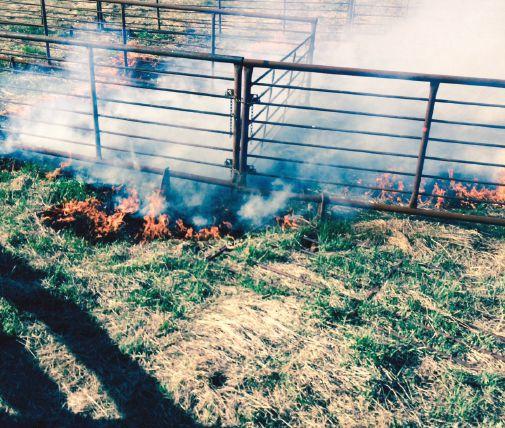
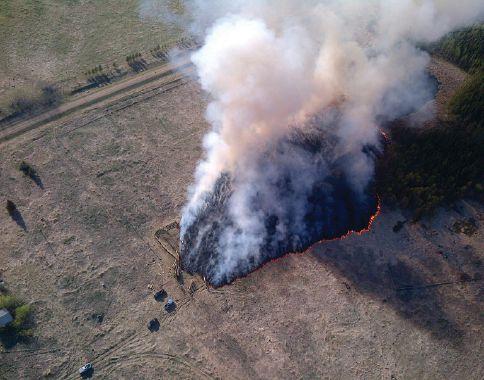
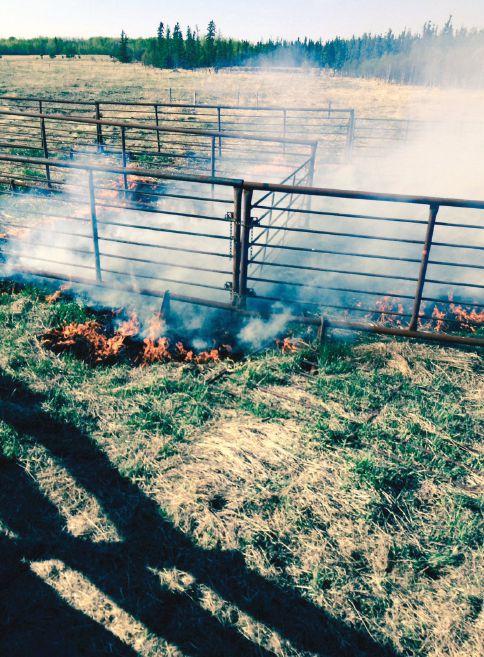
Fig. 1 is valuable and shows a wind driven V pattern giving a strong indication of the area of origin. But see how much more valuable the photograph of the same fire in Fig. 2, provided from a bystander,› in determining the area of origin.
FIGURE 1
FIGURE 2
PHOTOS: DAVID MOSELEY
from bystanders, so who were the bystanders, how do we contact them? Is there anything at all that doesn’t seem right, is out of place, or not as expected? This is the stuff of a good firefighter witness statement.
Here is a short excerpt from an attack crew statement. Consider what it might tell an investigator: When ready to enter the front door was forced and WALLACE and I advanced to the doorway with 44mm hoseline, TIC, and axe. We could see the floor immediately inside the door was burnt through, did not know if crawlspace or basement. We applied water to little fire we could see, most appeared to be in the attic, primarily to our right, in the AD corner. To the left was a large living room which appeared largely undamaged by fire and showing no significant heat signature on TIC. Not deeming this safe to enter, we were directed to the back door.
Note how this sheds light on the security of building, identity of additional witness, condition of building, location and intensity of fire, and actions of the fire department.
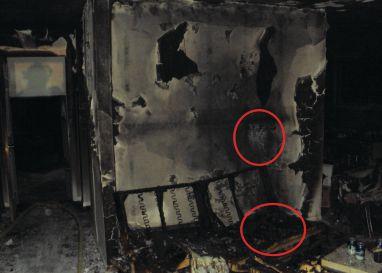
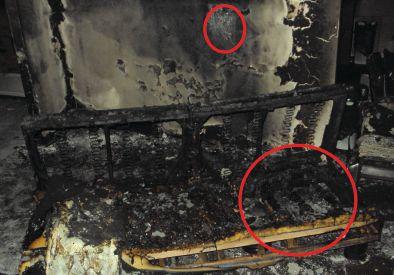
In Fig. 3, firefighters recognized the V pattern and damage to drywall paper, as well as the additional degree of damage to the right side of the couch as potential indicators of the fire origin area. Needing to access the ceiling above, they photographed the couch in place, then moved it and took the second photograph.
Whether your department demands it or not, consider getting into the habit of writing these incident statements. Beyond the value for investigation, they are a great way to reflect upon your performance, reflection that naturally should lead to improvement. The detailed, comprehensive, chronological nature of a statement can be a good lead into a debriefing or after-action review.
Photographs from witnesses are a tremendous aid to investigators, from broad and distant to closer in, multiple angles, as early in the incident as possible. Early often means taken by bystanders before firefighters arrive, so again this goes back to the importance of gathering bystander information for the investigator. In Fig. 1 you can see a valuable initial attack photograph of a wildfire with the wind driven V pattern giving a strong indication of the area of origin. But see how much more valuable the photograph of the same fire in Fig. 2 from a bystander is in determining the area of origin.
Preserving evidence always starts with the obvious. At a vehicle fire we found burnt toilet paper stuffed in the gas tank, and an empty jerrycan on the highway shoulder. Take a photograph and protect it so the investigator can collect it.
Beyond the obvious we need to remember the generalization that structure fires usually originate from the location of greatest damage and wildland fires from the area of least damage near the rear of the fire. We want to preserve evidence by minimizing the disturbance of these potential areas of origin. This can be difficult in a structure fire when this is also where overhaul usually starts. Overhaul most often starts after we have achieved our life safety and incident stabilization objectives, so we usually have time to pause and regroup. This is a perfect time to get the investigator in, or if not readily available, for the incident commander or company officer to consider the needs of investigation before proceeding.
When overhaul cannot wait and the investigator has not arrived, photographs can again be very valuable. In Fig. 3, firefighters recognized the V pattern and damage to drywall paper, as well as the additional degree of damage to the right side of the couch as potential indicators of the fire origin area. Needing to access the ceiling above, they photographed the couch in place, then moved it and took this second photograph.
As leaders, you need to recognize the need for, and adequately resource, fire investigation. Firefighters must know it is important to the organization. The steps laid out above are not expensive to implement or in the grand scheme of things that time consuming. Once recognized as important, it is mainly a matter of attitude.
David Moseley is a forest officer with Alberta Agriculture and Forestry, and officer with Lac La Biche County Fire Rescue in Alberta, focused on operations. His other areas of interest include instructing, CISM and wildfire investigation. Contact him at david.moseley@gov.ab.ca.
FIGURE 3 BEFORE
FIGURE 3 AFTER
BY TINA SARYEDDINE Executive Director Canadian Association of Fire Chiefs
WGUESTCOLUMN
While you were at COVID: Fire policy advances in Ottawa
hile fire departments were playing their positions during the COVID-19 crisis, policy issues impacting our sector continued to evolve at the national level. What are some of these issues and how do they affect the fire service?
A wildland urban interface guide: The National Research Council completed the full draft of its Wildland Urban Interface Guideline. The guideline, which was developed by a multi-stakeholder roundtable over a two-year period that included the CAFC, the NFPA and Fire Smart, provides a prelude to potential building and fire code issues. There will be a limited public review open for individuals with expertise in the field in September. Until then CAFC members have access to the draft copy.
Beginning of a new building and fire code cycle: During the COVID-19 outbreak, the Canadian Building and Fire Codes Commission (CCBFC) undertook an evaluation of their processes. This is timed at the end of one five-year code cycle and the beginning of the next. The CAFC has long been on the record with strong support for the CCBFC and calls to improve some of its processes. Consider, for example, that the CCBFC call for comments on the proposed changes for a given year would often come out within a month’s notice close to the December holidays. The software they used to collect comments on the code worked well for industries that might have limited numbers of comments, but poorly for sectors like fire, since every change would have to be commented on through separate entry.
Most importantly, the evidence-informed codes process has unintended consequences. Research grade evidence must be brought forward by the party wishing to propose or refute a change. This is done to prevent undue influence in the codes process. However, industries that have more capacity for generating reliable data tend to have more data and therefore more evidence. The evidence required differs from the essential experiential knowledge of people in the field. Since 2018, the CAFC has called on the federal government to consider a Safety Innovation Research Fund that would be driven by the fire sector to ensure that the type, quality, and questions answered through research yields the data needed to examine and prove experiential knowledge of what needs to be addressed.
$8 million distributed for mental health research: As part of the $30 million that was ring-fenced for first responder mental
Tina
Saryeddine, PhD, MHA, CHE, is the Executive Director of the Canadian Association of Fire Chiefs. You can learn more about the CAFC at www.cafc.ca.
health in budget 2018, the country’s largest federal granting agency for health research — Canadian Institutes for Health Research (CIHR) — announced its most recent funding competition results. Eight teams received close to a million dollars each to conduct their study. There were no fire specific projects in this round, but six projects were generic public safety personnel related. It is the hope of the CAFC that the remaining $3 million in funding for PSP mental health will be used for a project that can directly and immediately assist the front line. One idea is to channel the funding to set up a 1-800 suicide line that would be based on research and whose implementation would be evaluated while giving care to those seeking it.
Transport Canada e-shipping: In late 2019, the CAFC was advised that Transport Canada would be undertaking an e-shipping pilot project with a view to deciding on whether documentation regarding the transportation of dangerous goods could be provided electronically. The pilot provides temporary e-shipping permits to companies. At the time of submission, only three companies held e-shipping permit. The members of the CAFC National Advisory Council had the opportunity to discuss this project with Transport Canada. The need for both paper and electronic shipping copies during the pilot, special consideration for areas of the country where there is insufficient cell and internet coverage, and appropriate communication and training were highlighted.
Municipal budgets: Finally, during COVID nearly every sector had a need and an ask of the federal government. The CAFC’s focus was on ensuring the protection of volunteer firefighters, sufficient PPE and recognition of fire departments as part of a tiered healthcare system. However, in the larger context, fire department budgets will be impacted by the budgets of municipalities. The latter are being stressed by lower public transit numbers and lower user fee collections. As such, the Federation of Canadian Municipalities has put in its largest request to the federal government: $10 to $15 billion in emergency operating funds.
Now that the first wave of COVID is beginning to recede, the CAFC is reconvening the committees that will continue to monitor and address these issues. CAFC committees have over 100 fire chiefs providing leadership nationally. The key is to stay aware and stay involved. At ‘Virtually’ Fire Rescue Canada 2020, happening Sept. 14-15, we will discuss what lies ahead to 2030. Please join the conversation. We welcome all chief fire officers and affiliates. Let’s work together and shape the future of the fire sector.
FIRE PREVENTION WEEK
OCT. 4-10, 2020
This year’s FPW campaign, “Serve Up Fire Safety in the Kitchen!™” works to educate everyone about the simple but important actions they can take to keep themselves, and those around them, safe in the kitchen.
Did you know?
Cooking is the #1 cause of home fires and home fire injuries. Unattended cooking is the leading cause of fires in the kitchen.
Everything you need to educate your community:
This year’s FPW campaign provides an ideal opportunity to educate the public about the importance of fire safety. NFPA’s materials and resources help support your department’s efforts during Fire Prevention Week, and all year long.
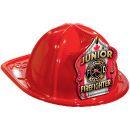
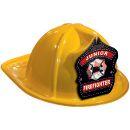
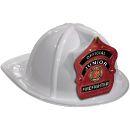
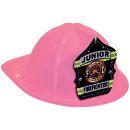
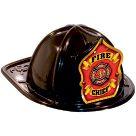
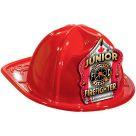
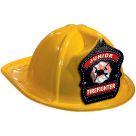
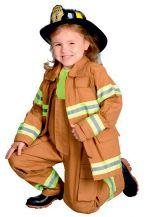
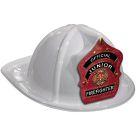
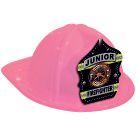
KIDS FIRE HATS ARE ALWAYS A HIT!
FIRE PREVENTION WEEK IN A BOX
100, there are all involved in Fire that will inspire help save lives. your Week, and all year develop and
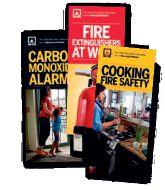
FPW In A Box™, for groups of 100, 300, or 500, is packed with resources that can help you raise awareness on the importance of practicing fire safety in the kitchen. You get everything you need in a cost-effective kit to make a maximum impact in your community.
• School Handouts
• Brochures • DVDs • Kids Turnout Gear • Fire Safety Rules Bike
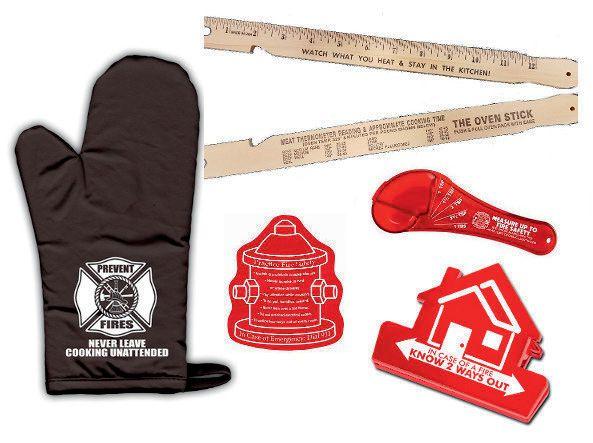
A great kit to promote fire safety in the kitchen! Package includes:
Fire Safety Oven Sticks (50)
5-in-1 Measuring Spoons (10)
“2 Ways Out” Chip Clips (50)
Fire Hydrant Jar Opener (25)
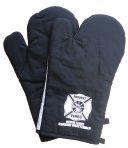
Fire Safety Oven Mitts (10)
BACKtoBASICS
Ladder Dating: The Halyard
BY MARK VAN DER FEYST
There are some great debates to have in the fire service between firefighters and colleagues about different ways of operating, uses of equipment, types of equipment, etc. These endless debates can go on forever with all sides agreeing or disagreeing. For most debates, there is not going to be a right answer because most of the items being debated will be situationally based. One of these hot topics to debate is the halyard – to tie it off or not to tie it off?
This investigation into the halyard continues my Back to Basics series called Ladder Dating (so named because firefighters need to “date” their ground ladders and get to know them well like a significant other).
Every extension ladder in the fire service will be equipped with a halyard, which is a piece of rope used to help extend the fly section or lower it. Depending upon the type of ladder (whether a two or three section ladder), there will be one or two halyards being used. Without this piece of equipment added to the ladder, the extension of the ground ladder will not be as easily achieved.
Most halyards are going to be constructed out of nylon, polyester, hemp or cotton; all are classified as utility rope. Different manufactures of ground ladders will have differing styles of utility rope.
Some will be small in diameter and others will be thicker. Regardless of the diameter size, they are all classed as utility rope. For the two-section ground ladder, there will be a utility rope affixed. For the three section ground ladders, there will be a combination of a utility rope and a steel cable being used in tandem. The steel cable is affixed to the fly section of the ladder while the utility rope will be affixed to the mid-fly section.
In basic training and in the textbooks used for basic training, the fire service has been taught and is still teaching to tie off the halyard once the ladder has been raised, extended, and placed in position. The main reason for this is for the safety of the firefighter using the ground ladder. The main premise is that should the locks, dawgs or pawls (for this article, locks will be used) of the ground ladder ever fail, then the halyard will prevent the fly section of the ladder from sliding down like a guillotine.
Will the halyard hold the weight of a firefighter and the fly section of the ground ladder in position if the locks were to fail? That answer will depend upon the rope being used and the factors of how old it is, how it been maintained over the life span of the rope, how thick or thin is it, what it is made of, whether it has been exposed to any heat over time, whether it is fraying, etc. The other factors
PHOTOS BY MARK VAN DER FEYST
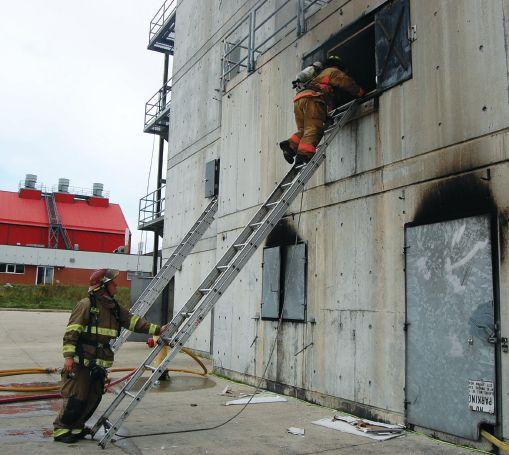
Here the ladder is extended, with the halyard is not tied off and the ladder is working properly.
to consider is what the halyard is attached to, such as the pully and the anchor tab on the bottom rung. Those two items are not life safety equipment and are not rated or tested to life safety limits like with rope rescue. They are unrated, utility purpose devices used to operate the halyard. The locks of the ladder are going to keep the fly section from sliding down and to date, there has not been any recorded case of locks failing on a ground ladder. Ensure they are locked in properly and the ladder will work.
The halyard is usually tied off with a clove hitch around the rungs of the ladder. Most of the time it is tied off wrapped around the rungs of both the bed section and the fly section keeping it secured while it is bedded on the truck. The issue with this method of storage is the time it will require to undo it when the ladder needs to be raised.
Here is a scenario to consider: There is a fire in your home. You are trapped in the bedroom of your house and have called 911. The fire department arrives on scene. By this time, the fire has grown, trapping you still in your room with heavy smoke now entering the room with intense heat. There is a team of firefighters who have brought a ground ladder over to your window to rescue you. Do you want them to take the time to undo the series of rope wrapped around both rungs just to extend the ladder, and then tie the rope around both rungs again with a clove hitch before they start to ascend up the ladder to rescue you? Or do you want the team to immediately raise the ladder, extend it, not tie off the halyard and come and get you?
This is main reason behind not tying off the halyard after extending it — immediate rescue purposes. If the ladder is being extended for other reasons, such as ventilation or gaining access to an upper portion of the building and time is available to do this, then certainly tie it off, if required. But the ground ladder can sit there with the halyard untied, and it will still work. For multiple rescues at different points of the building with the same ground ladder, having the halyard untied will allow for quick extension, making the rescue, then lowering to move to the next spot on the building.
There are ways to prep a ground ladder so that the halyard is tied permanently not requiring to be untied, so that the ladder can be raised and extended quickly to tactical rescue. This is effective and efficient. In the photo, you can see how the ladder is extended, with the halyard not tied off, and the ladder is working properly. In this setting, the halyard has been tied off around the bottom rung of the bed section for rapid deployment/extension.
If there is really a need to tie off the halyard because it is department SOP or because an officer is ordering it to be done, the halyard can be tied off without having to untie the rope off the bottom rung or from the quick deployment model. It can be done by tying it on a bight (a clove hitch on a bight). This will accomplish the same effect as the basic way as taught in our textbooks.
Are you putting your stock into the halyard or the locks of the ladder?
Mark van der Feyst has been in the fire service since 1999 and is currently a full-time firefighter with the WFD. He is an international instructor teaching in Canada, the United States, FDIC and India. He is a local level suppression instructor for the Pennsylvania State Fire Academy and the lead Author of Pennwell’s Residential Fire Rescue book. He can be contacted at Mark@FireStarTraining.com.
BY DAVE BALDING Fire Chief Nipawin, Saskatchewan
TFIRELINES
Becoming versatile
he fire service, I have come to realize through the good fortune of my engagement and involvement with fire departments across Canada, is diverse yet consistent and invariably challenging. I recently assumed the role of fire chief for the Town of Nipawin, Sask. This exciting new position entailed a move from my home province of some 27 years to a place with, I’m learning, both differences and similarities. In this agricultural region there are risks I have not yet seen such as grain entrapment and colder temperatures than I may be accustomed to. Not surprisingly, much of our modus operandi (way of doing business) is similar to models I’m familiar with. Of course, there are the typical local, regional and provincial elements I must familiarize myself with, a process already well underway.
There are a great many lessons here for me as I learn about my new home, the department, the community and region. In previous columns I have written about the need for leaders to be humble; it’s a vital quality that I feel is even more essential for this neophyte. I’m so very fortunate to be joining a department with and excellent reputation and quite a few members with considerable tenure. I have much to learn and I’m the first to see this. Learning is another positive aspect of effective leaders I have written of. Training and courses are one facet of learning we must remain engaged in as is paying attention to those around us and simply observing. I’m already reaping dividends as I learn about the department – it’s history, the members, significant calls, the political climate and more. These pieces all fit together like a puzzle to impart a flavour of the department in operational and softer yet vital aspects.
that is a fit for my philosophies. The matter of fitting in and meshing with a new department is not entirely measurable yet so very critical. As the first fire chief to serve this department coming from another jurisdiction, I’m keenly aware that I’m being watched and measured by those I lead. It’s important to bear in mind the obverse is also true; as an officer in any department we develop bonds with our subordinates and colleagues. Always remember the new recruit in their early days with your organization as they settle into the best profession in the world, be it career or volunteer. I have redoubled my commitment to always make them feel welcome and safe as I have been welcomed here.
Forging and enriching relationships is not only an essential part of what we do in the fire service, it is in my view one of the most affirming. Whether by default or intent we build and grow relationships on several levels in our professional environment. I’m reminded in my new setting of the importance and thrill of getting to know the members I work and respond with.
I reflect on the sense of community here - not only of the brother
I’m already reaping dividends as I learn about the department – it’s history, the members, significant calls, the political climate and more ‘‘ ’’
There’s nothing like removing one’s self from the status quo, the familiar, to grow versatility. Surroundings and situations we become accustomed to become comfortable. No matter what your role in the fire service, continue to challenge yourself, to push yourself even if it means getting out of that comfort zone. Flexibility in our characters and our intellectual capacity much like physical flexibility diminishes with lack of use. Our default condition is to stay comfortable, not to bend. Flex and bend, I say.
Another trait that strong and effective leaders possess is that of vision. Each one of us imprints our department in our own unique way and the extent to which we do so is a balance. I’m fortunate here in Nipawin to be engaged with an ambitious and dedicated department
Dave Balding joined the fire service in 1985 and is the fire chief with the Nipawin Fire Department in Saskatchewan. Contact Dave at d.balding@nipawin.com and follow him on Twitter at @ FireChiefDaveB.
and sisterhood that is the fire service, but of the communities in which our departments serve. When out and about in uniform or not, I have been stopped and welcomed to town. Ensuing conversation invariably revolves around the fire department. These experiences are reminders to me that we are always individually and collectively on display, ambassadors for the fire service. This is especially true in the environments I treasure: smaller communities across our country.
With this change come myriad challenges – and blessings for me. Among them is the opportunity to appreciate the gift of belonging to the fire service, leading and learning from a fresh new perspective. Is effective fire service leadership any more important for a newcomer? I’d say not, we must always be our best for those we lead, our organizations and the people we are in this to help. The key, as it is for every one of us no matter how much tenure we may have in our position, is to keep that inspiration and drive fresh and top of mind.
BY VINCE MACKENZIE Fire chief
Grand Falls - Windsor Newfoundland
WVOLUNTEERVISION
Not the same but better
ell, here we are halfway through the summer of 2020 and what an incident the first half of the year has been. The year 2020 will not be remembered as a calendar year so much as it will be remembered as an event. To call what we are in the midst of now a ‘different world” would be an understatement. Fire departments across the country have been affected by a series of abnormal events. First, we have all been touched and responded to the pandemic is some way, shape, or form. My co-columnist colleague Tom DeSorcy observed that when he spoke about it in June’s edition of Volunteer Vision. He said that it is the first time fire chiefs across Canada have been united when we consider every chief was working the same incident at the same time, referring to the pandemic crisis.
Second up, the tragic events of April in Nova Scotia saw the fire service once again stepping to the forefront as the violent acts and arsons of one person caused the mostly volunteer fire departments in the region to answer the calls with even more risk. Departments had to stand down as buildings burned because they were not able to respond due to the violence risk. The ensuing tragedy scarred their communities and will be remembered for a long time to come regionally and nationally. My deepest condolences to all affected and I wish you healthy healing.
Third up, late spring saw massive civil rights demonstrations as crowds of people take to the streets during a pandemic and the fire service was once again on high alert as we carefully watch protests in our community and ensuing fires in the United States. Here in Canada we had more peace in the demonstrations and fires were not an issue.
The way we measure our fire service objectives will be changed forever. We shouldn’t expect to meet last year’s goals as easily in the next couple of years. Our firefighters are seeing this daily as their observations around operations, training, and the way we do things now become a proving ground for what really works to be safer in the pandemic era. What we once considered great traditions in once a week department training may be shattered as we learn that training in small groups and in some cases virtually added to better learning for many. It does have its advantages and we also will acknowledge the disadvantages, especially in group cohesiveness. But as we are all affected by this era together the positive fact is that everyone is contributing to solutions.
The loss of training conferences has exposed many to other avenues of learning. While travel has been scaled back, the opportunity for firefighters to attend live trade shows, training and provincial and national conferences is almost nonexistent for a while. Our fire service associations have done great work leading us through and guiding the fire service during this unprecedented pandemic era.
Change is coming, adversity is coming, but fire departments have been ready and dealing with both change and adversity since our existence.
These are just three of the events in the first six months of this year. I’ve always maintained that fire departments are adversity departments: we are only pressed into rapid action when adversity strikes our community. Converging emergencies in local areas during the pandemic era only adds to the sense of adversity.
As firefighters, we are trained to act in face of adversity, therefore we care deeply for our communities. It takes a deep sense of caring to volunteer and operate at the level of commitment we put forth everyday as we carry that pager. Adversity is what we are here for but it seems it is relentless for this year.
Vince MacKenzie is the fire chief in Grand Falls-Windsor, Nfld. He is an executive member of the Canadian Association of Fire Chiefs and the past president of the Newfoundland and Labrador Association of Fire Services. Email Vince at firechief@townofgfw.com and follow him on Twitter at @FirechiefVince.
’’
Unfortunately, the organization’s revenue from conferences will be lower and place these associations in a change mode as well.
Our communities have learned to appreciate emergency services even more, as we all saw how important essential services are the core of our towns. Essential workers are not exclusive to the core emergency services we often get recognized as, we also learned that everyone is essential especially in even some of the lowest paying jobs that we take for granted every day.
So, buckle up folks and tighten the gear, the fire service will probably never be the same after 2020, but in most respects, I feel we will be in a better place. You will gain more knowledge and experience than you ever have in one calendar year. Let’s build it together. Change is coming, adversity is coming, but fire departments have been ready and dealing with both change and adversity since our existence. That is our true tradition: we got this!
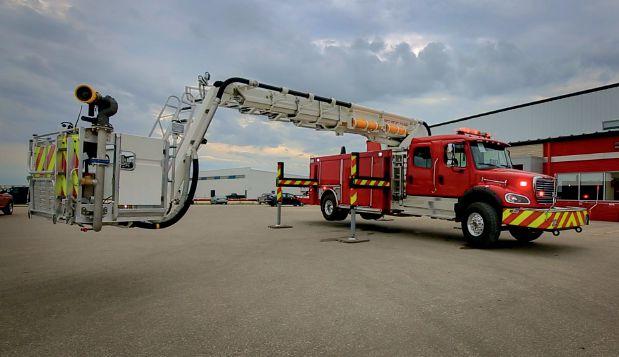
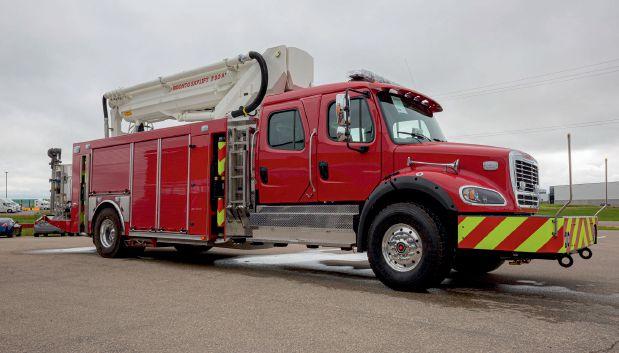
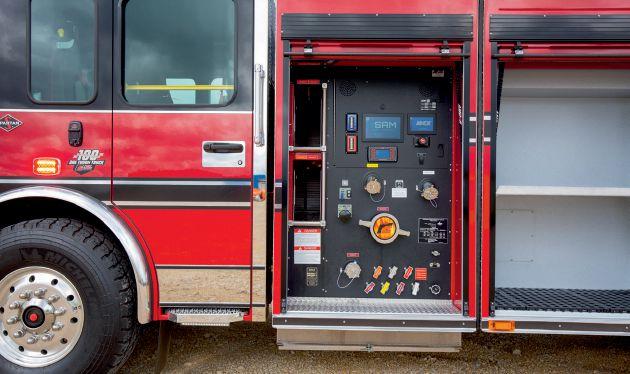
FGFT INTRODUCES THE BRONTO ALL-ROUNDER AND SAM EMERGENCY RESCUE
Fort Garry Fire Trucks is a proud distributor of sales, service, and parts for the versatile Bronto aerial platforms that are designed for easy maneuvering, quick set-up, and safe and efficient operation.
We are proud to unveil our brand new Bronto All - Rounder. This resourceful apparatus features a 92-foot articulated ladder platform built on a single axle Freightliner chassis with a 450 HP diesel engine and measures
We are also proud to introduce our SAM Emergency Rescue. SAM is an integrated total water control system that manages your truck’s pump, tank, intakes and discharges freeing up the pump operator to focus on the scene. The SAM system replaces your pressure governor and takes care of opening and closing valves based on operator settings all from a 10 inch
touch screen display. If you’re interested in either of our brand new rigs call our sales department and follow us on Facebook for videos and other updates.
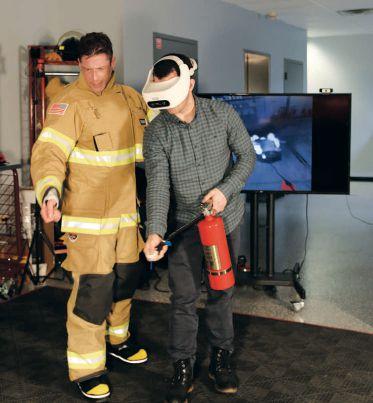
VIRTUAL REALITY TRAINING
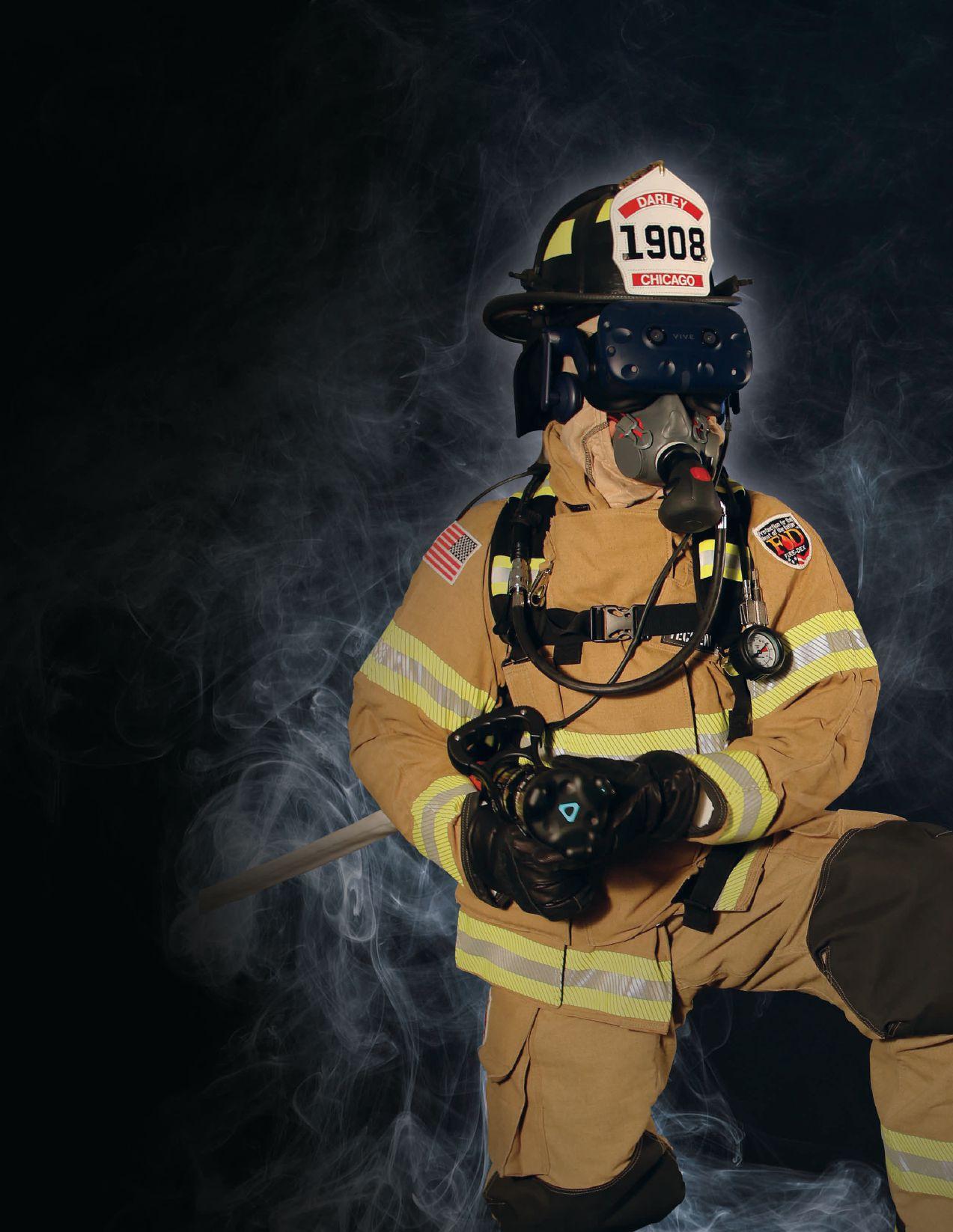
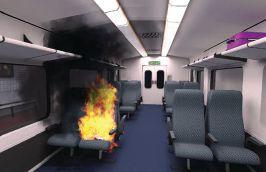
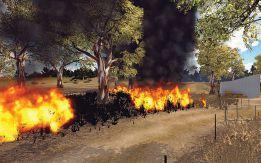
CONSISTENT, REPEATABLE AND SAFE TRAINING WITH VIRTUAL REALITY
VIRTUAL REALITY TRAINING SOLUTIONS FOR:
HOT FIRE TRAINING
FIRE EXTINGUISHER
ARSON INVESTIGATION
SITUATIONAL AWARENESS
INCIDENT COMMAND
VIRTUAL REALITY OFFERS:
- Safe training environment
- Highly visual form of visual learning
- Consistent, repeatable training
- Practical training for the current generation
REDUCE
COSTS, CARCINOGEN HEALTH EXPOSURES ENVIRONMENTAL RESTRICTIONS INCREASE
LEARNING RETENTION, END USER ENGAGEMENT, SPEED OF COMPETENCY