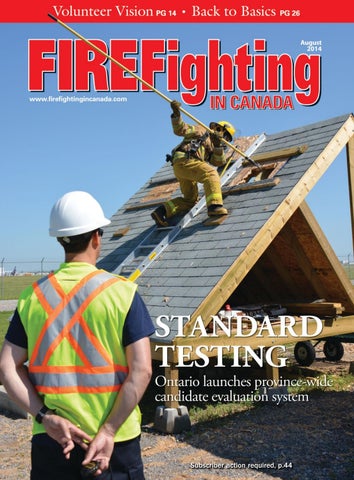
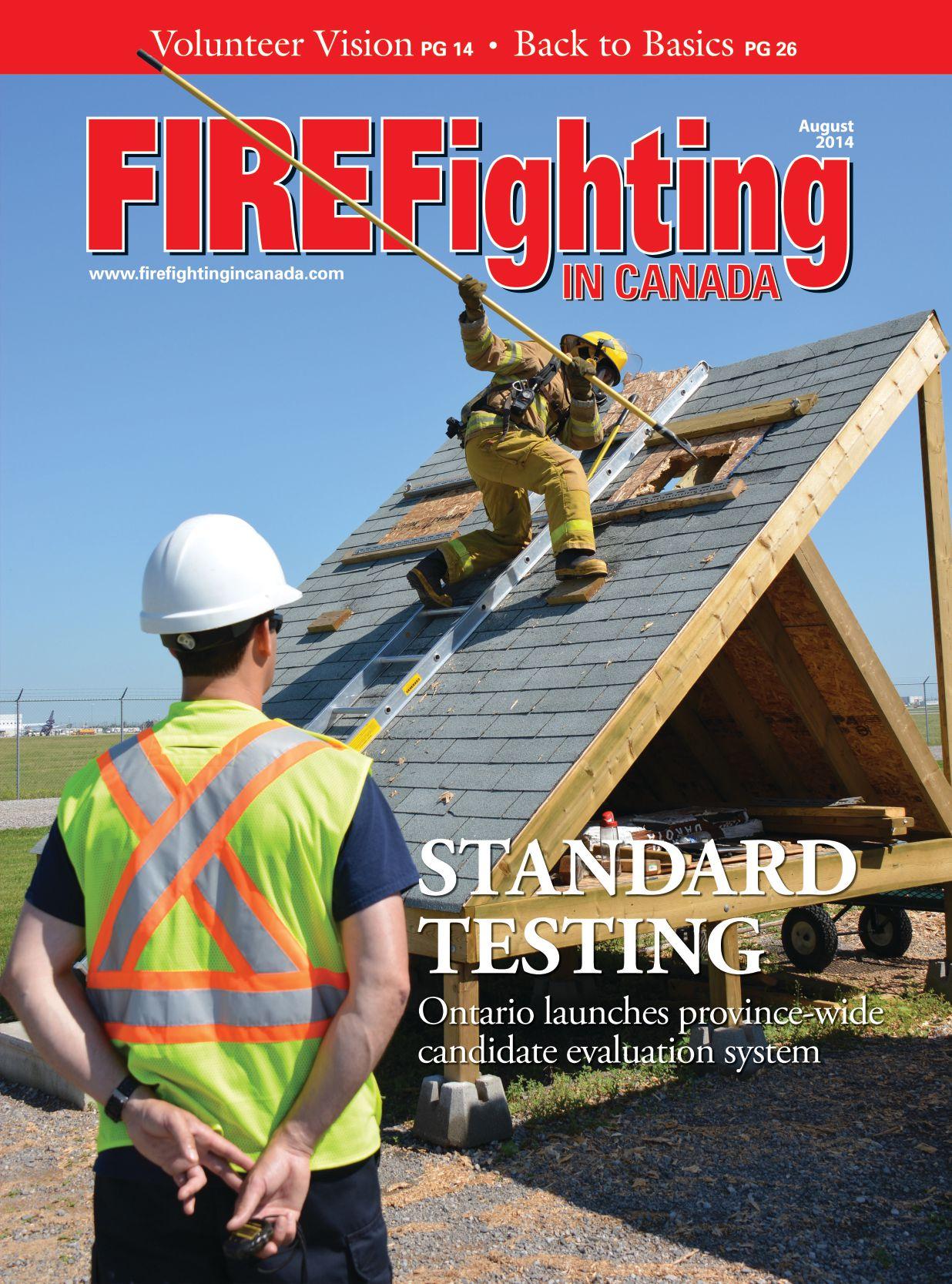
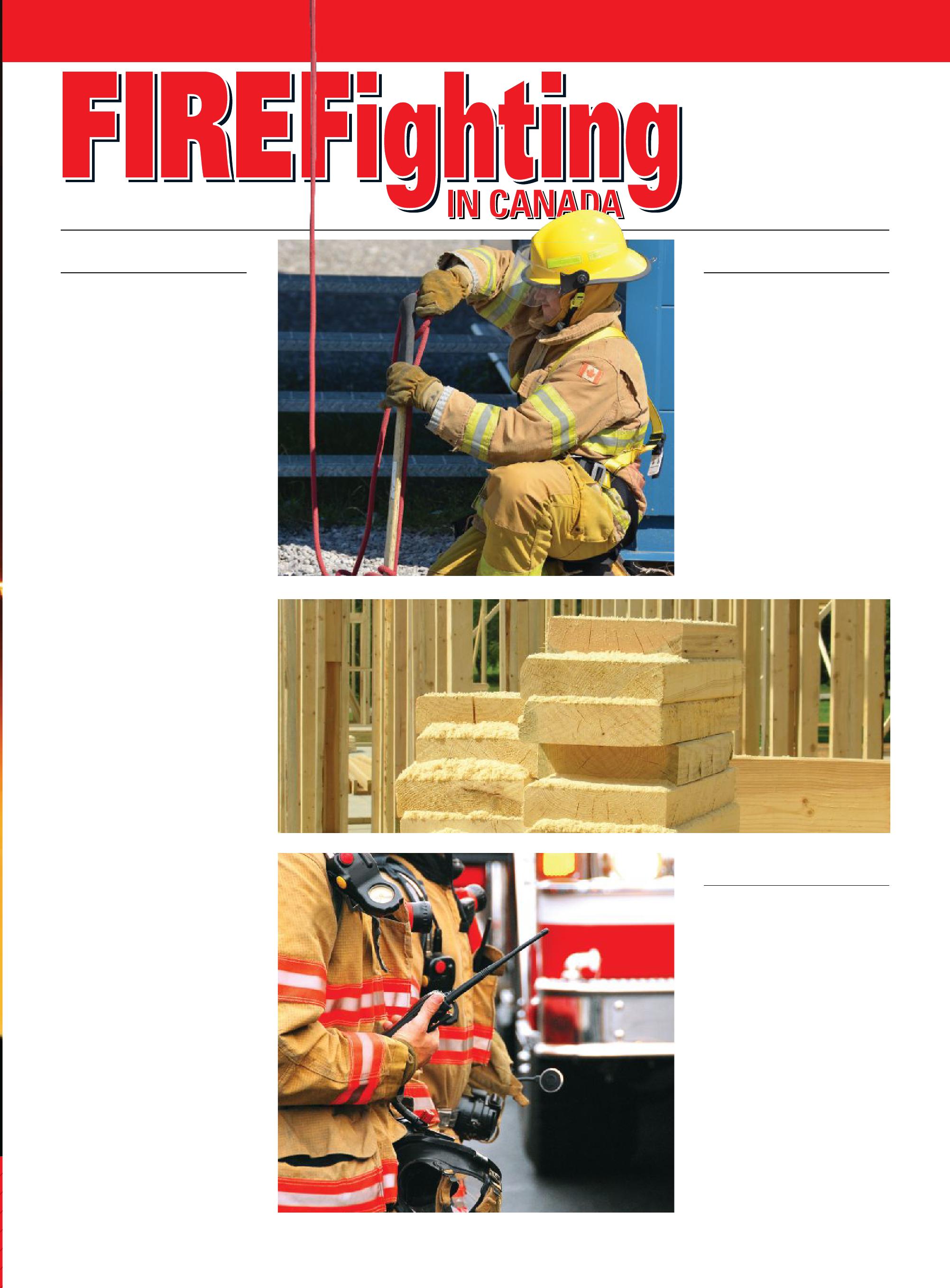
The Ontario Association of Fire Chiefs has introduced standardized testing for firefighter candidates to help eliminate the high costs and arbitrary pass scores and ensure that those who successfully navigate the process have the aptitude, interpersonal skills, work styles, fitness levels and technical know-how necessary to do the job. By Laura King
20 BEST PRACTICES
The increasing recognition of construction-fire risks by government and the construction industry has led to a trend toward fire-safety plans for construction sites, which outline actions to be taken by site owners to reduce the likelihood and manage the impact of fires during construction and demolition. By Len Garis and Joseph Clare
36 INTEROPERABLE RESPONSE
Using common technologies based on open national communication standards, the Multi-Agency Situational Awareness System makes it possible to connect different fire departments’ systems, allowing them to exchange realtime, location-based incident information relevant to emergency managers and first responders. By Kate Connick, Philip Dawe and Dave Matschke
BY LAURA KING Editor lking@annexweb.com
M COMMENT
Fairness in fire-service hiring
ost college or university graduates polish their resumes, ply friends and relatives for industry contacts, apply for jobs, and, eventually, find a position in a field related to the degree, diploma or certificate for which they studied. Sure, summer job experience gives graduates an edge, and, as we all know, it’s not necessarily what you know, but who you know.
Firefighters are different – except for the nepotism, which, anecdotally, is as much as issue in fire as it is in any other profession. In many cases, children of firefighters are good candidates who have the necessary drive and discipline for the job. In other cases, fire chiefs have sway in the hiring processes and if one fire chief knows another fire chief’s child, well, you know how it goes.
That’s part of the issue.
Meet Britney Holmberg, a firefighter with Brampton Fire and Emergency Services in Ontario, who took out a $10,000 line of credit to fund her applications to municipal fire departments and the testing that is part of the process. (See our cover story on page 10.)
also streamlines the hiring process for municipalities and removes considerable stress for candidates, who test once rather than for every municipality to which they apply.
The OAFC’s new candidate testing service launched in April and includes firefighter technical skills.
See story page 10.
Candidates pay about $800 for testing: aptitude, interpersonal skills, work styles, CPAT, medical, clinical and firefighter technical skills. Those who pass are given a certificate and can apply – at no charge – to as many municipalities as they wish that have signed on with CTS. The municipality chooses candidates to interview and hire. Although OAFC members pushed for CTS, not all have bought in yet. Many municipalities have their own hiring programs and were in the midst of recruiting when CTS launched so aren’t ready to change. Some chiefs have yet to broach the subject with HR. Others, when asked by email, declined to provide reasons but simply said they don’t support CTS.
Canada – 1 Year - $24.00 (with GST $25.20, with HST/QST $27.12) (GST - #867172652RT0001)
USA – 1 Year $40.00 USD
We acknowledge the financial support of the Government of Canada through the Canada Periodical Fund of the Department of Canadian Heritage.
Britney’s case is typical – school and training followed by three years of tests, coaching, interviews, and more debt.
Those who can’t afford the testing process don’t apply, and that has led to a lack of diversity in the fire service.
The Ontario Association of Fire Chiefs’ (OAFC) new Candidate Testing Service (CTS) deals with all of those issues: nepotism, cost and the lack of diversity. (This is not how CTS advertises, of course, but having spent considerable time learning about the process, this is how I see it – win-win.) CTS
There are other candidate-testing services in Ontario; none, as far as I can tell, is as comprehensive as CTS. All are for profit, and some rely on advisory services from one or more chiefs who sit on their boards. I’ll let you read between the lines.
CTS is a big change; effectively, it removes some control of the hiring process from chief officers, who can’t look the other way and interview someone’s kid who scored lower than others on the tests
How is that a bad thing?
Occasionally, Fire Fighting in Canada will mail information on behalf of industry-related groups whose products and services we believe may be of interest to you. If you prefer not to receive this information, please contact our circulation department in any of the four ways listed above.
All advertising is subject to the publisher’s approval. Such approval does not imply any endorsement of the products or services advertised. Publisher reserves the right to refuse advertising that does not meet the standards of the publication. www.firefightingincanada.com
ON THE COVER
PHOTO BY LAURA KING
The powerful new 2014 Ram 1500 Special Service* Vehicle is the truck Firefighters, EMS and First Responders rely on in the toughest situations. Its powerful and proven 5.7 L HEMI V8 engine offers 395 HP and 407 lb-ft of torque. With its Electronic Control System including All-Speed Traction Control, Hill Start Assist and Ready Alert Braking, Canada’s longest lasting line of pickups» are clearly what you want to be driving to every
STATIONtoSTATION
ACROSS CANADA: Regional news briefs
Boot camp boosts interest in fire fighting
Dalmeny Fire/Rescue in Saskatchewan hosted a junior firefighter boot camp in May to drum up interest among the town’s young people about volunteer fire fighting. The two-day course included typical training scenarios along with CPR, auto-extrication, extinguisher use and a blackout maze.
Like many fire departments, Dalmeny Fire/Rescue in Saskatchewan sometimes struggles to attract volunteers. Which is why Chief Rick Elder decided to plant the firefighting seed among the town’s teenagers.
In May, the department ran it first firefighter boot camp,
the brainchild of Chief Elder and executed by lieutenants
Tom Moody and Joanne Elder.
Ten students in Grades 10, 11 and 12 – seven girls and three boys – participated in the camp that ran from 4 p.m. until 9 p.m. over two days.
Students ran through CPR and AED use and some physi-
THE BRASS POLE
Promotions & Appointments
TIM BECKETT was named fire chief for the City of Mississauga on July 4 and started his new job July 21. Beckett had been chief in Kitchener, Ont., since 2007 and was chief in Whitchurch-Stoufville before that.
Beckett – a health enthusiast
who speaks nationally on fitness and leadership – has been in the fire service for 28 years and is a past president of the Ontario Association of Fire Chiefs.
DWAYNE MACINTOSH is the new fire chief at the Greater Toronto Airport Authority. MacIntosh, who had been acting chief since September 2013, was appointed on May 22. MacIntosh had been deputy chief since 2005
cal training. Then, Moody said, the students did some typical training-night exercises – including a blackout maze.
“They had to crawl along the wall and bring us back a specific item out of a bucket,” Moody said. “One student – they were using partial tanks of air and one of the low-air alarms went off during the maze and she didn’t panic, and she and the instructor came and changed out the air.”
The students also learned how to use fire extinguishers, did some basic first-aid training and participated in some simulations.
“Then they bunkered up and we took them over to our training ground and put each group through vehicle extrication exercise,” Moody said. “They broke glass and used hydraulic tools to basically take apart a car.”
The department hoped the students would tell their friends about their experiences. Each student received a thumb drive with a PowerPoint slide presen-
tation of the two days of training, and a t-shirt and hoodie with the camp logo.
“Apparently they’ve been seen around town wearing them and I think they’ve got some pretty good bragging rights out of this thing,” Moody said. “That was part of the goal –we’d like to do this annually and if other kids see it and think hey that’s cool.”
The 27-member department responds to about 120 calls a year. Dalmeny is a bedroom community, so its challenge is responding to calls during the day when many residents are at work.
The department has a rescue unit, a one-tonne brush truck, a single-axle tanker, a 1990 E1 custom cab town pumper, and a 1986 Smeal Ford commercial chassis pumper/tanker used for rural calls.
Follow the Dalmeny Fire Department on Twitter at @dalmenyfire.
-Laura King
and oversaw construction of the GTAA’s Fire and Emergency Services Training Institute. MacIntosh started his career 26 years ago with the Canadian Forces Fire Services.
Former GTAA chief MIKE FIGLIOLIA has relocated to North Bay, Ont., where he became deputy chief on June 9. Figliola had been the chief at the GTAA for 12 years and the deputy for three.
Figliola told Baytoday.ca that he had put a succession plan in place and it was time to explore other things. Figliola’s move brings him close to Algonquin Park, a favourite summertime getaway.
CHRIS SNETSINGER became fire chief in Peterborough, Ont., on July 1. Snetsinger had been acting chief since December, when former chief Doug Tennant
PHOTO COURTESY
DALMENY FIRE/RESCUE
Firefighters recognized for 50 years of service
Bill Purdy and Willie Wichuk have been firefighters for 50 years – as long as the Parkland County Fire Services has existed.
District Deputy Chief Purdy and firefighter Wichuk were honoured on June 14 during the department’s 50th anniversary celebration; both joined the fire service on June 1, 1964, and are active members.
Parkland County Fire Chief Jim Phelan was the master of ceremonies for the anniversary celebration and called on Stony Plain MLA Ken Lemke to present the Fire Services Exemplary Service Medal to Purdy and Wichuk in recognition of 50 years of service to public safety
in Canada.
In 1964, the hamlet of Wabamun – under the jurisdiction of the Municipal District of Stony Plain #84 – was the first community in Alberta to receive fire equipment. The Municipal District had a very aggressive fire protection plan and over five years, placed fire equipment in numerous locations throughout the Municipal District. The name changed to Parkland County and the county continues to provide services to many communities, including Tomahawk, Seba Beach, Parkland Village, Acheson, Carvel, Duffield, Kapasiwin, Lakeview, Falis, Betula Beach,
South Seba, Keephills, and Spring Lake.
Parkland County has as fulltime fire chief, three full-time
deputy chiefs, and more than 150 part-time firefighters and fire officers operating out of five fire stations.
When Capt. John Paradis became the fire chief at CFB Comox in 2012, he inherited a stack of paperwork spanning two decades – all part of an effort to create a formal agreement to improve emergency services in the Comox Valley area of Vancouver Island.
The last agreement with 19 Wing – a memorandum of understanding (MOU) signed in 1979 – was out of date and included only Comox and Courtney. What’s more, most of the valley communities already
had their own agreement but the base fire department wasn’t included.
“Everyone had tried before me,” Paradis said. “And I went, well, if I’m sitting in the seat now then I’ve got to try as well.
“Two years later, we’ve got this document flying around Ottawa and going through every single bit of scrutiny; it floored all of us – 35 years later and we’re the group that finally pulled it off and we were pretty happy I must admit!”
Essentially, the base was
unable to sign onto the existing agreement because the Queen – the signing authority for the base – is the higher authority, meaning the departments had to sign on with the base; that meant a new agreement had to be drawn up.
Counting CFB Comox, there are 10 fire departments all under one MOU fire-service agreement, which was signed May 26.
CFB Comox contributes hazmat response and urban search and rescue and is the only full-time department among
those that are part of the MOU that is staffed 24-7.
The municipal departments contribute labour and vehicles and a lot of water in the event of a fire at the base.
The formal signing ceremony included the mayors and district chairs of all the communities, and base commander Col. Jim Benninger. Benninger has the authority to release military firefighting resources to help the community. The MOU formalizes that authority.
-Laura King
moved back home to Deep River. Snetsinger started as a firefighter in Peterborough in 1995, became an acting captain in 2004, chief training officer in 2009, and deputy chief in 2012.
Fire Chief ANDY MACDONALD of Brampton, Ont., retired June 30. MacDonald is the Ontario Municipal Fire Prevention
Officers Association chief of the year for 2014, having been nominated for his dedication to fire prevention and public education. MacDonald has been chief in Brampton since 2008 and has been in the fire service for 35 years.
When JOHN MACDOUGALL received his 40-year longservice pin in December, Mississauga Mayor Hazel McCallion said
she was jealous that the chief had served longer than she has – McCallion has been mayor for 35 years. MacDougall has been chief since 2008 and was a firefighter in 1979 when a train derailment caused Canada’s largest peacetime evacuation. MacDougall’s last day of work was July 25.
Deputy Chief BRENT DENNY served his last day with the Cape
Breton Regional Municipality Fire & Emergency Services on July 31. Denny was the volunteer chief of the Sydney River Fire Department for 19 years, from November 1995 until August 2005. Denny was president of the Fire Services Association of Nova Scotia and the N.S. rep on the CAFC since 2004.
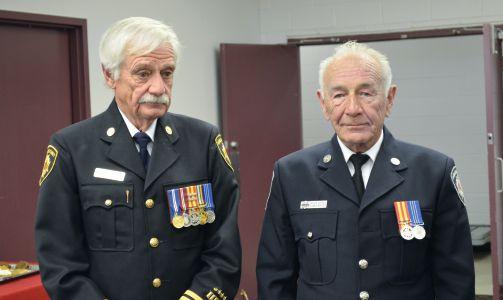
Bill Purdy (left) and Willie Wichuk were honoured at the 50th anniversary celebrations of the Parkland County Fire Services for their 50 years of participation in and dedication to public safety in Alberta.
PHOTO COURTESY BILL PURDY
STATIONtoSTATION
BRIGADE NEWS: From stations across Canada
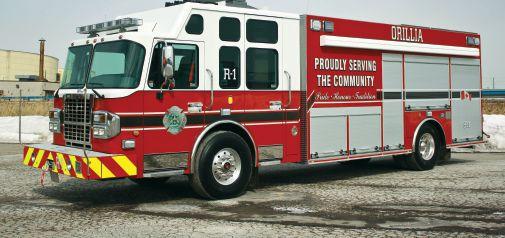
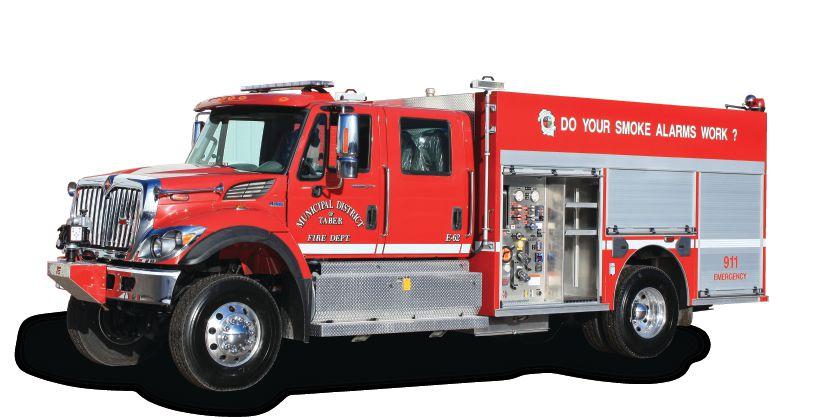
The Orillia Fire Department in Ontario, under Chief Ralph Dominelli, took delivery in May of a Dependable Emergency Vehicles-built rescue unit. Built on a Spartan Metro Star chassis and powered by an Allison 3000 EVS transmission and a Cummins ISL9 450-hp engine, the truck is equipped with a Whelen LED lighting package, a Harrison 15,000W hydraulic generator and a back-up camera.
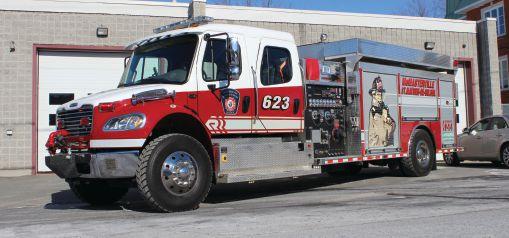
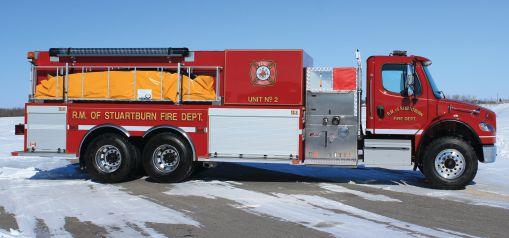
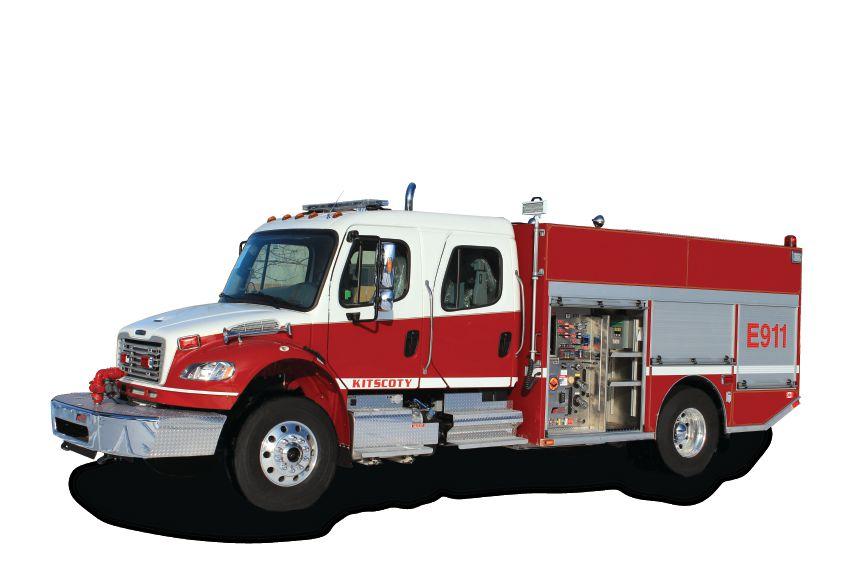
The McMasterville Fire Department in Quebec, under Chief David Roy, took delivery from Areo-Feu in February of a Rosenbauer-built pumper-tanker. Built on a Freightliner M2-106 chassis and powered by an Allison automatic transmission and a Cummins ISL 350-hp engine, the truck is equipped with a Rosenbauer NH55 1,250-IGPM pump, EZ Foam foam system and a 1,500-IG UPF water tank.
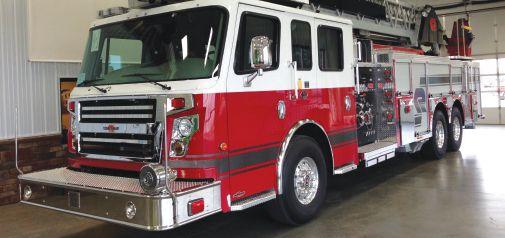
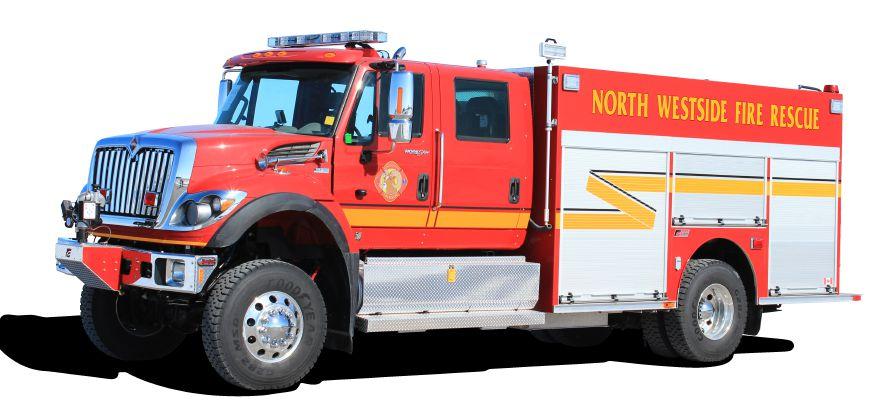
The Lachute Fire Department in Quebec, under Fire Chief Claude Giguere, took delivery from Areo-feu in October of a Rosenbauerbuilt quint. Built on a Rosenbauer Commander chassis and powered by an Allison automatic transmission and a Cummins 450-hp engine, the truck is equipped with a Waterous 1,250-IGPM pump, EZ Foam foam system, a 500-IG UPF water tank and a 100-foot Rosenbauer galvanized steel ladder.
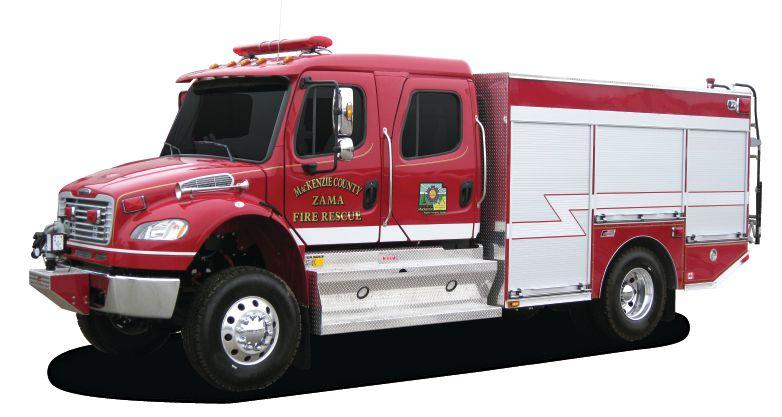
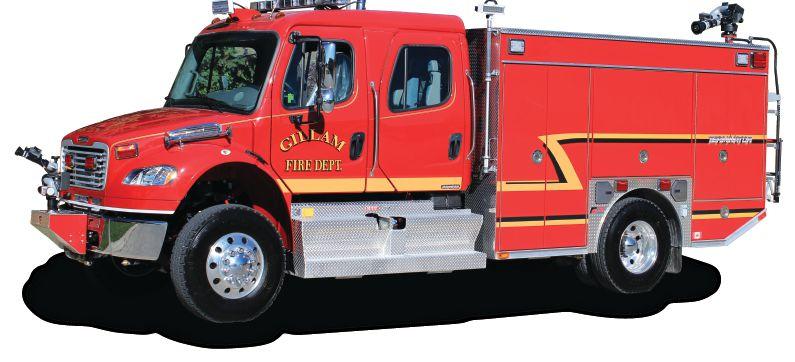
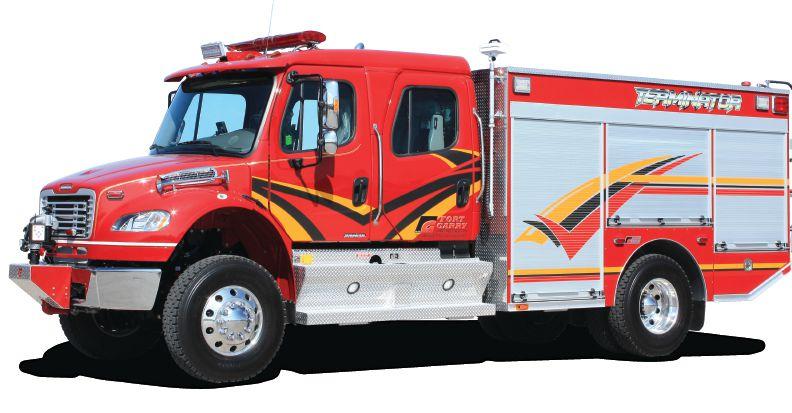
The Vita Fire Department in Manitoba, under Fire Chief Bob Fosty, took delivery in February of a Fort Garry Fire Trucks-built pumper-tanker. Built on a Freightliner M2-106 chassis and powered by an Allison 3000 EVS transmission and a Cummins ISL 350-hp engine, the truck is equipped with a Hale DSD 1,250-IGPM pump, a 3,000IG propoly water tank, four SCBA brackets and two FRC 900 Q65 rear scene lights.
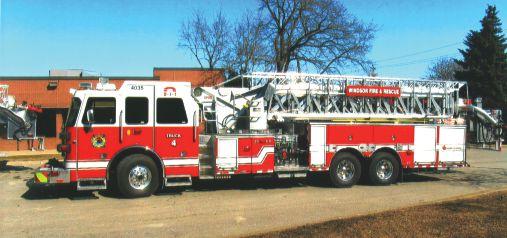
Windsor Fire & Rescue in Ontario, under Fire Chief Bruce Montone, took delivery in February of two Fort Garry Fire Trucks-built aerial platforms. Built on Sutphen TSAL4SK chassis and powered by Allison 4000 EVS transmissions and Cummins ISX 500-hp engines, the trucks are equipped with Hale QMax 1,500-IGPM pumps, Foam Pro 2002 foam systems, 300-IG poly water tanks and Voyager camera systems.
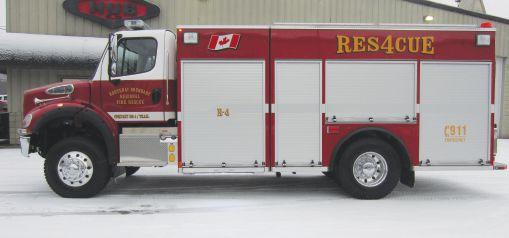
Kootenay Boundary Regional Fire Rescue in Trail, B.C., under Fire Chief Terry Martin, took delivery in December of a Hub Fire Engine & Equipment-built pumper-tanker. Built on a Freightliner M2 112 chassis and powered by an Allison 4000 EVS transmission and a Detroit DD13 450-hp engine, the truck is equipped with a Hale MG100 840 IGPM pump, a Foam Pro 1600 foam system, 500-IG co poly water tanks and Whelen LED light package XD 9000 winch.
THE MCMASTERVILLE FIRE DEPARTMENT
THE ORILLIA FIRE DEPARTMENT
THE LACHUTE FIRE DEPARTMENT
THE VITA FIRE DEPARTMENT
WINDSOR FIRE & RESCUE
KOOTENAY BOUNDARY REGIONAL FIRE RESCUE
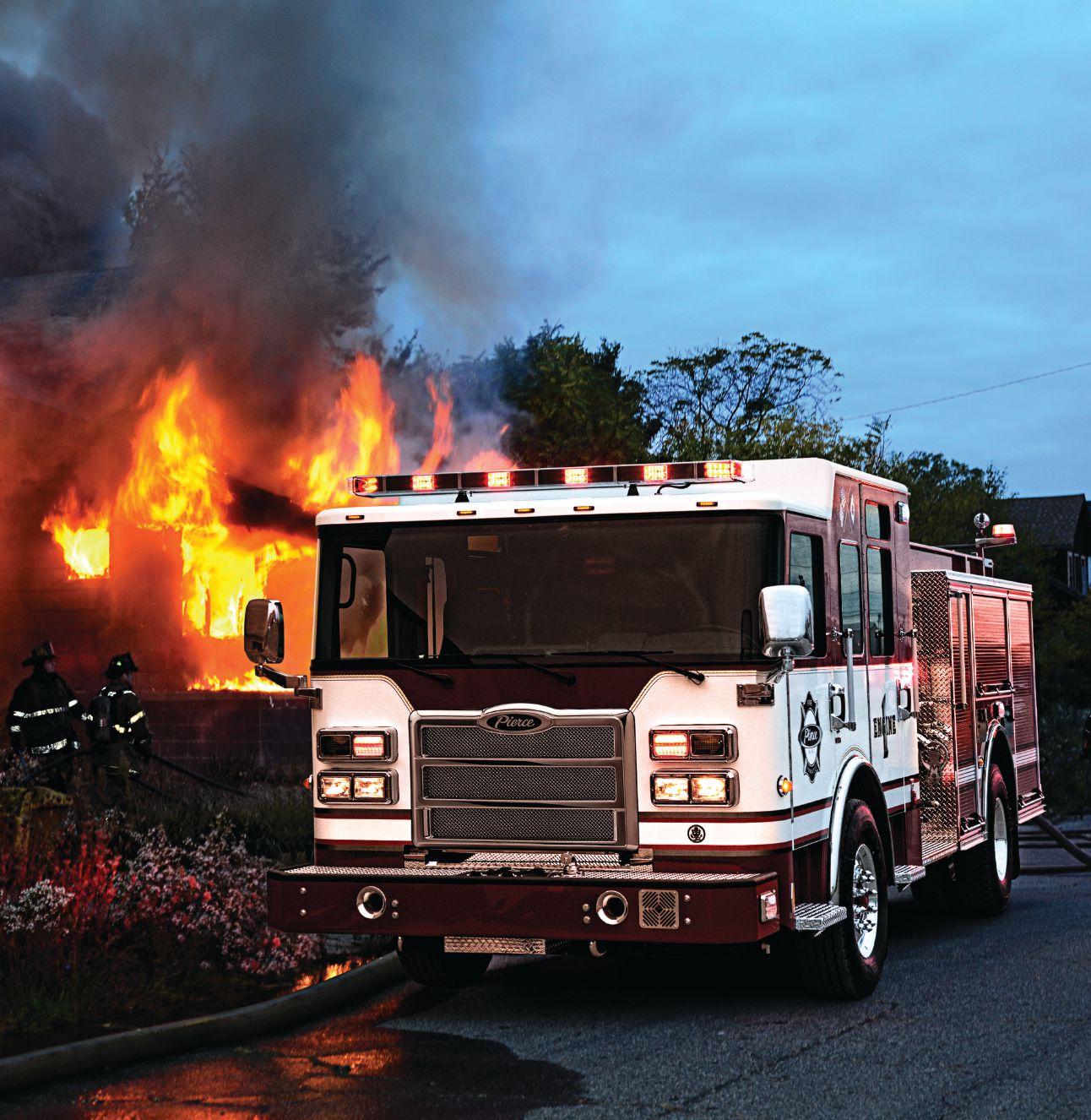
Proven reliability returns. The Pierce ® Enforcer ™ chassis is back, offering TAK-4 ® independent front suspension and two powerful engine options. With advancements in safety, visibility, space, ergonomics and serviceability, the new Enforcer performs like never before.
chassis:
Smaller, lower engine tunnel maximizes driver and officer space while improving visibility across the cab. ReadyReach Seatbelts for easy usage in full gear.
STANDARD
STANDARD TESTING
Ontario launches province-wide candidate evaluation system
By LAURA KING
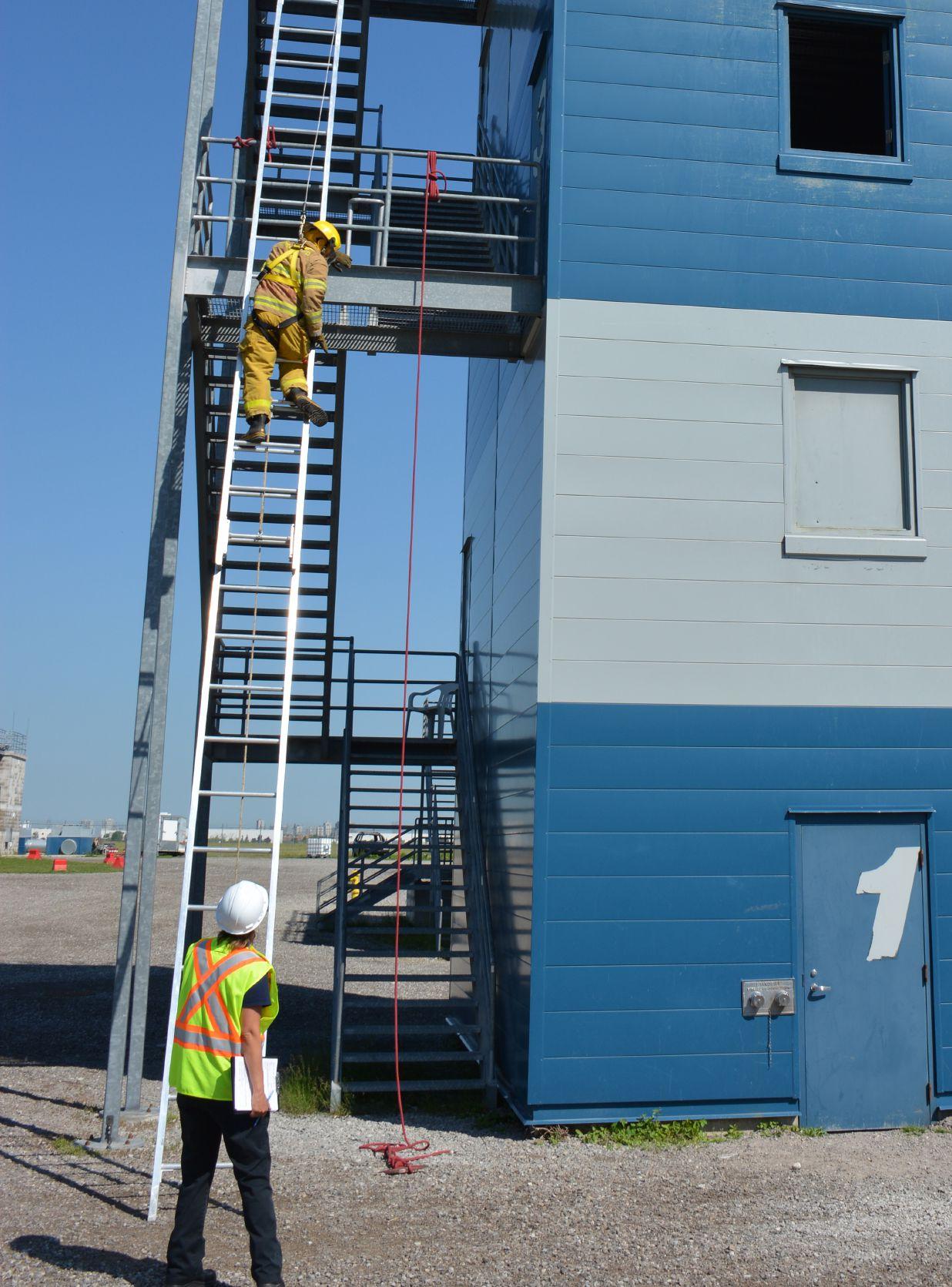
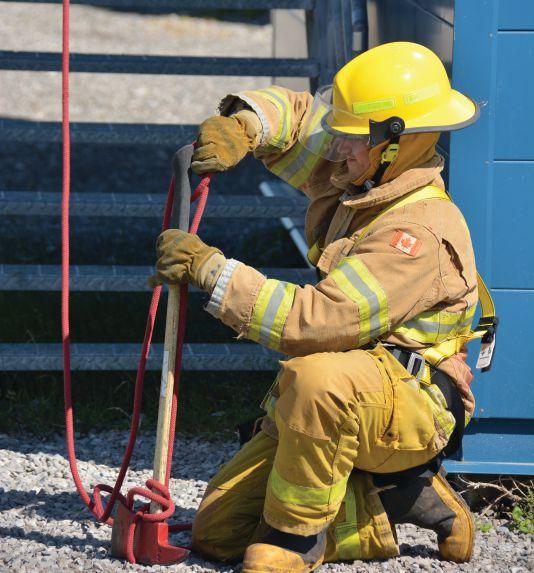
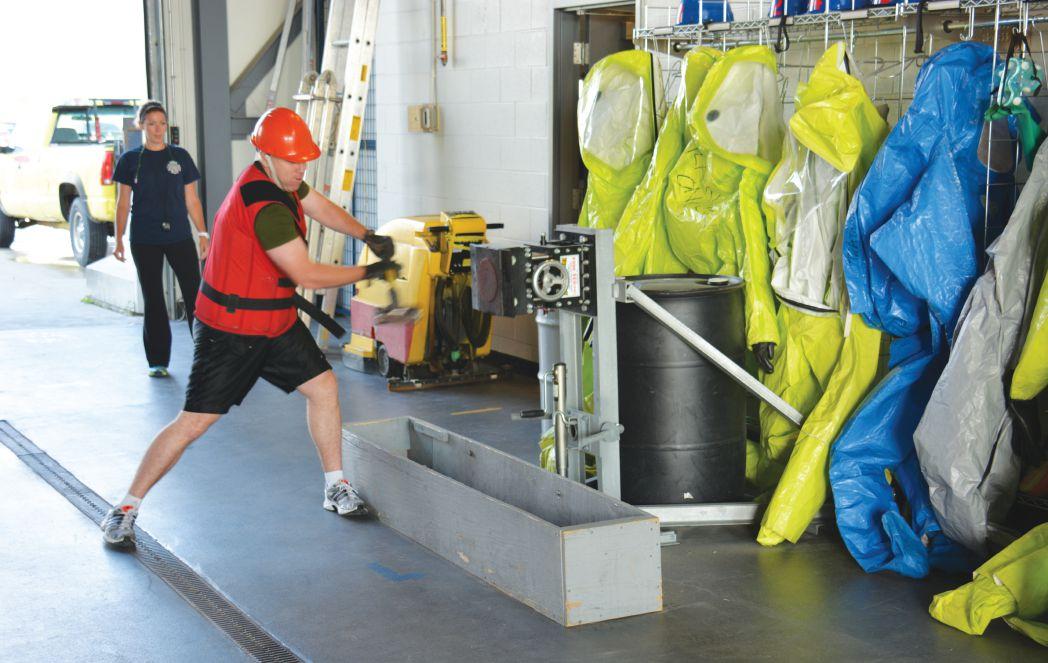
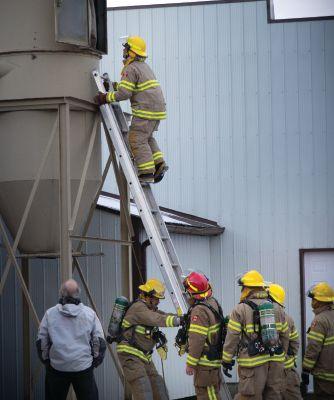
Candidates pay about $800 for CTS testing – which includes firefighter skills ranging from knots to raising ladders; the goal of the program is to reduce costs for prospective firefighters, who have traditionally paid between $1,500 and $5,000 to apply to multiple municipal departments before getting hired.
Before Britney Holmberg was hired by Brampton Fire and Emergency Services in 2013, she had applied to more than 30 municipal departments, written 20 aptitude tests and sweated through eight candidate physical ability tests. Holmberg took out a $10,000 line of credit and spent every cent paying for applications and tests to become a career firefighter.
It took three years of perseverance, a fair bit of frustration, and a lot of coaching to get hired – which is the norm for career firefighters in medium to large Canadian municipalities.
Fire chiefs in Ontario want to change the system – particularly the costs and the lack of preparedness – and, through the Ontario Association of Fire Chiefs new Candidate Testing Service (CTS), are trying to save prospective firefighters time, money and aggravation while streamlining the hiring process for municipal human resources departments.
“I meet a lot of candidates who think it’s going to be easy,” said Holmberg, a FireFit competitor and CrossFit enthusiast. “It’s frustrating to see the lack of effort of some graduates.”
Holmberg did her firefighter training online through TrainingDivision.com, then a 21-day boot camp in Texas. Physically, she knew she was firefighter material; her challenge was the aptitude test – although she did OK on the tests, she couldn’t get that elusive 90-plus per cent that many municipalities require.
“I couldn’t score in high 90s,” Holmberg said in an interview. “For me, it was do every test that was out there, and I would sit in my car afterwards and remember the questions and try to memorize them for the next time.”
That arbitrary high-90s mark – or whatever value is chosen by municipal human resources departments as the pass mark –can be problematic if candidates choose to challenge its validity.
Arbitrary numbers are sometimes not defensible under human rights legislation and some municipalities have been –and are being – challenged by candidates who score less than the mark set by the municipality. What’s to say, for example, that a candidate who scores 94 per cent is less qualified than an applicant who scores the required 95 per cent?
CTS manager Michelle O’Hara says that’s why candidates who write the new standardized test pass or fail but are not given a numerical score. Marks are based on a different “bands” developed by Fire and Police Selection Inc., the vendor that created the aptitude, interpersonal and work-styles test for CTS. The passing grade – or band – was chosen by the CTS advisory board, which comprises fire officers and human resources managers from departments that have signed on to the standardized testing system.
“The aptitude testing previously didn’t have the interper-
PHOTOS BY LAURA KING
sonal skills and work styles,” O’Hara said, “so candidates could score really well on map reading and other things; that doesn’t determine that they’re the best fit for the job.”
O’Hara said Fire and Police Selection Inc. did a two-year study of physical, interpersonal and work styles to determine the skills needed for the job.
“Our validation of human skills and work-styles inventory is all based on the criteria to be a firefighter. The majority of the standard is Grade 12-plus. The studies were based on the role of the firefighter – map reading, mathematical reasoning, whether you can read instructions, your grammar – can you write reports, navigate the firetruck through the streets?
“That’s why we put some value in the work-styles inventory and the personality testing – because that’s going to tell you whether people can get along in their departments, work well in their communities and work as a team. It’s not jut about whether you can do a mathematical calculation.”
The other problem, O’Hara said, with the arbitrary pass mark is that even the phys-
ical testing portion is rated.
“So, basically, some people who take the aptitude and CPAT get ranked first through 20th, so you’ll have 20 candidates at 80.117 or 80.226, and how do you determine who are the best candidates without interviewing them? In some respects the aptitude test really doesn’t say if they’re the right fit for the job, it just means they’re book smart.”
Which is exactly what Holmberg experienced.
“The aptitude test – reading comprehension and math – the math took me a lot of time and the test has a time cap,” Holmberg said.
“A lot of the time the best firefighters are the ones that aren’t very book smart, they’re more hands on, so now there’s more of a hands-on component; once I got through the written part then I knew I’d breeze through the hands on.”
In addition to testing and re-testing to improve her scores on the aptitude tests, Holmberg tutored kids in math to keep her skills sharp, volunteered with St. John Ambulance to become more proficient at the medical requirements, took a high-angle rescue course to get more experience
with ropes and ladders, and got on with a volunteer fire department to hone all those competencies.
“Then,” she said, “all of the sudden, the testing process becomes easier.”
Holmberg’s strategy – improving already-learned skills, building new ones, staying fit and knowing exactly what the tests involve and what physical traits are required (all the information is available on the CTS website at www.ofai.ca) – is exactly what Toronto Fire Services (TFS) encourages candidates to do to.
“If you know you are not 20/30 vision, go to an eye doctor and see if it can be corrected,” said TFS Division Chief David Sheen at one of 10 outreach sessions for prospective firefighters in the spring. “We want you to be successful.
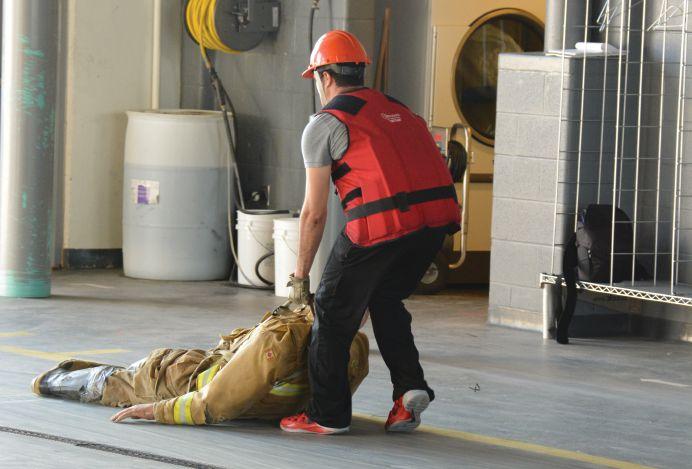
“The VO2 max is the end of the clinical assessment,” Sheen said. “If you are not prepared to do it then do not enter the test pool. The CPAT orientation – if you haven’t dragged a dummy, this is your opportunity.”
Indeed, lots of prospective firefighters don’t find out until it’s too late – until
A firefighter candidate moves through the CPAT test at the Fire and Emergency Services Institute (FESTI), located at the Greater Toronto Airport Authority. FESTI was chosen by Ontario Fire Administration Inc. to host its Candidate Testing Service.
BY VINCE MACKENZIE Fire chief
Grand Falls-Windsor, N.L.
FVOLUNTEERVISION
The ethical and financial service-delivery dilemma
ire departments all have jurisdictions – areas that we cover and in which we provide protective services. Sometime, in the evolution of your department, resources were acquired, people were trained, policies were established, and your boundaries were set up to protect a specified area. In most cases, that area is a municipality, and your response is typically set up around your municipal boundaries.
Unlike communities that have mutual-aid agreements, I write here about areas without any fire protection at all, that call on neighbours to respond to emergencies, without agreements or contracts in place.
In areas of Newfoundland and Labrador, and some other provinces, it is a given – you call, we come, even from outside municipal boundaries. But it seems as if more councils are directing their departments not to respond to outside calls. A recent situation in my province has brought this issue to the surface.
The incident involved a department that refused to respond to a call from a local service district that does not pay for service, nor does the homeowner. Council had advised the fire chief to not respond to these areas – which, in my view, is the correct decision – and the fire chief complied, as required. The homeowner complained to the CBC, which reported the story but failed to provide necessary details, and Newfoundlanders were left wondering why the bad firefighters didn’t respond.
Without an official directive from council, the decision whether to respond rests with the chief fire officer and can be morally disturbing, especially when few details about the call are available. Not responding places the department and the municipality under public scrutiny when the media report that the fire department refused to respond, even though the decision may have been sound to ensure protection of the municipality’s own taxpayers.
in from someone needing help from an outside area where there are no firefighting resources. Rarely, years ago, would a bill be sent to the property owner. Perhaps having the word volunteer attached to our service implies everything is free. Would a municipality take the same view with the provision of garbage collection for free in another area? Secondly, as resources become limited, sometimes making adequate in-town response difficult, fire departments and councils are forced to take a hard look at their capabilities. Municipalities are directing their fire departments to be prudent, particularly if an outside response reduces the protection level within their own boundaries.
Finally, although there are many areas of the country that have become accustomed to free fire service on the good graces of their neighbouring communities, these practices are being questioned by municipalities’ insurance companies, which underwrite fire-department liability. If providing services outside a jurisdiction results in exposing a community and its fire department to greater legal liabilities while having diminished service, then this issue must be addressed by local governments.
Perhaps having the word volunteer attached to our service implies everything is free.
’’
In the past, volunteer departments would respond to emergencies just about anywhere – most times without question or consequence. This response was typically praised as a moral obligation to help a neighbour. But things are changing, for several reasons.
First, the provision of fire service is an expensive venture; it is a municipal or district service for which taxpayers or subscribers pay the bills. But for many reasons, fire fighting is one of those services that, traditionally, has been shared when the emergency call comes
Vince MacKenzie is the fire chief in Grand Falls-Windsor, N.L. He is the president of the Newfoundland and Labrador Association of Fire Service and a director of the Canadian Association of Fire Chiefs. Email him at firechief@grandfallswindsor.com and follow him on Twitter at @FirechiefVince
Surely this is another good argument for the regionalization of fire services, a system under which all stakeholders can pay their collective shares and input resources to provide better services. While regionalization seems logical, in some cases, fire departments are simply forced to say no and not respond outside of their boundaries.
Another issue recently arose in Nova Scotia, where a fire department was forced to set a deadline to cease service to a district outside its boundaries due to non-payment of fees. The fee-for-service agreement had been established decades ago.
It is critically important for councils to provide clear policy direction to their fire departments, and, more importantly, to communicate those policies to the public. Fire departments must remember that their obligation is to their own citizens first, and that sometimes, as difficult as it is, we are not able to save the world.
BY DAVE BALDING Fire chief Fraser Lake, B.C.
WFIRELINES
Response levels: Do we promise too much?
hen Mrs. Smith is enduring the worst moments of her life and calls for help, she expects a well-trained, well-equipped fire department to show up promptly and resolve the problem. Members of the Fraser Lake fire department may tire of hearing that from me, but I believe we owe that to the public we protect.
That opening statement identifies three significant premises – often challenges – to fire departments across Canada, whether large or small, career or volunteer, brand new or well established.
The first component – well-trained firefighters – is a goal every one of us strives to achieve, from the seemingly insurmountable mass of knowledge and skills we must grasp when we first start out in the fire service, to the challenges of keeping those skills fresh and that muscle memory alive. No matter what the environment or subject material, a vibrant training program must exist and high-quality training must be consistently delivered. Do your firefighters know the relevance of their training? If they’re simply doing drills because they are told to, there may not be much buyin. If they understand that drills are performed frequently to enhance skills and reduce times in order to provide a more effective response for Mrs. Smith, firefighters will be much more motivated to train. Have you asked your firefighters for suggestions about training, such as areas they feel need more attention? How do we keep senior members or those who are well accomplished engaged in those training exercises which, by necessity, happen over and over? Why not have these firefighters help with a mini-presentation or assist in running a drill?
Aside from the core response activities, many fire departments choose to deliver additional services such as medical aid and various types of technical rescue. We join this profession to help others, so it’s only natural to take on these additional roles. However, doing so comes with a price – the cost of the required equipment, which may include a dedicated piece of apparatus, and the expense of responding to the incidents. The department must become proficient at its new specialized type of response, which may place an additional burden on an already potentially strained training program. Departments should look at their capabilities very closely and ensure they can withstand the increased demands placed on them by additional response capabilities.
services were the sacred cows and dire warnings of unnecessary suffering were sufficient to ensure adequate funding. Smaller, rural departments have lived with fiscal restraint for years. Larger, metro departments are also experiencing funding cuts and we have already witnessed some of the impacts: fewer personnel, managing overtime, closing fire stations and reverting to composite departments from career.
The third ingredient in our effective response model – showing up promptly – implies arriving on scene with sufficient personnel to do the job. First, adequate members are needed in the organization; that speaks to recruitment and retention, a topic for another day. Do all the members on your department’s roster respond consistently, whenever they can? If not, how is that managed? There are some options; for example, creating a duty-crew rotation can alleviate the need for the entire membership to attend all types of calls.
Fire-department leaders must look closely at their organizations and ask whether they are adequately trained, equipped and staffed for the types of emergencies to which they respond. If the answer isn’t a resounding yes, it’s time to identify weak areas with a view to making improvements. When improvements are not feasible, it may be time
When improvements are not feasible, it may be time to examine the level of service provided by the department . . . ‘‘ ’’
to examine the level of service provided by the department, including the types of emergencies to which the department responds, and the degree of response. For example, departments that do not have sufficient members trained for interior firefighting operations may adopt a defensive-operations-only stance. This position must be backed up by policy or bylaw.
One would expect the second component – a well-equipped fire department – to be a given. But gone are the days when emergency
Dave Balding, a 29-year veteran of the fire service, is the fire chief and emergency co-ordinator for the Village of Fraser Lake in British Columbia’s Central Interior. Contact Dave at dbalding@fraserlake.ca and follow him on Twitter at @FraserLakeFire
I know that reducing service by limiting the types of calls to which we respond or how we respond to them just doesn’t seem right; that’s because when something is asked of us, we in the fire service typically respond positively because we’re problem solvers and we’re in this profession to help people.
Being realistic about our abilities and response limitations, and communicating them to our residents, isn’t wrong; on the contrary – it’s the best thing we can do for them and for our firefighters.
A CERTI-FIRE KNOWS FIRE ALARM TECH.
In the same way star athletes are a select few who know how to use every muscle in their body to win, a Certi-Fire designated electrician is one of the few qualified in all aspects of fire alarm technology.
A Certi-Fire electrician has successfully completed an intensive, four level certification program acceptable to the Ontario Fire Marshal. It guarantees the expertise required to assess your needs, install the correct technology, and maintain and monitor your fire alarm system. It’s one-stop fire alarm security and peace of mind.
BEST PRACTICES
Sharing information helps to protect vulnerable construction sites
BY LEN GARIS and JOSEPH CLARE
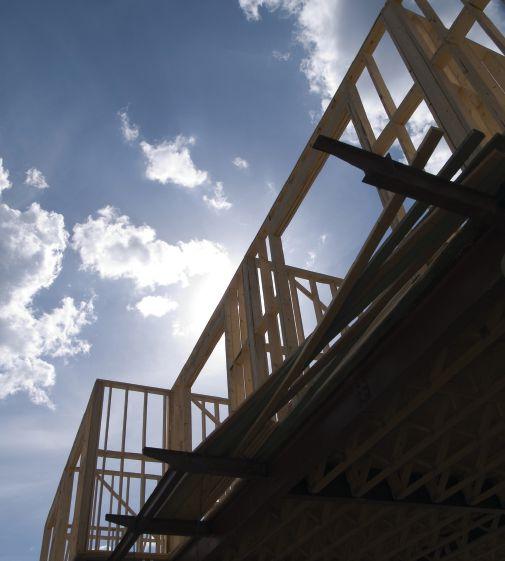
Abuilding is never more vulnerable to fire than during its construction – particularly when exposed wood is present. But a growing focus on best practices in Canada and around the world could help reduce these risks and prevent the types of devastating construction-site fires seen in Richmond, B.C., in 2011 and Kingston, Ont., in December 2013.
The increasing recognition of construction-fire risks by government and the construction industry has led to a trend toward fire-safety plans for construction sites, which outline actions to be taken by site owners to reduce the likelihood and manage the impact of fires during construction and demolition.
This emphasis on best practices and fire-safety planning are positive steps for the fire service, particularly because of the growing interest in wood construction across Canada, and new research showing that the only increased fire risk associated with wood-frame buildings is during their construction (more on this research below).
Fire-safety regulations related to buildings under construction vary across the country. While the National Fire Code requires a fire-safety plan for all construction sites, not all provinces have adopted this aspect of the code. The NFPA 241 standard also provides measures to prevent and minimize fire damage in structures during construction, alteration and demolition, but this too is not universally followed.
In some cases, construction-fire safety has been addressed under occupational health and safety guidelines for construction sites, as it has in Ontario.
British Columbia and Alberta have taken a more proactive approach. Both provinces’ fire codes include requirements for fire-safety plans for construction sites, and some cities, including Delta and Surrey in British Columbia, have developed detailed bulletins to assist site owners with the development of these plans. Surrey’s bulletin has been referenced by the Canadian Wood Council for its education outreach with the construction industry.
The leadership on this issue emerging in Western Canada mirrors what is happening abroad. The United Kingdom introduced construction-fire safety regulations in 2007. The Confederation of Fire Protection Associations in Europe – its members span 18 countries –followed suit in 2012 with specific guidelines based on best practices.
Construction fire safety plans (CFSP) are typically developed by the site owner or representative in conjunction with the local fire department, and are designed to address the typical hazards that are present during construction. The leading causes of fire in buildings under construction or demolition are incendiary or suspicious events, smoking, open flames (e.g. from hot works, such as welding), embers and heating equipment.
CFSPs also consider available firefighting infrastructure, the potential and impact of fire spread within the site and to neighbouring
Construction fire safety plans (CFSP) are typically developed by the site owner or representative in conjunction with the fire department, and are designed to address typical hazards that are present during construction. The leading causes of fire in buildings under construction or demolition are incendiary or suspicious events, smoking, open flames, embers and heating equipment.
properties, construction techniques, and unique issues related to each site and project.
At the very least, each plan should include consideration of:
• emergency procedures and information needed to plan for an emergency
• training of site personnel on evacuation procedures
• assigned site personnel who are responsible to install and maintain fire-safety duties
The Canadian Association of Fire Chiefs’ 106th Annual Conference
September 14-17, 2014
Ottawa, Ontario
REGISTER TODAY! www.cafc.ca/en/conference
Fire Chief of the Year Nominations are now being accepted! Each year the Canadian Association of Fire Chiefs and Fire Underwriters Survey recognize Fire Chiefs for their outstanding contribution to the Canadian Fire Service. Know a deserving Chief? Visit www.cafc.ca/en/awards/ to nominate your Chief today!
Les candidatures pour les Prix d’année des chefs de pompiers sont maintenant acceptées! Chaque année, l’Association canadienne des chefs de pompiers et d’inspection des assureurs incendie reconnaissent chefs de pompiers pour leur contribution exceptionnelle au Service canadien des incendies. Connaissez-vous un chef digne? Visitez http://cafc.ca/fr/awards/ de nommer votre chef aujourd’hui!
Western Canada is leading the push for fire-safety plans for construction sites. Studies show that buildings are more vulnerable to fire during construction, particularly if exposed wood is present, but the sharing of best practices for construction-site safety is helping to change that.
and evacuation procedures for all workers, and adequate training (and retraining) for workers assigned to firefighting duties.
Passive protection – including provision at each floor level of an unobstructed stair discharging to grade level; co-ordination between the construction of fire compartments and fire walls; management of temporary heating equipment and roofing operations including heat sources; a high standard of housekeeping on site; maintaining fire-department access to the site; and providing a fire separation between occupied areas and areas under construction or demolition.
Fire protection – including an activated, charged standpipe and sprinkler system installed progressively with building construction; on-site fire protection stations; adequate water supply for fire protection; and a fire alert warning system.
Security and monitoring – alert, roving after-hours security personnel; and a fire watch during and after hot works operations.
Additional activities include installing doors in firewalls and closing them after hours, providing temporary water-flow alarms on sprinklers, providing sprinkler systems for exposure protection, and a pre-construction meeting between the local fire department and site representatives.
Complex sites should have a fire risk assessment that identifies time frames and measures related to increased risks.
A checklist of all activities may also be provided to assist site owners in the development of the CFSP.
Increased fire-safety measures at construction sites will help address the safety gap related to wood-frame buildings. A report released in February by the University of the Fraser Valley in British Columbia showed that while wood-frame buildings are as safe as those built with steel or concrete when fire-safety systems (e.g. working smoke alarms and sprinklers) are in place, they are more vulnerable to fires when they lack those systems – as is the case during construction.
Titled Fire Outcomes in Residential Fires by General Construction Type, the report compared 11,875 fires that happened between October 2008 and October 2013 in residential buildings with five different construction types: exposed wood joists and trusses, wood joists and trusses
Fire-safety measures for buildings under construction include installing doors in firewalls and closing them after hours, providing temporary water-flow alarms on sprinklers, providing sprinkler systems for exposure protection, and a pre-construction meeting between the local fire department and site representatives.
protected by plaster or gyproc, heavy timber, exposed steel or concrete joists and trusses, and steel or concrete joists and trusses protected by plaster or gyproc. (See Making the case for wood, Fire Fighting in Canada, May 2014)
The research indicated that if a building has effective fire-safety systems, the framing material has little impact on fire spread, death and injury rates. Therefore, improved construction fire safety planning is an important contributor to the overall safety of wood-frame buildings.
(Read the full report at www.ufv.ca/cjsr.)
Leadership on this issue is required by the fire service at the national, provincial and local levels. Given the increased interest in wood construction across Canada – along with the fact that, ultimately, it is the fire service that responds to construction fires – it is incumbent on the fire service to begin pushing the decision makers to move forward with the necessary regulations, to ensure that best practices are used at construction sites in their own communities, and to advance the dialogue on wood-frame construction among the various stakeholders, from politicians to firefighters.
Greater harmonization among the stakeholders is the key to finding solutions that will ensure the next generation of wood buildings is as safe as possible.
(Download the City of Surrey’s Construction Fire Safety Plan Bulletin and checklist at http://www.surrey.ca/city-services/9624.aspx)
Len Garis is the fire chief for the City of Surrey, B.C., and an adjunct professor in the School of Criminology and Criminal Justice at the University of the Fraser Valley, Affiliated Research Faculty at John Jay College of Criminal Justice, New York, and a faculty member of the Institute of Canadian Urban Research Studies, Simon Fraser University. Contact him at LWGaris@surrey.ca.
Dr. Joseph Clare was the strategic planning analyst for the Surrey Fire Service between 2010 and 2013. He is an adjunct professor in the Crime Research Centre, University of Western Australia, and a faculty member of the Institute of Canadian Urban Research Studies (ICURS), Simon Fraser University. Contact him at joe.clare@uwa.edu.au.
■ Internal Ladder & Suction Hose Storage
■ 1000 IMP/1200 US Gallon Copoly Tank
■ Heated Pump Compartments
■ Gear Box Rise (For better driveline angle)
■ Freightliner Chassis
■ Aluminum Body (5083 Salt Water Marine Grade)
■ 20 Year Body Warranty
■ Darley PTO Rear Mount 1050 IMP/1250 US Gallon Pump
■ Grass Nozzles Option
■ Foam System Options
■ 12V Bumper Turret w/ Joystick Option
■ 100’ Hose Reel Under Cab Option
■ Aluminum Body (5052 Fresh Water Marine Grade)
■ 10 Year Body Warranty
■ High Side Compartments
■ Aluminum Extruded Rub Rails
■ Amdor Roll Up Doors
■ Two Speedlay Hose Beds
■ Short Wheelbase
■ Side Control Pump House
■ 800 IMP/960 US Gallon Water Tank
■ Foam System Options
■ Freightliner or International Chassis
■ Wildland Option
BACKtoBASICS
Master streams – part 2
BY MARK VAN DER FEYST
In June, we looked at master-stream operations. Now we are going to look at different uses of ground-deluge systems or ground master streams.
Ground master streams provide a way for engine companies to deliver water at high flow rates with effective results. These devices are an asset for departments in defensive operations; ground master streams also offer safety, as the reach allows firefighters to be a safe distance from fire.
As with an elevated master stream, options for ground deluges are a straight tip or an automatic combination nozzle; each provide a sustainable reach for safe fireground operations.
The tip choice depends on water-supply issues, pump capacity and length and size of the supply hose being used. Smooth-bore tips require half the pressure of an automatic combination nozzle; this is a great advantage when pump capacity is an issue or in long hose-lay situations.
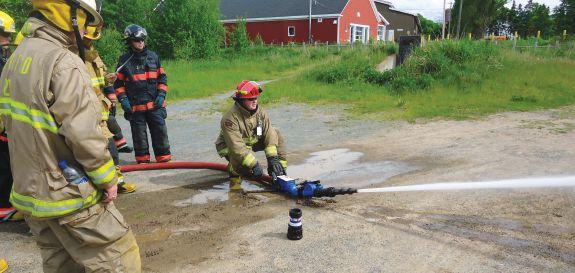
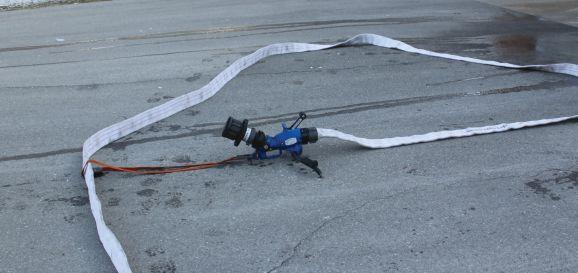
Most ground-deluge systems are designed so that one firefighter can handle set up. These high-volume systems need to be manned. If a master stream needs to be shut down right away, it is crucial that an operator be present. Some systems are designed to be set up and then left unmanned while they flow water (see photo 1); when the device detects any kind of movement, it shuts down immediately. Systems can be tested for shut-down by hitting the top part of the device with your hand; if the shut-down is working, the system will stop flowing water right away.
There are two choices for supply hose for these systems: 100-millimetre (four-inch) large-diameter hose, or 65-mm (two-and-a-half-inch) supply hose. If large-diameter supply hose is being used, a single inlet system will be employed rather than two 65-mm supply hoses required for the smaller size.
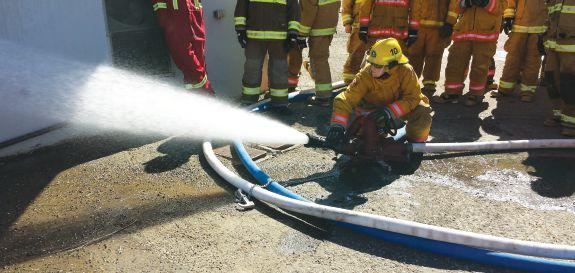
Regardless of the size of hose, there is a standard way to set up the ground deluge or master stream so that it will not move away while flowing water. In photo 2, you can see that the supply hose is looped around the front of the device with a minimum three-metre (10 foot) radius. The device is secured to the hose by a piece of webbing or a hose strap. The idea with this set up is that when the hose is charged with water, it becomes the anchor for the device. In photo 3 you can see how a two-hose system looks.
Some of the newer portable ground monitors are designed to have just one 65-mm supply line, for ease of
Photo 1: Some master-stream systems are designed to be set up and then left unmanned while they flow water.
Photo 2: The supply hose is looped around the front of the device with a minimum three-metre radius. The device is secured to the hose by a piece of webbing or a hose strap. When the hose is charged with water, it becomes the anchor for the device.
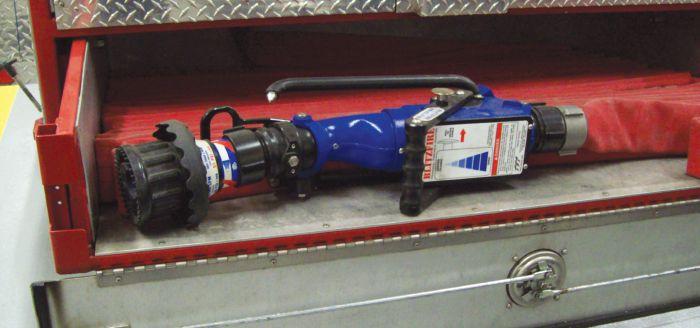
Photo 3: A two-hose system.
PHOTOS BY MARK VAN DER FEYST
use and set up. One firefighter can easily grab the pre-connected monitor (see photo 4), advance it, and set it up with the device not having to be anchored to the hose. The difference is that the supply hose needs to be in a straight line behind the monitor for about two to three metres (six to 10 feet); this ensures that the monitor works effectively.
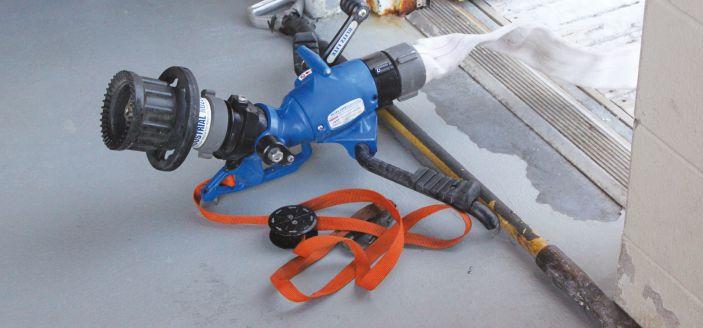
Another application for the ground monitor is interior offensive operations. In photo 5 you can see how we can take a small or regular-sized ground monitor and set it up for interior water flow. Why use it this way? Because it provides a vast amount of water and a long reach in order to achieve knockdown in a large building or a long hallway.
Notice in the photo the use of the anchor point across the doorway. A pry bar, a roof hook or a pike pole is needed so the ground monitor can rest against it and not
be pushed back while flowing water. This is useful for highrise fire fighting or in large, open warehouses and apartment buildings.
Master streams and ground deluges can be used with any type of apparatus.
Do not overlook the ground monitor as a useful tool when large water delivery is needed. Pull the ground deluge out from the truck storage compartment and practice setting it up and flowing water.
Mark van der Feyst is a 15-year veteran of the fire service. He works for the Woodstock Fire Department in Woodstock, Ontario. Mark instructs in Canada, the United States and India and is a local-level suppression instructor for the Pennsylvania State Fire Academy and an instructor for the Justice Institute of B.C. Email Mark at Mark@ FireStarTraining.com
Photo 4: Some portable ground monitors are designed to have just one 65-mm supply line. One firefighter can grab the pre-connected monitor and set it up with the device not having to be anchored to the hose.
Photo 5: A small or regular-sized ground monitor can be set up for interior water flow. It provides a large quantity of water and a long reach to knock down fires in large buildings or long hallways.
they’ve paid (or their parents have paid) tens of thousands of dollars for college programs – that they lack the aptitude, interpersonal skills or physical prowess necessary to be a firefighter, or worse, that they’re colour blind, don’t meet the vision requirements, or have high blood pressure or a high resting heart rate, and are therefore ineligible to be hired until those conditions are corrected.
What’s more, as Holmberg can attest, the cost of applying to municipal fire departments (after paying all that money for a college program) and taking repeated CPAT tests – the certification expires after 12 months – can be prohibitive.
O’Hara says prospective firefighters typically spend between $1,500 and $5,000 applying to fire departments before they get hired. The system, she says, is flawed: it caters to those who can afford it and have already completed firefighter training programs at community colleges or other institutions – typically, Caucasian males –and there are few, if any, support systems in place. In addition, firefighter training programs – there are about 17 in Ontario alone – are cranking out hundreds of students each year for whom there simply aren’t enough jobs.
The OAFC launched CTS in April after being directed by its members – the province’s chief fire officers – to devise a system of standardized testing that is fair and accessible to all prospective firefighters, keeps costs down for candidates, and eliminates considerable administrative work for municipalities.
Prospective firefighters register online with CTS and choose testing times. The $800 fee includes the interpersonal skills testing – something most municipalities don’t do in their screening processes but which is a crucial component of a successful fire-service career, says CTS program manager Brad Bigrigg.
“Most problems that develop in the fire hall are people problems, not process problems,” Bigrigg said in an interview.
CTS also tests for work styles – how people get work done and their work habits – and firefighter technical skills, from raising and climbing ladders to ventilating a pitched roof, which is not a part of some municipal candidate-testing processes. Bigrigg says CTS also tests more vigorously for hearing and vision than many municipalities.
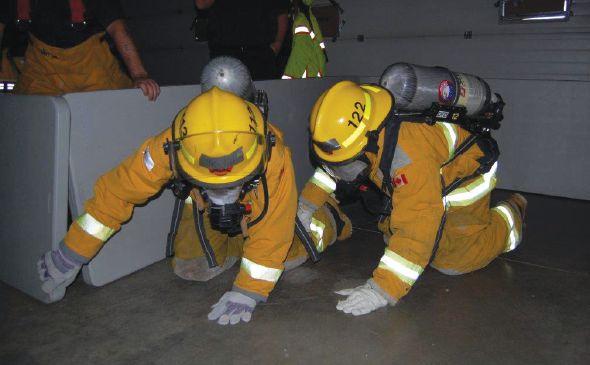
A firefighter candidate moves through steps during the clinical testing portion of Ontario’s new standardized-testing program. Candidates who pass all levels of the test receive a certificate and can then apply to municipalities that have signed on with CTS.
Prospective firefighter recruits who have registered with Ontario’s new Candidate Testing Service complete the aptitude, interpersonal skills and work styles tests. Candidates who pass that group of tests move on to the CPAT, medical testing and firefighter technical skills.
THE CIE SHOW IS CANADA’S PRE-EMINENT CONFERENCE DEDICATED TO THE EDUCATION, TRAINING AND RISK MANAGEMENT FOR THE INDUSTRIAL EMERGENCY RESPONSE SECTOR.
If your company is involved in industrial manufacturing, chemical producers, oil and gas, transportation of dangerous goods, nuclear, hazardous materials management, or any industry that could be susceptible to industrial emergencies, then you will benefit by attending.
Delegates will be able to participate in sessions including workshops, general sessions, HOT training (SCBA confidence drills), updates of government standards and panel discussions from leading experts.
The conference will address topics pertaining to railway, pipeline emergencies, fall arrest, mutual aid agreements, incident scene communications and other timely and topical sessions. For details check out our agenda on-line. PLUS, delegates will gain access to a wide variety of exhibitors that will be on hand to answer your technical questions, showcase the latest solutions, help your company be compliant and reduce risk.
Save with the early discount rate of $299+hst when you register before August 15th. $399 +hst after August 15th.
Trade show attendees gain free access if they register prior to August 15th. After August 15th pay $30 for both days.
QUOTE PROMOTION CODE FFC2014.
Do you have a product or service that would be of interest to this industry?
We invite you to exhibit.
The testing is done at FESTI – the Fire and Emergency Services Training Institute at the Greater Toronto Airport Authority. FESTI was the successful bidder and has hired evaluators for each segment of the testing process.
Candidates who pass the first group of tests – the aptitude, interpersonal and work styles – move on to the medical and clinical assessments and CPAT orientation (if they choose). Those who do not pass can re-test in 30 days. Those who pass the first set of tests go on to the CPAT and firefighter technical skills segments – the skills portion is based on NFPA standards. Candidates who pass all the tests can apply to municipalities that have signed on with CTS to select candidates to interview. There is no fee to apply to municipalities that have signed on to CTS.
Toronto was the first department to sign on to CTS. It wants its members to better reflect the city’s diverse population, and offers a career-access stream of testing to draw candidates from visible minorities.
Essentially, candidates who successfully complete the aptitude and interpersonal skills tests can defer the subsequent tests for up to two years while they complete their firefighter training. Candidates who complete the first level of testing – in other words, they know they have the aptitude, work habits and interpersonal skills that
TFS requires – can apply to TFS and be interviewed. If the interview is successful, candidates are given a right-of-first-refusal letter, then do their firefighter training –while keeping up their health and fitness – and come back to TFS once their firefighter education is complete.
“We’re here to set you up for success,” said Sheen. “We’re here to find out if you’re a good fit for us and if we’re a good fit for you.”
Indeed, once candidates are put on the right-of-first-refusal list, the Fire Services Credit Union offers a line of credit of up to $25,000 for firefighter training, Sheen said.
Candidates who apply to Toronto and already have firefighter training go into a hiring pool once they have passed all the tests, and are chosen by lottery for interviews. Those chosen get a conditional job offer then must do a medical test and provide references. The interview, Sheen says, is crucial.
“We find candidates don’t answer the questions fully; listen, give the answer and relate it to personal experience.”
Kitchener Fire has also signed on to CTS. Tim Beckett, who was the fire chief in Kitchener but moved to Mississauga in late July, said the CTS testing is similar to what Kitchener had been doing but frees up
human resources time.
An evaluator inspects the maze at the Fire and Emergency Services Training Institute in Toronto before prospective firefighter candidates run through the firefighter technical skills portion of the testing process.
“The program also provides an improvement to the candidates,” Beckett said, “not having to pay out to individual departments every time they apply to be a firefighter. I see this as a win-win for the fire departments and the candidates that are seeking employment.”
Bigrigg said several other municipalities are finalizing legalities and are expected to sign on with CTS shortly. The goal, he said, is to simplify the process for candidates, reduce overall costs and, most importantly, ensure an open, fair and defensible process that guarantees that appropriate candidates move through the process for interviews with fire departments.
But not everyone has bought into CTS – yet. OAFC executive director Richard Boyes said that while a motion to establish a candidate-testing system was passed at the 2012 mid-term meeting, CTS is working with fire departments and human resources managers across Ontario to draw municipalities into the program.
Municipalities that want to participate in CTS must sign an agreement with Ontario Fire Administration Inc. under which they take applications only from candidates who are CTS certified; CTS will let successful candidates know by email when departments are recruiting.
Skeptics have said the OAFC has established CTS as a cash grab. Boyes counters
that with the fact that all money from CTS goes back into the fire service, and notes that private candidate testing companies –which typically charge lower fees but also offer less vigorous testing – are for-profit entities.
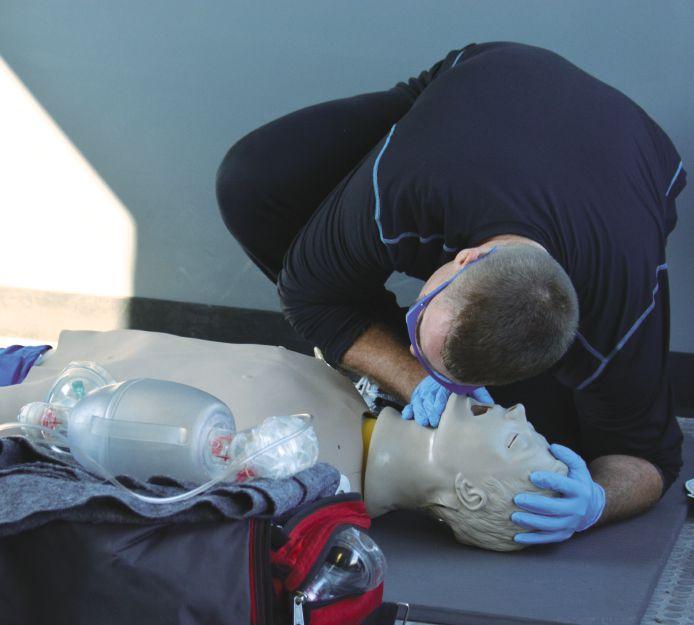
On a breezy Thursday morning in late June, a male candidate being tested at FESTI failed the medical skills assessment; the scenario involved a conscious patient who was transitioning into unconsciousness.
O’Hara said about one in 10 candidates fails that segment of the testing and encourages prospective firefighters to brush up on medical-response skills before choosing a test time.
“All the information about the testing is available on our website, and there is lots of detail,” O’Hara said. “There’s no excuse for showing up unprepared. If you’re not ready, wait until you know you can pass the tests so that you set yourself up for success.”
TFS District Chief Ron Barrow, who is in charge of recruitment, is blunt but encouraging: he doesn’t want candidates who aren’t ready to pay money for testing.
“We want you to manage your application process,” Barrow told a room full of prospective candidates in Toronto in May. “We want you to do your research and do what’s best for you.”
BY GORD SCHREINER Fire chief, Comox, B.C.
TSTOPBAD
Don’t like training? Find a new job
he fire service is like no other industry. We need to be constantly training for our next incident, without knowing what it will be, when it will occur or where it will happen.
Great firefighters train constantly, including physical training and reading fire-service publications. Great firefighters learn from others both around the fire hall and by reviewing recent line-of-duty death and injury reports. Big changes are happening in the fire service; we can’t always do what we always did.
What makes us firefighters? Well, it is not the hats and t-shirts. It’s not our uniforms or personal protective clothing, not our fancy rigs or bumper stickers, not our expensive equipment, our fire stations or our badges. It is our training. Training is what made us firefighters, and constant training is what continues to make us firefighters. A firefighter who doesn’t train is just another civilian.
It is too late to train tomorrow for the incident to which you are responding today. You should also never operate beyond your level of training. That is to say, if your department has trained only on defensive skills, then do not try to operate in an offensive posture as you will probably not be successful.
In all of my travels, I have yet to meet a firefighter who doesn’t agree that training is the single most important thing we do. I have met quite a few, though, who talk the talk but don’t walk the walk; they’re quick with lots of excuses as to why they or their departments don’t train much – small budget, too cold, too wet, not enough time, I already know everything. There is really no excuse for not training. Get out and train as if lives depend on you getting it right the first time, because they do!
We built our own training centre, which includes dozens of props. I challenge my firefighters to keep thinking up new ideas that are practical yet don’t cost a lot for our training centre. Even if the firefighters don’t come up with any new ideas, they probably learned something about fire service training through their research.
We recently added a sauna for dummies. We heat up our rescue dummies in a small room and then place them in a cooler room in which we search for them in smoke using thermal imaging cameras (TICs). The hot dummies provide a great thermal signature. We have created several other props like this just for TIC training.
What’s wrong with hitting a hydrant, stretching a line, donning SCBAs and throwing a ladder on a false alarm run? If your firefighters are on the rig, why not ask them to practise one of their common procedures to ensure they are not getting rusty? We just started doing this and our firefighters love it. It only takes a few minutes to stretch that pre-connect, flow water and put it back in place for the next call. That next run might involve a trapped child – and then those precious seconds really will make a difference. Wouldn’t it be great for you to get it right?
A firefighter who doesn’t train is just another civilian. ‘‘ ’’
Training resources are abundant. The Internet is full of fire-service lesson plans, scenarios and ideas and instructions for training props. Other fire departments will bend over backwards to share their training programs with you. There is a lot of great software out there for training, and a lot of it is inexpensive. In my department, training goes on almost every day. We added some training components to our on-board iPads so that each rig and officer has our latest lesson plans, complete with photos and videos.
Gord Schreiner joined the fire service in 1975 and is a full-time fire chief in Comox, B.C., where he manages the Comox Fire Training Centre. Chief Schreiner also serves as the educational chair for the Fire Chiefs’ Association of British Columbia. He has a diploma in fire service leadership and has traveled both nationally and internationally delivering fire service training. Contact him at firehall@comox.ca and follow him on Twitter at @comoxfire
Once you have the basics nailed down, expand to other techniques. In my department, we recently added vent-enter-isolatesearch procedures to our toolbox. Our firefighters embraced it and, I must say, are very good at it. I hope we never need this procedure, but if we call for it I know our crews can deliver.
Good training really does pay off in successful incidents. Victims are rescued, fires go out more quickly and, most importantly, our firefighters are safer. After some of our recent fires, firefighters commented that the incidents were very much like recent training scenarios. We practise like we play and we train as if lives depend on it, because they do. We keep our training challenging and exciting. I find that reminding our firefighters that lives depend on us helps to keep them motivated.
Remember: if it is predictable, it should be preventable.
Interoperable response
Information sharing system opens lines of communication, improves efficiency
BY KATE CORNICK, PHILIP DAWE, and DAVID MATSCHKE
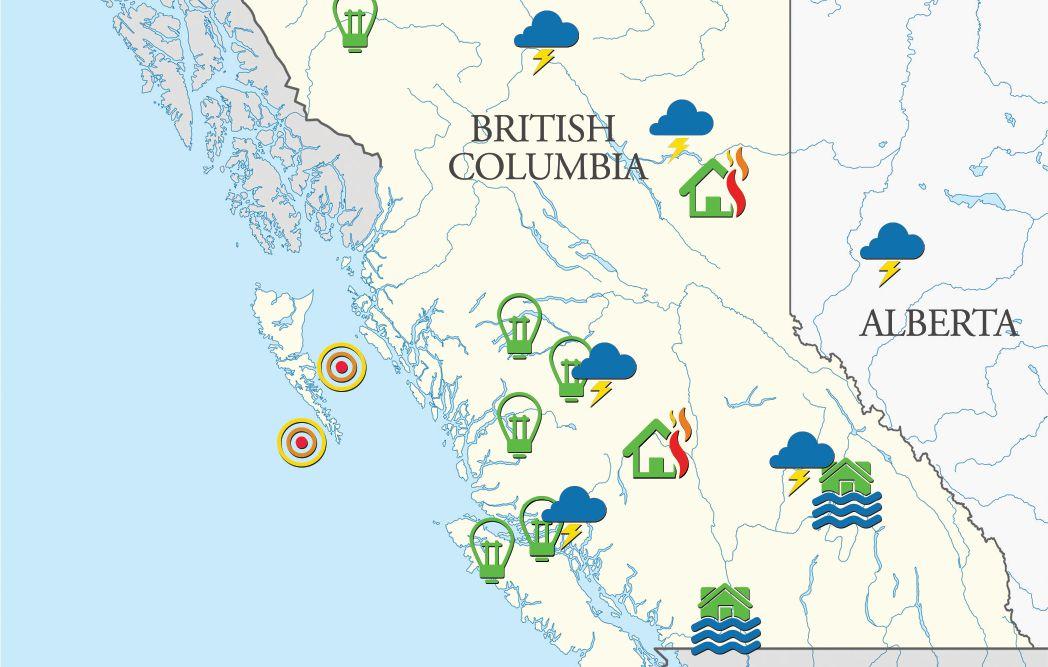
TOP New initiative of the Canadian Safety and Security Program allows fire-agency information to be shared on the Canada-wide Multi-Agency Situational Awareness System site in real time: circles indicate earthquakes; waves indicate flooding; light bulbs indicate power outages.
Even though police, paramedics, and firefighters are equipped with many tools to help them do their jobs, the ability of different departments to work together continues to challenge teams who are stationed kilometres apart, across several jurisdictions.
Interoperability is exactly the type of challenge that the Canadian Safety and Security Program (CSSP) aims to tackle. CSSP is a federally funded program that supports the development of science and technology solutions to public safety and security challenges.
Over the past three years, CSSP has created an information-exchange solution to
address a critical capability gap: first responder interoperability and multi-agency situational awareness. This solution is the Multi-Agency Situational Awareness System, referred to as MASAS.
Using common technologies based on open national communication standards, MASAS makes it possible to connect different departments’ systems, allowing them to exchange real-time, location-based incident information relevant to emergency managers and first responders.
With this system, responders can share data such as flood plains, fire perimeters, natural hazard alerts, evacuation zones and search areas.
In short, MASAS collects and distributes information capable of reaching a large audience within seconds. Picture a Google Maps layout to which information can be uploaded by hundreds of users, displaying the exact location of an incident. Anything that may be of help to responders, from temporary road closures to weather alerts, also appears on MASAS – with the use of different icons.
In an effort to provide the best possible situational awareness, MASAS relies on its users to input desired content into their own systems – information that can then be fed into MASAS and viewed by other connected agencies.
Although this national project still operates as a pilot, MASAS’ membership has doubled since 2012 when there were about 250 agencies using the system. Now, more than 500 agencies across Canada are accessing MASAS, from local fire departments to federal agencies such as the Department of National Defence and Health Canada.
MASAS also provides regional situational awareness by pulling together information from several agencies in a region. This means that different departments can learn about what is happening in a nearby town and see up-to-date incident information. Should addi-
tional resources be required, the requested team can quickly become aware of the situation while preparing to respond, improving its overall response efforts.
Emergency responders rely on a dispatcher to inform them of local incidents and to direct their services. Fire services respond to routine calls every day, but what happens when a car crashes on a busy highway involving a school bus, a transport truck containing hazardous materials, and half a dozen other drivers? The call comes in and a response team of firefighters will rush to the accident site. But are any routes closed? Are there other incidents in close proximity? What other agencies will be deployed? These concerns, among many others, can be alleviated with the help of MASAS.
Although this interactive and collaborative tool has already increased national situational awareness, there is still room for improvement. While MASAS has huge potential for the responder community, few first-response agencies use MASAS for day-to-day operations because it has been difficult to integrate local information into the system. That has changed.
One of the leading sources of situational awareness information is the public, and the first electronic record of most incidents
is a computer-aided dispatch (CAD) system. Automating the sharing of certain types of CAD information through MASAS can bring an incident to the attention of the greater public-safety community in seconds instead of minutes or hours, and eliminates the need for additional human resources.
Supported through the CSSP, the Kelowna Fire Department in British Columbia partnered with the FDM Software Group (its CAD provider) to develop software to link its CAD system to MASAS. This allows Kelowna firefighters to use MASAS for both local and national situational awareness. Connecting these two systems through a standard interface allows the department to rapidly see all incidents that require the involvement of multiple agencies – also known as high-crisis scenarios. All clients using the FDM dispatch system have the opportunity to do the same.
“Our challenge before the FDM-MASAS system was implemented was the time it took to relay real-time information to other first responders and stakeholders in an emergency,” says Brian Moore, dispatch supervisor with the Kelowna Fire Department and deputy emergency program co-ordinator with the Central Okanagan Regional Emergency Program.
“Once the Regional Emergency Operations Centre was opened, it typically took 15 to 90 minutes to become aware of the magnitude of an incident or event. Now all we do is turn on the lights and fire up MASAS. Everyone now knows what everyone else is doing. It’s making a tremendous difference in our planning, response and recovery for planned and emergency incidents of all sizes.”
As Moore also noted, a key secondary benefit is the significant reduction in repeat telephone calls, emails, faxes and reports required to relay situational awareness information that could be more openly shared at once with all users.
It has now become apparent to the public safety and securities communities that MASAS helps responders from all services co-ordinate a fast, effective response. Over the last year, key MASAS developments have been of particular interest to fire services. In 2013, the New Brunswick Department of Natural Resources Wildland Fire Reporting System was integrated with MASAS, as was Selkirk’s Wildfire System for Yukon, both automatically posting aroundthe-clock incident information to MASAS. Last year, MASAS began publishing Ontario’s open wildfire event information and using data from
Environment Canada. As a result, MASAS can now inform firefighters of wind speed and direction – valuable information for firefighters planning what to do at the scene of an incident.
Natural Resources Canada has recently begun to provide MASAS with near-real time, satellite-derived flood information of areas in crisis requiring a national emergency response. These projects, and others underway, demonstrate the potential for integrating existing department features or information services with MASAS to increase first-responder situational awareness – providing public safety and security agencies with a better picture of what is happening on the ground. With the addition of live CAD data into MASAS, the picture is more complete. With this connection established, other fire, paramedic, and police services can now use MASAS to improve their daily operations.
In consultation with experts across Canada, a national situational awareness system like MASAS has become a reality and the benefits are apparent: enhancing information sharing, improving co-ordination, and eliminating the duplication of efforts – overall resulting in a more organized and effective
response.
The CSSP continues to work with responders to improve interoperability and address key challenges for all responders, including fire services. A key element of the CSSP’s success is its Communities of Practice (CoPs), which bring together experts from various public safety and security domains to share knowledge and experience. Their combined expertise helps the CSSP develop projects and activities that address the real needs of responders on the ground.
The Fire CoP includes fire-service leaders, researchers, and members from industry who have joined to discuss specific challenges for the fire services, such as the need to identify common practices and improve how firefighters alert communities. These priorities are driven by the need to provide the best possible education, training, equipment, and information to first responders, and to increase interoperability and collaboration among the services. By working closely with first responders to better understand their operations, the CSSP can ensure that projects like MASAS address the needs of these communities and that the results of the research are transitioned into useable products and information.
Are you tough enough to call a mayday? TRAINER’SCORNER
BY ED BROUWER
Iam grateful for the positive response to my call in my June column for a greater mayday awareness. However we are far from the mark. Lately, we’ve been pushing mayday awareness training in our department. One particular night, we listened to the audio tapes of the Charleston Sofa Super Store fire. As the cries for help echoed through the hall, a few guys got weepy. One, in particular – a father of a firefighter in a neighboring department – gathered up extra copies of our handout and made his son read them. He pointed to the tag line, “Are you tough enough to call a mayday?” and asked, “Well, are you?”
Later that night at a local bar, this same firefighter bumped into two of our firefighters, and before the night was over they, too, asked him, “Are you tough enough to call a mayday?” He admitted that no one in his department had successfully completed the Firefighter’s Ghost Maze through which we put 100 firefighters during our spring training session. (See Trainer’s Corner, June 2014, at www.firefightingincanada. com). It was at this point that this firefighter gave me a great compliment (at least that is how I took it); he said, “Man, Brouwer is a hard ass when it comes to firefighter safety.” And to that I say, Yes! Yes I am, and I have no intention of dialing it down.
Perhaps the following report will help you to also become a hard ass for firefighter safety.
The day I was writing this – June 18 – marked the seventh anniversary of the Sofa Super Store fire in Charleston, S.C., that claimed the lives of nine firefighters. It will never be possible to determine what really occurred inside the Sofa Super Store, but it was a tragedy waiting to happen. It was determined that the building had been remodeled without permits or inspections. There were flammable liquids stored improperly in several areas. Some of the exits were locked. Timed pictures of the fire’s development, taken from across the road, showed heavy smoke and flames from the roof. Firefighters inside had no idea what was going on above them.
Almost every firefighter who arrived went into the building, including those on the ladder truck. “They were entering the building by ones and twos . . .” according to the post-incident investigation by the National Institute of Occupational Safety and Health (NIOSH) report. One firefighter, who realized a supply line had not been established, turned the corner to find the hydrant missing; it had been removed because delivery trucks kept hitting it. Unaware of the location of the next hydrant, this firefighter set out on foot to look; he found one, but wound up 30 meters (100 feet) short of hose. While that was underway, 16 firefighters were in the burning building with a booster line and a one-and-a-half-inch hoseline. Water supply set-up took about nine minutes.
Firefighters must practice calling a mayday to be comfortable doing so when bad things happen. The seven firefighters who died in the Sofa Super Store did not have a mayday protocol in place.
Although the firefighters heard of deteriorating conditions, none of the chiefs made a decision to evacuate the store and move from an offensive to a defensive attack. That decision didn’t come until after several disoriented firefighters had been rescued.
I must stress the importance of officers knowing when it’s time to change tactics and get firefighters out of harm’s way.
There was no accountability whatsoever. According to the report, “The first person outside the building to become aware that firefighters were in trouble inside was an off-duty battalion chief (car 303), who was en route to the scene in his personal vehicle. He heard traffic on his portable radio that indicated a firefighter was lost and unable to find his way out of the building.” (This radio traffic was not heard by anyone at the fire scene).
Car 303 attempted to contact the fire chief at 19:30:27 to advise him of the situation, but was unable to establish contact on the busy radio channel. He continued to the fire scene as quickly as possible, parked his vehicle, and located the fire chief on the west side of the fire building, near the loading dock. The face-to-face exchange with battalion chief 303 was the fire chief’s first indication that firefighters were in distress.
The review panel determined that the firefighters really didn’t have a mayday plan in place. Crews were not instructed on when to call a mayday and what to do to save themselves while awaiting rescue. The
analysis indicates that the Charleston Fire Department failed to adequately prepare its members for the situation they encountered at the Sofa Super Store fire.
Listening to the fire-ground tapes, you can hear the first radio traffic related to firefighters in trouble at 7:27 p.m. At 7:29 p.m. there is more radio traffic from firefighters lost and looking for help. (No one on the fire ground heard them.)
At 7:31 p.m. the rescue of an employee trapped inside the building is made by cutting through the wall. The employee did not have much time left. The 7:32 p.m. mark is the only time a mayday call is heard, and at that point a chief tells everyone to stay off the radio to listen for those calls.
We are pretty sure that within the first nine minutes of the call, six of the nine firefighters lost their lives. Only three firefighters called for help; firefighters Mulkey, Kelsey, Drayton, Baity, Hutchinson and Benke did not. These firefighters had a total of 125 years of service. Only firefighter French called a mayday and activated his emergency identifier button. Firefighter Thompson called for help once, and firefighter Champaign made multiple calls for help. Those three had a total of 7.5 years of service.
What would you say in your last nine minutes and three seconds? The following statements were taken from the radio traffic transcripts. They were made by firefighter Melven Champaign, 46: “Which way out?; Which way out?” Nine radio activations (no discernable audio) Keyed the mike: “Which way out? Everybody out . . . We need some help here . . . (inaudible) . . . firefighter. Needs some help out. Lost connection with the hose. Can you hear me dispatch? In Jesus’ name. Amen.” Then he died.
The PASS alarm is heard in the background during 52 transmissions, but there no reaction to it by other fire personnel.
The single use of the term mayday was recorded at 19:32:15. The mayday was not heard by the incident commander or by anyone else at the fire scene.
The Communications Center immediately notified the incident commander when a firefighter’s emergency button was activated at 19:34:40. During the period while firefighters were attempting to call for assistance, the following radio traffic was recorded: car 1 called for more pressure in the supply line from engine 12 to engine 10; car 1 called for engine 3 to respond to the fire scene and lay a line to ladder 5 (ladder 5 was being set up by off-duty firefighters on the west side of the building); car 2 called for manpower to assist with the civilian rescue operation; car 5 reported that the trapped employee had been rescued; car 2 called for EMS to respond for the rescued employee; engineer 11 advised that he was charging the two-and-a-half inch line; engineer 16 called for traffic control on the Savannah Highway because cars were still running over the supply line.
Analysis of the recorded radio traffic indicates that those members who would die did not attempt to call for assistance until they were in critical distress. All of the recorded messages indicate that the firefighters were lost, disoriented, and either running out of air or already out of air. The firefighters were already in imminent danger, deep inside the building, when they began to call for assistance.
The recorded radio traffic included 16 distress messages that were transmitted by firefighters inside of the Sofa Super Store. Distress messages were recorded from firefighter 16, firefighter 5, and engineer 5. The recordings included additional distress messages in which the firefighter speaking could not be identified.
None of these messages was heard by a command officer on the scene; they were ignored, neglected and left unanswered.
All of the firefighter-in-distress messages came from the radios assigned
CONTINUED ON PAGE 43
BY TOM BREMNER Fire chief, Salt Spring Island, B.C.
ICHANGEAGENT
Training to a new real-world standard
t is training night again and common themes echo in the station and on the training ground: This is a waste of time. Why do we have to do this again?
The saying “What we do does matter,” is true and it applies to training. If we are going to take the time to do something, let’s get it right and as close to reality as possible.
First, we need to give credit and respect to the numerous men and women who take the lead in training and provide – week in and week out – training sessions to improve our skills, safety and response outcomes. Hats off to all of you.
On the other hand is the question: Does our training provide a real understanding of what the live situation will be like, or is it just a session to make us feel we can do something safely, only to learn later that we have set ourselves up for failure?
The changes we have faced in emergency services over the last two decades are numerous: construction methods, rules and regulations, tightened budgets, greater human-resources issues, more public awareness of and interest in what we do. All these factors have forced us to revisit, revamp and wake up to what we traditionally have done and what we now must do to exist professionally and proficiently.
Training to a standard is critical. However, training to real-world situations is even more important.
Too often, we hear trainees complain about training. My first reaction to correcting this behaviour is to go online and review situational awareness guru Richard Gasaway’s views and comments about training – how we train and how we need to change training so that it is real.
Our priorities must be safety, good-quality training, enhanced service-delivery methods and better management of our everyday activities and resources.
Training needs to be dynamic and our members must understand and value the importance of modern training methods. We can have fun with training as long as our actions are safe, monitored and understood by all.
Training cannot be a blame game or a power struggle; it must be an understandable and communicative process that is professionally managed and delivered. The quality and experience of the trainers, their planning for the training program, and their understanding of the students becomes the most valuable assets you as a fire-service manager can create and provide.
Who knows what Canadian fire services will face in the moments, days or weeks ahead. Being able to train and understand the value of the training is huge, although it is, admittedly, boring at times. But as the saying goes – suck it up, buttercup! Certainly there are some training topics we just don’t like or enjoy. But in many cases we don’t get to choose them – we must deal with them the best we can. That said, we should also expect to be trained in a professional and respectful manner.
As we learn in life, tough love is sometimes the only way to
Training cannot be a blame game or a power struggle; it must be an understandable and communicative process that is professionally managed and delivered.
We have all attended training at which the outcome of the session has been less than professional or real. The abilities and presentation skills of the instructors are so important. If you find that a course is less than productive, stand up and, in an appropriate manner, let it be known. Don’t just accept this less-than-stellar effort and walk away.
We have come a long way over the last several decades and this progress must continue. The responsibility for safety, training and positive outcomes on the fire ground rests heavily on management, training officers and, of course, the firefighters.
Tom Bremner is the fire chief for Salt Spring Island, B.C. Contact him at tbremner@saltspringfire.com
handle the reality of a situation. The goal for the training provider is to ensure the quality and respect of both the instructors and firefighters.
It is easy to poke fun at and ridicule an instructor, but have you ever stepped up to the plate to lead a training session?
As we gain more experience in this service we all realize there is only so much we can do to reduce risks, and training is the most important option. To do something well, we need to spend 10,000 hours practising it over and over. How many hours have we each spent on any one topic? I hope you get the picture.
The next time you hear complaints about training, take a moment to set the record straight and provide leadership. What we do does matter. If we are going to take the time to do it let’s get it right and as close to reality as possible.
TRAINER’SCORNER
CONTINUED FROM PAGE 41
to the members who later died. The recording system did not capture any distress messages from the surviving members who were operating inside the building.
The survivors: seven firefighters lost connection with hoseline and their crew; two firefighters ran out of air. None of them called for help.
Calling a mayday must become an accepted decision. Firefighters do not like to admit that they might need to be rescued. The delay in calling a mayday may be caused by many factors, but three must be addressed immediately: the stigma associated with admitting to yourself and letting others know you need help; not having been given clear rules for calling a mayday; and the manner in which the fire service makes decisions.
A comment from a firefighter interviewed after his rescue: “I knew I was in trouble. I thought about using the radio, but I thought, ‘I found my way in; I can find my way out.’ ” Other firefighters said they realized that events were not unfolding correctly. They were all trying to find their way out of the building, but they couldn’t. They all ran out of air. They all tried alternative filter-breathing techniques. But in the end, exposure to carbon monoxide impaired their judgment and motor skills.
We in the Canadian fire services need to develop clear mayday decision-making parameters (rules that specify when a mayday must be called) and institute mayday training programs that firefighters must take and continue to pass throughout their fire-service experiences.
NFPA 1404 sets forth the standard for air management. According to the standard, a firefighter is supposed to exit the IDLH (immediately dangerous to life and health) environment before the low air alarm goes off. And if it goes off while a firefighter is in an IDLH environment, it is to be treated as an event comparable to a mayday situation.
What if we trained firefighters to be aware of their air supply while working in hazardous atmospheres?
What if we said the last 1100 psi of that air supply shall only be used in the event of an emergency that interferes with normal egress from that hazardous environment?
What if the activation of the SCBA low-air alarm in a hazardous environment were to be treated as a serious condition?
We need to start considering that the first 16 minutes of air are yours, the remaining 10 are for your family and fellow firefighters.
Each member has a responsibility to ensure his or her own safety by regularly checking the pressure remaining in the SCBA cylinder while operating in a hazardous environment.
We still have firefighters entering burning structures without radios.
We still have firefighters using the low air alarm as an indicator to leave the building.
We still spend more time tying knots than we do practicing a mayday. We still yell “shake” when a PASS alarm is activated.
Please help me change this. The lives of your members depend on your decision to help stop this insanity.
So let me ask you this: Are you tough enough to call a mayday? Well, are you?
Ed Brouwer is the chief instructor for Canwest Fire in Osoyoos, B.C., and Greenwood Fire and Rescue. The 25-year veteran of the fire service is also a fire warden with the B.C. Ministry of Forests, a wildland urban interface fire-suppression instructor/evaluator and an ordained disaster-response chaplain. Contact Ed at ebrouwer@canwestfire.org
BY PETER SELLS
FLASHPOINT
When waste disposal becomes a fire issue
G
arbage in, garbage out. We’ve all heard that phrase. It refers to failures in data analysis or human decision making due to faulty, incomplete, or imprecise information being input. If what you put in is unreliable, then what you get out will not be useful. Well, believe it or not, the philosophy of garbage in, garbage out may actually be the best, if not perhaps the only, long-term solution to a growing crisis in waste management in the Canadian north.
As I wrote this, the fire in the dump outside of the city of Iqaluit had been burning for at least five weeks. I say at least because it is possible that the fire had been burning for six months or more. Fires were suppressed at the dump three times since December 2013 by the surround-anddrown method. It is possible that beneath the frozen cap that formed over the 15-metre-deep pile, the fire continued to smolder until May 20, when it broke out again in earnest. “Every time before that we were able to extinguish the fires,” Fire Chief Luc Grandmaison told CTV in late May, “we believe what we were extinguishing was just the surface of a deep-seeded fire.”
The costs of fighting that fire, in terms of staffing dollars, diversion of water resources from domestic use to fire fighting, the risk of runoff contamination into Frobisher Bay, and a lack of progress in suppression efforts, led to council ordering Grandmaison to allow the fire to burn itself out. However, after three weeks of complaints about smoke drifting into town whenever the wind shifted, and out of concern for public health, council reversed that decision on June 11, ordering Grandmaison to “at his discretion, extinguish the fire as he sees fit, with the assistance of the Government of Nunavut to be done as soon as possible.”
LandfillFire Control Inc., was to arrive in Iqaluit at the end of June to assess the situation and advise how to proceed. Hopefully for all concerned, by the time you read this column, the fire had either been extinguished for good, or had burned itself out.
Neither of those outcomes, however, addresses the root of the issue. Iqaluit, and other northern communities, have a long-term problem on their hands. In fact, in late June, Rankin Inlet was fighting a dump fire of its own. When I was in Iqaluit in September 2010, the second-last sealift of the season had just arrived. Living in a city accessible only by sea or air, residents of Iqaluit depend on cargo deliveries that come into Frobisher Bay every month or so between the spring breakup and autumn freeze.
When I was there, there were a lot of large empty wooden crates visible in front and back yards. I was told that the residents are expected to break up the crates within a week or so of receiving their deliveries. Then the crates, along with all of the leftovers from their former contents, make their way into the landfill. It’s no wonder that in the few weeks since the dump fire had been burning, a temporary landfill site had already piled up 1.5 metres high. There are no household recycling or composting programs in place. “That’s not happening right now,”
Fires were suppressed at the dump three times since December 2013 by the surround-and-drown method. ‘‘ ’’
Grandmaison has been consulting with federal officials and experts in fighting landfill fires, and as of June 27 planned instead to fight fire with fire. “This fire can go away quicker if we accelerate the burning process,” he told the CBC. The suggestion was to aerate the fire by using a long metal pipe, perforated with holes along its length. The pipe would be drilled or rammed into the side of the burning pile in order to blow air into the depth of the fire. The strategy was to allow for more complete and aggressive combustion.
A landfill firefighting expert, Dr. Tony Sperling of Vancouver-based
Retired District Chief Peter Sells holds a B.Sc. from the University of Toronto and an MBA from the University of Windsor. He sits on the advisory council of the Institution of Fire Engineers, Canada branch. Peter is president of NivoNuvo Consulting, Inc, specializing in fire-service management. Contact him at peter.nivonuvo@gmail.com and follow him on Twitter at @NivoNuvo
George Siegler, Iqaluit’s deputy fire chief, told the CBC. “What’s happening is all of our garbage is going back in there. And we’re recreating this again. So this is just a recipe to have this happen again.”
So one reduction solution, already successful in many communities over decades, is not being enacted. Another waits in the wings, perhaps. In 2003, Canada, joined 32 other nations including our Arctic neighbours Finland, Norway, Russia and the United States, in ratifying the Protocol on Environmental Protection to the Antarctic Treaty, also known as the Madrid Protocol. In essence, the Madrid Protocol requires any party that transports waste into Antarctica or generates waste in Antarctica, to either incinerate the waste completely or remove it.
Garbage in, garbage out. If we can commit to that process with respect to any mining or commercial interests in the Antarctic, why can we not properly keep house in our own Great White North?