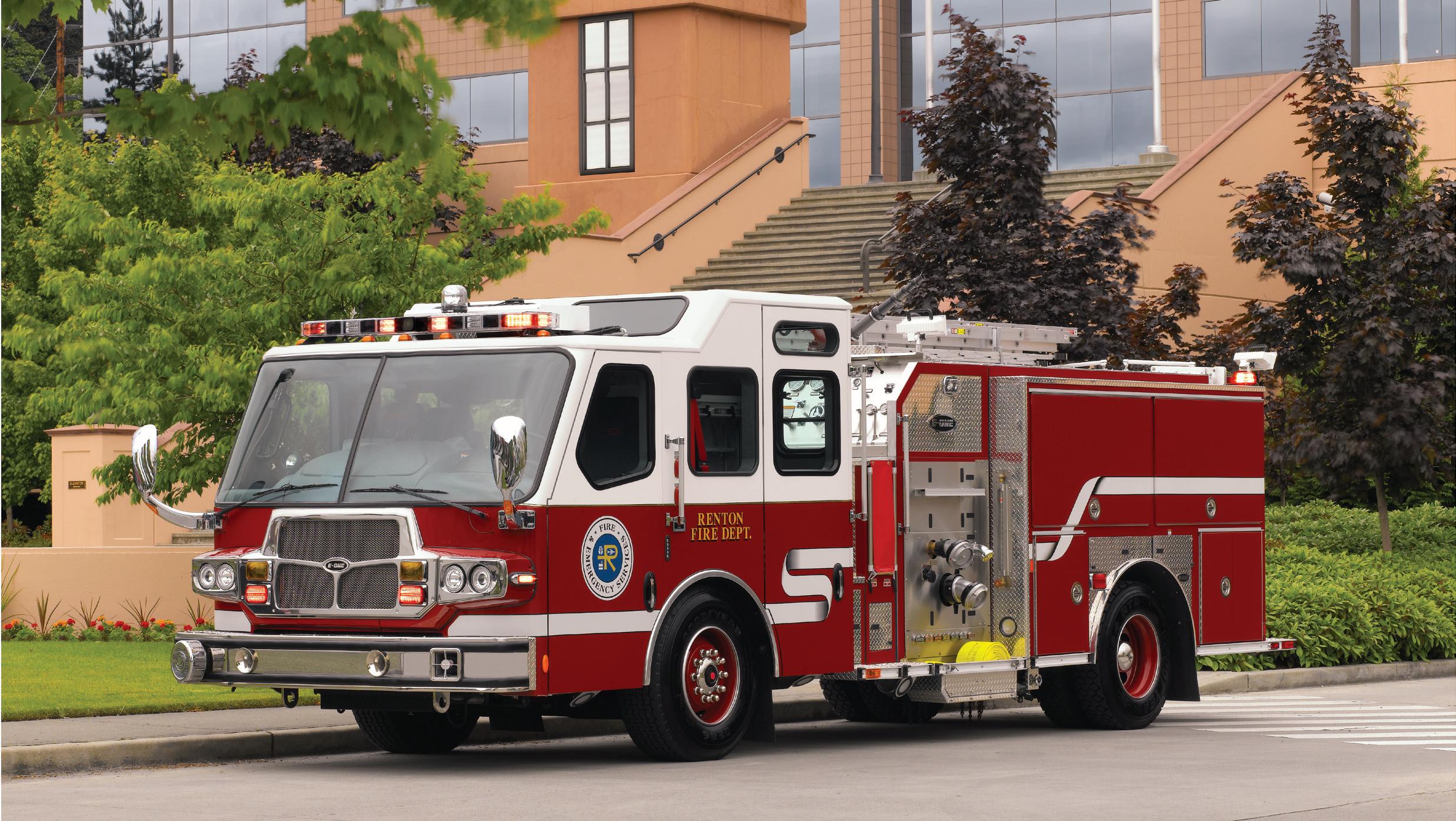
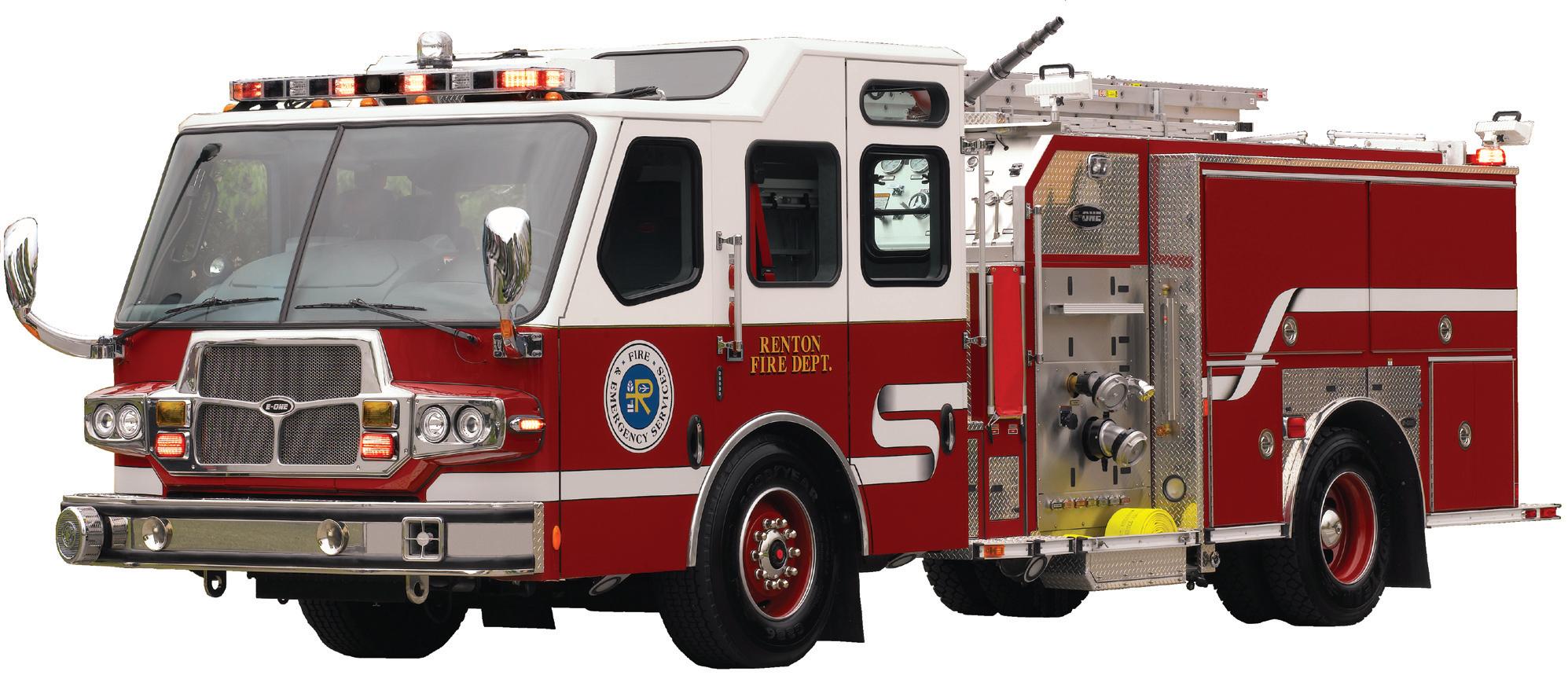
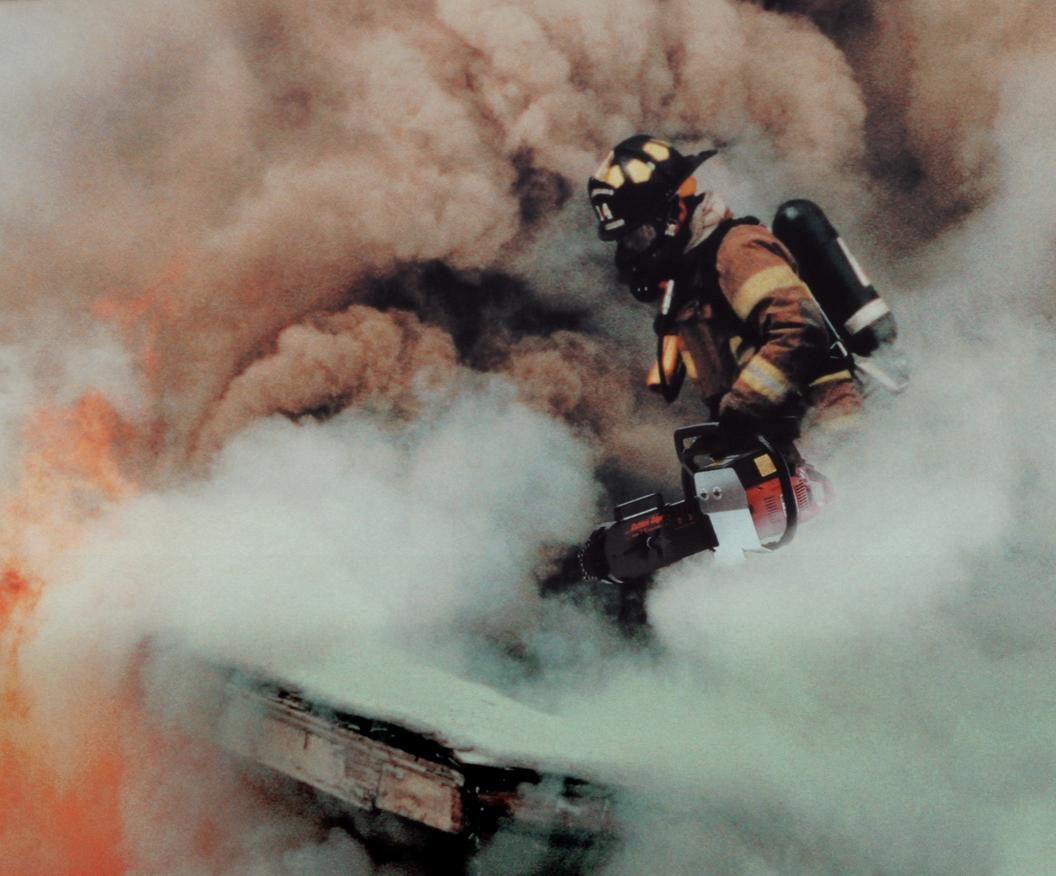
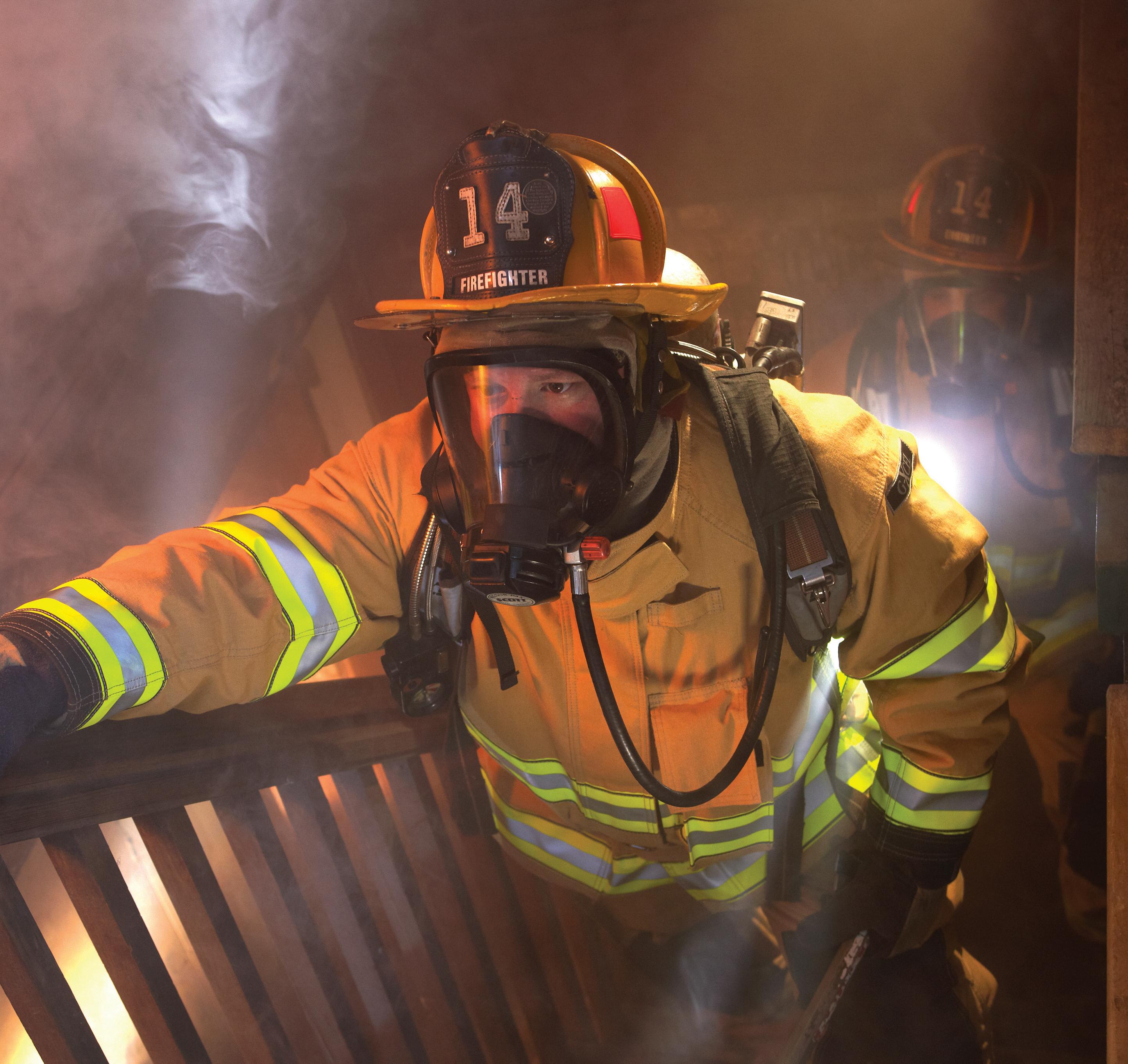
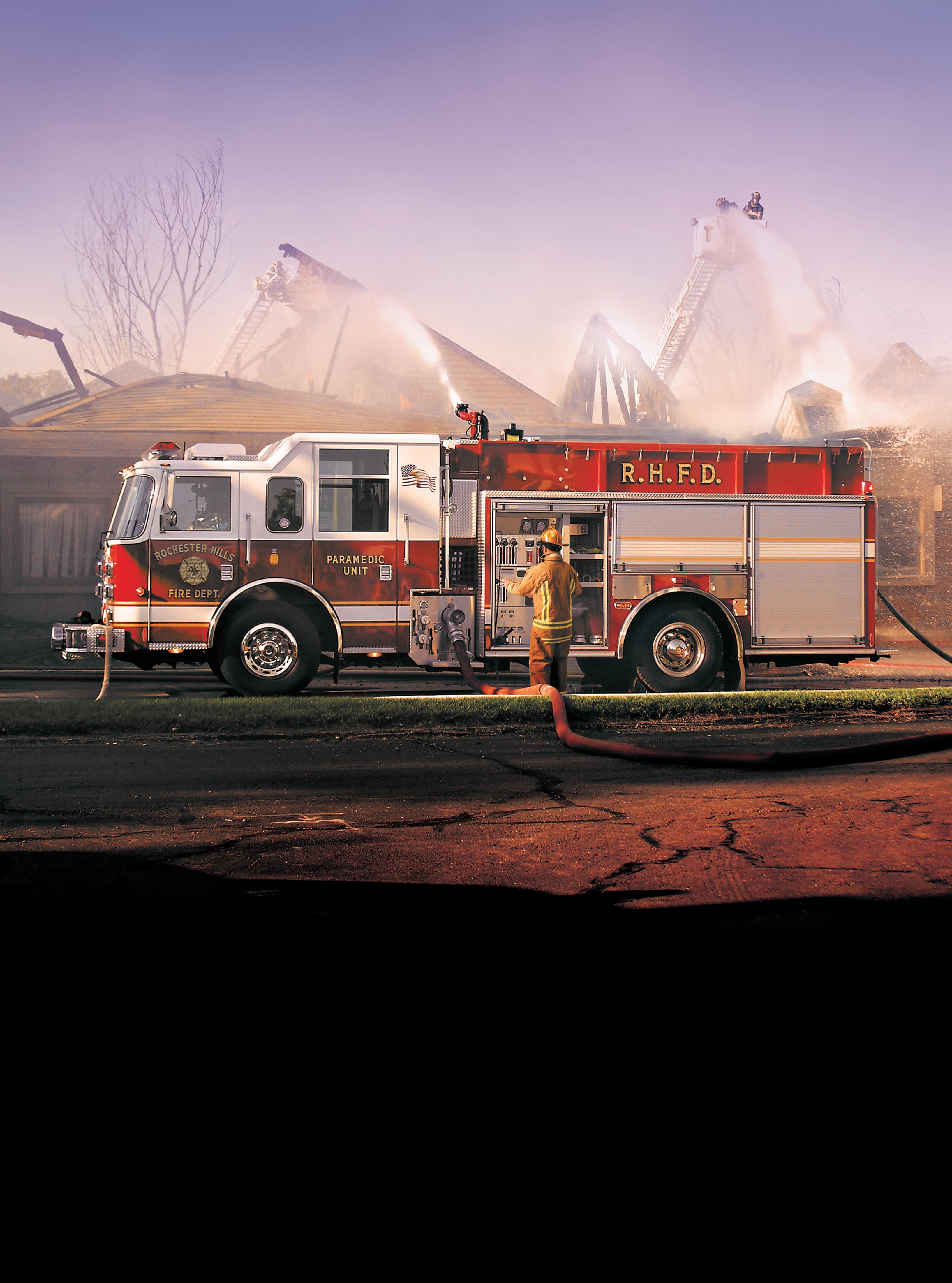
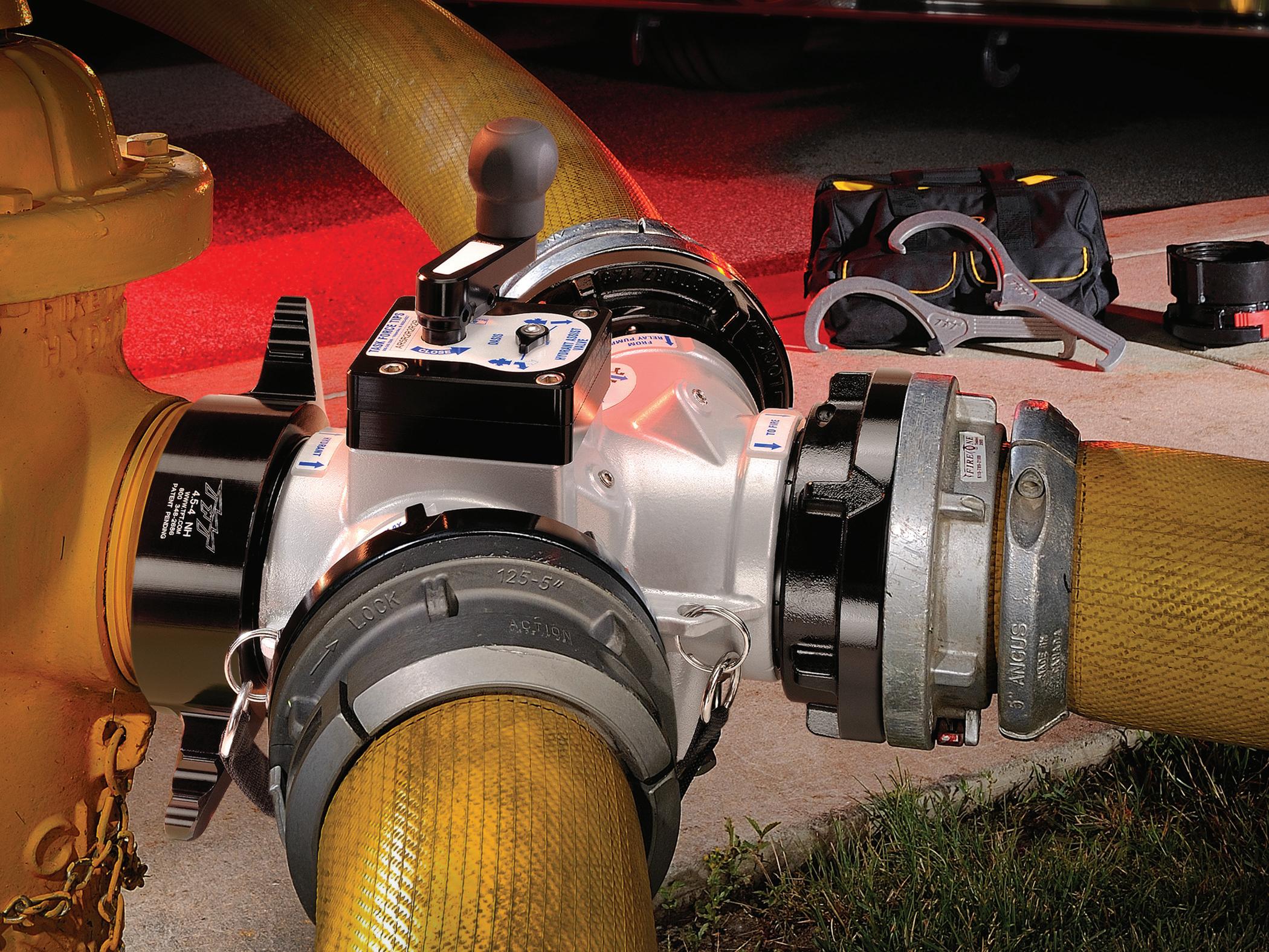
How can you protect against what you can’t see? The short answer - you can’t. That’s why we engineered The E-ONE Quest chassis with the best visibility in the industry. An expansive windshield and massive wipers provide best-in-class front visibility while the front cab-corner mirrors offer maximum side visibility. Plus, the ergonomically placed controls are easy to find, helping you keep your eyes on the road. Because when it comes to protecting your crew and all those that cross your path, shouldn’t you see what’s coming?
Learn how to Protect Better at E-ONE.com.
For more information, contact your nearest dealer:
First Truck Specialty Vehicles 18688 96th Avenue Surrey, BC Canada V4N 3P9
Phone: 604-888-1424
Territory: British Columbia, Alberta, Yukon, Northwest Territory
When lives are in the balance and seconds count.
Techno Feu Apparatus Maintenance
1 05 Marie -Victorin St. Francois-Du-Lac, PQ J0G 1M0
Phone: 450-568-2777
Territory: Quebec
CANADIAN CONTENT
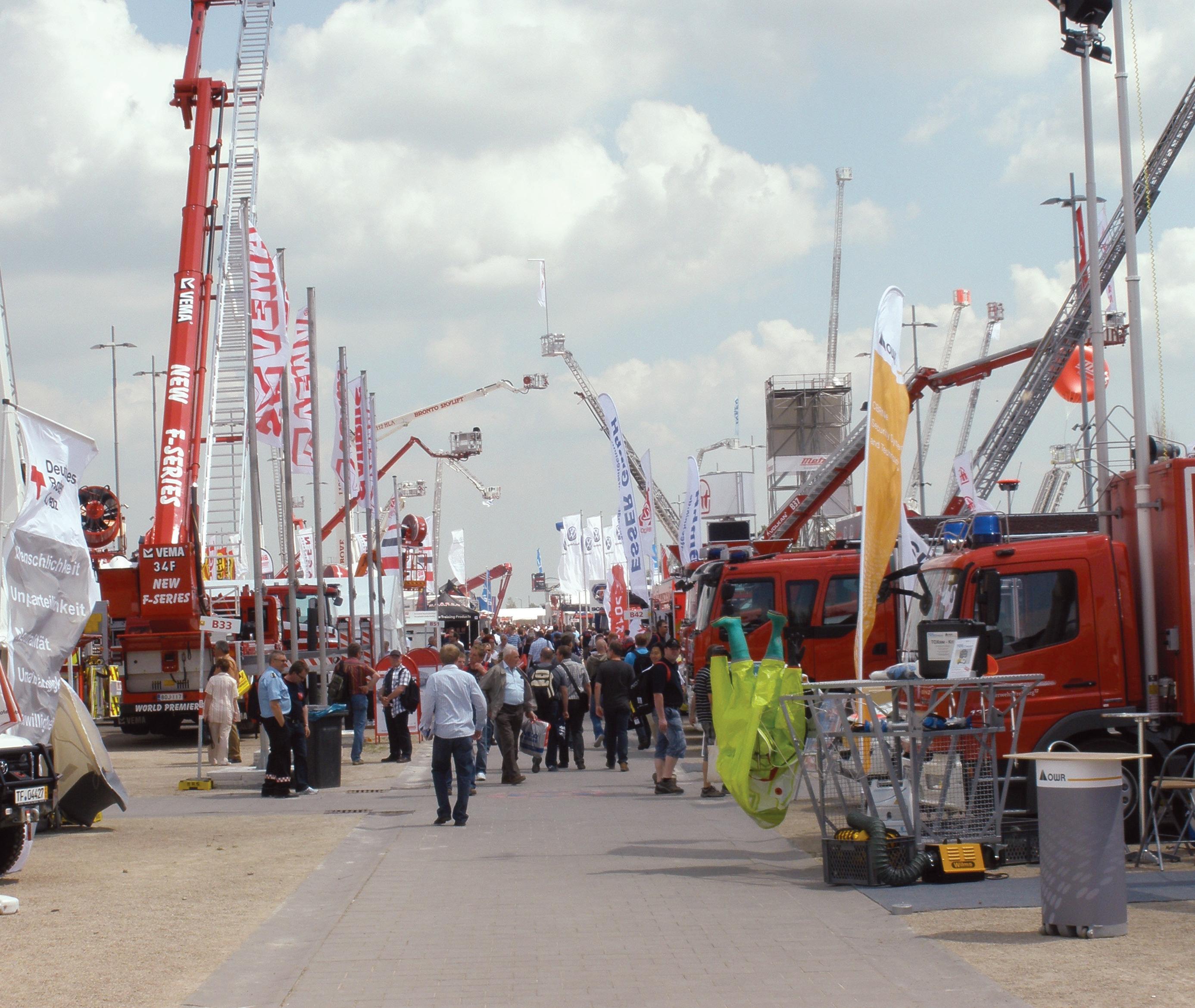
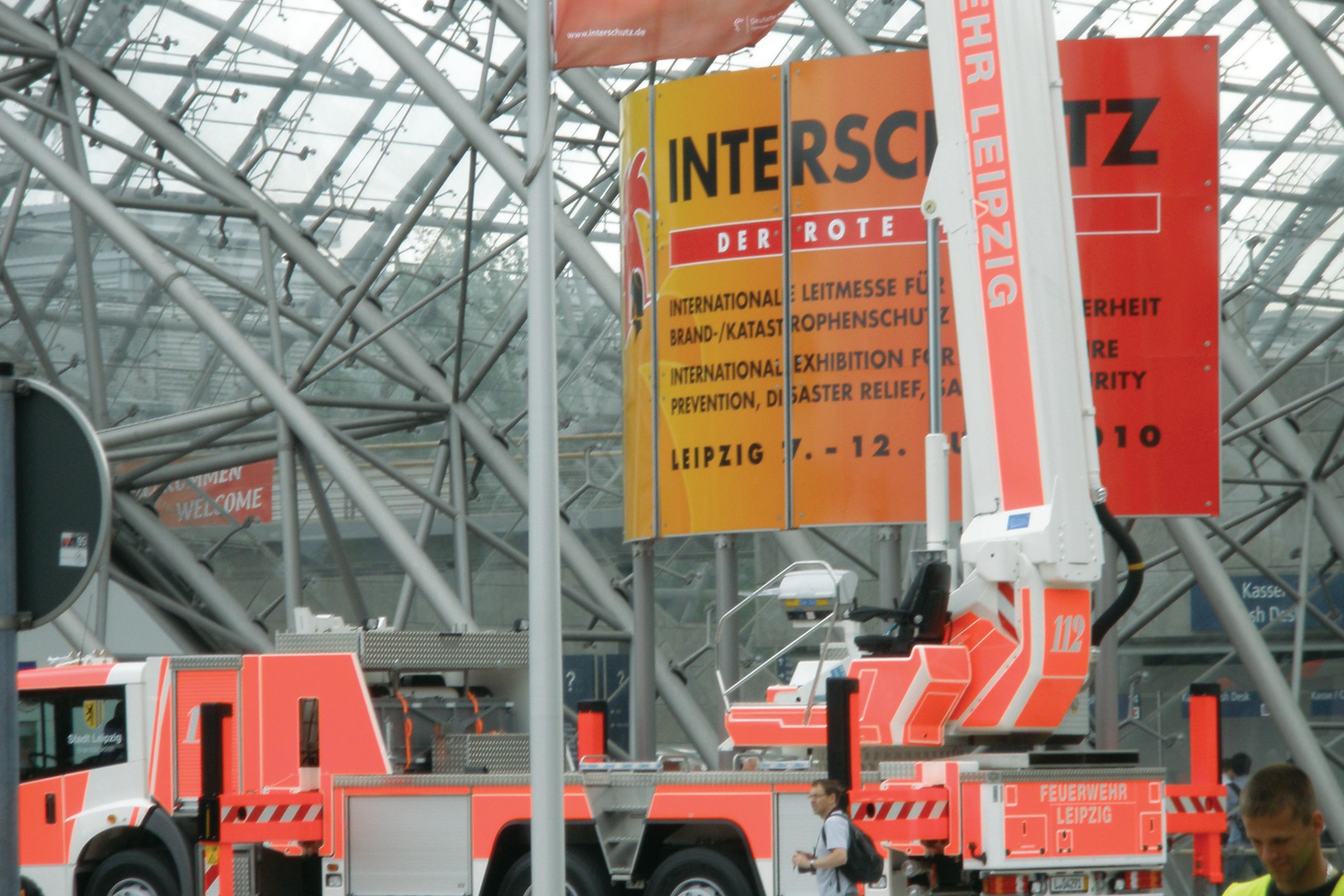
As Lyle Quan reports from Liepzig, Germany, Canadian vendors at Interschutz 2010 say the exhibition is a must-attend for anyone wanting to grow their businesses internationally.
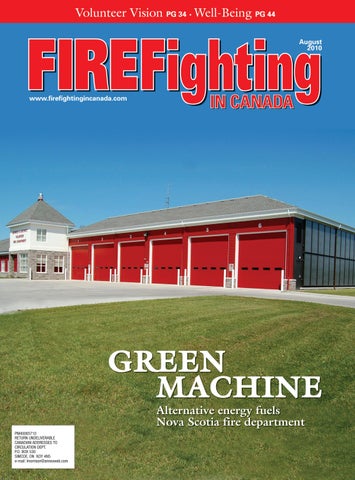
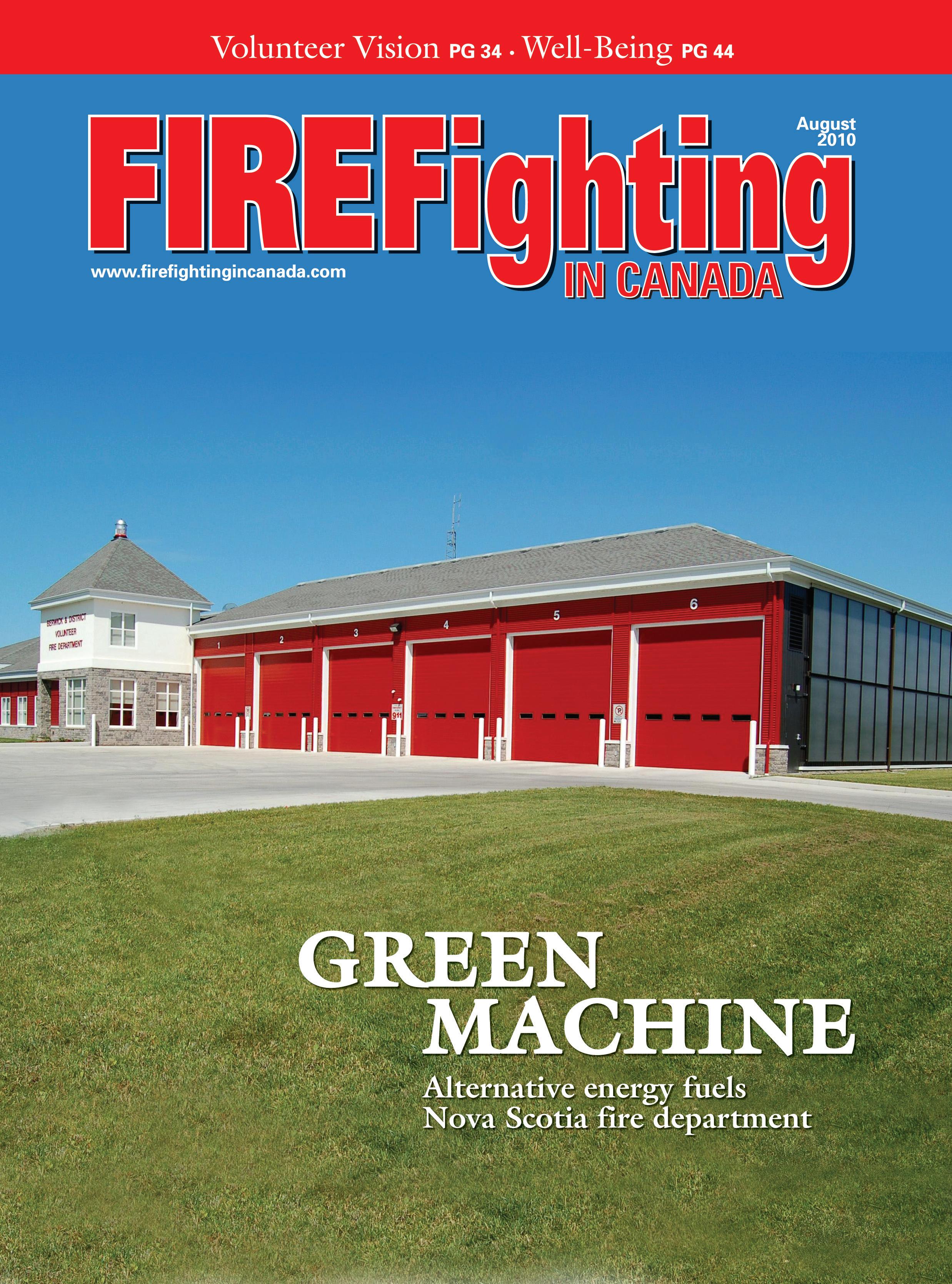
14 GREEN MACHINE
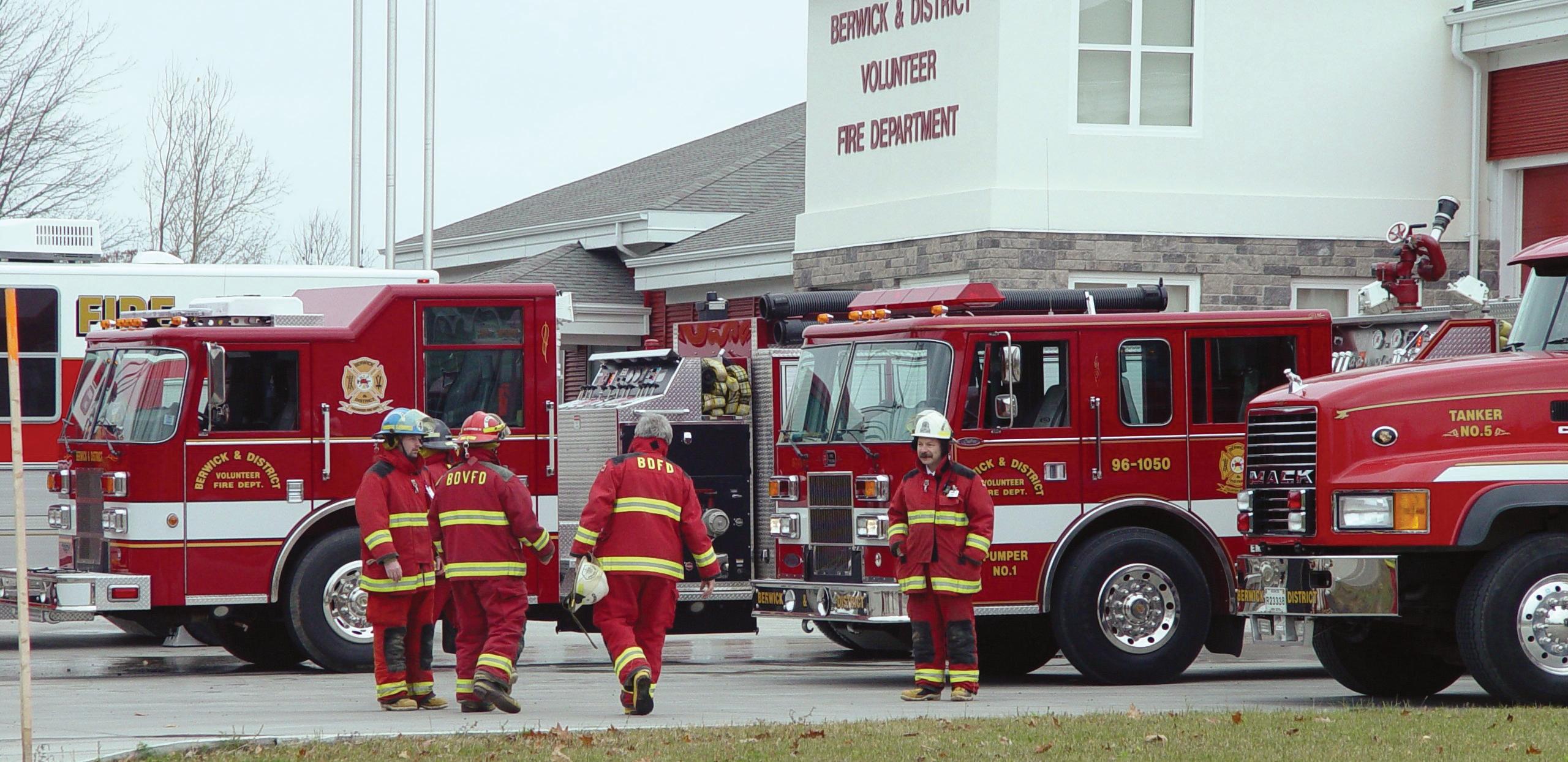
The new, green fire department in Berwick, N.S., was designed by firefighters, for firefighters. By Carroll
McCormick
20
HUMAN TRAFFICKING
While inspecting a business, you come across a filthy mattress and meet a worker who can’t speak English. This may be a sign of human trafficking, a growing problem in Canada. By Karin Mark and Len Garis 24
HIGH-RISE TRAINING
A report on the high-rise capabilities of the Surrey Fire Service in B.C. led to a decision to move to a systems approach. Deputy Chief James Bond and Training Officer John Lehmann explain.
30 EXTRICATION EXPLANATION
As Randy Schmitz explains, the Calgary Fire Department is running a pilot project with Crash Recovery System software that gives rescuers access to more than 25,000 vehicles and eliminates guesswork during extrication.
By Lau R a K I n G Editor
comment
A burning ring of fire
a
s outgoing CAFC president Bruce Burrell made the rounds of provincial fire chiefs association conferences this spring and summer, his message was clear: the association is strong and vibrant but it needs new members to sustain its mandate and to grow, and those members must include volunteer fire chiefs and officers.
As Burrell, the chief in Calgary (who, as we speak, is dealing with an $8.1-million cut to the fire service budget), told delegates to the Maritime Fire Chiefs Association in Yarmouth, N.S., in July, there are 180,000 firefighters in Canada, of which about 20,000 are chief officers, but there are only 800 members of the association, “so 800 people are paying for the initiatives of the CAFC.”
scape to advocate for it in Ottawa. That, too, costs money.
As Saint John fire chief and incoming CAFC president Rob Simonds pointed out, there are a number of lobby groups in Ottawa working against the CAFC and its call for residential sprinklers and even a national fire advisor, and lobbying just as hard for federal dollars.
The CAFC is lobbying to get the attention of the federal government for things like a national fire advisor, tax incentives for volunteer firefighters and residential sprinklers – all of which will benefit volunteers, not just career firefighters. Lobbying costs money. Preparing briefing papers for MPs so they understand and can eloquently present fire service issues to their peers is a daunting, time consuming and pricy task.
And while the CAFC is doing its part –Burrell and executive director Don Warden attended six provincial conferences this year and enjoyed a similarly challenging road trip in 2009 – the rest of the fire service needs to hop on the proverbial bandwagon or pumper truck.
“The government of Canada needs to start paying attention to the fire service,” Burrell said in Yarmouth. To do that the CAFC needs to engage more members and get people who know the political land-
“The CAFC is trying to elevate our position with the federal government so that we have the right people at the table with the right people,” Simonds said.
“Volunteers are missing from the CAFC and we need their support to do the research to present to the federal government to get the funding for the fire service.”
Simonds’ comments followed a presentation by Sean Tracey, the Canadian regional manager for the NFPA, who noted that although Canada has a gem in the National Research Council, which has done internationally renowned studies on fire behaviour, there is little or no Canadian funding for such research and, therefore, no scientific evidence on which to base arguments about the benefits of, for example, residential sprinklers.
“Who should be funding the research? It should be the fire service, if we want to see research on single family dwelling fires,” Tracey said.
PRESIdEnt MIKE FREDERICKS mfredericks@annexweb.com
PuBLICATION MAIL AGREEMENT #40065710
RETuRN uNDELIVERABLE CANADIAN ADDRESSES TO CIRCuLATION DEPT.
P.O. Box 530, SIMCOE, ON N3Y 4N5 e-mail: lmorrison@annexweb.com
Printed in Canada ISSN 0015–2595
CIRCuLatIon e-mail: lmorrison@annexweb.com
Tel: 866-790-6070 ext. 206 Fax: 877-624-1940
Mail: P.O. Box 530 Simcoe, ON N3Y 4N5
SuBSCRIPtIon RatES
Canada – 1 Year - $24.00 (with GST $25.20, with HST/QST $27.12) (GST - #867172652RT0001)
uSA – 1 Year $40.00 uSD
We acknowledge the financial support of the Government of Canada, through the Publications Assistance Program and the Canada Magazine Fund, toward our mailing and editorial cost. Nous reconnaissons l’aide financiere accordee par le gouvernement du Canada pour nos coults d’envoie postal et nos coutl redactionnels par l’entremise du Programme d’aide aux publications et du Fonds du Canda pour les magazines.
Occasionally, Fire Fighting in Canada will mail information on behalf of industry-related groups whose products and services we believe may be of interest to you. If you prefer not to receive this information, please contact our circulation department in any of the four ways listed above.
All advertising is subject to the publisher’s approval. Such approval does not imply any endorsement of the products or services advertised. Publisher reserves the right to refuse advertising that does not meet the standards of the publication.
www.firefightingincanada.com
ON THE COvER
The new fire hall in Berwick, N.S. – see story on page 14.
Photo by Carroll M C Cor
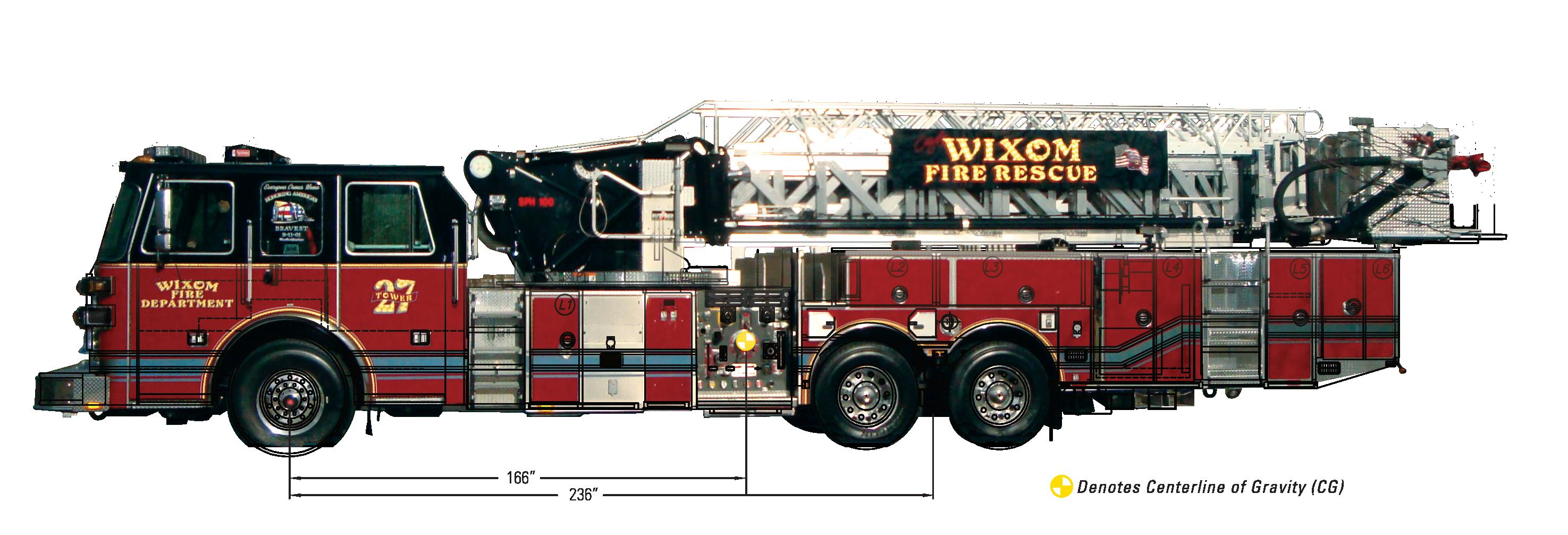
Can your fire apparatus manufacturer pinpoint the exact Center of Gravity of your fire truck? Why is this question important to ask? A recent change to the NFPA 1901 standard requires apparatus to have a Center of Gravity no higher than 80% of the rear axle track width. What does that mean for you? A fire truck with a lower Center of Gravity is a safer, more stable, and better handling piece of equipment. Sutphen Fire Trucks have always been designed to be the perfect mix of technology, engineering, performance, and safety. The Sutphen Mid-Mount design and its lower overall weight naturally contribute to the lower overall Center of Gravity, resulting in an apparatus that is perfectly in balance. Low Center of Gravity… one more reason, There’s Nothing Like A Sutphen.
across canada: Regional news briefs statIontostatIon
New regional department serves several communities
■ NEWFOUNDLAND AND LABRADOR
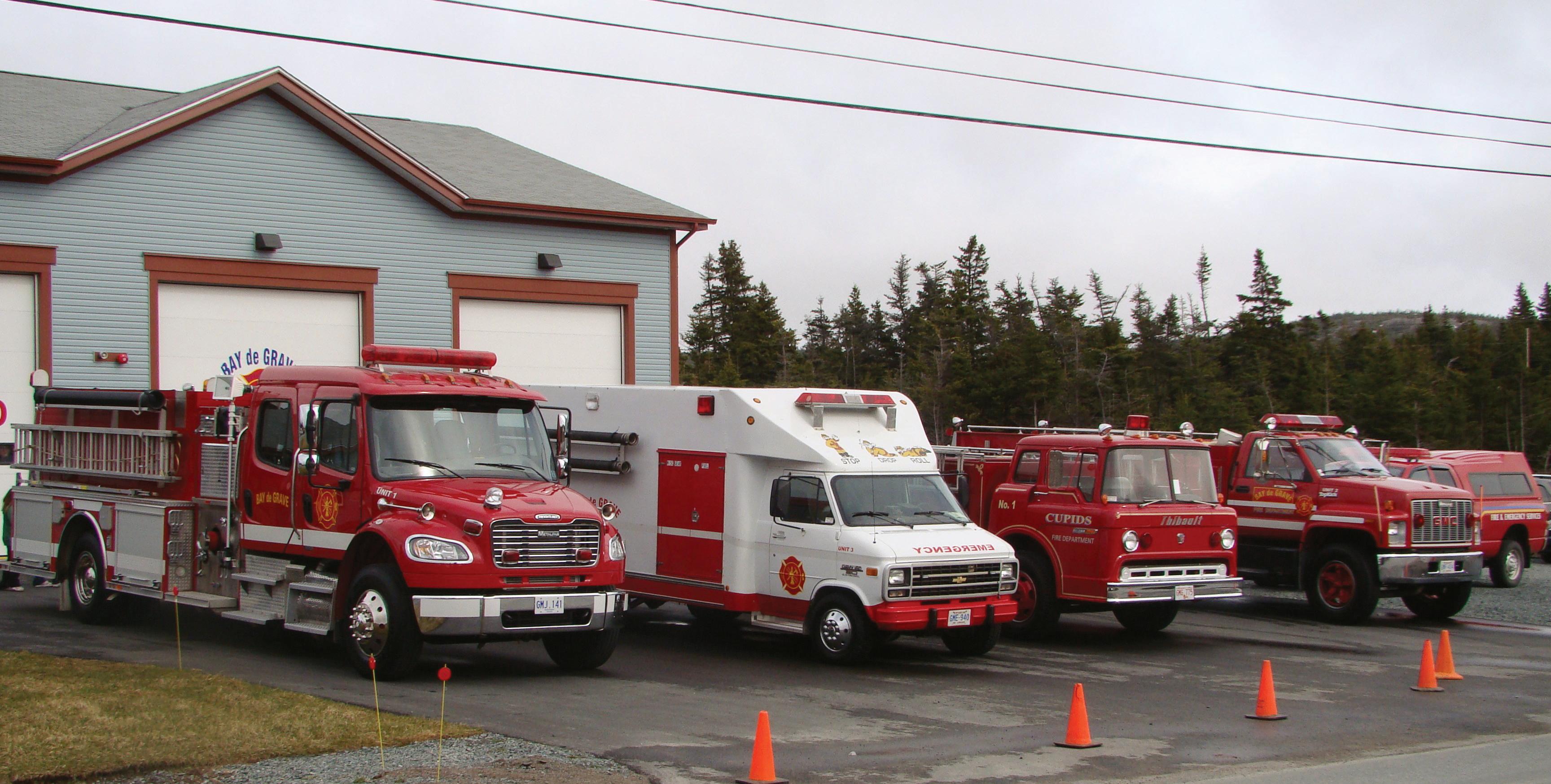
Take five small rural Newfoundland communities, the need for cost effective, efficient, professional firefighting services and a shared interest in achieving these goals: the result is the newly opened Bay de Grave Fire Hall in Newfoundland.
Consultations were held with the communities involved beginning in 2007 to help determine how to best meet their needs.
Lack of equipment and apparatus, and the need for better response times and a new building prompted community leaders to brainstorm
and come up with a plan to present to government for funding.
The plan came to fruition on April 16, 2010, when the new Bay de Grave regional fire hall opened – complete with a new pumper – in the community of South River thanks to a $997,000 investment through the provincial/ municipal capital works program. The new fire hall serves the communities of Clarke’s Beach, Cupids, Makinsons, North River and South River.
Bay de Grave Fire Chief Jeremy Hall said the location of the new station means fire
crews are able to respond to all emergency calls within eight to nine minutes.
Junior Taylor, chairman of the Bay de Grave Regional Fire Service committee, said the new regional department will be used as a model for other areas applying for regionalization and the benefits of a regional fire department.
-Bob Lynch
MFCA honours former secretary-treasurer for long service
■ ONTARIO
Former Maritime Fire Chiefs Association secretary/treasurer and executive director John Robart was chosen by the MFCA’s honours committee as the 2010 recipient
of the outstanding service award.
Robart, chief of the Oakhill & District Fire Department – which is part of the Lunenburg Regional Fire & Emergency Service
the brass pole:
promotions & appointments
JEFF BEntLEy was promoted to the position of deputy chief with Whitby Fire and Emergency Services in Ontario on July 12. Bentley joined the department as a volunteer firefighter in October 1978 and became a full-time member May 1980. He was platoon chief prior to his promotion and brings 30 years of sup-
retirements
pression experience to his new position. Bentley assumes responsibility for training, communications and suppression. The Harbour Grace Volunteer Fire Brigade in Newfoundland celebrated the retirement on April 17 of longtime dispatcher mInnIE PIKE Members of the Top of the
in Nova Scotia – was the backbone of the association for many years, working closely with departments or regions that hosted the annual conference and running the daily operations of
Ladder Club, the women’s auxiliary, the Junior Brigade, active members and town council honoured Pike, whose
the MFCA.
Robart resigned as secretary/treasurer in 2008 but remains a member of the association. He received the award from honours committee chair Harmon Ilsley.
family has been dispatching in Harbour Grace for 35 years. Harbour Grace Volunteer Fire Brigade Chief Sonia Williams presented Pike with the following certificates and medals: the 20-year long fire service medal, the 25-year silver bar, the 30-year gold bar, a 35-year plaque and certificates from the provincial government. Harbour Grace Mayor Don Coombs presented Pike with the mayor’s award of recognition.
The new regional fire hall in Bay de Grave, N.L., was a community effort involving firefighters, politicians and other stakeholders.
P hoto
OAFC/OAFTO partnership pays dividends
Three years ago, the Ontario Association of Fire Training Officers was invited by the Ontario Association of Fire Chiefs to attend its annual meeting and conference and offer hands-on training courses. Since then, the partnership between the OAFTO and the OAFC has grown and flourished.
Back in 2007, the OAFTO executive, through President Ted Morrison, was invited to attend the May 2008 conference and to host and instruct a few courses preceding the conference. These sessions would be available to all firefighters with a minimal registration fee to cover the costs of conducting the training. The OAFTO executive and members agreed to donate their time to instruct courses for this partnership with the OAFC. OAFC president Richard Boyes, chief of the Oakville Fire Department, generously donated Oakville’s newly constructed training campus to host the weekend training sessions.
In 2008, three hands-on training courses were offered. In 2009, OAFTO executive members arranged with the Ontario Fire College in Gravenhurst to use its facilities as a second location for additional hands-on courses.
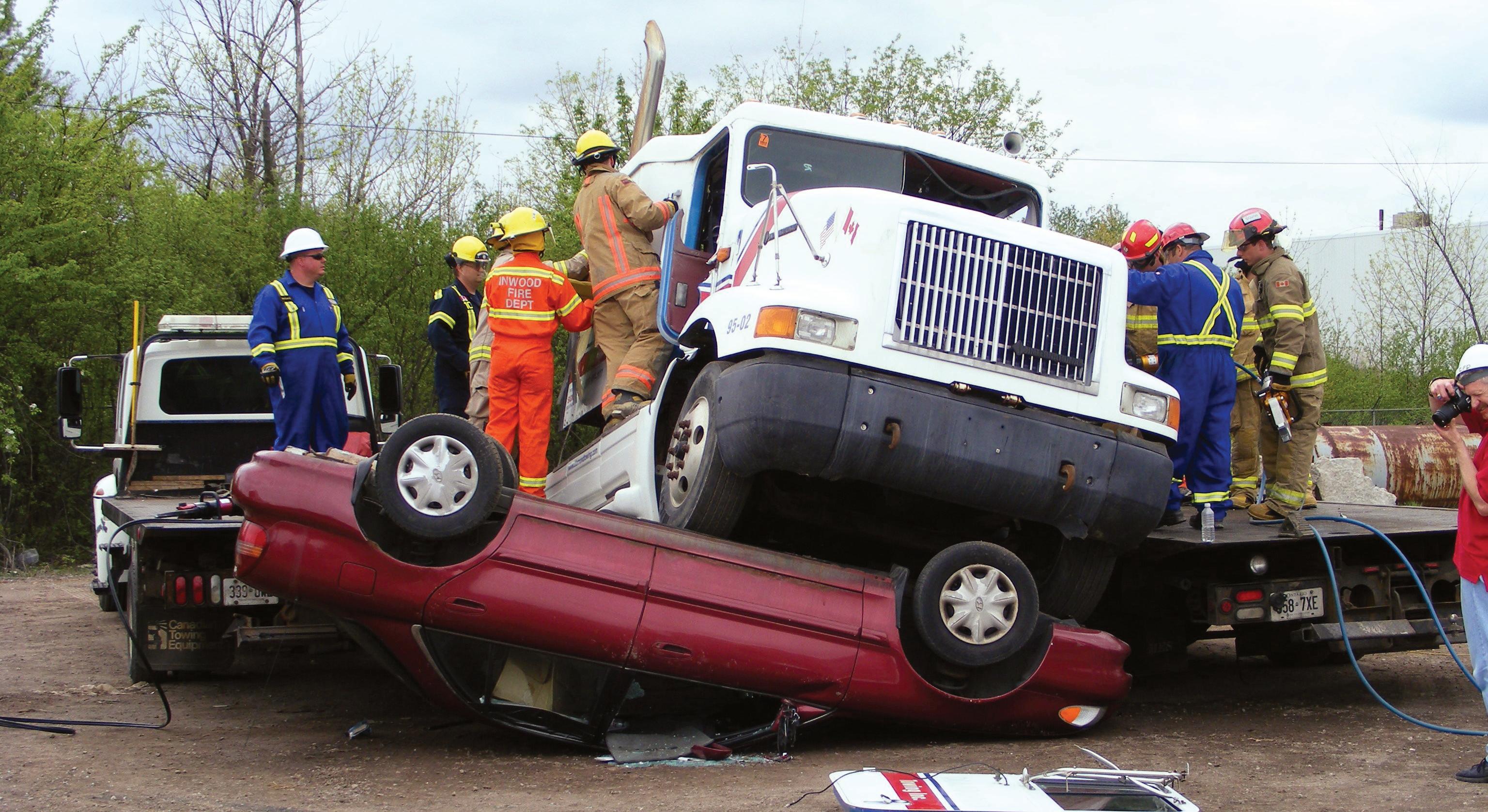
For the 2010 conference in May, more than 100 students participated in the weekend hands-on training sessions. The Oakville training sessions included a hybrid cars technology and extrication course lead by Pete Methner. An OFM pump operations/train-thetrainer course was headed by John Uptegrove and a heavy vehicle extrication and lifting techniques course was sponsored by Big Truck Rescue in partnership with ABC and Diamond Towing companies. At the Ontario Fire College location, Alan Brody, through the International Society of Fire Service Instructors Association, taught a two-day incident safety
officers course, issuing a certificate from that organization.
For the past three years, during the seminar portions of the conference, the training officers have been privileged to sit in on many learning and informative sessions, listening to keynote speakers such as Major General (retired) Lewis Mackenzie, who spoke on leadership at this year’s conference.
Thanks to the Ontario Association of Fire Chiefs and its executive for welcoming the Ontario Association of Training Officers and its membership to participate as partners in these annual educational seminars.
And, on behalf of the Ontario Association of Fire Training
Officers executive, thanks to Fred McClelland and Ed Godden of the Ontario Fire College. Thanks too to past and present sponsors, A.J. Stone, Acklands Grainger, Big Truck Rescue, Code 4, Darch Fire, Ontario Power Generation, Safetek, and Safe Design Apparel.
Please check out the Ontario Association of Fire Chiefs (www.oafc.on.ca) and the Ontario Association of Fire Training Officers (www. firetraining.ca) websites for the 2011 lineup of hands-on training sessions and conference speakers.
-Jim Allen, OAFTO 2nd vice president
CaPt. BRoCK BuRLEy retired from Whitby Fire and Emergency Services in Ontario on June 30 after 36 years of dedicated service. Burley served as a captain for 22 years, during which time his leadership, coaching and mentoring made a significant impact on the firefighters who had the privilege of working with him. Burley set a standard for those who followed and is held in very high esteem by all members of the department.
Deputy Chief Bud LIVESEy of the Surrey Fire Service in British Columbia retired July 31 after 36 years of career service. Livesey started his career in 1974. He was promoted from battalion chief to assistant chief in 2003 and to deputy in 2005. Livesey was key to the progressive changes in the operations of the department.
Deputy Chief JIm Bond of the Surrey Fire Service in British Columbia retired July 31 after
17 years of career service. Bond started his career with the department in 1993 as an assistant chief and was promoted in 2005 to deputy in charge of training, which underwent significant changes under his leadership.
last alarm
Platoon Chief (retired) Ed SChIFFKoRn passed away suddenly at his home near
Whitehorse, Yukon, June 10. He was a member of the Whitehorse Fire Department for more than 25 years before retiring in 1998. After he retired, Schiffkorn joined the Marsh Lake Fire and Rescue Service as a volunteer firefighter and was an active member for 12 years. With more than 40 years in the fire service in the Yukon, Schiffkorn was a founding member of the Association of Yukon Fire Chiefs.
Students participate in the heavy vehicle extrication and lifting techniques course during the Ontario Association of Fire Chiefs conference in May, sponsored by Big Truck Rescue.
statIontostatIon
br I gade news: From stations across Canada
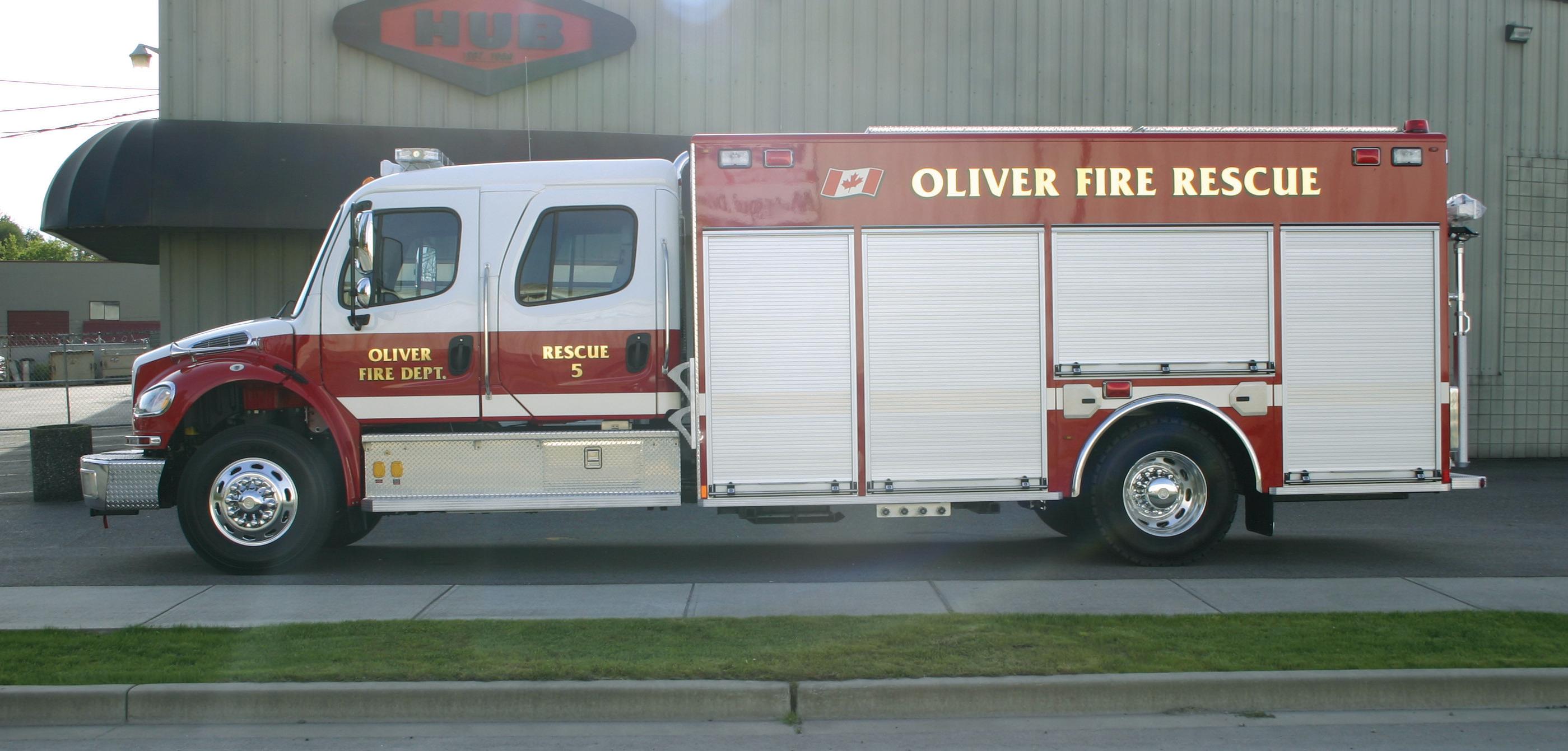
The oLIVER FIRE dEPaRtmEnt in British Columbia under Chief Dave Janzen took delivery in June of a Hub Fire Engines & Equipment-built Rescue unit. Built on a Freightliner M2 chassis and powered by an Allison 3000 EVS transmission and Cummins ISC 330-hp engine the truck is equipped with a CET PFP-DSL-MR 240 IGPM pump, a Foam Pro 1600 foam system, 300 IG co-poly water tank, Whelen light package, custom air bag rack, Onan Protec 25 kW generator and a Command light tower.
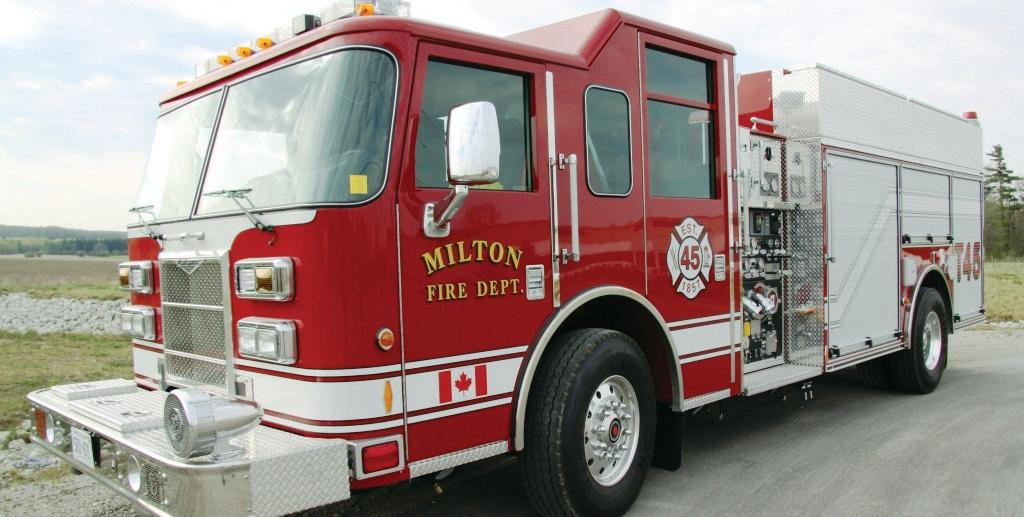
The mILton FIRE dEPaRtmEnt in Ontario took delivery from Darch Fire in May of a Pierce-built pumper-tanker. Built on a custom Contender chassis and powered by an Allison transmission and Cummins ISL 425-hp engine, the truck is equipped with a Waterous 1,250 IGPM pump, a Husky 12 foam system, 1,800 IG water tank, A Honda 5,000 W generator and enclosed ladder storage.
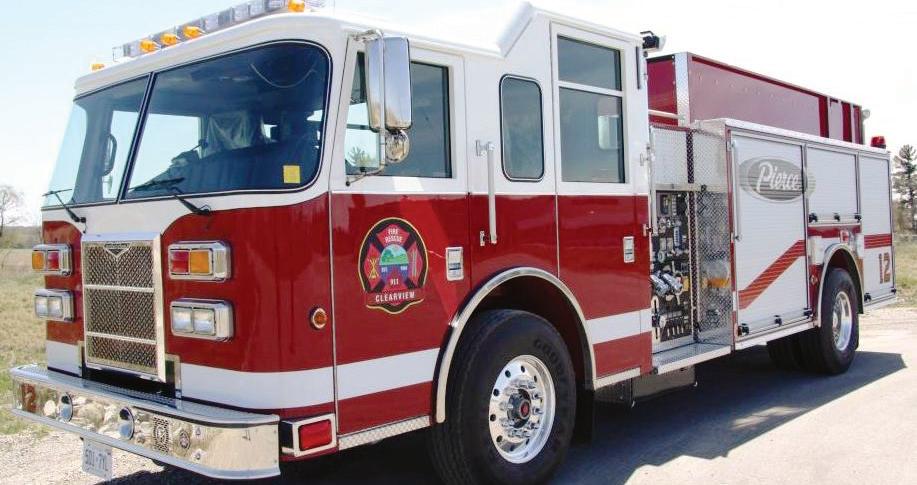
The CLEaRVIEw FIRE dEPaRtmEnt in Ontario under Chief Bob McKean took delivery from Darch Fire in May of a Pierce Manufacturing-built pumper-tanker. Built on a custom Contender chassis and powered by an Allison transmission and Cummins ISL 425-hp engine, the truck is equipped with a Waterous 1,250 IGPM pump, an 1,800 IG water tank, rear traffic advisor, Trident air primer and LED lights.
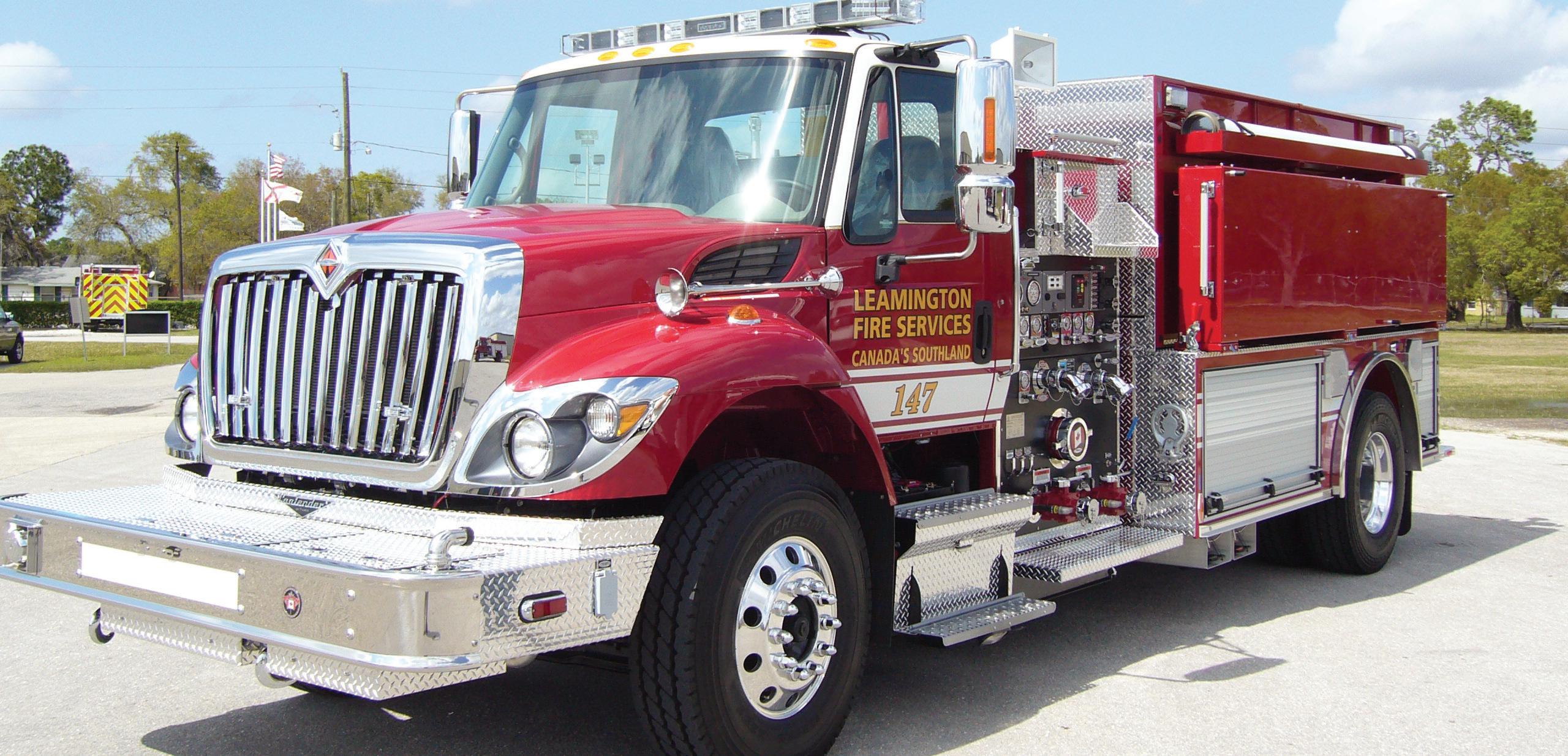
The LEamInGton FIRE SERVICE in Ontario under Chief Bob Bradt took delivery from Darch Fire in May of a Pierce Manufacturingbuilt tanker. Built on an International 7500 chassis and powered by an Allison transmission and a MaxxForce 10 350-hp engine, the tanker is equipped with a Hale 1,250 IGPM pump, a 1,500 IG water tank, a 10kW generator, 1,500w scene lights and LED lights.
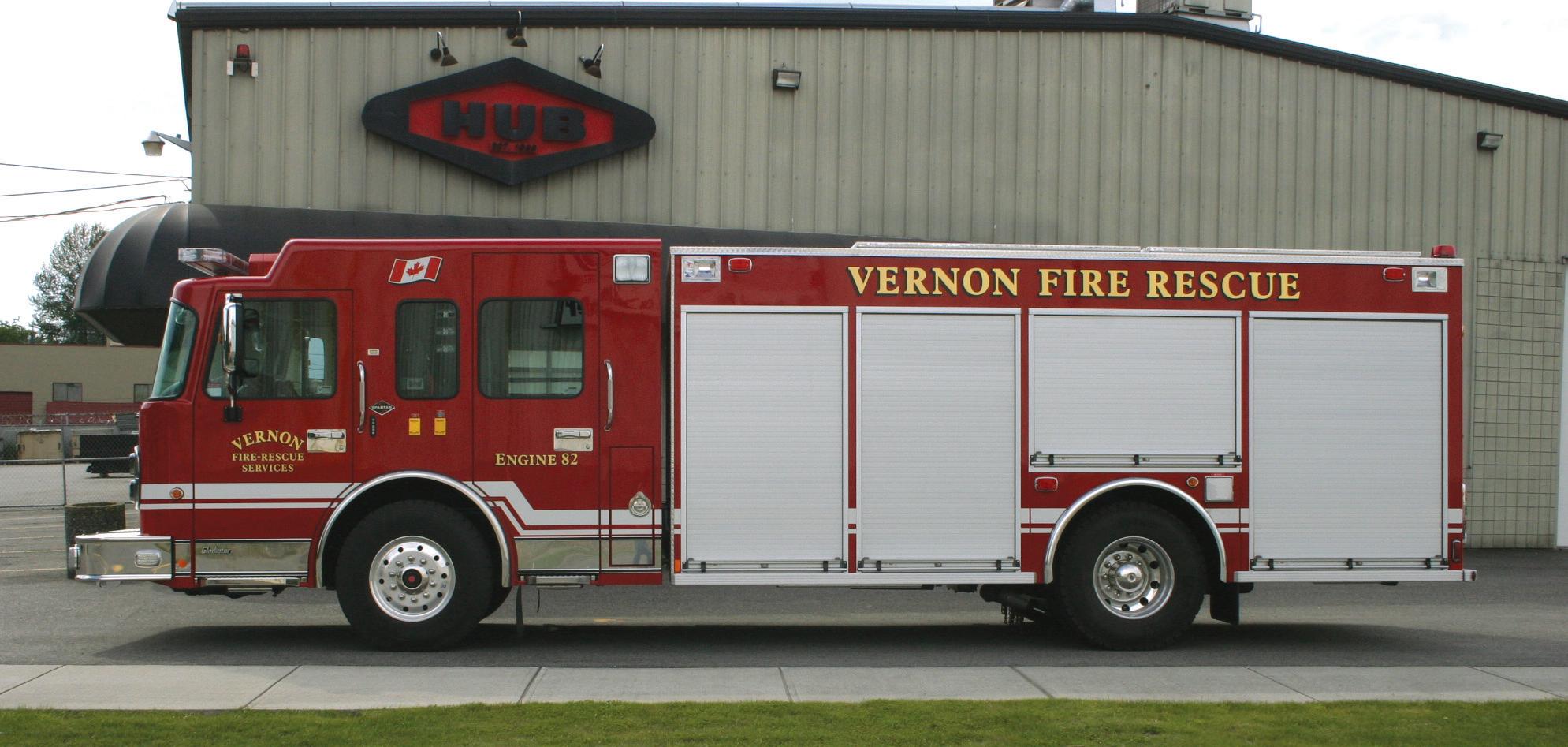
VERnon FIRE RESCuE SERVICES in B.C. under Chief John Lysholm took delivery in June of a Hub Fire Engines & Equipment-built pumper. Built on a Spartan Gladiator chassis and powered by an Allison 4000 EVS transmission and a Cummins ISM 500-hp engine, the pumper is equipped with a Hale RME rear-mount 1,500 IGPM pump, a Foam Pro 2002 foam system, 500 IG co-poly water tank, TFT Hurricane monitor, an Onan 60kW generator, Waterous foam refill system and Amdor LED ground lighting.
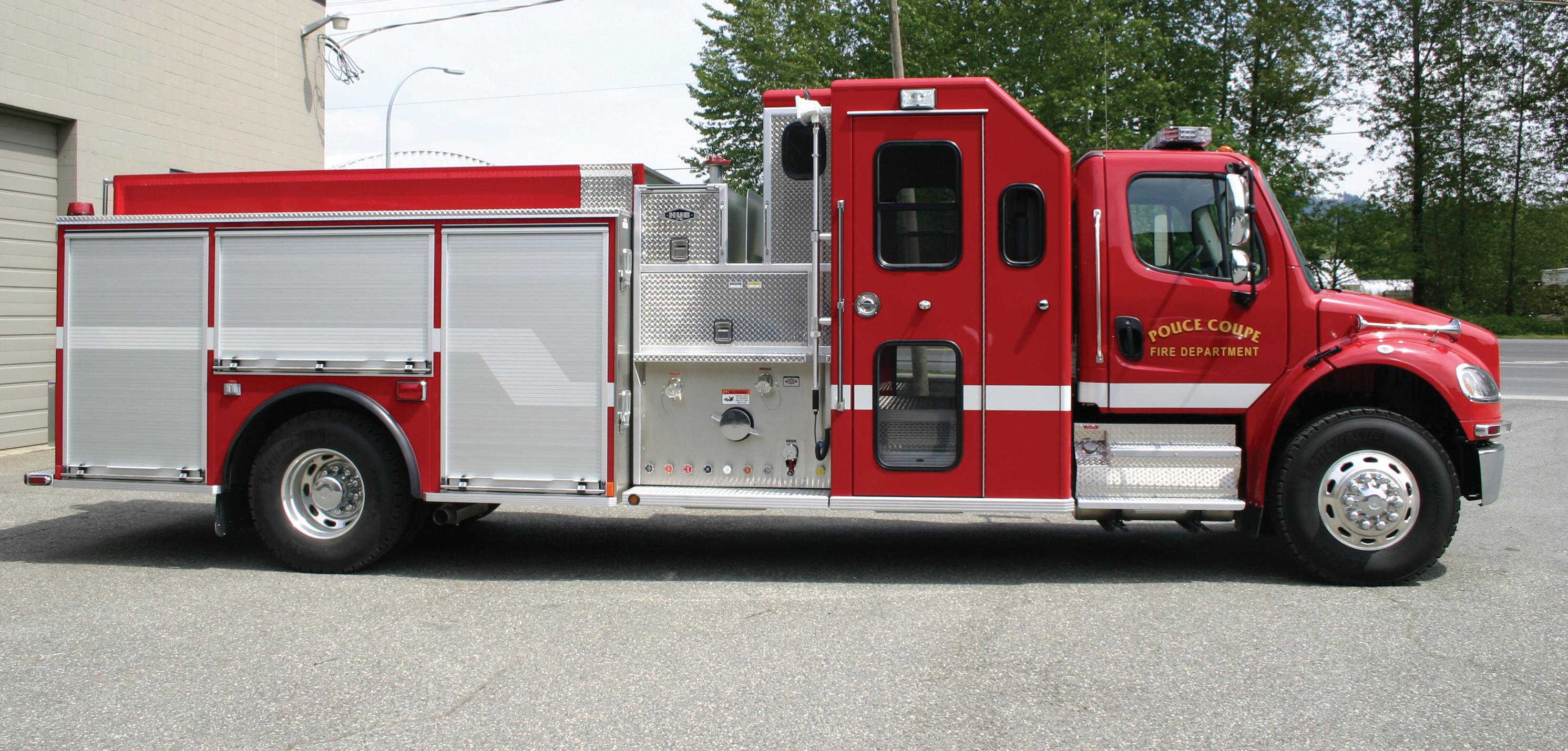
CouPE FIRE dEPaRtmEnt in B.C. under Chief Wally Zwahlen took delivery in June of a Hub Fire Engines & Equipment built pumper. Built on a Freightliner M2 chassis and powered by an Allison 3000 EVS transmission and a Cummins ISC 330-hp engine, it is equipped with a Hale QFLO 125 1,050 IGPM pump, Waterous 140-SP compressed air foam system, Foam Pro 2001 foam system, 700 IG co-poly water tank, Whelen light package and Amdor roll-up doors.
thE PouCE
oLIVER
mILton
CLEaRVIEw
LEamInGton
VERnon
PoLICE CouPE
canadian content
First Canuck pavilion at Interschutz a
success for vendors
By lyle Quan
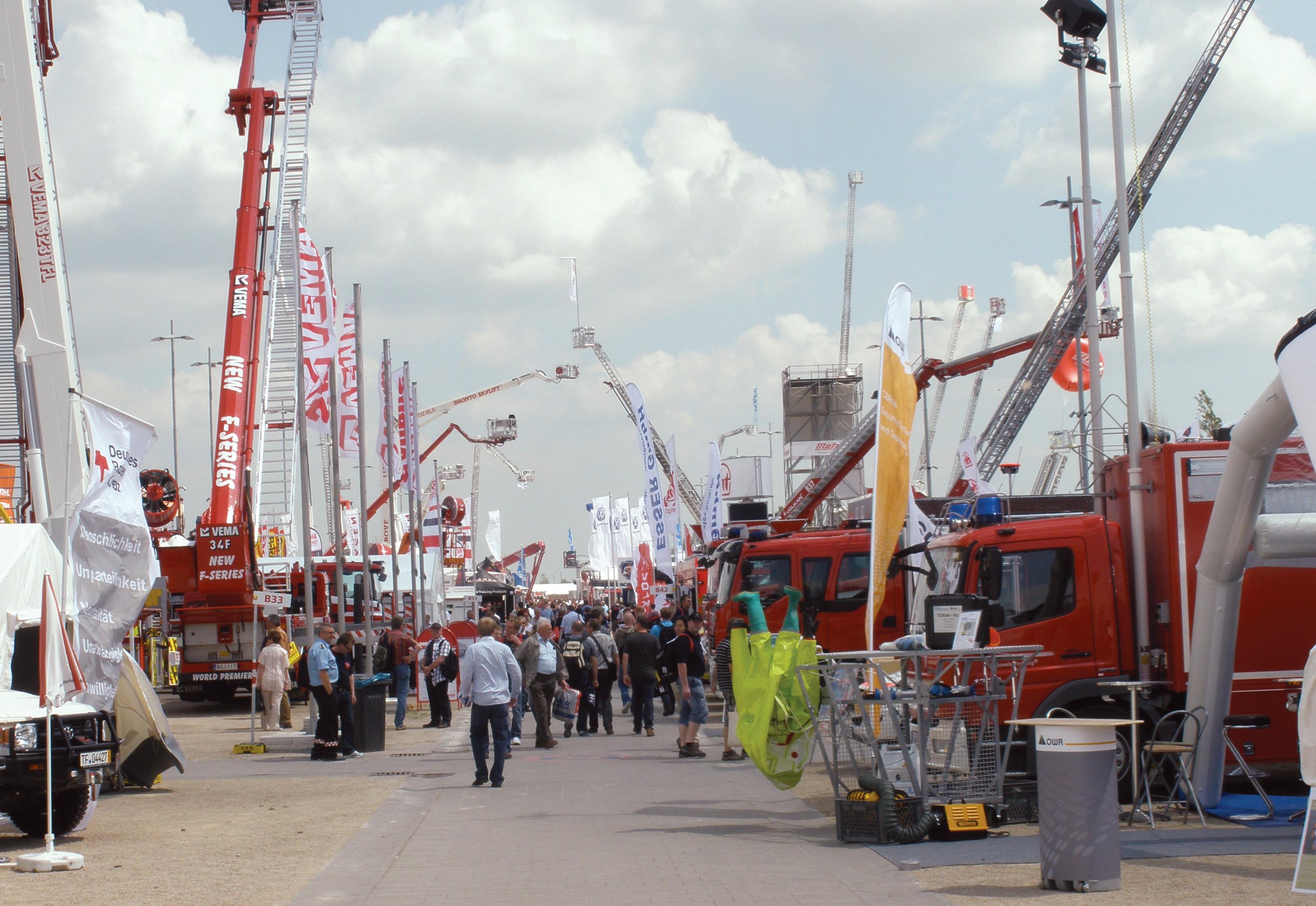
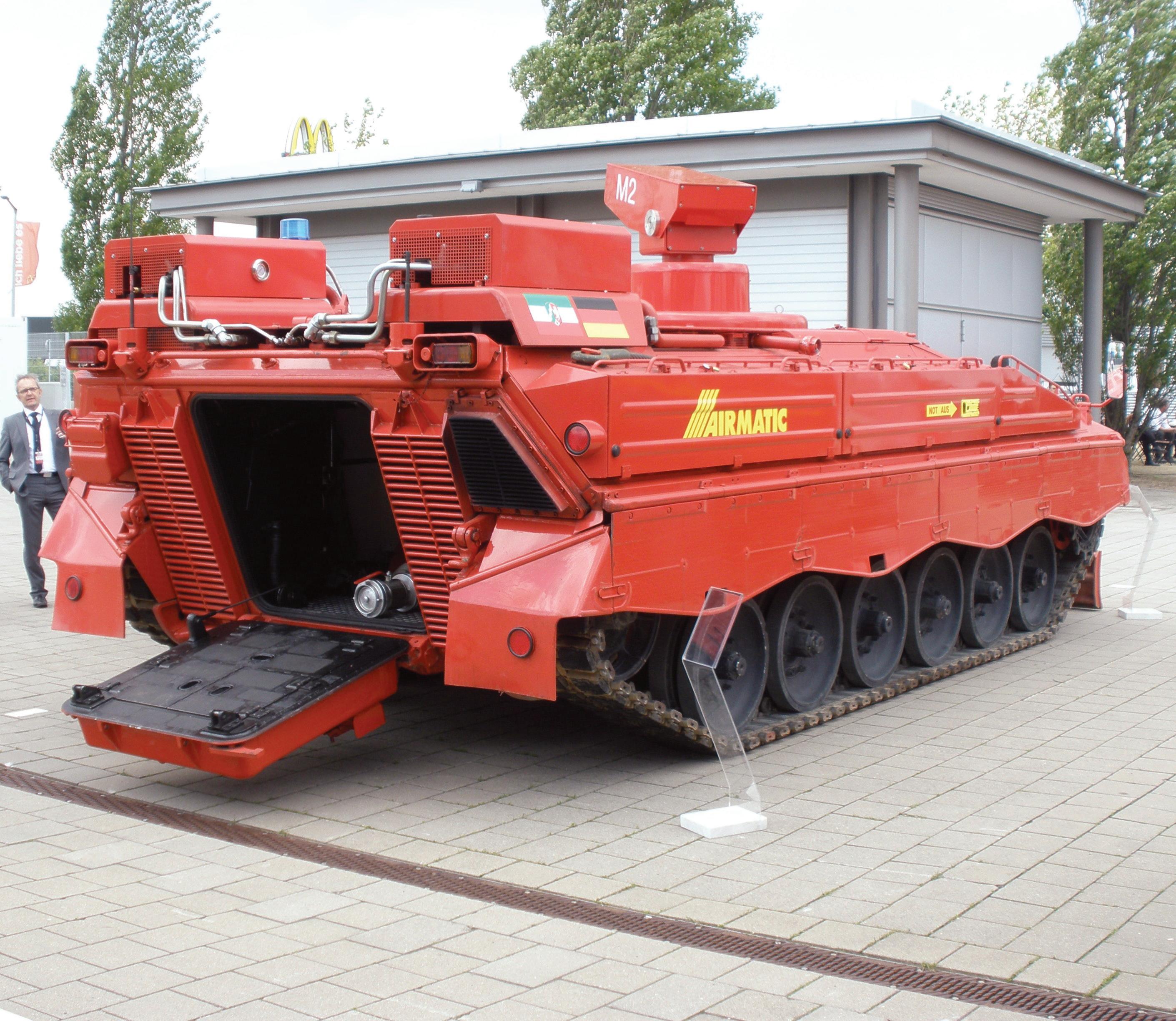
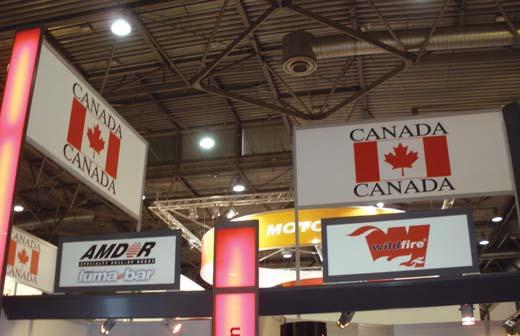
top : The open air midway at Interschutz with more than 700,000 square feet of displays. r I ght: The Morita wildland firefighting vehicle on display at Interschutz in Germany in June.
canadian fire service vendors who want to expand their businesses globally should think ahead to 2015 and the Interschutz International Exhibition for Rescue, Fire Prevention, Disaster Relief, Safety and Security.
“I think that if you want to grow you have to be there,” says Bruce Whitehouse, president of roll-up door maker AMDOR, in Burlington, Ont. “This is a truly international show with more than 100,000 attendees and if you want to be in the global marketplace it’s the place to be.”
Whitehead and eight other Canadian vendors – Air Boss-Defense, C.E.T. Fire Pumps, CGT Custom Tactical Gear, Demers
Ambulances, Fort Garry Fire Trucks, Innotex Northline Coupling Equipment, Stanfield’s and Wildfire Environmental –ventured to Liepzig, Germany, in June for Interschutz. Months of planning for the massive trade show, spearheaded by Dave Connor of Stability Dynamics, resulted in the first Canadian pavilion at Interschutz with Canadian vendors all under one roof.
The Canadian fire service industry was well represented at the six-day show. Whitehead says, with vendors from the garment industry, apparatus industry and the equipment industry along with Wildfire and CET.
“For us it was a long haul but it was an
Continued on page 48
PhotoS
By SEan t R a CE y Canadian Regional m anager, n FPa
eCodes need to align with NFPA 101
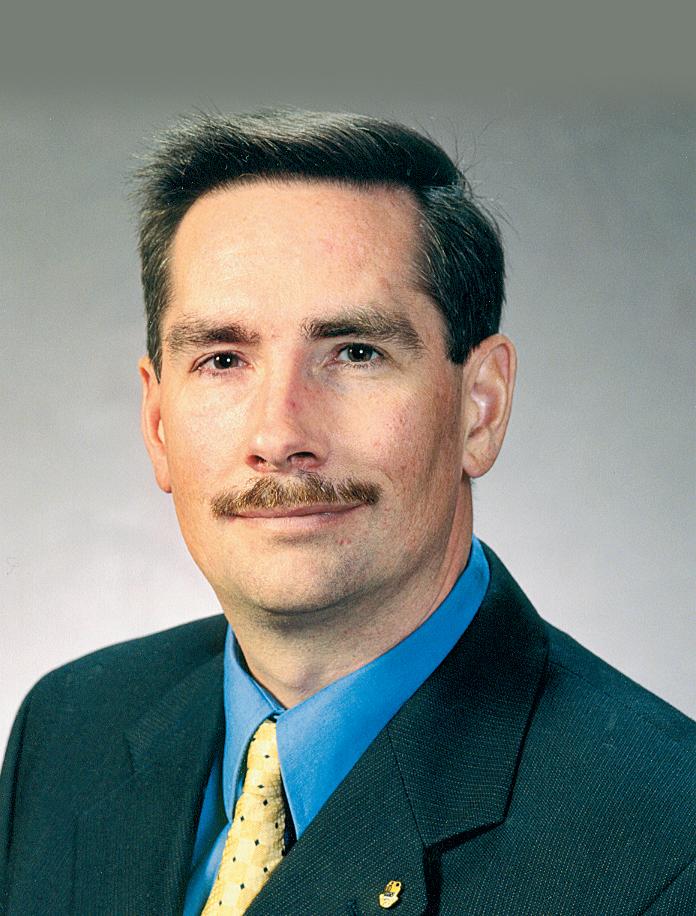
arlier this summer I had the opportunity to sit on a panel with Chief Bruce Burrell, representing the CAFC, and Kevan Jess, the Alberta Chief Fire Administrator. The panel was part of the inaugural meeting of the Canadian Association for Senior Living (CASL). It represents four of the provincial associations of nursing and care home operators and thus the major players in providing care and accommodation services to this at-risk group. As part of the panel we were able to identify our pressing concerns regarding fire and life safety in these facilities. The CASL panel discussion was an intriguing first step. Coming from this is the suggestion that CASL work with CAFC through a working group that would address many of the concerns that both parties have regarding care occupancies. If this working group proceeds, it could result in change proposals being made to the National Fire Code of Canada that would clarify inspection requirements for B2 and B3 occupancies. The Canadian Code Centre would be very hard pressed to reject any change proposals coming from such a combined effort.
One of the points I raised during the CASL panel discussion was that the fire loss rate in these Canadian facilities is significantly greater than in their U.S. counterparts. A review of Canadian statistics as of 2002 showed Canadians the fire fatality rate in homes for the aged was 9.28 times that of the U.S. The rate in homes for the aged is 4.79 times that of all other Canadian occupancies combined. We have a problem. I believe this is due to the lack of guidance in the fire code such as that found in the NFPA 101 Life Safety Code.
NFPA 101 is used in all U.S. states and has been adopted in two Canadian provinces, P.E.I. and Newfoundland and Labrador. Any U.S. care facility receiving federal funding must comply with NFPA 101. NFPA 101 has two classes of occupancies that are relevant for our discussions – health-care occupancies, which would be our B2 or nursing homes, and board and care occupancies, which would be similar to or our assisted living or B3 categories. NFPA 101has been refined over time from our North American fire loss experience. NFPA takes information from a number of fire investigations including the Meadowcroft fire in Mississauga, Ont., and pass these to the committee for possible inclusion. Committee members include a balance of interests that include care industry reps. We therefore believe we have the most current consensus codes that reflect our concerns for a balance between fire safety and societal costs.
The 2006 edition of NFPA 101 was changed to require the retroactive sprinklering of all existing nursing homes (B2). (NOTE: Any care facility (B3) that has an impractical evacuation capability must meet the fire safety performance requirements of a nursing home – thus retroactive sprinklers.) This was a change introduced by the American Health Care Association following a number of multiple fatality fires in 2003. As of 2013 all nursing homes receiving federal funds must be retroactively sprinklered in accordance with NFPA 13. In a presentation at the NFPA annual meeting it was reported that an estimated 90 per cent of the existing nursing homes are now sprinklered. The remainder shall be by 2013.
One other pressing concern we have in Canada is how we assess evacuation capabilities of residents for self-evacuation. One option is for a number of timed evacuation drills at challenging times throughout the day and at varying staff levels. There is no clear guidance in the fire codes. This causes confusion for the home operators and conflicts with local authorities. The Fire Code is silent on performance requirements – NFPA 101 can provide this guidance. Timed evacuation drills may not always be practical or the facility may be unwilling to do this. NFPA 101A Guide on Alternative Approaches to Life Safety is a very
a review of Canadian statistics as of 2002 showed Canadians the fire fatality rate in homes for the aged was 9.28 times that of the u .S.
’’
useful tool. It has a chapter on how to assign an evacuation capability score based on the number of patients, their physical and mental characteristics, as well as the number of staff present.
Sean Tracey, P.Eng., MIFireE, is the Canadian regional manager of the National Fire Protection Association International and formerly the Canadian Armed Forces fire marshal. Contact him at stracey@nfpa.org
Let me be clear. We need these facilities as they provide an invaluable service to these seniors. They also relieve the stresses on our overtaxed health-care system. With the changing demographics there will be a greater demand on these types of facilities. However, we need firm performance measures for these facilities based on occupants’ capability for self-preservation. The long-proven consensus developed standards found in NFPA 101 and NFPA 101A should be the solution. They have come to this consensus in the U.S. and have the lower fire losses to benefit. We just need to get these into the Canadian fire codes. The potential working group between CASL and CAFC may be our best option.
By t I m BECKE tt Fire Chief, Kitchener, o nt.
sWhere’s the logic in the lack of sprinklers?
prinklers save lives. Why then, in Ontario, is there resistance to legislating sprinklers in certain buildings? The facts are clear; people are dying in buildings that are not sprinklered. The public, the homebuilders and the government have been educated about the benefits of sprinklers but there is still resistance.
For decades, sprinklers have protected people in workplaces, in assembly occupancies and, in recent years, in highrises and hotels. But residential fire deaths occur above acceptable levels each year and recently, in Ontario, we have had several deaths and close calls in retirement homes. In Ontario, the fire service is advocating to have care facilities and retirement homes retrofitted with sprinklers.
Ontario witnessed two of the largest retirement home fires in the history of North America. In 1980, 25 seniors died at Extendicare in Mississauga and in 1995, eight died in the Meadowcroft Place, also in Mississauga. In a separate fire, three seniors died in the veterans’ wing of Toronto’s Sunnybrook Hospital. These three fires, which resulted in the deaths of 36 seniors, led to three separate, independent coroner’s inquests, all calling for the retroactive installation of sprinklers in retirement homes and long-term-care homes.
In 2008-2009, there were three catastrophic fires in Ontario retirement homes. A fire at Rowanwood Retirement Residence home in Huntsville caused more than $8 million in damage. Luckily, two off-duty police officers alerted the residents and all 56 seniors escaped. Just a month later in Niagara Falls, a fire at the Cavendish Manor Retirement Residence resulted in the transport to hospital of 11 seniors, including three in critical condition. Six months later in Orillia, a fire at the Muskoka Heights retirement home resulted in the deaths of four seniors; three others have permanent brain damage. If the recommendations from these inquests had been followed these tragic circumstances could have been prevented.
In June, a letter was sent by the OAFC to all MPPs urging them to reconsider and vote down the bill until sprinklers were included. The OAFC subsequently received a letter from the Minister of Community Safety and Correctional Services expressing disappointment over the OAFC’s campaign to have the bill voted down, given that it strives to protect seniors. The minister also said in the letter that he recognized that sprinklers are an important tool in combating fires. If this is the case, why is the government not legislating sprinklers?
Is it the money? A ministry official told the OAFC that the cost to retrofit retirement homes in Ontario would be $250 million. That is a lot of money but is that the price tag we put on public safety? We heard the cost (at the time I was writing this column) for the protection of the world leaders at the G8 and G20 summits was more than $1 billion, four times what it would cost to protect thousands of Ontario seniors. Ontarians have witnessed billions of dollars of G8 and G20 infrastructure money used to build new recreation facilities and build and repair new roads, but governments apparently can’t see fit to provide money to protect our seniors.
Fire sprinklers are good for public safety. It should, however, be noted that fire sprinklers will not replace firefighters in the community
It should, however, be noted that fire sprinklers will not replace firefighters in the community and nor should they. ‘‘ ’’
In Bill 21, The Retirement Homes Act, the Ontario Liberal government this spring introduced legislation designed to protect seniors in retirement homes. Although excellent in principle, the bill mentioned fire safety requirements but failed to identify the need to retrofit those seniors’ homes that were built pre-1997 without automatic sprinklers. The Ontario Association of Fire Chiefs recently made a presentation to the Standing Committee of Social Justice advising that sprinklers needed to be considered. Amendments were made to the bill but the legislation was passed without sprinklers being included.
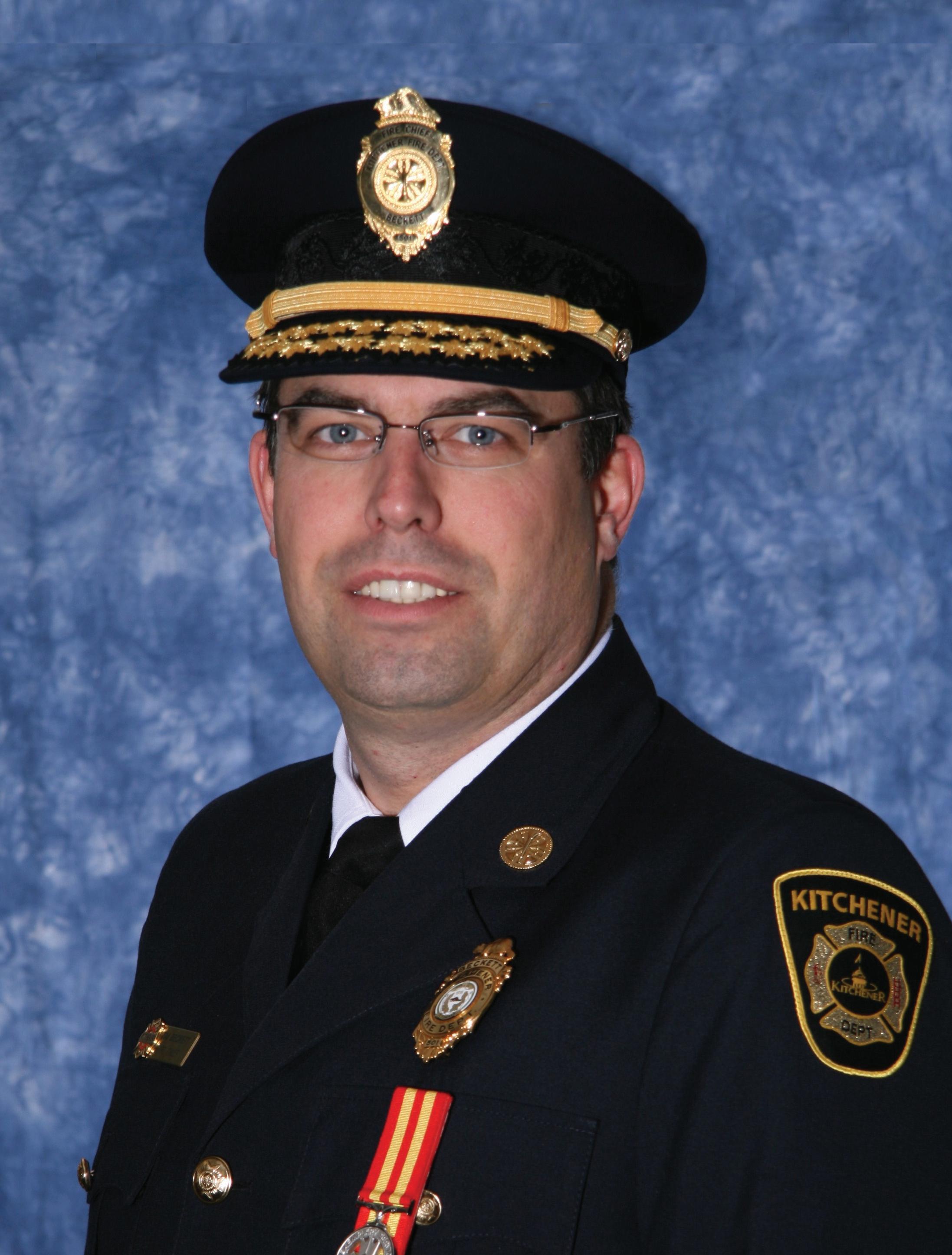
Tim Beckett is fire chief with City of Kitchener and is first vice-president of the Ontario Association of Fire Chiefs. He has 24 years in the fire service and a degree in public administration from Ryerson University in Toronto. Contact him at tim.beckett@kitchener.ca.
and nor should they. They will, however, save people’s lives, including those of firefighters. Sprinklers will protect the firefighters from exposures to toxins in fires. Sprinklers will protect the firefighters from having to enter structures that may be unstable due to fire damage. If the government is really serious about the safety and protection of the public and the firefighters, it needs to start listening to the people and sources that know – the provincial fire marshal , the fire chiefs, the fire prevention officers, the firefighters and, finally, the many inquests that have been held. They point to the need for sprinklers.
In the words of Ontario Premier Dalton McGuinty when addressing colleagues at a garden party on the unpopular Harmonized Sales Tax (HST), this may not be a popular decision, but it is the right decision.
Sprinklers are the right decision!
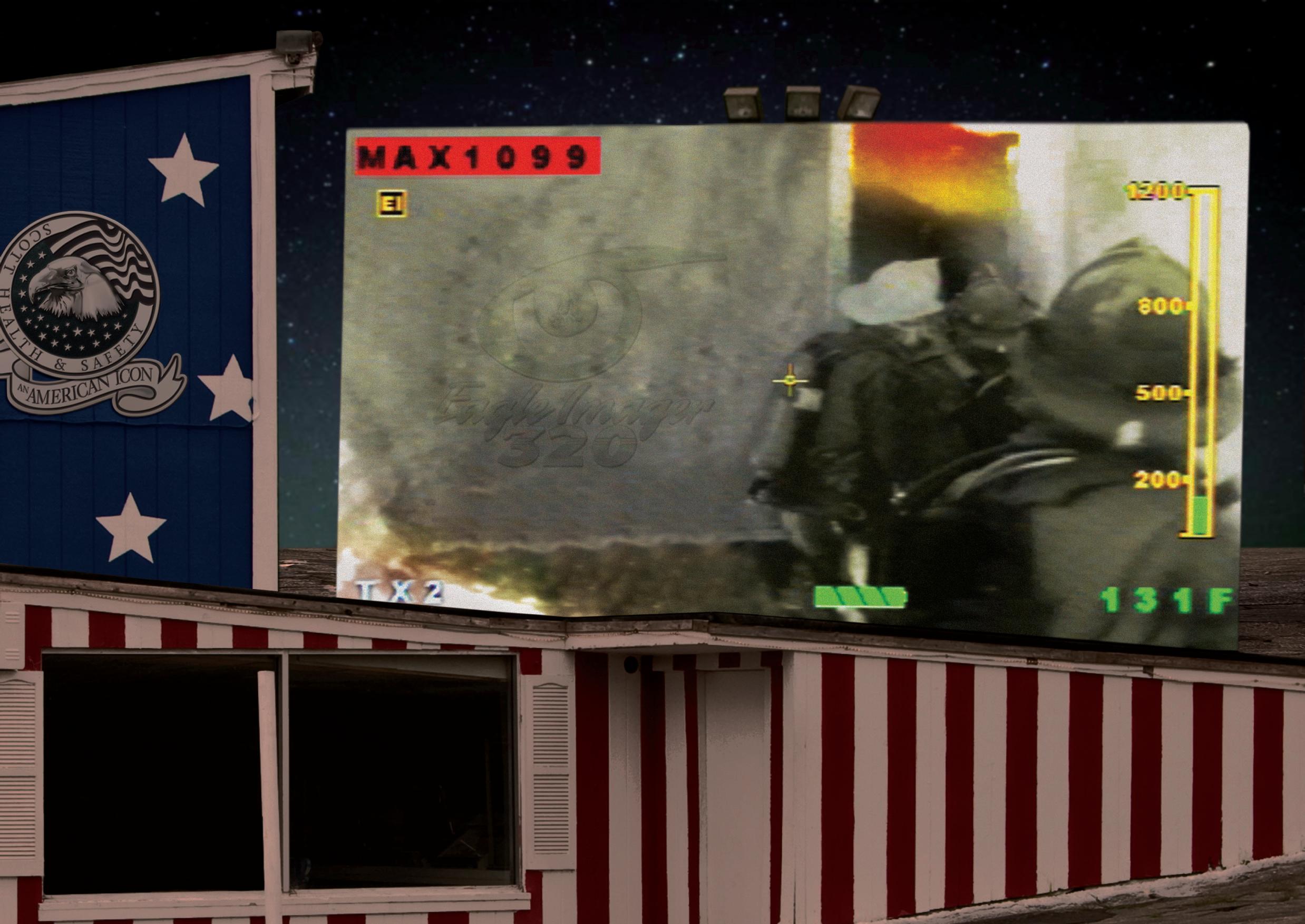
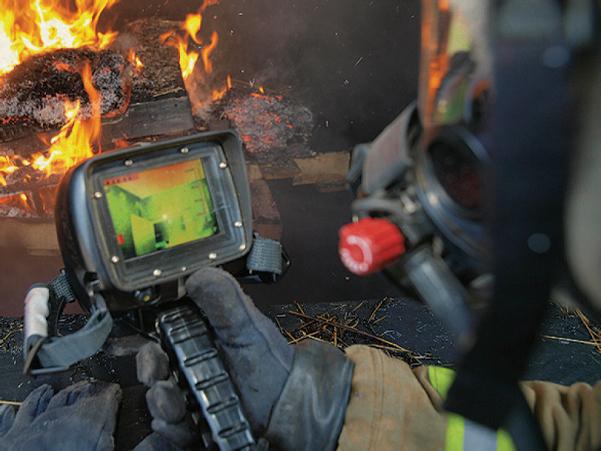
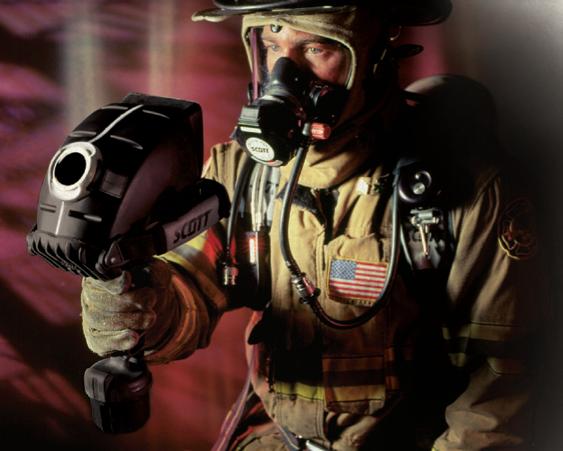
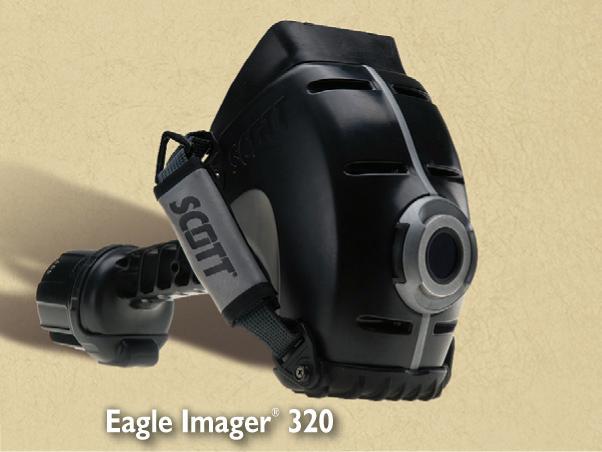
Scott does it again with the latest sequel in the Scott thermal imaging camera series – the Eagle Imager™ 320 Thermal Imaging Camera – featuring advanced thermal technology in a rugged tool for search and rescue and overhaul operations.
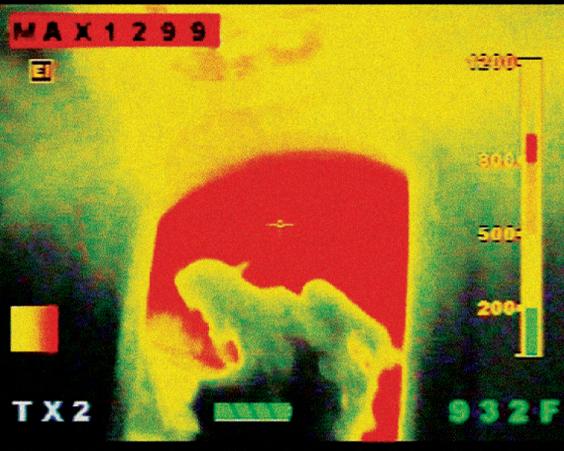
Built on the latest A-Si technology, the Eagle Imager 320 camera produces vivid imagery under hostile conditions. A dynamic range of 1,100°F eliminates white out, ghosted or otherwise distracting images and quickly renders highly detailed images for faster on-scene interpretation.
Advanced temperature identification operating modes and a graphical interface reduces scene misinterpretation and provides clearer identification of actual temperatures on a large LCD that allows images to zoom to 2x and 4x normal.
The ergonomic multi-position handle and tactile 2-button control are ideal for standing, crawling and hands-free operations and aid in quicker hand-offs and convenient battery changes. With the Eagle Imager 320, the difference is in the details.
green mach
green machIne
alternative energy fuels nova Scotia fire department
By Carroll MCCorMICk
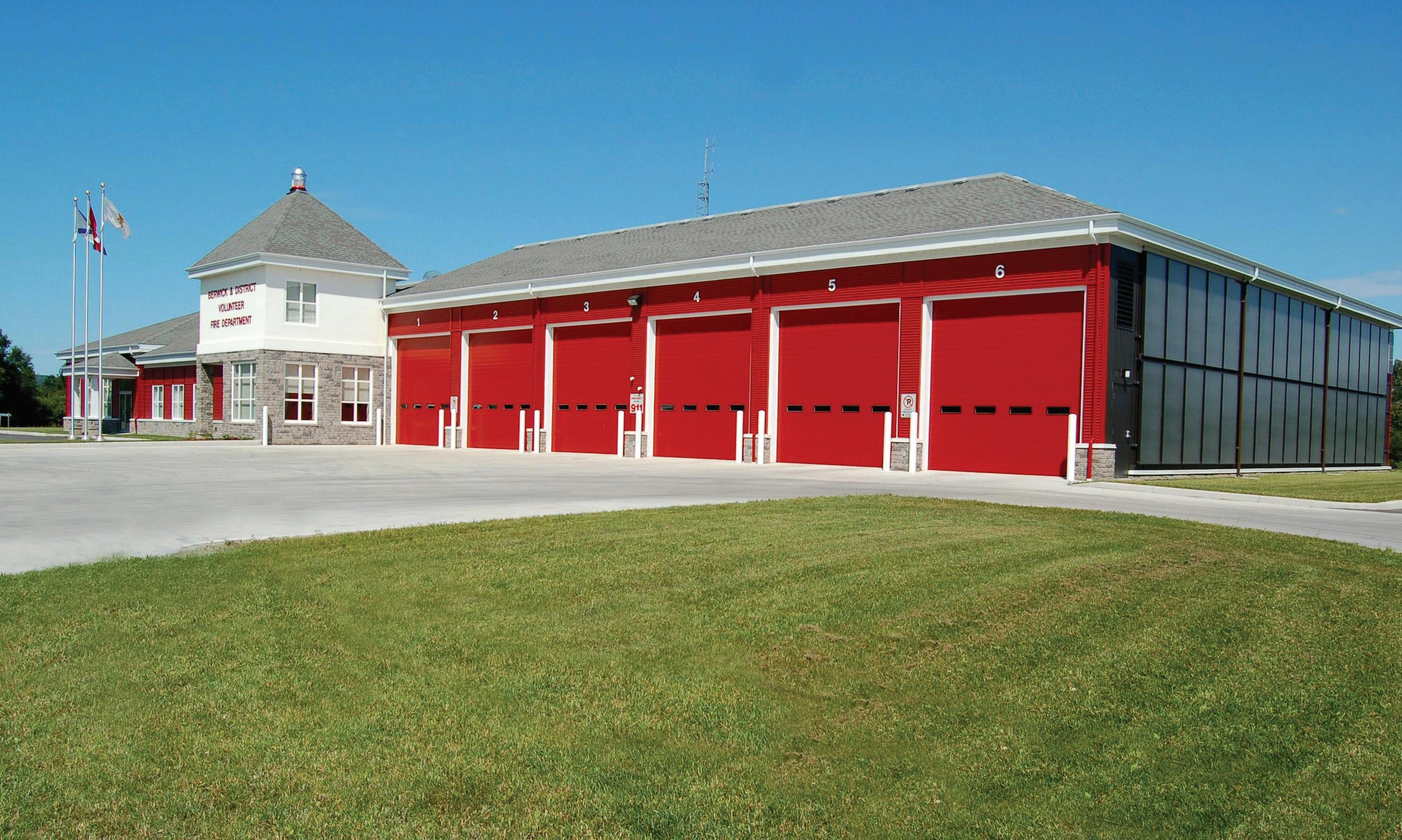
standing sentinel at the north entrance of Berwick, Nova Scotia, is a remarkable fire hall: At 1,393 square metres, its annual energy bill is roughly equal to that required for the 520-square-metre building the Berwick & District Volunteer Fire Department vacated in November 2008.
The spare, almost austere lines of the brick- and steel-clad structure symbolize the no-nonsense approach of a team of Berwick volunteer firefighters and other stakeholders in realizing their dream – a fire hall designed by firefighters, for firefighters
Thanks to a depth of expertise on the team in several building trades, tanker-loads of sweat equity and the backing of a town and district commission committed to green principles, firefighters have what they need and taxpayers are guaranteed predictable long-term operating costs.
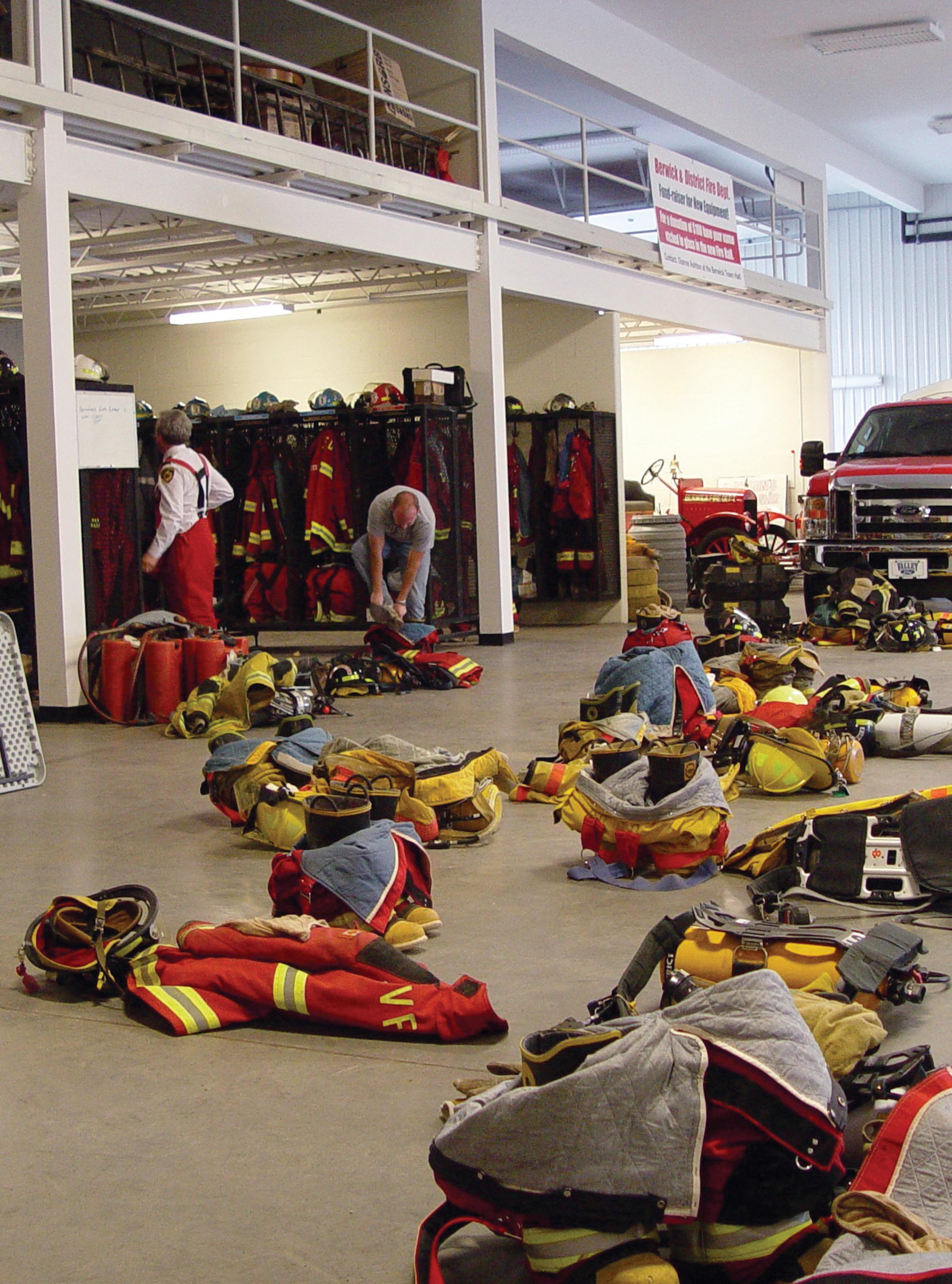
The $2.5-million fire hall includes a six-door apparatus bay, administrative offices and a rental hall. Remarkably, it uses no heating oil. Rather, it is warmed by an in-floor radiant heat system with its water heated by solar collectors, roof-mounted heat pumps for fast heating of administrative offices and recreation hall and backup electrical heat for the coldest, darkest days.
“When oil was $150 a barrel in 2008, we were scared,” says Bob Ashley, Berwick’s chief administrative officer. “There is a certain confidence and added security being oil-independent. It is one less major civic building that will be a major drain on the public purse. From my point of view, I like having the security of not having to rely on oil.”
left: The fire hall in Berwick, N.S., features in-floor radiant heating, steel mesh clothes lockers and ceiling-mounted air handling units that filter the air without having to open the bay doors.
abo V e : A lot of pride was invested in having the green fire hall as a gateway marker into Berwick, says chief administrative officer Bob Ashley.
The green features of the fire hall are layered like an onion: The entire south wall is covered with 34 liquid, flat-plate solar collectors, totalling 101 square metres. Rather than design the building so the collectors could sit at the 45 degree angle that is optimal for the latitude, the design team determined it was less costly to simply add more panels.
“It is cheaper to add 10 per cent more panels and mount them vertically,” explains Steve McMahon, a Berwick deputy chief. “We worked backward from the building design.”
McMahon has 25 years’ experience in the industrial electrical equipment field. He and team chairman Capt. Mark Marchant, Chief Laurie Saunders and Deputy Chief Ken Redden made up a key group of firefighters who were involved in the building design from the project’s inception.
The vertical installation of the solar collectors offers two other advantages: no snow accumulation; and a high, inefficient angle of incidence in the summer when the sun is high and heating is undesirable.
About 38 litres of glycol circulate from the collectors through solar panel-powered pumps to two heat exchangers in the mechanical room. The glycol’s heat is transferred via heat exchangers to water that circulates through three kilometres of tubing in the concrete floor. The system is designed to heat the apparatus bay to a maximum of 15 C – plenty warm for crew in constant movement; extra coils of tubing buried under the steel-mesh lockers – an airy, in-house invention – help to dry soaked gear. The glycol also preheats water destined for the hot water tank.
The air-to-air heat pumps, with electric element boosters, provide quick warming: A 10-ton unit with 27 kilowatts of electric backup heats
Continued on page 42
Photo by ja MES
Photo by Carroll
corner
Worthwhile SCBA training
By ED BROUWER
this Trainer’s Corner column is a collection of training drills that we at Canwest Fire have used to get firefighters more comfortable while wearing SCBA in immediately dangerous to life and health (IDLH) environments. You are welcome to change them to fit your department’s training guidelines.
■ SCBA POKER
This is a timed event. (The timer is the low-air alarm.)
Objectives: To get firefighters into the habit of checking their air pressure; to familiarize firefighters with search techniques while in an IDLH environment.
Props: A deck of ordinary playing cards.
Drill: Place obstacles such as chairs, tables and big cardboard boxes in your bay or a similar area. Shuffle the deck of cards and hide single cards face down throughout the search room. Divide firefighters into teams of two. Bleed down BA tanks to about half of their capacity – be sure they are all the same. Do not black out masks; however, if you have access to a smoke machine, use it. Otherwise, turn the lights off inside the building and allow firefighters to use flashlights. (Try placing waxed paper over the lens of the flashlight – it defuses the light to give a light smoke effect.) Each team gets one chance to go into the search area. They are to find five cards that make up a good poker hand. They do not have to take every card they find; they can gamble by leaving a card and hoping to find a better one. They must put the discarded card back, face down, exactly where they found it. When they are satisfied with their five cards they are to call the IC and inform him that they are leaving the building. Once every team has gone through the search room, the hands are revealed and the best poker hand wins. You can come up with prizes if you wish.
There is, however, a disqualifier. Should the low-air alarm go off before the search team has exited the search room that team is disqualified and any cards they have are deemed of no value.
■ PASS DEvICE SEARCH
This is a timed event. (Use a stopwatch.)
Objectives: To get firefighters into the habit of checking their air pressure; to familiarize firefighters with search techniques while in an IDLH environment.
Props: A PASS device and a smoke detector.
Drill: Place obstacles such as chairs, tables and big cardboard boxes in your bay or a similar area. Hide a PASS device and a smoke detector among the obstacles. Divide firefighters into teams of two. Black out masks (zero visability). Each team takes a turn going into the search area. Team members are to find the activated PASS alarm. Time starts when the team makes entry. Watch to see if they look behind the entry door or at least look a few feet in the opposite direction of their search. Once the door is closed behind them activate the smoke detector; 60 seconds later activate the PASS device. Time stops when the team deactivates the PASS device. The best time wins.
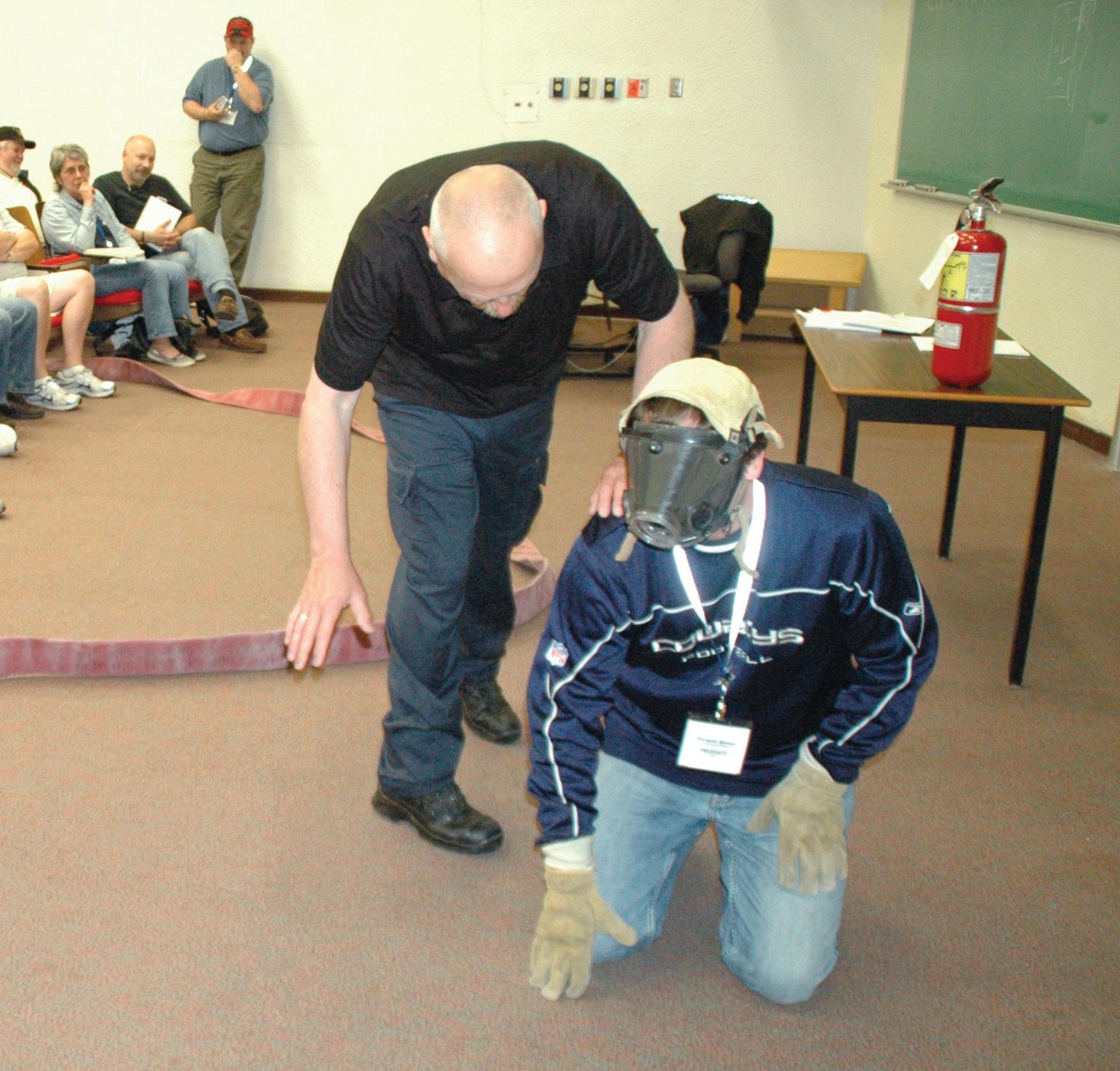
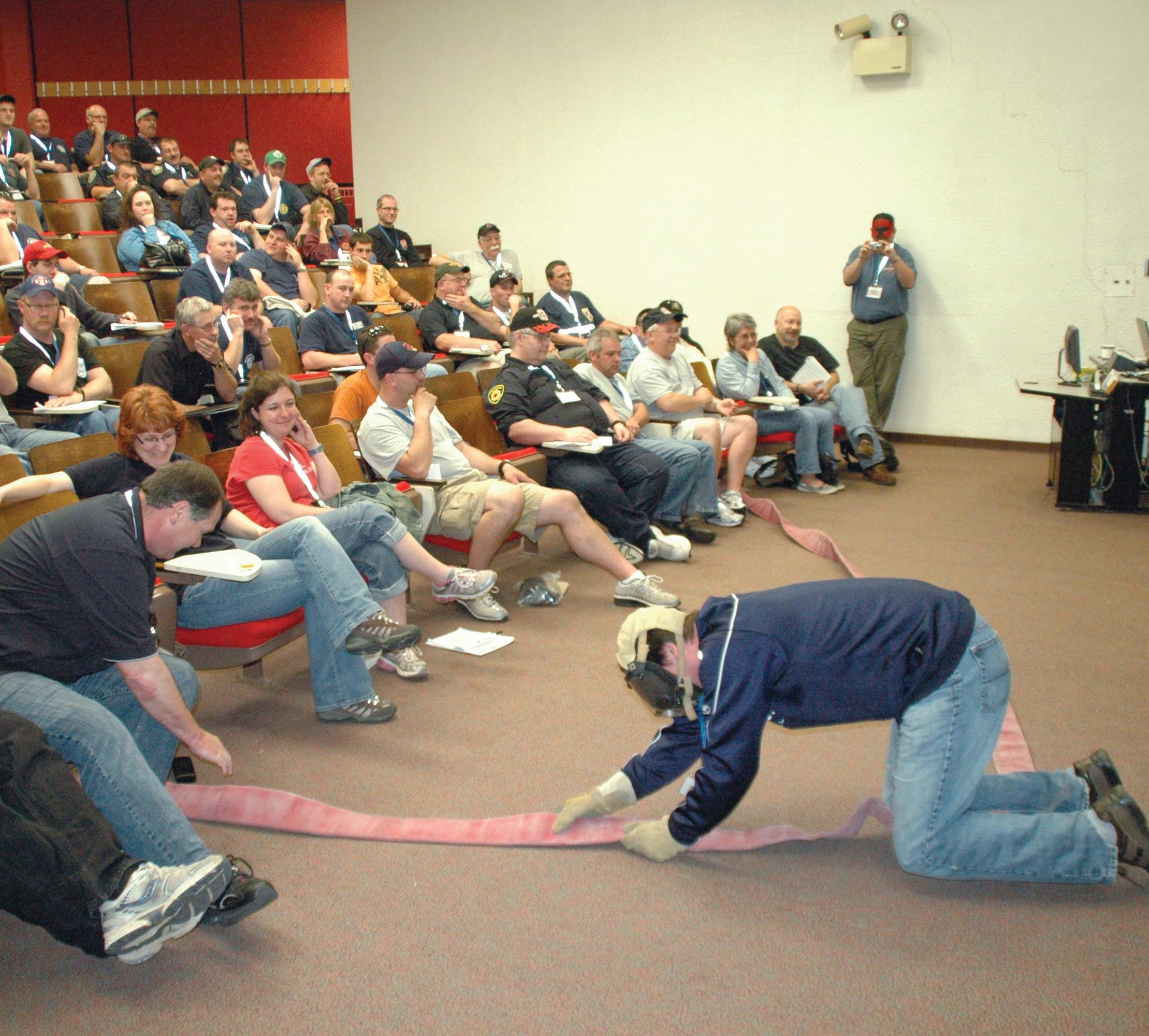
Trainer Ed Brouwer puts Dwayne Symes of the Ross Ferry Volunteer Fire Department in Nova Scotia through the paces in the mayday challenge during FDIC Atlantic in Wolfville, N.S., in June.
tRaInER’Scorner
There are two penalties and one disqualifier. A three-minute penalty is awarded for not checking behind the entry door. A twominute penalty is awarded for not informing the IC that the PASS device was found. Should the low-air alarm go off before the search team exits the search room, that team is disqualified.
■ MAyDAy CHALLENGE
This is NOT a timed event.
Points are awarded for following mayday protocols (possible 100 points).
Objective: To determine if firefighters will call a mayday for themselves. Scenario: Firefighters are sent in one at a time. BA masks are blacked out. The conditions in this scenario are immediately dangerous to life and health (IDLH), cold smoke and zero visibility. Radios are assigned. The firefighter is led into the building and brought to within five feet of the simulated charged hose line. As the firefighter is spun around, he is informed that he was part of a two-man attack team. The firefighter has lost connection with the hose and is now within five feet of the hose. The team was instructed to get out alive . . .
■ POINTS
5 - Firefighter calls out to the crew from which he/she was separated.
5 - Firefighter radios IC to inform of separation from hose.
10 - Firefighter radios a mayday and activates PASS if he can’t find the hose within 60 seconds.
10 - Firefighter uses L.U.N.A.R. or L.I.P.
5 - Firefighter radios IC to inform if he has found the hose.
5 - Firefighter radios IC to inform if he is following the hose line.
5 - Firefighter notes the couplings and follows hose line to safety.
5 - Firefighter radios IC to inform if/when low-air alarm is activated.
10 - Firefighter radios a mayday after low-air alarm activation if not able to exit in 60 seconds.
10 - Firefighter uses L.U.N.A.R. or L.I.P.
5 - Firefighter activates PASS alarm upon low-air alarm if not able to exit in 60 seconds.
5 - Firefighter calls out to partner when hears the PASS alarm activated. 10 - Firefighter radios a mayday for partner’s PASS alarm when activated.
10 - Firefighter uses L.U.N.A.R. or L.I.P.
100 - (L.U.N.A.R. = Location, Unit, Name, Assignment / Air, Resources needed; L.I.P. = Location, Identification, Problem) I hope these drills will be of benefit to your department. As always, I am looking for ideas to make our training nights more effective. I would appreciate your input. You can e-mail me at ed@thefire.ca. Thanks for your contribution to firefighter safety.
Train like their lives depend on it.
Ed Brouwer is the chief instructor for Canwest Fire in Osoyoos, B.C., and the training officer for West Boundary Highway Rescue. The 20-year veteran of the fire service is also a fire warden with the B.C. Ministry of Forests, a wildland interface fire suppression instructor/evaluator and a fire-service chaplain. Contact Ed at ed@thefire.ca
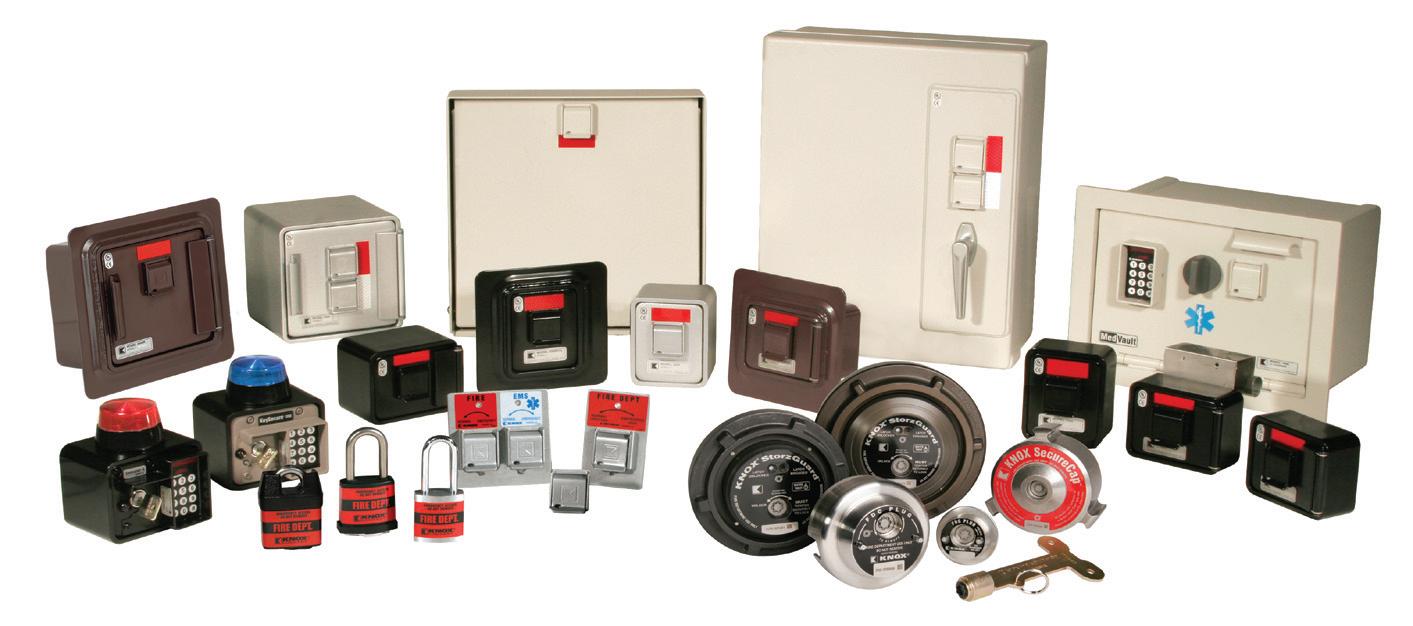
Knox-Box® Rapid Entry System
Emergency responders require a secure rapid entry system that allows fast access without damage to property or delays waiting for keys. The Knox-Box® Rapid Entry System is a comprehensive UL listed key control system that includes high security key boxes, cabinets, key switches, padlocks, master key retention devices and locking FDC plugs and caps. Rely upon the Knox System for all your rapid entry needs.
THERE’S
A
DIFFERENCE BETWEEN A GOOD FIREFIGHTER AND A GREAT ONE
ARE YOU FESTI TOUGH?
human trafficking
while inspecting a business, you come across a filthy mattress on the floor in a back room and meet an Asian worker who can’t speak English and is wearing little more than rags.
When you attend a medical call at a home, the nanny can’t tell you anything about the neighbourhood and clearly grows fearful when the homeowner arrives.
These may be signs of human trafficking, a growing problem in Canada and around the world. Victims of human trafficking are tricked or coerced into leaving their homes, and are then controlled and exploited in a new location, which could be in the same city or in a different country.
It’s a problem that has generally been considered to be beyond the purview of fire crews. But more and more, fire departments are realizing they can add value to the service they provide to their communities by simply observing and reporting the disturbing things their staff see in the course of their duties.
For example, Surrey Fire Service in B.C. has introduced HomeSafe, a fire safety and prevention program that uses home safety inspections, fire-setter intervention and public education to reduce house fires. HomeSafe also trains firefighters to identify the signs of senior and child abuse or neglect – and as of early 2010, human trafficking.
“Firefighters are skilled and credible observers, and with a bit of training we can help identify and refer cases of human trafficking to the proper authorities,” Surrey Fire Chief Len Garis said. “It’s adding value to what we do, as public servants. It’s another way we can help improve public safety in our community.”
In Canada, the RCMP’s Border Integrity Program has six regional Immigration and Passport sections, through which officers investigate human trafficking offences under the Immigration and Refugee Protection Act and other legislation.
Firefighters lend eyes and ears to spot and report abuse
By karIn Mark and len GarIS
Accurate statistics are difficult to verify, given the covert nature of human trafficking.
RCMP Const. Caroline Raymond, Human Trafficking Co-ordinator for the Pacific Region, said Canada sees both domestic and international human trafficking each year, in three general categories:
• domestic servitude (nannies, maids, slaves),
• forced labour (in factories, farms or businesses), and
• sexual exploitation (prostitution in illicit massage parlours).
“It’s a growing market -– unlike weapons and drugs, you can re-sell humans over and over,” Raymond noted. “We have to be aware of that crime as well. It’s out there and we can’t deny it.”
Raymond worked with Surrey Fire Service to train its more than 360 firefighters to identify the signs of human trafficking, and what to do if they see them.
“Firemen are out there and exposed to the community,” she said. “The more people who are aware of this crime, the better able
we are as a community to combat that. We consider them as partners.”
With respect to the training they received from Raymond, the firefighters’ role is solely to observe and report suspected cases to professionals with experience dealing with victims of human trafficking, who initially may not want help. For example, many fear authority because the police and government are corrupt in their homelands. Some fear deportation or retribution. Some don’t even realize they are victims, because they were slaves in a country where that practice is common.
After making their reports, the firefighters can rest assured that help is available for the victims. Within days, Citizenship and Immigration Canada will issue a Temporary Resident Permit, as long as it sees the potential for human trafficking. Temporary Resident Permits include health benefits and work permits, and are valid for six months –with the possibility of being extended to five years. The victims need never testify against their oppressors.
tak I ng a ct I on: w hat to look for
Victims of human trafficking can be any age, race or gender. Signs of human trafficking are more subtle than what is portrayed in movies, says RCmP Const. Caroline Raymond, human trafficking co-ordinator for the Pacific region. most of the victims are not kidnapped, but are either deceived or coerced into leaving their homes.
Signs of human trafficking include people who:
• are being controlled by threats, however subtle;
• fear for their safety or that of loved ones;
• have bruises or other signs of abuse;
• speak little or no English;
• aren’t familiar with their own neighbourhoods or don’t know where they are;
• have been tattooed or branded;
• are deprived of necessities such as medical care, food or adequate clothing;
• are not free to come and go as they please;
• may appear to be free to come and go, but are being controlled by threats;
• are working under unreasonable conditions;
• do not speak for themselves; someone else speaks on their behalf.
What to do:
If you see signs of human trafficking, inconspicuously observe as many details as possible and report them to your local police using the key words “potential human trafficking” or to one of the RCmP human trafficking Co-ordination Centres:
• national Capital Region: 613-952-4200
• ontario Region: 1-800-387-0020
• Quebec Region: 1-866-227-2124
• atlantic Region (new Brunswick, nova Scotia, P.E.I., newfoundland and Labrador): 1-888270-2266
• Pacific Region (B.C. and yukon): 604-598-5306
• north west Region: (alberta, Saskatchewan, manitoba, n.w.t. and nunavut): 403-699-2680 do not attempt to intervene.
More information:
more information on human trafficking can be found at www.rcmp-grc.gc.ca/imm-passp or, in B.C., the office to Combat trafficking in Persons website at www.pssg.gov.bc.ca/octip.
Information about the Surrey Fire Service’s homeSafe program can be found at www.surrey.ca
Accurate statistics are difficult to verify, given the covert nature of human trafficking.
RCMP Const. Caroline Raymond, Human Trafficking Co-ordinator for the Pacific Region, said Canada sees both domestic and international human trafficking each year, in three general categories:
• domestic servitude (nannies, maids, slaves),
• forced labour (in factories, farms or businesses), and
• sexual exploitation (prostitution in illicit massage parlours).
“It’s a growing market -– unlike weapons and drugs, you can re-sell humans over and over,” Raymond noted. “We have to be aware of that crime as well. It’s out there and we can’t deny it.”
Raymond worked with Surrey Fire Service to train its more than 360 firefighters to identify the signs of human trafficking, and what to do if they see them.
“Firemen are out there and exposed to the community,” she said. “The more people who are aware of this crime, the better able
we are as a community to combat that. We consider them as partners.”
With respect to the training they received from Raymond, the firefighters’ role is solely to observe and report suspected cases to professionals with experience dealing with victims of human trafficking, who initially may not want help. For example, many fear authority because the police and government are corrupt in their homelands. Some fear deportation or retribution. Some don’t even realize they are victims, because they were slaves in a country where that practice is common.
After making their reports, the firefighters can rest assured that help is available for the victims. Within days, Citizenship and Immigration Canada will issue a Temporary Resident Permit, as long as it sees the potential for human trafficking. Temporary Resident Permits include health benefits and work permits, and are valid for six months –with the possibility of being extended to five years. The victims need never testify against their oppressors.
tak I ng a ct I on: w hat to look for
Victims of human trafficking can be any age, race or gender. Signs of human trafficking are more subtle than what is portrayed in movies, says RCmP Const. Caroline Raymond, human trafficking co-ordinator for the Pacific region. most of the victims are not kidnapped, but are either deceived or coerced into leaving their homes.
Signs of human trafficking include people who:
• are being controlled by threats, however subtle;
• fear for their safety or that of loved ones;
• have bruises or other signs of abuse;
• speak little or no English;
• aren’t familiar with their own neighbourhoods or don’t know where they are;
• have been tattooed or branded;
• are deprived of necessities such as medical care, food or adequate clothing;
• are not free to come and go as they please;
• may appear to be free to come and go, but are being controlled by threats;
• are working under unreasonable conditions;
• do not speak for themselves; someone else speaks on their behalf.
What to do:
If you see signs of human trafficking, inconspicuously observe as many details as possible and report them to your local police using the key words “potential human trafficking” or to one of the RCmP human trafficking Co-ordination Centres:
• national Capital Region: 613-952-4200
• ontario Region: 1-800-387-0020
• Quebec Region: 1-866-227-2124
• atlantic Region (new Brunswick, nova Scotia, P.E.I., newfoundland and Labrador): 1-888270-2266
• Pacific Region (B.C. and yukon): 604-598-5306
• north west Region: (alberta, Saskatchewan, manitoba, n.w.t. and nunavut): 403-699-2680 do not attempt to intervene.
More information:
more information on human trafficking can be found at www.rcmp-grc.gc.ca/imm-passp or, in B.C., the office to Combat trafficking in Persons website at www.pssg.gov.bc.ca/octip.
Information about the Surrey Fire Service’s homeSafe program can be found at www.surrey.ca
hIgh-rIse traInIng
Partnership allows department to break barriers, find new systems, think outside the box
By JaMeS Bond and John lehMann
the firefighters climbed the stairs to the 19th floor, hooked up to a standpipe, deployed an attack line, advanced onto the 20th floor and flowed water. It had all the elements of a routine high-rise fire attack – except there was no fire and no walls or windows, just bare concrete with railings.
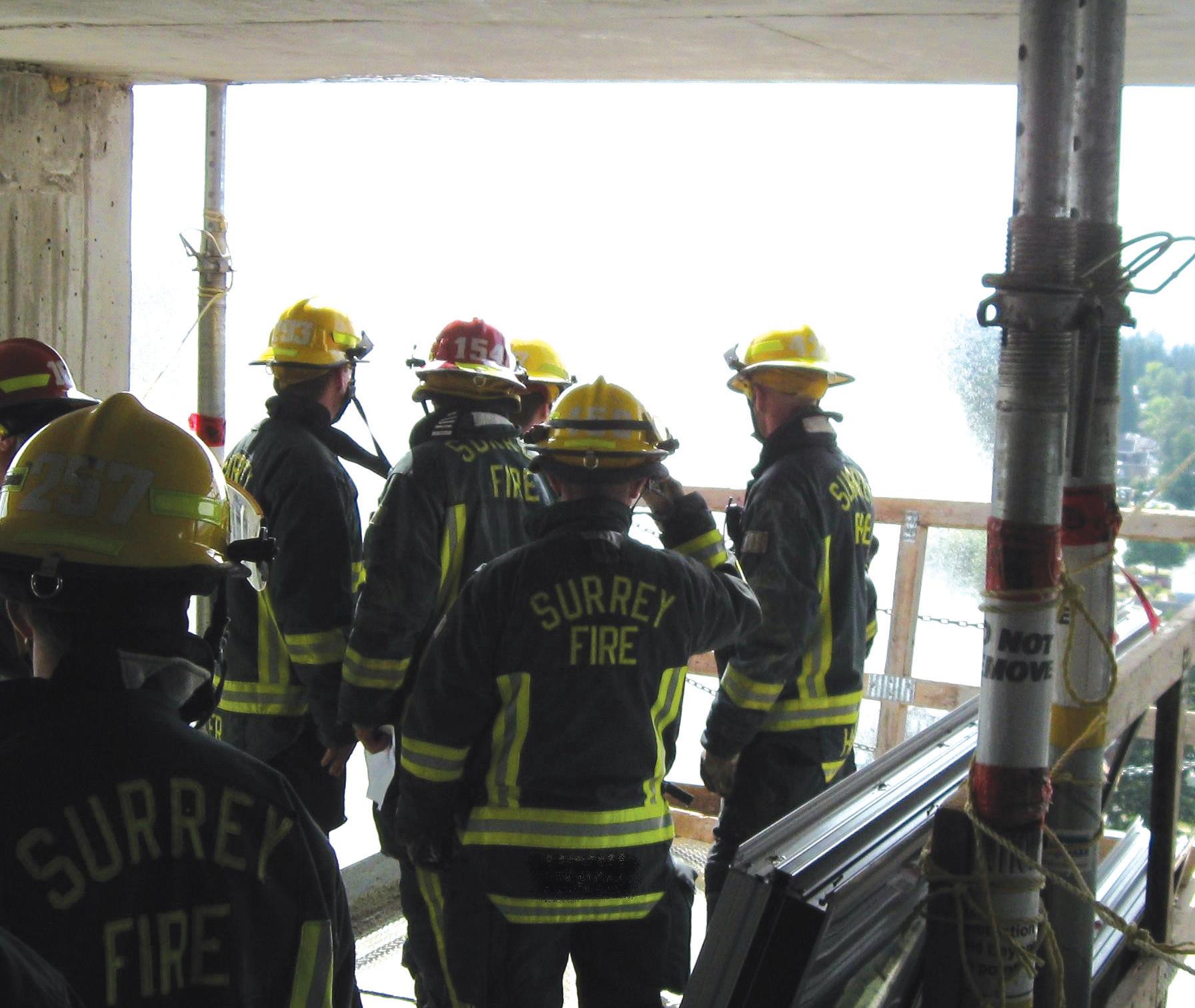
The firefighters from Surrey, B.C., were engaging in some unusual high-rise training, thanks to a unique partnership between Surrey Fire Service, ITC Construction Group, Pacific Rim Fire Protection and the Century Group. The training offered the firefighters important hands-on experience in the systems approach to safety in high-rise buildings that Surrey Fire Service initiated in 2008. However, some extra effort was required to provide this invaluable training.
A consultant’s report on Surrey’s high-rise capabilities led to the department’s decision to overhaul its high-rise firefighting procedures and move to a systems approach to safety in high-rise buildings. This approach requires a greater degree of co-operation between building occupants and fire departments.
The Fire Prevention Division works with building owners to educate residents, and the Fire Operations/Training Division works with fire suppression personnel to ensure that building practices and fire department procedures are compatible. The key issues are to educate high-rise occupants regarding a modified defend-in-place strategy, and to train suppression crews to effectively use a building’s fire protection systems in conjunction with the defend-in-place policy.
In Surrey, a Fire Prevention Division inspector visited each building to meet with its managers and occupants and explain the defendin-place policy. The policy was well received by building occupants who attended the public education sessions.
Training sessions were conducted for all career suppression crews, in three parts:
• Part 1 covered the roles of the initial eight arriving members;
• Part 2 required the deployment and use of high-rise hose bundles in a high-rise stairwell, through hands-on training;
• Part 3 examined high-rise strategies and tactics and incident management.
The first sessions, held in two residential high-rises, explained and demonstrated the roles of the initial eight firefighters to arrive: incident commander; lobby control member; elevator operator; and a four-member recon/attack team. The final member would be the pump operator, supplying the fire department connection (FDC) that is covered in the second training session.
In the first session, fire crews received instruction on apparatus placement, fire alarm control panel operations, PA system operation and firefighter elevator operations. With co-operation from the buildings’ strata councils, the crews practised using the PA system to make announcements, as dictated by the defend-in-place policy, and
conducted elevator safety checks while the elevators were in firefighter mode.
The crews also rode in the elevator wearing full personal protective equipment (including SCBA) and carrying all the required highrise equipment. At one point when the elevator was full, the crews were asked to put on their SCBA masks and go on air, to demonstrate the need to consider a possible emergency in the elevator rather than load it to capacity. The final lesson was a static demonstration of proper hose deployment in a high-rise stairwell.
The second session was intended to be hands-on training, where the crews would connect to the FDC, flow water into a standpipe, hook up to a standpipe valve, charge the hose line and advance it, finally flowing water. Flowing water was important because it demonstrated the need to have a standpipe valve operator to monitor system pressures, assist with hose advancement, control the stairwell and maintain the entry door as a viable means of egress.
The challenge was finding a high-rise location where training with flowing water could occur. Surrey’s high-rise committee solved this dilemma by finding a 21-storey residential high-rise that was under construction and met all the criteria – the building’s concrete was poured but it didn’t have any windows in yet, and it was located next to two wooded empty lots owned by the City of Surrey, so there was a suitable area where hose streams could be directed.
After a series of meetings, an agreement was reached between the construction company, the fire sprinkler company and the building owners to allow Surrey firefighters to access the building to attach supply lines to the fire department connection, carry their equipment to the 19th floor and attach lines in the stairwells before flowing water off the side of the building.
The biggest concern for the associated companies was the
Fire captain provides initial instructions to residents using the building’s public address system and a prepared script.
No Expensive Repairs
Stainless Steel Teeth
For more information, call your local Globe dealer or Safedesign
British Colum B ia and a l B erta Guillevin
Coquitlam, British Columbia 800-667-3362
Calgary, Alberta 800-661-9227
Campbell River, British Columbia 250-287-2186
Edmonton, Alberta 800-222-6473
Fort St. John, British Columbia 250-785-3375
Kamloops, British Columbia 250-374-0044
Nanaimo, British Columbia 250-758-3362
Prince George, British Columbia 250-960-4300
Trail, British Columbia 250-364-2526
Que B e C H.Q. Distribution LaSalle, Quebec 800-905-0821
atlanti C provin C es K & D Pratt Ltd. St. John's, Newfoundland 800-563-9595
Dartmouth, Nova Scotia 800-567-1955
Saint John, New Brunswick 800-567-1955
m anito B a and s askatC hewan Trak Ventures 204-724-2281
potential for a water leak. While there were no windows on the 21st floor, insulation and drywall were already being installed six floors below. A proactive risk-management plan was put in place: two portable water vacuums as well as mops and buckets were staged on the 21st floor whenever water was being used. The plan was going well when there was an unexpected water leak from a valve that became clogged with debris and failed to close fully.
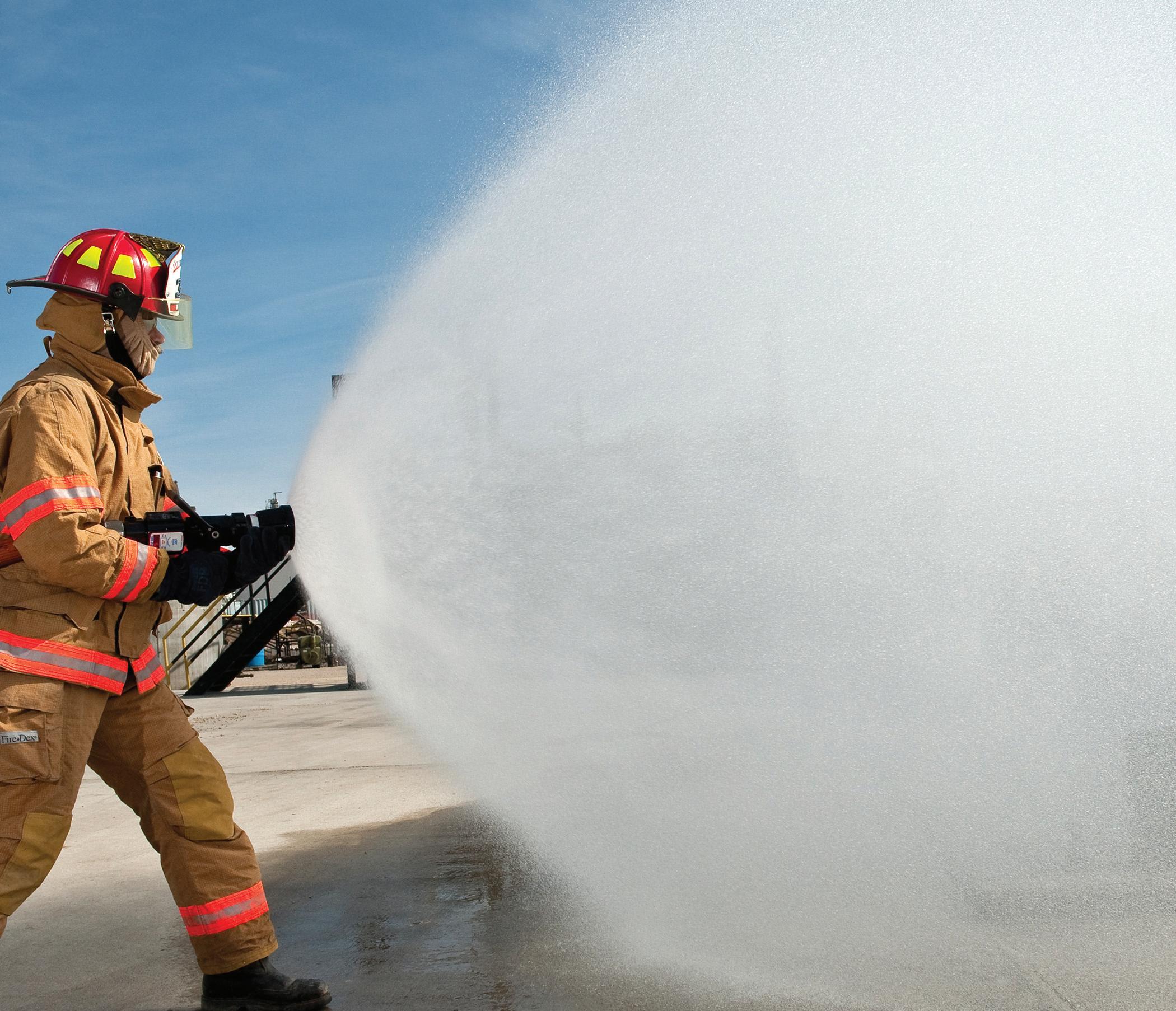
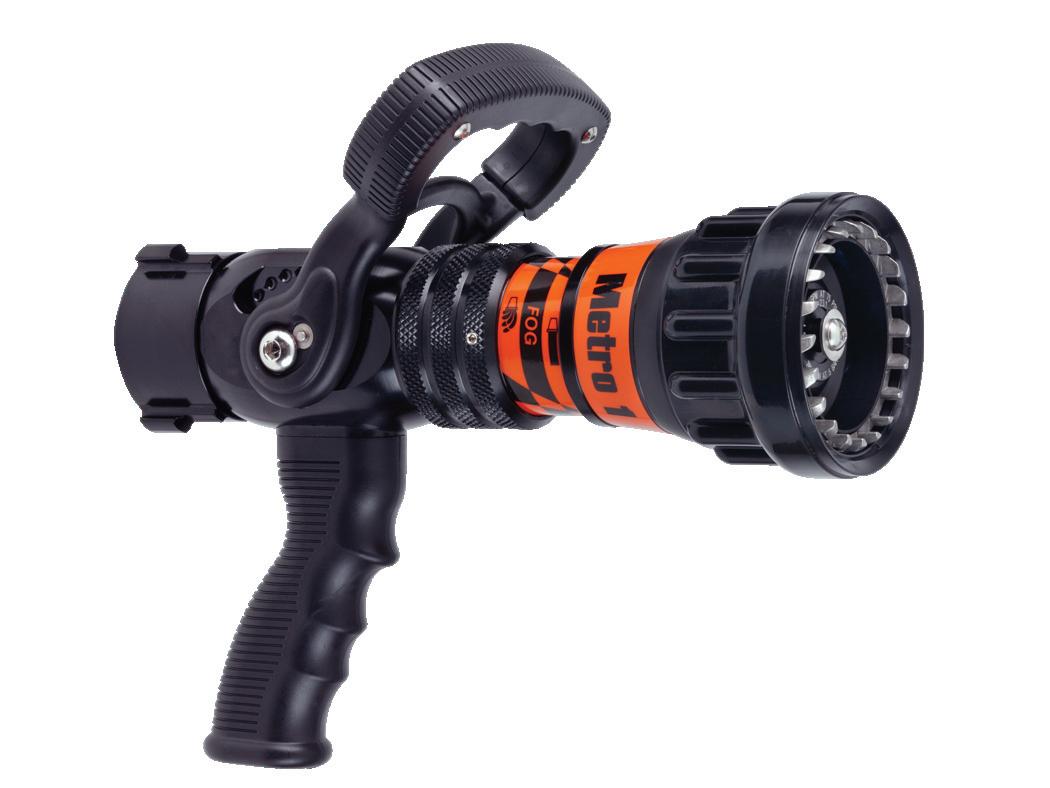
During the training, the crews pumped into the FDC at the required pressure and then attached attack lines to the standpipe valves in the stairwells. They then advanced the lines onto the floor to the safety railings and flowed water into the wooded lots. The session gave the members the opportunity to experience the effects of different reduced water pressures and to experiment with different nozzles (e.g., fog versus solid-bore). They also were able to feel how much more wind is present at higher elevations, and to see the effect it could have on a wind-driven fire.
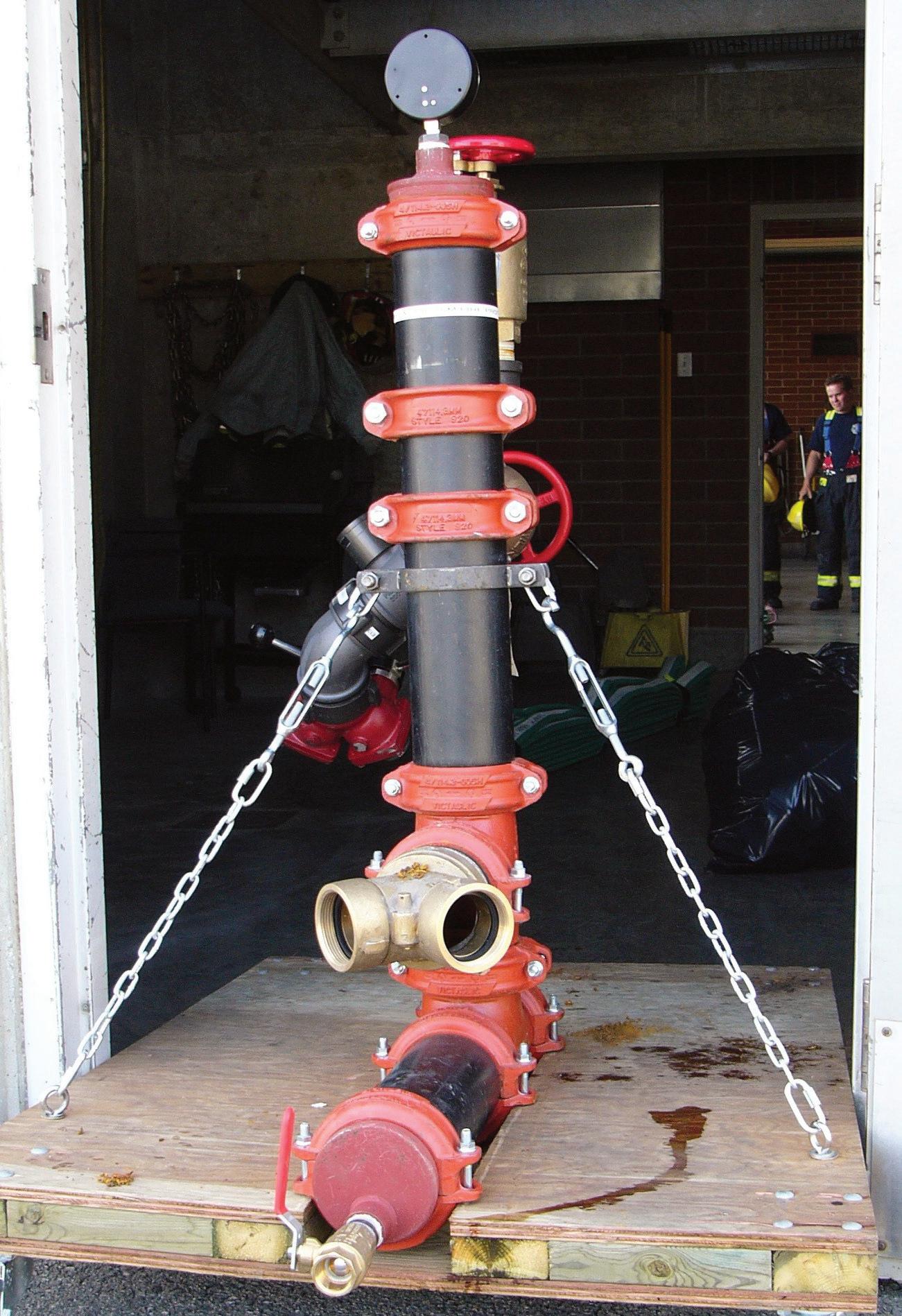
During another part of the session, a standpipe training prop was created to allow crews to simulate connecting to an FDC and then advancing their lines from the standpipe valves. Crews are able to experiment and compare different flow rates from both a pressurerestricting and pressure-reducing valve. The prop is portable and easily shipped to other fire halls for training.
The suppression crew members clearly benefited from these training sessions, which offered hands-on experience in a high-rise environment. However, the training division also learned some valuable lessons.
Two key points to be considered when
training off site are:
• Respect other people’s property and rules. We are used to being in control of a fire ground: we make the decisions, move people and equipment to suit our needs, and rarely get any argument. On someone else’s turf, we need to fully understand and play by their rules.
• Have a risk management plan in place. Give it some serious thought and incorporate a plan that will actually work if needed. It may just save your training and your reputation.
The single biggest lesson to be learned from Surrey’s experience is not to be afraid to explore new training opportunities. Don’t rule out a training session because no one has done it before, or because it will be hard work to set it up. The better and more realistic the training is, the better trained the firefighters will be, resulting in less injury and death to firefighters and civilians, as well as less property damage. A better-trained fire department results in a safer community for residents, workers and visitors.
In Surrey’s case, the willingness to take that extra step to create quality training opportunities will increase the safety of its firefighters as well as thousands of occupants of high-rise buildings.
The Surrey Fire Service and the University of the Fraser Valley are sponsoring the seminar Managing High-rises: A Systems Approach for the Fire Service, on Sept. 15, 2010 (8:304:30) at the Justice Institute of B.C. Theatre. Additional registration information may be found at www.ufv.ca/fire.
James Bond is the deputy chief in Surrey, B.C. John Lehmann is the training officer.
extrication explanatIon
Software program helps rescuers identify vehicles and danger areas during collisions
By randy SChMItz
ayear ago, in the August 2009 edition of Fire Fighting in Canada, we talked about new vehicle technology and the challenges it presents for rescuers.
Innovations such as roof curtain airbags, seatbelt pre-tensioners and knee bolsters all protect vehicle occupants but pose challenges for rescuers attempting extrication. With myriad vehicle makes and models, it’s impossible for rescuers to remember the locations of all these new protection systems.
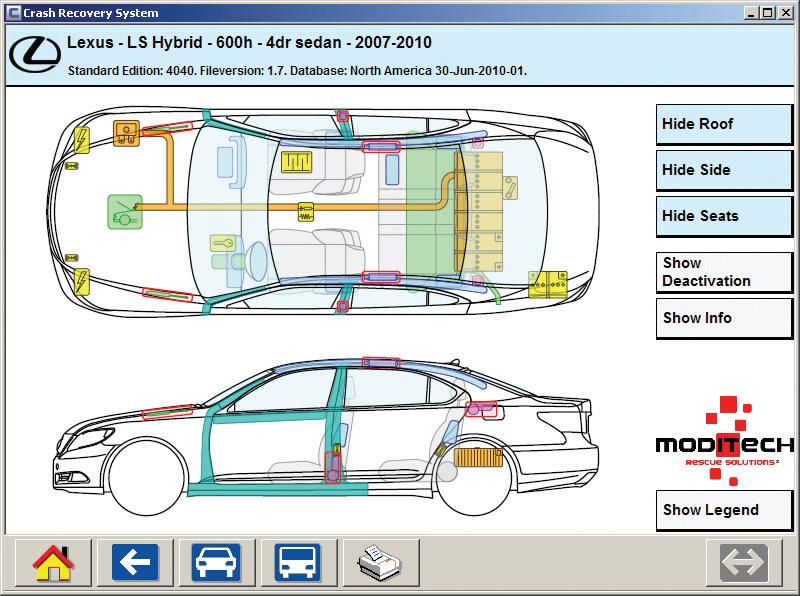
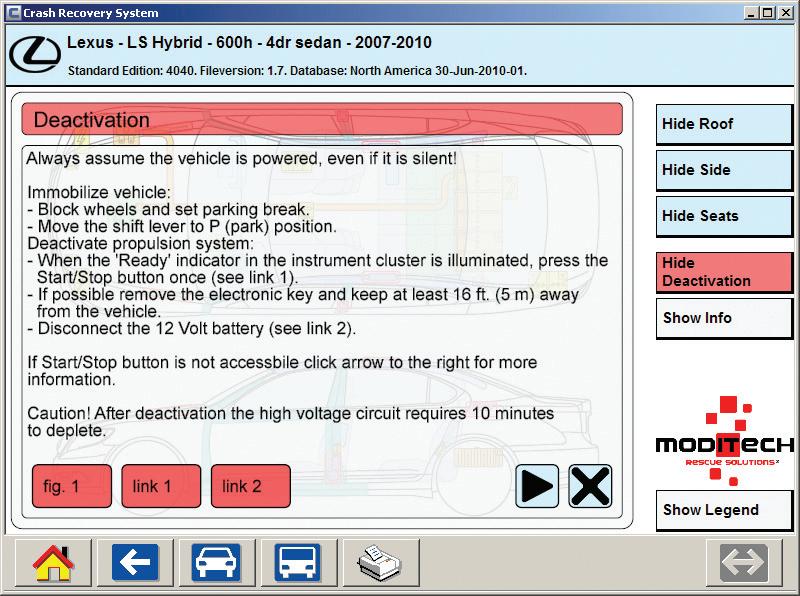
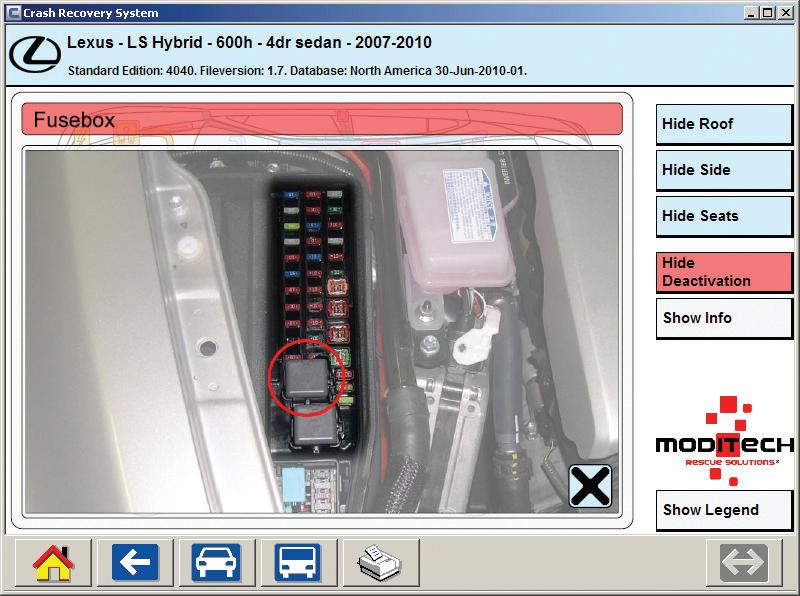
The Calgary Fire Department is running a pilot project with the Crash Recovery System software on three of its rescue trucks. CRS was developed by Netherlands-based Moditech Rescue Solutions (www. moditech.com). It is a cost-effective solution that gives rescuers access to more than 25,000 vehicles of all different makes, models and manufacturers dating to 1988 and eliminates guesswork during extrication.
At press time, CRS was in the early stages of testing in Calgary but it had already shown promising results including black box or event data recorder removal for police investigations, hybrid battery shutdown and magnesium metal component locations during a vehicle fire.
The program can be loaded onto a tough notebook or a laptop to bring to the incident scene. Depending on which software version your department buys, rescuers can physically identify the vehicle by visible description or manufacturer nameplate.
Vehicle model upgrades and components are constantly updated via the Internet to give rescuers the latest information about new vehicle design technology.
■ THE CHALLENGES OF NEW TECHNOLOGy
Car manufacturers have developed many innovative, passive safety devices to protect vehicle occupants. Vehicles have come a long way from the inception of a single crumple zone in the front frame rails back in the 1980s to an effective, energy absorbing management system that tremendously increases the passenger survival space.
Still, with every improvement to occupant safety, there is often a drawback or downside for rescuers performing patient extrication. Even with all the design improvements and collision avoidance systems, there are still high speed crashes and occupants continue to be pinned in vehicles.
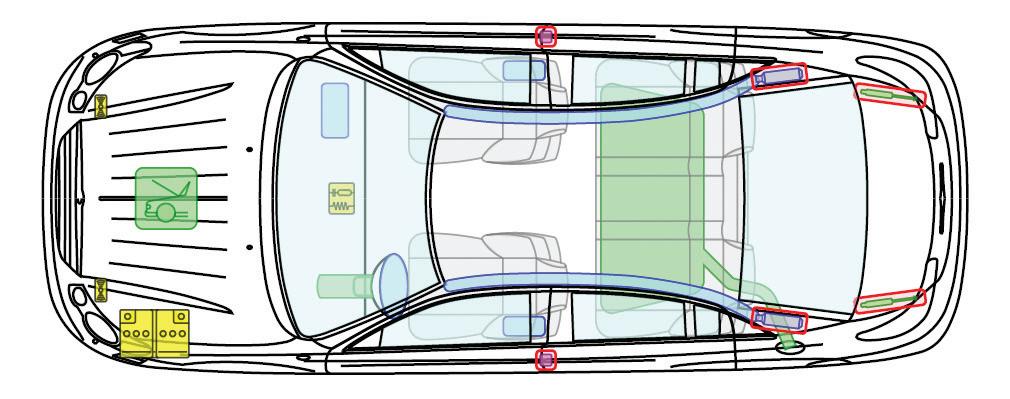
For example, supplemental restraint systems that protect occupants during a crash can seriously harm an unsuspecting rescuer because not all airbags and roof curtains deploy in all crashes. Inadvertently cutting into a 10,000 psi, undeployed metal cylinder while removing a roof can have disastrous results for rescuers and patients. Unfortunately, vehicle manufacturers do not place these cylinders in common locations. The cylinders can be found anywhere in the roof area of a vehicle.
Another challenge for rescuers is, of course, high-strength steel
locations. These areas can be extremely difficult to cut unless rescuers have the latest hydraulic tools; even then, the operator’s cutting skill and knowledge plays a role.
With hundreds of vehicle makes, models and designs, it is impossible to memorize the locations for all these restraint systems and high-strength steel components. Even 12-volt batteries are not in the same place they were a few years ago, as electrical power shutdown has become paramount in helping rescuers prevent an undeployed airbag from going off during extrication procedures.
What about hybrid vehicle technology? Environmentally friendly vehicles are becoming a way of life as consumers demand cost-efficient solutions to reduce fossil fuel emissions. Most modern countries have or are about to introduce emissions legislation. The move to clean fuel has sparked a drive for hydrogen and hybrid vehicles with complex power trains solutions that contain lithium ion and nickel metal hydride high-voltage batteries and components. These systems pack a lethal punch of high-voltage electricity that needs to be respected during extrication and have specific shutdown procedures. Power isolation is forefront to make these vehicles safe to work around for first responders.
It’s easy to understand, then, why our platinum 10-minute time frame from arrival to patient removal has increased.
■ UNDERSTANDING CRS
The Crash Recovery System provides all the details rescuers need in an understandable format, while allowing the safe performance of their duties.
One software option is the VIN edition, a program which allows rescuers to type in the vehicle identification number and bring up the make, model and year of the vehicle in question.
This program can also accommodate a bar code scanner tool that can capture the barcode VIN number in newer model vehicles and put the particular vehicle onto the laptop screen with the squeeze of the trigger.
Some benefits of the CRS for first responders are:
• Available technical information about components of the vehicle involved in a crash can reduce extrication time and increase overall safety of rescuers and patients;
• Vehicle-specific information can reduce training time, because rescuers do not need to learn details about different mounting locations for relevant components (batteries, roof curtain inflators, pyrotechnical pre-tensioner devices);
• Knowing exactly where a component is located is better than spending valuable time searching for it;
• Knowing where the high-strength steel is placed in a vehicle saves time.
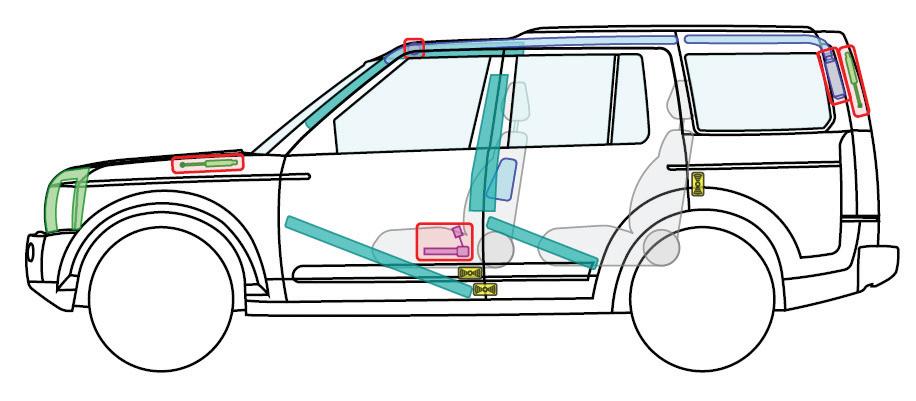
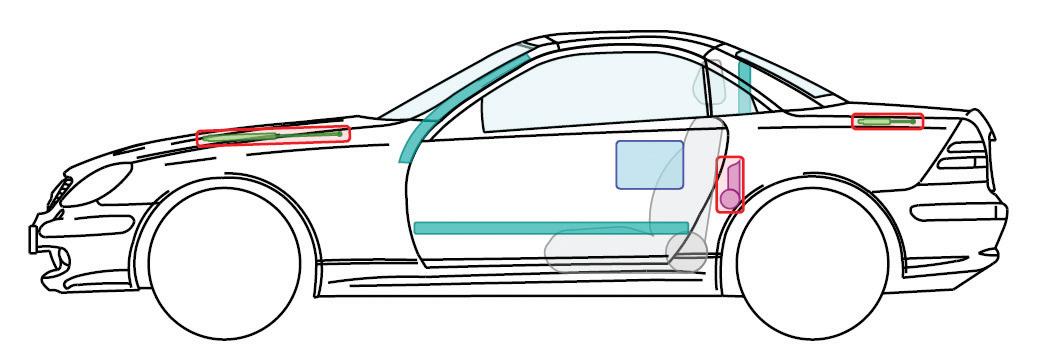
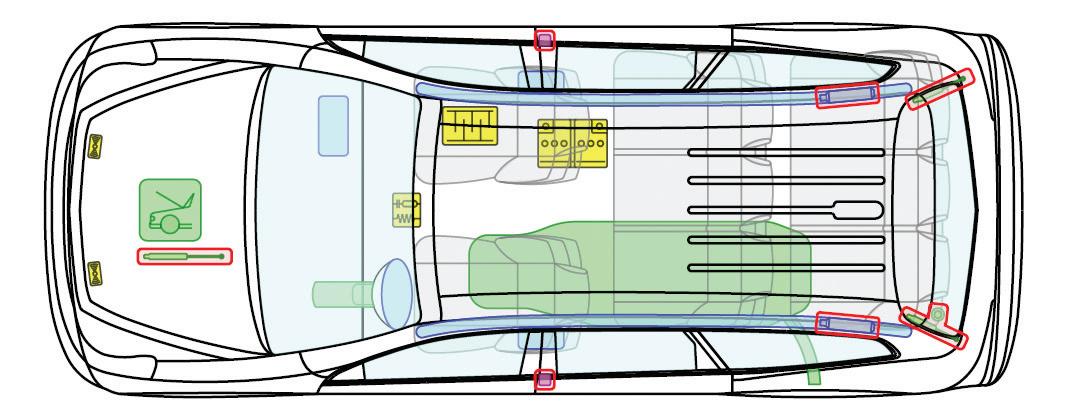
Here are some examples from the Crash Recovery System about
particular vehicles (all are screenshots taken from the software). Vehicle components are colour coded for easy identification
■ BODy CONSTRUCTION AND REINFORCEMENTS
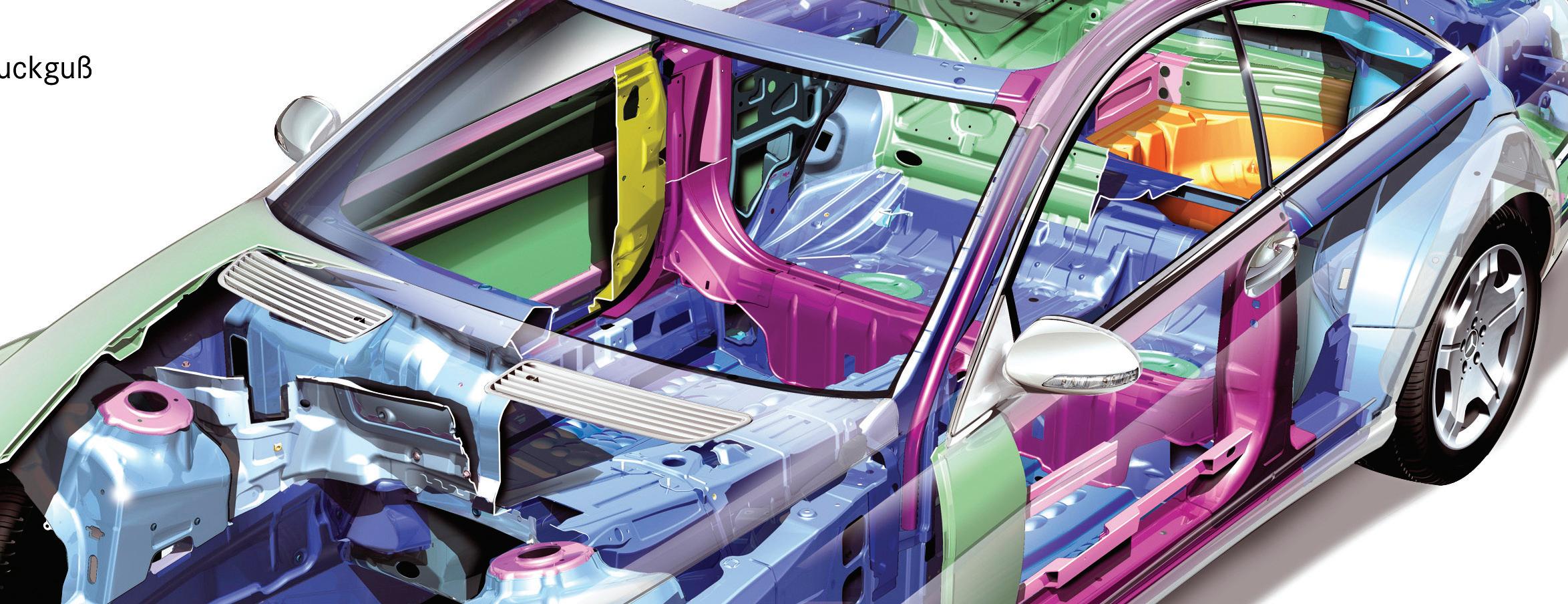
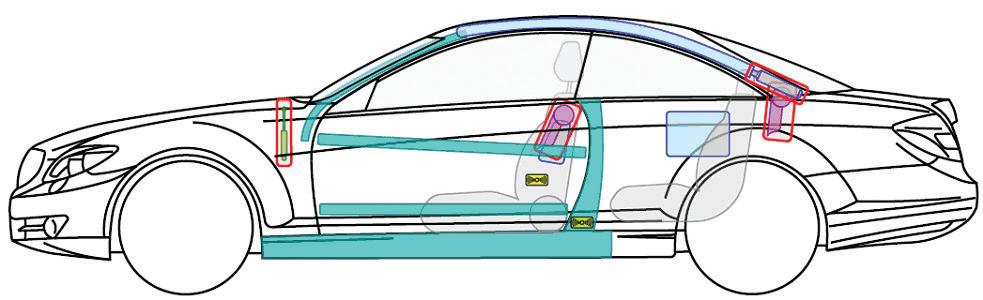
Hood struts are shown for rescuers to avoid cutting and for a possible hazard during fire. Note the heavily reinforced rocker panel highlighted in blue – rescuers will note the tensile strength of the steel and this will help determine what tool to use to cut. A reciprocating saw would prove to be ineffective on this component and thus a waste of valuable time.
Mercedes-Benz CL
Keep in mind that although this program is an excellent resource, it should not replace training. But it can be helpful to find the optimal course of action.
■ AIRBAGS
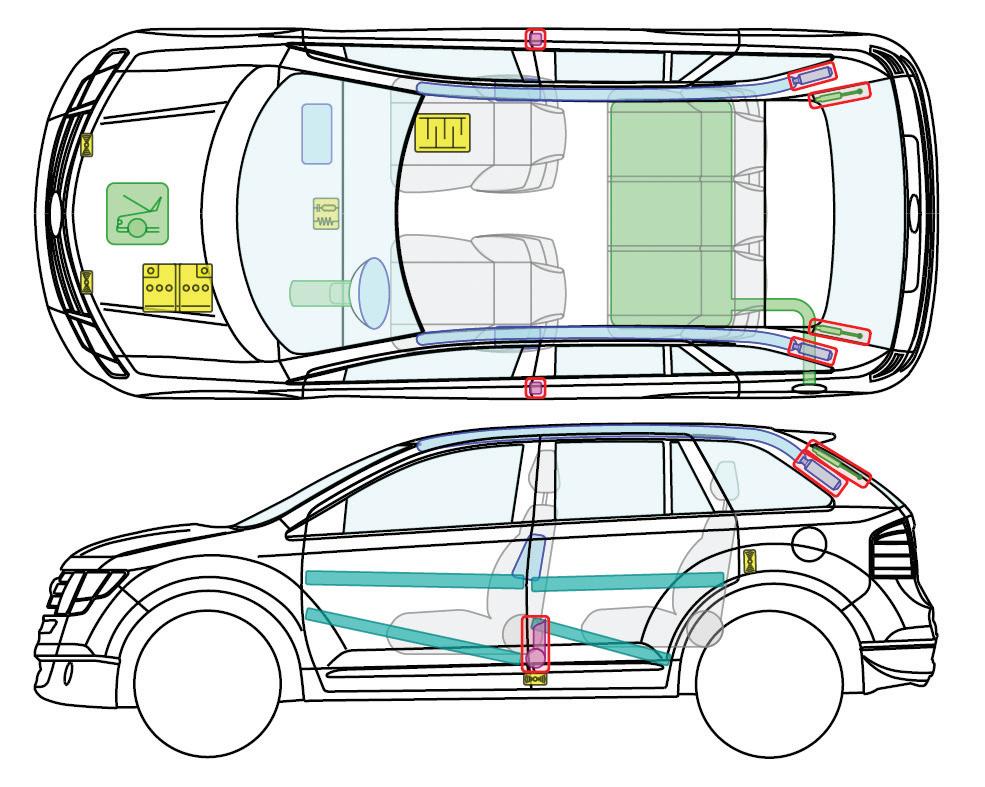
This vehicle is a 2010 Ford Edge equipped with frontal airbags for the driver and passenger, seat-mounted side airbags and a curtain airbag on both sides and for all rows of seating. The airbag control unit is on the centre tunnel of the vehicle under the dashboard. No further scanning for undeployed airbags is necessary; deployed airbags will be obvious. The yellow, colour-coded box under the engine hood is the 12-volt battery. Click on the box and text appears explaining the disconnection procedure and capacitor drain-down time. Roof curtain cylinders are visible in the middle of
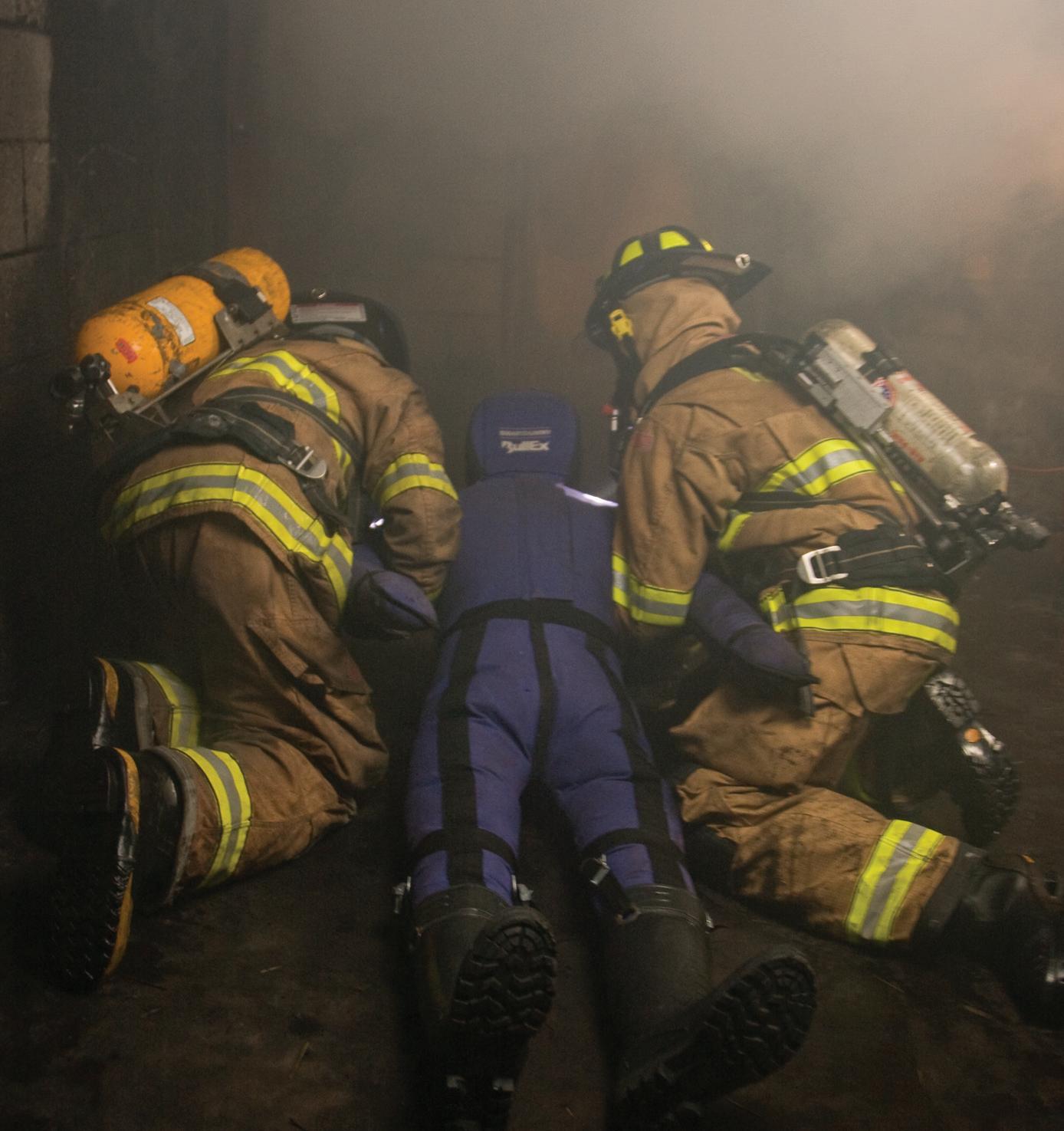
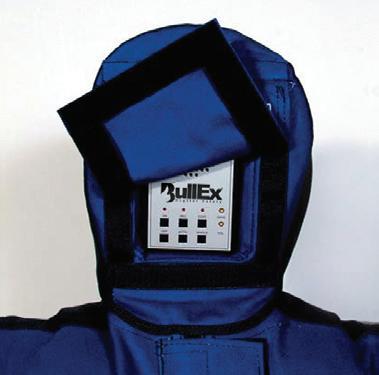
the SmartDummy talkS Back
Reinforcement pipe inside A-pillar. If you know where it is located, you can work around it or adapt your strategy (e.g., flap the roof to the front).
Vehicle information can also be helpful while determining Plan A, B and C. Tactics can be tailored to the actual components of the vehicle.
Land
Rover LR4
Reinforcement in B-pillar. It’s easy to see how you can work around this particular high-strength steel component. Keep in mind that there are vehicles in which the complete B-pillar is reinforced from top to bottom. This is where the knowledge and skill of the tool operator plays a big part. For late-model vehicles, rescuers need up-to-date hydraulic cutters. Note the green colour at the front of the vehicle; this signifies that this make and model of Land Rover has magnesium in the area and will be a serious hazard during a vehicle fire. Water and magnesium do not mix well!
Mercedes-Benz SLK, convertible
If the best plan is to relocated the roof, then there are several options to consider:
Plan A: Use the electric release
Plan B: Release the roof from the windshield frame and cut the C-post.
Plan C: Cut A- and C-pillars. Cut above the reinforcement.
l Best warranty in the industry
l Greatest number of safety options available on an SCBA
l Accountability System for complete fireground management
l New FireHawk M7 Responder Air Mask adds optional CBRN APR and PAPR convertibility
the rear C-pillars, along with the pyrotechnic seatbelt pre-tensioners in the lower B-pillar. The hood release symbol indicates how to locate the hood release and unlatch it for quick access. Both pictures and text will be shown.
Performing electrical shutdown is much
quicker if the battery location is known. On this Chevrolet Traverse, the battery is below the passenger’s seat and can be accessed through an opening in the floor of the vehicle.
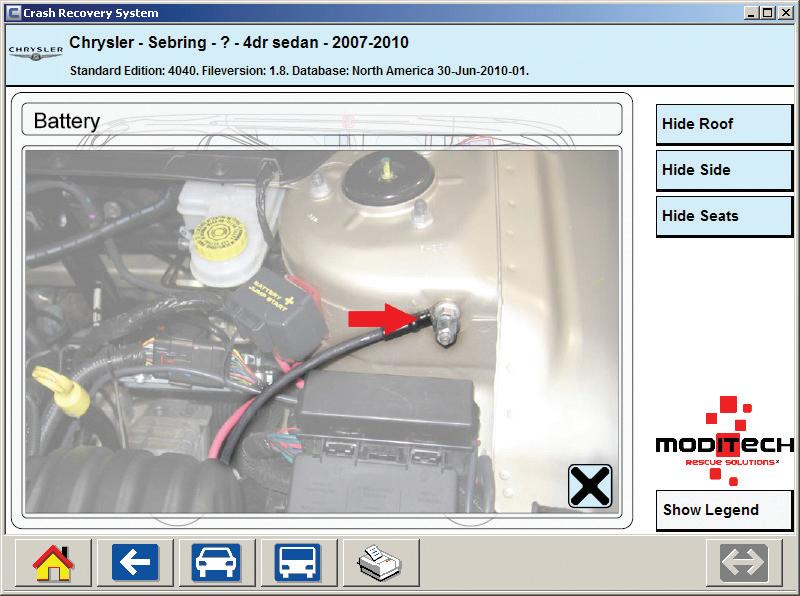
The battery of this Chrysler Sebring is
in the wheel well area of the vehicle. Even if you know where it is, it is very difficult to disconnect it. Additional information may be helpful. As you can see, the negative battery terminal can be disconnected from the body of the vehicle on the strut tower in the engine compartment.
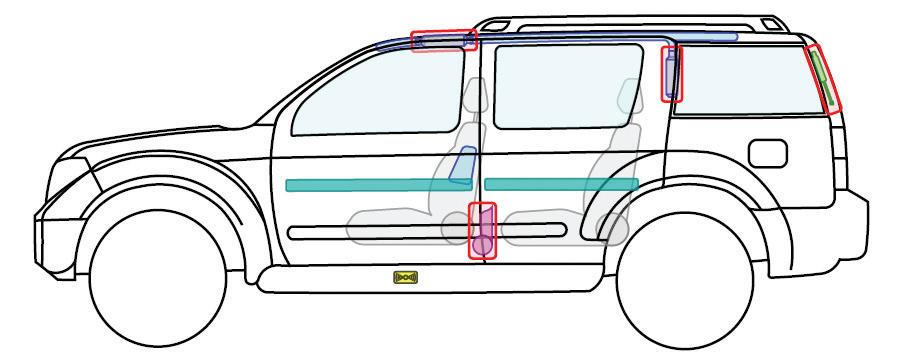
Looking at the side view of this Nissan Pathfinder, the location of the high-pressure cylinders for the roof curtain airbags is apparent. Cutting around these components is essential when removing the roof section. Furthermore, this schematic reveals that
a seatbelt pre-tensioner is mounted at the base of the B-pillar and a pressurized strut is supporting the rear hatch.
With this information, a lot of vehiclespecific issues when dealing with airbags are solved. All you need to do is to maintain safe distances from the undeployed airbags, stay clear of the high-pressure cylinders when cutting and shut down the electrical system.
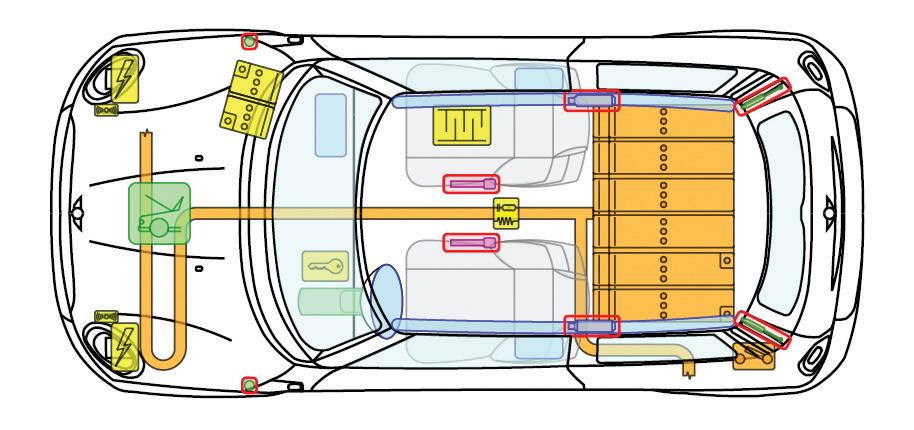
■ ALTERNATIvE PROPULSION
Every vehicle has some components that must be avoided. This also applies to vehicles with alternative propulsion, as they will have a lot more potentially hazardous systems as seen below:
This 2010 Mini Cooper carries a
Continued on page 46
By t om d ES o RC y Fire Chief, h ope, B.C.
Having the proper tools in the bag
having what you need, when you need it: whether you’re cooking dinner or running a business and, most certainly, at a fire scene, this phrase holds true. But even when you think you have everything you need, are you overlooking something? Let’s see . . . hose, nozzles, axe, thermal imager – the list goes on. While we carry all the basics, we’re not identical.
I realized this a few years ago when I was part of a radio talk show on behalf of the Fire Chiefs’ Association of British Columbia and the question of over response was raised – you know, when you attend that seemingly minor fire or medical call and bring an entire fleet of fire trucks. At least that’s what the public sees and, in some cases, if you’re a single-hall fire department, that can be everything you own.
“Why do you bring the big trucks out for such a non-event,” or “That’s such a waste,” are some of the comments you may have heard, maybe even from some of your own members.
Well, this was just the question that was asked during this radio program and the response given was, frankly, right on the money. Think of it this way: if you called a plumber to your home for what turned out to be a very minor issue, would you be surprised if he showed up to your door with just a wrench or would you expect him to bring the entire tool kit?
In the fire service trucks are just that – our tool kits. Each truck we have carries many different tools and if we should need one then we need it now and we know it’s there. Further to that, as an emergency manager, I subscribe to the motto “too much too soon is better than too little too late,” and as most in our field would agree, sending trucks home with dry hoses is much better than waiting for them to come when it turns out they’re needed.
volunteer fire departments. Think about it for a moment. What other first responder agencies could show up to a call with an electrician, a plumber, a mechanic and a doctor all in the same vehicle? Have you ever considered what our customers would think if they found out that the person who assisted them in their time of need was their child’s first grade teacher? Sure, we’re used to it and we take this for granted but remember, to the general public, we’re all dressed like firefighters so that’s who we are and what we do, period. I can only imagine that most people would be surprised to learn of the skills that actually exist in the hall outside of fire fighting. To take this another step further, consider those additional tools that people don’t see – the ones we put into the firefighter’s bag beyond those skills they already offer.
That being said, and as I’m sure most can appreciate, we can’t afford to train everyone to a particular specialty but we can put a certain number of members each year into more diverse programs, thus adding those valuable tools to their bags and, in turn, tools to ours from the department’s perspective.
Another thing that few outside of our fire halls realize is that, in a volunteer department, we never know who will show up when
I can only imagine that most people would be surprised to learn of the skills that actually exist in the hall outside of fire fighting. ‘‘ ’’
Unfortunately, we’ll never get past the optics of just such a response but, truth be known, the tools we carry go beyond the equipment on the trucks and by that, I’m referring to the passengers who ride inside those trucks, something many may forget. Here lies one of the beauties of the fire service – the vast number of skills we bring to the table, in particular, in
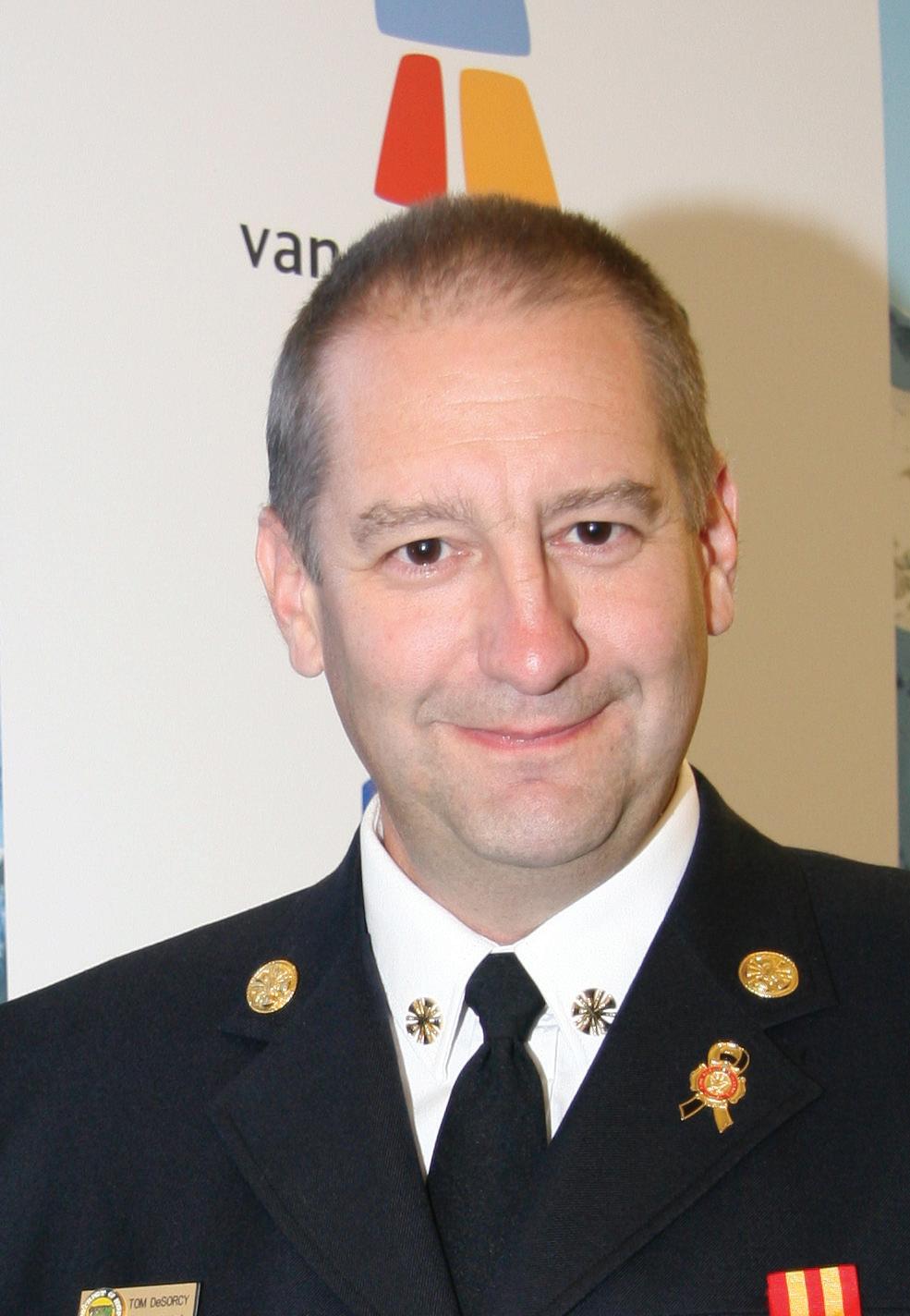
Tom DeSorcy became the first paid firefighter in his hometown of Hope, B.C., when he became fire chief in 2000. Originally a radio broadcaster, Tom’s voice could be heard in the early 1990s across Canada as one of the hosts of Country Coast to Coast. DeSorcy is married with two children, aged 28 and 20, and enjoys curling and golf. He is also active with the Fire Chiefs’ Association of B.C., and chairs the communications and conference committees. Contact him at TDeSorcy@hope.ca
the alarm is sounded, which makes it even more important that we, as chief officers, know what each and every one of our people brings to the table. I’m certainly not telling you something you don’t already know – just a simple reminder to look past the basic firefighter skills beyond the call at hand.
Remember, it’s the good leaders who take those skills and use them to their advantage and, of course, the best way to know what tools our firefighters have in the bag is to help them fill it. Take stock in your department beyond its walls to your members’ lives away from the hall and tap into their individual skills. What tools do you have at your disposal? What you find may surprise you. Yes, having what you need, when you need it, is important, but sometimes all you have may be all you’ll need.
• More than 100 exhibitors
• Dozens of sponsors
• 30 international teams
• Hundreds of delegates
• 2 tracks, 2 days
• Excellent quality speakers
• Animal Rescue Workshop, September 23rd, 2010 Keynote Speaker Featuring Chief Bobby Halton Fire Engineering Magazine/FDIC
■ SUBMERSIBLE COMPRESSOR PROvIDES CONTINUOUS DUTy
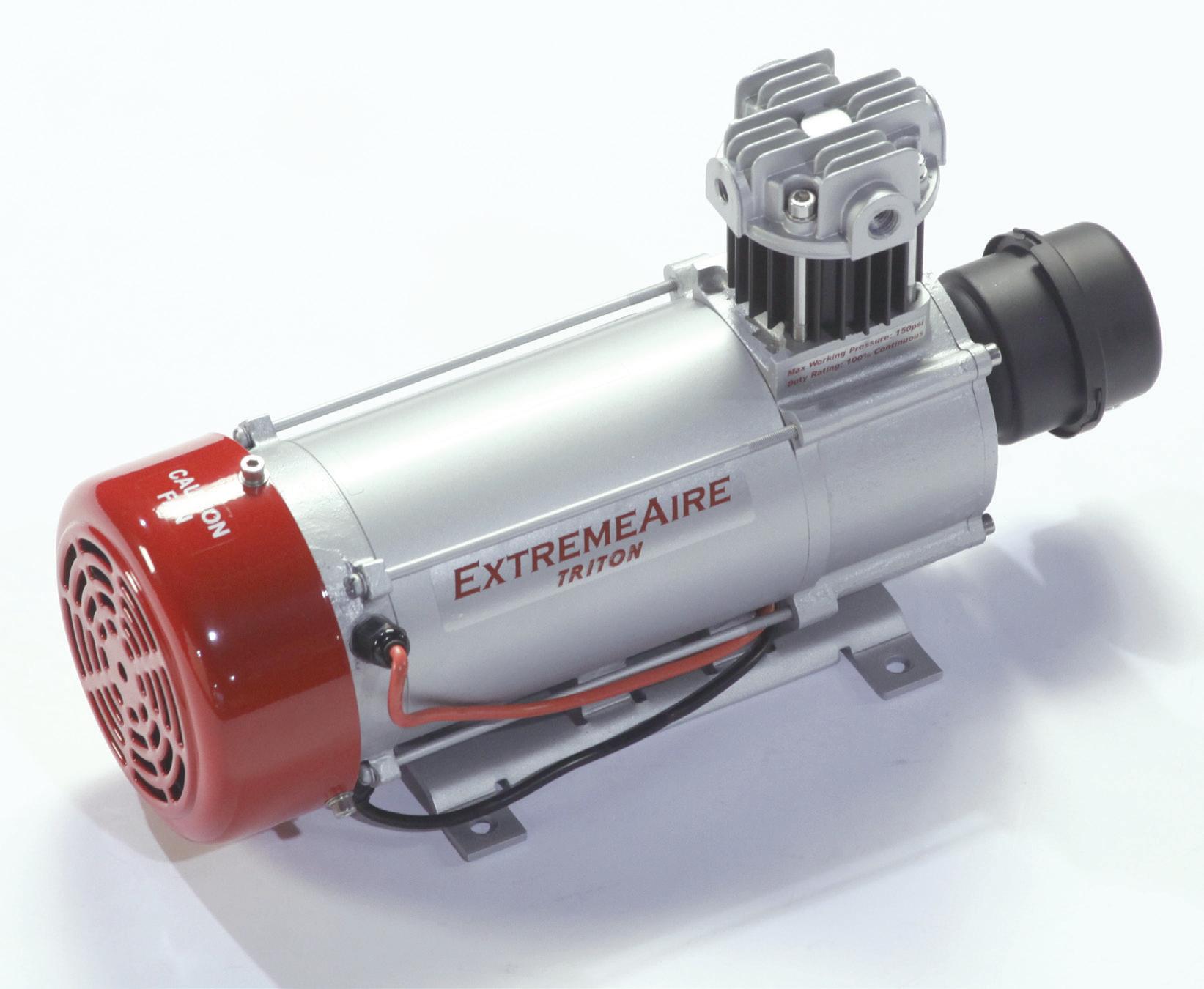
The ExtremeAire Triton is a fully sealed, submersible continuous-duty electric compressor that features a 1.5-horsepower, fan-cooled motor, permanently lubed and sealed bearings, heat-dissipating cylinder coating and stainless steel hardware. The Triton provides a working pressure of 150-psi (80-amp draw) and is available in 12- and 24-volt models with a variety of optional installation kits and pneumatic accessories. For more information visit www. extremeoutback.com.
■ PLASTIC IGNITION SWITCH FEATURES ANTI-RESTART
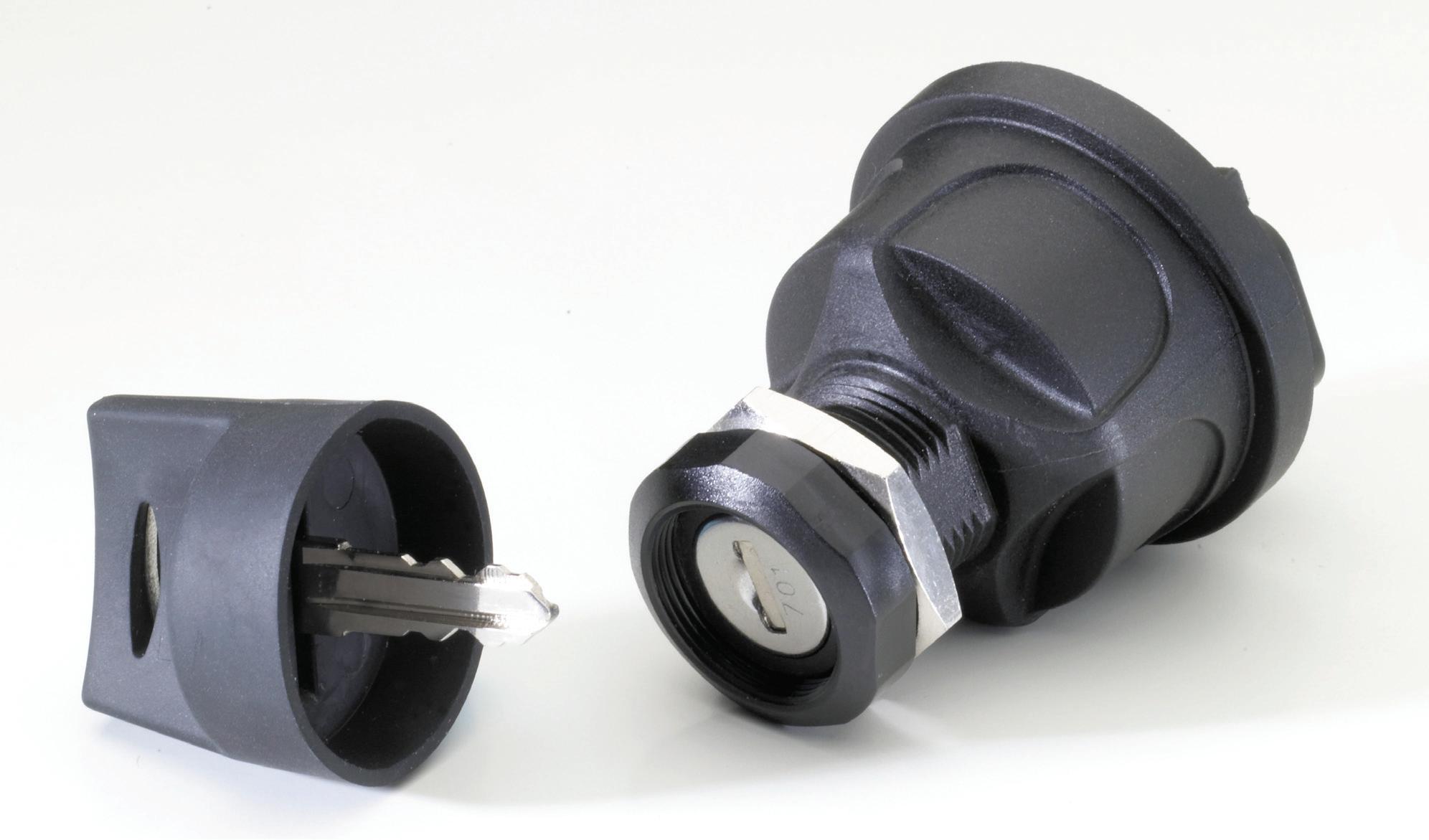
Cole Hersee’s new fully sealed plastic ignition switches are made of durable, engineering grade plastic, making them ideal for emergency vehicle applications. The switches are available in a variety of configurations to meet all customers’ needs, including anti-restart. The switches have an integral Deutsch connector, and the contacts are sealed to IP-67. Available with or without a key boot, Cole Hersee’s plastic ignition switches are rated at 10A at 12V DC, 5A at 24V DC and are tested to SAE J259 for ignition switches. For more information visit www.colehersee.com.
■ PUMP KIT MAKES TRUCKS SAFER TO OPERATE
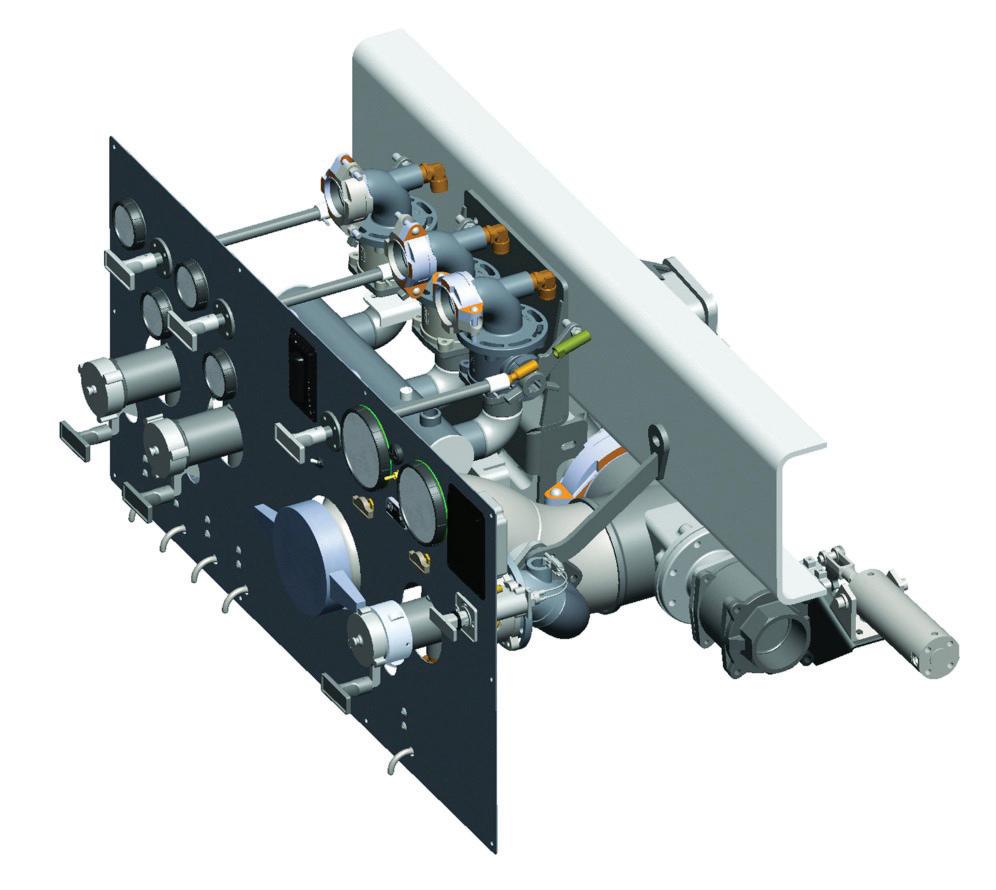
Hale’s SideKick is a 500/750 high-volume booster pump kit designed to be installed below the chassis top of frame, allowing more space for body components or additional tank capacity. This compact design results in a lower centre of gravity, making vehicles easier to handle and safer to operate. The SideKick features all stainless steel plumbing and manifolds for maximum corrosion resistance. The pump is outfitted with the Class 1 TPG and it features a quick pump service drop out to make repairs fast and easy, as well as a stainless steel pump panel that can be installed in the side compartment or hung below the apparatus body as a free-standing panel on a simple frame with brackets. For more information visit www.haleproducts.com.
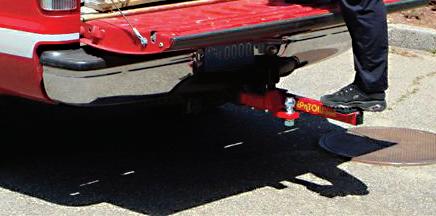
■ HITCH STEP ALLOWS FOR EASy ENTRy TO TRUCK BEDS
Step n Tow’s receiver hitch-mounted step, ball mount and winch-mount system was designed for pick-up trucks used in fire-
fighting operations. Constructed with heavy duty, galvanized steel, the system includes a 2.75-inch by seven-inch non-skid foot-step mounted on an 18-inch swing arm that locks into position to allow easy entry to the truck bed for quick access to mounted skid units or other equipment. The hitch system will fit on virtually any standard two-inch Class III receiver, has a two-inch drop and three-quarter-inch rise and is rated to 6,000 pounds, while the step is rated at 350 pounds. For more information, visit www.stepntow.com.
Set-up simulated contaminated areas and challenge trainees to meter and respond with GasTrainer™ , BullEx’s gas detector training system. GasTrainer responds automatically to the simulated hazard, displaying “gas levels” and alerting when alarm levels are reached. Trainees learn how different gases behave, how to locate sources and how to establish hot, warm and cold zones.
Take your training beyond the classroom with BullEx HazMat Training Tools. To see GasTrainer in action, check out our videos at www.bullexsafety.com.
BaCKtoBaSICS Ladder rescue methods
By MARK vAN DER FEyST
we have been looking at several aspects of ground ladders and how they are effective on the fire ground. In June we reviewed ladder placement angles and how we can ladder a building quickly for rescue without having to check for a proper angle.
We train to rescue civilians from buildings but we seldom have an opportunity to do so. In bigger cities, this opportunity may occur more often than in smaller municipalities. As mentioned in earlier columns, one firefighter with a 24-foot or 28-foot ground ladder can be very effective on the fire ground, especially when rescuing civilians.
Rescuing a conscious civilian may not be that physically taxing but it will be challenging mentally. Conscious fire victims may be hysterical, panic stricken or calm. If they are hysterical or panic stricken, rescuers must take control. Taking control requires rescuers get the attention of the victim and to have him focus on you as you provide directions. Hysterical and panic-stricken fire victims can be dangerous for rescuers. If not controlled quickly, they will take the rescuer for a dangerous ride straight down to the ground.
Rescuing unconscious fire victims requires physical effort. Here we will look at the phase during which the victim is out the window and on the ladder. In September, we focus on getting the fire victim from the floor to the window.
The first method rescuers can use to remove or rescue a fire victim is to have the victim face the ladder with his back toward the rescuer. This requires the victim’s feet to be passed out first and his body to be properly oriented. This takes time to set up and, in a situation in which rescuers will need to get the fire victim out of the structure, will not be the preferred method.
Once the fire victim is on the ladder, the firefighter needs to have his hands and arms underneath the victim’s armpits and one knee positioned underneath the victim’s buttocks, between his legs. In photo 1, firefighter Tim Llewellyn (of the Cranberry Township Volunteer Fire Company in Pennsylvania) has fire victim (Fire Chief Eric Wissner of the Perrysville Volunteer Fire Company in Pennsylvania) positioned on the ladder so that Llewellyn’s arms and knee are in the correct positions. This allows Llewellyn to lower the fire victim down the ladder one rung at a time. The difficultly with this technique is to move your knee out to allow the victim to slide down to the next rung. With the weight of the fire victim on your knee, it can be difficult, if not impossible, to remove your knee to lower the victim to the next rung.
A simple way to alleviate this difficultly is for the firefighter to rotate his wrist up, taking some of the weight off his knee. This allows the rescuer’s arms to move the fire victim up far enough to give the rescuer space to remove his knee. This must done at each step, all the way to the bottom.
An advantage of this method is the ability of the rescuer to quickly take control of the fire victim should he regain consciousness while on the ladder. Because the firefighter and the victim are facing the ladder, the rescuer can easily pin the victim against the ladder by pulling the victim’s body to the ladder. This will stop any jerking reaction that may cause both parties to fall off the ladder.
Once at the bottom, the firefighter can easily move the fire victim away from the ladder and on to waiting EMS crews. In photo 2, Llewellyn is able to take his hands off the rungs of the ladder and grab
Photo 1: The first rescue method is to have the victim face the ladder with his back toward the rescuer.
Photo 2: The rescuer is able to take his hands off the rungs of the ladder.
Photo 3: The rescuer grabs the victim under the arms to drag him away.
Photo 4: The other method for rescuing a fire victim is to position the victim horizontally across your arms.
Photo 5: The victim’s feet have been placed on the ground but the upper part of the body is still being supported by the left arm of the rescuer.
the fire victim under the arms to drag him away, as shown in photo 3.
The other method for removing or rescuing a fire victim is to position the victim horizontally across your arms, as in photo 4. This is the preferred method because it will not matter which way the victim is passed out the window. The victim can come out feet first or head first, body facing toward the ladder, or facing the rescuer. Whichever way the victim comes out, he can be positioned to be horizontal across the rescuer’s arms.
Llewellyn is using this method in photo 1. His right arm is between the legs of the fire victim with his hand grasping the ladder beam. The left arm is underneath the victim’s armpit. The left hand is grasping the ladder beam. The arms of the firefighter should be positioned so they are at about 90 degrees. This allows the fire victim to rest on the rescuer’s arms and be at chest height, giving the rescuer the ability to see what he is doing.
If the fire victim were resting on the rescuer’s arms and they were at 70 to 60 degrees, the fire victim would be blocking the rescuer’s face and would also be putting their weight too high on the rescuer.
The weight of the fire victim should be around chest height. This allows the rescuer to use his body as a braking device and as a support for the overall weight. To help distribute the weight evenly across the firefighter’s arms, the firefighter can slide his left hand or right hand down the ladder beam.
With this method, the firefighter will have complete control of the fire victim should he regain consciousness during rescue. The firefighter will be able to pin the victim against the ladder to stop any emotional and physical reaction. Removing a fire victim this way takes time. Rescuers may be able to descend the ladder more quickly with a smaller victim but it will take longer with a larger, heavier patient. When at the bottom of the ladder, the rescuer can easily remove the fire victim from the
ladder and pass him on to awaiting EMS crews.
In photo 5, the feet of the fire victim have been placed on the ground. The upper part of the body is still being supported by the left arm of the rescuer. The rescuer will now take his right hand and place it under the right arm of the fire victim. This allows the rescuer to drag the fire victim away from the ladder using the upper body drag technique as seen in photo 6.
Rescuing a fire victim from a burning building is not easy. It takes a lot of hard work to remove just one fire victim, let alone two or
three. Consistent training is the key to being able to do this efficiently.
Mark van der Feyst is an 11-year veteran of the fire service. He works for the City of Woodstock Fire Department in Ontario. Mark is an instructor teaching in Canada and the U.S. He is a local level suppression instructor for the Pennsylvania State Fire Academy, an Instructor for the Justice Institute of BC and a professor of fire science for Lambton College. He can be contacted at Mark@FireStarTraining.com
BullEx Smoke Generators were designed with one goal in mind: to create the most realistic fire training smoke possible. BullEx Smoke Generators continuously produce thick, heavy smoke without recharging or reheating. Whether you’re doing search & rescue,
ventilation or initial fire attack drills, these Smoke Generators don’t stop until your training is done. To see the Smoke Generators in action, check out our videos at www.bullexsafety.com
Photo 6: The rescuer drags the victim away from the ladder using the upper body drag technique.
from page 15
the recreation hall. A seven-ton unit with 27 kilowatts of electric backup heats the administration section.
Extra money was spent to insulate the fire hall to twice the standard required by code: R20 for the floor; R40 for the walls; and R60 for the ceilings.
The fire hall has several interior green features. For example, there are automatic light switches, automatic taps in the washrooms and auto-flush urinals. Each fire truck is equipped with a remote door opener, an energy saving convenience the old fire hall lacked.
“In the old days,” McMahon says (already, anything before November 2008 is the old days), “the trucks would leave the hall and the doors would stay open until someone happened along who thought to close them. This was a particular problem during daytime work week calls when manpower was tight.”
Another energy-saving feature the firefighters have to play with, literally, thanks to sheer inspiration and a big yard, is a 15.2metre by 31-metre by 2.4-metre deep pond fed by rainwater collected from the fire hall roof. Now, instead of filling a tanker from the outflow of the Ducks Unlimited pond about five kilometres away, crews simply tap into their own 1,135-million-litre reservoir
behind the fire hall.
One might think that Berwick (to be precise, the fire hall is a co-owned joint venture: 50 per cent by the Town of Berwick and 50 per cent by the Fire Commission for the District of Berwick) spared absolutely no expense to save a watt. But the designers, that savvy team of firefighters and local stakeholders, took a solidly earthbound approach to selecting hardware.
For example, they specified plain vanilla, locally available light fixtures and T8 bulbs. “We could have had a very minor efficiency gain by going to T5 lamps for instance, McMahon says. “However, the initial cost and lamp replacement cost made this impractical. Our guiding principle was to go with the best
Just the touch of a button...
...empties your tanker safely. No need for two-man crews, you don’t even have to leave your truck!
Our Newton Kwik-Dump Valve, Model 1070 Valve with 5018 Auto Chute (shown) can be electrically or air operated. Just the touch of a button empties your tanker, and gets you on your way - FAST! Contact us for more information. Brochures and CD-ROMs available.
A.H. Stock Manufacturing Corp. 8402 Center Road Newton, Wisconsin USA 53063
value, both long and short term. The other way to look at it was we were looking for the lowest cost of ownership.”
Truth be known, the mandate that drove the fire hall’s construction was not to build green purely on principle and damn the horses, but to select the most cost-effective, long-term solution. To figure this out, Berwick hired Acadia Management Group Inc., located in nearby Port Williams, to examine the alternatives.
“I was asked to come up with the most effective heating solution for the fire hall,” says AMG CEO Dr. James Retallack. “I was not asked to provide the best green alternative. I could have come back and said that oil heat was the best solution.”
It so happens that Kingston, a town a few kilometres west of Berwick, built a fire hall in 1998 that is oil heated and roughly the same size as the one Berwick wanted to build.
“I compared all the electricity and heating requirements, their costs and what they used. Steve is a big fan of solar and he understood that the temperature in the apparatus bay could be much lower and the firefighters still be comfortable,” Dr. Retallack explains. His point is that the right way to choose an optimal heating solution is to first understand the needs of the occupants and then select a solution that best meets those needs.
The long and the short of Dr. Retallack’s analysis was that a solar collector, in-floor solution would save $200,000 in heating costs over 10 years, compared to conventional oil heating. There was another revelation: “The surprising thing was that the original equipment cost was lower than a conventional system. This made their decision extremely straightforward,” Dr. Retallack says.
And the result of this 10-year effort: the planning, fundraising, grant chasing and construction? “We have a building that the community can be proud of,” Ashley, the Berwick CEO, says. “Firefighters like working in nice, safe facilities. We are having trouble attracting firefighters in Nova Scotia. How better to attract the next generation of firefighters.”
Carroll McCormick is a Montreal-based writer.
The Berwick Fire Department collaborated with the municipality to build the green fire hall.
Photo by Carroll M C Cor M i C k
CASH REBATES FROM
$50 $200 up to
Upgrade to the latest life safety equipment by Akron® . And cash in with
Rebate offers:
Trade in your used combination nozzle and purchase a new Turbojet® , SaberJet™ or Assault™ nozzle to receive a $50 - $75 cash rebate. monitor and purchase a new Mercury™ Quick At tack or MercuryMaster 1000™ monitor to receive a $150 - $200 cash rebate.
No limit on the number of items you can trade in. Each qualifying trade-in and purchase will receive a cash rebate.
For details, contact your local Akron Brass Distributor, visit: www.akronbrass.com/FFAppreciationRebate or call 800-228-1161. Rebate offer is good through September 30, 2010.
By I an CR o SB y wellness/fitness co-ordinator, Calgary Fire d epartment
wProof that firefighters need to be fit
ith the advent of new health monitoring technology, researchers are better able to explain why firefighters are more susceptible to heart attack than the general public. The leading cause of firefighter deaths continues to be heart attack. NIOSH estimates that there are an additional 1,000 on-duty non-fatal heart attacks for every cardiac death in North America. Investigations reveal that almost all firefighters who died of heart attack had underlying heart disease. Heart disease is an umbrella term for diseases that affect the heart, including coronary artery disease, conduction system malfunction, heart failure, valvular conditions and cardiomyopathies.
Most heart disease is a result of coronary artery disease or CAD. In firefighters, CAD may be due to a combination of personal and workplace factors. The personal factors are well known: age, gender, family history, diabetes, hypertension, smoking, high blood cholesterol, obesity and lack of exercise. NIOSH reports several workplace factors including exposure to smoke, diesel exhaust emissions, noise and shift work.
The presence of risk factors or even CAD alone, however, does not explain the high rate of heart attack death in firefighters, especially since the fatal heart attacks among firefighters have occurred in individuals who are younger than the average for the general public.
Researchers believe the trigger mechanism for heart attack may be attributed to both physical and emotional response to fire operations. With the advent of new technology such as wireless heart rate, respiratory rate, body position and skin temperature monitoring devices, researchers are better equipped to analyze the physiological response to fire operations. One recent study conducted by researchers at Indiana University used this technology to analyze the physiological stress on firefighters before, during and after actual fire suppression incidents.
into the rig.
The heart and ventilation rate during a call vary depending on the type and duration of the incident; the more serious the incident, the greater the physiological response. Scientists already know that all physical activity raises body temperature and causes the release of many hormones such as adrenalin. They didn’t realize how much of a role adrenalin actually plays in fire fighting. Adrenalin raises the heart rate and blood pressure and increases ventilation. The higher the physical demand or emotional stress, the greater the rise in temperature as well as the amount of hormone released.
During one rescue operation documented in the study, four firefighters rescued multiple victims (children) from a second floor bedroom. All four firefighters worked at or above their maximum predicted heart rate for more than 25 continuous minutes. This feat is physiologically impossible without the presence of adrenalin. The workload placed on the hearts of these firefighters was enormous. Fortunately, all four firefighters involved in this incident were in exceptionally good shape and did not possess underlying CAD. The firefighters all survived the incident; however, the outcome may have been very different had one of them possessed an underlying cardiovascular issue.
t he effect from adrenalin does not disappear when the physical activity stops or the emotional stimulus subsides. ‘‘ ’’
The study found that cardiovascular and respiratory stress begins during the initial response to the station alarm. Increases in heart and ventilation rate in response to the alarm are induced by an adrenalin release that gives us our fight or flight response. Explained by Pavlovlike conditioning, the increased ventilation and heart rate occur even before movement begins. Secondly, as the firefighter begins to move toward an apparatus, heart and ventilation rate increase even further. The study found that heart rates typically rise to 80 per cent of predicted heart rate maximum before lowering as the firefighter settles
Ian Crosby is in his 17th year with the Calgary Fire Department and serves as its wellness and fitness co-ordinator. Crosby developed the department’s Wellness Centre, which opened in February 2005. He is a member of the IAFF/IAFC/ACE Peer Fitness Trainer Oversight committee and an instructor for the PFT certification program. E-mail him at Ian.Crosby@calgary.ca
The effect from adrenalin does not disappear when physical activity stops or the emotional stimulus subsides. Time is required to metabolize adrenalin and dissipate body heat and therefore stress effects tend to linger. The four firefighters mentioned above had sustained elevated heart rates for much longer than the duration of the incident. In fact, three hours afterwards, their heart rates remained in excess of 100 beats per minute. Essentially, the physical and emotional triggers for heart attack stay with firefighters for some time after an incident.
This new research clearly demonstrates the magnitude of cardiovascular stress placed on working firefighters and indicates that firefighting activity can be a trigger for a cardiac event, especially in individuals with underlying CAD. The Indiana study emphasizes the need for physical fitness coupled with a comprehensive medical screening program. The authors conclude that, without good fitness and medical screening, cardiac death may be inevitable in firefighters with cardiovascular disease.
Continued from page 33
lithium ion battery where the rear seats are normally found. The high-voltage cabling running from the large battery pack to the engine compartment is shown in orange. It’s important to know where these components are and to avoid handling them. It’s also important to know how the propulsion system and high-voltage power can be disabled. Built-in safety devices should normally shut down the propulsion system when any airbag deploys. However, in some types of collisions, airbags will not deploy because of the crash characteristics. It’s difficult to determine whether the system has been deactivated or not. Responders should know the procedure to disable the propulsion system. While this procedure is again vehicle specific, easy to understand step-bystep instructions on system shutdown will be extremely helpful.
These are just a few examples why it is imperative to have up-to-date, vehiclespecific information readily at hand to deal with the hazards of today’s vehicles. CRS contains vehicle schematics for all vehicles and a number of heavy trucks on the market; you’ll be surprised to find the different
and obscure locations of some of these potentially hazardous components.
Information can never replace training, but it can help tailor the extrication and increase overall safety for everyone at the scene.
CRS software is available through local Hurst dealers or contact Tina Arndt at 800-537-2659 ext. 2068 or visit www. jawsoflife.com.
Calgary firefighter and extrication instructor
Randy Schmitz has been involved in the extrication field for 17 years and has competed in all levels of extrication competition including world challenges. He is the Alberta chairman for Transport Emergency Rescue Committee in Canada , chairman of the T.E.R.C. Canada educational committee and a judge for T.E.R.C. Canada and U.S. He can be reached at rwschmitz@shaw.ca
CANADIAN CONTENT
Continued from page 9
Nine vendors participated in the first Canadian pavilion at Interschutz in Germany in June.
unqualified success and we did feel that the other members of the pavilion felt it was worthwhile,” Whitehouse says. “Personally, I think the concept is fantastic. You’ve got a booth, you’ve got an area in behind your booth where you can go and talk to customers, and an area for refreshments – that whole concept works really well. It’s the way things are done in Europe and it’s a civilized way to do a show.”
Edward Macdonald, director of marketing for Stanfield’s Ltd. in Nova Scotia, went to Interschutz to promote the company’s line of firefighting products. He said the value of networking with other vendors, along with demonstrating products such Stanfield’s new fire hoods, is a great opportunity to expand internationally.
Jose Maria Sanchez de Muniain, managing editor of the U.K.-based Fire & Rescue Magazine and Industrial Fire Journal made a good point about fire-service equipment. “Borders,” he said, “should not exist when it comes to making the industry safer for everyone.”
Interschutz is held every five years and, because of its reputation for being one of the biggest and best shows in the world, was attended this year by more than 125,000 people over the six days.
There were more than 1,200 vendors in the Leipzig Conference Centre. The centre’s five large buildings, which total approximately one million square feet, along with numerous open-air displays on the 700,000 square feet of outdoor space, gave show goers an opportunity to see vendors, equipment and demonstrations.
The three pillars on which Interschutz is founded are:
1. Rescue;
2. Disaster relief;
3. Fire prevention.
Based on these three pillars, the organizers did an excellent job sharing information about what is being offered in the fields of fire safety, emergency planning and prevention. There were numerous displays that represented the training and educational fields, both private and public. On the public side, for example, Gloucestershire Fire Service College showed what the government-funded college offers students in the way of firefighter training. From a private perspective, Texas A & M University promoted its programs for prospective clients and students. It offers on-site training and can tailor-make a training package for your organization.
The aim of any conference (of this type) is to bring members of the emergency services industry together to share information and exchange ideas. The fire conferences I have attended have done this to varying degrees. Some, like the training officers association or fire prevention officers conferences, are more focused on their specific audiences and, as such, the information being exchanged is streamlined and tailored for their particular needs. This in no way reduces the value of these
conferences; it can, however, limit the ability to demonstrate how the specialized information you are gathering at these job-specific conferences can join together with other aspects of the industry.
With this concept of networking in mind, Interschutz was able to bring all of the key players together under one roof (so to speak). By doing this, whether you are in fire fighting, emergency planning, rescue, fire prevention or EMS, you have the opportunity to look at what is being offered in your specific part of the emergency services industry. And, because everything is at one main location, there is an the opportunity to look at how it all complements other areas of emergency services.
The variety and types of equipment on display were almost overwhelming. Some of the leading-edge concepts almost made me feel as if I were in a Star Wars movie (see the photo of the Morita wildland firefighting vehicle).
The displays ranged from vehicles and equipment to information technology, rescue, emergency equipment, first aid, building construction, equipment for fire stations, fire extinguishing equipment, and, of course, personal protective equipment.
The open air displays allowed many of the vendors the opportunity to actually demonstrate the operation of their vehicles. For example, one of the big draws in the open air midway was the Bronto Skylift 110-metre (350-foot) articulating aerial. Imagine having an aerial device that can reach 35 storeys into the air. In my neck of the woods, the average aerial device ranges from 100 to 120 feet – this is equivalent to a 10- to 12-storey building.
Because Interschutz promotes and prides itself on its international participation, countries such as Germany, Sweden, Japan, Korea, India, Canada, the United States, England and China had booths to showcase their equipment and to
promote the sharing of information and technology with other organizations and countries. More than 45 nations participated in this expo. Having spent most of my adult life in the emergency services and training industries, I was truly impressed with the displays, presentations and opportunity to interact with colleagues from other countries. I have written articles on the value of networking and the sharing of ideas to help the emergency services industry better meet the needs of its staff and the communities it serves. Interschutz was an excellent example of how public and private organizations can join together to share information and demonstrate what each group can offer others within the fire and safety fields.
At Interschutz, I had many opportunities to talk with emergency services personnel about how they identified their equipment needs and other topics. I found out that whether you are a firefighter in Canada, England, Korea or any other country, we all face the same demands in relation to training our staff and finding the funds to meet our equipment needs. In fact, I found this one-on-one interaction with some of my international counterparts to be as beneficial as the conference itself.
If you ever have the chance to attend Interschutz, take full advantage of this opportunity and bring some good walking shoes, you’ll need them.
Interschutz 2015 is scheduled for June 8-13 in Hannover, Germany.
-with files from Laura King
Lyle Quan is a deputy fire chief with the Guelph Fire Department in Ontario. He has a business degree in emergency services and a degree in adult education. Lyle is an Associate Instructor for the Ontario Fire College, Lakeland College and Dalhousie University. Email: thequans@
Photo by lyl E QU a N
1936: Standard on Powered Rescue Tools, 2010 Ed.
Item#: 193610 I Price: $40.70
Apply NFPA 1936 to equip first-responder teams with tools that can save lives. Make victim extrication and rescue operations more successful by providing emergency responders with the proper powered rescue tools.
Adopted by the U.S. Department of Homeland Security, NFPA 1936: Standard on Powered Rescue Tools establishes criteria for the design, performance, and testing of powered rescue tools and their components that perform spreading, lifting, holding, crushing, pulling, or cutting functions.
The standard also sets criteria for product conformance verification to assist purchasers in selecting powered rescue tools that are compliant with NFPA 1936. Changes in the 2010 edition include revised document compliance dates and new tool label temperature requirements.
Hybrid Vehicle-High Voltage/ SRS Shut Down Procedures Field Guide
Item#: HYBRID I Price: $93.15
Are your first responders fully prepared to deal with hybrid vehicles? Contact with 144 to 330 volt DC and some 650 volt AC systems during emergency operations could result in serious injury or even death.
This guide will help you deal with fires and other emergencies in and around hybrid gasoline and diesel/electric vehicles.
This 8 1/2” x 11” heavy duty book contains quick shut down procedures for 26 hybrid vehicle models, including the Enova hybrid school bus. Each hybrid vehicle’s complete procedures are neatly outlined in a step-by-step, easy to read format, featuring one page per vehicle.
Topics covered:
• High voltage systems/SRS systems
• Hybrid vehicle identification markings
• Hidden battery locations
• Hidden trunk & shift lock releases
• High voltage & SRS deactivation times
• High voltage cable colours
• High voltage cable routing
• Remote battery terminal locations
• Hidden high voltage shut down switch locations
Guide also includes 3D full colour vehicle illustrations displaying all high voltage system and related components.
InduStRynews
EASTWAy NAMES NEW DIRECTOR OF SALES
Ottawa – Eastway Emergency Vehicles has announced that Bill Lowry is its new director of sales. Lowry will strengthen existing client relationships, expand Eastway’s dealer network and cultivate new clients. “Bill’s knowledge of the fire truck industry is second to none,” said Eastway president Neil Greene. “This expansion to our sales team further strengthens our ability to meet the needs of our customers.” Lowry, who founded Almonte Fire Trucks Ltd. in 1978, recently retired from Seagrave Canada as sales manager. He served as fire chief of the Almonte, Ramsay and Mississippi Mills fire departments for 25 of his 34 year firefighting career.
Based in Ottawa and founded in 1968, Eastway manufactures a complete line of fire apparatus for the North American and export market. The company stocks a comprehensive inventory of pre-owned fire trucks and offers mobile in-firehall testing and service. For additional information visit www.eastway911.com
FM GLOBAL’S GRANT MONEy AvAILABLE TO CANADIAN DEPARTMENTS
Johnston, R.I. – FM Global (www.fmglobal.com), one of the world’s largest business property insurers, has earmarked US$400,000 during 2010 – a seven per cent increase from last year – to help organizations worldwide more effectively prevent fire in their communities.
Because fire continues to be the leading cause of property damage worldwide, costing companies almost US$2 million on average in property loss per incident, FM Global has awarded millions of dollars in fire prevention grants through its Fire Prevention Grant Program for more than 35 years.
“As the economy limps toward recovery, the most well-intentioned
agencies working to prevent fire continue to face ongoing budget constraints and funding challenges,” said Michael Spaziani, manager of FM Global’s Fire Prevention Grant Program. “Because FM Global believes that the majority of fire damage can be prevented, we are dedicated to helping those who share that same philosophy.”
In 2009, fire departments, brigades and other related agencies in Canada, the U.S., India, Brazil and the United Kingdom received, on average, US$2,500, in FM Global fire prevention grants to bolster loss prevention initiatives, such as community education, pre-fire planning and arson prevention.
To learn more about FM Global’s Fire Prevention grant program, or to apply for a grant, visit www.fmglobal.com/grants.
ANNEX BOOKSTORE ANNOUNCES WINNERS
Annex Bookstore, which supplies NFPA material to Canadian fire departments, thanks everyone who stopped by its booths at trade shows in Toronto and Penticton, B.C., and Yarmouth, N.S. in May, June and July.
Congratulations to the following winners of our draws:
• Ontario Association of Fire Chiefs, Chief Richard Murray, Amherstburg Fire Department (Vehicle Extrication, 3rd Edition, plus And the Beat Goes On DVD);
• Fire Chiefs Association of BC, Penticton, Dave Bigelow, East Sooke Volunteer Fire Department (Fire Investigator, 2nd Edition, and Officer’s Guide to Fire Service EMS);
• Maritime Fire Chiefs Association, Deputy Chief Dwayne LeBlanc, Wedgeport & District Fire Department (Effective Fire & EMS Administration and Firefighter Survival Techniques DVD).
Offering: A 2 course certificate in incident command for experienced incident commanders. Please contact our office for more information.
Are you looking to take on more responsibility in your Department? Trying to round out your technical ability with leadership skills? Preparing to advance your career?
At Dalhousie University the “Certificate in Fire Service Leadership” and volunteer fire officers.The 3 courses Dealing with People,Station Officer:Dealing with New Operations and The Environment of the Fire Station are all offered in each of our 3 terms, and April. The program can be completed in one year.
For more information and a program brochure please contact:
Gwen Doary,Program Manager
Dalhousie University Fire Management Certificate Programs 201-1535 Dresden Row,Halifax,Nova Scotia B3J 3T1 Tel:(902) 494-8838 • Fax:(902) 494-2598 • E-mail:Gwen.Doar
You will also find the information in our brochures or at the following internet address:Web site:http://collegeofcontinuinged.dal.ca
LIVE FIRE FIGHTING EXPERIENCE: Short and long term courses available, Municipal and Industrial fire fighting. Incident Command System, Emergency Response/HazMat, three year Fire Science Technology Diploma program. Lambton College, Sarnia, Ontario, call 1-800-791-7887 or www.lambton.on. ca/p_c/technology/fire_emerg_resp.htm. Enrol today!
By PE t ER SELLS
Seven deadly solutions
It occurred to me that many of the topics I have covered in FlashPoint columns are manifestations of the larger issue of risk management and control. This realization came as I was listening to the Traveling Wilburys song Seven Deadly Sins, so here are my seven deadly solutions for risk on the fire/rescue scene.
■ ELIMINATION
Risk management theorists usually place these control strategies in a hierarchy of most desirable (least exposure) to least desirable (most exposure). At the top of that hierarchy is elimination of risk. While not an obvious option for responders, consider that when an initial incident commander makes the call that the fire conditions are defensive he has effectively eliminated the risks associated with interior fire/rescue tactics.
■ TRANSFER
One means of eliminating a risk to firefighters is to transfer that risk onto another response organization. This is entirely appropriate if the nature of the risk is incompatible with our purpose and capabilities – for example, a response to a scene at which a fight is in progress or where weapons are being used. Our prudent action would be to hang back and allow law enforcement to stabilize the risk before we proceed with any fire or rescue operation.
■ SUBSTITUTION
Risk control by substitution involves replacing the use of a hazardous process or material with one that is equally effective but less hazardous. In fire protection, the replacement of halon agents with less toxic alternatives under the Montreal protocol has had a positive effect on the recovery of the ozone layer.
■ ENGINEERING CONTROLS
nications protocols such that a company officer acknowledges a dispatch with “Pumper 107 responding, belted” to indicate that all personnel are wearing seatbelts is an example of an administrative control. Highway response procedures that include the use of apparatus for scene blocking is another example. Administrative controls include supervision and enforcement of desired workplace performance and procedures for correction of unsafe performance.
■ EDUCATION AND TRAINING
The purpose of education and training is to affect a permanent and positive change in behaviour, or to reinforce current desired behaviours. These behaviours may be in support of administrative controls (learning and practising a new procedure), engineering controls (training with a new thermal imager or mobile data terminal) or, actually, any other type of risk management strategy. Training and education do not replace the need for proper supervision of safe behaviours.
■ PERSONAL PROTECTIvE EqUIPMENT
In the literature on risk control, PPE is considered the least desirable option. When all other strategies have been considered and rejected as ineffective or inappropriate, we will place humans in harm’s way with
o ne means of eliminating a risk to firefighters is to transfer that risk onto another response organization.
We don’t yet have firefighting robots that are capable of replacing humans but we are constantly adding technology to our arsenal. Thermal imagers may not eliminate risk completely but they allow us to operate more safely and effectively in a structure fire. A button on your mobile data terminal that is pressed by the company officer to indicate that all personnel are seated and belted can be seen as an engineering control or an administrative control. You’ll see what I mean in the next example.
■ ADMINISTRATIvE CONTROL
A change to a work procedure or protocol can be designed to reduce the probability or severity of an unfortunate event. A change to commu-
Retired district Chief Peter Sells writes, speaks and consults on fire service management and professional development across North America and internationally. He holds a B.Sc. from the University of Toronto and an MBA from the University of Windsor.
PPE between them and the risk. This stands in contrast to the daily firefighting routine, in which the use of PPE is a regular part of the job. In this context, we must realize that we are in a desperate position of last resort, similar to a scuba diver or a skydiver who has a finite lifespan dictated by the amount of time before they run out of air or hit the ground, respectively. How many of us treat our SCBA or bunker gear with the care of a skydiver packing a ‘chute?
There is a lot of material out there on risk management and control. Much of it is business related and focuses on financial exposure and risk to assets but even in those cases there are analogies that can be applied to our environment. The hierarchy I used above comes from ANSI Z102005, which lists five categories of risk control. I broke transfer out of elimination and education and training out of administrative, to make some points through example and because I needed seven categories to fit my theme. After all, you don’t wanna mess with the Traveling Wilburys.