
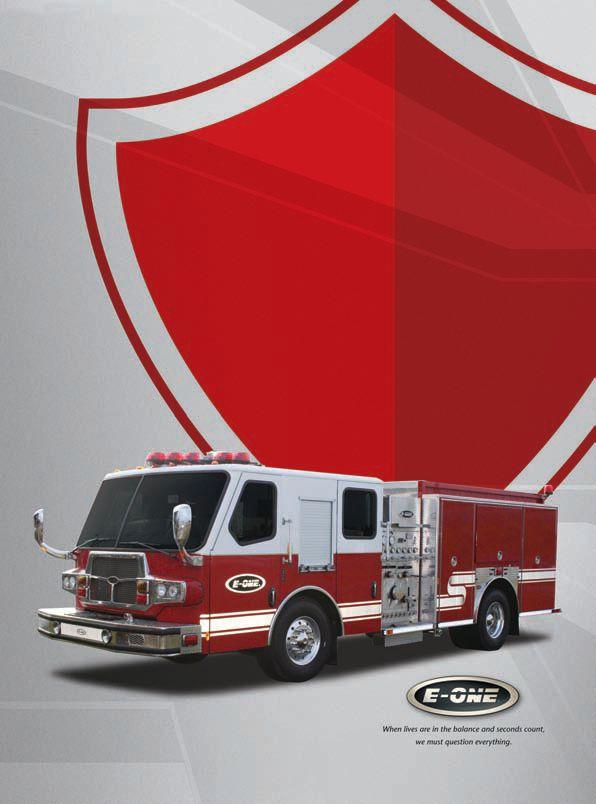
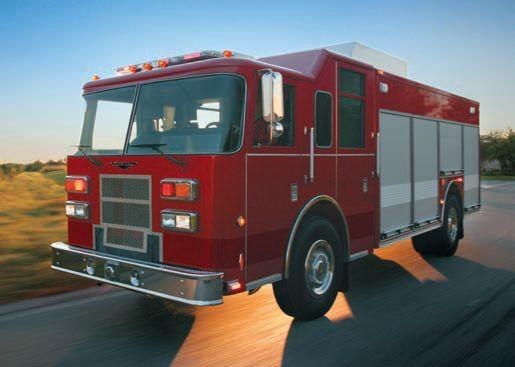
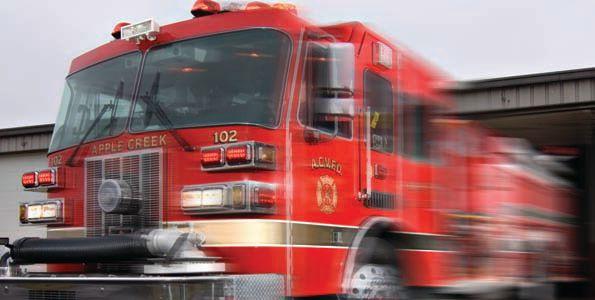
When the most hazardous part of the emergency can be getting to the scene, you need a vehicle that is safe by design. Utilizing a cab built with heavy-duty perimeter roof extrusions supported by twin vertical columns, the E-ONE Quest is designed to keep occupants safe in the event of a roll-over. And while in route, have added confidence with G4, our exclusive electronic stability control system. Also available are our new tethered seats with integrated seat belts and roll-over protection system. Get behind the wheel of the Quest and experience the protection of an industry benchmark.

at

GADGETS GALORE
James Careless surveys the industry for the latest and greatest in fire-service technology. 16
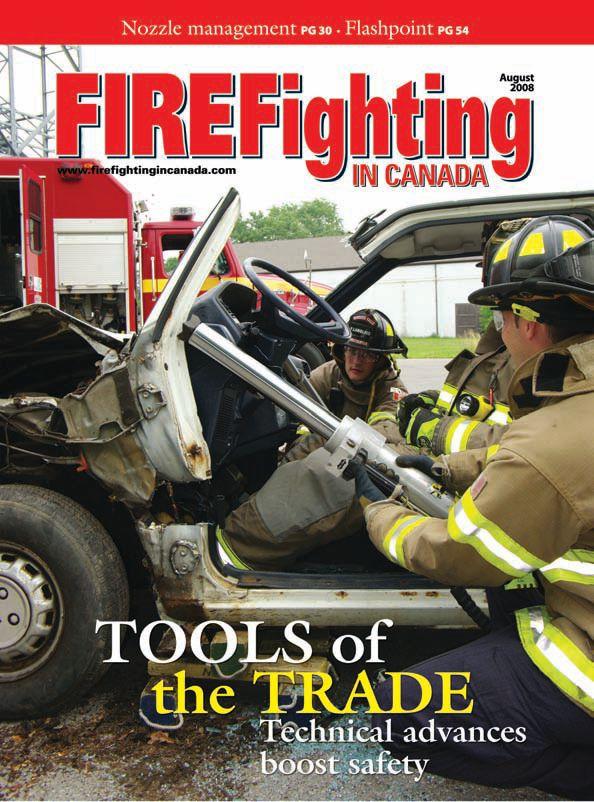
TOOLS OF THE TRADE Extrication specialist Pete Methner looks at Hurst’s new Streamline technology line and some other new trinkets unveiled at FDIC in Indianapolis.
26 ONLINE TRAINING
Dan Haden says online training is the most modern educational tool in the fire department training arsenal. Learn how to develop an online program for your department.
30 BACK TO BASICS: NOZZLE MANAGEMENT
With the advent of the pistol-grip nozzle, everybody became a cowboy. Training officer Mark van der Feyst reviews proper handling techniques.
44 LEADERSHIP CHALLENGES
Prince Alberta, Sask., Chief Les Karpluk had a eureka moment about department leadership while watching Shrek with his five-year-old son. Onions, ogres and leadership challenges all have layers.
CAFSystems™
ECLIPSE™
COME TO THE BATTLE WITH
MEET THE KING OF CAFS.
Fire doesn’t stand a chance against Waterous CAFSystems™. They are the most used, most trusted and most technically advanced CAFS in the world. Couple these attributes with the best CAFS training and warranty available and you quickly understand what makes Waterous the undisputed leader. Whether it’s our ECLIPSE™ midship CAFS, cutting edge Advantus® foam system with conductivity sensor technology, the value packed Aquis® foam proportioner or any of our other CAFSystems™ or CAFS equipment, count on Waterous to deliver superior foam. Bring a better fight to the fire. Call 651-450-5000 / Visit waterousco.com.

BY LAURA KING Editor lking@annexweb.com
aving attended three regional chiefs’ association meetings in the last several weeks, a few truths became evident about the fire services in Canada. Most of them are good.
The fire services continue to be made up of, and led by, dedicated men and women who are driven by their call of duty. It’s not just a trite string of words, it’s a fact, and after 16 months in this job I am still amazed by their commitment.
That commitment fuels associations to put on annual conventions that are outstanding. I’ve heard terrific speakers, attended educational seminars and briefings and been inundated with really useful information.
The sense of community among members of the fire services is humbling. Whether it’s a chief from a volunteer department in northern New Brunswick, or from one of the largest metropolitan departments in Canada, or a guest speaker from a department in the United States, you all share the same passion and goals for your job.
Certainly the Canadian Association of Fire Chiefs is aware of these issues and has passed many a resolution, on things like the need for a national fire advisor. The vision for this office is to have a place for data on fires in Canada and to take responsibility for national standards for training, fire prevention and education. The office would serve a key co-ordination role in helping the fire service respond to emergencies.
The core elements of its role have been addressed either directly or indirectly by many regional fire chiefs associations – the grassroots of Canada’s fire service.
Yet it seems to not be on the federal government’s radar – and this is a federal government that will soon be forced to face the electorate.
ON THE COVER
Niagara Falls, Ont., firefighters test new extrication tools. See page 16.
Some aren’t entirely in favour of the singular office of a national fire advisor, rather they support the CAFC and the provincial associations working through their provincial or territorial governments to bring these issues to the federal forefront.
ESTABLISHED 1957 August 2008 VOL. 52 NO. 5
EDITOR LAURA KING lking@annexweb.com 905-847-9743
EDITOR EMERITUS DON GLENDINNING
ADVERTISING MANAGER HOPE WILLIAMSON hwilliamson@annexweb.com 800-265-2827 ext. 253
PUBLISHER MARTIN MCANULTY fire@annexweb.com 1-519-429-5178 800-265-2827 ext. 252
PRODUCTION ARTIST BROOKE SHAW bshaw@annexweb.com
VP/GROUP PUBLISHER DIANE KLEER dkleer@annexweb.com
PRESIDENT MIKE FREDERICKS mfredericks@annexweb.com
PUBLICATION MAIL AGREEMENT #40065710
PAP Registration #8885
RETURN UNDELIVERABLE CANADIAN ADDRESSES TO CIRCULATION DEPT.
P.O. Box 530, SIMCOE, ON N3Y 4N5 email: sbrady@annexweb.com
Periodical Postage Paid at Buffalo NY. USPS 007-276, ISSN 0015-2595. Published eight times per year (Feb., March, May, June, Aug., Sep., Nov., Dec.) by Annex Publishing & Printing Inc. U.S. Office of Publication c/of DDM Direct.com, 1223 William St. Buffalo NY 14240. U.S. Postmaster send address change to P.O. Box Niagara Falls Ny 14304.
Printed in Canada ISSN 0015–2595
CIRCULATION
e-mail: sbrady@annexweb.com
Tel: 866-790-6070 ext. 206
Fax: 877-624-1940
Mail: P.O. Box 530 Simcoe, ON N3Y 4N5
SUBSCRIPTION RATES
Canada – 1 Year - $25.44 (includes GST - #867172652RT0001)
USA – 1 Year $50.00
We acknowledge the financial support of the Government of Canada, through the Publications Assistance Program and the Canada Magazine Fund, toward our mailing and editorial cost. Nous reconnaissons l’aide financiere accordee par le gouvernement du Canada pour nos coults d’envoie postal et nos coutl redactionnels par l’entremise du Programme d’aide aux publications et du Fonds du Canda pour les magazines.
Take my word for it – that sort of commitment is not the standard in other walks of life.
Having said that, it also occurred to me in my travels after talking to a chief or deputy that, “gee, this sounds familiar.”
Regardless of the region, firefighters share the same challenges. Training budgets are thin and professional development opportunities are sometimes few and far between. Equipment is aging and budget allocations to replace it are stressed. Co-ordination with other emergency responders could be better.
So, if the fire services share common problems, maybe there needs to be a renewed focus on bringing the collective muscle of the regional associations to bear in pushing for change.
Either way, it’s time for the grassroots to be heard. A concerted campaign, perhaps co-ordinated by the national association that is populated with all those regional chiefs, could make some noise.
Write your Member of Parliament. Invite your member of the legislature to come to your fire station. Show them what you’re dealing with. As the kids say, make it real.
Editors are supposed to avoid clichés. I’m making an exception.
Squeaky wheels get the grease.

From time to time, we at Fire Fighting In Canada make our subscription list available to reputable companies and organizations whose products and services we believe may be of interest to you. If you do not want your name to be made available, contact our circulation department in any of the four ways listed above.
No part of the editorial content of this publication may be reprinted without the publisher’s written permission @2008 Annex Publishing & Printing Inc. All rights reserved. Opinions expressed in this magazine are not necessarily those of the editor or the publisher. No liability is assumed for errors or omissions.
All advertising is subject to the publisher’s approval. Such approval does not imply any endorsement of the products or services advertised. Publisher reserves the right to refuse advertising that does not meet the standards of the publication.




























































The Regional District of FraserFort George unveiled its new fire and life safety house and mobile emergency operations centre in July. The 39-foot trailer serves a dual purpose for the regional district, providing fire safety training and emergency response support.
Donna Munt, regional district manager of public safety, says the unit will assist in responding to emergencies in the rural parts of the region.
“The Mobile Emergency Operations Centre will act as a base for staff and incident
command personnel. Over the coming year, the regional district will focus on installing additional communications and other equipment to continue improving its usefulness for emergency response,” Munt said.
The regional district of Fraser-Fort George invested just over $90,000 in the fire and life safety house and mobile emergency operations centre. The costs were offset through the support of corporate and community organizations such as BC Hydro.
James Baxter, chairperson
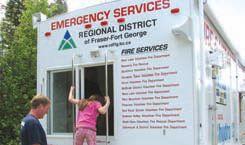
of the regional district’s fire and life safety working group says the new fire and life safety house is the only one of its kind in B.C.
“It will be a valuable tool for all the volunteer fire departments in the Regional District of Fraser-Fort George to help them better promote and teach their fire and life safety messages,” says Baxter.
Norfolk County Fire & Rescue Services has charged the owner of a property with failing to install a smoke alarm. After investigating a burn complaint on July 8, it was discovered that several large families were living in various buildings on the property. After closer
examination, three of the four buildings used for residential purposes did not have any smoke alarms. The other house on the property did not have the required number of alarms – one on each level.
The property owner was issued five provincial offences tickets for failing to install smoke alarm as required. The
DON JOLLEY has been appointed fire chief of the City of Pitt Meadows, B.C. Jolley recently left Langley City, B.C., after two years as deputy chief to assume the position in Pitt Meadows. Jolley began his fire services career in 1990 as a volunteer with Pitt Meadows and became full time in 2001 as assistant

chief/training. Pitt Meadows, a city of 17,000 in the Fraser Valley, approximately 50 kilometres east of Vancouver, operates one fire
fine for each smoke alarm offence is $235, totalling $1,175.
Meantime, a Niagara Falls landlord convicted a second time of failing to maintain smoke alarms in his buildings has been fined $17,500. A fire in a rental property caused more than $100,000 damage. Two rental units in the home
were occupied at the time but there were no serious injuries.
The Niagara Falls Fire Department determined that the first floor unit did not have a working smoke alarm. The defendant pleaded guilty to failing to maintain the smoke alarm in operating condition. He had been fined $5,000 in 2004 for failing to maintain smoke alarms in another rental unit.
station with a composite crew of 40 members. Pitt Meadows responds to more than 500 calls a year including FR medical. Jolley took over from Chief Bill Park, who retired June 20, after almost 30 years with the department, the last 10 as chief.
Fire Chief DAN HEYDON of New Tecumseth Fire Rescue in Ontario is please to announce several recent promotions. New
Tecumseth is a composite department consisting of 105 volunteer firefighters, a full-time chief, deputy chief, fire prevention officer and administrative assistant.
Station 1, Alliston: JERRY FULLERTON has been promoted to captain. He has been a member of the department since 1988 and will be celebrating 20 years of service in September. Prior to moving to Alliston four years ago,
The Ontario Association of Fire Chiefs is applauding the provincial government’s initiative to mandate automatic sprinkler systems in newly constructed condos and apartment buildings that are higher than three storeys.
“This is an important first step and we commend the McGuinty government for moving forward,” said Richard Boyes, President of the Ontario Association of Fire Chiefs.
“Ultimately, we would like to see sprinklers being made mandatory in all new residential units including single-family dwellings, townhouses, and low-rise buildings.”
Over the past seven years in Ontario, there has been an average of 28,569 fires per year resulting in 101 deaths, 862 injuries and $414.3 million in property damage annually.
The changes to the Building Code will come into effect on April 1, 2010.
“Those opposed to mandating sprinklers have said they’re concerned about the costs and the impact on the prices of new homes,” Boyes said. “But the same was said about seat belts and air bags in motor vehicles, and today these devices are recognized as essential life-saving equipment that no one would do without.”
-OAFC
The Alberta Fire Chiefs Association has noticed an increase in abuse of the possession and discharge of family fireworks, which results in fires and personal injury.
This issue was addressed in a resolution at AFCA’s 2006 conference and raised again at the 2008 conference in June. Alberta Municipal Affairs Minister Ray Danyluk has directed his department to investigate and bring forward changes to address this issue.
A case in point: RCMP in Bonnyville, were looking for tips
after someone stuffed a firework into a drunken man’s pocket, setting him on fire, on May 4. “This is a prime example of the abuse and danger from socalled family fireworks that have become so easily available in Alberta,” said AFCA President Brian McEvoy.
The AFCA believes the sale, possession and use of family fireworks within Alberta should be prohibited. The 2006 Fire Code was supposed to clean up the issue of fireworks in Alberta. Instead, it has made the issue even more confusing.
-AFCA
■ ALBERTA
The Alberta Fire Chiefs Association supports the Canadian Association of Fire Chiefs as they urge Parliament to give speedy passage to a bill that would give a tax incentive to volunteer emergency workers, including firefighters.
Bill C-219 was introduced earlier this year by Wayne Easter, MP for Malpeque, P.E.I., to provide a tax credit for volunteer firefighters who are not paid but have performed a specific number of hours of service, signed off by their municipality. They would be allowed to deduct $1,000 annually from their taxable income if they performed at least 100 hours of volunteer service; $2,000 if they performed 200 hours or more. The bill was recently passed by the standing committee on finance and will go to the House of Commons for third reading.
Current tax regulations are confusing and in some cases can cost a volunteer money at tax time for volunteering.
“In Alberta, approximately 77 per cent of the estimated 13,000 firefighters are volunteer and these firefighters provide protection to well over 90 per cent of Alberta communities,” said Brian McEvoy, president of the Alberta Fire

Chiefs Association.
Volunteerism is a fundamental value across Canada and all such work is very important to our society. However, firefighting is essential to protect lives, homes and businesses. It is becoming increasingly difficult to recruit volunteers, as many, especially in smaller communities, are self employed, causing a negative impact on their businesses when they are called out for an emergency. Failure to provide incentives to promote recruitment may force small, cash-strapped municipalities to consider the difficult option of reducing fire service levels.
“These are not service clubs but essential services to our communities. If no one shows up for an Elks meeting they reschedule the meeting. You can’t reschedule an emergency,” McEvoy said “This is why recruitment and retention was a focal point at our annual conference in Edmonton.
“Volunteer firefighters are one of the best deals available to municipalities, and the Alberta Fire Chiefs Association supports the Canadian Association of Fire Chiefs in urging Members of Parliament and the Senate to give speedy passage to Bill C-219.” -AFCA
he was district chief at Station 2 in Beeton. KEVIN RODWELL has been promoted to captain. He joined New Tecumseth in August 1997.
Station 2, Beeton: STEVE MARTIN has been promoted to captain. He joined New Tecumseth in June 2001. ERIC STEELE has been promoted to captain. He joined New Tecumseth in October 2002.
Station 3,Tottenham: KEITH LEWIS has been promoted to assistant district chief. He joined New Tecumseth in October 1986 and has been a captain since June 2000. His duties include administration and training. PAUL ECKER has been promoted to captain. He joined New Tecumseth in March 1999. GLENN TINK has been promoted to the captain. He joined New Tecumseth in 1997 and has been a fire inspector since 1999.
ROB HAYWARD has been promoted to the position of fire inspector. He joined New Tecumseth December 1999.
Fire Chief (retired) RONALD E. BENNING died suddenly on May 30 2008, at the age of 75. Chief Benning joined the Weyburn Fire Department in Ontario on Oct. 1, 1959, and was a charter

member of IAFF Local 2989 in 1985. Promoted to fire chief in 1988, he retired in February 1993 after 33 years of service.
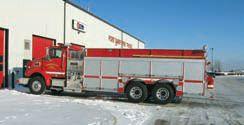
THE SUMMERVILLE FIRE DEPARTMENT in Hants County, N.S., took delivery in December of a Fort Garry Fire Trucks built 2500-gallon tandem tanker on a Sterling LT9500 chassis with a Cat C13 430hp engine, an Allison 4000 EVS transmission, made of full-framed saltwater marine grade aluminium with a Darley LDM 1500 pump, and a Foam Pro 2001 Class A foam system.
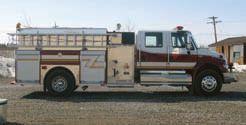
THE VALE-INCO FIRE DEPARTMENT in Thomson, Man., received a Fort Garry Fire Trucks built pumper in December with an International Durastar chassis, a Maxxforce 9, 330-hp engine, an Allison 3500 EVS transmission, a Darley PSP 1250 pump and a Foam Pro 2001 A and B foam system.
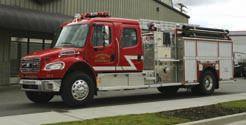
THE DASHWOOD FIRE DEPARTMENT in B.C. under the direction of Chief Nick Acciavatti took delivery in June of a HUB-built apparatus built on a Freightliner M2 chassis with a Cummins ISC engine, a 300-hp pump, an Allison 2500 EVS transmission, a 1,500gallon co-poly water tank, a Newton 10-inch electric dump valve and HUB swing-down porta tank storage.
Look for Upsala, Ont., Fire Chief Tim Beebe’s monthly Spontaneous Combustion column for a humourous look at some serious fire-services issues.

Have your say in our regular Fire Fighting in Canada online polls. In our early July poll, more than 88 per cent of you said your department is using apparatus that are more than 15 years old. Tune in regularly for new polls.
Check in daily for breaking fire-service news from coast to coast to coast.

BLOG
For strong and sometimes controversial opinions on fire-service issues, check out Peter Sells’ Flashpoint blog. Click on Blog or Web Exclusives.
DIGITAL MAGAZINE Visit www.firefightingincanada.com to sign up for your free digital issue.


EVENTS
Sent us your event and have it posted on our comprehensive list of conferences, workshops and association meetings.
Facing the unknown at every turn, firefighters need to have confidence in their gear. That’s why our scientists rigorously test our CROSSTECH® Products — so firefighters can focus on the hazards in their environment.
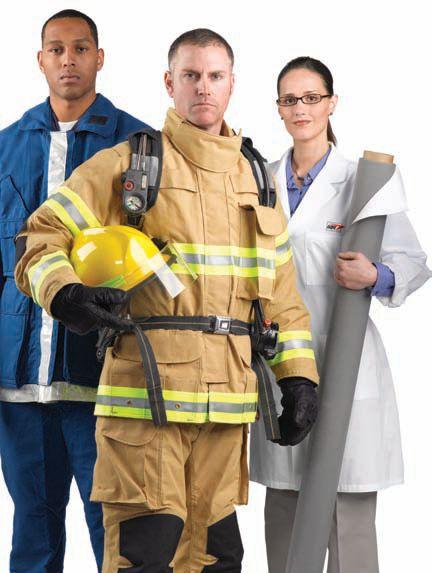
Our fabrics reliably provide maximum heat stress reduction and durable liquid penetration protection. The barriers of choice for firefighters, EMTs, and law enforcement professionals, CROSSTECH Products have been tried, tested, and proven like no other.
Firefighters are relentless in doing their duty. We’re relentless in giving them the best possible barrier for their gear.
Everyone knows that when you buy a computer it’s practically obsolete by the time you plug it in at home. Fire-related technology is no different – it’s constantly evolving, especially in areas such as communication/dispatch and incident management. Herewith, a primer on some new tools of the trade. Some are blue-sky items that most departments are never likely to see let alone afford, but it’s always fun to window shop. Others are more budget conscious and practical.
■ FIRE SURVEILLANCE AND MONITORING
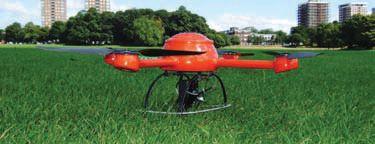
To keep an eye on developing fire situations, the United Kingdom’s West Midlands Fire Services (WMFS) flies its own micro-unmanned aerial vehicle, specifically, a Microdrone, sold by Prolity Corp. (www.prolity.com) of Ottawa. Equipped with four helicopter-style rotors – each at the end of a cross formation, with the Microdrone’s main fuselage/skids in the centre – this remotely controlled UAV is equipped with a video camera (visible light/infrared). It broadcasts what it sees back to the operator in real time. The German-made Microdrone also has an onboard GPS so it can relay its exact location back to base at any time. This is particularly helpful when the Microdrone is used to spot fires and to search for missing persons in remote areas.
“We are currently working with the federal government to get the Microdrone certified for use in Canada,” says Prolity CEO Michael Raz. “In the U.K., WMFS uses their Microdrone with an onboard video camera and a high resolution digital still camera for capturing detailed images at incident scenes.”
Keeping track of on-scene resources is a major headache for incident commanders, especially at fast-developing mutual aid scenes when new equipment seems to be arriving all the time. To provide commanders with a realtime briefing of equipment deployment, SRI International www.sri.com has developed the Mobile Mesh Communications System. This
Keeping up with advancements expensive but beneficial
By JAMES CARELESS
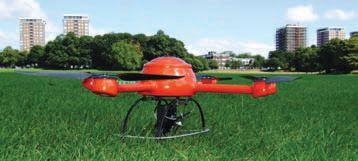
TOP: The Microdone unmanned aerial vehicle can be used to spot fires. It is not yet certified in Canada but is available through Ottawa’s Prolity Corp.
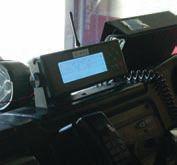
ABOVE: WiPath’s WDT300 Mobile Data Terminal is rugged for use in first-responder vehicles and has ports for a GPS printer and bar-code reader.
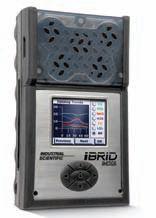
ABOVE RIGHT: Industrial Scientific Corporation’s MX6 iBrid multi-gas monitor – one of several new gas monitors on the market – can detect from one to six gases including oxygen.
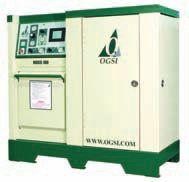
RIGHT: Medical Oxygen Generating System’s MOGS-50/100 can fill high-pressure cylinders up to 2200 psig and provide a direct oxygen flow at up to 80 psig.
approach begins with dual band (4.9 GHz and 5 GHz) radios installed in each truck, with each radio relaying its GPS-determined location and identity in real time. This data is then displayed on the incident commander’s laptop, letting him see at any given moment where everyone is on scene.
Redundancy note: The MMCS Mesh technology means that any Mesh radio within the system can communicate with any other Mesh radio in the system, rather than all of them having to go through one central gateway as conventional LMR radios do. As a result, the signals travel between radios by whatever path is most readily available. As well, should one radio in the network fail, the signals will simply go through all the rest.
Industrial Scientific Corporation’s MX6 iBrid multi-gas monitor has been CSA approved for use in Class I, Group A, B, C and D hazardous locations, both in diffusion mode and with an integrated sampling pump. Equipped with a full-colour LCD display, the MX6 iBrid provides clear readings in low-light or bright-light conditions. It also supports onboard graphing and a menu-driven PEG (Portable Embedded GUI) operating system. This means that an MX6 user can work through various instrument functions using an intuitive menu and the MX6’s five-way navigation button.
The MX6 can detect from one to six gases including oxygen. Add a photo-ionization detector (PID), and this device will detect unknown toxic hazards or volatile organic compounds. Find out more at www. indsci.com.
■
When hazardous gases escape during an incident such as a train derail-





ment, chemical spill or nuclear steam release, projecting their path is of vital importance. To make this process simple, Keigan Systems of London, Ont., has developed CLEER-Impact Plus. Available online at www.cleerimpact.com, this service lets you enter the type of incident and the wind direction. This program then displays the projected dispersion path using Google Maps.
CLEER-Impact Plus requires an annual subscription payment if you want to use its full customization tools. However, you can run a few pre-set scenarios for free at its website to get a better sense of this tool.
■
WiPath’s WDT3000 Mobile Data Terminal (www.wipath.com) costs about the same as a consumer laptop, yet it has been made more rugged for use in first-responder vehicles. Physically, the WDT3000 is mounted on a pedestal. It has a QWERTY keyboard in its lower half, and a 240 x 64 graphical sunlight readable display in its upper half. This means the WDT3000 works akin to an older DOS text-based computer, and has input ports for a GPS receiver, printer and bar code reader.
Meanwhile, WiPath’s PDT2000 Paging Data Terminal lets firefighters in the truck see incoming one-way pages from dispatch on a large LCD screen. Hard copies of the pages can be generated using an attached thermal printer, ensuring that there will be no misunderstandings in the field. You can find more about the WDT3000 and the PDT3000 at www.wipath.com.
■ EASY-TO-USE RADIO INTEROPERABILITY
Need an affordable way to get incompatible radio systems to talk to each other on-scene? Consider the ICRI (Incident Commanders’ Radio Interface) made by Communications-Applied Technology.




Dollar for dollar, the ICRI is one of the most inexpensive, easy-to-use interoperability solutions you can buy.
For instance, for about $6,000, the basic ICRI will interconnect up to six different radios and telephones – just plug them into the ICRI box – and pass audio among them. ICRI models can also be purchased in cheaper two-input models that are often sufficient if your local fire department can’t talk to local police – or up to 10 inputs from varying radios, telephones and satellite phones. These units even come in a back-packable model, and there’s a version with a cable reel that can be used as a quick-setup repeater. More at www.c-at.com.
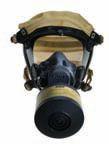
The National Institute of Occupational Health and Safety (NIOSH) has approved Scott Health & Safety’s AV-2000 facepiece for use either with a CBRN-approved air-purifying respirator (APR) or CBRNapproved SCBA equipment. This means that fire departments can use the AV-2000 both as a gas mask or respirator mask, and change from one application to another without using tools. This dual use will allow departments to keep fewer facemasks in stock and on trucks and reduce the cost of future replacements for APR/SCBA tasks. More at www.scotthealthsafety.com.
For those times you have to haul SCBA tanks, Groves’s new SCBA and rescue bags can make this tough job easier and safer. The bags are fitted with hard plastic bases and rigid sidewalls to protect the air tanks, which are housed individually in their own compartments. These bags have two heavy duty handles and an
over-the-shoulder strap for easier carrying, plus a reflective silver stripe for higher visibility. Groves’s SCBA bag holds two air tanks and the rescue bag hold three mini lifting bags, one SCBA cylinder, a controller and regulator and three 50-foot coils of hose. Details will be available shortly at www.readyrack.com.
To provide backup communications on a budget – including reaching into areas outside the range of your primary radio network – consider equipping your department with Mike Direct Connect Push-to-Talk wireless handsets.
Offered by Telus, Mike Direct Connect handsets operate on a network separate from the one used by the company’s Telus Mobility subscribers. This provides first responders with priority access during high-traffic periods. Mike Direct Connect also allows users to create their own talk groups, and to operate across the entire Mike national network and into the U.S. by roaming to Sprint.
The rugged Mike i570 handset meets U.S. military specifications for resistance to dust, shock, vibration, high and low temperature, low pressure and solar radiation, and costs $99.99 on a three-year contract. More at www.telus.com.
Finally, if your department has a requirement for medical oxygen on an ongoing basis, you may be able to save money by manufacturing it yourself, using an OGSI MOGS-50/100 Medical Oxygen Generating System. According to OGSI (short for Oxygen Generating Systems International), this MOGS-50/100 can fill high pressure cylinders up to 2200 psig and provide a direct oxygen flow at up to 80 psig. More data at www.ogsi.com.
Technical advances boost safety
By PETE METHNER
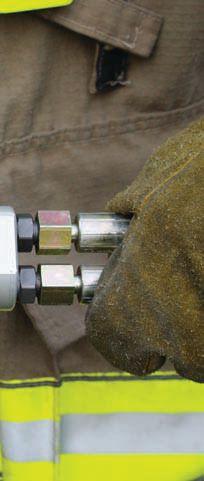
At the Fire Department Instructors Conference in Indianapolis in April, many firefighters had the opportunity to participate in the hands-on-training, or HOT, sessions. One of the areas I focused on was the hydraulic tool displays by the various rescue companies. This year, IDEX released its new Hurst Jaws of Life Streamline technology a comprehensive and advanced product range for technical rescue. Hurst has combined pneumatics, hydraulics, shoring and stabilization products and the Streamline technology provides the first complete product package with a reliable range of rescue tools that are faster, easier and safer to use.
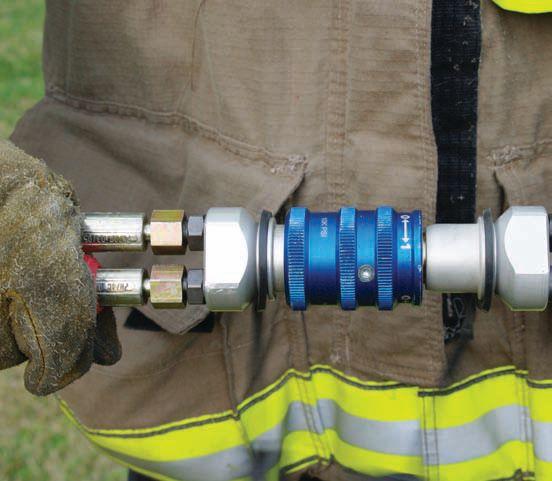
The Streamline technology coupling combines the advantages of single coupling and two-hose systems, simplifying the connection and disconnection with one single coupling. This single coupling eliminates miscommunication between rescuers when calling back to the pump to dump pressure or to apply pressure at the power unit.
The Streamline coupling can be disconnected and connected under pressure. The advantage I found with this type of coupling is that you can still monitor and inspect both pressure and return lines to the power unit.
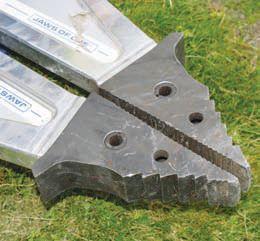
INSET: Among Hurst’s new tools for 2009 is its Streamline
Unlike other technology, burst pressure on both hose couplings exceeds 44,900 PSI, which is very impressive.
The other nice feature is that the coupling can be rotated 360 degrees and it won’t disconnect or kink the hoses.
One of the complaints I hear now and again is that couplings are difficult to change while wearing structural gloves. The Streamline coupling can be changed with gloves on and the ease of connection and disconnection is impressive.
A more important feature that I like is that you can still run up to 100-foot hose lengths off of the hose reel and the coupling can be retrofitted to your existing Hurst high-or low-pressure system. That means departments do not need to buy
new tools just to acquire these new couplings, rather older tools can be retrofitted for a small cost.
These Streamline couplings have an integrated pressure control valve, which makes dumping pressure obsolete.
And luminescent hoses now facilitate working in low-lit areas, which, again, are covered again by a 4:1 burst ratio.
Another feature that is not new to Hurst this year but has become standard is the Streamline Star-grip control valve that allows operators 360 degrees of safety while operating the tools and eliminates worry about pinched hands. This Star-grip control can be operated with only a one-quarter inch turn anywhere on the handle.
Hurst’s new SP310 Streamline spreader has a multifunctional tip that can be used for spreading, peeling, pulling and squeezing without having to change the tip. It is the largest tip in the industry and has a flared base to ensure that the metal you are spreading against stays off of the tool arm.
The more aggressive serrated face of the tip will ensure a grip that prevents the tip from slipping toward the patient when opened fully.
The SP310 also has a nice balance between 57,500 pounds of spreading force at a distance of 28.3 inches and a weight of just 43.2 pounds. This tool would work great for auto, bus and heavy truck extrication.
The SP512 spreader is a little smaller in length and offers up to 121,400 pounds of spreading force at the tip. With a smaller spreading distance of 24 inches, it weighs in at 57.1 pounds.
The larger, Streamline S510 heavy-duty cutter will cut any A, B, C post and sideimpact bar on today’s modern passenger vehicles with ease. It offers a cutting force of up to 169,000 pounds, weighs 42.3 pounds and has an opening of 7.2 inches. It will tackle any large rescue incident involving rail, aircraft, naval or natural disasters as well as military or armoured scenarios. With a faster opening time, this tool is quick to deploy when needed as either a firstresponse tool or a support tool.
The Streamline technology will offer as many as six different cutters with force ranging from 41,000 to 236,000 pounds.
Hurst is also the first to launch the Triple Stage Rescue Ram. It’s small – just 18 inches long when stored – lightweight and has high resistance against lateral load.
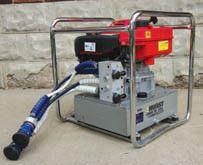
Hurst’s
It has the capability to extend 32 inches and push up to 30 ton in the first stage, 14.5 in the second stage and 4.5 tons in the third stage. It would be an asset in building collapse and disaster management. Streamline technology also offers both single-and dualpiston rams in different lengths.
At the heart of all this new technology are,
of course, Hurst’s power units. With singletool operation and the larger simo and trimo units, the biggest advantage is that tools do not have to be disconnected while in motion. The operator of each tool also doesn’t have to wait for the pressure to be dumped and doesn’t have to worry about stealing power from the other tool.
The simo and trimo units each have separate pumps within the body of the reservoir. This has no effect on the other tools. The power units deliver 10,150 pounds of operating pressure and are still the lowest in the high pressure systems.
Another new product courtesy of Hurst and the auto manufacturers that will benefit rescuers is the crash-recovery system. Hurst provides the computer program on a DVD that can be loaded onto you department’s in-cab computer or onto a laptop. At an accident scene, simply type in the make and model of the vehicle and rescuers have quick and easy access to important details.
The system will tell you where the battery is located and provide information on air bags, including the number of airbags in the vehicle and the module location. Rescuers can also access a dissected view of the vehicle and all the safety systems in place.
Another manufacturer, Genesis, launches its new All 9 cutter this year. It is made of highstrength aircraft aluminium and aluminium alloy forgings and has a wear-resistant anodized finish. The blades on the All 9 Cutter are made of forged steel.
The All 9 cutter had a D handle that can rotate 360 degrees or be removed when working in confined spaces, and it has a variable speed deadman control with load-holding capabilities and an over-pressurization relief.
The All 9 cutter produces more usable force at the centre and root of the blades. This force is available at the beginning of the cutting cycle when it is needed most.
The All 9 cutter also comes with a rechargeable LED lights that are built directly into the guard. It has a blade opening of 7.1 inches and a maximum cutting force of 231,000 pounds. It weighs 48.3 pounds and operates at 10,500 pounds of what?
I am waiting for the Genesis All 9 cutter to arrive so I can field test it.
Whatever rescue tool you use, use it safely and wisely. Rescuers must know their tool limitations before attempting to spread or cut through today’s technology.
• Sets up in under 2 minutes
• Eliminates setting up time-consuming pulley systems
• Reduces number of rescuers needed topside (2 people can do the work of approximately 8-10 used in traditional rope rescue)
• Dramatically reduces complexity of any rope rescue
• 1,000 lb. working capacity with a 10:1 safety margin
• Instant stop with zero shock loading
• Rope automatically aligns with the direction of the load
• Precise control allows a load to be raised and lowered a fraction of an inch at a time for critical positioning
By ED BROUWER
Irecently returned from speaking at the 14th Annual FDIC Atlantic, hosted by the Nova Scotia chapter of the International Society of Fire Service Instructors and the Maritime Association of Fire Chiefs. My sincere thanks goes to the men and women who laboured behind the scenes to provide what was, hands down, the best training conference in which I’ve been involved.
I was very pleased to see the interest in wildland urban interface fires, which was the subject of my workshops. My main focus, as is normally the case, was on firefighter safety.
Fighting fire in the interface is not as simple as blending structural and wildland firefighting agencies. We need a better understanding of fire behaviour, due to the complexities of wildfire in the interface. WUI fires offer very unique suppression challenges as well as firefighter safety concerns. One minute of wind direction or speed change and lives can be lost.
Firefighters can’t always contain wildfire in the interface, therefore, staying safe means being diligent about assessing the fire scene, anticipating worst-case scenarios and changing tactics accordingly.
The ability to size up an approaching wildfire that threatens life and property requires quick thinking and vital decision-making skills – skills that can only come from good training and experience.
Multiple ignitions, extreme fire behaviour, entire neighbourhoods involved, a mixture of natural and human-made fuels possibly including hazardous materials – add into that mix the emotional charge brought on by the evacuation process and it is easy to become overwhelmed.
As on any fire ground, there needs to be a continual sizing up of the incident. The following article from the California Department of Forestry and Fire Protection proves how quickly things can change in a WUI fire. The only constant is change.
On October 29, 2003, a 38-year-old male career firefighter (the victim) was killed and a 48-year-old male career captain was severely injured when fire overran their position. The incident occurred during the protection of a residential structure during a wildland fire operation that eventually consumed more than 280,000 acres.
The victim and his crew were part of a task force assigned to protect a number of residential structures located along a ridge on the flank of the fire. The victim’s crew was in the process of preparing to defend the structure when the fire made a slope and wind-driven run through heavy brush directly toward their position. The crew retreated to the residential structure to seek refuge from the oncoming fire. Two of the four crew members were able to get into the structure while the Captain was attempting to assist the victim as the fire reached their position. The victim died near the structure and the Captain, who was seriously burned, had to be assisted into the structure by the other crew members.
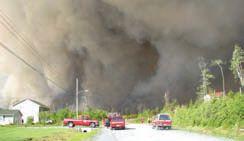
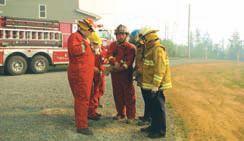
Firefighters from the Halifax Regional Fire Department were put to the test in June when a massive wildland urban interface fire forced the evacuation of more than 5,000 people in Porters Lake / Lake Echo, N.S.
■ Lookouts, communications, escape routes, safety zones.
■ 10 standard firefighting orders.
■ 18 situations that shout “watch out.”
■ Incidental issues for review.
■ Review structure protection triage procedures.
■ Ensure all personnel are briefed on fire weather watches and red flag warnings.
■ Review structure-protection tactics.
■ Complete a risk-verses-gain analysis while in a wildland urban interface operation.
The words “a slope and wind-driven run” describe the fire changing gears. Let’s say the fire was moving (rate of spread) at a rate of 10 metres per minute. As it hit the slope, the ROS would double for every 25 degrees of increase in slope. Our fire, with a 50-degree increase, would now have a ROS of 40 metres per minute. Add to this the wind factor. For every 13 kilometres over the original wind speed, the ROS doubles. These firefighters were directly in the path of a rapidly moving fire, driven by wind and supercharged by convection and preheated fuels. If they didn’t have escape routes and safety zones in place before this change in fire behaviour, they certainly didn’t have time to come up with them. We must implement LCES: Lookouts; Communications; Escape Routes; and Safety Zones.
The following news story from Firewise Wildfire News & Notes 2006 address this safety concern as well.
Deaths challenge firefighting strategy
On October 26, 2006, five USFS firefighters were entrapped while engaged in structure protection operations on the Esperanza Fire in Riverside County, California. Three firefighters were killed at the scene, one died en route to the hospital and the fifth died on October 31, 2006. All deaths were the result of burns received at the incident.
The fire produced a rapid rate of spread with extreme fire behavior conditions with wind dominancy. These conditions displayed increased spotting potential with flame lengths of up to 30 metres. A rate of spread of 32 km/h was observed on level terrain. Wind and slope alignment produced a greater rate of spread to 64 km/h that caused temperatures to exceed 660 C ahead of the fire front. A convection column of up to 5486 metres occurred.
At approximately 0620 hours, the branch director meets with E57 at 15400 Gorgonio View Road. At an unknown point in time after the branch director left, E57’s crew deploy a portable pump at the swimming pool to the west of the main residential structure and attach a 1.5-inch hose line, which is laid out to the east side of the residence. A 1.5-inch hose line was attached to a rear discharge of E57.
At 0640 hours, the branch director contacts the operations section chief and the Twin Pines structure group leader to advise them of extreme fire spread upslope toward Twin Pines Ranch Road. He advises them to start evacuations. At 0700 hours, the fire burns up the Twin Pines drainage and crosses Highway 243 south of Twin Pines Ranch Road and is described by the branch director as having very extreme fire behavior with multiple spot fires. Slope and wind alignment in conjunction with multiple spot fires resulted in an area ignition event. These conditions developed a headfire run to the northwest and to the ridgeline. The winds exceeded 80 km/h. The speed and intensity of this fire run overwhelmed the crew of E57. At approximately 0745 hours, a search for the crew of E57 began. At approximately 0800 hours, emergency medical treatment was rendered to the survivors.
We need to put more emphasis on fuel mitigation, pre-planning and cross training before fire season as a way to reduce a fire’s impact and to allow firefighters to know what to expect.
Consider sharing the preceding articles with your members and do some brainstorming.
Divide into groups and drive out to various local WUI locations. Ask each group to do a size-up report and discuss your discoveries back at the hall.
Ed Brouwer is the chief instructor for Canwest Fire in Osoyoos, B.C., and the training officer for West Boundary Highway Rescue. The 19-year veteran of the fire service is also a fire warden with the B.C. Ministry of Forests, a wildland interface fire suppression instructor/ evaluator and a fire-service chaplan.E-mail: ed@thefire.ca.

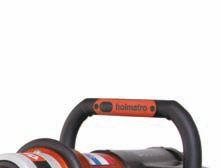
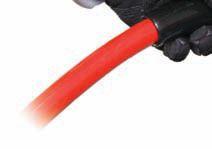
CORE Technology™ - the next major step forward. Approximately 40 years ago hydraulics were introduced into the field of extrication, and for the past 30 years, Holmatro Rescue Equipment has been at the forefront of many product technology improvements. Holmatro continuously analyzes the needs of rescuers worldwide and responds with tools to meet them.
After decades of firsts, Holmatro introduces a revolutionary new technology that is sure to be one of the most important innovations in the field of extrication ever: CORE Technology™.





This patented technology significantly reduces deployment time, makes system setup simpler and provides incredible flexibility to the rescuer, allowing them to focus on the rescue, not the rescue equipment.
Protected Power - With the high pressure hose at the CORE of the low pressure return line, it is protected from external damage, resulting in a safer hose assembly.
To find out more about this incredible new technology, visit:



BY E DAVID HODGINS Managing Director, Alberta Emergency Management Agency
lmost every day, fire claims the life of an individual somewhere in Canada. I am sure you will agree that this is unacceptable and that even one fire fatality is one too many.
What are we doing to solve this crisis? It’s time for a serious discussion about fire prevention. We all know that fire prevention and public education programs are not as sexy and do not provide the adrenaline rush generated by emergency lights and sirens. However, it is no longer acceptable to overlook opportunities to reduce fire fatalities through prevention programs while allocating more than 97 per cent of a fire department’s budget to reactive, emergency-related resources.
Here is a story that was published in May in a major Canadian newspaper. The names have been changed to obscure the fire department’s identity. A fire department’s reputation should be gauged by how well it prevents fires. A good prevention program reminds residents and commercial owners alike of the need to make sure that smoke detectors are in working order and that safety and fire hazards have been checked. The importance of fire prevention cannot be overestimated.
John Doe, a city fire-prevention inspector, told the press, “In 2007, there were nine deaths due to fires, and in eight of those cases there were no working smoke detectors. But the city’s auditor general (AG), Jane Doe, reported this week that when it comes to prevention, the city is not doing a good job. The AG’s finding should alarm city residents. On a more positive note, the fire department has been compiling data on the number of fires that have broken out, their causes, the number of deaths or injuries and amount of material damage. Unfortunately, the AG reported, the bank is rarely used. If this analysis were combined with the inventory of buildings, the fire department could direct its prevention efforts to buildings with the highest risks.”
At one time, and for some existing services, being assigned to the department’s fire-prevention program was viewed as a punishment. Management, with the support of some firefighter associations, used fire prevention as a landing place for individuals who could no longer perform response duties. Regardless of what the chiefs were saying about fire prevention, the real message was that fire prevention was not important, that any resource was better than none. It did not matter that the assigned individual had no interest in fire prevention nor in any training to perform successfully in this critical area. Given municipalities’ financial challenges, when fire department managers are directed by elected officials to cut their budgets, what area is first to be sacrificed? Fire prevention services are often reduced under the masquerade of realigning them to the fire suppression staff. That might work if the tools to perform the task were provided along with the required performance audits to ensure desired results are being achieved.
On a positive note, the president of the Alberta Fire Chiefs Association, Chief Brian McEvoy, and Edmonton Chief Randy Wolsey recently demonstrated what can be done to improve life safety and property protection. Working with senior government officials, they
At one time... being assigned to the department’s fire-prevention program was viewed as a punishment. ‘‘ ’’
It’s time to get ahead of fire tragedies. We need to get serious about eliminating the sound of sirens. Maybe it’s time to hand off the responsibility for the delivery of fire safety public education programs to the formal educational institutes. I have been involved in fire and emergency management services for 31 years and have watched fire departments secure new and improved apparatus with all the bells and whistles while almost ignoring prevention program needs. Some fire department managers point fingers and suggest others should do more to create rules to better control fires yet they ignore opportunities to be proactive in their own backyards.
David Hodgins is the managing director, Alberta Emergency Management Agency. He is a former assistant deputy minister and fire commissioner for British Columbia. A 30-year veteran of the fire service, he is a graduate of the University of Alberta’s public administration program and a certified emergency and disaster manager.
E-mail: David.Hodgins@gov.ab.ca
focused considerable efforts on program enhancements aimed at reducing fires in Alberta. Chief McEvoy and Chief Wolsey served on an Alberta working group looking at high intensity residential fires, established by the Alberta Emergency Management Agency under the direction of Municipal Affairs Minister Ray Danyluk.
The work group was established following several major residential fires in Edmonton and comprised representatives from numerous stakeholder groups. Many of the report’s recommendation spoke to public education and fire safety education as well as needed code changes.
Modern building and fire codes and the use of fire-resistant building materials are important when it comes to controlling fire once started. However, the most effective way to protect lives and property is to ensure fires don’t start in the first place. It’s time to focus your leadership priorities on fire prevention initiatives. Do it for your firefighters, their families and the public we serve.
By DAN HADEN
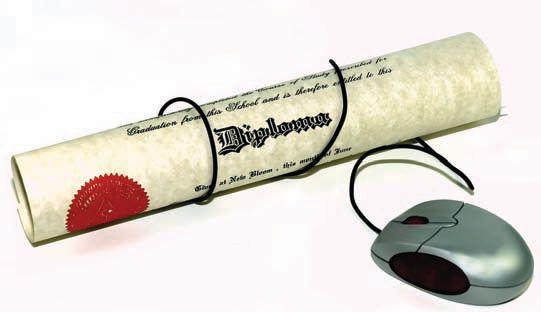
Online training is the most modern educational tool in the fire department training arsenal. Because it uses the latest technologies, it means fire departments have the ability to solve a multitude of training-related issues all at the same time. These solutions include educational needs assessment, training records management, consistent delivery, distance delivery, flexible scheduling, content related to policy, consistent and unbiased evaluation and, of course, the most important consideration – cost.
Effective training meets a need, most commonly a need to reduce risk by developing or improving knowledge and/or skill in an identified area of concern. Long before the actual content of training is designed, the needs assessment first determines the area of risk, the ability of training to resolve it, the
type and content of training required and who requires the training.
We can consider the example of mandatory legal requirement for WHMIS (Workplace Hazardous Materials Information System) training required by most, if not all provincial/territorial and even federal health and safety legislation.
Using a standardized e-mail questionnaire pre-designed for a specific workplace, we could quickly determine (by tracking addressees and responses) not only who has received WHMIS training within a given time period but also the most common chemicals being used in particular workplaces.
Computers can then generate statistics (metrics) from the results but, more importantly, they can represent these metrics graphically – which is often more meaningful. Risks can be pre-determined so that, for example, responses indicating that 38 per cent of workers had not received WHMIS
within the past 12 months could be reflected graphically as a moderate risk to the fire department. We could also break down the actual percentages of people completing WHMIS in given time periods and group them. In any event, the level of risk assessed by this tool would determine the overall (workplace generally) and specific (employee) urgency of the need for the program.
The responses would also indicate the type of chemicals most prominent in the workplace(s), which would be used to design the content of the course so that it was considerably more needs specific.
With the needs assessment indicating a moderate need of 38 per cent and prominent chemicals identified, the course content is then designed to meet the legal mandates.
The foundation for the content should be generally accepted adult education principles, including sequential learning. As importantly, content should be designed so that it regularly reviews the learner’s understanding with regularly occurring test pages.
The test pages can use any of the common measurement formats such as true or false, multiple choice or filling in blanks to measure the level of understanding.
Being able to pre-determine the preferred level of understanding and design questions that effectively measure at the desired level is an important feature of web-based online training. In educational parlance, the most common benchmark for measuring level of understanding is Bloom’s taxonomy.
According to Bloom, learning takes place at levels of understanding ranging from simple to difficult. In that order, these levels include: knowledge (basically memorizing); understanding (familiarity with what is being memorized); assimilation (assimilating learned materials into existing experiences); synthesis (learned materials become experiences sufficient to facilitate new learning); and evaluation (material is learned sufficiently to be able to critically analyze its value against other learning and experiences). It’s generally thought that higher learning (synthesis and evaluation) can only be measured through written essays.
It may be correct to assume that programs such as WHMIS do not require higher level understanding, just as it may be correct to assume that more complex and critical training (hazmat, pump operations, training officer) should require higher understanding. What’s important is that online training gives the fire service the flexibility to design training that meets these requirements.
Workplace learning should be workplace specific. It should, therefore, directly correlate to current workplace policies and practices. The easiest way to do this is to pair learning (course design and delivery) with workplace SOGs, SOPs, training notes and memos. This is a forte of training delivered online because of the ability to manage so-called “click-through” activities.
Basically, content can be designed so that the learner is required to read certain policy(ies) either as part of course content, or before being allowed to “click through” any particular page of the course. The requirement to read a particular page comes complete with the ability to require an electronic signature evidencing that the reader has read, and understood the policy, etc.
When the workplace is structured on shift-work, like fire fighting, that comes complete with irregular holiday scheduling, lieu days, sick days, etc., assuring that workers are trained can be a logistical nightmare.
This is another forte of education delivered online because it can be made available at any time convenient to the worker. The only requirement is access to a computer with Internet connectivity.
The result is a quasi-transfer of responsibility for learning to the employee-learner from the employer. At first glance, this seems somewhat like passing the buck. The fact is, however, that higher job satisfaction rates have been associated with greater control over productivity outcomes.
Online training also doesn’t depend on distance, making it the ideal distance education tool.
Online training costs are a function of many considerations, including complexity of courses and enrolment numbers. The possibilities are encouraging, however, when compared to the human resources and physical infrastructure costs of personnel required to present the same information in classroom settings over numerous shifts all tracked manually with paper and pencil.
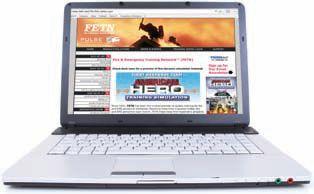
At the moment, there are two primary providers of online training in Canada, Medteq Solutions out of Guelph, Ont., and FETN, the Fire & Emergency Training Network out of the United States.
FETN primarily offers an American-based curriculum to Canadian clients with the capability to customize offerings to meet departmental needs. Users can subscribe to a 24/7 satellite service that airs the American Heat series of “incident-based, real-life training meeting NFPA standards”, Firefighting I and II, Hazmat and Technical Rescue, broad-based EMS courses through the FETN “PULSE” system, and daily news. Services also include training that is streamlined to a desktop computer through FETN’s PRIMEnet product line, which features DVOD (Desktop Video on Demand).
FETN has a library of fire and EMS courses available in web-based format with credit and accreditation through its own FETN Academy. You can learn more about FETN at www.twlk.com/fire/fetn_home. aspx.
Medteq Solutions is the Canadian affiliate of Target Safety, which calls itself “the only training partner of the NFPA.”
Medteq Solutions offers PreventionLink, which it says is “a comprehensive suite of online risk management, training, communications, and compliance systems designed exclusively for public entities.”
The Medteq curriculum is also available 24/7 online. Uniquely, Medteq has spent considerable resources modifying its curriculum to contain exclusive Canadian content, including referencing Canadian laws, regulations and standards, as well as using Canadian case studies, examples and experiences and Canadian spelling (a seemingly minor but noteworthy quality). You can learn more about Medteq Solutions by visiting www.medteqsolutions.ca or calling 866-639-8727.
When it comes to addressing risk management through online training, Canadian
Continued on page 50
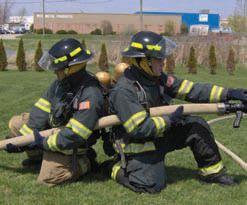
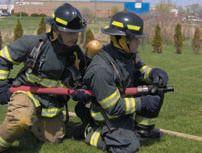
With the advent of the pistol-grip nozzle came poor and sloppy nozzle handling skills. Everybody became a cowboy or a six shooter by holding the nozzle at the hip to direct the stream of water (see the middle photo). I have seen everybody from the new recruit to the seasoned veteran hold a pistol-grip nozzle in this fashion. The nozzle with no pistol grip offers the same water delivery method as the pistol grip. The pistol-grip nozzle was designed to make it easier for one person to hold the nozzle but nobody should ever operate a nozzle alone. The pistol-grip nozzle is a good nozzle and offers many advantages. We have forgotten the basics of handling a nozzle correctly and efficiently because of the availability of the pistol-grip handle. If we stick to the basics of fire fighting or, in this case, the basics of holding and operating a nozzle correctly, we will maximize our efforts in fire suppression.
Handling a hose line requires at least two people. The reactionary forces produced by the movement of water exiting the nozzle work against the person who is handling it. This is why we always want at least two people handling a hose line. As depicted in the middle photo, the natural tendency is to hold the nozzle by its pistol-grip handle. Look at how close the nozzle is to the firefighter’s body. This firefighter will not be able to move the nozzle around to be effective. In order for him to move the nozzle up, down, left or right, he will have to move his whole body. Chances are the nozzle man is probably taking all the nozzle reaction because the backup man is not doing his job. This increases the ineffectiveness of handling or directing the nozzle up, down, left or right. The firefighter will have to move his whole body and control the nozzle reaction by holding the nozzle close to his body.
Nozzle reaction is present with any type of nozzle. The amount of nozzle reaction being produced will depend on the amount of water flowing. The more water and pres-
By MARK VAN DER FEYST
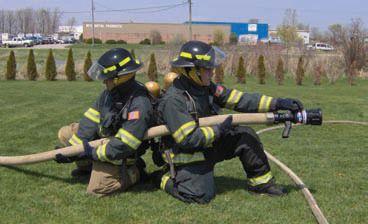
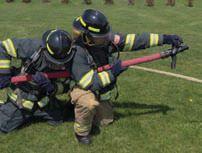
TOP: By facing backward and putting his whole back against the nozzle man, the backup man is able to support the nozzle man, extend his endurance in holding the hose line and keep watch on the conditions behind them.
MIDDLE: Holding the pistol-grip nozzle at the hip has become the norm but it is incorrect and ineffective.
BOTTOM: The foundation of proper nozzle management, with the nozzle about an arm’s length away from the firefighter.













GlobedealerorSafedesign.
For more information, call your local Globe dealer or Safedesign.
BRITISH COLUMBIA AND ALBERTA
Coquitlam, British Columbia 800-667-3362
Calgary, Alberta 800-661-9227
Edmonton, Alberta 800-222-6473
Kamloops, British Columbia 250-374-0044
Nanaimo, British Columbia 250-758-3362
Prince George, British Columbia 250-960-4300
QUEBEC
LaSalle, Quebec
800-905-0821
ATLANTIC PROVINCES
St. John's, Newfoundland
800-563-9595
Dartmouth, Nova Scotia
800-567-1955
Saint John, New Brunswick 800-567-1955
MANITOBA AND SASKATCHEWAN
Thompson, Manitoba
204-778-7123
sure being pumped, the greater the nozzle reaction. A single person cannot hold a nozzle for a long time without experiencing fatigue due to the reactionary forces fighting against him. This is where the backup man comes into play. He has an important job to do, and that job is to take the nozzle reaction away from the nozzle man. By doing this, the nozzle man will have the ability and the freedom to control and direct the nozzle.
How do we accomplish this? We attain proper nozzle management by going back to basics. Whether you have a pistol-grip nozzle or just a plain nozzle, going back to basics will work every time. In the bottom photo, we can see the foundation of proper nozzle management. Look at the nozzle in relation to the firefighter. The nozzle is about an arm’s length away from the firefighter. When his arm is fully extended, it should be able to grip the bale of the nozzle in the closed position. With the nozzle in this position, the firefighter will be able to direct the stream of water in any direction he wishes. To move the stream up, down, left or right will be a simple matter of moving the nozzle and not his whole body. Once the nozzle is open, the left hand can move onto the hose just behind the coupling to aid in the control of directing the nozzle.
Next, notice the hose in the arms of the first firefighter. The hose is up under his armpit and close to his body. His right hand is on the hose, holding the hose close to his body. He is resting his right arm on his right leg to help ease the burden of holding the hose line. This will maximize and extend the duration of handling the hose line. From this position, the firefighter will be able to flow water, direct it in any direction and advance it when needed. With the nozzle out in front of the firefighter as shown in the bottom photo, the firefighter will be able to hold onto the hose when the hose line is being pulled out. If the firefighter in the middle photo is holding the nozzle by its pistol-grip handle and the hose line is being pulled out by his crew, which is anxious to get the hose line out, he will lose the nozzle. If he is holding the nozzle as in the bottom photo, and the same zealous crew was pulling the hose line out, he will have a chance to hold onto the nozzle and not lose it – another point for safety. Advancing a hose line from this position is easier and more effective and is another topic for discussion.
The backup man in the bottom photo has an important job. His job is to support the nozzle man. We teach recruits to support the nozzle man by putting one arm on their back and one foot behind the nozzle man’s foot, as per the IFSTA Essentials book.
What does this do? It makes the picture look pretty, but it accomplishes nothing. In the bottom photo, look at the backup man’s position in relation to the nozzle man. He has his whole body supporting the nozzle man and has both hands holding the hose. By doing this, he is taking away the nozzle reaction from the nozzle man, and, at the same time, is supporting the nozzle man. (When it comes time to discuss hose line advancement, this position is very crucial in the drive of the hose line.) The backup man has to ensure that the hose remains in a straight line. By keeping the hose in a straight line, the backup man is ensuring the nozzle reaction stays with him. This will give the nozzle man the ability to direct the nozzle. Once the hose line is not kept straight, the nozzle reaction is transferred back to the nozzle man. This is crucial when the nozzle man is directing the stream left, right, up or down. Whichever direction the nozzle man decides to move the nozzle, the backup man has to synchronize his movements with him to maintain the straightness in the hose line. Notice how straight the hose line is in the top photo.
So far we have shown pictures with a 1.75-inch handline. This size of handline is easier to handle versus a 2.5-inch handline. The techniques discussed above also work for the 2.5-inch handline. In the top photo, a different technique is being used from the backup man to support the nozzle man. By facing backward and putting his whole back against the nozzle man, the backup man is able to support the nozzle man, extend his endurance in holding the hose line and will be able to keep watch on the conditions behind them at all times. Another technique for the 2.5-inch handline is for the nozzle man to put his one knee on the hose (using his whole body weight) while keeping the same amount of hose in front of him. This aids in one man having to flow a 2.5-inch handline by himself for a short duration while waiting for his partner.
By going back to the basics with our nozzle management, we will produce a better trained firefighter who will be more effective in fire stream application.
Mark van der Feyst began his career in the fire service in 1998 with the Cranberry Township Volunteer Fire Company, Station 21 in Pennsylvania. He served as a firefighter and training officer for four years then joined the Mississauga Fire & Emergency Services, where he served for three years as a firefighter and shift medical instructor. He is now the training division captain for the City of Woodstock Fire Department.

BY LYLE QUAN Deputy Chief Guelph Fire Department, Ont.
s firefighters we will face many new challenges in our careers: our first house fire; our first rescue; and even the first time we lead the way into a burning building. Fire departments throughout North America get top grades for teaching the technical aspects of the job but, with the exception of a few departments, there are no truly consistent succession planning and standard training programs to help with the transition from firefighter to officer.
This transition can be one of the most exciting times in our careers yet, at the same time, the most apprehensive. Why are we apprehensive? Because some new officers are simply given a new red or white helmet, along with a pat on the shoulder, and told to go out and lead. We know that a promotion will entail a physical change such as where we sit in the truck and how we dress. But are we prepared for the more challenging transition – the personal transition?
The physical part is easy but the personal transition will take some time and adjustment for both new officers and their subordinates. Most of us who have found ourselves in this position have planned for it and faced the challenges head on by taking courses ,whether they were offered through our department or other educational institutions, by searching out and finding a role model to emulate and from whom we were able to learn, or by going out and researching how others became good, solid team leaders through books and articles.
All of these work well, but it’s when we blend all three that we benefit the most.
Although this space does not allow me to build on each of the three methods at this time, we do have an opportunity to introduce two books that offer some solid guidance and encouragement on how to move to officer from firefighter. The fact that you are reading this column (and making notes) has already demonstrated your desire to improve and take on the leadership challenge.
year veteran of the Virginia Beach Fire Department, takes the reader through the ABCs of leadership, including the first day on the job, and lists leadership characteristics to embrace. The final chapter reflects on why leadership can fail and outlines some of the pitfalls to avoid. Sargent freely shares his experience and lessons learned during his progression through the ranks. One of my favourite leadership quotes in his book is, “You must get the right people on the bus, the wrong people off the bus, and the right people in the right seats on the bus.”
The second book, First In, Last Out, takes readers to the next level in their leadership journeys. Even though Salka talks about his move to lieutenant (and upward) from firefighter in the New York Fire Department; he pays a great deal of attention to his position as a chief officer. Salka is a 27-year veteran of the fire service and his book uses some real-life experiences that reinforce his leadership lessons. Salka addresses such issues as the foundation of great leadership, making correct decisions and getting people to be fully engaged in their work. I found his open and honest approach to leadership quite refreshing. And, because Salka shares how he learned from his mistakes, he puts a personal touch to these valuable lessons.
This transition can be one of the most exciting times . . . yet, at the same time, the most apprehensive. ‘‘ ’’
These books will offer some great insight to those about to make the move to officer from firefighter. Even those who have already made the move will find some valuable lessons from the authors. The first book is From Buddy to Boss by Chase Sargent; the second is First In, Last Out by John Salka. Both authors are veteran firefighters and officers and have a great deal of insight to share on leadership.
In From Buddy to Boss, Sargent, who is a division chief and 26-
Lyle Quan is the deputy fire chief – administration with the Guelph Fire Department in Ontario. A 27-year veteran of emergency services, he is a graduate of Lakeland College’s Bachelor of Applied Business: Emergency Services and Dalhousie University’s Fire Service Leadership and Administration Programs. Lyle is an Associate Instructor for the Ontario Fire College, Lakeland College and Dalhousie University. E-mail: thequans@sympatico.ca
Each chapter in Salka’s book is encapsulated into a final summary that highlights what you have read. I’m sure all readers will find these summaries to be a valuable quick references.
The books complement each other and will help you throughout your journey to chief officer from firefighter. And, even if you decide to remain a firefighter, you will benefit from reading these books. Never forget that the first person the new recruits turn to is the senior firefighter, so the absence of gold bars on your shoulders doesn’t make you immune to the leadership role. As a senior firefighter, you are actually the one who sets the foundation and path that these new firefighters will follow.
From Buddy to Boss by Chase Sargent. (2006), published by the PennWell Corporation and First In, Last Out by John Salka. (2004), published by the Penguin Group can be obtained online through Chapters and Amazon.
Ingleside, ON

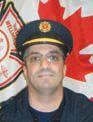
BY BRAD PATTON Fire Chief Centre Wellington, Ont.
f you read my inaugural column in June, you may have found it to be a bit of a rant. I discussed a few of the problems faced by fire chiefs and municipalities in managing a successful volunteer department. The obstacles are daunting but, I believe, manageable.
In my opinion, the first and most important aspect in successfully managing a volunteer department can be summed up in one word: value. I am convinced that value is the single most important part of managing in this type of environment. Everybody from the candidate applying to be a volunteer firefighter to the 20-year veteran and officer generally believes that they are of value to their departments and the communities they serve.
It may be hard to believe, but there are thousands of people out there working very hard for absolutely no pay. Think of all the people who canvass for cancer donations, aids, the Heart and Stroke Foundation of Canada, or people who walk miles to support their churches and clubs, and the hundreds more who teach or help in Third World counties. Why do they do this? Because in their hearts they see tremendous value in their efforts and time. When this type of value and motivation is part of every fire department activity it becomes an extremely powerful tool that can be used to achieve firedepartment goals.
Senior officers and municipal leaders must understand that the best form of management is for all firefighters to feel that everything they do is of value to the department, the community and to themselves.
That said, (I know some of you are thinking it’s time to give everybody a hug!) just how do you implement a deep sense of value in the troops that motivates them to put in thousands of hours in training, equipment checks and maintenance, responses to C/O calls without symptoms at 02:30 in the morning and the hundreds of night-time alarms?
That’s the feeling you want them to have all the time and there are plenty of things you can do to achieve that goal.
Let’s start with training, which I believe to be the most important thing a chief or a council can give a firefighter. When you facilitate a good training program, the effects contribute immensely to the sense of value.
A good training program says loudly and clearly that senior officers and the community care very much about recruits and firefighters and want to ensure that every opportunity is provided to learn how to safely and efficiently do the job. A good training program gives crew the knowledge that when they go out to a motor vehicle accident with persons trapped and the clock is ticking they will be able to safely and with great confidence do a perfect extrication.
To send firefighters who are not trained to a level at which they are truly confident into a fire, a first-aid call or a call for smell of smoke in a building will ruin their sense of value.
One of the hardest jobs in the fire department is that of the training officer. He or she must ensure that regardless of the amount of pay each person receives at the end of the training session, they must feel that they have received value for their time. Those completing the
When you facilitate a good training program, the effects contribute immensely to the sense of value. ‘‘ ’’
By value, I mean a strong sense that members of the department are either doing something that they feel is of value or are receiving something of value that increases their self worth.
Let’s apply that to the real world. When firefighters come back from a big fire that saved the town, there is little that you, as a manager, need to do. Saying thanks and letting the crew know that they did a hell of a job is a good idea, but the feelings of value are already running pretty high. Indeed, you should be able to feel and even see the feelings of self worth – they are walking taller, their chests are out and their voices are louder.
Brad Patton is fire chief for the Centre Welllington Volunteer Fire Rescue Department in Ontario, one of the largest volunteer departments in the province, with stations in Fergus and Elora.
training must feel deep inside that they now can do something better, and/or faster than they could before the training lesson started. This is not difficult to evaluate – be there after a lesson or a drill and listen to what the firefighters are saying. If you hear things like, “this is crap”, “we’ve done this a million times before”, “I didn’t learn anything” or “I couldn’t keep my eyes open” then you know you have to make changes, and fast. If you’re not hearing anything at all, then ask what the crew thought of the training. Be bold. Ask “Did you guys feel that the time spent was valuable?” Ask them in small groups or one on one; you want the truth and must have it to be a good leader.
It is vital to the success of your department that your firefighters not only feel that they are valued, but are valued.
I will continue this theme in the September issue. Meantime, each day is new; be safe, enjoy, and learn.
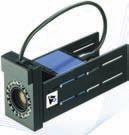

Charlotte, N.C. – The Imaging Source, a multi-national manufacturer of industrial cameras, has announced a new series of cost-effective LED lighting modules, that seamlessly integrate with The Imaging Source USB, FireWire and GigE camera.
• Very bright LEDs
• Direct connection to the camera
• All parameters can be set via the shipped software, IC capture and IC
• Imaging control or by custom-built software
• Compatible with The Imaging Source USB CCD cameras
• Compatible with The Imaging Source FireWire cameras
• Compatible with The Imaging Source GigE cameras
All cameras manufactured by The Imaging Source ship with IC capture and IC imaging control. The former is an end-user application, with which it is possible to set all cameras parameters, save singular images and image sequences and display live video streams. IC imaging control is an SDK, which consists of a .NET component, ActiveX control and C++ class library for Windows XP and Windows Vista. Learn more at www.tinyurl.com/5rd32x.
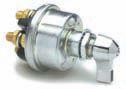
Boston – Cole Hersee Company, a manufacturer of electrical and electronic products for the vehicle industry, offers its High-Amp Double Pole Master Disconnect Switch.
This heavy-duty switch can handle a continuous current of 125A (at each pole), up to 36 V DC. Engineered for use in fire and emergency vehicles, pumps, and ladder units as well as ambulances, this high performance and durable switch is sealed to resist the elements.
The High-Amp Double Pole Master Disconnect Switch controls two independent circuits, eliminating the need for users to buy two separate switches while providing a cost-effective solution.
Additionally, this switch has the capacity to completely turn off one load while disconnecting two parts of the same circuit. This entirely shuts down the load circuitry, providing a safe disconnect and preventing electrical leaks that may drain batteries. For more information visit www.colehersee.com.
FoxFury’s compact TX-3 light increases visibility and safety of EMS/ rescue as well as fire professionals in structural and wildland environments.
Supplying 5.2 lumens of light, the TX-3 has three white and one rear red LEDs, with four modes to choose from. Combined, all this provides hands-free use, up-close lighting, and enhanced visibility to others with the flashing red LED.
For EMS/rescue, the light fits securely on a belt, epaulet or a pack. For firefighters, the TX-3 attaches best to a strap on the side of a helmet.
Its versatility provides a 90-degree tilt and ability to swivel 360 degrees on its base, allowing a user to aim the light where needed.
Weighing in at just one ounce, the lightweight TX-3 uses two CR2032 batteries (included), which provides up to 40 hours of light output.
The TX-3 meets the NFPA fire resistant requirements (500 degrees F for 30 minutes), is waterproof and is impact resistant.
For details visit www.foxfury.com/products/tx_series/tx3_running_ light.html” http://www.foxfury.com/products/tx_series/tx3_running_light.html
Pittsburgh, Pa. – The new Draeger PSS 7000 SCBA has received NFPA 1981 and 1982, 2007 approvals. The device is approved to meet and exceed NFPA’s new standard for water submersion, tumble test, heat and cold testing. It achieves the highest requirements in the market.
The Draeger PSS 7000 features a smart fully integrated electronic fire fighter monitoring system called Sentinel 7000, which is approved to the 1982, 2007 standard and includes a PASS device providing both audible and visual alarms to the fire fighter. It displays and records all vital information from the PASS device as well as from the SCBA providing real-time information regarding air supply and consumption.
Draegar’s new communication system fits into the Draeger FPS 7000 mask, which sets new industry standards for face fit and comfort. The mask comes in three distinctive sizes to perfectly fit the contour of the face and provides excellent sealing between the mask and face. It also has a fully integrated voice amplifier and radio interface system. The twin speakers provide exceptional voice clarity with a surround sound output. The Draeger FPS communication system has an extremely low profile as it was designed and built to fit into the actual face mask. For the first time Draeger introduces the TST technology to the industry (Titanium Sound Technology). This new technology which has a resistance to high temperature environments is incorporated into the Draeger PASS alarm sounders providing a loud 95 dba plus warning output to alert other fire fighters in the area. Visit www.draeger.ca for more details
■ SMITHS LAUNCHES CHEMICAL IDENTIFIER
Danbury, Conn. – Smiths Detection, part of the global technology business Smiths Group, has launched a new portable chemical identifier specially designed for diverse field operations requiring quick and easy identification of unknown solids or liquids.
The HazMatID Ranger is based on the company’s market-leading HazMatID, a field-based solid and liquid identifier used by military and civil responders around the world.
Designed for handheld, backpack or robot-portability and ease of use in protective gear, the HazMatID Ranger is capable of Fourier Transform Infrared (FTIR) analysis by simply touching the diamond sensor tip to a sample. In seconds, the light-weight system provides responders with both spectral results and a list of probable substances to help identify chemicals, as well as the actual components in mixtures.
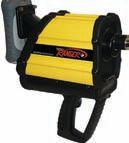
The HazMatID Ranger library allows responders to identify more than 32,000 suspicious white powders, WMDs, explosives, common and toxic chemicals. The system is also supported by ReachBack™ 24/7/365 technical assistance to aid responders with spectral interpretation in the field. For more details, visit www.smithsdetection.com.
By STEVE KRAFT
The scenario posed in May asked how you, as an officer, would manage the message in your department when there’s discussion about an issue that’s making the news; for example, two hatters or a controversy over stickers that express support for military troops on fire-service vehicles. These issues may not even affect your department directly, but as we all know, we all have strong opinions.
There is no doubt, as an officer, that you have been sitting around the coffee table or gathered around the pumper, listening to a discussion about an issue that solicits diverse opinions. Many times, these issues bring out the worst in us, as we are passionate about our beliefs. Sometimes, there are people on our departments who stir the pot even though they don’t have a vested interest in the discussion.
I believe all good leaders have opinions and, under most circumstances, won’t sit on the fence, rather they express their opinions in an unbiased way that is not offensive to others and encourages a positive environment. All people involved in the discussion need to feel that they can express an opinion contrary to yours and feel safe from reprisal and verbal assaults. Too many times, I’ve witnessed a verbal lashing against a staff member just because the person didn’t agree with the leader’s position. This will only discourage future discussions, which will have a huge impact on the crew, the division and the department in general. As an officer, if you prevent staff from expressing conflicting opinions, I believe it’s time to turn in your stripes. If your staff do not feel that they can express an opinion contrary to yours without feeling intimidated or afraid of the consequences, you’re not a leader – you’re a dictator; your staff will stop growing and so will the department. A different opinion can elicit healthy conflict, and healthy conflict is good and should be viewed as an opportunity for you and the department to grow. Your job is to ensure the conflict leads to a healthy discussion and doesn’t slip into unhealthy conflict resulting in verbal assaults on anyone’s character or deviate from the actual issue(s). When the discussions get personal, you (as the officer) must step in immediately and get the discussion back on track.
In the scenario above, I mention expressing support for military troops. As the leader, you may strongly oppose this for good reason. You may oppose the idea because you worry many people will believe you are showing support for the war and the public won’t realize the department’s goal is to support the troops, not the war. On the other hand, someone who supports the stickers might do so because both of his grandfathers fought in wars and the entire family is very proud of them. In this person’s case, he participates in a Remembrance Day ceremony every year and is very committed to showing respect and gratitude for the troops. My point is simple – as the officer, you must see both sides of the argument. Furthermore, you must always remember that your opinion is just an opinion – it’s not the only opinion. If you permit your staff to question your thoughts and opinions, challenge your ideas and concepts and in doing so, they feel perfectly comfortable – you are on your way to being a great officer and leader.
There is one caveat. I don’t believe there is room for public discussion if the issue is directly related to your fire department. If a chief officer issues a directive or procedure that you don’t agree with, as an officer, challenge the process in private, one on one with the chief officer or your supervisor. Never do it publicly, and especially not in front of your staff. When you challenge publicly, you teach your staff that it is OK to badmouth or ignore procedures you don’t like or with which you disagree. One of the problems with this is that one day you will want to implement something specific to your crew/division and your staff might not agree or like what you want them to do. Your staff will badmouth or even ignore your directive and I guarantee you won’t like this. The problem is that you trained them. Every time you badmouth a directive or procedure in front of your crew/division, you are teaching them that this is acceptable behaviour.
Matt Pegg - Deputy chief, Ajax, Ont.
Every good leader knows, appreciates and values the fact that a team is made up of individuals. As with any group of individuals, many differing and often competing opinions will exist. The fact that there are differences of opinion within a team or group is not only to be expected, but it is healthy.
As an officer, I support the fact that people are entitled to personal opinion. A crew that is willing to engage in open, honest and passionate debate and discussion with each other is likely a crew that works well together.
My suggestion in addressing this situation as the officer of the crew is as follows:
Ensure that the discussions occur at the appropriate time and place – break time or meal times.
Ensure that the discussions do not progress into personal attacks and ensure that tempers don’t get elevated. Controversial topics can quickly result in sharp comments that some may find offensive. Stay
“tuned in” to what is going on around you and be prepared to end the debate immediately if things get out of hand.
Ensure that while the “issue of the day” is fair game at the kitchen table, it does not affect the quality or quantity of work being performed. The officer needs to be vigilant during these types of debate in order to recognize when things are heating up and be willing to end the discussions when there is work to do.
The bottom line for me is simple – never silence the creative personal perspective that each crew member brings to the team, just ensure that crew safety, productivity and effectiveness come first.
As a colleague of mine likes to remind people, in a team, if you always agree with your partner and never challenge each other’s ideas, one of you does not need to be there!
Rick Lasky, chief, Lewisville Fire Department, Texas
When it comes to getting the message out, regardless of whether the issues directly impact the department, I try to deliver the message without opinion or influence and I expect my officers to do the same. We can discuss it in private and away from the troops and, if necessary, agree to disagree, but when the smoke clears, we all go out and deliver the same message the same way. It’s expected that the communication link among the rank and file will be followed and used appropriately and that we get the word out about whatever it is so it is delivered in its full fashion and not picked apart or watered down. When we deviate from this we end up with different versions of the same thing, which results in a splintered organization – one that looks like a bag of marbles that has hit the floor and is going in different directions.
Don’t get me wrong – I appreciate a good argument from an officer and hope that officers always feel safe, secure and confident enough to express their opinions and beliefs, but if the stance is to remain the same, it’s noted, and we move out together on the topic as one, as one team!
Officers can and will speak their minds and voice their opinions but the adult, professional way for the officers is to deliver the message, contain the emotional side (as they would on the fire ground) and, if need be, guide the discussion so it doesn’t get out of hand. This is the same whether it’s politics or whatever.
There are hundreds of hot-button issues that come up in the firehouse and some of them are sensitive, but a good leader knows how to get the word out without creating civil unrest.
Bryan Burbidge, chief, King Fire and Emergency Services, King City, Ont. The two situations in the example are very current issues affecting Ontario’s fire services but may or may not be affecting the national service this magazine goes to. Simply put, there is good news and bad news; good news that could affect your department or the fire service and, conversely, bad news that could affect your department or the fire service.
I once heard a speaker say, while asking his audience a question, “If what you are about to do right now made it to the headlines in tomorrow’s national papers, would you be proud or embarrassed of your action?”. Our service lives for activity or action and when there is idle time we tend to concentrate on dissecting the action or activity that others are experiencing. Regardless of whether we are directly involved, there are always comments.
As an officer in the station, I would want to encourage the other firefighters in the station to express the need to find out as much information as possible about the good news or bad news story before making any comments or jumping on bandwagons. I have learned in dealing with people that there are always three sides to a story – the truth and then the other two sides. When the media is involved, there are often more sides, depending on the slant or message the media want to portray. So, whichever side you are prone to listen to will be your take on the situation and it may not always be the truth.
Again, find the source of your information, analyze the information and make decisions for yourself. If the message is that important (such as supporting our troops) and it is truthful, then bang the corporate drum to get the message heard. On the other hand, if the message is inaccurate, educate yourself on the truth and, again, bang the corporate drum to get the RIGHT message heard.
After returning from a run, your first order of business is to go talk to the fire chief about the good work the firefighters just did with Mrs. Smith. As you’re walking to his office, you come around the corner and notice two firefighters surfing the Internet. Unfortunately, they are looking at websites that are inappropriate and against your town’s policy. As the officer, what should your actions be?
Email: skraft@richmondhill.ca
By DON HENRY
This is the final instalment in our series on transmissions. You can find the previous columns at www.firefightingincanada. com (click on Past Issues).
A stall test should be conducted when there is concern about the performance of the engine and/or the transmission.
Before conducting a stall test, ensure that the transmission oil level is correct. An incorrect oil level will cause the oil to foam. The foamed oil will contain air bubbles and will result in incorrect test results.
Ensure that the engine and transmission are at operating temperature between 160 and 200 F (71 and 93 C). Place the truck in an open area and warn everyone of the test. Block the wheels and apply the parking brakes (spring) and the service brakes (air).
Inspect and determine that the drive shaft and U-joints are able to withstand the load that will be placed on them. (See photos 1, 2 and 3.) Replace any defect U-joints before the stall test.
Prove that the engine tachometer is accurate. Place the transmission in neutral and push the foot throttle all the way to the floor. This r.p.m. number must be the same as the published ULC number on the fire pump test certification plate, plus or minus 50 r.p.m.
If this r.p.m. number is not correct, stop the test and find out why. Some books will call this high idle, max r.p.m. or governed r.p.m. Place the transmission in the highest range possible; this means selecting D for drive. Never select low gear (D1) or reverse.
With the brakes firmly applied, increase the engine speed with the foot throttle to wide-open throttle (WOT). The engine should speed up until it reaches its correct stall speed; this r.p.m. should be safely recorded. The stall test should not be conducted for more than 30 seconds. It will normally take less than 30 seconds for the r.p.m. to stabilize.
During the test, obverse the temperature of the transmission oils with the gauge on the dash. Never allow the temperature to rise above 300 F (149 C) during the test. It is normal for the temperature of the oils to rise very quickly. (See photo 4.)
What r.p.m. should the stall speed be? When your truck was manufactured, the builder took into account engine power transmission gear ratio, rear axle gear ratio, tire size, top speed and the terrain at which the vehicle would have to work. It was important that the correct engine, torque converter and transmission were selected to allow the engine to reach near its peak engine torque. Only the people who made your truck can give you the correct r.p.m. stall speed. This r.p.m. is lower than the engine maximum governed speed.
For example, the stall speed of a common truck engine may be 1,700 r.p.m. with the maximum governed speed at 2,300 r.p.m. By selecting the correct combination you get a truck that can pull away from a standing stop and accelerate to its top speed as fast as possible without damaging driveline components. (See photo 5.)
It is the job of the torque converter to multiply engine torque. The engine turns the torque converter impeller at whatever engine

The drive shaft looking toward the transmission/ engine; check the u-joints.
Drive shaft looking to rear of truck; check the u-joints.
A typical problem: a drive shaft with the u-joints out of phase. This truck had bad vibrations at between 40 and 55 km/h.
A newer-model truck with the multiplex electrical system. The transmission oil temperature gauge is at the lower left.
This r.p.m. gauge shows a low stall speed for this unit. It should have been 1,800-1,850 r.p.m., not less than 1,700. A simple valve, injector tune up fixed the problem.



speed is. The torque converter causes flow of transmission oil and this oil is pumped from the impeller to the torque converter turbine. The oil must now be redirected back to the torque converter impeller wheel and this is the job of the stator.
The stator is located between the impeller and the turbine wheel at the inner circle. During hard acceleration, the stator will lock (not be allowed to rotate). This is necessary for the multiplication of engine torque because of the redirection of the oil. The locking is accomplished by a one-way, over-running clutch (also called a sprag clutch). If this clutch were to fail, there would be no multiplication of engine torque. A normal stall speed of say 1,700 r.p.m. would fall by approximately one-third to 1,200 r.p.m. and the driver would complain that the engine had no power when accelerating.
At the end of this stall test, the transmission oil will be very hot and must be cooled. Slow the engine to the idle speed and place the transmission in neutral. Accelerate the engine to between 1,000 and 1,400 r.p.m. You should see the transmissions oil temperature rapidly decrease. This part of the test is called the cool down. If the oil does not cool down, then the oil cooler may be plugged or the one-way clutch in the stator could be stuck and may not be free wheeling. This will prevent the transmission oil from cooling properly.
The cool-down test and its results are just as important a diagnostic tool as the r.p.m. stall test. Many transmissions are ruined because of overheated oil, so the condition of the oil cooler is very important. As most transmission oil coolers use the engine coolant system to remove heat from the transmission’s oil, any problem with the engine’s coolant system will affect the transmission. Low coolant level, poor quality coolant or a defective thermostat(s) will cause problems.
After a transmission rebuild, the oil cooler lines can get mixed up and connected to the cooler incorrectly. This will not cause an overheating problem right away but on the first hot day, on a trip with hard accelerations and hills, the transmission oil will begin to overheat.
1. Above rated speed (or a high stall speed)
Let’s say that a normal stall speed for this truck is 1,700 r.p.m. If your results are more than 150 r.p.m. above the normal r.p.m. and the oil level is found to be correct, then you most likely have a defective clutch pack. This could be caused by low clutch pack oil pressure or possibly, a broken clutch pack seal.
Check the transmission operating main pressure and see if it is lower than normal.
Avoid the use of transmission oil additives that are advertised to swell the clutch pack seals. While this may be quick automotive fix, it’s not what you want for your fire truck.
When in drive and at the curb conducting a stall test you must remember that you have only charged two clutch packs, and, as such, a stall test only tells you the condition of those clutch packs. The other clutch packs that are involved in the other forward ranges can be checked by driving the truck, or by using the Allison diagnostic laptop computer program. If you have a defective clutch pack in, say, third range then you must look at the clutch packs involved in that range. As you know the forward clutch pack is good from the stall test, then the defective pack must be the clutch pack used in third range.
How will you know you have a problem? When the transmission up-shifts from a lower range to a higher range you should see the engine r.p.m. drop and then slowly climb again during a normal acceleration. If the r.p.m. instead increases very quickly and the truck does not move forward at the same rate, then you have a flare. This
flare is caused because of a slipping clutch pack. To be in any forward or reverse range you must have two clutch packs engaged. If this happens (and it would be rare to have a clutch slip) you will become quickly aware of the problem – the large clouds of smoke and burning smell will be the giveaway. The transmission oil will be black and have an overheated smell to it.
2. Lower than normal speed (or low stall speed)
If the recorded stall speed is 150 or more below the normal speed your problem is most likely in the engine. If the engine has a lot of black exhaust smoke, suspect a plugged air filter or a defective fuel injector. If there is not excessive smoke then look at a plugged fuel filter. You could have a defective turbocharger or a crack in the air-toair cooler that is in front of the radiator. It could be just as simple as the fact that this engine needs to have its exhaust valves, intake valves (if it has them) and injectors adjusted. Keep in mind that modern electronic diesel engines normally generate very little smoke.
The stall speed will be 30 to 50 per cent below normal stall speed. A defective freewheeling stator almost always causes this condition. The complaint will be that the engine has no power when, in fact, the torque converter is not multiplying the engine torque.
Talk to the operators. They will most likely tell you that sometimes, if you start off slowly, the truck works fine, and at high speed it works fine.
Get on this right away; at this point it can be a fairly inexpensive repair. You may need to only install a new over-running clutch if no other damage has been done. If this condition is allowed to continue,
it has been my experience that the one-way clutch may pile up inside the torque converter. This will cause the stator to stick. The torque converter will multiply torque but the transmission oil will overheat fast and the transmission will be ruined. You will hear the operators say the transmission cured itself (be very worried if you ever hear anything mechanical cured itself) and the next minute the transmission oil is very hot and smells burned. It has been my experience that the greatest cause of a defective stator is the driver backing up the truck and placing the it in forward before the truck comes to complete stop. Tell the drivers to use the large black things on the ends of the axle called brakes to stop the truck before changing direction.
The stall test should not be done as part of a daily or weekly check; it needs only to be done if a performance complaint is received, or make it part of an annual check. It can sometimes be difficult to obtain the stall speed specification r.p.m. years after the truck has been made, so make sure you demand this information as part of the bid process and store this number with the transmission’s SAM number. On some newer electronic engines it may be necessary to have the truck moving forward before you start the stall test. If you do not feel confident to conduct a stall test, then your local Allison dealer will.
Don Henry teaches in the Automotive Service Technician and Heavy Equipment Technician programs at Lakeland College in Vermilion, Alta., where he has been a faculty member for more than 17 years. He has co-developed and delivers Canada’s only post-secondary level fire-apparatus maintenance program and has completed a textbook on fire apparatus.
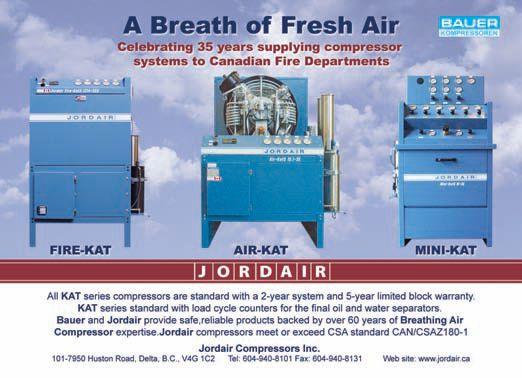


Peeling back the layers leads to manageable chunks of issues
By LES KARPLUK
At the Ontario Association of Fire Chiefs conference recently in Toronto, I had the privilege of co-presenting “Leadership – Art or Science,” with Deputy Chief Lyle Quan of the Guelph Fire Department. The presentation summarized how different leadership traits affect the fire service and how fire chiefs must be tuned into the leadership game. Leadership is a balancing act and few understand what is really required from today’s leaders. Recently, while watching the movie
Shrek with my five-year-old son, I had one of those light-bulb moments, which led me to what I am now calling The Shrek Layers of Leadership. Understanding another perspective on leadership while watching Shrek is not something a fire chief should readily admit! One would expect that leadership ideas come from respected authorities in the field like Ken Blanchard, Steven Covey and John Maxwell, but not a green ogre named Shrek. During a scene in the movie, Shrek explains to Donkey that an ogre is like an onion; onions have layers and ogres have layers. At this point you may
wonder if I’ve lost my mind and question the relationship between Shrek, onion layers and leadership. Shrek was trying to help Donkey understand that breaking down an idea into manageable pieces (onion layers) is one way to understand a complex subject. Let’s use Shrek’s philosophy to break down two leadership challenges into manageable, bite-size pieces.
In 350 BC, Aristotle wrote the Nicomachean Ethics in which he stated, “The man who has been educated in a subject is a good judge of that subject, and the man who has received an all-round education is a good judge in general.” The purpose for allocating budgetary dollars to training is to equip our firefighters and officers so they are able to make sound decisions and exercise good judgment during emergency and non-emergency functions. Providing sound education and training opportunities for our future leaders equips them to be good judges in general. Aristotle had it right.
The fire chief has to determine whether emphasis is to be placed on hard or soft skills. Hard skills are the minimum skills required to perform the job and include the ability to write a report, prepare a formal document, direct personnel during an emergency incident, engage a pump, etc. These are the skills that are easy to measure. The soft skills, or, as, they’re more commonly known, the people skills, are more subtle and difficult to quantify. These include the way a firefighter interacts and communicates with the public, the way an officer deals with personnel issues (conflict management), problem-solving ability, enthusiasm and the ability to give feedback and mentor. Both types of skills are essential for a leader in the fire service; both are equally important and both need to be given a priority in the profession.
There are numerous challenges in providing education and training for personnel, including time factors, seniority, scheduling issues and associated course costs (registration and possible overtime). More options are becoming available for departments to prepare staff for leadership and management positions. The virtual education world continues to advance with online certificate, degree and master programs available in a variety of business topics. These online programs are available for staff to take while on duty or in the comfort of their homes. Some post-secondary institutes offering virtual education also provide the course textbooks in PDF format, which saves the student time and money. Virtual education offers students flexibility so they can continue with their normal work schedule without attend-
ing a classroom setting. This flexibility provides the fire department with a convenient and low-cost method that helps prepare staff for those future leadership and management positions.
Without a plan, training for the sake of training is counterproductive. Let’s look at a hypothetical department that provided confined-space training five years ago, and since that time failed to implement a continuing-education program. Today, what would the result be if a member is injured while performing a confined-space rescue? My guess is that there will be potential liability issues (Bill C-45?). The education and training components in the department must be carefully planned, otherwise there is no return on the investment and the money is wasted.
A significant challenge for today’s fire-service leader is the ability to gain followers for the vision of the department. This responsibility rests solely on the shoulders of the fire chief and it is the fire chief who must champion this call. Without a vision, without the ideal, morale falls, projects fail or do not produce the desired results and staff look for other career options.
The department and staff need direction, otherwise they will never achieve significant goals or greatness. Today’s fire service leader must continually look at the big picture, change the path when obstacles are encountered and provide a clear picture of what the department can achieve. Members of the department must be involved in creating the vision since active participation in developing the vision creates buy in from
the people that have the most to gain and the most to lose.
Simply pulling staff together and asking them where they want to see the department go in the future is a great place to start. Asking for input in the development of the vision is essential for building trust. Being transparent and building relationships with the staff is one way to gain followers for the vision. Staff need to feel wanted, valued, respected and sought out for ideas before they jump on board.
■ JUST A THOUGHT . . .
Challenges will always exist in the fire service, just as surely as change is the norm in today’s dynamic work environment. The future of the department will only be successful when the ground has been prepared in advance. This is and will continue to be beyond the capabilities of any one individual.
In 1902 philosophical writer James Allen stated, “The vision that you glorify in your mind, the ideal that you enthrone in your heart – this you will build your life by, this you will become.” Let’s take the philosophy of James Allen, Aristotle and Shrek to develop our departments for the future; let’s become the future.
Les Karpluk, CFO, BAppBUS: ES is fire chief of Prince Albert Fire and Emergency Services. He is a graduate of the Certificate in Fire Service Leadership and Fire Service Administration programs at Dalhousie University and graduate of the Bachelor of Applied Business: Emergency Services from Lakeland College. Contact him at l.karpluk@sasktel.net.
Whether you’re a competitor, spectator or volunteer, come play in our backyard, British Columbia is the place to be in 2009. For 10 days in 2009, B.C. will be home to 14,000 police officers, firefighters, and customs and corrections officers from around the world as they showcase their athletic excellence in all the traditional sports and a few uniqueto-our region events, and then meet at our nightly celebrations to create friendships and
memories that will last a lifetime.
Picture yourself on a world-renowned mountain bike trail, teeing off at one of B.C.’s many spectacular golf courses or racing up popular Grouse Grind® — a 2.9 kilometre trail straight up the face of Grouse Mountain, fondly referred to as “Mother Nature’s Stairmaster”.
The World Police & Fire Games is the largest international, multi-sport event of its kind. From Vancouver and Burnaby; from Chilliwack to Whistler, B.C. is proud to host the 2009 World Police & Fire Games
- including a range of traditional, free admission events, as well as unique competitions designed to take your athletic and professional skills to their limits.
Come. Play. Stay. From July 31 to Aug. 9, 2009, our sea-to-sky playground will be your playground. Visit www.2009wpfg.ca for more information.
Lyons, S.D. – Rosenbauer America is pleased to announce its expansion into eastern Canadian markets through the appointment of Areo-Feu/Areo-Fire of Longueuil, Que., as its dealer for Quebec, New Brunswick and Newfoundland and Labrador. Areo-Feu will also cover part of Ontario, from north of Kingston westward to Sault Saint Marie.
The appointment of Areo-Feu became effective May 10.
A full-service dealership with 40 employees, Areo-Feu caters to French- and Englishspeaking clientele from a 35,000 square-foot facility just south of Montreal. It has mobile road service capability and a 10-bay service center with an enclosed pump-testing area using an underground water storage tank.
Founded in 1951 by Jean Picard, day-today management of the company is handled by president Jean-Max Picard, vice president Helene Picard and controller Josee Guillemette. Other key personnel include sales director Stephane Bouvier, service director Stephane Ferland and fire truck specialist Benoit Simard.
Areo-Feu can be reached at (800) 4691963, www.areo-fire.com.
For more details visit Rosenbauer at www.rosenbaueramerica.com.
Lyons, S.D. – Rosenbauer America broke ground on its 24,000 square foot expansion in November 2007. Now the new offices, fabrication areas and fire truck showroom are complete.
Harold and Helen Boer started Rosenbauer in the mid-1970s as a welding and vehicle refurbishment business.
Rosenbauer is the world’s leading manufacturer of firefighting vehicles and equipment. In North America, Rosenbauer incorporates the international strength and innovation of a global company with top American manufacturing firms.
Visit www.rosenbaueramerica.com.

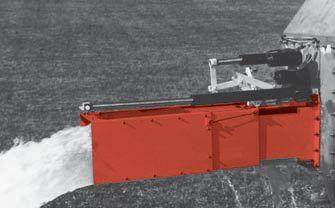
...empties your tanker safely. No need for two-man crews, you don’t even have to leave your truck!
Our Newton Kwik-Dump Valve, Model 1070 Valve with 5018 Auto Chute (shown) can be electrically or air operated. Just the touch of a button empties your tanker, and gets you on your way - FAST! Contact us for more information. Brochures and CD-ROMs available.
A.H. Stock Manufacturing Corp. 8402 Center Road
Phone: 920-726-4211 Fax: 920-726-4214 sales@ahstockmfg.com www.ahstockmfg.com

BY SEAN TRACEY Canadian Regional Manager NFPA International, Ottawa, Ont.
ire services across Canada have a major problem ensuring that there is an adequate water supply for fire fighting. Too few departments seem to address this or naively assume that others are looking after it. This is not unique to career or volunteer departments or it is a rural versus urban problem. The challenges are different but the underlying truth is the same – too few departments are managing water supplies for fire fighting.
Water supplies need to be managed in a community and NFPA 1201 Standard for Developing Fire Protection Services for the Public makes this clear. “The fire department shall carry out a continuing program of evaluation for all water supplies for fire fighting, maintaining a liaison with the water authorities on fire protection water supply matters.” This individual would liaise with water authorities and their peers in other communities, and perform regular assessments of existing water points or of the adequacy of the fire flows in the community. NFPA’s standard NFPA 1142 Standard on Water Supplies for Suburban and Rural Fire Fighting 2007 Edition also has detailed information on water supplies for these areas.
In many urban communities I have visited there is a general assumption that there are adequate water supplies for fire fighting because the building department addresses that when the buildings are built. The building codes state that there shall be adequate water supplies for fire fighting for every Part 3 building and for other high-risk Part 9 buildings. Yet, in training sessions I have done for building officials across Canada, no one has ever asked the engineer on record for the project for proof of this, nor does anyone seem to verify and document the requirements. Every project should be assessed to ensure adequate fire flows and residual pressure. This might be fine at the time of construction and for many years after but not when the fire flows are needed. By then, the engineer on record is long gone and the building records are misplaced. It then becomes a fire department problem, with fault for inadequate firefighting flows being placed on the department. This should have been avoided by insisting on proof of adequate firefighting flows in the design stages of the project. NFPA’s fire, building and life safety codes all require that water supply be properly documented to the authority having jurisdiction. Just because there is a municipal water supply source and a hydrant nearby does not mean that there will be adequate firefighting flows.
capabilities is more critical. Too few building departments are doing this. Fire departments, regardless of location, need to be involved in the building planning stages to avoid these major problems. The building codes do have a provision that impacts volunteer departments. They state that where fire department response is not adequate then consideration should be given to installing sprinklers. The code does not define what adequate is, therefore, no one seems to be enforcing this provision.
In my opinion, any high-risk or essential facilities in a community without a tanker accredited program (assessed as equivalent to a municipal water supply), should be sprinklered. The above clause in the code permits this. A fire department is therefore within its rights to demand this and it would be acceptable according to the building code in any jurisdiction – it just needs to be enforced.
Communities, regardless of size, should also consider how they address their water-supply deficiencies. Standby fees can be levied that would cover the costs to maintain or improve these systems for their fire flows. All non-sprinklered properties, including residential properties, should have a fee levied based on their property values at risk. Properties that have fire sprinkler systems that meet the code should be exempt
Fire departments... need to be involved in the building planning... to avoid these major problems.
In rural areas where no municipal water supplies are available, the need to verify firefighting flow availability with the fire department’s
Sean Tracey, P.Eng., MIFireE, is the Canadian regional manager of the National Fire Protection Association International and formerly the Canadian Armed Forces fire marshal. Contact him at stracey@nfpa.org
from these fees. The fees in municipal water supply locations go to funding the maintenance and inspection of the water mains that are in place to meet their demands. In rural areas not on municipal water, the fees go toward funding the construction and maintenance of dry hydrants, water supply points, water tankers and other apparatus necessary to meet these capabilities.
NFPA has made available a free, downloadable training program on rural water supplies at www.firewise.org. In addition, NFPA will be delivering training programs across Canada with programs scheduled for the Alberta building officials and Saskatchewan fire chiefs in 2009. We are available to assist associations and communities with this essential matter. Two provinces, Alberta and Ontario, have guidelines on water-supply calculations on the Internet that should be reviewed. The resources are out there but we need fire departments to take a more proactive role and take control of water-supply needs – no one else is doing it for you.


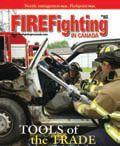
Continued from page 28
fire and emergency services should appreciate using curriculum that contains Canadian content. This is especially beneficial when it comes to training that is legally mandated in Canada, for example WHMIS and certain TDG (Transportation of Dangerous Goods) courses. It should be expected that we will increasingly see more mandated training in Canada.
Smaller fire departments, including volunteer departments, can realize a benefit through online training by reducing requirements for training officers to design, deliver and modify curriculum. Further, there is a reduced need for teaching infrastructure (classrooms, projectors, paper, etc.).
Because the same curriculum is delivered notwithstanding the size of the department, the knowledge and skills gained are transferable, which, among other things, can standardize the training and resulting firefighting activities of area fire departments that might be involved in mutual aid activities – a compulsory requirement in Ontario.
For volunteer fire departments, there is also a clear benefit in being able to train firefighters without requiring their presence at an official location or at certain times. Volunteer firefighters can complete competency training at home on their own schedule, addressing a common complaint of volunteers and one of the factors that contributes to increased volunteer attrition rates, and meaning that online training might be a valuable tool in the effort to retain volunteers.
It’s difficult to measure skills development through online training, so a skills measuring facility may be necessary. This may become one of the new functions of training divisions, or departments may wish to seek co-operative agreements with local educational facilities such as community colleges, universities or even larger departments that already have these capabilities (which, in turn, presents as an opportunity for the larger departments).
Online training can’t replace the important practical components of firefighter training. We will likely always need to actually handle ladders, hoses, nozzles, extrication equipment and vehicles as part of the practical training critical to important knowledge and skill development. In fact, the practical components of education are where learners get to complete necessary experiences.
Online training also shouldn’t be called interactive simply because the learner has to press buttons on a keyboard in order to elicit screen changes. This is a misnomer and it shouldn’t be used as an excuse for designing web pages that are uninteresting.
The strength of online training is in the way it enables us to deliver theoretical components of education in ways that are measurable, verifiable and transferable, and which complement the practical components for a more worthwhile and educationally viable training experience.
That makes it a useful and likely cost-effective tool for modern training scenarios.
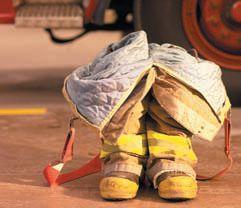
Offering: A 2 course certificate in incident command for experienced incident commanders. Please contact our office for more information.
Are you looking to take on more responsibility in your Department? Trying to round out your technical ability with leadership skills? Preparing to advance your career?
At Dalhousie University we offer a three course program, the “Certificate in Fire Service Leadership” to career and volunteer fire officers.The 3 courses Station Officer: Dealing with People,Station Officer:Dealing with New Operations and The Environment of the Fire Station are all offered in each of our 3 terms, September, January and April. The program can be completed in one year.
For more information and a program brochure please contact:
Gwen Doary,Program Manager
Dalhousie University Fire Management Certificate Programs 201-1535 Dresden Row,Halifax,Nova Scotia B3J 3T1 Tel:(902) 494-8838 • Fax:(902) 494-2598 • E-mail:Gwen.Doar y@Dal.Ca
You will also find the information in our brochures or at the following internet address:Web site:http://collegeofcontinuinged.dal.ca

”How to Prevent Home Fires” memorably demonstrates that everyday things, if not used properly, can become dangerous and even life-threatening, but that following simple precautions can head off fires before they start.
Audiences may be surprised as they watch scenes from an ordinary day in the life of typical people in a typical neighbourhood and realize just how many different types of fire hazards we all face every day. The fact is that people cause fires – and thousands of injuries and deaths could be prevented every year if folks incorporated fire prevention fundamentals into their daily lives.
Show this unique video at your community outreach programs and provide lessons on a wide range of fire prevention and response response topics, including:
• Kitchen and cooking safety
• Space heaters, fireplaces, and furnaces
• Electrical outlets, extension cords, and light bulbs
• Flammable liquids • Smoking safety
• Candles • Smoke alarms


Escape plans

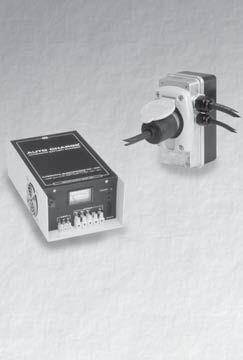



1-888-404-1129
CUSTOM TRAINING PROGRAMS:
MESC will provide custom design training programs. Other courses available include: Building standards, Rescue program, Emergency Medical, Management Program, Fire Prevention, Public Safety and Hazardous Material. Manitoba Emergency Services College, Brandon, Manitoba, phone: (204) 726-6855.
FIREFIGHTER CAREER TRAINING: Fire services career preparation Certificate recruit training program. Business leadership for the fire services. Courses available: Fire Prevention, Fire Suppression, HazMat, Emergency First Responder, Search and Rescue. For more details call Durham College, Whitby, Ontario or call Don Murdock at (905) 721-3111 ext. 4069.
LIVE FIRE FIGHTING EXPERIENCE: Short and long term courses available, Municipal and Industrial fire fighting. Incident Command System, Emergency Response/HazMat, three year Fire Science Technology Diploma program. Lambton College, Sarnia, Ontario, call 1-800-791-7887 or www.lambton.on. ca/p_c/technology/fire_emerg_resp.htm. Enroll today!




BY PETER SELLS District Chief
ecently, I was editing a video clip of myself setting fire to a couple of burn scenarios and then debriefing the viewers. All of this was set up for a professional development seminar on determination of origin and cause. I had to cringe as I was editing because I repeatedly referred to a smoke alarm as a smoke detector. We all have verbal bugaboos that stick with us, and that is one of mine. I know the device is properly called a smoke alarm because it sounds an alarm in response to the detection of products of combustion, but what comes out of my mouth is usually “smoke detector.” I will often correct myself right away but that is difficult to do on video that has already been shot.
Why is this a big deal? Whenever any of us is in uniform in the role of supervisor, spokesperson or instructor, our reputation and professional image is on the line. A large part of that professional image is wrapped up in our presentation. Much is written about projection, pace, eye contact, inflection, body language and all the other elements that make up the non-content portion of our message, but it can all go out the window if the content is wrong. So, when I use an incorrect term (smoke detector) in place of a correct term (smoke alarm), one of two things can happen in the minds of the audience. My credibility can lend support to the incorrect term, or my use of the incorrect term can reduce my credibility. The degree to which either of these effects occurs depends in a large part on the knowledge base of the audience. For example, a class of preschoolers may not catch the difference and may just accept what is said at face value. Then again, kids can be pretty sharp and may not be shy about pointing out an error.
So, the onus is on the speaker to be properly prepared. Practise the technical terms that you know are problematic for you. Make sure you use them properly and in the right context. One of my pet peeves is firefighters not distinguishing between salvage and overhaul. It comes out as one word sometimes – salvageandoverhaul. This misunderstanding has been fostered over time by the fact that these terms are often taught in the context of being secondary tasks on the fire ground, but they are separate and distinct. Salvage is essentially protective in nature and is often done simultaneously with fire attack (but not always). Overhaul is essentially destructive in nature and is often done after fire attack (but not always). An incident commander or sector officer ordering the application of these tactics should have a full understanding of each one, including the ability to communicate them properly.
of work on fire ground search-and-rescue tactics. He maintained that search and rescue were separate tasks. You may be searching with the intent of rescue but once the search is successful your task has become rescue. The reason we don’t generally discredit someone who always uses the terms together is that it is the industry standard terminology to do so and there is no real confusion on the intent or context.
We work in a constantly changing field, so remaining current can be a real chore as well. NBC-W (Nuclear/Biological/Chemical Warfare) became CBRN Defence (Chemical/Biological/Radiological/Nuclear) and then CBRNE (Explosive). CFR (Crash/Fire/Rescue) became ARFF (Aircraft Rescue/Fire Fighting). MVA (Motor Vehicle Accident) became MVC (Motor Vehicle Collision). It is interesting to note that each of these changes resulted in a more objective term that more accurately defines our purpose. We respond to nasty molecules regardless of whether they were agents of warfare. The aircraft in which we perform our rescue and firefighting tasks did not necessarily crash. Whether the motor vehicle collision was an accident is not relevant after the fact.
It is not enough to use the right words; we need to pronounce technical terms properly as well. You could be, oh, let’s say, a Harvard MBA but what does the inability to properly pronounce “nuclear”
Whenever any of us is in uniform... our reputation and professional image is on the line. ‘‘ ’’
Skip Coleman, the retired deputy chief from Toledo, Ohio, did a lot
District Chief Peter Sells writes, speaks and consults on fire service management and professional development across North America and internationally. He holds a B.Sc. from the University of Toronto and an MBA from the University of Windsor.
say about your fitness to be a world leader? Don’t you wish that was a hypothetical example? So, repeat after me; defiBRILLator (not defibulator), masonRY (not masonary), and nuCLEar (not nukular). It is less likely in today’s information-age world to find blatantly incorrect terms in print or online but it is still possible. “Masonary” is a good example. I have heard some very knowledgeable people use this term and it can be found in print but the word does not exist. Its acceptance through repeated use does not change the fact that in all instances the correct term is “masonry.”
Most importantly, getting the terminology and pronunciation right indicates a more complete understanding of the art and science of fire fighting in all its forms. One of my captains from my early days on the job would describe something as being “more better” than something else, which just drove me nuts. Eventually I realized that was the reason he did it, but it still makes me cringe.