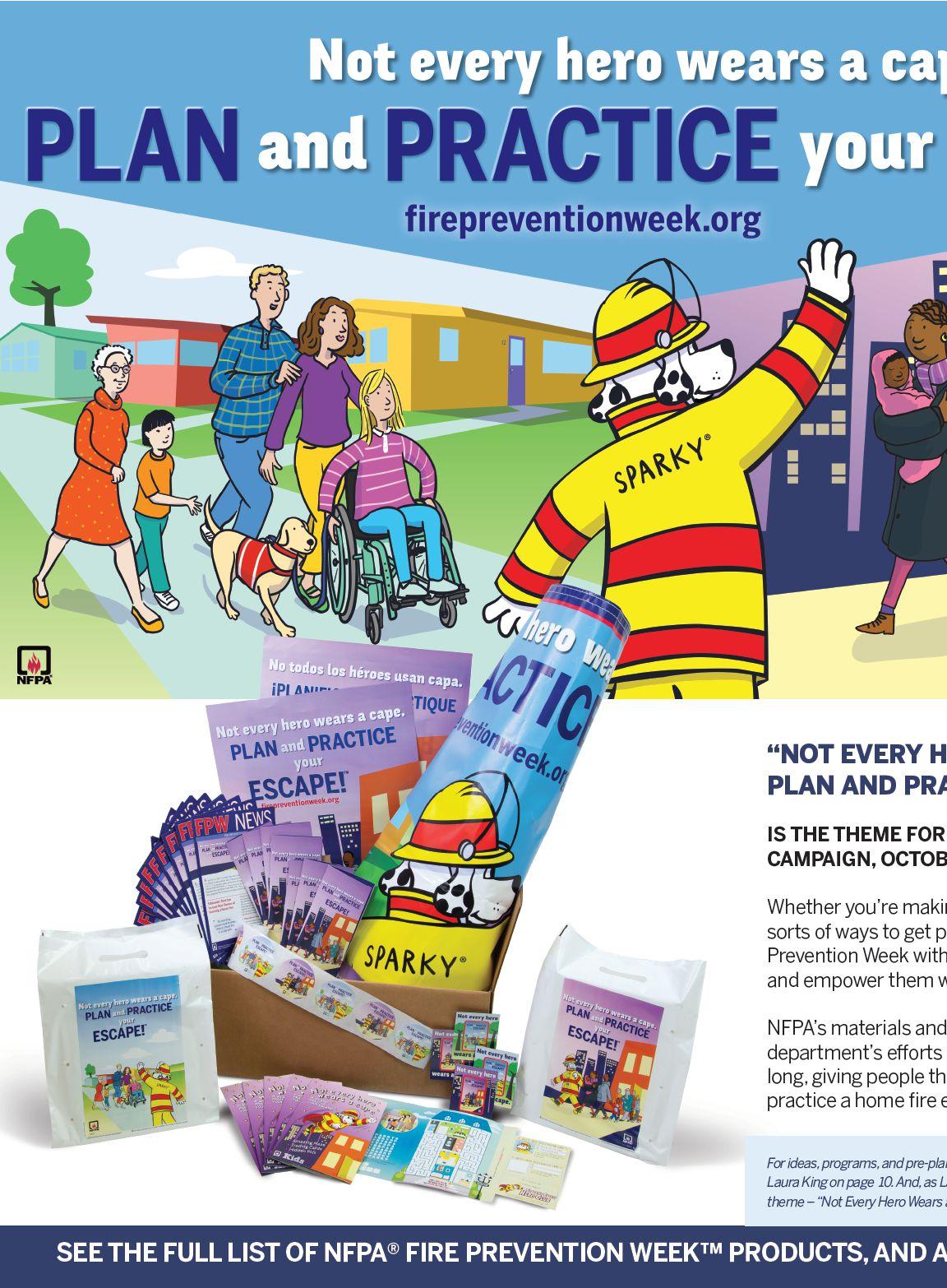
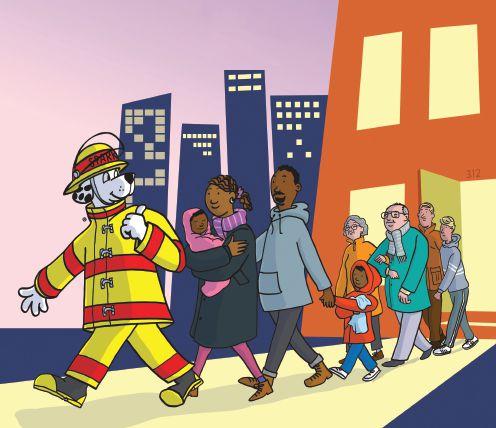
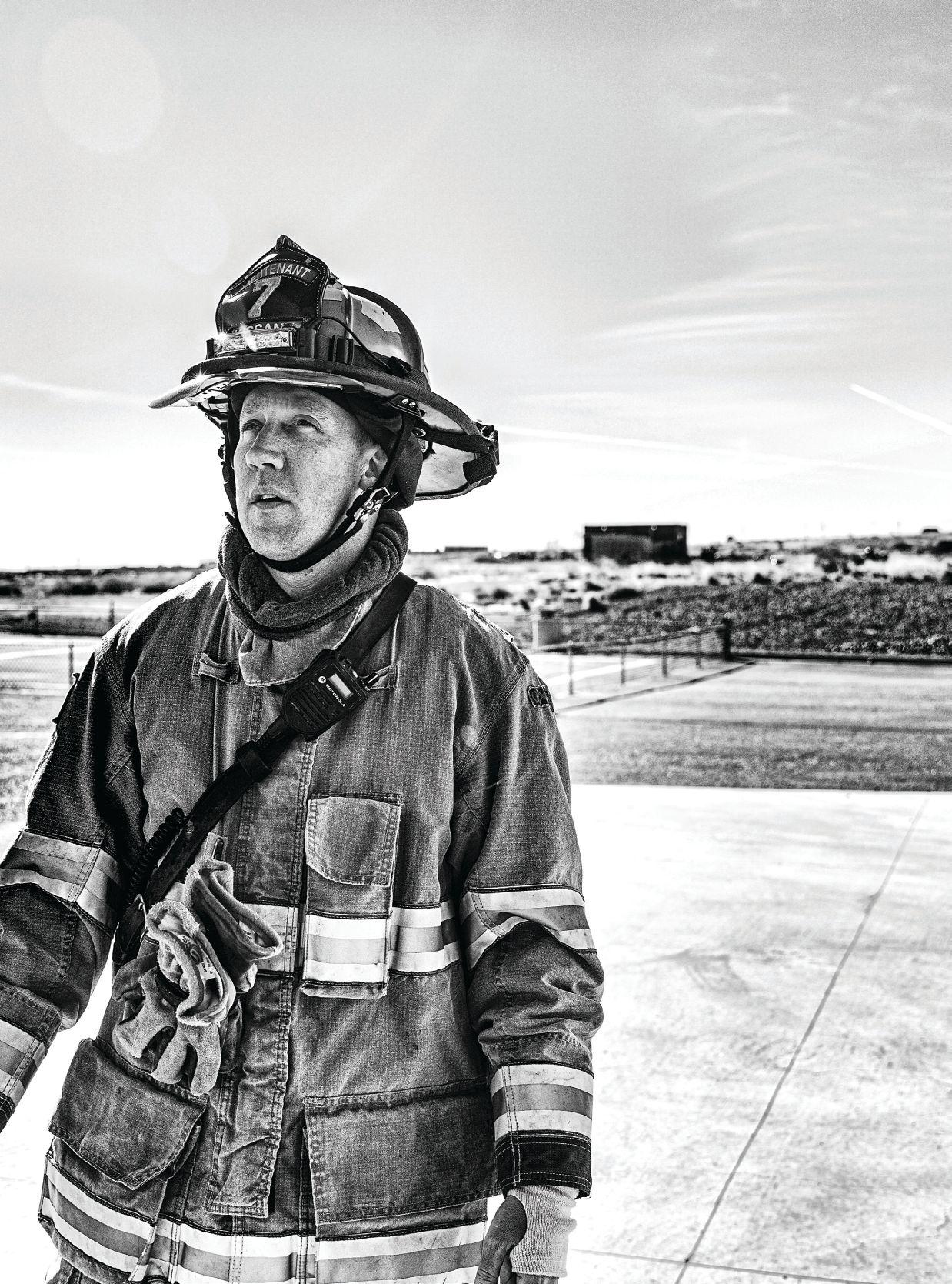
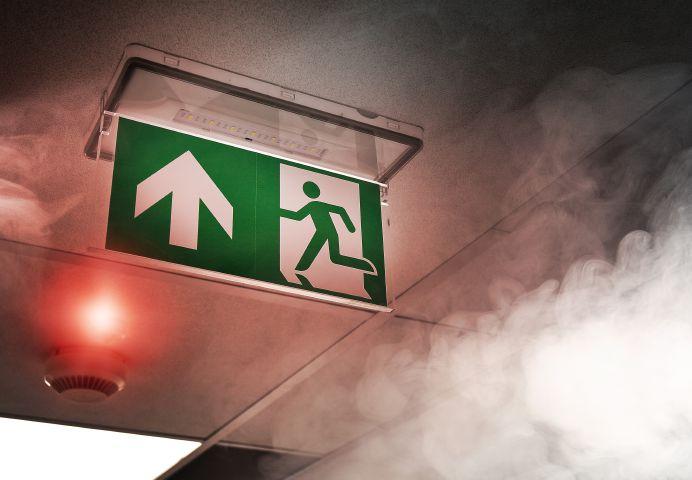
The NFPA is encouraging departments to come up with a pre-plan to promote Fire Prevention Week. The organization has resources available on its website.
16
COMMON SENSE IN THE FIRE SERVICE
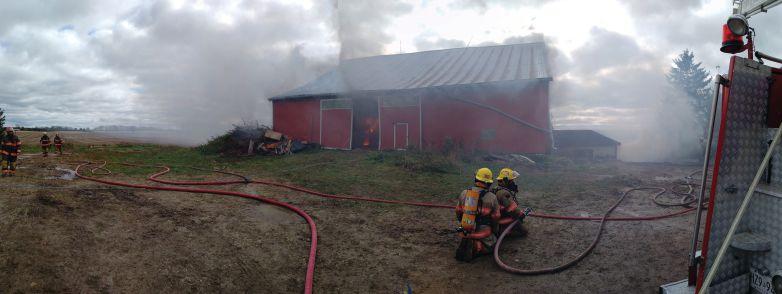
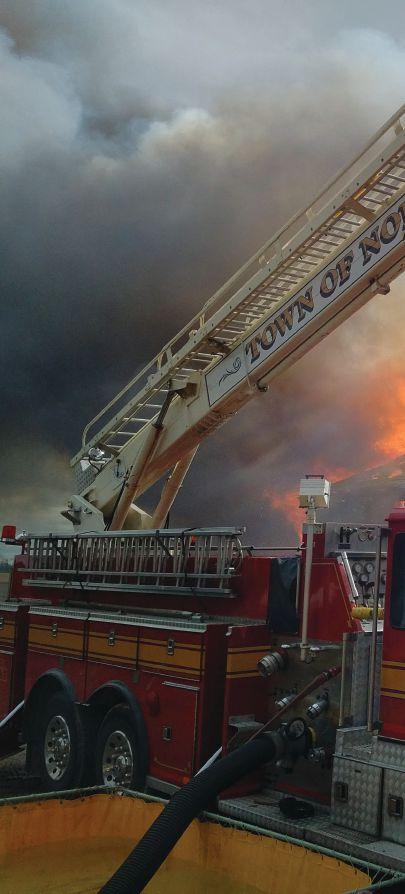
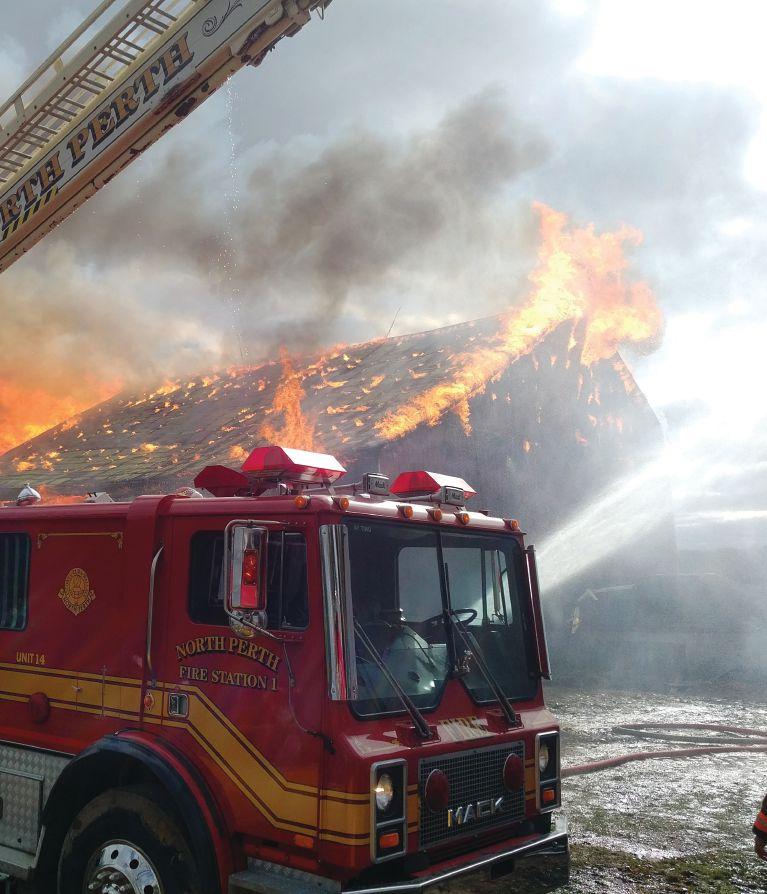
Kevin Scholl, district chief of the Atwood Station for the North Perth Fire Department, says incident commanders must keep a clear head when they are at a fire scene.
20
DEALING WITH DANGER
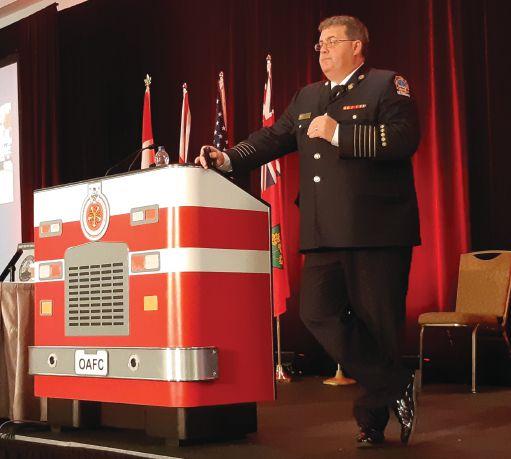
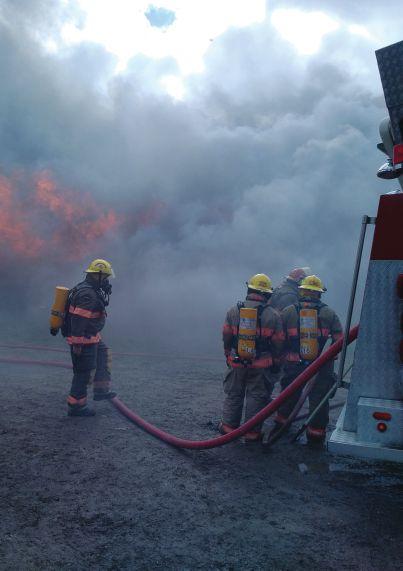
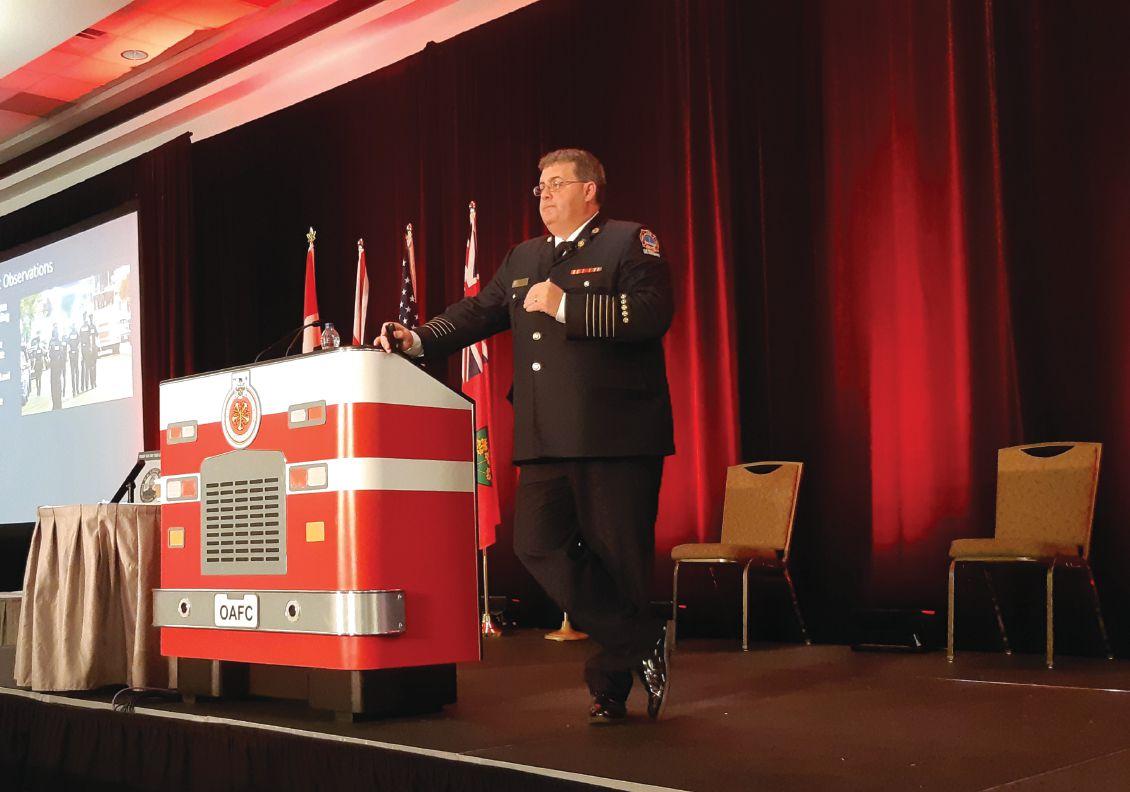
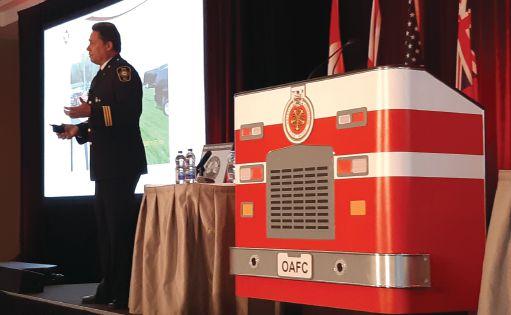
Toronto Fire Chief Matt Pegg spoke at a recent OAFC conference about how firefighters responded to a van attack along Yonge Street and a shooting in the Greektown neighbourhood of the city in 2018.
BY GRANT CAMERON Editor
COMMENT
Bullying shouldn’t be brushed aside
B
ullying and harassment in the workplace is an issue that employers are struggling to deal with these days. Fire departments are not immune. This stuff happens across the board.
That was one of the messages at a session I attended recently at the 2019 conference of the Ontario Association of Fire Chiefs held at The International Centre in Mississauga, Ont.
Zaheer Lakhani, partner at Bandhu Lakhani Campea in Oakville, led a talk which was aimed at helping fire chiefs and senior officers understand their obligations in such situations.
Good, essential, eye-opening, helpful material for fire-service leaders, especially in this day and age, I say.
Lakhani told the audience he’s dealt with incidents involving fire, police, lab technicians and more.
“It doesn’t matter what industry you’re in, it’s common,” he said.
those at the helm have a legal obligation to police and weed it out.
According to the Human Rights Code, everybody has a right to equal treatment with respect to employment. The test for bullying and harassment under the Occupational Health and Safety Act is engaging in a course of vexatious comment or conduct against a worker in a workplace that is known or ought reasonably to be known to be unwelcome from the recipient’s perspective.
ON THE COVER
The NFPA has resources to help fire departments plan for Fire Prevention Week – story on page 10.
Indeed, a Forum Research poll of more than 1,800 Canadians found that 55 per cent of them were bullied or had co-workers who were bullied in the workplace. And, while the majority reported it to employers, only one-third of workplaces took any action. The most common form of bullying was verbal, with 58 per cent reporting this type of behaviour, and almost a quarter reporting physical bullying.
For the record, examples of workplace bullying include physical, non-verbal, verbal, psychological and cyber bullying.
A problem, explained Lakhani, is that many leaders fail to recognize bullying and harassment, as well as sexual harassment, yet
The intention is irrelevant, noted Lakhani, as it only matters how the recipient felt about the situation.
To avoid problems, he advised fire-service leaders to set the tone, lead by example and have a zero-tolerance policy. They should also be properly trained and take all complaints seriously.
If an allegation does arise, fire-service leaders are advised to respond promptly, separate the individuals involved and get legal counsel.
One individual at the session asked what actions a chief should take if someone who has been bullied or harassed refuses to come forward.
In that case, Lakhani said, the chief should document the matter and any proactive measures that were taken.
“You should at least tell them their rights and how you can protect them.”
Sounds like solid advice to me.
ESTABLISHED 1957
AUGUST 2019 VOL. 63 NO. 5
EDITOR GRANT CAMERON gcameron@annexbusinessmedia.com 416-522-1595
Occasionally, Fire Fighting in Canada will mail information on behalf of industry-related groups whose products and services we believe may be of interest to you. If you prefer not to receive this information, please contact our circulation department in any of the four ways listed above.
All advertising is subject to the publisher’s approval. Such approval does not imply any endorsement of the products or services advertised. Publisher reserves the right to refuse advertising that does not meet the standards of the publication.
ILLUSTRATION BY BROOKE SHAW
STATIONtoSTATION
ACROSS CANADA: Regional news briefs
Firefighters can track exposures with new smartphone app
A free mobile smartphone app has been developed that will enable firefighters in Canada and the U.S. to create a personal diary and track on-thejob exposures to deadly carcinogens and other toxins.
The National Fire Operations Reporting System (NFORS) Exposure Tracker is now available as an app for firefighters, paramedics and police officers. They can use the app to log exposures and incident details in a private, encrypted and secure online environment.
“This valuable tool will help provide firefighters with the documentation they need to show on-the-job exposure to a toxic soup of carcinogens and ensure they have the resources to get healthy and return to work,” says Harold Schaitberger, general president of the International Association of Fire Fighters (IAFF).
The app was developed
through a partnership with the IAFF, the International Association of Fire Chiefs (IAFC), Metropolitan Fire Chiefs Association, International Public Safety Data Institute (IPSDI) and other fire-service experts. It is funded by the U.S. Federal Emergency Management Agency’s Assistance to Firefighters grant program and the Ramsey Social Justice Foundation.
Firefighters can download the app from app stores and complete an individual profile. The profile and data entered is encrypted and secure. The app is available from the Google Play store and the Apple App store. More information on the app can be obtained at www.nfors.org.
Fire departments will not have access to data of individual firefighters that choose to use the app. Fire departments participating in the NFORS Analytics (CAD Module) will
THE BRASS POLE
Promotions &
appointments
The District of Ucluelet in B.C. announced RICK GEDDES has been hired as the community’s first full-time fire chief. Geddes comes to Ucluelet from the Port Alberni area where he has served as the deputy chief for the Sproat
Lake Fire Department and acting unit chief for the B.C. Ambulance Service. The new role will lead the fire and protective services department and will include oversight of the emergency management program. The Ucluelet Volunteer Fire Brigade consists of 23 fully trained firefighters and provides essential fire and first responder protection service for the community.
App allows firefighters to log exposures in a secure online environment.
receive periodic aggregate reports about overall exposure trends, but not individual reports.
The app record provides detailed data on personal work-related exposures, which can be accessed anytime, even in retirement.
NFORS is encouraging firefighters and other first
The Town of WhitchurchStouffville in Ontario has hired former Markham Fire Chief BILL SNOWBALL as the new fire chief. Snowball spent more than 41 years at Markham Fire & Emergency Services. He began his career as a volunteer firefighter for Markham in 1974 and became a full-time firefighter in 1985. He worked his way up the ranks first as a volunteer fire-
responders to get their fire departments to participate in the nationwide program to ensure that information about on-the-job exposures is readily available.
By linking their fire department to NFORS Analytics, firefighters’ incident data will automatically load directly into their personal exposure record without additional data entry.
Information gathered in the app will provide essential data to help researchers better understand toxic exposures on the fire scene and develop new treatments and prevention protocols for occupational diseases, including cancer – now the leading cause of death amongst firefighters.
The IAFF and IPSDI are working together to ensure that firefighters using the app can also register to be part of the National Firefighter Cancer Registry and other firefighter cancer studies.
– Grant Cameron
fighter, then full-time firefighter, fire captain, platoon chief, deputy fire chief, and then fire chief in 2009. Snowball retired in 2016.
Ontario’s South Huron Fire Department promoted BILL VANDERWORP to assistant district chief of the Exeter Station.
Alberta department recognized for professional service
Red Deer Emergency Services (RDES) in Alberta is now the only department in the world with four accreditations in fire and medical services.
The department was recognized for receiving the Emergency Fire Dispatch Accredited Centre of Excellence accreditation at a ceremony in Washington, D.C. recently.
The accreditation acknowledges the exceptional performance and professional service to both residents and first responders by the Red Deer 911 Emergency Communications Centre.
“Our citizens are getting world-class service when they
Emergency
accreditations.
call into our 911 centre,”
RDES Chief/Manager Ken McMullen said in a statement.
“Not only are our operators providing the caller with exceptional care, but they are getting the best possible information and support to
our crews as they respond to the situation.”
In addition to the recent award, RDES has achieved the following accreditations:
• Commission on Fire Accreditation International (CFAI): 2016 – 2020
• Emergency Medical Dispatch Centre of Excellence: 2017 – 2020
• Accreditation Canada –Accredited with Exemplary Standing 2018 – 2021 Red Deer’s 911 Emergency Communication Centre is now just one of 45 centres in the world with the Emergency Fire Dispatch accreditation, and one of 26 in the world, and one of only two in
Canada, with both fire and medical dispatch accreditation.
“I am very proud of the work our team has done to earn these accreditations,” said McMullen. “We always strive for continuous improvement and excellence and will continue to develop and hone our technical skills to meet and exceed standards for accreditation in the future.”
The communications centre is a primary 911 public-safety answering point for more than 70 municipalities in central and southern Alberta and serves as a 911 caller’s first contact when they dial the number.
– Grant Cameron
Female firefighters being sought for UBC study
Female firefighters, either born female or now selfidentifying as female, from Canada, the United States, United Kingdom, France, Australia, and elsewhere are being sought to participate in a research study conducted by the University of British Columbia (UBC) in Canada.
The purpose of this study is to describe the incidence and circumstances of cancer and work-related injury among
female firefighters.
Although studies have highlighted the elevated cancer and injury rates among male firefighters, few contain sufficient numbers of women to draw any substantial conclusions.
This information is important for making the workplace safer for, and more supportive of, females in the fire service by: developing and evaluating health and wellness policies; designating resources; and
designing screening, surveillance, and prevention strategies.
The confidential online survey will take 10-20 minutes to complete, asking about your demographics, firefighter career, lifestyle, work-related injury, if any, and cancer experience, if any.
Any information shared with the researchers is kept private and only used for the study.
Principal investigator of the
study is Dr. Ian Pike, professor in the UBC department of pediatrics. Co-investigators are Len Garis, chief of the City of Surrey Fire Department in B.C., and Dr. Kenneth Kunz, medical oncologist in B.C. To complete the study, go to https://rc.bcchr.ca/redcap/surveys/?s=W9FAWEXK7P or contact researcher Kate Turcotte at kturcotte@ bcchr.ca or 604-875-2000, extension 6715.
Retirements
Vanderworp joined the department in April 1997, was promoted to captain in 2010 and ADC in March 2019.
GENE RICHARDSON is the new fire chief for the township of Lanark Highlands in Ontario. He has been a member of the Drummond/North Elmsley Tay Valley Fire Rescue since 1994 and has served in the role of captain since 2009. His
experience includes incident command, safety officer and accountability officer duties, apparatus maintenance, performance appraisals, training facilitator, fire suppression and auto extrication, fire prevention, fire inspection, public education, mutual aid and more.
Brownsburg-Chatham council appointed MICHEL ROBERT
as new fire chief for the Quebec municipality. Robert was officially approved as the new chief on April 2. Robert had previously served as deputy chief and had been serving as acting chief since February when former chief Richard Laporte resigned. The Brownsburg-Chatham fire department has stations in Brownsburg, St-Philippe, and Pine Hill.
South Huron Fire Department’s Assistant District Chief DANNY SMITH with the Exeter Station recently retired after 30 years of dedicated service. Smith started in February of 1989, was promoted to captain in 1998 and then promoted to ASDC in 2006. Smith retired in February 2019.
services in Red Deer, Alta., now has four
STATIONtoSTATION
BRIGADE NEWS: From departments across Canada
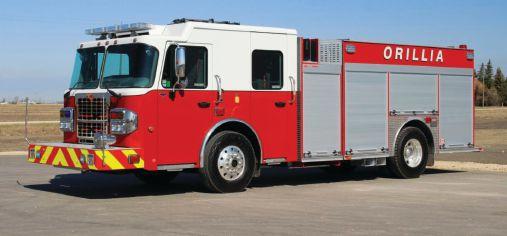
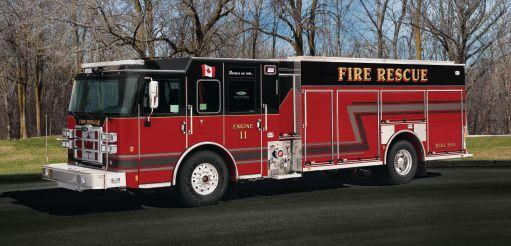
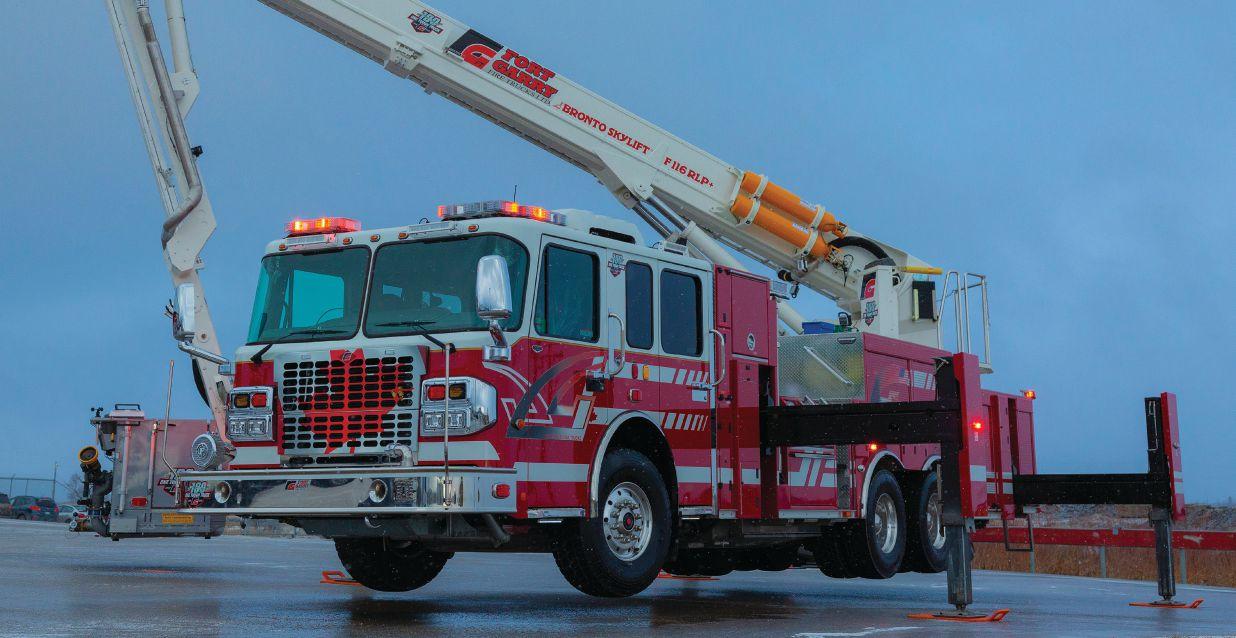
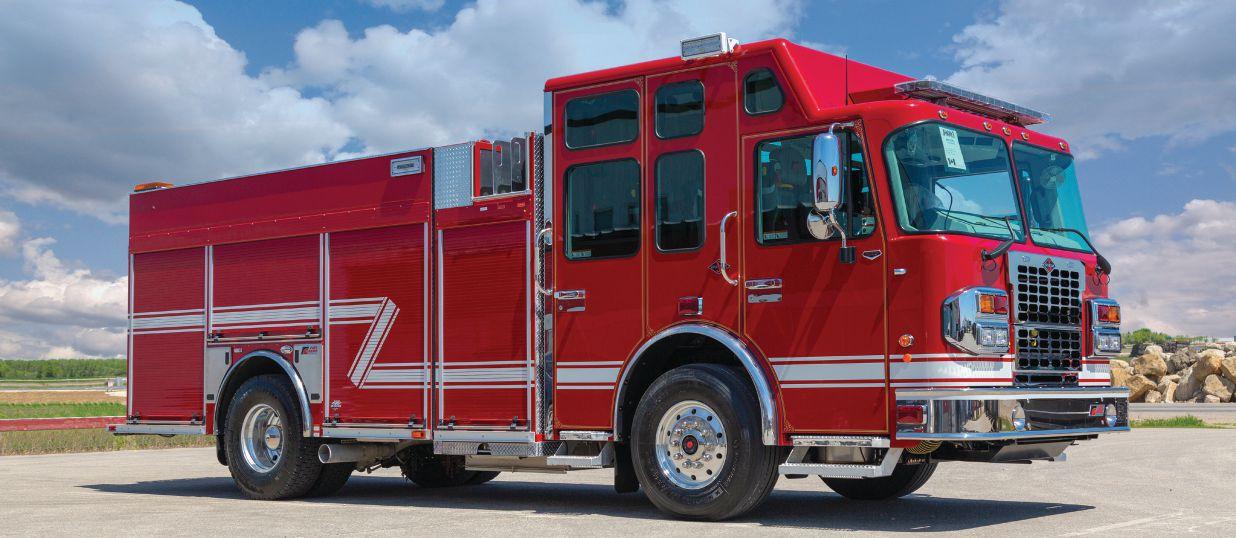
The fire department in Orillia, Ont., took delivery of a new emergency rescue pumper from Fort Garry Fire Trucks. The pumper has a Spartan Metro Star EMFD 10” RR chassis. The pumper is made of 5083 salt water marine grade aluminum and the tank is made of CoPoly 600 imperial gallon and Dual 25 imperial gallon foam cell. It also features a Hale DSD1500 Mid Ship Pump, Side control Pump House, Akron Ball Valves, Foam Pro 2001 Class A/B and more.
Vaughan Fire and Rescue Service in Ontario took delivery of three Engine Rescues from Safetek Emergency Vehicles Ltd, manufactured by Spartan Emergency Response. The rescues are built on MetroStar chassis’ with Cummins L9 450-hp engines. The chassis’ include Spartan’s industry leading Advanced Protection System for occupant safety and V-MUX Electrical System. Marine Grade Aluminum formed fire bodies include Smeal SG-09 Green Power Auxiliary Power Unit, Command Light tower light, Waterous 6000LPM Fire Pump with Advantus 6 foam system, 500-gallon Water Tank and 40-gal Foam Cell.
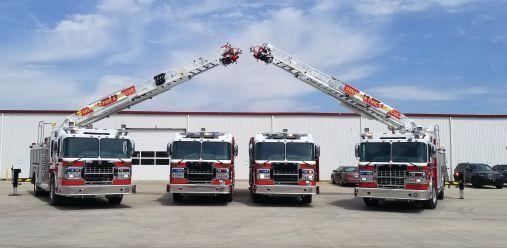
Vaughan Fire and Rescue Service in Ontario also took delivery of two 17M aerial quints from Safetek Emergency Vehicles Ltd, manufactured by Spartan Emergency Response. The aerial quints are built on MetroStar chassis’ with Cummins L9 450-hp engines. The chassis’ include Spartan’s industry leading Advanced Protection System for occupant safety and V-MUX Electrical System. Marine Grade Aluminum formed fire bodies include Smeal SG-09 Green Power Auxiliary Power Unit, Waterous 7000LPM Fire Pump with Advantus 6 foam system, 500-gallon Water Tank and 40-gal Foam Cell.
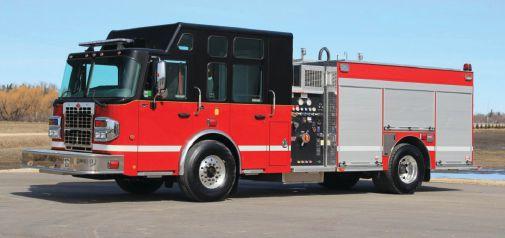
The fire department in Minto, Ont., took delivery of a new emergency rescue pumper from Fort Garry Fire Trucks. The pumper has a Spartan Metro Star EFLD 20” RR chassis and is constructed of 5083 Salt Water Marine Grade Aluminum and the tank is made of CoPoly 600 imperial gallon and 25 imperial gallon foam cell. The truck also features a Hale DSD1250 Mid Ship Pump, Side control Pump House, Akron Ball Valves, Foam Pro 1600 Class A, Chassis EMS cabinets and more.
The Town of Tofield Fire Department in Alberta recently took delivery of a new pumper manufactured by Pierce Manufacturing Inc. The aluminum pumper sits on an Enforcer chassis and has a Cummins LP 450-hp engine. It also has a Husky 3, single agent, PUC, multi select feature foam system and a Pierce, 1500 gpm, single stage, PUC pump.
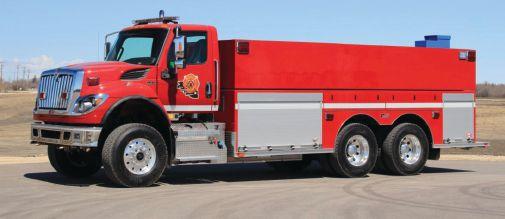
The Beaver Services Emergency Commission in Viking, Alta., recently took delivery of a Crusader Tanker from Fort Garry Fire Trucks. The tanker sits on an International HV607 2-door chassis and is made of Alum 5063 Marine Grade Aluminum. The tanker features a Side Kick Hale PTO Pump module 500 GPM with pump and roll, four KZCO electric valve ground nozzles under front bumper, 3,000 imperial gallon water tank, Fireman’s Friend external tank fill, and more.
VAUGHAN FIRE AND RESCUE SERVICE
TOWN OF TOFIELD FIRE DEPARTMENT
MINTO FIRE DEPARTMENT
ORILLIA FIRE DEPARTMENT
BEAVER SERVICES EMERGENCY COMMISSION
Be a superhero! Plan your escape
Departments encouraged to come up with a pre-plan to promote Fire Prevention Week
By LAURA KING
When I ask audiences across Canada who “does” Fire Prevention Week, every hand in the room shoots up, with great enthusiasm.
When I ask specifically what fire departments ”do” for Fire Prevention Week, the responses vary but I often hear, “We go into the schools,” or, “We do an open house.” Which is fantastic!
But today’s consumers – the people in your communities, your target audiences –receive and absorb information differently than they used to. They’re picky about the messages they receive.
Consumers want – and demand – to be engaged and entertained; they want information delivered to them in ways they can use, share, teach and act upon. And so do you.
LEFT The NFPA’s Fire Prevention Week website has turnkey resources available to fire departments and consumers in an effort to encourage people to think about planning and practising escape plans.
ABOVE The NFPA is encouraging people to make a home fire-escape plan. Materials are available on the NFPA website.
Essentially, to “do” Fire Prevention Week, you need a pre-plan. NFPA’s Fire Prevention Week website – www.firepreventionweek.org – provides turnkey resources for fire departments and consumers – everything your department needs to “do” Fire Prevention Week: videos, images, lessons, activities, tip sheets, social-media posts, press releases, proclamations (local and provincial/territorial), talking points, and games and apps.
The 2019 Fire Prevention Week theme – Not every hero wears a cape. Plan and practice your escape. – lends itself brilliantly to fun, engagement, creativity and interactive activities.
Imagine your volunteer firefighters or your C platoon decked out in superhero capes and masks, at a local community centre during Fire Prevention Week, helping families prepare escape plans. Now that’s an Instagram-able moment.
What’s more, NFPA has listened to the users of Fire Prevention Week (FPW) material, and for 2019 offers three images – an urban scene, a rural scene and a combination
urban/rural scene (notice the diversity represented in each image).
Departments can choose and use the FPW artwork that best reflects their audiences.
So how do you “do” Fire Prevention Week?
Start by going to www.firepreventionweek.org. There are four tabs across the top of the page:
1. Make your plan
2. About
3. Toolkit
4. Resources
Everything on the webpage is free to download; you need only a printer and some creative juices.
If your department lacks a quality printer, why not partner with a local print or copy shop to have materials produced, and promote the store during your FPW event as a partner in fire safety? Dollars to doughnuts the copy shop will offer you a deal or even freebies.
What will you find at each of the four tabs on the www.firepreventionweek.org web page?
• Make your plan: This section includes a home fire-escape plan grid with the 2019 theme artwork, a fire-escape checklist (you can find additional escape-planning activities for children at www.sparky.org), and a fire-safety checklist for caregivers of older adults. Older adults are a risk group in most Canadian communities; be sure to include them in your Fire Prevention Week planning. Use the eight fire-prevention messages in NFPA’s Remembering When program (www.nfpa.org/rememberingwhen) to enhance your visits with older adults.
• About: Do you know how and why Fire Prevention Week started? The story, of course, goes that Mrs. O’Leary’s cow kicked over a lantern that started the Great Chicago Fire in 1911. Fire Prevention Day, then Fire Prevention Week, were instituted to educate people about fire safety and prevention (thank goodness). In Canada, Fire Prevention Week was adopted in 1923 and is our longest-running safety campaign. We know Thanksgiving always falls during Fire Prevention Week (Oct. 6-12), which essentially shortens FPW for us Canucks. To that end, NFPA no longer includes
the FPW dates on the big, outdoor FPW banners. This extends the life of the banners (and your limited pub-ed budget) and enables departments to use the theme all year long. Many Canadian departments hold their FPW events in late August or September to guarantee good weather and a good turnout.
• Toolkit: Oh Canada! All the items in the Fire Prevention Week toolkit – the press release, proclamations, talking points and a fundraising letter – have been Canadian-ized, with Canadian spellings, metric measurements, and Canadian data. All you have to do is fill in the blanks with your department’s information and voila, you have an instant press kit to send to local reporters, and a framework for doing interviews, talking to residents and posting to social media. You’re welcome.
• Resources: This is the gold mine. Images, social media posts, videos, lesson plans, activities, tip sheets, games and apps, story books, templates for press releases, proclamations, talking points, and fundraising – all in one place, and all ready to download.
Now that you know how and where to find the resources, how can you best use them?
Preschools and daycares (ages 2-4): NFPA’s key messages for young children – which can be found in our Educational Message Desk Reference at www.nfpa.org/ Public-Education/Resources are:
1. Firefighters are community helpers
2. Know the sound of the smoke alarm
3. Get outside and stay outside
(Just a reminder that NFPA teaches stop, drop and roll to children starting in Grade 1 – focus on the messages above for younger children).
For preschools and daycares, use the Learn Not to Burn resources at www.sparkyschoolhouse.org and the Fire Prevention Week Make Your Plan grid. Show the Fire Safety Minute video. While you’re on that page, check out the lesson plans and games and apps.
Primary to Grade 2: Show the Fire Safety Minute video, and the key messages on the “Make your plan” tab at www.firepreventionweek.org. Follow the plan on the web page – map it out, mark the location of smoke alarms, pick a meeting place, make sure everyone knows how to call 911. Click on “make a plan” and use the provided
grid to have children draw their homes and find two ways out of every room. Go to the “resources” tab and find an activity you like – there are activities and videos for each age group. Wear your superhero capes and masks!
Grades 3-6: Show the Fire Safety Minute or Making a Home Fire Escape video. Go to the “resources” tab and choose an activity. Try the games and apps with this group. They may also really enjoy the Great Chicago Fire video – and their teachers will love the historical aspect. Show participants how to climb out a window and help a volunteer do so.
Adolescents: This is a tough group to reach. They’re on Instagram and Snapchat. Ask them to follow your department, and then be sure to post catchy items targeted specifically to them. Use GIFs and hashtags to develop a following (start now, not in October). Include the Fire Safety Minute video in your posts. Pose questions: Do you know two ways out of every room? Could you escape a fire in your home? Provide links to www.firepreventionweek.org. Run contests with prizes.
Community groups (children): Brownies, girl guides, scouts, boys and girls clubs, YMCA … use the apps on the www.firepreventionweek.org page and get everyone involved. Show the Fire Safety Minute video and/or the Making a Home Fire Escape plan video, and ask the participants to think about two ways out of every room in their homes. Ask for volunteers to
describe the two ways out. Show participants how to climb out a window and help a volunteer do so. Use the NFPA 10-minute mini-lesson on calling 911 from a mobile phone. Ask participants what they know about Justice League and superheroes (just for fun) and why even superheroes need help and partnerships to save the world. Wear your superhero capes and masks.
Older adults who live in their own homes: Older adults love your company. Choose one key message – plan and practise your escape – and provide the older-adult checklist (click the “resources” tab). Provide the escape-planning tip sheet (also in the “resources” section along with lots of other tip sheets). Older adults may not be able to move quickly or get out of a bedroom if there is smoke or fire. Make sure you know your department’s shelter-in-place policies. Remind older adults to have cell phones nearby, along with eyeglasses, footwear and towels to put around the door frame. Make sure they can hear the smoke alarm. Use the NFPA messaging desk reference to ensure your messaging is accurate. It’s free and downloadable. Show the Fire Safety Minute video or the Making a Home Fire Escape plan video. The Chicago Fire of 1870 video may also resonate with this group. Use the fire safety checklist for caregivers of older adults. Show the Fire Safety Minute video. Most importantly, have prizes and snacks. Autumn home show or fall fair: You will have a varied audience and likely only a few minutes to get your message across –
The NFPA has prepared resources to help fire departments and individuals prepare plans and escape routes in the event of a fire.
with the competition from the food vendors. Choose one topic and focus on it – plan and practise your escape. Explain that homes today burn fast because of lightweight construction and combustibles – families have just two minutes to escape once they hear the smoke alarm. Ask folks to identify two ways out of every room. Have the home fire-escape plan grids available. Show the Fire Safety Minute video. Have prizes.
No matter when or where your FPW activities occur, make sure you include messages for folks who have mobility challenges or are deaf or hard of hearing. Check out NFPA’s resources at www.nfpa. org/Public-Education/By-topic/People-atrisk/People-with-disabilities/Educationalmaterials.
What else can you do in your communities?
You don’t have to host an FPW “event,” rather, think about the activities that happen in your area every day, and have others help you get the message out – that’s true community risk reduction.
• Provide your municipality’s corporate communications department with the FPW images by going to www.nfpa.org/
fpw under the “resources” tab to use in social-media posts. The images are available in myriad sizes, in jpeg and PDF formats. Do this now; most communications folks require a lot of lead time.
• Ask your mayor, councillors and other local influencers to tweet/post about the FPW theme and use the hashtag #FirePreventionWeek. Have a contest to see who can get more followers during the week and have that councillor be an honourary firefighter for a day (just a thought). Get your kids (not kidding) to help you with Instagram hashtags. Instagram is different from Facebook and Twitter. Posting the same things on all three platforms fails to maximize the audience potential. Adding hashtags increases followers and spreads the messages more effectively. Try #firepreventionweek, #firesafety, #Sparky, #fireprevention.
• Invite sports teams – the local rep or Junior A hockey club, for example – to have an FPW theme night. Ask the announcer to read FPW messaging at the end of each period. Post safety tip sheets in the arena. Hand out FPW magnets.
Get Sparky to drop the puck.
• Have your firefighters bag groceries on Saturday, or, better yet, carry the bags to shoppers’ vehicles. On the way, explain the importance of home escape plans and provide handouts. A two-minute talk with a firefighter in a grocery-store parking lot will be a full-fledged conversation at that night’s family dinner.
• Ask local media to play the Fire Safety Minute video (anyone can use it) on their websites, social media feeds and YouTube channels. Have the local reporter demonstrate climbing out a window with a smoke alarm sounding in the background. Reporters love this sort of thing.
At NFPA, our mandate is to help save lives with information, knowledge and passion.
It’s a big word.
We can protect it together, doing little things that make a difference.
Laura King is the NFPA’s public-education representative for Canada. Contact her at canadacrr@nfpa.org; follow her on Twitter at @LauraKingNFPA.
Need Better Coverage, Lower Costs and Faster Dispatch?
You run an analog alerting network with old pagers that barely receive anymore. You’re tired of your pager repair and replacement budget being spent too fast. You’re frustrated with the long delay of your voice dispatch. If any of these statements apply to you, you should definitely consider the s.QUAD Voice – you will certainly be amazed. Contact us for details of our 50th anniversary Pager-Trade-In Program. www.swissphone.ca
swissphone@thamescom.com Phone 877-299-9989
BY MATT PEGG Fire Chief, Toronto, ON
WLEADERSHIPFORUM
Avoid falling into the “when I was” trap
hen I am flying somewhere as a passenger, I love that I have time to sit and think and to both read and write. For today’s busy leaders, having time to just think is a true luxury. I wrote this article in cruise at 30,000 feet while flying over Greenland. It was the act of travelling from one place to another that sparked this leadership thought in my mind.
In today’s world, there is more career movement than ever before. In the past, mobility on your resume was viewed as a bad thing, but that is simply not the case today. Today’s leaders, and the executive recruiters that identify and place new leaders, view a reasonable amount of career mobility as a very good thing. Whether that movement is upward or lateral in one organization or is between two or more different organizations, career mobility produces both perspective and exposure that enhance leadership ability.
I am a fan of career mobility, but in this month’s article I would like to share one of the most common pitfalls experienced by leaders who move between positions in one organization or who move between organizations. This one behaviour quickly compromises a leader’s reputation and acceptance within the new organization. This behaviour is what I not so affectionately refer to as “when I was.”
Leaders walk a fine line when attempting to leverage and reference the experience they gained in their former roles, especially those things that brought about positive change and produced results. They risk being quickly, and often silently, dismissed by their new team for being seen as constantly stuck in the “well, when I was” mode.
their team and not to live in the past.
This is one of the most difficult aspects of integrating into a new team, division or organization. Of course, you never want to disregard the skills, experiences and perspective that your leadership abilities are built on, but how can we leverage our past without alienating ourselves from our new team members?
I recommend learning to use language such as, “In my experience,” and, “Have we considered?” rather than falling into the, “When I was in such and such a place, we did it this way” trap. This provides an effective means of bringing your perspective to the table, without making your new team feel as though they are being subjected to yet another walk down your personal memory lane.
Without any doubt, leaders who ask timely, effective questions are far more successful than those who tend to automatically prescribe the correct answer without seeking to understand the local history and the perspective of the talented people that surround them.
Make no mistake – there will frequently be times when you will be asked specifically about your past experiences, and that information will be immensely valuable to your team. Leaders should never shy
The tendency to frequently refer to your previous position, team or organization happens naturally and automatically. ‘‘ ’’
The tendency to frequently refer to your previous position, team or organization happens naturally and automatically. It sneaks up on you without warning, and all too frequently resides in the leader’s blind spot.
We do this as a result of being outside our comfort zone, in a new culture that we don’t yet understand, and where we silently crave being respected as being competent and worthy by those around us.
Let’s face it, it is more comfortable explaining how things worked or what you did successfully in the role or place you came from than it is engaging your new team within an organizational culture that you have yet to learn. Your new team will be supportive and tolerant for a short period of time, but they will quickly expect you to be a part of
Matthew Pegg is the chief with Toronto Fire Services, having previously served in Georgina, Ajax and Brampton, Ont. Contact Matthew at matthew.pegg@toronto.ca and follow him on Twitter at @ ChiefPeggTFS.
away from, nor attempt to “forget” their past experiences, including both past successes and mistakes. However, we owe it to our new team to make every effort to fully integrate into our new role and to be present in today’s reality rather than defaulting to our past.
What everyone wants in a leader is a clear sense of vision, dedication, commitment and engagement. Be that leader. Be the one who seeks to understand how we do this, how we got here, what our team needs and then make it clear that your priority and focus is on the future of this team.
As leaders, our past experiences and stories are like seasoning on food. Using them in moderation enhances the entire experience although using too much can ruin a very good thing.
Avoid falling into the “when I was” trap and your integration into your new leadership role will go much smoother and will be a much more successful and enjoyable experience for both you and your team.
Common sense in the fire service
Incident commander must keep a clear head
By KEVIN SCHOLL
Common sense in the fire industry. It’s something that seems to fade at any type of emergency call, be it a fire, motor vehicle collision, or medical, etc.
In the fire service, we see so many different types of situations and scenarios on our call-outs.
I’m not trying to condemn anyone in this article, but would simply like to express what I have noticed in my 43 years in the fire service.
There are numerous studies being completed on topics ranging from fire behaviour to building construction, and extrication to search and rescue.
These studies all have an impact on the way that we operate and the way that we train.
The training that we go through now is better than it has ever been before.
With that being said, I feel there is still not enough being done to promote the importance of exercising common sense at a fire scene.
Due to the sheer number and variety of different types of incidents and fires that we are called to, it is difficult to know exactly what you’re getting into until you actually arrive on-scene.
Upon arrival, there are numerous decisions that need to be made in a very short amount of time that are all dependant on that specific situation.
For example, if there is a three-vehicle collision on a main highway, the first truck on the scene will have an officer who will become the incident commander (IC).
That officer will control the scene and make decisions on what to do and how resources should be deployed.
The IC will do a 360, check the situation and relay to the incoming crews what to do. He or she will also indicate where the most serious injuries are and how many patients have been involved.
The IC will also advise the incoming crews of any fluid leaks, overhead hydro lines, etc.
In these situations, the worst mistake the officer can make is getting tunnel vision. This is the point when common sense needs to kick in.
We have all likely made this mistake at one point in our fire-service career, but we need to try to keep a clear mind and look at the whole picture.
The IC must take a deep breath and don’t let his or her mind play tricks.
If you’re the IC, it’s important that you try to make the right decisions based on your training and experience.
Converse with other officers on scene to make big decisions on how to best handle the situation.
If you are the IC, though, it is up to you to make the final decision, and hopefully, if you’re demonstrating common sense, it will be the right decision.
Attitude plays a big role in making sensible decisions.
For example, if the IC starts the scene off by yelling out orders at his or her firefighters and cursing and swearing, that individual is not making sensible decisions. An officer needs a calm and clear mind to be able to think.
The incident commander at a fire scene needs to keep a clear mind and look at the whole picture in order to make the right decisions based on his or her training and experience.
The attitude of Incident Command reflects on the firefighters at task because they also need to work with a clear mind no matter what the situation is. ‘‘ ’’
The attitude of Incident Command reflects on the firefighters at task because they also need to work with a clear mind, no matter what the situation is.
I have seen this happen and the firefighters question any decisions by the IC after that.
In the fire service, we train as a team and need to work as a team with each response, and common sense plays a huge role in these circumstances.
When there is a multi-station response, (for example, if six other fire departments respond to a fire scene) this is where IC really has to have a clear mind, especially in
the volunteer areas like we are in.
IC has so many decisions to make, such as:
1. Making your plan
2. Water shuttle
3. Placing each station around the scene
4. Fire attack, etc.
IC has to have a clear mind and rely on common sense and use his or her training to the best of his or her knowledge.
We have had a few of these calls and everything went well, but I have read and seen that other areas have had problems, which we all do.
LEFT
Incident commanders don’t really know what they’re getting into until they arrive at the fire scene.
Nobody is perfect.
I have seen where arrogance takes over common sense and these things should not be happening.
I realize departments have their boundaries, but if there is a house fire in a rural area, for example, water will likely be the biggest issue and there should be water tankers coming from all stations closest to the scene.
I realize that each department likes to use all of their resources first.
But if there is a tanker (or tankers) 15 kilometres from the scene and IC has tankers coming from 40 kilometres away, which is the common-sense thing to do?
This is not making the right decisions.
People’s lives could be at risk.
If your department choses to wait on tankers from a farther distance instead of using other tankers within the responding station’s area, that is being arrogant over using common sense.
To me this is wrong.
We are in the fire service, whether it is full-time or volunteer, to help people and let’s not forget about helping each other.
We could talk about different scenarios until we’re blue in the face.
But the main point that needs to be understood is that we need to see more common sense in the fire service.
It is not something that we can open to a specific chapter in a textbook and learn about.
It is something that needs to come from within every individual firefighter.
We can all help ourselves practise this skill by keeping a clear mind and making the right decision every time we are on route to a call.
Rely on your training, knowledge and experience to help you make sensible decisions.
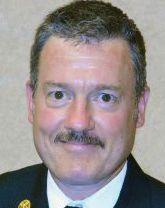
Kevin Scholl is district chief of the Atwood Station for the North Perth Fire Department. He joined the department in 1976 and was a captain for approximately 25 years. He was appointed district chief in January 2013.
BY VINCE MACKENZIE Fire chief,
Grand Falls - Windsor,
N.L.
HVOLUNTEERVISION
Training is critical for departments of all sizes
ow is your department doing? If you ask any firefighter in this country how his or her fire department is doing, you usually get one of two responses.
Responses from firefighters in busy volunteer departments will usually be optimistic. They say they are motivated, it is exciting, and time flies by as they feel they are doing something really worthwhile. Some could even say that the department is so busy that they even have difficulty finding time training. Training becomes a mixture of training nights and calls. The firefighters in busy volunteer departments become experienced quickly and have no problem maintaining their motivation.
In fire departments that are not busy with calls, which are the majority of departments in smaller communities, the answer to how your department is doing may be somewhat pessimistic. Those firefighters typically say there is a challenge to continuously stay motivated in a training program when call frequency is low. They say it’s a challenge to keep everyone interested. The fire department may be providing a larger social role in a community. Departments with low call volume must maintain the training program for motivational survival of the firefighters. Training is critical in all departments but even more so in small ones.
Fire-service officers who really understand the importance of firefighter training typically are really good leaders and the department they are in benefits greatly. There are a fair number of fire-service leaders that actually don’t fully understand the importance of an effective training program. They typically understand their training program only from the perspective by which they learned how training works within their own department.
most officers don’t see that until it is too late and their department is experiencing problems in training attendance.
Good fire departments make mistakes, they make tons of them. One good reason why they make mistakes is because they actually try to get better and try new things frequently. The only fire department that does not make mistakes is the one that does not try to improve.
I have often said that many fire departments can get by on mistakes that others may never see. We can mess up and make mistakes just like the best of organizations. You can mess up a lot in the fire department, but one thing a fire department must get right above everything else is its training program. You can’t get away with a messed-up training program for very long before it starts to show in effective firefighting performance, member morale, member attendance and safety.
Firefighters across the country wonder where to start. They ask how to repair their training program. I think it is easy. The chapters of training manuals using NFPA 1001 is a great place to start and master.
The Ontario fire service has just moved over to the NFPA Standard 1001 for firefighter training. Previous to that, Ontario had its own. I do believe that every province in Canada now follows the standard.
There are a fair number of fire-service leaders that actually don’t fully understand the importance of an effective training program. ‘‘ ’’
Without an effective and challenging training program in their departments, these folks may find themselves wondering why morale is falling and quickly make excuses to not train better, or worse not train at all for a period of time.
Fire-service leaders who don’t understand the true importance of training usually find themselves in departments that start to have issues and, later on, increasing negative morale issues within the department. They end up belonging to fire department organizations that don’t have a whole sense of organization. Compounding the problem is that
Vince MacKenzie is the fire chief in Grand Falls-Windsor, N.L. He is an executive member of the Canadian Association of Fire Chiefs and the past president of the Newfoundland and Labrador Association of Fire Services. Email Vince at firechief@townofgfw.com and follow him on Twitter at @FirechiefVince.
Many provinces have been using the NFPA standard as their basis for training. My province adopted and accredited in NFPA 1001 in 1991. It has not failed our department since.
With the vast diversity in Canada’s volunteer and composite fire service, everyone who reads this column comes from a different-sized fire department. The training program will vary based on the department’s needs. My advice is to allow yourself to continually allow your training team to go ahead and make mistakes, but in the process you will see your department progress.
Show me a department with a good training program and I’ll show you a department that has a lot of positive things going on outside of training too. Training is the core of everything we do. If you mess up training, you mess up the department. If you are in a messed-up department, look at your training program first as the main tool to fix the mess.
Dealing with Danger
Toronto fire chief provides overview of response to mass-casualty attacks in 2018
By GRANT CAMERON
It was just before one-thirty, April 23, 2018, a sunny afternoon in the North York city centre business district in Toronto, Ont., when the first 911 call came in – a motor vehicle accident with pedestrian injury.
Toronto Fire Services was immediately dispatched to the scene. The first truck arrived within three minutes. Upon arrival, though it became clear the incident was much more serious.
A rented van had been driven along a roughly two-kilometre stretch of Yonge Street from Finch to Sheppard avenues, deliberately targeting pedestrians on sidewalks, killing 10 and injuring 16.
Eventually, the damaged van stopped on the north sidewalk on Poyntz Avenue. And, in a dramatic scene that was captured on video, the suspect is seen pointing a dark-coloured object toward Toronto Police Const. Ken Lam who’d arrived at the scene. The man demands he be shot in the head but the officer, realizing the man didn’t have a gun, holsters his pistol.
The man is seen dropping the object from his hand, lays down on the ground and surrenders to Lam.
The arrest was made just seven minutes after the first 911 call reporting the incident was made.
It turned out to be the deadliest vehicle-ramming attack in Canadian history.
Toronto Fire Services Chief Matt Pegg spoke about the dramatic incident, the fire department’s response to it, and how it impacted firefighters at the 2019 conference of the Ontario Association of Fire Chiefs held at The International Centre in Mississauga, Ont., in May.
He also talked about the shootings that occurred July 22 the same year along Danforth Avenue in the Greektown neighbourhood of Toronto when a man killed two people and wounded 13 using a semi-automatic pistol, then committed suicide after a shootout with police.
Pegg was one of the keynote speakers at the conference. He spoke for roughly an hour and gave the audience some insight into the fire department’s role in the aftermath. He also shared his thoughts on what fire chiefs should do to prepare for such incidents.
There was a “palpable sense of horror and shock” after the van attack, he noted. “People were in disbelief. There was an overwhelming sense of evil.”
Pegg said the attack was something that was very difficult for him personally, and the firefighters on scene, because it was so different from events they’d responded to before.
“It’s very different from a normal, traumatic event.”
Some of the firefighters who were at the
Do what you can do in your organization to make it safe. People need to know they can come back from something like this and it’s okay.
scene are still dealing with the aftereffects, he noted.
Pegg showed video of the van attack arrest. It showed the man pointing an object at the police officer. The man continually says, “Shoot me in the head.”
The police officer shouts, “Get down,” at the man several times and he eventually lies on the ground where he is handcuffed by the officer.
“I’m not sure any of us will see any more profound act of bravery,” Pegg said of the police officer.
He said the area where the attack took place is a busy place and an urban environment, but it looked very different after the incident, with the injured and dying everywhere along the route.
“There were more Toronto police officers there than I’ve seen at anything,” he said.
Pegg also spoke about the bravery of firefighters who responded to the incident, as they didn’t know the attacker had been arrested.
He was at headquarters when the incident happened. After he learned numerous pedestrians had been struck, he headed to the scene.
Pegg said it was something he never thought he’d see in Toronto. About 20 fire trucks were deployed over an extensive stretch of Yonge Street.
Afterwards, he said, the city came together and a vigil led by community faith leaders was held for the victims. Pegg attended and said he distinctly remembers there was no political messaging.
“It was all about the community.”
Just several months later, the shootings occurred in the epicentre of Greektown.
The fire department received a call shortly after 10 p.m. that night, said Pegg, and the first fire truck arrived four minutes later.
A man had walked along Danforth, randomly shooting pedestrians before opening fire on crowded restaurants. He was engaged by police and eventually found deceased.
Pegg said some firefighters were on their hands and knees trying to save someone’s life while shots were being fired.
“They were literally in the middle of that scene.”
He said there were many lessons to be learned from both events, one being that fire chiefs need to work hard to make sure that officers on every truck are prepared to deal with a tragedy, and also ensure that their crews have the tools they need to handle such situations.
When such tragedies occur, said Pegg, it’s also important for fire chiefs to get to a safe place so they can be in a position to oversee the situation.
Another consideration, he noted, is to determine who is going to deal with the media. After the van attack, the police chief did the briefing but Pegg, Toronto Mayor John Tory and a representative from the paramedic service were also present.
Pegg said it’s also important for fire chiefs to understand the functions of other first responders and establish relationships with the chief of police and paramedics in advance of such incidents.
“We all have a job to do and there can not be any friction.”
Pegg said fire chiefs should be prepared
to leave the command post at times when police might be discussing sensitive information and there is good reason for that because everybody privy to that information could be compelled to present testimony later in court proceedings.
An often-overlooked issue with such tragedies, though, he said, is that firefighters are left to deal with stresses on their own.
He said post-traumatic stress is absolutely real and he’s now on a mission to make discussion around mental health safe.
“In our organization, it is okay not to be okay” and to talk about the aftereffects from a traumatic event, he said. “Mental illness is a sickness not a weakness. Join with me in taking that message back and driving the transformation in our business.”
There is an impact on firefighters from responding to such calls and departments have to have that conversation, he said.
“Do what you can do in your organization to make it safe. People need to know they can come back from something like this and it’s okay.”
Toronto Fire Services Chief Matt Pegg spoke at the 2019 conference of the Ontario Association of Fire Chiefs held at The International Centre in Mississauga in May.
Grow-op Guidelines
Expert provides advice for firefighters who respond to illegal labs
By GRANT CAMERON
When arriving at a suspected illegal cannabis grow-op or drug lab, firefighters should quickly size-up the outside of the building and be on the lookout for hazards before going in, says Dale Moore, fire protection specialist at the Office of the Fire Marshal and Emergency Management.
“Size-up is so important when firefighters go to a suspected growop home,” he told an audience at a session on grow-ops and drug lab hazards at the 2019 conference of the Ontario Association of Fire Chiefs held at The International Centre in Mississauga, Ont., in May.
Grow-ops are fraught with difficulties and traps that can kill firefighters who are not careful, he said.
Moore spoke for an hour on the topic and gave a rundown on what firefighters should look out for as well as the dangers they face when they are called to extinguish a blaze at a grow-op. He spoke from experience as he once found himself in the basement of a grow-op.
Years ago, firefighters didn’t have to worry about grow-ops but they are a big hazard now, he said.
Moore told the audience about two Philadelphia firefighters who died in the line of duty at a fire that started because of wiring and lamps used to grow marijuana in a basement.
He said grow-ops are found mostly in heavily-populated residential neighbourhoods but are also sometimes in agricultural and industrial areas.
He noted that one grow-op in a $600,000 townhouse was discovered because an adjoining unit had mould.
“They are now going out to smaller communities, figuring they’ll never catch on in a rural area, but police are finding them.”
Moore presented a series of photos to drive his point home. One photo showed a grow-op home that looked normal from the outside. Others showed homes with wiring all over the place.
One photo showed a camper trailer that had been demolished by a butane-extraction explosion, with a massive debris field. Yet another showed a camper trailer in Caledon, Ont., that had a butane can embedded in the wall, the result of another blast.
“That’s compressed gas,” noted Moore. “They’re going to fly all over the place.”
Moore said there are sometimes telltale signs of a grow-op, while other times there are none.
Coloured smoke from a fire scene, compressed gas cylinders in the yard, or vicious dogs, are indicators of a grow-op, he said.
Darkened or covered windows, humidity in the windows, multiple locks on doors, steel-barred outer doors, a lot of roof vents, staining around the windows or eavestroughs, and empty butane cans strewn about the outside are other telltale signs of clandestine operations.
If firefighters see a lot of pails wrapped in cellophane they should
get out of the area immediately because there could be lethal chemicals on site, he said.
Moore said he once went with a warrant to a house that had a three-car garage and found barrels of toluene and acetone which, if there was a fire and water was added, would cause problems. Turns out, the owner of the house was making meth for the Russian mafia.
If firefighters end up inside a grow-op, Moore said they should be on the lookout for entanglements, weakened structures and possible electrocution hazards.
“I can’t stress to you the importance of situational awareness,” he said.
In a grow-op, firefighters have no idea what’s in the ceiling, he said, and there could be fans with shrouds that can fall and cut firefighters, and ductwork with wires that cause entanglement.
He showed examples of how electrical bypasses are set up, which pose safety problems for firefighters, because they might put their hand into live wires in a heavy-smoke situation. Lamps used in marijuana grow-ops also have wires which can entangle firefighters.
Meanwhile, said Moore, firefighters should also be on the lookout for booby traps which are often set up at grow-ops to protect them –not from the police – but from rival drug dealers.
Firefighters at a grow-op shouldn’t turn anything on or off, he said, and just get out of the building, as dealers can set up a trip wire that closes a circuit and sends a current to a blasting cap which will explode. Even a mouse trap can be set up to trigger an explosive charge.
“Get out the way you came in,” he said, noting that shotgun shells on a floor could also indicate a booby trap.
Upon exiting a grow-op, Moore said firefighters still have another very important task to perform.
“When you come out the first thing you should do is an emergency decon,” because if there’s toxic mould in a home a firefighter might carry it and end up contaminating a fire truck.
BY DR. ELIAS MARKOU Naturopathic Doctor Mississauga, Ont.
WDeep breathing 101: how to manage stress
ith a firefighter lifestyle, there are many ways that stress can affect one’s life. In my many years of private practice, I have come to believe that stress truly is the silent killer. One stressful event will not kill you. It is the compounding effects of many years and many stressful situations that eventually overtakes the mind, body and spirit in a negative way.
Inside our body during a stressful situation there are very elaborate chemical and hormonal reactions that occur. Stress can create an irreversible damaging environment that often leads to chronic illness and disease.
There are very few tools that can help you combat stress and its effect on your body. On one hand, I can count the tools that can help you manage stress and the damaging results of stress.
The five things that can help you with your stress are deep breathing, prayer/meditation, regular exercise, yoga/stretching, and quality sleep. Breathing correctly and using your breath in a strategic way is the cheapest, simplest and most impactful technique for improving your health and your stress.
Peace activist and Buddhist monk, Thich Nhat Hanh, would say, “When you feel the stress coming, turn your focus to your breath.”
A high level of health can not be achieved without proper breathing. Breathing has many important physiological benefits that are known to regulate the nervous system, the heart and circulatory system, digestion, and hormonal system. Breathwork is also known to influence and bridge body between the physical body with the conscious mind.
work in adults significantly reduced the negative physiological effects of stress on the body.
Following are some very common techniques for proper breathing:
• Slow Down Your Breathing: When you are stopped at a red light, waiting in a line at the bank or just have a minute to spare in your day, take a minute and practise taking a series of breaths that are deep, slow and more regular with a consistent rhythm. This style of breathing is more efficient and can deliver 100 per cent more oxygen to your lungs and into your cells, resulting in a balanced nervous system.
• Breathe into Your Lower Abdomen: When you breathe in you should be able to feel and see the full expansion of your lower abdomen or belly and not see the expansion of your chest. Breathing into your belly over time will increase the strength of the muscles involved in breathing. Breathe in for five seconds, hold your breath for three seconds and release the breath over five seconds.
• Lengthen Your Exhalation: There are many firefighters that are actively trying to increase their V02 max, a parameter often used for firefighter testing. Many firefighters will run for hours on a treadmill
When we have stress and anxiety and feel depressed, our breathing becomes shallow, rapid and irregular. ‘‘ ’’
When we have stress and anxiety and feel depressed, our breathing becomes shallow, rapid and irregular. This kind of breathing has a negative influence on all of our physiological systems, resulting in poor health in the long run.
Breath control affects every system connected to health. It can lower blood pressure, oxygenate the brain and muscles, balance hormones, increase blood circulation of all parts of the body and relax the nervous system. Regular deep breathing can decrease stress, decrease anxiety, increase energy, and improve sleep and memory. A 2017 study published in the journal Frontiers in Psychologyshowed how breath-
Dr. Elias Markou is one very busy naturopathic doctor. He is in private practice in Mississauga, Ont., and is the chief medical officer for the Halton Hills Fire Department. Dr. Markou was a firefighter for six years; he is a firefighter health expert and blogger who is regularly featured on television and radio and in print. Contact him at drmarkou@mypurebalance.ca.
to achieve a competitive VO2 max. Did you know that you can increase your VO2 max simply by deep breathing? Respiration is deepened by actively exhaling more air out of your lungs, not by inhaling more air into your lungs. Pushing more air out of your lungs trigger the lungs and the brain to take in more air, resulting over time in a higher VO2 max.
Here are a few breathing techniques to improve your health. When the exhalation is longer than the inhalation, your body has a tendency of releasing more stress and toxins via your breath. This can also help you sleep better, decrease your anxiety and even help reduce physical pain and discomfort in the body.
Remember Thich’s most famous Buddhist prayer about breathing when all else fails in your road to health recovery. Just repeat, “Breathing in, I calm my body. Breathing out, I smile. Dwelling in the present moment, I know this is a wonderful moment.”
Hundreds attend B.C. expo/summit
Trucks, technology and apparatus were on display for fire chiefs and key decision-makers
By JAYSON KOBLUN
More than 300 fire chiefs, chief officers, emergency vehicle technicians and firefighters from across the province came to this year’s B.C. Fire Expo at the Trade and Convention Centre in Penticton.
Chiefs and other key decision-makers in the industry browsed the massive trade show floor of the Expo that was on from June 3 to 4.
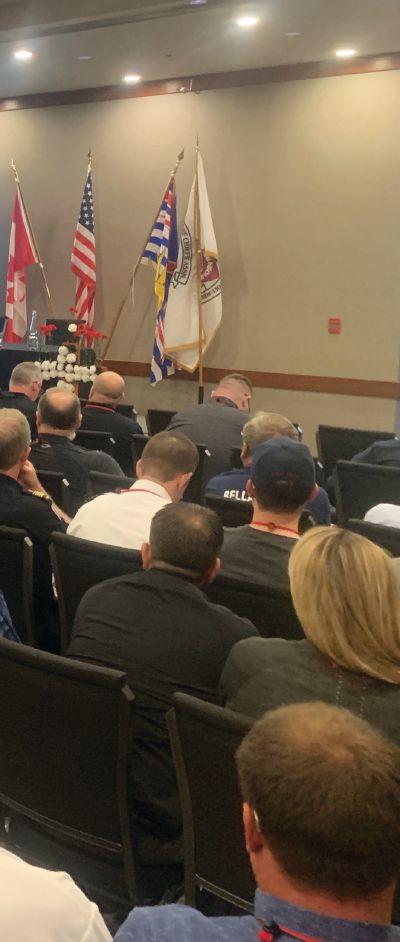
Most chiefs also stayed for an education summit hosted by the Fire Chiefs’ Association of British Columbia (FCABC) from June 4 to 6.
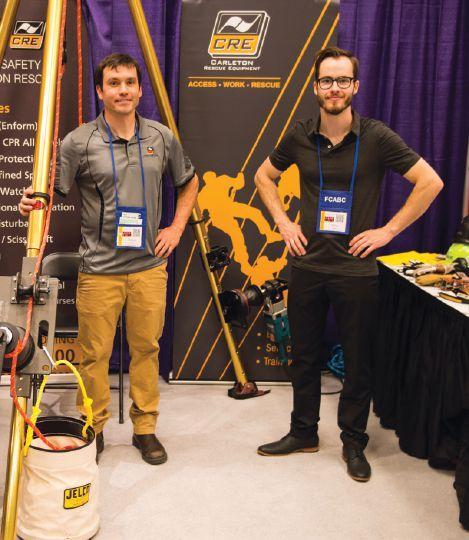
The show floor featured more than 150 displays.
The outside parking lot was filled with dozens of the newest fire trucks, apparatus and emergency-service vehicles for potential customers to consider or simply for anybody to get a good look at the latest tech and features of new trucks.
ABOVE The B.C. Fire Expo featured more than
Hope B.C. Fire Chief Tom DeSorcy was in the parking lot with the new fire-service vehicle his department received late last year and said he was thrilled with the new truck.
“This truck has everything,” he said, “lights all over the place, storage, and when the siren is turned on – man it’s loud.”
DeSorcy decided to not showcase just how loud the sirens were to save those at the event from a scare.
Most chiefs stayed behind once the Expo ended and sat in on several sessions hosted by the FCABC for the education summit portion of the show.
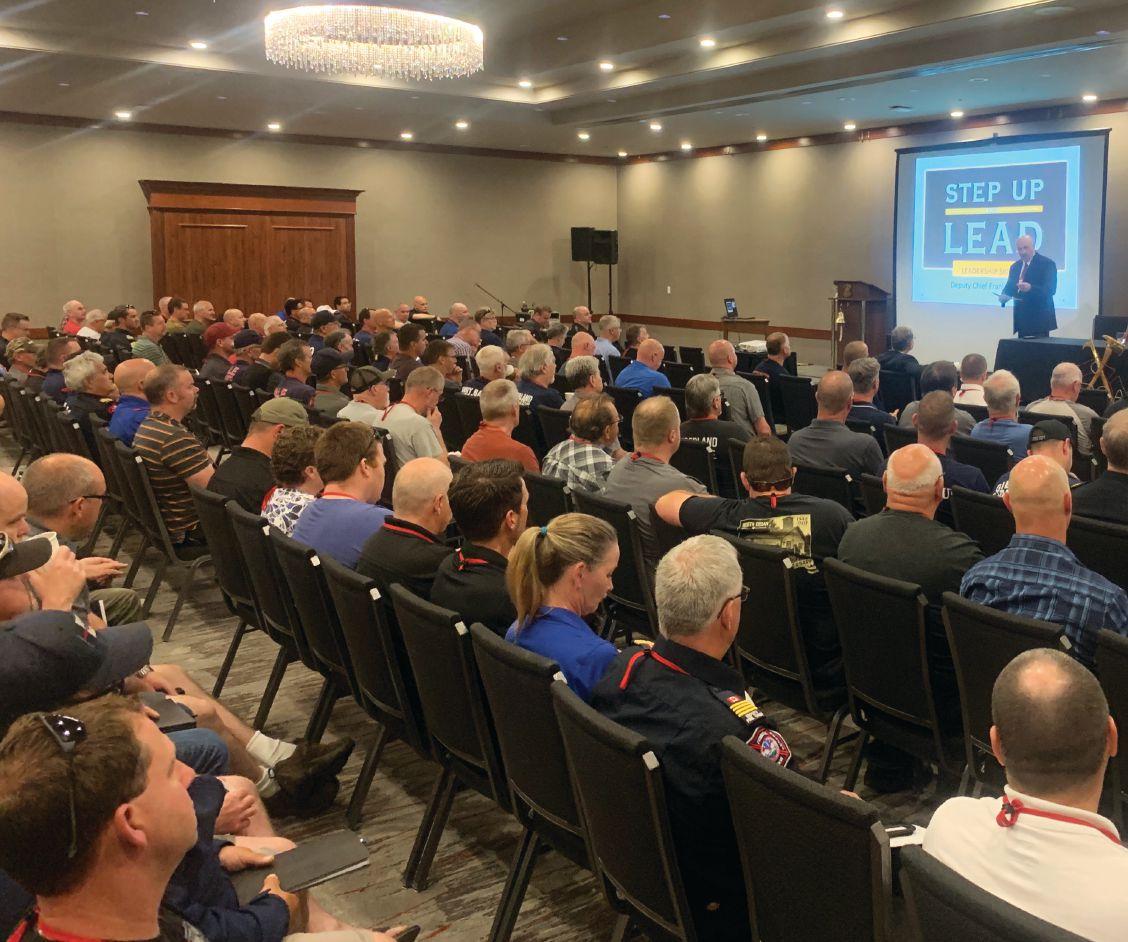
Keynote speaker was Frank Viscuso – an author, speaker and career deputy chief.
Viscuso spoke on stepping up to lead, sharing the secrets of effective fire-service leadership, introducing the traits and skills essential for successful fire-service leaders, and discussing the importance of customer service.
Other topics coverered at the conference were conversations on:
• wildfires
• body language
• surviving the career
• time mastery and accountability, and
• several others
Joy and Marty Playford hosted a session titled, Leading with Time Mastery and Accountability.
They spoke on how to help firefighters make the best use of their time and they also allotted time for the chiefs in the room to talk amongst themselves in mini break-out sessions.
“We want you all to get involved now and participate,” Joy said at the session. “Take a few minutes now and talk amongst yourselves and come up with some of the biggest challenges you face when it comes to managing your department’s time.”
The groups shared their lists of concerns and challenges with others in the room and the Playfords took some additional time to address the concerns and offer some of their own advice.
Laura King, who is NFPA Canadian public-education representative, shared on community risk and why community risk is important for departments to have a handle on.
Also, just in time for the Expo, the NFPA announced the new campaign for this year’s Fire Prevention Week titled, Not every hero wears a cape: Plan and practice your escape.
King sat down with DeSorcy, who is also the host of Fire Fighting in Canada: The Podcast, and the two recorded the latest episode which launched online at www.firefightingincanada.com/category/podcasts/ on July 2.
DeSorcy and King discussed what’s new this year, some background and history on the campaign, and offered valuable resources departments can use as they prepare for Fire Prevention Week, which runs Oct. 6 to 12.
The FCABC’s annual general meeting also took place at the Expo, and there was a themed beach-party event in the ballroom.
The 2020 B.C. Fire Expo will be held in Vernon, B.C., from June 7 to 11.
For more information on next year’s show visit www.bcfireexpo.ca/2020/home. php.
LEFT Frank Viscuso, an author, speaker and career deputy chief, was keynote speaker at an education summit hosted by the Fire Chiefs’ Association of British Columbia.
150 displays.
PHOTO CREDIT: TOM DESORCY
The lowdown on low-air alarms BACKtoBASICS
BY MARK VAN DER FEYST
In the world of fire fighting, we are becoming numb to a lot of the alarms and devices that we are equipped with on our personal protective equipment (PPE). This numbing effect is what is causing us to become de-sensitized to the alarms, vibrations, chirps, whistles and so on.
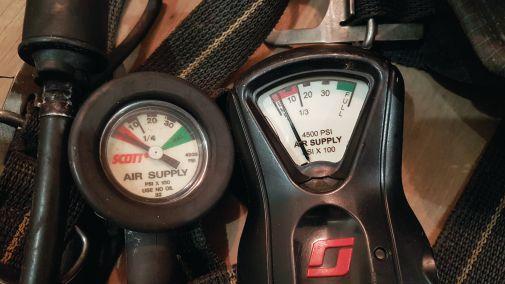
The SCBA is one piece of PPE that has many alarms on it to help warn us of impending danger, elevated temperatures and, of course, no movement. The one common alarm that we have on every SCBA is the low-air alarm.
So, what is the purpose of a low-air alarm on our SCBA? Is it the alarm that tells us when it is time to get out? Or, is it the alarm to tell us how much air we have left?
These two questions can serve as training lessons for any department, as it will spur a great debate and hopefully highlight what the correct answer is.
The low-air alarm was designed and installed to inform the user of how much air he or she has left in his or her cylinder – it is not an alarm to tell you when it is time to get out, because you are supposed to be out of the building or on your way out when the low-air alarm sounds.
Too many firefighters are relying upon the low-air alarm to tell them when it is time to leave a building – and for the most part, they are leaving the building well after the low-air alarm has gone off. The low-air alarm is designed to be an audible, and for some SCBA’s, a tactile alarm as well – which signals to the other firefighters that someone is running out of air. It is also primarily sounding/vibrating to tell the user – you are getting low on air.
The evidence of low-air alarms not working in terms of their intended purpose is the high rate of firefighters getting caught/ trapped in buildings, running out of air and then succumbing to a serious injury, or worse, death.
In light of this, NFPA standards for SCBA changed the requirements for the low-air alarm to go off at 25 per cent up to 33 per cent. This increase in the end-of-service alarm has prompted many fire departments to increase their air cylinder capacities – one-hour cylinders were becoming the trend to combat the low-air problem and to give firefighters as much air as possible to do their job. It also meant that the 2216 SCBA system was going to become insufficient in terms of providing enough air capacity for the end user.
Another NFPA standard change was the integration of the Heads-Up Display (HUD) in the facepiece of the firefighter. This added component allows the user to visually see his or her air consumption status at all times. Every SCBA manufacturer incorporated this extra safety feature into the facepiece somehow with a series of lights; green meaning 50 per cent and more of air, yellow indicating 50 per cent of air left, and flashing red indicating less than 33 per
cent of air remaining.
One particular SCBA manufacturer also added proximity lights on the back of the SCBA as well as on the front of the chest gauge so that all firefighters around can see exactly what the air status is for that particular user. When the air in the cylinder starts to deplete away, the lights that are displayed on the HUD are also displayed on the SCBA for a complete 360-degree situational awareness factor: green, yellow and red.
In basic training, we instruct our new firefighters to monitor their air consumption when they are wearing an SCBA by periodically checking their air gauge. This periodic check is a part of being situationally aware which lends into knowing how much air you are using and how much you have left.
Unfortunately, there has been a parting away from this training as time marches on for the firefighter – the periodic check starts to wean away, and the end result is the low-air alarm going off while still inside the building.
The intended purpose of the low-air alarm is to provide the firefighter with enough air so that if he or she were to find themselves in a situation where he or she had to get out of the building, the individual would have enough air to get out and, if the firefighter got into trouble, still have some air left to bide some time for the RIT rescue.
The school of thinking in this arena needs to be changed and enforced so that the culture of the fire department is progressing for the better – this starts at the top with enforcement.
An example of this is with the Mount Lebanon Fire Department in Pennsylvania where Fire Chief Nicholas Sohyda has a strict rule concerning low-air alarms; exit a building with your low-air alarm going off and you must report to him to explain exactly why it occurred.
NFPA standards for SCBA changed the requirements for the low-air alarm to go off at 25 per cent up to 33 per cent.
BY DAVE BALDING Fire Chief, Golden, B.C.
VFIRELINES
Vibrant training needed for meaningful retention
olunteer fire departments across Canada, regardless of size, continue to face mounting challenges in recruitment and meaningful retention.
It’s commonly held that volunteerism is on the downswing nationally as we compete with ever-demanding work schedules, children’s activities and other organizations, to name a few.
I’m happy to report that our fire department’s membership numbers are currently robust. Further, our members, both experienced and new, are engaged and enthusiastic.
Is there a recipe for this success? I say no, but there are some essential ingredients.
I used the term meaningful retention. Many departments have a periphery of somewhat active or inactive members and a nucleus of those who regularly show up, participate actively in training, attend emergency calls – regardless of the time of day, and other community events.
I have long maintained I’d rather have a few of the right members than a surplus of those who do not fully contribute. This expectation is clearly communicated by me and other officers.
Yes, peer pressure also plays a part as firefighters encourage the engagement of their colleagues.
Vibrant training is another essential ingredient for meaningful retention. Our training is wellplanned, dynamic and innovative. The results are evident in participation and retention.
Our recent success in recruiting brings a challenge, however. An influx of new members requires essential training soonest in order to achieve a safe level of competency in order to respond in any capacity.
of his religious principles) that we would gladly consider him although to meet operational requirements he must be clean shaven. Our impasse became resolved when I offered him an application for a position to undertake all duties that do not require the use of breathing apparatus. We now have a hardworking dedicated member who is a valued member of our team in every respect.
In Golden, we are no different from any other volunteer fire department. We, too, suffer from attrition. We recently lost two welltrained firefighters to career departments. Volunteer fire departments will continue to be the farm teams for career departments, to some extent.
We operate within a world of operating guidelines, policies, procedures and regulations in a paramilitary environment – rightly so for an inherently dangerous occupation. That said, flexibility remains another essential ingredient. As leaders, we must continually have our fingers on the pulse of our departments, continually seeking to make corrections and improvements. I write this as I’m away from the fire department for a time. Despite that, I pay rapt attention to the goingson, the calls.
I have long maintained I’d rather have a few of the right members than a surplus of those who do not fully contribute. ‘‘ ’’
Attracting members to a fire-service organization requires a multi-facetted approach. I believe in the fire department being actively involved in many aspects of the community. Golden Fire Rescue is immersed in many facets of our town’s activities, contributing to a public awareness on several levels such as fire safety, fire department needs, goals and more.
Word-of-mouth recruiting is highly successful. The enthusiasm our members exude when inviting others to join is evident. A recent local recruiting story with some flexibility bears retelling here. Last summer, I was approached by a Sikh gentleman expressing a sincere interest in joining the fire department. I explained (lacking a full understanding
Dave Balding joined the fire service in 1985 and is now fire chief in Golden, B.C. Contact Dave at david.balding@golden.ca and follow him on Twitter at @FireChiefDaveB.
I may have a little trepidation about the upcoming wildfire season and other significant events, but I also have every confidence the right things will be done. I believe this because we train well, we attract excellent candidates, we propel our members upward.
Grooming our up-and-coming members for new positions and responsibilities is critical to both the short- and long-term success of our departments.
We ask a lot in the volunteer fire service, but we also must give a lot. Some is typical, like thanks, rewards and so on, but there is more. Naturally the innate thrill of working with great colleagues and helping others is a giant reward. There are also the ad hoc ideas and activities that flow from a creative group of firefighters – true teambuilders.
The credit for the successes that we, along with our community enjoy, goes without question to those hard-working members that are the glue in our department.
TRAINER’SCORNER Lessons on cross-contamination
By ED BROUWER
At our last practice, I tried to demonstrate the process of cross-contamination from bunker gear to equipment, individuals, the fire hall, personal vehicles, and even to personal vehicles. The latter would eventually lead to contaminants being brought into the homes of our members.
There are several excellent videos that demonstrate this point. However, I felt it important for our members to actually experience this for themselves. I wanted the “shock value” of this self-discovery.
We did not really get into the decontamination processes after a fire, but we did mention showering, routine cleaning of gear, bagging gear before transport, and using wipes on scene. These things are addressed in the Invisible Danger and New Badge of Honor videos on YouTube. Be sure to watch the version which includes Bunker Gear Transfer.
It is well-documented that firefighters are at increased risk of developing certain cancers, including respiratory, urinary/reproductive system and malignant mesothelioma.
In 2010, researchers from the National Institute for Occupational Safety and Health (NIOSH) launched a multi-year study to examine whether firefighters have a higher risk of cancer and other causes of death due to job exposures. It was estimated that firefighter lifetime cancer risk is about 14 per cent greater than the general public. The chances of getting lung cancer and leukemia were seen to increase with fire runs and amount of time at fires.
This column will hopefully show you a simple but powerful way to prepare your members to readily receive this information, resulting in a change of attitude regarding contamination transfer.
The cost to your training budget will be around $60 – a bargain to be sure if even just one member discovers how easy it is to spread contaminates we pick up at calls.
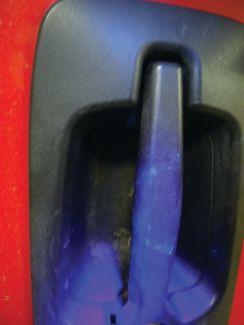
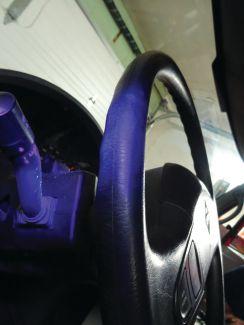
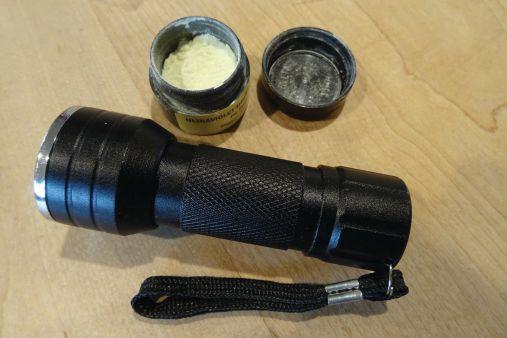
I ordered a UV Theft Detection Powder and UV LED Flashlight combo kit online and received it within a week. With shipping it worked out to $56.42 (Cdn.)
This powder glows bright blue only under UV black light and is invisible. The trick is to lightly dust with the powder, making it impossible to see. (I used a bit too much at first)
Last practice, I set up a room-search scenario. I used three small traffic cones as “bodies.” With a permanent marker, I added a number (one to three) to each one. Then, using a make-up brush I covered each with a light dusting of the powder and hid the cones in various places in our two-level fire hall.
Once the members donned their bunker gear they were divided into two teams (to promote competition). Each team was assigned an IC, and they chose members to be in SCBA (breathing air). Let me say, we never, ever just go in with a mixed team of BA-wearing and non-BA-wearing members, however, we did make an exception in this case. Not sure about your department dynamics, but we have
Door handles are a prime location for contaminated materials.
Firefighters were surprised to find powder on their hands.
Flashlights are another item that can get contaminated at a fire scene.
Steering wheels often get contaminated.
members who will never go into a building wearing BA (due to age or health), but I wanted everyone to experience this contamination transfer.
I wrote the numbers, one to three, on pieces of paper and had each IC choose one. Each team was to retrieve only the cone with their assigned number printed on it. Both teams went in one after the other and, in our case, one team went up the stairs to the second level. The others did a left-hand search.
Again, this really wasn’t about the “room search,” however we had them follow our department’s SOGs. When a cone was discovered it was passed from one team member to another. Once the cone was safely in the hands of the last member, they notified the IC, who told them to exit the building.
When both teams retrieved their cones, we debriefed the “room searches” and engaged in a question-and-answer period. The members still had no idea about the real reason behind this practice. I did this so that they would not behave any different before, during, or after this call simulation.
The practice, as far as they were concerned, was over so they doffed their gear and brought apparatus back in. When we were “supposedly” all cleaned up and ready to go home I called for everyone’s attention. I informed them that this practice was in fact about “contamination transfer.” I explained how the invisible powder was placed on the three cones.
Then, we turned off the lights in the hall and my assistant trainer and I, each armed with UV flashlights, began to shine on the gear hanging up in the lockers. There were audible exclamations of surprise as gloves, helmets and bunker gear glowed blue. When we retraced some of the search patterns, we discovered powder on the key pad for the hall door, the training room door knob and on various objects in the hall.
It was even more of an eye-opener when the UV lights lit up the powder on Engine One’s steering wheel, door handles and BA packs. Then, one member gasped as they discovered powder on their hands.
We had their attention to be sure. This brought out a verbal commitment from all our members to become vigilant in the decontamination process.
We talked about the danger of bringing gear home, or even keeping gear in bags in member’s personal vehicles. Our department immediately instituted new rules regarding gear in the training room.
They are also ordering first responder coveralls that will be kept in individual bags in the medical room. No more wearing of bunker gear or multi-purpose coveralls to first-response medical calls. Our gear was clean, but after this practice we were not taking any chances.
This was an eye-opening practice. I am sure there will be many changes, good changes to our SOGs regarding contaminated gear. It’s time we begin to save lives, starting at the fire hall.
Stay safe and remember to train like lives depend on it, because they do.
Ed Brouwer is the chief instructor for Canwest Fire in Osoyoos, B.C., deputy chief training officer for Greenwood Fire and Rescue, a fire warden, wildland urban interface fire-suppression instructor and ordained disaster-response chaplain. Contact Ed at aka-opa@hotmail.com.
TRUCKTECH
Fire hose history, care and best maintenance protocols
By CHRIS DENNIS
The summer is well under way. The best time to enjoy the great outdoors, except for the bugs. Heck, it’s better than snow, I say.
My last article was about apparatus decontamination practices from the crews riding the truck every day to the technicians that perform repairs on the truck.
Fire hose is the backbone to what you do to get “wet stuff on the hot stuff,” as was once said. Fire hose replaced the bucket brigade. It was first invented in Holland in 1673. It was a 50-footlong length made of leather or sail cloth. These pieces were sewn together and subsequently very heavy. A couple of brass threaded type fittings were attached to either end to couple the hose together.
The leather hose that was stitched was done along the same lines as tannery saddles and rigging for horseback riding. The problem was it leaked, as the seams could not be tight. More water was lost when put under pressure. The seams would also burst when applied weight was added to the hose. The leather, over time, would also crack and dry out then shrink.
This problem was manageable with hose care and maintenance even back in 1673. The design and concept were used for well over 100 years.
Then, in the early 1800s, a pair of firefighters in Philadelphia put their experience and knowledge to work to make this hose better. Still using leather, they were able to attach the two seams together with stitching and an added feature – copper rivets. They later stopped even stitching the hose as the rivets worked well. It would allow for higher pressures and better flow rates.
The pressures recorded were approximately 200-pounds-persquare-inch in the day. This creative invention almost made the hose leakproof. The rivets also now gave the seam area a lot more strength but increased a 50-foot-length to 85 pounds.
When I got schooled on this bit of history I was told that it was at this time when relay pumping was developed. Firefighters were able to move water between storage or pumping stations hundreds of feet apart – the new and improved bucket brigade. This hose, as well, required a lot of maintenance before it was put away for the next big one.
We move forward to 1821 when Mr. James Boyd was able to patent a rubber-lined hose. The outer jackets where made of spun cotton instead of leather. This would make the hose a lot lighter and easier to store and manage.
It was Charles Goodyear, yes of Goodyear rubber company, that discovered vulcanization and applied it to the rubber jacket fire hose. He even added cotton fibers to the rubber to reinforce it.
An old leather hose featuring copper rivets.
Engineered hose washers are available from many different manufacturers and can be used in the station or connected to a fire truck.
A pressure tester for fire hoses.
The outer cotton jackets would act like a sponge, soaking up water and contaminates from the fire.
When the event was over, the wet, dirty hose would be rolled up, folded or stacked till needed again.
It was at this time, again, the level of maintenance had to be stepped up. The hose had to be dried before being put away. It also had to be washed. The mold that would build up on the wet hose, as well as the biproducts of fire on the hose, were not in the best interests of the hose. Things like smell and looks was just part of the business then.
The hose would degrade and fall apart quickly. It had to be cleaned and dried prior to using again. Trees made great hose towers. As well, a gentle snake weave with the hose on its side in the sunshine dried cotton out. These practices are still in use today. Fire stations with hose towers, hose drying racks and the snake weave still work today.
Hose testing was done at this time and proven when the hose blew apart.
Many years have passed since then. Technology has evolved in everything, including fire hose.
If the hose is anything either than rubber exterior, I recommend it be taken off once a year in the spring for cleaning.
’’
Hose outer jackets are made of many different substances –polyester, woven yarn, filament yarn, rubber-in-rubber extrusions to synthetic materials, and recycled. Whatever it’s made of, hose manufacturers are selling a mold-resistant, not mold-free product. They will all prove to you that their product is best-suited for your job requirements. They all have to meet NFPA 1961 (standard on fire hose) if your department works to a suggested standard.
NFPA 1962 is the standard for the care and use, inspection, service-testing and replacement of fire hose, couplings, nozzles and fire-hose appliances.
The hose today requires washing. Decontamination of absolutely every piece of equipment that is used at a fire event requires cleaning. Whatever cleaning agents you are using be sure it meets the manufacturers recommendations for products so as not to ruin the hose.
Depending on your hose of choice, it’s not advisable to pack it away wet. The products, as mentioned earlier, in some cases can be packed away wet and it will not affect the hose product. However, mold will still grow.
There are many ways to wash fire hose.
A pressure washer can be used. Caution must be taken if using this as a means of washing hose. High-pressure washers can damage the weave, as well as pushing it apart if held too close to the weave. Dedicated fire-hose wash brushes and buckets with a garden hose will work perfectly.
As a MacGyver-type person myself, I always see ways to save
TRUCKTECH
money. This includes homemade hose washers. However, as a firefighting professional it’s not my suggestion to do so. Engineered hose washers are available from many different manufacturers.
You are setting yourself up for failure nowadays with occupational health and safety concerns if you use anything homemade. If it fails and injures someone, that amazing gesture of saving the department money by making one just cost the department a whole lot more if someone is hurt.
Depending on hose lay on the rig, your hose may be open to the elements. If so, a cover is best practice. Hard or soft covers will keep the ultraviolet rays and elements off the hose.
In Ontario as well as other provinces, we use a de-icing agent on the roads. Because this is in a liquid state it virtually atomizes and floats in the air and sticks to the hose.
If the hose exterior is anything other than rubber, I recommend it be taken off once a year in the spring for cleaning.
If the hose loads have been off entirely throughout the year and cleaned, then no need. If your department does not run many fire calls in a year, or runs a magnitude of calls, it needs to be hose-tested annually.
I recommend you check NFPA 1961 Chapter 2-1 hose requirements. This will help direct and guide you on what the requirements are and what a fire department is required to do under the guidelines.
Again, these are only guidelines. Each department should have testing procedures as well as documentation that the hose was tested to specifications. It may even be possible that the underwriter for your particular area requires a document that proves the hose is tested to assist with insurance reductions for your area of fire protection.
Nozzles, as well as all other hose appliances, require cleaning as well. Mild soap and water work perfect for nozzles. Be sure you have the correct lubrication fluids for the appliances you have washed – swivel couplings, fog and straight-stream nozzles, and the bails on these nozzles.
Whatever it may be, do not use a lubricant or spray that will attract dirt and allow it to stick.
A wet-applied agenda that dries is best suited such as a dryspray, silicone-based product, for example.
Good old-fashioned soap makes for a great lubrication tool as it will wash away all dirt when water is applied. Just remember to re-lube again with the same.
Have a safe, warm, wonderful summer.
Be safe my friends
Chris Dennis is the chief mechanical officer for Vaughan Fire & Rescue Service in Ontario. He can be reached at Chris.Dennis@ vaughan.ca.
BY LAURA KING NFPA public-education rep, Canada
TPractise … until you can’t get it wrong
he 2019 Fire Prevention Week theme is catchy: “Not every hero wears a cape. Plan and practice your escape”. It’s also critical.
We all know the data; occupants have fewer than two minutes to get out of a burning home.
At the 2019 NFPA conference in June, fire- and life-safety educators described over and over in a workshop their similar success stories: young children leading their families to safety in a smoke-filled home after practising their escape plans at home or in school. Or, parents who had experienced a home fire approaching department personnel in the local bank or grocery store and thanking them for speaking to their kids about smoke alarms and escape plans – for saving their lives.
It sounds dramatic, but in four days at the conference in San Antonio, Texas, I heard myriad stories of saves that were directly attributed to educators visiting schools or speaking at community events, and making sure children took critical life-safety messages home to their parents and families.
We talk a lot these days about community risk reduction: partnering with groups and agencies to identify risks, then building strategies and programs to develop stronger, safer communities.
We encourage municipalities to do that. We want fire departments to analyze data, figure out the problem areas (risks), and create public-education programs to help mitigate those risks. But we also want everyone to embrace Fire Prevention Week – an annual NFPA campaign that allows fire-safety advocates across North America to target audiences with one message, in this case, knowing how to safely exit the home when the smoke alarm sounds. (The story on page 10 of this publication provides more detail on this year’s theme.)
the escape plan. In Canada, many home fires occur at night. Waking up from a sound sleep to a foreign sound, smell or situation is likely to result in inertia, confusion and the loss of valuable seconds (if not moments). Lightweight construction, the volume of combustibles, open spaces, lack of home fire sprinklers; you all know the factors that make home fires today more dangerous and devastating.
Firefighters practise skills not only until they get them right, but also until they can’t get them wrong. Athletes and musicians practise their crafts until they can’t get them wrong – and there are no lives at stake. Astronauts and pilots, surgeons and dentists, welders and electricians train and practise and train and practise more. Yet when our most precious commodities – our families – are at risk, people figure someone else will save them from a deadly situation, in their own homes
People underestimate the smoke and heat caused by burning combustibles, and overestimate their abilities to escape a fire. Hollywood doesn’t help.
And, there’s no doubt that fewer fires have resulted in more complacency. The “it-won’t-happen-to-me mentality” is rampant in today’s narcissistic society that’s more worried about the speed of
“People underestimate the smoke and heat caused by burning combustibles, and overestimate their abilities to escape a fire. ‘‘ ’’
Your data – your community risk assessment – may show that children are no longer at greater risk of being injured or dying in a fire. That’s true. Codes and standards, fire prevention and public education have led to reduced risk. And that is a huge accomplishment. With children, rather than changing less-than-stellar behaviour – which is the objective of public education for adults – we are instilling good behaviour, motivating young people to take action to ensure the safety of their families.
Let’s consider for a minute why it’s critical to make and practise
Laura King is NFPA’s public-education representative for Canada. Contact her at canadacrr@NFPA.org and follow her on Twitter at @ LauraKingNFPA and Instagram at @nfpacanada
the wi-fi or snapping the perfect Instagram photo, than the ability to escape a house fire. Fire ranks lower on BuzzFeed-type lists of people’s fears than spiders and thunder. Eeks.
So, we’ve still got work to do.
NFPA’s Fire Prevention Week theme and resources are free to download at www.firepreventionweek.org. They’re fun – there are videos, games, apps, activities, templates and everything else your department or group needs to put together a package of information for any group in your community.
There are resources to help you explain why people need to have working smoke alarms, to have two ways out of every room, to go outside and stay outside, to have an outside meeting place, and to call 911 from the meeting place (not from inside the home).
We’ve made it easy for you so you can make it easy for the people who need to practise until they can’t get it wrong.
BY TINA SARYEDDINE
Executive director, Canadian Association of Fire Chiefs
EGUESTCOLUMN
Fire Rescue Canada slated for Sept. 13-16
very year, the Canadian Association of Fire Chiefs (CAFC) holds its annual meeting and conference called Fire Rescue Canada.
This year, the conference will be set in Calgary, Alta., from Sept. 13-16.
Fire Rescue Canada offers a terrific lineup of speakers, educational events, need-to-know sponsors, a sold-out exhibit show, and some amazing social and networking activities. You can learn more about it on the CAFC website.
However, Fire Rescue Canada is more than a conference. It’s also when the CAFC begins planning for the 2020 operating year.
Let me take you behind the scenes at Fire Rescue Canada 2019.
■ PLANNING FOR 2020
Before Fire Rescue Canada officially begins, the CAFC board of directors and our National Advisory Council (NAC) will meet to discuss plans for 2020.
For those unfamiliar, the CAFC’s NAC is composed of the presidents or president’s delegates from each provincial and territorial chiefs’ association and from national affiliate organizations.
Both groups then meet with the Canadian Council of Fire Marshals and Fire Commissioners. These meetings are a key vehicle for making sure that the CAFC’s policy issues and priorities are in lock-step and supportive of the issues that are faced closest to home.
Expert in diversity and inclusion, Chief jona olson suggests that to bring underrepresented groups to the forefront requires both within and across-group conversations.
■ CAFC’S TOWN HALL AND ANNUAL GENERAL MEETING
From closed-door meetings to the CAFC Town Hall, each of CAFC’s committees, from Building Codes to Dangerous Goods, Interoperability to Mental Health, Diversity and Inclusion to Redefining Fire then have the opportunity to share with the fire sector the initiatives that they are working on to advance the fire sector nationally.
There is also a call for resolutions which, over the years, has had many important impacts.
For example, it was a 2012 resolution to focus on the mental health needs of firefighters that prefaced CAFC’s commitment as a topmost policy priority in its advocacy with the federal government.
■ INTERESTING SPEAKERS
Last but not least, Fire Rescue Canada is about the fire service. It’s
Fire Rescue Canada offers a terrific lineup of speakers, educational events, a sold-out exhibit show and sponsors. ‘‘ ’’
By the end of these meetings, key policy priorities and areas of focus at the national and federal levels will be identified and will serve as “test materials” for the larger group to decide on for 2020.
■ WOMEN FIRE CHIEFS AND COMPANY OFFICERS
As a first for this year, on Friday, Sept. 13 the CAFC Women Fire Chiefs and Company Officers Network and Alberta Fire, Emergency Management and Wild Fire Management will host a nationwide joint meeting for women chiefs and company officers. This meeting is free and all women are welcome to attend.
The meeting will be followed by an “all allies” meeting of men and women at Fire Rescue Canada.
Why a women’s-only meeting?
Tina Saryeddine, PhD, MHA, CHE, is executive director of the CAFC.
about interesting speakers and committed representatives of the industry.
By the end of the conference, attendees will have learned a lot about diversity and inclusion, what happens when a department is thrust on to the national scene, what fire departments can do to get ready for the federal election, how we can be “all-in for mental health,” and what motivates volunteer firefighters to join departments, among others.
Most importantly, however, Fire Rescue Canada is about taking the time to meet each other – reconnecting with old friends and meeting new ones.
We hope to see you in September.
All CAFC members and friends and colleagues in the fire service are welcome to register for Fire Rescue Canada on the CAFC website at www.cafc.ca.
WORKING TOGETHER WORKS BETTER
Using built-in vehicle sensors, Automatic Crash Response1 can connect to an OnStar Emergency Certified Advisor2 who can provide information to first responders to assist an OnStar member if they’ve been involved in an accident. Advisors can help to identify the location, provide certain medical assistance and advise of the likelihood of serious injuries, using Injury Severity Prediction, until first responder help arrives.