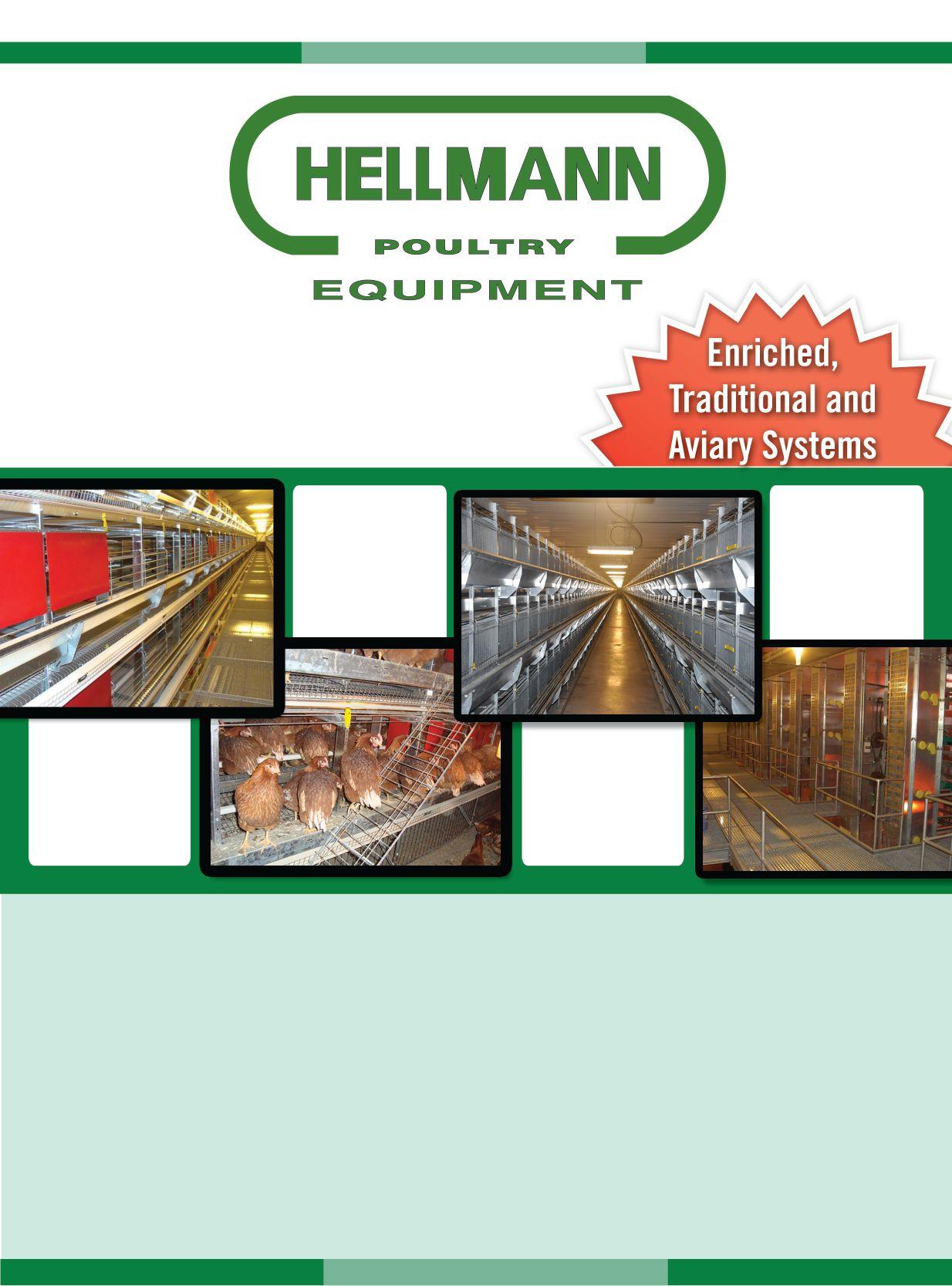
and Pullet Systems Standard Height and Lo-Profile Standard Depth and Extra Deep Options
10
Global: a Giant in agriculture and Poultry brazil’s expanding poultry industry
By Peter Hunton
12
Feed: ddGS Cost Savings
Researchers discuss the benefits of ddGS in turkey feed
By Neil Campbell, Gowans Feed Consulting
18
equiPment: the euro 2012 enriched Cage the new readily enriched cage from meller is now available in north america
By André Dumont
19
WelFaRe: a market for animal Welfare an agricultural economist proposes a new way to promote animal well-being
By Karen Dallimore
23
HouSinG: legislation Pushes u.S. for enriched Cages many organizations have joined forces to move historic ‘egg bill’ forward By Treena Hein
CoveR PHoto by maRilyn WHite.
FROM THE EDITOR
by KrISTy nuDDS
sustainability in Focus
sustainability has become a buzzword in the agricultural industry. but what does it mean exactly?
the uSda defines sustainability as a way to enhance environmental quality; make the most efficient use of nonrenewable resources and on-farm resources, including natural biological cycles and controls; sustain the economic viability of farm operations; and enhance the quality of life for society as a whole.
However, what’s key when talking about sustainability is economics. yes, the end result is providing food for the population at large, but those who produce the food need the system to be economically viable in order to continue making the necessary changes required to be sustainable in terms of both maintaining production and remaining viable economically.
animal welfare, particularly with respect to egg production and the use of gestation crates for sows, has become part of the sustainability equation. at many meetings i have been to in the past year participants have included the welfare of animals and the use of new production systems in the sustainability discussion.
this has been driven primarily by animal rights groups influencing consumers and industry, and it’s led many food companies to start demanding these animals be housed in a certain way. but the key question has always been, will consumers pay for the increased costs welfare-friendly systems incur?
in the article “a market for animal Welfare” (page 19), economist Jayson lusk proposes a credit system for animal welfare that makes welfare a “purchasable commodity” and encourages consumers to buy credits to support its improvement. an interesting idea. However, how will this be measured, and who makes the rules? as lusk correctly points out, consumers
are inconsistent — although many say they will pay more for a product produced within a certain type of welfare-friendly system, the number of consumers who will actually do so is minimal. this was evident, lusk says, during the discussion surrounding Proposition 2 in California; in that case, 63 per cent of consumers voted for a ban on conventional layer cages, but only five per cent said they were willing to pay the premium for cage-free eggs.
despite the lack of willingness to pay, consumers and food companies will continue to push for improved welfare standards. moving forward, the key is focusing not just on the systems themselves but also on how producers can transition while still remaining economically viable. otherwise, the sustainability discussion is moot.
New editor
February 2013
Vol. 100, No. 2
editor
Lianne appleby – lappleby@annexweb.com
888-599-2228 ext. 266
associate editor
David Manly – dmanly@annexweb.com
Publisher/Sales Manager
Marilyn White – mwhite@annexweb.com
519-429-5193
888-599-2228 ext 237 • fax: 888-404-1129
Sales assistant
Mary burnie – mburnie@annexweb.com 519-429-5175 • 888-599-2228 ext 234
Media Designer
Gerry Wiebe
Group Publisher
Diane Kleer – dkleer@annexweb.com
President Mike Fredericks – mfredericks@annexweb.com
Mailing address
P.O. box 530, 105 Donly Dr. S., Simcoe, ON N3y 4N5
Publication Mail agreement #40065710
returN uNDeLiVerabLe CaNaDiaN aDDreSSeS tO CirCuLatiON DePt., P.O. bOx 530, SiMCOe, ON N3y 4N5.
Canada – 1 year $30.00 per year (with GSt $31.50, with HSt/QSt $33.90)
GSt – #867172652rt0001
lianne (lia) appleby will serve as editor of Canadian Poultry while Kristy nudds is on maternity leave, beginning this month. She comes to the magazine from Hybrid turkeys, a division of Hendrix Genetics, in Kitchener, ont., where she specialized in corporate marketing and promotions. Prior to this, lianne worked in public relations for the ontario Cattlemen’s association for five years. She began her career with the Chicken Farmers of ontario. She holds a bSc. and mSc. from the university of Guelph, and completed her masters thesis on broiler nutrition under the guidance of dr. Steve leeson. She is looking forward to immersing herself in the world of the poultry producer and learning more about the industry. She resides in Rockwood, ont. n
uSa – 1 year $ 66.00 uSD Foreign – $75.00 per year
Occasionally, Canadian Poultry Magazine will mail information on behalf of industry-related groups whose products and services we believe may be of interest to you. If you prefer not to receive this information, please contact our circulation department in any of the four ways listed above.
With more than 60 years of experience developing innovative products for poultry producers worldwide, Lubing has established a reputation of leadership by introducing new, cutting-edge technologies to the poultry industry.
Find out what’s NEW at Lubing by visiting our site at www.lubingusa.com
SprayCabinet
Spraying/Disinfecting your chain... Simplified!
DripCanopy
Keep your floors mess-free with a DripCanopy!
Cantilever Drive Unit
Keep the clutter out of processing!
ChainKeeper
It’s like life insurance for your conveyor system!
BaitStation
Keep your rodent problems under control!
Glass-Pac Canada
St. Jacobs, Ontario
Tel: (519) 664.3811
Fax: (519) 664.3003
Carstairs, Alberta
Tel: (403) 337-3767
Fax: (403) 337-3590
Tel: (519) 657.5231
Fax: (519) 657.4092
Tel: (450) 263.6222
Fax: (450) 263.9021
Paying More for Food in 2013 What’s HATCHING HATCHING
Canadians can expect to pay more at the grocery store in 2013, especially for meat and eggs, according to a forecast by university of Guelph researchers.
Price hikes for staples such as meat, bread and cheese are also expected to drive record numbers of people to food banks in the coming year. at the same time, the Guelph experts predict Canadian households will waste more food than ever, throwing out nearly 40 per cent of what they purchase.
“Retail food prices are expected to grow faster than inflation and to increase steadily in the coming years,” said Prof. Sylvain Charlebois, associate dean of research and graduate studies in Guelph’s College of management and economics.
Charlebois, an expert on food distribution and safety, is the lead author of the 2013 Food Price index, an annual examination and discussion of Canadian retail food prices. last year, the index had predicted an overall increase of no more than two per cent, which accurately reflected real Canadian retail prices.
as it was last year, climate is expected to be the most unpredictable economic driver of food prices. the north american drought – the most devastating in recent history for the region – pushed 2012 food prices above expectations, especially for corn and soybeans.
overall, the Guelph researchers predict general food expenditures will increase between 1.5 and 3.5 per cent in 2013. their
predicted price increases for various foods:
• beef and pork: 4.5 to 6.5 per cent increase, due to rising grain prices for cattle feed and higher production costs in the pork industry
• eggs: 3.5 to 5 per cent, due mostly to increases in animal welfare-based technology
• Grain: 1.4 to 2.7 per cent
• Fresh vegetables, fruit and nuts, fish and seafood, and vegetables: one to three per cent the researchers expect that competition in Canadian food retailing – specifically, the arrival in Canada of target stores – will create a price war and eventually drive down food prices.
the full 2013 Food Price index can be found at: http:// www.uoguelph.ca/cpa/Foodindex-2013.pdf.
COMING EVENTs
Farmland Values on the Rise
according to a market
Snapshot from the municipal Property assessment Corporation (mPaC), there was an increase in every region of ontario and for all six classes of agricultural land for farmer-to-farmer transactions, with the largest increase seen in the top three classes (which are primarily used for cash crops).
While grazing land did see an increase, it was much less pronounced.
“the average price per acre of class 1 farmland in ontario rose from $4,051 per acre in 2008 to $7,323 in 2012,” said the report, while class 6 farmland showed only an increase from $421 to $1,008.
Quest to Increase Broiler Quota
ontarIo
The Practical Farmers of ontario (PFo) and Sustain ontario have launched campaigns asking the Chicken Farmers of ontario to increase the number of broiler chickens that farms can produce without quota in ontario from the current limit of 300 birds per year to 2,000 birds per year. there are provisions made, however, for farms to raise a certain number of chickens without quota, which in ontario is called the
the farm values for the 1,700 evaluated farms of 20 acres or more over the past five years were established based on a number of criteria by mPaC. the average increase was noted at 34 per cent, but if the homes (and the acre of land they sit on) are assessed as residential properties, the average increases to 46 per cent.
the increases are being driven by a number of factors,
“small flock exemption.” in ontario, the small flock exemption is 300 birds per year, while the minimum entry point for quota is: 14,000 birds x about seven cycles per year = 90,000 birds per year. there is no middle ground for small farms, says the PFo meanwhile, other provinces allow much greater flexibility in meat bird production.
the Chicken Farmers of ontario (CFo) are responsible for managing the broiler quota system and setting the small flock exemption limit in ontario. on September 6, 2012, the PFo sent a request to the CFo asking for the small flock exemption to be raised to 2,000 birds per year.
says the report. these include: historically low interest rates
• increased prices for agricultural commodities
• large machinery costs
• nutrient management operations for livestock
• urban development
For more information on municipal Property assessment Corporation and the farmland assessment survey, please visit our website www.mpac.ca.
that request was subsequently rejected and the PFo has requested a hearing with the CFo to discuss the matter.
a meeting was held between the PFo and the CFo in late december 2012 regarding this issue, but at press time, the outcome remains unknown.
For more information on both campaigns and how to contribute, please visit the websites for the PFo’s Small Flock Campaign at www. practicalfarmersontario.ca/ pfo---small-flock-campaign. html and Sustain ontario’s “are We too Chicken?” campaign at http://sustainontario. com/2012/12/12/13658/blog/ are-we-too-chicken.
February
February 25-27, 2013 Pacific Egg & Poultry Association annual convention interContinental Hotel, monterey, Calif.
For more information, contact debbie murdock: dmurdock@cgfa.org
marCH
march 6-8, 2013 London Farm Show Western Fair district, london, ont.
For more information, visit: http://www. westernfairdistrict.com
march 13-14, 2013 Midwest Poultry Federation Convention Saint Paul RiverCentre, Saint Paul, minn.
For more information, visit: http://midwestpoultry.com/
march 25-27, 2013 62nd Western Poultry Disease Conference Holiday inn Capitol Plaza, Sacramento, Calif.
For more information, visit: http://www.cevs. ucdavis.edu/confreg/index. cfm?confid=598
aprIL
april 10-11, 2013
London Poultry Show Progress building, Western Fair district, london, ont.
For more information, visit: www.westernfairdistrict.com
Farmer-to-farmer transactions have increased by 46 per cent over the past four years, according to MPaC.
Core Calcium Expands
Core Calcium & Shell Products, which produces calcium-based supplements for the poultry feed industry, has expanded its operation. the company moved from Saraland, ala. (where it has been since the company’s inception in 2000) to a plant roughly five times bigger in theodore in July 2012.
the new plant is located directly on the CSX railroad and a private dock, which allows the company to expand its shipping opportunities to include bulk rail, ships and barges. in addition to new transportation
abilities, the new plant offers new particle sizes and blends of its oyster shell calcium products in bulk 50-pound bags or 2,000-pound totes. the new plant also allows the company the capability of bagging other products and warehousing new products for distribution in the southeastern united States and offshore. the company is currently looking for a distributor in Western Canada for its product.
For more information, contact Ronnie mcdonough, the general manager of Core Calcium & Shell Products, at 251-443-3337.
Controversial research to resume A
fter a worldwide debate about the risks and rewards of pursuing research on H5n1 and a moratorium lasting almost a year on such research, it appears that some researchers may resume their experiments.
according to nature news, experts from all over the world in research and public health met at the national institutes of Health in bethesda, md., to discuss the future of the work. the discussions will continue on
Canada’s Farm Progress Show the Co-operators Centre, Regina, Sask.
For more information, visit: www.myfarmshow.com
JuLy
July 21-25, 2013
Poultry Science Association (PSA) annual meeting town & Country Resort & Conference Center, San diego, Calif.
For more information, visit: www.poultryscience.org
SepTember
September 10-12, 2013
Canada’s Outdoor Farm Show Canad’a outdoor Park, Woodstock, ont.
For more information, visit our website: www.outdoorfarmshow.com
the pros and cons of such research, but attendees are saying that the moratorium may be lifted at the discretion of the funders and the countries in which they are located.
in addition to that, the review will “put in place, for select experiments, an extra layer of review – in addition to peer review, and other standard safety and ethical reviews – by the uS department of Health and Human Services (HHS).”
We welcome additions to our Coming Events section. To ensure publication at least one month prior to the event, please send your event information at least eight to 12 weeks in advance to: Canadian Poultry, Annex Business Media, P.O. Box 530, 105 Donly Dr. S., Simcoe, ON N3Y 4N5; e-mail knudds@ annexweb.com; or fax 519429-3094.
The New Standard In High Yield
Highest Available Yield
The is the best choice for producing value-added deboned products for the fast growing, demanding high yield market. This market requires a broiler that can grow to heavier weights, produce higher meat yield, and do both more efficiently. With the , customers will optimize grow out and processing performance, achieving the highest eviscerated and breast meat yield of all breed options.
Top Broiler Performance
Cobb genetics excel in coupling optimum growth with the lowest feed conversion and lowest cost of meat production. The is proof that high yielding broilers can still achieve superior performance in the broiler house.
Global a Giant in agriculture and Poultry
Brazil is rapidly becoming a world leader
BY P ETER H UNTON
With an area of 8.5 million square kilometres, brazil is the fifth largest country in the world, with a population of 196 million that is growing at a rate of 1.6 per cent per year. it is the third largest agricultural exporter in the world, after the united States and the european union, and agriculture accounts for 6.1 per cent of its GdP, rising to approximately 25 per cent when all aspects of agri-business are included. However, in 2012, brazil ranks first for soybean production at 81 million tonnes, compared with the united States at 73 million.1
the poultry industry has evolved over the past 50 years into one of the world’s great success stories, with a modern broiler industry supported by massive resources for the production of feed ingredients, primarily corn and soybeans, and processing and marketing of end products. in 2011, the broiler industry exported 4.1 million tonnes of chicken to 150 countries, with a total worth of $8.85 billion uS. the industry also accounted for 3.5 million direct and indirect jobs.
but exports are not the only avenue that the industry has expanded, as domestic consumption stands at 47 kilograms/capita, slightly higher than
Brazil is the third largest agricultural exporter in the world, and its broiler industry exported 4.1 million tonnes of chicken to 150 countries in 2011, with a total worth of $8.85 billion Us
current u.S. consumption.
Rabobank, which specializes in agricultural financing, has recently predicted that by 2030 world demand for meat will rise by 44 per cent to 400 million tonnes annually, and that the largest portion of this expansion will be from poultry meat, which is
expected to account for 39 per cent of world meat consumption. they quote World bank data indicating feed, water and time required to produce one kilogram of meat in the chart below.
Recently, the egg industry has begun to grow and now involves a significant export business.
Industry exPansIon
BroiLer iNdUStrY GrowtH
the broiler industry in brazil has expanded from practically zero in 1960 to producing more than 13 million tonnes in 2011. in 1989, 1.5 billion broiler chicks were placed and in 2009, that number expanded to 6.5 billion. this development was based on an integrated system led by agri-businesses in the feed and processing sector, with co-operating growers surrounding each processing plant. the industry is concentrated in the south and mid-west of the country, in the states of Rio Grande do Sul, Santa Catarina, Sao Paulo and mato Grosso do Sul. data shows that, compared with broiler production in the u.K., for example, brazilian industry uses 25 per cent less energy, and produces 17 per cent less greenhouse gas emissions. another advantage enjoyed by the brazilian poultry industries is the relatively low cost of labour. according to Gordon butland of G&S agriconsultants, speaking at the recent World’s Poultry Congress, average personnel cost in brazil is $500 uS/ month, united States $2,000, thailand (another major broiler producer) $300 and Poland, $920. this, combined with comparatively low domestic feed grain prices, gives the country a competitive edge.
the first overseas shipment took place in 1976. Since exports became a major factor in expansion, the industry has had to meet international standards of quality, hygiene and, more recently, bird welfare. all of the exporters now meet the health and welfare standards established by the World animal Health organization (oie), and the u.n. Food and agriculture organization’s Codex alimentarius. Since many exports go to countries in the middle east, all processing plants shipping there can also work to halal standards. along the way, and again primarily to meet requirements of importing countries, the industry has become extremely conscious of its responsibility to protect the environment and to be seen as operating in a sustainable way. they are using novel ways to conserve and recycle water at many levels, as well as different ways to capture and recycle (or at least minimize the impact of) waste materials throughout the production and processing cycles.
Health monitoring is an important part of every commercial operation and brazil boasts that there has never been a reported case of avian influenza (ai) within its borders. the industry is moving rapidly towards a “compartmentalization” system that would limit disruption in the event of an outbreak of disease such as ai. Four of brazil’s major companies took part in a pilot project, currently under evaluation, that is expected to lead to government legislation setting up the system. the brazilian Poultry association (ubabeF), of which all major producers are members, has established a set of criteria for quality, biosecurity and sustainability that, when met, permits the companies to use the organization’s seal of quality when marketing their products. thirty-one broiler companies, and three egg-exporting companies, are listed as members of ubabeF in 2012.
tHe eGG iNdUStrY
the development of the egg industry as an active exporter is much more recent, and the volume is nowhere near as great as it is for broilers. nevertheless, the egg industry enjoys the same natural advantages as the broiler industry: readily available feed ingredients, good climate, relatively low labour cost and a large domestic market. However, until recently, the domestic market suffered the same “boom-and-bust” cycles that plague industries elsewhere. Producing an undifferentiated “commodity” for an indifferent public was the rule. However, things have changed in recent years and brazil has begun exporting both shell eggs and some liquid and dried egg products.
according to ubabeF, egg production in 2011 was 31.5 billion eggs (or 1.9 million tonnes), of which 16,600 tonnes was exported. although this is a relatively small volume in terms of the total international trade in eggs, it will likely increase substantially in the short to medium term. n
canadian feeding trial demonstrates benefits of elevating inclusion rates of ddgs in commercial tom turkeys
B Y N EIL C AMPBELL , G OWAN s F EED C ON s ULTING
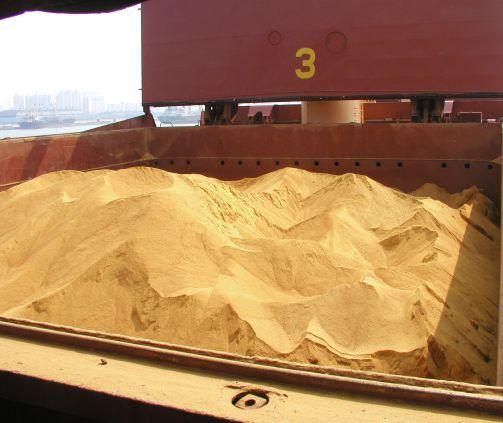
arecent Canadian onfarm feeding trial demonstrated significant feed cost savings while maintaining live animal performance through the inclusion of dried distillers Grains with Solubles (ddGS) in properly balanced turkey rations. the trial, conducted by Gowans Feed Consulting in conjunction with Great lakes Poultry Farms ltd., Fischer Feeds, and the u.S. Grains Council, tested ddGS inclusion rates of nine per cent and 15 per cent. turkey producers can therefore proceed with confidence with ddGS inclusion rates of up to 15 per cent, provided that rations are correctly balanced. the exact feed cost savings achieved by producers will depend on the price of ddGS versus the price of other grains and proteins, but may be significant.
Feed CoSt SaviNGS
ddGS from corn are a co-product of the u.S. and Canadian ethanol and distillery industries and are widely available across Canada. during most times of the year, they represent a significant opportunity to reduce feed costs.
ddGS are a moderate energy and amino acid ingredient, a good source of available phosphorus and highly palatable. Feeding trials in the united States have demonstrated inclusion rates of up to 20 per cent in tom turkeys without
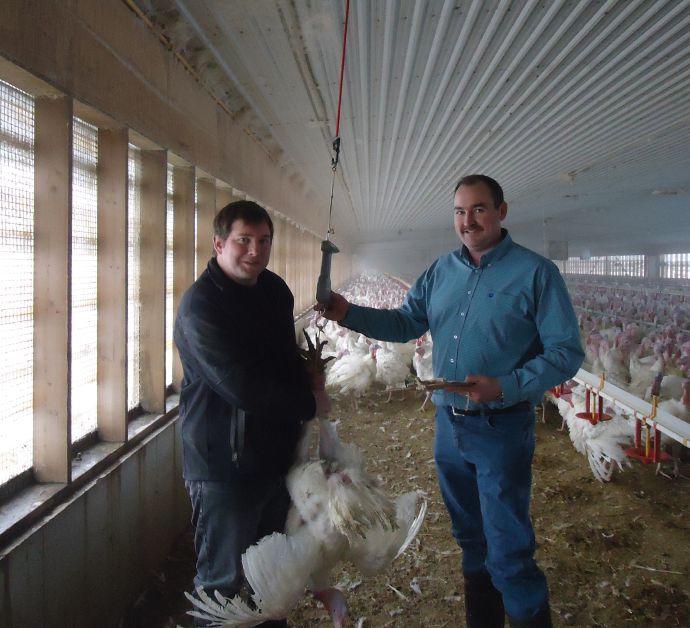
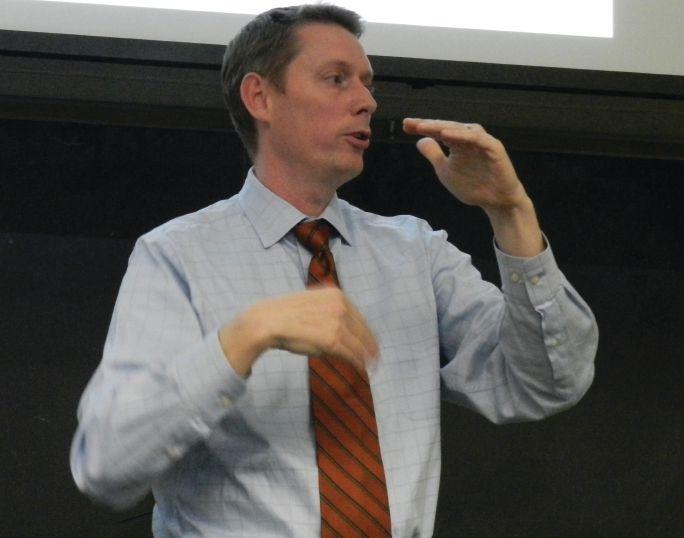
tyson schlegel (left) of great lakes Poultry Farms ltd. and neil campbell from gowans Feed consulting conducted a canadian trial on dried distillers grains with solubles (ddgs) in turkey rations.
any detrimental impact.
in Canada, turkey producers and nutritionists have been cautious in increasing inclusion rates past 10 per cent for fear of reducing growth performance and increasing wet litter challenges. However, our recent trial demonstrates that ddGS inclusion rates can be safely increased.
over the last several years, customers of Gowans Feed Consulting have been successfully feeding ddGS at inclusion rates of 10 per cent in the grower and finisher stages of tom turkey rations but were aware of the notion of realizing significant feed cost savings opportunities
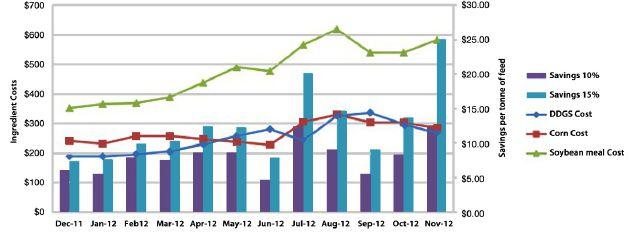
by increasing the inclusion rates. table 1 and Figure 1 present the theoretical monthly feed cost savings of feeding ddGS in tom turkey grower finisher rations at 10 per cent and 15 per cent in southwestern ontario over diets made without ddGS and the cost of ddGS relative to corn and soybean meal. over the past year, savings at 10 per cent inclusion have ranged from $4.72 to $12.64 per tonne of feed while savings at 15 per cent have ranged from $7.43 to $25.12 per tonne of feed. Feed cost savings are at their highest when ddGS are at a discount to corn and soybean meal prices are over $550 per tonne.
Feed alternatIVe
Feed
in order to gain confidence and demonstrate these potential savings, a com-
mercial scale feeding evaluation was required. Great lakes Poultry Farms ltd., a large modern turkey production complex near Wingham, ont., had four commercial grow-out barns available and is in close proximity to the Fischer Feeds feed mill, a large-scale fully automated modern facility in listowel, ont., with the process control necessary for the trial. the u.S. Grains Council provided funding support for the demonstration. the trial was conducted at Great lakes Poultry Farms’ Wingham West facility from January through may 2012.
on Jan. 3, 2012, a first allocation of 16,356 commercial tom turkeys (200 nicholas, 16,156 Hybrid Converter) was placed randomly in one barn. on Feb. 9 and 10, 2012, a second allocation of 16,175 toms (475 nicholas and 15,700 Hybrid Converter) was placed randomly in another barn. all birds on each placement date were grown together and the same feeding program was used.
at six weeks of age, the Jan. 3, 2012, placement was weighed and split evenly between barns 6 and 7 at the Wingham West grower-finisher commercial turkey barns. at six weeks of age, the Feb. 9 and 10 toms were weighed and split evenly between barns 8 and 9 at Wingham West. barns 6 and 8 were fed diets containing nine per cent corn ddGS. barns 7 and 9 were fed diets containing 15 per cent corn ddGS. all diets were formulated
Table 1 (TOp): monthly savings of feeding ddgs in ontario tom turkey grower finisher rations and monthly ingredient costs ($/tonne) source: gowans Feed consulting monthly ontario Value analysis
Figure 1 (LeFT): ontario ingredient costs and ddgs savings in turkey rations ($/tonne)
to the same nutrient specifications and fed ad libitum. Fifty birds from each barn were weighed weekly to monitor the average daily gain. Feed rations (pelleted) were manufactured at Fischer Feeds. turkeys were marketed as per the standard protocol to Cold Springs Farm Processing Plant in thamesford, ont. all four barns performed well on their respective treatments, with market weights, growth rate, feed conversion, mortality and feed cost per kilogram of gain achieving their respective targets. both treatments performed similarly with the 15 per cent ddGS treatment coming out slightly better in weight gain and with a lower feed cost at 115.5 days. overall, the feeding trial demonstrated that there were no negative effects of increasing the ddGS inclusion rate. this should give turkey producers and nutritionists the confidence to increase inclusion rates to 15 per cent. n
Neil Campbell is a partner with Gowans Feed Consulting, a leading independent poultry and swine nutrition consulting company working for producers across Canada and in select international markets. Neil is responsible for business development and consulting on feed cost reduction and ingredient price risk management for clients. More information on this feeding demonstration can be requested through Neil by e-mail at neil@gowansfeedconsulting.ca or by telephone at 519-866-5927.
tHe FeediNG triaL
CPRC Update Improving Canadian Poultry research
last fall, the Canadian Poultry Research Council (CPRC) hosted a series of six workshops across Canada in a lberta, Saskatchewan, manitoba, ontario, quebec and nova Scotia. Workshop objectives were to:
1. Present and discuss the national Research Strategy for Canada’s Poultry Sector issued in august 2012 and available on CPRC’s website
2. Review progress to date of the current Poultry Science Cluster co-funded by industry, provincial governments and agriculture and agri-Food Canada’s (aaFC) Growing Forward program
3. explore potential elements and partners for a new Cluster under aaFC’s AgriInnovation program scheduled to begin april 1, 2013 the workshop series was part of CPRC’s industry outreach activities to foster ongoing discussion among those involved in Canadian poultry research as well as those who benefit from research discoveries including producers, input suppliers, processors and consumers.
Participants were asked what they liked about CPRC’s approach to development of a potential Cluster application; several themes emerged from responses:
• A broadly based, balanced approach: many participants liked that the potential Cluster includes a range of scientific disciplines and that CPRC intends to balance forthcoming funds between Cluster research and individual projects.
• Based on industry needs : Participants recognized that the potential Cluster construct aligns with industry-identified research priority areas and target outcomes as described in the national Research Strategy.
• Collaboration: the participants appreciated efforts to solicit input from research groups across the country and encourage them to work together to address research issues.
• Long-term vision: the relatively long (five-year) time frame of the Cluster program was appreciated by most. even more so was CPRC’s vision beyond the Cluster to promote sustained funding for poultry research in general.
• take strategic approaches.
• improve communication.
• maintain flexibility.
• Consider the needs of all industry commodities.
• Secure stable sources of funding.
Next S tep S
While preparing the Cluster application, CPRC considered all of the valuable feedback received during, and subsequent to, the workshops. a CPRC subcommittee, representing each of the national poultry organizations, identified proposals of particular interest to industry. Proposals were reviewed by CPRC’s Scientific a dvisory Committee to ensure scientific merit and several of these research ideas are being incorporated into a Cluster application, to be submitted to aa FC by the end of m arch.
t he main thrust of the agenda was to draw on the broad pool of expertise and representation among workshop participants to receive input on ways that industry can leverage the research completed in the present Poultry Science Cluster and other industry research activities to maintain Canada’s poultry research initiatives. t hese initiatives will include both the AgriInnovation Science Cluster and ongoing project research supported through a variety of funding sources.
• Theme categorization: the participants generally agreed with dividing the cluster application into three broad themes, under each of which specific research activities could be listed.
Participant suggestions to improve the potential Cluster application also fell into themes:
• Consider using international collaboration.
• Promote multidisciplinary research and collaboration.
For more details on these or any other CPRC activities, please contact the Canadian Poultry Research Council, 350 Sparks Street, Suite 1007, o ttawa, o ntario, K1R 7S8, phone: 613566-5916, fax: 613-241-5999, e-mail: info@cp-rc.ca, or visit us online at www.cp-rc.ca. n
The membership of the CPRC consists of the Chicken Farmers of Canada, the Canadian Hatching Egg Producers, the Turkey Farmers of Canada, the Egg Farmers of Canada and the Canadian Poultry and Egg Processors’ Council. CPRC’s mission is to address its members’ needs through dynamic leadership in the creation and implementation of programs for poultry research in Canada, which may also include societal concerns.
Equipment
The euro 2012
meller Poultry equipment has introduced an enriched colony system that offers more space
B
Y A NDR é D UMONT
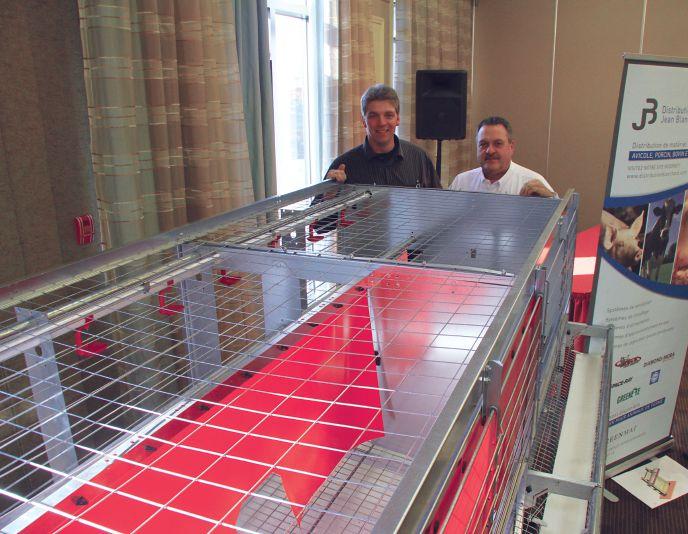
The new German-made m eller e uro 2012 enriched colony system is now available in north america.
‘’ e verything has been rethought,’’ says Chris bill, of meller Poultry equipment (based in Jarvis, ont). ‘’there is more nesting space, more feed space and more perching space.’’
the euro 2012 made its north american debut last november, at Rendezvous avicole, hosted by l’association québécoise des industries de nutrition animale et céréalière (aqinaC) in drummondville, que. the event was attended by a record-breaking 600 farmers and industry members.
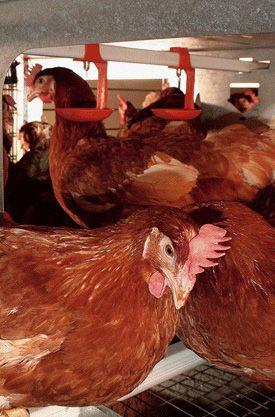
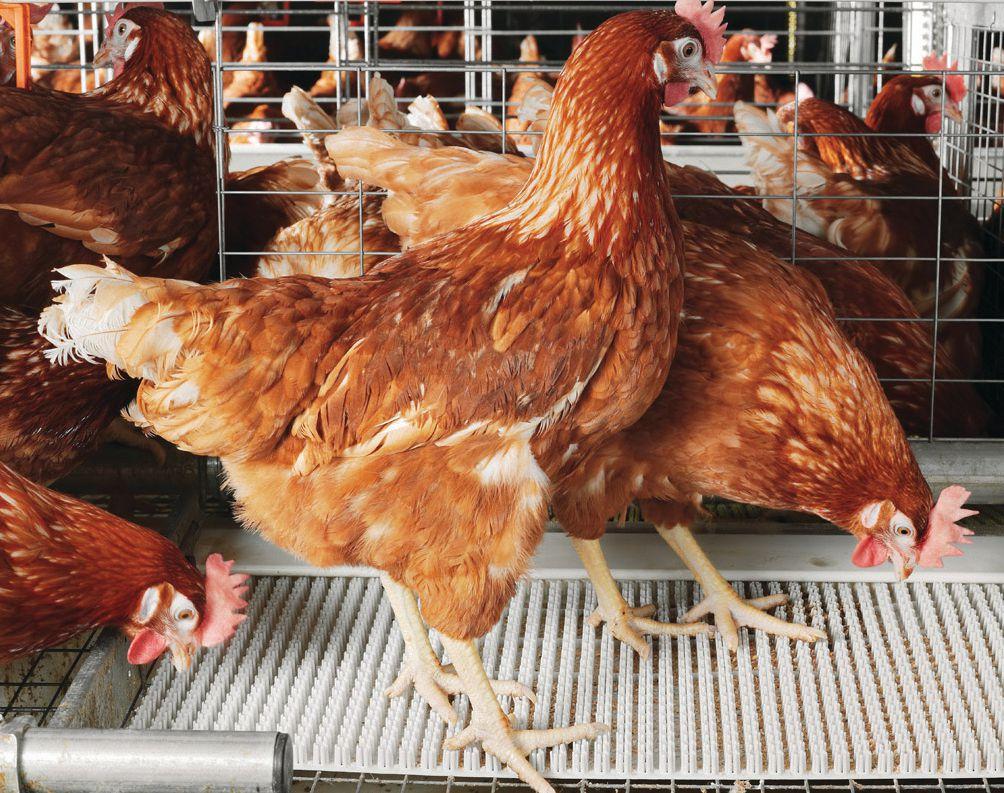
the new layer cage system boasts an innovative layout that allows more hens to feed, lay eggs and perch at the same time, without being bothered by other birds’ movement. it is readily enriched, as opposed to enrichable, the latter system requiring that accessories be added in order to become enriched.
the feed trough runs inside the cage, which allows birds to feeds from both sides, along the whole length of the cage. this doubles the feeding area when compared to cages with feed troughs in the front, bill points out.
birds may access a lower perch in the front of the cage with little effort. they may also jump onto a middle perch, which is high enough for other birds to walk under without bothering
there is more nesting space, more feed space and more perching space,” says chris Bill of meller Poultry equipment about the euro 2012 enriched colony system.
those perching.
the third perch runs the whole length of the cage, on top of the feeding trough. the nesting area has been shifted to the front of the cage. this reduces the travel distance for eggs rolling to the belt.
With 20 inches cage height at the back, the euro 2012 definitely offers more headroom, bill says. ‘’the reason the cage is so high is all the perches. european standards say birds have to be able to perch and have a clear height for their heads and their wing span.’’
p ri C e ta G
bill says the euro 2012 system is less expensive than its enrichable predecessor, even without accessories.
even though manitoba is so far the only province to have set a date for mandatory enriched cages in new constructions (2018), meller believes the timing is right to introduce the euro 2012 in Canada.
‘’We are forward-thinking,’’ b ill says. ‘’the writing is on the wall that this is coming. We want to promote the ideal cage now and give prospective buyers an idea of what is coming.’’
bill anticipates Canadian regulators will turn to eu standards when making enriched cages mandatory, which makes the euro 2012 system a safe bet. Farmers switching to enriched systems may simply use them with the current maximum density of one bird per 67 square inches and adapt when new regulation dictates lower density. n
InnoVatIVe systeM
Welfare a Market for animal Welfare
an economist’s perspective
supply and demand. economies of scale. it’s basic “Ham and eggonomics,” according to Jayson lusk, an agricultural economist at oklahoma State university. if dollars and cents have taken us to the animal welfare issues that we face today, can dollars and cents pull us out of them?
Speaking to an audience at the 2012 F.W. Presant memorial lecture at the university of Guelph, lusk proposed a market system for buying animal welfare, whereby consumers could purchase animal well-being units, similar to carbon credits. Such a trading system could offer a way for consumers to encourage improvements in animal welfare by paying producers for their efforts.
developing a market for buying animal welfare is one way to deal with an issue – a solution only an economist could think up, admits lusk. but if you think about it, it can make sense. books from 1910 talk about using cages and applying factory concepts of efficiency to raising animals, but it is only through the evolution of technology that producers have been able to specialize and gain economies of scale.
“Farmers aren’t more greedy than 100 years ago,” says lusk, “people are people.” the market is driven by consumer demand. it’s basic economics, not “evil agri-business” as the animal advocacy movement would like you to believe.
What we have now is higher produc-
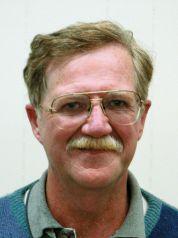
Jayson lusk, an agricultural economist at oklahoma state University, has an idea to improve animal welfare by having consumers purchase animal well-being units.
tion than ever before and consumers paying lower prices. We’re getting more for less, so what’s the problem? asks lusk.
Have these benefits come at the expense of animal welfare? this concern has now become a major driver in animal agriculture, but what are the solutions? bans to certain production practices are blunt instruments that focus on an input, not an output, says lusk. For example, poultry welfare in an aviary system can be worse than in a cage system. a ban is a solution that is expected to fit all, no matter how cold or hot it is where you live. also, if you only ban something
in one jurisdiction, retailers will just buy product from elsewhere. a ban can only work to change animal welfare if a trade barrier accompanies that ban.
in the united States, lusk says, bans have been mechanisms of change, however, with initiatives placed on state ballots that have been successful. but some states don’t allow ballot initiatives, which means that bans become law in states where the political climate is most favourable, not necessarily where the most animals are produced, which does not provide an overall solution to animal welfare issues.
buyInG Into WelFare
B Y K AREN D ALLIMORE
Photo by Karen d allimore
with the #1 mycotoxin management program
Alltech’s Mycotoxin Management Program is a fully integrated concept to audit your feeding program, ensuring your feed is protected from unwanted mycotoxins. Alltech’s 37+ testing program can review a plethora of toxins at an affordable price. It’s worth the investment to protect your feed!
Key Facts About Mycotoxins
• There are approximately 500 known mycotoxins.
• Animals are consistently exposed to multiple toxins.
• Interaction between toxins makes diagnosis difficult.
• Long term exposure to low levels of mycotoxins in the diet can reduce production and reproductive performance.
800-285-8617
Alltech.com
/AlltechNaturally
@AlltechTweets
Welfare
in many cases, consumers demand better conditions for the animals but are not willing to pay for an increased cost of production. that puts the producer in a pickle, says lusk. “Consumers aren’t always consistent,” he acknowledges. in California, for example, 63 per cent of consumers voted for a layer cage ban but only five per cent are willing to pay the premium for cage-free eggs. When they are standing in front of the egg shelf at the grocery store, many simply buy the cheapest eggs, believing that others will pay the price.
labels claiming higher standards of production are a low-cost solution but they can become confusing to the consumer (for example, what does “natural” really mean?). meat taxes proposed by some animal activist groups such as Peta are not particularly desirable either. meat demand is inelastic, says lusk. therefore, it would take a huge tax to change consumption, and the tax wouldn’t necessarily improve animal welfare.
What lusk proposes is a system that will be consumer driven: if animal welfare were a purchasable commodity, then consumers could buy credits to support the improvement of animal welfare. in essence, consumers would be paying the farmer to do a better job.
AGRO-DESIGN CONSTRUCTION Ltd.
lusk proposes purchasing animal well-being units (aWbu) as a mechanism to buy animal welfare. Placing a score on certain production systems, such as feeding level, space provided and nesting arrangements for poultry, for example, would provide a measuring stick for an aWbu, resulting in an aggregate score for that farm. Payment for the aWbu could then provide compensation to the farmer for the extra effort.
is lusk on to a good idea? ian duncan, animal and poultry science professor emeritus at the university of Guelph, likes the idea of a separate “welfare index” for each animal product that could be traded or offset, similar to carbon credits. However, he says, the problem would be setting up the welfare index.
after raising this issue during the
question period, he further explained after the lecture that welfare would be much harder to measure than carbon: it’s complicated.
For example, to a veterinarian, a product coming from a system in which there was a very low incidence of disease should have a high welfare index. a behavioural scientist would say that a product coming from a system that allowed for a full repertoire of natural behaviour should have a high welfare index. a production scientist would say that a production system in which animals were producing to the maximum of their genetic potential should have a high welfare index, because this would show that the animals were not stressed. as duncan pointed out, welfare is affected by all of the above factors. as a result, animal welfare credits are, “a nice idea in theory but it is really difficult to balance some of these things against each other.”
duncan’s behavioural research has focused on “asking the animal” what it feels about the conditions under which it is kept and the procedures to which it is subjected.
using broiler breeders as an example, he explained that these birds are kept extremely food restricted, and normally only allowed 35 to 40 per cent of the food they would eat if given a free choice. How do the birds feel about this?
duncan says they tell us that they are hungry by working extremely hard to get food. However, if we give them as much food as they want, they become obese, their production of fertile eggs drops dramatically, and soon they begin to suffer from all the diseases of obesity and they feel awful, duncan explained.
So the vet and production scientist would say, “restricted feeding offers the best welfare”; the behavioural scientist would say, “unrestricted feeding offers the best welfare.” duncan says this is an extreme example but in many situations a similar argument would take place.
Coming back to the concept of animal Well-being units, would people be willing to buy animal welfare? lusk asked. For those who feel strongly about animal welfare but have already changed their diet to reflect their preferences, buying welfare credits is an option that could appease their need to support animal welfare: they can’t not buy eggs anymore if they’re already not buying eggs. agribusiness, animal welfare groups, you and me, we could all buy aWbus and producers could participate and make money for doing so.
“the current market price for animal welfare is zero,” says lusk. “therefore not many farmers are going to sell it.”
From this economist’s perspective, we’ve just got the price wrong. n
Housing legislation Pushes u.s. for enriched Cages
many organizations have joined forces to move historic ‘egg bill’ forward
B Y T REENA H EIN
It’s a situation that surprised many in 2011 and 2012 inside and outside of the united States, but much progress has been made over the last two years in the quest to enact historic national legislation for enriched cages for layer hens – and that progress is steadily continuing.
the move, which grew from lobbying efforts over the last few years by the Humane Society of the united States (HSuS), is supported by ueP (the united egg Producers), a group that represents those that produce almost 95 per cent of u.S. eggs. “this amendment is supported by hundreds of family farmers, most of the national animal welfare groups such as HSuS and the american Society for the Prevention of Cruelty to animals, major consumer groups like Consumer Federation of america and national Consumers league, and scientific groups like the american veterinary medical association and the association of avian veterinarians – as well as dozens of media outlets, including the Chicago tribune, new york times and uSa today,” says ueP president Chad Gregory. “We think it’s best for our industry on all fronts.”
“the egg Products inspection act amendments of 2012” if passed, would require enriched colony housing systems to be phased into every commercial egg production facility in the country over the next 15 to 18 years.
Currently, a majority of u.S. hens are
CreatInG ChanGe
“studies show that enriched colony cages can be better for production than conventional cages, as the hens have lower mortality and higher productivity,” says UeP president chad gregory.
each provided 67 square inches of space, with up to 50 million receiving just 48 square inches. the proposed phase‐in would culminate with a minimum of 124 square inches of space for white hens and 144 for brown hens countrywide. Gregory adds, “the amendment also requires that after a phase‐in period, all egg‐laying hens be provided with environmental enrichments such as perches, nesting boxes and scratching areas that allow hens to express natural behaviours.”
the proposed legislation goes further – there are requirements for labelling on all egg cartons in the country to inform
consumers about production method: “eggs from caged hens,” “eggs from hens in enriched cages,” “eggs from cage‐free hens” and “eggs from free‐range hens.” Feed-withdrawal or water-withdrawal molting to extend the laying cycle is also prohibited if the bill passes (a practice already prohibited under the ueP’s “Certified” program). in addition, the bill includes standards for euthanasia of egg‐laying hens that have been approved by the american veterinary medical association, limits on ammonia levels in henhouses, and the prohibition of the transport and sale of eggs and egg
Photo courtesy of the United e gg Producers
Housing
products countrywide that don’t meet these requirements.
ratioNaLe
For Uep’S deCiSioN
by 2010, the HSuS had helped ensure the passing of Proposition 2 in California, which mandates that layers be housed in such a way that allows them freedom of movement, in an enriched cage or aviary, but the specifications were not exactly defined.
Still, at the time – and in some minds today – it was rather shocking when in July 2011, the ueP and HSuS announced that they had agreed to work together to push for federal legislation. (the HSuS agreed to immediately suspend state-level ballot initiative efforts in oregon and Washington.) “Protecting the stability of our industry is part of this,” says Gregory.
iNdUStrY
at riSk
the conundrum was a matter of supporting uniform federal legislation for a commodity that is often shipped from state to state, versus producers having to deal with dozens of contradictory, unworkable and competing state laws relating to egg production standards that were sure to spring up instead, and in light of this, the ueP stance seems very logical. “Five states already have such laws,” Gregory notes. “Federal legislation is the only way to ensure a uniform baseline for laying hen standards within the u.S. egg industry, and it’s the only way to pre-empt the state laws that call for conflicting standards. We need certainty about what standards are going to be required in the coming years so we can make the necessary investments.
Some farm groups, however, are still fighting the amendment, concerned that it sets a precedent for federal legislation concerning how farm animals are managed – stepping onto a slippery slope, if you will. there are also those who do not see the new cage requirements as science-based, while
•
•
•
•
•
•
Cooling System
•
•
RECIRCULATION FANS
circular Recirculation Unit
• 16” and 20” diameters
• 3600 coverage using directional wind vanes
• Superb alternative to race tracking
• With Multifan or Performa+ Leeson motors circulating fan
SELECT DOSER
• Select Doser dispenses products accurately into low and high pressure watering systems through it’s tubing via compression and peristalic action.
• Aggressive products and powders never pass through the pumps mechanism that can cause premature wear and maintenance.
• New improved Model 640 is now simple to use with one tube size
• New Select Doser Max can now operate in high pressure and volumes
• 12” – 24” diameters • Polyethelyne housing
• with Multifan or Performa+ Leeson motors
Genius picture Ge-430
• Genius 430LS Livestock climate control
• User friendly Interface (hot Keys)
• Large Display Screen for easy viewing
• Up to four variable stages and 30 off/on relays
• Expandable to 50 relays with relay module
• Up to 12 temperature sensors , one Humidity sensor
• Up to 12 heat zones, 12 cool stages, 2 light programs
• Up to 5 water metering, 2- 0-10volt outputs for dampers
• can operate Dual, natural and tunnel ventilation
• Multiple applications Genius controls from 3 – 10 stages
• Genius 420 Series control , up to 4 variable, 20 off/on
• New Genius Dimmable Light control
• New feed Bin monitoring control
• New Genius 420LS control system – larger screen and capacity
72” fan
• Heavy Duty fiberglass housing
• Heavy Duty 6 blade alum. Propeller
• Twin gates Size A belts with Auto tensioner
• 3 hp , single or 3 phase motor
• Optional cone for max air flow
LIGHt traP/ Dark OUt
• High light reduction
• Low resistance to air flow
• Simple Installation
• Easy to clean
• Uses P.V.c. snap release spacers
Housing
others argue that to codify cage standards today is to ignore innovations that could appear in the future. the ueP counters this by pointing out that leading scientists familiar with egg production see it as a transitional move. “our scientific advisory committee, the american veterinary medical association and other prestigious institutions have reviewed enriched cages and have noted that they combine the advantages of both conventional cages and cage-free systems,” says Gregory. “and a great deal of research shows that increasing the amount of space per hen and providing the hens with environmental enrichments improves their welfare, which is advantageous for hens and producers alike.”
there are also concerns capital costs of transitioning to enriched cages could be prohibitive for small producers. ueP has an answer for that too. “Studies show that enriched colony cages can be better for production than conventional cages, as the hens have lower mortality and higher productivity,” Gregory explains. “these improvements are confirmed in a January 2012 Feedstuffs report on an american egg producer using enriched colony cages: mortality was 4.22 per cent compared to 7.61 per cent in conventional cages, eggs laid per hen were 421 versus 399, and average case weight was 49.4 versus 47.93 pounds.”
lastly, there are worries over the cost of eggs going up – and consumers therefore eating less of them. “We have an agralytica study that predicts that enacting this legislation would add less than two cents to the cost of a dozen eggs spread out over an 18‐year period,” states Gregory.”
“it seems a big and scary move for some, and it’s hard for some in our industry to see the big picture,” says Gregory. “but we think this is the right thing for our nation’s laying hens and our farmers. the alternative to having a national standard for all u.S. egg producers is a future that’s not good for anyone.”
For more, visit www.eggbill.com. n
by JIm KnISLey
ALL THINGs CONsIDERED the other trade deal
This could be Canada’s year of the trade deal since an agreement with europe is expected, another with india is possible and Japan may be in the offing. and while the trans Pacific Partnership is supposed to wrap up in october, it likely won’t.
meanwhile, a huge deal that you’ve likely never heard of (and which doesn’t involve Canada or the u.S.) is in the works: asia is gearing up for negotiations leading to the biggest trade deal on the planet – the Regional Comprehensive economic Partnership, which comprises 16 countries in the asia-Pacific region, including China, india, Japan and north Korea.
What is remarkable, aside from the belief of most asian commentators and observers that the deal will come together fairly smoothly, is that it is being ignored in north america. a Google search carried out in mid-december showed no Canadian or american references to the RCeP.
north american attention is instead focused on the smaller, more controversial tPP because neither the u.S. nor Canada is part of the RCeP negotiations, therefore it serves little purpose to discuss it.
However, recent reports of tPP negotiations are that they do not appear to be going smoothly. Reporting from the recent trans Pacific Partnership talks in auckland, new Zealand, international trade expert Peter Clark wrote on iPolitics.ca: “the smell of doha is in the air.”
another blow for those cheering for the tPP is the fact that Japanese Prime minister yoshihiko noda, who announced his government’s intention to join the tPP talks, was trounced in a mid-december election. the victorious liberal democratic Party promised in its platform to oppose entering the tPP negotiations if abolishing tariffs “without sanctuary” is a precondition.
goods and services, investment, intellectual property rights, environmental protection, labour, financial services, technical barriers and regulatory issues.
However, there are land mines buried everywhere in this shopping (wish) list.
For example, new Zealand has a national drug-buying program called Pharmac that gives the country heft when negotiating the purchase of pharmaceuticals. new Zealanders love the program, but the u.S. doesn’t and wants to see greater patent protection for its drug companies. the u.S. also wants provisions that allow companies to challenge government laws and sue, but australia has said point blank it will not sign a deal that allows foreign companies to challenge its laws.
india, which isn’t at the negotiations table, is reportedly uncomfortable with the “Wto-plus approach” adopted by the u.S. at the tPP.
meanwhile, the RCeP is seen as a strictly economic arrangement aimed at consolidating existing free trade agreements, further lowering customs duties and reducing trade barriers. this comparative simplicity makes it much more attractive than a u.S-driven deal that would seemingly internationalize u.S. laws. there is also a geopolitical component to all of this. much of asia appears concerned with China’s growing power, and the u.S., as seen during the presidential debate on international policy prior to the recent election, is certainly paying attention.
Asia is gearing up for negotiations leading to the biggest trade deal on the planet
the position gives the new Japanese government some wiggle room. it could enter the talks if allowed to protect agriculture and some sensitive cultural issues, but if assurances are not offered, Japan could stay out alongside india, north Korea, thailand and others.
the 11 countries in the tPP talks are the united States, australia, new Zealand, Canada, mexico, Chile, Peru, Singapore, malaysia, vietnam and brunei. What is interesting is that australia and new Zealand are also a part of the RCeP talks. the tPP is seen in much of asia as a u.S.-driven show. Washington seems to want a big comprehensive deal covering
the recently elected Japanese government wants closer political ties with the u.S to act as a counterbalance to China, but it needs good economic and trade relations with China.
Writing from new delhi, Jyoti malhotra said that China’s support of the RCeP and the rivalry with the tPP could become “a new flashpoint in Southeast asia.”
Jane Kelsey, a professor of law at the university of auckland, wrote: “it is increasingly clear that uS politicians see the tPP as a vehicle to re-establish america’s ascendancy in the asia-Pacific region to counter China’s emergence as a superpower.”
Kelsey cites the taipei times, where she added that there is a “serious risk” of “a new Cold War, conducted through the proxy vehicle of economic integration agreements.”
if nothing else, all of the above indicates that the tPP is far from the simple, straightforward, clean trade deal mythologized by some in Canada. in fact, it should come with a label that says “Handle With Care.” n