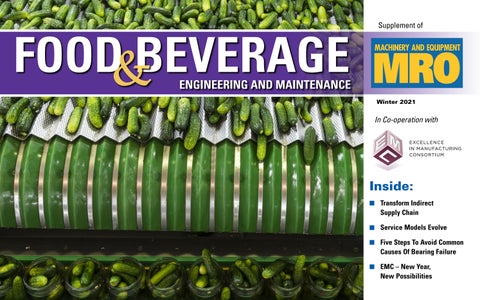
FOOD BEVERAGE


Food and beverage sales down in 2020.
![]()


Food and beverage sales down in 2020.
Five steps to transform indirect supply chain through a solutions mindset.
Service models evolve in response to the ‘new normal.’
MAINTENANCE
Five steps to avoid common causes of bearing failure.

New year, new possibilities.
EMC’s national coaching program has been designed to help manufacturers better understand the current situation they face by identifying and supporting a clear path forward. Free access for manufacturers. Enjoy 3 topic streams packed with valuable industry support.
READER SERVICE
Print and digital subscription inquiries or changes, please contact Beata Olechnowicz, Audience Development Manager Tel: (416) 510-5182 Fax: (416) 510-6875 email: bolechnowicz@annexbusinessmedia.com Mail: 111 Gordon Baker Rd., Suite 400 Toronto, ON M2H 3R1
PUBLISHER
Paul Burton pburton@ annexbusinessmedia.com 416-510-6756
COO Scott Jamieson sjamieson@ annexbusinessmedia.com
MEDIA DESIGNER
Andrea M. Smith asmith@ annexbusinessmedia.com
Co-operation with
EDITOR
Mario Cywinski mcywinski@ annexbusinessmedia.com 226-931-4194
ACCOUNT CO-ORDINATOR
Catherine Giles cgiles@ annexbusinessmedia.com 416-510-5232


Giroux • jp.giroux@emccanada.org CHAIRMAN OF THE BOARD, TREASURER Al Diggings • adiggins@emccanada.org
VICE PRESIDENT, MANUFACTURING SECTOR PERFORMANCE Scott McNeil-Smith • smcneilsmith@emccanada.org VICE PRESIDENT, COMMUNITY PARTNERSHIPS AND STAKEHOLDER RELATIONSHIPS Bren de Leeuw • bdeleeuw@emccanada.org

Last year, was definitely one to remember, and not for good reasons. With COVID-19 bringing with it lock downs, restrictions, closings, and much more, it was a rough year for those in the food industry. After the first wave of the virus, restrictions were slowly loosened over the summer months, and many in the food industry were slowly recovering.
However, near the end of 2020 (and into 2021), Ontario and Quebec both enacted greater restrictions as a result of COVID-19. Other provinces and territories currently have different levels of restrictions in place, and the food and beverage industry has definitely been impacted as a result.
In Ontario, most restaurants, bars, and other food establishments, have only been able to make do with take-out orders, with carry out and delivery. While some, like pizza places, fast food restaurants, and the like, mainly base their business model on this, others who do not, have not been so lucky over the last 10 months.
According to Statistics Canada, sales in the food services and drinking places sector (when seasonally adjusted) were down 27.6 per cent in October 2020 (the most recent data available) compared to the previous year. All provinces posted a drop, with the highest being Quebec down 36.6 per cent, Ontario down 31.4 per cent, and Manitoba down
23.8 per cent. Smaller losses were seen by Yukon (down 7.6 per cent), Newfoundland and Labrador (down 10.5 per cent), and Saskatchewan (down 11.5 per cent).
Breaking things down by restaurant type, full-service restaurants were down 38.1 per cent, limited-service eating places were down 8.9 per cent, special food services down 60.5 per cent, and drinking places down 50.3 per cent.
Looking at the numbers month by month, total food service sales were at just under $6.5 billion in October 2019, which went to over $4.7 billion in July 2020, $5.05 billion in August 2020, $5.15 billion in September 2020, and finally to just under $4.7 billion in October 2020. Therefore, as things were opening back up, sales were on their way up, and dropped back when restrictions were put back in place. The food industry is resilient, and when the time comes for restrictions to be removed once again, the stats show sales should pick back up.
Cywinski, Editor


Your business card probably doesn’t say “firefighter.” But you may feel like most of your time is spent fighting fires, responding to crises, implementing the latest corporate initiative, or fixing a problem before it turns into a full-fledged disaster.
BY DARR GREENHALGH
Getting through your daily to-do list in those circumstances is hard enough. Doing the most important parts of your job, increasing quality and efficiency, reducing costs and strengthening profitability, may seem impossible.
The most successful managers have been able to focus on those key priorities by embracing a solutions mindset to every aspect of their businesses and jobs, including their maintenance repair and operations (MRO) supply chains.
Every manufacturing facility faces problems,. A solutions mindset doesn ’t magically eliminate that; however, it does help to approach problems differently. Rather than asking “ how do we fix this problem now? ” , a solutions mindset asks “how can we fix this problem permanently, and ensure it never happens again?”
This way of thinking can transform daily routine. As problems are prevented, more time is available to think creatively and strategically about the performance goals for which you’re responsible.
A fully implemented solutions approach for the indirect supply chain can lead to cost reductions of 15 per cent, sometimes more. While tackling problems one-by-one may produce savings, you won’t get the cost reductions that a comprehensive, solutions approach brings. A
solutions mindset for a supply chain will also lead to improvements in inventory optimization, order visibility and labour efficiency.
As you start down that solutions road, however, you’ll need to be disciplined to step away from the barrage of calls, texts, and e-mails, and think carefully and strategically about your role, manufacturing facility and company. This can be intimidating at first, but it’s worth the effort.
Here are five steps to adopting a solutions mindset.
1
Analyze where time goes. Reviewing your calendar and analyzing how to spend your time is a good first step in identifying potential improvements. Whether calling suppliers, placing orders, expediting emergency shipments, reconciling invoices or managing lead times, you’ll probably spot opportunities to be more efficient. Anything touched more than once or delegated is something that could be automated or handled more efficiently.
As you start down that solutions road, however, you’ll need to be disciplined to step away from the barrage of calls, texts, and e-mails, and think carefully and strategically about your role, manufacturing facility and company.
move, inventory is stored, a part is used; find out what led to that action, and what will happen next. Are these processes efficient and automated where possible? Every inefficiency creates opportunities for errors and higher costs.
3 Set goals to address what you’ve identified. Now that you know how you and your facility could be performing better, set goals to increase efficiencies and improve processes. Doing this before consulting with external partners ensures that any solution will be tightly focused on your company’s priorities.
4
2
Consider how end-to-end supply chain affects upstream and downstream functions. When something happens in the supply chain, an order is initiated, materials
Identify service partners who can provide comprehensive solutions. Now’s the time to start talking with potential service partners. These aren’t just companies that can sell you a product. These are companies that wrap competitively priced products in value-added services provided by knowledgeable, responsive professionals and backed up with smart technology.
5 Get site and company buy-in. Finally, do the required work to get buy-in and approvals from decision makers and key stakeholders. A solutions-focused service provider will offer new ways to order, store and manage indirect inventory. Leadership must understand how the company will get costs savings, productivity improvements and other improvements in return.
A solutions mindset will do more than just make the supply chain more efficient and the facility more productive. It also will get you out of firefighting mode, as shortages, crises and inefficient tasks drop away.
Your workdays will be more pleasant, and you’ll find more time to think strategically and creatively, and implement new solutions, as you figure out the next improvement you can tackle.
Darr Greenhalgh is senior manager of customer solutions at MSC Industrial Supply Co. He has more than 25 years of experience in procurement, project management, lean supply chain management and manufacturing in a range of industries.

Many industrial customers have long relied on service providers to help keep operations running safely, reliably and profitably.
BY ADRIAN GUGGISBERG
That need continues, but the challenge is how to carry out service and maintenance operations with lockdowns, travel restrictions and social distancing. Service providers had to adapt by providing remote services based on digital solutions, without having engineers working on-site.
The challenge of the new normal is prompting service customers to seek new ways to ensure that their operations will always run smoothly, even when it is not possible for service technicians to visit their site. This is encouraging them to move from a traditional service model to remote services, where activities such as repair of existing equipment, and installation and commissioning of systems can be supported remotely. Using digital technology to enable service experts to connect with customers on-site, can offer considerable benefits in terms of reducing health and safety risks, and a faster response.
Connectivity is the key enabler for remote services and requires a significant change in customers making their data more accessible to their service partners. In the past, some industries, oil and gas for example, have rightly been very wary about cybersecurity and preserving the privacy of data from their assets. However, the COVID-19 pandemic has fostered a growing realization that some level of data has to be shared with trusted partners to gain the full advantages of digitalization, and preventative maintenance.
The trend in connectivity is sure to continue as every device becomes part of a connected world. This can support better decision making that provides a firm basis to achieve improved results. It is interesting to note that some of the remote predictive monitoring services being deployed right now were technically feasible 25 years ago. However, they were hard and expensive to implement. Today, barriers have been removed with the advent
of cheaper, yet more sensitive wireless sensors and cloud connectivity.
Plug and play experience, which we are familiar with from the consumer world, will accelerate the digital transformation of the service industry. As part of the growth in digital technology, we also expect to see even more developments in virtual collaboration, such as augmented reality or virtual reality, that enables service engineers to have an effective telepresence.
The change in the approach to service delivery is starting to build a new impetus to move away from the traditional business model, in which the service provider is paid for material and
work carried out. Historically, should a failed electric motor or drive cause a production line to break down, a team would travel to the site to fix the problem. However, with new digital solutions, the business model is set to shift to one based on outcomes.
Rather than focusing on how quickly a team can get to the site, and how long they take to find a solution, it will be about avoiding risk. For example, customers might pay their service provider to ensure a guaranteed level of production availability. Meaning, they will rely on a service company to implement a high level of connectivity to monitor their equipment remotely, and take proactive maintenance actions to ensure
Historically, should a failed electric motor or drive cause a production line to break down, a team would travel to the site to fix the problem. However, with new digital solutions, the business model is set to shift to one based on outcomes.
that breakdowns never happen. Whatever happens, customers will always be at the heart of a service business. However, they might be a new type of customer, such as insurance companies or investment funds within a new ecosystem. Using the Uber model as an example. In this case both the driver of the car, and the passenger, are effectively Uber customers. For
service this could mean that a highly energy efficient drive and motor solution is installed, but it is financed by a pension fund, operated by an industrial group, and the service provider ensures that it meets its performance and reliability targets.
Adrian Guggisberg, Division President of ABB Motion Services.


Bearings may be small, but they play an invaluable role in keeping industrial machinery running smoothly.
BY CHRIS JOHNSON
Improper lubrication, contamination, corrosion, overload, along with improper handling, mounting and storage are all leading causes of bearing failure. Here are five steps to avoid common problems and future process disruption.
Bearings should be stored horizontally in their original packaging in a clean, dry and room temperature

environment. When bearings are unnecessarily handled, for example, if their wrappings are prematurely removed, this can expose them to corrosion or contaminants. Even while they’re being stored on shelves, the bearings can still experience harmful vibration as a result of the facility’s daily operations. Therefore, it is important to store the bearings in an area not exposed to vibration.
Bearings are delicate components and should be treated with care.
Consequently, components that have been dropped shouldn’t be used, as this could lead to premature failure. Also, appropriate equipment should be used when handling and mounting bearings. Tools that are not specialised for use during the bearing mounting and dismounting process can cause damage, denting and wear. Bearing pullers or induction heaters; for example, are designed specifically for bearings. Making sure the bearing is mounted properly will avoid equipment imbalance and misalignment.
When selecting the best bearing for your needs, it’s important to
remember that inappropriate loads cause increased fatigue and risk of bearing failure. To get the best life ratings from your bearings, limit the actual load to between six and 12 per cent of the bearing’s dynamic load rating. This load rating does vary according to the bearing material. For example, stainless steel bearings will support approximately 80 to 85 per cent of the load figures indicated for chrome steel bearings.
The more the bearing is overloaded, the shorter the bearing life. Overloaded bearing components will experience premature wear. These bearings should be replaced to safeguard the surrounding equipment. While overload can be a result of
incorrect specification at the design phase, some overloading may occur due to changes in production requirements, environmental conditions, or operator error.
For example, if a steel bearing is heated above the limit that it is designed for, this can permanently deform or soften the bearing material, resulting in a reduced load carrying capacity and leading to equipment failure. Always check the manufacturer’s specification to make sure it meets your requirements prior to installation.
Contamination in the form of dust or dirt entering the bearing’s raceway is problematic. Choosing a closure that protects against these foreign particles entering the bearing and keeps the lubrication inside, is crucial. Closures should be expertly matched to the application, depending on the operating environment. While it’s recommended to seek advice from a bearing specialist, here are a few pointers to bear in mind.
Choose closures that will withstand the environmental and operating conditions. Routinely check bearing seals for hardening or wear. Inspections should be carried out for lubrication leaks. When conducting maintenance, try to avoid using steam cleaning methods or highpressure sprays. This may be difficult in the food and beverage industry, so sealed bearings with a washout resistant lubricant are recommended. If maintenance isn’t conducted appropriately, it can do more harm than good. In fact, it is easy to damage seals and force contaminants into clean equipment if not handled correctly. This is where condition monitoring such as vibration analysis can provide vital insight into the bearing’s operating condition and alert an operator to any changes without invasive action.
Wearing gloves will ensure that perspiration or other liquids do not affect the bearing in low-corrosive environments. However, corrosion-resistant
bearings will be needed in applications where corrodible materials wouldn’t suffice (food processing, chemical manufacturing, pharmaceutical production and bearings for marine applications).
Corrosion occurs primarily when the bearings have been exposed to water or more corrosive liquids. In some cases, it leads to etching on the surface, which will eventually develop rust. Flaking and cracks in the bearings can then follow. Common signs of corrosion are dark coloured or reddish-brown areas on the balls and raceways. Eventually, you may see pitting of the raceway surfaces. While the material choice is a crucial first step to combatting corrosion, preventative measures such as the use of lubricants with rust inhibitors are recommended.
Standard lubrication will do its bit in reducing friction and dissipating heat. However, this lubricant may not satisfy the maximum running speed,
torque level and temperature requirements of your application. Specialist lubrication may be required.
If the lubrication quantity isn’t sufficient, the balls, retainers, and raceways will have metal-on-metal contact, and friction will wear down the bearings. By contrast, if the bearings are overfilled with grease, heat cannot be dissipated, causing the bearing to overheat.
In both scenarios, this will reduce the efficiency of the equipment and overall process. Choosing the correct lubricant should start with the application conditions but should also consider the correct lubricant quantity and viscosity for the load, avoiding temperatures that are too extreme for the specified bearing, and preventing ingress of dirt or other contaminants. While these five steps offer a good starting point to reduce bearing failure and extend service life, appropriate design engineering and early intervention are key.
Chris Johnson is the managing director at SMB Bearings.

It’s a new year full of possibilities and brilliance, in terms of business improvement and growth. We are all pleased to see 2020 behind us, and despite the challenges throughout the year, lessons learned will continue to guide us and improve our abilities in all we do.
Excellence In Manufacturing Consortium (EMC) first began in 1998 with a group of like-minded manufacturers who were interested in learning, benchmarking and growing their businesses. EMC works with companies of all sizes and sectors across Canada. EMC builds on the first principles of peer networking, and providing services and programs that enable development of people and of industry.
With the interests of manufacturers at its core, EMC endeavours to focus on assisting and supporting members with activities which build peer knowledge and growth through best practice experiences, community partner support and resources, and delivery of subject matter expertise when required. With over 60 consortiums across Canada, connecting with other EMC members, especially in these virtual times, is easy.
Ongoing polls, taken over the past few months with those in the EMC Food and Beverage Sector program, have pointed to an interest in more networking experience tailored to building and developing food safety cultures. Including engaging, motivating and retaining staff, especially during COVID. It has us consider how to keep ideas flowing, or create a vested interest in the project(s) at hand.
Another issue facing food processors, growing exponentially
year-over-year, is the challenge of attracting and hiring good talent. Labour and skill shortages continue to point to an aging population, and a need exists to highlight industry attributes when educating youth about the benefits of a career in manufacturing. What do we need to do in industry to support awareness and interest of this nature? How can we align ourselves to promote opportunity at an earlier age with students, educators, and community partners? How are we filling vacancies and building rapport to become an industry of choice? What do we need to do and what needs to change?
Food safety, and talent attraction and retention will always remain key items for those in the food sector, but other areas need to be explored, learned from, and shared with peers. Including continuous improvement initiatives, lean journeys, or becoming more automated, digitalized and tech-savvy, and all elements of health and safety, human capital needs, training, procurement, and cost mitigation, There are many different facets to any company, and each area requires talented and trained people working cohesively to move the business forward on the continuum of growth and development.
EMC’s quarterly peer networking events are being developed and the first two EMC Food and Beverage Sector Events ready.
On February 25, Maple Lodge Farms of Brampton, Ontario will present “Continuously Improving Your Food Safety Culture Through People, Processes and Plant/Program Infrastructures Best Practices.” which looks at their best

practices on food safety and food safety culture. Sustaining a robust food safety culture is an essential business element for all processors today. The ongoing global pandemic has underscored this necessity. Staying abreast of changes in legislation, from a food safety and public health perspective, and nurturing a culture that understands, engages, and continually seeks improvement on current practices, is part of the broader picture of continuously improving food safety programs. This is a topic that businesses across Canada have expressed interest in and peer experiences are always welcomed!
EMC’s spring networking event on June 3 and will provides an opportunity to focus on “Change Management – Overcoming Resistance, Building Buy-In and Getting Real Results.” With a year of constant change behind us, this is a topic that remains relevant, and our ability to manage such can help ensure a more productive path forward.
Guest speaker, Laura Lee-Blake, Chief People Officer at Pearle Hospital -
ity Inc., leads a discussion on effective ways HR leaders can successfully partner with their business leaders, with a focus to champion change through adversity. The presentation will focus on:
• Controlling the narrative over change;
• Learnings from a challenging change journey case study;
• Creating the case for change and the rally cry for others to fully engage; and,
• Building resiliency and driving results during times of personal and professional adversity.
This session will be an excellent opportunity to learn how to navigate change issues successfully.
Moving forward, if you are interested in engaging in EMC’ s Strategic Interest Groups or Special Food and Beverage Sector networking sessions, feel free to reach out and we would be happy to share information on what is coming up in your region.
How do you get involved? If you are interested in learning more about EMC and the Food & Beverage Sector Initiative, touch base with Bren de Leeuw, Vice President, Community Partnerships and Stakeholder Relations (bdeleeuw@emccanada.org) anytime.


25-Feb-21
03-Jun-21
EMC Food, Beverage & Bio Sector
ZOOM Webinar Networking Event Maple Lodge Farms
Continuously Improving Your Food Safety Culture Through People, Processes and Plant/Program Infrastructures Best Practices
EMC Food, Beverage & Bio Sector
ZOOM Webinar Networking Event
Laura Lee Blake
Change Management - Overcoming Resistance, Building Buy-In and Getting Real Results