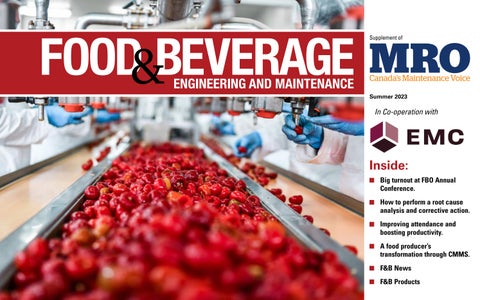
FB - Summer 2023

Page 1


It’s not uncommon for businesses to run into issues with

or non-

Paul Burton

pburton@annexbusinessmedia.com (416) 510-6756

Trish Ramsay

OUR FOOD, BEVERAGE & BIO SECTOR INITIATIVE MEMBERS ARE COOKING UP FRESH SOLUTIONS TO INDUSTRY CHALLENGES.

Mario Cywinski mcywinski@ annexbusinessmedia.com (226) 931-4194 NATIONAL ACCOUNT MANAGER Ilana Fawcett ifawcett@annexbusinessmedia.com (416) 829-1221 BRAND SALES MANAGER

Chander Verma cverma@annexbusinessmedia.com (416) 510-6797

The F&B industry

A

As competitive pressures continue to build globally, EMC’s Food, Beverage & Bio sector manufacturers/processors identified the need for an initiative focused specifically on this vital sector. Hosting events specifically for sector manufacturers/processors, we have shared best practices, visited plants across the Province, connected in group settings and on a oneto-one basis. The topics - all relevant and timely - have ultimately focused on what it takes to be competitive in the food industry today.

TOPICS ON THE MENU

tramsay@annexbusinessmedia.com (416) 510-6760 MEDIA DESIGNER

Lisa Zambri

CIRCULATION MANAGER

Beata Olechnowicz bolechnowicz@ annexbusinessmedia.com

COO

Scott Jamieson sjamieson@ annexbusinessmedia.com

(519) 376-0470 (866) 323-4362 LINKEDIN.COM/SHOWCASE/FOOD-BEVERAGEENGINEERING-AND-MAINTENANCE/ WWW.MROMAGAZINE.COM/INDUSTRY/FOOD-BEVERAGE/

Giroux • jp.giroux@emccanada.org VICE PRESIDENT AND GENERAL MANAGER Amanda Doman • adoman@emccanada.org

VICE PRESIDENT, MANUFACTURING SECTOR PERFORMANCE Scott McNeil-Smith • smcneilsmith@emccanada.org

MARKETING & COMMUNICATIONS MANAGER Tiffany Robbins • trobbins@emccanada.org ACCOUNT CO-ORDINATOR

Importance of the food and bev industry

In many ways, the food processing industry in Canada, is what allows everyone to have access to fresh food on a daily basis.

According to Agriculture and Agri-Food Canada’s 2022 numbers, the food and beverage processing sector is the largest manufacturing sector in Canada (in terms of GDP and employment). It contains 18.1 per cent of all manufacturing jobs, and 17.3 per cent of manufacturing GDP. While facilities are spread all over Canada, the biggest concentration is in Ontario and Quebec.

FOOD PROCESSING SALES WERE $141.6 BILLION IN 2022.

• Meat product manufacturing (27.2 per cent) – $38.5 billion;

• Grain and oilseed milling (14.3 per cent) – $20.3 billion;

• Dairy product manufacturing (12.3 per cent) – $17.4 billion; and,

• Bakeries and tortilla processing (11.3 per cent) – $16.0 billion.

If we look at the agri-food system as a whole (which is a well oiled supply chain machine), it employs 2.3 million people, which equates to around one in nine jobs in Canada, an provides around seven per cent ($143.8 billion) of Canada’s GDP.

JOB BREAKDOWN BY PART OF THE SYSTEM.

• Primary agriculture - 249,000;

• Food and beverage processors - 323,200;

• Food retailers and wholesalers - 684,200;

• Food service providers - 907,200.

Looking at things internationally, overall Canada is the world’s fifth largest exporter of agri-food and seafood in the world. Trailing only the EU-27 (European block), United States, Brazil, and China. While Canada exports to nearly 200 countries worldwide, a large chunk goes to the U.S. and China. In all Canada exported $92.8 billion worth of products in 2022. Conversely, Canadians spent $189.7 billion on food/beverage/tobacco products in 2022, which ranks as the third highest spend behind only transportation and shelter.

While we may look at operations in the industry to be large in nature only one per cent of food processing establishments have over 500 employees, with 91 per cent having under 100, and eight per cent having between 100 and 500 employees. What does this data mean?

Ultimately, that the food beverage sector in Canada is a large part of its economy, employs a large part of its citizens, and feeds the domestic and international market.

Mario Cywinski Food & Beverage Engineering &

PEPSICO CANADA USING CANADIAN SOURCES TO ACHIEVE RENEWABLE ELECTRICITY TARGET

PepsiCo Canada’s (PepsiCo) operations plan to use Canadian renewable energy to have its operations be 100 per cent renewable starting in 2023. The Canadian operations transition will secure over 160,000 megawatt-hours of electricity from renewable sources annually.

“We’re incredibly proud to share that we’re on track to achieve our goal of sourcing 100 per cent renewable electricity,” said Chris Johnson, national engineering and sustainability senior manager, PepsiCo Canada.

NEWS

PepsiCo plans to reach its targets through a 12-year Virtual Power Purchase Agreement with a TransAlta subsidiary for a new wind farm in Hanna, Alberta. The Garden Plain Wind Project, a 14,000acre plot of land is expected to produce 130 megawatts of wind power per year. PepsiCo also will purchase of Canadian Green-e certified renewable energy certificates from Canadian wind sources.

“TransAlta congratulates PepsiCo Canada for making a significant commitment to renewable energy through our Garden Plain Wind Project,” said Ross Piché, vice-

president, projects, and construction, TransAlta. “We are excited to partner with them to deliver a customized, sustainable, and reliable energy solution the company can rely on. The delivery of clean, renewable energy supports PepsiCo Canada’s sustainability goals while providing renewable electric energy to the region.”

Additionally, PepsiCo will begin to replace plastic drink carriers with cardboard carriers and pilot electric fleet vehicles in Canada later this year.

CFIN INVESTS IN FOODTECH PROJECTS

The Canadian Food Innovation Network (CFIN) has invested $516,959 into six foodtech projects funded through the organization’s Innovation Booster program. Industry will match these funds to create projects valued at just under $1 million.

The Innovation Booster program provides flexible and rapid support to small or medium enterprises

(SMEs) as they address food innovation challenges or technical hurdles that have created barriers to achieving their commercialization goals. The program is administered by CFIN, which is supported by the Government of Canada’s Strategic Innovation Fund.

The Innovation Booster funding recipients are:

Impactful Health R&D (Nova Scotia) receives $100,000 for the Pilot Coating Line. Impactful Health R&D (IHRD) is developing sustainable active packaging to prolong the shelf life of raw proteins, starting with fresh fish. The funding will help IHRD build and test a continuous film coating pilot line at their facilities in Nova Scotia, with the end goals of reducing food waste, limiting the reliance on traditional plastics, and increasing ROI for the entire value chain.

CarbonGraph Inc. (Ontario) receives $96,358 for enabling automated farm-to-table lifecycle assessments in Canada. CarbonGraph has developed a next-gen-

eration sustainability platform to automate lifecycle assessments of the environmental footprint of food products. After testing their platform with food companies across Canada, the Ontariobased startup is developing a new core functionality to automatically capture supply chain data from grocers and food distributors across thousands of individual products. This funding will enable CarbonGraph to pilot their enhanced platform with the country’s largest food manufacturers, distributors, and retailers.

Cibotica Inc. (British Columbia) receives $90,741 for its universal food-safe dispensing mechanism for food makelines. Cibotica is developing a foodsafe version of a universal dispensing mechanism and associated control algorithms to be used in their robotic salad and bowl makeline. The BC-based food tech company has already developed an ingredient-agnostic dispensing mechanism

that’s capable of dispensing most ingredients regardless of their shape, size, and preparation method. The focus of this project is to ensure the dispensing mechanism is food-safe and optimized for performance using advanced control algorithms.

Freshline (British Columbia) gets $83,908 for innovating the global food distribution supply chain. Freshline is building out the core functionality of its new B2B e-commerce platform that will enable food distributors and retailers to transact online in ways that were not previously possible. Improvements include a turnkey integration management tool that allows suppliers to connect their ERP, accounting, inventory, or operations management platform to Freshline via API, webhooks, or FTP.

New School Foods Inc. (Ontario) gets $80,526 for its novel process to create plant-based fish that flakes. New School Foods had developed a propri-

NEWSetary food scaffolding technology to create whole-cut meat alternatives. Their first product is a wholemuscle, unbreaded plant-based salmon fillet that mimics the look, taste, and texture of conventional salmon. The funding will be used to create novel equipment that can draw ‘white lines’ in the salmon to help improve this product by creating fillets that flake and closely emulate traditional salmon.

ABCO Industries Inc. (Nova Scotia) gets $64,926 for its experimental validation and verification of a novel blanching process – Harnessing the Full Potential of Direct Steam Injection. This project will enable ABCO to form the basis for commercializing a new blancher that uses a more efficient and effective steam process for heat delivery though the deployment of fans and the digitization of controls. This will result in reduced costs and increased returns for both the processor and consumer, while also creating a more sustainable and energy efficient blanching process.

During this fifth round of Innovation Booster funding, CFIN received 41 applications from across the country. In total, 23 Canadian foodtech companies have received $1,872,769 from this program since 2021.

ODD BURGER LAUNCHES NEW LINE

Odd Burger Corporation launched a new consumer packaged goods (CPG) line for retail sales channels. The initial launch will feature five plant-based proteins.

The retail products are expected to be available starting September 2023 and will initially be sold at Odd Burger restaurant locations and select Canadian retailers.

The Company will be manufacturing the retail products through its manufacturing subsidiary, Preposterous Foods, based out of London.

Odd Burger will also be utilizing A.S. Food Sales to accelerate the growth of its new retail product line and secure distribution with various retailers.

BIG TURNOUT AT

FBO ANNUAL CONFERENCE

Over 220 industry professionals attended the Food and Beverage Ontario (FBO) Annual Conference at Locomotive Hall at Steam Whistle in Toronto. Attendees heard from experts and networked with colleagues.

“On Thursday, May 25 over 225 representatives of Ontario’s food and beverage processing community as well as government officials, post-secondary institutions and related industry groups attended FBO’s annual conference in downtown Toronto,” said Chris Conway, CEO, FBO.

Michael Burrows CEO of Maple Lodge Farms, and chair of the FBO, opened the afternoon by welcoming all guests. Shay Marville, SVP

talent, Performance Art Agency was the first speaker, and she spoke about the importance of the human side of the industry and how food is engrained in every aspect of human life.

Benjamin Tal, deputy chief economist CIBC World Markets was up next, and he spoke about many topics, including US inflation expectations, past inflation underestimations, how people get their information about the economy, commodity pricing, global supply chain pressure index, retail gross margins, debt service ratio, relationship between job vacancies and employment, and the labour market.

Next up, Darrell Bricker, CEO of Ipsos public affairs, and expert

on national/international trends spoke about topics covered in his book Next. This was followed by the last formal presentation of the afternoon by Chantal Hébert, national affairs writer for the Toronto Star and a guest columnist for L’actualité. She spoke about what to expect from the next federal election in Canada.

“The formal portion of the event concluded with remarks from Ontario Ministry of Agriculture, Food and Rural Affairs Minister

Lisa Thompson,” said Conway. “Our members continue their hard work to ensure a thriving food and beverage manufacturing sector for Canadians.”

As you would expect food and beverage was front and centre, with a catered lunch opening the conference, and a networking reception closing the event.

Next year, the 2024 Annual Conference will take place on May 30, 2024, at Steam Whistle, in Toronto, Ontario.

HOW TO PERFORM A

ROOT CAUSE ANALYSIS

AND CORRECTIVE ACTION

It’s not uncommon for businesses to run into issues with quality or non-conformances. What they do next determines how effectively they can overcome challenges and enhance profitably when making their products.

When running day-to-day operations and having pressure of hitting sales targets, it’s easy to be reactionary rather than proactive when following up on problems with processes. When this happens, often only symptoms are addressed, and shortcuts are taken. Unfortunately, this leads to implemented measures being wrong, or only a temporary fix and a very expensive solution.

The instinctive reaction is to use “brain storming” and a heavy reliance on using job skill and experience, which seldomly identifies potential root causes. Reactionary problem solvers seldomly seek to identify potential changes and distinctions. Rather than addressing the root cause of the problem, they treat the symptoms. As a result, they fall into a detrimental, cycli-

cal pattern where the problem recurs.

How can businesses escape this self-perpetuating spiral? It starts with a problem-solving method known as root cause analysis and corrective action (RCCA).

WHAT IS RCCA?

In manufacturing, root cause analysis is a structured approach to solving problems that can arise either in the actual production process or in an administrative support process. But what is a root cause?

The American Society for Quality (ASQ) defines a root cause as “a factor that causes a nonconformance and should be permanently eliminated

through process improvement. The root cause is the core issue — the highest-level cause — that sets in motion the entire cause-and-effect reaction that ultimately leads to the problem.”

This analysis empowers leaders to systematically identify the underlying causes of problems that commonly occur — whether they are related to quality, delivery, safety, or efficiency. For example, if a product has a defect, RCCA can help you determine the “how, what, when, where, and why” the situation occurred.

This due diligence and focused analysis involve collecting and analyzing data, conducting interviews with the involved employees, and techniques such as process mapping to understand the sequence and interaction of tasks to highlight the weak spots in the process. Ideally, after identifying the

root cause, the team will apply the corrective measures necessary to resolve and prevent a recurrence. In industries where safety is a concern, the corrective action process takes centre-stage in importance.

• Corrective actions often result in:

• Making changes to an existing process;

• Training and educating employees on proper deployment of a process;

• Implementing a new process, procedure, or policy; and,

• Updating or revising existing safety measures.

WHY DOES THE ROOT CAUSE ANALYSIS METHODOLOGY MATTER?

RCCA removes emotion and bias by identifying the most important causeand-effect relationship in the system that broke down. When conducted properly and objectively, the RCCA process can improve quality, safety, and efficiency without playing the blame game. It simply improves the system.

A proper application of RCCA can save your business time, money, and resources while simultaneously improving customer satisfaction.

HOW DO YOU PERFORM ROOT CAUSE ANALYSIS?

Let’s break it down into 10 steps.

1. Organize a cross-functional team

Establish and organize a cross-functional team, including representatives from various departments and functions within the organization, such as: engineering, manufacturing, purchasing, quality, and health and safety. Ensuring that your team can apply diverse perspectives and skills and the breadth of expertise necessary to identify root causes more precisely. A cross-section of skills and knowledge empowers the meeting facilitator to analyze the issue from multiple angles and perspectives. Remember communication and collaboration are key. Everyone must commit to working together to focus on the problem.

2. Define the problem

A key in setting up the corrective action is defining the problem. The problem statement must be specific and narrowly defined to describe one and only one problem. If the problem statement is defined too broadly, it will be difficult to focus on the root cause. Ask, what object (or group of objects) has the deviation; what deviation does it have; and what do we see, hear, feel, taste, or smell that tells us there is a deviation. Ultimately the acid test of having a good problem statement is that will contain only one (1) Object and only one (1) deviation. Your team’s initial challenge will be distinguishing the problem’s causes from the symptoms. Symptoms are signs of pre-existing issues, whereas the root cause is the core issue that might generate several symptoms. We can separate these symptoms into two categories: Above the surface

Obvious material defects, broken parts, paperwork “triggers” - missing information to kick off the next process step, cost to replace parts, and cost to process return merchandise authorizations (RMAs). Below the surface

Employee overtime, additional freight cost to make up delays, administrative processing time, capacity constraints that diminish ability to take on more business, building and maintaining extra inventory, extra inspection, unnecessary product or informational rework, unnecessary testing time, and time spent placating unhappy customers. From there, you should ask follow-up questions, such as what, where, when, extent, and how.

3. Confirm the problem with a Gemba walk

A Gemba walk is a management technique in lean manufacturing created by the Japanese automobile manufacturers, which involves walk-

ing the production floor. A manager will observe the work, interview employees, and gather data about processes. The goal is to identify weaknesses and gaps to requirements, determine whether a different result occurred, and see if the problem can be duplicated. Once the issue has been understood, the gaps can be closed, and all requirements can be met. Those requirements can be internally or externally imposed. If the issue doesn’t arise, the question becomes, “why?” — what would have to change for it to happen again?

4. Identify and analyze causal factors, looking for distinctions and changes With the problem defined, the next step is to understand why or how the

problem occurred. Without the relevant data to understand a problem’s cause, preventing recurrence comes down to luck. Most non-conformances are the result of a change that happened within the process or perhaps a unique distinction inherent to the process.

Gathering root cause data requires combining a few different approaches. To start, consult any machine activity logs recorded automatically. You may also need to compile workers’ accounts, camera footage, and data from prior processes or related to inputs. Analyzing this data should help uncover the causal factors behind the incident, such as whether the team was understaffed at the time or if a new materials supplier’s quality standards contributed.

To begin your analysis, start by evaluating the equipment, reviewing the process’s procedures, considering the materials, and reviewing personnel. If there are issues, you need to gather a statistically significant number of data points to verify that this is a real pattern and not an anomaly.

5. Formulate a theory and potential root causes

Having performed a comprehensive review, you should have enough data and evidence now to formulate a theory that states the potential cause(s) or nonconformity. For instance, if the problem is environmental, you’ll want to follow up by reviewing factors like space, workflow, lighting, and ventilation. If the issue has to do with personnel, you’ll want to review factors like training, qualifications, planning, scheduling, time, resources, communication, and employee physical and mental well-being/job pressures/stress.

6.

Perform short-term containment

Addressing a root cause issue with corrective action rarely involves immediate fixes — machine replacement or repair, personnel or worker retraining, suppliers, rethinking an existing process, and other solutions often

create production downtime. Therefore, until corrective action takes effect, you’ll need to first focus on mitigation strategies.

To begin, establish a containment strategy to prevent the issue from spreading or having further negative impact. This may involve physically isolating a particular area, process, or machine. If there are no threats to worker or equipment safety identified, it may involve performing the process as normal with continual inspections throughout and additional quality assurance steps afterward.

Short-term containment efforts are only temporary measures to alleviate the symptoms. Those interim responses may impact efficiency, delivery times, or production costs, which could affect your operation’s profitability. However, depending on your corrective action timeline, you may need to maintain those short-term measures until you are able to confirm true problem resolution.

7. Identify and implement solutions for long-term corrective action

After containing the problem, brainstorm long-term solutions. In the beginning, you may be able to formulate several possible solutions. Through discussion, you should be able to narrow down that list to the best solution.

To create this short list, take the following steps:

Rank the solutions: Assign weights to each and prioritize from most to least effective.

Divide the solutions into sequential tasks: Some fixes may be multi-step; arrange them in the proper, most effective order.

Create action items with responsibilities and assigned due dates: Once the solutions are determined, everyone involved should be assigned tasks and expected completion dates to ensure a change is implemented. Project management becomes most important.

Establish a contingency plan: You should take the time to ask and answer

the following questions: what could go wrong, how will we know it, how can we prevent it or at least mitigate it?

8. Monitor and verify the solution

Next, you’ll monitor the situation to ensure that your implemented fixes achieved their intended impact and prevented the issue from recurring. If your corrective action was successful, this may involve confirming any new issues are absent from the gathered data, inspection reports, and your observations. However, what happens if the problem does recur? You’ll need to reject the initial root cause determination and try a different solution. Revisit your investigatory data to identify a different root cause. Be sure to expand your investigatory scope and identify whether the issue occurred elsewhere during production processes.

To protect client relationships, you should also determine if any products with defects were shipped to customers and what actions you must now take. This likely involves replacing the product at no charge. You should check products that have recently shipped, products that are still in transit, and products that might be in the customer’s warehouse or stockroom. Depending on the business relationship, you should proactively provide information about your problem and the temporary containment and longterm corrective actions that you’ve begun implementing. If you are in a regulated industry supply chain, you might be required to disclose the problem and even perform a product recall.

9. Verification

Monitoring your corrective action’s success requires more than a few days. It may take weeks or months of careful observation to ensure that the problem has been fully resolved. Therefore, be patient and allow as much time as needed before assuming that issue has been eradicated. This step

is often missed, and it’s why we see the same problems repeat themselves.

10. Update the documentation and procedures

Once you’ve verified that your corrective actions have had the desired effect, you should update your existing documents and procedures so they can be used as instructional materials to train others so the issue doesn’t crop up again. Revise your current documents accordingly, including procedures, work instructions, and standard work; user handbooks with photos to add details and guidance; guideline specifications; and service manuals.

Distribute the new procedures to the affected employees in the relevant departments, provide appropriate training, and confirm that they understand and will follow these new methods. If your company maintains any of the quality certifications such as ISO 9001, there is an additional requirement to verify that the employee is fully competent in the revised process.

RCCA HELPS BUSINESS IMPROVE THEIR QUALITY PROCESSES

RCCA supports operations improvements by promoting the problem-solving culture of team communication, resulting in behavior change and company culture focused on quality. Rather than simply dealing with symptoms in a reactionary manner, you can train your team to address the root causes. This way of thinking encourages deeper employee engagement and real empowerment throughout your workforce. We want the employees to drive the problem-solving process.

Richard Kunst is an author, speaker and seasoned lean practitioner based in Toronto, who leads a holistic practice to coach, mentor and provide management solutions to help companies implement or accelerate their excellence journeys. You can reach him at www.kunstsolutions.com.

A FOOD PRODUCER’S

TRANSFORMATION

THROUGH CMMS

The food and beverage industry faces a complex set of challenges.

The food and beverage maintenance workforce are shrinking. Companies are struggling to fill skilled positions, and experienced workers are hitting retirement age. Most managers are overseeing multiple work sites, and they’re trying to get more done with less.

As a result, the industry is increasingly looking to digital solutions like CMMS.

One such business is Gee Whiz, an agrobusiness based in Washington State. The company needed a mobile CMMS that could also

modernize their work order and asset management programs. Today, the company is saving hundreds of hours of labour time, making datadriven decisions, and maximizing their resources in the field.

Let’s have a look at how eMaint helped them get to today.

THE GEE WHIZ OPERATION

Gee Whiz is a producer of apples and cherries, that traces its roots to 1928, when three brothers (Grady, Robert, and David Auvil) planted

an orchard on a few acres in Washington. Over the years, the company has grown steadily. Today, it owns and farms more than 1,500 acres of orchards, ranches, and other facilities.

The Auvil brothers were born

innovators. They introduced new fruit varieties and pioneered new farming methods. Their orchards succeeded because they were never afraid to try new techniques, or to adapt to a changing market.

That’s the energy that drove the company to implement eMaint. It needed a software solution that their teams could use on the go. They were also looking to increase uptime, improve asset management, and help employees work more efficiently.

WHY DIGITIZE?

Gee Whiz operates orchards and ranches that span a huge geographical area. Their teams are constantly on the go, moving from one location to another. Altogether, they manage more than 1,000 assets, including trucks and trailers.

THE GOAL

They wanted a top-of-the-line CMMS that could handle work or-

Managing all their assets was a challenge. They were still using paperwork orders, which meant that that mechanics were spending hours filling out forms. The paperwork orders also made it hard to track work order history.

ders, improve asset management, and help them build an asset hierarchy. They also wanted a CMMS with a mobile solution.

Since their teams are always on the go, they needed the option to ac-

cess work orders in the field. They also needed a solution that could work offline. Their mechanics often visit remote ranches where internet connection is spotty, or where there isn’t any connection at all.

Sandi Gogert, fleet and housing administrator at Gee Whiz, said that she also wanted to restructure the way her teams worked. Gogert wanted a solution that would save her mechanics time and free them up for important jobs.

“I wanted to make it easy for our mechanics. I didn’t want them having to spend a lot of time away from the repairs, doing paperwork,” said Gogert.

THE EMAINT SOLUTION

Gogert spent some time researching options; she wanted to be sure to pick the right CMMS for the job. eMaint offered the team at Gee Whiz digital work order management, asset tracking, and a CMMS app for teams working in the field and offline.

The team at eMaint also worked with Gee Whiz to customize the software so that it met their needs. They discovered that Gee Whiz needed a simplified work order form that was easy to fill out in the

field and helped to make it happen.

“The people in the eMaint support team, they’ve been great,” said Gogert. “eMaint gets right back to you. They don’t just jump in and fix it—they show you how they fixed it, too. They’re hands on and want to help you.”

THE RESULT

The new software eliminated paperwork orders. The new system uses digital work orders, which are easier to track. Managers can search work order histories and spot trends in their most important assets. The software also lets you track work orders to see completion rates, and to make sure that jobs are being carried out correctly.

It also saved hundreds of hours of labour. Maintenance teams no longer needed to fill out work orders by hand. Instead, they can complete the forms on the job, from their mobile devices.

It can be used anywhere. It was

important to Gee Whiz to find a mobile solution that worked offline, too. The app can be accessed from any mobile device. When offline, they can still use the app. It automatically syncs changes into the CMMS as soon as a connection is re-established.

Now, Gee Whiz mechanics can complete and track work orders in the field. This saves them time –and it ensures that the work orders really get completed.

Work order completion serves a few key purposes.

Ensuring that jobs get completed.

Work orders give managers an easy way to check job completion. Standardizes workflows. eMaint’s work orders can include built-in checklists with the necessary steps to complete each maintenance task.

Managers can analyze work order history to see which assets regularly need to be repaired –and how often components need replacement.

MAKING CHANGE EASY

Change isn’t always easy.

“Change is hard for a lot of people,” Gogert said. “But eMaint isn’t hard to learn. It’s very easy, very customizable, so I think that a company in any field would be able to configure this to make it work for them.”

CMMS software implementation is usually seamless, even for expertise-constrained teams. It’s a great way to take any operation to the next level, improve maintenance outcomes, and get more done with limited resources.

Erin Sidwell is key account manager at Fluke Reliability and specializes in the food and beverage sector. She has over 20 years of experience advising food and beverage clients. Erin has a wealth of knowledge on maintenance and reliability in F&B as well a more broadly across the industrial sector. She is passionate about delivering results and delivering solutions that solve maintenance issues for businesses.

IMPROVING ATTENDANCE AND BOOSTING PRODUCTIVITY.

A good attendance program can motivate employees to maintain consistent attendance while promoting a healthy and balanced work environment. Here are some helpful tips to help today’s manufacturers stay productive.

In our fast-paced world, productivity is key, and this rings especially true in the manufacturing sector. According to a recent study by Statistics Canada, the manufacturing sector’s absenteeism rates have steadily increased over the past few years. In 2023, the average absenteeism rate was 13.2 days per full-time employee, up from 9.9 days in 2018, a 3.3-day increase over five years.

Furthermore, a Manulife report shows that absenteeism costs Canadian companies nearly $645 million annually. It’s not just lost wages; it’s also reduced productivity, increased workload for other employees, and potential overtime costs. These statistics underscore the significant impact of employee attendance on productivity levels and the bottom line.

CREATING AN ATTENDANCE PROGRAM: TIPS AND GUIDELINES

Define goals and set an internal benchmark: Setting internal benchmarks is a strategic process that

can help manufacturers measure the success of their attendance program. It’s important to define what the program aims to achieve clearly. Is it reducing absenteeism, improving productivity levels, or boosting employee morale? Then, measure the current state of attendance. This involves tracking the number of absences and lateness over a specific period, the reasons for absences or tardiness, any patterns or trends in absenteeism and tardiness, and the cost to the company regarding productivity and efficiency.

Set clear guidelines, communicate and train: A good program is easy to understand and implement. Clear guidelines remove ambiguity, ensure all employees understand the program and its benefits, and set expectations for employee behaviour. Establishing clear attendance standards, guidelines for rewarding positive behaviour, and penalties for absences through a policy will help create success. It can also address different types of absences, such as sick leave, personal leave, mental health days, and vacation days, and how these impact the program. It is important to ensure that all employees are informed about the program and that managers and supervisors are trained to implement it effectively within their teams.

Equitable and fair: Creating a fair program for all employees, regardless of their position, role, or tenure, gives everyone equal opportunities to benefit from the rewards. Ensuring that all employees are fairly recognized and rewarded with incentives of equal value and significance would be beneficial. Also, consider the legitimate reasons an employee may be absent from work, such as illnesses, family emergencies, or parental leave. Encouraging sick employees to come to work is not ideal, especially if they are contagious. Pe-

nalizing these absences might lead to a program that seems discriminatory or insensitive. To address this, manufacturers can consider a system distinguishing between unavoidable and avoidable absences.

Engage employees: Involve employees in the planning and implementation to ensure buy-in and commitment. Conduct a quick internal survey to determine what motivates employees to come to work and stay engaged. This will help you discover what programs will most benefit

your workforce. Manufacturers can also ask for program feedback, create a committee of involved employees to help design and evangelize the program internally, develop a test group to assist in discovering unforeseen issues and adjust the program before rolling it out company wide.

Regular monitoring and evaluation: This is an important step in the life cycle of any attendance program. It ensures that the program meets its intended objectives and allows for necessary modifications. Track and analyze the same data used in the benchmarking process to show progression or regression in the data. Conduct regular check-ins or surveys with employees to assess their satisfaction with the pro gram. It can be extremely helpful to gauge the program’s effective ness by analyzing its reception and impact on attendance.

Adjustments based on feedback and data: Use the insights gained from monitoring and evaluating to tweak the program. This could involve adjusting the rewards, the criteria for perfect attendance, or even how the program is communicated. The key is to be re sponsive and flexible, showing employees that their feedback is taken seriously and used to make improvements.

Formal review periods: Set specific times for formal reviews of the program - for instance, every six months or annually. These can involve a thorough evaluation of all aspects of the program and a plan for implementing any necessary changes. Health and wellness programs: Sometimes, poor attendance is

due to health issues. A health and wellness program promoting a healthy lifestyle can help reduce absenteeism. These programs can include fitness challenges, mental health resources, or incentives for regular health checkups. Consider offering several health check days or half-days employees can use for routine doctor visits, dental visits, or lab work. Health days will encourage employees to stay on top of their health while not going against their allotted PTO or sick days.

SELF-CALIBRATING THERMOMETERS

PRODUCTS

or ethylene oxide sterilization.

Endress+Hauser generation 2.0 iTHERM TrustSens TM371/TH372, self-calibrating RTD thermometer for hygienic operations.

Gen 2.0 includes new smart and safe features, including a wider operating temperature range (-40 to 190ºC), explosion protection, optional Bluetooth/WirelessHeart connectivity and potential integration with Netilion.

Certification for Ex-ia/IS makes it suitable for dust and gas applications like storage of grains, flour or pet food or for monitoring production of milk powder and alcohol or for sterile filling

The iTHERM TrustSens TM372 (imperial style) and its metric equivalent, TM371, enables continuous, traceable monitoring thanks to their fully automated inline self-calibration function without process interruption.

The sensor unit consists of a primary Pt100 temperature sensor and a integrated reference with long-term stability. The reference sensor uses a physical fixed point on the basis of the Curie temperature. The self-calibration is triggered automatically at a temperature of 118°C. The iTHERM TrustSens has a <0.35 K to <0.55 K calibration uncertainly compared to manual calibration.

ca.endress.com/en

STAINLESS-STEEL WORM GEARBOXES

IronHorse stainless steel worm gearboxes are power transmission devices that drive a load at a fixed reduced ratio of a motor’s speed. The stainless-steel housings of these gearboxes make them suitable for the food and beverage industry.

They are IP69K rated and Baking Industry

Sanitation Standards Committee certified with the housing, covers, and flanges all made out of 304 stainless-steel. They are available in gear ratios from 5:1 to 60:1 and the input flanges accept

56C or 145TC motor frames.

IronHorse stainless steel worm gearboxes have a hollow shaft output. Single and dual output shaft kits are available as are shaft bushings. Compatible output covers and output flanges are also available.

automationdirect.com/stainless-worm-gearboxes

JOIN US ONLINE

TUESDAY, AUGUST 29 , 1-4PM

A food and beverage organization’s production capabilities are highly dependent on the state of its capital assets. The goal of any organization is to maximize uptime.

Join us on August 29 as we discuss with a panel of experts how to leverage the availability of key production assets in order to meet quotas and maintain profit margins.

This half-day educational forum is presented by Machinery and Equipment MRO and Annex Business Media. It will allow maintenance, reliability and maintenance professionals in the Food and Beverage sector to learn techniques to easily identify an asset issue, and react to solve problems, preventing unexpected and costly breakdowns.

Turn static files into dynamic content formats.

Create a flipbook
Issuu converts static files into: digital portfolios, online yearbooks, online catalogs, digital photo albums and more. Sign up and create your flipbook.