The Changing Face of Manufacturing
As a newly appointed editor on Food & Beverage Engineering and Maintenance, I am making it a priority to examine content through the lens of the industrial and manufacturing conditions facing the food and beverage sector.
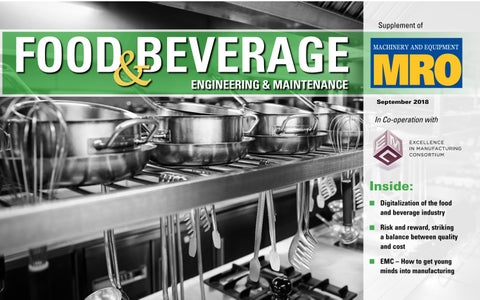
In this issue, topics covered are digitalization, balance between quality and cost, and how to get young people into the manufacturing industry. All three are of utmost importance to those in the food and beverage industry, as what may have seemed to be the future, is now.
Digitalization is all around us; everywhere we look, everything is now digital. From door locks to refrigerators, and paying for groceries with your phone, more transactions than ever are done digitally by being connected to the Internet. For the F&B industry this means can help with legislation compliance, as data is automatically collected on things like food temperatures, taking the guesswork out of food safety. How can digitalization help?
Read “Digitalization” on page 4.
No matter the industry, costs and quality are always a part of business that companies have to grapple with. Getting the very best machines, designs, tools, etc., will always offer the best quality, but the costs may not be what a company can afford.
However, the risk of not having quality tools may outweigh the cost needed. Contributor Jennifer Elliott outlines the risk and reward and the balance between costs and quality on page 8.
While many young people may not think of manufacturing as a career, it is worth thinking about as the manufacturing industry is changing.
Automation, which is still in the testing phases in automotive vehicles, whereas manufacturing plants have many autonomous aspects and continue to do more and more.
Digitalization, also gives rise to new jobs within manufacturing that were not present before. The next generation of workers have an opportunity to work in the new manufacturing sector.
Check out the training and events offered through EMC, which advocates for skilled trades and the next-generation of jobs in the manufacturing sector, starting on page 11.
For those who have any questions, comments, or suggestions, please do not hesitate to contact me at mcywinski@annexbusinessmedia.com.
Mario Cywinski, Editor
DIGITALIZATION
Presents the food and beverage industry with many new opportunities.
Digitalization encompasses a transformation in the way industrial environments work. For the food and beverage industry, this means companies can better comply with legislation through a transformation in areas including connectivity, smart sensors, traceability, cloud computing and monitoring. The shift toward digitalization is a natural continuation for leading food and beverage manufacturers. “Food, beverage and consumer products manufacturers are leveraging innovation to optimize service to consumers and trading partners,” said Pamela Baily, President, Grocery Manufacturers Association in USA.
LEGISLATION
The Centre for Disease Control and Prevention (CDC) estimates that one in six Americans suffer with a foodborne disease each year, and 3,000 deaths are attributed to food-borne illness. When people’s lives are at stake there is no room for error.
Therefore, one of the largest concerns for the food and beverage industry is using technology to find the best method to keep well maintained traceability records, which show the journey of food from farm to fork. Similarly, in the European Union
(EU), the General Food Law Regulation (EC) 2002 requires business operators to keep detailed records of food they supply to others and food they receive from suppliers. Digitalization aids this process by automatically collecting data such as food temperatures throughout production.
SMART SENSORS

Well-kept traceability records and sensor data can increase transparency between businesses, producers and consumers. This allows plant managers to respond faster in emergencies and use evidence to rebuild public trust following recalls. The processed and raw data can be stored and recalled if there are any issues further along in production. Cloud technology has made it easy to store and analyze data, removing any potential for human error by raising alerts and red flags immediately. Sensors can aid traceability in two ways: they improve the accuracy of automated processes and they can track and store a variety of manufacturing data. Time-temperature history, physical shocks and other important credentials can be continuously measured and synchronized across the factory thanks to the IIoT. Sensors used during food production can monitor products throughout the manufacturing and distribution supply chain. Sensors can form part of a device such as a smart container, or act standalone, depending on the needs and conditions of the manufacturing process.
product, self-chilling beverage cans, produced by collaboration between Crown Cork and Seal and Tempra Technologies are paving the way. As the costs of connectivity come down, all-in-one products such as this are likely to become common across multiple industries.
CONNECTIVITY
In the future, smart containers may be able to self-diagnose and
correct, for example by self-heating the container so that it remains above a threshold set out by health and safety guidelines such as Regulation (EC) 852/2004. A similar
For the first time in 2016, over half of the world’s developing population had Internet access. As Internet access widens and the price of networked devices drops, the volume of network traffic will rise. Alongside this, the falling cost of producing devices such as Wi-Fi-enabled temperature sensors mean they will become ubiquitous in industrial environments. However, more sensors lead to more raw data. This higher rate of data production presents issues of how to store and use the data.
Wi-Fi connected versions of motion and temperature sensors themselves, when combined with cloud-based storage may solve the problem of
data capacity. Vast amounts of data can be instantly communicated, stored and even analyzed in the cloud, supplying useful information about traceability, production costs and predictions.
CLOUD
Although almost sixty per cent of US food and beverage manufacturers use the Internet of Things (IoT) to track and trace ingredients, less than half are using the advanced analytics the IoT makes possible. Cloud analytics, real-time monitoring, virtual commissioning and digital twinning, the ability to recreate the plant virtually, are just some of the techniques now helping plant managers in the food sector reduce unplanned downtime, improve safety and mitigate food emergencies.
Crucially, plant managers can use the cloud to adapt to seasonal changes in demand, flexibly altering production setups, factory layouts and even reassigning staff without causing wider disruption.
MONITORING
Huge amount of data produced by the connected factory can be used for many purposes in the food and beverage sector. For example, understanding why one machine is running hotter than another, or why one is not picking as many products, can help operators understand the efficiencies of each machine, data that can be used to improve plant maintenance.
Many plants are using their own mobile networks to take monitoring to the next level. For example, on farms, sensors are used to monitor soil conditions, using the data to predict when animals are in heat and text the farmer with the information.
“In the future, agricultural machinery will work as rolling data centers and sensor technology will provide all the important information in real time,” predict PwC advisors. “The challenge for farmers will lie in intelligently networking the technology and managing the data.”
Further down the production line, food retailers such as Ocado
have built their own high-speed 4G networks to communicate with thousands of robots. Raw technical data has its uses, but these are greatly enhanced when the sensor data is combined with maintenance management or financial data. It is this consolidation that allows the information to come into its own and be useful for prediction, past analysis and optimization.
Although many businesses will be wary of the perceived complexity of undergoing digital transformation, it can bring about a true competitive advantage. Plant managers of the future should not only recognize the trend toward digitalization, but they should embrace the opportunities it brings, just as approximately 70,000 active contributors have wholeheartedly adopted Wikipedia, an opportunity produced by consumer digitalization.
This article was submitted by ABB. It is attributed to Robert Glass, who is the Global Food and Beverage Communications Manager at ABB.
RISK AND REWARD
Operators must strike a balance between costs and commitment to a quality kitchen.
BY JENNIFER ELLIOTT
Any kitchen can be a dangerous place to work. With potentially slippery (perhaps uneven) floors, dangerous (possibly outdated) machinery and equipment, sharp knives, hot surfaces, cramped workspaces, multi-level storage shelves, insufficient ventilation and exposure to potentially hazardous materials (heat, chemicals, food).
In the 20 years that I’ve spent working in commercial kitchens, the rewards of designing, stocking and operating a high-quality kitchen far outweigh the risks. That said, of course any food-service operator must strike a balance between a commitment to excellence and the costs associated with initiating and maintaining a top-notch kitchen. Having
PHOTO:
a place for everything (and having everything in its place) is a balance that is entirely possible to achieve. This starts with good design, which may or may not be up to the operator. A one-off, boutique-style restaurant would allow an operator a significant amount of input; a franchised operation would offer a franchisee little in the way of customization, but should provide the benefit of a space that’s been designed to meet the needs of many.
A good design organizes kitchen components in a way that optimizes
both performance and efficiency and that respects the flow of food. A welldesigned kitchen adheres to health code and features space for cleaning and washing, preparation, cooking, storage and service.
Perhaps most importantly for me is including the highest-quality dishwashing unit possible. Having worked in high-volume kitchens without one, relying on washing, rinsing and sanitizing in a threecompartment sink. Different types of professional units and a top-quality dishwasher is not only a worthwhile
investment for helping to keep a kitchen clean, organized and running smoothly, it’s essential to being able to maintaining proper food safety and sanitation and to providing remarkable service.
Storage areas, for refrigerated, frozen and dry foods, are key elements of a well-designed kitchen (as is having a space for receiving deliveries, if possible) and it’s great to have a separate space, even if only small, for food preparation (it’s especially
helpful to have a separate sink for washing produce), ideally with separate spaces for cutting, mixing and processing food. The heart of the kitchen, the area in which the cooking and service takes place -- should be thoughtfully laid-out and organized in a way that supports efficient and effective production and service.
The back-of-the-house team is the backbone of any restaurant or professional kitchen, without food production, food-service operators
have nothing to serve, so once the kitchen is designed and fitted out, the next most important investment is the addition of people. It is essential for operators to search for high-quality, passionate people to join their teams, some of these candidates will of course come with a set of knowledge, skills and ability that is specific to the work at hand, but in some cases, operators should be on the lookout for people who are of good character and who are coachable. It’s important
(several during peak hours). This can be expensive, but the confidence an operator gets to know her people are schooled specifically in food safety and sanitation is immeasurable.
Add to the mix the stocking of the space with good quality ingredients (they don’t have to be the very best, unless that’s part of the organization’s mission and culture), though this again will vary from one operation to another (the independent operator will have plenty of choice;
“...any food-service operator must strike a balance between a commitment to excellence and the costs associated with initiating and maintaining a top-notch kitchen. ”
never to rest on the laurels of initial hires, always looking to upgrade as the business grows.
One of the best investments I’ve made in my own restaurants is ensuring that all production and overnight staff, as well as back-of-house-and front-of-house supervisors, are certified in food safety so that there is always someone on the floor who has a food handler’s certificate
the franchised business practically none at the restaurant level, but a franchisee should benefit from the bargaining power of and the suppliers to the franchisor), and engaging with vendors with reputations for selling and shipping good-quality foods that are handled and transported safely and who will work with customers to resolve any concerns.
Signing-up for preventive maintenance programs on equipment, especially HVAC units, is another best practice and worthwhile investment. With any equipment that’s not being serviced regularly, it’s best not to put off a call when a piece of equipment is showing signs of wear, often getting out in front of an issue results in less money spent on repeat service calls or having to replace equipment entirely.
Finally, a comprehensive insurance
program is essential for your kitchen, always work not to need it, but work with confidence that the coverage is there if and when it is needed.
Jennifer Elliott is a writer and part-time professor with the School of Hospitality, Tourism and Culinary Arts at Centennial College in Toronto. Elliott blends her teaching and writing with her fulltime work in QSR operations with Tim Hortons. She may be reached at jenniferelliottcropper@gmail.com.
Fall is the perfect time of the year to take pride in the strength of our food, beverage, bio and agricultural sector in Canada and pay homage to those working in manufacturing in general regardless of the sector or size of company.
The food industry (which essentially encompasses all facets of the food chain from agriculture through processing, service and retail operations) employs in excess of 2.3 million people from coast to coast. It remains a key economic driver for our country, as such there is considerable investment in innovation, automation, new market development and initiatives to ensure our businesses continue to grow.
For the past several years, as the director of the food, beverage, bio and ag program at EMC (Excellence
In Manufacturing Consortium), I found that several things about the concept of manufacturing at this particular time of the year excite and inspire me, including the opportunity to grow and learn. There is
something about fall, it “reignites” our engines, providing a new menu of appetizing occasions for you to connect, grow and develop.
Ongoing EMC peer networking events, best practice sharing, plant
tours and training programs act as perfect appetizers to help stimulate our thoughts and enhance our creative continuous improvement abilities. Building on those activities, there are also a number of fabulous industry-related forums, summits, tradeshows and tabletop sessions to take advantage of. Also, having October, thought of as manufacturing month, just a few weeks away! So yes, being a part of the food, beverage, bio and ag sector, is truly an exciting place to be.
This month, parents across Canada are back in the throws of watching their children begin another wonderful year of learning at school. Some, like my grandson, are entering classes for the very first time. Regardless of age or grade, they are eager, excited and motivated to gain knowledge and experience.
Inevitably emerging as tomorrow’s leaders in any number of roles or disciplines.
Thinking about education today and the opportunity to promote a career in manufacturing during the month of October, you might ask yourself “What will these little ones become? What jobs will students in school believe to be their future? What teachers and educational curriculum will help shape and guide their career paths? How will parents, peers, role models, mentors, research and exposure to real life positions in their field of choice influence them? And more importantly, with retention and attraction being one of our key industry challenges, the question I find myself asking as the bus loads up my grandson for the first time is “How many of these young minds will end up with a career that
has an impact on the food, beverage, bio or agricultural industries?” and “what can I do to help?”
Since our humble beginnings almost 30 years ago, EMC has always embraced the opportunity to promote careers in manufacturing. We have and will continue to host events at colleges and universities showcasing the latest course content, helping build awareness around co-op programs and placements. We have participated in job fairs highlighting the depth and breadth of positions available in the industry, from administrative to management, though maintenance, supervisory levels, production workers, accountants, food safety, health and safety, human resources, IT, etc. The more technical and automated our facilities become, the more important candidates understanding of the
role between computer, machine, product and man. Manufacturing is complex and exciting for those interested in pursuing such a path that challenges one to grow.
We need to continue the dialogue about the fabulous career opportunities available in Manufacturing – sharing stories about what our companies do and how well they do it. We need to be proud of our role in the organization, how maintenance, for example, ensures that the equipment runs when it needs to, preventative techniques are applied, downtime issues minimized, automation and IT embraced, and continuous improvement and lean methodologies adopted. We need to give some understanding to the youth of today as to what our positions mean, not just that “I am in maintenance,” but how important it
is in the cog of manufacturing, the necessity of that role in maintaining competitiveness at home and abroad, and the knowledge gained year over year that can be shared and applied with others within the company and with peers across Canada. We all help contribute to our business’ success.
EMC has enjoyed partnering on activities that bring educators and students to plants to gain first hand knowledge about manufacturing in general exposing not only potential positions but also facets of entrepreneurship, technology, automation, product development, etc. These visits help broaden industry perspectives and shed valuable insight on career opportunities. During manufacturing month, week, day (depending on the region), interested partners, educators and industry can
be found working together in communities across the country and this is truly inspiring.
Kudos to the plants who have opened their doors to these activities, as they are essential for recruitment and attraction to our businesses, and thanks to other organizations who tirelessly promote careers in our industry at large.
A final thought to consider, as you watch those heading off to classes, consider sharing your experiences, knowledge and thoughts about the limitless positions available in manufacturing. Perhaps your insight and experience may “excite and inspire” someone to explore a career directly in industry, become engaged developing a new product or business or lead us on a new and exciting culinary journey with innovative ingredients!
Is the Food and Beverage Industry an exciting place to be – absolutely.
EMC (Excellence in Manufacturing Consortium) is a not-for-profit association of Manufacturers of all sizes and sectors from across Canada with a focus on enabling competitiveness in industry. Peer Networking, Best Practices, Plant Tours and value-added programs and service providers impacting several aspects of business provide benefit to Members.
How do you get involved? If you are interested in learning more about EMC (Excellence in Manufacturing Consortium) and the Food Sector Initiative, please feel free to touch base with Bren de Leeuw, Director - Field Operations Canada and EMC Food, Beverage and Bio Sector Program (bdeleeuw@emccanada.org) anytime!