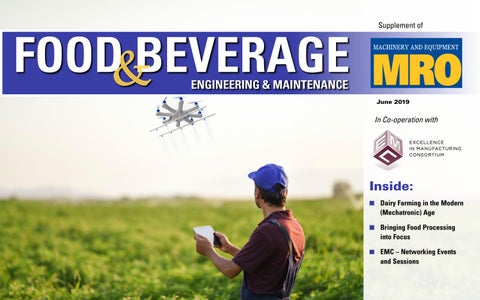
FB - June 2019

Page 1


FOOD BEVERAGE

Keeping

In dairy farming, pretty much the only thing that isn’t changing is the cow.

Future of Manufacturing National Conference

It was a very Canadian crime and one that was completely preventable.

Networking events and sessions provided by EMC.

510-5107 VICE-PRESIDENT Tim Dimopoulos tdimopoulos@ annexbusinessmedia.com

Mario Cywinski mcywinski@ annexbusinessmedia.com (226) 931-4194 ACCOUNT

Barb Vowles bvowles@ annexbusinessmedia.com (416) 510-5103 CIRCULATION MANAGER Beata Olechnowicz colechnowicz@ annexbusinessmedia.com

Keeping Products Safe and Secure

Looking at the food and beverage industry we see that it’s not simply about the food but about how that food is stored, how it’s kept fresh, how it’s processed, and the overall safety of the products. Many facets contribute to the overall food and beverage industry, and while safety is always near the top of the priorities list, security of the facilities that house and process the food should (if they are not already) also be a top priority.

Security, at its core, can be as simple as making sure that the facility is not broken into, or that nothing is stolen. And this is very important, especially if you are processing a product that may be expensive.

Companies also want to focus on their products, and therefore if they have to either throwaway product because it goes bad, or it goes missing/ stolen, it takes away from that goal. Contamination of products is a very big thought point for food processors.

Thinking outside the box, you can use security, and more precisely, security cameras, to help minimize loses. On top of protecting the facility, with cameras, product issues (bad food, packaging issues, contamination), as well as employees who miss things, can be detected. Employees can be trained to further reduce the need for lost products. It is human nature that when we think we are being watched, we are more likely to be careful about what we are doing, and in turn make fewer mistakes.

Another way to help reduce lost product is to try and make as much of the process automated as possible. Whether that is in a machine that is used

to milk a cow, or a conveyor system that moves product through a facility, having less chance for human error, is becoming the norm.

As there is less human handling of food and beverages by employees, the need for the machines to run at their best and minimize downtime becomes even more important.

Preventative maintenance, predictive maintenance, and as a last resort reactive maintenance of the machines that are used needs to be done regularly. The maintenance professionals will be in even more demand, as while automation removes workers at the front end, it necessitate workers at the back end to make sure there is no downtime.

At the end of the day, automation and security, which may be looked upon negatively by workers, is a needed step for companies who want to ensure that they are ahead of the curve when it comes to minimizing downtime.

DAIRY FARMING IN THE MODERN (MECHATRONIC) AGE

In dairy farming, pretty much the only thing that isn’t changing is the cow.

Everything else is looking more and more like I Robot than Old MacDonald. Automation and digitalization are an increasing part of the business model, in Canada and abroad. Robotic milking and feeding systems aren’t new ideas, but are becoming more sophisticated in ways that increase the productivity of the herd. Including the provision

of important data points on a computer or smartphone app about individual animal production, feeding habits and health. There are automated systems for almost every aspect of cow and calf management. Automation is scalable to different herd sizes and adaptable to different feeding approaches, whether herds graze outdoors or are largely housed indoors most of

Photo

the year, the latter more popular in Europe. Robotic milking systems represent a considerable investment, but one, more farms are considering. By 2017, 720 Canadian barns had switched to robotic milking, according to the Canadian Dairy Information Centre. That’s almost nine per cent of all domestic dairy farms, up from seven per cent two years earlier.

The technology behind the automation continues to evolve. For example, Lely, a Netherlands-based OEM in dairy automation, known in the Canadian market, recently launched its third generation milking robot. Whereas earlier models used servo-pneumatics and a hybrid electrical/pneumatic actuation system respective to guide the robotic arm, the new one uses Festo electric actuators and software.

Electric actuation has clear advantages over the servo-pneumatic and pneumatic-electric hybrid arms earlier systems. Its motion is gentler. It’s faster and more energy-efficient, requiring 30 per cent less time to place the teat cups on the cow. According to Arnoud Nieuwdorp, Global Key Account Manager, Festo, installation time is reduced thanks to the use of quick connectors, it also results in lower operating and maintenance costs and a lower total cost of ownership.

The new milking robot arm is set into motion by two electric actuators and a customized, horizontal toothed belt axis. With its smooth surfaces, the actuator is easy to clean, making it less susceptible to contamination. The complete solution for positioning the electromechanical drives and controlling format changeovers consists of a maintenance and wear-free EC motor, as well as a motor controller including power electronics. This avoids long motor cables, improves electromagnetic compatibility and reduces installation effort and space requirements. Besides liberating farmers from hard, monotonous work, automation makes it possible to establish round-the-clock milking operations. Cows decide when they want to enter the milking stanchion. When one does, the

Promo: May 1-Aug 31

robot management system identifies it and decides if the animal is ready to be milked. If it is, the milking process begins. Each cow wears a small transmitter chip on which data such as size, weight, recommended feed quantity and last milking time are saved.

“The fact that the cow barn is an extremely adverse environment has to be taken into consideration,” said Nieuwdorp. “You also have to remember that the cows will occasionally kick the milking robot’s arm.”

The motion software was created for the milking robot as software modules that can be re-used in other applications. That application software is implemented using function blocks, libraries or sample programs. That means that motion sequences can be easily configured via an intuitive customer interface without any programming knowledge.

Lely and Festo are continuing their technology collaboration as the focus of automation explores new areas. Robotic milking systems already can provide cow-specific information about health and fertility, as well as milk production quantity and quality, for feed suppliers and veterinarians.

New topics being researched include condition monitoring and predictive maintenance for the machinery itself to further lower the cost of ownership of these systems.

Article submitted by Festo Canada.

BRINGING FOOD PROCESSING INTO FOCUS

It was a very Canadian crime and one that was completely preventable.

The Great Canadian Maple Syrup Robbery made headlines around the world and was significant, not just in terms of its dollar value, but that it happened at all. A theft of many million dollars of maple syrup from a Quebec warehouse was only discovered when a routine inventory check turned up an empty barrel that was supposed to be full of syrup. Officials with the Federation of Quebec Maple Syrup Producers soon discovered that dozens of its barrels had been emptied and refilled with water.

A lack of security allowed thieves to enter the storage facility undetected and set about their work of substituting syrup with water. The loss was considerable, but it could have been worse. Saboteurs could have laced the syrup

with toxic chemicals or simply set fire to the warehouse and the 3.4 million litres of syrup that was stored there. In the end, the perpetrators were caught.

Food processing is a complex business, and manufacturing plants present a number of potential security risks along with the health and safety guidelines they are required to adhere to. Video surveillance can play a valuable role in several areas from the car park, entrances and exits, office areas, delivery and dispatch and most importantly, the manufacturing and processing areas themselves. Delivery of raw materials, storage and dispatch of the final product, and operation of machinery are all aspects of a manufacturing operation where video surveillance and related technologies can be deployed.

SECURING THE BUSINESS

Security starts with protecting the perimeter of the property, where IP network cameras can monitor gates and fences along the boundary of the facility, record vehicles using license plate recognition if deemed necessary, and maintain access control for all employees and visitors. IP cameras can be added to an existing analog system and providing better image quality, remote accessibility and advanced analytics. Edge technology allows these smart cameras to analyze and react to security breaches in real time, effectively making decisions to halt breaches before they escalate. For instance, if an intruder trespasses and attempts to enter the facility, a camera can send an e-mail to security, illuminate the area with a floodlight and activate an audio alarm or a

message through a loudspeaker instructing the intruder to leave immediately. The addition of audio can be an effective deterrent while security staff observe the scene remotely on their phone or laptop and decide on next steps.

In the shipping and receiving area, there are a number of security options for consideration. Single cameras can cover vast areas, with a field of view of 180 degrees by 90 degrees. A PTZ (pan, tilt, zoom) camera can be useful in busy bays where monitoring of several rolling doors is desired. Each time a door opens, the camera can automatically tilt and zoom to record that event as it’s happening.

An alternative to that is a multi-sensor, fixed field wide-angle camera that oversees the entire area and can zoom in as necessary. If the facility operates around the clock, high definition cameras with Lightfinder technology can record colour even in dark conditions, a far cry from the CCTVs of old.

PREVENTING CONTAMINATION

The number one concern for food processors is contamination. When a company has a seasonal workforce, those employees may not have as much training or loyalty to the employer. It’s equally important to have eyes and ears on the processing level. Human error or unsafe food handling can occur, but there is also a risk posed by third parties who supply ingredients. All it takes is one piece of packaging or some other contaminant to find its way into the production line and cause a hazard. Being able to trace when and where this happened is key to being able to issue a limited recall, should that be necessary. Network cameras can tie product batches to specific shifts, identify which workers were present, while video streams record the entire chain of events, so managers can zero in on the problematic batch or lot that would be affected.

the production system offers the possibility to remotely access live images over the network, making it possible to remotely monitor production lines and visually inspect and verify that functions and processes are running correctly. They can ensure safety rules and processes are being followed and tools and equipment are being managed properly while providing remote troubleshooting and assistance with maintenance and support.

Tracking every input scenario is essential and a high-resolution camera can help make a significant difference when looking at where contamination might have occurred. After the event occurs and an investigation takes place, managers can evaluate whether it is a process issue, an employee issue, or a prior issue that was the fault of the supplier.

PRODUCTION PROCESSING AREAS

In addition to keeping your business premises secure, network cameras are a valuable tool for optimizing overall production efficiency and creating a safe work environment for employees. Integrating the camera system into

In order to provide a high level of insight into manufacturing processes, Axis Communications provided two high performance network cameras to Dublin luxury chocolate maker Lily O’Brien, to oversee critical production processes and collect technical data. These PTZ cameras send images to any Internet-enabled PC across the business and help managers observe these critical processes and collect technical data, allowing staff to ensure production is running smoothly without having to be physically present at the machine.

ENSURING EMPLOYEE SAFETY

Video surveillance can help reduce the cost of accidents, where video from surveillance cameras can be used in post-incident investigation and identify whether responsibility lies with the employer, or the employee. Wherever ultimate responsibility may lie, the video can allow the organization to take action and ensure that it doesn’t occur again, through measures

such as additional signage, protective barriers or new machinery. It is in the best interest of both employers and employees to prevent accidents and incidents happening in the first place, and this is where an unseen benefit of video surveillance comes into play.

Like overt video surveillance being a deterrent to thieves, cameras visible in manufacturing facilities can help ensure that employees adhere to all appropriate health and safety guidance. Indeed, decade-long studies have shown that humans unknowingly behave better when they think they’re being watched, even if this perception is only prompted by a pair of eyes on a poster. So, it’s logical that where workers know that video surveillance is in operation, they are more likely to adhere to rules and regulations in relation to safe working practices.

Marine-grade stainless steel camera equipment with nylon domes are designed to withstand harsh weather conditions, but also function well in environments with frequent wash downs that are commonly used in food processing facilities.

Cameras can operate in minus 50 degrees Celsius temperatures, ideal for working in frozen food production facilities. Cameras can be outfitted with temperature sensors, which can trigger an alarm when temperature rises to an unsafe level so that spoilage is monitored, and food safety maintained.

The new world of IP network cameras can transform a food processing operation, bringing a level of security and efficiency to food processing that will have benefits that go far beyond addressing basic security needs.

Paul Laughton is Architect and Engineering Manager at Axis Communications, where he supports both internal employees and external customers in designing security systems.

Excellence In Manufacturing Consortium (EMC) Food & Beverage Sector networking events and our regional Strategic Interest Group (SIG) sessions present an excellent means for manufacturers to come together and learn from other’s experiences. It’s a time to share best practices, reveal inhibiting challenges, celebrate milestone achievements and recognize like-mindedness of ongoing quests in continuous improvement and business growth.

Recently, I received an e-mail from a participant at an EMC Food & Beverage Sector networking event on business growth. In a few words it sums up the value and importance that peer discussion provides “I would like to express my gratitude for the time that you spent yesterday to share the journey of Reunion Island Coffee. With our company beginning the journey of growth, you’ve highlighted so many things for me that even if I can only remember a tiny fraction of it, I will be miles ahead. I can see so many similarities between our companies, at least where you used to be and where we are now. I certainly hope to be able to tap into your experiences in the future and hopefully I can return some value to you at some point...”

EMC was built on the principle that knowledge sharing could only enhance a company’s capabilities and ultimate competitiveness. As we gathered at plants in the early years, we accepted our product differences and embraced the commonalities in business that we could collaborate on. The learning has never stopped.

Today, we have over 60 consortiums across Ontario, New Brunswick, Nova

Scotia, PEI and the BC Lower Mainland region, along with Food, Beverage Bio and Ag Sector Initiative. Each of these consortiums is supported by a team in the head office and regional field service advisors (FSA) with a robust background in manufacturing environments. The FSA’s provide information on upcoming opportunities, facilitate local networking events and regularly visit with EMC member companies in an effort to stay abreast of their needs.

Encouraging manufacturers that there is a great deal to learn regardless of product or sector, is a challenge – until participation in an event or plant tour

unveils many aspects of business, management, manufacturing, continuous improvement and general growth.

SIGs – these were sessions designed to have a “focus” and hone-in on issues of relevance for each particular region. Under the guidance of FSAs, schedules are developed based on those regional needs. There are SIGs taking place almost every day from January through June and September through December. Members can participate in as many events as they want – making the opportunity to gather ideas and create beneficial relationships with peers endless. These special sessions often feature host best practices, but can also take the form of roundtable discussion, or entail the latest information from a subject matter expert. The majority of sessions also have a plant tour.

Plant tours unveil the path of goods from raw material through packaging and provide an appreciation for the journey, the investment in automation and technology, the efforts at continuous improvement and a chance to gain insight from communication boards. “Seeing” things first-hand often sparks an idea for a continuous improvement initiative in a participant’s building. My favourite next to the visual management boards, is introducing observers to different products and processes identifying general similarities between totally unlike industries (i.e. glass production vs baking).

Our consortiums engage many key areas of a business, with sessions for senior management, continuous improvement, maintenance, human capital, health and safety, and IT. The Food & Beverage sector sessions draw on delegates from all aspects of the organization as above along with food safety,

regulatory and compliance, quality assurance, and sanitation.

Topics generated come from participants; talent attraction and retention has been one of the most discussed across Canada this past year. As a growing challenge for industry, particularly with an aging workforce, low unemployment rates, and a need for more skilled workers in the manufacturing sector, we continue to engage our members across Canada in dialogue, best practices and strategies for the future.

This year, we had the opportunity to learn best practices of Burnbrae Farms on talent attraction and retention. A session that highlighted the means they are using to engage their workforce, such as the involvement of others in the recruitment, onboarding, mentoring and engagement processes.

Looking at business growth was the focus of a session hosted by Reunion Island Coffee that painted a picture of the challenges positive development brings. Implementing an ERP and food safety system simultaneously, led to interesting challenges, which they shared so others may find their journey in this regard somewhat easier to navigate. Following a presentation, the plant tour highlighted their gains; such as investment in capital equipment, storage reorganization, and visual management systems.

In June, we are exploring “Talent Review and Building Performance” at Wholesome Kids Catering with insight from Maple Lodge Farms. Think about current challenges in attracting candidates, and future needs to grow, Talent Review becomes a critical component to aid in planning in the coming years.

September begins with a session on “Building World Class Food Safety Practices,” hosted by Healthcare Food Services (HFS) in Ottawa, this will be an opportunity to learn from one company that strides to be the best of the best in food safety and take in thoughts, perspectives and experiences of the discussion.

The SIG and food and beverage events are one way to foster knowledge. We also have tools such as member needs help available – wherein you can field a question to our membership at large. Policies, procedures, charts, ideas, contacts, are shared enabling companies to save time and effort by not ‘reinventing the wheel’. Additionally, B2B opportunities provide manufacturers seeking specific products, equipment, engineering, with the ability to connect with potential suppliers. In any of our training programs, you are sure to meet great people from industry. If you are attending an EMC Event anywhere – always remember your business cards.

This year, EMC is hosting the National Advantage Through Excellence – Future of Manufacturing Conference. Information is to the right.

How do you get involved? If you are interested in learning more about EMC (Excellence in Manufacturing Consortium) and the Food Sector Initiative, please feel free to touch base with Bren de Leeuw, Director - Field Operations Canada and EMC Food, Beverage and Bio Sector Program (bdeleeuw@emccanada.org) anytime.

to 30-Oct-1

Turn static files into dynamic content formats.

Create a flipbook
Issuu converts static files into: digital portfolios, online yearbooks, online catalogs, digital photo albums and more. Sign up and create your flipbook.