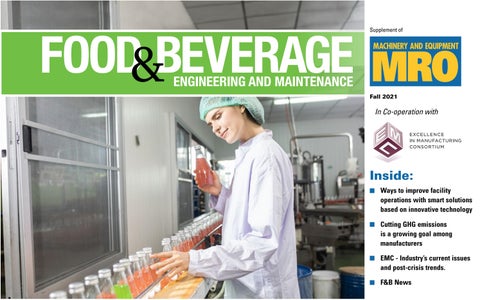
FB - Fall 2021

Page 1


How surveillance solutions can keep food and beverage manufacturing at the forefront of operation.

How digital pneumatics add fast conversion flexibility to food packaging systems.

Want to cut greenhouse gas emissions? Start with cutting energy waste.

Transparency, sustainability, and new consumer demands.

LEADERSHIP CERTIFICATE

PEOPLE & CULTURE LEADERS - FUNDED TRAINING

Exploring the industry’s current issues and taking advantage of post-crisis trends.

Designed to enhance leadership in manufacturing and increase performance of the workforce.

This program is designed for Supervisors, Managers and those in Leadership looking to enhance their skills. Participants will gain knowledge and skills to lead engaged, high-performing teams while becoming people leaders and leaders of organizational culture. By developing these skills, companies can expect stronger team collaboration, higher productivity, fewer conflicts, positive workplace culture, and overall better employee engagement.

STARTING - OCTOBER, 14 TH

To Register, Contact EMC’s Learning Centre; Amy Edwards, Training Coordinator aedwards@emccanada.org 1-866-323-4362

MACHINERY AND EQUIPMENT

Paul Burton

pburton@annexbusinessmedia.com (416) 510-6756

EDITOR

Mario Cywinski mcywinski@ annexbusinessmedia.com (226) 931-4194

ASSOCIATE EDITOR

Maryam Farag mfarag@annexbusinessmedia.com (437) 788-8830

NATIONAL ACCOUNT MANAGER

Ilana Fawcett ifawcett@annexbusinessmedia.com (416) 829-1221

BRAND SALES MANAGER

Melanie Morgan mmorgan@annexbusinessmedia.com (437) 218-0941

ACCOUNT CO-ORDINATOR

Catherine Giles cgiles@ annexbusinessmedia.com (416) 510-5232

MEDIA DESIGNER

Lisa Zambri

CIRCULATION MANAGER

Beata Olechnowicz bolechnowicz@ annexbusinessmedia.com

COO

Scott Jamieson sjamieson@ annexbusinessmedia.com

2021 In Co-operation with

PRESIDENT

JP Giroux • jp.giroux@emccanada.org

(519) 376-0470 (866) 323-4362

VICE PRESIDENT AND GENERAL MANAGER

Amanda Doman • adoman@emccanada.org

VICE PRESIDENT, MANUFACTURING SECTOR PERFORMANCE

Scott McNeil-Smith • smcneilsmith@emccanada.org

CHAIRMAN OF THE BOARD, TREASURER Al Diggings • adiggins@emccanada.org

Coming Out Stronger Than Before

The Canadian food and beverage processors have demonstrated resilience throughout the COVID-19 pandemic. In the early days of the pandemic, the sector faced significant challenges, such as outbreaks at processing plants that led to temporary closures, notably at meat processing facilities.

Like many other sectors of the economy, food and beverage supply chains were placed under strain due to volatility in demand and shifts in consumer consumption patterns. The closure of food service businesses and downturn in the hospitality sector caused processors to explore alternate retail channels. Companies adapted their facilities and procedures, and they invested in personal protective equipment to prevent the spread of COVID-19 in the workplace.

According to the Government of Canada, compared to other industries, economic indicators for food processing, such as sales, remained strong during 2020.

Let’s go back and take a look at how the food and beverage industry was doing pre-COVID19.

The food and beverage processing industry is Canada’s largest manufacturing industry, both in terms of GDP and by total employment. The sector is also the largest buyer of Canada’s raw agricultural products, purchasing over 70 per cent of Canada’s agricultural output.

Accodring to the Government of Canada, Canada’s food processing sector is export oriented, with a positive and growing trade surplus, and

is the world’s 11 th largest exporter of value-added food products.

The sector benefits from Canada’s trade agreements, including the ratification of new free trade agreements like Canada-United States-Mexico Agreement (CUSMA) and the United Kingdom-Canada agreement, which offer greater export and market access possibilities.

The food and beverage processing sector is composed of several subsectors, the largest being beverage manufacturing and meat product manufacturing, which accounts for 17 and 18 per cent of total sector GDP.

As COVID-19 restrictions gradually start to loosen, we hope to see the food and beverage industry remaining in a strong spot.

mfarag@annexbusinessmedia.com

INFARM PARTNERS WITH SOBEYS INC. THROUGH EXPANSION DEAL

ACROSS CANADA

Infarm and Sobeys Inc. have announced an agreement to accelerate the availability and distribution of fresh produce to an additional four of Canada’s 10 provinces by 2023.

As part of the deal, Infarm will

NEWS

construct new Infarm Growing Centres – growth, production and distribution hubs with highcapacity vertical farms – at sites in Calgary, Halifax and Winnipeg, with Hamilton, Ontario, nearToronto planned to host the location for the largest Infarm Growing Centre in North America with a growing capacity of 37,000 ft2.

“We’re delighted with what has been an extremely positive and successful partnership with the Sobeys family of retailers,” said Erez Galonska, CEO, Infarm. “This expansion deal represents one of the largest rollouts

of any vertical farming company in North America to date as we aim to offer local, high-quality produce to people everywhere.”

In combination with existing Infarm Growing Centres in Vancouver and Victoria/Vancouver Island, the agreement allows the company to increase production volume in Canada over sevenfold. The deal comes in response to the increasing demand by retailers, including Sobeys, Safeway and Thrifty Food for fresh Infarm produce, and will supply over 1000 stores in the retailer’s network alone.

“We are passionate about bringing Canadian families the best, freshest, most delicious produce every single day. The expansion of our exclusive partnership with Infarm demonstrates our commitment to delivering that in a technologically advanced and sustainable way,” said Niluka Kottegoda, Vice-President Customer Experience, Sobeys Inc. “We received overwhelmingly positive feedback from our customers and our store teams about the

current Infarm product grown in our stores. We are thrilled to expand into the Infarm Growing Centres as they allow us to exponentially offer these great local products to a multitude of communities across Canada all year-round.”

PLANT VEDA PARTNERS WITH FRESH PREP

Plant Veda Foods Ltd., a dairyalternative company, announced its partnership with Fresh Prep in the BC Homegrown Summer Campaign. Plant Veda’s lassi product line was featured on Fresh Prep’s Homegrown landing page, a series of Facebook and Instagram posts, and through Virgin Radio 94.5FM from July 19 to August 31.

During the week of August 23, Fresh Prep gave away a “Fresh Prep BC prize pack” on their Instagram channel, which included a Plant Veda product.

“We are ecstatic to be partnering with Plant Veda – they share the same values and passion for healthy food as Fresh Prep, along with being

a local company that creates delicious plant-based products.” said Becky Brauer, Co-Founder and Co-CEO, Fresh Prep.

CANADA’S FOOD AND BEVERAGE PROCESSING ASSOCIATIONS

INVEST IN FIRST-NATIONAL FOOD SUPPLY CHAIN PLATFORM

Protein Industries Canada announced the Food Convergence Innovation (FCI) Canada – Food and Beverage Supply Chain Project. Canada’s food and beverage associations will build provincial and regional databases that will then be connected into a national network. This project builds on Conseil de la Transformation Alimentaire du Québec  (CTAQ)’s existing  Systeme Numerique Alimentaire Collaboratif  (SNAC) collaboration platform, developed by Bivizio and currently in use in Quebec, as well as data science work conducted at the University of Ottawa.

“Improving our sector’s ability to both innovate and respond to emerging issues requires a collaborative,

innovative solution in and of itself,” said Bill Greuel, CEO, Protein Industries Canada. “This digital platform will help connect the value chain across the country, from ingredient processors in the east, to food manufacturers on the west coast. And better yet, it will do so in a way that will improve the lives of Canadians, thanks to its ability to further strengthen our domestic supply chain and increase the selection of food products available across the country.”

The national platform will help companies from across Canada make connections across the value chain by allowing them to post and search for specific products, services and partners within given geographic parameters.

The FCI-Canada Project will be led by McGill Centre for the Convergence of Health and Economics with a national consortium of Food and Beverage Canada, CTAQ, Food & Beverage Atlantic, Food and Beverage Ontario, Food & Beverage Manitoba, BC Food &

Beverage, Bivizio, and the University of Ottawa. These organizations are together investing $500,000 into the project, with Protein Industries Canada investing $2.1 million, for a total project value of $2.7 million.

“We believe this project demonstrates the value of Canadian industry partners working together toward a common goal – ensuring the strength and the resilience of Canada’s food sector,” said Kathleen Sullivan, CEO, Food and Beverage Canada. “This platform, which will serve the interests of Canada’s food and beverage manufacturing sector from coast to coast, confirms the value of the provincial associations forming Food and Beverage Canada.”

LABATT BREWERIES INVESTS IN PRODUCTION ENHANCEMENTS

Labatt Breweries of Canada is investing in Alberta’s economy and creating jobs with a $119 million capital program.

Alberta and Edmonton will benefit from the investment,

with $69.2 million going directly into Labatt’s Edmonton brewery to expand production capacity and help create 25 local jobs in Edmonton.

“We’re proud of our history in Alberta with almost 60 years of brewing beer in Edmonton and serving Albertans across the province,” said Kyle Norrington, President, Labatt Breweries Canada. “As the province continues its post-pandemic recovery, this investment is one more step in the right direction, with new jobs, economic growth and the type of innovation that continues to make Alberta a great place to live, work and do business.”

The Edmonton brewery investment will support new technology, equipment, product lines and upgrades to the brewhouse and control room. It will fund 30,000 square feet of new warehouse space, and a 30,000-square-feet ready-todrink building to support expanded brewing type and capacity.

“This is a vote of confidence in Alberta’s recovery, creating dozens

of new jobs right here in Edmonton, and even more across the province through economic impacts,” said Jason Kenney, Premier, Alberta. “This is more proof that Alberta’s Recovery Plan is powering our economy and getting Albertans back to work.”

CANADA AND ONTARIO INVEST IN FOOD AND BEVERAGE PROCESSORS

The governments of Canada and Ontario are investing up to $6 million in projects to help Ontario food and beverage processors improve their operations.

Applications for this program will be accepted in two phases; applications for the first phase of this new intake under the Canadian Agricultural Partnership to support projects that will enhance economic development and food safety in the sector will be accepted.

The second phase of the intake will open next month for targeted projects to improve labour

productivity, efficiency and reduce waste.

“Our processors have risen to the challenges caused by the COVID19 pandemic,” said Marie-Claude Bibeau, Federal Minister, Agriculture and Agri-Food. “We are confident this investment will help them make their businesses stronger and improve food safety during these challenging times. A robust agri-food processing sector is vital to our economy and we recognize all they do to provide Canadians with quality food and beverages.”

Some examples of projects eligible for support under the first phase of applications for food and beverage processors include:

• Implementing new technology to improve food safety

• Developing new products to increase sales

• Improving animal health through preventing the introduction and spread of disease throughout an operation.

Come with Questions. Leave with a Plan.

The top reliability & maintenance experts, knowledge and tech are coming together for three days in bourbon country.

> Practical Learning Sessions

> Cutting-Edge Tech Demos

> Insightful Case Studies

> In-Depth Workshops

> Networking Opportunities

HOW SURVEILLANCE SOLUTIONS CAN KEEP

FOOD AND BEVERAGE MANUFACTURING

AT THE FOREFRONT OF THEIR OPERATION

There’s no time for downtime in a food and beverage production facility. No matter the cause, interruptions may have deep financial implications.

Industry regulations and mandatory procedures demand compliance, quality and safety throughout the entire food and beverage manufacturing process. With a need to improve facility operations at an all-time high, chief operators and managers are looking for ways to run efficiently, healthier, and safer with smart solutions based on innovative technology.

According to the 2021 FCC Food and Beverage Report, there are more

concerns over employee health, which forced food manufacturing companies to make significant investments in personal protective equipment (PPE) and adjustment to their overall procedures. Gradual re-opening of economies created new opportunities and challenges as consumer behaviours were continually shifting, forcing these facilities to remain agile. Meanwhile, the focus of Canadian government investment is to increase food

autonomy and focus on safe plant output procedures.

Agile manufacturing’s consumer needs-based concept of flexibility, rapid iteration, augmentation, innovation, and ultimate safety requires improved reliability and compliance in production. The integrity of every step and process involved can be further optimized with surveillance solutions that provide clear situational awareness and enable increased efficiency and

preventative maintenance. It’s crucial that everything handled in the food and beverage production chain be done with smart, reliable systems for preventing contamination and tampering. It’s also about these facilities having access to products and analytics to help review the processing, to enhance procedures and equipment, to keep employees safe, and to guard the premises against theft, whether physical or data theft, and sabotage by intruders.

SCALING AGILITY IN INCIDENT MANAGEMENT

Surveillance systems can help to rapidly detect, assess, and respond to production incidents in real-time. For example, consider a solution like thermal cameras, they can be used to monitor fluid leaks at dangerous temperature variances, or visual cameras can be fixed on pressure gauges to spot irregularities. These can trigger alerts, with high-definition cameras serving

visual verification that can be done remotely to reduce visits. Agile principles to handling incidents can be done by interpreting the data coming from a connected device to evaluate if things are running smoothly and acting accordingly with minimized disruption.

WORKFORCE SAFETY AND COMPLIANCE

Making a site safer for employees and creating a better environment, while complying with HSE regulations, can be facilitated by surveillance. The agile manufacturing approach hinges on accuracy, and video surveillance delivers coverage of far greater scope than in-person observations, as it relates to improving risk management and workplace health and safety.

Identifying hazards and unsafe practices in real-time can also be done with solutions like access control, network audio and intelligent analytics. Manufacturers are also using cross-line detection software combined with network speakers

According to the 2021 FCC Food and Beverage Report, there are more concerns over employee health, which forced food manufacturing companies to make significant investments in personal protective equipment (PPE) and adjustment to their overall procedures.

to alert workers who get too close to hazardous areas. Together, these technologies help to mitigate risks in the F&B plants, handle emergencies, and even forensically assess health and safety practices.

It’s all about understanding the root cause and solving for it. With these solutions, operators can evaluate the type, scope, and severity of an emergency, and keep track of the number of workers in each zone of the facility. To further manage safety, systems on the market today assist with rapid evacuation plans. For example, detecting smoke, tracking the flow of evacuation through the plant, and supporting rescue teams. Video footage can also lend as a training resource. Providing situational analysis to employees, where they may have endangered

themselves or others, can be a persuasive tool for fostering safer behaviour. We are even seeing camera analytics deliver PPE detection and man-down alarms for improving lone worker safety. Two-way audio components let you communicate directly with your employees to ensure health and safety compliance.

MAKING CYBERSECURITY COUNT

Addressing cybersecurity is popular conversation these days in the food and beverage supply industry. In fact, according to a recent article published in Canadian Grocer by Sylvain Charlebois, a Professor in Food Distribution Policy and Senior Director/AGRI-Food Analytics Lab at Dalhousie University, mandatory cybersecurity rules don’t exist for the billions of agri-food businesses that

account for close to 20 per cent of the Canadian economy. Some trade groups may have voluntary guidelines, but that would be the extent of it.

Cybercrime, as it relates to IT and control systems, requires that facility operators work with surveillance experts to monitor threats and consequences and take quick action. It’s essential to harden all surveillance devices with upgrades, updates, and installations.

Plants with any Internet Protocol (IP) endpoints, such as cameras, audio and speaker solutions or radar and access control units, are running on an unsecured network. Therefore, they are absolutely considered as possible infringement points for bad actors.

Something to strongly consider here is life cycle management. All surveillance devices have a lifetime as to how long they will function optimally. And then there’s the economic life cycle of how long before the technology costs more to maintain than to purchase something

new and more efficient? Once a plant operator has considered all this and understands where the risks lie and how they can be exploited by cyber criminals, it’s time to patch software-based technologies, such as IP cameras.

Work with responsible surveillance vendors who regularly release firmware updates and security patches that verify that the devices are using the latest, more secure versions. At this point, if the facility were to experience a vulnerability, the device management software will pinpoint where and what action to take for device protection. Lastly, consider something as simple as ensuring surveillance solutions don’t run on default settings, to more robust tactics, like full encryption of traffic between these edge devices and the network itself.

Gavin Daly is the Architect and Engineering Manager at Axis Communications. He provides technical expertise and personalized advice for both internal and external clients.

HOW DIGITAL PNEUMATICS ADD

FAST CONVERSION FLEXIBILITY

TO FOOD PACKAGING SYSTEMS

Coffee, sugar, salt, pepper, artificial sweeteners, non-dairy creamer, even spice mixes, nowadays, and more food items are packaged in small, low-cost sachets for takeout, delivery, or for airline and hospital meal trays.

There are a lot of dosing machinery on the market for filling flat pouches and sachets of different sizes with dry powders. The challenge for OEMs is distinguishing theirs from the competitions. One approach, taken by Syntegon, with its recently introduced flat pouch Sigpack VPF,

was switching during the design process from conventional to digital pneumatics.

The Sigpack VPF and Festo Motion Terminal VTEM, the first integrated cyber-physical motion control platform for pneumatics, were under development during roughly the same timeframe. When the latter

was offered to Syntegon engineers, they embraced it for the productivity enhancements made possible by that first commercial product in a new subfield of pneumatic automation.

The cyber-physical system (CPS) technology used by the Motion Terminal uncouples pneumatics from much of its mechanical hardware, instead, making motion control and other functions reliant on Motion Apps downloaded to the manifold. These apps command a single piezo valve type to provide complex movements, variable positioning, condition monitoring and many other “smart” functionalities.

In other words, digital pneumatics.

Along with its integrated intelligent sensors for control, diagnostics and self-learning, this platform eliminates the need for up to 50 additional hardware components downstream of the manifold, from flow control valves to a wide range of directional control valves.

The attributes of a good, flatpouch dosing machine include the ability to change packaging formats

or contents quickly and flexibly, and meter out quantities as tiny as a few grams with precision. That plays to arguably the biggest benefit of digital pneumatics: the ability to make exponentially faster product and format changeovers via software apps than one can with conventional pneumatics.

The Sigpack VPF, which the manufacturer presents as a freely scalable flat pouch machine, uses the fast changeover capability of digital pneumatics to provide operators with the flexibility to respond rapidly to changing market demand. The machine fills up to 1,800 sachets per minute, using 3-12 “lanes”. The filling mechanism is based on an auger dosing system, known for its high degree of accuracy. Intelligent trend control allows readjustment for more precise dosing.

“Conventional valve technology would have allowed us to have product feeding per lane with vacuum and compressed air supply while also having two-chamber separation, but this would have

required additional cleaning components and a proportional valve for each lane,” said Maik Lamprecht, Project Manager for Platform Development, Syntegon.

Switching to digital pneumatics enabled process advantages, plus a reduction in the number of valve slices and peripherals, he added.

With its decentralized dispensing system, each lane of the Sigpack VPF has its own dosing chamber and stock

of product, said Rolf Steinemann, the machine’s Product Manager: “Now, different products, such as salt and pepper, can be packaged at the same time on one machine.”

Simultaneous filling of different products with the decentralized multi-lane dispensing system.

Digital pneumatics makes product feeding much easier, said Lamprecht, “It allowed every lane to be adjusted individually at the push of a button. We use only a third as many valve slices and the flat pouch machine has functions that we could only have otherwise achieved with much greater design effort.”

In the Sigpack VPF, the Motion App “Proportional Pressure Regulation” controls the product feeding for the multi-lane dosing process. With changing pouch sizes and powder consistencies, the Motion Terminal ensures reliable product distribution and a dependable feed process.

Other Motion Apps perform pressure and vacuum measurement for process monitoring, leakage monitoring for checking for valve contamination, as well as individual adjustment of the cleaning and

drainage pressure per lane.

“The Festo Motion Terminal has given us a significant boost in terms of process reliability,” said Lamprecht.

The Motion Terminal also enables adjustable cleaning and ejection pulse. It monitors the filling process and the valve performance using pressure testing. By monitoring pressure and vacuum, wear and contamination can be detected at an early stage. Leakage control also ensures reproducible results. The cleaning and air jet pressure can be set individually for each lane.

Thanks to the fast activation of new functions via apps, only one basic version of the Sigpack VPF is necessary.

“We can then quickly and easily

select apps and equip machines with different specifications in line with customer requirements,” said Steinemann.

Digital pneumatics also can perform proportional regulation, soft stop, leakage detection, pneumatic positioning tasks, even energy optimization. That, in turn,

simplifies design and maintenance. The Motion Terminal can provide real-time status information like process monitoring for individual machines or entire production lines and processes lines, making the technology IIoT-compliant.

Article provided by Festo.

WANT TO CUT

GREENHOUSE GAS EMISSIONS?

START WITH CUTTING ENERGY WASTE

Cutting greenhouse gas emissions is a growing goal among manufacturers, and independent of the motives, the results can be highly profitable.

One of the easiest and lowest cost approaches to reducing emissions is reducing waste. This is the energy that manufacturers are paying for but aren’t using, either because the system is oversized for the job, or else the system is losing energy through malfunction. Either way, the costs can be huge. A great place to start looking for energy cuts is in air compressors, where about 10 per cent of all power in a production plant is consumed.

Beverage production facilities might have multiple air compressor assets connect through pipes to deliver compressed air to move product, operate pneumatic tools, or pump liquids for a variety of purposes in production chains,

packaging, and cleaning.

For example, in the brewery, fermentation, and bottling processes, compressed air increases oxygen levels to complete the bacterial fermentation process. Air compressors reduce residual oxygen during bottling, and bottles are flushed with carbon dioxide and filled with beer using pneumatically powered machinery. Because breweries operate in warm environments, systems are more vulnerable to leaks.

Compressed air is also purified and filtered to

ensure safety and to maintain the proper pressure dewpoint needed to prevent microbial growth.

COMPRESSOR SYSTEM LEAKS

A 100 hp air compressor can consume around $50K in electricity annually, and as much as 30 per cent of that electricity goes toward pressurizing air lines that leak. (Note: Spending $15K to pressurize leaky air lines is not a complete loss since some pressure is making its way to the equipment being run by the compressor, but it might not be enough to run the equipment properly or might impact the quality of the work coming from the equipment).

In a large beverage production facility, a compressor system can stretch hundreds of feet, sweeping in and out through various operational systems. Issues in a compressed air system can occur anywhere along those lines—including the compressor, air dryer, mainline, flanges and valves in the clean-in-place system, the syrup maker, or the CO2 blender, not to mention certain

Finding and fixing compressed air leaks can result in huge energy savings and a serious reduction in greenhouse gas emissions. Some beverage production facilities have seen up to 30 per cent less compressed air consumed.

conveyor and pneumatic equipment systems.

HOW TO FIND INVISIBLE SQUEAKY LEAKS

Finding and fixing compressed air leaks can result in huge energy savings and a serious reduction in greenhouse gas emissions. Some beverage production facilities have seen up to 30 per cent less compressed air consumed. But with compressed air and gas leaks, finding them is half the battle, and is what has historically made the task low on the to-do list for maintenance teams. These leaks create high

pitched squeaks at decibel levels beyond the ability for human hearing. In recent developments, the need to hear these leaks has become a thing of the past. Today, these leaks can be visualized from a distance.

Acoustic imaging technology is equipped with an array of ultra-sensitive microphones that allow maintenance teams to quickly, and accurately, locate air and gas leaks within a compressed air system, even in the noisiest of environments. A typical system can be scanned in a day without interrupting production or putting technicians

in unnecessary danger.

Where to visualize expensive air and gas leaks

Air and gas leaks can be difficult to identify, especially if you don’t know where to look. Beyond the basic compressor system, these assets are also potential culprits for air, gas, and energy waste. Here are some examples.

Steam System (figure 1) – This steam system has leaks in the steam trap. Steam is expensive to product and these types of systems are not often easily accessible.

Control Air Regulator (figure 2) – This is a

control air regulator above a process valve. The housing with the leak is a check valve. The gasket between the two mounting surfaces has failed, proving this device was not venting excess pressure, but simply leaking.

Overhead Roller Bearings (figure 3) - This conveyor system is used to move boxes throughout a facility. Because the conveyor is so high, it is difficult to inspect. The use of an acoustic imager allowed the technician to inspect safely from the ground.

Pressure Regulators (figure 4) – This is a

pressure regulator that has corroded badly and is no longer functioning. The regulator was part of equipment that had compressed air, nitrogen, and carbon dioxide. This was not the first pressure regulator to fail in this location. A small carbon dioxide leak nearby was the offender causing the regulators to corrode and fail.

CUT WASTE, CUT GHG EMISSIONS

When you identify air and gas leaks in your beverage facilities early (and often—these aren’t

one-time occurrences after all), you have jumped the biggest hurdle toward your goals of reducing waste and reducing your greenhouse gas emissions. Next, get the leaks fixed and go back with your acoustic imager to verify the fixes. Like with any kind of goal, you have to keep at it to see the long-term benefits.

Aaron Woody, Senior Product Applications Manager, Fluke Corporation. He possesses 17 years of experience in the process automation and engineering industry.

FOOD AND BEVERAGE INDUSTRY TRENDS:

TRANSPARENCY, SUSTAINABILITY, AND NEW CONSUMER DEMANDS

Adapting to a new normal can be challenging.

If there’s one thing food and beverage producers have learned during the last 18 months, it’s that today’s food and beverage consumers are more informed, concerned, and curious about how the products they consume are produced, packaged, and delivered.

The COVID-19 pandemic has only served to heighten consumer awareness on the safety and sanitation practices of food plant production, the degree of eco-friendly processes used in production, and the desire for healthier food and beverage products. In fact, a recent report signaled the primary concerns for consumers going forward are:

• Where food and beverage products come from

• Ingredients used in production

• Environmental impacts of production, storage, and delivery

What’s even more interesting about the current state of the food and beverage landscape is that research indicates over 4,000 early-stage technology companies are making their entry into the

market via the food and beverage industry. For food and beverage producers, this could signal opportunities to adopt new technologies that help automate tasks or streamline operations. Whether

it’s transparency, sustainability, or developing new products, today’s food and beverage producers will need an industrial automation partner to help them adapt to changes in a very competitive marketplace.

ON CREATING TRANSPARENCY

Eighty per cent. That’s how many consumers, recently surveyed by the Food Industry Association (FMI), reported that transparency in food and beverage shopping is of the utmost importance to them. In addition, another recent study indicated that 56 per cent of consumers actively look for and seek information on the working and production conditions of food plants.

Tie these two statistics together and the question that looms large is: What can producers do to increase levels of transparency and ensure that the necessary plant conditions, equipment, and technology are in place to foster the highest degrees of safety and sanitation?

A FOCUS ON SUSTAINABILITY

The concept of sustainability has transcended that of an industry buzzword and arrived as a top consideration for food and beverage producers, as they work to unlock and leverage operational efficiency. Yet, so many producers still lack the visibility and insight into their internal architecture to identify

areas of inefficiency and improvement.

Rittal recently conducted a climate analysis for a major North American automotive manufacturer that discovered 25 cooling units out of 225 deployed in one facility were defective. This deficiency significantly reduced overall cooling efficiency, increased the burden on the rest of the cooling units, and resulted in sizable increases in energy consumption and cooling costs.

This should be a cautionary tale to the food and beverage industry, where control of and optimal cooling outputs is not merely a matter of energy consumption and cost but also the mission-critical task of combating food spoilage.

As food and beverage producers align more closely with IoT and Industry 4.0 principles, companies will require more robust IT networking structures in order to gather and process data nearest the edge. This IT network may also require the deployment of modular data centers housing sensitive IT racks that require precise, sustainable cooling.

DEMAND FOR ALTERNATIVE PRODUCTS

Consumers drive demand. The needs and desires of consumers shape the products companies create, and the food and beverage space is certainly no different, especially when it comes to something as personal and unique as food and beverage

choices. As with our discussion of sustainability relative to energy consumption, today’s consumer is also looking for sustainability in terms of holistic food systems.

Enter the rise of plant-based meat products such as Beyond Meat and the Impossible Burger, or dairy-free alternatives to milk and cheese such as Silk and Daiya. The end result is a plant-based food revolution that is grabbing notable market share on a global stage. There are several factors that account for the rise in plant-based alternatives to meat and dairy products:

• Human health

• Climate change

• Preservation of natural resources

• Animal welfare

Each of these variables signals a major shift in what consumers want from food and beverage production. What this means for food and beverage producers is that they must now be agile enough to operate multiple production streams at multiple sites with the same safety, sanitation, and production standards to which their consumers have grown accustomed.

This kind of maneuverability requires innovative panel and enclosure design and engineering.

Article provided by Rittal.

FOUR FOOD & BEVERAGE CHALLENGES FOR 2021: WHAT MANUFACTURERS NEED TO KNOW

EMC explores some of the industry’s current issues and shares insight into taking advantage of post-crisis trends.

Many industries have been hit hard by the COVID-19 pandemic. However, food and beverage manufacturing has experienced additional difficulties as it depends heavily on a complex supply chain that relies on outside providers.

Significant obstacles have included a lack of investment to spur innovation, a shrinking workforce, and rising costs.

Despite these challenges, the industry is still one of Canada’s top-performing sectors, with 15.6 per cent growth expected in food and beverage manufacturing output over the next five years.

For those willing to adapt their business model to stay competitive, companies can now seize new opportunities. As manufacturers align with recent trends caused by pandemic conditions, process improvement ideas could include upgraded information technology and automation efforts.

Here are some of the industry’s current issues:

RISING COSTS, THIN MARGINS

• Agricultural costs, processing costs and grocers fees have all increased during the pandemic.

• Machinery and equipment prices have risen by 36.1 per cent over the past

decade, and will continue to do so.

• Lockdowns have impacted the building of new facilities and increased costs, which may deter companies wishing to expand or build in Canada.

• Wages have increased by 16 per cent, and are still rising.

One of the challenges that food and beverage manufacturers face is achieving high efficiency and improved profitability with new regulations in place. In addition, consumer preferences are rapidly changing, supply chains are complicated, and costs are rising, while margins are shrinking. The global economic downturn has heightened these challenges, making it critical for organizations to develop effective strategies to remain agile and generate profits.

Moving forward, a more collaborative approach is needed to combat the challenges surrounding increased demand, and there is hope. Currently, there are calls to implement a code of conduct and best practice guidelines; an investigation is ongoing.

However, there are some good news. As new players, such as Google and Amazon, enter the transportation market, future advances may benefit food

and beverage manufacturers and reduce costs.

Amazon, which has one of the most innovative supply chains globally, now uses its strengths in logistics, cloud computing, AI, and digital services to partner with manufacturers. More specifically, these companies offer more efficient, sustainable, in-house solutions, which could potentially aid manufacturers in automating, keeping up with demand and increasing profits.

LABOUR CONCERNS

• Industry-wide labour shortages are primarily due to a retiring workforce and skills shortage.

• Temporary foreign workers (TFWs), an essential source of labour in the sector, have also been limited due to border restrictions and additional costs.

• The main issues for hiring in 2021 appear to be high wage expectations and untrained/inexperienced applicants.

• There is a significant need for the industry to enhance its human resources, recruitment, diversity, wellness and safety programs to innovate and remain relevant and competitive.

Food manufacturers in Canada expect to experience an employment gap in the next decade, and the demand could be as high as 65,000 jobs by 2025.

To avoid this, organizations must create targeted recruitment strategies for Canadians under 30, which includes: employee referrals; implementing robust programs to maximize benefits; recruiting women and

underrepresented groups.

Another factor that needs to be considered is the industry workforce productivity and training. Research shows that employers lack the capacity to invest in skills, training and education programs for various manufacturing sectors (including food and beverage sector). As advances in production and technology occur, there are new demands on the workforce, so pursuing educational reforms will benefit the industry.

In March 2021, the government announced special requirements for temporary farm workers entering Canada, and additional funding of $85 million to assist with isolation requirements under the Quarantine Act. Furthermore, as the industry now is considered essential, applications for TFWs in food processing are being prioritized by the government.

TECHNOLOGY AND DIGITIZATION

• Industry digitization has been on the horizon for a while, but most Canadian food manufacturers have not transitioned to Industry 4.0.

• Digitization, analytics and the cloud are three key themes for the next manufacturing technology advancements. These processes involve many “buzz words,” and how they will be implemented remains unclear.

• Until this point, the Internet of Things (IoT) has only been used in food traceability throughout supply chains, and not to its fullest potential. In Canada, manufacturing is “under-digitized” compared to “relatively high digitization” in the utilities, finance, insurance, and ICT sectors.

Industry 4.0 is supposed to change all aspects of the production process; however, implementation seems daunting and costly.

Technology is forecast to have a significant positive impact on the industry and is essential for organizational investment. Pertaining to efficiency and safety, food and beverage manufacturers can look to robotics and automation as they continue to develop. Which is why IoT technology is essential, allowing manufacturers to monitor their entire facility, and help identify inefficient processes.

The pandemic’s effects on the workforce, including concerns about workers in close quarters and closures, may bring these advancements forward. In addition, technology might also have a role in filling the labour gap in food and beverage manufacturing.

INVESTMENT AND GOVERNMENT

A lack of FDI investments is halting industry transformation and preventing old infrastructure and technology upgrades.

Moving past the pandemic and into the future, the concern is new openings and investments in Canada. Government subsidies are important but do not appear to be enough of an incentive.

Historically, federal government support (at least financial) for food and beverage manufacturers has been limited. This lack of support may be due partly to the industry’s substantial GDP contributions, which makes

it appear unsympathetic to government funding. In addition, the onus has generally fallen on provincial governments to assist. However, the pandemic’s spotlight on the food supply chain has resulted in more government assistance than ever as demands increase.

Canada’s food manufacturing industry has remained strong over the decades, but recent developments may drive FDI flows to other countries instead. A lack of greenfield investments into Canada will be detrimental to advancements in food and beverage manufacturing, which are necessary for the industry to compete globally.

Looking at annual sales, food and beverage manufacturing in Canada is recovering from the effects of the pandemic, and continued growth is expected. Still, the industry needs investments in new facilities and technologies to remain strong.

With slim margins, additional fees, and limited federal government support, innovation is challenging. Regardless of whether a code of conduct is the right step forward or not, there are some serious questions to consider about the relationship between industry and the federal government, and between suppliers and Canada’s large grocers. Partnerships are needed so the sector can continue providing food security to Canadians, and so the country can address some of its biggest challenges in the years ahead.

Article written by EMC.

Broad Spectrum Disinfectant Cleaner

The

next generation of plant-based disinfection for professionals.

Concrobium Broad Spectrum Disinfectant II is a broad-spectrum virucidal hard surface disinfectant that is expected to inactivate SARS-CoV-2, the virus that causes COVID-19.

Turn static files into dynamic content formats.

Create a flipbook
Issuu converts static files into: digital portfolios, online yearbooks, online catalogs, digital photo albums and more. Sign up and create your flipbook.