The Wood Pellet Association of Canada (WPAC) Conference and AGM is the largest gathering of the wood pellet industry in the nation.
Each year, the event attracts hundreds of wood pellet, biomass and bioenergy professionals from across the country — and the United States, Europe and Asia — to discuss the issues that are having an impact on the industry in Canada.
This year’s event — which went virtual for 2020 because of the pandemic — was the biggest one yet, with nearly 500 attendees participating!
Missed the live event?
Register now and unlock your FREE access to on-demand sessions at CanadianBiomassMagazine.com/WPAC2020
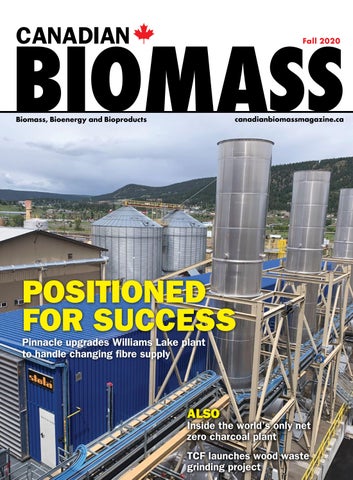
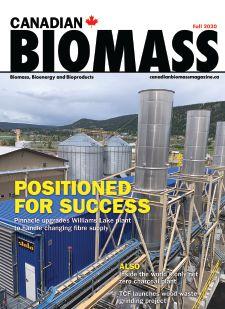
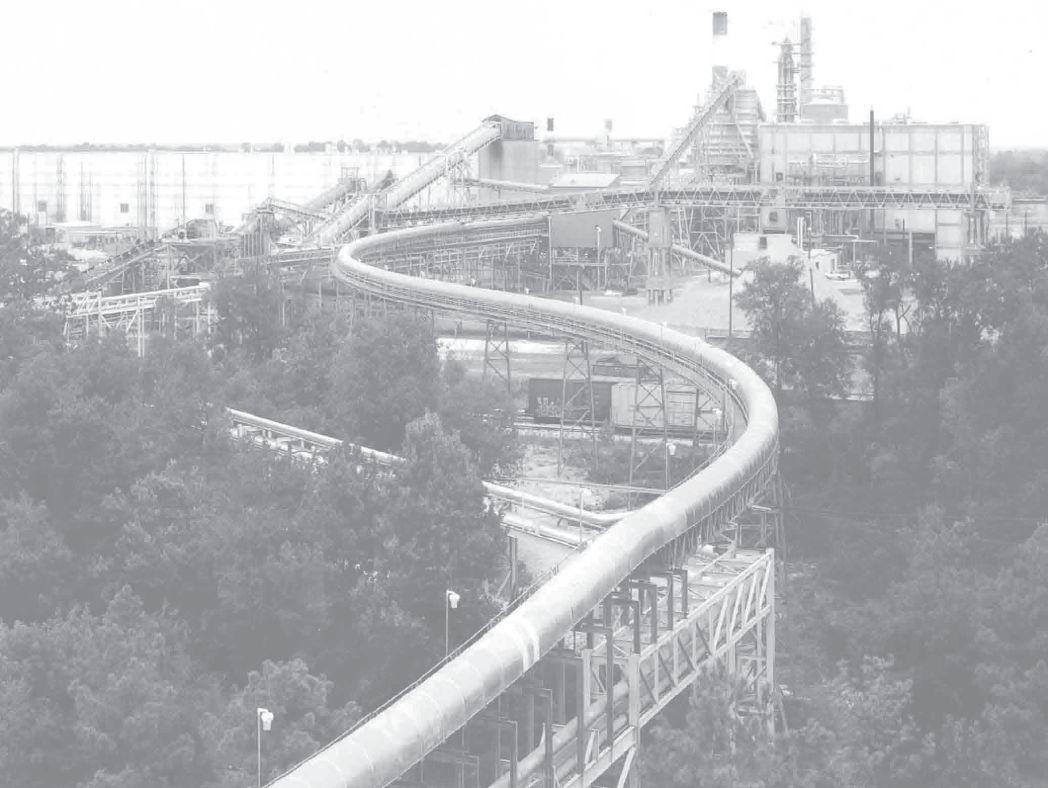
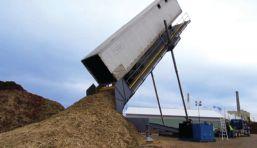
Pinnacle Renewable Energy has completed upgrades at its Williams Lake, B.C., plant, including the installation of a new bed dryer, to overcome the challenges of a changing fibre supply.
14
Masks made in Canada
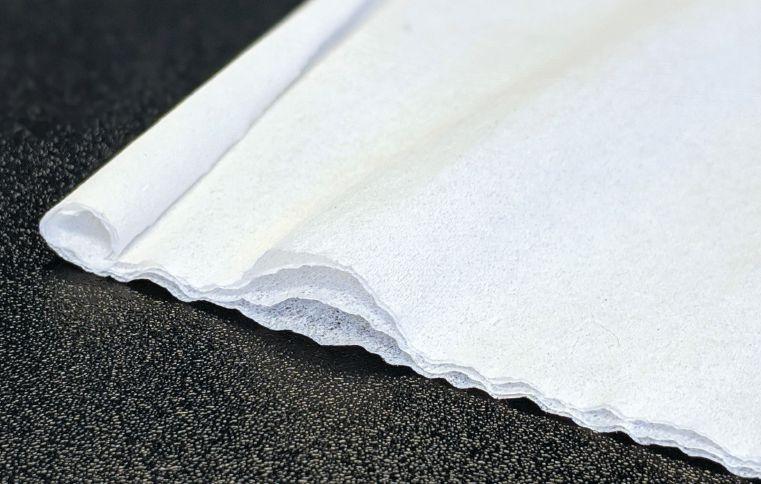
FPInnovations recently received a $1.3 million grant to develop biodegradable, sustainable face masks from wood fibre to help protect against COVID-19. The project shows how the Canadian forest industry can help respond to a national need.
16
Budding bioplastics
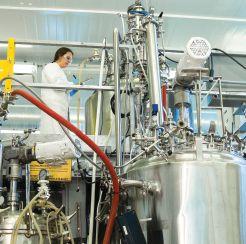
When TerraVerdae Bioworks began in 2009, the idea of producing natural biodegradable bioplastics seemed like a dream. But the company now has a pilot facility and is scaling up production in response to demand from multiple markets.
18
Creating value
Entrepreneurs Antoine and Simon Langlois are betting big on biochar. In 2018, they established Xylo-Carbone, and began selling high-energy biochar products, while using other byproducts to power the facility, making it the only net-zero charcoal facility in the world.
20 Grinding grants opportunities
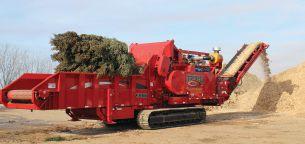
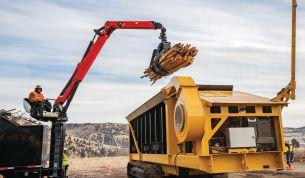
Terrace Community Forest has launched a wood waste grinding project, with help from the Forest Enhancement Society of BC, to fully utilize the available fibre supply and create new jobs.
TTurning waste into a solution
Investors are recognizing the potential of the bioeconomy
his year’s Wood Pellet Association of Canada (WPAC) Conference and AGM was unlike any other, taking place online from Sept. 22 to Sept. 24. Thanks to COVID-19, Canadian Biomass and WPAC had to pivot to bring the annual conference to life in a way that would be safe for everyone: virtually. Like many other organizations now know, putting on a virtual event is quite different from a live event. While networking opportunities are limited on a virtual platform, the upside is that the conference can reach a wider audience.
In fact, nearly 500 people from around the world attended this year’s conference to learn more about wood pellets as a source of “Responsible, Renewable Clean Energy” – WPAC’s new tagline. The event was a huge success, with many attendees providing positive feedback and asking for copies of the speakers’ presentations to share with their colleagues.
ognizing the potential of the bioeconomy in the past year or two. William Bardosh, CEO of TerraVerdae Bioworks, remembers when this wasn’t the case. When the company started in 2009, the idea of producing natural biodegradable bioplastics was “quaint” to many people, and there was little investment or capital, he says. But, the company recently received $4.5 million in grants from several groups, including Natural Resources Canada, to expand its ability to develop natural, biodegradable bioplastics. “I’m really amazed at the shift that’s gone on over the last 18-24 months,” he says on page 16.
CANADIAN
Volume 20 No. 4
Editor - Ellen Cools (416) 510-6766 ecools@annexbusinessmedia.com
Contributors - Gordon Murray, Guillaume Roy, Peter Diekmeyer, Rob van Adrichem, PJ Boyd
Group Publisher - Todd Humber 416-510-5248 thumber@annexbusinessmedia.com
COO Scott Jamieson sjamieson@annexbusinessmedia.com
Canadian Biomass is published four times a year: Winter, Spring, Summer and Fall. Published and printed by Annex Business Media.
Publication Mail Agreement # 40065710
Printed in Canada ISSN 2290-3097
The main takeaway for me was just how much potential there is for turning waste into a solution, to borrow the phrase from Jason Fisher, vice-president of strategic partnerships and corporate responsibility at Pinnacle Renewable Energy and one of the presenters at this year’s event. As the effects of climate change become more obvious and negatively impact society, investors and government will have to recognize and confront the uncertainty it brings. This means they will be looking for stable, sustainable sources of energy, such as wood pellets, William Strauss, president and founder of FutureMetrics, said in his presentation (read more about the conference on page 5).
It’s evident that more and more investors, particularly government, have started rec-
More recently, in August, the federal government announced $1.3 million in funding for FPInnovations to develop disposable, biodegradable face masks to protect against COVID-19. On page 14, Doug Singbeil, FPInnovation’s industrial sector leader for bioproducts, says this project proves the forest industry and bioeconomy can help Canada through the pandemic, and helps the industry continue to find ways to make sustainable, biosourced products.
Moving forward, it’s critical that government continue to support the bioeconomy and make it a key part of Canada’s low-carbon future. With associations like WPAC advocating for our industry and raising awareness about wood pellets’ role in fighting climate change, I feel confident we will continue to see growing support and investment from decision-makers. •
Subscription Rates: Canada - 1 Yr $57.00; 2 Yr $102.00 Single Copy - $9.00 (Canadian prices do not include applicable taxes) USA – 1 Yr $121.50 CDN; Foreign – 1 Yr $138.00 CDN
CIRCULATION jdoshi@annexbusinessmedia.com Tel: (416) 510-5124 Fax: (416) 510-6875 or (416) 442-2191 111 Gordon Baker Rd., Suite 400, Toronto, ON M2H 3R1
All advertising is subject to the publisher’s approval. Such approval does not imply any endorsement of the products or services advertised. Publisher reserves the right to refuse advertising that does not meet the standards of the publication.
www.canadianbiomassmagazine.ca
Spotlight on sustainability
2020 WPAC Conference and AGM highlights wood pellets as a solution to climate change
By Todd Humber
Vaughan Bassett opened this year’s Wood Pellet Association of Canada (WAPC) Conference and AGM with a reminder of how extraordinary and challenging 2020 has been.
“We had to really lift our game this year to deal with COVID-19 restrictions and practices, rail disruptions, fires blazing out of control to our south, more hurricanes than we actually had alphabet to name, export terminal challenges – and it’s only September,” said Bassett, president of WPAC and a senior vice-president at Pinnacle Renewable Energy.
The virtual conference ran from Sept. 22 to Sept. 24, attracting nearly 500 professionals from around the world.
“But if I know anything, it’s that we are a resilient bunch,” Bassett said. “We have weathered significant challenges in the past and have done so successfully.”
THE EXPENSE OF CLIMATE CHANGE
Climate change was a major focus of this year’s event, with WPAC embracing its new tagline of “Responsible, Renewable Clean Energy.”
William Strauss, president and founder of FutureMetrics, said the problem of carbon dioxide emissions is simply too expensive to ignore.
“We’re having increasing variability and severity in weather-related disasters,” he said. “Unpredictability with increasing costs is anathema to capitalism. Investors want to have certainty and predictability and not increasing costs. This is going to motivate change even amongst those that may not think it’s necessary right now.”
Strauss cast a spotlight on coal-fired power plants, pointing out there are still 5,026 plants operating globally with capacities of 100 megawatts (MW) or more.
He expects to see increased demand for co-firing, using wood pellets to replace some coal, or perhaps even full conver-
sions away from coal to pellets. Wood pellets have 85 per cent less carbon footprint than coal when creating energy, taking into account the supply chain, he said.
TURNING WASTE INTO A SOLUTION
Jason Fisher, vice-president of strategic partnerships and corporate responsibility at Pinnacle Renewable Energy, continued the green message in his presentation. For him, it’s a simple fact of the industry: “We turn local waste into a global solution,” he said.
Before the wood pellet industry took off, piles of sawdust and shavings accumulated at sawmills were often burned in beehive burners or in piles.
“In 2003, a serious effort was made to get rid of those burners in British Columbia,” he said, adding that it wasn’t just about getting rid of waste on the ground but also getting the waste out of the air.
But it’s important to recognize that wood pellets alone are not the solution, he said. Instead, they will work hand-in-hand in allowing the adoption of more solar and wind energy by providing a responsive and firm renewable energy source, he said.
Climate change is “already here and it’s not something we can put off addressing to a later date,” said Fisher.
NEGATIVE EMISSIONS POSSIBLE?
Jamie Stephen, founder and managing director of Torchlight Bioresources, pointed out that Canada has a long way to go to hit its 2030 Paris Agreement commitments. About 230 million tons, to be specific.
“We’re not going to eliminate all greenhouse gas emissions – so that means we do need negative emissions,” he said. “This means we’re actually removing carbon dioxide from the atmosphere in order to offset the places that we still have emissions.”
Stephen talked about bioenergy carbon capture and storage (BECCS) technology –which allows carbon dioxide to be stored underground – as a key way to achieve negative emissions.
Bassett concluded the conference by expressing optimism about the industry. There is a growing movement in some nations around ensuring pellets are produced sustainability, and Canada is well positioned to prove its forests and pellets are properly managed and harvested. This will level the playing field for Canadian producers, he said. •
All of the sessions from the conference are available to watch on-demand for free at canadianbiomassmagazine.ca/virtual-events.
BIOMASS update
FEDERAL GOVERNMENT INVESTS $13M IN SIX INDIGENOUS BIOMASS PROJECTS
The government of Canada has announced nearly $13 million in funding for six biomass projects in Northern Ontario.
Here is a breakdown of the funding:
Askii Environmental Inc. will receive $1.67 million to install biomass heating systems in Kitchenuhmaykoosib Inninuwug First Nation and Pikangikum First Nation to offset fossil fuel used to heat schools in the communities.
The government is investing $2,452,750 in Wikwemikong Development Commission to demonstrate the effectiveness of forest-based biomass and efficient residential heating sources in Wikwemikong Unceded Territory by installing pellet stoves, biomass boilers, wood pellet furnaces and wood pellet storage silos.
Meanwhile, $2,532,000 is going to the
Nishnawbe Aski Nation to replace wood stove heating appliances in six of the nation’s communities with upgraded high-efficiency wood stoves. According to a government press release, this will reduce the amount of fossil fuels used for heating by lowering demand on the community’s diesel-generated electricity supply.
The Bingwi Neyaashi Anishinaabek will receive $1,051,000 to replace their sawmill diesel heat source with a biomass system and install biomass-compatible heating systems in three new housing units. This will help the community prepare for future biomass heating expansion and demonstrate the economic benefits of biomass heating.
The biggest investment – $4,168,000 – goes to Sagatay Cogeneration Limited Partnership to help them develop engineering plans for a biomass cogeneration system
Pinnacle breaks wood pellet shipping record
The world record for the quantity of wood pellets carried in a single vessel has been broken. Pinnacle Renewable Energy Inc. loaded 64,527 tonnes on board the MG Kronos, destined for the UK. The panamax vessel, chartered by Cargill and planned with assistance from Thor E. Brandrud of Simpson Spence Young, was loaded at Fibreco Export Inc. on July 18, 2020. The previous record of 63,907 tonnes was held by Drax Biomass on the Zheng Zhi, loaded in Baton Rouge in March this year.
“We are really happy to get that record back!” said Vaughan Bassett, senior vice-president of Pinnacle. “It took a combination of various factors lining up to make this a reality. We needed all the product available in the terminal, a high capacity vessel, competent stevedoring and the correct draft conditions in the Panama Canal.”
This continuing trend towards larger cargo sizes helps lower the GHG footprint per tonne of product transported
off the west coast.
The receiver, Drax PLC, will consume these wood pellets at their power station in Yorkshire in the UK.
Gordon Murray, executive director of the Wood Pellet Association of Canada, said, “Pinnacle’s accomplishment is especially gratifying given that these Canadian wood pellets will be used to generate sustainable, renewable, low-carbon electricity in the United Kingdom, helping that country with its climate mitigation efforts and keeping their electrical grid operating safely and securely.”
Pinnacle’s CEO, Rob McCurdy, remarked that he was proud of Pinnacle’s commitment to reducing the GHG footprint of their wood pellets. “Every part of every initiative helps,” he said, “especially when the incremental improvement is exponentially more difficult to achieve. That’s when we know we are doing everything we can and it makes me proud.”
that will reduce the community’s dependence on diesel fuel for heat and electricity.
Finally, $983,000 will go to Wahgoshig First Nation to install a forest biomass heating system for four community buildings.
The funds for these projects come from the Clean Energy for Rural and Remote Communities Program: BioHeat Stream.
CRB INNOVATIONS RECEIVES $8.575M TO CONVERT WOOD WASTE INTO BIOFUELS
The federal government is investing $4.5 million in Sherbrooke, Que.-based CRB Innovations, which is developing a commercial pilot project to convert forestry residuals and other biomass sources into products that will be converted into biofuels and co-bioproducts.
The funding comes from Natural Resources Canada’s Clean Growth Program. This project is the first of its kind for a Canadian biorefinery.
The Quebec government is investing $2.5 million in the project from the Wood Innovation Program. The project will result in the development of new products in the bioenergy sector and bioproducts with a reduced carbon footprint. As a result, the Quebec government is also granting $1.575 million from the Technoclimat Program.
ELKEM TO BUILD
BIOCARBON
PLANT IN QUEBEC
Elkem has decided to invest in a new biocarbon pilot plant in Canada. The project aims to secure industrial verification of Elkem’s technology for renewable biocarbon, with a long-term goal of contributing to climate-neutral metal production. The technology also has potential for application in other industry sectors, contributing to reduced CO2 emissions.
The total investment for the pilot plant amounts to 180 million Norwegian Krone (NOK). The project has received financial support from the Canadian government, the Québec government and the city of Saguenay, reducing Elkem’s net investment to 60 million NOK. The plant will be constructed near Elkem’s production site in Chicoutimi, Que., with the start of construction planned for the second half of 2020. Based on conclusions from the pilot, Elkem will evaluate the basis for a full-scale plant.
“With this new biocarbon pilot plant in Canada, we aim to secure long-term access to low-cost, high-quality renewable biocarbon to replace fossil coal, and further improve our competitive position for a sustainable future. In addition, we see a potential for scaling up this technology to other industries – helping reduce emissions,” said Michael Koenig, CEO of Elkem.
With the new plant, Elkem will pilot an industrial biocarbon process tailor-made for silicon and ferrosilicon production. Using climate-neutral renewable biocarbon instead of fossil coal as a reduction agent is a key part of Elkem’s sustainable production strategy. Elkem already uses close to 20 per cent biocarbon in its production in Norway and the company is working towards increasing this to 40 per cent by 2030.
The pilot plant will source raw materials from local sawmills in Canada, including recycled bark, wood chips, sawdust and wood shaves. This will create new business opportunities within the circular economy and create new green jobs. More than two million Green tons (Gt) of potential raw material is already produced within 100 kilometres of the Chicoutimi area in Quebec.
NOVA SCOTIA GOVERNMENT AWARDS CONTRACTS TO BUILD WOOD CHIP HEATING SYSTEMS
The province of Nova Scotia has selected four companies to convert fossil fuel heating systems at six sites to wood chip heating systems.
According to a government press release, the companies will design, build and operate new boilers. The contracts include long-term agreements to source wood chips from private woodlots and sawmills.
The contracts have been awarded as follows:
• Mira Forestry Development Ltd., based in Albert Bridge, N.S., will convert the fossil fuel heating systems at Memorial High School in Sydney Mines, N.S., and Riverview High School in Sydney, N.S.
• Wood4heating Canada Inc. in Charlottetown, N.S., will convert the systems at Perennia Park Atlantic Centre for Agri-Innovation in Bible Hill, N.S., and Hants East Rural High School in Milford, N.S.
• Spec Resources Inc. in Church Point, N.S., will convert the system at Nova Scotia Community College Centre of Geographic Sciences in Lawrencetown, N.S.
• Finally, ACFOR Energy Inc., based in Cocagne, N.B., will convert the fossil fuel system at the Bridgewater Provincial Court.
The province has also announced a district heating network will be created at Perennia Park and three buildings will be heated by the new boiler. Bridgewater Provincial Court and Nova Scotia Community College’s Lunenberg campus will form a two-building district heating network.
“These projects help us progress towards a greener economy and reduce the carbon footprint of government buildings by replacing fossil fuels with a renewable resource,” said Nova Scotia lands and forestry minister Iain Rankin in a statement. “Using lower grade wood for heat will create new and stable markets for Nova Scotia’s wood chips and opportunities for private woodlot owners and sawmills to sell lower grade wood locally.”
LETHBRIDGE BIOGAS UNDERGOING $7M EXPANSION
Lethbridge Biogas has announced a $7 million expansion of the company’s existing site that will provide new opportunities for the region.
The company, based in Lethbridge, Alta., has been operating since 2013. The plant produces renewable electricity through the use of organic resources such as agricultural manures and food processing by-products.
The expansion will introduce Lethbridge Biogas into the natural gas market by allowing for the plant’s biogas to be purified into pipeline-grade
biomethane (renewable natural gas (RNG)), which will be injected into ATCO’s natural gas grid. The RNG will also be supplied to FortisBC under a long-term supply agreement by mid2021. Once the expansion is complete, Lethbridge Biogas will have the first full-scale, commercial renewable natural gas application in Alberta.
“This expansion at our Lethbridge Biogas facility is another significant milestone in the history of our project,” said Lethbridge Biogas director of operations Stefan Michalski, who also works
on the national level as co-chair of the Canadian Biogas Association. “It is the result of dedication and very hard work from our team over many, many years to get our business established, not only in the Lethbridge area but beyond in the Canadian and North American context.
A lot of players in the RNG market were interested to become part of this expansion, as RNG has become a highly sought-after commodity to reduce the carbon footprint in the natural gas supply chain.”
A natural win
FThe role of wood pellets in meeting climate change goals
By Gordon Murray
or decades, wood waste from manufacturing was burned in beehive burners and unwanted logs, branches and tops from harvesting were left on site, creating a fire and insect risk. Today, an increasing amount of that waste is being turned into wood pellets in Canada. Those pellets are used around the world to produce clean energy and to displace fossil fuels – supporting efforts to meet important global climate change targets.
Biomass, particularly wood pellets, is part of the climate change solution as we transition away from fossil fuels. The energy industry is increasingly using wood pellets to replace fossil fuels to substantially lower greenhouse gas (GHG) emissions. For example, at Drax Power Station in the UK, even after accounting for fossil fuel emissions along the supply chain during harvesting, manufacturing and transportation, wood pellets lower GHG emissions by more than 80 per cent compared to coal.
Power producers are not the only ones supporting energy from biomass. The United Nations Intergovernmental Panel on Climate Change (IPCC), the world’s leading authority on climate change, has recognized the significant GHG mitigation potential of biomass – as much as 80 to 90 per cent – provided that it is developed sustainably and used efficiently.
The need for sustainability is a strong argument for Canadian wood pellets. Canadian wood pellets are produced entirely from the residuals of sustainably managed forests. Those forests are highly regulated to ensure that Canada’s forests will not be depleted over time and the regulations are enforced by governments and backed by independent certification.
CO2: FOSSIL FUELS VERSUS BIOMASS
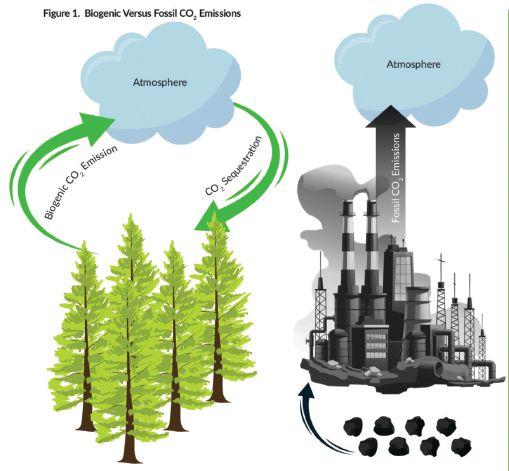
While both fossil fuels such as coal and biological materials like wood pellets emit carbon dioxide (CO2), it’s ultimately the source of that CO2 which determines the impact it will have on the atmosphere. Coal is a very efficient fuel, in that it provides more energy per kilogram than biomass, but it is not a renewable one. Coal is mined from carbon sinks that took millions of years to form, so when it is burned to produce energy it increases the total amount of CO2 and other potent GHGs in the atmosphere. Energy made from woody biomass comes from burning carbon drawn out of the atmosphere by trees within the last 150 years; most of the carbon from those trees is being held in long-lived forest products and in most jurisdictions in Canada, harvested areas are reforested and start drawing in CO2 from the atmosphere within a year of harvesting. Those factors make woody biomass a renewable energy source and an important alternative in the transition away from fossil fuels.
MORE TO CO2 AND PELLETS:
Carbon dioxide is not the only GHG, nor the most potent one. The chart below, based on IPCC data, shows some naturally occurring gases, such as methane, have a much higher global warming potential than carbon dioxide. As an example, the methane produced from decomposing wood is a more potent greenhouse gas than the carbon dioxide produced from combustion.
GAS
Carbon dioxide (CO2) 1
GREENHOUSE WARMING POTENTIAL OVER 100-YEAR TIME HORIZON
Methane (CH4) 28
Nitrous oxide (N2O) 265
“Ash content” – the material left behind after combustion – is another important consideration. Ash content is carefully monitored in the wood pellet sector and must meet strict customer requirements. The ash content of coal can be as high as 30 per cent, whereas industrial wood pellets have an ash content of less than three per cent, meaning wood pellets leave behind less waste after combustion.
GREENHOUSE
Figure 1. Biogenic versus fossil C02 emissions.
SUSTAINABLE FOREST MANAGEMENT AND CARBON STORAGE
Like wood pellet customers, other consumers of forest products want to ensure those products come from sustainable sources. Canada’s forest sector depends on sustainably managed forests to make lumber, panel products like plywood and oriented strand board (OSB), and pulp and paper products like tissue, cardboard and printing paper. Only 0.3 per cent of Canada’s forests are harvested annually and overall Canada’s forests are growing faster than they are being harvested.
It is a fundamental requirement of sustainable forestry that the carbon stock in forests remains stable or increases over time. Forest professionals manage whole forests by dividing them into hundreds of individual forest stands or sections. As one plot is being harvested, another is being planted, another is being thinned, while in yet another, crews are removing competing brush by hand to allow the trees to grow faster. While this is happening, the stands are being managed for other important values such as biodiversity, recreation and cultural heritage.
Since only a few forest stands are harvested each year, growth in the hundreds of adjacent stands adds up to at least the same, but most often more than the amount harvested. Newly planted stands sequester only small amounts of carbon, but as they increase in age, will store more and more carbon over time until they reach maturity. At maturity, both growth and carbon sequestration slow, until finally the trees are harvested, and the cycle begins again. This concept is important in understanding forest carbon accounting.
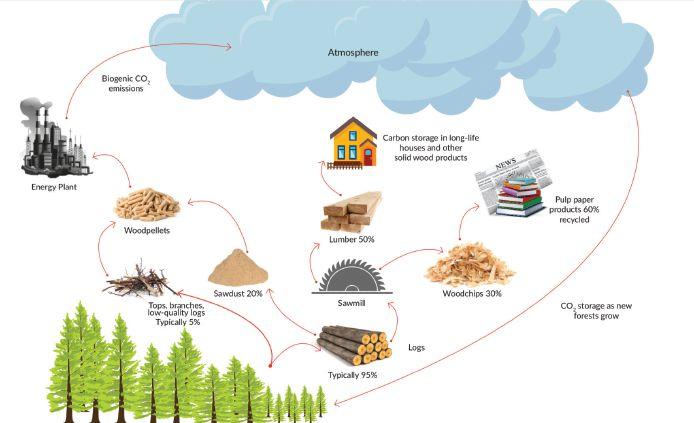
When a single forest stand is harvested, about half of the carbon ends up being stored in long-lived forest products. In North America, 2x4 lumber is used to build 90 per cent of North American houses, which last for many decades. Paper products, which are recycled up to seven times, also store carbon. Canada’s approach to sustainable forestry ensures its forests as a whole act as a carbon sink. New engineered wood products are allowing wood to store carbon in even longer-lived structures.
Despite the growing demand for clean energy, only a small amount of biomass makes its way into wood pellets. Canadian wood pellets are produced entirely from the residuals of sustainably man-
aged forests. Taken as a whole, these residuals account for about four per cent of the annual harvest in Canada.
Natural Resources Canada, in its 2019 annual report on the State of Canada’s Forests, confirmed that Canada’s managed forests are consistently a net carbon sink. Unfortunately, in recent years, global warming has accelerated the number of natural forest fires. The annual forest area burned is 15 times larger than annual harvesting and has caused excessive CO2 emissions. The wood pellet sector has an important role to play in reducing wildfire risk by salvaging a portion of the burnt timber as raw material and replanting some of the more accessible burnt areas, turning them back into carbon sinks.
While wood pellets are already part of the climate solution, the future holds even more promise. Emerging technology such as carbon capture and storage (CCS) promises to use wood pellets to achieve negative GHG emissions which are mixed with a solvent and then, instead of being released to the atmosphere, are sent through a pipeline to deep underground air pockets where they are permanently stored.
Large-scale CCS technology is just starting to be commercialized. There are currently two commercial scale coal power stations using CCS: SaskPower’s Boundary Dam project and Petra Nova’s project in Texas. Drax Power is working on CCS technology for biomass, and, when ready, it will actually enable negative emissions from wood pellets; that is to say, it will essentially suck GHGs out of the atmosphere.
The increasing demand for sustainable wood pellets generates two wins: reducing GHG emissions abroad and reducing forest waste domestically. Sustainable Canadian biomass, and the wood pellets made from it, are an excellent option for energy producers looking to lower their GHG emissions. Canadian wood pellet producers understand the needs of their customers and demand sustainable biomass from their suppliers even as they help their suppliers reduce waste. Both objectives support the goals of governments seeking better utilization of natural resources and more jobs from the natural resource sector. It’s a natural win for everyone. •
NOTES
1. Drax. Forest Scope. https://forestscope.info
2. Chum, H., A. Faaij, J. Moreira, G. Berndes, P. Dhamija, H. Dong, B. Gabrielle, A. Goss Eng, W. Lucht, M. Mapako, O. Masera Cerutti, T. McIntyre, T. Minowa, K. Pingoud. (2011). Bioenergy. In IPCC Special Report on Renewable Energy Sources and Climate Change Mitigation [O. Edenhofer, R. Pichs-Madruga, Y. Sokona, K. Seyboth, P. Matschoss, S. Kadner, T. Zwickel, P. Eickemeier, G. Hansen, S. Schlömer, C. von Stechow (eds)], Cambridge University Press, Cambridge, United Kingdom and New York, NY, USA.
3. Based on analysis of: Natural Resources Canada, Canadian Forest Service. (2020). State of Canadas Forests 2019 Annual Report. https://cfs.nrcan.gc.ca/pubwarehouse/ pdfs/40084.pdf
Figure 2. The carbon cycle in a sustainably managed Canadian forest.
Positioned for success
Pinnacle upgrades its Williams Lake plant to overcome the challenge of a changing fibre supply
By Ellen Cools
In the past year-and-a-half, the available fibre supply for pellet plants in B.C., has changed significantly. In 2019, multiple sawmills in the province took downtime or shut down completely due to weak lumber prices and dwindling fibre supply caused by pests and wildfire. Then, when COVID-19 hit in the spring this year, more sawmills took downtime or shut down thanks to weak lumber demand.
These difficulties for B.C. sawmills created a ripple effect for wood pellet producers. Pellet plants that have long-relied on sawmill residuals found their supply dwindling, even as demand for wood pellets remained steady or even increased.
As a result, many pellet producers had to turn to alternative sources of fibre, such as bush residuals and hog fuel. However, some pellet plants are not built to handle a diverse fibre diet. This was the case with Pinnacle Renewable Energy’s Williams Lake, B.C., pellet plant.
To combat this issue, in Q1 2019, the company decided to move forward with plans to upgrade the dryer at the Williams Lake facility, transitioning from a rotary dryer to a Stela bed dryer. Work on the project began in in Q4 2019. Despite some delays caused by COVID-19, the upgrade was completed late this summer.
GREATER FLEXIBILITY
Originally, the plant, which was built in 2006, was designed to run purely on sawmill residuals from neighbouring sawmills, including West Fraser and Tolko, Jason Fisher, Pinnacle’s vice-president of strategic partnerships and corporate responsibility, explains.
But with the new Stela bed dryer, the plant can now run a wider array of fibre types because it increases the amount of water that can be evaporated from the available fibre, Fisher says. This allows the facility to consume more sawdust, hog and
bush grind.
Consuming a wider variety of fibre, improving the plant’s environmental footprint and upgrading the safety systems were the main motivations for installing the new dryer, he adds.
“We wanted to make sure that, as we see the continued consolidation in the forest sector, we’re able to adapt and move away from a diet that was primarily saw-
mill residuals and be able to use harvest residuals as well,” he says.
The company chose to install a Stela bed dryer because of their experience working with the company, Scott Bax, COO of Pinnacle Renewable Energy, explains.
“This is our third installation and fourth dryer that we have with Stela,” he says. “We installed the first-ever biomass bed dryer in North America with Stela.
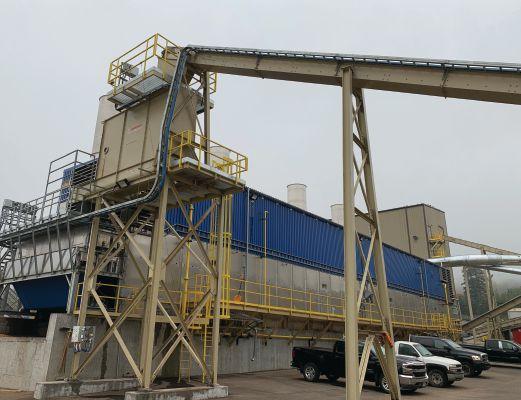
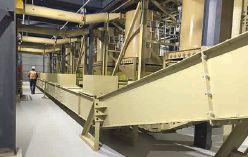
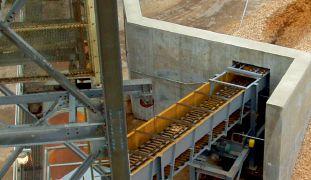
A view of the bed dryer infeed showing the infeed conveyor and metering bin supplied by Continental Conveyors. Photos courtesy Pinnacle Renewable Energy.
We’ve been with them since 2015 when we built our Lavington facility. We put two bed dryers in there, and one in our Smithers facility.”
Stela, based in Germany, is “a really reliable company to work with,” Bax adds. “They’re able to deliver a really solid product.”
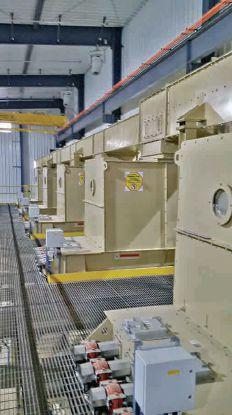
Along with the new bed dryer, Pinnacle added two new CSE Bliss hammer mills at the facility to handle a wider range of fibre types.
The project was part of Pinnacle’s $30 million Cariboo Upgrade Project, which consisted of two projects: the dryer and fibre breakdown upgrades at the Williams Lake plant, and a new emissions control device at the company’s Meadowbank facility, Bax shares. Of the $30 million, more than $20 million was allocated to the Williams Lake project.
As a result of these upgrades, the Williams Lake plant can now process 50,000 more metric tonnes per year, for a total production capacity of 230,000 tonnes per year. This is close to the plant’s original production capacity.
“As we saw our fibre supply change over time, production definitely dipped as a result of that,” Fisher explains. “So, this is Pinnacle getting back to where the plant was designed to be and making us more efficient and flexible from a production standpoint.”
INSIDE THE PLANT
The plant itself consists of a mix of older and newer technology. Fibre first goes through one of two infeeds – one for green, wet material and one for shavings.
“The point of having a shavings-only infeed is that material doesn’t need to go through the dryer; it’s dry enough, and we’ll mix it with what comes out of the dryer,” Bax explains.
From the green infeed, the biomass goes through a primary fibre breakdown unit. This unit is old custom technology, similar to a large hammermill, Bax says.
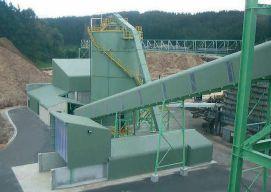
The fibre then goes to the Stela bed dryer through conveyors from Quebec-based Continental Conveyors.
When the product comes out of the dryer, it is mixed with the shavings, and then
goes to two CSE Bliss 4460 hammer mills.
From there, the material is conveyed again through Continental Conveyors to five Andritz 26LM pellet mills. The pellets then go into CSE Bliss coolers, and then across vibratory screens from Edem, an Optimil company, to screen out the fines. Finally, the pellets are conveyed to Pinnacle’s rail load-out system, ready to be shipped either to Pinnacle’s Westview Terminal in Prince Rupert, B.C. or FibreCo in Vancouver.
The pellets from the Williams Lake facility are bound either for Japan and South Korea or Europe (most often to Drax Group in the UK), Bax says.
CV Technology safety equipment is installed throughout the entire facility, along with GreCon spark detection equipment. An Allied Blower air system also pulls air off the hammermills and the CSE Bliss pellet coolers.
Pinnacle has a long history with all of these suppliers, Bax says.
“All of them were involved in other projects that Pinnacle has done,” he explains. “For example, Pinnacle is the
world’s largest owner of Andritz wood biomass pelleters. Today, we have around 55 of them in service, with 10 more coming in the Demopolis, Ala., plant that we’re building right now.”
CSE Bliss equipment is also used at almost all of Pinnacle’s pellet plants, along with Andritz, Continental Conveyors, GreCon, CV Technology and Allied Blower.
“They are all just really proven, great companies,” Bax says.
COMMUNITY IMPACT
These upgrades have been well-received by the community, local First Nations and forestry companies in the area, Bax adds.
The plant is located in the heart of Williams Lake. As the commercial district has built up around the facility, the company has worked to beautify the site and make it look less industrial. Pinnacle has also done paving work to control fugitive dust in response to concerns from the community, Fisher says.
“We’ve got wonderful support from the city; there’s a lot of local contractors that we use and we’re working extensively with local First Nations as suppliers and responding to their concerns,” he says.
Of course, the facility is also a big economic driver in the community, employing 30 people full-time and providing a home for wood fibre in the area. It also reduces the distance trucks need to travel transporting mill and bush residuals, Bax says.
The Williams Lake plant gets its fibre from harvesters in the region, mainly from Tsi Del Del Enterprises Ltd., a joint venture between Tsideldel First Nation and Tolko Industries (read more about their operations in Canadian Biomass’ Winer 2020 issue). Alkali Resource Management, owned by the Esk’etemc First Nation, also works with Tsi Del Del to supply fibre to the plant.
“It really provides the right balance to the milling capacities that exist in the larger Williams Lake area,” Bax says about the facility. “Now, there’s a natural home for a larger percentage of the residuals that are produced through the harvesting to the milling process, whether that be sawmilling or producing a particle board or something like that. We’re able to take what’s left over from them and utilize a larger part of that fibre supply chain.
“We’ve significantly upgraded the facility and really set it on the path where it’s well-suited for the available fibre supply
in the area, and we have more flexibility there than we’ve ever had,” he adds.
GROWTH POTENTIAL
This flexibility will be key for Pinnacle Renewable Energy’s operations moving forward as the wood pellet industry and market continues to grow, Bax says.
“The biggest challenge that we see for the industry as a whole and in British Columbia especially is the changing fibre supply and the need to have solutions that encompass the entire fibre supply chain. But, that’s really where our opportunities are going to exist,” he says. “We really are in lock-step with the mills in the region, so we’re going to continue to need to innovate and partner with First
Nations and others to perform strong well into the future.”
Looking ahead to the next five to 10 years, Bax believes Pinnacle is well-positioned for future opportunities to meet demand from Asia and Europe.
The company is in the process of building a new facility in High Level, Alta., in partnership with Tolko, that is scheduled to start up in Q4 2020. Meanwhile, they are also building a pellet plant in Demopolis, Ala., that will start up in Q2 2021.
“We see the wood pellet market continuing to grow and having great growth potential as a market and as an industry,” Bax says. “Our belief is that there are opportunities to continue to grow as the demand is there.” •
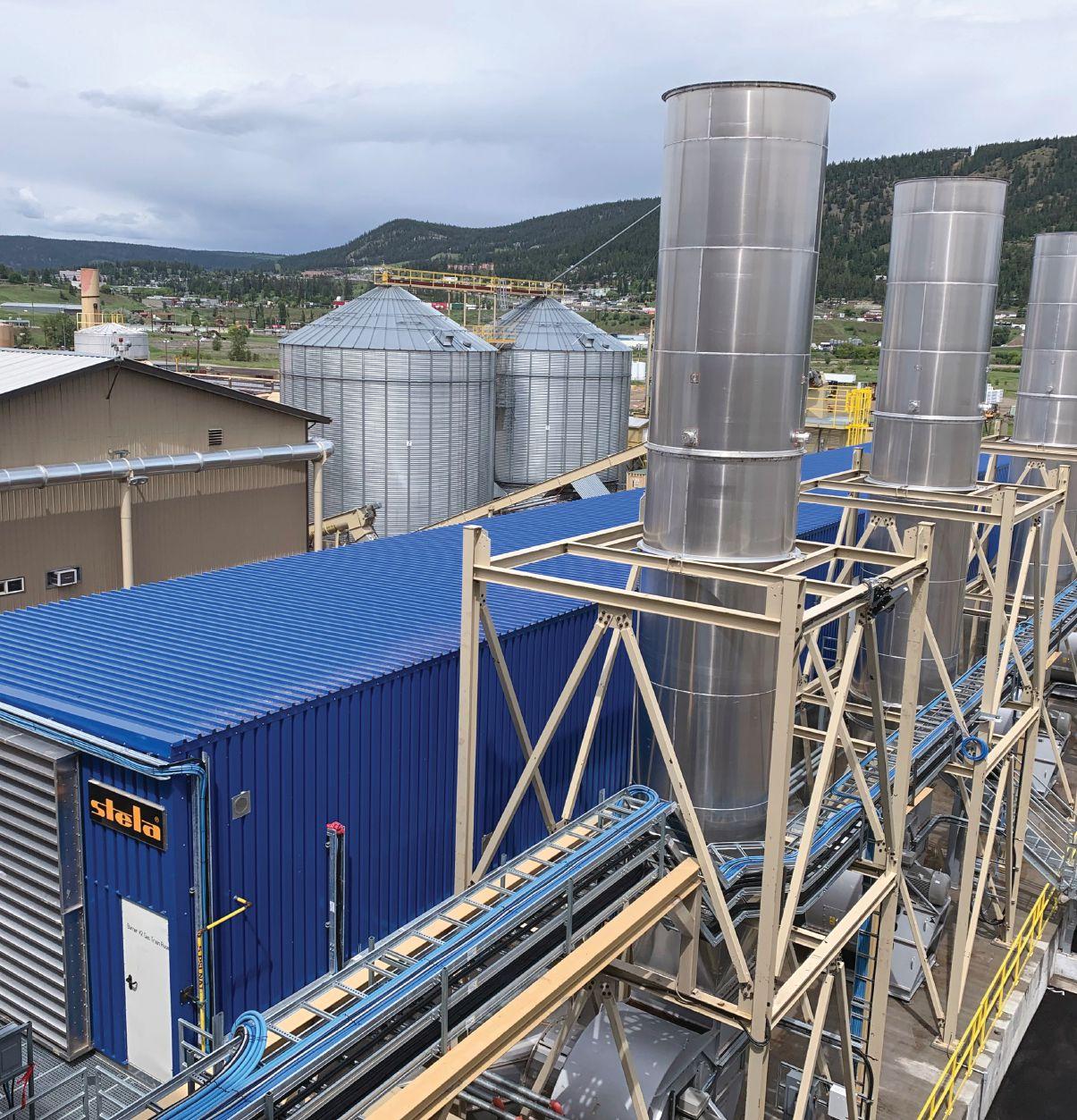
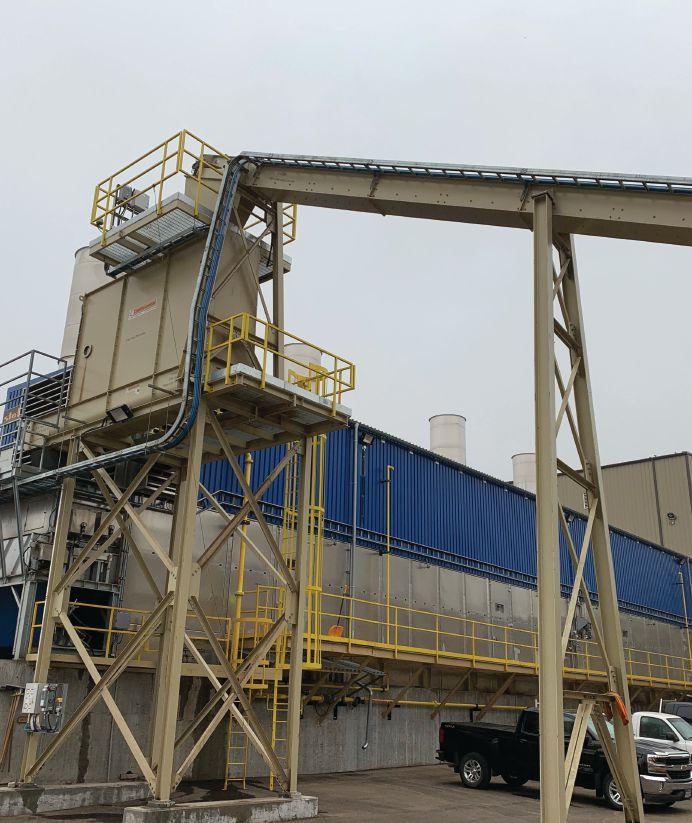
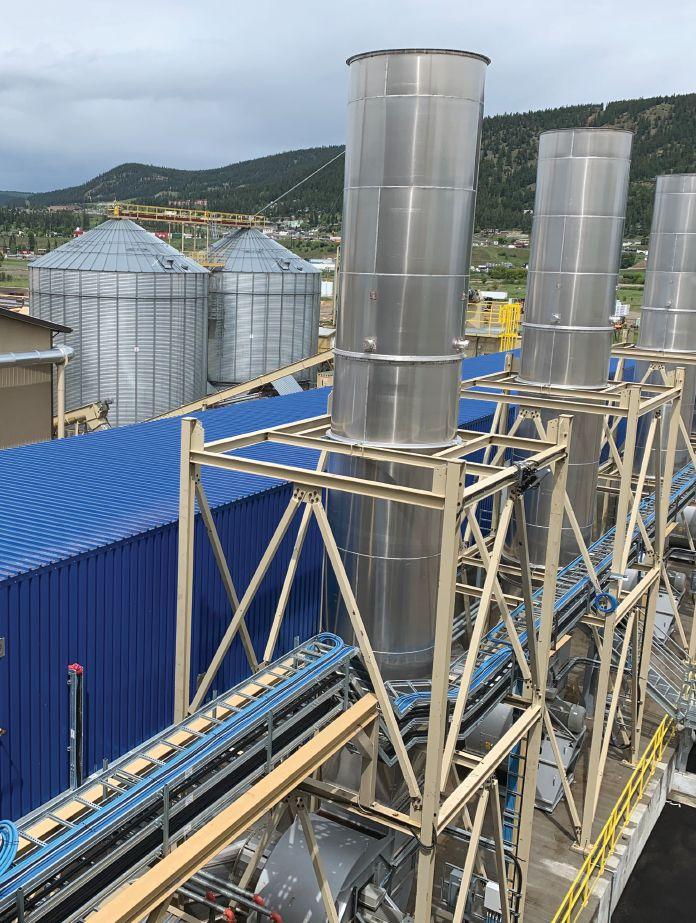
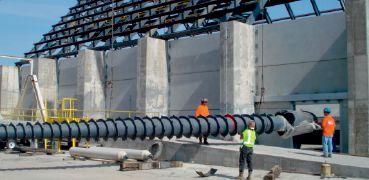
A view of the new Stela bed dryer installed at Pinnacle’s Williams Lake plant with the pelleter building and finished pellet storage silos shown in the background.
ROTOCHOPPER UPDATES FP-66 HORIZONTAL GRINDER
Rotochopper has updated its FP-66 horizontal grinder to increase the capacity of materials that can be processed by the mid-sized grinder. The larger 30-inch feed opening and increased powerfeed lift height allow larger materials into the grinding chamber – increasing productivity and efficiency. This heavy-duty grinder is now available with a more aggressive powerfeed and either a 630- or 755-hp diesel engine to grind a variety of raw materials, while still providing Rotochopper’s factory-direct customer support.
www.rotochopper.com
TIGERCAT UNVEILS THE 6050 CARBONATOR AS PART OF MATERIAL PROCESSING LINE
Unique, cost-effective and eco-friendly, the 6050 carbonator reduces wood debris volume onsite through an environmentally friendly carbon sequestration process with no material pre-processing required.
Logs, limbs, brush, stumps, yard waste, pallets, clean lumber and other clean wood-based debris can be reduced by 90-95 per cent. The remaining carbon-based output – often referred to as biochar – sequesters the captured carbon. Because there is no resulting organic decay, along with the associated release of greenhouse gasses, Tigercat believes that this carbonization process represents the lowest carbon footprint of any competing material reduction method.
The 6050 efficiently processes wood debris at high throughput rates. Under air and over-air fans create optimal conditions to maximize carbon content in the output.
The 6050 is equipped with replaceable thermo-ceramic panels rated to 1,650 C. A quenching system cools the end product to near ambient temperatures for handling, while further
improving the quality of the carbon-based output. An optional conveyor system is available for output collection.
The 6050 carbonator is extremely operator friendly with full remote control for all functions including machine travel. A live stream video monitoring system provides full visibility for easy feeding. www.tigercat.com
FINNA SENSORS LAUNCHES NEW OMNIR MOISTURE SENSOR FOR BIOMASS
Finna Sensors introduces a new data-driven, near infrared (NIR) moisture sensor: the all-new OMNIR On-Line Near Infrared Sensor.
All the players in the field measure moisture, and other constituents, are using near infrared (NIR) – a method that uses reflected light to measure the surface of a multitude of applications, including biomass. The NIR technique is an excellent one and has
proven to be one of the best methods for on-line, continuous and non-destructive measurement.
The new OMNIR On-Line Near Infrared Sensor was designed to be regularly improved. No more waiting years for the next innovation – OMNIR software can be upgraded via the cloud, negating the need for an on-site technician or sending in the sensor for the latest updates.
It was built on a Microsoft platform and SQL database, making interfaces and integration more familiar. Finna Sensors kept the technology relatable to make start-up, training and adoption more efficient.
The system also has robust factor floor integration and has built-in Internet of Things (IoT) functionality. OMNIR derived its name from omni, meaning all-sensing – not only does it focus on measuring the product accurately, it also continuously measures itself: 19 points of internal sensor health ensure greater up-time and make maintenance more predictable.
Despite data being the centerpiece, hardware was also kept in mind. OMNIR was built with a modular design, keeping the most sensitive electronics away from the line, and allowing the sensor to perform in the harshest conditions, right out of the box. Additionally, using the patented TrueOptics technique, the OMNIR measures the reflected light after it hits the product sample, decreasing the effect of outside influences such as dust, colour variations, vibration, etc. www.finnasensors.com
Masks made in Canada
FPInnovations works to develop biodegradable, sustainable face masks from wood fibre
By Ellen Cools
As the COVID-19 pandemic continues, news has been spreading about a different type of plague: disposable face masks are creating a new plastic pollution crisis. There are reports of face masks floating in the ocean like jellyfish, clogging up rivers and streams, and littering beaches and roads around the world.
But FPInnovations is working to come up with a ‘Made in Canada’ solution that will help protect the general public while reducing the amount of waste associated with disposable face masks. In September, the research organization announced it had successfully developed a biodegradable, sustainable filtration media made from wood fibre for single-use face masks.
RESPONDING TO A NATIONAL NEED
According to Doug Singbeil, industrial sector leader for bioproducts at FPInnovations, the main motivation behind this project was “to engage the Canadian forest sector in responding to a national need – in this case, materials for making general purpose masks or other types of masks to address the COVID crisis.”
The government of Canada invested $1.3 million in the project as part of Natural Resources Canada’s Technologies Programs’ contribution agreement with FPInnovations through the Forest Innovation Program.
This partnership has been “longstanding,” Singbeil says. “It’s actually a collaboration between the federal government and FPInnovations to help transform the forest sector to be able to make and produce bio-sourced products of all kinds.”
FILTRATION FIBRES
But what was the process for creating this biodegradable, sustainable filtration media?
FPInnovations undertook an eightweek research “sprint” during which time
researchers looked at the science behind filtration and paper-making to understand whether the filtration media would meet the goals of a general-purpose mask for public use, Singbeil says. They also had to make sure that this was something that could be manufactured using equipment that paper manufacturers in Canada already use.
“This way, the forest sector could respond to this emergency or future emergencies by very quickly shifting their manufacturing capacity to make filtration media if desired or needed,” Singbeil explains.
By the beginning of September, the team had successfully developed a recipe of fibres from a mix of hardwood and softwood trees. This blend of fibres works together to meet the requirements of the filtration media, such as filtration efficiency and permeability, Singbeil says. In other words, the material has to allow wearers to breathe while also protecting them and others from the virus.
“The filtration media itself is very good,” he says. “The efficiency of the mask made with our filter media is about 60 per cent. By comparison, surgical masks require a filtration efficiency of 95 per cent. So, it’s not yet meeting the requirements for surgical masks, but it’s very much meeting the needs for general purpose masks.
“For example, cloth masks have a filtration efficiency of about 30 per cent based on the testing we’ve done internally, and there’s a very wide variability of filtration efficiencies in the masks for the general public. So, on the whole, this media is extremely good and I’d say it more than meets the needs for a generalpurpose mask.”
This filtration media can also be used in a number of other applications, such as air filters, Singbeil says.
“Another objective here is to understand filtration using cellulose-based fibres,” he explains. “There are applications
FPInnovations has successfully developed a biodegradable filtration media made from wood waste. Face masks made with this filter have a filtration efficiency of 60 per cent. Photo courtesy FPInnovations.
everywhere for filtration media in our everyday lives, and for the most part, the filtration media that are used are based on plastics or plastic materials. So, what we learned from this project will also help us understand how to replace plastics with cellulosic-based fibres.”
This opens the door for a number of new markets for the Canadian wood products industry.
A FULLY BIODEGRADABLE MASK
But FPInnovations doesn’t plan on stopping there.
In fact, the research organization has already embarked on phase two of the project, which will take approximately six to 10 months. There are three goals for this phase, Singbeil says.
The first is to produce masks commercially using the filtration media that has been developed. FPInnovations is currently collaborating with mask manufacturers to test these masks for commercial production.
The second is to increase the efficiency of the filter and look at other attributes
that may be necessary to make the mask suitable for surgical use.
“The third objective is to actually find a way to make a fully biodegradable mask,” Singbeil says. “Right now, the filtration media itself is biodegradable, but it’s the inner layer of a three-layer mask. The two outer layers, even in the current iteration, will still be made of plastic-based materials. We’ve been able to replace about 40 per cent of the plastic in a general-purpose mask, but the ultimate objective is to be able to make a fully biodegradable mask.”
As with the biodegradable filtration media, the intent is to find ways for pulp and paper companies to manufacture the outer layers for these masks as well. This way, the material for the masks will be made in Canada by Canadian pulp and paper mills, Singbeil says.
Consequently, this project will demonstrate “the ability of the forest sector to develop bio-sourced materials and products that can displace plastics and be fully biodegradable,” he adds.
Of course, developing a biodegradable, sustainable face mask will also have
far-reaching consequences for the environment.
“I think it’s extremely important because you just need to look around at the masks that are discarded after one use and left lying on the ground or not disposed of effectively,” Singbeil says. “Having a biodegradable mask is incredibly important to making the use of masks sustainable.”
This project will also help set in motion a future where more single-use plastics can be replaced by sustainably sourced biodegradable materials. The key point is that the filtration media, along with other future products, are coming from sustainably harvested forests, Singbeil says.
“Even if the use of masks declines as we come out of the current crisis, the industry will be well-positioned to respond to the next event, if it ever comes. And in the meantime, we’re also developing and using the knowledge we’ve gained from this exercise to continue to find ways to make these sustainably bio-sourced products for everyday life,” he concludes. •
Budding bioplastics
Inside TerraVerdae Bioworks’ efforts to be at the forefront of an emerging industry
By Ellen Cools
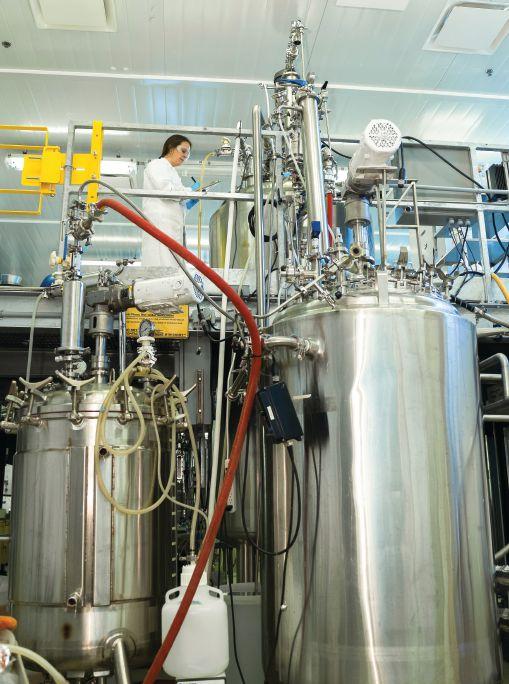
When TerraVerdae Bioworks began in 2009, the idea of producing natural biodegradable plastics still seemed like a dream that was light years away from coming to the market. Fast forward to 2020, and that dream is becoming a reality. The company now has a pilot facility capable of producing bio-based and biodegradable plastics and is scaling up production in response to demand from multiple markets.
THE PROCESS
Edmonton-based TerraVerdae Bioworks got started with technology from the National Research Council of Canada (NRC), CEO William Bardosh explains. The NRC had found a natural microbe that could accumulate a polyhydroxyalkanoate (PHA) polymer used to create natural polyester plastic with similar properties to polypropylene (which is used to produce plastics from fossil fuels). Bardosh and his team decided to develop the process to produce natural plastics.
But how exactly does a microbe end up as a bio-based plastic? Fermentation.
“It’s a process that is very similar to making yogurt or beer,” Bardosh explains. “For a microbe to grow, you have to provide two things: energy and a carbon source, because everything is made out of carbon – it’s a structural part.”
The microbes multiply, are grown up to a high density and accumulate the polymer inside of them, which is later extracted. Then, through a proprietary process, the polymer is blended with other components to produce a resin, Bardosh explains. The resin can be used to make everyday plastic products.
“If you have a pure polymer, whether it’s polyethylene, polypropylene – the petroleum-based ones – or PHA, you can’t just use that pure polymer to make a bottle, plastic container, sheet or whatever you want,” he says. “All products are engineered for specific performance requirements. You’ve got to blend the basic PHA with some other components that will give it more flexibility and other applicable properties.”
The process for producing these PHA polymers is carbonneutral and can use a range of renewable feedstocks. Agricultural feedstocks are the easiest to use, followed by forestry/wood waste and then municipal biomass waste, Bardosh shares.
While the company doesn’t have any specific feedstock suppliers yet, they are exploring a number of different sources and plan to nail down their suppliers this fall.
FOCUS ON FILMS
In 2016, TerraVerdae had established and scaled up the process for extracting the PHA polymer from the microbe, but found very little demand in the market, so they switched gears to focus on developing the resins.
“The issue at the time was that there really wasn’t much of a market for PHAs because it cost more to produce than petroleumbased plastics,” Bardosh explains. “Then we decided, ‘Well, if there’s no market for it, let’s start developing the resins and products ourselves.’”
The company recently received $4.5 million in grants from Alberta Innovates, Natural Resources Canada’s Clean Growth Program, advisory services and R&D funding from NRC’s Industrial Research Assistance Program, and other investors, to expand its ability to develop these resins and produce pilot quantities.
TerraVerdae’s resins are used to make films, adhesives, and coatings. There is a wide range of applications for films and coatings, Bardosh says when asked why they chose to focus on these products. For example, when it comes to coatings, companies want to minimize costs so they might use a paper or cardboard container, which is then coated to become water-resistant.
But their main focus is producing agricultural films, such as
Inside the TerraVerdae Bioworks pilot facility for the production of PHAs. Photo courtesy Jeff Hilbrecht Trident Photography.
mulch films. They have also developed biodegradable, bio-based plastic pouches for tree seedlings from their films – foresters will begin testing this product later this year. Currently, the company is doing tests to measure how fast these films will biodegrade in soil.
“Depending on the application, you might want them to biodegrade in a few weeks or a month, versus maybe six months. So, depending on the required biodegradability rate, we can engineer that,” Bardosh explains. “We’re also producing different kinds of pouches. They can either be sold as film pouches or they can be net-type pouches.”
Many of the products are customized based on what the customer is looking to do, because it depends on the soil type, humidity level and the actual plant or crop – whether it’s agricultural or a tree, he adds.
TerraVerdae is also interested in producing adhesives that currently cannot be recycled.
“Take an Amazon box – it’s made of cardboard, which is recyclable, but it also has tape on it, and that tape today is not recyclable. Even if the tape structure was made out of a biomaterial, the adhesives in that would not be recyclable. So, that’s the path we’re going down. We want to make it so the whole package would be compostable and biodegradable versus recyclable,” Bardosh says.
This wide range of applications also means there are a number of markets for TerraVerdae’s products: agriculture, forestry, the environmental space and packaging markets, to name a few.
GROWING GREEN
Currently, TerraVerdae produces limited quantities of their products, but plans to begin construction on a demonstration plant in January. The new demonstration plant will help the company expand its internal capability to produce the products customers request, Bardosh says.
In 2021, they will be producing close to commercial quantities, and a commercial plant is in the works for 2023 or 2024.
The overall goal in producing biodegradable bioplastics is to “establish a Canadian company that is a player in the world biomaterials market,” Bardosh says.
“It’s really coming out amongst experts in the biomaterial world that PHAs are one of the best options for displacing petroleum plastics,” he continues. “The trouble with a lot of the agriculturalbased materials like starch and fibres is that they just don’t have the performance properties needed to displace advanced materials made from polyethylene, polypropylene, etc. It’s taken 100 years to develop all of these petroleum-based plastics, and we’re trying to do the same thing in 20 years.”
However, Bardosh says there is a real need for the production of PHAs. Many groups around the world are working to develop alternatives to petroleum-based plastics. But, even if every company working on PHAs was provided with sufficient funds to build fullscale commercial plants today, it wouldn’t come close to meeting the demand to displace the known petroleum-based plastics, he says.
“So, it’s a huge challenge,” he says. “This is where the world has to step up and make a concerted effort to start funding these large production facilities because, right now, they’re the first of their kind, so of course they’re going to be more expensive, but it’s the route to the future.”
Another barrier to the development of this industry is getting private investment, Bardosh says.
“So, with new technologies and big, big capital budgets, the type of investors you need really have to be supported by government,” he says. “The Canadian government is stepping up to the plate. A lot of multinationals are coming along and committing resources.”
The Alberta government has also been very supportive of TerraVerdae, Bardosh adds.
While the return on investment for a manufacturing plant like this is not as quick or obvious as for things like software programs, for example, “there are people who are looking at making impact investments right, so they’ll accept more modest returns in the short term,” Bardosh says. “The investment climate is warming up, so we’re encouraged with that.”
“The world is changing,” he adds. “There’s a recognition that we have to be good shepherds of nature.”
It’s no surprise then, that the field of biodegradable bioplastics is growing, especially as major investment funds are turning away from the petroleum industry towards green technologies.
TerraVerdae Bioworks has also grown significantly in the last two years, Bardosh says. In the next five years, he believes the company will be in a position to generate substantial revenue, with its first commercial plant up and running in Canada, and a second – possibly in Europe – in the works.
“I think consumers are much more aware of their buying choices and I think they’re more interested in supporting things that are going to be good for the environment,” Bardosh says. “Companies are picking up on that and I’m really amazed at the shift that’s gone on over the last 18-24 months.” •
From single units to complete turnkey systems, CSE Bliss Manufacturing specializes in an industry leading line of hammer mills, rotary feeders, pellet coolers, parts and rebuilds, providing the complete solutions that only the CSE Bliss family can offer.
Creating value
Inside the world’s only net zero charcoal plant
By Guillaume Roy
Translated by Peter Diekmeyer
Wood industry veterans Antoine and Simon Langlois have long noted two interesting trends: the challenges that some processers have in selling by-products in the fluctuating wood chips market, and Canadians’ fondness for charcoal barbecues.
In 2017, the pair (who are not related) teamed up with Fonds Valorisation Bois de la FTQ and Investissement Québec to invest $10 million in Xylo-Carbone, a company dedicated to converting wood waste into charcoal – biochar.
“Barbecuing is a more than $1 billion dollar per year market,” says Simon, a chemical engineer by training. “We set up operations in the Mauricie region because it is a good place to harvest maple, yellow birch and other hardwood and there are few other businesses competing to buy the by-products.”
The investment created 20 jobs at the company’s Saint-Tite, Que., plant. XyloCarbone operates on 15 hectares of land, which means that it had plenty of room for expansion.
The entrepreneurs point out that the local community quickly got behind the project, which involves transforming what Antoine calls “bazou” (low-quality) crushed wood, worth around $60 per tonne, into finished “limousine” charcoal worth between $1,200 and $1,500 per tonne.
“The quality of the workforce, many of whom are locals who are very attached to the area, is excellent,” notes Antoine. “They have been a big asset.”
According to Simon, Xylo-Carbone, which recovers all the gases and tars that it emits during the production process, operates the world’s only net zero charcoal plant.
“We stand out by fostering sustainable forestry practices and offering a renewable product,” he says, noting that most of the
world’s charcoal is produced in developing countries by burning wood stuffed in a hole dug in the ground, a process that causes considerable pollution.
The two other traditional Canadian charcoal plants only produce limited output because their technologies are also highly polluting, he says. (Coal found in mines is not used by the barbecue market because it contains too many toxins).
THE PROCESS
Xylo-Carbone has access to a guaranteed annual supply of 20,000 m3 from Forex Langlois, Antoine’s logging company. “We are able to harvest smaller trees, which allows us to recover more fibre,” he says.
The wood is then sent to a dedicated yard for sorting. Groupement Forestier Mauricie (a buyers’ group made up of industrial clients) purchases about 200,000 m3 a year. The lower-quality wood ends up at Xylo-Carbone.
At the plant, the wood is sawed first into 16-inch logs, and then split again into four-inch pieces using a splitter designed by Cardinal Saw. The pieces are then put into cages and shipped to two refurbished MEC rail dryers to lower the moisture content from about 50 per cent to 15 per cent. This helps speed up the processing during later stages.
The four-inch pieces are then transferred to large, sealed metal tanks, designed in-house by Xylo-Carbone, to be heated in the pyrolizers. “PLCs control the entire cycle, which lasts 10 to 12 hours,” explains Simon. In a traditional coal mine, a cycle lasts about a week.
Inside the tanks, the wood is indirectly heated to temperatures of up to 800 C. “The wood never touches a flame,” Simon says. “Carbon is built-up in the wood fibre through pyrolysis, by heating the wood in the absence of oxygen.”
This process generates three products:
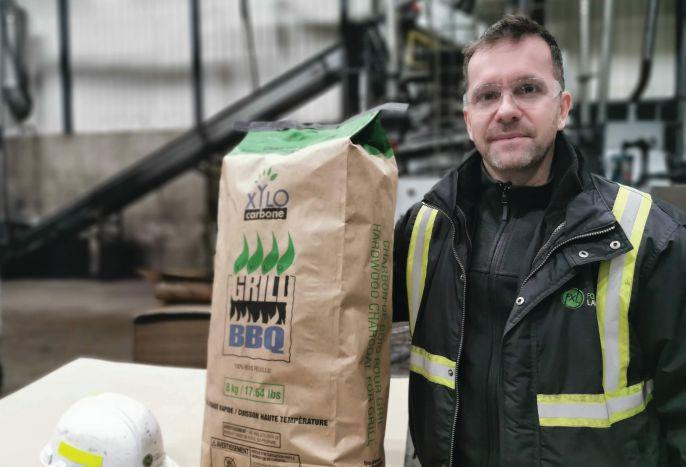
Antoine Langlois introduces the Xylo-Grill brand through which the company markets 80 per cent of the charcoal that is produced at its Saint-Tite, Que., plant. Photo courtesy Guillaume Roy.
the biochar, gas, and pyrolytic oil. Xylo-Carbone only sells the biochar. The other by-products are used to generate the energy the plant consumes during the production process.
At the end of the cycle, the sealed tanks are moved with the help of overhead cranes and the charcoal is cooled for three days before being stored. The material is then transferred to a conveyor before being bagged using a machine that was initially designed for packaging potatoes (a product of similar size).
Xylo-Carbone can produce a tonne of biochar using just four to five tonnes of green wood, compared to the six to seven tonnes of wood traditional processes take. In addition, 90 per cent of the lumps of charcoal produced are of a suitable size for the more lucrative BBQ market, compared to less than 70 per cent in traditional charcoal plants.
BARBECUE AND OTHER USES
The fact that Xylo-Carbone designed its own conversion units means that the company can control key parameters, including carbon levels.
“Our charcoal lights up quickly and produces intense heat, without dust,” notes Antoine. “Our clients appreciate this.”
About 80 per cent of Xylo-Carbone’s product is sold under the Xylo-Grill brand name to Costco, BMR and other major retailers. The company also produces charcoal for private label brands. While most of the output is sold in Canada, some is exported.
Xylo-Carbone is also developing new markets for the charcoal pieces that are too small to be used in the barbecue
market (around 10 per cent of their product). For example, the company is currently carrying out tests with large car manufacturing subcontractors to produce a black pigment made from Quebec charcoal. Research projects are also underway to produce activated charcoal in order to develop water or air filters. Charcoal could also be used to fertilize agricultural soils.
By increasing its volume 15-fold, Xylo-Carbone could one day even supply metal processors, Simon estimates.
THE FUTURE
At the time of writing in the spring, Xylo-Carbone intended to double production in the summer. Next year, the company will add two pyrolizers, which should enable it to double production again.
The company is also considering better leveraging the technology it has developed.
“Using our process, we produce all the energy we need and we still have surpluses,” notes Antoine, who believes that small factories could be set up next to sawmills using the bark and other by-products to produce charcoal. The excess energy that is produced could be used to power the dryers at the sawmills.
Simon argues that the process could also power greenhouses or other energy-intensive business.
The entrepreneurs are in the process of patenting the pyrolysis technology and plan to bring the product to market soon.
“With a market this big, others could also benefit from the technology,” Simon says. “Our goal is to license the technology and to buy back and market the charcoal that is produced.” •
FUEL | AIR | GAS | ASH
Grinding grants opportunities
Terrace Community Forest launches wood waste grinding project with help from FESBC
By PJ Boyd
An hour’s drive inland from the coast of Northwest B.C., along the Skeena River, Terrace Community Forest (TCF) has found a new way to increase fibre utilization from secondgrowth tree stands: grinding and trucking wood waste.
The company, founded in 2006, is licensed to harvest up to 30,000 cubic metres (approximately 650 logging truck loads) per year over three different operating areas around Terrace, B.C. In the past few years, TCF has been focused on commercial thinning second-growth tree stands, bringing hemlock and balsam to a processing area to be delimbed and cut-to-length.
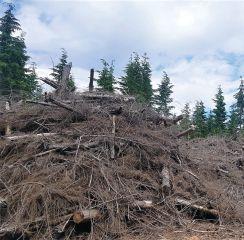
Their operations, unfortunately, resulted in a lot of wood waste. Rather than burn that waste, TCF stockpiled 15,000 cubic metres of wood waste to dry for two years, to reduce the wood’s moisture content.
During that time, Kim Haworth, the
sole staff member and general manager of TCF, looked for ways to utilize the fibre. When Skeena Sawmills announced it would build a new pellet plant in Terrace – Skeena Bioenergy – Haworth saw an opportunity. But the cost of grinding and transporting the wood waste was still uneconomical for TCF.
The solution came in the form of a $443,000 grant in June this year from the Forest Enhancement Society of BC (FESBC).
TCF’s decision to hold-off on burning the stockpile of wood waste encouraged FESBC to award the grant, Gordon Pratt, FESBC operations manager, tells Canadian Biomass
“We were very supportive [of TCF] that they had all of these waste piles that were scheduled to be burned, and with the recent opening of the Skeena Bioenergy pellet facility, there became an opportunity to utilize that. Otherwise the nearest facility was over two hours away
in Smithers, B.C.,” Pratt says.
“I think the big benefit is that we all want to do the right thing in the bush. None of us are in favour of putting what could be good fibre into smoke. So, the fact that TCF can be a good citizen and utilize as much of their residual fibre from harvesting as possible is a good thing. I think we all feel good about optimizing the fibre that could be used,” he adds.
Since its inception in 2016, FESBC has given grants to roughly 251 projects. The current project with TCF aligns with two of FESBC’s purposes: to increase the utilization of fibre and reduce greenhouse gas emissions created by wood burning.
Another one of FESBC’s goals is to help community forests utilize fibre so they are eliminating greenhouse gas emissions, creating an economically viable opportunity for the community forests and contributing to the bioeconomy.
“This kind of operation is new to this area of the province and it’s hoped it will
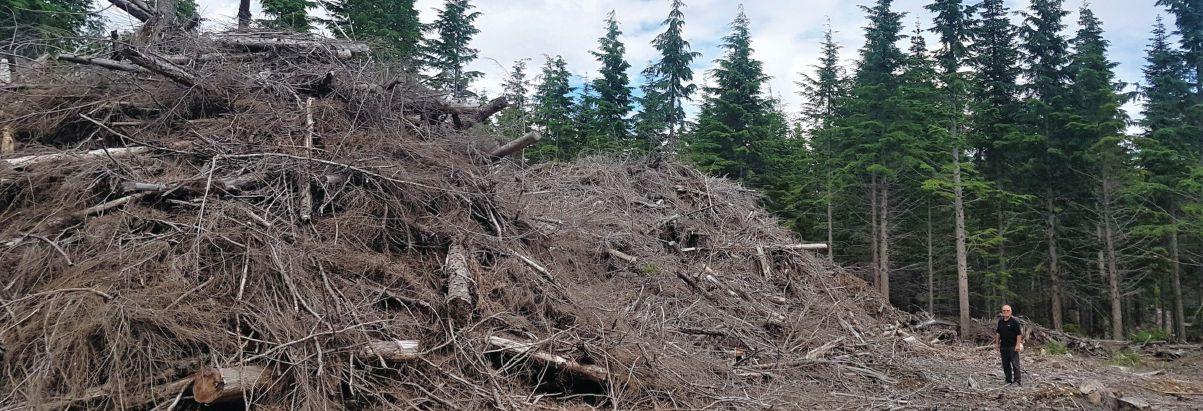
Terrace Community Forest general manager Kim Haworth stands by a slash pile of wood waste waiting to be ground by a machine. Photo courtesy Kim Haworth, Terrace Community Forest.
help the community forests get operators to invest in the proper equipment and figure out how to do this economically. Then, over time, it becomes sustainable and funding isn’t required,” Pratt says.
GETTING THE JOB DONE
TCF began grinding immediately after the grant was approved. Having previously burnt roughly 60,000 cubic metres of tops, limbs and non-merchantable logging material, Haworth was excited to begin the project. For him, it offered a chance to fully utilize the TCF’s timber profile, create four new jobs and minimize the amount of CO2 equivalent that TCF would have otherwise released into the atmosphere through burning.
“I think the main thing with this particular project is that the second-growth management is particularly new in the Northwest. We’re struggling with the small-diameter log in terms of markets,” Haworth says.
TCF’s logs are typically exported overseas to China, but this market has become limited because of the amount of beetledamaged spruce wood being exported to the country at low prices, he explains.
But this grinding project opens up a new market for TCF: the wood pellet industry.
“It gives us the opportunity to fully utilize the timber profile without distributing that material into the atmosphere,” Haworth says. “I think that’s a really good thing. It creates the jobs necessary to do it and a revenue stream not just for TCF and the local community, but for the provincial government as a whole through the stumpage process.
“This money all goes back into the community,” he continues. “Everything that TCF generates in terms of a revenue stream goes back into the community directly, through grants or by allocating funds to the city as a whole. We try to hire as many local people as we can. So, anyone involved in this specific project is a local individual.”
As of September, TCF had ground approximately two-thirds of the stockpiled material, which was being shipped to Skeena Bioenergy.
“I received enough funding this year to complete the grinding, so by the time the weather rolls around and changes to the point where we can’t grind anymore, I’ll be finished,” Haworth says.
He hopes to deliver any remaining material to the plant by early 2021.
TCF hires contractors to carry out most of its work, such as layout and supervision, management, tree planting, silviculture and harvesting.
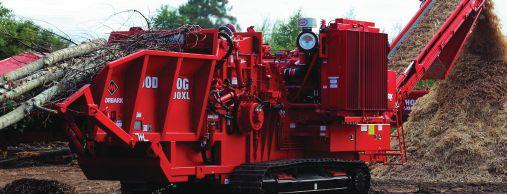
For the commercial thinning and grinding operations, TCF contracts Timber Baron Contracting. Logs are harvested using a LX830 Tigercat feller buncher, a 240 Hitachi excavator with a HTH623C Waratah harvesting head, 2954D John Deere swing machines, Tigercat 880 loggers and an 848H John Deere skidder. A Morbark 3200 track horizontal grinder, fed by a Tigercat 880 log loader, is used for the grinding.
Timber Baron hauls the logs with a fleet of Kenworth T800 trucks, as well as freightliner haulers for bush grind.
TCF also contracts Stardust Contracting Ltd. to haul wood waste using two 53-foot chip trailers with a live floor and triaxle tractor.
GRINDING ACCOMPLISHMENTS
Although TCF doesn’t know the exact amount of fibre that has been grinded up until this point, Haworth hopes to have processed 30,000 cubic meters of fibre by the time the project is completed.
Operations have not been as efficient as they could have been, Haworth admits, because TCF’s burn piles were not set up with the intention of transferring them to a pellet plant. But, in the future, the amount of fibre that is utilized will increase as they proceed with the knowledge and experience gained from this project.
“When we do this moving forward, it’s not going to be in a way that we’re doing it right now. The information that comes out of this is going to change because we will be changing our format when we’re processing this material. Hopefully the information I get from this will allow us to go forward with our own operational funds to do this project,” Haworth says.
Moving forward, TCF plans to organize their wood residual piles in a way that meets Skeena Bioenergy’s demands. For this, they will be more proactive in separating tops and limbs for grinding and trucking.
TCF also plans to focus on moisture reduction as they work more closely with the pellet plant – especially for their harvested hemlock, which has a high moisture content and consequently requires more time and energy invested in drying. Haworth believes these changes will result in more positive numbers that will grow as the project becomes financially sustainable and begins to generate opportunities for continued grinding operations and more job creation. •
Back and better with the bioeconomy
IThe role of the bioeconomy in Canada’s post-COVID economic recovery
By Rob van Adrichem
t seems to happen almost every day: a think tank, government organization, or blue-ribbon panel weighs in on the ingredients necessary for Canada’s post-COVID recovery and how “green” it should be. But as I write this, it seems premature to talk of a “post”-COVID recovery, with the world surpassing 35 million cases of COVID-19 and many provinces continuing to set single-day records for new cases. One thing, however, is sure: whether we’re talking about a post-COVID recovery or just the continued evolution of Canada’s economy, the bioeconomy is critically important.
And why wouldn’t it be? The bioeconomy is huge, employing upwards of two million people, according to Canada’s Bioeconomy Strategy. Maybe more important than the large number of jobs is where they are, as employment in the bioeconomy is spread across hundreds of communities large and small, helping to address urban-rural inequities and enabling forest-based communities to thrive. The bioeconomy is based on a renewable resource that comes from sustainably managed forests and has the unique potential to both displace and sequester carbon, aid in the transition away from a dependence on fossil fuels, and lead the way to a circular economy. The bioeconomy also has a social side, contributing to health and well-being, and cultural expression.
The issue isn’t whether the bioeconomy will continue to play an enormous role in Canada’s economy and society; it’s whether policy-makers and governments at all levels will seize this opportunity to make the bioeconomy a signature part of Canada’s low-carbon future. That’s where
we come in.
The Canadian Bioeconomy Conference and Exhibition, formerly known as the International Bioenergy Conference and Exhibition, started in 2004 in Prince George, B.C., to bring awareness to the growing market for Canada’s “waste” wood fibre in the form of wood pellets. While the mandate of the conference has evolved to include a greater range of products from the wood biomass value chain, the conference has stayed true to its initial purpose: bring people together to explore opportunities in the bioeconomy and provide them with diverse local, national, and international perspectives that can inform the development of the bioeconomy at home and beyond.
Our conference is certainly not alone in this mission. The Scaling Up and Canadian BioDesign conferences similarly explore critical issues in the evolution of the bioeconomy in Canada, and WoodWorks, the Forest Products Association of Canada, Bioindustrial Innovation Canada, the Wood Pellet Association of Canada, FPInnovations, the Canada Wood Group, the Council of Forest Industries, the Canadian Wood Council, and Forestry Innovation Investment are all active in advocacy, public communication, and knowledge transfer. Likewise, multiple universities and colleges deliver related educational programs and conduct research on topics ranging from ecosystem sustainability to new products.
Even with these organizations’ great work, we continue to require enhanced public education, government relations, and better communication within the sector. If anything, it would seem the challenge is greater than ever despite (or maybe because of) the proliferation of communi-
cation channels. It’s a topic that emerged in the first webinar our conference presented this past June, when Canada Research Chair Warren Mabee of Queen’s University suggested that “communication” is one of the big challenges for the sector, particularly conveying messages aimed at the public and consumers about the relationship between the bioeconomy and sustainability.
Not coincidentally, the COVID-19 pandemic is forcing all of us to become more creative in how we share information. The increase in digital delivery, such as webinars, is providing a broader range of stakeholders a kind of personal access to experts and information that simply didn’t exist before. During the same webinar in June, it was encouraging to hear B.C. Chief Forester Diane Nicholls express her excitement at the increase in the “chatter” around the bioeconomy, green solutions, and eagerness to do things better.
The challenge now is translating that interest into real advancement for the bioeconomy. Collaboration and co-operation among those of us active in the bioeconomy is crucial, as we continue to raise the profile and highlight the promise of this sector. We are honoured to have contributed to this effort during our conferences and are grateful that, even though our 2020 conference has been postponed, we can continue to connect many bioeconomy stakeholders online until hopefully we can all meet in person again. •
Rob van Adrichem has worked in post-secondary education and local government and is the chair of the society that presents the Canadian Bioeconomy Conference and Exhibition in Prince George.
GOOD HR PRACTICES ARE CRITICAL
IN THE FOREST, AT THE SAWMILL OR IN THE OFFICE
Talent Canada, a new information source from the publishers of Canadian Biomass, is designed to provide your senior management team and front-line leaders the information they need to find, keep and engage the best workforce.