INSIDE
+ Q&A with ASHRAE’s new president
+ Bringing the benefits of daylight indoors
+ Big water savings with little changes


+ Q&A with ASHRAE’s new president
+ Bringing the benefits of daylight indoors
+ Big water savings with little changes

We provide efficient and cost-effective solutions to your lighting needs and are committed to being your preferred supplier.





Editor Peter Saunders psaunders@ebmag.com
Publisher/Sales Anthony Capkun acapkun@ebmag.com
Account Manager Jennifer DiIorio jdiiorio@ebmag.com
Media Designer Svetlana Avrutin savrutin@annexbusinessmedia.com
Account Coordinator Kathryn Nyenhuis knyenhuis@annexbusinessmedia.com
SEPTEMBER 2019 COVER
Circulation Manager Urszula Grzyb ugrzyb@annexbusinessmedia.com
Executive Publisher & VP Tim Dimopolous tdimopoulos@annexbusinessmedia.com
COO Scott Jamieson sjamieson@annexbusinessmedia.com


Windows: The Weakest Link
Upgrading windows is important to improve the performance of the building envelope.
Q&A with ASHRAE’s New President
Canada’s own Darryl K. Boyce shares his past and his vision for the future. Bringing the Benefits of Daylight Indoors
Harvesting daylight can save energy while enhancing a sense of well-being.


Big Water Savings with Little Changes
Simple upgrades that cost only a few dollars can save thousands in the long run.
Solar Energy Mythbusting for Commercial Properties
Transitioning to on-site solar will not always benefit the bottom line.
AESP Conference Explores Evolution of Energy Efficiency
‘EEvolution’ brought a variety of perspectives to August’s event in Toronto.
4 From the Editor
Major players in commercial real estate are disclosing their energy data.
8 Energy Connections
Many questions about residential submetering can be cleared up.
15 The 360 on Energy
Canada needs a national energy management strategy.
20 Energy Wise
A ‘big-ticket’ approach may hurt responsible industrial managers. 18

AA new challenge seeks to encourage national energy consumption benchmarking.
s commercial real estate is a highly competitive business, you might expect property owners to keep their cards close to their chests. A new initiative, however, has encouraged three major players with buildings across Canada—QuadReal Property Group, Triovest Realty Advisors and Concert Properties—to publicly share their portfolios’ energy and water consumption data, using the Canadian Green Building Council’s (CaGBC’s) new Disclosure Challenge data visualization tool.
They volunteered, in fact, to participate earlier this year. Now they are starting to reap the benefits by gaining insight into their buildings’ operations in comparison to others. Having tracked nearly 500 buildings, comprising some 75 million square feet, they can now better pinpoint where to invest in energy-efficiency retrofits.
“By making their data public, these participants are providing intelligence that will help improve the efficiency of the whole industry,” says Akua Schatz, CaGBC’s vice-president (VP) of market engagement and advocacy.
Based on the Energy Star Portfolio Manager interactive energy management tool, Disclosure Challenge itself is a recent development, just released earlier this year.

“We started to develop it late last year and brought on key participants, who had to be willing to disclose all of their information,” Schatz explains. “In two cases, they were already using Energy Star Portfolio Manager, but we have further customized Disclosure Challenge to help them visualize the performance of their buildings.”
For CaGBC’s purposes, the project is intended to help encourage national energy consumption benchmarking.
“The ‘challenge’ has created healthy competition with respect to energy data collection,” says Schatz. “We will share some of the findings this fall and then get more participants on board next year. Our overall goal is to get the tool to track one billion square feet of commercial real estate.”
Peter Saunders, Editor psaunders@ebmag.com

BY CINDY MACDONALD
While floor-to-ceiling views of a city skyline are great for bringing in lots of natural lighting, they can be a headache from an operations point of view. In terms of heating and cooling, windows and frames are generally the poorest-performing components of the building envelope.
“Heat loss takes the path of least resistance,” says Elyse Henderson, a Vancouver-based energy and sustainability analyst with RDH Building Science. “In general, windows have worse thermal performance than opaque walls. Upgrading them and improving overall building airtightness are generally the biggest-impact solutions for saving heating—or cooling—energy.”
These two solutions are directly related, as upgrading windows can do much to improve a building’s airtightness.
A building envelope’s performance depends on its insulating properties. The thermal performance of windows is generally presented as their U-value. When it is instead expressed as the more familiar R-value, the insulating performance of older windows is typically only around two.
“So, when you put an R2 window in an R20 or R30 wall, guess what the worst-performing part of the wall is?” says David Heska, Southwestern Ontario building sciences director for Montreal-based engineering consultancy WSP.
In response to this issue, RDH’s Henderson points out, the retrofit market is seeing the emergence of more energy-efficient glass, higher-performing framing systems and greater attention paid to proper installation practices.
In high-rise buildings, especially, solar heat gain poses major issues for energy management.

‘Solar control’ and low-emissivity (low-e) coatings have been greatly improved over the past 15 years in terms of durability and effectiveness, while new ‘dynamic’ or ‘smart’ coatings can even adjust their tint in response to ambient lighting conditions, so as to block or transmit more heat. Simply upgrading from single- to doubleglazed insulating glass units (IGUs) can more than double performance.
“As soon as you upgrade to an IGU,you’re going to improve your thermal performance during the cold months,” addsStéphaneHoffman, principal and vice-president (VP) of building science analytics for engineering consulting firm Morrison Hershfield.
When considering a window upgrade, building owners and managers have the option of (a) replacing just the glass, (b) replacing both the glass and the frame system or (c) simply renewing the existing weather-sealing components to improve air- and water-tightness.

Fogging of double-glazed windows is a strong indicator of when they need to be replaced, as are ongoing water penetration, unusually high energy costs and occupant comfort complaints (e.g. too hot, too cold, too much glare.)
“When fogging starts to happen on a frequent basis, the windows are at the end of their service life,” says Morrison Hershfield’s Hoffman.
The typical life cycle for double-glazed windows is considered to be 20 to 30 years. Fogged IGUs cannot be effectively repaired.
Water infiltration is also an indicator of deterioration. In response, the facility manager may opt to renew the weather seals and sealants, which can provide another five to 10 years of service life for only about 20% of the cost of replacing the glass—but WSP’s Heska cautions there will likely not be any energy efficiency benefits, unless the building has suffered significant air leakage, too.
Al Jaugelis, senior fenestration specialist with RDH, says advances in glass coatings—particularly in triple-pane glass units, where two coatings can be applied—have yielded the biggest improvements in windows’ energy efficiency performance.
“Low-e coatings are used to control solar heat gain and reduce cooling loads,” he says. “They are also the most effective measure to minimize indoor heat loss during the heating season.”
In the past, many buildings used tinted glass to reduce solar heat gain, so the amount of visible light transmittance was significantly less. Morrison Hershfield’s Hoffman says newer, highly transparent low-e coatings “can help reduce lighting needs and improve occupant happiness.”
Indeed, occupant comfort is an indirect benefit of a window upgrade.
“Cold spots by windows and unwanted solar heat gains through old glazing units are a key contributor to occupant

C3 Specialty Glazing Solutions is installing a new curtain wall for a Toronto office building that will reportedly increase ‘vision area’ by 35% and help achieve LEED Gold certification.
Photo courtesy C3 Specialty Glazing Solutions
discomfort, as well as overworked HVAC systems,” says RDH’s Henderson. “You have better control of indoor temperatures with high-performance glazing products.”
In fact, by reducing heating and cooling demand, window replacements may even allow building operators to downsize mechanical equipment. Other benefits for commercial office towers and multi-unit residential buildings (MURBs) include improved esthetics, which in turn can increase property value.
Another factor to consider is the nature of the existing building envelope. For buildings from the 1980s or later, C3 Specialty Glazing Solutions president Rob Wood says installers can likely just change out the glass panes from the curtain wall, whereas for older buildings, both the glass and the frames will often need to be replaced or at least modified to accept IGUs.
C3, for its part, is currently working on a 1970s-era office building at 60 Bloor Street West in Toronto, where the replacement of the curtain wall is part of a larger, LEED Gold, Class A renewal effort.
For this building, C3 is installing a unitized doubleglazed curtain wall over the original single-glazed window system. Later, the original glass and portions of the frame will be removed from the interior of the building. The project also involves removing a portion of the existing metal spandrel panels. The new curtain wall is expected to increase the vision area by more than 35% and yield significantly better energy performance.
Another window replacement project with substantial
energy-saving implications is the renewal of the Ken Soble Tower in Hamilton. Dating from the late 1960s, this MURB is being upgraded to the Passive House standard to reduce its greenhouse gas (GHG) emissions by 94%.WSP’s Heska says the retrofit will include triple-glazed IGUs with an R-value of six.
Triple-glazed IGUs have not yet seen widespread adoption in the Canadian market, but their presence is growing, thanks in part to forward-looking efforts like British Columbia’s Energy Step Code.
Dynamic glazing, which features an adaptive coating, is also beginning to make inroads in the Canadian market. This type of ‘smart’ coating allows property managers to control transmittance of light and heat by making the glass lighter or darker at different times of day.
“This is a much more expensive technology,” says Heska. “We’re seeing it on newer construction.”
Another emerging technology of greater relevance for historic buildings is vacuum-insulated glazing, which yields a dual-pane unit of the same thickness as single-pane glass (i.e. 6 mm). Previously, upgrading from a single pane to a double-glazed IGU was hampered by the space limitations of the frame, but this way, double-glazed performance is available in a unit that fits an existing frame.
“It is in the early stages of commercialization, but has a lot of promise,” says Morrison Hershfield’s Hoffman.
While considering all of these options for window upgrades and planning a retrofit, of course, it is important in the context of energy management to evaluate the entire building— including walls, roof, lighting and HVAC—as one system.
“Don’t treat a window replacement as isolated,” says RDH’s Jaugelis. “It does have huge energy implications.”

BY DAVID STEWART JONES
Asure sign of an emerging business trend going mainstream is a sudden smokescreen of confusion and misinformation about its facts and benefits. Today’s rapid adoption of utility submetering is no exception.
Utility submetering typically replaces utilities-included rental arrangements, enabling multi-unit residential building (MURB) owners and managers to measure energy consumption for each suite or space. By delivering full transparency, submetering enables tenants to take direct control of their personal consumption and costs.
However, many people still have questions. Is submetering new? Is it a fair way to bill tenants? Has it been proven to lower energy consumption? Is it regulated and measured accurately and, if so, by whom? Is it expensive?
It’s been around a while Many people now hearing about submetering naturally assume it’s a recent innovation, but it has been around for more than 40 years.
“Adoption in North America is running a
bit behind Europe, where submetering was fully embraced decades ago,” says Ephram Spiegelman, vice-president (VP) of sales and marketing for submetering provider Enercare Connections, “but what’s important is it will stay around for the foreseeable future.”
It’s fairer for residents
In ‘bulk-metered’ buildings, where utilities are included in rents, tenants typically share energy costs. A person living alone is essentially subsidizing the consumption of the family of four living next door.
“Sharing is a good thing, except when it comes to energy costs!” says Spiegelman.
“Submetering puts consumers in control. They don’t have to pay for their neighbour’s consumption.”
It’s proven to lower utility consumption
Just as submetering empowers tenants to cut costs by reducing their own energy consumption, it also frees property owners from excessive utility costs incurred by tenants who would otherwise have no financial incentive
to curb unnecessary electricity or water use when utilities are included in the rent.
Submetering can deliver monthly savings in net operating expenses simply because residents are paying directly for their own consumption, instead of the building owner.
“Submetering and savings go hand-inhand,” says Spiegelman, citing a Navigant Consulting study showing a long-term 40% reduction in electricity use after bulk-metered buildings switched to submetering.
“Tenants pay more attention to their consumption and use less energy when they are billed more accurately using submetering. It encourages them to make conservation part of their everyday lifestyle.”
Submetering in Canada is highly regulated at both the provincial and federal levels. In Ontario, for example, providers must obtain licences from the Ontario Energy Board (OEB) and comply with billing, collection and disconnection requirements of its Unit Sub-Metering Code, as well as the province’s Energy Consumer Protection Act, Residential
Tenancies Act and other applicable legislation.
“Submetering is subject to rigorous requirements, exacting standards and continuous review and oversight,” says Spiegelman. “It is also monitored and regulated by Measurement Canada to ensure metering and billing accuracy.”
Submetering ensures tenants pay only for their actual consumption. Fees charged for delivering a submetering program will vary by provider and number of services, but government rebate programs help out low-income households and special rules protect them by preventing disconnections, waiving security deposits and allowing longer payment times for those in arrears.
“Submetering service charges in Ontario are almost always lower than the fees charged by local utilities, with no hidden price markups,” says Spiegelman.
David Stewart Jones is an environmental technology writer and researcher based in Toronto. Correspondence can be addressed to metersales@enercare.ca or davidstewartjones@outlook.com.

BY PETER SAUNDERS
During its annual conference this summer, ASHRAE introduced its executive committee officers and directors for the 2019/2020 session.
The new president is Darryl K. Boyce, who used his inaugural address at the conference to announce the society’s next theme—‘building for people and performance; achieving operational excellence’—and, as part of that theme, a focus on overcoming the challenges associated with improving energy efficiency for the built environment.
Hailing from Canada, Boyce is also special advisor to the vice-president (VP) of finance and administration at Ottawa’s Carleton University. We caught up with him to learn more about his past experience in mechanical engineering and his vision for the future.
“Buildings are often falling short on performing to the expectations of their designers and operators.”
Q: Congratulations on being named president of ASHRAE. When you think back on your career, when and how did mechanical engineering first become part of it?
A: When I was growing up, my father owned a logging company. For him to keep working, we regularly moved to new locations, including remote islands off the west coast of British Columbia. My childhood memories are of being around large equipment and the rugged individuals who operated and maintained it.
After the logging business closed, we continued to move around and I attended several schools. When I was 14, my father left our family. My mother, younger sister and I were left on welfare. I was thrust into the role of ‘man of the house’ and, as such, became the chief operating officer (COO) of our sub-standard home! There was no money to hire a plumber or electrician, so I was in charge of repairing any problems. I began to appreciate the importance of safe, healthy and effective building operations.
At 15, I went on a junior high-school trip to the local university and we toured its power plant. Again, the large equipment fascinated me.
“Who is responsible for all of this?” I asked.
“Mechanical engineers,” replied the tour guide.
When we returned to class, we had to write a paper about future careers that interested us. I wrote about mechanical engineering. It was then I caught the bug.
Q: Going forward, what will be the biggest challenges in reducing existing buildings’ consumption of electricity, natural gas and water?
A: My theme for ASHRAE this year reflects how buildings are often falling short on performing to the expectations of their designers and operators. By way of example, the Alice Turner Branch Library in Saskatoon is using 58% more energy than the design intent. The Roblin Centre at Red River College in Winnipeg is using 69% more. And the District Education Centre in Surrey, B.C., is using 203% more!
Here are three main reasons why. First, during the design process, the designers are not always focused on ‘operability.’ Secondly, buildings have become more complex. And that leads us to the third reason: operators are overwhelmed and end up lagging behind. They generally do not have the right skills to operate today’s buildings, as they are rarely trained and oriented properly at the ‘turnover’ point.
In 2010, for example, we opened a state-of-the-art engineering building at Carleton with Power over Ethernet (PoE) controls and enhanced submetering of equipment lighting and plug loads—but we soon found all of the additional data was overwhelming our control technicians. To help achieve operational excellence, we need to apply some best practices:
• Include a representative of the building operations team all the way through the design process, not solely at the end.

Q: You’ve dealt with many newly constructed buildings, but what about improving the energy efficiency of existing buildings?
A: ASHRAE helped develop the Advanced Energy Design Guide for Small to Medium Office Buildings: Achieving Zero Energy. While it provides direction for designing and constructing new buildings that are ready to accept renewable energy systems and meet low energy loads, it also applies to retrofits of existing buildings, depending on the depth and breadth of the work. The guide was co-developed with the American Institute of Architects (AIA), the Illuminating Engineering Society (IES) and the U.S. Green Building Council (USGBC), with support and funding from the U.S. Department of Energy (DOE) through the National Renewable Energy Laboratory (NREL).
Also, ASHRAE created the Building EQ program to improve the energy efficiency of existing buildings. This tool, which can be accessed online, provides an effective way to measure a building’s energy use through a documented Level 1 audit, take specific actions to reduce it and track year-over-year data.
• Ensure the design is suited for and reflects the capabilities of the people occupying and operating the building, so we are not leaving them wondering, “How do I make this work?”
• Establish an effective turnover and orientation training process.
• Evaluate design decisions for their impact on indoor environmental quality (IEQ) and remember the people in that building will be the best ‘sensors’ of comfort.
Q: In terms of achieving energy consumption goals, when (if ever) does it make more sense to tear down and rebuild, rather than renovate or retrofit a building?
A: ASHRAE does not advise owners on when they should rebuild, renovate or retrofit. We just say that regardless of the choice, it should be a well-built and energy-efficient building.
That said, if renovations or retrofitting cannot possibly result in a well-built, energy-efficient building that com-
plies with applicable codes and standards, then it should be rebuilt so it can comply.
Q: To take a real-world example, when you were assistant VP in facilities management and planning at Carleton, what measures was the university taking to address its energy consumption costs?
A: In the last few years, we were implementing a program to reduce energy use in the university’s existing buildings. This started with a campus-wide evaluation of energy reduction opportunities in each building, through the use of a system that included actual energy use data and a Level 1 energy audit.
The information gathered was used to prioritize buildings for implementation of guaranteed improvement projects, which involved repairing or replacing key system components. The goal of these projects was not just energy reduction, but also improvement of IEQ.
The reality is you cannot properly manage what you do not measure. So, it is critical for measurements to be reliable and connected to the systems that can effectively use the information. The improved connection of Carleton’s metering systems to the building automation system (BAS) is very important and the expanded use of analytical tools will increase the amount of data available to enable better decisions about building operations and energy use.
Q: In another Canadian example, an integrated approach to energy-efficient retrofits at Montreal’s Olympic Park recently won an ASHRAE Technology award. What lessons would you say can be learned from such projects?

“ASHRAE helped develop the Advanced Energy Design Guide for Small to Medium Office Buildings: Achieving Zero Energy, which provides direction for designing and constructing new buildings, but also applies to retrofits of existing buildings, depending on the depth and breadth of the work.”
This project also demonstrates the value of working closely with building operators to achieve the best results and backing up the work with guaranteed energy savings.
Q: What roles do you see computers, software and the Internet of Things (IoT) playing in improving aging buildings’ energy efficiency further?
A: We are at a point where analytical software and fault detection can truly improve the operation of the built environment and reduce its use of energy. Lighting controls are one way to improve efficiency, along with BASs, metering, monitoring, sensors and various applications. ASHRAE Technical Committee 1.5, Computer Applications, is concerned with the design and optimization of refrigeration, heating and air-conditioning systems, equipment and components thereof.
A: The key to this project was the holistic, comprehensive approach to the retrofit/renewal, resulting in a longer payback and greater impact on the effective operations of the facility.
Q: How does ASHRAE interact with energy managers and address their needs?
A: We regularly try to get building managers involved in ASHRAE’s standards writing committees and we encourage them to review drafts. The Building Owners and Managers Association (BOMA) International has organizational representation on many of our big project committees that have an impact on professionals in these industries, including those for Standards 90.1, Energy Standard for Buildings Except Low-Rise Residential Buildings, and 189.1, International Green Construction Code. We also see participation from individuals who help run university and hospital campuses. If any energy management professionals feel their needs are not being met, we encourage them to get involved in the process.

BY GRAEME DOGGART
Light contributes to a sense of well-being in any building, but especially those that lack natural daylight. Changing patterns of ambient lighting can help people feel connected with the world outside, so they are able to stay alert and focused. At
the same time, harvesting daylight can help save electricity and thus reduce utility bills.
‘Daylight harvesting’ is the process of balancing both natural and artificial light to obtain the desired level of illumination. In the simple example of a parking lot, for example, a photocell control turns artificial lights on
when it is dark out and keeps them off during the day, when they would be unnecessary and a waste of energy. The approach can be taken indoors, as well, which is particularly advantageous when surrounded by other buildings that block sunlight.
Further, it can be a manual or automated process. Traditionally, indoor lighting has been turned on and off manually by occupants, at the flick of a wall switch near a space’s entryway. The addition of dimmers enabled greater control over light levels.
Dimmers allow for ‘scaled’ daylight harvesting, where an occupant can theoretically dim lighting output anywhere from 100% to 0%, which can be effective for saving energy. From an operations standpoint, however, it is troublesome to constantly change artificial light levels manually throughout the day to compensate for the changing amount of natural light (which is affected by time of day, time of year, weather and cloud coverage).
This is where LED lighting control systems come in. By collecting data from embedded sensors and communicating it across the Internet of Things (IoT), they can better optimize operations with energy savings in mind.
First, the sensors capture how much natural light is entering a given space.Then, the corresponding control system can increase or reduce the amount of artificial light, so as to achieve or maintain a minimum recommended light level.
Using the same data, schedules can be set to ensure artificial lights are only powered during the times they are required. Motion sensors, meanwhile, can ensure lights are only on when a space is actually being used. Light level ‘scenes’ can even be customized as appropriate for different tasks throughout a building.
This is not so say manual daylight harvesting has no place in a modern building. Indeed, occupants can be granted access to the lighting control system, allowing them to adjust levels to their personal preference, rather than to a predetermined threshold. If they do not need as much light as assumed, then this access can reduce energy consumption even further, as well as personalize the environment for the occupant.
We now have more control over indoor light levels than ever before. Advances in IoT technology allow us to create smart workspaces, with light points capturing important data, providing new insights and, as a result, increasing energy efficiency.
Graeme Doggart is a marketing manager for the Canadian operations of Signify, formerly known as Philips Lighting, which develops Interact Pro lighting control systems with daylight harvesting and other features. For more information, visit www.signify.com.
BY JON GUSTAFSON
Property management professionals looking to boost water conservation often set their sights on the biggest and/or most expensive water-using equipment in their facility—but while these big-ticket items are certainly an important part of overall conservation, there is also a lot to be said for the role of the ‘little guy.’ Some simple upgrades or updates that cost only a few dollars can save thousands in the long run.
Vandal-resistant aerators are recommended to ensure targeted water savings are achieved.

In some buildings, laminar or nonaerated flow restrictors are required.
According to the federal department of the environment and climate change, Canada is the world’s second-highest consumer of water per capita, following the U.S. The first step to reducing commercial water use is to understand how so much water is being used in the first place.
A systematic look at water consumption, through an audit or other review process, can help operators get a clear look at use and ways to reduce it. A handwash sink without an aerator to reduce the flow of water from the faucet, for example, could easily be flowing at excessive rates, perhaps as high as 30 L of water per minute, well above the standard flow rate.
Indeed, aerators are one of the most commonly overlooked ways to reduce water consumption. They are inexpensive and simple to change or install, but the savings they achieve, multiplied across dozens or hundreds of sinks in a large facility, can make a significant impact, often in the order of tens of thousands of litres—and hundreds of dollars—in annual savings. By way of example, a facility with 40 hand washes per day, average 30 seconds per wash, can save more than 45,000 L of water by switching from an 8.3-L-per-minute (lpm) aerator to a 1.9-lpm model.
Also, aerators are sometimes removed by building occupants who assume more water is better. Vandal-resistant aerators are recommended to prevent tampering, maintain the integrity of the
product and ensure targeted water savings are achieved. Plumbing advances have helped today’s aerators offer lower flow rates—anywhere from 1.3 to 5.6 lpm—without diminishing performance. In addition to reducing a facility’s water bill, optimizing consumption also saves on electricity or natural gas bills because it means less energy is needed to heat the building’s water. As a result, the return on investment (ROI) for efficient aerators can be measured in just days, rather than years.
When considering this type of change, it is imperative first to understand how faucets are used on a day-to-day basis.
For simple restroom sinks, low-flow aerators will not diminish performance even as they decrease water use. In high-use areas, on the other hand, proper selection of aerators based on flow rate is important, to ensure tasks can still be performed effectively. Going with the lowest possible flow rate available may not be the right option for maintaining efficiency in the workplace.
There are also some buildings, notably healthcare facilities, where aerators are not the preferred method for reducing water consumption, due to concerns over bacterial contamination. In these situations, laminar or non-aerated flow restrictors are required.
Flow-control devices can be installed at the base of the faucet or spout to reduce annual water consumption by up to 20%. These types
of controls are also inherently vandal-resistant, since they are installed inside the faucet body and therefore are not easily accessible.
The key to capitalizing on this ‘low-hanging fruit’ for water conservation is to start with a facility-wide assessment. Many owners or operators may not be fully aware of their current water consumption and related issues. A review of plumbing equipment should address some basic questions: How old is it? Is it functional? Are there any leaks? Should it be replaced? Are better options available?
When excessive water use is taken into account, plumbing products may turn out to be a larger contributor to water consumption than they would otherwise appear.
Much as other major building systems, such as HVAC, tend to undergo regular evaluation and maintenance, so too should everyday plumbing fixtures undergo a periodic review of their status and functionality. With minimal expense and effort, there are often plenty of savings to be realized.
Jon Gustafson is a regional sales manager for T&S Brass, with a territory that includes the lab and plumbing sectors in Canada. He has more than a decade of experience in plumbing and is active in industry organizations and events. This article was originally published by HPAC magazine. For more information, visit www.tsbrass.com.

BY DAVID ARKELL
Canada needs a national energy management strategy. Every company or organization that has implemented a concerted, comprehensive energy management program has seen its productivity and operational performance improve. So, a national program, targeted to help all Canadian enterprises better manage their energy consumption, would do wonders for our economic prospects. There are many reasons our business executives and government leaders have tended to deliver mediocre energy performance to date:
• They do not believe energy is a controllable cost. “Just pay the bill” is a common refrain.
• They don’t understand energy markets and supply options.
• They have been sold on technology as the only solution to their energy consumption issues, so government grants for new equipment have become the ‘quick fix.’
• They frame energy management as simply an eng ineering issue.
• Their utility data is inaccessible or, at least, difficult to upload, track and analyze.
• They do not under stand how energy management integrates every department and function, including procurement, supply management, operations, internal auditing, human resources (HR), training and accounting.
Canada is already a global leader in supplying energy; it is time we also became leaders in managing its use. This would enhance our competitiveness and demonstrate our ongoing leadership on energy issues around the world.
This summer, I had the privilege of discussing this topic with national leaders at a preparatory roundtable convened by the Ottawa-based Business Council of Canada’s new Task Force on Canada’s Economic Future, setting the stage for policy recommendations to follow. There is a massive opportunity for a national energy management initiative, but it will need to be driven by businesses. We have to stop thinking government or utilities can do it.
Every organization that has implemented a comprehensive energy management program has seen its productivity and operational performance improve.
Support from top executives is critical because most companies do not pay attention to how much energy they use and at what cost. If they instead treated it as a controllable input cost and developed internal processes to conserve it, they could easily save at least 5% of their energy costs without any new capital expenditures. Nationally, this would represent more than $3 billion in annual savings over five years. That money could then be invested in productivity improvements and other priorities.
A national program for enterprise-level energy management could create the means for businesses across Canada to quickly and easily upload the energy and cost information from their utility bills into data analysis applications. They would thus
be able to integrate energy data collection and reporting with corporate initiatives to achieve cost reductions.
This would enable them to become more competitive and innovative, enhance teamwork between departments, trim their environmental footprint and foster a corporate culture of continual improvement. While such a national program would be voluntary, it could match incentives and market mechanisms to actual, measurable energy-efficiency milestones.
We cannot afford to be complacent about our economic prospects. A national energy management program would enable our government and business leaders to responsibly manage our endowment of energy and water resources for growth and jobs within a smaller environmental footprint. Indeed, energy management can show the way forward.
David Arkell is CEO of 360 Energy, a management consulting firm that specializes in helping clients across North America strategically manage their energy. For further information, questions or comments on this article, please contact him toll-free at (877) 431-0332 or via email at david.arkell@360energy.net.
BY JOHN WATKINS

Awide range of energy-efficiency tools and strategies— such as professional energy audits, lighting replacements with ‘smart’ LED systems, HVAC updates with automated controls and general energy-saving practices—can have a significant impact on the bottom line for commercial property managers. Once such steps have been taken and begun to reduce your facility’s energy consumption, however, there may still be other ways to decrease energy costs, by transitioning away from grid-based supply to solar.
Ostensibly, the capability to source free energy from the sun will save money over time, following the initial costs of photovoltaic (PV) panel installation—but given Canada’s often limited periods and intensities of sunlight, along with low costs for traditional power in some areas, it is not necessarily a foregone conclusion that transitioning to solar will benefit your bottom line.
To answer that question, it is essential to address some common myths about solar power—both good and bad—and assess the scenarios to which they apply.
It is extremely rare for a commercial building that collects solar energy to be fully self-sufficient (i.e. functioning completely independently from the grid). For one thing, installing a system equipped with enough storage to power a commercial
Photos courtesy Grundfos
enterprise through Canada’s long, dark winters would involve huge expense—and a lot of potential complications.
Instead, most commercial solar arrays are connected to the local power grid through net metering. This system transfers any surplus energy your building does not consume to the grid for municipal use. In return, the municipal government grants credits in the form of rebates or tax breaks.
Through this arrangement, a commercial building will generally receive enough credits in the spring and summer to offset the cost of buying grid-provided electricity in the darker months, when solar-generated energy is not sufficient.
It is important to note (a) not all provinces are set up for net metering and (b) most that are have limitations on both the maximum quantity of credits you can receive and the length of time over which you are able to accrue them. These factors are significant when considering a transition to solar.
Given solar energy is available for free, channelling it to power buildings may seem like a no-brainer, but installing a localized system to gather it is a relatively expensive undertaking and it is not always possible to yield enough savings within a reasonable time frame to offset those costs.
In parts of Canada where traditional power costs are high enough, including Yukon, Alberta, Saskatchewan, most of Ontario,
Nova Scotia and Prince Edward Island, you can expect a reasonable return on investment (ROI) from converting to solar.
In others, such as British Columbia, Manitoba, Quebec, New Brunswick, Newfoundland and Labrador, the cost of traditional power is so low—and net-metering credits are so minimal—that the transition would not provide enough financial benefits.
There are also province-specific installation costs, rules, regulations and rebates to consider, such as the following:
• In the Northwest Territories, only 15 kW of collected solar power is allowed to go back to the grid and rebates are capped at 33% or $5,000, whichever is less. While traditional power is relatively expensive, which might otherwise indicate solar viability, high installation costs and a lack of rebates—also the case in Nunavut— make the transition a riskier investment.
• Alberta’s rebates for contributed solar power are essentially limitless, reimbursing $0.90 per W and capped at 5 MW.
• Manitoba has no system in place for net meter ing procedures.
• In Quebec, tax credits are offered instead of direct power rebates.
With so many differences across the country, it is very important to take your location into consideration before making the jump to solar.
It is also important to look to the future. The costs of PV installations have been steadily dropping from year to year, as the
technology becomes more ubiquitous and reproducible. Meanwhile, costs for non-solar sources—including hydroelectricity, nuclear and natural gas—have been susceptible to fluctuations. While switching to solar might not make financial sense for your commercial building right now, that does not mean it should be ruled out for the future.
Even though Canadian winters are dark, most provinces receive more than enough light for solar energy to save money for users. Other parts of the equation are more significant, however, in determining viability.
By way of example, an analysis by non-profit organization Energy Hub shows Manitoba receives the third-highest amount of solar irradiation among all provinces, for example, but has no infrastructure in place or incentives available to support a viable solar energy market. Nova Scotia, meanwhile, ranks 10th for available sunlight, but second for overall solar viability, due to a combination of low installation costs and the availability of rebates.
The lower the amount of solar irradiation, the bigger (though, given the other aforementioned factors, not necessarily more expensive) the PV system will need to be to collect sufficient energy.
To take a somewhat extreme example, a large warehouse lit 24-7-356 by 50 100-W LED lights will consume 43,800 kW per year. In Alberta, which averages 1,276

hours of sunlight per year, this building would require 35 kW of solar capacity. In Nova Scotia, which averages 1,090 hours of sunlight per year, the system would need to increase to 40 kW.
The average cost of installation per W is $2.89 in Alberta and $2.83 in Nova Scotia. Before rebates and incentives, the warehouse’s system would cost $101,150 in Alberta and, due to its larger capacity, $113,200 in Nova Scotia—a difference of $12,050.
For commercial properties, applying Alberta’s rebate of $0.75 per W brings the installation cost down to $74,900, while Nova Scotia’s rebate of $0.85 per W brings it to $79,800—meaning a final, lower difference of $5,000.
While irradiance is only one component of the cost of solar energy, optimizing its benefits will make a system more effective. Tracking-mounted solar panels, which shift their positions and angles to maximize the amount of light they receive throughout the day, absorb more light than fixed-mount
systems, making them a better choice for darker locations.
Generally reserved for commercial and utility applications, tracking mounts include single-axis setups, which move from east to west, and dual-axis setups, which can move in all four directions (which is particularly beneficial in limited spaces, including rooftops and small plots of land). While tracking mounts are more costly, they can hasten ROI. Dual-axis mounts, for example, can absorb up to 45% more energy than their stationary counterparts. With all these factors to consider, a cost-benefit analysis is important for assessing your options. For some buildings, solar power is an excellent method for saving money on utility bills, while for others, the switch would not make financial sense.
John Watkins oversees profit and loss (P&L), purchasing, operations, product development, sales and marketing for FSC Lighting, which manufactures LED fixtures. He has a background in energy efficiency, lighting controls, power management and the Internet of Things (IoT). For more information, visit www.fsclighting.com.
BY PETER SAUNDERS

In August, the Association of Energy Services Professionals (AESP) returned to Toronto for its summer conference, providing the opportunity for a range of perspectives on energy-efficiency (EE) program designs, implementations and business models across North America.
which “energy efficiency can compete as a resource,” as Terry Young, vice-president (VP) of policy, engagement and innovation for Ontario’s Independent Electricity System Operator (IESO), put it during the opening plenary on Aug. 28—following pre-conference program manager workshops on Aug. 26 and 27—at the Sheraton Centre Toronto.
The notion has been a major game-changer for utilities, which are now tasked with helping their customers—including energy managers—buy less of their goods. While IESO program design supervisor Sura Abdul-Razzak discussed market reforms that will affect how electricity is dispatched and priced, with the hope of better integrating EE programs with customer needs, Enbridge director of marketing and energy conservation Sarah Van Der Paelt spoke of how her company, a natural gas distributor, is actively working to move away from natural gas, in large part because of the associated greenhouse gas (GHG) emissions.
strategic energy management, retrocommissioning and weatherization,” he said, citing examples from New Mexico and Pennsylvania, while ComEd senior program manager Jacob Stoll spoke of a joint-delivery initiative in Illinois.
Canada also has examples. Ariana Arguello, conservation assistance program specialist for FortisBC—which delivers both electricity and natural gas to customers in British Columbia—explained how she has worked with BC Hydro and the province’s government to develop a retrofit support program for social housing, covering everything from lighting to heat pumps to the building envelope.
“There are benefits to taking a holistic approach to EE and providing a one-stop shop,” she said. “We anticipated 25 participants per year, but in the one year since we launched, we’re already at 150!”
“Everyone needs to provide ‘one window’ like they do,” said Raegan Bond, principal consultant with Montreal-based Dunsky Energy Consulting.
AESP members represent utilities, governments, marketers, consultancies, manufacturers, suppliers and public agencies. As such, their policies and decisions have an impact on energy managers. And they are encouraged to speak at AESP’s conferences.
Branded as ‘EEvolution,’ the conference focused largely on the various ways in
One of the first conference sessions, incidentally, explored common ground for these two types of utilities by discussing gasand-electric EE program implementation.
Salil Gogte, CEO of EcoMetric Consulting, pointed out such programs can achieve cost efficiencies by reaching overlapping customers of both forms of energy.
“There are opportunities to build synergies by offering programs together, such as
By focusing on the goal of achieving energy consumption reductions, AESP members have found all sorts of ways to help energy managers, as a technology-themed session illustrated.
In Michigan, for example, Franklin Energy launched a multi-tier program to encourage industrial, institutional and commercial customers—particularly in
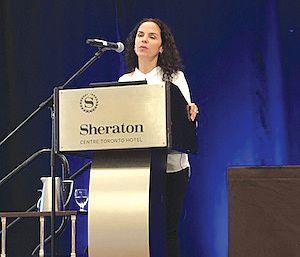
Ariana Arguello explained how FortisBC, BC Hydro and the provincial government worked together to create ‘one window’ to support energy-efficient social housing retrofits.
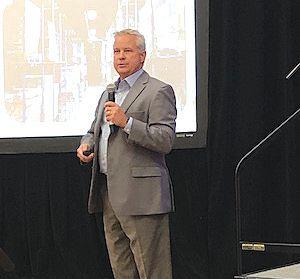
Collin Coker of Viking Cold Solutions explained how thermal batteries can save electricity for frozen-food warehouses.
the dry cleaning industry—to remember to replace their steam traps.
“When steam traps fail, they waste natural gas,” said Joe Bickham, commercial and industrial (C&I) specialty program manager for Franklin, “but upfront thirdparty audit costs are too expensive. So instead, we offer the audit and cover the cost of the new trap.”
In another specialized example, Collin Coker, VP of sales and marketing for Viking Cold Solutions, explained how his company’s thermal batteries—high-density polyethylene (HDPE) ‘cells’ containing a mix of water and salts that store and release thermal energy as they transition between solid and liquid phases—allow frozen-food warehouses to save on cooling energy, particularly during peak-demand periods.
“A 93,000-square-foot warehouse in Richmond, Calif., used the cells during 13-hour peak periods, six days a week,” he explained. “They achieved 43% lower net consumption in kWh, 29% lower peak demand in kW and 50% more stable temperatures. The same technology is getting traction in Ontario in response to Global Adjustment (GA) charges.”
The Internet of Things (IoT) is also enabling new efficiencies. Breezi, for example, is a tech startup known for bringing the popular ‘fitness tracker’ concept to HVAC systems in multi-unit residential buildings (MURBs) and commercial office towers.
“Software can turn machinery condition data into actionable information,” said
Rick Bain, Breezi’s director of business development.
Another main theme of the conference was collaboration. In addition to that between gas and electric utilities, municipal governments are more actively assisting energy manager s, for environmental reasons. By way of example, Trina Innes, director of Alberta’s Municipal Climate Change Action Centre, described funding an energy manager program for municipal facilities, among other projects.
“Vancouver’s looking at retrofit building codes,” added Corey Diamond, executive director of Efficiency Canada. “As cities are on the forefront of climate change mitigation, we’ll soon see them get more resources to support new policies. It will be fast and messy!”
“We work with government, utilities and service providers, connecting them to work better with energy at a local level,” said Tonja Leach, executive director of Ottawa-based Quality Urban Energy Systems of Tomorrow (QUEST). “We need to start not with technology, but with the outcome we want to achieve.”
Following through on that thought, Leach led a panel discussion at the end of the conference about taking an outcomes-based approach when planning deep energy retrofits for existing buildings.
“This approach is still a non-traditional one,” she said.
There are several examples where it is being taken in the Greater Toronto Area (GTA). One is the ‘Towerwise’ retrofit program, which primarily supports MURBs in the social/community housing sector.
“We use performance-based contracts,” explains Bryan Purcell, VP of policy and programs for the Atmospheric Fund behind the program. “The nature of a retrofit across a large facility will depend on the owner’s priorities, but performance requirements keep people at the table and engaged over the long term, extending to operations and maintenance.”
“Our big hurdle will be the contract,” said Kyla Greenham, curator of conservation and environment for the Toronto Zoo, which is moving toward carbon-neutral operations and a 95% GHG emission reduction target. “I’ve already been working on this project for five years and there’s still a lot to figure out.”
“An integrated approach that sets outcomes to be achieved has been common in the information technology (IT) industry for 10 years or more, but it is still new to the construction industry,” said Wesley Bristol, business development manager for Ecosystem, which won an ASHRAE award earlier this year for taking just such an approach to reducing utility bills for Montreal’s Olympic Park. “It’s happening as municipalities have new climate targets and are asking industry experts and the market to help them get there.”

BY ANATOLI NAOUMOV
e will first do all we can with our big energy users,” a plant manager once told me, “and then proceed to an energy audit.”
In the world of industrial energy management, this decision is in line with conventional wisdom, which recommends addressing the biggest ‘trouble’ first. In a perfect, abundant and rational world, this approach may be the best way forward—but in the real world, I think the ‘big-ticket’ approach to energy management may hurt business and responsible managers. The following are four reasons for my opinion.
The approval of a big project calls for a big capital expenditure (capex), often without any track record of similar implementations.This may prove problematic.
Capital, after all, is usually scarce. Any failure to secure sufficient investment for a big change can kill the organization’s appetite for energy management altogether.
Many vendors promote the big-ticket approach because it is highly visible and helps them reach their sales quotas.
Even when there is enough capital, the future of energy management at an industrial plant will be doomed if the bigticket project ends up being considered an underperformer.
It is common for even a decent project to be called a failure when expectations are not aligned, real-world energy management experience is in short supply and corporate politics come into play. When a big project is deemed unsuccessful, this judgment will affect competition for future capex funds.
The effect can go both ways. When a company starts one big energy management project without first establishing a general plan, the performance of that project can end up being affected by other projects later on. By way of example, if a building’s HVAC system is upgraded before a lighting
retrofit, then a new, efficient chiller may be forced to work in an inefficient mode, to meet a lower cooling load, and so its expected savings are never realized.
A similar situation arises when upgrading an air compressor prior to fixing leaks and making other demand-side adjustments. The smaller projects will reduce demand, causing the new compressor to operate inefficiently.
Instead, small projects should be undertaken in a way that makes bigger projects more profitable—or even unnecessary. With a lighting retrofit completed, a new chiller can be smaller. And with small compressed-air projects done, a smaller compressor will likely meet the required load.
While big projects typically entail long payback periods, creating energy management momentum within an organization requires some ‘quick wins’ to establish initial trust in the boardroom.
Small, co-ordinated projects also allow an organization to develop a documenta-
tion and reporting system, which will come in handy when addressing bigger projects.
As the famous Chinese proverb goes, “a journey of a thousand miles begins with a single step.” And that first step can only be taken from where you already are now. In the context of energy management, where starting with a big project may be irrationally risky, the best first step on the long journey is a comprehensive energy audit. This will clarify where the organization stands, create a map of opportunities, assess their interconnections and rank them by profitability.
The process itself saves no energy, but without it, an organization risks making costly, avoidable mistakes. This is why an audit is a great investment.
Anatoli Naoumov is a managing director and ‘chief energy waste-buster’ at GreenQ Partners (greenq.ca), which helps identify, implement and report energy saving projects. He has been named a Certified Measurement and Verification Professional (CMVP) by the Association of Energy Engineers (AEE) and the Efficiency Valuation Organization (EVO). For more information, contact him at anaoumov@greenq.ca.
We provide efficient and cost-effective solutions to your lighting needs and are committed to being your preferred supplier.