EM - May 2019

Page 1


INSIDE

+ Upgrading MICs Group’s hospitals

+ Lithium-ion batterybased energy storage

+ Water submetering for apartment buildings

Editor Peter Saunders psaunders@ebmag.com

Publisher/Sales Anthony Capkun acapkun@ebmag.com

Account Manager Jennifer DiIorio jdiiorio@ebmag.com

Media Designer Svetlana Avrutin savrutin@annexbusinessmedia.com

Account Coordinator Kathryn Nyenhuis knyenhuis@annexbusinessmedia.com

Circulation Manager Urszula Grzyb ugrzyb@annexbusinessmedia.com

Executive Publisher & VP Tim Dimopolous tdimopoulos@annexbusinessmedia.com

COO Scott Jamieson sjamieson@annexbusinessmedia.com

President & CEO Mike Fredericks

What LC3 means for energy-saving retrofits

Announced in March, the 2019 federal budget included an investment of $183 million in Low Carbon Cities Canada (LC3), a new municipal partnership designed to advance energy efficiency in buildings through retrofits, among other methods to reduce emissions and reach climate-change targets for 2030 and 2050.

“Powered

by the federal government’s investment, we will share solutions and best practices across the country.”

- Vicki-May Hamm, FCM

Working with the Federation of Canadian Municipalities (FCM), LC3 centres will be established in seven of the country’s largest urban areas, representing 43% of the population:

• Vancouver and Lower Mainland.

• Edmonton.

• Calgary.

• Greater Toronto and Hamilton Area (GTHA).

• Montreal Metropolitan Community.

• Halifax Region.

Modelled on the example of The Atmospheric Fund (TAF), which will serve as its GTHA partner, LC3 will work to remove barriers for new technologies, policies and financial tools. The

federal investment is intended to bridge the ‘commercialization gap’ by scaling up from concepts and one-off pilot projects to broader implementations and deployments. LC3 will invest the capital on a revolving basis to generate ongoing revenue for grants, projects and operations.

“These are really early days,” says Estelle Taylor, communications manager for TAF. “Finer details will be worked out in the months ahead as each centre ramps up and establishes terms and contracts.”

That said, she lists projects the LC3 organizations are considering supporting once they are up and running. They include:

• demonstrating the feasibility and affordability of comprehensive ‘deep energy’ retrofits for multi-unit commercial and residential buildings.

• leveraging property-assessed financing and other tools to support retrofits.

• helping social/affordable housing providers plan, finance, implement and maintain the performance of multi-measure retrofits.

• demonstrating the feasibility of low-carbon alternatives for space heating, including heat pumps for multi-residential housing retrofits.

• helping to develop and apply energy and water benchmarking rules to drive retrofit activity when buildings are being renovated or sold.

• quantifying the value of co-benefits to energy retrofits, such as increased resilience and indoor environment improvements.

• expanding training opportunities to develop a high-performance building construction workforce.

• co-financing near-net-zero housing retrofits and other energy upgrades for Indigenous communities.

“Powered by the federal government’s investment in LC3, we will share solutions and best practices with cities and communities across the country,” says Vicki-May Hamm, FCM’s president. Energy managers, to be sure, will be keen to see where this initiative leads in the days to come.

IMPROVING IAQ EFFICIENCY WITH BIOFILTRATION
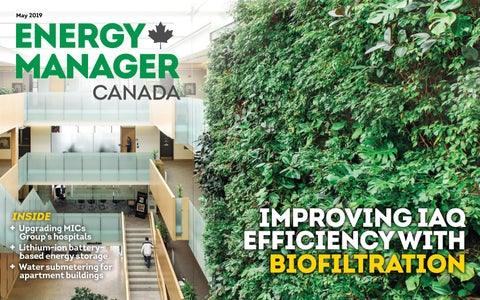
The traditional means of maintaining indoor air quality (IAQ) is to displace the ‘dirty’ air inside a building with new, ‘fresh’ air from outside. Since outdoor air quality is generally very good across North America, this method has proven effective at both (a) maintaining comfortable indoor temperatures and (b) reducing indoor buildup of pollutants, but at an energy cost that begs the question: is it possible to spend less to get the same results?

Costs of conditioning

For buildings with central air handling systems, the ideal temperature for IAQ is 15 C (59 F). This setting allows for heat removal from activities within the space. Therefore, before fresh air is disseminated in the space, it must be conditioned to an appropriate temperature to ensure occupant comfort.

Most indoor spaces require the delivery of new outside air at a rate of 8 to 10 L per second per person, as outlined in ASHRAE’s standard 62.12016, Ventilation for Acceptable Air Quality. Given this flow rate and the heat and density of the air, it is possible to calculate the amount of energy required for this task over a range of temperatures typically encountered in North American cities (see Chart 1 on page 5).

Note this calculation represents only the energy required to heat the air; it does not reflect the additional energy associated with humidity management. Most warm air is also humid, after all, and the removal of excessive moisture represents a substantial energy requirement in itself. Cold air, meanwhile, is inherently dry, leading in winter to the addition of moisture, which is also very energy-intensive.

By way of example, if the outside temperature is -25 C, conditioning intake air to a comfortable

The conditioning of this additional flow of air can represent a substantial energy cost to building owners. Under normal conditions, approximately 10% to 20% of the energy consumed by a building is used to condition intake air; but during extreme seasonal temperatures, that figure jumps to more than 30%.

Diamond Schmitt Architects specified a four-storey tall living wall biofilter for this civic centre in Cambridge, Ont., which then became the first LEED Gold-certified building of its kind in Canada.

Energy required to deliver clean air to one person as a function of outside air temperature

1: Gigajoule savings (range) per 100 L of air from a biofilter per year (by location).

20 C can increase the corresponding energy demand by nearly 50%, with 0.42 KW per person for heat increasing to 0.62 KW per person with humidification.

In an effort to reduce these energy expenses, many building managers limit the amount of outside air delivered to the occupants. This limitation can lead to a decrease in IAQ, which in turn reduces the well-being of the occupants.

To address this common dilemma, building operators seek to strike a balance between energy expenses and occupants’ health.

Addressing the dilemma

Biofiltration provides an alternative means of refreshing indoor air without the expense of bringing in new, fresh air from outside. The technology uses considerably less energy than conventional systems, without sacrificing the benefits of IAQ improvements.

One example of biofiltration is a ‘living wall.’ This is a hydroponic plant whose roots spread between layers of synthetic growth media. A living wall is designed to draw dirty indoor air in through this root zone.

Microbes on the plant’s roots consume pollutants as food. In turn, the plant emits clean air, which is then distributed throughout a building through the heating, ventilation and air-conditioning (HVAC) system. And the emitted air is already nearly the ideal temperature and humidity level.

Researchers have used RETScreen clean energy management software to calculate the cost

Chart 1
FIGURE

savings of biofiltration. Developed by Natural Resources Canada with a variety of partners, RETScreen uses advanced algorithms and databases to help the private and public sectors determine if proposed energy efficiency, cogeneration and renewable power projects make financial sense. Specifically, the software was used to calculate the cost savings of generating 100 L of clean air per second with 1 to 2 m2 of biofilter, compared to bringing in the same volume of air from outside, over an entire year. Data available through RETScreen, including regional temperature ranges and utility rates, allowed the researchers to assign local costs to clean and conditioned air.

The results showed using biofiltration to supply ‘virtual’ outdoor air achieved energy cost savings, as measured in gigajoules per 100 L of air per year and by location (see Figure 1 on page 5).

Generation and capacity

Assuming air flows at 0.05 m3 per second per square metre of biofilter, with an average removal efficiency of 50%, this rate is equivalent to 25 L of new outside air.

Further, assuming an occupancy density of one person per 20 m2 of floor space and a recommended ratio of 1 m2 of biofilter per 100 m2 of floor space, the biofilter could provide 50% of the ‘fresh air’ requirements of five occupants. This capacity translates into electricity savings during peak HVAC use—i.e. in the heat of summer for cooling air and the cold of winter for heating it— of 0.3 and 0.58 KW per occupant, respectively.

These calculations are for the absolute amount of cooling and heating required. They do not take into

The air emitted by a biofilter is already nearly the ideal temperature and humidity level.

account the use of heat pumps, which would reduce power requirements further. By way of example, an efficient heat pump can generate the equivalent of 4 KW in cooling while consuming only 1 KW of electrical power. If heat pumps are in place, then the biofilter is still generating clean air using less than half the energy of the traditional system.

Chart 2 summarizes energy required to condition biofiltered air, intake air, cold air, ‘normal’ air and hot air. As the biofilter emits air close to the ideal temperature, it requires the least amount of energy.

Unexpected results

Interestingly, conditioning cold air (i.e. warming it) requires the greatest amount of energy, even though doing so uses the cheaper form of energy: natural gas.

Since the electricity used for air conditioning is relatively more expensive than the natural gas used for heating, the researchers’ original assumption was biofiltration would achieve greater savings in warmer climates, where buildings rely more heavily on electricity. Instead, the savings were greater in cities where buildings use more heating throughout the year with natural gas (see Chart 3).

The reason for this unexpected result is the degree of difference. In Northern Canada’s colder climes, the absolute temperature gradient is greater. In fact, it is common for such buildings to experience a 40 to 50 C gradient.

Chart 2: Energy required to condition air to supply quality.
Chart 3: Potential energy savings in major cities.

A four-storey biofilter at Toronto’s Centennial College produces enough clean air to replace 20% to 30% of the library and academic facility’s intake air from outdoors, which would otherwise need to be heated or cooled.

In 2014, the historic Edmonton Federal Building was rejuvenated with the addition of a public atrium, featuring a 2,400-square-foot multi-sided, multi-level living wall biofilter.

Other benefits

The primary byproduct of using biofiltration for air in a building is, of course, a vibrant, living plant wall. Unlike other IAQ systems, there are no dirty filters to dispose of and no off-gassing of collected pollutants. Nature takes care of the volatile organic compounds (VOCs).

Living wall biofilters can also help buildings achieve ‘green’ certifications, including those relating to Leadership in Energy and Environmental Design (LEED), ASHRAE 62.1—Ventilation for

Acceptable Indoor Air Quality, the Canada Green Building Council’s (CaGBC’s) Well standard and the Green Infrastructure Foundation’s Living Architecture Performance Tool. In many cases, such certifications can help generate higher property values and tenant rents.

Cindy Loosemore is a writer and marketing professional based in Waterloo, Ont. She wrote this article on behalf of Nedlaw Living Walls in Breslau, Ont., which designs, builds and maintains biofiltration systems. For more information, visit www.nedlawlivingwalls.com.

Photo by Jim Dobie
A living wall at the University of Ottawa’s Vanier Hall extends six storeys high in the north atrium. Photo by Doublespace

Be proactive about carbon costs

Does your organization operate in New Brunswick, Ontario, Manitoba or Saskatchewan?

On Apr. 1, 2019, a federal carbon tax began applying to fossil fuels consumed in these four provinces because, unlike other Canadian jurisdictions, they have not put their own price on greenhouse gas (GHG) emissions that contribute to climate change. The initial tax is $20 per tonne of carbon dioxide (CO2) equivalent. Its cost reflects the quantity of GHGs emitted from burning each type of fossil fuel, e.g. 3.9 cents per cubic metre of natural gas. The tax is set to increase by $10 per year until it reaches $50 per tonne in 2022.

Know what you use

Have you budgeted for increased energy costs? If you know how much your facility already consumes, then you san set a baseline as the foundation for your energy management strategy, so actions to reduce

GHG emissions can follow, such as implementing conservation measures, changing procurement practices and/or adding on-site generation. You can then account for avoided carbon tax costs by tracking, reporting and verifying savings associated with emission reductions.

Know if you can enjoy a partial exemption

Large emitters (i.e. above 10,000 tonnes of CO2 equivalent) in specified industries may apply to join the federal output-based pricing system and get an exemption from paying the entire carbon tax.

Greenhouse growers can receive an 80% carbon tax break for natural gas and propane used to heat or provide CO2 for their crops, while farmers can receive total exemptions for fuel used in their work equipment.

For any exemptions to be applied, of course, utility providers need to be notified about them.

Take action to reduce costs

While it is impossible for most energy managers to immediately eliminate the use of fossil fuels and avoid the carbon tax, (a) incentives and rebates will help in the medium term and (b) reducing your reliance on energy that contributes to global warming is a long-term challenge. With the right playbook, fuel switching, energy efficiency and carbon tax avoidance are all achievable.

David Arkell is CEO of 360 Energy, one of Canada’s pre-eminent energy management consulting firms. For further information or assistance, please contact him at 877-431-0332 or david.arkell@360energy.net.

The tax is set to increase by $10 per year until it reaches $50 per tonne in 2022.

UPGRADING MICS GROUP’S HOSPITALS

In April, the MICs Group of Health Services—named for its hospital locations in Matheson, Iroquois Falls and Cochrane, Ont.—launched a comprehensive 18-month energy and facility renewal program. The $3.1-million initiative will address aging and inefficient infrastructure and is expected to save approximately $123,000 in utility and operational costs per year. These savings, guaranteed by Honeywell Building Technologies (HBT) through a 10-year performance contract, will go toward paying for the improvements. In addition, the upgrades are expected to qualify for a Union Gas commercial and industrial (C&I) energy efficiency incentive program, which has already provided $10,000 for the study portion and could add a further $15,000 once the project is completed.

What’s old is new again MICs operates three acute-care sites in Northern Ontario, all of which provide in- and out-patient, emergency, general surgery, ambulatory care and long-term care services:

• Bingham Memorial Hospital (BMH), a 46,000-square foot facility in Matheson, built in 1954 and renovated and expanded in 1989.

• Anson General Hospital (AGH), a 53,000-square-foot facility in Iroquois Falls, built in 1987.

• Lady Minto Hospital (LMH), a 60,000-square-foot facility in Cochrane, built in 1978 and renovated in 1990, 1998 and 2006.

One of the top priorities is replacing LMH’s chiller plant, which dates back to 1996 and is nearing the end of its useful life.

Photos courtesy HBT
“As hospitals get older, we are in the business of helping them reduce their costs, but no two projects are the same. We have to focus on the initiatives that make the most sense for each facility.” - Luis Rodrigues, HBT

“When I arrived at MICs in 2014, there had not been any major energy projects in more than 15 years,” says Paul Chatelain, CEO. “I had dealt with HBT before and they approached us with this opportunity.”

“We worked with Paul when he was at two other hospitals in the past,” says Luis Rodrigues, vice-president (VP) and general manager (GM) of HBT’s energy services group. “Half of our business is with existing clients, as we are able to go back to them and introduce new technologies.”

“MICs was also an existing customer for us,” adds Jeremy Newhook, senior business consultant for HBT. “We had provided capital upgrades in an earlier energy-saving project that formed an ongoing relationship for service and maintenance.”

Prioritizing programs

By June 2018, the new partnership was coming together. The top priorities included replacing LMH’s chiller plant, which dated back to 1996 and was nearing the end of its useful life, with a high-efficiency water-cooled model; replacing refrigeration equipment running on expensive municipal water with a new air-cooled system; installing low-flow plumbing fixtures; and replacing steam dryers and sterilizers with gas-fired alternatives. Other program measures will include: recommissioning heating, cooling and ventilation system controls; improving the building envelope with upgraded weather sealing and insulation on and

near windows to reduce drafts; installing ozone (O3) laundry systems, which use cold water to significantly reduce hot water consumption; and correcting the power factor for heat distribution based on changes in occupancy levels throughout the day.

“We will also install new controls equipment for the electric car plugs out front of the hospitals,” says Newhook. “These will be used to reduce consumption of electricity associated with keeping car block heaters warm in winter.”

“Our initial list was longer and would have cost $5 to $6 million, but we don’t have those resources,” says Chatelain. “There used to be more grants and incentives when Ontario had a cap-and-trade program, which recently ended. Nevertheless, we decided to move ahead in a more limited fashion. No matter how long the payback is, we’ll be saving money—and we may add other projects after the first 18 months.”

Sound investments

At press time, HBT had already begun supplying low-flush toilets and ordered the chiller upgrades.

“Most of the work will be done over the summer, which is typical practice in Northern Ontario,” says Chatelain. “HBT’s 10-year performance contract will come into effect when they finish installing everything.”

For its part, HBT expects to complete all of the upgrades by April 2020.

Replacing LMH’s existing piping system will pave the way for a steam-to-hot-water conversion of the boiler plant, to be undertaken in the project’s second phase.

“We are very proud to work with MICs as it takes a proactive approach to energy consumption,” says Rodrigues. “As hospitals get older, we are in the business of helping them reduce their costs, but no two projects are the same. We have to focus on the initiatives that make the most sense for each facility.”

“The energy savings will have a direct impact on our operating costs,” says Chatelain. “We are taking an aggressive approach by paying upfront to save money over time. This is a sound investment in the hospitals’ future.”

‘Discharge time’ is the period required for a battery to fully discharge itself after it has been completely charged. This period is generally a wide range, depending on the type of technology running off the battery.

‘Efficiency’ or ‘round-trip storage efficiency’ is the difference between the amount of energy you can put into a battery and how much you can get out of it. A low-efficiency battery is not economical when taking electricity off the grid, as the customer will end up paying for the electricity lost in the round trip.

The lifespan or ‘cycle capacity’ is also important. This refers to how many times the battery can be charged before it fades or how many years the battery will last.

All of these facets need to be considered,

along with the battery’s upfront cost, size and indoor and outdoor ambient temperature range ratings (especially when operating in extreme conditions).

Li-ion batteries, for their part, range in power from 0.1 to 100 MW, power density from 150 to 315 W per kg, energy density from 75 to 200 Wh per kg, discharge time from one minute to eight hours, efficiency from 75% to 98% and lifespan from 300 to 10,000 cycles or five to 15 years.

It is worth noting batteries are modular and can therefore be scaled up relatively easily to meet increased needs. While each battery offers a limited amount of energy storage that is predetermined, multiple batteries can be combined to achieve the desired capacity.

Growth and limits

The most prominent brands in the commercial and industrial (C&I) Li-ion battery-based energy storage market include Tesla (in partnership with Solar City), ABB, AES Energy Storage, Alevo, Electrovaya, Green Charge, Greensmith Energy, JLM Energy, LG Chem, Panasonic, Primus Power, Siemens, Sonnen and Younicos. Due to investments to support consumer electronics like smartphones and laptop computers, as well as electric vehicles (EVs), the costs of Li-ion batteries have declined significantly in recent years. Battery technology for EVs, especially, has been replicated and increased in scale for stationary energy storage applications. While declining costs for Li-ion batteries

are opening new markets, there are limits. For one thing, most applications to date have been designed to supply ancillary services or demand response, rather than dynamic real-time operations. For another, backing up large office buildings or industrial sites with today’s technology for anything more than a few minutes would require multiple shipping containers’ worth of batteries, at which point users run up against physical constraints in terms of finding enough space to house them. Rooftops are generally not feasible, as commercial- and industrial-scale batters are extremely heavy.

Depending on local building codes and regulations, there may be additional restrictions on where batteries can be located, e.g. rules prohibiting large-scale battery deployments in underground parking garages. As more experience is gained and the technology proves itself, some of these barriers may be lifted in the future.

Analyzing costs

A cost analysis of Li-ion batteries for energy storage needs to consider the potential value streams provided by the technology. Given today’s upfront costs, the majority of the resulting energy savings must be committed to paying for the battery itself. If the customer can take advantage of more than one value stream, on the other hand, the payback could be quicker and the benefits clearer.

Figures courtesy Powerconsumer FIGURE

Turn static files into dynamic content formats.

Create a flipbook
Issuu converts static files into: digital portfolios, online yearbooks, online catalogs, digital photo albums and more. Sign up and create your flipbook.