GETTING A HANDLE ON AIR HANDLING
INSIDE
+ Thriving in a post-COVID-19 world
+ AI and building analytics
+ Leak detection with ultrasound
+ Smart water metering

+ Thriving in a post-COVID-19 world
+ AI and building analytics
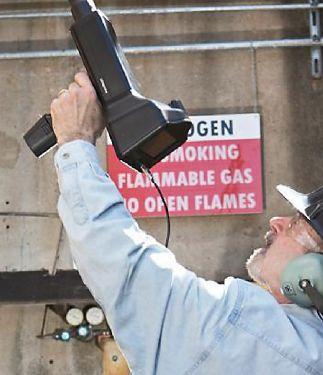
+ Leak detection with ultrasound
+ Smart water metering
CopperTree Analytics can help you to create operational efficiencies, reduce your buildings’ energy consumption and improve your bottom line. We deliver a comprehensive building analytics solution, consisting of an Energy Information System (EIS) and a Fault Detection and Diagnostics (FDD) platform with integrated system performance auditing.
Our software, KAIZEN, continuously monitors your building’s performance alerting you if a fault is detected or if performance is sub-optimal. Our clients use this powerful tool to move from a reactive or preventive maintenance model, to a data-driven proactive maintenance approach.
With no upfront capital investment and an affordable SaaS (Software as a Service) usage fee, KAIZEN results in time and resource savings for facility managers and cost savings for stakeholders.
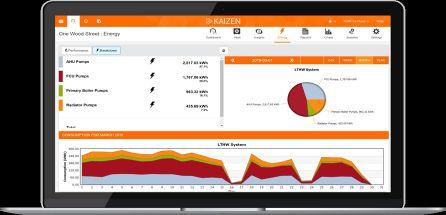

TRANSFORM YOUR BUILDING ANALYTICS INTO REALISTIC ACTIONS
CONTINUOUSLY MONITOR YOUR BUILDING DATA
BENEFIT FROM AUTOMATED REPORTING AND DISTRIBUTION
SAVE TIME AND MONEY WITH AUTOMATED FAULT DETECTION & DIAGNOSTICS (FDD)
Editor Doug Picklyk dpicklyk@hpacmag.com
Publisher/Sales Anthony Capkun acapkun@ebmag.com
Account Manager Jennifer DiIorio jdiiorio@ebmag.com
Media Designer Andrea M. Smith asmith@annexbusinessmedia.com
Account Coordinator Kathryn Nyenhuis knyenhuis@annexbusinessmedia.com
Circulation Manager Urszula Grzyb ugrzyb@annexbusinessmedia.com
Executive Publisher & VP Tim Dimopolous tdimopoulos@annexbusinessmedia.com
COO Scott Jamieson sjamieson@annexbusinessmedia.com
The next generation of variable-airvolume systems for buildings deliver improved energy efficiency, occupant comfort and indoor air quality.
Deciphering artificial intelligence and understanding how new analytics systems will lead to better, smarter, buildings.
Leak Detection
How to perform cost-saving leak detection using ultrasound technology.
Smart Water Meters
Gain control, save money and help the environment with greater visibility into water flow.


In the last issue I raised the issue of benchmarking the energy use in buildings as a great tool for comparing the efficiency of your facility to others of similar build and use in your area.
Well, that was two months ago, and we’re operating in a completely different world today. The general economy, not only in Canada but globally, has been devastated by the dramatic actions taken by governments around the world to contain the spread of the coronavirus COVID-19.
Self isolation and work from home orders have left many buildings empty and commercial areas deserted. Priorities have shifted to personal health and safety, and no doubt even when the gradual return to work begins our interpersonal behaviours will be more guarded and work space arrangements will have to be re-adjusted. How many people will want to ride in a crowded elevator? Maybe more people will be taking the stairs.
But before we look ahead to active workplaces again, if your building is currently operating empty, this may be the best time to evaluate the energy consumption your building really requires.
Without the variable energy consumed by normal daily activity, now is an opportunity to
Benchmarking sets the road map for discovering energy savings and lays out the obvious targets for energy efficiency goals. The data also helps develop the business case for ongoing energy improvements or retrofits and the need for someone to coordinate those activities.
identify areas of uncessary energy waste. In his
The 360 on Energy column in this issue, David Arkell points out, “Reviewing utilities is a lowcost action. It will eliminate any energy and water use that is not required. These are expenses your organization does not need.”
If for some reason your building is not benchmarking its energy consumption, maybe now is the time to start. Some regions are beginning to mandate benchmarking measures, so get ahead of the curve if you’re not already there.
In 2018 the federal government launched the ENERGY STAR certification program for commercial and institutional buildings in Canada. It’s voluntary, and already the online registry has 187 listings. The certification lets building owners demonstrate an environmental commitment, but it also gets building managers using the well-recognized ENERGY STAR Portfolio Manager, the de-facto benchmarking tool.
Of course, any improvements to the energy efficiency of a commercial, institutional or industrial facility not only provides benefits to the environment at large, but it also tends to raise an asset’s value and contribute to a better bottom line.
Energy benchmarking sets the road map for discovering energy savings and lays out the obvious targets for energy efficiency goals. The data also helps develop the business case for ongoing energy improvements or retrofits and the need for someone to coordinate those activities.
These are challenging times. Stay safe, keep in touch with family and friends, and look forward to better days ahead.
Doug Picklyk dpicklyk@hpacmag.com
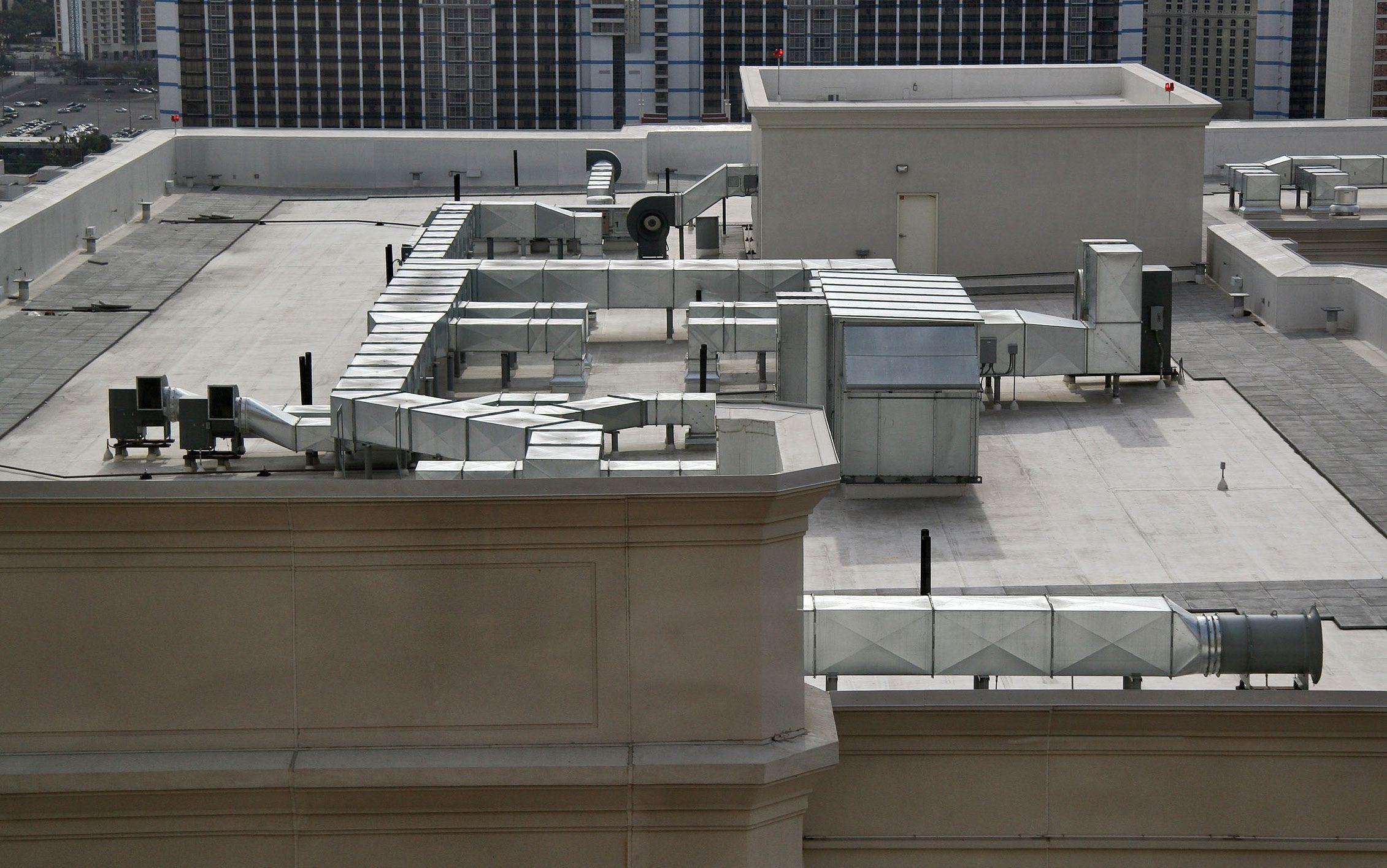
Experienced designers know that a well-designed high-performance air system is the most cost-effective and efficient system for many buildings. Thanks to industry and ASHRAE innovation, no other air-conditioning technology has advanced as rapidly over the last 10 years / BY GUS FARIS, DAN INT-HOUT AND MARK TERZIGNI
Over the last decade, perhaps no ventilation-system type has seen more innovation and greater advances than the variable-air-volume (VAV) system. Through application of best practices and the use of modern components, a new generation of VAV system has emerged: the high-performance air system (HPAS), so called because it ele-
vates the already high levels of performance of its technological forebearers.
Static-pressure and supply-air-temperature reset, along with significant improvements in economizer control and reliability, have slashed energy consumption. Chiller and rooftop-unit part-load efficiencies, meanwhile, have increased 50% with the addition of variable-speed

technology for fans and compressors and now often are used with geothermal fields, further enhancing efficiency.
Fan arrays, direct-drive fans, and advanced motors have reduced air-handler maintenance and unit size and driven up efficiency, while pretreatment, series energy
recovery, bypass and heat recovery have cut the amount of primary energy used for reheat to nearly zero.
ASHRAE (American society of heating, refrigeration, and air conditioning engineers) research has driven changes in ANSI/ASHRAE Standard 62.1, Ventilation for Acceptable Indoor Air Quality , that will allow a HPAS
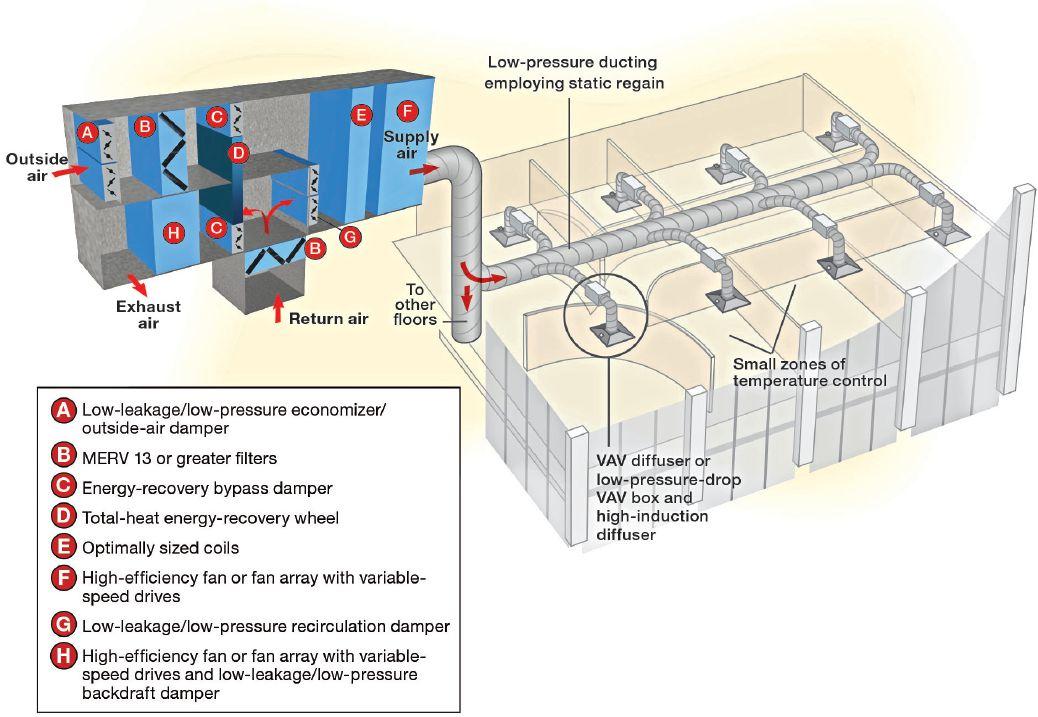
Ducted high-performance air system.
to bring in less outside air than a typical dedicated outdoor-air system (DOAS) and have provided a standardized sequence of operations that make HPAS the easiest systems to specify controls for.
For more evidence, look at the list of winning projects in virtually any building-design awards program from the last five years, and you will see HPAS are well-represented. In fact, from 2016 to 2018, every hospital and every large office building but one recognized in the ASHRAE Technology Awards program utilized a HPAS.
No issue is more important in the design of a commercial building than occupant comfort. To a leaseholder, employee-compensation costs are by far the largest expense— more than 130 times the cost of providing HVAC.1 That is why dissatisfaction with indoor environmental quality (IEQ) is the top reason owners cite for why leases do not get renewed.1
The zoning capability of HPAS enhances comfort. As with zonal cooling systems, indoor equipment can be sized for any zone, with most zones able to be served with one VAV terminal; even very large open areas rarely require more than two VAV terminals. HPAS achieve this level of zone control much more cost-effectively than do zonal systems—a central system requires only a VAV terminal, while a zonal system requires an additional fan coil, ventilation air distribution, piping controls, and, often, condensate collection for each new zone. And if a building needs to be reconfigured, changing the capacity of a VAV terminal often is as simple as updating a few parameters in the building automation system.
Comfort involves more than air temperature; it also encompasses drafts, noise, and humidity. With high-efficiency fans located far from occupants and compressors located even farther, HPAS operate at Noise Criterion
(NC) levels lower than those of any competing system. Modern HPAS humidity control largely happens at the air handler or rooftop unit. Designers are using methods such as coil bypass, outside-air pretreatment, and series energy recovery to circulate cool, dry air throughout buildings at temperatures that minimize reheat well below the maximum level in ANSI/ASHRAE/IES 90.1, Energy Standard for Buildings Except Low-Rise Residential Buildings . With widespread use of heat-recovery chillers, many buildings use almost zero primary energy for reheat.
top concern of building owners. HPAS ensure clean air is provided to every part of a building. Zone air-conditioning systems, on the other hand, struggle to provide high-efficiency filtration and often provide no filtration at all; when they attempt to provide MERV (Minimum Efficiency Reporting Value) 13 performance, for example, their 1-in. and 2-in. filters clog rapidly, wasting energy and necessitating more frequent maintenance.
With a rooftop unit or air handler, high-efficiency filters have a barely noticeable effect on performance and reduce maintenance requirements, according to the U.S.
Comfort involves more than air temperature; it also encompasses drafts, noise, and humidity.
For designers using ANSI/ASHRAE 55, Thermal Environmental Conditions for Human Occupancy, HPAS solve a lot of problems. Achieving and maintaining comfort involves much more than the control of air temperature; how air is distributed also is critical. The correct setting on a thermostat is of no value if occupants are in the path of a draft. With a HPAS and data provided by suppliers, designers can set the location of grilles, registers, and diffusers to ensure proper air distribution and eliminate drafts. Not only are many zonal devices, particularly those in occupied spaces, not designed to ensure proper throws, their manufacturers do not supply the data required by ANSI/ASHRAE 55, making it difficult for designers to show compliance. Right behind comfort, indoor-air quality (IAQ) is a
General Services Administration.2 For this reason, the U.S. Environmental Protection Agency recommends the use of an HPAS-type system in schools.3
In addition to ensuring clean air, air handlers are easy to keep clean, meeting the accessibility requirements of ANSI/ASHRAE Standard 62.1. Most direct-expansion (DX) fan coils, on the other hand, require nearly complete disassembly for cleaning. For owners wanting to cover all of the bases, ultraviolet lights—which are difficult and often unsafe to add to small DX fan coils but are a standard option in HPAS products—nearly eliminate any risk of biological contaminants.
Of course, energy never is far from owners’ minds,
either. It is easy to convince a layperson a zoned system will use less fan energy, but when you “look under the hood,” the advantages of a central system quickly reveal themselves.
Experienced designers know compressor energy exceeds fan energy by a factor of five or more in any system, and the surest way to reduce HVAC energy consumption is to turn off, or at least reduce the load on, compressors. This means economizing, bringing in 100% outdoor air when outdoor air has less energy than indoor air—like opening windows at exactly the right times. Of course, this makes IAQ advocates happy, as buildings can operate with 100% outdoor air much of the time in many climates.
When applied with static-pressure reset, HPAS use much less fan energy than in the past. While they may use more fan energy than a zonal system at the building design point, 99% of the time, the fans are running at much lower loads. In fact, for the vast majority of operating hours over the course of a year, HPAS fan motors consume 30% or less power than they do at full speed.
With buildings often operated at minimum ventilation airflows, HPAS use less fan power than DOAS much of the time. While both system types circulate the same amount of air, HPAS do it with more efficient fans and lower pressure drop. HPAS can circulate less ventilation air than DOAS for two reasons:
Demand-controlled ventilation is easy and nearly cost-free to implement with a HPAS. With a DOAS, it significantly increases equipment and controls costs. Since publication of the 2016 version of ANSI/ASHRAE Standard 62.1, outside air to many zones can be turned off while the zones are unoccupied, which can reduce outside-air requirements by up to 15%.

Deciphering artificial intelligence and understanding how new analytics systems will lead to better, smarter, buildings /
BY RICARDO MOROMISATO
These days it’s hard to avoid hearing about or reading news articles or online postings related to Artificial Intelligence, or AI. Whether it is smart appliances and home automation systems with intelligent digital assistants, autonomous vehicles, advanced medical diagnostics, virtual reality, or even human-like
McCarthy during a conference with fellow scientists at Dartmouth College in New Hampshire. Yet AI, described as the ability for machines to simulate intellectual processes characteristic of humans, is an area of study that has existed long before its inception as an academic discipline. Alan Turing, the British mathematician known for his cryptanalysis of the Enigma during the Second World War, and whose life is featured in the 2014 film, “The Imitation Game”, invented his “a-machine” (automatic machine) in 1936, and is widely considered to be the father of theoretical computer science and AI.
automatons—there seems to be no stopping AI. And when it comes to buildings, new automation systems used to control comfort, security and energy efficiency are moving towards intelligently controlled solutions.
AI is not a new concept. In fact, it was coined over 60 years ago by John
Even in our world of facility and energy management, AI sits among a long list of buzzwords including data mining, machine learning, predictive analytics, data science, deep learning, and many others which are trending upwards and gaining renewed popularity. However, even when these words are springing up in our everyday conversations and media discussions, for many of us the concepts are often fuzzy at best and incomprehensible at worst. This article aims to provide some clarity to this ‘word salad’, giving basic definitions and explaining how these