it was cut). Mills conducted an exhaustive search in neighbouring Maritime provinces, but to no avail, because their programs for instrumentation tech were too dissimilar. Same with Ontario, Manitoba and Saskatchewan.
It wasn’t until he got to Alberta that they found a placement for Jeremy because the programs were similar.
Not only is this story a great example of going that extra mile, but it also highlights how greater harmonization across provinces could help more apprentices cross the finish line.
Mills asked attendees to consider how they could help apprentices who are struggling. Rather than write them off, talk to them; maybe that apprentice has a learning disability that could be easily addressed.
He recounted a story about a welding apprentice who simply could not pass his Level 2, no matter what... yet he was a fantastic TIG welder. So why was he failing?
After some investigation, the apprentice was given graph paper to use as a scratchpad the next time he sat down to write his Level 2 exam. A simple thing like this helped the apprentice organize his thoughts and go on to pass his Level 2.
Capping off the morning session, EBMag’s Anthony Capkun moderated a panel of employers, educators and apprentices to get their gut reactions to STO’s Strategic Plan.The panel included:
• Nick Dewar – Trained as a sheet metal worker, now general manager with Optimum Mechanical.
• Kylia Mulvee – Starting her apprenticeship for electrical.
• Paiton Manuel – A second-year brick and stone masonry apprentice.
• Alan McClelland – chair, Heads of Apprenticeship Training Committee, Colleges Ontario; Dean, School of Transportation, Centennial College.
• James St. John – Trained as ironworker, now business manager/ financial secretary of the Central Ontario Building Trades, and president/director of the Hammer Heads Program.
• Robert De Rubeis – 35 years in secondary and post-secondary education, now manager of Gateway to the Trades.
All panelists felt the vision presented in the Strategic Plan was on the money, with one word of caution: the devil is in the details.
After lunch, attendees participated in a facilitated workshop—“Building STO’s future”—to foster discussion and generate ideas toward making STO’s vision come alive. STO’s vision is underpinned by these four objectives:
#1 – Support an innovative apprenticeship and certification model
Support an apprenticeship experience that prioritizes the needs of Skilled Trade Ontario’s clients, and support employers in building the skills and capabilities of their apprentices.
#2 – Promote and advance the skilled trades
Promote and advance the skilled trades to ensure the skilled trades workforce is robust and trained to the highest standard, and that skilled trades professionals can take pride in their career choice and the services they provide.
#3 – Facilitate research in the skilled trades
Take an informed, data-driven approach to decision-making to improve operational efficiency, customer satisfaction, and the overall performance of the skilled trades sector.
#4 – Build a diverse, equitable, and inclusive skilled trades sector
Create a welcoming environment that fosters creativity and encourages teamwork, and empower individuals from all backgrounds by promoting equity and inclusion in the skilled trades.
“The labour shortage is a critical challenge for Ontario, and it is more pressing now than ever before,” said Young. “With one in five jobs predicted to be in the skilled trades by 2026, we need to take action to attract and inspire the next generation of skilled trades professionals. Our strategic plan will provide a clear roadmap for driving growth in the sector and positioning Ontario as a leader in apprenticeship.”
NETCO Annual Training Conference
National Electrical Trade Council
August 13, Toronto netco.org
EFC Federation Cup Golf Tournament
Electro-Federation Canada
August 23, Ajax, Ont. electrofed.com
IEEE PCIC
Petroleum & Chemical Industry
Technical Conference
September 11-14, New Orleans, La. ieeepcic.com
ECAO Annual Industry Conference
Electrical Contractors Association of Ontario
September 17-21, Boston, Mass. ecaoboston-2023.com
CANEW – Canadian Airports
National Electrical Workshop Canadian Airports Electrical Association
September 24-29, Lethbridge, Alta. canew.ca
The Utility Expo
September 26-28, Louisville, Ky. theutilityexpo.com
ESC Annual Conference
Energy Storage Canada October 3-4, Toronto energystoragecanada.org
ECABC AGM, Conference, Tradeshow Electrical Contractors Association of British Columbia October 10-11, Whistler, B.C. eca.bc.ca
AD Electrical North American Meeting October 18-20, Grapevine, Texas adhq.com
AEA Electrical Learning Expo
Alberta Electrical Alliance October 25, Edmonton albertaelectricalalliance.com
Got an event to share? Email the editor at acapkun@ebmag.com. Meantime, scroll through Electrical Business Magazine’s online industry calendar at ebmag.com/events for direct links to these events (and others).
CAREERS THAT CHARGE AHEAD
The Top Electrical pros we need now... or tomorrow
Alabour shortage in the skilled trades is on everyone’s lips, and the electricity sector is far from immune. And while the vocation of “Electrician” continues to be a popular calling for those seeking careers in the construction trades, we are going to need a lot more of them in the coming years.
As Canada continues its pursuit of decarbonization— largely through the electrification of anything and everything—our society simply won’t be adequately served by the current roster of construction or industrial electricians. Rest assured: we still need them, but we are also going to need a whole new slate of electrical pros for specialized work.
The work could involve something carried out by the electrical contractor (including high-voltage) or maybe the electric utility, or perhaps a whole new business model. But one thing remains certain: the electrical sector is not only competing with other sectors for talent, but also with itself; besides electric utilities, manufacturers and distributors of electrical solutions are also casting their nets into the same talent pool.
Some vocations are not even specific to Electrical, but we will need them nonetheless: project managers, welders, cybersecurity specialists, computer network technicians and programmers, and many others.
As such, it’s never too soon to start planning for who you will need in your workforce in the coming years.
Through its countrywide surveys, Labour Market Intelligence reports, roundtables, and so on, Electricity Human Resources Canada has established itself as a trusted source of human resources insight, programs, and tools for the electricity sector.
For that reason, we turned to EHRC to discover which electrical professions will be in high demand over the coming years (if not already!) during Canada’s energy transformation.
SOLAR THERMAL HYDRONIC INSTALLER
Solar thermal hydronic installers install customized systems that collect radiant heat from the sun at low, medium or high temperatures for a variety of heating purposes in residential, commercial or light industrial settings. The solar thermal collectors may be mounted on the ground or built on the roof or walls of buildings. The heat is transferred from the collectors throughout the system using a heat transfer fluid.
Important: Some construction and installation tasks included in the trade national occupational analyses for Industrial and Construction Electricians are also performed or subcontracted by solar thermal hydronic installers.
CHART OF COMPETENCY
Category Competency Area
Construction and installation
FACT:
The largest segment of the solar thermal world market is now from medium-scale domestic hot water applications, accounting for up to 60% of new installed worldwide capacity. These types of systems are generally pumped systems, using either closedloop design with freeze-proof heat transfer fluid, or drainback systems using water.
Foundational trades skills
• Plan installation
• Perform foundational electrical tasks
• Install solar thermal system
• Install control systems
• Install wiring systems
• Complete installation process
• Commission equipment and systems
• Perform routine trade tasks
This SPECIAL FEATURE was developed in partnership with Electricity Human Resources Canada—the trusted source of HR insight, programs, and tools for the electricity sector.
ELECTRICAL ENGINEERING
Electrical engineering technicians and technologists may work independently or provide technical support and services in the design, development, testing, production, and operation of electrical equipment and systems.
Electrical engineering technicians working in the electricity sector can:
• Assist in the design, development and testing of electrical components, equipment, and systems.
• Assist in inspection, testing, adjusting, and evaluation of incoming electrical and electro-mechanical components and assemblies to ensure conformance with product specifications and tolerances.
• Conduct life tests (burn-ins) on assemblies and record and analyze results.
• Conduct or supervise the installation, commissioning, and operation of electrical equipment and systems.
• Carry out applied research in fields of electrical engineering and physics under the direction of scientists or engineers.
CHART OF COMPETENCY
Category Competency Area
Design
• Set up and operate specialized and standard test equipment to diagnose, test and analyze the performance of electrical components, assemblies and systems.
• Write specifications, schedules and technical reports and control schedules and budgets.
• Conduct pre-design activities
• Support pre-design consultations
• Design electrical system
• Assist in building and testing prototypes to specifications.
• Install, operate and maintain electrical equipment and systems.
• Calibrate electrical equipment and instruments according to technical manuals and written instructions.
• Collect and compile operational or experimental data and assist in the preparation of estimates, schedules, budgets, specifications and reports.
Electrical engineering technologists working in the electricity sector can:
TECHNICIAN/TECHNOLOGIST Transmission will become even more important in the coming years as our grid expands to include more (often distant) solar generation, wind turbines, and energy storage, plus emerging technologies like small modular reactors.
• Design, develop and test power equipment and systems.
• Supervise the building and testing of prototypes according to general instructions and established standards.
Construction and installation
• Support design of electrical system
• Produce design drawings and construction documentation
• Install generating, distribution and service equipment
• Install control systems
• Install smart/intelligent equipment
• Complete installation process
• Conduct tests for commissioning
• Commission equipment and systems
• Assist with commissioning of power generation equipment and systems
Power generation
Transmission & distribution
Asset maintenance
Grid technology
• Perform power station routine operation duties
• Operate transmission system
• Balance energy in system
• Operate distribution system
• Respond to electrical emergencies
• Prepare to maintain equipment and systems
• Conduct tests for maintenance
• Maintain generating, distribution and service equipment
• Assist with power-generating equipment maintenance
• Support nuclear power station maintenance activities in field
• Maintain control systems
• Maintain generating, distribution and service systems
• Maintain signalling and communication systems
• Repair electrical, hydraulic and mechanical equipment and systems
• Optimize equipment and system performance
• Support development of grid technology system
• Support commissioning of new/upgraded SCADA software
• Maintain SCADA functionality
• Support commissioning of new/refurbished assets and new energy resources to existing SCADA system
• Coordinate work with SCADA field technicians
• Maintain efficacy of SCADA data/databases
• Provide support for other enterprise services (e.g. telecom)
• Comply with network protocols
Engineering
Provide support for engineers
FACT:
There are currently over 166,000 kilometres of high-voltage transmission lines in Canada—enough to wrap around the earth over 4 times.
CHART OF COMPETENCY
Category
Power generation
POWER STATION OPERATOR
Power station operators operate power-generating equipment such as boilers, turbines, and generators to convert the power created from primary energy sources (e.g. coal, natural gas, and water) into electricity. They monitor and control equipment and auxiliary systems from both the station floor and control room(s) to ensure the equipment and systems are operating safely, efficiently, reliably, and within the prescribed limits to meet regulatory requirements, achieve productivity and efficiency goals, and provide reliable electricity.
Important: Some tasks are performed by all power station operators, while others may be specific to hydroelectric stations or thermal/ fossil fuel stations.
Competency Area
• Perform power station routine operation duties
• Operate major power station components
• Operate power station environmental protection systems
• Operate power station auxiliary systems and equipment
• Operate power station emergency and standby power systems
• Respond to unexpected events/incidents
Construction and installation
Transmission & distribution
Asset maintenance
Foundational trades skills
• Assist with commissioning of power generation equipment and systems
• Operate transmission system
• Operate distribution system
• Maintain generating, distribution and service equipment
• Assist with power generation equipment maintenance
• Perform routine trade tasks
Common competencies
The following competency categories and areas are common to all the profiles shown here.
Category Competency Area
Safety
Security
Policies and procedures
Information/record management
ICT foundations
Personal competencies
• Maintain a safe working environment
• Maintain a sustainable environment
• Respond to emergencies
• Follow security practices
• Follow organizational policies and procedures
• Complete information/record management tasks
• Use digital technology
• Use organization’s information & communications technology systems
• Demonstrate professionalism
• Communicate effectively
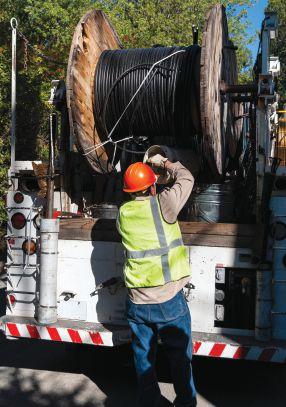
POWER CABLE TECHNICIAN
Power cable technicians install, operate, maintain, and repair power cables and related underground and above-ground infrastructure that is part of transmission and/or distribution systems. They are employed by electrical power generation, transmission and distribution companies, as well as electrical contractors and public utilities.
CHART OF COMPETENCY
Category
Construction and installation
Competency Area
• Plan installation
• Install underground cable systems
Splice underground cables
• Terminate underground cables
• Complete installation process
• Commission equipment and systems
Asset maintenance
Foundational trades skills
• Prepare to maintain equipment and systems
• Maintain underground cable systems
• Repair underground cable systems
• Perform routine trade tasks
This SPECIAL FEATURE was developed in partnership with Electricity Human Resources Canada—the trusted source of HR insight, programs, and tools for the electricity sector.
Dino Alimonti has been promoted to vice-president, Sales, at Eaton Canada. He most recently served as national sales manager, Canada, overseeing the various sales districts. Prior to that, he held a variety of roles of increasing responsibility across Marketing, Operations, and Sales. Alimonti holds a degree in Electrical Engineering from Toronto Metropolitan University (formerly Ryerson). Source: Eaton Canada
Mersen’s Tom Giuliano has assumed the position of vice-president, OEM Sales, for North America. He joined Mersen as a design engineer when Eldre was acquired in 2012. Giuliano has held positions of increasing responsibility, says Mersen, ranging from technical to sales functions and, most recently, as key account manager. He reports to Ferran Sacrest, vice-president, Sales & Customer Care, Americas. Source: Mersen
Gary Pounder has joined Stanpro in the newly created role of vice-president, Market Strategy, and interim sales manager for the Greater Toronto Area. As vice-president, Pounder will help ensure the company is embracing “an integrated approach” and coordinate market initiatives that will “accelerate Stanpro’s growth”. As interim sales manager, he is expected to “build a strong team” that will sustain itself when he exits the role. Source: Stanpro
Procore Technologies Inc.—a provider of construction management software—has taken on Sarah Hodges as chief marketing officer.
“As an established industry thought leader and advocate for women in construction, her customer-centric approach to marketing and ability to lead and inspire teams make her the ideal fit for this role,” said Tooey Courtemanche, founder, president and CEO. Source: Procore
Sonepar announced expanded responsibilities for MGM’s regional director, Jason Copeman: “all functional leaders of MGM and Dixon Electric will report directly to Jason”. MGM Electric is an electrical distributor serving Thunder Bay and northwestern Ontario. Dixon Electric is a full-line electrical distributor serving northern Ontario. Copeman will continue to report to Todd Walford, president, Sonepar Ontario.
Source: Sonepar
Denise Rumsey has been appointed regional sales manager (Central) at Eglo Canada, where she brings “over 10 years of expertise in the lighting and electrical industry, and seven years of management and leadership experience”.
Source: Eglo Canada
Shane Berry (far left) has been promoted to the position of vice-president, Manufacturing and Distribution, at Service Wire Co. “Shane’s professional and organizational skills make him a strong asset to our company,” said Chuck Oldaker, executive VP. The company also hired Tanner Beckett as inside sales rep. His territory includes British Columbia and Alberta. Source: Service Wire
After 12 years serving as its president, Stephen Sell has left the Ontario Electrical League. Over those years, he also served as president of the Ontario Mechanical League (launched in 2018) and executive director of Support Ontario Youth. Replacing him is Beatrice Sharkey, who has previously worked with provincial and municipal governments, associations, not-for-profits and small businesses. OEL also welcomed Michelle Barta as training and event coordinator. Her last position in the industry was with Nedco, as national marketing manager, Customer Loyalty and Promotions. Source: Ontario Electrical League
We’re limited by space here, but have plenty of room online! Read the news behind the news Visit EBMag.com and click “News”.
FIVE REASONS CONSTRUCTION JOBSITES ARE GOING ELECTRIC
The electrification of construction machinery is hardly a new concept. For years, electric equipment has been commonly seen in a variety of applications, from demolition and mining to aerial lift and industrial work.
Now, however, electric equipment is becoming increasingly prevalent on and around jobsites. Its benefits are clear; its potential is evident. Its long-term place in the industry is no longer up for debate.
And, as electric vehicles continue to be more widely adopted by consumers, all that’s left to do is examine—and try to accurately determine—how the construction industry should prepare for the technology to become fully mainstream in the not-too-distant future.
While speaking about just the variety of electric vehicles we’ll see down the road (pun intended), David Knight, CEO of IoT company Terbine, said “If you go out [in] about three years, there will be approximately 700 [types of] electric vehicles roadside, and that’s not even getting into construction and agriculture”.
Speaking at CONEXPO-CON/ AGG 2023, Knight commented on how the construction industry should prepare for the widespread adoption of electric vehicles. According to Knight, there are five main reasons why equipment end users in the construction industry are strongly considering investing (or already have invested) in electric equipment:
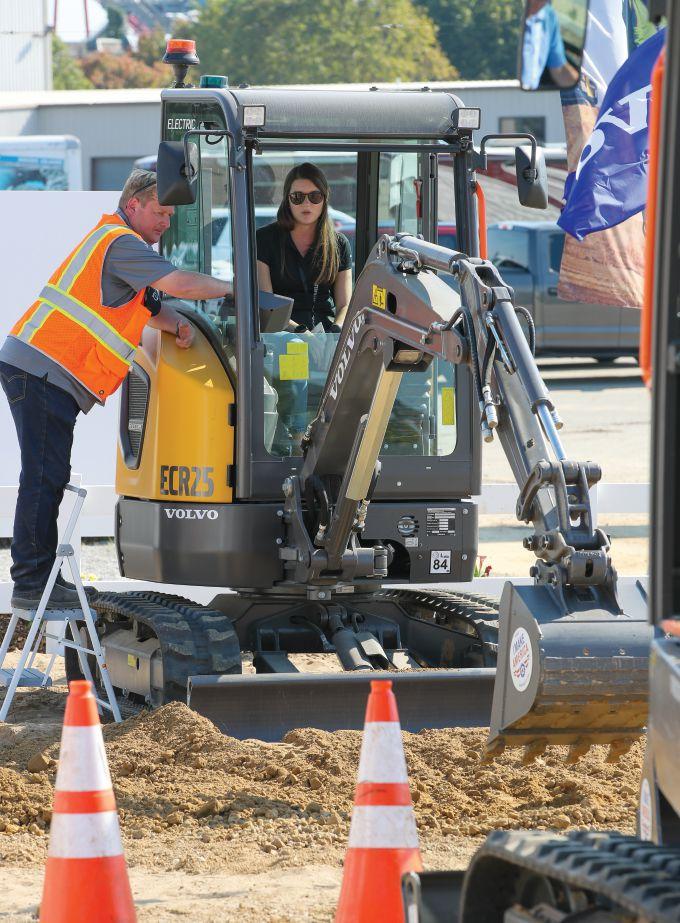
Debut of Volvo Construction Equipment’s ECR25 electric compact excavator at The Utility Expo. In 2021, the unit came equipped with a 48V, 20 kWh Li-ion battery (with auxiliary 12V battery), delivering 4 hours of run-time (depending on the application). On-board charging at 230 VAC 16A takes about 5 hours; at 400 VAC 32A, off-board charging time for 80% charge takes about 50 minutes. Photo: The Utility Expo.
Lower operating costs
The savings on diesel costs alone are significant. Most OEMs cite a range of four to eight hours of run-time for “average” use on electric compact equipment, with an 8-hour overnight charge. And while it’s quick and easy to compare run-times on a fully charged electric machine against a full tank on diesel units, 1
remember that there is no idling on an electric machine. Therefore, an operator can get a day or more of productive work out of it because he’s not typically running a machine for eight continuous hours.
Lower maintenance costs
Reciprocating engines possess many friction-generating parts that fail. The friction, and the frictional components and amount of heat generated with an engine running, is really what contributes to parts being replaced and maintained.
Federal and tax credits
Incentives can offer savings in the tens or even hundreds of thousands of dollars across a single fleet. Because they change all the time, it is important for organizations to stay up to date on available incentives— both regionally and nationally.
5 2 3 4
Carbon credits and offsets
Carbon credits (a.k.a. carbon allowances) work like permission slips for emissions. When a company buys a carbon credit—usually from government—it gains permission to generate one ton of CO2 emissions. When one company removes a unit of carbon from the atmosphere as part of its normal business activity, it can generate a carbon offset. Other companies can then purchase that carbon offset to reduce their own carbon footprint.
ESG goals
Organizations are slowly setting and working toward environmental, social, governance goals—a trend that is expected to become more common with time. Companies without ESG goals and corresponding policies face risks that could include loss of investors, a damaged reputation, and fines for regulatory non-compliance.
There is every reason to believe that electric vehicles and equipment will continue to develop and improve over time, said Knight, thus making a greater level of adoption even more likely in the near future.
According to Knight, the architectures of EVs are rising to even higher voltages. The higher the voltage, he explained, the less current is needed for a given amount of wattage. That also means less heat. And while voltages are very good now, they are expected to improve significantly in the coming years.
“They’re going to be really good in three to five years, and that’s going to allow for even faster and more efficient charging than ever before,” he added.
— With files from the Association of Equipment Manufacturers, a North America-based international trade group representing off-road equipment manufacturers and suppliers.
LET’S TALK ABOUT THE OTHER PANDEMIC: BREAK-INS
Ontario’s electrical distributors are being targeted /
BY ANTHONY CAPKUN
It started with a phone call from one of my friends in electrical distribution: “Hey Anthony, have you heard anything about a bunch of break-ins at electrical distributors?”.
Up until that moment, I had not.
“They’re taking residential wire, smoke detectors [...]” my friend continued, adding that the thieves—who may or may not be the same ones behind all break-ins—are using stolen vehicles. “They seem to be a well-organized outfit.”
Now that I have heard about what sounds like a crime spree, I wanted to know more. Copper theft is not new (we’ve published numerous news items on that front), but this sounded like something different altogether. And it seemed to be concentrated in Ontario.
Rather than phone every electrical distributor in the province, I figured the most efficient way to learn more was to contact Carol McGlogan, president & CEO of Electro-Federation Canada, which counts many of Canada’s electrical distributors in its membership.
How big is the problem, and where?
McGlogan says she, too, was caught off guard when the news of break-ins was first brought to her attention.
“Gerrie Electric were the first to approach me. They had had several branch break-ins and were wondering whether or not I had heard similar news from other distributors,”
The highest amount of activity occurred between Q4 2021 and Q1 2022, accounting for 60% of the break-ins.
McGlogan says. “And, at that point, I had not, so I sent out a note to all the heads of distributors in Ontario, asking whether they were seeing any activity.”
After not hearing back from anyone, EFC figured the Gerrie break-ins were isolated incidents. “But then, all of a sudden, I started to get a couple of responses saying, ‘Oh, yeah, we’ve seen some activity’,” McGlogan says. “So I sent out a second request, and then I got a bunch back.”
It was now abundantly clear that this was not an isolated incident.
“So we met as a group—those who had been affected, or who were interested in learning more,” she continued. The group assembled as much information as they could about the incidents, and delivered all of it to the police.
The No. 1 products being stolen are wire and cable, but the list also includes circuit breakers, receptacles, LED light fixtures and lamps, power tools, power bars/extension cords, lighting controls and sensors, and other building products.
When McGlogan says they compiled detailed information about the break-ins, she is not kidding. The group is looking at everything from time of day and location (e.g. behind the building) to the types of doors the thieves are breaching (e.g. glass, roll-up).
And the facts bear out that this remains primarily an Ontario problem.
In Brampton, one distributor pleaded for a meeting with the mayor to address the break-ins problem, writing:
I have been trying to reach you and would like a meeting asap to discuss. We have been broken into five times plus one failed attempt. We are tired and frustrated [...] and risk being cancelled by insurance or having to pay outrageous premiums.
Besides wire and cable, thieves take the opportunity to grab whatever they can along the way.
“We have national distributors on our task force, and they’re just talking about Ontario,” McGlogan noted. “I would imagine if there were a problem in other parts of the country, they would have said. But nobody has requested anything national, so we’re focused on Ontario.”
To wit, an excerpt from an EFC letter to police in April 2022:
“The recent rise in copper prices have made wire and cable a key target for theft in Ontario. In the past 5 months, 86 targeted thefts have occurred within our distributors—all for the same product, with similar tactics being used. Our concern is that these are organized crimes spanning several jurisdictions requiring a co-ordinated effort to solve and prevent.”
By the numbers
Since our initial conversation, McGlogan cited the most current statistics:
• 114 reported break-ins to EFC.
• The highest amount of activity occurred between Q4 2021 and Q1 2022, accounting for 60% of the break-ins.
• Regions with the highest break-in activity are: Halton (20), York (18), Peel (17), Waterloo (16), Durham County (15).
• At least $1.2 million in stolen goods has been reported. This amount is likely higher, as some distributors did not provide dollar values.
“When a deal is too good to be true, it’s a red flag... If you’re getting a price that’s way too good, your antenna should be up.”
Prevention is the key, and that includes asking how law enforcement could help prevent these activities (like driving around the back of these distributorships), and providing law enforcement with as much information as possible. Something in there could help them solve these cases.
“If I remember correctly, one of our task force members had a break-in that occurred through the roof. They could see it on the camera footage,” McGlogan said. “And the guy fell and hurt himself, and had to be carried out by his posse.”
When we spoke, McGlogan could not say with 100% certainty whether it is one criminal organization or many behind the break-ins, nor does she know where the stolen goods are ending up.
Community response
“Whenever there’s another break-in, I collect the information,” McGlogan says. The task group’s members not only share intel about methods of entry, but also what they’re doing to secure the premises. “Whether it’s parking vehicles in
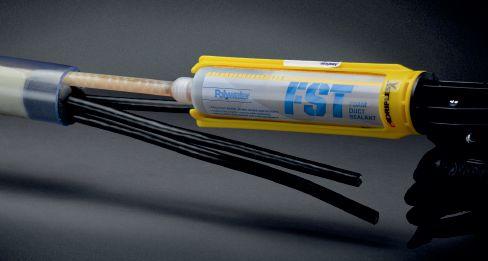
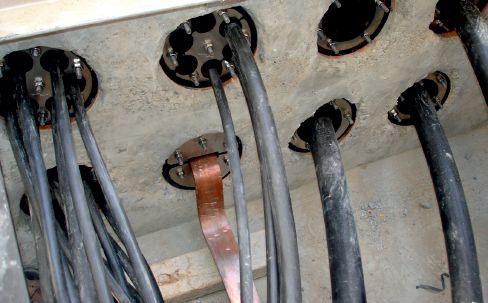
• Holds 22 ft. (6.7 m) of water head pressure and up to 90 ft. (27m) surges.
• Can seal conduits of all sizes and is re-enterable.
• Use with a wide range of cable jacket and conduit materials.
• Meets Canadian Electrical Code requirements.
CODE conundrum
RAY YOUSEF Ray is a code engineer with Ontario’s Electrical Safety Authority front of the door, or doing certain things with locks inside... somebody even mentioned a type of detector that disperses a fog during a break-in. There’s all sorts of cool things out there to catch the bad guys.”
EFC has provided members with information on how to keep their premises safe, as well as a flyer to police identifying EFC members who require extra protection. “And we have provided a flyer to be distributed at branch locations to inform contractors of the safety implications of purchasing stolen and counterfeit goods.”
There is also a chat group among Ontario distributor leaders where they share information about their break-ins and offer security tips. “So they’re connecting with each other for best practices, and to help the police network among themselves, especially when the activity is crossing jurisdictions.”
Outside of the moral, ethical implications of purchasing stolen goods, I asked McGlogan what message she has for people who are being offered great deals for something that fell off the proverbial back of a truck?
“When a deal is too good to be true, it’s a red flag... something’s off, right? If you’re getting a price that’s way too good, your antenna should be up.”
“Whenever you buy outside of authorized channels, you don’t know whether you’re dealing with stolen product, or maybe even counterfeit product... you really don’t know, and that’s a safety issue,” she said. “As a contractor, you’re obliged to carry out safe installations and keep your customers safe.”
“Also, what’s your recourse if something goes wrong with the product? When you purchase from the proper channel, you have recourse in terms of quality and returns, and that kind of thing. So you’re giving up all of your protections.”
At the end of the day, McGlogan said, you put your customer into harms way, and risk your own reputation, because you will be linked to all of that activity.
And that reputation extends to the entire community. If you see it, report it, McGlogan said. “It’s like Neighborhood Watch... to watch out for each other. You want to keep this industry clean. So it’s important to respond as a community.”
ADVERTISER INDEX
TACKLE THE CODE CONUNDRUM IF YOU DARE! Welcome to the newest round of questions that test your knowledge of the CE Code-Part I. Answers will appear in the October 2023 edition of Electrical Business Magazine, and online at EBMag.com under Features.
QUESTION 1
What is the maximum mounting height to the overcurrent device handle of a panelboard in a dwelling unit?
a) 1.5 m b) 1.6 m
c) 1.7 m d) 1.8 m
QUESTION 2
Conductors for equipotential bonding shall be permitted to be installed as open wiring, provided they are adequately secured.
a) True
b) False
QUESTION 3
The maximum rating for a circuit breaker protecting exposed wiring for permanent outdoor lighting circuit is:
a) 15 A b) 20 A
c) 30 A d) 40 A
ANSWERS
Electrical Business, June 2023 ed.
Question 1
When a PV recombiner is more than 7.5 metres from the inverter, the disconnect: d) all of the above. Rule 64-060.
Question 2
The ampacity of a communication cable marked “-LP” is determined by: b) The ampacity marked on the cable. Rule 16-330.
Question 3
Raceways that are less than 2 metres above grade and subject to mechanical damage shall:
d) Any of the above. Rule 12-934.
How did YOU do?
3 • Seasoned journeyman 1 • Apprentice
2 • Need refresher training 0 • Just here for fun!
DAN LEDUC
Retro is not cool... when it comes to prompt payment
Iam seeing a disturbing cash flow trend (in Ontario, at least) that, left unchecked, will take us back in time, not forward. Notwithstanding the changes made to the Ontario Construction Act in 2018 and 2019—and especially those surrounding prompt payment—in the last month alone, I have seen in construction documents:
1. Contract terms designating payment to be 45 days from receipt of an invoice.
2. In unit price contracts, negotiation and submittals prior to a proper invoice being accepted by the payment certifier.
45 days later
The construction industry is premised on cash flow; the examples above interfere with timely cash flow and are, in fact, breaches of the Ontario Construction Act, which states:
Payment deadline, owner to contractor: 6.4(1) Subject to the giving of a notice of non-payment under subsection (2), an owner shall pay the amount payable under a proper invoice no later than 28 days after receiving the proper invoice from the contractor (2017, c.24, s.7).
28-day terms, not 45. This becomes clearer when you consider Sections 4 and 5 of the Act:
No waiver of rights: 4) An agreement by any person who supplies services or materials to an improvement that this Act does not apply to the person or that the remedies provided by it are not available for the benefit of the person is void (R.S.O. 1990, c.C.30, s.4; 2017, c.24, s.69).
Contracts to conform: 5(1) Every contract or subcontract related to an improvement is deemed to be amended in so far as is necessary to be in conformity with this Act (R.S.O. 1990, c.C.30, s.5[1]).
The purpose behind enacting changes to the Ontario Construction Act (and to equivalent provisions in other Canadian jurisdictions) was to get the industry back to better cash flow, which benefits everyone.
These clauses render most payment terms that deviate from 28 days likely unenforceable.
Unit price contracts
Mandating some form of prior approval on quantities or amounts would also be a potential contravention of the Act especially when one considers the definition of a “proper invoice”:
6.1 In this Part, “proper invoice” means a written bill or other request for payment for services or materials in respect of an improvement under a contract [...] and, subject to subsection 6.3(2), meets any other requirements that the contract specifies:
1. The contractor’s name and address.
2. The date of the proper invoice and the period during which the services or materials were supplied.
3. Information identifying the authority, whether in the contract or otherwise, under which the services or materials were supplied.
4. A description, including quantity where appropriate, of the services or materials that were supplied.
5. The amount payable for the services or materials that were supplied, and the payment terms.
6. The name, title, telephone number, and mailing address of the person to whom payment is to be sent.
7. Any other information that may be prescribed (2017, c.24, s.7).
There is also a procedure for delivering a proper invoice:
6.3(1) Proper invoices shall be given to an owner on a monthly basis, unless the contract provides otherwise (2017, c.24, s.7).
Restriction on conditions: (2) A provision in a contract that makes the giving of a proper invoice conditional on the prior certification of a payment certifier or on the owner’s prior approval is of no force or effect (2017, c.24, s.7).
Two things to note:
1. The definition of “proper invoice” has nothing to do with quantities or amounts agreed upon in advance—even informally. It requires the contractor (the one with a direct contract with the owner) to determine the amount payable for the services or materials supplied.
2. Any type of provision in a contract that speaks to any kind of prior approval is of no force or effect... yet I am seeing such provisions in specs that will likely form part of the contract documents.
The purpose behind enacting changes to the Ontario Construction Act (and to equivalent provisions in other Canadian jurisdictions) was to get the industry back to better cash flow, which benefits everyone—not just subs, but also consultants and owners.
Hurdles to prompt payment need to be addressed, either through your trade or construction association, or some other avenue. If we don’t stem the tide, slow and protracted payments will become the industry norm once again.
This column is not legal advice, nor should it be taken as such
Dan Leduc is a partner at Soloway Wright LLP, and specializes in construction law. He is always happy to take on new clients from anywhere in Canada, and can be reached at dleduc@solowaywright.com.
FLEXIBLE SOLUTIONS ARE ESSENTIAL FOR ENERGY TRANSFORMATION
Plug-and-play renewable energies / BY
KARTHIK VELAYUTHAM
The energy sector is in a state of transition as the world moves to lower-carbon power generation. Embracing sustainable resources is key to achieving environmental goals but, due to their unpredictability, generation flexibility will be key.
The International Energy Agency (IEA) Net-Zero by 2050 roadmap states that a rapid scale-up of renewable technology is needed to meet the world’s energy ambitions (tinyurl.com/muxt2wpm). The roadmap estimates we could achieve this goal with the addition of 630 GW of solar and 390 GW of wind generation every year.
But these figures aren’t actually realistic.
New technologies will help address some of the limitations faced by our current renewable energy sources—primarily, flexibility.
These levels for solar and wind are, in fact, 4x the record volume of wind and solar generation seen in 2020. Moreover, IEA admits the level of solarpower alone would require the construction of the world’s current largest photovoltaic parks every single day. (The Golmud Solar Park in China has an installed solar capacity of 2.8 GW.)
Expanding the generation capacity of existing renewable energy sites is great, but we also need to see the deployment of new renewable energy technologies.
New energy technologies
IEA’s roadmap estimates that around half of the reductions in emissions by 2050 will come from technologies that are still at the prototype or demonstration stages; new technologies that will help address some of the limitations faced by our current renewable energy sources— primarily, flexibility. By their very nature, wind, solar, and tidal power are all unpredictable, with only a certain degree of accuracy achievable in estimating
We have been focused on exploiting low-level and ground winds with units that will be easily fitted to buildings in urban and built-up areas.
Source: Katrick Technologies.
kinetic energy potential. This means that the energy flow from a renewable source can be inconsistent, unstable, and difficult to control.
Moreover, not every solution is suitable for every location; landlocked areas will not benefit from tidal power, and built-up areas present an obstacle for wind power.
Energy storage offers one solution to this challenge. While a variable supply can pose an issue in a typical grid configuration, implementing battery storage to store surplus energy can safeguard supply.
Plug-and-play generation
A growing field of green energy technology is plugand-play systems, which are able to be used immediately upon connection, with minimal effort required. Beyond the initially installation and connection to the main grid, these systems do not require overly complex infrastructure nor large amounts of space and, because they can be installed individually and connect easily to the grid, the penetration level could be significant.
At present, the most common plug-and-play renewable energy technology is solar. In the United Kingdom, around 1.2 million (or 4.1%) of homes use the technology. However, this leaves a more-efficient source of generation—wind— largely untapped.
This is not surprising, as windpower options are currently limited by their size. Granted, small turbines for individual use do exist, but to install one large enough to power a house or business can be very costly and subject to complex planning regulations.
That’s why we have been focused on exploiting lowlevel and ground winds with units equipped with aerofoils that capture kinetic energy from wind at a far wider range of frequencies than regular turbines. Their modular configuration and size (around 0.9 x 0.9 m for the residential panels) allows them to be easily fitted to buildings in urban and built-up areas.
That’s our plan. The technology is currently in the prototyping stage, so planning regulations will be addressed further during the development stage and especially when the panels are commercialized.
Renewable energy is essential for reaching net-zero targets but, for this to happen, plug-and-play technologies like ours and others in development will play a vital role. Boosting flexibility and stability by improving the diversity of energy generation can help to balance energy supply with demand for clean, consistent power.
Karthik Velayutham is chief technology officer with Katrick Technologies—a cleantech startup that has designed and patented technologies to capture and convert energy from waste heat, wind, and waves into mechanical vibrations to produce carbon-free electricity.
Rockbook X540 and X550 G2 notebooks
Source: Werock Technologies GmbH Werock’s Rockbook X540 and X550 G2 rugged notebooks come with 11thgen Intel Core processors and up to 32 GB of RAM. They include options for LTE and 5G, and boast Wi-Fi 6 and Bluetooth 5.2, and can be used with all major GPS navigation systems. The X540 and X550 G2 weigh 2.85 kg and 3.3 kg, respectively, and come with two batteries: a 46.6-Wh hot-swap battery and an additional fixed 14.8-Wh battery (werocktools.com).
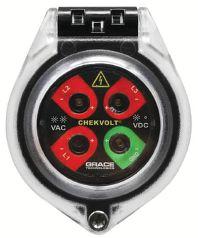
Grace Technologies’ ChekVolt
Source: Grace Technologies
ChekVolt allows you to test for the absence of voltage without opening enclosure doors. The device is a permanent electrical safety device (PESD) that allows such testing to be performed “safely by qualified electricians using their trusted voltmeters”. This touch-safe, compact PESD features voltmeter-compatible test points and redundant LED voltage presence indication rated up to 1000 VAC/VDC (graceport.com).
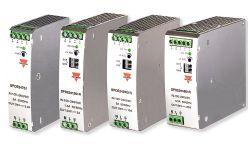
SPDE “ultracompact” DIN-rail power supplies
Source: Carlo Gavazzi
Carlo Gavazzi’s SPDE series consists of three frame sizes, with 75W (32-mm wide) on the low end to 480W (48mm wide) on the high end. Their design allows them to save up to 50% on panel space, says the company. Industry approvals include CE, UKCA, UL61010, and UL62368. The input voltages range is 90 VAC to 264 VAC, and 120VDC to 370VDC, while the output voltage range is 12 VDC, 24 VDC or 48 VDC (gavazzionline.com).
Field Productivity and Workforce Planning
Source: Procore Procore Workforce Management is a new solution featuring two key products: Field Productivity and Workforce Planning (formerly known as LaborChart). When paired, the two give you visibility into your workforce so you can better forecast and manage human resources. Field Productivity helps uncover real-time labour productivity information, while Workforce Planning helps centralize scheduling and communication (procore.com).
Keen Utility Pittsburgh Energy
Source: Keen Utility Keen says it is combining “a proven athletic-hiker fit with a nimble, easy-wearing work experience” with its Pittsburgh Energy. This medium-duty boot features asymmetrical carbon-fibre toes that are 15% lighter than steel, an oil- and slip- resistant outsole, and an EH rating to serve as a secondary source of protection from live circuits (keenfootwear.com).
Satco double LED strip lights
Source: Satco Products Inc. Satco/Nuvo has added double LED strip lights to its strip light collection. Boasting the look of a traditional fluorescent tube fixture, the new strips are offered in 2-ft and 4-ft configurations in 4000K CCT, and both sizes can accept an optional PIR motion sensor. With a high lumen output, damp location rating and rugged design, these strip lights are ideal for replacing or upgrading traditional fixtures (satco.com).
We’re limited by space here, but have plenty of room online! Check out more products and solutions at EBMag.com, under “Products”.
JOURNEYMEN WHO NEWLY CERTIFIED IN 2020 HIT HARD BY PANDEMIC
The onset of Covid in 2020 had a negative impact on the economy as a whole, but particularly on newly certified journeymen, as evidenced by the take-up rates of the Canada Emergency Response Benefit among skilled tradespeople (38.4%) and the general working population (35.2%).
Among the restrictions that provinces and territories implemented to contain the spread of Covid was the closure of many worksites. Actual construction cannot be done virtually, which is why newly certified journeys were more negatively affected than others in the labour force.
Journeymen who newly certified in 2020 earned a median employment income
Actual construction cannot be done virtually, which is why newly certified journeys were more negatively affected than others in the labour force.
of $50,080 that year, which marked a 5.2% drop compared with what those who certified in 2019 earned.
This represents one of the lowest median employment incomes of newly certified journeymen since the series started in 2008.
Combined with declines in workable hours and business shutdowns, journeymen who certified in 2018 had a median employment income of $57,450 in 2020. This marked an 8.2% (-$5,160) decline from the previous year, and the lowest median employment earnings since
the beginning of the series. Although the median employment income of journeymen (-8.2%) fell in 2020, when the median total income of journeymen was evaluated—including non-employment income from government transfers like CERB—the income of journeymen had a relatively slight decline compared with the previous year (-2.9%).
Income declines across Canada
In 2020, due to unprecedented challenges from the pandemic, the median em-
ployment income of newly certified journeymen fell across Canada compared with those who certified the previous year. (The median employment income of journeys largely depends on the state of the local labour market and the economy in general.)
The median employment income of newly certified journeymen continued to be highest in the territories (-13.5% to $66,540) and Alberta (-7.0% to $57,230). While both jurisdictions experienced significant drops, it was Newfoundland & Labrador (-16.3%) that recorded the largest decline from 2019.
Income falls in most trades
Only 3 of the 31 trades that Statistic Canada tracked saw growth in the median earnings of newly certified journeymen from 2019 to 2020: agricultural equipment technicians (+9.8%), industrial instrumentation and control technicians (+4.4%) and powerline technicians (+1.1%).
The remaining trades experienced decreases from 0.4% to 31.2%. (Not surprisingly, trades that rely heavily on interactions with the public—such as hairstylists [-31.2%], cooks [-21.5%] and estheticians [-21.3%]— decreased the most.
Considering these three trades have some of the highest concentrations of female journeymen and were most at risk of job disruption due to Covid restrictions,
CHART 1
Percent change in median employment income of newly certified journeypersons, 2019 compared with 2020 by jurisdiction.
Atlantic region
Newfoundland and Labrador
Prince Edward Island
Nova Scotia
New Brunswick
Quebec
Ontario
Manitoba
Saskatchewan
Alberta
British Columbia
The territories
Source(s): Registered Apprenticeship Information System (3154).
their decreases contributed to a larger decline in female journeyman income (-13.1%) than in male journeyman income (5.7%).
Journeyman mobility rates also decline
Previous research has found that interprovincial mobility can affect a journeyman’s income, notes Statistics Canada. Economic gains are among the main reasons for migration, and those who are mobile and migrate to other provinces tend to have higher incomes compared with those who do not.
In 2020, one year after certification, 5.2% of journeymen either lived or worked in a province or territory other than their place of certification. This marked the lowest national mobility rate of journeymen since the data series started in 2008, and a continued downward trend for a third year.
Sticking with 2020, against the backdrop of Covid restrictions, weak oil prices, and declines in construction activity and support activities for oil and gas extraction (-41.3%),
CHART 2
Median employment income of journeymen and other postsecondary graduates, two years after program completion.
Undergraduate degree
Professional degree
Master’s degree
Doctoral degree
Journeypersons
Note(s): All values are measured two years after program completion for those who certified or graduated in 2017 and 2018. They are adjusted to 2018 constant dollar values.
Source(s): Registered Apprenticeship Information System (3154) and Postsecondary Student Information System (5017).
Alberta’s gross domestic product dropped 8.2%—the largest decline among the provinces and territories.
Amidst these economic uncertainties, Alberta had difficulties retaining and attracting migrant journeymen. In 2020, under one-fifth (18.2%) of mobile journeymen (i.e. those who lived or worked in a province or territory other than their place of certification) who certified in 2019 moved to Alberta. This marked a 3.7 percentage point decline from the previous year, and the sixth consecutive year of in-migration declines.
In 2014, Alberta’s resource boom made it an attractive destination, and in-migration of newly certified journeymen to Alberta peaked, with nearly one-half (48.9%) of mobile journeymen moving there. In 2020, just over one-third (33.7%) of mobile journeymen had left the province.
British Columbia slowly replaced Alberta as the most common destination for newly certified migrant journeymen. In 2020, one year after certification, Brit-
ish Columbia received just under one-quarter (24.4%, +1.5% from 2019) of newly certified in-migrants, most
of whom migrated from Alberta, followed by Ontario (22.6%), which also surpassed Alberta
NANSY HANNA, P.ENG
Multiple power sources and transformer disconnection
As the installation of renewable and energy storage systems increases, related codes and standards have attempted to adapt. Transformers are traditionally unidirectional, connected to a single source and feeding a load but, in the case of battery energy storage systems (BESSs) or bi-directional EV supply equipment, the load is now also a source that can supply power in the opposite direction.
Naturally, this can create challenges in the application of some CE Code rules.
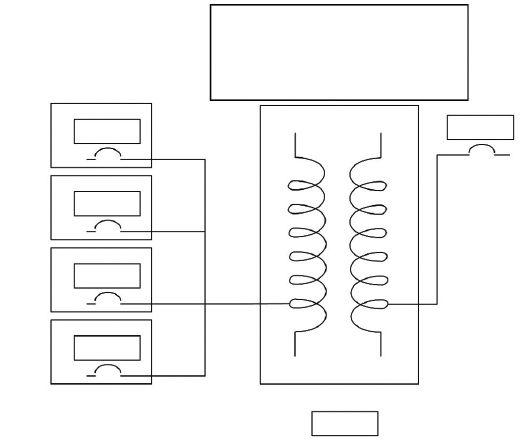
Diagram 1 shows multiple BESSs connected to a single transformer. In Charging Mode, the TX primary is connected to a supply authority system while the BESSs function as a load connected to the TX secondary circuits. This mode of operation is like a traditional connected load.
In Discharge Mode, however, the BESSs function as electric power production sources, either transferring stored energy back to the supply authority or supporting customer loads.
A BESS is capable of running in parallel with supply authority systems and, as such, we turn to Section 84 rules for the interconnection of electric power production sources, plus any applicable rules from Section 64. When a TX has a source on both sides, Rule 64-058(2) requires that each side be considered the primary and be provided with overcurrent protection.
A BESS is capable of running in parallel with supply authority systems and, as such, we turn to Section 84 rules for the interconnection of electric power production sources, plus any applicable rules from Section 64.
Since both sides of the TX are considered the primary (based on the operational modes of BESSs), certain requirements in Section 26 for transformer primary disconnecting means shall apply. Rule 26-248 states “A disconnecting means shall be installed in the primary circuit of each power and distribution transformer”.
Considering a traditional transformer’s operation, some may interpret Rule 26-248’s requirement for a single primary circuit as a single disconnecting means.
However, when multiple BESSs are connected to a single TX, we end up mul-
tiple primary circuits. It is debatable whether Rule 26248 requires a disconnecting means for each primary circuit, or a single disconnecting means for the transformer.
Meantime, Rule 64-060(6) states “Where the equipment is energized from more than one supply source, the disconnecting means shall comply with Rules 14-414 and 14-700”.
In our example, the transformer is the “equipment” that is energized from more than one supply source (other sources of voltage). Each BESS supply circuit is provided with a disconnecting means that may not
be adjacent to the TX, but may be grouped in accordance with Rule 14-414(1)(b).
CE Code Rule 84-020 and ESA Bulletin 64-1 both require a disconnecting means for each power production source. It is debatable whether these two requirements—disconnecting means for each source and disconnecting means for each primary circuit—could be achieved with one device.
As we contemplate the application of these different CE Code requirements, consider the following: Does Rule 26-248 require a single disconnecting means on both sides of a TX connected to multiple production sources, such as the BESSs in Diagram 1?
Based on a literal interpretation of the Rule, the answer is Yes.
But, notwithstanding Rule 26-248 and considering Rules 64-060(6) and 14414(1)(b), a disconnecting means located in each source circuit may be permitted and could provide an alternative to requiring a single disconnecting means, if certain conditions are met. (I will explore those conditions in my next column.)
Consult your Authority Having Jurisdiction for more specific interpretations
Nansy Hanna, P.Eng., is senior director, Engineering & Regulations, at Ontario’s Electrical Safety Authority (ESA). She is also chair of the Canadian Advisory Council on Electrical Safety (CACES) and a member of the ULC Advisory Council and CSA Technical Committee on CE Code-Part I. She can be reached at nansy.hanna@electricalsafety.on.ca.
DISCOVER THE FINANCIAL POWER of our EMPOWERING FUTURES PROGRAM FOR STUDENTS AND APPRENTICES
You need new talent, we can help. By participating in the Empowering Futures program, you can unlock up to $20,000 in hiring incentives when you hire two new first-year apprentices and up to $7,000 when you hire a student. Our program is specifically designed to offer an easy online application and management process to empower your organization while mitigating the financial risks associated with new hires.
Eligible small and medium-sized businesses can apply for support from the Canadian Apprenticeship Service. In addition to the grant, build your future workforce with:
• free access to employer-apprentice matching services;
• free access to mentorship programs; and
• free access to diversity and inclusion training. Apply for your grant at ApprenticeSearch.com/CAS
Les petites et moyennes entreprises admissibles peuvent présenter une demande d’aide au Service d’apprentissage du Canada. En plus de la subvention, vous pouvez recruter votre future main-d’œuvre grâce à :
• un accès gratuit aux services de jumelage employeur-apprenti;
• un accès gratuit aux programmes de mentorat; et
• un accès gratuit à de la formation sur la diversité et l’inclusion.
Faites votre demande de subvention à : RechercheApprentis.com/CAS