Cortellucci Vaughan Hospital: a study in smart construction P.20 INSIDE + A modern lodge & cowboy shack + Energy savings and finding lost things + Heavy rains, flooding and electricity




ANTHONY CAPKUN

Cortellucci Vaughan Hospital: a study in smart construction P.20 INSIDE + A modern lodge & cowboy shack + Energy savings and finding lost things + Heavy rains, flooding and electricity
ANTHONY CAPKUN
By the Fall of 2020, supply chain problems in the construction sector were well-known.
In the electrical space, there was a shortage of panelboards. Lumber, if you could find it, had tripled in price. Concrete—which typically operates on 24-hr to 48-hr notice—required at least one to two weeks’ notice... and there was a good chance you would not get the full amount.
Unfortunately, the supply chain is still very much under strain, and it will impact your work schedule, deliveries, and estimates.
In a letter to customers, one distributor cites major product shortages, noting EMT conduit, PVC, breakers and panels, NMD90, AC90 and aluminum cables are difficult to get, and have 12-week lead times. In some cases, the distributor will need to limit quantities, and the purchase of items in these categories may result in unexpected shipping delays or partial back orders.
Another distributor, also in a letter to customers, highlights unpredictable price increases, caused by factors such as worldwide shortages of raw materials (the cost of copper, for example, is through the roof), import delays, increased freight costs, and product demand. As such, the distributor cannot offer any price protection; instead, pricing will be finalized on the day the product is shipped to the customer.
Add to this Covid-related productivity losses (for health & safety protocols) or outbreaks that shut down everything, and you could be forgiven for wondering... Do my estimates even mean anything? How do I finish a job and move onto the next with these kinds of delays? Will I have enough cash to weather this storm?
I wish I had better news to report, but the storm is upon us, and it will continue to affect our jobs and livelihoods for the foreseeable future. And while we cannot control raw materials, my hope is that all the parties to a construction contract work together—with understanding and patience—to ensure everyone’s business succeeds, and not just the project.
What has been your experience?
acapkun@ebmag.com



Perspectives from a recently enlightened male
New thinking stems from the guidance document “Advancing women in skilled trades”.
A modern take on the “hunting lodge/ cowboy shack”
The building also serves as a mounting platform for a 28.35-kW solar PV system (case study).
Everything under the Kootenay sun
Despite living in “Cancel-gar”, electrician James York still believes in solar PV.
Smart buildings: at the inflection point
This market offers both GCs and subs opportunities for growth, plus a new, collaborative approach.
Digitizing healthcare delivery
The Cortellucci Vaughan Hospital: a case study in collaboration and smart construction.
Energy savings and finding lost things... an industrial lighting story
Despite the hype, there are numerous, pragmatic solutions that can result in massive efficiencies.

first all-new hospital constructed in Ontario in more than 30 years.
In late October, 2016, Infrastructure Ontario and Mackenzie Health awarded the Plenary Health team a contract valued at approximately $1.3 billion to design, build, finance and maintain the 1.2 million-sf hospital on a 40-acre greenfield site, with a completion target of 2020. The construction team for the project was led by PCL Construction, a group very familiar with P3 healthcare projects in the province. Their primary construction partners included Modern Niagara on the mechanical side and Plan Group on the electrical.
The client, Mackenzie Health, identified their Smart Vision for the hospital early on. “Smart devices, or smart technology and applications, are integrated into our everyday lives with smart phones for example, so we asked “How can we bring this technology into the hospital environment and give that kind of experience to our patients and also to our physicians and clinicians,” says Felix Zhang,
chief technology officer with Mackenzie Health.
To achieve that smart hospital vision required a high level of integration, converging the hospital IT network with the building systems. Together with PCL—and teams with expertise in information, communication & automation technology (ICAT)—the client was able to design and develop the necessary converged network backbone that props up the completed smart hospital.
“The P3 model requires a lot of collaboration on the front end,” says Andre Bohren, the construction manager with PCL who oversaw the Cortellucci Vaughan Hospital (CVH) project. “We really do have to build our partnership with our mechanical and electrical contractors, and in this case an additional third-party [Compugen] on the IT side.”
Because connectivity and intelligence are integrated with so many of the different devices and systems in a hospital setting, a high level of teamwork early on
“The P3 model requires a lot of collaboration on the front end.”
in the design was required to ensure the physical infrastructure would be in place to connect all the pieces together.
“The level of collaboration was very high on this project due to the fact that the smart hospital vision touched all of the major systems,” says Steve George, construction director (ICAT) with Plan Group.
Focus group meetings with were held weekly during the design phase and all stakeholders including the hospital, PCL and the trades were included to understand all the inputs and outputs involved in the converged network.
“In terms of the base infrastructure of this building, it’s not that different from other P3s in concept, but then we do have all this integrated mechanical that’s also speaking more to the client’s front-end system, which make this a bit smarter than other builds,” Bohren notes. “There’s more user interfaces, like through patient iPads that can control lighting, the blinds, room temperature and more, and that’s more ‘smart’ than I’ve seen on past projects.”

Peter Cole, district building systems manager with PCL, has been working on hospital P3 projects for over 10 years, and he’s witnessed the evolution of digital integration leading to today’s ICAT sophistication. “Ten years ago we were just touching a little bit on network design. We put a network in a hospital and we called it IT, and then it grew into ICT [information & communication technology], and then all of the sudden they added the automation.”
Bohren recalls the first major hospital project he worked on and installing copper lines for fax machines. “And that was supposed to be one of the more advanced hospitals trending toward paperless. Fast forward three or four hospitals later, and this is the most I’ve ever seen in terms of a hospital venturing into paperless and a user-facing system to this degree.That’s what’s unique at CVH compared to other hospital projects I’ve been involved with in Ontario.”
Today a smart build requires digital technology at all stages, and PCL has built a lot of capability around Autodesk’s building information modeling (BIM)
Today, a smart build requires digital technology at all stages
technology for collaboration on design documentation. The trade partners can access the 3D BIM model, and then they can pull out and add pieces where required.
According to Mark Sayers, construction manager for Modern Niagara (and another industry veteran who has worked on P3 hospitals with these partners in the past), this was the first major project incorporating 3D modeling early on. The construction team took the design-level 3D drawings from the architect and consulting engineers and added the construction level of detail.
“That whole process, especially with it being done using the same software model, was unique. It’s now becoming more standard in the industry, but definitely at the start of 2017, it was the first job I was involved with that did that,” Sayers says.
PCL also uses the Autodesk BIM 360 field system for communicating progress. “And we’ve layered on PCL’s own services with a [Microsoft] SharePoint backbone and it gives us a seamless window into those things. I’ve got to say, the collaboration piece in these tools, quality checking, progress photographs, is all shared in real time,” Bohren says.
PCL also has an online delivery tool used to communicate with the client in terms of scheduling deliveries onsite to optimize time, and they use a cloud-based PDF system for collaboration on document review so everyone can do their shop drawing reviews in real time together.
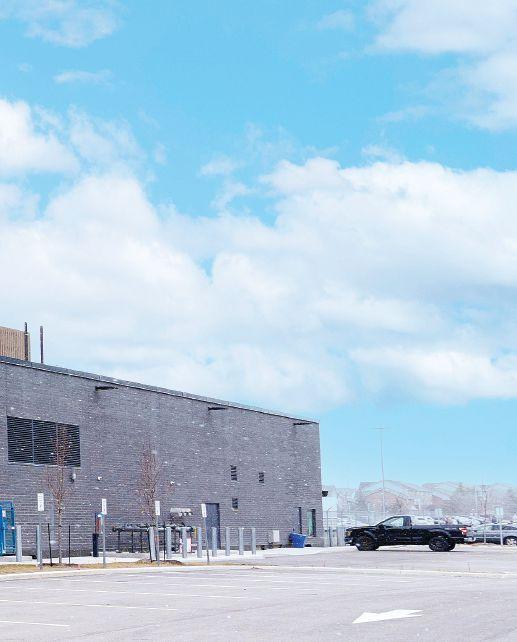
Sequentially, one of the first elements completed onsite was the Central Utilities Plant (CUP), a structure that houses the mechanical room along with power distribution and backup generator. Typically, utility plants are positioned in the penthouse or midway up a building; the CUP was constructed on ground level outside of the main building, providing multiple smart benefits.
“We were able to start building the CUP in advance and in parallel, and start adding in critical systems such as generators, boilers and the major electrical distribution, all while we were still putting up the building,” Bohren says. Commissioning on the CUP was also started well ahead of the main building.
“It was a real advantage for us,” Sayers adds. “We usually have to wait for the entire building to be
built before we can start working on the plant, and then it becomes a critical path item at the back end of the schedule.
“And with it being in its own building it became a unique feature. The architect incorporated glass into the chiller room, so you can look from the hospital and see right into the chiller room, and I haven’t seen a project where a mechanical facility has been featured like that. Usually it’s a back of house item that only mechanical contractors get excited over.”
From the client’s perspective, building the CUP outside of the main building saved on valuable real estate inside the hospital allowing more room for patient care, and it also isolated any noise or heat generated at the plant.
Prefabricated modular data centre
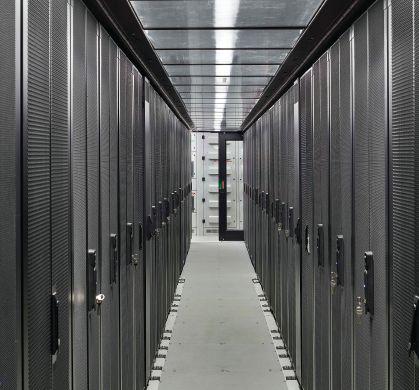
Another element placed outside the main building is the hospital’s data centre. The brains of the hospital information systems and an essential piece of the building’s operations, the data centre was positioned close to the CUP, convenient for connecting with power and cooling sources.
Mackenzie Health elected to go with a prefabricated solution that consists of two identical container-like enclosures that were built
and completely outfitted inside at a factory in Southwestern Ontario and then transported to the site.
“We were involved in the planning of the data centre with the supplier based on a specific set of specifications from the client, and we did regular inspections in the factory as it was being built,” says Steve George with Plan Group. Once onsite the team performed some finishing work from an electrical and IT standpoint, including connections to all of the main electrical feeders. The enclosures have their own self-contained uninterruptible power supply (UPS) and backup cooling systems. The enclosures are twinned and, for additional redundancy, they are connected by a fiber network to a data centre located within another Mackenzie Health hospital in nearby Richmond Hill.
wait for slabs to be poured and the building enclosed. Once delivered, the trades also performed the final connections onsite.
Another example of an offsite modular project included the pre-assembly of all the large chilled water, heating water and condenser water pipes onto structural steel pipe racks. This was performed in Modern Niagara’s fabrication facility. The pipe racks were then shipped on trucks and lowered into a tunnel connecting services from the CUP to the hospital.
Completion during Covid PCL and its partners hit important milestones along the construction path and achieved substantial completion of the project in August 2020, amidst the Covid-19 pandemic.
Safety precautions were implemented onsite, and there were no Covid outbreaks.
Smart benefits of positioning the modular data centre outside of the building, aside from space savings inside, include flexibility for future expansion or even downsizing. “Right now everyone’s talking about cloud services and, who knows... 10 or 20 years down the road we may leverage more cloud services and may not require a huge outside data centre anymore,” says Zhang. “It’s much more cost-effective to do that if it’s outside of the building.”
construction
For construction efficiencies, contractors like PCL seek opportunities to incorporate modular elements into buildings. This project included some 290 prefab patient washroom pods, each around 100 sf and weighing 5000 lb.
“There was an early collaboration with the design team and our trade partners to figure out how to streamline the washroom designs, reducing the number of variations required,” Bohren says. Once the pods were designed, the trades worked in PCL’s controlled factory environment. There are obvious scheduling benefits, working in parallel to the main build and not having to
The high level of collaboration among all partners that began at the onset of the project proved critical when the pandemic was first announced. Safety precautions were implemented onsite, and there were no Covid outbreaks. And, after close to 4 million worker hours completed throughout the project, there was not a single lost-time incident. “That speaks a lot to the professionalism of the skilled people we had working on the project, and the safety culture on the project,” Bohren says.
Officially opened on February 7 of this year, the hospital is currently supporting Ontario’s fight against Covid by providing critical and acute care support. Once the pandemic is over, the hospital will serve as a full-service community hospital with the capacity to operate 350 beds with shell space to add more floors of additional capacity. According to Zhang, the greatest reward so far has been the positive feedback from patients... the ultimate goal of their smart vision.
Doug Picklyk is the editor of HPAC magazine, hpacmag.com.
The internet of things has certainly become all the rage and, just like “the cloud” was a popular term that had everyone talking a few years ago, “industrial IoT” has become a hot topic.
Unfortunately, because of all the hype, a lot of technology companies are trying to force IoT into their solutions—even when it may not be an appropriate fit. That said, there are numerous pragmatic IoT solutions that can result in massive efficiencies for enterprises.
Look up. Look way up. Second-generation, familyowned Kodarin Industries (Stoney Creek, Ont.) was established in 1979. It specializes in custom machining services, and is broadly recognized for its ability to tackle industry’s toughest machining, fabricating and equipment maintenance challenges.
You can now add the ability to overcome energy efficiency challenges to their repertoire, as they recently rolled out a project that not only pays for itself, but decreases downtime while increasing cash flow.
Who would have known the path to industrial IoT was via your lighting? To see how this works, let’s examine Kodarin’s smart LED conversion project.
Embarking on an efficiency journey
Kodarin’s owners were on a mission to reduce their facility’s
energy consumption, and they knew a lighting upgrade would quickly deliver beneficial results. But they took their time deciding on a solution.
While doing their research, the family faced two dichotomies. First, there was no shortage of companies trying to shoehorn an LED retrofit solution into older, existing lighting using tube retrofit kits (which seemed counterintuitive to Kodarin). Second, on the opposite end of the spectrum, they were introduced to emerging IoT lighting technologies.
These smart LEDs looked great on paper (and were all the buzz), but they had a reputation for failing to meet expectations.
Alex Kodarin, company president, knew he wanted something more for their energy efficiency project. “I don’t want to outfit old technology when electricity prices are just going to go up... so there go my savings.” That put him on a quest to seek out an intelligent solution that also delivers on expectations.
Independence day for Kodarin
“I wanted smart LEDs, but I did not want to be tied to a subscription or an SaaS model,” said Kodarin. Here’s what happened on Kodarin’s path to sustainability.
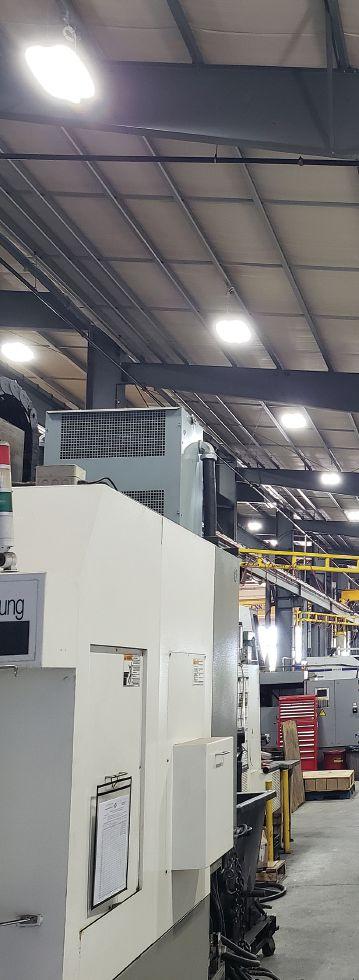
The facility’s existing lighting system consisted of 400W and 324W high-bays, which consumed 122,192 kWh annually. The average illumination on the shop floor was 11 fc.
Readily available, open standard, battery-powered asset tags report to the lighting’s sensors, and the system triangulates an asset’s last known standby position, and reports its coordinates.
“Now that you have these intelligent lights, why don’t you let them find those lost things?”
They were replaced with 24k lumen (160 lm/W) super-efficient, wireless-ready high-bays, with piggy-backing controls embedded in the LED drivers, and connected to a Bluetooth mesh-enabled passive-infrared sensor network.
The new lighting system employed three (3) simple energy-savings strategies:
1. Top trim
2. Bottom trim
3. Off
The same facility now consumes 24,638 kWh of electricity annually for the lighting system—a reduction of over 80%, and 30 kW of peak savings. Additional savings of 30% are realized with a controlled LED solution versus
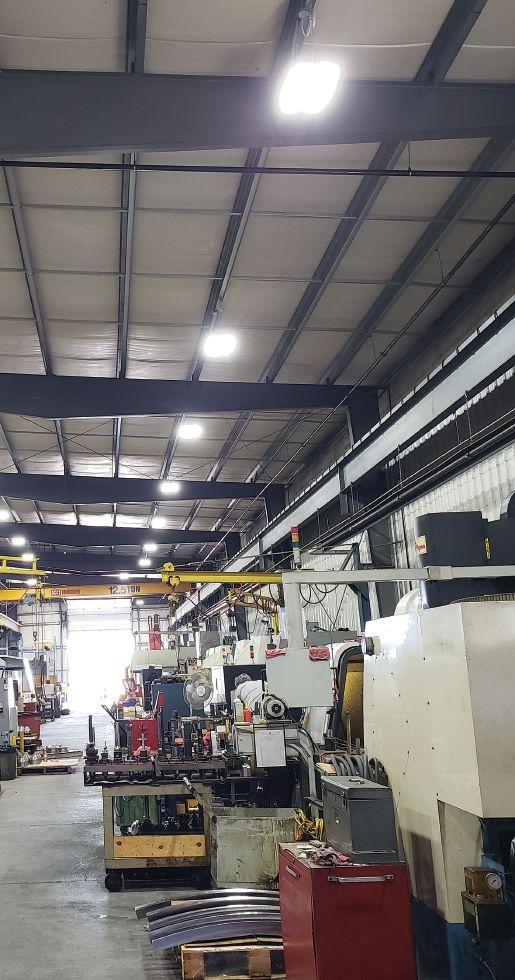
non-controlled. The ROI for the project—verified by Ontario’s Independent Electricity System Operator—is 14 months.
The average illumination on the shop floor has also greatly improved, now sitting at 32 fc.
How the system works
Top trim. When the sensors detect that someone has entered an area, the lights corresponding to that location illuminate to a “top trim” setpoint, providing sufficient illumination for the task at hand (typically 60-70% output, depending on the task). Coupled with already-efficient LEDs, this top trim setpoint not only adds to the savings but prolongs LED longevity by lowering heat and stress on the LED chips, further future-proofing the investment.
Bottom trim. When a workspace becomes vacant, the lighting goes into “Bottom trim” (a.k.a. standby mode)—typically 1020%. This provides enough light to keep spaces safely lit; forklift operators don’t have to wait for sensors to detect them when re-entering a space.
Off. The lights shut off completely after 30 minutes of vacancy. That length of inactivity usually indicates a truly long vacancy (i.e. end-of-shift).
After witnessing the controls in action, Alex was impressed. All the unused areas are autonomously tuned and, even at standby mode (10%), the facility is pretty darn bright. He was seeing the savings before his eyes in real time.
During a routine walkthrough, Alex noticed one of his operations come to a halt because certain tooling wasn’t readily available. “It’s a pretty large facility,” he said, a little dismayed. “Things get lost, sometimes.”
This just opened the door to larger possibilities.
“Alex, now that you have these intelligent lights, why don’t you let them find those lost things?” I said.
“What? They can do that?” asked Alex incredulously, and the case for an industrial IoT solution was born.
infrastructure; for example, by using data to prevent or minimize downtime. Rather than just use the technology to help save time while hunting for tools, the ceiling could be used to, say, track the run-time hours of non-lighting equipment. This information could to provide valuable insights into equipment maintenance needs and scheduling.
A typical non-controlled LED light source saves 40-50% of power as compared to fluorescent; even more compared to metal halide. That’s a great start.
But when you supplement an LED’s inherent energy efficiency with wireless intelligence, you augment your savings, add longevity, and ensure the best-case life-cycle costing.
Smart LED costs are not as prohibitive as you may think, and they’re not a pipe dream for operations folks any longer. Economies of scale and open standards have led to lower costs, making these technologies the only prudent choice. The ROI plus life-cycle costing makes them a slam dunk.
Originally trained and licensed as an electrician—then trained as an engineering technologist— George Filtsos, C. Tech., is the president of EcoGrid Technologies Inc., a provider of energy-savings solutions for the industrial and large commercial sectors. Visit ecogridtech.com.
We purchased readily available, open standard, battery-powered asset tags that are picked up by the Bluetooth mesh network.The tags report to the lighting’s sensors, and the system triangulates an asset’s last known standby position, and reports its coordinates.
Workers can check their app dashboard to get an approximate location for that asset (e.g. tooling dies) within 3 metres. Bluetooth beacons could be added to the facility for even greater accuracy.
Kodarin is exploring the possibility of expanding the capabilities of its new “digital ceiling”
When selecting a solutions provider, it is important to select someone who is product agnostic. You also want someone with wireless integration experience. For example, you would not want a butcher performing a surgical procedure; sure, he’s handy with sharp tools, much like a medical surgeon, but there is an enormous disparity in skill set and expertise. The same applies to smart LED projects.
When an owner has the vision and fortitude to explore the potential, a smart LED upgrade can easily serve as the launch pad toward a smart industrial building of the future. A typical sustainability project that saves operation costs today can provide you with a digital infrastructure that will accommodate whatever future technologies may bring tomorrow.




Stan Wachon has joined ABB (new.abb. com/ca) as national business development manager, Food & Beverage Industry, for the Electrification business. Stan possesses more than 30 years of experience in the manufacturing and industrial automation industry.
Marty McLaughlin has joined contractor and industrial products wholesale buying group AD as the first chief marketing officer. He most recently served as founder and owner of Mosaic Partner, a marketing and consulting firm (adhq.com).
Eaton (eaton.com) has named John Vernacchia to Energy Transition segment director. In this role, he will support Eaton’s “Everything as a Grid” approach to the energy transition, leading renewable, energy storage, microgrid and electric vehicle charging projects.

Service Wire Co. (servicewire. com) promoted Kerith Richards to regional sales manager-Canada, and expanded Seth Cook’s sales territory. Kerith will be responsible for commercial and industrial sales in all provinces, and continue her role as rep for Saskatoon, Manitoba, Ontario, Quebec, Nova Scotia, New Brunswick, and Newfoundland & Labrador. Seth assumes the role of rep for the Alberta markets, and will continue to serve British Columbia.




Surrey, B.C.-based E.B. Horsman & Son (ebhorsman.com) recently named several new branch managers across the province: Cory Evans, Campbell River; Joel Grimolfson, Courtenay; Nancy Rose, Williams Lake; Roy Paris, Burnaby.


ABB (abb.com/ca) has appointed John Ieraci to lead the company’s new Electrification Electric Mobility division in Canada, where he will be functionally responsible for the overall business, including business development, sales, operations, and service.
Signify Canada (signify.com) welcomed Jean-Francois Ouellet as Eastern Zone sales leader, where he will lead the Greater Montreal Specification & Sales team and agent partners in the Quebec and Maritime regions.



Ledvance (sylvania.com) welcomed Lori Bagazzoli as sales manager, Central Region, for Canada. Prior to joining Ledvance, Lori held positions at Viscor and Stanpro, and also spent some time in electrical distribution with Trade Electric/Gerrie Electric.

Electrimat (electrimat.com) recently welcomed two new specialists: Michel Caron for lighting and Pierre Mercure for electrical distribution. Electrimat serves the Montreal, North Shore, South Shore and Monteregie areas.
Electrician Karen Pullen, business rep with IBEW Local 353 (ibew353.org), has been named chair of the newly formed Ontario Building & Construction Tradeswomen committee (obctradeswomen.com). Karen already chairs her Local’s Women’s Committee. She will also serve as OBCT rep on the executive board of the Building & Construction Trades Council of Ontario.



Rittal (rittal.ca) recently announced its Quebec sales team, consisting of Simon Leger (technical rep/ channel specialist), Ashley Peluso (technical rep) and Ana Cristina Quintero (technical rep).


Hammond Power Solutions has appointed of Robert (Bob) Ellis as senior application engineer, where he will primarily work on supporting the Power Quality products business (hammondpowersolutions.com).
Magic Lite (magiclite.com) has appointed Jeff Porter to the position of chief operating officer. Jeff has spent over 30 years in the North American electrical and lighting manufacturing and distribution industry.
Todd Sweeney has joined OmniCable LLC (omnicable.com) as vice-president of Business Development. Prior to OmniCable, he spent the last two years with A-Z Wire & Cable as senior VP of Sales & Corporate Strategy. Before that, he spent 10 years at General Cable.

HES PV (hespv.ca), a distributor of solar PV solutions across Canada, welcomed Jeff MacAulay as its CEO. MacAulay has a background in electrical engineering, and possesses 20 years of energy industry experience.




2021 EFC Industry Conference
On September 22nd & 23rd, be part of a whole new virtual experience.
Change is at our doorstep. More than ever, we need to inspire and engage our community to work together to thrive ‘Beyond the Horizon’.
+ Expanded Programming + Keynote Presentations + Concurrent Learning Tracks
A dynamic group of speakers will inspire and arm leaders with change management strategies and execution, risk management and forecasting, and diversity and inclusion practices. Concurrent learning tracks address leadership, professional development and market outlooks, and include topics such as: strategic account management, virtual sales prospecting, Canada’s construction outlook, health and mental wellness, Canadian Electrical code updates, eCommerce and supply chain resiliency.

For full details, visit electrofed.com/2021beyondthehorizon or contact Nathalie Lajoie at nlajoie@electrofed.com
LEAD SPONSOR:

www.electrofed.com/2021beyondthehorizon linkedin.com/company/electro-federation-canada


Certain Taurus-branded safety shoes are being recalled because the steel plate used in the shoe is not CSA-certified as indicated. The recall involves black leather upper, 5-in. high safety shoes, Style No. 5001. The shoe has a white rectangle Omega logo and the tongue has a green CSA triangle logo. The style number is located on the product’s packaging. If you’re affected, stop using the product and contact Taurus Footwear: 416-270-1988.
Axis launches BalancedCare healthcare facility lighting

BalancedCare by Axis Lighting (axislighting.com) is a new brand focusing on healthcare facility lighting (e.g. patient rooms, bathrooms, corridors, nurses’ stations, common areas). The brand is “controls-agnostic”, with intelligent patient bed control compatibility and spectral programmability provided by tunable white and BIOS SkyBlue technologies. The products in this family are constructed of materials and finishes that withstand hospital cleaning protocols.
Lind Beacon360 torch with several mounting options
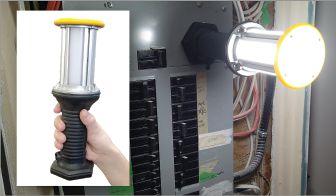
Lind Equipment’s 15W Beacon360 worklight offers four lighting modes, and provides several different
mounting options for the jobsite. The product is constructed with a rubber handle and bumpers, and polycarbonate lenses; it sports an IP65 weatherproof rating, and comes with a 3-year warranty. The torch can be recharged via AC outlet or DC car charger (lindequipment.net).
Terex Genie insulated Z-45 substation utility boom

The Genie Z-45 substation utility boom (SUB) mobile elevated work platform (MEWP) features a glass fiber jib section and platform with swing gate, and complies with ANSI A92.2 for Category E insulating rating of 20 kV (as measured between the boom tip and the chassis). While the device is designed for substation work, it is suitable in other applications where an insulated device is needed, but a traditional bucket truck may not be practical (terex.com).
Certain Dyna-Yard energy-absorbing lanyards can produce higher-than-expected maximum arresting forces and deployment in the event of a fall, posing a risk of injury. The following part numbers are affected: FP758116, FP758136, FP758146, FP7591116, FP7591336, FP7591446. As of June 30, 2020, the company has received no reports of incidents or injuries in Canada, where roughly 4347 units were sold. If you’re affected by this recall, contact Dynamic Safety International: atsen@pipcanada.ca or 647-546-1131.
Vickery Electric Mfg. offers a new model of power post—the JR1/15TDB—for applications like trailer parks.

As with all Vickery power posts, the unit is customizable; it features a compact design and is constructed of heavy-duty aluminum. It comes with corrosion-resistant finish brass or stainless steel screws, and is prewired to reduce installation costs. Of note, the units can also be fitted with power monitoring capabilities for accurate usage and billing information (vickeryelectric.ca).
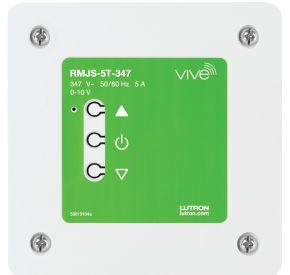
Lutron offers the Vive 347V dimming module with 0-10V control for Canadian facilities operating on 347V power. Vive is a modular, wireless lighting control solution for retrofits of existing commercial buildings and new construction. The modules can communicate wirelessly to Lutron Pico remote controls or other Vive wireless sensors—simplifying the addition of wall controls without running new wire—and are compatible with Vive system components, including the Vive wireless hub (lutron.com).

DAN LEDUC
As part of its post-pandemic recovery, China embarked upon a massive infrastructure program, guzzling up construction commodities and, thus, narrowing supply. So not only have prices increased on materials such as copper and steel, but there was no corresponding sense of prediction.
Most electrical contractors, suppliers and distributors were forced to hedge on material pricing. Some electrical contractors have opted to limit holding the prices on tenders for much shorter periods than the standard 60 days, with some holding their prices for just 3 to 5 days; that, in itself, causing even more turmoil in the industry.
Others may have qualified their bid submissions with wording that permits them to seek a subcontract price increase should the price of certain materials rise dramatically between the close of bid and the point at which that particular material needs to be purchased.
This can be an excellent way of managing the risks associated price volatility, but you also run the risk of submitting a non-compliant bid (because you have qualified it).
Should you choose to qualify your bid, however, that qualification regarding price increases should include a benchmark so that you can show the price increase from month-to-month for that particular commodity. The benchmark provides a baseline index at the close of bid; from this, you could demonstrate the dramatic price increase as you pursue recompense.
One such index, which appears to cover off almost all construction commodities, is the Producer Price Index (PPI), published by the U.S. Bureau of Labour Statistics (bls.gov/ppi). In PPI Table 9 (tinyurl.com/77k7yeu6), you can find the producer price indices and percentage changes for numerous commodity and service groupings.
When it comes to “copper wire and cable”, Table 9 demonstrates a 26.7% price increase from March 2020 to March 2021, and a 4.1% increase from just February 2021 to March 2021 (which, annualized, would be a 49.2% increase).
So, if you are considering qualifying your bid to manage price volatility, and accept the risk of providing a non-compliant bid, a benchmark will make quantifying the recourse you seek that much easier.
Dan Leduc is a partner in the law firm of Norton Rose Fulbright LLP, and practices exclusively in the area of construction law. He is always happy to take on new clients from anywhere in Canada. Contact Dan at dan.leduc@ nortonrosefulbright.com.

RAY YOUSEF
Ray is a code engineer with Ontario’s Electrical Safety Authority
TACKLE THE CODE CONUNDRUM IF YOU DARE! Answers to this month’s questions will appear in the June 2021 edition of Electrical Business Magazine.
A Class 2 power supply unit may be installed in a wet location:
a) with no restrictions
b) only when marked as such
c) only when equipped with GFCI protection
d) None of the above. Not permitted in wet locations.
Grounding conductors for electrical services are:
a) required to be electrically continuous
b) required to be mechanically continuous
c) allowed to be joined using approved components
d) A and B
e) A and C
The point of attachment of overhead supply service conductors shall be:
a) on the same side of the building as the consumer’s service head or equivalent
b) solidly anchored to the structure or service mast
c) in a position that allows the overhead service conductors or cables to angle away from the structure
d) in compliance with the requirements of the supply authority
e) all of the above
Electrical Business, April 2021 ed.
Question 1
Equipment marked Ex ia Gb is suitable for installation in Zone 0 locations.
b) False. Rule 18-090 and Table 18, CE Code 2021.
Question 2
The ampacity of conductors in a bundle of 11 copper eightconductor cables No. 26 AWG marked 75ºC is:
b) 0.8 A. Rule 16-330 and Table 60, CE Code 2021.
Question 3
An alternating current system is permitted to be ungrounded when:
c) A and B. Rule 10-400, CE Code 2021.
How did YOU do?
3 • Seasoned journeyman 1 • Apprentice
2 • Need refresher training 0 • Just here for fun!

NANSY HANNA, P.ENG
Well, this is a fact everyone knows but, sadly, we continue to see incidents related to electricity and water.
In December 2016, CSA Group— in partnership with the National Research Council of Canada—launched a new initiative to incorporate strategies for addressing climate change into both existing and new standards and codes. The results are intended to assist in future infrastructure design to withstand frequent and severe weather events (e.g. heavy rains, flooding), and help ensure the safety and well-being of Canadians.
The efforts of this working group have resulted in numerous changes and updates to our standards. The 2021 Canadian Electrical Code, for example, contains several new rules to address flooding:
Definitions for Flood hazard zone and Flood elevations were added to Section 0.
• Flood hazard zone is a spatially delineated area, designated in accordance with the National Building Code of Canada or applicable local legislation, as being subjected to a flood hazard.
• Flood elevation is the elevation of surface water resulting from a flood event designated in accordance with the National Building Code of Canada or applicable local legislation.
A Rule in Section 6 requires that the main service not be located below the

flood elevation level. This provision allows for the safe disconnection of electricity when required.
A Rule in Section 26 requires ground fault protection for branch circuits below ground level in flood hazard zones. This requirement contributes to increased electrical safety in buildings by providing a means for automatic deenergization of circuits that are most prone to flood damage.
Another Rule in Section 26 requires receptacles feeding sump pumps for buildings located in a flood hazard zone to be located above the flood elevation, or be suitable for submersion. This new Rule intends to increase the ability of sump pumps to operate during flood events, which can help keep building occupants safe and reduce damage to property.
These rules in the 2021 CE Code aim to make new electrical installations
safer and more robust when subjected to flooding.
Without first performing a proper evaluation and taking necessary actions, electrical wiring and equipment that has been exposed to water can be extremely hazardous when reenergized. As such, a new Rule in Section 2 requires electrical equipment that has been exposed to the ingress of water to be evaluated by an organization acceptable to your Authority Having Jurisdiction. This will confirm whether the equipment is safe, and can be placed back into service.
While the National Building Code of Canada may not currently designate flood hazard zones or flood elevations, the 2021 CE Code definitions do reference local legislation. For these new rules to be effective in reducing the electric hazards related with flooding, local building officials would need to designate flood zones and flood elevations, if not already designated.
Consult
Nansy Hanna, P.Eng., is senior director, Engineering & Regulations, at Ontario’s Electrical Safety Authority (ESA). She is also chair of the Canadian Advisory Council on Electrical Safety (CACES) and a member of the ULC Advisory Council, CSA Technical Committee on Industrial, Consumer and Commercial Products and CSA CE Code-Part I, Sections 24, 32, and 46. She can be reached at nansy.hanna@electricalsafety.on.ca.

With more ways to earn loyalty points and redeem great prizes, the new and improved AD Rewards program allows you to capitalize on the power of your purchases from AD distributors like never before.
With over 6,000 valuable merchandise and travel rewards, your relationship with your AD distributor has never been more powerful…or lucrative. Join today at any of these participating AD distributors.