From left: Jean Marc Leclerc, president & CEO of Honda Canada, shakes hands with Toshihiro Mibe, president & CEO of Honda Motor Co. at Honda of Canada Manufacturing, where the company announced a $15-billion investment to build an electric vehicle value chain in Canada.
Source: Honda Canada Inc
Honda “hits the gas” on EV value chain in Ontario
With an investment of about $15 billion (including its joint venture [JV] partners), Honda Motor Co. Ltd. announced it plans to build a “comprehensive EV value chain in Canada” to strengthen its electric vehicle supply system and capability to prepare for a future increase in EV demand in North America.
Honda has begun evaluating the requirements to build an EV plant and a stand-alone EV battery plant in Alliston, Ont. The proposed EV value chain will also include a cathode active material and precursor (CAM/pCAM) processing plant and a separator plant.
Honda expects that EV production will begin in 2028. Once fully operational, the plant will have a production capacity of 240,000 vehicles per year, while the battery plant will have a capacity of 36 GWh per year.
13 fast EV chargers coming to PEI
With the help of the Zero-Emission Vehicle Infrastructure Program (ZEVIP), Prince Edward Island is receiving $1.4 million to install 13 electric vehicle fast chargers across the province. The chargers are expected to be installed by September 2025. Natural Resources Canada’s ZEVIP provides funding that supports the installation of EV chargers in multi-unit residential buildings, at workplaces and public places, on-street, and where EV fleets are serviced.
Nearly 600 public EV chargers coming to Vancouver Island
The electric vehicle chargers will be installed throughout the Capital Regional District with combined funding of more than $8.7 million from the federal and provincial governments, the district, and the City of Victoria.
The funding will support the installation of about 576 Level 2 and 20 DC fast-charge charging ports in roughly 80 public locations across the region. The district is undertaking regional coordination and partnerships with local governments, including the City of Victoria, which will manage up to 424 of the Level 2 and all 20 of the DCFCs planned.
Ottawa is providing $1,746,535; the Government of British Columbia is adding $4,657,136, while the Capital Regional District and City of Victoria are contributing a combined $2,329,005.
Cutting the ribbon on Burchill’s energy storage system
Source: Natural Forces
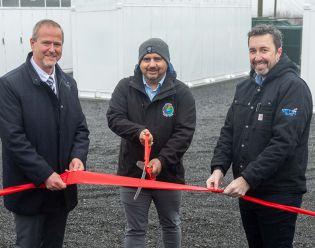
Representatives from Neqotkuk (a.k.a. Tobique First Nation), Saint John Energy, and Natural Forces came together for the inauguration of a 5.8-MW battery energy storage system (BESS), part of the Burchill Wind Project in New Brunswick.
Located about 15 kilometres southwest of Saint John, Burchill is a $95-million Indigenous-led project that involves 10 wind turbine generators capable of producing up to 42 MW of energy, coupled now with a 5.781-MW/11.562-MWh utility-scale BESS.
Saint John Energy serves as both interconnection partner and the buyer of Burchill’s energy. The project received nearly $50 million in funding from Canada’s Smart Renewables and Electrification Pathways (SREP) program.
Source: A. Capkun
The retiring president of Anamet Canada, Andrew Thew, has named John Richardson (formerly vicepresident, Sales) as his successor. Richardson (photo, right) possesses over 20 years of experience with the company. Filling Richardson’s vacancy is Patrick Read (left), who advances to the position of national sales manager. Based in Frankford, Ont., Anamet is a manufacturer of flexible conduit and fittings, whose solutions include Anaconda Sealtite, Firetech, and Ana-Quick.
With sadness we report the passing of Bruce Wesley MacGowan (Royal Pipe) on April 10, at home, with his daughters by his side. He was 67. His obituary explains MacGowan was diagnosed with pancreatic cancer in early February, and it progressed quickly. A memorial donation can be made to Pancreatic Cancer Canada or Juravinski Hospital.
Source: Northern Cables
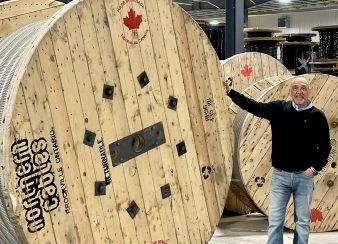
Northern Cables Inc. (Brockville, Ont.) has appointed Mike Christiansen to the position of territory manager, Western Canada. Northern manufactures wire and cable in over 400,000 sq. ft. of factory space.
John Selldorff, who led Legrand North & Central America as president & CEO for 22 years, has retired. His successor is Brian DiBella, formerly president of Legrand NCA’s Data, Power & Control division. “Brian recently celebrated his 20th year with Legrand and has successfully prepared himself for the role [...]” said Benoît Coquart, Legrand CEO.
Source: Southwire
Winn Wise has been named Southwire’s executive vice-president and chief commercial officer (photo). The company’s Electrical Distribution, National Accounts and Strategic Channels, Specialty Distribution, Retail and Canadian teams report to Wise. Aaron Asher has assumed the role of senior vice-president, Customer Experience, and Juan Hernandez has been named senior vice-president, Infrastructure.
Source: OmniCable
Christopher Breslin has been named chief executive officer of OmniCable—a redistributor of wire, cable, fiber, electrical and communications products. He succeeds interim CEO Jeff Siegfried, the company’s co-founder, who will remain as vice-chair. The company has also promoted 40+ year industry veteran Jim Walsh to the role of sales manager for Toronto.
The members of North America’s largest contractor and industrial products wholesale purchasing cooperative, AD, have elected/ re-elected three directors to board, and made one appointment. The Canadians on the board are: François Deschênes, Deschênes Group Inc.;
Source: AD
Nathalie Parisel has been appointed vice-president of Nedco Canada. She transitions from leading Nedco Quebec to overseeing Nedco Canada, Rexel Atlantic and Rexel Energy Solutions Business, and becomes a member of the Rexel Canada Executive Group.
Source: A. Capkun
Vivian Yoanidis, senior manager, DEI, at Hydro One, has been named this year’s Agent of Change by Electricity Human Resources Canada. “She is one of the most genuine people working in this industry,” said Michelle Branigan, EHRC CEO.
Source: Supplied
Gurvinder Chopra has joined QPS Evaluation Services Inc. as general manager. He most recently served as VP Standards & Government Relations, at ElectroFederation Canada.
E.B. Horsman & Son has appointed Steve Crocker (top left) as chief revenue officer. He possesses over 30 years of experience; in his last position with a major electrical distributor, he oversaw the sales and P&L aspects of the company’s Construction business. James O’Kane (top right) has been promoted to Interior district manager, where he will oversee the distributor’s Penticton, Kamloops, and Vernon locations. Chris Crockart (bottom left) has been named manager of “Distribution Centre 2” (DC2) in Edmonton. Kyle Irving (bottom right)
Photo: A. Capkun
Source: Legrand
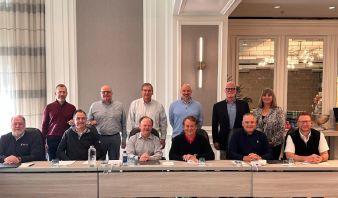
Steve Drummond, Source Atlantic; Tim Horsman, E.B. Horsman & Son.
Source: EBH & Son
has been named the new manager for the BC distribution centre.
With sadness we report the passing of Robert Dauphinee, who served Rittal Canada as technical sales representative for the Maritimes. “Robert [was] was a cherished team member; a kind soul, and a unique person,” said Rittal.
Francis Audet has joined Liteline Corp. as the regional sales manager
for Quebec. He possesses nearly two decades of experience in the electrical industry, both as a supplier and as an agent representative.
Source: Westburne
Tanner Ziprick has accepted the position of vendor operations manager for Westburne’s West Division. He reports to Todd Newell, divisional operations manager. Louisa Hadad (photo) has been promoted to account manager for the Greater Toronto Area, reporting to Tony Nguyen, divisional commercial sales manager. Ndioro (Ndy) Diop has been promoted to the role of national marketing manager, Advantage Partners Program. She reports to Salim Bhojani, national director, CX and Marketing.
LED ARCHITECTURAL CYLINDER
SILK
Source: Supplied
Jim Fonger has joined Rodan Energy Solutions Inc. as president of its wholly owned subsidiary, Rodan Distributed Energy Resources. Prior to joining Rodan, he served as vice-president, Asset and Advanced Technology Development, at Ameresco.
Source: Electric Avenue
Electric Avenue
Manufacturing, a supplier of EV supply equipment, has promoted general manager Kelsey Bond to national sales manager. The company has also joined the AD Canada-Electrical supplier network.
We’re limited by space here, but have plenty of room online! Read the news behind the news Visit EBMag.com and click “News”.
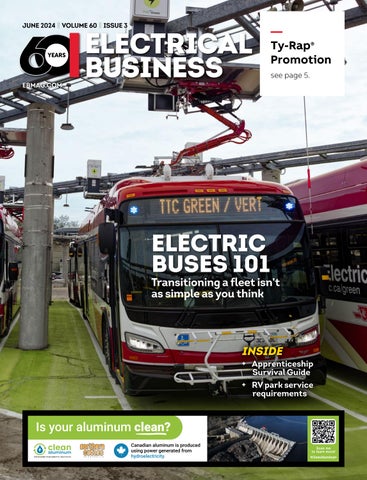
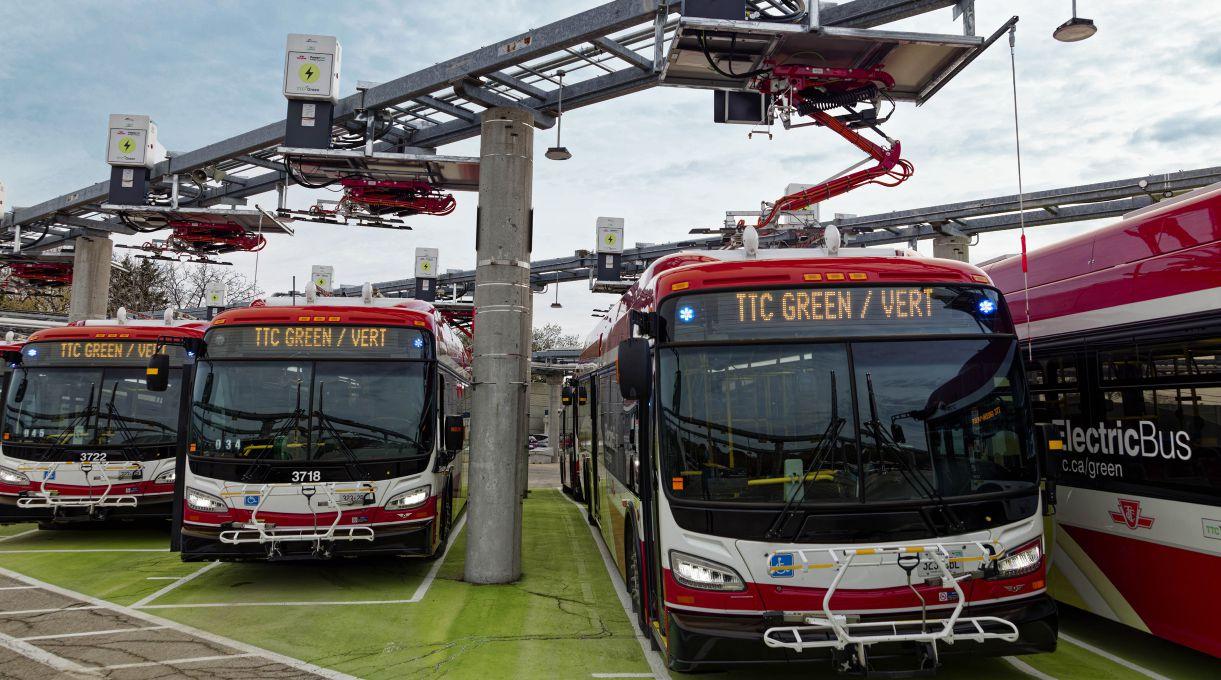
The Toronto Transit Commission and PowerON Energy Solutions unveil 10 newly commissioned, battery-electric bus charging pantographs as part of a proof-of-concept at the Birchmount Garage (April 2023).
DECARBONIZING OUR PUBLIC TRANSPORTATION A primer for bus electrification
As the global push for sustainability gathers steam, transit bus operators have an opportunity to contribute meaningfully to the decarbonization of transportation. Electrification of transit buses presents an immediate and impactful solution for reducing greenhouse gas emissions, and air and noise pollution for local communities. However, transitioning from fossil fuel-powered buses to electric alternatives is not as simple as replacing one for the other and installing chargers. It requires an understanding of the available types of electric buses, their corresponding charging systems, and best practices for a seamless electrification process.
Types of electric buses
Battery-electric buses (BEBs)
Powered entirely by electricity stored in
onboard batteries, BEBs are recharged at charging stations. They offer zero tailpipe emissions and often boast lower operating costs than their fossil-fuel counterparts, but their range between charges is limited by the battery’s capacity, making them ideal for fixed routes with predictable demands.
Hybrid-electric buses (HEBs)
These buses combine an internal combustion engine with an electric propulsion system, using energy stored in batteries for propulsion at lower speeds and the diesel engine at higher speeds. They emit fewer emissions than conventional diesel buses but do not achieve the zero-emission status of BEBs.
Hydrogen fuel cell electric buses (FCEBs) FCEBs use hydrogen gas to power an electric motor. While they emit only
water and heat, the production of hydrogen can generate emissions and can be energy intensive.
Approaches to charging for electric buses
There are two main approaches to charging electric transit buses: depot and opportunity.
The most common method, depot charging, involves the installation of charging infrastructure at the bus depot where buses are charged overnight. This solution works well for BEBs operating on routes where buses are able to achieve the entire daily schedule on a single charge.
For other routes, opportunity charging may offer a more practical solution. Fast-charging infrastructure is installed at endpoints or along the route, allowing buses to top up their battery
during driver breaks or layovers. While this method can extend a bus’s daily range, it often requires a larger upfront investment in infrastructure.
Choosing the appropriate charging hardware is as crucial as selecting the right electric bus type for the fleet. Understanding the benefits and distinctions between different types of charging technologies—particularly overhead pantograph charging and DC fast charging—helps for making informed decisions.
Overhead pantographs
A form of opportunity charging, overhead pantographs are a popular solution for high-demand routes where buses need to recharge multiple times throughout the day without returning to the depot. The system works by installing an overhead charging unit at selected stops where the charging process is initiated via a pantograph: a mechanical arm that extends from the charger to connect with the bus.
There are two types of pantograph charging systems: inverted and roof-mounted. Inverted pantographs are attached to the infrastructure, lowering onto the bus for charging. Roof-mounted pantographs are situated on the bus’s roof and rise to connect with the charger.
Overhead pantograph systems offer several benefits. As mentioned, they can be strategically located at endpoints or busy stops, providing buses with more opportunities to recharge and avoiding extended downtime.
And because buses can recharge frequently, they can operate with smaller batteries, reducing the bus’s weight and overall cost. This kind of system is also easy to expand as the fleet grows or route demands change.
DC fast charging
Another form of opportunity charging, DC fast charging provides a rapid energy boost to buses during layovers or between routes. DC fast chargers can deliver a large amount of power quickly—usually 50 kW to 350 kW—directly to the bus’s battery, bypassing the onboard charger for faster charging times.
DC fast charging also boasts several benefits, not the least of which is its ability to recharge a bus’s battery much
Emerging technology: wireless charging
Also known as inductive charging, this type of charging does not require a physical connection between the vehicle and the charging station. It relies on electromagnetic fields to transfer energy between two objects: a transmitting pad on the ground and a receiving pad on the vehicle.
The primary advantage is the ability to simply park the vehicle over the charging pad without having to plug in a cable. Charging pads can be integrated into existing infrastructure (e.g. depot parking spaces) to overcome space constraints and, with no physical connection, there is less wear and tear on physical components.
faster than traditional AC chargers, allowing for more uptime.
These chargers also provide for an easier installation, as they can be installed in existing depots or along routes, making them a versatile option for a variety of transit scenarios. And, by charging rapidly during off-peak hours, DC fast chargers can help mitigate strains on the power grid.
Each charging solution has its unique benefits and applications. The choice between overhead pantograph charging and DC fast charging will depend on the fleet’s specific operational needs, route schedules, and infrastructure capabilities. A comprehensive analysis of these factors will ensure a successful transition to an electrified bus fleet.
Bus fleet electrification best practices
Always begin with a comprehensive review of bus routes, considering factors like distance, topography, and climate, all of which impact a bus’s energy consumption and, by extension, the types of electric buses and charging infrastructure that should be considered.
Speaking of infrastructure, consider the electrical capacity of the transit authority’s depot. If depot charging is being considered, then the facility’s electrical service may need to be upgraded. For opportunity charging, determine the optimal locations for
charging stations along bus routes.
Pilot programs (where a few electric buses are tested on select routes to see how they operate in real-world conditions) offer valuable insights that inform the wider rollout.
The transit operator’s workforce will require additional training on these new technologies, as electric buses require different maintenance and operation practices.
Always consider the Total Cost of Ownership (TCO) when purchasing. Electric buses have higher upfront costs (plus related infrastructure), but they often have lower operating and maintenance costs, potentially resulting in a lower TCO over the bus’s service life.
Investigate the myriad federal, provincial, and local incentives that will help the transit authority pay for its electric buses and infrastructure.
Through the Zero-Emission Transit Fund (ZETF), for example, the Government of Canada is investing $2.75 billion over five years to support public transit and school bus operators plan for electrification, support the purchase of 5000 zero-emission buses, and build supporting infrastructure (which includes charging infrastructure and facility upgrades).
Two types of projects are eligible for ZETF funding:
Planning. Projects include studies, modelling, and feasibility analyses that will support the development of larger-scale capital projects.
Capital. Eligible projects include buses, charging and refuelling infrastructure, and other ancillary infrastructure needs.
Fleet pride
The journey toward fleet electrification may be complex, but it is a necessary step toward a sustainable future for public transit. With the right strategies and resources, transit bus operators can navigate the electrification process effectively, creating cleaner and and more cost-effective services for their communities.
Contributed by PowerON Energy Solutions, an OPG Company.
APPRENTICESHIP SURVIVAL GUIDE
Advice and anecdotes for when you take on an apprentice /
BY TONY KOVAC
Whether it goes well or poorly, taking on an apprentice in your electrical contracting business is a big commitment. What can you do to (hopefully) achieve a positive outcome, for both yourself and the apprentice?
So we asked a variety of industry professionals “What advice would you give to an electrical contractor when taking on an apprentice?”. They happily shared their advice and experiences with us which, collectively, make up our Apprenticeship Survival Guide.
MICHELLE BRANIGAN CEO Electricity Human Resources Canada
Assign a work buddy to your apprentice who is at a similar level, and monitor their progress. Communicate your expectations clearly and conduct regularly scheduled sessions to address any misalignment. Address any complaints by taking action according to your code of conduct—this is a sure way to build trust.
Be ready to provide additional training, if needed, then celebrate your apprentice’s progress and accomplishments. This will help keep them motivated.
Finally, embrace diversity and reinforce an inclusive work environment. Journeypersons can learn from apprentices, too!
BRADLEY WATT
309A Electrician Construction and Maintenance, 631A Network Cabling Specialist
When mentoring and teaching apprentices, I have found that the sooner I start treating them as my equals, the sooner they become open to following the directions and lessons offered.
Treat the apprentice as a journeyperson, not an apprentice. In other words, treat them with the respect and trust of the position that they are working toward. Far too often, contractors and journeypersons want the apprentice to trust them without setting the stage for mutual trust.
Simply put, if the contractor and journeypersons want highly motivated, respected, well-learned, trusted new journeypersons on staff, then teach and mentor the to become exactly that. Don’t teach them to be apprentices.
LEONARD FELDT President Feldt Electric Inc.
Over my 40 years in this business, I have worked with and trained many individuals. Some turned out as well-seasoned professionals in their field, some did not. I believe attitude and ability are very significant governing factors.
From the outset, if an individual does not have the requisite attitude to develop the requisite skills, nothing is going to happen and they will get nowhere. Conversely, if one has the requisite skills and the requisite attitude, the sky is the limit.
Discerning the difference between these two scenarios is the job of the mentor (which could be the employer). The mentor (master to the apprentice) will quickly determine whether the individual is worthy of their time and attention.
As a 309D Construction and Maintenance, Industrial Electronic Controls master electrician with an interprovincial seal, I have practiced in many aspects of this industry, and I can tell very quickly whether someone is worthy of my time and attention, to what degree that person has the requisite qualities for advancement in the trade, and in which areas they should concentrate.
Some are good mechanics but are poor thinkers; they will need constant guidance but the end work is well done. Some apprentices are very cerebral; they see the big picture and can do what’s needed to accomplish any allotted task with great skill and professionalism.
And some have no direction or desire to do anything other than what they are told in that moment.
Each has the ability to define themselves. The question they need to answer is: “Where do I want to go in this trade, and what am I willing to do to get there”.
CARA BRIDEAU
Red Seal Construction Electrician
I hear stories of many small- to medium-sized companies that are unable to grow because their main journeyman—who is brilliant and gets the job done—causes every other person onsite to be miserable, leading them to leave the company.
Maybe some journeymen feel that, because they were treated badly during their own apprenticeship, they’ve earned the right to treat their apprentices the same way. This will not fly in 2024! We have worker shortages across the country, and today’s apprentices do not wish to be treated badly for the sake of a job. If they aren’t being treated well, they will jump to another employer.
This means you need journeymen who are patient and appreciate having people help them. If they are a lone wolf who is stuck in their ways, they
KELLY KIENLEITNER
Chief Instructor Emeritus
Electrical Joint Training Committee
are probably not the right per son to mentor your apprentice.
A lot of employers also promote their star journeymen to foremen but, before you do, ensure they have the requisite people skills to juggle all the different personalities on a jobsite. Foremen set the tone of the job and, when they are patient and have a mentorship mindset, the rest of the workers onsite will be, too.
It is also important to have journeymen who love Electrical! It is a great career with a lot of cool stuff to learn.
A journeyman’s passion for the trade is contagious, and their apprentices will push themselves to progress in their careers without much encouragement. Show apprentices how you expect things to be done, watch them do it, then give them the responsibility of doing it themselves. If they feel like
The path to becoming a successful tradesperson is paved with commitment, communication, and care—the 3 Cs—from both journey and apprentice. Journeys should understand that the apprentice is not as skilled as them, and must be patient. For their part, apprentices should display a commitment and desire to learn the trade.
As the first woman in my trade, my first mentor and I had a rocky start. He felt that I had no business trying to become a journey in his trade.
Over time, he overcame his opposition to this new type of apprentice because he realized that I really wanted to learn. Thereafter, we discovered that we could, in fact, work together by being respectful, asking a ton of questions, and never assuming anything.
I have been a one-man show for the past 14 years, so the only input I could possibly provide is, if you are planning to hire, be sure you have the extra capital and be sure you have regular work. It’s a big responsibility to make sure you can provide that to someone if you expect them to devote a chunk of their lives to you.
they are always assisting with but never actually doing the work or expanding their skills, they won’t feel important to the company and will lose interest.
Remember that most people entering the trade are Gen Z, and some have never had a job in construction or an industrial setting before, so teach them how to navigate a jobsite effectively, and how to stay safe and productive.
They appreciate positive and constructive feedback. Leadership should conduct weekly or biweekly informal check-ins with their apprentices to address any situations before they are allowed to fester and become a longterm issue. The way you speak to and encourage them will have a positive, lasting effect on their time with your company.
RON BERGERON
Bergeron Electric (former owner)
Master Electrician, Professional Engineer
Our clients are primarily industrial and institu tional, and they expect a high level of knowledge and skill. It takes us 10 years of time and energy to train a person from high school student to “top gun”, which is why we do not rely on government funding when taking on apprentices. We hire for the long term.
CAMERON HANN
Jestek Electric Ltd.
Master Electrician
In most cases for a small shop, an apprentice will be your first employee (other than yourself). Hiring an apprentice can be a daunt ing task, as you are now responsible for training them and ensuring their safety.
(If government funding is available for the person selected, then we will accept it. It is useful, but not essential, to our future.)
Our prime consideration when taking on an apprentice—regardless of race, gender, creed, etc.—is attitude! Here are three key attributes: 1) interpersonal skills, 2) capacity to learn, and 3) willingness to work.
Established in 1945, our firm still operates successfully. Our philosophy of “nourish to flourish” applies to all staff—not just apprentices. For us, improving knowledge and skills is a life-long commitment. Our best electricians are our oldest electricians. Their mindset is “Whatever you do, do it well”.
We want everyone to understand that they are valued; that they matter. And we show this by providing safety training and technical courses, tool and clothing allowance, PPE, employee assistance plan, illustrated code books, monthly breakfast safety meetings, bimonthly all-staff meetings, work sharing, staff parties, etc.
In short, we provide opportunities for our staff to be the best they can be, both as technicians and as persons.
Hiring an apprentice is but one piece of the puzzle for success. For that piece to fit, make your company inviting by displaying how you treat your staff and conduct business. (We discourage foul language because, inevitably, it leads to a foul attitude.) Second, provide opportunities for personal growth to everyone (nourish to flourish).
Using this approach, any apprentice problems are greatly minimized. The good ones learn and become proficient, and stay on to transmit these values and help us remain successful.
KEVIN RITZMANN
Senior Director, Alltrade Industrial Contractors Inc.
When bringing on an apprentice, ensure that they experience as many different aspects of the trade as possible throughout their apprenticeship to help them become a well-rounded, confident journeyman—which will be valuable to both the individual and your company.
Over the course of the apprenticeship, you should ensure the apprentice is given ample opportunities for additional training on different equipment, tools and technology, plus practical training on things such as fall arrest, lockout/ tagout, testing, electrical supervision, and First Aid/CPR.
Instilling the importance of working safely—and looking out for the safety of those around you—is as critical as focusing on high-quality work and taking pride in the pursuit of excellence.
Pairing up apprentices with experienced journeymen
When interviewing candidates, ask them whose idea it was to enter the trade. Was it their idea, or did their parents put them up to it? Does the candidate know anything about what is involved in becoming an electrician?
Ask if they have participated in any apprenticeship program at their high school. If yes, this will help with their exposure to the trade. Ask to what level they’ve ever been exposed to heights, and whether they’ve had any safety training (which may delay their ability to start work).
Keep in mind that, for some candidates, this may be their first job... ever. This means you will also have to teach them the basics of being employed... like showing up for work on time.
All of our apprentices are registered through Support Ontario Youth, which helps monitor the apprentice’s hours and schedule schooling. This system has been very helpful, as it alleviates some of the administrative burden.
When you consider time lost to teaching, material that is no longer usable, fixing mistakes along the way, etc., training someone over a 5-year apprenticeship will cost the contractor over $150,000. It’s a commitment.
Similarly, when the apprentice is asked to buy their own code book and register for bulletins, it shows a commitment to their apprenticeship.
and supervisors who are willing to train and mentor them—as well as stretch their abilities and provide opportunities for growth—is import ant for apprentices’ development.
Over the years, we have found that some of our most loyal and dedicated team members are those who have come up through their apprenticeships, learning internal systems, and have been given the opportunity to continually grow in their careers.
To this day, I really appreciate all of the support and opportunities that I received as an apprentice from the great field and office leaders with whom I had the privilege of working; those who took the time to push me to expand my technical and personal skill set.
VIRGINIA POHLER
President
Donald R. McNichol Consulting Inc.
I had an amazing experience with the first journeyman I worked under for the first eight months of my apprenticeship.
I was paired with Murray a week after starting my probation period, and getting him to talk to me was a challenge. He would only speak the bare minimum to get the job done.
After about a week of working with Murray, he said something that made
GRAEME AITKEN
Executive Director
Electrical Contractors
Association of Ontario
You must consider your reason—the purpose—behind taking on an apprentice in the first place. Are you doing this to simply get a job or task completed, or to grow your business and launch someone’s career, thereby investing in the future of both?
I would hope it is about the future of your company... and the apprentice’s!
There are a number of important steps to ensure you get the best experience for both, and one of the first is to make sure both parties understand the other’s expectations.
For example, the contractor can reasonable expect the apprentice to learn, work diligently, ask questions, attend school and periodic training courses, and provide honest feedback. The apprentice can reasonably expect to be provided with opportunities to learn the trade, advance accordingly, have time to attend school, and receive mentorship.
Properly mentored apprentices generally become great mentors themselves, extending beyond trade knowledge to include your company’s processes and procedures.
Most importantly, an apprentice must feel like they belong. Don’t just invite them to the party... ask them to dance.
me snap in response “You can’t talk to me like that!”. As soon as the words came out of my mouth, I figured I should just pack up my tools and leave—I had blown this opportunity.
Instead, a big grin broke out on his face, and he said, “You want to go to the hockey tournament?”. He took me to the Ontario IBEW hockey tournament, introducing me to everyone as his apprentice. From that day on, Murray taught me everything he could.
He taught me the right way to hold my tools and position my body—skills that would later save my life in a near miss with an energized 347V lighting circuit.
He was also willing to let me make mistakes, so long as they didn’t create a safety hazard, or cost the job delays or unnecessary cost. He accepted that apprentices will make mistakes and, whenever possible, he would turn those mistakes into a teachable moment.
“First you learn to do it right, then you learn to do it fast,” he would say.
After a time, Murray allowed me to plan our work. He would then take the time to explain which aspects of my plan were good, and which were not so good.
This helped me develop and perfect my job planning and execution skills.
Leaders who don’t give their apprentices the chance to think and learn should not be surprised when they end up with journeymen who still need to be told what to do at every project stage.
Unlikely pairings can result in formidable teams. On the surface, a 62-year-old seasoned electrician and a 20-year-old woman do not have a lot in common, but when the former has a love of teaching and mentoring and the latter a desire to learn, the combination can be wildly successful.
The biggest mistake leaders can make is pairing workers based on age, gender, or personality. For better outcomes, focus instead on those who can teach and those who want to learn.
IS ENERGY EFFICIENCY IMPORTANT?
Owner and AEC communities say “Yes”... here’s why
BY ENERGY MANAGER CANADA
What do facility owners and managers, the AEC industry (architecture/ engineering/construction) and related stakeholders consider important when it comes to energy efficiency and, more importantly, why?
Are they motivated toward achieving greater efficiency, implementing proactive energy management measures and reducing emissions because it’s the right thing to do, or are there other factors at play?
Energy Manager Canada—a sister brand of Electrical Business Magazine—surveyed its audience of owners, energy managers, AEC players and others to help answer the question:
What motivates your organization to be proactive about energy management, energy efficiency and/or reducing emissions?
As you review their responses, think about opportunities to leverage your expertise as an electrical contractor, engineer, or consultant to address their interests, and become their trusted advisor and service provider.
Facts, figures, and commentary
For this survey, we heard from:
• 15.18% – Facility owners/ management
Nearly 80% of respondents consider proactive (rather than reactive) energy management as Very Important or Important. As utility costs rise (along with emissions consequences), this will only grow in importance.
To greater and lesser degrees, pretty much everyone understands the importance and value of greater energy efficiency. We are curious as to the 1.6% who feel it is Not Important. (Seriously? We are speechless.)
This relatively balanced spread across responses is not surprising, considering that the whole notion of tracking, measuring, and reporting emissions—let alone setting emissions-reduction targets— are still somewhat new to the market, and their extent varies across jurisdictions.
• 8.38% – Facility managers/ building engineers
• 20.42% – Energy managers (in-house or consulting)
• 14.14% – Specialized subcontractors
• 20.42% – Other
When shown the options, respondents (over 80%) overwhelmingly want to reduce their energy costs. That’s not to say that following government regs (or avoiding penalties) or good corporate citizenship are not important, only that their importance is overshadowed by the very fundamental need of reducing business cost where possible.
The overwhelming majority of respondents (80%) influence the procurement of solutions that better manage energy, while 87% (rounded) influence the procurement of solutions that increase energy efficiency.
In your organization, how important is it to set emissions reduction targets?
That said, carbon pricing schemes are here now, and likely here to stay. Emissions tracking and reporting are also becoming a reality for businesses of all sizes. Unless government policy shifts radically, this will only continue to become more important to an organization’s bottom line.
And here it is! The main reason survey respondents care about proactive energy management and energy efficiency ... cost!
Is your aluminum clean?
It’s not something most people think about when trying to make an eco-conscious choice, but approximately 3% of the world’s CO2 emissions come from the production of primary aluminum. The “Dirty” Truth is that most aluminum utilizes coal or gas to generate the electricity required for production. Aluminum requires anywhere from 13,000 to 18,000 Kilowatt hours to manufacture one tonne of product, leading to a high carbon footprint just to produce the base product.
100% of Canada’s primary aluminum production utilizes power generated from clean, renewable hydroelectricity, having a third of the CO2 emissions when compared to coal and gas. Globally, only 20% of the primary aluminum produced is made utilizing clean hydroelectric power. When you compare this to Canada’s availability of clean, renewable hydroelectric aluminum, why would you choose any other product?
Northern Cables supports the “ON-SHORING” movement that is fundamental to a well-rounded North American Economy. Our raw material supply chain consists of Canadian and American supply partners, which all metals, plastics, and packaging materials are sourced from.
Reduce your carbon footprint and support sustainable practices with Northern Cables. Why?
• Approximately 3% of CO2 emissions are a direct result of aluminum production. Where you source it matters!
• Foreign aluminum is made using power generated from dirty, carbon-rich coal or gas.
• Overseas shipping further adds to carbon emissions.
• Foreign aluminum is NOT subject to ANY carbon taxes in Canada.
• 100% of the aluminum in Northern Cables products is produced using power generated from CLEAN and RENEWABLE hydroelectricity.
• Our aluminum manufacturing partners are all within 700KM of our factories.
• It’s a fact: Canadian-made aluminum significantly lowers CO2 emissions.
Not surprisingly, they are quite interested in key building systems, such as Electrical, Mechanical, Building Envelope, and Controls and Automation. We were somewhat surprised to see the relative uninterest in digital twins, energy management software, etc. Perhaps these solutions have not been in the market long enough to warrant
more attention, or maybe their value proposition is not quite yet fully understood?
The market seems well aware of atomistic solutions for addressing energy consumption (e.g. lighting upgrades). This suggests that low-hanging fruit is still a very important strategy for reducing energy consumption. And a
Titan Steel Series
Emergency Lights & Running Man Signs
quick win never hurts.
This also leads us to believe that there are growth opportunities for holistic solutions, such as energy management systems, widespread automation and machine learning, and deep energy retrofits.
Where can you leave your mark?
For nearly 20 years, Energy Manager Canada has been laser-focused on one thing: proactive energy management. Our editorial coverage is not limited to any one sector or building type, and increasingly includes news and information about the emissions-reduction landscape. Visit energy-manager.ca.
EXEMPLIFYING THE HIGHEST BUSINESS STANDARDS
Canada’s Best Managed (electrical) Companies
Congratulations to the numerous companies carrying out electrical work (or serving those who do) who have ranked among Canada’s Best Managed Companies.
First established in Canada, Best Managed is a flagship program presented by Deloitte Private that celebrates the top privately owned Canadian companies with annual revenues over $50 million.
“Year after year, I am truly grateful for the opportunity to witness and be part of the remarkable accomplishments of the Best Managed Companies, who exemplify the highest business standards of innovation, adaptability, and bold leadership,” said Lorrie King, national co-leader of the program.
This year, we see an electrical newcomer to the list, as well as a few forward movers. Congratulations to the contractors, distributors, and manufacturers that made the 2024 list:
Best Managed – New
• Franklin Empire (distributor)
Best Managed
(Recipients that have re-applied and successfully retained their designation for two additional years.)
• Innovair Solutions (manufacturer)
Gold Standard
“We are honoured to be recognized as one of Canada’s Best Managed Companies for another year, and we remain committed to delivering exceptional products and services to our customers.”
– Rob Nadler, Stanpro
(distributor, moves up from Gold)
• ECS Electrical Cable Supply Ltd. (wholesaler)
• Gerrie Electric Wholesale Ltd. (distributor)
• Groupe Deschênes (distributor, includes Daltco Electric, Ideal Supply, Powrmatic)
• Houle Electric (contractor)
• K-Line Group of Companies (contractor)
• Mircom Group of Companies (manufacturer)
• Modern Niagara Group Inc. (contractor)
• PTI Transformers (manufacturer)
• Rex Power Magnetics (manufacturer)
• Robinson (distributor)
• Source Atlantic (distributor)
• Stanpro (manufacturer)
• Stelpro (manufacturer)
“This recognition represents more than just an award; it reflects our team’s unwavering commitment to excellence and innovation.”
“Their relentless ambition, determined focus, and strategic agility have led them to remain competitive on the world stage, creating sustainable economic growth in an evolving global market,” King added.
• Eddy Group Ltd. (distributor)
• Magna IV Engineering (engineering and services, moves up from Best Managed)
Platinum Club (Companies that have maintained their Best Managed status for 7 years or more.)
• Alliance Energy Ltd. (contractor)
• Deca Cables (manufacturer)
• E.B. Horsman & Son Ltd. (distributor)
(After three consecutive years of maintaining their status, these companies have successfully retained their status for 4-6 consecutive years.)
• Electrozad Supply Co. Ltd.
To attain/maintain their Best Managed designation, companies apply annually and go through an assessment led by a multi-disciplinary judging panel. They are evaluated on their leadership in the areas of strategy, capability and innovation, culture and commitment, as well as governance and financial performance.
The program has expanded beyond our borders since its inception, and is now present in over 40 countries.
As always, if we missed a company carrying out electrical work, or serving those who do, email acapkun@ebmag.com.
Source: Deloitte
ABB Terra AC Wallbox EV chargers
This electric vehicle charger product family is now available through select ABB Installation Products electrical distribution partners across Canada. The Wallbox is a Level 2 EV charger available in 32A, 40A, and 80A models. Along with integrated smart features to optimize charging efficiency, the Wallbox is able to perform remote software updates to ensure it stays current with the latest EV technologies. The units are engineered to save both space and time, promising a 30-min installation (emobility.abb.com).
Source: ABB
Northern Cables customer service portal v2.0
Northern Cables’ latest distributor customer service portal boasts new or upgraded features, such as: enhanced mobile device capabilities, real-time inventory viewing and reservation, integrated CRM for seamless communication with customers, automated shipping document processes, and automated reel
return RMA generator (northerncables.com).
Source: Northern Cables
Field-adjustable distribution without lens changes
Designed for outdoor applications, Ledvance’s Opti-Select area light integrates field-adjustable distribution technology, which allows for seamless switching between Type III, IV, and V distributions without changing lenses. This feature allows for 27 unique SKUs in one product, including selectable options of three CCTs, three lumen outputs, and three distributions (ledvanceus.com).
Source: Ledvance
AX and KX stainless steel enclosures
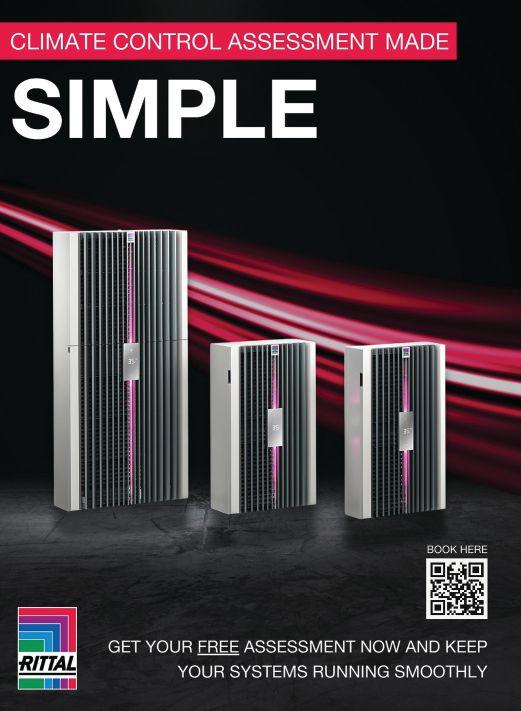
Rittal offers SS versions for the AX and KX enclosures to provide increased durability and resilience. This portfolio simplifies installation, providing ease for mounting system components and accessories. Door-operated switches, cable conduits, and enclosure lights “can be effortlessly installed on rails” (rittal.com).
We’re limited by space here, but have plenty of room online! Check out more products and solutions at EBMag.com, under “Products”.
CODE conundrum
RAY YOUSEF
Ray is a code engineer with Ontario’s Electrical Safety Authority
TACKLE
THE CODE CONUNDRUM... IF YOU DARE!
Welcome to the newest round of questions that test your knowledge of the CE Code-Part I. Answers will appear in the September 2024 edition of Electrical Business Magazine, and online at EBMag.com under Features.
QUESTION 1
At least one duplex receptacle shall be provided in the porch of a house.
a) True b) False
QUESTION 2
Single-phase inverters for an interactive solar photovoltaic system are not permitted to be connected to 3-phase systems, unless they are:
a) designed to provide 3-phase system voltages that are balanced within the limits of supply authority requirements.
b) in compliance with requirements of Rule 84-018.
c) in compliance with requirements of Rule 84-008.
d) All of the above.
QUESTION 3
Receptacles located between ___ m and ___ m of the inside walls of a pool shall be protected by a Class A type GFCI.
a) 1.0 m, 3.0 m c) 1.0 m, 2.5 m
b) 1.5 m, 2.5 m d) 1.5 m, 3.0 m
ANSWERS
Electrical Business, April 2024 ed.
Question 1
What size of copper tap conductor is required to connect a metal fence around an outdoor substation to the station ground electrode?
b) 2/0 AWG. Rule 36-312(2).
Question 2
Receptacles having CSA configurations 5-15R or 5-20R installed in buildings under construction:
d) All of the above. Rules 76-012, 76-016.
Question 3
Class H fuses are permitted to be used for overcurrent protection where circuit overload protection is provided by other means.
b) False. Rule 14-212.
How did YOU do?
3 • Seasoned journeyman 1 • Apprentice 2 • Need refresher training 0 • Just here for fun!
CALENDAR
EFC Federation Cup Golf Electro-Federation Canada
August 21, Ajax, Ont. electrofed.com
Imark Canada Annual Member Meeting
September 4-6, Collingwood, Ont. imarkgroup.com/imark-canada/
NETCO Annual Training Conference
National Electrical Trade Council September 5-6, Victoria netco.org/annual-conference
IAEI Canadian Section Convention and AGM Independent Alliance of the Electrical Industry
September 20-22, Vancouver iaei.org
CANEW: Canadian Airports National Electrical Workshop Canadian Airports Electrical Association
September 22-27, Halifax canew.ca
Safety Codes Council Summit October 2-4, Nisku, Alta. safetycodes.ab.ca
Canadian Utility Energy Expo (CUEE)
October 8-9, Toronto eda-on.ca
Energy Storage Canada Conference
October 8-9, Toronto energystoragecanada.org
Electrical Learning Expo Alberta Electrical Alliance October 23, Calgary albertaelectricalalliance.com
AD Electrical North American Meeting
October 28-30, Chicago, Ill. adhq.com
Got an event to share? Email the editor at acapkun@ebmag.com. Meantime, scroll through Electrical Business Magazine’s online industry calendar at ebmag.com/events for direct links to these events (and others).
The EstimatOR
DAN BERESFORD AND JOHN F. WIESEL
Training: expense or investment?
How do you account for training costs in your electrical contracting business? The first thing you need to decide is whether training is an investment or an expense. As a business owner or manager, every item that costs you something needs to be considered against the benefit it brings to the company (its potential ROI).
You may be thinking: “What if we train our employees, and they leave us? Where’s the ROI in that?”
While that may occur, a scarier consideration is this: What if you don’t train your employees, and they stay?
We see training as an investment in both people and your business.
Here is something to think about: You are bidding on a job that includes electrical systems for which your team has had no training and has no experience. Do you estimate the job based on your team’s current capabilities and hope for the best, or do you add time and costs to the job to cover the training that your team needs? Will that training open more opportunities for you?
A well-trained team will consistently outperform a team with little to no training.
It may be difficult to stomach when you see these costs as biting into your bottom line, but remember that a welltrained team will consistently outperform a team with little to no training. This improves your team’s morale, job satisfaction, and loyalty, as well as improving your product and, ultimately, your bottom line.
In our industry, a problem we regularly run into is balancing training needs with available time and money. When there is money for training, there seems to be no time; when there is time, the revenue may not be there to support it.
Some examples of training that could be seen as expenses may include Safety, Lift Training, H2S—basically, anything that costs you money and time but may not create efficiencies or immediately obvious ROIs. Yet all of this training is important and necessary, and should be properly accounted for when burdening your labour.
For Safety training, it can be as simple as adding a percentage point onto the overall labour and, for any specific training, adding that cost as a direct line item.
Other training is initiated with the intention of creating efficiencies and value for your team, clients, and bottom line. This could include Project Management, Estimating, Software, Lean initiatives—anything that will improve your processes and help reduce costs while turning out the same or a better product.
These types of training typically aren’t required or enforced by any government agencies or clients, but rather fall on the ambitions of the people doing the work and the companies for whom they work.
Training costs may be eligible to be claimed on income tax, and government grants exist that can help you reduce the costs of many training opportunities. Before possibly deciding against a specific training, check for government funding that could help you with the cost. We recommend going online and searching for “federal provincial job training grants” in your area.
John F. Wiesel is the president of Suderman Estimating Systems Inc., and has been estimating and teaching estimating since the early 1980s. Dan Beresford served as an electrician in the Canadian Navy, then worked in various roles in the electrical sector before joining Suderman.
DAVID PILON
RV park service requirements
The requirements for recreational vehicle parks underwent several changes in 2021 CE Code (Section 72), most of which dealt with calculations for determining the service requirements.
With regard to mobile homes, for instance, a single trailer would be calculated as a single dwelling unit, relying on Rule 8-200. An RV park, however, would be calculated with respect to Rule 8-202—like an apartment block.
These rules remained unchanged in the 2024 Canadian Electrical Code.
That said, recreational parks are seeing an increase in electrical service requirements. The days of 15A camper requirements are fading and single-phase 30A outlets are becoming the norm. Two-pole 50A outlets are also seeing an increase. We are seeing RV campgrounds becoming more akin to trailer parks, with outbuildings and appliances, and camper units that often never leave their sites... and are even sold in place.
To accommodate this trend, the calculations for an RV park should provide for an increase in electrical service to facilitate the safe operation of these campgrounds. This means an increase
ADVERTISER INDEX
ABB Inc. Canada 1, 5
Acuity Brands Lighting Canada 25
Adrian Steel Company 21
Champion Fiberglass 31
EFC Electro-Federation Canada 32
Electricity Human Resources Canada 9
Northern Cables Inc. 1, 24
Procore Technologies Canada Inc 2
Rittal Systems Ltd. 19
Satco Products of Canada 7
Standard Products Inc. 15
Suderman Estimating 13
Uline Canada Corporation 23
Ziptray 27
TO ADVERTISE Leslie Osborne losborne@annexbusinessmedia.com
in the wattage for each RV site outlet, and an increase in the percentage applied to each wattage rating for the overall calculation.
Table 71 of the CE Code breaks out these percentages. For a park with a mix of 50A, 30A, and 20A outlets, it is important to ensure the total count is cumulative, and that you start your calculation with the largest amperage outlets.
Let’s examine a campground with 70 sites. We would start with the 50A sites, then look at the 30A sites, and so on. We must also independently account for any outbuildings, as well such as showers, laundromats, streetlighting, and so on.
In our example, we’ve counted 30 sites with 50A outlets; 30 sites with 30A outlets; and 10 sites with 20A outlets. We will use a three-phase service for this park (see Table at top).
Total wattage requirement for the park = 373,500 W
373,500 W (208 x 1.73)
= 1037.96-amp service requirement
1037.96 A 0.80
= 1297.45-amp rated service requirement
Without allowing for any outbuildings, water pumps, streetlighting, etc., this campground would require a three-
The days of 15A camper requirements are fading and single-phase 30A outlets are becoming the norm.
phase 1200A 100% rated service, or a 1400A 80% rated service just to operate safely for campers.
The next step is to figure out the power distribution, whether from a single location or—more commonly— from area or loop panels, which then feed the outlets from each campground loop. But here, too, is where the issue of voltage drop comes into play, as well as ensuring all bonding and grounding are done according to Section 10 requirements.
Before proceeding with any campground installation, talk to your AHJ’s plans department and ensure your submissions contain all the relevant information to prevent delays.
Yes, all this so that your customers can have a safe, happy camping season.
Always consult your AHJ for more specific interpretations
David Pilon is manager, Electrical Inspections, at Technical Safety Authority, Saskatchewan (TSASK). He also serves as vice-chair of the Canadian Certified Electrical Inspector (CCEI) committee of the International Association of Electrical Inspectors (IAEI), Canadian Section. He can be reached at david.pilon@tsask.ca.
CHAMPION DUCT®
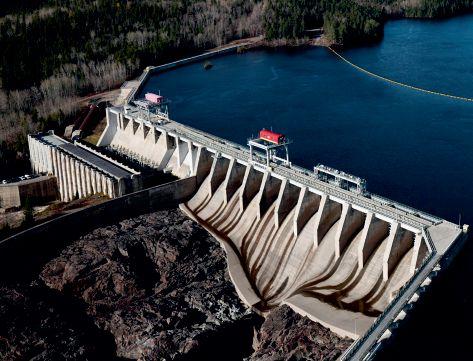
SOLVES RENEWABLES PROJECT CHALLENGES
Low coefficient of friction allows for smooth pulls
No burn-through eliminates elbow repairs
Mechanical strength protects cables NO BURN-THROUGH
Fault resistance makes repairing cables easy
DOWNLOAD GUIDE
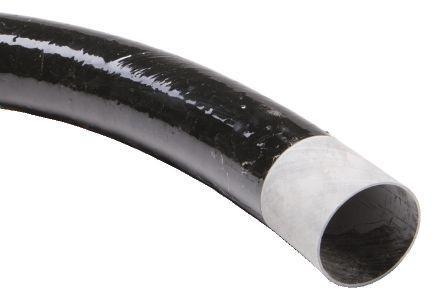
Champion Fiberglass® Elbows
EFC’s Industry Playbooks
‘Talent Availability’ has been identified by EFC’s membership as the top game changer affecting the electrical industry. EFC continues to develop programs to assist members with talent attraction, engagement and development. Our industry is gearing up for significant changes in the coming years. Of the 42,000 people that EFC member companies currently employ, over 10,000 of these employees are over the age of 55, which means there will be an influx of retirements within the next decade!
It’s important that we continue to train new staff so we can help develop the next generation of employees. It’s also imperative that we provide existing, tenured employees with professional development opportunities to help sharpen their skillsets and industry knowledge. Developed by EFC for the North American electrical industry, the playbooks are an effective method of informing new employees about the intricacies of the electrical industry during their orientation program.
For more information about EFC’s Industry Playbooks and other training modules, contact Tom Mason at tmason@electrofed.com