

THE BUYERS WILL BE THERE: MAKE SURE YOUR EXHIBIT SPACE IS TOO
Don’t miss the Electricity Distributors Association’s CUEE – the Canadian Utility Engineering and Equipment Trade Show and Marketplace – Canada’s most important meeting place where providers of leading-edge distribution and transmission products and services connect with key buyers in the utilities, municipal and other sectors.
• More than 100,000 square feet of indoor and outdoor exhibit space
• Exhibits and demonstrations from more than 200 companies
September 13-14 at the International Centre, Toronto
Book your CUEE booth and don’t miss out on the opportunity to be a part of Canada’s top utility trade show.
• More than 45 different product and service categories
• An event with a successful track record more than half a century long
For event information and exhibitor booth bookings: www.eda-on.ca/EVENTS/CUEE or jyuan@eda-on.ca
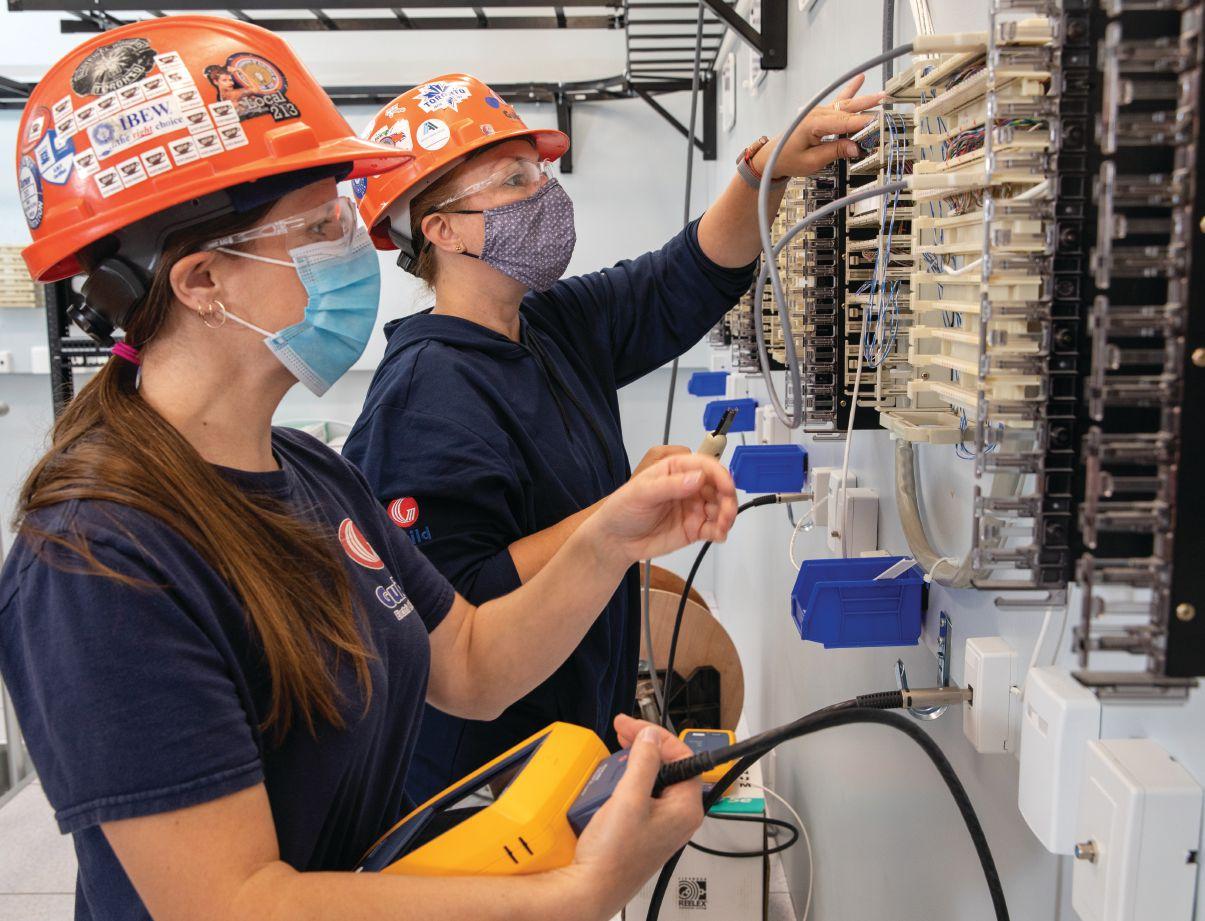
NETWORK CABLING SPECIALIST TRAINING PROGRAM ADDRESSES URGENT NEED
IBEW CCO and ECAO’s 631A training program
The surge in demand for expertise in the communications sector has left electrical and communications contractors struggling to find qualified individuals (i.e. network cabling specialists [NCS]) to do the required work to build and sustain critical telecommunications infrastructure.
“The work of an NCS can best be described as installing the telecommunications highway,” says Rich Di Pietro, project manager, with the Ontario Electrical Industry Training Trust Fund (OEITTF). “And this can include everything from standard computer and phone systems, assuring cell phone operability within build -
ings, cable TV, and Wi-Fi service to controlling the temperature in your home or business, to Power-overEthernet (PoE) devices, like lighting, where there is no longer is a conventional source of power.”
In essence, the network cabling specialist’s work touches every aspect of modern life.
This work was deemed important even before the pandemic, but became even more relevant and essential as more people worked (or studied) at home during the pandemic, and the need for a telecom infrastructure that could provide reliable connectivity became critical.
The Electrical Contractors Association of Ontario (ECAO) and the IBEW Construction Council of Ontario (IBEW CCO) stepped up to help guide the government on the right approach to meeting those needs.
“The government listened and responded with Skills Development Funding to support a certification program that professionalizes the [NCS] trade to ensure this important work is done correctly and safely,” said James Barry, executive secretary treasurer, IBEW CCO.
“The collaborative approach of the ECAO and IBEW CCO allowed for a non-partisan, industry perspective on what was needed,” said Graeme Aitken, executive director, ECAO. “Together, we have demonstrated the immeasurable value in setting shared goals that bolster the professionalism and integrity of the trade.”
Aitken noted this certification program will provide significant value for contractor members who will have the trained workers needed to address the growing demands in the communications sector.
The 631A Network Cabling Specialist trade designation is not new; however, what is new is IBEW CCO’s Training Delivery Agency (TDA) status as a designated provider for the NCS apprenticeship program in the Province of Ontario, with which they aim to significantly advance this important skilled trade.
Getting to know the NCS
The network cabling specialist is the fastest-evolving occupation in the electrical family of trades, notes Di Pietro. “Information, Communications and Automation Technology (ICAT) is rapidly changing which, in turn, increases the demand for communications services— specifically in the NCS occupation.”
He points to the expansion of PoE cabling, which is now becoming the normal specification in the design and building of communication systems. This encompasses sources of power and the communications data link for a variety of systems, including
“Together, we have demonstrated the immeasurable value in setting shared goals that bolster the professionalism and integrity of the trade.”
— Graeme Aitken, executive director, ECAO
Wi-Fi base stations, certain security systems, lighting systems, building automation operating systems and devices, as well as communications and technology systems.
Naturally, this evolution in technology has increased the need for employers to increase the number of NCS technicians and apprentices, along with upskilling their current workforce; meaning, workers who are already certified electricians but lack the crossover training to be certified as 631A Network Cabling Specialists.
IBEW CCO will train and mentor a contractor’s current workforce to ensure completion of the 631A licence, leading to a workforce with the required skill set for projects of any size. Each worker is also trained in areas such as Working at Heights and WHMIS. Di Pietro also feels IBEW CCO training will prove cost-competitive, as alternative training delivery methods are usually “private and expensive”.
This is something of which Di Pietro is very proud: “Now, NCS apprentices and future apprentices will have access to course offerings, access to learning accommodations, and state-of-the-art training in regions of the province”.
He explains that, to date, access to this kind of training for apprentices has been extremely limited—to the point where they cannot or do not attend. Currently, the IBEW CCO’s offerings are across Ontario, including Thunder Bay, Hamilton, Toronto, Ottawa, Sudbury, and Kitchener, giving NCS apprentices the ability to attend the training closer to home.
The importance of certification
Whether it’s an electrician or network cabling specialist, IBEW and its ECAO partner contractors have always stressed the importance of high training standards within the industry, says Di Pietro, adding “It is not only critical for promoting safety in the workplace,
but ensures the work is done correctly the first time”.
Although network cabling specialist tasks are considered “low-voltage” work—hence reduced risk—Di Pietro insists they nonetheless involve important skills that require the right training. “With higher voltages and wattages currently being tested for PoE, we may see higher risk in the future, which will certainly require additional training.”
He says the partners are also aggressively marketing these training programs to not only draw more 631A apprentices into the workforce, but to also upskill those already working within the communications and low-voltage sector.
“It is imperative to ensure we have the skilled workforce necessary, not just for today, but for the future,” Di Pietro counsels, “and that includes having a balance of apprentices and experienced journeypersons.”
IBEW CCO has had contractors in the non-union sector contact them to learn more about 631A training, Di Pietro adds. “They realize that properly trained employees—who have been through formal apprenticeship and received certification—will help the contractor remain competitive.”
Any contractor interested in learning more is encouraged to visit ibewcomms.ca and contact IBEW CCO to discuss individual needs, as well as expanded work opportunities as an ECAO signatory contractor.
Those who are interested in pursuing a 631A licence should also visit ibewcomms.ca to learn more about the trade and available opportunities.
“There is a host of information to help them learn more about the trade and how to apply,” says Di Pietro, adding that experienced communications technicians are also encouraged to learn more about the benefits of upskilling. “We have recruiters throughout the province ready to guide you through the process”.
Because technology never stops advancing, it is important workers remain knowledgeable in current practices. In the NCS sector, proper training and licencing also reduces deficiencies and adds to employer credibility.
“This trade certification program allows workers in the trade to have a fulfilling career and feel justifiably proud of what they have achieved and what they do,” says Di Pietro.
HEALTHY INDIGENOUS RELATIONS AND ENERGY PROJECTS
Fiona Blondin brings understanding
BY ANTHONY CAPKUN
Fiona Blondin is a Dene from the Yellowknives Dene, a First Nation in the Northwest Territories. Her grandfather, the late George Blondin, was invested posthumously as a Member of the Order of Canada in 2003 for his devotion to preserving the heritage of his people—compiling the stories of his people and Elders, and publishing them in several books.
“He became an author in his late 50s, taking oral history and documenting it for the next generation of Indigenous people—both from our nation and from other nations,” Fiona says. “My grandfather had a tremendous impact both on myself and on our family... thinking about how Indigenous people fit into a Canadian context, and how Canadians fit into an Indigenous context.”
Fiona added that the Blondin family endowed a scholarship in her grandfather’s name for students from the Northwest Territories to continue their post-secondary education. “He is somebody that has inspired the path that I am on, inspired the work that I continue to do to this day with Indigenous communities, and with the corporate sector... he was a champion.”
In February 2021, Fiona became the first-ever director, Indigenous Strategy, for Cormorant Utility Services, which serves the utility power sector in Ontario through its four operating
“To somebody like myself, inclusion means how Indigenous people, communities, and nations can participate in the sector.”
companies. As part of this challenging new role, she is responsible for developing and implementing a long-term strategy to promote and ensure the inclusion of all Indigenous communities across Ontario.
Now that you know a little about Fiona, you can understand why I reached out to her to better understand the importance of healthy Indigenous relations, specifically against the backdrop of energy projects.
Establishing healthy Indigenous relations
One of Fiona’s first accomplishments within Cormorant was publishing a bold Indigenous People Relations Policy, which is displayed prominently on the company’s website. Damian Kulasingham, Cormorant president, is quoted on the website as saying “Our success depends on building long-term partnerships and a culture of sharing alongside Indigenous people and communities”.
The company adds it is committed to the principles of Call to Action item No. 92 from the Truth & Reconciliation Commission of Canada, which is en-
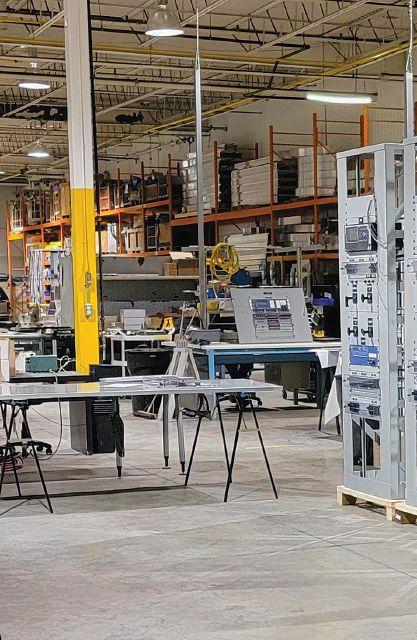
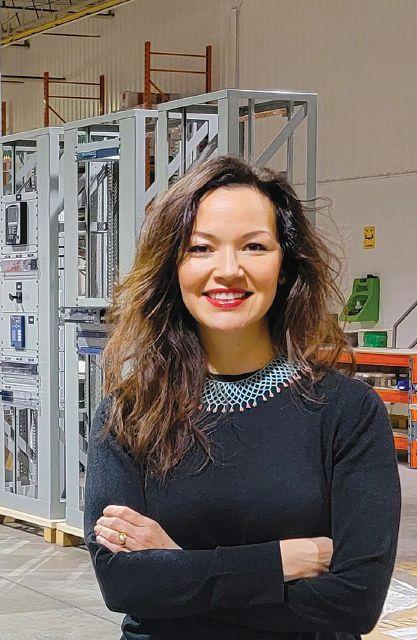
In February 2021, Fiona Blondin became the first-ever director, Indigenous Strategy, for Cormorant Utility Services.
titled “Business and Reconciliation”.
(The Truth & Reconciliation Commission ran from 2008 to 2015. It produced a list of 94 Calls to Action that aim to help heal wounds and, hopefully, bridge the divide between Indigenous and non-Indigenous Canadians.)
“Truly, it was a commission that looked at the path moving forward for the relationship between Canadian citizens, the corporate sector, for Indigenous communities, and how all of us can participate in reconciliation,” Fiona says. “And that was truly groundbreaking.”
I asked Fiona to explain the purpose and intent behind No. 92.
“Call to Action No. 92 is specific to business—the corporate sector and Indigenous communities—and it outlines why corporations and the business sector need to participate in that reconciliation relationship.”
“Creating and maintaining positive partnerships and relationships with Indigenous people and communities, now and moving forward, is a central value within the company and informs all of our actions. That understanding impacts every single piece of the company,” Fiona asserts.
Before joining Cormorant, Fiona admits she was impressed with Kulasingham’s leadership—as well as that of the executive and the owners—on Indigenous issues: “On what they believed Indigenous partnerships looked like, the impact of Indigenous-owned
projects, how our sector was changing, and on our ability to transform the work that we do”.
“Taking the step to develop an Indigenous People Relations Policy, then sharing it broadly, is about leadership within the sector. It’s not just about what we’re doing at Cormorant... it’s about the path that we’re trying to create within the sector.”
Much like a culture of safety starts at the top, a culture of progressive Indigenous relations starts at the top, too. This top-level belief system comes naturally to Cormorant, as its majority owner is CFFI Ventures Inc.—“a company committed to furthering reconciliation by advancing Indigenous ownership and shareholders in the Canadian economy and global markets”.
CFFI put its principles into reality, having concluded the sale of Clearwater Fine Food Inc. to a consortium of First Nations, representing one of the most significant single equity transactions with Indigenous peoples in Canada.
“Our entire leadership, along with all our employees, really value this relationship, and seek to understand the context of Indigenous partnerships better, particularly when you realize there are land issues that directly impact Indigenous communities.”
Role as director, Indigenous Strategy
With an Indigenous People Relations Policy in place and an executive team
“For Indigenous communities who are considering energy projects, you must develop a vision for your nation.”
that stands behind it, how does the director of Indigenous Strategy fit into everything? We know Fiona is responsible for the long-term strategy for promoting and ensuring the inclusion of Indigenous communities, but what does inclusion mean in this context? What does it look like?
“To somebody like myself, inclusion means how Indigenous people, communities, and nations can participate in the sector,” Fiona says.
“And, you know, I feel we’re coming into a time when Indigenous people are the owners of energy-related projects. For us at Cormorant, we are honouring this particular era of Indigenous relations, where Indigenous communities are taking a much more active role.”
In that vein, Fiona believes Indigenous communities are looking for good corporate partners. “And when I say good partners, I mean partners who share the same values around the environment, around our relationship, around our future, around employment.”
And good partners are partners for the long haul.
“To attract good partners within Indigenous communities, we had to transform ourselves and our understanding of inclusion.”
“You’re still going to be partners five years from now; in 10 years, you’re still going to be partners because of the values you share,” Fiona explains. “That’s our mentality as we look at different energy projects all over the country. As an Indigenous person, I feel passionate and committed to what we’re trying to do in the long term, and what we’re building within Canada, together, and the new kind of understanding that we have of each other.”
All this is to say that if your Indigenous policy is to host a community information session to tell Indigenous community members what you are
going to do... well, you had better go back to the drawing board. That’s oldschool thinking.
“We’re talking about something incredibly substantive; a relationship built upon a lot of thought and a lot of actions. At Cormorant, we have prepared to be that kind of partner. To attract good partners within Indigenous communities, we had to transform ourselves and our understanding of inclusion.”
“And I think Indigenous people are a significant part of that inclusion,” Fiona continues. “As the original people of Canada, we have a unique role within the diverse makeup of Canada, and that role is tied to the land and our responsibilities to the environment, which directly impacts and informs the energy sector.”
Advice for communities and developers
In the context of energy projects and healthy Indigenous relations, I asked Fiona for advice she can share with both Indigenous communities considering energy projects and parties interested in developing them.
“For Indigenous communities who are considering energy projects, you must develop a vision for your nation,” Fiona advises. “Each of our nations is incredibly unique from another. It could be clean energy projects, it could be hydroelectric projects, it could be ownership of transmission companies and lines.”
If you’re a developer, remember that community visions will differ based on the community. “Not one vision is good for everybody,” Fiona says.
“We have to be able to step back and understand that it’s not about our vision for the region, but the Indigenous community’s vision for their region. Now, how do we support that vision?”
Even though in Canada we still desperately need directors of Indigenous Strategy and Calls to Action (all 94 of them), Fiona remains optimistic about the path we are on.
“You know, we were looking at Indigenous-owned energy projects only in, say, the last 5 to 10 years, and now we’re starting to look at them more and more. And that speaks to the leadership from Indigenous communities and the power sector, which is really starting to transform itself.”
INDIGENOUS-LED ATLAS POWER POISED TO REVOLUTIONIZE ENERGY STORAGE
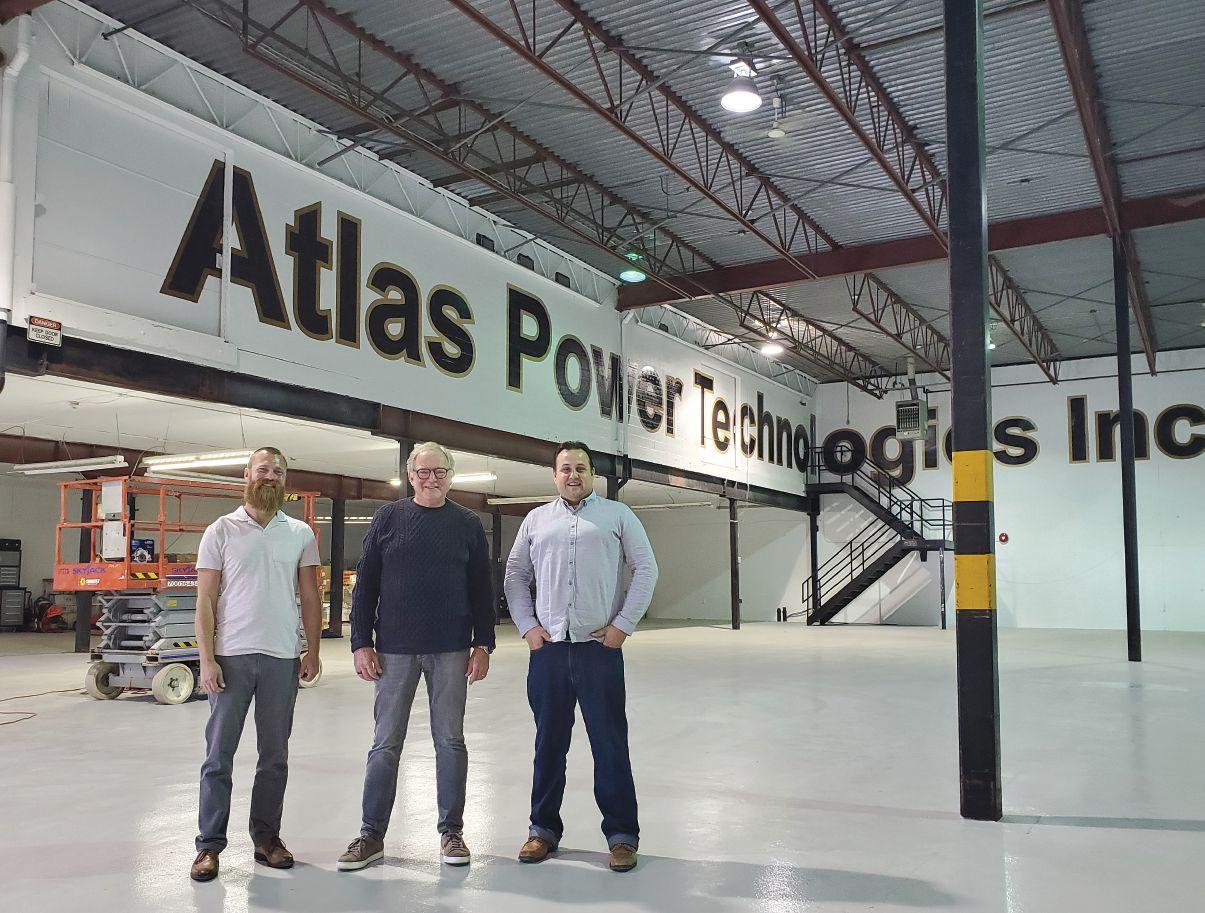
Energy start-up Atlas Power Technologies has announced that its supercapacitor manufacturing facility—currently under construction in Abbotsford, B.C.—is on track to be up and running before the end of the year.
“We’re accelerating the clean technology transition timeline by taking the most-mined products today that nobody wants and turning them into a high-value, clean technology,” said Mitchell Miller, CEO, Atlas Power.
Using technology first developed at the University of British Columbia,
and in partnership with Mitacs, Atlas Power’s process takes abundant materials (like mined thermal coal and/ or petroleum coke) and refines them to make high-grade, activated carbon—a component of supercapacitors.
A supercapacitor is a type of capacitor that can store a large amount of energy, typically 10x to 100x more energy per unit mass or volume compared to electrolytic capacitors. It is preferred to batteries owing to its faster and simpler charging, and faster delivery of charge. – Techopedia
So far, the technology’s application has been limited by high cost and low performance, explains Mitacs. Atlas Power aims to change that.
“We’re solving one of the biggest challenges of the clean energy transition, which is ‘How do we store renewable energy, efficiently and cost-effectively?’,” Miller said, whose technology is suitable for large-scale grid, utility and commercial applications.
Miller’s path toward founding Atlas involved collaborating with researchers at Simon Fraser University and UBC, along with the help of Mitacs. He eventually tapped into the Mitacs Indigenous Pathways program to hire student interns to help advance his ideas.
He says his Métis heritage is part of what drives him to find ways to add value to the world around him.What started as a small project to investigate a concept led to a breakthrough innovation that is performing 10 times better than existing supercapacitors today, he explained.
From left: Atlas Power Technologies’ Dean Hedman, director and chief construction officer; Brooke Wade, chair of the board of directors; Mitchell Miller, CEO and director.
Photo: Mitacs
“When you think about renewable energy going onto the grid, the amount of energy storage we have to produce is enormous, and there’s simply no clear path to get there with existing chemistries,” said Miller. He explained that competing storage technologies rely on scarce minerals, such as nickel, cobalt, graphite and lithium, which means new mines will need to be commissioned—a process that costs billions and will take decades.
“I get up every day knowing that, if we do our job correctly, the world will be a better place for my kids, and that’s a nice way to start the day,” he said.
To date, Atlas Power Technologies has hired three Mitacs interns, and has secured more than $400,000 in Mitacs funding. Prof. Jason Jiacheng Wang, who led the SFU research team, now serves as Atlas Power Technologies chief technical officer.
“Without Mitacs, we literally would not be where we are today,” said Mil-
“I get up every day knowing that, if we do our job correctly, the world will be a better place for my kids, and that’s a nice way to start the day.”
ler. “We were able to outsource our research and development to the university at an affordable rate, and that’s what allowed us to push forward.”
UBC Okanagan School of Engineering assistant professor Jian Liu is supervising the UBC team of Mitacs interns working on the project.
“We’re involved in many industrial collaborations, and they don’t always get this far,” said Liu. “Not only did this project go better than I ever expected, but our partner is now building their manufacturing capability right here in Canada, and that’s very important. They will be helping
to grow the local economy, and that’s much more important to me than the innovation itself.”
Candice Loring, business development director, Indigenous Community Engagement with Mitacs, calls the Atlas Power Technologies trajectory an incredible Indigenous-led business success story.
“I’m thrilled to bring this research under our new Indigenous pathways stream,” Loring said. “It’s my hope that this funding program becomes a standard offering to ensure equitable access to entrepreneurs and scholars, and to support collaborative innovation.”
Mitacs is a not-for-profit organization that fosters growth and innovation in Canada by solving business challenges with research solutions from academic institutions. It is funded by the Government of Canada and provincial partners.
— With files from Mitacs

YOUR NEXT WORK TRUCK COULD BE AN EV
Chevrolet and Ford are all-in with battery-electric offerings
The electric work truck is no longer just a niche offering from unknown, unproven manufacturers.
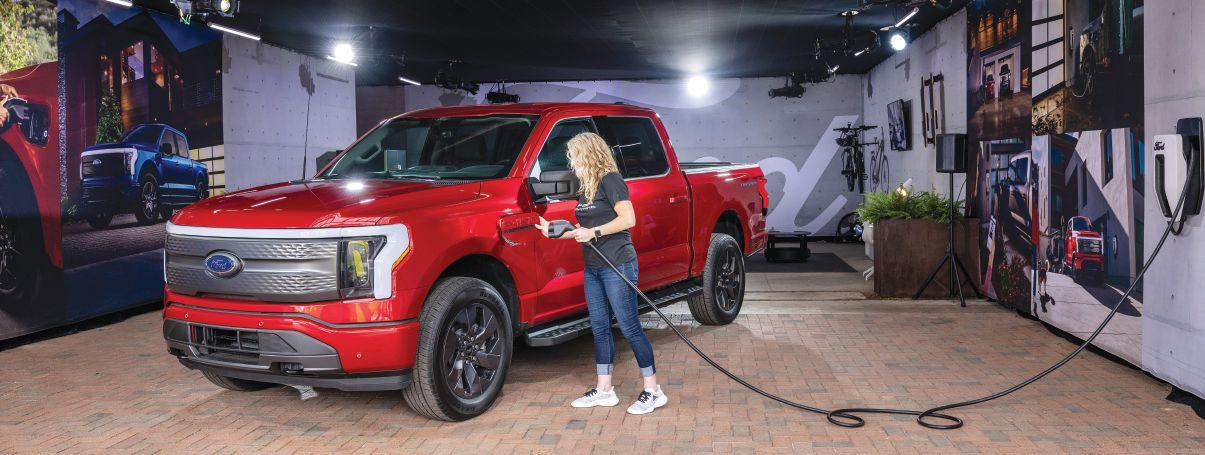
Ford’s all-electric F-150 Lighting started rolling off the line this year and—maybe surprisingly, maybe not— the current model year is no longer available for retail purchase. Chevrolet, meantime, is taking reservations now for its new all-electric Silverado, scheduled to come off the assembly in Fall 2023.
Both vehicles have been (or will be, in the case of Silverado EV) prepped for all the “smart” bells and whistles, including serving as an energy storage asset.
Unless you look closely, you’d think you were looking at an internal combustion engine vehicle (although the minimized air grille on both trucks gives you a clue as to what you’re really looking at). And they look great, don’t they?
ALL-ELECTRIC FORD F-150 LIGHTNING

Ford Motor Co. says the truck of the future is here, which it hails as “the smartest, most innovative truck Ford has ever built”.
Announced back in Spring 2021, the all-electric F-150 Lightning started rolling off the line this year.
“For both Ford and the American auto industry, F-150 Lightning represents a defining moment as we progress toward a zero emissions,
digitally connected future,” said Bill Ford, executive chair, Ford Motor Co.
Lightning targets 563 hp and 775 lb-ft of “nearly instantaneous torque”, a maximum 2000 lb of payload in the standard-range model, and a maximum 10,000 lb of available towing capacity on XLT and Lariat trucks with the extended-range battery and Max Trailer Tow Package.
“We’re not here to make an electric truck for the few,” said Ford’s Kumar Galhotra. “Ford is committed to building one that solves real problems for real people.”
Available technologies
As part of available Ford Co-Pilot360 technology, BlueCruise allows for handsfree driving on more than 160,000 km of pre-qualified
divided highways in Canada and the U.S., with more Hands-Free Blue Zones to come in the future.
Other tech includes available Onboard Scales, which uses the truck’s sensors to estimate payload and inform customers on how much they’re hauling. Since payload can impact range, Onboard Scales is integrated with Intelligent Range to help ensure F-150 Lightning
gives an accurate estimate of how far you can drive.
This truck debuts available Pro Trailer Hitch Assist, which automatically controls steering, throttle and brake inputs to make hitching trailers easier. Also making its debut on select vehicles is available Phone As A Key. When activated, this allows customers to lock, unlock and start their truck without taking their phone out of their pocket or using a fob.
These features and more will get better over time, says the automaker, with Ford Power-Up software updates.
“It really is the smartest F-150 we’ve ever made.” said Darren Palmer. “F-150 Lightning offers an immersive touchscreen, giving our customers all the info they want in an instant [...]”
Making its truck debut in the Lariat and Platinum series is SYNC 4A—an interface that is designed to adapt to driver behaviour. SYNC 4A employs natural voice control, cloud-connected navigation and wireless access to your favourite services. Elevating the digital experience further is the 12in. instrument cluster, which features a customizable interface and animated graphics.
Energy storage asset
Debuting on the F-150 Lightning is available Ford Intelligent Backup Power; with the ability to offload 9.6 kW
of power, this feature helps keeps the lights on during an outage. Enabled by the available 80A Ford Charge Station Pro and home management system, the Backup Power automatically kicks in to power your house. Once power is restored, the truck automatically reverts to charging its battery.
In the future, Ford plans to introduce Ford Intelligent Power, which will allow you to use your truck to power your home during high-cost, peak-energy hours.
With enhanced Pro Power Onboard, you can take advantage of built-in electrical outlets to directly power a variety of tools, electronics and appliances.
These capabilities are possible thanks to the truck’s “powerful next-generation lithium-ion battery”. F-150 Lightning offers two options: a standard-range battery (approx. 370 km estimated range) and an extended-range (approx. 483 km estimated range).
Some more facts
Under the hood, where the engine would normally be located, is the front trunk or “frunk”, good for 400 lb of payload.
Rugged underbody protection keeps the battery safe, with metal skid plates shielding both the battery and inboard motors from tough terrain. The battery
itself is secured inside a waterproof casing surrounded by crash-absorption protection, and has been tested down to -40 C.
The truck offers an 80A charge station as included equipment, which charges an extended-range truck from 15% to 100% in about eight hours.
The commercial-oriented
entry model starts at $58,000 US MSRP, while the XLT model starts at $68,000 US MSRP.
But don’t expect to get one any time soon. According to Ford Motor Co., the current model year of the all-electric F-150 Lightning pickups (all series) is no longer available for retail order due to high demand.
ALL-ELECTRIC CHEVROLET SILVERADO

Developed from the ground up as a fully-electric truck on GM’s Ultium EV Platform, the Silverado EV promises a combination of capability, performance and versatility, along with technologies that can evolve with the vehicle over time.
“Chevrolet has constantly revolutionized the Silverado franchise to make it the powerhouse it is today,” said Steve Hill, Chevrolet. “The Ultium Platform is a critical enabler of next-level pickup truck performance for both fleet and retail customers— whether they are currently driving a Silverado or are considering a pickup for the first time.”
At launch, the Silverado EV will be available in two configurations: an RST (Rally Sport Truck) First Edition and a fleet-oriented WT (Work Truck) model. Each will offer a suite of standard and available safety technologies.
Built to work
The WT will launch first for fleet customers, offering 510 hp and 615 lb-ft of torque, 8000 pounds of towing, and 1200 pounds of payload. After initial launch, Chevrolet will
introduce a fleet model with up to 20,000 lb max trailering with the max tow package.
“We’re excited to launch the Silverado EV, providing customers with a true work-capable truck to help them begin the transition to an electric fleet and assist them in achieving their own sustainability goals,” said Ed Peper, GM Fleet.
The chassis is designed with independent front and rear suspensions, with power transferred to the available 24-in. wheels on RST via front- and rear-drive motors that compose the e4WD system. Automatic Adaptive Air Suspension enables the vehicle to be raised or lowered up to 2 in.
Four-wheel steer capability reduces the turning radius at lower speeds for greater maneuverability in parking lots, and enhances handling and stability at higher speeds, particularly when trailering.
The RST and WT models also come with Tow/Haul mode, trailer hitch provisions, and an integrated trailer brake controller and Hitch Guidance. The RST also includes Chevy’s Advanced Trailering System.
whether drivers take their vehicles home or return to a central depot.
“We had no constraints when it came to designing the Silverado EV with dramatic style and flexible utility because we didn’t need to work around a traditional propulsion system,” said Phil Zak, Chevrolet Design.
Some more facts
The RST and WT feature public DC fast charging capabilities of up to 350 kW, enabling about 100 miles of range to be added in 10 minutes.
Energy storage asset
When combined with the available accessory power bar, the Silverado EV’s PowerBase charging system offers up to 10 outlets, to provide a total of 10.2 kW of power, including powering your home. The Silverado EV is also capable of charging another electric vehicle using the available accessory charge cord.
With the growing North American network of chargers and the Energy Assist feature in the myChevrolet Mobile App, drivers can create energy-efficient route planning, even while trailering.
RST owners also have access to Ultium Charge 360, GM’s holistic approach to EV charging, which is designed to simplify the overall charging experience, including access to more than 100,000 publicly available charging points in Canada and the U.S. WT customers have access to Ultium Charge 360 Fleet Service, which offers charging solutions for businesses,
The front-end design has been sculpted to direct air down the body side to reduce drag and turbulence. The Silverado EV will be offered exclusively in Crew Cab models, with a shorter front overhang. The second row is pushed rearward to provide more passenger room.
A 40/60 second-row seat offers four configurations that allow users to haul gear or equipment while still accommodating a passenger in the second row. With the addition of the available Multi-Flex Tailgate, the Silverado EV RST enables up to 10 ft, 10 in. of load floor and storage capability. An available tonneau cover allows items such as lumber or a kayak to be loaded into a fully lockable, weatherproof storage compartment.
Developed in-house at GM, Ultifi separates the vehicle’s software from the hardware to enable rapid and frequent software updates. This will give drivers the opportunity to evolve their vehicles over time, enhancing both the capabilities and accessing cloud services in a flexible and fast way.
Customers will have the ability to “content the truck across various price ranges”, with MSRPs around $50K to $80K and higher, allowing them to choose the truck that meets their capability and pricing needs. Reservations are being accepted now for Fall 2023.
Personalities

Eaton has appointed Jeff Walsh to the position of marketing manager, Shelf Goods, Canada (Electrical). Walsh has held a number of positions within Eaton, most recently as product line manager, Industrial Controls, where he managed a team of product engineers and specialists, and technology application engineers to develop marketing plans. Walsh holds a diploma in Industrial Electronics Engineering Technology from New Brunswick Community College (eatoncanada.ca).

Andreas Ruzic, executive vice-president of Rittal North America, has additionally been appointed CEO of Rittal USA. Ruzic possesses over 20 years of senior and C-level experience, says Rittal, covering a variety of industries. He has a degree in Industrial Engineering from the University of Applied Sciences in Rosenheim, Germany, and speaks three languages: English, Croatian, and German (rittal.ca).

Liteline Corp. (liteline.com) has hired Mike Smith as national business manager. Reporting to Steve McMullen, he will work alongside Liteline’s agent and factory direct sales team, focusing on driving sales by strengthening and building new customer relationships. Prior to joining Liteline, Smith held various sales positions with Ideal Supply—most recently as general sales manager.
Photo: J. Smith
Anders Hultberg is the new president of S&C Electric Canada Ltd., replacing Angelo Gravina, who is retiring. Before joining S&C, Hultberg served as senior vice-president and managing director of the high-voltage business for North America at Hitachi Energy. S&C Electric Canada Ltd. employs 500+ people in the Toronto area (sandc.com).
Michael Ramos has joined Stanpro’s Midwest sales team as a lighting specialist. He graduated with a certificate in Commerce/Industry Sales & Marketing from Red River College Polytechnic, and possesses seven years of experience in account management across several different industries (standardpro.com).

Patrick Charest has been appointed vice-president, Sales & Business Development, for Groupe Stelpro, announced Yves Chabot, company president. Charest has over 25 years of experience in the manufacturing industry in sales, marketing, and general management. A family business, Groupe Stelpro is an electric heating appliance manufacturer based in Quebec (stelpro.com).
Photo: Groupe Stelpro

TOA Canada Corp.—a developer, manufacturer and distributor of premier commercial audio and security products—has promoted Parth Gadhavi to the newly created position of national business development manager. Gadhavi previously served as Ontario East regional sales manager (toacanada.com).
Photo: TOA Canada

After serving as a regional sales manager for the Alberta, Saskatchewan and Manitoba territories, Tyrone Visser has moved on to become Wago Corp.’s North American business development manager for IIoT and Linux (wago.com).

OmniCable LLC—a re-distributor of wire & cable, electrical products, and value-added services—announced Georgia Sipsis has joined the company as territory sales manager, covering the Quebec, Maritimes, and Ontario regions (omnicable.ca). Sipsis possesses over
18 years of experience in the industry. Previously, she served as regional sales manager, Ontario, with Prysmian; before that, she was with General Cable.
Photo: OmniCable


John Galyen, president of Danfoss North America (at left), is retiring. Rick Sporrer, vice-president of sales, America, for Danfoss Power Solutions has been appointed successor (bottom left). Sporrer brings more than 30 years of experience to his new role. Prior to his current role, he served as director, Global Sales–Motors Business Unit Sporrer fully assumes his role in July (danfoss.com).

Carolina Rinfret has been appointed president & CEO of WaterPower Canada, a national trade association representing producers, manufacturers, developers, engineering firms, etc. (waterpowercanada.ca). Rinfret brings to her new position close to 20 years of legal, regulatory and government relations experience in hydroelectricity and the broader energy sector.
Photo: WaterPower Canada

Dan Drazilov has joined Sonepar Canada as vice-president of Mergers & Acquisitions, and Business Development. He previously served as president of AD Canada (Electrical) and as regional VP and GM for WESCO Canada. Sonepar is represented in nine provinces via Dixon Electric, Gescan, Lumen, MGM Electric, Sesco, Texcan and Vallen (soneparcanada.com).
Photo: Sonepar Canada
We’re limited by space here, but have plenty of room online! Learn more about these individuals by visiting EBMag.com. Click “News”, then click “Personalities”.
Photo: Eaton Corp.
Photo: Rittal Systems Ltd. Canada
Photo: Wago Corp.
PhotoS: Danfoss North America
Cementex doubleinsulated torque wrenches and screwdrivers

Photo: Cementex
These tools are rated for applications to 1000 VAC and 1500 VDC, and meet or exceed the requirements of CSA Z462. The wrenches feature a low-friction torque control mechanism that produces accurate readings in either direction, says Cementex, as well as
two calibration adjustments for precise torque settings. The screwdrivers feature an anti-backlash design for repeatability and a precision micrometer scale calibrated in inchpounds, in increments of 1 in.-lb (cementexusa.com).
Wago 221 Series inline splicing connectors
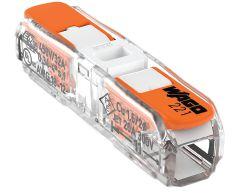
Sporting all of the familiar features of the lever-ac-
PROUD CANADIAN LIGHTING LEADER
tuated 221 Series, Wago has expanded the series to include the 221 inline splicing connector. This connector allows universal conductor connection, a visibly secure conductor contact, and comes with Orange levers for a toolfree wiring experience for solid, stranded and fine-stranded conductors, ranging from 12 AWG to 20 AWG. Equipped with Cage Clamp, the connectors offer the option of using additional adapters where multiple poles are required (wago.com).
Mitrex 800W solar panels
Mitrex Integrated Solar Technology—a manufacturer of building-in-

tegrated photovoltaics (BIPVs)—unveiled its largest “tandem” solar panel, which boasts a power output of up to 800W. These panels are made in Canada using monocrystalline silicon solar cells, and are equipped with patented anti-reflecting technology to optimize electricity generation. Additionally, the panels come with a 25-year warranty (mitrex.com).


Photo: Wago
Photo: Mitrex


Estimating 101
DAN BERESFORD AND JOHN F. WIESEL
Do you have good estimating habits?
Do you follow a format, plan or method when doing an estimate or take-off? Estimating is a process—a methodology—and you get better at it by developing good habits.
Many new estimators make the mistake of jumping around from section to section when going through drawings, but the best approach is to work through the specs and drawings step by step.
Learn to do the same things in the same order every time, and take your time. Do the first things first. Read the specs, then review the drawings and read the notes before you start to count and measure. Then read the addendums.
Do you record your conduit take-off the same way every time? Have you ever been on a job where a branch circuit and all the corresponding materials and by-products were missed? What happened to the job schedule? How were the missing items and labour covered off?
As you measure conduit and wire, and record them on the take-off sheet, mark them on the drawing, too. List all the conduit, connector bends, straps, etc. When you take off conduit the same way every time, you become more accurate. When there are multiple circuits, use as many drawings as you need so that you can see the different circuits.
When you skip around the drawings and specs, counting light fixtures can be agonizing! But, by working through one page at a time, you will miss far fewer fixtures. Take off one type of fixture at a time. Make sure you have the fixture list and symbols at hand. When you count a fixture, mark it. Do your lighting take-off the same way every time.
Counting switch, receptacle, or special outlet boxes or devices takes time but, when you miss one, you’ll miss time and material, and lose money. Be methodical when taking off boxes, and remember to take off boxes for the lighting circuits.
Break down every bid, every area, every room into its own take-off when counting and measuring. Paper is cheaper than time and, more importantly, paper is cheaper than mistakes. Use forms or spreadsheets designed specifically for the material you are taking off. Learn to estimate by hand, then move to software.
As you develop good habits and practices, you’ll get both faster and more accurate when estimating.

CODE conundrum
RAY YOUSEF
Ray is a code engineer with Ontario’s Electrical Safety Authority
TACKLE THE CODE CONUNDRUM IF YOU DARE!
Welcome to the newest round of questions that test your knowledge of the CE Code-Part I. Answers will appear in the September 2022 edition of Electrical Business Magazine, and online at EBMag.com under Features.
QUESTION 1
When Type CFC system wiring is used, it shall be covered with abrasion-resistant tape and secured to the floor so that all cables, corners, and bare conductor ends are completely covered.
a) True b) False
QUESTION 2
What is the maximum length of 12 trade-size, liquid-tight flexible conduit permitted for the connection of equipment?
a) 600 mm c) 1.0 metre
b) 750 mm d) 1.5 metre
QUESTION 3
The maximum rating for a circuit breaker protecting exposed wiring for permanent outdoor lighting circuit is:
a) 15 A c) 30 A
b) 20 A d) 40 A
ANSWERS
Electrical Business, May 2022 ed.
Question 1
Where receptacles of type 14-50R are installed on recreational vehicle lots, the CE Code requires them to be protected by Class A-type GFCIs.
b) False. Rule 72-108(4).
Question 2
What is the maximum distance for spacing between supports for electrical non-metallic tubing?
c) 1.0 m. Rule 12-1504.
Question 3
The maximum voltage for a class 2 circuit is:
d) 150 V. Rule 16-200.
John F. Wiesel is the president of Suderman Estimating Systems Inc., and has been estimating and teaching estimating since the early 1980s. Dan Beresford served as an electrician in the Canadian Navy, then worked in various roles in the electrical sector before joining Suderman.
How did YOU do?
3 • Seasoned journeyman 1 • Apprentice
2 • Need refresher training 0 • Just here for fun!

DAVID PILON
Ungrounded and NGR systems
What is an ungrounded system versus an impedance-grounded system, and what are their advantages and disadvantages?
An ungrounded system is one in which no point of the system is intentionally grounded. The non-current-carrying conductive parts of the electrical system equipment are grounded for equipotentiality, and bonded together for fault indication and activation.
So where, and why, would we use an ungrounded system?
These systems are typically seen in locations requiring a 3-phase system with no single-phase loads (e.g. 480V versus 480/277V or, the most popular in Canada, 600V versus 600/347V). Ungrounded systems are often found in facilities with large motor loads, like a manufacturing or petroleum plant.
But this doesn’t mean that such a facility could not have more than one system. Some plants will have a 600/347V system that feeds a lot of the equipment and lighting throughout the plant, plus an ungrounded 480V system for some of the motor loads (which prefer this voltage), as well as 208/120V
Generally, the purpose of the impedance grounded system is to allow it to operate under fault conditions until troubleshooting finds the fault
transformation for offices and other systems. (480V systems are also quite common in oil field installations.)
A fault to earth can go undetected in an ungrounded system, which will continue to operate because there is no reference to earth that would cause the breakers to trip. The only safety system in place for these systems are the ground detection lights, which are wired in such a way that, in the event of a fault, the imbalance will show a variance in the illumination (one light may go out completely or become very bright).
When you see a light out on the system, the first step is to check the bulbs. If the bulbs are all good, then the next step is troubleshooting the fault.
A neutral grounding resistor (NGR) system is an impedance-grounded system. With these systems, an impedance (we typically use a resistor here in Canada) is installed into the connection between the grounding electrode and the neutral point of the transformer.
These systems are not typically used where line-to-neutral loads are being served, and are set to alarm and de-energize immediately.
Generally, the purpose of the impedance grounded system is to allow it to operate under fault conditions until troubleshooting finds the fault. CE Code Table 17 lays out the alarming and de-energization parameters for these systems, and the different types of faults under which they can continue to operate under an alarm condition.
So, in a larger industrial facility, this system would continue to operate under a fault condition with an audible and visual alarm. It would permit the facility to repair the system within 48 hours, provided there are no line-toneutral loads being served.
When we talk about line-toneutral loads, we are referring to loads off the main system voltage. This does not include step-down transformers feeding new systems which are not protected by an impedance ground on the secondary. When choosing our methods for grounding, then, the issue usually comes down to a few things, such as: operational needs and the cost when a system shuts down; initial cost of the system in general; and the need to function under fault condition, and the hazard this may pose to operators.
Once the determination is made, the code requires that plans be submitted in accordance with the authority having jurisdiction.
Consult your Authority Having Jurisdiction for more
David Pilon is manager, Electrical Inspections, at Technical Safety Authority, Saskatchewan (TSASK). He also serves as vice-chair of the Canadian Certified Electrical Inspector (CCEI) committee of the International Association of Electrical Inspectors (IAEI), Canadian Section. He can be reached at david.pilon@tsask.ca.

Where Life Matters Look No Further
Leading the Way in Life Safety Solutions, Acuity Brands® delivers an innovative portfolio of emergency lighting solutions for today’s commercial, institutional, industrial, and public spaces, covering the scope of virtually any project requirement.
WE’RE TAKING REWARDS TO THE NEXT LEVEL.
With more ways to earn loyalty points and redeem great prizes, the new and improved AD Rewards program allows you to capitalize on the power of your purchases from AD distributors like never before.
With over 6,000 valuable merchandise and travel rewards, your relationship with your AD distributor has never been more powerful…or lucrative. Join today at any of these participating AD distributors.