Managing energy and reliability in cold storage facilities /
The construction of facilities for keeping things refrigerated across Canada continues unabated. The cold storage market in this country generated revenues of $11.1 billion US in 2024. With a compound annual growth rate of 17.6% from 2025 to 2030, revenues in this market are expected to reach $28.9 billion US by 2030.1
M artha Roberts, economics editor with Farm Credit Canada, notes that even though the cold storage sector has somewhat cooled since the sudden “large spike in demand from the pharmaceutical sector to store vaccines and supplies” during the pandemic, the market is still strong and growing.2
“And the addition of 2.5 million more people over the last four years—thanks largely to immigration—means more mouths to feed and more storage needed to house the growing stockpiles of food,” Roberts writes. “The same economic drivers that have prompted more canned food purchases are also spurring greater consumption of frozen goods.”
Food and beverage drive demand
When we talk about cold storage facilities, we typically think about the food and beverage (F&B) sectors, which are the primary drivers behind their construction.
ANTHONY CAPKUN
“A lot of F&B manufacturers are established in dense, populated areas. They have no room to expand their operations—to expand production—unless they give up having their own onsite cold storage,” says senior electrical industry professional Stan Wachon. “So a lot of them are sending their finished products straight to a third-party cold storage facility, which gives them room to expand.”
Wachon has spent over 30 years in the electrical/automation industries, most recently with a focus on the F&B industry. His priority is to help customers manage their energy use while providing strategies for maintaining operational reliability.
Roberts agrees that the biggest boost to cold storage facilities comes from the F&B sectors—its largest consumers. Growing alongside that are the sectors involved in cold chain logistics, which are seeing increased demand because of developments in preservation techniques and efficient transportation over long distances.
Costs for a cold storage facility will vary depending on location and temperature setpoint, and various other factors, writes Roberts, “but a realistic range runs from the high $200s to $400+ per square foot”—three times higher than a typical warehouse.3
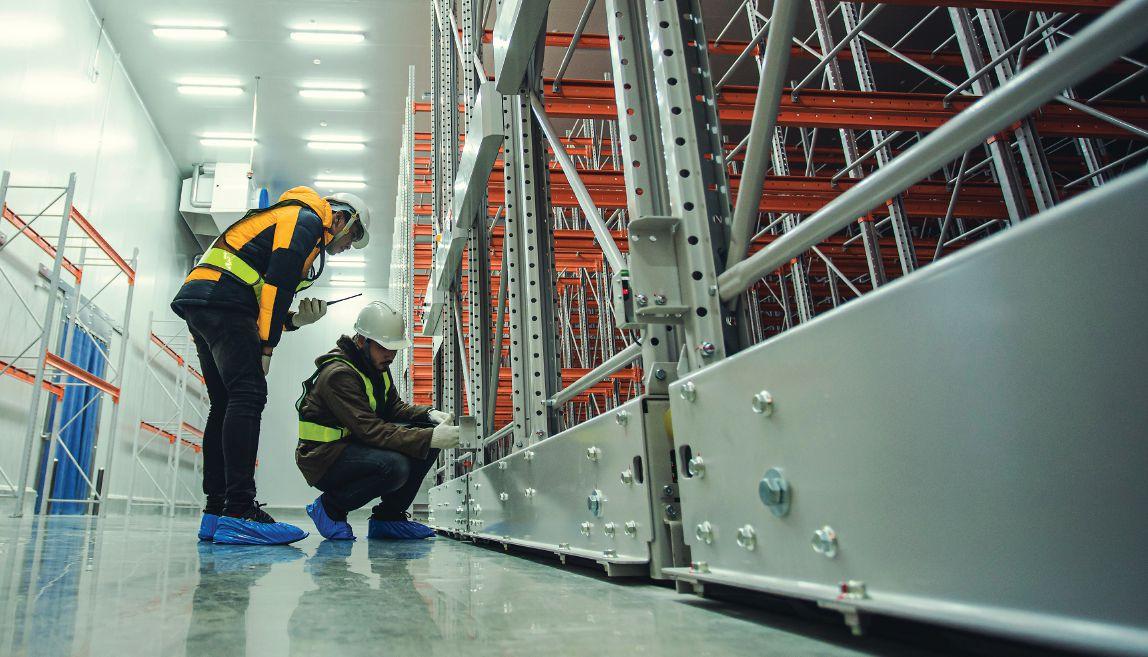
From the outside, a cold storage warehouse often looks like a simple, non-descript box. On the
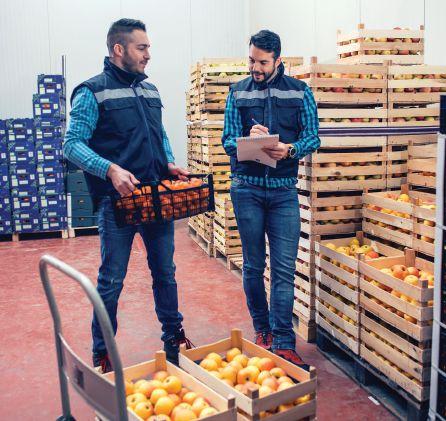
A lot of food and beverage manufacturers are making room to expand their operations by giving up their own onsite cold storage and sending finished products straight to a third-party cold storage facility.
inside, it is a sophisticated conglomeration of racking, lighting and, especially, the cooling system, which consists of the coolant/ refrigerant (typically anhydrous ammonia), compressors, condensers, receivers, separators, pumps, and evaporators.3
“And that cooling system is not just an energy hog,” says Wachon. “It also demands power consistency. When power is inconsistent or disrupted, it could be very detrimental to the product being stored.”
Power quality and energy efficiency
The average refrigerated warehouse uses 24.9 kWh per square foot annually, which is 4x higher than a conventional warehouse. 3
“The cost of energy is extremely high. We all know this. So when we look at power, we want to look at it through the lens of quality and consistency, but also efficiency,” Wachon says. “How do we know whether our facility and our individual pieces of equipment are using the correct amount of power, and using it efficiently?”
Part of that answer comes from knowing the type of cold storage facility, as this helps determine the
overall electrical load.
“If you’re storing ice cream, then you’re looking at sub-zero storage, which means greater energy consumption just to keep it below zero,” Wachon says. “If the facility is storing milk, which is just above freezing, then you’re consuming a little less.”
Cost per square foot for a cold storage facility is often
3x
higher than a typical warehouse
Warehouses can get as cold as -86°C for ultra-low temperature pharmaceuticals and medical supplies, but the most common freezer temperature range is between -23°C and -29°C.3
“Ultimately, you need information. You need data to understand what the electrical system—and everything connected to it—is doing,” he says. “At the end of the day, the owners and operators not only have to pay the bills, they have to ensure that none of the product spoils, and that the facility remains stable.”
The best way to gather that information is through metering, and a good starting place is at the service entrance.
Information is key to uptime
“What is the state of the power coming through my main? Is it consistent?” Wachon asks. “The
utility will always say there’s nothing wrong with their power delivery, but you don’t really know unless you install the right technology, such as metering, and start gathering data. Otherwise, any power inconsistences will be placed on the owner of the site.”
The natural extension to metering is data logging.
“You begin to see the amount of power you’re using during the day, during the evening, and you can build an energy profile (i.e. dashboard on your computer)—a usage report that not only shows how much energy is being used and when, but also identifies which systems are using the most energy.”
Comprising various motors and drives, the HVAC system in a cold storage facility is a massive energy consumer.
“Like anything, motors have a life span. How long before they need to be serviced? How long before they need to be replaced? That’s another area where metering and data logging—and especially individual equipment sensors—pay dividends. After so many hours of operation, for example, you know it is time to service motor #1.”
And with equipment status information at your fingertips, you will know whether motors #2, #3 and #4 can pick up the slack and keep everything running smoothly when motor #1 is taken offline for servicing, or should a disruption occur.
“I’m a big fan of equipment sensing devices,” Wachon says. “I mean, where are HVAC systems typically installed? On the roof, right? A place that is not regularly visited or easy to access. But when those RTUs are wired up with sensors, and one of them starts vibrating in a weird way, you’ll get a notification that something is not right. Then you can jump into action to address the issue before it becomes a problem.”
Essentially an early warning system, equipment sensors help avoid unplanned shutdowns. “Efficient use of energy coupled with efficient use of well-maintained resources equals a profitable operation,” Wachon says.
Metering, logging, and sensors are not just for new-builds, he continues. “Existing buildings can also really benefit. Again, let’s start by gathering data to find out how the equipment is performing.”
For example, the data may re-
veal that an old motor is drawing more power than the others. The owner/operator can put a plan in place to replace that motor with one that meets today’s efficiency standards.
Wachon recalls one site where the owner of an aging system knew that upgrades were necessary, but didn’t know where to begin.
“Anyone can replace a piece of electrical equipment—which could cost upward of $500,000— but not fully know whether it actually brought value. Instead, start with metering, at a substantially lower cost, which helps you make educated decisions about where to start your upgrades.”
Maintaining a healthy status quo
The final piece of the metering puzzle is to integrate all those technologies into the building automation system (BAS), Wachon says, “which ties everything together nicely as part of an efficient facility”.
“The additional cost for such a system is so small when you look at the big picture, yet so important for monitoring and controlling the facility’s health,” he says.
In fact, a cold storage facility’s monitoring capability is an extremely important consideration. Some critical questions3 customers will have of the owner include:
Warehouses can get as cold as -86°C for ultra-low temperature pharmaceuticals and medical supplies, but the most common freezer temperature range is between -23°C and -29°C.
Customers want their product to get to market without any spoilage, so they will seek out a reliable cold storage partner.
• How do they monitor the temperatures of their goods?
• Is the monitoring in real-time? Is it remote?
• How are they alerted to problems?
• What kind of security and surveillance capabilities do they have?
Customers want their product to get to market without any spoilage, so they will seek out a reliable cold storage partner.
“Bacteria is not your friend,” Wachon laughs. “When things get to a certain temperature above zero, bacteria starts to grow and multiply. When that happens, you’re likely looking at millions of dollars-worth of spoiled product, plus the possibility of spending lots of dollars to disinfect the area should the mould get out into the facility.
Backup power should be an important consideration for any cold storage facility, but it can be cost-prohibitive, which is why right-sizing is so important.
“In the case of, say, a battery energy storage system: do I need one megawatt or 10 megawatts? Armed with my load profile, I can approach the design and purchase of a BESS and say, ‘Okay, I want backup power for 4 hours to give me time to plan, take action, and keep product out of harm’s way,
which means I need this kind of BESS based on my quantified needs.”
A BESS could also be using for onsite renewable energy generation, global adjustment, and peak shaving. “Depending on where you operate, there may also be government or utility incentive programs to help the owner with these upgrade costs,” Wachon says.
“The key with cold storage is understanding the electrical system; making it as energy-efficient as possible, and being predictive rather than reactive to maintenance concerns. We need to continue educating end users about these benefits,” he says.
He says the owner of a facility must weigh the cost of energy efficiency, predictive maintenance and backup power against the cost of losing product... and reputation.
“If I’m the owner of a cold storage facility, and I was to lose everything and be held liable... what would that cost me?”
Sources
1. “Canada cold storage market size & outlook, 2024-2030,” Grand View Research Inc., 2025.
2. “Why the cold storage market is no longer as hot,” Martha Roberts, Farm Credit Canada, March 2024.
3. “Cold storage warehouses: the ultimate guide,” Conger Industries Inc., August 2024.
FROM DORMANCY TO NUCLEAR DOMINANCE
Will Wesleyville host Canada’s first new nuclear build in 40 years?
BY ANTHONY CAPKUN
While speaking at an Ontario Energy Network luncheon back in 2015, Duncan Hawthorne (then-president & CEO of Bruce Power) said that Canada is seen as a nuclear power pioneer on the global stage, and spoke passionately about positioning nuclear power as a critical element in Ontario’s energy supply mix.1
And what a pioneering history: Atomic Energy of Canada Ltd.—in cooperation with Canadian industry—began developing the first CANDU (CANada Deuterium Uranium) reactor in the late 1950s! The first commercial Candu reactors began operation in Pickering, Ont., in 1971.2
T his year, following expressions of interest from the Municipality of Port Hope and the Williams Treaties First Nations (WTFNs), the Ontario government has asked Ontario Power Generation to explore opportunities for new nuclear energy generation at its Wesleyville site, about an hour’s drive east of Toronto.
This would be the first new nuclear build in Canada in over 40 years.
Based on early assessments, the site could potentially host up to 10,000 megawatts of new nuclear generation, powering the equivalent of 10 million homes, and making it the largest nuclear generating station in Canada.
Wesleyville site history
OPG’s predecessor company Ontario Hydro began developing the Wesleyville site as an oil-fired generating station in the late 1970s. Construction
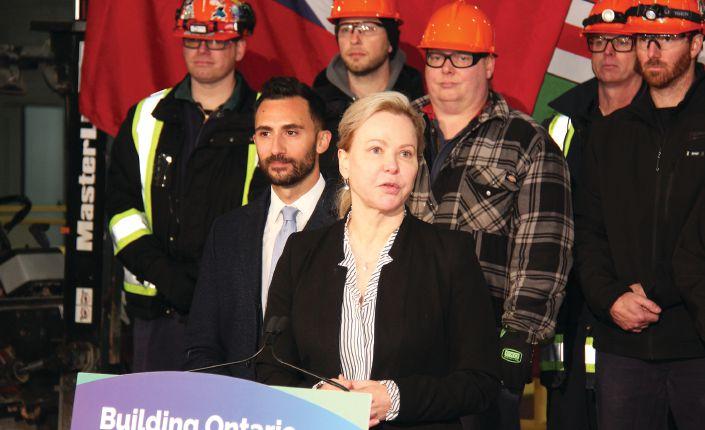
Municipality of Port Hope Mayor Olena Hankivsky and Minister of Energy & Electrification Stephen Lecce deliver remarks at a press conference held at OPG’s Wesleyville site (January 15, 2025).
halted following the 1979 oil shock and a recession.
W hile maintained over the years, the generating station has lain dormant. “Now, with Ontario’s electricity demand set to grow by 75% by 2050, Wesleyville is back in the spotlight,” writes OPG.3
T he 1300-acre site in Northumberland County is already zoned for electricity generation, with access to transmission, railways, and roads. It’s also located near Durham Region, which hosts OPG’s Pickering and Darlington nuclear generating stations.
Citing a study by the Conference Board of Canada, the Ministry of Energy & Electrification says the potential development would contribute $235 billion to Ontario’s GDP over an estimated 95-year project life, which includes design, construction, operation, and maintenance.4
It would also support 10,500 jobs across Ontario, including 1700 “new, good-paying jobs in Port Hope”, representing an average 15% to 20% boost to overall employment in the local area.
Port Hope Mayor Olena Hankivsky said she looks forward to continued
engagement with OPG, the community and related stakeholders in “inclusive, collaborative dialogue”.
OPG will provide the WTFNs with capacity funding and an opportunity for equity participation in any generation project.
The province also announced immediate funding of $1 million for the Municipality of Port Hope to support early growth readiness, assessment of planning and infrastructure requirements, and to meet consultation requirements.
As part of a milestone-based process leading toward the development of a Host Municipal Agreement, Port Hope could also access up to $30 million of funding for associated infrastructure investments and to attract co-located industries.
Sources
1. “What do drug dealers and nuclear power operators have in common?” Electrical Business Magazine (ebmag.com), February 12, 2015.
2. World Nuclear Association.
3. Ontario Power Generation.
4. Ministry of Energy & Electrification press conference, January 15, 2025.
CANADIAN CONSTRUCTION TRENDS AND OPPORTUNITIES TO WATCH IN 2025
BY NOLAN FRAZIER
It’s a new year, and as construction organizations navigate issues such as the skills gap, efficiency, sustainability, and more, it’s a great time to have a look ahead at some of the trends and areas we see affecting the industry in 2025.
This year presents significant opportunities for Canada’s construction sector, especially for organizations that are willing to embrace digital transformation and capitalize on government infrastructure investments.
Technology adoption, regulatory reform, and a focus on sustainability offer pathways to overcoming long-standing productivity gaps.
I n particular, we expect AI will continue to make inroads and have a greater impact on the jobsite, from daily operations to enhancing overall productivity.
T he labour shortage and skills gap will continue to affect construction this year, but we’re seeing conversations and approaches shift to address it. We’ll also see different approaches in the areas of efficiency and
In 2025, expect companies to leverage generative AI for onboarding, training, and upskilling
budget management, along with other innovations on the jobsite. H ere are some areas the Procore Technologies team is keeping an eye on for 2025, as well as some opportunities we see for the year.
The
impact of AI
AI agents and workflow automation. This year we’ll see AI agents become standard in automating repetitive tasks such as writing RFIs, design versioning, and project setup. By making it easier for teams to focus on higher-value tasks, these agents will empower construction teams to boost efficiency and streamline workflows.
New approach to AI and data-driven decision-making. As generative AI becomes more mainstream, construction professionals can interact with software through natural language, making it easier to gain insights and make data-driven decisions. This solution will allow project managers to ask questions directly to the AI agent and receive instant, customized responses—a game changer for daily operations and productivity.
Generative AI as the interface for SaaS platforms. Generative AI will redefine how construction professionals interact with software platforms. SaaS products will rely more on natural language commands to trigger actions. This in turn will make them more intuitive and customizable for specific industry needs. We’ll see this shift lead to greater adoption, especially as companies see the benefits of voice-driven interactions in managing projects.
Labour and skills gap
Revolutionizing the skill gaps. Leaders who embrace inclusive cultures and proactive tech solutions see greater workforce stability—a critical advantage in today’s competitive environment.
As the workforce shortage intensifies, we’ll see construction organizations that prioritize upskilling and integrating diverse talent finding an edge over those relying on traditional methods.
Workforce transformation and upskilling with AI. Artificial intelligence will accelerate workforce development by helping new employees become experts faster through AI-driven training and recruiting tools. In 2025, expect companies to leverage generative AI for onboarding, training, and upskilling to help bridge the labour gap and improve overall productivity.
Maximizing efficiency and budgets
Efficiency takes centre stage.
With economic pressures mounting, we’re seeing construction organizations turning to data-driven tools to do more with less, improve resource use, and cut costs. This year, we can expect widespread adoption to streamline project management and boost performance across the board.
Impact of regulatory standardization. Collaborating with the government to standardize building codes, permitting, and licensing processes across provinces will unlock efficiency and reduce barriers that have been preventing firms from scaling and adopting innovative practices.
Vertical integration grows. To protect their margins, general contractors and trades are bringing design and construction services in-house to control costs and navigate current economic challenges. This year, more firms will vertically integrate to shield themselves from economic fluctuations and maximize profits.
Innovations on the jobsite
Connected sites with IoT and wearables. We’ll see a shift in jobsite technology in 2025 as wearables and IoT devices become commonplace. By collecting real-time data on worker safety and tracking equipment, these technologies will enhance project efficiency and make site operations more transparent.
Sustainable innovations on the rise. With more industries pushing for environmentally responsible practices, construction is set to embed sustainability into design and material selection. By leveraging a construction management platform, companies can align diverse teams to implement green solutions: from renewable-powered data centres to nuclear-powered projects that set the stage for a more sustainable future.
Additional considerations for 2025
In addition to the trends mentioned above, there are great opportunities this year for Canadian construction that should also be considered. For example, contractors have an enormous opportunity to participate in public projects in 2025, especially with both federal and provincial governments planning large-scale infrastructure projects across sectors such as transportation, energy, healthcare, data centres, and public utilities.
While this might put additional strain on the labour shortage, it can be overcome in part by proposing and developing creative delivery models—such as public-private partnerships (P3s), integrated project delivery (IPD), and other collaborative procurement strategies—that optimize resources, reduce timelines, and improve outcomes.
T his also opens doors for government to explore alternative procurement strategies to attract more bidders, streamline processes, and mitigate the pressure on labour supply. These alternative approaches can create room for smaller contractors to uplevel their experience and gain involvement in large public projects, expanding the pool of firms capable of handling significant workloads.
By refining their project delivery models, contractors can demonstrate their capacity to handle complex, large-scale projects, enhance their competitiveness, and meet the growing demand for infrastructure across Canada.
T he industry continues to progress, and organizations that keep the above on their radar will be better prepared to address challenges and take advantage of opportunities in 2025... and beyond.
Nolan Frazier serves as regional sales director (Canada) for construction management platform Procore Technologies.
LEADING ONTARIO’S LARGEST INDIGENOUSLED GRID CONNECTION PROJECT
A conversation with Margaret Kenequanash
BY ANTHONY CAPKUN
Some refer to her as a trailblazer and a champion, but if you were to ask Margaret Kenequanash, she’d tell you she is just a person who’s helping to get the job done.
Margaret serves as CEO of Wataynikaneyap Power: a company 51% owned by 24 remote northern Ontario First Nations communities that constructed the largest Indigenous-led grid connection project in the province’s history. (Fortis Inc. and other private investors own the remaining 49%.)
Wataynikaneyap means “the line that brings light”—a suitable name, considering the project involves the construction of approximately 1,800 kilometres of new transmission lines to connect more than 18,000 people in remote First Nations communities to the provincial grid, ending their reliance on unreliable and/ or maxed-out diesel generation.
Margaret’s job as CEO is to see this ambitious, generational infrastructure project through to completion.
Margaret’s early years
Like others in her home commun-
Margaret Kenequanash at the Sachigo Lake First Nation substation.
ity of North Caribou Lake First Nation, Margaret and her family mostly lived off the land. The household relied on lanterns and candles for light, and wood for heating.
Laundry involved going down to the lake to draw water and haul it back up, then making a fire to heat the water, she recalls, “and that’s how you did your laundry every weekend”.
Growing up, all the kids knew their chores. Among them, Margaret and her brother were tasked with wood-cutting to prepare for the winter. They would cut cord after cord of wood, then load it onto a sled pulled by a big dog named Lion to bring it home.
“We didn’t have a skidoo then, so there was a lot of snowshoeing,” Margaret remembers. She lived this way until about the
age of 13, when her mom sent her to an all-girls school.
Upon her return, Margaret was assigned the task of building a fence around the community cemetery. “And that didn’t go so well,” she chuckles, “so I was asked to survey the toilets and their proximity to the lake for some government agency.”
“The following year, the leadership decided that my forte may be working with the youth and the Elders, and I did that for three years. My Elders taught me so much about the history of our people... where we lived, how we travelled... They grounded me.”
Power as a regional concern
“ I’ve been trying to pinpoint when we got our first generator,” Margaret muses. “A friend and I figured it was in the early 1980s, but it wasn’t a big power generator. It was one of those little generators that you plug into your house so that you could watch TV... if you even had a TV.”
Somewhere around the early 2000s, momentum started growing to get North Caribou Lake and other First Nations off of diesel generation and become connected to the provincial grid. How does one even begin to tackle such a momentous task?
“Well, if you have a few days, I could tell you,” Margaret laughs. “Discussions between First Nation community leaders where they prioritized energy as a regional issue actually started many years ago.”
In the early 2000s, the owner of the Musselwhite Mine concluded it needed more power, so Goldcorp approached the local First Nations to discuss the issue. The leadership of those communities expanded the lens, recognizing that power limitations were of concern to everyone in the region, not just those near the mine.
Based on those discussions, 13 First Nations rallied under their Tribal Councils—Windigo and Shibogama— to lead this regional initiative. Mandated by Tribal Council Resolution, the goal was to pursue the planning and development of a transmission line that would connect communities to the provincial grid.
U nder the banner of Central
Margaret Kenequanash (far right), welcomes the Bearskin Lake community during a luncheon. Source: Wataynikaneyap PoWER
Corridor Energy Group, they signed an agreement with Goldcorp and incorporated Wataynikaneyap Power. However, Goldcorp left the project in early 2010, as it could not assist with transmission, and Fortis joined several years later.
What began with 13 First Nations eventually expanded to the present 24, but not without roughly 2,500+ engagements, communications, and meetings “from the beginning of the project to where we are today”.
“And that’s a heck of a lot of chicken, you know? You’ve got to bring food to these meetings,” Margaret says with a laugh.
Planning gets underway
P lanning among the partner communities began in earnest, starting with routing for the transmission lines, followed by about five years’ worth of environmental assessments. Meantime, they also had to work with the Government of Ontario to ensure their project was included—and prioritized—in the province’s Integrated Power System Plan (which eventually became the Long-Term Energy Plan, or LTEP).
“Part of my job was convincing the government that they need to include us in any energy plan because of our mandate to connect remote First Nations to the transmission grid,” Margaret says.
An important part of that mandate included having ownership in any
project.
“That was the task we were given to enable the vision of our people: to bring reliable energy into our communities, own the infrastructure and ensure that we benefit from any development in our homeland,” Margaret says.
Why the line was needed
I will always appreciate Margaret’s bluntness. “Our reserves are these little square boxes that somebody decided we should live in, and we’re quickly outgrowing them. Our population is expanding, so we need more housing, more services, more infrastructure. And that’s the reality.”
She points to essential needs (e.g. water quality, shelter, healthcare) as a real pain point. “And our Elders are being flown out of the community to do respite or palliative care in hospitals. They cannot pass away with dignity in their own community because the services are not there. And the services that are there are questionable because we don’t have reliable energy.”
W hile engaging the various First Nation communities, Margaret recalls visiting one community where 42 young families were in need of housing. Sure, the houses they needed were being built, but there wasn’t enough electricity to power them.
“As a result, these young families were living in two-, three-bedroom units, and taking turns sleeping during
the night. It’s sad. Some of our First Nations are suffering. There are a lot of issues with water quality right across Canada. We shouldn’t have to deal with water quality—not in this day and age.”
Essential services, community development, infrastructure, and quality of life... all things that Watay’s partner communities aim to improve with reliable energy.
Margaret becomes involved Before becoming CEO of Watay Power, Margaret worked as executive director of the Shibogama First Nations Council when word came down that a big energy initiative was in the works.
“I don’t think I really knew what I was getting myself into,” Margaret laughs. “Even today, a lot of people say ‘Wow, that’s such a big project,’ but I never really think of it that way. I just see it as a project that needs to get done.”
“In fact, a lot of people told me that this [project] is not possible... that nobody’s going to listen to me,” she says. “That just added fuel to my fire.”
T he project officially got underway when the First Nations formed a partnership with FortisOntario in 2015. (That agreement allows the First Nations to increase their ownership to 100% after 25 years from the operation date of the transmission line.)
“Before that, we were running things as myself, Frank McKay, and
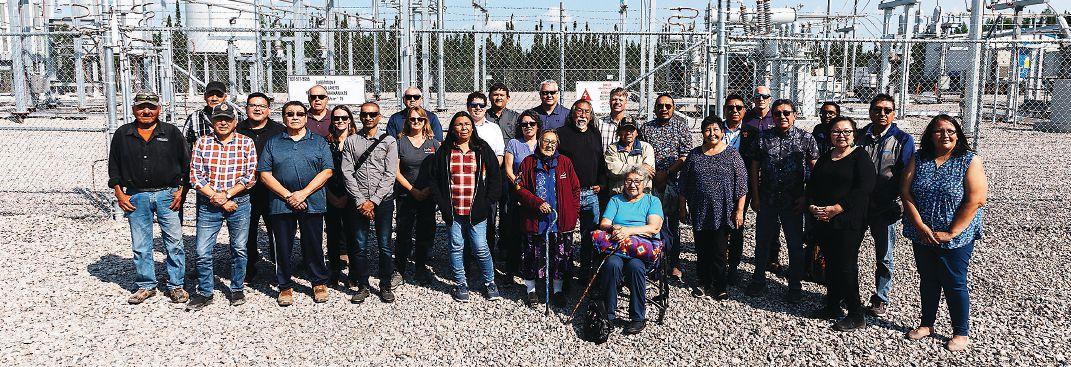
Following a blessing, community leadership, members, and invited guests stand for a photo in front of the Bearskin Lake substation (2023).
Gerry McKay from the three tribal councils. But we got better organized; someone took on community engagement, another would look after services, you know. Then, in 2017, I was asked if I could take on the project as CEO.”
However, Margaret could only become CEO with approval from the partner communities.
“And the leadership and the communities gave me the privilege, and the honour, to work for them on this project,” she says. “I don’t take it for granted. People ask ‘How did you do it?’. Well, it’s not just me. It’s also the Elders, the leaders, the partners. I’m just someone who wouldn’t allow that ship to sink.”
Differences are not necessarily opposition Bringing a massive project like this online is not without its hurdles, so part of Margaret’s job includes managing community expectations. “There’s a lot of testing and troubleshooting before we put a line into service, and some people get impatient: ‘Hey, I thought this was supposed to be reliable energy!’”
But those communities eventually start realizing the benefits. “A lot of our communities have connected new homes and, hopefully, this brings better living conditions.”
The project has also actively engaged a number of workers
from partner First Nations.
“ As we go into operation, we’re looking at apprenticeships to continue to mentor workers who want to continue in energy as linesmen, environmental monitors... there are many opportunities that present themselves here, and I hope that more young people come out and build themselves up to pursue other avenues of work.”
At the time of writing, construction is 100% complete. All of Wataynikaneyap Power’s assets are energized; 14 communities are connected to the grid and off diesel. Two more will be connected this year.
Margaret readily acknowledges that every community approaches things differently, but that ways can be found to work together. “I say kudos to the leadership for their direction and support, and working with us to make the project happen.”
T his project took 2,500+ engagements, Margaret reminds me—a strong indication that First Nations expect to have a say in what happens in their communities.
“And every person has a right to say ‘No’. Or they may say ‘Yes’ when they see meaningful participation and a benefit to the current and future generations. Recognizing those things and agreeing to work together has proven to be successful.”
Glo Wrap for both power and control
Northern Cables’ ACIC Glo Wrap for 0-10V lighting controls and fixtures is available in two, three, or four solid copper conductors insulated with PVC/nylon rated at 600V, from #14 AWG to #10 AWG. The cable assembly comes complete with two #16 control conductors under a blue jacket, and a bare copper ground. ACIC Glo Wrap allows control circuits to be placed in the same cable alongside light or power circuits, resulting in both cost and labour savings (northerncables.com).
Source: Northern Cables
Quazite and PenCell enclosures in Canada
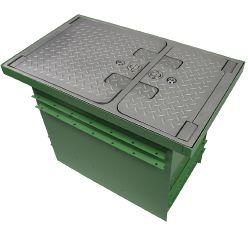
Quazite and PenCell enclosure solutions are available from Hubbell Canada. Both
are intended for applications in “non-deliberate traffic areas”, and Hubbell is able to customize a solution to fit your requirements. Quazite enclosures are constructed of fiberglass-reinforced polymer, while PenCell enclosures are made of structural foam-molded high-density polyethylene (hubbell.ca).
Source: Hubbell Canada
Guardian bender for EMT conduit
Ideal’s new Guardian bender features a set-angle stopper—built into the head—to automatically stop the bend once the conduit reaches the desired angle. Recessed markings wrap around the backside of the head to make it easier to observe the angle during air bends, and the handle can be used as a straight edge. The Guardian bender is available for 1/2-in. EMT and 3/4-in. EMT conduit (idealind.com).
Source: Ideal Electrical
HelioProtection fuses for highdemand PV circuits
Mersen has extended its line of 1500VDC HelioProtection 20x65mm photovoltaic fuses to include 63A and 65A models with both ferrule and crimp cap terminations. The HP15P series fuses are designed to handle the harsh cyclical loads and thermal conditions of the highest amperage applications, and for 1.35x the fuse rated current value. This allows for safe circuit interruption under typical low-fault current conditions (ep-ca.mersen.com).
Source: Mersen
Pocket-sized, portable thermal camera
Fluke Corp. says its new iSee pocket-sized, portable
thermal camera delivers image quality comparable to professional IR cameras, with full temperature range analysis. Weighing just under an ounce, the iSee camera plugs into your phone and launches quickly to provide thermal images ranging from 14 F to 1022 F. The iSee is constructed of aluminum and compatible with iPhone, iPad, Android, and HarmonyOS (fluke.com/en-ca).
Source: Fluke Corp.
Convention Centre Series floor boxes
Legrand Wiremold’s Convention Centre Series floor boxes are designed to accommodate power, communications, A/V devices—as well as plumbing for water and compressed air—all in one product. The cast aluminum cover is designed to meet 32,000 lb load on a 1x16-in. footprint, with a 2x safety factor. The boxes can be factory-wired with power distribution blocks, circuit breakers, and power devices, and are supplied with punched conduit entry locations and brackets as needed (legrand.us/wiremold).
Source: Legrand Wiremold
We’re limited by space here, but have plenty of room online! Check out more products and solutions at EBMag.com, under “Products”.
FLEET MANAGERS EXPECT MORE EVS OVER THE NEXT FIVE YEARS
A boon to electrical contractors
BY TONY KOVAC
In the third quarter of 2024, Canada’s zero-emission vehicle (ZEV) market continued its upward trajectory, writes S&P Global, achieving a new milestone with a 16.5% adoption rate.
This means that approximately one in every six new cars registered in Canada was a ZEV. This growth, S&P continues, reflects a 14.4% increase in overall ZEV volume compared to the previous quarter, driven by a 15.1% rise in battery electric vehicles (BEVs) and a 12.4% increase in plug-in hybrid electric vehicles (PHEVs).1
Statistics Canada information corroborates this trajectory. In Q4 2023, Canadians registered 40,051 BEVs. This was followed by a hiccup in Q1 2024, with 35,771 vehicles registered, but then a rebound in registrations in both Q2 2024 and Q3 2024, showing registrations of 48,489 BEVs and 56,048 BEVs, respectively.2
Spurred by government incentives, EV charging infrastructure continues to be developed across the country—not just for the average consumer, but for fleet operators, too, who are slowly transitioning their ICE (internal combustion engine) fleets to electric and hybrid electric.
In fact, a global survey conducted by Frost & Sullivan finds that while electric vehicle adoption rates vary by business and fleet type, most fleet managers expect a significant increase in the number of EVs entering their fleets over the next five years.3
“The movement towards sustainability and decarbonization comes as businesses with fleets of commercial vehicles face pressures from governments, customers, and value chain partners to improve their environmental footprint,” reads Frost’s survey report, with 70% of respondents noting that decarbonization was either an “important” or “cornerstone” component of their business strategy.
Decarbonization, then, is an important driver behind the adoption of electric vehicles and investing in charging infra-
An important driver behind fleets adopting electric vehicles and investing in charging infrastructure is decarbonization.
structure. Frost survey participants identified battery electric vehicles as a technology of choice, but very large fleets (over 500 vehicles) were also investing in plug-in hybrid EVs.
According to managers, the Top 10 drivers for adding electric vehicles to their fleets are (ranked highest to lowest):
1. Reduce carbon emissions
2 Meet decarbonization goals
3 Cost savings
4. Advancements in battery technology
5 Brand image/reputational risk
6. Lower buying/operating costs compared to ICE
7 Charging costs are lower than ICE fuel
8. Expansion of charging network
9 Competitive advantage
10. Government policies
Yard trucks are used to move trailers and containers at distribution centres, manufacturing plants, warehouses, rail intermodal sites, ports, and other such facilities. This model is fully electric. SOURCE: ORANGE EV
F leet managers will face new challenges as they transition to a mixed fleet, including the installation, maintenance, and uptime of charging infrastructure, as well as optimizing energy use to control costs.
H ere is where electrical professionals can step in to ensure they are the ones solving as many of these challenges as possible.
Fleet managers respond
Respondents are concerned about long downtimes during recharging cycles and an overall lack of robust charging infrastructure.
As a countermeasure, 78% indicate their organizations have procured onsite charging, with 69% saying they value the convenience and control of owning their own charging stations.
This presents an excellent opportunity for electrical contractors to expand their expertise beyond residential or condo charging to help meet the growing demand for designing, installing, and maintaining charging stations for fleet operators.
Make the connections
F rost & Sullivan’s report confirms that onsite charging depots and associated energy management systems can carry significant upfront capital expenditure, but also provide their users with better control over energy use and its associated cost.
“ This is especially true when incorporating onsite renewable power sources,” reads the report.
But not all fleet charging occurs in a central yard. Many companies also rely on public and at-home charging. In the case of the latter, cost
Sources
C urrently, the two most common ways fleet managers control charging costs are to:
1. Recharge EVs during low-rate periods (i.e. off-peak hours).
2 Charge an energy storage system during low-rate periods, then recharge EVs from the storage system regardless of the time of day.
T he third-most cited cost-reduction tactic is the implementation of monitoring and analytics tools to track energy consumption, with the goal of uncovering inefficiencies and optimization opportunities.
O ther cost-reduction methods uncovered by the survey include the generation of energy onsite (e.g. solar PV), and the implementation of energy efficiency measures.
Again, electrical contractors are well-positioned to provide solutions in all of these areas, from metering and uncovering inefficiencies to assisting with the design and installation of onsite energy generation and storage.
savings and convenience were the most cited benefits for home charging, which indicates that an electrical contractor’s influence can be broadened to those sites, as well.
The transition to electric fleets presents both challenges and opportunities, particularly in maintenance, analytics, and total cost of ownership.
Electrical contractors who specialize in charging infrastructure, energy management, and cost optimization can position themselves as trusted partners.
1. “Automotive insights: Q3 2024 Canadian EV information and analysis,” S&P Global, November 2024.
3. “The commercial EV transition: global insights on a mixed-energy fleet future,” Frost & Sullivan, September 2024.
Tariffs: Same issues in a different guise
For fans of The Simpsons: “Hi, I’m Troy McClure! You may remember me from such articles as ‘Covid-19 impacts: scary but true’ and ‘Supply chain meltdown’ and ‘Hyperinflation: not your friend’.
We find ourselves back to the same issues, only dressed up in a different guise.
With Trump implementing a 25% tariff on all Canadian goods, and our government’s retaliatory steps, where does that leave Canada’s construction industry?
Material costs and supply chains
The construction sector relies heavily on commodities like steel, copper, aluminum, and lumber, all of which are vulnerable to tariffs. The tariff on goods entering the U.S. could make our products less competitive, and Canadian producers may pass these costs on to domestic buyers.
Retaliatory tariffs on US imports could similarly increase prices for materials and equipment here.
Because Canadian contractors rely on cross-border supply chains, tariffs could lead to delays, budget overruns, and strained relationships up and down the contractual chain. Anticipate price volatility and plan accordingly.
Rising material costs could significantly narrow profit margins, especially on fixed-price contracts that do not account for cost increases. Contractors may also face greater competition for materials in their local markets as suppliers prioritize markets that are less impacted by tariffs.
Contractors should also be prepared for disputes stemming from delays and cost overruns, especially when existing contracts lack adequate provisions for addressing unforeseen changes in material costs or regulatory environments.
Key steps for mitigating risk
1. Review and revise contract terms
Change-in-law clauses: Ensure contracts include robust change-in-law clauses, which allow for adjustments
to project costs or timelines when new laws (e.g. tariffs) directly impact project delivery. Explicitly address how tariffs will be treated, and whether they qualify as changes in law that warrant renegotiation. If your contract lacks this clause, then attempt to qualify your bid (below). Contact your lawyer for the best wording.
Force majeure clauses: While tariffs might not qualify as traditional force majeure events, contractors could try to include provisions for significant and unforeseen economic changes in their contracts as grounds for relief.
Price escalation clauses: Where possible, include clauses that allow for adjustments in material costs tied to market indices. This protects you from absorbing unexpected price increases for key inputs.
2. Qualify bids appropriately Include tariff adjustments: When submitting bids, explicitly note that the proposed pricing assumes no significant tariff-related cost increases. Include language reserving the right to adjust pricing based on changes in material costs due to new trade policies. The possible downside to qualifying your bid is that you may render it non-compliant (although this does not always equal disqualification).
Limit exposure: Whenever possible, avoid committing to fixed-price contracts without adequate protections. Consider offering clients a range of options for sharing the risk of price volatility, such as cost-plus contracts. (This is likely wishful thinking.)
3. Diversify supply chains
Source locally: Reduce your dependency on cross-border materials and source from local suppliers to mitigate tariff-related risks. Strengthen your relationships with Canadian manufacturers to secure favourable pricing and priority access. This means looking beyond your local distributor to other potential suppliers and manufacturers.
Identify alternatives: Explore alternative suppliers in countries not affected by tariffs. This may involve establishing new relationships or revisiting agreements with international suppliers. Do your homework.
4. Engage in strategic procurement
Bulk purchases: Lock in pricing by purchasing materials in bulk before tariffs are implemented. This strategy is especially useful for long-lead items.
Forward contracts: Work with suppliers to negotiate forward contracts, fixing prices for critical materials to hedge against future increases.
5. Strengthen risk management
Adjust project timelines: Build additional time into project schedules to account for potential delays in material delivery. Again, this may be wishful thinking, but it could be addressed in terms of supply chain issues.
Expand contingency budgets: Include contingency budgets in project estimates to absorb unexpected cost increases. Manage expectations by clearly communicating your approach to clients.
Long-term considerations
Invest in innovation: Contractors could explore alternative materials or adopt innovative construction techniques; for instance, modular construction or prefabricated components manufactured locally could reduce reliance on tariff-impacted materials.
Build stronger relationships: Establishing long-term partnerships with suppliers, subcontractors, and clients
can create mutual understanding and flexibility in navigating tariff-related challenges. Collaborative approaches to risk-sharing will be key to maintaining project viability. Your competitors are in the exact same situation, so none of this should come as a surprise to anyone. Communication is key, and ignoring these challenges will only make their impacts worse.
Having good strategies is a good strategy
You’ve been through these kinds of problems before, most recently with Covid and all the supply chain and hyperinflation issues that came with it.
With proactive measures, you can protect yourself and your clients from the brunt of tariff-related disruptions. By seeking contract language to address these risks, qualifying bids, diversifying supply chains, and engaging in strategic procurement, you can build resilience in the face of trade uncertainty.
Look at this moment as a time to
innovate, collaborate, and adapt to ensure the stability and success of the industry.
This month’s “Legal Desk” was adapted from Dan’s article “Well isn’t this nice? Understanding the impacts of tariffs on Ottawa’s construction industry”, which appears in Construction Comment (February 2025) published by the Ottawa Construction Association, where Dan also serves on the board of directors. We strongly believe Dan’s article offers valuable, time-tested strategies for mitigating market volatility—advice that remains relevant even if the tariff issue is resolved by the time you read this.
This column is not legal advice, nor should it be taken as such.
Dan Leduc is a partner at Soloway Wright LLP, and specializes in construction law. He is always happy to take on new clients from anywhere in Canada, and can be reached at dleduc@solowaywright.com
Personalities
Mélanie Crouzatier has joined Electrical Business Magazine (Annex Business Media) as Quebec account manager (directrice de compte – Québec), where she will represent several Annex brands in the local market. She possesses over 20 years of experience in advertising and sponsorship, and will work in collaboration with media sales manager Leslie Osborne, who brings 15 years of experience in advertising sales, marketing strategy, and account management. “Together with Leslie, our client-facing team has never been stronger!” said editor-publisher Anthony Capkun
Source: SUPPLIED
With great sadness, we report the passing of Robert “Bob” Nelson on November 21 at the age of 78. Nelson was a champion of the electrical industry for decades, consulting with CSA Group and coordinating electrical apprenticeships at Mohawk College. He was instrumental in shaping the National Electrical Trade Council (NETCO) and in developing the Canadian version of the Electric Vehicle Infrastructure Training Program (EVITP).
Source: a. capkUn
Ledvance welcomed Graham Wark back to the company, appointing him vice-president of trade sales for the United States. Wark possesses over 35 years of experience in the lighting industry, including a previous tenure at Ledvance, where he served in numerous roles, including president of Canada for Osram Sylvania Ltd.
Source: Supplied
Leviton Canada has made some changes to its Canadian sales department.
Jason Denstedt has assumed the role of vice-president, National ED Sales,
overseeing the national electrical distribution sales team.
Bishop Smith has moved into the role of vice-president, Technical Service, ensuring the delivery of electrical and networking products.
Thomas Supinski now oversees all of Western Canada as sales director for British Columbia, Alberta, Saskatchewan, and Manitoba.
Jean-François Gravel has stepped into the role of sales director for Quebec and Ontario.
Source: Supplied
Tony Munden, CEO of Munden Enterprises, announced Steve Wheeler as president of the agency, saying “Steve has demonstrated an ability to foster collaboration and inspire our team to achieve extraordinary results”. A 10-year Red Seal Electrician, Randy MacGregor has been promoted to director of sales. Josh Neave has been promoted to VP of engineered solutions and business development.
Denise Rumsey has joined Reno Lighting as vice-president of business development. Rumsey’s electrical career began about 10 years ago when she joined Standard Products.
Source: Supplied
Gary Martins has joined Weidmuller as managing director for Canada. He possesses 28 years of experience in the automation industry, including leadership roles at B&R Automation, Murrelektronik, and Phoenix Contact.
Manufacturer rep agency
Intralec Electrical Products has two new reps: Beverly Pisco and Shaun Stevens. Pisco’s territory includes the northern Greater Toronto Area and northern Ontario. Stevens, who started his electrical career over 15 years ago as an apprentice, serves as outside sales rep for the Golden Horseshoe region. Ronak Mistry has joined Intralec as sales engineer, lending his skills to the specification business.
Source: Supplied
Ontario electrical distributor Ideal Supply Co. has implemented a north/ south sales structure for Electrical, with Orangeville serving as the demarcation line. Wayne Long will continue to be responsible for the Electrical division, with the Lighting and Projects departments reporting to him. Don McNichol becomes northern electrical sales manager, and Adam Coutts becomes southern electrical sales manager. Ideal Supply is a member of Groupe Deschênes
Lumentruss welcomed Howard Yaphe to its leadership team as vice-president, Strategy & Innovation. He has over 35 years of experience in the lighting industry, having served in executive positions at Canlyte, Lightolier, Philips, and Axis Lighting. Yaphe also holds over 160 patents and patents-pending related to luminaires.
Source: Supplied
Komal Kingrani has been appointed commercial operations manager at Eaton Canada. She has worked at Eaton since 2011, holding various roles in pricing, marketing, and product management.
Tony Munden, Steve Wheeler, and Josh Neave at The MEET Show 2022.
PHOTO: ELECTRICAL BUSINESS MAGAZINE
Elec-Tech Sales has promoted Dustin Nedohin to the role of business development for British Columbia, where he will call on consulting engineering firms and navigate major projects. Kevin Lomas—who has been in the electrical industry at both the agency and distribution levels—has joined as outside sales rep.
Source: Supplied
Eiko Global has appointed Yavor Kolarov to the position of president and chief revenue officer. He possesses an M.S. in Electrical Engineering, and most recently led the IOTA emergency lighting component business within Acuity.
Source: Supplied
NSI Industries LLC has made some changes to its Commercial division lineup. Mark Fallico has been promoted to vice-president of sales, where he will lead NSI’s efforts across all markets. Tom Wallace transitions to vice-president of national accounts.
Source: Supplied
CODE conundrum
GABRIEL BONE
Gabriel is technical training developer with Ontario’s Electrical Safety Authority
TACKLE THE CODE CONUNDRUM... IF YOU DARE!
Welcome to our new quizmaster, Gabriel, and to the newest round of questions that test your knowledge of the CE Code-Part I. Answers will appear in the April 2025 edition of Electrical Business Magazine, and online at EBMag.com under Features.
QUESTION 1
When a single dwelling does not have opposite sides, and a receptacle must be located on the adjacent side of the dwelling, what is the minimum spacing between the front-side and adjacent-side receptacles?
a) There is no minimum spacing requirement.
b) No less than 2/3 the width of the longest side.
c) No less than 1/2 the width of the longest side.
d) Centred on the adjacent-side wall, regardless of front-side’s location.
QUESTION 2
Marking the maximum load on a residential panelboard is not required when the loads are calculated in the apartment building as per Rules 8-200 or 8-202, and the service conductors are rated less than the overcurrent protection.
a) True b) False
QUESTION 3
What is the percentage factor for conductors installed for a generator without factory built-in overcurrent?
a) 100% b) 115% c) 125% d) 150%
ANSWERS
Electrical Business, November 2024
Question 1
How many standard 15A duplex receptacles can be installed on a general-purpose branch circuit, fed from a standard 15A circuit breaker?
Manufacturer rep Roney Marketing welcomed Mandeep Khaira and Christian Lee to the team. Khaira serves as territory manager for Ontario’s Golden Horseshoe region. Lee serves as outside sales rep for Central Ontario. “We’re excited to have Mandeep and Christian join our team [...]” said Brent Norrey
Source: Supplied
We’re limited by space here, but have plenty of room online! Read the news behind the news. Visit EBMag.com and click “News”.
c) 12. Rule 8-304(1)(a).
Question 2
What is the minimum size grounding conductor required for client’s a 45-kVA 600-120/208 delta-wye transformer with 60A primary overcurrent HRC fuses, connected to a 200A 4-wire splitter?
d) None of the above. Rule 10-212(2).
Question 3
What is the minimum height from the floor for a receptacle that is intended to connect to an emergency battery pack with two lamps for illuminating the area upon loss of power?
a) 2.5 m. Rule 46-304(1).
How did you do?
3 • Seasoned journeyman 1 • Apprentice 2 • Need refresher training 0 • Just here for fun!
NANSY HANNA, P.ENG.
CE Code promotes safe swimming and soaking
Although there are no publicly available statistics on the number of investigations into swimming-pool shocks in Canada, most people working in the industry—installers, electrical contractors, utilities—have either heard of, or investigated, such scenarios.
While most cases involve very low shock levels, a fault condition anywhere in the home or at a neighbour’s home, or on the utility’s neutral side could generate a potential hazardous voltage to pool users.
To address this issue, the 2024 CE Code has enhanced the bonding requirements for these installations.
Building on David Pilon’s informative overview of CE Code changes to pools, tubs, and spas (EB November 2024), let’s further explore the rationale behind these changes, which were based on recommendations outlined in the EPRI report that studied electrical risks to swimming pool users.1
(The EPRI report includes tests for determining the presence of this hazard and provides recommendations to “promote effective electrical safety around swimming pool environments”.)
These are the 2024 CE Code’s three major changes for pools and hot tubs:
1. Pool water is to be bonded via a corrosion-resistant conductive surface similar to the US National Electrical Code requirements.
2. Depending on the type of pool and deck construction, a copper grid may be required to be constructed below grade with a minimum No. 6 AWG bare conductor extending outside the pool shell.
3. Permanently installed spas and hot tubs will be required to be bonded to a minimum No. 6 AWG copper ring embedded in conductive surfaces (e.g. concrete slabs).
When the water and the deck are at the same voltage potential, no current will flow through a swimmer’s body, and the installation is electrically safe. The
Pool/deck construction type 2021 CE Code
• In-ground fiberglass nonconductive pool installed with either fiberglass rebar or fiber-reinforced concrete pool deck.
• In-ground concrete pool installed with nonencapsulated steel (tied together).
• Pool deck surrounding concrete with nonencapsulated rebar steel tied or bonded to pool steel.
• No vinyl liner installed.
• Composite above-ground pool
• Vinyl liner installed.
• Decking is elevated, nonconductive material (e.g. wood, composite).
Minimum No. 6 AWG copper ring required to be embedded in the concrete per Rule 68058(3)(iii) for decking.
Bonded at 4 equal points with No. 6 AWG copper per Rule 68-058(3)(a).
CE Code
No. 6 AWG copper grid required, installed per Rule 68058(3)(b)(i)(ii)(iii) for decking.
Water required to be bonded per Rule 68-058(7)(8).
Bonded at 4 equal points with No. 6 AWG copper per Rule 68-058(3)(a). No change.
Did not require bonding to the structure.
underlying goal behind these changes, then, is to achieve equipotentiality should anyone touch the water and a conductive surface at the same time.
CE Code Section 10 defines equipotentiality as “The state in which conductive parts are at a substantially equal electric potential”. The Section 10, Appendix B Note further clarifies that equipotential bonding describes the interconnection of conductive parts or objects to create equipotentiality between them, including non-electrical conductive objects.
The Appendix B Note to Rule 68-058 clarifies that principle further:
Equipotential bonding is not required for nonconductive sections of perimeter surfaces that are separated from the earth or other conductive surfaces or raised on nonconductive supports, and is not required for any perimeter surface that is electrically separated from the pool structure and raised on nonconductive supports above an equipotentially bonded surface.
The equipment standard C22.2 218.1 “Spas, hot tubs and associated equip-
Water required to be bonded per Rule 68-058(7)(8).
ment” requires spas and hot tubs to be connected to a local bonding grid with at least two bonding lugs. It further requires the installation instructions to include a note about the importance of connecting the equipment to a bonding grid to reduce the risk of electric shock.
These amendments in the CE Code will bring awareness to the importance of these requirements, and align with spa and hot tub standards and the manufacturer’s installation instructions.
Always remember that the goal is to have everything within reach of a swimmer at an equal potential.
Consult your Authority Having Jurisdiction for more specific interpretations
Sources
1. “Swimming pool stray and contact voltage research outcomes,” Electric Power Research Institute, June 2019, tinyurl.com/ydw6zyh4
Nansy Hanna, P.Eng., is senior director, Engineering & Regulations, at Ontario’s Electrical Safety Authority (ESA). She is also chair of the Canadian Advisory Council on Electrical Safety (CACES) and a member of the ULC Advisory Council and CSA Technical Committee on CE Code-Part I.