Feed mill renovation project in Truro, N.S., March 1997. Left to right: Lorraine’s brother, Jim Smith, a journeyman, who apprenticed with Deuville in 1987; John Cain, journeyman; Mike Stewart, journeyman; Lorraine Deuville.
Courtesy: L. Deuville.
“So what’s wrong with journeyman? That’s my personal preference. I’m a journeyman.”
She was a very hard worker and loved her family.”
“So, you could say it was out of fear that I chose to get into the trade and become a journeyman... so I could look after myself.”
Various people, including Owen, told Lorraine not to worry about getting her ticket, but she pursued her licence nonetheless, explaining, “If you’re dead, or we’re divorced, or you’re disabled, I need to be able to buy a permit to do work. So I’m going for my license.”
So, after working with her husband for years, Owen formally took on Lorraine as an apprentice in 1982. As it turns out, getting registered as an apprentice was one of her biggest challenges.
In effect, she was told “We have all these young fellows that need to get into the trades, and we don’t have enough room for them. So we don’t want to take a married woman”.
A life of life-long learning
When she got her licence, Lorraine remembers her instructor saying “This is only the beginning. You have your licence to start learning”.
“So what’s an electrician? Somebody that should be learning all the time. Because there’s ever-changing information, you know?” Lorraine insists, adding, “And I think I am always learning.”
Lorraine loves to learn, but not just electrical. “I love what I’ve learned from the building trade, where you watch construction from the bottom up, and you learn all these things you can do yourself. It wasn’t just electrical; it could be tearing down walls in my home at 11 o’clock at night when I decided I didn’t want this wall anymore,” Lorraine laughs.
“I should hope to die on the job. That would be the most pleasant place to go.” This
But Lorraine persevered and, in the end, completed her apprenticeship and became a full-fledged journeyman... a title she embraces proudly. “So what’s wrong with journeyman? That’s my personal preference. I’m a journeyman.”
“I’ll tell you one story when I first started with Owen. We went into this house that he was going to do work on, and he said to the fellow, ‘I hope you don’t mind, but my wife is starting to work with me. Do you have an issue with her coming onto the job?’.”
The homeowner replied, “It’s not my business; it’s your business. And I don’t care who you have working for you”.
“What a great customer,” Lorraine remembers. “Owen realized right then and there that he didn’t have to answer to anybody else either. And if they didn’t want me, he wouldn’t go either.”
“I’m fixing my own water heater, and helping other people. I wouldn’t have been able to do these things if it wasn’t for having the electrical trade and working with a lot of good tradespeople. You know, there were so many of them, and I’m grateful to them.”
That gratitude also extends to the people who “have hired me and trusted me,” Lorraine says. “We’re in their homes when no one is around; they give me their keys and say ‘Go in whenever you can and get it done’. It’s an honour to be able to do that, to serve people that trust you.”
At 72 years and still working jobs, Lorraine is often asked when she is going to retire.
“Never! I should hope to die on the job,” she says proudly. “That would be the most pleasant place to go.”
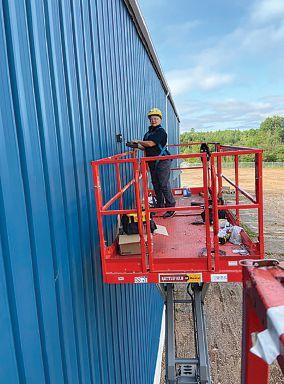
Lorraine installing outdoor light fixtures at a site in Debert, N.S., August 2021.
Photo: Brett Deuville.
Courtesy: L. Deuville.
Championing women in renewables since 2013
JOANNA SZAREK OSAWE
When I first met Joanna Szarek Osawe somewhere around 2014, Women in Renewable Energy (WiRE) was just a budding organization with big plans... and an even bigger heart.
Joanna is WiRE’s president and CEO. Founded in 2013 in her backyard in Toronto, WiRE’s mission “is to advance the role and recognition of women working in the energy sector, inclusive of all renewable energy and clean technologies”.
For the past 15-plus years, Joanna has worked at leading renewable and energy sector companies in Canada and the United States. And, in 2021, was appointed to the Federal Sustainable Development Advisory Council, which was led by Jonathan Wilkinson, Minister of Environment and Climate Change.
This was the perfect time to catch up with Joanna; to chat a bit more about WiRE and see how far it has come since those early days, and to find out a little more about this advisory council.
WiRE’s roots and growth
During her time in the renewables and energy sector, Joanna noticed “there are not a lot of women, minorities, or LGBTQ in our sector”.
“Whether it’s in the boardroom or on the construction site, I’ve typically been the only female there,” Joanna recalls, “and I really wanted to see that number elevated.”
It was the desire to change
these demographics that drove her to launch Women in Renewable Energy in the first place.
“One of my biggest champions has been my husband, who really pushed me toward WiRE,” Joanna says. “He deserves tremendous applause for his patience and ongoing support.”
Since its launch less than a decade ago, WiRE has grown by leaps and bounds. Its programming includes “capacity-building field trips, networking meet-ups, awards recognition programs, student bursaries, speed mentoring and more”.
“We are now in every single province, as well as the territories,” says Joanna proudly. “We also have chapters in the MENA Region [Middle East and North Africa], and also Turkey, Azerbaijan, UAE, and Georgia. And we’ll soon launch in Italy and Africa.”
“We have a fantastic leadership; a board of directors I’m very happy to lead with Aisha Bukhari and Julia Cushing, plus an excellent advisory committee that assists and provides recommendations.”
One of the results of all these inputs are initiatives like WiRE’s Awards of Distinction, in which the group works with companies in the energy industry “who wish to recognize and celebrate people who go above and beyond to help the role and recognition of women in the energy sector”.
“Right now, we are working on launching an Indigenous Community award, so we’re very excited,” she adds.
Besides the field trips to various energy installations, WiRE’s
signature initiative (to my mind) is its speed mentoring.
“Whether it’s in the boardroom or on the construction site, I’ve typically been the only female there. And I really wanted to see that number elevated.”
“This is really a fascinating program, similar to speed dating,” Joanna explains. “It’s typically done at conferences where we partner decision-makers with emerging professionals looking to enter the sector.” This gives industry newcomers the opportunity to have informal conversations with veterans and really “get to know” a sector. And, of course, it’s a great way to meet people and expand one’s network.
WiRE also provides speed interviewing, profiles industry champions in its communications and, like others during this pandemic, “We have a ton of webinars”.
“We are a volunteer-based, volunteer-run not-for-profit organization, so I’m overjoyed with the fantastic support we continue to get from our sponsors, which help keep the lights on!” Joanna says enthusiastically.
And that leads, naturally, to the importance of partnerships to both Joanna and WiRE.
“Whether it’s government,
“It’s fantastic to have a seat at the table, but it’s not just my voice... it’s really all of our voices, combined, at that table.”
industry, etc., I’m extremely proud of our partnerships; they are win-win for both organizations, and we complement each other’s messaging,” notes Joanna, explaining it’s easy when partnerships are aligned with WiRE’s mission and vision.
Just last year, WiRE started launching Student Chapters.
“Right now, we are working with Ontario Tech University, as well as University of Windsor. And we will be launching at Western, York and other academias in Ontario in the coming months.”
And while WiRE is now international, Joanna insists the organization remains glocal: “Be global, but act local”. For example, some programs and initiatives that work in Canada may not apply in other jurisdictions. “So we work with the women in those countries to better understand what their needs are.”
“I’ve received a few standard questions or remarks over the years that have definitely not sat well with me.”
Federal advisory council
So what is this Federal Sustainable Development Advisory Council to which Joanna has been appointed?
“Led by Jonathan Wilkinson, Minister of Environment and Climate Change [at the time of our conversation], the council is made up of members of the Canadian public so as to represent the views of different provinces and territories, Indigenous peoples, as well as environmental non-governmental organizations, such as WiRE, and business and labour organizations.”
“And, for the next four years, we will provide advice and work to develop policies around climate change,” Joanna continues. “Because of the immense wealth of experience among WiRE participants, I’ll be relying on their participation and advice to ensure our voices are heard as the federal government drafts sustainable development strategies.”
“It’s fantastic to have a seat at the table, but it’s not just my voice... it’s really all of our voices, combined, at that table.”
Upon reflection
I asked Joanna to look back over the years since WiRE’s inception, and highlight for me any moments that really stand out for her.
“I’ve received a few standard questions or remarks over the years that have definitely not sat well with me,” Joanna admits, reinforcing the notion that something like WiRE was needed in the industry.
“When we started WiRE, we would hear comments like ‘Do I have to put on a wig or skirt to join?’ or ‘Is this an anti-men group?’ or even “Aren’t you just segregating everyone?’,” Joanna remembers. “And my standard response is that WiRE is open to all. We are about bringing everyone together.”
And, to ensure there is no ambiguity, I asked Joanna to confirm what I already knew: that WiRE has always been open to everyone.
“As a matter of fact, our CFO is a gentleman, as are a lot of our volunteers. So, yes, and we continue to make sure we include everyone.”
A CITY-SCALE “LIVING LABORATORY”
UBC’s $23-million renewable energy hub
Anew, $23-million renewable energy hub will transform an entire city block at the University of British Columbia into a smart energy district, which will include the province’s first-ever hydrogen refuelling station for light- and heavy-duty vehicles.
“This is an exciting moment for UBC,” said Prof. Santa J. Ono, university president and vice-chancellor, adding the university is “truly grateful to our partners in government and industry who helped bring it to life.”
The project is supported by BC’s Ministry of Energy, Mines & Low Carbon Innovation, which announced $5.6 million in low-carbon fuel standard credits for the project.
“B.C. is well-positioned to become a world leader in clean energy, and this project demonstrates the excellent potential right here in the Lower Mainland,” said Minister Bruce Ralston.
Other funding was provided by the Canada Foundation for Innovation, BC Knowledge Development Fund, Natural Resources Canada (NRCan), Western Economic Diversification Canada and industry partners.
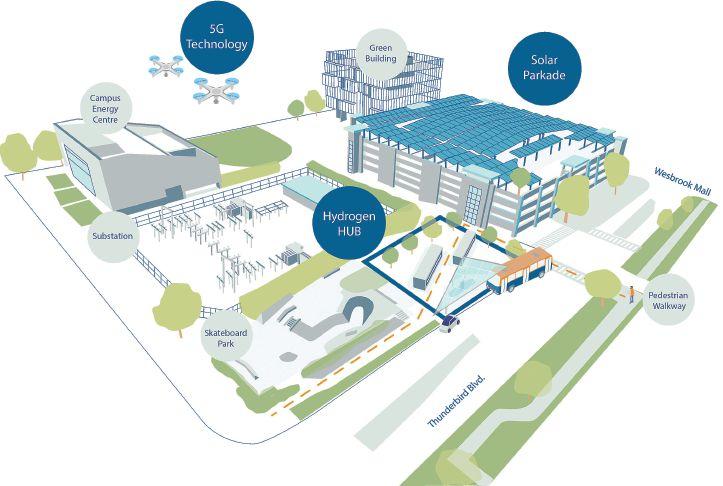
The energy hub will become a cityscale “living laboratory” that explores critical links between energy, transportation and urban design, says project lead Dr. Walter Mérida, a professor of mechanical engineering who leads MéridaLabs in the faculty of applied science.
A key feature is a water electrolyzer that uses electricity from the solar panels to split water into hydrogen and oxygen, resulting in “green hydrogen”. The process does not emit carbon emissions.
The project will also include:
• A solar array to simulate power generation in realistic urban environments.
• Reversible EV charging, where energy can potentially be exchanged between electric vehicles and the grid. This highlights how buildings and cars can evolve from passive assets that sit unused
The energy hub will explore critical links between energy, transportation and urban design.
Image: MéridaLabs.
for most of the day to active participants in smart energy storage transactions, says UBC.
• Smart energy storage enabled by aggregating the combined battery capacity of electric vehicles.
Hydrogen and clean electricity provide a clear path to sustainable, low-carbon economies for Canada and the world, says Mérida. “When combined with digital technologies, they can enable economic growth as transportation, telecommuni-
cations and civil infrastructures become smart and interconnected.”
The EV charging stations have already been installed, and should be operational. The hydrogen refuelling centre is scheduled to open next month, followed by the commissioning of the solar array in October 2022.
“Ultimately, the test bed will link technology and people. It will provide a space to gather, engage and think deeply about the way we want to live,” added Mérida.
Dr. Walter Mérida (far right) with students. Photo: UBC.
Both letters to the editor and online comments may be edited for clarity, length, etc., and do not necessarily reflect the views of Electrical Business Magazine
Kudos to Watay Power
Thank you for the uplifting story about Indigenous women and a charge-leading business, led by one powerful woman who is a hero to many—she dreamt the dream of Wataynikaneyap Power, and walked through political fires from start to finish. Now it’s great to see the focus continue, especially the childcare services! If more businesses offered this as part of doing business, we would see more success stories such as this!
— GSimon commented online for the story “Congratulations to Wataynikaneyap’s All-Women Line Crew [..]”
Really charged up!
Guys, you all need to stop with this electric vehicle nonsense. First, there’s no electrical infrastructure anywhere to support all the charging stations that would be required for everyone to drive electric cars, buses, cargo vehicles, etc. Second, what’s going to happen once China has mined all of the global resources required to make batteries, and our whole transportation industry is now totally dependent on these batteries?
— Ian commented online for the story “Opportunities in electrified transport just keep growing”
Is solar the best choice?
Due to the harsh weather conditions at this location, some real-life facts are missing from this piece (Cover feature, EBMag December 2021).
Solar panels have to be cleaned after every snowfall and, in this situation, sometimes daily. How many people are hired to do this? Are their salaries included in the overall calculations?
After a few winters of cleaning, the panels would start getting scratchedup, which would progressively reduce their output, eventually leading to their replacement.
— Marty K., Montreal
The trouble with “Troubleshooting”
Just a few comments on the article about troubleshooting ghost problems (EBMag October 2021). Generally a fairly good article, but with a few questionable statements.
For example: “Transmission power is generated as 6-phase”? or, to save money, “utilities deliver residential power with no isolated neutral”?
I’ve been in the electrical business for 45 years and have never heard these statements before. I may be missing something and would really appreciate some explanation.
Thanks, and I really enjoy the magazine.
— Cam D., Alberta
I am an avid reader of Electrical Business magazine, but I am a bit surprised by the content of the article “Got ghosts?”.
It appears that some of the descriptions could be misleading, such as “6 phases are split into 3 phases (commercial) and 2 phases (homes)”, and the author presents no indication of any actual certificates or licences.
— Cliff E.
“Troubleshooting” answers
“Transmission power is generated as 6-phase”? Yes, but, mostly in North America.
If you look at 3- or 2-phase power with an oscilloscope, you can see the 3-phase power has 3 peaks that are 120º out of phase, while 2-phase has peaks 180º out of phase. Normally we only care about them being labelled/ marked L1, L2, L3 for 3-phase and L1, L2 for 2-phase.
On big generators, like hydroelectric, we have phases A, B, C, D, E, F and a neutral (7-wire polyphase power). Think of it as two 3-phase generators in parallel, but 180º out of phase with the other 3-phase and neutral between them.
This has several advantages over producing just 3-phase power. One, higher-voltage for transmission lines. Two, it allows more distribution configurations, including DC transmission lines like we use here in Manitoba.
When you look at a transmission tower, you see A, B, C on one side, and D, E, F on the other, with the neutral at the top. With polyphase power, you can have 2 x 3-phase 120º power or 3 x 2-phase 180º split-phase power and use cheaper transformers.
The whole idea is to balance the load on the generator and have no current flow in the neutral line.
Regarding delivering residential power with no isolated neutral, I have come across this a few times; mostly in the military, where we had a lot of electronic equipment and needed to help keep out line noise.
In most cases, the neutral is grounded at the local pole XFMR to the XFMR case. So it is technically a ground line, but not always to earth. It very expensive to carry out “balanced power” because of the added cost of isolation XFMR(s) and extra wiring. Basically, it is just a split transformer with the neutral being hooked up to the centre tap. Most utilities now just use UPS power supplies for their electronic equipment.
Utilities could use isolated neutrals, but that would add a lot of cost to residential and light industrial installs. (Although it was actually quite common in the early days of electrical power.)
— Ray Richter
Personalities
Rahul Duggal (left) has been appointed to the position of manager, Commercial Operations, Eaton Canada Electrical (eaton.com). In his new role, he is responsible for establishing and leading a new organization that will include EatonCare and Sales & Marketing operations. Eric Posma has been appointed to the position of manager, Distributor Programs. He holds a degree in Engineering Physics (Electrical) from Queen’s University, and is a licensed Professional Engineer in Ontario. Komal Kingrani has been appointed senior product manager, Residential & Light Commercial Products, Electrical Sector, Electrical Americas–Canada. Kingrani began her career with Eaton as a pricing analyst for the Global Shared Services Centre.
Tyrone Varga has been appointed head of ABB’s Large Motors & Generators Division in Canada (abb.com). He possesses over 20 years of experience in sales and market development in the electric motor industry in North America. Previous roles include senior positions at Shermco Industries and TECO-Westinghouse Motors in both Canada and the United States. A SIAST graduate, Varga is an active member of IEEE PCIC.
Photo : ABB Canada
Sean Hanoman has joined Mersen as regional sales manager for Canada’s Central Region for Mersen Electrical Power–Toronto (ep-us.mersen.com). Reporting to Tom Arbanas, Hanoman comes to Mersen with over nine years of experience in the electrical industry. Before joining Mersen, he held the position of national category manager with Anixter Inc., and key account manager for Electrical Sales Network.
Photo : Mersen
Bryan Charlebois (left) has been named head of the Professional Channel for Signify Canada, reporting to Martin Stephenson, market leader, Canada. He joins Signify from Cree Lighting Canada, where he last held the role of vice-president, Sales (signify.com).
TOA Canada (toacanada.com) has hired Jacob Hazanovsky as an additional regional sales manager for Ontario. TOA is a player in the development, manufacture and distribution of commercial audio and security products.
Thierry Miras of Schneider Electric (se.com) has been named Leader of the Year by Electricity Human Resources Canada (electricityhr.ca) for making “an outstanding contribution to their organization within the Canadian electricity industry through visionary people management strategies and leadership”.
Logo : EHRC
Industrial connectivity player Weidmuller Ltd. has appointed Michael Daly as its new managing director for Canada. Prior to this appointment, he served as vice-president, Sales, at Rotalec (weidmuller.ca).
Photo : Weidmuller Ltd.
Technical Safety BC has appointed Phil Gothe as president and lead executive officer, succeeding Catherine Roome. Prior to accepting this appointment, Gothe served on Technical Safety BC’s executive team for the past 12 years, most recently as
vice-president, Operations and Client Experience (technicalsafetybc.ca).
Photo : Technical Safety BC
Leviton (leviton.com) has appointed Daryoush Larizadeh (left) to CEO. He will continue his responsibilities as president and COO. He becomes the fourth CEO since the company’s founding 115 years ago. Larizadeh assumes the role of CEO from Don Hendler (left), who held the position since 2007 following the passing of Harold Leviton (whose father founded the company in 1906). Hendler assumes the role of board chair. Stephen Sokolow, who last held this position, becomes chair emeritus while remaining an executive vice-president of the corporation.
Photos : Leviton
Sean Dunnigan, president of Techspan Industries Inc., has appointed Anthony Zellermeyer (left) to the position of vice-president, Marketing–Electrical Division. Zellermeyer has been with Techspan since 2018, serving most recently as national marketing manager (techspan.ca).
Photo : Techspan
AES Engineering (aesengr.com) announced its senior associate, Ark Tsisserev, has been awarded the IEC 1906 Award from the International Electrotechnical Commission for his contributions to electrical codes, both here and internationally. He is one of nine individuals in Canada to be recognized this year (iec.ch). Others include: Matthew Adams, Frédérick Dubé, Marie Josée Fortier, Mark Fox, Aaron MacNeill, Tim Olson, Jean Raymond, Martin Smith
We’re limited by space here, but have plenty of room online! Learn more about these individuals by visiting EBMag.com. Click “News”, then click “Personalities”.
Photo : Signify Canada
Photo : TOA Canada
Photo : Eaton Corp.
Meaghan Bayard has joined Leviton Canada as director, Human Resources (leviton.com).
Reporting to Jason Prevost, president & COO, she replaces Carolle Berlinguette, who has retired.
Photo : Leviton
Electric Mobility Canada reported the passing of Catherine Kargas—its former CEO and chair—in October, after a 5-year battle with cancer. She was 55.
“We all will remember her as a brilliant and dedicated person who always worked for the greater good of the planet in general, and electric mobility in particular,” wrote EMC’s Daniel Breton (emc-mec.ca).
Photo : Electric Mobility Canada
Westburne Ontario Division’s senior leadership team has a couple of
new faces. Mark McArthur (left) has been promoted to Eastern District manager, while Matt Madonna (right) has been promoted to Northern District manager (westburne.ca).
Photos : Westburne
Proterra Inc. has appointed Chris Bailey (left) president of its Powered & Energy business units. He succeeds Gareth Joyce, who was promoted to president of Proterra. Before joining Proterra, Bailey spent 17 years at Hubbell Inc., where he most recently served as vice-president, Product Innovation &
Technology Strategy (proterra.com).
Photo : Proterra
Liveable Cities announced some new members. (Clockwise from top left) Mike Andrews joins the team as account manager, smart cities. Victoria Stevens joins as a technical product specialist. Mandie Pitre joins the company as digital marketing & sales specialist, while Kiana Christie serves in Marketing, Communications, and Graphic Design (liveablecities.com).
Photos : Liveable Cities
“Gold Seal” accredited with the Canadian Construction Association BBB Accredited business
DAN LEDUC
Price volatility, inflation, and the false hope of force majeure
You are living it daily: price volatility, inflation, supply chain... all immeasurable impacts on your ability to perform your electrical subcontract. And, to top it off, this is likely your first pandemic, so you have no previous experience upon which to draw.
What do you do? Well, here are some things to consider. First, take inventory of your risk profile. If you are experiencing unanticipated price increases for key material items, verify whether you have any recourse in your current contract, then measure and assess the amount of the price increase.
Normally, the risk of price increases rests with the sub. You can address this risk by qualifying your bids to account for the risk and make it a shared risk with a measured benchmark (see Legal Desk, EBMag May 2021). If you do not have an express recourse in your contract, then you may have to look to an implied recourse.
Second, give notice—immediately. Set out, in great detail, your rationale for claiming an increase in your subcontract price, and provide that notice upstream to either the GC or construction manager (or the owner, when you are contracting directly with them). Notice of a potential claim is almost always an element to any recourse. Notice allows all parties to mitigate the issue of increased costs.
Third, whether there is an express provision or some form of implied provision in your subcontract to seek recourse, you must establish a causal link between the impact arising out of the pandemic and the increased material costs.
Sounds like nonsense, but it is still required for seeking legal recourse. For example, did delays in the project move you to increased material pricing? Further, what accounts for the price increases between the date you submitted your price and the date you purchased your materials?
You need to compile the specific causal links, as they will be the grounds for entitlement to a potential price increase claim. Lastly, change your corporate culture. Do not assume you are entitled to any recourse. Force majeure is not an implied term to a contract and, even should you have such a clause in your contract, the typical recourse is an extension of time—not an increase in your subcontract price.
(Besides, an extension may actually hurt you more if prices continue to rise on materials you have yet to purchase.)
Rejecting a sense of entitlement permits you to better assess and manage the risk during the bid process, perhaps by qualifying your bid (which, in itself, is a risk that could see you disqualified for being non-compliant).
This column is not legal advice, nor should it be taken as such
Dan Leduc is a partner in the law firm of Norton Rose Fulbright LLP, and practices exclusively in the area of construction law. He is always happy to take on new clients from anywhere in Canada. Email him at dan.leduc@nortonrosefulbright.com.
Mersen next-gen HelioProtection HP15M solar fuses
Photo : Mersen
Mersen’s next generation of HelioProtection series HP15M solar fuses have been designed and tested to more stringent standards, says the manufacturer, while keeping the same form factor, electrical performance, and pricing. These 1500VDC-rated fuses are designed for low minimum breaking capacity capabilities of 1.35x the fuse-rated current value, which allows for safe circuit interruption under typical low-fault current conditions (ep-us.mersen.com).
Milwaukee M18 Utility remote control searchlight
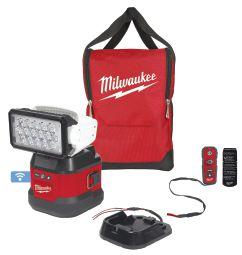
Milwaukee Tool’s searchlight can be operated while mounted to a bucket truck, or attached to the portable base to light other areas. The product comes equipped with a wireless joystick remote to give linemen control over the light’s positioning. Spot mode produces up to 1250 yards
of beam distance and offers 3.5 hours of run-time when mounted to the M18 base. The flood provides 4250 lumens over a larger area, and operates for 3.5 hours on High and up to 12 hours on Low (milwaukeetool.ca).
Sylvania UltraLED dual-selectable RT downlights
Photo : Ledvance
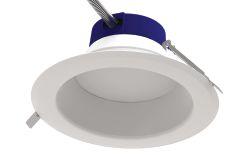
These downlights employ a light aluminum housing that promises quick and easy installation, and optimal performance. The ability to to select your ideal lumen output and colour temperature gives you the best light for your application from one downlight. This also saves space in your inventory or truck without limiting options for customers. The 0-10 volt dimmable downlights are Energy Star-listed, wet rated, and compatible with the Sylvania field-installable emergency battery back-up unit (sylvania.com).
Wago ECO 2 power supplies
Photo : Wago
Wago’s power supplies aim to maximize space in your control cabinet while providing an efficiency rating up to 90%. They measure 25 mm and 38 mm, respectively, and come with Push-In Cage Clamp technology
Photo : Milwaukee Tool
and orange integrated levers (allowing for a tool-free installation). Wago says its ECO 2 power supplies have a MTBF (mean time between failure) of greater than one million hours; meantime, the LED indications, DC O.K. contacts, adjustable output voltage and marking options make them a cost-effective choice for standard applications (wago.com).
HPS Titan X transformers conform to IECEx
Photo : Hammond Power Solutions
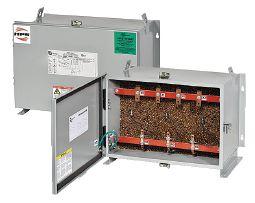
Hammond Power Solutions’ encapsulated transformers are designed for industrial and hazardous applications requiring conformity to IECEx, ATEX and UKEx, making them fully certified for use in a majority of hazardous locations. Both products are completely encapsulated in epoxy and silica, providing protection from airborne contaminants and preventing moisture ingress. The removable hinged door and factory-installed grounding lugs reduce installation time (hammondpowersolutions.com).
NSI Industries PowerGRP cable ties
The PowerGRP cable ties are available in a range of lengths and tensile strengths, and feature a self-locking design, making them suitable for securing wire bundles and harness components in numerous applications. The
cable ties’ feature smooth edges to prevent damage to cables, a curved tip for faster threading, and are available in Natural and Black (nsiindustries.com).
Teledyne FLIR adds to VS290 videoscope family
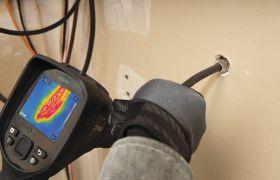
The VS290 thermal videoscope kit family of devices has two new members: the VS290-33 MSX and the VS290-21 Thermal. The VS290-33 features a rounded, dual thermal-visible probe for increased flexibility in conducting underground utility-vault inspection and other high-voltage scenarios requiring a CAT IV rating. The VS290-21 provides thermal-only building, electrical and mechanical electrical inspection capabilities for hard-toreach areas, such as crawlspaces or inside motors (flir.ca).
Swidget pairs with most Panasonic ventilation solutions
Panasonic announced that, as the exclusive distributor of Swidget controls in the electrical and HVAC distribution channels in Canada and the U.S., it can provide an “end-to-end smart home ventilation solution” by pairing Swidget devices with most of its portfolio of ventilation solutions. Swidget inserts fit directly into Swidget outlets or switches, and are interchangeable, allowing customers to create a customized solution (na.panasonic.com).
CODE conundrum
RAY YOUSEF
Ray is a code engineer with Ontario’s Electrical Safety Authority
TACKLE THE CODE CONUNDRUM IF YOU DARE!
Welcome to the newest round of questions that test your knowledge of the CE Code-Part I. Answers will appear in the April 2022 edition of Electrical Business Magazine, and at EBMag.com under Features.
QUESTION 1
Conductors for equipotential bonding shall be permitted to be installed as open wiring, provided that they are adequately secured.
a) True b) False
QUESTION 2
What size of copper tap conductor is required to connect a metal fence around an outdoor substation to the station ground electrode?
a) #6 AWG c) 3/0 AWG
b) 2/0 AWG d) 4/0 AWG
QUESTION 3
Receptacles having CSA configurations 5-15R or 5-20R installed in buildings under construction:
a) shall be protected by GFCI Class A.
b) can be wired by NMSC.
c) shall be kept entirely separate from lighting branch circuits.
d) all of the above.
ANSWERS
Electrical Business, December 2021 ed.
Question 1
Where circuit overload protection is provided by other means, fuses that are permitted to be used for overcurrent protection are:
d) A and B. Rule 14-212.
Question 2
A moulded-case circuit breaker is permitted to be located in a Category 2 location so long as it is contained in a NEMA-1 enclosure..
b) False. Rule 22-100(3).
Question 3
The power supply of a fire alarm system shall be: a) provided by a separate circuit. Rule 32-108(1).
How did YOU do?
3 • Seasoned journeyman 1 • Apprentice 2 • Need refresher training 0 • Just here for fun!
Photo : NSI Industries
Photo : Teledyne FLIR
Photo : Panasonic
NANSY HANNA, P.ENG
Energy storage systems in residential occupancies
As we continue moving toward net zero, the need for energy storage systems (ESSs) will continue to rise in both residential and non-residential applications. Unfortunately, some confusion has arisen around 2021 Canadian Electrical Code requirements for residential applications, so let’s examine the installation of an ESS in a dwelling unit.
The CE Code introduced two definitions for energy storage systems: Residential Use and Non-Residential Use. The former is marked as being suitable for residential use, and conforms to the requirements of ANSI/CAN/UL 9540 “Energy storage systems and equipment”.
Further, an Appendix B Note to Rule 64-918(1) clarifies that UL 9540 requires ESSs intended for dwelling units to be marked “Suitable for use in residential dwelling units where permitted”. (Non-Residential Use systems are defined as not marked as being suitable for residential use.)
These definitions introduce a restriction that seems to be based on UL 9540, but such a restriction is not actually intended by the standard. Moreover, as of today, there are no energy storage systems marked “Suitable for use in residential dwelling units where permitted” available on the market.
In fact, the purpose of UL 9540’s marking of ESSs with “Suitable for use [...]” is to permit units that have passed additional rigorous testing to be
installed in the living or habitable areas of a dwelling unit (where permitted by the AHJ).
Rule 64-918(1) further prohibits ESSs with a storage capacity greater than 1 kWh or utilizing lithium-ion batteries from being installed in dwelling units. Period.
Meantime, UL 9540 allows certified ESSs that are not marked for residential use—but meet the regular tests in the standard—to be installed in non-living or non-habitable spaces of a dwelling unit (e.g. utility closets, attached garages or storage spaces). This is evident in Table E.1 “Residential use ESS” where it is further clarified by showing the capacity and separation requirements of ESSs permitted in dwelling units.
This restriction in the CE Code is also in contradiction of NFPA 855 “Installation of stationary energy storage systems”. Clause 15.6.1 permits ESSs to be installed in attached and detached garages; in enclosed utility closets, and storage spaces.
NFPA 855 further clarifies that when the room or space where the ESS is to be installed is not finished, the walls and ceiling shall be protected with not less than 5/8-in. Type X gypsum board. (Note: NFPA 855 requires ESSs to conform to UL 9540).
Subrule 64-918(2), which prohibits installing ESSs utilizing batteries below grade, is also raising questions because it is unclear whether this applies to dwelling units. If there is any consideration by an AHJ to permit
ESSs in dwelling units, should they be permitted in basements? In a typical house, a utility room in a basement— or an unfinished basement—is a not habitable area.
Therefore, a basement could be a good location for an ESS. (Although other factors should be taken into consideration e.g. is the basement in a flood hazard area, is there a functional smoke detector, will there be a dedicated ESS storage room with at least 1-hour fire rating as per NFPA 855 intent).
Subrule 64-918(6) permits “Residential Use” ESSs to be installed in garages of dwelling units, provided any single ESS does not exceed 20 kWh storage capacity; multiple ESSs do not exceed 40 kWh capacity; and ESSs are spaced not less than 1 m apart.
Knowing that UL 9540’s intention for marking ESSs with “Suitable for use [...]” is to permit these units in living or habitable areas of dwelling units, one wonders whether Subrule 64-918(6) actually intends to permit ESSs—approved to UL 9540—to be installed in the garage of a dwelling unit. That approach would align with NFPA 855.
It is important to review and understand the intent of these new rules, and consult your AHJ during the design phase for projects involving energy storage system installations in residential occupancies.
Meantime, the Section 64 Technical Subcommittee is working on a proposal to update ESS rules, with specific advice for residential applications. Visit publicreview.csa.ca for public reviews and to get involved.
Consult your Authority Having Jurisdiction for more specific interpretations
(ESA). She is also chair of the Canadian Advisory Council on Electrical Safety (CACES) and a member of the ULC Advisory Council, CSA Technical Committee on Industrial, Consumer and Commercial Products and CSA CE Code-Part I, Sections 24, 32, and 46. She can be reached at nansy.hanna@electricalsafety.on.ca.
WE’RE TAKING REWARDS TO THE NEXT LEVEL.
With more ways to earn loyalty points and redeem great prizes, the new and improved AD Rewards program allows you to capitalize on the power of your purchases from AD distributors like never before.
With over 6,000 valuable merchandise and travel rewards, your relationship with your AD distributor has never been more powerful…or lucrative. Join today at any of these participating AD distributors.