Statscan reports that over onethird (35.6%) of women entering into an apprenticeship program in 2019 did so in a male-dominated trade (defined as programs in which men account for at least 80% of all registered apprentices). This rate has more than doubled in the last decade.
The major trade groups commonly associated with the construction industry reported the largest gains and were led by interior finishing (+268), carpenters (+263) and electricians (+214).
EARNINGS PLAY AN IMPORTANT ROLE
in supporting apprentices throughout their programs, notes Statscan.
Apprentices who earned from $45K to $60K in the registration year (46%) were 11 percentage points more likely to receive their certificate than those who earned from $15K $30K (35%).
Those who were working in a field closely related to their trade (38%) were more likely to earn their certificate than those who were not (32%).
Adam: I see it as a complex problem more than a big problem. As you look at the 140+ trades in the province, and speak with advocates, employers, labour associations, what you start to understand is that almost each of these trades has regionally specific challenges.
Some trades are relatively popular. You know, when you talk to someone about getting into, say, construction, everyone tends to say Electrician, or maybe Plumber, or Carpenter, etc. And so there are popular trades that may not have the same challenges as lesser-known trades, like mine: an Insulator. So our trade would have a challenge in attracting youth and talent, whereas other trades may not.
We have to look at best practices; what things are helping move the needle for some trades, and how can they be utilized to help move the needle for other trades that are really in trouble.
Andrew: I agree, it’s complex. To me, this gets into stigma and it gets into pathways. Construction has a marketing issue, because people think there’s just one job in construction, even though there’s 400,000 workers.
Adam is 100% correct. We’ve got 144 trades in this province, and there is no way you’re going to create a strategy that’s going to work for all 144. So there needs to be specialization; we need to understand where shortages exist. We need to also do a better job mapping out pathways. What are real jobs that exist? Where is the demand?
I think everybody can agree that we do need a lot of tradespeople. This is an area of growth. It’s an area that needs attention, and it’s an area that needs clarity when it comes to pathways so that people can understand the opportunities and where they can find a space for themselves.
Electrical Business: Your mandate is to attract youth to the trades. What age group are you starting at, and why is it key to start with this age group? What communications and messaging should be employed with these youth?
Andrew: I think our review classifies anyone under the age of 30 as a youth, but we are very much aware that career decisions are made much sooner than the age of 30. So we have a specific focus to get to primary school children, grades 7 and 8, and early high school.
Adam: And to help build some parallel structure around the opportunity of a pathway or career in the skilled trades; that they are of equal value, socially, as pursuing the “traditional” university or college model... although I would argue that apprenticeship is much more traditional. It’s been around for hundreds and thousands of years.
A real focus is [helping youth] develop a deeper understanding of trades opportunities, prior to high school, so they see them as equal opportunities when planning their careers, when speaking with guidance counselors, parents, and teachers.
And to have students think about the long-term ramifications of classes they choose; they should not undervalue themselves or underestimate the academic effort involved with the skilled trades. They may skip some subjects and still think they can get into a trade.
We need to solidify the information around career pathways, and what it takes to get into those trades, and how to be successful in those trades.
Jennifer: “You can’t be what you can’t see”. Growing up, you go to the doctor for regular shots, when you’re sick... so everybody knows what a doctor is.
A majority of apprentices take longer than the program duration to receive their certificate.
Statscan reports that, by the end of the expected duration of the program, less than one-fifth (16%) had received a certificate, while almost 2/3 (64%) were still continuing their program, and one-fifth (20%) had left their training.
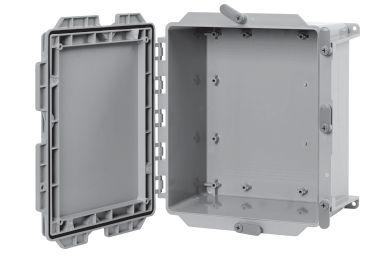
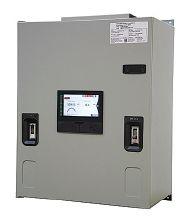
The Scepter® JBoxTM with Hinged Cover opens more than 200º for complete and easy access to control devices and instruments. 100% non-metallic, this box is ideally suited for indoor and outdoor industrial, MRO and OEM applications and in washdown environments. The Scepter JBox with Hinged Cover is suitable to be used as an enclosure per section 18 of UL 508A and is NEMA 12 rated for industrial use providing protection from contact and from harmful effects; dust-tight and drip-tight.
Available on all 8" to 16" Series JBoxes, the Hinged Cover features:
• A removable cover that opens more than 200º
• Back panels available for all sizes – white powder-coated
• Standoffs are molded-in to accept back panels as well as DIN rails
In 2019, new registrations in apprenticeship programs (-2.9%) and certifications in the trades (-3.9%) fell from 2018, as losses in Alberta offset gains in Ontario and Quebec.
Prior to the pandemic, Statscan reports the number of new registrations in apprenticeship programs in Canada fell 2.9% from 2018 to 77,573 new registrations in 2019.
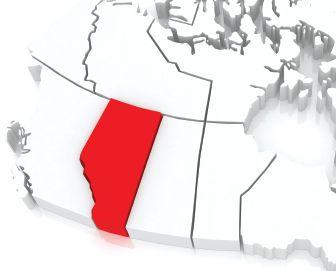
Over 3/4 of the decline occurred in Alberta, where the number of new registrations in apprenticeships fell by almost 1/4 (-2832) to 11,607 in 2019—its lowest level in a decade.
New registrations in Alberta decreased in 20 of the 21 major trade groups, led by electricians (-450), plumbers, pipefitters & steamfitters (-358) and interior finishing (-252).
According to the Survey of Employment, Payrolls and Hours, Alberta had the slowest employment growth (+0.7%) among the provinces in 2019. Employment here was down sharply in industries where apprenticeships are most concentrated, such as construction (-4.0%) and mining, quarrying, and oil & gas extraction (-4.0%).
The annual number of newly certified tradespeople declined 3.9% to 52,367 in 2019, following a 6.6% gain in 2018. Again, Alberta has borne the brunt, where over half of the overall decline occurred, and where the number of certifications fell by 1266 to a decade low of 7665.
The decreases were most pronounced in trades such as plumbers, pipefitters & steamfitters (-666), welders (-276), and electricians (-96).
Jennifer: Then you think of the 144 trades, and how many can you name?
So how do we even begin to remotely explain what the trades are if a child or youth doesn’t grow up with it or see it in their daily life?
My 8-year old is talking about being a carpenter and a farmer right now, because he’s put it together; he knows, from friends of ours, that farmers do a lot of carpentry. So if he didn’t see that, would he know what a carpenter was? I would hope so, considering my job! Anthony, do you know what Industrial Millwright is?
Electrical Business: Aren’t you the ones who fix industrial machinery in plants?
Jennifer: Yes, that’s a pretty general description, but most people have no idea what that is. How do you explain it to an adult, a youth, or a child?
I’m a doctor for machines. When the machine is sick, I fix it. But I do troubleshooting, hydraulics, pneumatics. I do a little bit of machining and blueprinting. And plumbing. We’re a little bit of everything! But how do I explain that to a student in Grade 7 or 8, who is trying to make choices for their classes for Grade 12.
Students—even adults—don’t know these careers are out there. Again, there’s 144 of them! So there’s a lot of opportunity to showcase what’s out there. As Adam noted, making sure the pathway is clear and, as Andrew noted, the pathways are a little bit different.
Electrical Business: How will you measure the results of your efforts?
Adam: Some of the indicators we’re hopeful to see is the average age of apprentices lowering in the province. Right now, you’re hearing numbers between age 27 and 29. I was an apprenticeship instructor and training coordinator for nearly 10 years, and I
saw many apprentices. At one point, when I was 26 or 27, I had people in my class who were at least a decade older than me. So I think a key indicator is to see that [average age] tick down. It will give us an indication that younger people are pursuing and starting careers in the skilled trades.
Jennifer: Going forward, we want to meet with a very large group of stakeholders, making sure we hear from parents, educators, training facilities, colleges, and employers—big, small and medium. They are all going to have a very different perspective.
Maybe the barriers are regional, maybe non-traditional... maybe stereotypes. But hearing about all the different barriers and knowing exactly what they are will help change them.We can put new practices or procedures in place to try to break the barriers and go after the stigmas, and bring more youth into the trades, including those that aren’t as well known.
Andrew: We’ve got a great team with the Ministry that’s going to help support us, and we’ve got a good process. We have a very robust consultation process, and stakeholders have already started to reach out to us. People want to talk about this issue.
I think I can speak on behalf of all three of us that we’re very honored to be part of this process and, hopefully, contribute something meaningful. We’re all passionate, and we want to do what we can to address some of the issues in the skilled trades and create new pathways, identify and reduce stigma, address the barriers... then wrap it up in a nice report for the Minister.
Obviously, as soon as we do that, we’d love it to be implemented the next day!
Stakeholders (and that’s everybody—parents, youth, employers, unions, skilled trade workers, anyone under 30), we want to hear from you. We’ll be reaching out, and we hope you reach back.
To engage with Jennifer, Adam and Andrew, email youthadvisors@ontario.ca, or visit the Ontario.ca website, direct link tinyurl.com/y6eqovr4.
NETWORK INFRASTRUCTURE PLANNING FOR INTELLIGENT BUILDINGSS
CAROL EVERETT OLIVER, RCDD, DCDC, ESS
The key to planning and installing an efficient intelligent building infrastructure is cooperative design between the end user, contractor, system designer and facilities personnel. This means detailed meetings and careful project management between all parties.
Planning for a smart building involves more than just connecting the various facilities, systems and building functions. It involves connecting the systems that need to be integrated, usually done through a unified management system to gather, monitor and aggregate data from multiple subsystems.
The list of IP-enabled building applications is growing, and wile many continue to operate over different open communication protocols, they can be integrated via IP protocols (TCP/IP). Examples of these systems include:
• Building automation systems (BAS and HVAC)
• Energy, lighting and electrical power management
• Audio and video systems
• Electronic safety and security (ESS) systems
Resources for the network designer and installer
Several key organizations offer definitions and guidelines for planning and installing an intelligent building infrastructure. They all possess some key similarities, such as defining interoperable systems, providing installation guidelines and, ultimately, improve building management and create cost efficiencies.
Although they complement one another, each document serves a unique purpose:
• ANSI/TIA-862-B (2016) “Structured cabling infrastructure standard for intelligent building systems”.
• TIA-TSB 184-A “Guidelines for supporting power delivery over balanced twisted-pair cabling”.
• ANSI/TIA-569-D (2018) “Telecommunications pathways and spaces” and Addendum 2 “Additional pathway and space considerations for supporting remote powering over balanced twisted-pair cabling”.
• ANSI/BICSI-007 (2020) “Information communication technology design and implementation practices for intelligent buildings and premises”.
• ANSI/BICSI N2-17 “Practices for the installation of telecommunications and ICT cabling intended to support remote power applications”.
• ISO/IEC TS 29125 (2017) “Information technology –telecommunications cabling requirements for remote powering of terminal equipment”.
• ISO/IEC 14763-2 (2012) “Information technology –Implementation of operation of customer premises cabling (Part 2: Planning and Installation)”.
Also be sure to reference the relevant installation sections in the CE Code for additional guidance on communications circuits, allowable ampacities, etc.
Centralized, decentralized or hybrid architecture
When designing the network infrastructure, it is important to look beyond just Day One and plan for the future. The first critical decision is locating the computing power and storage, which will usually be in the data centre or cloud, or the enterprise telecom room(s), or at the edge devices themselves.
The three topology choices are: 1) centralized, 2) decentralized, 3) hybrid.
Centralized
architecture
A centralized approach utilizes a central location where analysis, storage and computing occurs. Building applications and devices are connected back to this central location, typically the telecom room or data centre. A single location allows for easier management of active equipment from Day One, but may make it difficult to integrate further applications in the future.
Decentralized architecture a.k.a. zone cabling
In a decentralized architecture, the computing power is located nearer the devices, which usually run on embedded microprocessors. Information is processed locally rather than communicating all the way back to a central location, thereby avoiding potential latency that could inhibit application performance and reliability. Each zone has one or more enclosures that house the networking and processing equipment, as well as the cross-connections. When new devices are added, the horizontal cable is run from the zone enclosure (versus pulling a new cable from the telecom room).
Hybrid architecture
Depending on the processing, networking, power and storage requirements of the individual applications, a hybrid approach—which employs characteristics from both centralized and decentralized layouts—may be necessary.
Now that the overarching architecture has been decided, let’s get into the design steps for a common infrastructure for data and PoE, the telecom room, cabling and work area outlets.
Designing telecom rooms
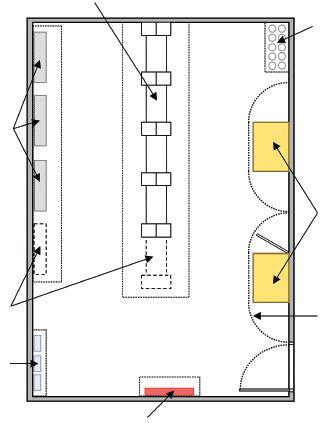
ANSI/BICSI-007 provides different layouts and size options for telecom rooms, guided by the space allocated within the building. While it is best practice to plan for the future and allow at least a 50% growth in equipment, it is sometimes not feasible in an existing facility.
The two telecom room options include: 1) a single TR to house the telecom equipment and specialty systems or 2) dual TRs, one for the core network and one for the other systems.
In the single TR scenario, the core network is usually located in racks in the middle of the room to allow front and rear access to the equipment and patching fields. The ancillary systems would be terminated either in a separate rack or in wall cabinets. The downside to this layout is that the core network is accessible to other services, which compromises security.
A dual (two-room) TR separates the core network from the additional systems, limiting the accessibility to outside services and providing maximum security for the core. Many new facilities, such as hospitals and financial institutions, are adopting the dual layout for this reason.
Cabling selection for data and power
Cable selection is dictated by the requirements (bandwidth [data] and power [PoE]) of the applications. Since the ratification of IEEE 802.3bt, PoE now enables up to 90 watts to be transmitted over all four pairs of a twisted-pair cable from the power source equipment to the powered device.
One of the main concerns, especially with running remote powering above 60W, is heat build-up within cable bundles, as well as the potential for electrical arcing damage to the connector contacts supporting remote powering applications.
System designers should refer to CE Code-Part I, TIATSB-184-A and ANSI/TIA-569-D-2 for safety and design practices for best cable performance and sizing of pathways. These documents all focus on defining acceptable temperature rise as it relates the bundle size, conductor size (AWG), ambient temperature and insulation temperature ratings. When planned properly, heat build-up and signal loss can be minimized or mitigated. TIA recommends:
Bidding and winning PROFITABLE PROJECTS in tough economic times!
Over 4700 people:
have
Our courses can be tailored for your company needs and one on one training. Courses run mornings, afternoons, evenings and weekends if requested.
Federal/provincial job training grants for up to 2/3rds of the course cost may be available to companies for training employees and new hires.
“Gold Seal” accredited with the Canadian Construction Association
FIGURE 1 Two telecom room layouts: single and dual (two-room), courtesy ANSI/BICSI-007 (2020).
Voice and Data Network Racks
Wall Mounted Systems (e.g., mass notification, security, paging)
Future Racks and Systems
Wireless Systems Devices
Electrical Power Panel
Conduit Risers
Clearance Boundary Specialty Systems
• De-rating the cable by reducing the horizontal channel length to make sure the specified cable does not exceed the channel length that matches the cable type and operating temperature.
• For higher power, select a larger-gauge cable (e.g. 22 AWG) to improve heat dissipation, which also allows for further distancing and lower voltage drop.
• Unbundle the cable in cable tray to allow for improved air circulation, as well limiting the maximum bundle size to 24 cables.
• In a pathway, mix cables carrying PoE with those only carrying data.
For new installations, both TIA and BICSI provide a summary of minimum and recognized cabling performance for balanced twisted-pair and optical fiber media. The recommended minimum 4-pair copper cable is Cat 6A/Class EA. However, BICSI also indicates there are times where the use of other horizontal cabling shall be allowed, so long as the cable does not violate code or authority having jurisdiction requirements, or when the existing installed cable is in use and meets or exceeds Cat 5e/Class D (especially when the installed cable is a result from expansion or other alterations to the system).
Rack Mounted Specialty Systems (e.g., biomedical, patient monitooring, secure communications)
Electrical Power Panel
Controlled Access
Authorized facility staff (visitors approved and escorted per site policy)
Clearance Boundary Future Racks and System
Electrical Power Panel
Limited Access
Authorized staff and approved
visitors (e.g., ICT contractors) per site policy
Conduit Risers
Clearance Boundary
Critical/ Sensitive Information
Wall Mounted Systems (e.g., nurse call, security)
Conduit Risers
Voice and Data Network Racks
Cable Slack Storage
Non-Sensitive
Wall Mounted Systems (e.g., environmental monitoring, wayfinding and displays)
Wireless Systems Devices
Pathway distances for cable runs from the termination equipment in the telecom room require careful planning, and must adhere to industry standards or the cable’s specs. TIA limits twisted-pair cabling to 100 metres for both delivery of data and power. However, the placement of devices (e.g. wireless access points) may well extend beyond that limitation. In such cases, alternative cable or optical fiber should be specified.
Optical fiber cable offers many advantages over twisted-pair for IP-based transmission, as it is able to transmit higher bandwidth over greater distances. Supported optical fiber cabling media per the standards includes OM3, OM4 and OM5 multimode fiber, and all forms of single-mode.
Hybrid fiber cables (where fiber is jacketed with copper strands for power delivery) are available, but this this solution requires additional media converters and active components.
Telecom outlets versus service outlets
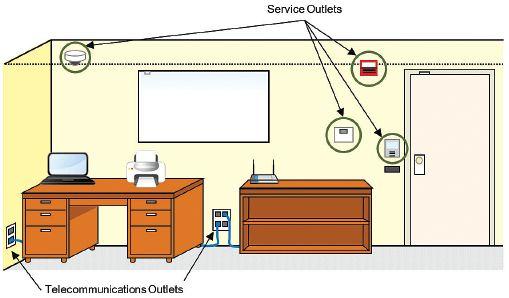
There are two categories of work area outlets in enterprise buildings: telecom outlets and service outlets. From a tech-
FIGURE 2 This drawing demonstrates the difference between the location of telecom outlets and service outlets, courtesy ANSI/BICSI-007. Service Outlets
nical and performance standpoint, the two are basically the same, but differ in their application and location, and the person(s) who regularly access them.
• Telecom outlets (TO) are primarily used in locations where the end device is administered by the user (e.g. computer, phone).
• Service outlets (SO) connect to a “non-telecommunications” device (e.g. door controller, security camera).
A service outlet is part of the building system; it is relatively permanent and devoted to a specific application. Because of their location, both BICSI and TIA allow service outlets to connect directly to the end of the horizontal cable run, versus having to terminate at a workstation outlet then running a patch cord to the device.
Key to overall reliability
A connected infrastructure for an intelligent building must be planned with five main considerations: performance, space, budget (OPEX and CAPEX), growth and sustainability. Key considerations for network infrastructure planning is the careful selection of the infrastructure components, pathways, spaces and cable management systems that suit the applications.
Pre-planning involves collaborative design, including staying on top of the many resources available (e.g. white papers, updated technical bulletins), and by partnering with industry associations and manufacturers.
A high-performance cabling system creates an efficient, connected, intelligent building that is able to handle the growing demand for power and data while reducing bandwidth bottlenecks and latency issues, and supports the migration toward future IoT demands.
Carol Everett Oliver, RCDD, DCDC, ESS, is the principal of CEO Communications, an ICT consulting firm focused on marketing, industry training and presentations. She is the first female president-elect for BICSI (2020-2022), and will serve as president in 2022. She possesses over 25 years of experience in the industry, and has worked for various cable and connectivity manufacturers. She also chairs the BICSI Intelligent Building standards subcommittee. She can be reached at ceo@ceocomm.com or coliver@bicsi.org.
DAN LEDUC
Demonstrating lost productivity with the measured mile
Many subcontractors have experienced a variety of negative impacts arising out of the pandemic, which could lead to delay claims or lost productivity claims—the two of which are quite different from each other.
Delay claims largely focus on time impact and schedule analysis, measuring cause of effect on slippages from a baseline schedule to any as-built schedule, and actual completion dates of the activities identified in the schedules.
Productivity claims focus more on the sub’s own labour records, starting with its estimate, and moving through its costing records for labour hours used, plus the impact of certain events on the sub’s execution plan and its actual experiences.
A White Paper* recently published by several trade associations (including the National Electrical Contractors Association) outlines two methodologies for demonstrating lost productivity: measured mile and Ibbs Study.
I prefer the measured mile. It is a means by which you compare productivity on one portion of a project or similar project where there was no impact (a control) against a portion where an impact was experienced. The White Paper explains:
As mentioned, the rule is reasonable similarity. Thus, if the activity code in the example on page 4 is described as “Feeder Conduit 2 in. to 6 in.”, the comparison could include conduits of various sizes. The reported decisions at the major boards of contract appeals evaluate material types, jointing methods [...] and other factors that need to be reasonably similar between the less-impacted and the impacted areas or time frames.
The measured mile comparisons between the less-impacted and impacted project areas or time frames are used to compute the should have spent labour hours in the impacted areas. If the claimant measures a production rate
of n number of labour hours to install a known quantity of material in the less-impacted area or time frame, that productivity factor can be applied to the take-off of similar conduit in the impacted area or time frame.
As claimant, you would then subtract the should have spent labour hours from the actual hours expended to solve for the inefficient hours. Actual productivity factor to install EMT in the less impacted area or time frame:
Quantity of EMT in the impacted area or time frame n labour hours/ foot of EMT
Should have spent labour hours
Actual productivity rate to install a foot of EMT in the less-impacted area or time frame
Claimed labour hours 700 ft of EMT x less-impacted labour productivity hours per foot = should have spent hours
”Determining Claimed Labour Hours”, see Notes
The White Paper, unfortunately, falls short on detailing the requirements you need to meet to make the measured mile useful.
Namely, your labour records need to be extremely detailed, identifying where each electrician was working at almost each hour of each day, or at least on what scope, geographically (e.g. 2nd floor) and by discipline (e.g. roughing in) that specific worker is performing. Being able to compare those records against your bid take-off makes the measured mile available to you.
Notes
* “Project-specific loss of productivity analysis methodologies,” William Ibbs, Ph.D., and Paul L. Stynchcomb (Ibbs Consulting Group), January 2021.
Dan Leduc is a partner in the law firm of Norton Rose Fulbright LLP, and practices exclusively in the area of construction law. He is always happy to take on new clients from anywhere in Canada. Contact Dan at dan.leduc@nortonrosefulbright.com.
Eaton Power Defense MCCBs now available
Eaton’s (eatoncanada.ca) Power Defense family of moulded case circuit breakers incorporate Power Xpert Release electronic trip units, which feature built-in communications, allowing you to use fewer components and a simplified design. The ArcFlash Reduction Maintenance System helps protect workers by reducing dangerous and potential arc flash incident energy levels, and enabling workers to activate this system from a distance. Zone Selective Interlock technology protects equipment by selecting faster trip times in coordinated systems.
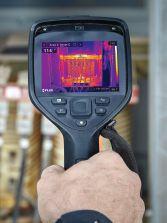
FLIR Systems expands Exx Seriesthermal imaging cameras
Compared to their predecessors, the new cameras promise enhanced resolution for more vibrant, easyto-read images, and on-camera routing capability to improve field survey efficiency. The cameras are designed to help you detect the early signs of building issues, identify hot spots, and troubleshoot electrical and mechanical systems. Don’t delay! Through March 31, customers who purchase an Exx Series camera will receive a free 3-month Thermal Studio Pro and Route Creator trial bundle (flir.ca).
Beluce expands Beghelli Castex hazardous lighting family
Beluce Canada (beghellicanada.com) has expanded its line of Beghelli hazardous LED lighting to include more class and division classifications. In
addition to the existing Castex flood, Beghelli now has linear and high-bay luminaries to accommodate a variety of applications. The Castex 1-4 luminaires are designed for installations where flammable gases or vapours are present. Each fixture comes with multiple mounting options, including pendant, ceiling, wall, pole, stanchion and chain.
ABB Integritas battery charger
ABB’s new Integritas wall-mounted industrial battery charger provides transformer-less power conversion in a compact footprint, promising N+1 or N+N redundancy in a single charger. The charger supports the DC power and battery charging needs of various industrial applications, from utilities and manufacturing to pharmaceuticals and petrochemicals. It provides up to 18 kW of output power at 125VDC from a direct, 3-phase, 480VAC input feed (new.abb.com/ca).
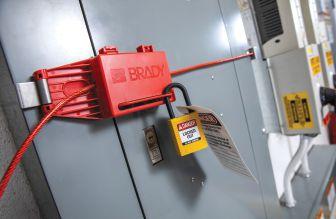
Brady panel lockout device
Rather than lock out individual breakers, Brady’s new panel lockout device effectively locks out all circuit breakers at once. It attaches to closed panel doors, offering easy installation with a one-piece design, and features an adjustable cable to fit a range of panel doors. For extra security, the device accommodates up to four
padlocks, and works well with hasps. The panel lockout is compact and lightweight, fitting easily in a lockout bag or toolbox (bradycanada.ca).
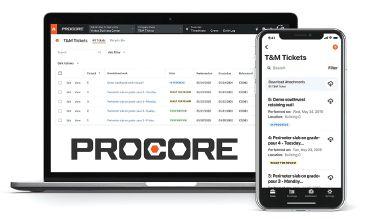
Procore labour productivity and time & material tickets
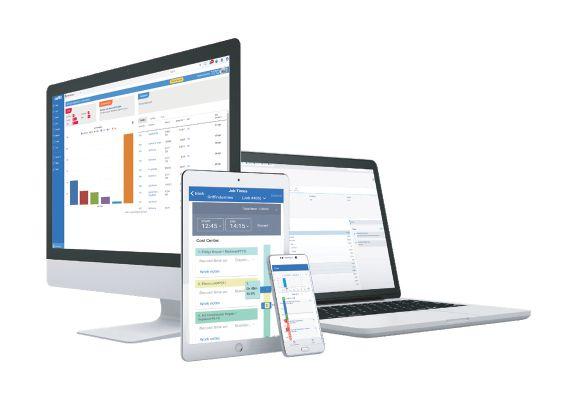
Procore unveiled two purpose-built features for specialty contractors in its construction management software: Real-Time Labour Productivity and Time & Material Tickets. Real-time insight into productivity means teams can identify at-risk scopes of work and act fast to realign with the schedule, says Procore. The Time & Materials Tickets makes it easy to document out-of-scope work as soon as it is requested in the field (procore.com).
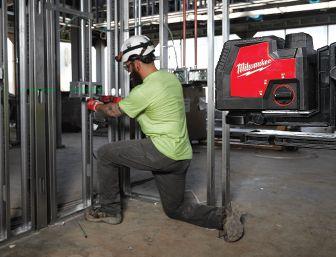
Milwaukee now offers jobsite lasers and accessories
The line-up includes two products on the M12 system—a green 360-deg 3-plane laser and a Green cross line & plumb points laser—and three lasers powered by RedLithium USB—a green cross line & plumb points laser, a green cross line laser, and a green 3-point laser. The two M12 solutions promise all-day run-time, and users can get 15+ hours of run-time using M12 RedLithium batteries. The green lasers offer visibility up to 125 ft, and achieve up to 165 ft of range with a laser detector (milwaukeetool.ca).
Wago 22-mm bulkhead connectors for enclosures
Wago’s new 22-mm connectors promise convenience when connecting to devices within industrial electrical enclosures. They are cUL certified and rated NEMA Type 2, 3R, 4, 4X, 12 and 13 or IP65 when the protective cap is closed. The PN 8000-099/000-1764 is a Cat 6A RJ45 female/female bulkhead connector rated up to 10 Gb/s, while the PN 8000-099/000-1765 is a USB 3.0 female/female bulkhead connector rated up to 5 Gb/s (wago.com).
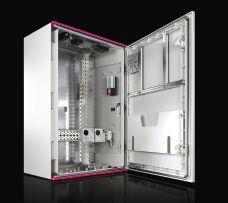
Rittal AX glass fiber enclosures
Rittal is replacing its previous KS series with AX glass fiber, UV-resistant enclosures, which promise panelbuilders “the greatest possible simplification, speed and design freedom, while at the same time fulfilling every precondition for maximum safety and robustness”. The enclosures are suitable for outdoor use; an integrated rain protection strip on the upper and lower edges of the door protects the gasket against dust and rainwater. They are UL 508A approved and have UL94 fire class V-0 (rittal.ca)
SensorSwitch improves WSXA Series
SensorSwitch (an Acuity Brands company) says it has improved the functionality and aesthetics of its WSXA Series of wall switch occupancy/vacancy sensors. The series now features a multi-way option (MWO) for connecting up to 9 switches on a single traveller for occupancy/daylight, and manual switch On/Off/Dimming control from any switch. The products in this series feature a screwless wallplate and updated look that helps them blend into the wall (acuitybrands.com).
CurrentLeak monitors branch circuits for undetected ground faults
Developed by Canadian electricians (Pivotal Product Developments), CurrentLeak aims to tackle the issue of undetected ground faults in residential applications. The device is installed into the main breaker section of the electrical panel, where it monitors all of the branch circuits in the home. CurrentLeak analyzes the magnitude of ground-fault currents and, should they reach unacceptable limits, it will activate a warning signal (currentleak.com).
CODE conundrum
RAY YOUSEF
Ray is a code engineer with Ontario’s Electrical Safety Authority
TACKLE THE CODE CONUNDRUM IF YOU DARE! Answers to this month’s questions will appear in the April 2021 edition of Electrical Business Magazine.
QUESTION 1
In a hospital, when an electric vehicle energy management system (EVEMS) is installed to monitor the consumer’s service loading, and to control the supply to electric vehicle supply equipment (EVSE), the demand load of this EVSE is:
a) 100% of the sum of all EV chargers
b) 90% of the sum of all EV chargers
c) As per Table 38
d) Ignored from the demand calculation of the hospital
QUESTION 2
For a 400A fusible disconnect switch fused at 400A, fed with a multi-conductor 600-kcmil copper in a raceway, marking is required beside the fused disconnect switch to state the maximum permitted continuous load is:
a) 320 A c) 268.8 A
b) 336 A d) None of the above
QUESTION 3
A single-conductor cable, carrying a current more than ___ amperes shall be run and supported in such a manner that the cable is encircled by ferrous material at all points of support, and at points of entry to enclosures.
a) 60 A c) 150 A
b) 100 A d) 200 A
ANSWERS
Electrical Business, December 2020 ed.
Question 1
For the demand load calculation for a school, the total demand load for 12 electric vehicle chargers—where each is rated at 8 kW—without an Electric Vehicle Energy Management System is:
c) 76.8 kW. Rule 8-204 and Table 38.
Question 2
All space within 6 m horizontally in any direction from dip tanks and their drain boards, with the space extending to a height of 1 m above the dip tanks and drain boards, is considered Zone 2.
b) False. Rule 20-302(1)(c).
Question 3
When interconnecting a solar PV system with the utility feeder, a means of isolation shall be provided: d) To isolate all sources of supply. Rule 84-026.
How did YOU do?
3 • Seasoned journeyman
2 • Need refresher training 1 • Apprentice
0 • Just here for fun!
Updated requirements for buildings housing livestock
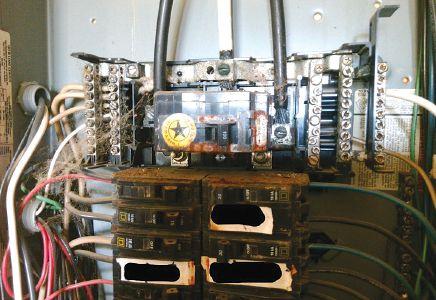
Barn fires can be tragic events for farmers, and the loss of livestock, buildings and equipment can be devastating in many ways.
In Ontario alone, approx. 80 reported fires involve barns housing livestock each year, with an estimated loss of $18.5 million. Approximately 40% of all barn fires are caused by electricity as the ignition source.*
Thankfully, updated requirements in the 2021 CE Code for buildings housing livestock will increase safety and help reduce the risks of barn fires and associated losses.
How did the changes come about?
As environments go, livestock barns can be quite corrosive. Not surprisingly, this corrosive environment is the leading cause of degradation or failure of electrical equipment.
The technical subcommittee responsible for those parts of the CE Code that address barns housing livestock was guided by a study that closely examined the environment in those buildings. Of primary interest was obtaining a better understanding of whether existing ventilation systems are able to control moisture and corrosive gases—the main culprits behind electrical equipment degradation and, ultimately, barn fires.
ADVERTISER INDEX
Not surprisingly, this corrosive environment is the leading cause of degradation or failure of electrical equipment.
The key findings of this study revealed that existing livestock ventilation systems do not adequately respond to elevated moisture or corrosive gas conditions. In fact, environmental monitoring showed that barns housing livestock regularly experience extended periods of elevated moisture and corrosive gas concentrations.
As a result, the updated rules in CE Code 2021 focus on ensuring electrical systems are designed and installed to withstand these harsh environments. Some of the main requirements include:
The new series of Rules 22800 to 22-808 require “Buildings housing livestock” to be classified as Category 1 (damp/ wet) and Category 2 (corrosive) environments, unless a deviation is allowed by the Authority Hav-
ing Jurisdiction. With this classification, electrical devices will be required to be approved for such environments (with the exception of specialty equipment). Specialty-type equipment is defined as “Agricultural equipment designed and used for a specific and unique purpose”.
Distribution equipment and panelboards will be required to be located in rooms that are completely cut off from the corrosive environment.
Wiring method restrictions contained in the 2018 CE Code are maintained in 2021. This includes not permitting EMT conduits and aluminum conductors, and requiring cables without metallic armour to be provided with protection from rodents.
These changes are an excellent example of co-operation between several parties—industry and regulators; a working group from Ontario’s Ministry of Agriculture, Food and Rural Affairs; insurance companies; and the Ontario Federation of Agriculture—all working toward the common goal of reducing harm and loss in this sector.
* Based on data from Ontario’s Office of the Fire Marshal & Emergency Management (OFMEM), which tracks fire incidents across the province, including barns housing livestock.
Nansy Hanna, P.Eng., is senior director, Engineering & Regulations, at Ontario’s Electrical Safety Authority (ESA). She is also chair of the Canadian Advisory Council on Electrical Safety (CACES) and a member of the ULC Advisory Council, CSA Technical Committee on Industrial, Consumer and Commercial Products and CSA CE Code-Part I, Sections 24, 32, and 46. She can be reached at nansy.hanna@electricalsafety.on.ca.
NANSY HANNA, P.ENG
Example of electrical equipment degradation due to corrosion in buildings housing livestock.
CONNECTIONS MORE CONFIDENT
The world runs on the connections you create every day. Our new, globally rated moulded case circuit breakers (MCCBs) help you defend them. Featuring built-in electronics that generate useful data to optimize performance across your facilities and safety-enhancing arc flash mitigation technology, we give you confidence you can count on.
Build your confidence at EatonCanada.ca/PowerDefense today.
We make what matters work.
WE’RE TAKING REWARDS TO THE NEXT LEVEL.
With more ways to earn loyalty points and redeem great prizes, the new and improved AD Rewards program allows you to capitalize on the power of your purchases from AD distributors like never before.
With over 6,000 valuable merchandise and travel rewards, your relationship with your AD distributor has never been more powerful…or lucrative.
Join today at any of these participating AD distributors.