THE RIGHT WAY TO LAUNDER FR GARMENTS
Making adjustments for comfort, safety, productivity and savings
Published by
INSIDE
+ Crime & punishment... the electrical version
+ The importance of lockout-tagout procedures
+ Stop worrying about arc flash—control it!
Spring 2018
Editor Anthony Capkun acapkun@annexbusinessmedia.com
Editor Jean Lian jlian@ohscanada.com
Publisher Peter Boxer pboxer@ohscanada.com
Account manager Jacquie Rankin jrankin@annexbusinessmedia.com
Assistant editor Ellen Cools ecools@annexbusinessmedia.com
Art director Svetlana Avrutin savrutin@annexbusinessmedia.com
Account Coordinator Kathryn Nyenhuis knyenhuis@annexbusinessmedia.com
Circulation manager Anita Madden amadden@annexbusinessmedia.com
COO Ted Markle tmarkle@annexbusinessmedia.com
President & CEO Mike Fredericks
FROM THE PUBLISHER OF
7
Will they launder their FR garments correctly?
You have a duty to keep your employees safe and to ensure any PPE, including their flame-resistant garments, is maintained properly. Unfortunately, there is no onesize-fits-all approach to PPE program management.
3 Message from the editors
A word from the editors of OHS Canada and Electrical Business Magazine, Jean Lian and Anthony Capkun.
5 Crime & punishment... the electrical version
We present a compilation of stories involving electrical injury to workers—both salaried and contractor—and the punishments meted to their employers or those who hired them.
11 Locking danger out, letting safety in
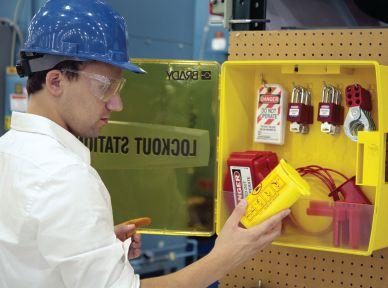
A lockout procedure that physically locks equipment into a safe mode by de-energizing it via a switch, circuit breaker, line valve or block is imperative in any sector that uses machinery run by electricity or any other stored power source.
14
Don’t worry about arc flash... control it!
With respect to workplace electrical safety, there has been little change over the past 10 years with regard to non-fatal electrical injuries. The issue isn’t a lack of awareness, intent or budget, but rather a lack of effective action and control.
Electricity is both ubiquitous and uniquely unforgiving
As you flip through this eBook, you may be wondering how electricity and the risk of electrical injury is any different from any other workplace hazard. Here’s the truth of the matter: it’s not.
In fact, the presence of lethal energy is like any other workplace hazard in that it should be included in your risk assessments; electrical work should involve qualified workers; procedures should be documented; and everything from work orders, training, etc., should become part of your overall managed and audited workplace health and safety system, and so on.
You understand this as a health and safety professional, so how is electricity any different?
A big difference between this and any other workplace hazard is that electricity, as a hazard, does not often get the respect it deserves. Almost everyone has a healthy respect for gas, confined spaces, working at heights, but not many people think twice about using a broken power bar or frayed extension cord, or opening a motor control centre panel without the correct personal protective equipment. Unfortunately, this sentiment is also shared by many of the electricians who work with the stuff daily.
We take electricity for granted because it is so ubiquitous and, to be fair, it is not remotely the No. 1 cause of workplace injury.
known as invisible electrical injury... which may not be as horrific a tragedy as that of electrical burn victims, but can be life-changing and traumatic nonetheless.
“I myself in the beginning didn’t believe this existed,” Dr. Fish admitted, yet sufferers of invisible electrical injury can experience any number of symptoms, the most common of which include memory impairment and general fatigue. Perhaps the biggest problem, though, is the fact that, because the injury is invisible, no one believes them!
Electricity, as a hazard, does not often get the respect it deserves.
However, when a truly cataclysmic electrical injury happens, everyone takes note, because it usually involves an explosion, sparks, smoke and burning—not to mention the workers who experience that blast head-on, or suffer burns from the massive heat created by an arc flash and bodily trauma from the explosion of the arc blast. But arc flashes and blasts as injurious events pale in comparison to electrical shock, which is regularly under-reported in the workplace. It’s not until someone experiences a truly life-altering shock that they and their employers really start to respect that lethal energy. Electricity is uniquely unforgiving when it enters the human body. Where it enters and exits the body can mean the difference between a bone burn and a skin graft, or between life and death.
Often, electricity’s effects on the human body are completely unknown or misunderstood. Back in 2010, I interviewed Dr. Joel Fish, chief medical officer at St. John’s Rehab hospital, to learn more about the phenomenon
(If you have about 10 minutes, check out Electrical Business Magazine’s video interview with Dr. Fish and some of the other professionals who work at St. John’s Rehab on YouTube at youtu.be/q7dN1CKpB-w entitled “The Road to Recovery”... you will definitely learn something new.)
This is why Canada’s leading publication for occupational health and safety professionals, OHS Canada, teamed up with Canada’s leading publication for the electrical industry, Electrical Business Magazine, to publish this special eBook focusing specifically on electrical safety in the workplace.
And electrOHS has been timed to publish in advance of next year’s publication of CSA Z462-18 “Workplace electrical safety”, with language that’s been harmonized with CSA Z1000 “Occupational health & safety management”. The electrical world has finally caught up with the health & safety world.
Jean Lian Editor, OH&S Canada
Anthony Capkun Editor, Electrical Business