On the path toward reducing diesel dependence. P.10
+ Going carbon-free with nuclear + Electrified transport marches on + Lighting for boutique retail
Clockwise from top left: Michelle Branigan, Electricity Human Resources Canada; Elisa Obermann, Marine Renewables Canada; Francis Bradley, Canadian Electricity Assoc.; Anne-Raphaëlle Audouin, WaterPower Canada; John Gorman, Canadian Nuclear Assoc.; Robert Hornung, Canadian Renewable Energy Assoc. photo : SCREEN CAPTURE
“I knew from my dosimeter that I got less radiation exposure than my co-worker who ate a banana that day.”
while there are many “one-off” measures across the country, Canada does not have a nationwide, comprehensive energy strategy. No overarching vision.
And heavy industry, Gorman added, doesn’t have any guidance for a “fuel switch,” echoing Hornung’s statement that we “need a pan-Canadian framework”.
Solid policy gives investors, developers and related stakeholders the confidence to move forward with projects. Lacking good policy—or policy that flip-flops across jurisdictions—does nothing to help move things along.
“Industry has the solutions,” Hornung pointed out, but government policy, regulators, “need to catch up.”
Keynote speaker Scott Moe, Premier of Saskatchewan, is fully supportive of nuclear energy “for power, for medical, for jobs, for climate change”.
During his address at CNA2021, he expressed his disappointment with Ottawa, which has yet to step in to support small modular reactor (SMR) innovation and technology in Canada. Currently, Canada’s SMR Action Plan is only an initiative among several provinces, Saskatchewan being one of them.
Again, no pan-Canadian framework. No, nationwide, comprehensive energy strategy.
Nuclear environmentalism
Another panel, “Non-traditional nuclear advocacy”, introduced us to a few independent, pro-nuclear advocacy groups who are fighting for nuclear energy in the context of climate change and energy poverty.
One of the panelists, Kristin Zaitz, is a civil engineer by training. She wasn’t raised a supporter of nuclear.
While in school, her class was tasked with delivering a speech on a controversial subject. Diablo Canyon nuclear generating station was not far, so she decided her speech would be about nuclear energy. She carried out all her own research, and realized “everything people said about nuclear was wrong”.
Zaitz was very proud of her speech which, she says, addressed the subject matter objectively, impartially, yet her professor gave her a poor mark because he was anti-nuclear.
At that moment, she realized attitudes toward nuclear energy are not necessarily grounded in fact. “Nuclear is an emotional topic,” she said.
Zaitz went on to become co-founder, president & CEO of Mothers for Nuclear.
Panelist Chris Keefer MD, CCFP-EM, admitted he used to get very anxious while driving through Pickering, Ont., and its nuclear generating station. However, once this emergency room doctor understood the science and its clean air advantage, he became a nuclear energy proponent.
He is active in Canadians for Nuclear Energy—the same people who are behind “Stand up for Nuclear”—and
founded the organization Doctors for Nuclear Energy.
“[Nuclear energy] provides the abundant, reliable energy we need to power modern society with only a fraction of the mining, fuel, and land requirements of other energy technologies. And it makes zero emissions,” reads the Canadians for Nuclear Energy site.
The panel noted that today’s youth did not grow up during the Cold War, Cuban Missile Crisis, etc. As such, they could be more receptive to nuclear energy, if they just knew more about it.
“Knowledge is power,” reads Zaitz’s bio on the Mothers for Nuclear website. “When I was pregnant, I inspected the inside of a containment dome during a refuelling outage. I knew from my dosimeter that I got less radiation exposure than my co-worker who ate a banana that day.”
But why all this fuss over wanting Joe Public to become pro-nuclear, anyway?
Because the panelists are all passionate environmentalists.
“As mothers, we feel a responsibility to protect our children, and the planet they’ll inherit,” reads the Mothers for Nuclear website.
“We believe that the evidence points to nuclear energy as the most-effective tool to transition off fossil fuels and eliminate air pollution,” reads a statement from Doctors for Nuclear Energy’s website.
As such, the panelists vehemently agree that nuclear energy is a powerful tool in the climate change toolbox, as it provides the massive amounts of energy we need for our power-hungry world in a relatively small footprint, with zero emissions.
The panelists cautioned that simply talking about how a nuclear generating station works is not going to convince anyone to become supportive. In that regard, they feel the nuclear industry is focusing too much on science and logic when talking about this emotional subject.
Instead, stories that are supportive of nuclear energy should come from the people who work in the industry; who know the science, but can connect with others on an emotional level.
“We need to shift public opinion to public action,” Keefer said.
Closing thoughts
When it comes to electricity, a lot of Canadian jurisdictions already produce the “clean” variety.
After some research (see Additional Reading), we learned hydroelectricity makes up nearly 60% of Canada’s electricity generation. When it comes to provincial electricity supply from hydro, Manitoba (96.8%), Newfoundland & Labrador (95.6%) and Quebec (93.9%) barely use anything else.
Windpower accounts for 98.3% of provincial electricity supply in Prince Edward Island. In a very distant second is Nova Scotia, at 11.6%.
(While found all over the country, solar power’s contribution is largely negligible at 0.6% nationally.)
But consider... 49.9% of Nova Scotia’s electricity supply is derived from coal, while Saskatchewan and Alberta claim 42.9% and 39.8%, respectively.
Meantime, 100% of Nunavut’s electricity supply is derived from petroleum.
Canada does not have a nationwide, comprehensive energy strategy. No overarching vision.
In the Northwest Territories, 57.1%.
So there is still a lot of “dirty” electricity generation to be found across Canada... generation that could be replaced by nuclear, which currently only makes up 14.8% of Canada’s electricity generation—and only in New Brunswick and Ontario.
Maybe we need some of those small modular reactors we keep hearing about?
After all, according to the Canada
Additional Reading
Energy Regulator, Canada is a world leader in uranium production. Saskatchewan is currently the only uranium-producing province in Canada, and Cameco’s McArthur River/Key Lake mine in northern Saskatchewan is the largest uranium mine in the world (although operations have been suspended for an indeterminate period due to weak global demand).
If we put everything on the table—nuclear, wind, solar, marine, waterpower, biomass, etc.—and actually develop a pan-Canadian energy strategy, it is our belief we can achieve cleaner air and avoid energy poverty here at home.
“Provincial and Territorial Energy Profiles – Canada”, Canada Energy Regulator, May 2021. LINK: tinyurl.com/29a8hh2w .
“Electricity facts”, Natural Resources Canada, October 2020. LINK: tinyurl.com/pama7u2c .
SASKATCHEWAN WILL SEE PROMPT PAYMENT PROVISIONS IN 2022
For years, contractors have essentially been financing projects and carrying all the risk, said Mark Cooper, president & CEO, Saskatchewan Construction Association.
“As of March 1, 2022, they will be protected from having unpaid invoices sitting there for months at a time.”
Next year, the Builders’ Lien (Prompt Payment) Amendment Act, 2019, will be proclaimed into force in Saskatchewan.
“Generally speaking, to say contractors are relieved would be an understatement,” said Cooper when we asked him about the overall reaction from the province’s construction sector.
For other jurisdictions seeking prompt payment, take note: it’s not a quick process.
“[...] to say contractors are relieved would be an understatement”
“The Saskatchewan Construction Association and industry partners have been pushing for this legislation for the last 6+ years,” said Cooper. “It has taken an immense amount of consultation with industry stakeholders—contractors, consultants, lawyers, the design community—and, of course, the government.”
Cooper explained that, with the time it took to craft the legal framework, prepare industry experts to become trained adjudicators, develop the Saskatchewan Construction Dispute Resolution Office (described below), to continually
manage the new legislation, “it has added up to many hours of advocacy work and many dollars invested”.
The new legislation will protect and define the rights and obligations of owners, developers, contractors and subs by establishing reasonable payment timelines for construction projects, and introducing an interim adjudication process as an alternative to arbitration and litigation.
“To reach consensus on a fair and fast-moving adjudication process that protects contractors from systemic late payment for work completed on time and to specifications—while allowing for a dispute mechanism with binding arbitration—is no easy task, but the wait will be well worth it,” Cooper added.
The payment timelines will mandate that owners and developers provide payment within 28 days of receiving a proper invoice for construction services. Contractors will have seven days to provide payment to subcontractors after receiving a payment from the owner or developer.
“These changes will ensure the prompt payment of contractors and subcontractors, and will enable parties to resolve issues quickly and without added costs—which, in turn, will help projects move forward without delays,” said Justice Minister and Attorney General Gordon Wyant.
The new adjudication process under the Act will enable parties to seek interim resolution for disputed payments. It will be overseen by the Saskatchewan Construction Dispute Resolution Office (SCDRO), a not-for-profit corporation designated by the minister to act as the official Adjudication Authority. The SCDRO will work with the ADR Institute of Saskatchewan Inc. to provide trained, independent adjudicators for disputes under the process.
“Although the legislation is not perfect—and there are a few sectors that are exempt from this law, such as mining—it is a huge step forward,” said Cooper.
3 EXTRAVAGANZA DAYS
January 17 • January 31 • February 14
Register now (free) for EBPowerCon 2022, launching January 17, and get the inside scoop on subjects like:
t The Future of Electrification in Canada
t Net Zero for the Rest of Us
t Hydrogen – the New Fuel tied to Electricity
t Partnering with Indigenous Communities for Electrification
t Transportation – Just about Everything is going Electric
With even more sessions to come!
REMEMBER… EBPowerCon is all about convenience. Hear from industry experts and visit our partners when you choose, from wherever you are—at your own pace— during the 6-week duration of the event. A SPECIAL WELCOME BACK TO THESE AMAZING PARTNERS!
USING CHP TO IMPROVE EFFICIENCY AND REDUCE EMISSIONS
How this not-so-new power generation technology is gaining groun BY
DAN TUAN
Combined heat & power is starting to gain some new attention in the power generation industry. Also known as co-generation (cogen, for short), CHP is actually not new; in fact, it is one of the oldest, energy-efficient power solutions, operating during a time when plants generated their own electricity using coal-fired boilers and steam-turbine generators.
A century later, CHP technology is seeing a resurgence due to its improved efficiency. Gas engine CHP systems are now almost 90% energy-efficient. Cogen systems are generally installed onsite for large facilities and buildings that need both electricity and thermal energy, such as institutions, hospitals, schools, and greenhouses.
Since most conventional electricity generation is limited to an average of 50% efficiency (coal-fired/gas-combined cycle), waste energy in the form of heat is discharged to the atmosphere. CHP offers significant improvements in efficiency because it produces two forms of energy from a single source: heat and electricity.
CHP is limited only by its ability to employ power generation in proximity to the heat load. Large-scale power plants were built in an era when heat wasn’t considered beyond a moderate combined-cycle system; the transmission & distribution requirements are intensive, and their locations made it impossible to utilize the heat source effectively.
Wastewater treatment plants are a prime example of a year-round CHP application. Thermal and electrical energy are in high demand throughout the process, where methane gas captured from the digesters run engine generators, producing heat for the
digesters and electric power for supporting the onsite electrical loads (e.g. pumps, process equipment).
A remote mining application in Canada’s North, for example, could also benefit from plant and site heating in an islanded power application.
The growing interest in distributed generation, lower-cost of installation and maintenance, and flexibility with renewables, provide an advantage in efficiency and immediate reduction in carbon emissions. As we navigate to new energy sources, gas engine CHP systems will integrate effectively with renewables and future fuels, such as hydrogen.
What’s driving the growth of CHP?
Greater energy efficiency, reliability and lower costs are top priorities for any business. Companies need to focus on their Environmental Social Governance (ESG) when setting standards for their operations. Socially conscious investors use these metrics to screen potential investments and consider how a company performs as an environmental steward.
Facilities with significant heating loads (e.g. hospitals, universities, military bases, ski resorts, shopping malls, high-rise office buildings) can all obtain reduced operating costs by implementing CHP systems that provide heat energy to meet the facility’s thermal requirements while taking advantage of offsetting (exporting electrical generation).
Unlike long-term, grand-scale power projects with higher costs, commercial businesses that are financially able to build their own cogen plants can complete these projects quickly and efficiently, gaining substantial savings in the short term.
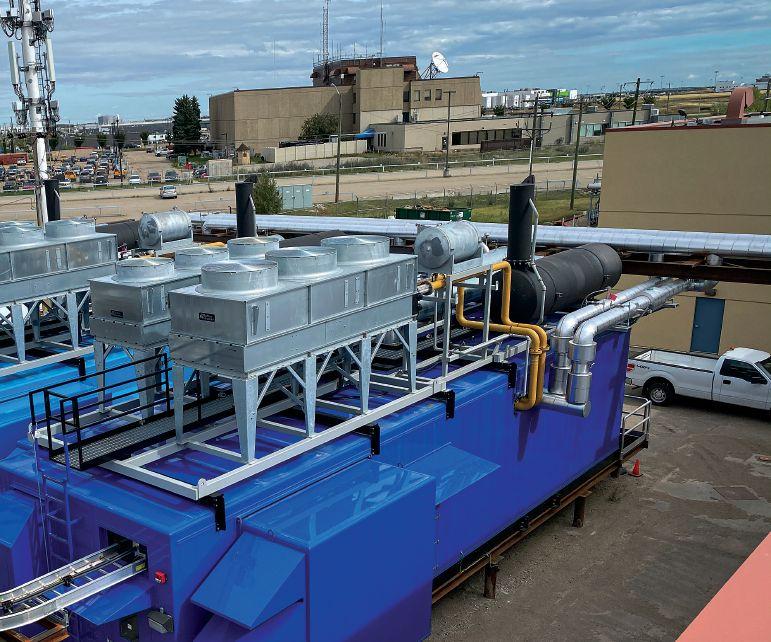
Edmonton International Airport recently implemented a CHP solution
designed around its terminal heating loads, as opposed to upgrading boilers alone. This not only met their heating requirements but allowed EIA to offset its electrical utility loads, raising overall efficiency. It also gives them the ability to export or offset the grid when power prices peak and heat demand is low. Many manufacturers now offer standardized CHP systems that remove the hassle and complexity of customized engineering elements. These packaged CHP solutions reduce onsite installation and construction costs and offer big benefits for smaller sites, including customized maintenance solutions for those without trained operators onsite.
Like any technology, CHP is not without its challenges
The potential for CHP growth is substantial, but there are several barriers limiting widespread adoption. The two primary challenges are integrating heat into the existing infrastructure, and securing interconnection agreements with the electric utility.
As we move forward to alternative energy strategies in the future, CHP provides an immediate impact and improved efficiency. For CHP to see true success in Canada, utilities and governments need to be open and responsive to companies and see it as an energy solution that benefits everyone involved. In fact, utilities are well-positioned to take the lead on facilitating CHP in suitable applications.
CHP is already happening in remote locations, First Nations communities and remote industrial operations, for example mining, where it is cost effective on a large scale.
After all, maximum efficiency is only realized when both sources of energy (heat and power) can be employed.While the technology is simple, questions concerning permits, inspections, regulations, project complexity and installation—not to mention integration with the grid—can lead to uncertainty around CHP.
The regulation of electric utility markets in Canada, which varies between provinces, can stall the process, making it difficult to obtain the necessary permits and approvals for independent power generation projects. When generating to the grid, limitations on export, demand charges and other costs tend to drive the ROI. As well, government subsidies for projects with improved carbon footprints can change with every election cycle (provincial and federal) and are burdensome in the approval process.
Another challenge is uncertainty with the installation process. The costs and complexity of installation really depend on the system itself, including things like the size of the unit, maintenance, location, site attenuation and local emission requirements.
The best application for cogen is one requiring both heating/cooling and electricity. Environmental factors also play a role. In Canada, generators need to function in extreme temperatures, which
often requires packaged systems (gensets in enclosures) to be custom-built and insulated to withstand our harsh winters. Reaching out to a reliable equipment and technology partner can help. Your dealer can provide support and insight into operation and local regulations, guidance in understanding the needs of your business, accessing grid supply information, and using data analytics to decide on the optimal type of power generation to meet your unique business requirements.
CHP is reducing emissions
Many organizations are (or should be) exploring power solutions that can help mitigate their reliance on fossil fuels and reduce their overall carbon footprint. Wind and solar have become common renewable energy sources, but they come with their own challenges, like power inconsistency and a lack of capacity for storing power.
From transportation and construction to manufacturing, food processing, greenhouses, hospitals and nursing homes, CHP’s reliability benefits are key in supporting industries in reducing their carbon emissions while maintaining the same energy outputs as other generators. A combination of CHP and renewable energy can provide longterm, onsite energy for locations that need better reliability and low carbon emissions. And when heat loads are low, CHP systems also provide reduced costs as they are able to shift production to the
hours with the lowest electricity prices and sell to the grid during peak demand. Hydrogen is quickly emerging as a clean, new fuel, and it is predicted to be the solution to decarbonizing the energy sectors. Many CHP systems are already using a combination of renewable fuels and natural gas. As hydrogen becomes more available, blending H2 with natural gas will further reduce emissions on existing systems. Gas engines today can use 5% to 20% H2, and retrofits in the manufacturing process can bring most engines to 25%. Manufacturers are already making inroads on developing 100% hydrogen-ready engines.
Using low-carbon fuels such as hydrogen in CHP units can further reduce emissions. However, there are still several hurdles to overcome for widespread adoption and use of hydrogen—especially when it comes to production, storage and transportation.
The future of CHP appears bright
As we navigate the complexities of the energy transformation wave, CHP can provide quick solutions, is easy to incorporate and, unlike earlier large-scale projects that were designed to last 50+ years, is ideal for the short-term. It can also provide an immediate reduction in carbon—a key factor, since many other viable solutions are still years away from implementation.
Governments are starting to recognize CHP as a way to boost efficiency, especially combined with renewables. New interest and investment—driven by a combination of low natural gas prices, environmental policies and reliability concerns—are moving the CHP market forward.
There must be a continued push to tell the CHP story and highlight the projects that have experienced success. When CHP is implemented and used to its full potential, it can provide a reliable and clean source of power while increasing energy efficiency, lowering emissions and helping shape a better future for the power industry.
Dan Tuan is the director of Power Systems with Finning Canada. He has been with Finning for 21 years, including 18 years in Electric Power Generation. He is also a member of the Advanced Energy Advisory Board of North America, and has served the primary power generation market segments in marine, mining, mission critical and renewable energy.
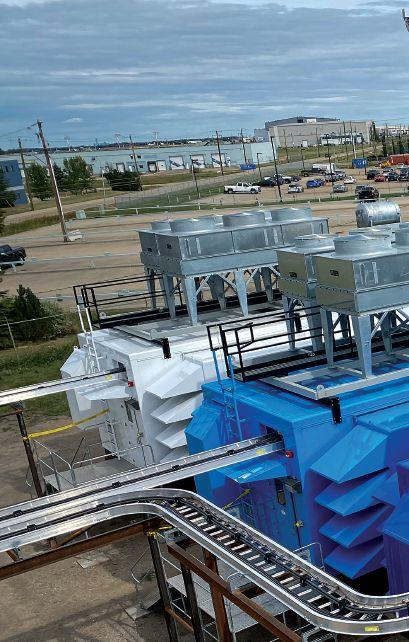
Edmonton International Airport’s CHP solution allows them to offset electrical utility loads, raising overall efficiency.
DIGITALIZATION AND SUSTAINABILITY – NOT SO NEBULOUS, AFTER ALL
A conversation with Adrian Thomas BY EDITOR
Over the years, I have found concepts like “sustainability” to be ill-defined, if defined at all. Instead, they seem to be invoked with the purpose of conjuring an interpretation—a vision—in the mind of the reader or viewer, which may not remotely align with someone else’s vision.
of experience in the electrical and automation industry; meaning, how should know a thing or two about these subjects.
During our conversation at EBPowerCon 2021, “Sustainability, Digitalization & Diversity for 21st Century Success”, I asked him to expound these two concepts— Sustainability and Digitalization—with the aim of making them understandable and actionable.
Sustainability... more than just green leaves
When we hear “sustainability”, Thomas said we all probably conjure the same image in our minds: “You know, trees with with green leaves.”
“But, when you step back, [Schneider Electric] takes a more broad view of sustainability, and it’s built upon the UN’s 17 sustainable development goals.”
Those 17 Goals do, in fact, include trees with green leaves, but also things like Decent Work and Economic Growth, Affordable and Clean Energy, Good Health and Well-Being, Gender Equality... and 13 others.
“When you think about it, sustainability is about longterm prosperity,” Thomas continued. “So, certainly, climate is a key factor in sustainability [but] it’s also about how we use our resources; it’s also about sustainability of the workforce.”
A key facet of workforce sustainability is diversity, equity and inclusion, Thomas continued, and how you partner with other people, other stakeholders.
In short, it is more than just our common vision of trees with green leaves, and there are both local and global imperatives for jumping on the sustainability train.
A key facet of workforce sustainability is diversity, equity and inclusion.
One of the terms that’s been rising in popularity is “digitalization” and, much like “sustainability”, I wondered: is this another possibly nebulous catch-all that defies definition, or does it mean something concrete?
Enter Adrian Thomas who, besides being president of Schneider Electric Canada, also possesses over 20 years
“This is been in discussion for many years, from the Kyoto Protocol to the Paris Climate Accord in 2015,” Thomas reminded me. “As society, there is the belief that we need to do something about climate, and we’re seeing that reflected in public policy. Just in December [2020], the government increased the cost of carbon. And that’s going to lead into the second force, which is financials. There is now a cost to emitting carbon.”
That said, Thomas is quick to point out there are also numerous opportunities for making one’s operations more energy-efficient and for reducing waste.
Electric Canada.
Digitalization... more than just an energy dashboard
Diving into the the subject of digitalization... are we just looking at being able to monitor and track the performance of, say, a motor? Are we talking about the cloud, and whatever lies therein?
Compared to days gone by,
“We’re working in a much more collaborative environment”
“I would sort it into two basic groups. The first is digitizing the information that’s available from the equipment in the buildings we are already using,” Thomas explained. “So your concept on motors... are we able to bring back energy data into a system—into a place—where we can use that information to give us some insights?”
This brings us into the realm of IoT and sending data to the cloud where it can crunched into something useful.
“The other piece to digitalization is virtualizing,” Thomas continued.
Schneider Electric, he explained, invested in a software company that helps stakeholders virtualize an entire building project, from construction to operations and maintenance.
“When you can virtualize that [building], you have the opportunity to optimize it [and so] reduce costs, manage the timing better...” All things you can do in a virtual world without impact in the physical world.
To flesh out digitalization even further, I asked whether all this information extends—or should extend—to general contractors or the trades involved in constructing or maintaining that building? Do you see this data, these insights, extending across the whole construction team, I asked.
“Absolutely,” Thomas said without hesitation, noting that some trades have already begun adapting resources inside their organizations to become more familiar with the modelling. “And those trades will be more effective and more successful in terms of being able to quote projects accurately, understand their costs, be profitable, and do things in shorter time.”
Once the digital infrastructure is in place, there are additional service contract opportunities for the trades.
“So the moment that, say, a breaker trips or there’s a situation, you’re alerted at the same time as the user, and you can dispatch and provide better service. So I think there are a lot of ways the contracting industry can really leverage this new technology to differentiate [themselves].”
The tricky part (okay, there are many) is figuring out who ensures that digital infrastructure is not only in place, but works as intended.
“Everyone has developed some digitization within their domain. So we have these silos of digitization—we have these systems—which are giving us great value. But sometimes, during the implementation, there’s no one there to plug it all together.”
So there’s still a gap, said Thomas, in terms of who owns the system of systems.
“It’s something that, if you’re doing a project, you have to pay attention to... these systems don’t magically self-connect.”
That said, Thomas is by no means pessimistic about the situation. Compared to days gone by, “We’re working in a much more collaborative environment”, he said.
“So, really, we have to bring together the user of the building, the contracting firm, and some of the solutions and technology providers to solve a problem effectively.”
This article presents highlights and takeaways from my discussion with Adrian Thomas during the session “Sustainability, Digitalization & Diversity for 21st Century Success” at EBPowerCon 2021. You can watch the entire conversation at our YouTube channel, youtu.be/dm0qYvsVXZw. Remember, EBPowerCon launches January 17. Visit EBPowerCon.ca to Register (free).
Triplett MM650 Lo-Z waterproof DMM
Triplett’s True-RMS Lo-Z waterproof digital multimeter offers a variety of measurement features, and features a backlit LCD and switch selector dial, Lo-Z (impedance) mode for identifying ghost voltages, data hold and more. The rubberized housing provides impact and drop resistance, while the Cat IV 600V rating resists damage from transient over-voltages (triplett.com).
Extech
DV690 high-voltage detector
FLIR’s Extech DV690 is a non-contact detector with a range of up to 69 kV, and features five mounting options. The detector features an LED alarm and 106 dB buzzer to notify users of the presence of dangerous voltage. The unit is built with an IP54 housing to protect from dust intrusion and water spray, and drop tested to 4 feet (extech.com).
Keen Utility Vista Energy footwear
Keen’s work sneaker is CSA-certified and features the Keen.
ReGEN cushioning
midsole that returns 50% energy with every step. The carbon-fiber toes are 15% lighter than steel, and a flexible, non-metallic puncture-resistant midsole plate makes the shoe lighter and metal detector-friendly. An oil- and slip-resistant outsole with water-diverting channels improves traction (keenutility.com).
Atkore Calbrite hygienic liquidtight conduit and fittings
Atkore’s Calbrite Flex offering now includes stainless steel hygienic liquidtight conduit and fittings. The conduit is made from polished 316 stainless steel helically wound flexible conduit, and offers a compression strength up to 400 kg, tensile strength up to 130 kg and a temperature range of -20 C to 105 C. The fittings are also made of 316 SS, and feature a straight external thread (calbrite.com).
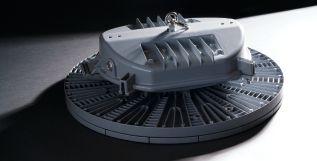
Dialight Vigilant high-bay
Dialight’s low-profile Vigilant LED HO high-bay is suitable for mounting heights up to 100 feet, and provides up to 71,000 lumens of total output. The unit is just under 7-in. high and weighs 48 lb, sports a copper-free aluminum housing, dual powder coat finish, and a hook mounting option. It carries a 10-year warranty, and has an operating temperature range of -40 C to 65 C (dialight.com).
E2S signalling beacons
E2S Warning Signals’ B350TLA traffic light warning signal beacons feature a 100×140-mm housing. The light engine for both the B350TLA and the 140×177-mm B450TLA is an array of 18 HO white LEDs, while the diffused lens determines the output light colour. The operating voltage ranges are 10-14vdc/16-33vdc and 48-260vac/ dc, with an operating temperature range of -40 C to 70 C (e2s.com).
Legrand GFCI
USB-A/-C outlet
Legrand says it has introduced the first GFCI outlet that includes connections for both USB Type-A and Type-C. The outlet automatically self-tests every 3 seconds, and is available in classic colours, as well as metallics (legrand.ca).
Polartec flame-resistant collection
The new flame-resistant (FR), arc-rated (AR) Polartec FR
Collection introduces three Polartec fabric constructions engineered with Westex FR/AR technology: Power Dry FR, Power Grid FR, and Wind Pro FR. The products span shirting, insulation and weather-resistance fabrics (westex.com).
Amerlux Dark Sky-friendly fixtures
Amerlux’s DS770FC Series employs shielded optics to minimize glare and reduce light trespass. The series offers four fitter options, six output levels, and IES Type II, III, IV or V distributions. The available colour temperatures are 3000K and 4000K, while an optional wireless node allows the fixture to operate on the SmartSite connected lighting system (amerlux.com).
Universal retrofit kit with Bluetooth
Universal
Lighting’s LRAxC
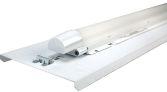
LED strip fixture retrofit kit with Bluetooth controls is used for replacing 4-ft or 8-ft fluorescent strip fixtures, while the controller provides for dimming and On/Off commands. The controller is factory-mounted to the light bar while the aux power and dimming control leads are pre-wired to the driver (unvlt.com).
Estimating 101
DAN BERESFORD AND JOHN F. WIESEL
Bidding information and communication problems
Let’s face it: we are quoting and bidding in a tough market that’s still affected by Covid. The competition is tighter, material and labour costs are increasing, and the time from bid request to submission is getting shorter. (Distributors and manufacturers are caught in this pinch, and give prices just before the bid is due.)
All of these things make it all the more important to avoid mistakes in our bid submissions; yet errors keep happening, frequently due to poor project information and communication problems.
When we get a bid request, we need to look at the entire package. Take note of the things that require more information; ask questions, and send them back. Look for things such as:
• Are power and lighting circuits properly labelled?
• Do the fixture specs match the drawings, and are heights listed?
• Any products you cannot get from your suppliers?
• Does the distribution equipment list match the information on the drawings?
• Are the responsibilities for wiring the mechanical equipment clear?
• Any incomplete notes in the drawing?
• Any addendums noted, but not included?
Here is an example of how poor project information and communication problems in a recent bid request forced the electrical contractor to rework the bid right up to closing time:
(It bears mentioning the bid request came with a short turnaround time, poor project information, and the need for additional information—some of which came last-minute... it’s no wonder a decent scope of work could not be sent to the general contractor.)
First, the contractor received the wrong drawing.When he received and reviewed the new drawing and addendums, he noticed new lighting circuits had been added and fixture heights had changed. In one area of the drawing, the power supply was 347V; on the other side of the junction box, the circuit was labelled 120V.
On the drawing, the T-bar measurements were metric, but the fixture spec showed imperial sizes. This meant the lighting company had to supply metric-sized fixtures... but at what voltage? It was never clarified.
Not only was the estimate a mess but—adding insult to injury— the wrong fixtures with the wrong voltage were supplied.
26% of rework is due to poor communication among team members, while 22% is the result of poor project information.* Even during the bidding process, teamwork between the architect, engineers, general, subs, distributors, and manufacturers is crucially important.
* Littman, Julie. “Survey: construction industry wastes over $200B on avoidable mistakes, rework,” Bisnow.com, August 1, 2018.
John F. Wiesel is the president of Suderman Estimating Systems Inc., and has been estimating and teaching estimating since the early 1980s. Dan Beresford served as an electrician in the Canadian Navy, then worked in various roles in the electrical sector before joining Suderman.
CODE conundrum
RAY YOUSEF
Ray is a code engineer with Ontario’s Electrical Safety Authority
TACKLE THE CODE CONUNDRUM IF YOU DARE!
Welcome to the newest round of questions that test your knowledge of the CE Code-Part I. Answers will appear in the February 2022 edition of Electrical Business Magazine, and online at EBMag.com under Features.
QUESTION 1
Where circuit overload protection is provided by other means, fuses that are permitted to be used for overcurrent protection are:
a) Class C c) Class H
b) HRCII-MISC d) A and B
QUESTION 2
A moulded-case circuit breaker is permitted to be located in a Category 2 location so long as it is contained in a NEMA-1 enclosure.
a) True b) False
QUESTION 3
The power supply of a fire alarm system shall be:
a) provided by a separate circuit.
b) interlocked with emergency lighting circuit in a hotel.
c) kept at least 3.0 m from any combustible material. d) all of the above.
ANSWERS
Electrical Business, October 2021 ed.
Question 1
The CE Code allows the use of non-metallic sheathed cable in a building of combustible construction. a) True. Rule 12-504.
Question 2
Where conductors are used in exposed wiring and are subject to corrosive liquids or vapours in a Category 2 location, they shall be of a type with corrosion-resistant protection, and be located more than horizontally from floors, decks or stairs.
b) 1.5 m. Rule 22-202(1).
Question 3
In a dwelling unit, what is the maximum allowable height of the handle of a panelboard’s overcurrent device?
c) 1.7 m. Rule 26-600(2).
How did YOU do?
3 • Seasoned journeyman 1 • Apprentice
2 • Need refresher training 0 • Just here for fun!
DAVID PILON
Dry-type transformers: conductor and protection selection
Why are the criteria for installing a transformer so complex? Why can’t it be simpler?
Because of all the rules in the CE Code, there are always other things that come into play. To be fair, those rules try to be flexible enough to allow the installation to proceed unhampered, with the end result being a functional and safe XFMR installation.
For the purpose of this column, I will use examples from one of our most common installation voltages—600V/208V—and refer to a single dry-type XFMR with a turns ratio of 2.88. Against this backdrop, I will discuss the CE Code’s rules and how they interact with each other to ensure a safe installation.
The first rule we need to look at is 26254 “Overcurrent protection”. Subrule 1 states that, so long as the O/C protection does not exceed 125% of the rated primary overcurrent, and the secondary conductors are rated for at least 125% of the secondary current, then secondary O/C protection may be omitted.
However, if there is going to be secondary O/C protection set at not more than 125% of the secondary, and the primary is fed from a circuit protected at not more than 300% of the rated primary current, then the primary will not require an individual O/C device.
When determining the installation and protection of a dry-type transformer, ask yourself: What am I trying to achieve?
But what happens when the rating of the O/C device does not correspond with 125% of the transformer’s primary ratings?
The CE Code instructs us to go to the next higher-rated device. It does not, however, suggest you no longer need to follow the other applicable rules. So, if we increase the primary O/C device to ensure the operation of the transformer, we must then ensure the secondary remains protected at not greater than 125% of the rated secondary.
Note that Subrule 3 only provides an exemption to the primary O/C protection, not to the secondary.
This scenario is covered in greater detail in the conductor Rule 26-256, and references the protection Rules 14-100 and 14-104, so let’s have a look.
Rule 26-256 tells us conductors supplying the primary and the secondary of a XFMR shall have an ampacity of not less than 125% of the rated primary or secondary current. The conductors may also be sized according to the demand load; however, this will now
require both primary and secondary conductors to be protected in accordance with the rules of Section 14.
This requirement may also bring Table 13 into play if the calculated load is also known.
Earlier I mentioned the allowance to increase the primary O/C device beyond the 125% where the value did not align with the 125% of the rated primary current. We know that the secondary protection would then need to be no greater than 125% of the rated secondary current.
This Subrule brings 14-100 to bear, which means the primary conductors must still be sized to be protected by the increased O/C protection, and the secondary conductors must also be protected by an O/C device. Now, however, we must also add the length of one conductor of the primary circuit plus the length of one conductor of the secondary circuit, and this must not exceed 7.5 m in total length.
When determining the installation and protection of a dry-type transformer, ask yourself: What am I trying to achieve? How can I best achieve it while keeping costs in check and without violating the CE Code?
Consult your Authority Having Jurisdiction for more specific interpretations
David Pilon is manager, Electrical Inspections, at Technical Safety Authority, Saskatchewan (TSASK). He also serves as vice-chair of the Canadian Certified Electrical Inspector (CCEI) committee of the International Association of Electrical Inspectors (IAEI), Canadian Section. He can be reached at david.pilon@tsask.ca.
WE’RE TAKING REWARDS TO THE NEXT LEVEL.
With more ways to earn loyalty points and redeem great prizes, the new and improved AD Rewards program allows you to capitalize on the power of your purchases from AD distributors like never before.
With over 6,000 valuable merchandise and travel rewards, your relationship with your AD distributor has never been more powerful…or lucrative. Join today at any of these participating AD distributors.