Members of the GrandBridge Energy Operations and Fleet teams visited Conestoga College’s Skills Training Centre in Ingersoll, Ont., to donate vehicles to the Powerline Technician Program. Students and instructors were present to welcome the arrival of the vehicles (February 19, 2025).
SOURCE: GRANDBRIDGE ENERGY INC.
GrandBridge supports hands-on training for Conestoga powerline students
GrandBridge Energy is donating a bucket truck and a pickup truck to Conestoga College to enhance hands-on learning for students in the Powerline Technician Program.
The Ontario electric utility serves the cities of Brantford and Cambridge, the Township of North Dumfries, and the County of Brant. As part of its fleet modernization plan, the utility identified a 2009 International double bucket truck and a 2013 Chevrolet Silverado to donate to the college.
“We are committed to fostering learning opportunities that support the next generation of skilled trades professionals who will play a key role in the future success of our industry,” said president & CEO Sarah Hughes.
Enova donates $6,250 to youth support organization
From left: Andrea Ferguson, OneRoof Youth Services; Enova Power president & CEO Greig Cameron, along with Enova’s Jenna Trakalo, Penny Tucker, Kiel Edge. SOURCE: ENOVA POWER
Enova Power Corp. kicked off the new year with a $6,250 donation to OneRoof Youth Services, a charitable organization providing support to youth who are experiencing homelessness in Ontario’s Waterloo Region.
Enova made the donation on behalf of its customers who switched to eBilling during the annual autumn eBilling
campaign, which ran from November 4 until December 13, 2024. The utility donated $5 for each customer who made the switch, which was doubled to $10 during the “Week of Giving” in early December.
The donation supports services for at-risk and homeless youth such as mental health and addiction support, emergency shelters, supportive housing units, food hampers, and essential services.
EECOL acquires ISS to deliver AVEVA solutions in Western Canada
Electrical distributor EECOL has acquired Industrial Software Solutions (ISS), an exclusive distributor of AVEVA’s industrial automation software solutions in Western Canada and the Pacific Northwest.
Through its AVEVA solutions, ISS provides companies with detailed insights into their manufacturing process, enabling them to make informed
decisions about automating tasks, improving performance, and more.
“This collaboration will significantly expand the reach of EECOL, AVEVA, and ISS solutions across Western Canada [...]” said EECOL president Jim Powell.
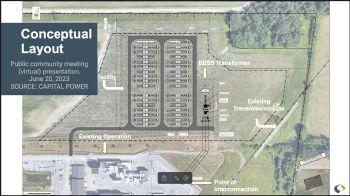
York Energy Centre is getting a battery energy storage system for a neighbour
SOURCE: CAPITAL POWER
A new battery energy storage facility has broken ground in York Region, Ontario that, when completed, will be capable of storing up to 120 MW of electricity, with electrical energy output for up to four hours.
The York Battery Energy Storage System (BESS) project is located adjacent to the existing York Energy Centre (YEC) on land owned by Capital Power.
The installation will consist of interconnected enclosures measuring about 9 x 2 x 3 metres and containing numerous modular lithium-ion batteries. Each enclosures is fully sealed, centrally controlled, and equipped with temperature monitoring and regulating instrumentation. Additionally, each enclosure has its own HVAC system containing refrigerant and coolant for thermal management.
The BESS modules will be paired with medium-voltage step-up transformers to allow for integration with other electrical components.
The construction phase will be approximately one year in duration, and will include site preparation, foundation and laneway construction, component delivery and installation, including crane(s) required for placement of the BESS enclosures onto their dedicated foundations, and post-construction site restoration of temporary construction areas.
The BESS encompasses an area of about 1.5 hectares (4 acres). Commercial operation is expected in August 2025.
Poplar Hill First Nation connects to Ontario’s grid, ending diesel dependence
SOURCE: SUPPLIED
Eliminating its reliance on diesel generators, the northern Ontario community of Poplar Hill First Nation was connected to the provincial power grid on December 17, 2024, reports Wataynikaneyap Power.
Located about 570 km northwest of Thunder Bay, Poplar Hill’s distribution system connects to the provincial grid through 190 kilometres of transmission line and four substations. The com-
munity will now be served by Hydro One Remote Communities Inc. for local distribution.
OEC bolsters electrical and telecom capabilities with Primary majority ownership Energy and infrastructure services company OEC announced it has completed the purchase of a majority stake in Primary Engineering and Construction.
Headquartered in Calgary, Primary operates from 11 locations across Canada, employing a team of over 450 specialists in electrical engineering, telecommunications, land development, and grid interconnection services.
OEC serves the infrastructure, energy, gas, and electricity distribution, and telecom sectors with over 3000 employees. Its group of companies deliver end-to-end solutions, from conception and design to engineering, construction, and field services.
PARTNERSHIPS
Arlington Industries recognized Munden Enterprises Ltd. with its 2024 Canadian Sales Achievement Award at the National Electrical Manufacturers Representatives Association’s (NEMRA) annual conference. Munden is a manufacturers’ rep agency serving Atlantic Canada since 2004.
Elec-Tech Sales Ltd. has been appointed to represent Hammond Power Solutions in British Columbia.
SurgePure Corp. has partnered with AMG Baytech for representation in Eastern Ontario.
Intellimeter has signed on with ElectriXwest and The Titan Group to bolster its presence in the Prairies.
THE TOP 6: EXTENDING SWITCHGEAR LIFE SPAN
Best practices for managing aging switchgear effectively while ensuring your own success
BY TREENA HEIN
As electrical systems age, facility managers face ongoing decisions that have cost implications upfront, but also for many years to come. They rely on their electrical contractors for solid recommendations about what’s best for their switchgear infrastructure—whether that’s replacement versus a full/partial retrofit—and then to carry the work out accordingly.
But how do contractors arrive at those recommendations, and what industry best practices should be used to help optimize their clients’ aging switchgear systems?
To get us started, John Hodson, former owner of the MagnaIV Calgary office and current owner of Surplus High Voltage Assets in Calgary, first points to some general points about the infrastructure itself.
“A lot of switchgear housing is still good after 20 or 30 or even 50 years but, of course, the switching technology has evolved,” he says. “The housing is about 50% of the cost, so it’s cost-effective and also better for the environment to keep it in place instead of ripping out everything... which usually
ends up at scrap dealers.”
“With the increasing cost of mining raw materials like copper and aluminum, and also the tariff situation, it’s best to keep the housing as long as possible and change the components.”
Allen Tressel, electrical department manager and co-founder of Team Power Solutions in Saskatoon, Sask., is of the same mind.
“In Saskatchewan and other parts of Canada, the switchgear structural housing built years ago was generally built much heavier that what we see in optimized designs today,” he says, “and a lot of it just needs a clean up and a rebuild.”
That leaves optimizing the performance of the components inside. Here are the best practices these and other experts recommend.
Best practice #1
Taking a thorough look
Sandra Pedro, utilities director at ABB, explains that recommendations about aging electrical infrastructure should be preceded by detailed site studies, including fault current studies.
“Since electrical systems evolve over time, referencing the
old study or just the nameplate of the equipment does not provide the most current requirements,” she explains. “By assessing the system’s current demand profiles, contractors can implement targeted retrofits that modernize aging switchgear and ensure that systems meet modern performance and sustainability standards.”
Courtney Forget, vice-president of services for Schneider Electric Canada, also recommends an initial comprehensive assessment. “Regular inspections and testing are essential to uncover hidden issues and understand the life cycle.”
Best practice #2 Building trust through explanation
Once a thorough analysis is complete, Tressel points to the need to provide clear explanations of your recommendations for either the retrofit or replacement of components, with the needs of the customer coming above all.
“It might be that new components are best, or sometimes it’s a rebuild,” he says. “It’s not always about what has the quickest return on investment. You want to work with customers as a trusted partner to help them make the best decisions for their unique situation and considering all aspects of their operation— including the cost of downtime. You want to communicate well and create a good long-term relationship, supporting a solid plan.”
In a replacement recommendation, for example, contractors should explain that some older equipment is not worth keeping simply because the parts just aren’t available anymore.
“It’s an easy decision to replace if there’s something uncommon,
but there are a lot of grey area situations,” says Tressel. “It’s a case-by-case basis and you have to do your research. At some point, the component crosses that threshold and it’s more expensive to maintain it than to replace it, as parts get more scarce and more costly.”
This often happens with certain breaker parts, Tressel continues. He’s been on projects where he was surprised to find “old stuff” was actually still available, usually because it is really popular and still supported. Conversely,
“There can be newer stuff from 10 years ago that wasn’t common and isn’t supported anymore”.
“Overall, for whatever reason, if it’s a long delivery time and costly to get the part, then you may lean toward replacement versus retrofit.”
Best practice #3 Introducing new technologies when appropriate
When replacement is the best option, electrical contractors should introduce new technologies that promise clear advantages in
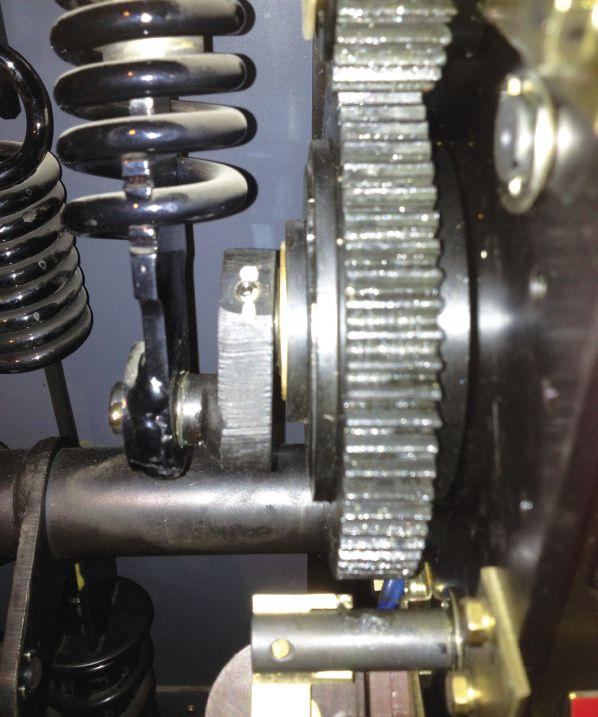
Photo shows a circuit breaker’s internal gears and spring.
Source: JOHN HODSON
reducing future maintenance requirements.
Pedro highlights modular switchgear, for example, which “futureproofs” a site by reducing outages and minimizing the need for full replacement or repairs down the road. Instead of the oil or SF6 gas that’s present in traditional switchgear, modular products featuring vacuum interruption and solid dielectric insulation can reduce many maintenance requirements.
Forget points to connectable digital breakers that not only enhance reliability and safety (e.g. with arc flash detection systems), but also enable condition-based maintenance, reducing the need for frequent interventions. In addition, transitioning from electromechanical to digital relays provides advanced protection and diagnostics.
“This upgrade offers superior fault protection and seamless integration with modern control systems,” Forget says.
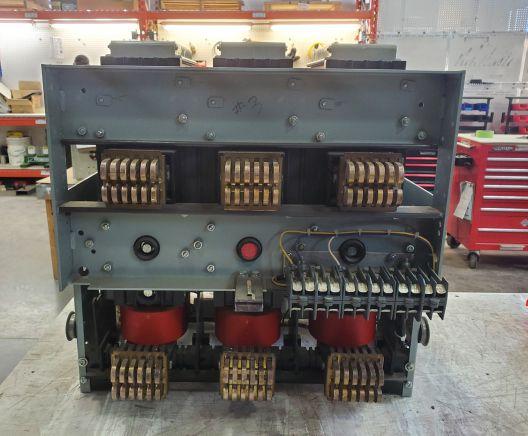
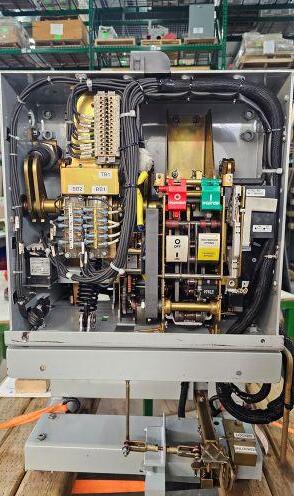
Breaker assembly showing electrical components prior to refurbishment.
Source: Team Power Solutions
At the same time, Tressel explains that clients usually have a goal of maintaining consistency with equipment to save costs.
“If you have two or even five different vintages, it’s tough for operators as they have to learn how to operate and maintain all of them,” he says.
“On the other hand, if you keep new components similar, you have less training, efficient maintenance, and you can continue to use your standard stock spare parts. Also, if you maintain the original specifications with rebuilds, you don’t have to do design changes, so you avoid or reduce those engineering and construction costs.”
Best practice #4 Regular, proper maintenance
As you recommend and carry out component replacement or retrofit, another best practice is to encourage the performance of proper regular maintenance to help clients optimize their infrastructure over the long term.
In Hodson’s experience, about 25 years is a component’s typical life span under reasonable maintenance but, as is the case with just about any asset, a stricter maintenance regime can extend that life.
“Some utilities let things run to failure and swap out switchgear quickly,” he observes. “They have spares for everything and are regulated separately. Industrial and commercial operations should also have spares on hand, but they don’t want to run to failure, so maintenance is critical. If you let things run to failure, it
could be months before you’re back up.”
In his view, everyone in the industry should be following InterNational Electrical Testing Association (NETA) standards for electrical power equipment maintenance, similar to CSA Z463 “Maintenance of electrical systems”.
“You [should also] use this as maintenance guidelines when you bring in an engineering consultant or testing firm, instead of just bringing a company in for wide-open maintenance testing,” he explains.
Forget adds that new sensor technologies open the door to advanced preventive or predictive management. Furthermore, “adopting condition-based maintenance service plans can lead to savings on insurance premiums”.
And while the maintenance discussion is happening, don’t forget to include lubrication. While it may seem to clients to be a good way to extend the life of components, clients aren’t generally aware that lubrication must be done carefully. Improper lubrication and resulting operational failure can lead to costly downtime and repairs, and Tressel encourages everyone in the industry to remind clients about this whenever possible.
Over-lubricated mechanism, demonstrating the Allen recommendation for Best Practice #5 regarding proper lubrication frequency, highlighting the challenge of removing old or incorrect lubricants.
Source: Team Power Solutions
“When we do a minor rebuild, we always educate the client that we have to partially disassemble just to clean and remove the old lubrication,” he says, “which must be done before installing new lubrication.”
Best practice #5 Encouraging environmental analysis
Tressel would like to see the industry adopt a best practice of urging clients in appropriate situations to examine environmental hygiene as an important way to extend switchgear lifespan.
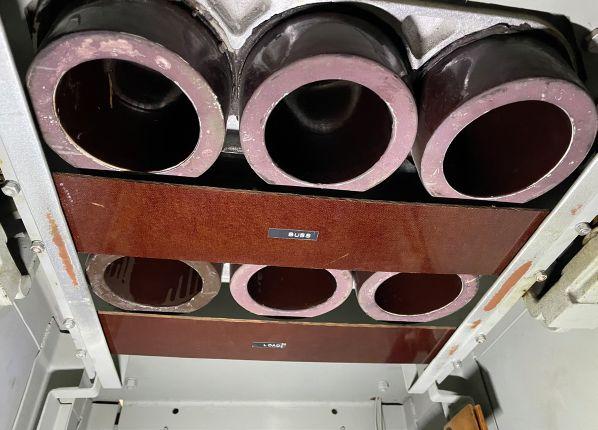
Close-up
view of breaker stabs, round type.
Source: Team Power Solutions
“If you can install a HVAC system and/or maintain a positive pressure in the room to reduce dust and other contaminants, you’ll keep your switchgear infrastructure in much better shape,” he asserts. “Yes, there’s a cost to these HVAC systems in the install and ongoing maintenance, but that’s worth it to increase reliability, safety, and production.”
“There could be a lot of contaminants in the environment but, because electrical equipment doesn’t move or make noise, it’s typically ignored,” Tressel adds. “However, you can be assured, in a dirty operating environment, it is building up issues in silence.”
Best practice #6 Encouraging good recordkeeping
As time passes, there are always staff changes. Ongoing retirements and the loss of institutional knowledge can raise the equipment’s operating risk, and create significant barriers to achieving longer switchgear life, says Tressel.
“In many cases, there isn’t a long-term history with equipment that’s established, so companies don’t have maintenance history records. Better record-keeping means better care. If records management is improved—leading to more accessible historical data—repeat issues, deficiencies, and general maintenance will be better and components can last much longer,” he notes.
The best perspective moving forward
Overall, Tressel stresses that educating clients about maintenance is the best way for you to work together to optimize switchgear operation through ongoing combinations of component service,
retrofit, and replacement. He also recommends encouraging a proactive stance.
“Emergency or reactive situations are not ideal for anyone,” he says. “With advanced planning, service-based knowledge and working together as trusted partners, the best contractors help their customers solve the challenges ahead, plan for the best business decisions, and optimize their uptime and operating efficiency.”
By providing expert support for customers’ unique concerns and, ultimately, implementing the best solutions, our industry can do a lot to help clients manage their switchgear future in the most logical and cost-effective ways.”
Treena Hein is an award-winning Canadian science, technology and industry business trends writer, and regularly contributes to Electrical Business Magazine.
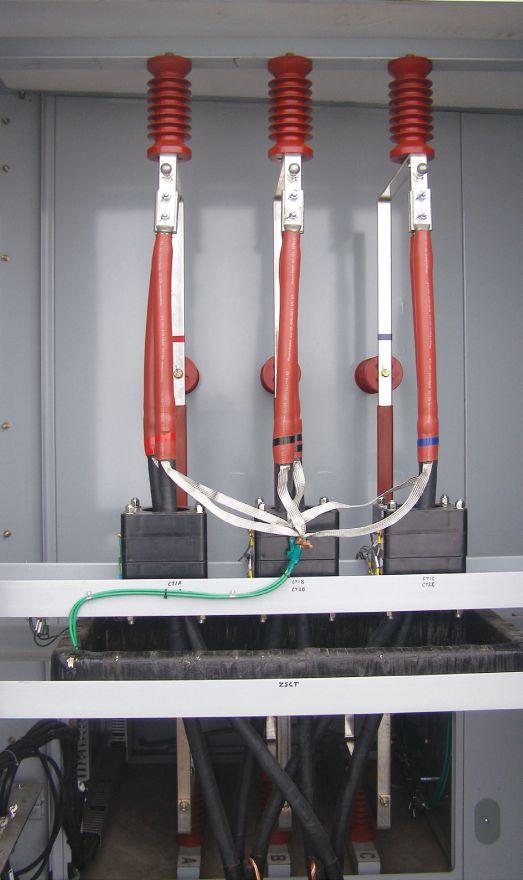
Close-up of electrical connections within a 600V breaker.
Source: Team Power Solutions
Worn gear, which would be difficult to detect without full disassembly and assessment.
Source: Team Power Solutions
ELECTRICITY WORKFORCE development leaders
EHRC’s Awards of Excellence, 2024
BY ANTHONY CAPKUN
At the very least, Primary Engineering and Construction, Exactus Energy, Hydro Ottawa, Ontario Energy Board, and OEC have one thing in common: a sparkly new trophy, courtesy of EHRC’s 12th Annual Awards of Excellence.
The organization’s signature awards program recognizes employees, leaders, and teams making “a positive and tangible impact on their organization while contributing to the composition of a highly skilled workforce in the electricity industry”.
2024 HONOREES
Workplace Culture Innovator
This award is presented to an individual, team, or organization demonstrating a strong commitment to building and promoting a healthy, inclusive, and positive work environment for all employees.
This year’s Workplace Culture Innovator award went to Lenore Robson, vice-president of people, culture & strategic policy at the Ontario Energy Board. Bruce Power’s Daniel Spadafora presented the award.
HR Innovator
This award recognizes an individual, team, or organization demonstrating innovation and creativity in designing and implementing Human Resources initiatives with measurable value to the business.
This year’s HR Innovator award went to Hydro Ottawa’s Learning and Development Team. It was presented by IBEW First District and EHRC board member Bruce Harris.
Workplace DEI Champion
This award is presented to an individual, team, or organization that champions diversity, equity, and inclusion and serves as a role model for others.
This year’s award went to Kerry Penner, vice-president, Enterprise Advancement, at OEC. It was presented by John Wabb of the Canadian Union of Skilled Workers (CUSW).
Emerging Leader of the Year
The award recognizes an individual with fewer than 10 years of industry experience whose accomplishments motivate their peers, and who demonstrates dedication to their organization and the electricity sector.
This year’s Emerging Leader of the Year award recipient is Dustin Willett, chief operating officer at Exactus Energy. It was presented by EHRC CEO Michelle Branigan.
Leader of the Year
EHRC board vice-chair Kevin Weaver (Georgian College) presented the highest honour—Leader of the Year—to Primary Engineering and Construction president & CEO Jesse Spring.
The recipient of this award is an individual who has made an outstanding contribution to their organization within the Canadian electricity sector through visionary people management strategies and leadership.
Nominated by his colleagues, Spring was recognized for “his compassionate leadership and unwavering commitment to fostering an inclusive, values-driven culture” says EHRC.
“For him, it’s not just about expanding in size and revenue; it’s about expanding Primary’s culture and dedication to client service.”
Nominations for EHRC’s Awards of Excellence were accepted from September to November 2024. The Leader of the Year was announced in December, while the remaining honorees were revealed at EHRC’s in-person Awards of Excellence in February 2025 in Toronto.
The 21st annual Awards of Excellence will take place February 19, 2026.
PataBid Quantify Electrical Estimating Software
PataBid Quantify enables owners and estimators to expedite the bidding process by at least 50% compared to traditional estimating methods. Quantify’s out of the box, robust, automated features deliver fast and accurate electrical estimates for residential, commercial or industrial projects.
Quantify is a next generation electrical estimating platform designed to out perform traditional software. Our modern software offers an items database of 55,000+ items, tailored Canadian content, AI automated takeoff, manual drafting, a proposal module, closeout capabilities and much more. Get direct access to contractor-specific electrical pricing through integrations with City Electric Supply and Gescan. Stay accurate and competitive with 24/7 real-time pricing in Quantify.
Here’s what Cody Rattai of CodeRad Electrical Ltd. has to say about PataBid’s estimating software:
“Quantify electrical estimating software allows for smart estimating; huge time saver for my small business. Amazing customer support, from initial setup to customized solutions. It is great to have the flexibility to manually create drawings & takeoffs, or import shop drawings and have the AI count devices.”
Try Quantify free for 2 weeks and grow your business today!
RENEWABLES ROUNDUP
Noteworthy wind, solar, and energy storage news from across Canada
Capstone’s 24-MW Parc Éolien de Saint-Philémon in Quebec consists of eight Enercon E82-3.0MW turbines.
SOURCE: CAPSTONE INFRASTRUCTURE CORP.
BRITISH COLUMBIA
Capstone executes 30-year PPAs for 537 MW of Indigenous-led wind power Independent power producer Capstone Infrastructure Corp. has executed three 30-year Electricity Purchase Agreements with BC Hydro.
The three wind projects—all Indigenous-led partnerships—will have a total combined capacity of 537 MW, and are expected to generate about 1.4 million MWh of electricity annually.
With a nameplate capacity of 197 MW, the Brewster project is located roughly 50 kilometres northwest of Campbell River, on Vancouver Island.
The 197-MW Highland Valley project is located about 18 kilometres west of the District Municipality of Logan Lake, in the Thompson-Nicola Regional District in the Southern Interior.
The 143-MW Mount Mabel project is also located in the Thompson-Nicola Regional District, approximately 25 kilometres northeast of Merritt.
NATIONAL
Canada’s wind, solar, and energy storage capacity grows 46% in five years
The Canadian Renewable Energy Association announced that Canada’s wind, solar, and energy storage sectors have grown by 46% in the last five years, with an installed capacity of more than 24 GW at the end of 2024.
Since 2020, the industry increased its installed capacity by nearly 7.6 GW. This includes over 4.7 GW of new utility-scale wind, nearly 2 GW of new utility-scale solar, more than 600 MW of new onsite solar, and more than 200 MW of new energy storage.
“Canada’s wind, solar, and energy storage industry grew impressively over the past five years—and we expect to see significantly more growth in the next five years,” said CanREA’s Vittoria Bellissimo.
In total, Canadian jurisdictions can expect to connect at least 10,000 MW of new wind, solar, and energy storage by the start of 2030. CanREA is tracking another 5000 MW that will come into service beyond that time frame, for a total of more than 15,000 MW of procurements that are either underway or being planned.
“Canada has massive, untapped wind and solar resources that can and should be harnessed [...]” Bellissimo added.
NOVA SCOTIA
Competitive procurement will add 2000+ GWh of wind energy province’s grid
Nova Scotia’s Green Choice Program has attracted 11 large-scale Nova Scotia Power customers for renewable electricity, including public institutions and some large industrial and commercial businesses.
Six wind farms were chosen through a competitive independent procurement to support the program. Each is co-owned by a private developer in partnership with one or more Mi’kmaw communities.
The farms will start generating more than 2000 GWh of electricity per year by the end of 2028, and increase renewable electricity on the grid for program customers by more than 12%, and nearly 7% for all ratepayers.
The developers are investing about $73.5 million in social and economic benefits for communities where the wind farms are located.
ONTARIO
Rooftop and carport solar PV system helps bring energy independence to Evolv1
The Evolv1 building in the University of Waterloo Research & Technology Park has become electrically self-sufficient following the installation of a DC-optimized rooftop and carport solar PV system.
Over a 3-year period, the system offset 105% of the facility’s annual energy use and saved about $360,000 in energy costs.
The building is a collaboration between building owner The Cora Group, Stantec, Sustainable Waterloo Region, David Johnston Research & Technology Park, and anchor tenant EY.
VCT Group designed and installed a combined rooftop and parking lot canopy system of 768 kW. The installation features 33-kW DC-optimized inverters and power optimizers from SolarEdge, connected to each pair of modules. The optimizers maximize energy generation by overcoming issues such as module mismatch, soiling, and shading.
SOURCE: SOLAREDGE
A GROWING POWER STRUGGLE
How can Canada’s aging grid support the data centre industry?
BY ANTHONY CAPKUN
We have all heard how data centres find themselves listed among the largest of electricity consumers. Annual electricity demand from DCs is more than 280 TWh in 2024 in the U.S. alone, according to Eaton’s “2025 Data Centre Progress Report”.
While their load may be less than, say, an aluminum smelting operation, a key difference is that DCs are popping up everywhere—and will continue to do so as we fully immerse ourselves in the “Intelligence Age”.
Data centre growth in Canada has evolved rapidly in recent years due to digitalization trends across industries and increased demand for AI and cloud computing capabilities, explains president and managing director of Nexans North America Tim King. “Plus, factors like data sovereignty and rising geopolitical turmoil have heightened the pressure for investments in infrastructure development.”
Electrical Business Magazine recently spoke with Tim to get some insights on how data centre growth in Canada will continue to impact our grid in the years to come.
What are the biggest growth drivers for DCs?
TIM: The biggest factors driving this growth over the next few years will be shaped by both global and domestic trends. The potential for regulatory changes and tariffs to reshape the future of data centres is pretty high, both positively and negatively. Our ever-evolving technological landscape is going to need more processing power to support technologies such as AI, 5G, IoT, and cloud computing. In order to support this massive spike in demand for data, there is an equal
Tim King, president and managing director of Nexans North America, shares the team’s results during an employee town hall.
demand to meet the electrical load.
The focus on sustainability and grid resilience will also drive the adoption of more energy-efficient infrastructure, which includes the use of high-performance cabling that reduces energy consumption and minimizes heat generation. As Canada positions itself as a global leader in data centre innovation, these combined factors—technological progress, regulatory changes, and the growing demand for data—will accelerate the expansion and modernization of DCs across the country.
What challenges does this pose for Canada’s grid in terms of capacity and reliability?
TIM: At its current pace, data centre growth has the potential to strain capacity and reliability capabilities. Canada is facing a critical decision regarding its aging electrical grid which, if left as is, could increase the risks for wildfires, blackouts, and cyberattacks. Grid modernization in Canada, and across all of North America, is going to be essential to meet the electrical demand, which is expected to grow tremendously in the coming decades.
The grid itself is outdated and distressed. An upgrade to the entire value chain of electricity infrastructure needs to be addressed at all stages, from transmission to distribution. If left neglected, things like hospitals, homes, schools, and government buildings are at risk of falling behind as demand increases.
We’ve covered the electrical demand from data centres and the need for a resilient, reliable grid. Meanwhile, how are data centres addressing their high energy consumption?
TIM: As AI and data centres continue to grow, energy reliability is a critical concern. To address this, Canada must prioritize generational sustainability as it strategizes solutions for managing rising energy demands. At the same time, it should not impose regulatory penalties on regions that are not yet fully sustainable.
As I mentioned earlier, one key measure for ensuring long-term energy efficiency is the continued investment
in resilient wiring and cables by manufacturers that are supplying data centres. The most critical piece of the puzzle is not actually the cables in the DCs themselves—which are certainly complex—but the transmission and distribution cables that supply the energy that powers them.
Although the AI models themselves can be made more efficient (e.g. DeepSeek), I don’t see any slowdown in the need for data centres. The grids that will be built around DCs have to handle the load that is currently in place and be resilient enough to handle load spikes as technology develops further.
Do renewables and microgrids have a role to play in powering data centres?
TIM : Renewable energy sources and microgrids have a crucial role in powering modern data centres in Canada, especially as it relates to economic and environmental impact. Solar, wind, hydropower, and nuclear all help to reduce a DC’s carbon footprint while increasing its overall energy independence and contributing to grid reliability.
The traditional grid can become overwhelmed during peak times, but through energy source diversification, data centres can leverage a more stable, reliable supply. This lessens the risk for outages and power fluctuations, which in turn leads to fewer profit losses for the institutions that depend on that information infrastructure.
Meanwhile, microgrids help provide stable power for high-demand operations
while reducing a DC’s reliance on the grid. They can also support remote or rural areas where reliable power is needed, but not to the degree of requiring a direct connection to the main grid, which can be costly and impractical
Sustainability and the future of DC energy
As sustainability moves to the forefront of corporate strategy, data centres are evolving to prioritize energy efficiency, renewable power, and a reduced environmental impact. Many operators are now sourcing electricity from wind, solar, and water to reduce their carbon footprint and increase energy independence.
Meeting Environmental,
Social, and Governance (ESG) goals has become a driving force behind these decisions, with many DC operators committing to net-zero carbon operations. “The generation source needs to be at the centre of any conversation,” Tim notes, emphasizing the role of sustainable energy sourcing.
As Canada’s data centre footprint expands, so does the strain on our aging grid. While renewable energy and efficiency improvements can help offset their energy consumption, the long-term success of data centres in Canada will depend on a resilient, future-ready power infrastructure capable of balancing sustainability, reliability, and growth.
STAINLESS STEEL BANDING
WHERE SHOULD RESIDENTIAL ELECTRICAL WORKERS FOCUS IN 2025
Insights from CMHC’s Housing Market Outlook
BY TONY KOVAC
With Canada’s economic future facing significant uncertainty due to changes in US trade policies, Canada Mortgage and Housing Corp. (CMHC) believes our housing market could face “considerable headwinds in both the short and medium term”.
CMHC published its latest “Housing market outlook 20252027” (HMO), in which the authors do not identify a base case because of this uncertainty. “Instead, we project three plausible scenarios and will monitor how things unfold against these scenarios over the year,” say HMO authors.
(Behind the HMO is CHMC’s chief economist and deputy chief economists: Mathieu Laberge, Aled ab Iorwerth, Kevin Hughes, and Tania Bourassa-Ochoa. They lead a cross-country team whose goal is “to improve understanding of trends in the economy, housing markets, and how they impact affordability”.)
The Medium Scenario
The threat of US trade tariffs, along with the likelihood of
Tariffs are not the only story. Reduced immigration targets will also affect the economy.
Canadian retaliation, could have a major impact on Canada’s economy as early as this year, including:
• Investment uncertainty
• Weaker Canadian dollar
• Lower export revenues
• Job losses
• Higher inflation
• Greater risk of recession
CMHC’s Medium Scenario assumes the U.S. will impose a 25% tariff on 10% of Canadian goods, with Canada retaliating in return. In this scenario, the
negative economic impacts may be softened by stronger US government spending and higher US demand for imports as a result.
But tariffs are not the only story, notes CMHC: reduced immigration targets will also affect the economy, as slower population growth could lead to lower economic activity.
“Considering these factors, we expect modest economic growth in 2025 improving in 2026 and 2027. After declining in 2023 and 2024, GDP per capita should grow over the forecast period,” say HMO authors.
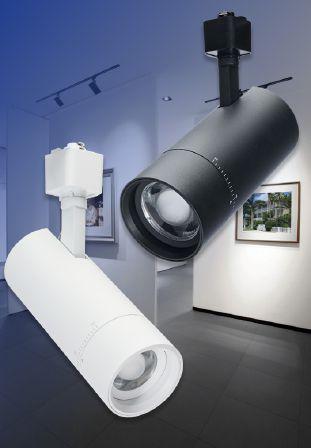
Pro Series Beam Adjustable Track Head
SATCO|NUVO’s beam adjustable LED track head fixtures bring both functionality and style to your lighting projects. These fixtures are CCT selectable, allowing users to choose from five different color temperature options. With an impressive CRI rating of 90, they produce crisp, true-to-life white light. The track heads offer precise beam control, with a 90° adjustable head and a beam range from 20° to 50°, making them ideal for a variety of settings such as museums, art galleries, retail stores, offices, and restaurants. Compatible with SATCO H-Track systems and a variety of accessories (sold separately), these fixtures are versatile enough to meet any lighting need. Available in matte black or matte white finishes and in 15 or 30 watts, these track heads will enhance any space with both beauty and efficiency.
The HMO expects consumer spending per capita to increase over the forecast period, supported by lower borrowing costs. That said, several factors will slow growth, including:
• Loss of purchasing power from past inflation, with incomes catching up gradually
• Increasing unemployment rates in 2025
• Higher interest rates on mortgage renewals in 2025-2026
Overall consumer spending will grow at a slower pace due to reduced population growth. This leads to weaker overall economic demand and, not surprisingly, limits the need for workers and slows job growth—especially this year.
“As a result, we expect unemployment to rise until mid-2025. An improving economy and lower population growth will contribute to lower unemployment rates in 2026 and 2027. Government spending will also likely slow down with lower population growth,” say the authors.
The HMO expects Canadian business investment to rebound over the forecast period after two years of weak activity, with lower interest rates supporting the recovery.
“However, trade tariffs, rising wage pressures from limited population growth and tighter lending conditions from cautious lenders will limit the rebound,” reads the HMO.
Getting into the housing outlook
Despite the economic and immigration issues, CHMC expects housing market activity in Canada to improve.
“The combination of lower mortgage rates and changes to mortgage rules introduced in 2024 should unlock pent-up demand from homebuyers previously priced out of the market,” say HMO authors.
Compared to new homes, CHMC expects resale homes to attract a larger share of renewed demand, saying they offer more options for financially constrained homebuyers. Additionally, new construction projects take time... which may limit developers’ ability to meet demand quickly.
According to CMHC, Millennials are currently driving housing demand. As remote work declines, the HMO authors assume this group will prioritize being closer to jobs, which should boost sales recovery in larger urban markets.
CHMC also expects some repeat homebuyers to return to the market, including those who wish to take advantage of lower mortgage rates to upgrade their homes, and possibly those who purchased during the pandemic.
The housing market recovery will be uneven, CMHC warns, with the condominium apartment market lagging—especially in regions that depend on investor activity.
“Investors who bought pre-construction units to rent out are increasingly selling as costs rise faster than rental incomes. We expect listings to continue to increase, driven by record new condominium apartment completions in 2025 and softening rental markets.”
Prices are expected to grow faster this year, reflecting a recovery and renewed demand for ground-oriented homes, before slowing down in 2026-2027.
At that point, the HMO authors expect much of the pent-up demand to be met.
“Although mortgage payments and prices will rise, improved job markets and income growth will make housing more attainable than during the 20222024 period.”
Affordable regions will lead recovery
“The housing markets in Ontario and
British Columbia are particularly unaffordable,” HMO authors say bluntly.
“We expect sales in these markets to remain below their 10-year averages. This is due to ongoing affordability challenges and the more notable impact of new immigration targets. We expect prices to grow more slowly in these provinces, especially in the first half of the forecast period.”
The authors note that the more-affordable Alberta and Quebec markets began recovering in early 2024. Sales in these provinces are expected to reach historically high levels, with prices growing faster than national averages during the first half of the forecast period.
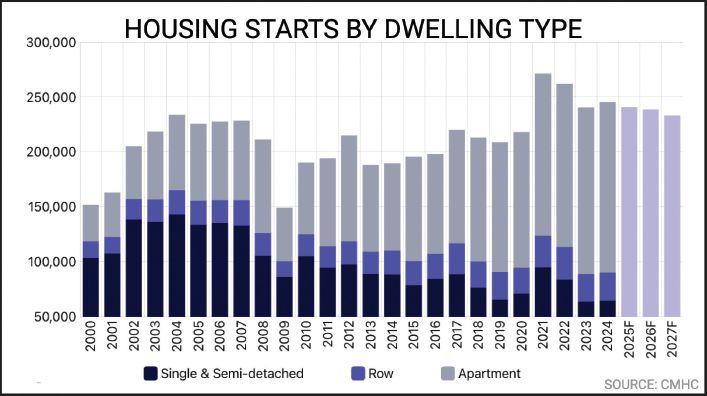
That said, the HMO expects housing starts to slow down over the forecast period, primarily due to fewer condos being built.
“With low investor interest and more young families looking for family-friendly homes, developers will find it harder to sell enough units to fund new projects. The increase in unsold units will likely reduce new project launches, leading to a decline in new condominium apartment construction.”
In Ontario, pre-construction condos—which are often bought by investors—will see lower demand due to weaker resale and rental markets. This will lead to new construction slowing down as of this year.
British Columbia is seeing fewer investors but a stronger resale market, so the condo slowdown is expected to
CALENDAR
be “milder and delayed”.
Because more buyers are residents as opposed to investors, the impact on new construction in Alberta will be minimal, say the authors.
What about rental units?
On the rental side, apartment construction reached record levels in 2024 due to government support, a rapidly growing renter population, and strong rent growth at the time of planning.
“We expect this momentum to continue through 2025 and 2026, supported by numerous projects set to start. However, softening rental market conditions may lead to fewer rental projects starting in 2027.”
The HMO authors expect a small recovery in ground-oriented home construction, led by lower-priced options. Again, first-time buyers may prefer resale homes due to better supply, meaning developers will be limited in their ability to compete with these resale markets due to high costs and lower profits.
Regionally, new construction in Quebec will recover from recent lows, while new construction will slow down from high levels in Alberta.
Since 2024, rental supply has grown faster than new demand, CMHC notes, “but affordability remains a challenge”.
“We expect lower immigration and an increase in first-time homebuyers to continue to reduce rental demand throughout 2025-2027. Supply will continue to expand as new rental units are completed, leading to higher vacancies and slower rent increases”.
HMO authors suggest rental affordability will take time to improve. Some vacated units will adjust to market rents and renter incomes will catch up to previous rent increases. Also, as some tenants move to higher-priced new units, more affordable options should gradually open up for others.
A few more possible scenarios
In addition to the Medium Scenario discussed above, the HMO authors present two other possible housing market scenarios:
1. Low-growth Scenario
• The U.S. puts higher tariffs on Canadian exports, causing job losses and a recession in 2025.
• US immigration policies become stricter, making Canada more attractive to immigrants, leading to higher immigration than expected.
• Higher tariffs temporarily raise inflation but the central bank lowers the policy rate to support the economy. Financial uncertainty increases mortgage borrowing costs slightly relative to the medium scenario.
In this scenario, the recession delays housing recovery, increasing pent-up demand. Fewer homes are built due to weaker demand and supply challenges. By late 2026, however, the economy will rebound while a growing population boosts home sales. Rental markets will stay tight, limiting improvements in rental affordability.
2. High-growth Scenario
• The U.S. introduces fewer and shorter-lasting tariffs, while US government spending boosts Canadian exports.
• Canadian immigration meets recent targets.
• Higher incomes and stronger consumer confidence encourage more spending. Stronger declines in borrowing costs make homeownership more attainable.
In this scenario, more homes are built thanks to better financing and business conditions.
Stronger job and income growth combined with lower mortgage rates will make homeownership more accessible. Higher demand will push home prices up more quickly.
With files from CMHC’s 2025 Housing Market Outlook. CMHC’s forecasts are based on information available as of January 14, 2025. Canada Mortgage and Housing Corp. is the federal Crown Corporation responsible for administering Canada’s National Housing Act. Created in 1946 as Central Mortgage and Housing—a successor to the Wartime Housing Corp.—its initial priority was to provide homes for returning WWII veterans.
MCEE (Mecanex-Climatex-ÉlectricitéÉclairage)
April 24-25, Montreal mcee.ca
LightFair
May 4-8, Las Vegas lightfair.us.messefrankfurt.com
ECAA Annual Conference
Electrical Contractors Association of Alberta
May 22-25, Edmonton ecaa.ab.ca
EFC Annual Industry Conference Electro-Federation Canada
May 27-29, Niagara Falls, Ont. electrofed.com
Skills Canada National Competition May 29-30, Regina skillscompetencescanada.com
ECAO Annual General Meeting Electrical Contractors Assoc. Ontario June 5, Niagara Falls, Ont. ecao.org
ECABC Conference and AGM Electrical Contractors Assoc. British Columbia June 12-13, Victoria eca.bc.ca
EASA Convention & Solutions Expo Electrical Apparatus Service Association
July 19-22, Nashville, Tenn. easa.com/convention
The NECA Show
National Electrical Contractors Association
September 12-15, Chicago, Ill. necanet.org
AD Electrical North American Meeting Affiliated Distributors October 27-30, Chicago, Ill. adhq.com
Got an event to share? Email the editor at acapkun@ebmag.com. Meantime, scroll through Electrical Business Magazine’s online industry calendar at ebmag.com/events for direct links to these events (and others).
FROM SHIPPING TO SETUP
Corrosion prevention for wind and solar installation
BY JULIE HOLMQUIST
If a wind or solar energy installation doesn’t last as long as its expected 20- to 30-year service life, can it be considered a sustainable use of resources?
“Solar energy is a beacon of sustainability, but the spectre of corrosion threatens to dim its shine,” writes Roarke Construction.
Corrosion is a key enemy of wind and solar power installations, which is why those involved with a renewable energy project should not only select the most appropriate materials during the design phase, but also employ a few simple corrosion prevention measures during shipping and maintenance.
Shipping corrosion-free components
One of the first corrosion prevention tasks gets underway when solar panels and wind turbines are being shipped to the jobsite, where they are expected to arrive in like-new condition. This can be challenging, as fluctuating temperatures, humidity, and even salt spray heighten the risk of corrosion during the journey. The right protective packaging can significantly reduce the risk.
When packaging photovoltaic equipment, manufacturers should consider the protection of components that are sensitive to electrostatic discharge (ESD), such as bypass diodes, but also metal supports, frames, wires, and electrical contacts that could be subject to corrosion.
ESD films and bags treated with corrosion inhibitors are suitable for a variety of ferrous and non-ferrous alloys, including galvanized steel, aluminum, and brass, while permanent static-dissipative properties help reduce or eliminate static buildup in the package.
When it comes to wind turbine components, it is their size rather than ESD that presents a problem.
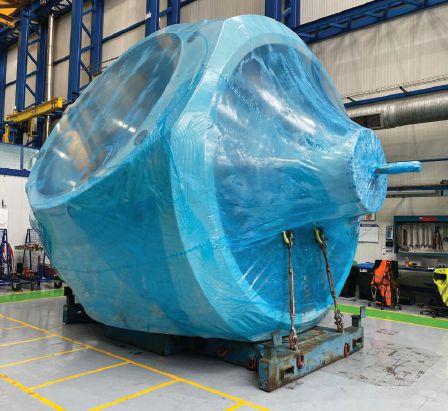
Large wind turbine shafts, rings, and hubs often receive the brunt of harsh weather because they may be transported on open truck beds, or stored onsite for several years until installation is completed.
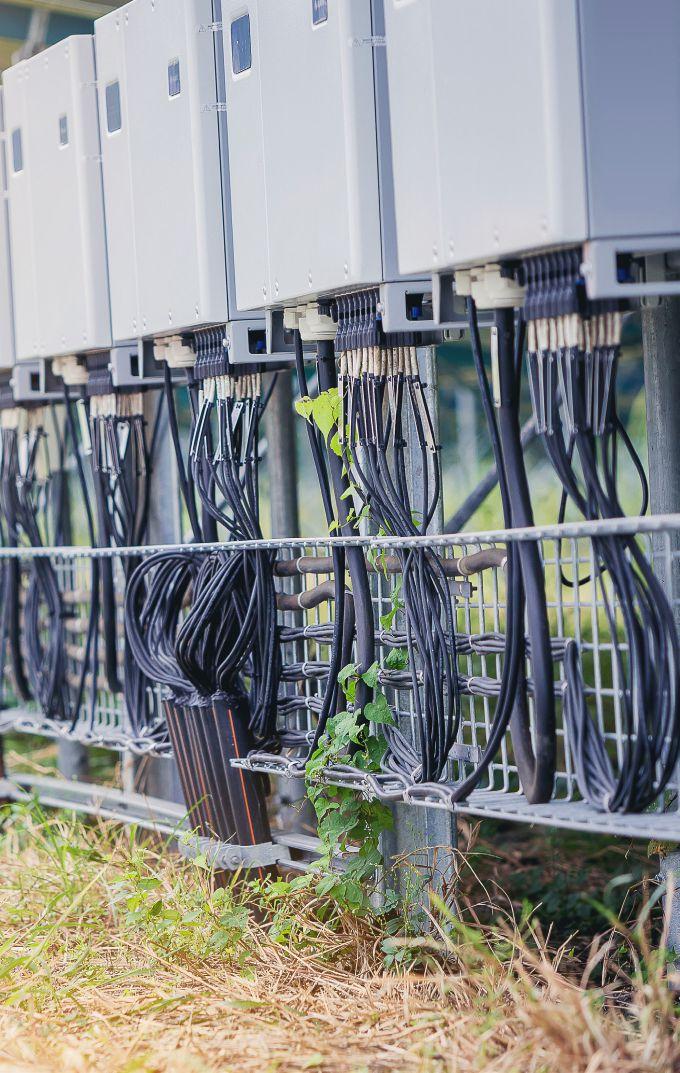
A technician monitors electrical connections to keep the PV system running smoothly.
It is therefore important to protect these items with robust anti-corrosion films that are available in sizes large enough to shrink wrap giant components, or even a removable coating for more vulnerable surfaces.
Corrosion prevention in control panels
The job of corrosion protection is not over after solar panels and wind turbines are put into service. Panels and turbines are equipped with wires and electrical contact points that merge inside control boxes, where they are potentially subject to the ingress of oxygen, humidity, and chlorides.
One option for protecting these areas is to use a corrosion-inhibiting emitter, which works by releasing corrosion-inhibiting vapours that diffuse throughout the space and adsorb on metal sur-
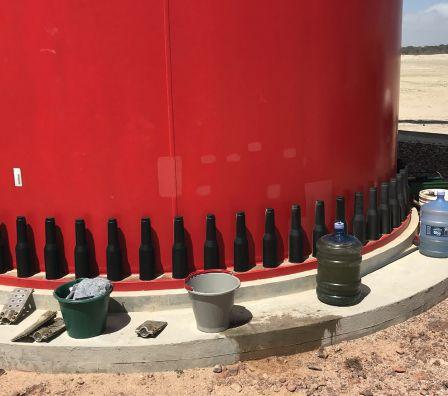
Corrosion prevention measures applied to the base bolts of a wind turbine can help extend service life.
SOURCE: CORTEC CASE HISTORY 617
faces (ferrous and non-ferrous) to which they are attracted. These emitters are easily replaced every two years as part of routine maintenance—a much simpler task than replacing corroded metal contacts that could interrupt operations.
In some cases, extra coatings may also be desirable on various structural components, such as the base bolts that keep wind turbines in place.
While these suggestions do not cover all possible corrosion concerns for wind and solar energy installations, they are good places to start for basic corrosion prevention.
The foundation for long-term durability
Left unchecked in renewable energy installations, corrosion can lead to structural degradation, safety hazards, reduced production, increased maintenance costs, and shortened lifespan.
For those charged with maintaining these installations, Roarke continues, “Corrosion is a relentless adversary”—suggesting that keeping the menace away is always a priority.
Anti-corrosion packaging helps ensure wind turbine components arrive at the site in optimal condition.
SOURCE: CORTEC CASE HISTORY 715
That’s why getting off to a good start with corrosion prevention is essential—not just for longevity, but for ensuring wind and solar remain truly sustainable energy sources.
Source
“From shine to rust: the corrosion crisis in solar module mounting systems”, Roarke Construction, LinkedIn August 2024, tinyurl.com/bdzxyhvt
As content writer with Cortec Corp., Julie Holmquist has been writing about corrosion solutions for nearly a decade. Her work has been published in dozens of trade magazines across a range of industries, from energy to chemical engineering and water treatment.
Personalities
Kevin Mallory, vice-president & general manager of Hubbell Canada, retired effective April 1. He spent 33 years with Hubbell, starting as a wiring device product manager in 1992. Mallory was promoted to director of marketing and sales in 1997. In 2004, he relocated from Canada to Connecticut to head the Residential Wiring Device product development team. He moved back to Canada in late 2009, serving as vice-president & general manager before retiring. Mallory was an active member of Canada’s electrical industry, dedicating time and effort to Electro-Federation of Canada, where he served as chair in 2013.
Source: Supplied
Martina Mercurio has rejoined Ledvance Canada where she worked several years ago—as senior sales representative for the Central Region. “With over 20 years of
sales experience, Martina is an invaluable resource to her customers and her colleagues [...]” said regional sales manager Linda Conejo.
Source: Supplied
Michael Hurd has joined electrical distributor Robertson Electric Wholesale as vice-president of business development, where he is responsible for expanding Robertson’s residential sector portfolio across Canada.
Source: Supplied
Martin McDermott, Intralec
Electrical Products’ Ontario sales rep for the northern Greater Toronto Area, has retired after 28 years of service. “His presence will be greatly missed, but we are thrilled for him as he steps into this exciting new chapter,” said Cindy Doherty
Source: Supplied
Electrical distributor EB Horsman welcomed Patrick Mitchell as vice-president of operations, filling the role vacated by Roy Bragg, who has retired. The distributor also expressed deep gratitude to Bragg for 27 years of service.
Source: Supplied
OmniCable has promoted Chris Kennedy to vice-president, Procurement and Category Management. He has over 14 years of experience at the company, most recently serving as vice-president, Sales Operations. The company also appointed Shaun Takata as key account manager, Datacom & Communications, in Canada.
Source: Supplied
We’re limited by space here, but have plenty of room online! Read the news behind the news. Visit EBMag.com and click “News”.
THE ESTIMATOR
JOHN F. WIESEL AND JOHN M. WIESEL
Keeping labour units in step with change
If you can find a product, then you can find someone to price it for you. Finding a labour unit, however, is not always that easy—especially with the constant influx of new and evolving products.
From electric vehicle supply equipment to renewable energy and data centres, ensuring labour units align with the task can be a challenge for electrical estimators.
As recently as 10 years ago, you could pull a Labour manual off the shelf and find the same familiar products and labour units. Today, a product could be obsolete before the Labour manual is even published.
I recall being at an industry event at the start of the LED revolution, when cost-effective LEDs began flooding the market to serve every imaginable application.
A lifelong lighting expert gave a talk—his last before retiring—and reflected on how long it took him to master the many lighting options and applications. But with the rapid pace of innovation, he wondered how anyone could possibly keep up.
As I left the event, I wondered how an electrical estimator could account for rapidly changing technologies in their estimates. How does an estimator determine a labour unit for something unfamiliar, undefined, or without a comparable match?
The people who write and update Labour manuals are experienced professionals, so lean into their expertise. Borrow from their framework to develop labour units for an unfamiliar product.
What defining features does this new product have?
• Is it linear? How would you measure it?
• Is it flexible or rigid?
• How much does it weigh? Does it require specialized equipment or extra manpower?
• What shape is it? Is it easy to handle?
• Is it plug-and-play? Is it finicky to install and/or does it require a certain level of expertise?
As you answer these questions, you begin forming a picture of comparable items that are familiar to you and your team. Use your experience—and that of your team—to demystify the new product, making it easier to calculate those elusive labour units.
In an industry where change is constant, adaptability and creativity aren’t just advantages—they are essential.
John F. Wiesel is the president of Suderman Estimating Systems Inc., and has been estimating and teaching estimating since the early 1980s. John M. Wiesel is a Red Seal construction electrician, spending over 20 years in industry before joining Suderman as a principal.
products and solutions
WaveLinx offers hybrid lighting control
Cooper Lighting Solutions’ WaveLinx digital lighting control solutions leverage both the wired and the wireless with CAT and PRO devices to deliver a hybrid approach to connected lighting. For simple, stand-alone applications, you can wire together minimal interoperable devices with Cat 5 cables to create a cost-effective lighting control solution. You can then scale this solution while networking through the WaveLinx Area Controller (cooperlighting.com).
Source: Cooper Lighting Solutions
Flo J3400 or J1772 residential chargers
Flo says its next-generation residential charger meets the needs of both electric and plug-in hybrid electric vehicles, from compact crossovers to heavy-duty pickup trucks. The Flo Home X3 features a 50A/12-kW output. The Flo Home X6 is housed in aluminum and comes with a detachable cable holster. The Level 2 Flo Home X8 boasts 80A/19.2-kW output, as well as a detachable holster. All chargers are supported by Flo’s app (flo.com).
Source: Services Flo Inc.
Controller for street and area lighting
Synapse’s TL7-DALI-DC twist-lock wireless lighting controller employs D4i LED driver resources, such as power monitoring, power supplies, diagnostics, and
asset data, and includes GPS location, photocell and tilt features. The controller is plug-and-play compatible and installs in ANSI C136.41 7-pin receptacles. Additional features are available when combined with the SimplySnap Cloud application (synapsewireless.com).
Source: Synapse Wireless
Time Sync Hub to align all monitored devices
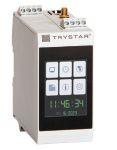
The key to accurate power data is having all monitored devices aligned to one common time source, says Trystar. The Time Sync Hub (models TSH-100 and TSH-200) provides time synchronization for power system devices, such as sequence of events recorders (SERs), power meters, protective relays, transfer switches, UPSs, PLCs, and others across the power distribution system. This data can be used for commissioning, equipment testing, and event reconstruction in the case of a power outage or loss (trystar.com).
Source: Trystar
We’re limited by space here, but have plenty of room online! Check out more products and solutions at EBMag.com, under “Products”.
CODE conundrum
GABRIEL BONE
Technical training developer with Ontario’s Electrical Safety Authority
TACKLE THE CODE CONUNDRUM... IF YOU DARE!
Welcome to the newest round of questions that test your knowledge of the CE Code-Part I. Answers will appear in the June 2025 edition of Electrical Business Magazine, and online at EBMag.com under Features.
QUESTION 1
If an enclosure is neither used in a hazardous location nor marked as per Table 65, where is it permitted to be used?
a) Outdoors in damp locations c) Underground in wet locations
b) Indoors in ordinary locations d) Prohibited to be used
QUESTION 2
What is the IEC equivalent of a #8 AWG conductor?
a) 5.2 mm2 b) 4 mm2 c) 6 mm2 d) 10 mm2
QUESTION 3
A heater control device may be installed 1 m to 500 mm from a shower stall entrance if it is:
a) Supplied by an extra-low-voltage Class 2 circuit
b) Protected by a Class B GFCI
c) Supplied by a Class 1 circuit
d) Heater controllers are not permitted near a shower stall
ANSWERS
Electrical Business, February 2025 ed.
QUESTION 1
When a single dwelling does not have opposite sides, and a receptacle must be located on the adjacent side of the dwelling, what is the minimum spacing between the front-side and adjacent-side receptacles?
c) No less than 1/2 the width of the longest side. Rule 26-724(1)(b).
QUESTION 2
Marking the maximum load on a residential panelboard is not required when the loads are calculated in the apartment building as per Rules 8-200 or 8-202, and the service conductors are rated less than the overcurrent protection.
b) False. Rule 2-100(6).
QUESTION 3
What is the percentage factor for conductors installed for a generator without factory built-in overcurrent?
b) 115%. Rule 28-904(2).
How did you do?
3 • Seasoned journeyman 1 • Apprentice
2 • Need refresher training 0 • Just here for fun!
Containerized energy storage solution
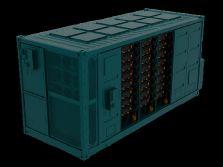
GE Vernova’s Restore DC Block offers a capacity of 5 MWh and duration range of 2 to 8 hours. The system boasts “zero-touch commissioning”, while integrated intelligent thermal management and high-speed edge analytics monitor the system’s state of charge, health, and safety. Powered by liquid-cooled lithium iron phosphate cells, it operates in temperatures ranging from -30 C to 50 C and supports various configurations (gevernova.com).
Source: GE Vernova
750-kV ester oil-immersed power transformer
Chint says its ester oil-immersed power transformer provides enhanced safety through an ignition point that exceeds 355 C, reducing the risk of fire. The TX uses Cargill FR3 fluid—a vegetable oil-based ester with “excellent cooling and insulating properties”, according to Chint, adding that ester oil also extends the life of transformer insulation, improving reliability (chintglobal. com).
Source: Chint
Self-directed online training for SPE-1000
Esafe offers an online, self-directed course to help users navigate the changes made to CSA Group’s SPE-1000:21
“Model code for the field evaluation of electrical equipment”. The course breaks down into six modules/components, says Esafe, and will be beneficial to those involved with electrical equipment, industrial control systems, or renewable energy technology (esafe.org).
Source: Esafe Technical Training DeWalt knockout tool and bandsaws
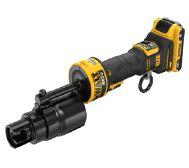
The 20V Max hydraulic knockout tool (DCE600) delivers up to 11 tons of force output, and the dies contain embedded magnets that attach securely to mild steel. The tool punches split slugs ranging from 1/2 in. to 2 in. for ease of use in disassembling the system. The mid-size (DCS378) and dual-trigger bandsaws (DCS379) are designed to deliver up to 120 cuts per charge through 12-gauge strut, and are equipped with a 3-3/8 in. cut capacity.
Source: DeWalt
CABLES Is Your Aluminum Clean?
Aluminum is essential in electrical infrastructure, but not all aluminum is created equal. Nearly 3% of the world’s CO2 emissions come from aluminum production, with most relying on “dirty” coal or gas to be produced—creating a massive carbon footprint.
In Canada, we do things differently. 100% of our primary aluminum is produced using clean, renewable hydroelectricity, generating a third of the CO2 emissions compared to coal and gas. Yet, globally, only 20% of aluminum is made this way.
SHOW & TELL
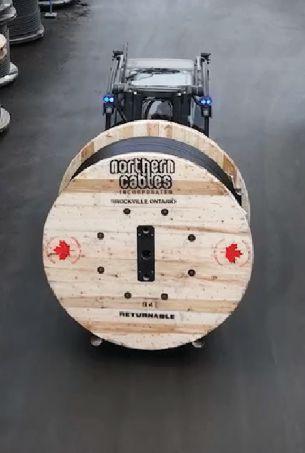
At Northern Cables, we’re proud to be a Canadian manufacturer, supporting Canadian jobs and industry. Our raw material supply chain includes trusted Canadian suppliers, ensuring a strong local foundation while sourcing responsibly—without overseas shipping adding to the carbon footprint (and the costs).
We support on-shoring, keeping manufacturing in Canada to build a stronger economy. Choosing Canadian-made products secures jobs, strengthens industries, and reduces reliance on foreign supply.
Why look elsewhere when the best choice is made here?
Northern Cables—Canadian made. Canadian strong.
Reduce your carbon footprint and support sustainable practices with Northern Cables. Why?
• Approximately 3% of CO2 emissions are a direct result of aluminum production. Where you source it matters!
• Foreign aluminum is made using power generated from dirty, carbon-rich coal or gas.
• Overseas shipping further adds to carbon emissions.
• Foreign aluminum is NOT subject to ANY carbon taxes in Canada.
• 100% of the aluminum in Northern Cables products is produced using power generated from CLEAN and RENEWABLE hydroelectricity.
• Our aluminum manufacturing partners are all within 700KM of our factories.
• It’s a fact: Canadian-made aluminum significantly lowers CO2 emissions.
DAVID PILON
Flooding, boating, campgrounds, and you
It’s that time of year when the snow begins to melt, causing rivers and creeks to overrun their banks or overwhelm a home’s drainage system. Freeze-thaw cycles have caused the ground—plus everything in it and on it—to shift, possibly rupturing water mains and causing significant damage to neighbourhoods.
Flood conditions always threaten the protection of people and property. In some cases, the utility will cut off an entire district until the waters recede to the point where assessments can be made and sites can be reenergized, one by one.
The CE Code’s 28-900 series of rules touch on the need to protect both workers and the system, and Rule 14414 discusses connections to different circuits.
Some of the field techniques we’ve seen in emergency situations of are simply not safe and create a hazard for everyone. For example, connecting a panel without considering anyone’s safety, or creating dual male end cords to energize through a receptacle without understanding how this will affect workers and systems.
Backup generators, for example, must be checked for safe operation. As the Authority Having Jurisdiction, we want to ensure that no current is back-feeding to neighbours or utility workers.
Most jurisdictions provide guidelines on how to tackle individual properties or entire communities to keep people (including you!) and property safe during flood remediation and restoration.
Rule 2-022 talks about the dangerous conditions caused by flooding and the
submersion of equipment and cables. If the installation has not been negatively affected and remains safe, your AHJ may determine that the intent of this rule has been met.
When a piece of equipment must be replaced, some AHJs may allow you to replace like-for-like, whereas others may require the entire installation to be brought up to the latest code requirements.
Always check with your local AHJ for any regulations and bulletins relating to flooding and power restoration.
Always check with your local AHJ for any regulations and bulletins relating to flooding and power restoration.
Meanwhile, the end of winter heralds the coming growing season. Irrigation systems are expanding, and with them comes the need for large pumps that are placed in bodies of water shared by boaters, kayakers, and swimmers.
Some of these pumps float on the water and look like fishing platforms, while others are mounted on the shore, with intakes in the water where people are canoeing. Rule 26-956 reminds us that your AHJ must be alerted to the installation of these pumps, and rules regarding their installation on navigable waters may be imposed. If you’re involved in the irrigation sector, make sure you know the AHJ’s requirements for your area.
But it’s not all work and no play! We’re also getting ready for camping, boating, swimming, and more. Summer in Canada can be short, after all, so we plan and prepare to hit the ground running.
Marinas and harbours are being designed and built for the upcoming season. Boathouses are being installed and wiring them often occurs during the off-season so that, when the weather allows, our boats can be floated.
Plans reviews for these installations and structures are generally required in inspection jurisdictions, so touch base with your local AHJ for their requirements.
And then there are the campgrounds, getting ready to welcome visitors once the snow is gone. Section 72 was updated to ensure these places are designed to handle the higher loads demanded by today’s large RVs, as well as increased year-round use of the campsites themselves
One of the last things we want to keep in mind is the risk of electric shock drowning (ESD), which is often suspected as a cause behind otherwise inexplicable drownings. Recent changes to CE Code Sections 26 and 78 aim to reduce the risk of ESD.
Read the code and discuss plans with your AHJ. After all, the best way to enjoy Canada’s spring, summer, and fall seasons is safely!
Consult your Authority Having Jurisdiction for more specific interpretations
David Pilon is manager, Electrical Inspections, at Technical Safety Authority, Saskatchewan (TSASK). He also serves as vice-chair of the Canadian Certified Electrical Inspector (CCEI) committee of the International Association of Electrical Inspectors (IAEI), Canadian Section.
TO ADVERTISE Leslie Osborne losborne@annexbusinessmedia.com