
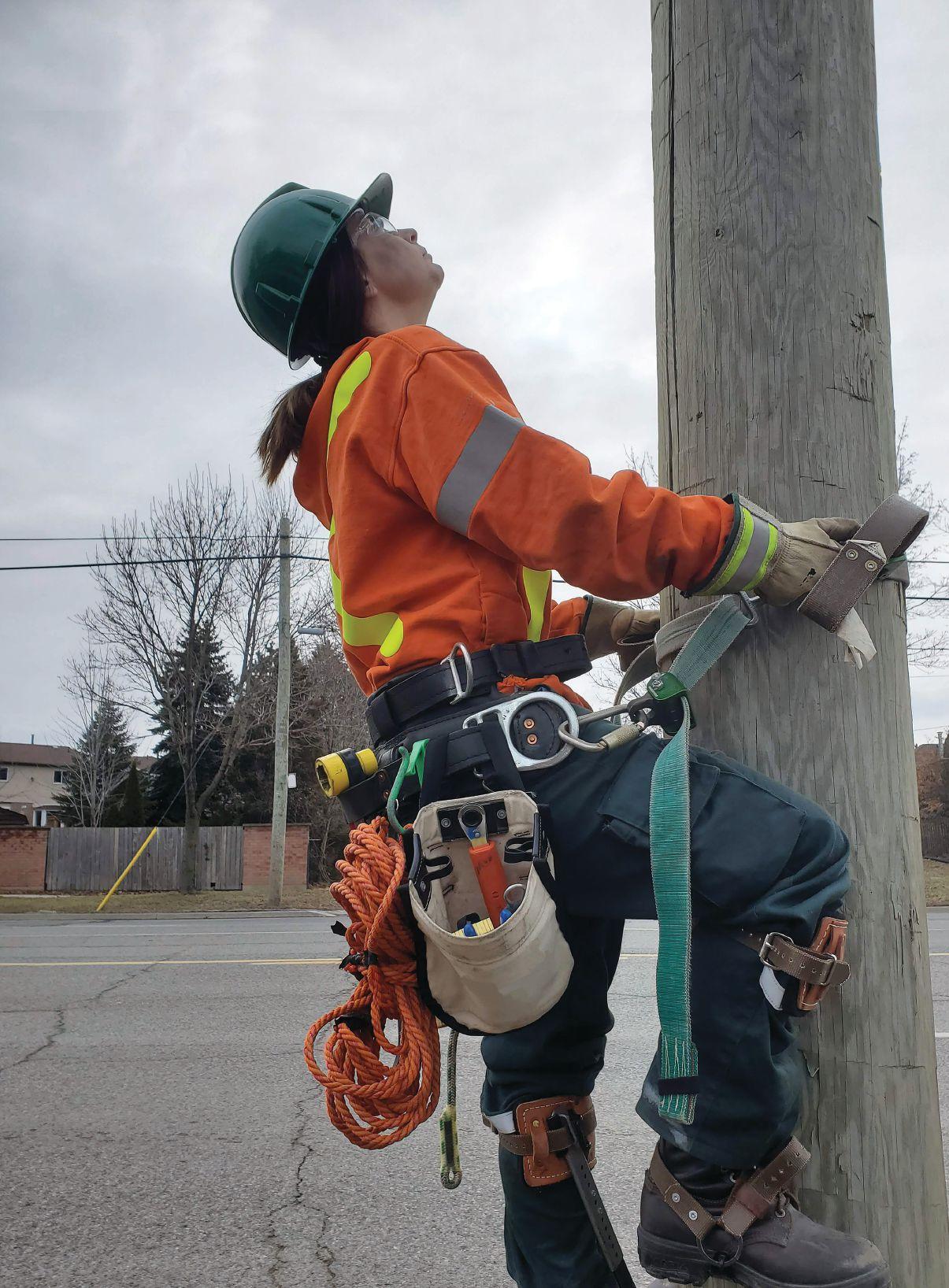

Canada’s female participation in Electrical continues to climb! P.14
+ 2021 work truck and van preview
+ Absence of voltage testing




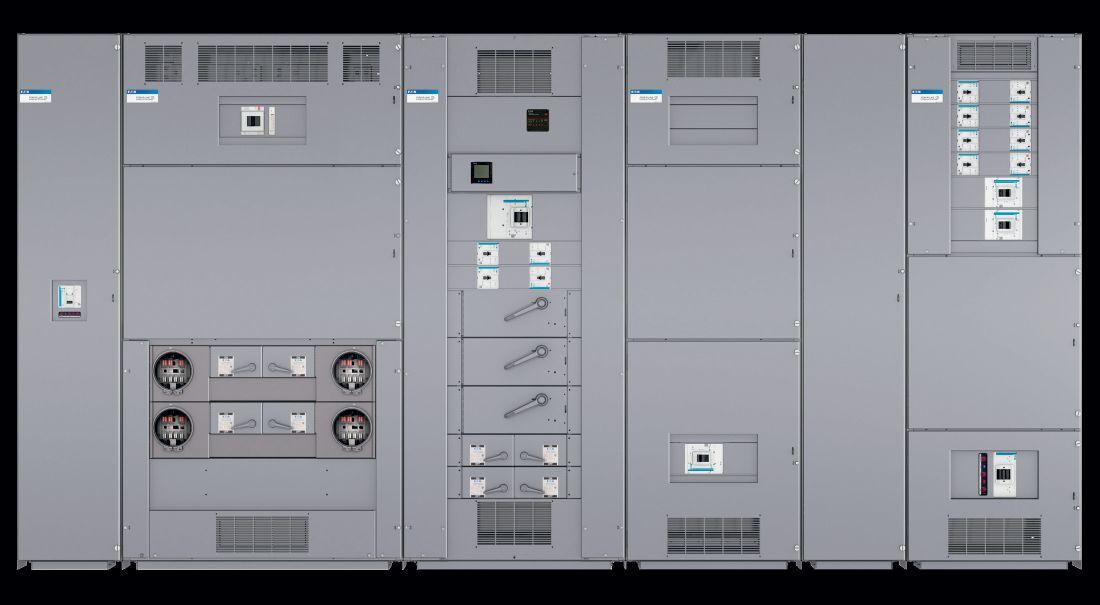
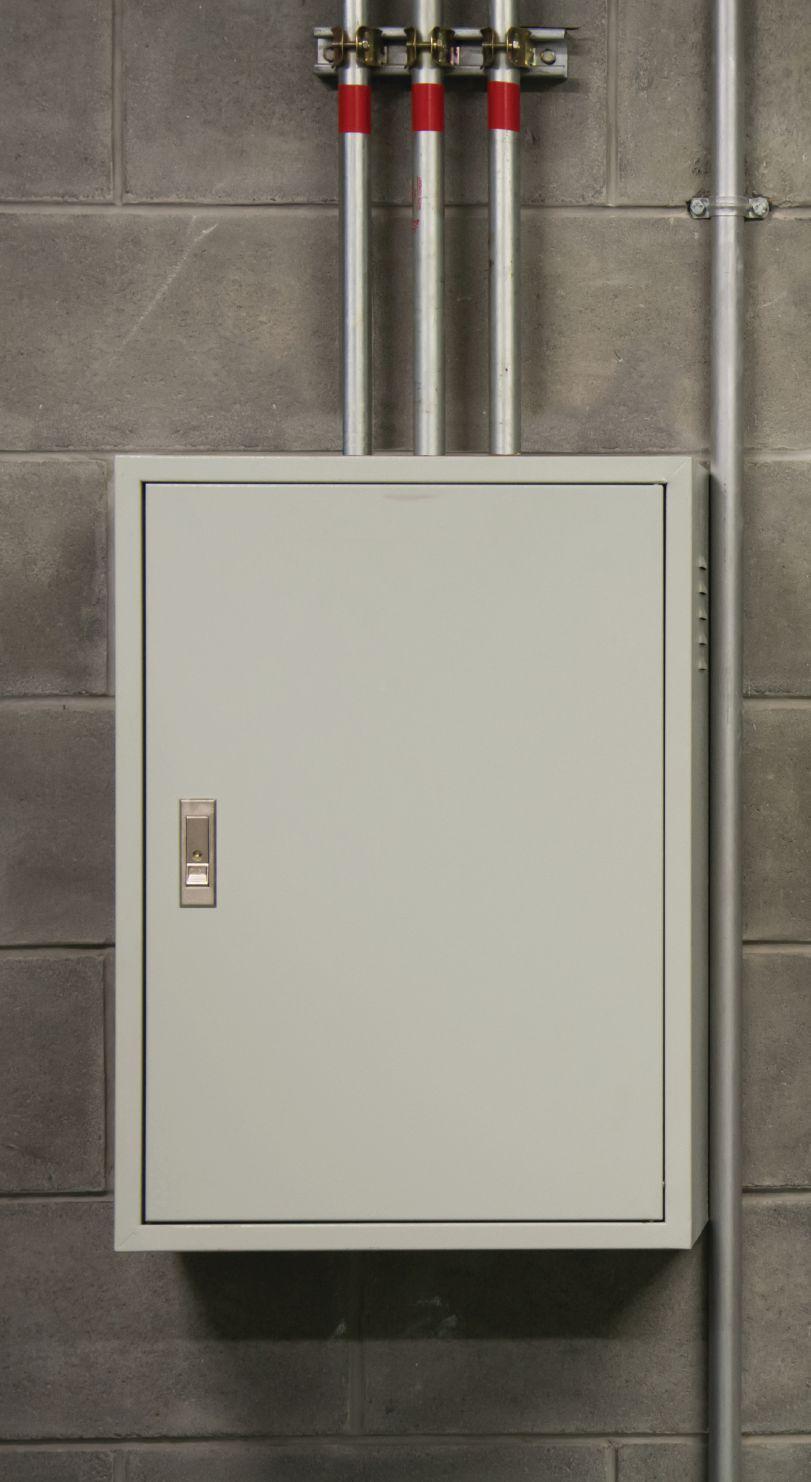
Old-school electrical switchboards can’t keep up with the rapidly evolving changes of light commercial applications. Today’s power distribution needs require multiple configurations and expansion options neatly packaged in a space-saving compact structure.
The result?
You can focus your precious time and resources on-site to get the light commercial application up and running.
Two space-saving options: 12” deep for the wallsupported or 18” deep for the free-standing unit.
The Solution to Your Switchboard Needs Now and in the Future
Six regional satellite locations across Canada for shorter lead times.
Service entrance main disconnect, utility compartment and distribution, expansion options for future needs.
See Our EatonAR App in Action
No need to wonder what configuration will best suit your needs or how the Pow-R-Line CS switchboard will fit in your location. We’ve put the power of choice in your hands with our new interactive 3D online experience.
Want more?
Our EatonAR app gives you a 360-degree view of the Pow-R-Line CS switchboard in your chosen location.


Canadian Manufacturing Demo Days puts the power of Annex Business Media’s manufacturing brands to work to showcase your product videos through a single online source. Promoted through database, online, editorial and social media drivers across 17 manufacturing titles to ensure you receive the leads of decision makers interested in your products. For More Information Visit: canadianmanufacturing. com/demo-days/

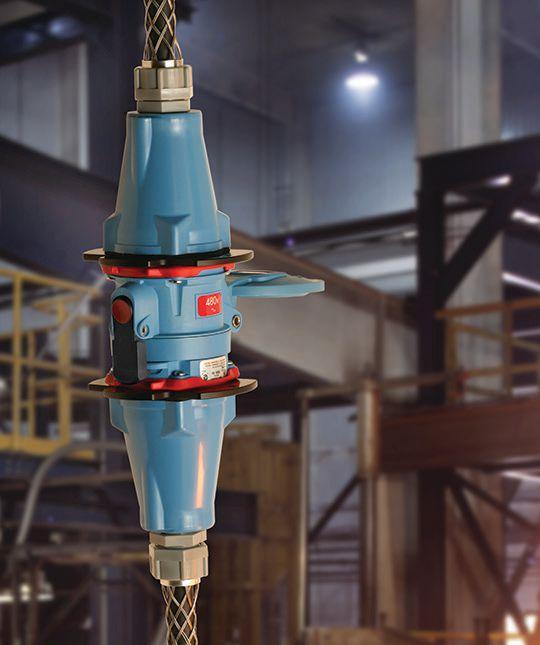

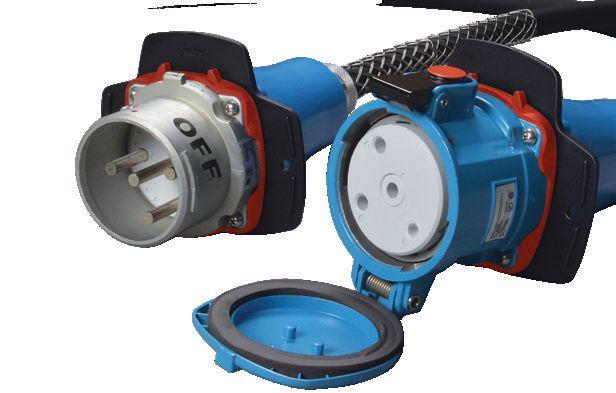
MELTRIC DS and DSN Series Switch-Rated plugs and receptacles are designed and rated to function as a switch. Users can safely make and break connections, even in overload conditions.
• Silver-nickel contacts resist wear and maintain superior conductivity even in wet and corrosive environments.
• Silver-nickel butt-style contacts resist arcing and welding, allowing them to close into and withstand short circuit currents as high as 100kA.
• Enclosed arc chambers and dead front construction prevent exposure to arcing and eliminate unintended access to live parts.
Switch-Rated plugs and receptacles from MELTRIC provide a secure and foolproof means of ensuring user safety without the need for interlocks and safety switches required with other types of plugs and receptacles. At no time is a user exposed to live contacts while connecting or disconnecting.

plugs and receptacles


While most models have engine, package, trim, or colour changes, two light-duty pick-up heavyweights have made major changes
MARIO CYWINSKI
Ford has completely redesigned its F-150 for 2021, and added a hybrid powertrain for the first time. Meantime, Ram has added a new TRX off-road model to compete with the Ford Raptor.
On the other end of the spectrum, Nissan will be pulling the Titan, NV and NV200 from the Canadian marketplace after the 2021 model year, leaving the Frontier, which is set to reveal a completely redesigned model in the near future.
Chevrolet is adding new trailering technology and capacity to its trucks for 2021, while Mercedes-Benz is doing incremental updates to its vans. Toyota is adding new packages to its pick-ups, and the Honda Ridgeline unibody pick-up is still available.
The top-selling vehicle in Canada takes things a step further for 2021, with the F-150 now available with a hybrid powertrain. PowerBoost combines the 3.5L EcoBoost engine (mated to a 10-speed automatic transmission) with a 47-hp electric motor, and a 1.5-kWh lithium-ion battery.
It can go an estimated 1100 km on one tank of fuel, and can tow at least 12,000 lb (when properly equipped). The hybrid model is available on all trims, XL to Limited.
PowerBoost comes with Pro Power Onboard, which turns the truck into a mobile generator. Three levels are available: 2.4kW system with two 120V 20A outlets; a 7.2-kW system with four 120V 20A outlets; and a NEMA L6-20 240V 30A outlet.
Meantime, a 2.0-kW system with two 120V 20A outlets is available on 2.7L and 3.5L EcoBoost and 5.0L V-8 models.
The truck has been redesigned inside and out. The front end sees a new front fascia, choice of 11 grilles, three headlight options, 13 wheel options, and the addition of active grill shutters and an active air dam.
Over-the-air updates and new SYNC system that can connect Apple CarPlay, Android Auto, and AppLink apps wirelessly, are added. Two centre stack screen sizes are available for 2021: standard 8 in. and available 12 in.
An available 12-in. digital gauge cluster is also added. New driver-assist technologies include Active Drive Assist, which allows hands-free driving on Canadian and United States divided high-

ways (an extra camera faces the driver to ensure they are focused on the road. Intersection Assist detects oncoming traffic while performing a left turn, and will apply brakes when needed.
The F150 hybrid can go an estimated 1100 km on one tank of fuel, and tow at least 12,000 lb (when properly equipped)
A Tremor package is added for 2021, which has a lifted suspension with FOX 2.0 monotube dampers with rear piggyback reservoirs, tuned front coil-over and rear leaf springs, 32-in. all-terrain tires, frame-mounted steel front bash plate and underbody skid plates, rear locking differential, and six-switch auxilliary power pack.
Super Duty was all-new for 2020, and sees only minor package, trim, and colour changes for 2021. Transit Connect and Transit vans are carryover models for 2021, with only minor colour changes.
The 2021 F-150 is now available with a hybrid powertrain. PowerBoost combines the 3.5L EcoBoost engine with a 47-hp electric motor, and a 1.5-kWh lithium-ion battery.

For 2021, the Ram 1500 gets a new available colour heads-up display, which is customizable, as well as a digital rearview mirror (which can revert to a regular rearview).
The Trailer package now includes trailer reverse steering control (allowing the driver to enter measurements and allows the vehicle to steer while reversing). A new Limited Longhorn 10th Anniversary edition is added, offering special badging throughout, and brown interior with unique touches inside.
The big news for the Ram 1500 is the addition of the performance-oriented TRX.TRX will have 702 hp and 650 lbft of torque from a 6.2L supercharged HEMI V-8, mated to an 8-speed automatic transmission.
The TRX has five dynamic drive modes (auto, sport, tow, snow, and custom) that control the 4WD system, throttle response, transmission, paddle
shifters, suspension, and electric power steering. Also, three dynamic off-road modes (mud/sand, rock, and baja) can be chosen. A launch control button is standard.
The Uconnect system standard on the TRX is a 12” model, and can be paired to a 900W Harmon Kardon audio system and 19 speakers. An available heads-up display can show up to five items at one time (lane departure, lane keeping, adaptive cruise control, navigation, speed, gear and speed limit).
A Limited Night Edition model is added, with 20-in. black wheels (17-in. on dual rear-wheel models), black Ram grille, grille surround and badging; headlights and taillights have black bezels, mirrors have black caps, bumpers are body colour, amd a variety of body colours are available.
The Promaster now comes with crosswind assist (which helps in windy con-
ditions) as standard. Available new options are a digital LCD rearview mirror (replacing the traditional mirror), and new safety features such as blind-spot monitoring, forward collision warning with emergency braking, and lighting. The ProMaster City sees wheel and fog light availability changes.
The big news for Gladiator is the addition of a 3.0L EcoDiesel V-6 engine with engine Start/Stop. It offers 260-hp and 442 lb-ft of torque, and is mated to an 8-speed automatic transmission. Also, all models now have the option of full-time, 4WD.
Two special edition models are new for 2021. A Willys model starts life as a Sport S trim and adds limited-slip rear differential, rock rails, 32-in. mud tires, and unique exterior appearance. An 80th anniversary edition offers 18-in. wheels, grey metallic exterior accents, 8.4-in. touchscreen, berber floor mats, and special exterior badging.
For 2021, Silverado 1500 adds the Multi-Flex tailgate, a version of which debuted on the GMC Sierra, and allows for six functions to help load and unload the truck bed.
Silverado 3.0L turbo-diesel models now offer a max capacity of 9500 lb on 2WD models, while increasing capacity by 1900 lb on most other configurations.
Chevrolet focused on trailering enhancements for 2021; the crew cab short box can now tow 9300 lb (a 2500lb increase), while the regular cab long box ups its capacity to 9600 lb (and has a payload capacity of 2280 lb in 2WD).
New trailering technologies include trailer length indicator, jack-knife alert, and new cargo bed views (zoom view and bed hitch guidance) to make trailering easier.
The rear trailer view now offers guidelines and a trailer-angle indicator, and rear sideview is enhanced. Other package, trim, and colour changes also occur.
Like the Silverado 1500, the Heavy Continues page 30...
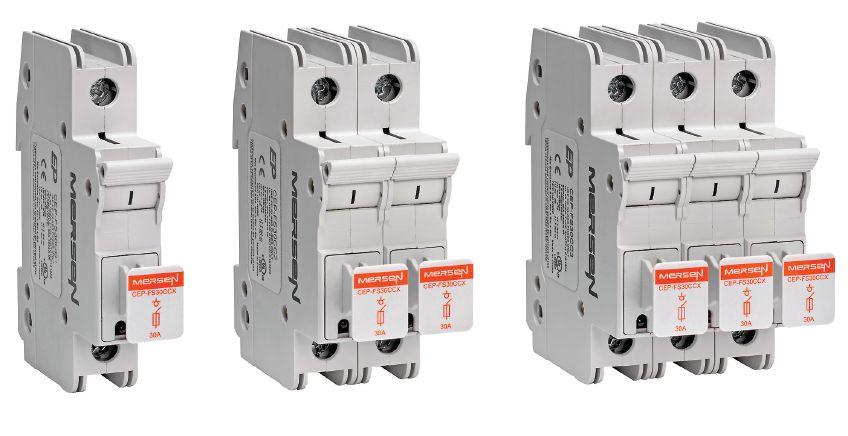
Real estate inside an electrical cabinet is expensive. Decreasing the size of components can yield large returns by enabling the use of smaller cabinets. Labor is another major cost driver which can be reduced by using easy to mount DIN rail capable products. Mersen’s Compact Fused Switch is an ideal choice for saving space, reducing labor costs, and providing next-level safety within your control panel.
Mersen’s Compact Fused Switches are 30 amp rated, UL 98/CSA C22.2 No. 4 listed disconnects and work with UL class CC fuses providing a maximum SCCR rating of 200kA. These IP20 rated units come in single, two- and three-pole configurations, are 35mm DIN rail mountable, and include an easy-touse lockout/tagout feature for added safety. The switches can be used as a main/feeder device and, in conjunction with CC fuses, are rated for branch circuit protection.
Mersen’s Compact Fused Switch gives you the best of both worlds by providing the highest level of safety in a compact footprint. If you are looking to reduce the size of your panel or need additional real estate for added components, consider Mersen’s Compact Fused Switches in your next design.
• UL 98 30A Fused disconnect
• Smaller footprint compared to a traditional Class CC disconnect
• Accepts Class CC 30A fuses for branch circuit protection
• 35mm DIN rail mounted
• Built-in lockout/tagout feature
• 200kA SCCR rating
• 75°C CU Wire

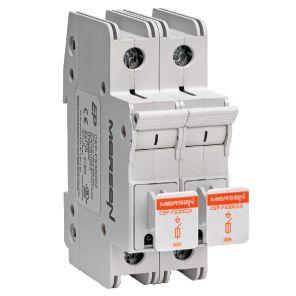


Mersen’s Compact Fused Disconnect incorporates switch functionality with the high protection level of a fuse. The switch accepts class CC fuses, is UL 98 listed and suitable for branch circuit disconnect and protection. It has a smaller footprint compared to a traditional Class CC disconnect with an interrupt rating of 200kA.
The compact form factor and ease of installation make it a great choice for panel builders. The easy lockout/tagout feature and IP20 rating ensures additional safety along with the built in switch capability.
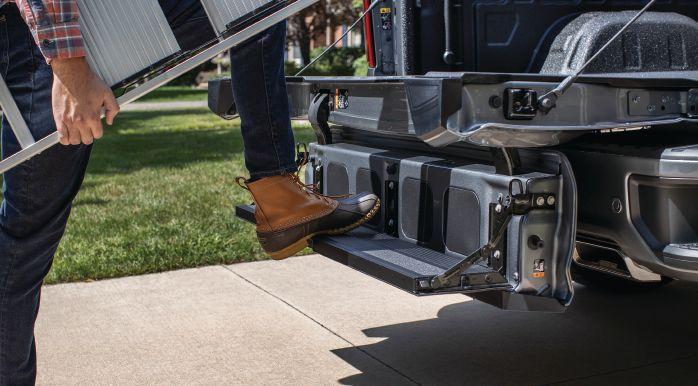
Silverado 1500 adds the Multi-Flex tailgate, a version of which debuted on the GMC Sierra, and allows for six functions to help load and unload the truck bed.
Continued from page 27
Duty models get the same trailering technology improvements. The Silverado 3500 HD WT with 6.6L Duramax diesel (mated to 10-speed auto transmission) in regular cab, dual-rear wheels, 2WD, with gooseneck hitch and max tow package can now tow 36,000 ls (a 500-lb increase).
A selection of special edition packages are also added for 2021: Carhartt Edition available on LTZ, while Midnight Edition, Z71 Sport Edition, and Z71 Chrome Sport Edition are available on LT and LTZ.
Other minor package, trim, and colour changes also occur.
The Colorado has an updated lower fascia, front skid plates, centre bars, new logos, embossed tailgate, and unique looks for each trim. The ZR2 will feature lettered Chevrolet front fascia, standard front and rear electronic locking differentials, 2-in. suspension lift, 3.5-in. wider track, off-road rocker protection, cast iron control arms, and multiple skid plates, Multimatic DSSV position-sensitive dampers, and red tow hooks.
The Canyon adds two new trim levels for 2021. An AT4 mode offers a unique exterior with dark chrome finishes, a new larger grille and red hooks. The interior features Kalahari stitching and
AT4 headrest embroidery.
Off-road features include 31-in. tires on 17-in. wheels, off-road tuned suspension with hill descent system, 4WD system with automatic locking differential, and transfer case skid plate.
A top-of-the-line Denali grade is also added, with an exterior offering a new grille, chrome assist steps, and 20-in. wheels. The interior has wood trim, aluminum decor, unique stitching, and heated seats and steering wheel.
General Motors offers full-size vans—GMC Savana and Chevrolet Express—which see a new 6.6L gas V8 engine added, with 401 hp and 464 lb-ft of torque. The Sierra is a carryover for 2021.
For 2021, Metris receives a handful of updates. First is a new 9-speed auto transmission, replacing the 7-speed version. Active Break Assist and Distronic (an adaptive cruise control system) are added to the Metris. A digital interior rearview mirror is added, and uses the rear camera to show what is behind the vehicle.
Other changes include: multifunction steering wheel now standard on cargo vans, instrument cluster with pixel-matrix display and 7-in. touchscreen with smartphone integration
are now standard (a version with navigation is available).

The 2021 Metris now includes a digital interior rearview mirror.
The long-running Sprinter sees a few changes for the 2021 model year. The biggest is the return of the 4-cylinder turbo-diesel engine (offering 161 hp) that is mated to a 9-speed transmission. V-6 diesel and 4-cylinder gas engines are also available.
Standard equipment now includes Active Brake Assist, multi-function steering wheel, cruise control, full front floor covering, and power and heated mirrors.
For 2021, Toyota is adding two packages to the Tacoma family: Trail and Nightshade packages both have 5-ft truck beds and double cabs. The Nightshade package offers an auto transmission, premium options, black exterior features and a black leather interior.
The Trail package offers an auto transmission, 16-in. off-road wheels, side-step bars, black badge covers, power driver’s seat, and interior accents.
All other Tacoma models carryover with minor changes, and all now offer dual-zone automatic A/C, and audio system with Apple CarPlay and Android Auto.
Mario Cywinski has over 16 years of automobile industry experience. He is a member of the Automobile Journalists Association of Canada, and a a judge for Canadian Truck King Challenge. He is also editor of EBMag sister magazines Machinery & Equipment MRO and Food & Beverage.


Tired of production delays from your wire and cable supplier?
Experience the reliability 80% of customers tout by going with Service Wire.
Our growing list of C(UL) rated wire and cable products are designed to meet the stringent standards your customers need—everything from bare copper and RW90 coloured single conductors to ServicePLEX and Teck90.
You can count on Service to come through when others disappoint.
Our competitive pricing and availability allow you to regularly shop our industry-leading inventory worry-free. We have complete cutting capabilities, inventory management, and prepackaged wire and cable ready for same-day shipment.
It’s time for an easy win with Service Wire. Don’t just take our word for it. Ask to see our customer survey results.

Continued from page 18
KELLY KIENLEITNER Chief Instructor
Electrical Joint Training Committee
“I had been a stay-at-home mom since my son was born, and ran a daycare,” Kelly explains when, at the age of 35, she found herself in the middle of a divorce. Knowing she couldn’t make a living at daycare, so she took an adult education course to explore career options.
“I took tests for three days—math, English, physics, spatial [ ] they put all the tests on the computer, which spit out about 120 jobs for which I had the aptitude, attitude or the training to be able to do.” Kelly says, who then narrowed the list to 10 possible careers, then two: corrections officer or electrician.
She then attended BCIT’s first-ever Try-A-Trade for women, where Kelly explored 12 trades over 12 nights. “And it reinforced the fact that I really wanted to be electrician,” she says.
With her goal in mind, Kelly went back to school to upgrade her math, physics and English, then enrolled in a pre-apprenticeship program.When she came out of school, she took a turn and, rather than go straight to electrician, she became an electric motor winder. “So that was my first trade. Electrician is really my second trade.”
And for Kelly, being in electrical— and in the trades—is a perfect fit. “As a child in school, I was the round peg that they were forever trying to shove into a square hole... and I never quite fit. I come to the trades, and it was like ‘Oh, this is where I fit!’.”
Little did Kelly know when she entered the profession of motor winder that she would be the first woman pursuing that trade in British Columbia, and the first to get a Red Seal for it. For some of the others journeymen, it took some getting used to.
“I started as a maintenance man,

because that’s what they do in that trade [...] So, shipping, receiving, cleaning parts, just basic stuff,” Kelly recounts. “In my first week, one of the old journeys came up to me—a big ol’ German—gets right in my face and tells me ‘This is men’s work!’.”
Kelly kept her cool and politely asked him whether the work of motor winder required his gender-specific anatomy; for the jobs that did require a man’s anatomy, Kelly would pass on those, and work on the others.
“He stormed off,” Kelly says, “Three days later, he comes back and he apologizes to me. He said ‘You know, I never thought about it that way. What exactly does that thing in my pants have to do with my ability to do my job?’.”
That same, big ol’ German also played a key role in Kelly’s I’ve made it moment.
“When he retired, he walked me over to his toolbox (and winders make a ton of their own tools... it’s just part of that trade), and said, ‘I’m retiring, I don’t
need them. I want you to have them’,” Kelly says. “That was such an immense compliment.”
She loves that, in electrical, the work changes all the time. “We have to learn constantly to stay on top of things. I love that! I hate being stagnant.”
And while she’s come upon a few bumps in the road because of her gender, she’s also seen it go the other way.
“I was recently talking to a young man whose foreman couldn’t understand why he had to go and get his children at school,” Kelly says. “So there is a little bit of that old-school hierarchy that still exists.”
“I’ve always said that [women] are 48% of the population, so we should be 48% of everything we want to be included in. So, yes, there are barriers; yes, we are making progress. And I am really, really proud of my union local, because 7% of our journeys are women, and 17% of our apprentices are women.”
One of things Kelly feels would help more people stay in the trades is 24hour daycare.
“And I want it for the guys, too. Daycare is set up for office workers, not for us. We work shifts. We need 24hour daycare so that we, as parents, can do the work that’s necessary to move our country forward without worrying about our kids.”
“Especially for the girls, one of the things I always say is: ‘ Listen, you know what? I started out as a welfare mom. I’m now chief instructor. I’m a foreman. I make $100K a year. And it’s given me the freedom to stand on my own two feet’, which, as a female, is so important.”
When I asked Kelly when she thinks she will be able to say We’ve made it, her response was quick:
“To be quite honest, when our gender stops being a topic of conversation. When the conversation becomes about whether we’re good tradespeople.”
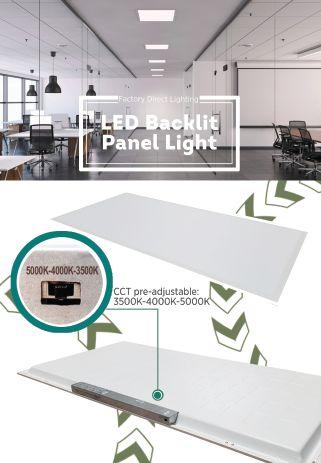
Factory Direct Lighting’s new LED Backlit Panel Lights are designed to provide energy-e cient light distribution in o ce, school, and other commercial applications. The innovative new designed backlit fixtures optimize the easy installation and uniform light di usion with a wide beam angle to prevent hot spots. The backlit fixtures save up to 50% on energy e ciency to provide more lumens compared to traditional Tro ers. The material of the lens is PMMA LGP which reduces the risk of yellowing over time and the aluminum frame is white paint finished. The FDL’s LED Backlit Panel Lights are CCT pre-adjustable with 3500K-4000K-5000K, meeting your expectation for color temperature on multiple occasions.
Features of FDL LED Backlit Panel Lights:
• Size: 1X4, 2X2, and 2X4
• Wattage: 40W and 50W
• Lumens: 5000 or 6250lms
• Voltage: 120-347V
• E ciency: 125lms/Watt
• Power Factor: >0.95
• CRI: >80
• Energy Standard: DLC 5.1 & Premium Version
• cETLus Certified
• 5-Year Warranty
• CCT Pre-adjustable: 3500K-4000K-5000K
Leviton 2-gang pokethrough

The latest addition to Leviton’s floor box portfolio is a 2-gang pokethrough featuring adjustable anchoring clips that simplify installation adjustments with the box: you simply loosen the clips to remove the device. The floor box sports two-piece construction that allows it to self-level up to 4 degrees, eliminating a potential tripping hazard and poor aesthetics (leviton.com).
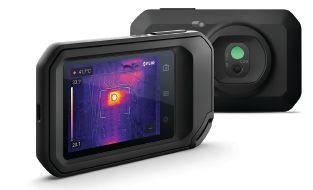
Featuring a 128x96 px thermal camera, a 5MP visual camera and MSX image enhancement, the FLIR C3-X aims to help you easily identify hidden building problems in the palm of your hand. The C3-X sports a temperature range up to 300 C on a 3.5-in. touchscreen. MSX mode adds visible light details to thermal images in real-time so you can identify issues within the context of the problem area (flir.ca).

The BradyJet J1000 printer and Brady Workstation software (plus materials) promise to manage all terminal block ID tasks. The system imports data, allows tag creation and prints terminal block and component
tags, while new inkjet technology means ink sets within seconds, reducing the chance of smudging (bradycanada.ca).
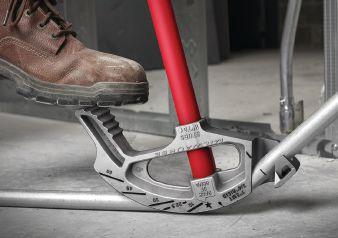
The new 1-in. aluminum conduit bender features high-contrast markings, promising great visibility for accurate bending. A reinforced hook and pedal provide added durability, while the secure double-bolted handle will not loosen (milwaukeetool.com).
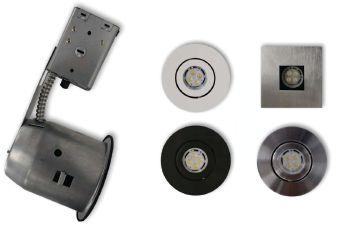
Intended for remodeller construction, the SRCR series of commercial recessed MR16 remotes has been designed to blend seamlessly into modern decors. The units are available for IC inherently protected, and can be mounted in a variety of ways above suspended or drywall ceilings, leaving only the lamp and compact trimplate visible (standardpro.com).
The Lithonia TWX LED family of wallpacks feature a borosilicate glass lens that works in conjunction with the light engine to provide illumination while minimizing wasted uplight. The family replaces 70W to 400W HID luminaires, in lumen outputs
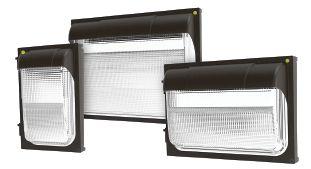
ranging from 2950 to 13,850. They are available in four colours and two finishes (lithonia.acuitybrands.com).
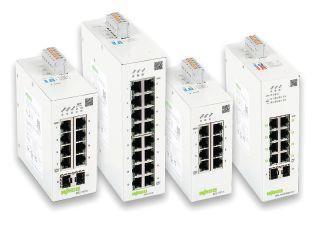
Wago has expanded its line of managed switches; each switch includes Ethernet Ring Protection Switching (ERPS) and Rapid Spanning Tree (RSTP) for network redundancy, port mirroring, onboard firewall and more. The switches come with an “easy-to-use, dynamic web-based dashboard” and topology mapping to provide instant updates on network status and system health (wago.com).
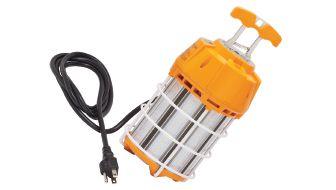
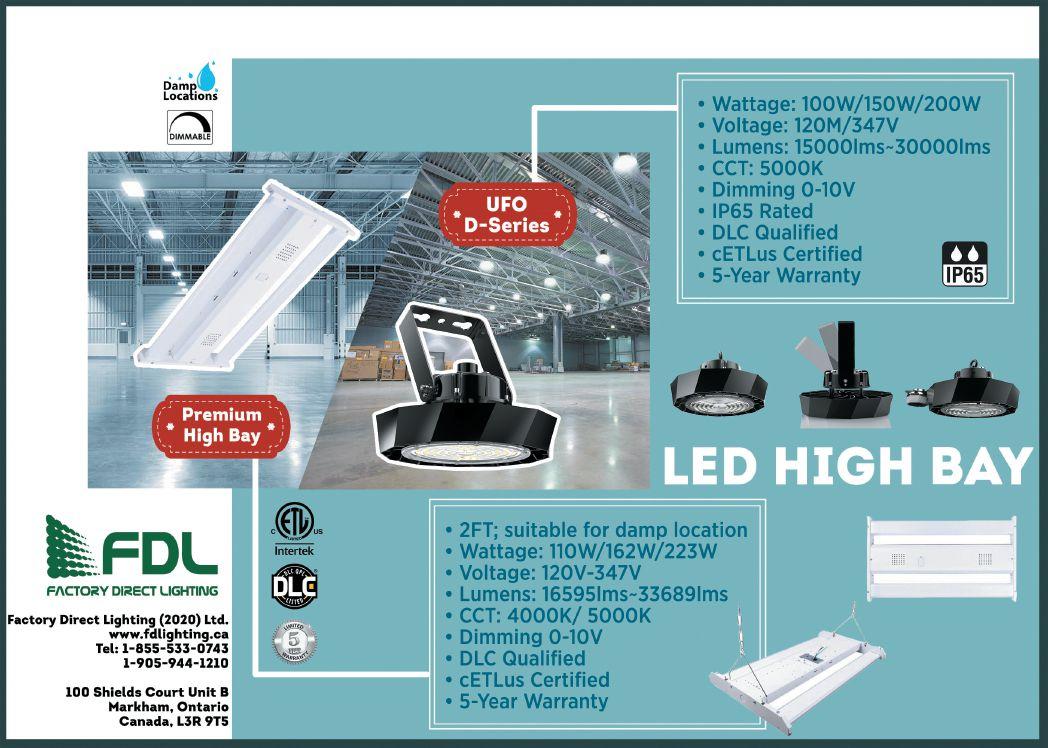
Designed for installation in construction and renovation sites, maintenance rooms, storage spaces and damp location-rated areas, the 100W TL100C LED yields 5000K light output of 12,000 lumens, and requires less than 25% of the energy of a 400W HID equivalent. LED technology provides the TL100C with an L70-rated operating life of 54,000 hours. Its daisy-chain feature allows up to six (6) 100W units to be linked together (masteringled.com).
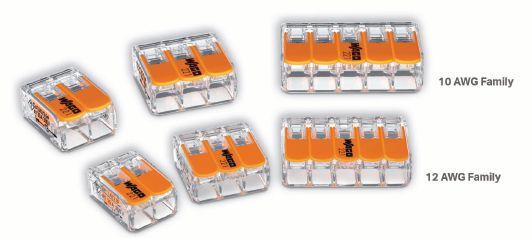
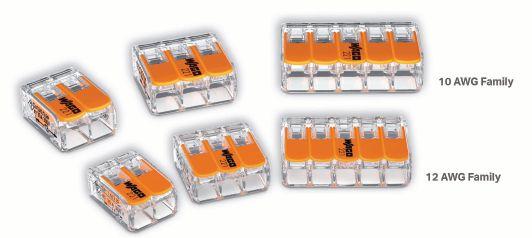
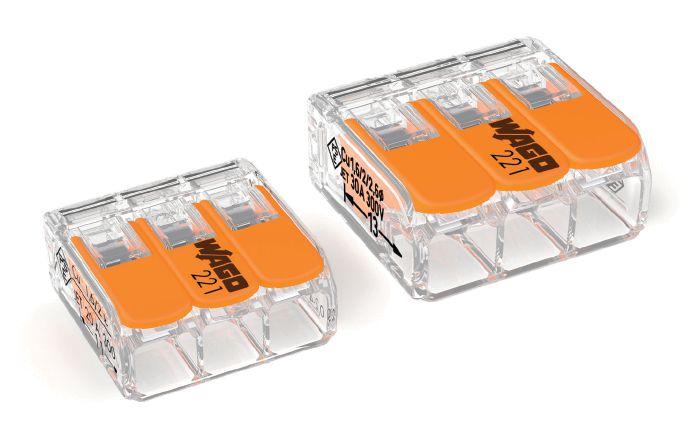
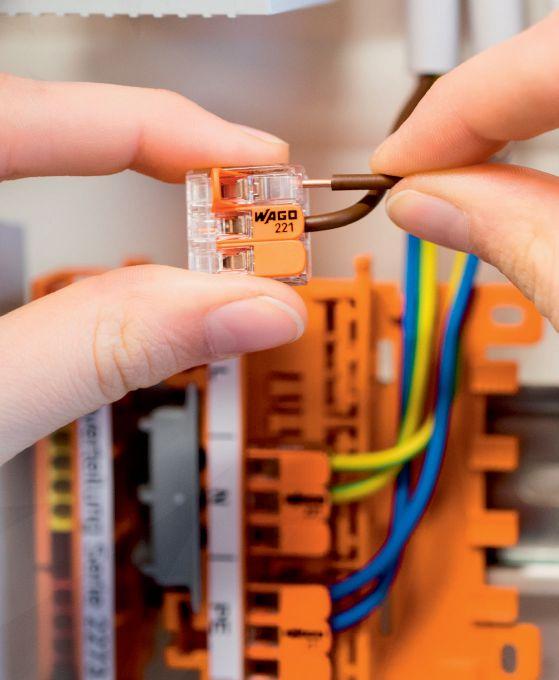
Pull the lever up, insert the stripped conductor, and push the lever back down –done. WAGO’s 221 Series compact splicing connectors let you connect any combination of solid, stranded and flexible copper wires quickly and reliably. Visually inspect for proper strip length and complete wire insertion through its transparent housing.
any combination of solid, stranded and flexible copper wires quickly and reliably. Visually inspect for proper strip length and complete wire insertion through its transparent housing.
• 10 AWG family: 20 – 10 AWG
•
• Comfortable, tool-free lever operation
• Test port located on the front and back for convenience
• 2-, 3-, and 5-wire versions for all wire types
• 10 AWG family: 20 – 10 AWG
• 12 AWG family: 24 – 12 AWG
• 12 AWG family: 24 – 12 AWG
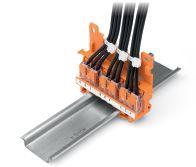
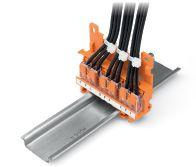
For even greater application flexibility, transform the 221 Series connectors into a fixed terminal block solution for DIN or chassis mount applications with the optional mounting carrier.
For even greater application flexibility, transform the 221 Series connectors into a fixed terminal block solution for DIN or chassis mount applications with the optional mounting carrier.
The certification process for electrical products designed for use in hazardous locations in North America is different than the requirements for international (IECEx) and European certification (ATEX).

Be prepared, be successful BEHZAD NEJAD, P.ENG.
The formal approval of electrical equipment for use in Canada was introduced in the Canadian Electrical Code, first published in 1927. While there have been many changes to the code and related regulations since then, Canadian-made electrical products continue to require the approval of a certifying body (e.g. CSA Group, Underwriters Laboratories of Canada Inc., QPS) to assure their safety.
Certification by an impartial third-party or certification agency is an attestation that minimum relevant safety and
No matter how complex, the certification process cannot be avoided
performance standards have been met.
The certification of electrical products being designed and manufactured for use in hazardous locations and explosive atmospheres (Ex equipment) is especially stringent because of the associated risk of explosion should those products fail. Such a catastrophic event could result in loss of life and the destruction of property, not to mention damaging the reputations of the designer, manufacturer, installer—even the certifying agency.
The requirements for hazloc certification have also become more complex since their introduction. Given today’s global marketplace, the chances are high that a new product must also be approved by authorities in other jurisdictions. Manu -
facturers of products intended for use outside their country of origin face a few daunting challenges, which can include dealing with foreign engineering firms and unfamiliar equipment distributors, gaining the approval of unfamiliar certifying agencies, meeting additional regulations, and even overcoming language barriers.
No matter how complex, the certification process cannot be avoided, and is a requirement for manufacturers aspiring to have their electrical products Approved for Use. Certification translates into consumer confidence in both the manufacturer and its products. It enables a product’s end user to procure the correct equipment for a specific application.
C ertification, and its en -

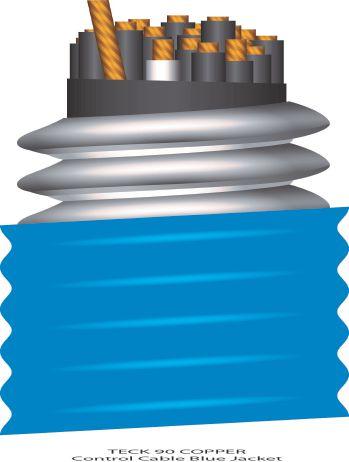
Northern Cables continues to expand their product offering with our recent launch of our ACIC - Armoured Control Cable. These cables are designed to connect control circuits in petro-chemical, pulp and paper, and other Industrial application environments. ACIC control cable can be used in open and concealed wiring, direct burial and in hazardous locations.
The insulated conductors are made with cross-linked polyethylene and twisted with an uninsulated ground wire. The twisted core is covered with a PVC jacket, then either an aluminum or galvanized steel armour is applied, with a final blue PVC jacket installed over the armour. ACIC control cable is manufactured to CSA 22.2 # 239 and CSA 22.2 # 174 to allow it to meet certain CSA tests including flame test FT4, minus 40-degree Celsius cold impact test low acid gas and sunlight resistance. ACIC control cable is available in 600V constructions from #18 to #14 with a conductor count from 2 to 50.
Northern Cables does carry stock of popular types. Please contact customer service for pricing and availability or visit the INVENTORY tab on our website.
Product certification
forcement by the appropriate authority having jurisdiction, gives manufacturers comfort in knowing their products continue to comply with relevant safety standards—from design and installation, to use in the field. Certification gives the AHJ the right to inspect and enforce the requirements of the applicable codes, regulations and standards. Liability is no longer solely borne by the manufacturer.
So if certification is such an integral part of getting a product to market, why do so many manufacturers spend more time and pay more money than necessary for this process?
Really know your product
In my experience, manufacturers aren’t always as prepared as they should be for each stage of the application process. An efficient certification process can take between two to four months, while an ill-prepared or unprepared application can easily extend the process to a whole year, with double the cost.
To begin with, an application for certification requires an understanding of where the product will be sold, installed, and used.
Knowing where the equipment is intended to be sold (which country/ies) helps identify applicable certification requirements and standards, which vary from one jurisdiction to another. The certification process for electrical products designed for use in hazardous locations in North America, for example, is different than the requirements for international (IECEx) and European certification (ATEX). In some cases, manufacturers wish to secure all three marks and certifications so they can sell their product anywhere in the world. Naturally, this adds cost and possibly time to the certification process—especially if the manufacturers are unfamiliar with and/or unprepared to meet each of these requirements.

It is in your best interest to move your products quickly through the design, testing, approval, and production stages into the marketplace to keep pace with rapidly changing technology.
T he manufacturer needs to know which directives, regulations/Code of Practice apply in each jurisdiction where the product will be purchased, installed and used, in addition to the standards for that specific product. They also need to anticipate the impact of those standards with regard to:
• product design,
• relevant technical guidelines,
• appropriate protection techniques for installation,
• required hazardous location markings, and
• expectations at each phase of the certification application, including testing and sampling.
Any time spent ensuring a product meets standards and technical guidelines is time wasted if the correct standard/guideline was not identified and referenced at the outset. The standards themselves are complex and may require interpretation. The language in standards include statements such as “applies only to” or “except as permitted by Subrule[...]” or “unless otherwise specified”. Rules are typically numbered (e.g. Rule 10-212[2] or Article 3.6.2.8) and often refer to Subrules, Notes and Appendices that may also apply.
Manufacturers do not always speak the language found in these documents.
An illprepared or unprepared application can easily extend the process to a whole year, with double the cost.
The certifying agency controls the process: the manufacturer submits documents and waits for a response. Manufacturers begin the process by initiating a Request for Quotation from the certifying agency.
At this stage, their proposal documents need only contain enough information to obtain an accurate quote quickly. However, when critical information is missing, or the product is described insufficiently, the certifying body will need more time to obtain the required details before providing a quote. This adds time to the process.
T he initial request should include a general description of the product (main and safety parts), electrical ratings, hazardous location markings, list of applicable standards, type(s) of certification requested, and protection techniques. In some cases, more than one method of protection is needed. Each protection technique needs to be separately designed by the manufacturer, and individually evaluated and tested by the certifying agency.
U pon receipt of the quote, the manufacturer will be able to anticipate subsequent requirements. This information is spelled out in checklists that certifying agencies use to better to understand a product, thereby more quickly completing their
assessment and evaluation to determine compliance. It is in the manufacturer’s best interest to access, use and submit the checklist(s) as a self-assessment. Those who are prepared for this stage will accelerate their process.
The scheduled drawings should be separated from manufacturing drawings, and must contain information critical to the product’s compliance with applicable hazardous location standard(s). This separation will be helpful when internal documentation and non-safety details need to be updated (such updates can then proceed without engaging the certifying agency).
A s a general principle, it’s important to anticipate what will be involved in maintaining hazloc product certification while preparing for its certification.
Manufacturers also need to anticipate the certifying body’s requirements for testing (e.g. preparing the correct number of samples, in the correct configuration). Manufacturers can begin preparing them right away so that, when samples are requested, they can be provided immediately.
Failure to consider and anticipate the certifying agency’s requirements may lead to redesigning the product, repeating certain steps, redoing documentation, creating new drawings—all of which add time and cost unnecessarily to the process.
For example, let’s take the certification process for a hazloc LED fixture, Zone 1 application. The certification process should take 3 months to complete. However, if the manufacturer is not prepared to design the LED arrays, driver and internal PCB components based on requirements in the standards, the process can easily take up to 6 or 8 months!
He who hesitates... adds cost
As a manufacturer, it is in your best interest to move your products quickly through the design, testing, approval, and production stages into the marketplace to keep pace with rapidly changing technology. The certification process takes time: it involves assessing the required technical documentation, testing the product against the relevant standards, and ensuring compliance with the applicable legal framework, and all the certification rules and procedures.
It is wiser to be well-prepared for success than to receive notice that a certification application has failed. Know your plans for your product in advance; know the applicable standards and technical guidelines; know which documents you will be expected to provide to the certifying agency; anticipate the need to provide samples. Delays are never pleasant— especially ones that could have been avoided.
Behzad Nejad, P.Eng., is the director and a consulting engineer at Hazcon Inc., where he provides hazardous location consulting services (IECEx, ATEX, Canadian Electrical Code and National Electrical Code) for manufacturers of electrical products. He has a Master’s degree in Electrical Engineering and has been a member of Professional Engineers Ontario since 2013. Behzad’s experience in the industry also includes seven years at CSA Group’s certification agency. He has published and presented technical articles and tutorials on hazardous locations at several IEEE/PCIC conferences, and is also a part-time instructor at Seneca College, teaching electrical courses since 2014. You can reach him at behzad@hazcon.com.

Ray is a code engineer with Ontario’s Electrical Safety Authority
Ontario’s Electrical Safety Authority esasafe.com
Answers to this month’s questions will appear in the May 2021 edition of Electrical Business Magazine.
QUESTION 1
Equipment marked Ex ia Gb is suitable for installation in Zone 0 locations:
a) True
b) False
QUESTION 2
The ampacity of conductors in a bundle of 11 copper eightconductor cables No. 26 AWG marked 75ºC is:
a) 1 A
b) 0.8 A
c) 0.5 A
d) None of the above
QUESTION 3
An alternating current system is permitted to be ungrounded when:
a) equipped with suitable ground fault detection.
b) maintained by qualified persons.
c) A and B.
d) None of the above. Grounding is required for all alternating current systems.
ANSWERS, Electrical Business, February 2021 ed.
Q-1: In a hospital, when an electric vehicle energy management system (EVEMS) is installed to monitor the consumer’s service loading, and to control the supply to electric vehicle supply equipment (EVSE), the demand load of this EVSE is: d) Ignored from the demand calculation of the hospital. Rules 8-206, 8-106(11), CE Code 2021.
Q-2: For a 400A fusible disconnect switch fused at 400A, fed with a multi-conductor 600-kcmil copper in a raceway, marking is required beside the fused disconnect switch to state the maximum permitted continuous load is: d) None of the above. Rule 2-100(4), CE Code 2021.
Q-3: A single-conductor cable, carrying a current more than ___ amperes shall be run and supported in such a manner that the cable is encircled by ferrous material at all points of support, and at points of entry to enclosures.
d) 200 A. Rules 4-008(3), 12-106(5), CE Code 2021.
How did YOU do?
3 • Seasoned journeyman
2
• Need refresher training
1
• Apprentice
0
• Just here for fun!


Designed with contractors in mind, the SensorSwitch JOT enabled wireless solution offers a straightforward approach to installation and pairing of lighting fixtures and controls.
KEY HIGHLIGHTS:
KEY HIGHLIGHTS:
» Wireless dimming and switching without 0-10V control wires
Designed with contractors in mind, the SensorSwitch™ JOT enabled wireless solution offers a straightforward approach to installation and pairing of lighting fixtures and controls.
We’ve partnered with Lithonia Lighting® to bring you a broad selection of products that offer the convenience of wireless dimming and wireless product pairing, all while aiding in simple code compliance and energy efficiency.
Designed with contractors in mind, the SensorSwitch™ JOT enabled wireless solution offers a straightforward approach to installation and pairing of lighting fixtures and controls. We’ve partnered with Lithonia Lighting® to bring you a broad selection of products that offer the convenience of wireless dimming and wireless product pairing, all while aiding in simple code compliance and energy efficiency.
We’ve partnered with Lithonia Lighting® to bring you a broad selection of products that offer the convenience of wireless dimming and wireless product pairing, all while
» Wireless dimming and switching without 0-10V control wires
» Wireless product pairing without mobile apps and laptops
KEY HIGHLIGHTS:
» Wireless product pairing without mobile apps and laptops
» Wall switches function with or without a neutral connection
» Occupancy and daylight sensing for code compliance
» Wall switches function with or without a neutral connection
» Wireless dimming and switching without 0-10V control wires
» Occupancy and daylight sensing for code compliance
» Time saving solution for single room lighting control
» Wireless product pairing without mobile apps and laptops
» Wall switches function with or without a neutral connection
» Time saving solution for single room lighting control
» Occupancy and daylight sensing for code compliance
» Ideal for both new construction and renovation of small commercial spaces
» Time saving solution for single room lighting control
» Ideal for both new construction and renovation of small commercial spaces
» Ideal for both new construction and renovation of small







Absence of voltage testing is a vital step in the process of verifying and establishing a deenergized state for any electrical system. As detailed in CSA Z462 “Workplace electrical safety”, Clause 4.2.5., there is a specific and approved approach to establishing an electrically safe work condition:
• Determine all possible source of electrical supply.
• Interrupt the load current, open the disconnecting device for each possible source.
• Where possible, verify that all blades of the disconnecting devices are open.
• Release or block any stored energy.
• Apply lockout device in accordance with documented and established work procedures
• Using an adequately rated portable test instrument, test each phase conductor or circuit part to verify it is de-energized. Test each phase conductor or circuit path, both phase-to-phase and phase-to-ground. Before and after each test, verify the test instrument is operating satisfactorily.
The key is verification... you need to verify the electrical system is deenergized and verify the test instrument is functioning correctly. Conducting an absence of voltage test inside an electrical cabinet is not only time-consuming but contains risk of shock and
This direct connection is part of the integral safety architecture and operation of an absence of voltage tester.
electrocution from inadvertent contact with electrical circuit paths inside the panel, incorrect application of test instruments or human error.
To address this risk, CSA Z462 contains an Exception Note whereby the step requiring direct contact with previously energized conductors with an adequately-rated test device can be replaced by using an adequately-rated, permanently mounted test device, provided the product meets certain requirements, such as:
• It is listed and labelled for the purpose of verifying the absence of voltage.
• It tests each phase conductor or circuit path, both phase-tophase and phase-to-ground.
• The test device is verified as operating satisfactorily on any known voltage source before and after verifying the absence of voltage.
What is an absence of voltage tester?
Listed and labelled for the purpose of verifying the absence of voltage refers to UL 1436 “Standard for safety: outlet circuit testers and similar indicating devices”. In the Glossary (Section 5), an absence of voltage tester (AVT) is defined as:
“A permanently mounted test device that is used to verify that a circuit is deenergized prior to opening an electrical enclosure that contains energized electrical conductors or circuit paths.”
An AVT is provided with a test circuit with active indications to verify the absence of phaseto-phase and phase-to-ground voltage.
UL 1436 Section 12 contains specific construction and operation clauses related to the AVT product, including (but not limited to):
• An AVT shall provide the user with a visual indicator to confirm the absence of voltage after the absence of voltage test has been performed. The visual indication shall be Green.
• The AVT shall incorporate a supervisory test circuit to verify that the tester is functioning properly before and after the AVT performs voltage measurements.
• The AVT visual indicator shall only illuminate Green when all phase-to-phase and phase-toground voltages measure less than 3VAC or 3VDC.
• The AVT visual indicators shall not illuminate Green unless the phase and ground leads are in direct contact with the circuit conductors being tested.
• The AVT shall comply with the Standard for Functional Safety IEC 61508 and achieve a SIL 3 rating.
Achieving a SIL 3 safety rating requires meeting requirements with respect to failure mode effects analysis, meeting requirements with respect to component selection and probability of failure rates, and meeting guidelines with respect to safety concepts and architecture. This is to assure the AVT product has been designed in such a manner that it will not fail in any critical manner.
Operation and design of an AVT
A listed and approved absence of voltage tester provides a simple means of initiating a test (press Test Button). This reduces the time required to conduct the test (from 20 minutes to around 10 seconds) and allows the test to be conducted prior to opening an electrical enclosure, thereby reducing the risk of exposure to shock or electrocution hazards.
The AVT provides visual indication of the presence of voltage via 3-phase voltage Red lights connected directly to the circuit conductors, thereby indicating that hazardous voltage is present. This functionality is separate from the absence of voltage test and not required by UL 1436, but it is available and provides verification of an electrically unsafe condition.
This direct connection is part of the integral safety architecture and operation of an absence of voltage tester.
To initiate the absence of voltage test, the user presses the Test button on the display unit. Once initiated, the test process will not commence until the supervisory circuit has verified the phase voltage lights are Off and the sensor lead connections have been verified.
The continuity check is a critical aspect of verification and is provided through a continuity monitoring loop where two sensors are provided per phase and per ground. When a short or break is detected in any of the leads, the next test in the sequence will not initiate. To complete the continuity verification, a signal is injected on one of the sensor leads and is read by the other sensor lead.
Once the above conditions are verified, the absence of voltage tester runs through the following verifications, in sequence:
• energy level on the bus is low enough to perform the test
• voltage source is sufficient to perform the test
• phase A, B then C voltage is <3V RMS
• phase A, B then C connection loop has continuity
• phase A, B then C DC voltage is <3V RMS
• phase A, B then C connection loop
has continuity
• phase A, B then C RMS voltage is <3V RMS
• phase A, B then C connection loop has continuity
• phase A, B then C DC voltage is <3V RMS
Again, the verifications are performed in sequence; the next test can only initiate once the previous one has passed. Only when all verification tests are passed, in sequence, will all 3-phase Green lights illuminated, can we confirm the absence of voltage.
Test ports for absence of voltage testing
Voltage test ports allow for the user to test for voltage without opening an electrical enclosure, and are excellent tools for safely troubleshooting and determining the value of any voltage present. However, these test portals cannot be used to verify the absence of voltage as per the Note 1 Exception because:
• They are not labelled for the purpose of verifying the absence of voltage.
• There is no supervisory circuit to ensure the test portal is functioning properly.
• There is no active indication of the absence of voltage.
• There is no continuity check to verify the leads being tested at the port are in direct contact with the circuit conductors being tested.
Reading no voltage at the test port only indicates an absence of voltage at the test port.
Even if we were to combine a voltage indicator with a test portal in a single enclosure—both with leads to the energized conductors—it would not suffice to meet the Note 1 Exception for verifying an electrically safe work condition, regardless of whether the work was being performed by a qualified worker or not.
Having two independent connections to the circuit conductors—one set of leads from the voltage indicator and another set of leads from the
voltage test portal—provides redundancy, but consider...
Let’s say we observe (confirm) voltage through the indicating lights; we then deenergize and observe the lights are no longer illuminated. We conduct a voltage test at the test portal using an adequately rated portable test instrument and measure no voltage. Even then, we cannot verify an absence of voltage because:
• no supervisory circuit ensuring the test portal is functioning properly
• no active indication of absence of voltage
• no continuity check verifying the leads are connected, all of which are required
As you can see, we cannot and should not rely solely on those indicating lights.
Verified... or not verified
CSA Z462 4.1.4. notes “hazard elimination shall be the first priority in the implementation of safety related work practices”. Using a combination voltage indicator and voltage test port reduces the probability of electrical shock by accidental contact with live conductors (as the test is undertaken outside the cabinet), but does not eliminate the hazard as absence of voltage cannot be verified.
When conducting an absence of voltage test, there are only two options: use an adequately rated portable test device and make direct contact with the circuit conductors being tested, or use a listed and labelled absence of voltage tester.
When it comes to electrical safety and establishing a safe working environment, a high degree of confidence simply isn’t enough; the absence of voltage is either verified or it is not.
Note
CSA Z462-21, 4.2.5. “Exception Notes 1” will be updated to replace the term permanently mounted test device with permanently mounted absence of voltage tester to remove any confusion.
Andrew Cochran is president of I-Gard Corp., a provider of neutral grounding resistors, ground fault protection systems and power resistor-based solutions for power protection.

In my last column, I discussed—in simplified terms—how an energized circuit can magnetically induce a current on another circuit, when the latter has no physical reference to the energized circuit (EB December 2020).
The effect this has on grounding is significant. When we ground a system, it is only that system—and not others that may have been created from this system—that is grounded.
I discussed how the utility’s earth return path—using the low-voltage neutral as a parallel path—is a concern; and how the earth return may have an effect on stray currents around a farm (depending on, but not limited to, things like moisture content and soil resistivity).
Again, we face the question: why do we ground? We ground so as to stabilize the system we have created, and to set our reference (I am right here, right now).
I think we are all comfortable with the fault return path, and the requirement for any faults to complete the circuit in the system to activate an overcurrent device.
So what about the reference point? How does this affect a sprawling farm site?
When we ground at the service (we are right here, right now), then move 200+ feet across the yard
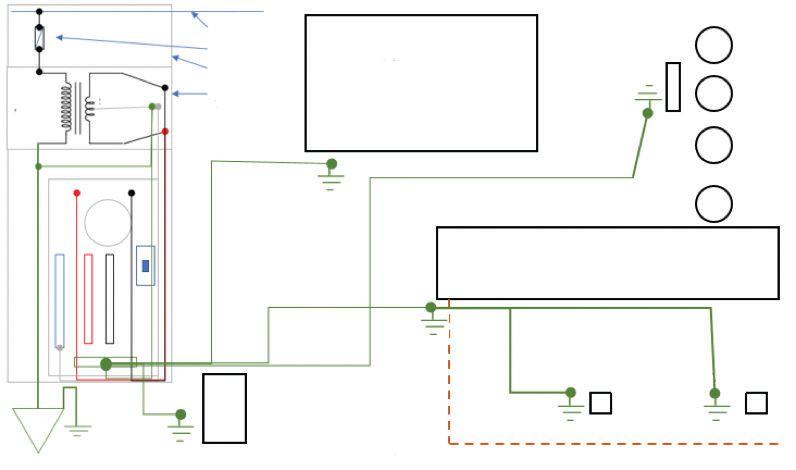
with a feeder to a barn, or 300 feet to a set of grain bins, we are now being fed from a system that is established back across the yard (right there, right now). This could expose us—and especially our quadrupeds—to potential shock hazards.
A s we move outward to other facilities and buildings in rural Saskatchewan, we require the addition of equipotential grounding. These equipotential ground rods establish the ground potential as the same as the bonding conductor carried from neighbouring facilities.
This is very important in an area fed with an earth return system on a farm, as quadrupeds
are extremely sensitive to stray earth currents.
B y establishing equipotentiality for the entire area that’s supplied with electricity from the system, we reduce the effects of stray current and further reinforce system stabilization with the earth (see Figure).
We do not permit re-grounding of the neutral. Instead, we require a bonding conductor for a fault return path to be run to all structures, and that it be connected to an equipotential grounding plate at each structure.
In so doing, we ensure that all structures fed from that one service are as close as possible to the same zero potential throughout the yard. This promotes safety, reduces parallel neutral paths, and reduces fire and shock hazards for people and animals.
David Pilon is manager, Electrical Inspections, at Technical Safety Authority, Saskatchewan (TSASK). He also serves as vice-chair of the Canadian Certified Electrical Inspector (CCEI) committee of the International Association of Electrical Inspectors (IAEI), Canadian Section. He can be reached at david.pilon@tsask.ca.































Best-in-class max. available payload of 7,850 lbs*
Max. available diesel towing of 37,000 lbs**






Best-in-class‡ max. available payload of 3,325 lbs
Best-in-class† max. available towing of 14,000 lbs



When you’re building a business, you need the best. The 2021 Ford Super Duty is a powerful business partner. Designed with productivity in mind, the all-new Ford F-150 – with its available Tailgate Work Surface comes ready for the worksite, and its class-exclusive^ available Pro Power OnboardTM offers exportable power on demand to help keep you running until the job’s done.


With more ways to earn loyalty points and redeem great prizes, the new and improved AD Rewards program allows you to capitalize on the power of your purchases from AD distributors like never before.
With over 6,000 valuable merchandise and travel rewards, your relationship with your AD distributor has never been more powerful…or lucrative. Join today at any of these participating AD distributors.