Media Designer | Curtis Martin akeba@annexbusinessmedia.com
Group Publisher | Martin McAnulty mmcanulty@annexbusinessmedia.com
President & CEO | Mike Fredericks
Printed in Canada ISSN 1488-4305
Publications Mail Agreement #40065710
Circulation
e-mail: amadden@annexbusinessmedia.com
Tel.: 416-442-5600 ext 3547
Fax: 416-510-6875 (main) 416-510-2191
Mail: 111 Gordon Baker Rd., Suite 400, Toronto, ON M2H 3R1
Subscription rates:
Canada – 1 yr $17.00 CDN
USA – 1 yr $26.00 USD
Foreign – 1 yr $35.00 USD
From time to time, we at Drainage Contractor make our subscription list available to reputable companies and organizations whose products and services we believe may be of interest to you. If you do not want your name to be made available, contact our circulation department in any of the four ways listed above.
All advertising is subject to the publisher’s approval. Such approval does not imply any endorsement of the products or services advertised. Publisher reserves the right to refuse advertising that does not meet the standards of the publication. www.drainagecontractor.com
10 SHARING SUCCESS
Bioreactors are an effective tool for reducing nitrate loss.
16 DIGGING INTO DRONES
Contractors can still benefit from the technology without buying a drone for themselves.
26 TEST DRIVE
Checking out the 2019 Chevrolet Silverado.
28
BACK TO SCHOOL
Staying up to date with subsurface drainage.
38
KEEP OUT
Phosphorus removal structures are helping to prevent phosphorus from entering waterways.
ON THE WEB:
Hurricane Michael fails to end Florida's red tide
When Hurricane Michael hit Florida in October, experts and residents hoped it would break up the patchy and toxic algae bloom that has lingered in the Gulf of Mexico, off Florida's shoreline, for the last year. Hurricanes can break up algae blooms, but deep ocean currents that have been feeding the bloom since the summer persisted through the storm.
Mandating change
by Stefanie Croley
BIf solutions to minimize nutrient runoff were made mandatory in your state, what would the local reaction be like?
y now, nutrient should be familiar m ore, t he t erm contamination of water from drained agricultural in news stories, scientific meetings. And by the be hearing less about In my last column Drainage Contractor , I the industry to speak discussion around nutrient quality regulations. Everyone c ontractors a nd f armers authorities – has a role effects of pollution, and efforts have been voluntary. But a new regulatory is showing to protect difference law now farmers – wide grasses – to reduce amount and surrounding The has according buffers supervisor for the Minnesota and Soil Resources, in to the article (published Capital Journal, by South aerial photos are taken and corrective action an initial warning, followed $500 issued monthly or even daily.
Like any law, Gile says this one brings controversy, but so far, no fines have been
AGREM AND GEOLOGIC TEAM UP
AGREM LLC and GeoLogic Computer Systems form a new distribution agreement between their companies. This agreement creates a water management software with the goal of developing a seamless transition from survey to design to installation and, finally to analysis.
AGREM brings their SDS tile design software and their design expertise for customer designs. GeoLogic brings their topo collection and machine control software, GCS:Topo and GCS:Pipe, to collect the elevation data and then take the design from AGREM SDS tile
design software into GCS:Pipe for installation.
The cooperation between AGREM and Geologic means an end-to-end solution for the water management market, with professional advice, guidance, training and support throughout the process. Both companies have further invested in remote support tools, which allow direct support in the cab, in the field and in the middle of a job. AGREM’s tiling design software will work with GeoLogic’s machine control expertise, with the aim to provide customers a complete software and
IOWA CONTRACTORS ENCOURAGED TO CONTRIBUTE TO LOCAL SOURCE WATER PROTECTION TEAM
Contractors in Iowa with knowledge of land improvement practices that focus on the reduction of contaminants in the groundwater are encouraged to contribute to a local Source Water Protection Team, according to the latest newsletter from Land Improvement Contractors of America (LICA).
The Iowa Department of Natural Resources’ (DNR) Source Water Protection program allows communities to voluntarily take steps to safeguard the quality of groundwater they use.
Currently in communities, shallow groundwater aquifers are refilled by rain in areas surrounding their wells or ‘capture zones.’ The water that flows to these aquifers, where groundwater is stored, can potentially carry contaminants from the land and contaminate the entire water source. These ‘capture zones’ will be the focus of each community’s Source Water Protection Plan with the goal of preventing contamination from entering groundwater storage at the source.
“The purpose of Source Water Protection planning is to unite a community in the common goal of protecting their drinking water at the source...We are trying to prevent contamination from the land surface, which in turn, reduces the costs of water treatment and possibly postpones the need to drill new wells,” Bridget Durst, source water community facilitator for Conservation Districts of Iowa and the Iowa DNR, states.
A number of these projects also address practices outlined in the Iowa Nutrient Reduction Strategy.
While some practices do not require much design or modification of the land, some projects will. Contractors who have experience with wetland restoration, pond building, tree planting, seeding large areas and the removal of underground storage tanks within their respective capture zones are encouraged to contribute their knowledge to local Source Water Protection teams.
Questions about the Source Water protection efforts can be directed to Bridget Durst, Source Water Community Facilitator Conservation Districts of Iowa/Iowa DNR Office at 712-262-4177 or bridget.durst@dnr.iowa.gov.
service solution for tile design. AGREM is a software company serving drainage contractors and agricultural producers, offering services like GIS technology for its mapping software. GeoLogic develops and installs software solutions for surveying, agriculture, construction and landfill management.
For more information, please contact AGREM LLC or GeoLogic Computer Systems, Inc. by finding the contact information online at agrem.com and agsales@gcs3d.com respectively.
ADMC NAMES NEW EXECUTIVE DIRECTOR
The board of directors of the Agricultural Drainage Management Coalition (ADMC), an organization that promotes drainage water conservation practices, names Keegan Kult as its new executive director. Kult's experience includes a decade as an environmental scientist at the Iowa Soybean Association working on edge-of-field water quality projects.
“We look forward to working with Keegan as we continue to promote common sense solutions to complex issues in the ag drainage industry. Keegan has proven himself to be a dedicated and effective member of the scientific and environmental community,” stated Charlie Schafer, ADMC president, in a statement.
The Agricultural Drainage Management Coalition (ADMC) is a nation-wide group of agricultural, industry, and environmental interests that have come together to promote drainage water conservation practices. The ADMC includes over 60 key stakeholders, including individual farmers, industry manufacturers and environmental groups.
INDUSTRY NEWS
DRAINAGE CONTRACTOR BIDS
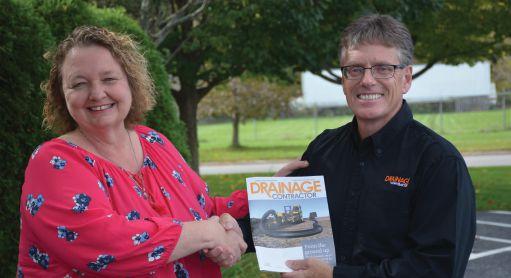
FAREWELL TO ED COSMAN; WELCOMES SHARON KAUK
After more than 30 years of selling print and digital marketing solutions, Ed Cosman, associate publisher for Drainage Contractor, is retiring at the end of Dec. 2018.
After completing college and obtaining a marketing diploma, Cosman started his media career in Nov. 1988 selling advertising space for Glass Canada magazine, one of the trade publications owned by AIS Communications. Then with the Fall 1990 issue, he took over the advertising responsibilities for Drainage Contractor and maintained that role for the last 28 years. Along the way, AIS Communications, which was located in Exeter, ON, was purchased by Annex Business Media in 2006 and Cosman re-located in 2008 to its head office in Simcoe, ON.
“I’ve had a great run over the last 30 years and am honored to have worked with fantastic people – both clients and fellow employees – over that time,” Cosman says. “There have been – and continue to be – changes in way companies market and promote their products, and it’s time for me to step aside and let someone else take over.”
While still relatively young at 55 years old, Cosman will not sit idly at home. He will continue to volunteer his time with a number of local charitable organizations and looks forward to devoting more time to hobbies that have been on the back burner. He and his wife Christie will also be able to spend more time with their grandchildren.
The team at Drainage Contractor thanks Cosman for his many years of commitment to the brand, and wishes him the very best in his retirement.
We are thrilled to welcome Sharon Kauk, the new national sales manager for Drainage Contractor. Kauk, who has been employed by Annex Business Media for 13 years, brings more than 25 years of advertising sales experience to her new role.
Kauk is also the national sales manager for Manure Manager magazine, and the lead for the North American Manure Expo. Her strong advertising and conference background, along with her positive, ambitious attitude and networking skills, make her a great asset to the Drainage Contractor brand.
“I enjoy meeting new people and I look forward to learning and working in the drainage industry,” she says.
Please join us in congratulating Ed Cosman on his retirement, and welcoming Sharon Kauk to the Drainage Contractor team.
A SLICE OF DRAINAGE HISTORY NOW AVAILABLE ONLINE
Recounts of drainage-related research from the archives of Ohio State University are now available online. Anyone can read about the research conducted at the university to develop the American version of corrugated plastic drain tubing and to develop a laserbeam, or laserplane depth and grade-controlled drain plow for the drain tubing’s rapid and accurate installation.
The Ohio State UniversityFood, Agricultural and Biological Engineering (OSU-FABE) website has been revised and updated to include stories about the cooperative research conducted by the USDA-Agricultural Research Service (ARS) and the department of agricultural engineering.
Subsurface drainage research and equipment development at Ohio State University have made key contributions to a major
transition in drainage techniques. Slow, inefficient installation of heavy clay and concrete tile has given way to lightweight, flexible, corrugated plastic drain tubing installed with laser-beamcontrolled, high-speed trenchers and drain plows.
In addition to reading about Ohio’s contribution to corrugated plastic tubing for agricultural drainage, other publications include research about rubber tractor tires, laser beam automatic grade-control systems and a fun piece about the slow moving vehicle sign.
Further history on the beginning of modern subsurface tile drainage, research stories and supporting documents are available online at Transforming Drainage. The printed hard copy versions can be accessed in the International Drainage Hall
of Fame for current and future research and extension engineers, graduate students, and industry officials involved in drainage research and development. In addition to the access to printed copies, all the documents were saved in PDF format to facilitate sharing (if requested) via CDs, Flash Drives, and/or E-mail attachments, when visiting Ohio State University’s department of food, agricultural and biological engineering. Requests should be directed to Dr. Larry Brown, director of the Overholt Drainage Education and Research Program.
Read more about corrugated plastic tubing at: fabe.osu.edu/ about-us/history-department/ corrugated-plastic-tubing. Read the beginning of modern subsurface tile drainage at: transformingdrainage.org/ resources/usda-ars-history.
Back to the future
Revisiting the history of drainage before exploring the future of drainage.
by Mike Cook
By the time you receive this magazine, the edited version of LICA’s History of Drainage, We Help Feed the World , will nearly be ready for print. LICA expects to send out more than 5,000 copies to government officials, schools and universities, contractors, and others who are interested in the history of drainage. It has been very interesting to assemble a timeline of drainage evolution, from Cato, the elder in Italy (around 160 BC) to today. Like a lot of modern-day inventions, drainage was slow changing until the mid1960s. By mid-December we hope to have the hardbound book go to print.
E DITORIAL SUBMISSION GUIDELINES
If you have anything interesting for the book, we want to hear from you. All editorial submission should include the following four items:
1. Date: The publication will follow a timeline.
2. What: Describe the action, product or service.
3. Impact: Describe the positive impact it had on the industry.
4. Source: Identify the source. Please submit all editorial to the designated email: LICAHISTORYOFDRAINAGE@ gmail.com
If you have some history you would like to share, please contact Jerry Biuso, National LICA CEO (phone: 908-996-7979, email: gbiusosr@earthlink.net); Bob Clark, project chairman (phone: 317-694-9167, email: bob2@ c larkfarmdrainage.com); o r m yself ( phone: 989-587-3528, email: swms@4wbi.net).
A G LIMPSE INTO THE PAST
Records show John Johnston, a Scottish native, brought drainage to the United States in 1838. Over the years, he laid approximately
72 miles of clay tile on his 320-acre farm. In the beginning, clay tile was handmade in various ways before being mass-produced in kilns, a type of oven that made the process more efficient. When it came to installing tile, contractors relied on hand digging and horses with scrapers. This install method lasted until the Buckeye Trencher Corporation started to bui ld stea m tren chers in 190 2. In the early 1960s, the United States Department of Agriculture Agricultural Research Service at Ohio State University researched ways to line drains with plastic and control the mole plow powered by a dozer with a laser. Mole drains were also common. From then, to the present, tile drainage has modernized in leaps and bounds, with more of its story yet to be told.
LOOKING FORWARD
History is important, but so is the future. From Feb. 26 to March 2, 2019, LICA will host its Winter 2019 convention at the Hilton El Conquistador Resort, in Tucson, AZ. The resort is all-inclusive with many activities and fun things to do, so make plans to attend. The convention is always educational and meeting other contractors yields new ideas. You can visit www.licanational.com for more details. We look forward to seeing you there! DC
Mike Cook is the current president of the Land Improvement Contractors of America. Visit www.licanational.com for more updates from LICA.
SHARING SUCCESS
Bioreactors are an effective tool for reducing nitrate loss.
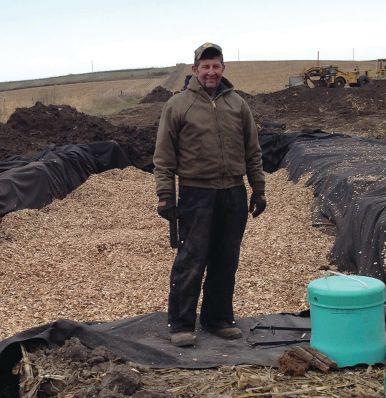
Roger and Louise Van Ersvelde are passionate about conservation and land stewardship on their farm east of Brooklyn in Poweshiek County, IA.
by LIZ JUCHEMS
They shared that passion with more than 50 attendees at a field day this past August, and highlighted the newest practice they are using on their farm – a denitrifying bioreactor.
“Installing the bioreactor was the next logical step for helping to do my best to help make sure the water leaving our farm is as clean as possible,” Van Ersvelde says.
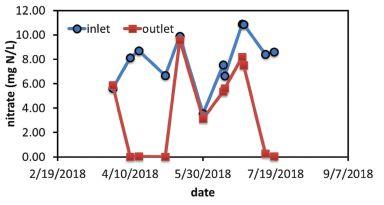
Their denitrifying bioreactor was completed fall of 2017 with assistance from the local Natural Resource Conservation Service staff and Poweshiek County Soil and Water Conservation District. To measure the performance of the bioreactor, they partnered with Andrew Graham, assistant professor of chemistry at Grinnell College, to collect and analyze paired samples collected from the inlet and outlet structures.
Photo courtesy of Andrew Graham, Grinnell College.
1. Average nitrate removal is 46 percent from March to July 2018.
2. Higher removal efficiencies were observed during lower flow times (March-Early May and again in July). Removal efficiencies ranged from 10 to 30 percent during highflow times.
3. Removals of total N are pretty comparable to nitrate removal. This indicates the bioreactor is promoting denitrification to primarily nitrogen gas and not generating ammonia.
4. The high nitrate removal tends to coincide with high-dissolved organic carbon concentrations, suggesting that the extent of denitrification is strongly dependent on the amount of readily degradable carbon.
“If you care about the environment, bioreactors are a great practice – even with no direct benefit to the landowner,” says Dave Maxwell, the contractor who helped install the bioreactor.
To learn more about bioreactors and other edge of field practices, visit iowalearningfarms.org/field-edge-practices. DC
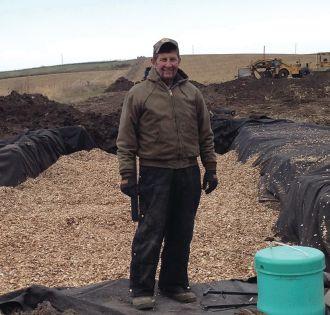
RIGHT: Roger Van Ersvelde is now using a denitrifying bioreactor on his farm. Photo courtesy of Poweshiek County Soil and Water Conservation District.
Joining forces
Gaining community support for agricultural drainage improvement projects, one landowner at a time.
by Chuck Brandel
Mo st
landowners, agencies, and consultants are beginning to see the mutual benefits of implementing best management practices (BMPs) to manage water, enhance crop conditions, and improve water quality.
Multi-purpose drainage management (MDM) plans, which incorporate a combination of BMPs, tend to have the most significant impact on crop production, wildlife habitat, and water quality. However, the implementation phase of these plans require co-ordination with drainage authorities, multiple agencies, and landowners on a varying list of land practices, commitment levels, funding sources, and approvals necessary to proceed.
WHAT'S THE HOLDUP?
Why are landowners hesitant to support MDM and other drainage projects?
Landowners want to see that things work. I feel that they’re comfortable with the dependable drainage systems built one hundred years ago; however, many are unaware of the deteriorating condition of their existing system, and new ways to accomplish drainage, enhance crop production, and protect natural resources and habitats simultaneously. To get them fully on board, it is imperative that project teams build trust, introduce opportunities for outside funding, and present practical options for implementation.
FINDING A WIN-WIN
What’s the best way to convince landowners that MDMs really are a win-win for drainage districts?
Bringing landowners together, listening to their concerns and priorities is the first step in building trust. Instead of pointing out individuals, strengthen the sense of the community of landowners within the watershed by encouraging each to take responsibility of one area of the project for which they are especially invested. Also, when meeting with a group of landowners, it is important to bring options for
their consideration, including a good (baseline option), better (a great option), and best (a home run). Each of these options should include drainage repairs, improvements, and strategies to enhance crop conditions with a variety of BMPs. Each option should also reference the impact of potential grant and outside funding, as landowners are much more willing to introduce BMPs when these potential opportunities are available.
Most importantly, do not lead with water quality, the landowners are interested in drainage first and foremost. Introducing options without asking for commitments early on will allow the concepts to be understood first and consensus can build as the meeting progresses
FINDING THE FUNDING
Funding is important to landowners, but how does one go about co-ordiating applications between landowners, agencies, and drainage authorities?
First of all, it is important to recognize that some landowners see public agencies as an adversary, with requirements that are time consuming to fulfill, making crop production more costly. Therefore, building trust and consensus among these groups are critical. Emphasizing that collaboration from multiple landowners significantly improves the drainage authority’s chances of actually securing funding verses individual landowners is a small, but nevertheless important first step in building support for co-operation. DC
Chuck Brandel, PE, is the vice-president of ISG. Chuck’s significant expertise in agricultural and rural drainage is widely recognized throughout the upper Midwest and has made him a frequently requested authority and designer on many drainage projects throughout the region. Chuck understands the required processes and procedures for these projects and works closely with landowners, drainage authorities, contractors, and regulatory agencies, both in design and funding allocation.
by STEPHANIE GORDON
DIGGING INTO DRONES
Contractors can still benefit from the technology without buying a drone for themselves
Drones need no introduction. Stories about drones hover on technology websites and never seem to go out of style. But what value does this former “next big thing” bring to the drainage industry?
Scott Hiebert is the co-founder of Green Aero Tech, a drone mapping service serving Western Canada. His company offers a mapping service that primarily uses drones, or UAVs, to create an accurate elevation and visual model of a field. After showing what drones can do to his first customer, the customer responded with “that’s a pretty picture, but none of that matters until I’ve got my water under control.”
Drones can be used to help drainage contractors, but the priority is still installing good drainage. Over the past several years since drones have landed in the industry, the general verdict amongst contractors is drones aren’t worth the time, money, or the learning curve that’s required to use them. What’s more, it’s
not feasible for each individual contractor to buy a drone to survey a field. Drones and drainage are remaining as two seperate industries, with drainage contractors who see the value in the data provided opting to contract out to drone companies to utilize their services.
“It’s economies of scale, we don’t know anybody that’s big enough to make it work,” Hiebert starts. “I’ve got three [drones] in the truck right now and a typical crew will probably run $80,000 to $100,000 CAD [$62,000 to $78,000 USD] worth of equipment with them.” Green Aero Tech currently spreads that investment over four provinces across Canada and plans to expand into the United States too.
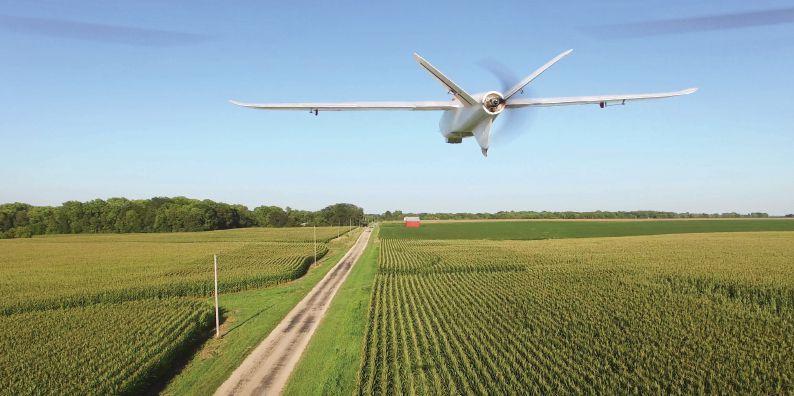
One of the benefits of drones is being able to take on large scale projects, and not be limited by barriers on the ground. Photo courtesy of Corey Getz.
RIGHT:
In the United States, Corey Getz and Quint Shambaugh are co-founders of DIGS Associates, where they use UAVs for topographic data collection on large scale watersheds and design engineer drainage water management systems. Both Getz and Shambaugh were drainage contractors designing and installing tile before moving on to create DIGS Associates. They’re aware of the barriers facing contractors to adopt this technology, but want to help contractors benefit off the technology to improve how drainage is done. “Corey and I, when we participated in the industry, we saw some things that we wanted to make better and that’s how we developed this business model,” Shambaugh says.
The costs of the drone hardware, software, accessories and all the knowledge it requires, is a cost absorbed by drone companies that offer up their services to contractors.
PROS AND CONS OF USING DRONES
It’s no surprise that a con associated with using drones is the cost involved –commercial-grade equipment can have high price points that are inaccessible to some. However, even in the past couple of years the accuracy and ability of UAV equipment has grown. Drones can cover more ground and produce more accurate data than a traditional in-field survey. They can fly over wet, rough ground and reach places other equipment, such as a side-by-side, cannot. Being in the air eliminates a lot of barriers faced on the ground.
“The fields can be muddy, they can have bales on them, the guy can be cultivating, it doesn’t have to be harrowed, as long as it’s harvested, or I can see 50 percent [of the ground], we’re going,” Hiebert says. As a farmer himself, Hiebert also mentions that drones help avoid biosecurity concerns because you don’t have to enter the field to gather the data. Green Aero Tech also gathers visual images, not just data points, but a bird’s eye view of the field so one can crossreference the data if there’s irregularities. Hiebert explains one of the positives of photogrammetry (where measurements are made from photographs) is the accuracy, but one of the downsides is not being able to see through thick vegetation.
Flying means that you don’t have to follow a snake pattern, like most contractors do when driving a field.
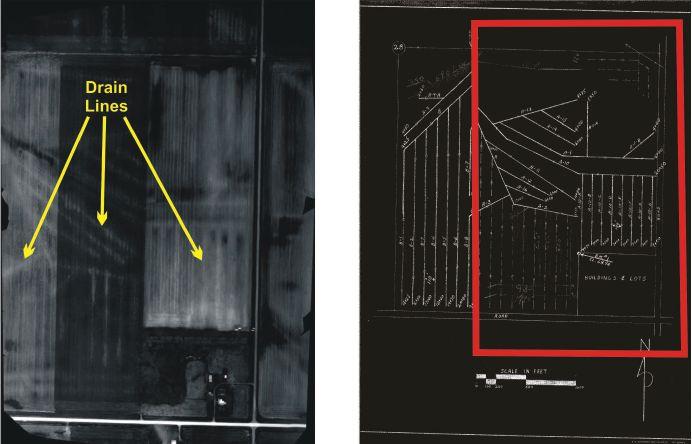
After a large rainfall event, drain lines are easier to spot using thermal infrared cameras attached to drones. Photo courtesy of Barry Allred and Greg Rouse, obtained in co-operation with Adam Batschelet, WinTec Arrowmaker Inc.
Shambaugh explains how the drones collect data in a grid pattern, so you can have every inch covered, and can determine with more accuracy where the low and high spots are. An average project for DIGS is close to 1,000 acres and they typically collect three layers of data.
Drones do have their limits: they don’t work well with water, wind and vegetation. If there is too much water on a field, there will be reflectivity that will affect the data collected. If there’s too much wind, the drone won’t be able to stabilize itself at a certain elevation. Finally, vegetation, like trees or standing crops, give off false readings and prevent the drone from feeding back accurate data. The best times to fly are right after harvest up until there’s snow on the ground, and after the snow melts but before the crop is too high – which is still a larger window than on-the-ground surveys.
With this larger window, the scope of projects they’re able to tackle is also larger. “We look at things from a holistic scope, and so when we have a client that contacts us about 80 acres, we don’t just identify their 80 acres . . . we identify all the water that hits the watershed that could possibly affect the 80 acres,” Getz says. Looking at the bigger picture allows DIGS to look at larger-scale nutrient loss reduction strategies that can help an entire watershed and not just an individual landowner. Working within an entire watershed allows for opportunities for landowners to work
together, share in mains, sub-mains, or lower their costs with cost-sharing.
Would these kinds of large-scale, long-term solutions be possible without drone technology? “Not even close,” Getz says. “There's no way we would be able to be where we are at today to identify watersheds like we do, as quickly as we do it allows us to get it done in one project rather than have several projects over the course of a decade or two.” With news stories fixating on water pollution, nutrient runoff and other environmental concerns, these holistic approaches made possible through drone technology could be a way forward for policy makers and contractors alike.
HOW CAN CONTRACTORS BENEFIT FROM USING DRONES?
Ryan Maltby is a drainage contractor working 20 miles south of Springfield, IL, installing field tile, excavating, and completing all other forms of dirt work. Maltby has worked with DIGS on several projects since the company started three years ago. The maps, data and drainage plan he receives from DIGS help Maltby with the legwork part of drainage so he can concentrate on putting tile in the ground.
“I don’t know if you can put a dollar amount on the amount of time it saves you,” Maltby says. Contractors do most of their work when the weather is nice, whereas drones can fly when it’s muddy or freezing temperatures. “You don’t really want to take the time to go drive a
Land Improvement Contractors of America
LICA has been serving contractors across the country for 75 years, providing our members with the tools they need to “work smarter not harder.” Below are a few of our member benefits.
field and do a design when you could be spending your time more wisely actually getting the work done.” In addition, the drones don’t tear up the ground and preserve equipment that would’ve been driven through a chisel-plowed field in the middle of winter.
Drones also help gather information after a big rain, without needing the land to dry, so that drainage contractors can better understand the damage. Reading after the rain paints a more accurate picture about how much water is actually held by the land. Maltby explains that when you’re in the air looking at a hole that is holding water, you’re able to better understand what gear you need. “You can upsize your tile to make sure you handle that amount of water, which is a big part of making a customer happy at the end of the day.”
DIGS has been compiling all the data the company has been collecting over the years of surveying watersheds. Currently, the information is shared with contractors who work with them on a project, but they continue to pursue other layers of data for their files to use for future projects. In addition to gathering data, DIGS creates drainage plans, but they’re always reviewed by the contractor they’ve partnered up with to execute the project. “We want them to have more information, we want them to be in the driver's seat, we want them to make informed decisions,” Shambaugh says.
Drone information can be a lot to sift through. It’s only a pretty picture until you’re able to do something with it. “That’s exactly why we’re here,” Shambaugh says. “We ask a lot of our contractors: we ask them to be engineers, we ask them to be mechanics, we ask them to be accountants, we ask them to be salesmen . . . we’re here to help them determine the information.”
Green Aero Tech currently only offers drainage analysis without providing the final drainage plan, but Hiebert still sees value in working with contractors. In Hiebert’s own experience across Western Canada, their biggest hurdle is landowners not taking water management seriously. “That’s where these contractors have a lot of value, and that’s why we like working with them, because the data gets used,” Hiebert says.
USING DRONES TO FIND OLD DRAINAGE PIPES
Barry Allred, a USDA research agricultural engineer, and Greg Rouse, a GIS co-ordinator for Ross County Soil and Water Conservation District in Ohio are creating guidelines that will help people use drones to locate old drainage pipe. They started mapping tile lines as they were being put into the ground, giving the farmer X and Y co-ordinates showing the tile lines. But then turned their focus to the lines already in place, trying to find an efficient way to map old drainage tile to help farmers and contractors who are retrofitting and repairing tile.
One significant observation to date, according to Allred and Rouse, is that several days after a large rainfall event, the tile is easier to see. “The soil directly over the drain line will dry out first, be lighter in colour and reflect more light, and have a different temperature compared to the soil between the drain lines which is darker and might also be a different temperature,” Allred explains. So far, the project has seen a lot of success with thermal imagery to spot old pipe. Water has a very high specific heat capacity,
EFFICIENCY THROUGH INNOVATION
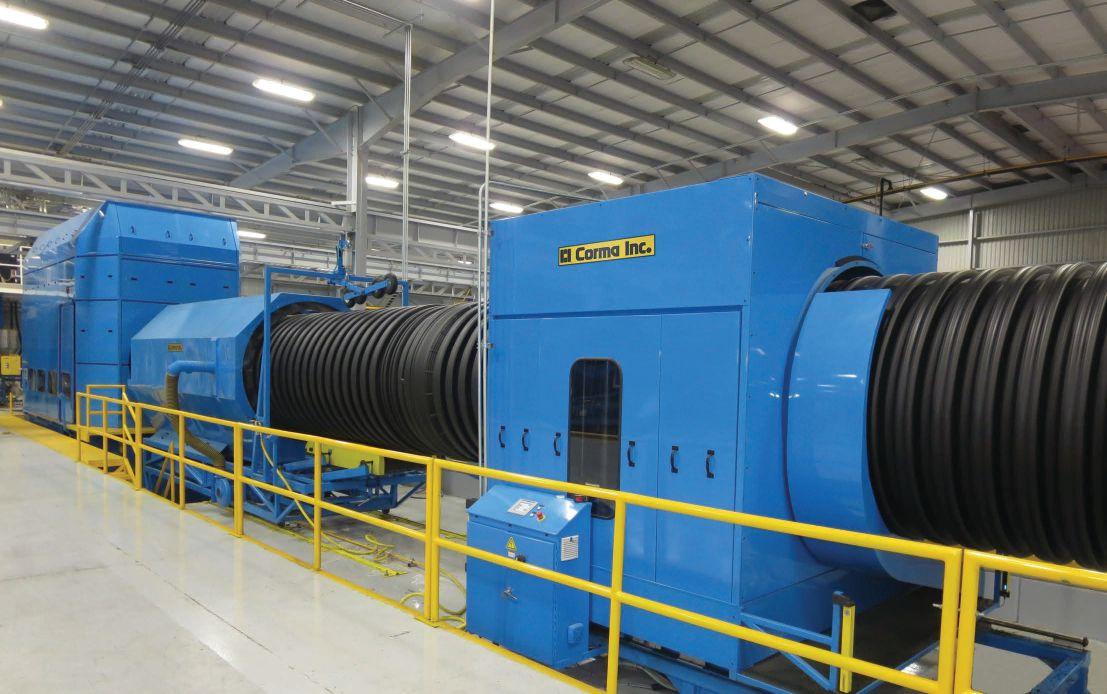
CORMA
Innovation revisited
How
do we
encourage change and adoption of new practices?
by Jacqui Empson Laporte
I
previously wrote an article about barriers to adoption of innovative drainage practices. Those barriers included risk aversion, practices of adjacent landowners, economics and local conditions.
I’ve putting some thought into the construction of a funding/education program that would help us all move past some of these barriers.
A simple program includes a list of technical support, equipment or materials that are funded under the program. The rationale behind these types of programs is that if assistance is provided to purchase what is needed, then the new actions, technology or practice will be adopted. An example might be a program that provides 30 per cent of the cost of a no-till drill, or up to $20 per acre for cover crop seeds. These types of programs are simple to understand, easier to administer, and provide the tools people need to adopt a new practice.
Supporting farmers, contractors, and practitioners in making this change is important. However, a question about effectiveness remains – are the people who participate in this type of program the ones who had already decided to adopt this BMP? Is the cost of the equipment or materials the barrier to adoption? I would suggest that the bigger cost or risk to adopting a new BMP is not the equipment or materials, but
the implementation and troubleshooting. There is also that fine balance between extension and outreach, and allowing the farmer/contractor the opportunity to learn and explore on their own. Extension and funding programs (at least in Ontario) tend to be short term and heavy on the front end. The assistance in the longer term, after implementation, is harder to account for and fund because we don’t know what we don’t know. What advice, support or assistance will the farmers and contractors need? What data, outcomes or information will we, as extension specialists, need?
If the real barrier is implementation, then how do we encourage those producers to try a new practice? Take a risk? Evaluate the results and adjust accordingly? If we were interested in program effectiveness, we measure not what practices the person did, but whether or not they moved along a spectrum of innovation. What is innovative for one person is old news for another. If we were to rank farmers and contractors on a spectrum of innovation of one (being low) and 10 (high), we would find that those ranked higher are the ones that we tend to promote as speakers, landowner ambassadors and champions. How can we work with the ones ranked lower?
Some ideas that I’ve had to make this work include:
1. Similar to a career test where people answer questions and the outcome provides advice on potential suitable careers, what if we had a way of asking questions to identify and r ank s omeone’s r isk t olerance? Willingness to adapt? That would provide a baseline measurement to track progress.
2. Is education really a barrier? From mentoring, field days, trade shows and local programs to Twitter and YouTube, there are tons of formal and informal opportunities to learn new things in agriculture. How do we help match people to the opportunities that suit them the best? Can we prevent people from being overwhelmed at information
overload, and simply try to point them towards step one?
3. Could we implement an equipment co-op or lending program that allowed a farmer or contractor to try out a piece of equipment to test it before making a purchase that might end up being a costly mistake? This happens on an ad hoc basis already, when neighbours, friends or family share equipment.
4. What if we encouraged people to do test plots and paid them for any yield drops that could be attributed to the trial? (This focuses on the activity and learning, not the tools themselves).
5. Is there some type of precision ag tool or technology that could allow
us to monitor and take appropriate actions, so that the risks, troubleshooting, opportunities or benefits could be addressed sooner? I’m always interested in hearing from farmers and contractors. What do you think would – or wouldn’t – work when it comes to implementing programs? DC
Jacqui Empson Laporte is an environmental specialist and a member of the drainage team for the Ontario Ministry of Agriculture, Food and Rural Affairs. She is also a director on the board of Innovative Farmers Association of Ontario, and is responsible for managing projects related to Lake Huron water quality. Her interest is the design of environmental programs.
Ready to tile?
Each tiling project is unique, just like the land itself.
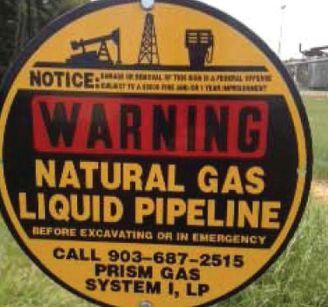
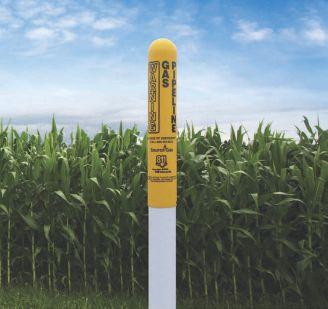
Pipelines or utility lines can be 12 inches or less below the surface. Marker signs, like those to the right, identify the general location of underground lines. But lines don’t always follow a straight path. And they may not be as deep as you think.
Always call 811 or visit clickbeforeyoudig.com to have underground pipelines and utilities located before you tile.
Defining sufficient outlets
Land owners and contractors could pay damages if surface water isn't redirected to a sufficient outlet.
by Sid Vander Veen, drainage co-ordinator, OMAFRA
ALICO member asked me for a definition of the term “sufficient outlet.” This lead to a series of questions:
WHY SHOULD SUFFICIENT OUTLETS BE IMPORTANT TO A TILE DRAINAGE CONTRACTOR?
The answer to this question stems from court decisions. When surface water is collected, the courts often follow the principal outlined in the 1897 appeal court decision in Ostrom v. Sills. In this decision, the judge writes the following:
“Generally speaking, the upper proprietor may dispose of the surface water upon his land as he may see fit but he cannot by artificial drains and ditches, collect it or the water stagnant pools or pond upon his premises and cast it in a body upon the proprietor below him to his injury. He cannot collect and concentrate such waters and put them through an artificial ditch in unusual quantities upon his adjacent proprietor.”
This means that if surface water (including tile drainage) is collected and directed onto a lower property, the property owner (and possibly the contractor) could potentially be held liable for the damages that result. The collected water must be brought to a sufficient outlet.
W HAT IS THE DEFINITION OF A SUFFICIENT OUTLET?
In the development of municipal drains in Ontario, the Drainage Act defines “sufficient outlet” as “ a point at which water can be discharged safely so that it will do no damage to lands or roads . . .” Although the Drainage Act does not regulate tile drainage systems installed on private agricultural land, this definition still provides a good direction for tile drainage contractors. The legal sufficiency of an outlet under common law can only be decided by a judge. Examples of sufficient outlets include: • Municipal drains, but only for the area of land that is actually assessed into the municipal drain; before connecting to a municipal drain,
contractors should contact the drainage superintendent about connection conditions (e.g. a 1 ft. freeboard).
• Natural watercourses, but only for the land that is in the watershed of the natural watercourse. Permits may still be required from the local conservation authority.
• Mutual agreement drains.
Roadside ditches or other private ditches may have the capacity to handle the flow from a tile drainage system, but they are private systems. They are not a legal outlet unless the owner of the private system grants permission for the connection. Even with permission, caution is advised. These private systems often drain across another property owner or owners, and these other owners may be of the opinion that the connection is causing damages on their property. So even with permission, the potential liability could still extend further downstream.
AR E THERE OTHER SOURCES OF INFORMATION ON THE COMMON LAW AS IT RELATES TO WATER?
There is an excellent book entitled “Water Law in Canada – the Atlantic Provinces,” which contains a chapter on surface water and another chapter on riparian rights. John J ohnston o btained pe rmission f rom t he publisher to post a scan of these chapters on the LICO website. You can find them here: www.drainage.org/reference_publications.html
LICENSING UPDATES
As of August 13, 2018, there were 101 licensed tile drainage contractors in Ontario. There are 221 licensed machines and 450 machine operators (263 Class A). Remember, you are supposed to have your licenses with you when performing your work as a business or if you are operating a machine. It seems that no one goes anywhere anymore without their phone. Why not take a picture of your license with your phone? DC
TEST DRIVE
Checking out the 2019 Chevrolet Silverado.
Trucks have never been more important to a manufacturer’s bottom line; not only because they are selling in ever-increasing numbers, but also because there just doesn’t appear to be a price ceiling.
Customers keep loading up new pickups with luxuries that only a few years ago were found only in sedans. It’s this hunger for constantly increasing content that pushes prices up as these up-market extras quickly add up.
For 2019, Chevrolet has released an allnew generation of Silverado, now offering eight trim levels, six different engine and transmission combinations – and for the first time – a new Duramax 3.0L turbodiesel. These trim packages not only offer groups of conveniences but they also cover the very necessary work truck (WT) market right up to the opulent High Country. Within each trim level customers still have ample options when it comes to custom building the truck they need. Cabs, box lengths, powertrains, gearing and sundry equipment – Chevy does not believe in one-size-fits all.
For this generation of Silverado, Chevy is mining its history and addingelements from previous generations of trucks. The notable one is the “Chevrolet” name stamped on the tailgate that dates back to ’50s and ’60s. The center-grille mounted
bowtie is also iconic; however the new look is anything but rounded as the designs of previous trucks. This new body is square, tall and slab-sided, offering a powerful profile. Sitting on up to 33-inch tires just amplifiesthat impression.
Though this next-gen Silverado is larger than its predecessor (1.2-inches wider, 1.5-inches taller, 1.7-inches longer, with 3.9-inches added to the wheelbase) it is lighter by some 450 pounds. A mixed materials approach to construction is the reason for this. Strategic use of aluminum and more high-strength steel has lowered the weight; yet the frame is actually 10 percent more rigid than the outgoing model.
The cargo box on the truck is what makesit a pickup – a feature that’s been the same from day one. It’s also the feature that changes the least from generation to generation – but not this time. Chevy has spent time and money on the business end of this new Silverado firstly by increasing the cargo volume to best-in-class. By widening the inner box walls to mimic the outer body panels, they have increased the
by HOWARD J. ELMER
available space by as much as 20 percent. This spacealso boasts 12 fixed tie-down points with a sheer force of 500 pounds each (twice the previous rating). There are also nine moveable tie-downs. The box has task lighting and a 120V power outlet in the sidewall. Getting in and out of the box is also easier now with even larger cut-outs in the CornerStep bumper and large stakehole handholds.
Below it all is the rolled steel bed floor, which is now using an even higher grade of high-strength steel. Silverado also offers four versions of its tailgate. A standard, manual unsprung gate; a manual gate with lift-assist; a power locking version and even a power up and down gate with automatic release. Each of these is lockable. Making use of this additional space in the new bed are available storage bins that fit over the wheel wells which still leave the floor clear.
Multiple powertrains are another feature that gives customers necessary choices and Chevy has new mechanicals in its 2019 lineup, including the diesel.
Details are being kept under wraps until late in the year.
Gas engines include updated versions of the 5.3L and 6.2L V8’s along with an allnew 2.7L turbo engine that is now the base engine on the high-volume Silverado LT and RST. It offers 22 percent more torque and greater fuel efficiency that the 4.3L V6. However this V6 and the 5.3L V8 will still the chief options on the entry-level and WT models.
An exciting development in fuel efficiency for this new generation is a technology called Dynamic Fuel Management (DFM). Unlike the current Active Fuel Management (which runs as either an eight-cylinder or four-cylinder), the new DFM can fire on as few as two cylinders. Studies have shown that under normal usage, a DFM-equipped engine was running on less than eight cylinders 60 percent of the time. This translates to a nine percent improvement in fuel efficiency over the old AFM system.
The stretched body on the new Silverado translates to more room inside the cab – starting with added threeinches of rear-seat legroom for a total
of 43.4-inches, which almost equals the 44.5-inches available to the front seat driver and passenger. The other benefit of more space is storage and Silverado has built new features into the second row starting with two 10L bins integrated into the seat backs. Under the rear seat there is a moulded, compartmentalized, 24L storage tray.
In the front, by going with a traditional gear shift lever, the entire centre console/ armrest is a massive storage space organized into several transforming spaces that will accommodate pretty much anything your daily life requires – along with all the electrical inputs and outlets necessary to run them. The interior itself is better seen, then described. However, it is, without a doubt, the best interior Chevy has ever put forward.
3.0L turbo-diesel.
Each transmission is coupled to the appropriate engine, as needed. At the lower end (power and price-wise) is the automatic six-speed. The new base 2.7L turbo pushes power through an eightspeed gearbox; it also is the main choice for the 5.3L V8. The new 10-speed is found on the 6.2L V8 and will power the coming
The 2019 Silverado has a max-towing limit of 12,200 pounds. New maximum payload has increased by 340 pounds to a hefty 2,500 pounds. To handle these new weights, Chevy has added some very welcome and slick towing technologies. First, up to four cameras offer different views while hitching. This includes hitch guidance lines on the centre display and a choice of views. After the driver has lined up the hitch and shifted to park the parking brake sets automatically – avoiding that slight roll that wrecks the alignment. An optional feature is a trailer tire temp and pressure monitor. An industry first, this system allows the driver to keep an eye on the trailer tires. A new trailer light check system runs the lights in sequence as you watch. This feature can be activated from inside the truck or via a MYChevrolet Trailering App on your smartphone.
The new 2019 Chevrolet Silverado will be coming to dealers this fall. DC
Stay tuned for another instalment of Howard Elmer’s truck reviews in the May 2019 issue of Drainage Contractor.
IOWA DRAINAGE SCHOOL 2018
Staying up to date with subsurface drainage
Continuing education is part of any career – including a drainage contractor’s. Agricultural drainage systems are complex. Contractors must pay attention to local laws, soil types, slope, environmental considerations and size, depth and spacing of tile.
by DR. KAPIL ARORA
Iowa State University, in collaboration with the University of Missouri and Iowa Soybean Association, hosted a farmland subsurface drainage school in August 2018 at the Borlaug Learning Center in Nashua, IA. The three-day Iowa Drainage School included classroom lectures, discussions, team problem solving and field exercises, and provided a unique educational opportunity for attendees, which included contractors, farmland owners, drainage consulting engineers, drainage equipment manufacturers, county officials, and technical service providers from eight different states. The school focused on the fundamentals of drainage design including understanding soils, obtaining an accurate survey, drainage pipe size and spacing, controlled drainage
and water table management, sub-irrigation, legal considerations, different installation techniques and equipment.
SURVEYING THE LAND
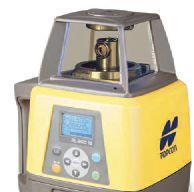
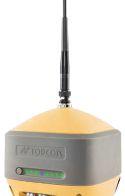
The school started with a morning session to help participants understand soils and their properties influencing water movement. Participants then conducted augur-hole tests to see how quickly water moves laterally within soil. In the afternoon, participants worked in groups to complete a field survey using handheld GPS units and Laser Levels in collaboration with Roger and Brady Kolbet of MidTech Services. Thinking like surveyors, participants learned how to correct common elevation and horizontal location issues, and how to work with contour maps to determine
RIGHT: Mark Paca, from Midwest Pipe Supply, talking about the things to consider for a quality installation.
MASTENBRI O IEK
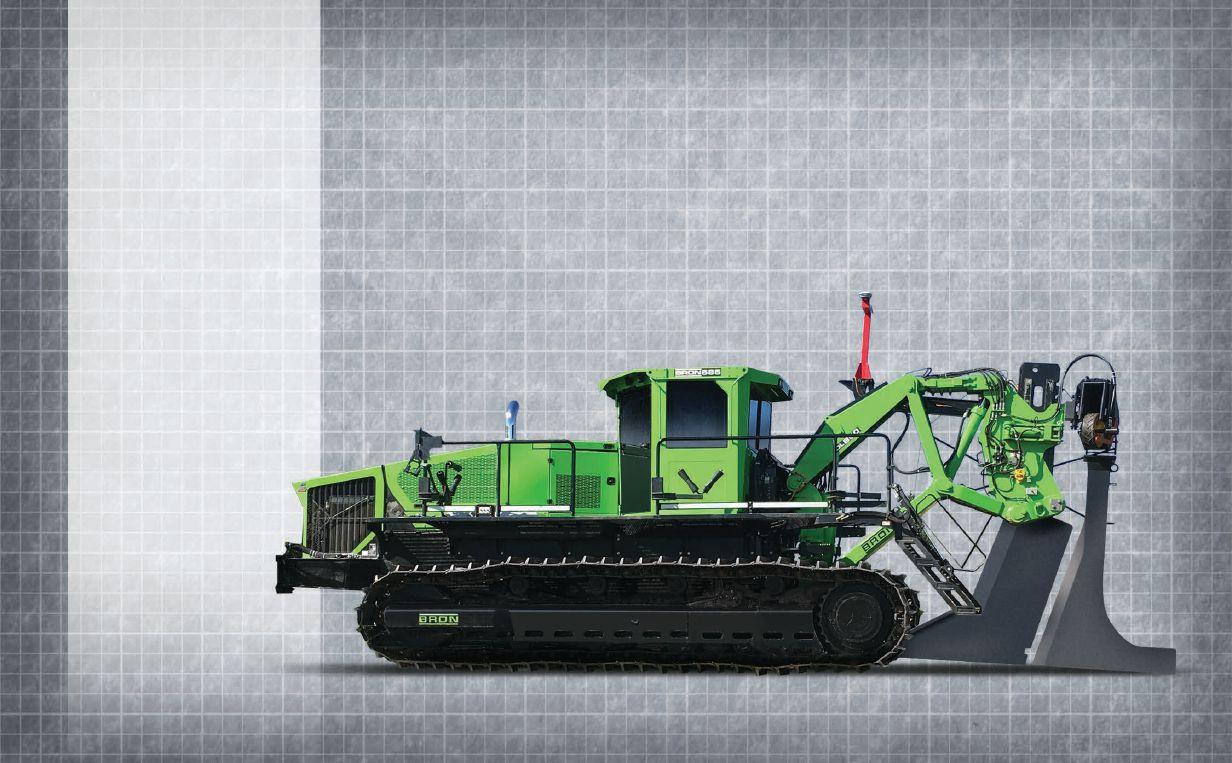
V-blade plow minimizes soil disturbance for optimum drainage results
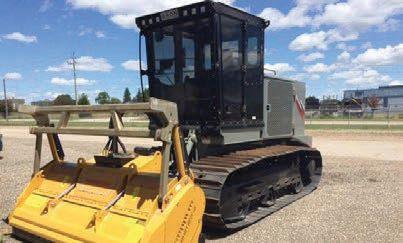
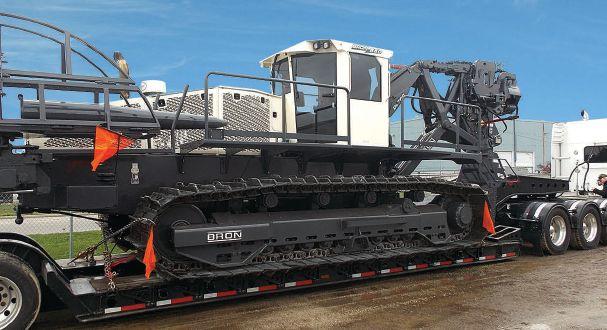
2017 BRON 275 740 Hours, c/w Seppi 225 Miniforest Mulching Head, D4 U/C with GFT40 Motors, Demo Unit
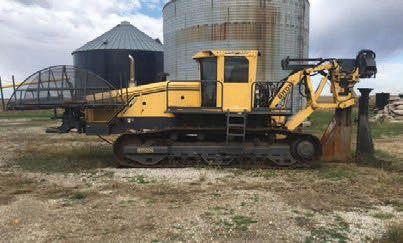
2013 BRON 350 QSM-11 Cummins Power, DL400 Plow, Chute, 32” Pads with Ice Picks, Dual Steering, Tow Cable
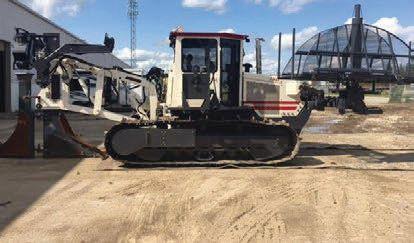
2017 BRON 150 DL375 Plow, Cat Engine, Reel Carrier, Tile Puller, Factory Demo 100 hours, Factory Warranty Included
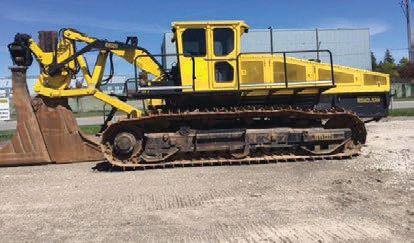
2008 BRON 450 DL750 Plow, Cat Engine, 32” Pads with Ice Picks, Auto Greaser
www.rwfbron.com
■ Five Core Cooling System exceeds cooling for Tier 4 engine standards
■ Quieter Reconfigured Cab Interior for Operator comfort
■ Standard DL 850 Drainage Plow increased strength & durability
■ LED Light Package for increased visibility for those long days in the field
■ Improved swing mechanism for the Onboard Reel for smoother reel speeds & consistent torque
■ Optional hydraulic rear step raises out of the way when plowing and lowers when required.
■ Standard oscillating track frames.
■ Fluid Samples for All Fluids
■ 150 Point Machine Inspection
■ Internal Inspection All Drivetrain Components
■ Required Factory Repairs
■ New & Used Equipment Sales
■ Parts & Service all BRON Products
■ Selected All Makes Parts for Construction Equipment
■ Certified Rebuilds on BRON Products
■ Custom Fabrication
■ New Paint
■ Factory Tested
■ New Certified Serial Number Assigned
■ 6 Month Warranty Assigned
■ Repairs on all Drainage Plows & selected Construction Equipment
■ Parts Facility in Marine City Michigan
■ Road Service for all BRON Products & other selected Equipment
■ Parts Facilities in Woodstock ON and Marine City MI.
CONTRACTOR AT WORK
available depths of installation. In the evening, participants observed demonstrations of three different drainage design softwares, GK Technology’s SD Drain, Trimble’s FarmWorks, and Ag Leader’s SMS Advanced, to lay out tile.
PLANNING IT OUT
Groups worked through problem sets to understand how tile size is influenced by the installation site and learned how to size drainage tile for a specific drainage coefficient. Participants put all the information
together to complete a drainage plan for the field that was surveyed on the first day. To conclude the day, Jacob Handsaker (Hands-On-Excavating) and Jim Johnson (Johnson Tile Plow) discussed using GPS and laser levels for tile installation.
BOULDERS, BARRIERS AND RUNOFF CONCERNS
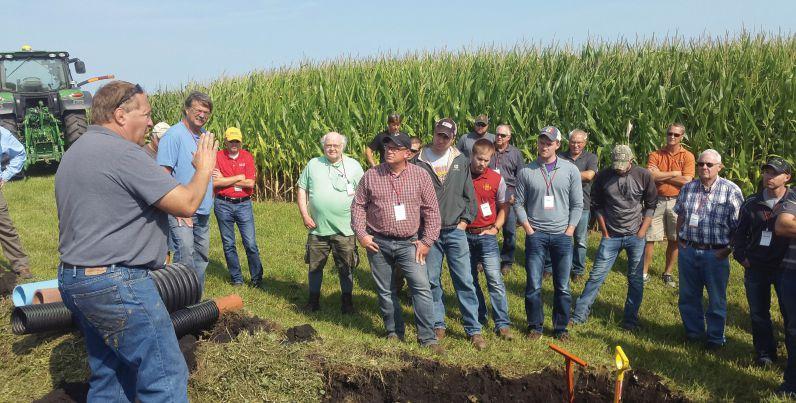
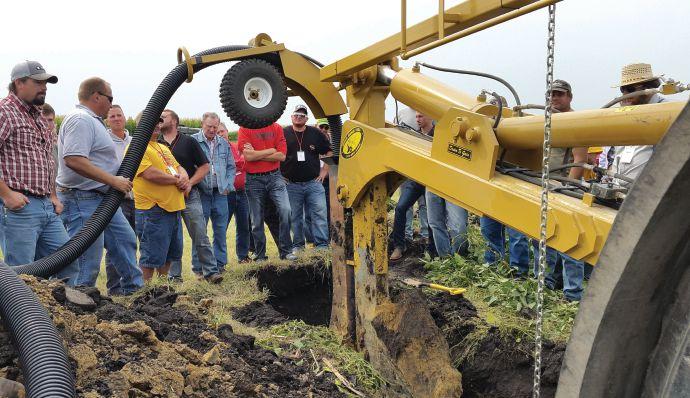
Participants learned how to install tile on contour lines, use control structures and followed a field demonstration of tile installation which wasn’t without its barriers. A big boulder stopped
a tile plow dead in its tracks during the installation. The demonstration showed participants how to work with big boulders and after, following the demonstration, Mark Paca (Midwest Pipe Supply) led a discussion on the various issues faced during tile installation and simple strategies to achieve a quality installation.
In addition to learning how to install tile, the school participants learned the potential environmental effects of drainage such as nutrient transport. Participants learned how to reduce nitrogen concentrations in drainage water with wetlands, woodchip bioreactors, conservation drainage, saturated buffers, shallow drainage, drainage water recycling and cover crops.
Ray Slach shared his experience with excavation safety and the need to call “811-One Call” to locate all the buried utilities when planning and installing drain tile. Don Etler (Bolton and Menk Engineers) spoke about drainage laws and how they relate to drainage district functions.
The school concluded with each group presenting their drainage plans. Each team discussed different features of their design and how these features addressed functionality, flexibility and performance. DC
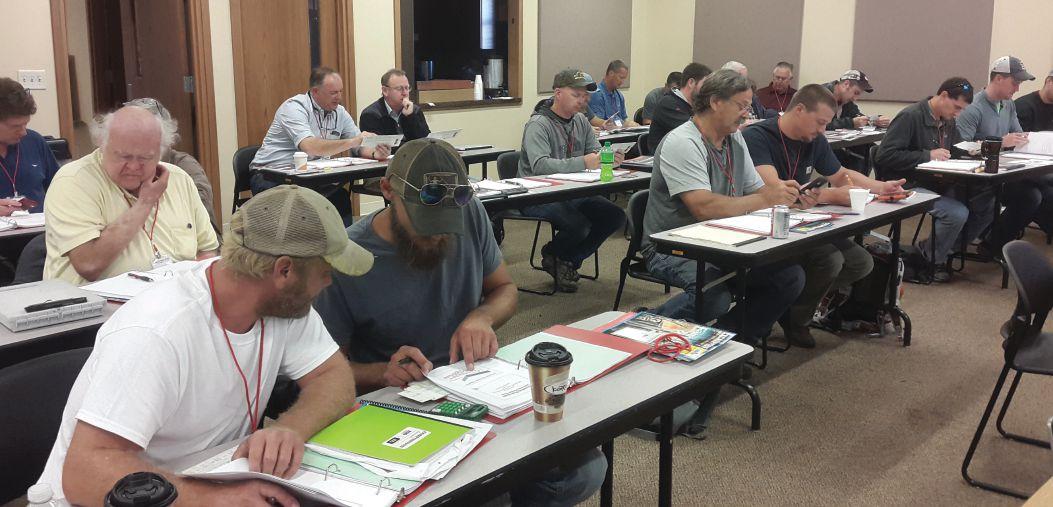
Iowa Drainage School participants working on problem sets in teams. Photo courtesy of Kapil Arora.
A photo from Iowa Drainage School 2016. The school has been offered every year since 2007. Photo courtesy of Kapil Arora
TECHNOLOGY
CONTINUED FROM PAGE 18
so depending on the time of day, there will be temperature differences in the soil above the drain line versus the soil between the drain lines.
The research will determine guidelines for the optimal time to be out in the field to collect imagery that will produce maps of old drainage pipes. The researchers are looking at soil wetness conditions, crop residue, soil temperature, the size of a rainfall event and how long after a rainfall event will produce the best results. The project so far has collected data in Ross County, OH, elsewhere across the state of Ohio and in parts of the Midwest.
No conclusions have been made yet, but Allred and Rouse hope to collect a majority of their data when there’s bare ground over the next couple of months and have some preliminary guidelines before planting starts again next year.
“There’s a huge amount of subsurface drainage that’s been installed
The costs of the drone hardware, software, accessories and all the knowledge it requires, is a cost absorbed by drone companies that offer up their services to contractors. Photo courtesy of Corey Getz.
throughout the Midwest, U.S. and Canada, where maps of the existing systems are not available, but the farmers or drainage contractors would certainly like to have those maps,” Allred says. “I would think that this concern would be a market for those that have drone imagery services.”
FINAL WORDS
Are drones going to become more commonplace in drainage? Maybe not, but maybe more contractors will experiment with using the data and maps that this new technology can provide to better their own practices.
“The farmers use technology more and more every year, so therefore we have to use technology more and more every year,” Maltby notices. “You’re always going to find people who want to do it the old way and think that’s good enough, but I feel like to be a sustainable contractor nowadays you have to embrace as much technology as you can.”
Scott Hiebert, of Green Aero Tech, agrees with contractors who don’t immediately see the value of drones. His company has invested a lot of time and effort testing various UAV equipment to see what works best. After many tries working with wrong equipment, he knows the difference between what a $10,000 drone can do and what a RTK (Real Time Kinetic) or PPK drone is capable of. Hiebert tells contractors that just because you had some drone work done and it wasn’t good, it doesn’t mean the technology isn’t there. “[When] done properly with the right equipment it works.”
At the end of the day good business decisions keep the customer in mind. As a farmer, farming 12,000-acres in Manitoba where there’s water issues, Hiebert takes his investment in drainage seriously. “Don’t go out there and use old or poor data, you don’t want to skimp on that.”
Trimble Agriculture
YOUR WATER MANAGEMENT SOLUTION LEADER for
When land improvement contractors need innovative drainage and complete earthworks solutions, they come to Trimble. Why? Because we listen to our customers.
Most of our best ideas come from our users. Laser grade control, levee design systems, field leveling and 3D GPS‑based grade control all came out of talks with growers and contractors.
PLOW & WHEEL TRENCHERS
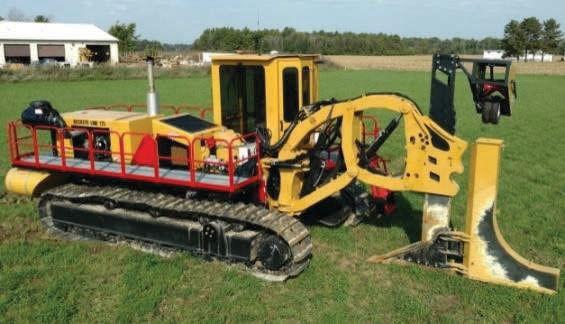
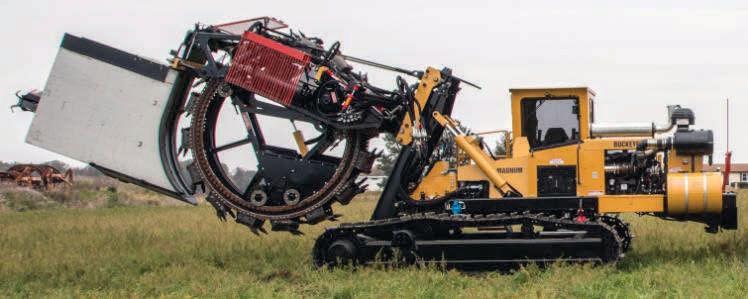
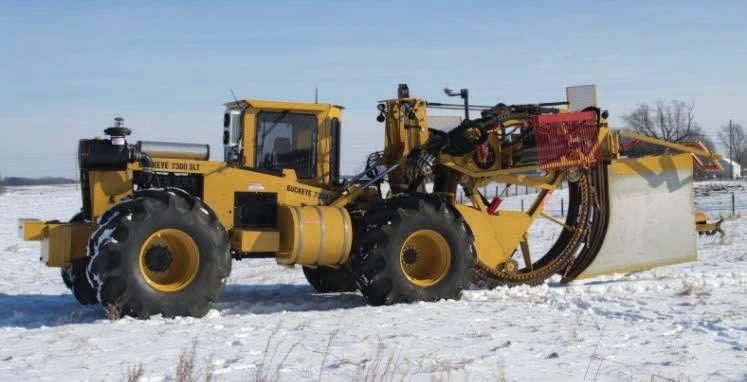
Wolfe Heavy Equipment continues to set the tone for powerful agricultural and commercial trenching equipment. Wolfe’s versatility, superior manufacturing and expert service along with reduced fuel consumption provides increased profitability.
DRAINAGE MANAGEMENT SYSTEMS
KEEP OUT
Phosphorus removal structures are helping to prevent phosphorus from entering waterways.
While phosphorus is a necessary nutrient in agriculture, it is a water quality pollutant that must be prevented from excessively entering waterways. One way to do this is by minimizing erosion.
by TRUDY KELLY FORSYTHE
Chad Penn, a soil scientist with the United States Department of Agriculture, says there are many effective best management practices that minimize erosion, including no or reduced till and incorporating buffer strips.
That said, Penn adds that if soil phosphorus builds up high beyond the need of plants, even with erosion control to prevent particulate phosphorus from leaving the field, there can still be a loss of dissolved phosphorus.
“You would then have to prevent water from leaving a field to slow down the transport of dissolved phosphorus,” he says.
PHOSPHORUS REMOVAL
Unlike nitrogen, which is very unstable in soil, once phosphorus reaches high levels in soil it stays high for a very long time – even if producers stop applying phosphorus and continue harvesting crops.
LEFT AND RIGHT:
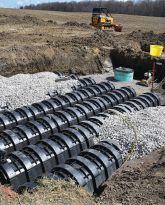
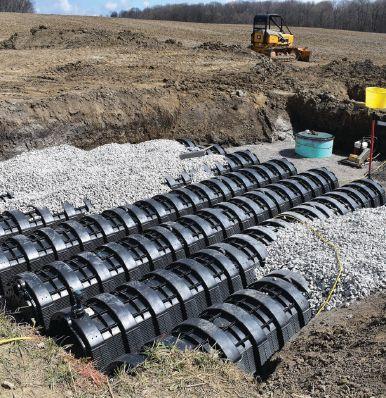
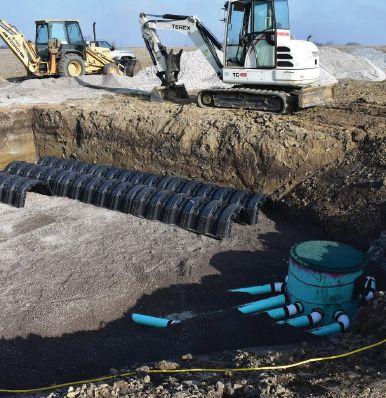
Construction of a subsurface tile drain P removal structure near Waterloo, IN. This was designed for water to flow from the bottom-upward through slag, allowing several inches of head space through use of the infiltrators, to promote flocculation and settling prior to discharge. Photos courtesy of Chad Penn.
“You want between 15 and 30 milligrams per kilogram (mg/kg) of Mehlich-3 phosphorus in your soil; that’s all most agronomic crops need,” Penn says. “If it reaches 300 to 400 mg/kg, it can take around 20 to 30 years for it to get back down. During that long drawdown period, every flow event will leak a little bit of dissolved phosphorus.”
Phosphorus removal structures –structures that contain filters to intercept and trap dissolved phosphorus before it reaches waterways – are having a positive impact on preventing phosphorus from entering waterways. While the structures can appear in many different forms, and be located in a variety of areas including on the surface, in ditches or tile drains, Penn explains they must all have four basic principles:
• They must contain solid media with a high affinity for phosphorus, commonly
DRAINAGE MANAGEMENT SYSTEMS
Left: Building a bed of steel slag during construction of a sub-surface tile drain P removal structure for a project in Dunkirk, OH. Right: A completed ditch-style P removal structure on a poultry farm in Mercer County, OH. This structure was built for water to flowf rom the bottom-upward through steel slag. Photos courtesy of Chad Penn.
known as a phosphorus sorption material;
• The phosphorus sorption material must be contained and placed in a hydrologically active area with high-dissolved phosphorus concentrations;
• High-dissolved phosphorus water must be able to flow through the contained phosphorus sorption material at a sufficient rate; and
• The phosphorus sorption material must be able to be removed and replaced after it is no longer effective.
CHOOSING A LOCATION
Penn says the location of a phosphorus removal structure should meet the following criteria to qualify as a potential site for construction of a phosphorus removal structure:
• Flow convergence must be at a point where water can be directed into a structure, or there must be an ability to manipulate the landscape
• There must be at least 0.2 ppm dissolved phosphorus in the water
• There must be sufficient hydraulic head for pushing the water through the structure by gravity; this is a function of the elevation change or of the drainage ditch depth
• The site must have sufficient space to accommodate phosphorus sorption material
PHROG
While a professor at Oklahoma State University, Penn helped develop a software package that is capable of designing landscape-scale filters that remove dissolved phosphorus from drainage water. Known as Phrog, the software needs several inputs and target goals to design a site-specific phosphorus removal structure.
“To do the design, you need to know how much phosphorus is leaving the site, what the concentration of dissolved phosphorus is and how much water per year is flowing through
where the high phosphorus is,” Penn says. “We put that together to get the calculated load or total mass of dissolved phosphorus.”
Armed with that information, the designer decides what percentage of cumulative phosphorus to remove – Penn says he generally goes with 40 percent removal – over a certain number of years.
DESIGN CONSIDERATIONS
To achieve the input target, designers need to decide what flow rate they want the structure to handle. Peak flow rate is when the majority of phosphor us is lost in large flow events. If installing in a subsurface tile drain, contractors should assume the worstcase scenario that pipe could handle. Other considerations if installing a structure in subsurface tile is how deep it is from the surface to the drain, whether to have the water flow down or upward through the media and what media to use to filter.
“You need to filter from the top
down if you’re using an iron-rich filter media,” Penn says, explaining they tend to use industrial by-products for the filter media because they are typically readily available and less expensive. “Some manufactured materials tend to be really expensive, but if they’re really good, less material may be required.”
However, whenever industrial by-products are used they should first be tested for safety, especially for heavy metals. “It comes down to the structure’s ability to absorb phosphorus, to transmit water and safety,” Penn says.
A CASE STUDY
Using Phrog, Alberta’s Agriculture and Forestry Department designed a phosphorus removal structure. The intent was to determine if the phosphorus filter is effective under Alberta’ environmental conditions, to create a demonstration site for producers and producer groups and to determine if the phosphorus filter technology is a cost-effective management option that can mitigate phosphorus loss and be a best management practice option for landscape and production systems in Alberta.
The filter was constructed using an Americanmanufactured phosphorus absorption media called BioMax Phosphorus Removal media. The phosphorus removal structure was installed in June of 2017 and early results are promising.
“Water sampling to date indicates phosphorus removal of approximately 90 percent,” says Ken Janzen, a project technologist. “The filter has performed quite well through the last winter season, freezing up several times for about a week each time, but then thawing to become operational again when temperatures rose above zero.”
MAKING IT WORK
One of biggest obstacles to getting the phosphorus removal structures where they can do their jobs is finding competent people to design and build them.
“We need people trained on how to design the structures and we need an industry of competent people to take those designs and build them,” Penn says. “Drainage contractors could be those people. Whether or not they do the design, drainage contractors are in a good position to build it. They know drainage.”
Penn will soon work with Scott Cedarquist and Luther Smith of the American Society of Agricultural and Biological Engineers and American Society of Agronomy to create training videos on design and construction of phosphorus removal structures. These are intended to train and certify contractors in these areas.
Currently, Penn is conducting further research on how to make the phosphorus removal structures more economical through techniques such as re-generation of filter media.
For additional information on how to design a phosphorus removal structure, Penn has co-authored a book called Design and Construction of Phosphorus Removal Structures for Improving Water Quality with James Bowen. Published by Springer, it is available in e-book or hard copy. DC
NEW PRODUCTS
HICKENBOTTOM ADDS NEW ACCESSORY
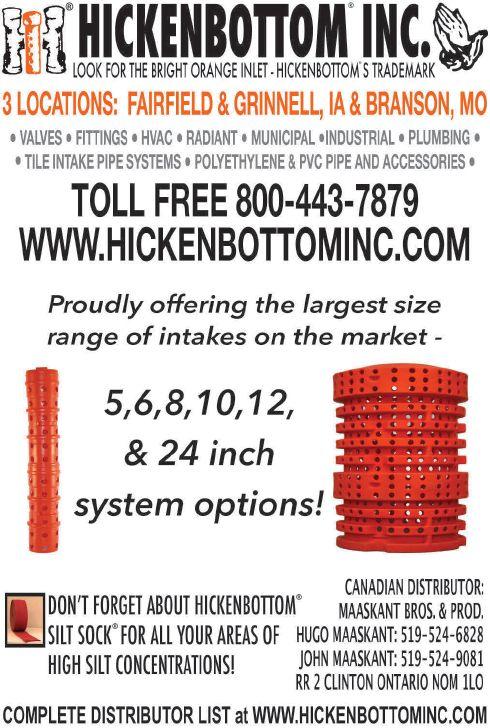
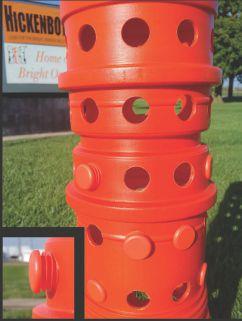
Hickenbottom is expanding its inlet accessory line. After offering the Hickenbottom Silt Sock as a way to enhance erosion control, it has now created a quick and easy way to modify the flow rate of new or existing Hickenbottom inlet systems. The new Hickenbottom PLUG ITS are small, simple to use, and effortless to install, making modifications easy and Hickenbottom inlet systems more versatile. Currently available for the five-inch, six-inch, eight-inch and 10 inch Hickenbottom inlets. For more information, please visit www. hickenbottominc.com.
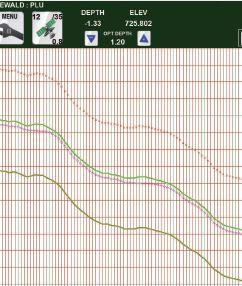
AGREPLAN AND GEOLOGIC RELEASE NEW GEOSITE MANAGER SYSTEM
AgRePlan, LLC and GeoLogic Computer Systems, Inc. (GeoLogic) are announcing the release of an improved version of the
GeoSite Manager System (GeoSite) and a distribution agreement between AgRePlan and GeoLogic. The ownership of the software previously known as AMWWorks, is now wholly owned by GeoLogic. The GeoSite Manager System improves the accuracy and performance of equipment used in agriculture, construction and landfills. GeoLogic's goal is to use the power of RTK-GPS coupled to its GeoSite Software to improve the bottom line through the use of professional surveying tools, real time screen feedback and machine control. AMW-Works customers will be allowed to license the updated GeoSite software at a low cost. Please contact AgRePlan at 937-845-9092 for more information.
FRATCO INTRODUCES PROCORR
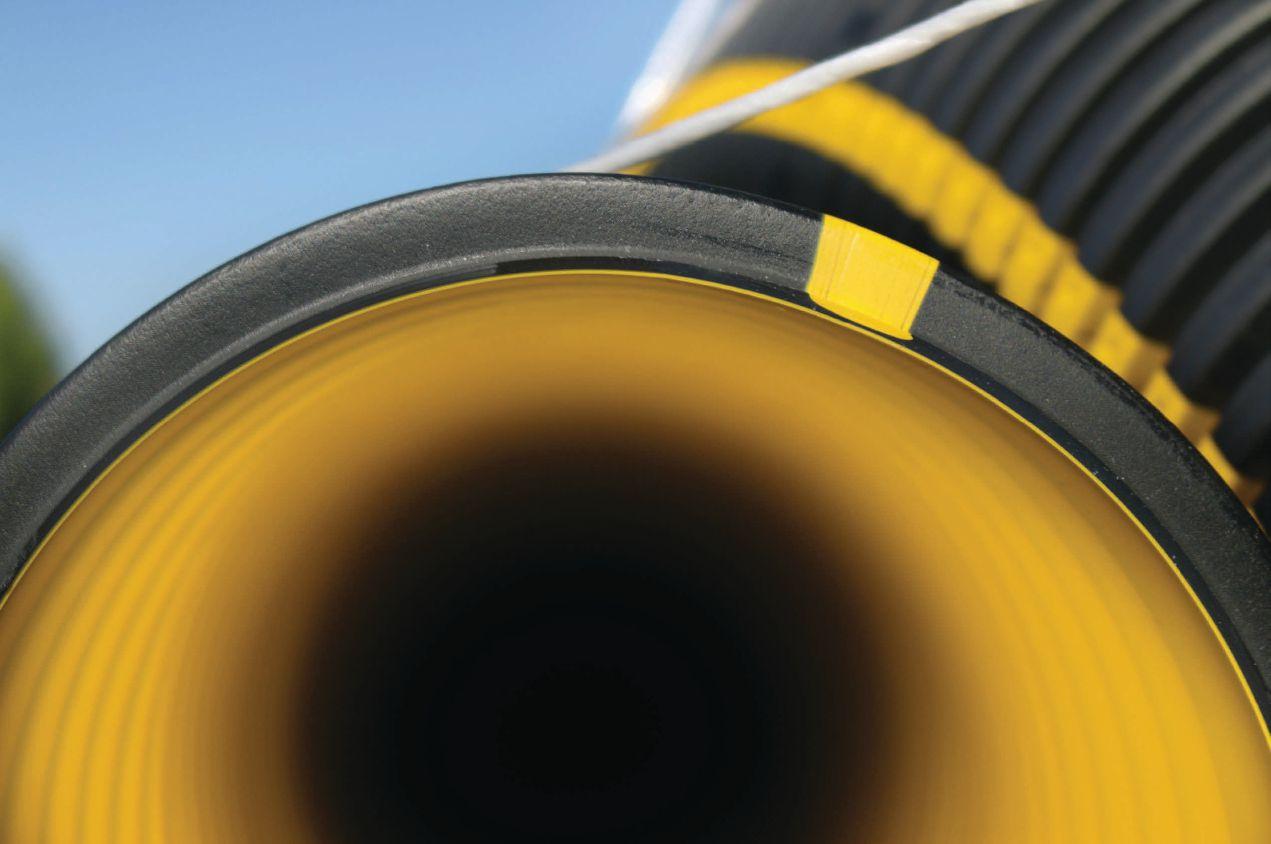
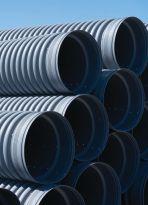
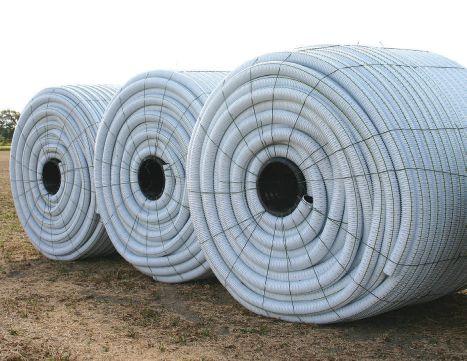
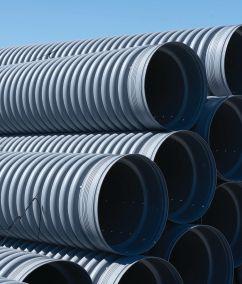
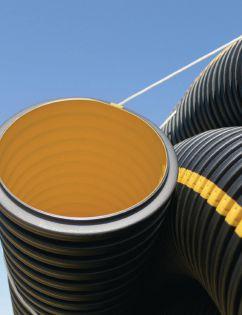
Fratco adds ProCorr to its catalog of drainage pipe. Produced with high-quality polypropylene to ensure long-term use, ProCorr has been engineered to perform optimally under harsh conditions. Its composition of HDPP provides a stiffness greater than HDPE pipe for installations that require durable, high-performing products – including highway, commercial
and recreational field and facility projects. Additionally, it serves as an alternative to concrete and metal pipe solutions while providing easier installation. ProCorr meets AASHTO M330, ASTM F2881 and ASTM 2736 product standards.
Fracto also has FlexCorr, another item in the product line. This flexible dualwall pipe is produced in four sizes to suit a variety of applications. For more information on ProCorr, FlexCorr and other drainage solutions, visit fratco.com.
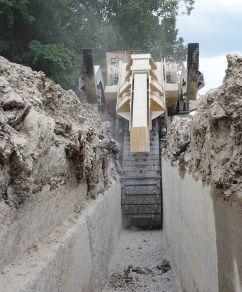
TRENCOR INTRODUCES T1460 TO T14 TRENCHER UPGRADE
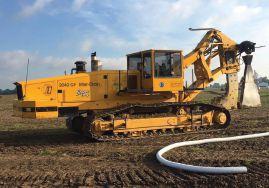
American Augers/Trencor has released a large-scale upgrade to its 1400-series trencher line. The T1454/617 trencher features a Tier 4 Final emissions compliant engine, electronics and customerrequested features. The T14 rig’s electronics package includes a digital operator display in the cab, upgraded software and a telematics package, which enables the rig to gather, log and transmit real-time operating data. Emission compliance is based on a Tier 4 Final Mercedes MTU6R1500 industrial/mining diesel engine.
A redesigned T14 undercarriage features an better attachment method to a heavier, stronger mainframe. Safety enhancements include a new digging drive brake and optional cameras in the cab that increase operator visibility of the worksite. T14-54/617 trencher options include a new quiet pack for running in soundsensitive environments, such as urban worksites, and a counterweight package that increases the machine’s width and depth capabilities.
PRINSCO RELEASES SECOND GENERATION OF GOLDFLEX FLEXIBLE DUAL-WALL PIPE
Prinsco’s original Goldflex flexible dual-wall pipe was in development for more than five years with millions of contractorinstalled feet before coming to the market in 2017. Goldflex G2 is the second generation, re-engineered based on years of customer feedback and testing. Goldflex G2 is the industry’s most tested, highest performing flexible dual-wall and currently available in 12-inch. Additional G2 sizes are coming soon. For more information go to Prinsco. com/Goldflex.
HOWARD COUNTY WATERSHED IMPROVEMENT EFFORTS DRAW NATIONAL ATTENTION
Howard Soil and Water Conversation District (SWCD), in northeastern Iowa, has been using funding from the Department of Natural Resources and other partners to improve water quality throughout the county by stabilizing streambanks across multiple watersheds. These local efforts have recently been profiled by The National Association of Conservation Districts (NACD).
In 2018, NACD, in partnership with the USDA Natural Resources Conservation Service (NRCS), awarded funds through their technical assistance grants program to Howard SWCD. Through these funds, the district was able to assist local landowners with planning, design, land surveys and implementation of streambank management. In Howard County, 11 projects have been selected for bank stabilization practices, totaling more than 6,000 feet of improved streambanks. Streambank restoration projects have not only combatted erosion and improved water quality, but they have also assisted in increasing local wildlife populations.
NACD specifically featured a project done on Tim Huhe’s land that protects livestock and helps reduce erosion. Huhe’s cattle grazed a pasture on his land that abutted a stream, but in some sections, the bank was eroded, undercut or destroyed. The cows would sometimes fall into the stream unaware, becoming injured or falling to their death. Howard SWCD conducted surveys of the land and created designs for a streambank stabilization project on Huhe’s property. The district completed its work within a week after beginning construction and now uses this project as an example county-wide.
Since 2012, the DNR has helped fund a watershed improvement project on Silver Creek with funding from the U.S. Environmental Protection Agency’s Section 319 program. The Iowa DNR has invested nearly $500,000 of EPA 319 grant funding to the project. Those funds, along with the work of local project staff with local farmers and landowners, have leveraged more than $3 million of clean water investments in these tributaries to one of Iowa's most popular paddling destinations, the Upper Iowa River.
Through a co-operative agreement, NACD and NRCS have awarded $9 million in funding to further enhance conservation district technical assistance across the nation. Conservation districts or state associations of conservation districts are eligible for this funding, which will help conservation districts build their technical assistance capacity and enhance their ability to provide conservation planning and technical assistance specific to conservation practice implementation. NACD will administer funds provided by NRCS to conservation districts in high-priority locations across the nation. NACD anticipates that about 180 staff years of work will be funded through these agreements with conservation districts. More information can be found at nacdnet.org/technical-assistance-grants.
BUSINESS DIRECTORY
ASSOCIATES LIMITED
AD INDEX
Finding – and keeping – balance
I cannot complain, and I will not complain.
by Rob Burtonshaw
An exceedingly wet and loss-making spring – which stopped virtually all of our contracts dead, and had everyone talking about record rainfall – turned into the warmest and driest summer anyone can remember which caused lots of chatter about drought. What’s more, autumn has been remarkably dry so far too, providing perfect conditions for installing pipe, which means profitable months. A terrible start was turned on its head and overall it has been a balanced year, albeit a strange one.
Maintaining balance and avoiding kneejerk reactions is difficult, perhaps impossible, when so much is dependent upon something you cannot control. I need a double-sided motivational picture: on one side an optimistic message telling me to relax, things will change and it will be OK; and on the other side, a dose of reality reminding me the good times will end and to calm down and stop spending.
Our business is seasonal; like all contractors we have extreme peaks and troughs in our workload. By far, our busiest time of year is after harvest. If we had double the workforce we would still struggle to keep up, and by contrast in the winter we could manage half as many staff. It has been a problem for years and one that we have not been able to answer. I do not believe that hiring and firing people is an option. It is difficult to recruit and the last thing I want to do is do more of it. A well-trained, committed workforce is worth a hell of a lot and is something I spend a great deal of time trying to maintain and improve. Good short-term temporary or contract staff are almost impossible to find; so much so that it does not seem like an option. Trying to diversify and do something else in the winter has also failed in the past. We are willing to turn our hand to whatever we can, but many others have the same attitude, and competition can be strong. It is also difficult to commit to
another venture when you only really need it for a few months of the year. Once again, it seems the solution is accepting the rough with the smooth, stomaching the losses during the winter to make profit in the summer. It all works out in the end.
Balance is also something I have to bear in mind with my home life. I’m lucky enough to have a wife and family. My children are still relatively young and take up a great deal of time. At this time of year it is easy to focus on work, to keep my head down and work longer and harder, to not switch off at home and always be on call, on the go and always thinking about the next contract. Easy it may be, but it does not help home life or work. I don’t want to give a false impression: I do fail sometimes but it is rare that I’m so late home that I miss my children’s bedtime. I’m often up earlier and miss seeing the children in the mornings but I try hard not to miss seeing them in the evenings.
Work does take over somewhat after harvest, but not in the winter. I take holidays, spend time away, and think of ways to help me forget about work when I’m not at work. Not only does this make me a better husband and father, but it helps the business too. Some people try to deny it, but the longer you work, the less efficient you are. Mistakes get made and focus gets lost. Holidays and time away are as important for the business as they are for home life.
There are no easy answers to maintaining balance in our job – whether it be work-life balance or juggling heavy and slow seasons. It’s not something you think that much about when running from one site to the next, desperately trying to keep the promise you made before the plow broke down. But maintaining balance and keeping all the wheels spinning – not just the one that is immediately in front of me – is one of my goals, and I encourage you to consider it too. DC
THIS IS NOT JUST PIPE.
This is four generations of grit and determination. A century of pioneering innovation and tireless refinement to produce a product with proven reliability. This is unparalleled customer service that builds trust and loyalty. This is our unwaivering commitment to getting it right every time. No exceptions. IF IT HAS TO BE RIGHT, IT HAS TO BE FRATCO.