Requirements like buffer zones and on-farm water treatment will change the drainage industry for the better.
by Jannen Belbeck
It was recently announced that nearly all producers in Minnesota will now have to install buffers along drainage ditches.
According to the Commissioner of the Minnesota department of Agriculture, Dave Frederickson, nearly 300,000 acres of farmland is covered in the state’s Agriculture Water Certification Program so far, a number they expect to rise to half a million acres by the time the buffer zone rule comes into effect on November 1, 2018. While some worry about paperwork and the many regulations associated with these types of incoming laws, drainage contractors will need to adapt and move forward.
Although some states show no sign of implementing buffer rules or requiring water treatment, agricultural runoff continues to be an issue and a common thread at council and conservation meetings across the country. It is likely only a matter of time before we see more rules and regulations put in place.
As technology and environmental law continue to change, so too will the role of the contractor.
As technology and environmental law continue to change, so too will the role of the drainage contractor. This shift will require drainage contractors to continue to pursue education and smart investments in innovation in order to keep the industry current.
With environmental concerns being pushed to the forefront, some drainage contractors have begun taking on the additional role of being a reliable source for producers, by providing knowledge about the latest technologies and productivity advancements and how these can lesson environmental impacts of agricultural runoff.
While many in the industry will spend the off-season conducting machinery maintenance, networking at state LICA conventions or taking in some much-needed R&R, others will use the time to continue their
education, learning more about the aspects of agriculture drainage, including installing on-farm water treatment, like bioreactors or saturated buffer strips.
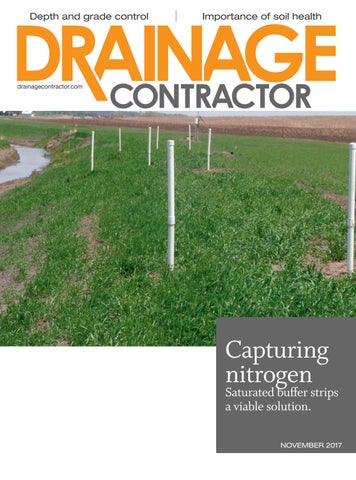
To get a head start, check out our cover story, Capturing Nitrogen (on page 26), which showcases research on establishing installation guidelines for saturated buffer strips. Not only do saturated buffers prevent nitrogen loss, but they help keep the expensive nutrients stay where they need to –in the ground, helping crops flourish.
And so, with all the discussion around changing laws and regulations, one must remember –with change comes opportunity – an opportunity to learn, and in turn, an opportunity to teach producers about the broadening role of the drainage contractor, a theme I’m sure will be made apparent within LICA’s new project.
The association will explore and highlight the history of agricultural drainage in the U.S. and are calling upon contractors to submit their own little piece of history. (See page 8.)
Don’t forget, Drainage Contractor wants to hear from you. What would like to know more about? What are the current limitations or opportunities you’re facing? Let us know and we’ll be sure to explore these issues with industry stakeholders, researchers and other drainage professionals.
Stay in touch through our Twitter feed and Facebook page and be sure you’re subscribed to our E-newsletters so you don’t miss out on the latest industry news, views and research.
Predictability Matters
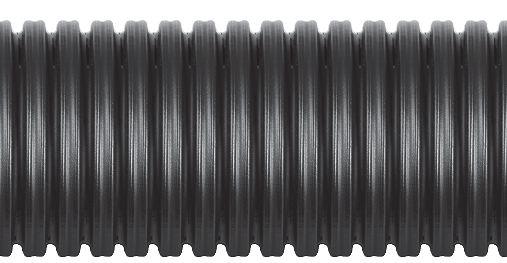
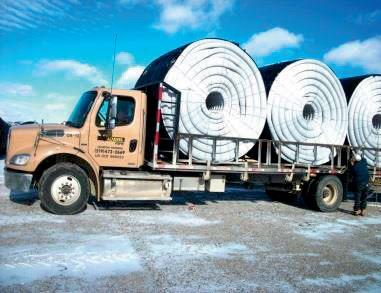
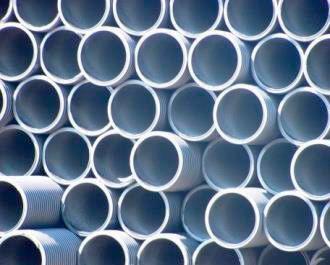
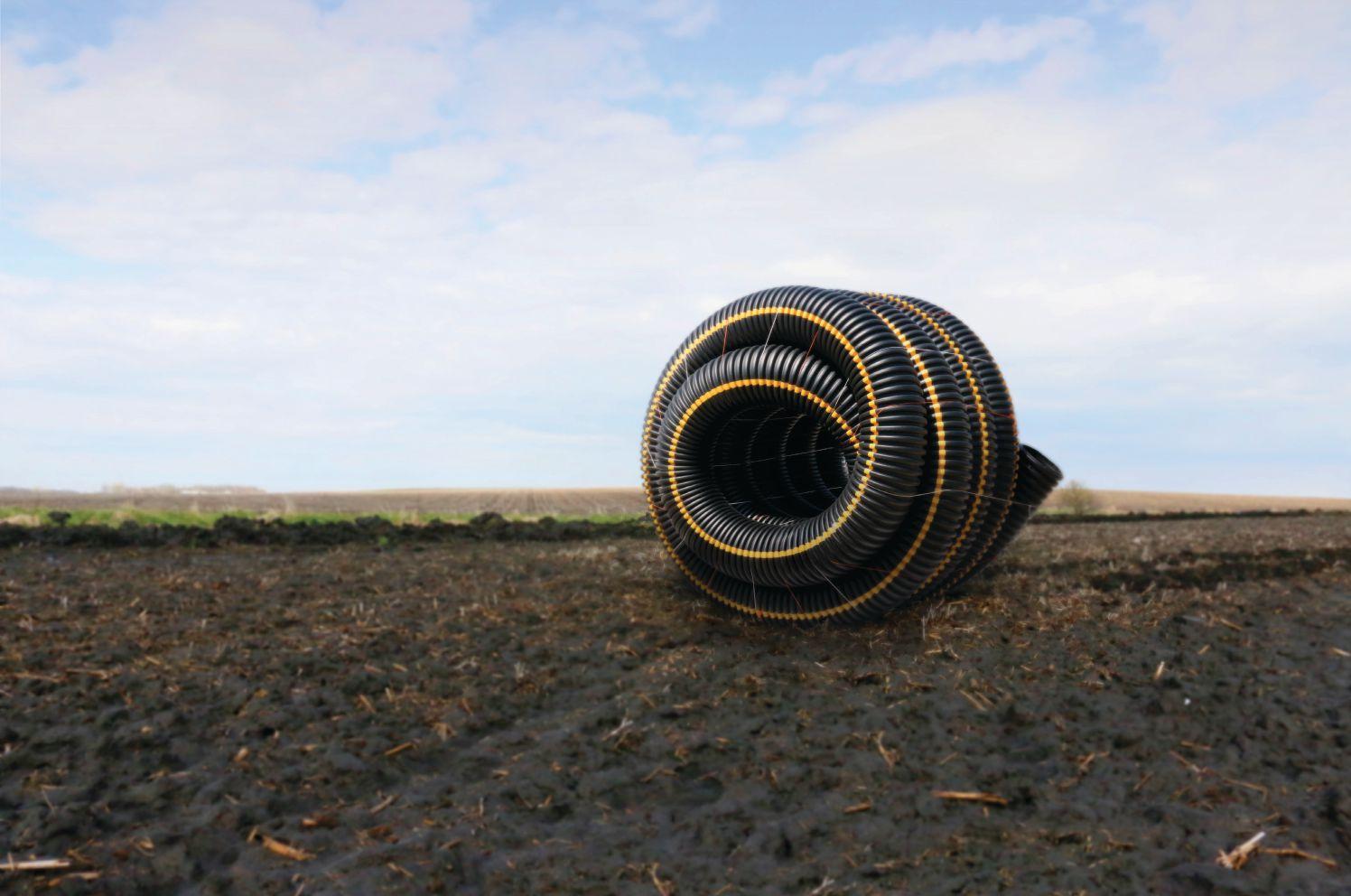
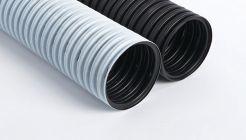
When others use off spec virgin resin, they are buying resins that did not meet the performance criteria of the grade that was intended. The range of key material attributes can vary greatly and affect consistency, creating a less predictable finished product.
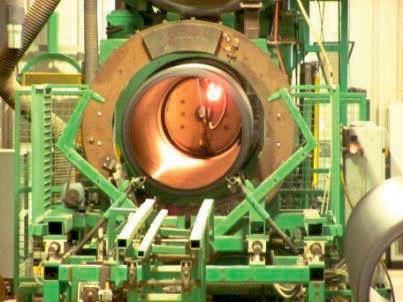
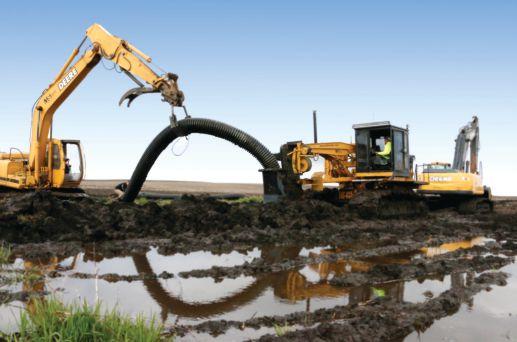
ADS controls the resin used in manufacturing through best in class sourcing, testing, blending, and quality control. These processes enable us to develop HDPE resin mixes that meet or exceed material specifications, so we can produce pipe that is reliable, with quality that is predictable.
LICA TOURS MINING OPERATION IN ACTION
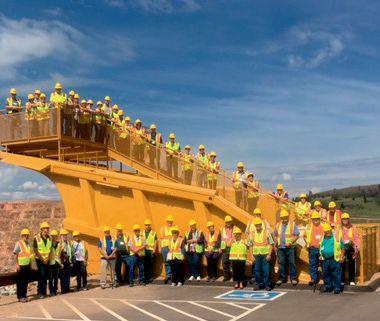
The first day of the 2017 Land Improvement Contractors of America (LICA) summer meeting tour, held in Colorado Springs on July 11 to 16, was spent touring a mining operation, allowing visitors to see active mining in just about every phase with various views: from the valley fill, gold recovery operation to the surface mine operation. The tour outlined modern-day methods that keep the historic gold mining legacy alive.
The aim of LICA is to encourage high standards of workmanship in resource management, land improvement practices and to promote enterprises in the area of land improvement contracting. This association of contractors brings together people having similar interests and opportunities for improving our natural resources with an adequate profit.
The summer meeting also included committee meetings, educational seminars, which touched on by-laws, conservation and strategic planning, and the event’s Associates’ Night where LICA’s National Associates exhibit products and services.
FIVE YEARS OF GROWTH FOR WOLFE
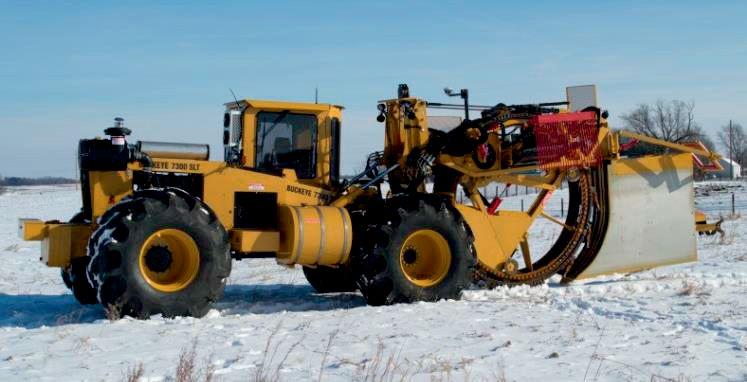
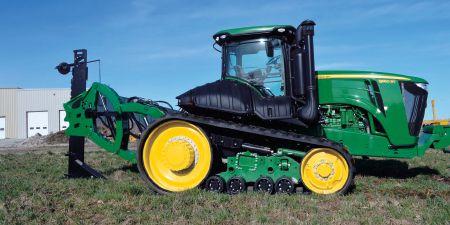
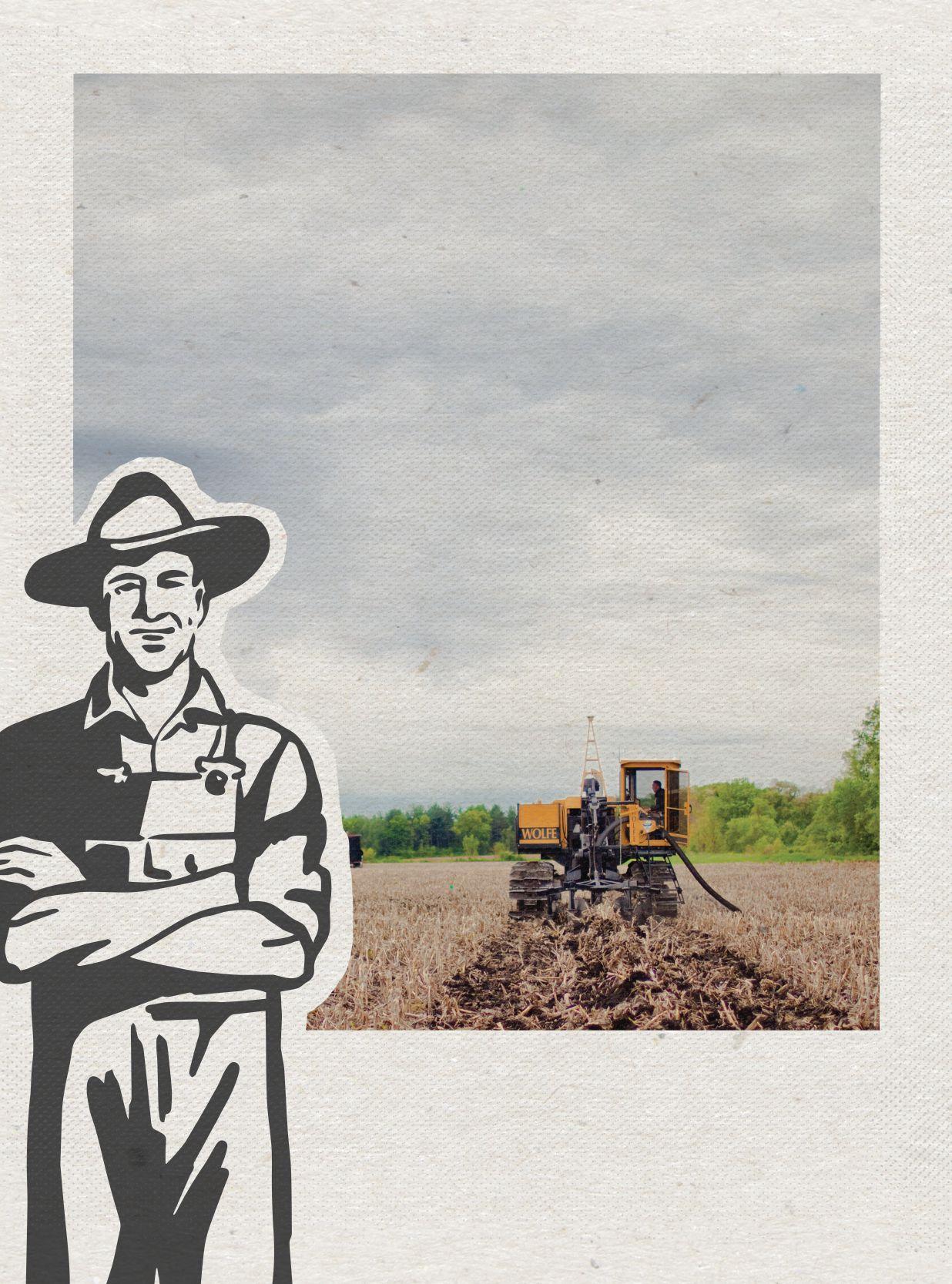
Over the course of five years Wolfe Equipment has transformed into a modern company with cutting-edge designs. Based in southwestern Ontario, Wolfe was purchased by Ed Veeke in 2012 and specializes in manufacturing drainage equipment, utility plows and wheel trenchers, primarily for the agriculture, and oil and gas markets.
Since the purchase, Veeke made the decision to merge Wolfe with Parmerit, a company that specializes in automation, machining and fabrication.
Since 2012, Wolfe has doubled its revenue, upgraded to next-day service in much of North America and made several changes to its products, including improving the painting process and designing a new cab.
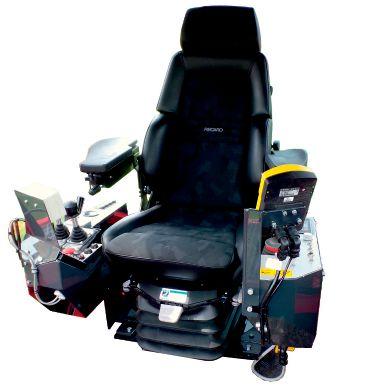
With operator comfort as a top priority, the new cab design includes air ride suspension, ergonomic controls, and the CAT C-15 Tier 4 engine, which also allows for greater fuel efficiency while meeting 2018 North American environmental standards.
For more information, visit: wolfeequipment.com
Agri Drain Corp., recently teamed up with Ecosystem Services Exchange (ESE) to provide technical assistance to contractors and landowners.
Based in Adair, Iowa, Agri Drain has been a trusted resource in the agricultural industry for products and services that conserve water, improve water quality and wildlife habitat, increase yields, reduce flooding, minimize soil erosion and nutrient loss, and provide on-farm, agronomic benefits.
ESE is a certified technical service provider to the United States Department of Agriculture (USDA) and offers design and monitoring services for subsurface drainage, saturated buffers, bioreactors, drainage water management, and sub-irrigation systems. These plans
can be financially supported by federal cost share programs through the USDA, which can help pay for the design, installation, and operation of drainage water management systems.
Management services provided by ESE include the ability to raise and lower surface and subsurface water levels remotely through a patented proprietary operating system to increase yield, improve water quality, reduce flooding, and enhance wildlife habitat. Automated pumps and valves can also be incorporated into the system.
For more information, contact Paul Sweeney, director of conservation planning at paul@ecoexch.com or 888-826-5112.
LEFT: LICA members pose for a group photo during the tour of a gold mine in Cripple Creek, CO; RIGHT: The event’s Associates’ Night allowed LICA’s National Associates to exhibit products and services. Photos courtesy of Land Improvement Contractors of America.
IOWA NUTRIENT RESEARCH CENTER AT IOWA STATE UNIVERSITY FUNDS WATER QUALITY PROJECTS
The Iowa Nutrient Research Center at Iowa State University has funded 11 new projects related to water quality.
Researchers from Iowa State and the University of Iowa will collaborate on the projects with those from the Iowa Department of Natural Resources, the Iowa Soybean Association, the Nature Conservancy, and East Carolina University. This is the fifth year the center has funded research.
Projects include:
• Does quantity and quality of tile drainage water impact in-stream eutrophication potential? Evidence from a long-term biofuel cropping systems experiment will measure chemical composition and the potential of subsurface drainage to cause a detrimental overabundance of nutrients from a variety of management practices.
• Impacts of cover crops on phosphorus and nitrogen loss with surface runoff. An existing study will continue for two more years (conducted under natural rainfall) to evaluate impacts of a winter cereal rye cover crop on soil, nitrogen and phosphorus loss with surface runoff in a field testing high in phosphorus, managed with a corn-soybean rotation.
• Total phosphorus loads in Iowa rivers and estimation of stream bank phosphorus contribution: will use new topographical information to expand on the evaluation and quantification of phosphorus loads in Iowa rivers.
• Water quality evaluation of prairie strips across Iowa — will assess the effects of prairie strips on the quantity
and quality of surface water runoff from cropped watersheds, and the effects of prairie strips on dissolved nutrient concentrations in shallow groundwater. The project information will be disseminated through field days, presentations and Iowa State University Extension and outreach fact sheets.
• Modeling of nutrient reduction practices will focus on delivery-scale evaluation and modeling of the effectiveness of in-field and edge-of-field practices including cover crops, fertilizer management and wetlands in increasing ecosystem nitrogen and phosphorus retention and reducing downstream nutrient loads.
• Amounts and forms of dissolved phosphorus lost with surface runoff as affected by phosphorus management and soil conservation practices: Will study dissolved phosphorus in runoff for a wide range of soil P levels, fertilizer and manure P management practices and soil conservation practices.
• Woodchip bioreactors for improved water quality: Will evaluate nitrate-nitrogen fate in woodchip bioreactors over a range of water retention rates, while gaining knowledge about improved bioreactor design for field implementation.
• Improving the effectiveness of conservation programs through innovative reverse auctions and sensible enrollment restrictions. This study will assess the value of reverse auctions and enrollment restrictions in improving the cost-effectiveness of conservation programs offered
to Iowa farmers.
• A study of limiting nitrogen immobilization in cover crop systems will look at ways to fine tune cover crop management so nitrogen immobilization is unlikely and it can be mineralized for crop use.
• Successful voluntary watershed improvement projects: Do short-term adoption and outreach lead to attitude changes and longterm sustainable practice adoption? This study will look at the structural practices of conservation practices adoption and assess and compare farmers’ and local stakeholders’ attitudes toward water quality and conservation within intervention and nonintervention watersheds.
• Baseline assessment of Geisler Farm Site: Collection of pre-BMP monitoring data — will collect baseline monitoring data at a farm in Calhoun County to characterize the soil, geology, hydrology and water quality conditions of the farm prior to the establishment of conservation best management practices.
The Iowa Nutrient Research Center was created in response to legislation passed by the Iowa Legislature in 2013. The center pursues science-based approaches to evaluating the performance of current and emerging nutrient management practices, providing recommendations on implementing the practices and developing new practices.
For more information, visit: http://www.cals.iastate.edu/ nutrientcenter/project
Land Improvement Contractors of America
LICA has been serving contractors across the country for 75 years, providing our members with the tools they need to “work smarter not harder.” Below are a few of our member benefits.
LICA Safety Management Plan
The LICA Portal
Caterpillar Extended Powertrain Protection Program
The history of drainage can be traced back to writings as early as 200 B.C., with ancient Romans using brush, straw, poles and even stones to line ditches. In America, John Johnston of Seneca, NY is credited as being the “father of tile drainage” since he was the first to install ceramic tile in 1835.
While his neighbors may have called his project “Scotch Johnston’s Folly” and predicted failure, it wasn’t long before the benefits of draining a wet field became apparent. The ground where Johnston buried tile yielded 50 bushels per acre, where previously it was only yielding five. And today, the drainage industry is a growing, global interest.
Chronicling what took place between Johnston’s concept and today’s multi-million dollar industry is the task that Jerry Biuso, CEO for the Land Improvement Contractors of America (LICA) wants to take on.
“America feeds the world and the development of drainage systems has been vital to that effort. I believe it is important to have a recorded history of the drainage industry in which many of our members work,” Biuso says.
To spearhead this monumental task, Biuso has enlisted Bob Clark III, president of Clark Farm Drainage, Inc. and pastpresident of LICA, to serve as the project chairman. The goal of the project is to collect relevant information from every aspect of the industry, reviewing and coordinating that data, and then publishing the results in a leather-bound book, which will be available through LICA.
“Bob is the perfect choice for this project because, in addition to his natural curiosity about the history of drainage in America, he is actively involved in current developments within the industry,” Biuso says. Bob serves as LICA’s liaison with the Agricultural Drainage Management Coalition (ADMC), the Transforming Drainage study, and the Environmental Protection Agency’s (EPA) Ag Training, an independent committee that advises the EPA on a wide range of environmental issues important to agriculture and rural communities.
However, Bob cannot do this research alone.
“We are reaching out to anyone involved in the drainage industry; researchers, producers, contractors, manufacturers, educators, and asking them to provide any [historical data] they may have relating to the drainage industry in America, as well as [to comment on] where they see the industry heading tomorrow,” Biuso says.
If you have some history you would like to share, please get in touch with either Jerry Biuso (gbiusosr@earthlink.net) or Bob Clark (bob2@clarkfarmdrainage.com). DC
TILE DRAINAGE ACT
Oby JULIENNE ISAACS
Who is it protecting?
ntario is the only Canadian province that has a licensing program for drainage contractors. By far the most agricultural tile is installed in Ontario, and the program ensures Ontario contractors are highly skilled.
However, some say there’s confusion about the purpose of the regulation, particularly as more farmers are buying unlicensed equipment for the purpose of installing tile on their own land – and sometimes their neighbor’s, says Jamie Turvey, president of the Land Improvement Contractors of Ontario (LICO). Does the licensing program exist to protect contractors or farmers?
The program, established under the Agricultural Tile Drainage Installation Act, came into effect in January 1973. Its goal has always been to protect farmers from bad workmanship, says John Johnston, secretary of LICO.
In 1973, Johnston was the Drainage Engineer at OMAFRA. “[Up until] that point in time, anybody could put tile drains in place.
People who didn’t have experience could offer themselves up as a contractor,” he says.
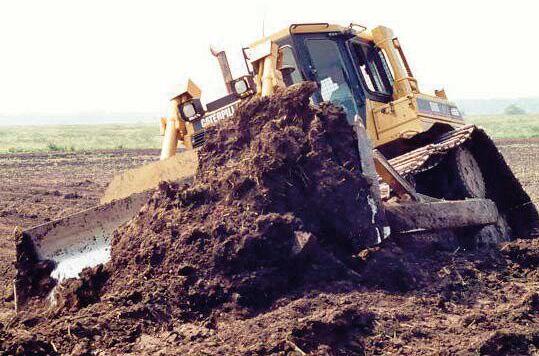
“You had people buying bulldozers and putting on a vertical blade and cutting land like a knife through butter. There were a lot of farmers spending money on systems that wouldn’t work.”
In the early 1970s, a number of experienced contractors documented problems with tile drainage systems across the province and made a presentation to the Minister of Agriculture requesting regulation. “They said, ‘We need to do something about this because there are a lot of investments being made that farmers won’t be able to recoup, and it’s giving us a bad name,’” says Johnston. Their request was granted.
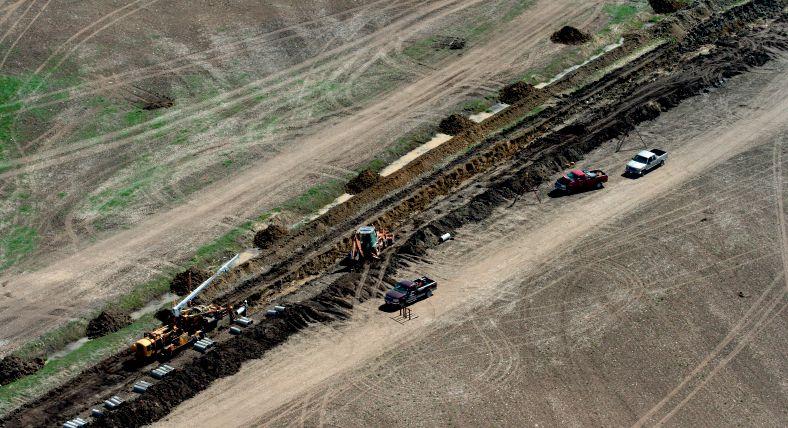
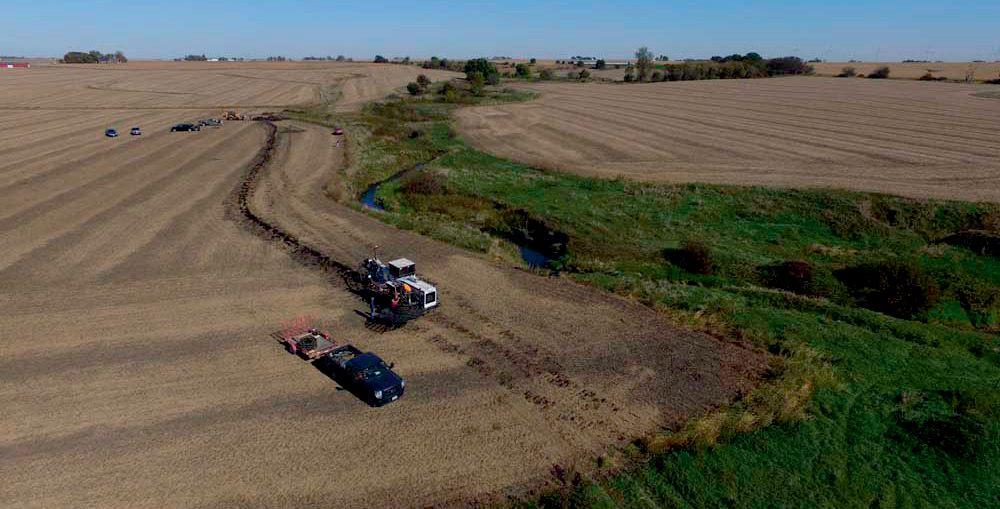
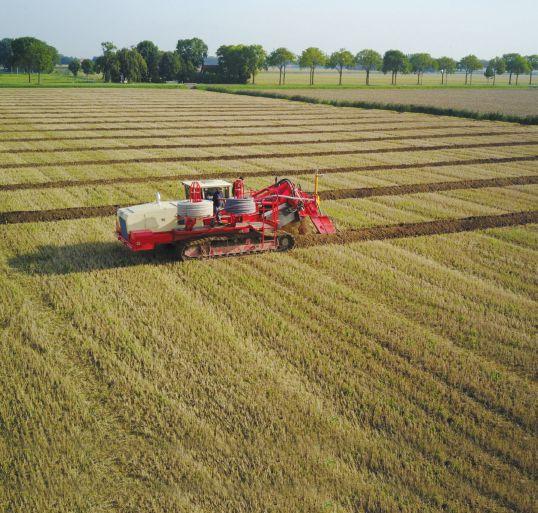
RIGHT: An aerial image of Marquardt Farm Drainage installing tile drainage in a field. Photo courtesy of Steve Cronsberry at Marquardt Farm Drainage.
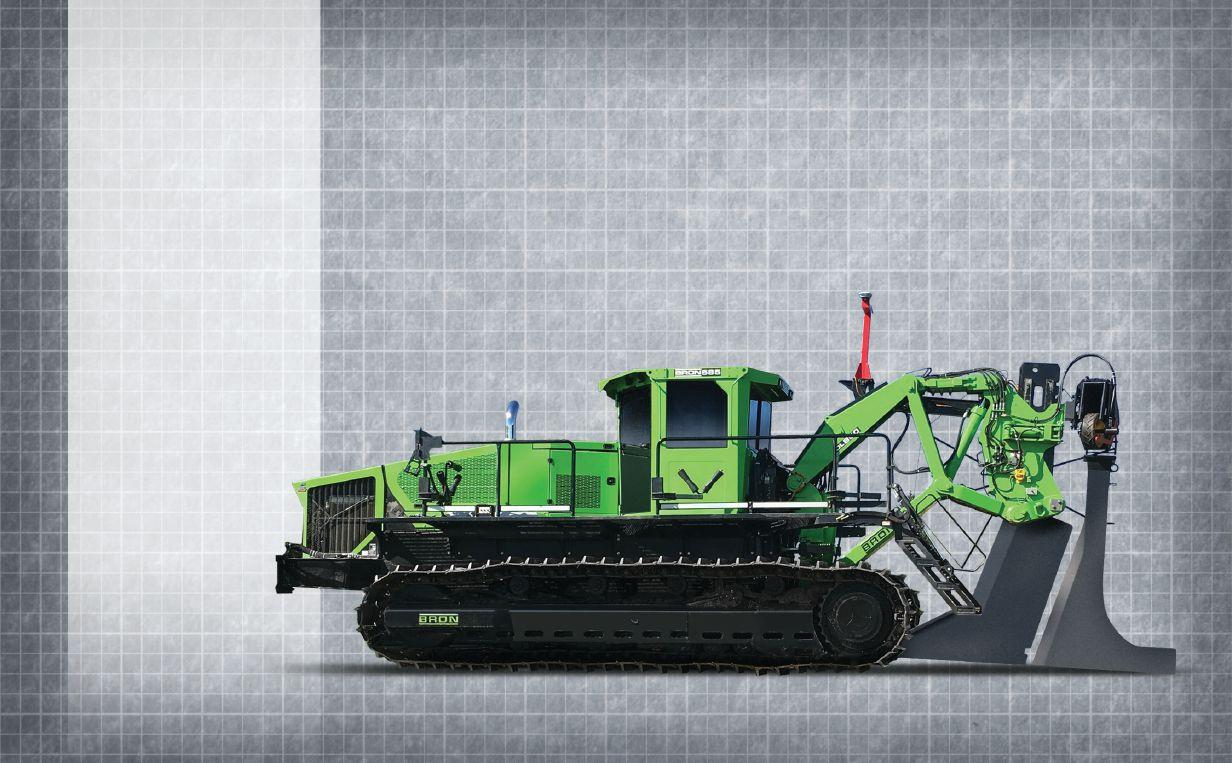
•Up to 7ft cutting depth
•High production
•Low ground pressure
•Robustly built plow and frame
•Oscillating tracks
•Wider cab model
•Variable angle arc plate
•Quick change teeth (reversible)
•Tubing chutes up to 16 inch
•GPS or Laser Guidance
LICENSE REQUIREMENTS
The Agricultural Tile Drainage Installation Act regulates three types of licenses: : Machine, operator and business, says Sid Vander Veen, Drainage Coordinator for OMAFRA.
The machine license ensures that every new model of drainage equipment that comes on the market goes through a series of tests to make sure it is capable of installing tile to the proper grade and tolerances, and in a variety of soil types. Once it passes all these tests, the machine is licensable; when contractors approach the ministry requesting a license for the machine, it is approved.
The operator license works like an apprenticeship program – there are three levels. Class C entry-level machine operators’ licenses are offered to contractors after they’ve worked in tile drainage for 60 days; the license allows them to work under the supervision of contractors with Class A licenses. Class B licenses are granted once the contractor has logged 250 hours and completed a five-day drainage course. This level of license allows operators to work independently for three hours before checking in with a supervisor.
To achieve a Class A license, contractors must log a further 250 hours (500 in total) and pass an eight-day course plus verbal and field tests to ensure their understanding and to show they can apply a system’s design criteria.
Business licenses are issued to owners with a licensed machine and at least one Class A operator.
“We have an inspector who performs some of these tests, like the field test for the A operator and for the new machines,” says Vander Veen. “We also inspect new businesses to make sure everything is operational.
“If there’s a complaint about workmanship, we’ll send an inspector out to inspect the system. If there are workmanship issues, the contractor has to either fix the [problems] or we hold a hearing before the director, who has the authority to suspend licenses.” Vander Veen says compliance is excellent in the province, and the Ministry hasn’t held a hearing in more than 20 years.
When the Ministry finds incidents of unlicensed contractors, infractions tend to be minor, and the Ministry goes through a process of “progressive compliance,” he says, educating operators about the law.
There’s an important exception to the licensing requirements: if farmers wish to install tile on their own land, they’re allowed, says Johnston.
WHO’S PROTECTED?
Steve Cronsberry, owner of Marquardt Farm Drainage, says the licensing system is very important for maintaining the high quality of tile drainage systems installed in Ontario, for both the farmer and the contractor.
“For example, if a farmer drained his own farm without the knowledge gained through the licensing program, how does anyone know it was installed properly?” Cronsberry says.
DEPTH AND GRADE
Comparing corrugated plastic subsurface drain as-designed vs. as-installed.
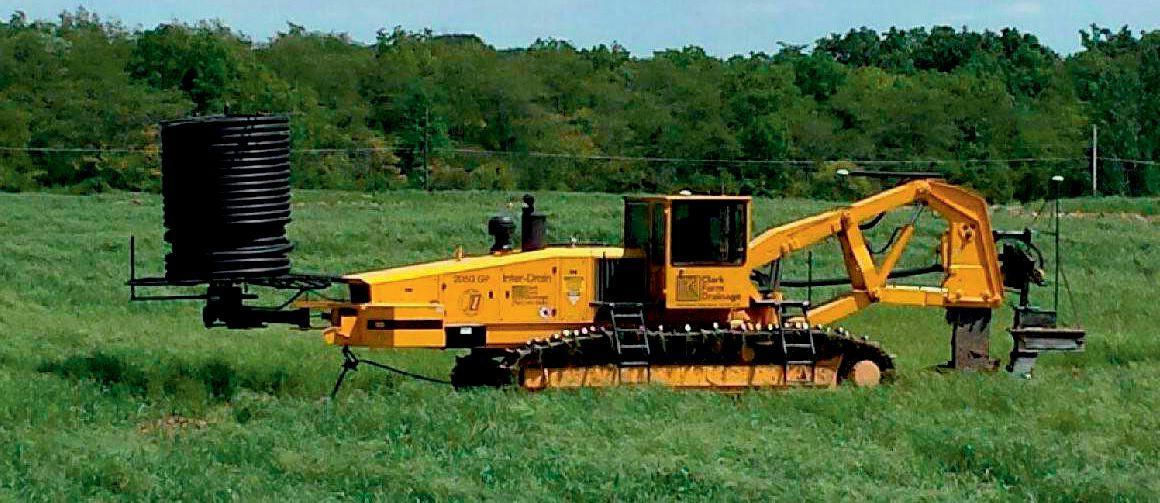
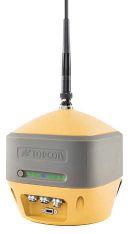
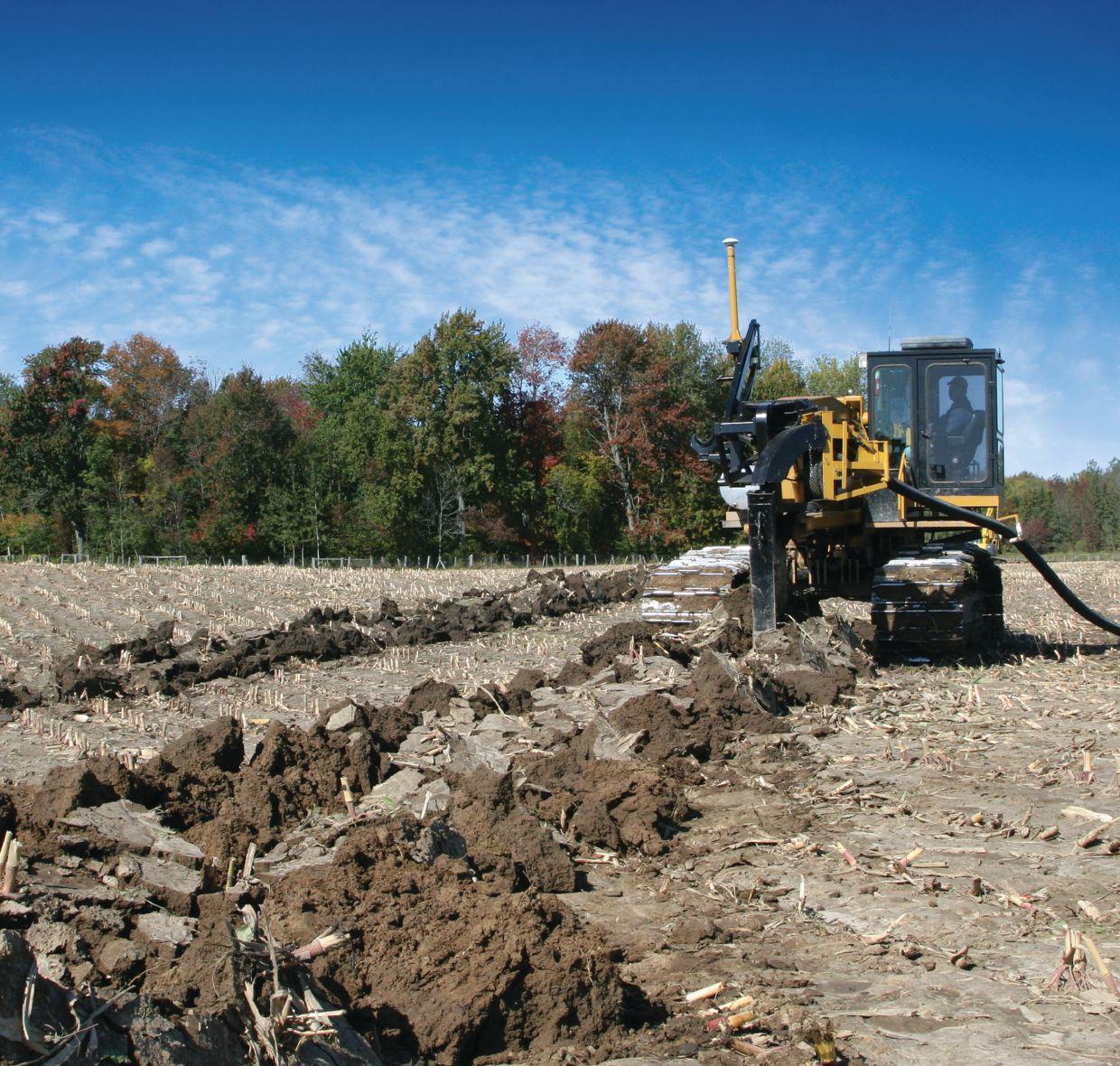
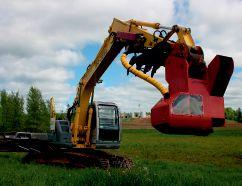
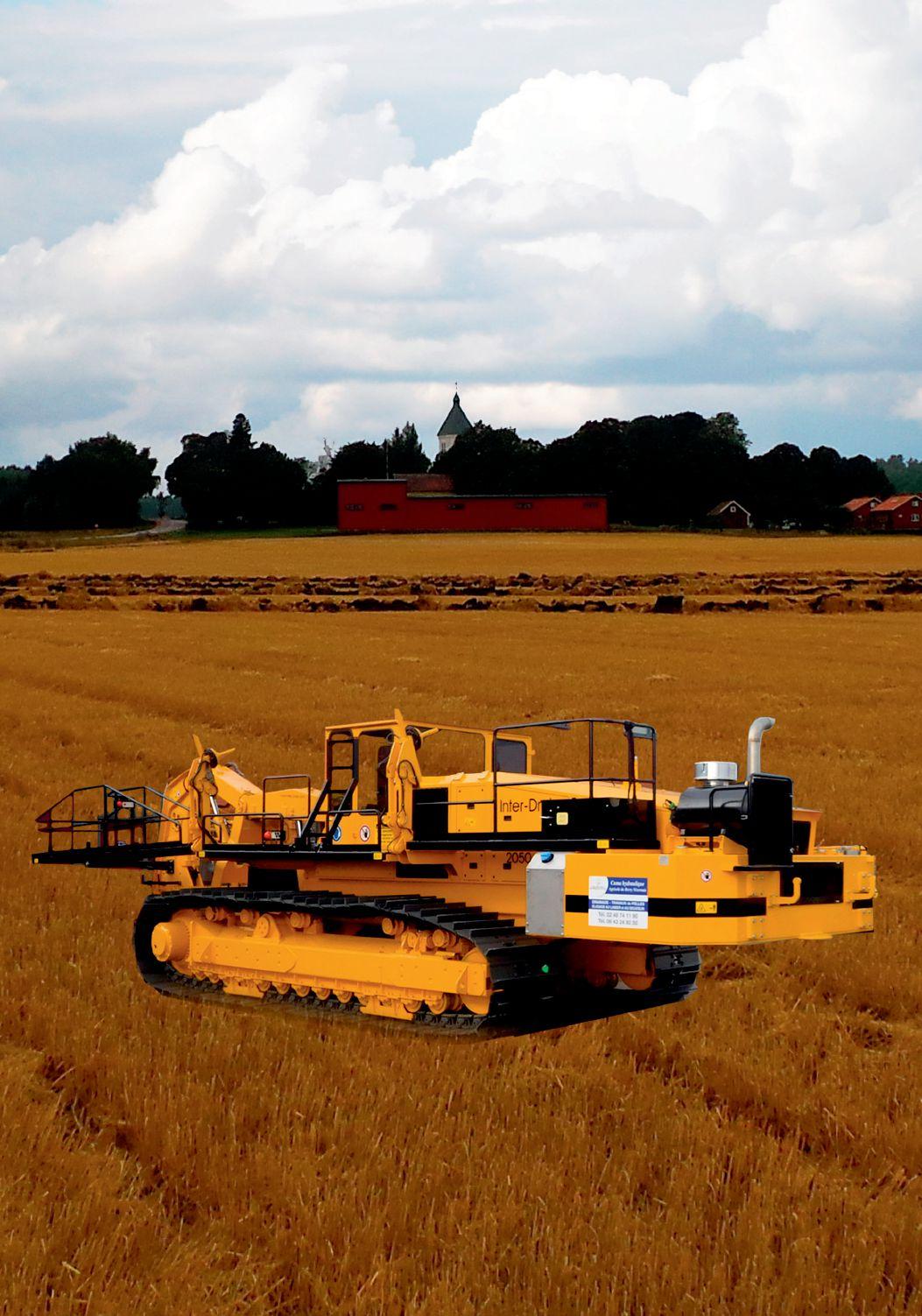
This is the third paper published on the analysis of drain depth and grade data recorded during a field installation of corrugated plastic drain tubing. A 2050 GP model inter-drain double-link drainage plow was equipped with a Trimble RTK-GPS system to automatically control drain depth and grade and steer the drain plow along the drain line path for each subsurface drain planned for the field.
by JAMES L. FOUSS, BOB CLARK III, JOSH SHULER, AND JOEY SCHLATTER
RIGHT: A 2050 GP model Inter-Drain doublelink drainage plow was equipped with a Trimble RTK-GPS system to automatically control drain depth and grade and steer the drain plow along the drain line path for each subsurace drain planned for the field. Photos and figures courtesy of Bob Clark III.
A farm in Ohio was selected for the July 2016 installation of the subsurface drainage system in clay-loam soil by Clark Farm Drainage, Inc. in New Castle, IN.
The initial results analyzed and published from this field installation was to determine if the corrugated drainpipe guided down through the pipe-feeder “boot” attached behind the plow blade with a linkage system installed the drainpipe at the same depth as the bottom of the drainage channel, which was created by the cutting tip of the plow-blade.
An RTK-GPS sensor positioned directly above the plow-blade cutting tip was mounted on a cantilever arm attached to the plow-blade shank. The RTK-GPS system electronic circuit operated
the plow hydraulic system to continuously adjust plowing depth to control the elevation and gradient in the bottom of the subsurface drainage channel created.
A second RTK-GPS sensor was mounted on a vertical mast directly above the rear of the pipe-feeder to detect and record the elevation of the installed drainpipe at nearly constant travel intervals during forward motion of the plow.
It was concluded that the drainpipe was continuously installed by the pipe-feeder at the same elevation as the bottom or the plowedin drainage channel. The results of this initial analysis of the recorded elevation and grade data were presented and published in the proceedings of the American Society of Agricultural
TECH TIPS
and Biological Engineers (ASABE) International Drainage Symposium, held in Minneapolis, MN on Sept. 6 to 9, 2016. (Fouss and Clark III).
The second paper was published in the November 2016 issue of Drainage Contractor magazine (drainagecontractor. com/drainage-management-systems/ testing-technology-2131) and provided observations and comments by drainage plow contractors about the field installation results. It also provided recommendations on additional reports to be published from further analyses of the recorded data, and suggestions for additional field installation tests. The primary observations and comments on the results published in the initial paper described the different types of pipefeeder “boots” and the configurations of attachments or linkages for the “boot” to the plow-blade.
It was also pointed out that the differences in plow design could have a significant effect on the results and accuracy of the subsurface drainage
installation, thus they recommended conducting similar field performance evaluations on other drainage plow models.
The contractors added a discussion on the need to make a comparison of the drain “as-installed” with the drain “as-designed” in the drainage system design plan, which is the focus here.
COMPARING AS-INSTALLED WITH AS-DESIGNED
In this follow-up analysis and paper, the objective was to determine if the drain tubing was installed by the RTK-GPS controlled drain plow at the depth and grade specified in the drainage system design plan.
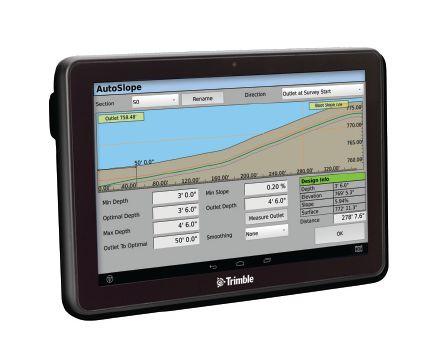
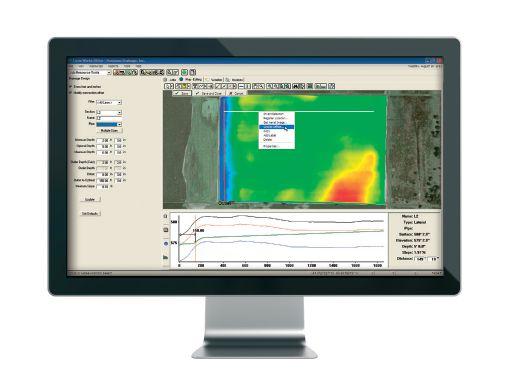
The drainage system design for the field was pre-planned with the Trimble Farm Works software, which used the topographic map data for the field site as an input.
The drain design plan specified the location via GPS coordinates for each drain line (or section line) in the data file and
labeled it with identification, name, and the X, Y, Z coordinates for the downslope outlet end of the drain line.
In addition, the drain design specified the following parameters for all sections of the drain line length – minimum slope, minimum depth, maximum depth, optimum depth, optimum outlet, last data point outlet, and specs on pipe type, and pipe sizes.
These drainage design parameters were stored in a digital memory component of the RTK-GPS system prior to the installation of the drains. The RTK-GPS system is designed to automatically control the operating depth of the drain plow along the path of each drain (or section line) to “match” the drain depth and grade parameters and specifications in the design plan for that drain line.
During the drain installation, the GPS data recorded by the RTK-GPS receiver mounted on the plow-blade was considered the “as-installed” drain (this is the same digital data file many contractors have previously named drainage completed).
It was concluded in the Drainage Symposium paper that the pipe-feeder “boot” installed the drainpipe at the same elevation (or depth) and grade as recorded in the drainage completed digital file recorded by the RTK-GPS system that automatically controlled the drain plowblade depth and grade as the drainpipe was installed.
X-Y GRAPHS OF RECORDED COORDINATES FOR DRAIN “AS-DESIGNED” VS. “AS-INSTALLED”
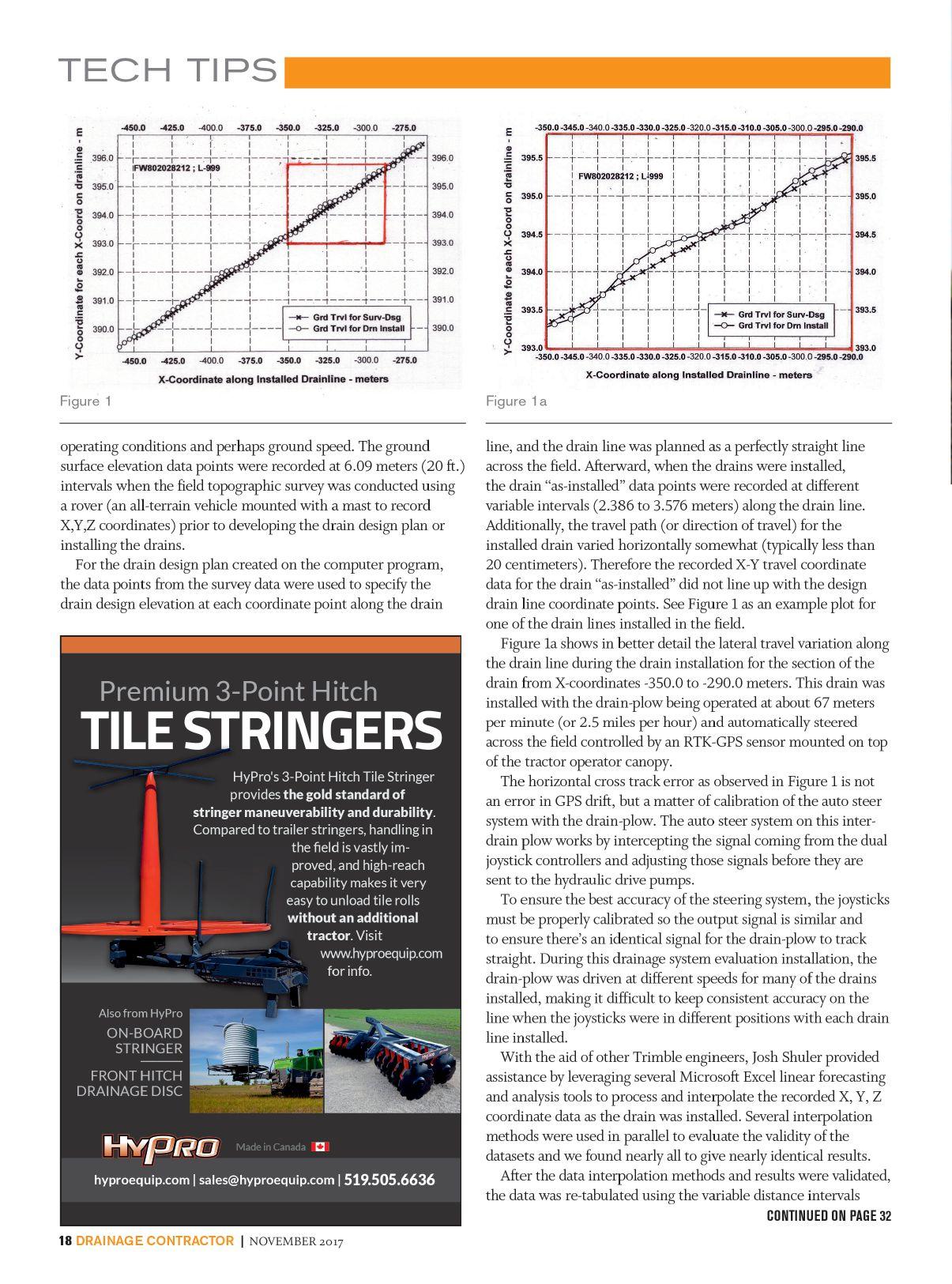
The preliminary graphs originally plotted from the field recorded data gave a close comparison of the drain “as-designed” with the drain “as-installed”, but we were not satisfied with the comparison as it was not as exact as we expected it to be. Those preliminary graphs were plotted by assuming the ground travel between coordinate data points recorded were separated by a constant travel interval – i.e., about two meters for the ground survey and drain design data, and about three meters for the drain “as-installed” data – neither assumption was correct.
The actual ground travel intervals between recorded coordinate data points varied somewhat for different plow
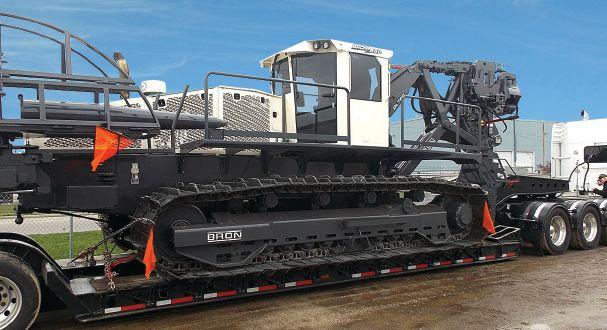
www.rwfbron.com
■ Five Core Cooling System exceeds cooling for Tier 4 engine standards
■ Quieter Reconfigured Cab Interior for Operator comfort
■ Standard DL 850 Drainage Plow increased strength & durability
■ LED Light Package for increased visibility for those long days in the field
■ Improved swing mechanism for the Onboard Reel for smoother reel speeds & consistent torque
■ Optional hydraulic rear step raises out of the way when plowing and lowers when required.
■ Standard oscillating track frames.
■ Fluid Samples for All Fluids
■ 150 Point Machine Inspection
■ Internal Inspection All Drivetrain Components
■ Required Factory Repairs
■ New & Used Equipment Sales
■ Parts & Service all BRON Products
■ Selected All Makes Parts for Construction Equipment
■ Certified Rebuilds on BRON Products
■ Custom Fabrication
■ New Paint
■ Factory Tested
■ New Certified Serial Number Assigned
■ 6 Month Warranty Assigned
■ Repairs on all Drainage Plows & selected Construction Equipment
■ Parts Facility in Marine City Michigan
■ Road Service for all BRON Products & other selected Equipment
■ Parts Facilities in Woodstock ON and Marine City MI.
Addressing excess nutrient loading through water retention.
Management of excess water on agricultural lands, to reduce or prevent detrimental impacts, may be the most serious production problem facing agriculture in the cool, humid region of the United States.
The farm practices that offer the best solutions for the problem of excess water are not universally agreed upon and the merits of some over others is not easily isolated.
In a project that has been running from October of 2015 to this past April, preliminary findings suggest there truly are some agricultural and tile drainage best management practices that can sustain production without impacting downstream water resources.
Kevin King, an agricultural research engineer with the United States Department of Agriculture’s Agricultural Research Service (USDA-ARS) in Columbus, OH, conducted research on a total of forty paired field sites with both surface discharge and subsurface water monitoring abilities.
On some of the early established sites,
he has been able to acquire baseline data in the last two or three years and, as of last fall, has started testing on seven or eight of these paired sites to quantify the impact of farm practices on water quality. Looking at the data he has just started collecting, King is particularly concerned about the subsurface nutrient levels.
“What we have seen is, at least in this landscape and in Ohio here, we cannot ignore tile drainages as significant pathways for nutrient improvement,” he says. “Tile drainage generally accounts for anywhere from 40 to upwards of 90 percent of the phosphorus movement and the water movement from a field.”
Most of the soils in Ohio are poorly drained and couldn’t be farmed without tile, so there is a lot of tile drainage in the state. Further adding to the problem, soil types in Ohio tend to be prone to
by AMY PETHERICK
developing preferential flow paths. King also confirms that climate variability is increasing.
“In those rainfall events where we get about an inch and a half or greater, we get about 60 to 65 percent of our surface flow and about 40 to 45 percent of our tile flow come from those events,” he says. “So, if we start to look at practices, what’s the best way to store another inch and a half of water in our landscape?”
King has learned that although many farmers are quite conscious of nutrient loss and have nutrient management plans, water management plans don’t really exist. Typically, the goal is simply to get the water off the field as fast as possible and King understands that is a prudent objective for planting and harvest
MASTENBRI O IEK
V-blade plow minimizes soil disturbance for optimum drainage results
NEW KID ON THE BLOCK
Bourke Sprague is a new drainage contractor bursting onto the scene with success in Kentucky.
No official background in drainage or excavating stopped the now 37-year-old Bourke Sprague from building his company, Sprague Excavating LLC, based in Union county, Kentucky.
by JANNEN BELBECK
Excavating conducts tile
After graduating from the University of Mississippi in 2002 with a degree in marketing, Sprague came back home to try farming with his dad, who, since 1984, had rented out the farm. After farming for two years, with the economy on the downswing, the family decided to once again rent out the 1500-acre farm in 2004.
Along with his brother and father, Sprague helped build a 40-acre motocross facility on some strip mine land they owned. Building this track was the first time he had ever ran a bulldozer. Sprague logged nearly 4,000 hours of dozer time building, grooming, rebuilding, and preparing the track over the six years in operation.
Also in 2004, Sprague’s father was approved to implement conservation practices through the Environmental Quality Incentives
Program (EQIP) with the National Resource Conservation Service (NRCS). Sprague worked on building WASCOB levees to prevent erosion and learned to build waterways, rock structures, and rock crossings.
After the project, Sprague started Sprague Excavating LLC in 2005.
A CHALLENGING START
Launching a new business is a challenge and hard work in its own right, but there’s something to be said for starting a new excavating and drainage business, where companies have more than likely been operating in some communities for decades.
“It’s very hard when someone like me hasn’t been in the business at all to come into [the] local community and gain their confidence that I could do the jobs correctly,” Sprague says.
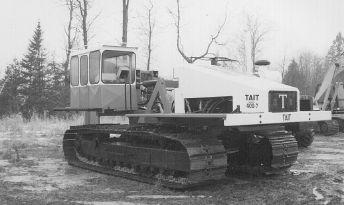
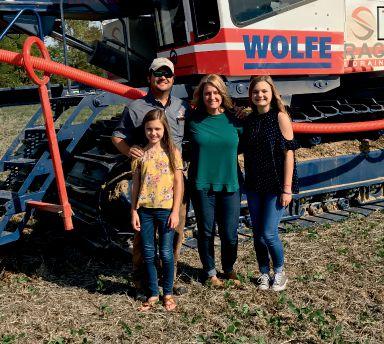
LEFT: Sprague
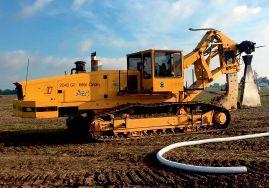
drainage projects with a WOLFE 600 Parallel Link Plow.
RIGHT: Bourke Sprague with his wife Heather, and daughters Savannah and Chloe.
“It had been a struggle for two or three years to pick up work. However, with each job I completed, I started to attract new customers.”
At this point, Sprague had accumulated an old excavator and couple of late model dozers and began to market himself to other farmers in the area for custom work. For the next two years or so work was slow, but Sprague stayed persistent. Things started to change in 2008 when he started doing excavating work for a local drainage contractor and farmer who had been in business for over 40 years. Sprague says this farmer was instrumental in helping him grow his knowledge of the tile drainage business.
In 2010, the contractor sold his tile machine and retired. Sprague saw opportunity there. “I felt it was time to be a full-service business and offer both tiling and dozer services,” Sprague says. “This way, I could install tile and then do the dozer work. Up until this point I was doing dozer work for a couple of tile contractors and my work depended on them installing tile in order for me to build levees. I knew in order
for me to grow my company I had to invest in a tile plow.”
In the beginning, Sprague surrounded himself with more experienced people in the drainage field in hopes that some of their knowledge would rub off. Sprague credits the relationships he built and the experience he had with the local NRCS at the start of his career.
“The NRCS guys were really hard on me when checking my work. If I was a tenth of an inch low on the height of a levee they would make me drive across the field and fix it. Looking back, I’m glad they held me to those high standards as it taught me to do the job correctly the first time.” Sprague says.
“I went headfirst into the drainage business. I definitely know all about on the job training and with each job I completed I became more and more comfortable with the work,” he says. “I’ve been eating, breathing and sleeping tiling since I bought that first plow. It’s something I’ve been able to do naturally and completing a quality job from conception to completion gives me great satisfaction.”
When first getting established, Sprague wasn’t afraid to ask
CONTRACTOR AT WORK
for help, getting assistance with designing drainage projects and spending many hours learning how to use design software. He installed his first tiling project in March 2010, with a 9400 John Deere tractor and a pull-type plow. Sprague used this equipment to mainly complete soil erosion projects and small pattern tile jobs.
After a couple of years, Sprague bought a D8-sized dozer with a rear mount plow – now he had tracks and the ability to install large mains. After a year, he was able to afford his first self-propelled Wolfe 400 tile plow in 2013. This machine really helped open opportunities for Sprague. He purchased a twoyear-old Wolfe 540 in 2016, and now operates a brand new Wolfe 600 parallel link plow.
GOOD TEAM, GOOD CONTRACTOR
Sprague currently operates with a crew of seven men, four of which are the tile crew, working on the fields day-to-day.
Despite a decent-size crew, the long days and even longer nights have Sprague thinking of taking a step away from operating the plow. The environment and weather also take a toll since the area Sprague operates in isn’t prone to freezing and the crew runs through winter. Other team members are starting to transition into different positions.
“I probably do about 95 percent of the plowing right now. I really feel [that] farmers like to see the owner running that
machine,” Sprague says. However, if he has to look at new jobs or survey a field, Sprague calls on one of his crew, David Wright, to run the plow.
“David has been with me since the beginning and I credit our success to him as much as [myself]. Hopefully [the business] will continue to grow and I will have a solid foundation in place for a second crew.”
After plowing all week, Sprague spends the weekends looking at new potential jobs, doing administrative work, research or surveying. He will sometimes spend upwards of 80 hours per week working, which wouldn’t be possible without the support from his wife and two daughters.
“[My wife Heather] has been so supportive of me, by my side the entire time,” Sprague says. “It takes a special family that understands the work it takes in the agriculture and agricultural drainage businesses.”
In addition to the long days, a constant issue is logistics. With so many pieces of equipment and so many different jobs to do, it can be challenging to maximize efficiency. That, along with being self-employed and operating a company, Sprague needs to invest a lot of time and effort in order to stay on top of things.
He highlights the importance of finding and harboring good employees.
“Surround yourself with people that are going to do what they
BIG BENEFITS
EXTEND
PROMOTE
For more information or to place an order call 1-800-354-9146
say and work with you,” Sprague says. “Those people are your ‘pit crew’ and if you don’t have a good one, then you won’t win the race. You’ve got to have people you can depend on.”
Sprague differentiates himself from his competition by using his knowledge of different soil profiles to provide the farmer with information about their land they may not have known.
“When presenting a drainage plan to a customer, I want to give them as much information about their land and soil profiles as I can,” Sprague says. “Looking at their soil information allows me to design the field with the correct tile spacing and depth.”
Sprague presents this information in a very detailed manner, compiled in a binder for them to keep. He utilizes large format printers to print large tile maps in the planning phase so the designs are easier to see.
“I put a lot of effort into this part of the process and I believe it pays, because the farmer can see that you have done your due diligence. After a job is completed I give the customers a completed tile map in small and large format for their records.”
NETWORKING OPPORTUNITIES
Continuing education and creating a network of other drainage contractors has helped Sprague stay ahead in the industry, especially since LICA doesn’t currently hold a chapter in Kentucky. But, Sprague says face-to-face networking isn’t the only option any more, Facebook is great tool to learn and hear about what other contractors are doing, and it also appears to
works from a marketing standpoint.
“It’s been a neat tool for brand awareness and recognition. It might not get you a job per se (it’s hard to tell) but I guarantee people see and know who you are and that’s a step in the right direction.”
“I’m all about consuming as much information as I can,” Sprague says. “It’s really nice to be able to talk to other contractors because you can’t really talk to them in your local area – since they’re competitors.
Sprague is now a part of a networking group of sorts with three other contractors from three different states: South Dakota, Wisconsin and Iowa. Thesecontractors wanted to bring together likeminded people with similar business goals.
“Our first meeting was last year, we sat down with all our numbers and critiqued each other’s operations, offering suggestions to help each other out.”
Looking to the future, Sprague is studying water quality control and learning about bioreactors, even though there aren’t a lot of regulations in the area. Ultimately, Sprague says the more information he can give to the producers, the better that reflects on him as a business owner and drainage contractor. He’s also become very good at designing tile systems with pump stations.
“I love to take on the most challenging jobs that I can –the harder the job the more fun and satisfying it is for me to complete,” Sprague says. “One of the biggest rewards for me is to take a seemingly impossible job and transform it into a highly producing field. It doesn’t get any better than that.” DC
by AMY PETHERICK
CAPTURING NITROGEN
Research is establishing installation guidelines for buffer strips.
When nitrogen escapes from fields and buffer strips into watershed systems, it’s costly for everyone. New research suggests the installation of saturated buffer strips could offer a viable solution with economic merit for preventing these nitrogen losses.
Tim Recker is a farmer from Arlington, IA who also owns and operates Recker Excavating Inc. The excavating company has been assisting Dan Jaynes of the U.S. Department of Agriculture’s Agricultural Research Service (USDA-ARS) with his research on saturated buffer strips. After the successful installation of his first saturated buffer last year in August, Recker is enthusiastic about the ease of installation and the broad appeal they offer to landowners facing growing scrutiny over water quality.
“What farmer doesn’t want to keep the expensive nutrients that he puts on his own ground and not send them down the river?”
Recker says.
Learning from Jaynes about how saturated buffers work has taught Recker that although the concept doesn’t apply everywhere, pretty much any location with a buffer strip may be a candidate for saturated buffer installation.
Jaynes explains that saturated buffers do require an existing riparian buffer, or that there will soon be a new buffer installed adjacent to a stream, pond, or ditch.
A proper installation will include roughly three feet of relief between the buffer and the field that’s draining into it, although Jaynes admits this can eliminate some potential sites
RIGHT: A saturated buffer installation requires at least one meter of relief between the field and the buffer. There was enough room, in this case, to convert a newly established riparian buffer into a saturated buffer but adequate space can be a limiting ‘retrofit’ factor.
Photo courtesy of Lynn Betts.
DRAINAGE MANAGEMENT
CONTINUED FROM PAGE 20
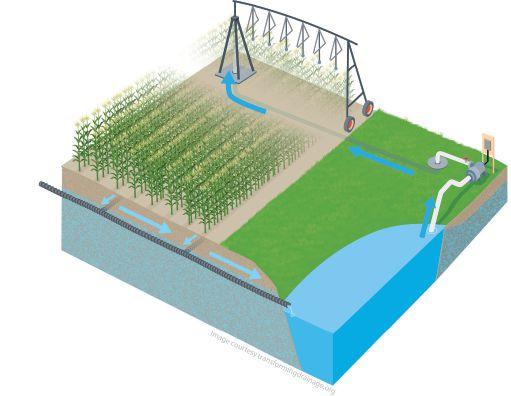
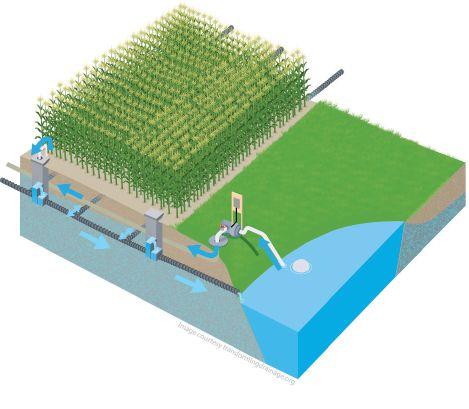
Drainage water can be recycled to any field, not just the field it originally came from, using on-farm irrigation (left) or through subirrigation (right), by flooding the subsurface drain tiles which artificially raises the water table up below a crop.
activities. But beyond those two times in a year, extensive drainage isn’t quite as necessary and could actually be very beneficial to growing crops.
“Not every tile system is designed for it ... but, when we do have drainage water management and when we can design it, we see about a 40 to 45 percent [nutrient loss] reduction annually. So that’s some success, and a way we can store more water on the field.”
Blind inlet installation is another way to reduce the amount of phosphorous leaving with the water in the field according to King. Having done a lot of research with King over the years, Mark Williams, a researcher with the USDA-ARS in West Lafayette, IN, agrees that blind inlets help to reduce not only the amount of sediment which leaves the field, but the amount of phosphorus too.
“In a normal year a reduction of 50 percent phosphorus is achievable,” he says, “and we’re hoping for even better control with steel slag.”
Replacing the limestone normally used in the construction of a blind inlet with steel slag is a relatively new concept Williams explains. While more research is necessary, the slag should prove effective in forming complexes that bind with phosphorus because of the high concentrations of calcium and iron that are contained in it. But he admits that it’s still too early to know just how much of an impact this has to offer. “Historically, we thought phosphorus wasn’t moving through the tile drains but in recent years we’ve learned that’s not true,” he says. “We need more research on tile drainage.”
Williams believes designing and installing tile drainage with nothing more than the idea of removing water as fast as possible
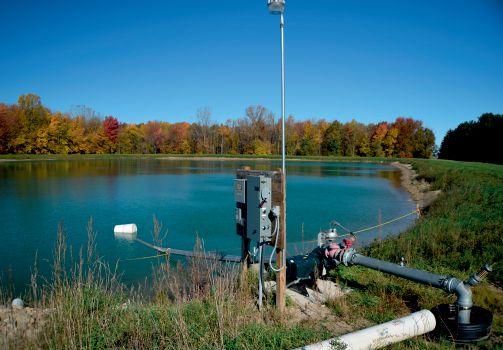
Drainage water recycling systems involve the diversion of excess surface and tile drainage water into onfarm ponds. As seen at this location in Michigan, one pump can accumulate a significant amount of water for use during the growing season. Photos courtesy of transformingdrainage.com.
will quickly become an outdated practice. “There’s not only the environmental impact of nutrient loading to consider,” he says, “there’s also a lot of change in how we can best use that drainage water whether that’s subsurface irrigation or other purposes.”
One of the researchers leading the way on drainage water management is Dr. Jane Frankenberger, a professor at Purdue University. In conjunction with 14 other researchers, she’s helping to evaluate the full impact of three major practices. She says they are looking at the use of saturated buffers, although more for their potential ability in reducing nitrogen losses than their impact on phosphorus. They are also closely investigating how controlled drainage will help nutrient losses and how the latest practice of drainage water recycling could improve things further. While water recycling practices seem new, the concept is actually rather old.
“The concept has been around for a long time but there is hardly anyone who has implemented it,” she says. “It was probably first done more than 30 years ago but what’s new [now] is, we are actively promoting it and researching it.”
Of course, taking land out of production for a drainage water collection pond is a bit of a mental hurdle for many farmers. Cost is undoubtedly a major barrier in adoption of water recycling practices Frankenberger explains. That’s why it is important to her that researchers continue the work they’ve started on trying to evaluate the economic impacts.
“Having water during the growing season can benefit the crops. If offers more benefits than most other practices,” she assures. “We are trying to get at how much benefit versus how much cost, so we can talk about the profitability, but we won’t have those numbers for another couple of years.”
Until conclusive evidence that drainage water recycling pays does emerge, King believes the best advice tile drainage contractors can offer farmers is to make sure their new tile installations can accommodate water management practices down the road. DC
ENVIRONMENT
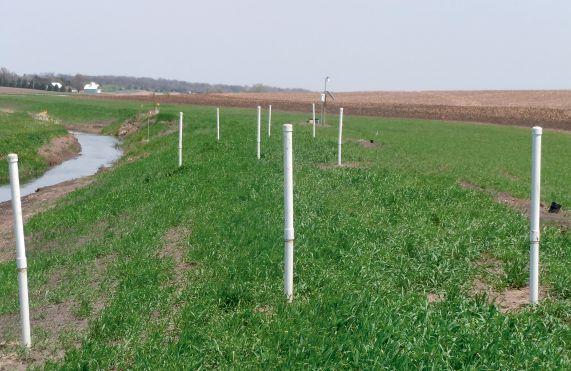
In conducting research on saturated buffers, several monitoring wells are installed (front) between the underground distribution pipe (as indicated by the control box in the background here) and the water leaving the buffer (left).
Photo courtesy of Kent Heikens, USDA-ARS.
that lack the additional space.
“We’re going to intercept the tile outlet within the buffer, put in a control box, and then use that to raise the water table within that outlet,” he explains. “Then we put in a new distribution pipe, just some perforated tile, which runs along the field edge of the buffer.”
The new distribution pipe is installed fairly shallow he says, preferably two-and-a-half feet below the ground surface, and this is what enables the water control box intercepting the tile flow to raise the water table up into the new distribution pipe so that pipe stays full and water leaks out into the buffer for maximum nitrate removal.
“If we have about a meter of relief, we can raise that water table in the buffer and we don’t impact the farmer’s drainage system at all,” he says, “and that’s what’s ideal, because once we put this in, the farmer doesn’t have to do anything, just go out once a year and make sure that no junk has filled the box. I think it is a real benefit for this practice.”
Jaynes says that the practice is most suited to soils with a lot of carbon in them, because it’s the carbon that is stimulating denitrification of the water while it seeps through the saturated buffer. Locations where the soil is very dark near waterways, (which is very typical in Iowa or Minnesota) needs to test positive for more than one percent carbon, as deep as three-or-four feet into the soil profile.
He also explains that it’s helpful when the buffer is lower than the field landscape, otherwise the rest of the tile drainage system will be impeded by artificially raising the water table with the control box. The last thing to consider is how far the new distribution tile can be run through the buffer.
“The longer you can extend that, the more nitrate you can remove,” he says. “And, typically, we run up against a property line we can’t go across.”
Jaynes says that in cases like this, start at zero grade and get shallower as you go downstream, or deeper as you go upstream. “Just don’t go any deeper than four feet or more
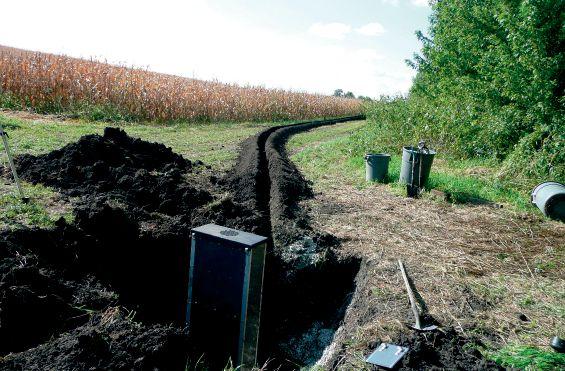
Installation of a saturated buffer can be accomplished even during the growing season. It’s very common to be able to complete the entire installation in no more than half a day.
courtesy of Dan Jaynes, USDA-ARS.
than a foot-and-a-half as you’re getting shallower.”
These are the best guidelines he can offer based on what the research shows so far. But Jayne says in observing more than 10 sites so far, these installations offer a lot of variable control.
“We measure what the nitrate concentration is in the outlet, and ideally if things are working properly, what we see is decreasing nitrate concentration as we go through our distribution pipe into the stream,” he explains. “In some buffers, it happens quickly within the first 10 feet or so, and all the nitrate is gone. In some of the others, you use that entire width of the buffer and you still don’t get removal of all the nitrate, but it does reduce it some.”
Recker says in his buffer, Jaynes has been able to track 100 percent elimination of nitrogen between the tile outlet and the water leaving the buffer. He knows that isn’t always going to be the case, but he’s pretty excited to see those results are achievable on his farm.
“I’ve done both the bioreactor with woodchips and I’ve installed three saturated buffers now,” he says. “The saturated buffer is a third of the cost, the time to install it is so much quicker, and the research shows that we’re getting better nitrogen removal.”
Typically, full installation takes about half-a-day and most of that time will be spent finding the outlet in the buffer if it’s not obvious. Once the new control box is in place, laying the new distribution pipe takes only a matter of minutes. Recker says that as farmers push for earlier planting seasons and work later into the fall, tiling work, which can be primarily done outside of a shrinking tile installation season, is good for landowners and tile drainage contractors alike.
“These kind of jobs, they’re not difficult jobs,” he says. “If we can find a practice that we can be working all summer long, and it has the benefits of nitrogen removal – hey, that’s a win-win for everybody.” DC
Photo
Quality Concrete Drain Tile
• Competitive prices
• Full inventory of 5" to 48" Concrete Drain Tile
• Concrete T’s, Intake Caps, Gates
TECH TIPS
between recorded data points from the as-installed data to appropriately align the datasets, rather than the previously used “approximate” constant travel interval spacing between data points. Additionally, the interpolation procedure adjusted the horizontal lateral displacement of the actual plow travel path from the straight-line drain path to the same X-Y coordinates for the ground survey data points.
In plotting the data from the re-tabulated table, the total distance traveled to any point along the drain line (section line) path was determined by summarizing the series of variable ground travel intervals for all data points to that point plotted in the drain line path.
• Fast delivery to your jobsite
The variable spaced “as-installed” drain elevation data points were plotted at the same variable intervals on the X-axis as the ground surface and drain design data points. This method of data processing and plotting provided a more accurate representation of reality and allowed for higher quality direct comparison and “match” between the “as-designed” elevation for the drain and the drain elevation “as-installed” at each variable interval of travel along the drain line path.
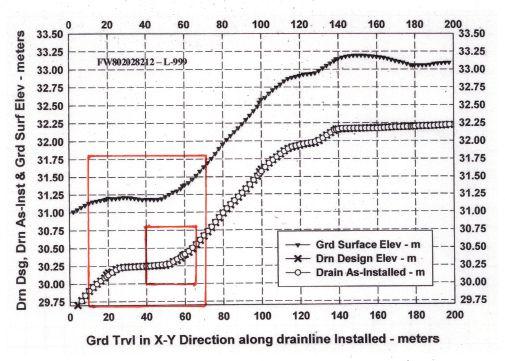
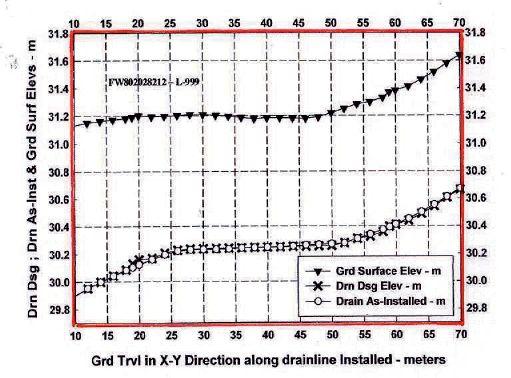
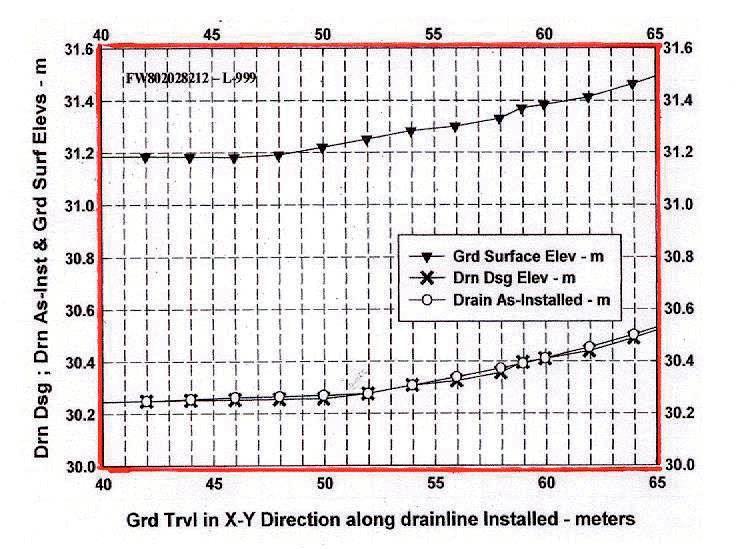
Three example graphs are presented here (Figs. 2, 2a & 2b) to illustrate that the RTK-GPS depth and grade-control system on the double-link inter-drain drainage plow did install the subsurface corrugated-wall plastic drain tubes very accurately at the design drain elevation for the entire length of the planned drain line. In the graph, the “as-installed” data points are mostly hidden behind the drain design elevation data points. Thus, as concluded in the first paper published in the ASABE International Drainage Symposium Proceedings on this RTK-GPS evaluation technology for this double-link drainage plow, the data file recorded by the plow-blade mounted RTK-GPS sensor is satisfactory for documenting the installation depth and grade for the drains and the data file can be provided to the farmer for his installed subsurface drainage system records.
To quantify the accuracy of the drain installation with the RTK-GPS controlled double-link drainage plow, the difference between the drain “installed” elevation and the “design” elevation for the drain tube was tabulated for each variable interval data
Figure 2
point along the drain line plotted in the Fig. 2 graph. The tabulated design and installed elevation difference values were averaged, and then the standard deviation was computed for the difference at each variably spaced data point of the design elevation and the installed elevation for the drain length section shown in the graphic plot.
For drain line L-999, the average elevation difference was 0.00372 meter, meaning that the drain design elevation was on average 0.00372 meter deeper (or lower) in the soil profile than the installed drain elevation.
The standard deviation of the difference between the drain design and installed elevations was 0.0091 meter for drain line L-999. Although not illustrated here, very similar results were obtained for the analysis of installation accuracy of other drain lines installed in the field.
We recommend this type of field evaluation of drain installation quality be conducted for other drain-plow models, and giving attention to ground travel speeds and different linkage systems for the attached pipe-feeder “boot.” Further, we recommend publication of the installation accuracy evaluation results by the plow manufacturer or the contractor. DC
Figure 2a
Figure 2b
NEW PRODUCTS
PERFORM ROTARY DITCHING WITH DITCH DOCTOR
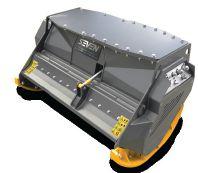
The Ditch Doctor rotary attachment is used to create, restore and maintain efficient ditches, and is gentle on the environment. The attachment is used with a hydraulic excavator as a faster and more cost effective alternative to the conventional ditching method of bucket and excavator. One of the major benefits of the Ditch Doctor method is that the spoil is self-leveling so there is no need for any additional handling of the spoil. It produces an immediately viable ditch requiring less maintenance once established and significantly reduces the impact on the local environment. The vegetation on the slope of the ditch is not disturbed preventing erosion of the evenly distributed spoil back into the ditch. The Ditch Doctor method can also create a two stage ditch and work in up to three feet of water. For more information, visit ditchdoctor.ca
NEW FLEXIBLE DUAL-WALL PIPE AVAILABLE
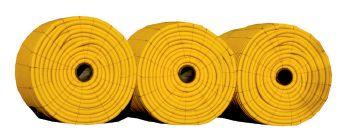
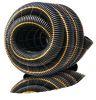
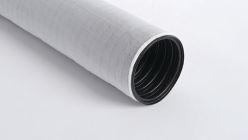
Prinsco, Inc. introduces GOLDFLEX, a flexible dual-wall pipe that pairs the performance of traditional
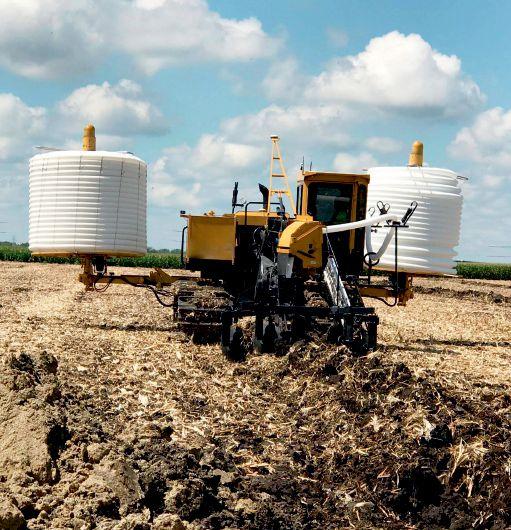
dual-wall sticks with the installation ease of single-wall coils. The dual-wall pipe is designed for high performance drainage mains and installs up to 60 percent faster than traditional sticks. It comes in coils up to 290 feet and can be plowed in using a customized plow boot. This eliminates the need to trench, place and join dual-wall sticks, making installation much safer, faster and more cost effective. The benefit to farmers is less soil compaction, shorter installation timelines and a faster entry into the fields. The ability to plow in mains also makes GOLDFLEX ideal for high water table areas where trenching isn’t possible.
For more information, visit prinsco.com
FRATCO RELEASES FLEXCORR
FlexCorr is a solution to one of the biggest problems in the drainage industry. FlexCorr functions as a “main” and comes spooled and ready for modern automated installation. It promises to shave days off installation, decreasing costs, and allowing installers to keep up with demand. The lower-density, flexible inner liner performs better in longterm stress crack resistance and cold temperature brittleness tests required by ASTM. Currently, Fratco is initially offering the pipe in a variety of sizes (8” to 15” in diameter) and styles (plain, perforated, and narrow slot), which are compatible with current fittings.
For more information, visit fratco.com
AGRI DRAIN INTRODUCES TWO NEW PRODUCTS
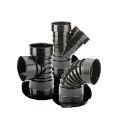
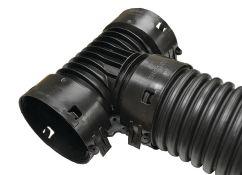
The EZTee is a rugged-built tile tee, made of injection
molded HDPE, that lays flat, then snaps together over the pipe like a clamshell. Integrated fasteners and internal tabs ensure a secure connection to corrugated plastic pipe. Snap the EZTee together and push the pipe through, or simply lay the tee under the pipe and snap together. EZTee’s stackable design saves space and shipping costs vs. standard bagged tees! EZTees comply with ASTM F 405-13 & AASHTO M 252-09 standards.
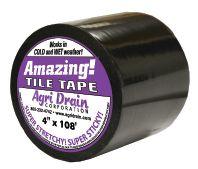
Amazing Tile Tape now comes in 4” wide x 108’ long rolls, saving time by covering more on each pass. Amazing Tile Tape makes watertight junctions and connections. Unlike other tapes on the market, it has amazing grip and stretching capabilities, making it the best in the industry. Amazing Tile Tape can be used in a variety of applications, including field
tiling, marine, plumbing, automotive, and maintenance. For more information on these products, visit agridrain.com
TIMEWELL DRAINAGE PRODUCTS LAUNCHES NEW COILED DUAL WALL
Timewell Drainage Products has announce the introduction of MaxFlex Coiled Dual Wall in 6” through 12”. MaxFlex will enable customers the ability to more efficiently install a higher capacity main or sub main right behind their plow or trencher. Safety, capacity and ease of installation were key drivers in the development of the MaxFlex line. The company notes it can decrease installation and labor time by 50 percent or more. As a new product for many, Timewell recommends a review of all company installation and handling instructions. Key considerations for plow installations include: shatter plate width, burial depth, chute design and final support groove.
For more information, visit timewellpipe.com
Double Link Tile Plows
Surface Water Intakes
8” & 10”
patented 8" & 10" combination Tees. Also 6” square & round risers with patented reducing Tee.
• Constructed of heavy-weight, high-density polyethylene.
• Parts highly adjustable & interchangeable with others on the market
• Orifice plate placed at tee level or at ground level.
•
•
• OH LICA Jan 3-5, Dublin
• MN LICA Jan 4-5, New Ulm
• IA LICA Jan 7-9, Des Moines
• NY LICA Jan 9-11, Geneva
• IL LICA Jan 12-14, East Peoria
• SD LICA Jan 15-17, Deadwood
• NE LICA Jan 16-18, Kearney
• IN LICA Jan 24-26, Indianapolis
• MO LICA Jan 25-27, Springfield
BUSINESS
“Then, if the farm is sold, the new landowner may be purchasing a farm with a defective drainage system.”
But the reason for the Act needs to be clarified to all stakeholders, says Robert Hall, who’s on the board at LICO. Hall says that until a recent meeting where the subject came up, he and some of the younger contractors had always been under the impression that the program existed to protect contractors and make sure there was a standard for the quality of the workmanship.
“The contractors talk at the meetings about how the program isn’t protecting them from unlicensed contractors doing work, but the mandate is to protect farmers,” he says.
In recent years, there’s been an uptick in farmers purchasing unlicensed tractor-mounted plows that aren’t designed to meet performance standards in order to install their own tile.
Turvey says this is creating resentment in the contracting community, for several reasons. First, the equipment isn’t up to snuff: “It’s the difference between a shovel and an excavator,” he says. “This equipment works for random tiling but not real-world systematic drainage.”
Second, a growing number of farmers are using the equipment to install tile on their neighbor’s land, and a lack of enforcement means these operators are getting away with breaking the law. Fines are as low as $500 per infraction, says Turvey, but as far as he knows nobody has ever been fined.
So far, “there’s no way [for OMAFRA] to convict someone unless they catch them in the act. There aren’t enough people to enforce it and by the time they get to the job site it could be two weeks too late,” he says.
Turvey says fines need to be updated so farmers are deterred from purchasing unlicensable machines for doing custom work. But he believes the best way to protect farmers is to close all the loopholes in the law that allow unlicensed operators to install tile on anyone else’s land. “The contractors feel they’ve done everything they should do to get their licenses, but people who aren’t licensed are able to install tile at will,” he says. “They’re doing a disservice to the farmers by not enforcing the laws.”
Cronsberry echoes this. “I think we need to have a licensing system where anybody putting in tile has a license,” he says. “All of the unlicensed pull-behind equipment and installers should be licensed, so that everything is being installed properly. Everybody thinks that just putting tile in the ground means you’ll get good drainage, but there’s a science to it.” DC
DON’T MISS THE 60TH ANNUAL LICO CONVENTION, TAKING PLACE JANUARY 22-25, 2018 IN LONDON, ONT. PLUS the 2018 Contractor Courses have been announced. Sign up today at https://bdc.ridgetownc.com: Primary Drainage Course, Jan 8-12 Advanced Drainage Course, Feb 5-15 Agricultural Erosion Control Structures Course, Feb 26-Mar 2
BUSINESS DIRECTORY
A conversation about soil
by Rob Burtonshaw
I can’t think of many things more underappreciated than soil. The earth below our feet is vital for life: the vast majority of our food depends upon it and without it humanity would end. Yet how many people make that association? For example, the vitality of oxygen and water is embedded in our minds as essential to life.
Soil by comparison is overlooked and often denigrated. This is true of the general public, but also farmers, and I’m convinced that part of our job as drainage contractors is to remind anyone who cares to listen of the importance of soil and the level of water in that soil. As soil health becomes more important, drainage needs to be part of that conversation.
It doesn’t matter what sector of agriculture you operate in, the basics of farming are the same: increase yields, protect crops, and protect and encourage soils. Managing water levels in the soil falls into the last of these principles and I suspect that all contractors see the effect drainage has. Waterlogged soils can’t produce strong healthy crops.
Excess water fills all the gaps and cavities in the soil forcing out oxygen and creating anaerobic conditions. Crops cannot thrive and yield is low. The solution is pipe in the ground, a man-made exit of the excess water. Soils are a natural ecosystem: dynamic, complicated and varied.
There are many different ways to achieve good drainage, and when picking the right method, one of the primary considerations is the soil type.
I often think that here in the U.K. we get the raw end of the deal. I know I’m wrong, but the grass is often greener on the other side of the fence and the temptation to whinge is sometimes too strong to restrain. Our soils, here in sunny Warwickshire, roughly in the middle of green and pleasant England, are
heavy, sticky clays.
Our offices are on the site of a former Brickworks and if I wanted to make some traditional red bricks, the raw material is pretty close. Add to this the British weather, which I suspect all will know, has a tendency to vary from drizzle to rain – the water that falls tends to take its time to soak into the soil. More often than not a British contractor is trying to remove water from the surface or close to the surface on top of clay soils, this means a stone backfill on top of the drains and often some form of secondary drainage, such as mole ploughing or subsoiling.
Compare this to the Netherlands where most soil types are extremely light. In England, we have another word for the type of soil so fruitfully farmed by the Dutch – sand. There is no need for a stone fill, the soil itself can do the job and the water permeates the soil quickly and easily.
Normally Dutch contractors are controlling the water table and trying to prevent ground water from rising too high in the soil profile. However, before I start to daydream about emigrating to the Netherlands freeing myself from my clay quagmire, light soils have different problems. The large particle sizes found in sandy soils move more freely and then often fall gently to the bottom of pipework in drains with a shallow gradient. Dutch drains need jet washing each year and even with such maintenance they do not last long. Sometimes deeper sacrificial drains are required, to allow the junction to be installed in the dry, pumped outlets are common.
Contractors in the Netherlands and in the U.K. area trying to achieve the same goal, using the same tool, but using that tool in different ways because of the nature of the soil. The soil and its characteristics are the boss, we have to follow its lead. I will embrace it, celebrate it and promote it. I guess its starts here. DC